EP3608836B1 - Verfahren zum erfassen eines fingerabdruck-bilds - Google Patents
Verfahren zum erfassen eines fingerabdruck-bilds Download PDFInfo
- Publication number
- EP3608836B1 EP3608836B1 EP19189803.0A EP19189803A EP3608836B1 EP 3608836 B1 EP3608836 B1 EP 3608836B1 EP 19189803 A EP19189803 A EP 19189803A EP 3608836 B1 EP3608836 B1 EP 3608836B1
- Authority
- EP
- European Patent Office
- Prior art keywords
- image
- region
- segmented
- segmented image
- acquired
- Prior art date
- Legal status (The legal status is an assumption and is not a legal conclusion. Google has not performed a legal analysis and makes no representation as to the accuracy of the status listed.)
- Active
Links
Images

Classifications
-
- G—PHYSICS
- G06—COMPUTING OR CALCULATING; COUNTING
- G06V—IMAGE OR VIDEO RECOGNITION OR UNDERSTANDING
- G06V40/00—Recognition of biometric, human-related or animal-related patterns in image or video data
- G06V40/10—Human or animal bodies, e.g. vehicle occupants or pedestrians; Body parts, e.g. hands
- G06V40/12—Fingerprints or palmprints
- G06V40/1335—Combining adjacent partial images (e.g. slices) to create a composite input or reference pattern; Tracking a sweeping finger movement
-
- G—PHYSICS
- G06—COMPUTING OR CALCULATING; COUNTING
- G06V—IMAGE OR VIDEO RECOGNITION OR UNDERSTANDING
- G06V10/00—Arrangements for image or video recognition or understanding
- G06V10/20—Image preprocessing
- G06V10/25—Determination of region of interest [ROI] or a volume of interest [VOI]
-
- G—PHYSICS
- G06—COMPUTING OR CALCULATING; COUNTING
- G06V—IMAGE OR VIDEO RECOGNITION OR UNDERSTANDING
- G06V10/00—Arrangements for image or video recognition or understanding
- G06V10/20—Image preprocessing
- G06V10/26—Segmentation of patterns in the image field; Cutting or merging of image elements to establish the pattern region, e.g. clustering-based techniques; Detection of occlusion
-
- G—PHYSICS
- G06—COMPUTING OR CALCULATING; COUNTING
- G06V—IMAGE OR VIDEO RECOGNITION OR UNDERSTANDING
- G06V40/00—Recognition of biometric, human-related or animal-related patterns in image or video data
- G06V40/10—Human or animal bodies, e.g. vehicle occupants or pedestrians; Body parts, e.g. hands
- G06V40/12—Fingerprints or palmprints
- G06V40/13—Sensors therefor
- G06V40/1324—Sensors therefor by using geometrical optics, e.g. using prisms
-
- G—PHYSICS
- G06—COMPUTING OR CALCULATING; COUNTING
- G06V—IMAGE OR VIDEO RECOGNITION OR UNDERSTANDING
- G06V40/00—Recognition of biometric, human-related or animal-related patterns in image or video data
- G06V40/10—Human or animal bodies, e.g. vehicle occupants or pedestrians; Body parts, e.g. hands
- G06V40/12—Fingerprints or palmprints
- G06V40/1365—Matching; Classification
Definitions
- the invention relates to a method for obtaining an image of at least one fingerprint from a plurality of images acquired by an image sensor of a fingerprint capture system and a device for implementing the image. implement the process.
- fingerprints for example of the fingerprint type, of a plurality of fingers, of a palm of a hand, makes it possible to secure access to buildings or to machines. Using this technology increases security as the probability that two people have two identical fingerprints is almost zero.
- a fingerprint capture system makes it possible to obtain at least one image of at least one fingerprint.
- each fingerprint is compared with a set of reference fingerprints contained in a database.
- each fingerprint is compared to a single fingerprint. The comparison makes it possible to determine whether or not each obtained fingerprint belongs to a person referenced in the database or if the person is indeed who he claims to be.
- Some fingerprint capture systems capture a sequence of fingerprint images. This is particularly the case with certain contact fingerprint capture systems which are not configured to ensure stability of the finger (s) in front of the image sensor or not configured so that each finger is pressed. in the same way and at the same time on the fingerprint capture system. This is also the case with contactless fingerprint capture systems in front of which the finger (s) are passed without any finger touching said system.
- each finger is moving in front of the image sensor.
- This type of image capture system then uses a process for obtaining images making it possible to obtain a final image from the images of the sequence. The final image corresponds either to the image of the sequence best representing each fingerprint, or to portions of images of the sequence, each portion best representing a fingerprint.
- image sensors such as image sensors of the CCD type (charge-coupled device, in English terminology. ) or CMOS (complementary metal-oxide semiconductor, “complementary metal-oxide-semiconductor” in English terminology).
- CCD charge-coupled device
- CMOS complementary metal-oxide semiconductor
- TCM sensors TCM sensors
- the images acquired by an image sensor have different properties depending on the type of image sensor used.
- an optical sensor has a lower image acquisition frequency than a TCM sensor.
- the images acquired by an optical sensor because of their longer acquisition time, are of higher quality than the images acquired by a TCM sensor.
- the methods for obtaining images used by the fingerprint capture systems capturing a sequence of fingerprint images are generally adapted to the characteristics of the image sensor used by said system. These methods are in particular adapted to the image acquisition frequency of these sensors. Thus, a method intended to operate with images supplied by an optical sensor (respectively a TCM sensor) cannot function correctly with images supplied by a TCM sensor (respectively an optical sensor).
- WO2018 / 106987A1 describes tracking the fingerprints of a hand in a sequence of images and assigning a trust score.
- the invention relates to a method making it possible to obtain an image of at least one fingerprint from a sequence of images acquired by an image sensor of a capture system. of fingerprints making image acquisitions with a predefined image acquisition frequency dependent on said image sensor.
- the method comprises: obtaining an image, called a first segmented image, resulting from an application of an image segmentation method on a first acquired image, said segmentation method being adapted to identify regions corresponding to fingerprints in an image; for each acquired image, called second acquired image, following the first acquired image, apply a processing comprising: obtaining an image, called second segmented image, resulting from an application of the image segmentation process to the second acquired image; applying a region tracking method to the regions identified in each segmented image from the first segmented image to the second segmented image; determining a confidence score for each region identified, the confidence score of a region of the second segmented image associated with a region of a previous segmented image being a sum between the confidence score of said region of the previous image and an increment depending on the predefined image acquisition frequency, and the confidence score of a region identified in at least one segmented image preceding the second segmented image but having no corresponding region in the second segmented image being a difference between the confidence score of said region of the
- the method therefore makes it possible to adapt the evolution of the confidence score of each region as a function of the image acquisition frequency.
- the method for obtaining an image is suitable for any type of image sensor.
- the confidence score of a region detected in a previous segmented image increases when said region is detected in the second segmented image and decreases when said region is not detected in the second segmented image.
- determining that the new region corresponds to a region found in a previous segmented image, called an existing region if a criterion representative of a correlation between the new region and at least one existing region is met.
- the region tracking method does not make it possible to track a region detected in a previous segmented image in the second segmented image, it is possible to determine by an alternative method whether this region is present in the second segmented image.
- the criterion representative of a correlation between a new region and an existing region is a function of a ratio between an area of an intersection between the existing region and the new region and a minimum area value between the area of the new region and the area of the existing region and / or a function of a distance between a center of gravity of the new region and a center of gravity of the existing region.
- the duration since the acquisition of the first acquired image is greater than the predetermined duration, terminate the image acquisitions and generate information making it possible to generate an image comprising a number of areas of acquired images. at most equal to the second predetermined threshold, each zone corresponding to a region identified in the images segmented from the first segmented image to the second segmented image, each region used to define an area having a confidence score greater than the confidence scores of the zones not used to define a zone.
- the method has a maximum duration, which makes it possible to avoid that a user remains too long in front of the fingerprint capture system.
- the method nevertheless makes it possible to obtain information making it possible to generate an image, even if certain regions used to define a zone of this image have an insufficient confidence score.
- each increment is inversely proportional to the predefined image acquisition frequency.
- the confidence score of a region resulting from a sensor having a low acquisition frequency evolves faster than the confidence score of a region resulting from a sensor having a higher acquisition frequency.
- the number of images necessary to generate information making it possible to obtain an image comprising, for each admissible region, an area of an acquired image corresponding to the admissible region is therefore smaller when the image sensor used has an image acquisition frequency lower than when the image sensor used has a higher image acquisition frequency.
- the invention relates to a device making it possible to obtain an image of at least one fingerprint from a sequence of images acquired by an image sensor of a capture system. of fingerprints making image acquisitions with a predefined image acquisition frequency dependent on said image sensor.
- the device comprises: obtaining means for obtaining an image, called a first segmented image, resulting from an application of an image segmentation method on a first acquired image, said segmentation method being adapted to identify corresponding regions to footprints in an image; obtaining means for obtaining at least one image, called second segmented image, resulting from an application of the image segmentation method to at least one image acquired according to the first image acquired, called second image acquired; processing means for applying a region tracking method to the regions identified in each segmented image from the first segmented image to the second segmented image; processing means for determining a confidence score for each identified region, the confidence score of a region of the second segmented image associated with a region of a previous segmented image being a sum between the confidence score of said region of the previous image and an increment depending on the predefined image acquisition frequency, and the confidence score of a region identified in at least one segmented image preceding the second segmented image but having no corresponding region in the second segmented image being a difference between the confidence score
- the invention relates to a system comprising a device according to the second aspect.
- the invention relates to a computer program, comprising instructions for implementing, by a device, the method according to the first aspect, when said program is executed by a processor of said device.
- the invention relates to storage means, storing a computer program comprising instructions for implementing, by a device, the method according to the first aspect, when said program is executed by a processor of said device.
- the method of the invention is described in a context where a contact fingerprint capture system using a TCM sensor acquires images of a plurality of fingers.
- the method is however adapted to operate with a contact fingerprint capture system using an optical sensor or a non-contact fingerprint capture system using an optical sensor or TCM sensor.
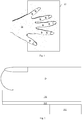
- the Fig. 1 schematically describes an example of a fingerprint capture system using the method according to the invention.
- a plurality of fingers of a hand M is placed on a fingerprint capture system 10.
- the Fig. 2 schematically illustrates in detail the fingerprint capture system 10.
- the fingerprint capture system 10 comprises a transparent blade 100 comprising an upper face on which the plurality of fingers are placed, of which only one finger D is shown in the figure. Fig. 2 .
- the fingerprint capture system 10 Located below the transparent slide 100 and glued to the underside of said slide, the fingerprint capture system 10 comprises a TCM 101 sensor.
- the TCM 101 sensor is positioned so as to generate an image of the plurality of fingers.
- the fingerprint capture system 10 further comprises a processing module 102.
- the Fig. 3 schematically illustrates an example of the hardware architecture of the processing module 102.
- the processing module 102 then comprises, connected by a communication bus 1020: a processor or CPU (“Central Processing Unit” in English) 1021; a random access memory RAM (“Random Access Memory” in English) 1022; a ROM read only memory 1023; a storage unit such as a hard disk or a storage medium reader, such as an SD (“Secure Digital”) 1024 card reader; at least one communication interface 1025 allowing the processing module 102 to receive the images acquired by the image sensor 101.
- a communication bus 1020 a processor or CPU (“Central Processing Unit” in English) 1021; a random access memory RAM (“Random Access Memory” in English) 1022; a ROM read only memory 1023; a storage unit such as a hard disk or a storage medium reader, such as an SD (“Secure Digital”) 1024 card reader; at least one communication interface 1025 allowing the processing module 102 to receive the images acquired by the image sensor 101.
- a communication bus 1020 a processor or CPU (“Central Processing Unit” in English) 1021
- Processor 1021 is capable of executing instructions loaded into RAM 1022 from ROM 1023, external memory (not shown), storage media (such as an SD card), or a communication network. When processing module 102 is powered on, processor 1021 is able to read instructions from RAM 1022 and execute them. These instructions form a computer program causing the implementation, by the processor 1021, of the method described in relation to the Fig. 4 .
- the process described in relation to the Fig. 4 can be implemented in software form by executing a set of instructions by a programmable machine, for example a DSP (“Digital Signal Processor”), a microcontroller or a GPU (graphics processor, “Graphics Processing Unit” in terminology Anglo-Saxon), or be implemented in hardware form by a machine or a dedicated component, for example an FPGA (“Field-Programmable Gate Array”) or an ASIC (“Application-Specific Integrated Circuit”).
- a programmable machine for example a DSP (“Digital Signal Processor”), a microcontroller or a GPU (graphics processor, “Graphics Processing Unit” in terminology Anglo-Saxon), or be implemented in hardware form by a machine or a dedicated component, for example an FPGA (“Field-Programmable Gate Array”) or an ASIC (“Application-Specific Integrated Circuit”).
- the Fig. 4 schematically illustrates an example of a method for obtaining images according to the invention.
- the image sensor 101 makes image acquisitions with a predefined image acquisition frequency F.
- a user wishes to be identified or authenticated, he applies a plurality of fingers to the upper face of the transparent blade 100.
- a triggering device not shown in FIG. Fig. 2 then triggers an acquisition of a sequence of images.
- the trigger device is, for example, a button that the user presses when he puts his hand on the upper face of the transparent slide 100 or a photoelectric cell which triggers the acquisition of the sequence of images when a presence at least one finger is detected on said upper face.
- the trigger device starts a timer which measures a duration d since the acquisition of the first image of a sequence of images.
- each segmented image supplied by the image sensor, and therefore the first segmented image represents each region identified by the segmentation process in the form of a mask, each pixel of a mask being represented by a same value different from a value assigned to the background pixels of the segmented image.
- the segmented image is a grayscale image where each pixel is coded on “8” bits between “0” and “255”
- each pixel of the background of the segmented image is for example associated with the value “ 0 "
- each pixel in a region is associated with the value" 200 ".
- the pixels of two distinct regions are associated with different values.
- the processing module 102 obtains an image, called a second segmented image, resulting from an application of the image segmentation method to a second image, called a second acquired image, according to the first acquired image.
- the processing module 102 applies a region tracking method to the regions identified in each segmented image from the first segmented image to the second segmented image.
- a region tracking method As we can read in the document “A. Yilmaz, O. Javed and M. Shah,“ Object tracking: a survey ”, ACM computing Surveys, Vol. 38, 2006 ” the literature abounds in object tracking methods ( ie tracking regions).
- the processing module 102 applies a method based on Kalman filtering. Kalman filtering is described in the document “RE Kalman, A new approach for linear filtering and prediction problems, journal of basic engineering, vol. 82, 1960, P. 33-45 " .
- the processing module uses a method described in the document “N.
- the processing module applies a method based on a descent of gradients described in the document "M. Bertalmio, G. Sapiro, G.
- Region tracking determines, among the regions identified in the second segmented image, which regions have a corresponding region in one or more previous segmented images of the image sequence.
- Certain regions can thus be followed over the whole sequence from the first segmented image to the second segmented image, others may appear only in certain images. This is for example the case when a finger is not pressed on the upper face of the transparent slide 100 with equal force during the acquisition of the images of the sequence.
- Step 43 for each region of the second segmented image having no corresponding region in a previous segmented image, called a new region, the processing module determines that the new region corresponds to a region found in a previous segmented image , said existing region, if a criterion representative of a correlation between the new region and at least one existing region is met. Step 43 therefore addresses any defects in the region tracking method. Indeed, regions of the second segmented image which would not have been associated with previous segmented image regions by the region tracking method can still be associated with previous segmented image regions.
- the processing module considers that the existing region is present in the second segmented image. It is therefore as if the existing region had been tracked by the region tracking method in the second segmented image.
- the processing module 102 considers that the new region corresponds to the existing region.
- C1 0.5, that is to say that the two regions must have at least 50% of area in common to be matched.
- a measure of correlation between a new region and an existing region is a function of a distance c2 between a center of gravity of the new region and a center of gravity of the existing region.
- the processing module 102 considers that the new region corresponds to the existing region.
- the distance threshold C2 10 pixels.
- the processing module 102 uses an overall measurement CG taking into account the ratio c1 and the distance c2 .
- the processing module 102 considers that the new region corresponds to the existing region.
- Step 43 makes it possible to process cases where the same finger is segmented with one, two or three phalanges depending on the images.
- the region tracking method then has difficulty tracking even though it is the same finger.
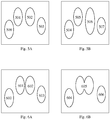
- Figs. 5A and 5B schematically illustrate a first case where a region tracking method might fail when matching regions.
- the Fig. 5A illustrates a first segmented image in which four regions have been detected by the segmentation process.
- the Fig. 5B illustrates a second segmented image directly following the first segmented image in which four regions have also been detected by the segmentation process.
- the region tracking method is capable of mapping region 500 to region 504, the region 501 with the region 505 and the region 503 with the region 507.
- the region tracking method is not capable of associating the region 502 with the region 506 because these two regions, although corresponding on the same finger, are very different.
- the region 506 in fact corresponds to two phalanges of the finger while the region 502 corresponds only to one phalanx. In this case, step 43 allows region 506 to be associated with region 502. Region 502 is then considered to be present in the second image.
- Figs. 6A and 6B schematically illustrate a second case where a region tracking method might fail when matching regions.
- the Fig. 6A illustrates a third segmented image in which four regions have been detected by the segmentation process.
- the Fig. 6B illustrates a fourth segmented image directly following the third segmented image. Only three regions were detected in the fourth image.
- the tracking method is able to map region 600 to region 604 and region 603 to region 606. But the tracking method is not able to map regions 601 and 602 to region 605. This problem occurs when two fingers are very close and their proximity induces the segmentation process in error since it does not know in this case whether it is dealing with one or two regions.
- step 43 makes it possible to associate region 605 with both region 601 and region 602. Regions 601 and 602 are then considered to be present in the fourth image.
- Step 42, or step 43 when executed, is followed by step 45.
- the processing module 102 determines a confidence score ⁇ curr for each region identified in each segmented image, the confidence score ⁇ curr for a region of the second segmented image (ie the segmented image current) associated with a region of a previous segmented image being a sum between the confidence score of said region of the previous image ⁇ pre and of a first increment ⁇ 1 ( F ) depending on the image acquisition frequency predefined F.
- ⁇ curr ⁇ pre + ⁇ 1 F
- the first increment is a decreasing function of the predefined image acquisition frequency F.
- ⁇ 1 F K 1 F
- K1 is a constant, for example equal to "2".
- step 45 the note of confidence ⁇ curr an identified region in at least one previous segmented image but having no corresponding region in the second segmented image (i. E. The current segmented image) , is a difference between the confidence score of said region of the previous image ⁇ pre and of a second increment ⁇ 2 ( F ) depending on the predefined image acquisition frequency F.
- ⁇ curr ⁇ pre - ⁇ 2 F
- the second increment is also a decreasing function of the predefined image acquisition frequency F.
- ⁇ 2 F K 2 F
- K2 is a constant, for example equal to “1”.
- a region which is present in each image of the sequence sees its rating increase more rapidly than a region which does not appear in certain images of the sequence.
- the confidence score of said new region is initialized at zero when this region is identified by the segmentation process.
- the processing module 102 determines a number N of regions, called admissible regions, identified in the segmented images from the first segmented image to the second segmented image ( ie current segmented image) having a higher confidence score. at a predetermined confidence threshold S1 .
- the predetermined confidence threshold S1 is equal to “1.5”.
- the processing module 102 compares the number of admissible regions N with a predetermined number of regions S2. When the number of admissible regions N is equal to the predetermined number of regions S2, the processing module 102 terminates the image acquisitions and generates information making it possible to obtain an image, called the final image, comprising, for each admissible region, a zone of an acquired image corresponding to the admissible region during a step 49. In one embodiment, the information generated is directly the final image. To generate the final image, the processing module 102 determines in which segmented image each of the S2 regions has obtained a maximum confidence score.
- the processing module 102 extracts from the acquired image corresponding to the segmented image, the pixels located in an area corresponding spatially to the region of the segmented image and inserts them into the final image at the same position. Pixels in the final image that do not correspond to a region are set to a preset value. The final image therefore represents fingerprints on a uniform background.
- the information generated comprises information representative of a set of pointers indicating for each pixel to be used to generate the final image, the acquired image in which to fetch said pixel and the position of said pixel in said pixel. image acquired.
- the processing module 102 compares the duration d since the acquisition of the first acquired image with a predetermined duration D corresponding to a maximum acquisition time.
- the predetermined duration D corresponds to a maximum time during which a user must leave his hand in the fingerprint capture system 10. In one embodiment, the predetermined duration D is “2” seconds. If the duration d is less than or equal to the predetermined duration D, the processing module 102 returns to step 41 during which it obtains a new second segmented image.
- the processing module 102 ends the image acquisitions and generates a final image with the regions that it has at its disposal.
- the final image then comprises a number of zones at most equal to the predetermined number of regions S2 , each zone corresponding to a region identified in the images segmented from the first segmented image to the second segmented image, each region used to define a zone having a higher confidence score than the confidence scores of the zones not used to define a zone.
- the processing module chooses a maximum of regions among the regions identified in the segmented images, without exceeding the predetermined number of regions S2.
- the chosen regions are the regions identified in the segmented images associated with the highest confidence scores. Among these selected regions, some regions may have a confidence score greater than the S1 confidence threshold, and others, a confidence score less than the S1 confidence threshold.
Landscapes
- Engineering & Computer Science (AREA)
- Physics & Mathematics (AREA)
- General Physics & Mathematics (AREA)
- Multimedia (AREA)
- Theoretical Computer Science (AREA)
- Human Computer Interaction (AREA)
- Optics & Photonics (AREA)
- Image Input (AREA)
- Collating Specific Patterns (AREA)
Claims (10)
- Verfahren zum Erhalt eines Bilds mindestens eines Fingerabdrucks anhand einer Sequenz von Bildern, die von einem Bildsensor eines Fingerabdruckerfassungssystems (10) aufgenommen werden, der Bildaufnahmen mit einer vorgegebenen Bildaufnahmefrequenz vornimmt, die von dem Bildsensor abhängig ist, dadurch gekennzeichnet, dass das Verfahren Folgendes umfasst:Erhalten (40) eines Bilds, erstes segmentiertes Bild genannt, das aus einer Anwendung eines Bildsegmentierungsverfahrens auf ein erstes aufgenommenes Bild hervorgeht, wobei das Segmentierungsverfahren geeignet ist, Gebiete zu identifizieren, die Abdrücken in einem Bild entsprechen;für jedes aufgenommene Bild, zweites aufgenommenes Bild genannt, das auf das erste aufgenommene Bild folgt, Anwenden einer Verarbeitung umfassend:Erhalten (41) eines Bilds, zweites segmentiertes Bild genannt, das aus einer Anwendung des Bildsegmentierungsverfahrens auf das zweite aufgenommene Bild hervorgeht;Anwenden (42) eines Verfahrens zur Verfolgung von Gebieten auf die identifizierten Gebiete in jedem segmentierten Bild vom ersten segmentierten Bild bis zum zweiten segmentierten Bild;Bestimmen (45) einer Vertrauensnote für jedes identifizierte Gebiet, wobei die Vertrauensnote eines Gebiets des zweiten segmentierten Bilds, das einem Gebiet eines vorausgehenden segmentierten Bilds zugeordnet ist, eine Summe zwischen der Vertrauensnote des Gebiets des vorausgehenden Bilds und einem Inkrement ist, das von der vorgegebenen Bildaufnahmefrequenz abhängig ist, und die Vertrauensnote eines identifizierten Gebiets in mindestens einem segmentierten Bild, das dem zweiten segmentierten Bild vorausgeht, jedoch kein entsprechendes Gebiet im zweiten segmentierten Bild aufweist, eine Differenz zwischen der Vertrauensnote des Gebiets des vorausgehenden segmentierten Bilds und einem zweiten Inkrement ist, das von der vorgegebenen Bildaufnahmefrequenz abhängig ist; und,Bestimmen (46) einer Anzahl von Gebieten, zulässige Gebiete genannt, die in den segmentierten Bildern identifiziert werden, vom ersten segmentierten Bild bis zum zweiten segmentierten Bild, die eine Vertrauensnote über einer ersten vorbestimmten Schwelle aufweisen; und,wenn die Anzahl von zulässigen Gebieten gleich einer zweiten vorbestimmten Schwelle ist, Beenden der Bilderfassungen und Erzeugen einer Information, die es gestattet, ein Bild zu erhalten, das für jedes zulässige Gebiet einen Bereich eines aufgenommenen Bilds umfasst, der dem zulässigen Gebiet entspricht.
- Verfahren nach Anspruch 1, dadurch gekennzeichnet, dass für jedes Gebiet des zweiten segmentierten Bilds, das kein entsprechendes Gebiet in einem vorausgehenden segmentierten Bild aufweist, neues Gebiet genannt, Bestimmen (43), dass das neue Gebiet einem Gebiet entspricht, das in einem vorausgehenden segmentierten Bild gefunden wird, vorhandenes Gebiet genannt, wenn ein Kriterium, das für eine Korrelation zwischen dem neuen Gebiet und mindestens einem vorhandenen Gebiet repräsentativ ist, eingehalten wird.
- Verfahren nach Anspruch 2, dadurch gekennzeichnet, dass das Kriterium, das für eine Korrelation zwischen dem neuen Gebiet und einem vorhandenen Gebiet repräsentativ ist, von einem Verhältnis zwischen einer Fläche einer Schnittmenge zwischen dem vorhandenen Gebiet und dem neuen Gebiet und einem Mindestflächenwert zwischen der Fläche des neuen Gebiets und der Fläche des vorhandenen Gebiets und/oder von einem Abstand zwischen einem Schwerpunkt des neuen Gebiets und einem Schwerpunkt des vorhandenen Gebiets abhängig ist.
- Verfahren nach Anspruch 1, 2 oder 3, dadurch gekennzeichnet, dass, wenn die Anzahl von zulässigen Gebieten kleiner als die zweite vorbestimmte Schwelle ist, Anwenden der Verarbeitung für ein neues zweites aufgenommenes Bild, wenn eine Dauer von der Aufnahme des ersten aufgenommenen Bilds kleiner oder gleich einer vorbestimmten Dauer ist.
- Verfahren nach Anspruch 4, dadurch gekennzeichnet, dass, wenn die Dauer von der Aufnahme des ersten aufgenommenen Bilds länger als die vorbestimmte Dauer ist, Beenden der Bildaufnahmen und Erzeugen einer Information, die es gestattet, ein Bild zu erzeugen, das eine Anzahl von Bereichen aufgenommener Bilder umfasst, die höchstens gleich der zweiten vorbestimmten Schwelle ist, wobei jeder Bereich einem identifizierten Gebiet in den segmentierten Bildern vom ersten segmentierten Bild bis zum zweiten segmentierten Bild entspricht, wobei jedes Gebiet, das dafür verwendet wird, einen Bereich zu definieren, eine höhere Vertrauensnote als die Vertrauensnoten der Bereiche aufweist, die nicht dafür verwendet werden, einen Bereich zu definieren.
- Verfahren nach einem der vorhergehenden Ansprüche, dadurch gekennzeichnet, dass jedes Inkrement zur vorbestimmten Bildaufnahmefrequenz umgekehrt proportional ist.
- Vorrichtung zum Erhalten eines Bilds mindestens eines Fingerabdrucks anhand einer Sequenz von Bildern, die von einem Bildsensor eines Fingerabdruckerfassungssystems (10) aufgenommen werden, der Bildaufnahmen mit einer vorgegebenen Bildaufnahmefrequenz vornimmt, die von dem Bildsensor abhängig ist, dadurch gekennzeichnet, dass die Vorrichtung Folgendes umfasst:Erhaltungsmittel zum Erhalten (40) eines Bilds, erstes segmentiertes Bild genannt, das aus einer Anwendung eines Bildsegmentierungsverfahrens auf ein erstes aufgenommenes Bild hervorgeht, wobei das Segmentierungsverfahren geeignet ist, Gebiete zu identifizieren, die Abdrücken in einem Bild entsprechen;Erhaltungsmittel zum Erhalten (41) mindestens eines Bilds, zweites segmentiertes Bild genannt, das aus einer Anwendung des Bildsegmentierungsverfahrens auf mindestens ein aufgenommenes Bild, das auf das erste aufgenommene Bild folgt, zweites aufgenommenes Bild genannt, hervorgeht;Verarbeitungsmittel zum Anwenden (42) eines Verfahrens zur Verfolgung von Gebieten auf die identifizierten Gebiete in jedem segmentierten Bild vom ersten segmentierten Bild bis zum zweiten segmentierten Bild;Bestimmungsmittel zum Bestimmen (45) einer Vertrauensnote für jedes identifizierte Gebiet, wobei die Vertrauensnote eines Gebiets des zweiten segmentierten Bilds, das einem Gebiet eines vorausgehenden segmentierten Bilds zugeordnet ist, eine Summe zwischen der Vertrauensnote des Gebiets des vorausgehenden Bilds und einem Inkrement ist, das von der vorgegebenen Bildaufnahmefrequenz abhängig ist, und die Vertrauensnote eines identifizierten Gebiets in mindestens einem segmentierten Bild, das dem zweiten segmentierten Bild vorausgeht, jedoch kein entsprechendes Gebiet im zweiten segmentierten Bild aufweist, eine Differenz zwischen der Vertrauensnote des Gebiets des vorausgehenden segmentierten Bilds und einem zweiten Inkrement ist, das von der vorgegebenen Bildaufnahmefrequenz abhängig ist; und,Verarbeitungsmittel zum Bestimmen (46) einer Anzahl von Gebieten, zulässige Gebiete genannt, die in den segmentierten Bildern identifiziert werden, vom ersten segmentierten Bild bis zum zweiten segmentierten Bild, die eine Vertrauensnote über einer ersten vorbestimmten Schwelle aufweisen; und,Verarbeitungsmittel zum Beenden der Bilderfassungen, wenn die Anzahl von zulässigen Gebieten gleich einer zweiten vorbestimmten Schwelle ist, und zum Erzeugen einer Information, die es gestattet, ein Bild zu erhalten, das für jedes zulässige Gebiet einen Bereich eines aufgenommenen Bilds umfasst, der dem zulässigen Gebiet entspricht.
- System umfassend eine Vorrichtung nach Anspruch 7.
- Computerprogramm, dadurch gekennzeichnet, dass es Anweisungen umfasst, um durch eine Vorrichtung (102) das Verfahren nach einem der Ansprüche 1 bis 6 durchzuführen, wenn das Programm von einem Prozessor (1021) der Vorrichtung ausgeführt wird.
- Speichermittel, dadurch gekennzeichnet, dass sie ein Computerprogramm speichern, das Anweisungen umfasst, um durch eine Vorrichtung (102) das Verfahren nach einem der Ansprüche 1 bis 6 durchzuführen, wenn das Programm von einem Prozessor (1021) der Vorrichtung ausgeführt wird.
Priority Applications (1)
| Application Number | Priority Date | Filing Date | Title |
|---|---|---|---|
| PL19189803T PL3608836T3 (pl) | 2018-08-10 | 2019-08-02 | Sposób pozyskiwania obrazu odcisku palca |
Applications Claiming Priority (1)
| Application Number | Priority Date | Filing Date | Title |
|---|---|---|---|
| FR1857448A FR3084943B1 (fr) | 2018-08-10 | 2018-08-10 | Procede pour obtenir une image d'empreinte digitale |
Publications (2)
| Publication Number | Publication Date |
|---|---|
| EP3608836A1 EP3608836A1 (de) | 2020-02-12 |
| EP3608836B1 true EP3608836B1 (de) | 2021-01-06 |
Family
ID=65494230
Family Applications (1)
| Application Number | Title | Priority Date | Filing Date |
|---|---|---|---|
| EP19189803.0A Active EP3608836B1 (de) | 2018-08-10 | 2019-08-02 | Verfahren zum erfassen eines fingerabdruck-bilds |
Country Status (5)
| Country | Link |
|---|---|
| US (1) | US10963666B2 (de) |
| EP (1) | EP3608836B1 (de) |
| ES (1) | ES2848974T3 (de) |
| FR (1) | FR3084943B1 (de) |
| PL (1) | PL3608836T3 (de) |
Families Citing this family (4)
| Publication number | Priority date | Publication date | Assignee | Title |
|---|---|---|---|---|
| FR3102600B1 (fr) * | 2019-10-24 | 2021-10-08 | Idemia Identity & Security France | Procédé de segmentation d’une image d’entrée représentant au moins une empreinte biométrique au moyen d’un réseau de neurones à convolution |
| FR3117235B1 (fr) | 2020-12-09 | 2024-01-05 | Idemia Identity & Security France | Procede et dispositif de selection d’une image d’empreinte digitale dans une sequence d’images pour authentification ou identification |
| EP4287148B1 (de) * | 2022-05-30 | 2025-08-06 | By Techdesign S.L. | Berührungsloses biometrisches fingerabdrucksystem |
| CN117372696A (zh) | 2023-10-18 | 2024-01-09 | 三星(中国)半导体有限公司 | 指纹分割方法和装置 |
Family Cites Families (3)
| Publication number | Priority date | Publication date | Assignee | Title |
|---|---|---|---|---|
| US10339362B2 (en) * | 2016-12-08 | 2019-07-02 | Veridium Ip Limited | Systems and methods for performing fingerprint based user authentication using imagery captured using mobile devices |
| KR102434562B1 (ko) * | 2015-06-30 | 2022-08-22 | 삼성전자주식회사 | 위조 지문 검출 방법 및 장치, 지문 인식 방법 및 장치 |
| MA48606A (fr) * | 2016-12-08 | 2020-03-18 | Veridium Ip Ltd | Systèmes et procédés d'exécution d'une authentification d'utilisateur basée sur des empreintes digitales au moyen d'images capturées à l'aide de dispositifs mobiles |
-
2018
- 2018-08-10 FR FR1857448A patent/FR3084943B1/fr not_active Expired - Fee Related
-
2019
- 2019-08-01 US US16/529,312 patent/US10963666B2/en active Active
- 2019-08-02 PL PL19189803T patent/PL3608836T3/pl unknown
- 2019-08-02 EP EP19189803.0A patent/EP3608836B1/de active Active
- 2019-08-02 ES ES19189803T patent/ES2848974T3/es active Active
Non-Patent Citations (1)
| Title |
|---|
| None * |
Also Published As
| Publication number | Publication date |
|---|---|
| EP3608836A1 (de) | 2020-02-12 |
| FR3084943A1 (fr) | 2020-02-14 |
| US10963666B2 (en) | 2021-03-30 |
| US20200050821A1 (en) | 2020-02-13 |
| PL3608836T3 (pl) | 2021-06-14 |
| FR3084943B1 (fr) | 2021-04-16 |
| ES2848974T3 (es) | 2021-08-13 |
Similar Documents
| Publication | Publication Date | Title |
|---|---|---|
| EP3608836B1 (de) | Verfahren zum erfassen eines fingerabdruck-bilds | |
| EP3637379B1 (de) | Verfahren und vorrichtung zur erkennung von dokumentenfälschungen | |
| EP3608834A1 (de) | Analyseverfahren eines fingerabdrucks | |
| EP2771841B1 (de) | Betrugsverhindernde vorrichtung | |
| EP2786314B1 (de) | Verfahren und vorrichtung zur verfolgung eines objekts in einer folge von mindestens zwei bildern | |
| CA3000153A1 (fr) | Procede d'analyse d'un document structure susceptible d'etre deforme | |
| EP3214601B1 (de) | Verfahren zur verbesserung von bildern, das auf bilder von fingerabdrücken angewandt werden kann | |
| EP3567521B1 (de) | Biometrisches erkennungsverfahren anhand der iris | |
| EP3401837B1 (de) | Vorrichtung zum abnehmen von fingerabdrücken | |
| FR3011960A1 (fr) | Procede d'identification a partir d'un modele spatial et spectral d'objet | |
| EP4099200B1 (de) | Verfahren und vorrichtung zur biometrischen identifizierung und/oder authentifizierung | |
| EP3836014A1 (de) | Verfahren zur verfolgung eines elements, eines zugehörigen elektronischen geräts und eines computerprogrammprodukts | |
| FR2979727A1 (fr) | Identification par reconnaissance d'iris | |
| EP1646967B1 (de) | Verfahren zur messung des naheverhältnisses zweier konturen und system zur automatischen zielidentifikation | |
| EP3073416B1 (de) | Vorrichtung zum überprüfen der echtheit eines fingerabdrucks | |
| WO2021209412A1 (fr) | Procede de detection d'attaque par presentation pour des empreintes digitales | |
| EP3471016A1 (de) | Präsenzerkennungsverfahren eines körperteils, der einen fingerabdruck auf einem fingerabdrucksensor erzeugen kann | |
| EP4012669B1 (de) | Verfahren und vorrichtung zur auswahl eines fingerabdruckbildes aus einer bildsequenz zur authentifizierung oder identifizierung | |
| WO2020099400A1 (fr) | Procede de detection automatique de l'usurpation de visage | |
| EP3320481B1 (de) | Verfahren zur verifizierung der verazität eines fingers | |
| EP4730283A1 (de) | Verfahren und vorrichtung zur bestimmung der anzahl von teilpalmenabdrücken zur erfassung der gesamtheit eines handfussabdrucks, verfahren und system zur erfassung davon | |
| EP3579141A1 (de) | Verarbeitungsverfahren eines fingerabdruck-bilds der papillarlinien | |
| FR3150622A3 (fr) | Procédé de traitement d’une image d’épreuve, dispositif informatique et programme d’ordinateur associés. | |
| WO2011036046A1 (fr) | Procédé de détection de faux doigt pour logiciel d'acquisition d'empreintes digitales | |
| WO2007068748A1 (fr) | Procede de caracterisation d'une region d'interet dans une image, signal representatif d'une image, procede de comparaison d'images, dispositifs et programme d'ordinateur correspondants |
Legal Events
| Date | Code | Title | Description |
|---|---|---|---|
| PUAI | Public reference made under article 153(3) epc to a published international application that has entered the european phase |
Free format text: ORIGINAL CODE: 0009012 |
|
| STAA | Information on the status of an ep patent application or granted ep patent |
Free format text: STATUS: REQUEST FOR EXAMINATION WAS MADE |
|
| 17P | Request for examination filed |
Effective date: 20190806 |
|
| AK | Designated contracting states |
Kind code of ref document: A1 Designated state(s): AL AT BE BG CH CY CZ DE DK EE ES FI FR GB GR HR HU IE IS IT LI LT LU LV MC MK MT NL NO PL PT RO RS SE SI SK SM TR |
|
| AX | Request for extension of the european patent |
Extension state: BA ME |
|
| GRAP | Despatch of communication of intention to grant a patent |
Free format text: ORIGINAL CODE: EPIDOSNIGR1 |
|
| STAA | Information on the status of an ep patent application or granted ep patent |
Free format text: STATUS: GRANT OF PATENT IS INTENDED |
|
| INTG | Intention to grant announced |
Effective date: 20200910 |
|
| GRAS | Grant fee paid |
Free format text: ORIGINAL CODE: EPIDOSNIGR3 |
|
| GRAA | (expected) grant |
Free format text: ORIGINAL CODE: 0009210 |
|
| STAA | Information on the status of an ep patent application or granted ep patent |
Free format text: STATUS: THE PATENT HAS BEEN GRANTED |
|
| AK | Designated contracting states |
Kind code of ref document: B1 Designated state(s): AL AT BE BG CH CY CZ DE DK EE ES FI FR GB GR HR HU IE IS IT LI LT LU LV MC MK MT NL NO PL PT RO RS SE SI SK SM TR |
|
| REG | Reference to a national code |
Ref country code: GB Ref legal event code: FG4D Free format text: NOT ENGLISH |
|
| REG | Reference to a national code |
Ref country code: AT Ref legal event code: REF Ref document number: 1353136 Country of ref document: AT Kind code of ref document: T Effective date: 20210115 Ref country code: CH Ref legal event code: EP |
|
| REG | Reference to a national code |
Ref country code: DE Ref legal event code: R096 Ref document number: 602019002076 Country of ref document: DE |
|
| REG | Reference to a national code |
Ref country code: IE Ref legal event code: FG4D Free format text: LANGUAGE OF EP DOCUMENT: FRENCH |
|
| REG | Reference to a national code |
Ref country code: NL Ref legal event code: FP |
|
| REG | Reference to a national code |
Ref country code: AT Ref legal event code: MK05 Ref document number: 1353136 Country of ref document: AT Kind code of ref document: T Effective date: 20210106 |
|
| REG | Reference to a national code |
Ref country code: LT Ref legal event code: MG9D |
|
| PG25 | Lapsed in a contracting state [announced via postgrant information from national office to epo] |
Ref country code: FI Free format text: LAPSE BECAUSE OF FAILURE TO SUBMIT A TRANSLATION OF THE DESCRIPTION OR TO PAY THE FEE WITHIN THE PRESCRIBED TIME-LIMIT Effective date: 20210106 Ref country code: GR Free format text: LAPSE BECAUSE OF FAILURE TO SUBMIT A TRANSLATION OF THE DESCRIPTION OR TO PAY THE FEE WITHIN THE PRESCRIBED TIME-LIMIT Effective date: 20210407 Ref country code: BG Free format text: LAPSE BECAUSE OF FAILURE TO SUBMIT A TRANSLATION OF THE DESCRIPTION OR TO PAY THE FEE WITHIN THE PRESCRIBED TIME-LIMIT Effective date: 20210406 Ref country code: HR Free format text: LAPSE BECAUSE OF FAILURE TO SUBMIT A TRANSLATION OF THE DESCRIPTION OR TO PAY THE FEE WITHIN THE PRESCRIBED TIME-LIMIT Effective date: 20210106 Ref country code: PT Free format text: LAPSE BECAUSE OF FAILURE TO SUBMIT A TRANSLATION OF THE DESCRIPTION OR TO PAY THE FEE WITHIN THE PRESCRIBED TIME-LIMIT Effective date: 20210506 Ref country code: NO Free format text: LAPSE BECAUSE OF FAILURE TO SUBMIT A TRANSLATION OF THE DESCRIPTION OR TO PAY THE FEE WITHIN THE PRESCRIBED TIME-LIMIT Effective date: 20210406 Ref country code: LT Free format text: LAPSE BECAUSE OF FAILURE TO SUBMIT A TRANSLATION OF THE DESCRIPTION OR TO PAY THE FEE WITHIN THE PRESCRIBED TIME-LIMIT Effective date: 20210106 |
|
| REG | Reference to a national code |
Ref country code: ES Ref legal event code: FG2A Ref document number: 2848974 Country of ref document: ES Kind code of ref document: T3 Effective date: 20210813 |
|
| PG25 | Lapsed in a contracting state [announced via postgrant information from national office to epo] |
Ref country code: SE Free format text: LAPSE BECAUSE OF FAILURE TO SUBMIT A TRANSLATION OF THE DESCRIPTION OR TO PAY THE FEE WITHIN THE PRESCRIBED TIME-LIMIT Effective date: 20210106 Ref country code: RS Free format text: LAPSE BECAUSE OF FAILURE TO SUBMIT A TRANSLATION OF THE DESCRIPTION OR TO PAY THE FEE WITHIN THE PRESCRIBED TIME-LIMIT Effective date: 20210106 Ref country code: AT Free format text: LAPSE BECAUSE OF FAILURE TO SUBMIT A TRANSLATION OF THE DESCRIPTION OR TO PAY THE FEE WITHIN THE PRESCRIBED TIME-LIMIT Effective date: 20210106 Ref country code: LV Free format text: LAPSE BECAUSE OF FAILURE TO SUBMIT A TRANSLATION OF THE DESCRIPTION OR TO PAY THE FEE WITHIN THE PRESCRIBED TIME-LIMIT Effective date: 20210106 |
|
| PG25 | Lapsed in a contracting state [announced via postgrant information from national office to epo] |
Ref country code: IS Free format text: LAPSE BECAUSE OF FAILURE TO SUBMIT A TRANSLATION OF THE DESCRIPTION OR TO PAY THE FEE WITHIN THE PRESCRIBED TIME-LIMIT Effective date: 20210506 |
|
| REG | Reference to a national code |
Ref country code: DE Ref legal event code: R097 Ref document number: 602019002076 Country of ref document: DE |
|
| PG25 | Lapsed in a contracting state [announced via postgrant information from national office to epo] |
Ref country code: EE Free format text: LAPSE BECAUSE OF FAILURE TO SUBMIT A TRANSLATION OF THE DESCRIPTION OR TO PAY THE FEE WITHIN THE PRESCRIBED TIME-LIMIT Effective date: 20210106 Ref country code: CZ Free format text: LAPSE BECAUSE OF FAILURE TO SUBMIT A TRANSLATION OF THE DESCRIPTION OR TO PAY THE FEE WITHIN THE PRESCRIBED TIME-LIMIT Effective date: 20210106 Ref country code: SM Free format text: LAPSE BECAUSE OF FAILURE TO SUBMIT A TRANSLATION OF THE DESCRIPTION OR TO PAY THE FEE WITHIN THE PRESCRIBED TIME-LIMIT Effective date: 20210106 |
|
| PLBE | No opposition filed within time limit |
Free format text: ORIGINAL CODE: 0009261 |
|
| STAA | Information on the status of an ep patent application or granted ep patent |
Free format text: STATUS: NO OPPOSITION FILED WITHIN TIME LIMIT |
|
| REG | Reference to a national code |
Ref country code: DE Ref legal event code: R079 Ref document number: 602019002076 Country of ref document: DE Free format text: PREVIOUS MAIN CLASS: G06K0009000000 Ipc: G06V0010000000 |
|
| PG25 | Lapsed in a contracting state [announced via postgrant information from national office to epo] |
Ref country code: DK Free format text: LAPSE BECAUSE OF FAILURE TO SUBMIT A TRANSLATION OF THE DESCRIPTION OR TO PAY THE FEE WITHIN THE PRESCRIBED TIME-LIMIT Effective date: 20210106 Ref country code: SK Free format text: LAPSE BECAUSE OF FAILURE TO SUBMIT A TRANSLATION OF THE DESCRIPTION OR TO PAY THE FEE WITHIN THE PRESCRIBED TIME-LIMIT Effective date: 20210106 Ref country code: RO Free format text: LAPSE BECAUSE OF FAILURE TO SUBMIT A TRANSLATION OF THE DESCRIPTION OR TO PAY THE FEE WITHIN THE PRESCRIBED TIME-LIMIT Effective date: 20210106 |
|
| 26N | No opposition filed |
Effective date: 20211007 |
|
| PG25 | Lapsed in a contracting state [announced via postgrant information from national office to epo] |
Ref country code: AL Free format text: LAPSE BECAUSE OF FAILURE TO SUBMIT A TRANSLATION OF THE DESCRIPTION OR TO PAY THE FEE WITHIN THE PRESCRIBED TIME-LIMIT Effective date: 20210106 |
|
| PG25 | Lapsed in a contracting state [announced via postgrant information from national office to epo] |
Ref country code: SI Free format text: LAPSE BECAUSE OF FAILURE TO SUBMIT A TRANSLATION OF THE DESCRIPTION OR TO PAY THE FEE WITHIN THE PRESCRIBED TIME-LIMIT Effective date: 20210106 |
|
| PG25 | Lapsed in a contracting state [announced via postgrant information from national office to epo] |
Ref country code: MC Free format text: LAPSE BECAUSE OF FAILURE TO SUBMIT A TRANSLATION OF THE DESCRIPTION OR TO PAY THE FEE WITHIN THE PRESCRIBED TIME-LIMIT Effective date: 20210106 |
|
| REG | Reference to a national code |
Ref country code: BE Ref legal event code: MM Effective date: 20210831 |
|
| PG25 | Lapsed in a contracting state [announced via postgrant information from national office to epo] |
Ref country code: IS Free format text: LAPSE BECAUSE OF FAILURE TO SUBMIT A TRANSLATION OF THE DESCRIPTION OR TO PAY THE FEE WITHIN THE PRESCRIBED TIME-LIMIT Effective date: 20210506 Ref country code: LU Free format text: LAPSE BECAUSE OF NON-PAYMENT OF DUE FEES Effective date: 20210802 |
|
| PG25 | Lapsed in a contracting state [announced via postgrant information from national office to epo] |
Ref country code: IE Free format text: LAPSE BECAUSE OF NON-PAYMENT OF DUE FEES Effective date: 20210802 Ref country code: BE Free format text: LAPSE BECAUSE OF NON-PAYMENT OF DUE FEES Effective date: 20210831 |
|
| REG | Reference to a national code |
Ref country code: CH Ref legal event code: PL |
|
| PG25 | Lapsed in a contracting state [announced via postgrant information from national office to epo] |
Ref country code: LI Free format text: LAPSE BECAUSE OF NON-PAYMENT OF DUE FEES Effective date: 20220831 Ref country code: CH Free format text: LAPSE BECAUSE OF NON-PAYMENT OF DUE FEES Effective date: 20220831 |
|
| P01 | Opt-out of the competence of the unified patent court (upc) registered |
Effective date: 20230428 |
|
| PG25 | Lapsed in a contracting state [announced via postgrant information from national office to epo] |
Ref country code: CY Free format text: LAPSE BECAUSE OF FAILURE TO SUBMIT A TRANSLATION OF THE DESCRIPTION OR TO PAY THE FEE WITHIN THE PRESCRIBED TIME-LIMIT Effective date: 20210106 |
|
| PG25 | Lapsed in a contracting state [announced via postgrant information from national office to epo] |
Ref country code: HU Free format text: LAPSE BECAUSE OF FAILURE TO SUBMIT A TRANSLATION OF THE DESCRIPTION OR TO PAY THE FEE WITHIN THE PRESCRIBED TIME-LIMIT; INVALID AB INITIO Effective date: 20190802 |
|
| PG25 | Lapsed in a contracting state [announced via postgrant information from national office to epo] |
Ref country code: MK Free format text: LAPSE BECAUSE OF FAILURE TO SUBMIT A TRANSLATION OF THE DESCRIPTION OR TO PAY THE FEE WITHIN THE PRESCRIBED TIME-LIMIT Effective date: 20210106 |
|
| PG25 | Lapsed in a contracting state [announced via postgrant information from national office to epo] |
Ref country code: TR Free format text: LAPSE BECAUSE OF FAILURE TO SUBMIT A TRANSLATION OF THE DESCRIPTION OR TO PAY THE FEE WITHIN THE PRESCRIBED TIME-LIMIT Effective date: 20210106 |
|
| PG25 | Lapsed in a contracting state [announced via postgrant information from national office to epo] |
Ref country code: MT Free format text: LAPSE BECAUSE OF FAILURE TO SUBMIT A TRANSLATION OF THE DESCRIPTION OR TO PAY THE FEE WITHIN THE PRESCRIBED TIME-LIMIT Effective date: 20210106 |
|
| REG | Reference to a national code |
Ref country code: DE Ref legal event code: R081 Ref document number: 602019002076 Country of ref document: DE Owner name: IDEMIA PUBLIC SECURITY FRANCE, FR Free format text: FORMER OWNER: IDEMIA IDENTITY & SECURITY FRANCE, COURBEVOIE, FR |
|
| PGFP | Annual fee paid to national office [announced via postgrant information from national office to epo] |
Ref country code: NL Payment date: 20250723 Year of fee payment: 7 |
|
| PGFP | Annual fee paid to national office [announced via postgrant information from national office to epo] |
Ref country code: ES Payment date: 20250901 Year of fee payment: 7 |
|
| PGFP | Annual fee paid to national office [announced via postgrant information from national office to epo] |
Ref country code: DE Payment date: 20250724 Year of fee payment: 7 |
|
| PGFP | Annual fee paid to national office [announced via postgrant information from national office to epo] |
Ref country code: PL Payment date: 20250724 Year of fee payment: 7 Ref country code: IT Payment date: 20250723 Year of fee payment: 7 |
|
| REG | Reference to a national code |
Ref country code: NL Ref legal event code: PD Owner name: IDEMIA PUBLIC SECURITY FRANCE; FR Free format text: DETAILS ASSIGNMENT: CHANGE OF OWNER(S), ASSIGNMENT; FORMER OWNER NAME: IDEMIA IDENTITY & SECURITY FRANCE Effective date: 20251009 |
|
| PGFP | Annual fee paid to national office [announced via postgrant information from national office to epo] |
Ref country code: GB Payment date: 20250725 Year of fee payment: 7 |
|
| PGFP | Annual fee paid to national office [announced via postgrant information from national office to epo] |
Ref country code: FR Payment date: 20250725 Year of fee payment: 7 |
|
| REG | Reference to a national code |
Ref country code: ES Ref legal event code: PC2A Owner name: IDEMIA PUBLIC SECURITY FRANCE Effective date: 20260306 |