EP3579141A1 - Verarbeitungsverfahren eines fingerabdruck-bilds der papillarlinien - Google Patents
Verarbeitungsverfahren eines fingerabdruck-bilds der papillarlinien Download PDFInfo
- Publication number
- EP3579141A1 EP3579141A1 EP19178180.6A EP19178180A EP3579141A1 EP 3579141 A1 EP3579141 A1 EP 3579141A1 EP 19178180 A EP19178180 A EP 19178180A EP 3579141 A1 EP3579141 A1 EP 3579141A1
- Authority
- EP
- European Patent Office
- Prior art keywords
- vignettes
- image
- singular
- thumbnails
- control
- Prior art date
- Legal status (The legal status is an assumption and is not a legal conclusion. Google has not performed a legal analysis and makes no representation as to the accuracy of the status listed.)
- Withdrawn
Links
Images





Classifications
-
- G—PHYSICS
- G06—COMPUTING OR CALCULATING; COUNTING
- G06V—IMAGE OR VIDEO RECOGNITION OR UNDERSTANDING
- G06V40/00—Recognition of biometric, human-related or animal-related patterns in image or video data
- G06V40/10—Human or animal bodies, e.g. vehicle occupants or pedestrians; Body parts, e.g. hands
- G06V40/12—Fingerprints or palmprints
- G06V40/1347—Preprocessing; Feature extraction
- G06V40/1353—Extracting features related to minutiae or pores
-
- G—PHYSICS
- G06—COMPUTING OR CALCULATING; COUNTING
- G06V—IMAGE OR VIDEO RECOGNITION OR UNDERSTANDING
- G06V40/00—Recognition of biometric, human-related or animal-related patterns in image or video data
- G06V40/10—Human or animal bodies, e.g. vehicle occupants or pedestrians; Body parts, e.g. hands
- G06V40/12—Fingerprints or palmprints
- G06V40/1347—Preprocessing; Feature extraction
-
- G—PHYSICS
- G06—COMPUTING OR CALCULATING; COUNTING
- G06V—IMAGE OR VIDEO RECOGNITION OR UNDERSTANDING
- G06V40/00—Recognition of biometric, human-related or animal-related patterns in image or video data
- G06V40/10—Human or animal bodies, e.g. vehicle occupants or pedestrians; Body parts, e.g. hands
- G06V40/12—Fingerprints or palmprints
- G06V40/1382—Detecting the live character of the finger, i.e. distinguishing from a fake or cadaver finger
-
- G—PHYSICS
- G06—COMPUTING OR CALCULATING; COUNTING
- G06V—IMAGE OR VIDEO RECOGNITION OR UNDERSTANDING
- G06V10/00—Arrangements for image or video recognition or understanding
- G06V10/98—Detection or correction of errors, e.g. by rescanning the pattern or by human intervention; Evaluation of the quality of the acquired patterns
- G06V10/993—Evaluation of the quality of the acquired pattern
Definitions
- the present invention relates to a method for processing an image of a papillary impression, in particular for determining the quality of said image.
- the present invention also relates to a computer program adapted for implementing the method for treating the image of a papillary impression.
- the present invention relates to a device provided with the computer program for implementing the process for processing the image of the papillary impression.
- Biometrics incorporates many consumer products, including consumer items such as mobile phones, laptops, personal organizers, or any other item that requires identification of an individual.
- Biometrics generally implements the recognition of morphological characteristics of an individual, such as, for example, papillary impressions, by comparison with one or more reference data previously acquired and recorded during a step, called the enrollment step, and representative. (s) said morphological characteristics.
- This evaluation step which is relatively easy for a trained human eye, proves to be much more complicated for a computer and may thus require the implementation of complex algorithms or calculations, such as filtering methods, statistical measurements on the distribution of pixels or contours, or even black box methods like neural networks.
- complex algorithms or calculations such as filtering methods, statistical measurements on the distribution of pixels or contours, or even black box methods like neural networks.
- these methods require capacities and computation times that are not always compatible with an implementation in increasingly miniaturized objects.
- the singular areas of a papillary impression can be classified, according to a decreasing scale, into characteristics of order 1, 2 and 3.
- the characteristics of order 1 are relative to the overall shape of the impression, and include, for example arches, loops or vortices.
- the characteristics of order 2 and 3 (also called “singular points") of a papillary impression bring together patterns that make it possible to differentiate two papillary impressions having the same overall shape, and thus represent discriminant information.
- the Figures 11a to 11j illustrate, in a non-exhaustive way, examples of order 2 characteristics.
- the order 3 features include pores as well as thickness variations of peaks and valleys.
- An object of the present invention is therefore to provide an image processing method of a papillary impression simple to implement and fast execution compared to methods known to those skilled in the art.
- Another object of the present invention is also to provide a method for treating a papillary impression that makes it possible at one and the same time to evaluate the quality of said acquired impression and the quantity of relevant information it contains.
- Another object of the present invention is also to be able to provide recognition of a papillary impression with respect to an enrollment image.
- Another object of the present invention is to provide a method of reliable treatment of a papillary impression obtained with a small size sensor, and in particular of size less than 50 mm 2 .
- the reference thumbnail database comprises reference thumbnails associated with at least two distinct singular zones of order 2 and / or of order 3.
- the step b) of extracting the control vignettes further comprises a step of orienting said vignettes along a main axis so as to align the singular zones with said axis.
- the orientation of the thumbnails thus makes it possible to facilitate the step c) of projecting the thumbnails on the basis of reference thumbnails, and also to reduce the calculation times.
- This reorientation also makes it easier to compare said reoriented thumbnails with their projection on the basis of reference vignettes.
- the step a) of detecting singular zones in the image comprises a detection of a contrast variation of the intensity of the enrollment image.
- the detection of the contrast variation comprises the calculation of spatial derivatives of the intensity at each of the positions of the enrollment image.
- step a) comprises the implementation of the Harris method.
- each control vignette, extracted in step b) is written in vector form, the vector form comprising, for components, the intensities relative to each pixel of the thumbnail under consideration.
- the step d) of calculating the projection gap comprises the calculation of an error, called construction error, said construction error comprising the calculation of the standardized sum of the differences of each vignette. witnesses in relation to his reconstructed vignette.
- an enrollment image is qualified as a quality image when the construction error is less than a predetermined value.
- the method further comprises a step e) of quantifying a discriminant information contained in the enrollment image, said discriminant information being relative to the singular points actually detected in step a).
- step e) comprises evaluating the dispersion of at least two projection coordinates, for all the control vignettes, and relating to at least two reference vignettes known as reference vignettes. main.
- the singular zones detected in step a) comprise characteristics of order 2 or higher.
- the reference base is constructed from at least one reference image, at least one papillary impression.
- the singular zones detected in step a1) comprise characteristics of order 1 or higher, advantageously characteristics of order 2 or higher.
- the step b1) of extracting the primitive vignettes further comprises a step of orienting said vignettes along the main axis so as to align the primitive singular zones with said axis.
- the invention also relates to a computer program comprising instructions which, when the program is executed by a computer, lead to implement the method according to the present invention.
- the invention further relates to an electronic device provided with the computer program, and having a fingerprint sensor whose fingerprint images acquired by the fingerprint sensor are intended to be processed by said computer program. .
- the present invention provides a method of treating an image of a papillary impression, called an enrollment image.
- the present invention provides a method for determining the quality of the enrollment image.
- the invention comprises firstly an extraction of control vignettes, possibly oriented, of the enrollment image, each centered on singular areas of said image.
- the extracted control vignettes are then projected on a base of reference vignettes, in particular an orthogonal base, from which a set of projected vignettes results.
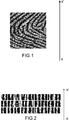
- the figure 1 represents an image of a papillary impression, which in this case is digital, the image being hereinafter called the enrollment image.
- an image is an arrangement of pixels, in particular a matrix arrangement of pixels, along two orthogonal directions.
- each pixel is representative of an intensity value of the image, at the very location of the pixel in question.
- vignettes which are also images, and for which the above-mentioned definitions apply. More precisely, a vignette represents a part of a given image.
- the thumbnails are cut in such a way that each thumbnail comprises a discriminating information of a fingerprint (also called a singular or characteristic zone in the following description).
- the enrollment image may be the result of an acquisition of papillary impression by a sensor, in particular an optical sensor or a capacitive sensor, of any size.
- the sensor may be of small size, and may more particularly have an area less than 50 mm 2 , for example equal to 20 mm 2 .
- the processing method comprises a step a) of detecting the singular zones of the enrollment image.
- singular areas is meant changes in continuity of the papillary lines, then introducing points around which pixel value variations can be observed.
- the singular areas of a papillary impression are grouped into three subsets called order characteristics, respectively, 1, 2 and 3.
- the first order features include arches, loops and swirls.
- the characteristics of order 2 and 3 include points called singular points.
- Figures 11a to 11j non-exhaustively illustrate order 2 features.
- Order 3 features include pores and thickness variations of peaks and valleys.
- the invention is particularly suitable for detecting the characteristics of order 2 or even orders 3 and higher.
- the group of characteristics of order 2 (and also of order 3) groups together several types of singular points. It may be considered in the following statement, different types intra order (within the same order of characteristics) or inter order (between two orders of different characteristics) of singular points.
- a singular zone and more particularly a singular point, is then characterized by its position p in the image and its orientation ⁇ in the image.
- the position p corresponds to the coordinates of the pixels forming the singular zone in the frame of the image.
- the orientation ⁇ (detailed below) is representative of a value of the gradient of the values of the pixels composing the singular zone at the position p.
- the gradient of the values of the pixels composing the singular zone at the position p is called the local intensity gradient. More precisely by “local”, reference is made to the vignette as will be described later. The positions and orientations of these singular areas then make it possible to distinguish one individual from among others, or one finger from others.
- the singular zones, and particularly the singular points, are points for which the spatial derivatives of the image in their immediate neighborhood are non-zero.
- FIGS. Figures 11a to 11j may include: a termination ( figure 11a ); an island 1 ( figure 11b ); an island variant ( figure 11c ); an intersection ( figure 11d ); a single or multiple bifurcation ( figure 11e ); opposite connection ( figure 11f ); a deltoid connection ( figure 11g ); a lake ( figure 11h ); a hook ( figure 11i ); and / or a bridge ( figure 11j ).
- the singular points of order 2 or 3 characterize a break in continuity of the papillary lines and can as such be detected on the basis of this break in continuity.
- a technique particularly adapted to the detection of singular zones, in particular the 2 and higher order characteristics, is the Harris method or detector described in document [2] cited at the end of the description.
- This method comprises in particular a scanning of the surface of the image at a given pitch (for example a pixel) by a window of a predetermined size, and an evaluation of the difference or of the error between two successive windows. Since the error is greater than a threshold value, it is concluded to the presence of a minutia.
- FIG. 1 The examination of figure 1 also noticeably reveals that the second order singular points present an "orientation" (marked by white arrows on the figure 1 ), denoted by the following orientation ⁇ .
- the latter corresponds to the general orientation of the papillary lines at the very location of a given singular point of order 2, that is to say by considering a tangent to at least one of the papillary lines forming the said point. singular, and is representative at the scale of the vignette of the intensity of the enrollment image at the position p.
- the orientation ⁇ is in particular expressed with respect to a principal axis marked XX 'on the figure 1 .
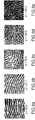
- Step a) is followed by a step b) thumbnail extraction ( figure 2 ), say control vignettes.
- the control thumbnails may each be centered on one of the singular points detected in step a).
- control vignettes may be oriented along the direction of the main axis XX 'so as to align the tangents of the singular points identified along said axis.
- orientation of a thumbnail associated with a singular point of orientation ⁇ comprises the rotation of the singular point along an angle - ⁇ .
- the orientation of the thumbnails thus makes it possible to facilitate step c) (described below) of projection of the thumbnails on the basis of reference thumbnails, and also to reduce the calculation times.
- This reorientation also makes it easier to compare said reoriented thumbnails with their projection on the basis of reference vignettes.
- thumbnails are portions of the enrollment image, and smaller than the enrollment image.
- the size of the thumbnails (the size of a thumbnail corresponds to the dimension of one and the other of its sides) can be between 1/4 and 1/3 of the width of a papillary line.
- each oriented thumbnail, indexed "i" represents a vector v i whose components correspond to the intensities of each of the pixels composing said oriented thumbnail.
- the method further comprises a step c) of projecting the thumbnails oriented in a thumbnail database comprising reference thumbnails b j , (with for example j an integer between 1 and k), called reference base in the following sequence.
- the baseline can be an established basis and be constructed, a method of which will be described later in the statement.
- the reference thumbnail database advantageously comprises at least two associated reference thumbnails of two different types of singular points. he can these are two types of the same order of characteristic (intra-order) or two orders of different characteristics (inter-order).
- the reference thumbnail database comprises reference thumbnails associated with types of singular zones of order 2.
- the reference thumbnail database comprises reference thumbnails associated with types of singular zones of order 3.
- the richness of the reference base allows a better representation of the thumbnails oriented at the end of the projection step.
- the projection of the oriented thumbnails in the reference base makes it possible to determine projection coordinates ⁇ ij of each of the thumbnails oriented on said base.
- the method comprises the construction of a vignette called reconstructed vignette w i .
- k is the number of reference tiles selected for the construction of this reconstructed vignette.
- k is the number of reference tiles selected for the construction of this reconstructed vignette.
- the projection step is followed by a step d) of calculating a projection difference of the control vignettes relative to the projected thumbnails.
- the projection gap may be a quality indicator of the enrollment image on the basis of the projection coordinates ⁇ ij determined in step c).
- step d) may include the calculation of an error, called a construction error.
- the construction error "e” may include the calculation of the normalized sum of the Euclidean distances of each thumbnail oriented relative to its projected thumbnail.
- the error e makes it possible to compare the reconstructed thumbnails and the enrollment thumbnails previously stored in an enrollment database comprising the thumbnails of the enrollment image.
- the reference base and the enrollment base could only form a single base if the construction error e is suitable, for example less than a threshold value.
- enrollment thumbnails can be added to the baseline as construction error e is located below the threshold value.
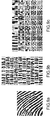
- FIGs 3a-3c and 4a-4c illustrate, respectively, a comparative example of the method of treating a first ( figure 3a ) and a second ( figure 4a ) enrollment image with different qualities.
- the extraction of thumbnails oriented from the first and the second enrollment image gives, respectively, a first series of oriented thumbnails ( figure 3b ) and a second series of oriented vignettes ( figure 4b ).
- a criterion on the construction error e for example by establishing a threshold value of said error, it can be established whether or not an enrollment image is satisfied at a given level. of predetermined quality.
- the method comprises a comparison, for example by the same calculation as the construction error, between reference thumbnails and registration thumbnails previously stored in the enrollment database.
- a comparison for example by the same calculation as the construction error, between reference thumbnails and registration thumbnails previously stored in the enrollment database.
- the method may further comprise a step e) of quantifying a discriminant information contained in the enrollment image, said discriminant information being relative to the singular points actually detected in step a). More particularly, the processing method may comprise a step of measuring the variety of oriented vignettes extracted in step b).
- Figures 6a-6b and 7a-7b illustrate the case of a poorly discriminating imprint ( figure 6a ) and that of a discriminating imprint ( figure 7a ).
- the indiscriminate footprint ( figure 6a ) shows little or no ruptured papillary lines. More particularly, virtually no singular point of order 2 is observed.
- the oriented vignettes extracted from this footprint ( figure 6b ) are relatively unchanged so that a recognition process performed on the basis of this footprint would be unreliable.
- figure 7a associated with a distinctly more discriminating footprint. Many bifurcations, reorientation or breaks in continuity of the papillary lines can be observed on this impression. This results in oriented vignettes ( figure 7b ) of various aspects.
- the step e) may comprise the evaluation of the dispersion of at least two projection coordinates, for all the oriented vignettes, and relating to at least two reference vignettes called main reference vignettes.
- Figures 8a and 8b represent, respectively, the dispersions of two projection coordinates of the footprint of the figure 6a and the imprint of the figure 7a .
- the Figures 9a to 9c represent the successive steps of a method of constructing the reference base.
- the reference base can be constructed from at least one image, called reference image ( figure 9a ), at least one papillary impression.
- the number of reference images may be greater than 5, preferably greater than 10, for example equal to 15.
- the quality of the reference base constructed according to the method described below may depend on the quality, and in particular the visual quality, of the reference image.
- a step of selecting the reference image according to visual criteria, both on the quality of the image and on the discriminant information it contains, can be implemented prior to the construction of the reference base.
- the construction of the reference base may comprise a step a1) of detecting, on the at least one reference image, singular points of order 2 or higher.
- Each singular point is characterized by a position p1, and an orientation ⁇ 1 representative of a value of the local gradient of the intensity of the reference image at the position p1.
- This step is similar to step a) previously described.
- the method of constructing the reference base also comprises a step b1) for extracting vignettes, called primitive vignettes.
- Each of the primitive vignettes is centered on one of the singular zones detected in step a1), and can be oriented along the main axis XX 'so as to align said singular zones along said axis.
- This step is also similar to step b) described above.
- the method for constructing the reference base also comprises a step c1) of principal component analysis (called "ACP”) of all the primitive vignettes, possibly oriented, so as to form the basis reference and extract reference eigenvalues associated with each primitive vignette.
- ACP principal component analysis
- the step c1) of ACP allows in particular to rewrite the vectors formed by the primitive vignettes in the form of a linear combination of vectors, usually called “eigenvectors", these vectors forming the reference base which is orthogonal.
- the linear combination is weighted in particular by weighting factors, otherwise called “eigenvalues”, each associated with a reference vignette otherwise called “eigenvector”.
- This prioritization of reference thumbnails according to their associated eigenvalues can advantageously be used to evaluate the quantity of discriminant information actually contained in an enrollment image.
- only the projections of the thumbnails oriented on the reference thumbnails, named b 1 and b 2 , associated with the two highest eigenvalues are considered in order to quantify the quantity of discriminant information.
- the amount of discriminant information may for example correspond to the ratio R between the highest projection coordinate on the lowest projection coordinate.
- Figures 10a to 10d represent enrollment images visually classified according to a decreasing amount of discriminant information.
- the ratio R mentioned above each of these figures, is in conformity with the visual classification.
- dispersion of the orientation ⁇ of each of the singular points detected in step a) can also be taken into account to measure the amount of discriminant information actually contained in an enrollment image.
- the invention described above thus makes it possible to simplify the treatment of papillary impressions.
- the invention also relates to a computer program comprising instructions which, when the program is executed by a computer, lead to implementing the method of processing an image of a print according to the present invention.
- the invention also relates to an electronic device provided with the aforementioned computer program, and provided with a fingerprint sensor whose acquired fingerprint images are intended to be processed by said computer program.
- the device is a mobile phone, a laptop, a secure opening system, or a handle, including a handle of a vehicle.
Landscapes
- Engineering & Computer Science (AREA)
- Human Computer Interaction (AREA)
- Physics & Mathematics (AREA)
- General Physics & Mathematics (AREA)
- Multimedia (AREA)
- Theoretical Computer Science (AREA)
- Computer Vision & Pattern Recognition (AREA)
- Image Processing (AREA)
- Image Analysis (AREA)
Applications Claiming Priority (1)
| Application Number | Priority Date | Filing Date | Title |
|---|---|---|---|
| FR1855027A FR3082341B1 (fr) | 2018-06-08 | 2018-06-08 | Procede de traitement d'une image d'empreinte papillaire |
Publications (1)
| Publication Number | Publication Date |
|---|---|
| EP3579141A1 true EP3579141A1 (de) | 2019-12-11 |
Family
ID=63834124
Family Applications (1)
| Application Number | Title | Priority Date | Filing Date |
|---|---|---|---|
| EP19178180.6A Withdrawn EP3579141A1 (de) | 2018-06-08 | 2019-06-04 | Verarbeitungsverfahren eines fingerabdruck-bilds der papillarlinien |
Country Status (3)
| Country | Link |
|---|---|
| US (1) | US10997391B2 (de) |
| EP (1) | EP3579141A1 (de) |
| FR (1) | FR3082341B1 (de) |
Citations (1)
| Publication number | Priority date | Publication date | Assignee | Title |
|---|---|---|---|---|
| US20100080425A1 (en) * | 2008-09-29 | 2010-04-01 | Board of regents of the Nevada System of Higher Education, on Behalf of the University of | Minutiae-based template synthesis and matching |
Family Cites Families (4)
| Publication number | Priority date | Publication date | Assignee | Title |
|---|---|---|---|---|
| US8625861B2 (en) * | 2008-05-15 | 2014-01-07 | International Business Machines Corporation | Fingerprint representation using gradient histograms |
| WO2010056904A2 (en) * | 2008-11-12 | 2010-05-20 | University Of Utah Research Foundation | Image pattern recognition |
| KR20140102038A (ko) * | 2013-02-13 | 2014-08-21 | 삼성전자주식회사 | 영상 정합 장치 및 영상 정합 방법 |
| US9785818B2 (en) * | 2014-08-11 | 2017-10-10 | Synaptics Incorporated | Systems and methods for image alignment |
-
2018
- 2018-06-08 FR FR1855027A patent/FR3082341B1/fr not_active Expired - Fee Related
-
2019
- 2019-06-03 US US16/429,875 patent/US10997391B2/en active Active
- 2019-06-04 EP EP19178180.6A patent/EP3579141A1/de not_active Withdrawn
Patent Citations (1)
| Publication number | Priority date | Publication date | Assignee | Title |
|---|---|---|---|---|
| US20100080425A1 (en) * | 2008-09-29 | 2010-04-01 | Board of regents of the Nevada System of Higher Education, on Behalf of the University of | Minutiae-based template synthesis and matching |
Non-Patent Citations (6)
| Title |
|---|
| C. HARRIS ET AL.: "A combined corner and edge detector", FOURTH ALVEY VISION CONFÉRENCE, 1988, pages 147 - 151 |
| CHING-TANG HSIEH ET AL.: "Principal Component Analysis for Minutiae Verification on FingerprintImage", PROCEEDINGS OF THE 7TH WSEAS INT. CONFERENCE ON MULTIMEDIA SYSTEMS & SIGNAL PROCESSING, 15 April 2007 (2007-04-15), Hangzhou, XP002789039, Retrieved from the Internet <URL:http://citeseerx.ist.psu.edu/viewdoc/download?doi=10.1.1.124.3970&rep=rep1&type=pdf> [retrieved on 20190218] * |
| D.G. LOWE ET AL.: "Distinctive image features from scale-invariant keypoints", INTERNATIONAL JOURNAL OF COMPUTER VISION, vol. 60, no. 2, 2004, pages 91 - 110, XP002756976, DOI: doi:10.1023/B:VISI.0000029664.99615.94 |
| MATHILDE BOURJOTRÉGIS PERRIERJEAN-FRANÇOIS MAINGUET: "Etude d'algorithmes d'authentification pour petits capteurs d'empreinte digitale", COLLOQUE CORESA, 2017 |
| S.M. SMITH ET AL.: "A new approach to low level image processing", TECHNICAL REPORT TR95SMSLC |
| XUNQIANG TAO ET AL: "A novel measure of fingerprint image quality using Principal Component Analysis(PCA)", BIOMETRICS (ICB), 2012 5TH IAPR INTERNATIONAL CONFERENCE ON, IEEE, 29 March 2012 (2012-03-29), pages 170 - 175, XP032215571, ISBN: 978-1-4673-0396-5, DOI: 10.1109/ICB.2012.6199804 * |
Also Published As
| Publication number | Publication date |
|---|---|
| US20190377928A1 (en) | 2019-12-12 |
| FR3082341B1 (fr) | 2021-07-23 |
| FR3082341A1 (fr) | 2019-12-13 |
| US10997391B2 (en) | 2021-05-04 |
Similar Documents
| Publication | Publication Date | Title |
|---|---|---|
| EP3637379B1 (de) | Verfahren und vorrichtung zur erkennung von dokumentenfälschungen | |
| EP3640843B1 (de) | Verfahren zur extraktion von merkmalen eines fingerabdrucks, der durch ein eingangsbild dargestellt wird | |
| EP2902943B1 (de) | Validierungsverfahren für die Verwendung eines echten Fingers als Auflagefläche für einen digitalen Fingerabdruck | |
| EP3206192B1 (de) | Verfahren zur sicherung und überprüfung eines dokuments | |
| FR2900482A1 (fr) | Procede d'identification d'une personne par analyse des cara cteristiques de ses cils | |
| EP2751739B1 (de) | Betrugserkennung in einem biometrischen zugangskontrollsystem | |
| EP3382605A1 (de) | Analyseverfahren eines strukturierten dokuments, das verformbar ist | |
| US20110274356A1 (en) | Image pattern recognition | |
| FR3053500B1 (fr) | Procede de detection de fraude d'un systeme de reconnaissance d'iris | |
| EP3567521B1 (de) | Biometrisches erkennungsverfahren anhand der iris | |
| EP3214601B1 (de) | Verfahren zur verbesserung von bildern, das auf bilder von fingerabdrücken angewandt werden kann | |
| EP3608836A1 (de) | Verfahren zum erfassen eines fingerabdruck-bilds | |
| EP3311333A1 (de) | Paarung von bildern von postsendungen mit deskriptoren von singularitäten des gradientenfelds | |
| EP3929809A1 (de) | Methode zur erkennung von mindestens einem sichtbaren biometrischen merkmal auf einem eingangsbild mittels eines konvolutionales neurales netzwerk | |
| EP4099200B1 (de) | Verfahren und vorrichtung zur biometrischen identifizierung und/oder authentifizierung | |
| EP2474937B1 (de) | Elektronisches Authentifizierungsverfahren einer handschriftlichen Unterschrift, Modul-und entsprechendes Computerprogramm | |
| EP3264329A1 (de) | Verfahren und vorrichtung zur detektion von betrug durch überprüfung mit zwei verschiedenen fokalzonen bei der automatischen erkennung eines gesichts | |
| EP3579141A1 (de) | Verarbeitungsverfahren eines fingerabdruck-bilds der papillarlinien | |
| WO2021209412A1 (fr) | Procede de detection d'attaque par presentation pour des empreintes digitales | |
| EP2682900B1 (de) | Untershrift Erkennungsmethode | |
| Dewan et al. | Offline Signature Verification Using Neural Network | |
| Hasan et al. | An Application of SURF Algorithm on JAKIM’s Halal Logo Detection | |
| Zayid et al. | Miniature and Orientation Map Feature Extraction | |
| EP2856391B1 (de) | Verfahren zur erkennung von fallenden schatten auf einem anfänglichen bild | |
| Ruzicka et al. | Towards Fingerprint Mosaicking Artifact Detection: A Self-Supervised Deep Learning Approach |
Legal Events
| Date | Code | Title | Description |
|---|---|---|---|
| PUAI | Public reference made under article 153(3) epc to a published international application that has entered the european phase |
Free format text: ORIGINAL CODE: 0009012 |
|
| STAA | Information on the status of an ep patent application or granted ep patent |
Free format text: STATUS: REQUEST FOR EXAMINATION WAS MADE |
|
| 17P | Request for examination filed |
Effective date: 20190604 |
|
| AK | Designated contracting states |
Kind code of ref document: A1 Designated state(s): AL AT BE BG CH CY CZ DE DK EE ES FI FR GB GR HR HU IE IS IT LI LT LU LV MC MK MT NL NO PL PT RO RS SE SI SK SM TR |
|
| AX | Request for extension of the european patent |
Extension state: BA ME |
|
| STAA | Information on the status of an ep patent application or granted ep patent |
Free format text: STATUS: EXAMINATION IS IN PROGRESS |
|
| 17Q | First examination report despatched |
Effective date: 20210531 |
|
| RAP3 | Party data changed (applicant data changed or rights of an application transferred) |
Owner name: COMMISSARIAT A L'ENERGIE ATOMIQUE ET AUX ENERGIESALTERNATIVES |
|
| REG | Reference to a national code |
Ref country code: DE Ref legal event code: R079 Free format text: PREVIOUS MAIN CLASS: G06K0009000000 Ipc: G06V0040130000 |
|
| GRAP | Despatch of communication of intention to grant a patent |
Free format text: ORIGINAL CODE: EPIDOSNIGR1 |
|
| STAA | Information on the status of an ep patent application or granted ep patent |
Free format text: STATUS: GRANT OF PATENT IS INTENDED |
|
| RIC1 | Information provided on ipc code assigned before grant |
Ipc: G06V 40/13 20220101AFI20250516BHEP |
|
| INTG | Intention to grant announced |
Effective date: 20250602 |
|
| STAA | Information on the status of an ep patent application or granted ep patent |
Free format text: STATUS: THE APPLICATION IS DEEMED TO BE WITHDRAWN |
|
| 18D | Application deemed to be withdrawn |
Effective date: 20251003 |