EP3607911B1 - Nozzle system and powder blasting device - Google Patents
Nozzle system and powder blasting device Download PDFInfo
- Publication number
- EP3607911B1 EP3607911B1 EP18188331.5A EP18188331A EP3607911B1 EP 3607911 B1 EP3607911 B1 EP 3607911B1 EP 18188331 A EP18188331 A EP 18188331A EP 3607911 B1 EP3607911 B1 EP 3607911B1
- Authority
- EP
- European Patent Office
- Prior art keywords
- cross
- section
- nozzle
- nozzle element
- width
- Prior art date
- Legal status (The legal status is an assumption and is not a legal conclusion. Google has not performed a legal analysis and makes no representation as to the accuracy of the status listed.)
- Active
Links
Images



Classifications
-
- A—HUMAN NECESSITIES
- A61—MEDICAL OR VETERINARY SCIENCE; HYGIENE
- A61C—DENTISTRY; APPARATUS OR METHODS FOR ORAL OR DENTAL HYGIENE
- A61C17/00—Devices for cleaning, polishing, rinsing or drying teeth, teeth cavities or prostheses; Saliva removers; Dental appliances for receiving spittle
- A61C17/02—Rinsing or air-blowing devices, e.g. using fluid jets or comprising liquid medication
-
- B—PERFORMING OPERATIONS; TRANSPORTING
- B24—GRINDING; POLISHING
- B24C—ABRASIVE OR RELATED BLASTING WITH PARTICULATE MATERIAL
- B24C5/00—Devices or accessories for generating abrasive blasts
- B24C5/02—Blast guns, e.g. for generating high velocity abrasive fluid jets for cutting materials
- B24C5/04—Nozzles therefor
-
- A—HUMAN NECESSITIES
- A61—MEDICAL OR VETERINARY SCIENCE; HYGIENE
- A61C—DENTISTRY; APPARATUS OR METHODS FOR ORAL OR DENTAL HYGIENE
- A61C17/00—Devices for cleaning, polishing, rinsing or drying teeth, teeth cavities or prostheses; Saliva removers; Dental appliances for receiving spittle
- A61C17/02—Rinsing or air-blowing devices, e.g. using fluid jets or comprising liquid medication
- A61C17/0217—Rinsing or air-blowing devices, e.g. using fluid jets or comprising liquid medication having means for manually controlling the supply of two or more fluids, e.g. water and air
-
- A—HUMAN NECESSITIES
- A61—MEDICAL OR VETERINARY SCIENCE; HYGIENE
- A61C—DENTISTRY; APPARATUS OR METHODS FOR ORAL OR DENTAL HYGIENE
- A61C17/00—Devices for cleaning, polishing, rinsing or drying teeth, teeth cavities or prostheses; Saliva removers; Dental appliances for receiving spittle
- A61C17/02—Rinsing or air-blowing devices, e.g. using fluid jets or comprising liquid medication
- A61C17/022—Air-blowing devices, e.g. with means for heating the air
-
- A—HUMAN NECESSITIES
- A61—MEDICAL OR VETERINARY SCIENCE; HYGIENE
- A61C—DENTISTRY; APPARATUS OR METHODS FOR ORAL OR DENTAL HYGIENE
- A61C3/00—Dental tools or instruments
- A61C3/02—Tooth drilling or cutting instruments; Instruments acting like a sandblast machine
- A61C3/025—Instruments acting like a sandblast machine, e.g. for cleaning, polishing or cutting teeth
-
- B—PERFORMING OPERATIONS; TRANSPORTING
- B24—GRINDING; POLISHING
- B24C—ABRASIVE OR RELATED BLASTING WITH PARTICULATE MATERIAL
- B24C5/00—Devices or accessories for generating abrasive blasts
-
- B—PERFORMING OPERATIONS; TRANSPORTING
- B24—GRINDING; POLISHING
- B24C—ABRASIVE OR RELATED BLASTING WITH PARTICULATE MATERIAL
- B24C7/00—Equipment for feeding abrasive material; Controlling the flowability, constitution, or other physical characteristics of abrasive blasts
- B24C7/0046—Equipment for feeding abrasive material; Controlling the flowability, constitution, or other physical characteristics of abrasive blasts the abrasive material being fed in a gaseous carrier
-
- B—PERFORMING OPERATIONS; TRANSPORTING
- B24—GRINDING; POLISHING
- B24C—ABRASIVE OR RELATED BLASTING WITH PARTICULATE MATERIAL
- B24C7/00—Equipment for feeding abrasive material; Controlling the flowability, constitution, or other physical characteristics of abrasive blasts
- B24C7/0084—Equipment for feeding abrasive material; Controlling the flowability, constitution, or other physical characteristics of abrasive blasts the abrasive material being fed in a mixture of liquid and gas
-
- Y—GENERAL TAGGING OF NEW TECHNOLOGICAL DEVELOPMENTS; GENERAL TAGGING OF CROSS-SECTIONAL TECHNOLOGIES SPANNING OVER SEVERAL SECTIONS OF THE IPC; TECHNICAL SUBJECTS COVERED BY FORMER USPC CROSS-REFERENCE ART COLLECTIONS [XRACs] AND DIGESTS
- Y02—TECHNOLOGIES OR APPLICATIONS FOR MITIGATION OR ADAPTATION AGAINST CLIMATE CHANGE
- Y02P—CLIMATE CHANGE MITIGATION TECHNOLOGIES IN THE PRODUCTION OR PROCESSING OF GOODS
- Y02P70/00—Climate change mitigation technologies in the production process for final industrial or consumer products
- Y02P70/10—Greenhouse gas [GHG] capture, material saving, heat recovery or other energy efficient measures, e.g. motor control, characterised by manufacturing processes, e.g. for rolling metal or metal working
Definitions
- the present invention refers to a nozzle system and a powder blasting device.
- Nozzle systems in powder blasting devices are well known from the state of the art, for example from US 3 882 638 A or EP 0 294 548 A1 .
- Such nozzle systems are typically used for cleaning teeth, in particular for removing stains, tartar and colorations from teeth and for removing dental biofilms.
- the aim of using a powder blasting device is to clean dental surfaces and free them form stains, tartar biofilms and colorations without harming the tooth surface underneath which is enamel or dentine.
- the powder is adapted to manipulate or to adjust a functionality of the output stream.
- nozzle systems provide a powder-gas mixture stream being encased by a liquid stream.
- the outlet stream formed by the powder-gas mixture encased by the liquid stream, is directed on the tooth surface and causes the removing of stains, tartar coloration and/or dental biofilms.
- the liquid stream encasing the powder-gas mixture stream is provided for trapping dust generated and to avoid mist during operation of the powder blasting device.
- JP 200 893 080 discloses a nozzle system having a first nozzle element and a second nozzle element, wherein the first nozzle element is surrounded by the second nozzle element. Further, the first nozzle element includes a short curved acceleration section.
- EP 0 248 638 concerns a cleaning device for dental use.
- the cleaning device has a nozzle head, the nozzle head being designed to accelerate air.
- the accelerated air is mixed with a premixed abrasive liquid mixture at an output of the nozzle head.
- a nozzle system for a powder blasting device comprising
- the envelope of the powder-gas mixture has an enlarged cross section, when it is ejected from the nozzle system, and therefore a larger surface can be treated by the output stream. Consequently, a cleaning surface is enlarged and powder abrasivity is reduced, simultaneously.
- a sound shock being generated otherwise outside of the nozzle system, preferably at its front end, is generated inside the nozzle system. Therefore, the noise caused by the nozzle system in operation is advantageously reduced for giving an operator and/or a patient a more comfortable impression/feeling.
- Another positive effect is the possibility of enlarging the cross section of the ejected output stream without increasing an air flow rate. Thus, it can be avoided that too much air is used during a treatment, which otherwise would increase an emphysema risk, i. e. pushing air within tissues.
- Another positive effect of increasing the cross section of the outlet stream, in particular of the cross section of the powder-gas mixture is an opportunity to create or manipulate different nozzle properties without changing a base unit in charge of supplying the nozzle system with air and/or powder, since the air flow rate remains constant as well as the powder flow rate. For example, it is advantageously possible to adapt an air speed of the ejected output steam as well as its pressure.
- Another positive effect of the nozzle system of the present invention is that less liquid (e.g. water) is needed and therefore used when using the powder blasting device comprising the nozzle system of the present invention. This may be due to the fact that the liquid stream is better spread and is therefore more efficient in entrapping the powder and/or powder-gas mixture stream.
- liquid e.g. water
- abrasivity defines an efficiency of removing particle from a material surface during a treatment.
- the abrasivity is specified by the ratio of the crater depth generation rate over powder quantity. The larger -value, the bigger the abrasivity, i. e. more particles of the treated material are removed from the surface.
- a reduction of abrasivity is preferably referenced to a first nozzle element having a constant cross section, in particular a constant first cross section of the acceleration part.
- the first nozzle element and/or the second nozzle element have a sleeve like body, wherein the first nozzle element is arranged inside the second nozzle element, in particular concentrically.
- the first nozzle element and the second nozzle element end or terminate at a front end of the nozzle system.
- the first nozzle element and the second nozzle element end along the transporting direction simultaneously, i. e. in a plane perpendicular to the transporting direction.
- the first nozzle element protrudes at the front end of the nozzle system.
- the nozzle system is incorporated into a handheld device of a powder blasting device, such that an operator can easily direct the output stream onto the object to be treated.
- the spreading part forms the end of the first nozzle element in transporting direction. Furthermore, the spreading part follows downstream to the acceleration part, preferably directly afterwards.
- the acceleration part has a first cross section being constant in a direction extending along the transporting direction and/or the spreading part has a second cross section being at least partially constant in a direction extending along the transporting direction.
- the second cross section is constant over its whole extension along the transporting direction.
- the acceleration part and/or the spreading part have subsections having different cross sections.
- the cross section of these subsections increases in transporting direction, such that the subsection at the end of the acceleration part and/or spreading part has the largest cross section of all cross sections assigned to the subsections.
- the acceleration part has a first length being longer than 0.5 mm, preferably longer than 0.75 mm and more preferably longer than 1 mm.
- the first cross section has a first width measured perpendicular to the transporting direction and a second cross section has a second width measured perpendicular to the transporting direction, wherein the second width is up to three times, preferably up to 2.5 times and most preferably up to 2 times, in particular mainly 1.5 times, larger than the first width and/or wherein the first width has a width between 0.1 and 2.5 mm, preferably between 0.25 and 1.5 mm and most preferably 0.6 mm.
- the second cross section and/or a second width of the second cross section is preferably a mean value of all second cross sections or second widths of all subsections along the transporting direction.
- the first nozzle element comprises a collecting part, wherein the collecting part is arranged upstream to the acceleration part, wherein the collecting part has a third cross section being preferably at least partially constant along the transporting direction.
- the acceleration part follows directly downstream to the collection part.
- the collection part directs the powder-gas mixture preferably of the acceleration part.
- a funnel shaped subsection of the collecting part in particular in a transition area between the collecting part and the acceleration part, directs the powder-gas mixture inside the acceleration part.
- the acceleration part, the collecting part and/or the spreading part are arranged adjacent and/or concentrically to each other.
- the third cross section is larger than the first cross section, wherein
- an inner curvature of the first nozzle element in a transition area or in the spreading part has a step-like and/or a cone-like shape.
- Forming the inner curvature in the spreading part in a step-like and/or cone like manner represents another advantageous possibility to manipulate the form of the cross section of the powder-gas mixture stream being ejected at the front end.
- the transition area forms a transition between the collecting part and the acceleration part and/or a transition between the acceleration and the spreading part.
- the acceleration part has a first length measured along the transporting direction and the spreading part has a second length measured along the transporting direction, wherein the second length is 0.5 to 3.5 times, preferably 1.1 to 2 times and most preferably 1.3 to 1.8 times, longer than the first length.
- the acceleration part has a first length being longer than 0.5 mm, preferably longer than 0.75 mm and more preferably longer than 1 mm.
- the liquid stream is ejected from the channel via an output surface, wherein the channel is preferably configured such that the liquid stream encasing the powder-gas mixture stream is formed by droplets.
- the output surface in particular a fourth cross section assigned to the output surface, has a structure or profile that supports the droplet formation.
- the output surface has a fourth cross section, wherein the fourth cross section preferably has a size between 0.1 and 0.9 mm 2 , preferably between 0.3 and 0.6 mm 2 and most preferably between 0.3 and 0.4 mm 2 .
- the fourth cross section is realized that is smaller than the fourth cross sections typically known from the prior art. The reduction of the fourth cross section supports the formation of the droplets at the front end of the nozzle system advantageously.
- a nozzle system for a powder blasting device comprising a nozzle system for a powder blasting device, comprising
- the fourth cross section is formed undulated or as a slit, an assembly of holes and/or assembly of grooves.
- the fourth cross section profile determining how the liquid is ejected from the nozzle system, in particular from the channel.
- the fourth cross section of the output surface comprises six or more openings for ejecting the liquid stream.
- the fourth cross section comprises less than six openings.
- the holes and/or grooves are distributed homogeneously or statistically along a circumferential direction.
- the holes might have a circular, rectangular elliptical shape and/or any other shape or a combination thereof.
- an outer curvature of the first nozzle element defines the shape of the fourth cross section, wherein the outer curvature of the first nozzle element comprises at least one recess being curved inwardly.
- the recess is formed arched parabolic and/or circularly in a circumferential direction.
- the outer curvature of the first nozzle element is an integral part of the channel, in particular defines the structure / profile of the fourth cross section at the front end.
- the outer curvature/side of the first nozzle element is configured with regard to the inner surface of the second nozzle element, which is preferably circular, such that a set of sub-channels extending parallel to the transporting direction is realized.
- each end of the sub-channels forms an opening being part of the fourth cross section.
- the extension of the sub-channels is at least as long as the second length of the acceleration part.
- an inner curvature of the second nozzle element defines the shape of the fourth cross section, wherein the inner curvature of the second nozzle element comprises at least one recess being curved outwardly.
- the recess is formed arched parabolic and/or circularly in a circumferential direction.
- the inner curvature of the second nozzle element is an integral part of the channel, in particular defines the structure / profile of the fourth cross section at the front end.
- the inner curvature/side of the second nozzle element is configured with regard to the outer surface of the first nozzle element, which is preferably circular, such that a set of sub-channels extending parallel to the transporting direction is realized.
- each end of the sub-channels forms an opening being part of the fourth cross section.
- the extension of the sub-channels is at least as long as the second length of the acceleration part.
- the shape of the fourth cross section can be defined by the insertion of elements between the first and second nozzle elements.
- the first nozzle element in a direction parallel to the transporting direction the first nozzle element extends further than the second nozzle element or the first nozzle element and/or the second nozzle element ends at a common plane being perpendicular to the transporting direction.
- the first nozzle element protrudes at the front end relative to the second nozzle element along the transporting direction or does not protrudes at the front end.
- the form of the output stream can be further manipulated.
- the first nozzle element does not protrude further than 1 mm, preferably further than 0.8 mm and most preferably 0.5 mm.
- Another aspect of the present invention is a powder blasting device comprising the nozzle system according to the present invention. All features and benefits mentioned in the context of the nozzle system can be transferred to the powder blasting device and vice versa.
- the output stream has a fifth cross section that differs from a circularly formed cross section.
- a nozzle system 1 according to a preferred embodiment of the present invention is presented in a sectional side view along a transporting direction T.
- Such nozzle systems 1 are preferably an essential part of a powder blasting device.
- Those power blasting devices are preferably used for removing stains, tartar or a coloration from a tooth and/or for removing dental biofilms.
- the nozzle system 1 provides an output stream 2 that is able to remove stains and coloration and/or to remove dental biofilms. In operation, the output stream 2 is ejected by the nozzle system 1 at its front end FE.
- the output stream 2 comprises a liquid stream 22 in order to guide the powder-gas mixture stream 21 and to trap dust generated and to avoid mist during operation.
- the powder-gas mixture stream 21 is encased or surrounded at least partially, preferably completely, by the liquid stream 22 in a plane expanding perpendicular to a transporting direction T of the output stream 2.
- the nozzle system 1 comprises a first nozzle element 10 for transporting a powder-gas mixture stream 21 along the transporting direction T and a second nozzle element 20, wherein the second nozzle element 20 surrounds the first nozzle element 10 such that at least one channel 25 is formed between the first nozzle element 10 and the second nozzle element 20.
- the first nozzle element 10 and/or the second nozzle element 20 have a sleeve - like body, wherein the first nozzle element 10 is arranged inside the second nozzle 20 element, in particular concentrically to each other.
- the output stream 2 is ejected from the nozzle system 1 at a front end FE or a front side of the nozzle system 2.
- the first nozzle element 10 extends further than the second nozzle element 20 in a direction extending parallel to the transporting direction T.
- the first nozzle element 10 and the second nozzle element 20 end in a common plane that extends perpendicular to the transporting direction T.
- the first nozzle element 10 has an acceleration part 11 having a first cross section and a spreading part 12 having a second cross section, wherein the spreading part 12 is arranged downstream of the acceleration part 11.
- the spreading part 12 is configured such that the particles of the powder-gas mixture stream 21 are spread.
- the second cross section is larger than the first cross section.
- the acceleration part 11 is arranged directly next to the spreading part 12 in a direction extending parallel to the transporting direction T.
- the first cross section has a first width W1 measured perpendicular to the transporting direction T and a second cross section has a second width W2 measured perpendicular to the transporting direction T, wherein the second width W2 is up to three times, preferably up to 2.5 times and most preferably up to 2 times, in particular mainly 1.5 times, larger than the first width W1 and/or wherein the first width W1 has a width between 0.2 and 1.5 mm, preferably between 0.4 and 0.9 mm and most preferably 0.6 mm.
- a sound shock is generated inside the nozzle system 1 and not at the front end of the nozzle system 1.
- noises generated by the nozzle system 1 during operation can be reduced for giving an operator and/or patient a more comfortable impression.
- an emphysema risk is reduced and a wider range of properties regarding the output stream 2 can be established, for example a thinner or larger output stream measured in a direction perpendicular to the transporting direction T.
- a curvature / inner side 14 of the first nozzle element 10 has a step-like shape for forming a transition between the acceleration part 11 and the spreading part 12. Furthermore, it is provided that the acceleration part 12 is arranged concentrically to the spreading part 12. Thus, a homogeneous spreading can be guaranteed.
- the first nozzle element 10 comprises a collecting part 13, wherein the collecting part 13 is arranged upstream to the acceleration part 11, wherein the collecting part has a third cross section being preferably constant along the transporting direction T.
- the third cross section might correspond to the second cross section of the spreading part 12 or might be different form the second cross section, for example regarding size and steps, i. e. a form of the inner side 14 of the first nozzle element 10.
- the inner curvature/side 14 of the first nozzle element 10 has another step-like shape forming the transition from the collecting part 13 to the acceleration part 11. It is also conceivable the transition between the collecting part 13 and the acceleration part 11 is funnel shaped.
- the third cross section is larger than the first cross section, wherein a third width W3 of the third cross section is up to three times, preferably up to two times and most preferably up to 1.6, in particular mainly 1.2 times, larger than the first width, wherein the first width has a width between 0.2 and 1.5 mm, preferably between 0.4 and 0.9 mm and most preferably mainly 0.6 mm.
- the acceleration part 11 has a first length L1 measured along the transporting direction T and the spreading part 12 has a second length L2 measured along the transporting direction T, wherein the second length L2 is 0.5 to 3.5 times, preferably 1.1 to 2 times and most preferably 1.3 to 1.8 times, longer than the first length L1.
- the first length L1 should be longer than 0.5 mm.
- the channel 25 is configured such that a small/thin liquid jet is generated for the output stream 2.
- an output surface 23 from which the liquid jet is ejected preferably has comparable small fourth cross section.
- the fourth cross section is measured in a plane extending perpendicular to the transporting direction T at the front end FE.
- all openings used and/or being available for ejecting the liquid stream preferably form the fourth cross section, i. e. the fourth cross section might be formed by sub-cross sections assigned to several separated or individual openings at the front end for ejecting the liquid stream 22.
- the fourth cross section has a structure or profile formed by a plurality of openings that for example are arranged circumferential at the front end FE of the channel 25, preferably uniformly along a circle.
- the fourth cross section preferably has a size between 0.1 and 0.8 mm 2 , preferably between 0.6 and 0.3 mm 2 and most preferably between 0.3 and 0.4 mm 2 .
- the forth cross section according to the state of the art is larger than 0.8 mm 2 .
- the fourth cross section is preferably configured such that the liquid stream 22 encasing the powder-gas mixture stream 12 is formed by droplets. Due to the use of droplets it is advantageously possible to increase a probability of the liquid to trap dust powder. Furthermore, a controlled liquid stream 22 supports directing or guiding of the powder - gas mixture stream 21.
- a nozzle system (1) for a powder blasting device comprising
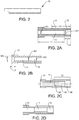
- FIG. 2 a first nozzle element 10 according to the prior art is presented for comparing it to the geometries of the first nozzle elements 10 of the figures 2a to 2d representing different exemplary embodiments of first nozzle elements 10 for a nozzle system 1 according to the present invention.
- figure 2a shows a first nozzle element 10, assigned to a nozzle system 1 being named EA-5698 in the following, which has no collecting part.
- the first nozzle element 10 has a comparable long acceleration part 11 compared to the spreading part 12.
- the elements 17, such as struts or rips, extending at an outer side 15 of the first nozzle element 10 are intended for realizing sub-channel and a structured output surface 23 of the channel 25 ejecting the liquid stream 22.
- the struts and/or rips have a length longer than the second length L2.
- the second width W2 is about 0.8 mm
- the inner diameter of the first nozzle element 10 according to the prior art is about 0.65 mm.
- the first nozzle element 1 in figure 2b has a collecting area 13 and refers to a nozzle system 1 named EA 5682 in the following.
- Its second width W2 is about 0.7 mm.
- the first length L1 is about 3 to 5 mm and the second length L2 about 2 to 3 mm.
- a third length L3 assigned to the collecting part 13 is about 0.3 to 0.7 mm and the third width is about 1 mm.
- the transition between the collecting part 13 and the acceleration part 11 is funnel shaped.
- the third width W3 being for example about 1 mm is larger than the second with being for example about 0.7 mm.
- the first width is about 0.61 mm.
- the first nozzle element 10 of figure 2c is for example part of a nozzle system 1 assigned to the name EA-5701.
- the first nozzle element 10 of figure 2c differs from that of figure 2b by the design of the inner curvature/side 14 of the spreading part 12, wherein the inner curvature/side along the transporting direction T has a step like shape.
- several subsection, in particular three subsection 25, are provided, wherein the sub-sections 25 have the same length measured along the transporting direction T.
- the length of each subsection is about 1.5 mm, consequently forming a second length L2 of about 4.5 mm.
- a respective second width W2 assigned to each of the subsection increases along the transporting direction T.
- the second width W2 is increased by 0.2 mm by each transition from one subsection 26 to the next subsection 26 in transporting direction T.
- a further first nozzle element 10 is presented and this first nozzle element is part of the nozzle system called EA-5697 in the following.
- a longer collecting part 13 is provided.
- the third width W3 being for example about 0.8 mm is smaller than the second with W2 being for example about 1 mm.
- FIG 3 a front end FE of a nozzle system 1 according to the prior at is presented in a perspective view for comparing it to front ends FE of nozzle systems 1 of the figures 3a to 3i representing different exemplary embodiments of nozzle system 1 according to the present invention.
- the view at the front end FE shows the fourth cross section formed at the end of the channel 25 for ejecting the liquid stream 22.
- the nozzle system 1 representing the prior art is called in the following EMS.
- This nozzle system 1 is ring-shaped and has no structures included in the channel 25 for forming a profiled fourth cross section.
- the channel 25 of the nozzle systems 2 illustrated by the figure 3a to 3h is formed by several sub-channels, in particular groove like sub-channels, between the first nozzle element 10 and the second nozzle element 20.
- the sub-channels extends preferably parallel to the transporting direction T and their ends at the front end of the nozzle system 1 forms the fourth cross section.
- the sub-channels have a fourth length L4 measured in a direction extending parallel to the transporting direction T.
- the fourth length L4 is determined by the length of rip elements and/or strut elements 17 protruding from the first nozzle element 10 radially.
- the fourth length L4 is longer than the second length L2.
- a ratio of the second length L2 to the fourth length L4 is larger than 1, preferably larger than 2 and most preferably larger than 3.
- the struts elements 17 are part of the first nozzle element 10.
- the outer surface/side 15 of the first nozzle element 10 has an arched shape between two adjacent strut elements 17.
- the first nozzle element 10 includes grooves 35 for forming the sub-channels.
- the outer surface/side 15 of the first nozzle element 10 is shaped/curved inwardly.
- the arched shape is mainly parabolic and six different sub-channels are formed by six radially extending strut elements 17.
- the nozzle system of the figures 3a to 3d mainly differs from each other by the thickness of a wall assigned to the first nozzle element 10.
- the nozzle system of figure 3a refers to EA 5682, the nozzle system of figure 3b to EA 5701, the nozzle system of figure 3c to EA 5698 and the nozzle system of figure 3d to EA 5697.
- EMS abrasivity of the output stream 1 was measured and compared to the abrasivity of the nozzle system named EMS.
- Abrasivity test is carried out by using a test bench where the nozzle is placed at 45° and 2 mm of projected distance. A shutter in front of the nozzle is used to determine the exposure time.
- the test material is a PMMA plate. 16 abrasion points are made for each test using the same application time.
- the exposure time is adjusted to get abrasion holes of 20 to 200 microns.
- the exposure time is mostly between 1 and 5 seconds. This exposure time is not a key parameter as the outcome is normalized according to the powder amount used. Therefore, the abrasivity is defined as the crater depth generation rate over powder quantity.
- Abrasivity Crater depth [ ⁇ m] / powder quantity used [g]
- the abrasivity of EMS had a value between 1700 and 2333 ⁇ m/g
- EA-5682 had a value between 1300 and 1600 ⁇ m/gm
- EA-5701 had a value between 900 and 1100 ⁇ m/g
- EA-5698 had a value between 700 and 1100 ⁇ m/g
- ES 5697 had a value between 400 and 600 ⁇ m/g.
- FIG 4 a fifth cross section Q5 assigned to the output stream realized by EA-5701 is shown.
- the fifth cross section of the output stream is visualized by directing the output stream 2 on a painted steel surface located at a distance of 2.2 mm from the front end FE of the nozzle system 1. It can be seen that the fifth cross section differs from a circularly formed cross section.
Landscapes
- Health & Medical Sciences (AREA)
- Dentistry (AREA)
- Epidemiology (AREA)
- Life Sciences & Earth Sciences (AREA)
- Animal Behavior & Ethology (AREA)
- General Health & Medical Sciences (AREA)
- Public Health (AREA)
- Veterinary Medicine (AREA)
- Engineering & Computer Science (AREA)
- Mechanical Engineering (AREA)
- Oral & Maxillofacial Surgery (AREA)
- Nozzles (AREA)
Priority Applications (17)
| Application Number | Priority Date | Filing Date | Title |
|---|---|---|---|
| ES18188331T ES2880368T3 (es) | 2018-08-09 | 2018-08-09 | Sistema de boquilla y dispositivo de limpieza por chorro de polvo |
| EP18188331.5A EP3607911B1 (en) | 2018-08-09 | 2018-08-09 | Nozzle system and powder blasting device |
| DK18188331.5T DK3607911T3 (da) | 2018-08-09 | 2018-08-09 | Dysesystem og pulverblæsningsanordning |
| KR1020217003439A KR102916385B1 (ko) | 2018-08-09 | 2019-08-07 | 노즐 시스템, 분말 블라스팅 디바이스 및 노즐 시스템의 사용 방법 |
| US17/258,186 US12220788B2 (en) | 2018-08-09 | 2019-08-07 | Nozzle system, powder blasting device and method for using a nozzle system |
| AU2019319615A AU2019319615B2 (en) | 2018-08-09 | 2019-08-07 | Nozzle system, powder blasting device and method for using a nozzle system |
| PCT/EP2019/071217 WO2020030691A1 (en) | 2018-08-09 | 2019-08-07 | Nozzle system, powder blasting device and method for using a nozzle system |
| PL19749353.9T PL3833299T3 (pl) | 2018-08-09 | 2019-08-07 | System dysz i urządzenie do piaskowania strumieniem proszku |
| EP19749353.9A EP3833299B1 (en) | 2018-08-09 | 2019-08-07 | Nozzle system and powder blasting device |
| FIEP19749353.9T FI3833299T3 (fi) | 2018-08-09 | 2019-08-07 | Suutinjärjestelmä ja jauhepuhalluslaite |
| ES19749353T ES2955203T3 (es) | 2018-08-09 | 2019-08-07 | Sistema de boquilla y dispositivo de proyección de polvo |
| JP2021503797A JP7443327B2 (ja) | 2018-08-09 | 2019-08-07 | ノズルシステム、粉体吹き付け装置、及び、ノズルシステムを使用する方法 |
| CN201980052778.8A CN112543624B (zh) | 2018-08-09 | 2019-08-07 | 喷嘴系统、喷粉装置和喷嘴系统的使用方法 |
| DE202019005817.6U DE202019005817U1 (de) | 2018-08-09 | 2019-08-07 | Düsensystem und Pulverstrahlgerät |
| HUE19749353A HUE063158T2 (hu) | 2018-08-09 | 2019-08-07 | Fúvókarendszer, porszóró eszköz és eljárás fúvókarendszer alkalmazására |
| DK19749353.9T DK3833299T3 (da) | 2018-08-09 | 2019-08-07 | Dysesystem og pulverblæsningsanordning |
| AU2025202064A AU2025202064A1 (en) | 2018-08-09 | 2025-03-21 | Nozzle system, powder blasting device and method for using a nozzle system |
Applications Claiming Priority (1)
| Application Number | Priority Date | Filing Date | Title |
|---|---|---|---|
| EP18188331.5A EP3607911B1 (en) | 2018-08-09 | 2018-08-09 | Nozzle system and powder blasting device |
Publications (2)
| Publication Number | Publication Date |
|---|---|
| EP3607911A1 EP3607911A1 (en) | 2020-02-12 |
| EP3607911B1 true EP3607911B1 (en) | 2021-04-07 |
Family
ID=63207662
Family Applications (2)
| Application Number | Title | Priority Date | Filing Date |
|---|---|---|---|
| EP18188331.5A Active EP3607911B1 (en) | 2018-08-09 | 2018-08-09 | Nozzle system and powder blasting device |
| EP19749353.9A Active EP3833299B1 (en) | 2018-08-09 | 2019-08-07 | Nozzle system and powder blasting device |
Family Applications After (1)
| Application Number | Title | Priority Date | Filing Date |
|---|---|---|---|
| EP19749353.9A Active EP3833299B1 (en) | 2018-08-09 | 2019-08-07 | Nozzle system and powder blasting device |
Country Status (13)
| Country | Link |
|---|---|
| US (1) | US12220788B2 (https=) |
| EP (2) | EP3607911B1 (https=) |
| JP (1) | JP7443327B2 (https=) |
| KR (1) | KR102916385B1 (https=) |
| CN (1) | CN112543624B (https=) |
| AU (2) | AU2019319615B2 (https=) |
| DE (1) | DE202019005817U1 (https=) |
| DK (2) | DK3607911T3 (https=) |
| ES (2) | ES2880368T3 (https=) |
| FI (1) | FI3833299T3 (https=) |
| HU (1) | HUE063158T2 (https=) |
| PL (1) | PL3833299T3 (https=) |
| WO (1) | WO2020030691A1 (https=) |
Families Citing this family (2)
| Publication number | Priority date | Publication date | Assignee | Title |
|---|---|---|---|---|
| CN113262065B (zh) * | 2021-01-29 | 2022-10-25 | 深圳瑞圣特电子科技有限公司 | 用于冲牙器的喷嘴组件 |
| DE102024107326A1 (de) * | 2024-03-14 | 2025-09-18 | Sata Gmbh & Co. Kg | Farbdüse für eine Lackierpistole |
Family Cites Families (22)
| Publication number | Priority date | Publication date | Assignee | Title |
|---|---|---|---|---|
| US3882638A (en) | 1973-10-04 | 1975-05-13 | Robert B Black | Air-abrasive prophylaxis equipment |
| US3982605A (en) | 1975-05-05 | 1976-09-28 | The Carborundum Company | Nozzle noise silencer |
| US4449332A (en) | 1979-07-31 | 1984-05-22 | Griffiths Norman J | Dispenser for a jet of liquid bearing particulate abrasive material |
| DE3132291A1 (de) * | 1981-08-14 | 1983-07-14 | Siemens AG, 1000 Berlin und 8000 München | Geraet zur bearbeitung, insbesondere reinigung, der oberflaeche von teilen, insbesondere von zaehnen |
| DK151127C (da) * | 1983-11-11 | 1988-04-25 | Sven Karl Lennart Goof | Instrument til rensning af taender |
| US4776794A (en) * | 1986-06-03 | 1988-10-11 | Moshe Meller | Cleaning instrument using premixed abrasive liquid |
| US4820152A (en) | 1987-04-21 | 1989-04-11 | Dentsply Research & Development Corp. | Single multi-function handpiece for dental instruments |
| US5779523A (en) * | 1994-03-01 | 1998-07-14 | Job Industies, Ltd. | Apparatus for and method for accelerating fluidized particulate matter |
| US5957760A (en) * | 1996-03-14 | 1999-09-28 | Kreativ, Inc | Supersonic converging-diverging nozzle for use on biological organisms |
| EP1166883B1 (en) * | 2000-06-30 | 2005-10-05 | Shibuya Kogyo Co., Ltd | Cleaning nozzle and cleaning apparatus |
| FR2830744B1 (fr) | 2001-10-11 | 2004-07-09 | Satelec Soc | Dispositif aeropolisseur dentaire |
| DE10254159A1 (de) * | 2002-11-20 | 2004-06-03 | Linde Ag | Trockeneisstrahlen mit Mantelstrom |
| KR20040101948A (ko) * | 2004-05-31 | 2004-12-03 | (주)케이.씨.텍 | 표면세정용 승화성 고체입자 분사용 노즐 및 이를 이용한 세정방법 |
| JP4653055B2 (ja) * | 2006-10-10 | 2011-03-16 | 株式会社松風 | 歯科治療用粉体噴射装置用ノズル |
| GB0810384D0 (en) * | 2008-06-06 | 2008-07-09 | 3M Innovative Properties Co | Powder jet device for applying dental material |
| DE102010064406A1 (de) * | 2010-12-30 | 2012-07-05 | ipal Gesellschaft für Patentverwertung Berlin mbH | Vorrichtung und Verfahren zum Partikelstrahlen mittels gefrorener Gaspartikel |
| GB2488842A (en) * | 2011-03-11 | 2012-09-12 | Osspray Ltd | Ceramic discharge tip for a dental abrasion device |
| JP5910933B2 (ja) | 2011-03-17 | 2016-04-27 | 新東工業株式会社 | 湿式ブラスト加工用ノズルおよびそのノズルを備えたブラスト加工装置 |
| CN102672625B (zh) * | 2011-03-17 | 2016-12-14 | 新东工业株式会社 | 喷丸加工用喷嘴以及具备该喷嘴的喷丸加工装置 |
| US8544769B2 (en) | 2011-07-26 | 2013-10-01 | General Electric Company | Multi-nozzle spray gun |
| IL219169A0 (en) * | 2012-04-15 | 2012-07-31 | Yehuda Darshan | Apparatus for cleaning tissues from root canal by spinning liquid jet |
| JP6417596B2 (ja) * | 2013-06-05 | 2018-11-07 | 株式会社サンギ | 粉体噴射用ハンドピース |
-
2018
- 2018-08-09 EP EP18188331.5A patent/EP3607911B1/en active Active
- 2018-08-09 ES ES18188331T patent/ES2880368T3/es active Active
- 2018-08-09 DK DK18188331.5T patent/DK3607911T3/da active
-
2019
- 2019-08-07 DK DK19749353.9T patent/DK3833299T3/da active
- 2019-08-07 ES ES19749353T patent/ES2955203T3/es active Active
- 2019-08-07 PL PL19749353.9T patent/PL3833299T3/pl unknown
- 2019-08-07 DE DE202019005817.6U patent/DE202019005817U1/de active Active
- 2019-08-07 EP EP19749353.9A patent/EP3833299B1/en active Active
- 2019-08-07 AU AU2019319615A patent/AU2019319615B2/en active Active
- 2019-08-07 FI FIEP19749353.9T patent/FI3833299T3/fi active
- 2019-08-07 US US17/258,186 patent/US12220788B2/en active Active
- 2019-08-07 JP JP2021503797A patent/JP7443327B2/ja active Active
- 2019-08-07 WO PCT/EP2019/071217 patent/WO2020030691A1/en not_active Ceased
- 2019-08-07 HU HUE19749353A patent/HUE063158T2/hu unknown
- 2019-08-07 KR KR1020217003439A patent/KR102916385B1/ko active Active
- 2019-08-07 CN CN201980052778.8A patent/CN112543624B/zh active Active
-
2025
- 2025-03-21 AU AU2025202064A patent/AU2025202064A1/en not_active Abandoned
Non-Patent Citations (1)
| Title |
|---|
| None * |
Also Published As
| Publication number | Publication date |
|---|---|
| WO2020030691A1 (en) | 2020-02-13 |
| AU2019319615B2 (en) | 2025-04-17 |
| US20210276152A1 (en) | 2021-09-09 |
| KR20210042318A (ko) | 2021-04-19 |
| ES2880368T3 (es) | 2021-11-24 |
| JP2021531886A (ja) | 2021-11-25 |
| DK3607911T3 (da) | 2021-07-12 |
| US12220788B2 (en) | 2025-02-11 |
| CN112543624A (zh) | 2021-03-23 |
| EP3833299B1 (en) | 2023-06-07 |
| KR102916385B1 (ko) | 2026-01-23 |
| AU2019319615A1 (en) | 2021-01-28 |
| DK3833299T3 (da) | 2023-09-18 |
| HUE063158T2 (hu) | 2023-12-28 |
| FI3833299T3 (fi) | 2023-08-31 |
| CN112543624B (zh) | 2023-01-24 |
| EP3833299A1 (en) | 2021-06-16 |
| EP3607911A1 (en) | 2020-02-12 |
| PL3833299T3 (pl) | 2023-12-04 |
| DE202019005817U1 (de) | 2022-06-07 |
| ES2955203T3 (es) | 2023-11-29 |
| AU2025202064A1 (en) | 2025-04-10 |
| JP7443327B2 (ja) | 2024-03-05 |
Similar Documents
| Publication | Publication Date | Title |
|---|---|---|
| AU2025202064A1 (en) | Nozzle system, powder blasting device and method for using a nozzle system | |
| JP4847863B2 (ja) | 歯科用粉末射出装置のノズル部品 | |
| US5094615A (en) | Dental polishing head and method | |
| JP2637626B2 (ja) | 高圧洗浄装置のフラットジェットノズル | |
| CA1064208A (en) | Apparatus for removing dust having device for producing air curtain | |
| KR20080101712A (ko) | 분사 노즐 | |
| CN109642420B (zh) | 卫生嵌入单元 | |
| CN1761526A (zh) | 气溶胶容器的喷射按钮 | |
| JP2017064099A (ja) | 吐水装置 | |
| JP2942168B2 (ja) | ブラスト加工における加工パターンの拡大方法及び装置 | |
| US6824453B1 (en) | Surface treatment nozzle | |
| JP7788832B2 (ja) | 積層造形装置および吹出ノズル | |
| JP7293125B2 (ja) | 混合チャンバー及びハンドピース | |
| US6053803A (en) | Apparatus and method for generating a pressurized fluid stream having abrasive particles | |
| JP7806435B2 (ja) | 除塵装置 | |
| JP4246550B2 (ja) | 噴射ノズル | |
| WO2001045859A1 (en) | Nozzle assembly | |
| JP3541162B2 (ja) | 歯科用治療剤を噴射するためのノズル | |
| JP2858485B2 (ja) | 遊離砥粒噴射ノズル | |
| WO2001041659A1 (de) | Verfahren und vorrichtung zur reinigung von reinigungsbereichen des mundinnenraums | |
| JP3246452U (ja) | 口腔洗浄器用ノズルおよび口腔洗浄器 | |
| EP1787754B1 (de) | Gehäuse für ein Schleifrad | |
| JPH069626Y2 (ja) | エアータービンハンドピースの排気用キャップ | |
| JP3863385B2 (ja) | ブラスト装置用スリットノズル | |
| JPH07164126A (ja) | ダイカストマシン用エアーブロー装置及び同方法 |
Legal Events
| Date | Code | Title | Description |
|---|---|---|---|
| PUAI | Public reference made under article 153(3) epc to a published international application that has entered the european phase |
Free format text: ORIGINAL CODE: 0009012 |
|
| STAA | Information on the status of an ep patent application or granted ep patent |
Free format text: STATUS: THE APPLICATION HAS BEEN PUBLISHED |
|
| AK | Designated contracting states |
Kind code of ref document: A1 Designated state(s): AL AT BE BG CH CY CZ DE DK EE ES FI FR GB GR HR HU IE IS IT LI LT LU LV MC MK MT NL NO PL PT RO RS SE SI SK SM TR |
|
| AX | Request for extension of the european patent |
Extension state: BA ME |
|
| STAA | Information on the status of an ep patent application or granted ep patent |
Free format text: STATUS: REQUEST FOR EXAMINATION WAS MADE |
|
| 17P | Request for examination filed |
Effective date: 20200612 |
|
| RBV | Designated contracting states (corrected) |
Designated state(s): AL AT BE BG CH CY CZ DE DK EE ES FI FR GB GR HR HU IE IS IT LI LT LU LV MC MK MT NL NO PL PT RO RS SE SI SK SM TR |
|
| GRAP | Despatch of communication of intention to grant a patent |
Free format text: ORIGINAL CODE: EPIDOSNIGR1 |
|
| STAA | Information on the status of an ep patent application or granted ep patent |
Free format text: STATUS: GRANT OF PATENT IS INTENDED |
|
| INTG | Intention to grant announced |
Effective date: 20200930 |
|
| GRAJ | Information related to disapproval of communication of intention to grant by the applicant or resumption of examination proceedings by the epo deleted |
Free format text: ORIGINAL CODE: EPIDOSDIGR1 |
|
| STAA | Information on the status of an ep patent application or granted ep patent |
Free format text: STATUS: REQUEST FOR EXAMINATION WAS MADE |
|
| GRAJ | Information related to disapproval of communication of intention to grant by the applicant or resumption of examination proceedings by the epo deleted |
Free format text: ORIGINAL CODE: EPIDOSDIGR1 |
|
| GRAP | Despatch of communication of intention to grant a patent |
Free format text: ORIGINAL CODE: EPIDOSNIGR1 |
|
| GRAS | Grant fee paid |
Free format text: ORIGINAL CODE: EPIDOSNIGR3 |
|
| STAA | Information on the status of an ep patent application or granted ep patent |
Free format text: STATUS: REQUEST FOR EXAMINATION WAS MADE |
|
| GRAS | Grant fee paid |
Free format text: ORIGINAL CODE: EPIDOSNIGR3 |
|
| STAA | Information on the status of an ep patent application or granted ep patent |
Free format text: STATUS: GRANT OF PATENT IS INTENDED |
|
| GRAP | Despatch of communication of intention to grant a patent |
Free format text: ORIGINAL CODE: EPIDOSNIGR1 |
|
| INTC | Intention to grant announced (deleted) | ||
| GRAA | (expected) grant |
Free format text: ORIGINAL CODE: 0009210 |
|
| STAA | Information on the status of an ep patent application or granted ep patent |
Free format text: STATUS: THE PATENT HAS BEEN GRANTED |
|
| INTG | Intention to grant announced |
Effective date: 20210212 |
|
| RIN1 | Information on inventor provided before grant (corrected) |
Inventor name: FOURNIER, MAXIME Inventor name: PICHAT, PATRICK Inventor name: BEANI, FLORENT Inventor name: BERTOLOTE, TIAGO Inventor name: DONNET, MARCEL Inventor name: SAUVAGEOT-MAXIT, KARINE |
|
| INTC | Intention to grant announced (deleted) | ||
| INTG | Intention to grant announced |
Effective date: 20210222 |
|
| AK | Designated contracting states |
Kind code of ref document: B1 Designated state(s): AL AT BE BG CH CY CZ DE DK EE ES FI FR GB GR HR HU IE IS IT LI LT LU LV MC MK MT NL NO PL PT RO RS SE SI SK SM TR |
|
| REG | Reference to a national code |
Ref country code: GB Ref legal event code: FG4D |
|
| REG | Reference to a national code |
Ref country code: CH Ref legal event code: EP Ref country code: AT Ref legal event code: REF Ref document number: 1378681 Country of ref document: AT Kind code of ref document: T Effective date: 20210415 |
|
| REG | Reference to a national code |
Ref country code: DE Ref legal event code: R096 Ref document number: 602018015045 Country of ref document: DE |
|
| REG | Reference to a national code |
Ref country code: IE Ref legal event code: FG4D |
|
| REG | Reference to a national code |
Ref country code: FI Ref legal event code: FGE |
|
| REG | Reference to a national code |
Ref country code: DK Ref legal event code: T3 Effective date: 20210706 |
|
| REG | Reference to a national code |
Ref country code: NL Ref legal event code: FP |
|
| REG | Reference to a national code |
Ref country code: LT Ref legal event code: MG9D |
|
| REG | Reference to a national code |
Ref country code: SE Ref legal event code: TRGR |
|
| REG | Reference to a national code |
Ref country code: AT Ref legal event code: NF05 Ref document number: 1378681 Country of ref document: AT Kind code of ref document: T Effective date: 20210902 |
|
| PG25 | Lapsed in a contracting state [announced via postgrant information from national office to epo] |
Ref country code: HR Free format text: LAPSE BECAUSE OF FAILURE TO SUBMIT A TRANSLATION OF THE DESCRIPTION OR TO PAY THE FEE WITHIN THE PRESCRIBED TIME-LIMIT Effective date: 20210407 Ref country code: LT Free format text: LAPSE BECAUSE OF FAILURE TO SUBMIT A TRANSLATION OF THE DESCRIPTION OR TO PAY THE FEE WITHIN THE PRESCRIBED TIME-LIMIT Effective date: 20210407 Ref country code: BG Free format text: LAPSE BECAUSE OF FAILURE TO SUBMIT A TRANSLATION OF THE DESCRIPTION OR TO PAY THE FEE WITHIN THE PRESCRIBED TIME-LIMIT Effective date: 20210707 |
|
| REG | Reference to a national code |
Ref country code: ES Ref legal event code: FG2A Ref document number: 2880368 Country of ref document: ES Kind code of ref document: T3 Effective date: 20211124 |
|
| PG25 | Lapsed in a contracting state [announced via postgrant information from national office to epo] |
Ref country code: PT Free format text: LAPSE BECAUSE OF FAILURE TO SUBMIT A TRANSLATION OF THE DESCRIPTION OR TO PAY THE FEE WITHIN THE PRESCRIBED TIME-LIMIT Effective date: 20210809 Ref country code: NO Free format text: LAPSE BECAUSE OF FAILURE TO SUBMIT A TRANSLATION OF THE DESCRIPTION OR TO PAY THE FEE WITHIN THE PRESCRIBED TIME-LIMIT Effective date: 20210707 Ref country code: LV Free format text: LAPSE BECAUSE OF FAILURE TO SUBMIT A TRANSLATION OF THE DESCRIPTION OR TO PAY THE FEE WITHIN THE PRESCRIBED TIME-LIMIT Effective date: 20210407 Ref country code: PL Free format text: LAPSE BECAUSE OF FAILURE TO SUBMIT A TRANSLATION OF THE DESCRIPTION OR TO PAY THE FEE WITHIN THE PRESCRIBED TIME-LIMIT Effective date: 20210407 Ref country code: RS Free format text: LAPSE BECAUSE OF FAILURE TO SUBMIT A TRANSLATION OF THE DESCRIPTION OR TO PAY THE FEE WITHIN THE PRESCRIBED TIME-LIMIT Effective date: 20210407 Ref country code: IS Free format text: LAPSE BECAUSE OF FAILURE TO SUBMIT A TRANSLATION OF THE DESCRIPTION OR TO PAY THE FEE WITHIN THE PRESCRIBED TIME-LIMIT Effective date: 20210807 Ref country code: GR Free format text: LAPSE BECAUSE OF FAILURE TO SUBMIT A TRANSLATION OF THE DESCRIPTION OR TO PAY THE FEE WITHIN THE PRESCRIBED TIME-LIMIT Effective date: 20210708 |
|
| REG | Reference to a national code |
Ref country code: DE Ref legal event code: R097 Ref document number: 602018015045 Country of ref document: DE |
|
| PG25 | Lapsed in a contracting state [announced via postgrant information from national office to epo] |
Ref country code: RO Free format text: LAPSE BECAUSE OF FAILURE TO SUBMIT A TRANSLATION OF THE DESCRIPTION OR TO PAY THE FEE WITHIN THE PRESCRIBED TIME-LIMIT Effective date: 20210407 Ref country code: CZ Free format text: LAPSE BECAUSE OF FAILURE TO SUBMIT A TRANSLATION OF THE DESCRIPTION OR TO PAY THE FEE WITHIN THE PRESCRIBED TIME-LIMIT Effective date: 20210407 Ref country code: SM Free format text: LAPSE BECAUSE OF FAILURE TO SUBMIT A TRANSLATION OF THE DESCRIPTION OR TO PAY THE FEE WITHIN THE PRESCRIBED TIME-LIMIT Effective date: 20210407 Ref country code: SK Free format text: LAPSE BECAUSE OF FAILURE TO SUBMIT A TRANSLATION OF THE DESCRIPTION OR TO PAY THE FEE WITHIN THE PRESCRIBED TIME-LIMIT Effective date: 20210407 Ref country code: EE Free format text: LAPSE BECAUSE OF FAILURE TO SUBMIT A TRANSLATION OF THE DESCRIPTION OR TO PAY THE FEE WITHIN THE PRESCRIBED TIME-LIMIT Effective date: 20210407 |
|
| PLBE | No opposition filed within time limit |
Free format text: ORIGINAL CODE: 0009261 |
|
| STAA | Information on the status of an ep patent application or granted ep patent |
Free format text: STATUS: NO OPPOSITION FILED WITHIN TIME LIMIT |
|
| 26N | No opposition filed |
Effective date: 20220110 |
|
| PG25 | Lapsed in a contracting state [announced via postgrant information from national office to epo] |
Ref country code: MC Free format text: LAPSE BECAUSE OF FAILURE TO SUBMIT A TRANSLATION OF THE DESCRIPTION OR TO PAY THE FEE WITHIN THE PRESCRIBED TIME-LIMIT Effective date: 20210407 |
|
| PG25 | Lapsed in a contracting state [announced via postgrant information from national office to epo] |
Ref country code: IS Free format text: LAPSE BECAUSE OF FAILURE TO SUBMIT A TRANSLATION OF THE DESCRIPTION OR TO PAY THE FEE WITHIN THE PRESCRIBED TIME-LIMIT Effective date: 20210807 Ref country code: LU Free format text: LAPSE BECAUSE OF NON-PAYMENT OF DUE FEES Effective date: 20210809 Ref country code: AL Free format text: LAPSE BECAUSE OF FAILURE TO SUBMIT A TRANSLATION OF THE DESCRIPTION OR TO PAY THE FEE WITHIN THE PRESCRIBED TIME-LIMIT Effective date: 20210407 |
|
| PG25 | Lapsed in a contracting state [announced via postgrant information from national office to epo] |
Ref country code: IE Free format text: LAPSE BECAUSE OF NON-PAYMENT OF DUE FEES Effective date: 20210809 |
|
| PG25 | Lapsed in a contracting state [announced via postgrant information from national office to epo] |
Ref country code: CY Free format text: LAPSE BECAUSE OF FAILURE TO SUBMIT A TRANSLATION OF THE DESCRIPTION OR TO PAY THE FEE WITHIN THE PRESCRIBED TIME-LIMIT Effective date: 20210407 |
|
| P01 | Opt-out of the competence of the unified patent court (upc) registered |
Effective date: 20230530 |
|
| PG25 | Lapsed in a contracting state [announced via postgrant information from national office to epo] |
Ref country code: HU Free format text: LAPSE BECAUSE OF FAILURE TO SUBMIT A TRANSLATION OF THE DESCRIPTION OR TO PAY THE FEE WITHIN THE PRESCRIBED TIME-LIMIT; INVALID AB INITIO Effective date: 20180809 |
|
| REG | Reference to a national code |
Ref country code: AT Ref legal event code: UEP Ref document number: 1378681 Country of ref document: AT Kind code of ref document: T Effective date: 20210407 |
|
| PG25 | Lapsed in a contracting state [announced via postgrant information from national office to epo] |
Ref country code: MK Free format text: LAPSE BECAUSE OF FAILURE TO SUBMIT A TRANSLATION OF THE DESCRIPTION OR TO PAY THE FEE WITHIN THE PRESCRIBED TIME-LIMIT Effective date: 20210407 |
|
| PG25 | Lapsed in a contracting state [announced via postgrant information from national office to epo] |
Ref country code: TR Free format text: LAPSE BECAUSE OF FAILURE TO SUBMIT A TRANSLATION OF THE DESCRIPTION OR TO PAY THE FEE WITHIN THE PRESCRIBED TIME-LIMIT Effective date: 20210407 |
|
| PG25 | Lapsed in a contracting state [announced via postgrant information from national office to epo] |
Ref country code: MT Free format text: LAPSE BECAUSE OF FAILURE TO SUBMIT A TRANSLATION OF THE DESCRIPTION OR TO PAY THE FEE WITHIN THE PRESCRIBED TIME-LIMIT Effective date: 20210407 |
|
| PGFP | Annual fee paid to national office [announced via postgrant information from national office to epo] |
Ref country code: NL Payment date: 20250821 Year of fee payment: 8 |
|
| PGFP | Annual fee paid to national office [announced via postgrant information from national office to epo] |
Ref country code: FI Payment date: 20250820 Year of fee payment: 8 Ref country code: ES Payment date: 20250917 Year of fee payment: 8 |
|
| PGFP | Annual fee paid to national office [announced via postgrant information from national office to epo] |
Ref country code: DK Payment date: 20250821 Year of fee payment: 8 Ref country code: DE Payment date: 20250819 Year of fee payment: 8 |
|
| PGFP | Annual fee paid to national office [announced via postgrant information from national office to epo] |
Ref country code: IT Payment date: 20250829 Year of fee payment: 8 |
|
| PGFP | Annual fee paid to national office [announced via postgrant information from national office to epo] |
Ref country code: BE Payment date: 20250820 Year of fee payment: 8 Ref country code: GB Payment date: 20250822 Year of fee payment: 8 |
|
| PGFP | Annual fee paid to national office [announced via postgrant information from national office to epo] |
Ref country code: FR Payment date: 20250827 Year of fee payment: 8 Ref country code: AT Payment date: 20250819 Year of fee payment: 8 |
|
| PGFP | Annual fee paid to national office [announced via postgrant information from national office to epo] |
Ref country code: CH Payment date: 20250901 Year of fee payment: 8 Ref country code: SE Payment date: 20250821 Year of fee payment: 8 |