EP3605071B1 - Verfahren zur untersuchung eines edelsteins - Google Patents
Verfahren zur untersuchung eines edelsteins Download PDFInfo
- Publication number
- EP3605071B1 EP3605071B1 EP19198176.0A EP19198176A EP3605071B1 EP 3605071 B1 EP3605071 B1 EP 3605071B1 EP 19198176 A EP19198176 A EP 19198176A EP 3605071 B1 EP3605071 B1 EP 3605071B1
- Authority
- EP
- European Patent Office
- Prior art keywords
- diamond
- solid
- inclusion
- solid block
- transparent
- Prior art date
- Legal status (The legal status is an assumption and is not a legal conclusion. Google has not performed a legal analysis and makes no representation as to the accuracy of the status listed.)
- Active
Links
Images




Classifications
-
- G—PHYSICS
- G01—MEASURING; TESTING
- G01N—INVESTIGATING OR ANALYSING MATERIALS BY DETERMINING THEIR CHEMICAL OR PHYSICAL PROPERTIES
- G01N21/00—Investigating or analysing materials by the use of optical means, i.e. using sub-millimetre waves, infrared, visible or ultraviolet light
- G01N21/84—Systems specially adapted for particular applications
- G01N21/87—Investigating jewels
-
- G—PHYSICS
- G01—MEASURING; TESTING
- G01N—INVESTIGATING OR ANALYSING MATERIALS BY DETERMINING THEIR CHEMICAL OR PHYSICAL PROPERTIES
- G01N21/00—Investigating or analysing materials by the use of optical means, i.e. using sub-millimetre waves, infrared, visible or ultraviolet light
- G01N21/01—Arrangements or apparatus for facilitating the optical investigation
- G01N21/03—Cuvette constructions
- G01N2021/0342—Solid sample being immersed, e.g. equiindex fluid
Definitions
- the present invention relates to a method for analyzing a diamond, and in particular to a method for locating an inclusion in a diamond. More in particular the method is useful for accurately deriving the location and/or shape of an inclusion in a 3D model of the diamond.
- Embodiments of the invention are described herein with particular reference to modelling of diamonds. Moreover, the invention is applicable for both rough diamonds polished diamonds as well as semi-polished diamonds.
- the value of a cut diamond is determined to a significant extent by the four C's: cut, clarity, carat and colour.
- the inclusions must be located and their influence on the cost of the final brilliant must be minimized.
- the stone may have internal or external flaws or inclusions.
- the terms "flaw”, "inclusion” and “defect” are used as synonyms referring to a visually discernable irregularity inside the gemstone.
- the clarity of a gemstone such as a diamond will depend on the number, size, colour, location, orientation and visibility of the inclusions.
- a cutter looks through the loupe to a diamond, trying to sort out the inclusions and their numerous reflections. He counts, identifies and localizes the inclusions approximately, weighs the stone, determines its shape, crystal structure, colour and clarity. Next he mentally cuts off the flaw zones and decides what he can get from the residual diamond using just his experience. This is the way to prize the rough diamond.
- Such a method is typically used when buying rough diamonds, when observing a stone to make a first draft of its cut, as a basic method for evaluating small size rough diamonds, or appraise the finished brilliants.
- the cutter first observes the stone, and then opens a number (typically two, but sometimes one window is sufficient) "windows" on opposite sides of the stone so that by looking through one of them he can see the inclusion against the background of the other window.
- a number typically two, but sometimes one window is sufficient
- he draws a line which is meant as a trace of the sawing plane.
- looking through one of the windows he matches front and back lines and makes sure that the inclusion is left in the certain, predicted area of the diamond.
- two dots are marked on the opposite surfaces of diamond. Each couple of dots marks the beginning and the end of the line which goes through the inclusion. The intersection of the lines displays the position of the inclusion.
- Such a method is typically used at the stage of checking before sawing, to specify the location of the inclusion by looking from the different points of view, to check the appeared flaws in the middle of the process.
- a number of windows are polished in front of the inclusions. Note that in case of flat and smooth facets on the rough stone they may function as readily available windows. In a typical case, the windows must allow observing the inclusion(s) from at least two points of view (ideally orthogonal directions). Note however that for certain cases one window may be sufficient, see further.
- the stone is glued to a holder, mounted in a scanner and a 3D-model of the diamond is built. Further the process bifurcates depending on the used optics.
- the inclusion is imaged from two (or more) sides as illustrated in figure 1A , see the viewing directions L1 and L2.
- Contours of the inclusion in the images represent the bases of so called "optical cylinders".
- Each cylinder extends between opposite locations on the outer surface of the stone in respective directions L1', L2'.
- the directions of the cylinders L1', L2' are calculated by the method of Snell's law, using the 3D-model of the diamond.
- the intersection body of the cylinders provides an approximate, usually accurate shape of the inclusion and its location.
- Such a method is disclosed in EP 1 211 503 .
- An example of a suitable device for performing this method is the "Helium Rough" device produced by the applicant.
- the inclusion in a stone 1 is imaged by an observer 3 through a microscope 2 from one, two or more sides, but the angles ⁇ 1 and ⁇ 2 ( figure 1B ) must typically be less than 15° for an accurate result.
- each cylinder starts at the focusing point as illustrated in figures 1B and 1C .
- This allows to localize point inclusions from only one direction, and to determine accurately the inclusions of complicated form (even convex form) using just a few directions.
- a microscope with a high magnification (low depth of field) the distance to a small inclusion can be derived relatively accurately from the distance between the lens and the focussing point, allowing the use of only one viewing direction for small inclusions.
- This method is typically used for complex diamonds with a number of different types of inclusions.
- An example of a suitable device for performing this method is the "M-box" device produced by the applicant.
- Figure 1B illustrates the method used for a point inclusion, where a cylinder 4 begins at the focusing point and extends over a distance equal to the depth of field (DOF) in the viewing direction.
- the real shape of the inclusion is indicated with a dashed line, and it will be clear that the method of figure 1B will not give an accurate result for such an inclusion.
- Figure 1C illustrates the method used for larger inclusions where a cylinder 4 begins at the focusing point and extends in the viewing direction to the outer surface of the diamond. This method will give good results for the illustrated inclusion.
- Figures 1B and 1C show only one cylinder, but typically at least two cylinders are used, such that the shape and location of the inclusion can be determined by intersecting the at least two cylinders.
- clouds i.e. a number of small inclusions close to each other, only one direction of observation is sufficient to localize the cloud by focusing to each of the point inclusions of the cloud step by step.
- a diamond is glued to the holder and submerged in an immersion solution with the same refractive index as diamond. As a result, the diamond "disappears", but any inclusions remain visible.
- the stone in the immersion liquid is rotated and 2D images are obtained from a plurality of different viewing directions to determine a complete 3D-model of the inclusion(s).
- An example of such a method is disclosed in US 4,049,350 and in WO 2008/102361 .
- WO 2008/102361 further mentions immersion of the stone in a solid material using infrared light and rotation scanning for determining the location of an inclusion.
- the term gemstone is used to illustrate the embodiments, while the claimed invention is limited to the analysis of a diamond.
- the method will allow to use all the traditional analyzing methods (see methods 1-4 described in the background section) in an improved way.
- the solid block can be given any suitable shape (from the start or by additional polishing) in order to provide a good visibility of all areas of the diamond from one, two or more directions.
- the use of a solid transparent material around the gemstone will facilitate the cutting process: the gemstone may be cut whilst remaining in the solid immersion material, together with the solid immersion material.
- the planning marks may be put on the surface of the solid immersion material, avoiding marking lines on the surface of the gemstone.
- visible range rays can be used for lighting the solid block with the gemstone inside. This allows the use of the same visible range optic devices as currently used in diamond industry for determining inclusions.
- a method for locating an inclusion in a diamond wherein the inclusion is visualized using light rays in the visible spectrum through a surface of the transparent block and wherein the position of the inclusion is determined using computer means.
- a 3D model of the gemstone will be obtained before immersing the stone, and this 3D model will then be used in the calculations.
- the gemstone is fixed on a holder, and the immersion material is applied whilst the gemstone remains fixed on the holder.
- This will allow to first scan the gemstone on the holder to obtain a 3D model of the outer surface in a pre-determined coordinate system, and next obtain a 3D model of the outer surface of the solid block in the same coordinate system.
- the holder with the solid block can then simply be transferred to the different devices used in the analyzing and/or cutting process.
- a number of morphological features of the gemstone are determined before the gemstone is taken up in the transparent solid block, and a number of reference points are chosen using the determined morphological details. After taking up of the gemstone in the solid block the same morphological features and associated reference points are looked up so that any analyzing done before including the stone in the immersion material can be matched to the analyzing done whilst the gemstone is contained in the solid block.
- a number of high magnification photographs may be used. Using such a method it is not necessary to fix the gemstone on a table or in a holder as in the previous embodiment.
- the solid block is formed or polished with at least two flat surfaces.
- the solid block can for example be formed or polished with a prism shape, in particular a rectangular cuboid shape.
- the solid block may be polished in order to obtain one or more improved facets for analyzing the gemstone.
- the solid block may be polished such that a polished window is opposite a matt outer surface. This has the advantage that a homogeneous background is created for the view through the polished window.
- the solid block is polished or shaped with a shape similar to the shape of the gemstone but with a number of flat surfaces.
- the shape of the solid block can be such that the distance between the outer surface of the gemstone and the outer surface of the solid block lies within a predetermined range. Note that it is advantageous to reduce the distance between the gemstone and the outer surface of the solid block in order to reduce absorption and to obtain a better brightness when the gemstone is analyzed using light rays in the visible spectrum.
- the solid transparent material has a refractive index RIs similar to the refractive index RIg of the gemstone, wherein preferably RIg - 0,1 ⁇ RIs ⁇ RIg + 0,1, and most preferably RIg - 0,01 ⁇ RIs ⁇ RIg + 0,01.
- the solid material has a transparency for a predetermined segment of visible light, between 5 and 70%, preferably between 30 and 70% and more preferably between 40 and 70%.
- a 3D model of the outer surface of the gemstone is obtained relative to a coordinate system.
- the solid block is polished.
- a 3D model of the outer surface of the (optionally polished) solid block of transparent material is obtained relative to said coordinate system.
- the analyzing comprises observing the inclusion through at least one facet of the solid block and obtaining at least one 2D image of said inclusion as seen through said at least one facet; and determining the location of the inclusion using said at least one image of the inclusion, the 3D model of the gemstone and the 3D model of the solid block.
- the analyzing comprises observing the inclusion through 2 or more facets.
- the solid block is formed or polished with at least a first and a second surface through which an inclusion can be seen, wherein the analyzing comprises:
- a 3D model of the outer surface of the gemstone is obtained relative to a coordinate system, and the location of the first and second surface of the solid block is determined relative to the same coordinate system. More in particular it will be advantageous to also build a 3D model of the solid block relative to the same coordinate system.
- the 3D model of the outer surface of the gemstone, the location of the first and second surface (or the 3D model) of the solid block, as well as the angle of incidence of the light rays and the refractive index of the solid immersion material can then also be used for determining the axial direction of first and second optical cylinder by applying the well known optical laws.
- a focusing function is used for obtaining the first and second 2D images of the inclusion, wherein the first 2D image is obtained whilst observing the inclusion in a first direction and focusing in a first focusing point and the second 2D image is obtained whilst observing the inclusion in a second direction and focusing in a second focusing point; wherein the first optical cylinder starts from an end surface containing the first focusing point and extends in the first axial direction, typically calculated using the location of the first surface; and wherein the second optical cylinder starts from an end surface containing the second focusing point and extends in a second axial direction, typically calculated using the location of the second surface.
- the gemstone is any one of the following: a rough diamond, a polished diamond, a semi-polished diamond.
- the analyzing comprises marking the surface of the solid block providing indications for the cutting process and cutting the solid block using the markings on the surface.
- a 2D image of the solid block is obtained, wherein the one or more inclusions are looked up in the 2D image of the solid block using an automated algorithm based on light/dark differences and/or based on the sharpness of the inclusions boundaries.
- This sharpness typically depends on focusing plane position: an inclusion will only have a sharp boundary when the inclusion is inside the depth of field.
- the immersion material is an arsenic-sulphide composition, optionally alloyed with selenium or iodine, such as the arsenic sulphides (As(X)S(Y)), or arsenic sulphide iodides (As(X)S(Y)I(Z)), or arsenic sulphides containing iodine (As(X)S(Y)+(Z)%I), and for example As 2 S 9 , As 2 S 9 +3%I, As 2 S 10 , As 2 S 5 +8%I, As 30 S 46 I 24 , or a combination thereof.
- arsenic-sulphide composition optionally alloyed with selenium or iodine, such as the arsenic sulphides (As(X)S(Y)), or arsenic sulphide iodides (As(X)S(Y)I(Z)), or arsenic sulphides containing iodine
- the gemstone is diamond
- the gemstone whilst being analyzed, is heated up to a temperature below the melting temperature to decrease the inner tensions inside the solid immersion material.
- the gemstone is analyzed with an optical device containing an infra-red heater for the heating of the solid block.
- the solid transparent block is included in a container, in particular a cuvette, which is transparent in a segment of the visible spectrum or in a segment of the infrared spectrum.
- the analyzing is done through one or more walls of said container or cuvette whilst the solid transparent block is in the container.
- Including and analyzing the solid transparent block in a transparent container has the advantage that there can be chosen a suitable container with suitable facets and that no polishing of the transparent block is needed to obtain good facets. Further such a container can be easily cleaned before and during the analyzing which facilitates manipulation.
- the melting or plasticizing of the solid immersion material is done in the container or cuvette, e.g. in an inert atmosphere such as Argon at a temperature of 195_-/+ 30 degrees Celsius depending on the selection of immersion glass material.
- the solid immersion material and the gemstone are placed in the container whereupon this assembly is heated to melt and immerse the gemstone in the immersion material and to obtain a good wetted connecting interface between the immersion material with the gemstone and the container.
- the assembly of the container with immersion material and gemstone is not cooled to room temperature but is kept at a higher temperature (but below the glass transition temperature) to avoid cracking of the glass. This may e.g. be achieved by providing the cuvette with an additional heating means, see further.
- the container is manufactured of a quartz material.
- a quartz material has the advantage that it has a relatively high heating coefficient.
- the container is a glass cuvette, e.g. a quartz cuvette, an IR quartz cuvette, an UV quartz cuvette.
- the container is heated during step of cooling (i.e. during the step of allowing the immersion material to become solid) and during the further analyzing to avoid that the container or the immersion material cracks during cooling. Note that this is only an option and that such a step will typically not be included if the immersion material does not crack during the solidifying step.
- the container is provided with a heating means. However, according to other embodiments the heating may be performed by external means, such as circulating warm air, infrared heating, etc.
- the heating means may comprise an electrically conductive coating applied on the container or cuvette.
- This coating is typically at least transparent in a segment of the visible spectrum or in a segment of the infrared spectrum. Such a coating allows for a good heating of the immersion material.
- the coating is preferably manufactured from an Indium-Tin-Oxide material, but the skilled person will understand that other electrically conductive, optically transparent coatings may also be used.
- the coating preferably has a layer thickness which is less than 10 micron, preferably less than 3 micron, and most preferably less than 2 micron, and e.g. approximately 1 micron. In that way the refractive index of the coating material will not influence the optical paths in significant way and need not be taken into account.
- the coating may be applied on the inner surface and/or on the outer surface of the container.
- the coating may e.g. be applied by vacuum sputtering.
- Commercially available suitable coating materials include e.g. the ITO coating from Ocean Thin Films which is normally used for defrosting and maintaining LCD displays.
- the heating means may comprise one or more heating wires which may be arranged in or near the container.
- the heating means By providing a heating means in the container it is possible to obtain an improved heating of the immersion material and a good interface between the container and the immersion material. Further the heating means may be used to heat the assembly of the container and transparent block during the analyzing.
- the gemstone fixed on a holder is included in the immersion material in the container.
- the holder may also be provided with a heating means.
- the holder may be in contact with the coating so that it is also heated when heating the cuvette. In that way the holder can also be heated to avoid heat dissipation from the cuvette through the holder if the holder is inside the immersion material.
- the container or cuvette has a polygonal shape with an open top, in particular a prism shape such as a beam shape, an octahedron shape or a pyramid shape.
- a polygonal shape has a plurality of edges, and one or more heating wires may be arranged at or near one or more of said plurality of edges. If the container or cuvette has a bottom, one or more heating wires may be provided at or near the bottom.
- the invention also relates to a container or cuvette made of a material which is at least transparent in a segment of the visible spectrum or in a segment of the infrared spectrum, wherein said container or cuvette comprises a gemstone covered by a transparent solid material, which solid transparent material is adhered to the container or cuvette, in particular for use in an embodiment of the method of the invention.
- the container may have any one or more of the above disclosed features.
- the method comprises the following steps.
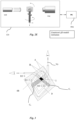
- a gemstone 100 is glued on a holder 102, see figure 2A .
- the gemstone 100 is measured (scanned) to construct a three dimensional (3D) model of the exterior surface of the gemstone 100.
- a gemstone imaging apparatus 120 comprising the holder 102 upon which the gemstone 100 is fixed; a light source 110; and an imaging device 114 such as a digital camera.
- the holder 102 is typically capable of rotating and/or translating in order to reposition the gemstone 100 relative to the light source 110 and the imaging device 114.
- the imaging apparatus 102 is communicating with a computer 104.
- the computer 104 can control the holder 102 and the imaging device 114 in order to receive images of the gemstone 100 in different positions thereof.
- the imaging or scanning apparatus 120 may include additional components for performing additional measurements of the gemstone 100.
- Various scanning apparatuses generally suitable for use with the present invention are known in the prior art.
- the stone 100 on the holder 102 is immersed in a liquid material suitable for forming a transparent solid encasing around the stone.
- the liquid glassy material is then cooled to form a transparent solid body around the stone.
- the information about the location of the diamond inside the solid material can e.g. be kept either by the holder or by special marks put on the sides of the solid immersion beforehand.
- the medium can have the form of a cube, an octahedron, or other forms similar (or approximately equidistant) to that of the diamond with well-polished sides.
- FIG. 6 An example of an octahedron shape similar to that of the original diamond is illustrated in figure 6 .
- the solid immersion material SI is shaped with an outer surface OS in the form of an octahedron.
- a small distance d min between the solid immersion polished side plane and the surface of the diamond provides a better contrast and brightness of the inclusion thanks to minimizing the light scattering in the small layer of the immersion.
- the 3D model of the outer surface of the stone has been determined with respect to the holder and that the shape of the encasing with respect to the holder is known or can be determined, such that a 3D model of the outer surface of solid encasing can be built on the same coordinate basis as the coordinate basis used for the 3D model of the gemstone.
- a scan of the outer surface of the solid block 130 is performed in order to build a 3D model of the solid block on the same coordinate basis as the coordinate basis used for the 3D model of the gemstone.
- the refractive indexes of the material of the gemstone and of the solid encasing the light paths within the solid block can be calculated.
- the solid block 130 applied around the diamond by immersion has a number of flat surfaces through which the diamond can be observed, and can e.g. have the shape of a prism, such as a rectangular cube.
- the solid block may have a shape which is similar to the shape of the gemstone inside but has a number of flat surfaces, see e.g. figure 3 .
- the shape of the solid block could be such that the distance between the outer surface of the gemstone and the outer surface of the solid block lies within a certain range. Note that it is possible to change the shape of the solid block e.g. by polishing, and that is e.g. possible to add additional facets to the solid block for an improved viewing of the inclusions, and this without removing valuable gemstone material.
- polished windows may e.g. be used to find and build inclusions, wherein a matt surface has the advantage of creating a homogeneous background for the view through the polished windows 132. In other words, in certain cases, it may be advantageous to make sure that there is a matt surface 131 opposite a polished window 132.
- the casing 130 should be transparent in a part of the visible spectrum, with a transparency of between 5 and 70%, preferably between 40 and 70 %. This will allow the use of the currently available cameras.
- a suitable material will typically be a glassy material with a refractive index similar to the refractive index of the gemstone in the solid state thereof.
- the RI of the glassy material is 2.42 +/-0,3, and more preferably 2,42 +/- 0.1, and most preferably 2,42 +/- 0,01.
- arsenic-sulphide compositions preferably alloyed with Selenium or Iodine, e.g. arsenic sulphides (As(X)S(Y)), arsenic sulphide iodides (As(X)S(Y)I(Z)) or arsenic sulphides containing iodine (As(X)S(Y)+(Z)%I). More in particular, examples are As 2 S 9 , As 2 S 9 +3%I, As 2 S 10 , As 2 S 5 +8%I, As 30 S 46 I 24 , or a combination thereof.
- Selenium or Iodine e.g. arsenic sulphides (As(X)S(Y)), arsenic sulphide iodides (As(X)S(Y)I(Z)) or arsenic sulphides containing iodine (As(X)S(Y)+(Z)%I). More
- the material has a low melting point (e.g. about 200-300°C).
- the material has a coefficient of the thermal expansion (CTE) close to that of the gemstone and/or a plasticity which is sufficiently high to avoid cracking after solidification at room temperature.
- the arsenic-sulphides alloyed by selenium or iodine may be used, optionally heated up to the temperature close to the point at which the material is about to soften, but still solid. Heating the material slightly whilst keeping a solid immersion body will decrease drastically the inner tensions inside the solid immersion material. This will allow avoiding knags and cracks, which could appear because of the difference in thermal expansion coefficient between diamond and the solid immersion material.
- the solid immersion materials mentioned above are not toxic at such temperatures (typically about 60°C), and the temperature still allows the use of the currently available optical devices which may be slightly modified by adding a small standard infra-red heater for obtaining those increased temperatures.
- the glass block 130 in which the gemstone 100 is taken up is placed in an imaging apparatus 120 for determining the location of the inclusion in the gemstone. More preferably, a scanning apparatus of the general type disclosed in EP 1 211 503 may be utilized in embodiments of the present invention. Possible methods use optical cylinders and are similar to the methods of the prior art illustrated in figures 1A-C . If the RI of the material of the solid block is identical the RI of the gemstone, it is possible to simply use the methods illustrated in figures 1A-C with this difference that the 3D model to be used is the 3D model of the solid block and not the 3D model of the diamond.
- the method is slightly more complex as illustrated in figure 3 . More in particular, both the outer surface A of the solid block SB and the outer surface B of the gemstone D need to taken into account to calculate the trace of the beam between an inclusion I and an observer O.
- the coordinates of the surface are known from the 3D-models which are determined as explained above.
- figure 3 shows in detail how to build the shape of the inclusion by intersecting optical cylinders C1, C2. In the case of a narrow depth-of-field apparatus (cf.
- the cylinders extend in the direction of the light trace between the focal plane and the outer surface of the gemstone, and have a shape closely fitting the contour of the inclusion, see the dark hatched areas. If “direction” is defined as the perpendicular to the side through which the inclusion is observed then, when using a narrow depth-of-field apparatus, each direction typically allows measuring through it within a cone with a vertex angle of 10 to 15 degrees. Increasing this angle will result in a decrease of the measurement accuracy due to the astigmatism phenomenon. When a wide depth-of-field apparatus is used (cf.
- cylinders C1, C2 are created extending in the direction of the light trace from one location of the outer surface to an opposite location on the outer surface and having a shape closely fitting the contour of the inclusion, see the light and dark hatched areas in figure 3 .
- the phenomenon of astigmatism (the deformation of the width of the ray bundle after refraction) can be taken into account in the calculation, as illustrated in figure 3 .
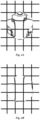
- FIGS 4A and 4B it is shown how the RI of the solid glassy material influences the image of the stone.
- Figure 5B shows how the glassy material helps to detect an inclusion (encircled) which are barely noticeable without any immersion ( figure 5A ). More in particular, the inclusion is more clearly visible in the photo of figure 5B then in the photo of figure 5A . This shows that the method of the invention is also appropriate to use in the event that RI is not exactly equal to that of the gemstone.
- Embodiments of the method of the invention have amongst others, one or more of following advantages over the prior art:
- Figure 7 illustrates an embodiment where the solid immersion material 130 is included in a cuvette 140.
- This cuvette 140 is transparent in a segment of the visible spectrum or in a segment of the infrared spectrum, and is e.g. manufactured of quartz.
- the analyzing of the gemstone can be done through one or more facets of said cuvette 140 whilst the solid transparent block is in the cuvette.
- a piece of immersion glass is put into the cuvette. Then the assembly of cuvette, immersion material and gemstone is heated in an inert atmosphere such as Argon at a temperature up to 195 -/+30 degrees Celsius depending on the type of immersion glass material selected.
- the assembly is not cooled down to room temperature but kept at a slightly higher temperature for the analysis of the gemstone in order to avoid cracks in the immersion or cuvette glass.
- the cuvette may be slightly heated, e.g. up to 35-70 degrees Celsius but below the immersion glass solid/liquid transition temperature. In that way the immersion material becomes more plastic and problems with differences of the temperature expansion coefficient between the cuvette glass and the immersion glass are avoided. Also there a good wetted contact interface is achieved between the immersion material and the cuvette.
- Figure 8 illustrates two possible shapes for a cuvette 140a, 140b.
- the cuvette 140a has a beam shape
- the cuvette 140b has an octahedron shape with an open top.
- Such a polygonal shape has a plurality of edges, and one or more heating wires 141 may be arranged at or near one or more of said plurality of edges.
- an electrically conductive coating may be provided on the inner and/or outer surface of the cuvette, as disclosed above in the summary of the invention. Further there may be provided electrical contacts to connect the coating to an electrical source such as a current source.
Landscapes
- Physics & Mathematics (AREA)
- Health & Medical Sciences (AREA)
- Life Sciences & Earth Sciences (AREA)
- Chemical & Material Sciences (AREA)
- Analytical Chemistry (AREA)
- Biochemistry (AREA)
- General Health & Medical Sciences (AREA)
- General Physics & Mathematics (AREA)
- Immunology (AREA)
- Pathology (AREA)
- Investigating Materials By The Use Of Optical Means Adapted For Particular Applications (AREA)
Claims (15)
- Verfahren zum Analysieren eines Diamanten, typischerweise zum Lokalisieren eines Einschlusses in einem Diamanten, umfassend:- Auswählen eines festen Materials, das mindestens in einem Segment des sichtbaren Spektrums oder einem Segment des Infrarotspektrums transparent ist;- Schmelzen oder Plastifizieren des festen Materials und Eintauchen des Diamanten in das geschmolzene oder plastifizierte Material, derart, dass der Diamant mindestens teilweise darin bedeckt ist; wobei das feste transparente Material einen Brechungsindex RIs aufweist und der Diamant einen Brechungsindex Rig aufweist, wobei RIg - 0,3 < RIs < RIg + 0,3;- Erstarrenlassen des geschmolzenen oder plastifizierten Materials, um ein fester transparenter Block zu werden, der den Diamanten enthält; dadurch gekennzeichnet, dass das Verfahren ferner umfasst:- Analysieren des Diamanten durch eine Oberfläche des transparenten festen Blocks unter Verwendung von Lichtstrahlen in dem sichtbaren Spektrum oder in dem Infrarotspektrum, wobei das Analysieren das Eintauchen des festen Blocks in eine Immersionsflüssigkeit umfasst.
- Verfahren nach Anspruch 1, wobei der feste Block in der Immersionsflüssigkeit gedreht wird und 2D-Bilder aus einer Vielzahl von unterschiedlichen Betrachtungsrichtungen erhalten werden, um ein 3D-Modell der Einschlusses/der Einschlüsse des Diamanten zu bestimmen.
- Verfahren nach einem der vorstehenden Ansprüche zum Lokalisieren eines Einschlusses in einem Diamanten, wobei die Analyse umfasst: Visualisieren des Einschlusses unter Verwendung von Lichtstrahlen in dem sichtbaren Spektrum durch eine Oberfläche des transparenten Blocks und Bestimmen der Position des Einschlusses unter Verwendung von Computermitteln.
- Verfahren nach einem der vorstehenden Ansprüche, wobei RIg - 0,1 < RIs < RIg + 0,1 und vorzugsweise RIg - 0,01 < RIs < RIg + 0,01; und/oder wobei das feste Material eine Transparenz für ein vorherbestimmtes Segment des sichtbaren Lichts zwischen 5 % und 70 %, vorzugsweise zwischen 30 % und 70 % und mehr bevorzugt zwischen 40 % und 70 % aufweist.
- Verfahren nach einem der vorstehenden Ansprüche, wobei der feste Block mit mindestens einer ersten und einer zweiten Oberfläche ausgebildet oder poliert wird, durch die ein Einschluss erkannt werden kann, wobei das Analysieren umfasst:- Beobachten des Einschlusses durch die erste Oberfläche des festen Blocks und Erhalten eines ersten 2D-Bilds des Einschlusses, wie er durch die erste Oberfläche erkannt wird;- Beobachten des Einschlusses durch die zweite Oberfläche des festen Blocks und Erhalten eines zweiten 2D-Bilds des Einschlusses, wie er durch die zweite Oberfläche erkannt wird;- Bestimmen eines ersten optischen Zylinders unter Verwendung einer ersten Kontur des ersten Bilds des Einschlusses und eines zweiten optischen Zylinders unter Verwendung einer zweiten Kontur des zweiten Bilds des Einschlusses;- Verwenden des Schnittpunkts des ersten und zweiten optischen Zylinders, um die Stelle und/oder Form des Einschlusses zu bestimmen.
- Verfahren nach einem der vorstehenden Ansprüche, wobei vor dem Bedecken des Diamanten mit dem transparenten Material ein 3D-Modell der Außenoberfläche des Diamanten relativ zu einem Koordinatensystem erhalten wird;
wobei nach dem Bedecken des Diamanten mit dem transparenten Material der feste Block optional poliert wird; und wobei ein 3D-Modell der Außenoberfläche des festen Blocks relativ zu dem Koordinatensystem erhalten wird; wobei das Analysieren umfasst:- Beobachten des Einschlusses durch mindestens eine Oberfläche des festen Blocks und Erhalten von mindestens einem 2D-Bild des Einschlusses, wie er durch diese mindestens eine Oberfläche erkannt wird;- Bestimmen der Stelle des Einschlusses unter Verwendung des mindestens einen Bilds des Einschlusses, des 3D-Modells des Diamanten und des 3D-Modells des festen Blocks. - Verfahren nach einem der vorstehenden Ansprüche, wobei das Analysieren umfasst:
Markieren der Oberfläche des festen Blocks, wobei Hinweise für grobe Verarbeitungsschritte, wie Vorschmieden, Brechen, Sägen oder für feine Schneide-/Polierschritte, bereitgestellt werden. - Verfahren nach einem der vorstehenden Ansprüche, wobei das Immersionsmaterial eine Arsensulfid-Zusammensetzung ist, die optional mit Selen oder Jod legiert ist, wie Arsensulfide (As(X)S(Y)), Arsensulfidiodide (As(X)S(Y))I(Z)) oder Arsensulfide, die Jod (As(X)S(Y)+(Z)%I) enthalten, und beispielsweise As2S9, As2S9+3 %I, AS2S10, As2S5+8 %I, AS30S46I24 oder eine Kombination davon.
- Verfahren nach einem der vorstehenden Ansprüche, wobei der Diamant während des Analysierens auf eine Temperatur unterhalb der Schmelztemperatur erwärmt wird, um die inneren Spannungen im Inneren des festen Immersionsmaterial zu verringern.
- Verfahren nach einem der vorstehenden Ansprüche, wobei der Diamant auf einem Halter befestigt ist, und wobei das Immersionsmaterial aufgetragen wird, während der Diamant auf dem Halter befestigt bleibt.
- Verfahren nach einem der vorstehenden Ansprüche, wobei der feste transparente Block, einschließlich des Diamanten, in einem Behälter, insbesondere einer Küvette, eingeschlossen ist, und wobei das Analysieren durch eine Wand des Behälters erfolgt, während der feste transparente Block in dem Behälter ist, wobei
der Behälter mindestens in einem Segment des sichtbaren Spektrums oder in einem Segment des Infrarotspektrums transparent ist, wobei das feste Immersionsmaterial in dem Behälter geschmolzen oder plastifiziert wird, derart, dass es an dem Behälter haftet. - Verfahren nach Anspruch 11, wobei der Diamant und das feste Immersionsmaterial in einen Behälter platziert werden, woraufhin das Schmelzen oder Plastifizieren des festen Immersionsmaterials und das Eintauchen des Diamanten in das geschmolzene oder plastifizierte Material erfolgt, derart, dass der Diamant mindestens teilweise mit dem festen Immersionsmaterial in dem Behälter bedeckt ist, wobei vorzugsweise der Behälter während des Abkühlens des Immersionsmaterials erwärmt bleibt.
- Diamant, aufgenommen in einem festen Block (130) aus festem transparentem Material, zur Verwendung in dem Analyseschritt des Verfahrens gemäß einem der vorstehenden Ansprüche, wobei das feste Material in mindestens einem Segment des sichtbaren Spektrums transparent ist, und wobei das Material des festen Blocks eine Arsensulfid-Zusammensetzung ist, die optional mit Selen oder Jod legiert ist, wobei das feste transparente Material einen Brechungsindex RIs aufweist und der Diamant einen Brechungsindex RIg aufweist und wobei RIg - 0,3 < RIs < RIg + 0,3.
- Diamant, aufgenommen in einem festen Block (130) nach Anspruch 13, wobei das feste Material ein beliebiges der folgenden ist: As2S9, As2S9+3 %I, AS2S10, As2S5+8 %I, AS30S46I24 oder eine Kombination davon.
- Diamant, aufgenommen in einem festen Block (130) nach einem der Ansprüche 13 oder 14;wobei der feste Block mit mindestens zwei flachen Oberflächen poliert wird, um Facetten für eine Analyse des Diamanten zu erhalten; oderwobei der feste Block mit einer Form, die der Form des Diamanten ähnelt, jedoch mit mehreren flachen Oberflächen, poliert oder geformt wird.
Applications Claiming Priority (3)
| Application Number | Priority Date | Filing Date | Title |
|---|---|---|---|
| BE2010/0411A BE1019409A5 (nl) | 2010-07-07 | 2010-07-07 | Verbeterde werkwijze voor het analyseren van een edelsteen. |
| EP11733638.8A EP2591341B1 (de) | 2010-07-07 | 2011-07-07 | Verbessertes verfahren zur untersuchung eines edelsteins |
| PCT/EP2011/061529 WO2012004351A1 (en) | 2010-07-07 | 2011-07-07 | Improved method for analyzing a gemstone |
Related Parent Applications (1)
| Application Number | Title | Priority Date | Filing Date |
|---|---|---|---|
| EP11733638.8A Division EP2591341B1 (de) | 2010-07-07 | 2011-07-07 | Verbessertes verfahren zur untersuchung eines edelsteins |
Publications (2)
| Publication Number | Publication Date |
|---|---|
| EP3605071A1 EP3605071A1 (de) | 2020-02-05 |
| EP3605071B1 true EP3605071B1 (de) | 2024-11-06 |
Family
ID=43111360
Family Applications (2)
| Application Number | Title | Priority Date | Filing Date |
|---|---|---|---|
| EP11733638.8A Active EP2591341B1 (de) | 2010-07-07 | 2011-07-07 | Verbessertes verfahren zur untersuchung eines edelsteins |
| EP19198176.0A Active EP3605071B1 (de) | 2010-07-07 | 2011-07-07 | Verfahren zur untersuchung eines edelsteins |
Family Applications Before (1)
| Application Number | Title | Priority Date | Filing Date |
|---|---|---|---|
| EP11733638.8A Active EP2591341B1 (de) | 2010-07-07 | 2011-07-07 | Verbessertes verfahren zur untersuchung eines edelsteins |
Country Status (3)
| Country | Link |
|---|---|
| EP (2) | EP2591341B1 (de) |
| BE (1) | BE1019409A5 (de) |
| WO (1) | WO2012004351A1 (de) |
Families Citing this family (4)
| Publication number | Priority date | Publication date | Assignee | Title |
|---|---|---|---|---|
| DE60030569D1 (de) † | 2000-12-04 | 2006-10-19 | Diamcad | Verfahren und Vorrichtung zur Ortung von Einschlüssen in einem Diamantstein |
| ES2683243T3 (es) * | 2014-03-31 | 2018-09-25 | Think Laboratory Co., Ltd. | Aparato y método de chapar cilindros |
| BE1025152B1 (nl) | 2017-04-19 | 2018-11-19 | Octonus Finland Oy | Verbeterde werkwijze voor het analyseren van een edelsteen |
| USD1070645S1 (en) | 2023-02-23 | 2025-04-15 | Octonus Finland Oy | Gemstone |
Family Cites Families (8)
| Publication number | Priority date | Publication date | Assignee | Title |
|---|---|---|---|---|
| NL251725A (de) | 1959-06-03 | 1900-01-01 | ||
| DE2444644A1 (de) | 1974-09-18 | 1976-04-08 | Dihaco Diamanten Handels Co | Verfahren und vorrichtung zur ermittlung und groessenbestimmung von einschluessen in edelsteinen |
| RU2054656C1 (ru) * | 1993-01-12 | 1996-02-20 | Алтайское производственное объединение "Кристалл" | Способ определения положения дефекта в прозрачном камне |
| DE60030569D1 (de) * | 2000-12-04 | 2006-10-19 | Diamcad | Verfahren und Vorrichtung zur Ortung von Einschlüssen in einem Diamantstein |
| US7487870B2 (en) * | 2003-11-05 | 2009-02-10 | Tom Ceulemans | Device and kit for visualizing a cutting regime of a diamond, and a method for determining a cutting regime |
| US7622296B2 (en) * | 2004-05-28 | 2009-11-24 | Wafergen, Inc. | Apparatus and method for multiplex analysis |
| IL181484A0 (en) * | 2007-02-21 | 2007-07-04 | Haim Shlezinger | A method for evaluation of a gemstone |
| DE102005039679A1 (de) * | 2005-08-22 | 2007-03-08 | Galatea Ltd. | Verfahren zum Bestimmen des Wertes eines Objekts |
-
2010
- 2010-07-07 BE BE2010/0411A patent/BE1019409A5/nl not_active IP Right Cessation
-
2011
- 2011-07-07 EP EP11733638.8A patent/EP2591341B1/de active Active
- 2011-07-07 EP EP19198176.0A patent/EP3605071B1/de active Active
- 2011-07-07 WO PCT/EP2011/061529 patent/WO2012004351A1/en not_active Ceased
Also Published As
| Publication number | Publication date |
|---|---|
| EP2591341A1 (de) | 2013-05-15 |
| WO2012004351A1 (en) | 2012-01-12 |
| EP2591341B1 (de) | 2019-10-02 |
| EP3605071A1 (de) | 2020-02-05 |
| BE1019409A5 (nl) | 2012-07-03 |
Similar Documents
| Publication | Publication Date | Title |
|---|---|---|
| US7800741B2 (en) | Method for evaluation of a gemstone | |
| CN101292152B (zh) | 评估宝石的方法 | |
| EP2225731B1 (de) | Verfahren und system zur verbesserten optischen modellierung von edelsteinen | |
| TW468043B (en) | Stereo vision inspection system for transparent media | |
| US20080111074A1 (en) | Method for infrared imaging of substrates through coatings | |
| EP2591341B1 (de) | Verbessertes verfahren zur untersuchung eines edelsteins | |
| CN1902474A (zh) | 宝石中缺陷的检测 | |
| RU2705381C1 (ru) | Система и способ автоматического создания схем ценной огранки необработанного драгоценного камня | |
| Froud et al. | Advances in the Raman depth profiling of polymer laminates | |
| US20180372647A1 (en) | Method to characterize cut gemstones using optical coherence tomography | |
| US11226292B2 (en) | Method for analysing a gemstone | |
| Semencha et al. | Effective diagnostics of internal defects of diamonds in the near infrared range on the basis of immersion medium made from low-melting chalcogenide glass | |
| WO2009133393A1 (en) | Locating inclusions in diamond | |
| US10016872B2 (en) | Method for producing a mirror substrate blank of titanium-doped silica glass for EUV lithography, and system for determining the position of defects in a blank | |
| CA2679558C (en) | A method for evaluation of a gemstone | |
| RU2054656C1 (ru) | Способ определения положения дефекта в прозрачном камне | |
| CN115656052A (zh) | 一种透光物体缺陷检测方法 | |
| US20190271602A1 (en) | Prism coupling methods of characterizing stress in glass-based ion-exchanged articles having problematic refractive index profiles | |
| RU2035039C1 (ru) | Способ определения положения дефекта в прозрачном камне | |
| CN120142168A (zh) | 一种多线光束飞机挡风玻璃划痕形貌测量装置及方法 | |
| HK40014246B (en) | Improved method for analysing a gemstone | |
| HK1118909B (en) | A method for evaluation of a diamond |
Legal Events
| Date | Code | Title | Description |
|---|---|---|---|
| PUAI | Public reference made under article 153(3) epc to a published international application that has entered the european phase |
Free format text: ORIGINAL CODE: 0009012 |
|
| STAA | Information on the status of an ep patent application or granted ep patent |
Free format text: STATUS: THE APPLICATION HAS BEEN PUBLISHED |
|
| AC | Divisional application: reference to earlier application |
Ref document number: 2591341 Country of ref document: EP Kind code of ref document: P |
|
| AK | Designated contracting states |
Kind code of ref document: A1 Designated state(s): AL AT BE BG CH CY CZ DE DK EE ES FI FR GB GR HR HU IE IS IT LI LT LU LV MC MK MT NL NO PL PT RO RS SE SI SK SM TR |
|
| STAA | Information on the status of an ep patent application or granted ep patent |
Free format text: STATUS: REQUEST FOR EXAMINATION WAS MADE |
|
| 17P | Request for examination filed |
Effective date: 20200731 |
|
| RBV | Designated contracting states (corrected) |
Designated state(s): AL AT BE BG CH CY CZ DE DK EE ES FI FR GB GR HR HU IE IS IT LI LT LU LV MC MK MT NL NO PL PT RO RS SE SI SK SM TR |
|
| STAA | Information on the status of an ep patent application or granted ep patent |
Free format text: STATUS: EXAMINATION IS IN PROGRESS |
|
| 17Q | First examination report despatched |
Effective date: 20220426 |
|
| GRAP | Despatch of communication of intention to grant a patent |
Free format text: ORIGINAL CODE: EPIDOSNIGR1 |
|
| STAA | Information on the status of an ep patent application or granted ep patent |
Free format text: STATUS: GRANT OF PATENT IS INTENDED |
|
| RIC1 | Information provided on ipc code assigned before grant |
Ipc: G01N 21/03 20060101ALN20240513BHEP Ipc: G01N 21/87 20060101AFI20240513BHEP |
|
| INTG | Intention to grant announced |
Effective date: 20240604 |
|
| RAP3 | Party data changed (applicant data changed or rights of an application transferred) |
Owner name: OCTONUS FINLAND OY |
|
| GRAS | Grant fee paid |
Free format text: ORIGINAL CODE: EPIDOSNIGR3 |
|
| GRAA | (expected) grant |
Free format text: ORIGINAL CODE: 0009210 |
|
| STAA | Information on the status of an ep patent application or granted ep patent |
Free format text: STATUS: THE PATENT HAS BEEN GRANTED |
|
| AC | Divisional application: reference to earlier application |
Ref document number: 2591341 Country of ref document: EP Kind code of ref document: P |
|
| AK | Designated contracting states |
Kind code of ref document: B1 Designated state(s): AL AT BE BG CH CY CZ DE DK EE ES FI FR GB GR HR HU IE IS IT LI LT LU LV MC MK MT NL NO PL PT RO RS SE SI SK SM TR |
|
| REG | Reference to a national code |
Ref country code: GB Ref legal event code: FG4D |
|
| REG | Reference to a national code |
Ref country code: CH Ref legal event code: EP |
|
| REG | Reference to a national code |
Ref country code: DE Ref legal event code: R096 Ref document number: 602011075091 Country of ref document: DE |
|
| REG | Reference to a national code |
Ref country code: IE Ref legal event code: FG4D |
|
| REG | Reference to a national code |
Ref country code: LT Ref legal event code: MG9D |
|
| REG | Reference to a national code |
Ref country code: NL Ref legal event code: MP Effective date: 20241106 |
|
| PG25 | Lapsed in a contracting state [announced via postgrant information from national office to epo] |
Ref country code: PT Free format text: LAPSE BECAUSE OF FAILURE TO SUBMIT A TRANSLATION OF THE DESCRIPTION OR TO PAY THE FEE WITHIN THE PRESCRIBED TIME-LIMIT Effective date: 20250306 Ref country code: HR Free format text: LAPSE BECAUSE OF FAILURE TO SUBMIT A TRANSLATION OF THE DESCRIPTION OR TO PAY THE FEE WITHIN THE PRESCRIBED TIME-LIMIT Effective date: 20241106 Ref country code: IS Free format text: LAPSE BECAUSE OF FAILURE TO SUBMIT A TRANSLATION OF THE DESCRIPTION OR TO PAY THE FEE WITHIN THE PRESCRIBED TIME-LIMIT Effective date: 20250306 |
|
| PG25 | Lapsed in a contracting state [announced via postgrant information from national office to epo] |
Ref country code: NL Free format text: LAPSE BECAUSE OF FAILURE TO SUBMIT A TRANSLATION OF THE DESCRIPTION OR TO PAY THE FEE WITHIN THE PRESCRIBED TIME-LIMIT Effective date: 20241106 Ref country code: FI Free format text: LAPSE BECAUSE OF FAILURE TO SUBMIT A TRANSLATION OF THE DESCRIPTION OR TO PAY THE FEE WITHIN THE PRESCRIBED TIME-LIMIT Effective date: 20241106 |
|
| REG | Reference to a national code |
Ref country code: AT Ref legal event code: MK05 Ref document number: 1739856 Country of ref document: AT Kind code of ref document: T Effective date: 20241106 |
|
| PG25 | Lapsed in a contracting state [announced via postgrant information from national office to epo] |
Ref country code: BG Free format text: LAPSE BECAUSE OF FAILURE TO SUBMIT A TRANSLATION OF THE DESCRIPTION OR TO PAY THE FEE WITHIN THE PRESCRIBED TIME-LIMIT Effective date: 20241106 |
|
| PG25 | Lapsed in a contracting state [announced via postgrant information from national office to epo] |
Ref country code: ES Free format text: LAPSE BECAUSE OF FAILURE TO SUBMIT A TRANSLATION OF THE DESCRIPTION OR TO PAY THE FEE WITHIN THE PRESCRIBED TIME-LIMIT Effective date: 20241106 |
|
| PG25 | Lapsed in a contracting state [announced via postgrant information from national office to epo] |
Ref country code: NO Free format text: LAPSE BECAUSE OF FAILURE TO SUBMIT A TRANSLATION OF THE DESCRIPTION OR TO PAY THE FEE WITHIN THE PRESCRIBED TIME-LIMIT Effective date: 20250206 |
|
| PG25 | Lapsed in a contracting state [announced via postgrant information from national office to epo] |
Ref country code: GR Free format text: LAPSE BECAUSE OF FAILURE TO SUBMIT A TRANSLATION OF THE DESCRIPTION OR TO PAY THE FEE WITHIN THE PRESCRIBED TIME-LIMIT Effective date: 20250207 Ref country code: LV Free format text: LAPSE BECAUSE OF FAILURE TO SUBMIT A TRANSLATION OF THE DESCRIPTION OR TO PAY THE FEE WITHIN THE PRESCRIBED TIME-LIMIT Effective date: 20241106 Ref country code: AT Free format text: LAPSE BECAUSE OF FAILURE TO SUBMIT A TRANSLATION OF THE DESCRIPTION OR TO PAY THE FEE WITHIN THE PRESCRIBED TIME-LIMIT Effective date: 20241106 |
|
| PG25 | Lapsed in a contracting state [announced via postgrant information from national office to epo] |
Ref country code: PL Free format text: LAPSE BECAUSE OF FAILURE TO SUBMIT A TRANSLATION OF THE DESCRIPTION OR TO PAY THE FEE WITHIN THE PRESCRIBED TIME-LIMIT Effective date: 20241106 |
|
| PG25 | Lapsed in a contracting state [announced via postgrant information from national office to epo] |
Ref country code: RS Free format text: LAPSE BECAUSE OF FAILURE TO SUBMIT A TRANSLATION OF THE DESCRIPTION OR TO PAY THE FEE WITHIN THE PRESCRIBED TIME-LIMIT Effective date: 20250206 |
|
| PG25 | Lapsed in a contracting state [announced via postgrant information from national office to epo] |
Ref country code: SM Free format text: LAPSE BECAUSE OF FAILURE TO SUBMIT A TRANSLATION OF THE DESCRIPTION OR TO PAY THE FEE WITHIN THE PRESCRIBED TIME-LIMIT Effective date: 20241106 |
|
| PG25 | Lapsed in a contracting state [announced via postgrant information from national office to epo] |
Ref country code: DK Free format text: LAPSE BECAUSE OF FAILURE TO SUBMIT A TRANSLATION OF THE DESCRIPTION OR TO PAY THE FEE WITHIN THE PRESCRIBED TIME-LIMIT Effective date: 20241106 |
|
| PG25 | Lapsed in a contracting state [announced via postgrant information from national office to epo] |
Ref country code: EE Free format text: LAPSE BECAUSE OF FAILURE TO SUBMIT A TRANSLATION OF THE DESCRIPTION OR TO PAY THE FEE WITHIN THE PRESCRIBED TIME-LIMIT Effective date: 20241106 |
|
| PG25 | Lapsed in a contracting state [announced via postgrant information from national office to epo] |
Ref country code: RO Free format text: LAPSE BECAUSE OF FAILURE TO SUBMIT A TRANSLATION OF THE DESCRIPTION OR TO PAY THE FEE WITHIN THE PRESCRIBED TIME-LIMIT Effective date: 20241106 |
|
| PG25 | Lapsed in a contracting state [announced via postgrant information from national office to epo] |
Ref country code: SK Free format text: LAPSE BECAUSE OF FAILURE TO SUBMIT A TRANSLATION OF THE DESCRIPTION OR TO PAY THE FEE WITHIN THE PRESCRIBED TIME-LIMIT Effective date: 20241106 |
|
| PG25 | Lapsed in a contracting state [announced via postgrant information from national office to epo] |
Ref country code: CZ Free format text: LAPSE BECAUSE OF FAILURE TO SUBMIT A TRANSLATION OF THE DESCRIPTION OR TO PAY THE FEE WITHIN THE PRESCRIBED TIME-LIMIT Effective date: 20241106 |
|
| PG25 | Lapsed in a contracting state [announced via postgrant information from national office to epo] |
Ref country code: IT Free format text: LAPSE BECAUSE OF FAILURE TO SUBMIT A TRANSLATION OF THE DESCRIPTION OR TO PAY THE FEE WITHIN THE PRESCRIBED TIME-LIMIT Effective date: 20241106 |
|
| REG | Reference to a national code |
Ref country code: DE Ref legal event code: R097 Ref document number: 602011075091 Country of ref document: DE |
|
| PG25 | Lapsed in a contracting state [announced via postgrant information from national office to epo] |
Ref country code: SE Free format text: LAPSE BECAUSE OF FAILURE TO SUBMIT A TRANSLATION OF THE DESCRIPTION OR TO PAY THE FEE WITHIN THE PRESCRIBED TIME-LIMIT Effective date: 20241106 |
|
| PLBE | No opposition filed within time limit |
Free format text: ORIGINAL CODE: 0009261 |
|
| STAA | Information on the status of an ep patent application or granted ep patent |
Free format text: STATUS: NO OPPOSITION FILED WITHIN TIME LIMIT |
|
| 26N | No opposition filed |
Effective date: 20250807 |
|
| PGFP | Annual fee paid to national office [announced via postgrant information from national office to epo] |
Ref country code: BE Payment date: 20250728 Year of fee payment: 15 |
|
| REG | Reference to a national code |
Ref country code: DE Ref legal event code: R119 Ref document number: 602011075091 Country of ref document: DE |
|
| REG | Reference to a national code |
Ref country code: CH Ref legal event code: H13 Free format text: ST27 STATUS EVENT CODE: U-0-0-H10-H13 (AS PROVIDED BY THE NATIONAL OFFICE) Effective date: 20260224 |
|
| PG25 | Lapsed in a contracting state [announced via postgrant information from national office to epo] |
Ref country code: LU Free format text: LAPSE BECAUSE OF NON-PAYMENT OF DUE FEES Effective date: 20250707 |
|
| GBPC | Gb: european patent ceased through non-payment of renewal fee |
Effective date: 20250707 |
|
| PG25 | Lapsed in a contracting state [announced via postgrant information from national office to epo] |
Ref country code: GB Free format text: LAPSE BECAUSE OF NON-PAYMENT OF DUE FEES Effective date: 20250707 |
|
| PG25 | Lapsed in a contracting state [announced via postgrant information from national office to epo] |
Ref country code: DE Free format text: LAPSE BECAUSE OF NON-PAYMENT OF DUE FEES Effective date: 20260203 |
|
| PG25 | Lapsed in a contracting state [announced via postgrant information from national office to epo] |
Ref country code: FR Free format text: LAPSE BECAUSE OF NON-PAYMENT OF DUE FEES Effective date: 20250731 |
|
| PG25 | Lapsed in a contracting state [announced via postgrant information from national office to epo] |
Ref country code: CH Free format text: LAPSE BECAUSE OF NON-PAYMENT OF DUE FEES Effective date: 20250731 |