EP3603606B1 - Klebendes monomer für dentalmaterial - Google Patents
Klebendes monomer für dentalmaterial Download PDFInfo
- Publication number
- EP3603606B1 EP3603606B1 EP18777195.1A EP18777195A EP3603606B1 EP 3603606 B1 EP3603606 B1 EP 3603606B1 EP 18777195 A EP18777195 A EP 18777195A EP 3603606 B1 EP3603606 B1 EP 3603606B1
- Authority
- EP
- European Patent Office
- Prior art keywords
- group
- general formula
- groups
- represented
- core
- Prior art date
- Legal status (The legal status is an assumption and is not a legal conclusion. Google has not performed a legal analysis and makes no representation as to the accuracy of the status listed.)
- Active
Links
Classifications
-
- C—CHEMISTRY; METALLURGY
- C09—DYES; PAINTS; POLISHES; NATURAL RESINS; ADHESIVES; COMPOSITIONS NOT OTHERWISE PROVIDED FOR; APPLICATIONS OF MATERIALS NOT OTHERWISE PROVIDED FOR
- C09J—ADHESIVES; NON-MECHANICAL ASPECTS OF ADHESIVE PROCESSES IN GENERAL; ADHESIVE PROCESSES NOT PROVIDED FOR ELSEWHERE; USE OF MATERIALS AS ADHESIVES
- C09J4/00—Adhesives based on organic non-macromolecular compounds having at least one polymerisable carbon-to-carbon unsaturated bond ; adhesives, based on monomers of macromolecular compounds of groups C09J183/00 - C09J183/16
-
- A—HUMAN NECESSITIES
- A61—MEDICAL OR VETERINARY SCIENCE; HYGIENE
- A61K—PREPARATIONS FOR MEDICAL, DENTAL OR TOILETRY PURPOSES
- A61K6/00—Preparations for dentistry
- A61K6/60—Preparations for dentistry comprising organic or organo-metallic additives
-
- A—HUMAN NECESSITIES
- A61—MEDICAL OR VETERINARY SCIENCE; HYGIENE
- A61K—PREPARATIONS FOR MEDICAL, DENTAL OR TOILETRY PURPOSES
- A61K6/00—Preparations for dentistry
- A61K6/30—Compositions for temporarily or permanently fixing teeth or palates, e.g. primers for dental adhesives
-
- A—HUMAN NECESSITIES
- A61—MEDICAL OR VETERINARY SCIENCE; HYGIENE
- A61K—PREPARATIONS FOR MEDICAL, DENTAL OR TOILETRY PURPOSES
- A61K6/00—Preparations for dentistry
- A61K6/70—Preparations for dentistry comprising inorganic additives
- A61K6/71—Fillers
- A61K6/74—Fillers comprising phosphorus-containing compounds
-
- A—HUMAN NECESSITIES
- A61—MEDICAL OR VETERINARY SCIENCE; HYGIENE
- A61K—PREPARATIONS FOR MEDICAL, DENTAL OR TOILETRY PURPOSES
- A61K6/00—Preparations for dentistry
- A61K6/80—Preparations for artificial teeth, for filling teeth or for capping teeth
- A61K6/831—Preparations for artificial teeth, for filling teeth or for capping teeth comprising non-metallic elements or compounds thereof, e.g. carbon
- A61K6/838—Phosphorus compounds, e.g. apatite
-
- C—CHEMISTRY; METALLURGY
- C07—ORGANIC CHEMISTRY
- C07F—ACYCLIC, CARBOCYCLIC OR HETEROCYCLIC COMPOUNDS CONTAINING ELEMENTS OTHER THAN CARBON, HYDROGEN, HALOGEN, OXYGEN, NITROGEN, SULFUR, SELENIUM OR TELLURIUM
- C07F9/00—Compounds containing elements of Groups 5 or 15 of the Periodic Table
- C07F9/02—Phosphorus compounds
- C07F9/06—Phosphorus compounds without P—C bonds
- C07F9/08—Esters of oxyacids of phosphorus
- C07F9/09—Esters of phosphoric acids
- C07F9/091—Esters of phosphoric acids with hydroxyalkyl compounds with further substituents on alkyl
-
- C—CHEMISTRY; METALLURGY
- C07—ORGANIC CHEMISTRY
- C07F—ACYCLIC, CARBOCYCLIC OR HETEROCYCLIC COMPOUNDS CONTAINING ELEMENTS OTHER THAN CARBON, HYDROGEN, HALOGEN, OXYGEN, NITROGEN, SULFUR, SELENIUM OR TELLURIUM
- C07F9/00—Compounds containing elements of Groups 5 or 15 of the Periodic Table
- C07F9/02—Phosphorus compounds
- C07F9/06—Phosphorus compounds without P—C bonds
- C07F9/08—Esters of oxyacids of phosphorus
- C07F9/09—Esters of phosphoric acids
- C07F9/098—Esters of polyphosphoric acids or anhydrides
-
- C—CHEMISTRY; METALLURGY
- C08—ORGANIC MACROMOLECULAR COMPOUNDS; THEIR PREPARATION OR CHEMICAL WORKING-UP; COMPOSITIONS BASED THEREON
- C08F—MACROMOLECULAR COMPOUNDS OBTAINED BY REACTIONS ONLY INVOLVING CARBON-TO-CARBON UNSATURATED BONDS
- C08F222/00—Copolymers of compounds having one or more unsaturated aliphatic radicals, each having only one carbon-to-carbon double bond, and at least one being terminated by a carboxyl radical and containing at least one other carboxyl radical in the molecule; Salts, anhydrides, esters, amides, imides, or nitriles thereof
- C08F222/10—Esters
- C08F222/1006—Esters of polyhydric alcohols or polyhydric phenols
- C08F222/102—Esters of polyhydric alcohols or polyhydric phenols of dialcohols, e.g. ethylene glycol di(meth)acrylate or 1,4-butanediol dimethacrylate
-
- C—CHEMISTRY; METALLURGY
- C09—DYES; PAINTS; POLISHES; NATURAL RESINS; ADHESIVES; COMPOSITIONS NOT OTHERWISE PROVIDED FOR; APPLICATIONS OF MATERIALS NOT OTHERWISE PROVIDED FOR
- C09J—ADHESIVES; NON-MECHANICAL ASPECTS OF ADHESIVE PROCESSES IN GENERAL; ADHESIVE PROCESSES NOT PROVIDED FOR ELSEWHERE; USE OF MATERIALS AS ADHESIVES
- C09J4/00—Adhesives based on organic non-macromolecular compounds having at least one polymerisable carbon-to-carbon unsaturated bond ; adhesives, based on monomers of macromolecular compounds of groups C09J183/00 - C09J183/16
- C09J4/06—Organic non-macromolecular compounds having at least one polymerisable carbon-to-carbon unsaturated bond in combination with a macromolecular compound other than an unsaturated polymer of groups C09J159/00 - C09J187/00
-
- C—CHEMISTRY; METALLURGY
- C08—ORGANIC MACROMOLECULAR COMPOUNDS; THEIR PREPARATION OR CHEMICAL WORKING-UP; COMPOSITIONS BASED THEREON
- C08F—MACROMOLECULAR COMPOUNDS OBTAINED BY REACTIONS ONLY INVOLVING CARBON-TO-CARBON UNSATURATED BONDS
- C08F20/00—Homopolymers and copolymers of compounds having one or more unsaturated aliphatic radicals, each having only one carbon-to-carbon double bond, and only one being terminated by only one carboxyl radical or a salt, anhydride, ester, amide, imide or nitrile thereof
- C08F20/02—Monocarboxylic acids having less than ten carbon atoms, Derivatives thereof
- C08F20/10—Esters
- C08F20/34—Esters containing nitrogen, e.g. N,N-dimethylaminoethyl (meth)acrylate
- C08F20/36—Esters containing nitrogen, e.g. N,N-dimethylaminoethyl (meth)acrylate containing oxygen in addition to the carboxy oxygen, e.g. 2-N-morpholinoethyl (meth)acrylate or 2-isocyanatoethyl (meth)acrylate
Definitions
- the present invention relates to adhesive monomers for dental materials, dental materials including the monomers, and kits including the dental materials.
- Non-Patent Literature 1 In the context of MI, development of restorative materials having high tooth adhesiveness, as well as development of adhesive monomers ensuring sufficient adhesive strength with a small bonding area and having toughness and durability, and improvement of tooth surface treatment methods, is strongly desired.
- a typical adhesive monomer for dental materials serves as a coupling agent between the resin and the tooth as the adhesive monomer for dental materials contains a carboxylic acid or a phosphate group at the end.
- MDP (10-methacryloyloxydecyl dihydrogen phosphate) having a phosphoric acid ester group is a useful phosphoric acid monomer which is not only used for adhesive materials but also blended with many dental materials such as composite resins because the monomer has higher bonding performance as compared to carboxylic acid-based adhesive monomers such as MAC-10 (11-methacryloxy-1,1-undecane dicarbonic acid) and 4-META (4-methacryloxyethyl trimellitate anhydride) (see, for example, Patent Literature 1).
- MDP is a monofunctional monomer, so that there is a limit to resin matrix formation, and thus enhancement of strength cannot be expected.
- phosphoric acid monomers containing a plurality of acrylic groups in the molecule have been reported.
- the phosphoric acid monomers can be expected to enhance resin strength, but have the problem that sufficient adhesive strength is not developed because the distance between the phosphoric acid ester group and the acrylate in the molecule, the acidity environment of the phosphoric acid ester group reaction field and the distance between the crosslinking points of acrylates are not adequate (see, for example, Patent Literatures 2 and 3).
- it is strongly desired to develop novel adhesive acrylate compounds which have high strength and adhesiveness and which can be blended with resin bonding materials and composite resin materials.
- Patent Literature 9 JP 2014 091692 describes a phosphoric acid ester compound and a polymeric composition for a dental material. Also described, is a dental adhesive composition based on monomer A-3, wherein the core X and the terminal group Y1 are boundvia a C 1 -C 10 alkyl group having one phosphorus containing group and two methacryol groups and an oxygen as the linking group.
- an object of the present invention is to provide adhesive monomers for dental materials having the function of enhancing adhesive strength with the tooth in dental treatment.
- compositions containing (meth)acrylate compounds having phosphorus-containing groups and carbamate groups have high adhesive strength with the tooth. Consequently, the present invention has been completed.
- the present invention includes the subject matter as defined in the claims.
- the adhesive monomer for dental materials of the present invention has the function of enhancing adhesive strength with the tooth in dental treatment.
- the "(meth)acryl” means acryl or methacryl, and for example, the "(meth)acrylic acid” means methacrylic acid or acrylic acid.
- the "(meth)acryloyl” means “acryloyl” or “methacryloyl”
- the "(meth)acrylate” means “acrylate” or "methacrylate”.
- An adhesive monomer for dental materials according to the invention is a compound represented by the general formula (1) below, in which the core (X) below and the terminal group (Y1) below are bonded to each other directly or via the linking group (Z) below.
- n 1a represents the number of terminal groups (Y1) directly bonded to the core (X)
- n 1b represents the number of terminal groups (Y1) bonded to the core (X) via the linking group (Z)
- the sum of n 1a and n 1b is equal to the valence of the core (X).
- the combination of n 1a and n 1b is not limited as long as each of n 1a and n 1b is an integer of not less than 0 and the sum thereof is not less than 3.
- n 1a is 0 and n 1b is an integer of not less than 3, and in this case, all the terminal groups (Y1) are bonded to the core X via the linking group (Z).
- n 1b is 0 and n 1a is an integer of not less than 3, and in this case, all the terminal groups (Y1) are directly bonded to the core X.
- the adhesive monomer does not comprise a compound of general formula (1) where n1a is 0, n1b is 4, the core (X) is or , one terminal group (Y1) is a phosphorus-containing group represented by the general formula (2), three terminal groups (Y1) are (meth) acryloyl group-containing groups (Y2) represented by general formula (4b), and each linking group (Z) is selected from the group consisting of: and where the left end of the linking group is bonded to the core (X), and the right end of the group is bonded to the terminal group (Y1).
- the core (X) is a polyvalent organic group having a valence of not less than 3 containing an oxygen atom or a nitrogen atom in which an atom bonded to the terminal group(Yl) or the linking group (Z) is the oxygen atom or the nitrogen atom.
- the oxygen atom or nitrogen atom bonded to the terminal group (Yl) or the linking group (Z) is bonded to a methylene group or a divalent aromatic carbon group in addition to the terminal group (Yl) or the linking group (Z).
- Any hydrogen atom present in the methylene group or the divalent aromatic carbon group may be substituted by a C 1-12 monovalent hydrocarbon group.
- the number of carbon atoms in the core (X) is normally in the range of 1 to 200, preferably 1 to 100, more preferably 1 to 30, still more preferably 2 to 20.
- the valence of the core (X) is not less than 3 as described above, and preferably 3 to 12, more preferably 3 to 8.
- the atom bonded to the terminal group (Yl) or the linking group (Z) is selected from an oxygen atom and a nitrogen atom as described above, and is preferably an oxygen atom.
- Examples of the core (X) include groups represented by the general formulas (8a) to (8j) below. (in the general formula (8g), n 8g is an integer of 1 to 40).
- n 8g in the general formula (8g) is an integer of 1 to 40, preferably 1 to 20, more preferably 1 to 10, still more preferably 1 to 5.
- the terminal group (Y1) is a phosphorus-containing group represented by the general formula (2) below, a phosphorus-containing group represented by the general formula (3) below, a (meth)acryloyl group-containing group (Y2) represented by the general formula (4) below, a (meth)acryloyl group, a C 1-20 hydrocarbon group or a hydrogen atom, and a plurality of terminal groups (Y1) may be the same as or different from each other, with the proviso that among all the terminal groups (Y1) in the compound represented by the general formula (1), one terminal group is the phosphorus-containing group represented by the general formula (2) below or the phosphorus-containing group represented by the general formula (3) below, and two or more terminal groups are the (meth)acryloyl group-containing groups (Y2).
- one end of the group is bonded to the core (X) or the linking group (Z), and the other end of the group is bonded to the core (X) or the linking group (Z) present in another compound represented by the general formula (1; wherein the phosphorus-containing group represented by the general formula (2) or the phosphorus-containing group represented by the general formula (3) are bonded to a terminal oxygen atom or nitrogen atom of the core (X) or the linking group (Z).
- Examples of the (meth)acryloyl group-containing group (Y2) include groups represented by the general formulas 10 (4a) to (4f) below.
- the terminal group (Y1) is a phosphorus-containing group represented by the general formula (2), a phosphorus-containing group represented by the general formula (3), a (meth)acryloyl group-containing group (Y2) represented by the general formula (4a) to (4f), a (meth)acryloyl group, a C 1-20 hydrocarbon group or a hydrogen atom as described above, preferably a phosphorus-containing group represented by the general formula (2), a phosphorus-containing group represented by the general formula (3), a (meth)acryloyl group-containing group (Y2) represented by the general formula (4), or a hydrogen atom, more preferably a phosphorus-containing group represented by the general formula (2), a phosphorus-containing group represented by the general formula (3), or a (meth)acryloyl group-containing group (Y2) represented by the general formula (4a) to (4f).
- the linking group (Z) is a divalent group represented by the general formula (5) below, and when the compound represented by the general formula (1) contains a plurality of linking groups (Z), the linking groups (Z) may be the same as or different from each other.
- n 5a , n 5b , n 5c and n 5d represent the unit numbers of respective repeating units, and are each 0 to 100, preferably 0 to 20.
- the sum of n 5a , n 5b , n 5c and n 5d is 1 to 100, preferably 1 to 20.
- the left end of the group is bonded to the core (X), and the right end of the group is bonded to the terminal group (Y1).
- the repeating unit represented by -C 2 H 4 O- in the general formula (5) is an oxyethylene unit.
- the oxyethylene unit include -CH 2 CH 2 O- and -CH(CH 3 )O-. Of these oxyethylene units, -CH 2 CH 2 O- is preferable. These oxyethylene units may be present singly, or two or more thereof may be present in combination.
- the repeating unit represented by -C 3 H 6 O- in the general formula (5) is an oxypropylene unit.
- the oxypropylene unit include groups such as -CH 2 CH 2 CH 2 O-, - CH(CH 3 )CH 2 O- and -CH 2 CH(CH 3 )O-. Of these oxypropylene units, - CH(CH 3 )CH 2 O- and -CH 2 CH(CH 3 )O- are preferable. These oxypropylene units may be present singly, or two or more thereof may be present in combination.
- the repeating unit represented by -C 4 H 8 O- in the general formula (5) is an oxybutylene unit.
- the oxybutylene unit include groups such as -CH 2 CH 2 CH 2 CH 2 O-, - CH(CH 3 )CH 2 CH 2 O-, -CH 2 CH(CH 3 )CH 2 O-, -CH 2 CH 2 CH(CH 3 )O-, - CH(CH 2 CH 3 )CH 2 O-, -CH 2 CH(CH 2 CH 3 )O-, -CH(CH 3 )CH(CH 3 )O-, - C(CH 3 ) 2 CH 2 O- and -CH 2 C(CH 3 ) 2 O-.
- oxybutylene units - CH 2 CH 2 CH 2 O- is preferable.
- These oxybutylene units may be present singly, or two or more thereof may be present in combination.
- the repeating unit represented by -CO(CH 2 ) 5 O- in the general formula (5) is one unit of a polycaprolactone chain.
- the repeating unit may be composed of one type of repeating unit, or two or more types of repeating units.
- the form in which these repeating units are present is not particularly limited, and for example, the repeating units may be randomly present, or a certain number of certain repeating units may be grouped, that is, repeating units may be present in the form of blocks. Further, the sequence of these repeating units is not limited.
- the linking group (Z) is preferably a divalent group represented by the general formula (6) below.
- the linking groups (Z) may be the same as or different from each other.
- n 6a , n 6b and n 6c represent the unit numbers of respective repeating units, and are each 0 to 100, preferably 0 to 20.
- the sum of n 6a , n 6b and n 6c is 1 to 100, preferably 1 to 20.
- the left end of the group is bonded to the core (X), and the right end of the group is bonded to the terminal group (Y1).
- the descriptions of the repeating units in the general formula (6) are the same as the descriptions of the repeating units in the general formula (5) .
- the linking group (Z) is more preferably a divalent group represented by the general formula (7) below.
- the linking groups (Z) may be the same as or different from each other.
- n 7a and n 7b represent the unit numbers of respective repeating units, and are each 0 to 100, preferably 0 to 20.
- the sum of n 7a and n 7b is 1 to 100, preferably 1 to 20.
- the left end of the group is bonded to the core (X), and the right end of the group is bonded to the terminal group (Y1).
- the descriptions of the repeating units in the general formula (7) are the same as the descriptions of the repeating units in the general formula (5).
- linking group (Z) may include linking groups having repeating units composed of only oxyethylene units (linking groups in which n 7b is 0, and n 7a is 1 to 100, preferably 1 to 20 in the general formula (7)), linking groups having repeating units composed of only oxypropylene units (linking groups in which n 7a is 0, and n 7b is 1 to 100, preferably 1 to 20 in the general formula (7)), and linking groups having a block structure of polymer block composed of oxypropylene units/polymer block composed of oxyethylene units/polymer block composed of oxypropylene units (linking groups having a structure in which blocks are linked in the structure (7') below in the general formula (7)).
- n 7a1 , n 7a2 and n 7b represent the unit numbers of respective repeating units, and are each 1 to 100, preferably 1 to 20.
- the sum of n 7a1 , n 7a2 and n 7b is 1 to 100, preferably 1 to 20.
- the left end of the group is bonded to the core (X), the right end of the group is bonded to the terminal group (Y1), and the oxypropylene polymer blocks and the oxyethylene polymer block in the bracket are bonded in the order presented.
- the descriptions of the repeating units in the general formula (7') are the same as the descriptions of the repeating units in the general formula (5).
- Examples of the adhesive monomer for dental materials of the invention include compounds represented by the general formulas (10a) to (10v) below.
- R 10A , R 10B , R 10C , R 10D , R 10E , R 10a , R 10b , R 10c , R 10d , R 10e and R 10f are each a hydrogen atom or a methyl group.
- n 10a , n 10b , n 10c , n 10d , n 10e and n 10f represent the unit numbers of respective repeating units (specifically oxyethylene units or oxypropylene units), and each in the range of 1 to 100, preferably 1 to 20, and the unit numbers of the respective repeating units may be the same as or different from each other.
- Each repeating unit may be composed of one type of unit (oxyethylene unit or oxypropylene unit), or composed of two types of units (oxyethylene unit and oxypropylene unit).
- constituent units may be randomly present, or a certain number of certain repeating units may be grouped, that is, repeating units may be present in the form of blocks. Further, the sequence of these repeating units is not limited.
- the adhesive monomer for dental materials of the invention may be produced by a known method.
- a corresponding hydroxyl group-containing compound or amino group-containing compound preferably a corresponding hydroxyl group-containing compound is reacted with a known phosphorylating agent (for example phosphorus pentaoxide, phosphorus pentachloride, phosphorus trichloride, phosphorus oxychloride or phosphorus pentasulfide) by a known method to form hydroxyl groups or amino groups, preferably hydroxyl groups, present in the compound into phosphoric acid esters or phosphoric acid amides.
- a known phosphorylating agent for example phosphorus pentaoxide, phosphorus pentachloride, phosphorus trichloride, phosphorus oxychloride or phosphorus pentasulfide
- the hydroxyl group or amino group-containing compound corresponding to the adhesive monomer for dental materials may be represented by the general formula (11) below, in which the core (X) below and the terminal group (Y3) below are bonded to each other directly or via the linking group (Z) below.
- n 11a represents the number of terminal groups (Y3) directly bonded to the core (X)
- n 11b represents the number of terminal groups (Y3) bonded to the core (X) via the linking group (Z)
- the sum of n 11a and n 11b is equal to the valence of the core (X).
- the combination of n 11a and n 11b is not limited as long as each of n 11a and n 11b is an integer of not less than 0 and the sum thereof is not less than 3.
- n 11a is 0 and n 11b is an integer of not less than 3, and in this case, all the terminal groups (Y3) are bonded to the core (X) via the linking group (Z).
- n 11b is 0 and n 11a is an integer of not less than 3, and in this case, all the terminal groups (Y3) are directly bonded to the core (X).
- the core (X) and the linking group (Z) are as described for the general formula (1)
- the terminal group (Y3) is a (meth)acryloyl group-containing group (Y2) represented by the general formula (4a) to a (meth)acryloyl group, a C 1-20 hydrocarbon group or a hydrogen atom, preferably a (meth)acryloyl group-containing group (Y2) represented by the general formula (4a) to (4f), a (meth)acryloyl group or a hydrogen atom, more preferably (meth)acryloyl group-containing group (Y2) represented by the general formula (4a) to (4f) or hygrogen atom.
- a plurality of terminal groups (Y3) may be the same as or different from each other, with the proviso that among all the terminal groups (Y3) in the compound represented by the general formula (11), one or more terminal groups are (meth)acryloyl group-containing groups (Y2), and one or more terminal groups are hydrogen atoms, preferably, two or more terminal groups are (meth)acryloyl group-containing groups (Y2), and one or more terminal groups are hydrogen atoms.
- all the hydroxyl groups or amino groups in the corresponding hydroxyl group or amino group-containing compound may be formed into phosphoric acid esters or phosphoric acid amides, or some hydroxyl groups or amino groups may remain.
- the products thus obtained can be used as the adhesive monomer for dental materials of the invention as long as they contain compounds represented by the general formula (1).
- one ester group or amide group may be introduced, or two ester groups or amide groups may be introduced on one phosphorus atom.
- the products thus obtained can be used as the adhesive monomer for dental materials of the invention as long as they contain compounds represented by the general formula (1).
- Examples of the compounds of the general formula (11) include (meth)acryloyl group-containing group (Y2)-containing alcohols or (meth)acryloyl group-containing group (Y2)-containing polyols represented by the general formulas (11a) to (11v) below.
- R 11A , R 11B , R 11C , R 11D , R 11E , R 11a , R 11b , R 11c , R 11d , R 11e and R 11f are each a hydrogen atom or a methyl group.
- n 11a , n 11b , n 11c , n 11d , n 11e and n 11f represent the unit numbers of respective repeating units (specifically oxyethylene units or oxypropylene units), and each in the range of 1 to 100, preferably 1 to 20, and the unit numbers of the respective repeating units may be the same as or different from each other.
- Each repeating unit may be composed of one type of unit (oxyethylene unit or oxypropylene unit), or composed of two types of units (oxyethylene unit and oxypropylene unit).
- constituent units may be randomly present, or a certain number of certain repeating units may be grouped, that is, repeating units may be present in the form of blocks. Further, the sequence of these repeating units is not limited.
- the method for producing the hydroxyl group-containing compound or amino group-containing compound corresponding to the adhesive monomer for dental materials of the invention is not particularly limited, and for example, the compound is obtained by reacting a (meth)acryloyl group-containing isocyanate compound represented by the general formula (12) below with a polyol compound under reaction conditions in which some hydroxyl groups remain.
- R 12a represents a hydrogen atom or a methyl group
- R 12b represents a C 2-6 linear alkylene group or a C 2-6 linear oxyalkylene group
- the linear alkylene group or the linear oxyalkylene group is optionally substituted with a C 1-6 alkyl group or a (meth)acryloyloxymethylene group in place of a hydrogen atom.
- the monomer composition for dental materials of the invention optionally contains polymerizable monomers other than the adhesive monomers for dental materials of the invention which can be blended with the later-described dental material (for example (meth)acrylate group-containing monomers other than the adhesive monomers for dental materials of the invention).
- the content of the adhesive monomer for dental materials of the invention may be not less than 1.0 mass% (e.g. not less than 10 mass%, not less than 50 mass%, not less than 80 mass% or not less than 90 mass%) and may be not more than 100 mass% (e.g. not more than 99 mass%, not more than 90 mass%, not more than 80 mass%, not more than 50 mass% or not more than 10 mass%) based on the total amount of the monomer composition for dental materials.
- the monomer composition for dental materials according to the invention is preferably negative in a reverse mutation test.
- the reverse mutation test (Ames test) means a test for examining the mutagenicity of a monomer composition for dental materials using microorganisms.
- the reverse mutation test in the present invention is conducted by the following method.
- the reverse mutation test is conducted under a fluorescent lamp with an ultraviolet absorbing film and/or a LED in accordance with the following procedure.
- a sterilized test tube First, to a sterilized test tube are added 0.1 mL of a test composition solution having dimethyl sulfoxide (DMSO) as a medium, and 0.5 mL of a 0.1 M phosphate buffer solution (pH 7.4) in the case where metabolic activation is not performed, or 0.5 mL of the later-described S9mix in the case where metabolic activation is performed. Thereafter, 0.1 mL of the later-described bacterial suspension is added, and the resulting mixture is mixed.
- DMSO dimethyl sulfoxide
- pH 7.4 a 0.1 M phosphate buffer solution
- the resulting mixture is preincubated at 100 rpm for 20 minutes, 2 mL of the later-described top agar is then added, and the resulting mixture is mixed, and overlaid on the later-described minimal glucose agar plate medium (five or more doses). After it is confirmed that the mixture has been overlaid and solidified, the minimal glucose agar plate medium is turned upside down, and culture is performed at 37°C for 48 hours. Whether the result is negative or positive is determined on the cultured plate. When a negative control substance is subjected to the test, DMSO is used as the negative control substance, and 0.1 mL of the medium is added instead of the test composition solution in the above-described process.
- the monomer composition for dental materials is negative when the average number of colonies with the test composition is equal to or less than two times the average number of colonies with only the negative control substance for all strains, at all doses and in both the cases where metabolic activation is not performed and metabolic activation is performed.
- the doses of a test substance present in the test composition solution are adjusted so that a maximum dose of 5000 ⁇ g per plate is followed by five or more doses descending in a geometric progression with a common ratio of 2 to 4.
- the strain to be used is Salmonella typhimurium TA 100 or TA 1535, or Escherichia coli WP2uvrA, which are a base pair substitution mutant strain, or Salmonella typhimurium TA 98 or TA 1537, which are a frameshift mutant strain.
- the minimal glucose agar plate medium to be used is Tesmedia AN Medium (manufactured by Oriental Yeast Co., Ltd., for testing of mutagenicity).
- the number of the minimal glucose agar plate media per dose is not less than 2 for the negative control substance, and not less than 2 for the test composition.
- the case where metabolic activation is performed means that S9mix (a rat liver microsome fraction containing a coenzyme) is added together with a test substance, and the case where metabolic activation is not performed means that S9mix is not added.
- the S9mix has the composition of S9: 0.1 mL (a supernatant portion of a liver homogenate centrifuged at 9000 ⁇ g), MgCl 2 : 8 ⁇ mol, KCl: 33 ⁇ mol, glucose-6-phosphoric acid: 5 ⁇ mol, NADPH: 4 ⁇ mol, NAPH: 4 ⁇ mol and sodium phosphate buffer solution (pH 7.4): 100 ⁇ mol.
- the top agar to be used is a mixture obtained by subjecting an amino acid solution (0.5 mmol/L L-histidine, 0.5 mmol/L D-biotin and 0.5 mmol/L L-tryptophane) to filtration sterilization, subjecting a soft agar solution (0.6% (w/v) agar (Bacto-Agar) and 0.5% (w/v) sodium chloride) to high-pressure steam sterilization at 121°C for 20 minutes, and mixing the amino acid solution and the melted soft agar solution at a volume ratio of 1:10.
- an amino acid solution 0.5 mmol/L L-histidine, 0.5 mmol/L D-biotin and 0.5 mmol/L L-tryptophane
- a soft agar solution (0.6% (w/v) agar (Bacto-Agar) and 0.5% (w/v) sodium chloride
- each bacterial suspension In preparation of each bacterial suspension, the bacterial concentration is adjusted to not less than 1 ⁇ 10 9 bacteria per mL for each bacterium.
- a nutrient broth culture is used for culture of each bacterium.
- the nutrient broth culture is prepared by dissolving Nutrient Broth No. 2 (Oxoid, Nutrient Broth No. 2) in purified water to a concentration of 2.5 wt%, and subjecting the resulting solution to high-pressure steam sterilization at 121°C for 20 minutes.
- the monomer composition for dental materials according to the invention may allow the relative cell survival rate to fall within a certain range in a cytotoxicity test by an NRU method using the later-described Balb/3T3 cells.
- the cytotoxicity test is conducted by the following method.
- Balb/3T3 cells (Balb/3T3 clone A31 cells (mouse skin-derived fibroblast cells)) are seeded at a density of 10000 cells per well in a 96-well plate, and precultured for 25 hours, the medium in each well is then removed, 0.1 mL of a test solution containing a test composition or a negative control solution is added to the cells, and the cells are cultured in a CO 2 incubator for 24 hours.
- 12 wells are used for the negative control solution, and 6 wells are used for the test solution.
- each well is observed under a microscope to confirm growth of the cells, the culture in each well is removed, and washing is performed with 0.15 mL of PBS.
- 0.1 mL of an NR culture is added to each well, and the cells are cultured in a CO 2 incubator for 3 hours to perform staining. After the culture, the culture in each well is removed, and washing is performed with 0.15 mL of PBS. 0.15 ml of an NR-redissolving solution is added to each well, and shaken with a plate shaker for 10 minutes. Neutral red (NR) is dissolved in the NR-redissolving solution, the absorbance of the solution in each well is then measured at 540 nm, and the average value of the absorbances is determined.
- NR neutral red
- the absorbance of a solution in a well containing the test solution is calculated as a relative value against the absorbance of a solution in a well containing the negative control solution, with the latter absorbance set to 100, and the thus-obtained value is defined as a relative cell survival rate (%) of a test composition containing a test substance (a monomer composition for dental materials containing a adhesive monomer for dental materials).
- test composition For preparation of a test solution containing a test composition, a test composition is added to DMSO, and the resulting mixture is then diluted with DMSO to prepare a DMSO solution. Thereafter, 10 ⁇ L of the above-described DMSO solution is added per 2 mL of the later-described D05 culture, and the resulting mixture is stirred and mixed to prepare a test solution.
- the test solution is adjusted so that the test composition solution contains a test substance at a predetermined concentration (specifically, the monomer composition for dental materials contains a adhesive monomer for dental materials at a predetermined concentration).
- the negative control solution is prepared by adding DMSO to the D05 culture to a concentration of 0.5 v/v%.
- the D05 culture is D-MEM (Dulbecco's Modified Eagle's Medium 9, Cat No. 048-30275, containing 584 mg/L of glutamine and 5.958 g/L of HEPES) which contains 5 vol% of calf serum, 1 mmol/L sodium pyruvate and 1 vol% of a penicillin-streptomycin-amphotericin B suspension.
- D-MEM Dulbecco's Modified Eagle's Medium 9, Cat No. 048-30275, containing 584 mg/L of glutamine and 5.958 g/L of HEPES
- calf serum 1 mmol/L sodium pyruvate
- penicillin-streptomycin-amphotericin B suspension penicillin-streptomycin-amphotericin B suspension.
- the D10 culture is D-MEM containing 10 vol% of calf serum, 1 vol% of a penicillin-streptomycin-amphotericin B suspension and 1 vol% of a 100 mmol/L sodium pyruvate solution.
- the preculture of the Balb/3T3 cells is performed in the following manner: cells in the logarithmic growth phase are isolated using trypsin-EDTA, a cell suspension having a cell concentration of 1 ⁇ 10 5 cells/mL is then prepared using a D05 culture, and 0.1 mL of the cell suspension is then dispensed and seeded in a 96-well plate (1 ⁇ 10 4 cells/well), and left standing in a CO 2 incubator for 25 hours.
- the NR culture is a culture obtained by mixing an NR (neutral red) stock solution and a D10 culture at a ratio of 1:79, leaving the resulting mixture overnight at 37°C, and then removing the NR crystal by filtration with a filter.
- the NR (neutral red) stock solution is a 0.4% (w/v) aqueous solution of neutral red (NR) (manufactured by Wako Pure Chemical Industries, Ltd.).
- the NR-dissolving solution is a solution obtained by mixing acetic acid, ethanol and water at a ratio of 1:50:49.
- the NR-dissolving solution is prepared within an hour before use.
- the concentration of the test substance of the test composition in the test solution may be, for example, 0.00164 mg/mL, 0.00410 mg/mL, 0.0102 mg/mL, 0.0256 mg/mL, 0.0640 mg/mL, 0.160 mg/mL, 0.400 mg/mL or 1.00 mg/mL.
- the relative cell survival rate in the NRU method using the Balb/3T3 cells may be not less than 0.01% (e.g.
- not less than 0.05% not less than 0.1%, not less than 0.5%, not less than 1.0%, not less than 5.0%, not less than 10%, not less than 20%, not less than 30%, not less than 40%, not less than 50%, not less than 60%, not less than 70%, not less than 80%, not less than 90%, not less than 95% or not less than 99%), and may be not more than 100% (e.g. not more than 99%, not more than 95%, not more than 90%, not more than 80%, not more than 70%, not more than 60%, not more than 50%, not more than 40%, not more than 30%, not more than 20%, not more than 10%, not more than 5.0%, not more than 1.0%, not more than 0.5%, not more than 0.1% or not more than 0.05%).
- the monomer composition for dental materials according to the invention may allow the relative cell growth rate to fall within a certain range in a cell test by a WST method using the Balb/3T3 cells.
- the cell test is conducted by the following method.
- Balb/3T3 cells (Balb/3T3 clone A31 cells (mouse skin-derived fibroblast cells)) are seeded at a density of 2000 cells per well in a 96-well plate, and precultured for 24 hours, the culture in each well is then removed, 0.1 mL of a test solution containing a test composition or a negative control solution is added to the cells, and the cells are cultured in a CO 2 incubator for 48 hours.
- 6 wells are used for the negative control solution
- 3 wells are used for the test solution.
- the test solution or the negative control solution is discarded, washing is performed with PBS, 0.2 mL of a DMEM culture containing a 10% WST-8 reagent is added to each well, and color reaction is carried out in a CO 2 incubator for 2 hours.
- the absorbance of the solution in the well after the reaction is measured at 450 nm and 650 nm by a microplate reader.
- a value obtained by subtracting the 650 nm-absorbance from the 450 nm-absorbance of the solution in each well is defined as the absorbance for each well, and with a negative value set to 0 if any, the average value of the absorbances is determined.
- a value obtained by dividing the average absorbance of the solution in wells containing the test solution by the average absorbance of the solution in wells containing the negative control solution is defined as a relative cell growth rate (%) of a test composition containing a test substance (a monomer composition for dental materials containing a adhesive monomer for dental materials).
- test composition solution For preparation of a test solution containing a test composition, a test composition is added to DMSO, and the resulting mixture is then diluted with DMSO to prepare a DMSO solution. Thereafter, 5 ⁇ L of the solution diluted with DMSO solution is added per mL of a DMEM culture to prepare a test solution. The test solution is adjusted so that the test composition solution contains a test substance at a predetermined concentration (specifically, the monomer composition for dental materials contains a adhesive monomer for dental materials at a predetermined concentration).
- the negative control solution is prepared by adding DMSO to the DMEM culture to a concentration of 0.5 vol%.
- the DMEM culture is Dulbecco's Modified Eagle's Medium (D-MEM) containing 10 vol% of calf serum and 1 vol% of a penicillin-streptomycin-amphotericin B suspension ( ⁇ 100).
- D-MEM Dulbecco's Modified Eagle's Medium
- the preculture of the Balb/3T3 cells is performed in the following manner: Balb/3T3 clone A31 cells in the logarithmic growth phase are isolated using 0.25% trypsin-1mM EDTA, a cell suspension having a cell concentration of 20000 cells/mL is then prepared using a DMEM culture, and 0.1 mL of the cell suspension is then dispensed and seeded in a 96-well plate (2000 cells/well), and left standing in a CO 2 incubator for 24 hours.
- the concentration of the test substance of the test composition in the test solution may be, for example, 0.00164 mg/mL, 0.00410 mg/mL, 0.0102 mg/mL, 0.0256 mg/mL, 0.0640 mg/mL, 0.160 mg/mL, 0.400 mg/mL or 1.00 mg/mL.
- the relative cell growth blocking rate in the WST method using the Balb/3T3 cells may be not less than 0.001% (e.g.
- not less than 0.01% not less than 0.05%, not less than 0.1%, not less than 0.5%, not less than 1.0%, not less than 5.0%, not less than 10%, not less than 20%, not less than 30%, not less than 40%, not less than 50%, not less than 60%, not less than 70%, not less than 80%, not less than 90%, not less than 95% or not less than 99%), and may be not more than 100% (e.g.
- the adhesive monomer for dental materials of the invention is suitable as a raw material for dental materials because it is possible to enhance adhesive strength with the tooth in dental treatment while imparting sufficient mechanical strength to cured products of dental materials containing the adhesive monomer for dental materials of the invention.
- components other than the adhesive monomers for dental materials of the invention for example polymerizable monomers other than the adhesive monomers for dental materials of the invention ((meth)acrylate group-containing monomers other than the adhesive monomers for dental materials of the invention, monomers containing epoxy groups
- a dental material containing the adhesive monomer for dental materials of the invention can be produced.
- Examples of the components other than the adhesive monomers for dental materials of the invention may include (meth)acrylate group-containing monomers other than the adhesive monomers for dental materials of the invention.
- the (meth)acrylate group-containing monomer other than the adhesive monomers for dental materials of the invention contains one or more (meth)acrylate groups in the molecule.
- the number of polymerizable groups present may be 1, or not less than 2.
- the (meth)acrylate group-containing monomer other than the adhesive monomers for dental materials of the invention may be composed of one compound, or composed of a mixture of two or more compounds.
- Examples of the (meth)acrylate group-containing monomers other than the adhesive monomers for dental materials, which have only one polymerizable group, include monomers represented by the general formula (21) below.
- R 21a represents hydrogen or a methyl group
- R 21b represents a C 1-20 monovalent organic group which may contain oxygen or nitrogen.
- Examples of the monovalent organic groups include hydrocarbon groups, for example, C 1-20 acyclic hydrocarbon groups such as alkyl groups, alkenyl groups and alkynyl groups, and C 1-20 cyclic hydrocarbon groups such as cycloalkyl groups, cycloalkenyl groups, cycloalkynyl groups and aryl groups; and C 1-20 oxygen-containing hydrocarbon groups such as those groups corresponding to the above hydrocarbon groups except that oxygen is introduced between at least part of the carbon atoms forming carbon-carbon bonds (but oxygen atoms are not inserted contiguously), for example, alkoxyalkyl groups, alkoxyalkylene glycol groups and tetrahydrofurfuryl groups.
- the C 1-20 cyclic hydrocarbon groups may have acyclic hydrocarbon moieties. Further, the acyclic hydrocarbon moieties present in these groups may be linear or branched.
- the C 1-20 hydrocarbon groups or the C 1-20 oxygen-containing hydrocarbon groups contain linear alkylene moieties
- at least one of the methylene groups in such moieties may be substituted by an ester bond, an amide bond, a carbonate bond, a urethane bond (a carbamoyl group) or a urea bond (but the methylene groups are not substituted contiguously).
- hydrogen atoms present in the organic groups such as the C 1-20 hydrocarbon groups and the C 1-20 oxygen-containing hydrocarbon groups may be substituted by acid groups such as carboxyl groups and phosphate groups, and functional groups such as hydroxyl groups, amino groups and epoxy groups.
- Examples of the methacryloyl group-containing compounds represented by the general formula (21) include methyl methacrylate, ethyl methacrylate, propyl methacrylate, butyl methacrylate, hexyl methacrylate, cyclohexyl methacrylate, ethoxydiethylene glycol methacrylate, methoxytriethylene glycol methacrylate, phenoxyethyl methacrylate, 2-hydroxyethyl methacrylate, 2-hydroxypropyl methacrylate, 2-hydroxybutyl methacrylate, 2-hydroxy-3-phenoxypropyl methacrylate, 4-hydroxybutyl methacrylate and 1,4-cyclohexanedimethanol monomethacrylate.
- Examples of the acryloyl group-containing compounds represented by the general formula (21) include methyl acrylate, ethyl acrylate, propyl acrylate, butyl acrylate, hexyl acrylate, cyclohexyl acrylate, ethoxydiethylene glycol acrylate, methoxytriethylene glycol acrylate, phenoxyethyl acrylate, 2-hydroxyethyl acrylate, 2-hydroxypropyl acrylate, 2-hydroxybutyl acrylate, 2-hydroxy-3-phenoxypropyl acrylate, 4-hydroxybutyl acrylate and 1,4-cyclohexanedimethanol monoacrylate.
- Examples of the (meth)acrylate group-containing monomers other than the adhesive monomers for dental materials of the invention, which have two or more polymerizable groups, include monomers represented by the general formula (22) below.
- R 22a and R 22b each represent hydrogen or a methyl group and may be the same as or different from each other; and R 22c represents a C 1-40 divalent organic group which may contain oxygen or nitrogen.
- divalent organic groups examples include hydrocarbon groups, for example, C 1-40 acyclic hydrocarbon groups such as alkylene groups, alkenylene groups and alkynylene groups, and C 1-40 cyclic hydrocarbon groups such as cycloalkylene groups, cycloalkenylene groups, cycloalkynylene groups and arylene groups; and C 1-40 oxygen-containing hydrocarbon groups such as those groups corresponding to the above hydrocarbon groups except that oxygen is introduced between at least part of the carbon atoms forming carbon-carbon bonds (but oxygen atoms are not inserted contiguously), for example, oxyalkylene groups.
- the C 1-40 cyclic hydrocarbon groups may have acyclic hydrocarbon moieties. Further, the acyclic hydrocarbon moieties present in these groups may be linear or branched.
- the C 1-40 hydrocarbon groups or the C 1-40 oxygen-containing hydrocarbon groups contain linear alkylene moieties
- at least one of the methylene groups in such moieties may be substituted by an ester bond, an amide bond, a carbonate bond, a urethane bond (a carbamoyl group) or a urea bond (but the methylene groups are not substituted contiguously).
- hydrogen atoms present in the organic groups such as the C 1-40 hydrocarbon groups and the C 1-40 oxygen-containing hydrocarbon groups may be substituted by acid groups such as carboxyl groups and phosphate groups, functional groups such as hydroxyl groups, amino groups and epoxy groups, and polymerizable groups such as acryloyl groups and methacryloyl groups.
- some preferred monomers are those monomers in which R 22c is a linear alkylene group having 2 to 20 carbon atoms, preferably 4 to 12 carbon atoms.
- Examples of the compounds which correspond to the above preferred monomers and have methacryloyl groups include 1,4-butanediol dimethacrylate, 1,6-hexanediol dimethacrylate, 1,8-octanediol dimethacrylate, 1,9-nonanediol dimethacrylate and 1,10-decanediol dimethacrylate.
- Examples of the compounds which correspond to the above preferred monomers and have acryloyl groups include 1,4-butanediol diacrylate, 1,6-hexanediol diacrylate, 1,8-octanediol diacrylate, 1,9-nonanediol diacrylate and 1,10-decanediol diacrylate.
- R 22c is a linear oxyalkylene group having 2 to 20 carbon atoms, preferably 4 to 12 carbon atoms.
- Examples of the compounds which correspond to the above preferred monomers and have methacryloyl groups include ethylene glycol dimethacrylate, diethylene glycol dimethacrylate, triethylene glycol dimethacrylate, tetraethylene glycol dimethacrylate, polyethylene glycol dimethacrylate, tripropylene glycol dimethacrylate, tetrapropylene glycol dimethacrylate and polypropylene glycol dimethacrylate.
- Examples of the compounds which correspond to the above preferred monomers and have acryloyl groups include ethylene glycol diacrylate, diethylene glycol diacrylate, triethylene glycol diacrylate, tetraethylene glycol diacrylate, polyethylene glycol diacrylate, tripropylene glycol diacrylate, tetrapropylene glycol diacrylate and polypropylene glycol diacrylate.
- R 23a and R 23b each represent hydrogen or a methyl group and may be the same as or different from each other; and R 23c and R 23d each represent a C 1-12 divalent organic group which may contain oxygen, and may be the same as or different from each other.
- divalent organic groups examples include hydrocarbon groups, for example, C 1-12 acyclic hydrocarbon groups such as alkylene groups, and C 1-12 cyclic hydrocarbon groups such as cycloalkylene groups and arylene groups; and C 1-12 oxygen-containing hydrocarbon groups such as those groups corresponding to the above hydrocarbon groups except that oxygen is introduced between at least part of the carbon atoms forming carbon-carbon bonds (but oxygen atoms are not inserted contiguously), for example, oxyalkylene groups.
- the C 1-12 cyclic hydrocarbon groups may have acyclic hydrocarbon moieties. Further, the acyclic hydrocarbon moieties present in these groups may be linear or branched.
- hydrogen atoms present in the organic groups such as the C 1-12 hydrocarbon groups and the C 1-12 oxygen-containing hydrocarbon groups may be substituted by acid groups such as carboxyl groups and phosphate groups, functional groups such as hydroxyl groups, amino groups and epoxy groups, and polymerizable groups such as acryloyl groups and methacryloyl groups.
- R 23e represents a C 1-20 divalent organic group which may contain oxygen.
- divalent organic groups examples include hydrocarbon groups, for example, C 1-20 acyclic hydrocarbon groups such as alkylene groups, and C 1-20 cyclic hydrocarbon groups such as cycloalkylene groups and arylene groups; and C 1-20 oxygen-containing hydrocarbon groups such as those groups corresponding to the above hydrocarbon groups except that oxygen is introduced between at least part of the carbon atoms forming carbon-carbon bonds (but oxygen atoms are not inserted contiguously), for example, oxyalkylene groups.
- the C 1-20 cyclic hydrocarbon groups may have acyclic hydrocarbon moieties. Further, the acyclic hydrocarbon moieties present in these groups may be linear or branched.
- hydrogen atoms present in the organic groups such as the C 1-20 hydrocarbon groups and the C 1-20 oxygen-containing hydrocarbon groups may be substituted by acid groups such as carboxyl groups and phosphate groups, and functional groups such as hydroxyl groups, amino groups and epoxy groups.
- Examples of the acryloyl group-containing compounds represented by the general formula (23) include urethane acrylates formed by the reaction between a hydroxyacrylate such as 2-hydroxyethyl acrylate, 2-hydroxypropyl acrylate, 2-hydroxybutyl acrylate, 2-hydroxy-3-phenoxypropyl acrylate, 4-hydroxybutyl acrylate or 1,4-cyclohexanedimethanol monoacrylate, and a diisocyanate such as 2,4- or 2,6-toluene diisocyanate, 4,4'-, 2,4'- or 2,2'-diphenylmethane-diisocyanate, 1,6-hexamethylene diisocyanate, or 2,2,4- or 2,4,4-trimethyl-1,6-hexamethylene-diisocyanate.
- Examples of such urethane acrylates include 2,2,4-trimethylhexamethylene bis(2-carbamoyloxyethyl) diacrylate.
- other preferred compounds may be at least one selected from the group consisting of compounds represented by the general formulas (24a) to (24e).
- R 25a and R 25b each represent hydrogen or a methyl group and may be the same as or different from each other; and R 25c and R 25d each represent a C 1-12 divalent organic group which may contain oxygen, and may be the same as or different from each other.
- divalent organic groups examples include hydrocarbon groups, for example, C 1-12 acyclic hydrocarbon groups such as alkylene groups, and C 1-12 cyclic hydrocarbon groups such as cycloalkylene groups and arylene groups; and C 1-12 oxygen-containing hydrocarbon groups such as those groups corresponding to the above hydrocarbon groups except that oxygen is introduced between at least part of the carbon atoms forming carbon-carbon bonds (but oxygen atoms are not inserted contiguously), for example, oxyalkylene groups.
- the C 1-12 cyclic hydrocarbon groups may have acyclic hydrocarbon moieties. Further, the acyclic hydrocarbon moieties present in these groups may be linear or branched.
- hydrogen atoms present in the organic groups such as the C 1-12 hydrocarbon groups and the C 1-12 oxygen-containing hydrocarbon groups may be substituted by acid groups such as carboxyl groups and phosphate groups, functional groups such as hydroxyl groups, amino groups and epoxy groups, and polymerizable groups such as acryloyl groups and methacryloyl groups.
- R 25e represents a C 1-20 divalent organic group which may contain oxygen.
- the divalent organic groups include C 1-20 hydrocarbon groups such as alkylene groups, cycloalkylene groups and arylene groups; and C 1-20 oxygen-containing hydrocarbon groups such as those groups corresponding to the above hydrocarbon groups except that oxygen is introduced between at least part of the carbon atoms forming carbon-carbon bonds (but oxygen atoms are not inserted contiguously), for example, oxyalkylene groups.
- the C 1-20 cyclic hydrocarbon groups may have acyclic hydrocarbon moieties.
- hydrogen atoms present in the organic groups such as the C 1-20 hydrocarbon groups and the C 1-20 oxygen-containing hydrocarbon groups may be substituted by acid groups such as carboxyl groups and phosphate groups, and functional groups such as hydroxyl groups, amino groups and epoxy groups.
- Examples of the methacryloyl group-containing compounds represented by the general formula (25) include 2,2-bis[4-(3-methacryloyloxy-2-hydroxypropoxy)phenyl]propane (Bis-GMA), ethylene oxide-modified bisphenol A dimethacrylate and propylene oxide-modified bisphenol A dimethacrylate.
- Examples of the acryloyl group-containing compounds represented by the general formula (25) include 2,2-bis[4-(3-acryloyloxy-2-hydroxypropoxy)phenyl]propane, ethylene oxide-modified bisphenol A diacrylate and propylene oxide-modified bisphenol A diacrylate.
- the dental material may further contain, as a (meth)acrylate group-containing monomer other than the adhesive monomers for dental materials of the invention, a monomer exhibiting a bonding function.
- adhesive (meth)acrylate group-containing monomers other than the adhesive monomers for dental materials of the invention include monomers having at least one polymerizable group selected from methacryloyl groups and acryloyl groups, and an acidic group (such monomers exclude the adhesive monomer for dental materials of the invention).
- the acidic groups include phosphate residues, pyrophosphate residues, thiophosphate residues, carboxylate residues and sulfonate residues.
- Examples of the monomers having a methacryloyl group and a phosphate residue include 2-methacryloyloxyethyl dihydrogen phosphate, 9-methacryloyloxynonyl dihydrogen phosphate, 10-methacryloyloxydecyl dihydrogen phosphate, 11-methacryloyloxyundecyl dihydrogen phosphate, 20-methacryloyloxyeicosyl dihydrogen phosphate, 1,3-dimethacryloyloxypropyl-2-dihydrogen phosphate, 2-methacryloyloxyethyl phenyl phosphoric acid, 2-methacryloyloxyethyl 2'-bromoethyl phosphoric acid, methacryloyloxyethyl phenyl phosphonate, and acid chlorides of these compounds.
- Examples of the monomers having a acryloyl group and a phosphate residue include 2-acryloyloxyethyl dihydrogen phosphate, 9-acryloyloxynonyl dihydrogen phosphate, 10-acryloyloxydecyl dihydrogen phosphate, 11-acryloyloxyundecyl dihydrogen phosphate, 20-acryloyloxyeicosyl dihydrogen phosphate, 1,3-diacryloyloxypropyl-2-dihydrogen phosphate, 2-acryloyloxyethyl phenyl phosphoric acid, 2-acryloyloxyethyl 2'-bromoethyl phosphoric acid, acryloyloxyethyl phenyl phosphonate, and acid chlorides of these compounds.
- Examples of the monomers having a methacryloyl group and a pyrophosphate residue include di(2-methacryloyloxyethyl) pyrophosphate, and acid chlorides thereof.
- Examples of the monomers having an acryloyl group and a pyrophosphate residue include di(2-acryloyloxyethyl) pyrophosphate, and acid chlorides thereof.
- Examples of the monomers having a methacryloyl group and a thiophosphate residue include 2-methacryloyloxyethyl dihydrogen dithiophosphate, 10-methacryloyloxydecyl dihydrogen thiophosphate, and acid chlorides of these compounds.
- Examples of the monomers having an acryloyl group and a thiophosphate residue include 2-acryloyloxyethyl dihydrogen dithiophosphate, 10-acryloyloxydecyl dihydrogen thiophosphate, and acid chlorides of these compounds.
- Examples of the monomers having a methacryloyl group and a carboxylate residue include 4-methacryloyloxyethoxycarbonylphthalic acid, 5-methacryloylaminopentylcarboxylic acid, 11-methacryloyloxy-1,1-undecanedicarboxylic acid, and acid chlorides and acid anhydrides of these compounds.
- Examples of the monomers having an acryloyl group and a carboxylate residue include 4-acryloyloxyethoxycarbonylphthalic acid, 5-acryloylaminopentylcarboxylic acid, 11-acryloyloxy-1,1-undecanedicarboxylic acid, and acid chlorides and acid anhydrides of these compounds.
- Examples of the monomers having a methacryloyl group and a sulfonate residue include 2-sulfoethyl methacrylate and 2-methacrylamido-2-methylpropanesulfonic acid.
- Examples of the monomers having an acryloyl group and a sulfonate residue include 2-sulfoethyl acrylate and 2-acrylamido-2-methylpropanesulfonic acid.
- other components may be polymerization initiators.
- the polymerization initiator may be any of general polymerization initiators used in the dental field, and is usually selected in consideration of the polymerizability of the polymerizable monomers, and the polymerization conditions.
- a redox polymerization initiator that is a combination of an oxidant and a reductant is preferable.
- an oxidant and a reductant which are separately packaged need to be mixed with each other immediately before use.
- the oxidants are not particularly limited. Examples thereof include organic peroxides such as diacyl peroxides, peroxy esters, dialkyl peroxides, peroxyketals, ketone peroxides and hydroperoxides.
- organic peroxides include such diacyl peroxides as benzoyl peroxide, 2,4-dichlorobenzoyl peroxide and m-toluoyl peroxide; such peroxy esters as t-butyl peroxybenzoate, bis-t-butyl peroxyisophthalate, 2,5-dimethyl-2,5-bis(benzoylperoxy)hexane, t-butyl peroxy-2-ethylhexanoate and t-butyl peroxyisopropyl carbonate; such dialkyl peroxides as dicumyl peroxide, di-t-butyl peroxide and lauroyl peroxide; such peroxyketals as 1,1-bis(t-but
- the reductants are not particularly limited, but tertiary amines are usually used.
- the tertiary amines include N,N-dimethylaniline, N,N-dimethyl-p-toluidine, N,N-dimethyl-m-toluidine, N,N-diethyl-p-toluidine, N,N-dimethyl-3,5-dimethylaniline, N,N-dimethyl-3,4-dimethylaniline, N,N-dimethyl-4-ethylaniline, N,N-dimethyl-4-i-propylaniline, N,N-dimethyl-4-t-butylaniline, N,N-dimethyl-3,5-di-t-butylaniline, N,N-bis(2-hydroxyethyl)-p-toluidine, N,N-bis(2-hydroxyethyl)-3,5-dimethylaniline, N,N-bis(2-hydroxyethyl)-3
- organic peroxide/amine systems other redox polymerization initiators such as cumene hydroperoxide/thiourea systems, ascorbic acid/Cu 2+ salt systems and organic peroxide/amine/sulfinic acid (or sulfinate salt) systems may be used. Further, other polymerization initiators such as tributyl borane and organic sulfinic acids are also suitably used.
- the peroxides are not particularly limited, and examples thereof include benzoyl peroxide, t-butyl hydroperoxide and cumene hydroperoxide.
- the azo compounds are not particularly limited, and examples thereof include azobisisobutyronitrile.
- suitable initiators are redox initiators such as ⁇ -diketones/tertiary amines, ⁇ -diketones/aldehydes and ⁇ -diketones/mercaptans.
- Examples of the photopolymerization initiators include ⁇ -diketones/reductants, ketals/reductants and thioxanthones/reductants.
- Examples of the ⁇ -diketones include camphorquinone, benzil and 2,3-pentanedione.
- Examples of the ketals include benzyl dimethyl ketal and benzyl diethyl ketal.
- Examples of the thioxanthones include 2-chlorothioxanthone and 2,4-diethylthioxanthone.
- reductants examples include tertiary amines such as Michler's ketone, 2-(dimethylamino)ethyl methacrylate, N,N-bis[(meth)acryloyloxyethyl]-N-methylamine, ethyl N,N-dimethylaminobenzoate, butyl 4-dimethylaminobenzoate, butoxyethyl 4-dimethylaminobenzoate, N-methyldiethanolamine, 4-dimethylaminobenzophenone, N,N-bis(2-hydroxyethyl)-p-toluidine and dimethylaminophenanthrol; aldehydes such as citronellal, lauryl aldehyde, phthalic dialdehyde, dimethylaminobenzaldehyde and terephthalaldehyde; and thiol group-containing compounds such as 2-mercaptobenzoxazole, decanethiol, 3-mercapto
- Suitable initiators are benzoin alkyl ethers and benzyl dimethyl ketal. Further, such photopolymerization initiators as (bis)acylphosphine oxides are also suitably used.
- examples of the acylphosphine oxides include 2,4,6-trimethylbenzoyldiphenylphosphine oxide, 2,6-dimethoxybenzoyldiphenylphosphine oxide, 2,6-dichlorobenzoyldiphenylphosphine oxide, 2,4,6-trimethylbenzoylmethoxyphenylphosphine oxide, 2,4,6-trimethylbenzoylethoxyphenylphosphine oxide, 2,3,5,6-tetramethylbenzoyldiphenylphosphine oxide and benzoyldi-(2,6-dimethylphenyl) phosphonate.
- bisacylphosphine oxides include bis-(2,6-dichlorobenzoyl)phenylphosphine oxide, bis-(2,6-dichlorobenzoyl)-2,5-dimethylphenylphosphine oxide, bis-(2,6-dichlorobenzoyl)-4-propylphenylphosphine oxide, bis-(2,6-dichlorobenzoyl)-1-naphthylphosphine oxide, bis-(2,6-dimethoxybenzoyl)phenylphosphine oxide, bis-(2,6-dimethoxybenzoyl)-2,4,4-trimethylpentylphosphine oxide, bis-(2,6-dimethoxybenzoyl)-2,5-dimethylphenylphosphine oxide, bis-(2,4,6-trimethylbenzoyl)phenylphosphine oxide and (2,5,6-trimethylbenzoyl)-2,4,4-tri
- (bis)acylphosphine oxide photopolymerization initiators may be used singly or in combination with various reductants such as amines, aldehydes, mercaptans and sulfinate salts. These reductants may be suitably used also in combination with the visible light photopolymerization initiators described hereinabove.
- the polymerization initiators or the photopolymerization initiators may be used singly, or two or more thereof may be used in appropriate combination.
- the amount thereof is usually in the range of 0.01 to 20 parts by weight, preferably 0.1 to 5 parts by weight per 100 parts by weight of the dental material.
- other components may be fillers.
- the filler may be any of general fillers used in the dental field.
- the fillers are usually broadly categorized into organic fillers and inorganic fillers.
- organic fillers examples include fine powders of polymethyl methacrylate, polyethyl methacrylate, methyl methacrylate-ethyl methacrylate copolymer, crosslinked polymethyl methacrylate, crosslinked polyethyl methacrylate, ethylene-vinyl acetate copolymer and styrene-butadiene copolymer.
- the inorganic fillers include fine powders of various glasses (based on silicon dioxide and optionally containing oxides of, for example, heavy metals, boron and aluminum), various ceramics, diatomaceous earth, kaolin, clay minerals (such as montmorillonite), activated clay, synthetic zeolite, mica, calcium fluoride, ytterbium fluoride, calcium phosphate, barium sulfate, zirconium dioxide, titanium dioxide and hydroxyapatite.
- various glasses based on silicon dioxide and optionally containing oxides of, for example, heavy metals, boron and aluminum
- various ceramics diatomaceous earth, kaolin, clay minerals (such as montmorillonite), activated clay, synthetic zeolite, mica, calcium fluoride, ytterbium fluoride, calcium phosphate, barium sulfate, zirconium dioxide, titanium dioxide and hydroxyapatite.
- clay minerals such as montmorillonite
- activated clay synthetic zeolite
- X-ray contrast agents include barium borosilicate glasses (such as Kimble Raysorb T3000, Schott 8235, Schott GM27884 and Schott GM39923), strontium boroaluminosilicate glasses (such as Raysorb T4000, Schott G018-093 and Schott GM32087), lanthanum glasses (such as Schott GM31684), fluoroaluminosilicate glasses (such as Schott G018-091 and Schott G018-117), and boroaluminosilicate glasses containing zirconium and/or cesium (such as Schott G018-307, G018-308 and G018-310).
- barium borosilicate glasses such as Kimble Raysorb T3000, Schott 8235, Schott GM27884 and Schott GM39923
- strontium boroaluminosilicate glasses such as Raysorb T4000, Schott G018-
- an organic inorganic composite filler may be used which is obtained by adding a polymerizable monomer beforehand to the inorganic filler to give a paste, which is then cured by polymerization and crushed.
- the material contains a microfiller having a particle diameter of not more than 0.1 um.
- a material is suited as a dental composite resin.
- Preferred examples of the materials for such micron size fillers include silica (for example, product name: AEROSIL), alumina, zirconia and titania.
- AEROSIL AEROSIL
- alumina for example, product name: AEROSIL
- titania titanium dioxide
- the addition of such a micron size inorganic filler is advantageous in order for a cured product of the composite resin to achieve high polish and smoothness by being polished.
- These fillers may have been surface treated with agents such as silane coupling agents in accordance with purposes.
- surface treating agents include known silane coupling agents, for example, organosilicon compounds such as ⁇ -methacryloxyalkyltrimethoxysilanes (the number of carbon atoms between the methacryloxy group and the silicon atom: 3 to 12), ⁇ -methacryloxyalkyltriethoxysilanes (the number of carbon atoms between the methacryloxy group and the silicon atom: 3 to 12), vinyltrimethoxysilane, vinylethoxysilane and vinyltriacetoxysilane.
- the surface treating agent is usually used with a concentration in the range of 0.1 to 20 parts by weight, and preferably 1 to 10 parts by weight per 100 parts by weight of the filler.
- fillers may be appropriately added according to the purpose of the dental material. These fillers are appropriately used singly, or two or more thereof are appropriately used in combination.
- the preferred range of the amount of the filler varies depending on the purpose of the dental material. For example, in the case where the dental material is used as a dental bonding material which is one of dental adhesives, the filler may be added in an amount of 0.1 to 5 parts by weight per 100 parts by weight of the dental material in order to adjust the viscosity of the dental material. As another example, in the case where the dental material is used as a dental adhesive cement which is one of dental adhesives, the filler may be added in an amount of 30 to 70 parts by weight per 100 parts by weight of the dental material in order to enhance the mechanical strength and adjust the viscosity.
- the filler may be added in an amount of 50 to 90 parts by weight per 100 parts by weight of the dental material in order to enhance the mechanical strength and adjust the viscosity.
- the dental material of the invention may appropriately contain components other than the adhesive monomers for dental materials of the invention, the polymerizable monomer other than the adhesive monomers for dental materials of the invention (for example the (meth)acrylate group-containing monomer other than the adhesive monomers for dental materials of the invention, or the epoxy group-containing monomer), the polymerization initiator and the filler in accordance with the purpose.
- the dental material may contain the aforementioned polymerization inhibitor for enhancing storage stability.
- known colorants such as pigments and dyes may be added.
- known reinforcing materials such as fibers may be added to increase the strength of cured products.
- solvents such as acetone, ethanol and water may be present as necessary.
- the amount of the adhesive monomer for dental materials of the invention based on the amount of the dental material is not particularly limited, and is, for example, in the range of 0.1 to 99%.
- the preferred amount of the adhesive monomer for dental materials may vary depending on the purpose of the dental material.
- the adhesive monomer for dental materials is added in an amount of 1 to 60 wt% based on the amount of the polymerizable monomer components (the dental hydroxyl group-containing monomer and the polymerizable monomer other than the hydroxyl group-containing monomers (for example the (meth)acrylate group-containing monomer other than the adhesive monomers for dental materials of the invention, or the epoxy group-containing monomer).
- the amount of the adhesive monomer for dental materials is preferably 1 to 60 wt% based on the amount of the polymerizable monomer components.
- the dental material of the invention is preferably negative in a reverse mutation test.
- the reverse mutation test (Ames test) is conducted in accordance with the same procedure as that of the above-described reverse mutation test except that the dental material of the invention is used instead of the monomer composition for dental materials according to the invention.
- the dental material of the invention may allow the relative cell survival rate to fall within a certain range in a cell test in the NRU method using Balb/3T3 cells.
- the cell test is conducted in accordance with the same procedure as that of the above-described cell test in the NRU method except that the dental material of the invention is used instead of the monomer composition for dental materials according to the invention.
- the concentration of the test substance of the test material (the adhesive monomer for dental materials of the dental material) in the test solution, and the relative cell growth rate (%) in the dental material may be the same as in the case of the monomer composition for dental materials of the invention.
- the dental material of the invention may allow the relative cell growth rate to fall within a certain range in a cell test in the WST method using Balb/3T3 cells.
- the cell test is conducted in accordance with the same procedure as that of the above-described cell test in the WST method except that the dental material of the invention is used in place of the monomer composition for dental materials according to the invention.
- the concentration of the test substance of the test material (the adhesive monomer for dental materials of the dental material) in the test solution, and the relative cell growth rate (%) in the dental material may be the same as in the case of the monomer composition for dental materials according to the invention.
- a known method may be adopted without limitation as a method for producing the dental material of the invention by mixing the adhesive monomer for dental materials of the invention, the polymerizable monomer other than the adhesive monomers for dental materials of the invention (for example the (meth)acrylate group-containing monomer other than the adhesive monomers for dental materials of the invention, or the epoxy group-containing monomer), the polymerization initiator, the filler, other components.
- the adhesive monomer for dental materials of the invention for example the (meth)acrylate group-containing monomer other than the adhesive monomers for dental materials of the invention, or the epoxy group-containing monomer
- the polymerizable monomer other than the adhesive monomers for dental materials of the invention for example the (meth)acrylate group-containing monomer other than the adhesive monomers for dental materials of the invention, or the epoxy group-containing monomer
- the polymerization initiator for example the (meth)acrylate group-containing monomer other than the adhesive monomers for dental materials of the invention, or the epoxy group-containing monomer
- the dental material according to the invention may be cured under appropriate conditions in accordance with the manner in which the polymerization initiator initiates the polymerization.
- a desired cured product may be obtained by shaping the dental material into a prescribed form, and then irradiating the material with visible light for a prescribed time using a known irradiator.
- the conditions such as intensity and dose may be controlled appropriately in accordance with the curability of the dental material.
- the cured product that has been cured by the application of light such as visible light may be heat treated under more appropriate conditions, and thereby the mechanical properties of the cured product can be enhanced.
- a desired cured product may be obtained by shaping the dental material into a prescribed form, and then heating the material at an appropriate temperature for an appropriate time.
- the thus-obtained cured product of the dental material according to the invention may be used for dental treatment purposes.
- the dental material according to the invention may be suitably used for dental treatment purposes, and may be used as, for example, a filling composite resin, a tooth crowning hard resin, a denture base resin, a denture base liner, an impression material, a dental adhesive material (orthodontic adhesive material, bonding material, adhesive resin cement, filling adhesive composite resin or resin glass ionomer cement), a dental primer, a dental fissure sealant, a CAD/CAM resin block, a temporary crown or an artificial dental material.
- a filling composite resin a tooth crowning hard resin, a denture base resin, a denture base liner, an impression material
- a dental adhesive material orthodontic adhesive material, bonding material, adhesive resin cement, filling adhesive composite resin or resin glass ionomer cement
- a dental primer orthodontic adhesive material, bonding material, adhesive resin cement, filling adhesive composite resin or resin glass ionomer cement
- a dental primer a dental fissure sealant
- the adhesive monomer for dental materials according to the invention is particularly suitable for dental adhesive materials and dental primers because the adhesive monomer for dental materials has the function of enhancing adhesive strength with the tooth in dental treatment and a property of increasing the mechanical strength of a cured product of the dental material blended.
- the adhesive monomer for dental materials according to the invention contains both phosphate groups and (meth)acryloyl groups in the molecule as described above, and are thus supposed to have three functions: tooth surface etching ability derived from phosphoric acid as acidic groups, interaction with the tooth surface via phosphate groups and bonding to a resin matrix via (meth)acryloyl groups. Further, the adhesive monomer for dental materials according to the invention has a carbamate structure in the molecule.
- the carbamate structure is known to exhibit the effect of imparting high mechanical properties to a so-called urethane polymer due to the coagulation effect of the carbamate structure in the urethane polymer, and in the invention, the carbamate structure present in the molecule of the adhesive monomer for dental materials according to the invention may also have a favorable effect on the strength of the cured dental material according to the invention.
- the dental material according to the invention may be used by any known methods generally adopted for dental materials without limitation.
- the dental material according to the invention is used as a bonding material
- the dental material is applied to a cavity in the mouth, then dried as necessary, and photocured with a known irradiator as necessary, and a filling composite resin is then packed.
- the dental material according to the invention is used as an adhesive resin cement
- a tooth surface and a prosthesis bonded surface are treated with a primer as necessary, and the dental material according to the invention is then applied to the prosthesis, and the prosthesis is pressure-bonded at a prescribed site in the mouth.
- the dental material according to the invention is used as a tooth primer
- the dental material is applied to a cavity in the mouth, then dried as necessary, and photocured with a known irradiator as necessary, and a prosthesis coated with an adhesive cement is pressure-bonded to the cavity.
- the dental material according to the invention is used as a filling adhesive composite resin
- the dental material is directly packed in a cavity in the mouth, and then photocured with a known irradiator to achieve the purpose.
- Kits according to the invention include the above-described dental material.
- the kits according to the invention include kits in which each component of the dental material is packed as one agent; and kits composed of a plurality of agents such that each component of the dental material is divided into two or more agents and packed in view of a polymerization type, storage stability.
- the kits according to the invention may include other dental materials which are used in combination with the dental material according to the invention. Such kits are used for bonding materials, adhesive cements, primers, adhesive composite resins.
- a 500-milliliter four-necked flask equipped with a stirring blade, a thermometer and a reflux tube was loaded with 100 g (1.09 mol, the number of moles of OH groups: 3.27 mol) of glycerin (manufactured by Sigma-Aldrich Co. LLC), 0.43 g (1000 ppm based on the total weight of reactants) of dibutyltin dilaurate (manufactured by Wako Pure Chemical Industries, Ltd.) and 0.22 g (500 ppm based on the total weight of reactants) of 2,6-t-butyl-4-methylphenol (manufactured by Wako Pure Chemical Industries, Ltd.), and heated to 55°C.
- glycerin manufactured by Sigma-Aldrich Co. LLC
- 0.43 g (1000 ppm based on the total weight of reactants) of dibutyltin dilaurate manufactured by Wako Pure Chemical Industries, Ltd.
- 0.22 g 500
- the reaction product was subjected to LC-MS analysis, and the result showed that the masses of [M-H] + were 483 and 867. This result indicated that the main products had a molecular weight of 482 and a molecular weight of 866, which were consistent with the molecular weight of the compound 2-1 below and the molecular weight of the compound 2-2 below, respectively.
- a 300-milliliter four-necked flask equipped with a stirring blade, a thermometer and a reflux tube was loaded with 99.0 g of a polyol 1 (OH group: 1.63 mol) of the structural formula in Table 1 below (ACTCOL (registered trademark), manufactured by Mitsui Chemicals, Inc., average molecular weight: 182, hydroxyl group value: 926 mg KOH/g), 0.27 g (1000 ppm based on the total weight of reactants) of dibutyltin dilaurate and 0.14 g (500 ppm based on the total weight of reactants) of 2,6-t-butyl-4-methylphenol, and heated to 55°C.
- ACTCOL registered trademark
- hydroxyl group value 926 mg KOH/g
- the reaction product was subjected to LC-MS analysis, and the result showed that the mass of [M-H] + was 489 and the mass of [M-Na] + was 511. This result demonstrated that the main product had a molecular weight of 488, and this molecular weight was consistent with that of the compound 1 in which one oxyethylene unit is introduced and a + b + c is equal to 1.
- the reaction product was discharged from the reaction vessel to give 260 g of a product containing a hydroxyl group-containing monomer represented by the structural formula of the compound 7 below.
- Example 1 is an example of compositions suitable for evaluation of performance as a resin.
- the composition prepared as described above was packed in a 2 ⁇ 2 ⁇ 25 mm SUS mold, covered with a cover film, and then irradiated with light from a dental visible light irradiator ( ⁇ Light V, manufactured by J. Morita Tokyo MFG. Corp.) for 3 minutes on each side, namely, for a total of 6 minutes on both sides to cure the composition.
- the cured product was stored in deionized water at 37°C for 24 hours, and then subjected to a three-point bending test with a general-purpose tester (Precise Versatile Material Tester 210X, manufactured by INTESCO Co., Ltd.) under conditions in which the distance between supports was 20 mm and the cross head speed was 1.0 mm/min.
- the results of the bending test of the cured products of the compositions to be used as the dental materials are shown in Table 2.
- a bovine lower anterior tooth extracted and kept in a frozen state was thawed by injection of water, and subjected to root amputation and pulp extirpation treatment. This was placed in a plastic cylindrical container having a diameter of 25 mm and a depth of 25 mm, and embedded in an acrylic resin. The surface thereof was wet-polished with #120 and #400 emery papers to expose enamel in a state of being parallel to the lip surface.
- the sample was stored in warm water at 37°C for 24 hours, and a shear load which was parallel to the enamel and in contact with the surface of the bovine tooth was then applied at a cross head speed of 1.0 mm/min using a general-purpose tester (Precise Versatile Material Tester 210X, manufactured by INTESCO Co., Ltd.).
- the shear adhesive strength was determined from the shear load at the time when the columnar composition formed on the bovine tooth surface was separated from the surface.
- Example 2 Except that the monophosphoric acid ester group-containing methacrylate compounds 4, 6, 8, 14, 18, 20 and 26 obtained in the above Production Examples were used in place of the compound 2, the same operation as in Example 1 was carried out to prepare polymerizable monomer compositions, and compositions to be used as dental materials. Subsequently, the same tests as in Example 1 were conducted to obtain bending strength and shear test results. The results are shown in Table 2.
- Example 2 Except that MDP (10-methacryloyloxydecyl dihydrogen phosphate) was used in place of the compound 2, the same operation as in Example 1 was carried out to prepare a polymerizable monomer composition, and a composition to be used as a dental material. Subsequently, the same tests as in Example 1 were conducted to obtain bending strength and shear test results. The results are shown in Table 2.
- the results in Table 2 reveal that the compositions containing the adhesive monomers for dental materials of the invention have higher adhesive strength with the tooth as compared to the composition containing the conventional adhesive monomer for dental materials, and the cured products of the compositions containing the adhesive monomers for dental materials of the invention have more excellent strength as compared to the cured product of the composition containing the conventional adhesive monomer for dental materials.
- use of the adhesive monomer for dental materials of the present invention ensures that a dental adhesive material having high adhesive strength with the tooth and a dental cured product having high strength can be provided.
- Example 9 is an example of compositions suitable for evaluation of performance as a resin. Except that bovine tooth enamel and bovine tooth dentin were used, the same tests as in Example 1 were conducted to obtain bending strength and shear test results. The results are shown in Table 3.
- Example 9 Except that the phosphoric acid ester group-containing methacrylates 4, 6, 8, 14, 16, 18, 20 and 26 obtained in the above Production Examples were used in place of the compound 2, the same operation as in Example 9 was carried out to prepare compositions to be used as dental materials. Subsequently, the same tests as in Example 9 were conducted to obtain bending strength and shear test results. The results are shown in Table 3.
- Example 9 Except that MDP (10-methacryloyloxydecyl dihydrogen phosphate) was used in place of the compound 2, the same operation as in Example 9 was carried out to prepare a composition to be used as a dental material. Subsequently, the same test as in Example 9 was conducted to obtain a shear test result. The result is shown in Table 3.
- Example 9 Except that the phosphoric acid ester group-containing methacrylates 10, 12, 22 and 24 obtained in the above Production Examples were used in place of the compound 2, the same operation as in Example 9 was carried out to prepare compositions to be used as dental materials. Subsequently, the same test as in Example 9 was conducted to obtain a shear test result. The result is shown in Table 4.
- compositions containing the adhesive monomers for dental materials of the invention have higher adhesive strength with the tooth as compared to the composition containing the conventional adhesive monomer for dental materials.
- Example 22 is an example of compositions suitable for evaluation of performance as a resin. Except that bovine tooth dentin was used, a plastic mold was placed on a dentin flat surface blown with compressed air, the composition was packed in two portions, and a dental composite resin (Venus Diamond) was not used, the same tests as in Example 1 were conducted to obtain bending test and shear test results. The results are shown in Table 4.
- Example 22 Except that MDP (10-methacryloyloxydecyl dihydrogen phosphate) was used in place of the compound 2, the same operation as in Example 22 was carried out to prepare a composition to be used as a dental material. Subsequently, the same tests as in Example 22 were conducted to obtain bending test and shear test results. The results are shown in Table 5.
- Example 22 is an example of compositions suitable for evaluation of performance as a resin. Except that bovine tooth dentin was used, and after application of the composition, compressed air was blown with a low blowing force to remove the solvent, the same test as in Example 1 was conducted to obtain a shear test result. The result is shown in Table 6.
- Example 23 Except that MDP (10-methacryloyloxydecyl dihydrogen phosphate) was used in place of the compound 2, the same operation as in Example 23 was carried out to prepare a composition to be used as a dental material. Subsequently, the same test as in Example 23 was conducted to obtain a shear test result. The result is shown in Table 6.
- compositions containing the adhesive monomers for dental materials of the invention have higher adhesive strength with the tooth as compared to the compositions containing the conventional adhesive monomers for dental materials, and the cured products of the compositions containing the adhesive monomers for dental materials of the invention have more sufficient mechanical strength as compared to the cured products of the compositions containing the conventional adhesive monomers for dental materials.
Landscapes
- Health & Medical Sciences (AREA)
- Chemical & Material Sciences (AREA)
- General Health & Medical Sciences (AREA)
- Life Sciences & Earth Sciences (AREA)
- Organic Chemistry (AREA)
- Oral & Maxillofacial Surgery (AREA)
- Public Health (AREA)
- Veterinary Medicine (AREA)
- Epidemiology (AREA)
- Animal Behavior & Ethology (AREA)
- Biochemistry (AREA)
- Molecular Biology (AREA)
- Inorganic Chemistry (AREA)
- Plastic & Reconstructive Surgery (AREA)
- Polymers & Plastics (AREA)
- Medicinal Chemistry (AREA)
- Chemical Kinetics & Catalysis (AREA)
- Dental Preparations (AREA)
Claims (15)
- Adhäsives Monomer für Dentalmaterialien, umfassend eine Verbindung dargestellt durch die nachstehende allgemeine Formel (1), in der der nachstehende Kern (X) und die nachstehende endständige Gruppe (Y1) direkt oder über die nachstehende Linkergruppe (Z) aneinander gebunden sind:
X(Y1)n1a(Z-Y1)n1b (1)
(in der allgemeinen Formel (1) steht n1a für die Anzahl von endständigen Gruppen (Y1), die direkt an den Kern (X) gebunden sind, steht n1b für die Anzahl von endständigen Gruppen (Y1), die über die Linkergruppe (Z) an den Kern (X) gebunden sind, und ist die Summe von n1a und n1b gleich der Wertigkeit des Kerns (X);ist der Kern (X) eine mehrwertige organische C1-200-Gruppe mit einer Wertigkeit von nicht weniger als 3, die ein Sauerstoffatom oder ein Stickstoffatom enthält, in der ein Atom, das an die endständige Gruppe (Y1) oder die Linkergruppe (Z) gebunden ist, das Sauerstoffatom oder das Stickstoffatom des Kerns (X) ist;ist die endständige Gruppe (Y1) aus (a) bis (f) ausgewählt:(a) einer phosphorhältigen Gruppe, dargestellt durch die nachstehende allgemeine Formel (2),(b) einer phosphorhältigen Gruppe, dargestellt durch die nachstehende allgemeine Formel (3),(c) einer (Meth)acryloylgruppe-enthaltenden Gruppe (Y2), die zumindest eine ist, die aus der aus Gruppen dargestellt durch die nachstehende allgemeine Formel (4a) bis (4f) bestehenden Gruppe ausgewählt ist,(d) einer (Meth)acryloylgruppe,(e) einer C1-20-Kohlenwasserstoffgruppe oder(f) einem Wasserstoffatom undwobei eine Vielzahl von endständigen Gruppen (Y1) gleich oder verschieden voneinander sein kann, mit der Maßgabe, dass aus allen endständigen Gruppen (Y1) in der durch die allgemeine Formel (1) dargestellten Verbindung eine endständige Gruppe die phosphorhältige Gruppe ist, die durch die nachstehende allgemeine Formel (2) dargestellt ist, oder die phosphorhältige Gruppe ist, die durch die nachstehende allgemeine Formel (3) dargestellt ist, und die zwei oder mehr endständigen Gruppen die (Meth)acryloylgruppe-enthaltenden Gruppen (Y2) sind; und
die Linkergruppe (Z) eine zweiwertige Gruppe ist, die durch die nachstehende allgemeine Formel (5) dargestellt ist, und wenn die Verbindung, die durch die allgemeine Formel (1) dargestellt ist, eine Vielzahl von Linkergruppen (Z) enthält, die Linkergruppen (Z) gleich oder verschieden voneinander sein können);
 (in der allgemeinen Formel (3) ist ein Ende der Gruppe an den Kern (X) oder die Linkergruppe (Z) gebunden und ist das andere Ende der Gruppe an den Kern (X) oder die Linkergruppe (Z) gebunden, die in einer anderen durch die allgemeine Formel (1) dargestellten Verbindung vorhanden ist),
wobei die phosphorhältige Gruppe, die durch die allgemeine Formel (2) dargestellt ist, oder die phosphorhältige Gruppe, die durch die allgemeine Formel (3) dargestellt ist, an ein endständiges Sauerstoffatom oder Stickstoffatom des Kerns (X) oder der Linkergruppe (Z) gebunden sind;
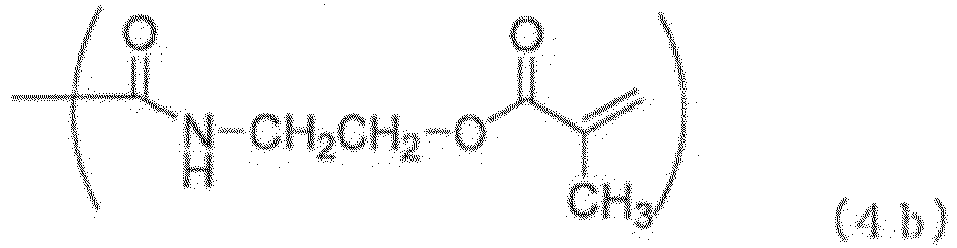
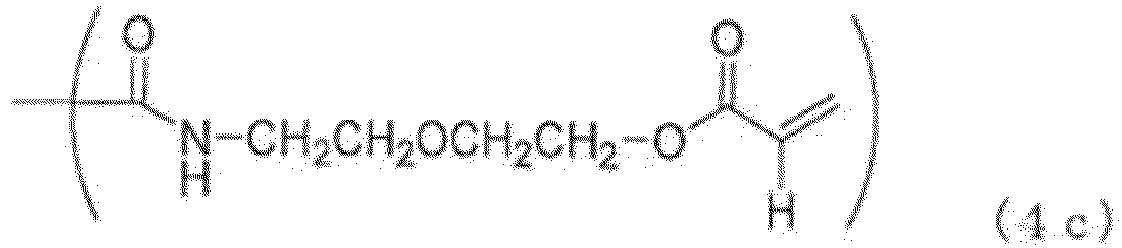


 (in der allgemeinen Formel (5) stehen n5a, n5b, n5c und n5d für die Anzahl der Einheiten der entsprechenden Wiederholungseinheiten und sind jeweils 0 bis 100, die Summe von n5a, n5b, n5c und n5d ist 1 bis 100, ist das linke Ende der Gruppe an den Kern (X) gebunden und ist das rechte Ende der Gruppe an die endständige Gruppe (Y1) gebunden);mit der Maßgabe, dass das adhäsive Monomer keine Verbindung der allgemeinen Formel (1) umfasst, worin n1a = 0 ist, n1b = 4 ist,wobei der Kern (X)

 wobei das linke Ende der Linkergruppe an den Kern (X) gebunden ist und das rechte Ende der Linkergruppe an die endständige Gruppe (Y1) gebunden ist.
 - Adhäsives Monomer für Dentalmaterialien nach Anspruch 1, wobei die endständige Gruppe (Y1) aus (a), (b), (c) und (f) ausgewählt ist:(a) einer phosphorhältigen Gruppe, dargestellt durch die nachstehende allgemeine Formel (2),(b) einer phosphorhältigen Gruppe, dargestellt durch die nachstehende allgemeine Formel (3),(c) einer (Meth)acryloylgruppe-enthaltenden Gruppe (Y2), die zumindest eine ist, die aus der aus Gruppen dargestellt durch die nachstehende allgemeine Formel (4a) bis (4f) bestehenden Gruppe ausgewählt ist, oder(f) einem Wasserstoffatom.
- Adhäsives Monomer für Dentalmaterialien nach Anspruch 1 oder 2, wobei die endständige Gruppe (Y1) aus (a) bis (c) ausgewählt ist:(a) einer phosphorhältigen Gruppe, dargestellt durch die nachstehende allgemeine Formel (2),(b) einer phosphorhältigen Gruppe, dargestellt durch die nachstehende allgemeine Formel (3), oder(c) einer (Meth)acryloylgruppe-enthaltenden Gruppe (Y2), die zumindest eine ist, die aus der aus Gruppen dargestellt durch die nachstehende allgemeine Formel (4a) bis (4f) bestehenden Gruppe ausgewählt ist.
- Adhäsives Monomer für Dentalmaterialien nach einem der Ansprüche 1 bis 3, wobei in der Linkergruppe (Z) n5a, n5b, n5c und n5d jeweils 0 bis 20 sind und die Summe von n5a, n5b, n5c und n5d = 1 bis 20 ist.
- Adhäsives Monomer für Dentalmaterialien nach einem der Ansprüche 1 bis 4, wobei die Linkergruppe (Z) eine zweiwertige Gruppe ist, die durch die nachstehende allgemeine Formel (6) dargestellt ist:

- Adhäsives Monomer für Dentalmaterialien nach einem der Ansprüche 1 bis 5, wobei die Linkergruppe (Z) eine zweiwertige Gruppe ist, die durch die nachstehende allgemeine Formel (7) dargestellt ist:

- Adhäsives Monomer für Dentalmaterialien nach einem der Ansprüche 1 bis 6, wobei der Kern (X) eine organische Gruppe mit einer Wertigkeit von 3 bis 12 ist.
- Adhäsives Monomer für Dentalmaterialien nach einem der Ansprüche 1 bis 7, wobei der Kern (X) zumindest einer ist, der aus der aus Gruppen dargestellt durch die nachstehenden allgemeinen Formeln (8a) bis (8j) bestehenden Gruppe ausgewählt ist:


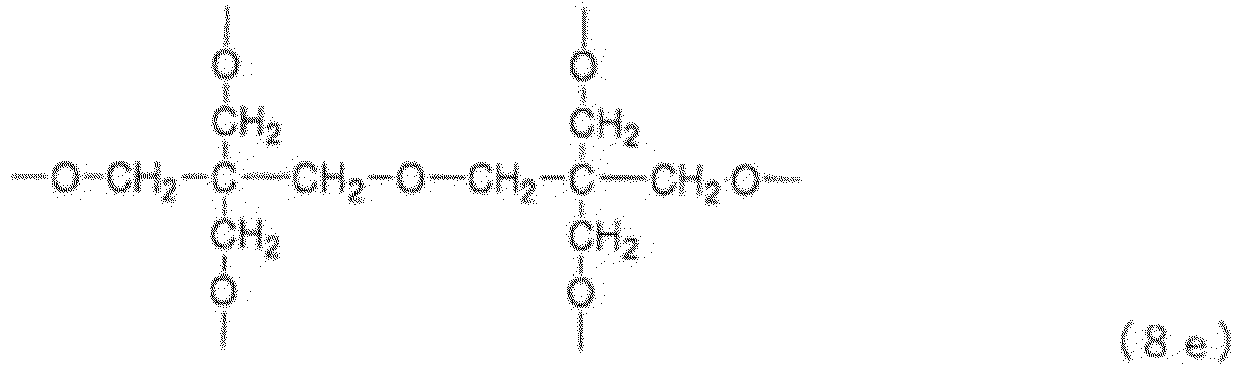


- Adhäsives Monomer für Dentalmaterialien nach einem der Ansprüche 1 bis 7, wobei der Kern (X) zumindest einer ist, der aus der aus Gruppen dargestellt durch die nachstehenden allgemeinen Formeln (8a), (8b) und (8d) bis (8j) bestehenden Gruppe ausgewählt ist:



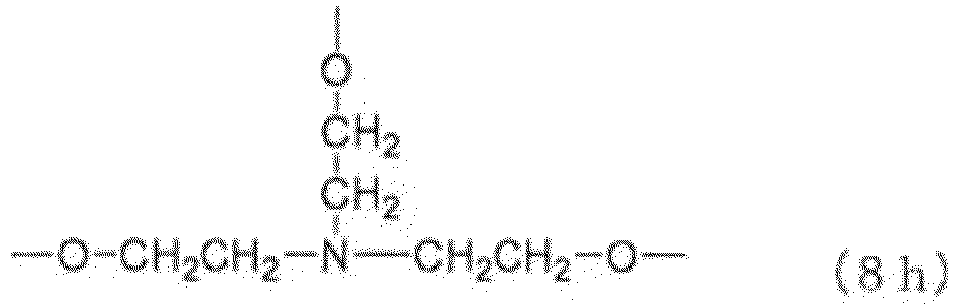

- Adhäsives Monomer für Dentalmaterialien nach einem der Ansprüche 1 bis 7, wobei der Kern (X) zumindest einer ist, der aus der aus Gruppen dargestellt durch die nachstehenden allgemeinen Formeln (8f) bis (8j) bestehenden Gruppe ausgewählt ist:
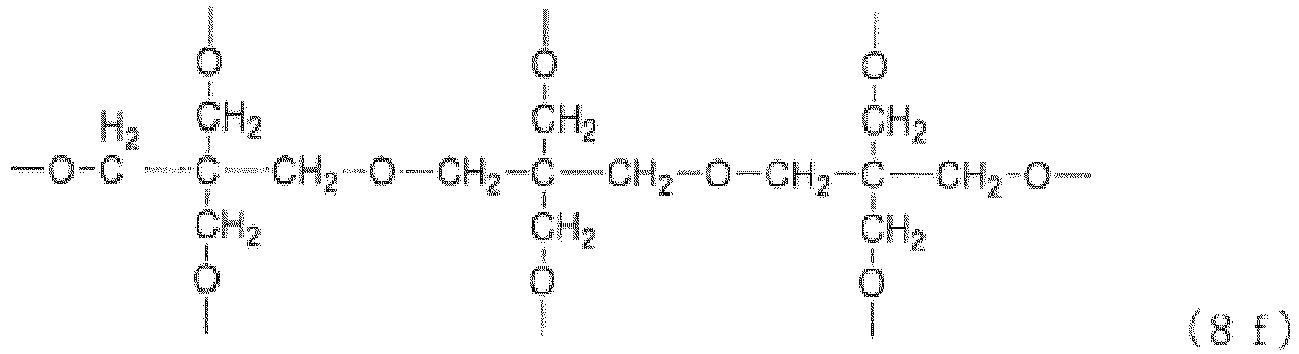

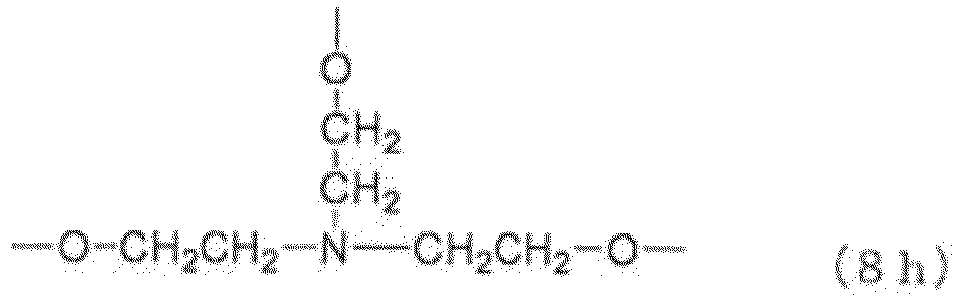

- Adhäsives Monomer für Dentalmaterialien nach einem der Ansprüche 1 bis 10, wobei die (Meth)acryloylgruppe-enthaltende Gruppe (Y2) zumindest eine ist, die aus der aus Gruppen dargestellt durch die nachstehende allgemeine Formel (4a) und (4c) bis (4f) bestehenden Gruppe ausgewählt ist:


- Adhäsives Monomer für Dentalmaterialien nach einem der Ansprüche 1 bis 11, wobei das adhäsive Monomer aus einer beliebigen der Folgenden ausgewählt ist:

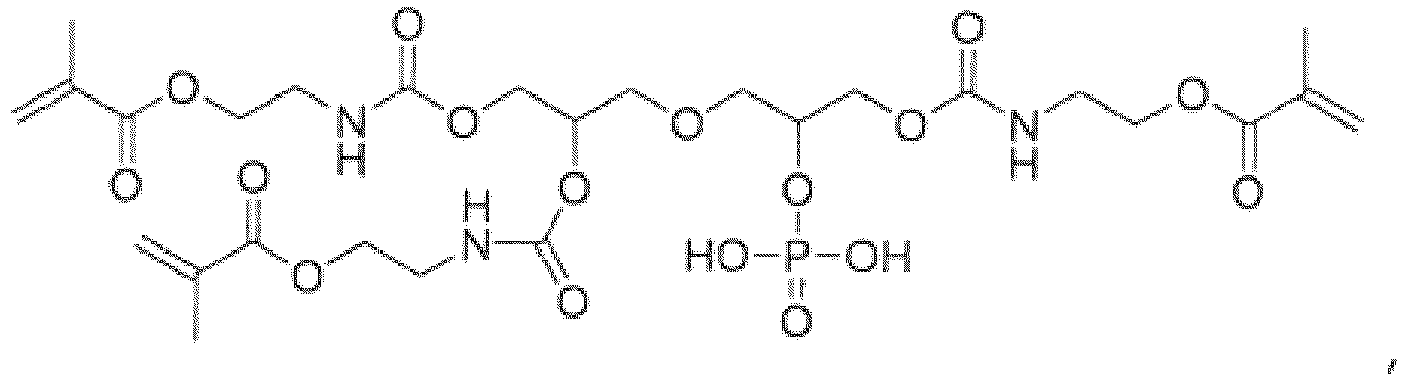

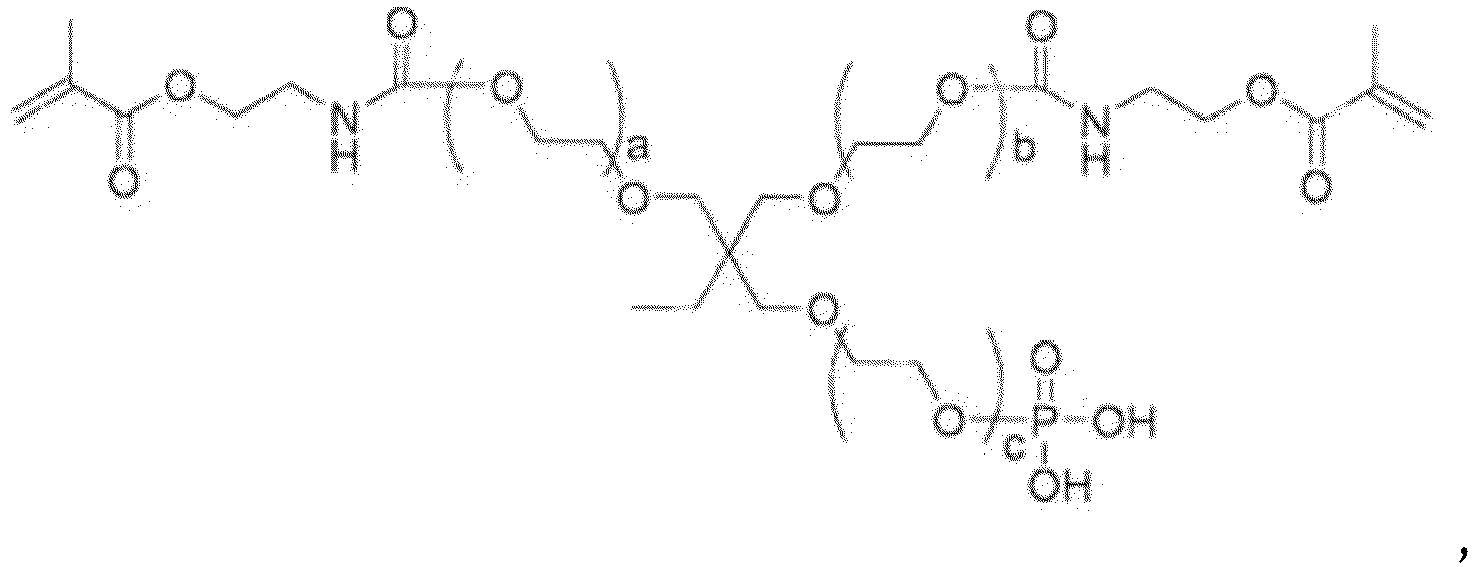


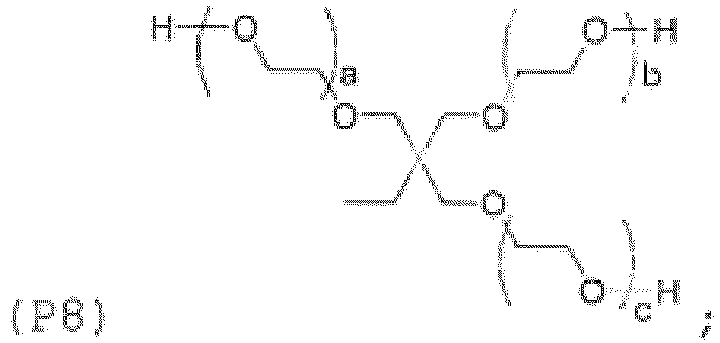
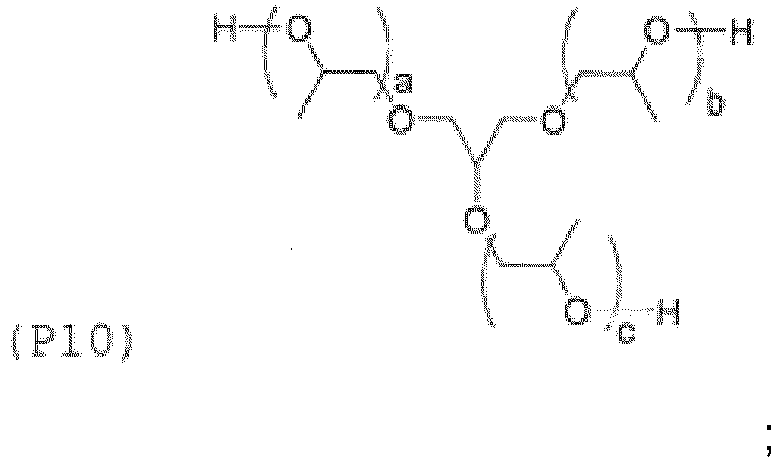

- Monomerzusammensetzung für Dentalmaterialien, umfassend ein adhäsives Monomer für Dentalmaterialien nach einem der Ansprüche 1 bis 12.
- Dentalmaterial, umfassend ein adhäsives Monomer für Dentalmaterialien, wobei das adhäsive Monomer für Dentalmaterialien eine Verbindung, dargestellt durch die nachstehende allgemeine Formel (1), umfasst, in der der nachstehende Kern (X) und die nachstehende endständige Gruppe (Y1) direkt oder über die nachstehende Linkergruppe (Z) aneinander gebunden sind:
X(Y1)n1a(Z-Y1)n1b (1)
(in der allgemeinen Formel (1) steht n1a für die Anzahl von endständigen Gruppen (Y1), die direkt an den Kern (X) gebunden sind, steht n1b für die Anzahl von endständigen Gruppen (Y1), die über die Linkergruppe (Z) an den Kern (X) gebunden sind, und ist die Summe von n1a und n1b gleich der Wertigkeit des Kerns (X);ist der Kern (X) eine mehrwertige organische C1-200-Gruppe mit einer Wertigkeit von nicht weniger als 3, die ein Sauerstoffatom oder ein Stickstoffatom enthält, in der ein Atom, das an die endständige Gruppe (Y1) oder die Linkergruppe (Z) gebunden ist, das Sauerstoffatom oder das Stickstoffatom des Kerns (X) ist;ist die endständige Gruppe (Y1) aus (a) bis (f) ausgewählt:(a) einer phosphorhältigen Gruppe, dargestellt durch die nachstehende allgemeine Formel (2),(b) einer phosphorhältigen Gruppe, dargestellt durch die nachstehende allgemeine Formel (3),(c) einer (Meth)acryloylgruppe-enthaltenden Gruppe (Y2), die zumindest eine ist, die aus der aus Gruppen dargestellt durch die nachstehende allgemeine Formel (4a) bis (4f) bestehenden Gruppe ausgewählt ist,(d) einer (Meth)acryloylgruppe,(e) einer C1-20-Kohlenwasserstoffgruppe oder(f) einem Wasserstoffatom undwobei eine Vielzahl von endständigen Gruppen (Y1) gleich oder verschieden voneinander sein kann, mit der Maßgabe, dass aus allen endständigen Gruppen (Y1) in der durch die allgemeine Formel (1) dargestellten Verbindung eine endständige Gruppe die phosphorhältige Gruppe ist, die durch die nachstehende allgemeine Formel (2) dargestellt ist, oder die phosphorhältige Gruppe ist, die durch die nachstehende allgemeine Formel (3) dargestellt ist, und die zwei oder mehr endständigen Gruppen die (Meth)acryloylgruppe-enthaltenden Gruppen (Y2) sind; und
die Linkergruppe (Z) eine zweiwertige Gruppe ist, die durch die nachstehende allgemeine Formel (5) dargestellt ist, und wenn die Verbindung, die durch die allgemeine Formel (1) dargestellt ist, eine Vielzahl von Linkergruppen (Z) enthält, die Linkergruppen (Z) gleich oder verschieden voneinander sein können;
 (in der allgemeinen Formel (3) ist ein Ende der Gruppe an den Kern (X) oder die Linkergruppe (Z) gebunden und ist das andere Ende der Gruppe an den Kern (X) oder die Linkergruppe (Z) gebunden, die in einer anderen durch die allgemeine Formel (1) dargestellten Verbindung vorhanden ist),
wobei die phosphorhältige Gruppe, die durch die allgemeine Formel (2) dargestellt ist, oder die phosphorhältige Gruppe, die durch die allgemeine Formel (3) dargestellt ist, an ein endständiges Sauerstoffatom oder Stickstoffatom des Kerns (X) oder der Linkergruppe (Z) gebunden sind;


 (in der allgemeinen Formel (5) stehen n5a, n5b, n5c und n5d für die Anzahl der Einheiten der entsprechenden Wiederholungseinheiten und sind jeweils 0 bis 100, ist die Summe von n5a, n5b, n5c und n5d = 1 bis 100, ist das linke Ende der Gruppe an den Kern (X) gebunden und ist das rechte Ende der Gruppe an die endständige Gruppe (Y1) gebunden).
 - Set, umfassend ein Dentalmaterial nach Anspruch 14.
Applications Claiming Priority (2)
| Application Number | Priority Date | Filing Date | Title |
|---|---|---|---|
| JP2017072681 | 2017-03-31 | ||
| PCT/JP2018/013232 WO2018181707A1 (ja) | 2017-03-31 | 2018-03-29 | 歯科材料用接着性モノマー |
Publications (3)
| Publication Number | Publication Date |
|---|---|
| EP3603606A1 EP3603606A1 (de) | 2020-02-05 |
| EP3603606A4 EP3603606A4 (de) | 2020-10-28 |
| EP3603606B1 true EP3603606B1 (de) | 2024-11-13 |
Family
ID=63677872
Family Applications (1)
| Application Number | Title | Priority Date | Filing Date |
|---|---|---|---|
| EP18777195.1A Active EP3603606B1 (de) | 2017-03-31 | 2018-03-29 | Klebendes monomer für dentalmaterial |
Country Status (4)
| Country | Link |
|---|---|
| US (1) | US11311462B2 (de) |
| EP (1) | EP3603606B1 (de) |
| JP (1) | JP6734990B2 (de) |
| WO (1) | WO2018181707A1 (de) |
Families Citing this family (5)
| Publication number | Priority date | Publication date | Assignee | Title |
|---|---|---|---|---|
| JP6734990B2 (ja) | 2017-03-31 | 2020-08-05 | 三井化学株式会社 | 歯科材料用接着性モノマー |
| WO2020046654A1 (en) * | 2018-08-30 | 2020-03-05 | 3M Innovative Properties Company | (meth)acrylate urethane (urea) phosphonates as adhesion promoters |
| US11951193B2 (en) * | 2018-12-28 | 2024-04-09 | Mitsui Chemicals, Inc. | Monomer composition for dental materials, composition for dental materials, and dental material |
| KR20220123228A (ko) | 2019-12-27 | 2022-09-06 | 미쓰이금속광업주식회사 | 황화물 고체 전해질 및 그 제조 방법 |
| JP2024512756A (ja) * | 2021-04-02 | 2024-03-19 | クルツァー ゲゼルシャフト ミット ベシュレンクテル ハフツング | 自己接着性歯科用材料 |
Citations (4)
| Publication number | Priority date | Publication date | Assignee | Title |
|---|---|---|---|---|
| EP0074708B1 (de) * | 1981-07-29 | 1986-02-19 | Kuraray Co., Ltd. | Klebstoffzusammensetzung |
| EP0225030A1 (de) * | 1985-10-22 | 1987-06-10 | Minnesota Mining And Manufacturing Company | Durch Strahlung härtbare Phosphorsäureester-Verbindungen und magnetisches Aufzeichnungsmaterial enthaltend gehärtete Phosphorsäureester |
| US5860806A (en) * | 1996-11-29 | 1999-01-19 | The Kerr Corporation | Single dose dental adhesive delivery system and method and adhesive therefor |
| JP2014091692A (ja) * | 2012-11-02 | 2014-05-19 | Kuraray Noritake Dental Inc | リン酸エステル化合物及びそれを含む重合性組成物 |
Family Cites Families (12)
| Publication number | Priority date | Publication date | Assignee | Title |
|---|---|---|---|---|
| US4539382A (en) | 1981-07-29 | 1985-09-03 | Kuraray Co., Ltd. | Adhesive composition |
| JPS5821607A (ja) | 1981-07-30 | 1983-02-08 | Kuraray Co Ltd | 歯科用接着剤 |
| US4650847A (en) | 1981-07-29 | 1987-03-17 | Kuraray Co., Ltd. | Adhesive composition |
| DE602005014253D1 (de) | 2004-10-14 | 2009-06-10 | Dentsply Int Inc | Aus nur einer komponente bestehendes selbstätzendes haftmittel |
| JP4831993B2 (ja) * | 2005-04-15 | 2011-12-07 | クラレメディカル株式会社 | 有機リン酸化合物 |
| JP5416456B2 (ja) | 2009-03-31 | 2014-02-12 | クラレノリタケデンタル株式会社 | リン酸エステル化合物及びそれを含む重合性組成物 |
| BR112012007330A2 (pt) * | 2009-10-01 | 2017-06-06 | Septodont Confi-Dental Div | compostos, composições contendo os mesmos, uso dos mesmos e processos para a produção dos mesmos. |
| WO2013083734A1 (de) * | 2011-12-06 | 2013-06-13 | Ivoclar Vivadent Ag | Dentalmaterialien auf basis von stark aciden polymerisierbaren bisphosphonsäuren |
| EP2873410B1 (de) * | 2012-07-10 | 2022-05-04 | Tokuyama Dental Corporation | Dentalhaftzusammensetzung |
| EP3120827B1 (de) * | 2015-07-22 | 2019-02-06 | Ivoclar Vivadent AG | Adhäsive dentalwerkstoffe mit stark aciden haftpolymeren |
| JP6734990B2 (ja) * | 2017-03-31 | 2020-08-05 | 三井化学株式会社 | 歯科材料用接着性モノマー |
| WO2018181711A1 (ja) * | 2017-03-31 | 2018-10-04 | 三井化学株式会社 | リン含有化合物 |
-
2018
- 2018-03-29 JP JP2019510120A patent/JP6734990B2/ja active Active
- 2018-03-29 WO PCT/JP2018/013232 patent/WO2018181707A1/ja not_active Ceased
- 2018-03-29 US US16/488,299 patent/US11311462B2/en active Active
- 2018-03-29 EP EP18777195.1A patent/EP3603606B1/de active Active
Patent Citations (4)
| Publication number | Priority date | Publication date | Assignee | Title |
|---|---|---|---|---|
| EP0074708B1 (de) * | 1981-07-29 | 1986-02-19 | Kuraray Co., Ltd. | Klebstoffzusammensetzung |
| EP0225030A1 (de) * | 1985-10-22 | 1987-06-10 | Minnesota Mining And Manufacturing Company | Durch Strahlung härtbare Phosphorsäureester-Verbindungen und magnetisches Aufzeichnungsmaterial enthaltend gehärtete Phosphorsäureester |
| US5860806A (en) * | 1996-11-29 | 1999-01-19 | The Kerr Corporation | Single dose dental adhesive delivery system and method and adhesive therefor |
| JP2014091692A (ja) * | 2012-11-02 | 2014-05-19 | Kuraray Noritake Dental Inc | リン酸エステル化合物及びそれを含む重合性組成物 |
Non-Patent Citations (2)
| Title |
|---|
| CATEL YOHANN ET AL: "Monomers for adhesive polymers, 18. Synthesis, photopolymerization and adhesive properties of polymerizable [alpha]-phosphonooxy phosphonic acids", DESIGNED MONOMERS AND POLYMERS, vol. 20, no. 1, 29 September 2016 (2016-09-29), pages 106 - 117, XP055831639, Retrieved from the Internet <URL:https://www.tandfonline.com/doi/pdf/10.1080/15685551.2016.1231043> DOI: 10.1080/15685551.2016.1231043 * |
| TAUSCHER SVEN ET AL: "Monomers for adhesive polymers, 17. a Synthesis, photopolymerization and adhesive properties of polymerizable phosphonic acids bearing urea groups", DESIGNED MONOMERS AND POLYMERS, vol. 19, no. 1, 28 September 2015 (2015-09-28), pages 77 - 88, XP055831624, DOI: 10.1080/15685551.2015.1092015 * |
Also Published As
| Publication number | Publication date |
|---|---|
| US20190374440A1 (en) | 2019-12-12 |
| EP3603606A1 (de) | 2020-02-05 |
| US11311462B2 (en) | 2022-04-26 |
| JP6734990B2 (ja) | 2020-08-05 |
| JPWO2018181707A1 (ja) | 2020-02-20 |
| EP3603606A4 (de) | 2020-10-28 |
| WO2018181707A1 (ja) | 2018-10-04 |
Similar Documents
| Publication | Publication Date | Title |
|---|---|---|
| US11110038B2 (en) | Dental polymerizable monomers, compositions, adhesive dental materials and kits | |
| EP3603606B1 (de) | Klebendes monomer für dentalmaterial | |
| EP3135270B1 (de) | Polymerisierbares monomer für dentalmaterial | |
| US11786444B2 (en) | Dental polyfunctional monomers and dental hydroxyl group-containing monomers | |
| JP4673310B2 (ja) | 歯科用重合性組成物 | |
| EP3604318B1 (de) | Phosphorhaltige verbindung | |
| WO2020122124A1 (ja) | (メタ)アクリレート、モノマー組成物、成形体、歯科材料用組成物、及び歯科材料 | |
| JP7610699B2 (ja) | 歯科材料用組成物、歯科材料及び抗菌用組成物 |
Legal Events
| Date | Code | Title | Description |
|---|---|---|---|
| STAA | Information on the status of an ep patent application or granted ep patent |
Free format text: STATUS: THE INTERNATIONAL PUBLICATION HAS BEEN MADE |
|
| PUAI | Public reference made under article 153(3) epc to a published international application that has entered the european phase |
Free format text: ORIGINAL CODE: 0009012 |
|
| STAA | Information on the status of an ep patent application or granted ep patent |
Free format text: STATUS: REQUEST FOR EXAMINATION WAS MADE |
|
| 17P | Request for examination filed |
Effective date: 20190809 |
|
| AK | Designated contracting states |
Kind code of ref document: A1 Designated state(s): AL AT BE BG CH CY CZ DE DK EE ES FI FR GB GR HR HU IE IS IT LI LT LU LV MC MK MT NL NO PL PT RO RS SE SI SK SM TR |
|
| AX | Request for extension of the european patent |
Extension state: BA ME |
|
| DAV | Request for validation of the european patent (deleted) | ||
| DAX | Request for extension of the european patent (deleted) | ||
| A4 | Supplementary search report drawn up and despatched |
Effective date: 20200925 |
|
| RIC1 | Information provided on ipc code assigned before grant |
Ipc: C09J 4/06 20060101ALI20200921BHEP Ipc: C08F 222/10 20060101ALI20200921BHEP Ipc: A61K 6/00 20200101AFI20200921BHEP |
|
| STAA | Information on the status of an ep patent application or granted ep patent |
Free format text: STATUS: EXAMINATION IS IN PROGRESS |
|
| 17Q | First examination report despatched |
Effective date: 20210817 |
|
| TPAC | Observations filed by third parties |
Free format text: ORIGINAL CODE: EPIDOSNTIPA |
|
| RAP3 | Party data changed (applicant data changed or rights of an application transferred) |
Owner name: KULZER GMBH Owner name: MITSUI CHEMICALS, INC. |
|
| REG | Reference to a national code |
Ref country code: DE Ref legal event code: R079 Free format text: PREVIOUS MAIN CLASS: A61K0006000000 Ipc: A61K0006300000 Ref country code: DE Ref legal event code: R079 Ref document number: 602018076553 Country of ref document: DE Free format text: PREVIOUS MAIN CLASS: A61K0006000000 Ipc: A61K0006300000 |
|
| RIC1 | Information provided on ipc code assigned before grant |
Ipc: C09J 4/06 20060101ALI20240411BHEP Ipc: C08F 222/10 20060101ALI20240411BHEP Ipc: C09J 4/00 20060101ALI20240411BHEP Ipc: C07F 9/09 20060101ALI20240411BHEP Ipc: A61K 6/30 20200101AFI20240411BHEP |
|
| GRAP | Despatch of communication of intention to grant a patent |
Free format text: ORIGINAL CODE: EPIDOSNIGR1 |
|
| STAA | Information on the status of an ep patent application or granted ep patent |
Free format text: STATUS: GRANT OF PATENT IS INTENDED |
|
| INTG | Intention to grant announced |
Effective date: 20240621 |
|
| GRAS | Grant fee paid |
Free format text: ORIGINAL CODE: EPIDOSNIGR3 |
|
| GRAA | (expected) grant |
Free format text: ORIGINAL CODE: 0009210 |
|
| STAA | Information on the status of an ep patent application or granted ep patent |
Free format text: STATUS: THE PATENT HAS BEEN GRANTED |
|
| AK | Designated contracting states |
Kind code of ref document: B1 Designated state(s): AL AT BE BG CH CY CZ DE DK EE ES FI FR GB GR HR HU IE IS IT LI LT LU LV MC MK MT NL NO PL PT RO RS SE SI SK SM TR |
|
| REG | Reference to a national code |
Ref country code: GB Ref legal event code: FG4D |
|
| REG | Reference to a national code |
Ref country code: CH Ref legal event code: EP |
|
| RAP4 | Party data changed (patent owner data changed or rights of a patent transferred) |
Owner name: KULZER GMBH Owner name: MITSUI CHEMICALS, INC. |
|
| REG | Reference to a national code |
Ref country code: DE Ref legal event code: R096 Ref document number: 602018076553 Country of ref document: DE |
|
| REG | Reference to a national code |
Ref country code: IE Ref legal event code: FG4D |
|
| P01 | Opt-out of the competence of the unified patent court (upc) registered |
Free format text: CASE NUMBER: APP_60742/2024 Effective date: 20241112 |
|
| REG | Reference to a national code |
Ref country code: LT Ref legal event code: MG9D |
|
| REG | Reference to a national code |
Ref country code: NL Ref legal event code: MP Effective date: 20241113 |
|
| PG25 | Lapsed in a contracting state [announced via postgrant information from national office to epo] |
Ref country code: PT Free format text: LAPSE BECAUSE OF FAILURE TO SUBMIT A TRANSLATION OF THE DESCRIPTION OR TO PAY THE FEE WITHIN THE PRESCRIBED TIME-LIMIT Effective date: 20250313 Ref country code: HR Free format text: LAPSE BECAUSE OF FAILURE TO SUBMIT A TRANSLATION OF THE DESCRIPTION OR TO PAY THE FEE WITHIN THE PRESCRIBED TIME-LIMIT Effective date: 20241113 Ref country code: IS Free format text: LAPSE BECAUSE OF FAILURE TO SUBMIT A TRANSLATION OF THE DESCRIPTION OR TO PAY THE FEE WITHIN THE PRESCRIBED TIME-LIMIT Effective date: 20250313 |
|
| PGFP | Annual fee paid to national office [announced via postgrant information from national office to epo] |
Ref country code: DE Payment date: 20250218 Year of fee payment: 8 |
|
| PG25 | Lapsed in a contracting state [announced via postgrant information from national office to epo] |
Ref country code: FI Free format text: LAPSE BECAUSE OF FAILURE TO SUBMIT A TRANSLATION OF THE DESCRIPTION OR TO PAY THE FEE WITHIN THE PRESCRIBED TIME-LIMIT Effective date: 20241113 Ref country code: NL Free format text: LAPSE BECAUSE OF FAILURE TO SUBMIT A TRANSLATION OF THE DESCRIPTION OR TO PAY THE FEE WITHIN THE PRESCRIBED TIME-LIMIT Effective date: 20241113 |
|
| REG | Reference to a national code |
Ref country code: AT Ref legal event code: MK05 Ref document number: 1741105 Country of ref document: AT Kind code of ref document: T Effective date: 20241113 |
|
| PG25 | Lapsed in a contracting state [announced via postgrant information from national office to epo] |
Ref country code: BG Free format text: LAPSE BECAUSE OF FAILURE TO SUBMIT A TRANSLATION OF THE DESCRIPTION OR TO PAY THE FEE WITHIN THE PRESCRIBED TIME-LIMIT Effective date: 20241113 |
|
| PG25 | Lapsed in a contracting state [announced via postgrant information from national office to epo] |
Ref country code: ES Free format text: LAPSE BECAUSE OF FAILURE TO SUBMIT A TRANSLATION OF THE DESCRIPTION OR TO PAY THE FEE WITHIN THE PRESCRIBED TIME-LIMIT Effective date: 20241113 |
|
| PG25 | Lapsed in a contracting state [announced via postgrant information from national office to epo] |
Ref country code: NO Free format text: LAPSE BECAUSE OF FAILURE TO SUBMIT A TRANSLATION OF THE DESCRIPTION OR TO PAY THE FEE WITHIN THE PRESCRIBED TIME-LIMIT Effective date: 20250213 |
|
| PG25 | Lapsed in a contracting state [announced via postgrant information from national office to epo] |
Ref country code: GR Free format text: LAPSE BECAUSE OF FAILURE TO SUBMIT A TRANSLATION OF THE DESCRIPTION OR TO PAY THE FEE WITHIN THE PRESCRIBED TIME-LIMIT Effective date: 20250214 Ref country code: LV Free format text: LAPSE BECAUSE OF FAILURE TO SUBMIT A TRANSLATION OF THE DESCRIPTION OR TO PAY THE FEE WITHIN THE PRESCRIBED TIME-LIMIT Effective date: 20241113 Ref country code: AT Free format text: LAPSE BECAUSE OF FAILURE TO SUBMIT A TRANSLATION OF THE DESCRIPTION OR TO PAY THE FEE WITHIN THE PRESCRIBED TIME-LIMIT Effective date: 20241113 |
|
| PG25 | Lapsed in a contracting state [announced via postgrant information from national office to epo] |
Ref country code: PL Free format text: LAPSE BECAUSE OF FAILURE TO SUBMIT A TRANSLATION OF THE DESCRIPTION OR TO PAY THE FEE WITHIN THE PRESCRIBED TIME-LIMIT Effective date: 20241113 |
|
| PGFP | Annual fee paid to national office [announced via postgrant information from national office to epo] |
Ref country code: FR Payment date: 20250219 Year of fee payment: 8 |
|
| PG25 | Lapsed in a contracting state [announced via postgrant information from national office to epo] |
Ref country code: RS Free format text: LAPSE BECAUSE OF FAILURE TO SUBMIT A TRANSLATION OF THE DESCRIPTION OR TO PAY THE FEE WITHIN THE PRESCRIBED TIME-LIMIT Effective date: 20250213 |
|
| PG25 | Lapsed in a contracting state [announced via postgrant information from national office to epo] |
Ref country code: SM Free format text: LAPSE BECAUSE OF FAILURE TO SUBMIT A TRANSLATION OF THE DESCRIPTION OR TO PAY THE FEE WITHIN THE PRESCRIBED TIME-LIMIT Effective date: 20241113 |
|
| PG25 | Lapsed in a contracting state [announced via postgrant information from national office to epo] |
Ref country code: DK Free format text: LAPSE BECAUSE OF FAILURE TO SUBMIT A TRANSLATION OF THE DESCRIPTION OR TO PAY THE FEE WITHIN THE PRESCRIBED TIME-LIMIT Effective date: 20241113 |
|
| PG25 | Lapsed in a contracting state [announced via postgrant information from national office to epo] |
Ref country code: EE Free format text: LAPSE BECAUSE OF FAILURE TO SUBMIT A TRANSLATION OF THE DESCRIPTION OR TO PAY THE FEE WITHIN THE PRESCRIBED TIME-LIMIT Effective date: 20241113 |
|
| PGFP | Annual fee paid to national office [announced via postgrant information from national office to epo] |
Ref country code: CH Payment date: 20250401 Year of fee payment: 8 |
|
| PG25 | Lapsed in a contracting state [announced via postgrant information from national office to epo] |
Ref country code: RO Free format text: LAPSE BECAUSE OF FAILURE TO SUBMIT A TRANSLATION OF THE DESCRIPTION OR TO PAY THE FEE WITHIN THE PRESCRIBED TIME-LIMIT Effective date: 20241113 |
|
| PG25 | Lapsed in a contracting state [announced via postgrant information from national office to epo] |
Ref country code: SK Free format text: LAPSE BECAUSE OF FAILURE TO SUBMIT A TRANSLATION OF THE DESCRIPTION OR TO PAY THE FEE WITHIN THE PRESCRIBED TIME-LIMIT Effective date: 20241113 |
|
| PG25 | Lapsed in a contracting state [announced via postgrant information from national office to epo] |
Ref country code: CZ Free format text: LAPSE BECAUSE OF FAILURE TO SUBMIT A TRANSLATION OF THE DESCRIPTION OR TO PAY THE FEE WITHIN THE PRESCRIBED TIME-LIMIT Effective date: 20241113 |
|
| PG25 | Lapsed in a contracting state [announced via postgrant information from national office to epo] |
Ref country code: IT Free format text: LAPSE BECAUSE OF FAILURE TO SUBMIT A TRANSLATION OF THE DESCRIPTION OR TO PAY THE FEE WITHIN THE PRESCRIBED TIME-LIMIT Effective date: 20241113 |
|
| REG | Reference to a national code |
Ref country code: DE Ref legal event code: R097 Ref document number: 602018076553 Country of ref document: DE |
|
| PG25 | Lapsed in a contracting state [announced via postgrant information from national office to epo] |
Ref country code: SE Free format text: LAPSE BECAUSE OF FAILURE TO SUBMIT A TRANSLATION OF THE DESCRIPTION OR TO PAY THE FEE WITHIN THE PRESCRIBED TIME-LIMIT Effective date: 20241113 |
|
| PLBE | No opposition filed within time limit |
Free format text: ORIGINAL CODE: 0009261 |
|
| STAA | Information on the status of an ep patent application or granted ep patent |
Free format text: STATUS: NO OPPOSITION FILED WITHIN TIME LIMIT |
|
| PG25 | Lapsed in a contracting state [announced via postgrant information from national office to epo] |
Ref country code: MC Free format text: LAPSE BECAUSE OF FAILURE TO SUBMIT A TRANSLATION OF THE DESCRIPTION OR TO PAY THE FEE WITHIN THE PRESCRIBED TIME-LIMIT Effective date: 20241113 |
|
| 26N | No opposition filed |
Effective date: 20250814 |
|
| PG25 | Lapsed in a contracting state [announced via postgrant information from national office to epo] |
Ref country code: LU Free format text: LAPSE BECAUSE OF NON-PAYMENT OF DUE FEES Effective date: 20250329 |
|
| GBPC | Gb: european patent ceased through non-payment of renewal fee |
Effective date: 20250329 |
|
| REG | Reference to a national code |
Ref country code: BE Ref legal event code: MM Effective date: 20250331 |
|
| PG25 | Lapsed in a contracting state [announced via postgrant information from national office to epo] |
Ref country code: GB Free format text: LAPSE BECAUSE OF NON-PAYMENT OF DUE FEES Effective date: 20250329 |
|
| PG25 | Lapsed in a contracting state [announced via postgrant information from national office to epo] |
Ref country code: BE Free format text: LAPSE BECAUSE OF NON-PAYMENT OF DUE FEES Effective date: 20250331 |
|
| PG25 | Lapsed in a contracting state [announced via postgrant information from national office to epo] |
Ref country code: IE Free format text: LAPSE BECAUSE OF NON-PAYMENT OF DUE FEES Effective date: 20250329 |