EP3603546B1 - A kit for removing a tissue lesion - Google Patents
A kit for removing a tissue lesion Download PDFInfo
- Publication number
- EP3603546B1 EP3603546B1 EP19189139.9A EP19189139A EP3603546B1 EP 3603546 B1 EP3603546 B1 EP 3603546B1 EP 19189139 A EP19189139 A EP 19189139A EP 3603546 B1 EP3603546 B1 EP 3603546B1
- Authority
- EP
- European Patent Office
- Prior art keywords
- tissue
- kit
- coil
- electrode
- tube
- Prior art date
- Legal status (The legal status is an assumption and is not a legal conclusion. Google has not performed a legal analysis and makes no representation as to the accuracy of the status listed.)
- Active
Links
Images


Classifications
-
- A—HUMAN NECESSITIES
- A61—MEDICAL OR VETERINARY SCIENCE; HYGIENE
- A61B—DIAGNOSIS; SURGERY; IDENTIFICATION
- A61B18/00—Surgical instruments, devices or methods for transferring non-mechanical forms of energy to or from the body
- A61B18/04—Surgical instruments, devices or methods for transferring non-mechanical forms of energy to or from the body by heating
- A61B18/12—Surgical instruments, devices or methods for transferring non-mechanical forms of energy to or from the body by heating by passing a current through the tissue to be heated, e.g. high-frequency current
-
- A—HUMAN NECESSITIES
- A61—MEDICAL OR VETERINARY SCIENCE; HYGIENE
- A61B—DIAGNOSIS; SURGERY; IDENTIFICATION
- A61B18/00—Surgical instruments, devices or methods for transferring non-mechanical forms of energy to or from the body
- A61B18/04—Surgical instruments, devices or methods for transferring non-mechanical forms of energy to or from the body by heating
- A61B18/12—Surgical instruments, devices or methods for transferring non-mechanical forms of energy to or from the body by heating by passing a current through the tissue to be heated, e.g. high-frequency current
- A61B18/14—Probes or electrodes therefor
- A61B18/149—Probes or electrodes therefor bow shaped or with rotatable body at cantilever end, e.g. for resectoscopes, or coagulating rollers
-
- A—HUMAN NECESSITIES
- A61—MEDICAL OR VETERINARY SCIENCE; HYGIENE
- A61B—DIAGNOSIS; SURGERY; IDENTIFICATION
- A61B10/00—Instruments for taking body samples for diagnostic purposes; Other methods or instruments for diagnosis, e.g. for vaccination diagnosis, sex determination or ovulation-period determination; Throat striking implements
-
- A—HUMAN NECESSITIES
- A61—MEDICAL OR VETERINARY SCIENCE; HYGIENE
- A61B—DIAGNOSIS; SURGERY; IDENTIFICATION
- A61B17/00—Surgical instruments, devices or methods
- A61B17/32—Surgical cutting instruments
- A61B17/3205—Excision instruments
- A61B17/32053—Punch like cutting instruments, e.g. using a cylindrical or oval knife
-
- A—HUMAN NECESSITIES
- A61—MEDICAL OR VETERINARY SCIENCE; HYGIENE
- A61B—DIAGNOSIS; SURGERY; IDENTIFICATION
- A61B10/00—Instruments for taking body samples for diagnostic purposes; Other methods or instruments for diagnosis, e.g. for vaccination diagnosis, sex determination or ovulation-period determination; Throat striking implements
- A61B10/02—Instruments for taking cell samples or for biopsy
-
- A—HUMAN NECESSITIES
- A61—MEDICAL OR VETERINARY SCIENCE; HYGIENE
- A61B—DIAGNOSIS; SURGERY; IDENTIFICATION
- A61B10/00—Instruments for taking body samples for diagnostic purposes; Other methods or instruments for diagnosis, e.g. for vaccination diagnosis, sex determination or ovulation-period determination; Throat striking implements
- A61B10/02—Instruments for taking cell samples or for biopsy
- A61B10/0233—Pointed or sharp biopsy instruments
-
- A—HUMAN NECESSITIES
- A61—MEDICAL OR VETERINARY SCIENCE; HYGIENE
- A61B—DIAGNOSIS; SURGERY; IDENTIFICATION
- A61B17/00—Surgical instruments, devices or methods
- A61B17/32—Surgical cutting instruments
- A61B17/3205—Excision instruments
- A61B17/32056—Surgical snare instruments
-
- A—HUMAN NECESSITIES
- A61—MEDICAL OR VETERINARY SCIENCE; HYGIENE
- A61B—DIAGNOSIS; SURGERY; IDENTIFICATION
- A61B17/00—Surgical instruments, devices or methods
- A61B17/32—Surgical cutting instruments
- A61B17/3209—Incision instruments
-
- A—HUMAN NECESSITIES
- A61—MEDICAL OR VETERINARY SCIENCE; HYGIENE
- A61B—DIAGNOSIS; SURGERY; IDENTIFICATION
- A61B18/00—Surgical instruments, devices or methods for transferring non-mechanical forms of energy to or from the body
- A61B18/04—Surgical instruments, devices or methods for transferring non-mechanical forms of energy to or from the body by heating
- A61B18/12—Surgical instruments, devices or methods for transferring non-mechanical forms of energy to or from the body by heating by passing a current through the tissue to be heated, e.g. high-frequency current
- A61B18/14—Probes or electrodes therefor
-
- A—HUMAN NECESSITIES
- A61—MEDICAL OR VETERINARY SCIENCE; HYGIENE
- A61B—DIAGNOSIS; SURGERY; IDENTIFICATION
- A61B90/00—Instruments, implements or accessories specially adapted for surgery or diagnosis and not covered by any of the groups A61B1/00 - A61B50/00, e.g. for luxation treatment or for protecting wound edges
- A61B90/04—Protection of tissue around surgical sites against effects of non-mechanical surgery, e.g. laser surgery
-
- A—HUMAN NECESSITIES
- A61—MEDICAL OR VETERINARY SCIENCE; HYGIENE
- A61M—DEVICES FOR INTRODUCING MEDIA INTO, OR ONTO, THE BODY; DEVICES FOR TRANSDUCING BODY MEDIA OR FOR TAKING MEDIA FROM THE BODY; DEVICES FOR PRODUCING OR ENDING SLEEP OR STUPOR
- A61M29/00—Dilators with or without means for introducing media, e.g. remedies
- A61M29/02—Dilators made of swellable material
-
- A—HUMAN NECESSITIES
- A61—MEDICAL OR VETERINARY SCIENCE; HYGIENE
- A61B—DIAGNOSIS; SURGERY; IDENTIFICATION
- A61B17/00—Surgical instruments, devices or methods
- A61B17/12—Surgical instruments, devices or methods for ligaturing or otherwise compressing tubular parts of the body, e.g. blood vessels or umbilical cord
- A61B17/12009—Implements for ligaturing other than by clamps or clips, e.g. using a loop with a slip knot
- A61B17/12013—Implements for ligaturing other than by clamps or clips, e.g. using a loop with a slip knot for use in minimally invasive surgery, e.g. endoscopic surgery
-
- A—HUMAN NECESSITIES
- A61—MEDICAL OR VETERINARY SCIENCE; HYGIENE
- A61B—DIAGNOSIS; SURGERY; IDENTIFICATION
- A61B17/00—Surgical instruments, devices or methods
- A61B17/32—Surgical cutting instruments
- A61B17/320016—Endoscopic cutting instruments, e.g. arthroscopes, resectoscopes
-
- A—HUMAN NECESSITIES
- A61—MEDICAL OR VETERINARY SCIENCE; HYGIENE
- A61B—DIAGNOSIS; SURGERY; IDENTIFICATION
- A61B17/00—Surgical instruments, devices or methods
- A61B17/32—Surgical cutting instruments
- A61B17/3209—Incision instruments
- A61B17/32093—Incision instruments for skin incisions
-
- A—HUMAN NECESSITIES
- A61—MEDICAL OR VETERINARY SCIENCE; HYGIENE
- A61B—DIAGNOSIS; SURGERY; IDENTIFICATION
- A61B18/00—Surgical instruments, devices or methods for transferring non-mechanical forms of energy to or from the body
- A61B18/04—Surgical instruments, devices or methods for transferring non-mechanical forms of energy to or from the body by heating
- A61B18/12—Surgical instruments, devices or methods for transferring non-mechanical forms of energy to or from the body by heating by passing a current through the tissue to be heated, e.g. high-frequency current
- A61B18/14—Probes or electrodes therefor
- A61B18/1492—Probes or electrodes therefor having a flexible, catheter-like structure, e.g. for heart ablation
-
- A—HUMAN NECESSITIES
- A61—MEDICAL OR VETERINARY SCIENCE; HYGIENE
- A61B—DIAGNOSIS; SURGERY; IDENTIFICATION
- A61B17/00—Surgical instruments, devices or methods
- A61B2017/00743—Type of operation; Specification of treatment sites
- A61B2017/00809—Lung operations
-
- A—HUMAN NECESSITIES
- A61—MEDICAL OR VETERINARY SCIENCE; HYGIENE
- A61B—DIAGNOSIS; SURGERY; IDENTIFICATION
- A61B17/00—Surgical instruments, devices or methods
- A61B17/32—Surgical cutting instruments
- A61B2017/320044—Blunt dissectors
-
- A—HUMAN NECESSITIES
- A61—MEDICAL OR VETERINARY SCIENCE; HYGIENE
- A61B—DIAGNOSIS; SURGERY; IDENTIFICATION
- A61B17/00—Surgical instruments, devices or methods
- A61B17/32—Surgical cutting instruments
- A61B2017/320052—Guides for cutting instruments
-
- A—HUMAN NECESSITIES
- A61—MEDICAL OR VETERINARY SCIENCE; HYGIENE
- A61B—DIAGNOSIS; SURGERY; IDENTIFICATION
- A61B17/00—Surgical instruments, devices or methods
- A61B17/32—Surgical cutting instruments
- A61B2017/320064—Surgical cutting instruments with tissue or sample retaining means
-
- A—HUMAN NECESSITIES
- A61—MEDICAL OR VETERINARY SCIENCE; HYGIENE
- A61B—DIAGNOSIS; SURGERY; IDENTIFICATION
- A61B18/00—Surgical instruments, devices or methods for transferring non-mechanical forms of energy to or from the body
- A61B2018/00315—Surgical instruments, devices or methods for transferring non-mechanical forms of energy to or from the body for treatment of particular body parts
- A61B2018/00541—Lung or bronchi
-
- A—HUMAN NECESSITIES
- A61—MEDICAL OR VETERINARY SCIENCE; HYGIENE
- A61B—DIAGNOSIS; SURGERY; IDENTIFICATION
- A61B18/00—Surgical instruments, devices or methods for transferring non-mechanical forms of energy to or from the body
- A61B2018/00571—Surgical instruments, devices or methods for transferring non-mechanical forms of energy to or from the body for achieving a particular surgical effect
- A61B2018/00577—Ablation
-
- A—HUMAN NECESSITIES
- A61—MEDICAL OR VETERINARY SCIENCE; HYGIENE
- A61B—DIAGNOSIS; SURGERY; IDENTIFICATION
- A61B18/00—Surgical instruments, devices or methods for transferring non-mechanical forms of energy to or from the body
- A61B2018/00571—Surgical instruments, devices or methods for transferring non-mechanical forms of energy to or from the body for achieving a particular surgical effect
- A61B2018/00595—Cauterization
-
- A—HUMAN NECESSITIES
- A61—MEDICAL OR VETERINARY SCIENCE; HYGIENE
- A61B—DIAGNOSIS; SURGERY; IDENTIFICATION
- A61B18/00—Surgical instruments, devices or methods for transferring non-mechanical forms of energy to or from the body
- A61B18/04—Surgical instruments, devices or methods for transferring non-mechanical forms of energy to or from the body by heating
- A61B18/12—Surgical instruments, devices or methods for transferring non-mechanical forms of energy to or from the body by heating by passing a current through the tissue to be heated, e.g. high-frequency current
- A61B18/1206—Generators therefor
- A61B2018/1246—Generators therefor characterised by the output polarity
- A61B2018/126—Generators therefor characterised by the output polarity bipolar
-
- A—HUMAN NECESSITIES
- A61—MEDICAL OR VETERINARY SCIENCE; HYGIENE
- A61B—DIAGNOSIS; SURGERY; IDENTIFICATION
- A61B18/00—Surgical instruments, devices or methods for transferring non-mechanical forms of energy to or from the body
- A61B18/04—Surgical instruments, devices or methods for transferring non-mechanical forms of energy to or from the body by heating
- A61B18/12—Surgical instruments, devices or methods for transferring non-mechanical forms of energy to or from the body by heating by passing a current through the tissue to be heated, e.g. high-frequency current
- A61B18/14—Probes or electrodes therefor
- A61B2018/1405—Electrodes having a specific shape
- A61B2018/142—Electrodes having a specific shape at least partly surrounding the target, e.g. concave, curved or in the form of a cave
-
- A—HUMAN NECESSITIES
- A61—MEDICAL OR VETERINARY SCIENCE; HYGIENE
- A61B—DIAGNOSIS; SURGERY; IDENTIFICATION
- A61B18/00—Surgical instruments, devices or methods for transferring non-mechanical forms of energy to or from the body
- A61B18/04—Surgical instruments, devices or methods for transferring non-mechanical forms of energy to or from the body by heating
- A61B18/12—Surgical instruments, devices or methods for transferring non-mechanical forms of energy to or from the body by heating by passing a current through the tissue to be heated, e.g. high-frequency current
- A61B18/14—Probes or electrodes therefor
- A61B2018/1405—Electrodes having a specific shape
- A61B2018/1435—Spiral
-
- A—HUMAN NECESSITIES
- A61—MEDICAL OR VETERINARY SCIENCE; HYGIENE
- A61B—DIAGNOSIS; SURGERY; IDENTIFICATION
- A61B18/00—Surgical instruments, devices or methods for transferring non-mechanical forms of energy to or from the body
- A61B18/04—Surgical instruments, devices or methods for transferring non-mechanical forms of energy to or from the body by heating
- A61B18/12—Surgical instruments, devices or methods for transferring non-mechanical forms of energy to or from the body by heating by passing a current through the tissue to be heated, e.g. high-frequency current
- A61B18/14—Probes or electrodes therefor
- A61B2018/1467—Probes or electrodes therefor using more than two electrodes on a single probe
-
- A—HUMAN NECESSITIES
- A61—MEDICAL OR VETERINARY SCIENCE; HYGIENE
- A61B—DIAGNOSIS; SURGERY; IDENTIFICATION
- A61B18/00—Surgical instruments, devices or methods for transferring non-mechanical forms of energy to or from the body
- A61B18/04—Surgical instruments, devices or methods for transferring non-mechanical forms of energy to or from the body by heating
- A61B18/12—Surgical instruments, devices or methods for transferring non-mechanical forms of energy to or from the body by heating by passing a current through the tissue to be heated, e.g. high-frequency current
- A61B18/14—Probes or electrodes therefor
- A61B2018/1497—Electrodes covering only part of the probe circumference
Definitions
- the present invention relates to a kit for tissue resection. More particularly, the present invention relates to a kit for lesion removal.
- Cancer is not a single disease, but rather a collection of related diseases that can start essentially anywhere in the body.
- the body's cells begin to divide without stopping, proliferating and potentially spreading into surrounding tissues.
- cells grow and divide to form new cells as required by the body and when they become damaged or old, they die, and new cells replace the damaged or old cells; however, cancer interrupts this process.
- the cells become abnormal, and cells that should die do not and new cells form when they are not needed. These new cells can reproduce or proliferate without stopping and may form growths called tumors.
- Cancerous tumors are malignant, which means they can spread into or invade surrounding healthy tissue. In addition, cancer cells can break off and travel to remote areas in the body through blood or in the lymph system. Benign tumors, unlike malignant tumors, do not spread or invade surrounding tissue; however, they may grow large and cause damage. Both malignant and benign tumors may be removed or treated. Malignant tumors tend to grow back whereas benign tumors can grow back but are much less likely to do so.
- Cancer is a genetic disease in that it is caused by changes in the genes that control the ways that cells function, especially in how they grow and divide. Genetic changes that cause cancer may be inherited or they may arise over an individual's lifetime as a result of errors that occur as cells divide or because of damage to DNA caused by certain environmental exposure, for example, industrial/commercial chemicals and ultraviolet light.
- the genetic changes that may cause cancer tend to affect three types of genes; namely proto-oncogenes which are involved in normal cell growth and division, tumor suppressor genes which are also involved in controlling cell growth and division, and DNA repair genes which, as the name implies, are involved in repairing damaged DNA.
- the type of cancer may be named for the organ or tissue where the cancers arise, for example, lung cancer, or the type of cell that formed them, for example squamous cell cancer.
- Cancer is a leading cause of death both in the United States and world-wide. According to the World Health Organization, the number of new cancer cases will rise to twenty-five (25) million per year over the next two decades.
- Lung cancer is one of the most common cancers today. According to the World Cancer Report 2014 from the World Health Organization, lung cancer occurred in 14 million people and resulted in 8.8 million deaths world-wide, making it the most common cause of cancer-related death in men and the second most common cause of cancer-related death in women. Lung cancer or lung carcinoma is a malignant lung tumor that if left untreated can metastasize into neighboring tissues and organs. The majority of lung cancer is caused by long-term tobacco smoking; however, about 10 to 15 percent of lung cancer cases are not tobacco related. These non-tobacco cases are most often caused by a combination of genetic factors and exposure to certain environmental conditions, including radon gas, asbestos, second-hand tobacco smoke, other forms of air pollution, and other agents. The chance of surviving lung cancer as well as other forms of cancer depends on early detection and treatment.
- a biopsy is performed and sent for study. If it is determined that the lesion is cancerous, a second procedure may be performed to remove the cancer. If the biopsy reveals no cancer, it may be correct, or the biopsy did not pick the cancerous cells. Accordingly, there exists a need for removing the whole lesion in one single procedure so that an accurate diagnosis may be performed.
- US 2018140319 discloses apparatus and methods for tissue reduction where one embodiment of the tissue resection device may generally comprise an external clamping mechanism having at least two distally extending members shaped with an atraumatic distal end and defining a confined region between the distally extending members sized to receive a tissue region therebetween. Additionally, an elongate coring needle defining a lumen and having a proximal end attached to a handle and a distal end which defines a cutting mechanism may also be included, wherein the coring needle is translatable adjacent and/or relative to the external or internal clamping mechanism defined by the confined region.
- WO 2011094110 discloses a surgical instrument configured to deliver electrical energy to the tissue of a patient, comprising a first electrode comprising a distal portion configured to contact the tissue and a second electrode comprising a distal portion configured to be inserted into the tissue, wherein the distal portion of the second electrode at least partially encompasses the distal portion of the first electrode.
- DE 102016101915 discloses an incision instrument for performing incisions in a standardized manner in the opening of an operation field, comprising a handle element with a cutting blade receiving element formed at a distal end of the handle element, a cutting blade which is removably receivable in the cutting blade receiving element as well as a guide channel that extends in the longitudinal direction of the instrument for receiving a guide wire therein.
- the kit for performing lung lesion removal of the present invention overcomes the limitations associated with the prior art.
- the present invention relates to a kit for performing lung lesion removal.
- a lung needle biopsy is typically performed when an abnormality is found on an imaging test, for example, an X-ray or CAT scan.
- a fine needle is used to remove sample of lung tissue for examining under a microscope to determine the presence of abnormal cells.
- Tissue diagnosis is challenging in small ( ⁇ 6mm) and intermediate (6-12mm) nodules.
- CT guided biopsy of peripheral lesions either through the chest wall (80%) or by means of a bronchoscope (20%) yields only a .001-.002 cm2 of diagnostic tissue, and as such, cancer, when present, is only successfully identified in 60% of small and intermediate nodules.
- bronchoscopic techniques and technology continue to evolve, biopsy accuracy, specificity, and sensitivity will always be limited when dealing with small and intermediate nodules in the periphery of the lung.
- a second procedure may be performed to remove the lesion and then followed up with chemotherapy and/or radiation.
- the second procedure most likely involves lung surgery. These procedures are typically done through an incision between the ribs. There are a number of possible procedures depending on the state of the cancer.
- Video-assisted thoracic surgery is a less invasive procedure for certain types of lung cancer. It is performed through small incisions utilizing an endoscopic approach and is typically utilized for performing wedge resections of smaller lesions close to the surface of a lung. In a wedge resection, a portion of the lobe is removed. In a sleeve resection, a portion of a large airway is removed thereby preserving more lung function.
- surgeons perform an open thoracotomy or lobectomy to remove lung nodules that are 2-3 cm from the lung surface.
- a thoracotomy is an open approach surgery in which a portion of a lobe, a full lobe or an entire lung is removed.
- a pneumonectomy an entire lung is removed. This type of surgery is obviously the most aggressive.
- a lobectomy an entire section or lobe of a lung is removed and represents a less aggressive approach than removing the entire lung. All thoracoscopic lung surgeries require trained and experienced thoracic surgeons and the favorability of surgical outcomes track with operative experience.
- any of these types of lung surgery is a major operation with possible complications which depend on the extent of the surgery as well as the patient's overall health.
- the recovery may take from weeks to months.
- a thoracotomy spreading of the ribs is required, thereby increasing postoperative pain.
- video-assisted thoracic surgery is less invasive, there can still be a substantial recovery period.
- full treatment may require a system chemotherapy and/or radiation treatment.
- a fine needle biopsy may not prove to be totally diagnostic.
- the fine needle biopsy procedure involves guiding a needle in three-dimensional space under two-dimensional imaging. Accordingly, the doctor may miss the lesion, or even if he or she hits the correct target, the section of the lesion that is removed through the needle may not contain the cancerous cells or the cells necessary to assess the aggressiveness of the tumor.
- a needle biopsy removes enough tissue to create a smear on a slide.
- the device of the present invention is designed to remove the entire lesion, or a substantial portion of it, while minimizing the amount of healthy lung tissue removal. This offers a number of advantages. Firstly, the entire lesion may be examined for a more accurate diagnosis without confounding sampling error, loss of cell packing or gross architecture. Secondly, since the entire lesion is removed, a secondary procedure as described above may not be required. Thirdly, localized chemotherapy and/or energy-based tumor extirpation, such as radiation, may be introduced via the cavity created by the lesion removal.
- a kit for removing a tissue lesion is provided with an anchor, one or more incision blades, a tissue dilator, and a tissue resection mechanism.
- the tissue resection mechanism includes an outer tube having a helical coil disposed on a distal end where the coil includes a first electrode.
- a central tube is provided having a distal edge profile including one or more surface segments, at least one of surface segments includes a second electrode.
- the central tube is slidably disposed within the outer tube and is position such that the second electrode opposes at least a portion the first electrode.
- a cutting tube includes a cutting edge slidably disposed within the central tube and the cutting tube is configured to advance at least as far as one of the coil segments.
- the invention encompasses a kit for removing a tissue lesion is provided with one or more incision blades, a tissue dilator, and a tissue resection mechanism.
- the tissue resection mechanism includes an outer tube having a helical coil disposed on a distal end where the coil includes a first electrode.
- a central tube is provided having a distal edge profile including one or more surface segments, at least one of surface segments includes a second electrode.
- the central tube is slidably disposed within the outer tube and is position such that the second electrode opposes at least a portion the first electrode.
- a cutting tube includes a cutting edge slidably disposed within the central tube and the cutting tube is configured to advance at least as far as one of the coil segments.
- the invention encompasses a kit for removing a tissue lesion is provided with an anchor, one or more incision blades, and a tissue resection mechanism.
- the tissue resection mechanism includes an outer tube having a helical coil disposed on a distal end where the coil includes a first electrode.
- a central tube is provided having a distal edge profile including one or more surface segments, at least one of surface segments includes a second electrode.
- the central tube is slidably disposed within the outer tube and is position such that the second electrode opposes at least a portion the first electrode.
- a cutting tube includes a cutting edge slidably disposed within the central tube and the cutting tube is configured to advance at least as far as one of the coil segments.
- tissue resection device 1100 includes an outer tube 1105 is provided having a distal edge profile and having an inner diameter ID outer .
- a coil 1110 is attached to outer tube 1105 where the coil turns are spaced from and opposed to a distal end of outer tube 1105.
- Coil 1110 preferably has a slightly blunted tip 1115 to minimize the possibility that it will penetrate through a blood vessel while being sufficiently sharp to penetrate tissue such as pleura and parenchyma.
- coil 1110 may take the form of a helix having a constant or variable pitch. Coil 1110 may also have a variable cross-sectional geometry.
- An electrode 1130 is disposed on a surface or embedded within coil 1110.
- coil 1110 may include a plurality of contiguous coil segments, e.g., coil segments 1120 and 1125.
- Coil segment 1120 comprises a helical member having a pitch of zero, e.g., a generally planar open ring structure, having an inner diameter ID coil and an outer diameter OD coil .
- Coil segment 1125 comprises a helical structure of constant or variable pitch and constant or variable cross-sectional geometry.
- electrode 1130 may be disposed on a surface of or embedded in coil segment 1120.
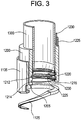
- a central tube 1200 having a distal end with an edge profile comprising one or more surface segments and having an outer diameter OD central and an inner diameter ID central .
- an electrode 1205 is disposed on or embedded within at least one of the surface segments.
- Central tube 1200 is slidably disposed within outer tube 1105 and positioned such that electrode 1205 opposes and overlaps at least a portion of electrode 1130.
- the space between electrode 1205 and electrode 1130 is referred to as the tissue clamping zone.
- OD central > ID coil and OD coil > ID central .
- OD central is about equal to OD coil . Accordingly, Central tube 1200 may be advanced through the tissue clamping zone towards coil 1110 such that electrode 1205 abuts electrode 1130.
- a cutting tube 1300 is slidably disposed within central tube 1200.
- the distal end of cutting tube 1300 is provided with a knife edge to facilitate tissue cutting.
- the resection device 1100 may be inserted into tissue and outer tube 1105 may be advanced a predetermined distance towards a target.
- Coil segment 1125 allows the device to penetrate the tissue in a manner similar to a cork screw. As coil segment 1125 penetrates tissue, any vessel in its path is either moved to planar coil segment 1120 or pushed away from the coil 1100 for subsequent turns. Coil tip 1115 is made blunt enough to minimize chances that it will penetrate through a blood vessel while still sharp enough to penetrate certain tissue such as the lung pleura and parenchyma.
- Central tube 1200 may then be advanced a predetermined distance towards the target. Any vessels that are disposed in the tissue clamping zone will be clamped between electrode 1130 and electrode 1205.
- the vessels can then be sealed by the application of bipolar energy to electrode 1130 and electrode 1205.
- cutting tube 1300 is advanced to core the tissue to the depth that outer tube 1105 has reached. The sealing and cutting process can be repeated to create a core of desired size.
- the resection device may be further configured to dissect a target lesion and seal tissue proximate the dissection point.
- central tube 1200 is provided with a ligation snare 1230, first and second ligation electrodes 1215 and 1220, an amputation snare 1225 and a ligation snare 1230.
- the word "snare” refers to a flexible line, e.g., a string or a wire.
- the inner wall surface of central tube 1200 includes upper and lower circumferential grooved pathways 1212 and 1214 disposed proximate the distal end.
- the first and second ligation electrodes 1215 and 1220 are disposed on the inner wall of central tube 1200 such that lower circumferential groove 1214 is between them.
- Upper grooved pathway 1212 is disposed axially above ligation electrodes 1215 and 1220.
- Ligation snare 1230 is disposed in lower circumferential groove 1214 and extends through central tube 1200 and axially along the outer wall surface to a snare activation mechanism (not shown).
- Amputation snare 1225 is disposed in upper circumferential groove 1212 and extends through central tube 1200 and axially along the outer wall surface to a snare activation mechanism (not shown).
- the outer surface of central tube 1200 may be provided with a plurality of axially extending grooved pathways which receive amputation snare 1225, ligation snare 1230 and are in communication with upper and lower circumferential grooved pathways 1212 and 1214.
- electrode leads for ligation electrodes 1215 and 1220 may extend to an energy source via the axially extending grooved pathways.
- the resection device of this embodiment can detach and seal the tissue core.
- Cutting tube 1300 may be retracted to expose ligation snare 1230 which is preferably made of flexible line, e.g., suture.
- Ligation snare 1230 may be engaged to snag tissue and pull tissue against the inner wall surface between first and second ligation electrodes 1215 and 1220.
- Bipolar energy is then applied to first and second electrodes 1215 and 1220 to seal, i.e., cauterize, the tissue.
- cutting tube 1300 may be further retracted to expose amputation snare 1225 which may then be activated to sever the tissue core upstream from the point where the tissue was sealed (ligation point).
- amputation snare 1225 has a smaller diameter than that of ligation snare 1230.
- the smaller diameter facilitates tissue slicing. Accordingly, the resection device 1100 according to this embodiment both creates a tissue core and disengages the core from surrounding tissue.
- the resection device of the invention is provided with a single snare disposed between ligation electrodes which both ligates and cuts tissue.
- the single snare first pulls tissue against the inner wall surface of central tube 1200 between ligation electrodes 1215 and 1220. Bipolar energy is then applied to first and second electrodes 1215 and 1220 to seal, i.e., cauterize, the tissue. Once sealed, the snare is further pulled to sever the tissue core.
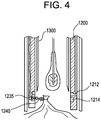
- ligation snare 1230 includes a set of knots 1235 and 1240 which tighten under load, shown, for example, in Figure 4 .
- Ligation is performed by retracting cutting tube 1300 to expose ligation snare 1210 and activating ligation snare 1230 which lassos tissue as ligation knot tightens. Once the tissue is lassoed, cutting tube 1300 may be further retracted to expose amputation snare 1225 which may then be activated to sever the tissue core upstream from the point where the point where the tissue was lassoed.
- the present disclosure also contemplates an exemplary method and system for using the resection device to remove tissue lesions, for example, lung lesions.
- the exemplary method generally comprises anchoring the lesion targeted for removal, creating a channel in the tissue leading to the target lesion, creating a tissue core which includes the anchored lesion, ligating the tissue core and sealing the surrounding tissue, and removing the tissue core including the target lesion from the channel.
- Anchoring may be performed by, any suitable structure for securing the device to the lung.
- a channel may be created to facilitate insertion of resection device 1100.
- the channel may be created by making an incision in the lung area and inserting a tissue dilator and port into the incision.
- a tissue core which includes the anchored lesion may be created.
- Resection device 1100 may be inserted into the channel and used to create the tissue core, to ligate the tissue core and to seal the tissue core and sever it from the surrounding tissue as described hereinabove. The tissue core may then be removed from the channel.
- a cavity port may be inserted in the channel to facilitate subsequent treatment of the target lesion site through chemotherapy and/or energy-based tumor extirpation such as radiation.
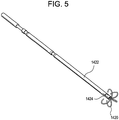
- the anchor depicted in Figure 5 is suitable for use in performing the exemplary method for removing tissue lesions described herein.
- the anchor comprises an outer tube 1422 having a sufficiently sharp edge to pierce the chest cavity tissue and lung without causing excess damage and an inner tube 1424 disposed within outer tube 1422.
- One or more tines or fingers 1426 formed from shape memory material, e.g., Nitinol, preformed are attached to the end of inner tube 1424.
- Outer tube 1422 is retractably disposed over inner tube 1424 such that when outer tube 1422 is retracted, tines 1426 assume their preform shape as shown.
- Outer tube 1422 is retracted after it has pierced the lung lesion thereby causing tines 1426 to engage the lung lesion.
- Other suitable anchors may include coils and suction-based structures.
- the incision blades depicted in Figure 6 are suitable for use in performing the exemplary method for removing tissue lesions described herein.
- anchor 1400 it is preferable to create a small cut or incision to facilitate insertion of chest wall tissue dilator.
- Incision blades 1605 are used to make a wider cut.
- Successive incision blades 1605 include a central aperture which allows them to be coaxially advanced along the anchor needle 1405 to create a wider cut in the chest wall, with each successive blade being larger than the previous blade, thereby increasing the width of the incision.
- the tissue dilator depicted in Figure 7 is suitable for use in performing the exemplary method for removing tissue lesions described herein.
- the tissue dilator may comprise any suitable device for creating a channel in organic tissue.
- the tissue dilator assembly includes a single cylindrical rod with rounded end 1510 or a cylindrical rod with rounded end and a rigid sleeve arrangement 1515. Successive tissue dilators are coaxially advanced along the anchor needle to create
- tissue resection device capable of penetrating lung tissue and creating a tissue core including a target lesion is suitable for use in performing the exemplary method for removing tissue lesions described herein.
- Tissue resection device 1100 described hereinbefore is preferred.
- tissue resection device 1100 Once tissue resection device 1100 is removed, a small channel in the lung exits where the target lesion was removed.
- This channel may be utilized to introduce an energy-based ablation device and/or localized chemotherapy depending on the results of the tissue diagnosis. Accordingly, the exemplary method and system of the present invention may not only be utilized to ensure an effective biopsy is performed but also complete removal of the lesion with minimal healthy lung tissue removal.
Landscapes
- Health & Medical Sciences (AREA)
- Life Sciences & Earth Sciences (AREA)
- Surgery (AREA)
- Engineering & Computer Science (AREA)
- General Health & Medical Sciences (AREA)
- Biomedical Technology (AREA)
- Animal Behavior & Ethology (AREA)
- Public Health (AREA)
- Veterinary Medicine (AREA)
- Heart & Thoracic Surgery (AREA)
- Medical Informatics (AREA)
- Molecular Biology (AREA)
- Nuclear Medicine, Radiotherapy & Molecular Imaging (AREA)
- Pathology (AREA)
- Physics & Mathematics (AREA)
- Otolaryngology (AREA)
- Plasma & Fusion (AREA)
- Vascular Medicine (AREA)
- Hematology (AREA)
- Anesthesiology (AREA)
- Oral & Maxillofacial Surgery (AREA)
- Surgical Instruments (AREA)
Priority Applications (1)
| Application Number | Priority Date | Filing Date | Title |
|---|---|---|---|
| PL19189139T PL3603546T3 (pl) | 2018-07-31 | 2019-07-30 | Zestaw do usuwania zmiany chorobowej tkanki |
Applications Claiming Priority (6)
| Application Number | Priority Date | Filing Date | Title |
|---|---|---|---|
| US201862712545P | 2018-07-31 | 2018-07-31 | |
| US201862728170P | 2018-09-07 | 2018-09-07 | |
| US201862744797P | 2018-10-12 | 2018-10-12 | |
| US201862749302P | 2018-10-23 | 2018-10-23 | |
| US201862756234P | 2018-11-06 | 2018-11-06 | |
| US16/512,649 US20200038097A1 (en) | 2018-07-31 | 2019-07-16 | Kit for removing a tissue lesion |
Publications (2)
| Publication Number | Publication Date |
|---|---|
| EP3603546A1 EP3603546A1 (en) | 2020-02-05 |
| EP3603546B1 true EP3603546B1 (en) | 2021-03-24 |
Family
ID=67513400
Family Applications (1)
| Application Number | Title | Priority Date | Filing Date |
|---|---|---|---|
| EP19189139.9A Active EP3603546B1 (en) | 2018-07-31 | 2019-07-30 | A kit for removing a tissue lesion |
Country Status (7)
| Country | Link |
|---|---|
| US (1) | US20200038097A1 (pl) |
| EP (1) | EP3603546B1 (pl) |
| JP (1) | JP2020018854A (pl) |
| CN (1) | CN110772312A (pl) |
| BR (1) | BR102019015652A2 (pl) |
| ES (1) | ES2874524T3 (pl) |
| PL (1) | PL3603546T3 (pl) |
Families Citing this family (8)
| Publication number | Priority date | Publication date | Assignee | Title |
|---|---|---|---|---|
| US20200038089A1 (en) * | 2018-07-31 | 2020-02-06 | Ethicon, Inc. | Tissue resection apparatus |
| WO2021220220A1 (en) * | 2020-04-30 | 2021-11-04 | Ethicon, Inc. | Systems, devices, and methods for coring tissue |
| US12521168B2 (en) | 2020-06-08 | 2026-01-13 | Prana Thoracic, Inc. | Tissue resection control systems and methods |
| US20210393332A1 (en) * | 2020-06-22 | 2021-12-23 | Ethicon, Inc. | Methods and devices for navigating a tissue resection device |
| KR20230120632A (ko) * | 2020-08-17 | 2023-08-17 | 프라나 토라식 인코포레이티드 | 코어링 및 절단 장치, 시스템 및 방법 |
| WO2022214896A1 (en) * | 2021-04-09 | 2022-10-13 | Ethicon, Inc. | Systems, devices, and methods for coring tissue |
| CN116019500B (zh) | 2023-03-03 | 2025-01-14 | 北京市肿瘤防治研究所 | 一种ct引导下经皮穿刺肺结节切割器 |
| CN119606490B (zh) * | 2024-12-30 | 2025-11-18 | 华中科技大学同济医学院附属同济医院 | 一种用于肺部胸膜下磨玻璃结节的圆形内切割闭合器 |
Family Cites Families (12)
| Publication number | Priority date | Publication date | Assignee | Title |
|---|---|---|---|---|
| US5843108A (en) * | 1997-10-23 | 1998-12-01 | Samuels; Shaun Laurence Wilkie | Over the wire scapel |
| US6733499B2 (en) * | 2002-02-28 | 2004-05-11 | Biosense Webster, Inc. | Catheter having circular ablation assembly |
| US6974467B1 (en) * | 2002-11-04 | 2005-12-13 | Gonzales Jr Antonio | Method and apparatus for making a precise surgical incision |
| US20040147917A1 (en) * | 2003-01-23 | 2004-07-29 | Mueller Richard L. | Device and method for treatment of breast tissue with electromagnetic radiation |
| US8317771B2 (en) * | 2007-07-11 | 2012-11-27 | Apollo Endosurgery, Inc. | Methods and systems for performing submucosal medical procedures |
| US8900250B2 (en) * | 2008-08-19 | 2014-12-02 | Cook Medical Technologies, LLC | Apparatus and methods for removing lymph nodes or anchoring into tissue during a translumenal procedure |
| US20110190764A1 (en) * | 2010-01-29 | 2011-08-04 | Ethicon Endo-Surgery, Inc. | Surgical instrument comprising an electrode |
| EP2838434B1 (en) * | 2012-04-16 | 2019-07-24 | The University Of Queensland | A microbiopsy device |
| JP6020908B2 (ja) * | 2012-12-06 | 2016-11-02 | 国立研究開発法人産業技術総合研究所 | 内視鏡用組織片採取装置 |
| US20140277039A1 (en) * | 2013-03-15 | 2014-09-18 | Acclarent, Inc. | Apparatus and method for treatment of ethmoid sinusitis |
| DE102016101915A1 (de) * | 2016-02-03 | 2017-08-03 | Aesculap Ag | Minimalinvasives Inzisionsinstrument mit geführter Mehrfachschneide |
| ES2949144T3 (es) * | 2016-11-23 | 2023-09-26 | Corit Medical Llc | Aparato para reducción tisular |
-
2019
- 2019-07-16 US US16/512,649 patent/US20200038097A1/en not_active Abandoned
- 2019-07-30 BR BR102019015652-0A patent/BR102019015652A2/pt not_active Application Discontinuation
- 2019-07-30 ES ES19189139T patent/ES2874524T3/es active Active
- 2019-07-30 EP EP19189139.9A patent/EP3603546B1/en active Active
- 2019-07-30 JP JP2019139537A patent/JP2020018854A/ja active Pending
- 2019-07-30 PL PL19189139T patent/PL3603546T3/pl unknown
- 2019-07-31 CN CN201910700729.2A patent/CN110772312A/zh active Pending
Non-Patent Citations (1)
| Title |
|---|
| None * |
Also Published As
| Publication number | Publication date |
|---|---|
| ES2874524T3 (es) | 2021-11-05 |
| JP2020018854A (ja) | 2020-02-06 |
| CN110772312A (zh) | 2020-02-11 |
| BR102019015652A2 (pt) | 2020-02-18 |
| PL3603546T3 (pl) | 2022-01-10 |
| EP3603546A1 (en) | 2020-02-05 |
| US20200038097A1 (en) | 2020-02-06 |
Similar Documents
| Publication | Publication Date | Title |
|---|---|---|
| EP3603546B1 (en) | A kit for removing a tissue lesion | |
| US12102372B2 (en) | Tissue resection apparatus | |
| US11723708B2 (en) | Method for removing a tissue lesion | |
| EP2923645B1 (en) | Devices and systems for obtaining a tissue sample using a biopsy tool | |
| CN102843975B (zh) | 内窥镜超声引导的活组织检查针 | |
| US20210219967A1 (en) | Systems, devices, and methods for coring tissue | |
| US20130165959A1 (en) | Adjustable resection device and related methods of use | |
| CA3177320A1 (en) | Systems, devices, and methods for coring tissue | |
| US20220047322A1 (en) | Coring and amputation devices, systems, and methods | |
| WO2022214896A1 (en) | Systems, devices, and methods for coring tissue | |
| US10363087B2 (en) | Tissue resection device | |
| BR102019015643A2 (pt) | método para remover uma lesão de tecido | |
| Tillson | Abdominal biopsy procedures: intestines and liver. | |
| IES85915Y1 (en) | Endoscopic ultrasound-guided biopsy needle |
Legal Events
| Date | Code | Title | Description |
|---|---|---|---|
| PUAI | Public reference made under article 153(3) epc to a published international application that has entered the european phase |
Free format text: ORIGINAL CODE: 0009012 |
|
| STAA | Information on the status of an ep patent application or granted ep patent |
Free format text: STATUS: THE APPLICATION HAS BEEN PUBLISHED |
|
| AK | Designated contracting states |
Kind code of ref document: A1 Designated state(s): AL AT BE BG CH CY CZ DE DK EE ES FI FR GB GR HR HU IE IS IT LI LT LU LV MC MK MT NL NO PL PT RO RS SE SI SK SM TR |
|
| AX | Request for extension of the european patent |
Extension state: BA ME |
|
| STAA | Information on the status of an ep patent application or granted ep patent |
Free format text: STATUS: REQUEST FOR EXAMINATION WAS MADE |
|
| 17P | Request for examination filed |
Effective date: 20200612 |
|
| RBV | Designated contracting states (corrected) |
Designated state(s): AL AT BE BG CH CY CZ DE DK EE ES FI FR GB GR HR HU IE IS IT LI LT LU LV MC MK MT NL NO PL PT RO RS SE SI SK SM TR |
|
| GRAP | Despatch of communication of intention to grant a patent |
Free format text: ORIGINAL CODE: EPIDOSNIGR1 |
|
| STAA | Information on the status of an ep patent application or granted ep patent |
Free format text: STATUS: GRANT OF PATENT IS INTENDED |
|
| INTG | Intention to grant announced |
Effective date: 20201019 |
|
| GRAJ | Information related to disapproval of communication of intention to grant by the applicant or resumption of examination proceedings by the epo deleted |
Free format text: ORIGINAL CODE: EPIDOSDIGR1 |
|
| STAA | Information on the status of an ep patent application or granted ep patent |
Free format text: STATUS: REQUEST FOR EXAMINATION WAS MADE |
|
| GRAP | Despatch of communication of intention to grant a patent |
Free format text: ORIGINAL CODE: EPIDOSNIGR1 |
|
| STAA | Information on the status of an ep patent application or granted ep patent |
Free format text: STATUS: GRANT OF PATENT IS INTENDED |
|
| INTC | Intention to grant announced (deleted) | ||
| INTG | Intention to grant announced |
Effective date: 20210113 |
|
| GRAS | Grant fee paid |
Free format text: ORIGINAL CODE: EPIDOSNIGR3 |
|
| GRAA | (expected) grant |
Free format text: ORIGINAL CODE: 0009210 |
|
| STAA | Information on the status of an ep patent application or granted ep patent |
Free format text: STATUS: THE PATENT HAS BEEN GRANTED |
|
| AK | Designated contracting states |
Kind code of ref document: B1 Designated state(s): AL AT BE BG CH CY CZ DE DK EE ES FI FR GB GR HR HU IE IS IT LI LT LU LV MC MK MT NL NO PL PT RO RS SE SI SK SM TR |
|
| REG | Reference to a national code |
Ref country code: GB Ref legal event code: FG4D |
|
| REG | Reference to a national code |
Ref country code: CH Ref legal event code: EP Ref country code: CH Ref legal event code: NV Representative=s name: E. BLUM AND CO. AG PATENT- UND MARKENANWAELTE V, CH |
|
| REG | Reference to a national code |
Ref country code: IE Ref legal event code: FG4D |
|
| REG | Reference to a national code |
Ref country code: DE Ref legal event code: R096 Ref document number: 602019003392 Country of ref document: DE Ref country code: AT Ref legal event code: REF Ref document number: 1373674 Country of ref document: AT Kind code of ref document: T Effective date: 20210415 |
|
| REG | Reference to a national code |
Ref country code: SE Ref legal event code: TRGR |
|
| REG | Reference to a national code |
Ref country code: NL Ref legal event code: FP |
|
| REG | Reference to a national code |
Ref country code: LT Ref legal event code: MG9D |
|
| PG25 | Lapsed in a contracting state [announced via postgrant information from national office to epo] |
Ref country code: HR Free format text: LAPSE BECAUSE OF FAILURE TO SUBMIT A TRANSLATION OF THE DESCRIPTION OR TO PAY THE FEE WITHIN THE PRESCRIBED TIME-LIMIT Effective date: 20210324 Ref country code: BG Free format text: LAPSE BECAUSE OF FAILURE TO SUBMIT A TRANSLATION OF THE DESCRIPTION OR TO PAY THE FEE WITHIN THE PRESCRIBED TIME-LIMIT Effective date: 20210624 Ref country code: FI Free format text: LAPSE BECAUSE OF FAILURE TO SUBMIT A TRANSLATION OF THE DESCRIPTION OR TO PAY THE FEE WITHIN THE PRESCRIBED TIME-LIMIT Effective date: 20210324 Ref country code: GR Free format text: LAPSE BECAUSE OF FAILURE TO SUBMIT A TRANSLATION OF THE DESCRIPTION OR TO PAY THE FEE WITHIN THE PRESCRIBED TIME-LIMIT Effective date: 20210625 Ref country code: NO Free format text: LAPSE BECAUSE OF FAILURE TO SUBMIT A TRANSLATION OF THE DESCRIPTION OR TO PAY THE FEE WITHIN THE PRESCRIBED TIME-LIMIT Effective date: 20210624 |
|
| PG25 | Lapsed in a contracting state [announced via postgrant information from national office to epo] |
Ref country code: RS Free format text: LAPSE BECAUSE OF FAILURE TO SUBMIT A TRANSLATION OF THE DESCRIPTION OR TO PAY THE FEE WITHIN THE PRESCRIBED TIME-LIMIT Effective date: 20210324 Ref country code: LV Free format text: LAPSE BECAUSE OF FAILURE TO SUBMIT A TRANSLATION OF THE DESCRIPTION OR TO PAY THE FEE WITHIN THE PRESCRIBED TIME-LIMIT Effective date: 20210324 |
|
| REG | Reference to a national code |
Ref country code: AT Ref legal event code: MK05 Ref document number: 1373674 Country of ref document: AT Kind code of ref document: T Effective date: 20210324 |
|
| PG25 | Lapsed in a contracting state [announced via postgrant information from national office to epo] |
Ref country code: AT Free format text: LAPSE BECAUSE OF FAILURE TO SUBMIT A TRANSLATION OF THE DESCRIPTION OR TO PAY THE FEE WITHIN THE PRESCRIBED TIME-LIMIT Effective date: 20210324 Ref country code: SM Free format text: LAPSE BECAUSE OF FAILURE TO SUBMIT A TRANSLATION OF THE DESCRIPTION OR TO PAY THE FEE WITHIN THE PRESCRIBED TIME-LIMIT Effective date: 20210324 Ref country code: LT Free format text: LAPSE BECAUSE OF FAILURE TO SUBMIT A TRANSLATION OF THE DESCRIPTION OR TO PAY THE FEE WITHIN THE PRESCRIBED TIME-LIMIT Effective date: 20210324 Ref country code: EE Free format text: LAPSE BECAUSE OF FAILURE TO SUBMIT A TRANSLATION OF THE DESCRIPTION OR TO PAY THE FEE WITHIN THE PRESCRIBED TIME-LIMIT Effective date: 20210324 Ref country code: CZ Free format text: LAPSE BECAUSE OF FAILURE TO SUBMIT A TRANSLATION OF THE DESCRIPTION OR TO PAY THE FEE WITHIN THE PRESCRIBED TIME-LIMIT Effective date: 20210324 |
|
| REG | Reference to a national code |
Ref country code: ES Ref legal event code: FG2A Ref document number: 2874524 Country of ref document: ES Kind code of ref document: T3 Effective date: 20211105 |
|
| PG25 | Lapsed in a contracting state [announced via postgrant information from national office to epo] |
Ref country code: IS Free format text: LAPSE BECAUSE OF FAILURE TO SUBMIT A TRANSLATION OF THE DESCRIPTION OR TO PAY THE FEE WITHIN THE PRESCRIBED TIME-LIMIT Effective date: 20210724 Ref country code: SK Free format text: LAPSE BECAUSE OF FAILURE TO SUBMIT A TRANSLATION OF THE DESCRIPTION OR TO PAY THE FEE WITHIN THE PRESCRIBED TIME-LIMIT Effective date: 20210324 Ref country code: RO Free format text: LAPSE BECAUSE OF FAILURE TO SUBMIT A TRANSLATION OF THE DESCRIPTION OR TO PAY THE FEE WITHIN THE PRESCRIBED TIME-LIMIT Effective date: 20210324 Ref country code: PT Free format text: LAPSE BECAUSE OF FAILURE TO SUBMIT A TRANSLATION OF THE DESCRIPTION OR TO PAY THE FEE WITHIN THE PRESCRIBED TIME-LIMIT Effective date: 20210726 |
|
| REG | Reference to a national code |
Ref country code: DE Ref legal event code: R097 Ref document number: 602019003392 Country of ref document: DE |
|
| PG25 | Lapsed in a contracting state [announced via postgrant information from national office to epo] |
Ref country code: DK Free format text: LAPSE BECAUSE OF FAILURE TO SUBMIT A TRANSLATION OF THE DESCRIPTION OR TO PAY THE FEE WITHIN THE PRESCRIBED TIME-LIMIT Effective date: 20210324 Ref country code: AL Free format text: LAPSE BECAUSE OF FAILURE TO SUBMIT A TRANSLATION OF THE DESCRIPTION OR TO PAY THE FEE WITHIN THE PRESCRIBED TIME-LIMIT Effective date: 20210324 |
|
| PLBE | No opposition filed within time limit |
Free format text: ORIGINAL CODE: 0009261 |
|
| STAA | Information on the status of an ep patent application or granted ep patent |
Free format text: STATUS: NO OPPOSITION FILED WITHIN TIME LIMIT |
|
| PG25 | Lapsed in a contracting state [announced via postgrant information from national office to epo] |
Ref country code: SI Free format text: LAPSE BECAUSE OF FAILURE TO SUBMIT A TRANSLATION OF THE DESCRIPTION OR TO PAY THE FEE WITHIN THE PRESCRIBED TIME-LIMIT Effective date: 20210324 |
|
| 26N | No opposition filed |
Effective date: 20220104 |
|
| PG25 | Lapsed in a contracting state [announced via postgrant information from national office to epo] |
Ref country code: MC Free format text: LAPSE BECAUSE OF FAILURE TO SUBMIT A TRANSLATION OF THE DESCRIPTION OR TO PAY THE FEE WITHIN THE PRESCRIBED TIME-LIMIT Effective date: 20210324 |
|
| REG | Reference to a national code |
Ref country code: BE Ref legal event code: MM Effective date: 20210731 |
|
| PG25 | Lapsed in a contracting state [announced via postgrant information from national office to epo] |
Ref country code: IS Free format text: LAPSE BECAUSE OF FAILURE TO SUBMIT A TRANSLATION OF THE DESCRIPTION OR TO PAY THE FEE WITHIN THE PRESCRIBED TIME-LIMIT Effective date: 20210724 Ref country code: LU Free format text: LAPSE BECAUSE OF NON-PAYMENT OF DUE FEES Effective date: 20210730 |
|
| PG25 | Lapsed in a contracting state [announced via postgrant information from national office to epo] |
Ref country code: IE Free format text: LAPSE BECAUSE OF NON-PAYMENT OF DUE FEES Effective date: 20210730 Ref country code: BE Free format text: LAPSE BECAUSE OF NON-PAYMENT OF DUE FEES Effective date: 20210731 |
|
| PGFP | Annual fee paid to national office [announced via postgrant information from national office to epo] |
Ref country code: SE Payment date: 20220615 Year of fee payment: 4 |
|
| PGFP | Annual fee paid to national office [announced via postgrant information from national office to epo] |
Ref country code: CH Payment date: 20220801 Year of fee payment: 4 |
|
| PG25 | Lapsed in a contracting state [announced via postgrant information from national office to epo] |
Ref country code: CY Free format text: LAPSE BECAUSE OF FAILURE TO SUBMIT A TRANSLATION OF THE DESCRIPTION OR TO PAY THE FEE WITHIN THE PRESCRIBED TIME-LIMIT Effective date: 20210324 |
|
| PG25 | Lapsed in a contracting state [announced via postgrant information from national office to epo] |
Ref country code: HU Free format text: LAPSE BECAUSE OF FAILURE TO SUBMIT A TRANSLATION OF THE DESCRIPTION OR TO PAY THE FEE WITHIN THE PRESCRIBED TIME-LIMIT; INVALID AB INITIO Effective date: 20190730 |
|
| REG | Reference to a national code |
Ref country code: CH Ref legal event code: PL |
|
| REG | Reference to a national code |
Ref country code: SE Ref legal event code: EUG |
|
| PG25 | Lapsed in a contracting state [announced via postgrant information from national office to epo] |
Ref country code: MK Free format text: LAPSE BECAUSE OF FAILURE TO SUBMIT A TRANSLATION OF THE DESCRIPTION OR TO PAY THE FEE WITHIN THE PRESCRIBED TIME-LIMIT Effective date: 20210324 Ref country code: CH Free format text: LAPSE BECAUSE OF NON-PAYMENT OF DUE FEES Effective date: 20230731 |
|
| PG25 | Lapsed in a contracting state [announced via postgrant information from national office to epo] |
Ref country code: SE Free format text: LAPSE BECAUSE OF NON-PAYMENT OF DUE FEES Effective date: 20230731 |
|
| PG25 | Lapsed in a contracting state [announced via postgrant information from national office to epo] |
Ref country code: TR Free format text: LAPSE BECAUSE OF FAILURE TO SUBMIT A TRANSLATION OF THE DESCRIPTION OR TO PAY THE FEE WITHIN THE PRESCRIBED TIME-LIMIT Effective date: 20210324 |
|
| PG25 | Lapsed in a contracting state [announced via postgrant information from national office to epo] |
Ref country code: MT Free format text: LAPSE BECAUSE OF FAILURE TO SUBMIT A TRANSLATION OF THE DESCRIPTION OR TO PAY THE FEE WITHIN THE PRESCRIBED TIME-LIMIT Effective date: 20210324 |
|
| PGFP | Annual fee paid to national office [announced via postgrant information from national office to epo] |
Ref country code: NL Payment date: 20250726 Year of fee payment: 7 |
|
| PGFP | Annual fee paid to national office [announced via postgrant information from national office to epo] |
Ref country code: ES Payment date: 20250801 Year of fee payment: 7 |
|
| PGFP | Annual fee paid to national office [announced via postgrant information from national office to epo] |
Ref country code: DE Payment date: 20250729 Year of fee payment: 7 |
|
| PGFP | Annual fee paid to national office [announced via postgrant information from national office to epo] |
Ref country code: PL Payment date: 20250707 Year of fee payment: 7 Ref country code: IT Payment date: 20250721 Year of fee payment: 7 |
|
| PGFP | Annual fee paid to national office [announced via postgrant information from national office to epo] |
Ref country code: GB Payment date: 20250728 Year of fee payment: 7 |
|
| PGFP | Annual fee paid to national office [announced via postgrant information from national office to epo] |
Ref country code: FR Payment date: 20250728 Year of fee payment: 7 |