EP3596191B1 - Reinigungszusammensetzung - Google Patents
Reinigungszusammensetzung Download PDFInfo
- Publication number
- EP3596191B1 EP3596191B1 EP18714846.5A EP18714846A EP3596191B1 EP 3596191 B1 EP3596191 B1 EP 3596191B1 EP 18714846 A EP18714846 A EP 18714846A EP 3596191 B1 EP3596191 B1 EP 3596191B1
- Authority
- EP
- European Patent Office
- Prior art keywords
- membrane
- composition
- alkyl
- cleaning composition
- ppm
- Prior art date
- Legal status (The legal status is an assumption and is not a legal conclusion. Google has not performed a legal analysis and makes no representation as to the accuracy of the status listed.)
- Active
Links
Images
Classifications
-
- C—CHEMISTRY; METALLURGY
- C11—ANIMAL OR VEGETABLE OILS, FATS, FATTY SUBSTANCES OR WAXES; FATTY ACIDS THEREFROM; DETERGENTS; CANDLES
- C11D—DETERGENT COMPOSITIONS; USE OF SINGLE SUBSTANCES AS DETERGENTS; SOAP OR SOAP-MAKING; RESIN SOAPS; RECOVERY OF GLYCEROL
- C11D1/00—Detergent compositions based essentially on surface-active compounds; Use of these compounds as a detergent
- C11D1/66—Non-ionic compounds
- C11D1/83—Mixtures of non-ionic with anionic compounds
-
- B—PERFORMING OPERATIONS; TRANSPORTING
- B01—PHYSICAL OR CHEMICAL PROCESSES OR APPARATUS IN GENERAL
- B01D—SEPARATION
- B01D65/00—Accessories or auxiliary operations, in general, for separation processes or apparatus using semi-permeable membranes
- B01D65/02—Membrane cleaning or sterilisation ; Membrane regeneration
-
- B—PERFORMING OPERATIONS; TRANSPORTING
- B08—CLEANING
- B08B—CLEANING IN GENERAL; PREVENTION OF FOULING IN GENERAL
- B08B3/00—Cleaning by methods involving the use or presence of liquid or steam
- B08B3/04—Cleaning involving contact with liquid
- B08B3/08—Cleaning involving contact with liquid the liquid having chemical or dissolving effect
-
- B—PERFORMING OPERATIONS; TRANSPORTING
- B01—PHYSICAL OR CHEMICAL PROCESSES OR APPARATUS IN GENERAL
- B01D—SEPARATION
- B01D2321/00—Details relating to membrane cleaning, regeneration, sterilization or to the prevention of fouling
- B01D2321/16—Use of chemical agents
- B01D2321/162—Use of acids
-
- B—PERFORMING OPERATIONS; TRANSPORTING
- B01—PHYSICAL OR CHEMICAL PROCESSES OR APPARATUS IN GENERAL
- B01D—SEPARATION
- B01D2321/00—Details relating to membrane cleaning, regeneration, sterilization or to the prevention of fouling
- B01D2321/16—Use of chemical agents
- B01D2321/164—Use of bases
-
- C—CHEMISTRY; METALLURGY
- C11—ANIMAL OR VEGETABLE OILS, FATS, FATTY SUBSTANCES OR WAXES; FATTY ACIDS THEREFROM; DETERGENTS; CANDLES
- C11D—DETERGENT COMPOSITIONS; USE OF SINGLE SUBSTANCES AS DETERGENTS; SOAP OR SOAP-MAKING; RESIN SOAPS; RECOVERY OF GLYCEROL
- C11D1/00—Detergent compositions based essentially on surface-active compounds; Use of these compounds as a detergent
- C11D1/02—Anionic compounds
- C11D1/12—Sulfonic acids or sulfuric acid esters; Salts thereof
- C11D1/14—Sulfonic acids or sulfuric acid esters; Salts thereof derived from aliphatic hydrocarbons or mono-alcohols
- C11D1/146—Sulfuric acid esters
-
- C—CHEMISTRY; METALLURGY
- C11—ANIMAL OR VEGETABLE OILS, FATS, FATTY SUBSTANCES OR WAXES; FATTY ACIDS THEREFROM; DETERGENTS; CANDLES
- C11D—DETERGENT COMPOSITIONS; USE OF SINGLE SUBSTANCES AS DETERGENTS; SOAP OR SOAP-MAKING; RESIN SOAPS; RECOVERY OF GLYCEROL
- C11D1/00—Detergent compositions based essentially on surface-active compounds; Use of these compounds as a detergent
- C11D1/66—Non-ionic compounds
- C11D1/75—Amino oxides
-
- C—CHEMISTRY; METALLURGY
- C11—ANIMAL OR VEGETABLE OILS, FATS, FATTY SUBSTANCES OR WAXES; FATTY ACIDS THEREFROM; DETERGENTS; CANDLES
- C11D—DETERGENT COMPOSITIONS; USE OF SINGLE SUBSTANCES AS DETERGENTS; SOAP OR SOAP-MAKING; RESIN SOAPS; RECOVERY OF GLYCEROL
- C11D2111/00—Cleaning compositions characterised by the objects to be cleaned; Cleaning compositions characterised by non-standard cleaning or washing processes
- C11D2111/10—Objects to be cleaned
- C11D2111/14—Hard surfaces
Definitions
- the invention relates to cleaning compositions, more specifically to compositions for cleaning membranes used in processing food products.
- the food and beverage products produced are of a suitable standard and purity for consumption by the public.
- the public will not accept products that contain chemical residues, such as those that remain after cleaning of the equipment used to produce a particular product. For example, it is not acceptable for food products to taste of the surfactants that were used to clean the equipment used to produce the product.
- Customer product quality is an increasingly important topic for high premium whey products such as infant food, for example, where it is critical that the products are not contaminated with or contain potentially hazardous materials. It is currently possible to analyse products to detect such residues in parts per million (ppm) or parts per billion (ppb) scale to ensure that even trace amounts of undesirable or hazardous materials are not present in dairy products in particular.
- ppm parts per million
- ppb parts per billion
- a composition for use as a cleaning composition to clean membranes comprising 10 ppm to 500 ppm of at least one amine oxide and at least one alkyl sulfate, wherein the at least one alkyl sulfate comprises 2-ethylhexyl sulfate and the at least one amine oxide comprises lauryldimethylamine oxide, wherein less than 50mg/m 2 of the composition is retained on a membrane cleaned using the composition.
- the composition of the invention comprises at least two different surfactants, a non-ionic surfactant and an anionic surfactant.
- the cleaning composition may be used to clean membranes used to process food products or beverages.
- the cleaning composition may be used to clean membranes used to process dairy products, fruit juices or alcoholic beverages such as beer.
- the membrane that is cleaned using the composition of the present aspect is rinsed using water after the application of the composition.
- Cleaning compositions used to clean membranes that are used to process food products typically leave a residue on the membranes, even after rinsing. This residue can then pass into the food products that are subsequently processed by the membrane. For example, residue on membranes used to process beer or wine can be re-dissolved by the alcohol in the beverage. In another example, residue on membranes used to process dairy products can be re-dissolved in the fats present in the diary dairy product. Accordingly, the cleaning composition can contaminate the product that is to be processed using the membrane.
- a cleaning composition to clean membranes used in food product processing that leaves less than 50 mg/m 2 of surfactant on the membrane according to the present invention requires significantly less rinsing of the membrane to remove, for example, and is a sufficiently low concentration to pose a reduced risk of contamination of dairy products subsequently processed by the membrane compared to uses of compositions known in the art to clean dairy product membranes.
- the adsorption and subsequent desorption of a surfactant to a surface depends on a variety of different factors.
- the material of the surface, and more specifically the hydrophilicity of the surface, would be expected to influence the adsorption behaviour of a surfactant onto a substrate.
- the macroscopic structure of the material might also be expected to impact the adsorption and desorption of a surfactant to a surface, therefore the amount of surfactant that remains on the surface after use.
- results of a flat and even material compared to a porous membrane could be expected to give different results.
- the pore size of a porous material such as a membrane may also be expected to produce different results, e.g. microfiltration membrane compared to ultrafiltration membrane.
- the different molecular weight cut off of the membranes may lead to different interaction of the membrane with the different-sized and structured surfactants. Accordingly, different sized pores on the same material membrane could lead to different residue result for a given surfactant.
- the structure of a surfactant would also be expected to influence the adsorption and desorption to and from a surface.
- Chain length, size of surfactant, and the electronegativity of the polar head groups may all influence the adsorption and desorption behaviour of the surfactant to a given surface and therefore to a given membrane.
- a cleaning composition comprising 10 ppm to 500 ppm of at least one amine oxide and at least one alkyl sulfate, wherein the at least one alkyl sulfate comprises 2-ethylhexyl sulfate and the at least one amine oxide comprises lauryldimethylamine oxide, provides both good cleaning performance of the membrane and a low residue on the membrane after the cleaning process. Accordingly, use of the composition of the present invention allows a high quality clean of the membrane without requiring extensive rinses with water after the cleaning process, resulting in reduced cleaning procedures and lower risks of contamination of the products.
- less than 20 mg/m 2 of the surfactants of the composition are retained on the membrane after use.
- less than 10 mg/m 2 of the surfactants of the composition are retained on the membrane after use.
- More preferably, less than 5 mg/m 2 of the surfactants of the composition are retained on the membrane after use.
- the retained composition of the present aspect on a membrane may be 50% less than compositions comprising an amine oxide that do not comprise an alkyl sulfate.
- the retained composition of the present aspect on a membrane may be 75% less than compositions comprising an amine oxide that do not comprise an alkyl sulfate.
- the retained composition of the present aspect on a membrane may be 90% less than compositions comprising an amine oxide that do not comprise an alkyl sulfate.
- amine oxide refers to oxides of tertiary amines having general formula (I): wherein R 1 is selected independently from optionally substituted C 4 -C 20 alkyl, R 2 and R 3 are selected independently from optionally substituted C 1 -C 5 alkyl. Suitable substituents are defined below.
- the composition may comprise a plurality of amine oxides. Each amine oxide within the plurality of amine oxides may vary in chain length for one or more of R 1 , R 2 , or R 3 .
- the composition may comprise a plurality of amine oxides comprising at least three amine oxides where R 1 is C 12 alkyl for a first amine oxide, R 1 is C 14 alkyl for a second amine oxide and R 1 is C 16 alkyl for a third amine oxide.
- the amine oxide may be selected from the list comprising: tetradecyldimethylamine oxide, lauryldimethylamine oxide, pentadecyldimethylamine oxide, decyldimethylamine oxide, hexadecyldimethylamine oxide, octadecyldimethylamine oxide, or cocalkyldimethylamine oxide.
- R 1 is C 12 -C 16 alkyl.
- R 2 and R 3 are C 1-3 alkyl.
- the at least one amine oxide includes lauryldimethylamine oxide.
- the composition comprises from 10 to 500 ppm of the at least one amine oxide.
- the composition may comprise from 50 to 400 ppm of the at least one amine oxide.
- the composition may comprise from 100 to 400 ppm of the at least one amine oxide.
- the composition may comprise at least 100 ppm of the at least one amine oxide.
- the composition may comprise at least 150 ppm of the at least one amine oxide.
- the composition may be provided in a concentrated stock solution that is then diluted by the end user for use. Accordingly, the stock solution may comprise 1 to 40 weight percent of the at least one amine oxide. The stock solution may comprise 1 to 20 weight percent of the at least one amine oxide. The stock solution may be diluted before use such that the composition that is used to clean the membrane may comprise from 0.01 to 2 weight percent of the at least one amine oxide, or from 0.01 to 1 weight percent of the at least one amine oxide, for example.
- the at least one alkyl sulfate has the general formula (II): where R 4 is selected from the group consisting of optionally substituted C 4 -C 20 alkyl, and optionally substituted C 4 -C 20 cycloalkyl.
- the at least one alkyl sulfate is a branched alkyl sulfate. Accordingly, R 4 is branched.
- R 4 may be optionally substituted C 6 -C 15 alkyl.
- R 4 may be optionally substituted C 6 to C 10 alkyl.
- the at least one alkyl sulfate comprises 2-ethylhexyl sulfate.
- the composition may comprise from 10 to 1000 ppm of the at least one alkyl sulfate.
- the composition may comprise from 10 to 500 ppm of the at least one alkyl sulfate.
- the composition may comprise from 10 to 300 ppm of the at least one alkyl sulfate.
- the composition may comprise from 50 to 200 ppm of the at least one alkyl sulfate.
- the composition may comprise from 50 to 100 ppm of the at least one alkyl sulfate.
- the composition may comprise at least 50 ppm of the at least one alkyl sulfate.
- the composition may comprise at least 75 ppm of the at least one alkyl sulfate.
- the composition may be provided in a concentrated stock solution that is then diluted by the end user before use.
- the stock solution may comprise 1 to 40 weight percent of the at least one alkyl sulfate.
- the stock solution may comprise 1 to 20 weight percent of the at least one alkyl sulfate.
- the stock solution may then be diluted before use such that the composition that is used to clean the membrane may comprise from 0.001 to 2 weight percent of the at least one alkyl sulfate or from 0.05 to 1 weight percent of the at least one alkyl sulfate, for example.
- the at least one alkyl sulfate is preferably in salt form.
- the counter ion of the salt form of the at least one alkyl sulfate is a monovalent counter ion.
- the counter ion may be an alkali metal, such as sodium, or potassium.
- the counter ion may be any other suitable counter ion, such as ammonium, for example.
- the composition comprises lauryldimethylamine oxide and 2-ethylhexyl sulfate.
- the composition may comprise from 50 ppm to 500ppm 2-ethylhexyl sulfate.
- the composition comprises from 100 ppm to 500 ppm lauryldimethylamine oxide and the composition may comprise from 50 ppm to 250 ppm 2-ethylhexyl sulfate.
- the composition may comprise from 100 to 400 ppm lauryldimethylamine oxide and the composition may comprise from 50 to 100 ppm 2-ethylhexyl sulfate.
- the composition may comprise additional components.
- the composition may comprise a salt.
- the composition may comprise an alkali metal salt, such as an alkali metal halide, or sulfate; or an alkali earth metal, such as an alkali earth metal halide or sulfate.
- the composition may comprise enzymes such as proteases, lipases, or proteolytic enzymes.
- the composition may comprise stabilisers such as polypropylene glycol, glycerin, glycerol, polyols, sorbitols, or sugar alcohols for example.
- the composition may be acidic.
- the composition may have a pH of less than pH 5, less than pH 4, less than pH 3.
- the composition may have a pH between 0 and 5, 0 and 4, or 0 and 3.
- the composition may have a pH between 1 and 5, 1 and 4, or 1 and 3.
- the composition may be alkaline.
- the composition may have a pH of more than pH 8, more than pH 9, or more than pH 10.
- the composition may have a pH from 8 to 14, 9 to 14, or 10 to 14.
- the composition may have a pH from 8 to 12, 9 to 12, or 10 to 12.
- the composition may be neutral.
- the composition may have a pH from 6 to 8, such as pH 6, pH 6.5, pH 7, pH 7.5 or pH 8.
- the composition may be neutral and the pH may be changed before application to a membrane to be cleaned.
- the pH may be raised prior to application to a membrane to be cleaned.
- the pH may be lowered prior to application to a membrane to be cleaned.
- the membrane cleaned using the composition is a polymeric membrane.
- the membrane may comprise polyamide, polyether sulfone, polysulfone, polyvinyldifluoride, polypropylene, or polyacrylnitrile.
- the membrane that is cleaned using the composition may be a ceramic membrane.
- the membrane may comprise a backing layer.
- the backing layer may be a polymeric backing layer.
- the backing layer may comprise polyethylene or polypropylene.
- halogen includes fluorine, chlorine, bromine, and iodine.
- alkyl alkylene, alkenyl, or alkynyl are used herein to refer to both straight and branched chain acyclic forms. Cyclic analogues thereof are referred to as cycloalkyl, etc.
- alkyl includes monovalent, straight or branched, saturated, acyclic hydrocarbyl groups.
- alkyl is C 1-10 alkyl, in another embodiment C 1-6 alkyl, in another embodiment C 1-4 alkyl, such as methyl, ethyl, n-propyl, i-propyl, or t-butyl groups.
- cycloalkyl includes monovalent, saturated, cyclic hydrocarbyl groups.
- the cycloalkyl is C 3-10 cycloalkyl, in other embodiments C 3-6 cycloalkyl, such as cyclopentyl and cyclohexyl.
- Optionally substituted groups of the compounds of the invention may be substituted or unsubstituted, in one embodiment unsubstituted.
- the membrane is rinsed with water.
- the membrane may be rinsed with water of high, medium, or low quality.
- the membrane may comprise less than 20 mg/m 2 of the surfactant after the step of rinsing the membrane.
- the membrane comprises less than 10 mg/m 2 of the surfactant after the step of rinsing the membrane. More preferably, the membrane comprises less than 5 mg/m 2 of the surfactant after the step of rinsing the membrane. Accordingly, step (c) may remove substantially all of the surfactants of the composition from the membrane. Step (c) may remove substantially all of the composition from the membrane.
- the membrane may retain 50% less amine oxide than compositions comprising an amine oxide that do not comprise an alkyl sulfate.
- the membrane may retain 75% less amine oxide than compositions comprising an amine oxide that do not comprise an alkyl sulfate.
- the membrane may retain 90% less amine oxide than compositions comprising an amine oxide that do not comprise an alkyl sulfate.
- step (c) requires a lower volume of water to remove the cleaning composition from the membrane than methods using cleaning compositions known in the art. As a result, the down time between production runs where the cleaning composition of the invention is used to clean the membranes is reduced.
- the method of the present aspect may be applied to clean membranes that are used to process food or beverage products. Accordingly, the method may be applied to clean membranes used to process beer. Alternatively, the method may be applied to clean membranes used to process dairy products. In embodiments where the method is used to clean membranes used to process dairy products, the cleaning composition may be particularly efficacious at removing components of the dairy products from the membrane. For example, the cleaning composition may remove milk proteins and fats such as butterfat from the membrane.
- the composition may be acidic.
- the composition may have a pH of less than pH 5, less than pH 4, or less than pH 3.
- the composition may be alkaline.
- the composition may have a pH of more than pH 8, more than pH 9, or more than pH 10.
- the composition may have a pH of 10, 11, or 12.
- the pH of the composition may be changed before being applied to the membrane using the method of the invention.
- the pH of the composition may be raised.
- the pH of the composition may be raised to pH 8, pH 9, pH 10, or higher.
- the pH of the composition may be lowered.
- the pH of the composition may be lowered to pH 7, pH 5, pH 4, pH 3, or lower.
- the invention extends to use of a composition according to the first aspect of the invention to clean membranes used to process food products.
- Preferred and optional features of the first and second aspects are preferred and optional features of the third aspect.
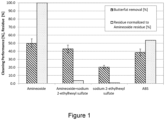
- Figure 1 is a chart showing the cleaning performance of test cleaning compositions and surfactant residue remaining on a membrane cleaned using the compositions.
- Membrane materials PES: polyether sulfone, PS: polysulfone.
- Membrane backing material PE: polyethylene, PP: polypropylene.
- the HFK 131 membrane has a polyether sulfone membrane with a polyethylene backing material this is indicated in table 1 below as PES/PE.
- Membranes were pre-rinsed with deionised water (DI water) at 2m 3 /hour for 5 minutes at standard conditions (room temperature and 1 bar pressure). The membranes were then cleaned using citric acid (pH 2.5) for 20 minutes at 40°C, before being rinsed in DI water for 10 minutes. The membranes were further cleaned using sodium hydroxide (NaOH) at pH 11.5 for 20 minutes at 40-45°C.
- DI water deionised water
- NaOH sodium hydroxide
- the pure water flux was determined to monitor the concentration of any contaminants on the membranes
- the membranes were then rinsed in DI water for 10 minutes at 2m 3 /hour and 1 bar. Samples were taken every minute from concentrate and total permeate side for surface tension measurements. Again, pure water flux was determined as previously described. The cleaned membranes were then analysed to determine the mass of surfactant residue that remained on the membrane after the above cleaning procedure.
- Table 1 Summary of test results showing the residue remaining on test membranes in mg/m 2 . Where blends of surfactants were used, x/y gives the residue of surfactant X and surfactant Y respectively. Concentrations of surfactants are 1000ppm unless otherwise stated below.
- Examples A-E are comparative examples.
- ABS had a superior residue performance (i.e., a lower mass of surfactant remained on the membrane after cleaning) compared to lauryldimethylamine oxide.
- 2-propylheptanol ethoxylates lead to a significantly higher surfactant residue than these standard membrane cleaning surfactants ( ⁇ factor of 2).
- the backing materials of the membranes has also been shown to produce different results (compare GR61PP with GR70PE, for example).
- the cleaning performance of the test cleaning compositions was determined by measuring the percentage of butterfat removed from a membrane and was carried out using the following method: PS coupons were prepared by pre-cleaning in methanol for 30 seconds and being allowed to dry. The coupons were then weighed to get the clean coupon weight. A homogenous layer of butter was applied to the coupons and the dried weight recorded.
- Surfactant solutions were prepared and heated to 45°C. The surfactant solutions were stirred at 240rpm and the pH was brought to pH 11 using NaOH. The coupons were suspended in the surfactant solutions for ten minutes, before being rinsed with deionised water and allowed to dry overnight. The coupons were then weighed to record the weight of butter that had been removed by the surfactant solution.
- lauryldimethylamine oxide showed good cleaning performance, removing 50% of the butterfat from the membrane, but there remained a high residue of the surfactant on the membrane after rinsing of the membrane.
- alkylbenzene sulfonate sodium salt (ABS) showed a reduced cleaning performance and an improved residue performance compared to NPE and the amine oxide composition.
- the sodium 2-ethylhexyl sulfate composition showed very good residue performance but poor cleaning performance.
- the cleaning composition comprising the combination of the lauryldimethylamine oxide and the sodium 2-ethylhexyl sulfate maintained a similar, if slightly reduced, cleaning performance to the amine oxide alone, whilst also maintaining the good residue performance of the sodium 2-ethylhexyl sulfate composition.
- Table 2 shows a comparison of the residue remaining on a membrane, as measured by the surface tension of the rinse water runoff, for lauryldimethylamine oxide (AO) alone and lauryldimethylamine oxide in combination with sodium 2-ethylhexyl sulfate (AS).
- Table 2 Surface tension of rinse water that has been used to rinse a membrane cleaned using with a cleaning composition comprising lauryldimethylamine oxide (AO) compared to a membrane cleaned using a cleaning composition comprising lauryldimethylamine oxide and sodium 2-ethylhexyl sulfate (AS).
- the combination composition is removed at a faster rate than the composition comprising the lauryldimethylamine oxide only.
- cleaning compositions comprising a blend of surfactants that were tested, such as a composition comprising lauryldimethylamine oxide and oleic acid sulfonate potassium salt, showed that the cleaning performance of the amine oxide decreased proportionally to the concentration of the oleic acid sulfonate potassium salt.
- composition comprising the combination of lauryldimethylamine oxide and sodium 2-ethylhexyl sulfate was found to be surprisingly efficacious for use as a cleaning composition for membranes, especially those membranes used to process food products such as dairy products.
Landscapes
- Chemical & Material Sciences (AREA)
- Chemical Kinetics & Catalysis (AREA)
- Life Sciences & Earth Sciences (AREA)
- Engineering & Computer Science (AREA)
- Oil, Petroleum & Natural Gas (AREA)
- Wood Science & Technology (AREA)
- Organic Chemistry (AREA)
- General Chemical & Material Sciences (AREA)
- Detergent Compositions (AREA)
Claims (12)
- Membranreinigungszusammensetzung, umfassend von 10 ppm bis 500 ppm von mindestens einem Aminoxid und mindestens einem Alkylsulfat, wobei das mindestens eine Alkylsulfat 2-Ethylhexylsulfat umfasst und das mindestens eine Aminoxid Lauryldimethylaminoxid umfasst, wobei weniger als 50 mg/m 2 der Zusammensetzung auf einer Membran zurückbleibt, die unter Verwendung der Zusammensetzung gereinigt wurde.
- Membranreinigungszusammensetzung nach Anspruch 1, wobei die Membranreinigungszusammensetzung eine Vielzahl von Aminoxiden umfasst.
- Membranreinigungszusammensetzung nach einem der vorstehenden Ansprüche, wobei die Membranreinigungszusammensetzung von 100 ppm bis 500 ppm Lauryldimethylaminoxid und von 50 ppm bis 250 ppm 2-Ethylhexylsulfat umfasst.
- Membranreinigungszusammensetzung nach einem der vorstehenden Ansprüche, wobei die Membranreinigungszusammensetzung einen pH-Wert von über 8 aufweist.
- Verfahren zum Reinigen einer Membran, umfassend die Schritte:a) Bereitstellen einer Membranreinigungszusammensetzung nach einem der Ansprüche 1 bis 4;b) Aufbringen der Membranreinigungszusammensetzung auf eine Membran; undc) Spülen der Membran, um mindestens einen Großteil der Zusammensetzung von der Membran zu entfernen;wobei die Membran weniger als 50 mg/m2 der Reinigungszusammensetzung nach dem Schritt des Spülens der Membran umfasst.
- Verfahren nach Anspruch 5, wobei die Membran weniger als 20 mg/m2 der Reinigungszusammensetzung nach dem Schritt des Spülens der Membran umfasst.
- Verfahren nach Anspruch 5 oder 6, wobei die Membranverwendet wird, um Nahrungsmittel oder Getränke zu verarbeiten.
- Verfahren nach Anspruch 7, wobei die Membran verwendet wird, um Milchprodukte, Fruchtsäfte oder alkoholische Getränke zu verarbeiten.
- Verfahren nach einem der Ansprüche 5 bis 8, wobei die Membran eine Polymermembran ist.
- Verfahren nach Anspruch 9, wobei die Membran Polyamid, Polyethersulfon, Polysulfon, Polyvinyldifluorid, Polypropylen oder Polyacrylnitril umfasst.
- Verfahren nach einem der Ansprüche 5 bis 10, wobei die Membran eine Polymerträgerschicht umfasst.
- Verwendung einer Membranreinigungszusammensetzung nach einem der Ansprüche 1 bis 4, um Membranen zu reinigen, die verwendet werden, um Nahrungsmittel zu verarbeiten.
Applications Claiming Priority (2)
| Application Number | Priority Date | Filing Date | Title |
|---|---|---|---|
| GBGB1704127.8A GB201704127D0 (en) | 2017-03-15 | 2017-03-15 | Cleaning composition |
| PCT/IB2018/051665 WO2018167667A1 (en) | 2017-03-15 | 2018-03-13 | Cleaning composition |
Publications (3)
| Publication Number | Publication Date |
|---|---|
| EP3596191A1 EP3596191A1 (de) | 2020-01-22 |
| EP3596191C0 EP3596191C0 (de) | 2024-11-13 |
| EP3596191B1 true EP3596191B1 (de) | 2024-11-13 |
Family
ID=58605375
Family Applications (1)
| Application Number | Title | Priority Date | Filing Date |
|---|---|---|---|
| EP18714846.5A Active EP3596191B1 (de) | 2017-03-15 | 2018-03-13 | Reinigungszusammensetzung |
Country Status (8)
| Country | Link |
|---|---|
| US (4) | US11168285B2 (de) |
| EP (1) | EP3596191B1 (de) |
| JP (1) | JP6810276B2 (de) |
| AR (1) | AR111526A1 (de) |
| AU (1) | AU2018234444B2 (de) |
| GB (1) | GB201704127D0 (de) |
| MX (1) | MX2019010996A (de) |
| WO (1) | WO2018167667A1 (de) |
Families Citing this family (2)
| Publication number | Priority date | Publication date | Assignee | Title |
|---|---|---|---|---|
| GB201704127D0 (en) * | 2017-03-15 | 2017-04-26 | Ecolab Usa Inc | Cleaning composition |
| WO2023014663A1 (en) | 2021-08-02 | 2023-02-09 | Ecolab Usa Inc. | Booster composition for cleaning fermentation equipment and methods of use |
Family Cites Families (34)
| Publication number | Priority date | Publication date | Assignee | Title |
|---|---|---|---|---|
| US3666917A (en) * | 1969-12-12 | 1972-05-30 | Hydroflow Corp | Heating system utilizing an electrolytic device in a closed hydraulic circuit |
| US4529534A (en) * | 1982-08-19 | 1985-07-16 | The Procter & Gamble Company | Peroxyacid bleach compositions |
| US4661275A (en) * | 1985-07-29 | 1987-04-28 | The Lubrizol Corporation | Water-based functional fluid thickening combinations of surfactants and hydrocarbyl-substituted succinic acid and/or anhydride/amine terminated poly(oxyalkylene) reaction products |
| US4661279A (en) * | 1985-11-22 | 1987-04-28 | Basf Corporation | Detergent composition |
| US4849012A (en) * | 1988-07-25 | 1989-07-18 | Teijin Limited | Method for growing citrus fruits |
| US5213619A (en) * | 1989-11-30 | 1993-05-25 | Jackson David P | Processes for cleaning, sterilizing, and implanting materials using high energy dense fluids |
| US5269850A (en) * | 1989-12-20 | 1993-12-14 | Hughes Aircraft Company | Method of removing organic flux using peroxide composition |
| US6376449B2 (en) * | 1993-03-27 | 2002-04-23 | Novozymes A/S | Acidic cleaning composition comprising an acidic protease I |
| BR9509483A (pt) * | 1994-10-28 | 1997-10-14 | Procter & Gamble | Composições para limpeza de superfícies duras inclusive aminas protonatadas e lensoativos de óxido de aminas |
| US5678238A (en) * | 1995-09-13 | 1997-10-14 | Richard Billings | Micro encapsulation of hydrocarbons and chemicals |
| GB2334722B (en) * | 1998-02-25 | 2002-04-24 | Reckitt & Colman Inc | Aqueous cleaning composition for removing soap scum |
| GB2334721B (en) * | 1998-02-25 | 2002-06-12 | Reckitt & Colman Inc | Cleansing composition |
| US7513132B2 (en) * | 2003-10-31 | 2009-04-07 | Whirlpool Corporation | Non-aqueous washing machine with modular construction |
| US20040014624A1 (en) * | 2001-06-06 | 2004-01-22 | Bolkan Steven A. | Recylable cleaning compositions |
| JP4132915B2 (ja) * | 2002-03-27 | 2008-08-13 | ジョンソン株式会社 | 漂白剤組成物 |
| US20030216281A1 (en) * | 2002-05-17 | 2003-11-20 | The Clorox Company | Hard surface cleaning composition |
| JP2005281651A (ja) * | 2004-03-31 | 2005-10-13 | Co-Op Clean Co Ltd | 液体洗浄剤組成物 |
| CA2541755A1 (en) * | 2005-04-04 | 2006-10-04 | Henkel Kommanditgesellschaft Auf Aktien | Oil-splitting alkaline cleaner for metal parts |
| US20060269509A1 (en) * | 2005-05-31 | 2006-11-30 | Excelda Corporation | Scent eliminating composition including colloidal silver |
| EP2252683B1 (de) * | 2008-02-11 | 2015-07-15 | Ecolab Inc. | Verwendung von aktivatorkomplexen zur verbesserung der reinigungsleistung von alkalischen peroxidreinigungssystemen bei kalten temperaturen |
| US9109191B2 (en) * | 2009-12-15 | 2015-08-18 | Invista North America S.A.R.L. | Emulsion compositions and a method for selecting surfactants |
| US8372794B2 (en) * | 2009-12-15 | 2013-02-12 | Invista North America S.A R.L. | Emulsion compositions and a method for selecting surfactants |
| JP2012106160A (ja) * | 2010-11-16 | 2012-06-07 | Adeka Clean Aid Co Ltd | 分離膜用洗浄剤組成物及び分離膜の洗浄方法 |
| US9338896B2 (en) * | 2012-07-25 | 2016-05-10 | Enthone, Inc. | Adhesion promotion in printed circuit boards |
| US9751049B2 (en) * | 2014-05-30 | 2017-09-05 | Novaflux Inc. | Compositions and methods of cleaning polyvinyl pyrrolidone-based hemodialysis filtration membrane assemblies |
| EP2987849A1 (de) * | 2014-08-19 | 2016-02-24 | The Procter and Gamble Company | Verfahren zum Waschen eines Stoffs |
| BR112017015300B1 (pt) * | 2015-01-15 | 2022-09-13 | Ecolab Usa Inc | Composição de limpeza espumante aquosa para removersujeira em baixas temperaturas de uma superfície a ser limpa, composição de espuma, método para remover sujeira de uma superfície a ser limpa e uso da referida composição |
| US20180134997A1 (en) * | 2015-06-09 | 2018-05-17 | Danisco Us Inc. | Osmotic burst encapsulates |
| JP6090378B2 (ja) | 2015-07-27 | 2017-03-08 | 栗田工業株式会社 | 逆浸透膜用洗浄液、および洗浄方法 |
| WO2017035006A1 (en) * | 2015-08-21 | 2017-03-02 | Ecolab Usa Inc. | Pyrithione preservative system in solid rinse aid products |
| DE102016202846A1 (de) * | 2016-02-24 | 2017-08-24 | Henkel Ag & Co. Kgaa | Wasch- oder Reinigungsmittel mit verbesserter antimikrobieller Wirkung |
| KR20180133427A (ko) * | 2016-04-18 | 2018-12-14 | 바스프 에스이 | 경질 표면의 세정 방법, 및 상기 방법에 유용한 제형 |
| EP3249035A1 (de) * | 2016-05-26 | 2017-11-29 | The Procter and Gamble Company | Verfahren zum waschen von geweben |
| GB201704127D0 (en) * | 2017-03-15 | 2017-04-26 | Ecolab Usa Inc | Cleaning composition |
-
2017
- 2017-03-15 GB GBGB1704127.8A patent/GB201704127D0/en not_active Ceased
-
2018
- 2018-03-13 JP JP2019547484A patent/JP6810276B2/ja active Active
- 2018-03-13 WO PCT/IB2018/051665 patent/WO2018167667A1/en not_active Ceased
- 2018-03-13 EP EP18714846.5A patent/EP3596191B1/de active Active
- 2018-03-13 MX MX2019010996A patent/MX2019010996A/es unknown
- 2018-03-13 AU AU2018234444A patent/AU2018234444B2/en active Active
- 2018-03-13 US US16/491,985 patent/US11168285B2/en active Active
- 2018-03-15 AR ARP180100605A patent/AR111526A1/es active IP Right Grant
-
2021
- 2021-10-08 US US17/450,323 patent/US11851633B2/en active Active
-
2023
- 2023-11-09 US US18/505,774 patent/US12344817B2/en active Active
-
2025
- 2025-06-06 US US19/231,150 patent/US20250297191A1/en active Pending
Also Published As
| Publication number | Publication date |
|---|---|
| US20220025296A1 (en) | 2022-01-27 |
| EP3596191A1 (de) | 2020-01-22 |
| EP3596191C0 (de) | 2024-11-13 |
| US11851633B2 (en) | 2023-12-26 |
| AR111526A1 (es) | 2019-07-24 |
| US11168285B2 (en) | 2021-11-09 |
| US20200308506A1 (en) | 2020-10-01 |
| US20250297191A1 (en) | 2025-09-25 |
| AU2018234444A1 (en) | 2019-09-05 |
| MX2019010996A (es) | 2019-10-17 |
| AU2018234444B2 (en) | 2020-07-02 |
| JP2020509136A (ja) | 2020-03-26 |
| JP6810276B2 (ja) | 2021-01-06 |
| NZ756433A (en) | 2021-10-29 |
| WO2018167667A1 (en) | 2018-09-20 |
| US20240076576A1 (en) | 2024-03-07 |
| GB201704127D0 (en) | 2017-04-26 |
| US12344817B2 (en) | 2025-07-01 |
Similar Documents
| Publication | Publication Date | Title |
|---|---|---|
| US20250297191A1 (en) | Cleaning composition | |
| DE112014003673B4 (de) | Verfahren zum Herstellen eines polierten Objekts und Poliermittelsatz | |
| EP2229431B1 (de) | Textur- und reinigungsmedium zur oberflächenbehandlung von wafern und dessen verwendung | |
| Rabiller-Baudry et al. | Characterisation of cleaned and fouled membrane by ATR—FTIR and EDX analysis coupled with SEM: application to UF of skimmed milk with a PES membrane | |
| US4311618A (en) | Cleanser with ionic and nonionic surfactants | |
| DE112013004295T5 (de) | Polierzusammensetzung und Verfahren zur Herstellung eines Substrats | |
| EP1656987A1 (de) | Verfahren zur Reinigung einer Filtrationsmembran | |
| JP2012106160A (ja) | 分離膜用洗浄剤組成物及び分離膜の洗浄方法 | |
| CA2909253C (en) | Compositions and methods for cleaning membranes | |
| NZ756433B2 (en) | Cleaning composition | |
| US20180200678A1 (en) | Agent, liquid, and method for cleaning reverse osmosis membrane | |
| US10626355B2 (en) | Composition, its use and method for removing and preventing wet strength resins from contaminating papermaking equipment | |
| JP2023168414A (ja) | リンス用組成物およびリンス方法 | |
| EP3645790B1 (de) | Zusammensetzung, ihre verwendung und verfahren zur entfernung nassfester harze und zur verhinderung der verunreinigung von papierherstellungsgeräten durch nassfeste harze | |
| CN109742013A (zh) | 一种降低硅片背面金属的清洗方法 | |
| CN104815561A (zh) | 一种反渗透膜的清洗方法及清洗液 | |
| JP2021183306A (ja) | 分離膜洗浄方法及びそれに用いる分離膜用洗浄剤 | |
| KR20100038308A (ko) | 필터와 같은 처리 장비를 세척하는 방법 | |
| JP4578853B2 (ja) | Cip用洗浄剤組成物 | |
| WO2007076922A1 (de) | Reinigung gesägter siliciumscheiben | |
| CN110180392A (zh) | 一种从制胶废水中提取白坚木皮醇用滤膜的清洗方法 | |
| JP2005314582A (ja) | Cip用洗浄剤組成物 | |
| JP2005314580A (ja) | Cip用洗浄剤組成物 | |
| JP2014034691A (ja) | めっき液のリサイクル方法および装置 | |
| JP2019063685A (ja) | 金属汚染除去剤及び製品洗浄方法 |
Legal Events
| Date | Code | Title | Description |
|---|---|---|---|
| STAA | Information on the status of an ep patent application or granted ep patent |
Free format text: STATUS: UNKNOWN |
|
| STAA | Information on the status of an ep patent application or granted ep patent |
Free format text: STATUS: THE INTERNATIONAL PUBLICATION HAS BEEN MADE |
|
| PUAI | Public reference made under article 153(3) epc to a published international application that has entered the european phase |
Free format text: ORIGINAL CODE: 0009012 |
|
| STAA | Information on the status of an ep patent application or granted ep patent |
Free format text: STATUS: REQUEST FOR EXAMINATION WAS MADE |
|
| 17P | Request for examination filed |
Effective date: 20190702 |
|
| AK | Designated contracting states |
Kind code of ref document: A1 Designated state(s): AL AT BE BG CH CY CZ DE DK EE ES FI FR GB GR HR HU IE IS IT LI LT LU LV MC MK MT NL NO PL PT RO RS SE SI SK SM TR |
|
| AX | Request for extension of the european patent |
Extension state: BA ME |
|
| DAV | Request for validation of the european patent (deleted) | ||
| DAX | Request for extension of the european patent (deleted) | ||
| STAA | Information on the status of an ep patent application or granted ep patent |
Free format text: STATUS: EXAMINATION IS IN PROGRESS |
|
| 17Q | First examination report despatched |
Effective date: 20220905 |
|
| GRAP | Despatch of communication of intention to grant a patent |
Free format text: ORIGINAL CODE: EPIDOSNIGR1 |
|
| STAA | Information on the status of an ep patent application or granted ep patent |
Free format text: STATUS: GRANT OF PATENT IS INTENDED |
|
| INTG | Intention to grant announced |
Effective date: 20240710 |
|
| GRAS | Grant fee paid |
Free format text: ORIGINAL CODE: EPIDOSNIGR3 |
|
| GRAA | (expected) grant |
Free format text: ORIGINAL CODE: 0009210 |
|
| STAA | Information on the status of an ep patent application or granted ep patent |
Free format text: STATUS: THE PATENT HAS BEEN GRANTED |
|
| AK | Designated contracting states |
Kind code of ref document: B1 Designated state(s): AL AT BE BG CH CY CZ DE DK EE ES FI FR GB GR HR HU IE IS IT LI LT LU LV MC MK MT NL NO PL PT RO RS SE SI SK SM TR |
|
| REG | Reference to a national code |
Ref country code: GB Ref legal event code: FG4D |
|
| REG | Reference to a national code |
Ref country code: CH Ref legal event code: EP |
|
| REG | Reference to a national code |
Ref country code: DE Ref legal event code: R096 Ref document number: 602018076507 Country of ref document: DE |
|
| REG | Reference to a national code |
Ref country code: IE Ref legal event code: FG4D |
|
| U01 | Request for unitary effect filed |
Effective date: 20241203 |
|
| U07 | Unitary effect registered |
Designated state(s): AT BE BG DE DK EE FI FR IT LT LU LV MT NL PT RO SE SI Effective date: 20241212 |
|
| PGFP | Annual fee paid to national office [announced via postgrant information from national office to epo] |
Ref country code: IE Payment date: 20241231 Year of fee payment: 8 |
|
| U20 | Renewal fee for the european patent with unitary effect paid |
Year of fee payment: 8 Effective date: 20250205 |
|
| PG25 | Lapsed in a contracting state [announced via postgrant information from national office to epo] |
Ref country code: HR Free format text: LAPSE BECAUSE OF FAILURE TO SUBMIT A TRANSLATION OF THE DESCRIPTION OR TO PAY THE FEE WITHIN THE PRESCRIBED TIME-LIMIT Effective date: 20241113 Ref country code: IS Free format text: LAPSE BECAUSE OF FAILURE TO SUBMIT A TRANSLATION OF THE DESCRIPTION OR TO PAY THE FEE WITHIN THE PRESCRIBED TIME-LIMIT Effective date: 20250313 |
|
| PG25 | Lapsed in a contracting state [announced via postgrant information from national office to epo] |
Ref country code: ES Free format text: LAPSE BECAUSE OF FAILURE TO SUBMIT A TRANSLATION OF THE DESCRIPTION OR TO PAY THE FEE WITHIN THE PRESCRIBED TIME-LIMIT Effective date: 20241113 |
|
| PGFP | Annual fee paid to national office [announced via postgrant information from national office to epo] |
Ref country code: NO Payment date: 20250312 Year of fee payment: 8 |
|
| PG25 | Lapsed in a contracting state [announced via postgrant information from national office to epo] |
Ref country code: GR Free format text: LAPSE BECAUSE OF FAILURE TO SUBMIT A TRANSLATION OF THE DESCRIPTION OR TO PAY THE FEE WITHIN THE PRESCRIBED TIME-LIMIT Effective date: 20250214 |
|
| PG25 | Lapsed in a contracting state [announced via postgrant information from national office to epo] |
Ref country code: PL Free format text: LAPSE BECAUSE OF FAILURE TO SUBMIT A TRANSLATION OF THE DESCRIPTION OR TO PAY THE FEE WITHIN THE PRESCRIBED TIME-LIMIT Effective date: 20241113 |
|
| PGFP | Annual fee paid to national office [announced via postgrant information from national office to epo] |
Ref country code: GB Payment date: 20250102 Year of fee payment: 8 |
|
| PG25 | Lapsed in a contracting state [announced via postgrant information from national office to epo] |
Ref country code: RS Free format text: LAPSE BECAUSE OF FAILURE TO SUBMIT A TRANSLATION OF THE DESCRIPTION OR TO PAY THE FEE WITHIN THE PRESCRIBED TIME-LIMIT Effective date: 20250213 |
|
| PG25 | Lapsed in a contracting state [announced via postgrant information from national office to epo] |
Ref country code: SM Free format text: LAPSE BECAUSE OF FAILURE TO SUBMIT A TRANSLATION OF THE DESCRIPTION OR TO PAY THE FEE WITHIN THE PRESCRIBED TIME-LIMIT Effective date: 20241113 |
|
| PG25 | Lapsed in a contracting state [announced via postgrant information from national office to epo] |
Ref country code: SK Free format text: LAPSE BECAUSE OF FAILURE TO SUBMIT A TRANSLATION OF THE DESCRIPTION OR TO PAY THE FEE WITHIN THE PRESCRIBED TIME-LIMIT Effective date: 20241113 |
|
| PG25 | Lapsed in a contracting state [announced via postgrant information from national office to epo] |
Ref country code: CZ Free format text: LAPSE BECAUSE OF FAILURE TO SUBMIT A TRANSLATION OF THE DESCRIPTION OR TO PAY THE FEE WITHIN THE PRESCRIBED TIME-LIMIT Effective date: 20241113 |
|
| PLBE | No opposition filed within time limit |
Free format text: ORIGINAL CODE: 0009261 |
|
| STAA | Information on the status of an ep patent application or granted ep patent |
Free format text: STATUS: NO OPPOSITION FILED WITHIN TIME LIMIT |
|
| PG25 | Lapsed in a contracting state [announced via postgrant information from national office to epo] |
Ref country code: MC Free format text: LAPSE BECAUSE OF FAILURE TO SUBMIT A TRANSLATION OF THE DESCRIPTION OR TO PAY THE FEE WITHIN THE PRESCRIBED TIME-LIMIT Effective date: 20241113 |
|
| 26N | No opposition filed |
Effective date: 20250814 |
|
| REG | Reference to a national code |
Ref country code: CH Ref legal event code: H13 Free format text: ST27 STATUS EVENT CODE: U-0-0-H10-H13 (AS PROVIDED BY THE NATIONAL OFFICE) Effective date: 20251024 |
|
| PG25 | Lapsed in a contracting state [announced via postgrant information from national office to epo] |
Ref country code: CH Free format text: LAPSE BECAUSE OF NON-PAYMENT OF DUE FEES Effective date: 20250331 |