EP3587583A1 - Procede de traitement de biomasse ligno-cellulosique - Google Patents
Procede de traitement de biomasse ligno-cellulosique Download PDFInfo
- Publication number
- EP3587583A1 EP3587583A1 EP19178488.3A EP19178488A EP3587583A1 EP 3587583 A1 EP3587583 A1 EP 3587583A1 EP 19178488 A EP19178488 A EP 19178488A EP 3587583 A1 EP3587583 A1 EP 3587583A1
- Authority
- EP
- European Patent Office
- Prior art keywords
- solid
- liquid
- filter
- separation
- mixer
- Prior art date
- Legal status (The legal status is an assumption and is not a legal conclusion. Google has not performed a legal analysis and makes no representation as to the accuracy of the status listed.)
- Pending
Links
Images


Classifications
-
- C—CHEMISTRY; METALLURGY
- C08—ORGANIC MACROMOLECULAR COMPOUNDS; THEIR PREPARATION OR CHEMICAL WORKING-UP; COMPOSITIONS BASED THEREON
- C08H—DERIVATIVES OF NATURAL MACROMOLECULAR COMPOUNDS
- C08H8/00—Macromolecular compounds derived from lignocellulosic materials
-
- C—CHEMISTRY; METALLURGY
- C12—BIOCHEMISTRY; BEER; SPIRITS; WINE; VINEGAR; MICROBIOLOGY; ENZYMOLOGY; MUTATION OR GENETIC ENGINEERING
- C12P—FERMENTATION OR ENZYME-USING PROCESSES TO SYNTHESISE A DESIRED CHEMICAL COMPOUND OR COMPOSITION OR TO SEPARATE OPTICAL ISOMERS FROM A RACEMIC MIXTURE
- C12P7/00—Preparation of oxygen-containing organic compounds
- C12P7/02—Preparation of oxygen-containing organic compounds containing a hydroxy group
- C12P7/04—Preparation of oxygen-containing organic compounds containing a hydroxy group acyclic
- C12P7/06—Ethanol, i.e. non-beverage
- C12P7/08—Ethanol, i.e. non-beverage produced as by-product or from waste or cellulosic material substrate
- C12P7/10—Ethanol, i.e. non-beverage produced as by-product or from waste or cellulosic material substrate substrate containing cellulosic material
-
- C—CHEMISTRY; METALLURGY
- C12—BIOCHEMISTRY; BEER; SPIRITS; WINE; VINEGAR; MICROBIOLOGY; ENZYMOLOGY; MUTATION OR GENETIC ENGINEERING
- C12P—FERMENTATION OR ENZYME-USING PROCESSES TO SYNTHESISE A DESIRED CHEMICAL COMPOUND OR COMPOSITION OR TO SEPARATE OPTICAL ISOMERS FROM A RACEMIC MIXTURE
- C12P19/00—Preparation of compounds containing saccharide radicals
- C12P19/02—Monosaccharides
-
- C—CHEMISTRY; METALLURGY
- C12—BIOCHEMISTRY; BEER; SPIRITS; WINE; VINEGAR; MICROBIOLOGY; ENZYMOLOGY; MUTATION OR GENETIC ENGINEERING
- C12M—APPARATUS FOR ENZYMOLOGY OR MICROBIOLOGY; APPARATUS FOR CULTURING MICROORGANISMS FOR PRODUCING BIOMASS, FOR GROWING CELLS OR FOR OBTAINING FERMENTATION OR METABOLIC PRODUCTS, i.e. BIOREACTORS OR FERMENTERS
- C12M21/00—Bioreactors or fermenters specially adapted for specific uses
- C12M21/12—Bioreactors or fermenters specially adapted for specific uses for producing fuels or solvents
-
- C—CHEMISTRY; METALLURGY
- C12—BIOCHEMISTRY; BEER; SPIRITS; WINE; VINEGAR; MICROBIOLOGY; ENZYMOLOGY; MUTATION OR GENETIC ENGINEERING
- C12M—APPARATUS FOR ENZYMOLOGY OR MICROBIOLOGY; APPARATUS FOR CULTURING MICROORGANISMS FOR PRODUCING BIOMASS, FOR GROWING CELLS OR FOR OBTAINING FERMENTATION OR METABOLIC PRODUCTS, i.e. BIOREACTORS OR FERMENTERS
- C12M21/00—Bioreactors or fermenters specially adapted for specific uses
- C12M21/18—Apparatus specially designed for the use of free, immobilized or carrier-bound enzymes
-
- C—CHEMISTRY; METALLURGY
- C12—BIOCHEMISTRY; BEER; SPIRITS; WINE; VINEGAR; MICROBIOLOGY; ENZYMOLOGY; MUTATION OR GENETIC ENGINEERING
- C12M—APPARATUS FOR ENZYMOLOGY OR MICROBIOLOGY; APPARATUS FOR CULTURING MICROORGANISMS FOR PRODUCING BIOMASS, FOR GROWING CELLS OR FOR OBTAINING FERMENTATION OR METABOLIC PRODUCTS, i.e. BIOREACTORS OR FERMENTERS
- C12M45/00—Means for pre-treatment of biological substances
- C12M45/02—Means for pre-treatment of biological substances by mechanical forces; Stirring; Trituration; Comminuting
-
- C—CHEMISTRY; METALLURGY
- C12—BIOCHEMISTRY; BEER; SPIRITS; WINE; VINEGAR; MICROBIOLOGY; ENZYMOLOGY; MUTATION OR GENETIC ENGINEERING
- C12M—APPARATUS FOR ENZYMOLOGY OR MICROBIOLOGY; APPARATUS FOR CULTURING MICROORGANISMS FOR PRODUCING BIOMASS, FOR GROWING CELLS OR FOR OBTAINING FERMENTATION OR METABOLIC PRODUCTS, i.e. BIOREACTORS OR FERMENTERS
- C12M47/00—Means for after-treatment of the produced biomass or of the fermentation or metabolic products, e.g. storage of biomass
-
- C—CHEMISTRY; METALLURGY
- C12—BIOCHEMISTRY; BEER; SPIRITS; WINE; VINEGAR; MICROBIOLOGY; ENZYMOLOGY; MUTATION OR GENETIC ENGINEERING
- C12P—FERMENTATION OR ENZYME-USING PROCESSES TO SYNTHESISE A DESIRED CHEMICAL COMPOUND OR COMPOSITION OR TO SEPARATE OPTICAL ISOMERS FROM A RACEMIC MIXTURE
- C12P19/00—Preparation of compounds containing saccharide radicals
- C12P19/04—Polysaccharides, i.e. compounds containing more than five saccharide radicals attached to each other by glycosidic bonds
-
- C—CHEMISTRY; METALLURGY
- C12—BIOCHEMISTRY; BEER; SPIRITS; WINE; VINEGAR; MICROBIOLOGY; ENZYMOLOGY; MUTATION OR GENETIC ENGINEERING
- C12P—FERMENTATION OR ENZYME-USING PROCESSES TO SYNTHESISE A DESIRED CHEMICAL COMPOUND OR COMPOSITION OR TO SEPARATE OPTICAL ISOMERS FROM A RACEMIC MIXTURE
- C12P19/00—Preparation of compounds containing saccharide radicals
- C12P19/14—Preparation of compounds containing saccharide radicals produced by the action of a carbohydrase (EC 3.2.x), e.g. by alpha-amylase, e.g. by cellulase, hemicellulase
-
- C—CHEMISTRY; METALLURGY
- C12—BIOCHEMISTRY; BEER; SPIRITS; WINE; VINEGAR; MICROBIOLOGY; ENZYMOLOGY; MUTATION OR GENETIC ENGINEERING
- C12P—FERMENTATION OR ENZYME-USING PROCESSES TO SYNTHESISE A DESIRED CHEMICAL COMPOUND OR COMPOSITION OR TO SEPARATE OPTICAL ISOMERS FROM A RACEMIC MIXTURE
- C12P7/00—Preparation of oxygen-containing organic compounds
- C12P7/02—Preparation of oxygen-containing organic compounds containing a hydroxy group
- C12P7/04—Preparation of oxygen-containing organic compounds containing a hydroxy group acyclic
- C12P7/16—Butanols
-
- C—CHEMISTRY; METALLURGY
- C12—BIOCHEMISTRY; BEER; SPIRITS; WINE; VINEGAR; MICROBIOLOGY; ENZYMOLOGY; MUTATION OR GENETIC ENGINEERING
- C12P—FERMENTATION OR ENZYME-USING PROCESSES TO SYNTHESISE A DESIRED CHEMICAL COMPOUND OR COMPOSITION OR TO SEPARATE OPTICAL ISOMERS FROM A RACEMIC MIXTURE
- C12P7/00—Preparation of oxygen-containing organic compounds
- C12P7/24—Preparation of oxygen-containing organic compounds containing a carbonyl group
- C12P7/26—Ketones
- C12P7/28—Acetone-containing products
- C12P7/36—Acetone-containing products produced from substrate containing grain or cereal material
-
- C—CHEMISTRY; METALLURGY
- C13—SUGAR INDUSTRY
- C13K—SACCHARIDES OBTAINED FROM NATURAL SOURCES OR BY HYDROLYSIS OF NATURALLY OCCURRING DISACCHARIDES, OLIGOSACCHARIDES OR POLYSACCHARIDES
- C13K1/00—Glucose; Glucose-containing syrups
- C13K1/02—Glucose; Glucose-containing syrups obtained by saccharification of cellulosic materials
-
- B—PERFORMING OPERATIONS; TRANSPORTING
- B01—PHYSICAL OR CHEMICAL PROCESSES OR APPARATUS IN GENERAL
- B01D—SEPARATION
- B01D29/00—Filters with filtering elements stationary during filtration, e.g. pressure or suction filters, not covered by groups B01D24/00 - B01D27/00; Filtering elements therefor
- B01D29/09—Filters with filtering elements stationary during filtration, e.g. pressure or suction filters, not covered by groups B01D24/00 - B01D27/00; Filtering elements therefor with filtering bands, e.g. movable between filtering operations
-
- C—CHEMISTRY; METALLURGY
- C12—BIOCHEMISTRY; BEER; SPIRITS; WINE; VINEGAR; MICROBIOLOGY; ENZYMOLOGY; MUTATION OR GENETIC ENGINEERING
- C12P—FERMENTATION OR ENZYME-USING PROCESSES TO SYNTHESISE A DESIRED CHEMICAL COMPOUND OR COMPOSITION OR TO SEPARATE OPTICAL ISOMERS FROM A RACEMIC MIXTURE
- C12P2201/00—Pretreatment of cellulosic or lignocellulosic material for subsequent enzymatic treatment or hydrolysis
-
- Y—GENERAL TAGGING OF NEW TECHNOLOGICAL DEVELOPMENTS; GENERAL TAGGING OF CROSS-SECTIONAL TECHNOLOGIES SPANNING OVER SEVERAL SECTIONS OF THE IPC; TECHNICAL SUBJECTS COVERED BY FORMER USPC CROSS-REFERENCE ART COLLECTIONS [XRACs] AND DIGESTS
- Y02—TECHNOLOGIES OR APPLICATIONS FOR MITIGATION OR ADAPTATION AGAINST CLIMATE CHANGE
- Y02E—REDUCTION OF GREENHOUSE GAS [GHG] EMISSIONS, RELATED TO ENERGY GENERATION, TRANSMISSION OR DISTRIBUTION
- Y02E50/00—Technologies for the production of fuel of non-fossil origin
- Y02E50/10—Biofuels, e.g. bio-diesel
Definitions
- the invention relates to a process for treating lignocellulosic biomass to produce so-called second generation sweet juices (2G).
- sweet juices can be used to produce other products chemically or biochemically / fermentatively (for example, alcohols such as ethanol, butanol or other molecules, for example solvents such as acetone and other bio-based molecules ).
- Lignocellulosic biomass represents one of the most abundant renewable resources on earth.
- the substrates considered are very varied, they concern both woody substrates such as different woods (hardwoods and conifers), co-products from agriculture (wheat straw, rice straw, corn cobs, etc.) or other food, paper, etc. industries
- Lignocellulosic biomass is made up of three main polymers: cellulose (35 to 50%), which is a polysaccharide essentially consisting of hexoses; hemicellulose (20 to 30%), which is a polysaccharide essentially consisting of pentoses; and lignin (15 to 25%), which is a polymer of complex structure and of high molecular weight, composed of aromatic alcohols linked by ether bonds.
- cellulose and hemicellulose are those which allow the production of 2G sweet juices.
- the biochemical transformation process of lignocellulosic into 2G sweet juices notably includes a pre-treatment step and an enzymatic hydrolysis step with an enzymatic cocktail. These methods also most often include an impregnation step before the pretreatment.
- the sugary juices from the hydrolysis can be used / developed as such or optionally be further processed, for example in a fermentation or chemical process. Most often, the overall process comprises intermediate separation steps and / or a step of purifying the final product.
- the pretreatment makes it possible to modify the physicochemical properties of the lignocellulosic biomass in order to make the cellulose accessible to the enzymes and to achieve good reactivity in enzymatic hydrolysis.
- the pretreatment can be carried out with or without the addition of acidic or basic products. It can also be carried out in a solvent such as water or an organic product such as, for example, alcohol (organosolv process) but also in a low-diluting medium such as steam.
- This pretreatment can also have a physical stage such as defibration or an explosive expansion in the context of a steam explosion.
- This pretreatment can also have several stages making it possible to optimize the overall process, such as, for example, an acid cooking followed by a steam explosion or two consecutive steam explosions.
- the pretreatments below grouped under the generic term of “cooking” relate to treatments in dilute conditions of the biomass, and group together acid cooking, alkaline cooking, and “organosolv” cooking.
- This latter process relates to a pretreatment in the presence of one or more organic solvents and generally of water.
- the solvent can be an alcohol (ethanol), an acid such as acetic acid, formic acid, or acetone.
- the organosolv pulping processes lead to an at least partial solubilization of the lignin, a partial solubilization of the hemicelluloses.
- Pre-treatment of the steam explosion type is different from a cooking type treatment in the sense that the biomass is concentrated and subjected to a proportionally small amount of water vapor.
- the steam explosion in acidic condition is preferred, because it allows a good compromise between the acid hydrolysis of hemicellulose and the reactivity of cellulose in enzymatic hydrolysis, with an almost total hydrolysis of hemicellulose. and a significant improvement in the accessibility and reactivity of cellulose to enzymes.
- This pretreatment can be preceded by other treatment (s) (grinding, impregnation, cooking, etc.).
- the pretreatment step is often preceded by an impregnation step. It is followed by an enzymatic hydrolysis step using an enzymatic cocktail. In certain cases, these preceding stages are followed by a stage of ethanolic fermentation of the sugars released and a stage of purification of the fermentation products.
- the enzymatic hydrolysis and fermentation stages can take place in the same reactor, in a fermentation configuration called SSF (Simultaneous Saccharification and Fermentation). When these two process steps are separated, this is called a SHF (Separated Hydrolysys and Fermentation) type scheme. Examples are given in the document “ Ethanol from lignocellulosics: A review of the economy ", M. von Silvers and G. Zacchi, Bioresource Technology 56 (1996) 131-140 .
- a- a pretreatment step is carried out by bringing the biomass charge into contact and heating with water and an acid or basic compound, so as to obtain a pretreated substrate
- b- the pretreated substrate is brought into contact with cellulase enzymes and with a liquid stream enriched in fermentation products obtained in step e) so as to obtain a hydrolyzate comprising a solid residue and a liquid phase containing sugars
- c- an alcoholic fermentation of the hydrolyzate is carried out by means of an alcohol-generating microorganism so as to produce a fermentation wine comprising a solid material and a liquid phase containing fermentation products
- d- at least a portion is extracted solid matter contained in the fermentation wine so as to obtain a flow enriched in solid matter and a fermentation wine depleted in solid matter
- This patent thus proposes to effect the separation of lignin and other possible inert solids after the fermentation step.
- the solid matter composed mainly of lignin is then subjected to washing to recover trapped fermentation products, in particular alcohols and solvents.
- the washing liquid is then recycled to the enzymatic hydrolysis unit, which can be the same unit as the fermentation unit or which can be separate from the fermentation unit so as not to dilute the existing streams .
- the patent EP 2,774,992 proposes to carry out, in a process comprising a pretreatment step, an enzymatic hydrolysis step and then a fermentation step, to extract at least part of the solid residue contained in the hydrolyzate so as to obtain a flow of solid residue comprising lignin and a hydrolyzate depleted in solid residue, then the stream of solid residue is washed with a liquid stream so as to recover a liquid stream enriched in sugars, which can be recycled in the enzymatic hydrolysis step in order to be able to recover the sugars without providing a dilution of the flows in the process.
- washes and extractions of intermediate products are carried out, aiming to separate from a solid / liquid mixture a phase enriched in solid matter and a phase enriched in liquid, using conventional devices such as a decantation or percolation to carry out extraction / separation and a backwashing device.
- the invention therefore aims to design a new way of making solid / liquid separations from a mixture, which is improved compared to conventional technologies, especially in the context of biomass treatment processes. It aims in particular to design more efficient and / or more flexible technologies depending on the mixture to be treated.
- the invention aims to design this type of technology which, moreover, can be implemented with devices as compact as possible.
- the invention thus proposes to couple two operations with two devices specific to each of them, namely first of all a mixer for bringing the mixture to be separated into contact with a mixing fluid (aqueous by example), which can operate continuously, and which then feeds a band filter to effect the actual separation.
- a mixing fluid aqueous by example
- the mixer gives the mixture the appropriate characteristics (rheological properties, dry matter content, etc.) so that it can then be treated by the filter continuously.
- the two devices can be connected in series, both operating continuously, which is significantly more advantageous than batch operation.
- the term "continuous" is understood for the solid to be treated.
- the continuous mixer is known in principle: it is, schematically, a mixer comprising a cylindrical hollow body with an inlet supplied with the mixture, an internal screw for conveying the mixture from the inlet to the outlet of the mixer, and a mixing fluid circuit (water) bringing the mixture in the mixer into contact with the fluid in question.
- the mixer can be fitted with a doser at the inlet.
- This type of continuous mixer is sold in particular by the company PARIMIX under the name "continuous mixer PARIMIX IMR". It has in particular the advantage of being able to operate the contacting of a mixture, even at high flow rate, with a small volume of mixing chamber, which makes the device very compact, which is very particularly sought in the context of the invention. It also allows a short residence time of the mixture in the mixer, while making it possible to obtain, at the outlet of the mixer, a very homogeneous product and at the desired dry matter content.
- the preferred continuous filter is a belt filter, also known in principle: schematically, it makes it possible to carry out the extraction and washing of a solid / liquid mixture continuously, by conveying the mixture to different zones successively of a canvas band.
- the extraction is carried out under partial vacuum through this fabric which transports the mixture, from zone to zone, and which is porous in order to be able to carry out filtration / extraction. It can be provided, in its most downstream part, with a press to complete the extraction of the liquid.
- This type of band filter is for example marketed by the company BHS under the name "Continuous band filter BFR". This type of tool is known as a continuous belt filter with vacuum extraction.
- continuous filters can also be used, for example in the form of a belt press or in the form of a plurality of belt presses in series.
- the invention therefore uses in series these two devices, both operating continuously (the band filter operating, however, strictly speaking sequentially, as will be detailed below), the output of the mixer supplying the input of the filter (this which is clearly more advantageous than a batch operation), hence a very compact assembly that is easy to integrate into an existing biomass treatment installation.
- the separation of the solid / liquid mixture during step b is carried out on a first part of the pretreated substrate obtained at the end of step a , and a second part of said pretreated substrate is subjected to at least one step.
- subsequent treatment in particular hydrolysis and then fermentation, and the solid phase enriched in solid obtained in step b is also subjected to at least one subsequent treatment step, in particular the same or the same as those undergone by the second part of the pretreated substrate.
- the liquid phases enriched in liquid resulting from the separation step b are sweet juices
- said method also comprises a step c of production of enzymes and / or a step d of production of yeasts , and less one of said sweet juices is used for said production of enzymes c or yeasts d (propagation / growth of microorganisms). It is thus possible, in this case, to extract just the necessary quantity of sweet juice to feed the production of enzymes or yeasts, and thus limit the separation of the pretreated marc to the just necessary.
- the method according to the invention may advantageously comprise a step e of enzymatic hydrolysis of the pretreated substrate resulting from step a of pretreatment to obtain a hydrolyzate, and the solid / liquid separation b can then be carried out on at least part of said hydrolyzate , especially on all of said hydrolyzate.
- the solid / liquid separation b is carried out on at least a part, in particular all, of the pretreated substrate obtained at the end of the pretreatment step a to obtain a solid phase enriched in solid, and the process also comprises a step e of enzymatic hydrolysis of said solid phase enriched in solid to obtain a hydrolyzate.
- the process also comprises a step e of enzymatic hydrolysis of said solid phase enriched in solid to obtain a hydrolyzate.
- step b of separation the interior of the mixer is heated to a temperature of at least 30 ° C in operation, in particular between 40 and 60 ° C, in particular by integrated electric heating means. It has indeed been found that heating the mixture during its transport inside the mixer improves the homogeneity of the mixture leaving the mixer. Temperatures remain low enough not to generate too much energy consumption.
- the extraction / washing fluid is heated before introduction into the filter and / or the liquid phase extracted from the filter and recycled before its introduction into the mixer, in particular to a temperature of at least 30 ° C, and at most 90 ° C, in particular a temperature between 40 ° C and 80 ° C.
- Warming the liquid phase before recycling it in the mixer allows it to participate in the effort of heating the mixture in the mixer.
- the heating obtained by the heating means equipping the mixer and the heating obtained by the circulation in the mixer of a hot mixing fluid can then be adjusted appropriately.
- the filter is a band filter which comprises at least two, in particular at least three, successive zones, with drawing off in at least one, in particular in each, zone of a liquid phase.
- the band filters are very flexible to use: we can predict the number and the dimension, in particular the length of zones that we want, we can group zones to draw only one liquid phase by grouping zones , the zones can have different lengths, for example increasing or decreasing lengths depending on the axis of transport of the mixture on the strip ...
- the liquid phase of the first and / or of the second zone is recycled at least partially at the inlet of the mixer of step b. It is therefore preferred to recycle the liquid phase (s) extracted most upstream from the band filter, that is to say those which are the most concentrated, which makes it possible to obtain a more concentrated liquid at the outlet of the mixer.
- the liquid phase withdrawn from the third and / or the following zones and / or from the last zone is recycled at least in part as washing / extraction fluid for the band filter: this is the way in which we put implement the counter current in the operation of the band filter in the invention.
- the filter in particular the band, can be equipped with a press in its terminal part.
- the separation is thus further improved.
- the operating parameters of the separation steps b1 and b2 can be selected according to the characteristics of the solid / liquid mixture, so that the liquid phases produced extracted from the band filter have a concentration of at least 30 g of product / kg, in particular at least 35 or 40, and preferably at least 50g of product / kg, in particular at least 50g of sugar / kg when the separation b is carried out on the pretreated substrate obtained from step a of pretreatment. It is indeed from such a concentration that sugary juices can be effectively valorized as such.
- the preferred operating parameters to achieve this result are in particular the recycling rate of the liquid phase extracted from the filter at the inlet of the mixer, or the recycling configuration (i.e. a single type of recycled juice or several juices from several zones of the filter in particular, which will thus have different sugar concentrations, according to adjustable proportions, and / or an addition of water in adjustable quantity to this or these recycled juices at the level of the mixer).
- the installation may provide, in the separation zone: - fluid connection means between the band filter and the mixer for recycling at least part of a liquid phase extracted by the filter at the inlet of the mixer and - means for fluid connection for recycling another liquid phase extracted from the filter as washing fluid for said filter.
- the filter is preferably a band filter, which can optionally be fitted with a press in its terminal part.
- the treatment installation may also include an enzyme production zone and / or a yeast production zone, and provide means for transferring at least one liquid phase extracted from the band filter from the separation zone to the enzyme production zone and / or yeast production zone, said liquid phase being a sweet juice.
- the subject of the invention is also the use of the method or of the installation described above for the treatment of biomass of the wood, straw, agricultural residue type, and all dedicated energy crops, in particular annual or multi-annual plants such as miscanthus. to produce sugars, biofuels or biobased molecules.
- the lignocellulosic biomass, or lignocellulosic materials used in the process according to the invention is obtained for example from wood (hardwood and resinous), raw or treated, from agricultural by-products such as straw , plant fibers, forest crops, residues of alcoholic, sugar and cereal plants, residues from the paper industry, marine biomass (for example cellulosic macroalgae) or products of transformation of cellulosic or lignocellulosic materials.
- the lignocellulosic materials can also be biopolymers and are preferably rich in cellulose.
- the invention makes it possible to produce, as recoverable products, both biofuel such as ethanol and sugary juices, or only biofuel, or only sugary juices, with great flexibility.
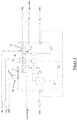
- the figure 1 therefore represents the tools developed in the context of the invention for effecting the solid / liquid separation of a mixture in a process for treating lignocellulosic biomass: the mixture to be separated is first treated by a mixer M continuously from PARIMIX IMR type, shown in more detail in figure 3 , then by a band filter F of the continuous band vacuum filter type, of the BFR type from BHS. They are both here arranged substantially horizontally, at different heights, the mixer being arranged above the band filter.
- the mixture to be separated is a marc pretreated from a biomass treatment process, although the separation according to the invention can be applied to other solid / liquid mixtures of such a process (as described below using the figures 6 and following).
- the mixer M allows a repulping of the pretreated marcs with a high dry matter (MS) and solids content, by adding a mixing fluid and by kneading obtained by the endless turn of the mixer conveying the marc from one end to the other from the mixer.
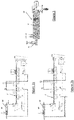
- the mixer M as detailed in the figure 3 , comprises a cylindrical body provided with a rotating screw V without a core, with its upstream end provided with a doser D continuously dosing the mixture to be separated, which is then injected into the mixer by a supply tube or hopper A connected at the dispenser. It is shown in the operating position, that is to say in a substantially horizontal plane.
- the cylindrical body of the mixer In its upstream part, the cylindrical body of the mixer is provided with inlet (s) of mixing fluid (s) e1, e2, the fluid (s) are centrifuged by the turns, the liquid vortex thus created meets the flow of exploded grounds reverse. Thanks to this principle, the volume of the mixing chamber of this mixer is low, the power used is also low and the mixer as a whole is compact.
- the mixer is equipped with electric heating means (not shown) to heat the interior of the cylindrical body to a temperature of about 40 to 50 ° C., this supply of heat promoting the obtaining of greater homogeneity of the mixing at the outlet of the mixer in constant stay in it.
- the plumped marc, at the outlet of the mixer M falls by gravity onto the upstream part of the band of the band filter F.
- the separation of this marc on the band filter F with backwashing makes it possible to extract juices concentrated in sugars.
- the technology of the F-band filter is based on vacuum filtration, the principle of which is to distribute the pretreated marc on a band advancing sequentially.
- This porous strip makes it possible, by vacuum drawing, to separate the liquids (the juices) from the solid by forming a cake (the washed marc), which falls at the end of the strip. Washing fluid is sprayed over the strip to wash the cake which gradually forms along the strip.
- the juices are partially recycled, as detailed below. They can also be grouped into a single stream.
- the band filter F has 10 active vacuum zones, numbered 1 to 10 on the figure 1 , where different stages of the washing and filtration process can take place (movable and resizable areas in the filter). It can be fitted with polyurethane or silicone type polymer strips on the side of the filter strip to limit vacuum losses and improve separation. One can plan to add a partition in the upper part (or any other equivalent mechanical means), just after the first zone or zones, to allow a better distribution of the mixture on the strip.
- the pretreated marc M0 enters the doser D of the mixer M, while the mixing fluid is introduced into the mixer through the inputs e1 , e2 (shown only at the figure 3 ).
- the mixed marc M1 also designated “MoRe” below
- the strip conveys the marc to its downstream end, with vacuum extraction, under the strip, of three liquid phases J1, J2 and J3, which are sweet juices of decreasing concentrations.
- Above the strip in its upstream part or its central part, two fluids f1 and f2 are extracted / washed by nozzles at a distance from each other.
- the fluid f1 can be water
- the fluid f2 is the partial or total recycling of the juice J3.
- the displacement of the extraction / washing fluid takes place against the flow of the mixture on the strip.
- a “simulated” counter-current in the sense that there is no counter-current flow proper in each of the washing areas.
- the principle of the band filter is based on a tangential washing: the mixture moves here laterally, in the figure by way of example from left to right, and the washing liquid (called higher extraction / washing fluid more generally) moves from the top to the bottom.
- the injection of liquid on the mixture which moves on the strip can be done, in particular, either by pouring, that is to say by gravity flow, or by sprinkling ...
- the movement from top to bottom of the liquid passing through the mixture moving on the strip is imposed by the vacuum that is created on the strip.
- the filter operates sequentially on the mixture comprising the solid phase to be extracted (also called “cake”), which can be schematized as follows: - time 1, the band advances, - time 2, the band stops and the vacuum is created (and if necessary, pressed) and juice is extracted in each of the zones, and so on. It should be noted, generally, that the injection of the washing liquids is itself carried out continuously (it is injected when the strip advances and when it is stopped). The counter-current is "simulated" by the reinjection of the extracted juice upstream of its extraction.
- All or part of at least one of the juices J1, J2, J3 can be recycled as a mixing fluid in the mixer M.
- the washing fluid (s) f1, f2 are heated, for example to a temperature of 30 to 85 ° C before being poured onto the top of the cake conveyed by the porous strip, using heating means equipping the conduits feed.
- the flow of sugary juice (s) which is recycled either as a mixing fluid in the mixer or as a washing / extraction fluid in the filter is / are also heated before reintroduction into the filter or in the mixer, also at using heating means equipping their supply ducts, for example at a temperature of 30 to 85 ° C.
- the figure 2a represents a first way of implementing the installation of the figure 1 , to separate the pretreated marc from a Miscanthus-based biomass: the juice J3 is recycled entirely into the most upstream inlet, the inlet f1, of washing fluid extracting the filter F, the juice J2 is entirely recycled into input e1 of the mixer M, in addition to an input e2 of the mixing fluid in the form of water. All the J1 juice is extracted for use / recovery outside this separation facility.
- the figure 2b is another way to implement the installation of the figure 1 , to separate the pretreated marc from a straw-based biomass.
- the difference from figure 2a is that here part of the juice J1 is also recycled as a mixing fluid in the mixer with the juice J2.
- the proportion of each of the juices J1, J2, J3 ... extracted from the band filter which is recycled in the mixer or in the filter can be very variable, from 0% to 100%. It will depend on the nature of the biomass (the rate of its dry matter), the desired water consumption, the desired concentration of active agents (in sugars here) of the juices extracted according to their subsequent use, in a process global biomass treatment, as needed, or as an independent recovery product.
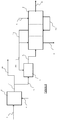
- Block 2 is the first stage of conditioning and pretreatment of an incoming stream of biomass 1 with one or more reagents, by bringing it into contact with one or more other incoming streams 3 of fluid (water, water with an acid type chemical catalyst, basic, oxidizing, water vapor ...) and possible heat treatment (s).
- a pretreated marc flow 4 is obtained.
- the block 5 therefore operates the sub-step b1 of the separation b according to the invention: it is the mixer M which receives as input a portion 4a of the pretreated marc flow 4 and at least one flow of mixing liquid comprising a part juices 11a extracted from the band filter 7 downstream of the mixer 5.
- Block 7 operates the separation sub-step b2 with the band filter: it receives as input the flow of solid 6 which leaves the mixer in block 5, and at least one flow of washing liquid 8, with recycling from part 11c of the juices extracted from downstream upstream of the filter and from another part 11a towards the inlet of the mixer of block 5, there comes out a flow of washed solid 10.
- This figure therefore represents the invention this time integrated into the treatment process, which, beyond the pretreatment carried out on the biomass, continues by the enzymatic hydrolysis and the fermentation of the marc.
- the pretreated marc 4 has been divided into a stream 4a which is separated according to the invention as described in the preceding figure, and a stream 4b which is directed to step 23 of enzymatic hydrolysis.
- the separated and washed marc 10 according to the invention can also be directed to this step 23 with the flow 4b.
- a flow 24 results therefrom which can, depending on whether the hydrolysis takes place simultaneously with the fermentation (SSF) or not, be composed of a mixture of non-hydrolysed solid and sugars resulting from the hydrolysis (without SSF) or d '' a mixture of non-hydrolyzed solid and fermentation products (with SSF).
- Block 20 is the stage (s) of production of the biocatalysts (enzymes, yeasts) which uses (s) the sweet juice 9 resulting from the separation by the band filter of block 7 and one or more fluid flows 21 necessary for the production biocatalysts (water, nutrient, other sugars, chemicals for example to regulate pH, etc.), this sweet juice 9 then serving as a growth / propagation or production substrate for the microorganisms (fungi) producing the enzymes and / or yeast.
- the biocatalysts enzymes, yeasts
- the extracted juice 9 is entirely used for the production of yeasts and / or enzymes. It can also be used for these purposes only for only part of the flow 9. It is also possible to recover all or part of this sweet juice 9 independently of the biomass treatment process (to recover it as such, for example).
- a flow 22 comes out of block 20 containing the biocatalysts (enzymes and / or yeasts), and possibly other fluids (for example: water, chemicals in particular for regulating the pH, etc.), biocatalysts if produced other than on juice sweet, nutrients, etc ...), this outgoing stream 22 being injected at the inlet of the block 23 of enzymatic hydrolysis.
- biocatalysts enzymes and / or yeasts
- other fluids for example: water, chemicals in particular for regulating the pH, etc.
- the enzyme cocktail was produced by a fungus Trichoderma reesei.
- the yeast produced is preferably a yeast of the Saccharomyces cerevisiae type genetically modified to consume xylose.
- the flow obtained which will be used in the fermentation stage may contain yeasts in whole or concentrated must, in the latter case we speak of yeast cream (we must then perform a prior concentration stage).
- step 30 of fermentation step distinct from step 23 of enzymatic hydrolysis, and the separation of blocks 5, 7 of the invention is inserted between these two stages:
- the stream 24 from the the enzymatic hydrolysis step is separated according to the invention, and the stream 9 at the outlet of the block 7 operating the separation by the band filter is sent as a stream entering the fermentation block 30, also supplied with an incoming stream 31 from or fluids necessary for fermentation, such as biocatalysts (yeasts), and possibly nutrients etc ...
- the stream 32 leaving the fermentation step contains the fermentation product, which can then undergo conventional separation steps, of the distillation, dehydration, solid / liquid separation type (not shown) which make it possible to obtain the desired biobased molecule ( here ethanol as biofuel), solid residues and liquid residues also called vinasses.
- Block 40 therefore represents the enzymatic hydrolysis step and the fermentation step which can be separated or simultaneous, represented by a common block for the sake of clarity.
- the stream 41 resulting from these two stages and which therefore contains a portion of non-hydrolysed solid and the fermentation product is brought into the inlet to the separation blocks 5, 7 according to the invention.
- the flow of liquid containing fermentation products leaving 42 from this separation feeds the block 50 of the step of separation of the fermentation products (this flow of liquid is therefore of different composition from the flow 9 of the previous variants, which was only a juice sugar).
- a stream of liquid 51 of partially purified fermentation product is recovered, and a stream 52 of vinasses, which can optionally (dotted arrows in the figure) be recycled to replace the washing water 8 of the block band filter 7.
- the separation step b of the invention is carried out after the separation step 50: the stream 54 resulting from the separation 50 and comprising a medium separated from the product containing the non-hydrolysed solid and the liquid is sent to the mixer 5, the flow of solid 55 leaving the band filter of the block 7 are vinasses extracted by washing therefore.
- the separation step 50 can be coupled to the fermentation step, this is called fermentation / separation coupling, either in situ, in the fermentation reactor itself, or on another separate circuit, where the medium after separation returns to fermentation.
- the separation step b according to the invention can be inserted between known steps of a biomass treatment process, here in order to use the sweet juices as substrates for propagation, growth or production of enzymes of microorganisms necessary for the conversion of biomass, but also when we want to develop as such these sweet juices.
- example 1 on TCR Rapid Growth Coppice
- example 2 on Miscanthus example 3 on straw
- example 4 on another configuration of straw example 5 on another configuration on TCR.
- the objective is to obtain sweet juices J1 with a sugar concentration of 50 g / kg minimum.
- MS designates the dry matter content which is measured according to standard ASTM E1756 - 08 (2015) “Standard Test Method for Determination of Total Solids in Biomass”.
- the operating conditions are as follows:
- the mixer M is a PARIMIX IMR continuous mixer, which allows plumping of marc with high dry matter (MS) and solid content. It is heated by electrical means to about 40-50 ° C.
- the separation on the band filter F of the continuous band filter type BFR from the company BHS with backwashing, makes it possible to extract juices concentrated in sugars.
- the band filter technology is based on vacuum filtration. The principle is to distribute the pretreated marc on a band advancing sequentially. This porous strip makes it possible, by vacuum drawing, to separate the liquids (the juices) from the solid by forming a cake (the washed marc), which falls at the end of the strip. The juices are partially recycled.
- the filter F used has 10 active vacuum zones, where different stages of the washing and filtration process can take place (zones that can be moved in the filter).
- the zones are grouped into three groups of zones, which are modular, and which make it possible to extract three juices J1, J2 and J3.
- the filter is provided, on the sides of the porous strip, with polyurethane or silicone strips, to limit the vacuum losses observed and to improve the filtration of the product.
- the filter is provided with a vertical wall above the strip just after the mixture supply zone to allow a better distribution of the mixture on the filter.
- Table 1 below groups together the characteristics of solid content and dry matter content MS of the feed (pretreated biomass M0) which is separated according to the invention: ⁇ u> Table 1 ⁇ /u>
- Example 5 TCR (2)
- Example 4 Straw (2)
- Example 3 Straw
- Example 2 Miscanthus
- Example 1 TCR M0 Pretreated Biomass 44% solid 29 - 32% solid 29 - 30% solid 42% solid 38 - 43% solid 53% DM 41 - 46% DM 42 - 44% DM 54% DM 49 - 53% DM
- the speed of rotation of the feed screw of the mixer M, and therefore the flow rate of the pretreated marc M0, is defined by the frequency of the metering device D. This speed influences the mixing and the consistency of the plump marc at the outlet of the mixer. Too high a speed of the mixing screw results in a plump marc which is too viscous for the rest of the process.
- Table 2 below presents the flow rates of raw marc and recycled juice entering the mixer: ⁇ u> Table 2 ⁇ /u> Gross input flow (kg / h) Recycled juice (kg / h) TCR (2) - example 5 50 130 Straw (2) - example 4 50 130 Straw - example 3 50 129 Miscanthus - example 2 70 95 TCR - example 1 50 75
- Example 1 Biomass based on fast growing coppice (TCR)
- Example 2 Biomass based on Miscanthus
- the band filter F was fed with 160 kg / h MoRe (18% DM) at 58 ° C.
- Two spill washing nozzles were installed on zones 4 and 6 of the 10 active zones of the strip. To have the greatest possible space between the flows, the first nozzle was washed in counter-current mode of the direction of advance of the filter, and the second in co-current mode. 45 kg / h of juice J1 at 65-68 g / kg of sugars was produced during the first two days. Then, on the third day, the wash water flow was increased to produce more juice with a slightly lower concentration. Consequently, 55 kg / h of J1 was produced with a sugar concentration of between 58 and 60 g / kg.
- Example 3 Biomass based on straw
- the first straw test was made with the same configuration as for the two previous examples.
- J1 juice had a low sugar concentration of 38.77 g / kg.
- a recycling of J1 (20 kg / h) to the tank of J2 was installed and the mixture of the juices J1 and J2 was heated and recycled to the mixer M.
- the first wash nozzle was by spray (zone 4) and the second by spill (zone 6). Indeed, 70 kg / h of J1 juice at 53-57 g / kg of sugars was produced.
- the operating conditions are detailed in Table 4 below.
- Example 4 Biomass based on straw
- This test uses the same configuration as Example 3, also with a straw-based biomass therefore, with the following differences: here the final press (pressing the marc cake washed at the level of zone 9 of the band filter) does not is not used, the first washing nozzle is used by pouring and not spraying, and the second washing nozzle is used by spraying and not pouring.
- the J1 juice produced has a higher sugar concentration (50-66 g / kg of sugar).
- the operating conditions are detailed in Table 4 below.
- Example 5 Biomass based on TCR
- This test uses the same configuration as Example 1, also with a TCR-based biomass, therefore, with the following differences: here, the final press (pressing the marc cake washed at zone 9 of the band filter) is not used, and the first wash nozzle is used by spillage and not spraying.
- the J1 juice produced has a concentration of 51 g / kg of sugar.
- the operating conditions are detailed in Table 4 below.
- Table 4 presents the loading characteristics: a mixture of M0 with the juices J2 (or J1 + J2 for straw) and the products J1 and M0 and quantifies the efficiency of the separation obtained with the invention: separation of the straw was the most efficient (99%) ⁇ u> Table 4 ⁇ /u> Ex 5: TCR (2) Ex 4: Straw (2) Ex 3: Straw Ex 2: Miscanthus Ex 1: TCR Charge M0 pretreated biomass 44% solid 29-32% solid 29 - 30% solid 42% solid 38 - 43% solid 53% MS 41-46% DM 42 - 44% DM 54% DM 49 - 53% DM 80 g / kg of sugar 65-93 g / kg sugar ⁇ 90 g / kg of sugar ⁇ 95 g / kg of sugar ⁇ 83 g / kg of sugar J2 recycled juice ⁇ 0% solid - 0% solid - 0.003% solid - - 0% solid - 0% solid 4% MS 5-11% DM 6% DM 4% MS 8.6% DM 23
- the invention thus makes it possible, whatever the pretreated biomass and its rheological constraints, to obtain a sweet juice of a concentration greater than 50 g / kg, which is not the case when the invention is not implementation, as shown in the following comparative examples:
- the pretreated biomasses of two of the preceding examples are used in a configuration not in accordance with the invention: the substrate M0 is mixed in a mixer M with water and then separated on the band filter F. In this implementation not in accordance with the invention, there is no recycling of a stream extracted from the band filter F to the mixer M.
- the pretreated biomass M0 TCR from Example 1 is mixed in a mixer M with water and then separated on the band filter F itself operated according to the configuration of Example 1.
- the biomass TCR pretreated must be diluted to a solids level of less than 16% to form a cake capable of being filtered on the F-band filter.
- the composition of the TCR marc M0 of example 1 is recalled: solid content 38%, sugar content 83 g / kg.
- the first zone of the band filter allows to extract a concentrated juice J1 with a content of 41.6 g / kg of sugars only.
- a concentration of 50 g / kg of sugars in the juice J1 for the substrate TCR it can be seen that it is not possible to reach a concentration of 50 g / kg of sugars in the juice J1 for the substrate TCR.
- the pretreated biomass M0 straw from Example 3 is mixed in a mixer M with water and then separated on the band filter F itself operated according to the configuration of Example 3.
- the biomass Straw pretreated must be diluted to a solids content of less than 9% to form a cake capable of being filtered on the F-band filter.
- the composition of the straw marc M0 from Example 3 is recalled: solid content 30%, sugar content 90 g / kg. To obtain a correct rheology at the mixer outlet, it is necessary to lower the solid content of the substrate after mixing, it is thus necessary to add 117 kg of water to 50 kg of marc M0 in the mixer, this mixture is then deposited on the band filter.
- the first zone of the band filter allows to extract a concentrated juice J1 with a content of 27 g / kg of sugars.
- a concentration of 50 g / kg of sugars in the juice J1 for the straw substrate it is seen that it is not possible to reach a concentration of 50 g / kg of sugars in the juice J1 for the straw substrate.
Landscapes
- Chemical & Material Sciences (AREA)
- Organic Chemistry (AREA)
- Life Sciences & Earth Sciences (AREA)
- Engineering & Computer Science (AREA)
- Wood Science & Technology (AREA)
- Zoology (AREA)
- Health & Medical Sciences (AREA)
- Bioinformatics & Cheminformatics (AREA)
- Genetics & Genomics (AREA)
- Biochemistry (AREA)
- General Health & Medical Sciences (AREA)
- Biotechnology (AREA)
- Microbiology (AREA)
- General Engineering & Computer Science (AREA)
- Chemical Kinetics & Catalysis (AREA)
- General Chemical & Material Sciences (AREA)
- Biomedical Technology (AREA)
- Sustainable Development (AREA)
- Molecular Biology (AREA)
- Mechanical Engineering (AREA)
- Materials Engineering (AREA)
- Medicinal Chemistry (AREA)
- Polymers & Plastics (AREA)
- Emergency Medicine (AREA)
- Preparation Of Compounds By Using Micro-Organisms (AREA)
- Extraction Or Liquid Replacement (AREA)
- Polysaccharides And Polysaccharide Derivatives (AREA)
- Apparatus Associated With Microorganisms And Enzymes (AREA)
- Enzymes And Modification Thereof (AREA)
- Micro-Organisms Or Cultivation Processes Thereof (AREA)
- Processing Of Solid Wastes (AREA)
Applications Claiming Priority (1)
| Application Number | Priority Date | Filing Date | Title |
|---|---|---|---|
| FR1855789A FR3083126B1 (fr) | 2018-06-27 | 2018-06-27 | Procede de traitement de biomasse ligno-cellulosique |
Publications (1)
| Publication Number | Publication Date |
|---|---|
| EP3587583A1 true EP3587583A1 (fr) | 2020-01-01 |
Family
ID=63579399
Family Applications (1)
| Application Number | Title | Priority Date | Filing Date |
|---|---|---|---|
| EP19178488.3A Pending EP3587583A1 (fr) | 2018-06-27 | 2019-06-05 | Procede de traitement de biomasse ligno-cellulosique |
Country Status (12)
| Country | Link |
|---|---|
| US (1) | US20200002482A1 (enExample) |
| EP (1) | EP3587583A1 (enExample) |
| JP (1) | JP2020000230A (enExample) |
| CN (1) | CN110643642A (enExample) |
| AR (1) | AR115615A1 (enExample) |
| AU (1) | AU2019204400B2 (enExample) |
| BR (1) | BR102019013159A2 (enExample) |
| CA (1) | CA3047963A1 (enExample) |
| FR (1) | FR3083126B1 (enExample) |
| MX (1) | MX2019007408A (enExample) |
| MY (1) | MY194371A (enExample) |
| ZA (1) | ZA201904073B (enExample) |
Cited By (4)
| Publication number | Priority date | Publication date | Assignee | Title |
|---|---|---|---|---|
| FR3095649A1 (fr) * | 2019-05-03 | 2020-11-06 | Europeenne De Biomasse | Substrat pulvérulent obtenu par vapocraquage d’une biomasse sans auxiliaire chimique et ses utilisations |
| WO2021260310A1 (fr) | 2020-06-22 | 2021-12-30 | IFP Energies Nouvelles | Procédé de production de proteines par une souche de champignon trichoderma dans laquelle le gène cel1 a est invalidé |
| EP4067498A1 (fr) | 2021-03-30 | 2022-10-05 | IFP Energies nouvelles | Procédé de traitement de biomasse ligno-cellulosique |
| FR3155530A1 (fr) | 2023-11-20 | 2025-05-23 | IFP Energies Nouvelles | Procédé de traitement d’une biomasse lignocellulosique |
Families Citing this family (9)
| Publication number | Priority date | Publication date | Assignee | Title |
|---|---|---|---|---|
| FR3075202B1 (fr) * | 2017-12-20 | 2020-08-28 | Ifp Energies Now | Procede de traitement de biomasse ligno-cellulosique |
| FR3142492A1 (fr) | 2022-11-28 | 2024-05-31 | IFP Energies Nouvelles | Procédé de traitement d’un mélange en phase aqueuse de composés comprenant des sucres à 5 et 6 atomes de carbone. |
| FR3144994A1 (fr) | 2023-01-18 | 2024-07-19 | IFP Energies Nouvelles | Procédé de traitement d’une biomasse lignocellulosique |
| FR3146905A1 (fr) | 2023-03-23 | 2024-09-27 | IFP Energies Nouvelles | Procédé de traitement d’une biomasse lignocellulosique |
| FR3146906A1 (fr) | 2023-03-23 | 2024-09-27 | IFP Energies Nouvelles | Procédé de traitement d’un mélange en phase aqueuse de composés comprenant des sucres à 5 et 6 atomes de carbone. |
| FR3146904A1 (fr) | 2023-03-23 | 2024-09-27 | IFP Energies Nouvelles | Procédé de traitement d’un mélange en phase aqueuse de composés comprenant des sucres à 5 et 6 atomes de carbone. |
| CN116812906A (zh) * | 2023-05-25 | 2023-09-29 | 湖南钠科新材料有限公司 | 一种生物质基硬碳材料及其制备方法和应用 |
| CN119909455B (zh) * | 2023-10-30 | 2026-01-06 | 中国石油化工股份有限公司 | 一种改性助滤剂、制备方法及秸秆纤维素酶解液的过滤处理方法 |
| WO2025230923A1 (en) * | 2024-04-29 | 2025-11-06 | GranBio Intellectual Property Holdings, LLC | Methods and systems for reactive separation of biomass-derived materials in biorefineries |
Citations (10)
| Publication number | Priority date | Publication date | Assignee | Title |
|---|---|---|---|---|
| EP2471940A1 (en) * | 2010-12-31 | 2012-07-04 | Süd-Chemie AG | Efficient lignocellulose hydrolysis with integrated enzyme production |
| FR2991997A1 (fr) * | 2012-06-18 | 2013-12-20 | IFP Energies Nouvelles | Procede de production d'un cocktail enzymatique utilisant les residus liquides d'un procede de conversion biochimique de materiaux ligno-cellulosiques |
| WO2014091103A1 (fr) * | 2012-12-14 | 2014-06-19 | IFP Energies Nouvelles | Procede de production de solutions de sucres et d'alcools a partir de biomasse lignocellulosique avec traitement complementaire du residu solide par un sel inorganique hydrate |
| EP2774992A1 (fr) | 2013-03-06 | 2014-09-10 | IFP Energies nouvelles | Procédé de production d'alcools et/ou de solvants à partir de biomasse lignocellulosique avec lavage du residu solide obtenu après hydrolyse |
| WO2014135755A1 (fr) | 2013-03-06 | 2014-09-12 | IFP Energies Nouvelles | Procédé de production d'alcools et/ou de solvants à partir de biomasse lignocellulosique avec lavage du residu solide obtenu après fermentation |
| EP2860269A1 (en) * | 2012-05-18 | 2015-04-15 | Toray Industries, Inc. | Method for producing sugar solution |
| WO2016124822A1 (en) * | 2015-02-06 | 2016-08-11 | Upm-Kymmene Corporation | A method and an apparatus for increasing concentration of soluble carbohyrate containing fraction, a soluble carbohyrate containing fraction, a solid fraction and their use |
| WO2016193576A1 (fr) | 2015-05-29 | 2016-12-08 | Lesaffre Et Compagnie | Propagation de levures simultanée a la saccharification |
| FR3043408A1 (fr) * | 2015-11-09 | 2017-05-12 | Ifp Energies Now | Procede de traitement de biomasse lignocellulosique incluant la gazeification d'une poudre d'un residu ligneux issu d'un procede biochimique de traitement de biomasse lignocellulosique |
| WO2017174378A1 (fr) | 2016-04-08 | 2017-10-12 | IFP Energies Nouvelles | Procede de production de cellulases avec du marc lignocellulosique pretraite |
Family Cites Families (6)
| Publication number | Priority date | Publication date | Assignee | Title |
|---|---|---|---|---|
| CN101186943B (zh) * | 2006-11-17 | 2010-09-08 | 安徽丰原发酵技术工程研究有限公司 | 利用作物秸秆生产乙醇的方法 |
| WO2009080737A2 (en) * | 2007-12-21 | 2009-07-02 | Shell Internationale Research Maatschappij B.V. | A process for converting lignocellulose into sugars |
| AU2011325841B2 (en) * | 2010-11-05 | 2016-01-07 | Greenfield Ethanol Inc. | Bagasse fractionation for cellulosic ethanol and chemical production |
| UA111729C2 (uk) * | 2010-11-09 | 2016-06-10 | Ґрінфілд Спешіалті Алкоголз Інк. | Пристрій для відокремлення твердих речовин від рідини і спосіб обробки біомаси, який включає відокремлення твердих речовин від рідини |
| AU2014288229B2 (en) * | 2013-07-12 | 2018-03-08 | Toray Industries, Inc. | Method for producing alcohol from cellulose-containing biomass |
| US10087578B2 (en) * | 2013-08-09 | 2018-10-02 | Inbicon A/S | Device for discharging pretreated biomass from higher to lower pressure regions |
-
2018
- 2018-06-27 FR FR1855789A patent/FR3083126B1/fr active Active
-
2019
- 2019-06-05 EP EP19178488.3A patent/EP3587583A1/fr active Pending
- 2019-06-20 MX MX2019007408A patent/MX2019007408A/es unknown
- 2019-06-24 AR ARP190101749A patent/AR115615A1/es unknown
- 2019-06-24 ZA ZA2019/04073A patent/ZA201904073B/en unknown
- 2019-06-24 JP JP2019116111A patent/JP2020000230A/ja active Pending
- 2019-06-24 AU AU2019204400A patent/AU2019204400B2/en active Active
- 2019-06-24 MY MYPI2019003644A patent/MY194371A/en unknown
- 2019-06-25 US US16/451,946 patent/US20200002482A1/en active Pending
- 2019-06-25 BR BR102019013159-4A patent/BR102019013159A2/pt unknown
- 2019-06-25 CA CA3047963A patent/CA3047963A1/fr active Pending
- 2019-06-27 CN CN201910567003.6A patent/CN110643642A/zh active Pending
Patent Citations (10)
| Publication number | Priority date | Publication date | Assignee | Title |
|---|---|---|---|---|
| EP2471940A1 (en) * | 2010-12-31 | 2012-07-04 | Süd-Chemie AG | Efficient lignocellulose hydrolysis with integrated enzyme production |
| EP2860269A1 (en) * | 2012-05-18 | 2015-04-15 | Toray Industries, Inc. | Method for producing sugar solution |
| FR2991997A1 (fr) * | 2012-06-18 | 2013-12-20 | IFP Energies Nouvelles | Procede de production d'un cocktail enzymatique utilisant les residus liquides d'un procede de conversion biochimique de materiaux ligno-cellulosiques |
| WO2014091103A1 (fr) * | 2012-12-14 | 2014-06-19 | IFP Energies Nouvelles | Procede de production de solutions de sucres et d'alcools a partir de biomasse lignocellulosique avec traitement complementaire du residu solide par un sel inorganique hydrate |
| EP2774992A1 (fr) | 2013-03-06 | 2014-09-10 | IFP Energies nouvelles | Procédé de production d'alcools et/ou de solvants à partir de biomasse lignocellulosique avec lavage du residu solide obtenu après hydrolyse |
| WO2014135755A1 (fr) | 2013-03-06 | 2014-09-12 | IFP Energies Nouvelles | Procédé de production d'alcools et/ou de solvants à partir de biomasse lignocellulosique avec lavage du residu solide obtenu après fermentation |
| WO2016124822A1 (en) * | 2015-02-06 | 2016-08-11 | Upm-Kymmene Corporation | A method and an apparatus for increasing concentration of soluble carbohyrate containing fraction, a soluble carbohyrate containing fraction, a solid fraction and their use |
| WO2016193576A1 (fr) | 2015-05-29 | 2016-12-08 | Lesaffre Et Compagnie | Propagation de levures simultanée a la saccharification |
| FR3043408A1 (fr) * | 2015-11-09 | 2017-05-12 | Ifp Energies Now | Procede de traitement de biomasse lignocellulosique incluant la gazeification d'une poudre d'un residu ligneux issu d'un procede biochimique de traitement de biomasse lignocellulosique |
| WO2017174378A1 (fr) | 2016-04-08 | 2017-10-12 | IFP Energies Nouvelles | Procede de production de cellulases avec du marc lignocellulosique pretraite |
Non-Patent Citations (4)
| Title |
|---|
| ANONYMOUS: "BFR Rubber Belt Filter (brochure)", BHS SONTHOFEN WEBSITE, 9 February 2015 (2015-02-09), pages 1 - 12, XP055567598, Retrieved from the Internet <URL:https://www.bhs-sonthofen.de/en/products/filtration-technology/rubber-belt-filter.html> [retrieved on 20190312] * |
| M. BALAT: "Production of bioéthanol from lignocellulosic materials via the biochemical pathway: A review", ENERGY CONVERSION AND MANAGEMENT, vol. 52, 2011, pages 858 - 875, XP055567536, DOI: doi:10.1016/j.enconman.2010.08.013 |
| M. VON SILVERSG. ZACCHI: "Ethanol from lignocellulosics: A review of the economy", BIORESOURCE TECHNOLOGY, vol. 56, 1996, pages 131 - 140, XP002333494, DOI: doi:10.1016/0960-8524(96)00018-1 |
| N. SARKARS. KUMAR GHOSHS. BANNERJEEK. AIKAT: "Bioethanol production from agricultural wastes : an overview", RENWABLE ENERGY, vol. 37, 2012, pages 19 - 27 |
Cited By (7)
| Publication number | Priority date | Publication date | Assignee | Title |
|---|---|---|---|---|
| FR3095649A1 (fr) * | 2019-05-03 | 2020-11-06 | Europeenne De Biomasse | Substrat pulvérulent obtenu par vapocraquage d’une biomasse sans auxiliaire chimique et ses utilisations |
| WO2020225504A3 (fr) * | 2019-05-03 | 2020-12-03 | Europeenne De Biomasse | Substrat pulverulent obtenu par vapocraquage d'une biomasse sans auxiliaire chimique et ses utilisations |
| WO2021260310A1 (fr) | 2020-06-22 | 2021-12-30 | IFP Energies Nouvelles | Procédé de production de proteines par une souche de champignon trichoderma dans laquelle le gène cel1 a est invalidé |
| EP4067498A1 (fr) | 2021-03-30 | 2022-10-05 | IFP Energies nouvelles | Procédé de traitement de biomasse ligno-cellulosique |
| FR3121451A1 (fr) | 2021-03-30 | 2022-10-07 | IFP Energies Nouvelles | Procédé de traitement de biomasse ligno-cellulosique |
| FR3155530A1 (fr) | 2023-11-20 | 2025-05-23 | IFP Energies Nouvelles | Procédé de traitement d’une biomasse lignocellulosique |
| WO2025108769A1 (fr) | 2023-11-20 | 2025-05-30 | IFP Energies Nouvelles | Procede de traitement d'une biomasse lignocellulosique |
Also Published As
| Publication number | Publication date |
|---|---|
| CA3047963A1 (fr) | 2019-12-27 |
| AR115615A1 (es) | 2021-02-10 |
| AU2019204400A1 (en) | 2020-01-16 |
| JP2020000230A (ja) | 2020-01-09 |
| AU2019204400B2 (en) | 2025-01-23 |
| FR3083126A1 (fr) | 2020-01-03 |
| MX2019007408A (es) | 2020-01-23 |
| CN110643642A (zh) | 2020-01-03 |
| FR3083126B1 (fr) | 2020-06-26 |
| MY194371A (en) | 2022-11-30 |
| BR102019013159A2 (pt) | 2020-07-07 |
| ZA201904073B (en) | 2020-12-23 |
| US20200002482A1 (en) | 2020-01-02 |
Similar Documents
| Publication | Publication Date | Title |
|---|---|---|
| EP3587583A1 (fr) | Procede de traitement de biomasse ligno-cellulosique | |
| EP3728408B1 (fr) | Procede de traitement de biomasse ligno-cellulosique par impregnation | |
| EP3484945B1 (fr) | Procede de traitement de biomasse ligno-cellulosique par impregnation et explosion a la vapeur | |
| EP3728410B1 (fr) | Procede de traitement de biomasse ligno-cellulosique | |
| EP3728409B1 (fr) | Procede de traitement de biomasse ligno-cellulosique | |
| EP3899000B1 (fr) | Procédé de traitement de biomasse lignocellulosique | |
| CA3125497A1 (fr) | Procede de traitement d'une biomasse lignocellulosique | |
| FR2954350A1 (fr) | Procede de production d'alcools et/ou de solvants a partir de pulpes papetieres avec recyclage du vegetal non hydrolyse dans un reacteur de regeneration | |
| FR2954351A1 (fr) | Procede de production d'alcools et/ou de solvants a partir de pulpes papetieres avec recyclage du vegetal non hydrolyse | |
| FR3090423A1 (fr) | Procede de nettoyage d’un reacteur de traitement d’une biomasse lignocellulosique | |
| EP3898926A1 (fr) | Procédé de nettoyage d'un réacteur de traitement d'une biomasse lignocellulosique | |
| EP4067498A1 (fr) | Procédé de traitement de biomasse ligno-cellulosique | |
| FR3037075A1 (fr) | Procede de pretraitement de biomasse en vue de sa gazeification, en particulier pour production de carburant de synthese de seconde generation | |
| WO2023241996A1 (fr) | Procede de traitement d'une biomasse lignocellulosique | |
| EP4599095A1 (fr) | Procede de traitement d'une biomasse lignocellulosique | |
| FR3115538A1 (fr) | Procédé de traitement d’une biomasse lignocellulosique |
Legal Events
| Date | Code | Title | Description |
|---|---|---|---|
| PUAI | Public reference made under article 153(3) epc to a published international application that has entered the european phase |
Free format text: ORIGINAL CODE: 0009012 |
|
| STAA | Information on the status of an ep patent application or granted ep patent |
Free format text: STATUS: THE APPLICATION HAS BEEN PUBLISHED |
|
| AK | Designated contracting states |
Kind code of ref document: A1 Designated state(s): AL AT BE BG CH CY CZ DE DK EE ES FI FR GB GR HR HU IE IS IT LI LT LU LV MC MK MT NL NO PL PT RO RS SE SI SK SM TR |
|
| AX | Request for extension of the european patent |
Extension state: BA ME |
|
| STAA | Information on the status of an ep patent application or granted ep patent |
Free format text: STATUS: REQUEST FOR EXAMINATION WAS MADE |
|
| 17P | Request for examination filed |
Effective date: 20200701 |
|
| RBV | Designated contracting states (corrected) |
Designated state(s): AL AT BE BG CH CY CZ DE DK EE ES FI FR GB GR HR HU IE IS IT LI LT LU LV MC MK MT NL NO PL PT RO RS SE SI SK SM TR |
|
| RAP1 | Party data changed (applicant data changed or rights of an application transferred) |
Owner name: INSTITUT NATIONAL DE RECHERCHE POUR L'AGRICULTURE, L'ALIMENTATION ET L'ENVIRONNEMENT Owner name: IFP ENERGIES NOUVELLES Owner name: AGRO INDUSTRIES RECHERCHE ET DEVELOPPEMENT |
|
| STAA | Information on the status of an ep patent application or granted ep patent |
Free format text: STATUS: EXAMINATION IS IN PROGRESS |
|
| 17Q | First examination report despatched |
Effective date: 20230309 |