EP3585802B1 - Neuartige peptide und deren verwendung in der diagnose - Google Patents
Neuartige peptide und deren verwendung in der diagnose Download PDFInfo
- Publication number
- EP3585802B1 EP3585802B1 EP18711229.7A EP18711229A EP3585802B1 EP 3585802 B1 EP3585802 B1 EP 3585802B1 EP 18711229 A EP18711229 A EP 18711229A EP 3585802 B1 EP3585802 B1 EP 3585802B1
- Authority
- EP
- European Patent Office
- Prior art keywords
- peptide
- caga
- seq
- peptides
- pylori
- Prior art date
- Legal status (The legal status is an assumption and is not a legal conclusion. Google has not performed a legal analysis and makes no representation as to the accuracy of the status listed.)
- Active
Links
Images

Classifications
-
- C—CHEMISTRY; METALLURGY
- C07—ORGANIC CHEMISTRY
- C07K—PEPTIDES
- C07K14/00—Peptides having more than 20 amino acids; Gastrins; Somatostatins; Melanotropins; Derivatives thereof
- C07K14/195—Peptides having more than 20 amino acids; Gastrins; Somatostatins; Melanotropins; Derivatives thereof from bacteria
- C07K14/205—Peptides having more than 20 amino acids; Gastrins; Somatostatins; Melanotropins; Derivatives thereof from bacteria from Campylobacter (G)
-
- G—PHYSICS
- G01—MEASURING; TESTING
- G01N—INVESTIGATING OR ANALYSING MATERIALS BY DETERMINING THEIR CHEMICAL OR PHYSICAL PROPERTIES
- G01N33/00—Investigating or analysing materials by specific methods not covered by groups G01N1/00 - G01N31/00
- G01N33/48—Biological material, e.g. blood, urine; Haemocytometers
- G01N33/50—Chemical analysis of biological material, e.g. blood, urine; Testing involving biospecific ligand binding methods; Immunological testing
- G01N33/53—Immunoassay; Biospecific binding assay; Materials therefor
- G01N33/569—Immunoassay; Biospecific binding assay; Materials therefor for microorganisms, e.g. protozoa, bacteria, viruses
- G01N33/56911—Bacteria
- G01N33/56922—Campylobacter
-
- G01N33/5753—
-
- G—PHYSICS
- G01—MEASURING; TESTING
- G01N—INVESTIGATING OR ANALYSING MATERIALS BY DETERMINING THEIR CHEMICAL OR PHYSICAL PROPERTIES
- G01N2333/00—Assays involving biological materials from specific organisms or of a specific nature
- G01N2333/195—Assays involving biological materials from specific organisms or of a specific nature from bacteria
- G01N2333/205—Assays involving biological materials from specific organisms or of a specific nature from bacteria from Campylobacter (G)
-
- G—PHYSICS
- G01—MEASURING; TESTING
- G01N—INVESTIGATING OR ANALYSING MATERIALS BY DETERMINING THEIR CHEMICAL OR PHYSICAL PROPERTIES
- G01N2469/00—Immunoassays for the detection of microorganisms
- G01N2469/20—Detection of antibodies in sample from host which are directed against antigens from microorganisms
Definitions
- H. pylori is a bacterium usually found in the stomach. Some H. pylori strains carry the CagA (cytotoxicity-associated antigen A) gene which encodes for a virulence factor.
- the CagA gene encodes the 1140 to 1180-amino acid protein CagA which is a bacterial oncoprotein that is translocated into stomach epithelial cells at the site of infection. Upon translocation, it affects intracellular signalling pathways of the epithelial cell.
- H. pylori bacteria carrying the CagA gene are associated with increased risk for gastric cancer development, and presence of anti-CagA-antibodies is associated with increased future gastric cancer risk.
- Early detection of CagA+ H. pylori infection can lead to increased cancer survival, as eradication of infection in infected individuals reduces gastric cancer risk. Therefore, a method that identifies individuals carrying CagA+ H. pylori can be used to diagnose high gastric cancer risk, and thereby assist prevention of gastric cancer development.
- US2016/030510 discloses a CagA-derived 14 amino acid peptide and a CagA-derived 29 amino acid peptide, the peptides are used in the diagnosis and treatment of tauopathies.
- CN104147589B discloses the 18 amino acid peptide cecropin AWRK6, the peptide is used in diagnosis and in the treatment of septic shock.
- YASUDA ET AL "A novel diagnostic monoclonal antibody specific for Helicobacter pylori CagA of East Asian type", APMIS, vol. 117, no. 12, 17 November 2009 (2009-11-17), pages 893-899, XP055157605 , discloses a highly specific ELISA-based assay using a monoclonal antibody specifically recognizing East Asian CagA-positive H.pylori, wherein the antibody is generated against a 18aa peptide (AINRKIDRINKIASAGKG) which is specific to East Asian CagA.
- H. pylori producing the East Asian CagA protein variant is known to be more virulent than that producing Western CagA.
- H. pylori-associated disease including identification of individuals at high risk of gastric cancer development.
- H. pylori-infected individuals will raise antibodies against H. pylori proteins, including CagA.
- CagA-specific antibodies indicates H. pylori infection.
- the diagnostic capacity does not stem from only the presence/absence of peptides in the infected individual, but crucially also from only a small subset of the immunogenic peptides consistently eliciting an antibody-response that is absent in non-infected individuals.
- a peptide comprising or consisting of an amino acid sequence selected from the group consisting of SEQ ID NO 1 to SEQ ID NO .
- said peptide consists of at most 25 amino acids, more preferably 15 amino acids and even more preferred at most 10 amino acids.
- the peptide comprises or consists of the sequence selected from the group consisting of SEQ ID NO 2-7, or even more preferred the group consisting of SEQ ID NO 2-5.
- novel peptides have the advantage that they can be used for diagnosis, more specifically diagnosis of CagA-positive H. pylori. Thus, diagnosis using these peptides results in few false positives.
- the minimal binding regions that have been identified are also useful for detecting CagA-specific antibodies. Since they are short, there will be low background binding. Furthermore, the peptides are short and can therefore be manufactured at a low cost.
- a peptide comprising an amino acid sequence selected from the group consisting of SEQ ID NO 1 to SEQ ID NO 5, said peptide consisting of at most 25 amino acids for use in diagnosis Helicobacter pylori infection or prediction of the risk for gastric cancer.
- kits comprising a peptide according to the first aspect of the invention or a mixture of peptides according to the second aspect of the invention.
- the kit is preferably a kit for diagnosis, more specifically diagnosis of CagA-positive H. pylori, or for prediction of the risk for gastric cancer.
- a method of diagnosis comprising the steps of a) providing a sample from a subject, the subject being a human, b) contacting said sample with a peptide comprising an amino acid sequence selected from the group consisting of SEQ ID NO 1 to SEQ ID NO 5, said peptide consisting of at most 25 amino acids, c) detecting specific binding of antibodies in the sample to the peptide, where the method is not practiced on a human body.
- a method of detecting H. pylori CagA-binding antibodies in a sample from a subject comprising contacting a biological sample with a peptide comprising an amino acid sequence selected from the group consisting of SEQ ID NO 1 to SEQ ID NO 5, said peptide consisting of at most 25 amino acids and detecting binding of antibodies in the sample to the peptide.
- the sample may be a blood, serum, plasma sample or tissue sample, for example a gastric tissue sample.
- SEQ ID NO 2 to SEQ ID 5" refers to SEQ ID NO, 2, 3, 4, and 5.
- Sequences are written using the standard one-letter annotation for amino acid residues. The amino acid residues are preferably connected with peptide bonds.
- sequences herein may have sequence variability.
- certain sequences may specify a position in the sequence that can be any amino acid. This may be indicated with an X or, in the sequence listing, Xaa.
- the X or Xaa can be replaced with any amino acid, preferably any L-amino acid, including amino acids resulting from post translational modification, such as citrulline.
- the amino acid does not have to be a naturally occurring amino acid.
- the amino acid does not have a bulky side chain, as a bulky side chain could prevent antibody binding.
- a suitable molecular weight of the amino acid may be from 85 D to 300 D, more preferably from 89 D to 220 D.
- the peptide may comprise or consist of an amino acid sequence selected from the group consisting of SEQ ID NO 1 to SEQ ID NO 5.
- the amino acid may be replaced in a conserved manner, wherein, for example, a hydrophobic amino acid is replaced with a different hydrophobic amino acid, or where a polar amino acid is replaced with a different polar amino acid.
- a peptide comprising or consisting of one of SEQ ID NO 1 to SEQ ID NO 5 is used, for example SEQ ID NO 1, 2, 3, 4, or 5, (Table 4). These sequences comprise the minimal binding regions of certain antibodies.
- the peptide comprises or consists of an amino acid sequence selected from SEQ ID NO 1 to SEQ ID NO 5.
- the peptide comprises or consists of a sequence selected from SEQ ID No 1 to SEQ ID NO 5.
- SEQ ID No 1 to SEQ ID NO 5 all relate to the same epitopes (epitope 12 and 14), and around 95 % of all CagA+ H. pylori isolates of the world carry at least one of these sequence variants.
- the peptides have common structural features in that:
- SEQ ID NO 1 to SEQ ID NO 5 examples include, but is not limited to, sequences SEQ ID NO 129 to SEQ ID NO 170, SEQ ID NO 186 to SEQ ID NO 187 and SEQ ID NO 266 to SEQ ID NO 279.
- the peptide comprises or consists of a sequence selected from SEQ ID NO 1, 2, 3, 4 and 5.
- SEQ ID NO 1, 2, 3, 4 and 5 Examples of useful peptides that comprise these sequences are described in Table 2 and 3.
- the peptide preferably has a length of 25 amino acids or shorter, such as 20 or 15 amino acids.
- a shorter peptide may be desirable because it results in less unspecific binding (by an antibody) and therefore less background.
- a longer peptide may in some cases be desirable to allow for exposing the epitope to allow antibody binding without sterical hindrance, or for peptide folding.
- the peptide is 14 amino acid residues, more preferably 13 amino acid residues, even more preferably 12, 11, 10, 9, 8, 7, 6 or 5 amino acid residues (6 applies to SEQ ID 8, 11, 9, 10 and 12 only, and 5 applies to SEQ ID NO 8 and 11 only).
- the peptide binds specifically (in the immunological sense) and with high affinity to an antibody, preferably an antibody that also binds to the H. pylori CagA protein.
- An antibody-peptide interaction is said to exhibit "specific binding" or “preferential binding” in the immunological sense if it reacts or associates more frequently, more rapidly, with greater duration and/or with greater affinity with a particular cell or substance than it does with alternative cells or substances.
- An antibody “specifically binds” or “preferentially binds” to a peptide if it binds with greater affinity, avidity, more readily, and/or with greater duration than it binds to other substances. Binding can be determined with any suitable method. Binding can be determined by methods known in the art, for example ELISA, surface plasmon resonance, western blot or the other methods described herein (see below). Such methods can be used for determining suitable length or amino acid sequence of the peptide.
- the use of the peptide has both a high diagnostic specificity and a high diagnostic sensitivity. In any diagnostic test, these two properties are dependent on what level is used as the cut-off for a positive test.
- a receiver operator characteristic curve can be used. In an ROC curve, true positive rate (sensitivity) is plotted against false positive rate (1-specificity) as the cut-off is varied from 0 to infinity. The area under the ROC curve (ROC AUC) is then used to estimate the overall diagnostic accuracy.
- the use of the peptide has an ROC AUC of at least 0.55, for example an ROC AUC of at least, 0.60, 0.65, 0.70, 0.75, 0.80, 0.85, 0.90, 0.95, 0.96, 0.97, 0.98, 0.99 or an ROC AUC of 1.00.
- the use of the peptide has ROC AUC of at least 0.85, and most preferably an ROC AUC of 1.
- peptide is used to mean peptides, proteins, fragments of proteins and the like, including peptidomimetic compounds.
- peptidomimetic means a peptide-like molecule that has the activity of the peptide upon which it is structurally based, the activity being specific and high affinity binding to antibodies that bind to the CagA protein.
- Such peptidomimetics include chemically modified peptides, peptide-like molecules containing non-naturally occurring amino acids (see, for example, Goodman and Ro, Peptidomimetics for Drug Design, in "Burger's Medicinal Chemistry and Drug Discovery” Vol. 1 (ed. M. E.
- peptidomimetics are known in the art including, for example, peptide-like molecules which contain a constrained amino acid. In certain embodiments circular peptides may be used.
- the peptide may be an isolated peptide meaning a peptide in a form other than it occurs in nature, e.g. in a buffer, in a dry form awaiting reconstitution, as part of a kit, etc.
- the peptide is substantially purified meaning a peptide that is substantially free of other proteins, lipids, carbohydrates, nucleic acids and other biological materials with which it is naturally associated.
- a substantially pure peptide can be at least about 60% of dry weight, preferably at least about 70%, 80%, 90%, 95%, or 99% of dry weight.
- a peptide of the present invention can be in the form of a salt.
- Suitable acids and bases that are capable of forming salts with the peptides are well known to those of skill in the art, and include inorganic and organic acids and bases.
- the peptide can be provided in a solution, for example an aqueous solution.
- a solution may comprise suitable buffers, salts, protease inhibitors, or other suitable components as is known in the art.
- the peptide may be associated with (e.g. coupled, fused or linked to, directly or indirectly) one or more additional moieties as is known in the art.
- additional moieties include peptide or non-peptide molecules such as biotin, a poly his tag, GST, a FLAG-tag, or a linker or a spacer.
- the association may be a covalent or non-covalent bond.
- the association may be, for example, via a terminal cysteine residue or a chemically reactive linking agent, the biotin-avidin system or a poly-his tag.
- the peptide may be linked with a peptide bond to a single biotin-conjugated lysine residue, in which the lysine is biotinylated via the epsilon amino groups on its side chain, such as the peptide example H-XXXXXXXXXXXX(K(Biotin))-NH2, where X indicates the amino acids of the peptide.
- the associated moiety may be used to attach or link the peptide, to improve purification, to enhance expression of the peptide in a host cell, to aid in detection, to stabilize the peptide, etc.
- a linker or a spacer it may be desirable to use a linker or a spacer to ensure exposure of the peptide to antibodies so that the antibodies can bind.
- the peptide may be associated with a substrate that immobilizes the peptide.
- the substrate may be, for example, a solid or semi-solid carrier, a solid phase, support or surface.
- the peptide may be immobilized on a solid support. Examples includes beads or wells in plates, such as microtiter plates, such as 96-well plates, and also include surfaces of lab-on-a-chip diagnostic or similar devices.
- the association can be covalent or non-covalent, and can be facilitated by a moiety associated with the peptide that enables covalent or non-covalent binding, such as a moiety that has a high affinity to a component attached to the carrier, solid phase, support or surface.
- the biotin-avidin system can be used.
- the peptides can be used for detecting H. pylori CagA-specific antibodies in a sample from a subject, the method comprising contacting a biological sample with a peptide as described herein and detecting binding of antibodies in the sample to the peptide.
- the peptide may be associated with a substrate that immobilizes the peptide, as described herein, for example attached to a solid support.
- the method may include incubation to allow binding, washing, and detection of antibodies as described herein. Methods for detecting binding of antibodies are described below and include for example ELISA.
- the peptides can be used for diagnosis, in particular diagnosis of infection of H. pylori or gastric cancer. It is known that CagA H. pylori infection correlates with an increased risk for gastric cancer.
- the peptides can be used for assessing the risk of a subject developing gastric cancer.
- the risk of developing gastric cancer may include the risk of proceeding from not having gastric cancer to having gastric cancer of any stage, of proceeding from a benign disease state to a malign state or proceeding from a less malign state to a more malign state.
- the risk may include the risk of having gastric cancer or developing gastric cancer in the future.
- the peptide is used for assessing the risk of a subject developing gastric cancer in the future.
- the peptides can also be used for diagnosis of other diseases that are associated with H. pylori infection, such as peptic ulcer disease, dyspepsia and immune thrombocytopenic purpura (ITP).
- Diagnosis can be carried out using any suitable method.
- antibodies in a sample from a subject are allowed to bind to a peptide, and binding is detected.
- the subject can be a human or an animal, preferably a human. Binding in vitro of antibodies from the subject to the peptide indicates that the immune system of the subject has generated antibodies against that particular peptide and thus that that peptide and hence that CagA H. pylori is present in the subject.
- the method may comprise the steps of (1) isolating, from a subject, a sample of body fluid or tissue likely to contain antibodies or providing, in vitro, such a sample; (2) contacting the sample with a peptide, under conditions effective for the formation of a specific peptide-antibody complex (for specific binding of the peptide to the antibody), e.g., reacting or incubating the sample and a peptide; and (3) assaying the contacted (reacted) sample for the presence of an antibody-peptide reaction (for example determining the amount of an antibody-peptide complex).
- the method may involve one or more washing steps, as is known in the art. Steps 2 and 3 are preferably carried out in vitro, that is. using the sample after the sample has been isolated from the subject, in a sample previously isolated from a subject.
- the sample can be any suitable sample for example a sample of blood, serum, plasma, saliva, mucosal secretion, ascites fluid, or similar bodily fluid, or tissue.
- Antibody-response to the peptides can be detected by different immunological/serological methods. Suitable formats of detecting presence of the antibody using the peptides includes peptide micro arrays, ELISA, chromatography, western blot, lab-on-a chip formats, microbead-based single- or multiplex immunoassays etc.
- these methods involve proving the peptide bound to stationary phase (such as the well of an ELISA plate or the surface of a microbead) and adding the sample to be analysed in the liquid phase, allowing antibodies to bind and then washing away unbound antibodies.
- stationary phase such as the well of an ELISA plate or the surface of a microbead
- Antibody binding can be detected in vitro by using a labelled secondary antibody that binds to a specific type of human antibody for example IgG, IgA, IgG1, IgG2 or IgG3, IgG4.
- the secondary antibody is labelled with an enzyme, such as horseradish peroxidase (HRP) or alkaline phosphatase (AP).
- HRP horseradish peroxidase
- AP alkaline phosphatase
- the secondary antibody is suitably from another species than human, for example from rabbit or goat.
- a fluorescence label or radioactive label can be used.
- a protocol for using the peptides in an ELISA can be easily optimized by a person skilled in the art with regard to which secondary antibody to use, its dilution, buffers, blocking solution, wash etc.
- An outline of an example of an ELISA protocol using plates can be as follows: Polystyrene microtiter plates are coated with optimal concentrations, as determined by checkerboard titrations, of the peptides of interest dissolved in PBS at room temperature overnight. After two washes with PBS, wells are blocked with 0.1% (wt/vol) bovine serum albumin-PBS at 37°C for 30 min.
- B-cells are isolated from the subject, and it is analysed if the cells are able to produce antibodies that bind to the peptide. This can be done by using the ELISPOT method, ALS (antibodies in lymphocyte secretions), or similar methods.
- Diagnosis can also be carried out by detecting the presence of CagA protein in tissue sample from a patient using antibodies specific for a peptide selected from peptides comprising or consisting of SEQ ID NO 32-330, SEQ ID NO 1-5, in particular SEQ ID NO 2-5.
- the sample is preferably a sample of gastric tissue.
- Antibodies with the desired binding specificity can be generated by a person skilled in the art.
- the antibody can be a polyclonal or a monoclonal antibody, where monoclonal antibodies are preferred.
- the antibody can be used in any useful format to detect the protein, for example western blot, ELISA, immunohistochemistry, etc.
- the antibody can be used for the diagnostic methods herein.
- the method may be such that it can result in two possible outcomes: H. pylori infection present or H . pylori infection absent.
- H. pylori infection can for example be determined on the basis of a signal cut off in the assay. There may also be an intermediate result: outcome uncertain that warrants further investigation or re-sampling or reanalysis of samples.
- H. pylori infection may be useful to treat the H. pylori infection, for example in order to decrease the risk of the subject developing gastric cancer. Treatment can be done by methods known in the art, for example with the use of antibiotics. For different reasons, some being low availability of active antibiotics in the stomach as well as problems with antibiotic resistance, there are many different antibiotic treatment regimens for H. pylori infection, and the efficacy of these generally differ in different parts of the world.
- the treatment regimens include at least two different antibiotics selected from the groups of macrolides, beta-lactams, nitroimidazoles, tetracyclines and fluoroquinolones, with or without the addition of bismuth subcitrate potassium, where one antibiotic is preferably selected from each group.
- One or more antibiotics may be administered in combination with a proton pump inhibitor.
- One treatment includes administration of the proton pump inhibitor omeprazole, and the antibiotics amoxicillin and clarithromycin for 7 to 14 days.
- a method for preventing gastric cancer comprising the steps of 1) carrying out diagnosis as described herein on a subject and 2) treating the H. pylori infection in the subject.
- treatment is made so that the subject is free of H. pylori infection.
- gastric cancer of an early or advanced stage it may also be useful to perform further investigations to assess the presence of gastric cancer of an early or advanced stage. This may be relevant for all patients, but is of special relevance in subjects known or suspected to otherwise have a high risk of gastric cancer, such as patients originating from countries with high gastric cancer risk, subjects who are smokers, and/or subjects whose close family members are known to have been diagnosed with gastric cancer. Such investigation can be made with gastroscopy, where the stomach lining is inspected to evaluate if gastric cancer is present. If a gastric tumour is observed, the tumour may be treated by endoscopic resection, if at an early stage, or by surgery, if at an advanced stage.
- the method can be used as a follow-up to a routine gastroscopy investigation. If the endoscopy and/or the subsequent histopathology examination discover that there are precancerous conditions present in the stomach, for example by an elevated OLGA-score, the method can be used to inform further patient handling. This can be in the form of a recommendation for appropriate time-interval for follow-up gastroscopy. For example, if it has been established that a CagA+ H. pylori infection is present, it may be beneficial to perform a follow-up gastroscopy with a shorter time-interval than if there is no CagA+ H. pylori infection present.
- the peptides can be synthesized by methods known in the art.
- the peptides can be obtained pure and in large quantities by means of organic synthesis, such as solid phase synthesis. Methods for peptide synthesis are well known in the art, for example using a peptide synthesis machine. Of course, the peptides may be ordered from a peptide synthesis company.
- the peptides can also be of animal, plant, bacterial or virus origin.
- the peptide may then be purified from the organism, as is known in the art.
- the peptide can be produced using recombinant technology, for example using eukaryotic cells, bacterial cells, or virus expression systems. It is referred to Current Protocols in Molecular Biology, (Ausubel et al, Eds.,) John Wiley & Sons, NY (current editi on) for details.
- H. pylori displays some genetic diversity in the CagA sequence and it may be desirable to use a peptide or a group of peptides that identifies several strains.
- SEQ ID NO 1 to SEQ ID NO 7 represents such a group of peptides, since 95 % of all CagA+ H. pylori isolates of the world carry at least one of these sequence variants. Thus, it may be useful to provide a mixture (a "cocktail") of two or more peptides herein (SEQ ID NO 1-330).
- such a mixture comprises at least two, preferably three, more preferably four, more preferably five, more preferably six and more preferably seven peptides selected from peptides that comprise or consist of SEQ ID NO 1 to SEQ ID NO 13.
- the sequences are selected from SEQ ID NO 1 to SEQ ID NO 7.
- Preferred mixtures include SEQ ID NO 1, 2, 3, 4, 5, 6 and 7, SEQ ID NO SEQ ID NO 1, 2, 3, 4 and 5, SEQ ID NO 2, 3, 4, 5, 6, and 7 and SEQ ID NO 2, 3, 4 and 5.
- SEQ ID NO 1 to SEQ ID NO 5 are present in the so called CagA ABC, ABCC and ABCCC types, while SEQ ID NO 6 and SEQ ID NO 7 are only present in the ABD type.
- one sequence is selected from SEQ ID NO 1 to 5 and one sequence is selected from one of SEQ ID NO 6 and 7.
- the peptides of SEQ ID NO 6 and 7 may be particularly useful for diagnosis of H. pylori strains in Asia.
- the peptides are selected from the peptides of SEQ ID NO 8 to SEQ ID NO 13.
- Another useful way to detect more than one H. pylori strain is to use a peptide containing the motif EPIYA which is present in SEQ ID NO 8, 9, 10 and 12.
- kits may be used for diagnosis as described herein.
- a kit may comprise one or more peptides or mixtures thereof, binding buffer, and detection agents such as a secondary antibody.
- the kit can include a substrate that immobilizes the peptide, such as a solid support, such as microtiter plates, such as ELISA plates to which the peptide(s) of the invention have been pre-adsorbed, various diluents and buffers, labelled conjugates or other agents for the detection of specifically bound antigens or antibodies, such as secondary antibodies, and other signal-generating reagents, such as enzyme substrates, cofactors and chromogens.
- Other suitable components of a kit can easily be determined by one of skill in the art.
- CagA-peptides of relevance were identified using a three-step procedure, using peptide array experiments.
- the antibody binding signature of the peptides was analyzed by incubating the arrays with pooled or individual serum samples from H . pylori-infected and uninfected individuals from a dyspepsia patient cohort.
- the H . pylori-infected individuals had an infection with known CagA-status (cagA-gene present/absent).
- Serum samples were obtained from individuals in Managua, Portugal undergoing endoscopy due to dyspepsia, as previously described ( Thorell et al, BMC Evol Biol 2016:16:53 ). Each of these patients had a known H. pylori infection status, and the genome sequences of their H. pylori isolates were available.
- Antibody-responses to CagA-peptides were assayed using peptide array analysis.
- Medium-density arrays were printed using laser printing synthesis technology.
- On these chips around 8 600 different 15-amino acid (15-mer) H. pylori peptides were spotted onto each chip. Thereafter, the chips were incubated with a 1/1000-dilution of patient serum, or a 1/1000-dilution of a pool of 10 different serum samples, followed by washing and subsequent incubation by fluorochrome-conjugated rabbit anti-human-IgG antibodies. Finally, fluorescence image scanning and digital image analysis was performed to detect antibody-binding to each of the peptides on the chip. Chip printing and antibody analysis was performed by the company PEPperPRINT (Heidelberg, Germany).
- High-density arrays were made using on-chip photolithographic synthesis. In these experiments, around 200 000 different 15-mer H. pylori peptides were spotted onto each chip. Thereafter, the chips were incubated with 1/1000-dilution of patient serum, or a 1/1000-dilution of a pool of 10 different serum samples, followed by washing and subsequent incubation by fluorochrome-conjugated rabbit anti-human-IgG or rabbit-anti-human-IgA antibodies. Finally, fluorescence image scanning and digital image analysis was performed to detect antibody-binding to each of the peptides on the chip. Chip printing and antibody analysis was performed by the company Schafer-n (Copenhagen, Denmark).
- the entire CagA-sequence was screened by assessing serum antibody-binding to overlapping 15-mer peptides and pools of serum samples.
- the H. pylori strain 26695 was used as the source of the CagA peptide sequences.
- Antibody-binding to each peptide was assessed individually on the array, and two serum pools - one consisting of pooled sera from 10 H. pylori- infected (Hp+) individuals and the other consisting of sera from 10 uninfected (Hp-) individuals were used.
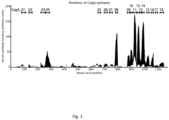
- H. pylori CagA contains 18 different linear B-cell epitopes, with an average length of 22 amino acids (Table 1 and Fig 1 ). These epitopes are all useful for diagnosis of a CagA+ H . pylori-infection.
- every available sequence variant of this peptide was also used, if such a sequence variant was found present at least twice in our database of 245 world-wide CagA sequences.
- 1144 different CagA peptides and sequence variants within the 18 identified epitopes were assayed using high-density arrays.
- Epitopes with a high frequency of responding individuals and a strong antibody binding would be suitable to use for diagnosis of CagA+ H. pylori infection.
- a problem with previously known methods to assess CagA-antibodies has been the high number of false-positive individuals - i.e. H. pylori- non-infected individuals that comes out positive in the test. Therefore, those peptides that had a good discriminatory capacity were identified: a strong antibody-response in individuals with a CagA+ infection, but a minimal response in those with an infection lacking CagA, and in H. pylori -uninfected individuals.
- the discriminatory capacity of peptides using ROC curves were assayed and the area under the curve (AUC) of the ROC curve (ROC AUC) was used as an estimation of diagnostic capacity.
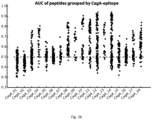
- ROC AUC of 1144 different peptides, including sequence variants, from the 18 identified CagA epitopes was 0.53 ( Fig 2A ). Since an ROC AUC of 0.53 is very close to the diagnostic accuracy of a coin-toss (i.e. not useful for diagnosis), this highlights the problem of high false-positive rates for existing serology tests relying on antibody-responses to the entire CagA protein.
- a diagnostic with an ROC AUC of less than 0.7 may have a diagnostic capacity.
- peptides to which a consistent fraction of CagA+ individuals had an antibody-response, but to which none of the individuals with a CagA-negative strain or lacking an H. pylori infection had such a response were identified.
- Each of these peptides can also be used for diagnosis of H. pylori CagA+ infection.
- Example 7 Identification of crucial amino-acid sequences for diagnosing a CagA+ H. pylori infection.
- the crucial parts of the peptides span between 5-6 amino acids, and that there is redundancy in some of the positions of these crucial sequences.
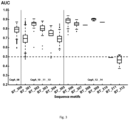
- the crucial sequences for certain epitopes are shown in Table 4, and their ROC AUC levels in Fig 3 .
- the peptides of table 4 are particularly useful for diagnosis and treatment of H. pylori infection and gastric cancer, including prevention of cancer, since they are highly specific.
Landscapes
- Health & Medical Sciences (AREA)
- Life Sciences & Earth Sciences (AREA)
- Chemical & Material Sciences (AREA)
- Immunology (AREA)
- Engineering & Computer Science (AREA)
- Molecular Biology (AREA)
- Hematology (AREA)
- Biomedical Technology (AREA)
- Urology & Nephrology (AREA)
- Biochemistry (AREA)
- Medicinal Chemistry (AREA)
- General Health & Medical Sciences (AREA)
- Organic Chemistry (AREA)
- Food Science & Technology (AREA)
- Pathology (AREA)
- Cell Biology (AREA)
- Physics & Mathematics (AREA)
- Analytical Chemistry (AREA)
- Biotechnology (AREA)
- Microbiology (AREA)
- General Physics & Mathematics (AREA)
- Gastroenterology & Hepatology (AREA)
- Virology (AREA)
- Biophysics (AREA)
- Genetics & Genomics (AREA)
- Proteomics, Peptides & Aminoacids (AREA)
- Tropical Medicine & Parasitology (AREA)
- Peptides Or Proteins (AREA)
- Hospice & Palliative Care (AREA)
- Oncology (AREA)
- Medicines That Contain Protein Lipid Enzymes And Other Medicines (AREA)
Claims (7)
- Peptid, das eine Aminosäuresequenz umfasst, die aus der Gruppe ausgewählt ist, die aus SEQ ID Nr. 1 bis SEQ ID Nr. 5 besteht, wobei das Peptid aus höchstens 25 Aminosäuren besteht, zur Verwendung in einem in vivo Verfahren zur Diagnose von Helicobacter pylori-Infektion oder zur Vorhersage des Risikos für Magenkrebs.
- Peptid zur Verwendung nach Anspruch 1, wobei das Peptid ausgewählt ist aus der Gruppe bestehend aus SEQ ID Nr. 2 bis SEQ ID Nr 5.
- Peptid zur Verwendung nach einem der Ansprüche 1 bis 2, wobei das Peptid höchstens zehn Aminosäuren umfasst.
- Peptid zur Verwendung nach einem der Ansprüche 1 bis 4, wobei das Peptid aus einer Aminosäuresequenz besteht ist, die aus SEQ ID Nr. 1 bis SEQ ID Nr. 5 ausgewählt ist.
- Ein Diagnoseverfahren, das die folgenden Schritte umfasst:a) Bereitstellung einer Probe, die von einem Subjekt gewonnen wurde, wobei das Subjekt ein Mensch ist,b) Inkontaktbringen der Probe mit einem Peptid, das eine Aminosäuresequenz umfasst, die aus der Gruppe bestehend aus SEQ ID Nr. 1 bis SEQ ID Nr. 5 ausgewählt ist, wobei das Peptid aus höchstens 25 Aminosäuren besteht,c) Nachweis der spezifischen Bindung von Antikörpern in der Probe an das Peptid,wobei das Verfahren nicht an einem menschlichen Körper durchgeführt wird,wobei das Verfahren zum Nachweis von Helicobacter pylori Infektion oder zur Vorhersage des Risikos für Magenkrebs verwendet wird.
- Verfahren zum Nachweis von H. pylori CagA-bindenden Antikörpern in einer Probe, die von einem Subjekt gewonnen wurde, wobei das Verfahren umfasst:das Inkontaktbringen einer biologischen Probe mit einem Peptid, das eine Aminosäuresequenz umfasst, die aus der Gruppe bestehend aus SEQ ID Nr. 1 bis SEQ ID Nr. 5 ausgewählt ist, wobei das Peptid aus höchstens 25 Aminosäuren besteht,und das Nachweisen der Bindung von Antikörpern in der Probe an das Peptid.
- Das Verfahren nach Anspruch 6, wobei die Probe eine Blut-, Serum-, Plasma- oder Magengewebeprobe ist.
Applications Claiming Priority (2)
| Application Number | Priority Date | Filing Date | Title |
|---|---|---|---|
| SE1750203A SE541618C2 (en) | 2017-02-24 | 2017-02-24 | Novel peptides and their use in diagnosis |
| PCT/EP2018/054396 WO2018153991A1 (en) | 2017-02-24 | 2018-02-22 | Novel peptides and their use in diagnosis |
Publications (3)
| Publication Number | Publication Date |
|---|---|
| EP3585802A1 EP3585802A1 (de) | 2020-01-01 |
| EP3585802B1 true EP3585802B1 (de) | 2025-04-23 |
| EP3585802C0 EP3585802C0 (de) | 2025-04-23 |
Family
ID=61655722
Family Applications (1)
| Application Number | Title | Priority Date | Filing Date |
|---|---|---|---|
| EP18711229.7A Active EP3585802B1 (de) | 2017-02-24 | 2018-02-22 | Neuartige peptide und deren verwendung in der diagnose |
Country Status (10)
| Country | Link |
|---|---|
| US (3) | US11401308B2 (de) |
| EP (1) | EP3585802B1 (de) |
| JP (2) | JP7199384B2 (de) |
| KR (2) | KR20240126079A (de) |
| CN (1) | CN110662757A (de) |
| AU (3) | AU2018225417B2 (de) |
| ES (1) | ES3034860T3 (de) |
| SE (1) | SE541618C2 (de) |
| SG (1) | SG11201907408PA (de) |
| WO (1) | WO2018153991A1 (de) |
Families Citing this family (4)
| Publication number | Priority date | Publication date | Assignee | Title |
|---|---|---|---|---|
| JP7222511B2 (ja) * | 2018-06-28 | 2023-02-15 | 国立大学法人 大分大学 | ペプチド及びその利用 |
| CN113366012A (zh) * | 2019-01-31 | 2021-09-07 | 国立大学法人东京医科齿科大学 | 幽门螺杆菌菌株的鉴定方法及鉴定试剂盒 |
| WO2025000054A1 (en) * | 2023-06-30 | 2025-01-02 | Biotome Pty Ltd | Helicobacter caga peptides and their use in diagnosis |
| CN119716051B (zh) * | 2024-12-19 | 2025-08-12 | 无锡壹闪生物科技有限公司 | 抗幽门螺旋杆菌CagA亚型抗体检测试剂盒及其应用 |
Family Cites Families (22)
| Publication number | Priority date | Publication date | Assignee | Title |
|---|---|---|---|---|
| US5928865A (en) * | 1992-03-02 | 1999-07-27 | Chiron S.P.A. | Compositions comprising isolated Helicobacter pylori CagI polynucleotides and method of preparation thereof |
| DE69334197T2 (de) * | 1992-03-02 | 2008-12-11 | Novartis Vaccines And Diagnostics S.R.L. | Helicobacter pylori Cytotoxin verwendbar in Impfstoffe und Diagnostik |
| US7141244B1 (en) * | 1992-03-02 | 2006-11-28 | Chiron Srl | Helicobacter pylori proteins useful for vaccines and diagnostics |
| US7300918B2 (en) * | 1994-01-14 | 2007-11-27 | Matthias Rath | Method of producing vaccines from protein signal oligopeptides |
| US6019974A (en) * | 1996-01-26 | 2000-02-01 | Emory University | SPE-4 peptides |
| US6902903B1 (en) | 1996-12-19 | 2005-06-07 | Chiron Corporation | Helicobacter pylori diagnostics |
| DE69713146T2 (de) * | 1996-12-19 | 2002-11-14 | Chiron Corp. (N.D.Ges.D. Staates Delaware), Emeryville | Helicobacter pylori diagnostika |
| GB9929464D0 (en) * | 1999-12-13 | 2000-02-09 | Proteom Ltd | Complementary peptide ligande generated from the human genome |
| CN1313337A (zh) * | 2000-03-15 | 2001-09-19 | 上海博德基因开发有限公司 | 一种新的多肽——锌指蛋白10和编码这种多肽的多核苷酸 |
| GB0103424D0 (en) * | 2001-02-12 | 2001-03-28 | Chiron Spa | Gonococcus proteins |
| JP2004123737A (ja) * | 2002-09-10 | 2004-04-22 | New Industry Research Organization | 新規抗体及びその利用法 |
| WO2004094467A2 (en) * | 2003-04-22 | 2004-11-04 | Intercell Ag | H. pylori antigens |
| CN1847854A (zh) * | 2005-04-11 | 2006-10-18 | 兰州大学 | 检测幽门螺杆菌抗原的免疫胶体金试纸及其制备方法 |
| CN102260322B (zh) * | 2011-07-06 | 2014-04-23 | 苏静 | 幽门螺杆菌抗原肽及其应用 |
| WO2013143026A1 (en) * | 2012-03-31 | 2013-10-03 | Abmart (Shanghai) Co., Ltd | Peptide and antibody libraries and uses thereof |
| US20160030510A1 (en) * | 2012-06-08 | 2016-02-04 | The Board Of Trustees Of The Leland Stanford Junior University | Methods of treating alzheimer's disease and other tauopathies with inhibitors of microtubule affinity regulating kinase |
| EP2837939A1 (de) * | 2013-08-13 | 2015-02-18 | Technische Universität München | Verfahren zum Nachweis von H.pylori-Infektionen |
| WO2015151128A1 (en) * | 2014-04-04 | 2015-10-08 | Over S.R.L. | Method for rapid detection of infection from caga positive helicobacter pylori and diagnostic kit therefor |
| CN104147589B (zh) * | 2014-07-18 | 2016-08-17 | 辽宁大学 | 抗菌肽awrk6在制备治疗败血症药物中的应用 |
| US9700514B1 (en) * | 2014-08-20 | 2017-07-11 | Darren Rubin | Single solid oral dosage forms for treating Helicobacter pylori infection and duodenal ulcer disease |
| CA2988388C (en) * | 2015-04-23 | 2022-11-22 | Nantomics, Llc | Cancer neoepitopes |
| US11505581B2 (en) * | 2015-05-14 | 2022-11-22 | La Jolla Institute For Allergy And Immunology | Antigens and T cell epitopes from cockroach and methods of making and using same |
-
2017
- 2017-02-24 SE SE1750203A patent/SE541618C2/en unknown
-
2018
- 2018-02-22 JP JP2019567783A patent/JP7199384B2/ja active Active
- 2018-02-22 ES ES18711229T patent/ES3034860T3/es active Active
- 2018-02-22 US US16/488,077 patent/US11401308B2/en active Active
- 2018-02-22 EP EP18711229.7A patent/EP3585802B1/de active Active
- 2018-02-22 WO PCT/EP2018/054396 patent/WO2018153991A1/en not_active Ceased
- 2018-02-22 SG SG11201907408PA patent/SG11201907408PA/en unknown
- 2018-02-22 AU AU2018225417A patent/AU2018225417B2/en active Active
- 2018-02-22 KR KR1020247027370A patent/KR20240126079A/ko active Pending
- 2018-02-22 KR KR1020197027947A patent/KR20190121820A/ko not_active Ceased
- 2018-02-22 CN CN201880026986.6A patent/CN110662757A/zh active Pending
-
2022
- 2022-06-01 AU AU2022203786A patent/AU2022203786B2/en active Active
- 2022-06-29 US US17/852,797 patent/US12037365B2/en active Active
- 2022-12-15 JP JP2022200083A patent/JP2023049050A/ja active Pending
-
2024
- 2024-05-31 US US18/680,407 patent/US12459976B2/en active Active
- 2024-09-04 AU AU2024219396A patent/AU2024219396A1/en active Pending
Also Published As
| Publication number | Publication date |
|---|---|
| JP7199384B2 (ja) | 2023-01-05 |
| AU2024219396A1 (en) | 2024-09-26 |
| US11401308B2 (en) | 2022-08-02 |
| JP2023049050A (ja) | 2023-04-07 |
| ES3034860T3 (en) | 2025-08-25 |
| AU2018225417A1 (en) | 2019-08-22 |
| SE1750203A1 (en) | 2018-08-25 |
| US20240309054A1 (en) | 2024-09-19 |
| AU2022203786A1 (en) | 2022-07-14 |
| KR20190121820A (ko) | 2019-10-28 |
| US12037365B2 (en) | 2024-07-16 |
| JP2020512398A (ja) | 2020-04-23 |
| EP3585802C0 (de) | 2025-04-23 |
| EP3585802A1 (de) | 2020-01-01 |
| US20220363725A1 (en) | 2022-11-17 |
| US12459976B2 (en) | 2025-11-04 |
| KR20240126079A (ko) | 2024-08-20 |
| WO2018153991A1 (en) | 2018-08-30 |
| CN110662757A (zh) | 2020-01-07 |
| AU2018225417B2 (en) | 2022-03-17 |
| AU2022203786B2 (en) | 2024-06-06 |
| US20200062806A1 (en) | 2020-02-27 |
| SG11201907408PA (en) | 2019-09-27 |
| SE541618C2 (en) | 2019-11-12 |
Similar Documents
| Publication | Publication Date | Title |
|---|---|---|
| US12459976B2 (en) | Peptides and their use in diagnosis | |
| US10871493B2 (en) | Assay for the diagnosis of peanut allergy | |
| US11598772B2 (en) | Method and products for the diagnosis of a seafood allergy | |
| JP2006284567A (ja) | ヘリコバクター・ピロリ感染の診断方法及び診断キット | |
| US20190359694A1 (en) | Serological assay for zika virus infection | |
| Chandra et al. | Epitope mapping of antibodies to VlsE protein of Borrelia burgdorferi in post-Lyme disease syndrome | |
| CA3211678A1 (en) | Peptides and their use in diagnosis of sars-cov-2 infection | |
| WO2014159931A1 (en) | Strings of epitopes useful in diagnosing and eliciting immune responses to sexually trasmitted infections | |
| JP6357425B2 (ja) | 干渉ペプチド及び微生物の検出方法 | |
| US8591899B2 (en) | Diagnosis of Bacillus anthracis infection based on detection of bacterial secreted biomarkers | |
| RU2478970C1 (ru) | Способ иммунофлуоресцентного определения протективного антигена возбудителя сибирской язвы | |
| EP3919503A1 (de) | Verfahren zur identifizierung von helicobacter-pylori-stamm und kit zur identifizierung | |
| WO2025000054A1 (en) | Helicobacter caga peptides and their use in diagnosis | |
| WO2006000056A1 (en) | Novel methods of diagnosis of treatment of p. aeruginosa infection and reagents therefor |
Legal Events
| Date | Code | Title | Description |
|---|---|---|---|
| STAA | Information on the status of an ep patent application or granted ep patent |
Free format text: STATUS: UNKNOWN |
|
| STAA | Information on the status of an ep patent application or granted ep patent |
Free format text: STATUS: THE INTERNATIONAL PUBLICATION HAS BEEN MADE |
|
| PUAI | Public reference made under article 153(3) epc to a published international application that has entered the european phase |
Free format text: ORIGINAL CODE: 0009012 |
|
| STAA | Information on the status of an ep patent application or granted ep patent |
Free format text: STATUS: REQUEST FOR EXAMINATION WAS MADE |
|
| 17P | Request for examination filed |
Effective date: 20190920 |
|
| AK | Designated contracting states |
Kind code of ref document: A1 Designated state(s): AL AT BE BG CH CY CZ DE DK EE ES FI FR GB GR HR HU IE IS IT LI LT LU LV MC MK MT NL NO PL PT RO RS SE SI SK SM TR |
|
| AX | Request for extension of the european patent |
Extension state: BA ME |
|
| DAV | Request for validation of the european patent (deleted) | ||
| DAX | Request for extension of the european patent (deleted) | ||
| STAA | Information on the status of an ep patent application or granted ep patent |
Free format text: STATUS: EXAMINATION IS IN PROGRESS |
|
| 17Q | First examination report despatched |
Effective date: 20221121 |
|
| GRAP | Despatch of communication of intention to grant a patent |
Free format text: ORIGINAL CODE: EPIDOSNIGR1 |
|
| STAA | Information on the status of an ep patent application or granted ep patent |
Free format text: STATUS: GRANT OF PATENT IS INTENDED |
|
| INTG | Intention to grant announced |
Effective date: 20241127 |
|
| GRAS | Grant fee paid |
Free format text: ORIGINAL CODE: EPIDOSNIGR3 |
|
| GRAA | (expected) grant |
Free format text: ORIGINAL CODE: 0009210 |
|
| STAA | Information on the status of an ep patent application or granted ep patent |
Free format text: STATUS: THE PATENT HAS BEEN GRANTED |
|
| AK | Designated contracting states |
Kind code of ref document: B1 Designated state(s): AL AT BE BG CH CY CZ DE DK EE ES FI FR GB GR HR HU IE IS IT LI LT LU LV MC MK MT NL NO PL PT RO RS SE SI SK SM TR |
|
| REG | Reference to a national code |
Ref country code: GB Ref legal event code: FG4D |
|
| REG | Reference to a national code |
Ref country code: CH Ref legal event code: EP |
|
| REG | Reference to a national code |
Ref country code: DE Ref legal event code: R096 Ref document number: 602018081278 Country of ref document: DE |
|
| REG | Reference to a national code |
Ref country code: IE Ref legal event code: FG4D |
|
| U01 | Request for unitary effect filed |
Effective date: 20250519 |
|
| U07 | Unitary effect registered |
Designated state(s): AT BE BG DE DK EE FI FR IT LT LU LV MT NL PT RO SE SI Effective date: 20250523 |
|
| REG | Reference to a national code |
Ref country code: ES Ref legal event code: FG2A Ref document number: 3034860 Country of ref document: ES Kind code of ref document: T3 Effective date: 20250825 |
|
| PG25 | Lapsed in a contracting state [announced via postgrant information from national office to epo] |
Ref country code: NO Free format text: LAPSE BECAUSE OF FAILURE TO SUBMIT A TRANSLATION OF THE DESCRIPTION OR TO PAY THE FEE WITHIN THE PRESCRIBED TIME-LIMIT Effective date: 20250723 Ref country code: GR Free format text: LAPSE BECAUSE OF FAILURE TO SUBMIT A TRANSLATION OF THE DESCRIPTION OR TO PAY THE FEE WITHIN THE PRESCRIBED TIME-LIMIT Effective date: 20250724 |
|
| PG25 | Lapsed in a contracting state [announced via postgrant information from national office to epo] |
Ref country code: PL Free format text: LAPSE BECAUSE OF FAILURE TO SUBMIT A TRANSLATION OF THE DESCRIPTION OR TO PAY THE FEE WITHIN THE PRESCRIBED TIME-LIMIT Effective date: 20250423 |
|
| PG25 | Lapsed in a contracting state [announced via postgrant information from national office to epo] |
Ref country code: HR Free format text: LAPSE BECAUSE OF FAILURE TO SUBMIT A TRANSLATION OF THE DESCRIPTION OR TO PAY THE FEE WITHIN THE PRESCRIBED TIME-LIMIT Effective date: 20250423 |
|
| PG25 | Lapsed in a contracting state [announced via postgrant information from national office to epo] |
Ref country code: RS Free format text: LAPSE BECAUSE OF FAILURE TO SUBMIT A TRANSLATION OF THE DESCRIPTION OR TO PAY THE FEE WITHIN THE PRESCRIBED TIME-LIMIT Effective date: 20250723 |
|
| PG25 | Lapsed in a contracting state [announced via postgrant information from national office to epo] |
Ref country code: IS Free format text: LAPSE BECAUSE OF FAILURE TO SUBMIT A TRANSLATION OF THE DESCRIPTION OR TO PAY THE FEE WITHIN THE PRESCRIBED TIME-LIMIT Effective date: 20250823 |
|
| PG25 | Lapsed in a contracting state [announced via postgrant information from national office to epo] |
Ref country code: SM Free format text: LAPSE BECAUSE OF FAILURE TO SUBMIT A TRANSLATION OF THE DESCRIPTION OR TO PAY THE FEE WITHIN THE PRESCRIBED TIME-LIMIT Effective date: 20250423 |
|
| PG25 | Lapsed in a contracting state [announced via postgrant information from national office to epo] |
Ref country code: CZ Free format text: LAPSE BECAUSE OF FAILURE TO SUBMIT A TRANSLATION OF THE DESCRIPTION OR TO PAY THE FEE WITHIN THE PRESCRIBED TIME-LIMIT Effective date: 20250423 |
|
| PG25 | Lapsed in a contracting state [announced via postgrant information from national office to epo] |
Ref country code: SK Free format text: LAPSE BECAUSE OF FAILURE TO SUBMIT A TRANSLATION OF THE DESCRIPTION OR TO PAY THE FEE WITHIN THE PRESCRIBED TIME-LIMIT Effective date: 20250423 |