EP3581101A2 - Vorrichtung und verfahren zur für pulsdiagnosemessung - Google Patents
Vorrichtung und verfahren zur für pulsdiagnosemessung Download PDFInfo
- Publication number
- EP3581101A2 EP3581101A2 EP19179313.2A EP19179313A EP3581101A2 EP 3581101 A2 EP3581101 A2 EP 3581101A2 EP 19179313 A EP19179313 A EP 19179313A EP 3581101 A2 EP3581101 A2 EP 3581101A2
- Authority
- EP
- European Patent Office
- Prior art keywords
- pulse
- harmonic
- pressure
- blood pressure
- holding device
- Prior art date
- Legal status (The legal status is an assumption and is not a legal conclusion. Google has not performed a legal analysis and makes no representation as to the accuracy of the status listed.)
- Granted
Links
Images




Classifications
-
- A—HUMAN NECESSITIES
- A61—MEDICAL OR VETERINARY SCIENCE; HYGIENE
- A61B—DIAGNOSIS; SURGERY; IDENTIFICATION
- A61B5/00—Measuring for diagnostic purposes; Identification of persons
- A61B5/02—Detecting, measuring or recording for evaluating the cardiovascular system, e.g. pulse, heart rate, blood pressure or blood flow
- A61B5/021—Measuring pressure in heart or blood vessels
- A61B5/022—Measuring pressure in heart or blood vessels by applying pressure to close blood vessels, e.g. against the skin; Ophthalmodynamometers
-
- A—HUMAN NECESSITIES
- A61—MEDICAL OR VETERINARY SCIENCE; HYGIENE
- A61B—DIAGNOSIS; SURGERY; IDENTIFICATION
- A61B5/00—Measuring for diagnostic purposes; Identification of persons
- A61B5/0002—Remote monitoring of patients using telemetry, e.g. transmission of vital signals via a communication network
- A61B5/0004—Remote monitoring of patients using telemetry, e.g. transmission of vital signals via a communication network characterised by the type of physiological signal transmitted
-
- A—HUMAN NECESSITIES
- A61—MEDICAL OR VETERINARY SCIENCE; HYGIENE
- A61B—DIAGNOSIS; SURGERY; IDENTIFICATION
- A61B5/00—Measuring for diagnostic purposes; Identification of persons
- A61B5/02—Detecting, measuring or recording for evaluating the cardiovascular system, e.g. pulse, heart rate, blood pressure or blood flow
- A61B5/024—Measuring pulse rate or heart rate
-
- A—HUMAN NECESSITIES
- A61—MEDICAL OR VETERINARY SCIENCE; HYGIENE
- A61B—DIAGNOSIS; SURGERY; IDENTIFICATION
- A61B5/00—Measuring for diagnostic purposes; Identification of persons
- A61B5/02—Detecting, measuring or recording for evaluating the cardiovascular system, e.g. pulse, heart rate, blood pressure or blood flow
-
- A—HUMAN NECESSITIES
- A61—MEDICAL OR VETERINARY SCIENCE; HYGIENE
- A61B—DIAGNOSIS; SURGERY; IDENTIFICATION
- A61B5/00—Measuring for diagnostic purposes; Identification of persons
- A61B5/02—Detecting, measuring or recording for evaluating the cardiovascular system, e.g. pulse, heart rate, blood pressure or blood flow
- A61B5/021—Measuring pressure in heart or blood vessels
- A61B5/02108—Measuring pressure in heart or blood vessels from analysis of pulse wave characteristics
-
- A—HUMAN NECESSITIES
- A61—MEDICAL OR VETERINARY SCIENCE; HYGIENE
- A61B—DIAGNOSIS; SURGERY; IDENTIFICATION
- A61B5/00—Measuring for diagnostic purposes; Identification of persons
- A61B5/02—Detecting, measuring or recording for evaluating the cardiovascular system, e.g. pulse, heart rate, blood pressure or blood flow
- A61B5/021—Measuring pressure in heart or blood vessels
- A61B5/022—Measuring pressure in heart or blood vessels by applying pressure to close blood vessels, e.g. against the skin; Ophthalmodynamometers
- A61B5/0225—Measuring pressure in heart or blood vessels by applying pressure to close blood vessels, e.g. against the skin; Ophthalmodynamometers the pressure being controlled by electric signals, e.g. derived from Korotkoff sounds
-
- A—HUMAN NECESSITIES
- A61—MEDICAL OR VETERINARY SCIENCE; HYGIENE
- A61B—DIAGNOSIS; SURGERY; IDENTIFICATION
- A61B5/00—Measuring for diagnostic purposes; Identification of persons
- A61B5/02—Detecting, measuring or recording for evaluating the cardiovascular system, e.g. pulse, heart rate, blood pressure or blood flow
- A61B5/026—Measuring blood flow
-
- A—HUMAN NECESSITIES
- A61—MEDICAL OR VETERINARY SCIENCE; HYGIENE
- A61B—DIAGNOSIS; SURGERY; IDENTIFICATION
- A61B5/00—Measuring for diagnostic purposes; Identification of persons
- A61B5/48—Other medical applications
- A61B5/4854—Diagnosis based on concepts of alternative medicine, e.g. homeopathy or non-orthodox
-
- A—HUMAN NECESSITIES
- A61—MEDICAL OR VETERINARY SCIENCE; HYGIENE
- A61B—DIAGNOSIS; SURGERY; IDENTIFICATION
- A61B5/00—Measuring for diagnostic purposes; Identification of persons
- A61B5/68—Arrangements of detecting, measuring or recording means, e.g. sensors, in relation to patient
- A61B5/6801—Arrangements of detecting, measuring or recording means, e.g. sensors, in relation to patient specially adapted to be attached to or worn on the body surface
- A61B5/6802—Sensor mounted on worn items
- A61B5/6803—Head-worn items, e.g. helmets, masks, headphones or goggles
-
- A—HUMAN NECESSITIES
- A61—MEDICAL OR VETERINARY SCIENCE; HYGIENE
- A61B—DIAGNOSIS; SURGERY; IDENTIFICATION
- A61B5/00—Measuring for diagnostic purposes; Identification of persons
- A61B5/68—Arrangements of detecting, measuring or recording means, e.g. sensors, in relation to patient
- A61B5/6801—Arrangements of detecting, measuring or recording means, e.g. sensors, in relation to patient specially adapted to be attached to or worn on the body surface
- A61B5/6802—Sensor mounted on worn items
- A61B5/681—Wristwatch-type devices
-
- A—HUMAN NECESSITIES
- A61—MEDICAL OR VETERINARY SCIENCE; HYGIENE
- A61B—DIAGNOSIS; SURGERY; IDENTIFICATION
- A61B5/00—Measuring for diagnostic purposes; Identification of persons
- A61B5/68—Arrangements of detecting, measuring or recording means, e.g. sensors, in relation to patient
- A61B5/6801—Arrangements of detecting, measuring or recording means, e.g. sensors, in relation to patient specially adapted to be attached to or worn on the body surface
- A61B5/6813—Specially adapted to be attached to a specific body part
- A61B5/6822—Neck
-
- A—HUMAN NECESSITIES
- A61—MEDICAL OR VETERINARY SCIENCE; HYGIENE
- A61B—DIAGNOSIS; SURGERY; IDENTIFICATION
- A61B5/00—Measuring for diagnostic purposes; Identification of persons
- A61B5/68—Arrangements of detecting, measuring or recording means, e.g. sensors, in relation to patient
- A61B5/6801—Arrangements of detecting, measuring or recording means, e.g. sensors, in relation to patient specially adapted to be attached to or worn on the body surface
- A61B5/6813—Specially adapted to be attached to a specific body part
- A61B5/6824—Arm or wrist
-
- A—HUMAN NECESSITIES
- A61—MEDICAL OR VETERINARY SCIENCE; HYGIENE
- A61B—DIAGNOSIS; SURGERY; IDENTIFICATION
- A61B5/00—Measuring for diagnostic purposes; Identification of persons
- A61B5/68—Arrangements of detecting, measuring or recording means, e.g. sensors, in relation to patient
- A61B5/6801—Arrangements of detecting, measuring or recording means, e.g. sensors, in relation to patient specially adapted to be attached to or worn on the body surface
- A61B5/6813—Specially adapted to be attached to a specific body part
- A61B5/6825—Hand
- A61B5/6826—Finger
-
- A—HUMAN NECESSITIES
- A61—MEDICAL OR VETERINARY SCIENCE; HYGIENE
- A61B—DIAGNOSIS; SURGERY; IDENTIFICATION
- A61B5/00—Measuring for diagnostic purposes; Identification of persons
- A61B5/68—Arrangements of detecting, measuring or recording means, e.g. sensors, in relation to patient
- A61B5/6801—Arrangements of detecting, measuring or recording means, e.g. sensors, in relation to patient specially adapted to be attached to or worn on the body surface
- A61B5/6813—Specially adapted to be attached to a specific body part
- A61B5/6829—Foot or ankle
-
- A—HUMAN NECESSITIES
- A61—MEDICAL OR VETERINARY SCIENCE; HYGIENE
- A61B—DIAGNOSIS; SURGERY; IDENTIFICATION
- A61B5/00—Measuring for diagnostic purposes; Identification of persons
- A61B5/68—Arrangements of detecting, measuring or recording means, e.g. sensors, in relation to patient
- A61B5/6801—Arrangements of detecting, measuring or recording means, e.g. sensors, in relation to patient specially adapted to be attached to or worn on the body surface
- A61B5/683—Means for maintaining contact with the body
- A61B5/6831—Straps, bands or harnesses
-
- A—HUMAN NECESSITIES
- A61—MEDICAL OR VETERINARY SCIENCE; HYGIENE
- A61B—DIAGNOSIS; SURGERY; IDENTIFICATION
- A61B5/00—Measuring for diagnostic purposes; Identification of persons
- A61B5/72—Signal processing specially adapted for physiological signals or for diagnostic purposes
- A61B5/7235—Details of waveform analysis
-
- A—HUMAN NECESSITIES
- A61—MEDICAL OR VETERINARY SCIENCE; HYGIENE
- A61B—DIAGNOSIS; SURGERY; IDENTIFICATION
- A61B5/00—Measuring for diagnostic purposes; Identification of persons
- A61B5/72—Signal processing specially adapted for physiological signals or for diagnostic purposes
- A61B5/7235—Details of waveform analysis
- A61B5/7253—Details of waveform analysis characterised by using transforms
- A61B5/7257—Details of waveform analysis characterised by using transforms using Fourier transforms
-
- A—HUMAN NECESSITIES
- A61—MEDICAL OR VETERINARY SCIENCE; HYGIENE
- A61B—DIAGNOSIS; SURGERY; IDENTIFICATION
- A61B5/00—Measuring for diagnostic purposes; Identification of persons
- A61B5/72—Signal processing specially adapted for physiological signals or for diagnostic purposes
- A61B5/7271—Specific aspects of physiological measurement analysis
- A61B5/7275—Determining trends in physiological measurement data; Predicting development of a medical condition based on physiological measurements, e.g. determining a risk factor
-
- A—HUMAN NECESSITIES
- A61—MEDICAL OR VETERINARY SCIENCE; HYGIENE
- A61B—DIAGNOSIS; SURGERY; IDENTIFICATION
- A61B5/00—Measuring for diagnostic purposes; Identification of persons
- A61B5/72—Signal processing specially adapted for physiological signals or for diagnostic purposes
- A61B5/7235—Details of waveform analysis
- A61B5/7264—Classification of physiological signals or data, e.g. using neural networks, statistical classifiers, expert systems or fuzzy systems
Definitions
- the present invention relates to a device and a method for a pulse diagnosis measurement.
- a tourniquet is touched to a position of a pulse for performing the measurement to understand a physiological condition of the organism.
- accuracy of the measurement is affected by the tourniquet, especially when it is needed to measure harmonics of the blood pressure wave with high accuracy.
- Quality of the tourniquet has a major impact.
- design of a proper tourniquet is an important problem to be solved.
- a pressure of the tourniquet is increased until the pressure is greater than a systolic blood pressure to block a blood flow of an arterial, and the pressure of the tourniquet is decreased until a Korotkoff sound (e.g., corresponding samples of the Korotkoff sound in an electronic blood pressure monitor) exists, such that the systolic blood pressure and a diastolic blood pressure can be obtained.
- a Korotkoff sound e.g., corresponding samples of the Korotkoff sound in an electronic blood pressure monitor
- the present invention therefore provides a method and related device for a pulse diagnosis measurement to improve a pulse diagnosis of an organism to solve the abovementioned problem.
- the claimed device for a pulse diagnosis measurement comprises a sensing device, for sensing a blood pressure wave of an organism, to generate a pulse signal; a pulse-holding device, for applying a pressure on a pulse of the organism, wherein the pulse-holding device has a first elasticity coefficient, the first elasticity coefficient is corresponding to a first frequency of a first harmonic of the blood pressure wave, and the first harmonic is a first integer harmonic or a first fractional harmonic; and a processing device, for generating pulse diagnosis information of the first harmonic according to the pulse signal.
- Fig. 1 is a schematic diagram of a pulse diagnosis measurement device according to an example of the present invention.
- a pulse diagnosis measurement device 100 may be a pulse diagnosis device, an electronic blood pressure monitor, a finger diagnosis device or other blood pressure wave measurement device.
- the pulse diagnosis measurement device 100 includes a sensing device 110, for sensing a blood pressure wave of an organism (e.g., a human or another animal), to generate a pulse signal.
- the pulse diagnosis measurement device 100 further includes a pulse-holding device 120, for applying a pressure on a pulse of the organism, to facilitate the sensing device 110 to sense the blood pressure wave.
- the pulse-holding device 120 may be a tourniquet.
- the tourniquet can enclose the pulse to apply a pressure.
- the pulse-holding device 120 may be designed as a clip for performing a measurement by clamping the pulse, e.g., a finger diagnosis device, which can perform the measurement by clamping a finger tip.
- the pulse-holding device 120 may include an elastic material such as elastic cloth and is made as an elastic wearable device, e.g., a finger cot, a watch, a bracelet, a wristband, an armband, an ankle ring, a headscarf or a collar, to sense the pulse at different parts of a body.
- the sensing device 110 is a pressure sensor such as a piezoelectric element, to sense a pressure, and the sensed pressure can be converted into an electronic signal.
- the sensing device 110 can contact the position of the pulse, and the pulse-holding device 120 applies a pressure on a top of the sensing device 110, such that the sensing device 110 can accurately sense beats of the pulse.
- the sensing device 110 is a pressure sensor and the pulse-holding device 120 is an inflatable cuff or bag.
- the sensing device 110 may be inflated or deflated to adjust a pressure on the pulse.
- the sensing device 110 is coupled to the pulse-holding device 120, to sense a change of an internal air pressure of the pulse-holding device 120 caused by beats of the pulse.
- the sensing device 110 is a photoplethysmography (PPG) module including a light emitting diode (LED) and a photo detector (not shown).
- PPG photoplethysmography
- a change of a blood volume can be detected via a photoelectric means when beats of the pulse occur, so as to measure the blood pressure wave.
- the pulse-holding device 120 secures the PPG module to the position of the pulse, and provides an effect of resonance with the pulse.
- the pulse diagnosis measurement device 100 further includes a processing device 130 for performing a signal processing on the pulse signal generated by the sensing device 110, such as a Fourier transform, to generate pulse diagnosis information.
- a processing device 130 for performing a signal processing on the pulse signal generated by the sensing device 110, such as a Fourier transform, to generate pulse diagnosis information.
- any periodic wave in a time domain can be converted into harmonics (or harmonic components) in a frequency domain.
- the processing device 130 can perform the Fourier transform on the pulse signal which is obtained by the sensing device 110 sensing the blood pressure wave, to generate harmonics of the blood pressure wave.
- the pulse diagnosis measuring device 100 is designed to obtain accurate information of specific harmonics by measuring the blood pressure wave. That is, the pulse diagnosis measuring device 100 can accurately measure one or some specific harmonics of the blood pressure waves.
- the pulse-holding device 120 should have specific physical conditions to resonate with the specific harmonic.
- the pulse-holding device 120 (such a tourniquet) may oscillate (e.g., vibrate) with beats of the pulse, when measuring the blood pressure wave.
- the pulse-holding device 120 should have an appropriate elasticity coefficient to oscillate to fully match relaxation and contraction of the pulse. If the elasticity coefficient is too small or too large, the pulse-holding device 120 may be too soft or too hard, which results that no data is generated or damping is too high. As a result, an inaccurate measurement result is obtained.
- a pulse diagnosis measurement device using a pressure sensor cannot measure variation of pressure accurately due to an inappropriate elasticity coefficient of the pulse diagnosis measurement device.
- a pulse diagnosis measurement device using a PPG technique cannot measure volume variation of light accurately caused by relaxation and contraction of a blood vessel due to an inappropriate elasticity coefficient of the pulse diagnosis measurement device. Furthermore, a harmonic of a higher frequency needs a larger elasticity coefficient to achieve a resonance, so as to obtain accurate harmonic information. Conversely, a harmonic of a lower frequency needs a smaller elasticity coefficient to achieve the resonance.
- an elasticity coefficient of the pulse-holding device 120 has a specific correspondence with a frequency of a harmonic to be measured. It can also be said that the elasticity coefficient of the pulse-holding device 120 is selected or determined according to the frequency of the harmonic to be measured.
- the pulse-holding device 120 has a first elasticity coefficient corresponding to a first frequency of a first harmonic of the blood pressure wave.
- the processing device 130 can process a measured pulse signal (including its Fourier transform), to generate pulse diagnosis information of the first harmonic.
- the first harmonic may be a first integer harmonic or a first fractional harmonic.
- the first harmonic and the second harmonic are simply general terms for harmonics to distinguish with each other, and are not specifically referred to the first harmonic and the second harmonic in the signal analysis theory.
- an amplitude of an integer harmonic of a blood pressure wave decreases as a frequency of the integer harmonic increases.
- an elasticity coefficient of the pulse-holding device 120 is adjustable or switchable.
- the pulse-holding device 120 can be switched to have a second elasticity coefficient different from the first elasticity coefficient.
- the second elasticity coefficient may be corresponding to a second frequency of a second harmonic of the blood pressure wave.
- the second harmonic may be a second integer harmonic or a second fractional harmonic.
- the processing device 130 processes a measured pulse signal to generate pulse diagnosis information of the second harmonic.
- the elasticity coefficient of the pulse-holding device 120 can be adjusted in response to the frequency of the harmonic to be measured.
- the second elasticity coefficient is greater than the first elasticity coefficient, when the second frequency of the second harmonic is greater than the first frequency of the first harmonic.
- the pulse-holding device 120 includes a plurality of tourniquets for adjusting or switching an elasticity coefficient.
- the tourniquets can be used separately when the tourniquets have different elasticity coefficients, or several tourniquets can be connected in series or in parallel to produce different elasticity coefficients.
- the first frequency of the first harmonic is n times the fundamental frequency (i.e., heart rate) of the blood pressure wave, where n is an integer and 1 ⁇ n ⁇ 10.
- the first elasticity coefficient is corresponding to a pressure-strain modulus Ep.
- the fundamental frequency of the blood pressure wave is f Hz, 0.8 ⁇ f ⁇ 1.5
- the first elasticity coefficient is not smaller than 3.5*10 6 dyn/cm 2
- the first elasticity coefficient is not smaller than 3.5*10 6 dyn/cm 2 and not lager than 9.82*10 6 dyn/cm 2 .
- Ep ⁇ P/( ⁇ R 0 /R 0 ), and ⁇ R 0 /R0 is the length difference per unit radial length.
- Ep can be regarded as a radial elasticity coefficient of the blood vessel.
- ⁇ P is a pressure applied by harmonics and ⁇ R 0 is a change of a radial length caused by the pressure, if the blood pressure wave is decomposed into the harmonics.
- each harmonic has its corresponding pressure-strain modulus Ep. Therefore, a better resonance with the blood vessel can be obtained, and a more accurate measurement result can be obtained, if the first elasticity coefficient of the pulse-holding device 120 can be matched to the pressure-strain modulus Ep of each harmonic.
- the first elasticity coefficient of the pulse-holding device 120 is used for measuring a relation between a radial stress and a radial strain.
- the radial elasticity coefficient can be calculated, when the pulse-holding device 120 is a tourniquet which surrounds the pulse position (e.g., a wrist, an arm, a finger, etc.) to form a circle or an arc.
- a circle or an arc is formed when the pulse-holding device 120 is worn, if the pulse-holding device 120 is made into a wearable device such as a finger cot, a watch, a bracelet, a wristband, an armband, a foot ring, a headscarf or a collar, and a radial elasticity coefficient can be calculated.
- the portion of two ends of a clip contacting to an organism can be regarded as an arc, when the pulse-holding device 120 is the clip, and a radial elasticity coefficient can be also calculated.
- the numerical range of the first elasticity coefficient as mentioned above includes numerical values of a radial elasticity coefficient suitable for measuring a n-order integer harmonic (1 ⁇ n ⁇ 10).
- the first frequency of the first harmonic is n times the fundamental frequency of the blood pressure wave, where n is a fraction and 0 ⁇ n ⁇ 1.
- the first elasticity coefficient is corresponding to a pressure-strain modulus Ep.
- the fundamental frequency of the blood pressure wave is f Hertz, 0.8 ⁇ f ⁇ 1.5
- the first elasticity coefficient is not smaller than 0.16*10 6 dyn/cm 2 and is not greater than 3.5*10 6 dyn/cm 2 .
- This example shows that not only the integer harmonic but also the fractional harmonic of the lower frequency have their applicable range of radial elasticity coefficients.
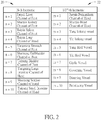
- Fig. 2 includes correspondence tables 20 and 22.
- the correspondence table 20 shows the meridians corresponding to the 10 integer harmonics above the fundamental frequency (inclusive).
- the correspondence table 22 shows the meridians corresponding to the 10 1/2 m -th harmonics.
- Each harmonic can display an energy state of a corresponding meridian, which has physiological significance and pathological significance.
- the pulse diagnosis measurement device 100 greatly helps the analysis and diagnosis of Chinese medicine by measuring these harmonics of the human body.
- FIG. 3 is a correspondence table 30 of the twenty harmonics and elasticity coefficients of the pulse-holding device 120, wherein a unit of the elasticity coefficient is dyn/cm 2 .
- the pulse-holding device 120 can be switched to a corresponding elasticity coefficient according to the correspondence table 30, to perform the measurement. Compared with a conventional measurement device where an elasticity coefficient needed for a tourniquet part is not considered, this method can improve the accuracy of the measurement.
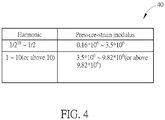
- Fig. 4 is another correspondence table 40 of the twenty harmonics and elasticity coefficients of the pulse-holding device 120, wherein the unit of the elasticity coefficient is also dyn/cm 2 .
- the correspondence table 40 simplifies the number of groups of frequencies of harmonics, which simplifies a design of the pulse-holding device 120. It should be noted that the correspondence tables in Fig. 3 and Fig. 4 are only for exemplifying the present invention, and a scope of the present invention is not limited hereto.
- n and m described above may be adjusted according to the organism to be measured, to measure n integer harmonics and m fractional harmonics of the organism.
- elasticity coefficients of the pulse-holding device 120 corresponding to these harmonics those skilled in the art can evaluate and select the elasticity coefficients by referring to the pressure-strain modulus Ep of the blood vessel of the organism, according to the examples of the present invention.
- the scope of the present invention is not limited to the specific ranges of the abovementioned elasticity coefficients, but includes an adjustment space.
- the upper limit and the lower limit of the range of values may be adjusted from 10% to 20%.
- the range of the fundamental frequency of the blood pressure wave mentioned above may have an adjustment space according to actual situations.
- the upper limit and the lower limit of the frequency range may allow an adjustment of 10% to 20%.
- the present invention also provides a method of designing the pulse-holding device 120.
- the pulse-holding device 120 in order to accurately measure the harmonics of different frequencies of the blood pressure wave, the pulse-holding device 120 needs to have matched resonance conditions, wherein the matched elasticity coefficient of the pulse-holding device 120 is the most critical one.
- One of main factors for determining the elasticity coefficient is a material used for the pulse-holding device 120, particularly a portion contacted to the organism (such as the pulse and its surrounding area).
- an appropriate pulse-holding material is determined based on a result of the Fourier analysis of the blood pressure wave.
- the blood pressure wave is measured by using the pulse-holding device 120 made of a certain material, and amplitudes of harmonics of the blood pressure wave are obtained by using the Fourier analysis and are recorded. Then, the pulse-holding device 120 made of various materials (or mixed materials) repeats the processes described above, and performances of the materials when measuring the harmonics can be compared. For a specific harmonic, the larger the amplitude, the elasticity coefficient of the material is to cause the pulse-holding device 120 to generate a greater resonance with the harmonic, and thus the more suitable for measuring the harmonic. Thus, for a specific harmonic, a material capable of generating a maximum amplitude of the harmonic can be selected to make the pulse-holding device 120.
- a maximum area of the harmonic can be used for selecting the appropriate pulse-holding material.
- An area of a harmonic here refers to an area covered by a waveform of one or more periods of the harmonic.
- the maximum area of the harmonic is used as a reference standard. That is, in the measurement process, the maximum areas that can be generated by harmonics of different frequencies under different pulse-holding materials are compared to select a pulse-holding material that can generate the maximum area of the harmonic at a specific frequency/band.
- a pulse-holding material is selected according to the maximum amplitude of the harmonic. In this situation, when a harmonic has the largest amplitude, the most suitable measurement state is achieved, and at this time the pressure of the pulse-holding device 120 is the diastolic blood pressure.
- the pulse-holding material is selected according to the maximum area of the harmonic. In this situation, when a harmonic has the largest area, the most suitable measurement state is achieved, and at this time the pressure of the pulse-holding device 120 is the diastolic blood pressure.
- the factor of determining the elasticity coefficient of the pulse-holding device 120 may also include an external form of the pulse-holding device 120.
- the pulse-holding device 120 is a tourniquet, even with the same material, an elasticity coefficient of the tourniquet enclosing one circle is different from an elasticity coefficient of the tourniquet enclosing two circles (enclosing two circles is equivalent to connecting two tourniquets with the same material in parallel).
- an elasticity coefficient of the tourniquet made into a mesh is different from an elasticity coefficient of the tourniquet with a solid form with the same material.
- one of main features of the present invention i.e., when designing a pulse-holding device, it is possible to generate a matched radial elasticity coefficient corresponding to a pressure-strain modulus of a blood vessel (which varies with frequencies of different harmonics).
- a matched radial elasticity coefficient corresponding to a pressure-strain modulus of a blood vessel which varies with frequencies of different harmonics.
- a pulse-holding device with a matched elasticity coefficient can be designed according to practical applications, without being limited to the material and the external form described above.
- different measured parts of an organism may have different dampings.
- a pulse from a superficial part, such as a finger or a wrist has a lower damping
- a pulse covered by thicker tissue of the organism, such as an arm has a higher damping.
- a lighter material can be selected to reduce the damping.
- a low-frequency harmonic is not easily affected by tissue of the organism.
- a suitable measured part can be selected according to the frequency of a harmonic to be measured.
- a pulse-holding device may need to have suitable resonance conditions.
- the resonance conditions also include a suitable pressure applied by the pulse-holding device to a pulse.
- the harmonics are difficult to be measured accurately, if one of the following situations happens: the pressure is too small to form a resonance, and the pressure is too large and is larger than a diastolic blood pressure.
- the present invention provides an example for another pulse diagnosis measurement device, which may dynamically adjust a pressure of the pulse-holding device to change a resonance condition during a measurement process, to match a blood pressure wave and its harmonics to be measured, so as to achieve a better measurement result.
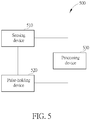
- a pulse diagnosis measurement device 500 may be a pulse diagnosis device, an electronic blood pressure monitor, a finger diagnosis device or other blood pressure wave measurement device.
- the pulse diagnosis measurement device 500 includes a sensing device 510, for sensing a blood pressure wave of an organism, to generate a first pulse signal.
- the pulse diagnosis measurement device 500 further includes a pulse-holding device 520, for applying a pressure on a pulse of the organism.
- the pulse diagnosis measurement device 500 further includes a processing device 530, for computing a pulse pressure according to the first pulse signal, and continuing adjusting the pressure of the pulse-holding device 520 until the pulse pressure is not increased, at which time the pressure of the pulse-holding device 520 has a most suitable pressure value.
- the processing device 530 further senses the blood pressure wave according to the most suitable pressure value, to generate a second pulse signal.
- the pulse-holding device 520 may include an air bag, and the pressure of the pulse-holding device 520 may be adjusted by controlling the amount of air inflated into the air bag.
- a magnitude of the pulse pressure is used for determining a suitable measurement state.
- the pulse pressure may be defined as a difference between a systolic blood pressure and a diastolic blood pressure.
- the processing device 530 continuously increases the pressure of the pulse-holding device 520, and detects a maximum value and a minimum value of each blood pressure wave of the first pulse signal measured by the sensor device 510. Then, the processing device 530 subtracts the maximum value and the minimum value to obtain the pulse pressure.
- the pressure of the pulse-holding device 520 is increased and the pulse pressure is not increased, a suitable measurement state is achieved.
- a pressure value applied by the pulse-holding device 520 to the maximum pulse pressure is the suitable pressure value, which represents a suitable resonance condition of the blood pressure wave, such that the pulse diagnosis measurement device 500 achieves the suitable measurement state.
- pulse diagnosis information of the second pulse signal generated is more accurate than that of the first pulse signal generated before the suitable measurement state is achieved.
- the processing device 530 further generates pulse diagnosis information of the organism according to the second pulse signal, wherein the pulse diagnosis information includes at least one of following information: a heart rate, a systolic blood pressure, a diastolic pressure and at least one harmonic of the blood pressure wave.
- the most suitable pressure value described above is the diastolic blood pressure, and at that time, the systolic blood pressure is a sum of the diastolic blood pressure and the pulse pressure.
- a pressure of the tourniquet is continuously increased until the pressure is greater than a systolic blood pressure to block a blood flow of an arterial, and the pressure of the tourniquet is decreased until a Korotkoff sound (corresponding samples of the Korotkoff sound in an electronic blood pressure monitor) exists, such that the systolic blood pressure and a diastolic blood pressure can be obtained.
- a Korotkoff sound corresponding samples of the Korotkoff sound in an electronic blood pressure monitor
- pressure values of the pulse-holding device 120 needed for harmonics of different frequencies are slightly different.
- a high frequency harmonic needs a higher pressure value
- a low frequency harmonic needs a lower pressure value.
- the processing device 530 senses the blood pressure wave according to the optimal pressure value
- the pressure of the pulse-holding device 520 is further adjusted according to a fine-tuned value to measure a specific harmonic (e.g., a fractional harmonic) of the blood pressure wave.
- the fine-tuned value is corresponding to a frequency of the specific harmonic.
- the pressure of the pulse-holding device 520 is reduced according to the fine-tuned value to measure the harmonic.
- the pressure of the pulse-holding device 520 is increased in according to the fine-tuned value to measure the harmonic.
- the resonance of the pulse-holding device 520 with the harmonic is improved and a better measurement result is obtained. For example, when performing a Fourier transform on the measured blood pressure wave, it is observed that an amplitude of a specific harmonic becomes larger or an area covered by a waveform of at least one cycle of the specific harmonic becomes larger.
- the abovementioned fine-tuned value may be determined or dynamically adjusted according to a result of the Fourier analysis on the blood pressure wave.
- the fine-tuned value may be selected (or dynamically adjusted to) such that the amplitude of the specific harmonic or the area covered by the waveform of the specific harmonic becomes larger.
- the amplitude of the specific harmonic H can be obtained from the result of the Fourier analysis on the blood pressure wave.
- a measurement state is the most appropriate measurement state when the amplitude of the harmonic H is maximized.
- the pressure of the pulse-holding device 520 has the most suitable pressure value for measuring the harmonic H.
- the fine-tuned value corresponding to the harmonic H can be obtained.
- the above method of determining the fine-tuned value according to the maximum amplitude of the harmonic may also be performed according to the maximum area of the harmonic (i.e., the area covered by the waveform of the at least one period is maximized).
- Fig. 6 is a flowchart of a process 60 according to the examples of the present invention.
- the process 60 states a pulse diagnosis measurement method performed by the pulse diagnosis measurement device 500, and includes the following steps: Step 600: Start.
- Step 602 The pulse-holding device 520 applies a pressure to a pulse of an organism.
- Step 604 The sensing device 510 senses a blood pressure wave of the organism, to generate a first pulse signal.
- Step 606 The processing device 530 computes a pulse pressure according to the first pulse signal.
- Step 610 The sensing device 510 senses the blood pressure wave according to the most suitable pressure value, to generate a second pulse signal.
- Step 612 End.
- the present invention further provides a pulse diagnosis analysis method, which can be applied to the pulse diagnosis measurement device 100 and the pulse diagnosis measurement device 500, or other pulse diagnosis devices such as a pulse instrument, an electronic blood pressure monitor, a finger diagnosis device, other blood wave measurement devices, etc. If the method is applied to the pulse diagnosis measurement device 100 (or the pulse diagnosis measurement device 500), a measurement of a blood pressure wave is performed by the sensing device 110 (or the sensing device 510) and the pulse-holding device 120 (or the pulse-holding device 520). The processing device 130 (or the processing device 530) performs subsequent data analysis and processing according to the measurement result.
- a pulse diagnosis analysis method which can be applied to the pulse diagnosis measurement device 100 and the pulse diagnosis measurement device 500, or other pulse diagnosis devices such as a pulse instrument, an electronic blood pressure monitor, a finger diagnosis device, other blood wave measurement devices, etc. If the method is applied to the pulse diagnosis measurement device 100 (or the pulse diagnosis measurement device 500), a measurement of a blood pressure wave is performed by the sensing device 110 (or the sensing device
- "a stable and good measurement” means that a premature contraction of a heart is filtered out from the blood pressure wave.
- the heart rate HR, the harmonic amplitudes An and the harmonic phase differences ⁇ n are averaged respectively to obtain means and standard deviations (SDs).
- SDs are divided by the averages to obtain variation coefficients which include a heart rate variation coefficient HRCV and variation coefficients of the harmonic amplitudes HCVn and variation coefficients of the harmonic phase differences HPCVn.
- the HCVn and the HPCVn are divided respectively by the HRCV, to obtain failure indices of the harmonic amplitudes and the harmonic phase differences.
- Failure indices of the harmonic amplitudes FIAn represent pathological conditions of a gas phase
- failure indices of the harmonic phase differences FIPn represent pathological conditions of a blood phase.
- HRCV HRV / HRM
- HRVM HRV * HRM .
- the HRCV and the HRVM in the equations (Eq.3) and (Eq.4) are related to a brain death.
- the failure indices of the harmonic amplitudes of the fundamental frequency and the 4-th harmonic (i.e., HCV1 and HCV4) and the failure indices of the harmonic phase differences of the fundamental frequency and the 4-th harmonic (i.e., HPCV1 and HPCV4) can be used for assisting the diagnosis and the treatment.
- Mean[An] and Mean[ ⁇ n] are average values of the harmonic amplitudes An and the harmonic phase differences ⁇ n, respectively.
- the heart rate HR, the harmonic amplitudes A(1/2 n ) and the harmonic phase differences ⁇ (1/2 n ) are averaged respectively to obtain means and a deviation.
- the deviation is divided by the means to obtain variation coefficients which include a heart rate variation coefficient HRCV and variation coefficients of harmonic amplitudes HCV(1/2 n ) and variation coefficient of harmonic phase differences HPCV(1/2 n ).
- the HCV(1/2 n ) and the HPCV(1/2 n ) are divided respectively by the HRCV, to obtain failure indices of the harmonic amplitudes and the harmonic phase differences.
- Failure indices of the harmonic amplitudes FIA(1/2 n ) represent pathological conditions of a gas phase
- failure indices of the harmonic phase differences FIP(1/2 n ) represent pathological conditions of a blood phase.
- Mean[A(1/2 n )] and Mean[ ⁇ (1/2 n )] are average values of the harmonic amplitudes A(1/2 n ) and the harmonic phase differences ⁇ (1/2 n ), respectively.
- a time interval T (e.g., within that a blood pressure is measured)
- low-frequency pathological matrices in each t consecutive seconds (a preferred value of t is 6) are averaged, and an averaged low-frequency pathological matrix Mean [Low f Pathological Matrix] is obtained.
- the time interval T may be determined according to a frequency of a harmonic (i.e., varies with n). For example, when n is larger, the time interval T needed is larger.
- Fig. 7 is a correspondence table of frequencies of harmonics f(1/2 n ) and the time interval T according to an example of the present invention.
- the correspondence table 70 illustrates the time interval T corresponding to each harmonic frequency f(1/2 n ).
- the pathological matrix and the low-frequency pathological matric can be combined to analyze basic conditions and variations of physiology, pathology, pharmacology and psychology of an organism.
- the above examples may be analyzed via artificial intelligence, and are served as a basis of a human interface platform.
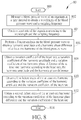
- Fig. 8 is a flowchart of a process 80 according to the examples of the present invention.
- the process 80 states a pulse diagnosis measurement method, and includes the following steps: Step 800: Start.
- Step 802 Measure a blood pressure wave of an organism in a time interval to obtain a wavelength of the blood pressure wave and a sampling frequency.
- Step 804 Obtain a heart rate of the organism according to the wavelength and the sampling frequency.
- Step 806 Perform a Fourier analysis on the blood pressure wave to obtain a harmonic amplitude and a harmonic phase difference of at least one harmonic of the blood pressure wave.
- Step 808 Obtain a variation coefficient of the heart rate, a variation coefficient of the harmonic amplitude and a variation coefficient of the harmonic phase difference of the at least one harmonic according to the heart rate, the harmonic amplitude and the harmonic phase difference.
- Step 810 Obtain a first failure index of the at least one harmonic according to the variation coefficient of the harmonic amplitude and the variation coefficient of the heart rate.
- Step 812 Obtain a second failure index of the at least one harmonic according to the variation coefficient of the harmonic phase difference and the variation coefficient of the heart rate.
- Step 814 End.
- the pulse diagnosis measurement device 100 or the pulse diagnosis measurement device 500 may be used at a user end to obtain pulse diagnosis data of a patient.
- the pulse diagnosis data is uploaded to the medical cloud, and is analyzed and diagnosed according to the pulse diagnosis analysis method in the present invention.
- prescription is generated according to results of the analysis and the diagnosis, and is provided to the user end to complete the medical procedure.
- the results of the analysis and the diagnosis and the prescription may be provided jointly, or only the prescription is provided.
- the present invention can be applied to condition monitoring.
- a condition monitoring system (including, e.g., the pulse diagnosis measurement device 100 or the pulse diagnosis measurement device 500) is designed to generate pulse diagnosis data of a patient, to perform a condition monitoring.
- An alert is issued when abnormal data are detected, e.g., a variation coefficient or a failure index of a specific harmonic is abnormal.
Landscapes
- Health & Medical Sciences (AREA)
- Life Sciences & Earth Sciences (AREA)
- Engineering & Computer Science (AREA)
- Physics & Mathematics (AREA)
- Medical Informatics (AREA)
- Biomedical Technology (AREA)
- Veterinary Medicine (AREA)
- Public Health (AREA)
- Biophysics (AREA)
- Pathology (AREA)
- General Health & Medical Sciences (AREA)
- Heart & Thoracic Surgery (AREA)
- Molecular Biology (AREA)
- Surgery (AREA)
- Animal Behavior & Ethology (AREA)
- Physiology (AREA)
- Cardiology (AREA)
- Vascular Medicine (AREA)
- Psychiatry (AREA)
- Signal Processing (AREA)
- Computer Vision & Pattern Recognition (AREA)
- Artificial Intelligence (AREA)
- Mathematical Physics (AREA)
- Ophthalmology & Optometry (AREA)
- Alternative & Traditional Medicine (AREA)
- Hematology (AREA)
- Computer Networks & Wireless Communication (AREA)
- Measuring Pulse, Heart Rate, Blood Pressure Or Blood Flow (AREA)
Priority Applications (1)
| Application Number | Priority Date | Filing Date | Title |
|---|---|---|---|
| EP20171508.3A EP3711659B1 (de) | 2018-06-11 | 2019-06-11 | Vorrichtung und verfahren zur pulsdiagnosemessung |
Applications Claiming Priority (1)
| Application Number | Priority Date | Filing Date | Title |
|---|---|---|---|
| US201862683626P | 2018-06-11 | 2018-06-11 |
Related Child Applications (2)
| Application Number | Title | Priority Date | Filing Date |
|---|---|---|---|
| EP20171508.3A Division-Into EP3711659B1 (de) | 2018-06-11 | 2019-06-11 | Vorrichtung und verfahren zur pulsdiagnosemessung |
| EP20171508.3A Division EP3711659B1 (de) | 2018-06-11 | 2019-06-11 | Vorrichtung und verfahren zur pulsdiagnosemessung |
Publications (4)
| Publication Number | Publication Date |
|---|---|
| EP3581101A2 true EP3581101A2 (de) | 2019-12-18 |
| EP3581101A3 EP3581101A3 (de) | 2020-01-22 |
| EP3581101B1 EP3581101B1 (de) | 2025-03-19 |
| EP3581101C0 EP3581101C0 (de) | 2025-03-19 |
Family
ID=67003177
Family Applications (2)
| Application Number | Title | Priority Date | Filing Date |
|---|---|---|---|
| EP19179313.2A Active EP3581101B1 (de) | 2018-06-11 | 2019-06-11 | Vorrichtung zur pulsdiagnosemessung |
| EP20171508.3A Active EP3711659B1 (de) | 2018-06-11 | 2019-06-11 | Vorrichtung und verfahren zur pulsdiagnosemessung |
Family Applications After (1)
| Application Number | Title | Priority Date | Filing Date |
|---|---|---|---|
| EP20171508.3A Active EP3711659B1 (de) | 2018-06-11 | 2019-06-11 | Vorrichtung und verfahren zur pulsdiagnosemessung |
Country Status (7)
| Country | Link |
|---|---|
| US (1) | US12097013B2 (de) |
| EP (2) | EP3581101B1 (de) |
| JP (2) | JP6831524B2 (de) |
| KR (1) | KR102266214B1 (de) |
| CN (1) | CN110575151B (de) |
| AU (2) | AU2019204074B2 (de) |
| TW (2) | TW202120010A (de) |
Families Citing this family (9)
| Publication number | Priority date | Publication date | Assignee | Title |
|---|---|---|---|---|
| CN110123270A (zh) * | 2019-04-02 | 2019-08-16 | 博脉有限公司 | 诊脉仪输出信号修正方法及系统 |
| US10623119B1 (en) * | 2019-09-09 | 2020-04-14 | Cisco Technology, Inc. | Dynamic location accuracy deviation system |
| CN111493823A (zh) * | 2020-03-23 | 2020-08-07 | 新绎健康科技有限公司 | 一种用于检测经络共振频率的装置及方法 |
| TWI759186B (zh) * | 2021-04-23 | 2022-03-21 | 友達光電股份有限公司 | 脈診裝置 |
| TWM625329U (zh) * | 2021-08-02 | 2022-04-01 | 當代漢雲企業有限公司 | 壓脈帶 |
| CN114652275B (zh) * | 2022-03-10 | 2025-05-23 | 福州九候生医科技有限公司 | 脉搏波数据处理方法及相关设备 |
| US20230363651A1 (en) * | 2022-05-13 | 2023-11-16 | Hon Hai Precision Industry Co., Ltd. | Data processing device and method |
| JP2024006108A (ja) | 2022-06-30 | 2024-01-17 | ミネベアミツミ株式会社 | 脈波測定装置の調整方法、脈波測定システム、及び脈波測定装置 |
| US20240285179A1 (en) * | 2023-02-23 | 2024-08-29 | Yu-Cheng Kuo | Device and Method for Pulse Diagnosis Measurement |
Family Cites Families (45)
| Publication number | Priority date | Publication date | Assignee | Title |
|---|---|---|---|---|
| US4776344A (en) * | 1985-02-28 | 1988-10-11 | Omron Tateisi Electronics Co. | Electronic blood pressure measuring device |
| JPS61199835A (ja) | 1985-03-01 | 1986-09-04 | オムロン株式会社 | 電子血圧計 |
| JPH06107B2 (ja) * | 1985-05-07 | 1994-01-05 | オムロン株式会社 | 電子血圧計 |
| US5730138A (en) | 1988-03-10 | 1998-03-24 | Wang; Wei-Kung | Method and apparatus for diagnosing and monitoring the circulation of blood |
| US4873987A (en) * | 1988-06-30 | 1989-10-17 | Ljubomir Djordjevich | Noninvasive continuous monitor of arterial blood pressure waveform |
| JP2664943B2 (ja) | 1988-08-08 | 1997-10-22 | コーリン電子株式会社 | 圧脈波検出装置の異常判定装置 |
| JP2702297B2 (ja) | 1991-03-07 | 1998-01-21 | テルモ株式会社 | 自動血圧計 |
| JPH04367648A (ja) * | 1991-06-14 | 1992-12-18 | Colleen Denshi Kk | 血圧監視装置 |
| JP2979933B2 (ja) | 1993-08-03 | 1999-11-22 | セイコーエプソン株式会社 | 脈波解析装置 |
| CN1154432C (zh) * | 1995-11-01 | 2004-06-23 | 精工爱普生株式会社 | 用于测量生理状态的装置 |
| DE69832782T2 (de) * | 1997-11-20 | 2006-09-21 | Seiko Epson Corp. | Vorrichtung zur pulswellenuntersuchung |
| TW436302B (en) * | 1998-06-17 | 2001-05-28 | Wang Wei Gung | Stimulation device synchronous with heartbeats |
| SG94349A1 (en) * | 2000-10-09 | 2003-02-18 | Healthstats Int Pte Ltd | Method and device for monitoring blood pressure |
| TW563846U (en) * | 2002-03-29 | 2003-11-21 | Chian Shiue Ching | Compound type heat dissipation member |
| CN100464175C (zh) * | 2002-12-30 | 2009-02-25 | 赵亮 | 金属膜式脉冲输出型钢体弹性微变量传感器及其测量方法 |
| CN100367908C (zh) * | 2003-11-13 | 2008-02-13 | 李士春 | 中医脉诊传感系统 |
| TW200633682A (en) * | 2005-03-25 | 2006-10-01 | Wei-Kung Wang | A device for detecting chaotic physiological phenomena |
| US20070163353A1 (en) * | 2005-12-07 | 2007-07-19 | Drexel University | Detection of blood pressure and blood pressure waveform |
| TWM325098U (en) * | 2007-04-03 | 2008-01-11 | Ching-Sung Weng | Cardiovascular analytical system |
| CN101310676A (zh) * | 2007-05-24 | 2008-11-26 | 国立中国医药研究所 | 中医脉诊的分析系统与方法 |
| JP2008295517A (ja) * | 2007-05-29 | 2008-12-11 | National Research Inst Of Chinese Medicine | 漢方医における脈診の分析システムと方法 |
| CN101371779B (zh) * | 2007-08-24 | 2011-08-03 | 柳竹 | 中医脉象生理信息的一种提取方法 |
| US8556821B2 (en) * | 2008-02-20 | 2013-10-15 | General Electric Company | Adaptive frequency domain filtering for improved non-invasive blood pressure estimation |
| AU2014233568B2 (en) * | 2008-06-26 | 2016-06-16 | Gambro Lundia Ab | Method and device for processing a time-dependent measurement signal |
| KR101604078B1 (ko) | 2009-05-22 | 2016-03-17 | 삼성전자주식회사 | 저가압 혈압 측정 장치 및 방법 |
| US8740803B2 (en) * | 2010-03-23 | 2014-06-03 | General Electric Company | Use of the frequency spectrum of artifact in oscillometry |
| GB201011367D0 (en) * | 2010-07-06 | 2010-08-18 | Medical Res Council | Methods |
| JP5732692B2 (ja) | 2010-08-02 | 2015-06-10 | セイコーエプソン株式会社 | 血圧検出装置及び血圧検出方法 |
| KR20120021098A (ko) | 2010-08-31 | 2012-03-08 | 상지대학교산학협력단 | 맥파의 주파수 영역 분석을 이용한 혈관노화 평가방법 |
| CN101982156B (zh) * | 2010-09-08 | 2012-05-16 | 北京航空航天大学 | 基于微泡超声造影剂的血压无创测量装置 |
| CN102144916B (zh) * | 2011-04-21 | 2013-01-23 | 华东理工大学 | 一种可自动调压的多通道脉搏信号检测方法及装置 |
| CN202365763U (zh) * | 2011-09-27 | 2012-08-08 | 浙江师范大学 | 一种基于脉象频谱分析的穿戴式无线脉诊仪系统 |
| TWI529537B (zh) * | 2013-06-04 | 2016-04-11 | 晨星半導體股份有限公司 | 具有移動高畫質連接埠之顯示器及其信號處理方法 |
| WO2016029166A1 (en) * | 2014-08-22 | 2016-02-25 | Thomas Adrian Furness, Iii | Automated diagnosis based at least in part on pulse waveforms |
| CN204971219U (zh) * | 2015-08-26 | 2016-01-20 | 李嘉桓 | 具有生物信号采集、放大、谐波、共振电路的装置 |
| TWI622389B (zh) | 2015-09-16 | 2018-05-01 | 可對應中醫人體經絡產生氣血共振的系統 | |
| JP2017106786A (ja) * | 2015-12-09 | 2017-06-15 | 東亜非破壊検査株式会社 | 可搬式高調波非破壊検査装置 |
| US20170181649A1 (en) * | 2015-12-28 | 2017-06-29 | Amiigo, Inc. | Systems and Methods for Determining Blood Pressure |
| WO2017136772A1 (en) * | 2016-02-03 | 2017-08-10 | Angilytics Inc. | Non-invasive and non-occlusive blood pressure monitoring devices and methods |
| WO2017147609A1 (en) * | 2016-02-25 | 2017-08-31 | Echo Labs, Inc. | Systems and methods for modified pulse transit time measurement |
| JP6680155B2 (ja) | 2016-09-12 | 2020-04-15 | オムロンヘルスケア株式会社 | 血圧測定装置、血圧測定装置の制御方法およびプログラム |
| RU2750352C2 (ru) * | 2016-09-22 | 2021-06-28 | Конинклейке Филипс Н.В. | Сенсорное устройство и способ измерения физиологического параметра |
| US20190111298A1 (en) * | 2017-04-14 | 2019-04-18 | Robert Tremaine Whalen | Belt pre-tensioning and positioning system for training a muscle |
| US10940324B2 (en) * | 2017-05-03 | 2021-03-09 | West Affum Holdings Corp. | Wearable cardioverter defibrillator (WCD) system computing heart rate from noisy ECG signal |
| CN107397542B (zh) * | 2017-09-15 | 2020-12-18 | 中国科学院重庆绿色智能技术研究院 | 一种基于脉搏波传感器的动态血压监测穿戴式设备及监测方法 |
-
2019
- 2019-06-06 TW TW109137567A patent/TW202120010A/zh unknown
- 2019-06-06 TW TW108119720A patent/TWI731339B/zh active
- 2019-06-10 US US16/435,578 patent/US12097013B2/en active Active
- 2019-06-11 AU AU2019204074A patent/AU2019204074B2/en active Active
- 2019-06-11 KR KR1020190068891A patent/KR102266214B1/ko active Active
- 2019-06-11 JP JP2019108791A patent/JP6831524B2/ja active Active
- 2019-06-11 EP EP19179313.2A patent/EP3581101B1/de active Active
- 2019-06-11 EP EP20171508.3A patent/EP3711659B1/de active Active
- 2019-06-11 CN CN201910499545.4A patent/CN110575151B/zh active Active
-
2020
- 2020-10-19 JP JP2020175321A patent/JP7174959B2/ja active Active
-
2021
- 2021-05-04 AU AU2021202795A patent/AU2021202795B2/en active Active
Non-Patent Citations (1)
| Title |
|---|
| WILLIAM CRAELIUS ET AL: "Rhythm Analysis of Arterial Blood Pressure", IEEE TRANSACTIONS ON BIOMEDICAL ENGINEERING, IEEE, USA, vol. BME-19, no. 12, 1 December 1986 (1986-12-01), pages 1166 - 1172, XP011173883, ISSN: 0018-9294 * |
Also Published As
| Publication number | Publication date |
|---|---|
| TW202120010A (zh) | 2021-06-01 |
| KR20190140418A (ko) | 2019-12-19 |
| JP2021006291A (ja) | 2021-01-21 |
| JP6831524B2 (ja) | 2021-02-17 |
| AU2019204074B2 (en) | 2021-03-25 |
| US12097013B2 (en) | 2024-09-24 |
| TW202000126A (zh) | 2020-01-01 |
| CN110575151A (zh) | 2019-12-17 |
| JP2019213861A (ja) | 2019-12-19 |
| AU2021202795A1 (en) | 2021-06-03 |
| EP3581101B1 (de) | 2025-03-19 |
| AU2021202795B2 (en) | 2023-05-18 |
| TWI731339B (zh) | 2021-06-21 |
| US20190374112A1 (en) | 2019-12-12 |
| EP3711659C0 (de) | 2025-09-17 |
| EP3711659A1 (de) | 2020-09-23 |
| EP3581101A3 (de) | 2020-01-22 |
| KR102266214B1 (ko) | 2021-06-17 |
| EP3711659B1 (de) | 2025-09-17 |
| JP7174959B2 (ja) | 2022-11-18 |
| CN110575151B (zh) | 2022-11-22 |
| EP3581101C0 (de) | 2025-03-19 |
| AU2019204074A1 (en) | 2020-06-11 |
Similar Documents
| Publication | Publication Date | Title |
|---|---|---|
| EP3581101B1 (de) | Vorrichtung zur pulsdiagnosemessung | |
| JP3703496B2 (ja) | 誘発された摂動を測定して生理学的パラメータを測定するための装置および方法 | |
| EP1478269B1 (de) | Verfahren und gerät für die nichtinvasive messung von hämodynamischen parametern mit hilfe von parametrik | |
| EP1970000B1 (de) | Verfahren und Vorrichtung zur manschettenlosen und nicht-invasiven Messung des Handgelenkblutdrucks in Zusammenhang mit einem Kommunikationsgerät | |
| US6293915B1 (en) | Pulse wave examination apparatus, blood pressure monitor, pulse waveform monitor, and pharmacological action monitor | |
| KR101798495B1 (ko) | 웨어러블 손목 혈압계 | |
| JPH09506024A (ja) | 誘発された摂動を測定して生理学的パラメータを測定するための装置および方法 | |
| EP3457929B1 (de) | Nichtinvasives system und verfahren zur messung der blutdruckvariabilität | |
| JPH09135819A (ja) | 健康状態管理装置 | |
| JP7327816B2 (ja) | 脈波信号の解析装置、脈波信号の解析方法およびコンピュータプログラム | |
| US20220218217A1 (en) | Blood pressure measurement system and blood pressure measurement method using the same | |
| JP2009153843A (ja) | 血圧測定装置 | |
| KR20200107157A (ko) | 혈압 측정 시스템 및 이를 이용한 혈압 측정 방법 | |
| JPH06343638A (ja) | 生体の循環機能監視装置 |
Legal Events
| Date | Code | Title | Description |
|---|---|---|---|
| PUAI | Public reference made under article 153(3) epc to a published international application that has entered the european phase |
Free format text: ORIGINAL CODE: 0009012 |
|
| STAA | Information on the status of an ep patent application or granted ep patent |
Free format text: STATUS: THE APPLICATION HAS BEEN PUBLISHED |
|
| AK | Designated contracting states |
Kind code of ref document: A2 Designated state(s): AL AT BE BG CH CY CZ DE DK EE ES FI FR GB GR HR HU IE IS IT LI LT LU LV MC MK MT NL NO PL PT RO RS SE SI SK SM TR |
|
| AX | Request for extension of the european patent |
Extension state: BA ME |
|
| PUAL | Search report despatched |
Free format text: ORIGINAL CODE: 0009013 |
|
| AK | Designated contracting states |
Kind code of ref document: A3 Designated state(s): AL AT BE BG CH CY CZ DE DK EE ES FI FR GB GR HR HU IE IS IT LI LT LU LV MC MK MT NL NO PL PT RO RS SE SI SK SM TR |
|
| AX | Request for extension of the european patent |
Extension state: BA ME |
|
| RIC1 | Information provided on ipc code assigned before grant |
Ipc: A61B 5/00 20060101ALI20191213BHEP Ipc: A61B 5/021 20060101AFI20191213BHEP |
|
| STAA | Information on the status of an ep patent application or granted ep patent |
Free format text: STATUS: REQUEST FOR EXAMINATION WAS MADE |
|
| 17P | Request for examination filed |
Effective date: 20200722 |
|
| RBV | Designated contracting states (corrected) |
Designated state(s): AL AT BE BG CH CY CZ DE DK EE ES FI FR GB GR HR HU IE IS IT LI LT LU LV MC MK MT NL NO PL PT RO RS SE SI SK SM TR |
|
| STAA | Information on the status of an ep patent application or granted ep patent |
Free format text: STATUS: EXAMINATION IS IN PROGRESS |
|
| 17Q | First examination report despatched |
Effective date: 20210421 |
|
| GRAP | Despatch of communication of intention to grant a patent |
Free format text: ORIGINAL CODE: EPIDOSNIGR1 |
|
| STAA | Information on the status of an ep patent application or granted ep patent |
Free format text: STATUS: GRANT OF PATENT IS INTENDED |
|
| INTG | Intention to grant announced |
Effective date: 20241122 |
|
| GRAS | Grant fee paid |
Free format text: ORIGINAL CODE: EPIDOSNIGR3 |
|
| GRAA | (expected) grant |
Free format text: ORIGINAL CODE: 0009210 |
|
| STAA | Information on the status of an ep patent application or granted ep patent |
Free format text: STATUS: THE PATENT HAS BEEN GRANTED |
|
| AK | Designated contracting states |
Kind code of ref document: B1 Designated state(s): AL AT BE BG CH CY CZ DE DK EE ES FI FR GB GR HR HU IE IS IT LI LT LU LV MC MK MT NL NO PL PT RO RS SE SI SK SM TR |
|
| REG | Reference to a national code |
Ref country code: GB Ref legal event code: FG4D |
|
| REG | Reference to a national code |
Ref country code: CH Ref legal event code: EP |
|
| REG | Reference to a national code |
Ref country code: IE Ref legal event code: FG4D |
|
| REG | Reference to a national code |
Ref country code: DE Ref legal event code: R096 Ref document number: 602019067396 Country of ref document: DE |
|
| U01 | Request for unitary effect filed |
Effective date: 20250410 |
|
| U07 | Unitary effect registered |
Designated state(s): AT BE BG DE DK EE FI FR IT LT LU LV MT NL PT RO SE SI Effective date: 20250417 |
|
| PG25 | Lapsed in a contracting state [announced via postgrant information from national office to epo] |
Ref country code: RS Free format text: LAPSE BECAUSE OF FAILURE TO SUBMIT A TRANSLATION OF THE DESCRIPTION OR TO PAY THE FEE WITHIN THE PRESCRIBED TIME-LIMIT Effective date: 20250619 |
|
| PG25 | Lapsed in a contracting state [announced via postgrant information from national office to epo] |
Ref country code: NO Free format text: LAPSE BECAUSE OF FAILURE TO SUBMIT A TRANSLATION OF THE DESCRIPTION OR TO PAY THE FEE WITHIN THE PRESCRIBED TIME-LIMIT Effective date: 20250619 |
|
| PG25 | Lapsed in a contracting state [announced via postgrant information from national office to epo] |
Ref country code: HR Free format text: LAPSE BECAUSE OF FAILURE TO SUBMIT A TRANSLATION OF THE DESCRIPTION OR TO PAY THE FEE WITHIN THE PRESCRIBED TIME-LIMIT Effective date: 20250319 |
|
| PG25 | Lapsed in a contracting state [announced via postgrant information from national office to epo] |
Ref country code: GR Free format text: LAPSE BECAUSE OF FAILURE TO SUBMIT A TRANSLATION OF THE DESCRIPTION OR TO PAY THE FEE WITHIN THE PRESCRIBED TIME-LIMIT Effective date: 20250620 |
|
| U20 | Renewal fee for the european patent with unitary effect paid |
Year of fee payment: 7 Effective date: 20250628 |
|
| PG25 | Lapsed in a contracting state [announced via postgrant information from national office to epo] |
Ref country code: SM Free format text: LAPSE BECAUSE OF FAILURE TO SUBMIT A TRANSLATION OF THE DESCRIPTION OR TO PAY THE FEE WITHIN THE PRESCRIBED TIME-LIMIT Effective date: 20250319 |
|
| PG25 | Lapsed in a contracting state [announced via postgrant information from national office to epo] |
Ref country code: ES Free format text: LAPSE BECAUSE OF FAILURE TO SUBMIT A TRANSLATION OF THE DESCRIPTION OR TO PAY THE FEE WITHIN THE PRESCRIBED TIME-LIMIT Effective date: 20250319 |
|
| PG25 | Lapsed in a contracting state [announced via postgrant information from national office to epo] |
Ref country code: PL Free format text: LAPSE BECAUSE OF FAILURE TO SUBMIT A TRANSLATION OF THE DESCRIPTION OR TO PAY THE FEE WITHIN THE PRESCRIBED TIME-LIMIT Effective date: 20250319 |
|
| PG25 | Lapsed in a contracting state [announced via postgrant information from national office to epo] |
Ref country code: CZ Free format text: LAPSE BECAUSE OF FAILURE TO SUBMIT A TRANSLATION OF THE DESCRIPTION OR TO PAY THE FEE WITHIN THE PRESCRIBED TIME-LIMIT Effective date: 20250319 |
|
| PG25 | Lapsed in a contracting state [announced via postgrant information from national office to epo] |
Ref country code: SK Free format text: LAPSE BECAUSE OF FAILURE TO SUBMIT A TRANSLATION OF THE DESCRIPTION OR TO PAY THE FEE WITHIN THE PRESCRIBED TIME-LIMIT Effective date: 20250319 |
|
| PG25 | Lapsed in a contracting state [announced via postgrant information from national office to epo] |
Ref country code: IS Free format text: LAPSE BECAUSE OF FAILURE TO SUBMIT A TRANSLATION OF THE DESCRIPTION OR TO PAY THE FEE WITHIN THE PRESCRIBED TIME-LIMIT Effective date: 20250719 |