EP3575749B1 - Optisches messinstrument - Google Patents
Optisches messinstrument Download PDFInfo
- Publication number
- EP3575749B1 EP3575749B1 EP19174201.4A EP19174201A EP3575749B1 EP 3575749 B1 EP3575749 B1 EP 3575749B1 EP 19174201 A EP19174201 A EP 19174201A EP 3575749 B1 EP3575749 B1 EP 3575749B1
- Authority
- EP
- European Patent Office
- Prior art keywords
- patterns
- readers
- pattern
- color
- digit
- Prior art date
- Legal status (The legal status is an assumption and is not a legal conclusion. Google has not performed a legal analysis and makes no representation as to the accuracy of the status listed.)
- Active
Links
Images









Classifications
-
- G—PHYSICS
- G01—MEASURING; TESTING
- G01B—MEASURING LENGTH, THICKNESS OR SIMILAR LINEAR DIMENSIONS; MEASURING ANGLES; MEASURING AREAS; MEASURING IRREGULARITIES OF SURFACES OR CONTOURS
- G01B11/00—Measuring arrangements characterised by the use of optical techniques
- G01B11/02—Measuring arrangements characterised by the use of optical techniques for measuring length, width or thickness
- G01B11/04—Measuring arrangements characterised by the use of optical techniques for measuring length, width or thickness specially adapted for measuring length or width of objects while moving
- G01B11/043—Measuring arrangements characterised by the use of optical techniques for measuring length, width or thickness specially adapted for measuring length or width of objects while moving for measuring length
-
- G—PHYSICS
- G01—MEASURING; TESTING
- G01D—MEASURING NOT SPECIALLY ADAPTED FOR A SPECIFIC VARIABLE; ARRANGEMENTS FOR MEASURING TWO OR MORE VARIABLES NOT COVERED IN A SINGLE OTHER SUBCLASS; TARIFF METERING APPARATUS; MEASURING OR TESTING NOT OTHERWISE PROVIDED FOR
- G01D5/00—Mechanical means for transferring the output of a sensing member; Means for converting the output of a sensing member to another variable where the form or nature of the sensing member does not constrain the means for converting; Transducers not specially adapted for a specific variable
- G01D5/26—Mechanical means for transferring the output of a sensing member; Means for converting the output of a sensing member to another variable where the form or nature of the sensing member does not constrain the means for converting; Transducers not specially adapted for a specific variable characterised by optical transfer means, i.e. using infrared, visible, or ultraviolet light
- G01D5/32—Mechanical means for transferring the output of a sensing member; Means for converting the output of a sensing member to another variable where the form or nature of the sensing member does not constrain the means for converting; Transducers not specially adapted for a specific variable characterised by optical transfer means, i.e. using infrared, visible, or ultraviolet light with attenuation or whole or partial obturation of beams of light
- G01D5/34—Mechanical means for transferring the output of a sensing member; Means for converting the output of a sensing member to another variable where the form or nature of the sensing member does not constrain the means for converting; Transducers not specially adapted for a specific variable characterised by optical transfer means, i.e. using infrared, visible, or ultraviolet light with attenuation or whole or partial obturation of beams of light the beams of light being detected by photocells
- G01D5/347—Mechanical means for transferring the output of a sensing member; Means for converting the output of a sensing member to another variable where the form or nature of the sensing member does not constrain the means for converting; Transducers not specially adapted for a specific variable characterised by optical transfer means, i.e. using infrared, visible, or ultraviolet light with attenuation or whole or partial obturation of beams of light the beams of light being detected by photocells using displacement encoding scales
- G01D5/34776—Absolute encoders with analogue or digital scales
- G01D5/34792—Absolute encoders with analogue or digital scales with only digital scales or both digital and incremental scales
-
- G—PHYSICS
- G01—MEASURING; TESTING
- G01B—MEASURING LENGTH, THICKNESS OR SIMILAR LINEAR DIMENSIONS; MEASURING ANGLES; MEASURING AREAS; MEASURING IRREGULARITIES OF SURFACES OR CONTOURS
- G01B5/00—Measuring arrangements characterised by the use of mechanical techniques
- G01B5/02—Measuring arrangements characterised by the use of mechanical techniques for measuring length, width or thickness
-
- G—PHYSICS
- G06—COMPUTING OR CALCULATING; COUNTING
- G06K—GRAPHICAL DATA READING; PRESENTATION OF DATA; RECORD CARRIERS; HANDLING RECORD CARRIERS
- G06K7/00—Methods or arrangements for sensing record carriers, e.g. for reading patterns
- G06K7/10—Methods or arrangements for sensing record carriers, e.g. for reading patterns by electromagnetic radiation, e.g. optical sensing; by corpuscular radiation
- G06K7/12—Methods or arrangements for sensing record carriers, e.g. for reading patterns by electromagnetic radiation, e.g. optical sensing; by corpuscular radiation using a selected wavelength, e.g. to sense red marks and ignore blue marks
-
- G—PHYSICS
- G06—COMPUTING OR CALCULATING; COUNTING
- G06K—GRAPHICAL DATA READING; PRESENTATION OF DATA; RECORD CARRIERS; HANDLING RECORD CARRIERS
- G06K7/00—Methods or arrangements for sensing record carriers, e.g. for reading patterns
- G06K7/10—Methods or arrangements for sensing record carriers, e.g. for reading patterns by electromagnetic radiation, e.g. optical sensing; by corpuscular radiation
- G06K7/14—Methods or arrangements for sensing record carriers, e.g. for reading patterns by electromagnetic radiation, e.g. optical sensing; by corpuscular radiation using light without selection of wavelength, e.g. sensing reflected white light
- G06K7/1404—Methods for optical code recognition
- G06K7/1408—Methods for optical code recognition the method being specifically adapted for the type of code
- G06K7/1426—Multi-level bar codes
-
- G—PHYSICS
- G06—COMPUTING OR CALCULATING; COUNTING
- G06K—GRAPHICAL DATA READING; PRESENTATION OF DATA; RECORD CARRIERS; HANDLING RECORD CARRIERS
- G06K19/00—Record carriers for use with machines and with at least a part designed to carry digital markings
- G06K19/06—Record carriers for use with machines and with at least a part designed to carry digital markings characterised by the kind of the digital marking, e.g. shape, nature, code
- G06K19/06009—Record carriers for use with machines and with at least a part designed to carry digital markings characterised by the kind of the digital marking, e.g. shape, nature, code with optically detectable marking
- G06K19/06037—Record carriers for use with machines and with at least a part designed to carry digital markings characterised by the kind of the digital marking, e.g. shape, nature, code with optically detectable marking multi-dimensional coding
Definitions
- the present invention relates to a measuring instrument.
- a clerk When cloths are made or resized in a clothing store, a clerk generally measures dimensions of the cloths using a measure. The clerk enters the measurement data in a dimension sheet of each customer by hand, and then manually inputs the measurement data to a terminal of the store. In this case, the work for entering the measurement data in the dimension sheet and the work for inputting the measurement data to the terminal are required, and therefore double labors occur.
- the apparatus includes: a transmitter that has a measure measuring the dimensions of a measurement object, and transmits the measurement data; and a measure signal receiver and recorder that receives a signal including the measurement data transmitted from the transmitter and prints the measurement data.
- a binary code comprised of white dots and black dots printed on the measure is read optically by a reader, the read data is decoded, and the decoded data is transmitted to the receiver and recorder.
- Patent Document 2 Japanese Laid-open Patent Publication No. 2009-75013
- Patent Document 3 Japanese Laid-open Patent Publication No. 5-272916
- An optical position encoder disclosed in EP0560520A1 comprises an encoded device for mounting to an element the position of which is to be monitored, the encoded device comprising a plurality of parallel tracks each consisting of a plurality of coloured squares.
- An optical sensing head extending transverse to the tracks provides an output representative of the colour being sensed on each respective track.
- the outputs are connected to a decoder comprising a look-up table so that the position of the element can be determined according to the combination of colours being sensed.
- DE202004008829U1 discloses an optoelectronic absolute angle indicator having a fine positioning track whose angle graduation has a maximized resolution relative to the base position track. It comprises equal-size transparent and opaque fields, i.e. dark and light fields. The fine position is detected using a fine position opening in a shutter element.
- a measuring instrument according to the present invention is defined in claim.
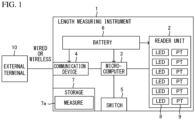
- FIG. 1 is a diagram illustrating the configuration of a length measuring instrument according to a present embodiment.
- the length measuring instrument may be used in a clothing store, but may be used for any other purposes.
- a length measuring instrument (hereinafter referred to as "a measuring instrument") 1 includes: a reader unit 2 that reads a color pattern from a measure 7a having multi-digit color patterns; a microcomputer 3 as a measuring means that calculates a length of a measurement object from data read by the reader unit 2; a communication device 4 that transmits data of the calculated length of the measurement object to an external terminal 10 by wired or wireless communication; a switch 5 that instructs the start of the measurement to the microcomputer 3; a battery 6 that supplies an electric power to the reader unit 2, the microcomputer 3 and the communication device 4; and a storage 7 that stores the measure 7a.
- the measuring instrument 1 and the external terminal 10, or the measuring instrument 1 alone, may configure a measuring system for measuring and determining a length of measurement subject.
- the measuring instrument 1 may perform functions of the external terminal 10 that are described herein.
- the measuring system may further include other devices such as a server, a storage device, or any type of communication devices.
- the measuring system may have functions for storing measured lengths, or processing the measured lengths for certain purposes such as making clothes for example. These functions are realized by executing software in the external terminal 10 or other devices.
- the reader unit 2 includes: light emitting diodes (LEDs) 8 each of which irradiates the color pattern with a light; and phototransistors (PTs) 9 each of which receives a reflection light from the color pattern, and converts it into a current or voltage with a value corresponding to a receiving light amount.
- the LED 8 is irradiated with light, including infrared, a visible light and an ultraviolet light.
- the PT 9 receives the light reflected by the color pattern.
- a set of the LED 8 and the PT 9 corresponds to the reader unit described later.
- the LED 8 is used as a light emitting element, and the PT 9 is used as a light receiving element. However, a light emitting element other than the LED 8 may be used, and a light receiving element other than the PT 9 may be used.
- the microcomputer 3 is a processor such as a central processing unit (CPU).
- the microcomputer 3 controls on/off of the LED 8, and reads the current value or voltage value of the output from the PT 9. Since the reflectivities are different by the colors of the color patterns, and the light receiving amount of the PT 9 varies depending on the reflectivities, the microcomputer 3 is capable of determining the color by the current value or voltage value output from the PT 9. When the voltage values output from the PT 9 are 2.0V, 1.5V and 1.0V, for example, the microcomputer 3 determines that the colors of the color pattern are white, blue and black, respectively.
- the base N number Gray code is described later.
- the same color with N different concentrations may be used, for example.
- the differences in such concentrations of the color pattern are also treated as "different colors”.
- the storage 7 is removably attached to a housing of the measuring instrument 1.
- the measure 7a is housed in the storage 7.
- a measure may not be stored in storage or in a measuring instrument, as long as the measuring instrument can read color patterns on the measure.
- a measuring instrument may have a slit for slidably passing a measure.
- the external terminal 10 is a terminal device such as a computer or smart phone having a wired or wireless communication function, receives the data of the length of the measurement object from the communication device 4, and registers and manages the data in the database.
- the database for registering the data of the length may be incorporated in the external terminal 10, or may be provided outside of the external terminal 10 in an accessible state. Further, softwares for processing the measured length may be stored in the external terminal 10 or in any other device in which the external terminal 10 is accessible.
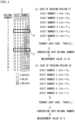
- FIG. 2 is a diagram illustrating a reading processing of a color pattern of a ternary number.
- a color pattern 11 of the ternary number is composed of 6 digits, and three colors of white, blue and black are adopted as colors corresponding to ternary values "0", "1" and "2", respectively.
- the reflectivity is high in order of white, blue and black.
- Each line of the ternary color pattern 11 corresponds to certain decimal number as illustrated in FIG. 2 , and each decimal number corresponds to a certain length.
- the decimal numbers are arranged in an ascending order, but the decimal numbers may be arranged in a descending order, for example.
- a voltage value output from the PT 9 is analog data. It is assumed that, when white, blue and black are read, voltage values output from the PT 9 are 2.0V, 1.5V and 1.0V, respectively.
- a single set of the LED 8 and the PT 9 is assigned so as to read a single digit pattern of the color pattern 11.
- At least six sets of the LED 8 and the PT 9 are provided in the measuring instruments 1.
- each of the PTs 9 corresponding to white digit numbers 1 to 3 outputs 2.0V
- each of the PTs 9 corresponding to blue digit numbers 4 and 6 outputs 1.5V
- the PT 9 corresponding to black digit number 5 outputs 1.0V.
- the microcomputer 3 determines the color of each digit based on the voltage value output from each of the PT 9, and converts the color into a corresponding ternary value. In an example of FIG. 2 , the pattern in the region 21 is converted into a ternary value "000121".
- the microcomputer 3 calculates a length of a measurement object by converting the ternary value "000121" into a decimal value.
- the ternary value "000121” is converted into a decimal value "16", and may be further converted into a certain length corresponds to the decimal number "16".
- the read ternary value may be directly converted into a certain length data without converting into a decimal value.
- the value calculated from the reading result of the region 21 is identical with the value assigned to the region 21.
- the color pattern 11 is read across two adjacent lines, a line corresponds to a decimal number "8" and a line corresponds to a decimal number "9".
- each of the PTs 9 corresponding to the digit numbers 1 to 3 in which both lines are white outputs 2.0V.
- the PT 9 corresponding to the digit number 4 in which one line is white and the other line is blue may output 1.75V, that is in the middle of 2.0V and 1.5V
- each of the PTs 9 corresponding to the digit numbers 5 and 6 in which one line is white and the other line is black may output 1.5V, that is in the middle of 2.0V and 1.0V, for example.
- an intermediate value of colors of adjacent upper and lower patterns is output from the PT 9 when each PT 9 is located at the boundary of two lines in the color pattern 11 and reads the color patterns of the two lines.
- the voltage values of "2.0V, 2.0V, 2.0V, 1.75V, 1.5V, 1.5V" corresponding to the digit numbers 1 to 6 are output from the PTs 9 in the described example. Since each of the output voltage values of the digit numbers 5 and 6 corresponds to a voltage value when the blue color pattern is read, the microcomputer 3 recognizes that the color pattern corresponding to the value "1" has been read for the digit numbers 5 and 6. On the other hand, since the output voltage value of the digit number 4 is just the middle of voltages 2.0V corresponding to the white color pattern and 1.5V corresponding to the blue color pattern, the microcomputer 3 cannot determine whether either value "0" or "1" has been read.
- the microcomputer 3 may convert the read pattern of the region 22 into either the ternary value "000011” or "000111” based on the voltage value from each PT9, and converts the ternary value into a decimal value to calculate the length of the measurement object.
- the ternary value "000011” or "000111” is not identical with both of the values "000022" and "000100” located in the region 22.
- the decimal value "4" or “13” corresponding to the ternary value "000011” or "000111” is not the same as the decimal value "8" or "9” corresponding to two lines of region 22.
- the measured length calculated by the microcomputer 3 is not identical with the actual length of the measurement object, and an error occurs in the reading.
- a reading error may occur at the boundary of the color pattern 11.
- FIG. 3A is a diagram illustrating an example of the color pattern of the ternary number explained in FIG. 2 .
- FIG. 3B is a diagram illustrating an example of another color pattern 12 by a ternary Gray code.
- the color change in which a change of the colors between the adjacent upper and lower color patterns, occurs in a plurality of digits, as indicated in the regions 23 to 25 of FIG. 3A .
- the color change occurs in two digits, the digit numbers 5 and 6.
- the color change occurs in three digits, the digit numbers 4 to 6.
- FIG. 4 is a diagram illustrating a reading processing of the color pattern 12 by the ternary Gray code.
- each of the PTs 9 corresponding to white digit numbers 1 to 3 outputs 2.0V
- each of the PTs 9 corresponding to blue digit numbers 4 and 6 outputs 1.5V
- the PT 9 corresponding to black digit number 5 outputs 1.0V.
- the microcomputer 3 determines the color of each digit based on the voltage value from each PT 9, and converts the read color into the corresponding ternary value. From a pattern of the region 27 of FIG. 4 , a ternary value "000121" is obtained.
- the microcomputer 3 converts the ternary value "000121" into a decimal value to calculate the length of the measurement object.
- the ternary value "000121” is converted into a decimal number "10", by referring to a table showing a relationship between the ternary number and the decimal number, for instance. Since the region 27 corresponds to the decimal number "10", the length of the measurement object is identical with the length indicated by the measure 7a.
- each of the PTs 9 corresponding to the digit numbers 1 to 4 in which upper and lower patterns are white outputs 2.0V
- the PT 9 corresponding to the digit number 6 in which one line is black and the other line is white may output 1.5V.
- the microcomputer 3 may determine that the ternary Gray code corresponding to the region 28 is "000011” based on the output voltage value from the PTs 9.
- the microcomputer 3 converts the ternary value "000011” into a decimal value "5" to calculate the length of the measurement object.
- the color patterns "000012" and "000010" located in the region 28 correspond to decimal values "3" and "4", and therefore they are not identical with the decimal number "5" calculated by the microcomputer 3.
- the reason why the error occurs even when the color pattern 12 by the ternary Gray code illustrated in FIG. 4 is used is that a binary change occurs in the digits of the upper and lower patterns adjacent to the boundary of the color pattern 12.
- the binary change means that a difference between values of the same digit of the upper and lower patterns is 2 or more, i.e., means that there is a change of white and black in the color pattern 12 of FIG. 4 .
- the PT 9 corresponding to the digit number 6 may output 1.5V, which is the same as an output voltage value of the PT 9 when the blue pattern is read, and therefore the microcomputer 3 determines the color of the digit number 6 as the blue. For this reason, an error may occur between the length of an actual measurement object and the measured length calculated by the microcomputer 3.
- the single value change means that the difference between values of the same digit of the upper and lower patterns is 1, or that there is a change of white and blue or a change of blue and black in the color pattern 12 of FIG. 4 .
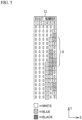
- FIG. 5 is a diagram illustrating another example of a color pattern 13 by the ternary Gray code using three colors.
- the color pattern 13 of FIG. 5 is capable of improving a problem caused by the color pattern 12. It is assumed that a lateral direction (i.e., a digit direction) of FIG. 5 is an X direction, and a vertical direction of FIG. 5 in which patterns of the same digit are arranged is a Y direction.
- the color change or value change between the adjacent upper and lower patterns occurs in only one digit, and the value change is the single value change. Therefore, the ternary Gray code of the color pattern 13 does not cause the binary change. That is to say, in the color pattern 13, a plurality of patterns assigned to respective different decimal values are arranged, each pattern has a plurality of digits to which values of N-ary number are assigned (N is 3 or more), and each digit has a different color depending on the assigned value.
- a plurality of patterns are arranged in an ascending or descending order, a Hamming distance between adjacent patterns in the arrangement direction is 1, an amount of change in the value at one of the digits included in the adjacent patterns is 1, and an amount of change in the value at the other digits of the adjacent color patterns is 0.
- the microcomputer 3 can convert the intermediate value into the decimal value corresponding to either one of the upper pattern or the lower pattern by using the color pattern 13. For this reason, a substantial error does not occur between the length of the actual measurement object and the measured length calculated by the microcomputer 3.
- the ternary color patterns illustrated in FIG. 4 and FIG. 5 are not arranged in an ascending or descending ternary order. Further, the decimal values are not mathematically assigned to each of the ternary color patterns. For instance, the ternary value "000121" in the region 27 of FIG. 4 shall mathematically mean the decimal value "16", but is actually assigned to the decimal value "10". In FIGs. 4 and 5 , decimal values are just assigned to each of the ternary color patterns in the order in which the color patterns are aligned.
- FIG. 6 is a diagram illustrating a method of creating a new ternary Gray code in which the binary change does not occur from the ternary Gray code.
- a conversion rule to create the new binary Gray code in which the binary change does not occur from the binary Gray code is as follows:
- the digit number 1 is the most significant digit and the digit number 6 is the least significant digit.
- this digit number 0 is an imaginary digit that is set for a value conversion processing of the digit number 1 for convenience and does not exist in the color pattern 13.
- a value "0" as a fixed value is virtually set to a digit of the digit number 0.
- a value "0" of the digit number 6 before conversion is converted. Since the total of the values of the digit numbers 0 to 5 upper than the digit number 6 is 2 (even), the value of the digit number 6 is maintained to "0" according to the conversion rule (1). Next, the total of the values of the digit numbers 0 to 4 upper than the digit number 5 is 1 (odd), and the value of the digit number 5 is 1. Therefore, the value of the digit number 5 is maintained to "1" according to the conversion rule (2).
- the total of the values of the digit numbers 0 to 3 upper than the digit number 4 before conversion is 1 (odd), and the value of the digit number 4 is 0. Therefore, the value of the digit number 4 is converted from “0" to "2" according to the conversion rule (4).
- the total of the values of the digit numbers 0 to 2 upper than the digit number 3 before conversion is 0, and therefore the value of the digit number 3 is maintained to "1" according to the conversion rule (1).
- the ternary Gray code "001010” is converted into the new ternary Gray code "001210" in which the binary change does not occur.
- the new ternary Gray code can be created.
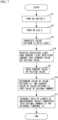
- FIG. 7 is a flowchart illustrating a processing operation of the measuring instrument 1.
- the switch 5 when the switch 5 is depressed to measure a length of a measuring object, the start of the measurement is instructed to the microcomputer 3 (S1).
- the microcomputer 3 turns on each LED 8 (S2), and the LED 8 irradiates the color pattern 13 with light (S3).
- Each PT 9 receives reflected light from the color pattern 13, and outputs a current or voltage corresponding to the light receiving amount (S4).
- the microcomputer 3 reads a current value or voltage value output from each PT 9 (S5).
- the microcomputer 3 determines a read color of each digit of the color pattern 13 based on the current value or voltage value outputted from each PT 9, calculates an N-ary value of each digit of the N-ary Gray code from the read color of the color pattern 13, and converts the N-ary value into a decimal value (S6).
- the decimal value assigned to the color pattern 13 from the ternary value the ternary value obtained by reading the N-ary Gray code is inversely converted with the conversion rules as described in connection with FIG. 6 , and then the inversely converted ternary value is converted into a decimal value based on a well-known conversion method.
- the microcomputer 3 may be provided beforehand with a table indicating a corresponding relationship between the colors of each line of the color pattern 13 and the decimal value, and may determine the decimal value corresponds to the read ternary number by referring to this table.
- the table may contain any other information that can be used to convert the read ternary values into decimal values.
- the microcomputer 3 transmits data converted into the decimal number to the external terminal 10 via the communication device 4 (S7), and terminates the present processing.
- the external terminal or other device that is communicatable with the external terminal, converts the received decimal number into actual measured length.
- the color pattern is N-ary numbers (N is 3 or more), it is possible to reduce the number of digits constituting the color pattern and thin the width of the measure 7a, as compared with the case where the binary code is printed on the measure. Also, it is possible to reduce the number of reading sensors, i.e., the number of LEDs 8 and PTs 9, for reading the color pattern. Therefore, it is possible to reduce the size of the reader unit and the measuring instrument.
- a measurement accuracy of the length of the measurement object in other words a minimum measurable length, depends on a width of each color pattern in the Y direction.
- the number of digits in each line of the color pattern 13 needs to be increased.
- the width of each digit of the color pattern in the X direction is required to be narrowed, and therefore the widths in the X direction and the Y direction of one color pattern need to be reduced.
- a photo sensor of the PT 9 has a constant detection range, and a photo sensor having a narrow detection range capable of reading narrower color patters is expensive.
- a photo sensor having a narrow detection range capable of reading narrower color patters is expensive.
- it is difficult to narrow an interval in the X direction between the adjacent photo sensors and it may be difficult to read narrower color patterns. As described above, it is difficult to increase the number of digits in the color pattern.
- FIG. 8 is a diagram illustrating the reader unit of the measuring instrument 1 according to a first embodiment.
- the reader unit 2 includes five readers (first readers) 20 arranged in X direction, three readers (second readers) 22a to 22c arranged in Y direction, and two readers (third readers) 24a and 24c arranged in Y direction.
- Each of the readers 20, 22a to 22c, 24a and 24c includes the LED 8 and the PT 9.
- FIG. 9A is an enlarged view of the color pattern according to the first embodiment.
- FIG. 9B is an enlarged view of a single pattern.
- FIG. 9A illustrates an enlarged range A in FIG. 5 , and illustrates the ternary value in an upper left of each pattern 40. The ternary value does not have to be shown in the measure 7a.
- the values "0", "1" and “2" correspond to white, blue and black, respectively.
- a plurality of patterns 40 are arranged in the X direction and the Y direction, as illustrated in FIG. 9A .
- the patterns 40 of the digit numbers 1 to 6 are denoted as patterns 41 to 46, respectively.
- the patterns 46 of the least significant digit are denoted as the patterns 46a to 46g from the upside along the Y direction.
- the width in the Y direction of each pattern 40 is P1, for example 3mm.
- the widths P1 of all patterns 40 are substantially the same as each other, and fall within an error range of about a manufacturing error.
- Each of the six patterns 41 to 46 arranged in the X direction corresponds to a single line of a color pattern.
- Five ranges 30 and a range 32b correspond to ranges in which each of the readers 20 and the reader 22b read the patterns 40, respectively.
- the ranges 30 and 32b are arranged in, and are located on a line extending in the X direction.
- a position of the line on which the ranges 30 and 32b are arranged is referred to as a measurement position 36.
- the measurement position 36 is located in the center of the pattern 40 in the Y direction, and is a reference position of the color pattern reading.
- the accuracy of the length measurement which corresponds to a minimum measurable length is P1, that is 3mm.
- a description will be given of a method of setting the accuracy of the length measurement to 1mm, i.e., one third of the width P1 by using the same color pattern as FIG. 9A .
- the pattern 46 of the least significant digit is virtually divided into three regions 47a to 47c along the Y direction for the purpose of a description.
- the regions 47a to 47c cannot be visibly distinguished from each other on the measure 7a.
- a width in the Y direction of each of the regions 47a to 47c is P3.
- the P3 is one third of the P1, for example 1mm.
- the widths P3 of the regions 47a to 47c are substantially the same as each other.
- FIGs. 10 to 12 are enlarged views of the color pattern and a reading state according to the first embodiment.
- the range 32b to be read by the reader 22b is located in the region 47b of the pattern 46c
- the range 32a to be read by the reader 22a is located in the region 47a of the pattern 46b
- the range 32c to be read by the reader 22c is located in the region 47c of the pattern 46d.
- a distance between the centers of the ranges 32a and 32b, i.e., a distance between the readers 22a and 22b is P2
- a distance between the centers of the ranges 32b and 32c i.e., a distance between the readers 22b and 22c is P2.
- the distance P2 is a sum of the width P1 and the width P3, for example 4mm.
- the colors to be read in the ranges 32a, 32b and 32c are blue (1), white (0) and white (0), respectively.
- the microcomputer 3 determines that the measurement position 36 is located in the center of the pattern 46c in the Y direction which is the center of the region 47b in the pattern 46c.
- the range 32b is located in the region 47c of the pattern 46c
- the range 32a is located in the region 47b of the pattern 46b
- the range 32c is located in the region 47a of the pattern 46e.
- the positions of all readers are shifted by the width P3 in a -Y direction from their positions of FIG. 10
- the colors to be read in the ranges 32a, 32b and 32c are blue (1), white (0) and blue (1), respectively.
- the microcomputer 3 determines that the measurement position 36 is located away from the center of the pattern 46c in the Y direction by a distance +P3.
- the range 32b is located in the region 47a of the pattern 46c
- the range 32a is located in the region 47c of the pattern 46a
- the range 32c is located in the region 47b of the pattern 46d.
- the positions of all readers are shifted by the width P3 in a +Y direction from their positions of FIG. 10 .
- the colors to be read in the ranges 32a, 32b and 32c of the digit number 6 are black (2), white (0) and blue (1), respectively.
- the microcomputer 3 determines that the measurement position 36 is located away from the center of the pattern 46c in the Y direction by a distance -P3.
- the reader 22b which is disposed in the measurement position 36 reads white of the pattern 46c.
- the reader 22a reads blue, blue and black, respectively
- the reader 22c reads white, blue and white, respectively. Therefore, it is possible to determine a positional relationship between the color pattern and the readers 22a, 22b and 22c from the combination of the colors which the three readers 22a, 22b and 22c read.
- each reader is shifted in the Y direction by the distance tP3.
- the above-mentioned three states it is possible to set the measurement accuracy of the length to the width P3, i.e., 1mm.
- a change in the colors read by the readers 22a and 22c is detected by using the readers 22a and 22c disposed away from the reader 22b in the Y direction by the distance P2, which makes it possible to set the measurement accuracy of the length that corresponds to a minimum measurable length to the width P3 which is one third of the width P1.
- the patterns 46d, 46e and 46f are read in the ranges 32a, 32b and 32c, and the read colors are white (0), blue (1) and black (2), respectively.
- the patterns 46c, 46e and 46f are read in the ranges 32a, 32b and 32c, and the read colors are white (0), blue (1) and black (2), respectively.
- the patterns 46d, 46e and 46g are read in the ranges 32a, 32b and 32c, and the read colors are white (0), blue (1) and black (2), respectively.
- the colors read from the respective readers 22a to 22c is all the same combination even if the measurement position 36 is located in which of the region 47a, 47b or 47c. Therefore, it is not possible to determine that the measurement position 36 is located in which of the regions 47a, 47b and 47c, based on only the colors read from the three readers 22a to 22c. Accordingly, the measurement accuracy is not necessarily the width P3.
- the color pattern further is read by using the two additional readers 24a and 24c, as illustrated in FIG. 12 .
- the range 34a corresponding to the reader 24a is set at a position away from the range 32a corresponding to the reader 22a in the +Y direction by the width P1.
- the range 34c corresponding to the reader 24c is set at a position away from the range 32c corresponding to the reader 22c in the -Y direction by the width P1.
- the range 32b is located in the region 47b of the pattern 46e as illustrated in FIG.
- the range 32a is located in the region 47a of the pattern 46d
- the range 34a is located in the region 47a of the pattern 46c
- the range 32c is located in the region 47c of the pattern 46f
- the range 34c is located in the region 47c of the pattern 46g.
- the patterns 46c, 46d, 46e, 46f and 46g are read in the ranges 34a, 32a, 32b, 32c and 34b, and the read colors are white (0), white (0), blue (1), black (2) and black (2), respectively.
- the patterns 46b, 46c, 46e, 46f and 46g are read in the ranges 34a, 32a, 32b, 32c and 34c, and the read colors are blue (1), white (0), blue (1), black (2) and black (2), respectively.
- the patterns 46c, 46d, 46e, 46g and 46h are read in the ranges 34a, 32a, 32b, 32c and 34c, and the read colors are white (0), white (0), blue (1), black (2) and blue (1), respectively.
- the measurement position 36 is located in which of the regions 47a to 47c by using the readers 24a and 24c disposed at positions shifted from the readers 22a and 22c by the width P1 in the Y direction. Therefore, even when the two patterns 46 with the same color are continuously arranged on the least significant digit in the Y direction, the measurement accuracy of the width P3 can be achieved.
- the color pattern of FIG. 5 three patterns 46 on the least significant digit with the same color are not continuously arranged in the Y direction, and it is therefore sufficient that the readers illustrated in FIG. 12 are used.
- FIG. 13 is a diagram illustrating a table used in the first embodiment.
- a color of the range 32b i.e., the ternary value
- a sum of the values of the ranges 30, a combination of the colors of the ranges 34a, 32a, 32c and 34c, and a correction value to be added to the length calculated from the reading result are set in the table as illustrated in FIG. 13 .
- the sum of the values of the ranges 30 indicates whether the sum of the patterns 41 to 45 other than the pattern 46 of the least significant digit is odd or even.
- the correction value is a value to be add to the length determined by the colors read in the ranges 30 and 32b.
- the correction value "-P3" indicates reducing a length corresponding to the width P3 (e.g.
- the correction value "+P3" indicates adding the length corresponding to the width P3 (e.g. 1mm) to the length determined by the reading result of the ranges 30 and 32b.
- the microcomputer 3 determines the length of the measurement object by using the measurement results of the readers 20, 22a to 22c, 24a and 24c. Therefore, it is possible to improve the measurement accuracy of the length compared with the width P1 of the pattern, without increasing the number of digits of the color pattern 13.
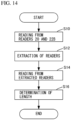
- FIG. 14 is a flowchart illustrating a processing executed by the microcomputer according to a first variation of the first embodiment.
- the microcomputer 3 determines the colors of the patterns from the output of the readers 20 and 22b (S10). For example, the microcomputer 3 executes the operation of S2 to S5 in FIG. 7 to the readers 20 and 22b. In this case, the microcomputer 3 may control the readers 24a, 22a, 22c and 24c so as not to read the color pattern by turning off the readers 24a, 22a, 22c and 24c or supplying no power supply to the LEDs 8 and the PTs 9 of the readers 24a, 22a, 22c and 24c.
- the microcomputer 3 extracts readers for reading the pattern from the reader 24a, 22a, 22c and 24c, based on the reading result of the readers 20 and 22b (S12). A method of determining the readers to be extracted will be described later.
- the microcomputer 3 determines the colors of the patterns read by the extracted readers, based on the output from the extracted reader (S14). For example, the microcomputer 3 executes the operation of S2 to S5 in FIG. 7 to the extracted readers, and may turn off unextracted readers.
- the microcomputer 3 determines the length of the measurement object based on the determined colors of the read patterns (S16). For example, the microcomputer 3 executes the operation of S6 and S7 in FIG. 7 . Then, the present processing is terminated.
- FIG. 15 is a diagram illustrating a table used in the first variation of the first embodiment.
- the microcomputer 3 determines the color of the range 32b and determines whether the sum of the values of the ranges 30 is odd or even, the microcomputer 3 can determine ranges among the ranges 34a, 32a, 32c and 34c required for determining the correction value.
- a reading result in a range enclosed in each of solid lines 50 of FIG. 15 is used for the determination of the length.
- a reading result in a range enclosed in each of dotted lines 52 is not used for the determination of the length.
- either one of two ranges enclosed in each of dotted lines 54 is used for the determination of the length.
- the microcomputer 3 extracts the reader 22c and one of the readers 24a or 22a, and does not extract the reader 24c and the other of the readers 24a or 22a.
- the microcomputer 3 extracts the readers 24a and 24c, and does not extract the readers 22a and 22c.
- a second variation of the first embodiment indicates an example in which the accuracy of the length is a half of the width P1.
- FIG. 16A is an enlarged view of a color pattern according to the second variation of the first embodiment.
- FIG. 16B is an enlarged view of the single pattern.
- two ranges 32a and 32b read by the readers 22a and 22b respectively are provided on the patterns 46 of the least significant digit.
- the plurality of readers 20 and the reader 22a are arranged in a row in the X direction.
- the pattern 46 of the least significant digit is virtually divided into two regions 47a and 47b in the Y direction, as illustrated in FIG. 16B .
- the width in the Y direction of each of the regions 47a and 47b is P5.
- the width P5 is a half of the width P1.
- the widths P1 and P5 are 4mm and 2mm, respectively.
- the range 32a is located in the region 47a of the pattern 46c, and the range 32b is located in the region 47b of the pattern 46d.
- a distance in the Y direction between the center of the ranges 30 and 32b, and the measurement position 36 as a reading reference is P5/2, for example 1mm.
- a distance P6 in the Y direction between the centers of the ranges 32a and 32b is a sum of the widths P1 and P5, for example 6mm.
- the microcomputer 3 determines that the measurement position 36 is located in the center of the pattern 46c in the Y direction, from a relationship of the color read in the range 32a and the color read in the range 32b.
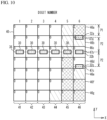
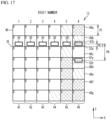
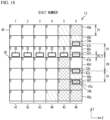
- FIGs. 17 and 18 are enlarged views of the color pattern according to the second variation.
- the range 32a is located in the region 47b of the pattern 46b
- the range 32b is located in the region 47a of the pattern 46d.
- the microcomputer 3 determines that the measurement position 36 is located between the patterns 46b and 46c, from the relationship of the color read in the range 32a and the color read in the range 32b.
- the microcomputer 3 determines whether the measurement position 36 is located on which positions of FIGs. 16 and 17 by relationship between the colors read in the regions 32a and 32b , so that the microcomputer 3 can set the measurement accuracy of the length to a half (i.e., 2mm) of the width P1 (i.e., 4mm) of the pattern 40.
- the ranges 34a and 34b are added to the example of FIG. 17 .
- the range 34a to be read by the reader 24a is located away from the range 32a in the +Y direction by the width P1
- the range 34b to be read by a reader 24b is located away from the range 32b in the -Y direction by the width P1.
- the readers 20 i.e., first readers
- the ranges 30 in the plurality of patterns 41 to 45 are arranged in the X direction.
- the readers 22a to 22c optically read the colors of the ranges 32a to 32c (i.e., second ranges) in the patterns 46 (i.e., second patterns) of the least significant digit arranged in the Y direction among the plurality of color patterns 40, respectively.
- the ranges 32a to 32c are arranged in the Y direction at an interval different from the width P 1 of the pattern 40 in the Y direction.
- the microcomputer 3 determines the length of the measurement object with an accuracy smaller than the width P1, from the reading result by the readers 20 and 22a to 22c.
- the operation of the microcomputer 3 to determine the length corresponds to an example of a "determiner".
- the measurement accuracy is a multiple of the number of readers 22a to 22c. For example, in the first embodiment, the measurement accuracy is 1/3 of the width P1 (resolution 1/3), and in the second variation, the measurement accuracy is 1/2 of the width P1 (resolution 1/2).
- a function of the determiner may be realized in cooperation with a processor such as the microcomputer 3 and software, or may be realized by a dedicated circuit.
- the ranges 32a to 32c are arranged on any of the patterns 46a to 46g so as to correspond to the regions 47a to 47c into which one of the patterns 46 is virtually divided in the Y direction, respectively. Thereby, the measurement accuracy of the length can be improved by a multiple of the number of regions 47a to 47c.
- Each of the distance between the ranges 32a and 32b and the distance between the ranges 32b and 32c is larger than the width P1. Thereby, it is possible to widen installation intervals between the readers 22a and 22b and between the readers 22b and 22c, and there is no need to reduce the sizes of the readers 22a to 22c. Also, it is possible to suppress interference between the ranges 32a to 32c.
- the readers 24a and 24c optically read the colors of the ranges 34a and 34c corresponding to the regions 47a and 47c other than the central region 47b among the regions 47a to 47c, respectively.
- An interval between the range 34a and the range 32a corresponding to the same region 47a as the range 34a is the width P1.
- An interval between the range 34c and the range 32c corresponding to the same region 47c as the range 34c is the width P1.
- the microcomputer 3 determines the length of the measurement object from the reading results by the readers 20, 22a to 22c, 24a and 24c. Thereby, even if the two patterns 46 with the same color of the least significant digit are continuous, it is possible to measure the length accurately.
- the microcomputer 3 determines whether remaining readers among the readers 22a to 22c, and the readers 24a and 24c execute the reading. Thereby, it is possible to suppress the consumption of the electric power of the readers.
- One of the ranges 32a, 32b and 32c is arranged opposite to the ranges 30 in the X direction.
- the range 32b corresponding to the central region 47b among the regions 47a to 47c is arranged opposite to the ranges 30 in the X direction.
- the measurement position 36 is shifted from the position of the ranges 30 in the Y direction by approximately 1/2 of the width P5.
- the description is given of the example that the pattern 46 is virtually divided into two or three regions, but the pattern 46 may be divided into four or more regions as long as it is divided into a plurality of regions. Also, the description is given of the case where the color pattern is the ternary number, but it is sufficient that the color pattern is N-ary number.
- an optical reader which is the reader unit 2 reads a reading object having the plurality of color patterns, the plurality of color patterns assigned to respective different decimal values are arranged in the Y direction, each of the color patterns has a plurality of patterns 40 corresponding to a plurality of digits arranged in the X direction, and a value of N-ary number is assigned to each of the digits.
- the readers 20 and 22b are arranged along the X direction, and read patterns 40 corresponding to respective different digits in one of the color patterns.
- the readers 22a and 22c are arranged opposite to one of the readers 20 and 22b along the Y direction, and read the patterns 40 of the same digit as a digit read by the reader 22b, the patterns 40 of the same digit being included in a color pattern adjacent to a color pattern read by the readers 20 and 22b in the Y direction. Thereby, it is possible to improve the measurement accuracy of the length.
- the second readers includes at least one of the readers 22a and 22c that are arranged at positions away from the reader 22b by a distance greater than the width P1, respectively. Thereby, it is possible to improve the measurement accuracy of the length.
- the optical reader includes the readers 24a and 24c that are arranged at positions away from the readers 22a and 22c by the width P1, respectively. Thereby, it is possible to improve the measurement accuracy of the length.
- the readers 20 and 22a are arranged along the X direction, and read patterns 40 corresponding to respective different digits in one of the color patterns.
- the reader 22b is arranged opposite to the reader 22a along the Y direction, and read the pattern 40 of the same digit as a digit read by the reader 22a, the pattern 40 of the same digit being included in a color pattern adjacent to a color pattern read by the reader 22a in the Y direction.
- the reader 22b is arranged at a position away from the reader 22a by 1.5 times of the width P1. Thereby, it is possible to improve the measurement accuracy of the length.
- the measuring instrument 1 outputs the decimal value to the external terminal.
- the measuring instrument may output trinary data, or the actual measured length converted from the read code to the external terminal.
- the external terminal receives the ternary data
- the external terminal converts the received ternary data into the decimal value and/or into actual measured length.
Landscapes
- Physics & Mathematics (AREA)
- General Physics & Mathematics (AREA)
- Engineering & Computer Science (AREA)
- Theoretical Computer Science (AREA)
- General Health & Medical Sciences (AREA)
- Toxicology (AREA)
- Artificial Intelligence (AREA)
- Computer Vision & Pattern Recognition (AREA)
- Electromagnetism (AREA)
- Health & Medical Sciences (AREA)
- Spectrometry And Color Measurement (AREA)
- Length Measuring Devices By Optical Means (AREA)
- Tape Measures (AREA)
- Length-Measuring Instruments Using Mechanical Means (AREA)
Claims (6)
- Messinstrument (1), umfassend:ein Maßstab (7a), auf dem ein Code mit einer Vielzahl von Farbmustern (13) gedruckt ist, wobei jedes der Farbmuster eine Vielzahl von Ziffern aufweist, der Werte einer N-fachen Zahl zugeordnet sind, wobei N 3 oder mehr ist, wobei eine der unterschiedlicher Farben, die jeweils einem von N-fachen Werten entsprechen, jedem Muster (40) zugeordnet ist, das jeder Ziffer entspricht, die in jedem Farbmuster beinhaltet ist, wobei die Muster, die jeder Ziffer entsprechen, in einer zweiten Richtung (X) angeordnet sind, die eine erste Richtung (Y) schneidet, eine Hamming-Distanz zwischen benachbarten Farbmustern in der ersten Richtung (Y) gleich 1 ist und ein Änderungsbetrag des Werts an einer der Ziffern, die in den benachbarten Farbmustern beinhaltet sind, gleich 1 ist, wobei die Muster, die in der zweiten Richtung (X) angeordnet sind, alle die gleiche Breite (P1) in der ersten Richtung (Y) aufweisen;eine Vielzahl von ersten Lesegeräten (20), die in der zweiten Richtung (X) angeordnet und dazu konfiguriert ist, Farben von ersten Bereichen (30) in einer Vielzahl von ersten Mustern (41 bis 45) optisch zu lesen, die jeweils Ziffern außer einer niedrigstwertigen Ziffer unter den Farbmustern entsprechen, wobei die ersten Bereiche in den ersten Mustern in der zweiten Richtung (X) angeordnet sind; undeine Vielzahl von zweiten Lesegeräten (22a bis 22c), die in der ersten Richtung (Y) angeordnet und dazu konfiguriert ist, Farben von zweiten Bereichen (32a bis 32c) in einer Vielzahl von zweiten Mustern (46a bis 46h) optisch zu lesen, die in der ersten Richtung (Y) angeordnet ist, die jeweils Mustern der niedrigstwertigen Ziffer unter den Farbmustern entsprechen, wobei die benachbarten zweiten Lesegeräte in der ersten Richtung (Y) in einem Intervall (P2) angeordnet sind, das sich von der Breite (P1) des Musters in der ersten Richtung (Y) unterscheidet, und eines der zweiten Lesegeräte (22b) in der zweiten Richtung (X) Seite an Seite mit der Vielzahl der ersten Lesegeräte (20) angeordnet ist.
- Messinstrument nach Anspruch 1, ferner umfassend:
eine Bestimmungseinrichtung (3), die dazu konfiguriert ist, eine Länge eines Messobjekts mit einer Genauigkeit kleiner als die Breite des Musters in der ersten Richtung (Y) aus Leseergebnissen durch die ersten Lesegeräte (20) und die zweiten Lesegeräte (22a bis 22c) zu bestimmen. - Messinstrument (1) nach Anspruch 1 oder 2, wobei
die zweiten Bereiche (32a bis 32c) auf einem beliebigen der zweiten Muster (46a bis 46h) so angeordnet sind, dass sie einer Vielzahl von Regionen (47a bis 47c) entsprechen, in die jeweils eines der zweiten Muster in der ersten Richtung (Y) virtuell unterteilt ist. - Messinstrument (1) nach Anspruch 2, umfassend:eine Vielzahl von dritten Lesegeräten (24a, 24c), die dazu konfiguriert ist, Farben von dritten Bereichen (34a, 34c) optisch zu lesen, die jeweils anderen Regionen als einer zentralen Region (47b) unter der Vielzahl von Regionen (47a bis 47c) entsprechen, wobei ein Intervall zwischen einem der dritten Bereiche (34a, 34c) und einem der zweiten Bereiche (32a, 32c), das derselben Region (47a, 47c) wie einer der dritten Bereiche entspricht, gleich der Breite der Muster in der ersten Richtung (Y) ist, wobeidie Bestimmungseinrichtung (3) die Länge des Messobjekts aus Leseergebnissen durch die ersten Lesegeräte, die zweiten Lesegeräte und die dritten Lesegeräte bestimmt.
- Messinstrument (1) nach Anspruch 4, wobei
die Bestimmungseinrichtung (3) basierend auf Leseergebnissen durch die ersten Lesegeräte (20) und einen Teil der zweiten Lesegeräte (22a bis 22c) bestimmt, ob verbleibende zweite Lesegeräte (22a bis 22c) und die dritten Lesegeräte (24a, 24c) einen Lesevorgang ausführen. - Messinstrument (1) nach Anspruch 1, wobeieines der zweiten Muster (46) in der ersten Richtung (Y) in R Regionen (47a bis 47c) virtuell unterteilt ist, wobei P2 = P1 + P1/R und R 2 oder 3 ist, unddie zweiten Bereiche (32a bis 32c) jeweils auf unterschiedlichen zweiten Mustern unter den zweiten Mustern (46a bis 46h) angeordnet sind und jeweils auf unterschiedlichen Regionen unter den Regionen (47a bis 47c) angeordnet sind.
Priority Applications (1)
| Application Number | Priority Date | Filing Date | Title |
|---|---|---|---|
| EP20177402.3A EP3736543B1 (de) | 2018-06-01 | 2019-05-13 | Optische leser |
Applications Claiming Priority (1)
| Application Number | Priority Date | Filing Date | Title |
|---|---|---|---|
| JP2018106211A JP7118748B2 (ja) | 2018-06-01 | 2018-06-01 | 計測器および光学読取器 |
Related Child Applications (2)
| Application Number | Title | Priority Date | Filing Date |
|---|---|---|---|
| EP20177402.3A Division EP3736543B1 (de) | 2018-06-01 | 2019-05-13 | Optische leser |
| EP20177402.3A Division-Into EP3736543B1 (de) | 2018-06-01 | 2019-05-13 | Optische leser |
Publications (2)
| Publication Number | Publication Date |
|---|---|
| EP3575749A1 EP3575749A1 (de) | 2019-12-04 |
| EP3575749B1 true EP3575749B1 (de) | 2023-08-16 |
Family
ID=66529926
Family Applications (2)
| Application Number | Title | Priority Date | Filing Date |
|---|---|---|---|
| EP20177402.3A Active EP3736543B1 (de) | 2018-06-01 | 2019-05-13 | Optische leser |
| EP19174201.4A Active EP3575749B1 (de) | 2018-06-01 | 2019-05-13 | Optisches messinstrument |
Family Applications Before (1)
| Application Number | Title | Priority Date | Filing Date |
|---|---|---|---|
| EP20177402.3A Active EP3736543B1 (de) | 2018-06-01 | 2019-05-13 | Optische leser |
Country Status (5)
| Country | Link |
|---|---|
| US (2) | US10860824B2 (de) |
| EP (2) | EP3736543B1 (de) |
| JP (1) | JP7118748B2 (de) |
| KR (1) | KR102248659B1 (de) |
| CN (1) | CN110555327B (de) |
Families Citing this family (8)
| Publication number | Priority date | Publication date | Assignee | Title |
|---|---|---|---|---|
| JP7411325B2 (ja) * | 2018-12-26 | 2024-01-11 | 富士通コンポーネント株式会社 | 計測器 |
| US11333480B2 (en) * | 2019-12-12 | 2022-05-17 | Fujitsu Component Limited | Measuring instrument and measure |
| JP7339163B2 (ja) * | 2020-01-09 | 2023-09-05 | 富士通コンポーネント株式会社 | 計測器、メジャー及び計測方法 |
| CN114616436A (zh) * | 2020-09-30 | 2022-06-10 | 富士通电子零件有限公司 | 测量装置 |
| US12264912B2 (en) | 2021-06-16 | 2025-04-01 | Reekon Tools Inc. | Digital linear measuring device |
| US11960968B2 (en) * | 2022-08-25 | 2024-04-16 | Omron Corporation | Scanning device utilizing separate light pattern sequences based on target distance |
| US12118428B2 (en) | 2022-08-25 | 2024-10-15 | Omron Corporation | Using distance sensor delta to determine when to enter presentation mode |
| US12339112B2 (en) | 2022-08-25 | 2025-06-24 | Omron Corporation | Symbology or frame rate changes based on target distance |
Family Cites Families (30)
| Publication number | Priority date | Publication date | Assignee | Title |
|---|---|---|---|---|
| JPS5272916U (de) | 1975-10-29 | 1977-05-31 | ||
| JPS542150A (en) * | 1977-06-07 | 1979-01-09 | Yamato Scale Co Ltd | Gray cord reading device |
| US5173602A (en) | 1991-12-24 | 1992-12-22 | Xerox Corporation | Binary position sensitive detector with multiple rows of alternating types of photocells |
| GB9205575D0 (en) * | 1992-03-13 | 1992-04-29 | Lucas Ind Plc | Position encoder |
| JPH0735535A (ja) * | 1993-07-16 | 1995-02-07 | Japan Aviation Electron Ind Ltd | メジャー付き送信器及びメジャー信号受信・記録器 |
| SG52286A1 (en) | 1993-07-22 | 2001-01-16 | Bourns Inc | Absolute digital position encoder |
| US5880683A (en) | 1993-07-22 | 1999-03-09 | Bourns, Inc. | Absolute digital position encoder |
| JPH07294238A (ja) * | 1994-04-25 | 1995-11-10 | Ryoichi Kaneki | デジタルメジャ−コ−ド |
| EP0698994B1 (de) * | 1994-08-23 | 2000-02-02 | Hewlett-Packard Company | Sensoranordnung für einen optischen Bildabtaster die Grauwert- und Farbsignale liefert |
| HUP9801931A3 (en) * | 1995-03-31 | 1999-04-28 | Kiwisoft Programs Ltd Te Atatu | Machine-readable label |
| JP3996520B2 (ja) * | 2003-01-30 | 2007-10-24 | 株式会社デンソーウェーブ | 二次元情報コードおよびその生成方法 |
| US7154613B2 (en) | 2004-03-15 | 2006-12-26 | Northrop Grumman Corporation | Color coded light for automated shape measurement using photogrammetry |
| DE202004008829U1 (de) * | 2004-06-03 | 2004-09-02 | Ovari, Akos | Optoelektronischer Absolut-Winkelgeber mit erhöhter Auflösung auf Grund der lokalen Detektierung der Verhältnisse dunkler und heller Felder |
| JP2006147112A (ja) | 2004-11-24 | 2006-06-08 | Toshiba Corp | 磁気記録媒体および磁気記録再生装置 |
| US7780089B2 (en) * | 2005-06-03 | 2010-08-24 | Hand Held Products, Inc. | Digital picture taking optical reader having hybrid monochrome and color image sensor array |
| JP4577126B2 (ja) | 2005-07-08 | 2010-11-10 | オムロン株式会社 | ステレオ対応づけのための投光パターンの生成装置及び生成方法 |
| US7445160B2 (en) | 2006-06-14 | 2008-11-04 | Hewlett-Packard Development Company, L.P. | Position location using error correction |
| JP2009075013A (ja) * | 2007-09-21 | 2009-04-09 | A & D Co Ltd | デジタル周囲長測定器 |
| EP2076015B1 (de) * | 2007-12-25 | 2016-06-29 | Brother Kogyo Kabushiki Kaisha | Bilderzeugungsvorrichtung |
| WO2010112082A1 (en) * | 2009-04-03 | 2010-10-07 | Csem Centre Suisse D'electronique Et De Microtechnique Sa Recherche Et Developpement | A one-dimension position encoder |
| JP5272916B2 (ja) | 2009-06-17 | 2013-08-28 | ペンタックスリコーイメージング株式会社 | 撮像装置 |
| JP5790144B2 (ja) * | 2010-08-20 | 2015-10-07 | 日本精工株式会社 | アブソリュートエンコーダ及び絶対位置検出装置、並びにアブソリュートエンコーダの信号パターンの製造方法 |
| EP2541470B1 (de) | 2011-06-29 | 2017-10-04 | Denso Wave Incorporated | Informationscode und informationscodeleser |
| CN104246794A (zh) * | 2012-04-26 | 2014-12-24 | 惠普发展公司,有限责任合伙企业 | 具有多个不同区域的二维条形码 |
| US9111357B2 (en) | 2012-06-07 | 2015-08-18 | Medsnap, Llc | System and method of pill identification |
| JP6174407B2 (ja) | 2013-07-24 | 2017-08-02 | 富士通コンポーネント株式会社 | 印刷装置及びマーク検出方法 |
| US10504230B1 (en) | 2014-12-19 | 2019-12-10 | Amazon Technologies, Inc. | Machine vision calibration system with marker |
| JP2017216620A (ja) | 2016-06-01 | 2017-12-07 | キヤノン株式会社 | 画像読取装置、画像形成装置、画像読取方法、及びコンピュータプログラム |
| JP7058983B2 (ja) * | 2017-11-20 | 2022-04-25 | 富士通コンポーネント株式会社 | 長さ計測器、コード及びコード変換方法 |
| JP7167675B2 (ja) | 2018-12-04 | 2022-11-09 | 株式会社デンソー | 物体検知装置および物体検知方法 |
-
2018
- 2018-06-01 JP JP2018106211A patent/JP7118748B2/ja active Active
-
2019
- 2019-05-13 EP EP20177402.3A patent/EP3736543B1/de active Active
- 2019-05-13 EP EP19174201.4A patent/EP3575749B1/de active Active
- 2019-05-16 US US16/414,108 patent/US10860824B2/en active Active
- 2019-05-31 CN CN201910469596.2A patent/CN110555327B/zh active Active
- 2019-05-31 KR KR1020190064500A patent/KR102248659B1/ko active Active
-
2020
- 2020-11-04 US US17/089,054 patent/US11892328B2/en active Active
Also Published As
| Publication number | Publication date |
|---|---|
| EP3736543A1 (de) | 2020-11-11 |
| CN110555327B (zh) | 2022-12-20 |
| US10860824B2 (en) | 2020-12-08 |
| EP3736543B1 (de) | 2023-02-01 |
| JP2019211286A (ja) | 2019-12-12 |
| US20190370515A1 (en) | 2019-12-05 |
| EP3575749A1 (de) | 2019-12-04 |
| KR102248659B1 (ko) | 2021-05-07 |
| US20210049335A1 (en) | 2021-02-18 |
| US11892328B2 (en) | 2024-02-06 |
| KR20190137714A (ko) | 2019-12-11 |
| JP7118748B2 (ja) | 2022-08-16 |
| CN110555327A (zh) | 2019-12-10 |
Similar Documents
| Publication | Publication Date | Title |
|---|---|---|
| EP3575749B1 (de) | Optisches messinstrument | |
| US8366011B2 (en) | Two dimensional bar code having increased accuracy | |
| US5027526A (en) | Digital linear measuring device | |
| US5235181A (en) | Absolute position detector for an apparatus for measuring linear angular values | |
| US5142793A (en) | Digital linear measuring device | |
| US5062214A (en) | Absolute measurement scale system | |
| US11334737B2 (en) | Length measuring instrument, code, and code conversion method | |
| US11415402B2 (en) | Measuring instrument | |
| US11120238B2 (en) | Decoding color barcodes | |
| US11333480B2 (en) | Measuring instrument and measure | |
| JP7339163B2 (ja) | 計測器、メジャー及び計測方法 | |
| JP7200333B2 (ja) | コード変換方法 | |
| JPS59177687A (ja) | カラ−バ−コ−ド方式 | |
| KR100678619B1 (ko) | 디지털 광학 앵글 센서 | |
| JP2022177556A (ja) | 計測器及び計測方法 | |
| JP2021096235A (ja) | 計測器、メジャー及びメジャーの製造方法 |
Legal Events
| Date | Code | Title | Description |
|---|---|---|---|
| PUAI | Public reference made under article 153(3) epc to a published international application that has entered the european phase |
Free format text: ORIGINAL CODE: 0009012 |
|
| STAA | Information on the status of an ep patent application or granted ep patent |
Free format text: STATUS: THE APPLICATION HAS BEEN PUBLISHED |
|
| AK | Designated contracting states |
Kind code of ref document: A1 Designated state(s): AL AT BE BG CH CY CZ DE DK EE ES FI FR GB GR HR HU IE IS IT LI LT LU LV MC MK MT NL NO PL PT RO RS SE SI SK SM TR |
|
| AX | Request for extension of the european patent |
Extension state: BA ME |
|
| STAA | Information on the status of an ep patent application or granted ep patent |
Free format text: STATUS: REQUEST FOR EXAMINATION WAS MADE |
|
| 17P | Request for examination filed |
Effective date: 20200603 |
|
| RBV | Designated contracting states (corrected) |
Designated state(s): AL AT BE BG CH CY CZ DE DK EE ES FI FR GB GR HR HU IE IS IT LI LT LU LV MC MK MT NL NO PL PT RO RS SE SI SK SM TR |
|
| STAA | Information on the status of an ep patent application or granted ep patent |
Free format text: STATUS: EXAMINATION IS IN PROGRESS |
|
| 17Q | First examination report despatched |
Effective date: 20210311 |
|
| GRAP | Despatch of communication of intention to grant a patent |
Free format text: ORIGINAL CODE: EPIDOSNIGR1 |
|
| STAA | Information on the status of an ep patent application or granted ep patent |
Free format text: STATUS: GRANT OF PATENT IS INTENDED |
|
| RIC1 | Information provided on ipc code assigned before grant |
Ipc: G01D 5/347 20060101AFI20230301BHEP |
|
| INTG | Intention to grant announced |
Effective date: 20230315 |
|
| GRAS | Grant fee paid |
Free format text: ORIGINAL CODE: EPIDOSNIGR3 |
|
| GRAA | (expected) grant |
Free format text: ORIGINAL CODE: 0009210 |
|
| STAA | Information on the status of an ep patent application or granted ep patent |
Free format text: STATUS: THE PATENT HAS BEEN GRANTED |
|
| AK | Designated contracting states |
Kind code of ref document: B1 Designated state(s): AL AT BE BG CH CY CZ DE DK EE ES FI FR GB GR HR HU IE IS IT LI LT LU LV MC MK MT NL NO PL PT RO RS SE SI SK SM TR |
|
| REG | Reference to a national code |
Ref country code: CH Ref legal event code: EP Ref country code: DE Ref legal event code: R096 Ref document number: 602019034952 Country of ref document: DE |
|
| REG | Reference to a national code |
Ref country code: IE Ref legal event code: FG4D |
|
| REG | Reference to a national code |
Ref country code: LT Ref legal event code: MG9D |
|
| REG | Reference to a national code |
Ref country code: NL Ref legal event code: MP Effective date: 20230816 |
|
| REG | Reference to a national code |
Ref country code: AT Ref legal event code: MK05 Ref document number: 1600466 Country of ref document: AT Kind code of ref document: T Effective date: 20230816 |
|
| PG25 | Lapsed in a contracting state [announced via postgrant information from national office to epo] |
Ref country code: GR Free format text: LAPSE BECAUSE OF FAILURE TO SUBMIT A TRANSLATION OF THE DESCRIPTION OR TO PAY THE FEE WITHIN THE PRESCRIBED TIME-LIMIT Effective date: 20231117 |
|
| PG25 | Lapsed in a contracting state [announced via postgrant information from national office to epo] |
Ref country code: IS Free format text: LAPSE BECAUSE OF FAILURE TO SUBMIT A TRANSLATION OF THE DESCRIPTION OR TO PAY THE FEE WITHIN THE PRESCRIBED TIME-LIMIT Effective date: 20231216 |
|
| PG25 | Lapsed in a contracting state [announced via postgrant information from national office to epo] |
Ref country code: SE Free format text: LAPSE BECAUSE OF FAILURE TO SUBMIT A TRANSLATION OF THE DESCRIPTION OR TO PAY THE FEE WITHIN THE PRESCRIBED TIME-LIMIT Effective date: 20230816 Ref country code: RS Free format text: LAPSE BECAUSE OF FAILURE TO SUBMIT A TRANSLATION OF THE DESCRIPTION OR TO PAY THE FEE WITHIN THE PRESCRIBED TIME-LIMIT Effective date: 20230816 Ref country code: PT Free format text: LAPSE BECAUSE OF FAILURE TO SUBMIT A TRANSLATION OF THE DESCRIPTION OR TO PAY THE FEE WITHIN THE PRESCRIBED TIME-LIMIT Effective date: 20231218 Ref country code: NO Free format text: LAPSE BECAUSE OF FAILURE TO SUBMIT A TRANSLATION OF THE DESCRIPTION OR TO PAY THE FEE WITHIN THE PRESCRIBED TIME-LIMIT Effective date: 20231116 Ref country code: NL Free format text: LAPSE BECAUSE OF FAILURE TO SUBMIT A TRANSLATION OF THE DESCRIPTION OR TO PAY THE FEE WITHIN THE PRESCRIBED TIME-LIMIT Effective date: 20230816 Ref country code: LV Free format text: LAPSE BECAUSE OF FAILURE TO SUBMIT A TRANSLATION OF THE DESCRIPTION OR TO PAY THE FEE WITHIN THE PRESCRIBED TIME-LIMIT Effective date: 20230816 Ref country code: LT Free format text: LAPSE BECAUSE OF FAILURE TO SUBMIT A TRANSLATION OF THE DESCRIPTION OR TO PAY THE FEE WITHIN THE PRESCRIBED TIME-LIMIT Effective date: 20230816 Ref country code: IS Free format text: LAPSE BECAUSE OF FAILURE TO SUBMIT A TRANSLATION OF THE DESCRIPTION OR TO PAY THE FEE WITHIN THE PRESCRIBED TIME-LIMIT Effective date: 20231216 Ref country code: HR Free format text: LAPSE BECAUSE OF FAILURE TO SUBMIT A TRANSLATION OF THE DESCRIPTION OR TO PAY THE FEE WITHIN THE PRESCRIBED TIME-LIMIT Effective date: 20230816 Ref country code: GR Free format text: LAPSE BECAUSE OF FAILURE TO SUBMIT A TRANSLATION OF THE DESCRIPTION OR TO PAY THE FEE WITHIN THE PRESCRIBED TIME-LIMIT Effective date: 20231117 Ref country code: FI Free format text: LAPSE BECAUSE OF FAILURE TO SUBMIT A TRANSLATION OF THE DESCRIPTION OR TO PAY THE FEE WITHIN THE PRESCRIBED TIME-LIMIT Effective date: 20230816 Ref country code: AT Free format text: LAPSE BECAUSE OF FAILURE TO SUBMIT A TRANSLATION OF THE DESCRIPTION OR TO PAY THE FEE WITHIN THE PRESCRIBED TIME-LIMIT Effective date: 20230816 |
|
| PG25 | Lapsed in a contracting state [announced via postgrant information from national office to epo] |
Ref country code: PL Free format text: LAPSE BECAUSE OF FAILURE TO SUBMIT A TRANSLATION OF THE DESCRIPTION OR TO PAY THE FEE WITHIN THE PRESCRIBED TIME-LIMIT Effective date: 20230816 |
|
| PG25 | Lapsed in a contracting state [announced via postgrant information from national office to epo] |
Ref country code: ES Free format text: LAPSE BECAUSE OF FAILURE TO SUBMIT A TRANSLATION OF THE DESCRIPTION OR TO PAY THE FEE WITHIN THE PRESCRIBED TIME-LIMIT Effective date: 20230816 |
|
| PG25 | Lapsed in a contracting state [announced via postgrant information from national office to epo] |
Ref country code: SM Free format text: LAPSE BECAUSE OF FAILURE TO SUBMIT A TRANSLATION OF THE DESCRIPTION OR TO PAY THE FEE WITHIN THE PRESCRIBED TIME-LIMIT Effective date: 20230816 Ref country code: RO Free format text: LAPSE BECAUSE OF FAILURE TO SUBMIT A TRANSLATION OF THE DESCRIPTION OR TO PAY THE FEE WITHIN THE PRESCRIBED TIME-LIMIT Effective date: 20230816 Ref country code: ES Free format text: LAPSE BECAUSE OF FAILURE TO SUBMIT A TRANSLATION OF THE DESCRIPTION OR TO PAY THE FEE WITHIN THE PRESCRIBED TIME-LIMIT Effective date: 20230816 Ref country code: EE Free format text: LAPSE BECAUSE OF FAILURE TO SUBMIT A TRANSLATION OF THE DESCRIPTION OR TO PAY THE FEE WITHIN THE PRESCRIBED TIME-LIMIT Effective date: 20230816 Ref country code: DK Free format text: LAPSE BECAUSE OF FAILURE TO SUBMIT A TRANSLATION OF THE DESCRIPTION OR TO PAY THE FEE WITHIN THE PRESCRIBED TIME-LIMIT Effective date: 20230816 Ref country code: CZ Free format text: LAPSE BECAUSE OF FAILURE TO SUBMIT A TRANSLATION OF THE DESCRIPTION OR TO PAY THE FEE WITHIN THE PRESCRIBED TIME-LIMIT Effective date: 20230816 Ref country code: SK Free format text: LAPSE BECAUSE OF FAILURE TO SUBMIT A TRANSLATION OF THE DESCRIPTION OR TO PAY THE FEE WITHIN THE PRESCRIBED TIME-LIMIT Effective date: 20230816 |
|
| REG | Reference to a national code |
Ref country code: DE Ref legal event code: R097 Ref document number: 602019034952 Country of ref document: DE |
|
| PLBE | No opposition filed within time limit |
Free format text: ORIGINAL CODE: 0009261 |
|
| STAA | Information on the status of an ep patent application or granted ep patent |
Free format text: STATUS: NO OPPOSITION FILED WITHIN TIME LIMIT |
|
| 26N | No opposition filed |
Effective date: 20240517 |
|
| PG25 | Lapsed in a contracting state [announced via postgrant information from national office to epo] |
Ref country code: IT Free format text: LAPSE BECAUSE OF FAILURE TO SUBMIT A TRANSLATION OF THE DESCRIPTION OR TO PAY THE FEE WITHIN THE PRESCRIBED TIME-LIMIT Effective date: 20230816 Ref country code: SI Free format text: LAPSE BECAUSE OF FAILURE TO SUBMIT A TRANSLATION OF THE DESCRIPTION OR TO PAY THE FEE WITHIN THE PRESCRIBED TIME-LIMIT Effective date: 20230816 |
|
| PG25 | Lapsed in a contracting state [announced via postgrant information from national office to epo] |
Ref country code: BG Free format text: LAPSE BECAUSE OF FAILURE TO SUBMIT A TRANSLATION OF THE DESCRIPTION OR TO PAY THE FEE WITHIN THE PRESCRIBED TIME-LIMIT Effective date: 20230816 |
|
| PG25 | Lapsed in a contracting state [announced via postgrant information from national office to epo] |
Ref country code: BG Free format text: LAPSE BECAUSE OF FAILURE TO SUBMIT A TRANSLATION OF THE DESCRIPTION OR TO PAY THE FEE WITHIN THE PRESCRIBED TIME-LIMIT Effective date: 20230816 |
|
| REG | Reference to a national code |
Ref country code: CH Ref legal event code: PL |
|
| PG25 | Lapsed in a contracting state [announced via postgrant information from national office to epo] |
Ref country code: MC Free format text: LAPSE BECAUSE OF FAILURE TO SUBMIT A TRANSLATION OF THE DESCRIPTION OR TO PAY THE FEE WITHIN THE PRESCRIBED TIME-LIMIT Effective date: 20230816 |
|
| PG25 | Lapsed in a contracting state [announced via postgrant information from national office to epo] |
Ref country code: LU Free format text: LAPSE BECAUSE OF NON-PAYMENT OF DUE FEES Effective date: 20240513 |
|
| PG25 | Lapsed in a contracting state [announced via postgrant information from national office to epo] |
Ref country code: MC Free format text: LAPSE BECAUSE OF FAILURE TO SUBMIT A TRANSLATION OF THE DESCRIPTION OR TO PAY THE FEE WITHIN THE PRESCRIBED TIME-LIMIT Effective date: 20230816 Ref country code: LU Free format text: LAPSE BECAUSE OF NON-PAYMENT OF DUE FEES Effective date: 20240513 Ref country code: CH Free format text: LAPSE BECAUSE OF NON-PAYMENT OF DUE FEES Effective date: 20240531 |
|
| REG | Reference to a national code |
Ref country code: BE Ref legal event code: MM Effective date: 20240531 |
|
| PG25 | Lapsed in a contracting state [announced via postgrant information from national office to epo] |
Ref country code: IE Free format text: LAPSE BECAUSE OF NON-PAYMENT OF DUE FEES Effective date: 20240513 |
|
| PG25 | Lapsed in a contracting state [announced via postgrant information from national office to epo] |
Ref country code: BE Free format text: LAPSE BECAUSE OF NON-PAYMENT OF DUE FEES Effective date: 20240531 |
|
| PGFP | Annual fee paid to national office [announced via postgrant information from national office to epo] |
Ref country code: GB Payment date: 20250327 Year of fee payment: 7 |
|
| PGFP | Annual fee paid to national office [announced via postgrant information from national office to epo] |
Ref country code: DE Payment date: 20250402 Year of fee payment: 7 |
|
| PGFP | Annual fee paid to national office [announced via postgrant information from national office to epo] |
Ref country code: FR Payment date: 20250401 Year of fee payment: 7 |
|
| PG25 | Lapsed in a contracting state [announced via postgrant information from national office to epo] |
Ref country code: CY Free format text: LAPSE BECAUSE OF FAILURE TO SUBMIT A TRANSLATION OF THE DESCRIPTION OR TO PAY THE FEE WITHIN THE PRESCRIBED TIME-LIMIT; INVALID AB INITIO Effective date: 20190513 |
|
| PG25 | Lapsed in a contracting state [announced via postgrant information from national office to epo] |
Ref country code: HU Free format text: LAPSE BECAUSE OF FAILURE TO SUBMIT A TRANSLATION OF THE DESCRIPTION OR TO PAY THE FEE WITHIN THE PRESCRIBED TIME-LIMIT; INVALID AB INITIO Effective date: 20190513 |