EP3573671B1 - Verfahren zur reinigung von oberflächen in innenräumen und in technischen ausrüstungen mit benignen bakterien - Google Patents
Verfahren zur reinigung von oberflächen in innenräumen und in technischen ausrüstungen mit benignen bakterien Download PDFInfo
- Publication number
- EP3573671B1 EP3573671B1 EP18704600.8A EP18704600A EP3573671B1 EP 3573671 B1 EP3573671 B1 EP 3573671B1 EP 18704600 A EP18704600 A EP 18704600A EP 3573671 B1 EP3573671 B1 EP 3573671B1
- Authority
- EP
- European Patent Office
- Prior art keywords
- spores
- cleaning
- bacillus
- bacteria
- benign bacteria
- Prior art date
- Legal status (The legal status is an assumption and is not a legal conclusion. Google has not performed a legal analysis and makes no representation as to the accuracy of the status listed.)
- Active
Links
Images


Classifications
-
- A—HUMAN NECESSITIES
- A61—MEDICAL OR VETERINARY SCIENCE; HYGIENE
- A61L—METHODS OR APPARATUS FOR STERILISING MATERIALS OR OBJECTS IN GENERAL; DISINFECTION, STERILISATION OR DEODORISATION OF AIR; CHEMICAL ASPECTS OF BANDAGES, DRESSINGS, ABSORBENT PADS OR SURGICAL ARTICLES; MATERIALS FOR BANDAGES, DRESSINGS, ABSORBENT PADS OR SURGICAL ARTICLES
- A61L2/00—Disinfection or sterilisation of materials or objects, in general; Accessories therefor
- A61L2/16—Disinfection or sterilisation of materials or objects, in general; Accessories therefor using chemical substances
- A61L2/22—Phase substances, e.g. smokes or aerosols
-
- A—HUMAN NECESSITIES
- A01—AGRICULTURE; FORESTRY; ANIMAL HUSBANDRY; HUNTING; TRAPPING; FISHING
- A01N—PRESERVATION OF BODIES OF HUMANS OR ANIMALS OR PLANTS OR PARTS THEREOF; BIOCIDES, e.g. AS DISINFECTANTS, AS PESTICIDES OR AS HERBICIDES; PEST REPELLANTS OR ATTRACTANTS; PLANT GROWTH REGULATORS
- A01N63/00—Biocides, pest repellants or attractants, or plant growth regulators containing microorganisms, viruses, microbial fungi, animals or substances produced by, or obtained from, microorganisms, viruses, microbial fungi or animals, e.g. enzymes or fermentates
- A01N63/20—Bacteria; Substances produced thereby or obtained therefrom
-
- A—HUMAN NECESSITIES
- A01—AGRICULTURE; FORESTRY; ANIMAL HUSBANDRY; HUNTING; TRAPPING; FISHING
- A01N—PRESERVATION OF BODIES OF HUMANS OR ANIMALS OR PLANTS OR PARTS THEREOF; BIOCIDES, e.g. AS DISINFECTANTS, AS PESTICIDES OR AS HERBICIDES; PEST REPELLANTS OR ATTRACTANTS; PLANT GROWTH REGULATORS
- A01N25/00—Biocides, pest repellants or attractants, or plant growth regulators, characterised by their forms, or by their non-active ingredients or by their methods of application, e.g. seed treatment or sequential application; Substances for reducing the noxious effect of the active ingredients to organisms other than pests
- A01N25/02—Biocides, pest repellants or attractants, or plant growth regulators, characterised by their forms, or by their non-active ingredients or by their methods of application, e.g. seed treatment or sequential application; Substances for reducing the noxious effect of the active ingredients to organisms other than pests containing liquids as carriers, diluents or solvents
- A01N25/04—Dispersions, emulsions, suspoemulsions, suspension concentrates or gels
- A01N25/06—Aerosols
-
- A—HUMAN NECESSITIES
- A01—AGRICULTURE; FORESTRY; ANIMAL HUSBANDRY; HUNTING; TRAPPING; FISHING
- A01N—PRESERVATION OF BODIES OF HUMANS OR ANIMALS OR PLANTS OR PARTS THEREOF; BIOCIDES, e.g. AS DISINFECTANTS, AS PESTICIDES OR AS HERBICIDES; PEST REPELLANTS OR ATTRACTANTS; PLANT GROWTH REGULATORS
- A01N63/00—Biocides, pest repellants or attractants, or plant growth regulators containing microorganisms, viruses, microbial fungi, animals or substances produced by, or obtained from, microorganisms, viruses, microbial fungi or animals, e.g. enzymes or fermentates
- A01N63/20—Bacteria; Substances produced thereby or obtained therefrom
- A01N63/22—Bacillus
-
- A—HUMAN NECESSITIES
- A01—AGRICULTURE; FORESTRY; ANIMAL HUSBANDRY; HUNTING; TRAPPING; FISHING
- A01N—PRESERVATION OF BODIES OF HUMANS OR ANIMALS OR PLANTS OR PARTS THEREOF; BIOCIDES, e.g. AS DISINFECTANTS, AS PESTICIDES OR AS HERBICIDES; PEST REPELLANTS OR ATTRACTANTS; PLANT GROWTH REGULATORS
- A01N63/00—Biocides, pest repellants or attractants, or plant growth regulators containing microorganisms, viruses, microbial fungi, animals or substances produced by, or obtained from, microorganisms, viruses, microbial fungi or animals, e.g. enzymes or fermentates
- A01N63/20—Bacteria; Substances produced thereby or obtained therefrom
- A01N63/25—Paenibacillus
-
- B—PERFORMING OPERATIONS; TRANSPORTING
- B08—CLEANING
- B08B—CLEANING IN GENERAL; PREVENTION OF FOULING IN GENERAL
- B08B15/00—Preventing escape of dirt or fumes from the area where they are produced; Collecting or removing dirt or fumes from that area
-
- B—PERFORMING OPERATIONS; TRANSPORTING
- B08—CLEANING
- B08B—CLEANING IN GENERAL; PREVENTION OF FOULING IN GENERAL
- B08B17/00—Methods preventing fouling
- B08B17/02—Preventing deposition of fouling or of dust
-
- B—PERFORMING OPERATIONS; TRANSPORTING
- B08—CLEANING
- B08B—CLEANING IN GENERAL; PREVENTION OF FOULING IN GENERAL
- B08B7/00—Cleaning by methods not provided for in a single other subclass or a single group in this subclass
-
- B—PERFORMING OPERATIONS; TRANSPORTING
- B08—CLEANING
- B08B—CLEANING IN GENERAL; PREVENTION OF FOULING IN GENERAL
- B08B9/00—Cleaning hollow articles by methods or apparatus specially adapted thereto
-
- B—PERFORMING OPERATIONS; TRANSPORTING
- B08—CLEANING
- B08B—CLEANING IN GENERAL; PREVENTION OF FOULING IN GENERAL
- B08B9/00—Cleaning hollow articles by methods or apparatus specially adapted thereto
- B08B9/02—Cleaning pipes or tubes or systems of pipes or tubes
- B08B9/027—Cleaning the internal surfaces; Removal of blockages
-
- B—PERFORMING OPERATIONS; TRANSPORTING
- B08—CLEANING
- B08B—CLEANING IN GENERAL; PREVENTION OF FOULING IN GENERAL
- B08B9/00—Cleaning hollow articles by methods or apparatus specially adapted thereto
- B08B9/08—Cleaning containers, e.g. tanks
-
- A—HUMAN NECESSITIES
- A61—MEDICAL OR VETERINARY SCIENCE; HYGIENE
- A61L—METHODS OR APPARATUS FOR STERILISING MATERIALS OR OBJECTS IN GENERAL; DISINFECTION, STERILISATION OR DEODORISATION OF AIR; CHEMICAL ASPECTS OF BANDAGES, DRESSINGS, ABSORBENT PADS OR SURGICAL ARTICLES; MATERIALS FOR BANDAGES, DRESSINGS, ABSORBENT PADS OR SURGICAL ARTICLES
- A61L2101/00—Chemical composition of materials used in disinfecting, sterilising or deodorising
- A61L2101/32—Organic compounds
-
- A—HUMAN NECESSITIES
- A61—MEDICAL OR VETERINARY SCIENCE; HYGIENE
- A61L—METHODS OR APPARATUS FOR STERILISING MATERIALS OR OBJECTS IN GENERAL; DISINFECTION, STERILISATION OR DEODORISATION OF AIR; CHEMICAL ASPECTS OF BANDAGES, DRESSINGS, ABSORBENT PADS OR SURGICAL ARTICLES; MATERIALS FOR BANDAGES, DRESSINGS, ABSORBENT PADS OR SURGICAL ARTICLES
- A61L2103/00—Materials or objects being the target of disinfection or sterilisation
- A61L2103/75—Room floors or walls
-
- A—HUMAN NECESSITIES
- A61—MEDICAL OR VETERINARY SCIENCE; HYGIENE
- A61L—METHODS OR APPARATUS FOR STERILISING MATERIALS OR OBJECTS IN GENERAL; DISINFECTION, STERILISATION OR DEODORISATION OF AIR; CHEMICAL ASPECTS OF BANDAGES, DRESSINGS, ABSORBENT PADS OR SURGICAL ARTICLES; MATERIALS FOR BANDAGES, DRESSINGS, ABSORBENT PADS OR SURGICAL ARTICLES
- A61L2202/00—Aspects relating to methods or apparatus for disinfecting or sterilising materials or objects
- A61L2202/10—Apparatus features
- A61L2202/17—Combination with washing or cleaning means
Definitions
- the present invention relates to a method for cleaning surfaces in interior spaces and in technical equipments.
- the invention is intended for the more efficient visual cleaning and slowing down of dust deposit for all types of surfaces in an interior space or in technical equipment.
- a cleaning company or the tenant or owner of a building establishes a regular cleaning programme whereby the surfaces in the interior spaces to be cleaned are described and whereby the frequency of cleaning and the cleaning products to be used are determined.
- a specific cleaning programme is usually developed for all possible interior spaces of the building.
- reception areas For industrial buildings or educational institutes these are reception areas, production halls, laboratories, training centres, classrooms, workplaces, dressing rooms, desks and offices, gym areas, sports centres, sanitary facilities such as showers and toilets, conference rooms, stairwells and corridors, elevators, storage areas, canteens, eating areas and restaurants, garages for company vehicles and the like.
- Each room has different types of surfaces which often need to be cleaned with a specific cleaning product and a specific technique: stone and wooden floors, carpets, walls, doors and ceilings, cupboards, glass and mirrors, windowsills, surfaces of a desk, chairs and tables, lamps, settees, beds, telephones, computers, televisions, books, paintings, art objects, plants, sunblinds and louvres, curtains - the list is pretty endless.
- the frequency of cleaning is determined by the average level of soiling and the desired cleaning quality of the building as a function of the predetermined budget. Because of the many working hours required on a day-to-day basis to keep all kinds of surfaces in interior spaces clean, the cleaning activity becomes very expensive.
- the cleaning sector has been going through a constant rationalisation since the eighties with the aim of improving productivity and reducing costs.
- a large number of companies, including many small and medium-sized enterprises is under constant competitive pressure.
- solutions to limit the preparation time, or the application of the cleaning product shortening the contact time and the treatment time of the surface, rinsing and drying surfaces sooner and clearing up the tools more quickly.
- Examples of solutions whereby less working hours are needed to clean surfaces comprise the use of microfibre cloths and mops, limiting the cleaning to the places where needed, not using too many different cleaning products, cleaning with two hands at the same time, not dosing the cleaning products manually, not using too much water such that limescale is avoided and the surfaces don't stay wet too long, and automated cleaning by scrubbing machines.
- WO 2006/125283 A1 describes a method for keeping surfaces free from pathogenic bacteria by applying non-pathogenic bacteria including Bacillus varieties. The method involves spraying a solution of non-pathogenic bacteria strains over the surface, in order to prevent other, possibly dangerous bacteria multiplying quickly and exceeding a possible infection threshold.
- BE 1018722 A5 describes a device to atomize non-pathogenic bacteria of the genus Bacillus on a pet and its surrounding to block pathogenic bacteria.
- the device is static and located on the cage or residence of the pet, and periodically emits non-pathogenic bacteria on the pet.
- EP 2329893 B1 of Metatecta a method for the microbiological cleaning of an interior space.
- the method comprises a two-step technique in an enclosed space, whereby first a biocide is atomized and one hour later a mixture of spores of aerobic spore forming Bacillus varieties.
- This method describes a method to sanitise an interior space biologically contaminated by viruses, bacteria, spores, yeasts or moulds. In this method no people or animals are permitted in the space during the treatment.
- non-targeted atomized droplets are used, with the aim of slowly letting the droplets descend through the air in the spaces to be cleaned, which raises the treatment duration per space.
- the purpose of the present invention is to provide a solution to the aforementioned limitations and other disadvantages, by providing a method that allows surfaces in interior spaces to be cleaned more quickly, consisting of at least the following step:
- An advantage connected to the method of claim 1 is that it allows the surfaces to be cleaned to be moistened very quickly and in a targeted way whereby the surfaces that were sprayed don't feel wet, but are covered in benign bacteria.
- An added advantage of this method is that no detergents or cleaning chemicals are required anymore and manipulations such as dissolving in water and pouring out buckets are no longer necessary.
- the electrical and/or pneumatic atomizer atomizes the liquid with spores of benign bacteria to a droplet size that is smaller or equal to 80 ⁇ m, whereby the treated surfaces feel moist, but don't look wet.
- the concentration of spores of benign bacteria in the liquid to be atomized amounts to between 10 6 KVE/ml and 50 ⁇ 10 7 KVE/ml, whereby sufficient benign bacteria are applied on the parts of the surface covered by the atomization.
- the electrical or pneumatic atomizer is an ultra-low volume atomizer, which generates a straight jet with a reach up to 15 metres or less.
- An example of such an atomizer is the targeted Vectornate atomizer type C20 or DC20. This straight jet allows to obtain a cleaning of the surface, also in spaces that are difficult to access for manual cleaning.
- the electrical atomizer atomizes the liquid with spores of benign bacteria at a flow rate of maximum 300 ml per minute and at an air flow of 0.2 litre a minute on the surface at a pressure of maximum 18 KPa.
- An advantage of such atomization is that a good distribution over the surface is obtained, without the surface feeling wet.
- An advantage of this manual cleaning with a microfibre cloth is that this step can also be done quickly, as the microfibre does not have to be moistened, and the treated surfaces do not have to be covered or treated with aqueous solutions with detergents for example.
- the quantity of atomized liquid with spores of benign bacteria, applied per square metre of treated surface amounts to maximum 10 grammes per m 2 .
- the atomized spores of bacteria in the atomized liquid are preferably chosen from the spores of benign bacteria of the genus Bacillus for applications at room temperature, and preferably comprise Bacillus subtilis, Bacillus amyloliquefaciens, Bacillus pumilus, Bacillus licheniformis or Bacillus megaterium or a combination of two or more of these strains.
- the spores of benign bacteria in the atomized liquid are preferably chosen from the spores of aerobic spore forming cold-tolerant bacteria of the genera Sporosarcina, Paenisporosarcina, or Paenibacillus or comprise a combination thereof and for the genus Sporosarcina globispora, aquimarina, or psychrophila or a combination of two or more of these strains.
- the atomized liquid preferably contains spores of Paenisporosarcina macmoerdoensis, and for the genus Paenibacillus preferably spores of Paenibacillus glacialis, amylolyticus, pabuli, xylanexedens, castaneae, or macquariensis antarcticus or a combination of two or more of these strains.
- a liquid with benign bacteria is atomized with a droplet size smaller than or equal to 80 ⁇ m.
- the amount of liquid can be restricted to maximum 10 grammes per m 2 such that the surface does not feel wet and there is no danger for slipping and no stripes or streaks are visible when people, animals or trolleys step or roll over the wet floors.
- An advantage of this method is that the time of the cleaning of the surfaces can be reduced by 20 to 30%.
- a solution of spores of aerobic spore-forming Bacillus varieties dissolved in demineralised water with 1% isopropyl-alcohol or another suitable alcohol is atomized.
- the aim of adding an alcohol is to degrease the surfaces in combination with the use of a microfibre.
- this solution was atomized on all surfaces that needed to be cleaned.
- the atomization was done with a targeted Vectornate atomizer type C20.
- the table compares the method according to the invention with the conventional method and this for three different environments.
- the required time was measured every time and also the dust load of the surfaces before, during and after cleaning, and again one week later (after 7 days).
- Table II Comparison of the method according to the invention with the conventional method for cleaning three different environments. Method steps product Time min Dust load g/m 2 BEFORE AFTER AFTER 7d 1 - Showroom of 400 m 2 with furniture Invention Atomize + microfibre cloth Spores-mixture 27 12.3 3.07 4.72 Conventional Deterg. Mixture + cloth detergent 39 12.3 8.78 10.45 2 - Air box section 42 m 2 panels with insulating material Invention Atomize + microfibre cloth Spores-mixture 14 22.4 7.57 8.89 Conventional Deterg.
- the method according to the invention results in time savings of 30% in relation to the conventional method. It is possible to work faster in large store areas, where many different objects are located closely against each other which in turn consist of separate components (textiles, glass, wood, metal) which conventionally are cleaned with specific means.
- the method according to the invention only one product is used for all types of objects, more specifically the atomized spore mixture of benign bacteria.
- the atomized jet of the electric atomizer has a greater reach than a human action and can also penetrate much easier under, between and above all objects.
- an air box section with panels with insulating material an air box needs to be cleaned, in which outside air is sucked in, and is then heated and/or cooled and humidified, before being distributed in a building.
- Such an air box is characterised by a series of metal parts and insulating materials which are difficult to access manually, which collect a lot of dust and dirt.
- the fine atomized jet of the electrical atomizer allows the jet to be targeted on these components and to get to the dirty parts which before were not or barely accessible for cleaning.
- the required time is less, and there is less dust accumulation in corners and sides.
- the electric atomizer allows a fine atomized jet to be targeted on legs of chairs, computer screens, electric cables and computer screens, as well as in the areas between and under the computers, where a lot of dust particles tend to stick to.
- the method according to the invention allows a reduction of dust accumulation and a lowering of the frequency of cleaning, without compromising the proper operation of the computers.
- Another advantage of the method according to the invention is that it results in an electrostatic charge of the treated surface.
- a charge is formed on the droplets by the ballo-electrical effect ( Thiago et al. J. Braz. Chem. Soc. Vol 27, No 2, AG 229-238, 2016 ).
- the droplets are given an equal electric charge and they mutually repel.
- the charge of the aerosols is maintained, such that all the dust obtains one and the same charge and will repel other charged dust particles.
- the atomizer keeps the opposite charge.
- An added advantage of the method according to the invention is that it stimulates the taking up and metabolising of dust by the germinated spores because the surface charge of Bacillus spores favourably affects their germination speed ( Nishihara T. et al. Microbiol. Immunol. 1981; 25(8): 763-71 ). Spores of Bacillus varieties have a negative charge ( Didouh N. et al., Afr. J. Microbiol. Res., Vol.9 (2), AG 57-65, January 2015 ).
- an atomizer 1 is shown for the targeted atomization of a liquid with spores of benign bacteria 2 on all or certain types of surfaces 3 in an interior space.
- the electric atomizer 1 consists of a fan 4 which can blow air through a solution of benign bacteria 2, and targets it via a nozzle 5 on a chosen surface.
- Figure 2 schematically shows the application of the method for the cleaning of a surface in an interior space, consisting of a targeted atomization by means of an electric atomizer 1, in which a liquid with spores of benign bacteria 2 up to a droplet size of 80 ⁇ m is atomized, whereby in this case an aqueous solution of spores of benign bacteria of the genus Bacillus is dissolved.
- FIG 3 the use of a microfibre 6 to take up an atomized bacteria film 7 on a surface 3 is illustrated.
- the microfibre 6 can be wiped over the surface 3 that was sprayed to clean the surface 3 without the need to make it wet first.
- Figure 4 shows the use of the method for the cleaning of a surface according to the invention, whereby in this case the surface 3 to be cleaned is a climate ceiling 8, which results in the cooling of an interior space.
- the distance between ceiling and climate ceiling is restricted, but can be cleaned by the targeted atomization of a solution with spores of benign bacteria possibly with 1% isopropyl-alcohol.
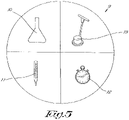
- FIG. 5 shows a Sinner circle 9 in which the four factors are presented which influence the cleaning. It concerns chemical cleaning products 10, the temperature 11 at which they are active, the time 12 during which they are active, and the mechanical treatment 13 with brushes or cloths required to clean a surface. Reduction of one of these factors must be compensated by increasing other factors to achieve the same result. Use of less strong chemicals will have to be compensated by allowing them to work over a longer period of time or at a higher temperature for example.
Landscapes
- Life Sciences & Earth Sciences (AREA)
- Health & Medical Sciences (AREA)
- Engineering & Computer Science (AREA)
- General Health & Medical Sciences (AREA)
- Zoology (AREA)
- Dentistry (AREA)
- Agronomy & Crop Science (AREA)
- Environmental Sciences (AREA)
- Pest Control & Pesticides (AREA)
- Plant Pathology (AREA)
- Wood Science & Technology (AREA)
- Microbiology (AREA)
- Virology (AREA)
- Biotechnology (AREA)
- Mechanical Engineering (AREA)
- Chemical & Material Sciences (AREA)
- Veterinary Medicine (AREA)
- Chemical Kinetics & Catalysis (AREA)
- General Chemical & Material Sciences (AREA)
- Epidemiology (AREA)
- Animal Behavior & Ethology (AREA)
- Public Health (AREA)
- Dispersion Chemistry (AREA)
- Toxicology (AREA)
- Micro-Organisms Or Cultivation Processes Thereof (AREA)
- Cleaning By Liquid Or Steam (AREA)
- Cleaning In General (AREA)
- Prevention Of Fouling (AREA)
- Agricultural Chemicals And Associated Chemicals (AREA)
- Apparatus For Disinfection Or Sterilisation (AREA)
- Apparatus Associated With Microorganisms And Enzymes (AREA)
Claims (15)
- Verfahren zum Verringern der Staubablagerung auf Innenräumen oder technischen Anlagen, Beschleunigen der Reinigung und Verringern der Reinigungshäufigkeit von Innenräumen oder technischen Anlagen, wobei das Verfahren wenigstens den folgenden Schritt umfasst:- die gezielte Zerstäubung auf den Oberflächen einer Flüssigkeit mit Sporen gutartiger Bakterien auf allen oder bestimmten Oberflächenarten mittels eines elektrisch und/oder pneumatisch betriebenen Zerstäubers, während der Raum für Menschen und Tiere zugänglich bleibt;dadurch gekennzeichnet, dass in dem Aerosol, das durch Zerstäuben der Flüssigkeit ausgebildet wird, die Tröpfchen kleiner als oder gleich 80 µm sind und durch den balloelektrischen Effekt die gleiche elektrische Ladung erhalten, wobei die gleiche elektrische Ladung bei der Sedimentation der Aerosole auf Staub beibehalten wird.
- Verfahren nach Anspruch 1, dadurch gekennzeichnet, dass die Konzentration an Sporen gutartiger Bakterien in der Flüssigkeit, die zerstäubt werden soll, zwischen 106 KVE/ml und 50 × 107 KVE/ml beträgt.
- Verfahren nach Anspruch 1, dadurch gekennzeichnet, dass der elektrische Zerstäuber ein Ultra-Low-Volume-Zerstäuber ist, der einen geraden Strahl mit einer Reichweite bis zu 15 Metern oder weniger erzeugt.
- Verfahren nach Anspruch 3, dadurch gekennzeichnet, dass der elektrische und/oder pneumatische Zerstäuber die Flüssigkeit mit Sporen gutartiger Bakterien auf der Oberfläche mit einer Durchflussmenge von maximal 300 ml pro Minute und einem Luftstrom von 0,2 Liter pro Minute bei einem Druck von maximal 18 kPa zerstäubt.
- Verfahren nach Anspruch 1, dadurch gekennzeichnet, dass es gefolgt ist von- der manuellen oder maschinellen Reinigung der Oberflächen mittels einer Mikrofaser.
- Verfahren nach Anspruch 1, dadurch gekennzeichnet, dass die Menge an zerstäubter Flüssigkeit mit Sporen gutartiger Bakterien, die pro Quadratmeter behandelter Oberfläche aufgebracht wird, maximal 10 Gramm pro m2 beträgt, mit der Absicht, dass sich die Oberfläche nicht nass anfühlt.
- Verfahren nach Anspruch 6, dadurch gekennzeichnet, dass die Sporen der gutartigen Bakterien in der zerstäubten Flüssigkeit aus der Gattung Bacillus für Anwendungen bei Raumtemperatur ausgewählt werden.
- Verfahren nach Anspruch 7, dadurch gekennzeichnet, dass die gutartigen Bakterien in der zerstäubten Flüssigkeit, die aus der Gattung Bacillus ausgewählt sind, aus Bacillus subtilis, Bacillus amyloliquefaciens, Bacillus pumilus, Bacillus licheni formis oder Bacillus megaterium oder einer Kombination davon bestehen.
- Verfahren nach Anspruch 6, dadurch gekennzeichnet, dass die Sporen der gutartigen Bakterien in der zerstäubten Flüssigkeit aus den Sporen aerober sporenausbildender kältetoleranter Bakterien der Gattungen Sporosarcina, Paenisporosarcina oder Paenibacillus oder einer Kombination davon für Anwendungen bei kalten Umgebungstemperaturen zwischen 4 und 18 °C ausgewählt sind.
- Verfahren nach Anspruch 9, dadurch gekennzeichnet, dass die Sporen der gutartigen Bakterien in der zerstäubten Flüssigkeit, die aus der Gattung Sporosarcina ausgewählt sind, aus Sporosarcina globispora, aquimarina oder psychrophila oder einer Kombination davon bestehen.
- Verfahren nach Anspruch 9, dadurch gekennzeichnet, dass die Sporen gutartiger Bakterien in der zerstäubten Flüssigkeit, die aus der Gattung Paenisporosarcina ausgewählt sind, aus den Sporen von Paenisporosarcina macmoerdoensis bestehen.
- Verfahren nach Anspruch 9, dadurch gekennzeichnet, dass die Sporen gutartiger Bakterien in der zerstäubten Flüssigkeit, die aus der Gattung Paenibacillus ausgewählt sind, aus den Sporen von Paenibacillus glacialis, amylolyticus, pabuli, xylanexedens, castaneae oder macquariensis antarcticus oder einer Kombination davon bestehen.
- Verfahren nach Anspruch 7, dadurch gekennzeichnet, dass die zerstäubte Flüssigkeit aus einer Lösung von Sporen aerober sporenausbildender Bacillus -Variationen besteht, die in entmineralisiertem Wasser mit 1 % Isopropylalkohol gelöst sind.
- Verfahren nach Anspruch 7, dadurch gekennzeichnet, dass es die Aufnahme und ein Metabolisieren von Staub durch die gekeimten Sporen anregt, weil die Oberflächenladung von Bacillus -Sporen, die durch den balloelektrischen Effekt erhalten werden, ihre Keimungsgeschwindigkeit günstig beeinflusst.
- Verwendung des Verfahrens nach einem der vorhergehenden Ansprüche, dadurch gekennzeichnet, dass das Verfahren verwendet wird, um die Staubablagerung in Räumen zu verringern, die durch eine Hand für eine manuelle Reinigung nicht erreichbar sind.
Applications Claiming Priority (2)
| Application Number | Priority Date | Filing Date | Title |
|---|---|---|---|
| BE2017/5044A BE1024938B1 (nl) | 2017-01-25 | 2017-01-25 | Werkwijze voor het schoonmaken van oppervlakken in binnenruimten en in technische installaties |
| PCT/IB2018/050424 WO2018138645A1 (en) | 2017-01-25 | 2018-01-24 | Method for cleaning surfaces in interior spaces and in technical equipments with benign bacteria |
Publications (2)
| Publication Number | Publication Date |
|---|---|
| EP3573671A1 EP3573671A1 (de) | 2019-12-04 |
| EP3573671B1 true EP3573671B1 (de) | 2022-04-13 |
Family
ID=57960187
Family Applications (1)
| Application Number | Title | Priority Date | Filing Date |
|---|---|---|---|
| EP18704600.8A Active EP3573671B1 (de) | 2017-01-25 | 2018-01-24 | Verfahren zur reinigung von oberflächen in innenräumen und in technischen ausrüstungen mit benignen bakterien |
Country Status (14)
| Country | Link |
|---|---|
| US (1) | US11541138B2 (de) |
| EP (1) | EP3573671B1 (de) |
| JP (1) | JP6936326B2 (de) |
| CN (1) | CN110325222A (de) |
| AU (1) | AU2018213217B2 (de) |
| BE (1) | BE1024938B1 (de) |
| CA (1) | CA3045269C (de) |
| DK (1) | DK3573671T3 (de) |
| ES (1) | ES2921276T3 (de) |
| PL (1) | PL3573671T3 (de) |
| PT (1) | PT3573671T (de) |
| RU (1) | RU2737090C1 (de) |
| WO (1) | WO2018138645A1 (de) |
| ZA (1) | ZA201903627B (de) |
Families Citing this family (3)
| Publication number | Priority date | Publication date | Assignee | Title |
|---|---|---|---|---|
| BE1028228B1 (nl) * | 2020-04-22 | 2021-11-30 | Living Tech Cvba | Werkwijze voor het verlagen van de werkzame verblijftijd van viruspartikels op oppervlakken en samenstelling hiervoor |
| FR3119477A1 (fr) * | 2021-02-04 | 2022-08-05 | Valeo Systemes D'essuyage | Procédé de maintenance d’un robot de livraison |
| KR102813793B1 (ko) * | 2021-03-30 | 2025-05-27 | 텐센트 테크놀로지(센젠) 컴퍼니 리미티드 | 포토레지스트 제거 방법 및 포토레지스트 제거 시스템 |
Family Cites Families (26)
| Publication number | Priority date | Publication date | Assignee | Title |
|---|---|---|---|---|
| SU978962A1 (ru) * | 1981-01-15 | 1982-12-07 | Алмалыкский Ордена Ленина И Ордена Трудового Красного Знамени Горно-Металлургический Комбинат Им.В.И.Ленина | Способы защиты поверхностей нагрева от отложений пыли, содержащейс в дымовых газах |
| JPH03157500A (ja) * | 1989-11-14 | 1991-07-05 | Mitsubishi Materials Corp | 微生物ベースのガラスクリーナー |
| JP3161025B2 (ja) | 1992-05-21 | 2001-04-25 | ソニー株式会社 | 電極間スペーサ |
| US6571810B1 (en) * | 1994-09-30 | 2003-06-03 | Zymo International, Inc. | Parts washing system |
| KR19990077318A (ko) | 1996-01-16 | 1999-10-25 | 에드워드 제이. 존스 | 세제 및 소독제 제조물 |
| ID18847A (id) * | 1996-02-07 | 1998-05-14 | Univ Southampton | Metoda pengendapan partikel partikel diudara |
| EP1004263A1 (de) * | 1998-11-09 | 2000-05-31 | The Procter & Gamble Company | Teleskopischer Sprüharm |
| US20050164902A1 (en) | 2003-10-24 | 2005-07-28 | Ecolab Inc. | Stable compositions of spores, bacteria, and/or fungi |
| JP2003157500A (ja) | 2001-11-22 | 2003-05-30 | Fujitsu Ltd | 安全走行支援装置,安全走行支援プログラム,及び安全走行支援方法 |
| JP2004351321A (ja) | 2003-05-29 | 2004-12-16 | Regal Joint Co Ltd | 液体噴射装置 |
| CN1256171C (zh) * | 2004-03-23 | 2006-05-17 | 文正贵 | 腐植酸盐生化液在净化室内空气中的应用 |
| GB0501719D0 (en) * | 2005-01-28 | 2005-03-02 | Green Bruce P | Sterilant system |
| DE102005014843A1 (de) * | 2005-03-30 | 2006-10-19 | Basf Ag | Verwendung von Hydrophobinen zur Oberflächenbehandlung von gehärteten mineralischen Baustoffen, Naturstein, Kunststein und Keramiken |
| BE1016597A6 (nl) * | 2005-05-25 | 2007-02-06 | Gielen Cornelis | Werkwijze voor het pathogeen vrij houden van een oppervlak, voorwerp en/of inrichting. |
| BE1018288A3 (nl) * | 2008-06-25 | 2010-08-03 | Cruysberghs Rudiger | Inrichting voor het biologisch behandelen van hvac eenheden. |
| CN101357237B (zh) * | 2008-08-31 | 2011-07-20 | 华南理工大学 | 一种微生态制剂喷雾除家畜家禽养殖场恶臭的方法 |
| BE1018722A5 (nl) * | 2009-04-17 | 2011-07-05 | Cruysberghs Rudiger | Een biologische samenstelling voor het behandelen van huisdieren en hun levensomgeving. |
| JP5662655B2 (ja) | 2009-06-01 | 2015-02-04 | 勤 桂 | ノズル |
| BE1019057A3 (nl) * | 2009-12-02 | 2012-02-07 | Metatecta Nv | Werkwijze voor het microbiologisch reinigen van een binnenruimte. |
| JP3161025U (ja) * | 2010-05-06 | 2010-07-15 | 佐々木 巖 | 清掃用ヘラ |
| WO2013188930A1 (en) | 2012-06-21 | 2013-12-27 | Willocx Filip Willem Maria | Method for removing particulate matter in indoor environments |
| CN103127541A (zh) * | 2012-07-19 | 2013-06-05 | 太原师范学院 | 一种轮藻驱蚊空气清新剂及其制备方法 |
| JP5866743B1 (ja) | 2015-06-19 | 2016-02-17 | 株式会社E・テック | 衣服消毒装置及び衣服消毒方法 |
| CN105148306A (zh) * | 2015-09-21 | 2015-12-16 | 盐城复华环保产业开发有限公司 | 一种用于有机肥生产车间的生物除臭剂及其使用方法 |
| CN105640828B (zh) * | 2016-01-06 | 2018-08-31 | 名臣健康用品股份有限公司 | 榴莲壳提取物在口腔护理产品中的应用 |
| JP6461037B2 (ja) | 2016-04-21 | 2019-01-30 | 創研株式会社 | 微生物を有する洗浄剤及び微生物を使用する洗浄方法 |
-
2017
- 2017-01-25 BE BE2017/5044A patent/BE1024938B1/nl active IP Right Grant
-
2018
- 2018-01-24 WO PCT/IB2018/050424 patent/WO2018138645A1/en not_active Ceased
- 2018-01-24 AU AU2018213217A patent/AU2018213217B2/en active Active
- 2018-01-24 ES ES18704600T patent/ES2921276T3/es active Active
- 2018-01-24 DK DK18704600.8T patent/DK3573671T3/da active
- 2018-01-24 CA CA3045269A patent/CA3045269C/en active Active
- 2018-01-24 CN CN201880005572.5A patent/CN110325222A/zh active Pending
- 2018-01-24 PL PL18704600.8T patent/PL3573671T3/pl unknown
- 2018-01-24 PT PT187046008T patent/PT3573671T/pt unknown
- 2018-01-24 RU RU2019122544A patent/RU2737090C1/ru active
- 2018-01-24 JP JP2019540406A patent/JP6936326B2/ja active Active
- 2018-01-24 EP EP18704600.8A patent/EP3573671B1/de active Active
- 2018-01-24 US US16/479,681 patent/US11541138B2/en active Active
-
2019
- 2019-06-06 ZA ZA2019/03627A patent/ZA201903627B/en unknown
Non-Patent Citations (1)
| Title |
|---|
| None * |
Also Published As
| Publication number | Publication date |
|---|---|
| BE1024938B1 (nl) | 2018-08-27 |
| CA3045269C (en) | 2021-11-30 |
| BE1024938A1 (nl) | 2018-08-20 |
| US20210322610A1 (en) | 2021-10-21 |
| DK3573671T3 (da) | 2022-07-11 |
| US11541138B2 (en) | 2023-01-03 |
| RU2737090C1 (ru) | 2020-11-24 |
| AU2018213217B2 (en) | 2022-11-03 |
| PT3573671T (pt) | 2022-07-13 |
| JP2020506798A (ja) | 2020-03-05 |
| CA3045269A1 (en) | 2018-08-02 |
| WO2018138645A1 (en) | 2018-08-02 |
| ZA201903627B (en) | 2022-01-26 |
| PL3573671T3 (pl) | 2022-08-08 |
| CN110325222A (zh) | 2019-10-11 |
| JP6936326B2 (ja) | 2021-09-15 |
| EP3573671A1 (de) | 2019-12-04 |
| ES2921276T3 (es) | 2022-08-23 |
| AU2018213217A1 (en) | 2019-07-11 |
Similar Documents
| Publication | Publication Date | Title |
|---|---|---|
| CA3045269C (en) | Method for cleaning surfaces in interior spaces and in technical equipments with benign bacteria | |
| EP4366787B1 (de) | Verwaltung eines mikrobioms in innenräumen | |
| US7767141B2 (en) | Method for reducing allergens in an enclosure | |
| Berg et al. | Safety assessment of the use of Bacillus-based cleaning products | |
| HK40012551A (en) | Method for cleaning surfaces in interior spaces and in technical equipments with benign bacteria | |
| HK40012551B (en) | Method for cleaning surfaces in interior spaces and in technical equipments with benign bacteria | |
| Andersen | Cleaning of rooms in wards | |
| US20220088255A1 (en) | Systems and methods for sanitizing an indoor environment | |
| CAPOLONGO | CHAPTER X FINISHING MATERIALS AS HEALTH PROMOTERS IN HEALING SPACES STEFANO CAPOLONGO AND MARCO GOLA | |
| Enterprises | Business Profile | |
| WO2000054585A1 (en) | Germicidal composition and method for treating the living space | |
| Cole | Cleaning and Special Environments: understanding the science | |
| FREE | Company profile | |
| JP2006271536A (ja) | 玄関マットとその製造方法 | |
| Harris | Mold: An Indoor Air Pollutant | |
| CN111643004A (zh) | 一种健康型家庭保洁方法 | |
| Force | The NHSScotland National Cleaning Services Specification | |
| NANAIMO | Fisheries and Oceans Canada | |
| Care et al. | What is the Difference Between Deep Clean and General Clean?[VIDEO] | |
| Menetrez | ANTIMICROBIAL TREATMENTS OF INDOOR MOLD AND BACTERIA. | |
| Button | The Everything Guide to a Healthy Home: All you need to protect yourself and your family from hidden household dangers | |
| Menetrez | Antimicrobial treatment and efficacy | |
| Leony et al. | A STUDY OF SPATIAL AND OCCUPANTS'BEHAVIORAL CHANGES DURING COVID-19 (CASE STUDY: LANDED HOUSE TYPE 70M2 IN SOUTH BEKASI, INDONESIA) | |
| JP2006037663A (ja) | 室内のカビの汚染防止方法 |
Legal Events
| Date | Code | Title | Description |
|---|---|---|---|
| STAA | Information on the status of an ep patent application or granted ep patent |
Free format text: STATUS: UNKNOWN |
|
| STAA | Information on the status of an ep patent application or granted ep patent |
Free format text: STATUS: THE INTERNATIONAL PUBLICATION HAS BEEN MADE |
|
| PUAI | Public reference made under article 153(3) epc to a published international application that has entered the european phase |
Free format text: ORIGINAL CODE: 0009012 |
|
| STAA | Information on the status of an ep patent application or granted ep patent |
Free format text: STATUS: REQUEST FOR EXAMINATION WAS MADE |
|
| 17P | Request for examination filed |
Effective date: 20190710 |
|
| AK | Designated contracting states |
Kind code of ref document: A1 Designated state(s): AL AT BE BG CH CY CZ DE DK EE ES FI FR GB GR HR HU IE IS IT LI LT LU LV MC MK MT NL NO PL PT RO RS SE SI SK SM TR |
|
| AX | Request for extension of the european patent |
Extension state: BA ME |
|
| DAV | Request for validation of the european patent (deleted) | ||
| DAX | Request for extension of the european patent (deleted) | ||
| REG | Reference to a national code |
Ref country code: HK Ref legal event code: DE Ref document number: 40012551 Country of ref document: HK |
|
| STAA | Information on the status of an ep patent application or granted ep patent |
Free format text: STATUS: EXAMINATION IS IN PROGRESS |
|
| 17Q | First examination report despatched |
Effective date: 20201014 |
|
| RIC1 | Information provided on ipc code assigned before grant |
Ipc: A01N 63/20 20200101ALI20211213BHEP Ipc: A01N 63/22 20200101ALI20211213BHEP Ipc: B08B 9/08 20060101ALI20211213BHEP Ipc: B08B 9/027 20060101ALI20211213BHEP Ipc: B08B 9/00 20060101ALI20211213BHEP Ipc: C12N 1/20 20060101ALI20211213BHEP Ipc: A01N 25/06 20060101ALI20211213BHEP Ipc: B08B 7/00 20060101ALI20211213BHEP Ipc: A47L 11/00 20060101ALI20211213BHEP Ipc: A61L 2/22 20060101AFI20211213BHEP |
|
| GRAP | Despatch of communication of intention to grant a patent |
Free format text: ORIGINAL CODE: EPIDOSNIGR1 |
|
| STAA | Information on the status of an ep patent application or granted ep patent |
Free format text: STATUS: GRANT OF PATENT IS INTENDED |
|
| INTG | Intention to grant announced |
Effective date: 20220121 |
|
| GRAS | Grant fee paid |
Free format text: ORIGINAL CODE: EPIDOSNIGR3 |
|
| GRAA | (expected) grant |
Free format text: ORIGINAL CODE: 0009210 |
|
| STAA | Information on the status of an ep patent application or granted ep patent |
Free format text: STATUS: THE PATENT HAS BEEN GRANTED |
|
| AK | Designated contracting states |
Kind code of ref document: B1 Designated state(s): AL AT BE BG CH CY CZ DE DK EE ES FI FR GB GR HR HU IE IS IT LI LT LU LV MC MK MT NL NO PL PT RO RS SE SI SK SM TR |
|
| REG | Reference to a national code |
Ref country code: GB Ref legal event code: FG4D |
|
| REG | Reference to a national code |
Ref country code: CH Ref legal event code: EP |
|
| REG | Reference to a national code |
Ref country code: DE Ref legal event code: R096 Ref document number: 602018033728 Country of ref document: DE |
|
| REG | Reference to a national code |
Ref country code: IE Ref legal event code: FG4D |
|
| REG | Reference to a national code |
Ref country code: AT Ref legal event code: REF Ref document number: 1482897 Country of ref document: AT Kind code of ref document: T Effective date: 20220515 |
|
| REG | Reference to a national code |
Ref country code: NL Ref legal event code: FP |
|
| REG | Reference to a national code |
Ref country code: FI Ref legal event code: FGE |
|
| REG | Reference to a national code |
Ref country code: DK Ref legal event code: T3 Effective date: 20220704 |
|
| REG | Reference to a national code |
Ref country code: PT Ref legal event code: SC4A Ref document number: 3573671 Country of ref document: PT Date of ref document: 20220713 Kind code of ref document: T Free format text: AVAILABILITY OF NATIONAL TRANSLATION Effective date: 20220707 |
|
| REG | Reference to a national code |
Ref country code: SE Ref legal event code: TRGR |
|
| REG | Reference to a national code |
Ref country code: LT Ref legal event code: MG9D |
|
| REG | Reference to a national code |
Ref country code: ES Ref legal event code: FG2A Ref document number: 2921276 Country of ref document: ES Kind code of ref document: T3 Effective date: 20220823 |
|
| REG | Reference to a national code |
Ref country code: NO Ref legal event code: T2 Effective date: 20220413 |
|
| PG25 | Lapsed in a contracting state [announced via postgrant information from national office to epo] |
Ref country code: LT Free format text: LAPSE BECAUSE OF FAILURE TO SUBMIT A TRANSLATION OF THE DESCRIPTION OR TO PAY THE FEE WITHIN THE PRESCRIBED TIME-LIMIT Effective date: 20220413 Ref country code: HR Free format text: LAPSE BECAUSE OF FAILURE TO SUBMIT A TRANSLATION OF THE DESCRIPTION OR TO PAY THE FEE WITHIN THE PRESCRIBED TIME-LIMIT Effective date: 20220413 Ref country code: GR Free format text: LAPSE BECAUSE OF FAILURE TO SUBMIT A TRANSLATION OF THE DESCRIPTION OR TO PAY THE FEE WITHIN THE PRESCRIBED TIME-LIMIT Effective date: 20220714 Ref country code: BG Free format text: LAPSE BECAUSE OF FAILURE TO SUBMIT A TRANSLATION OF THE DESCRIPTION OR TO PAY THE FEE WITHIN THE PRESCRIBED TIME-LIMIT Effective date: 20220713 |
|
| PG25 | Lapsed in a contracting state [announced via postgrant information from national office to epo] |
Ref country code: RS Free format text: LAPSE BECAUSE OF FAILURE TO SUBMIT A TRANSLATION OF THE DESCRIPTION OR TO PAY THE FEE WITHIN THE PRESCRIBED TIME-LIMIT Effective date: 20220413 Ref country code: LV Free format text: LAPSE BECAUSE OF FAILURE TO SUBMIT A TRANSLATION OF THE DESCRIPTION OR TO PAY THE FEE WITHIN THE PRESCRIBED TIME-LIMIT Effective date: 20220413 Ref country code: IS Free format text: LAPSE BECAUSE OF FAILURE TO SUBMIT A TRANSLATION OF THE DESCRIPTION OR TO PAY THE FEE WITHIN THE PRESCRIBED TIME-LIMIT Effective date: 20220813 |
|
| REG | Reference to a national code |
Ref country code: DE Ref legal event code: R097 Ref document number: 602018033728 Country of ref document: DE |
|
| PG25 | Lapsed in a contracting state [announced via postgrant information from national office to epo] |
Ref country code: SM Free format text: LAPSE BECAUSE OF FAILURE TO SUBMIT A TRANSLATION OF THE DESCRIPTION OR TO PAY THE FEE WITHIN THE PRESCRIBED TIME-LIMIT Effective date: 20220413 Ref country code: SK Free format text: LAPSE BECAUSE OF FAILURE TO SUBMIT A TRANSLATION OF THE DESCRIPTION OR TO PAY THE FEE WITHIN THE PRESCRIBED TIME-LIMIT Effective date: 20220413 Ref country code: RO Free format text: LAPSE BECAUSE OF FAILURE TO SUBMIT A TRANSLATION OF THE DESCRIPTION OR TO PAY THE FEE WITHIN THE PRESCRIBED TIME-LIMIT Effective date: 20220413 Ref country code: EE Free format text: LAPSE BECAUSE OF FAILURE TO SUBMIT A TRANSLATION OF THE DESCRIPTION OR TO PAY THE FEE WITHIN THE PRESCRIBED TIME-LIMIT Effective date: 20220413 Ref country code: CZ Free format text: LAPSE BECAUSE OF FAILURE TO SUBMIT A TRANSLATION OF THE DESCRIPTION OR TO PAY THE FEE WITHIN THE PRESCRIBED TIME-LIMIT Effective date: 20220413 |
|
| PLBE | No opposition filed within time limit |
Free format text: ORIGINAL CODE: 0009261 |
|
| STAA | Information on the status of an ep patent application or granted ep patent |
Free format text: STATUS: NO OPPOSITION FILED WITHIN TIME LIMIT |
|
| 26N | No opposition filed |
Effective date: 20230116 |
|
| PG25 | Lapsed in a contracting state [announced via postgrant information from national office to epo] |
Ref country code: AL Free format text: LAPSE BECAUSE OF FAILURE TO SUBMIT A TRANSLATION OF THE DESCRIPTION OR TO PAY THE FEE WITHIN THE PRESCRIBED TIME-LIMIT Effective date: 20220413 |
|
| PG25 | Lapsed in a contracting state [announced via postgrant information from national office to epo] |
Ref country code: SI Free format text: LAPSE BECAUSE OF FAILURE TO SUBMIT A TRANSLATION OF THE DESCRIPTION OR TO PAY THE FEE WITHIN THE PRESCRIBED TIME-LIMIT Effective date: 20220413 |
|
| REG | Reference to a national code |
Ref country code: AT Ref legal event code: UEP Ref document number: 1482897 Country of ref document: AT Kind code of ref document: T Effective date: 20220413 |
|
| PG25 | Lapsed in a contracting state [announced via postgrant information from national office to epo] |
Ref country code: MC Free format text: LAPSE BECAUSE OF FAILURE TO SUBMIT A TRANSLATION OF THE DESCRIPTION OR TO PAY THE FEE WITHIN THE PRESCRIBED TIME-LIMIT Effective date: 20220413 |
|
| PG25 | Lapsed in a contracting state [announced via postgrant information from national office to epo] |
Ref country code: MC Free format text: LAPSE BECAUSE OF FAILURE TO SUBMIT A TRANSLATION OF THE DESCRIPTION OR TO PAY THE FEE WITHIN THE PRESCRIBED TIME-LIMIT Effective date: 20220413 |
|
| PG25 | Lapsed in a contracting state [announced via postgrant information from national office to epo] |
Ref country code: BG Free format text: LAPSE BECAUSE OF FAILURE TO SUBMIT A TRANSLATION OF THE DESCRIPTION OR TO PAY THE FEE WITHIN THE PRESCRIBED TIME-LIMIT Effective date: 20220413 |
|
| PG25 | Lapsed in a contracting state [announced via postgrant information from national office to epo] |
Ref country code: BG Free format text: LAPSE BECAUSE OF FAILURE TO SUBMIT A TRANSLATION OF THE DESCRIPTION OR TO PAY THE FEE WITHIN THE PRESCRIBED TIME-LIMIT Effective date: 20220413 |
|
| PGFP | Annual fee paid to national office [announced via postgrant information from national office to epo] |
Ref country code: PT Payment date: 20250122 Year of fee payment: 8 |
|
| PGFP | Annual fee paid to national office [announced via postgrant information from national office to epo] |
Ref country code: DK Payment date: 20250122 Year of fee payment: 8 Ref country code: FI Payment date: 20250121 Year of fee payment: 8 |
|
| PGFP | Annual fee paid to national office [announced via postgrant information from national office to epo] |
Ref country code: ES Payment date: 20250214 Year of fee payment: 8 |
|
| PGFP | Annual fee paid to national office [announced via postgrant information from national office to epo] |
Ref country code: IE Payment date: 20250119 Year of fee payment: 8 Ref country code: SE Payment date: 20250122 Year of fee payment: 8 |
|
| PGFP | Annual fee paid to national office [announced via postgrant information from national office to epo] |
Ref country code: NO Payment date: 20250121 Year of fee payment: 8 |
|
| PGFP | Annual fee paid to national office [announced via postgrant information from national office to epo] |
Ref country code: AT Payment date: 20250120 Year of fee payment: 8 Ref country code: CH Payment date: 20250201 Year of fee payment: 8 |
|
| PGFP | Annual fee paid to national office [announced via postgrant information from national office to epo] |
Ref country code: PL Payment date: 20250114 Year of fee payment: 8 |
|
| PGFP | Annual fee paid to national office [announced via postgrant information from national office to epo] |
Ref country code: IT Payment date: 20250131 Year of fee payment: 8 |
|
| PG25 | Lapsed in a contracting state [announced via postgrant information from national office to epo] |
Ref country code: CY Free format text: LAPSE BECAUSE OF FAILURE TO SUBMIT A TRANSLATION OF THE DESCRIPTION OR TO PAY THE FEE WITHIN THE PRESCRIBED TIME-LIMIT; INVALID AB INITIO Effective date: 20180124 |
|
| PG25 | Lapsed in a contracting state [announced via postgrant information from national office to epo] |
Ref country code: HU Free format text: LAPSE BECAUSE OF FAILURE TO SUBMIT A TRANSLATION OF THE DESCRIPTION OR TO PAY THE FEE WITHIN THE PRESCRIBED TIME-LIMIT; INVALID AB INITIO Effective date: 20180124 |
|
| PG25 | Lapsed in a contracting state [announced via postgrant information from national office to epo] |
Ref country code: TR Free format text: LAPSE BECAUSE OF FAILURE TO SUBMIT A TRANSLATION OF THE DESCRIPTION OR TO PAY THE FEE WITHIN THE PRESCRIBED TIME-LIMIT Effective date: 20220413 |
|
| PGFP | Annual fee paid to national office [announced via postgrant information from national office to epo] |
Ref country code: NL Payment date: 20260121 Year of fee payment: 9 Ref country code: LU Payment date: 20260121 Year of fee payment: 9 |
|
| PGFP | Annual fee paid to national office [announced via postgrant information from national office to epo] |
Ref country code: GB Payment date: 20260121 Year of fee payment: 9 |
|
| PGFP | Annual fee paid to national office [announced via postgrant information from national office to epo] |
Ref country code: DE Payment date: 20260128 Year of fee payment: 9 |
|
| PGFP | Annual fee paid to national office [announced via postgrant information from national office to epo] |
Ref country code: BE Payment date: 20260121 Year of fee payment: 9 |
|
| PGFP | Annual fee paid to national office [announced via postgrant information from national office to epo] |
Ref country code: FR Payment date: 20260121 Year of fee payment: 9 |