EP3562316B1 - Procédé de traitement d'insectes comprenant la séparation des cuticules de la partie molle des insectes puis la séparation de la partie molle en trois fractions - Google Patents
Procédé de traitement d'insectes comprenant la séparation des cuticules de la partie molle des insectes puis la séparation de la partie molle en trois fractions Download PDFInfo
- Publication number
- EP3562316B1 EP3562316B1 EP17715223.8A EP17715223A EP3562316B1 EP 3562316 B1 EP3562316 B1 EP 3562316B1 EP 17715223 A EP17715223 A EP 17715223A EP 3562316 B1 EP3562316 B1 EP 3562316B1
- Authority
- EP
- European Patent Office
- Prior art keywords
- fraction
- insects
- weight
- soft part
- cuticles
- Prior art date
- Legal status (The legal status is an assumption and is not a legal conclusion. Google has not performed a legal analysis and makes no representation as to the accuracy of the status listed.)
- Active
Links
Images
Classifications
-
- A—HUMAN NECESSITIES
- A23—FOODS OR FOODSTUFFS; TREATMENT THEREOF, NOT COVERED BY OTHER CLASSES
- A23K—FODDER
- A23K20/00—Accessory food factors for animal feeding-stuffs
- A23K20/10—Organic substances
- A23K20/142—Amino acids; Derivatives thereof
- A23K20/147—Polymeric derivatives, e.g. peptides or proteins
-
- A—HUMAN NECESSITIES
- A23—FOODS OR FOODSTUFFS; TREATMENT THEREOF, NOT COVERED BY OTHER CLASSES
- A23D—EDIBLE OILS OR FATS, e.g. MARGARINES, SHORTENINGS OR COOKING OILS
- A23D9/00—Other edible oils or fats, e.g. shortenings or cooking oils
- A23D9/02—Other edible oils or fats, e.g. shortenings or cooking oils characterised by the production or working-up
-
- A—HUMAN NECESSITIES
- A23—FOODS OR FOODSTUFFS; TREATMENT THEREOF, NOT COVERED BY OTHER CLASSES
- A23J—PROTEIN COMPOSITIONS FOR FOODSTUFFS; WORKING-UP PROTEINS FOR FOODSTUFFS; PHOSPHATIDE COMPOSITIONS FOR FOODSTUFFS
- A23J3/00—Working-up of proteins for foodstuffs
- A23J3/04—Animal proteins
-
- A—HUMAN NECESSITIES
- A23—FOODS OR FOODSTUFFS; TREATMENT THEREOF, NOT COVERED BY OTHER CLASSES
- A23K—FODDER
- A23K10/00—Animal feeding-stuffs
- A23K10/20—Animal feeding-stuffs from material of animal origin
-
- A—HUMAN NECESSITIES
- A23—FOODS OR FOODSTUFFS; TREATMENT THEREOF, NOT COVERED BY OTHER CLASSES
- A23K—FODDER
- A23K40/00—Shaping or working-up of animal feeding-stuffs
- A23K40/10—Shaping or working-up of animal feeding-stuffs by agglomeration; by granulation, e.g. making powders
-
- A—HUMAN NECESSITIES
- A23—FOODS OR FOODSTUFFS; TREATMENT THEREOF, NOT COVERED BY OTHER CLASSES
- A23K—FODDER
- A23K20/00—Accessory food factors for animal feeding-stuffs
- A23K20/10—Organic substances
- A23K20/158—Fatty acids; Fats; Products containing oils or fats
-
- A—HUMAN NECESSITIES
- A23—FOODS OR FOODSTUFFS; TREATMENT THEREOF, NOT COVERED BY OTHER CLASSES
- A23L—FOODS, FOODSTUFFS OR NON-ALCOHOLIC BEVERAGES, NOT OTHERWISE PROVIDED FOR; PREPARATION OR TREATMENT THEREOF
- A23L33/00—Modifying nutritive qualities of foods; Dietetic products; Preparation or treatment thereof
- A23L33/10—Modifying nutritive qualities of foods; Dietetic products; Preparation or treatment thereof using additives
- A23L33/17—Amino acids, peptides or proteins
-
- A—HUMAN NECESSITIES
- A23—FOODS OR FOODSTUFFS; TREATMENT THEREOF, NOT COVERED BY OTHER CLASSES
- A23V—INDEXING SCHEME RELATING TO FOODS, FOODSTUFFS OR NON-ALCOHOLIC BEVERAGES AND LACTIC OR PROPIONIC ACID BACTERIA USED IN FOODSTUFFS OR FOOD PREPARATION
- A23V2002/00—Food compositions, function of food ingredients or processes for food or foodstuffs
-
- A—HUMAN NECESSITIES
- A23—FOODS OR FOODSTUFFS; TREATMENT THEREOF, NOT COVERED BY OTHER CLASSES
- A23V—INDEXING SCHEME RELATING TO FOODS, FOODSTUFFS OR NON-ALCOHOLIC BEVERAGES AND LACTIC OR PROPIONIC ACID BACTERIA USED IN FOODSTUFFS OR FOOD PREPARATION
- A23V2200/00—Function of food ingredients
- A23V2200/12—Replacer
- A23V2200/13—Protein replacer
-
- A—HUMAN NECESSITIES
- A23—FOODS OR FOODSTUFFS; TREATMENT THEREOF, NOT COVERED BY OTHER CLASSES
- A23V—INDEXING SCHEME RELATING TO FOODS, FOODSTUFFS OR NON-ALCOHOLIC BEVERAGES AND LACTIC OR PROPIONIC ACID BACTERIA USED IN FOODSTUFFS OR FOOD PREPARATION
- A23V2250/00—Food ingredients
- A23V2250/50—Polysaccharides, gums
- A23V2250/51—Polysaccharide
- A23V2250/511—Chitin, chitosan
-
- C—CHEMISTRY; METALLURGY
- C11—ANIMAL OR VEGETABLE OILS, FATS, FATTY SUBSTANCES OR WAXES; FATTY ACIDS THEREFROM; DETERGENTS; CANDLES
- C11B—PRODUCING, e.g. BY PRESSING RAW MATERIALS OR BY EXTRACTION FROM WASTE MATERIALS, REFINING OR PRESERVING FATS, FATTY SUBSTANCES, e.g. LANOLIN, FATTY OILS OR WAXES; ESSENTIAL OILS; PERFUMES
- C11B1/00—Production of fats or fatty oils from raw materials
- C11B1/06—Production of fats or fatty oils from raw materials by pressing
Definitions
- the present invention relates to a method for treating insects.
- the present application also discloses powders, in particular a powder obtainable by the method for treating insects according to the invention, and the use of these powders in food, in particular in animal feed.
- Powders prepared from animals have long been used in animal feed.
- fishmeal is one of the main sources of protein in animal feed.
- Fishmeal is very rich in animal proteins (rich in amino acids such as lysine and methionine) that are easy to digest.
- Growing demand accompanied by limited supply has resulted, among other things, in significantly increasing its price.
- the document WO 2014/123420 A1 relates to a process for converting insects into nutrient streams, such as a fat-containing fraction, an aqueous protein-containing fraction and a solids-containing fraction.
- the process comprises the steps of: (a) crushing insects or worms, thereby obtaining a paste, the insects or worms being reduced in size, (b) heating the paste to a temperature of 70-100°C and (c) subjecting the heated paste to a physical separation step, preferably decantation and/or centrifugation, provided that the process does not include enzymatic treatment of the paste.
- the document EP 3 078 277 A1 discloses a method of manufacturing insect powder comprising drying the insects with air at a temperature between 100°C and 180°C; and grinding the insects to obtain a powder, wherein the powder has a water activity of less than 0.7.
- Insect flours offer alternative natural protein sources and the possibility of being mass-produced with a minimal ecological footprint.
- certain beetles such as Tenebrio molitor, have the advantage of being suitable for intensive mass production.
- chitin means any type of chitin derivative, i.e. a derivative of polysaccharides comprising N-acetyl-glucosamine units and D-glucosamine units, in particular chitin-polypeptide copolymers (sometimes referred to as "chitin-polypeptide composites"). These copolymers can also be associated with pigments, often of the melanin type.
- Chitin is said to be the second most synthesized polymer in the living world after cellulose. Indeed, chitin is synthesized by many species in the living world: it partly constitutes the exoskeleton of crustaceans and insects and the lateral wall that surrounds and protects fungi. More specifically, in insects, chitin constitutes 3 to 60% of their exoskeleton.
- chitin is generally considered a difficult compound for some animals to digest.
- insects we mean insects at any stage of development, such as adult, larval or nymph stage.
- the cuticle is the outer layer (or exoskeleton) secreted by the epidermis of insects. It is generally formed of three layers: the epicuticle, the exocuticle and the endocuticle.
- soft part refers to the flesh (including muscles and viscera) and juice (including biological fluids, water and haemolymph) of insects. In particular, the soft part does not consist of insect juice.
- insects used in the method according to the invention are at a larval stage.
- insects used in the method according to the invention are edible.
- insects preferred for implementing the method according to the invention are, for example, Coleoptera, Diptera, Lepidoptera, Isoptera, Orthoptera, Hymenoptera, Blattoptera, Hemyptera, Heteroptera, Ephemeroptera and Mecoptera, preferably Coleoptera, Diptera, Orthoptera, Lepidoptera or mixtures thereof, even more preferably Coleoptera.
- the beetles preferentially used in the method according to the invention belong to the families Tenebrionidae, Melolonthidae, Dermestidae, Coccinellidae, Cerambycidae, Carabidae, Buprestidae, Cetoniidae, Dryophthoridae, or their mixtures.
- these are the following beetles: Tenebrio molitor, Alphitobius diaperinus, Zophobas morio, Tenebrio obscurus, Tribolium castaneum and Rhynchophorus ferrugineus, or their mixtures.
- the oily fraction has a lipid content greater than or equal to 90%, preferably greater than or equal to 95%, even more preferably greater than or equal to 99% by weight of the total weight of the oily fraction.
- the solid fraction has a dry matter content of between 45 and 65% by weight of the total weight of the solid fraction.
- the aqueous fraction has a carbohydrate content of between 15 and 40% by weight, preferably between 20 and 30% by weight, on the total dry weight of the aqueous fraction.
- the aqueous fraction has a dry matter content of less than or equal to 20% by weight, preferably less than or equal to 15% by weight of the total weight of the aqueous fraction.
- the separation of the cuticles from the soft part of the insects is carried out using a filter press.
- a filter press is made up of filter cloths and allows separation according to the principle of pressure filtration.
- the separation of the cuticles from the soft part of the insects is carried out using a belt separator.
- a belt separator refers to a device allowing the separation of the solid part from the soft part of a product, and which comprises a clamping belt (or press belt) and a perforated drum.
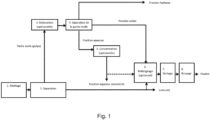
- step 2 The separation of the cuticles from the soft part of the insects is more fully described in step 2 of the detailed method of treating insects according to the invention below.
- the cuticles obtained at the end of this separation step have a high chitin content of the order of 10 to 30% by weight on the total weight of cuticles, as indicated below.
- the step of separating the cuticles from the soft part is carried out without any prior step of crushing the insects, particularly in the form of particles, having been carried out.
- step 4 of the detailed method of treating insects according to the invention is more fully described in step 4 of the detailed method of treating insects according to the invention below.
- the method of treating insects according to the invention may comprise a slaughtering step prior to the step of separating the cuticles from the soft part.
- the insects are directly used for implementing step 2 of separating the cuticles from the soft part of the insects, i.e. the insects are not subjected to any treatment, such as grinding, freezing or dehydration between step 1 and step 2.
- the method for treating insects according to the invention further comprises a step of maturing the soft part of the insects, between the step of separating the cuticles from the soft part and the step of separating the soft part of the insects into an oily fraction, a solid fraction and an aqueous fraction.
- stage of maturation of the soft part of the insects we mean more specifically a stage during which the soft part of the insects is subjected to agitation.
- step 3 is more fully described in step 3 of the detailed method for treating insects according to the invention below.
- the method for treating insects according to the invention comprises a step of concentrating the aqueous fraction, to obtain an aqueous fraction concentrated.
- step 5 is more fully described in step 5 of the detailed method for treating insects according to the invention below.
- step 6 is more fully described in step 6 of the detailed method for treating insects according to the invention below.
- the method for treating insects according to the invention comprises a step of drying the solid fraction or the mixture to obtain a dry solid fraction or a dry mixture, respectively.
- step 7 is more fully described in step 7 of the detailed method for treating insects according to the invention below.
- the method for treating insects according to the invention further comprises a step of grinding the dry solid fraction or the dry mixture.
- step 8 is more fully described in step 8 of the detailed method for treating insects according to the invention below.
- Step 2 aims to separate the cuticles from the soft part of the insects.
- Separation of the cuticles from the soft part of insects can be done using any type of suitable separator.
- the separation of the cuticles of the part soft is made using a filter press.
- the filter press used in the insect treatment process according to the invention is a belt filter press.
- a belt filter press consists of two perforated clamping belts (also called “filter cloths"). The insects are placed between the two perforated clamping belts so that the soft part of the insects is forced through the perforations of the clamping belts by pressure, while the solid part of the insects remains between the 2 perforated clamping belts.
- the person skilled in the art is able to determine the diameter of the perforations of the clamping bands as well as the pressure to be exerted, allowing the separation of the cuticles from the soft part of the insects.
- Examples include the belt filter press (or "belt press”) from the Flottweg company, or the belt filter presses from the ATR Disations company.
- the separation of the cuticles from the soft part is carried out using a strip separator.
- a belt separator may include a clamping belt and a perforated drum, the clamping belt surrounding at least a portion of the perforated drum.
- the clamping strip allows the insects to be fed and applied against the perforated drum so as to force the soft part of the insects through the perforations of the drum by pressure, while the solid part of the insects (cuticles) remains outside the drum.
- the cuticles can then be removed using a scraper knife.
- Examples include belt separators from the Baader company, such as the 601 to 607 belt separators ("soft separator 601 to 607"), or the SEPAmatic ® belt separators from BFD Corporation (410 to 4000V range).
- the diameter of the perforations of the drum is between 0.5 and 3 mm, preferably between 1 and 2 mm.
- the person skilled in the art is able to determine the pressure to be exerted allowing the separation of the cuticles from the soft part of the insects.
- This insect separation step differs from conventional pressing which can be carried out, for example, with a single-screw or twin-screw press in that it allows a (clean) separation of the soft part and the cuticles of the insects and not a separation of a juice from a solid fraction.
- the separation of the cuticles from the soft part of the insects is carried out using a belt separator.
- the cuticles obtained in step 2 comprise between 10 and 30%, preferably between 15 and 25% by weight of chitin, on the total dry weight of cuticles.
- the determination of the chitin content is carried out by extraction of the chitin.
- a method for determining the chitin content that can be used is the ADAC 991.43 method.
- the cuticles comprise less than 25%, preferably less than 10%, more preferably less than 5%, even more preferably less than 3% by weight of lipids on the total dry weight of the cuticles.
- the cuticles comprise between 55 and 90%, advantageously between 60 and 85%, preferably between 65 and 80% by weight of proteins on the total dry weight of cuticles.
- proteins In the context of the present application, by “proteins” is meant the quantity of crude proteins.
- the quantification of crude proteins is well known to those skilled in the art.
- the Dumas method or the Kjeldhal method may be cited.
- the Kjeldhal method is used.
- this method is based on measuring the nitrogen content.
- chitin contains nitrogen at a content of around 8%. Consequently, the nitrogen content of chitin was deduced from the measured nitrogen content before performing the conversion to obtain the protein content.
- the cuticles comprise between 0.5 and 30%, advantageously between 1 and 20%, preferably between 5 and 15% by weight of carbohydrates on the total dry weight of cuticles.
- Carbohydrate content was calculated by measuring the difference of carbohydrates. According to this method, the carbohydrate content is equal to the dry matter content from which the ash, protein and lipid contents are subtracted.
- the cuticles preferably comprise at least 0.08% by weight, more preferably at least 0.1% by weight, even more preferably at least 0.12% by weight of trehalose on the total dry weight of cuticles.
- the amount of trehalose is determined by GC-MS analysis. Such analysis is further described in Example 1 below.
- the soft part obtained in step 2 comprises between 20 and 50% by weight of lipids, preferably between 30 and 40% by weight of lipids on the total dry weight of the soft part.
- the soft part comprises at least 45%, preferably at least 48%, more preferably at least 50% by weight of proteins on the total dry weight of the soft part.
- the soft part of the insects is then, optionally, subjected to agitation in a tank.
- This step helps to facilitate the separation of the soft part of the insects in step 4 below.
- the method according to the invention comprises such a step.
- Step 4 Separation of the soft part into a solid fraction, an aqueous fraction and an oily fraction
- This step aims to recover three fractions from the soft part of the insects obtained in step 2 or 3, namely a solid fraction, an aqueous fraction, and an oily fraction.
- this step of separating the soft part is carried out in two sub-steps.
- the soft part of the insects is subjected to decantation using a 2-phase decanter, so as to obtain a solid fraction and a liquid fraction.
- the liquid fraction is subjected to centrifugation, so as to recover an oily fraction and an aqueous fraction.
- a plate centrifuge is used.
- step 4 the soft part of the insects is subjected to decantation using a 3-phase decanter, so as to directly obtain an aqueous fraction, an oily fraction and a solid fraction.
- Suitable 3-phase decanters are, for example, the Tricanter ® from Flottweg, or 3-phase decanters from GEA, such as the CA 225-03-33 decanter.
- the separation of the soft part is carried out according to the second embodiment.
- the use of a 3-phase decanter makes it possible to obtain a particularly effective phase separation.
- the solid fraction obtained has a high dry matter content
- the aqueous fraction has little insoluble sediment (from the solid fraction) and oil
- the oily fraction has little insoluble sediment (from the solid fraction) and water.
- the aqueous fraction obtained in step 4 is then optionally concentrated, to obtain a concentrated aqueous fraction.
- the concentration is achieved by evaporation.
- the evaporation is carried out at a temperature between 30 and 100°C, preferably between 60 and 80°C.
- the evaporation is carried out at a pressure between 50 and 1013 mbar, preferably at 1013 mbar.
- Evaporation is preferably carried out for a period of between 5 and 20 minutes.
- Concentration is preferably carried out using a falling film evaporator, a rising-flow plate evaporator, or a thin-film evaporator.
- This type of standard equipment can be used without encountering any fouling problems, thanks in particular to the low quantity of sediment present in the aqueous fraction.
- aqueous fractions cannot be concentrated beyond 42% dry matter, because they tend to gel (glue water) from this concentration.
- the aqueous fraction comprises small soluble proteins (at least 45% of the soluble proteins of the aqueous fraction have a size less than 550 g/mol, as more fully described below), which makes it possible to avoid gelling and thus to obtain an aqueous fraction with a high concentration of dry matter (up to 70%) and having a viscosity less than 30,000 cPs (centipoise).
- soluble proteins is meant, among crude proteins, those which are soluble in an aqueous solution whose pH is between 6 and 8, advantageously between 7.2 and 7.6.
- protein when used in this application, it means crude protein.
- the aqueous solution is a buffer solution whose pH is between 6 and 8, advantageously between 7.2 and 7.6.
- the buffer solution is a NaCl phosphate buffer solution, whose pH is equal to 7.4 +/- 0.2.
- Step 6 Mixing the concentrated aqueous fraction and/or cuticles with the solid fraction
- All or part of the cuticles obtained in step 2 and/or all or part of the concentrated aqueous fraction obtained in step 5 may optionally be mixed with the solid fraction obtained in step 4 to obtain a mixture.
- the mixture is homogenized so as to facilitate its subsequent processing.
- mixers examples include conical screw mixers, such as those from Vrieco-Nauta ® , or pendulum mixers, such as those from PMS.
- Step 7 Drying of the solid fraction obtained in step 4 or of the mixture obtained in step 6
- the solid fraction obtained in step 4 or the mixture obtained in step 6 can be dried to obtain a dry solid fraction or a dry mixture.
- drying is carried out using a disc dryer, a tubular dryer, a propeller dryer, a flash dryer, a thin film dryer or an atomization dryer.
- drying is carried out using a disc or tubular dryer.
- Suitable tubular dryers are, for example, those from the company Tummers (Simon Dryers Technology).
- Suitable disc dryers are, for example, those from the company Haarslev.
- Drying can be done between 1 and 10 hours, preferably between 3 and 5 hours.
- the drying is carried out at a temperature between 60 and 225°C, preferably between 80 and 100°C.
- evaporation is carried out at atmospheric pressure.
- Step 8 Grinding of the dry solid fraction or dry mixture obtained in step 7
- binder we mean a composition in the form of particles.
- the powder is an insect powder, that is, a powder prepared solely from insects and optionally water.
- a crusher such as a hammer mill or a cone crusher (such as the cone crushers ("Kek cone mills”) from Kemutec) can be used, for example.
- particle size acceptable for human or animal consumption When the powder is ground to a particle size acceptable for human or animal consumption, it may be referred to as “flour” and in particular "insect meal”.
- particle size acceptable for human or animal consumption a particle size of between 100 ⁇ m and 1.5 mm, preferably between 300 ⁇ m, is intended. and 1 mm, more preferably between 500 and 800 ⁇ m.
- the present application also discloses the products resulting from the process according to the invention.
- the present application further discloses a solid fraction obtainable by the insect treatment method according to the invention.
- the present application also discloses a solid fraction comprising at least 71% by weight of proteins and between 0.1 and 2% by weight of chitin, the weight percentages being indicated on the total dry weight of the solid fraction.
- the solid fraction comprises at least 73% by weight, more preferably at least 74% by weight, even more preferably at least 75% by weight of proteins, the weight percentages being indicated on the total dry weight of solid fraction.
- the solid fraction comprises between 0.5 and 1.7% by weight of chitin on the total dry weight of solid fraction.
- the solid fraction comprises between 5 and 17% by weight of lipids, preferably between 10 and 15% by weight of lipids, on the total dry weight of solid fraction.
- the solid fraction comprises between 1 and 10% by weight, preferably between 2 and 6% by weight of ash, on the total dry weight of solid fraction.
- the method for determining the ash content is well known to those skilled in the art.
- the ash has been determined according to the method falling under EC Regulation 152/2009 of 27-01-2009.
- the solid fraction preferably comprises between 5 and 15% by weight, more preferably between 7 and 13% by weight of carbohydrates on the total dry weight of solid fraction.
- the solid fraction preferably comprises at least 0.2% by weight, more preferably at least 0.3% by weight, even more preferably at least 0.35% by weight of trehalose on the total dry weight of solid fraction.
- the digestibility of proteins in humans and animals is strongly conditioned by the size of the proteins.
- the solid fraction contains soluble proteins that are small enough to facilitate digestion by animals.
- At least 75%, preferably at least 80%, more preferably at least 85% of the soluble proteins of the solid fraction have a size less than or equal to 12400 g/mol.
- At least 55%, preferably at least 60%, more preferably at least 65% of the soluble proteins of the solid fraction have a size less than 550 g/mol.
- the present application also discloses an aqueous fraction capable of being obtained by the insect treatment method according to the invention.
- the present application further discloses an aqueous fraction comprising at least 48% by weight of proteins, at least 2% by weight of trehalose, and having a lipid content of less than 7% by weight, the weight percentages being indicated on the total dry weight of the aqueous fraction.
- the aqueous fraction comprises at least 55% by weight, more preferably at least 60% by weight, even more preferably at least 65% by weight of proteins, based on the total dry weight of the aqueous fraction.
- the aqueous fraction comprises at least 2.5% by weight, more preferably at least 3% by weight of trehalose on the total dry weight of the aqueous fraction.
- the aqueous fraction has a lipid content of less than 6% by weight, more preferably less than 4% by weight, even more preferably less than 2% by weight, of the total dry weight of the aqueous fraction.
- the aqueous fraction comprises between 5% and 20% by weight of ash, preferably between 7% and 15% by weight of ash on the total dry weight of the aqueous fraction.
- the aqueous fraction comprises less than 2% by weight of sediments insoluble, preferably less than 1% by weight of insoluble sediments, on the total weight of the aqueous fraction.
- the aqueous fraction does not contain chitin.
- the aqueous fraction contains soluble proteins that are small enough to facilitate digestion by animals.
- At least 90%, preferably at least 95%, more preferably at least 97% of the soluble proteins of the aqueous fraction have a size less than or equal to 12400 g/mol.
- At least 45%, preferably at least 50%, more preferably at least 53% of the soluble proteins of the aqueous fraction have a size less than 550 g/mol.
- the aqueous fraction has a dry matter content of between 5 and 15% by weight of the total weight of the aqueous fraction.
- the concentrated aqueous fraction When concentrated, the concentrated aqueous fraction has a dry matter content of between 55 and 75% by weight of the total weight of concentrated aqueous fraction.
- the present application also discloses a concentrated aqueous fraction capable of being obtained by the insect treatment method according to the invention, said treatment method then comprising the optional concentration step.
- the present application further discloses an oily fraction obtainable by the insect treatment method according to the invention.
- This insect treatment method may further comprise one or more of the characteristics described above.
- the present application more particularly discloses a powder capable of being obtained by the process for preparing a powder, and in particular an insect powder, according to the invention, as described above.
- the present application further discloses a powder, and in particular an insect powder, comprising at least 71% by weight of proteins and between 0.1 and 4% by weight of chitin, the weight percentages being indicated on the total dry weight of powder.
- this powder has a protein content greater than or equal to 72% by weight, more preferably greater than or equal to 74% by weight, even more preferably greater than or equal to 75% by weight, on the total dry weight of powder.
- this powder has a chitin content of between 0.5 and 3% by weight, more preferably between 0.8 and 2% by weight, even more preferably between 0.8 and 1.7% by weight on the total dry weight of powder.
- this powder comprises between 5 and 20% by weight, preferably between 7 and 17% by weight of lipids, on the total dry weight of powder.
- this powder comprises between 1 and 10% by weight, preferably between 2 and 6% by weight of ash, on the total dry weight of powder.
- this powder preferably comprises between 3 and 20% by weight of carbohydrates on the total dry weight of powder.
- this powder preferably comprises at least 0.1% by weight, more preferably at least 0.2% by weight of trehalose on the total dry weight of powder.
- This powder comprises at least 71% by weight of proteins and between 0.1 and 2% by weight of chitin, the weight percentages being indicated on the total dry weight of powder.
- this powder has a protein content greater than or equal to 72% by weight, more preferably greater than or equal to 74% by weight, even more preferably greater than or equal to 75% by weight, on the total dry weight of powder.
- this powder has a chitin content of between 0.5 and 1.7% by weight of chitin, on the total dry weight of powder.
- this powder comprises between 5 and 17% by weight, preferably between 10 and 15% by weight of lipids, on the total dry weight of powder.
- this powder comprises between 1 and 10% by weight, preferably between 2 and 6% by weight of ash, on the total dry weight of powder.
- this powder preferably comprises between 5 and 15% by weight, more preferably between 7 and 13% by weight of carbohydrates on the total dry weight of powder.
- this powder preferably comprises at least 0.2% by weight, more preferably at least 0.3% by weight, even more preferably at least 0.35% by weight of trehalose on the total dry weight of powder.
- the present application therefore further discloses a powder, and in particular an insect powder, comprising at least 65% by weight of proteins, at least 10% by weight of carbohydrates and between 0.1 and 2% by weight of chitin, the percentages by weight being indicated on the total dry weight of powder.
- this powder has a protein content greater than or equal to 70% by weight, more preferably greater than or equal to 74% by weight, on the total dry weight of powder.
- this powder has a chitin content of between 0.2 and 1.5% by weight, more preferably between 0.5 and 1.3% by weight, on the total dry weight of powder.
- this powder has a carbohydrate content greater than or equal to 12% by weight, more preferably greater than or equal to 14% by weight, on the total dry weight of powder.
- this powder preferably comprises at least 0.7% by weight, more preferably at least 0.9% by weight, even more preferably at least 1% by weight, and even more preferably at least 1.2% by weight of trehalose on the total dry weight of powder.
- this powder comprises between 5 and 15% by weight, preferably between 7 and 13% by weight of lipids, on the total dry weight of powder.
- this powder comprises between 3 and 10% by weight, preferably between 4 and 8% by weight of ash, on the total dry weight of powder.
- the residual moisture content of the powders according to the invention is between 2 and 15%, preferably between 5 and 10%, more preferably between 4 and 8%.
- This moisture content can for example be determined according to the method resulting from EC regulation 152/2009 of 27-01-2009 (103 °C / 4 h).
- the proteins in the powders have a digestibility greater than or equal to 85% by weight of the total weight of crude proteins.
- Digestibility is pepsin digestibility measured by the method described in Directive 72/199/EC.
- the digestibility is greater than or equal to 88%, more preferably, greater than or equal to 92%.
- the present application further discloses the use of an aqueous fraction, a concentrated aqueous fraction, or the powder comprising at least 65% protein, at least 10% by weight carbohydrates and between 0.1 and 2% by weight of chitin described above, as a flavoring, advantageously in animal feed.
- the present application finally discloses the use of a powder in food, preferably in animal feed.
- Tenebrio molitor larvae were used. Upon receipt of the larvae, they can be stored at 4°C for 0 to 15 days in their rearing tanks before slaughter without major degradation. The weight of the larvae (age) used is variable and therefore their composition can vary, as illustrated in Table 1 below: ⁇ u>Table 1 ⁇ /u>: Biochemical composition of ⁇ i>Tenebrio molitor ⁇ /i> larvae according to their weight.
- Live larvae (+4°C to +25°C) are conveyed in a layer of thickness between 2 and 10 cm, on a perforated belt (1 mm) to a blanching chamber.
- the insects are then blanched with steam (nozzles or steam bed) at 98°C under forced ventilation or with water at 92-95°C (spray nozzles) or in mixed mode (water + steam).
- the residence time in the blanching chamber is between 5 seconds and 15 minutes, ideally 5 min.
- the temperature of the larvae emerging from blanching is between 75°C and 98°C.
- the larvae, once blanched, are conveyed to the feed hopper of a belt separator, in order to separate the cuticles from the soft part of the larvae.
- the separation is carried out immediately after slaughter so that the larvae do not have time to cool to room temperature.
- the belt separator used is a 601 belt separator from the Baader company.
- the diameter of the drum perforations is 1.3 mm.
- the soft part of the insects is collected in a tank.
- the cuticles are collected using a scraper knife.
- Trehalose is analyzed by GC-MS.
- Temperature program 150 °C, followed by a ramp at 10 °C/min up to 260 °C, after 5 minutes at this temperature, a ramp of 25 °C/min up to 310 °C and holding this temperature for 2 minutes.
- Injector temperature 280 °C
- interface 250 °C
- split ratio 10
- injection volume is 1 ⁇ L.
- a sH-RXI-5mS column 30 m x 0.25 mm x 0.25 ⁇ m is used.
- the sample preparation for analysis is carried out as follows: a precise amount of the sample (between 10 and 300 mg) is weighed in a Falcon tube, 9.75 mL of methanol are added as well as 250 ⁇ L of an internal standard solution (myo-inositol, 25 ⁇ g/mL) in DMSO. The mixture is stirred at 80 °C for 10 minutes, 100 ⁇ L of BSTFA are then added and the reaction mixture is stirred for an additional 30 minutes at room temperature, 1 mL of acetonitrile is then added. and the sample thus prepared injected onto a GC-MS device.
- the measured amount is 1.2 mg of trehalose per g of dry matter.
- the soft part of the insects is left to rest in the recovery tank from step 2, stirring for 1 hour and at a temperature of around 90°C.
- Step 4 Separation of the soft part into a solid fraction, an aqueous fraction and an oily fraction
- the soft part is then separated into three fractions using a three-phase decanter.
- the decanter used is the Tricanter ® Z23 from Flottweg.
- Preparation of the liquid sample 400 ⁇ L are solubilized in 1600 ⁇ L of the mobile phase and filtered using the Chromafil xtra PES-45/25 filter, just before injection. 1.5 mL of the sample thus prepared are centrifuged for 15 min at 12000 rpm (10625g).
- the conditions for implementing the chromatography are as follows: the column used is a Superdex Peptide GL 10/300 (GE Healthcare), the detection is carried out by a DAD detector at 215 nm, the speed of the mobile phase is 0.3 mL/min and it is composed of ACN (acetonitrile)/H 2 O/TFA (trifluoroacetic acid) (30/70/0.1), the analysis is carried out at 25 °C.
- Trehalose is analyzed by GC-MS.
- Temperature program 150°C, followed by a ramp at 10°C/min up to 260 °C, after 5 minutes at this temperature, a ramp of 25 °C/min up to 310 °C and maintaining this temperature for 2 minutes.
- the sample preparation for analysis is carried out as follows: a precise quantity of the sample (between 10 and 300 mg) is weighed in a Falcon tube, 9.75 mL of methanol are added as well as 250 ⁇ L of an internal standard solution (myo-inositol, 25 ⁇ g/mL) in DMSO. The mixture is stirred at 80 °C for 10 minutes, 100 ⁇ L of BSTFA are then added and the reaction mixture is stirred for an additional 30 minutes at room temperature, 1 mL of acetonitrile is then added and the sample thus prepared is injected onto a GC-MS device.
- the amount measured in the solid fraction is 3.82 mg of trehalose per g of dry matter.
- the amount measured in the aqueous fraction is 33.2 mg of trehalose per g of dry matter.
- the aqueous fraction comprises less than 1% by weight of insoluble sediments on the total weight of the aqueous fraction.
- the aqueous fraction obtained in step 4 is then concentrated by evaporation, using a falling film evaporator.
- the concentrated aqueous fraction obtained has a dry matter concentration of approximately 65%.
- Step 6 (optional): Mixing the concentrated aqueous fraction and/or cuticles with the solid fraction
- Step 6 was not implemented in this Example.
- the solid fraction obtained in step 4 is dried using a Haarslev disc dryer for 5 hours to obtain a dry solid fraction or a dry mixture.
- the solid fraction contains less than 10 CFU/g of enterobacteria.
- the dry solid fraction is finally ground using a continuous hammer mill (6 reversible mobiles - thickness 8 mm).
- the mill is fed by a hopper with a flow control hatch (180 kg/h).
- the perforated grid used to control the output particle size is 0.8 mm.
- the motor rotation speed is 3000 rpm. (electric motor, power consumption 4kW (5.5 HP)).
- Steps 1 through 5 were implemented as described in Example 1.
- Step 6 (optional): Mixing the concentrated aqueous fraction and cuticles with the solid fraction
- step 6 The mixture obtained in step 6 is dried using a Haarslev disc dryer for 5 hours to obtain a dry mixture.
- the dry mixture contains less than 10 CFU/g of enterobacteria.
- the dry mixture is finally ground using a continuous hammer mill (6 reversible mobiles - thickness 8 mm).
- the mill is fed by a hopper with a flow control hatch (180 kg/h).
- the perforated grid used to control the output particle size is 0.8 mm.
- the motor rotation speed is 3000 rpm (electric motor, power consumption 4 kW (5.5 HP)).
Landscapes
- Life Sciences & Earth Sciences (AREA)
- Chemical & Material Sciences (AREA)
- Polymers & Plastics (AREA)
- Engineering & Computer Science (AREA)
- Food Science & Technology (AREA)
- Zoology (AREA)
- Animal Husbandry (AREA)
- Health & Medical Sciences (AREA)
- Physiology (AREA)
- Biomedical Technology (AREA)
- Biotechnology (AREA)
- Molecular Biology (AREA)
- Proteomics, Peptides & Aminoacids (AREA)
- Nutrition Science (AREA)
- Biochemistry (AREA)
- Oil, Petroleum & Natural Gas (AREA)
- Fodder In General (AREA)
- Agricultural Chemicals And Associated Chemicals (AREA)
- General Preparation And Processing Of Foods (AREA)
- Peptides Or Proteins (AREA)
- Meat, Egg Or Seafood Products (AREA)
Applications Claiming Priority (2)
| Application Number | Priority Date | Filing Date | Title |
|---|---|---|---|
| FR1663478A FR3060947B1 (fr) | 2016-12-28 | 2016-12-28 | Procede de traitement d'insectes comprenant la separation des cuticules de la partie molle des insectes puis la separation de la partie molle en trois fractions |
| PCT/FR2017/050554 WO2018122476A1 (fr) | 2016-12-28 | 2017-03-10 | Procédé de traitement d'insectes comprenant la séparation des cuticules de la partie molle des insectes puis la séparation de la partie molle en trois fractions |
Publications (2)
| Publication Number | Publication Date |
|---|---|
| EP3562316A1 EP3562316A1 (fr) | 2019-11-06 |
| EP3562316B1 true EP3562316B1 (fr) | 2024-11-20 |
Family
ID=58464589
Family Applications (2)
| Application Number | Title | Priority Date | Filing Date |
|---|---|---|---|
| EP17715223.8A Active EP3562316B1 (fr) | 2016-12-28 | 2017-03-10 | Procédé de traitement d'insectes comprenant la séparation des cuticules de la partie molle des insectes puis la séparation de la partie molle en trois fractions |
| EP17825881.0A Withdrawn EP3562317A1 (fr) | 2016-12-28 | 2017-12-28 | Procede de traitement d'insectes comprenant la separation des cuticules de la partie molle des insectes puis la separation de la partie molle en trois fractions |
Family Applications After (1)
| Application Number | Title | Priority Date | Filing Date |
|---|---|---|---|
| EP17825881.0A Withdrawn EP3562317A1 (fr) | 2016-12-28 | 2017-12-28 | Procede de traitement d'insectes comprenant la separation des cuticules de la partie molle des insectes puis la separation de la partie molle en trois fractions |
Country Status (16)
| Country | Link |
|---|---|
| US (3) | US11998029B2 (https=) |
| EP (2) | EP3562316B1 (https=) |
| JP (2) | JP7184777B2 (https=) |
| KR (3) | KR102718285B1 (https=) |
| CN (2) | CN110099573A (https=) |
| AU (3) | AU2017387972B2 (https=) |
| BR (1) | BR112019013421A2 (https=) |
| CA (1) | CA3047512A1 (https=) |
| CO (2) | CO2019007202A2 (https=) |
| DK (1) | DK3562316T3 (https=) |
| ES (1) | ES3011334T3 (https=) |
| FR (1) | FR3060947B1 (https=) |
| MX (1) | MX2019007884A (https=) |
| MY (2) | MY198155A (https=) |
| PL (1) | PL3562316T3 (https=) |
| WO (2) | WO2018122476A1 (https=) |
Families Citing this family (13)
| Publication number | Priority date | Publication date | Assignee | Title |
|---|---|---|---|---|
| FR3098687B1 (fr) * | 2019-07-19 | 2022-05-20 | Veolia Environnement Ve | Procede d’obtention de farines enrichies en proteines provenant de larves utilisees pour la bioconversion de dechets organiques |
| FR3105261B1 (fr) * | 2019-12-19 | 2024-08-23 | Ynsect | Procédé d’obtention de chitine et/ ou de chitosan mettant en œuvre deux hydrolyses enzymatiques |
| KR102325312B1 (ko) * | 2020-01-02 | 2021-11-11 | 한국식품연구원 | 그래프팅기술을 이용한 곤충 유래 식품 단백질의 제조방법 및 이에 따라 제조된 곤충 유래 조성물 |
| EP3991567A1 (de) * | 2020-10-28 | 2022-05-04 | Bühler Insect Technology Solutions AG | Verfahren zur herstellung eines proteinmehls aus insekten, insbesondere aus insektenlarven und aus insektenpuppen, oder aus würmern und trocknungsvorrichtung zur verwendung in ei-nem solchen verfahren |
| KR102393124B1 (ko) * | 2021-01-13 | 2022-05-03 | 농업회사법인 (주)한국유용곤충연구소 | 동애등에와 곤충키틴을 포함하는 발효 곤충사료첨가제의 제조방법 및 그에 따라 제조된 발효 곤충사료첨가제 |
| CN112841405A (zh) * | 2021-02-22 | 2021-05-28 | 苏州市格立尔环保技术有限公司 | 一种利用黑水虻制备脱脂虫粉和虫油的方法 |
| JP2022180759A (ja) * | 2021-05-25 | 2022-12-07 | 株式会社明治 | 節足動物又はその一部を処理する方法及び節足動物の体内部画分 |
| ES3041604T3 (en) * | 2021-07-13 | 2025-11-13 | Alfa Laval Corp Ab | Method and system for providing an insect-based, low-fat protein meal from an insect-based raw material |
| FR3131183B1 (fr) | 2021-12-24 | 2025-08-15 | Innovafeed | Installation de traitement de larves d’arthropodes, et notamment d’insectes et plus specifiquement de larves de dipteres. |
| FR3134501B1 (fr) | 2022-04-13 | 2024-03-22 | Nutriearth | Composition huileuse alimentaire contenant du 7-deshydrocholesterol, de la previtamine d3 et de la vitamine d3 – produits associes |
| KR102800760B1 (ko) * | 2022-05-10 | 2025-04-28 | 한국식품연구원 | 식용곤충 가수분해물을 포함하는 사료첨가제의 제조방법 및 이에 따라 제조된 사료첨가제 |
| WO2024141616A1 (fr) * | 2022-12-30 | 2024-07-04 | Ynsect | Hydrolysat obtenu à partir d'insectes et procédé de fabrication |
| FR3145259A1 (fr) | 2023-01-30 | 2024-08-02 | Innovafeed | Procédé de traitement d’insectes et poudres obtenues |
Citations (1)
| Publication number | Priority date | Publication date | Assignee | Title |
|---|---|---|---|---|
| CN102696740A (zh) * | 2012-07-06 | 2012-10-03 | 中国水产科学研究院渔业机械仪器研究所 | 一种河蟹机械式壳肉分离方法 |
Family Cites Families (40)
| Publication number | Priority date | Publication date | Assignee | Title |
|---|---|---|---|---|
| US3106571A (en) * | 1955-10-14 | 1963-10-08 | Thomas C Fisher | Physico-mechanical process of obtaining high quality cocoanut oil |
| CH678684A5 (https=) * | 1987-08-19 | 1991-10-31 | Bucher Guyer Ag Masch | |
| US5197916A (en) * | 1992-06-23 | 1993-03-30 | Star-Kist, Inc. | Fish skinner |
| US6440446B1 (en) * | 1998-04-22 | 2002-08-27 | Kabushiki Kaisha Hayashibara Seibutsu Kagaku Kenkyujo | Agent for anti-osteoporosis |
| JP3748022B2 (ja) | 1999-11-19 | 2006-02-22 | ユニ・チャーム株式会社 | 水解性の吸収性物品およびその製造方法 |
| CN1100490C (zh) * | 1999-12-01 | 2003-02-05 | 中国科学院动物研究所 | 一种资源昆虫有效成份的分离、提取方法 |
| JP2004504863A (ja) * | 2000-08-11 | 2004-02-19 | ナチュラ・ホールディングス・プロプライエタリー・リミテッド | 脂肪種子の加工 |
| CA2363451C (en) * | 2001-11-20 | 2005-05-10 | Mcn Bioproducts Inc. | Oilseed processing |
| KR100494358B1 (ko) * | 2004-07-30 | 2005-06-10 | 주식회사 바이오그랜드 | 두뇌 또는 인지 기능 증진용 조성물 |
| JP2008519855A (ja) | 2004-11-12 | 2008-06-12 | チェサピーク パール インク. | 昆虫幼虫からのタンパク質回収 |
| CN101117359B (zh) | 2006-08-01 | 2012-04-25 | 西安市轻工业研究所 | 一种食用昆虫几丁聚糖及其生产方法和应用 |
| US20080194003A1 (en) * | 2007-02-13 | 2008-08-14 | Jere Northrop | System for producing food and feed |
| CN101144097B (zh) | 2007-09-18 | 2010-12-01 | 重庆百奥帝克微生态科技有限公司 | 一种制备甲壳素及其壳聚糖和壳寡糖的方法 |
| CA2670245A1 (en) * | 2009-06-25 | 2010-12-25 | James Haythornthwaite | Alignment mechanism for food separator |
| DE202010001849U1 (de) | 2010-01-30 | 2010-05-20 | Nordischer Maschinenbau Rud. Baader Gmbh + Co. Kg | Vorrichtung zum Trennen von miteinander vermischten Stoffen unterschiedlicher Fließfähigkeit |
| CN102558387A (zh) * | 2010-12-13 | 2012-07-11 | 青岛中仁药业有限公司 | 一种从蝇蛆中提取甲壳素和抗菌肽的方法 |
| FR2975706B1 (fr) | 2011-05-26 | 2017-07-21 | Ifremer (Institut Francais De Rech Pour L'exploitation De La Mer) | Extraction de chitines en une seule etape par hydrolyse enzymatique en milieu acide |
| CN102578390A (zh) * | 2012-02-17 | 2012-07-18 | 郎影菲 | 一种禽畜饲料用昆虫添加剂及应用 |
| NL2009044C2 (en) | 2012-06-21 | 2013-12-24 | Protix Biosystems B V | Method to convert insects or worms into nutrient streams and compositions obtained thereby. |
| NL2010268C2 (en) * | 2013-02-07 | 2014-08-11 | Protix Biosystems B V | Method to convert insects or worms into nutrient streams and compositions obtained thereby. |
| EP3096633B1 (en) * | 2013-11-11 | 2023-12-20 | Dossey, Aaron T. | Insect products and methods of manufacture and use thereof |
| US20150164109A1 (en) | 2013-12-17 | 2015-06-18 | Bradley N. Ruben | Recycled food processing, products therefrom, and devices useful therein |
| US20150223493A1 (en) * | 2014-02-10 | 2015-08-13 | Lee Tech Llc | System for and method of converting agricultural waste to animal feed and other valuable raw materials |
| FR3031113B1 (fr) | 2014-12-31 | 2018-03-16 | Ynsect | Procede de production de produit(s) d'interet a partir d'insecte par hydrolyse enzymatique |
| ES2733534T3 (es) | 2014-12-31 | 2019-11-29 | Ynsect | Polvo de coleóptero |
| FR3031115B1 (fr) * | 2014-12-31 | 2018-03-02 | Ynsect | Production de chitine a partir d'insectes par hydrolyse enzymatique comportant une combinaison d'etapes prealables |
| EP3240436B1 (fr) * | 2014-12-31 | 2020-05-13 | Ynsect | Composition comportant de la chitine et des protéines digestibles |
| EP3078277A1 (en) * | 2015-03-12 | 2016-10-12 | Krauß, Stefan | Method for the manufacture of insect powder |
| CN110036023B (zh) * | 2016-11-09 | 2023-01-10 | Icm株式会社 | Nkx3.2片段和包含其作为活性成分的药物组合物 |
| US11504391B1 (en) | 2016-11-23 | 2022-11-22 | Alnylam Pharmaceuticals, Inc. | Modified RNA agents with reduced off-target effect |
| FR3061856B1 (fr) * | 2017-01-18 | 2021-04-02 | Ynsect | Utilisations therapeutiques d'une poudre d'insectes |
| FR3070577B1 (fr) * | 2017-09-06 | 2021-07-30 | Ynsect | Poudre d'insectes pour prevenir ou reduire le stress des poissons pendant l'elevage |
| BE1025664B9 (nl) * | 2017-10-26 | 2019-06-21 | Millibeter N V | Werkwijze voor het scheiden van de biomassa van levende larven in een pulp- en een vloeibare fractie |
| FR3075205B1 (fr) * | 2017-12-15 | 2020-11-06 | Ynsect | Chitine et procede d'obtention de chitine et/ou chitosan par voie enzymo-chimique |
| FR3075204B1 (fr) * | 2017-12-15 | 2020-11-20 | Ynsect | Chitine et procede d'obtention de chitine et/ou chitosan par voie chimique |
| FR3087092B1 (fr) * | 2018-10-12 | 2020-11-13 | Ynsect | Poudre d'insectes pour eviter une deformation squelettique d'un poisson et/ou renforcer la solidite d'une arete de poisson pendant l'elevage |
| NL2027744B1 (en) * | 2019-09-17 | 2022-09-16 | Protix Bv | Hydrolysate of water soluble insect proteins |
| DE102019219928A1 (de) * | 2019-12-17 | 2021-06-17 | Deutsches Institut Für Lebensmitteltechnik E.V. | Verfahren zur Herstellung von Proteinmasse |
| FR3105261B1 (fr) * | 2019-12-19 | 2024-08-23 | Ynsect | Procédé d’obtention de chitine et/ ou de chitosan mettant en œuvre deux hydrolyses enzymatiques |
| EP3991567A1 (de) * | 2020-10-28 | 2022-05-04 | Bühler Insect Technology Solutions AG | Verfahren zur herstellung eines proteinmehls aus insekten, insbesondere aus insektenlarven und aus insektenpuppen, oder aus würmern und trocknungsvorrichtung zur verwendung in ei-nem solchen verfahren |
-
2016
- 2016-12-28 FR FR1663478A patent/FR3060947B1/fr active Active
-
2017
- 2017-03-10 ES ES17715223T patent/ES3011334T3/es active Active
- 2017-03-10 WO PCT/FR2017/050554 patent/WO2018122476A1/fr not_active Ceased
- 2017-03-10 AU AU2017387972A patent/AU2017387972B2/en active Active
- 2017-03-10 KR KR1020197021713A patent/KR102718285B1/ko active Active
- 2017-03-10 DK DK17715223.8T patent/DK3562316T3/da active
- 2017-03-10 PL PL17715223.8T patent/PL3562316T3/pl unknown
- 2017-03-10 EP EP17715223.8A patent/EP3562316B1/fr active Active
- 2017-03-10 MY MYPI2019003699A patent/MY198155A/en unknown
- 2017-03-10 BR BR112019013421A patent/BR112019013421A2/pt not_active Application Discontinuation
- 2017-03-10 CN CN201780081603.0A patent/CN110099573A/zh active Pending
- 2017-03-10 JP JP2019535310A patent/JP7184777B2/ja active Active
- 2017-03-10 KR KR1020237027638A patent/KR20230124761A/ko not_active Ceased
- 2017-03-10 US US16/473,871 patent/US11998029B2/en active Active
- 2017-12-28 JP JP2019535288A patent/JP7127030B2/ja active Active
- 2017-12-28 CA CA3047512A patent/CA3047512A1/fr not_active Abandoned
- 2017-12-28 US US16/473,465 patent/US20200107560A1/en not_active Abandoned
- 2017-12-28 MY MYPI2019003739A patent/MY199031A/en unknown
- 2017-12-28 EP EP17825881.0A patent/EP3562317A1/fr not_active Withdrawn
- 2017-12-28 AU AU2017385712A patent/AU2017385712B2/en active Active
- 2017-12-28 MX MX2019007884A patent/MX2019007884A/es unknown
- 2017-12-28 CN CN201780081410.5A patent/CN110099571A/zh active Pending
- 2017-12-28 KR KR1020197021715A patent/KR102683683B1/ko active Active
- 2017-12-28 WO PCT/EP2017/084774 patent/WO2018122352A1/fr not_active Ceased
-
2019
- 2019-07-03 CO CONC2019/0007202A patent/CO2019007202A2/es unknown
- 2019-07-03 CO CONC2019/0007204A patent/CO2019007204A2/es unknown
-
2022
- 2022-01-28 US US17/587,625 patent/US20220174989A1/en not_active Abandoned
-
2023
- 2023-03-20 AU AU2023201702A patent/AU2023201702B2/en active Active
Patent Citations (1)
| Publication number | Priority date | Publication date | Assignee | Title |
|---|---|---|---|---|
| CN102696740A (zh) * | 2012-07-06 | 2012-10-03 | 中国水产科学研究院渔业机械仪器研究所 | 一种河蟹机械式壳肉分离方法 |
Also Published As
Similar Documents
| Publication | Publication Date | Title |
|---|---|---|
| EP3562316B1 (fr) | Procédé de traitement d'insectes comprenant la séparation des cuticules de la partie molle des insectes puis la séparation de la partie molle en trois fractions | |
| WO2018122475A1 (fr) | Procédé de traitement d'insectes comprenant la séparation des cuticules de la partie molle des insectes a l'aide d'un separateur a bande | |
| EP3724234A1 (fr) | Chitine et procédé d'obtention de chitine et/ou chitosan par voie enzymo-chimique | |
| FR3075204A1 (fr) | Chitine et procede d'obtention de chitine et/ou chitosan par voie chimique | |
| CA3047521C (fr) | Procede de traitement d'insectes comprenant la separation des cuticules de la partie molle des insectes puis la separation de la partie molle en trois fractions | |
| FR3089759A1 (fr) | Extrait hydrosoluble et procédé d’obtention à partir de cuticules d’insectes | |
| EP4658083A1 (fr) | Procédé de traitement d'insectes et poudres obtenues | |
| RU2790403C2 (ru) | Способ обработки насекомых, включающий отделение кутикулы от мягкой части насекомых с помощью ленточного сепаратора с последующим разделение мягкой части на три фракции | |
| RU2775236C2 (ru) | Способ обработки насекомых, включающий отделение кутикулы от мягкой части насекомых с помощью ленточного сепаратора |
Legal Events
| Date | Code | Title | Description |
|---|---|---|---|
| STAA | Information on the status of an ep patent application or granted ep patent |
Free format text: STATUS: UNKNOWN |
|
| STAA | Information on the status of an ep patent application or granted ep patent |
Free format text: STATUS: THE INTERNATIONAL PUBLICATION HAS BEEN MADE |
|
| PUAI | Public reference made under article 153(3) epc to a published international application that has entered the european phase |
Free format text: ORIGINAL CODE: 0009012 |
|
| STAA | Information on the status of an ep patent application or granted ep patent |
Free format text: STATUS: REQUEST FOR EXAMINATION WAS MADE |
|
| 17P | Request for examination filed |
Effective date: 20190723 |
|
| AK | Designated contracting states |
Kind code of ref document: A1 Designated state(s): AL AT BE BG CH CY CZ DE DK EE ES FI FR GB GR HR HU IE IS IT LI LT LU LV MC MK MT NL NO PL PT RO RS SE SI SK SM TR |
|
| AX | Request for extension of the european patent |
Extension state: BA ME |
|
| DAV | Request for validation of the european patent (deleted) | ||
| DAX | Request for extension of the european patent (deleted) | ||
| STAA | Information on the status of an ep patent application or granted ep patent |
Free format text: STATUS: EXAMINATION IS IN PROGRESS |
|
| 17Q | First examination report despatched |
Effective date: 20210521 |
|
| P01 | Opt-out of the competence of the unified patent court (upc) registered |
Effective date: 20230517 |
|
| GRAP | Despatch of communication of intention to grant a patent |
Free format text: ORIGINAL CODE: EPIDOSNIGR1 |
|
| STAA | Information on the status of an ep patent application or granted ep patent |
Free format text: STATUS: GRANT OF PATENT IS INTENDED |
|
| INTG | Intention to grant announced |
Effective date: 20240826 |
|
| GRAS | Grant fee paid |
Free format text: ORIGINAL CODE: EPIDOSNIGR3 |
|
| GRAA | (expected) grant |
Free format text: ORIGINAL CODE: 0009210 |
|
| STAA | Information on the status of an ep patent application or granted ep patent |
Free format text: STATUS: THE PATENT HAS BEEN GRANTED |
|
| AK | Designated contracting states |
Kind code of ref document: B1 Designated state(s): AL AT BE BG CH CY CZ DE DK EE ES FI FR GB GR HR HU IE IS IT LI LT LU LV MC MK MT NL NO PL PT RO RS SE SI SK SM TR |
|
| REG | Reference to a national code |
Ref country code: GB Ref legal event code: FG4D Free format text: NOT ENGLISH |
|
| REG | Reference to a national code |
Ref country code: CH Ref legal event code: EP |
|
| REG | Reference to a national code |
Ref country code: DE Ref legal event code: R096 Ref document number: 602017086220 Country of ref document: DE |
|
| REG | Reference to a national code |
Ref country code: IE Ref legal event code: FG4D Free format text: LANGUAGE OF EP DOCUMENT: FRENCH |
|
| REG | Reference to a national code |
Ref country code: DK Ref legal event code: T3 Effective date: 20250214 |
|
| REG | Reference to a national code |
Ref country code: NL Ref legal event code: FP |
|
| REG | Reference to a national code |
Ref country code: LT Ref legal event code: MG9D |
|
| REG | Reference to a national code |
Ref country code: ES Ref legal event code: FG2A Ref document number: 3011334 Country of ref document: ES Kind code of ref document: T3 Effective date: 20250407 |
|
| PG25 | Lapsed in a contracting state [announced via postgrant information from national office to epo] |
Ref country code: IS Free format text: LAPSE BECAUSE OF FAILURE TO SUBMIT A TRANSLATION OF THE DESCRIPTION OR TO PAY THE FEE WITHIN THE PRESCRIBED TIME-LIMIT Effective date: 20250320 Ref country code: PT Free format text: LAPSE BECAUSE OF FAILURE TO SUBMIT A TRANSLATION OF THE DESCRIPTION OR TO PAY THE FEE WITHIN THE PRESCRIBED TIME-LIMIT Effective date: 20250320 Ref country code: HR Free format text: LAPSE BECAUSE OF FAILURE TO SUBMIT A TRANSLATION OF THE DESCRIPTION OR TO PAY THE FEE WITHIN THE PRESCRIBED TIME-LIMIT Effective date: 20241120 |
|
| PGFP | Annual fee paid to national office [announced via postgrant information from national office to epo] |
Ref country code: DE Payment date: 20250327 Year of fee payment: 9 |
|
| PG25 | Lapsed in a contracting state [announced via postgrant information from national office to epo] |
Ref country code: FI Free format text: LAPSE BECAUSE OF FAILURE TO SUBMIT A TRANSLATION OF THE DESCRIPTION OR TO PAY THE FEE WITHIN THE PRESCRIBED TIME-LIMIT Effective date: 20241120 |
|
| PGFP | Annual fee paid to national office [announced via postgrant information from national office to epo] |
Ref country code: DK Payment date: 20250327 Year of fee payment: 9 Ref country code: RO Payment date: 20250304 Year of fee payment: 9 Ref country code: NL Payment date: 20250327 Year of fee payment: 9 |
|
| REG | Reference to a national code |
Ref country code: AT Ref legal event code: MK05 Ref document number: 1742703 Country of ref document: AT Kind code of ref document: T Effective date: 20241120 |
|
| PG25 | Lapsed in a contracting state [announced via postgrant information from national office to epo] |
Ref country code: BG Free format text: LAPSE BECAUSE OF FAILURE TO SUBMIT A TRANSLATION OF THE DESCRIPTION OR TO PAY THE FEE WITHIN THE PRESCRIBED TIME-LIMIT Effective date: 20241120 |
|
| PGFP | Annual fee paid to national office [announced via postgrant information from national office to epo] |
Ref country code: NO Payment date: 20250327 Year of fee payment: 9 |
|
| PG25 | Lapsed in a contracting state [announced via postgrant information from national office to epo] |
Ref country code: AT Free format text: LAPSE BECAUSE OF FAILURE TO SUBMIT A TRANSLATION OF THE DESCRIPTION OR TO PAY THE FEE WITHIN THE PRESCRIBED TIME-LIMIT Effective date: 20241120 Ref country code: LV Free format text: LAPSE BECAUSE OF FAILURE TO SUBMIT A TRANSLATION OF THE DESCRIPTION OR TO PAY THE FEE WITHIN THE PRESCRIBED TIME-LIMIT Effective date: 20241120 Ref country code: GR Free format text: LAPSE BECAUSE OF FAILURE TO SUBMIT A TRANSLATION OF THE DESCRIPTION OR TO PAY THE FEE WITHIN THE PRESCRIBED TIME-LIMIT Effective date: 20250221 |
|
| PGFP | Annual fee paid to national office [announced via postgrant information from national office to epo] |
Ref country code: FR Payment date: 20250321 Year of fee payment: 9 |
|
| PGFP | Annual fee paid to national office [announced via postgrant information from national office to epo] |
Ref country code: GB Payment date: 20250225 Year of fee payment: 9 |
|
| PG25 | Lapsed in a contracting state [announced via postgrant information from national office to epo] |
Ref country code: RS Free format text: LAPSE BECAUSE OF FAILURE TO SUBMIT A TRANSLATION OF THE DESCRIPTION OR TO PAY THE FEE WITHIN THE PRESCRIBED TIME-LIMIT Effective date: 20250220 |
|
| PGFP | Annual fee paid to national office [announced via postgrant information from national office to epo] |
Ref country code: TR Payment date: 20250303 Year of fee payment: 9 |
|
| PG25 | Lapsed in a contracting state [announced via postgrant information from national office to epo] |
Ref country code: SM Free format text: LAPSE BECAUSE OF FAILURE TO SUBMIT A TRANSLATION OF THE DESCRIPTION OR TO PAY THE FEE WITHIN THE PRESCRIBED TIME-LIMIT Effective date: 20241120 |
|
| PGFP | Annual fee paid to national office [announced via postgrant information from national office to epo] |
Ref country code: PL Payment date: 20250227 Year of fee payment: 9 |
|
| PGFP | Annual fee paid to national office [announced via postgrant information from national office to epo] |
Ref country code: ES Payment date: 20250411 Year of fee payment: 9 |
|
| PGFP | Annual fee paid to national office [announced via postgrant information from national office to epo] |
Ref country code: IT Payment date: 20250327 Year of fee payment: 9 |
|
| PG25 | Lapsed in a contracting state [announced via postgrant information from national office to epo] |
Ref country code: EE Free format text: LAPSE BECAUSE OF FAILURE TO SUBMIT A TRANSLATION OF THE DESCRIPTION OR TO PAY THE FEE WITHIN THE PRESCRIBED TIME-LIMIT Effective date: 20241120 |
|
| PG25 | Lapsed in a contracting state [announced via postgrant information from national office to epo] |
Ref country code: SK Free format text: LAPSE BECAUSE OF FAILURE TO SUBMIT A TRANSLATION OF THE DESCRIPTION OR TO PAY THE FEE WITHIN THE PRESCRIBED TIME-LIMIT Effective date: 20241120 |
|
| PG25 | Lapsed in a contracting state [announced via postgrant information from national office to epo] |
Ref country code: CZ Free format text: LAPSE BECAUSE OF FAILURE TO SUBMIT A TRANSLATION OF THE DESCRIPTION OR TO PAY THE FEE WITHIN THE PRESCRIBED TIME-LIMIT Effective date: 20241120 |
|
| REG | Reference to a national code |
Ref country code: DE Ref legal event code: R097 Ref document number: 602017086220 Country of ref document: DE |
|
| PG25 | Lapsed in a contracting state [announced via postgrant information from national office to epo] |
Ref country code: SE Free format text: LAPSE BECAUSE OF FAILURE TO SUBMIT A TRANSLATION OF THE DESCRIPTION OR TO PAY THE FEE WITHIN THE PRESCRIBED TIME-LIMIT Effective date: 20241120 |
|
| PLBE | No opposition filed within time limit |
Free format text: ORIGINAL CODE: 0009261 |
|
| STAA | Information on the status of an ep patent application or granted ep patent |
Free format text: STATUS: NO OPPOSITION FILED WITHIN TIME LIMIT |
|
| PG25 | Lapsed in a contracting state [announced via postgrant information from national office to epo] |
Ref country code: MC Free format text: LAPSE BECAUSE OF FAILURE TO SUBMIT A TRANSLATION OF THE DESCRIPTION OR TO PAY THE FEE WITHIN THE PRESCRIBED TIME-LIMIT Effective date: 20241120 |
|
| 26N | No opposition filed |
Effective date: 20250821 |
|
| REG | Reference to a national code |
Ref country code: CH Ref legal event code: H13 Free format text: ST27 STATUS EVENT CODE: U-0-0-H10-H13 (AS PROVIDED BY THE NATIONAL OFFICE) Effective date: 20251024 |
|
| PG25 | Lapsed in a contracting state [announced via postgrant information from national office to epo] |
Ref country code: LU Free format text: LAPSE BECAUSE OF NON-PAYMENT OF DUE FEES Effective date: 20250310 |
|
| REG | Reference to a national code |
Ref country code: BE Ref legal event code: MM Effective date: 20250331 |
|
| PG25 | Lapsed in a contracting state [announced via postgrant information from national office to epo] |
Ref country code: BE Free format text: LAPSE BECAUSE OF NON-PAYMENT OF DUE FEES Effective date: 20250331 |
|
| PG25 | Lapsed in a contracting state [announced via postgrant information from national office to epo] |
Ref country code: CH Free format text: LAPSE BECAUSE OF NON-PAYMENT OF DUE FEES Effective date: 20250331 |
|
| PG25 | Lapsed in a contracting state [announced via postgrant information from national office to epo] |
Ref country code: IE Free format text: LAPSE BECAUSE OF NON-PAYMENT OF DUE FEES Effective date: 20250310 |