EP3561895B1 - Organische lichtemittierende vorrichtung - Google Patents
Organische lichtemittierende vorrichtung Download PDFInfo
- Publication number
- EP3561895B1 EP3561895B1 EP19170928.6A EP19170928A EP3561895B1 EP 3561895 B1 EP3561895 B1 EP 3561895B1 EP 19170928 A EP19170928 A EP 19170928A EP 3561895 B1 EP3561895 B1 EP 3561895B1
- Authority
- EP
- European Patent Office
- Prior art keywords
- group
- substituted
- compound
- unsubstituted
- hole transport
- Prior art date
- Legal status (The legal status is an assumption and is not a legal conclusion. Google has not performed a legal analysis and makes no representation as to the accuracy of the status listed.)
- Active
Links
Images

Classifications
-
- H—ELECTRICITY
- H10—SEMICONDUCTOR DEVICES; ELECTRIC SOLID-STATE DEVICES NOT OTHERWISE PROVIDED FOR
- H10K—ORGANIC ELECTRIC SOLID-STATE DEVICES
- H10K50/00—Organic light-emitting devices
- H10K50/10—OLEDs or polymer light-emitting diodes [PLED]
- H10K50/11—OLEDs or polymer light-emitting diodes [PLED] characterised by the electroluminescent [EL] layers
-
- H—ELECTRICITY
- H10—SEMICONDUCTOR DEVICES; ELECTRIC SOLID-STATE DEVICES NOT OTHERWISE PROVIDED FOR
- H10K—ORGANIC ELECTRIC SOLID-STATE DEVICES
- H10K50/00—Organic light-emitting devices
- H10K50/10—OLEDs or polymer light-emitting diodes [PLED]
- H10K50/11—OLEDs or polymer light-emitting diodes [PLED] characterised by the electroluminescent [EL] layers
- H10K50/12—OLEDs or polymer light-emitting diodes [PLED] characterised by the electroluminescent [EL] layers comprising dopants
-
- H—ELECTRICITY
- H10—SEMICONDUCTOR DEVICES; ELECTRIC SOLID-STATE DEVICES NOT OTHERWISE PROVIDED FOR
- H10K—ORGANIC ELECTRIC SOLID-STATE DEVICES
- H10K50/00—Organic light-emitting devices
- H10K50/10—OLEDs or polymer light-emitting diodes [PLED]
- H10K50/14—Carrier transporting layers
- H10K50/15—Hole transporting layers
-
- H—ELECTRICITY
- H10—SEMICONDUCTOR DEVICES; ELECTRIC SOLID-STATE DEVICES NOT OTHERWISE PROVIDED FOR
- H10K—ORGANIC ELECTRIC SOLID-STATE DEVICES
- H10K71/00—Manufacture or treatment specially adapted for the organic devices covered by this subclass
- H10K71/40—Thermal treatment, e.g. annealing in the presence of a solvent vapour
- H10K71/441—Thermal treatment, e.g. annealing in the presence of a solvent vapour in the presence of solvent vapors, e.g. solvent vapour annealing
-
- H—ELECTRICITY
- H10—SEMICONDUCTOR DEVICES; ELECTRIC SOLID-STATE DEVICES NOT OTHERWISE PROVIDED FOR
- H10K—ORGANIC ELECTRIC SOLID-STATE DEVICES
- H10K85/00—Organic materials used in the body or electrodes of devices covered by this subclass
- H10K85/10—Organic polymers or oligomers
- H10K85/111—Organic polymers or oligomers comprising aromatic, heteroaromatic, or aryl chains, e.g. polyaniline, polyphenylene or polyphenylene vinylene
-
- H—ELECTRICITY
- H10—SEMICONDUCTOR DEVICES; ELECTRIC SOLID-STATE DEVICES NOT OTHERWISE PROVIDED FOR
- H10K—ORGANIC ELECTRIC SOLID-STATE DEVICES
- H10K85/00—Organic materials used in the body or electrodes of devices covered by this subclass
- H10K85/10—Organic polymers or oligomers
- H10K85/141—Organic polymers or oligomers comprising aliphatic or olefinic chains, e.g. poly N-vinylcarbazol, PVC or PTFE
- H10K85/146—Organic polymers or oligomers comprising aliphatic or olefinic chains, e.g. poly N-vinylcarbazol, PVC or PTFE poly N-vinylcarbazol; Derivatives thereof
-
- H—ELECTRICITY
- H10—SEMICONDUCTOR DEVICES; ELECTRIC SOLID-STATE DEVICES NOT OTHERWISE PROVIDED FOR
- H10K—ORGANIC ELECTRIC SOLID-STATE DEVICES
- H10K85/00—Organic materials used in the body or electrodes of devices covered by this subclass
- H10K85/10—Organic polymers or oligomers
- H10K85/151—Copolymers
-
- H—ELECTRICITY
- H10—SEMICONDUCTOR DEVICES; ELECTRIC SOLID-STATE DEVICES NOT OTHERWISE PROVIDED FOR
- H10K—ORGANIC ELECTRIC SOLID-STATE DEVICES
- H10K85/00—Organic materials used in the body or electrodes of devices covered by this subclass
- H10K85/60—Organic compounds having low molecular weight
- H10K85/615—Polycyclic condensed aromatic hydrocarbons, e.g. anthracene
-
- H—ELECTRICITY
- H10—SEMICONDUCTOR DEVICES; ELECTRIC SOLID-STATE DEVICES NOT OTHERWISE PROVIDED FOR
- H10K—ORGANIC ELECTRIC SOLID-STATE DEVICES
- H10K85/00—Organic materials used in the body or electrodes of devices covered by this subclass
- H10K85/60—Organic compounds having low molecular weight
- H10K85/615—Polycyclic condensed aromatic hydrocarbons, e.g. anthracene
- H10K85/622—Polycyclic condensed aromatic hydrocarbons, e.g. anthracene containing four rings, e.g. pyrene
-
- H—ELECTRICITY
- H10—SEMICONDUCTOR DEVICES; ELECTRIC SOLID-STATE DEVICES NOT OTHERWISE PROVIDED FOR
- H10K—ORGANIC ELECTRIC SOLID-STATE DEVICES
- H10K85/00—Organic materials used in the body or electrodes of devices covered by this subclass
- H10K85/60—Organic compounds having low molecular weight
- H10K85/615—Polycyclic condensed aromatic hydrocarbons, e.g. anthracene
- H10K85/624—Polycyclic condensed aromatic hydrocarbons, e.g. anthracene containing six or more rings
-
- H—ELECTRICITY
- H10—SEMICONDUCTOR DEVICES; ELECTRIC SOLID-STATE DEVICES NOT OTHERWISE PROVIDED FOR
- H10K—ORGANIC ELECTRIC SOLID-STATE DEVICES
- H10K85/00—Organic materials used in the body or electrodes of devices covered by this subclass
- H10K85/60—Organic compounds having low molecular weight
- H10K85/615—Polycyclic condensed aromatic hydrocarbons, e.g. anthracene
- H10K85/626—Polycyclic condensed aromatic hydrocarbons, e.g. anthracene containing more than one polycyclic condensed aromatic rings, e.g. bis-anthracene
-
- H—ELECTRICITY
- H10—SEMICONDUCTOR DEVICES; ELECTRIC SOLID-STATE DEVICES NOT OTHERWISE PROVIDED FOR
- H10K—ORGANIC ELECTRIC SOLID-STATE DEVICES
- H10K85/00—Organic materials used in the body or electrodes of devices covered by this subclass
- H10K85/60—Organic compounds having low molecular weight
- H10K85/631—Amine compounds having at least two aryl rest on at least one amine-nitrogen atom, e.g. triphenylamine
-
- H—ELECTRICITY
- H10—SEMICONDUCTOR DEVICES; ELECTRIC SOLID-STATE DEVICES NOT OTHERWISE PROVIDED FOR
- H10K—ORGANIC ELECTRIC SOLID-STATE DEVICES
- H10K85/00—Organic materials used in the body or electrodes of devices covered by this subclass
- H10K85/60—Organic compounds having low molecular weight
- H10K85/631—Amine compounds having at least two aryl rest on at least one amine-nitrogen atom, e.g. triphenylamine
- H10K85/633—Amine compounds having at least two aryl rest on at least one amine-nitrogen atom, e.g. triphenylamine comprising polycyclic condensed aromatic hydrocarbons as substituents on the nitrogen atom
-
- H—ELECTRICITY
- H10—SEMICONDUCTOR DEVICES; ELECTRIC SOLID-STATE DEVICES NOT OTHERWISE PROVIDED FOR
- H10K—ORGANIC ELECTRIC SOLID-STATE DEVICES
- H10K85/00—Organic materials used in the body or electrodes of devices covered by this subclass
- H10K85/60—Organic compounds having low molecular weight
- H10K85/631—Amine compounds having at least two aryl rest on at least one amine-nitrogen atom, e.g. triphenylamine
- H10K85/636—Amine compounds having at least two aryl rest on at least one amine-nitrogen atom, e.g. triphenylamine comprising heteroaromatic hydrocarbons as substituents on the nitrogen atom
-
- H—ELECTRICITY
- H10—SEMICONDUCTOR DEVICES; ELECTRIC SOLID-STATE DEVICES NOT OTHERWISE PROVIDED FOR
- H10K—ORGANIC ELECTRIC SOLID-STATE DEVICES
- H10K85/00—Organic materials used in the body or electrodes of devices covered by this subclass
- H10K85/60—Organic compounds having low molecular weight
- H10K85/649—Aromatic compounds comprising a hetero atom
- H10K85/654—Aromatic compounds comprising a hetero atom comprising only nitrogen as heteroatom
-
- H—ELECTRICITY
- H10—SEMICONDUCTOR DEVICES; ELECTRIC SOLID-STATE DEVICES NOT OTHERWISE PROVIDED FOR
- H10K—ORGANIC ELECTRIC SOLID-STATE DEVICES
- H10K85/00—Organic materials used in the body or electrodes of devices covered by this subclass
- H10K85/60—Organic compounds having low molecular weight
- H10K85/649—Aromatic compounds comprising a hetero atom
- H10K85/657—Polycyclic condensed heteroaromatic hydrocarbons
- H10K85/6572—Polycyclic condensed heteroaromatic hydrocarbons comprising only nitrogen in the heteroaromatic polycondensed ring system, e.g. phenanthroline or carbazole
-
- H—ELECTRICITY
- H10—SEMICONDUCTOR DEVICES; ELECTRIC SOLID-STATE DEVICES NOT OTHERWISE PROVIDED FOR
- H10K—ORGANIC ELECTRIC SOLID-STATE DEVICES
- H10K85/00—Organic materials used in the body or electrodes of devices covered by this subclass
- H10K85/60—Organic compounds having low molecular weight
- H10K85/649—Aromatic compounds comprising a hetero atom
- H10K85/657—Polycyclic condensed heteroaromatic hydrocarbons
- H10K85/6574—Polycyclic condensed heteroaromatic hydrocarbons comprising only oxygen in the heteroaromatic polycondensed ring system, e.g. cumarine dyes
-
- H—ELECTRICITY
- H10—SEMICONDUCTOR DEVICES; ELECTRIC SOLID-STATE DEVICES NOT OTHERWISE PROVIDED FOR
- H10K—ORGANIC ELECTRIC SOLID-STATE DEVICES
- H10K85/00—Organic materials used in the body or electrodes of devices covered by this subclass
- H10K85/60—Organic compounds having low molecular weight
- H10K85/649—Aromatic compounds comprising a hetero atom
- H10K85/657—Polycyclic condensed heteroaromatic hydrocarbons
- H10K85/6576—Polycyclic condensed heteroaromatic hydrocarbons comprising only sulfur in the heteroaromatic polycondensed ring system, e.g. benzothiophene
-
- H—ELECTRICITY
- H10—SEMICONDUCTOR DEVICES; ELECTRIC SOLID-STATE DEVICES NOT OTHERWISE PROVIDED FOR
- H10K—ORGANIC ELECTRIC SOLID-STATE DEVICES
- H10K50/00—Organic light-emitting devices
- H10K50/10—OLEDs or polymer light-emitting diodes [PLED]
- H10K50/14—Carrier transporting layers
- H10K50/15—Hole transporting layers
- H10K50/156—Hole transporting layers comprising a multilayered structure
-
- H—ELECTRICITY
- H10—SEMICONDUCTOR DEVICES; ELECTRIC SOLID-STATE DEVICES NOT OTHERWISE PROVIDED FOR
- H10K—ORGANIC ELECTRIC SOLID-STATE DEVICES
- H10K50/00—Organic light-emitting devices
- H10K50/10—OLEDs or polymer light-emitting diodes [PLED]
- H10K50/17—Carrier injection layers
- H10K50/171—Electron injection layers
Definitions
- One or more embodiments relate to an organic light-emitting device and a method of manufacturing the same.
- Organic light-emitting devices are self-emission devices that produce full-color images, and also have wide viewing angles, high contrast ratios, short response times, and excellent characteristics in terms of brightness, driving voltage, and response speed, compared to devices in the art.
- organic light-emitting devices may include a first electrode disposed on a substrate, and a hole transport region, an emission layer, an electron transport region, and a second electrode, which are sequentially disposed on the first electrode. Holes provided from the first electrode may move toward the emission layer through the hole transport region, and electrons provided from the second electrode may move toward the emission layer through the electron transport region. Carriers, such as holes and electrons, recombine in the emission layer to produce excitons. These excitons transit from an excited state to a ground state, thereby generating light.
- WO 2016/188609 A1 relates to formulations containing an organic semiconductor and a metal complex.
- WO 2015/144298 A1 relates to a light emitting device and electronic equipment.
- Embodiments are directed to an organic light-emitting device, including a first electrode, a second electrode facing the first electrode, and an organic layer between the first electrode and the second electrode and comprising an emission layer.
- the organic layer includes a first hole transport region and a second hole transport region between the first electrode and the emission layer.
- the first hole transport region includes a polymer compound.
- the second hole transport region includes a first compound and a second compound, or includes the first compound and a third compound.
- the polymer compound includes a repeating unit derived from a compound including a moiety represented by Formula 1A.
- the first compound is a compound including a repeating unit represented by Formula 1.
- the second compound is a compound represented by Formula 2
- the third compound is a compound represented by Formula 3: wherein, in Formulae 1A, 1, 2, and 3, L 1 to L 4 , L 11 to L 13 , L 21 , L 22 , and L 31 to L 35 are each independently selected from a substituted or unsubstituted C 3 -C 10 cycloalkylene group, a substituted or unsubstituted C 1 -C 10 heterocycloalkylene group, a substituted or unsubstituted C 3 -C 10 cycloalkenylene group, a substituted or unsubstituted C 1 -C 10 heterocycloalkenylene group, a substituted or unsubstituted C 6 -C 60 arylene group, a substituted or unsubstituted C 1 -C 60 heteroarylene group, a substituted or unsubstituted divalent non-aromatic condensed polycyclic group, and a substituted or unsubstitute
- R 11 , R 21 to R 28 , and R 31 to R 34 are each independently hydrogen, deuterium, -F, -Cl, -Br, - I, a hydroxyl group, a cyano group, a nitro group, an amidino group, a hydrazino group, a hydrazono group, a substituted or unsubstituted C 1 -C 60 alkyl group, a substituted or unsubstituted C 2 -C 60 alkenyl group, a substituted or unsubstituted C 2 -C 60 alkynyl group, a substituted or unsubstituted C 1 -C 60 alkoxy group, a substituted or unsubstituted C 3 -C 10 cycloalkyl group, a substituted or unsubstituted C 1 -C 10 heterocycloalkyl group, a substituted or unsubstituted C 3 -C 10 cycloalkenyl group
- Q 1 to Q 3 , Q 11 to Q 13 , Q 21 to Q 23 , and Q 31 to Q 33 are each independently selected from hydrogen, deuterium, -F, -Cl, -Br, -I, a hydroxyl group, a cyano group, a nitro group, an amidino group, a hydrazino group, a hydrazono group, a C 1 -C 60 alkyl group, a C 2 -C 60 alkenyl group, a C 2 -C 60 alkynyl group, a C 1 -C 60 alkoxy group, a C 3 -C 10 cycloalkyl group, a C 1 -C 10 heterocycloalkyl group, a C 3 -C 10 cycloalkenyl group, a C 1 -C 10 heterocycloalkenyl group, a C 6 -C 60 aryl group, a C 1 -C 60 heteroaryl group, a monovalent non-ar
- Embodiments also provide a method of manufacturing an organic light-emitting device, including forming a first hole transport region on a first electrode and forming a second hole transport region on the first hole transport region.
- Forming the first hole transport region includes a solution process using a first composition.
- Forming of the second hole transport region includes a solution process using a second composition.
- the first composition includes a compound including a moiety represented by Formula 1A and a first solvent.
- the second composition includes a first compound, a second compound, and a second solvent, or includes the first compound, a third compound, and the second solvent.
- the first compound is a compound including a repeating unit represented by Formula 1.
- the second compound is a compound represented by Formula 2.
- the third compound is a compound represented by Formula 3.
- the second hole transport region may include a high-molecular-weight region and a low-molecular-weight region.
- the high-molecular-weight region may be a region closer to an interface between the first hole transport region and the second hole transport region than to an interface between the emission layer and the second hole transport region.
- the low-molecular-weight region may be a region closer to an interface between the emission layer and the second hole transport region than to an interface between the first hole transport region and the second hole transport region in the second hole transport region.
- An amount of the second compound in the low-molecular-weight region may be greater than an amount of the second compound in the high-molecular-weight region.
- the first composition may include a polymer compound and a first solvent.
- the second composition may include the first compound, the second compound, and a second solvent, or may include the first compound, the third compound, and the second solvent.
- binding sites that are not substituted with Z 31 to Z 37 may be bound to hydrogen.
- k31 is 0 or 1.
- L 35 is selected from monovalent groups which correspond to the divalent groups as described above.
- R 11 , R 21 to R 28 , and R 31 to R 34 are each independently hydrogen, deuterium, -F, -Cl, -Br, -I, a hydroxyl group, a cyano group, a nitro group, an amidino group, a hydrazino group, a hydrazono group, a substituted or unsubstituted C 1 -C 60 ( e.g. C 1 -C 20 ) alkyl group, a substituted or unsubstituted C 2 -C 60 ( e.g. C 2 -C 20 ) alkenyl group, a substituted or unsubstituted C 2 -C 60 ( e.g.
- C 2 -C 20 alkynyl group, a substituted or unsubstituted C 1 -C 60 ( e.g. C 1 -C 20 ) alkoxy group, a substituted or unsubstituted C 3 -C 10 cycloalkyl group, a substituted or unsubstituted C 1 -C 10 heterocycloalkyl group, a substituted or unsubstituted C 3 -C 10 cycloalkenyl group, a substituted or unsubstituted C 1 -C 10 heterocycloalkenyl group, a substituted or unsubstituted C 6 -C 60 ( e.g.
- C 6 -C 30 aryl group, a substituted or unsubstituted C 6 -C 60 ( e.g. C 6 -C 30 ) aryloxy group, a substituted or unsubstituted C 6 -C 60 ( e . g . C 6 -C 30 ) arylthio group, a substituted or unsubstituted C 1 -C 60 ( e . g .
- R 11 , R 21 to R 28 , and R 31 to R 34 may be selected from: hydrogen, deuterium, -F, -Cl, -Br, -I, a hydroxyl group, a cyano group, a nitro group, an amidino group, a hydrazino group, a hydrazono group, a C 1 -C 20 alkyl group, and a C 1 -C 20 alkoxy group; a C 1 -C 20 alkyl group and a C 1 -C 20 alkoxy group, each substituted with at least one selected from deuterium, -F, -Cl, -Br, -I, a hydroxyl group, a cyano group, a nitro group, an amidino group, a hydrazino group, and a hydrazono group; a cyclopentyl group, a cyclohexyl group, a cycloheptyl group,
- b11 and b31 to b34 are each independently an integer of 1 to 10.
- C 1 -C 20 heteroarylene group, the substituted divalent non-aromatic condensed polycyclic group, the substituted divalent non-aromatic condensed heteropolycyclic group, the substituted C 1 -C 60 ( e.g. C 1 -C 20 ) alkyl group, the substituted C 2 -C 60 ( e.g. C 2 -C 20 ) alkenyl group, the substituted C 2 -C 60 ( e.g. C 2 -C 20 ) alkynyl group, the substituted C 1 -C 60 ( e.g.
- C 1 -C 20 alkoxy group, the substituted C 3 -C 10 cycloalkyl group, the substituted C 1 -C 10 heterocycloalkyl group, the substituted C 3 -C 10 cycloalkenyl group, the substituted C 1 -C 10 heterocycloalkenyl group, the substituted C 6 -C 60 ( e.g. C 6 -C 30 ) aryl group, the substituted C 6 -C 60 (e.g. C 6 -C 30 ) aryloxy group, the substituted C 6 -C 60 ( e.g. C 6 -C 30 ) arylthio group, the substituted C 1 -C 60 ( e . g .
- C 1 -C 20 ) heteroaryl group, the substituted monovalent non-aromatic condensed polycyclic group, and the substituted monovalent non-aromatic condensed heteropolycyclic group may be selected from: deuterium, -F, -Cl, -Br, -I, a hydroxyl group, a cyano group, a nitro group, an amidino group, a hydrazino group, a hydrazono group, a C 1 -C 60 ( e.g. C 1 -C 20 ) alkyl group, a C 2 -C 60 ( e.g. C 2 -C 20 ) alkenyl group, a C 2 -C 60 ( e.g.
- C 2 -C 20 alkynyl group, and a C 1 -C 60 ( e.g. C 1 -C 20 ) alkoxy group; a C 1 -C 60 ( e.g. C 1 -C 20 ) alkyl group, a C 2 -C 60 ( e.g. C 2 -C 20 ) alkenyl group, a C 2 -C 60 ( e.g. C 2 -C 20 ) alkynyl group, and a C 1 -C 60 ( e . g .
- C 1 -C 20 alkoxy group, each substituted with at least one selected from deuterium, -F, -Cl, -Br, -I, a hydroxyl group, a cyano group, a nitro group, an amidino group, a hydrazino group, a hydrazono group, a C 3 -C 10 cycloalkyl group, a C 1 -C 10 heterocycloalkyl group, a C 3 -C 10 cycloalkenyl group, a C 1 -C 10 heterocycloalkenyl group, a C 6 -C 60 ( e.g.
- C 6 -C 30 aryl group, a C 6 -C 60 ( e.g. C 6 -C 30 ) aryloxy group, a C 6 -C 60 ( e.g. C 6 -C 30 ) arylthio group, a C 1 -C 60 ( e.g.
- C 6 -C 30 arylthio group, a C 1 -C 60 ( e.g. C 1 -C 20 ) heteroaryl group, a monovalent non-aromatic condensed polycyclic group, and a monovalent non-aromatic condensed heteropolycyclic group, each substituted with at least one selected from deuterium, -F, -Cl, -Br, -I, a hydroxyl group, a cyano group, a nitro group, an amidino group, a hydrazino group, a hydrazono group, a C 1 -C 60 ( e.g.
- C 1 -C 20 ) alkyl group a C 2 -C 60 ( e.g. C 2 -C 20 ) alkenyl group, a C 2 -C 60 ( e.g. C 2 -C 20 ) alkynyl group, a C 1 -C 60 ( e.g. C 1 -C 20 ) alkoxy group, a C 3 -C 10 cycloalkyl group, a C 1 -C 10 heterocycloalkyl group, a C 3 -C 10 cycloalkenyl group, a C 1 -C 10 heterocycloalkenyl group, a C 6 -C 60 ( e.g.
- C 2 -C 20 alkynyl group, a C 1 -C 60 ( e.g. C 1 -C 20 ) alkoxy group, a C 3 -C 10 cycloalkyl group, a C 1 -C 10 heterocycloalkyl group, a C 3 -C 10 cycloalkenyl group, a C 1 -C 10 heterocycloalkenyl group, a C 6 -C 60 ( e.g. C 6 -C 30 ) aryl group, a C 1 -C 60 ( e.g.
- C 1 -C 20 heteroaryl group, a monovalent non-aromatic condensed polycyclic group, a monovalent non-aromatic condensed heteropolycyclic group, a biphenyl group, and a terphenyl group.
- the cross-linking group is a substituent that may form a covalent bond by polymerization.
- the cross-linking group may be selected from: a hydroxyl group, a thiol group, an alkoxy group, an epoxy group, a carboxyl group, an amine group, an amide group, a cyano group, an isocyanate group, a glycidyl group, an acrylate group, a methacrylate group, a vinyl group, and an ethenyloxy group; and an alkoxy group, an epoxy group, a carboxyl group, an amine group, an amide group, a cyano group, an isocyanate group, a glycidyl group, an acrylate group, a methacrylate group, a vinyl group, and an ethenyloxy group, each substituted with at least one selected from deuterium, -F, -Cl, -Br, -I, a C 1 -C 20
- Compounds B1 to B6 may each be a compound having a molecular weight of 5,000 g/mol or more.
- the first electrode 110 may be formed by depositing or sputtering a material for forming the first electrode 110 on the substrate.
- the material for a first electrode may be selected from materials with a high work function to facilitate hole injection.
- the first electrode 110 may be a reflective electrode, a semi-transmissive electrode, or a transmissive electrode.
- a material for forming a first electrode may be selected from indium tin oxide (ITO), indium zinc oxide (IZO), tin oxide (SnO 2 ), zinc oxide (ZnO), and combinations thereof.
- a material for forming a first electrode may be selected from magnesium (Mg), silver (Ag), aluminium (Al), aluminium-lithium (Al-Li), calcium (Ca), magnesium-indium (Mg-In), magnesium-silver (Mg-Ag), and combinations thereof.
- the organic layer 150 is disposed on the first electrode 110.
- the organic layer 150 may include an emission layer.
- the organic layer 150 may further include an electron transport region between the emission layer and the second electrode.
- the hole transport region may have i) a single-layered structure including a single layer including a single material, ii) a single-layered structure including a single layer including a plurality of different materials, or iii) a multi-layered structure having a plurality of layers including a plurality of different materials.
- the hole transport region may include at least one layer selected from a hole injection layer, a hole transport layer, an emission auxiliary layer, and an electron blocking layer.
- the hole transport region may have a single-layered structure including a single layer including a plurality of different materials, or a multi-layered structure having a hole injection layer/hole transport layer structure, a hole injection layer/hole transport layer/emission auxiliary layer structure, a hole injection layer/emission auxiliary layer structure, a hole transport layer/emission auxiliary layer structure, or a hole injection layer/hole transport layer/electron blocking layer structure, wherein for each structure, constituting layers are sequentially stacked from the first electrode 110 in this stated order.
- the first hole transport region includes a polymer compound.
- the second hole transport region includes a first compound and a second compound or a first compound and a third compound.
- the polymer compound, the first compound, the second compound and the third compound are respectively the same as described above
- R 201 and R 202 may optionally be linked to each other via a single bond, a dimethyl-methylene group, or a diphenyl-methylene group
- R 203 and R 204 may optionally be linked via a single bond, a dimethyl-methylene group, or a diphenyl-methylene group.
- L 201 to L 205 may each independently be selected from: a phenylene group, a pentalenylene group, an indenylene group, a naphthylene group, an azulenylene group, a heptalenylene group, an indacenylene group, an acenaphthylene group, a fluorenylene group, a spiro-bifluorenylene group, a benzofluorenylene group, a dibenzofluorenylene group, a phenalenylene group, a phenanthrenylene group, an anthracenylene group, a fluoranthenylene group, a triphenylenylene group, a pyrenylene group, a chrysenylene group, a naphthacenylene group, a picenylene group, a perylenylene group, a pent
- xa1 to xa4 may each independently be 0, 1, or 2.
- R 201 to R 204 and Q 201 may each independently be selected from: a phenyl group, a biphenyl group, a terphenyl group, a pentalenyl group, an indenyl group, a naphthyl group, an azulenyl group, a heptalenyl group, an indacenyl group, an acenaphthyl group, a fluorenyl group, a spiro-bifluorenyl group, a benzofluorenyl group, a dibenzofluorenyl group, a phenalenyl group, a phenanthrenyl group, an anthracenyl group, a fluoranthenyl group, a triphenylenyl group, a pyrenyl group, a chrysenyl group, a naphthacenyl group, a picenyl group,
- At least one selected from R 201 to R 203 may each independently be selected from: a fluorenyl group, a spiro-bifluorenyl group, a carbazolyl group, a dibenzofuranyl group, and a dibenzothiophenyl group; and a fluorenyl group, a spiro-bifluorenyl group, a carbazolyl group, a dibenzofuranyl group, and a dibenzothiophenyl group, each substituted with at least one selected from deuterium, -F, -Cl, -Br, -I, a hydroxyl group, a cyano group, a nitro group, an amidino group, a hydrazino group, a hydrazono group, a C 1 -C 20 alkyl group, a C 1 -C 20 alkoxy group, a cyclopentyl group,
- At least one selected from R 201 to R 204 may be selected from: a carbazolyl group; and a carbazolyl group substituted with deuterium, -F, -Cl, -Br, -I, a hydroxyl group, a cyano group, a nitro group, an amidino group, a hydrazino group, a hydrazono group, a C 1 -C 20 alkyl group, a C 1 -C 20 alkoxy group, a cyclopentyl group, a cyclohexyl group, a cycloheptyl group, a cyclopentenyl group, a cyclohexenyl group, a phenyl group, a biphenyl group, a terphenyl group, a phenyl group substituted with a C 1 -C 10 alkyl group, a phenyl group substituted with -F
- the compound represented by Formula 202 may be represented by Formula 202A:
- R 213 to R 217 may each independently be selected from hydrogen, deuterium, -F, - Cl, -Br, -I, a hydroxyl group, a cyano group, a nitro group, an amidino group, a hydrazino group, a hydrazono group, a C 1 -C 20 alkyl group, a C 1 -C 20 alkoxy group, a cyclopentyl group, a cyclohexyl group, a cycloheptyl group, a cyclopentenyl group, a cyclohexenyl group, a phenyl group, a biphenyl group, a terphenyl group, a phenyl group substituted with a C 1 -C 10 alkyl group, a phenyl group substituted with -F, a pentalenyl group, an indenyl group, a naphthyl group, an azuleny
- a thickness of the hole transport region may be in a range of about 100 ⁇ to about 10,000 ⁇ , or, for example, about 100 ⁇ to about 7000 ⁇ , about 100 ⁇ to about 5000 ⁇ , about 100 ⁇ to about 3000 ⁇ , or about 100 ⁇ to about 1,000 ⁇ .
- the hole transport region may further include, in addition to these materials, a charge-generation material for the improvement of conductive properties.
- the charge-generation material may be homogeneously or non-homogeneously dispersed in the hole transport region.
- the charge-generation material may be, for example, a p-dopant.
- the p-dopant may have a lowest unoccupied molecular orbital (LUMO) level of -3.5 eV or less.
- LUMO lowest unoccupied molecular orbital
- the p-dopant may include at least one selected from a quinone derivative, a metal oxide, and a cyano group-containing compound, as examples.
- the p-dopant may include at least one selected from: a quinone derivative, such as tetracyanoquinodimethane (TCNQ) or 2,3,5,6-tetrafluoro-7,7,8,8-tetracyanoquinodimethane (F4-TCNQ); a metal oxide, such as tungsten oxide or molybdenum oxide; 1,4,5,8,9,11-hexaazatriphenylene-hexacarbonitrile (HAT-CN); and a compound represented by Formula 221 below:
- a quinone derivative such as tetracyanoquinodimethane (TCNQ) or 2,3,5,6-tetrafluoro-7,7,8,8-tetracyanoquinodimethane (F4-TCNQ)
- a metal oxide such as tungsten oxide or molybdenum oxide
- HAT-CN 1,4,5,8,9,11-hexaazatriphenylene-hexacarbonitrile
- R 221 to R 223 may each independently be selected from a substituted or unsubstituted C 3 -C 10 cycloalkyl group, a substituted or unsubstituted C 1 -C 10 heterocycloalkyl group, a substituted or unsubstituted C 3 -C 10 cycloalkenyl group, a substituted or unsubstituted C 1 -C 10 heterocycloalkenyl group, a substituted or unsubstituted C 6 -C 60 ( e.g. C 6 -C 32 ) aryl group, a substituted or unsubstituted C 1 -C 60 (e.g.
- R 221 to R 223 may have at least one substituent selected from a cyano group, -F, -Cl, -Br, -I, a C 1 -C 20 alkyl group substituted with -F, a C 1 -C 20 alkyl group substituted with -Cl, a C 1 -C 20 alkyl group substituted with -Br, and a C 1 -C 20 alkyl group substituted with -I.
- the emission layer may include a host material and a dopant material.
- the dopant material may include at least one selected from a phosphorescent dopant and a fluorescent dopant.
- materials described below may be used.
- an amount of the dopant material may be in a range of, for example, about 0.01 parts to about 15 parts by weight based on 100 parts by weight of the host material.
- the host material may include a compound represented by Formula 301 below.
- Formula 301 [Ar 301 ] xb11 -[(L 301 ) xb1 -R 301 ] xb21
- xb21 may be an integer of 1 to 5
- Q 301 to Q 303 may each independently be selected from a C 1 -C 10 alkyl group, a C 1 -C 10 alkoxy group, a phenyl group, a biphenyl group, a terphenyl group, and a naphthyl group.
- Ar 301 may be a substituted or unsubstituted C 6 -C 32 carbocyclic group or a substituted or unsubstituted C 1 -C 12 heterocyclic group, but embodiments are not limited thereto.
- L 301 to L 304 in Formulae 301, 301-1, 301-2 and 301-3 may each independently be selected from: a substituted or unsubstituted C 3 -C 10 cycloalkylene group, a substituted or unsubstituted C 1 -C 10 heterocycloalkylene group, a substituted or unsubstituted C 3 -C 10 cycloalkenylene group, a substituted or unsubstituted C 1 -C 10 heterocycloalkenylene group, a substituted or unsubstituted C 6 -C 30 arylene group, a substituted or unsubstituted C 1 -C 20 heteroarylene group, a substituted or unsubstituted divalent non-aromatic condensed polycyclic group, and a substituted or unsubstituted divalent non-aromatic condensed heteropolycyclic group, but embodiments are not limited thereto.
- R 301 to R 304 in Formulae 301, 301-1, 301-2 and 301-3 may each independently be selected from: deuterium, -F, -Cl, -Br, -I, a hydroxyl group, a cyano group, a nitro group, an amidino group, a hydrazino group, a hydrazono group, a substituted or unsubstituted C 1 -C 60 ( e.g. C 1 -C 10 ) alkyl group, a substituted or unsubstituted C 2 -C 60 ( e.g.
- C 1 -C 10 alkoxy group, a substituted or unsubstituted C 3 -C 10 cycloalkyl group, a substituted or unsubstituted C 1 -C 10 heterocycloalkyl group, a substituted or unsubstituted C 3 -C 10 cycloalkenyl group, a substituted or unsubstituted C 1 -C 10 heterocycloalkenyl group, a substituted or unsubstituted C 6 -C 30 aryl group, a substituted or unsubstituted C 6 -C 30 aryloxy group, a substituted or unsubstituted C 6 -C 30 arylthio group, a substituted or unsubstituted C 1 -C 20 heteroaryl group, a substituted or unsubstituted monovalent non-aromatic condensed polycyclic group, a substituted or unsubstituted monovalent non-aromatic condensed heteropol
- Q 31 and Q 33 may respectively be the same as described above.
- At least one selected from R 311 and R 312 may each be a C 1 -C 20 alkyl group.
- at least one selected from R 311 and R 312 may be a methyl group, an ethyl group, a propyl group, an isobutyl group, a sec-butyl group, a ter-butyl group, pentyl group, an isoamyl group, or a hexyl group.
- the solubility of an organometallic complex represented by Formula 401 in a solvent may be controlled.
- the host material may include at least one selected from the following compounds:
- the host material may further include an alkaline earth metallic complex.
- the host may include a complex selected from a Be complex (for example, Compound H55), a Mg complex, and a Zn complex.
- the host material may be selected from a Be complex (for example, Compound H55), a Mg complex, and a Zn complex.
- the host material may include, for example, at least one selected from 9,10-di(2-naphthyl)anthracene (ADN), 2-methyl-9,10-bis(naphthalen-2-yl)anthracene (MADN), 9,10-di-(2-naphthyl)-2-t-butyl-anthracene (TBADN), 4,4'-bis(N-carbazolyl)-1,1'-biphenyl (CBP), 1,3-di-9-carbazolylbenzene (mCP), 1,3,5-tri(carbazol-9-yl)benzene (TCP), and Compounds H1 to H55:
- ADN 9,10-di(2-naphthyl)anthracene
- MADN 2-methyl-9,10-bis(naphthalen-2-yl)anthracene
- TAADN 9,10-di-(2-naphthyl)-2-t-butyl
- Phosphorescent dopant included in emission layer in organic layer 150 includes Phosphorescent dopant included in emission layer in organic layer 150
- the phosphorescent dopant may include an organometallic complex represented by Formula 401 below: Formula 401 M(L 401 ) xc1 (L 402 ) xc2
- L 402 may be a monovalent, divalent, or trivalent organic ligand.
- L402 may be a ligand represented by Formula 403:
- a 401 and A 402 may each independently be selected from a benzene group, a naphthalene group, a fluorene group, a spiro-bifluorene group, an indene group, a pyrrole group, a thiophene group, a furan(furan) group, an imidazole group, a pyrazole group, a thiazole group, an isothiazole group, an oxazole group, an isoxazole group, a pyridine group, a pyrazine group, a pyrimidine group, a pyridazine group, a quinoline group, an isoquinoline group, a benzoquinoline group, a quinoxaline group, a quinazoline group, a carbazole group, a benzimidazole group, a benzofuran group, a benzothiophene group, an isobenzo
- At least one selected from R 401 and R 402 may each be a C 1 -C 20 alkyl group.
- the at least one selected from R 401 and R 402 may each be a methyl group, an ethyl group, a propyl group, an isobutyl group, a sec-butyl group, a ter-butyl group, pentyl group, an isoamyl group, or a hexyl group.
- the solubility of an organometallic complex represented by Formula 401 in a solvent may be controlled.
- the phosphorescent dopant may include at least one selected from the following compounds:
- the phosphorescent dopant may further include, for example, one selected from Compounds PD1 to PD25:
- the fluorescent dopant may include an arylamine compound or a styrylamine compound.
- the fluorescent dopant may include a compound represented by Formula 501 below.
- Ar 501 may be a substituted or unsubstituted C 5 -C 30 carbocyclic group or a substituted or unsubstituted C 1 -C 20 heterocyclic group, but embodiments are not limited thereto.
- Ar 501 in Formula 501 may be selected from:
- R 501 and R 502 in Formula 501 may each independently be selected from:
- Q 31 to Q 33 may each independently be selected from a C 1 -C 10 alkyl group, a C 1 -C 10 alkoxy group, a phenyl group, a biphenyl group, a terphenyl group, and a naphthyl group.
- xd4 may be 2.
- the fluorescent dopant may include at least one selected from the following compounds:
- the fluorescent dopant may be selected from, for example, the following compounds.
- the electron transport region may include, for example, at least one selected from a buffer layer, a hole blocking layer, an electron control layer, an electron transport layer, and an electron injection layer.
- the electron transport region may have an electron transport layer/electron injection layer structure, a hole blocking layer/electron transport layer/electron injection layer structure, an electron control layer/electron transport layer/electron injection layer structure, or a buffer layer/electron transport layer/electron injection layer structure, wherein for each structure, constituting layers are sequentially stacked from an emission layer.
- the electron transport region may include a second compound represented by Formula 2.
- the electron transport region (for example, a buffer layer, a hole blocking layer, an electron control layer, or an electron transport layer in the electron transport region) may include a metal-free compound containing at least one ⁇ electron-depleted nitrogen-containing ring.
- Examples of the ⁇ electron-depleted nitrogen-containing ring include an imidazole, a pyrazole, a thiazole, an isothiazole, an oxazole, an isoxazole, a pyridine, a pyrazine, a pyrimidine, a pyridazine, an indazole, a purine, a quinoline, an isoquinoline, a benzoquinoline, a phthalazine, a naphthyridine, a quinoxaline, a quinazoline, a cinnoline, a phenanthridine, an acridine, a phenanthroline, a phenazine, a benzimidazole, an isobenzothiazole, a benzoxazole, an isobenzoxazole, a triazole, a tetrazole, an oxadiazole, a triazine
- the electron transport region may include a compound represented by Formula 601: Formula 601 [Ar 601 ] xe11 -[(L 601 )xe1-R 601 ] xe21
- At least one of Ar 601 (s) in the number of xe11 and R 601 (s) in the number of xe21 may include the ⁇ electron-depleted nitrogen-containing ring.
- Ar 601 may be a substituted or unsubstituted C 5 -C 30 carbocyclic group or a substituted or unsubstituted C 1 -C 20 heterocyclic group, but embodiments are not limited thereto.
- ring Ar 601 in Formula 601 may be selected from: a benzene group, a naphthalene group, a fluorene group, a spiro-bifluorene group, a benzofluorene group, a dibenzofluorene group, a phenalene group, a phenanthrene group, an anthracene group, a fluoranthene group, a triphenylene group, a pyrene group, a chrysene group, a naphthacene group, a picene group, a perylene group, a pentaphene group, an indenoanthracene group, a dibenzofuran group, a dibenzothiophene group, a carbazole group, an imidazole group, a pyrazole group, a thiazole group, an isothiazole group, an oxazole group, an isoxazo
- Q 31 to Q 33 may each independently be selected from a C 1 -C 10 alkyl group, a C 1 -C 10 alkoxy group, a phenyl group, a biphenyl group, a terphenyl group, and a naphthyl group.
- xe11 in Formula 601 is two or more, two or more Ar 601 (s) may be linked to each other via a single bond.
- Ar 601 in Formula 601 may be an anthracene group.
- the compound represented by Formula 601 may be represented by Formula 601-1:
- L 601 and L 611 to L 613 in Formulae 601 and 601-1 may each independently be selected from: a substituted or unsubstituted C 3 -C 10 cycloalkylene group, a substituted or unsubstituted C 1 -C 10 heterocycloalkylene group, a substituted or unsubstituted C 3 -C 10 cycloalkenylene group, a substituted or unsubstituted C 1 -C 10 heterocycloalkenylene group, a substituted or unsubstituted C 6 -C 30 arylene group, a substituted or unsubstituted C 1 -C 20 heteroarylene group, a substituted or unsubstituted divalent non-aromatic condensed polycyclic group, and a substituted or unsubstituted divalent non-aromatic condensed heteropolycyclic group, but embodiments are not limited thereto.
- L 601 and L 611 to L 613 in Formulae 601 and 601-1 may each independently be selected from, for example, a phenylene group, a naphthylene group, a fluorenylene group, a spiro-bifluorenylene group, a benzofluorenylene group, a dibenzofluorenylene group, a phenanthrenylene group, an anthracenylene group, a fluoranthenylene group, a triphenylenylene group, a pyrenylene group, a chrysenylene group, a perylenylene group, a pentaphenylene group, a hexacenylene group, a pentacenylene group, a thiophenylene group, a furanylene group, a carbazolylene group, an indolylene group, an isoindolylene group, a benzofuranylene group, a benzo
- xe1 and xe611 to xe613 in Formulae 601 and 601-1 may each independently be 0, 1, or 2.
- R 601 and R 611 to R 613 in Formulae 601 and 601-1 may each independently be selected from: a substituted or unsubstituted C 3 -C 10 cycloalkyl group, a substituted or unsubstituted C 1 -C 10 heterocycloalkyl group, a substituted or unsubstituted C 3 -C 10 cycloalkenyl group, a substituted or unsubstituted C 1 -C 10 heterocycloalkenyl group, a substituted or unsubstituted C 6 -C 30 aryl group, a substituted or unsubstituted C 6 -C 30 aryloxy group, a substituted or unsubstituted C 6 -C 30 arylthio group, a substituted or unsubstituted C 1 -C 20 heteroaryl group, a substituted or unsubstituted monovalent non-aromatic condensed polycyclic group, a substituted or un
- R 601 and R 611 to R 613 may each independently be selected from: a phenyl group, a biphenyl group, a terphenyl group, a naphthyl group, a fluorenyl group, a spiro-bifluorenyl group, a benzofluorenyl group, a dibenzofluorenyl group, a phenanthrenyl group, an anthracenyl group, a fluoranthenyl group, a triphenylenyl group, a pyrenyl group, a chrysenyl group, a perylenyl group, a pentaphenyl group, a hexacenyl group, a pentacenyl group, a thiophenyl group, a furanyl group, a carbazolyl group, an indolyl group, an isoind
- compositions to be used to manufacture organic light-emitting devices were prepared according to compositions shown in Table 1.
- Table 1 Composition Compound included in composition Solvent Solid content Polymer compound First compound Second compound or third compound HTL-A1
- Compound A1 Cyclohexylbenzene 2.5 wt% HTL-A2
- Compound A6 Cyclohexylbenzene 2.5 wt% HTL-A3
- Compound A8 Cyclohexylbenzene 2.5 wt% HTL-A4
- Compound A9 Cyclohexylbenzene 2.5 wt% HTL-A5 Compound 3-13 Cyclohexylbenzene 2.5 wt% HTL-A6
- Compound 3-4 Cyclohexylbenzene 2.5 wt% HTL-B1
- Compound B1 Cyclohexylbenzene 2.5 wt% HTL-B2
- Compound B2 Cyclohexylbenzene 2.5 wt% HTL-B3
- compositions shown in Table 2 were spin-coated on a 50 mm ⁇ 50 mm glass substrate to form a hole transport region having a thickness of about 100 nm, immersed in anisole, and stirred at room temperature for 30 minutes. After the stirring was completed, a solvent was extracted therefrom, a photoluminescence (PL) spectrum was measured, and the intensity of the PL spectrum measured after excitation at a maximum absorption wavelength ( ⁇ max) of each HTL composition was defined as "PL_i”.
- PL photoluminescence
- the degree of curing of film was defined as (PL_i - PL_f)/PL_i and the values thereof were calculated and are shown in Table 2.
- Table 2 HTL composition Degree of curing of film (%)
- Example 1-4 HTL-A4 97 Comparative Example 1-1 HTL-B1 30
- hole transport region membranes formed in Examples 1-1 to 1-4 have high degree of curing of film, as compared with hole transport region membranes formed in Comparative Examples 1-1 to 1-3.
- compositions shown in Table 3 were spin-coated on a 50 mm ⁇ 50 mm glass substrate and baked at a temperature of 240 °C for 10 minutes to form a hole transport region having a thickness of 100 nm, thereby preparing a sample.
- a total of ten samples were prepared, and an absorbance of a maximum absorption wavelength (UV abs. ⁇ max) was measured by a UV absorption spectrum of the center of a hole transport region membrane and set as an initial absorbance.
- Organic light-emitting devices were manufactured in the same manner as in Example 3-1, except that Compositions of the HTL1 item shown in Tables 4 to 6 were used instead of HTL-A1 that was the composition used in Example 3-1, and Compositions of the HLT2 item shown in Tables 4 to 6 were used instead of HTL-B14, and Compositions of the EML item shown in Tables 4 to 6 were used instead of B EMI,-9.
- the lifespan T95 indicates an amount of time (hr) that lapsed when luminance was 95% of initial luminance (100%) (at 10 mA/cm 2 ).
- the organic light-emitting device may have a low driving voltage, high efficiency, and a long lifespan.
Landscapes
- Engineering & Computer Science (AREA)
- Chemical & Material Sciences (AREA)
- Materials Engineering (AREA)
- Physics & Mathematics (AREA)
- Spectroscopy & Molecular Physics (AREA)
- Optics & Photonics (AREA)
- Manufacturing & Machinery (AREA)
- Electroluminescent Light Sources (AREA)
Claims (13)
- Organische lichtemittierende Vorrichtung (10), Folgendes umfassend:eine erste Elektrode (110);eine zweite Elektrode (190), welche der ersten Elektrode (110) zugewandt ist; undeine organische Schicht (150) zwischen der ersten Elektrode (110) und der zweiten Elektrode (190) und welche eine Emissionsschicht umfasst,wobei die organische Schicht (150) einen ersten Lochtransportbereich und einen zweiten Lochtransportbereich zwischen der ersten Elektrode (110) und der Emissionsschicht einschließt,der erste Lochtransportbereich eine Polymerverbindung einschließt,der zweite Lochtransportbereich eine erste Verbindung und eine zweite Verbindung einschließt oder die erste Verbindung und eine dritte Verbindung einschließt,die Polymerverbindung eine Wiederholungseinheit einschließt, die von einer Verbindung abgeleitet ist, die einen Anteil einschließt, der durch Formel 1A dargestellt ist,die erste Verbindung eine Verbindung ist, die eine durch Formel 1 dargestellte Wiederholungseinheit einschließt,die zweite Verbindung eine durch Formel 2 dargestellte Verbindung ist, unddie dritte Verbindung eine durch Formel 3 dargestellte Verbindung ist:


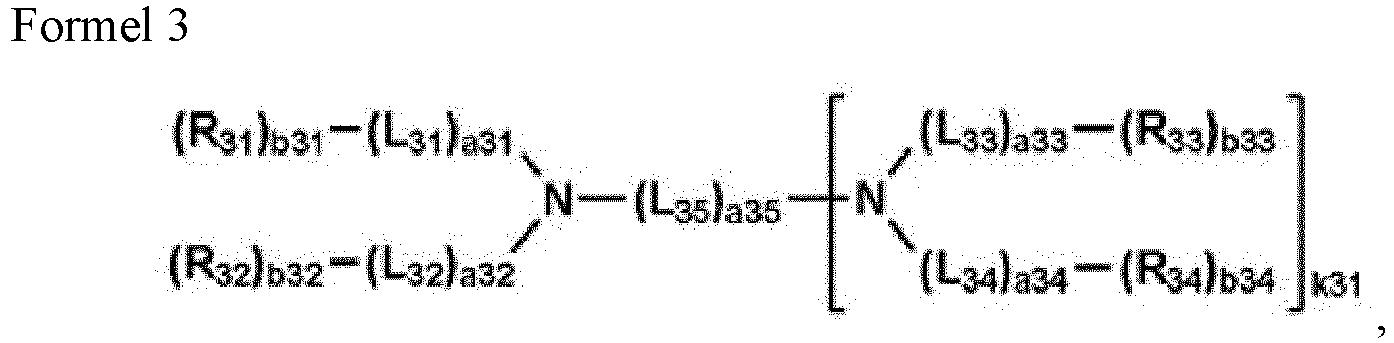 wobei, in den Formeln 1A, 1, 2, und 3,L1 bis L4, L11 bis L13, L21, L22 und L31 bis L35 jeweils unabhängig aus einer substituierten oder unsubstituierten C3-C10-Cycloalkylengruppe, einer substituierten oder unsubstituierten C1-C10-Heterocycloalkylengruppe, einer substituierten oder unsubstituierten C3-C10-Cycloalkenylengruppe, einer substituierten oder unsubstituierten C1-C10-Heterocycloalkenylengruppe, einer substituierten oder unsubstituierten C6-C60-Arylengruppe, einer substituierten oder unsubstituierten C1-C60-Heteroarylengruppe, einer substituierten oder unsubstituierten zweiwertigen nicht aromatischen kondensierten polyzyklischen Gruppe, und einer substituierten oder unsubstituierten zweiwertigen nicht aromatischen kondensierten heteropolyzyklischen Gruppe ausgewählt sind,a1 bis a3, a11 bis a13, a21, a22 und a31 bis a34 jeweils unabhängig eine Ganzzahl von 0 bis 5 sind, a4 und a35 jeweils unabhängig eine Ganzzahl von 1 bis 5 sind,k1 1 oder 2 ist,k2 0 oder 1 ist,k1 und k2 die Gleichung k1 + k2 = 2 erfüllen,mindestens eines von X1 bis X3 eine Bindungsstelle zu einem benachbarten Atom ist,Ar21 und Ar22 jeweils unabhängig aus einer substituierten oder unsubstituierten C6-C60-Arylgruppe, einer substituierten oder unsubstituierten C6-C60-Aryloxygruppe, einer substituierten oder unsubstituierten C6-C60-Arylthiogruppe, einer substituierten oder unsubstituierten C1-C60-Heteroarylgruppe, einer substituierten oder unsubstituierten einwertigen nicht aromatischen kondensierten polyzyklischen Gruppe und einer substituierten oder unsubstituierten einwertigen nicht aromatischen kondensierten heteropolyzyklischen Gruppe ausgewählt sind,k31 0 oder 1 ist, wobei, wenn k31 0 ist, L35 aus einwertigen Gruppen ausgewählt ist, die den oben für L35 beschriebenen zweiwertigen Gruppen entsprechen,R11, R21 bis R28 und R31 to R34 jeweils unabhängig voneinander Folgendes sind: Wasserstoff, Deuterium, -F, -Cl, -Br, -I, eine Hydroxylgruppe, eine Cyanogruppe, eine Nitrogruppe, eine Amidinogruppe, eine Hydrazinogruppe, eine Hydrazonogruppe, eine substituierte oder unsubstituierte C1-C60-Alkylgruppe, eine substituierte oder unsubstituierte C2-C60-Alkenylgruppe, eine substituierte oder unsubstituierte C2-C60-Alkinylgruppe, eine substituierte oder unsubstituierte C1-C60-Alkoxygruppe, eine substituierte oder unsubstituierte C3-C10-Cycloalkylgruppe, eine substituierte oder unsubstituierte C1-C10-Heterocycloalkylgruppe, eine substituierte oder unsubstituierte C3-C10-Cycloalkenylgruppe, eine substituierte oder unsubstituierte C1-C10-Heterocycloalkenylgruppe, eine substituierte oder unsubstituierte C6-C60-Arylgruppe, eine substituierte oder unsubstituierte C6-C60-Aryloxygruppe, eine substituierte oder unsubstituierte C6-C60-Arylthiogruppe, eine substituierte oder unsubstituierte C1-C60-Heteroarylgruppe, eine substituierte oder unsubstituierte einwertige nicht aromatische kondensierte polyzyklische Gruppe, eine substituierte oder unsubstituierte einwertige nicht aromatische kondensierte heteropolyzyklische Gruppe, -Si(Q1)(Q2)(Q3), -N(Q1)(Q2), -B(Q1)(Q2), -C(=O)(Q1), -S(=O)2(Q1), oder -P(=O)(Q1)(Q2),b11 und b31 bis b34 jeweils unabhängig eine Ganzzahl von 1 bis 10 sind,mindestens ein Substituent der substituierten C3-C10-Cycloalkylengruppe, der substituierten C1-C10-Heterocycloalkylengruppe, der substituierten C3-C10-Cycloalkenylengruppe, der substituierten C1-C10-Heterocycloalkenylengruppe, der substituierten C6-C60-Arylengruppe, der substituierten C1-C60-Heteroarylengruppe, der substituierten zweiwertigen nicht aromatischen kondensierten polyzyklischen Gruppe, der substituierten zweiwertigen nicht aromatischen kondensierten heteropolyzyklischen Gruppe, der substituierten C1-C60-Alkylgruppe, der substituierten C2-C60-Alkenylgruppe, der substituierten C2-C60-Alkinylgruppe, der substituierten C1-C60-Alkoxygruppe, der substituierten C3-C10-Cycloalkylgruppe, der substituierten C1-C10-Heterocycloalkylgruppe, der substituierten C3-C10-Cycloalkenylgruppe, der substituierten C1-C10-Heterocycloalkenylgruppe, der substituierten C6-C60-Arylgruppe, der substituierten C6-C60-Aryloxygruppe, der substituierten C6-C60-Arylthiogruppe, der substituierten C1-C60-Heteroarylgruppe, der substituierten einwertigen nicht aromatischen kondensierten polyzyklischen Gruppe und der substituierten einwertigen nicht aromatischen kondensierten heteropolyzyklischen Gruppe ausgewählt ist aus:Deuterium, -F, -Cl, -Br, -I, einer Hydroxylgruppe, einer Cyanogruppe, einer Nitrogruppe, einer Amidinogruppe, einer Hydrazinogruppe, einer Hydrazonogruppe, einer C1-C60-Alkylgruppe, einer C2-C60-Alkenylgruppe, einer C2-C60-Alkinylgruppe und einer C1-C60-Alkoxygruppe;einer C1-C60-Alkylgruppe, einer C2-C60-Alkenylgruppe, einer C2-C60-Alkinylgruppe und einer C1-C60-Alkoxygruppe, jeweils substituiert mit mindestens einer Gruppe, ausgewählt aus Deuterium, -F, -Cl, -Br, -I, einer Hydroxylgruppe, einer Cyanogruppe, einer Nitrogruppe, einer Amidinogruppe, einer Hydrazinogruppe, einer Hydrazonogruppe, einer C3-C10-Cycloalkylgruppe, einer C1-C10-Heterocycloalkylgruppe, einer C3-C10-Cycloalkenylgruppe, einer C1-C10-Heterocycloalkenylgruppe, einer C6-C60-Arylgruppe, einer C6-C60-Aryloxygruppe, einer C6-C60-Arylthiogruppe, einer C1-C60-Heteroarylgruppe, einer einwertigen nicht aromatischen kondensierten polyzyklischen Gruppe, einer einwertigen nicht aromatischen kondensierten heteropolyzyklischen Gruppe, -Si(Q11)(Q12)(Q13), -N(Q11)(Q12), -B(Q11)(Q12), -C(=O)(Qn), -S(=O)2(Q11) und -P(=O)(Q11)(Q12);einer C3-C10-Cycloalkylgruppe, einer C1-C10-Heterocycloalkylgruppe, einer C3-C10-Cycloalkenylgruppe, einer C1-C10-Heterocycloalkenylgruppe, einer C6-C60-Arylgruppe, einer C6-C60-Aryloxygruppe, einer C6-C60-Arylthiogruppe, einer C1-C60-Heteroarylgruppe, einer einwertigen nicht aromatischen kondensierten polyzyklischen Gruppe und einer einwertigen nicht aromatischen kondensierten heteropolyzyklischen Gruppe;einer C3-C10-Cycloalkylgruppe, einer C1-C10-Heterocycloalkylgruppe, einer C3-C10-Cycloalkenylgruppe, einer C1-C10-Heterocycloalkenylgruppe, einer C6-C60-Arylgruppe, einer C6-C60-Aryloxygruppe, einer C6-C60-Arylthiogruppe, einer C1-C60-Heteroarylgruppe, einer einwertigen nicht aromatischen kondensierten polyzyklischen Gruppe und einer einwertigen nicht aromatischen kondensierten heteropolyzyklischen Gruppe, jeweils substituiert mit mindestens einer Gruppe ausgewählt aus Deuterium, -F, - Cl, -Br, -I, einer Hydroxylgruppe, einer Cyanogruppe, einer Nitrogruppe, einer Amidinogruppe, einer Hydrazinogruppe, einer Hydrazonogruppe, einer C1-C60-Alkylgruppe, einer C2-C60-Alkenylgruppe, einer C2-C60-Alkinylgruppe, einer C1-C60-Alkoxygruppe, einer C3-C10-Cycloalkylgruppe, einer C1-C10-Heterocycloalkylgruppe, einer C3-C10-Cycloalkenylgruppe, einer C1-C10-Heterocycloalkenylgruppe, einer C6-C60-Arylgruppe, einer C6-C60-Aryloxygruppe, einer C6-C60-Arylthiogruppe, einer C1-C60-Heteroarylgruppe, einer einwertigen nicht aromatischen kondensierten polyzyklischen Gruppe, einer einwertigen nicht aromatischen kondensierten heteropolyzyklischen Gruppe, -Si(Q21)(Q22)(Q23), -N(Q21)(Q22), -B(Q21)(Q22), -C(=O)(Q21), -S(=O)2(Q21) und -P(=O)(Q21)(Q22); und-Si(Q31)(Q32)(Q33), -N(Q31)(Q32), -B(Q31)(Q32), -C(=O)(Q31), -S(=O)2(Q31) und -P(=O)(Q31)(Q32), undQ1 bis Q3, Q11 bis Q13, Q21 bis Q23 und Q31 bis Q33 jeweils unabhängig ausgewählt sind aus Wasserstoff, Deuterium, -F, -Cl, -Br, -I, einer Hydroxylgruppe, einer Cyanogruppe, einer Nitrogruppe, einer Amidinogruppe, einer Hydrazinogruppe, einer Hydrazonogruppe, einer C1-C60-Alkylgruppe, einer C2-C60-Alkenylgruppe, einer C2-C60-Alkinylgruppe, einer C1-C60-Alkoxygruppe, einer C3-C10-Cycloalkylgruppe, einer C1-C10-Heterocycloalkylgruppe, einer C3-C10-Cycloalkenylgruppe, einer C1-C10-Heterocycloalkenylgruppe, einer C6-C60-Arylgruppe, einer C1-C60-Heteroarylgruppe, einer einwertigen nicht aromatischen kondensierten polyzyklischen Gruppe, einer einwertigen nicht aromatischen kondensierten heteropolyzyklischen Gruppe, einer Biphenylgruppe und einer Terphenylgruppe.
 - Organische lichtemittierende Vorrichtung (10) nach Anspruch 1, wobei:der erste Lochtransportbereich zwischen der ersten Elektrode (110) und der Emissionsschicht liegt; undder zweite Lochtransportbereich zwischen dem ersten Lochtransportbereich und der Emissionsschicht liegt.
- Organische lichtemittierende Vorrichtung (10) nach Anspruch 2, wobei:der zweite Lochtransportbereich einen Bereich mit hohem Molekulargewicht und einen Bereich mit niedrigem Molekulargewicht einschließt,der Bereich mit hohem Molekulargewicht ein Bereich ist, der näher an einer Grenzfläche zwischen dem ersten Lochtransportbereich und dem zweiten Lochtransportbereich als an einer Grenzfläche zwischen der Emissionsschicht und dem zweiten Lochtransportbereich liegt,der Bereich mit niedrigem Molekulargewicht ein Bereich ist, der näher an einer Grenzfläche zwischen der Emissionsschicht und dem zweiten Lochtransportbereich als an einer Grenzfläche zwischen dem ersten Lochtransportbereich und dem zweiten Lochtransportbereich im zweiten Lochtransportbereich liegt,eine Menge der ersten Verbindung in dem Bereich mit hohem Molekulargewicht über einer Menge der ersten Verbindung in dem Bereich mit niedrigem Molekulargewicht liegt, undeine Menge der zweiten Verbindung und eine Menge der dritten Verbindung in dem Bereich mit niedrigem Molekulargewicht größer sind als eine Menge der zweiten Verbindung und eine Menge der dritten Verbindung in dem Bereich mit hohem Molekulargewicht.
- Organische lichtemittierende Vorrichtung (10) nach Anspruch 2 oder Anspruch 3, wobei:der zweite Lochtransportbereich eine erste Lochtransportschicht zwischen dem ersten Lochtransportbereich und der Emissionsschicht und eine zweite Lochtransportschicht zwischen der ersten Lochtransportschicht und der Emissionsschicht einschließt,die erste Lochtransportschicht die erste Verbindung einschließt, unddie zweite Lochtransportschicht die zweite Verbindung oder die dritte Verbindung einschließt.
- Organische lichtemittierende Vorrichtung (10) nach einem der Ansprüche 1 bis 4, wobei:die erste Verbindung ein Molekulargewicht von 5 000 g/Mol oder mehr aufweist,die zweite Verbindung ein Molekulargewicht von 2 000 g/Mol oder weniger aufweist,die dritte Verbindung ein Molekulargewicht von 2 000 g/Mol oder weniger aufweist.
- Organische lichtemittierende Vorrichtung (10) nach einem der Ansprüche 1 bis 5, wobei:L1 bis L4, L11 bis L13, L21, L22 und L31 bis L35 jeweils unabhängig eine Gruppe sind, die durch eine ausgewählte Formel aus den Formeln 3-1 bis 3-51 dargestellt ist:


 wobei, in den Formeln 3-1 bis 3-51,Y1 O, S, C(Z3)(Z4), N(Z5) oder Si(Z6)(Z7) ist,Z1 bis Z7 jeweils unabhängig ausgewählt sind aus Deuterium, -F, -Cl, -Br, -I, einer Hydroxylgruppe, einer Cyanogruppe, einer Nitrogruppe, einer Aminogruppe, einer Amidinogruppe, einer Hydrazingruppe, einer Hydrazongruppe, einer Carbonsäuregruppe oder einem Salz derselben, einer Sulfonsäuregruppe oder einem Salz derselben, einer Phosphorsäuregruppe oder einem Salz derselben, einer C1-C20-Alkylgruppe, einer C1-C20-Alkoxygruppe, einer Phenylgruppe, einer Biphenylgruppe, einer Terphenylgruppe, einer Naphthylgruppe, einer Fluorenylgruppe, einer Spirobifluorenylgruppe, einer Benzofluorenylgruppe, einer Dibenzofluorenylgruppe, einer Phenanthrenylgruppe, einer Anthracenylgruppe, einer Pyrenylgruppe, einer Chrysenylgruppe, einer Pyridinylgruppe, einer Pyrazinylgruppe, einer Pyrimidinylgruppe, einer Pyridazinylgruppe, einer Quinolinylgruppe, einer Isoquinolinylgruppe, einer Quinoxalinylgruppe, einer Quinazolinylgruppe, einer Carbazolylgruppe, einer Dibenzofuranylgruppe, einer Dibenzothiophenylgruppe, einer Triazinylgruppe, einer Benzimidazolylgruppe, einer Phenanthrolinylgruppe und -Si(Q33)(Q34)(Q35),Q33 to Q35 jeweils unabhängig ausgewählt sind aus einer C1-C10-Alkylgruppe, einer C1-C10-Alkoxygruppe, einer Phenylgruppe, einer Biphenylgruppe, einer Terphenylgruppe und einer Naphthylgruppe,d2 eine Ganzzahl von 0 bis 2 ist,d3 eine Ganzzahl von 0 bis 3 ist,d4 eine Ganzzahl von 0 bis 4 ist,d5 eine Ganzzahl von 0 bis 5 ist,d6 eine Ganzzahl von 0 bis 6 ist,d8 eine Ganzzahl von 0 bis 8 ist, und* und *' jeweils eine Bindungsstelle zu einem benachbarten Atom angeben.
 - Organische lichtemittierende Vorrichtung (10) nach einem der Ansprüche 1 bis 6, wobei:Ar21 und Ar22 jeweils unabhängig eine Gruppe sind, die dargestellt ist durch eine der Formeln 5-1 bis 5-23:


 wobei, in den Formeln 5-1 bis 5-23,Y31 O, S, C(Z34)(Z35) oder Si(Z36)(Z37) ist,Z31 bis Z37 jeweils unabhängig ausgewählt sind aus Deuterium, -F, -Cl, -Br, -I, einer Hydroxylgruppe, einer Cyanogruppe, einer Nitrogruppe, einer Amidinogruppe, einer Hydrazinogruppe, einer Hydrazonogruppe, einer C1-C20-Alkylgruppe, einer C1-C20-Alkoxygruppe, einer Phenylgruppe, einer Biphenylgruppe, einer Terphenylgruppe, einer Naphthylgruppe, einer Fluorenylgruppe, einer Anthracenylgruppe, einer Phenanthrenylgruppe, einer Imidazolylgruppe, einer Pyrazolgruppe, einer Thiazolylgruppe, einer Isothiazolylgruppe, einer Oxazolylgruppe, einer Isoxazolylgruppe, einer Pyridinylgruppe, einer Pyrazinylgruppe, einer Pyrimidinylgruppe, einer Pyridazinylgruppe, einer Indazolylgruppe, einer Purinylgruppe, einer Chinolinylgruppe, einer Isochinolinylgruppe, einer Benzochinolinylgruppe, einer Phthalazinylgruppe, einer Naphthyridinylgruppe, einer Chinoxalinylgruppe, einer Chinazolinylgruppe, einer Cinnolinylgruppe, einer Phenanthridinylgruppe, einer Acridinylgruppe, einer Phenanthrolinylgruppe, einer Phenazinylgruppe, einer Benzimidazolylgruppe, einer Isobenzothiazolylgruppe, einer Benzoxazolylgruppe, einer Isobenzoxazolylgruppe, einer Triazolylgruppe, einer Tetrazolylgruppe, einer Oxadiazolylgruppe, einer Triazinylgruppe, einer Thiadiazolylgruppe, einer Imidazopyridinylgruppe, einer Imidazopyrimidinylgruppe, einer Azacarbazolylgruppe,e3 eine Ganzzahl von 0 bis 3 ist,e4 eine Ganzzahl von 0 bis 4 ist,e5 eine Ganzzahl von 0 bis 5 ist,e6 eine Ganzzahl von 0 bis 6 ist,e7 eine Ganzzahl von 0 bis 7 ist,e9 eine Ganzzahl von 0 bis 9 ist, und* und *' jeweils eine Bindungsstelle zu einem benachbarten Atom angeben.
 - Organische lichtemittierende Vorrichtung (10) nach einem der Ansprüche 1 bis 7, wobei:
R11, R21 bis R28 und R31 bis R34 jeweils unabhängig ausgewählt sind aus:Wasserstoff, Deuterium, -F, -Cl, -Br, -I, einer Hydroxylgruppe, einer Cyanogruppe, einer Nitrogruppe, einer C2-C20-Alkylgruppe, einer C2-C20-Alkenylgruppe, einer C2-C20-Alkinylgruppe, einer C1-C20-Alkoxygruppe, einer Cyclopentylgruppe, einer Cyclohexylgruppe, einer Phenylgruppe, einer Naphthylgruppe, einer Fluorenylgruppe, einer Carbazolylgruppe, einer Dibenzofuranylgruppe, einer Dibenzothiophenylgruppe, einer Biphenylgruppe und einer Terphenylgruppe, undeiner C2-C20-Alkylgruppe, einer C2-C20-Alkenylgruppe, einer C2-C20-Alkinylgruppe, einer C1-C20-Alkoxygruppe, einer Cyclopentylgruppe, einer Cyclohexylgruppe, einer Phenylgruppe, einer Naphthylgruppe, einer Fluorenylgruppe, einer Carbazolylgruppe, einer Dibenzofuranylgruppe, einer Dibenzothiophenylgruppe, einer Biphenylgruppe und einer Terphenylgruppe, jeweils substituiert mit mindestens einer Gruppe, ausgewählt aus Deuterium, -F, -Cl, -Br, -I, einer Hydroxylgruppe, einer Cyanogruppe, einer Nitrogruppe, einer Amidinogruppe, einer Hydrazinogruppe, einer Hydrazonogruppe, einer C2-C20-Alkylgruppe, einer C2-C20-Alkenylgruppe, einer C2-C20-Alkinylgruppe, einer C1-C20-Alkoxygruppe, einer Phenylgruppe, einer Naphthylgruppe, einer Fluorenylgruppe, einer Carbazolylgruppe, einer Dibenzofuranylgruppe, einer Dibenzothiophenylgruppe, einer Biphenylgruppe und einer Terphenylgruppe. - Organische lichtemittierende Vorrichtung (10) nach einem der Ansprüche 1 bis 8, wobeider durch Formel 1A dargestellte Anteil durch die Formel 1A-1 oder die Formel 1A-2 dargestellt ist:


 wobei, in den Formeln 1A-1 und 1A-2,R1 bis R9 jeweils unabhängig ausgewählt sind aus:Wasserstoff, Deuterium, -F, -Cl, -Br, -I, einer Hydroxylgruppe, einer Cyanogruppe, einer Nitrogruppe, einer Methylgruppe, einer Ethylgruppe, einer Propylgruppe, einer Isobutylgruppe, einer sec-Butylgruppe, einer ter-Butylgruppe, einer C2-C20-Alkenylgruppe, einer C2-C20-Alkinylgruppe, einer C1-C20-Alkoxygruppe, einer Cyclopentylgruppe und einer Cyclohexylgruppe; undeiner Methylgruppe, einer Ethylgruppe, einer Propylgruppe, einer Isobutylgruppe, einer sec-Butylgruppe, einer ter-Butylgruppe, einer C2-C20-Alkenylgruppe, einer C2-C20-Alkinylgruppe, einer C1-C20-Alkoxygruppe, einer Cyclopentylgruppe und einer Cyclohexylgruppe, jeweils substituiert mit mindestens einer Gruppe,ausgewählt aus Deuterium,
-F, -Cl, -Br, -I, einer Hydroxylgruppe, einer Cyanogruppe, einer Nitrogruppe, einer Amidinogruppe, einer Hydrazinogruppe, einer Hydrazonogruppe, einer Methylgruppe, einer Ethylgruppe, einer Propylgruppe, einer Isobutylgruppe, einer sec-Butylgruppe, einer ter-Butylgruppe, einer C2-C20-Alkenylgruppe, einer C2-C20-Alkinylgruppe, einer C1-C20-Alkoxygruppe, einer Phenylgruppe, einer Naphthylgruppe, einer Fluorenylgruppe, einer Carbazolylgruppe, einer Dibenzofuranylgruppe, einer Dibenzothiophenylgruppe, einer Biphenylgruppe und einer Terphenylgruppe,zwei oder mehr von R1 bis R9 optional verbunden sind, um eine substituierte carbozyklische C5-C60-Gruppe, oder eine substituierte heterozyklische C2-C60-Gruppe zu bilden,b1 bis b9 jeweils unabhängig eine Ganzzahl von 1 bis 4 sind,mindestens eines von X1, X2, X4 und X5 in Formel 1A-1 eine Bindungsstelle zu einem benachbarten Atom ist, undmindestens eines von X1, X2 und X3 in Formel 1A-2 eine Bindungsstelle zu einem benachbarten Atom ist. - Organische lichtemittierende Vorrichtung (10) nach einem der Ansprüche 1 bis 9, wobeidie Verbindung, die den durch Formel 1A dargestellten Anteil einschließt, aus den Verbindungen A1 bis A9 ausgewählt ist:


 wobei, in den Verbindungen A1 und A2, Bu eine Butylgruppe bezeichnet, und in Verbindung A2, m1 und n1 jeweils unabhängig voneinander eine reelle Zahl größer als 0 und kleiner als 1 sind.
 - Organische lichtemittierende Vorrichtung (10) nach einem der Ansprüche 1 bis 10, wobeidie erste Verbindung aus den Verbindungen B1 bis B6 ausgewählt ist:


 wobei, in den Verbindungen B1 bis B6, n eine Ganzzahl von 10 bis 100 000 ist.
 - Organische lichtemittierende Vorrichtung (10) nach einem der Ansprüche 1 bis 11, wobei:die Emissionsschicht ein Wirtsmaterial und ein Dotierstoffmaterial einschließt, unddas Dotierstoffmaterial einen phosphoreszierenden Dotierstoff oder einen fluoreszierenden Dotierstoff einschließt.
- Organische lichtemittierende Vorrichtung (10) nach einem der Ansprüche 1 bis 12, ferner umfassend einen Elektronentransportbereich zwischen der Emissionsschicht und der zweiten Elektrode (190), wobei der Elektronentransportbereich eine Elektronentransportschicht einschließt.
Applications Claiming Priority (1)
| Application Number | Priority Date | Filing Date | Title |
|---|---|---|---|
| KR1020180047325A KR102547688B1 (ko) | 2018-04-24 | 2018-04-24 | 유기 발광 소자 및 이의 제조 방법 |
Publications (2)
| Publication Number | Publication Date |
|---|---|
| EP3561895A1 EP3561895A1 (de) | 2019-10-30 |
| EP3561895B1 true EP3561895B1 (de) | 2025-02-26 |
Family
ID=66286127
Family Applications (1)
| Application Number | Title | Priority Date | Filing Date |
|---|---|---|---|
| EP19170928.6A Active EP3561895B1 (de) | 2018-04-24 | 2019-04-24 | Organische lichtemittierende vorrichtung |
Country Status (4)
| Country | Link |
|---|---|
| US (1) | US12167687B2 (de) |
| EP (1) | EP3561895B1 (de) |
| KR (1) | KR102547688B1 (de) |
| CN (1) | CN110400884B (de) |
Families Citing this family (1)
| Publication number | Priority date | Publication date | Assignee | Title |
|---|---|---|---|---|
| KR20210109720A (ko) * | 2020-02-27 | 2021-09-07 | 삼성디스플레이 주식회사 | 유기 발광 소자의 제조 방법 및 이에 의하여 제조된 유기 발광 소자 |
Family Cites Families (22)
| Publication number | Priority date | Publication date | Assignee | Title |
|---|---|---|---|---|
| EP0650955B1 (de) * | 1993-11-01 | 1998-08-19 | Hodogaya Chemical Co., Ltd. | Aminverbindung und sie enthaltende Elektrolumineszenzvorrichtung |
| US6242115B1 (en) * | 1997-09-08 | 2001-06-05 | The University Of Southern California | OLEDs containing thermally stable asymmetric charge carrier materials |
| US7838627B2 (en) | 2005-12-29 | 2010-11-23 | E. I. Du Pont De Nemours And Company | Compositions comprising novel compounds and polymers, and electronic devices made with such compositions |
| EP2162424A1 (de) | 2007-06-01 | 2010-03-17 | E. I. Du Pont de Nemours and Company | Lochtransportmaterialien |
| US8063399B2 (en) | 2007-11-19 | 2011-11-22 | E. I. Du Pont De Nemours And Company | Electroactive materials |
| JP5564801B2 (ja) | 2008-02-15 | 2014-08-06 | 三菱化学株式会社 | 共役ポリマー、有機電界発光素子材料、有機電界発光素子用組成物、ポリマーの製造方法、有機電界発光素子、有機elディスプレイ、及び有機el照明 |
| JP5184938B2 (ja) * | 2008-03-28 | 2013-04-17 | 住友化学株式会社 | 有機エレクトロルミネッセンス素子及びその製造方法 |
| KR101800355B1 (ko) | 2010-11-22 | 2017-12-21 | 엘지디스플레이 주식회사 | 정공 수송 물질 및 이를 이용한 유기전계발광소자 |
| KR101053466B1 (ko) * | 2011-02-16 | 2011-08-03 | 덕산하이메탈(주) | 화합물 및 이를 이용한 유기전기소자, 그 전자장치, 내열성 측정법 |
| KR101908384B1 (ko) * | 2011-06-17 | 2018-10-17 | 삼성디스플레이 주식회사 | 유기 발광 소자 및 이를 포함하는 평판 표시 장치 |
| WO2013114976A1 (ja) | 2012-01-30 | 2013-08-08 | 住友化学株式会社 | 高分子化合物および組成物、並びにこれらを用いた発光素子 |
| JP6088161B2 (ja) * | 2012-06-29 | 2017-03-01 | 出光興産株式会社 | 芳香族アミン誘導体及び有機エレクトロルミネッセンス素子 |
| KR102098093B1 (ko) * | 2012-12-06 | 2020-04-08 | 덕산네오룩스 주식회사 | 유기전기 소자용 화합물, 이를 이용한 유기전기소자 및 그 전자 장치 |
| JP6095390B2 (ja) * | 2013-02-06 | 2017-03-15 | キヤノン株式会社 | 有機発光素子及び表示装置 |
| JP6201538B2 (ja) * | 2013-09-03 | 2017-09-27 | セイコーエプソン株式会社 | 機能層形成用インクの製造方法、有機el素子の製造方法 |
| JP2015191978A (ja) | 2014-03-27 | 2015-11-02 | セイコーエプソン株式会社 | 発光装置および電子機器 |
| KR102250691B1 (ko) | 2014-10-06 | 2021-05-13 | 덕산네오룩스 주식회사 | 유기전기 소자용 화합물, 이를 이용한 유기전기소자 및 그 전자 장치 |
| KR102342493B1 (ko) | 2014-11-19 | 2021-12-23 | 덕산네오룩스 주식회사 | 유기전기소자용 조성물을 이용한 디스플레이 장치 및 유기전기소자 |
| JP6786523B2 (ja) | 2015-05-22 | 2020-11-18 | メルク パテント ゲーエムベーハー | 有機半導体と金属錯体を含む調合物 |
| US10312449B2 (en) | 2015-05-27 | 2019-06-04 | Samsung Display Co., Ltd. | Organic light-emitting device |
| KR102591635B1 (ko) | 2015-10-27 | 2023-10-20 | 삼성디스플레이 주식회사 | 유기 발광 소자 |
| KR102658366B1 (ko) | 2016-07-28 | 2024-04-18 | 삼성디스플레이 주식회사 | 유기 발광 소자 |
-
2018
- 2018-04-24 KR KR1020180047325A patent/KR102547688B1/ko active Active
-
2019
- 2019-04-23 US US16/391,985 patent/US12167687B2/en active Active
- 2019-04-24 CN CN201910332043.2A patent/CN110400884B/zh active Active
- 2019-04-24 EP EP19170928.6A patent/EP3561895B1/de active Active
Also Published As
| Publication number | Publication date |
|---|---|
| KR20190123822A (ko) | 2019-11-04 |
| US12167687B2 (en) | 2024-12-10 |
| EP3561895A1 (de) | 2019-10-30 |
| CN110400884B (zh) | 2024-07-12 |
| CN110400884A (zh) | 2019-11-01 |
| KR102547688B1 (ko) | 2023-06-27 |
| US20190326520A1 (en) | 2019-10-24 |
Similar Documents
| Publication | Publication Date | Title |
|---|---|---|
| EP3229290B1 (de) | Organische lichtemittierende vorrichtung | |
| EP3188268B1 (de) | Organische lichtemittierende vorrichtung | |
| EP4225006B1 (de) | Organische lichtemittierende vorrichtung | |
| EP3244466B1 (de) | Organische lichtemittierende vorrichtung | |
| EP3792255B1 (de) | Heterocyclische verbindung und organische lichtemittierende vorrichtung damit | |
| EP3561896B1 (de) | Organische lichtemittierende vorrichtung und verfahren zur herstellung davon | |
| EP3486250B1 (de) | Organometallische verbindung und organische lichtemittierende vorrichtung damit | |
| EP3525253B1 (de) | Organische lichtemittierende vorrichtung und anzeigevorrichtung mit einer organischen lichtemittierenden vorrichtung | |
| EP3188277A1 (de) | Organische lichtemittierende vorrichtung | |
| US12178114B2 (en) | Azide-based compound, organic light-emitting device including the azide-based compound, and method of manufacturing the organic light-emitting device | |
| EP3822258B1 (de) | Kondensierte cyclische verbindung, zusammensetzung damit und organische lichtemittierende vorrichtung mit dünnschicht aus der zusammensetzung | |
| EP3185331B1 (de) | Organische lichtemittierende vorrichtung | |
| EP3219714B1 (de) | Verbindung und organische lichtemittierende vorrichtung damit | |
| EP3890044B1 (de) | Organische lichtemittierende vorrichtung und einrichtung damit | |
| EP3748706B1 (de) | Heterocyclische verbindung und organische lichtemittierende vorrichtung damit | |
| US10873041B2 (en) | Condensed cyclic compound and organic light-emitting device including the same | |
| EP3561895B1 (de) | Organische lichtemittierende vorrichtung | |
| EP3854795A1 (de) | Kondensierte cyclische verbindung und organische lichtemittierende diode damit |
Legal Events
| Date | Code | Title | Description |
|---|---|---|---|
| PUAI | Public reference made under article 153(3) epc to a published international application that has entered the european phase |
Free format text: ORIGINAL CODE: 0009012 |
|
| STAA | Information on the status of an ep patent application or granted ep patent |
Free format text: STATUS: THE APPLICATION HAS BEEN PUBLISHED |
|
| AK | Designated contracting states |
Kind code of ref document: A1 Designated state(s): AL AT BE BG CH CY CZ DE DK EE ES FI FR GB GR HR HU IE IS IT LI LT LU LV MC MK MT NL NO PL PT RO RS SE SI SK SM TR |
|
| AX | Request for extension of the european patent |
Extension state: BA ME |
|
| STAA | Information on the status of an ep patent application or granted ep patent |
Free format text: STATUS: REQUEST FOR EXAMINATION WAS MADE |
|
| 17P | Request for examination filed |
Effective date: 20200323 |
|
| RBV | Designated contracting states (corrected) |
Designated state(s): AL AT BE BG CH CY CZ DE DK EE ES FI FR GB GR HR HU IE IS IT LI LT LU LV MC MK MT NL NO PL PT RO RS SE SI SK SM TR |
|
| STAA | Information on the status of an ep patent application or granted ep patent |
Free format text: STATUS: EXAMINATION IS IN PROGRESS |
|
| 17Q | First examination report despatched |
Effective date: 20211206 |
|
| P01 | Opt-out of the competence of the unified patent court (upc) registered |
Effective date: 20230516 |
|
| REG | Reference to a national code |
Ref country code: DE Ref legal event code: R079 Free format text: PREVIOUS MAIN CLASS: H01L0051540000 Ipc: H10K0085100000 Ref country code: DE Ref legal event code: R079 Ref document number: 602019066403 Country of ref document: DE Free format text: PREVIOUS MAIN CLASS: H01L0051540000 Ipc: H10K0085100000 |
|
| GRAP | Despatch of communication of intention to grant a patent |
Free format text: ORIGINAL CODE: EPIDOSNIGR1 |
|
| STAA | Information on the status of an ep patent application or granted ep patent |
Free format text: STATUS: GRANT OF PATENT IS INTENDED |
|
| RIC1 | Information provided on ipc code assigned before grant |
Ipc: H10K 50/15 20230101ALN20240729BHEP Ipc: C08G 61/12 20060101ALI20240729BHEP Ipc: C07C 211/54 20060101ALI20240729BHEP Ipc: H10K 85/60 20230101ALI20240729BHEP Ipc: H10K 85/10 20230101AFI20240729BHEP |
|
| RAP3 | Party data changed (applicant data changed or rights of an application transferred) |
Owner name: SAMSUNG DISPLAY CO., LTD. |
|
| RIC1 | Information provided on ipc code assigned before grant |
Ipc: H10K 50/15 20230101ALN20240826BHEP Ipc: C08G 61/12 20060101ALI20240826BHEP Ipc: C07C 211/54 20060101ALI20240826BHEP Ipc: H10K 85/60 20230101ALI20240826BHEP Ipc: H10K 85/10 20230101AFI20240826BHEP |
|
| INTG | Intention to grant announced |
Effective date: 20240904 |
|
| GRAS | Grant fee paid |
Free format text: ORIGINAL CODE: EPIDOSNIGR3 |
|
| GRAA | (expected) grant |
Free format text: ORIGINAL CODE: 0009210 |
|
| STAA | Information on the status of an ep patent application or granted ep patent |
Free format text: STATUS: THE PATENT HAS BEEN GRANTED |
|
| AK | Designated contracting states |
Kind code of ref document: B1 Designated state(s): AL AT BE BG CH CY CZ DE DK EE ES FI FR GB GR HR HU IE IS IT LI LT LU LV MC MK MT NL NO PL PT RO RS SE SI SK SM TR |
|
| REG | Reference to a national code |
Ref country code: GB Ref legal event code: FG4D |
|
| REG | Reference to a national code |
Ref country code: CH Ref legal event code: EP |
|
| REG | Reference to a national code |
Ref country code: DE Ref legal event code: R096 Ref document number: 602019066403 Country of ref document: DE |
|
| REG | Reference to a national code |
Ref country code: IE Ref legal event code: FG4D |
|
| PGFP | Annual fee paid to national office [announced via postgrant information from national office to epo] |
Ref country code: FR Payment date: 20250321 Year of fee payment: 7 |
|
| PGFP | Annual fee paid to national office [announced via postgrant information from national office to epo] |
Ref country code: GB Payment date: 20250320 Year of fee payment: 7 |
|
| REG | Reference to a national code |
Ref country code: NL Ref legal event code: MP Effective date: 20250226 |
|
| PG25 | Lapsed in a contracting state [announced via postgrant information from national office to epo] |
Ref country code: RS Free format text: LAPSE BECAUSE OF FAILURE TO SUBMIT A TRANSLATION OF THE DESCRIPTION OR TO PAY THE FEE WITHIN THE PRESCRIBED TIME-LIMIT Effective date: 20250526 |
|
| PG25 | Lapsed in a contracting state [announced via postgrant information from national office to epo] |
Ref country code: FI Free format text: LAPSE BECAUSE OF FAILURE TO SUBMIT A TRANSLATION OF THE DESCRIPTION OR TO PAY THE FEE WITHIN THE PRESCRIBED TIME-LIMIT Effective date: 20250226 |
|
| PG25 | Lapsed in a contracting state [announced via postgrant information from national office to epo] |
Ref country code: PL Free format text: LAPSE BECAUSE OF FAILURE TO SUBMIT A TRANSLATION OF THE DESCRIPTION OR TO PAY THE FEE WITHIN THE PRESCRIBED TIME-LIMIT Effective date: 20250226 |
|
| PGFP | Annual fee paid to national office [announced via postgrant information from national office to epo] |
Ref country code: DE Payment date: 20250320 Year of fee payment: 7 |
|
| PG25 | Lapsed in a contracting state [announced via postgrant information from national office to epo] |
Ref country code: ES Free format text: LAPSE BECAUSE OF FAILURE TO SUBMIT A TRANSLATION OF THE DESCRIPTION OR TO PAY THE FEE WITHIN THE PRESCRIBED TIME-LIMIT Effective date: 20250226 |
|
| REG | Reference to a national code |
Ref country code: LT Ref legal event code: MG9D |
|
| PG25 | Lapsed in a contracting state [announced via postgrant information from national office to epo] |
Ref country code: IS Free format text: LAPSE BECAUSE OF FAILURE TO SUBMIT A TRANSLATION OF THE DESCRIPTION OR TO PAY THE FEE WITHIN THE PRESCRIBED TIME-LIMIT Effective date: 20250626 Ref country code: NO Free format text: LAPSE BECAUSE OF FAILURE TO SUBMIT A TRANSLATION OF THE DESCRIPTION OR TO PAY THE FEE WITHIN THE PRESCRIBED TIME-LIMIT Effective date: 20250526 |
|
| PG25 | Lapsed in a contracting state [announced via postgrant information from national office to epo] |
Ref country code: NL Free format text: LAPSE BECAUSE OF FAILURE TO SUBMIT A TRANSLATION OF THE DESCRIPTION OR TO PAY THE FEE WITHIN THE PRESCRIBED TIME-LIMIT Effective date: 20250226 |
|
| PG25 | Lapsed in a contracting state [announced via postgrant information from national office to epo] |
Ref country code: HR Free format text: LAPSE BECAUSE OF FAILURE TO SUBMIT A TRANSLATION OF THE DESCRIPTION OR TO PAY THE FEE WITHIN THE PRESCRIBED TIME-LIMIT Effective date: 20250226 |
|
| PG25 | Lapsed in a contracting state [announced via postgrant information from national office to epo] |
Ref country code: LV Free format text: LAPSE BECAUSE OF FAILURE TO SUBMIT A TRANSLATION OF THE DESCRIPTION OR TO PAY THE FEE WITHIN THE PRESCRIBED TIME-LIMIT Effective date: 20250226 Ref country code: PT Free format text: LAPSE BECAUSE OF FAILURE TO SUBMIT A TRANSLATION OF THE DESCRIPTION OR TO PAY THE FEE WITHIN THE PRESCRIBED TIME-LIMIT Effective date: 20250626 |
|
| PG25 | Lapsed in a contracting state [announced via postgrant information from national office to epo] |
Ref country code: GR Free format text: LAPSE BECAUSE OF FAILURE TO SUBMIT A TRANSLATION OF THE DESCRIPTION OR TO PAY THE FEE WITHIN THE PRESCRIBED TIME-LIMIT Effective date: 20250527 Ref country code: BG Free format text: LAPSE BECAUSE OF FAILURE TO SUBMIT A TRANSLATION OF THE DESCRIPTION OR TO PAY THE FEE WITHIN THE PRESCRIBED TIME-LIMIT Effective date: 20250226 |
|
| REG | Reference to a national code |
Ref country code: AT Ref legal event code: MK05 Ref document number: 1771978 Country of ref document: AT Kind code of ref document: T Effective date: 20250226 |
|
| PG25 | Lapsed in a contracting state [announced via postgrant information from national office to epo] |
Ref country code: SE Free format text: LAPSE BECAUSE OF FAILURE TO SUBMIT A TRANSLATION OF THE DESCRIPTION OR TO PAY THE FEE WITHIN THE PRESCRIBED TIME-LIMIT Effective date: 20250226 |
|
| PG25 | Lapsed in a contracting state [announced via postgrant information from national office to epo] |
Ref country code: SM Free format text: LAPSE BECAUSE OF FAILURE TO SUBMIT A TRANSLATION OF THE DESCRIPTION OR TO PAY THE FEE WITHIN THE PRESCRIBED TIME-LIMIT Effective date: 20250226 |
|
| PG25 | Lapsed in a contracting state [announced via postgrant information from national office to epo] |
Ref country code: DK Free format text: LAPSE BECAUSE OF FAILURE TO SUBMIT A TRANSLATION OF THE DESCRIPTION OR TO PAY THE FEE WITHIN THE PRESCRIBED TIME-LIMIT Effective date: 20250226 |
|
| PG25 | Lapsed in a contracting state [announced via postgrant information from national office to epo] |
Ref country code: IT Free format text: LAPSE BECAUSE OF FAILURE TO SUBMIT A TRANSLATION OF THE DESCRIPTION OR TO PAY THE FEE WITHIN THE PRESCRIBED TIME-LIMIT Effective date: 20250226 |
|
| PG25 | Lapsed in a contracting state [announced via postgrant information from national office to epo] |
Ref country code: AT Free format text: LAPSE BECAUSE OF FAILURE TO SUBMIT A TRANSLATION OF THE DESCRIPTION OR TO PAY THE FEE WITHIN THE PRESCRIBED TIME-LIMIT Effective date: 20250226 |
|
| PG25 | Lapsed in a contracting state [announced via postgrant information from national office to epo] |
Ref country code: EE Free format text: LAPSE BECAUSE OF FAILURE TO SUBMIT A TRANSLATION OF THE DESCRIPTION OR TO PAY THE FEE WITHIN THE PRESCRIBED TIME-LIMIT Effective date: 20250226 Ref country code: CZ Free format text: LAPSE BECAUSE OF FAILURE TO SUBMIT A TRANSLATION OF THE DESCRIPTION OR TO PAY THE FEE WITHIN THE PRESCRIBED TIME-LIMIT Effective date: 20250226 |
|
| PG25 | Lapsed in a contracting state [announced via postgrant information from national office to epo] |
Ref country code: RO Free format text: LAPSE BECAUSE OF FAILURE TO SUBMIT A TRANSLATION OF THE DESCRIPTION OR TO PAY THE FEE WITHIN THE PRESCRIBED TIME-LIMIT Effective date: 20250226 |
|
| PG25 | Lapsed in a contracting state [announced via postgrant information from national office to epo] |
Ref country code: SK Free format text: LAPSE BECAUSE OF FAILURE TO SUBMIT A TRANSLATION OF THE DESCRIPTION OR TO PAY THE FEE WITHIN THE PRESCRIBED TIME-LIMIT Effective date: 20250226 |
|
| REG | Reference to a national code |
Ref country code: CH Ref legal event code: H13 Free format text: ST27 STATUS EVENT CODE: U-0-0-H10-H13 (AS PROVIDED BY THE NATIONAL OFFICE) Effective date: 20251125 |
|
| REG | Reference to a national code |
Ref country code: DE Ref legal event code: R097 Ref document number: 602019066403 Country of ref document: DE |
|
| PG25 | Lapsed in a contracting state [announced via postgrant information from national office to epo] |
Ref country code: LU Free format text: LAPSE BECAUSE OF NON-PAYMENT OF DUE FEES Effective date: 20250424 |
|
| PG25 | Lapsed in a contracting state [announced via postgrant information from national office to epo] |
Ref country code: MC Free format text: LAPSE BECAUSE OF FAILURE TO SUBMIT A TRANSLATION OF THE DESCRIPTION OR TO PAY THE FEE WITHIN THE PRESCRIBED TIME-LIMIT Effective date: 20250226 |
|
| REG | Reference to a national code |
Ref country code: BE Ref legal event code: MM Effective date: 20250430 |
|
| PLBE | No opposition filed within time limit |
Free format text: ORIGINAL CODE: 0009261 |
|
| STAA | Information on the status of an ep patent application or granted ep patent |
Free format text: STATUS: NO OPPOSITION FILED WITHIN TIME LIMIT |
|
| PG25 | Lapsed in a contracting state [announced via postgrant information from national office to epo] |
Ref country code: BE Free format text: LAPSE BECAUSE OF NON-PAYMENT OF DUE FEES Effective date: 20250430 |
|
| PG25 | Lapsed in a contracting state [announced via postgrant information from national office to epo] |
Ref country code: CH Free format text: LAPSE BECAUSE OF NON-PAYMENT OF DUE FEES Effective date: 20250430 |
|
| 26N | No opposition filed |
Effective date: 20251127 |