EP3561069B1 - Verfahren zur diagnose von lungenkrebs durch bakterielle metagenome analyse - Google Patents
Verfahren zur diagnose von lungenkrebs durch bakterielle metagenome analyse Download PDFInfo
- Publication number
- EP3561069B1 EP3561069B1 EP17888390.6A EP17888390A EP3561069B1 EP 3561069 B1 EP3561069 B1 EP 3561069B1 EP 17888390 A EP17888390 A EP 17888390A EP 3561069 B1 EP3561069 B1 EP 3561069B1
- Authority
- EP
- European Patent Office
- Prior art keywords
- genus
- family
- order
- class
- derived
- Prior art date
- Legal status (The legal status is an assumption and is not a legal conclusion. Google has not performed a legal analysis and makes no representation as to the accuracy of the status listed.)
- Active
Links
Images




Classifications
-
- C—CHEMISTRY; METALLURGY
- C12—BIOCHEMISTRY; BEER; SPIRITS; WINE; VINEGAR; MICROBIOLOGY; ENZYMOLOGY; MUTATION OR GENETIC ENGINEERING
- C12Q—MEASURING OR TESTING PROCESSES INVOLVING ENZYMES, NUCLEIC ACIDS OR MICROORGANISMS; COMPOSITIONS OR TEST PAPERS THEREFOR; PROCESSES OF PREPARING SUCH COMPOSITIONS; CONDITION-RESPONSIVE CONTROL IN MICROBIOLOGICAL OR ENZYMOLOGICAL PROCESSES
- C12Q1/00—Measuring or testing processes involving enzymes, nucleic acids or microorganisms; Compositions therefor; Processes of preparing such compositions
- C12Q1/68—Measuring or testing processes involving enzymes, nucleic acids or microorganisms; Compositions therefor; Processes of preparing such compositions involving nucleic acids
- C12Q1/6876—Nucleic acid products used in the analysis of nucleic acids, e.g. primers or probes
- C12Q1/6888—Nucleic acid products used in the analysis of nucleic acids, e.g. primers or probes for detection or identification of organisms
- C12Q1/6895—Nucleic acid products used in the analysis of nucleic acids, e.g. primers or probes for detection or identification of organisms for plants, fungi or algae
-
- C—CHEMISTRY; METALLURGY
- C12—BIOCHEMISTRY; BEER; SPIRITS; WINE; VINEGAR; MICROBIOLOGY; ENZYMOLOGY; MUTATION OR GENETIC ENGINEERING
- C12Q—MEASURING OR TESTING PROCESSES INVOLVING ENZYMES, NUCLEIC ACIDS OR MICROORGANISMS; COMPOSITIONS OR TEST PAPERS THEREFOR; PROCESSES OF PREPARING SUCH COMPOSITIONS; CONDITION-RESPONSIVE CONTROL IN MICROBIOLOGICAL OR ENZYMOLOGICAL PROCESSES
- C12Q1/00—Measuring or testing processes involving enzymes, nucleic acids or microorganisms; Compositions therefor; Processes of preparing such compositions
- C12Q1/68—Measuring or testing processes involving enzymes, nucleic acids or microorganisms; Compositions therefor; Processes of preparing such compositions involving nucleic acids
- C12Q1/6876—Nucleic acid products used in the analysis of nucleic acids, e.g. primers or probes
- C12Q1/6888—Nucleic acid products used in the analysis of nucleic acids, e.g. primers or probes for detection or identification of organisms
- C12Q1/689—Nucleic acid products used in the analysis of nucleic acids, e.g. primers or probes for detection or identification of organisms for bacteria
-
- C—CHEMISTRY; METALLURGY
- C12—BIOCHEMISTRY; BEER; SPIRITS; WINE; VINEGAR; MICROBIOLOGY; ENZYMOLOGY; MUTATION OR GENETIC ENGINEERING
- C12Q—MEASURING OR TESTING PROCESSES INVOLVING ENZYMES, NUCLEIC ACIDS OR MICROORGANISMS; COMPOSITIONS OR TEST PAPERS THEREFOR; PROCESSES OF PREPARING SUCH COMPOSITIONS; CONDITION-RESPONSIVE CONTROL IN MICROBIOLOGICAL OR ENZYMOLOGICAL PROCESSES
- C12Q1/00—Measuring or testing processes involving enzymes, nucleic acids or microorganisms; Compositions therefor; Processes of preparing such compositions
- C12Q1/68—Measuring or testing processes involving enzymes, nucleic acids or microorganisms; Compositions therefor; Processes of preparing such compositions involving nucleic acids
- C12Q1/6806—Preparing nucleic acids for analysis, e.g. for polymerase chain reaction [PCR] assay
-
- C—CHEMISTRY; METALLURGY
- C12—BIOCHEMISTRY; BEER; SPIRITS; WINE; VINEGAR; MICROBIOLOGY; ENZYMOLOGY; MUTATION OR GENETIC ENGINEERING
- C12Q—MEASURING OR TESTING PROCESSES INVOLVING ENZYMES, NUCLEIC ACIDS OR MICROORGANISMS; COMPOSITIONS OR TEST PAPERS THEREFOR; PROCESSES OF PREPARING SUCH COMPOSITIONS; CONDITION-RESPONSIVE CONTROL IN MICROBIOLOGICAL OR ENZYMOLOGICAL PROCESSES
- C12Q1/00—Measuring or testing processes involving enzymes, nucleic acids or microorganisms; Compositions therefor; Processes of preparing such compositions
- C12Q1/68—Measuring or testing processes involving enzymes, nucleic acids or microorganisms; Compositions therefor; Processes of preparing such compositions involving nucleic acids
- C12Q1/6844—Nucleic acid amplification reactions
- C12Q1/686—Polymerase chain reaction [PCR]
-
- C—CHEMISTRY; METALLURGY
- C12—BIOCHEMISTRY; BEER; SPIRITS; WINE; VINEGAR; MICROBIOLOGY; ENZYMOLOGY; MUTATION OR GENETIC ENGINEERING
- C12Q—MEASURING OR TESTING PROCESSES INVOLVING ENZYMES, NUCLEIC ACIDS OR MICROORGANISMS; COMPOSITIONS OR TEST PAPERS THEREFOR; PROCESSES OF PREPARING SUCH COMPOSITIONS; CONDITION-RESPONSIVE CONTROL IN MICROBIOLOGICAL OR ENZYMOLOGICAL PROCESSES
- C12Q1/00—Measuring or testing processes involving enzymes, nucleic acids or microorganisms; Compositions therefor; Processes of preparing such compositions
- C12Q1/68—Measuring or testing processes involving enzymes, nucleic acids or microorganisms; Compositions therefor; Processes of preparing such compositions involving nucleic acids
- C12Q1/6869—Methods for sequencing
-
- C—CHEMISTRY; METALLURGY
- C12—BIOCHEMISTRY; BEER; SPIRITS; WINE; VINEGAR; MICROBIOLOGY; ENZYMOLOGY; MUTATION OR GENETIC ENGINEERING
- C12Q—MEASURING OR TESTING PROCESSES INVOLVING ENZYMES, NUCLEIC ACIDS OR MICROORGANISMS; COMPOSITIONS OR TEST PAPERS THEREFOR; PROCESSES OF PREPARING SUCH COMPOSITIONS; CONDITION-RESPONSIVE CONTROL IN MICROBIOLOGICAL OR ENZYMOLOGICAL PROCESSES
- C12Q1/00—Measuring or testing processes involving enzymes, nucleic acids or microorganisms; Compositions therefor; Processes of preparing such compositions
- C12Q1/68—Measuring or testing processes involving enzymes, nucleic acids or microorganisms; Compositions therefor; Processes of preparing such compositions involving nucleic acids
- C12Q1/6876—Nucleic acid products used in the analysis of nucleic acids, e.g. primers or probes
- C12Q1/6883—Nucleic acid products used in the analysis of nucleic acids, e.g. primers or probes for diseases caused by alterations of genetic material
- C12Q1/6886—Nucleic acid products used in the analysis of nucleic acids, e.g. primers or probes for diseases caused by alterations of genetic material for cancer
-
- C—CHEMISTRY; METALLURGY
- C12—BIOCHEMISTRY; BEER; SPIRITS; WINE; VINEGAR; MICROBIOLOGY; ENZYMOLOGY; MUTATION OR GENETIC ENGINEERING
- C12Q—MEASURING OR TESTING PROCESSES INVOLVING ENZYMES, NUCLEIC ACIDS OR MICROORGANISMS; COMPOSITIONS OR TEST PAPERS THEREFOR; PROCESSES OF PREPARING SUCH COMPOSITIONS; CONDITION-RESPONSIVE CONTROL IN MICROBIOLOGICAL OR ENZYMOLOGICAL PROCESSES
- C12Q2531/00—Reactions of nucleic acids characterised by
- C12Q2531/10—Reactions of nucleic acids characterised by the purpose being amplify/increase the copy number of target nucleic acid
- C12Q2531/113—PCR
-
- C—CHEMISTRY; METALLURGY
- C12—BIOCHEMISTRY; BEER; SPIRITS; WINE; VINEGAR; MICROBIOLOGY; ENZYMOLOGY; MUTATION OR GENETIC ENGINEERING
- C12Q—MEASURING OR TESTING PROCESSES INVOLVING ENZYMES, NUCLEIC ACIDS OR MICROORGANISMS; COMPOSITIONS OR TEST PAPERS THEREFOR; PROCESSES OF PREPARING SUCH COMPOSITIONS; CONDITION-RESPONSIVE CONTROL IN MICROBIOLOGICAL OR ENZYMOLOGICAL PROCESSES
- C12Q2600/00—Oligonucleotides characterized by their use
- C12Q2600/158—Expression markers
-
- C—CHEMISTRY; METALLURGY
- C12—BIOCHEMISTRY; BEER; SPIRITS; WINE; VINEGAR; MICROBIOLOGY; ENZYMOLOGY; MUTATION OR GENETIC ENGINEERING
- C12Q—MEASURING OR TESTING PROCESSES INVOLVING ENZYMES, NUCLEIC ACIDS OR MICROORGANISMS; COMPOSITIONS OR TEST PAPERS THEREFOR; PROCESSES OF PREPARING SUCH COMPOSITIONS; CONDITION-RESPONSIVE CONTROL IN MICROBIOLOGICAL OR ENZYMOLOGICAL PROCESSES
- C12Q2600/00—Oligonucleotides characterized by their use
- C12Q2600/166—Oligonucleotides used as internal standards, controls or normalisation probes
Definitions
- the present invention relates to a method of diagnosing lung cancer through bacterial metagenomic analysis, and more particularly, to a method of diagnosing lung cancer by analyzing an increase or decrease in content of extracellular vesicles derived from specific bacteria by bacterial metagenomic analysis using a subject-derived sample.
- Lung cancer is a malignant tumor originating from the lungs, and, in spite of the development of modern medical science, lung cancer has a 5-year survival rate of less than 50% and is the leading cause of death in Korea.
- Lung cancer is broadly classified into small cell lung cancer and non-small cell lung cancer according to histological type, and the small cell lung cancer has a feature distinctively distinguished from other types of lung cancer in terms of treatment and prognosis, and thus histological examination results of lung cancer are very important in determining a decision for therapeutic policy.
- Lung cancer has symptoms such as coughing, hemoptysis, chest pain, dyspnea, and the like. However, when such symptoms are shown, there are many cases where lung cancer has already progressed, and frequent cases where there are no symptoms yet lung cancer is progressing, and only 5% to 15% of lung cancer patients are diagnosed when they have no symptoms and most lung cancer patients are diagnosed with lung cancer after experiencing such symptoms. So far, there has been no certified screening method for early detection of lung cancer before symptoms are shown, early detection of lung cancer using chest computed tomography (CT) is most commonly used, but the effectiveness thereof has yet been proved.
- CT chest computed tomography
- microbiota or microbiome is a microbial community that includes bacteria, archaea, and eukaryotes present in a given habitat, and intestinal microbiota is known to play a vital role in human's physiological phenomena and significantly affect human health and diseases through interactions with human cells.
- Bacteria symbiotically living in the human body secrete nanometer-sized vesicles to exchange information about genes, proteins, and the like with other cells.
- the mucous membranes form a physical barrier membrane that does not allow particles with the size of 200 nm or more to pass therethrough, and thus bacteria symbiotically living in the mucous membranes are unable to pass therethrough, but bacterial-derived vesicles have a size of approximately 100 nm or less and thus relatively freely pass through the mucous membranes and are absorbed into the human body.
- COPD chronic obstructive pulmonary disease
- Metagenomics also called environmental genomics, may be analytics for metagenomic data obtained from samples collected from the environment, and collectively refers to a total genome of all microbiota in the natural environment in which microorganisms exist and was first used by Jo bottlesman in 1998 ( herman et al., 1998 Chem. Biol. 5, R245-249 ). Recently, the bacterial composition of human microbiota has been listed using a method based on 16s ribosomal RNA (16s rRNA) base sequences, and 16s ribosomal RNA analyzes sequences using a 454FLX titanium platform.
- EP2484752 A2 provides a method for the diagnosis of diseases caused by Gram positive bacteria-derived extracellular vesicles wherein the method comprises measuring 16S rRNA by PCR.
- the inventors of the present invention extracted DNA from bacteria-derived extracellular vesicles isolated from blood, which is a subject-derived sample, and performed metagenomic analysis on the extracted DNA, and, as a result, identified bacteria-derived extracellular vesicles capable of acting as a causative factor of lung cancer, thus completing the present invention.
- a method of providing information for lung cancer diagnosis comprising the following processes:
- the present invention also provides a method of diagnosing lung cancer, comprising the following processes:
- lung cancer in process (c), may be diagnosed by comparing an increase or decrease in content of extracellular vesicles derived from one or more bacteria selected from the group consisting of the phylum Acidobacteria and the phylum Chloroflexi with that of the normal individual-derived sample.
- lung cancer in process (c), may be diagnosed by comparing an increase or decrease in content of extracellular vesicles derived from one or more bacteria selected from the group consisting of the class Thermomicrobia and the class Solibacteres with that of the normal individual-derived sample.
- lung cancer in process (c), may be diagnosed by comparing an increase or decrease in content of extracellular vesicles derived from one or more bacteria selected from the group consisting of the order Turicibacterales, the order Rickettsiales, the order Alteromonadales, the order RF32, the order Thermales, the order JG30-KF-CM45, the order I025, the order Solibacterales, and the order Aeromonadales with that of the normal individual-derived sample.
- lung cancer in process (c), may be diagnosed by comparing an increase or decrease in content of extracellular vesicles derived from one or more bacteria selected from the group consisting of the family Turicibacteraceae, the family Clostridiaceae, the family S24-7, the family Rhizobiaceae, the family mitochondria, the family F16, the family Gordoniaceae, the family Rhodospirillaceae, the family Thermaceae, the family Shewanellaceae, the family Ellin6075, the family Rs-045, and the family Aeromonadaceae with that of the normal individual-derived sample.
- bacteria selected from the group consisting of the family Turicibacteraceae, the family Clostridiaceae, the family S24-7, the family Rhizobiaceae, the family mitochondria, the family F16, the family Gordoniaceae, the family Rhodospirillaceae, the family Thermaceae, the family Shewanellaceae, the family Ellin6075, the family Rs-045, and
- lung cancer in process (c), may be diagnosed by comparing an increase or decrease in content of extracellular vesicles derived from one or more bacteria selected from the group consisting of the genus Chromohalobacter, the genus Geobacillus, the genus Proteus, the genus Megamonas, the genus Moraxella, the genus Alloiococcus, the genus Turicibacter, the genus SMB53, the genus Veillonella, the genus Peptoniphilus, the genus Comamonas, the genus Hymenobacter, the genus Citrobacter, the genus Novosphingobium, the genus Gordonia, the genus Aerococcus, the genus Thermus, the genus Shewanella, and the genus Achromobacter with that of the normal individual-derived sample.
- bacteria selected from the group consisting of the genus Chromohalobacter, the genus Geobacillus
- lung cancer in process (c), may be diagnosed by comparing an increase or decrease in content of extracellular vesicles derived from one or more bacteria selected from the group consisting of the order Bacillales, the order Rickettsiales, and the order I025 with that of the chronic obstructive pulmonary disease patient-derived sample.
- lung cancer in process (c), may be diagnosed by comparing an increase or decrease in content of extracellular vesicles derived from one or more bacteria selected from the group consisting of the family Staphylococcaceae, the family Nocardiaceae, and the family Rs-045 with that of the chronic obstructive pulmonary disease patient-derived sample.
- lung cancer in process (c), may be diagnosed by comparing an increase or decrease in content of extracellular vesicles derived from one or more bacteria selected from the group consisting of the genus Alloiococcus, the genus Moraxella, the genus Staphylococcus, the genus Brevundimonas, the genus Enhydrobacter, the genus Comamonas, and the genus Rhodococcus with that of the chronic obstructive pulmonary disease patient-derived sample.
- bacteria selected from the group consisting of the genus Alloiococcus, the genus Moraxella, the genus Staphylococcus, the genus Brevundimonas, the genus Enhydrobacter, the genus Comamonas, and the genus Rhodococcus with that of the chronic obstructive pulmonary disease patient-derived sample.
- lung cancer in process (c), may be diagnosed by comparing an increase or decrease in content of extracellular vesicles derived from one or more bacteria selected from the group consisting of the phylum Bacteroidetes, the phylum Cyanobacteria, the phylum TM7, the phylum Fusobacteria, the phylum Thermi, the phylum Verrucomicrobia, the phylum Armatimonadetes, the phylum Acidobacteria, the phylum Gemmatimonadetes, and the phylum Chloroflexi with that of the asthma patient-derived sample.
- bacteria selected from the group consisting of the phylum Bacteroidetes, the phylum Cyanobacteria, the phylum TM7, the phylum Fusobacteria, the phylum Thermi, the phylum Verrucomicrobia, the phylum Armatimonadetes, the phylum Acidobacteria, the phylum Gemmatimonadetes, and
- lung cancer in process (c), may be diagnosed by comparing an increase or decrease in content of extracellular vesicles derived from one or more bacteria selected from the group consisting of the class Bacteroidia, the class Bacilli, the class Flavobacteriia, the class Sphingobacteriia, the class Alphaproteobacteria, the class Fusobacteriia, the class TM7-3, the class Deinococci, the class Verrucomicrobiae, the class Saprospirae, the class Chloroplast, the class Cytophagia, the class Fimbriimonadia, the class Chloracidobacteria, the class Thermomicrobia, the class Thermoleophilia, and the class Solibacteres with that of the asthma patient-derived sample.
- bacteria selected from the group consisting of the class Bacteroidia, the class Bacilli, the class Flavobacteriia, the class Sphingobacteriia, the class Alphaproteobacteria, the class Fusobacter
- lung cancer in process (c), may be diagnosed by comparing an increase or decrease in content of extracellular vesicles derived from one or more bacteria selected from the group consisting of the order YS2, the order Turicibacterales, the order Bifidobacteriales, the order Bacteroidales, the order Enterobacteriales, the order Rhodobacterales, the order Gemellales, the order Flavobacteriales, the order Caulobacterales, the order Neisseriales, the order Sphingobacteriales, the order Deinococcales, the order Pseudomonadales, the order Rhodocyclales, the order Xanthomonadales, the order Fusobacteriales, the order Actinomycetales, the order Sphingomonadales, the order Verrucomicrobiales, the order Saprospirales, the order Rhizobiales, the order Bacillales, the order Streptophyta, the order Cytophagales, the order Thermales
- lung cancer in process (c), may be diagnosed by comparing an increase or decrease in content of extracellular vesicles derived from one or more bacteria selected from the group consisting of the family Helicobacteraceae, the family Bacteroidaceae, the family Turicibacteraceae, the family Veillonellaceae, the family Bijidobacteriaceae, the family Barnesiellaceae, the family Rikenellaceae, the family Clostridiaceae, the family Odoribacteraceae, the family Enterobacteriaceae, the family Porphyromonadaceae, the family Gemellaceae, the family Weeksellaceae, the family Carnobacteriaceae, the family Leptotrichiaceae, the family Moraxellaceae, the family Caulobacteraceae, the family Erythrobacteraceae, the family Hyphomicrobiaceae, the family Neisseriaceae, the family Sphingobacteriaceae, the family Deinococcaceacea
- lung cancer in process (c), may be diagnosed by comparing an increase or decrease in content of extracellular vesicles derived from one or more bacteria selected from the group consisting of the genus Trabulsiella, the genus Enterobacter, the genus Veillonella, the genus Bifidobacterium, the genus Lachnospira, the genus Comamonas, the genus Bacteroides, the genus Turicibacter, the genus Sutterella, the genus Klebsiella, the genus SMB53, the genus Roseburia, the genus Dialister, the genus Ruminococcus, the genus Parabacteroides, the genus Butyricimonas, the genus Odoribacter, the genus Eubacterium, the genus Dorea, the genus Enhydrobacter, the genus Granulicatella, the genus Chryseobacterium, the genus
- the subject sample may be blood.
- the blood may be whole blood, serum, plasma, or blood mononuclear cells.
- Extracellular vesicles secreted from bacteria present in the environment are absorbed into the human body, and thus can directly affect the occurrence of cancer, and since it is difficult to implement early diagnosis for lung cancer before symptoms are shown, efficient treatment is difficult.
- a risk for lung cancer may be predicted through metagenomic analysis of bacteria or bacteria-derived extracellular vesicles using a human body-derived sample, and thus the onset of lung cancer can be delayed or lung cancer can be prevented through appropriate management by early diagnosis and prediction of a risk group for lung cancer, and, even after lung cancer occurs, early diagnosis for lung cancer can be implemented, thereby lowering a disease rate and increasing therapeutic effects.
- causative factors can be predicted by performing metagenomic analysis on patients diagnosed with lung cancer, and thus the patients are able to avoid exposure to the causative factors, whereby the progression of lung cancer is ameliorated, or recurrence of lung cancer can be prevented.
- the present invention relates to a method of diagnosing lung cancer through bacterial metagenomic analysis.
- the inventors of the present invention extracted genes from bacteria-derived extracellular vesicles of a subject-derived sample, performed metagenomic analysis thereon, and identified bacteria-derived extracellular vesicles capable of acting as a causative factor of lung cancer.
- the present invention provides a method of providing information for lung cancer diagnosis, the method comprising:
- lung cancer diagnosis refers to determining whether a patient has a risk for lung cancer, whether the risk for lung cancer is relatively high, or whether lung cancer has already occurred.
- the method of the present invention may be used to delay the onset of lung cancer through special and appropriate care for a specific patient, which is a patient having a high risk for lung cancer or prevent the onset of lung cancer.
- the method may be clinically used to determine treatment by selecting the most appropriate treatment method through early diagnosis of lung cancer.
- the lung cancer diagnosis of the present invention is advantageous in that various subtypes of lung cancer, such as adenocarcinoma, small cell carcinoma, and squamous cell carcinoma can be simultaneously predicted.
- metagenome refers to the total of genomes including all viruses, bacteria, fungi, and the like in isolated regions such as soil, the intestines of animals, and the like, and is mainly used as a concept of genomes that explains identification of many microorganisms at once using a sequencer to analyze non-cultured microorganisms.
- a metagenome does not refer to a genome of one species, but refers to a mixture of genomes, including genomes of all species of an environmental unit. This term originates from the view that, when defining one species in a process in which biology is advanced into omics, various species as well as existing one species functionally interact with each other to form a complete species.
- metagenomic analysis is performed using bacteria-derived extracellular vesicles isolated from serum.
- the subject sample may be blood, and the blood may be whole blood, serum, plasma, or blood mononuclear cells, but the present invention is not limited thereto.
- metagenomic analysis was performed on bacteria-derived extracellular vesicles in normal individual-derived blood and lung cancer patient-derived blood, and bacteria-derived extracellular vesicles capable of acting as a cause of the onset of lung cancer were actually identified by analysis at phylum, class, order, family, and genus levels.
- the content of extracellular vesicles derived from bacteria belonging to the phylum Acidobacteria and the phylum Chloroflexi was significantly different between lung cancer patients and normal individuals (see Example 4).
- the content of extracellular vesicles derived from bacteria belonging to the order Turicibacterales, the order Rickettsiales, the order Alteromonadales, the order RF32, the order Thermales, the order JG30-KF-CM45, the order I025, the order Solibacterales, and the order Aeromonadales was significantly different between lung cancer patients and normal individuals (see Example 4).
- metagenomic analysis was performed on bacteria-derived extracellular vesicles in chronic obstructive pulmonary disease (COPD) patient-derived blood and lung cancer patient-derived blood, and bacteria-derived extracellular vesicles capable of acting as a cause of the onset of lung cancer were actually identified by analysis at phylum, class, order, family, and genus levels.
- COPD chronic obstructive pulmonary disease
- the content of extracellular vesicles derived from bacteria belonging to the order Bacillales, the order Rickettsiales, and the order I025 was significantly different between lung cancer patients and COPD patients (see Example 5).
- the content of extracellular vesicles derived from bacteria belonging to the family Staphylococcaceae, the family Nocardiaceae, and the family Rs-045 was significantly different between lung cancer patients and COPD patients (see Example 5).
- the content of extracellular vesicles derived from bacteria belonging to the genus Alloiococcus, the genus Moraxella, the genus Staphylococcus, the genus Brevundimonas, the genus Enhydrobacter, the genus Comamonas, and the genus Rhodococcus was significantly different between lung cancer patients and COPD patients (see Example 5).
- metagenomic analysis was performed on bacteria-derived extracellular vesicles in asthma patient-derived blood and lung cancer patient-derived blood, and bacteria-derived extracellular vesicles capable of acting as a cause of the onset of lung cancer were actually identified by analysis at phylum, class, order, family, and genus levels.
- the order Turicibacterales the order Bifidobacteriales, the order Bacteroidales, the order Enterobacteriales, the order Rhodobacterales, the order Gemellales, the order Flavobacteriales, the order Caulobacterales, the order Neisseriales, the order Sphingobacteriales, the order Deinococcales, the order Pseudomonadales, the order Rhodocyclales, the order Xanthomonadales, the order Fusobacteriales, the order Actinomycetales, the order Sphingomonadales, the order Verrucomicrobiales, the order Saprospirales, the order Rhizobiales, the order Bacillales, the order Streptophyta, the order Cytophagales,
- bacteria-derived extracellular vesicles exhibiting a significant change in content in lung cancer patients compared to normal individuals, COPD patients, and asthma patients are identified by performing metagenomic analysis on bacteria-derived extracellular vesicles isolated from blood, and lung cancer may be diagnosed by analyzing an increase or decrease in the content of bacteria-derived extracellular vesicles at each level through metagenomic analysis.
- Example 1 Analysis of In Vivo Absorption, Distribution, and Excretion Patterns of Intestinal Bacteria and Bacteria-Derived Extracellular Vesicles
- the bacteria were not systematically absorbed when administered, while the bacteria-derived EVs were systematically absorbed at 5 min after administration, and, at 3 h after administration, fluorescence was strongly observed in the bladder, from which it was confirmed that the EVs were excreted via the urinary system, and were present in the bodies up to 12 h after administration.
- DNA was extracted using the same method as that used in Example 2, and then PCR was performed thereon using 16S rDNA primers shown in Table 1 to amplify DNA, followed by sequencing (Illumina MiSeq sequencer).
- the results were output as standard flowgram format (SFF) files, and the SFF files were converted into sequence files (.fasta) and nucleotide quality score files using GS FLX software (v2.9), and then credit rating for reads was identified, and portions with a window (29 bps) average base call accuracy of less than 99% (Phred score ⁇ 20) were removed.
- SFF standard flowgram format
- Example 4 Lung Cancer Diagnostic Model Based on Metagenomic Analysis of Bacteria-Derived Extracellular Vesicles Isolated from Normal Individual-Derived Blood and Lung Cancer Patient-Derived Blood
- Extracellular vesicles were isolated from blood samples of 318 lung cancer patients and 234 normal individuals, the two groups matched in age and gender, and then metagenomic sequencing was performed thereon using the method of Example 3.
- metagenomic sequencing was performed thereon using the method of Example 3.
- a strain exhibiting a p value of less than 0.05 between two groups in a t-test and a difference of two-fold or more between two groups was selected, and then an area under curve (AUC), sensitivity, and specificity, which are diagnostic performance indexes, were calculated by logistic regression analysis.
- AUC area under curve
- a diagnostic model developed using, as a biomarker, one or more bacteria selected from the order Turicibacterales, the order Rickettsiales, the order Alteromonadales, the order RF32, the order Thermales, the order JG30-KF-CM45, the order I025, the order Solibacterales, and the order Aeromonadales exhibited significant diagnostic performance for lung cancer (see Table 4 and FIG. 4 ).
- f_Shewa nellaceae 0.000 3 0.001 2 0.000 9 0.004 0 0.009 3 3.3 0 0.7 0 0.76 0.56 0.72 0.70 0. 58 f_Ellin60 75 0.000 1 0.000 9 0.000 5 0.001 8 0.002 0 3.7 3 0.7 1 0.77 0.56 0.73 0.71 0. 57 f_Rs-045 0.000 4 0.002 1 0.001 7 0.005 8 0.000 1 4.2 2 0.7 2 0.81 0.54 0.72 0.73 0. 55 f_Aerom onadaceae 0.000 7 0.002 9 0.005 6 0.032 0 0.007 5 8.1 5 0.7 1 0.79 0.55 0.72 0.72 0. 55
- g_Turicib acter 0.001 7 0.003 3 0.000 4 0.001 7 0.000 0 0.25 0.7 6 0.75 0.63 0.74 0.69 0.
- Example 5 Lung Cancer Diagnostic Model Based on Metagenomic Analysis of Bacteria-Derived Extracellular Vesicles Isolated from COPD Patient-Derived Blood and Lung Cancer Patient-Derived Blood
- Extracellular vesicles were isolated from blood samples of 319 lung cancer patients and 208 COPD patients, and then metagenomic sequencing was performed thereon using the method of Example 3.
- metagenomic sequencing was performed thereon using the method of Example 3.
- a strain exhibiting a p value of less than 0.05 between two groups in a t-test and a difference of two-fold or more between two groups was selected, and then an AUC, sensitivity, and specificity, which are diagnostic performance indexes, were calculated by logistic regression analysis.
- a diagnostic model developed using, as a biomarker, one or more bacteria selected from the order Bacillales, the order Rickettsiales, and the order I025 exhibited significant diagnostic performance for lung cancer (see Table 7 and FIG. 7 ).
- a diagnostic model developed using, as a biomarker, one or more bacteria selected from the family Staphylococcaceae, the family Nocardiaceae, and the family Rs-045 exhibited significant diagnostic performance for lung cancer (see Table 8 and FIG. 8 ).
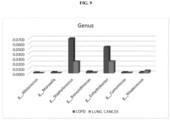
- a diagnostic model developed using, as a biomarker, one or more bacteria selected from the genus Alloiococcus, the genus Moraxella, the genus Staphylococcus, the genus Brevundimonas, the genus Enhydrobacter, the genus Comamonas, and the genus Rhodococcus exhibited significant diagnostic performance for lung cancer (see Table 9 and FIG. 9 ).
- Example 6 Lung Cancer Diagnostic Model Based on Metagenomic Analysis of Bacteria-Derived Extracellular Vesicles Isolated from Asthma Patient-Derived Blood and Lung Cancer Patient-Derived Blood
- Extracellular vesicles were isolated from blood samples of 308 lung cancer patients and 277 asthma patients, and then metagenomic sequencing was performed thereon using the method of Example 3.
- metagenomic sequencing was performed thereon using the method of Example 3.
- a strain exhibiting a p value of less than 0.05 between two groups in a t-test and a difference of two-fold or more between two groups was selected, and then an AUC, sensitivity, and specificity, which are diagnostic performance indexes, were calculated by logistic regression analysis.
- a diagnostic model developed using, as a biomarker, one or more bacteria selected from the order YS2, the order Turicibacterales, the order Bifidobacteriales, the order Bacteroidales, the order Enterobacteriales, the order Rhodobacterales, the order Gemellales, the order Flavobacteriales, the order Caulobacterales, the order Neisseriales, the order Sphingobacteriales, the order Deinococcales, the order Pseudomonadales, the order Rhodocyclales, the order Xanthomonadales, the order Fusobacteriales, the order Actinomycetales, the order Sphingomonadales, the order Verrucomicrobiales, the order Saprospirales, the order Rhizobiales, the order Bacillales, the order Streptophyta, the order Cytophagales, the order Thermales, the order Fim
- a diagnostic model developed using, as a biomarker, one or more bacteria selected from the family Helicobacteraceae, the family Bacteroidaceae, the family Turicibacteraceae, the family Veillonellaceae, the family Bijidobacteriaceae, the family Barnesiellaceae, the family Rikenellaceae, the family Clostridiaceae, the family Odoribacteraceae, the family Enterobacteriaceae, the family Porphyromonadaceae, the family Gemellaceae, the family Weeksellaceae, the family Carnobacteriaceae, the family Leptotrichiaceae, the family Moraxellaceae, the family Caulobacteraceae, the family Erythrobacteraceae, the family Hyphomicrobiaceae, the family Neisseriaceae, the family Sphingobacteriaceae, the family Deinococcaceae, the family
- a diagnostic model developed using, as a biomarker, one or more bacteria selected from of the genus Trabulsiella, the genus Enterobacter, the genus Veillonella, the genus Bifidobacterium, the genus Lachnospira, the genus Comamonas, the genus Bacteroides, the genus Turicibacter, the genus Sutterella, the genus Klebsiella, the genus SMB53, the genus Roseburia, the genus Dialister, the genus Ruminococcus, the genus Parabacteroides, the genus Butyricimonas, the genus Odoribacter, the genus Eubacterium, the genus Dorea, the genus Enhydrobacter, the genus Granulicatella, the genus Chryseobacterium, the genus
- a risk group for lung cancer can be diagnosed early and predicted by predicting a risk for lung cancer through metagenomic analysis of bacteria or bacteria-derived extracellular vesicles from a human body-derived sample, and thus the onset of lung cancer can be delayed or lung cancer may be prevented through appropriate management, and, even after lung cancer occurs, early diagnosis for lung cancer can be implemented, thereby lowering a disease rate and increasing therapeutic effects.
- patients diagnosed with lung cancer are able to avoid exposure to causative factors predicted by metagenomic analysis, whereby the progression of lung cancer is ameliorated, or recurrence of lung cancer can be prevented.
Landscapes
- Chemical & Material Sciences (AREA)
- Life Sciences & Earth Sciences (AREA)
- Organic Chemistry (AREA)
- Proteomics, Peptides & Aminoacids (AREA)
- Health & Medical Sciences (AREA)
- Analytical Chemistry (AREA)
- Engineering & Computer Science (AREA)
- Zoology (AREA)
- Wood Science & Technology (AREA)
- Genetics & Genomics (AREA)
- Immunology (AREA)
- Biotechnology (AREA)
- Molecular Biology (AREA)
- General Health & Medical Sciences (AREA)
- Biophysics (AREA)
- Physics & Mathematics (AREA)
- Biochemistry (AREA)
- Bioinformatics & Cheminformatics (AREA)
- General Engineering & Computer Science (AREA)
- Microbiology (AREA)
- Pathology (AREA)
- Chemical Kinetics & Catalysis (AREA)
- Hospice & Palliative Care (AREA)
- Oncology (AREA)
- Botany (AREA)
- Mycology (AREA)
- Measuring Or Testing Involving Enzymes Or Micro-Organisms (AREA)
Claims (3)
- Verfahren zum Bereitstellen von Informationen über eine Lungenkrebsdiagnose, wobei das Verfahren die folgenden Prozesse umfasst:(a) Extrahieren von DNA aus extrazellulären Vesikeln, die aus einer Patientenprobe isoliert wurden;(b) Durchführen einer Polymerase-Kettenreaktion (PCR) an der extrahierten DNA unter Verwendung eines Primer-Paares, das SEQ ID Nr: 1 und SEQ ID Nr: 2 aufweist; und(c) Erstellen der Diagnose durch Vergleichen, durch Sequenzierung des PCR-Produkts, einer Erhöhung oder Verringerung eines Gehalts von bakterienabgeleiteten, extrazellulären Vesikeln der Patientenprobe mit jener(i) einer von einem normalen Individuum stammenden Probe, wobei die extrazellulären Vesikel von einem oder mehreren Bakterien abgeleitet sind, ausgewählt aus der Gruppe bestehend aus:dem Stamm Acidobacteria und dem Stamm Chloroflexi; der Klasse Thermomicrobia und der Klasse Solibacteres;der Ordnung Turicibacterales, der Ordnung Rickettsiales, der Ordnung Alteromonadales, der Ordnung RF32, der Ordnung Thermales, der Ordnung JG30-KF-CM45, der Ordnung 1025, der Ordnung Solibacterales und der Ordnung Aeromonadales;der Familie Turicibacteraceae, der Familie Clostridiaceae, der Familie S24-7, der Familie Rhizobiaceae, der Familie Mitochondrien, der Familie F16, der Familie Gordoniaceac, der Familie Rhodospirillaceae, der Familie Thermaceae, der Familie Shewanellaceae, der Familie Ellin6075, der Familie Rs-045 und der Familie Aeromonadaceae; undder Gattung Chromohalobacter, der Gattung Geobacillus, der Gattung Proteus, der Gattung Megamonas, der Gattung Moraxella, der Gattung Alloiococcus, der Gattung Turicibacter, der Gattung SMB53, der Gattung Veillonella, der Gattung Peptoniphilus, der Gattung Comamonas, der Gattung Hymenobacter, der Gattung Citrobacter, der Gattung Novosphingobium, der Gattung Gordonia, der Gattung Aerococcus, der Gattung Thermus, der Gattung Shewanella und der Gattung Achromobacter;(ii) einer von einem Patienten mit chronisch obstruktiver Lungenerkrankung stammenden Probe, wobei die extrazellulären Vesikel von einem oder mehreren Bakterien abgeleitet sind, ausgewählt aus der Gruppe bestehend aus:der Ordnung Bacillales, der Ordnung Rickettsiales und der Ordnung 1025;der Familie Nocardiaceae und der Familie Rs-045; undder Gattung Alloiococcus, der Gattung Moraxella, der Gattung Brevundimonas, der Gattung Enhydrobacter, der Gattung Comamonas und der Gattung Rhodococcus; ODER(iii) einer von einem Asthmapatienten stammenden Probe, wobei die extrazellulären Vesikel von einem oder mehreren Bakterien abgeleitet sind, ausgewählt aus der Gruppe bestehend aus:dem Stamm Bacteroidetes, dem Stamm Cyanobacteria, dem Stamm TM7, dem Stamm Fusobacteria, dem Stamm Thermi, dem Stamm Verrucomicrobia, dem Stamm Armatimonadetes, dem Stamm Acidobacteria, dem Stamm Gemmatimonadetes und dem Stamm Chloroflexi;der Klasse Bacteroidia, der Klasse Bacilli, der Klasse Flavobacteriia, der Klasse Sphingobacteriia, der Klasse Alphaproteobacteria, der Klasse Fusobacteriia, der Klasse TM7-3, der Klasse Deinococci, der Klasse Verrucomicrobiae, der Klasse Saprospirae, der Klasse Chloroplast, der Klasse Cytophagia, der Klasse Fimbriimonadia, der Klasse Chloracidobacteria, der Klasse Thermomicrobia, der Klasse Thermoleophilia und der Klasse Solibacteres;der Ordnung YS2, der Ordnung Turicibacterales, der Ordnung Bifidobacteriales, der Ordnung Bacteroidales, der Ordnung Enterobacteriales, der Ordnung Rhodobacterales, der Ordnung Gemellales, der Ordnung Flavobacteriales, der Ordnung Caulobacterales, der Ordnung Neisseriales, der Ordnung Sphingobacteriales, der Ordnung Deinococcales, der Ordnung Pseudomonadales, der Ordnung Rhodocyclales, der Ordnung Xanthomonadales, der Ordnung Fusobacteriales, der Ordnung Actinomycetales, der Ordnung Sphingomonadales, der Ordnung Verrucomicrobiales, der Ordnung Saprospirales, der Ordnung Rhizobiales, der Ordnung Bacillales, der Ordnung Streptophyta, der Ordnung Cytophagales, der Ordnung Thermales, der Ordnung Fimbriimonadales, der Ordnung CW040, der Ordnung Rickettsiales, der Ordnung RB41, der Ordnung Alteromonadales, der Ordnung JG30-KF-CM45, der Ordnung 1025, der Ordnung Aeromonadales und der Ordnung Solibacterales;der Familie Helicobacteraceae, der Familie Bacteroidaceae, der Familie Turicibacteraceae, der Familie Veillonellaceae, der Familie Bifidobacteriaceae, der Familie Barnesiellaceae, der Familie Rikenellaceae, der Familie Clostridiaceae, der Familie Odoribacteraceae, der Familie Enterobacteriaceae, der Familie Porphyromonadaceae, der Familie Gemellaceae, der Familie Weeksellaceae, der Familie Carnobacteriaceae, der Familie Leptotrichiaceae, der Familie Moraxellaceae, der Familie Caulobacteraceae, der Familie Erythrobacteraceae, der Familie Hyphomicrobiaceae, der Familie Neisseriaceae, der Familie Sphingobacteriaceae, der Familie Deinococcaceae, der Familie Aerococcaceae, der Familie Bartonellaceae, der Familie Micrococcaceae, der Familie Flavobacteriaceae, der Familie Burkholderiaceae, der Familie Lactobacillaceae, der Familie Dietziaceae, der Familie Rhodocyclaceae, der Familie Xanthomonadaceae, der Familie Geodermatophilaceae, der Familie Actinomycetaceae, der Familie Methylobacteriaceae, der Familie Pseudomonadaceae, der Familie Corynebacteriaceae, der Familie Nocardioidaceae, der Familie Verrucomicrobiaceae, der Familie Sphingomonadaceae, der Familie Mycobacteriaceae, der Familie Tissierellaceae, der Familie Chitinophagaceae, der Familie Intrasporangiaceae, der Familie Propionibacteriaceae, der Familie Aurantimonadaceae, der Familie Planococcaceae, der Familie Fusobacteriaceae, der Familie Bradyrhizobiaceae, der Familie Nocardiaceae, der Familie Dermabacteraceae, der Familie Bacillaceae, der Familie Thermaceae, der Familie Ellin6075, der Familie Brevibacteriaceae, der Familie Microbacteriaceae, der Familie Rhodospirillaceae, der Familie Cytophagaceae, der Familie Fimbriimonadaceae, der Familie Dermacoccaceae, der Familie Chromatiaceae, der Familie Rhizobiaceae, der Familie Gordoniaceae, der Familie mitochondria, der Familie Pseudonocardiaceae, der Familie Exiguobacteraceae, der Familie Shewanellaceae, der Familie F16, der Familie Rs-045 und der Familie Aeromonadaceae; undder Gattung Trabulsiella, der Gattung Veillonella, der Gattung Bifidobacterium, der Gattung Lachnospira, der Gattung Comamonas, der Gattung Bacteroides, der Gattung Turicibacter, der Gattung Sutterella, der Gattung Klebsiella, der Gattung SMB53, der Gattung Roseburia, der Gattung Dialister, der Gattung Ruminococcus, der Gattung Parabacteroides, der Gattung Butyricimonas, der Gattung Odoribacter, der Gattung Eubacterium, der Gattung Dorea, der Gattung Enhydrobacter, der Gattung Granulicatella, der Gattung Chryseobacterium, der Gattung Porphyromonas, der Gattung Coprococcus, der Gattung Peptoniphilus, der Gattung Microbispora, der Gattung Deinococcus, der Gattung Aerococcus, der Gattung Actinomyces, der Gattung Brevundimonas, der Gattung Blastomonas, der Gattung Citrobacter, der Gattung Lactobacillus, der Gattung Stenotrophomonas, der Gattung Corynebacterium, der Gattung Lautropia, der Gattung Akkermansia, der Gattung Bacillus, der Gattung Sphingobacterium, der Gattung Anaerococcus, der Gattung Neisseria, der Gattung Leptotrichia, der Gattung Mycobacterium, der Gattung Kocuria, der Gattung Methylobacterium, der Gattung Propionibacterium, der Gattung Hymenobacter, der Gattung Sphingomonas, der Gattung Fusobacterium, der Gattung Brachybacterium, der Gattung Rhodococcus, der Gattung Micrococcus, der Gattung Kaistobacter, der Gattung Finegoldia, der Gattung Rubellimicrobium, der Gattung Brevibacterium, der Gattung Agrobacterium, der Gattung Dietzia, der Gattung Fimbriimonas, der Gattung Flavobacterium, der Gattung Dermacoccus, der Gattung Skermanella, der Gattung Novosphingobium, der Gattung Gordonia, der Gattung Rheinheimera, der Gattung Achromobacter, der Gattung Hydrogenophilus, der Gattung Thermus, der Gattung Exiguobacterium, der Gattung Shewanella, der Gattung Ralstonia und der Gattung Alkanindiges;und wobei es sich bei der Patientenprobe um Blut handelt.
- Verfahren zum Diagnostizieren von Lungenkrebs, wobei das Verfahren die folgenden Prozesse umfasst:(a) Extrahieren von DNA aus extrazellulären Vesikeln, die aus einer Patientenprobe isoliert wurden;(b) Durchführen einer Polymerase-Kettenreaktion (PCR) an der extrahierten DNA unter Verwendung eines Primer-Paares, das SEQ ID Nr: 1 und SEQ ID Nr: 2 aufweist; und(c) Erstellen der Diagnose durch Vergleichen, durch Sequenzierung eines Produkts der PCR, einer Erhöhung oder Verringerung eines Gehalts von bakterienabgeleiteten, extrazellulären Vesikeln der Patientenprobe mit jener(i) einer von einem normalen Individuum stammenden Probe, wobei die extrazellulären Vesikel von einem oder mehreren Bakterien abgeleitet sind, ausgewählt aus der Gruppe bestehend aus:dem Stamm Acidobacteria und dem Stamm Chloroflexi; der Klasse Thermomicrobia und der Klasse Solibacteres;der Ordnung Turicibacterales, der Ordnung Rickettsiales, der Ordnung Alteromonadales, der Ordnung RF32, der Ordnung Thermales, der Ordnung JG30-KF-CM45, der Ordnung 1025, der Ordnung Solibacterales und der Ordnung Aeromonadales;der Familie Turicibacteraceae, der Familie Clostridiaceae, der Familie S24-7, der Familie Rhizobiaceae, der Familie Mitochondrien, der Familie F16, der Familie Gordoniaceae, der Familie Rhodospirillaceae, der Familie Thermaceae, der Familie Shewanellaceae, der Familie Ellin6075, der Familie Rs-045 und der Familie Aeromonadaceae; undder Gattung Chromohalobacter, der Gattung Geobacillus, der Gattung Proteus, der Gattung Megamonas, der Gattung Moraxella, der Gattung Alloiococcus, der Gattung Turicibacter, der Gattung SMB53, der Gattung Veillonella, der Gattung Peptoniphilus, der Gattung Comamonas, der Gattung Hymenobacter, der Gattung Citrobacter, der Gattung Novosphingobium, der Gattung Gordonia, der Gattung Aerococcus, der Gattung Thermus, der Gattung Shewanella und der Gattung Achromobacter;(ii) einer von einem Patienten mit chronisch obstruktiver Lungenerkrankung stammenden Probe, wobei die extrazellulären Vesikel von einem oder mehreren Bakterien abgeleitet sind, ausgewählt aus der Gruppe bestehend aus:der Ordnung Bacillales, der Ordnung Rickettsiales und der Ordnung 1025;der Familie Nocardiaceae und der Familie Rs-045; undder Gattung Alloiococcus, der Gattung Moraxella, der Gattung Brevundimonas, der Gattung Enhydrobacter, der Gattung Comamonas und der Gattung Rhodococcus; ODER(iii) einer von einem Asthmapatienten stammenden Probe, wobei die extrazellulären Vesikel von einem oder mehreren Bakterien abgeleitet sind, ausgewählt aus der Gruppe bestehend aus:dem Stamm Bacteroidetes, dem Stamm Cyanobacteria, dem Stamm TM7, dem Stamm Fusobacteria, dem Stamm Thermi, dem Stamm Verrucomicrobia, dem Stamm Armatimonadetes, dem Stamm Acidobacteria, dem Stamm Gemmatimonadetes und dem Stamm Chloroflexi;der Klasse Bacteroidia, der Klasse Bacilli, der Klasse Flavobacteriia, der Klasse Sphingobacteriia, der Klasse Alphaproteobacteria, der Klasse Fusobacteriia, der Klasse TM7-3, der Klasse Deinococci, der Klasse Verrucomicrobiae, der Klasse Saprospirae, der Klasse Chloroplast, der Klasse Cytophagia, der Klasse Fimbriimonadia, der Klasse Chloracidobacteria, der Klasse Thermomicrobia, der Klasse Thermoleophilia und der Klasse Solibacteres;der Ordnung YS2, der Ordnung Turicibacterales, der Ordnung Bifidobacteriales, der Ordnung Bacteroidales, der Ordnung Enterobacteriales, der Ordnung Rhodobacterales, der Ordnung Gemellales, der Ordnung Flavobacteriales, der Ordnung Caulobacterales, der Ordnung Neisseriales, der Ordnung Sphingobacteriales, der Ordnung Deinococcales, der Ordnung Pseudomonadales, der Ordnung Rhodocyclales, der Ordnung Xanthomonadales, der Ordnung Fusobacteriales, der Ordnung Actinomycetales, der Ordnung Sphingomonadales, der Ordnung Verrucomicrobiales, der Ordnung Saprospirales, der Ordnung Rhizobiales, der Ordnung Bacillales, der Ordnung Streptophyta, der Ordnung Cytophagales, der Ordnung Thermales, der Ordnung Fimbriimonadales, der Ordnung CW040, der Ordnung Rickettsiales, der Ordnung RB41, der Ordnung Alteromonadales, der Ordnung JG30-KF-CM45, der Ordnung 1025, der Ordnung Aeromonadales und der Ordnung Solibacterales;der Familie Helicobacteraceae, der Familie Bacteroidaceae, der Familie Turicibacteraceae, der Familie Veillonellaceae, der Familie Bifidobacteriaceae, der Familie Barnesiellaceae, der Familie Rikenellaceae, der Familie Clostridiaceae, der Familie Odoribacteraceae, der Familie Enterobacteriaceae, der Familie Porphyromonadaceae, der Familie Gemellaceae, der Familie Weeksellaceae, der Familie Carnobacteriaceae, der Familie Leptotrichiaceae, der Familie Moraxellaceae, der Familie Caulobacteraceae, der Familie Erythrobacteraceae, der Familie Hyphomicrobiaceae, der Familie Neisseriaceae, der Familie Sphingobacteriaceae, der Familie Deinococcaceae, der Familie Aerococcaceae, der Familie Bartonellaceae, der Familie Micrococcaceae, der Familie Flavobacteriaceae, der Familie Burkholderiaceae, der Familie Lactobacillaceae, der Familie Dietziaceae, der Familie Rhodocyclaceae, der Familie Xanthomonadaceae, der Familie Geodermatophilaceae, der Familie Actinomycetaceae, der Familie Methylobacteriaceae, der Familie Pseudomonadaceae, der Familie Corynebacteriaceae, der Familie Nocardioidaceae, der Familie Verrucomicrobiaceae, der Familie Sphingomonadaceae, der Familie Mycobacteriaceae, der Familie Tissierellaceae, der Familie Chitinophagaceae, der Familie Intrasporangiaceae, der Familie Propionibacteriaceae, der Familie Aurantimonadaceae, der Familie Planococcaceae, der Familie Fusobacteriaceae, der Familie Bradyrhizobiaceae, der Familie Nocardiaceae, der Familie Dermabacteraceae, der Familie Bacillaceae, der Familie Thermaceae, der Familie Ellin6075, der Familie Brevibacteriaceae, der Familie Microbacteriaceae, der Familie Rhodospirillaceae, der Familie Cytophagaceae, der Familie Fimbriimonadaceae, der Familie Dermacoccaceae, der Familie Chromatiaceae, der Familie Rhizobiaceae, der Familie Gordoniaceae, der Familie mitochondria, der Familie Pseudonocardiaceae, der Familie Exiguobacteraceae, der Familie Shewanellaceae, der Familie F16, der Familie Rs-045 und der Familie Aeromonadaceae; undder Gattung Trabulsiella, der Gattung Veillonella, der Gattung Bifidobacterium, der Gattung Lachnospira, der Gattung Comamonas, der Gattung Bacteroides, der Gattung Turicibacter, der Gattung Sutterella, der Gattung Klebsiella, der Gattung SMB53, der Gattung Roseburia, der Gattung Dialister, der Gattung Ruminococcus, der Gattung Parabacteroides, der Gattung Butyricimonas, der Gattung Odoribacter, der Gattung Eubacterium, der Gattung Dorea, der Gattung Enhydrobacter, der Gattung Granulicatella, der Gattung Chryseobacterium, der Gattung Porphyromonas, der Gattung Coprococcus, der Gattung Peptoniphilus, der Gattung Microbispora, der Gattung Deinococcus, der Gattung Aerococcus, der Gattung Actinomyces, der Gattung Brevundimonas, der Gattung Blastomonas, der Gattung Citrobacter, der Gattung Lactobacillus, der Gattung Stenotrophomonas, der Gattung Corynebacterium, der Gattung Lautropia, der Gattung Akkermansia, der Gattung Bacillus, der Gattung Sphingobacterium, der Gattung Anaerococcus, der Gattung Neisseria, der Gattung Leptotrichia, der Gattung Mycobacterium, der Gattung Kocuria, der Gattung Methylobacterium, der Gattung Propionibacterium, der Gattung Hymenobacter, der Gattung Sphingomonas, der Gattung Fusobacterium, der Gattung Brachybacterium, der Gattung Rhodococcus, der Gattung Micrococcus, der Gattung Kaistobacter, der Gattung Finegoldia, der Gattung Rubellimicrobium, der Gattung Brevibacterium, der Gattung Agrobacterium, der Gattung Dietzia, der Gattung Fimbriimonas, der Gattung Flavobacterium, der Gattung Dermacoccus, der Gattung Skermanella, der Gattung Novosphingobium, der Gattung Gordonia, der Gattung Rheinheimera, der Gattung Achromobacter, der Gattung Hydrogenophilus, der Gattung Thermus, der Gattung Exiguobacterium, der Gattung Shewanella, der Gattung Ralstonia und der Gattung Alkanindiges;und wobei es sich bei der Patientenprobe um Blut handelt.
- Verfahren nach Anspruch 1 oder Anspruch 2, wobei das Blut Vollblut, Serum, Plasma oder mononukleäre Blutzellen ist.
Applications Claiming Priority (4)
| Application Number | Priority Date | Filing Date | Title |
|---|---|---|---|
| KR20160179225 | 2016-12-26 | ||
| KR1020170080905A KR101833503B1 (ko) | 2016-12-26 | 2017-06-27 | 만성폐쇄성폐질환자에서 세균 메타게놈 분석을 통한 폐암 진단방법 |
| KR1020170080906A KR101833504B1 (ko) | 2016-12-26 | 2017-06-27 | 세균 메타게놈 분석을 통한 폐암 진단방법 |
| PCT/KR2017/015173 WO2018124617A1 (ko) | 2016-12-26 | 2017-12-21 | 세균 메타게놈 분석을 통한 폐암 진단 방법 |
Publications (4)
| Publication Number | Publication Date |
|---|---|
| EP3561069A1 EP3561069A1 (de) | 2019-10-30 |
| EP3561069A4 EP3561069A4 (de) | 2020-08-19 |
| EP3561069C0 EP3561069C0 (de) | 2024-07-24 |
| EP3561069B1 true EP3561069B1 (de) | 2024-07-24 |
Family
ID=61726830
Family Applications (1)
| Application Number | Title | Priority Date | Filing Date |
|---|---|---|---|
| EP17888390.6A Active EP3561069B1 (de) | 2016-12-26 | 2017-12-21 | Verfahren zur diagnose von lungenkrebs durch bakterielle metagenome analyse |
Country Status (6)
| Country | Link |
|---|---|
| US (1) | US20200157608A1 (de) |
| EP (1) | EP3561069B1 (de) |
| JP (1) | JP6914551B2 (de) |
| KR (2) | KR101833504B1 (de) |
| CN (3) | CN108239670A (de) |
| WO (1) | WO2018124617A1 (de) |
Families Citing this family (25)
| Publication number | Priority date | Publication date | Assignee | Title |
|---|---|---|---|---|
| KR102087105B1 (ko) * | 2018-02-21 | 2020-03-10 | 주식회사 엠디헬스케어 | 큐프리아비더스 속 세균 유래 나노소포 및 이의 용도 |
| KR102230479B1 (ko) * | 2018-02-26 | 2021-03-22 | 주식회사 엠디헬스케어 | 투리시박터 속 세균 유래 나노소포 및 이의 용도 |
| KR102122898B1 (ko) * | 2018-02-26 | 2020-06-15 | 주식회사 엠디헬스케어 | 블라우티아 속 세균 유래 나노소포 및 이의 용도 |
| KR102118197B1 (ko) * | 2018-02-28 | 2020-06-02 | 주식회사 엠디헬스케어 | 마이크로코커스 속 세균 유래 나노소포 및 이의 용도 |
| KR102185985B1 (ko) * | 2018-03-05 | 2020-12-03 | 주식회사 엠디헬스케어 | 알로이오코커스 속 세균 유래 나노소포 및 이의 용도 |
| KR102118996B1 (ko) * | 2018-03-06 | 2020-06-05 | 주식회사 엠디헬스케어 | 베일로넬라 속 세균 유래 나노소포 및 이의 용도 |
| JP7486479B2 (ja) * | 2018-10-13 | 2024-05-17 | メモリアル スローン ケタリング キャンサー センター | Car t細胞療法応答不良のリスクがある対象を識別および処置するための方法および組成物 |
| KR102356626B1 (ko) * | 2018-12-10 | 2022-01-28 | 주식회사 엠디헬스케어 | 웨이셀라 속 세균 유래 나노소포 및 이의 용도 |
| JP7291424B2 (ja) * | 2019-01-09 | 2023-06-15 | エムディー ヘルスケア インコーポレイテッド | デイノコッカス属細菌由来ナノ小胞及びその用途 |
| KR102284589B1 (ko) * | 2019-01-09 | 2021-08-03 | 주식회사 엠디헬스케어 | 로도코커스 속 세균 유래 나노소포 및 이의 용도 |
| KR102286042B1 (ko) * | 2019-01-09 | 2021-08-03 | 주식회사 엠디헬스케어 | 데이노코커스 속 세균 유래 나노소포 및 이의 용도 |
| WO2020145663A1 (ko) * | 2019-01-09 | 2020-07-16 | 주식회사 엠디헬스케어 | 로도코커스 속 세균 유래 나노소포 및 이의 용도 |
| KR102379022B1 (ko) * | 2019-05-24 | 2022-03-28 | 주식회사 엠디헬스케어 | qPCR 분석을 통한 위암 진단방법 |
| KR102304775B1 (ko) | 2020-01-29 | 2021-09-23 | 고려대학교 산학협력단 | 뇌 mri 분석을 이용한 만성폐쇄성폐질환 진단 방법 |
| CN111621577B (zh) * | 2020-03-09 | 2023-09-05 | 中国科学院亚热带农业生态研究所 | 一种基于鼻腔原核微生物相对丰度的评价保育猪个体所处生长环境温湿状态的方法 |
| CN115942944A (zh) * | 2020-06-11 | 2023-04-07 | 伊夫罗生物科学公司 | 使用颤螺旋菌科微生物胞外囊泡治疗疾病和障碍的组合物和方法 |
| CN113262297A (zh) * | 2020-11-02 | 2021-08-17 | 中南大学湘雅二医院 | 一种基于巴氏菌的治疗性肺癌疫苗及其配置方法和应用 |
| CN112538545B (zh) * | 2020-12-15 | 2022-12-13 | 上海交通大学医学院 | 真菌微生物组作为标志物在制备治疗筛查和肺癌诊断中的应用 |
| CN112662795B (zh) * | 2021-01-26 | 2023-12-15 | 苏州系统医学研究所 | 用于感染性病原体检测的阳性对照品及其制备方法与应用 |
| CN113528427A (zh) * | 2021-06-22 | 2021-10-22 | 姜海涛 | 一种结直肠靶向载药外泌体及应用和治疗结直肠疾病药物 |
| US20240369564A1 (en) * | 2021-07-20 | 2024-11-07 | Micronoma, Inc. | Methods of disease diagnostics utilizing microbial extracellular vesicle (mev) analytes |
| WO2023042673A1 (ja) * | 2021-09-16 | 2023-03-23 | 国立研究開発法人物質・材料研究機構 | 膜小胞の検出方法、バイオマーカー配列の探索方法、膜小胞検出装置、バイオマーカー配列探索装置、プログラム、コンピュータ、及び、疾病バイオマーカーの探索方法 |
| CN113913333B (zh) * | 2021-10-20 | 2022-09-02 | 南京世和基因生物技术股份有限公司 | 一种肺癌诊断标志物及用途 |
| CN117004744B (zh) * | 2022-04-27 | 2024-05-24 | 数字碱基(南京)科技有限公司 | 一种基于血浆微生物dna特征的肺癌预后评估方法及模型 |
| KR102954588B1 (ko) | 2023-06-15 | 2026-04-20 | 충남대학교병원 | 기관지폐포세척액의 마이크로바이옴을 포함하는 폐암 진단용 바이오마커 조성물 |
Family Cites Families (11)
| Publication number | Priority date | Publication date | Assignee | Title |
|---|---|---|---|---|
| EP2030623A1 (de) * | 2007-08-17 | 2009-03-04 | Nestec S.A. | Verhinderung und/oder Behandlung von Stoffwechselerkrankungen durch Modulation der Menge der Enterobakterien |
| WO2011027956A2 (ko) * | 2009-09-04 | 2011-03-10 | 주식회사이언메딕스 | 그람 양성 박테리아에서 유래한 세포밖 소포체 및 이를 이용한 질병 모델 |
| EP2486940B1 (de) * | 2009-10-08 | 2017-10-04 | Aeon Medix Inc. | Zusammensetzungen mit aus raumluft gewonnenen extrazellulären membran-vesikeln und verwendung davon |
| JP6114035B2 (ja) * | 2010-02-10 | 2017-04-12 | ザ リージェンツ オブ ザ ユニバーシティ オブ カリフォルニア | 肺癌検出用唾液バイオマーカー |
| KR101421779B1 (ko) * | 2011-04-08 | 2014-07-28 | 주식회사이언메딕스 | 아시네토박터 속 세균유래 세포밖 소포체 및 이의 용도 |
| KR20130021920A (ko) * | 2011-08-24 | 2013-03-06 | 포항공과대학교 산학협력단 | Akkermansia muciniphila 또는 Bacteroides acidifaciens 유래 세포밖 소포체를 유효성분으로 함유하는 염증성 질환의 치료 또는 예방용 조성물 |
| SI3223838T1 (sl) * | 2014-11-28 | 2025-07-31 | Anagenix Ip Limited | Pripravki zlatega kivija ter metode priprave in uporabe |
| KR101798176B1 (ko) * | 2014-12-16 | 2017-11-15 | 주식회사 엠디헬스케어 | 세균 유래의 나노소포체를 이용한 세균성 감염질환 원인균 동정방법 |
| KR20160101521A (ko) * | 2015-02-17 | 2016-08-25 | 이화여자대학교 산학협력단 | 세균 유래 세포밖 소포체를 이용한 호흡기 염증성 질환의 진단방법 |
| KR20160110232A (ko) * | 2015-03-11 | 2016-09-21 | 주식회사 엠디헬스케어 | 유산균 유래 세포밖 소포체를 유효성분으로 포함하는 염증질환의 예방 또는 치료용 조성물 |
| GB2554365B (en) * | 2016-09-22 | 2022-05-04 | Aer Beatha Ltd | Canister and valve |
-
2017
- 2017-06-27 KR KR1020170080906A patent/KR101833504B1/ko active Active
- 2017-06-27 KR KR1020170080905A patent/KR101833503B1/ko not_active Expired - Fee Related
- 2017-08-31 CN CN201710769440.7A patent/CN108239670A/zh not_active Withdrawn
- 2017-08-31 CN CN201710770882.3A patent/CN108265115A/zh not_active Withdrawn
- 2017-12-21 WO PCT/KR2017/015173 patent/WO2018124617A1/ko not_active Ceased
- 2017-12-21 US US16/473,020 patent/US20200157608A1/en not_active Abandoned
- 2017-12-21 EP EP17888390.6A patent/EP3561069B1/de active Active
- 2017-12-21 JP JP2019534797A patent/JP6914551B2/ja not_active Expired - Fee Related
- 2017-12-21 CN CN201780080645.2A patent/CN110382715B/zh not_active Expired - Fee Related
Also Published As
| Publication number | Publication date |
|---|---|
| US20200157608A1 (en) | 2020-05-21 |
| EP3561069A4 (de) | 2020-08-19 |
| EP3561069C0 (de) | 2024-07-24 |
| KR101833503B1 (ko) | 2018-03-05 |
| CN110382715B (zh) | 2024-01-02 |
| KR101833504B1 (ko) | 2018-03-05 |
| EP3561069A1 (de) | 2019-10-30 |
| JP2020503028A (ja) | 2020-01-30 |
| CN110382715A (zh) | 2019-10-25 |
| CN108239670A (zh) | 2018-07-03 |
| CN108265115A (zh) | 2018-07-10 |
| JP6914551B2 (ja) | 2021-08-04 |
| WO2018124617A1 (ko) | 2018-07-05 |
Similar Documents
| Publication | Publication Date | Title |
|---|---|---|
| EP3561069A1 (de) | Verfahren zur diagnose von lungenkrebs durch bakterielle metagenome analyse | |
| EP3587596B1 (de) | Verfahren zur diagnose von chronischer obstruktiver atemwegserkrankung durch bakterielle metagenomanalyse | |
| EP3564390B1 (de) | Verfahren zur diagnose von kolontumoren durch bakterielle metagenome analyse | |
| CN110382719B (zh) | 通过微生物宏基因组分析来诊断乳腺癌的方法 | |
| KR101940445B1 (ko) | 세균 메타게놈 분석을 통한 당뇨병 진단 방법 | |
| US20200157632A1 (en) | Method of diagnosing gastric cancer through bacterial metagenome analysis | |
| EP3567118B1 (de) | Verfahren zur diagnose von herzkrankheiten durch bakterielle metagenomanalyse | |
| KR102019646B1 (ko) | 미생물 메타게놈 분석을 통한 아토피피부염 진단방법 | |
| EP3748018A1 (de) | Verfahren zur diagnose von depression durch bakterielle metagenomanalyse | |
| CN111727263B (zh) | 通过细菌性宏基因组分析来诊断中风的方法 | |
| US12084721B2 (en) | Inflammatory bowel disease diagnostic method by means of bacterial metagenomic analysis | |
| US12365949B2 (en) | Method for diagnosing ovarian cancer through microbial metagenome analysis | |
| KR102019648B1 (ko) | 천식환자에서 세균 메타게놈 분석을 통한 폐암 진단방법 | |
| KR101940424B1 (ko) | 세균 메타게놈 분석을 통한 신부전 진단방법 | |
| US20200354795A1 (en) | Method for diagnosing pancreatic cancer via bacterial metagenomic analysis | |
| US11708615B2 (en) | Method for diagnosing lymphoma via bacterial metagenomic analysis |
Legal Events
| Date | Code | Title | Description |
|---|---|---|---|
| STAA | Information on the status of an ep patent application or granted ep patent |
Free format text: STATUS: THE INTERNATIONAL PUBLICATION HAS BEEN MADE |
|
| PUAI | Public reference made under article 153(3) epc to a published international application that has entered the european phase |
Free format text: ORIGINAL CODE: 0009012 |
|
| STAA | Information on the status of an ep patent application or granted ep patent |
Free format text: STATUS: REQUEST FOR EXAMINATION WAS MADE |
|
| 17P | Request for examination filed |
Effective date: 20190625 |
|
| AK | Designated contracting states |
Kind code of ref document: A1 Designated state(s): AL AT BE BG CH CY CZ DE DK EE ES FI FR GB GR HR HU IE IS IT LI LT LU LV MC MK MT NL NO PL PT RO RS SE SI SK SM TR |
|
| AX | Request for extension of the european patent |
Extension state: BA ME |
|
| DAV | Request for validation of the european patent (deleted) | ||
| DAX | Request for extension of the european patent (deleted) | ||
| A4 | Supplementary search report drawn up and despatched |
Effective date: 20200720 |
|
| RIC1 | Information provided on ipc code assigned before grant |
Ipc: C12Q 1/6869 20180101ALI20200714BHEP Ipc: C12Q 1/6886 20180101ALI20200714BHEP Ipc: C12Q 1/689 20180101ALI20200714BHEP Ipc: C12Q 1/68 20180101AFI20200714BHEP |
|
| STAA | Information on the status of an ep patent application or granted ep patent |
Free format text: STATUS: EXAMINATION IS IN PROGRESS |
|
| 17Q | First examination report despatched |
Effective date: 20211203 |
|
| GRAP | Despatch of communication of intention to grant a patent |
Free format text: ORIGINAL CODE: EPIDOSNIGR1 |
|
| STAA | Information on the status of an ep patent application or granted ep patent |
Free format text: STATUS: GRANT OF PATENT IS INTENDED |
|
| INTG | Intention to grant announced |
Effective date: 20240318 |
|
| GRAS | Grant fee paid |
Free format text: ORIGINAL CODE: EPIDOSNIGR3 |
|
| GRAA | (expected) grant |
Free format text: ORIGINAL CODE: 0009210 |
|
| STAA | Information on the status of an ep patent application or granted ep patent |
Free format text: STATUS: THE PATENT HAS BEEN GRANTED |
|
| AK | Designated contracting states |
Kind code of ref document: B1 Designated state(s): AL AT BE BG CH CY CZ DE DK EE ES FI FR GB GR HR HU IE IS IT LI LT LU LV MC MK MT NL NO PL PT RO RS SE SI SK SM TR |
|
| REG | Reference to a national code |
Ref country code: GB Ref legal event code: FG4D |
|
| REG | Reference to a national code |
Ref country code: CH Ref legal event code: EP |
|
| REG | Reference to a national code |
Ref country code: IE Ref legal event code: FG4D Ref country code: DE Ref legal event code: R096 Ref document number: 602017083594 Country of ref document: DE |
|
| U01 | Request for unitary effect filed |
Effective date: 20240820 |
|
| U07 | Unitary effect registered |
Designated state(s): AT BE BG DE DK EE FI FR IT LT LU LV MT NL PT RO SE SI Effective date: 20240902 |
|
| PG25 | Lapsed in a contracting state [announced via postgrant information from national office to epo] |
Ref country code: NO Free format text: LAPSE BECAUSE OF FAILURE TO SUBMIT A TRANSLATION OF THE DESCRIPTION OR TO PAY THE FEE WITHIN THE PRESCRIBED TIME-LIMIT Effective date: 20241024 |
|
| PG25 | Lapsed in a contracting state [announced via postgrant information from national office to epo] |
Ref country code: PL Free format text: LAPSE BECAUSE OF FAILURE TO SUBMIT A TRANSLATION OF THE DESCRIPTION OR TO PAY THE FEE WITHIN THE PRESCRIBED TIME-LIMIT Effective date: 20240724 Ref country code: GR Free format text: LAPSE BECAUSE OF FAILURE TO SUBMIT A TRANSLATION OF THE DESCRIPTION OR TO PAY THE FEE WITHIN THE PRESCRIBED TIME-LIMIT Effective date: 20241025 |
|
| PG25 | Lapsed in a contracting state [announced via postgrant information from national office to epo] |
Ref country code: IS Free format text: LAPSE BECAUSE OF FAILURE TO SUBMIT A TRANSLATION OF THE DESCRIPTION OR TO PAY THE FEE WITHIN THE PRESCRIBED TIME-LIMIT Effective date: 20241124 |
|
| PG25 | Lapsed in a contracting state [announced via postgrant information from national office to epo] |
Ref country code: HR Free format text: LAPSE BECAUSE OF FAILURE TO SUBMIT A TRANSLATION OF THE DESCRIPTION OR TO PAY THE FEE WITHIN THE PRESCRIBED TIME-LIMIT Effective date: 20240724 |
|
| PG25 | Lapsed in a contracting state [announced via postgrant information from national office to epo] |
Ref country code: RS Free format text: LAPSE BECAUSE OF FAILURE TO SUBMIT A TRANSLATION OF THE DESCRIPTION OR TO PAY THE FEE WITHIN THE PRESCRIBED TIME-LIMIT Effective date: 20241024 Ref country code: ES Free format text: LAPSE BECAUSE OF FAILURE TO SUBMIT A TRANSLATION OF THE DESCRIPTION OR TO PAY THE FEE WITHIN THE PRESCRIBED TIME-LIMIT Effective date: 20240724 |
|
| PG25 | Lapsed in a contracting state [announced via postgrant information from national office to epo] |
Ref country code: RS Free format text: LAPSE BECAUSE OF FAILURE TO SUBMIT A TRANSLATION OF THE DESCRIPTION OR TO PAY THE FEE WITHIN THE PRESCRIBED TIME-LIMIT Effective date: 20241024 Ref country code: PL Free format text: LAPSE BECAUSE OF FAILURE TO SUBMIT A TRANSLATION OF THE DESCRIPTION OR TO PAY THE FEE WITHIN THE PRESCRIBED TIME-LIMIT Effective date: 20240724 Ref country code: NO Free format text: LAPSE BECAUSE OF FAILURE TO SUBMIT A TRANSLATION OF THE DESCRIPTION OR TO PAY THE FEE WITHIN THE PRESCRIBED TIME-LIMIT Effective date: 20241024 Ref country code: IS Free format text: LAPSE BECAUSE OF FAILURE TO SUBMIT A TRANSLATION OF THE DESCRIPTION OR TO PAY THE FEE WITHIN THE PRESCRIBED TIME-LIMIT Effective date: 20241124 Ref country code: HR Free format text: LAPSE BECAUSE OF FAILURE TO SUBMIT A TRANSLATION OF THE DESCRIPTION OR TO PAY THE FEE WITHIN THE PRESCRIBED TIME-LIMIT Effective date: 20240724 Ref country code: GR Free format text: LAPSE BECAUSE OF FAILURE TO SUBMIT A TRANSLATION OF THE DESCRIPTION OR TO PAY THE FEE WITHIN THE PRESCRIBED TIME-LIMIT Effective date: 20241025 Ref country code: ES Free format text: LAPSE BECAUSE OF FAILURE TO SUBMIT A TRANSLATION OF THE DESCRIPTION OR TO PAY THE FEE WITHIN THE PRESCRIBED TIME-LIMIT Effective date: 20240724 |
|
| PG25 | Lapsed in a contracting state [announced via postgrant information from national office to epo] |
Ref country code: SM Free format text: LAPSE BECAUSE OF FAILURE TO SUBMIT A TRANSLATION OF THE DESCRIPTION OR TO PAY THE FEE WITHIN THE PRESCRIBED TIME-LIMIT Effective date: 20240724 |
|
| PG25 | Lapsed in a contracting state [announced via postgrant information from national office to epo] |
Ref country code: CZ Free format text: LAPSE BECAUSE OF FAILURE TO SUBMIT A TRANSLATION OF THE DESCRIPTION OR TO PAY THE FEE WITHIN THE PRESCRIBED TIME-LIMIT Effective date: 20240724 |
|
| PG25 | Lapsed in a contracting state [announced via postgrant information from national office to epo] |
Ref country code: SK Free format text: LAPSE BECAUSE OF FAILURE TO SUBMIT A TRANSLATION OF THE DESCRIPTION OR TO PAY THE FEE WITHIN THE PRESCRIBED TIME-LIMIT Effective date: 20240724 |
|
| PLBE | No opposition filed within time limit |
Free format text: ORIGINAL CODE: 0009261 |
|
| STAA | Information on the status of an ep patent application or granted ep patent |
Free format text: STATUS: NO OPPOSITION FILED WITHIN TIME LIMIT |
|
| 26N | No opposition filed |
Effective date: 20250425 |
|
| PG25 | Lapsed in a contracting state [announced via postgrant information from national office to epo] |
Ref country code: MC Free format text: LAPSE BECAUSE OF FAILURE TO SUBMIT A TRANSLATION OF THE DESCRIPTION OR TO PAY THE FEE WITHIN THE PRESCRIBED TIME-LIMIT Effective date: 20240724 |
|
| REG | Reference to a national code |
Ref country code: CH Ref legal event code: PL |
|
| U90 | Renewal fees not paid: noting of loss of rights |
Free format text: RENEWAL FEE NOT PAID FOR YEAR 08 Effective date: 20250711 |
|
| GBPC | Gb: european patent ceased through non-payment of renewal fee |
Effective date: 20241221 |
|
| PG25 | Lapsed in a contracting state [announced via postgrant information from national office to epo] |
Ref country code: GB Free format text: LAPSE BECAUSE OF NON-PAYMENT OF DUE FEES Effective date: 20241221 |
|
| PG25 | Lapsed in a contracting state [announced via postgrant information from national office to epo] |
Ref country code: CH Free format text: LAPSE BECAUSE OF NON-PAYMENT OF DUE FEES Effective date: 20241231 |
|
| PG25 | Lapsed in a contracting state [announced via postgrant information from national office to epo] |
Ref country code: IE Free format text: LAPSE BECAUSE OF NON-PAYMENT OF DUE FEES Effective date: 20241221 |
|
| U93 | Unitary patent lapsed |
Free format text: RENEWAL FEE NOT PAID Effective date: 20241231 |
|
| PG25 | Lapsed in a contracting state [announced via postgrant information from national office to epo] |
Ref country code: CY Free format text: LAPSE BECAUSE OF FAILURE TO SUBMIT A TRANSLATION OF THE DESCRIPTION OR TO PAY THE FEE WITHIN THE PRESCRIBED TIME-LIMIT Effective date: 20240724 |
|
| PG25 | Lapsed in a contracting state [announced via postgrant information from national office to epo] |
Ref country code: TR Free format text: LAPSE BECAUSE OF FAILURE TO SUBMIT A TRANSLATION OF THE DESCRIPTION OR TO PAY THE FEE WITHIN THE PRESCRIBED TIME-LIMIT Effective date: 20240724 |
|
| PG25 | Lapsed in a contracting state [announced via postgrant information from national office to epo] |
Ref country code: HU Free format text: LAPSE BECAUSE OF FAILURE TO SUBMIT A TRANSLATION OF THE DESCRIPTION OR TO PAY THE FEE WITHIN THE PRESCRIBED TIME-LIMIT; INVALID AB INITIO Effective date: 20171221 |