EP3559926B1 - Bestimmung von angepassten sicheren geschwindigkeiten für fahrzeuge - Google Patents
Bestimmung von angepassten sicheren geschwindigkeiten für fahrzeuge Download PDFInfo
- Publication number
- EP3559926B1 EP3559926B1 EP17882832.3A EP17882832A EP3559926B1 EP 3559926 B1 EP3559926 B1 EP 3559926B1 EP 17882832 A EP17882832 A EP 17882832A EP 3559926 B1 EP3559926 B1 EP 3559926B1
- Authority
- EP
- European Patent Office
- Prior art keywords
- road
- segment
- speed
- data
- target vehicle
- Prior art date
- Legal status (The legal status is an assumption and is not a legal conclusion. Google has not performed a legal analysis and makes no representation as to the accuracy of the status listed.)
- Active
Links
Images



Classifications
-
- G—PHYSICS
- G08—SIGNALLING
- G08G—TRAFFIC CONTROL SYSTEMS
- G08G1/00—Traffic control systems for road vehicles
- G08G1/01—Detecting movement of traffic to be counted or controlled
- G08G1/052—Detecting movement of traffic to be counted or controlled with provision for determining speed or overspeed
-
- G—PHYSICS
- G08—SIGNALLING
- G08G—TRAFFIC CONTROL SYSTEMS
- G08G1/00—Traffic control systems for road vehicles
- G08G1/01—Detecting movement of traffic to be counted or controlled
- G08G1/0104—Measuring and analyzing of parameters relative to traffic conditions
- G08G1/0108—Measuring and analyzing of parameters relative to traffic conditions based on the source of data
- G08G1/0112—Measuring and analyzing of parameters relative to traffic conditions based on the source of data from the vehicle, e.g. floating car data [FCD]
-
- G—PHYSICS
- G08—SIGNALLING
- G08G—TRAFFIC CONTROL SYSTEMS
- G08G1/00—Traffic control systems for road vehicles
- G08G1/01—Detecting movement of traffic to be counted or controlled
- G08G1/0104—Measuring and analyzing of parameters relative to traffic conditions
- G08G1/0125—Traffic data processing
- G08G1/0129—Traffic data processing for creating historical data or processing based on historical data
-
- G—PHYSICS
- G08—SIGNALLING
- G08G—TRAFFIC CONTROL SYSTEMS
- G08G1/00—Traffic control systems for road vehicles
- G08G1/01—Detecting movement of traffic to be counted or controlled
- G08G1/0104—Measuring and analyzing of parameters relative to traffic conditions
- G08G1/0137—Measuring and analyzing of parameters relative to traffic conditions for specific applications
- G08G1/0141—Measuring and analyzing of parameters relative to traffic conditions for specific applications for traffic information dissemination
-
- G—PHYSICS
- G08—SIGNALLING
- G08G—TRAFFIC CONTROL SYSTEMS
- G08G1/00—Traffic control systems for road vehicles
- G08G1/09—Arrangements for giving variable traffic instructions
- G08G1/0962—Arrangements for giving variable traffic instructions having an indicator mounted inside the vehicle, e.g. giving voice messages
- G08G1/0967—Systems involving transmission of highway information, e.g. weather, speed limits
- G08G1/096708—Systems involving transmission of highway information, e.g. weather, speed limits where the received information might be used to generate an automatic action on the vehicle control
- G08G1/096716—Systems involving transmission of highway information, e.g. weather, speed limits where the received information might be used to generate an automatic action on the vehicle control where the received information does not generate an automatic action on the vehicle control
-
- G—PHYSICS
- G08—SIGNALLING
- G08G—TRAFFIC CONTROL SYSTEMS
- G08G1/00—Traffic control systems for road vehicles
- G08G1/09—Arrangements for giving variable traffic instructions
- G08G1/0962—Arrangements for giving variable traffic instructions having an indicator mounted inside the vehicle, e.g. giving voice messages
- G08G1/0967—Systems involving transmission of highway information, e.g. weather, speed limits
- G08G1/096733—Systems involving transmission of highway information, e.g. weather, speed limits where a selection of the information might take place
- G08G1/096741—Systems involving transmission of highway information, e.g. weather, speed limits where a selection of the information might take place where the source of the transmitted information selects which information to transmit to each vehicle
-
- G—PHYSICS
- G08—SIGNALLING
- G08G—TRAFFIC CONTROL SYSTEMS
- G08G1/00—Traffic control systems for road vehicles
- G08G1/09—Arrangements for giving variable traffic instructions
- G08G1/0962—Arrangements for giving variable traffic instructions having an indicator mounted inside the vehicle, e.g. giving voice messages
- G08G1/0967—Systems involving transmission of highway information, e.g. weather, speed limits
- G08G1/096766—Systems involving transmission of highway information, e.g. weather, speed limits where the system is characterised by the origin of the information transmission
- G08G1/096775—Systems involving transmission of highway information, e.g. weather, speed limits where the system is characterised by the origin of the information transmission where the origin of the information is a central station
-
- G—PHYSICS
- G06—COMPUTING OR CALCULATING; COUNTING
- G06Q—INFORMATION AND COMMUNICATION TECHNOLOGY [ICT] SPECIALLY ADAPTED FOR ADMINISTRATIVE, COMMERCIAL, FINANCIAL, MANAGERIAL OR SUPERVISORY PURPOSES; SYSTEMS OR METHODS SPECIALLY ADAPTED FOR ADMINISTRATIVE, COMMERCIAL, FINANCIAL, MANAGERIAL OR SUPERVISORY PURPOSES, NOT OTHERWISE PROVIDED FOR
- G06Q40/00—Finance; Insurance; Tax strategies; Processing of corporate or income taxes
- G06Q40/08—Insurance
Definitions
- This invention relates to the assessment of safe vehicular speeds, and more particularly to measuring populations of drivers in varying driving conditions to determine such safe speeds.
- a goal is to determine a "customized speed limit" based on the individual driver and the road conditions at the time of travel.
- a single official speed limit presumes that there is a universal safe speed for a road segment.
- a safe speed is highly dependent on the driver and the road conditions.
- the speed limit may not reflect a safe speed because of weather (rain, snow, fog, wind speed), construction, darkness, sun glare, traffic, an inexperienced driver, an exhausted driver, or a host of other factors.
- US 2011/301802 A1 describes a method of monitoring the speed of an automotive vehicle comprising: identifying an approaching road segment lying ahead of the vehicle; accessing a speed profile of the approaching segment, the speed profile generated by analyzing a statistical distribution of historical speed data collected from probe vehicles that have previously traveled over the approaching segment; establishing a target vehicle speed over the approaching road segment based on a desired relationship with the speed profile, the desired relationship being based upon at least one of a driver condition factor, a driving conditions factor, a vehicle condition factor, and a driver input factor; assessing whether the vehicle is likely to exceed the target speed over the approaching segment based, at least in part, on at least one measured vehicle dynamic property; and activating at least one vehicle system in response to the above assessment, as well as a method of monitoring the speed of an automotive vehicle comprising: determining a location of the vehicle relative to an approaching road segment lying ahead of the vehicle; accessing a first speed profile
- information is collected from multiple trips and multiple drivers across many road segments.
- the information collected includes the speed traveled along the road segment, along with additional information, such as (for example) driver, time of day, day of week, weather and road conditions, angle of the sun or other factors.
- additional information such as (for example) driver, time of day, day of week, weather and road conditions, angle of the sun or other factors.
- the driver's speed can be compared on each road segment with relevant data from previous trips (from e.g., similar roads, weather conditions, drivers). The comparison yields a score representing the safety of the driver's speed.
- the safe speed on a road segment is often a function of road conditions. For example, a driver may need to drive more slowly on a road at night than during the day.
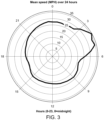
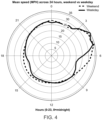
- This invention allows the estimation of conditional empirical speed distributions, where any of the following may be factors in this estimation: weather conditions on a given road segment, time of day, day of the week, or direction of one's driving with respect to solar glare (whether or not "the sun is in your eyes").
- the server 110 For a particular road segment traversed by a particular vehicle, the server 110 computes a score by comparing the segment speed with the segment speeds logged for the same segment (or similar segments) from other similar trips, and combining the comparisons according to a weighting based on the similarity of the trips.
- the other trips may be from the same or other drivers. Similarity of trips is based on a combination of one or more of the following measures: weather (including rain, snow, fog, wind speed), construction, darkness, sun glare, traffic, driver experience, driver exhaustion, driver distraction, typical speeds for this driver or this vehicle on this or other road segments, or other features of the road, driver and environment. Henceforth we refer to such measures as "covariate measures”. Use of similar segments is discussed further below.
- a score per road segment we can report this score directly to an interested party (such as the driver).
- FIG. 5 illustrates the cumulative distribution function (CDF) of speed on a single road segment, across many drivers and trips, weighted by driver. It additionally illustrates the CDFs of two particular drivers. The drivers' CDFs differ from the common CDF and from each other.
- CDF cumulative distribution function
- the segment speed 603 corresponds to a vertical line (607) on the plot; in general, this vertical line intersects each CDF at a different height (quantile).
- the intersection with CDF 605 is marked by 608 (at quantile 0.50), and the intersection with CDF 606 is marked by 609 (at quantile 0.15).
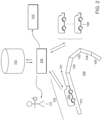
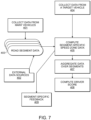
- the system collects segment speed data from multiple vehicles (step 401). As discussed above, this data may be first collected in the vehicle, and then sent to a server in batches, or alternatively, the data may be sent to the server on an ongoing basis. This data for each road segments is used to compute segment data 403 for all the segments (step 402). The server also collects data for a specific vehicle (step 404). Using the road segment characteristics 403, the system computes segment-specific speed data for the user, for example, the median speed travelled in the segment (step 405).
- the system aggregates the segment-specific data over the road segments travelled by the vehicle (step 407), and computes a driver score (step 408), which is provided to the driver or a third party.
- the aggregated score may be specific to a class (i.e., type) of road segments, for example, for highway or surface street, or some other category, such as time of day, for example, daytime versus nighttime driving.
- the median instead of the median, we may record alternate statistics of the speed across a segment, such as the mean speed, the mean and variance, the Z-score, the median and interquartile range, or all the speed samples.
- the score (for a road segment, trip or trips) may include a confidence interval or other indication or uncertainty.
- a speed margin can be added to forgive some fraction of risky speeding.
- the observed median speed for an individual road segment under evaluation can be modified to be, e.g., 5 miles per hour (approx. 8 kilometers per hour) closer to the population median speed.
- the output score can be either discrete (e.g., "safe” vs “slightly risky” vs “very risky”) or continuous (e.g., 0.12 vs 0.87).
- the weight can be reduced by the number of trips per driver on that road segment (e. g., if a driver traverses a particular road segment X times, reduce the weight by an additional multiplicative factor of X).
- speed samples may be used from differing road segments (or the same road segment in different environments) by transforming the speed samples to representative speed samples of the appropriate type. For example, suppose we observe the speed distribution for road segment A and road segment B, both in clear weather. We match speed samples based on quantiles and fit a regression R1. Next, we fit a speed regression R2 on segment A between speeds in clear weather versus rain. By applying R2 and R1 on the original CDF of road segment A in clear weather, we obtain an estimate for the CDF of road segment B in the rain.
- An additional technique for handling sparse data is to leverage the prior driving history of the drivers. For example, suppose we wish to estimate the 85 th percentile of the mean speed on a road segment. Absent additional information, it would require many samples to make a reliable estimate. Suppose we only have a single measurement on the road segment. However, suppose prior measurements indicated that that particular driver regularly drove between the 83 th and 87 th percentile on most other roads. The single data point is then a fairly accurate estimate of the 85 th percentile. Leveraging the prior speeding behavior of all the drivers allows for more accurate estimates of speed distributions with less data.
- the system may factor in a roadway's speed limit in addition to population speeds when determining safe speed ranges for a road segment.
- Implementation of the approaches described above may implement the data processing steps (e.g., data storage, data reduction, and data communication) using hardware, software, or a combination of hardware and software.
- the hardware can include application specific integrated circuits (ASICS).
- ASICS application specific integrated circuits
- the software can instructions stored on a non-transitory medium (e.g., non-volatile semiconductor memory) for causing one or more processors in a tag, the smartphone, and/or the server, to perform the procedures described above.
Landscapes
- General Physics & Mathematics (AREA)
- Physics & Mathematics (AREA)
- Chemical & Material Sciences (AREA)
- Analytical Chemistry (AREA)
- Life Sciences & Earth Sciences (AREA)
- Atmospheric Sciences (AREA)
- Business, Economics & Management (AREA)
- Engineering & Computer Science (AREA)
- Accounting & Taxation (AREA)
- Finance (AREA)
- Theoretical Computer Science (AREA)
- Development Economics (AREA)
- Marketing (AREA)
- Strategic Management (AREA)
- Technology Law (AREA)
- General Business, Economics & Management (AREA)
- Economics (AREA)
- Traffic Control Systems (AREA)
- Entrepreneurship & Innovation (AREA)
- Educational Administration (AREA)
- Educational Technology (AREA)
Claims (9)
- Computerimplementiertes Verfahren zum Charakterisieren der Geschwindigkeit eines Zielfahrzeugs in einem Straßennetz, wobei das Verfahren Folgendes umfasst:Sammeln und Speichern (401) von Daten, wobei die Daten Folgendes umfassen: Segmentgeschwindigkeit von einem oder mehreren Fahrzeugen, die mehrere Straßensegmente eines Straßennetzes durchfahren, zusammen mit einer oder mehreren kovariaten Messungen, die ausgewählt werden aus Fahrer, Tageszeit, Wochentag, Wetter, Konstruktion, Dunkelheit, Sonneneinstrahlung, Verkehr, Fahrererfahrung, Fahrererschöpfung, Ablenkung des Fahrers, Straßenart, Straßengeometrie oder Straßenbedingungen;Verarbeiten (402,403) der gesammelten Daten, die mit dem Straßensegment assoziiert sind, für jedes Straßensegment der mehreren Straßensegmente, um eine Geschwindigkeitscharakterisierung für das Straßensegment zu bestimmen, umfassend Bestimmen einer Verteilung von Fahrzeuggeschwindigkeiten auf dem Straßensegment unter Verwendung von Segmentgeschwindigkeiten, die für Fahrzeuge gesammelt wurden, die das Straßensegment durchfahren, und unter Verwendung von Segmentgeschwindigkeiten, die für Fahrzeuge gesammelt wurden, die andere Straßensegmente durchfahren, die dem Straßensegment ähnlich sind; wobei die anderen Straßensegmente, die dem Straßensegment ähnlich sind, aus Straßensegmenten mit ähnlicher Straßenart, ähnlicher Straßengeometrie oder ähnlichen Straßenbedingungen ausgewählt werden;Sammeln (404) von Daten von dem Zielfahrzeug für jedes Straßensegment in einer Sequenz von Straßensegmenten;für ein oder mehrere Straßensegmente in der Sequenz von Straßensegmenten, Kombinieren (405) der Geschwindigkeitscharakterisierung für das Straßensegment und der von dem Zielfahrzeug auf dem Straßensegment gesammelten Daten, um eine segmentspezifische Bewertung für die Geschwindigkeit des Zielfahrzeugs auf dem Straßensegment durch Kombinieren der Geschwindigkeitsverteilung des Straßensegments und einer Geschwindigkeit, die aus den von dem Zielfahrzeug gesammelten Daten bestimmt wird, zu berechnen, wobei das Kombinieren Folgendes umfasst: Bestimmen eines Perzentils der Geschwindigkeit für das Zielfahrzeug in der Geschwindigkeitsverteilung des Straßensegments; Aggregieren (407) der segmentspezifischen Bewertungen für jedes Straßensegment in der Sequenz von Straßensegmenten, um eine Fahrbewertung für das Zielfahrzeug zu berechnen (408); undBereitstellen der Fahrbewertung für einen Fahrer des Zielfahrzeugs oder einen Dritten.
- Verfahren nach Anspruch 1, wobei beim Sammeln und Speichern der Daten das eine oder die mehreren Fahrzeuge mehrere Fahrzeuge umfassen.
- Verfahren nach einem der Ansprüche 1 oder 2, wobei, beim Sammeln und Speichern der Daten, die Daten Folgendes umfassen: mehrere der Segmentgeschwindigkeiten, wobei jede Segmentgeschwindigkeit mit einem entsprechenden Straßensegment, einem entsprechenden Fahrzeug oder einem entsprechenden Fahrer eines Fahrzeugs assoziiert ist, und die Zeit des Durchfahrens des Segments.
- Verfahren nach Anspruch 1, wobei die segmentspezifische Bewertung für die Geschwindigkeit des Zielfahrzeugs eine Bewertung umfasst, die aus dem Perzentil bestimmt wird.
- Verfahren nach Anspruch 4, wobei die aus dem Perzentil bestimmte Bewertung eine quantitative Bewertung umfasst.
- Verfahren nach Anspruch 4, wobei die aus dem Perzentil bestimmte Bewertung eine kategorische Bewertung umfasst.
- Verfahren nach Anspruch 1, wobei das Bestimmen der Verteilung von Fahrzeuggeschwindigkeiten Gewichtungsdaten für die Straßensegmente umfasst, die gemäß ihrer Ähnlichkeit ähnlich sind.
- Verfahren nach Anspruch 1, wobei die segmentspezifische Bewertung für die Geschwindigkeit des Zielfahrzeugs eine kategorische Bewertung umfasst.
- Maschinenlesbares Medium, das darauf gespeicherte Anweisungen umfasst, wobei das Ausführen der Anweisungen auf einem Prozessor den Prozessor veranlasst, die Geschwindigkeit eines Zielfahrzeugs auf einem Straßennetz zu charakterisieren, Folgendes umfassend:Empfangen und Speichern (401) von Daten, wobei die Daten Folgendes umfassen: Segmentgeschwindigkeit von einem oder mehreren Fahrzeugen, die mehrere Straßensegmente eines Straßennetzes durchfahren, zusammen mit einer oder mehreren kovariaten Messungen, die ausgewählt werden aus Fahrer, Tageszeit, Wochentag, Wetter, Konstruktion, Dunkelheit, Sonneneinstrahlung, Verkehr, Fahrererfahrung, Fahrererschöpfung, Ablenkung des Fahrers, Straßenart, Straßengeometrie oder Straßenbedingungen;Verarbeiten (402,403) der gesammelten Daten, die mit dem Straßensegment assoziiert sind, für jedes Straßensegment der mehreren Straßensegmente, um eine Geschwindigkeitscharakterisierung für das Straßensegment zu bestimmen, umfassend Bestimmen einer Verteilung von Fahrzeuggeschwindigkeiten auf dem Straßensegment unter Verwendung von Segmentgeschwindigkeiten, die für Fahrzeuge gesammelt wurden, die das Straßensegment durchfahren, und unter Verwendung von Segmentgeschwindigkeiten, die für Fahrzeuge gesammelt wurden, die andere Straßensegmente durchfahren, die dem Straßensegment ähnlich sind; wobei die anderen Straßensegmente, die dem Straßensegment ähnlich sind, aus Straßensegmenten mit ähnlicher Straßenart, ähnlicher Straßengeometrie oder ähnlichen Straßenbedingungen ausgewählt werden;Empfangen von Daten von dem Zielfahrzeug für jedes Straßensegment in einer Sequenz von Straßensegmenten;für ein oder mehrere Straßensegmente in der Sequenz von Straßensegmenten, Kombinieren (405) der Geschwindigkeitscharakterisierung für das Straßensegment und der von dem Zielfahrzeug auf dem Straßensegment gesammelten Daten, um eine segmentspezifische Bewertung für die Geschwindigkeit des Zielfahrzeugs auf dem Straßensegment durch Kombinieren der Geschwindigkeitsverteilung des Straßensegments und einer Geschwindigkeit, die aus den von dem Zielfahrzeug gesammelten Daten bestimmt wird, zu berechnen, wobei das Kombinieren Folgendes umfasst: Bestimmen eines Perzentils der Geschwindigkeit für das Zielfahrzeug in der Geschwindigkeitsverteilung des Straßensegments; Aggregieren (407) der segmentspezifischen Bewertungen für jedes Straßensegment in der Sequenz von Straßensegmenten, um eine Fahrbewertung für das Zielfahrzeug zu berechnen (408); undBereitstellen der Fahrbewertung für einen Fahrer des Zielfahrzeugs oder einen Dritten.
Applications Claiming Priority (2)
| Application Number | Priority Date | Filing Date | Title |
|---|---|---|---|
| US15/384,730 US10262530B2 (en) | 2016-12-20 | 2016-12-20 | Determining customized safe speeds for vehicles |
| PCT/US2017/064404 WO2018118387A1 (en) | 2016-12-20 | 2017-12-04 | Determining customized safe speeds for vehicles |
Publications (4)
| Publication Number | Publication Date |
|---|---|
| EP3559926A1 EP3559926A1 (de) | 2019-10-30 |
| EP3559926A4 EP3559926A4 (de) | 2020-08-19 |
| EP3559926C0 EP3559926C0 (de) | 2025-07-02 |
| EP3559926B1 true EP3559926B1 (de) | 2025-07-02 |
Family
ID=62561924
Family Applications (1)
| Application Number | Title | Priority Date | Filing Date |
|---|---|---|---|
| EP17882832.3A Active EP3559926B1 (de) | 2016-12-20 | 2017-12-04 | Bestimmung von angepassten sicheren geschwindigkeiten für fahrzeuge |
Country Status (13)
| Country | Link |
|---|---|
| US (1) | US10262530B2 (de) |
| EP (1) | EP3559926B1 (de) |
| JP (1) | JP6961012B2 (de) |
| KR (1) | KR20190111935A (de) |
| CN (1) | CN110268454B (de) |
| AU (1) | AU2017378643A1 (de) |
| CA (1) | CA3047735A1 (de) |
| ES (1) | ES3037011T3 (de) |
| IL (1) | IL267522B (de) |
| MX (1) | MX395090B (de) |
| PH (1) | PH12019550100A1 (de) |
| WO (1) | WO2018118387A1 (de) |
| ZA (1) | ZA201904335B (de) |
Families Citing this family (15)
| Publication number | Priority date | Publication date | Assignee | Title |
|---|---|---|---|---|
| US10697784B1 (en) | 2017-07-19 | 2020-06-30 | BlueOwl, LLC | System and methods for assessment of rideshare trip |
| US10955252B2 (en) | 2018-04-03 | 2021-03-23 | International Business Machines Corporation | Road-condition based routing system |
| US11030890B2 (en) * | 2018-05-03 | 2021-06-08 | International Business Machines Corporation | Local driver pattern based notifications |
| US11346680B2 (en) * | 2018-05-09 | 2022-05-31 | International Business Machines Corporation | Driver experience-based vehicle routing and insurance adjustment |
| EP3747718B1 (de) * | 2019-06-04 | 2021-11-03 | Zenuity AB | Verfahren zur anpassung der abstimmungsparametereinstellungen einer systemfunktionalität zur strassenfahrzeuggeschwindigkeitsanpassungssteuerung |
| US20240095836A1 (en) * | 2019-10-02 | 2024-03-21 | BlueOwl, LLC | Cloud-based vehicular telematics systems and methods for generating hybrid epoch driver predictions and hazard alerts |
| FR3103305A1 (fr) | 2019-11-19 | 2021-05-21 | Continental Automotive | Procédé et dispositif de prédiction d’au moins une caractéristique dynamique d’un véhicule en un point d’un segment routier. |
| JP7409040B2 (ja) * | 2019-11-25 | 2024-01-09 | オムロン株式会社 | 危険度推定装置、車載装置、危険度推定方法、および危険度推定プログラム |
| CN111610787B (zh) * | 2020-05-29 | 2023-04-07 | 亚哲科技股份有限公司 | 自动驾驶汽车安全控制方法、计算机存储介质、电子设备 |
| US11995983B2 (en) * | 2020-10-16 | 2024-05-28 | Grabtaxi Holdings Pte. Ltd. | Method, electronic device, and system for detecting overspeeding |
| CN112762954B (zh) * | 2020-12-25 | 2021-11-02 | 河海大学 | 一种路径规划方法及系统 |
| JP2023000321A (ja) * | 2021-06-17 | 2023-01-04 | 株式会社デンソーテン | クラス分類装置及びクラス分類方法 |
| US12106660B2 (en) * | 2021-06-30 | 2024-10-01 | State Farm Mutual Automobile Insurance Company | High speed determination of intersection traversal without road data |
| CN113505793B (zh) * | 2021-07-06 | 2022-03-04 | 上海致宇信息技术有限公司 | 复杂背景下的矩形目标检测方法 |
| KR102477885B1 (ko) * | 2022-01-18 | 2022-12-15 | 재단법인차세대융합기술연구원 | 자율주행 도로의 주행 안전도를 평가하는 안전도 분석 관리 서버 |
Family Cites Families (19)
| Publication number | Priority date | Publication date | Assignee | Title |
|---|---|---|---|---|
| JP2816919B2 (ja) * | 1992-11-05 | 1998-10-27 | 松下電器産業株式会社 | 空間平均速度および交通量推定方法、地点交通信号制御方法、交通量推定・交通信号制御機制御装置 |
| JP3024478B2 (ja) * | 1993-11-11 | 2000-03-21 | 三菱電機株式会社 | ナビゲーション装置を含んだ定速走行制御装置 |
| DE60121963T2 (de) * | 2001-10-15 | 2007-01-18 | Ford Global Technologies, LLC, Dearborn | Verfahren und Einrichtung zur Steuerung eines Fahrzeuges |
| US7821421B2 (en) * | 2003-07-07 | 2010-10-26 | Sensomatix Ltd. | Traffic information system |
| WO2009026161A1 (en) | 2007-08-16 | 2009-02-26 | Google Inc. | Combining road and vehicle sensor traffic information |
| US9310214B1 (en) | 2008-01-24 | 2016-04-12 | Blackberry Corporation | System and method for dynamically redefining road segment boundaries |
| KR101331054B1 (ko) | 2010-05-13 | 2013-11-19 | 한국전자통신연구원 | 도로노면정보 및 통계적 교통상황을 고려한 안전속도 산정방법 및 그 장치 |
| US8478499B2 (en) | 2010-06-07 | 2013-07-02 | Ford Global Technologies, Llc | System and method for vehicle speed monitoring using historical speed data |
| WO2014002209A1 (ja) * | 2012-06-27 | 2014-01-03 | 三菱電機株式会社 | 推奨走行パターン生成装置 |
| US8457880B1 (en) | 2012-11-28 | 2013-06-04 | Cambridge Mobile Telematics | Telematics using personal mobile devices |
| US9228836B2 (en) | 2013-03-15 | 2016-01-05 | Cambridge Mobile Telematics | Inference of vehicular trajectory characteristics with personal mobile devices |
| US20140322676A1 (en) * | 2013-04-26 | 2014-10-30 | Verizon Patent And Licensing Inc. | Method and system for providing driving quality feedback and automotive support |
| US9557179B2 (en) | 2013-08-20 | 2017-01-31 | Qualcomm Incorporated | Navigation using dynamic speed limits |
| JP6263402B2 (ja) * | 2013-10-11 | 2018-01-17 | 株式会社デンソーアイティーラボラトリ | 安全速度情報生成装置、安全速度生成方法、及びプログラム |
| EP3761272A1 (de) | 2014-04-29 | 2021-01-06 | Discovery Limited | System und verfahren zum erhalt von fahrzeugtelematikdaten |
| CN105723242B (zh) * | 2014-08-26 | 2018-07-03 | 微软技术许可有限责任公司 | 测量路网中的交通速度 |
| GB201420988D0 (en) * | 2014-11-26 | 2015-01-07 | Tomtom Telematics Bv | Apparatus and method for vehicle economy improvement |
| US9666072B2 (en) * | 2014-12-29 | 2017-05-30 | Here Global B.V. | Dynamic speed limit |
| US9994172B2 (en) | 2015-02-26 | 2018-06-12 | Ford Global Technologies, Llc | Methods and systems to determine and communicate driver performance |
-
2016
- 2016-12-20 US US15/384,730 patent/US10262530B2/en active Active
-
2017
- 2017-12-04 AU AU2017378643A patent/AU2017378643A1/en not_active Abandoned
- 2017-12-04 CA CA3047735A patent/CA3047735A1/en active Pending
- 2017-12-04 MX MX2019007200A patent/MX395090B/es unknown
- 2017-12-04 KR KR1020197021063A patent/KR20190111935A/ko not_active Withdrawn
- 2017-12-04 ES ES17882832T patent/ES3037011T3/es active Active
- 2017-12-04 WO PCT/US2017/064404 patent/WO2018118387A1/en not_active Ceased
- 2017-12-04 EP EP17882832.3A patent/EP3559926B1/de active Active
- 2017-12-04 CN CN201780086035.3A patent/CN110268454B/zh active Active
- 2017-12-04 JP JP2019553153A patent/JP6961012B2/ja active Active
-
2019
- 2019-06-18 PH PH12019550100A patent/PH12019550100A1/en unknown
- 2019-06-19 IL IL267522A patent/IL267522B/en active IP Right Grant
- 2019-07-01 ZA ZA2019/04335A patent/ZA201904335B/en unknown
Also Published As
| Publication number | Publication date |
|---|---|
| AU2017378643A1 (en) | 2019-07-11 |
| EP3559926A1 (de) | 2019-10-30 |
| JP2020502713A (ja) | 2020-01-23 |
| EP3559926A4 (de) | 2020-08-19 |
| BR112019012678A2 (pt) | 2019-11-12 |
| MX2019007200A (es) | 2020-01-14 |
| IL267522A (en) | 2019-08-29 |
| CN110268454B (zh) | 2022-05-13 |
| WO2018118387A1 (en) | 2018-06-28 |
| CN110268454A (zh) | 2019-09-20 |
| IL267522B (en) | 2021-05-31 |
| US20180174484A1 (en) | 2018-06-21 |
| JP6961012B2 (ja) | 2021-11-05 |
| EP3559926C0 (de) | 2025-07-02 |
| US10262530B2 (en) | 2019-04-16 |
| ES3037011T3 (en) | 2025-09-26 |
| KR20190111935A (ko) | 2019-10-02 |
| PH12019550100A1 (en) | 2020-06-08 |
| CA3047735A1 (en) | 2018-06-28 |
| MX395090B (es) | 2025-03-24 |
| ZA201904335B (en) | 2020-12-23 |
Similar Documents
| Publication | Publication Date | Title |
|---|---|---|
| US10262530B2 (en) | Determining customized safe speeds for vehicles | |
| US20240119536A1 (en) | Vehicle operation analytics, feedback, and enhancement | |
| US11868915B2 (en) | Route scoring for assessing or predicting driving performance | |
| US11407410B2 (en) | Method and system for estimating an accident risk of an autonomous vehicle | |
| EP3578433B1 (de) | Verfahren zur schätzung des unfallrisikos eines autonomen fahrzeugs | |
| US8645052B2 (en) | Motor vehicle acceleration determining system | |
| KR101617349B1 (ko) | 운전 습관 분석 진단 시스템 및 방법 | |
| EP3581454A1 (de) | System und verfahren zur verwendung von aggregierten wetterdaten für den strassenbelagszustand und schätzungen der strassenreibung | |
| US9082072B1 (en) | Method for applying usage based data | |
| US20140278574A1 (en) | System and method for developing a driver safety rating | |
| CN104318759B (zh) | 基于自学习算法的公交车停靠站时间实时估计方法及系统 | |
| US12580987B2 (en) | Using contextual information for vehicle trip loss risk assessment scoring | |
| US12038294B2 (en) | Machine learning platform for dynamic device and sensor quality evaluation | |
| LU100760B1 (en) | Vehicular motion assessment method | |
| Stankevich et al. | Usage-based vehicle insurance: Driving style factors of accident probability and severity | |
| WO2017155889A1 (en) | Freight and weather decision support system | |
| US20250131508A1 (en) | Artificial intelligence-based systems and methods for determining insurance premium amount | |
| Ullah et al. | A data-driven approach for customized pay-as-you-drive insurance premiums | |
| Korishchenko et al. | Usage-based vehicle insurance: Driving style factors of accident probability and severity | |
| BR112019012678B1 (pt) | Método para caracterizar uma velocidade do veículo-alvo em uma rede de vias e mídia legível por máquina | |
| CN116665342B (zh) | 新能源汽车驾驶行为分析方法、系统及设备 | |
| Wang et al. | Post-event Connected Vehicle Data Exploration-Lessons Learned |
Legal Events
| Date | Code | Title | Description |
|---|---|---|---|
| STAA | Information on the status of an ep patent application or granted ep patent |
Free format text: STATUS: THE INTERNATIONAL PUBLICATION HAS BEEN MADE |
|
| PUAI | Public reference made under article 153(3) epc to a published international application that has entered the european phase |
Free format text: ORIGINAL CODE: 0009012 |
|
| STAA | Information on the status of an ep patent application or granted ep patent |
Free format text: STATUS: REQUEST FOR EXAMINATION WAS MADE |
|
| 17P | Request for examination filed |
Effective date: 20190718 |
|
| AK | Designated contracting states |
Kind code of ref document: A1 Designated state(s): AL AT BE BG CH CY CZ DE DK EE ES FI FR GB GR HR HU IE IS IT LI LT LU LV MC MK MT NL NO PL PT RO RS SE SI SK SM TR |
|
| AX | Request for extension of the european patent |
Extension state: BA ME |
|
| RIN1 | Information on inventor provided before grant (corrected) |
Inventor name: BALAKRISHNAN, HARI Inventor name: MALALUR, PARESH GOVIND Inventor name: BRADLEY, WILLIAM FRANCIS |
|
| DAV | Request for validation of the european patent (deleted) | ||
| DAX | Request for extension of the european patent (deleted) | ||
| A4 | Supplementary search report drawn up and despatched |
Effective date: 20200720 |
|
| RIC1 | Information provided on ipc code assigned before grant |
Ipc: G08G 1/0967 20060101ALI20200714BHEP Ipc: G08G 1/052 20060101ALI20200714BHEP Ipc: G08G 1/01 20060101AFI20200714BHEP |
|
| STAA | Information on the status of an ep patent application or granted ep patent |
Free format text: STATUS: EXAMINATION IS IN PROGRESS |
|
| 17Q | First examination report despatched |
Effective date: 20230208 |
|
| P01 | Opt-out of the competence of the unified patent court (upc) registered |
Effective date: 20230519 |
|
| GRAP | Despatch of communication of intention to grant a patent |
Free format text: ORIGINAL CODE: EPIDOSNIGR1 |
|
| STAA | Information on the status of an ep patent application or granted ep patent |
Free format text: STATUS: GRANT OF PATENT IS INTENDED |
|
| INTG | Intention to grant announced |
Effective date: 20250130 |
|
| GRAS | Grant fee paid |
Free format text: ORIGINAL CODE: EPIDOSNIGR3 |
|
| GRAA | (expected) grant |
Free format text: ORIGINAL CODE: 0009210 |
|
| STAA | Information on the status of an ep patent application or granted ep patent |
Free format text: STATUS: THE PATENT HAS BEEN GRANTED |
|
| AK | Designated contracting states |
Kind code of ref document: B1 Designated state(s): AL AT BE BG CH CY CZ DE DK EE ES FI FR GB GR HR HU IE IS IT LI LT LU LV MC MK MT NL NO PL PT RO RS SE SI SK SM TR |
|
| REG | Reference to a national code |
Ref country code: GB Ref legal event code: FG4D |
|
| REG | Reference to a national code |
Ref country code: CH Ref legal event code: EP |
|
| REG | Reference to a national code |
Ref country code: IE Ref legal event code: FG4D |
|
| REG | Reference to a national code |
Ref country code: DE Ref legal event code: R096 Ref document number: 602017090359 Country of ref document: DE |
|
| U01 | Request for unitary effect filed |
Effective date: 20250723 |
|
| U07 | Unitary effect registered |
Designated state(s): AT BE BG DE DK EE FI FR IT LT LU LV MT NL PT RO SE SI Effective date: 20250729 |
|
| REG | Reference to a national code |
Ref country code: ES Ref legal event code: FG2A Ref document number: 3037011 Country of ref document: ES Kind code of ref document: T3 Effective date: 20250926 |
|
| U20 | Renewal fee for the european patent with unitary effect paid |
Year of fee payment: 9 Effective date: 20251110 |
|
| PG25 | Lapsed in a contracting state [announced via postgrant information from national office to epo] |
Ref country code: IS Free format text: LAPSE BECAUSE OF FAILURE TO SUBMIT A TRANSLATION OF THE DESCRIPTION OR TO PAY THE FEE WITHIN THE PRESCRIBED TIME-LIMIT Effective date: 20251102 |
|
| PGFP | Annual fee paid to national office [announced via postgrant information from national office to epo] |
Ref country code: GB Payment date: 20251001 Year of fee payment: 9 |
|
| PG25 | Lapsed in a contracting state [announced via postgrant information from national office to epo] |
Ref country code: NO Free format text: LAPSE BECAUSE OF FAILURE TO SUBMIT A TRANSLATION OF THE DESCRIPTION OR TO PAY THE FEE WITHIN THE PRESCRIBED TIME-LIMIT Effective date: 20251002 |
|
| PG25 | Lapsed in a contracting state [announced via postgrant information from national office to epo] |
Ref country code: HR Free format text: LAPSE BECAUSE OF FAILURE TO SUBMIT A TRANSLATION OF THE DESCRIPTION OR TO PAY THE FEE WITHIN THE PRESCRIBED TIME-LIMIT Effective date: 20250702 |
|
| PG25 | Lapsed in a contracting state [announced via postgrant information from national office to epo] |
Ref country code: GR Free format text: LAPSE BECAUSE OF FAILURE TO SUBMIT A TRANSLATION OF THE DESCRIPTION OR TO PAY THE FEE WITHIN THE PRESCRIBED TIME-LIMIT Effective date: 20251003 |
|
| PG25 | Lapsed in a contracting state [announced via postgrant information from national office to epo] |
Ref country code: CZ Free format text: LAPSE BECAUSE OF FAILURE TO SUBMIT A TRANSLATION OF THE DESCRIPTION OR TO PAY THE FEE WITHIN THE PRESCRIBED TIME-LIMIT Effective date: 20250702 |
|
| PG25 | Lapsed in a contracting state [announced via postgrant information from national office to epo] |
Ref country code: PL Free format text: LAPSE BECAUSE OF FAILURE TO SUBMIT A TRANSLATION OF THE DESCRIPTION OR TO PAY THE FEE WITHIN THE PRESCRIBED TIME-LIMIT Effective date: 20250702 |
|
| PG25 | Lapsed in a contracting state [announced via postgrant information from national office to epo] |
Ref country code: RS Free format text: LAPSE BECAUSE OF FAILURE TO SUBMIT A TRANSLATION OF THE DESCRIPTION OR TO PAY THE FEE WITHIN THE PRESCRIBED TIME-LIMIT Effective date: 20251002 |
|
| PG25 | Lapsed in a contracting state [announced via postgrant information from national office to epo] |
Ref country code: SM Free format text: LAPSE BECAUSE OF FAILURE TO SUBMIT A TRANSLATION OF THE DESCRIPTION OR TO PAY THE FEE WITHIN THE PRESCRIBED TIME-LIMIT Effective date: 20250702 |
|
| PGFP | Annual fee paid to national office [announced via postgrant information from national office to epo] |
Ref country code: ES Payment date: 20260115 Year of fee payment: 9 |
|
| PG25 | Lapsed in a contracting state [announced via postgrant information from national office to epo] |
Ref country code: SK Free format text: LAPSE BECAUSE OF FAILURE TO SUBMIT A TRANSLATION OF THE DESCRIPTION OR TO PAY THE FEE WITHIN THE PRESCRIBED TIME-LIMIT Effective date: 20250702 |
|
| PLBE | No opposition filed within time limit |
Free format text: ORIGINAL CODE: 0009261 |
|
| STAA | Information on the status of an ep patent application or granted ep patent |
Free format text: STATUS: NO OPPOSITION FILED WITHIN TIME LIMIT |