EP3554787B1 - Procédé de production d'un objet rempli de mousse imprimé en 3d - Google Patents
Procédé de production d'un objet rempli de mousse imprimé en 3d Download PDFInfo
- Publication number
- EP3554787B1 EP3554787B1 EP17809327.4A EP17809327A EP3554787B1 EP 3554787 B1 EP3554787 B1 EP 3554787B1 EP 17809327 A EP17809327 A EP 17809327A EP 3554787 B1 EP3554787 B1 EP 3554787B1
- Authority
- EP
- European Patent Office
- Prior art keywords
- construction material
- shell
- free
- layer
- precursor
- Prior art date
- Legal status (The legal status is an assumption and is not a legal conclusion. Google has not performed a legal analysis and makes no representation as to the accuracy of the status listed.)
- Active
Links
Images
Classifications
-
- B—PERFORMING OPERATIONS; TRANSPORTING
- B29—WORKING OF PLASTICS; WORKING OF SUBSTANCES IN A PLASTIC STATE IN GENERAL
- B29C—SHAPING OR JOINING OF PLASTICS; SHAPING OF MATERIAL IN A PLASTIC STATE, NOT OTHERWISE PROVIDED FOR; AFTER-TREATMENT OF THE SHAPED PRODUCTS, e.g. REPAIRING
- B29C44/00—Shaping by internal pressure generated in the material, e.g. swelling or foaming ; Producing porous or cellular expanded plastics articles
- B29C44/02—Shaping by internal pressure generated in the material, e.g. swelling or foaming ; Producing porous or cellular expanded plastics articles for articles of definite length, i.e. discrete articles
- B29C44/08—Shaping by internal pressure generated in the material, e.g. swelling or foaming ; Producing porous or cellular expanded plastics articles for articles of definite length, i.e. discrete articles using several expanding or moulding steps
-
- B—PERFORMING OPERATIONS; TRANSPORTING
- B29—WORKING OF PLASTICS; WORKING OF SUBSTANCES IN A PLASTIC STATE IN GENERAL
- B29C—SHAPING OR JOINING OF PLASTICS; SHAPING OF MATERIAL IN A PLASTIC STATE, NOT OTHERWISE PROVIDED FOR; AFTER-TREATMENT OF THE SHAPED PRODUCTS, e.g. REPAIRING
- B29C44/00—Shaping by internal pressure generated in the material, e.g. swelling or foaming ; Producing porous or cellular expanded plastics articles
- B29C44/02—Shaping by internal pressure generated in the material, e.g. swelling or foaming ; Producing porous or cellular expanded plastics articles for articles of definite length, i.e. discrete articles
- B29C44/12—Incorporating or moulding on preformed parts, e.g. inserts or reinforcements
- B29C44/18—Filling preformed cavities
-
- B—PERFORMING OPERATIONS; TRANSPORTING
- B33—ADDITIVE MANUFACTURING TECHNOLOGY
- B33Y—ADDITIVE MANUFACTURING, i.e. MANUFACTURING OF THREE-DIMENSIONAL [3D] OBJECTS BY ADDITIVE DEPOSITION, ADDITIVE AGGLOMERATION OR ADDITIVE LAYERING, e.g. BY 3D PRINTING, STEREOLITHOGRAPHY OR SELECTIVE LASER SINTERING
- B33Y70/00—Materials specially adapted for additive manufacturing
-
- B—PERFORMING OPERATIONS; TRANSPORTING
- B29—WORKING OF PLASTICS; WORKING OF SUBSTANCES IN A PLASTIC STATE IN GENERAL
- B29C—SHAPING OR JOINING OF PLASTICS; SHAPING OF MATERIAL IN A PLASTIC STATE, NOT OTHERWISE PROVIDED FOR; AFTER-TREATMENT OF THE SHAPED PRODUCTS, e.g. REPAIRING
- B29C64/00—Additive manufacturing, i.e. manufacturing of three-dimensional [3D] objects by additive deposition, additive agglomeration or additive layering, e.g. by 3D printing, stereolithography or selective laser sintering
- B29C64/10—Processes of additive manufacturing
- B29C64/106—Processes of additive manufacturing using only liquids or viscous materials, e.g. depositing a continuous bead of viscous material
-
- B—PERFORMING OPERATIONS; TRANSPORTING
- B29—WORKING OF PLASTICS; WORKING OF SUBSTANCES IN A PLASTIC STATE IN GENERAL
- B29K—INDEXING SCHEME ASSOCIATED WITH SUBCLASSES B29B, B29C OR B29D, RELATING TO MOULDING MATERIALS OR TO MATERIALS FOR MOULDS, REINFORCEMENTS, FILLERS OR PREFORMED PARTS, e.g. INSERTS
- B29K2075/00—Use of PU, i.e. polyureas or polyurethanes or derivatives thereof, as moulding material
-
- B—PERFORMING OPERATIONS; TRANSPORTING
- B29—WORKING OF PLASTICS; WORKING OF SUBSTANCES IN A PLASTIC STATE IN GENERAL
- B29L—INDEXING SCHEME ASSOCIATED WITH SUBCLASS B29C, RELATING TO PARTICULAR ARTICLES
- B29L2031/00—Other particular articles
- B29L2031/54—Balls
-
- B—PERFORMING OPERATIONS; TRANSPORTING
- B33—ADDITIVE MANUFACTURING TECHNOLOGY
- B33Y—ADDITIVE MANUFACTURING, i.e. MANUFACTURING OF THREE-DIMENSIONAL [3D] OBJECTS BY ADDITIVE DEPOSITION, ADDITIVE AGGLOMERATION OR ADDITIVE LAYERING, e.g. BY 3D PRINTING, STEREOLITHOGRAPHY OR SELECTIVE LASER SINTERING
- B33Y10/00—Processes of additive manufacturing
Definitions
- the present invention relates to a method for producing an object, comprising the steps of: producing a shell which comprises a volume for receiving a fluid, by means of an additive manufacturing process from a construction material; providing a reaction mixture comprising a polyisocyanate component and a polyol component in the volume and allowing the reaction mixture to react in the volume so that a polymer is at least partially present in the volume.
- the invention further relates to an object obtainable by a method according to the invention, comprising a shell which defines a volume located within the shell and a foam which completely or partially fills the volume. The shell can subsequently be completely or partially removed in order to obtain complex-shaped foam bodies.
- Additive manufacturing processes are those processes in which objects are built up layer by layer. They therefore differ significantly from other methods for producing objects such as milling, drilling or machining. In the latter processes, an object is processed in such a way that it receives its final geometry by removing material.
- Additive manufacturing processes use different materials and process techniques to build objects layer by layer.
- FDM Fused Deposition Modeling
- a thermoplastic wire is liquefied and deposited layer by layer on a movable construction platform using a nozzle. When it solidifies, a solid object is created.
- the nozzle and the construction platform are controlled based on a CAD drawing of the object. If the geometry of this object is complex, for example with geometric undercuts, additional support materials must be printed and removed again after the object is finished.
- thermoplastic powders to build objects layer by layer. Thin layers of powder are applied using a so-called coater and then selectively melted using an energy source. The surrounding powder supports the component geometry. Complex geometries can therefore be manufactured more economically than with the FDM process described above. In addition, various objects can be arranged or manufactured closely packed in the so-called powder bed. Due to these advantages, powder-based additive manufacturing processes are considered to be the most economical additive manufacturing processes on the market. They are therefore mainly used by industrial users. Examples of powder-based additive manufacturing processes are so-called laser sintering (SLS, selective laser sintering) or high speed sintering (HSS). or high speed sintering (HSS).
- SLS laser sintering
- HSS high speed sintering
- HSS high speed sintering
- the energy is introduced via a guided laser beam.
- HSS high speed sintering
- IR infrared
- SHS Selective Heat Sintering
- Another group of additive manufacturing processes uses radically cross-linkable resins, which may obtain their final strength in the formed object via a second curing mechanism. Examples of such processes are stereolithography processes and the so-called DLP process derived from them.
- liquid cure systems are known in which the liquid coating material is first crosslinked radically, for example photochemically, and then further cured via reactions of NCO groups with suitable reaction partners.
- WO 2015/139095 A1 a method for producing a composite object using a computer-controlled device and such a device is disclosed.
- the device comprises a reservoir with a liquid, hardenable first material, means for selectively solidifying the first material and means for selectively depositing a second material.
- the method comprises the steps of selectively depositing portions of the second material and selectively solidifying sections of the first material such that the solidified sections of the first material and the deposited portions of the second material form the composite object.
- WO 2016/086268 A1 describes a method for manufacturing a buoyancy module for a subsea buoyancy system comprising the steps of forming a shell, at least partially, by an additive manufacturing process; introducing a buoyancy material into the shell; and sealing the shell.
- WO 2016/142930 A1 discloses, among other things, a method for producing a three-dimensional object using a "3D object manufacturing machine" with a main and a satellite material distribution head.
- a two-component material such as "EasyFlo Spray foam FR8 Liquid Plastic” or similar polyurethane foams can be injected into the interior of the three-dimensional object, creating a reinforced, durable inner shell without compromising the external appearance of the model.
- One object of the present invention is to at least partially overcome at least one disadvantage of the prior art. Furthermore, the invention has the object of providing an additive manufacturing process in which the objects to be produced can be obtained as cost-efficiently and/or individualized and/or resource-conserving as possible, which particularly concerns the recyclability of construction material.
- the object is achieved by a method according to claim 1 and an object according to claim 13.
- Advantageous further developments are specified in the subclaims. They can be combined as desired, unless the context clearly indicates the opposite.
- the reaction mixture has a setting time of ⁇ 2 minutes.
- the method according to the invention makes it possible to produce objects whose external shape is only limited by the performance of the additive manufacturing process selected and the equipment used.
- the objects are mechanically reinforced by the polymer obtained by reaction. This also reduces the production times for the objects, since only the outer shell needs to be manufactured.
- the method according to the invention can be used to produce a complex-shaped foam object with internal foam geometries that cannot be accessed using conventional methods.
- the shaping construction material produced using an additive method can preferably be at least partially removed again, for example by melting, thermolysis or hydrolysis.
- the setting time is ⁇ 3 minutes, more preferably ⁇ 5 minutes. It is further It is preferred that the setting time is ⁇ 3 minutes to ⁇ 90 minutes or ⁇ 5 minutes to ⁇ 60 minutes.
- the setting time is the time after which a theoretically infinitely expanded polymer has been formed during the polyaddition between NCO-reactive components and polyisocyanate components.
- the setting time can be determined experimentally by dipping a thin wooden stick into the foaming reaction mixture at short intervals. The time from mixing the components to the point at which threads remain attached to the stick when it is pulled out is the setting time.
- Reaction mixtures with the setting times according to the invention which are considered slow in the professional world, allow the undesirable side effects of the exothermic reaction of the reaction mixture to form a PUR or PUR/PIR material not to damage the shell or, in the case of complex geometries, to lead to an undesirable, highly inconsistent formation of the foam structure.
- One undesirable effect is, for example, the melting or softening of a thermoplastic shell with loss of the intended shape.
- a slower reaction allows the released reaction heat to be dissipated better.
- the pressure build-up inside the shell due to the reaction is also undesirable, particularly in combination with melting or softening of thermoplastic shell material. The slower the reaction progresses, the more gas can diffuse through the shell to the outside.
- the setting time provided for in the invention can be achieved by various measures, either individually or in combination.
- the reaction mixture can contain an amine catalyst.
- Another measure is the use of slower-reacting aliphatic polyisocyanates.
- the polyol component can contain difunctional polyols, which reduce the crosslinking density in the end product and also in the reacting reaction mixture and thus possibly also have an effect on prolonging the setting time.
- the reaction mixture can be made low-viscosity.
- the reaction mixture can have an initial viscosity (20 °C, ASTM D 2393), i.e. immediately after mixing the polyol component and isocyanate component, of ⁇ 100 mPas to ⁇ 5000 mPas.
- the volume can be, for example, ⁇ 1 cm 3 to ⁇ 5000 cm 3 .
- the shell together with the The reaction mixture contained therein can be rotated or swiveled in space so that the reaction mixture can be evenly distributed in the available shell.
- reaction mixture does not contain a blowing agent and thus does not harden into a foam.
- the polymer obtained would then act as a solid layer on the inside of the casing to mechanically reinforce it.
- the advantages of the process according to the invention are particularly evident when the reaction mixture also contains a blowing agent. This can be a physical and/or chemical blowing agent.
- the construction material preferably comprises a polyurethane polymer.
- Components in the reaction mixture can then react with any reactive groups still available in the polyurethane polymer present in the shell to form a material bond.
- Thermoplastic polyurethanes (TPU), in particular thermoplastic polyurethane elastomers (TPE), are particularly preferred.
- Suitable organic aliphatic, cycloaliphatic, araliphatic and/or aromatic polyisocyanates with at least two isocyanate groups per molecule and mixtures thereof, which are known to the person skilled in the art, are used to produce the polyurethane polymer in the building material.
- NCO-terminated prepolymers can be used.
- NCO-reactive compounds with Zerewitinoff-active H atoms for producing the polyurethane polymer in the building material.
- These can be, for example, low molecular weight diols (e.g. 1,2-ethanediol, 1,3- or 1,2-propanediol, 1,4-butanediol, 1,5-petanediol, 1,6-hexanediol), triols (e.g. glycerol, trimethylolpropane) and tetraols (e.g.
- diols e.g. 1,2-ethanediol, 1,3- or 1,2-propanediol, 1,4-butanediol, 1,5-petanediol, 1,6-hexanediol
- triols e.g. glycerol, trimethylolpropane
- tetraols e.g.
- pentaerythritol short-chain amino alcohols
- polyamines but also higher molecular weight polyhydroxy compounds
- polyether polyols such as polyether polyols, polyester polyols, polycarbonate polyols, polyether carbonate diols, polysiloxane polyols, polyamines and polyether polyamines as well as polybutadiene polyols.
- the NCO groups in the polyurethane polymer of the construction material can be partially blocked.
- the process according to the invention then further comprises the step of unblocking these NCO groups. After they have been unblocked, they are available for reactions with the reaction mixture to form a cohesive bond.
- the blocking agent is chosen so that the NCO groups are at least partially unblocked when heated.
- blocking agents are alcohols, lactams, oximes, malonic esters, alkyl acetoacetates, triazoles, phenols, imidazoles, pyrazoles and amines such as butanone oxime, diisopropylamine, 1,2,4-triazole, dimethyl-1,2,4-triazole, imidazole, Diethyl malonate, acetoacetic ester, acetone oxime, 3,5-dimethylpyrazole, ⁇ -caprolactam, N-methyl-, N-ethyl-, N-(iso)propyl-, Nn-butyl-, N-iso-butyl-, N-tert-butyl-benzylamine or 1,1-dimethylbenzylamine, N-alkyl-N-1,1-dimethylmethylphenylamine, adducts of benzylamine with
- the shell is obtained in two production stages.
- the first production stage can be considered as the construction stage.
- This construction stage allows can be realized using radiation-optical additive manufacturing processes such as the inkjet process, stereolithography or the DLP (digital light processing) process and is the subject of steps I), II) and III).
- the second production stage can be regarded as the hardening stage and is the subject of step IV).
- the precursor or intermediate shell obtained after the construction stage is converted into a mechanically more durable shell without further changing the shape.
- step I) of this variant of the process a radically cross-linked build material is deposited on a carrier.
- This is usually the first step in inkjet, stereolithography and DLP processes.
- a layer of build material bonded to the carrier is obtained, which corresponds to a first selected cross section of the precursor.
- step II) is repeated until the desired precursor is formed.
- step II) a radically cross-linked build material is deposited on a previously applied layer of the build material, so that a further layer of the build material is obtained which corresponds to another selected cross-section of the precursor and which is connected to the previously applied layer.
- the previously applied layer of the build material can be the first layer from step I) or a layer from a previous run of step II).
- the deposition of a radically cross-linked building material takes place at least in step II) (preferably also in step I) by exposing and/or irradiating a selected area of a radically cross-linkable resin, corresponding to the respective selected cross-section of the precursor.
- This can be done both by selective exposure (stereolithography, DLP) of the cross-linkable building material and by selective application of the cross-linkable building material, followed by an exposure step which no longer has to be selective due to the previous selective application of the cross-linkable building material (inkjet process).
- radically cross-linkable building material and "radically cross-linked building material” are used.
- the radically cross-linkable building material is converted into the radically cross-linked building material by exposure and/or irradiation, which triggers radical cross-linking reactions.
- Exposure here means the effect of light in the range between near IR and near UV light (1400 nm to 315 nm wavelength). The other shorter wavelength ranges are covered by the term “irradiation”, for example far UV light, X-rays, gamma radiation and also electron beams.
- the selection of the respective cross-section is conveniently carried out using a CAD program with which a model of the shell to be produced has been created. This operation is also called “slicing” and serves as the basis for controlling the exposure and/or irradiation of the radically cross-linkable resin.
- the radically crosslinkable build-up material has a viscosity (23 °C, DIN EN ISO 2884-1) of ⁇ 5 mPas to ⁇ 100,000 mPas. It is therefore to be regarded as a liquid resin, at least for the purposes of additive manufacturing.
- the viscosity is preferably ⁇ 50 mPas to ⁇ 10,000 mPas, more preferably > 500 mPas to ⁇ 5,000 mPas.
- the molecular ratio of these functional groups can be determined by integrating the signals of a sample in the 13 C NMR spectrum.
- the radically crosslinkable building material can also comprise a non-curable component, in which, for example, stabilizers, fillers and the like are combined.
- step IV) is also carried out after step III).
- the precursor obtained after step III) is heated to a temperature of ⁇ 50 °C, preferably ⁇ 65 °C, more preferably ⁇ 80 °C, particularly preferably ⁇ 80 °C to ⁇ 200 °C, so that the shell is obtained.
- the heating can take place for a period of ⁇ 1 minute, preferably ⁇ 5 minutes, more preferably ⁇ 10 minutes to ⁇ 24 hours, preferably ⁇ 8 hours, particularly preferably ⁇ 4 hours.
- the reaction is carried out until ⁇ 20%, preferably ⁇ 10% and more preferably ⁇ 5% of the originally present NCO groups are still present. This can be determined by quantitative IR spectroscopy
- step IV) is only carried out when all the precursor build-up material has reached its gel point.
- the gel point is considered to have been reached when in a dynamic mechanical analysis (DMA) with a plate/plate oscillation viscometer according to ISO 6721-10 at 20 °C, the graphs of the storage modulus G ⁇ and the loss modulus G" cross each other. If necessary, the precursor is subjected to further exposure and/or irradiation to complete the radical crosslinking.
- the radically crosslinked build material can have a storage modulus G ⁇ (DMA, plate/plate oscillation viscometer according to ISO 6721-10 at 20 °C and a shear rate of 1/s) of ⁇ 10 6 Pa.
- the radically crosslinkable building material can also contain additives such as fillers, UV stabilizers, radical inhibitors, antioxidants, mold release agents, water scavengers, slip additives, defoamers, flow control agents, rheology additives, flame retardants and/or pigments.
- additives such as fillers, UV stabilizers, radical inhibitors, antioxidants, mold release agents, water scavengers, slip additives, defoamers, flow control agents, rheology additives, flame retardants and/or pigments.
- auxiliaries and additives with the exception of fillers and flame retardants, are usually present in an amount of less than 10% by weight, preferably less than 5% by weight, particularly preferably up to 3% by weight, based on the radically crosslinkable resin.
- Flame retardants are usually present in amounts of at most 70% by weight, preferably at most 50% by weight, particularly preferably at most 30% by weight, calculated as the total amount of flame retardants used based on the total weight of the radically crosslinkable
- Suitable fillers are, for example, AlOH 3 , CaCO 3 , metal pigments such as TiO 2 and other known conventional fillers. These fillers are preferably used in amounts of at most 70% by weight, preferably at most 50% by weight, particularly preferably at most 30% by weight, calculated as the total amount of fillers used based on the total weight of the radically crosslinkable resin.
- Suitable UV stabilizers can preferably be selected from the group consisting of piperidine derivatives, such as 4-benzoyloxy-2,2,6,6-tetramethylpiperidine, 4-benzoyloxy-1,2,2,6,6-pentamethylpiperidine, bis-(2,2,6,6-tetra-methyl-4-piperidyl)-sebacate, bis(1,2,2,6,6-pentamethyl-1-4-piperidinyl)-sebacate, bis-(2,2,6,6-tetramethyl-4-piperidyl)-suberate, bis-(2,2,6,6-tetramethyl-4-piperidyl)-dodecanedioate; benzophenone derivatives such as 2,4-dihydroxy, 2-hydroxy-4-methoxy, 2-hydroxy-4-octoxy, 2-hydroxy-4-dodecyloxy or 2,2'-dihydroxy-4-dodecyloxy-benzophenone; Benztriazole derivatives, such as 2-(2H-
- Particularly preferred UV stabilizers are those that completely absorb radiation with a wavelength of ⁇ 400 nm. These include, for example, the benzotriazole derivatives mentioned.
- Very particularly preferred UV stabilizers are 2-(5-chloro-2H-benzotriazol-2-yl)-6-(1,1-dimethylethyl)-4-methylphenol, 2-(2H-benzotriazol-2-yl)-4-(1,1,3,3-tetramethylbutyl)phenol and/or 2-(5-chloro-2H-benzotriazol-2-yl)-4,6-bis(1,1-dimethylethyl)phenol.
- one or more of the UV stabilizers mentioned as examples are added to the radically crosslinkable building material, preferably in amounts of 0.001 to 3.0% by weight, particularly preferably 0.005 to 2% by weight, calculated as the total amount of UV stabilizers used based on the total weight of the radically crosslinkable building material.
- Suitable antioxidants are preferably sterically hindered phenols, which can preferably be selected from the group consisting of 2,6-di-tert-butyl-4-methylphenol (ionol), pentaerythritol tetrakis(3-(3,5-di-tert-butyl-4-hydroxyphenyl)propionate), octadecyl 3-(3,5-di-tert-butyl-4-hydroxyphenyl)propionate, triethylene glycol bis(3-tert-butyl-4-hydroxy-5-methylphenyl)propionate, 2,2'-thio-bis(4-methyl-6-tert-butylphenol) and 2,2'-thiodiethyl bis[3-(3,5-di-tert-butyl-4-hydroxyphenyl)propionate].
- ionol 2,6-di-tert-butyl-4-methylphenol (ionol)
- antioxidants are preferably used in amounts of 0.01 to 3.0 wt.%, particularly preferably 0.02 to 2.0 wt.%, calculated as the total amount of antioxidants used based on the total weight of the radically crosslinkable building material.
- Suitable radical inhibitors or retarders are particularly those that specifically inhibit uncontrolled radical polymerization of the resin formulation outside the desired (irradiated) area. These are crucial for good edge sharpness and imaging accuracy in the precursor. Suitable radical inhibitors must be selected according to the desired radical yield from the irradiation/exposure step and the polymerization rate and reactivity/selectivity of the double bond carriers.
- Suitable radical inhibitors are, for example, 2,2-(2,5-thiophenediyl)bis(5-tert-butylbenzoxazole), Phenothiazine, hydroquinones, hydroquinone ethers, quinone alkyds and nitroxyl compounds and mixtures thereof, benzoquinones, copper salts, pyrocatechols, cresols, nitrobenzene and oxygen. These antioxidants are preferably used in amounts of 0.001% to 3% by weight.
- the olefinic double bonds in the radically crosslinkable building material are at least partially in the form of (meth)acrylate groups.
- the radically crosslinkable building material comprises a compound which is obtainable from the reaction of an NCO-terminated polyisocyanate prepolymer with a molar deficit of a hydroxyalkyl (meth)acrylate, based on the free NCO groups.
- the radically crosslinkable building material comprises a compound which is obtainable from the reaction of an NCO-terminated polyisocyanurate with a molar deficit of a hydroxyalkyl (meth)acrylate, based on the free NCO groups.
- Suitable polyisocyanates for the preparation of the NCO-terminated polyisocyanurates and prepolymers are, for example, those which have a molecular weight in the range of 140 to 400 g/mol, with aliphatically, cycloaliphatically, araliphatically and/or aromatically bound isocyanate groups, such as.
- BDI 1,4-Diisocyanatobutan
- PDI 1,5-Diisocyanatopentan
- HDI 1,6-Diisocyanatohexan
- prepolymers bearing aliphatic and/or aromatic isocyanate end groups such as, for example, aliphatic or aromatic isocyanate end group-bearing polyether, polyester, polyacrylate, polyepoxide or polycarbonate prepolymers, can be used as starting materials for isocyanurate formation.
- Suitable trimerization catalysts are described below in connection with another embodiment.
- Suitable hydroxyalkyl (meth)acrylates include alkoxyalkyl (meth)acrylates with 2 to 12 carbon atoms in the hydroxyalkyl radical. Preference is given to 2-hydroxyethyl acrylate, the isomer mixture formed by the addition of propylene oxide to acrylic acid, or 4-hydroxybutyl acrylate.
- the reaction between the hydroxyalkyl (meth)acrylate and the NCO-terminated polyisocyanurate can be catalyzed by the usual urethanization catalysts such as DBTL.
- the molar ratio between NCO groups and OH groups of the hydroxyalkyl (meth)acrylate can be in a range from ⁇ 10:1 to ⁇ 1.1:1 (preferably ⁇ 5:1 to ⁇ 1.5:1, more preferably ⁇ 4:1 to ⁇ 2:1).
- the curable compound obtained can have a number average molecular weight M n of ⁇ 200 g/mol to ⁇ 5000 g/mol.
- this molecular weight is ⁇ 300 g/mol to ⁇ 4000 g/mol, more preferably ⁇ 400 g/mol to ⁇ 3000 g/mol.
- a curable compound which was obtained from the reaction of an NCO-terminated polyisocyanurate with hydroxyethyl (meth)acrylate, the NCO-terminated polyisocyanurate being obtained from 1,6-hexamethylene diisocyanate in the presence of an isocyanate trimerization catalyst.
- the radically crosslinkable resin further comprises a radical initiator and/or an isocyanate trimerization catalyst.
- the radical initiator and/or isocyanate trimerization catalyst can only be added to the resin immediately before the start of the process according to the invention.
- Thermal and/or photochemical radical initiators can be considered as radical initiators. It is also possible to use thermal and photochemical radical initiators at the same time. Suitable thermal radical initiators are, for example, azobisisobutyronitrile (AIBN), dibenzoyl peroxide (DBPO), di-tert-butyl peroxide and/or inorganic peroxides such as Peroxodisulfates.
- AIBN azobisisobutyronitrile
- DBPO dibenzoyl peroxide
- di-tert-butyl peroxide di-tert-butyl peroxide
- inorganic peroxides such as Peroxodisulfates.
- Suitable type (I) systems are aromatic ketone compounds, such as benzophenones in combination with tertiary amines, alkylbenzophenones, 4,4'-bis(dimethylamino)benzophenone (Michler's ketone), anthrone and halogenated benzophenones or mixtures of the types mentioned.
- type (II) initiators such as benzoin and its derivatives, benzil ketals, acylphosphine oxides, 2,4,6-trimethylbenzoyldiphenylphosphine oxide, bisacylphosphine oxides, phenylglyoxylic acid esters, camphorquinone, ⁇ -aminoalkylphenones, ⁇ , ⁇ -dialkoxyacetophenones and ⁇ -hydroxyalkylphenones.
- type (II) initiators such as benzoin and its derivatives, benzil ketals, acylphosphine oxides, 2,4,6-trimethylbenzoyldiphenylphosphine oxide, bisacylphosphine oxides, phenylglyoxylic acid esters, camphorquinone, ⁇ -aminoalkylphenones, ⁇ , ⁇ -dialkoxyacetophenones and ⁇ -hydroxyalkylphenones.
- Irgacur ® 500 a mixture of benzophenone and (1-hydroxycyclohexyl)phenyl ketone, Ciba, Lampertheim, DE
- Irgacure ® 819 DW phenylbis-(2, 4, 6-trimethylbenzoyl)phosphine oxide, Ciba, Lampertheim, DE
- Esacure ® KIP EM oligo-[2-hydroxy-2-methyl-1-[4-(1-methylvinyl)-phenyl]-propanone], Lamberti, Aldizzate, Italy
- Mixtures of these compounds can also be used.
- photoinitiators When using photoinitiators, care should be taken to ensure that they have sufficient reactivity towards the radiation source used. There are a large number of photoinitiators on the market. Commercially available photoinitiators cover the entire UV-VIS spectrum. Photoinitiators are used in the production of paints, printing inks and adhesives, as well as in the dental field.
- the photoinitiator is generally used in a concentration of 0.01 to 6.0 wt.%, preferably 0.05 to 4.0 wt.% and particularly preferably 0.1 to 3.0 wt.%, based on the amount of curable component containing olefinically unsaturated double bonds used.
- the additive manufacturing process of stereolithography is covered.
- the carrier can, for example, be lowered by a predetermined distance of ⁇ 1 ⁇ m to ⁇ 2000 ⁇ m.
- the additive manufacturing process of DLP technology is covered when the plurality of energy beams generate the image to be provided by exposure and/or irradiation via an array of individually controllable micromirrors.
- the carrier can, for example, be raised by a predetermined distance of ⁇ 1 ⁇ m to ⁇ 2000 ⁇ m.
- the additive manufacturing process of the inkjet method is covered: the crosslinkable building material is optionally applied separately from the catalysts according to the invention selectively by one or more print heads and the subsequent curing by irradiation and/or exposure can be unselective, for example, by a UV lamp.
- the print head(s) for applying the cross-linkable building material can be a (modified) print head for inkjet printing processes.
- the carrier can be designed to be movable away from the print head or the print head can be designed to be movable away from the carrier.
- the increments of the distance movements between the carrier and the print head can, for example, be in a range from ⁇ 1 ⁇ m to ⁇ 2000 ⁇ m.
- the particles are a powder sintering or powder melting process. It is preferred that at least 90% by weight of the particles have a particle diameter of ⁇ 0.25 mm, preferably ⁇ 0.2 mm, particularly preferably ⁇ 0.15 mm.
- the energy source for connecting the particles can be electromagnetic energy such as UV to IR light. An electron beam is also conceivable.
- the particles in the irradiated part of the particle layer are usually connected by (partial) melting of a (partially) crystalline material and connecting the material when it cools. However, it is also possible that other shape transformations of the particles, such as a glass transition, i.e. heating the material to a temperature above the glass transition temperature, cause the particles to connect with one another.
- the energy beam for bonding the particles can be a beam of electromagnetic energy such as a "light beam” from UV to IR light.
- the energy beam is preferably a laser beam, particularly preferably with a wavelength between 600 nm and 15 ⁇ m.
- the laser can be designed as a semiconductor laser or as a gas laser. An electron beam is also conceivable.
- a liquid containing an IR absorber can be applied to the layer using an inkjet process. Irradiating the layer leads to a selective heating of those particles that are in contact with the liquid including the IR absorber. In this way, the particles can be bonded.
- a second liquid can also be used, which is complementary to the energy-absorbing liquid in terms of its behavior towards the energy used. In areas where the second liquid is applied, the energy used is not absorbed but reflected. The areas under the second liquid are thus shaded. In this way, the selectivity between areas of the layer that are to be melted and those that are not to be melted can be increased.
- binder jetting This type of process can be considered a so-called "binder jetting” process.
- the liquid can come into contact with the powder layer in a variety of ways and solidify it in a targeted manner.
- Preferred building materials that are processed in this way are either inorganic sands such as SiO 2 or gypsum or organic polymer powders such as polystyrene, polyvinyl chloride, polymethyl methacrylate and polyurethane.
- This embodiment is a fused deposition modeling (FDM) process.
- the individual filaments that are applied can have a diameter of ⁇ 30 ⁇ m to ⁇ 2000 ⁇ m, preferably ⁇ 40 ⁇ m to ⁇ 1000 ⁇ m and particularly preferably ⁇ 50 ⁇ m to ⁇ 500 ⁇ m.
- the first step of this embodiment of the method concerns the construction of the first layer on a carrier.
- the second step is then carried out in which further layers are applied to previously applied layers of the construction material until the desired end result in the form of the object is obtained.
- the at least partially melted construction material combines with already existing layers of the material in order to build up a structure in the z-direction. However, it is possible that only one layer of the construction material is applied to a carrier. is applied.
- the reaction mixture reacts to form a foam with a compressive strength at 10% compression (DIN EN 826) of ⁇ 50 kPa, preferably ⁇ 95 kPa to ⁇ 800 kPa or to form a foam with a compression hardness at 40% compression (ISO 3386-1) of ⁇ 15 kPa, preferably ⁇ 12 kPa, most preferably ⁇ 1 kPa to ⁇ 10 kPa.
- DIN EN 826 10% compression
- ISO 3386-1 40% compression
- the foams preferred according to the invention have a bulk density (ISO 845) of ⁇ 300 g/l, particularly preferably ⁇ 200 g/l and particularly preferably ⁇ 100 g/l.
- the polyol component comprises a difunctional polyether polyol and/or a difunctional polyester polyol and/or a difunctional polyether carbonate polyol.
- the difunctional polyether polyol is preferably a polyoxyalkylene polyol with a hydroxyl number (DIN 53240) of ⁇ 150 to ⁇ 550 mg KOH/g. It can also be used, for example, in a proportion of ⁇ 3 to ⁇ 25% by weight, preferably ⁇ 5 to ⁇ 20% by weight, based on the total weight of the polyol component.
- DIN 53240 hydroxyl number
- the difunctional polyester polyol has a hydroxyl number (DIN 53240) of ⁇ 200 to ⁇ 500 mg KOH/g.
- Crude MDI Polyphenyl-polymethylene polyisocyanates
- polyoxyalkylene polyols in the hydroxyl number range of 25 to 40 mg KOH/g are preferably used, which are preferably obtainable by reacting ethylene oxide and/or propylene oxide with trivalent polyols, such as glycerol, trimethylolpropane or with divalent polyols, such as ethylene glycol, water, 1,2-propylene glycol, neopentyl glycol, bisphenols, and others.
- polyoxyalkylene polyols in the hydroxyl number range of 380 to 650 mg KOH/g are preferably used, which are preferably accessible by reacting ethylene oxide and/or propylene oxide with polyols, such as glycerol, trimethylolpropane, triethanolamine, ethylenediamine, ortho-toluyldiamine, mixtures of sugar and/or sorbitol with glycols, etc.
- polyols such as glycerol, trimethylolpropane, triethanolamine, ethylenediamine, ortho-toluyldiamine, mixtures of sugar and/or sorbitol with glycols, etc.
- difunctional polyoxyalkylene polyols in the hydroxyl number range from 150 to 550 are used, which are preferably accessible by reacting ethylene oxide and/or propylene oxide with glycols, such as ethylene, diethylene, 1,2- or 1,3-propylene glycol, 1,4-butanediol, neopentyl glycol, bisphenols and others.
- glycols such as ethylene, diethylene, 1,2- or 1,3-propylene glycol, 1,4-butanediol, neopentyl glycol, bisphenols and others.
- polyols containing ester groups in the hydroxyl number range of 200 to 500 mg KOH/g which can preferably be prepared by esterification of phthalic anhydride, terephthalic acid, isophthalic acid, glutaric, succinic and/or adipic acid with ethylene, diethylene, propylene glycol, butanediol, hexanediol, trimethylolpropane, glycerin and others.
- the use of a reaction product of phthalic anhydride, diethylene glycol and ethylene oxide is particularly preferred.
- component B5 preference is given to using hexafunctional propylene oxide-ethylene oxide copolymers in the hydroxyl number range from 25 to 200, which are preferably obtainable by reacting ethylene oxide and propylene oxide with sorbitol and its isomers.
- Catalysts (B8) include compounds that accelerate the reaction to produce the foam.
- Organic metal compounds preferably organic tin compounds, such as tin(II) salts of organic carboxylic acids, for example tin(II) acetate, tin(II) octoate, tin(II) ethyl hexanoate, tin(II) laurate and the dialkyltin(IV) salts of organic carboxylic acids, for example dibutyltin diacetate, dibutyltin dilaurate, dibutyltin maleate, dioctyltin diacetate, bismuth and zinc salts and tertiary amines such as triethylamine, tributylamine, dimethylcyclohexylamine, dimethylbenzylamine, N-methylimidazole, N-methyl-, N-ethyl-, N-cyclohexylmorpholine, N,
- catalysts that can be considered are: tris(dialkylamino)-s-hexahydrotriazines, in particular tris(N,N-dimethylamino)-s-hexahydrotriazine, tetraalkylammonium salts such as N,N,N-trimethyl-N-(2-hydroxypropyl)ammonium formate, N,N,N-trimethyl-N-(2-hydroxypropyl)ammonium 2-ethylhexanoate, Tetraalkylammonium hydroxides such as tetramethylammonium hydroxide, alkali hydroxides such as sodium hydroxide, alkali alcoholates such as sodium methylate and potassium isopropylate, as well as alkali or alkaline earth salts of fatty acids with 1 to 20 C atoms and optionally pendant OH groups.
- tris(dialkylamino)-s-hexahydrotriazines in particular tris(N,N-dimethyl
- Tertiary amines which are reactive with isocyanates are preferred, such as N,N-dimethylaminopropylamine, bis-(dimethylaminopropyl)amine, N,N-dimethylaminopropyl-N'-methylethanolamine, dimethylaminoethoxyethanol, bis-(dimethylaminopropyl)amino-2-propanol, N,N-dimethylaminopropyl-dipropanolamine, N,N,N'-trimethyl-N'-hydroxyethyl-bisaminoethyl ether, N,N-dimethylaminopropyl urea, N-(2-hydroxypropyl)imidazole, N-(2-hydroxyethyl)imidazole, N-(2-aminopropyl)imidazole, 2-((dimethylamino)ethyl)methylaminopropanol, 1,1'-((3-(dimethyl
- Auxiliaries and/or additives B9) that can be used include, for example, colorants, foam stabilizers, inorganic fillers, emulsifiers, cell openers and flame retardants.
- Suitable foam stabilizers include, for example, siloxane-polyoxyalkylene copolymers, organopolysiloxanes, ethoxylated fatty alcohols and alkylphenols, fatty acid-based amine oxides and betaines and castor oil or ricinoleic acid esters.
- Cell openers include paraffins, polybutadienes, fatty alcohols and, if necessary, polyalkylene oxide-modified dimethylpolysiloxanes.
- auxiliaries and/or additives B9) which may optionally be used in accordance with the invention are emulsifiers, reaction retarders, stabilizers against aging and weathering effects, plasticizers, inorganic flame retardants, phosphorus- and/or halogen-containing organic flame retardants, fungistatic and bacteriostatic substances, pigments and dyes, and the conventional organic and inorganic fillers known per se.
- emulsifiers are ethoxylated alkylphenols, alkali metal salts of fatty acids, alkali metal salts of sulfated fatty acids, alkali metal salts of sulfonic acids and salts of fatty acids and amines.
- auxiliaries and/or additives are described, for example, in the Kunststoff-Handbuch, Polyurethane, Volume VII, Carl Hanser Verlag, Kunststoff, Vienna, 2nd edition, 1983.
- the foam can be produced by mixing the polyol formulation with the polyisocyanate component, usually in weight ratios of 100:150 to 100:200. This mixing is usually carried out using a low-pressure foaming machine.
- foam blocks made from this can have the following average properties: density (DIN 53420) 23.0 kg/m 3 ; compressive strength (10% compression, DIN EN 826) 98 kPa and elongation at break (DIN 53430) 19%.
- foam blocks made from this material can have the following average properties: density (DIN 53420) 24.2 kg/m 3 ; Compressive strength (10% compression, DIN EN 826) 97 kPa and elongation at break (DIN 53430) 19.83%.
- the polyol component comprises a blowing agent which is a mixture of water and at least one physical blowing agent.
- reaction mixture is provided in the volume without interruption.
- the introduction without interruption could thus be characterized as a "one shot” process.
- the shell produced in the additive manufacturing process encloses the volume in a partially interrupted form.
- the shell can have an opening for filling in the reaction mixture, wherein this opening has an area (based on the total surface of the additively manufactured shell) of ⁇ 10%, preferably ⁇ 5% and particularly preferably ⁇ 3%.
- the shell produced in the additive manufacturing process encloses the volume without interruption.
- the shell is thus a completely closed shell.
- the reaction mixture can be introduced by injection using an injection cannula through the shell.
- the casing produced in the additive manufacturing process comprises one or more temporarily openable sections which are designed to release excess gas pressure built up in the volume.
- Such sections can be in the form of valves, the integration of which into the casing should not cause any difficulties in view of the fact that the casing was produced by an additive manufacturing process. So-called duckbill valves are particularly suitable.
- Such openable sections can help to ensure that during the foaming of the reaction mixture with the release of gaseous propellant, the internal pressure in closed volumes does not increase so much that the casing bursts. In the course of a post-treatment, these sections can also be removed mechanically after the object has been produced.
- the invention further relates to an article obtainable by a method according to the invention, comprising a shell which defines a volume located within the shell and a foam which completely or partially fills the volume, wherein the shell comprises a thermoplastic polyurethane polymer, the foam comprises a polyurethane foam with a compressive strength at 10% compression (DIN EN 826) of ⁇ 50 kPa, preferably ⁇ 95 kPa to ⁇ 800 kPa or a compression hardness at 40% compression (ISO 3386-1) of ⁇ 15 kPa, preferably ⁇ 12 kPa, very particularly preferably ⁇ 1 kPa to ⁇ 10 kPa and the foam and the shell are at least partially bonded to one another.
- a compressive strength at 10% compression DIN EN 826
- ⁇ 50 kPa preferably ⁇ 95 kPa to ⁇ 800 kPa
- a compression hardness at 40% compression ISO 3386-1
- the filled volume can be, for example, ⁇ 1 cm 3 to ⁇ 5000 cm 3 .
- the casing comprises temporarily openable sections which are designed to release excess gas pressure built up in the volume.
- Such sections can be in the form of valves, the integration of which into the casing should not cause any difficulties in view of the fact that the casing was produced by an additive manufacturing process. So-called duckbill valves are particularly suitable.
- Such openable sections can help to ensure that during foaming of the reaction mixture with the release of gaseous propellant, the internal pressure in closed volumes does not rise so much that the casing bursts. In the course of a post-treatment, these sections can also be removed mechanically after the article has been produced.
- the shell comprises elements that protrude into the volume. In this way, a structural reinforcement of the article can be achieved.
- the object is a ball.
- the ball is preferably used as a game or sports device, for example as a football, basketball, handball, tennis ball, bat or the like. Such a ball can also have elements that protrude from the shell into the volume.
- the ball preferably has a closed shell and a foam with a bulk density (ISO 845) of ⁇ 100 g/l and a compressive strength at 10% compression (DIN EN 826) of ⁇ 50 kPa as filling.
- the foam is then to be regarded as a hard, elastic foam.
- An inventive article 10 was produced by first additively manufacturing a shell 4 and then filling it with a reaction mixture.
- the shell 4 was produced using the SLA process.
- the UV-reactive resin used was the photopolymer resin Greay FLGPGR03 from the manufacturer Formlabs and was processed in the SLA printer Form 2 from the manufacturer Formlabs.
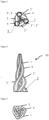
- the shell forms a shape made of three intertwined, hollow elements (2, 2', 2") with a wall thickness of 2 mm.
- the elements (2, 2', 2") were open at the bottom to enable filling with polymer, as in Figure 1
- a reaction mixture was filled into this shell to form an object 10 as shown in Figure 2 to be shown.
- Figure 3 shows a plan view of the inventive article 10.
- the Figures 1 to 3 However, the objects 10 shown are only examples and can have any shape achieved by 3D printing.
- the prepolymer mixture has a drying time of 3 h, determined in a moisture curing system at 23 °C and 50% relative humidity.
- an object 10 made of an additively produced shell 4 that is completely filled with a polymer.
- the shell 4 and the cured polymer are connected to one another in a way that has little tension between the shell 4 and the volume 3, 3', 3" that surrounds the shell 4 formed by the walls 1.
- the object 10 has a high level of stability due to this firm form fit.
- the shell 4 and the polymer are firmly connected to one another so that they preferably cannot be separated from one another again without destroying the object 10. In this way, geometrically complex and voluminous structures can be created very quickly, which would not be possible without 3D printing.
Landscapes
- Chemical & Material Sciences (AREA)
- Engineering & Computer Science (AREA)
- Materials Engineering (AREA)
- Manufacturing & Machinery (AREA)
- Physics & Mathematics (AREA)
- Mechanical Engineering (AREA)
- Optics & Photonics (AREA)
Claims (15)
- Procédé de fabrication d'un objet (10), comprenant les étapes suivantes :- fabrication d'une enveloppe (4) qui comprend un volume (3, 3', 3") pour réception d'un fluide, à l'aide d'un procédé de fabrication additive à partir d'un matériau de construction ;- mise en place dans le volume (3, 3', 3") d'un mélange réactionnel comprenant un composant polyisocyanate et un composant polyol ;- mise en réaction du mélange réactionnel dans le volume (3, 3', 3") de façon à obtenir un polymère au moins partiellement présent dans le volume (3, 3',3"),caractérisé en ce que le mélange réactionnel présente un temps de prise ≥ 2 minutes.
- Procédé selon la revendication 1, caractérisé en ce que le matériau de construction est réticulable par voie radicalaire et comprend également des groupes ayant des atomes d'hydrogène actifs selon Zerewitinoff, en ce que l'enveloppe (4) est obtenue à partir d'un précurseur, et en ce que le procédé comprend les étapes suivantes :I) dépôt d'un matériau de construction réticulable par voie radicalaire sur un support de façon à obtenir une couche d'un matériau de construction lié au support, qui correspond à une première section transversale sélectionnée du précurseur ;II) dépôt du matériau de construction réticulable par voie radicalaire sur une couche appliquée au préalable du matériau de construction, de façon à obtenir une autre couche de matériau de construction, qui correspond à une autre section transversale sélectionnée du précurseur et qui est liée à la couche précédemment appliquée ;III) répétition de l'étape II) jusqu'à formation du précurseur ;dans lequel le dépôt du matériau de construction réticulable par voie radicalaire a lieu au moins dans l'étape II) par éclairement et/ou irradiation d'une zone sélectionnée d'un matériau de construction réticulable par voie radicalaire, correspondant à la section transversale choisie dans chaque cas du précurseur, etdans lequel le matériau de construction réticulable par voie radicalaire présente une viscosité, mesurée à 23 °C selon DIN EN ISO 2884-1, de ≥ 5 mPa.s à ≤ 100 000 mPa.s,le matériau de construction réticulable par voie radicalaire comportant un composant durcissable dans lequel se trouvent des groupes NCO et des doubles liaisons C=C oléfiniques, et en ce qu'on procède en outre après l'étape III) à une étape IV) :
IV) chauffage du précurseur obtenu dans l'étape III) à une température
≥ 50 °C de façon à obtenir l'enveloppe (4). - Procédé selon la revendication 2, caractérisé en ce que- le support est disposé à l'intérieur d'un récipient et peut être abaissé verticalement dans la direction de la gravité,- le récipient contient le matériau de construction réticulable par voie radicalaire en une quantité suffisante pour recouvrir au moins le support et une surface la plus supérieure dans la direction verticale du matériau de construction réticulé déposé sur le support,- avant chaque étape II), le support est abaissé sur une distance prédéfinie, de façon qu'il se forme une couche du matériau de construction réticulable par voie radicalaire au-dessus de la couche la plus supérieure, dans la direction verticale, du matériau de construction réticulé, et- dans l'étape II), un faisceau d'énergie éclaire et/ou irradie la zone sélectionnée de la couche du matériau de construction réticulable par voie radicalaire, correspondant à la section transversale choisie dans chaque cas du précurseur.
- Procédé selon la revendication 2, caractérisé en ce que- le support est disposé dans un récipient et peut être relevé verticalement dans la direction opposée à la gravité,- le récipient met à disposition le matériau de construction réticulable par voie radicalaire,- avant chaque étape II), le support est relevé sur une distance prédéfinie, de façon qu'il se forme une couche du matériau de construction réticulable par voie radicalaire en dessous de la couche la plus inférieure, dans la direction verticale, du matériau de construction réticulé, et- dans l'étape II), un grand nombre de faisceaux d'énergie éclairent et/ou irradient simultanément la zone sélectionnée de la couche du matériau de construction réticulable par voie radicalaire, correspondant à la section transversale choisie dans chaque cas du précurseur.
- Procédé selon la revendication 2, caractérisé en ce que- dans l'étape II), le matériau de construction réticulable par voie radicalaire est appliqué à partir d'une ou plusieurs têtes d'impression, correspondant à la section transversale choisie dans chaque cas du précurseur, puis est éclairé et/ou irradié.
- Procédé selon la revendication 1, caractérisé en ce que la fabrication de l'enveloppe (4) par le procédé de fabrication additive comprend les étapes suivantes :- application d'une couche de particules comportant le matériau de construction sur une surface cible ;- action d'énergie sur une partie sélectionnée de la couche, correspondant à une section transversale de l'enveloppe (4) de façon à lier les particules dans la partie sélectionnée ;- répétition des étapes d'application et d'action d'énergie pour un grand nombre de couches, de façon à lier les parties liées des couches voisines, pour former l'enveloppe (4).
- Procédé selon la revendication 1, caractérisé en ce que la fabrication de l'enveloppe (4) par le procédé de fabrication additive comprend les étapes suivantes :- application d'une couche sur les particules comportant le matériau de construction sur une surface cible ;- application d'un liquide sur une partie sélectionnée de la couche, correspondant à une section transversale de l'enveloppe (4), le liquide étant choisi de façon à lier les particules les unes aux autres par collage, fusion et/ou dissolution, dans les zones de la couche en contact avec le liquide,- répétition des étapes d'application de la couche et du liquide, de façon à lier les parties liées des couches voisines, pour former l'enveloppe (4).
- Procédé selon la revendication 1, caractérisé en ce que la fabrication de l'enveloppe (4) par le procédé de fabrication additive comprend les étapes suivantes :- application d'un filament d'un matériau de construction au moins partiellement fondu sur un support, de façon à obtenir une couche du matériau de construction qui correspond à une première section transversale sélectionnée de l'enveloppe (4) ;- application d'un filament du matériau de construction au moins partiellement fondu sur une couche préalablement appliquée du matériau de construction, de façon à obtenir une nouvelle couche du matériau de construction, qui correspond à une nouvelle section transversale sélectionnée de l'enveloppe (4) et qui est liée à la couche appliquée au préalable ;- répétition de l'étape d'application d'un filament du matériau de construction au moins partiellement fondu sur une couche appliquée au préalable du matériau de construction, jusqu'à formation de l'enveloppe (4).
- Procédé selon l'une des revendications 1 à 8, caractérisé en ce que le mélange réactionnel est mis à réagir pour former une mousse ayant une résistance à la compression, pour une déformation de 10 % mesurée selon DIN EN 826, ≥ 50 kPa, ou une mousse ayant une dureté de compression pour une compression de 40 %, mesurée selon ISO 3386-1, ≤ 15 kPa.
- Procédé selon l'une des revendications 1 à 9, caractérisé en ce que le composant polyol comprend un polyétherpolyol difonctionnel et/ou un polyesterpolyol difonctionnel et/ou un polyéthercarbonatepolyol difonctionnel.
- Procédé selon l'une des revendications 1 à 10, caractérisé en ce que le composant polyol comprend un agent porogène qui est un mélange d'eau et d'au moins un agent porogène physique.
- Procédé selon l'une des revendications 1 à 11, caractérisé en ce que le mélange réactionnel est introduit sans interruption dans le volume (3, 3',3").
- Objet (10) pouvant être obtenu par un procédé selon l'une des revendications 1 à 12, comprenant une enveloppe (4) qui définit un volume (3, 3', 3") à l'intérieur de l'enveloppe (4), et une mousse remplissant le volume (3, 3', 3") en totalité ou en partie,
caractérisé en ce que l'enveloppe (4) comprend un polymère de polyuréthane thermoplastique, la mousse comprend une mousse de polyuréthane ayant une résistance à la compression pour une compression de 10 %, mesurée selon DIN EN 826, ≥ 50 kPa ou une dureté de compression, pour une compression de 40 %, mesurée selon ISO 3386-1, ≤ 15 kPa, et la mousse et l'enveloppe (4) sont liées l'une à l'autre au moins partiellement par correspondance de matière. - Objet (10) selon la revendication 13, caractérisé en ce que l'enveloppe (4) comprend des éléments pénétrant dans le volume (3, 3', 3").
- Objet (10) selon la revendication 13 ou 14, caractérisé en ce que l'objet (10) est un ballon.
Applications Claiming Priority (2)
| Application Number | Priority Date | Filing Date | Title |
|---|---|---|---|
| EP16203988 | 2016-12-14 | ||
| PCT/EP2017/082154 WO2018108781A1 (fr) | 2016-12-14 | 2017-12-11 | Procédé destiné à la fabrication d'un objet rempli de mousse, imprimé en 3d |
Publications (3)
| Publication Number | Publication Date |
|---|---|
| EP3554787A1 EP3554787A1 (fr) | 2019-10-23 |
| EP3554787B1 true EP3554787B1 (fr) | 2024-09-25 |
| EP3554787C0 EP3554787C0 (fr) | 2024-09-25 |
Family
ID=57629271
Family Applications (1)
| Application Number | Title | Priority Date | Filing Date |
|---|---|---|---|
| EP17809327.4A Active EP3554787B1 (fr) | 2016-12-14 | 2017-12-11 | Procédé de production d'un objet rempli de mousse imprimé en 3d |
Country Status (3)
| Country | Link |
|---|---|
| US (1) | US20200009769A1 (fr) |
| EP (1) | EP3554787B1 (fr) |
| WO (1) | WO2018108781A1 (fr) |
Families Citing this family (4)
| Publication number | Priority date | Publication date | Assignee | Title |
|---|---|---|---|---|
| WO2020117984A1 (fr) * | 2018-12-04 | 2020-06-11 | Jabil Inc. | Appareil, système et procédé de revêtement de matériaux d'impression organiques et inorganiques |
| WO2020118242A1 (fr) | 2018-12-06 | 2020-06-11 | Jabil Inc. | Appareil, système et procédé d'utilisation de microsphères sacrificielles pour former une mousse fabriquée de manière additive |
| WO2020118260A1 (fr) | 2018-12-06 | 2020-06-11 | Jabil Inc. | Appareil, système et procédé d'utilisation de fabrication additive pour former une mousse de semelle de chaussure |
| US10974458B2 (en) * | 2019-01-11 | 2021-04-13 | Hewlett-Packard Development Company, L.P. | Dimensional compensations for additive manufacturing |
Family Cites Families (15)
| Publication number | Priority date | Publication date | Assignee | Title |
|---|---|---|---|---|
| US3703571A (en) * | 1971-05-10 | 1972-11-21 | Arthur H Roberts | Method of casting rigid foam to support a hollow flexible plastic shell |
| DE4319948A1 (de) | 1993-06-16 | 1994-12-22 | Bayer Ag | Tertiäre Aminogruppen aufweisende Verbindungen, ein Verfahren zu ihrer Herstellung und ihre Verwendung als Katalysatoren |
| GB0317387D0 (en) | 2003-07-25 | 2003-08-27 | Univ Loughborough | Method and apparatus for combining particulate material |
| US9758613B2 (en) * | 2012-04-30 | 2017-09-12 | Covestro Deutschland Ag | Method for producing foamed molded bodies |
| EP2784100B1 (fr) | 2013-03-25 | 2015-09-23 | Bayer MaterialScience AG | Mousse rigide de polyuréthane avec répartition homogène de la taille des cellules et pourcentage homogène d'alvéoles ouvertes |
| US8974213B1 (en) * | 2013-09-02 | 2015-03-10 | Massivit 3D Printing Technologies Ltd | Large shells manufacturing apparatus |
| WO2015065936A2 (fr) | 2013-10-30 | 2015-05-07 | Boyd Iv R Platt | Fabrication additive de bâtiments et d'autres structures |
| CN106457664B (zh) | 2014-03-21 | 2019-12-13 | 莱恩奥罗克澳大利亚私人有限公司 | 一种合成复合物的方法和装置 |
| AU2015280283B2 (en) * | 2014-06-23 | 2019-05-02 | Carbon, Inc. | Methods of producing three-dimensional objects from materials having multiple mechanisms of hardening |
| TWI601628B (zh) | 2014-08-29 | 2017-10-11 | 三緯國際立體列印科技股份有限公司 | 立體列印裝置以及立體列印方法 |
| WO2016086268A1 (fr) | 2014-12-02 | 2016-06-09 | Matrix Composites & Engineering Ltd. | Module de flottabilité et procédé de formation |
| CN106132654B (zh) | 2015-02-03 | 2019-05-17 | 飞利浦照明控股有限公司 | 用于成型和复制对象的基于熔融沉积成型的模具、用于其制造的方法以及熔融沉积成型3d打印机 |
| US20160243721A1 (en) * | 2015-02-23 | 2016-08-25 | Barristo Enterprises Inc. | Method for Strengthening 3D Printed Components |
| DE102015204151B4 (de) * | 2015-03-09 | 2025-12-24 | Adidas Ag | Ball, insbesondere Fußball, und Verfahren zur Herstellung eines Balls |
| WO2016142930A1 (fr) * | 2015-03-12 | 2016-09-15 | Massivit 3D Printing Technologies Ltd. | Machine pour fabrication d'objets 3d |
-
2017
- 2017-12-11 EP EP17809327.4A patent/EP3554787B1/fr active Active
- 2017-12-11 WO PCT/EP2017/082154 patent/WO2018108781A1/fr not_active Ceased
- 2017-12-11 US US16/468,170 patent/US20200009769A1/en not_active Abandoned
Also Published As
| Publication number | Publication date |
|---|---|
| EP3554787A1 (fr) | 2019-10-23 |
| EP3554787C0 (fr) | 2024-09-25 |
| WO2018108781A1 (fr) | 2018-06-21 |
| US20200009769A1 (en) | 2020-01-09 |
Similar Documents
| Publication | Publication Date | Title |
|---|---|---|
| EP3538584B1 (fr) | Procédé de fabrication d'un objet à partir d'un précurseur et utilisation d'une résine réticulable par voie radicalaire dans un procédé de fabrication additive | |
| EP0603675B1 (fr) | Polyuréthanes aliphatiques et thermoplastiques sans catalyseur | |
| DE2624528C2 (de) | Verfahren zur Herstellung von Polyurethanschaumstoffen | |
| EP1432749B1 (fr) | Procede de fabrication d' elastomeres de polyurethanne et utilisation | |
| DE69504696T2 (de) | Pulverbeschichtungszusammensetzungen sowie verfahren zur stubstratbeschichtung | |
| DE2633764C2 (de) | Verfahren zur Herstellung von Kunststoff -Metall-Verbunden | |
| EP3548522B1 (fr) | Procédé de fabrication d'un objet à partir d'un précurseur et utilisation d'une résine réticulable par voie radicalaire dans un procédé de fabrication additive | |
| WO2018108781A1 (fr) | Procédé destiné à la fabrication d'un objet rempli de mousse, imprimé en 3d | |
| EP3852675B1 (fr) | Appareil orthodontique d'orthopédie maxillaire imprimée en 3d à partir de polymères réticulés | |
| DE3700572A1 (de) | Kunststoff-verbundkoerper und ein verfahren zu seiner herstellung | |
| EP0347691A2 (fr) | Article en polyuréthane, muni d'une feuille multicouche profilée, procédé de sa fabrication, et utilisation | |
| EP3645598B1 (fr) | Procédé de fabrication additive au moyen de matériau de construction thermoplastique réticulé de façon radicalaire | |
| EP2651999B1 (fr) | Produits de polyaddition de polyisocyanate, leur procédé de fabrication et leur utilisation | |
| EP2820061B1 (fr) | Systèmes de polyuréthane 2k dotés d'une température de transition vitreuse élevée | |
| CH625261A5 (fr) | ||
| EP3601398B1 (fr) | Procédé de polymérisation double au moyen de catalyseurs à l'étain latents par voie thermique | |
| EP3638725B1 (fr) | Procédé de fabrication additive faisant appel aux amines pour le post-durcissement | |
| EP4367155B1 (fr) | Résine photo- et thermodurcissable utile dans des procédés de fabrication additive | |
| DE10044712A1 (de) | Verfahren zur Herstellung von schalldämpfenden Polyurethanschäumen | |
| WO2023061904A1 (fr) | Résine photodurcissable et thermodurcissable utile dans des procédés de fabrication additive | |
| EP2603538A1 (fr) | Polyuréthanes stables à la lumière et leur utilisation | |
| DE4441570A1 (de) | Schaumkunststoff aus Einweg-Druckbehältern | |
| EP2762510A1 (fr) | Élément composite avec un noyau en polyuréthane pauvre en émissions ainsi que son procédé de fabrication | |
| WO2012080400A1 (fr) | Procédé de fabrication de corps moulés en polyuréthane de faible masse volumique | |
| JP2021515080A (ja) | 低温での複合材料の製造方法 |
Legal Events
| Date | Code | Title | Description |
|---|---|---|---|
| STAA | Information on the status of an ep patent application or granted ep patent |
Free format text: STATUS: UNKNOWN |
|
| STAA | Information on the status of an ep patent application or granted ep patent |
Free format text: STATUS: THE INTERNATIONAL PUBLICATION HAS BEEN MADE |
|
| PUAI | Public reference made under article 153(3) epc to a published international application that has entered the european phase |
Free format text: ORIGINAL CODE: 0009012 |
|
| STAA | Information on the status of an ep patent application or granted ep patent |
Free format text: STATUS: REQUEST FOR EXAMINATION WAS MADE |
|
| 17P | Request for examination filed |
Effective date: 20190715 |
|
| AK | Designated contracting states |
Kind code of ref document: A1 Designated state(s): AL AT BE BG CH CY CZ DE DK EE ES FI FR GB GR HR HU IE IS IT LI LT LU LV MC MK MT NL NO PL PT RO RS SE SI SK SM TR |
|
| AX | Request for extension of the european patent |
Extension state: BA ME |
|
| DAV | Request for validation of the european patent (deleted) | ||
| DAX | Request for extension of the european patent (deleted) | ||
| STAA | Information on the status of an ep patent application or granted ep patent |
Free format text: STATUS: EXAMINATION IS IN PROGRESS |
|
| 17Q | First examination report despatched |
Effective date: 20220307 |
|
| RAP1 | Party data changed (applicant data changed or rights of an application transferred) |
Owner name: STRATASYS, INC. |
|
| GRAP | Despatch of communication of intention to grant a patent |
Free format text: ORIGINAL CODE: EPIDOSNIGR1 |
|
| STAA | Information on the status of an ep patent application or granted ep patent |
Free format text: STATUS: GRANT OF PATENT IS INTENDED |
|
| RIC1 | Information provided on ipc code assigned before grant |
Ipc: B29L 31/54 20060101ALN20240326BHEP Ipc: B29K 75/00 20060101ALN20240326BHEP Ipc: B33Y 70/00 20150101ALI20240326BHEP Ipc: B33Y 10/00 20150101ALI20240326BHEP Ipc: B29C 64/106 20170101ALI20240326BHEP Ipc: B29C 44/18 20060101ALI20240326BHEP Ipc: B29C 44/08 20060101AFI20240326BHEP |
|
| INTG | Intention to grant announced |
Effective date: 20240419 |
|
| GRAS | Grant fee paid |
Free format text: ORIGINAL CODE: EPIDOSNIGR3 |
|
| GRAA | (expected) grant |
Free format text: ORIGINAL CODE: 0009210 |
|
| STAA | Information on the status of an ep patent application or granted ep patent |
Free format text: STATUS: THE PATENT HAS BEEN GRANTED |
|
| AK | Designated contracting states |
Kind code of ref document: B1 Designated state(s): AL AT BE BG CH CY CZ DE DK EE ES FI FR GB GR HR HU IE IS IT LI LT LU LV MC MK MT NL NO PL PT RO RS SE SI SK SM TR |
|
| REG | Reference to a national code |
Ref country code: GB Ref legal event code: FG4D Free format text: NOT ENGLISH |
|
| REG | Reference to a national code |
Ref country code: CH Ref legal event code: EP |
|
| REG | Reference to a national code |
Ref country code: DE Ref legal event code: R096 Ref document number: 502017016452 Country of ref document: DE |
|
| REG | Reference to a national code |
Ref country code: IE Ref legal event code: FG4D Free format text: LANGUAGE OF EP DOCUMENT: GERMAN |
|
| U01 | Request for unitary effect filed |
Effective date: 20241015 |
|
| U07 | Unitary effect registered |
Designated state(s): AT BE BG DE DK EE FI FR IT LT LU LV MT NL PT RO SE SI Effective date: 20241031 |
|
| PG25 | Lapsed in a contracting state [announced via postgrant information from national office to epo] |
Ref country code: NO Free format text: LAPSE BECAUSE OF FAILURE TO SUBMIT A TRANSLATION OF THE DESCRIPTION OR TO PAY THE FEE WITHIN THE PRESCRIBED TIME-LIMIT Effective date: 20241225 |
|
| PG25 | Lapsed in a contracting state [announced via postgrant information from national office to epo] |
Ref country code: GR Free format text: LAPSE BECAUSE OF FAILURE TO SUBMIT A TRANSLATION OF THE DESCRIPTION OR TO PAY THE FEE WITHIN THE PRESCRIBED TIME-LIMIT Effective date: 20241226 |
|
| U20 | Renewal fee for the european patent with unitary effect paid |
Year of fee payment: 8 Effective date: 20241218 |
|
| PG25 | Lapsed in a contracting state [announced via postgrant information from national office to epo] |
Ref country code: RS Free format text: LAPSE BECAUSE OF FAILURE TO SUBMIT A TRANSLATION OF THE DESCRIPTION OR TO PAY THE FEE WITHIN THE PRESCRIBED TIME-LIMIT Effective date: 20241225 |
|
| PG25 | Lapsed in a contracting state [announced via postgrant information from national office to epo] |
Ref country code: RS Free format text: LAPSE BECAUSE OF FAILURE TO SUBMIT A TRANSLATION OF THE DESCRIPTION OR TO PAY THE FEE WITHIN THE PRESCRIBED TIME-LIMIT Effective date: 20241225 Ref country code: NO Free format text: LAPSE BECAUSE OF FAILURE TO SUBMIT A TRANSLATION OF THE DESCRIPTION OR TO PAY THE FEE WITHIN THE PRESCRIBED TIME-LIMIT Effective date: 20241225 Ref country code: GR Free format text: LAPSE BECAUSE OF FAILURE TO SUBMIT A TRANSLATION OF THE DESCRIPTION OR TO PAY THE FEE WITHIN THE PRESCRIBED TIME-LIMIT Effective date: 20241226 |
|
| PG25 | Lapsed in a contracting state [announced via postgrant information from national office to epo] |
Ref country code: IS Free format text: LAPSE BECAUSE OF FAILURE TO SUBMIT A TRANSLATION OF THE DESCRIPTION OR TO PAY THE FEE WITHIN THE PRESCRIBED TIME-LIMIT Effective date: 20250125 |
|
| PG25 | Lapsed in a contracting state [announced via postgrant information from national office to epo] |
Ref country code: SM Free format text: LAPSE BECAUSE OF FAILURE TO SUBMIT A TRANSLATION OF THE DESCRIPTION OR TO PAY THE FEE WITHIN THE PRESCRIBED TIME-LIMIT Effective date: 20240925 |
|
| PG25 | Lapsed in a contracting state [announced via postgrant information from national office to epo] |
Ref country code: ES Free format text: LAPSE BECAUSE OF FAILURE TO SUBMIT A TRANSLATION OF THE DESCRIPTION OR TO PAY THE FEE WITHIN THE PRESCRIBED TIME-LIMIT Effective date: 20240925 |
|
| PG25 | Lapsed in a contracting state [announced via postgrant information from national office to epo] |
Ref country code: PL Free format text: LAPSE BECAUSE OF FAILURE TO SUBMIT A TRANSLATION OF THE DESCRIPTION OR TO PAY THE FEE WITHIN THE PRESCRIBED TIME-LIMIT Effective date: 20240925 Ref country code: CZ Free format text: LAPSE BECAUSE OF FAILURE TO SUBMIT A TRANSLATION OF THE DESCRIPTION OR TO PAY THE FEE WITHIN THE PRESCRIBED TIME-LIMIT Effective date: 20240925 |
|
| PG25 | Lapsed in a contracting state [announced via postgrant information from national office to epo] |
Ref country code: SK Free format text: LAPSE BECAUSE OF FAILURE TO SUBMIT A TRANSLATION OF THE DESCRIPTION OR TO PAY THE FEE WITHIN THE PRESCRIBED TIME-LIMIT Effective date: 20240925 |
|
| PG25 | Lapsed in a contracting state [announced via postgrant information from national office to epo] |
Ref country code: MC Free format text: LAPSE BECAUSE OF FAILURE TO SUBMIT A TRANSLATION OF THE DESCRIPTION OR TO PAY THE FEE WITHIN THE PRESCRIBED TIME-LIMIT Effective date: 20240925 |
|
| REG | Reference to a national code |
Ref country code: CH Ref legal event code: PL |
|
| PLBE | No opposition filed within time limit |
Free format text: ORIGINAL CODE: 0009261 |
|
| STAA | Information on the status of an ep patent application or granted ep patent |
Free format text: STATUS: NO OPPOSITION FILED WITHIN TIME LIMIT |
|
| GBPC | Gb: european patent ceased through non-payment of renewal fee |
Effective date: 20241225 |
|
| 26N | No opposition filed |
Effective date: 20250626 |
|
| PG25 | Lapsed in a contracting state [announced via postgrant information from national office to epo] |
Ref country code: GB Free format text: LAPSE BECAUSE OF NON-PAYMENT OF DUE FEES Effective date: 20241225 |
|
| PG25 | Lapsed in a contracting state [announced via postgrant information from national office to epo] |
Ref country code: CH Free format text: LAPSE BECAUSE OF NON-PAYMENT OF DUE FEES Effective date: 20241231 |
|
| PG25 | Lapsed in a contracting state [announced via postgrant information from national office to epo] |
Ref country code: IE Free format text: LAPSE BECAUSE OF NON-PAYMENT OF DUE FEES Effective date: 20241211 |
|
| U20 | Renewal fee for the european patent with unitary effect paid |
Year of fee payment: 9 Effective date: 20251119 |
|
| PG25 | Lapsed in a contracting state [announced via postgrant information from national office to epo] |
Ref country code: HR Free format text: LAPSE BECAUSE OF FAILURE TO SUBMIT A TRANSLATION OF THE DESCRIPTION OR TO PAY THE FEE WITHIN THE PRESCRIBED TIME-LIMIT Effective date: 20240925 |
|
| PG25 | Lapsed in a contracting state [announced via postgrant information from national office to epo] |
Ref country code: CY Free format text: LAPSE BECAUSE OF FAILURE TO SUBMIT A TRANSLATION OF THE DESCRIPTION OR TO PAY THE FEE WITHIN THE PRESCRIBED TIME-LIMIT Effective date: 20240925 |
|
| PG25 | Lapsed in a contracting state [announced via postgrant information from national office to epo] |
Ref country code: TR Free format text: LAPSE BECAUSE OF FAILURE TO SUBMIT A TRANSLATION OF THE DESCRIPTION OR TO PAY THE FEE WITHIN THE PRESCRIBED TIME-LIMIT Effective date: 20240925 |
|
| PG25 | Lapsed in a contracting state [announced via postgrant information from national office to epo] |
Ref country code: HU Free format text: LAPSE BECAUSE OF FAILURE TO SUBMIT A TRANSLATION OF THE DESCRIPTION OR TO PAY THE FEE WITHIN THE PRESCRIBED TIME-LIMIT; INVALID AB INITIO Effective date: 20171211 |