EP3554787B1 - Method for producing a 3d printed foam-filled object - Google Patents
Method for producing a 3d printed foam-filled object Download PDFInfo
- Publication number
- EP3554787B1 EP3554787B1 EP17809327.4A EP17809327A EP3554787B1 EP 3554787 B1 EP3554787 B1 EP 3554787B1 EP 17809327 A EP17809327 A EP 17809327A EP 3554787 B1 EP3554787 B1 EP 3554787B1
- Authority
- EP
- European Patent Office
- Prior art keywords
- construction material
- shell
- free
- layer
- precursor
- Prior art date
- Legal status (The legal status is an assumption and is not a legal conclusion. Google has not performed a legal analysis and makes no representation as to the accuracy of the status listed.)
- Active
Links
Images
Classifications
-
- B—PERFORMING OPERATIONS; TRANSPORTING
- B29—WORKING OF PLASTICS; WORKING OF SUBSTANCES IN A PLASTIC STATE IN GENERAL
- B29C—SHAPING OR JOINING OF PLASTICS; SHAPING OF MATERIAL IN A PLASTIC STATE, NOT OTHERWISE PROVIDED FOR; AFTER-TREATMENT OF THE SHAPED PRODUCTS, e.g. REPAIRING
- B29C44/00—Shaping by internal pressure generated in the material, e.g. swelling or foaming ; Producing porous or cellular expanded plastics articles
- B29C44/02—Shaping by internal pressure generated in the material, e.g. swelling or foaming ; Producing porous or cellular expanded plastics articles for articles of definite length, i.e. discrete articles
- B29C44/08—Shaping by internal pressure generated in the material, e.g. swelling or foaming ; Producing porous or cellular expanded plastics articles for articles of definite length, i.e. discrete articles using several expanding or moulding steps
-
- B—PERFORMING OPERATIONS; TRANSPORTING
- B29—WORKING OF PLASTICS; WORKING OF SUBSTANCES IN A PLASTIC STATE IN GENERAL
- B29C—SHAPING OR JOINING OF PLASTICS; SHAPING OF MATERIAL IN A PLASTIC STATE, NOT OTHERWISE PROVIDED FOR; AFTER-TREATMENT OF THE SHAPED PRODUCTS, e.g. REPAIRING
- B29C44/00—Shaping by internal pressure generated in the material, e.g. swelling or foaming ; Producing porous or cellular expanded plastics articles
- B29C44/02—Shaping by internal pressure generated in the material, e.g. swelling or foaming ; Producing porous or cellular expanded plastics articles for articles of definite length, i.e. discrete articles
- B29C44/12—Incorporating or moulding on preformed parts, e.g. inserts or reinforcements
- B29C44/18—Filling preformed cavities
-
- B—PERFORMING OPERATIONS; TRANSPORTING
- B33—ADDITIVE MANUFACTURING TECHNOLOGY
- B33Y—ADDITIVE MANUFACTURING, i.e. MANUFACTURING OF THREE-DIMENSIONAL [3D] OBJECTS BY ADDITIVE DEPOSITION, ADDITIVE AGGLOMERATION OR ADDITIVE LAYERING, e.g. BY 3D PRINTING, STEREOLITHOGRAPHY OR SELECTIVE LASER SINTERING
- B33Y70/00—Materials specially adapted for additive manufacturing
-
- B—PERFORMING OPERATIONS; TRANSPORTING
- B29—WORKING OF PLASTICS; WORKING OF SUBSTANCES IN A PLASTIC STATE IN GENERAL
- B29C—SHAPING OR JOINING OF PLASTICS; SHAPING OF MATERIAL IN A PLASTIC STATE, NOT OTHERWISE PROVIDED FOR; AFTER-TREATMENT OF THE SHAPED PRODUCTS, e.g. REPAIRING
- B29C64/00—Additive manufacturing, i.e. manufacturing of three-dimensional [3D] objects by additive deposition, additive agglomeration or additive layering, e.g. by 3D printing, stereolithography or selective laser sintering
- B29C64/10—Processes of additive manufacturing
- B29C64/106—Processes of additive manufacturing using only liquids or viscous materials, e.g. depositing a continuous bead of viscous material
-
- B—PERFORMING OPERATIONS; TRANSPORTING
- B29—WORKING OF PLASTICS; WORKING OF SUBSTANCES IN A PLASTIC STATE IN GENERAL
- B29K—INDEXING SCHEME ASSOCIATED WITH SUBCLASSES B29B, B29C OR B29D, RELATING TO MOULDING MATERIALS OR TO MATERIALS FOR MOULDS, REINFORCEMENTS, FILLERS OR PREFORMED PARTS, e.g. INSERTS
- B29K2075/00—Use of PU, i.e. polyureas or polyurethanes or derivatives thereof, as moulding material
-
- B—PERFORMING OPERATIONS; TRANSPORTING
- B29—WORKING OF PLASTICS; WORKING OF SUBSTANCES IN A PLASTIC STATE IN GENERAL
- B29L—INDEXING SCHEME ASSOCIATED WITH SUBCLASS B29C, RELATING TO PARTICULAR ARTICLES
- B29L2031/00—Other particular articles
- B29L2031/54—Balls
-
- B—PERFORMING OPERATIONS; TRANSPORTING
- B33—ADDITIVE MANUFACTURING TECHNOLOGY
- B33Y—ADDITIVE MANUFACTURING, i.e. MANUFACTURING OF THREE-DIMENSIONAL [3D] OBJECTS BY ADDITIVE DEPOSITION, ADDITIVE AGGLOMERATION OR ADDITIVE LAYERING, e.g. BY 3D PRINTING, STEREOLITHOGRAPHY OR SELECTIVE LASER SINTERING
- B33Y10/00—Processes of additive manufacturing
Definitions
- the present invention relates to a method for producing an object, comprising the steps of: producing a shell which comprises a volume for receiving a fluid, by means of an additive manufacturing process from a construction material; providing a reaction mixture comprising a polyisocyanate component and a polyol component in the volume and allowing the reaction mixture to react in the volume so that a polymer is at least partially present in the volume.
- the invention further relates to an object obtainable by a method according to the invention, comprising a shell which defines a volume located within the shell and a foam which completely or partially fills the volume. The shell can subsequently be completely or partially removed in order to obtain complex-shaped foam bodies.
- Additive manufacturing processes are those processes in which objects are built up layer by layer. They therefore differ significantly from other methods for producing objects such as milling, drilling or machining. In the latter processes, an object is processed in such a way that it receives its final geometry by removing material.
- Additive manufacturing processes use different materials and process techniques to build objects layer by layer.
- FDM Fused Deposition Modeling
- a thermoplastic wire is liquefied and deposited layer by layer on a movable construction platform using a nozzle. When it solidifies, a solid object is created.
- the nozzle and the construction platform are controlled based on a CAD drawing of the object. If the geometry of this object is complex, for example with geometric undercuts, additional support materials must be printed and removed again after the object is finished.
- thermoplastic powders to build objects layer by layer. Thin layers of powder are applied using a so-called coater and then selectively melted using an energy source. The surrounding powder supports the component geometry. Complex geometries can therefore be manufactured more economically than with the FDM process described above. In addition, various objects can be arranged or manufactured closely packed in the so-called powder bed. Due to these advantages, powder-based additive manufacturing processes are considered to be the most economical additive manufacturing processes on the market. They are therefore mainly used by industrial users. Examples of powder-based additive manufacturing processes are so-called laser sintering (SLS, selective laser sintering) or high speed sintering (HSS). or high speed sintering (HSS).
- SLS laser sintering
- HSS high speed sintering
- HSS high speed sintering
- the energy is introduced via a guided laser beam.
- HSS high speed sintering
- IR infrared
- SHS Selective Heat Sintering
- Another group of additive manufacturing processes uses radically cross-linkable resins, which may obtain their final strength in the formed object via a second curing mechanism. Examples of such processes are stereolithography processes and the so-called DLP process derived from them.
- liquid cure systems are known in which the liquid coating material is first crosslinked radically, for example photochemically, and then further cured via reactions of NCO groups with suitable reaction partners.
- WO 2015/139095 A1 a method for producing a composite object using a computer-controlled device and such a device is disclosed.
- the device comprises a reservoir with a liquid, hardenable first material, means for selectively solidifying the first material and means for selectively depositing a second material.
- the method comprises the steps of selectively depositing portions of the second material and selectively solidifying sections of the first material such that the solidified sections of the first material and the deposited portions of the second material form the composite object.
- WO 2016/086268 A1 describes a method for manufacturing a buoyancy module for a subsea buoyancy system comprising the steps of forming a shell, at least partially, by an additive manufacturing process; introducing a buoyancy material into the shell; and sealing the shell.
- WO 2016/142930 A1 discloses, among other things, a method for producing a three-dimensional object using a "3D object manufacturing machine" with a main and a satellite material distribution head.
- a two-component material such as "EasyFlo Spray foam FR8 Liquid Plastic” or similar polyurethane foams can be injected into the interior of the three-dimensional object, creating a reinforced, durable inner shell without compromising the external appearance of the model.
- One object of the present invention is to at least partially overcome at least one disadvantage of the prior art. Furthermore, the invention has the object of providing an additive manufacturing process in which the objects to be produced can be obtained as cost-efficiently and/or individualized and/or resource-conserving as possible, which particularly concerns the recyclability of construction material.
- the object is achieved by a method according to claim 1 and an object according to claim 13.
- Advantageous further developments are specified in the subclaims. They can be combined as desired, unless the context clearly indicates the opposite.
- the reaction mixture has a setting time of ⁇ 2 minutes.
- the method according to the invention makes it possible to produce objects whose external shape is only limited by the performance of the additive manufacturing process selected and the equipment used.
- the objects are mechanically reinforced by the polymer obtained by reaction. This also reduces the production times for the objects, since only the outer shell needs to be manufactured.
- the method according to the invention can be used to produce a complex-shaped foam object with internal foam geometries that cannot be accessed using conventional methods.
- the shaping construction material produced using an additive method can preferably be at least partially removed again, for example by melting, thermolysis or hydrolysis.
- the setting time is ⁇ 3 minutes, more preferably ⁇ 5 minutes. It is further It is preferred that the setting time is ⁇ 3 minutes to ⁇ 90 minutes or ⁇ 5 minutes to ⁇ 60 minutes.
- the setting time is the time after which a theoretically infinitely expanded polymer has been formed during the polyaddition between NCO-reactive components and polyisocyanate components.
- the setting time can be determined experimentally by dipping a thin wooden stick into the foaming reaction mixture at short intervals. The time from mixing the components to the point at which threads remain attached to the stick when it is pulled out is the setting time.
- Reaction mixtures with the setting times according to the invention which are considered slow in the professional world, allow the undesirable side effects of the exothermic reaction of the reaction mixture to form a PUR or PUR/PIR material not to damage the shell or, in the case of complex geometries, to lead to an undesirable, highly inconsistent formation of the foam structure.
- One undesirable effect is, for example, the melting or softening of a thermoplastic shell with loss of the intended shape.
- a slower reaction allows the released reaction heat to be dissipated better.
- the pressure build-up inside the shell due to the reaction is also undesirable, particularly in combination with melting or softening of thermoplastic shell material. The slower the reaction progresses, the more gas can diffuse through the shell to the outside.
- the setting time provided for in the invention can be achieved by various measures, either individually or in combination.
- the reaction mixture can contain an amine catalyst.
- Another measure is the use of slower-reacting aliphatic polyisocyanates.
- the polyol component can contain difunctional polyols, which reduce the crosslinking density in the end product and also in the reacting reaction mixture and thus possibly also have an effect on prolonging the setting time.
- the reaction mixture can be made low-viscosity.
- the reaction mixture can have an initial viscosity (20 °C, ASTM D 2393), i.e. immediately after mixing the polyol component and isocyanate component, of ⁇ 100 mPas to ⁇ 5000 mPas.
- the volume can be, for example, ⁇ 1 cm 3 to ⁇ 5000 cm 3 .
- the shell together with the The reaction mixture contained therein can be rotated or swiveled in space so that the reaction mixture can be evenly distributed in the available shell.
- reaction mixture does not contain a blowing agent and thus does not harden into a foam.
- the polymer obtained would then act as a solid layer on the inside of the casing to mechanically reinforce it.
- the advantages of the process according to the invention are particularly evident when the reaction mixture also contains a blowing agent. This can be a physical and/or chemical blowing agent.
- the construction material preferably comprises a polyurethane polymer.
- Components in the reaction mixture can then react with any reactive groups still available in the polyurethane polymer present in the shell to form a material bond.
- Thermoplastic polyurethanes (TPU), in particular thermoplastic polyurethane elastomers (TPE), are particularly preferred.
- Suitable organic aliphatic, cycloaliphatic, araliphatic and/or aromatic polyisocyanates with at least two isocyanate groups per molecule and mixtures thereof, which are known to the person skilled in the art, are used to produce the polyurethane polymer in the building material.
- NCO-terminated prepolymers can be used.
- NCO-reactive compounds with Zerewitinoff-active H atoms for producing the polyurethane polymer in the building material.
- These can be, for example, low molecular weight diols (e.g. 1,2-ethanediol, 1,3- or 1,2-propanediol, 1,4-butanediol, 1,5-petanediol, 1,6-hexanediol), triols (e.g. glycerol, trimethylolpropane) and tetraols (e.g.
- diols e.g. 1,2-ethanediol, 1,3- or 1,2-propanediol, 1,4-butanediol, 1,5-petanediol, 1,6-hexanediol
- triols e.g. glycerol, trimethylolpropane
- tetraols e.g.
- pentaerythritol short-chain amino alcohols
- polyamines but also higher molecular weight polyhydroxy compounds
- polyether polyols such as polyether polyols, polyester polyols, polycarbonate polyols, polyether carbonate diols, polysiloxane polyols, polyamines and polyether polyamines as well as polybutadiene polyols.
- the NCO groups in the polyurethane polymer of the construction material can be partially blocked.
- the process according to the invention then further comprises the step of unblocking these NCO groups. After they have been unblocked, they are available for reactions with the reaction mixture to form a cohesive bond.
- the blocking agent is chosen so that the NCO groups are at least partially unblocked when heated.
- blocking agents are alcohols, lactams, oximes, malonic esters, alkyl acetoacetates, triazoles, phenols, imidazoles, pyrazoles and amines such as butanone oxime, diisopropylamine, 1,2,4-triazole, dimethyl-1,2,4-triazole, imidazole, Diethyl malonate, acetoacetic ester, acetone oxime, 3,5-dimethylpyrazole, ⁇ -caprolactam, N-methyl-, N-ethyl-, N-(iso)propyl-, Nn-butyl-, N-iso-butyl-, N-tert-butyl-benzylamine or 1,1-dimethylbenzylamine, N-alkyl-N-1,1-dimethylmethylphenylamine, adducts of benzylamine with
- the shell is obtained in two production stages.
- the first production stage can be considered as the construction stage.
- This construction stage allows can be realized using radiation-optical additive manufacturing processes such as the inkjet process, stereolithography or the DLP (digital light processing) process and is the subject of steps I), II) and III).
- the second production stage can be regarded as the hardening stage and is the subject of step IV).
- the precursor or intermediate shell obtained after the construction stage is converted into a mechanically more durable shell without further changing the shape.
- step I) of this variant of the process a radically cross-linked build material is deposited on a carrier.
- This is usually the first step in inkjet, stereolithography and DLP processes.
- a layer of build material bonded to the carrier is obtained, which corresponds to a first selected cross section of the precursor.
- step II) is repeated until the desired precursor is formed.
- step II) a radically cross-linked build material is deposited on a previously applied layer of the build material, so that a further layer of the build material is obtained which corresponds to another selected cross-section of the precursor and which is connected to the previously applied layer.
- the previously applied layer of the build material can be the first layer from step I) or a layer from a previous run of step II).
- the deposition of a radically cross-linked building material takes place at least in step II) (preferably also in step I) by exposing and/or irradiating a selected area of a radically cross-linkable resin, corresponding to the respective selected cross-section of the precursor.
- This can be done both by selective exposure (stereolithography, DLP) of the cross-linkable building material and by selective application of the cross-linkable building material, followed by an exposure step which no longer has to be selective due to the previous selective application of the cross-linkable building material (inkjet process).
- radically cross-linkable building material and "radically cross-linked building material” are used.
- the radically cross-linkable building material is converted into the radically cross-linked building material by exposure and/or irradiation, which triggers radical cross-linking reactions.
- Exposure here means the effect of light in the range between near IR and near UV light (1400 nm to 315 nm wavelength). The other shorter wavelength ranges are covered by the term “irradiation”, for example far UV light, X-rays, gamma radiation and also electron beams.
- the selection of the respective cross-section is conveniently carried out using a CAD program with which a model of the shell to be produced has been created. This operation is also called “slicing” and serves as the basis for controlling the exposure and/or irradiation of the radically cross-linkable resin.
- the radically crosslinkable build-up material has a viscosity (23 °C, DIN EN ISO 2884-1) of ⁇ 5 mPas to ⁇ 100,000 mPas. It is therefore to be regarded as a liquid resin, at least for the purposes of additive manufacturing.
- the viscosity is preferably ⁇ 50 mPas to ⁇ 10,000 mPas, more preferably > 500 mPas to ⁇ 5,000 mPas.
- the molecular ratio of these functional groups can be determined by integrating the signals of a sample in the 13 C NMR spectrum.
- the radically crosslinkable building material can also comprise a non-curable component, in which, for example, stabilizers, fillers and the like are combined.
- step IV) is also carried out after step III).
- the precursor obtained after step III) is heated to a temperature of ⁇ 50 °C, preferably ⁇ 65 °C, more preferably ⁇ 80 °C, particularly preferably ⁇ 80 °C to ⁇ 200 °C, so that the shell is obtained.
- the heating can take place for a period of ⁇ 1 minute, preferably ⁇ 5 minutes, more preferably ⁇ 10 minutes to ⁇ 24 hours, preferably ⁇ 8 hours, particularly preferably ⁇ 4 hours.
- the reaction is carried out until ⁇ 20%, preferably ⁇ 10% and more preferably ⁇ 5% of the originally present NCO groups are still present. This can be determined by quantitative IR spectroscopy
- step IV) is only carried out when all the precursor build-up material has reached its gel point.
- the gel point is considered to have been reached when in a dynamic mechanical analysis (DMA) with a plate/plate oscillation viscometer according to ISO 6721-10 at 20 °C, the graphs of the storage modulus G ⁇ and the loss modulus G" cross each other. If necessary, the precursor is subjected to further exposure and/or irradiation to complete the radical crosslinking.
- the radically crosslinked build material can have a storage modulus G ⁇ (DMA, plate/plate oscillation viscometer according to ISO 6721-10 at 20 °C and a shear rate of 1/s) of ⁇ 10 6 Pa.
- the radically crosslinkable building material can also contain additives such as fillers, UV stabilizers, radical inhibitors, antioxidants, mold release agents, water scavengers, slip additives, defoamers, flow control agents, rheology additives, flame retardants and/or pigments.
- additives such as fillers, UV stabilizers, radical inhibitors, antioxidants, mold release agents, water scavengers, slip additives, defoamers, flow control agents, rheology additives, flame retardants and/or pigments.
- auxiliaries and additives with the exception of fillers and flame retardants, are usually present in an amount of less than 10% by weight, preferably less than 5% by weight, particularly preferably up to 3% by weight, based on the radically crosslinkable resin.
- Flame retardants are usually present in amounts of at most 70% by weight, preferably at most 50% by weight, particularly preferably at most 30% by weight, calculated as the total amount of flame retardants used based on the total weight of the radically crosslinkable
- Suitable fillers are, for example, AlOH 3 , CaCO 3 , metal pigments such as TiO 2 and other known conventional fillers. These fillers are preferably used in amounts of at most 70% by weight, preferably at most 50% by weight, particularly preferably at most 30% by weight, calculated as the total amount of fillers used based on the total weight of the radically crosslinkable resin.
- Suitable UV stabilizers can preferably be selected from the group consisting of piperidine derivatives, such as 4-benzoyloxy-2,2,6,6-tetramethylpiperidine, 4-benzoyloxy-1,2,2,6,6-pentamethylpiperidine, bis-(2,2,6,6-tetra-methyl-4-piperidyl)-sebacate, bis(1,2,2,6,6-pentamethyl-1-4-piperidinyl)-sebacate, bis-(2,2,6,6-tetramethyl-4-piperidyl)-suberate, bis-(2,2,6,6-tetramethyl-4-piperidyl)-dodecanedioate; benzophenone derivatives such as 2,4-dihydroxy, 2-hydroxy-4-methoxy, 2-hydroxy-4-octoxy, 2-hydroxy-4-dodecyloxy or 2,2'-dihydroxy-4-dodecyloxy-benzophenone; Benztriazole derivatives, such as 2-(2H-
- Particularly preferred UV stabilizers are those that completely absorb radiation with a wavelength of ⁇ 400 nm. These include, for example, the benzotriazole derivatives mentioned.
- Very particularly preferred UV stabilizers are 2-(5-chloro-2H-benzotriazol-2-yl)-6-(1,1-dimethylethyl)-4-methylphenol, 2-(2H-benzotriazol-2-yl)-4-(1,1,3,3-tetramethylbutyl)phenol and/or 2-(5-chloro-2H-benzotriazol-2-yl)-4,6-bis(1,1-dimethylethyl)phenol.
- one or more of the UV stabilizers mentioned as examples are added to the radically crosslinkable building material, preferably in amounts of 0.001 to 3.0% by weight, particularly preferably 0.005 to 2% by weight, calculated as the total amount of UV stabilizers used based on the total weight of the radically crosslinkable building material.
- Suitable antioxidants are preferably sterically hindered phenols, which can preferably be selected from the group consisting of 2,6-di-tert-butyl-4-methylphenol (ionol), pentaerythritol tetrakis(3-(3,5-di-tert-butyl-4-hydroxyphenyl)propionate), octadecyl 3-(3,5-di-tert-butyl-4-hydroxyphenyl)propionate, triethylene glycol bis(3-tert-butyl-4-hydroxy-5-methylphenyl)propionate, 2,2'-thio-bis(4-methyl-6-tert-butylphenol) and 2,2'-thiodiethyl bis[3-(3,5-di-tert-butyl-4-hydroxyphenyl)propionate].
- ionol 2,6-di-tert-butyl-4-methylphenol (ionol)
- antioxidants are preferably used in amounts of 0.01 to 3.0 wt.%, particularly preferably 0.02 to 2.0 wt.%, calculated as the total amount of antioxidants used based on the total weight of the radically crosslinkable building material.
- Suitable radical inhibitors or retarders are particularly those that specifically inhibit uncontrolled radical polymerization of the resin formulation outside the desired (irradiated) area. These are crucial for good edge sharpness and imaging accuracy in the precursor. Suitable radical inhibitors must be selected according to the desired radical yield from the irradiation/exposure step and the polymerization rate and reactivity/selectivity of the double bond carriers.
- Suitable radical inhibitors are, for example, 2,2-(2,5-thiophenediyl)bis(5-tert-butylbenzoxazole), Phenothiazine, hydroquinones, hydroquinone ethers, quinone alkyds and nitroxyl compounds and mixtures thereof, benzoquinones, copper salts, pyrocatechols, cresols, nitrobenzene and oxygen. These antioxidants are preferably used in amounts of 0.001% to 3% by weight.
- the olefinic double bonds in the radically crosslinkable building material are at least partially in the form of (meth)acrylate groups.
- the radically crosslinkable building material comprises a compound which is obtainable from the reaction of an NCO-terminated polyisocyanate prepolymer with a molar deficit of a hydroxyalkyl (meth)acrylate, based on the free NCO groups.
- the radically crosslinkable building material comprises a compound which is obtainable from the reaction of an NCO-terminated polyisocyanurate with a molar deficit of a hydroxyalkyl (meth)acrylate, based on the free NCO groups.
- Suitable polyisocyanates for the preparation of the NCO-terminated polyisocyanurates and prepolymers are, for example, those which have a molecular weight in the range of 140 to 400 g/mol, with aliphatically, cycloaliphatically, araliphatically and/or aromatically bound isocyanate groups, such as.
- BDI 1,4-Diisocyanatobutan
- PDI 1,5-Diisocyanatopentan
- HDI 1,6-Diisocyanatohexan
- prepolymers bearing aliphatic and/or aromatic isocyanate end groups such as, for example, aliphatic or aromatic isocyanate end group-bearing polyether, polyester, polyacrylate, polyepoxide or polycarbonate prepolymers, can be used as starting materials for isocyanurate formation.
- Suitable trimerization catalysts are described below in connection with another embodiment.
- Suitable hydroxyalkyl (meth)acrylates include alkoxyalkyl (meth)acrylates with 2 to 12 carbon atoms in the hydroxyalkyl radical. Preference is given to 2-hydroxyethyl acrylate, the isomer mixture formed by the addition of propylene oxide to acrylic acid, or 4-hydroxybutyl acrylate.
- the reaction between the hydroxyalkyl (meth)acrylate and the NCO-terminated polyisocyanurate can be catalyzed by the usual urethanization catalysts such as DBTL.
- the molar ratio between NCO groups and OH groups of the hydroxyalkyl (meth)acrylate can be in a range from ⁇ 10:1 to ⁇ 1.1:1 (preferably ⁇ 5:1 to ⁇ 1.5:1, more preferably ⁇ 4:1 to ⁇ 2:1).
- the curable compound obtained can have a number average molecular weight M n of ⁇ 200 g/mol to ⁇ 5000 g/mol.
- this molecular weight is ⁇ 300 g/mol to ⁇ 4000 g/mol, more preferably ⁇ 400 g/mol to ⁇ 3000 g/mol.
- a curable compound which was obtained from the reaction of an NCO-terminated polyisocyanurate with hydroxyethyl (meth)acrylate, the NCO-terminated polyisocyanurate being obtained from 1,6-hexamethylene diisocyanate in the presence of an isocyanate trimerization catalyst.
- the radically crosslinkable resin further comprises a radical initiator and/or an isocyanate trimerization catalyst.
- the radical initiator and/or isocyanate trimerization catalyst can only be added to the resin immediately before the start of the process according to the invention.
- Thermal and/or photochemical radical initiators can be considered as radical initiators. It is also possible to use thermal and photochemical radical initiators at the same time. Suitable thermal radical initiators are, for example, azobisisobutyronitrile (AIBN), dibenzoyl peroxide (DBPO), di-tert-butyl peroxide and/or inorganic peroxides such as Peroxodisulfates.
- AIBN azobisisobutyronitrile
- DBPO dibenzoyl peroxide
- di-tert-butyl peroxide di-tert-butyl peroxide
- inorganic peroxides such as Peroxodisulfates.
- Suitable type (I) systems are aromatic ketone compounds, such as benzophenones in combination with tertiary amines, alkylbenzophenones, 4,4'-bis(dimethylamino)benzophenone (Michler's ketone), anthrone and halogenated benzophenones or mixtures of the types mentioned.
- type (II) initiators such as benzoin and its derivatives, benzil ketals, acylphosphine oxides, 2,4,6-trimethylbenzoyldiphenylphosphine oxide, bisacylphosphine oxides, phenylglyoxylic acid esters, camphorquinone, ⁇ -aminoalkylphenones, ⁇ , ⁇ -dialkoxyacetophenones and ⁇ -hydroxyalkylphenones.
- type (II) initiators such as benzoin and its derivatives, benzil ketals, acylphosphine oxides, 2,4,6-trimethylbenzoyldiphenylphosphine oxide, bisacylphosphine oxides, phenylglyoxylic acid esters, camphorquinone, ⁇ -aminoalkylphenones, ⁇ , ⁇ -dialkoxyacetophenones and ⁇ -hydroxyalkylphenones.
- Irgacur ® 500 a mixture of benzophenone and (1-hydroxycyclohexyl)phenyl ketone, Ciba, Lampertheim, DE
- Irgacure ® 819 DW phenylbis-(2, 4, 6-trimethylbenzoyl)phosphine oxide, Ciba, Lampertheim, DE
- Esacure ® KIP EM oligo-[2-hydroxy-2-methyl-1-[4-(1-methylvinyl)-phenyl]-propanone], Lamberti, Aldizzate, Italy
- Mixtures of these compounds can also be used.
- photoinitiators When using photoinitiators, care should be taken to ensure that they have sufficient reactivity towards the radiation source used. There are a large number of photoinitiators on the market. Commercially available photoinitiators cover the entire UV-VIS spectrum. Photoinitiators are used in the production of paints, printing inks and adhesives, as well as in the dental field.
- the photoinitiator is generally used in a concentration of 0.01 to 6.0 wt.%, preferably 0.05 to 4.0 wt.% and particularly preferably 0.1 to 3.0 wt.%, based on the amount of curable component containing olefinically unsaturated double bonds used.
- the additive manufacturing process of stereolithography is covered.
- the carrier can, for example, be lowered by a predetermined distance of ⁇ 1 ⁇ m to ⁇ 2000 ⁇ m.
- the additive manufacturing process of DLP technology is covered when the plurality of energy beams generate the image to be provided by exposure and/or irradiation via an array of individually controllable micromirrors.
- the carrier can, for example, be raised by a predetermined distance of ⁇ 1 ⁇ m to ⁇ 2000 ⁇ m.
- the additive manufacturing process of the inkjet method is covered: the crosslinkable building material is optionally applied separately from the catalysts according to the invention selectively by one or more print heads and the subsequent curing by irradiation and/or exposure can be unselective, for example, by a UV lamp.
- the print head(s) for applying the cross-linkable building material can be a (modified) print head for inkjet printing processes.
- the carrier can be designed to be movable away from the print head or the print head can be designed to be movable away from the carrier.
- the increments of the distance movements between the carrier and the print head can, for example, be in a range from ⁇ 1 ⁇ m to ⁇ 2000 ⁇ m.
- the particles are a powder sintering or powder melting process. It is preferred that at least 90% by weight of the particles have a particle diameter of ⁇ 0.25 mm, preferably ⁇ 0.2 mm, particularly preferably ⁇ 0.15 mm.
- the energy source for connecting the particles can be electromagnetic energy such as UV to IR light. An electron beam is also conceivable.
- the particles in the irradiated part of the particle layer are usually connected by (partial) melting of a (partially) crystalline material and connecting the material when it cools. However, it is also possible that other shape transformations of the particles, such as a glass transition, i.e. heating the material to a temperature above the glass transition temperature, cause the particles to connect with one another.
- the energy beam for bonding the particles can be a beam of electromagnetic energy such as a "light beam” from UV to IR light.
- the energy beam is preferably a laser beam, particularly preferably with a wavelength between 600 nm and 15 ⁇ m.
- the laser can be designed as a semiconductor laser or as a gas laser. An electron beam is also conceivable.
- a liquid containing an IR absorber can be applied to the layer using an inkjet process. Irradiating the layer leads to a selective heating of those particles that are in contact with the liquid including the IR absorber. In this way, the particles can be bonded.
- a second liquid can also be used, which is complementary to the energy-absorbing liquid in terms of its behavior towards the energy used. In areas where the second liquid is applied, the energy used is not absorbed but reflected. The areas under the second liquid are thus shaded. In this way, the selectivity between areas of the layer that are to be melted and those that are not to be melted can be increased.
- binder jetting This type of process can be considered a so-called "binder jetting” process.
- the liquid can come into contact with the powder layer in a variety of ways and solidify it in a targeted manner.
- Preferred building materials that are processed in this way are either inorganic sands such as SiO 2 or gypsum or organic polymer powders such as polystyrene, polyvinyl chloride, polymethyl methacrylate and polyurethane.
- This embodiment is a fused deposition modeling (FDM) process.
- the individual filaments that are applied can have a diameter of ⁇ 30 ⁇ m to ⁇ 2000 ⁇ m, preferably ⁇ 40 ⁇ m to ⁇ 1000 ⁇ m and particularly preferably ⁇ 50 ⁇ m to ⁇ 500 ⁇ m.
- the first step of this embodiment of the method concerns the construction of the first layer on a carrier.
- the second step is then carried out in which further layers are applied to previously applied layers of the construction material until the desired end result in the form of the object is obtained.
- the at least partially melted construction material combines with already existing layers of the material in order to build up a structure in the z-direction. However, it is possible that only one layer of the construction material is applied to a carrier. is applied.
- the reaction mixture reacts to form a foam with a compressive strength at 10% compression (DIN EN 826) of ⁇ 50 kPa, preferably ⁇ 95 kPa to ⁇ 800 kPa or to form a foam with a compression hardness at 40% compression (ISO 3386-1) of ⁇ 15 kPa, preferably ⁇ 12 kPa, most preferably ⁇ 1 kPa to ⁇ 10 kPa.
- DIN EN 826 10% compression
- ISO 3386-1 40% compression
- the foams preferred according to the invention have a bulk density (ISO 845) of ⁇ 300 g/l, particularly preferably ⁇ 200 g/l and particularly preferably ⁇ 100 g/l.
- the polyol component comprises a difunctional polyether polyol and/or a difunctional polyester polyol and/or a difunctional polyether carbonate polyol.
- the difunctional polyether polyol is preferably a polyoxyalkylene polyol with a hydroxyl number (DIN 53240) of ⁇ 150 to ⁇ 550 mg KOH/g. It can also be used, for example, in a proportion of ⁇ 3 to ⁇ 25% by weight, preferably ⁇ 5 to ⁇ 20% by weight, based on the total weight of the polyol component.
- DIN 53240 hydroxyl number
- the difunctional polyester polyol has a hydroxyl number (DIN 53240) of ⁇ 200 to ⁇ 500 mg KOH/g.
- Crude MDI Polyphenyl-polymethylene polyisocyanates
- polyoxyalkylene polyols in the hydroxyl number range of 25 to 40 mg KOH/g are preferably used, which are preferably obtainable by reacting ethylene oxide and/or propylene oxide with trivalent polyols, such as glycerol, trimethylolpropane or with divalent polyols, such as ethylene glycol, water, 1,2-propylene glycol, neopentyl glycol, bisphenols, and others.
- polyoxyalkylene polyols in the hydroxyl number range of 380 to 650 mg KOH/g are preferably used, which are preferably accessible by reacting ethylene oxide and/or propylene oxide with polyols, such as glycerol, trimethylolpropane, triethanolamine, ethylenediamine, ortho-toluyldiamine, mixtures of sugar and/or sorbitol with glycols, etc.
- polyols such as glycerol, trimethylolpropane, triethanolamine, ethylenediamine, ortho-toluyldiamine, mixtures of sugar and/or sorbitol with glycols, etc.
- difunctional polyoxyalkylene polyols in the hydroxyl number range from 150 to 550 are used, which are preferably accessible by reacting ethylene oxide and/or propylene oxide with glycols, such as ethylene, diethylene, 1,2- or 1,3-propylene glycol, 1,4-butanediol, neopentyl glycol, bisphenols and others.
- glycols such as ethylene, diethylene, 1,2- or 1,3-propylene glycol, 1,4-butanediol, neopentyl glycol, bisphenols and others.
- polyols containing ester groups in the hydroxyl number range of 200 to 500 mg KOH/g which can preferably be prepared by esterification of phthalic anhydride, terephthalic acid, isophthalic acid, glutaric, succinic and/or adipic acid with ethylene, diethylene, propylene glycol, butanediol, hexanediol, trimethylolpropane, glycerin and others.
- the use of a reaction product of phthalic anhydride, diethylene glycol and ethylene oxide is particularly preferred.
- component B5 preference is given to using hexafunctional propylene oxide-ethylene oxide copolymers in the hydroxyl number range from 25 to 200, which are preferably obtainable by reacting ethylene oxide and propylene oxide with sorbitol and its isomers.
- Catalysts (B8) include compounds that accelerate the reaction to produce the foam.
- Organic metal compounds preferably organic tin compounds, such as tin(II) salts of organic carboxylic acids, for example tin(II) acetate, tin(II) octoate, tin(II) ethyl hexanoate, tin(II) laurate and the dialkyltin(IV) salts of organic carboxylic acids, for example dibutyltin diacetate, dibutyltin dilaurate, dibutyltin maleate, dioctyltin diacetate, bismuth and zinc salts and tertiary amines such as triethylamine, tributylamine, dimethylcyclohexylamine, dimethylbenzylamine, N-methylimidazole, N-methyl-, N-ethyl-, N-cyclohexylmorpholine, N,
- catalysts that can be considered are: tris(dialkylamino)-s-hexahydrotriazines, in particular tris(N,N-dimethylamino)-s-hexahydrotriazine, tetraalkylammonium salts such as N,N,N-trimethyl-N-(2-hydroxypropyl)ammonium formate, N,N,N-trimethyl-N-(2-hydroxypropyl)ammonium 2-ethylhexanoate, Tetraalkylammonium hydroxides such as tetramethylammonium hydroxide, alkali hydroxides such as sodium hydroxide, alkali alcoholates such as sodium methylate and potassium isopropylate, as well as alkali or alkaline earth salts of fatty acids with 1 to 20 C atoms and optionally pendant OH groups.
- tris(dialkylamino)-s-hexahydrotriazines in particular tris(N,N-dimethyl
- Tertiary amines which are reactive with isocyanates are preferred, such as N,N-dimethylaminopropylamine, bis-(dimethylaminopropyl)amine, N,N-dimethylaminopropyl-N'-methylethanolamine, dimethylaminoethoxyethanol, bis-(dimethylaminopropyl)amino-2-propanol, N,N-dimethylaminopropyl-dipropanolamine, N,N,N'-trimethyl-N'-hydroxyethyl-bisaminoethyl ether, N,N-dimethylaminopropyl urea, N-(2-hydroxypropyl)imidazole, N-(2-hydroxyethyl)imidazole, N-(2-aminopropyl)imidazole, 2-((dimethylamino)ethyl)methylaminopropanol, 1,1'-((3-(dimethyl
- Auxiliaries and/or additives B9) that can be used include, for example, colorants, foam stabilizers, inorganic fillers, emulsifiers, cell openers and flame retardants.
- Suitable foam stabilizers include, for example, siloxane-polyoxyalkylene copolymers, organopolysiloxanes, ethoxylated fatty alcohols and alkylphenols, fatty acid-based amine oxides and betaines and castor oil or ricinoleic acid esters.
- Cell openers include paraffins, polybutadienes, fatty alcohols and, if necessary, polyalkylene oxide-modified dimethylpolysiloxanes.
- auxiliaries and/or additives B9) which may optionally be used in accordance with the invention are emulsifiers, reaction retarders, stabilizers against aging and weathering effects, plasticizers, inorganic flame retardants, phosphorus- and/or halogen-containing organic flame retardants, fungistatic and bacteriostatic substances, pigments and dyes, and the conventional organic and inorganic fillers known per se.
- emulsifiers are ethoxylated alkylphenols, alkali metal salts of fatty acids, alkali metal salts of sulfated fatty acids, alkali metal salts of sulfonic acids and salts of fatty acids and amines.
- auxiliaries and/or additives are described, for example, in the Kunststoff-Handbuch, Polyurethane, Volume VII, Carl Hanser Verlag, Kunststoff, Vienna, 2nd edition, 1983.
- the foam can be produced by mixing the polyol formulation with the polyisocyanate component, usually in weight ratios of 100:150 to 100:200. This mixing is usually carried out using a low-pressure foaming machine.
- foam blocks made from this can have the following average properties: density (DIN 53420) 23.0 kg/m 3 ; compressive strength (10% compression, DIN EN 826) 98 kPa and elongation at break (DIN 53430) 19%.
- foam blocks made from this material can have the following average properties: density (DIN 53420) 24.2 kg/m 3 ; Compressive strength (10% compression, DIN EN 826) 97 kPa and elongation at break (DIN 53430) 19.83%.
- the polyol component comprises a blowing agent which is a mixture of water and at least one physical blowing agent.
- reaction mixture is provided in the volume without interruption.
- the introduction without interruption could thus be characterized as a "one shot” process.
- the shell produced in the additive manufacturing process encloses the volume in a partially interrupted form.
- the shell can have an opening for filling in the reaction mixture, wherein this opening has an area (based on the total surface of the additively manufactured shell) of ⁇ 10%, preferably ⁇ 5% and particularly preferably ⁇ 3%.
- the shell produced in the additive manufacturing process encloses the volume without interruption.
- the shell is thus a completely closed shell.
- the reaction mixture can be introduced by injection using an injection cannula through the shell.
- the casing produced in the additive manufacturing process comprises one or more temporarily openable sections which are designed to release excess gas pressure built up in the volume.
- Such sections can be in the form of valves, the integration of which into the casing should not cause any difficulties in view of the fact that the casing was produced by an additive manufacturing process. So-called duckbill valves are particularly suitable.
- Such openable sections can help to ensure that during the foaming of the reaction mixture with the release of gaseous propellant, the internal pressure in closed volumes does not increase so much that the casing bursts. In the course of a post-treatment, these sections can also be removed mechanically after the object has been produced.
- the invention further relates to an article obtainable by a method according to the invention, comprising a shell which defines a volume located within the shell and a foam which completely or partially fills the volume, wherein the shell comprises a thermoplastic polyurethane polymer, the foam comprises a polyurethane foam with a compressive strength at 10% compression (DIN EN 826) of ⁇ 50 kPa, preferably ⁇ 95 kPa to ⁇ 800 kPa or a compression hardness at 40% compression (ISO 3386-1) of ⁇ 15 kPa, preferably ⁇ 12 kPa, very particularly preferably ⁇ 1 kPa to ⁇ 10 kPa and the foam and the shell are at least partially bonded to one another.
- a compressive strength at 10% compression DIN EN 826
- ⁇ 50 kPa preferably ⁇ 95 kPa to ⁇ 800 kPa
- a compression hardness at 40% compression ISO 3386-1
- the filled volume can be, for example, ⁇ 1 cm 3 to ⁇ 5000 cm 3 .
- the casing comprises temporarily openable sections which are designed to release excess gas pressure built up in the volume.
- Such sections can be in the form of valves, the integration of which into the casing should not cause any difficulties in view of the fact that the casing was produced by an additive manufacturing process. So-called duckbill valves are particularly suitable.
- Such openable sections can help to ensure that during foaming of the reaction mixture with the release of gaseous propellant, the internal pressure in closed volumes does not rise so much that the casing bursts. In the course of a post-treatment, these sections can also be removed mechanically after the article has been produced.
- the shell comprises elements that protrude into the volume. In this way, a structural reinforcement of the article can be achieved.
- the object is a ball.
- the ball is preferably used as a game or sports device, for example as a football, basketball, handball, tennis ball, bat or the like. Such a ball can also have elements that protrude from the shell into the volume.
- the ball preferably has a closed shell and a foam with a bulk density (ISO 845) of ⁇ 100 g/l and a compressive strength at 10% compression (DIN EN 826) of ⁇ 50 kPa as filling.
- the foam is then to be regarded as a hard, elastic foam.
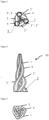
- An inventive article 10 was produced by first additively manufacturing a shell 4 and then filling it with a reaction mixture.
- the shell 4 was produced using the SLA process.
- the UV-reactive resin used was the photopolymer resin Greay FLGPGR03 from the manufacturer Formlabs and was processed in the SLA printer Form 2 from the manufacturer Formlabs.
- the shell forms a shape made of three intertwined, hollow elements (2, 2', 2") with a wall thickness of 2 mm.
- the elements (2, 2', 2") were open at the bottom to enable filling with polymer, as in Figure 1
- a reaction mixture was filled into this shell to form an object 10 as shown in Figure 2 to be shown.
- Figure 3 shows a plan view of the inventive article 10.
- the Figures 1 to 3 However, the objects 10 shown are only examples and can have any shape achieved by 3D printing.
- the prepolymer mixture has a drying time of 3 h, determined in a moisture curing system at 23 °C and 50% relative humidity.
- an object 10 made of an additively produced shell 4 that is completely filled with a polymer.
- the shell 4 and the cured polymer are connected to one another in a way that has little tension between the shell 4 and the volume 3, 3', 3" that surrounds the shell 4 formed by the walls 1.
- the object 10 has a high level of stability due to this firm form fit.
- the shell 4 and the polymer are firmly connected to one another so that they preferably cannot be separated from one another again without destroying the object 10. In this way, geometrically complex and voluminous structures can be created very quickly, which would not be possible without 3D printing.
Landscapes
- Chemical & Material Sciences (AREA)
- Engineering & Computer Science (AREA)
- Materials Engineering (AREA)
- Manufacturing & Machinery (AREA)
- Physics & Mathematics (AREA)
- Mechanical Engineering (AREA)
- Optics & Photonics (AREA)
Description
Die vorliegende Erfindung betrifft ein Verfahren zur Herstellung eines Gegenstandes, umfassend die Schritte: Herstellen einer Hülle, welche ein Volumen zur Aufnahme eines Fluids umfasst, mittels eines additiven Herstellungsverfahrens aus einem Aufbaumaterial; Bereitstellen einer Reaktionsmischung umfassend eine Polyisocyanatkomponente und eine Polyolkomponente in dem Volumen und Reagierenlassen der Reaktionsmischung in dem Volumen, so dass ein wenigstens teilweise in dem Volumen vorliegendes Polymer erhalten wird. Die Erfindung betrifft weiterhin einen Gegenstand, erhältlich durch ein erfindungsgemäßes Verfahren, umfassend eine Hülle, welche ein innerhalb der Hülle befindliches Volumen definiert und einen das Volumen ganz oder teilweise ausfüllenden Schaum. Die Hülle kann nachträglich ganz oder teilweise entfernt werden, um komplex geformte Schaumkörper zu erhalten.The present invention relates to a method for producing an object, comprising the steps of: producing a shell which comprises a volume for receiving a fluid, by means of an additive manufacturing process from a construction material; providing a reaction mixture comprising a polyisocyanate component and a polyol component in the volume and allowing the reaction mixture to react in the volume so that a polymer is at least partially present in the volume. The invention further relates to an object obtainable by a method according to the invention, comprising a shell which defines a volume located within the shell and a foam which completely or partially fills the volume. The shell can subsequently be completely or partially removed in order to obtain complex-shaped foam bodies.
Als additive Fertigungsverfahren werden solche Verfahren bezeichnet, mit denen Gegenstände schichtweise aufgebaut werden. Sie unterscheiden sich daher deutlich von anderen Verfahren zur Herstellung von Gegenständen wie Fräsen, Bohren oder Zerspanen. Bei letztgenannten Verfahren wird ein Gegenstand so bearbeitet, dass er durch Wegnahme von Material seine Endgeometrie erhält.Additive manufacturing processes are those processes in which objects are built up layer by layer. They therefore differ significantly from other methods for producing objects such as milling, drilling or machining. In the latter processes, an object is processed in such a way that it receives its final geometry by removing material.
Additive Fertigungsverfahren nutzen unterschiedliche Materialien und Prozesstechniken, um Gegenstände schichtweise aufzubauen. Beim sogenannten Fused Deposition Modeling (FDM) beispielsweise wird ein thermoplastischer Kunststoffdraht verflüssigt und mit Hilfe einer Düse schichtweise auf einer beweglichen Bauplattform abgelegt. Beim Erstarren entsteht ein fester Gegenstand. Die Steuerung der Düse und der Bauplattform erfolgt auf der Grundlage einer CAD-Zeichnung des Gegenstands. Ist die Geometrie dieses Gegenstands komplex, zum Beispiel mit geometrischen Hinterschneidungen, müssen zusätzlich Stützmaterialien mitgedruckt und nach Fertigstellung des Gegenstands wieder entfernt werden.Additive manufacturing processes use different materials and process techniques to build objects layer by layer. In so-called Fused Deposition Modeling (FDM), for example, a thermoplastic wire is liquefied and deposited layer by layer on a movable construction platform using a nozzle. When it solidifies, a solid object is created. The nozzle and the construction platform are controlled based on a CAD drawing of the object. If the geometry of this object is complex, for example with geometric undercuts, additional support materials must be printed and removed again after the object is finished.
Daneben existieren additive Fertigungsverfahren, welche thermoplastische Pulver nutzen, um Gegenstände schichtweise aufzubauen. Hierbei werden über einen so genannten Beschichter dünne Pulverschichten aufgetragen und anschließend mittels einer Energiequelle selektiv aufgeschmolzen. Das umgebende Pulver stützt dabei die Bauteilgeometrie. Komplexe Geometrien sind dadurch wirtschaftlicher zu fertigen als beim zuvor beschrieben FDM-Verfahren. Zudem können verschiedene Gegenstände eng gepackt im so genannten Pulverbett angeordnet beziehungsweise gefertigt werden. Aufgrund dieser Vorteile gelten pulverbasierte additive Fertigungsverfahren zu den wirtschaftlichsten additiven Herstellungsverfahren am Markt. Sie werden daher überwiegend von industriellen Nutzern verwendet. Beispiele für pulverbasierte additive Fertigungsverfahren sind das sogenannte Lasersintern (SLS, Selective Laser Sintering) oder das High Speed Sintering (HSS). oder das High Speed Sintering (HSS). Sie unterscheiden sich untereinander in der Methode, um die Energie für das selektive Aufschmelzen in den Kunststoff einzutragen. Beim Lasersinterverfahren erfolgt der Energieeintrag über einen gelenkten Laserstrahl. Beim so genannten High Speed Sintering (HSS)-Verfahren (
Eine weitere Gruppe von additiven Fertigungsverfahren setzt radikalisch vernetzbare Harze ein, welche gegebenenfalls über einen zweiten Härtungsmechanismus ihre Endfestigkeit im gebildeten Gegenstand erhalten. Beispiele für solche Verfahren sind Stereolithographieverfahren und das davon abgeleitete sogenannte DLP-Verfahren.Another group of additive manufacturing processes uses radically cross-linkable resins, which may obtain their final strength in the formed object via a second curing mechanism. Examples of such processes are stereolithography processes and the so-called DLP process derived from them.
Im technischen Gebiet der Beschichtungen sind sogenannte "dual cure"-Systeme bekannt, bei denen das flüssig aufgetragene Beschichtungsmaterial zunächst radikalisch, beispielsweise photochemisch, vernetzt wird und anschließend über Reaktionen von NCO-Gruppen mit geeigneten Reaktionspartnern weiter aushärten.In the technical field of coatings, so-called "dual cure" systems are known in which the liquid coating material is first crosslinked radically, for example photochemically, and then further cured via reactions of NCO groups with suitable reaction partners.
Das Vorliegen von Schaum oder anderen Füllungen zwischen 3D-gedruckten Wänden ist beispielsweise aus den Patentanmeldungen
Das Einführen von schaumbildenden Reaktionsgemischen in Hohlräume, wie es bei der Herstellung von PUR- oder PUR/PIR-Schaumkörpern bekannt ist, lässt sich nicht ohne weiteres auf 3D-gedruckte Hüllen übertragen. Reaktionsgemische für sogenannte "foam in place"-Verfahren oder "reaction injection moulding"-Verfahren sind auf hohe Reaktionsgeschwindigkeiten und dementsprechend niedrige Entformzeiten hin ausgelegt. Die hierbei auftretenden Drücke durch den aufsteigenden Schaum und das freigesetzte Treibmittel können jedoch leicht die mechanische Belastbarkeit von 3D-gedruckten Hüllen übersteigen.The introduction of foam-forming reaction mixtures into cavities, as is known in the production of PUR or PUR/PIR foam bodies, cannot be easily transferred to 3D-printed shells. Reaction mixtures for so-called "foam in place" processes or "reaction injection molding" processes are designed for high reaction speeds and correspondingly short demolding times. The pressures arising from the However, rising foam and the released propellant can easily exceed the mechanical strength of 3D printed shells.
Eine Aufgabe der vorliegenden Erfindung ist es, mindestens einen Nachteil des Standes der Technik wenigstens zu einem Teil zu überwinden. Weiterhin stellt sich die Erfindung die Aufgabe, ein additives Fertigungsverfahren bereitzustellen, bei dem die herzustellenden Gegenstände möglichst kosteneffizient und/oder individualisiert und/oder ressourcenschonend erhalten werden können, was insbesondere die Wiederverwertbarkeit von Aufbaumaterial betrifft.One object of the present invention is to at least partially overcome at least one disadvantage of the prior art. Furthermore, the invention has the object of providing an additive manufacturing process in which the objects to be produced can be obtained as cost-efficiently and/or individualized and/or resource-conserving as possible, which particularly concerns the recyclability of construction material.
Erfindungsgemäß gelöst wird die Aufgabe durch ein Verfahren gemäß Anspruch 1 und einen Gegenstand gemäß Anspruch 13. Vorteilhafte Weiterbildungen sind in den Unteransprüchen angegeben. Sie können beliebig kombiniert werden, sofern sich aus dem Kontext nicht eindeutig das Gegenteil ergibt.According to the invention, the object is achieved by a method according to
Ein Verfahren zur Herstellung eines Gegenstands umfasst die Schritte:
- Herstellen einer Hülle, welche ein Volumen zur Aufnahme eines Fluids umfasst, mittels eines additiven Herstellungsverfahrens aus einem Aufbaumaterial;
- Bereitstellen einer Reaktionsmischung umfassend eine Polyisocyanatkomponente und eine Polyolkomponente in dem Volumen;
- Reagierenlassen der Reaktionsmischung in dem Volumen, so dass ein wenigstens teilweise in dem Volumen vorliegendes Polymer erhalten wird.
- Producing a shell comprising a volume for receiving a fluid by means of an additive manufacturing process from a construction material;
- providing a reaction mixture comprising a polyisocyanate component and a polyol component in the volume;
- Allowing the reaction mixture to react in the volume to obtain a polymer at least partially present in the volume.
In dem Verfahren weist die Reaktionsmischung eine Abbindezeit von ≥ 2 Minuten auf.In the process, the reaction mixture has a setting time of ≥ 2 minutes.
Durch das erfindungsgemäße Verfahren lassen sich Gegenstände herstellen, deren äußere Form nur durch die Leistungsfähigkeit des gewählten additiven Fertigungsverfahrens und der eingesetzten Geräte beschränkt ist. Eine mechanische Verstärkung der Gegenstände erfolgt durch das durch Reaktion erhaltene Polymer. Somit lassen sich auch die Fertigungszeiten für die Gegenstände verringern, da nur die äußere Hülle gefertigt werden muss.The method according to the invention makes it possible to produce objects whose external shape is only limited by the performance of the additive manufacturing process selected and the equipment used. The objects are mechanically reinforced by the polymer obtained by reaction. This also reduces the production times for the objects, since only the outer shell needs to be manufactured.
Weiter lässt sich durch das erfindungsgemäße Verfahren ein komplex geformter Schaumgegenstand mit innenliegenden Schaumgeometrien herstellen, welcher durch herkömmliche Verfahren nicht zugänglich ist. In diesem Verfahren kann das durch ein additives Verfahren gefertigte formgebende Aufbaumaterial bevorzugt z.B. durch Schmelzen, Thermolyse oder Hydrolyse zum Teil zumindest wieder entfernt werden.Furthermore, the method according to the invention can be used to produce a complex-shaped foam object with internal foam geometries that cannot be accessed using conventional methods. In this method, the shaping construction material produced using an additive method can preferably be at least partially removed again, for example by melting, thermolysis or hydrolysis.
Vorzugsweise beträgt die Abbindezeit ≥ 3 Minuten, mehr bevorzugt ≥ 5 Minuten. Es ist weiter bevorzugt, dass die Abbindezeit ≥ 3 Minuten bis ≤ 90 Minuten oder ≥ 5 Minuten bis ≤ 60 Minuten beträgt.Preferably, the setting time is ≥ 3 minutes, more preferably ≥ 5 minutes. It is further It is preferred that the setting time is ≥ 3 minutes to ≤ 90 minutes or ≥ 5 minutes to ≤ 60 minutes.
Die Abbindezeit ist diejenige Zeit, nach der bei der Polyaddition zwischen NCO-reaktiven Komponenten und Polyisocyanat-Komponenten ein theoretisch unendlich ausgedehntes Polymer entstanden ist. Die Abbindezeit lässt sich experimentell dadurch ermitteln, dass in das aufschäumende Reaktionsgemisch in kurzen Abständen ein dünner Holzstab eingetaucht wird. Die Zeit vom Vermischen der Komponenten bis zu dem Zeitpunkt, bei dem am Stab beim Herausziehen Fäden hängenbleiben, ist die Abbindezeit.The setting time is the time after which a theoretically infinitely expanded polymer has been formed during the polyaddition between NCO-reactive components and polyisocyanate components. The setting time can be determined experimentally by dipping a thin wooden stick into the foaming reaction mixture at short intervals. The time from mixing the components to the point at which threads remain attached to the stick when it is pulled out is the setting time.
Reaktionsmischungen mit den erfindungsgemäßen, in der Fachwelt als langsam angesehenen Abbindezeiten gestatten es, dass die unerwünschten Nebeneffekte der exothermen Reaktion der Reaktionsmischung unter Ausbildung eines PUR- oder PUR/PIR-Materials die Hülle nicht beschädigen bzw. bei komplexen Geometrien zu einer ungewünschten stark uneinheitlichen Ausbildung der Schaumstruktur führen. Eine unerwünschte Wirkung ist zum Beispiel das Aufschmelzen oder Erweichen einer thermoplastischen Hülle unter Verlust der vorgesehenen Form. Durch eine langsamere Reaktion kann die freigesetzte Reaktionswärme besser abgeführt werden. Bei geschlossenen Hüllen ist zusätzlich der Druckaufbau im Inneren der Hülle durch die Reaktion unerwünscht, insbesondere in Kombination mit einem Aufschmelzen oder Erweichen von thermoplastischem Hüllenmaterial. Je langsamer die Reaktion fortschreitet, desto mehr Gas kann durch die Hülle nach Außen hindurchdiffundieren. Für das erfindungsgemäße Verfahren ist dabei gegebenenfalls erwünscht, das die additive gefertigte Hülle nicht vollständig gasdicht und/oder flüssigkeitsdicht ist.Reaction mixtures with the setting times according to the invention, which are considered slow in the professional world, allow the undesirable side effects of the exothermic reaction of the reaction mixture to form a PUR or PUR/PIR material not to damage the shell or, in the case of complex geometries, to lead to an undesirable, highly inconsistent formation of the foam structure. One undesirable effect is, for example, the melting or softening of a thermoplastic shell with loss of the intended shape. A slower reaction allows the released reaction heat to be dissipated better. In the case of closed shells, the pressure build-up inside the shell due to the reaction is also undesirable, particularly in combination with melting or softening of thermoplastic shell material. The slower the reaction progresses, the more gas can diffuse through the shell to the outside. For the process according to the invention, it may be desirable for the additively manufactured shell not to be completely gas-tight and/or liquid-tight.
Die erfindungsgemäße vorgesehene Abbindezeit kann durch verschiedene Maßnahmen einzeln oder in Kombination erreicht werden. So kann die Reaktionsmischung einen Amin-Katalysator enthalten. Eine andere Maßnahme ist der Einsatz von langsamer reagierenden aliphatischen Polyisocyanaten. Schließlich kann die Polyolkomponente difunktionelle Polyole enthalten, welche die Vernetzungsdichte im Endprodukt und auch im reagierenden Reaktionsgemisch herabsetzen und damit gegebenenfalls auch einen verlängernden Einfluss auf die Abbindezeit haben.The setting time provided for in the invention can be achieved by various measures, either individually or in combination. For example, the reaction mixture can contain an amine catalyst. Another measure is the use of slower-reacting aliphatic polyisocyanates. Finally, the polyol component can contain difunctional polyols, which reduce the crosslinking density in the end product and also in the reacting reaction mixture and thus possibly also have an effect on prolonging the setting time.
Zur Vereinfachung des Bereitstellens der Reaktionsmischung kann diese niedrigviskos eingestellt sein. Beispielsweise kann die Reaktionsmischung eine anfängliche Viskosität (20 °C, ASTM D 2393), das heißt unmittelbar nach dem Vermischen von Polyolkomponente und Isocyanatkomponente, von ≥ 100 mPas bis ≤ 5000 mPas aufweisen.To simplify the preparation of the reaction mixture, it can be made low-viscosity. For example, the reaction mixture can have an initial viscosity (20 °C, ASTM D 2393), i.e. immediately after mixing the polyol component and isocyanate component, of ≥ 100 mPas to ≤ 5000 mPas.
Das Volumen kann beispielsweise ≥ 1 cm3 bis ≤ 5000 cm3 betragen.The volume can be, for example, ≥ 1 cm 3 to ≤ 5000 cm 3 .
Nach dem Bereitstellen der Reaktionsmischung in dem Volumen kann die Hülle mitsamt der enthaltenen Reaktionsmischung im Raum gedreht oder geschwenkt werden, so dass sich die Reaktionsmischung gleichmäßig in der zur Verfügung stehenden Hülle verteilen kann.After providing the reaction mixture in the volume, the shell together with the The reaction mixture contained therein can be rotated or swiveled in space so that the reaction mixture can be evenly distributed in the available shell.
Es sind Fälle denkbar, in denen die Reaktionsmischung kein Treibmittel enthält und somit nicht zu einem Schaum aushärtet. Dann würde das erhaltene Polymer als massive Schicht auf der Innenseite der Hülle als dessen mechanische Verstärkung wirken. Die Vorteile des erfindungsgemäßen Verfahrens kommen jedoch besonders zum Tragen, wenn die Reaktionsmischung auch ein Treibmittel enthält. Hierbei kann es sich um physikalische und/oder chemische Treibmittel handeln.Cases are conceivable in which the reaction mixture does not contain a blowing agent and thus does not harden into a foam. The polymer obtained would then act as a solid layer on the inside of the casing to mechanically reinforce it. However, the advantages of the process according to the invention are particularly evident when the reaction mixture also contains a blowing agent. This can be a physical and/or chemical blowing agent.
Vorzugsweise umfasst das Aufbaumaterial ein Polyurethan-Polymer. Dann können Komponenten in der Reaktionsmischung mit noch verfügbaren reaktiven Gruppen des in der Hülle vorliegenden Polyurethan-Polymers unter Ausbildung einer stoffschlüssigen Verbindung miteinander reagieren. Besonders bevorzugt sind thermoplastische Polyurethane (TPU), insbesondere thermoplastische Polyurethan-Elastomere (TPE).The construction material preferably comprises a polyurethane polymer. Components in the reaction mixture can then react with any reactive groups still available in the polyurethane polymer present in the shell to form a material bond. Thermoplastic polyurethanes (TPU), in particular thermoplastic polyurethane elastomers (TPE), are particularly preferred.
Zur Herstellung des Polyurethan-Polymers im Aufbaumaterial eignen sich die dem Fachmann an sich bekannten organischen aliphatischen, cycloaliphatischen, araliphatischen und/oder aromatischen Polyisocyanate mit mindestens zwei Isocyanatgruppen pro Molekül sowie Gemische davon. Beispielsweise können NCO-terminierte Prepolymere eingesetzt werden.Suitable organic aliphatic, cycloaliphatic, araliphatic and/or aromatic polyisocyanates with at least two isocyanate groups per molecule and mixtures thereof, which are known to the person skilled in the art, are used to produce the polyurethane polymer in the building material. For example, NCO-terminated prepolymers can be used.
Als NCO-reaktive Verbindungen mit Zerewitinoff-aktiven H-Atomen zur Herstellung des Polyurethan-Polymers im Aufbaumaterial können alle dem Fachmann bekannten Verbindungen eingesetzt werden, welche eine mittlere OH- bzw. NH-Funktionalität von mindestens 1,5 aufweisen. Dies können beispielsweise niedermolekulare Diole (z. B. 1,2-Ethandiol, 1,3- bzw. 1,2-Propandiol, 1,4-Butandiol, 1,5-Petandiol, 1,6-Hexandiol), Triole (z. B. Glycerin, Trimethylolpropan) und Tetraole (z. B. Pentaerythrit) sein, kurzkettige Aminoalkohole, Polyamine aber auch höhermolekulare Polyhydroxyverbindungen wie Polyetherpolyole, Polyesterpolyole, Polycarbonatpolyole, Polyethercarbonatdiole, Polysiloxanpolyole, Polyamine und Polyetherpolyamine sowie Polybutadienpolyole.All compounds known to the person skilled in the art which have an average OH or NH functionality of at least 1.5 can be used as NCO-reactive compounds with Zerewitinoff-active H atoms for producing the polyurethane polymer in the building material. These can be, for example, low molecular weight diols (e.g. 1,2-ethanediol, 1,3- or 1,2-propanediol, 1,4-butanediol, 1,5-petanediol, 1,6-hexanediol), triols (e.g. glycerol, trimethylolpropane) and tetraols (e.g. pentaerythritol), short-chain amino alcohols, polyamines but also higher molecular weight polyhydroxy compounds such as polyether polyols, polyester polyols, polycarbonate polyols, polyether carbonate diols, polysiloxane polyols, polyamines and polyether polyamines as well as polybutadiene polyols.
Die NCO-Gruppen im Polyurethan-Polymer des Aufbaumaterials können teilweise blockiert sein. Dann umfasst das erfindungsgemäße Verfahren weiterhin den Schritt des Deblockierens dieser NCO-Gruppen. Nach ihrer Deblockierung stehen sie so für Reaktionen mit der Reaktionsmischung zur Verfügung unter Ausbildung einer stoffschlüssigen Verbindung.The NCO groups in the polyurethane polymer of the construction material can be partially blocked. The process according to the invention then further comprises the step of unblocking these NCO groups. After they have been unblocked, they are available for reactions with the reaction mixture to form a cohesive bond.
Das Blockierungsmittel wird so gewählt, dass bei Erwärmung die NCO-Gruppen wenigstens teilweise deblockieren. Beispiele für Blockierungsmittel sind Alkohole, Lactame, Oxime, Malonester, Alkylacetoacetate, Triazole, Phenole, Imidazole, Pyrazole sowie Amine, wie z.B. Butanonoxim, Diisopropylamin, 1,2,4-Triazol, Dimethyl-1,2,4-triazol, Imidazol, Malonsäurediethylester, Acetessigester, Acetonoxim, 3,5-Dimethylpyrazol, ε-Caprolactam, N-Methyl-, N-Ethyl-, N-(Iso)propyl-, N-n-Butyl-, N-iso-Butyl-, N-tert.-Butyl-benzylamin oder 1,1-Dimethylbenzylamin, N-Alkyl-N-1,1- Dimethylmethylphenylamin, Addukte von Benzylamin an Verbindungen mit aktivierten Doppelbindungen wie Malonsäureestern, N,N-Dimethylaminopropylbenzylamin und andere tertiäre Aminogruppen enthaltende gegebenenfalls substituierte Benzylamine und/oder Dibenzylamin oder beliebige Gemische dieser Blockierungsmittel.The blocking agent is chosen so that the NCO groups are at least partially unblocked when heated. Examples of blocking agents are alcohols, lactams, oximes, malonic esters, alkyl acetoacetates, triazoles, phenols, imidazoles, pyrazoles and amines such as butanone oxime, diisopropylamine, 1,2,4-triazole, dimethyl-1,2,4-triazole, imidazole, Diethyl malonate, acetoacetic ester, acetone oxime, 3,5-dimethylpyrazole, ε-caprolactam, N-methyl-, N-ethyl-, N-(iso)propyl-, Nn-butyl-, N-iso-butyl-, N-tert-butyl-benzylamine or 1,1-dimethylbenzylamine, N-alkyl-N-1,1-dimethylmethylphenylamine, adducts of benzylamine with compounds having activated double bonds such as malonic acid esters, N,N-dimethylaminopropylbenzylamine and other optionally substituted benzylamines and/or dibenzylamine containing tertiary amino groups or any mixtures of these blocking agents.
In einer bevorzugten Ausführungsform ist das Aufbaumaterial radikalisch vernetzbar und umfasst Gruppen mit Zerewitinoff-aktiven H-Atomen, die Hülle wird aus einem Vorläufer erhalten und das Verfahren umfasst die Schritte:
- I) Abscheiden von radikalisch vernetztem Aufbaumaterial auf einem Träger, so dass eine Lage eines mit dem Träger verbundenen Aufbaumaterials erhalten wird, welche einem ersten ausgewählten Querschnitt des Vorläufers entspricht;
- II) Abscheiden von radikalisch vernetztem Aufbaumaterial auf eine zuvor aufgetragene Lage des Aufbaumaterials, so dass eine weitere Lage des Aufbaumaterials erhalten wird, welche einem weiteren ausgewählten Querschnitt des Vorläufers entspricht und welche mit der zuvor aufgetragenen Lage verbunden ist;
- III) Wiederholen des Schritts II), bis der Vorläufer gebildet ist;
- wobei das Abscheiden von radikalisch vernetztem Aufbaumaterial wenigstens in Schritt II) durch Belichten und/oder Bestrahlen eines ausgewählten Bereichs eines radikalisch vernetzbaren Aufbaumaterials, entsprechend dem jeweils ausgewählten Querschnitt des Vorläufers, erfolgt und
- wobei das radikalisch vernetzbare Aufbaumaterial eine Viskosität (23 °C, DIN EN ISO 2884-1) von ≥ 5 mPas bis ≤ 100000 mPas aufweist,
- wobei das radikalisch vernetzbare Aufbaumaterial eine härtbare Komponente umfasst, in der NCO-Gruppen und olefinische C=C-Doppelbindungen vorliegen
- und nach Schritt III) weiterhin Schritt IV) durchgeführt wird:
IV) Erwärmen des nach Schritt III) erhaltenen Vorläufers auf eine Temperatur von ≥ 50 °C, so dass die Hülle erhalten wird.
- I) depositing radically cross-linked building material on a carrier so as to obtain a layer of building material bonded to the carrier which corresponds to a first selected cross-section of the precursor;
- II) depositing radically cross-linked building material onto a previously applied layer of the building material so as to obtain a further layer of the building material which corresponds to a further selected cross-section of the precursor and which is connected to the previously applied layer;
- III) repeating step II) until the precursor is formed;
- wherein the deposition of radically crosslinked building material is carried out at least in step II) by exposing and/or irradiating a selected region of a radically crosslinkable building material, corresponding to the respectively selected cross-section of the precursor, and
- wherein the radically crosslinkable building material has a viscosity (23 °C, DIN EN ISO 2884-1) of ≥ 5 mPas to ≤ 100000 mPas,
- wherein the radically crosslinkable building material comprises a curable component in which NCO groups and olefinic C=C double bonds are present
- and after step III) step IV) is continued:
IV) Heating the precursor obtained after step III) to a temperature of ≥ 50 °C to obtain the shell.
In dieser Variante wird somit die Hülle in zwei Herstellungsabschnitten erhalten. Der erste Herstellungsabschnitt kann als Aufbauabschnitt angesehen werden. Dieser Aufbauabschnitt lässt sich mittels strahlenoptischer additiver Fertigungsverfahren wie dem Inkjet-Verfahren, der Stereolithographie oder dem DLP (digital light processing)-Verfahren realisieren und ist Gegenstand der Schritte I), II) und III). Der zweite Herstellungsabschnitt kann als Härtungsabschnitt angesehen werden und ist Gegenstand des Schritts IV). Hier wird der nach dem Aufbauabschnitt erhaltene Vorläufer oder intermediäre Hülle ohne die Form weiter zu verändern in eine mechanisch dauerhaftere Hülle überführt.In this variant, the shell is obtained in two production stages. The first production stage can be considered as the construction stage. This construction stage allows can be realized using radiation-optical additive manufacturing processes such as the inkjet process, stereolithography or the DLP (digital light processing) process and is the subject of steps I), II) and III). The second production stage can be regarded as the hardening stage and is the subject of step IV). Here, the precursor or intermediate shell obtained after the construction stage is converted into a mechanically more durable shell without further changing the shape.
In Schritt I) dieser Variante des Verfahrens erfolgt das Abscheiden eines radikalisch vernetzten Aufbaumaterials auf einem Träger. Dieses ist gewöhnlich der erste Schritt in Inkjet-, Stereolithographie- und DLP-Verfahren. Auf diese Weise wird eine Lage eines mit dem Träger verbundenen Aufbaumaterials erhalten, welche einem ersten ausgewählten Querschnitt des Vorläufers entspricht.In step I) of this variant of the process, a radically cross-linked build material is deposited on a carrier. This is usually the first step in inkjet, stereolithography and DLP processes. In this way, a layer of build material bonded to the carrier is obtained, which corresponds to a first selected cross section of the precursor.
Gemäß der Anweisung von Schritt III) wird Schritt II) so lange wiederholt, bis der gewünschte Vorläufer gebildet ist. In Schritt II) erfolgt das Abscheiden eines radikalisch vernetzten Aufbaumaterials auf eine zuvor aufgetragene Lage des Aufbaumaterials, so dass eine weitere Lage des Aufbaumaterials erhalten wird, welche einem weiteren ausgewählten Querschnitt des Vorläufers entspricht und welche mit der zuvor aufgetragenen Lage verbunden ist. Bei der zuvor aufgetragenen Lage des Aufbaumaterials kann es sich um die erste Lage aus Schritt I) oder um eine Lage aus einer vorigen Durchlauf des Schritts II) handeln.According to the instructions of step III), step II) is repeated until the desired precursor is formed. In step II), a radically cross-linked build material is deposited on a previously applied layer of the build material, so that a further layer of the build material is obtained which corresponds to another selected cross-section of the precursor and which is connected to the previously applied layer. The previously applied layer of the build material can be the first layer from step I) or a layer from a previous run of step II).
Es ist in dieser Verfahrensvariante vorgesehen, dass das Abscheiden eines radikalisch vernetzten Aufbaumaterials wenigstens in Schritt II) (vorzugsweise auch in Schritt I) durch Belichten und/oder Bestrahlen eines ausgewählten Bereichs eines radikalisch vernetzbaren Harzes, entsprechend dem jeweils ausgewählten Querschnitt des Vorläufers, erfolgt. Dieses kann sowohl durch selektives Belichten (Stereolithographie, DLP) des vernetzbaren Aufbaumaterials als auch durch selektives Auftragen des vernetzbaren Aufbaumaterials, gefolgt von einem Belichtungsschritt, der aufgrund des vorigen selektiven Auftragens des vernetzbaren Aufbaumaterials nicht mehr selektiv sein muss (Inkjet-Verfahren).In this process variant, it is provided that the deposition of a radically cross-linked building material takes place at least in step II) (preferably also in step I) by exposing and/or irradiating a selected area of a radically cross-linkable resin, corresponding to the respective selected cross-section of the precursor. This can be done both by selective exposure (stereolithography, DLP) of the cross-linkable building material and by selective application of the cross-linkable building material, followed by an exposure step which no longer has to be selective due to the previous selective application of the cross-linkable building material (inkjet process).
Im Kontext dieser Verfahrensvariante werden die Begriffe "radikalisch vernetzbares Aufbaumaterial" und "radikalisch vernetztes Aufbaumaterial" benutzt. Hierbei wird das radikalisch vernetzbare Aufbaumaterial durch das Belichten und/oder Bestrahlen, welches radikalische Vernetzungsreaktionen auslöst, in das radikalisch vernetzte Aufbaumaterial überführt. Unter "Belichten" wird hierbei die Einwirkung von Licht im Bereich zwischen nahem IR- und nahem UV-Licht (1400 nm bis 315 nm Wellenlänge) verstanden. Die übrigen kürzeren Wellenlängenbereiche werden durch den Begriff "Bestrahlen" abgedeckt, zum Beispiel fernes UV-Licht, Röntgenstrahlung, Gammastrahlung und auch Elektronenstrahlung.In the context of this process variant, the terms "radically cross-linkable building material" and "radically cross-linked building material" are used. The radically cross-linkable building material is converted into the radically cross-linked building material by exposure and/or irradiation, which triggers radical cross-linking reactions. "Exposure" here means the effect of light in the range between near IR and near UV light (1400 nm to 315 nm wavelength). The other shorter wavelength ranges are covered by the term "irradiation", for example far UV light, X-rays, gamma radiation and also electron beams.
Das Auswählen des jeweiligen Querschnitts erfolgt zweckmäßigerweise durch ein CAD-Programm, mit dem ein Modell der herzustellenden Hülle erzeugt wurde. Diese Operation wird auch "Slicing" genannt, und dient als Grundlage für die Steuerung der Belichtung und/oder Bestrahlung des radikalisch vernetzbaren Harzes.The selection of the respective cross-section is conveniently carried out using a CAD program with which a model of the shell to be produced has been created. This operation is also called "slicing" and serves as the basis for controlling the exposure and/or irradiation of the radically cross-linkable resin.
Das radikalisch vernetzbare Aufbaumaterial weist in dieser Verfahrensvariante eine Viskosität (23 °C, DIN EN ISO 2884-1) von ≥ 5 mPas bis ≤ 100000 mPas auf. Somit ist es zumindest für die Zwecke der additiven Fertigung als flüssiges Harz anzusehen. Vorzugsweise beträgt die Viskosität ≥ 50 mPas bis ≤ 10000 mPas, mehr bevorzugt > 500 mPas bis ≤ 5000 mPas.In this process variant, the radically crosslinkable build-up material has a viscosity (23 °C, DIN EN ISO 2884-1) of ≥ 5 mPas to ≤ 100,000 mPas. It is therefore to be regarded as a liquid resin, at least for the purposes of additive manufacturing. The viscosity is preferably ≥ 50 mPas to ≤ 10,000 mPas, more preferably > 500 mPas to ≤ 5,000 mPas.
Weiterhin umfasst in dem Verfahren das radikalisch vernetzbare Harz eine härtbare Komponente, in der NCO-Gruppen und olefinische C=C-Doppelbindungen vorliegen. In dieser härtbaren Komponente kann das molare Verhältnis von NCO-Gruppen und olefinischen C=C-Doppelbindungen in einem Bereich von ≥ 1:5 bis ≤ 5:1 (bevorzugt ≥ 1:4 bis ≤ 4:1, mehr bevorzugt ≥ 1:3 bis ≤ 3:1) liegen. Das molekulare Verhältnis dieser funktionellen Gruppen lässt sich durch die Integration der Signale einer Probe im 13C-NMR-Spektrum ermitteln.Furthermore, in the process, the radically crosslinkable resin comprises a curable component in which NCO groups and olefinic C=C double bonds are present. In this curable component, the molar ratio of NCO groups and olefinic C=C double bonds can be in a range from ≥ 1:5 to ≤ 5:1 (preferably ≥ 1:4 to ≤ 4:1, more preferably ≥ 1:3 to ≤ 3:1). The molecular ratio of these functional groups can be determined by integrating the signals of a sample in the 13 C NMR spectrum.
Neben der härtbaren Komponente kann das radikalisch vernetzbare Aufbaumaterial auch eine nicht härtbare Komponente umfassen, in der beispielsweise Stabilisatoren, Füllstoffe und dergleichen zusammengefasst sind. In der härtbaren Komponente können die NCO-Gruppen und die olefinischen C=C-Doppelbindungen in getrennten Molekülen und/oder in einem gemeinsamen Molekül vorliegen. Wenn NCO-Gruppen und olefinische C=C-Doppelbindungen in getrennten Molekülen vorliegen, weist der nach Schritt IV) dieser Verfahrensvariante erhaltene Körper ein interpenetrierendes Polymer-Netzwerk auf.In addition to the curable component, the radically crosslinkable building material can also comprise a non-curable component, in which, for example, stabilizers, fillers and the like are combined. In the curable component, the NCO groups and the olefinic C=C double bonds can be present in separate molecules and/or in a common molecule. If NCO groups and olefinic C=C double bonds are present in separate molecules, the body obtained after step IV) of this process variant has an interpenetrating polymer network.
In dieser Variante des Verfahrens wird weiterhin nach Schritt III) weiterhin Schritt IV) durchgeführt. In diesem Schritt erfolgt das Erwärmen des nach Schritt III) erhaltenen Vorläufers auf eine Temperatur von ≥ 50 °C, vorzugsweise ≥ 65 °C, mehr bevorzugt ≥ 80 °C, besonders bevorzugt ≥ 80 °C bis ≤ 200 °C, so dass die Hülle erhalten wird. Das Erwärmen kann für eine Zeitspanne von ≥ 1 Minute, bevorzugt ≥ 5 Minuten, mehr bevorzugt ≥ 10 Minuten bis ≤ 24 Stunden bevorzugt ≤ 8 Stunden, besonders bevorzugt < 4 Stunden, erfolgen.In this variant of the process, step IV) is also carried out after step III). In this step, the precursor obtained after step III) is heated to a temperature of ≥ 50 °C, preferably ≥ 65 °C, more preferably ≥ 80 °C, particularly preferably ≥ 80 °C to ≤ 200 °C, so that the shell is obtained. The heating can take place for a period of ≥ 1 minute, preferably ≥ 5 minutes, more preferably ≥ 10 minutes to ≤ 24 hours, preferably ≤ 8 hours, particularly preferably < 4 hours.
Vorzugsweise wird die Reaktion durchgeführt, bis ≤ 20%, bevorzugt ≤ 10% und mehr bevorzugt ≤ 5% der ursprünglich vorhandenen NCO-Gruppen noch vorhanden sind. Dieses lässt sich mittels quantitativer IR-Spektroskopie bestimmenPreferably, the reaction is carried out until ≤ 20%, preferably ≤ 10% and more preferably ≤ 5% of the originally present NCO groups are still present. This can be determined by quantitative IR spectroscopy
Es ist bevorzugt, dass Schritt IV) erst dann durchgeführt wird, wenn das gesamte Aufbaumaterial des Vorläufers seinen Gelpunkt erreicht hat. Der Gelpunkt wird als erreicht angesehen, wenn in einer dynamisch-mechanischen Analyse (DMA) mit einem Platte/Platte-Oszillationsviskosimeter gemäß ISO 6721-10 bei 20 °C sich die Graphen des Speichermoduls G` und des Verlustmoduls G" kreuzen. Gegebenenfalls wird der Vorläufer weiterer Belichtung und/oder Bestrahlung zur Vervollständigung der radikalischen Vernetzung ausgesetzt. Das radikalisch vernetzte Aufbaumaterial kann ein Speichermodul G` (DMA, Platte/Platte-Oszillationsviskosimeter gemäß ISO 6721-10 bei 20 °C und einer Scherrate von 1/s) von ≥ 106 Pa aufweisen.It is preferred that step IV) is only carried out when all the precursor build-up material has reached its gel point. The gel point is considered to have been reached when in a dynamic mechanical analysis (DMA) with a plate/plate oscillation viscometer according to ISO 6721-10 at 20 °C, the graphs of the storage modulus G` and the loss modulus G" cross each other. If necessary, the precursor is subjected to further exposure and/or irradiation to complete the radical crosslinking. The radically crosslinked build material can have a storage modulus G` (DMA, plate/plate oscillation viscometer according to ISO 6721-10 at 20 °C and a shear rate of 1/s) of ≥ 10 6 Pa.
Das radikalisch vernetzbare Aufbaumaterial kann weiterhin Additive wie Füllstoffe, UV-Stabilisatoren, Radikalinhibitoren, Antioxidantien, Formtrennmittel, Wasserfänger, Slipadditive, Entschäumer, Verlaufsmittel, Rheologieadditive, Flammschutzmittel und/oder Pigmente enthalten. Diese Hilfs- und Zusatzmittel, ausgenommen Füllstoffe und Flammschutzmittel, liegen üblicherweise in einer Menge von weniger als 10 Gew.-%, vorzugsweise weniger als 5 Gew.-%, besonders bevorzugt bis zu 3 Gew.-%, bezogen auf das radikalisch vernetzbare Harz vor. Flammschutzmittel liegen üblicherweise in Mengen von höchstens 70 Gew.-%, vorzugsweise höchstens 50 Gew.-%, besonders bevorzugt höchstens 30 Gew.-%, berechnet als Gesamtmenge an eingesetzten Flammschutzmitteln bezogen auf das Gesamtgewicht des radikalisch vernetzbaren Aufbaumaterials vor.The radically crosslinkable building material can also contain additives such as fillers, UV stabilizers, radical inhibitors, antioxidants, mold release agents, water scavengers, slip additives, defoamers, flow control agents, rheology additives, flame retardants and/or pigments. These auxiliaries and additives, with the exception of fillers and flame retardants, are usually present in an amount of less than 10% by weight, preferably less than 5% by weight, particularly preferably up to 3% by weight, based on the radically crosslinkable resin. Flame retardants are usually present in amounts of at most 70% by weight, preferably at most 50% by weight, particularly preferably at most 30% by weight, calculated as the total amount of flame retardants used based on the total weight of the radically crosslinkable building material.
Geeignete Füllstoffe sind beispielsweise AlOH3, CaCO3, Metallpigmente wie TiOz und weitere bekannte übliche Füllstoffe. Diese Füllstoffe werden vorzugsweise in Mengen von höchstens 70 Gew.-%, bevorzugt höchstens 50 Gew.-%, besonders bevorzugt höchstens 30 Gew.-%, berechnet als Gesamtmenge an eingesetzten Füllstoffen bezogen auf das Gesamtgewicht des radikalisch vernetzbaren Harzes, eingesetzt.Suitable fillers are, for example, AlOH 3 , CaCO 3 , metal pigments such as
Geeignete UV-Stabilisatoren können vorzugsweise ausgewählt werden aus der Gruppe, bestehend aus Piperidinderivaten, wie z.B. 4-Benzoyloxy-2,2,6,6-tetramethylpiperidin, 4-Benzoyloxy-1,2,2,6,6-pentamethylpiperidin, Bis-(2,2,6,6-tetra-methyl-4-piperidyl)-sebacat, Bis(1,2,2,6,6-pentamethyl-1-4-piperidinyl)-sebacat, Bis-(2,2,6,6-tetramethyl-4-piperidyl)-suberat, Bis-(2,2,6,6-tetramethyl-4-piperidyl)-dodecandioat; Benzophenonderivaten, wie z.B. 2,4-Dihydroxy-, 2-Hydroxy-4-methoxy-, 2-Hydroxy-4-octoxy-, 2-Hydroxy-4-dodecyloxy- oder 2,2'-Dihydroxy-4-dodecyloxy-benzophenon; Benztriazolderivaten, wie z.B. 2-(2H-Benzotriazol-2-yl)-4,6-di-tert-pentylphenol, 2-(2H-Benzotriazol-2-yl)-6-dodecyl-4-methylphenol, 2-(2H-Benzotriazol-2-yl)-4,6-bis(1-methyl-1-phenylethyl)phenol, 2-(5-Chlor-2H-benzotriazol-2-yl)-6-(1,1-dimethylethyl)-4-methylphenol, 2-(2H-benzotriazol-2-yl)-4-(1,1,3,3-tetramethylbutyl)phenol, 2-(2H-Benzotriazol-2-yl)-6-(1-methyl-1-phenylethyl)-4-(1,1,3,3-tetramethylbutyl)phenol, Isooctyl-3-(3-(2H-benzotriazol-2-yl)-5-(1,1-dimethylethyl)-4-hydroxyphenylpropionat), 2-(2H-Benzotriazol-2-yl)-4,6-bis(1,1-dimethylethyl)phenol, 2-(2H-Benzotriazol-2-yl)-4,6-bis(1-methyl-1-phenylethyl)phenol, 2-(5-Chlor-2H-benzotriazol-2-yl)-4,6-bis(1,1-dimethylethyl)phenol; Oxalaniliden, wie z.B. 2-Ethyl-2'-ethoxy- oder 4-Methyl-4'-methoxyoxalanilid; Salicylsäureestern, wie z.B. Salicylsäurephenylester, Salicylsäure-4-tert-butylphenylester, Salicylsäure-4-tert-octylphenylester; Zimtsäureesterderivaten, wie z.B. α-Cyano-β-methyl-4-methoxyzimtsäuremethylester, α-Cyano-β-methyl-4-methoxyzimtsäurebutyl-ester, α-Cyano-β-phenylzimtsäureethylester, α-Cyano-β-phenylzimtsäureisooctylester; und Malonesterderivaten, wie z.B. 4-Methoxybenzylidenmalonsäuredimethylester, 4-Methoxybenzylidenmalonsäurediethylester, 4-Butoxybenzylidenmalonsäuredimethylester. Diese bevorzugten Lichtstabilisatoren können sowohl einzeln als auch in beliebigen Kombinationen untereinander zum Einsatz kommen.Suitable UV stabilizers can preferably be selected from the group consisting of piperidine derivatives, such as 4-benzoyloxy-2,2,6,6-tetramethylpiperidine, 4-benzoyloxy-1,2,2,6,6-pentamethylpiperidine, bis-(2,2,6,6-tetra-methyl-4-piperidyl)-sebacate, bis(1,2,2,6,6-pentamethyl-1-4-piperidinyl)-sebacate, bis-(2,2,6,6-tetramethyl-4-piperidyl)-suberate, bis-(2,2,6,6-tetramethyl-4-piperidyl)-dodecanedioate; benzophenone derivatives such as 2,4-dihydroxy, 2-hydroxy-4-methoxy, 2-hydroxy-4-octoxy, 2-hydroxy-4-dodecyloxy or 2,2'-dihydroxy-4-dodecyloxy-benzophenone; Benztriazole derivatives, such as 2-(2H-benzotriazol-2-yl)-4,6-di-tert-pentylphenol, 2-(2H-benzotriazol-2-yl)-6-dodecyl-4-methylphenol, 2-(2H-benzotriazol-2-yl)-4,6-bis(1-methyl-1-phenylethyl)phenol, 2-(5-chloro-2H-benzotriazol-2-yl). )-6-(1,1-dimethylethyl)-4-methylphenol, 2-(2H-benzotriazol-2-yl)-4-(1,1,3,3-tetramethylbutyl)phenol, 2-(2H-benzotriazol-2-yl)-6-(1-methyl-1-phenylethyl)-4-(1,1,3,3-tetramethylbutyl)phenol, Isooctyl-3-(3-(2H-benzotriazol-2-yl)-5-(1,1-dimethylethyl)-4-hydroxyphenylpropionate), 2-(2H-benzotriazol-2-yl)-4,6-bis(1,1-dimethylethyl)phenol, 2-(2H-benzotriazol-2-yl)-4,6-bis(1-methyl-1-phenylethyl)phenol, 2-(5-chloro-2H -benzotriazol-2-yl)-4,6-bis(1,1-dimethylethyl)phenol; oxalanilides, such as 2-ethyl-2'-ethoxy- or 4-methyl-4'-methoxyoxalanilide; Salicylic acid esters, such as salicylic acid phenyl ester, Salicylic acid 4-tert-butylphenyl ester, salicylic acid 4-tert-octylphenyl ester; cinnamic acid ester derivatives, such as methyl α-cyano-β-methyl-4-methoxycinnamate, butyl α-cyano-β-methyl-4-methoxycinnamate, ethyl α-cyano-β-phenylcinnamate, isooctyl α-cyano-β-phenylcinnamate; and malonic ester derivatives, such as dimethyl 4-methoxybenzylidenemalonate, diethyl 4-methoxybenzylidenemalonate, dimethyl 4-butoxybenzylidenemalonate. These preferred light stabilizers can be used individually or in any combination with one another.
Besonders bevorzugte UV-Stabilisatoren sind solche, die Strahlung einer Wellenlänge < 400 nm vollständig absorbieren. Hierzu zählen beispielsweise die genannten Benztriazolderivate. Ganz besonders bevorzugte UV-Stabilisatoren sind 2-(5-Chlor-2H-benzotriazol-2-yl)-6-(1,1-dimethylethyl)-4-methylphenol, 2-(2H-benzotriazol-2-yl)-4-(1,1,3,3-tetramethylbutyl)phenol und/oder 2-(5-Chlor-2H-benzotriazol-2-yl)-4,6-bis(1,1-dimethylethyl)phenol.Particularly preferred UV stabilizers are those that completely absorb radiation with a wavelength of < 400 nm. These include, for example, the benzotriazole derivatives mentioned. Very particularly preferred UV stabilizers are 2-(5-chloro-2H-benzotriazol-2-yl)-6-(1,1-dimethylethyl)-4-methylphenol, 2-(2H-benzotriazol-2-yl)-4-(1,1,3,3-tetramethylbutyl)phenol and/or 2-(5-chloro-2H-benzotriazol-2-yl)-4,6-bis(1,1-dimethylethyl)phenol.
Gegebenenfalls werden ein oder mehrere der beispielhaft genannten UV-Stabilisatoren dem radikalisch vernetzbaren Aufbaumaterial vorzugsweise in Mengen von 0,001 bis 3,0 Gew.-%, besonders bevorzugt 0,005 bis 2 Gew.-%, berechnet als Gesamtmenge an eingesetzten UV-Stabilisatoren bezogen auf das Gesamtgewicht des radikalisch vernetzbaren Aufbaumaterials, zugesetzt.If appropriate, one or more of the UV stabilizers mentioned as examples are added to the radically crosslinkable building material, preferably in amounts of 0.001 to 3.0% by weight, particularly preferably 0.005 to 2% by weight, calculated as the total amount of UV stabilizers used based on the total weight of the radically crosslinkable building material.
Geeignete Antioxidantien sind vorzugsweise sterisch gehinderten Phenole, welche vorzugsweise ausgewählt werden können aus der Gruppe, bestehend aus 2,6-Di-tert-butyl-4-methylphenol (Ionol), Pentaerythrit-tetrakis(3-(3,5-di-tert-butyl-4-hydroxy-phenyl)-propionat), Octadecyl-3-(3,5-di-tert-butyl-4-hydroxyphenyl)-propionat, Triethylen-glykol-bis(3-tert-butyl-4-hydroxy-5-methylphenyl)propionat, 2,2'-Thio-bis(4-methyl-6-tert-butylphenol) und 2,2'-Thiodiethyl-bis[3-(3,5-di-tert-butyl-4-hydroxyphenyl)propionat]. Diese können bei Bedarf sowohl einzeln als auch in beliebigen Kombinationen untereinander eingesetzt werden. Diese Antioxidantien werden vorzugsweise in Mengen von 0,01 bis 3,0 Gew.-%, besonders bevorzugt 0,02 bis 2,0 Gew.-%, berechnet als Gesamtmenge an eingesetzten Antioxidantien bezogen auf das Gesamtgewicht des radikalisch vernetzbaren Aufbaumaterials, eingesetzt.Suitable antioxidants are preferably sterically hindered phenols, which can preferably be selected from the group consisting of 2,6-di-tert-butyl-4-methylphenol (ionol), pentaerythritol tetrakis(3-(3,5-di-tert-butyl-4-hydroxyphenyl)propionate), octadecyl 3-(3,5-di-tert-butyl-4-hydroxyphenyl)propionate, triethylene glycol bis(3-tert-butyl-4-hydroxy-5-methylphenyl)propionate, 2,2'-thio-bis(4-methyl-6-tert-butylphenol) and 2,2'-thiodiethyl bis[3-(3,5-di-tert-butyl-4-hydroxyphenyl)propionate]. These can be used individually or in any combination with one another if required. These antioxidants are preferably used in amounts of 0.01 to 3.0 wt.%, particularly preferably 0.02 to 2.0 wt.%, calculated as the total amount of antioxidants used based on the total weight of the radically crosslinkable building material.
Geeignete Radikalinhibitoren bzw. Verzögerer sind besonders solche, die eine unkontrollierte radikalische Polymerisation der Harzformulierung außerhalb des gewünschten (bestrahlten) Bereiches gezielt inhibieren. Diese sind für eine gute Randschärfe und Abbildungsgenauigkeit im Vorläufer entscheidend. Geeignete Radikalinhibitoren müssen entsprechend der gewünschten Radikalausbeute aus dem Bestrahlungs-/Belichtungsschritt und der Polymerisationsgeschwindigkeit und Reaktivität/Selektivität der Doppelbindungsträger ausgesucht werden. Geeignete Radikalinhibitoren sind z. B. 2,2-(2,5-thiophendiyl)bis(5-tertbutylbenzoxazol), Phenothiazin, Hydrochinone, Hydrochinonether, Quinonalkyde und Nitroxylverbindungen sowie Mischungen davon, Benzoquinone, Kupfer Salze, Brenzcatechine, Cresole, Nitrobenzol und Sauerstoff. Diese Antioxidantien werden vorzugsweise in Mengen von 0,001 Gew% bis 3 Gew.% eingesetzt.Suitable radical inhibitors or retarders are particularly those that specifically inhibit uncontrolled radical polymerization of the resin formulation outside the desired (irradiated) area. These are crucial for good edge sharpness and imaging accuracy in the precursor. Suitable radical inhibitors must be selected according to the desired radical yield from the irradiation/exposure step and the polymerization rate and reactivity/selectivity of the double bond carriers. Suitable radical inhibitors are, for example, 2,2-(2,5-thiophenediyl)bis(5-tert-butylbenzoxazole), Phenothiazine, hydroquinones, hydroquinone ethers, quinone alkyds and nitroxyl compounds and mixtures thereof, benzoquinones, copper salts, pyrocatechols, cresols, nitrobenzene and oxygen. These antioxidants are preferably used in amounts of 0.001% to 3% by weight.
In einer weiteren bevorzugten Ausführungsform liegen in de radikalisch vernetzbaren Aufbaumaterial die olefinischen Doppelbindungen zumindest teilweise in Form von (Meth)Acrylatgruppen vor.In a further preferred embodiment, the olefinic double bonds in the radically crosslinkable building material are at least partially in the form of (meth)acrylate groups.
In einer weiteren bevorzugten Ausführungsform umfasst das radikalisch vernetzbare Aufbaumaterial eine Verbindung, die aus der Reaktion eines NCO-terminierten Polyisocyanatprepolymers mit einem, bezogen auf die freien NCO-Gruppen, molaren Unterschuss eines Hydroxyalkyl(meth)acrylats erhältlich ist.In a further preferred embodiment, the radically crosslinkable building material comprises a compound which is obtainable from the reaction of an NCO-terminated polyisocyanate prepolymer with a molar deficit of a hydroxyalkyl (meth)acrylate, based on the free NCO groups.
In einer weiteren bevorzugten Ausführungsform umfasst das radikalisch vernetzbare Aufbaumaterial eine Verbindung, die aus der Reaktion eines NCO-terminierten Polyisocyanurats mit einem, bezogen auf die freien NCO-Gruppen, molaren Unterschuss eines Hydroxyalkyl(meth)acrylats erhältlich ist.In a further preferred embodiment, the radically crosslinkable building material comprises a compound which is obtainable from the reaction of an NCO-terminated polyisocyanurate with a molar deficit of a hydroxyalkyl (meth)acrylate, based on the free NCO groups.
Geeignete Polyisocyanate zur Herstellung der NCO-terminierten Polyisocyanurate und Prepolymere sind beispielsweise solche, die ein Molekulargewicht im Bereich von 140 bis 400 g/mol aufweisen, mit aliphatisch, cycloaliphatisch, araliphatisch und/oder aromatisch gebundenen Isocyanatgruppen, wie z. B. 1,4-Diisocyanatobutan (BDI), 1,5-Diisocyanatopentan (PDI), 1,6-Diisocyanatohexan (HDI), 2-Methyl-1,5-diisocyanatopentan, 1,5-Diisocyanato-2,2-dimethylpentan, 2,2,4- bzw. 2,4,4-Trimethyl-1,6-diisocyanatohexan, 1,10-Diisocyanatodecan, 1,3- und 1,4-Diisocyanatocyclohexan, 1,4-Diisocyanato-3,3,5-trimethylcyclohexan, 1,3-Diisocyanato-2-methylcyclohexan, 1,3-Diisocyanato-4-methylcyclohexan, 1-Isocyanato-3,3,5-trimethyl-5-isocyanatomethyl-cyclohexan (Isophorondiisocyanat; IPDI), 1-Isocyanato-1-methyl-4(3)-isocyanatomethylcyclohexan, 2,4'- und 4,4'-Diisocyanatodicyclohexylmethan (H12MDI), 1,3- und 1,4-Bis(isocyanatomethyl)cyclohexan, Bis-(isocyanatomethyl)-norbornan (NBDI), 4,4'-Diisocyanato-3,3'-dimethyldicyclohexylmethan, 4,4'-Diisocyanato-3,3',5,5'-tetramethyldicyclohexylmethan, 4,4'-Diisocyanato-1,1'-bi(cyclohexyl), 4,4'-Diisocyanato-3,3'-dimethyl-1,1'-bi(cyclohexyl), 4,4'-Diisocyanato-2,2',5,5'-tetra-methyl-1,1'-bi(cyclohexyl), 1,8-Diisocyanato-p-menthan, 1,3-Diisocyanato-adamantan, 1,3-Dimethyl-5,7-diisocyanatoadamantan, 1,3- und 1,4-Bis-(isocyanatomethyl)benzol (Xyxlylendiisocyanat; XDI), 1,3- und 1,4-Bis(1-isocyanato-1-methylethyl)-benzol (TMXDI) und Bis(4-(1-isocyanato-1-methylethyl)phenyl)-carbonat, 2,4- und 2,6-Diisocyanatotoluol (TDI), 2,4'- und 4,4'-Diisocyanatodiphenylmethan (MDI), 1,5-Diisocyanatonaphthalin sowie beliebige Gemische solcher Diisocyanate.Suitable polyisocyanates for the preparation of the NCO-terminated polyisocyanurates and prepolymers are, for example, those which have a molecular weight in the range of 140 to 400 g/mol, with aliphatically, cycloaliphatically, araliphatically and/or aromatically bound isocyanate groups, such as. B. 1,4-Diisocyanatobutan (BDI), 1,5-Diisocyanatopentan (PDI), 1,6-Diisocyanatohexan (HDI), 2-Methyl-1,5-diisocyanatopentan, 1,5-Diisocyanato-2,2-dimethylpentan, 2,2,4- bzw. 2,4,4-Trimethyl-1,6-diisocyanatohexan, 1,10-Diisocyanatodecan, 1,3- und 1,4-Diisocyanatocyclohexan, 1,4-Diisocyanato-3,3,5-trimethylcyclohexan, 1,3-Diisocyanato-2-methylcyclohexan, 1,3-Diisocyanato-4-methylcyclohexan, 1-Isocyanato-3,3,5-trimethyl-5-isocyanatomethyl-cyclohexan (Isophorondiisocyanat; IPDI), 1-Isocyanato-1-methyl-4(3)-isocyanatomethylcyclohexan, 2,4'- und 4,4'-Diisocyanatodicyclohexylmethan (H 12 MDI), 1,3- und 1,4-Bis(isocyanatomethyl)cyclohexan, Bis-(isocyanatomethyl)-norbornan (NBDI), 4,4'-Diisocyanato-3,3'-dimethyldicyclohexylmethan, 4,4'-Diisocyanato-3,3',5,5'-tetramethyldicyclohexylmethan, 4,4'-Diisocyanato-1,1'-bi(cyclohexyl), 4,4'-Diisocyanato-3,3'-dimethyl-1,1'-bi(cyclohexyl), 4,4'-Diisocyanato-2,2',5,5'-tetra-methyl-1,1'-bi(cyclohexyl), 1,8-Diisocyanato-p-menthan, 1,3-Diisocyanatoadamantane, 1,3-dimethyl-5,7-diisocyanatoadamantane, 1,3- and 1,4-bis-(isocyanatomethyl)benzene (xyxlylene diisocyanate; XDI), 1,3- and 1,4-bis(1-isocyanato-1-methylethyl)benzene (TMXDI) and bis(4-(1-isocyanato-1-methylethyl)phenyl) carbonate, 2,4- and 2,6-diisocyanatotoluene (TDI), 2,4'- and 4,4'-diisocyanatodiphenylmethane (MDI), 1,5-diisocyanatonaphthalene and any mixtures of such diisocyanates.
Ferner können erfindungsgemäß auch aliphatische und/oder aromatische Isocyanat-Endgruppen tragende Prepolymere, wie beispielsweise aliphatische oder aromatische Isocyanat-Endgruppentragende Polyether-, Polyester-, Polyacrylat, Polyepoxyd oder Polycarbonat-Prepolymere als Edukte der Isocyanurat-Bildung eingesetzt werden. Geeignete Trimerisierungskatalysatoren werden weiter unten im Zusammenhang mit einer anderen Ausführungsform beschrieben.Furthermore, according to the invention, prepolymers bearing aliphatic and/or aromatic isocyanate end groups, such as, for example, aliphatic or aromatic isocyanate end group-bearing polyether, polyester, polyacrylate, polyepoxide or polycarbonate prepolymers, can be used as starting materials for isocyanurate formation. Suitable trimerization catalysts are described below in connection with another embodiment.
Geeignete Hydroxyalkyl(meth)acrylate sind unter anderem Alkoxyalkyl(meth)acrylate mit 2 bis 12 Kohlenstoffatomen im Hydroxyalkylrest. Bevorzugt sind 2-Hydroxyethylacrylat, das bei der Anlagerung von Propylenoxid an Acrylsäure entstehende Isomerengemisch oder 4-Hydroxybutylacrylat.Suitable hydroxyalkyl (meth)acrylates include alkoxyalkyl (meth)acrylates with 2 to 12 carbon atoms in the hydroxyalkyl radical. Preference is given to 2-hydroxyethyl acrylate, the isomer mixture formed by the addition of propylene oxide to acrylic acid, or 4-hydroxybutyl acrylate.
Die Reaktion zwischen dem Hydroxyalkyl(meth)acrylat und dem NCO-terminierten Polyisocyanurat kann durch die üblichen Urethanisierungskatalysatoren wie DBTL katalysiert werden. Bei dieser Reaktion kann das molare Verhältnis zwischen NCO-Gruppen und OH-Gruppen des Hydroxyalkyl(meth)acrylats in einem Bereich von ≥10:1 bis ≤ 1,1:1 (bevorzugt ≥ 5:1 bis ≤ 1,5:1, mehr bevorzugt ≥ 4:1 bis ≤ 2:1) liegen. Die erhaltene härtbare Verbindung kann ein zahlenmittleres Molekulargewicht Mn von ≥ 200 g/mol bis ≤ 5000 g/mol aufweisen. Vorzugsweise beträgt dieses Molekulargewicht ≥ 300 g/mol bis ≤ 4000 g/mol, mehr bevorzugt ≥ 400 g/mol bis ≤ 3000 g/mol.The reaction between the hydroxyalkyl (meth)acrylate and the NCO-terminated polyisocyanurate can be catalyzed by the usual urethanization catalysts such as DBTL. In this reaction, the molar ratio between NCO groups and OH groups of the hydroxyalkyl (meth)acrylate can be in a range from ≥10:1 to ≤ 1.1:1 (preferably ≥ 5:1 to ≤ 1.5:1, more preferably ≥ 4:1 to ≤ 2:1). The curable compound obtained can have a number average molecular weight M n of ≥ 200 g/mol to ≤ 5000 g/mol. Preferably, this molecular weight is ≥ 300 g/mol to ≤ 4000 g/mol, more preferably ≥ 400 g/mol to ≤ 3000 g/mol.
Besonders bevorzugt ist eine härtbare Verbindung, die aus der Reaktion eines NCO-terminierten Polyisocyanurats mit Hydroxethyl(meth)acrylat erhalten wurde, wobei das NCO-terminierte Polyisocyanurat aus 1,6-Hexamethylendiisocyanat in Gegenwart eines Isocyanat-Trimerisierungskatalysators erhalten wurde. Diese härtbare Verbindung hat ein zahlenmittleres Molekulargewicht Mn von ≥ 400 g/mol bis ≤ 3000 g/mol und ein molares Verhältnis von NCO-Gruppen und olefinischen C=C-Doppelbindungen in einem Bereich von ≥ 1:5 bis ≤ 5:1. besonders bevorzugt ≥1:3 bis ≤ 3:1, ganz besonders bevorzugt. ≥1:2 bis ≤ 2:1.Particularly preferred is a curable compound which was obtained from the reaction of an NCO-terminated polyisocyanurate with hydroxyethyl (meth)acrylate, the NCO-terminated polyisocyanurate being obtained from 1,6-hexamethylene diisocyanate in the presence of an isocyanate trimerization catalyst. This curable compound has a number-average molecular weight M n of ≥ 400 g/mol to ≤ 3000 g/mol and a molar ratio of NCO groups and olefinic C=C double bonds in a range from ≥ 1:5 to ≤ 5:1. particularly preferably ≥1:3 to ≤ 3:1, very particularly preferably ≥1:2 to ≤ 2:1.
In einer weiteren bevorzugten Ausführungsform umfasst das radikalisch vernetzbare Harz weiterhin einen Radikalstarter und/oder einen Isocyanat-Trimerisierungskatalysator. Um eine unerwünschte Erhöhung der Viskosität des radikalisch vernetzbaren Harzes zu verhindern, können Radikalstarter und/oder Isocyanat-Trimerisierungskatalysator erst unmittelbar vor Beginn des erfindungsgemäßen Verfahrens dem Harz hinzugefügt werden.In a further preferred embodiment, the radically crosslinkable resin further comprises a radical initiator and/or an isocyanate trimerization catalyst. In order to prevent an undesirable increase in the viscosity of the radically crosslinkable resin, the radical initiator and/or isocyanate trimerization catalyst can only be added to the resin immediately before the start of the process according to the invention.
Als Radikalstarter kommen thermische und/oder photochemische Radikalstarter (Photoinitiatoren) in Betracht. Es ist auch möglich, dass gleichzeitig thermische und photochemische Radikalstarter eingesetzt werden. Geeignete thermische Radikalstarter sind beispielsweise Azobisisobutyronitril (AIBN), Dibenzoylperoxid (DBPO), Di-tert-butylperoxid und/oder anorganische Peroxide wie Peroxodisulfate.Thermal and/or photochemical radical initiators (photoinitiators) can be considered as radical initiators. It is also possible to use thermal and photochemical radical initiators at the same time. Suitable thermal radical initiators are, for example, azobisisobutyronitrile (AIBN), dibenzoyl peroxide (DBPO), di-tert-butyl peroxide and/or inorganic peroxides such as Peroxodisulfates.
Bei den Photoinitiatoren wird prinzipiell zwischen zwei Typen unterschieden, dem unimolekularen Typ (I) und dem bimolekularen Typ (II). Geeignete Typ (I)-Systeme sind aromatische Ketonverbindungen, wie z. B. Benzophenone in Kombination mit tertiären Aminen, Alkylbenzophenone, 4,4'-Bis(dimethylamino)benzophenon (Michlers Keton), Anthron und halogenierte Benzophenone oder Mischungen der genannten Typen. Weiter geeignet sind Typ (II)-Initiatoren wie Benzoin und seine Derivate, Benzilketale, Acylphosphinoxide, 2,4,6-Trimethylbenzoyldiphenylphosphinoxid, Bisacylphosphinoxide, Phenylglyoxylsäureester, Campherchinon, α-Aminoalkylphenone, α,α-Dialkoxyacetophenone und α-Hydroxyalkylphenone. Spezielle Beispiele sind Irgacur®500 (eine Mischung von Benzophenon und (1-Hydroxycyclohexyl)phenylketon, Fa. Ciba, Lampertheim, DE), Irgacure®819 DW (Phenylbis-(2, 4, 6-trimethylbenzoyl)phosphinoxid, Fa. Ciba, Lampertheim, DE) oder Esacure® KIP EM (Oligo-[2-hydroxy-2-methyl-1-[4-(1-methylvinyl)-phenyl]-propanone], Fa. Lamberti, Aldizzate, Italien) und Bis-(4-methoxybenzoyl)diethylgerman. Es können auch Gemische dieser Verbindungen eingesetzt werden.In principle, a distinction is made between two types of photoinitiators, the unimolecular type (I) and the bimolecular type (II). Suitable type (I) systems are aromatic ketone compounds, such as benzophenones in combination with tertiary amines, alkylbenzophenones, 4,4'-bis(dimethylamino)benzophenone (Michler's ketone), anthrone and halogenated benzophenones or mixtures of the types mentioned. Also suitable are type (II) initiators such as benzoin and its derivatives, benzil ketals, acylphosphine oxides, 2,4,6-trimethylbenzoyldiphenylphosphine oxide, bisacylphosphine oxides, phenylglyoxylic acid esters, camphorquinone, α-aminoalkylphenones, α,α-dialkoxyacetophenones and α-hydroxyalkylphenones. Specific examples are Irgacur ® 500 (a mixture of benzophenone and (1-hydroxycyclohexyl)phenyl ketone, Ciba, Lampertheim, DE), Irgacure ® 819 DW (phenylbis-(2, 4, 6-trimethylbenzoyl)phosphine oxide, Ciba, Lampertheim, DE) or Esacure ® KIP EM (oligo-[2-hydroxy-2-methyl-1-[4-(1-methylvinyl)-phenyl]-propanone], Lamberti, Aldizzate, Italy) and bis-(4-methoxybenzoyl)diethylgerman. Mixtures of these compounds can also be used.
Bei den Photoinitiatoren sollte darauf geachtet werden, dass sie eine ausreichende Reaktivität gegenüber der verwendeten Strahlenquelle haben. Es ist eine Vielzahl von Photoinitiatoren auf dem Markt bekannt. Durch kommerziell verfügbare Photoinitiatoren wird der Wellenlängenbereich im gesamten UV-VIS Spektrum abgedeckt. Photoinitiatoren finden Einsatz bei der Herstellung von Lacken, Druckfarben und Klebstoffen sowie im Dentalbereich.When using photoinitiators, care should be taken to ensure that they have sufficient reactivity towards the radiation source used. There are a large number of photoinitiators on the market. Commercially available photoinitiators cover the entire UV-VIS spectrum. Photoinitiators are used in the production of paints, printing inks and adhesives, as well as in the dental field.
In dieser Verfahrensvariante kommt der Photoinitiator im Allgemeinen in einer auf die Menge der eingesetzten härtbaren olefinisch ungesättigte Doppelbindungen tragenden Komponente bezogenen Konzentration von 0,01 bis 6,0 Gew.-%, bevorzugt von 0,05 bis 4,0 Gew.-% und besonders bevorzugt von 0,1 bis 3,0 Gew.-% zum Einsatz.In this process variant, the photoinitiator is generally used in a concentration of 0.01 to 6.0 wt.%, preferably 0.05 to 4.0 wt.% and particularly preferably 0.1 to 3.0 wt.%, based on the amount of curable component containing olefinically unsaturated double bonds used.
In einer weiteren bevorzugten Ausführungsform weist das Verfahren die Merkmale auf:
- der Träger ist innerhalb eines Behälters angeordnet und ist vertikal in Schwerkraftrichtung absenkbar,
- der Behälter enthält das radikalisch vernetzbare Aufbaumaterial in einer Menge, welche ausreicht, um wenigstens den Träger und eine in vertikaler Richtung gesehenen obersten Oberfläche von auf dem Träger abgeschiedenem vernetztem Aufbaumaterial zu bedecken,
- vor jedem Schritt II) wird der Träger um eine vorbestimmte Strecke abgesenkt, so dass über der in vertikaler Richtung gesehen obersten Lage des vernetzten Aufbaumaterials sich eine Schicht des radikalisch vernetzbaren Aufbaumaterials bildet und
- in Schritt II) belichtet und/oder bestrahlt ein Energiestrahl den ausgewählten Bereich der Schicht des radikalisch vernetzbaren Aufbaumaterials, entsprechend dem jeweils ausgewählten Querschnitt des Vorläufers.
- the carrier is arranged inside a container and can be lowered vertically in the direction of gravity,
- the container contains the radically crosslinkable building material in an amount sufficient to cover at least the carrier and an uppermost surface, viewed in the vertical direction, of crosslinked building material deposited on the carrier,
- Before each step II), the carrier is lowered by a predetermined distance so that above the topmost layer of the cross-linked building material in the vertical direction, a Layer of the radically crosslinkable building material and
- In step II), an energy beam exposes and/or irradiates the selected region of the layer of the radically crosslinkable building material, corresponding to the respectively selected cross-section of the precursor.
Somit wird gemäß dieser Ausführungsform das additive Fertigungsverfahren der Stereolithographie (SLA) abgedeckt. Der Träger kann beispielsweise jeweils um eine vorbestimmte Strecke von ≥ 1 µm bis ≤ 2000 µm abgesenkt werden.Thus, according to this embodiment, the additive manufacturing process of stereolithography (SLA) is covered. The carrier can, for example, be lowered by a predetermined distance of ≥ 1 µm to ≤ 2000 µm.
In einer weiteren bevorzugten Ausführungsform weist das Verfahren die Merkmale auf:
- der Träger ist innerhalb eines Behälters angeordnet ist und vertikal entgegen der Schwerkraftrichtung anhebbar,
- der Behälter stellt das radikalisch vernetzbare Aufbaumaterial bereit,
- vor jedem Schritt II) wird der Träger um eine vorbestimmte Strecke angehoben, so dass unter der in vertikaler Richtung gesehen untersten Lage des vernetzten Aufbaumaterials sich eine Schicht des radikalisch vernetzbaren Aufbaumaterials bildet und
- in Schritt II) belichtet und/oder bestrahlt eine Mehrzahl von Energiestrahlen den ausgewählten Bereich der Schicht des radikalisch vernetzbaren Aufbaumaterials, entsprechend dem jeweils ausgewählten Querschnitt des Vorläufers, gleichzeitig.
- the carrier is arranged within a container and can be lifted vertically against the direction of gravity,
- the container provides the radically crosslinkable building material,
- before each step II), the carrier is raised by a predetermined distance so that a layer of the radically crosslinkable building material is formed under the lowest layer of the crosslinked building material in the vertical direction and
- in step II), a plurality of energy beams simultaneously expose and/or irradiate the selected region of the layer of the radically crosslinkable building material, corresponding to the respectively selected cross-section of the precursor.
Somit wird gemäß dieser Ausführungsform das additive Fertigungsverfahren der DLP-Technologie abgedeckt, wenn die Mehrzahl von Energiestrahlen über ein Array von einzeln ansteuerbaren Mikrospiegeln das per Belichtung und/oder Bestrahlung bereitzustellende Bild erzeugen. Der Träger kann beispielsweise jeweils um eine vorbestimmte Strecke von ≥ 1 µm bis ≤ 2000 µm angehoben werden.Thus, according to this embodiment, the additive manufacturing process of DLP technology is covered when the plurality of energy beams generate the image to be provided by exposure and/or irradiation via an array of individually controllable micromirrors. The carrier can, for example, be raised by a predetermined distance of ≥ 1 µm to ≤ 2000 µm.
In einer weiteren bevorzugten Ausführungsform weist das Verfahren die Merkmale auf:
- in Schritt II) wird das radikalisch vernetzbare Aufbaumaterial aus einem oder mehreren Druckköpfen, entsprechend dem jeweils ausgewählten Querschnitt des Vorläufers, aufgetragen und wird anschließend belichtet und/oder bestrahlt.
- In step II), the radically crosslinkable build-up material is applied from one or more print heads, according to the selected cross-section of the precursor, and is then exposed and/or irradiated.
Somit wird gemäß dieser Ausführungsform das additive Fertigungsverfahren der Inkjet-Methode abgedeckt: es wird das vernetzbare Aufbaumaterial gegebenenfalls separat von den erfindungsgemäßen Katalysatoren selektiv durch einen oder mehrere Druckköpfe aufgetragen und die anschließende Härtung durch Bestrahlen und/oder Belichtung kann unselektiv sein, beispielsweise durch eine UV-Lampe. Bei dem oder den Druckköpfen zum Auftragen des vernetzbaren Aufbaumaterials kann es sich um einen (modifizierten) Druckkopf für Tintenstrahldruckverfahren handeln. Der Träger kann vom Druckkopf weg bewegbar ausgestaltet sein oder der Druckkopf kann vom Träger weg bewegbar ausgestaltet sein. Die Inkremente der Abstandsbewegungen zwischen Träger und Druckkopf können beispielsweise in einem Bereich von ≥ 1 µm bis ≤ 2000 µm liegen.Thus, according to this embodiment, the additive manufacturing process of the inkjet method is covered: the crosslinkable building material is optionally applied separately from the catalysts according to the invention selectively by one or more print heads and the subsequent curing by irradiation and/or exposure can be unselective, for example, by a UV lamp. The print head(s) for applying the cross-linkable building material can be a (modified) print head for inkjet printing processes. The carrier can be designed to be movable away from the print head or the print head can be designed to be movable away from the carrier. The increments of the distance movements between the carrier and the print head can, for example, be in a range from ≥ 1 µm to ≤ 2000 µm.
In einer weiteren bevorzugten Ausführungsform umfasst die Herstellung der Hülle mittels des additiven Fertigungsverfahrens die Schritte:
- Auftragen einer Schicht aus das Aufbaumaterial aufweisenden Partikeln auf eine Zielfläche;
- Einwirken von Energie auf einen ausgewählten Teil der Schicht, entsprechend einem Querschnitt der Hülle, so dass die Partikel im ausgewählten Teil verbunden werden;
- Wiederholen der Schritte des Auftragens und des Einwirkens von Energie für eine Mehrzahl von Schichten, so dass die verbundenen Teile der benachbarten Schichten sich verbinden, um die Hülle zu bilden.
- Applying a layer of particles comprising the build material to a target surface;
- Applying energy to a selected part of the layer, corresponding to a cross-section of the shell, so that the particles in the selected part are bonded;
- Repeating the steps of applying and exposing energy for a plurality of layers such that the bonded portions of the adjacent layers join to form the shell.
Gemäß dieser Ausführungsform handelt es sich um ein Pulversinter- oder Pulverschmelzverfahren. Es ist bevorzugt, dass mindestens 90 Gewichts-% der Partikel einen Teilchendurchmesser von ≤ 0.25 mm, bevorzugt ≤ 0.2 mm, besonders bevorzugt ≤ 0.15 mm aufweisen. Die Energiequelle zum Verbinden der Teilchen kann elektromagnetische Energie wie zum Beispiel UV- bis IR-Licht sein. Denkbar ist auch ein Elektronenstrahl. Das Verbinden der Partikel im bestrahlten Teil der Partikelschicht erfolgt üblicherweise durch (teilweises) Aufschmelzen eines (teil)kristallinen Materials und Verbinden des Materials beim Abkühlen. Es ist aber auch möglich, dass andere Gestaltumwandlungen der Partikel wie ein Glasübergang, das heißt das Erwärmen des Materials auf eine Temperatur oberhalb der Glasübergangstemperatur, eine Verbindung der Partikel der Partikel untereinander bewirken.According to this embodiment, it is a powder sintering or powder melting process. It is preferred that at least 90% by weight of the particles have a particle diameter of ≤ 0.25 mm, preferably ≤ 0.2 mm, particularly preferably ≤ 0.15 mm. The energy source for connecting the particles can be electromagnetic energy such as UV to IR light. An electron beam is also conceivable. The particles in the irradiated part of the particle layer are usually connected by (partial) melting of a (partially) crystalline material and connecting the material when it cools. However, it is also possible that other shape transformations of the particles, such as a glass transition, i.e. heating the material to a temperature above the glass transition temperature, cause the particles to connect with one another.
In einer weiteren bevorzugten Ausführungsform umfasst das Einwirken von Energie auf einen ausgewählten Teil der Schicht, entsprechend einem Querschnitt der Hülle, so dass die Partikel im ausgewählten Teil verbunden werden, den folgenden Schritt:
- Bestrahlen eines ausgewählten Teils der Schicht, entsprechend einem Querschnitt der Hülle, mit einem Energiestrahl, so dass die Partikel im ausgewählten Teil verbunden werden.
- Irradiating a selected part of the layer, corresponding to a cross-section of the shell, with an energy beam so that the particles in the selected part are bonded.
Diese Verfahrensform kann als selektives Sinterverfahren, insbesondere als selektives Lasersinterverfahren (SLS) angesehen werden. Der Energiestrahl zum Verbinden der Teilchen kann ein Strahl elektromagnetischer Energie wie zum Beispiel ein "Lichtstrahl" von UV- bis IR-Licht sein. Vorzugsweise ist der Energiestrahl ein Laserstrahl, besonders bevorzugt mit einer Wellenlänge zwischen 600 nm und 15 µm. Der Laser kann als Halbleiterlaser oder als Gaslaser ausgeführt sein. Denkbar ist auch ein Elektronenstrahl.This process can be used as a selective sintering process, in particular as a selective Laser sintering (SLS) processes can be considered. The energy beam for bonding the particles can be a beam of electromagnetic energy such as a "light beam" from UV to IR light. The energy beam is preferably a laser beam, particularly preferably with a wavelength between 600 nm and 15 µm. The laser can be designed as a semiconductor laser or as a gas laser. An electron beam is also conceivable.
In einer weiteren bevorzugten Ausführungsform umfasst das Einwirken von Energie auf einen ausgewählten Teil der Schicht, entsprechend einem Querschnitt der Hülle, so dass die Partikel im ausgewählten Teil verbunden werden, die folgenden Schritte:
- Auftragen einer Flüssigkeit auf einen ausgewählten Teil der Schicht, entsprechend einem Querschnitt der Hülle, wobei die Flüssigkeit die Absorption von Energie in den von ihr kontaktierten Bereichen der Schicht relativ zu den nicht von ihr kontaktierten Bereichen erhöht;
- Bestrahlen der Schicht, so dass die Partikel in von der Flüssigkeit kontaktierten Bereichen der Schicht miteinander verbunden werden und die Partikel in nicht von der Flüssigkeit kontaktierten Bereichen der Schicht nicht miteinander verbunden werden.
- Applying a liquid to a selected portion of the layer corresponding to a cross-section of the shell, the liquid increasing the absorption of energy in the areas of the layer contacted by it relative to the areas not contacted by it;
- Irradiating the layer so that the particles in areas of the layer contacted by the liquid are bonded together and the particles in areas of the layer not contacted by the liquid are not bonded together.
Bei dieser Ausführungsform kann beispielsweise eine Flüssigkeit enthaltend einen IR-Absorber mittels Inkjet-Verfahren auf die Schicht aufgetragen werden. Das Bestrahlen der Schicht führt zu einer selektiven Erwärmung derjenigen Partikel, welche in Kontakt mit der Flüssigkeit samt IR-Absorber stehen. Auf diese Weise kann ein Verbinden der Partikel erreicht werden. Optional kann zusätzlich eine zweite Flüssigkeit eingesetzt werden, die hinsichtlich des Verhaltens gegenüber der verwendeten Energie komplementär zur Energie absorbierenden Flüssigkeit ist. In Bereichen, in denen die zweite Flüssigkeit aufgetragen wird, wird die eingesetzte Energie nicht absorbiert, sondern reflektiert. Die unter der zweiten Flüssigkeit liegenden Bereiche werden somit abgeschattet. Auf diese Weise kann die Trennschärfe gegenüber aufzuschmelzenden und nicht aufzuschmelzenden Bereichen der Schicht erhöht werden.In this embodiment, for example, a liquid containing an IR absorber can be applied to the layer using an inkjet process. Irradiating the layer leads to a selective heating of those particles that are in contact with the liquid including the IR absorber. In this way, the particles can be bonded. Optionally, a second liquid can also be used, which is complementary to the energy-absorbing liquid in terms of its behavior towards the energy used. In areas where the second liquid is applied, the energy used is not absorbed but reflected. The areas under the second liquid are thus shaded. In this way, the selectivity between areas of the layer that are to be melted and those that are not to be melted can be increased.
In einer weiteren bevorzugten Ausführungsform umfasst die Herstellung der Hülle mittels des additiven Fertigungsverfahrens die Schritte:
- Auftragen einer Schicht aus das Aufbaumaterial aufweisenden Partikeln auf eine Zielfläche;
- Auftragen einer Flüssigkeit auf einen ausgewählten Teil der Schicht, entsprechend einem Querschnitt der Hülle, wobei die Flüssigkeit derart ausgewählt ist, dass sie in den von ihr kontaktierten Bereichen der Schicht durch Verkleben, Verschmelzen und/oder Anlösen die Partikel untereinander verbindet.
- Wiederholen der Schritte des Auftragens der Schicht und der Flüssigkeit, so dass die verbundenen Teile der benachbarten Schichten sich verbinden, um die Hülle zu bilden.
- Applying a layer of particles comprising the build material to a target surface;
- Applying a liquid to a selected part of the layer, corresponding to a cross-section of the shell, wherein the liquid is selected such that it bonds, melts and/or dissolves the connects particles with each other.
- Repeat the steps of applying the layer and the liquid so that the joined parts of the adjacent layers join together to form the shell.
Diese Verfahrensform kann als sogenanntes "Binder Jetting"-Verfahren angesehen werden. Die Flüssigkeit kann dabei wie beschrieben in unterschiedlichster Weise mit der Pulverschicht in Kontakt treten und diese gezielt verfestigen.This type of process can be considered a so-called "binder jetting" process. As described, the liquid can come into contact with the powder layer in a variety of ways and solidify it in a targeted manner.
Bevorzugte Aufbaumaterialien, die so verarbeitet werden, sind entweder anorganische Sande wie zum Beispiel SiO2 oder Gips oder organische Polymere Pulver wie Polystyrol, Polyvinylchlorid, Polymethylmethacrylat und Polyurethan.Preferred building materials that are processed in this way are either inorganic sands such as SiO 2 or gypsum or organic polymer powders such as polystyrene, polyvinyl chloride, polymethyl methacrylate and polyurethane.
In einer weiteren bevorzugten Ausführungsform umfasst die Herstellung der Hülle mittels des additiven Fertigungsverfahrens die Schritte:
- Auftragen eines Filaments eines zumindest teilweise geschmolzenen Aufbaumaterials auf einen Träger, so dass eine Lage des Aufbaumaterials erhalten wird, welche einem ersten ausgewählten Querschnitt der Hülle entspricht;
- Auftragen eines Filaments des zumindest teilweise geschmolzenen Aufbaumaterials auf eine zuvor aufgetragene Lage des Aufbaumaterials, so dass eine weitere Lage des Aufbaumaterials erhalten wird, welche einem weiteren ausgewählten Querschnitt der Hülle entspricht und welche mit der zuvor aufgetragenen Lage verbunden ist;
- Wiederholen des Schritts des Auftragens eines Filaments des zumindest teilweise geschmolzenen Aufbaumaterials auf eine zuvor aufgetragene Lage des Aufbaumaterials, bis die Hülle gebildet ist.
- Applying a filament of an at least partially melted building material to a carrier so as to obtain a layer of the building material which corresponds to a first selected cross-section of the shell;
- Applying a filament of the at least partially melted building material to a previously applied layer of the building material so as to obtain a further layer of the building material which corresponds to a further selected cross-section of the shell and which is connected to the previously applied layer;
- Repeating the step of applying a filament of the at least partially melted building material to a previously applied layer of the building material until the shell is formed.
Bei dieser Ausführungsform handelt es sich um ein Schmelzschichtungs- oder Fused Deposition Modeling (FDM)-Verfahren. Die einzelnen Filamente, welche aufgetragen werden, können einen Durchmesser von ≥ 30 µm bis ≤ 2000 µm aufweisen, bevorzugt ≥ 40 µm bis ≤ 1000 µm und besonders bevorzugt ≥ 50 µm bis ≤ 500 µm.This embodiment is a fused deposition modeling (FDM) process. The individual filaments that are applied can have a diameter of ≥ 30 µm to ≤ 2000 µm, preferably ≥ 40 µm to ≤ 1000 µm and particularly preferably ≥ 50 µm to ≤ 500 µm.
Der erste Schritt dieser Ausführungsform des Verfahrens betrifft den Aufbau der ersten Lage auf einen Träger. Anschließend wird der zweite Schritt so lange ausgeführt, in dem auf zuvor aufgetragene lagen des Aufbaumaterials weiter Lagen aufgetragen werden, bis das gewünschte Endergebnis in Form des Gegenstands erhalten wird. Das zumindest teilweise aufgeschmolzene Aufbaumaterial verbindet sich mit bereits bestehenden Lagen des Materials, um eine Struktur in z-Richtung aufzubauen. Es ist aber möglich, dass nur eine Lage des Aufbaumaterials auf einen Träger aufgetragen wird.The first step of this embodiment of the method concerns the construction of the first layer on a carrier. The second step is then carried out in which further layers are applied to previously applied layers of the construction material until the desired end result in the form of the object is obtained. The at least partially melted construction material combines with already existing layers of the material in order to build up a structure in the z-direction. However, it is possible that only one layer of the construction material is applied to a carrier. is applied.
In einer weiteren bevorzugten Ausführungsform reagiert die Reaktionsmischung zu einem Schaum mit einer Druckfestigkeit bei 10% Stauchung (DIN EN 826) von ≥ 50 kPa, bevorzugt ≥ 95 kPa bis ≤ 800 kPa oder zu einem Schaum mit einer Stauchhärte bei 40% Kompression (ISO 3386-1) von ≤ 15 kPa, bevorzugt ≤ 12 kPa, ganz besonders bevorzugt ≥ 1 kPa bis ≤ 10 kPa.In a further preferred embodiment, the reaction mixture reacts to form a foam with a compressive strength at 10% compression (DIN EN 826) of ≥ 50 kPa, preferably ≥ 95 kPa to ≤ 800 kPa or to form a foam with a compression hardness at 40% compression (ISO 3386-1) of ≤ 15 kPa, preferably ≤ 12 kPa, most preferably ≥ 1 kPa to ≤ 10 kPa.
Die erfindungsgemäß bevorzugten Schäume haben eine Rohdichte (ISO 845) von ≤ 300 g/l, besonders bevorzugt ≤ 200 g/l und besonders bevorzugt ≤ 100 g/l.The foams preferred according to the invention have a bulk density (ISO 845) of ≤ 300 g/l, particularly preferably ≤ 200 g/l and particularly preferably ≤ 100 g/l.
In einer weiteren bevorzugten Ausführungsform umfasst die Polyolkomponente ein difunktionelles Polyetherpolyol und/oder ein difunktionelles Polyesterpolyol und/oder ein difunktionelles Polyethercarbonatpolyol.In a further preferred embodiment, the polyol component comprises a difunctional polyether polyol and/or a difunctional polyester polyol and/or a difunctional polyether carbonate polyol.
Vorzugsweise ist das difunktionelle Polyetherpolyol ein Polyoxyalkylenpolyol mit einer Hydroxylzahl (DIN 53240) von ≥ 150 bis ≤ 550 mg KOH/g. Es kann weiterhin beispielsweise in einem Anteil von ≥ 3 bis ≤ 25 Gew.-%, bevorzugt ≥ 5 bis ≤ 20 Gew.-%, bezogen auf das Gesamtgewicht der Polyolkomponente, eingesetzt werden.The difunctional polyether polyol is preferably a polyoxyalkylene polyol with a hydroxyl number (DIN 53240) of ≥ 150 to ≤ 550 mg KOH/g. It can also be used, for example, in a proportion of ≥ 3 to ≤ 25% by weight, preferably ≥ 5 to ≤ 20% by weight, based on the total weight of the polyol component.
Es ist weiterhin bevorzugt, dass das difunktionelle Polyesterpolyol eine Hydroxylzahl (DIN 53240) von ≥ 200 bis ≤ 500 mg KOH/g aufweist.It is further preferred that the difunctional polyester polyol has a hydroxyl number (DIN 53240) of ≥ 200 to ≤ 500 mg KOH/g.
Ein Beispiel für eine im erfindungsgemäßen Verfahren einsetzbare Reaktionsmischung enthält die nachfolgend wiedergegebene Polyisocyanatkomponente A) und/oder Polyolkomponente B), welche auch in der Patentanmeldung
- Polyisocyanatkomponente A) umfassend:
- A1) 0
bis 10 Gew.-%,bevorzugt 0,1 bis 8 Gew.-%, besonders bevorzugt 0,1 - 5 Gew.-%, bezogen auf die organische Polyisocyanatkomponente A), 2,2'-Diphenylmethandiisocyanat, - A2) 0 bis 30 Gew.-%,
bevorzugt 10 bis 25 Gew.-%, bezogen auf die organische Polyisocyanatkomponente A), 2,4'-Diphenylmethandiisocyanat und - A3) 25 bis 75 Gew.-%, bevorzugt 35 bis 55 Gew.-%, bezogen auf die Polyisocyanatkomponente A), 4,4'-Diphenylmethandiisocyanat
- A1) 0
- Polyolkomponente B) umfassend:
- B1) 20 bis 70 Gew.-%, bevorzugt 25 bis 45 Gew.-%, bezogen auf die Komponente B, Polyoxyalkylenpolyolen mit einer Hydroxylzahl von 25 bis 60 mg KOH/g und einer zahlenmittleren
Funktionalität von 2bis 4, - B2) 20 bis 50 Gew.-%, bezogen auf die Komponente B, Polyoxypropylenpolyolen mit einer Hydroxylzahl von 300 bis 900 mg KOH/g und einer zahlenmittleren
Funktionalität von bis 4, - B3) 0 bis 25 Gew.-%,
bevorzugt 5 bis 20 Gew.-%, bezogen auf die Komponente B, Polyoxyalkylenpolyolen mit einer Hydroxylzahl von 150 bis 550 mg KOH/g und einerFunktionalität von 2, - B4) 0 bis 20 Gew.-%, bezogen auf die Komponente B, Estergruppen-haltige Polyole mit einer Hydroxylzahl von 200 bis 500 mg KOH/g und einer zahlenmittleren
Funktionalität von 2bis 5, - B5) 0,1 bis 15 Gew.-%,
bevorzugt 0,1bis 5 Gew.-%, bezogen auf die Komponente B, Propylenoxid-Ethylenoxid-Copolymere mit einer Hydroxylzahl von 25 bis 200 mg KOH/g und einerFunktionalität von 5 bis 8, bevorzugt 6, - B6) 0
bis 3 Gew.-%, bezogen auf die Komponente B, Glycerin - B7) 1 bis 7 Gew.-%,
bevorzugt 4bis 6,5 Gew.-%, besondersbevorzugt 5,6 bis 6,6 Gew.-%, bezogen auf die Komponente B, Wasser, - B8) 0,5
bis 4 Gew.-%, bezogen auf die Komponente B, Katalysatoren - B9) gegebenenfalls Hilfs- und/oder Zusatzmittel,
- wobei die NCO-Kennzahl (Verhältnis der Anzahl der NCO-Gruppen zu der Anzahl der NCO-reaktiven Gruppen multipliziert mit 100) 85 bis 125, bevorzugt 100 bis 120 beträgt und die Summe der Komponenten B1) bis B9) 100 Gew.-% beträgt.
- B1) 20 bis 70 Gew.-%, bevorzugt 25 bis 45 Gew.-%, bezogen auf die Komponente B, Polyoxyalkylenpolyolen mit einer Hydroxylzahl von 25 bis 60 mg KOH/g und einer zahlenmittleren
- Polyisocyanate component A) comprising:
- A1) 0 to 10 wt.%, preferably 0.1 to 8 wt.%, particularly preferably 0.1 - 5 wt.%, based on the organic polyisocyanate component A), 2,2'-diphenylmethane diisocyanate,
- A2) 0 to 30 wt. %, preferably 10 to 25 wt. %, based on the organic polyisocyanate component A), 2,4'-diphenylmethane diisocyanate and
- A3) 25 to 75 wt. %, preferably 35 to 55 wt. %, based on the polyisocyanate component A), 4,4'-diphenylmethane diisocyanate
- Polyol component B) comprising:
- B1) 20 to 70% by weight, preferably 25 to 45% by weight, based on component B, of polyoxyalkylene polyols having a hydroxyl number of 25 to 60 mg KOH/g and a number-average functionality from 2 to 4,
- B2) 20 to 50% by weight, based on component B, of polyoxypropylene polyols having a hydroxyl number of 300 to 900 mg KOH/g and a number-average functionality of 2.5 to 4,
- B3) 0 to 25% by weight, preferably 5 to 20% by weight, based on component B, of polyoxyalkylene polyols having a hydroxyl number of 150 to 550 mg KOH/g and a functionality of 2,
- B4) 0 to 20% by weight, based on component B, of ester group-containing polyols with a hydroxyl number of 200 to 500 mg KOH/g and a number-average functionality of 2 to 5,
- B5) 0.1 to 15% by weight, preferably 0.1 to 5% by weight, based on component B, of propylene oxide-ethylene oxide copolymers having a hydroxyl number of 25 to 200 mg KOH/g and a functionality of 5 to 8, preferably 6,
- B6) 0 to 3 wt.%, based on component B, glycerin
- B7) 1 to 7 wt.%, preferably 4 to 6.5 wt.%, particularly preferably 5.6 to 6.6 wt.%, based on component B, water,
- B8) 0.5 to 4 wt.%, based on component B, catalysts
- B9) where appropriate, auxiliary and/or additional materials,
- wherein the NCO index (ratio of the number of NCO groups to the number of NCO-reactive groups multiplied by 100) is 85 to 125, preferably 100 to 120, and the sum of components B1) to B9) is 100 wt.%.
Als Polyisocyanat-Komponente werden vorzugsweise Mischungen aus 4,4'-, 2,4'- und 2,2'-Diphenylmethandiisocyanaten und Polyphenyl-polymethylen-polyisocyanaten (Roh-MDI) eingesetzt. Besonders bewährt haben sich Roh-MDI-Typen mit einem Diphenylmethandiisocyanat-Isomerengehalt von 50 bis 70 Gew.-%.Mixtures of 4,4'-, 2,4'- and 2,2'-diphenylmethane diisocyanates and polyphenyl-polymethylene polyisocyanates (crude MDI) are preferably used as the polyisocyanate component. Crude MDI types with a diphenylmethane diisocyanate isomer content of 50 to 70 wt.% have proven particularly effective.
Als Komponente B1) werden bevorzugt Polyoxyalkylenpolyole im Hydroxylzahlbereich von 25 bis 40 mg KOH/g verwendet, die vorzugsweise durch Umsetzung von Ethylenoxid und/oder Propylenoxid mit dreiwertigen Polyolen, wie z.B. Glycerin, Trimethylolpropan oder mit zweiwertigen Polyolen, wie z.B. Ethylenglycol, Wasser, 1,2-Propylenglycol, Neopentylglycol, Bisphenolen, und anderen zugänglich sind.As component B1), polyoxyalkylene polyols in the hydroxyl number range of 25 to 40 mg KOH/g are preferably used, which are preferably obtainable by reacting ethylene oxide and/or propylene oxide with trivalent polyols, such as glycerol, trimethylolpropane or with divalent polyols, such as ethylene glycol, water, 1,2-propylene glycol, neopentyl glycol, bisphenols, and others.
Als Komponente B2) werden vorzugsweise Polyoxyalkylenpolyole im Hydroxylzahlbereich von 380 bis 650 mg KOH/g verwendet, die vorzugsweise durch Umsetzung von Ethylenoxid und/oder Propylenoxid mit Polyolen, wie z.B. Glycerin, Trimethylolpropan, Triethanolamin, Ethylendiamin, ortho-Toluyldiamin, Mischungen aus Zucker und/oder Sorbit mit Glycolen u.a. zugänglich sind.As component B2), polyoxyalkylene polyols in the hydroxyl number range of 380 to 650 mg KOH/g are preferably used, which are preferably accessible by reacting ethylene oxide and/or propylene oxide with polyols, such as glycerol, trimethylolpropane, triethanolamine, ethylenediamine, ortho-toluyldiamine, mixtures of sugar and/or sorbitol with glycols, etc.
Als Komponente B3) werden difunktionelle Polyoxyalkylenpolyole im Hydroxylzahlbereich von 150 bis 550 verwendet, die bevorzugt durch Umsetzung von Ethylenoxid und/oder Propylenoxid mit Glycolen, wie z.B. Ethylen-, Diethylen-, 1,2- oder 1,3-Propylenglycol, 1,4-Butandiol, Neopentylglycol, Bisphenolen- und anderen zugänglich sind.As component B3), difunctional polyoxyalkylene polyols in the hydroxyl number range from 150 to 550 are used, which are preferably accessible by reacting ethylene oxide and/or propylene oxide with glycols, such as ethylene, diethylene, 1,2- or 1,3-propylene glycol, 1,4-butanediol, neopentyl glycol, bisphenols and others.
Als Komponente B4) finden bevorzugt Estergruppen-haltige Polyole im Hydroxylzahlbereich von 200 bis 500 mg KOH/g Verwendung, die bevorzugt durch Veresterung von Phthalsäureanhydrid, Terephthalsäure, Isophthalsäure, Glutar-, Bernstein-, und/oder Adipinsäure mit Ethylen-, Diethylen-, Propylenglycol, Butandiol, Hexandiol, Trimethylolpropan, Glyzerin und anderen hergestellt werden können. Besonders bevorzugt ist die Verwendung eines Umsetzungsproduktes aus Phthalsäureanhydrid, Diethylenglycol und Ethylenoxid.As component B4), preference is given to using polyols containing ester groups in the hydroxyl number range of 200 to 500 mg KOH/g, which can preferably be prepared by esterification of phthalic anhydride, terephthalic acid, isophthalic acid, glutaric, succinic and/or adipic acid with ethylene, diethylene, propylene glycol, butanediol, hexanediol, trimethylolpropane, glycerin and others. The use of a reaction product of phthalic anhydride, diethylene glycol and ethylene oxide is particularly preferred.
Als Komponente B5) werden bevorzugt hexafunktionelle Propylenoxid-Ethylenoxid-Copolymere im Hydroxylzahlbereich von 25 bis 200 verwendet, die vorzugsweise durch Umsetzung von Ethylenoxid und Propylenoxid mit Sorbit und seinen Isomeren zugänglich sind. Besonders bevorzugt ist ein Anteil von ≥ 10 Gew.-% Ethylenoxideinheiten, bezogen auf (B5).As component B5), preference is given to using hexafunctional propylene oxide-ethylene oxide copolymers in the hydroxyl number range from 25 to 200, which are preferably obtainable by reacting ethylene oxide and propylene oxide with sorbitol and its isomers. A proportion of ≥ 10% by weight of ethylene oxide units, based on (B5), is particularly preferred.
Zu den Katalysatoren (B8) gehören Verbindungen, die die Reaktion zur Herstellung des Schaumes beschleunigen. In Betracht kommen organische Metallverbindungen, vorzugsweise organische Zinnverbindungen, wie Zinn(II)-salze von organischen Carbonsäuren, beispielsweise Zinn(II)-acetat, Zinn(II)-octoat, Zinn(II)-ethyl-hexanoat, Zinn(II)-laurat und die Dialkylzinn(IV)-salze von organischen Carbonsäuren, beispielsweise Dibutylzinndiacetat, Dibutylzinndilaurat, Dibutylzinnmaleat, Dioctylzinndiacetat, Wismut- und Zinksalze sowie tertiäre Amine wie Triethylamin, Tributylamin, Dimethylcyclohexylamin, Dimethylbenzylamin, N-Methyl-imidazol, N-Methyl-, N-Ethyl-, N-Cyclohexylmorpholin, N,N,N',N'-Tetramethylethylendiamin, N,N,N',N'-Tetramethylbutylendiamin, N,N,N',N'-Tetramethyl-hexylendiamin-1,6, Pentamethyldiethylentriamin, Tetramethyl-diaminoethylether, Bis-(dimethylaminopropyl)-harnstoff, Dimethylpiperazin, 1,2-Dimethylimidazol, 1-Aza-bicyclo-[3,3,0]-octan, 1,4-Diazabicyclo-[2,2,2]-octan, und Alkanolaminverbindungen wie Triethanolamin, Tris-isopropanolamin, N-Methyl- und N-Ethyl-diethanolamin und Dimethylethanolamin. Als Katalysatoren kommen weiter in Betracht: Tris-(dialkylamino)-s-hexahydrotriazine, insbesondere Tris-(N,N-dimethylamino)-s-hexahydrotriazin, Tetraalkylammoniumsalze wie beispielsweise N,N,N-Trimethyl-N-(2-hydroxy-propyl)-ammonium-formiat, N,N,N-Trimethyl-N-(2-hydroxy-propyl)-ammonium-2-ethyl-hexanoat, Tetraalkyl-ammoniumhydroxide wie Tetramethylammoniumhydroxid, Alkalihydroxide wie Natriumhydroxid, Alkalialkoholate wie Natriummethylat und Kaliumisopropylat, sowie Alkali- oder Erdalkalisalze von Fettsäuren mit 1 bis 20 C-Atomen und gegebenenfalls seitenständigen OH-Gruppen.Catalysts (B8) include compounds that accelerate the reaction to produce the foam. Organic metal compounds, preferably organic tin compounds, such as tin(II) salts of organic carboxylic acids, for example tin(II) acetate, tin(II) octoate, tin(II) ethyl hexanoate, tin(II) laurate and the dialkyltin(IV) salts of organic carboxylic acids, for example dibutyltin diacetate, dibutyltin dilaurate, dibutyltin maleate, dioctyltin diacetate, bismuth and zinc salts and tertiary amines such as triethylamine, tributylamine, dimethylcyclohexylamine, dimethylbenzylamine, N-methylimidazole, N-methyl-, N-ethyl-, N-cyclohexylmorpholine, N,N,N',N'-tetramethylethylenediamine, N,N,N',N'-tetramethylbutylenediamine, N,N,N',N'-tetramethylhexylenediamine-1,6, Pentamethyldiethylenetriamine, tetramethyldiaminoethyl ether, bis(dimethylaminopropyl)urea, dimethylpiperazine, 1,2-dimethylimidazole, 1-azabicyclo[3,3,0]octane, 1,4-diazabicyclo[2,2,2]octane, and alkanolamine compounds such as triethanolamine, trisisopropanolamine, N-methyl- and N-ethyldiethanolamine and dimethylethanolamine. Other catalysts that can be considered are: tris(dialkylamino)-s-hexahydrotriazines, in particular tris(N,N-dimethylamino)-s-hexahydrotriazine, tetraalkylammonium salts such as N,N,N-trimethyl-N-(2-hydroxypropyl)ammonium formate, N,N,N-trimethyl-N-(2-hydroxypropyl)ammonium 2-ethylhexanoate, Tetraalkylammonium hydroxides such as tetramethylammonium hydroxide, alkali hydroxides such as sodium hydroxide, alkali alcoholates such as sodium methylate and potassium isopropylate, as well as alkali or alkaline earth salts of fatty acids with 1 to 20 C atoms and optionally pendant OH groups.
Bevorzugt werden gegenüber Isocyanaten reaktionsfähige tertiäre Amine wie beispielsweise N,N-Dimethylaminopropylamin, Bis-(Dimethylaminopropyl)-amin, N,N-Dimethylaminopropyl-N'-methyl-ethanolamin, Dimethylaminoethoxyethanol, Bis-(Dimethylaminopropyl)amino-2-propanol, N,N-Dimethylaminopropyl-dipropanolamin, N,N,N'-Trimethyl-N'-hydroxyethyl-bisaminoethylether, N,N-Dimethylaminopropylharnstoff, N-(2-Hydroxypropyl)-imidazol, N-(2-Hydroxyethyl)-imidazol, N-(2-Aminopropyl)-imidazol, 2-((Dimethylamino)ethyl)methylaminopropanol, 1,1'-((3-(Dimethylamino)propyl)imino)bis-2-propanol und/oder die in
Als Hilfs- und/oder Zusatzmittel B9) können beispielsweise Farbmittel, Schaumstabilisatoren, anorganische Füllstoffe, Emulgatoren, Zellöffner und Flammschutzmittel verwendet werden.Auxiliaries and/or additives B9) that can be used include, for example, colorants, foam stabilizers, inorganic fillers, emulsifiers, cell openers and flame retardants.
Als Schaumstabilisatoren eignen sich beispielsweise Siloxan-Polyoxyalkylen-Copolymere, Organopolysiloxane, ethoxylierte Fettalkohole und Alkylphenole, Fettsäure-basierte Aminoxide und Betaine und Ricinusöl- bzw. Ricinolsäureester.Suitable foam stabilizers include, for example, siloxane-polyoxyalkylene copolymers, organopolysiloxanes, ethoxylated fatty alcohols and alkylphenols, fatty acid-based amine oxides and betaines and castor oil or ricinoleic acid esters.
Als Zellöffner wirken beispielweise Paraffine, Polybutadiene, Fettalkohole und gegebenenfalls Polyalkylenoxid-modifizierte Dimethylpolysiloxane.Cell openers include paraffins, polybutadienes, fatty alcohols and, if necessary, polyalkylene oxide-modified dimethylpolysiloxanes.
Weitere Beispiele von gegebenenfalls erfindungsgemäß mit zu verwendenden Hilfs- und/oder Zusatzmitteln B9) sind Emulgatoren, Reaktionsverzögerer, Stabilisatoren gegen Alterungs- und Witterungseinflüsse, Weichmacher, anorganische flammhemmende Substanzen, phosphor- und/oder halogenhaltige organische Flammschutzmittel, fungistatisch und bakteriostatisch wirksame Substanzen, Pigmente und Farbstoffe sowie die an sich bekannten üblichen organischen und anorganischen Füllstoffe. Als Emulgatoren seien beispielsweise genannt ethoxylierte Alkylphenole, Alkalimetallsalze von Fettsäuren, Alkalimetallsalze von sulfatierten Fettsäuren, Alkalimetallsalze von Sulfonsäuren und Salze von Fettsäuren und Aminen.Further examples of auxiliaries and/or additives B9) which may optionally be used in accordance with the invention are emulsifiers, reaction retarders, stabilizers against aging and weathering effects, plasticizers, inorganic flame retardants, phosphorus- and/or halogen-containing organic flame retardants, fungistatic and bacteriostatic substances, pigments and dyes, and the conventional organic and inorganic fillers known per se. Examples of emulsifiers are ethoxylated alkylphenols, alkali metal salts of fatty acids, alkali metal salts of sulfated fatty acids, alkali metal salts of sulfonic acids and salts of fatty acids and amines.
Nähere Angaben über Verwendungs- und Wirkungsweise der oben genannten Hilfs- und/oder Zusatzmittel sind z.B. im Kunststoff-Handbuch, Polyurethane, Band VII, Carl Hanser Verlag, München, Wien, 2. Auflage, 1983 beschrieben.Further details on the use and mode of action of the above-mentioned auxiliaries and/or additives are described, for example, in the Kunststoff-Handbuch, Polyurethane, Volume VII, Carl Hanser Verlag, Munich, Vienna, 2nd edition, 1983.
Der Schaumstoff kann durch Vermischen der Polyolformulierung mit der Polyisocyanat-Komponente, in der Regel in den Gew.-Verhältnissen von 100:150 bis 100:200, hergestellt werden. Üblicherweise erfolgt diese Vermischung mittels einer Niederdruck-Schäummaschine.The foam can be produced by mixing the polyol formulation with the polyisocyanate component, usually in weight ratios of 100:150 to 100:200. This mixing is usually carried out using a low-pressure foaming machine.
Ein spezielles Beispiel (Beispiel 1 aus
- 30,0 Gew.-Teilen Polyetheralkohol (B1) auf Basis Glycerin/ Propylenoxid/ Ethylenoxid, OH-Zahl 28 mg KOH/g,
Funktionalität 3, - 34,0 Gew.-Teilen Polyetheralkohol (B2) auf Basis Trimethylolpropan/Propylenoxid, OH-Zahl 550 mg KOH/g,
Funktionalität 3, - 15,0 Gew.-Teilen Polyesteretheralkohol (B4) auf Basis Phthalsäureanhydrid/Diethylenglycol/Ethylenoxid, OH-Zahl 300 mg KOH/g,
Funktionalität 2, - 12,0 Gew.-Teilen Polyetheralkohol (B3) auf Basis Propylenglycol/ Propylenoxid, OH-Zahl 512 mg KOH/g,
Funktionalität 2, - 0,50 Gew.-Teilen Polyoxyalkylenpolyolen (B5), auf Basis Sorbit/ Propylenoxid/ Ethylenoxid, OH-Zahl 100 mg KOH/g und einer Funktionalität von 6
- 6,40 Gew.-Teilen Wasser (B7)
- 1,80 Gew.-Teilen eines wie in
EP 0629607 A2 - 0,30 Gew.-Teilen Silikon-Schaumstabilisator (Niax® Silicone SR 234 von Momentive Performance Materials) (B9),
- 30.0 parts by weight of polyether alcohol (B1) based on glycerine/propylene oxide/ethylene oxide, OH number 28 mg KOH/g,
functionality 3, - 34.0 parts by weight of polyether alcohol (B2) based on trimethylolpropane/propylene oxide, OH number 550 mg KOH/g,
functionality 3, - 15.0 parts by weight of polyester ether alcohol (B4) based on phthalic anhydride/diethylene glycol/ethylene oxide, OH number 300 mg KOH/g,
functionality 2, - 12.0 parts by weight of polyether alcohol (B3) based on propylene glycol/propylene oxide, OH number 512 mg KOH/g,
functionality 2, - 0.50 parts by weight of polyoxyalkylene polyols (B5), based on sorbitol/propylene oxide/ethylene oxide, OH number 100 mg KOH/g and a functionality of 6
- 6.40 parts by weight of water (B7)
- 1.80 parts by weight of a
EP0629607A2 - 0.30 parts by weight of silicone foam stabilizer (Niax ® Silicone SR 234 from Momentive Performance Materials) (B9),
Diese Polyolkomponente kann beispielsweise (Beispiel 1 aus
- 182 Gew.-Teile eines technischen Isocyanates mit einem Anteil von ca. 14 Gew.-%, bezogen auf organische Polyisocyanatkomponente A), 2,4'-Diphenylmethandiisocyanat und von ca. 45 Gew.-%, bezogen auf organische Polyisocyanatkomponente A), 4,4'-Diphenylmethandiisocyanat, und einem NCO-Gehalt von 31,8 Gew.-%
- 182 parts by weight of a technical isocyanate with a proportion of approx. 14% by weight, based on organic polyisocyanate component A), 2,4'-diphenylmethane diisocyanate and approx. 45% by weight, based on organic polyisocyanate component A), 4,4'-diphenylmethane diisocyanate, and an NCO content of 31.8% by weight
Wie in Beispiel 1 aus
Ein weiteres spezielles Beispiel (Beispiel 2 aus
- 30,0 Gew.-Teilen Polyetheralkohol (B1) auf Basis Glycerin/ Propylenoxid/ Ethylenoxid, OH-Zahl 28 mg KOH/g,
Funktionalität 3, - 34,2 Gew.-Teilen Polyetheralkohol (B2) auf Basis Trimethylolpropan/Propylenoxid, OH-Zahl 550 mg KOH/g,
Funktionalität 3, - 15,0 Gew.-Teilen Polyesteretheralkohol (B4) auf Basis Phthalsäureanhydrid/Diethylenglycol/-Ethylenoxid, OH-Zahl 310 mg KOH/g,
Funktionalität 2, - 12,0 Gew.-Teilen Polyetheralkohol (B3) auf Basis Propylenglycol/ Propylenoxid, OH-Zahl 512 mg KOH/g,
Funktionalität 2, - 0,30 Gew.-Teilen Polyoxyalkylenpolyolen (B5), auf Basis Sorbit/ Propylenoxid/ Ethylenoxid, OH-Zahl 100 mg KOH/g, Funktionalität von 6
- 1,9 Gew.-Teilen Umsetzungsprodukt aus Acetessigsäureethylester, einem Polyetheralkohol auf Basis Trimethylolpropan/Propylenoxid (OH-Zahl 550 mg KOH/g) und 1-(Dimethylamino)-3-amino-propan analog
EP 0 629 607 (B8 - 0,30 Gew.-Teilen Silikon-Schaumstabilisator (Niax® Silicone SR 234 von Momentive Performance Materials) (B9),
- 5,8 Gew.-Teilen Wasser (B7)
- 30.0 parts by weight of polyether alcohol (B1) based on glycerine/propylene oxide/ethylene oxide, OH number 28 mg KOH/g,
functionality 3, - 34.2 parts by weight of polyether alcohol (B2) based on trimethylolpropane/propylene oxide, OH number 550 mg KOH/g,
functionality 3, - 15.0 parts by weight of polyester ether alcohol (B4) based on phthalic anhydride/diethylene glycol/ethylene oxide, OH number 310 mg KOH/g,
functionality 2, - 12.0 parts by weight of polyether alcohol (B3) based on propylene glycol/propylene oxide, OH number 512 mg KOH/g,
functionality 2, - 0.30 parts by weight of polyoxyalkylene polyols (B5), based on sorbitol/propylene oxide/ethylene oxide, OH number 100 mg KOH/g, functionality of 6
- 1.9 parts by weight of reaction product of acetoacetate ethyl ester, a polyether alcohol based on trimethylolpropane/propylene oxide (OH number 550 mg KOH/g) and 1-(dimethylamino)-3-aminopropane analogue
EP 0 629 607 (B8 - 0.30 parts by weight of silicone foam stabilizer (Niax ® Silicone SR 234 from Momentive Performance Materials) (B9),
- 5.8 parts by weight of water (B7)
Diese Polyolkomponente kann beispielsweise (Beispiel 2 aus
- 172 Gew.-Teile eines technischen Isocyanates mit einem Anteil von ca. 21 Gew.-%, bezogen auf organische Polyisocyanatkomponente A), 2,4'-Diphenylmethandiisocyanat und von ca. 44 Gew.-%, bezogen auf organische Polyisocyanatkomponente A), 4,4'-Diphenylmethandiisocyanat, und einem NCO-Gehalt von ca. 31,9 Gew.-%
- 172 parts by weight of a technical isocyanate with a proportion of approx. 21% by weight, based on organic polyisocyanate component A), 2,4'-diphenylmethane diisocyanate and approx. 44% by weight, based on organic polyisocyanate component A), 4,4'-diphenylmethane diisocyanate, and an NCO content of approx. 31.9% by weight
Wie in Beispiel 1 aus
In einer weiteren bevorzugten Ausführungsform umfasst die Polyolkomponente ein Treibmittel, welches eine Mischung aus Wasser und mindestens einem physikalischen Treibmittel ist.In a further preferred embodiment, the polyol component comprises a blowing agent which is a mixture of water and at least one physical blowing agent.
In einer weiteren bevorzugten Ausführungsform wird die Reaktionsmischung ohne Unterbrechung in dem Volumen bereitgestellt. Das Einbringen ohne Unterbrechung ließe sich somit als "one shot"-Verfahren charakterisieren.In a further preferred embodiment, the reaction mixture is provided in the volume without interruption. The introduction without interruption could thus be characterized as a "one shot" process.
In einer weiteren bevorzugten Ausführungsform umschließt die in dem additiven Herstellungsverfahren hergestellte Hülle das Volumen in teilweise unterbrochener Form. So kann die Hülle eine Öffnung für das Einfüllen der Reaktionsmischung aufweisen, wobei diese Öffnung eine Fläche (bezogen auf die Gesamtoberfläche der additiv gefertigten Hülle) von ≤ 10%, bevorzugt ≤ 5% und besonders bevorzugt ≤ 3% aufweist.In a further preferred embodiment, the shell produced in the additive manufacturing process encloses the volume in a partially interrupted form. The shell can have an opening for filling in the reaction mixture, wherein this opening has an area (based on the total surface of the additively manufactured shell) of ≤ 10%, preferably ≤ 5% and particularly preferably ≤ 3%.
In einer weiteren bevorzugten Ausführungsform umschließt die in dem additiven Herstellungsverfahren hergestellte Hülle das Volumen ohne Unterbrechung. Somit ist die Hülle eine vollständig geschlossene Hülle. Das Einführen der Reaktionsmischung kann durch Injektion mittels einer Injektionskanüle durch die Hülle hindurch erfolgen.In a further preferred embodiment, the shell produced in the additive manufacturing process encloses the volume without interruption. The shell is thus a completely closed shell. The reaction mixture can be introduced by injection using an injection cannula through the shell.
In einer weiteren bevorzugten Ausführungsform umfasst die in den additiven Herstellungsverfahren hergestellte Hülle einen oder mehrere temporär sich öffenbare Abschnitte, welche eingerichtet sind, um im Volumen aufgebauten Gas-Überdruck abzulassen. Solche Abschnitte können in Form von Ventilen vorliegen, deren Integration in die Hülle angesichts der Tatsache, dass die Hülle durch ein additives Fertigungsverfahren hergestellt wurde, keine Schwierigkeiten bereiten dürfte. Besonders geeignet sind sogenannte Entenschnabelventile. Solche öffenbare Abschnitte können dazu beitragen, dass während des Aufschäumens der Reaktionsmischung unter Freisetzung von gasförmigem Treibmittel der Innendruck in geschlossenen Volumina nicht so stark ansteigt, dass die Hülle aufplatzt. Im Zuge einer Nachbehandlung können diese Abschnitte nach Herstellung des Gegenstands auch mechanisch entfernt werden.In a further preferred embodiment, the casing produced in the additive manufacturing process comprises one or more temporarily openable sections which are designed to release excess gas pressure built up in the volume. Such sections can be in the form of valves, the integration of which into the casing should not cause any difficulties in view of the fact that the casing was produced by an additive manufacturing process. So-called duckbill valves are particularly suitable. Such openable sections can help to ensure that during the foaming of the reaction mixture with the release of gaseous propellant, the internal pressure in closed volumes does not increase so much that the casing bursts. In the course of a post-treatment, these sections can also be removed mechanically after the object has been produced.
Die Erfindung betrifft weiterhin einen Gegenstand, erhältlich durch ein erfindungsgemäßes Verfahren, umfassend eine Hülle, welche ein innerhalb der Hülle befindliches Volumen definiert und einen das Volumen ganz oder teilweise ausfüllenden Schaum, wobei die Hülle ein thermoplastisches Polyurethanpolymer umfasst, der Schaum einen Polyurethanschaum mit einer Druckfestigkeit bei 10% Stauchung (DIN EN 826) von ≥ 50 kPa, bevorzugt ≥ 95 kPa bis ≤ 800 kPa oder einer Stauchhärte bei 40% Kompression (ISO 3386-1) von ≤ 15 kPa, bevorzugt ≤ 12 kPa, ganz besonders bevorzugt ≥ 1 kPa bis ≤ 10 kPa umfasst und der Schaum und die Hülle zumindest teilweise stoffschlüssig miteinander verbunden sind.The invention further relates to an article obtainable by a method according to the invention, comprising a shell which defines a volume located within the shell and a foam which completely or partially fills the volume, wherein the shell comprises a thermoplastic polyurethane polymer, the foam comprises a polyurethane foam with a compressive strength at 10% compression (DIN EN 826) of ≥ 50 kPa, preferably ≥ 95 kPa to ≤ 800 kPa or a compression hardness at 40% compression (ISO 3386-1) of ≤ 15 kPa, preferably ≤ 12 kPa, very particularly preferably ≥ 1 kPa to ≤ 10 kPa and the foam and the shell are at least partially bonded to one another.
Das eingefüllte Volumen kann beispielsweise ≥ 1 cm3 bis ≤ 5000 cm3 betragen.The filled volume can be, for example, ≥ 1 cm 3 to ≤ 5000 cm 3 .
In einer bevorzugten Ausführungsform des Gegenstands umfasst die Hülle temporär sich öffenbare Abschnitte, welche eingerichtet sind, um im Volumen aufgebauten Gas-Überdruck abzulassen. Solche Abschnitte können in Form von Ventilen vorliegen, deren Integration in die Hülle angesichts der Tatsache, dass die Hülle durch ein additives Fertigungsverfahren hergestellt wurde, keine Schwierigkeiten bereiten dürfte. Besonders geeignet sind sogenannte Entenschnabelventile. Solche öffenbare Abschnitte können dazu beitragen, dass während des Aufschäumens der Reaktionsmischung unter Freisetzung von gasförmigem Treibmittel der Innendruck in geschlossenen Volumina nicht so stark ansteigt, dass die Hülle aufplatzt. Im Zuge einer Nachbehandlung können diese Abschnitte nach Herstellung des Gegenstands auch mechanisch entfernt werden.In a preferred embodiment of the article, the casing comprises temporarily openable sections which are designed to release excess gas pressure built up in the volume. Such sections can be in the form of valves, the integration of which into the casing should not cause any difficulties in view of the fact that the casing was produced by an additive manufacturing process. So-called duckbill valves are particularly suitable. Such openable sections can help to ensure that during foaming of the reaction mixture with the release of gaseous propellant, the internal pressure in closed volumes does not rise so much that the casing bursts. In the course of a post-treatment, these sections can also be removed mechanically after the article has been produced.
In einer weiteren bevorzugten Ausführungsform des Gegenstands umfasst die Hülle in das Volumen hineinragende Elemente. Auf diese Weise kann eine strukturelle Verstärkung des Gegenstands erreicht werden.In a further preferred embodiment of the article, the shell comprises elements that protrude into the volume. In this way, a structural reinforcement of the article can be achieved.
In einer weiteren bevorzugten Ausführungsform des Gegenstands ist der Gegenstand ein Ball. Der Ball wird vorzugsweise als Spiel- oder Sportgerät eingesetzt, beispielsweise als Fußball, Basketball, Handball, Tennisball, Schlagball oder dergleichen. Solch ein Ball kann auch von der Hülle in das Volumen hineinragende Elemente aufweisen. Der Ball weist vorzugsweise eine geschlossene Hülle auf und als Füllung einen Schaum mit einer Rohdichte (ISO 845) von ≤ 100 g/l und eine Druckfestigkeit bei 10% Stauchung (DIN EN 826) von ≥ 50 kPa auf. Dann ist der Schaum als harter elastischer Schaum anzusehen.In a further preferred embodiment of the object, the object is a ball. The ball is preferably used as a game or sports device, for example as a football, basketball, handball, tennis ball, bat or the like. Such a ball can also have elements that protrude from the shell into the volume. The ball preferably has a closed shell and a foam with a bulk density (ISO 845) of ≤ 100 g/l and a compressive strength at 10% compression (DIN EN 826) of ≥ 50 kPa as filling. The foam is then to be regarded as a hard, elastic foam.
-
Figur 1 zeigt eine Unteransicht der 3D-gedruckten Hülle (4) eines erfindungsgemäßen Gegenstandes (10) gemäß Beispiel 1 aus drei ineinander verschlungenen Elementen (2, 2', 2") mit Wänden (1) und den hiervon eingeschlossenen mit Polymer gefüllten Volumen (3, 3', 3").Figure 1 shows a bottom view of the 3D-printed shell (4) of an inventive article (10) according to Example 1 consisting of three intertwined elements (2, 2', 2") with walls (1) and the polymer-filled volumes (3, 3', 3") enclosed thereby. -
Figur 2 zeigt eine Seitenansicht der Form aus Beispiel 1 aus drei ineinander verschlungenen Elementen (2, 2', 2").Figure 2 shows a side view of the mold from example 1 consisting of three intertwined elements (2, 2', 2"). -
Figur 3 zeigt eine Aufsicht der Form aus Beispiel 1 aus drei ineinander verschlungenen Elementen (2, 2', 2").Figure 3 shows a top view of the mold from example 1 consisting of three intertwined elements (2, 2', 2").
Ein erfindungsgemäßer Gegenstand 10 wurde hergestellt, indem zunächst eine Hülle 4 additiv gefertigt und anschließend diese mit einer Reaktionsmischung ausgefüllt wurde. Die Hülle 4 wurde dabei im SLA-Verfahren hergestellt. Das dabei verwendete UV-reaktive Harz war das Photopolymer Resin Greay FLGPGR03 vom Hersteller Formlabs und wurde im SLA-Drucker Form 2 vom Hersteller Formlabs verarbeitet. Die Hülle bildet dabei eine Form aus drei ineinander verschlungenen, hohlen Elementen (2, 2', 2") mit einer Wandstärke von 2 mm. Die Elemente (2, 2', 2") waren nach unten hin offen, um das Befüllen mit Polymer zu ermöglichen, wie in
Als Reaktionsmischung für das Polymer zur Füllung der hohlen Elemente (2, 2', 2") wurde zunächst ein Prepolymer aus 51 Gew.-% Methylendiphenylisocyanat, 29 Gew.-% trifunktionellen Polypropylenpolyetherpolyols mit einer Hydroxyzahl von 35, 18 Gew.-% eines linearen Polypropylenpolyetherpolyols mit einer Hydroxyzahl von 28, 1 Gew.-% Paratoluolsulfonylisocyanat, 0,6 Gew.-% eines polyethermodifizierten Polysiloxanes als Schaumstabilisator (Tegostab B 1903 bezogen von der Evonik Industries AG) und 0,4 Gew.-% Dibutylzinndilaurat als Katalysator. 25 g dieses Prepolymers wurden mit 2,5 g Wasser als chemischem Treibmittel zu einer Prepolymermischung gemischt und zügig innerhalb von 2 bis 3 Minuten mit einem Holzspachtel verrührt. Unmittelbar danach wurde die Prepolymermischung in die additiv hergestellte Hülle 4 gegossen, um den Gegenstand 10, wie in
Nach 24 h wurde der überschüssige Schaum an den Öffnungen 5, 5', 5" mit einem scharfen Messer entfernt. Somit erhält man einen erfindungsgemäßen Gegenstand 10 aus einer additiv hergestellten Hülle 4, die vollständig mit einem Polymer ausgeschäumt ist. Die Hülle 4 und das ausgehärtete Polymer sind dabei auf eine Weise miteinander verbunden, die wenig Spannung zwischen der Hülle 4 und dem in dem Volumen 3, 3', 3", das die Hülle 4 gebildet aus den Wänden 1 umschließt, aufweist. Der Gegenstand 10 weist aufgrund dieses festen Formschlusses eine hohe Stabilität auf. Die Hülle 4 und das Polymer sind dabei fest miteinander verbunden sodass sie sich bevorzugt nicht ohne Zerstörung des Gegenstandes 10 wieder voneinander trennen lassen. Auf diese Weise können geometrisch komplexe und dabei voluminöse Strukturen sehr schnell erzeugt werden, die ohne 3D Druck nicht herstellbar wären. Gleichzeitig wäre eine Herstellung des kompletten Gegenstandes in einem 3D Druck Verfahren extrem zeitaufwendig. Es besteht zudem eine hohe Flexibilität in der Auswahl und Kombination der Eigenschaften der Materialien der Hülle sowie des Polymers, was eine kostengünstige Herstellung verschiedenster Geometrien in Kombination mit unterschiedlichsten Materialeigenschaften ermöglicht.After 24 hours, the excess foam at the
Claims (15)
- Method of producing an article (10), comprising the steps of:- producing a shell (4) encompassing a volume (3, 3', 3") for accommodating a fluid by means of an additive manufacturing method from a construction material;- providing a reaction mixture comprising a polyisocyanate component and a polyol component in the volume (3, 3', 3");- allowing the reaction mixture to react in the volume (3, 3', 3") to obtain a polymer present at least in part in the volume (3, 3', 3"),characterized in that
the reaction mixture has a setting time of ≥ 2 minutes. - Method according to Claim 1, characterized in that the construction material is free-radically crosslinkable and comprises groups having Zerewitinoff-active hydrogen atoms, in that the shell (4) is obtained from a precursor, and in that the method comprises the steps of:I) depositing free-radically crosslinked construction material on a carrier to obtain a ply of a construction material bonded to the carrier which corresponds to a first selected cross section of the precursor;II) depositing free-radically crosslinked construction material onto a previously applied ply of the construction material to obtain a further ply of the construction material which corresponds to a further selected cross section of the precursor and which is bonded to the previously applied ply;III) repeating step II) until the precursor is formed;wherein the depositing of free-radically crosslinked construction material at least in step II) is effected by exposure and/or irradiation of a selected region of a free-radically crosslinkable construction material corresponding to the respectively selected cross section of the precursor, andwherein the free-radically crosslinkable construction material has a viscosity, measured at 23°C to DIN EN ISO 2884-1, of ≥ 5 mPas to ≤ 100 000 mPas,wherein the free-radically crosslinkable construction material comprises a curable component in which there are NCO groups and olefinic C=C double bonds,and in that step III) is followed by a further step IV):
IV) heating the precursor obtained by step III) to a temperature of ≥ 50°C to obtain the shell (4). - Method according to Claim 2, characterized in that- the carrier is disposed within a vessel and is lowerable vertically in the direction of gravity,- the vessel contains the free-radically crosslinkable construction material in an amount sufficient to cover at least the carrier and an uppermost surface of crosslinked construction material deposited on the carrier as viewed in vertical direction,- before each step II) the carrier is lowered by a predetermined distance so that a layer of the free-radically crosslinkable construction material is formed above the uppermost ply of the crosslinked construction material as viewed in vertical direction and- in step II) an energy beam exposes and/or irradiates the selected region of the layer of the free-radically crosslinkable construction material corresponding to the respectively selected cross section of the precursor.
- Method according to Claim 2, characterized in that- the carrier is disposed within a vessel and is liftable vertically counter to the direction of gravity,- the vessel provides the free-radically crosslinkable construction material,- before each step II) the carrier is lifted by a predetermined distance so that a layer of the free-radically crosslinkable construction material is formed below the lowermost ply of the crosslinked construction material as viewed in vertical direction and- in step II) a multitude of energy beams simultaneously expose and/or irradiate the selected region of the layer of the free-radically crosslinkable construction material corresponding to the respectively selected cross section of the precursor.
- Method according to Claim 2, characterized in that- in step II) the free-radically crosslinkable construction material is applied from one or more print heads corresponding to the respectively selected cross section of the precursor and is subsequently exposed and/or irradiated.
- Method according to Claim 1, characterized in that the production of the shell (4) by means of the additive manufacturing method comprises the steps of:- applying a layer of particles including the construction material to a target surface;- introducing energy into a selected portion of the layer corresponding to a cross section of the shell (4) to bond the particles in the selected portion;- repeating the steps of applying and introducing energy for a multitude of layers to bond the bonded portions of the adjacent layers to form the shell (4).
- Method according to Claim 1, characterized in that the production of the shell (4) by means of the additive manufacturing method comprises the steps of:- applying a layer of particles including the construction material to a target surface;- applying a liquid to a selected portion of the layer corresponding to a cross section of the shell (4), where the liquid is selected in such a way that it bonds the particles to one another in the regions of the layer with which it comes into contact by bonding, fusion and/or partial dissolution;- repeating the steps of applying the layer and the liquid to bond the bonded portions of the adjacent layers to form the shell (4).
- Method according to Claim 1, characterized in that the production of the shell (4) by means of the additive manufacturing method comprises the steps of:- applying a filament of an at least partly molten construction material to a carrier to obtain a ply of the construction material corresponding to a first selected cross section of the shell (4);- applying a filament of the at least partly molten construction material to a previously applied ply of the construction material to obtain a further ply of the construction material which corresponds to a further selected cross section of the shell (4) and which is bonded to the ply applied beforehand;- repeating the step of applying a filament of the at least partly molten construction material to a previously applied ply of the construction material until the shell (4) has been formed.
- Method according to any of Claims 1 to 8, characterized in that the reaction mixture reacts to form a foam having a compressive strength at 10% compression, measured to DIN EN 826, of ≥ 50 kPa or to form a foam having a compression hardness at 40% compression, measured to ISO 3386-1, of ≤ 15 kPa.
- Method according to any of Claims 1 to 9, characterized in that the polyol component comprises a difunctional polyether polyol and/or a difunctional polyester polyol and/or a difunctional polyether carbonate polyol.
- Method according to any of Claims 1 to 10, characterized in that the polyol component comprises a blowing agent which is a mixture of water and at least one physical blowing agent.
- Method according to any of Claims 1 to 11, characterized in that the reaction mixture is provided in the volume (3, 3', 3") in an uninterrupted manner.
- Article (10) obtainable by a method according to any of Claims 1 to 12, comprising a shell (4) that defines a volume (3, 3', 3") within the shell (4) and a foam that wholly or partly fills the volume (3, 3', 3"),
characterized in that
the shell (4) comprises a thermoplastic polyurethane polymer, the foam comprises a polyurethane foam having a compressive strength at 10% compression, measured to DIN EN 826, of ≥ 50 kPa or a compression hardness at 40% compression, measured to ISO 3386-1, of ≤ 15 kPa, and the foam and the shell (4) are at least partly cohesively bonded to one another. - Article (10) according to Claim 13, characterized in that the shell (4) comprises elements that project into the volume (3, 3', 3").
- Article (10) according to Claim 13 or 14, characterized in that the article (10) is a ball.
Applications Claiming Priority (2)
| Application Number | Priority Date | Filing Date | Title |
|---|---|---|---|
| EP16203988 | 2016-12-14 | ||
| PCT/EP2017/082154 WO2018108781A1 (en) | 2016-12-14 | 2017-12-11 | Method for producing a 3d printed, foam-filed object |
Publications (3)
| Publication Number | Publication Date |
|---|---|
| EP3554787A1 EP3554787A1 (en) | 2019-10-23 |
| EP3554787B1 true EP3554787B1 (en) | 2024-09-25 |
| EP3554787C0 EP3554787C0 (en) | 2024-09-25 |
Family
ID=57629271
Family Applications (1)
| Application Number | Title | Priority Date | Filing Date |
|---|---|---|---|
| EP17809327.4A Active EP3554787B1 (en) | 2016-12-14 | 2017-12-11 | Method for producing a 3d printed foam-filled object |
Country Status (3)
| Country | Link |
|---|---|
| US (1) | US20200009769A1 (en) |
| EP (1) | EP3554787B1 (en) |
| WO (1) | WO2018108781A1 (en) |
Families Citing this family (4)
| Publication number | Priority date | Publication date | Assignee | Title |
|---|---|---|---|---|
| WO2020117984A1 (en) * | 2018-12-04 | 2020-06-11 | Jabil Inc. | Apparatus, system and method of coating organic and inorganic print materials |
| WO2020118242A1 (en) | 2018-12-06 | 2020-06-11 | Jabil Inc. | Apparatus, system and method of using sacrificial microspheres to form additively manufactured foam |
| WO2020118260A1 (en) | 2018-12-06 | 2020-06-11 | Jabil Inc. | Apparatus, system and method of using additive manufacturing to form shoe sole foam |
| US10974458B2 (en) * | 2019-01-11 | 2021-04-13 | Hewlett-Packard Development Company, L.P. | Dimensional compensations for additive manufacturing |
Family Cites Families (15)
| Publication number | Priority date | Publication date | Assignee | Title |
|---|---|---|---|---|
| US3703571A (en) * | 1971-05-10 | 1972-11-21 | Arthur H Roberts | Method of casting rigid foam to support a hollow flexible plastic shell |
| DE4319948A1 (en) | 1993-06-16 | 1994-12-22 | Bayer Ag | Compounds containing tertiary amino groups, a process for their preparation and their use as catalysts |
| GB0317387D0 (en) | 2003-07-25 | 2003-08-27 | Univ Loughborough | Method and apparatus for combining particulate material |
| US9758613B2 (en) * | 2012-04-30 | 2017-09-12 | Covestro Deutschland Ag | Method for producing foamed molded bodies |
| EP2784100B1 (en) | 2013-03-25 | 2015-09-23 | Bayer MaterialScience AG | Rigid polyurethane foams with even cell size distribution and homogeneous open cell structure |
| US8974213B1 (en) * | 2013-09-02 | 2015-03-10 | Massivit 3D Printing Technologies Ltd | Large shells manufacturing apparatus |
| WO2015065936A2 (en) | 2013-10-30 | 2015-05-07 | Boyd Iv R Platt | Additive manufacturing of buildings and other structures |
| CN106457664B (en) | 2014-03-21 | 2019-12-13 | 莱恩奥罗克澳大利亚私人有限公司 | A method and device for synthesizing complexes |
| AU2015280283B2 (en) * | 2014-06-23 | 2019-05-02 | Carbon, Inc. | Methods of producing three-dimensional objects from materials having multiple mechanisms of hardening |
| TWI601628B (en) | 2014-08-29 | 2017-10-11 | 三緯國際立體列印科技股份有限公司 | Three-dimensional printing apparatus and method for three-dimensional printing |
| WO2016086268A1 (en) | 2014-12-02 | 2016-06-09 | Matrix Composites & Engineering Ltd. | Buoyancy module and method of forming |
| CN106132654B (en) | 2015-02-03 | 2019-05-17 | 飞利浦照明控股有限公司 | Fused deposition modeling based mold for molding and replicating objects, method for its manufacture, and fused deposition modeling 3D printer |
| US20160243721A1 (en) * | 2015-02-23 | 2016-08-25 | Barristo Enterprises Inc. | Method for Strengthening 3D Printed Components |
| DE102015204151B4 (en) * | 2015-03-09 | 2025-12-24 | Adidas Ag | Ball, especially football, and method for manufacturing a ball |
| WO2016142930A1 (en) * | 2015-03-12 | 2016-09-15 | Massivit 3D Printing Technologies Ltd. | A machine for 3d objects manufacture |
-
2017
- 2017-12-11 EP EP17809327.4A patent/EP3554787B1/en active Active
- 2017-12-11 WO PCT/EP2017/082154 patent/WO2018108781A1/en not_active Ceased
- 2017-12-11 US US16/468,170 patent/US20200009769A1/en not_active Abandoned
Also Published As
| Publication number | Publication date |
|---|---|
| EP3554787A1 (en) | 2019-10-23 |
| EP3554787C0 (en) | 2024-09-25 |
| WO2018108781A1 (en) | 2018-06-21 |
| US20200009769A1 (en) | 2020-01-09 |
Similar Documents
| Publication | Publication Date | Title |
|---|---|---|
| EP3538584B1 (en) | Method of making an object from a precursor and use of a resin which can be radically crosslinked by means of an additive production method | |
| EP0603675B1 (en) | Catalyst-free aliphatic thermoplastic polyurethanes | |
| DE2624528C2 (en) | Process for the production of polyurethane foams | |
| EP1432749B1 (en) | Method for the production of polyurethane elastomers and use | |
| DE69504696T2 (en) | POWDER COATING COMPOSITIONS AND METHOD FOR STUBSTRATE COATING | |
| DE2633764C2 (en) | Process for the production of plastic-metal composites | |
| EP3548522B1 (en) | Method of making an object from a precursor and use of a resin which can be radically crosslinked by means of an additive production method | |
| WO2018108781A1 (en) | Method for producing a 3d printed, foam-filed object | |
| EP3852675B1 (en) | 3d-printed orthodontic dental splint made of cross-linked polymers | |
| DE3700572A1 (en) | PLASTIC COMPOSITE BODY AND A METHOD FOR THE PRODUCTION THEREOF | |
| EP0347691A2 (en) | Polyurethane amide provided with a contoured multi-laver film, its use and a method for making it | |
| EP3645598B1 (en) | Additive manufacturing method comprising a thermoplastic structural material which is crosslinkable with radicals | |
| EP2651999B1 (en) | Polyisocyanate polyaddition products, a process for preparation thereof and use thereof | |
| EP2820061B1 (en) | 2k polyurethane systems with high glass transition temperature | |
| CH625261A5 (en) | ||
| EP3601398B1 (en) | Dual cure method using thermally latent tin catalysts | |
| EP3638725B1 (en) | Additive production method using amines for post-curing | |
| EP4367155B1 (en) | Photo- and thermally curable resin useful in additive manufacturing processes | |
| DE10044712A1 (en) | Production of polyurethane foams, useful as an energy absorber, comprises reaction of polyisocyanates with polyether alcohols and polyester alcohols in the presence of propellant and catalyst | |
| WO2023061904A1 (en) | Photo- and thermally curable resin useful in additive manufacturing processes | |
| EP2603538A1 (en) | Light-fast polyurethanes and use thereof | |
| DE4441570A1 (en) | Low di:isocyanate monomer content poly:urethane foam compsn. | |
| EP2762510A1 (en) | Composite elements comprising a core of low-emission polyurethane, and process for their manufacture | |
| WO2012080400A1 (en) | Process for producing low-density polyurethane mouldings | |
| JP2021515080A (en) | Method of manufacturing composite material at low temperature |
Legal Events
| Date | Code | Title | Description |
|---|---|---|---|
| STAA | Information on the status of an ep patent application or granted ep patent |
Free format text: STATUS: UNKNOWN |
|
| STAA | Information on the status of an ep patent application or granted ep patent |
Free format text: STATUS: THE INTERNATIONAL PUBLICATION HAS BEEN MADE |
|
| PUAI | Public reference made under article 153(3) epc to a published international application that has entered the european phase |
Free format text: ORIGINAL CODE: 0009012 |
|
| STAA | Information on the status of an ep patent application or granted ep patent |
Free format text: STATUS: REQUEST FOR EXAMINATION WAS MADE |
|
| 17P | Request for examination filed |
Effective date: 20190715 |
|
| AK | Designated contracting states |
Kind code of ref document: A1 Designated state(s): AL AT BE BG CH CY CZ DE DK EE ES FI FR GB GR HR HU IE IS IT LI LT LU LV MC MK MT NL NO PL PT RO RS SE SI SK SM TR |
|
| AX | Request for extension of the european patent |
Extension state: BA ME |
|
| DAV | Request for validation of the european patent (deleted) | ||
| DAX | Request for extension of the european patent (deleted) | ||
| STAA | Information on the status of an ep patent application or granted ep patent |
Free format text: STATUS: EXAMINATION IS IN PROGRESS |
|
| 17Q | First examination report despatched |
Effective date: 20220307 |
|
| RAP1 | Party data changed (applicant data changed or rights of an application transferred) |
Owner name: STRATASYS, INC. |
|
| GRAP | Despatch of communication of intention to grant a patent |
Free format text: ORIGINAL CODE: EPIDOSNIGR1 |
|
| STAA | Information on the status of an ep patent application or granted ep patent |
Free format text: STATUS: GRANT OF PATENT IS INTENDED |
|
| RIC1 | Information provided on ipc code assigned before grant |
Ipc: B29L 31/54 20060101ALN20240326BHEP Ipc: B29K 75/00 20060101ALN20240326BHEP Ipc: B33Y 70/00 20150101ALI20240326BHEP Ipc: B33Y 10/00 20150101ALI20240326BHEP Ipc: B29C 64/106 20170101ALI20240326BHEP Ipc: B29C 44/18 20060101ALI20240326BHEP Ipc: B29C 44/08 20060101AFI20240326BHEP |
|
| INTG | Intention to grant announced |
Effective date: 20240419 |
|
| GRAS | Grant fee paid |
Free format text: ORIGINAL CODE: EPIDOSNIGR3 |
|
| GRAA | (expected) grant |
Free format text: ORIGINAL CODE: 0009210 |
|
| STAA | Information on the status of an ep patent application or granted ep patent |
Free format text: STATUS: THE PATENT HAS BEEN GRANTED |
|
| AK | Designated contracting states |
Kind code of ref document: B1 Designated state(s): AL AT BE BG CH CY CZ DE DK EE ES FI FR GB GR HR HU IE IS IT LI LT LU LV MC MK MT NL NO PL PT RO RS SE SI SK SM TR |
|
| REG | Reference to a national code |
Ref country code: GB Ref legal event code: FG4D Free format text: NOT ENGLISH |
|
| REG | Reference to a national code |
Ref country code: CH Ref legal event code: EP |
|
| REG | Reference to a national code |
Ref country code: DE Ref legal event code: R096 Ref document number: 502017016452 Country of ref document: DE |
|
| REG | Reference to a national code |
Ref country code: IE Ref legal event code: FG4D Free format text: LANGUAGE OF EP DOCUMENT: GERMAN |
|
| U01 | Request for unitary effect filed |
Effective date: 20241015 |
|
| U07 | Unitary effect registered |
Designated state(s): AT BE BG DE DK EE FI FR IT LT LU LV MT NL PT RO SE SI Effective date: 20241031 |
|
| PG25 | Lapsed in a contracting state [announced via postgrant information from national office to epo] |
Ref country code: NO Free format text: LAPSE BECAUSE OF FAILURE TO SUBMIT A TRANSLATION OF THE DESCRIPTION OR TO PAY THE FEE WITHIN THE PRESCRIBED TIME-LIMIT Effective date: 20241225 |
|
| PG25 | Lapsed in a contracting state [announced via postgrant information from national office to epo] |
Ref country code: GR Free format text: LAPSE BECAUSE OF FAILURE TO SUBMIT A TRANSLATION OF THE DESCRIPTION OR TO PAY THE FEE WITHIN THE PRESCRIBED TIME-LIMIT Effective date: 20241226 |
|
| U20 | Renewal fee for the european patent with unitary effect paid |
Year of fee payment: 8 Effective date: 20241218 |
|
| PG25 | Lapsed in a contracting state [announced via postgrant information from national office to epo] |
Ref country code: RS Free format text: LAPSE BECAUSE OF FAILURE TO SUBMIT A TRANSLATION OF THE DESCRIPTION OR TO PAY THE FEE WITHIN THE PRESCRIBED TIME-LIMIT Effective date: 20241225 |
|
| PG25 | Lapsed in a contracting state [announced via postgrant information from national office to epo] |
Ref country code: RS Free format text: LAPSE BECAUSE OF FAILURE TO SUBMIT A TRANSLATION OF THE DESCRIPTION OR TO PAY THE FEE WITHIN THE PRESCRIBED TIME-LIMIT Effective date: 20241225 Ref country code: NO Free format text: LAPSE BECAUSE OF FAILURE TO SUBMIT A TRANSLATION OF THE DESCRIPTION OR TO PAY THE FEE WITHIN THE PRESCRIBED TIME-LIMIT Effective date: 20241225 Ref country code: GR Free format text: LAPSE BECAUSE OF FAILURE TO SUBMIT A TRANSLATION OF THE DESCRIPTION OR TO PAY THE FEE WITHIN THE PRESCRIBED TIME-LIMIT Effective date: 20241226 |
|
| PG25 | Lapsed in a contracting state [announced via postgrant information from national office to epo] |
Ref country code: IS Free format text: LAPSE BECAUSE OF FAILURE TO SUBMIT A TRANSLATION OF THE DESCRIPTION OR TO PAY THE FEE WITHIN THE PRESCRIBED TIME-LIMIT Effective date: 20250125 |
|
| PG25 | Lapsed in a contracting state [announced via postgrant information from national office to epo] |
Ref country code: SM Free format text: LAPSE BECAUSE OF FAILURE TO SUBMIT A TRANSLATION OF THE DESCRIPTION OR TO PAY THE FEE WITHIN THE PRESCRIBED TIME-LIMIT Effective date: 20240925 |
|
| PG25 | Lapsed in a contracting state [announced via postgrant information from national office to epo] |
Ref country code: ES Free format text: LAPSE BECAUSE OF FAILURE TO SUBMIT A TRANSLATION OF THE DESCRIPTION OR TO PAY THE FEE WITHIN THE PRESCRIBED TIME-LIMIT Effective date: 20240925 |
|
| PG25 | Lapsed in a contracting state [announced via postgrant information from national office to epo] |
Ref country code: PL Free format text: LAPSE BECAUSE OF FAILURE TO SUBMIT A TRANSLATION OF THE DESCRIPTION OR TO PAY THE FEE WITHIN THE PRESCRIBED TIME-LIMIT Effective date: 20240925 Ref country code: CZ Free format text: LAPSE BECAUSE OF FAILURE TO SUBMIT A TRANSLATION OF THE DESCRIPTION OR TO PAY THE FEE WITHIN THE PRESCRIBED TIME-LIMIT Effective date: 20240925 |
|
| PG25 | Lapsed in a contracting state [announced via postgrant information from national office to epo] |
Ref country code: SK Free format text: LAPSE BECAUSE OF FAILURE TO SUBMIT A TRANSLATION OF THE DESCRIPTION OR TO PAY THE FEE WITHIN THE PRESCRIBED TIME-LIMIT Effective date: 20240925 |
|
| PG25 | Lapsed in a contracting state [announced via postgrant information from national office to epo] |
Ref country code: MC Free format text: LAPSE BECAUSE OF FAILURE TO SUBMIT A TRANSLATION OF THE DESCRIPTION OR TO PAY THE FEE WITHIN THE PRESCRIBED TIME-LIMIT Effective date: 20240925 |
|
| REG | Reference to a national code |
Ref country code: CH Ref legal event code: PL |
|
| PLBE | No opposition filed within time limit |
Free format text: ORIGINAL CODE: 0009261 |
|
| STAA | Information on the status of an ep patent application or granted ep patent |
Free format text: STATUS: NO OPPOSITION FILED WITHIN TIME LIMIT |
|
| GBPC | Gb: european patent ceased through non-payment of renewal fee |
Effective date: 20241225 |
|
| 26N | No opposition filed |
Effective date: 20250626 |
|
| PG25 | Lapsed in a contracting state [announced via postgrant information from national office to epo] |
Ref country code: GB Free format text: LAPSE BECAUSE OF NON-PAYMENT OF DUE FEES Effective date: 20241225 |
|
| PG25 | Lapsed in a contracting state [announced via postgrant information from national office to epo] |
Ref country code: CH Free format text: LAPSE BECAUSE OF NON-PAYMENT OF DUE FEES Effective date: 20241231 |
|
| PG25 | Lapsed in a contracting state [announced via postgrant information from national office to epo] |
Ref country code: IE Free format text: LAPSE BECAUSE OF NON-PAYMENT OF DUE FEES Effective date: 20241211 |
|
| U20 | Renewal fee for the european patent with unitary effect paid |
Year of fee payment: 9 Effective date: 20251119 |
|
| PG25 | Lapsed in a contracting state [announced via postgrant information from national office to epo] |
Ref country code: HR Free format text: LAPSE BECAUSE OF FAILURE TO SUBMIT A TRANSLATION OF THE DESCRIPTION OR TO PAY THE FEE WITHIN THE PRESCRIBED TIME-LIMIT Effective date: 20240925 |
|
| PG25 | Lapsed in a contracting state [announced via postgrant information from national office to epo] |
Ref country code: CY Free format text: LAPSE BECAUSE OF FAILURE TO SUBMIT A TRANSLATION OF THE DESCRIPTION OR TO PAY THE FEE WITHIN THE PRESCRIBED TIME-LIMIT Effective date: 20240925 |
|
| PG25 | Lapsed in a contracting state [announced via postgrant information from national office to epo] |
Ref country code: TR Free format text: LAPSE BECAUSE OF FAILURE TO SUBMIT A TRANSLATION OF THE DESCRIPTION OR TO PAY THE FEE WITHIN THE PRESCRIBED TIME-LIMIT Effective date: 20240925 |
|
| PG25 | Lapsed in a contracting state [announced via postgrant information from national office to epo] |
Ref country code: HU Free format text: LAPSE BECAUSE OF FAILURE TO SUBMIT A TRANSLATION OF THE DESCRIPTION OR TO PAY THE FEE WITHIN THE PRESCRIBED TIME-LIMIT; INVALID AB INITIO Effective date: 20171211 |