EP3554237B1 - Akarizide zusammensetzung - Google Patents
Akarizide zusammensetzung Download PDFInfo
- Publication number
- EP3554237B1 EP3554237B1 EP17825590.7A EP17825590A EP3554237B1 EP 3554237 B1 EP3554237 B1 EP 3554237B1 EP 17825590 A EP17825590 A EP 17825590A EP 3554237 B1 EP3554237 B1 EP 3554237B1
- Authority
- EP
- European Patent Office
- Prior art keywords
- mites
- following formula
- compounds
- lice
- composition
- Prior art date
- Legal status (The legal status is an assumption and is not a legal conclusion. Google has not performed a legal analysis and makes no representation as to the accuracy of the status listed.)
- Not-in-force
Links
- DCIPJCWVEWDWSU-DHZHZOJOSA-N C/N=C/C(CCCCN=C)OC Chemical compound C/N=C/C(CCCCN=C)OC DCIPJCWVEWDWSU-DHZHZOJOSA-N 0.000 description 1
- RDNXDMGDGWOAIG-UHFFFAOYSA-N NCCCCCC(N=[IH])=O Chemical compound NCCCCCC(N=[IH])=O RDNXDMGDGWOAIG-UHFFFAOYSA-N 0.000 description 1
Images


Classifications
-
- A—HUMAN NECESSITIES
- A01—AGRICULTURE; FORESTRY; ANIMAL HUSBANDRY; HUNTING; TRAPPING; FISHING
- A01N—PRESERVATION OF BODIES OF HUMANS OR ANIMALS OR PLANTS OR PARTS THEREOF; BIOCIDES, e.g. AS DISINFECTANTS, AS PESTICIDES OR AS HERBICIDES; PEST REPELLANTS OR ATTRACTANTS; PLANT GROWTH REGULATORS
- A01N35/00—Biocides, pest repellants or attractants, or plant growth regulators containing organic compounds containing a carbon atom having two bonds to hetero atoms with at the most one bond to halogen, e.g. aldehyde radical
- A01N35/02—Biocides, pest repellants or attractants, or plant growth regulators containing organic compounds containing a carbon atom having two bonds to hetero atoms with at the most one bond to halogen, e.g. aldehyde radical containing aliphatically bound aldehyde or keto groups, or thio analogues thereof; Derivatives thereof, e.g. acetals
-
- A—HUMAN NECESSITIES
- A01—AGRICULTURE; FORESTRY; ANIMAL HUSBANDRY; HUNTING; TRAPPING; FISHING
- A01M—CATCHING, TRAPPING OR SCARING OF ANIMALS; APPARATUS FOR THE DESTRUCTION OF NOXIOUS ANIMALS OR NOXIOUS PLANTS
- A01M1/00—Stationary means for catching or killing insects
- A01M1/02—Stationary means for catching or killing insects with devices or substances, e.g. food, pheronones attracting the insects
- A01M1/026—Stationary means for catching or killing insects with devices or substances, e.g. food, pheronones attracting the insects combined with devices for monitoring insect presence, e.g. termites
-
- A—HUMAN NECESSITIES
- A01—AGRICULTURE; FORESTRY; ANIMAL HUSBANDRY; HUNTING; TRAPPING; FISHING
- A01M—CATCHING, TRAPPING OR SCARING OF ANIMALS; APPARATUS FOR THE DESTRUCTION OF NOXIOUS ANIMALS OR NOXIOUS PLANTS
- A01M1/00—Stationary means for catching or killing insects
- A01M1/10—Catching insects by using Traps
- A01M1/103—Catching insects by using Traps for crawling insects
-
- A—HUMAN NECESSITIES
- A01—AGRICULTURE; FORESTRY; ANIMAL HUSBANDRY; HUNTING; TRAPPING; FISHING
- A01M—CATCHING, TRAPPING OR SCARING OF ANIMALS; APPARATUS FOR THE DESTRUCTION OF NOXIOUS ANIMALS OR NOXIOUS PLANTS
- A01M1/00—Stationary means for catching or killing insects
- A01M1/14—Catching by adhesive surfaces
-
- A—HUMAN NECESSITIES
- A01—AGRICULTURE; FORESTRY; ANIMAL HUSBANDRY; HUNTING; TRAPPING; FISHING
- A01N—PRESERVATION OF BODIES OF HUMANS OR ANIMALS OR PLANTS OR PARTS THEREOF; BIOCIDES, e.g. AS DISINFECTANTS, AS PESTICIDES OR AS HERBICIDES; PEST REPELLANTS OR ATTRACTANTS; PLANT GROWTH REGULATORS
- A01N31/00—Biocides, pest repellants or attractants, or plant growth regulators containing organic oxygen or sulfur compounds
- A01N31/02—Acyclic compounds
-
- A—HUMAN NECESSITIES
- A01—AGRICULTURE; FORESTRY; ANIMAL HUSBANDRY; HUNTING; TRAPPING; FISHING
- A01N—PRESERVATION OF BODIES OF HUMANS OR ANIMALS OR PLANTS OR PARTS THEREOF; BIOCIDES, e.g. AS DISINFECTANTS, AS PESTICIDES OR AS HERBICIDES; PEST REPELLANTS OR ATTRACTANTS; PLANT GROWTH REGULATORS
- A01N37/00—Biocides, pest repellants or attractants, or plant growth regulators containing organic compounds containing a carbon atom having three bonds to hetero atoms with at the most two bonds to halogen, e.g. carboxylic acids
- A01N37/02—Saturated carboxylic acids or thio analogues thereof; Derivatives thereof
Definitions
- the invention relates to an anti-mite composition and its uses, in particular in the veterinary field.
- red louse of hens D. gallinae and O. sylviarum
- D. gallinae the red louse of hens
- O. sylviarum the two species of "louse” known as “red lice”
- D. gallinae and O. sylviarum do not have exactly the same lifestyles: the red louse of hens, D. gallinae, is in fact a micropredator, like the adult female mosquito and the bedbug. It lives at a distance from the host's body and an adult female individual can successively feed on several different host individuals. It carries out all the stages of its development (moulting, laying) in the environment.
- sylviarum behaves more like a typical ectoparasite: it remains on the host outside of meals, and can lay and molt on the host's body. In the event of a heavy infestation, however, part of the population can behave like D. gallinae and accumulate in interstices located in the environment of the host.
- the application EP1531840A1 aims to solve a problem of infestation by arachnids, and in particular the infestation of henhouses by lice.
- This problem is solved by the fact that the inventor has isolated pheromones from secretions collected from the uropygial gland of ducks and hens.
- the inventor thus identified two major pheromones of which he characterized some of the constituents: an allomone having a repellent effect and a kairomone having an attracting effect on lice.
- Allomone consists essentially of esters named as follows: bis (2-ethylhexyl) adipate and 2,2,4-trimethyl-1,3 pentanediol (sic) diisobutyrate (sic), in almost equimolar proportions.
- kairomone it essentially consists of the following molecules (alkanes, alkenes and alcohols): heptadecene-1-ol, heptadecane / heptadecene, octadecene 1-ol and octadecane / octadecene, in almost equimolar proportions.
- Requirement WO2010130990 describes the uses of octanoic acid and octanal (among other compounds) to attract mites from poultry.
- Requirement JP2004231582 describes uses of (E) -non-2-enal, octanal and nonanal (among other compounds) for the same purpose.
- WO2010143752 mentions oct-1-en-3-ol mixed with aldehydes such as octanal or nonanal to attract insects and ticks.
- An objective of the invention is to provide such a composition.
- Another object of the invention is to provide a method for eliminating mites effectively and without danger for production animals, employees and other persons in contact with them, as well as the environment.
- Yet another object of the invention is to provide mite traps.
- the invention relates to a composition
- a composition comprising as active substance a mixture of the following compounds, in particular synthetic: (E) -non-2-enal, nonanoic acid, octanal, nonanal and oct-1 -en-3-ol.
- the invention is based on the surprising finding made by the inventors that the mixture of the aforementioned compounds makes it possible to artificially reproduce the odor of birds and in particular that of gallinacea.
- ( E ) -non-2-enal (CAS number: 18829-56-6) is represented by the semi-structural formula I following: nonanoic acid (CAS number: 112-05-0) is represented by the following structural formula II: octanal (CAS number: 124-13-0) is represented by the following structural formula III: nonanal (CAS number: 124-19-6) is represented by the following structural formula and oct-1-en-3-ol (CAS number: 3391-86-4) is represented by the following structural formula:
- the various aforementioned compounds are preferably, under normal temperature and pressure conditions in the liquid state (1 bar, temperature varying from 5 ° C to 30 ° C). These compounds are notably volatile (they were captured using the headspace technique, which selects only volatile compounds), which allows their diffusion into the surrounding atmosphere.
- the invention relates to an above-mentioned composition
- a liquid mixture of the following compounds comprising, as active substance, a liquid mixture of the following compounds: ( E ) -non-2-enal, nonanoic acid, octanal, nonanal and octanal. -1-en-3-ol.
- This mixture is in particular equivolumic, that is to say that it contains an essentially identical volume of each of the compounds listed. This means that each of the aforementioned compounds of the composition are mixed in equal volume, for example, 500 microliters of each of them.
- the compounds contained in the composition are essentially pure. This means in particular in liquid form that each of the compounds, before their mixing to obtain the composition according to the invention, is present at at least 95%, in particular at least 96%, in particular at least 97%, in particular at least 98% by mole. relative to the total substance.
- the invention relates to the above-mentioned composition, further comprising octanoic acid (CAS number 124-07-2) of the following formula VI
- the invention relates to the above-mentioned composition, comprising all the compounds of formula I to VIII.
- composition according to the invention at least one heating device, of resistance type, making it possible to generate a small flow of tempered air in order to increase the volatility of the compounds contained in said composition.
- composition according to the invention may also be advantageous to combine with the composition according to the invention at least one adjuvant also intended to increase the volatility of the compounds contained in said composition according to the invention.
- This adjuvant is chosen in particular from organic esters which are more volatile than the compounds of the above-mentioned composition and which do not exhibit the attractive activity according to the invention.
- the invention further relates to the use of a composition as defined above, for decontamination, or prevention of contamination of bird farms by mites.
- the invention relates to the use of an aforementioned composition
- the inventors have taken advantage of the characterization of the odor of birds, in particular of the hen, to produce an artificial odor thereof. This artificial odor was thus used to create a decoy and attract bird parasites away from their targets.
- mites are defined according to their commonly used phylogenetic classification, namely: they are very small, even microscopic arachnids with a body devoid of segmentation in the central part (idiosome), carrying a gnathosome (equivalent of the head, but devoid of main ganglion and other attributes allowing to define a head) more or less conical and provided with chelicera and pedipalps, living for some in ectoparasite of man, animals or plants.
- the invention relates to the above-mentioned use, in which said birds are gallinacea.
- gallinacea in the invention backyard birds such as quails, turkeys, pheasants, peacocks, guinea fowl or hens. It is particularly advantageous that the animals concerned by the use of the above-mentioned composition are hens.
- the invention relates to the above-mentioned use, where said mites are mites commonly called lice, in particular red lice, gray lice or black lice.
- lice are not formally arachnids, but insects, this lice terminology is commonly used to refer to parasitic mites of birds, and especially chickens. Also, in the invention, this name of lice will be used with reference to the conventional use made by those skilled in the art in this zootechnical field.
- the invention relates to the above-mentioned use, where said lice are chosen from the following species Dermanyssus gallinae and Ornithonyssus sylviarum.
- the red louse Dermanyssus gallinae was discovered in 1778 by De Geer and is today classified as follows: Class: Arachnida, Subclass: Acari, Order: Mesostigmata, Superfamily: Dermanyssoidea, Family: Dermanyssidae, Genus: Dermanyssus and Species: Dermanyssus gallinae.
- Ornithonyssus sylviarum was discovered in 1877 by Canestrini & Fanzago, is today classified as follows: Class: Arachnida, Subclass: Acari, Order: Mesostigmata, Superfamily: Dermanyssoidea , Family: Macronyssidae, Genus: Ornithonyssus and Species: Ornithonyssus sylviarum
- the cycle of D. gallinae involves 5 stages (egg, larva, protonymph, deutonymph, adult) and requires between 7 and 10 days from egg to egg under rearing conditions (temperature and humidity close to the optimum). It is carried out in its entirety in the environment, away from the host's body. Contact between the mite and the host occurs between 3 and 10 times for a few minutes in its lifetime (one contact per blood meal). The survival of D. gallinae is several months depending on the environmental conditions in the absence of a host (at least 9 months). The cycle of O. sylviarum also has 5 stages and might survive a little shorter in the absence of a host.
- Symptoms associated with an infestation by D. gallinae lice are mainly related to stress and anemia. Few or no bite marks by the mite are generally identified, indirect lesions are produced by increased pecking between birds. O. sylviarum, on the other hand, behaves more like a typical ectoparasite (it can actually live on the host, which D. gallinae never does) and notably causes visible skin symptoms: the seed coat becomes rough, the feathers and down are blackened. by the droppings of mites and dried blood, in various parts in males, in the peri cloacal region in females.
- the invention also relates to a method of detecting the infestation of a building for breeding birds by mites, comprising a step of bringing a composition as defined above into contact with the surrounding atmosphere. , and a step of determining the presence or absence of mites, or even an estimate of the number of mites present in said building.
- the invention relates to the aforementioned method of detecting the infestation of a chicken farm by red, black or gray lice, in particular the lice Dermanyssus gallinae and Ornithonyssus sylviarum in a henhouse.
- the artificial odor will propagate in the breeding place, and thus potentially attract lice. present. From then on, the lice will spontaneously, attracted by the odor, come to the source of emission of the odor, knowing that they are endowed with a significant intrinsic mobility (able to travel several meters in one minute) .
- lice are present in a trap, it is possible to count them (for example the number of lice per square centimeter or the proportion of surface area occupied by the lice) in order to obtain an indication of the level of local infestation. To do this, it is possible, for example, to place white grid surfaces around the source of the artificial odor and / or to provide images of ranges indicative of the coverage rate. We can also simply note the presence (positive trap) or the absence (negative trap) of lice in the trap.
- acaricide in the invention a compound or a composition capable of killing mites, either in the larval state or in the adult state, but also optionally capable of killing the eggs.
- an acaricide according to the invention can also, without killing them, render females sterile.
- the invention relates to a device as mentioned above, in which the means for capturing are anti-escape containers or adhesive or sticky surfaces, and where said means for killing mites are chemical compounds or predatory or parasitic organisms of said mites.
- the invention also relates to a method of preventing the infestation of bird farms by mites, or of decontamination of bird farms infected by mites, comprising a step of installing, within said farms, d 'one or more devices as defined above.
- the invention further relates to the combination of the aforementioned anti-escape attractant traps with dietary supplementation for chickens, said dietary supplement being repellent for mites.
- the invention relates to a method of preventing the aforementioned infestation, comprising a step of bringing a composition as defined above into contact with the surrounding atmosphere, and a step of determining the presence or absence of mites, or even an estimate of the number of mites present in said building, and further comprising providing the birds with a food comprising a repellant against mites.
- Such repellants are known to those skilled in the art and consist essentially of a food supplement based on essential oil compounds mixed with food or drinking water.
- the birds, and in particular the hen, fed in this way are much less attractive to the mites than when they have not eaten the food supplement.
- This method has a synergistic effect by repelling the mite away from the bird by manipulating its scents and at the same time attracting it by means of an artificial scent.
- the loose bird host - micropredatory louse association implies an ability to efficiently find a host at rare and occasional feeding time.
- the stimuli emitted by the host and potentially acting on the behavior of D. gallinae, apart from CO 2 and temperature, have not been the subject of successful studies so far.
- the role of stimulus associated with temperature variations has been demonstrated, with more or less complex interactions with CO 2 , a nonspecific chemical compound since it is emitted by any organism having a respiration.
- the inventors used a technique for sampling odors of the “headspace” type and then analyzed them in a gas chromatograph (GC) coupled to mass spectrometry (MS).
- the "headspace” technique has been selected for its sensitivity and its ability to provide samples representative of odors, set of volatile molecules, and little polluted in non-volatile molecules compared to samples collected by liquid extraction for example.
- GC gas chromatograph
- MS mass spectrometry
- the volatile molecules emitted by the hen in the volume of the aquarium are then trapped passively for 5 hours by solid phase microextraction (SPME fiber - Solid Phase MicroExtraction).
- SPME fiber - Solid Phase MicroExtraction The inventors thus took twenty samples, ie approximately 3 repetitions of capture per individual on 7 different individuals and analyzed them by GC-MS.
- the inventors evaluated the behavioral response of the mite to exposure to air loaded with synthetic volatile compound (s) alone (s). ) or in a cocktail through behavior tests. In addition, in order to ensure the response to the cocktail formed is indeed comparable to the response to a real chicken odor, the inventors verified the ability of the mite to detect its host by the olfactory sense by means of the same method.
- the installation is composed of two identical containers (see below) containing volatile compounds to be tested or nothing (control) and a Y-shaped glass olfactometer through which purified air circulates.
- a pump located upstream propels ambient air through activated carbon and then water to purify it.
- This purified air is then propelled through the two receptacles independently, into one without encountering odor to be tested (witness), in the other by taking on odor, and out to be routed in the branches of the olfactometer.
- Each of these air flows, charged with odor or pure, then simultaneously traverses one of the branches of the Y.
- the mite introduced through the opening of the vertical tube (basal bar) of the Y is thus exposed to the compound or to the group of compounds tested on one side, to clean air on the other ( Figures 2A and 2B ).
- a unique mite was used, and eliminated immediately after the test (single use of each mite).
- the olfactometer was systematically rinsed with ethanol and dried before further use (a set of 9 olfactometers allowed the tests to be carried out).
- the connections of the receptacles to the branches of the olfactometer were reversed every other time in order to ensure that there was no "side” effect.
- the air flow rates produced in the boxes were determined so as to allow the mite to retain its adhesion to the support and to move without difficulty.
- the containers in which the air is loaded with odor are glass jars fitted with airtight caps and glass arms for connection to the tubes conveying the flows ( Figures 2A and 2B ).
- the substances to be tested are placed in small glass vials fitted with a rubber stopper through which a capillary passes, which makes it possible to regulate the emission of volatile molecules.
- These bottles are inserted into the jars so as to diffuse the volatile compounds in the enclosure formed by each jar ( Figure 2A ).
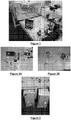
- the inventors also tested the odors emitted by live hens by replacing the jars with boxes of Plexiglas® specially designed for this use (production of a "headspace” through which the air propelled in the branches), designed to receive a hen each, and equipped with inlets and outlets suitable for connection to the tubes conveying the flows ( Figure 3 ).
- Binomial tests were performed on the distribution of individuals in the branches of the Y-tubes to see if this distribution differed significantly from a 50:50 distribution (neutrality) and if so, if there was rather attraction (distribution significantly> 1 ⁇ 2 on the side of the proposed compound or cocktail), repulsion (distribution significantly ⁇ 1 ⁇ 2 on the side of the proposed compound or cocktail) (and this independently of the physical side thanks to the inversion of the connections during the tests).
- the first four compounds were selected in view of their systematic occurrence and their relative abundance greater than the others in the chromatograms: ( E ) -non-2-enal, nonanoic acid, octanal, nonanal. Two additional compounds, oct-1-en-3-ol and octanoic acid, were selected on the basis of their presence in the chromatograms and their demonstrated attractiveness to other mites in the body.
- literature ⁇ b> Table 1 ⁇ /b>: ⁇ b> Average relative abundances in the odors of hens of the compounds retained for the assembly (on the basis of the areas under peaks).
- the percentage of non-choice under these conditions is 18%.
- 6-compound cocktails (mix 5.0) and 5-compounds (mix 1.0) selected in the present study are both significantly attractive, but within the 6-compound cocktail (mix 5.0), octanoic acid is not necessary for attraction.
- the other five compounds (the compounds of mix 10) seem very necessary for the attraction (since none of the other combinations of 5 compounds nor any of the individual compounds are significantly attractive). They act in synergy.
- Mix 1.0 is the initial cocktail (5 molecules, in equivolumic proportions).
- Mix1.2, mix1.3, mix1.4 and mix1.5 the proportion of mites that choose the cocktail rather than the control is always greater than 50%, except for mix1.1.1 ( Figure 8 ).
- Mix1.1 the proportion of mites that choose the cocktail rather than the control is always greater than 50%, except for mix1.1.1 ( Figure 8 ).
- Mix1.2 the majority mix1.2 (( E ) -2-nonenal) is significantly more chosen than the control.
Landscapes
- Life Sciences & Earth Sciences (AREA)
- Pest Control & Pesticides (AREA)
- Environmental Sciences (AREA)
- Engineering & Computer Science (AREA)
- Wood Science & Technology (AREA)
- Zoology (AREA)
- Insects & Arthropods (AREA)
- Agronomy & Crop Science (AREA)
- Plant Pathology (AREA)
- Health & Medical Sciences (AREA)
- Dentistry (AREA)
- General Health & Medical Sciences (AREA)
- Agricultural Chemicals And Associated Chemicals (AREA)
- Catching Or Destruction (AREA)
Claims (12)
- Zusammensetzung, umfassend als aktive Substanz eine Mischung der folgenden Verbindungen:(E)-non-2-enal der folgenden Formel I:
 Nonansäure der folgenden Formel II:
 Octanal der folgenden Formel III:
 Nonanal der folgenden Formel IV:
 oct-1-en-3-ol der folgenden Formel V:
- Zusammensetzung nach Anspruch 1, ferner umfassend Octansäure der folgenden Formel VI:

- Zusammensetzung nach Anspruch 1 oder 2, ferner umfassend mindestens eine der folgenden Verbindungen:1-Octanol der folgenden Formel VI:
 1-Nonanol der folgenden Formel VII:
 2-Octanon der folgenden Formel VIII:
- Zusammensetzung nach einem der Ansprüche 1 oder 3, umfassend die Verbindungen der Formel I bis VIII, der folgenden Formel:(E)-non-2-enal der folgenden Formel I:
 Nonansäure der folgenden Formel II:
 Octanal der folgenden Formel III:
 Nonanal der folgenden Formel IV:
 oct-1-en-3-ol der folgenden Formel V:
 1-Octanol der folgenden Formel VI:
 1-Nonanol folgenden Formel VII: und
 2-Octanon der folgenden Formel VIII:
- Verwendung einer Zusammensetzung nach einem der Ansprüche 1 bis 4 zur Dekontaminierung oder Verhinderung der Kontamination von Vogelfarmen durch Milben oder zur kontinuierlichen Überwachung von Vogelfarmen, die für Milbenbefall anfällig sind.
- Verwendung nach Anspruch 5, wobei die Vögel Gallinaceen sind, insbesondere die Vögel Hühner sind.
- Verwendung nach Anspruch 5 oder Anspruch 6, wobei die Milben allgemein als Läuse bezeichnete Milben, insbesondere rote Läuse, graue Läuse oder schwarze Läuse sind.
- Verwendung nach Anspruch 7, wobei die Läuse aus den folgenden Arten Dermanyssus gallinae und Ornithonyssus sylviarum ausgewählt sind.
- Verfahren zum Erkennen des Befalls einer Vogelfarm durch Milben, umfassend einen Schritt des Inkontaktbringens einer Zusammensetzung nach einem der Ansprüche 1 bis 4 mit der umgebenden Atmosphäre und einen Schritt des Bestimmens des Vorhandenseins, der Abwesenheit oder der Anzahl der in der verwendeten Vorrichtung vorhandenen Milben.
- Vorrichtung, umfassend Mittel zum Inkontaktbringen einer Zusammensetzung nach einem der Ansprüche 1 bis 4 mit der Umgebungsatmosphäre und Mittel zum Einfangen und/oder Abtöten von Milben.
- Vorrichtung nach Anspruch 10, wobei die Mittel zum Einfangen Fluchtschutzbehälter oder klebende oder klebrige Oberflächen sind, und die Mittel zum Abtöten von Milben chemische Verbindungen oder räuberische oder parasitäre Organismen der Milben sind.
- Verfahren zum Verhindern des Befalls von Vogelfarmen durch Milben oder zum Dekontaminieren von Vogelfarmen, die mit Milben infiziert sind, umfassend einen Schritt des Installierens von Vorrichtungen, wie in einem der Ansprüche 10 oder 11 definiert, innerhalb der Farmen.
Applications Claiming Priority (2)
| Application Number | Priority Date | Filing Date | Title |
|---|---|---|---|
| FR1662502A FR3060258B1 (fr) | 2016-12-15 | 2016-12-15 | Composition anti-acariens |
| PCT/FR2017/053611 WO2018109417A1 (fr) | 2016-12-15 | 2017-12-15 | Composition anti-acariens |
Publications (2)
| Publication Number | Publication Date |
|---|---|
| EP3554237A1 EP3554237A1 (de) | 2019-10-23 |
| EP3554237B1 true EP3554237B1 (de) | 2021-03-31 |
Family
ID=58314458
Family Applications (1)
| Application Number | Title | Priority Date | Filing Date |
|---|---|---|---|
| EP17825590.7A Not-in-force EP3554237B1 (de) | 2016-12-15 | 2017-12-15 | Akarizide zusammensetzung |
Country Status (4)
| Country | Link |
|---|---|
| EP (1) | EP3554237B1 (de) |
| BR (1) | BR112019012279A2 (de) |
| FR (1) | FR3060258B1 (de) |
| WO (1) | WO2018109417A1 (de) |
Families Citing this family (1)
| Publication number | Priority date | Publication date | Assignee | Title |
|---|---|---|---|---|
| US20240215564A1 (en) * | 2023-01-04 | 2024-07-04 | Noam Drori | Wearable passive lice eliminator |
Family Cites Families (17)
| Publication number | Priority date | Publication date | Assignee | Title |
|---|---|---|---|---|
| US5296227A (en) * | 1991-12-18 | 1994-03-22 | Old Dominion University | Attractant decoy for controlling bont ticks |
| JP3297885B2 (ja) * | 1993-03-09 | 2002-07-02 | アース製薬株式会社 | ダニ誘引組成物、ダニ類の捕獲材およびダニ類の誘引方法 |
| JP4971569B2 (ja) * | 2001-02-06 | 2012-07-11 | 積水化学工業株式会社 | ダニ類駆除方法 |
| GB0207894D0 (en) * | 2002-04-05 | 2002-05-15 | Univ Aberdeen | Chemicals for sea lice monitoring and control |
| PT1531840E (pt) | 2002-06-19 | 2012-03-08 | Fideline | Composições repulsivas de alomona e atrativas de cairomona para controlo de aracnídeos |
| JP4286546B2 (ja) * | 2003-01-30 | 2009-07-01 | 花王株式会社 | ダニ誘引剤、ダニ誘引捕獲材、及びダニ誘引方法 |
| WO2004095927A1 (en) * | 2003-04-30 | 2004-11-11 | Fideline | Allomone repulsive compositions for the treatment of fleas |
| US7441367B2 (en) * | 2005-03-14 | 2008-10-28 | Vmi Foundation | Robotic pest removal system |
| JP2006327957A (ja) * | 2005-05-24 | 2006-12-07 | Kao Corp | ダニ忌避剤 |
| US20090281190A1 (en) | 2006-04-13 | 2009-11-12 | Simon Fraser University | Novel attract and kill composition for control of pest insects |
| WO2008081462A2 (en) * | 2007-01-04 | 2008-07-10 | Menachem Ritterband | Treating lice with gaseous compounds in an airtight space |
| MX381848B (es) * | 2009-04-17 | 2025-03-13 | Stratacor Inc | Composiciones pesticidas para insectos y artropodos |
| GB0908090D0 (en) * | 2009-05-11 | 2009-06-24 | Rothamsted Res Ltd | Use of a carboxylic acid or an aldehyde |
| WO2010143752A2 (en) * | 2009-06-11 | 2010-12-16 | International Centre Of Insect Physiology And Ecology | Compositions for attracting blood-feeding insects |
| CA2849270C (en) * | 2011-10-04 | 2021-11-23 | 0903608 B.C. Ltd. | Pest control formulations and methods of making and using same |
| KR20150056537A (ko) * | 2012-08-17 | 2015-05-26 | 올팩터 래버러토리스, 인코포레이티드 | 곤충의 유인 및 기피를 위한 조성물 및 방법 |
| JP6576643B2 (ja) * | 2015-02-09 | 2019-09-18 | 理研香料ホールディングス株式会社 | 揮発性閉鎖空間防害虫剤 |
-
2016
- 2016-12-15 FR FR1662502A patent/FR3060258B1/fr not_active Expired - Fee Related
-
2017
- 2017-12-15 BR BR112019012279-6A patent/BR112019012279A2/pt not_active Application Discontinuation
- 2017-12-15 WO PCT/FR2017/053611 patent/WO2018109417A1/fr not_active Ceased
- 2017-12-15 EP EP17825590.7A patent/EP3554237B1/de not_active Not-in-force
Non-Patent Citations (1)
| Title |
|---|
| None * |
Also Published As
| Publication number | Publication date |
|---|---|
| FR3060258A1 (fr) | 2018-06-22 |
| BR112019012279A2 (pt) | 2019-11-19 |
| WO2018109417A1 (fr) | 2018-06-21 |
| FR3060258B1 (fr) | 2019-07-12 |
| EP3554237A1 (de) | 2019-10-23 |
Similar Documents
| Publication | Publication Date | Title |
|---|---|---|
| Mackay et al. | An improved autocidal gravid ovitrap for the control and surveillance of Aedes aegypti | |
| Mul et al. | Control methods for Dermanyssus gallinae in systems for laying hens: results of an international seminar | |
| Wurmitzer et al. | Attraction of dung beetles to herbivore dung and synthetic compounds in a comparative field study | |
| Natale et al. | Apple and peach fruit volatiles and the apple constituent butyl hexanoate attract female oriental fruit moth, Cydia molesta, in the laboratory | |
| Campolo et al. | Interaction between ants and the Mediterranean fruit fly: New insights for biological control | |
| Veronesi et al. | Macrocyclops albidus (Copepoda: Cyclopidae) for the biocontrol of Aedes albopictus and Culex pipiens in Italy | |
| Bharathi et al. | Attractiveness of some food baits to the melon fruit fly, Bactrocera cucurbitae (Coquillett)(Diptera: Tephritidae) | |
| Liu et al. | Classical olfactory conditioning in the oriental fruit fly, Bactrocera dorsalis | |
| Papadopoulos et al. | Effect of plant chemicals on the behavior of the Mediterranean fruit fly | |
| Shelly et al. | Re‐examining the relationship between sexual maturation and age of response to methyl eugenol in males of the oriental fruit fly | |
| EP3554237B1 (de) | Akarizide zusammensetzung | |
| Dekebo et al. | Attractiveness of the small hive beetle (Aethina tumida) to volatiles from honey bee (Apis mellifera) and beehive materials | |
| Goolsby et al. | Comparison of natural and artificial odor lures for nilgai (Boselaphus tragocamelus) and white-tailed deer (Odocoileus virginianus) in South Texas: Developing treatment for cattle fever tick eradication | |
| Chapman et al. | An evaluation of (Z)‐9‐tricosene and food odours for attracting house flies, Musca domestica, to baited targets in deep‐pit poultry units | |
| Mazor | Competitiveness of fertilizers with proteinaceous baits applied in Mediterranean fruit fly, Ceratitis capitata Wied.(Diptera: Tephritidae) control | |
| Grant et al. | Floral attraction and flower visitors of a subcanopy, tropical rainforest tree, Fontainea picrosperma | |
| Krochuk et al. | Why defaecate on your doorstep? Investigating an unusual behaviour in Africa’s smallest falcon | |
| Petrović et al. | Using pheromone traps for the detection and monitoring of the seasonal flight of the vine bud moth Theresimima ampellophaga (Bayle-Barelle, 1808)(Lepidoptera: Zygaenidae, Procridinae) in Serbia | |
| Auffray et al. | Attractant activity of host-related chemical blends on the poultry red mite at different spatial scales | |
| Farina et al. | Calliphora vomitoria: both the beauty and the beast | |
| Filgueiras et al. | Livestock manure as an alternative attractant for fruit flies (Diptera: Tephritidae) in guava tree | |
| Rayaisse | Development of tools to control Palpalis group tsetse flies in West Africa | |
| Doherty | Host-Odor Attractants of Philornis Downsi [Diptera: Muscidae], An Invasive Bird Parasite in the Galapagos Islands | |
| Ahmadi et al. | Evaluating the Trapping Potential of Rosa damascena and Phenylacetaldehyde for Paranthrene diaphana | |
| Abdel-Gahny et al. | Ecological studies of some insects associated with Bedouin settlements in St Katherine Protectorate, South Sinai, Egypt |
Legal Events
| Date | Code | Title | Description |
|---|---|---|---|
| STAA | Information on the status of an ep patent application or granted ep patent |
Free format text: STATUS: UNKNOWN |
|
| STAA | Information on the status of an ep patent application or granted ep patent |
Free format text: STATUS: THE INTERNATIONAL PUBLICATION HAS BEEN MADE |
|
| PUAI | Public reference made under article 153(3) epc to a published international application that has entered the european phase |
Free format text: ORIGINAL CODE: 0009012 |
|
| STAA | Information on the status of an ep patent application or granted ep patent |
Free format text: STATUS: REQUEST FOR EXAMINATION WAS MADE |
|
| 17P | Request for examination filed |
Effective date: 20190612 |
|
| AK | Designated contracting states |
Kind code of ref document: A1 Designated state(s): AL AT BE BG CH CY CZ DE DK EE ES FI FR GB GR HR HU IE IS IT LI LT LU LV MC MK MT NL NO PL PT RO RS SE SI SK SM TR |
|
| AX | Request for extension of the european patent |
Extension state: BA ME |
|
| DAV | Request for validation of the european patent (deleted) | ||
| DAX | Request for extension of the european patent (deleted) | ||
| STAA | Information on the status of an ep patent application or granted ep patent |
Free format text: STATUS: EXAMINATION IS IN PROGRESS |
|
| 17Q | First examination report despatched |
Effective date: 20200519 |
|
| REG | Reference to a national code |
Ref country code: DE Ref legal event code: R079 Ref document number: 602017035884 Country of ref document: DE Free format text: PREVIOUS MAIN CLASS: A01N0031020000 Ipc: A01N0037020000 |
|
| GRAP | Despatch of communication of intention to grant a patent |
Free format text: ORIGINAL CODE: EPIDOSNIGR1 |
|
| STAA | Information on the status of an ep patent application or granted ep patent |
Free format text: STATUS: GRANT OF PATENT IS INTENDED |
|
| RIC1 | Information provided on ipc code assigned before grant |
Ipc: A01P 7/02 20060101ALI20200924BHEP Ipc: A01N 35/02 20060101ALI20200924BHEP Ipc: A01M 1/10 20060101ALI20200924BHEP Ipc: A01M 1/02 20060101ALI20200924BHEP Ipc: A01N 37/02 20060101AFI20200924BHEP Ipc: A01P 19/00 20060101ALI20200924BHEP Ipc: A01N 31/02 20060101ALI20200924BHEP Ipc: A01M 1/14 20060101ALI20200924BHEP |
|
| INTG | Intention to grant announced |
Effective date: 20201022 |
|
| GRAS | Grant fee paid |
Free format text: ORIGINAL CODE: EPIDOSNIGR3 |
|
| GRAA | (expected) grant |
Free format text: ORIGINAL CODE: 0009210 |
|
| STAA | Information on the status of an ep patent application or granted ep patent |
Free format text: STATUS: THE PATENT HAS BEEN GRANTED |
|
| AK | Designated contracting states |
Kind code of ref document: B1 Designated state(s): AL AT BE BG CH CY CZ DE DK EE ES FI FR GB GR HR HU IE IS IT LI LT LU LV MC MK MT NL NO PL PT RO RS SE SI SK SM TR |
|
| REG | Reference to a national code |
Ref country code: GB Ref legal event code: FG4D Free format text: NOT ENGLISH Ref country code: CH Ref legal event code: EP |
|
| REG | Reference to a national code |
Ref country code: AT Ref legal event code: REF Ref document number: 1375894 Country of ref document: AT Kind code of ref document: T Effective date: 20210415 |
|
| REG | Reference to a national code |
Ref country code: DE Ref legal event code: R096 Ref document number: 602017035884 Country of ref document: DE |
|
| REG | Reference to a national code |
Ref country code: IE Ref legal event code: FG4D Free format text: LANGUAGE OF EP DOCUMENT: FRENCH |
|
| REG | Reference to a national code |
Ref country code: LT Ref legal event code: MG9D |
|
| PG25 | Lapsed in a contracting state [announced via postgrant information from national office to epo] |
Ref country code: HR Free format text: LAPSE BECAUSE OF FAILURE TO SUBMIT A TRANSLATION OF THE DESCRIPTION OR TO PAY THE FEE WITHIN THE PRESCRIBED TIME-LIMIT Effective date: 20210331 Ref country code: FI Free format text: LAPSE BECAUSE OF FAILURE TO SUBMIT A TRANSLATION OF THE DESCRIPTION OR TO PAY THE FEE WITHIN THE PRESCRIBED TIME-LIMIT Effective date: 20210331 Ref country code: NO Free format text: LAPSE BECAUSE OF FAILURE TO SUBMIT A TRANSLATION OF THE DESCRIPTION OR TO PAY THE FEE WITHIN THE PRESCRIBED TIME-LIMIT Effective date: 20210630 Ref country code: BG Free format text: LAPSE BECAUSE OF FAILURE TO SUBMIT A TRANSLATION OF THE DESCRIPTION OR TO PAY THE FEE WITHIN THE PRESCRIBED TIME-LIMIT Effective date: 20210630 |
|
| PG25 | Lapsed in a contracting state [announced via postgrant information from national office to epo] |
Ref country code: LV Free format text: LAPSE BECAUSE OF FAILURE TO SUBMIT A TRANSLATION OF THE DESCRIPTION OR TO PAY THE FEE WITHIN THE PRESCRIBED TIME-LIMIT Effective date: 20210331 Ref country code: RS Free format text: LAPSE BECAUSE OF FAILURE TO SUBMIT A TRANSLATION OF THE DESCRIPTION OR TO PAY THE FEE WITHIN THE PRESCRIBED TIME-LIMIT Effective date: 20210331 Ref country code: SE Free format text: LAPSE BECAUSE OF FAILURE TO SUBMIT A TRANSLATION OF THE DESCRIPTION OR TO PAY THE FEE WITHIN THE PRESCRIBED TIME-LIMIT Effective date: 20210331 |
|
| REG | Reference to a national code |
Ref country code: NL Ref legal event code: MP Effective date: 20210331 |
|
| REG | Reference to a national code |
Ref country code: AT Ref legal event code: MK05 Ref document number: 1375894 Country of ref document: AT Kind code of ref document: T Effective date: 20210331 |
|
| PG25 | Lapsed in a contracting state [announced via postgrant information from national office to epo] |
Ref country code: SM Free format text: LAPSE BECAUSE OF FAILURE TO SUBMIT A TRANSLATION OF THE DESCRIPTION OR TO PAY THE FEE WITHIN THE PRESCRIBED TIME-LIMIT Effective date: 20210331 Ref country code: NL Free format text: LAPSE BECAUSE OF FAILURE TO SUBMIT A TRANSLATION OF THE DESCRIPTION OR TO PAY THE FEE WITHIN THE PRESCRIBED TIME-LIMIT Effective date: 20210331 Ref country code: AT Free format text: LAPSE BECAUSE OF FAILURE TO SUBMIT A TRANSLATION OF THE DESCRIPTION OR TO PAY THE FEE WITHIN THE PRESCRIBED TIME-LIMIT Effective date: 20210331 Ref country code: CZ Free format text: LAPSE BECAUSE OF FAILURE TO SUBMIT A TRANSLATION OF THE DESCRIPTION OR TO PAY THE FEE WITHIN THE PRESCRIBED TIME-LIMIT Effective date: 20210331 Ref country code: EE Free format text: LAPSE BECAUSE OF FAILURE TO SUBMIT A TRANSLATION OF THE DESCRIPTION OR TO PAY THE FEE WITHIN THE PRESCRIBED TIME-LIMIT Effective date: 20210331 Ref country code: LT Free format text: LAPSE BECAUSE OF FAILURE TO SUBMIT A TRANSLATION OF THE DESCRIPTION OR TO PAY THE FEE WITHIN THE PRESCRIBED TIME-LIMIT Effective date: 20210331 |
|
| PG25 | Lapsed in a contracting state [announced via postgrant information from national office to epo] |
Ref country code: IS Free format text: LAPSE BECAUSE OF FAILURE TO SUBMIT A TRANSLATION OF THE DESCRIPTION OR TO PAY THE FEE WITHIN THE PRESCRIBED TIME-LIMIT Effective date: 20210731 Ref country code: PT Free format text: LAPSE BECAUSE OF FAILURE TO SUBMIT A TRANSLATION OF THE DESCRIPTION OR TO PAY THE FEE WITHIN THE PRESCRIBED TIME-LIMIT Effective date: 20210802 Ref country code: PL Free format text: LAPSE BECAUSE OF FAILURE TO SUBMIT A TRANSLATION OF THE DESCRIPTION OR TO PAY THE FEE WITHIN THE PRESCRIBED TIME-LIMIT Effective date: 20210331 Ref country code: RO Free format text: LAPSE BECAUSE OF FAILURE TO SUBMIT A TRANSLATION OF THE DESCRIPTION OR TO PAY THE FEE WITHIN THE PRESCRIBED TIME-LIMIT Effective date: 20210331 Ref country code: SK Free format text: LAPSE BECAUSE OF FAILURE TO SUBMIT A TRANSLATION OF THE DESCRIPTION OR TO PAY THE FEE WITHIN THE PRESCRIBED TIME-LIMIT Effective date: 20210331 |
|
| REG | Reference to a national code |
Ref country code: DE Ref legal event code: R097 Ref document number: 602017035884 Country of ref document: DE |
|
| PG25 | Lapsed in a contracting state [announced via postgrant information from national office to epo] |
Ref country code: ES Free format text: LAPSE BECAUSE OF FAILURE TO SUBMIT A TRANSLATION OF THE DESCRIPTION OR TO PAY THE FEE WITHIN THE PRESCRIBED TIME-LIMIT Effective date: 20210331 Ref country code: AL Free format text: LAPSE BECAUSE OF FAILURE TO SUBMIT A TRANSLATION OF THE DESCRIPTION OR TO PAY THE FEE WITHIN THE PRESCRIBED TIME-LIMIT Effective date: 20210331 Ref country code: DK Free format text: LAPSE BECAUSE OF FAILURE TO SUBMIT A TRANSLATION OF THE DESCRIPTION OR TO PAY THE FEE WITHIN THE PRESCRIBED TIME-LIMIT Effective date: 20210331 |
|
| PLBE | No opposition filed within time limit |
Free format text: ORIGINAL CODE: 0009261 |
|
| STAA | Information on the status of an ep patent application or granted ep patent |
Free format text: STATUS: NO OPPOSITION FILED WITHIN TIME LIMIT |
|
| 26N | No opposition filed |
Effective date: 20220104 |
|
| PG25 | Lapsed in a contracting state [announced via postgrant information from national office to epo] |
Ref country code: IS Free format text: LAPSE BECAUSE OF FAILURE TO SUBMIT A TRANSLATION OF THE DESCRIPTION OR TO PAY THE FEE WITHIN THE PRESCRIBED TIME-LIMIT Effective date: 20210731 |
|
| REG | Reference to a national code |
Ref country code: DE Ref legal event code: R119 Ref document number: 602017035884 Country of ref document: DE |
|
| PG25 | Lapsed in a contracting state [announced via postgrant information from national office to epo] |
Ref country code: MC Free format text: LAPSE BECAUSE OF FAILURE TO SUBMIT A TRANSLATION OF THE DESCRIPTION OR TO PAY THE FEE WITHIN THE PRESCRIBED TIME-LIMIT Effective date: 20210331 Ref country code: IT Free format text: LAPSE BECAUSE OF FAILURE TO SUBMIT A TRANSLATION OF THE DESCRIPTION OR TO PAY THE FEE WITHIN THE PRESCRIBED TIME-LIMIT Effective date: 20210331 |
|
| REG | Reference to a national code |
Ref country code: CH Ref legal event code: PL |
|
| GBPC | Gb: european patent ceased through non-payment of renewal fee |
Effective date: 20211215 |
|
| REG | Reference to a national code |
Ref country code: BE Ref legal event code: MM Effective date: 20211231 |
|
| PG25 | Lapsed in a contracting state [announced via postgrant information from national office to epo] |
Ref country code: LU Free format text: LAPSE BECAUSE OF NON-PAYMENT OF DUE FEES Effective date: 20211215 Ref country code: IE Free format text: LAPSE BECAUSE OF NON-PAYMENT OF DUE FEES Effective date: 20211215 Ref country code: GB Free format text: LAPSE BECAUSE OF NON-PAYMENT OF DUE FEES Effective date: 20211215 Ref country code: DE Free format text: LAPSE BECAUSE OF NON-PAYMENT OF DUE FEES Effective date: 20220701 |
|
| PG25 | Lapsed in a contracting state [announced via postgrant information from national office to epo] |
Ref country code: BE Free format text: LAPSE BECAUSE OF NON-PAYMENT OF DUE FEES Effective date: 20211231 |
|
| PG25 | Lapsed in a contracting state [announced via postgrant information from national office to epo] |
Ref country code: LI Free format text: LAPSE BECAUSE OF NON-PAYMENT OF DUE FEES Effective date: 20211231 Ref country code: CH Free format text: LAPSE BECAUSE OF NON-PAYMENT OF DUE FEES Effective date: 20211231 |
|
| PG25 | Lapsed in a contracting state [announced via postgrant information from national office to epo] |
Ref country code: CY Free format text: LAPSE BECAUSE OF FAILURE TO SUBMIT A TRANSLATION OF THE DESCRIPTION OR TO PAY THE FEE WITHIN THE PRESCRIBED TIME-LIMIT Effective date: 20210331 |
|
| PG25 | Lapsed in a contracting state [announced via postgrant information from national office to epo] |
Ref country code: HU Free format text: LAPSE BECAUSE OF FAILURE TO SUBMIT A TRANSLATION OF THE DESCRIPTION OR TO PAY THE FEE WITHIN THE PRESCRIBED TIME-LIMIT; INVALID AB INITIO Effective date: 20171215 Ref country code: GR Free format text: LAPSE BECAUSE OF FAILURE TO SUBMIT A TRANSLATION OF THE DESCRIPTION OR TO PAY THE FEE WITHIN THE PRESCRIBED TIME-LIMIT Effective date: 20210331 |
|
| PG25 | Lapsed in a contracting state [announced via postgrant information from national office to epo] |
Ref country code: SI Free format text: LAPSE BECAUSE OF FAILURE TO SUBMIT A TRANSLATION OF THE DESCRIPTION OR TO PAY THE FEE WITHIN THE PRESCRIBED TIME-LIMIT Effective date: 20210331 |
|
| PGFP | Annual fee paid to national office [announced via postgrant information from national office to epo] |
Ref country code: FR Payment date: 20231229 Year of fee payment: 7 |
|
| PG25 | Lapsed in a contracting state [announced via postgrant information from national office to epo] |
Ref country code: MK Free format text: LAPSE BECAUSE OF FAILURE TO SUBMIT A TRANSLATION OF THE DESCRIPTION OR TO PAY THE FEE WITHIN THE PRESCRIBED TIME-LIMIT Effective date: 20210331 |
|
| PG25 | Lapsed in a contracting state [announced via postgrant information from national office to epo] |
Ref country code: MT Free format text: LAPSE BECAUSE OF FAILURE TO SUBMIT A TRANSLATION OF THE DESCRIPTION OR TO PAY THE FEE WITHIN THE PRESCRIBED TIME-LIMIT Effective date: 20210331 |
|
| PG25 | Lapsed in a contracting state [announced via postgrant information from national office to epo] |
Ref country code: FR Free format text: LAPSE BECAUSE OF NON-PAYMENT OF DUE FEES Effective date: 20241231 |
|
| PG25 | Lapsed in a contracting state [announced via postgrant information from national office to epo] |
Ref country code: TR Free format text: LAPSE BECAUSE OF FAILURE TO SUBMIT A TRANSLATION OF THE DESCRIPTION OR TO PAY THE FEE WITHIN THE PRESCRIBED TIME-LIMIT Effective date: 20210331 |