EP3552683A1 - Milieu filtrant, en particulier milieu de filtre à air et élément de filtre, en particulier élément de filtre à air, pourvu d'un milieu filtrant - Google Patents
Milieu filtrant, en particulier milieu de filtre à air et élément de filtre, en particulier élément de filtre à air, pourvu d'un milieu filtrant Download PDFInfo
- Publication number
- EP3552683A1 EP3552683A1 EP19178002.2A EP19178002A EP3552683A1 EP 3552683 A1 EP3552683 A1 EP 3552683A1 EP 19178002 A EP19178002 A EP 19178002A EP 3552683 A1 EP3552683 A1 EP 3552683A1
- Authority
- EP
- European Patent Office
- Prior art keywords
- filter layer
- filter
- packing density
- fibers
- section
- Prior art date
- Legal status (The legal status is an assumption and is not a legal conclusion. Google has not performed a legal analysis and makes no representation as to the accuracy of the status listed.)
- Withdrawn
Links
- 239000000835 fiber Substances 0.000 claims abstract description 252
- 238000012856 packing Methods 0.000 claims abstract description 220
- 239000002121 nanofiber Substances 0.000 claims abstract description 38
- 229920002994 synthetic fiber Polymers 0.000 claims description 7
- 239000012209 synthetic fiber Substances 0.000 claims description 7
- 229920003043 Cellulose fiber Polymers 0.000 claims description 3
- 239000000463 material Substances 0.000 description 61
- 239000002245 particle Substances 0.000 description 34
- 239000000523 sample Substances 0.000 description 21
- 230000007423 decrease Effects 0.000 description 18
- 239000011148 porous material Substances 0.000 description 15
- 238000011144 upstream manufacturing Methods 0.000 description 15
- 238000003490 calendering Methods 0.000 description 14
- 238000003860 storage Methods 0.000 description 14
- 238000001914 filtration Methods 0.000 description 13
- 230000004888 barrier function Effects 0.000 description 12
- 239000012530 fluid Substances 0.000 description 11
- 230000008859 change Effects 0.000 description 10
- 238000002485 combustion reaction Methods 0.000 description 10
- 238000004519 manufacturing process Methods 0.000 description 10
- 238000002844 melting Methods 0.000 description 10
- 239000000853 adhesive Substances 0.000 description 8
- 230000001070 adhesive effect Effects 0.000 description 8
- 229920002678 cellulose Polymers 0.000 description 8
- 239000001913 cellulose Substances 0.000 description 8
- 230000008018 melting Effects 0.000 description 8
- 230000035699 permeability Effects 0.000 description 8
- 230000007704 transition Effects 0.000 description 8
- 230000003247 decreasing effect Effects 0.000 description 7
- 239000000428 dust Substances 0.000 description 7
- 239000006185 dispersion Substances 0.000 description 6
- 238000000034 method Methods 0.000 description 6
- 239000004745 nonwoven fabric Substances 0.000 description 6
- 229920000642 polymer Polymers 0.000 description 6
- 238000000926 separation method Methods 0.000 description 6
- 230000015572 biosynthetic process Effects 0.000 description 5
- 238000005470 impregnation Methods 0.000 description 5
- 230000008901 benefit Effects 0.000 description 3
- 230000006835 compression Effects 0.000 description 3
- 238000007906 compression Methods 0.000 description 3
- 238000000280 densification Methods 0.000 description 3
- 239000003365 glass fiber Substances 0.000 description 3
- 239000000155 melt Substances 0.000 description 3
- 238000001471 micro-filtration Methods 0.000 description 3
- XLYOFNOQVPJJNP-UHFFFAOYSA-N water Substances O XLYOFNOQVPJJNP-UHFFFAOYSA-N 0.000 description 3
- 230000006978 adaptation Effects 0.000 description 2
- 230000000295 complement effect Effects 0.000 description 2
- 238000005520 cutting process Methods 0.000 description 2
- 238000013461 design Methods 0.000 description 2
- 230000000694 effects Effects 0.000 description 2
- 230000002349 favourable effect Effects 0.000 description 2
- 238000009499 grossing Methods 0.000 description 2
- 238000012886 linear function Methods 0.000 description 2
- 239000007788 liquid Substances 0.000 description 2
- 238000005259 measurement Methods 0.000 description 2
- 238000001000 micrograph Methods 0.000 description 2
- 239000004814 polyurethane Substances 0.000 description 2
- 230000008569 process Effects 0.000 description 2
- 239000011347 resin Substances 0.000 description 2
- 229920005989 resin Polymers 0.000 description 2
- 238000007711 solidification Methods 0.000 description 2
- 230000008023 solidification Effects 0.000 description 2
- 239000007921 spray Substances 0.000 description 2
- 239000011800 void material Substances 0.000 description 2
- RNFJDJUURJAICM-UHFFFAOYSA-N 2,2,4,4,6,6-hexaphenoxy-1,3,5-triaza-2$l^{5},4$l^{5},6$l^{5}-triphosphacyclohexa-1,3,5-triene Chemical compound N=1P(OC=2C=CC=CC=2)(OC=2C=CC=CC=2)=NP(OC=2C=CC=CC=2)(OC=2C=CC=CC=2)=NP=1(OC=1C=CC=CC=1)OC1=CC=CC=C1 RNFJDJUURJAICM-UHFFFAOYSA-N 0.000 description 1
- OAYXUHPQHDHDDZ-UHFFFAOYSA-N 2-(2-butoxyethoxy)ethanol Chemical compound CCCCOCCOCCO OAYXUHPQHDHDDZ-UHFFFAOYSA-N 0.000 description 1
- KXGFMDJXCMQABM-UHFFFAOYSA-N 2-methoxy-6-methylphenol Chemical compound [CH]OC1=CC=CC([CH])=C1O KXGFMDJXCMQABM-UHFFFAOYSA-N 0.000 description 1
- QTBSBXVTEAMEQO-UHFFFAOYSA-M Acetate Chemical compound CC([O-])=O QTBSBXVTEAMEQO-UHFFFAOYSA-M 0.000 description 1
- 239000004925 Acrylic resin Substances 0.000 description 1
- 229920000178 Acrylic resin Polymers 0.000 description 1
- VGGSQFUCUMXWEO-UHFFFAOYSA-N Ethene Chemical compound C=C VGGSQFUCUMXWEO-UHFFFAOYSA-N 0.000 description 1
- 239000005977 Ethylene Substances 0.000 description 1
- 206010041662 Splinter Diseases 0.000 description 1
- XTXRWKRVRITETP-UHFFFAOYSA-N Vinyl acetate Chemical compound CC(=O)OC=C XTXRWKRVRITETP-UHFFFAOYSA-N 0.000 description 1
- -1 acrylic ester Chemical class 0.000 description 1
- 238000004458 analytical method Methods 0.000 description 1
- 239000011230 binding agent Substances 0.000 description 1
- 230000000903 blocking effect Effects 0.000 description 1
- 238000004364 calculation method Methods 0.000 description 1
- 238000009960 carding Methods 0.000 description 1
- 230000015556 catabolic process Effects 0.000 description 1
- 238000005253 cladding Methods 0.000 description 1
- 230000001427 coherent effect Effects 0.000 description 1
- 238000002591 computed tomography Methods 0.000 description 1
- 239000012141 concentrate Substances 0.000 description 1
- 238000010276 construction Methods 0.000 description 1
- 239000000356 contaminant Substances 0.000 description 1
- 238000001816 cooling Methods 0.000 description 1
- 229920001577 copolymer Polymers 0.000 description 1
- 238000009826 distribution Methods 0.000 description 1
- 239000003344 environmental pollutant Substances 0.000 description 1
- 239000003822 epoxy resin Substances 0.000 description 1
- 239000003063 flame retardant Substances 0.000 description 1
- 230000004927 fusion Effects 0.000 description 1
- 230000001788 irregular Effects 0.000 description 1
- 239000003550 marker Substances 0.000 description 1
- 230000007246 mechanism Effects 0.000 description 1
- 239000000203 mixture Substances 0.000 description 1
- 229920001568 phenolic resin Polymers 0.000 description 1
- 239000005011 phenolic resin Substances 0.000 description 1
- 231100000719 pollutant Toxicity 0.000 description 1
- 229920000647 polyepoxide Polymers 0.000 description 1
- 229920000728 polyester Polymers 0.000 description 1
- 229920002635 polyurethane Polymers 0.000 description 1
- 229920002689 polyvinyl acetate Polymers 0.000 description 1
- 239000011118 polyvinyl acetate Substances 0.000 description 1
- 239000002244 precipitate Substances 0.000 description 1
- 239000002994 raw material Substances 0.000 description 1
- 230000009467 reduction Effects 0.000 description 1
- 238000005096 rolling process Methods 0.000 description 1
- 239000004071 soot Substances 0.000 description 1
- 238000005507 spraying Methods 0.000 description 1
- 239000000126 substance Substances 0.000 description 1
- 229920003002 synthetic resin Polymers 0.000 description 1
- 239000000057 synthetic resin Substances 0.000 description 1
- 238000012360 testing method Methods 0.000 description 1
Images


Classifications
-
- B—PERFORMING OPERATIONS; TRANSPORTING
- B01—PHYSICAL OR CHEMICAL PROCESSES OR APPARATUS IN GENERAL
- B01D—SEPARATION
- B01D39/00—Filtering material for liquid or gaseous fluids
- B01D39/14—Other self-supporting filtering material ; Other filtering material
- B01D39/16—Other self-supporting filtering material ; Other filtering material of organic material, e.g. synthetic fibres
- B01D39/1607—Other self-supporting filtering material ; Other filtering material of organic material, e.g. synthetic fibres the material being fibrous
- B01D39/1623—Other self-supporting filtering material ; Other filtering material of organic material, e.g. synthetic fibres the material being fibrous of synthetic origin
-
- B—PERFORMING OPERATIONS; TRANSPORTING
- B01—PHYSICAL OR CHEMICAL PROCESSES OR APPARATUS IN GENERAL
- B01D—SEPARATION
- B01D39/00—Filtering material for liquid or gaseous fluids
- B01D39/14—Other self-supporting filtering material ; Other filtering material
- B01D39/16—Other self-supporting filtering material ; Other filtering material of organic material, e.g. synthetic fibres
- B01D39/18—Other self-supporting filtering material ; Other filtering material of organic material, e.g. synthetic fibres the material being cellulose or derivatives thereof
-
- B—PERFORMING OPERATIONS; TRANSPORTING
- B01—PHYSICAL OR CHEMICAL PROCESSES OR APPARATUS IN GENERAL
- B01D—SEPARATION
- B01D46/00—Filters or filtering processes specially modified for separating dispersed particles from gases or vapours
- B01D46/52—Particle separators, e.g. dust precipitators, using filters embodying folded corrugated or wound sheet material
- B01D46/521—Particle separators, e.g. dust precipitators, using filters embodying folded corrugated or wound sheet material using folded, pleated material
-
- B—PERFORMING OPERATIONS; TRANSPORTING
- B01—PHYSICAL OR CHEMICAL PROCESSES OR APPARATUS IN GENERAL
- B01D—SEPARATION
- B01D2239/00—Aspects relating to filtering material for liquid or gaseous fluids
- B01D2239/02—Types of fibres, filaments or particles, self-supporting or supported materials
- B01D2239/025—Types of fibres, filaments or particles, self-supporting or supported materials comprising nanofibres
-
- B—PERFORMING OPERATIONS; TRANSPORTING
- B01—PHYSICAL OR CHEMICAL PROCESSES OR APPARATUS IN GENERAL
- B01D—SEPARATION
- B01D2239/00—Aspects relating to filtering material for liquid or gaseous fluids
- B01D2239/06—Filter cloth, e.g. knitted, woven non-woven; self-supported material
- B01D2239/065—More than one layer present in the filtering material
-
- B—PERFORMING OPERATIONS; TRANSPORTING
- B01—PHYSICAL OR CHEMICAL PROCESSES OR APPARATUS IN GENERAL
- B01D—SEPARATION
- B01D2239/00—Aspects relating to filtering material for liquid or gaseous fluids
- B01D2239/12—Special parameters characterising the filtering material
- B01D2239/1208—Porosity
-
- B—PERFORMING OPERATIONS; TRANSPORTING
- B01—PHYSICAL OR CHEMICAL PROCESSES OR APPARATUS IN GENERAL
- B01D—SEPARATION
- B01D2239/00—Aspects relating to filtering material for liquid or gaseous fluids
- B01D2239/12—Special parameters characterising the filtering material
- B01D2239/1233—Fibre diameter
Definitions
- the invention relates to the technical field of treatment and filtration of fluids and in particular air, for example, the filtration of liquid such as oil or air for internal combustion engines.
- the invention relates to a filter medium such as an air filter medium and a filter element with such a filter medium.
- Air filters are used for example in the air supply of internal combustion engines to clean the air supplied for the combustion of pollutants and dirt particles, so that only purified air is supplied to a combustion process in the internal combustion engine.
- An air filter has an inlet opening for unpurified raw air and an outflow opening for the filtered clean air and an air filter medium, wherein the air filter medium fulfills the actual filter function.
- the air filter medium consists for example of a filter paper, through which the air to be filtered flows when the internal combustion engine sucks air, so that the dirt particles are separated or separated in the air filter medium from the air flowing through.
- the air filter medium may be folded (pleated filter) or have a plurality of filter chambers (flute filter) to increase the surface of the filter, thereby extending the life of an air filter element, as a larger filter surface can absorb more debris before passing through deposited dust caused pressure loss on the air filter medium has risen so that the performance of the internal combustion engine decreases.
- EP 2 060 311 A1 describes an air filter medium for a vacuum cleaner bag having at least one layer of drained nonwoven comprising a polymeric continuous fiber.
- a filter medium in particular an air filter medium is specified, which has a first filter layer and a second filter layer.
- the first filter layer has a first filter layer section and a second filter layer section, wherein the second filter layer section is arranged in a flow direction of the filter medium behind the first filter layer section.
- the first filter layer section has a first packing density of fibers and a first packing density value, respectively, and the second filter layer section has a second packing density of fibers different from the first packing density of fibers and a second packing density value different from the first packing density value.
- the second filter layer is arranged in the flow direction behind the first filter layer and has nanofibers and, in one embodiment, may be a nanofiber filter layer.
- the packing density and a packing density value are, in particular, the mean packing density or the average packing density value of a filter layer section or a filter layer.
- the flow direction is transverse or orthogonal to the first and second filter layer and thus also transversely or orthogonal to the first and second Filter layer portion of the first filter layer.
- the air flow to be filtered flows through all the filter layers of the air filter medium and also all the filter layer sections of each filter layer.
- the filter medium stores dirt particles in its volume and depending on the size of the dirt particles this sequentially deposits and that the comparatively large dirt particles first, d. H. through the first filter layer section with a high porosity value, and the finer dirt particles through the second filter layer section with a lower porosity value that lies deeper in the direction of flow.
- the second filter layer additionally provides a final filter function through a nanofiber filter layer. This allows the smallest dirt particles to be filtered out of the fluid stream to be filtered.
- the second filter layer has, in particular compared to the first filter layer and especially to the second filter layer section on pores with a smaller size, so that finer dirt particles can be filtered from the fluid to be filtered.
- a filter ply portion is a plane of a filter ply of the filter media, the filter ply portion extending transversely to the flow direction through at least a portion of the filter ply and the filter media. If a fluid flow is passed through the filter medium, the fluid flow in the direction of flow passes through one or more filter layer sections in succession.
- a filter layer section is thus a depth section of a filter layer in the direction of the flow direction with predeterminable depth and can be, for example, on the order of a few microns, z. B. between 10 .mu.m and 100 .mu.m, or of a few mm, z. B. 1 mm, be.
- a fluid stream may be a gas or liquid stream passing through the filter element for the purpose of filtering or segregating contaminants Dirt particles is guided. It should be pointed out that an air filter will be described in the following in part, but the explanations regarding the construction of the air filter can also relate to a filter medium in general.
- the packing density is a measure of the proportion of filter fibers per depth of a filter layer section, i. H. the packing density is to be understood as the packing density of fibers or filter fibers per unit area or volume.
- the packing density can be determined for each filter layer and for each layer of filter layer, for example via embedded in synthetic resin or cross-sectional images of the air filter medium. Such a micrograph is imaged and the area of the micrograph is evaluated such that the area of the microsection covered by fibers and the total area of a filter layer section or non-fiber covered section of the microsection and the total area of a filter layer section are related be set.
- the determination of the packing density can take place on the image recording by evaluating the pixels on which a fiber can be seen and those pixels which indicate a gap. With a fixed or known total number of pixels in the filter layer section, the packing density can thus be determined by setting the number of pixels that display a filter fiber in relation to the total number of pixels in the filter layer section. Alternatively, the number of pixels showing a space may be subtracted from the total number of pixels so as to have a control value, for example. Depending on whether the gaps or the fibers on the sectional image are better recognizable and evaluable, the corresponding pixels can be counted.
- the thus determined packing density is an average packing density of the evaluated filter layer section.
- the smaller such a filter layer section is set, d. H. the smaller the depth of a filter layer section in the direction of the flow direction, the lower the deviations of the packing density at the edges of the filter layer section from the determined mean value.
- the packing density can also be determined via a three-dimensional computed tomography image. Analogous to the picture elements of an image recording, there are spatial points in a three-dimensional recording whose number and size depend on the technical frame data of the receiving device. The determination of the packing density of a three-dimensional recording by means of spatial points is carried out analogously to the method with pixels.
- the space points including a space and the space points including a filter fiber can be respectively set in proportion to the total number of space points so as to determine the packing density.
- Packing Density refers to a sudden change in packing density across the material depth of the air filter medium, d. H. in that two adjoining filter layer sections have a different packing density at the transition between the adjoining filter layer sections.
- such a packing density jump may act as a mostly unwanted dirt barrier and cause clogging of an air filter media before it has reached the maximum dirt particle storage capacity by the debris occupying and clogging a depth portion of the air filter media about the packing density jump.
- a percentage change in the packing density between the outflow surface of a filter layer and the inflow surface of a filter layer adjoining in the direction of flow can be decisive for preventing dirt barriers.
- the packing density gradient can be used as a measure for changing the packing density over the material thickness of a filter layer in the direction of flow serve.
- the packing density increases either by a decreasing number of fiber spaces or by a decreasing size of fiber spaces on a depth portion of a filter sheet, ie, in a filter sheet portion.
- a gradient is used in the context of this document as a value indicating the rate of change of a quantity.
- the packing density gradient indicates the rate at which the packing density of an air filter medium changes with increasing material depth or material thickness in the direction of the flow direction of the air filter medium.
- the fiber diameter gradient indicates the rate at which the fiber diameter of the fibers in an air filter medium changes with increasing material depth or material thickness in the direction of the flow direction of the air filter medium.
- the porosity of a filter sheet is a measure of the number and size of spaces between the filter fibers of the filter sheet.
- the porosity may indicate which resistor is opposed to a flow of fluid, such as a stream of air that penetrates a filter ply.
- a filter layer is open at the inflow surface and at the outflow surface, so that a fluid flow at the inflow surface can penetrate into the material and can be forced out of the material at the outflow surface.
- the porosity can be considered as the ratio of void volume to total volume. As the value of the porosity increases, the proportion of the void volume to the total volume is larger.
- the porosity of an air filter medium, a filter layer or a filter layer section can in particular be defined individually by specifying the pore volume.
- a single filter layer of the measurement can be supplied.
- a filter layer can also be divided into individual depth sections of this measurement supplied. The finer the depth sections whose porosity is thus determined, the more accurate a course of the porosity can be given over the material depth of a filter layer.
- a porosity jump is a sudden change in porosity at adjacent surfaces of adjacent filter layers or filter layer sections.
- the packing density can be considered as a counterpart of the porosity.
- the porosity is determined and indicated in particular with the aid of the fiber interspaces or pores of the air filter medium, whereas the packing density can be determined and indicated in particular with the aid of the fibers present. Packing density and porosity can be considered as complementary quantities.
- the determination of the air permeability of an air filter medium can be carried out according to DIN EN ISO 9237, which provides a test area of 20 cm 2 and a differential pressure of 200 Pa. In this case, samples should be taken and tested at ten different points of the air filter medium to be tested. The samples are usually 56 mm in diameter and are circular. Should the filter medium be too narrow to provide this sample size, the diameter of a sample may be 42 mm or even 25 mm. The result is given by the unit l / m 2 s as mean value and as scattering.
- An air filter medium or a single filter layer consists of a plurality of fibers.
- a fiber is characterized by its fiber diameter or in general by its fiber cross-section or the cross-sectional area.
- the fiber diameter or fiber cross section is given as the mean fiber diameter or fiber cross section, an indication being given by means of a logarithmic normal distribution being used for these values.
- An air filter medium may consist of one or more filter layers, which in turn each consist of one or more fibers.
- the filter effect of an air filter medium results from the fact that an air stream flows through the filter layers and the dirt particles contained in the air flow in the interstices of the fibers or stick to the fibers and are separated from the air flow.
- a fiber diameter gradient indicates the extent to which the diameter of the fibers of an air filter medium changes over the material depth of a filter layer or a filter layer section. This also applies analogously to a fiber cross-sectional gradient.
- the Faser notebook inconvenience between the first filter layer and the second filter layer should be as low as possible, ie that the fiber diameter of the fibers in the second filter layer section deviates as small as possible from the fiber diameter of the fibers in the second filter layer.
- nanofibers are understood to mean fibers having a fiber diameter between approximately 50 nm and approximately 500 nm, preferably between approximately 100 nm and 300 nm.
- a nanofiber layer or nanofiber filter layer is a filter layer which has nanofibers or consists partly or completely of nanofibers.
- meltblown, spunbond, wet-laid and dry-laid layer production carded web, filament spunbonded web and cross-layer web are defined in " Nonwovens: Raw Materials, Manufacturing, Application, Properties, Examination, 2nd Edition, 2012, Weinheim “, ISBN: 978-3-527-31519-2 ,
- a filter layer has a thickness in the direction of flow and is passed by a fluid flow to be filtered transversely or orthogonally to an extension plane of the filter layer.
- continuous is used in the context of this document to describe the change of a value, in particular the change in the packing density of a filter layer with increasing material depth in the direction of flow of this filter layer.
- a steady change of one of these values means that a value of packing density increases with increasing material depth or with increasing movement of an air flow in the direction of flow through the air filter medium changes in its scalar value only in one direction, for example, increases.
- Steady means that the value of the packing density increases or increases with increasing material depth. In this case, this value does not have to increase uniformly and can have a first growth rate over a first depth section, and a second growth rate over a second depth section that is either greater or smaller than the first growth rate.
- semisolid means that a value of, for example, the packing density remains constant with increasing material depth over at least a partial depth section of the air filter medium, while the packing density changes only in one direction in the remaining material depth.
- the property that the packing density does not reverse a positive (or negative) rate of increase over the material depth is constant and half-continuous.
- Halftetig includes a growth rate of zero, whereas steadily means a growth rate of greater than zero.
- a constant increase in a value for example the packing density of fibers in a first filter layer, means that a rate of increase of the packing density remains the same over the entire material depth of the first filter layer.
- the rate of growth in this case describes a linear function having a constant slope, the slope being the rate of growth of the packing density.
- the basis weight or basis weight of a filter medium is specified for paper according to DIN EN ISO 536.
- the following deviations can be made: Samples are taken at ten different points of a sample and tested.
- the sample size may have a diameter of 56 mm, if the medium to be tested should be narrower, the diameter may also be 42 mm or 25 mm.
- the specification of the basis weight or the basis weight of a filter medium is for fleece according to DIN EN 29 073-1. Thereafter, samples are taken at ten different locations of a sample and tested.
- the sample size is at least 50,000 mm 2 (eg 250 mm x 250 mm), alternatively 100 cm 2 are also permissible if the medium to be tested should be smaller.
- the individual values of the samples as well as a mean value including scattering in the unit g / m 2 are given.
- the determination of the thickness for smooth paper is carried out according to ISO 534, preferably with a different surface load of 1 N / cm 2 .
- Samples are taken and tested at ten different locations in a sample.
- the sample size can be 56 mm in diameter. If no flat samples with a diameter corresponding to a diameter of the measuring foot of a tester, z. B. 16 mm available, strips of the filter medium to be tested can be cut out and measured, so that a self-level sample can be measured. As a result, the individual values of the samples as well as an average value and dispersion in the unit mm are given.
- the determination of the thickness for nonwovens is in accordance with DIN EN ISO 9073-2. Samples are taken and tested at ten different locations in a sample. The samples can have a size of DIN A5 and are measured at two points in the center of the area. If no samples of this size are available, even smaller samples can be measured. As a result, the individual values of the samples as well as an average value and dispersion in the unit mm are given.
- the determination of the thickness for voluminous nonwovens takes place according to DIN EN ISO 9073-2.
- Bulky nonwovens are nonwovens that are compressible by at least 20% when the applied pressure changes from 0.1 kPa to 0.5 kPa, ie to 80% of the initial thickness before changing the applied pressure.
- Samples are taken at ten different locations of a sample and tested. The samples can have a size of 130 mm x 80 mm. If no samples of this size are available, even smaller samples can be measured. As a result, the individual values of the samples as well as an average value and dispersion in the unit mm are given.
- the first filter layer has a middle section, which is arranged in the direction of flow between the first filter layer section and the second filter layer section.
- the center section can thus provide an air filter medium with increased thickness or depth of the flow direction. With increasing thickness of the air filter medium in the flow direction, the dirt particle storage capacity of the air filter medium can be increased.
- the first filter layer portion and the middle portion may be configured such that no packing density jump occurs upon transition from the first filter sheet portion to the middle portion, i. H. that at this junction, the packing density of the first filter layer portion substantially corresponds to the packing density of the central portion.
- the first filter layer has a Anströmdorfenabexcellent and the first filter layer portion is arranged in the flow direction behind the Anströmdorfenabrough.
- the first filter layer in the throughflow direction initially has an inflow depth section with increasing packing density, which represents the beginning or the inlet surface of the fluid flow to be filtered into the filter medium.
- the first surface is a surface or a plane (which may also be curved or may have any other geometric shape), which is traversed by the air flow to be filtered.
- the inflow depth section is arranged on the first surface of the air filter medium.
- the air filter medium is supplied to the first surface of the first filter layer.
- no further filter layer which belongs to the air filter medium.
- the first filter layer has an outflow depth section and the second filter layer section is arranged in the flow direction upstream of the outflow depth section.
- the Abströmdorfenabites thus represents at least a portion of that second surface of the first filter layer over which the filtered from the first filter layer air flow leaves the first filter layer and a filtering through the second filter layer, that is supplied by the nanofiber filter layer.
- the inflow depth section and the outflow depth section can thus be disregarded in one embodiment, since these two depth sections are properties of the first filter layer which are due to a so-called inlet or outlet roughness of the filter medium material ,
- the second filter layer is arranged on an outflow surface of the filter medium.
- the second filter layer ie the nanofiber filter layer, performs a final ultrafine filtration on the outflow side of the filter medium and represents the outflow surface of the filter medium, at which the filtered fluid leaves the filter medium in the direction of the clean side.
- the first filter layer section has a first packing density of fibers and the second filter layer section has a second packing density of fibers, wherein a value of the second packing density is different from a value of the first packing density.
- the first filter layer section may have more fiber interspaces and / or larger fiber interspaces than the second filter layer section.
- a packing density of fibers of the first filter layer increases in the direction of flow from the first filter layer section to the second filter layer section. This means, for example, that the fiber spaces in the first filter layer decrease with increasing material depth starting from the first filter layer section to the second filter layer section in terms of their number and / or their size.
- the fact that the packing density of the first filter layer section differs from the packing density of the second filter layer section means that within the first filter layer, dirt particles of different size or extent are filtered out of the air stream and stored in the air filter medium.
- a packing density of fibers of the first filter layer in the flow direction continuously increases from the first filter layer section to the second filter layer section.
- the packing density may remain the same as the material depth increases at least in sections in the direction of flow, which may also be referred to as semi-continuous.
- a packing density of fibers of the first filter layer increases in the direction of flow from the first filter layer section to the second filter layer section.
- a constant increase in the packing density of fibers of the first filter layer means that a rate of increase of the packing density remains the same over the entire material depth of the first filter layer.
- the rate of growth in this case describes a linear function having a constant slope, the slope being the rate of growth of the packing density.
- the packing density at the surface of the air filter medium which is the outflow surface of the clean air, is based on the requirements of the purity, d. H. the degree of separation to be achieved.
- the maximum difference in packing density between adjoining filter layer sections is at most 15%, preferably at most 10%, and more preferably at most 5%.
- a value of the second porosity is different from a value of the first porosity.
- the air filter medium or a filter layer can filter dirt particles of different sizes from the raw air and store them within the material of the air filter medium.
- a porosity of the first filter layer decreases in the direction of flow from the first filter layer section to the second filter layer section.
- a porosity of the first filter layer in the flow direction continuously decreases from the first filter layer section to the second filter layer section.
- a porosity of the first filter layer decreases in the direction of flow from the first filter layer section to the second filter layer section.
- the porosity is complementary to the packing density with the proviso that an increasing packing density can be accompanied by a decreasing porosity, for example in a direction of the air flow from the inflow surface of an air filter medium to its outflow surface.
- the same statements apply to the porosity that were made to the packing density, wherein in a preferred embodiment, the porosity is characterized by a decrease rate, in contrast to a rate of increase of the packing density.
- the statements on the continuity, semi-continuity and constancy of the increase in the rate of increase of the packing density also apply.
- a steady and in particular a constant rate of decrease of the porosity, and thus avoidance of strong and abrupt changes in the porosity in the air filter medium, can avoid the formation of dirt barriers in the air filter medium.
- erratic and / or strong changes in porosity, ie in particular porosity reductions, in an air filter medium can constitute a so-called "dirt barrier", which can increasingly and concentrated concentrate dirt particles, so that the air filter medium already at a relatively low uptake of dirt particles that adhere to collect said dirt barrier, clogged or can be limited in its air permeability.
- the porosity within a filter layer decreases constantly.
- the porosity at the surfaces of adjacent filter layers may be equal or nearly equal. This ensures that there is no dirt barrier even between filter layers, since there too no strong and / or erratic increase in porosity takes place.
- the first filter layer may be made integral, i. H. that the first filter layer is not formed by the composition of multiple layers, but is designed as a single, integrally manufactured filter layer.
- an integral production of a filter layer can lead to both the number and the dimensions of the packing density jumps or porosity jumps being reduced.
- An amount of such a jump is understood to be the difference between the values of the said parameters packing leap and porosity jump in adjoining filter layer sections in the region of the adjoining surfaces.
- a first surface of the second filter layer abuts directly on the first filter layer.
- the first filter layer and the second filter layer are mechanically coupled together or adhesively bonded to each other over the entire or part of the surface of the adjoining surfaces.
- the first filter layer may be a coarse filtration layer and the second filter layer may be a fine filtration layer in the form of a nanofiber filter.
- a packing density of the second filter layer section is greater than a packing density of the second filter layer.
- the second filter layer in the form of a nanofiber layer has smaller pores than at least the second filter layer section of the first filter layer.
- This variant is characterized by the advantage that in the filtration at the transition between the first and second filter layer gradually a small particle layer, z. B. soot layer, forms, which can grow into the first filter layer. Thanks to the larger pores of the first filter layer, there is enough space for the particles. This does not lead to an early blocking. Overall, this causes an increase in the dirt particle storage capacity.
- a porosity of the second filter layer portion deviates from a porosity of the second filter sheet by at most about 15%, preferably at most 10%, and more preferably at most about 5%.
- the formation of a dirt barrier or a barrier layer can thus be adjusted substantially optimally by a specific porosity jump to the extent specified become.
- the first filter layer section has first fibers with a first cross section and the second filter layer section has second fibers with a second cross section, wherein the middle section has first fibers and second fibers.
- the fiber cross-section may be one of several parameters that make it possible to provide a desired packing density or porosity of a filter layer or a filter layer section.
- the fiber cross section can in particular by the size of a cross-sectional area will be described.
- the fiber cross-section alone is not a sufficient description parameter, since for these two values, in particular, the interspaces between the fibers used can essentially be decisive.
- the high cross-section fibers are used for a high porosity and low packing density filter layer section, whereas the lower cross-section fibers are used for a lower porosity, higher packing density filter layer section.
- the first filter ply portion has a higher porosity and a lower packing density than the second filter ply portion when the first fibers have a larger cross section than the second fibers.
- the middle section has both first fibers and second fibers. As a result, an increasing packing density or decreasing porosity from the first filter layer section to the second filter layer section can be provided.
- the first fibers and the second fibers are arranged in the middle section such that a portion of the second fibers increases in the sum of the first fibers and second fibers on a depth section of the first filter layer in the direction of the flow direction of the first filter layer.
- a low packing density or high porosity is achieved with the first fibers and a higher packing density or lower porosity is achieved with the second fibers, an increasing packing density or volume is achieved by increasing the depth of the material in the direction of flow in the middle portion Achieved a decreasing porosity.
- the first fibers In a first depth section, which is arranged in front in the middle section in the direction of flow, the first fibers have a comparatively high and the second fibers a comparatively small proportion of the sum of the fibers in this first depth section, whereas in a second depth section that in the middle section in the flow direction behind the first depth section, the first fibers have a lower and the second fibers have a higher proportion of the sum of the fibers in the second depth section than in the first depth section.
- the first fibers and the second fibers are arranged in the central portion such that a proportion of the second fibers on the sum of the first fibers and second fibers steadily increases on a depth portion of the first filter layer in the direction of the flow direction of the first filter layer.
- the first fibers and the second fibers are arranged in the central portion such that a proportion of the second fibers on the sum of the first fibers and second fibers increases constantly on a depth portion of the first filter layer in the direction of the flow direction of the first filter layer.
- a packing density of the middle section increases in the direction of the flow direction of the first filter layer.
- the packing density of the middle section is realized by means of fibers of different cross-section, the above applies regarding the first fibers and second fibers, which have a decreasing or increasing proportion of the sum of the first and second fibers on a depth section in the direction of flow ,
- the second filter layer section is calendered.
- a mechanical pressure is applied to a surface, i. H. in this case, on the surface of the second filter layer portion so as to achieve densification of the fibers.
- the first filter layer section has at least one first fiber with a first cross section and the second filter layer section at least one second fiber with a second cross section, wherein the second cross section is smaller than the first cross section.
- both the first fiber and the second fiber may be of any geometric shape, e.g. B. a prismatic body with an elliptical or other basic shape.
- the first filter layer has a material thickness between about 0.2 mm to about 0.9 mm, and preferably between 0.3 mm and 0.7 mm.
- the first filter layer may be a graded cellulose carrier.
- the air filter medium has an air permeability of about 100 l / m 2 s to about 1000 l / m 2 s at 200 Pa.
- the air filter medium has a basis weight of about 80 g / m 2 to about 200 g / m 2 after impregnation and curing.
- the impregnation of a filter layer can be done, for example, with phenolic resin, acrylic resin, epoxy resin and can in particular have a flame retardant effect.
- the first filter layer can be a graded, multilayer cellulose synthetic support with a material thickness in the direction of flow of 0.4 mm to 0.9 mm, an air permeability of 200 l / m 2 s to 1000 1 / m 2 s, and a basis weight after impregnation and curing of 100 g / m 2 to 200 g / m 2 .
- the first filter layer may comprise a carded web and a wet-laid nonwoven layer, which are needled and glued together.
- the carded web may be multi-ply and have a bico-fiber content in a filter ply portion at a surface of the outflow area of greater than about 5% of the mass of that ply portion.
- the fiber fineness can be up to 1.5 denier. With hydroentanglement, fiber finenesses of 0.5 to 50 dtex can be achieved.
- the material thickness of the first filter layer of this embodiment may be between 1.0 mm and 4.0 mm with an air permeability of 400 l / m 2 s and 1500 l / m 2 s and a basis weight between 200 g / m 2 and 400 g / m 2 be.
- the thickness of the air filter medium is proportional to the dirt particle storage capacity of the air filter medium in that increasing thickness also increases the dirt particle storage capacity.
- the first filter layer comprises cellulose-based fibers, synthetic fibers such as PET, PBT, PA, bico fibers, glass fibers or a combination thereof.
- the bico fiber content in the second filter layer section may be greater than about 5% of the mass of the second filter layer section.
- the bico fiber is a two-component fiber consisting of a high-temperature-melting component (fiber core) and a low-temperature melting component (fiber cladding), which is preferably used as a meltbonding fiber by the bico fiber to a temperature above the melting point of the low-temperature melting component and below the melting point of the high-temperature-melting component is heated, so that the low-temperature melting component melts and adheres the fibers together during cooling and curing.
- fiber core high-temperature-melting component
- fiber cladding low-temperature melting component
- the second filter layer section that is to say the fine filter of the first filter layer adjoining the second filter layer, has fibers with a fiber fineness of about 0.5 dtex to about 50 dtex, preferably from about 1 dtex to about 15 dtex.
- the second filter layer section comprises fibers having a fiber fineness of less than about 2 denier.
- the second filter layer has a fiber with a fiber diameter of between about 50 nm and about 500 nm and in particular between 100 nm and 300 nm.
- the second filter layer is a PA polymer, a PA 6 polymer, a PA 6.10 polymer, or a PA 66 polymer.
- the first filter layer and the second filter layer are mechanically coupled to one another by means of an adhesive, in particular by means of a dispersion adhesive, d. H. glued together.
- the adhesive is applied as a primer at 0.5 g / m 2 to 5.0 g / m 2 , preferably 1 g / m 2 to 2 g / m 2 .
- a small order amount can reduce the risk of electrical breakdown during production, since a lower voltage can be used. Likewise, a pore closure can be prevented by a small application amount.
- the adhesive can be applied by spraying or by rolling.
- the dispersion adhesive may be polyurethane, vinyl acetate, ethylene, polyvinyl acetate, butyl diglycol acetate, copolymer, acrylic ester, or a combination thereof.
- the first filter layer section comprises a fiber having a fiber diameter of between about 15 ⁇ m and about 40 ⁇ m.
- the second filter layer section comprises a fiber having a fiber diameter of between about 8 ⁇ m and about 14 ⁇ m.
- the air filter medium has a third filter layer, wherein the third filter layer is arranged in the flow direction before the first filter layer.
- the third filter layer thus performs a pre-filtering.
- the third filter layer has a spunbond layer or a meltblown layer.
- the third filter layer is arranged by a cross-layer method on the first filter layer.
- the first filter layer has a spunbond layer or a meltblown layer.
- the first filter layer is a carded nonwoven.
- Carding is a process for producing a nonwoven in which the loose fibers are aligned.
- the air filter medium has a fourth filter layer, wherein the fourth filter layer is arranged in the flow direction before the third filter layer and wherein the fourth filter layer with the third filter layer and / or the third filter layer with the first filter layer are mechanically connected by needling.
- the first filter layer and / or the second filter layer and / or the third filter layer and / or the fourth filter layer is thermally bonded by thermofusion.
- At least one surface of the first filter layer and / or the third filter layer and / or the fourth filter layer is calendered.
- the calendering allows an adaptation of the packing density of the calendered filter layer.
- the calendered surface of the first filter layer and / or the third filter layer and / or the fourth filter layer is arranged in the direction of flow on a back side of the respective filter layer.
- calendered surface faces the clean side and has a higher packing density and a lower porosity in order not to exceed a required particle content on the clean side.
- the fiber diameter or the fiber fineness of the fibers of the fourth filter layer is greater than the fiber diameter or the fiber fineness of the fibers of the third filter layer.
- these fibers can be arranged over the fourth filter layer and arranged behind the third filter layer so that an increasing packing density and a decreasing porosity are achieved over the entire air filter medium.
- these fibers may be arranged such that the fibers of higher fiber fineness have a higher proportion of the sum of the fibers in a depth portion nearer the clean air side than in a depth portion farther away from the clean air side, as described in detail above.
- the first filter layer comprises fibers having a fiber fineness of between about 1.5 denier and about 2 denier or having a fiber diameter between about 12 ⁇ m and about 14 ⁇ m.
- At least one of the first filter layer, the second filter layer, the third filter layer or the fourth filter layer comprises melt fibers in a proportion of about 5% to about 50% of a mass of the respective filter layer.
- the melt fibers may be, for example, a co-polyester having a melting point between 110 ° C and 120 ° C, which are melted by the corresponding temperature, so as to Solidification of the other fibers with respect to each other.
- the remaining melt fibers may for example have a melting point between 220 ° C and 250 ° C, so that they do not melt at the melting temperature of the melt fibers.
- the air filter medium is designed as a folded filter.
- a pleated filter medium has a plurality of pleats to increase the surface of the air filter medium in a reduced space, thereby extending the life of an air filter element, since a larger filter surface or an increased dirt particle storage capacity can absorb more debris before the dust caused by deposited Pressure loss on the filter medium has risen so that an increased power for the suction of air through the air filter medium is required.
- the air filter medium can be folded with all filter layers.
- the air filter medium is designed as a pleated filter with variable pleat depth.
- the air filter medium may be preferably arranged in a housing, wherein the housing may be formed in a predetermined manner due to external space requirements.
- a functional component for example in the form of an additional filter element, can be arranged in the housing.
- the structural design of the housing to external conditions eg. As the space in an engine compartment of a vehicle, be adapted.
- the structural design of the housing has a direct influence on the size and shape of the air filter medium and thus also on the filter performance of the air filter medium.
- the air filter medium may be a variable-folding-depth element to match the outer shape of the air filter medium to the structural requirements in a housing.
- the filter layers as described above and in the following can be embodied from a plurality of filter layer sections, which are mechanically connected to one another, for example by needling or hydroentanglement, thermally or chemically, for example with adhesive, in particular via spray bonding, in particular with PU, or via impregnation.
- the layer production can be wet laid or drained, for example, as a carded web, or in the form of filament spunbond, in particular by means of spunbond or by means of meltblown.
- the first filter layer and / or the air filter medium as described above and below may have a packing density gradient and / or a fiber diameter gradient.
- the air filter medium has a so-called spunbond nanofiber structure with the nanofiber layer on the outflow side of the air filter medium.
- the air filter medium may comprise one or more synthetic filter layers which are combined with one another. At least one of these synthetic filter layers can be made according to the spunbond manufacturing process. Another layer consists of nanofibers.
- the air filter medium has a packing density gradient in the form that substantially prevents a sudden change in either of these two parameters.
- barrier layers By combining a spunbond filter layer with a nanofiber filter layer, the formation of barrier layers can be reduced by adjusting the porosity or packing density of the filter layers, which are arranged in the flow direction in front of the nanofiber filter, in the direction of the nanofiber filter such that they adhere to the adjoining surfaces the first filter layer and the nanofiber filter layer have a substantially identical porosity or packing density or that a predetermined value is not exceeded by the difference of the corresponding parameters of these layers.
- a Gadienten für is created in the air filter medium, which can offer advantages in terms of dust storage capacity and separation efficiency of dirt particles.
- the said Gradientenstrukter begins on the upstream side with an open, porous material and is becoming denser and less porous in the flow direction.
- the fiber diameter can decrease from the upstream side to the downstream side.
- the spunbond layer can be used as a coarse filtration layer and mainly as a dust storage layer.
- the downstream nanofiber layer can serve as a microfiltration layer and be used to meet a required Abscheidgrad the dirt particles.
- the gradient structure can also be generated within the spunbond layer, for example by unilateral densification or smoothing of the fibers. This can be produced for example by needling, by thermofusion, by water jet compression and / or by calendering.
- spunbond layers so that the gradient structure can be made even more precise and, in particular, no porosity or density jumps can be generated from one layer to the next, by the porosities or packing densities at adjoining surfaces of adjacent spunbond layers being equal or equal almost the same are. That is, from the upstream side, a relatively open fiber layer with large diameter fibers followed by a denser fiber layer with fibers of smaller diameter than the preceding layer are arranged first.
- SS-NF two spunbond layers followed by a nanofiber layer
- SSS-NF three spunbond layers followed by a nanofiber layer
- a single integral spunbond layer can be created in a single operation by placing two or more spray bars one behind the other. These then first produce fibers of large diameter and then ever finer or vice versa.
- the air filter medium has a so-called spunbond meltblown nanofiber structure with the nanofiber layer on the outflow side of the air filter medium.
- the spunbond layer is produced according to the spunbond production process, a second layer after the meltblown process and a third layer consists of nanofibers.
- a second layer after the meltblown process consists of nanofibers.
- a third layer consists of nanofibers.
- the spunbond layer is used as a coarse filtration layer and mainly as a dust storage layer.
- the downstream nanofiber layer serves as a microfiltration layer and is used to fulfill the required degree of separation.
- a meltblown layer is arranged in between, in order to realize a homogeneous gradient structure.
- An arrangement of the three layers is thus the combination S-M-NF, a Spunbondlage followed by a Meltblownlage, further followed by a nanofiber layer, respectively in the direction from the upstream side to the downstream side in the direction of the flow direction.
- Structures may also be constructed as follows: S-S-M-NF (two consecutive spunbond layers followed by a meltblown layer and a nanofiber layer) or S-S-S-M-NF (three consecutive spunbond layers followed by a meltblown layer and a nanofiber layer).
- a gradient filter medium is used together with a nanofiber layer in a so-called X-NF structure with the nanofiber layer on the outflow side.
- the X-layer may also be the combination of several filter layers, for example carded nonwoven with carded nonwoven or carded nonwoven with wetlaid nonwoven. These combinations may have a gradient structure regarding their porosity or their packing density as described above and in the following, in that they are very open-pored on the upstream side and have a compacted structure on the downstream side.
- the upstream fleece layer is as coarse filtration layer and mainly used as a dust storage layer.
- the downstream nanofiber layer serves as a microfiltration layer and is used to fulfill a given degree of separation.
- the upstream nonwoven layer may consist of carded web, wet laid nonwoven or combinations of these nonwoven layers.
- the gradient structure can also be generated within the upstream nonwoven layer by achieving unilateral densification of the fibers or smoothing of the layer and solidification by suitable methods. This can be produced for example by needling, by thermofusion, by water jet compression, by binders (chemical equipment) and / or by calendering.
- the upstream nonwoven layer and the nanofiber layer can be produced in one operation.
- a filter element with a filter medium is specified as described above and below.
- the second filter layer is arranged on an outflow surface of the filter element.
- an air filter is provided with an air filter medium as described above and below.
- the air filter may in particular be an air filter for the filtration of supply air for an internal combustion engine.
- a filter medium in particular an air filter medium, has a first filter layer and a second filter layer, the first filter layer having a first filter layer Filter layer portion and a second filter layer portion disposed in a flow direction of the filter medium behind the first filter layer portion, wherein the first filter layer portion having a first packing density of fibers and wherein the second filter layer portion has a second packing density of fibers differing from the first packing density of fibers.
- the second filter layer on nanofibers and is arranged in the flow direction behind the first filter layer.
- a filter medium according to aspect 1 wherein the first filter layer has a central portion which is arranged in the flow direction between the first filter layer portion and the second filter layer portion.
- a filter medium is specified according to one of the aspects 1 or 2, wherein the first filter layer has a Anströmdorfenabexcellent and the first filter layer portion is arranged in the flow direction behind the Anströmdorfenabrough.
- a filter medium according to one of the preceding aspects is provided, wherein the inflow section is arranged on the first surface of the filter medium.
- a filter medium is specified according to one of the preceding aspects, wherein the first filter layer has a Abströmdorfenabexcellent and the second filter layer portion is arranged in the flow direction before the Abströmdorfenabrough.
- a filter medium according to one of the preceding aspects is specified, wherein the second filter layer is arranged on an outflow surface of the filter medium.
- a filter medium according to one of the preceding aspects is specified, wherein a packing density of fibers of the first filter layer in FIG Flow direction increases from the first filter layer portion to the second filter layer portion.
- a filter medium according to one of the preceding aspects is specified, wherein a packing density of fibers of the first filter layer in the flow direction continuously increases from the first filter layer section to the second filter layer section.
- a filter medium according to one of the preceding aspects is specified, wherein a packing density of fibers of the first filter layer in the direction of flow from the first filter layer section to the second filter layer section constantly increases.
- a filter medium according to one of the preceding aspects is specified, wherein the first filter layer section has a first porosity and the second filter layer section has a second porosity, wherein a value of the second porosity is smaller than a value of the first porosity.
- a filter medium according to one of the preceding aspects is specified, wherein a porosity of the first filter layer decreases in the direction of flow from the first filter layer section to the second filter layer section.
- a filter medium according to one of the preceding aspects is specified, wherein a porosity of the first filter layer in the flow direction continuously decreases from the first filter layer section to the second filter layer section.
- a filter medium according to one of the preceding aspects is specified, wherein a porosity of the first filter layer in the direction of flow from the first filter layer section to the second filter layer section decreases constantly.
- a filter medium according to one of the preceding aspects is specified, wherein a first surface of the second filter layer rests directly on the first filter layer.
- a filter medium according to one of the preceding aspects is specified, wherein a packing density of the second filter layer section is greater than a packing density of the second filter layer.
- a filter medium according to one of the aspects 1 to 14 is specified, wherein a packing density of the second filter layer section deviates from a packing density of the second filter layer by at most about 15%, preferably at most 10% and more preferably at most 5%.
- the first filter layer section comprises first fibers having a first cross section
- the second filter layer section having second fibers having a second cross section
- the middle section having first fibers and second fibers.
- a filter medium according to aspect 17 wherein the first fibers and the second fibers are arranged in the central portion such that a portion of the second fibers on the sum of the first fibers and second fibers on a depth portion of the first filter sheet in the direction of Flow direction of the first filter layer increases.
- a filter medium according to one of the aspects 17 or 18 is provided, wherein the first fibers and the second fibers are arranged in the central portion such that a portion of the second fibers on the sum of the first fibers and second fibers on a depth portion of the first Filter layer steadily increases in the direction of the flow direction of the first filter layer.
- a filter medium according to any one of aspects 17 to 19 is provided, wherein the first fibers and the second fibers are arranged in the central portion such that a portion of the second fibers on the sum of the first fibers and second fibers on a depth portion of the first Filter layer in the direction of the flow direction of the first filter layer constantly increases.
- a filter medium according to any of aspects 2 to 20 is specified, wherein a packing density of the central portion in the direction of the flow direction of the first filter layer increases.
- a filter medium according to one of the preceding aspects is specified, wherein the second filter layer section is calendered.
- a filter medium according to one of the preceding aspects is provided, wherein the first filter layer section has at least one first fiber with a first cross section, wherein the second filter layer section has at least one second fiber with a second cross section, wherein the second cross section is smaller than the first Cross-section.
- a filter medium according to one of the preceding aspects is provided, wherein the first filter layer has a material thickness in the direction of the flow direction between about 0.2 mm to about 0.9 mm, preferably 0.3 mm to 0.7 mm.
- a filter medium according to any one of the preceding aspects is provided, wherein the first filter layer has an air permeability of about 100 l / m 2 s to about 1000 l / m 2 s at 200 Pa.
- a filter medium according to any one of the preceding aspects is provided, wherein the first filter layer has a basis weight of about 80 g / m 2 to about 200 g / m 2 .
- a filter medium according to any of aspects 1 to 23 is provided, wherein the first filter layer is a graded, multi-layer cellulose synthetic support having a material thickness in the flow direction of 0.4 mm to 0.9 mm, an air permeability of 200 l / m 2 s to 1000 l / m 2 s, and a basis weight after impregnation and curing of 100 g / m 2 to 200 g / m 2 .
- a filter medium according to any one of aspects 1 to 23 is provided, wherein the filter medium has a thickness between about 1.0 mm and about 4.0 mm.
- a filter medium according to aspect 28 wherein the filter medium has an air permeability of about 400 l / m 2 s and about 1500 l / m 2 s.
- a filter medium according to any of aspects 28 or 29 is provided, wherein the filter medium has a basis weight of about 200 g / m 2 and about 400 g / m 2 .
- a filter medium according to any of aspects 28 to 30 is provided, wherein the second filter layer section comprises fibers having a fiber fineness of about 0.05 dtex to about 50 dtex.
- a filter medium according to any one of aspects 28 to 31 is provided, wherein the second filter layer section comprises fibers having a fiber fineness of less than about 2 denier.
- a filter medium according to any preceding aspect is provided, wherein the second filter layer comprises a fiber having a fiber diameter between about 50 nm and about 500 nm, preferably 100 nm to 300 nm.
- a filter medium according to one of the preceding aspects is specified, wherein the second filter layer comprises a PA polymer, in particular a PA 6, PA 6.10 or PA 66 polymer.
- a filter medium according to one of the preceding aspects is specified, wherein the first filter layer and the second filter layer are bonded together by means of an adhesive, in particular by means of a dispersion adhesive.
- a filter medium according to any one of the preceding aspects is provided, wherein the first filter layer section comprises a fiber having a fiber diameter between about 12 ⁇ m and about 40 ⁇ m.
- a filter medium according to any one of the preceding aspects is provided, wherein the second filter layer section comprises a fiber having a fiber diameter between about 8 ⁇ m and about 14 ⁇ m.
- a filter medium according to any one of the preceding aspects is provided, wherein the first filter layer comprises cellulose-based fibers, synthetic fibers such as PET, PBT, PA, bico fibers, glass fibers or a combination thereof.
- a filter medium according to one of the preceding aspects is specified, furthermore comprising a third filter layer, wherein the third filter layer is arranged in the direction of flow in front of the first filter layer.
- a filter medium according to aspect 39 is specified, wherein the third filter layer has a spunbond layer or a meltblown layer.
- a filter medium according to one of the aspects 39 or 40 is indicated, wherein the third filter layer is arranged on the first filter layer by a cross-layer method.
- a filter medium according to one of the preceding aspects, further comprising a fourth filter layer (160), wherein the fourth filter layer is arranged in the flow direction in front of the third filter layer, wherein the fourth filter layer with the third filter layer and / or the third filter layer with the first filter layer are mechanically connected by needling.
- a fourth filter layer 160
- the fourth filter layer is arranged in the flow direction in front of the third filter layer, wherein the fourth filter layer with the third filter layer and / or the third filter layer with the first filter layer are mechanically connected by needling.
- a filter medium according to one of the preceding aspects is specified, wherein the first filter layer and / or the second filter layer and / or the third filter layer and / or the fourth filter layer are thermally bonded by thermal fusion.
- a filter medium according to one of the preceding aspects is specified, wherein at least one surface of the first filter layer and / or the third filter layer and / or the fourth filter layer is calendered.
- a filter medium according to one of the preceding aspects is specified, wherein the calendered surface of the first filter layer and / or the third filter layer and / or the fourth filter layer is arranged in the direction of flow on a back side of the respective filter layer.
- a filter medium according to any one of the preceding aspects is provided, wherein at least one of the first filter layer, the second filter layer, the third filter layer or the fourth filter layer comprises fused fibers in a proportion of about 5% to about 50% of a mass of the respective filter layer ,
- a filter medium according to one of the preceding aspects is specified, wherein the first filter layer has a spunbond layer or a meltblown layer.
- a filter medium according to one of the preceding aspects is specified, wherein the first filter layer is a carded nonwoven.
- a filter medium according to one of the preceding aspects is specified, wherein the filter medium is designed as a folded filter.
- a filter medium according to aspect 49 is provided, wherein the filter medium is designed as a variable-depth pleat filter.
- a filter element in particular an air filter element, is specified.
- the filter element comprises a filter medium according to any one of aspects 1 to 50, wherein the filter medium is a folded filter medium.
- a filter element according to aspect 51 is indicated, wherein the second filter layer is arranged on the outflow surface of the filter medium of the filter element.
- a filter in particular an air filter, is provided with a filter element according to one of the aspects 51 or 52.
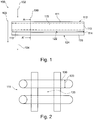
- Fig. 1 shows an air filter medium 100 having a first filter layer 110 and a second filter layer 120.
- the first filter layer 110 has a first filter layer section 111, a second filter layer section 113 and a middle section 115, the middle section 115 lying behind the first filter layer section 111 in the direction of the flow direction 103 and the second filter layer section 113 behind the middle section 115.
- the sections 111, 115, 113 are part of an integral first filter layer 110, d. H. that the first filter layer has been produced in particular in one operation and has not been produced from a plurality of individual layers, so that within the first filter layer or packing density jumps can be substantially prevented. Furthermore, the sections 111, 115, 113 may differ precisely with regard to the parameters of packing density and packing density progression, the packing density progression undergoing a change in the direction of the flow direction 103, in particular an increase.
- the first filter layer 110 has a first surface 112 and a second surface 114.
- the first surface is designed as an inflow surface of the air filter medium, which is directly exposed to the unfiltered air flowing from the direction of flow 102.
- the second surface 114 adjoins the second filter layer 120, specifically such that the second surface 114 of the first filter layer 110 directly adjoins a first surface 122 of the second filter layer 120, wherein the surface 114 may be glued to the surface 122 in particular.
- the second filter layer 120 has a second surface 124 which represents the outflow surface of the air filter medium, ie that this surface 124 faces the clean side of the air filter medium, so that the clean air leaves the air filter medium starting in the direction of the outflow direction 104.
- the air to be filtered flows through the air filter medium 100 transversely or orthogonal to the illustrated filter layers and filter layer sections.
- a section line AA '190 is shown, which is a position of the in the Figures 6A, 6B and 6C indicated sectional image indicates.
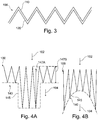
- Fig. 2 shows a schematic representation of a fiber braid of the first filter layer portion 111. Shown are four overlapping fibers 130, wherein the fibers each have a fiber diameter or a fiber cross section 133. The pore is flowed through by the air to be cleaned and dirt particles remain hanging on the fiber braid as soon as the dimensions of a dirt particle exceed the dimensions of the pores and / or impinge on the fibers and there adhere.
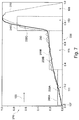
- Fig. 3 shows an air filter medium 100 with a first filter layer 110 and a second filter layer 120, wherein the air filter medium 100 is designed as a folded filter and both filter layers 110, 120 are folded accordingly.
- the flow direction is on hand of FIGS. 4A and 4B shown.
- Fig. 4A shows an air filter medium 100, which is designed as a variable-depth pleat filter 147.
- the inflow direction 102 extends in the direction of the fold depth 147.
- the fold edges 140 of all folds of the air filter medium 100 form a stepped course 145 with two different filter fold depth regions 147A, 147B, wherein the stepped course according to the line 145 can be adapted, for example, to a housing shape.
- the filter fold depth 147B is less than the filter fold depth 147A, resulting in the stepped course of the fold edge line 145.
- the fold edge line 145 may have a linear, oblique or curved course or a combination of different shapes.
- the folded edges are at the same height. Only for the sake of completeness it should be noted that a stepped or differently shaped course of the fold edge line is also possible on the inflow side 102.
- Fig. 4B shows an air filter medium 100, wherein the folded edge profile 145 on the downstream side 104 has an elliptical or paraboloidal course.
- Fig. 5 shows a schematic representation of an air filter medium 100 with four filter layers, the fourth filter layer 160 is arranged in the flow direction 103 front, the third filter layer 150 immediately behind the fourth filter layer 160, the first filter layer 110 immediately behind the third filter layer 150 and the second filter layer 120 directly behind the first filter layer 110.
- the packing density of the filter fibers in the fourth, third and first filter layer increases with increasing material depth in the direction of the flow direction 103, then in the second filter layer 120, which is designed as a nanofiber layer, increase again, so as to absorb dirt particles on to allow the entire material depth, which can also be referred to as volume storage.
- Fig. 6A shows a schematic representation of a sectional view of an air filter medium 100 along the section line AA '190, which in Fig. 1 is shown.
- the fibers are drawn as irregular elements, with the fiber interstices running as a white area between the fibers. It can be seen that the number of fibers increases with increasing material depth in the direction of the flow direction 103, and vice versa, the gaps become smaller and smaller. Thus, the packing density of the fibers increases in the direction of the flow direction 103 and the porosity decreases to the same degree.
- Fig. 6A is the third filter layer 150, and the first filter layer portion 111 and the second filter layer portion 113 of the first filter layer 110 shown.
- the number of Fibers and the packing density of the fibers apparently increase in the direction 103 from the third filter layer 150 via the first filter layer 110 to the second filter layer 120.
- Fig. 6B shows a schematic representation of a sectional image of the first filter layer 110 along the section line A-A '.
- the first filter layer section 111 and the second filter layer section 113 are each shown with their filter layer section depth 117.
- the filter layer sections 111, 113 can have different depths 117 in the direction of the flow direction 103.
- the filter layer sections 111, 113 may be a depth section of predetermined depth 117 in the direction of the flow direction 103 of an integral filter layer.
- Fig. 6C shows a schematic representation of the first filter layer 110 with a first filter layer portion 111, wherein the depth 117 of the depth of the first filter layer portion of Fig. 6B differs.
- a cut is to be made through an air filter medium 100 in the direction of the cutting line 190.
- an image recording of the cut surface can be made, which is supplied to the further analysis of the packing density.
- the depth 117 and the position of a filter layer portion with respect to the material depth in the direction 103 on the cut surface is determined.
- the air filter medium can be impregnated with a resin, which can be made more clearly visible on a picture taken by a marker. Such a resin is located on the cross-sectional image in the interstices, but not where a fiber was actually cut when making the cut.
- the determination of the fiber density can take place on the image acquisition by evaluating the pixels on which a fiber can be seen and those pixels which indicate a gap. With a fixed or known total number of pixels in the filter layer section, the packing density can thus be determined by setting the number of pixels that display a filter fiber in relation to the total number of pixels in the filter layer section. Alternatively, the number of pixels showing a space may be subtracted from the total number of pixels so as to have a control value, for example. Depending on whether the gaps or the fibers on the sectional image are better recognizable and evaluable, the corresponding pixels can be counted.
- the thus determined packing density is an average packing density of the evaluated filter layer section.
- the smaller such a filter layer section is set, d. H. the smaller the depth 117, the lower are the deviations of the packing density at the edges of the filter layer section from the mean value determined in this way.
- Fig. 7 shows a schematic course of the packing density in the first filter layer, wherein the first filter layer is a graded filter layer with synthetic fibers.
- the representation is a normalized representation in terms of packing density and material thickness, d. H.
- the respective packing density 210 is based on the highest value of the packing density in the first filter layer, the highest value being set to 1.0, or the material thickness of the first filter layer, which is also set to 1.0.
- the absolute dimensions of the material thickness reference is made to the comments above.
- the packing density in the flow direction 103 increases, ie, starting from a material depth of 0.0 in the direction of the maximum material thickness.
- the packing density increases from 0.0 to 0.0.
- the packing density increases further and increases within the first filter layer section 111 and within the middle section 115.
- a greater increase in the packing density than in sections 111, 115 occurs until it changes from the second filter layer section 113 into the outflow section 108, in which the packing density decreases.
- each section 111, 115, 113 in each case a smoothed profile 230A, 230B, 230C of the packing density and an average packing density 240A, 240B, 240C are plotted, the average packing density resulting from the packing density in the respective filter layer section.
- the smoothed packing density trajectory can be represented, for example, by the mechanism of the sliding window, in which a certain number of packing density values of adjacent subsections are used for the calculation of the smoothed packing density trajectory. For the next value in one direction, z. B. in the flow direction, added a new value and the value that was opposite to the flow direction was the last contained falls away.
- the packing density progression 230A abruptly transitions into the packing density course 230B at the transition from the first filter layer section 111 to the middle section 115. The same applies to the transition from the middle section 115 to the second filter layer section 113. Independently of this, the increase in the packing density in the second filter layer section 113 is higher than in the central section or in the first filter layer section.
- the pitch of the packing density trace in the first and second filter layer sections may be about 1.
- the slope may be up to about 5.
- the first filter layer portion 111 is indicated as having a normalized material thickness of about 0.02 to about 0.35 and has a normalized average packing density of about 0.07 to about 0.12.
- the center section 115 extends from about 0.35 to about 0.73 of the normalized material thickness and has a normalized average packing density of about 0.2 to about 0.25.
- the normalized average packing density of the center section 115 is greater than the normalized mean packing density of the first filter layer section 111 and smaller than the normalized average packing density of the second filter layer section 112.
- the second filter layer section extends from about 0.73 to about 0.85 of the normalized material thickness and has a normalized average packing density of about 0.7 to 0.8.
- a ratio of the normalized mean packing density of the first filter layer section 111 to a standardized average packing density of the second filter layer section 112 is between 0.1 and 0.4, in particular between 0.1 and 0.2.
- a relatively strong gradient is formed.
- Fig. 7 an exemplary measured curve 250 of the packing density is shown.
- the actual measured curve may vary by the smoothed value of the package density 230A, 230B, 230C, as shown by the dotted line 250, for example.
- Fig. 8 shows analogously to Fig. 7 a packing density curve of a graded filter layer with cellulose-based fibers, in particular a first filter layer 110, which consists at least almost of cellulose fibers.
- a first filter layer 110 which consists at least almost of cellulose fibers.
- the upstream section 107 may extend beyond the normalized material thickness to about 0.2.
- the first filter layer section 111 extends between about 0.2 and 0.5 of the normalized material thickness of the first filter layer.
- the normalized average packing density is 0.35 to 0.65, more particularly about 0.5 and the smoothed packing density range is from about 0.45 for a material thickness of 0.2 to about 0.52 for a material thickness from 0.5.
- the middle section 115 extends between about 0.5 and 0.7 of the normalized material thickness.
- the normalized average packing density is 0.5 to 0.7, more specifically about 0.6, and the smoothed packing density range is from about 0.52 for a material thickness of 0.5 to about 0.75 for a material thickness of 0.7 ,
- the normalized average packing density of the center section 115 is greater than the normalized mean packing density of the first filter layer section 111 and smaller than the normalized average packing density of the second filter layer section 112.
- the second filter layer portion 113 extends between about 0.7 and 0.8 of the normalized material thickness.
- the normalized average packing density is about 0.9 to 0.93, and the smoothed packing density range is from about 0.75 for a material thickness of 0.7 to 1.0 for a material thickness of about 0.8.
- the result is a ratio of a standardized average packing density of the first filter layer section 111 to a standardized average packing density of the second filter layer section 112 of between 0.25 and 0.65, in particular between 0.45 and 0.60. Thanks to this gradient, particularly favorable conditions are established for a cellulose-based filter layer 110.
- the first filter layer 110 comprises at least 50 weight percent cellulosic fibers and at least 25 weight percent synthetic fibers.
- the ratio of a normalized mean packing density of the first filter layer section 111 to a standardized average packing density of the second filter layer section 112 is between 0.25 and 0.65, preferably between 0.25 and 0.35.
- the first filter ply 110 has a central portion 115 with a normalized mean packing density that is greater than the normalized average packing density of the first filter ply portion 111 and less than the normalized average packing density of the second filter ply portion 112.
Landscapes
- Chemical & Material Sciences (AREA)
- Chemical Kinetics & Catalysis (AREA)
- Filtering Materials (AREA)
Applications Claiming Priority (5)
| Application Number | Priority Date | Filing Date | Title |
|---|---|---|---|
| DE102013006952 | 2013-04-23 | ||
| DE102013008391.5A DE102013008391A1 (de) | 2013-04-23 | 2013-05-17 | Filtermedium, insbesondere Luftfiltermedium, sowie Filterelement, insbesondere Luftfilterelement, mit einem Filtermedium |
| EP17171817.4A EP3231497B1 (fr) | 2013-04-23 | 2014-04-15 | Milieu filtrant, en particulier milieu de filtre à air et élément de filtre, en particulier élément de filtre à air, pourvu d'un milieu filtrant |
| PCT/EP2014/057631 WO2014173733A1 (fr) | 2013-04-23 | 2014-04-15 | Milieu filtrant, en particulier milieu de filtre à air et élément de filtre, en particulier élément de filtre à air, pourvu d'un milieu filtrant |
| EP14718378.4A EP2988846B2 (fr) | 2013-04-23 | 2014-04-15 | Milieu filtrant, en particulier milieu de filtre à air et élément de filtre, en particulier élément de filtre à air, pourvu d'un milieu filtrant |
Related Parent Applications (3)
| Application Number | Title | Priority Date | Filing Date |
|---|---|---|---|
| EP17171817.4A Division EP3231497B1 (fr) | 2013-04-23 | 2014-04-15 | Milieu filtrant, en particulier milieu de filtre à air et élément de filtre, en particulier élément de filtre à air, pourvu d'un milieu filtrant |
| EP14718378.4A Division EP2988846B2 (fr) | 2013-04-23 | 2014-04-15 | Milieu filtrant, en particulier milieu de filtre à air et élément de filtre, en particulier élément de filtre à air, pourvu d'un milieu filtrant |
| EP14718378.4A Division-Into EP2988846B2 (fr) | 2013-04-23 | 2014-04-15 | Milieu filtrant, en particulier milieu de filtre à air et élément de filtre, en particulier élément de filtre à air, pourvu d'un milieu filtrant |
Publications (1)
| Publication Number | Publication Date |
|---|---|
| EP3552683A1 true EP3552683A1 (fr) | 2019-10-16 |
Family
ID=51628777
Family Applications (3)
| Application Number | Title | Priority Date | Filing Date |
|---|---|---|---|
| EP14718378.4A Active EP2988846B2 (fr) | 2013-04-23 | 2014-04-15 | Milieu filtrant, en particulier milieu de filtre à air et élément de filtre, en particulier élément de filtre à air, pourvu d'un milieu filtrant |
| EP17171817.4A Active EP3231497B1 (fr) | 2013-04-23 | 2014-04-15 | Milieu filtrant, en particulier milieu de filtre à air et élément de filtre, en particulier élément de filtre à air, pourvu d'un milieu filtrant |
| EP19178002.2A Withdrawn EP3552683A1 (fr) | 2013-04-23 | 2014-04-15 | Milieu filtrant, en particulier milieu de filtre à air et élément de filtre, en particulier élément de filtre à air, pourvu d'un milieu filtrant |
Family Applications Before (2)
| Application Number | Title | Priority Date | Filing Date |
|---|---|---|---|
| EP14718378.4A Active EP2988846B2 (fr) | 2013-04-23 | 2014-04-15 | Milieu filtrant, en particulier milieu de filtre à air et élément de filtre, en particulier élément de filtre à air, pourvu d'un milieu filtrant |
| EP17171817.4A Active EP3231497B1 (fr) | 2013-04-23 | 2014-04-15 | Milieu filtrant, en particulier milieu de filtre à air et élément de filtre, en particulier élément de filtre à air, pourvu d'un milieu filtrant |
Country Status (6)
| Country | Link |
|---|---|
| US (1) | US20160051918A1 (fr) |
| EP (3) | EP2988846B2 (fr) |
| CN (2) | CN105120979B (fr) |
| DE (2) | DE102013008391A1 (fr) |
| PL (1) | PL3231497T3 (fr) |
| WO (1) | WO2014173733A1 (fr) |
Families Citing this family (17)
| Publication number | Priority date | Publication date | Assignee | Title |
|---|---|---|---|---|
| US10828587B2 (en) | 2015-04-17 | 2020-11-10 | Hollingsworth & Vose Company | Stable filter media including nanofibers |
| DE102015012643A1 (de) | 2015-09-30 | 2017-03-30 | Mann + Hummel Gmbh | Filtermedium und Verwendung des Filtermediums |
| CN109562311B (zh) | 2016-05-13 | 2021-07-16 | 唐纳森公司 | 过滤介质、过滤元件和过滤方法 |
| WO2018011347A1 (fr) * | 2016-07-14 | 2018-01-18 | Ahlstrom-Munksjö Oyj | Milieu filtrant ayant une efficacité améliorée pour l'élimination des particules de carburant |
| US20180133632A1 (en) * | 2016-11-11 | 2018-05-17 | Hollingsworth & Vose Company | Filter media having a density variation |
| CN107362618B (zh) * | 2017-08-22 | 2019-09-13 | 江南大学 | 具有高容污及吸附功能的折叠滤芯及其制备方法 |
| US20210146287A1 (en) * | 2018-06-25 | 2021-05-20 | Zephyros, Inc. | Functional insert for nonwoven materials |
| DE102018130552A1 (de) * | 2018-11-30 | 2020-06-04 | Mann+Hummel Gmbh | Flüssigkeitsfilter |
| US11452959B2 (en) * | 2018-11-30 | 2022-09-27 | Hollingsworth & Vose Company | Filter media having a fine pore size distribution |
| US12239930B2 (en) | 2019-03-28 | 2025-03-04 | Donaldson Company, Inc. | Filter media with improved dust loading |
| US11213777B2 (en) * | 2019-09-06 | 2022-01-04 | Imam Abdulrahman Bin Faisal University | Titanium oxide-comprising fibrous filter material |
| CA3151645A1 (fr) | 2019-10-08 | 2021-04-15 | Donaldson Company, Inc. | Milieu filtrant comprenant une couche de fibres fines |
| DE102019129776B3 (de) * | 2019-11-05 | 2021-01-21 | Mann+Hummel Gmbh | Filtermedium, Verfahren zu dessen Herstellung und Verwendung des Filtermediums in einem Filterelement |
| KR102893058B1 (ko) * | 2020-02-11 | 2025-12-01 | 삼성전자주식회사 | 전자 부품의 열을 방출할 수 있는 전자파 차폐 시트 및 그 것을 포함하는 전자 장치 |
| CN116234620A (zh) | 2020-04-03 | 2023-06-06 | 唐纳森公司 | 过滤介质 |
| CN218339211U (zh) * | 2022-11-01 | 2023-01-20 | 马勒汽车技术(中国)有限公司 | 滤芯及具有该滤芯的汽车空调过滤器 |
| WO2024165198A1 (fr) * | 2023-02-06 | 2024-08-15 | Fibertex Nonwovens A/S | Matériau filtrant comprenant une couche de base non tissée à structure de gradient et une couche supérieure de nanofibres |
Citations (5)
| Publication number | Priority date | Publication date | Assignee | Title |
|---|---|---|---|---|
| EP1911960A2 (fr) * | 2006-10-09 | 2008-04-16 | Mann+Hummel Gmbh | Dispositif de filtrage, en particulier destiné à la filtration d'air de combustion dans des moteurs à combustion interne |
| EP1982625A2 (fr) * | 2007-04-20 | 2008-10-22 | Wolf PVG GmbH & Co. Kommanditgesellschaft | Sac filtrant pour un aspirateur |
| EP2060311A1 (fr) | 2007-11-14 | 2009-05-20 | Wolf PVG GmbH & Co. Kommanditgesellschaft | Milieu de filtre à air |
| WO2009136395A1 (fr) * | 2008-05-05 | 2009-11-12 | Avgol Industries 1953 Ltd | Matériau non-tissé |
| US20110259813A1 (en) * | 2010-04-27 | 2011-10-27 | Hollingsworth & Vose Company | Filter media with a multi-layer structure |
Family Cites Families (23)
| Publication number | Priority date | Publication date | Assignee | Title |
|---|---|---|---|---|
| US4032688A (en) * | 1973-08-31 | 1977-06-28 | Pall Corporation | Seamless tubular nonwoven webs and filters thereof |
| US4842739A (en) * | 1987-08-20 | 1989-06-27 | Minnesota Mining And Manufacturing Company | High surface area filter cartridge |
| EP0489157B1 (fr) * | 1989-03-16 | 1997-06-04 | Toyo Boseki Kabushiki Kaisha | Materiau filtrant tubulaire flexible |
| IN189834B (fr) * | 1997-04-18 | 2003-04-26 | Mann & Hummel Filter | |
| EP1002156A4 (fr) * | 1998-06-10 | 2001-08-08 | Bba Nonwovens Simpsonville Inc | Filtre a lait obtenu au mouille lie thermiquement haute efficacite |
| DE19920983C5 (de) * | 1999-05-06 | 2004-11-18 | Fibermark Gessner Gmbh & Co. Ohg | Zwei- oder mehrlagiges Filtermedium für die Luftfiltration und daraus hergestelltes Filterelement |
| KR100405318B1 (ko) | 2000-11-20 | 2003-11-12 | 한국바이린주식회사 | 공기 청정기용 필터 여재와 그 제조방법 |
| DE10245124A1 (de) * | 2002-09-27 | 2004-02-05 | Fibermark Gessner Gmbh & Co. Ohg | Filtermedium für die Flüssigkeitsfiltration mit erhöhter Standzeit |
| US7717975B2 (en) | 2005-02-16 | 2010-05-18 | Donaldson Company, Inc. | Reduced solidity web comprising fiber and fiber spacer or separation means |
| WO2006106506A2 (fr) * | 2005-04-04 | 2006-10-12 | Technion Research & Development Foundation Ltd. | Structure medicale d'accrochage, procedes de fabrication et d'utilisation de cette derniere |
| DE202005019004U1 (de) | 2005-12-06 | 2007-04-19 | Melitta Haushaltsprodukte Gmbh & Co. Kg | Filtermaterial und Staubsaugerbeutel |
| US8062523B2 (en) | 2006-12-01 | 2011-11-22 | Perry Equipment Corporation | Filter element and methods of manufacturing and using same |
| WO2008118228A2 (fr) | 2006-12-05 | 2008-10-02 | Stonybrook Water Purification | Articles comprenant un support fibreux |
| US8257459B2 (en) | 2007-02-28 | 2012-09-04 | Hollingsworth & Vose Company | Waved filter media and elements |
| KR101000366B1 (ko) | 2007-04-25 | 2010-12-13 | 비엔케이(주) | 공기 청정용 필터 |
| US8303693B2 (en) * | 2007-04-26 | 2012-11-06 | The Hong Kong Polytechnic University | Nanofiber filter facemasks and cabin filters |
| EP2011555B2 (fr) * | 2007-07-06 | 2017-09-20 | Eurofilters Holding N.V. | Sac d'aspirateur |
| DE202007015659U1 (de) * | 2007-11-08 | 2009-03-19 | Mann+Hummel Gmbh | Mehrlagiges, insbesondere zweistufiges Filterelement zur Reinigung eines mit Partikeln behafteten Mediums |
| US8241729B2 (en) * | 2007-11-13 | 2012-08-14 | E.I. Du Pont De Nemours And Company | Breathable garment having a fluid drainage layer |
| US20110114554A1 (en) | 2008-07-18 | 2011-05-19 | Clarcor Inc. | Multi-component filter media with nanofiber attachment |
| US7922959B2 (en) * | 2008-08-01 | 2011-04-12 | E. I. Du Pont De Nemours And Company | Method of manufacturing a composite filter media |
| US9885154B2 (en) * | 2009-01-28 | 2018-02-06 | Donaldson Company, Inc. | Fibrous media |
| DE102011111738A1 (de) * | 2011-08-26 | 2013-02-28 | Neenah Gessner Gmbh | Mehrlagiges Filtermaterial und daraus hergestelltes Filterelement |
-
2013
- 2013-05-17 DE DE102013008391.5A patent/DE102013008391A1/de not_active Withdrawn
-
2014
- 2014-04-15 EP EP14718378.4A patent/EP2988846B2/fr active Active
- 2014-04-15 WO PCT/EP2014/057631 patent/WO2014173733A1/fr not_active Ceased
- 2014-04-15 PL PL17171817T patent/PL3231497T3/pl unknown
- 2014-04-15 EP EP17171817.4A patent/EP3231497B1/fr active Active
- 2014-04-15 EP EP19178002.2A patent/EP3552683A1/fr not_active Withdrawn
- 2014-04-15 DE DE112014002098.2T patent/DE112014002098A5/de not_active Ceased
- 2014-04-15 CN CN201480023191.1A patent/CN105120979B/zh not_active Expired - Fee Related
- 2014-04-15 CN CN201711155957.3A patent/CN107823961B/zh active Active
-
2015
- 2015-10-23 US US14/922,063 patent/US20160051918A1/en not_active Abandoned
Patent Citations (5)
| Publication number | Priority date | Publication date | Assignee | Title |
|---|---|---|---|---|
| EP1911960A2 (fr) * | 2006-10-09 | 2008-04-16 | Mann+Hummel Gmbh | Dispositif de filtrage, en particulier destiné à la filtration d'air de combustion dans des moteurs à combustion interne |
| EP1982625A2 (fr) * | 2007-04-20 | 2008-10-22 | Wolf PVG GmbH & Co. Kommanditgesellschaft | Sac filtrant pour un aspirateur |
| EP2060311A1 (fr) | 2007-11-14 | 2009-05-20 | Wolf PVG GmbH & Co. Kommanditgesellschaft | Milieu de filtre à air |
| WO2009136395A1 (fr) * | 2008-05-05 | 2009-11-12 | Avgol Industries 1953 Ltd | Matériau non-tissé |
| US20110259813A1 (en) * | 2010-04-27 | 2011-10-27 | Hollingsworth & Vose Company | Filter media with a multi-layer structure |
Also Published As
| Publication number | Publication date |
|---|---|
| EP3231497B1 (fr) | 2019-06-05 |
| CN105120979B (zh) | 2017-12-19 |
| EP2988846A1 (fr) | 2016-03-02 |
| EP3231497A1 (fr) | 2017-10-18 |
| CN107823961B (zh) | 2020-03-13 |
| US20160051918A1 (en) | 2016-02-25 |
| PL3231497T3 (pl) | 2019-12-31 |
| EP2988846B1 (fr) | 2017-05-31 |
| WO2014173733A1 (fr) | 2014-10-30 |
| DE102013008391A1 (de) | 2014-10-23 |
| CN105120979A (zh) | 2015-12-02 |
| CN107823961A (zh) | 2018-03-23 |
| DE112014002098A5 (de) | 2016-01-14 |
| EP2988846B2 (fr) | 2023-01-18 |
Similar Documents
| Publication | Publication Date | Title |
|---|---|---|
| EP2988846B1 (fr) | Milieu filtrant, en particulier milieu de filtre à air et élément de filtre, en particulier élément de filtre à air, pourvu d'un milieu filtrant | |
| EP2544791B1 (fr) | Matériau filtrant d'un élément filtrant et un élément filtrant | |
| EP2911765B1 (fr) | Matériau de filtre à durée d'utilisation accrue et élément filtrant contenant ce matériau de filtre | |
| DE102012010307B4 (de) | Mehrlagiges Filtermaterial zur Flüssigkeitsfiltration sowie daraus hergestelltes Filterelement | |
| DE10221694A1 (de) | Mehrlagiger Filteraufbau und Verwendung eines mehrlagigen Filteraufbaus | |
| EP1035902A1 (fr) | Element filtrant | |
| DE102008035934B4 (de) | Filtermedium | |
| EP2777795B1 (fr) | Sac d'aspirateur | |
| EP3423169B1 (fr) | Élément filtrant et filtre à carburant | |
| WO2015091011A1 (fr) | Milieu de filtrage et élément de filtrage présentant un milieu de filtrage | |
| DE102015015777A1 (de) | Filtermedium und Filterelement mit einem Filtermedium | |
| WO2006032706A1 (fr) | Procede de production d'une couche filtrante et couche filtrante destinee en particulier a un sac filtre a poussiere d'un aspirateur | |
| DE20207663U1 (de) | Mehrlagiger Filteraufbau | |
| EP3049171B1 (fr) | Matériau filtrant et combinaison de matériaux filtrants servant à isoler des liquides et éléments filtrants fabriqués à partir dudit matériau filtrant | |
| EP3630335B1 (fr) | Milieu filtrant, son procédé de fabrication et son utilisation dans un élément filtrant | |
| DE19541252C1 (de) | Mehrschichtiges, voluminöses Filtermedium mit speichernder Wirkung | |
| EP3601657B1 (fr) | Média filtrant, élément filtrant et leur utilisation, et système filtrant | |
| DE10392265T5 (de) | Luftreinigerelement |
Legal Events
| Date | Code | Title | Description |
|---|---|---|---|
| PUAI | Public reference made under article 153(3) epc to a published international application that has entered the european phase |
Free format text: ORIGINAL CODE: 0009012 |
|
| STAA | Information on the status of an ep patent application or granted ep patent |
Free format text: STATUS: THE APPLICATION HAS BEEN PUBLISHED |
|
| AC | Divisional application: reference to earlier application |
Ref document number: 3231497 Country of ref document: EP Kind code of ref document: P Ref document number: 2988846 Country of ref document: EP Kind code of ref document: P |
|
| AK | Designated contracting states |
Kind code of ref document: A1 Designated state(s): AL AT BE BG CH CY CZ DE DK EE ES FI FR GB GR HR HU IE IS IT LI LT LU LV MC MK MT NL NO PL PT RO RS SE SI SK SM TR |
|
| RIN1 | Information on inventor provided before grant (corrected) |
Inventor name: KILIAN, ALEXANDER Inventor name: POLJAK, IVANKA Inventor name: NEUMANN, JENS Inventor name: WALZ, STEFAN Inventor name: HEIM, MICHAEL Inventor name: PFANNKUCH, STEFFEN Inventor name: SCHOEN, MARIO Inventor name: MBADINGA MOUANDA, GELASE |
|
| STAA | Information on the status of an ep patent application or granted ep patent |
Free format text: STATUS: REQUEST FOR EXAMINATION WAS MADE |
|
| 17P | Request for examination filed |
Effective date: 20200309 |
|
| RBV | Designated contracting states (corrected) |
Designated state(s): AL AT BE BG CH CY CZ DE DK EE ES FI FR GB GR HR HU IE IS IT LI LT LU LV MC MK MT NL NO PL PT RO RS SE SI SK SM TR |
|
| RAP3 | Party data changed (applicant data changed or rights of an application transferred) |
Owner name: MANN+HUMMEL GMBH |
|
| STAA | Information on the status of an ep patent application or granted ep patent |
Free format text: STATUS: EXAMINATION IS IN PROGRESS |
|
| 17Q | First examination report despatched |
Effective date: 20230126 |
|
| STAA | Information on the status of an ep patent application or granted ep patent |
Free format text: STATUS: THE APPLICATION IS DEEMED TO BE WITHDRAWN |
|
| 18D | Application deemed to be withdrawn |
Effective date: 20230606 |