EP3546258A1 - Luftausströmer - Google Patents
Luftausströmer Download PDFInfo
- Publication number
- EP3546258A1 EP3546258A1 EP19159325.0A EP19159325A EP3546258A1 EP 3546258 A1 EP3546258 A1 EP 3546258A1 EP 19159325 A EP19159325 A EP 19159325A EP 3546258 A1 EP3546258 A1 EP 3546258A1
- Authority
- EP
- European Patent Office
- Prior art keywords
- air
- control
- cams
- elements
- locking elements
- Prior art date
- Legal status (The legal status is an assumption and is not a legal conclusion. Google has not performed a legal analysis and makes no representation as to the accuracy of the status listed.)
- Granted
Links
Images



Classifications
-
- B—PERFORMING OPERATIONS; TRANSPORTING
- B60—VEHICLES IN GENERAL
- B60H—ARRANGEMENTS OF HEATING, COOLING, VENTILATING OR OTHER AIR-TREATING DEVICES SPECIALLY ADAPTED FOR PASSENGER OR GOODS SPACES OF VEHICLES
- B60H1/00—Heating, cooling or ventilating devices
- B60H1/34—Nozzles; Air-diffusers
- B60H1/3414—Nozzles; Air-diffusers with means for adjusting the air stream direction
- B60H1/3421—Nozzles; Air-diffusers with means for adjusting the air stream direction using only pivoting shutters
-
- B—PERFORMING OPERATIONS; TRANSPORTING
- B60—VEHICLES IN GENERAL
- B60H—ARRANGEMENTS OF HEATING, COOLING, VENTILATING OR OTHER AIR-TREATING DEVICES SPECIALLY ADAPTED FOR PASSENGER OR GOODS SPACES OF VEHICLES
- B60H1/00—Heating, cooling or ventilating devices
- B60H1/34—Nozzles; Air-diffusers
- B60H2001/3464—Details of hinges
-
- B—PERFORMING OPERATIONS; TRANSPORTING
- B60—VEHICLES IN GENERAL
- B60H—ARRANGEMENTS OF HEATING, COOLING, VENTILATING OR OTHER AIR-TREATING DEVICES SPECIALLY ADAPTED FOR PASSENGER OR GOODS SPACES OF VEHICLES
- B60H1/00—Heating, cooling or ventilating devices
- B60H1/34—Nozzles; Air-diffusers
- B60H2001/3471—Details of actuators
-
- F—MECHANICAL ENGINEERING; LIGHTING; HEATING; WEAPONS; BLASTING
- F24—HEATING; RANGES; VENTILATING
- F24F—AIR-CONDITIONING; AIR-HUMIDIFICATION; VENTILATION; USE OF AIR CURRENTS FOR SCREENING
- F24F13/00—Details common to, or for air-conditioning, air-humidification, ventilation or use of air currents for screening
- F24F13/08—Air-flow control members, e.g. louvres, grilles, flaps or guide plates
- F24F13/10—Air-flow control members, e.g. louvres, grilles, flaps or guide plates movable, e.g. dampers
- F24F13/14—Air-flow control members, e.g. louvres, grilles, flaps or guide plates movable, e.g. dampers built up of tilting members, e.g. louvre
- F24F13/1413—Air-flow control members, e.g. louvres, grilles, flaps or guide plates movable, e.g. dampers built up of tilting members, e.g. louvre using more than one tilting member, e.g. with several pivoting blades
-
- F—MECHANICAL ENGINEERING; LIGHTING; HEATING; WEAPONS; BLASTING
- F24—HEATING; RANGES; VENTILATING
- F24F—AIR-CONDITIONING; AIR-HUMIDIFICATION; VENTILATION; USE OF AIR CURRENTS FOR SCREENING
- F24F13/00—Details common to, or for air-conditioning, air-humidification, ventilation or use of air currents for screening
- F24F13/08—Air-flow control members, e.g. louvres, grilles, flaps or guide plates
- F24F13/10—Air-flow control members, e.g. louvres, grilles, flaps or guide plates movable, e.g. dampers
- F24F13/14—Air-flow control members, e.g. louvres, grilles, flaps or guide plates movable, e.g. dampers built up of tilting members, e.g. louvre
- F24F13/1426—Air-flow control members, e.g. louvres, grilles, flaps or guide plates movable, e.g. dampers built up of tilting members, e.g. louvre characterised by actuating means
Definitions
- the invention relates to an air vent with the features of the preamble of claim 1.
- the air vent is provided for ventilating a passenger compartment of a motor vehicle with cold or warm air and is typically installed in a dashboard such that air outlets of the air vent are flush with the instrument panel. Other uses of the air vents are not excluded.
- the French patent application FR 3 054 491 A1 discloses an air vent with an air duct that divides into two air channels. Starting from a branch point, the two air ducts extend initially arcuately apart and then again obliquely towards each other, so that air flows through the two air ducts, which emanate from the two air ducts through air outlet openings of the two air channels, obliquely flow together and unite to form a flow of air.
- a direction of the combined air flow is determined or co-determined by a ratio of amounts of air flowing through the two air ducts: If the amount of air flowing through one of the two air ducts is greater than in the other air duct, the combined air flow is directed in the corresponding direction.
- two barrier flaps are arranged, which are pivotable about a common pivot axis.
- the two barrier flaps are pivotable back and forth between an abutting and a V-shaped position and when in contact with each other.
- pivoting apart of the barrier flaps obstruct the barrier flaps or the air ducts. If the two barrier flaps are pivoted together in one direction, they obstruct one of the two air ducts, so that air flows through the other air duct and flows obliquely out of the air vent according to its oblique course to the air outlet opening.
- the object of the invention is to propose an air vent with a simplified control mechanism.
- the air vent according to the invention has two air ducts, each with an air outlet opening. It is also conceivable that one or both air ducts have a plurality of air outlet openings. The air outlet openings can be arranged directly or at a distance next to or above each other. Toward the air outlet openings, the two air ducts extend obliquely toward one another, so that air streams which flow through the two air ducts and flow out through the air outlet openings converge obliquely toward one another and merge to form a flow of air. If the amount of air in an air duct is greater, this deflects the combined airflow from the air vent to the air outlet openings obliquely in the corresponding direction.
- the air vent may also include a plurality of blocking elements for one or both air channels.
- the locking elements are pivotable, preferably they are hinged flaps.
- the blocking elements can be arranged in an intended flow direction before or at a beginning of the two air channels, ie in the region of the branching point at which the air channel divides into the two air channels, or in the two air channels.
- the blocking elements can be arranged at a beginning at basically any point between the beginning and one end or at the end of the air ducts.
- air passage cross sections of the two air ducts can be changed individually or jointly, the air passage cross sections can be increased and reduced jointly by jointly moving the blocking elements and / or the air passage cross section of an air duct increased and the air passage cross section of the other air duct can be reduced.
- the air vent according to the invention has a curve control with a rotatable Control disc with a control cam for an associated locking element.
- the cams of the locking elements of the two air ducts are different, the air vent has (at least) two cams.
- the control disk can have both control cams or there are several control disks available.
- the cam control may be understood as a cam control comprising both cams, or as two cam controls each having a camming cam.
- the control cams are traversed, for example, controls the locking elements, which interact with the cams, with the rotation of the control discs along the cams.
- the cam control moves the locking elements.
- An embodiment of the invention provides controls on the locking elements, which interact with the associated cams.
- the controls are, for example, pins or lugs which rest on the control cam or engage in the control cam.
- the controls move along the cams, actually moving the cams.
- This movement of the controls along the cams and vice versa of the cams along the controls can also be considered as "passing through” the cams.
- the locking elements are not moved.
- the blocking elements are moved in those sections of the control cams in which the control cams move away from the axes of rotation of the control disks or approach the axes of rotation.
- An embodiment of the invention provides cams with jointly passed portions that move a blocking element and not the other blocking element, and / or jointly passed portions that move both locking elements.
- the cams are rotationally fixed to each other, for which an embodiment of the invention comprises two control discs, each having a control cam, which is associated with a respective blocking element.
- inventive air vent 1 is provided for installation in a dashboard of a motor vehicle, not shown, for ventilation of a passenger compartment of the motor vehicle. It has a rectangular tube-shaped housing 2 with changing height and in the embodiment of constant width.
- the housing 2 forms an air inlet channel 3, which divides at a branch point 4 into a first air channel 5 and a second air channel 6.
- the housing 2 is drawn without side walls.
- the two air channels 5, 6, which also have rectangular tube-shaped cross sections, extend in an intended direction of flow through the Lucasausströmer 1 starting from the branching point 4 arcuately initially diagonally apart and then obliquely in the intended flow direction and toward each other.
- the first air channel 5 ends with a first air outlet opening 7 and the second air channel 6 with a second air outlet opening 8.
- the air outlet openings 7, 8 have in the embodiment at a distance from each other, but can also be arranged without a distance from each other.
- In the intended direction of flow through the two air channels 5, 6 flowing air streams flow as in FIG. 4 seen obliquely towards each other, from the two air outlet openings 7, 8 and unite to form a common air flow from the air vent. 1
- the air vent 1 for each of the two air ducts 5, 6 a pivotable flap as a blocking element 9, 10, namely a first Sperrlement 9 for the first Air duct 5 and a second locking element for the second air duct 6.
- the two flaps are pivotable about bearing journals 11, 12, namely a first bearing pin 11 for the first locking element 9 and a second bearing pin 12 for the second locking element 10 in the bearing holes in the non shown side walls of the housing 2 are stored.
- bearing journals 11, 12 namely a first bearing pin 11 for the first locking element 9 and a second bearing pin 12 for the second locking element 10 in the bearing holes in the non shown side walls of the housing 2 are stored.
- FIG. 1 are the bearing pins 11, 12, the pivot axes of the locking elements 9, 10 forming flaps, at in the intended flow direction of the Lucasausströmers 1 front edges of the locking elements 9, 10.
- FIG. 1 are the bearing pins 11, 12, the pivot axes of the locking elements 9, 10 forming flaps, at in the intended flow direction of the Lucasausströmers 1
- the first bearing journals 11 of the first locking element 9 are located on an upper side and the second bearing journals 12 of the second locking element 10 on an underside of the housing 1.
- the air vent 1 a cam control 13 with two flat and circular in the exemplary embodiment control discs 14, 15, namely a first control disc 14 with a first control cam 16 for the first locking element 9 and a second control disc 15 with a second control cam 17 for the second locking element 10.
- the two control discs 14, 15 are rotatably mounted on a shaft 18 so that the two control discs 14, 15 and the two cams 16, 17 are rotationally fixed to each other.
- the shaft 18 with the two control cams 16, 17 having control discs 14, 15 is in FIG. 2 to see individually.
- the control discs 14, 15 are arranged on the not shown side walls of the housing 2 of the Lucasausströmers 1, the shaft 18 is located in a middle between the top and the bottom of the housing 1 and is rotatably mounted in the side walls of the housing 1.
- a rotary drive of the control discs 14, 15 takes place in the embodiment by hand by means of a handwheel 19 via an intermediate gear 20, both of which are rotatably mounted on one of the two side walls of the housing 1 and roll on each other.
- the handwheel 19 is slightly above the air outlet openings 7, 8 above and in the manner provided in a dashboard built-in air vent 1 from the dashboard.
- the rotary drive of the control discs 14, 15 can also be done by means of a motor, in particular an electric motor (not shown).
- Each of the two locking elements 9, 10 has a laterally projecting pin, which engages as a control element 21 in the control cam 16, 17 of the two control discs 15, 16.
- the cams 16, 17 extend in sections arcuately concentric with the shaft 18, which defines an axis of rotation of the two control discs 14, 15, that is with a constant radius to the shaft 18. In other sections, the cams 16, 17 arcuately inward or outward, so that by rotation of the control discs 14, 15 and with them the control cams 16, 17, the two pivotal flaps designed as blocking elements 9, 10 are pivoted.
- the movement of the control elements 21 in the control cams 14, 15 or the movement or rotation of the control cams 16, 17 in relation to the control elements 21 can also be regarded as passing through the control cams 16, 17.
- FIG. 3 shown position in which the first locking element 9 is obliquely from the top to the center of the housing 2 and one of the two air channels 5 blocks and the second locking element 10 inside at the bottom of the Housing 2 of the Lucasausströmers 1 rests, pivots by turning the control discs 14, 15, the first locking element 9 up inside to the top of the housing 2, so that, as in FIG. 4 to see, both air channels 5, 6 are open.
- FIGS. 3 to 6 is the front view, first control disk 14 transparent and their first cams 16 drawn with dashed lines.
- the intermediate 20 and the handwheel 19 are in FIGS. 3 to 6 not drawn.
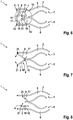
- FIGS. 7 and 8 show two examples: In FIG. 7 are the bearing pins 11, 12 of the locking elements 9, 10 at the intended in the direction of flow through the air vent 1 rear edges of the locking elements 9, 10 and in a middle between the top and bottom of the housing 2.
- the controls 21 are located at the In the intended flow direction front edges of the locking elements 9, 10.
- the air vent 1 works out FIG. 7 in the same way as the air vent 1 from FIGS. 1 to 6 and reference is made to the above explanations.
- the blocking elements 9, 10 are pivotally mounted in their centers and in the middle of the two air ducts 5, 6.
- the control elements 21 may be arranged at the front or rear edges of the blocking elements 9, 10 in the throughflow direction.
- the two locking elements 9, 10 in the region of the branch point 4 of the air inlet channel 3 in the two air channels 5, 6 and thus at the beginning of the air ducts 5, 6 are arranged. However, they can also be arranged further back in the air ducts 5, 6 at any point between their beginning and their ends at the air outlet openings 7, 8 (not shown).
- control discs 14, 15 with the control cams 16, 17, the handwheel 19 and the intermediate 20 are in FIGS. 7 and 8 not drawn.
Landscapes
- Physics & Mathematics (AREA)
- Thermal Sciences (AREA)
- Engineering & Computer Science (AREA)
- Mechanical Engineering (AREA)
- Air-Flow Control Members (AREA)
- Air-Conditioning For Vehicles (AREA)
Abstract
Description
- Die Erfindung betrifft einen Luftausströmer mit den Merkmalen des Oberbegriffs des Anspruchs 1. Der Luftausströmer ist zu einer Belüftung eines Fahrgastraums eines Kraftwagens mit kalter oder warmer Luft vorgesehen und wird typischerweise in ein Armaturenbrett so eingebaut, dass Luftaustrittsöffnungen des Luftausströmers bündig mit dem Armaturenbrett sind. Andere Verwendungen des Luftausströmers sind nicht ausgeschlossen.
- Die französische Patentanmeldung
FR 3 054 491 A1 - In einer Durchströmungsrichtung durch den bekannten Luftausströmer vor der Teilung in zwei Luftkanäle, das heißt in dem Luftkanal zwischen einer Lufteintrittsöffnung und der Verzweigungsstelle, sind zwei Sperrklappen angeordnet, die um eine gemeinsame Schwenkachse schwenkbar sind. Mit einer komplizierten mechanischen Steuerung sind die beiden Sperrklappen zwischen einer aneinander anliegenden und einer V-förmig auseinanderstehenden Stellung und, wenn sie aneinander anliegen, gemeinsam hin und her schwenkbar. Durch Auseinanderschwenken der Sperrklappen versperren die Sperrklappen den bzw. die Luftkanäle. Werden die beiden Sperrklappen gemeinsam in einer Richtung geschwenkt, versperren sie einen der beiden Luftkanäle, so dass Luft durch den anderen Luftkanal strömt und entsprechend seines schrägen Verlaufs zur Luftaustrittsöffnung schräg aus dem Luftausströmer ausströmt.
- Aufgabe der Erfindung ist, einen Luftausströmer mit einer vereinfachten Steuermechanik vorzuschlagen.
- Diese Aufgabe wird erfindungsgemäß durch die Merkmale des Anspruchs 1 gelöst. Der erfindungsgemäße Luftausströmer weist zwei Luftkanäle mit jeweils einer Luftaustrittsöffnung auf. Denkbar ist auch, dass ein oder beide Luftkanäle mehrere Luftaustrittsöffnungen aufweisen. Die Luftaustrittsöffnungen können unmittelbar oder mit Abstand neben- bzw. übereinander angeordnet sein. Zu den Luftaustrittsöffnungen hin verlaufen die beiden Luftkanäle schräg aufeinander zu, so dass Luftströme, die die beiden Luftkanäle durchströmen und durch die Luftaustrittsöffnungen ausströmen, schräg aufeinander zu und zusammenströmen und sich zu einem Luftstrom vereinigen. Ist die Luftmenge in einem Luftkanal größer, lenkt das den vereinigten Luftstrom aus dem Luftausströmer nach den Luftaustrittsöffnungen schräg in die entsprechende Richtung.
- Zu einer Steuerung der Luftmengen in den beiden Luftkanälen und damit zum Lenken des vereinigten Luftstroms aus dem Luftausströmer nach den Luftaustrittsöffnungen weist der erfindungsgemäße Luftausströmer für jeden Luftkanal ein bewegliches Sperrelement auf. Der Luftausströmer kann auch mehrere Sperrelemente für einen oder beide Luftkanäle aufweisen. Insbesondere sind die Sperrelemente schwenkbar, vorzugsweise sind sie schwenkbare Klappen. Die Sperrelemente können in einer vorgesehenen Durchströmungsrichtung vor bzw. an einem Anfang der beiden Luftkanäle, also im Bereich der Verzweigungsstelle, an der sich der Luftkanal in die beiden Luftkanäle teilt, oder in den beiden Luftkanälen angeordnet sein. Die Sperrelemente können an einem Anfang an grundsätzlich beliebiger Stelle zwischen dem Anfang und einem Ende oder am Ende der Luftkanäle angeordnet sein. Durch einzelnes oder gemeinsames Bewegen der Sperrelemente lassen sich Luftdurchtrittsquerschnitte der beiden Luftkanäle einzeln oder gemeinsam ändern, wobei durch gemeinsames Bewegen der Sperrelemente die Luftdurchtrittsquerschnitte gemeinsam vergrößert und verkleinert und/oder der Luftdurchtrittsquerschnitt eines Luftkanals vergrößert und der Luftdurchtrittsquerschnitt des anderen Luftkanals verkleinert werden kann.
- Zum Bewegen der Sperrelemente, was auch als Steuern der Sperrelemente und der die beiden Luftkanäle durchströmenden Luftmengen aufgefasst werden kann, weist der erfindungsgemäße Luftausströmer eine Kurvensteuerung mit einer drehbaren Steuerscheibe mit einer Steuerkurve für ein zugeordnetes Sperrelement auf. Die Steuerkurven der Sperrelemente der beiden Luftkanäle sind verschieden, der Luftausströmer weist (mindestens) zwei Steuerkurven auf. Die Steuerscheibe kann beide Steuerkurven aufweisen oder es sind mehrere Steuerscheiben vorhanden. Die Kurvensteuerung kann als eine Kurvensteuerung, die beide Steuerkurven umfasst, oder als zwei Kurvensteuerungen mit jeweils einer Steuerkurve aufgefasst werden. Bei einer Drehung der Steuerscheiben werden die Steuerkurven durchlaufen, beispielsweise bewegen sich Steuerelemente der Sperrelemente, die mit den Steuerkurven zusammenwirken, bei der Drehung der Steuerscheiben entlang der Steuerkurven. Beim Durchlaufen der Steuerkurven durch Drehung der Steuerscheiben bewegt die Kurvensteuerung die Sperrelemente.
- Eine Ausgestaltung der Erfindung sieht Steuerelemente an den Sperrelementen vor, die mit der zugeordneten Steuerkurven zusammenwirken. Die Steuerelemente sind beispielsweise Zapfen oder Nasen, die an der Steuerkurve anliegen oder in die Steuerkurve eingreifen. Bei der Drehung der Steuerkurven durch Drehung der Steuerscheiben bewegen sich die Steuerelemente an den Steuerkurven entlang, wobei sich tatsächlich die Steuerkurven bewegen. Diese Bewegung der Steuerelemente entlang der Steuerkurven bzw. umgekehrt der Steuerkurven entlang der Steuerelemente kann auch als "Durchlaufen" der Steuerkurven aufgefasst werden. In kreisbogenförmigen Abschnitten der Steuerkurven konzentrisch, das heißt mit gleichbleibendem Radius um eine Drehachse der Steuerscheiben herum, werden die Sperrelemente nicht bewegt. Bewegt werden die Sperrelemente in solchen Abschnitten der Steuerkurven, in denen sich die Steuerkurven von den Drehachsen der Steuerscheiben entfernen oder sich den Drehachsen nähern.
- Eine Ausgestaltung der Erfindung sieht Steuerkurven mit gemeinsam durchlaufenen Abschnitten vor, die ein Sperrelement bewegen und das andere Sperrelement nicht, und/oder gemeinsam durchlaufene Abschnitte, die beide Sperrelemente bewegen. Es können Abschnitte, die beide Sperrelemente gleichsinnig und/oder Abschnitte, die beide Sperrelemente gegensinnig bewegen, vorhanden sein. Dabei soll "gleichsinnig" als Verkleinern oder Vergrößern der Luftdurchtrittsquerschnitte beider Luftkanäle und "gegensinnig" als Vergrößern des Luftdurchtrittsquerschnitts eines und gleichzeitiges Verkleinern des Luftdurchtrittsquerschnitts des anderen Luftkanals verstanden werden. Vorzugsweise sind die Steuerkurven drehfest miteinander, wofür eine Ausgestaltung der Erfindung zwei Steuerscheiben mit jeweils einer Steuerkurve aufweist, denen jeweils ein Sperrelement zugeordnet ist.
- Die vorstehend in der Beschreibung genannten Merkmale und Merkmalskombinationen, Ausführungen und Ausgestaltungen der Erfindung, sowie die nachfolgend in der Figurenbeschreibung genannten und/oder in einer Figur gezeichneten Merkmale und Merkmalskombinationen sind nicht nur in der jeweils angegebenen oder gezeichneten Kombination, sondern auch in grundsätzlich beliebigen anderen Kombinationen oder aber einzeln verwendbar. Es sind Ausführungen der Erfindung möglich, die nicht alle Merkmale eines abhängigen Anspruchs aufweisen. Auch können einzelne Merkmale eines Anspruchs durch andere offenbarte Merkmale oder Merkmalskombinationen ersetzt werden. Ausführungen der Erfindung, die nicht alle Merkmale des oder der Ausführungsbeispiele, sondern einen grundsätzlich beliebigen Teil der gekennzeichneten Merkmale eines Ausführungsbeispiels gegebenenfalls in Kombination mit einem, mehreren oder allen Merkmalen eines oder mehrerer weiterer Ausführungsbeispiele aufweisen, sind möglich.
- Die Erfindung wird nachfolgend anhand in der Zeichnung dargestellter Ausführungsbeispiele näher erläutert. Es zeigen:
- Figur 1
- ein erstes Ausführungsbeispiel eines erfindungsgemäßen Luftausströmers in einer perspektivischen und teilweise aufgeschnittenen Darstellung;
- Figur 2
- Steuerscheiben einer Kurvensteuerung des Luftausströmers aus
Figur 1 ; - Figuren 3 bis 6
- den Luftausströmer aus
Figur 1 mit Sperrelementen in verschiedenen Stellungen in einer Seitenansicht; und - Figuren 7 und 8
- als weitere Ausführungsbeispiele den Luftausströmer aus
Figur 1 mit anders angeordneten Sperrelementen in Seitenansicht. - Die Figuren sind vereinfachte und schematisierte Darstellungen.
- Der in
Figur 1 dargestellte, erfindungsgemäße Luftausströmer 1 ist zu zu einem Einbau in ein Armaturenbrett eines nicht dargestellten Kraftwagens zu einer Belüftung eines Fahrgastraums des Kraftwagens vorgesehen. Er weist ein rechteckrohrförmiges Gehäuse 2 mit sich ändernder Höhe und im Ausführungsbeispiel gleichbleibender Breite auf. Das Gehäuse 2 bildet einen Lufteintrittskanal 3, der sich an einer Verzweigungsstelle 4 in einen ersten Luftkanal 5 und einen zweiten Luftkanal 6 teilt. Das Gehäuse 2 ist ohne Seitenwände gezeichnet. Die beiden Luftkanäle 5, 6, die ebenfalls rechteckrohrförmige Querschnitte aufweisen, verlaufen in einer vorgesehenen Durchströmungsrichtung durch den Luftausströmer 1 von der Verzweigungsstelle 4 ausgehend bogenförmig zunächst schräg auseinander und anschließend wieder schräg in der vorgesehenen Durchströmungsrichtung und aufeinander zu. Der erste Lufkanal 5 endet mit einer ersten Luftaustrittsöffnung 7 und der zweite Luftkanal 6 mit einer zweiten Luftaustrittsöffnung 8. Die Luftaustrittsöffnungen 7, 8 weisen im Ausführungsbeispiel einen Abstand voneinander auf, können allerdings auch ohne Abstand voneinander angeordnet sein. In der vorgesehenen Durchströmungsrichtung durch die beiden Luftkanäle 5, 6 strömende Luftströme strömen wie inFigur 4 zu sehen schräg aufeinander zu, aus den beiden Luftaustrittsöffnungen 7, 8 aus und vereinigen sich zu einem gemeinsamen Luftstrom aus dem Luftausströmer 1. - An der Verzweigungsstelle 4, an der sich der Lufteintrittskanal 3 in die beiden Luftkanäle 5, 6 teilt, weist der Luftausströmer 1 für jeden der beiden Luftkanäle 5, 6 eine schwenkbare Klappe als Sperrelement 9, 10 auf, nämlich ein erstes Sperrlement 9 für den ersten Luftkanal 5 und ein zweites Sperrelement für den zweiten Luftkanal 6. Die beiden Klappen sind um Lagerzapfen 11, 12 schwenkbar, nämlich einem ersten Lagerzapfen 11 für das erste Sperrelement 9 und einem zweiten Lagerzapfen 12 für das zweite Sperrelement 10, die in Lagerlöchern in den nicht dargestellten Seitenwänden des Gehäuses 2 gelagert sind. In
Figur 1 befinden sich die Lagerzapfen 11, 12, die Schwenkachsen der die Sperrelemente 9, 10 bildenden Klappen definieren, an in der vorgesehenen Durchströmungsrichtung des Luftausströmers 1 vorderen Rändern der Sperrelemente 9, 10. InFigur 1 befinden sich die ersten Lagerzapfen 11 des ersten Sperrelements 9 an einer Oberseite und die zweiten Lagerzapfen 12 des zweiten Sperrelements 10 an einer Unterseite des Gehäuses 1. Durch Schwenken der Sperrelemente 9, 10 lassen sich Luftdurchtrittsquerschnitte der beiden Luftkanäle 5, 6 einzeln verkleinern. - Zum Schwenken der Sperrelemente 5, 6 weist der erfindungsgemäße Luftausströmer 1 eine Kurvensteuerung 13 mit zwei ebenen und im Ausführungsbeispiel kreisförmigen Steuerscheiben 14, 15 auf, nämlich einer ersten Steuerscheibe 14 mit einer ersten Steuerkurve 16 für das erste Sperrelement 9 und einer zweiten Steuerscheibe 15 mit einer zweiten Steuerkurve 17 für das zweite Sperrelement 10. Die beiden Steuerscheiben 14, 15 sind drehfest auf einer Welle 18 angeordnet, so dass die beiden Steuerscheiben 14, 15 und die beiden Steuerkurven 16, 17 drehfest miteinander sind. Die Welle 18 mit den beiden die Steuerkurven 16, 17 aufweisenden Steuerscheiben 14, 15 ist in
Figur 2 einzeln zu sehen. Die Steuerscheiben 14, 15 sind an den nicht gezeichneten Seitenwänden des Gehäuses 2 des Luftausströmers 1 angeordnet, die Welle 18 befindet sich in einer Mitte zwischen der Oberseite und der Unterseite des Gehäuses 1 und ist in den Seitenwänden des Gehäuses 1 drehbar gelagert. - Ein Drehantrieb der Steuerscheiben 14, 15 erfolgt im Ausführungsbeispiel von Hand mittels eines Handrads 19 über ein Zwischenrad 20, die beide drehbar an einer der beiden Seitenwände des Gehäuses 1 gelagert sind und die aufeinander wälzen. Das Handrad 19 steht etwas über die Luftaustrittsöffnungen 7, 8 über und bei in vorgesehener Weise in ein Armaturenbrett eingebautem Luftausströmer 1 aus dem Armaturenbrett vor. Der Drehantrieb der Steuerscheiben 14, 15 kann auch mittels eines Motors, insbesondere eines Elektromotors erfolgen (nicht dargestellt).
- Jedes der beiden Sperrelemente 9, 10 weist einen seitlich abstehenden Zapfen auf, der als Steuerelement 21 in die Steuerkurve 16, 17 einer der beiden Steuerscheiben 15, 16 eingreift. Die Steuerkurven 16, 17 verlaufen abschnittsweise kreisbogenförmig konzentrisch zur Welle 18, die eine Drehachse der beiden Steuerscheiben 14, 15 definiert, das heißt mit konstantem Radius zur Welle 18. Auf anderen Abschnitten verlaufen die Steuerkurven 16, 17 bogenförmig nach innen bzw. nach außen, so dass durch Drehung der Steuerscheiben 14, 15 und mit ihnen der Steuerkurven 16, 17 die beiden als schwenkbare Klappen ausgebildeten Sperrelemente 9, 10 geschwenkt werden. Die Bewegung der Steuerelemente 21 in den Steuerkurven 14, 15 bzw. die Bewegung bzw. Drehung der Steuerkurven 16, 17 in Bezug zu den Steuerelementen 21 kann auch als Durchlaufen der Steuerkurven 16, 17 aufgefasst werden.
- Ausgehend von einer in
Figur 3 gezeigten Stellung, bei der das erste Sperrelement 9 schräg von der Oberseite zur Mitte des Gehäuses 2 steht und einen der beiden Luftkanäle 5 versperrt und das zweite Sperrelement 10 innen an der Unterseite des Gehäuses 2 des Luftausströmers 1 anliegt, schwenkt durch Drehen der Steuerscheiben 14, 15 das erste Sperrelement 9 nach oben innen an die Oberseite des Gehäuses 2, so dass, wie inFigur 4 zu sehen, beide Luftkanäle 5, 6 offen sind. In denFiguren 3 bis 6 ist die in Blickrichtung vordere, erste Steuerscheibe 14 durchsichtig und ihre ersten Steuerkurven 16 mit Strichlinien gezeichnet. Das Zwischenrad 20 und das Handrad 19 sind inFiguren 3 bis 6 nicht gezeichnet. Wie inFigur 4 durch Pfeile dargestellt, strömen Luftströme durch die beiden Luftkanäle 5, 6 schräg aufeinander zu aus den Luftaustrittsöffnungen 7, 8 der Luftkanäle 5, 6 aus und vereinigen sich zu einem gemeinsamen Luftstrom. Ist, wie inFiguren 3 und 5 zu sehen, nur einer der beiden Luftkanäle 5, 6 offen, tritt der Luftstrom entsprechend schräg aus der jeweiligen Luftaustrittsöffnung 7, 8 aus. Durch Sperren oder teilweises Sperren eines der beiden Luftkanäle 5, 6 wird der vereinigte Luftstrahl hinter den Luftaustrittsöffnungen 7, 8 schräg in die entsprechende Richtung abgelenkt. - Bei einem Weiterdrehen der Steuerscheiben 14, 15 schwenkt, wie in
Figur 5 zu sehen, dass zweite Sperrelement 10 nach oben und sperrt den zweiten Luftkanal 6. Das erste Sperrelement 9 verbleibt dabei innen an der Oberseite des Gehäuses 2, so dass der zugeordnete erste Luftkanal 5 offen bleibt. Werden die Steuerscheiben 14, 15 noch weiter gedreht, schwenkt das erste Sperrelement 9 wieder schräg nach innen, so dass beide Luftkanäle 5, 6 gesperrt sind und keine Luft durch den Luftausströmer 1 strömt. - Die Sperrelemente 9, 10 können anders angeordnet sein. Die
Figuren 7 und 8 zeigen dafür zwei Beispiele: InFigur 7 befinden sich die Lagerzapfen 11, 12 der Sperrelemente 9, 10 an den in der vorgesehenen Durchströmungsrichtung durch den Luftausströmer 1 hinteren Rändern der Sperrelemente 9, 10 und in einer Mitte zwischen der Oberseite und der Unterseite des Gehäuses 2. Die Steuerelemente 21 befinden sich an den in der vorgesehenen Durchströmungsrichtung vorderen Rändern der Sperrelemente 9, 10. Zum Öffnen der beiden Luftkanäle 5, 6 werden die beiden Sperrelemente 9, 10 in die Mitte des Gehäuses 2 geschwenkt. Im Übrigen funktioniert der Luftausströmer 1 ausFigur 7 in gleicher Weise wie der Luftausströmer 1 ausFiguren 1 bis 6 und es wird auf die obigen Erläuterungen verwiesen. - In
Figur 8 sind die Sperrelemente 9, 10 in ihren Mitten und in Mitten der beiden Luftkanäle 5, 6 schwenkbar gelagert. Die Steuerelemente 21 können an den in der Durchströmungsrichtung vorderen oder hinteren Rändern der Sperrelemente 9, 10 angeordnet sein. Auch bei diesem Ausführungsbeispiel der Erfindung funktioniert die inFigur 8 nicht gezeichnete Kurvensteuerung 13 wie zuFiguren 1 bis 6 erläutert. InFigur 8 sind die beiden Sperrelemente 9, 10 im Bereich der Verzweigungsstelle 4 des Lufteintrittskanals 3 in die beiden Luftkanäle 5, 6 und damit am Anfang der Luftkanäle 5, 6 angeordnet. Sie lassen sich allerdings auch weiter hinten in den Luftkanälen 5, 6 an beliebiger Stelle zwischen deren Anfang und deren Enden an den Luftaustrittsöffnungen 7, 8 anordnen (nicht dargestellt). - Die Steuerscheiben 14, 15 mit den Steuerkurven 16, 17, das Handrad 19 und das Zwischenrad 20 sind in
Figuren 7 und 8 nicht gezeichnet. -
- 1
- Luftausströmer
- 2
- Gehäuse
- 3
- Lufteintrittskanal
- 4
- Verzweigungsstelle
- 5
- erster Luftkanal
- 6
- zweiter Luftkanal
- 7
- erste Luftaustrittsöffnung
- 8
- zweite Luftaustrittsöffnung
- 9
- erstes Sperrelement
- 10
- zweites Sperrelement
- 11
- erster Lagerzapfen
- 12
- zweiter Lagerzapfen
- 13
- Kurvensteuerung
- 14
- erste Steuerscheibe
- 15
- zweite Steuerscheibe
- 16
- erste Steuerkurve
- 17
- zweite Steuerkurve
- 18
- Welle
- 19
- Handrad
- 20
- Zwischenrad
- 21
- Steuerelement
Claims (6)
- Luftausströmer, mit zwei Luftkanälen (5, 6), die je eine Luftaustrittsöffnung (7, 8) aufweisen und die zu den Luftaustrittsöffnungen (7, 8) hin schräg in einer vorgesehenen Durchströmungsrichtung von Luft durch die Luftkanäle (5, 6) und aufeinander zu verlaufen, so dass durch die beiden Luftaustrittöffnungen (7, 8) aus den Luftkanälen (5, 6) ausströmende Luftströme zu einem gemeinsamen Luftstrom zusammen strömen, und mit jeweils einem beweglichen Sperrelement (9, 10) für jeden Luftkanal (5, 6), mit denen sich Luftdurchtrittsquerschnitte der beiden Luftkanäle (5, 6) einzeln verkleinern lassen, dadurch gekennzeichnet, dass der Luftausströmer (1) für jedes Sperrelement (9, 10) eine Kurvensteuerung (13) mit einer drehbaren Steuerscheibe (14, 15) mit einer Steuerkurve (16, 17) für das zugeordnete Sperrelement (9, 10) aufweist, mit der das jeweilige Sperrelement (9, 10) bewegbar ist, wobei die Steuerkurven (16, 17) bei einer Drehung der Steuerscheibe (14, 15) durchlaufen werden.
- Luftausströmer nach Anspruch 1, dadurch gekennzeichnet, dass die Sperrelemente (9, 10) Steuerelemente (21) aufweisen, die mit der zugeordneten Steuerkurve (16, 17) zusammenwirken und die sich bei Drehung der Steuerscheibe/n (14, 15) entlang der Steuerkurven (16, 17) bewegen, so dass die Sperrelemente (9, 10) bewegt werden.
- Luftausströmer nach Anspruch 1 oder 2, dadurch gekennzeichnet, dass die Steuerkurven (16, 17) Abschnitte aufweisen, mit denen sie ein Sperrelement (9, 10) bewegen während ein anderes Sperrelement (10, 9) still steht und/oder dass die Steuerkurven (16, 17) Abschnitte aufweisen, in denen sie beide Sperrelemente (9, 10) gleichsinnig bewegen und/oder dass die Steuerkurven (16, 17) Abschnitte aufweisen, in denen sie beide Sperrelemente (9, 10) gegensinnig bewegen.
- Luftausströmer nach einem oder mehreren der Ansprüche 1 bis 3, dadurch gekennzeichnet, dass die Steuerkurven (16, 17) drehfest miteinander sind.
- Luftausströmer nach einem oder mehreren der vorhergehenden Ansprüche, dadurch gekennzeichnet, dass der Luftausströmer (1) zwei gleichachsige Steuerscheiben (14, 15) aufweist, von denen jeweils eine Steuerscheibe (14, 15) eine Steuerkurve (16, 17) für das zugeordnete Sperrelement (9, 10) aufweist.
- Luftausströmer nach einem oder mehreren der vorhergehenden Ansprüche, dadurch gekennzeichnet, dass die Sperrelemente (9, 10) schwenkbar, insbesondere schwenkbare Klappen, sind.
Applications Claiming Priority (1)
| Application Number | Priority Date | Filing Date | Title |
|---|---|---|---|
| DE102018105747.4A DE102018105747A1 (de) | 2018-03-13 | 2018-03-13 | Luftausströmer |
Publications (2)
| Publication Number | Publication Date |
|---|---|
| EP3546258A1 true EP3546258A1 (de) | 2019-10-02 |
| EP3546258B1 EP3546258B1 (de) | 2020-09-30 |
Family
ID=65598488
Family Applications (1)
| Application Number | Title | Priority Date | Filing Date |
|---|---|---|---|
| EP19159325.0A Active EP3546258B1 (de) | 2018-03-13 | 2019-02-26 | Luftausströmer |
Country Status (2)
| Country | Link |
|---|---|
| EP (1) | EP3546258B1 (de) |
| DE (1) | DE102018105747A1 (de) |
Cited By (2)
| Publication number | Priority date | Publication date | Assignee | Title |
|---|---|---|---|---|
| CN111497568A (zh) * | 2020-04-08 | 2020-08-07 | 浙江吉利汽车研究院有限公司 | 一种通道的开关装置、空气调节系统和汽车 |
| FR3148829A1 (fr) * | 2023-05-15 | 2024-11-22 | Psa Automobiles Sa | Aérateur à effet coanda pour une planche de bord de véhicule automobile |
Families Citing this family (5)
| Publication number | Priority date | Publication date | Assignee | Title |
|---|---|---|---|---|
| DE102019107446A1 (de) * | 2019-03-22 | 2020-09-24 | Bayerische Motoren Werke Aktiengesellschaft | Luftausströmer für ein Kraftfahrzeug und Kraftfahrzeug mit einem solchen Luftausströmer |
| DE102019120516A1 (de) | 2019-07-30 | 2021-02-04 | Fischer Automotive Systems Gmbh & Co. Kg | Luftausströmer |
| DE102020131095A1 (de) * | 2020-11-24 | 2022-05-25 | Novares Löhne GmbH | Lüftungseinrichtung |
| CN114013249B (zh) * | 2021-12-16 | 2024-08-30 | 宁波继峰汽车零部件股份有限公司 | 一种车载空调出风口调节装置 |
| DE102023203069A1 (de) | 2023-04-03 | 2024-10-10 | Volkswagen Aktiengesellschaft | Luftausströmer für ein Kraftfahrzeug, Kraftfahrzeug |
Citations (5)
| Publication number | Priority date | Publication date | Assignee | Title |
|---|---|---|---|---|
| FR2760694A1 (fr) * | 1997-03-12 | 1998-09-18 | Bourbon Automobile Sa | Bouche pour l'ecoulement d'un fluide |
| DE102013210055B3 (de) * | 2013-05-29 | 2014-09-11 | Faurecia Innenraum Systeme Gmbh | Luftausströmer |
| DE102017111011A1 (de) * | 2017-05-19 | 2017-07-27 | Dr. Schneider Kunststoffwerke Gmbh | Luftausströmer |
| FR3054491A1 (fr) | 2016-07-29 | 2018-02-02 | Peugeot Citroen Automobiles Sa | Aerateur pour vehicule automobile a compacite amelioree. |
| EP3290245A1 (de) * | 2016-09-01 | 2018-03-07 | Fischer Automotive Systems GmbH & Co. KG | Luftausströmer |
-
2018
- 2018-03-13 DE DE102018105747.4A patent/DE102018105747A1/de not_active Withdrawn
-
2019
- 2019-02-26 EP EP19159325.0A patent/EP3546258B1/de active Active
Patent Citations (5)
| Publication number | Priority date | Publication date | Assignee | Title |
|---|---|---|---|---|
| FR2760694A1 (fr) * | 1997-03-12 | 1998-09-18 | Bourbon Automobile Sa | Bouche pour l'ecoulement d'un fluide |
| DE102013210055B3 (de) * | 2013-05-29 | 2014-09-11 | Faurecia Innenraum Systeme Gmbh | Luftausströmer |
| FR3054491A1 (fr) | 2016-07-29 | 2018-02-02 | Peugeot Citroen Automobiles Sa | Aerateur pour vehicule automobile a compacite amelioree. |
| EP3290245A1 (de) * | 2016-09-01 | 2018-03-07 | Fischer Automotive Systems GmbH & Co. KG | Luftausströmer |
| DE102017111011A1 (de) * | 2017-05-19 | 2017-07-27 | Dr. Schneider Kunststoffwerke Gmbh | Luftausströmer |
Cited By (2)
| Publication number | Priority date | Publication date | Assignee | Title |
|---|---|---|---|---|
| CN111497568A (zh) * | 2020-04-08 | 2020-08-07 | 浙江吉利汽车研究院有限公司 | 一种通道的开关装置、空气调节系统和汽车 |
| FR3148829A1 (fr) * | 2023-05-15 | 2024-11-22 | Psa Automobiles Sa | Aérateur à effet coanda pour une planche de bord de véhicule automobile |
Also Published As
| Publication number | Publication date |
|---|---|
| EP3546258B1 (de) | 2020-09-30 |
| DE102018105747A1 (de) | 2019-09-19 |
Similar Documents
| Publication | Publication Date | Title |
|---|---|---|
| EP3546258B1 (de) | Luftausströmer | |
| DE102017113906B4 (de) | Luftausströmer | |
| DE102008050180B4 (de) | Luftauslassdüse | |
| EP3530506B1 (de) | Luftausströmer | |
| DE102019120516A1 (de) | Luftausströmer | |
| DE102018205881B3 (de) | Luftausströmer für ein Fahrzeug | |
| EP1800918B1 (de) | Luftausströmer mit Drallströmung | |
| DE102018104048A1 (de) | Luftausströmer | |
| DE102018122999A1 (de) | Luftausströmer | |
| DE102018130048A1 (de) | Luftausströmer | |
| DE102014100441A1 (de) | Luftlenkeinrichtung für einen Luftausströmer | |
| DE102019120807A1 (de) | Luftausströmer | |
| DE102005027746A1 (de) | Luftausströmer für den Fahrgastraum eines Fahrzeuges | |
| EP2062763B1 (de) | Düse, insbesondere für ein Fahrzeug | |
| EP1270286B1 (de) | Luftleitvorrichtung, insbesondere eines Fahrzeugs | |
| EP1634739A2 (de) | Luftausströmer, insbesondere für ein Fahrzeug | |
| DE102019132921B4 (de) | Luftausströmer mit Bedieneinrichtung | |
| DE102021111535A1 (de) | Luftausströmeranordnung | |
| DE102007037273A1 (de) | Luftdüse zur Belüftung eines Fahrzeuginnenraums | |
| EP1204538B1 (de) | Luftausströmer mit lamellen | |
| DE102019131554B4 (de) | Luftauslassvorrichtung für den Auslass einer Luftströmung | |
| EP0841202B1 (de) | Heiz- oder Klimaanlage | |
| DE19816013A1 (de) | Luftstromverteiler für einen Kraftfahrzeuginnenraum | |
| DE102019115285A1 (de) | Luftausströmer | |
| EP0937596B1 (de) | Luftstromverteiler |
Legal Events
| Date | Code | Title | Description |
|---|---|---|---|
| PUAI | Public reference made under article 153(3) epc to a published international application that has entered the european phase |
Free format text: ORIGINAL CODE: 0009012 |
|
| STAA | Information on the status of an ep patent application or granted ep patent |
Free format text: STATUS: THE APPLICATION HAS BEEN PUBLISHED |
|
| AK | Designated contracting states |
Kind code of ref document: A1 Designated state(s): AL AT BE BG CH CY CZ DE DK EE ES FI FR GB GR HR HU IE IS IT LI LT LU LV MC MK MT NL NO PL PT RO RS SE SI SK SM TR |
|
| AX | Request for extension of the european patent |
Extension state: BA ME |
|
| STAA | Information on the status of an ep patent application or granted ep patent |
Free format text: STATUS: REQUEST FOR EXAMINATION WAS MADE |
|
| 17P | Request for examination filed |
Effective date: 20200227 |
|
| RBV | Designated contracting states (corrected) |
Designated state(s): AL AT BE BG CH CY CZ DE DK EE ES FI FR GB GR HR HU IE IS IT LI LT LU LV MC MK MT NL NO PL PT RO RS SE SI SK SM TR |
|
| GRAP | Despatch of communication of intention to grant a patent |
Free format text: ORIGINAL CODE: EPIDOSNIGR1 |
|
| STAA | Information on the status of an ep patent application or granted ep patent |
Free format text: STATUS: GRANT OF PATENT IS INTENDED |
|
| INTG | Intention to grant announced |
Effective date: 20200519 |
|
| GRAS | Grant fee paid |
Free format text: ORIGINAL CODE: EPIDOSNIGR3 |
|
| GRAA | (expected) grant |
Free format text: ORIGINAL CODE: 0009210 |
|
| STAA | Information on the status of an ep patent application or granted ep patent |
Free format text: STATUS: THE PATENT HAS BEEN GRANTED |
|
| AK | Designated contracting states |
Kind code of ref document: B1 Designated state(s): AL AT BE BG CH CY CZ DE DK EE ES FI FR GB GR HR HU IE IS IT LI LT LU LV MC MK MT NL NO PL PT RO RS SE SI SK SM TR |
|
| REG | Reference to a national code |
Ref country code: CH Ref legal event code: EP Ref country code: GB Ref legal event code: FG4D Free format text: NOT ENGLISH |
|
| REG | Reference to a national code |
Ref country code: DE Ref legal event code: R096 Ref document number: 502019000252 Country of ref document: DE Ref country code: AT Ref legal event code: REF Ref document number: 1318447 Country of ref document: AT Kind code of ref document: T Effective date: 20201015 |
|
| REG | Reference to a national code |
Ref country code: IE Ref legal event code: FG4D Free format text: LANGUAGE OF EP DOCUMENT: GERMAN |
|
| PG25 | Lapsed in a contracting state [announced via postgrant information from national office to epo] |
Ref country code: NO Free format text: LAPSE BECAUSE OF FAILURE TO SUBMIT A TRANSLATION OF THE DESCRIPTION OR TO PAY THE FEE WITHIN THE PRESCRIBED TIME-LIMIT Effective date: 20201230 Ref country code: SE Free format text: LAPSE BECAUSE OF FAILURE TO SUBMIT A TRANSLATION OF THE DESCRIPTION OR TO PAY THE FEE WITHIN THE PRESCRIBED TIME-LIMIT Effective date: 20200930 Ref country code: GR Free format text: LAPSE BECAUSE OF FAILURE TO SUBMIT A TRANSLATION OF THE DESCRIPTION OR TO PAY THE FEE WITHIN THE PRESCRIBED TIME-LIMIT Effective date: 20201231 Ref country code: FI Free format text: LAPSE BECAUSE OF FAILURE TO SUBMIT A TRANSLATION OF THE DESCRIPTION OR TO PAY THE FEE WITHIN THE PRESCRIBED TIME-LIMIT Effective date: 20200930 Ref country code: HR Free format text: LAPSE BECAUSE OF FAILURE TO SUBMIT A TRANSLATION OF THE DESCRIPTION OR TO PAY THE FEE WITHIN THE PRESCRIBED TIME-LIMIT Effective date: 20200930 Ref country code: BG Free format text: LAPSE BECAUSE OF FAILURE TO SUBMIT A TRANSLATION OF THE DESCRIPTION OR TO PAY THE FEE WITHIN THE PRESCRIBED TIME-LIMIT Effective date: 20201230 |
|
| PG25 | Lapsed in a contracting state [announced via postgrant information from national office to epo] |
Ref country code: LV Free format text: LAPSE BECAUSE OF FAILURE TO SUBMIT A TRANSLATION OF THE DESCRIPTION OR TO PAY THE FEE WITHIN THE PRESCRIBED TIME-LIMIT Effective date: 20200930 Ref country code: RS Free format text: LAPSE BECAUSE OF FAILURE TO SUBMIT A TRANSLATION OF THE DESCRIPTION OR TO PAY THE FEE WITHIN THE PRESCRIBED TIME-LIMIT Effective date: 20200930 |
|
| REG | Reference to a national code |
Ref country code: NL Ref legal event code: MP Effective date: 20200930 |
|
| REG | Reference to a national code |
Ref country code: LT Ref legal event code: MG4D |
|
| PG25 | Lapsed in a contracting state [announced via postgrant information from national office to epo] |
Ref country code: SM Free format text: LAPSE BECAUSE OF FAILURE TO SUBMIT A TRANSLATION OF THE DESCRIPTION OR TO PAY THE FEE WITHIN THE PRESCRIBED TIME-LIMIT Effective date: 20200930 Ref country code: LT Free format text: LAPSE BECAUSE OF FAILURE TO SUBMIT A TRANSLATION OF THE DESCRIPTION OR TO PAY THE FEE WITHIN THE PRESCRIBED TIME-LIMIT Effective date: 20200930 Ref country code: EE Free format text: LAPSE BECAUSE OF FAILURE TO SUBMIT A TRANSLATION OF THE DESCRIPTION OR TO PAY THE FEE WITHIN THE PRESCRIBED TIME-LIMIT Effective date: 20200930 Ref country code: CZ Free format text: LAPSE BECAUSE OF FAILURE TO SUBMIT A TRANSLATION OF THE DESCRIPTION OR TO PAY THE FEE WITHIN THE PRESCRIBED TIME-LIMIT Effective date: 20200930 Ref country code: PT Free format text: LAPSE BECAUSE OF FAILURE TO SUBMIT A TRANSLATION OF THE DESCRIPTION OR TO PAY THE FEE WITHIN THE PRESCRIBED TIME-LIMIT Effective date: 20210201 Ref country code: RO Free format text: LAPSE BECAUSE OF FAILURE TO SUBMIT A TRANSLATION OF THE DESCRIPTION OR TO PAY THE FEE WITHIN THE PRESCRIBED TIME-LIMIT Effective date: 20200930 |
|
| PG25 | Lapsed in a contracting state [announced via postgrant information from national office to epo] |
Ref country code: AL Free format text: LAPSE BECAUSE OF FAILURE TO SUBMIT A TRANSLATION OF THE DESCRIPTION OR TO PAY THE FEE WITHIN THE PRESCRIBED TIME-LIMIT Effective date: 20200930 Ref country code: ES Free format text: LAPSE BECAUSE OF FAILURE TO SUBMIT A TRANSLATION OF THE DESCRIPTION OR TO PAY THE FEE WITHIN THE PRESCRIBED TIME-LIMIT Effective date: 20200930 Ref country code: IS Free format text: LAPSE BECAUSE OF FAILURE TO SUBMIT A TRANSLATION OF THE DESCRIPTION OR TO PAY THE FEE WITHIN THE PRESCRIBED TIME-LIMIT Effective date: 20210130 Ref country code: PL Free format text: LAPSE BECAUSE OF FAILURE TO SUBMIT A TRANSLATION OF THE DESCRIPTION OR TO PAY THE FEE WITHIN THE PRESCRIBED TIME-LIMIT Effective date: 20200930 |
|
| PG25 | Lapsed in a contracting state [announced via postgrant information from national office to epo] |
Ref country code: SK Free format text: LAPSE BECAUSE OF FAILURE TO SUBMIT A TRANSLATION OF THE DESCRIPTION OR TO PAY THE FEE WITHIN THE PRESCRIBED TIME-LIMIT Effective date: 20200930 Ref country code: NL Free format text: LAPSE BECAUSE OF FAILURE TO SUBMIT A TRANSLATION OF THE DESCRIPTION OR TO PAY THE FEE WITHIN THE PRESCRIBED TIME-LIMIT Effective date: 20200930 |
|
| REG | Reference to a national code |
Ref country code: DE Ref legal event code: R097 Ref document number: 502019000252 Country of ref document: DE |
|
| PLBE | No opposition filed within time limit |
Free format text: ORIGINAL CODE: 0009261 |
|
| STAA | Information on the status of an ep patent application or granted ep patent |
Free format text: STATUS: NO OPPOSITION FILED WITHIN TIME LIMIT |
|
| PG25 | Lapsed in a contracting state [announced via postgrant information from national office to epo] |
Ref country code: DK Free format text: LAPSE BECAUSE OF FAILURE TO SUBMIT A TRANSLATION OF THE DESCRIPTION OR TO PAY THE FEE WITHIN THE PRESCRIBED TIME-LIMIT Effective date: 20200930 |
|
| 26N | No opposition filed |
Effective date: 20210701 |
|
| PG25 | Lapsed in a contracting state [announced via postgrant information from national office to epo] |
Ref country code: MC Free format text: LAPSE BECAUSE OF FAILURE TO SUBMIT A TRANSLATION OF THE DESCRIPTION OR TO PAY THE FEE WITHIN THE PRESCRIBED TIME-LIMIT Effective date: 20200930 |
|
| REG | Reference to a national code |
Ref country code: BE Ref legal event code: MM Effective date: 20210228 |
|
| PG25 | Lapsed in a contracting state [announced via postgrant information from national office to epo] |
Ref country code: IT Free format text: LAPSE BECAUSE OF FAILURE TO SUBMIT A TRANSLATION OF THE DESCRIPTION OR TO PAY THE FEE WITHIN THE PRESCRIBED TIME-LIMIT Effective date: 20200930 Ref country code: LU Free format text: LAPSE BECAUSE OF NON-PAYMENT OF DUE FEES Effective date: 20210226 |
|
| PG25 | Lapsed in a contracting state [announced via postgrant information from national office to epo] |
Ref country code: SI Free format text: LAPSE BECAUSE OF FAILURE TO SUBMIT A TRANSLATION OF THE DESCRIPTION OR TO PAY THE FEE WITHIN THE PRESCRIBED TIME-LIMIT Effective date: 20200930 |
|
| PG25 | Lapsed in a contracting state [announced via postgrant information from national office to epo] |
Ref country code: FR Free format text: LAPSE BECAUSE OF NON-PAYMENT OF DUE FEES Effective date: 20210228 Ref country code: IE Free format text: LAPSE BECAUSE OF NON-PAYMENT OF DUE FEES Effective date: 20210226 |
|
| PG25 | Lapsed in a contracting state [announced via postgrant information from national office to epo] |
Ref country code: IS Free format text: LAPSE BECAUSE OF FAILURE TO SUBMIT A TRANSLATION OF THE DESCRIPTION OR TO PAY THE FEE WITHIN THE PRESCRIBED TIME-LIMIT Effective date: 20210130 |
|
| PG25 | Lapsed in a contracting state [announced via postgrant information from national office to epo] |
Ref country code: BE Free format text: LAPSE BECAUSE OF NON-PAYMENT OF DUE FEES Effective date: 20210228 |
|
| REG | Reference to a national code |
Ref country code: CH Ref legal event code: PL |
|
| PG25 | Lapsed in a contracting state [announced via postgrant information from national office to epo] |
Ref country code: LI Free format text: LAPSE BECAUSE OF NON-PAYMENT OF DUE FEES Effective date: 20220228 Ref country code: CH Free format text: LAPSE BECAUSE OF NON-PAYMENT OF DUE FEES Effective date: 20220228 |
|
| PG25 | Lapsed in a contracting state [announced via postgrant information from national office to epo] |
Ref country code: CY Free format text: LAPSE BECAUSE OF FAILURE TO SUBMIT A TRANSLATION OF THE DESCRIPTION OR TO PAY THE FEE WITHIN THE PRESCRIBED TIME-LIMIT Effective date: 20200930 |
|
| PG25 | Lapsed in a contracting state [announced via postgrant information from national office to epo] |
Ref country code: HU Free format text: LAPSE BECAUSE OF FAILURE TO SUBMIT A TRANSLATION OF THE DESCRIPTION OR TO PAY THE FEE WITHIN THE PRESCRIBED TIME-LIMIT; INVALID AB INITIO Effective date: 20190226 |
|
| GBPC | Gb: european patent ceased through non-payment of renewal fee |
Effective date: 20230226 |
|
| PG25 | Lapsed in a contracting state [announced via postgrant information from national office to epo] |
Ref country code: GB Free format text: LAPSE BECAUSE OF NON-PAYMENT OF DUE FEES Effective date: 20230226 |
|
| PG25 | Lapsed in a contracting state [announced via postgrant information from national office to epo] |
Ref country code: GB Free format text: LAPSE BECAUSE OF NON-PAYMENT OF DUE FEES Effective date: 20230226 |
|
| PG25 | Lapsed in a contracting state [announced via postgrant information from national office to epo] |
Ref country code: MK Free format text: LAPSE BECAUSE OF FAILURE TO SUBMIT A TRANSLATION OF THE DESCRIPTION OR TO PAY THE FEE WITHIN THE PRESCRIBED TIME-LIMIT Effective date: 20200930 |
|
| PG25 | Lapsed in a contracting state [announced via postgrant information from national office to epo] |
Ref country code: TR Free format text: LAPSE BECAUSE OF FAILURE TO SUBMIT A TRANSLATION OF THE DESCRIPTION OR TO PAY THE FEE WITHIN THE PRESCRIBED TIME-LIMIT Effective date: 20200930 |
|
| PG25 | Lapsed in a contracting state [announced via postgrant information from national office to epo] |
Ref country code: MT Free format text: LAPSE BECAUSE OF FAILURE TO SUBMIT A TRANSLATION OF THE DESCRIPTION OR TO PAY THE FEE WITHIN THE PRESCRIBED TIME-LIMIT Effective date: 20200930 |
|
| REG | Reference to a national code |
Ref country code: DE Ref legal event code: R081 Ref document number: 502019000252 Country of ref document: DE Owner name: MATIKON GMBH & CO. KG, DE Free format text: FORMER OWNER: FISCHER AUTOMOTIVE SYSTEMS GMBH & CO. KG, 72160 HORB, DE |
|
| PGFP | Annual fee paid to national office [announced via postgrant information from national office to epo] |
Ref country code: DE Payment date: 20250129 Year of fee payment: 7 |
|
| REG | Reference to a national code |
Ref country code: AT Ref legal event code: MM01 Ref document number: 1318447 Country of ref document: AT Kind code of ref document: T Effective date: 20240226 |
|
| PG25 | Lapsed in a contracting state [announced via postgrant information from national office to epo] |
Ref country code: AT Free format text: LAPSE BECAUSE OF NON-PAYMENT OF DUE FEES Effective date: 20240226 |
|
| PGFP | Annual fee paid to national office [announced via postgrant information from national office to epo] |
Ref country code: AT Payment date: 20260410 Year of fee payment: 5 |