EP3545274B1 - Signalisation olfactive après surchauffe dans des équipement technique par pyrolyse de dérivés de substances odorantes - Google Patents
Signalisation olfactive après surchauffe dans des équipement technique par pyrolyse de dérivés de substances odorantes Download PDFInfo
- Publication number
- EP3545274B1 EP3545274B1 EP17811856.8A EP17811856A EP3545274B1 EP 3545274 B1 EP3545274 B1 EP 3545274B1 EP 17811856 A EP17811856 A EP 17811856A EP 3545274 B1 EP3545274 B1 EP 3545274B1
- Authority
- EP
- European Patent Office
- Prior art keywords
- fragrance
- pyrolyzable
- derivative
- sotolon
- glucoside
- Prior art date
- Legal status (The legal status is an assumption and is not a legal conclusion. Google has not performed a legal analysis and makes no representation as to the accuracy of the status listed.)
- Active
Links
Images



Classifications
-
- G—PHYSICS
- G01—MEASURING; TESTING
- G01K—MEASURING TEMPERATURE; MEASURING QUANTITY OF HEAT; THERMALLY-SENSITIVE ELEMENTS NOT OTHERWISE PROVIDED FOR
- G01K11/00—Measuring temperature based upon physical or chemical changes not covered by groups G01K3/00, G01K5/00, G01K7/00 or G01K9/00
- G01K11/003—Measuring temperature based upon physical or chemical changes not covered by groups G01K3/00, G01K5/00, G01K7/00 or G01K9/00 using absorption or generation of gas, e.g. hydrogen
-
- C—CHEMISTRY; METALLURGY
- C10—PETROLEUM, GAS OR COKE INDUSTRIES; TECHNICAL GASES CONTAINING CARBON MONOXIDE; FUELS; LUBRICANTS; PEAT
- C10B—DESTRUCTIVE DISTILLATION OF CARBONACEOUS MATERIALS FOR PRODUCTION OF GAS, COKE, TAR, OR SIMILAR MATERIALS
- C10B53/00—Destructive distillation, specially adapted for particular solid raw materials or solid raw materials in special form
- C10B53/02—Destructive distillation, specially adapted for particular solid raw materials or solid raw materials in special form of cellulose-containing material
-
- Y—GENERAL TAGGING OF NEW TECHNOLOGICAL DEVELOPMENTS; GENERAL TAGGING OF CROSS-SECTIONAL TECHNOLOGIES SPANNING OVER SEVERAL SECTIONS OF THE IPC; TECHNICAL SUBJECTS COVERED BY FORMER USPC CROSS-REFERENCE ART COLLECTIONS [XRACs] AND DIGESTS
- Y02—TECHNOLOGIES OR APPLICATIONS FOR MITIGATION OR ADAPTATION AGAINST CLIMATE CHANGE
- Y02B—CLIMATE CHANGE MITIGATION TECHNOLOGIES RELATED TO BUILDINGS, e.g. HOUSING, HOUSE APPLIANCES OR RELATED END-USER APPLICATIONS
- Y02B10/00—Integration of renewable energy sources in buildings
- Y02B10/30—Wind power
-
- Y—GENERAL TAGGING OF NEW TECHNOLOGICAL DEVELOPMENTS; GENERAL TAGGING OF CROSS-SECTIONAL TECHNOLOGIES SPANNING OVER SEVERAL SECTIONS OF THE IPC; TECHNICAL SUBJECTS COVERED BY FORMER USPC CROSS-REFERENCE ART COLLECTIONS [XRACs] AND DIGESTS
- Y02—TECHNOLOGIES OR APPLICATIONS FOR MITIGATION OR ADAPTATION AGAINST CLIMATE CHANGE
- Y02E—REDUCTION OF GREENHOUSE GAS [GHG] EMISSIONS, RELATED TO ENERGY GENERATION, TRANSMISSION OR DISTRIBUTION
- Y02E50/00—Technologies for the production of fuel of non-fossil origin
- Y02E50/10—Biofuels, e.g. bio-diesel
-
- Y—GENERAL TAGGING OF NEW TECHNOLOGICAL DEVELOPMENTS; GENERAL TAGGING OF CROSS-SECTIONAL TECHNOLOGIES SPANNING OVER SEVERAL SECTIONS OF THE IPC; TECHNICAL SUBJECTS COVERED BY FORMER USPC CROSS-REFERENCE ART COLLECTIONS [XRACs] AND DIGESTS
- Y02—TECHNOLOGIES OR APPLICATIONS FOR MITIGATION OR ADAPTATION AGAINST CLIMATE CHANGE
- Y02T—CLIMATE CHANGE MITIGATION TECHNOLOGIES RELATED TO TRANSPORTATION
- Y02T50/00—Aeronautics or air transport
- Y02T50/60—Efficient propulsion technologies, e.g. for aircraft
- Y02T50/678—Aviation using fuels of non-fossil origin
Definitions
- the present invention discloses olfactory signaling after overheating in technical facilities by means of pyrolysis of fragrance derivatives.
- the usual technical solution for overheating protection consists in the installation of platinum measuring resistors (e.g. Pt100, Pt1000), which enable a temperature measurement via the dependence of the electrical resistance of platinum on the temperature ("characteristic curve") and can thus be used as thermal sensors or "thermal sensors” do. These are used, for example, to switch off in the event of overheating and / or to give acoustic or optical signals in the event of overheating.
- platinum measuring resistors e.g. Pt100, Pt1000
- thermal sensors are not only used in electrical systems, but also on other technical equipment that is at risk from heating.
- An important technical limitation here is that thermal sensors initially only work selectively, and more comprehensive monitoring can only be achieved by using several thermal sensors or by measuring in an area in which the heat must first be distributed.
- the inventors have found that when pyrolysable fragrance derivatives are applied to or in a technical device or a component thereof, a corresponding warning signal can be released when heated without the fragrance itself having previously evaporated.
- the technical solution in principle to distribute volatile fragrances over a large area in a technical facility, without them being lost through evaporation over time, consists in the use of chemically bound fragrances, which only occur at elevated temperatures, i.e. above room temperature, e.g. of more than 50 ° C, for example 80 ° C or more, 100 ° C or more, 110 ° C or more, 120 ° C or more, disintegrate in a chemical reaction, ie pyrolyze.
- This can mainly be done by the Use of fragrance glucosides can be achieved, but is in principle not limited to this, but can also be achieved with other fragrance derivatives.
- the pyrolysis of substances does not take place over a wide temperature range, but in a narrow one.
- the present invention relates to a method for providing a technical device with a warning signal against heating, a pyrolysable fragrance derivative being applied to or introduced onto the technical device or components thereof.
- kits comprising a solution, a spray, an aerosol, a powder or a film that can be applied, which comprises a pyrolysable fragrance derivative, preferably the pyrolyzable fragrance derivative being selected from the group consisting of a glycoside, N -Glycoside, thioglycoside, ester, thioester, ether, thioether, amide, acetal, hemiacetal or carbamate, preferably where the pyrolysable fragrance derivative is selected from mono- and / or oligo-glycosides, more preferably glucosides, in particular where the pyrolysable fragrance derivative comprises sotolone glucoside; and optionally an odor sample comprising the fragrance corresponding to the pyrolyzable fragrance derivative in a method according to the invention.
- a pyrolysable fragrance derivative being selected from the group consisting of a glycoside, N -Glycoside, thioglycoside, ester, thi
- sotolon glucoside in particular sotolon- ⁇ -D-glucoside of the general chemical formula I, which was previously not synthetically accessible.
- a fragrance is a chemical substance that stimulates the sense of smell, in particular a chemical substance that stimulates the olfactory sense of a vertebrate, preferably a human, and / or a chemical substance that can be detected by an olfactory sensor.
- An olfactory sensor is a sensor that can detect a substance in such a way that a substance is detected that a large number of people perceive as a fragrance.
- biological olfactory sensors such as those of humans, electronic noses or other technical devices can also be used as olfactory sensors.
- a derivative of a fragrance is a substance that is not a fragrance itself, or has a lower or different perception quality, but from which a fragrance can be generated by splitting off, in particular splitting off a molecular component of the fragrance derivative.
- the present invention relates to a method for providing a technical device with a warning signal against heating, a pyrolysable fragrance derivative being applied to or introduced onto the technical device or components thereof.
- a pyrolysable fragrance derivative being applied to or introduced onto the technical device or components thereof.
- fragrance derivatives can also be applied, which can preferably lead to different smells, so that different operators of the technical device can recognize at least one fragrance after pyrolysis, for example if they cannot perceive certain fragrances.
- the warning signal which is a warning of heating, in particular excessive heating, from a technical device, and which is given in particular when heating to a temperature that the technical device should not normally achieve, is released here of the fragrance generated after pyrolysis, which is thus olfactory perceptible, for example by a user or a supervisor and / or an olfactory sensor.
- the application or introduction can take place in various ways, both on or into the technical device and also components thereof, possibly even before assembling the technical device, for example accumulators, for example in cell phones, laptops or tablets, or before installing a component, possibly also a replacement component.
- the pyrolysable fragrance derivative is in particular a heat-unstable, pyrolysable fragrance derivative that can be applied to technical equipment that is at risk, for example, from overheating.
- the pyrolysable fragrance derivative is from a temperature of more than 120 ° C, for example 130 ° C or more, preferably 140 ° C or more, more preferably 150 ° C or more, even more preferably 160 ° C or more, e.g. 160 ° C to 240 ° C, pyrolyzable, and in particular no longer stable at these temperatures, so that it disintegrates and releases the fragrance of the fragrance derivative.
- the pyrolyzable fragrance derivative is disintegrated by pyrolysis at a temperature of 250 ° C. or less, preferably 240 ° C. or less.
- the pyrolysable fragrance derivative is selected from the group consisting of mono- and / or oligosaccharides, esters, thioesters, ethers, thioethers, amides, acetals, hemiacetals and carbamates and / or derivatives thereof, preferably a glycoside, N-glycoside, Thioglycoside, ester, thioester, ether, thioether, amide, acetal, hemiacetal or carbamate, preferably where the pyrolysable fragrance derivative is selected from mono- and / or oligoglycosides and / or derivatives thereof, more preferably glucosides and / or derivatives thereof, nor further preferred glucosides, in particular where the pyrolysable fragrance derivative comprises sotolone glucoside.
- sugars or saccharides or derivatives thereof such as glucose, galactose, fructose, mannose, etc.
- glycosides N-glycosides, thioglycosides, or compounds for the formation of esters, thioesters
- esters thioesters
- sugars or saccharides or derivatives thereof such as glucose, galactose, fructose, mannose, etc.
- sugars or saccharides or derivatives thereof such as glucose, galactose, fructose, mannose, etc.
- sugars or saccharides or derivatives thereof such as glucose, galactose, fructose, mannose, etc.
- esters thioesters
- carbamates such as carboxylic acids, etc.
- saccharides for example, also more complex saccharides, e.g. glycosides, e.g.
- mono- and / or oligosaccharides such as mono- or oligoglycosides, and also mono- and / or oligomers other sugars than glucose, as well as derivatives of sugars or saccharides such as deoxy sugar, sugar acids, Sugar alcohols, also in more complex sugars, such as glycosides, are possible.
- Organic and / or inorganic, non-glycosidic esters can also be used as derivatizing molecular units Half-acetals and acetals, for example the glycosides, and / or ethers are possible.
- derivatives of saccharides mono- as well as oligosaccharides
- glycosides or glucosides there are also those with substitutions of the hydroxyl groups, in particular with halogens - especially F, Cl, Br, I - and pseudohalogens such as -SCN, -CN, - NCO, -OCN, -NCS, N 3 , epimerizations of hydroxyl groups in the sugars, e.g. glycosides, and / or oxidations of hydroxyl groups to ketones or terminal carboxy functions (e.g. sugar acids), and / or complexes with metal ions - especially those that change the pyrolysis temperature of the saccharide, eg glycoside, in question.
- halogens - especially F, Cl, Br, I - and pseudohalogens such as -SCN, -CN, - NCO, -OCN, -NCS, N 3
- epimerizations of hydroxyl groups in the sugars e.g. glycosides
- hydroxyl groups e.g. glycosides
- the metal ions for the complexes are not particularly restricted and can, for example, be adapted to the fragrance and / or the derivatizing component.
- glycoside residues in particular glucoside residues, and / or derivatives thereof, possibly also with the participation of functional groups of the aglycone in the glycoside or glucoside and / or derivative thereof, Cu (II), Fe (III), Al (III) and / or Zn (II) is conceivable as a metal ion, which can then impair the stability of the glycosides or glucosides and / or derivatives thereof and thus their pyrolysis temperature.
- fragrances are preferably selected from the food sector and these are glycosidically bound, in particular to glucose, but also to galactose, etc.
- the pyrolysable fragrance derivative is selected from glycosides and / or derivatives thereof, in particular glucosides and / or derivatives thereof, of sotolone, maltol, ethyl maltol, furaneol, homofuraneol, norfuraneol, eugenol, terpineol, thioterpineol, thymol, 1-octene-3 -ol, and / or 2-furfurylthiol and / or selected from glycosides and / or derivatives thereof, in particular glucosides and / or derivatives thereof, of smoke aromas, the smoke aromas preferably being selected from phenol, 2-methylphenol, hydroquinone, 2,6 -Dimethoxyphenol (syn.
- Syringol 2,6-dimethoxy-4-methylphenol (syn. 4-methylsyringol), o-, m- and p-cresol, 2-methoxyphenol (guaiacol), 2-methoxy-4-vinylphenol , 4-ethyl-2-methoxyphenol, 4- and 5-methyl-2-methoxyphenol (the former syn. 4-methyl-guaiacol), and / or 2- and / or 4-methylphenol.
- fragrances are selected that have a very low odor threshold and / or would normally not be expected in the vicinity of the technical facility.
- Sotolon the odorant of the "Maggikrautes” (lovage, Levisticum officinale), whose structure is shown in the following formula II and which has an odor threshold of only 0.02 ng / L air ( Koenig et al. 1999, J. Agric. Food Chem. 1999, 47, 3288-3291 ), these advantages very well and was also selected and used as an exemplary compound in the examples shown here, although the invention is not restricted to Sotolon and its derivatives. This was made possible in particular by the successful synthesis of the previously unsynthesized substance sotolon glucoside, in particular sotolon- ⁇ -D-glucoside of the general chemical formula I.
- Sotolon has a very low odor threshold in the range of ⁇ g / kg, depending on the test person, whereby in the glucoside, as a derivative, glucose is glycosidically bound via its hydroxyl group, i.e. via the C1-OH group.
- the fragrance that is released from the fragrance derivative is one that has a very low odor threshold and / or whose pyrolysis temperature corresponds to the respective required overheating signal temperature - depending on the technical device - and / or that in the spatial environment of the technical equipment to be protected is normally not to be expected.
- a required overheating signal temperature is the temperature below or at least at which the warning signal should be perceptible, i.e. the fragrance is released in a perceptible amount by pyroylysis, whereby this depends on the fragrance itself and its perception, its concentration, the pyrolysis and the spatial environment (e.g. with or without drafts, room humidity, etc.).
- the fragrance released from the fragrance derivative is a smoke flavor, such as off Stahl et al., "Nature's Chemical Signatures in Human Olfaction: A Foodborne Perspective for Future Biotechnology, Angew. Chem. Int. Ed. 2014, 53, pp. 2-22 ; Mayr et al., “Determination of the Importance of In-Mouth Release of Volatile Phenol Glycoconjugates to the Flavor of Smoke-Tainted Wines," J. Agric. Food Chem. 2014, 62, pp. 2327-2336 ; or Pino, "Characterization of volatile compounds in a smoke flavoring from rice husk", Food Chemistry 153 (2014) pp. 81-86 , known. These offer the additional advantage that their perception is directly associated with the risk of fire.
- fragrance derivatives are of course also possible, so that, for example, on the one hand a burning smell can occur, but on the other hand also an unusual smell, which can also serve to localize an overheated material and / or component.
- a burning smell can occur
- an unusual smell which can also serve to localize an overheated material and / or component.
- By using different fragrance derivatives it is also possible to locate the overheated area more easily using a specific smell. This can also be of interest with regard to a variation of the pyrolysis temperature of the fragrance derivatives.
- the fragrance derivative itself has no, a different, and / or a significantly lower olfactory perception than the fragrance.
- sotolon glucoside which only show residues of sotolon from the synthesis, hardly show any smell of sotolon.
- Glycosides can also for example are partially perceived as bitter substances, but this is essentially a taste perception, corresponding to the good solubility in water and the low volatility of glycosides; for example, naringin, the glucoside of the flavonoid neringenin, is a strong bitter substance and is responsible for the bitterness of grapefruit.
- the amount of the pyrolyzable fragrance derivative applied can be adapted to whether heating of the technical facility is to be expected at certain points or over a large area, such that the total amount of fragrance that can be released by the heating in the area to be expected is sufficient so that in the room in which the technical equipment to be protected is located, the odor threshold value can be exceeded and an odor signal can be triggered.
- a correspondingly adapted distribution can be achieved, for example, by appropriate adjustment of the concentration of the pyrolyzable fragrance derivative in a solution or liquid or in an aerosol or spray or an applicable film, for example a sticker, which is used for application, and / or by targeted and / or multiple applications of this solution.
- the fragrance derivative can be applied in a concentration of 1-1,000,000 ppm, preferably 10-100,000 ppm, e.g. about 50,000 ppm.
- the pyrolysable fragrance derivative is applied or introduced as an aerosol, spray, in solution or in powder form, preferably as an aerosol, spray or in solution, the solvent preferably being an organic solvent, for example ethanol, ethyl acetate, methanol, acetone, dimethyl sulfoxide, dimethylformamide , Ethylene glycol monomethyl ether, isopropanol, or a mixture thereof, or water, preferably an organic solvent, for example ethanol, ethyl acetate, methanol, acetone, dimethyl sulfoxide, dimethylformamide, ethylene glycol monomethyl ether, isopropanol, or a mixture thereof is used.
- the solvent does not include electrolytes.
- the pyrolyzable fragrance derivative can also be applied as a powder or dust, for example if it has appropriate adhesive forces and / or is applied in such a way that it adheres to the technical device or a component thereof itself, for example due to the nature of the technical device or the Part of it.
- auxiliaries can be included which are usually included, such as surface-active agents, propellants, etc. which are not particularly restricted and can be adapted according to the fragrance and / or fragrance derivative used .
- the solution, the aerosol or the spray can be suitably packaged.
- drying can follow after application.
- an organic solvent when applied to the technical device to be protected, it is selected such that there are no residues during the application and subsequent drying - with the technical device, for example an electrical system, preferably in the inactive state form through the solution, for example electrolyte residues, and preferably only the fragrance derivative remains after application and drying.
- the solvent is one which has a boiling point which is below the pyrolysis temperature of the fragrance derivative, preferably below 100 ° C, more preferably below 70 ° C, and / or at a temperature of 10 to 40 ° C a vapor pressure has that it evaporates substantially after application.
- the pyrolysable fragrance derivative is applied with an applicable film, preferably a sticker, optionally with a protective film that can be peeled off after application.
- the film that can be applied or the material of the sticker is not particularly restricted and can be produced, for example, on the basis of one or more polymers and / or cellulose and its derivatives, for example paper, the polymer and / or the cellulose and its derivatives not being particularly restricted are.
- the optional removable protective film is also not restricted and can, for example, be adapted to the material of the film, for example the sticker.
- the pyrolysable fragrance derivative can, for example, be applied to the film, for example the sticker, that is, for example, be present on a surface thereof, and / or be contained in the material of the film, for example the sticker, for example by being included in the production of the film, for example the Sticker, incorporated into the starting material becomes.
- the pyrolysable fragrance derivative is present at least on one surface of the film that can be applied, for example the sticker.
- the film that can be applied for example the sticker, can be provided with a suitable adhesive which can be adapted to the technical device and is likewise not particularly restricted.
- the film that can be applied contains a test strip comprising the fragrance corresponding to the pyrolyzable fragrance derivative, which is protected from being released, for example, by a protective strip.
- the test strip can be connected to the film that can be applied, e.g. a sticker, or it can be present separately.
- a corresponding test strip can also be added separately to a solution, a spray and / or an aerosol comprising the pyrolyzable fragrance derivative.
- the test strip is furthermore not particularly restricted and can serve as an odor sample for the user. Several test strips can also be present in order to be able to provide several users with a corresponding odor sample.
- a spray, a powder and / or a film that can be applied for example a sticker
- a user can subsequently, even repeatedly, after installation or purchase with a corresponding olfactory device, the technical device, for example a technical system
- a warning signal against overheating is provided by pyrolysable fragrance derivatives, preferably with a hand-held spray and / or a sticker.
- the technical equipment or a component thereof is not particularly restricted and includes both the technical equipment as a whole as well as parts thereof, such as components, but also aids that contribute to the functioning of the technical equipment as a component, such as lubricants such as lubricating oil, pump fluids, etc.
- the technical device or a component thereof is selected from electrical systems or components thereof, for example cables, cable ducts, coil windings, motor, generator and / or transformer windings; Axle bearings, lines for liquids, in particular dangerous liquids; Containers containing highly flammable and / or explosive substances; medical equipment; IT systems such as servers; Installations in aerospace or other means of passenger transport; Electronics in the home and / or everyday life such as accumulators, for example in cell phones, laptops or tablets, in particular lithium accumulators; and / or lubricants.
- the technical device or a component thereof is selected from technical devices or components thereof, that is to say parts from which the technical device can be assembled.
- the pyrolysable fragrance derivative can be applied by spraying a solution or as dust, or before installation on components, e.g. components, a technical device, e.g. cables, coil windings, lubricants, etc., in order to prevent internal (e.g. current flow, exothermic reaction and / or friction) or external influences (e.g. thermal radiation, convection of hot gases, contact with hot objects) to give an olfactory warning signal in order to be able to prevent damage to the technical equipment, or the consequential damage or costs to be expected from its failure to reduce or prevent.
- components e.g. components, a technical device, e.g. cables, coil windings, lubricants, etc.
- internal e.g. current flow, exothermic reaction and / or friction
- external influences e.g. thermal radiation, convection of hot gases, contact with hot objects
- the technical device is an electrical system or a component thereof and / or a technical device in which its own costs are particularly high, for the failure of which the follow-up costs would be particularly high, and / or the failure of which is associated with particular dangers,
- the pyrolyzable fragrance derivative is applied together with an auxiliary substance which inhibits or prevents enzymatic cleavage or degradation by microorganisms of the pyrolyzable fragrance derivatives, for example parabens (esters of para-hydroxybenzoic acid).
- an auxiliary substance which inhibits or prevents enzymatic cleavage or degradation by microorganisms of the pyrolyzable fragrance derivatives, for example parabens (esters of para-hydroxybenzoic acid).
- the present invention relates to the use of a kit comprising a solution, a spray, an aerosol, a powder or a film that can be applied, which comprises a pyrolyzable fragrance derivative, preferably wherein the pyrolyzable fragrance derivative is selected from the group consisting from a glycoside, N-glycoside, thioglycoside, ester, thioester, ether, Thioether, amide, acetal, hemiacetal or carbamate, preferably where the pyrolyzable fragrance derivative is selected from mono- and / or oligo-glycosides, more preferably glucosides, in particular where the pyrolyzable fragrance derivative comprises sotolone glucoside; and optionally an odor sample comprising the fragrance corresponding to the pyrolyzable fragrance derivative in a method according to the invention.
- a kit comprising a solution, a spray, an aerosol, a powder or a film that can be applied, which comprises a
- kit is therefore used in the method according to the invention.
- the kit can be provided, for example, as a spray can, for example in hand format, as a liquid, as a solid, for example in a suitable container.
- the kit comprises the free fragrance as a sample of the warning odor, for example packaged separately, as an odor sample, for example as a test strip.
- the kit is provided as a film that can be applied, for example as a sticker, this or this can optionally include a protective film that can be peeled off after application and / or a separate odor sample or not connected to the film, e.g. the sticker, for example a test strip with the free one bound fragrance that can be protected, for example, by a protective strip.
- the sticker for example a test strip with the free one bound fragrance that can be protected, for example, by a protective strip.
- Corresponding statements on a solution, a powder, an aerosol, a spray and an applicable film, as well as configurations for this, can also be found in the description of the method according to the invention for providing a technical device with a warning signal against heating.
- the present invention relates to sotolon glucoside, in particular sotolon- ⁇ -D-glucoside of the general chemical formula I.
- sotolon-glucoside is not on sotolon- ⁇ -D-glucoside, but also includes, for example, sotolon- ⁇ -D-glucoside which can be obtained by simple conversion.
- the sotolon glucoside here comprises anomers as well as diastereomers in pure form, for example both the anomer sotolon-ß-D-glucoside, i.e. a diastereomer mixture obtained from racemic sotolon, as well as the two diastereomers R- / S-sotolon-ß-D-glucoside in pure form or essentially as a pure form, as can be synthesized from the respective enantiomers R- and S-sotolon.
- the general chemical structural formula I of sotolon-ß-D-glucoside no diastereochemistry of the 4-methyl group is shown either, either one or the other diastereomer can be obtained, as can a mixture of both.
- Sotolon itself is characterized by a low odor threshold. Also disclosed is the use of sotolon glucoside as a pyrolysable fragrance derivative, its use as an applicatable agent with warning effect against heating, for example above 110 ° C, for example more than 120 ° C, for example 130 ° C or more, 140 ° C or more, 150 ° C or more, or 160 ° C. or more, and its use in the method according to the invention for providing a technical device with a warning signal against overheating.
- sotolon glucoside in which sotolon is reacted with a suitable glycosyl transferase, for example a glycosyl transferase derived from wine, in a biotransformation, for example by Escherichia coli, with UDP-glucose, for example with the cell's own UDP-glucose.
- a suitable glycosyl transferase for example a glycosyl transferase derived from wine
- LB Luria Bertani
- FIG. 1 shows the biotransformation of sotolone to sotolone glucoside, which progresses over time.
- Fig. 1 shows the biotransformation of racemic sotolon to sotolon- ⁇ -D-glucoside (diastereomers) with the glycosyltransferase VvdGT13 in E. coli.
- the analysis of the culture supernatant by means of LC-MS at time 0 (upper three spectra) and after one day (lower three spectra) is shown.
- the spectra show: above: TIC total ion current, negative mode, in the middle: UV 250-258 nm, below: EIC extracted ion current, negative mode.
- the sotolone glucoside produced in synthesis example 1 was identified and characterized by mass spectroscopy as part of the analysis accompanying the synthesis.
- the HPLC system used consisted of a quadruple pump and a variable wavelength detector, both from Agilent 1100 (Bruker Daltonics, Bremen, Germany).
- a LUNA C18 100A 150 x 2 mm column was used (Phenomenex, Aillesburg, Germany).
- the HPLC was carried out with the following binary gradient system: solution A, water with 0.1% formic acid and solution B, 100% methanol with 0.1% formic acid.
- the gradient program used was: 0-3 min, 90% A / 10% B after 50% A / 50% B; 3-6 min, 50% A / 50% B after 100% B, constant for 8 min; 14-14.1 min, 100% B after 90% A / 10% B, for 11 min.
- the flow rate was 0.2 ml / min.
- To the HPLC A Bruker esquire 3000plus mass spectrometer was coupled with an ESI interface to record the mass spectra. The ionization voltage of the capillary was 4000 V and the end plate was set to -500 V.
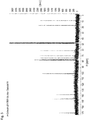
- sotolone glucoside identified by its mass (as formic acid adduct), its shift in transit time on the RP column in relation to unglucosylated sotolon and its similar UV absorption was further confirmed and characterized in more detail by its mass spectrum MS and MS2, as in Figure 2 shown.
- Fig. 2 shows the UV spectrum (top), -MS (middle) and -MS2 (bottom) of sotolon- ⁇ -D-glucoside in the described LC-MS system.
- -MS shows the molecular ion signal of sotolone glucoside as a deprotonated HCOOH adduct at 334.9 Dalton.
- -MS2 shows the deprotonated sotolone glucoside with a mass of 288.7 Dalton and a split-off sotolone anion fragment with a mass of 126.8 Dalton.
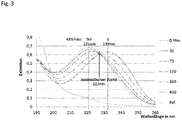
- Fig. 3 a diagram of temporally successive spectra recorded with a Jenway 7315 spectrophotometer.
- Fig. 3 shows here the course of the reaction of the enzyme-catalyzed hydrolysis of sotolon- ⁇ -D-glucoside (SG) to sotolon (S), with UV spectra from 190 to 260 nm being recorded at the specified time intervals. The absorption maxima ABSmax of the two substances are also shown.
- sotolon- ⁇ -D-glucoside When sotolon- ⁇ -D-glucoside is split into sotolon, there is a slight shift and decrease in the absorption maximum. An isosbestic point is also observed, which denotes the point at which all graphs intersect due to the same extinction coefficient there). It is proof of the direct conversion of educt into product, as is to be expected in the case of hydrolysis of a glucoside. It would not be there if intermediate products were created or the product was further degraded; it is very likely that these would have different extinction coefficients at this wavelength, see above that the sum of the absorbances would not be constant. The analysis results are thus in conformity with the presence of a simple glucoside and its cleavage.
- Example 1 Pyrolysis in a heating furnace
- sotolone glucoside 5 mg are successively heated in a precisely temperature-controlled heating furnace with an exhaust device.
- the Sotolon odor odor of the lovage, Levisticum officinale, "Maggi herb odor”
- Table 3 Sotolon odor perception by a person, here an inventor, when sotolon glucoside is heated step-by-step using a heating oven set up in a closed room.
- Example 2 External heating of a coated cable by convection of hot air
- a three-core cable designed for 230V-50Hz was coated with 1 mg sotolone glucoside in methanolic solution and dried.
- a heat gun which, depending on the exposure time, can reach temperatures above 200 ° C, a strong Sotolon odor is perceptible throughout the room within seconds, after no such odor was perceptible in the previous cold state. No changes in the surface of the insulating material are visible on the cable; it is still undamaged.
- the external heating of the cable coated with sotolon glucoside by convection of hot air releases the warning substance sotolon.
- Example 3 External heating of a coated cable by heat radiation
- a three-core cable designed for 230V-50Hz was coated with 1 mg sotolone glucoside in methanolic solution and dried. Under the heat of a warm light lamp (200 W), a strong Sotolon odor is perceptible in the whole room after 15 minutes, after no such odor was perceptible in the previous cold state. No changes in the surface of the insulating material are visible on the cable; it is still undamaged.
- the winding of a fan motor (operating values: 12 V, 0.19 A; manufacturer's specifications) was coated with 2.5 mg of sotolone glucoside in methanolic solution at 24 V applied voltage. After drying, a current flow corresponding to an overload was given through the winding. Warning odor development, heat radiation, electrical functionality and externally visible condition were observed over time.
- the electrical windings of the fan motor were overloaded when a voltage of 24 V was applied. If the warning smell of Sotolon is noticed in the room after 10 minutes of operation under overload, the motor is still functional and externally unchanged, but the inner part of the device with the axis is overheated and can no longer be touched with the bare hand. The experiment was terminated after 1.5 hours and severe overheating of the device before the coils burned out.
Landscapes
- Chemical & Material Sciences (AREA)
- Engineering & Computer Science (AREA)
- Oil, Petroleum & Natural Gas (AREA)
- Materials Engineering (AREA)
- Organic Chemistry (AREA)
- Physics & Mathematics (AREA)
- General Physics & Mathematics (AREA)
- Fats And Perfumes (AREA)
Claims (10)
- Procédure pour l'équipement d'une installation technique d'un signal d'avertissement contre le réchauffement, où un composé aromatique pyrolysable est appliqué sur ou introduit dans l'installation technique ou ses composants.
- Procédure selon la revendication 1, où le composé aromatique pyrolysable est pyrolysable à partir d'une température supérieure à 120°C, de préférence supérieure à 150°C ou plus.
- Procédure selon la revendication 1 ou 2, où le composé aromatique est sélectionné du groupe composé de mono- et/ou oligosaccharides, esters, thioesters, éthers, thioéthers, amides, acétals, hémiacétals et carbamates et/ou des dérivés de ces derniers, de préférence d'un glycoside, N-glycoside, ester, thioester, éther, thioéther, amide, acétal, hémiacétal ou carbamate, et/ou des dérivés de ces derniers, où le composé aromatique pyrolysable est de préférence sélectionné de mono- et/ou oligo-glycosides et/ou des dérivés de ces derniers ou encore de préférence de glucosides tout en particulier ceux où le composé aromatique pyrolysable contient du glucoside de sotolon.
- Procédure selon la revendication 3, où le composé aromatique pyrolysable est sélectionné de glycosides, surtout de glucosides de sotolon, maltol, éthyl maltol, furanéol, homofuranéol, norfuranéol, eugénol, terpinéol, thioterpinéol, thymol, 1-0cten-3-ol, et/ou 2-furfurylthiol, et/ou sélectionné de glycosides, surtout de glucosides, d'arômes de fumée, où les arômes de fumée sont de préférence sélectionnés de phénol, 2-méthylphénol, hydroquinone, 2,6- diméthoxyphénol, 2,6-diméthoxy-4-méthylphénol, o-, m-, et p-crésol, 2- méthoxyphénol, 2-méthoxy-4-vinylphénol, 4-éthyl-2-méthoxyphénol, 4- et 5-méthyl- 2-méthoxyphénol, et/ou 2- et/ou 4-méthylphénol.
- Procédure selon l'une des revendications précédentes, où le composé aromatique pyrolysable est appliqué ou introduit comme aérosol, spray, en solution ou en poudre, de préférence où le composé aromatique pyrolysable est appliqué ou introduit comme aérosol, spray ou en solution, où de préférence de l'éthanol, acétate d'éthyle, méthanol, acétone, diméthylsulfoxide, diméthylformamide, éther monométhylique d'éthylèneglycol, isopropanol, ou un mélange de ces derniers est employé comme solvant.
- Procédure selon l'une des revendications 1 à 4, où le composé aromatique pyrolysable est appliqué par un film applicable, de préférence une étiquette, en option avec un film de protection détachable après l'application, et par ailleurs de préférence que le film applicable comporte une bandelette de test contenant la substance aromatique correspondant au composé aromatique pyrolysable qui est protégé contre la propagation par une bande protectrice.
- Procédure selon l'une des revendications précédentes, où l'installation technique ou un composant de cette dernière est sélectionné d'installations électriques ou de composants de ces derniers, comme des câbles, conduites de câbles, enroulements de bobines, enroulements moteurs, de générateurs et/ou de transformateurs ; boîtes d'essieu, conduites de fluides, surtout de fluides dangereuses ; récipients contenant des substances facilement inflammables et/ou explosives ; dispositifs médicaux ; installations informatiques comme des serveurs ; installations aéronautiques et/ou spatiales et dans d'autres moyens de transport pour personnes ; dispositifs électroniques du foyer et/ou du quotidien comme des accumulateurs dans des portables, ordinateurs portables ou tablettes p. ex., surtout des accumulateurs au lithium ; et/ou des lubrifiants.
- Procédure selon l'une des revendications précédentes, où le composé aromatique pyrolysable est appliqué ensemble avec un additif qui inhibe ou empêche la coupure enzymatique ou le clivage des composés aromatiques pyrolysables par des micro-organismes.
- Emploi d'un kit qui contient une solution, spray, aérosol, poudre ou un film applicable lequel ou lesquels contient/contiennent un composé aromatique pyrolysable, de préférence où le composé aromatique pyrolysable est sélectionné du groupe composé d'un glycoside, N-glycoside, thioglycoside, ester, thioester, éther, thioéther, amide, acétal, hémiacétal ou carbamate, de préférence où le composé aromatique pyrolysable est sélectionné de
mono- et/ou oligo-glycosides, par ailleurs de préférence de glucosides surtout de ceux où le composé aromatique pyrolysable contient du glucoside de sotolon ; et
en option un échantillon olfactif qui contient la substance aromatique correspondant au composé aromatique pyrolysable dans une procédure selon l'une des revendications 1 à 8. - Glucoside de sotolon, surtout le β-D-glucoside de sotolon de la formule chimique générale 1.

Applications Claiming Priority (2)
| Application Number | Priority Date | Filing Date | Title |
|---|---|---|---|
| DE102016225419.7A DE102016225419A1 (de) | 2016-12-19 | 2016-12-19 | Olfaktorische Signalgebung nach Überhitzung in technischen Einrichtungen mittels Pyrolyse von Duftstoffderivaten |
| PCT/EP2017/078702 WO2018114124A1 (fr) | 2016-12-19 | 2017-11-09 | Émission olfactive d'un signal après surchauffe dans des installations techniques au moyen d'une pyrolyse de dérivés de matières odoriférantes |
Publications (2)
| Publication Number | Publication Date |
|---|---|
| EP3545274A1 EP3545274A1 (fr) | 2019-10-02 |
| EP3545274B1 true EP3545274B1 (fr) | 2021-01-06 |
Family
ID=60654919
Family Applications (1)
| Application Number | Title | Priority Date | Filing Date |
|---|---|---|---|
| EP17811856.8A Active EP3545274B1 (fr) | 2016-12-19 | 2017-11-09 | Signalisation olfactive après surchauffe dans des équipement technique par pyrolyse de dérivés de substances odorantes |
Country Status (3)
| Country | Link |
|---|---|
| EP (1) | EP3545274B1 (fr) |
| DE (1) | DE102016225419A1 (fr) |
| WO (1) | WO2018114124A1 (fr) |
Families Citing this family (3)
| Publication number | Priority date | Publication date | Assignee | Title |
|---|---|---|---|---|
| CN108982743B (zh) * | 2018-08-17 | 2021-04-20 | 福建中烟工业有限责任公司 | 检测烟草制品和/或烟用香精香料中葫芦巴内酯的方法 |
| EP3857220B1 (fr) | 2018-09-24 | 2023-01-18 | 4GENE GmbH | Procédé, dispositif et indicateur pour localiser des dommages par surchauffe |
| DE102020002054A1 (de) | 2020-03-30 | 2021-09-30 | 4Gene Gmbh | Olfaktorische Signalgebung nach Überhitzung in technischen Einrichtungen mittels Freisetzung von Duftstoffen aus Zusammensetzungen |
Family Cites Families (10)
| Publication number | Priority date | Publication date | Assignee | Title |
|---|---|---|---|---|
| JPH06123658A (ja) | 1992-10-12 | 1994-05-06 | Shikoku Sogo Kenkyusho:Kk | 電気設備の過熱検出装置 |
| US5922996A (en) | 1994-09-27 | 1999-07-13 | Rizzo Development Corp. | Electrical insulated cable having means for indicating malfunctions |
| GB2301231A (en) | 1995-05-26 | 1996-11-27 | Johnson Electric Sa | Thermal olfactory alarm for electril motor winding |
| JP3539525B2 (ja) | 1995-12-27 | 2004-07-07 | 株式会社昭電 | 異常臭気感知警告装置 |
| CN100340553C (zh) * | 1998-02-03 | 2007-10-03 | 荷兰联合利华有限公司 | 制备sotolon的方法 |
| US20100117828A1 (en) | 2008-11-07 | 2010-05-13 | Stuart Owen Goldman | Alarm scheme with olfactory alerting component |
| DE102009047745A1 (de) | 2009-12-09 | 2011-06-16 | Prüftech GmbH | Kabel mit Indikatormaterial zum Erkennen von Beschädigungen |
| US8910508B2 (en) | 2012-04-16 | 2014-12-16 | International Business Machines Corporation | Early detection of overheating devices |
| US9244046B2 (en) | 2012-12-03 | 2016-01-26 | International Business Machines Corporation | System for preventing undue bending of cables |
| US20230129115A1 (en) * | 2013-05-03 | 2023-04-27 | Broan-Nutone Llc | Sensor-enabled range hood system and method |
-
2016
- 2016-12-19 DE DE102016225419.7A patent/DE102016225419A1/de not_active Withdrawn
-
2017
- 2017-11-09 EP EP17811856.8A patent/EP3545274B1/fr active Active
- 2017-11-09 WO PCT/EP2017/078702 patent/WO2018114124A1/fr not_active Ceased
Non-Patent Citations (1)
| Title |
|---|
| None * |
Also Published As
| Publication number | Publication date |
|---|---|
| WO2018114124A1 (fr) | 2018-06-28 |
| DE102016225419A1 (de) | 2018-06-21 |
| EP3545274A1 (fr) | 2019-10-02 |
Similar Documents
| Publication | Publication Date | Title |
|---|---|---|
| EP3545274B1 (fr) | Signalisation olfactive après surchauffe dans des équipement technique par pyrolyse de dérivés de substances odorantes | |
| Anand et al. | Antimicrobial activity of Agastache honey and characterization of its bioactive compounds in comparison with important commercial honeys | |
| Arivizhivendhan et al. | Antioxidant and antimicrobial activity of bioactive prodigiosin produces from Serratia marcescens using agricultural waste as a substrate | |
| Kurek et al. | Development and evaluation of a novel antioxidant and pH indicator film based on chitosan and food waste sources of antioxidants | |
| Kosanić et al. | Antioxidant properties of some lichen species | |
| Alvarez-Suarez et al. | Antioxidant characterization of native monofloral Cuban honeys | |
| Chatterjee et al. | Vanillic acid and coumaric acid grafted chitosan derivatives: improved grafting ratio and potential application in functional food | |
| Aguilar‐Zárate et al. | Characterisation of pomegranate‐husk polyphenols and semi‐preparative fractionation of punicalagin | |
| Co et al. | Extraction of antioxidants from spruce (Picea abies) bark using eco‐friendly solvents | |
| Boga et al. | Phytochemical profile and some biological activities of three Centaurea species from Turkey | |
| Bhatia et al. | Development, characterization, and assessment of antioxidant pectin–sodium alginate based edible films incorporated with cassia essential oil | |
| Wang et al. | Characterization of sodium alginate-carrageenan films prepared by adding peanut shell flavonoids as an antioxidant: Application in chilled pork preservation | |
| Hempfling et al. | Chemical composition of the organic matter in forest soils: 2. Moder profile | |
| Glorybai et al. | Some biological activities of Epaltes divaricata L.-an in vitro study | |
| Güçlütürk et al. | Evaluation of anti‐oxidant activity and identification of major polyphenolics of the invasive weed Oxalis pes‐caprae | |
| Garrido et al. | Studies on the food additive propyl gallate: synthesis, structural characterization, and evaluation of the antioxidant activity | |
| Gulati et al. | Effect of onion peel extract on structural, mechanical, thermal, and antioxidant properties of methylcellulose films | |
| Black et al. | Linkage analysis of oligosaccharides and polysaccharides: a tutorial | |
| Han et al. | Microwave‐ultrasonic technique development coupled with natural deep eutectic solvents in anthocyanin extraction from perilla leaves (Perilla frutescens var. Acuta) | |
| Ickovski et al. | Chemometric approach to the composition of flavonoid compounds and phenolic acids and antioxidant potential of Artemisia species from different habitats | |
| Yang et al. | Optimization and component identification of ultrasound‐assisted extraction of functional compounds from waste blackberry (Rubus fruticosus Pollich) seeds | |
| Rosário et al. | Red araçá pulp microencapsulation by hydrolyzed pinhão starch, and tara and arabic gums | |
| Cano‐Gonzalez et al. | Transformation of agricultural wastes into functional oligosaccharides using enzymes and emerging technologies | |
| Deliorman‐Orhan et al. | Assessment of antiradical potential of Calluna vulgaris (L.) Hull and its major flavonoid | |
| Sentandreu et al. | Identification of new coloured anthocyanin–flavanol adducts in pressure-extracted pomegranate (Punica granatum L.) juice by high-performance liquid chromatography/electrospray ionization mass spectrometry |
Legal Events
| Date | Code | Title | Description |
|---|---|---|---|
| STAA | Information on the status of an ep patent application or granted ep patent |
Free format text: STATUS: UNKNOWN |
|
| STAA | Information on the status of an ep patent application or granted ep patent |
Free format text: STATUS: THE INTERNATIONAL PUBLICATION HAS BEEN MADE |
|
| PUAI | Public reference made under article 153(3) epc to a published international application that has entered the european phase |
Free format text: ORIGINAL CODE: 0009012 |
|
| STAA | Information on the status of an ep patent application or granted ep patent |
Free format text: STATUS: REQUEST FOR EXAMINATION WAS MADE |
|
| 17P | Request for examination filed |
Effective date: 20190626 |
|
| AK | Designated contracting states |
Kind code of ref document: A1 Designated state(s): AL AT BE BG CH CY CZ DE DK EE ES FI FR GB GR HR HU IE IS IT LI LT LU LV MC MK MT NL NO PL PT RO RS SE SI SK SM TR |
|
| AX | Request for extension of the european patent |
Extension state: BA ME |
|
| STAA | Information on the status of an ep patent application or granted ep patent |
Free format text: STATUS: EXAMINATION IS IN PROGRESS |
|
| 17Q | First examination report despatched |
Effective date: 20191115 |
|
| DAV | Request for validation of the european patent (deleted) | ||
| DAX | Request for extension of the european patent (deleted) | ||
| GRAP | Despatch of communication of intention to grant a patent |
Free format text: ORIGINAL CODE: EPIDOSNIGR1 |
|
| STAA | Information on the status of an ep patent application or granted ep patent |
Free format text: STATUS: GRANT OF PATENT IS INTENDED |
|
| INTG | Intention to grant announced |
Effective date: 20200506 |
|
| GRAJ | Information related to disapproval of communication of intention to grant by the applicant or resumption of examination proceedings by the epo deleted |
Free format text: ORIGINAL CODE: EPIDOSDIGR1 |
|
| STAA | Information on the status of an ep patent application or granted ep patent |
Free format text: STATUS: EXAMINATION IS IN PROGRESS |
|
| INTC | Intention to grant announced (deleted) | ||
| GRAR | Information related to intention to grant a patent recorded |
Free format text: ORIGINAL CODE: EPIDOSNIGR71 |
|
| GRAS | Grant fee paid |
Free format text: ORIGINAL CODE: EPIDOSNIGR3 |
|
| STAA | Information on the status of an ep patent application or granted ep patent |
Free format text: STATUS: GRANT OF PATENT IS INTENDED |
|
| INTG | Intention to grant announced |
Effective date: 20201012 |
|
| GRAA | (expected) grant |
Free format text: ORIGINAL CODE: 0009210 |
|
| STAA | Information on the status of an ep patent application or granted ep patent |
Free format text: STATUS: THE PATENT HAS BEEN GRANTED |
|
| AK | Designated contracting states |
Kind code of ref document: B1 Designated state(s): AL AT BE BG CH CY CZ DE DK EE ES FI FR GB GR HR HU IE IS IT LI LT LU LV MC MK MT NL NO PL PT RO RS SE SI SK SM TR |
|
| REG | Reference to a national code |
Ref country code: GB Ref legal event code: FG4D Free format text: NOT ENGLISH |
|
| REG | Reference to a national code |
Ref country code: AT Ref legal event code: REF Ref document number: 1352878 Country of ref document: AT Kind code of ref document: T Effective date: 20210115 Ref country code: CH Ref legal event code: EP |
|
| REG | Reference to a national code |
Ref country code: DE Ref legal event code: R096 Ref document number: 502017009016 Country of ref document: DE |
|
| REG | Reference to a national code |
Ref country code: IE Ref legal event code: FG4D Free format text: LANGUAGE OF EP DOCUMENT: GERMAN |
|
| REG | Reference to a national code |
Ref country code: NL Ref legal event code: MP Effective date: 20210106 |
|
| REG | Reference to a national code |
Ref country code: LT Ref legal event code: MG9D |
|
| PG25 | Lapsed in a contracting state [announced via postgrant information from national office to epo] |
Ref country code: LT Free format text: LAPSE BECAUSE OF FAILURE TO SUBMIT A TRANSLATION OF THE DESCRIPTION OR TO PAY THE FEE WITHIN THE PRESCRIBED TIME-LIMIT Effective date: 20210106 Ref country code: BG Free format text: LAPSE BECAUSE OF FAILURE TO SUBMIT A TRANSLATION OF THE DESCRIPTION OR TO PAY THE FEE WITHIN THE PRESCRIBED TIME-LIMIT Effective date: 20210406 Ref country code: GR Free format text: LAPSE BECAUSE OF FAILURE TO SUBMIT A TRANSLATION OF THE DESCRIPTION OR TO PAY THE FEE WITHIN THE PRESCRIBED TIME-LIMIT Effective date: 20210407 Ref country code: HR Free format text: LAPSE BECAUSE OF FAILURE TO SUBMIT A TRANSLATION OF THE DESCRIPTION OR TO PAY THE FEE WITHIN THE PRESCRIBED TIME-LIMIT Effective date: 20210106 Ref country code: FI Free format text: LAPSE BECAUSE OF FAILURE TO SUBMIT A TRANSLATION OF THE DESCRIPTION OR TO PAY THE FEE WITHIN THE PRESCRIBED TIME-LIMIT Effective date: 20210106 Ref country code: NO Free format text: LAPSE BECAUSE OF FAILURE TO SUBMIT A TRANSLATION OF THE DESCRIPTION OR TO PAY THE FEE WITHIN THE PRESCRIBED TIME-LIMIT Effective date: 20210406 Ref country code: PT Free format text: LAPSE BECAUSE OF FAILURE TO SUBMIT A TRANSLATION OF THE DESCRIPTION OR TO PAY THE FEE WITHIN THE PRESCRIBED TIME-LIMIT Effective date: 20210506 |
|
| PG25 | Lapsed in a contracting state [announced via postgrant information from national office to epo] |
Ref country code: SE Free format text: LAPSE BECAUSE OF FAILURE TO SUBMIT A TRANSLATION OF THE DESCRIPTION OR TO PAY THE FEE WITHIN THE PRESCRIBED TIME-LIMIT Effective date: 20210106 Ref country code: PL Free format text: LAPSE BECAUSE OF FAILURE TO SUBMIT A TRANSLATION OF THE DESCRIPTION OR TO PAY THE FEE WITHIN THE PRESCRIBED TIME-LIMIT Effective date: 20210106 Ref country code: LV Free format text: LAPSE BECAUSE OF FAILURE TO SUBMIT A TRANSLATION OF THE DESCRIPTION OR TO PAY THE FEE WITHIN THE PRESCRIBED TIME-LIMIT Effective date: 20210106 Ref country code: RS Free format text: LAPSE BECAUSE OF FAILURE TO SUBMIT A TRANSLATION OF THE DESCRIPTION OR TO PAY THE FEE WITHIN THE PRESCRIBED TIME-LIMIT Effective date: 20210106 |
|
| PG25 | Lapsed in a contracting state [announced via postgrant information from national office to epo] |
Ref country code: IS Free format text: LAPSE BECAUSE OF FAILURE TO SUBMIT A TRANSLATION OF THE DESCRIPTION OR TO PAY THE FEE WITHIN THE PRESCRIBED TIME-LIMIT Effective date: 20210506 |
|
| REG | Reference to a national code |
Ref country code: DE Ref legal event code: R097 Ref document number: 502017009016 Country of ref document: DE |
|
| PG25 | Lapsed in a contracting state [announced via postgrant information from national office to epo] |
Ref country code: SM Free format text: LAPSE BECAUSE OF FAILURE TO SUBMIT A TRANSLATION OF THE DESCRIPTION OR TO PAY THE FEE WITHIN THE PRESCRIBED TIME-LIMIT Effective date: 20210106 Ref country code: EE Free format text: LAPSE BECAUSE OF FAILURE TO SUBMIT A TRANSLATION OF THE DESCRIPTION OR TO PAY THE FEE WITHIN THE PRESCRIBED TIME-LIMIT Effective date: 20210106 Ref country code: CZ Free format text: LAPSE BECAUSE OF FAILURE TO SUBMIT A TRANSLATION OF THE DESCRIPTION OR TO PAY THE FEE WITHIN THE PRESCRIBED TIME-LIMIT Effective date: 20210106 |
|
| PLBE | No opposition filed within time limit |
Free format text: ORIGINAL CODE: 0009261 |
|
| STAA | Information on the status of an ep patent application or granted ep patent |
Free format text: STATUS: NO OPPOSITION FILED WITHIN TIME LIMIT |
|
| PG25 | Lapsed in a contracting state [announced via postgrant information from national office to epo] |
Ref country code: RO Free format text: LAPSE BECAUSE OF FAILURE TO SUBMIT A TRANSLATION OF THE DESCRIPTION OR TO PAY THE FEE WITHIN THE PRESCRIBED TIME-LIMIT Effective date: 20210106 Ref country code: DK Free format text: LAPSE BECAUSE OF FAILURE TO SUBMIT A TRANSLATION OF THE DESCRIPTION OR TO PAY THE FEE WITHIN THE PRESCRIBED TIME-LIMIT Effective date: 20210106 Ref country code: SK Free format text: LAPSE BECAUSE OF FAILURE TO SUBMIT A TRANSLATION OF THE DESCRIPTION OR TO PAY THE FEE WITHIN THE PRESCRIBED TIME-LIMIT Effective date: 20210106 |
|
| 26N | No opposition filed |
Effective date: 20211007 |
|
| PG25 | Lapsed in a contracting state [announced via postgrant information from national office to epo] |
Ref country code: ES Free format text: LAPSE BECAUSE OF FAILURE TO SUBMIT A TRANSLATION OF THE DESCRIPTION OR TO PAY THE FEE WITHIN THE PRESCRIBED TIME-LIMIT Effective date: 20210106 Ref country code: AL Free format text: LAPSE BECAUSE OF FAILURE TO SUBMIT A TRANSLATION OF THE DESCRIPTION OR TO PAY THE FEE WITHIN THE PRESCRIBED TIME-LIMIT Effective date: 20210106 |
|
| PG25 | Lapsed in a contracting state [announced via postgrant information from national office to epo] |
Ref country code: SI Free format text: LAPSE BECAUSE OF FAILURE TO SUBMIT A TRANSLATION OF THE DESCRIPTION OR TO PAY THE FEE WITHIN THE PRESCRIBED TIME-LIMIT Effective date: 20210106 |
|
| PG25 | Lapsed in a contracting state [announced via postgrant information from national office to epo] |
Ref country code: IT Free format text: LAPSE BECAUSE OF FAILURE TO SUBMIT A TRANSLATION OF THE DESCRIPTION OR TO PAY THE FEE WITHIN THE PRESCRIBED TIME-LIMIT Effective date: 20210106 |
|
| PG25 | Lapsed in a contracting state [announced via postgrant information from national office to epo] |
Ref country code: IS Free format text: LAPSE BECAUSE OF FAILURE TO SUBMIT A TRANSLATION OF THE DESCRIPTION OR TO PAY THE FEE WITHIN THE PRESCRIBED TIME-LIMIT Effective date: 20210506 |
|
| PG25 | Lapsed in a contracting state [announced via postgrant information from national office to epo] |
Ref country code: MC Free format text: LAPSE BECAUSE OF FAILURE TO SUBMIT A TRANSLATION OF THE DESCRIPTION OR TO PAY THE FEE WITHIN THE PRESCRIBED TIME-LIMIT Effective date: 20210106 |
|
| REG | Reference to a national code |
Ref country code: CH Ref legal event code: PL |
|
| GBPC | Gb: european patent ceased through non-payment of renewal fee |
Effective date: 20211109 |
|
| PG25 | Lapsed in a contracting state [announced via postgrant information from national office to epo] |
Ref country code: LU Free format text: LAPSE BECAUSE OF NON-PAYMENT OF DUE FEES Effective date: 20211109 Ref country code: BE Free format text: LAPSE BECAUSE OF NON-PAYMENT OF DUE FEES Effective date: 20211130 |
|
| REG | Reference to a national code |
Ref country code: BE Ref legal event code: MM Effective date: 20211130 |
|
| PG25 | Lapsed in a contracting state [announced via postgrant information from national office to epo] |
Ref country code: LI Free format text: LAPSE BECAUSE OF NON-PAYMENT OF DUE FEES Effective date: 20211130 Ref country code: CH Free format text: LAPSE BECAUSE OF NON-PAYMENT OF DUE FEES Effective date: 20211130 |
|
| PG25 | Lapsed in a contracting state [announced via postgrant information from national office to epo] |
Ref country code: IE Free format text: LAPSE BECAUSE OF NON-PAYMENT OF DUE FEES Effective date: 20211109 Ref country code: GB Free format text: LAPSE BECAUSE OF NON-PAYMENT OF DUE FEES Effective date: 20211109 |
|
| PG25 | Lapsed in a contracting state [announced via postgrant information from national office to epo] |
Ref country code: FR Free format text: LAPSE BECAUSE OF NON-PAYMENT OF DUE FEES Effective date: 20211130 |
|
| PG25 | Lapsed in a contracting state [announced via postgrant information from national office to epo] |
Ref country code: NL Free format text: LAPSE BECAUSE OF NON-PAYMENT OF DUE FEES Effective date: 20210206 Ref country code: CY Free format text: LAPSE BECAUSE OF FAILURE TO SUBMIT A TRANSLATION OF THE DESCRIPTION OR TO PAY THE FEE WITHIN THE PRESCRIBED TIME-LIMIT Effective date: 20210106 |
|
| PG25 | Lapsed in a contracting state [announced via postgrant information from national office to epo] |
Ref country code: HU Free format text: LAPSE BECAUSE OF FAILURE TO SUBMIT A TRANSLATION OF THE DESCRIPTION OR TO PAY THE FEE WITHIN THE PRESCRIBED TIME-LIMIT; INVALID AB INITIO Effective date: 20171109 |
|
| REG | Reference to a national code |
Ref country code: AT Ref legal event code: MM01 Ref document number: 1352878 Country of ref document: AT Kind code of ref document: T Effective date: 20221109 |
|
| PG25 | Lapsed in a contracting state [announced via postgrant information from national office to epo] |
Ref country code: AT Free format text: LAPSE BECAUSE OF NON-PAYMENT OF DUE FEES Effective date: 20221109 |
|
| PG25 | Lapsed in a contracting state [announced via postgrant information from national office to epo] |
Ref country code: MK Free format text: LAPSE BECAUSE OF FAILURE TO SUBMIT A TRANSLATION OF THE DESCRIPTION OR TO PAY THE FEE WITHIN THE PRESCRIBED TIME-LIMIT Effective date: 20210106 |
|
| PG25 | Lapsed in a contracting state [announced via postgrant information from national office to epo] |
Ref country code: TR Free format text: LAPSE BECAUSE OF FAILURE TO SUBMIT A TRANSLATION OF THE DESCRIPTION OR TO PAY THE FEE WITHIN THE PRESCRIBED TIME-LIMIT Effective date: 20210106 |
|
| PG25 | Lapsed in a contracting state [announced via postgrant information from national office to epo] |
Ref country code: MT Free format text: LAPSE BECAUSE OF FAILURE TO SUBMIT A TRANSLATION OF THE DESCRIPTION OR TO PAY THE FEE WITHIN THE PRESCRIBED TIME-LIMIT Effective date: 20210106 |
|
| PGFP | Annual fee paid to national office [announced via postgrant information from national office to epo] |
Ref country code: DE Payment date: 20251128 Year of fee payment: 9 |