EP3545274B1 - Olfaktorische signalgebung nach überhitzung in technischen einrichtungen mittels pyrolyse von duftstoffderivaten - Google Patents
Olfaktorische signalgebung nach überhitzung in technischen einrichtungen mittels pyrolyse von duftstoffderivaten Download PDFInfo
- Publication number
- EP3545274B1 EP3545274B1 EP17811856.8A EP17811856A EP3545274B1 EP 3545274 B1 EP3545274 B1 EP 3545274B1 EP 17811856 A EP17811856 A EP 17811856A EP 3545274 B1 EP3545274 B1 EP 3545274B1
- Authority
- EP
- European Patent Office
- Prior art keywords
- fragrance
- pyrolyzable
- derivative
- sotolon
- glucoside
- Prior art date
- Legal status (The legal status is an assumption and is not a legal conclusion. Google has not performed a legal analysis and makes no representation as to the accuracy of the status listed.)
- Active
Links
Images



Classifications
-
- G—PHYSICS
- G01—MEASURING; TESTING
- G01K—MEASURING TEMPERATURE; MEASURING QUANTITY OF HEAT; THERMALLY-SENSITIVE ELEMENTS NOT OTHERWISE PROVIDED FOR
- G01K11/00—Measuring temperature based upon physical or chemical changes not covered by groups G01K3/00, G01K5/00, G01K7/00 or G01K9/00
- G01K11/003—Measuring temperature based upon physical or chemical changes not covered by groups G01K3/00, G01K5/00, G01K7/00 or G01K9/00 using absorption or generation of gas, e.g. hydrogen
-
- C—CHEMISTRY; METALLURGY
- C10—PETROLEUM, GAS OR COKE INDUSTRIES; TECHNICAL GASES CONTAINING CARBON MONOXIDE; FUELS; LUBRICANTS; PEAT
- C10B—DESTRUCTIVE DISTILLATION OF CARBONACEOUS MATERIALS FOR PRODUCTION OF GAS, COKE, TAR, OR SIMILAR MATERIALS
- C10B53/00—Destructive distillation, specially adapted for particular solid raw materials or solid raw materials in special form
- C10B53/02—Destructive distillation, specially adapted for particular solid raw materials or solid raw materials in special form of cellulose-containing material
-
- Y—GENERAL TAGGING OF NEW TECHNOLOGICAL DEVELOPMENTS; GENERAL TAGGING OF CROSS-SECTIONAL TECHNOLOGIES SPANNING OVER SEVERAL SECTIONS OF THE IPC; TECHNICAL SUBJECTS COVERED BY FORMER USPC CROSS-REFERENCE ART COLLECTIONS [XRACs] AND DIGESTS
- Y02—TECHNOLOGIES OR APPLICATIONS FOR MITIGATION OR ADAPTATION AGAINST CLIMATE CHANGE
- Y02B—CLIMATE CHANGE MITIGATION TECHNOLOGIES RELATED TO BUILDINGS, e.g. HOUSING, HOUSE APPLIANCES OR RELATED END-USER APPLICATIONS
- Y02B10/00—Integration of renewable energy sources in buildings
- Y02B10/30—Wind power
-
- Y—GENERAL TAGGING OF NEW TECHNOLOGICAL DEVELOPMENTS; GENERAL TAGGING OF CROSS-SECTIONAL TECHNOLOGIES SPANNING OVER SEVERAL SECTIONS OF THE IPC; TECHNICAL SUBJECTS COVERED BY FORMER USPC CROSS-REFERENCE ART COLLECTIONS [XRACs] AND DIGESTS
- Y02—TECHNOLOGIES OR APPLICATIONS FOR MITIGATION OR ADAPTATION AGAINST CLIMATE CHANGE
- Y02E—REDUCTION OF GREENHOUSE GAS [GHG] EMISSIONS, RELATED TO ENERGY GENERATION, TRANSMISSION OR DISTRIBUTION
- Y02E50/00—Technologies for the production of fuel of non-fossil origin
- Y02E50/10—Biofuels, e.g. bio-diesel
-
- Y—GENERAL TAGGING OF NEW TECHNOLOGICAL DEVELOPMENTS; GENERAL TAGGING OF CROSS-SECTIONAL TECHNOLOGIES SPANNING OVER SEVERAL SECTIONS OF THE IPC; TECHNICAL SUBJECTS COVERED BY FORMER USPC CROSS-REFERENCE ART COLLECTIONS [XRACs] AND DIGESTS
- Y02—TECHNOLOGIES OR APPLICATIONS FOR MITIGATION OR ADAPTATION AGAINST CLIMATE CHANGE
- Y02T—CLIMATE CHANGE MITIGATION TECHNOLOGIES RELATED TO TRANSPORTATION
- Y02T50/00—Aeronautics or air transport
- Y02T50/60—Efficient propulsion technologies, e.g. for aircraft
- Y02T50/678—Aviation using fuels of non-fossil origin
Definitions
- the present invention discloses olfactory signaling after overheating in technical facilities by means of pyrolysis of fragrance derivatives.
- the usual technical solution for overheating protection consists in the installation of platinum measuring resistors (e.g. Pt100, Pt1000), which enable a temperature measurement via the dependence of the electrical resistance of platinum on the temperature ("characteristic curve") and can thus be used as thermal sensors or "thermal sensors” do. These are used, for example, to switch off in the event of overheating and / or to give acoustic or optical signals in the event of overheating.
- platinum measuring resistors e.g. Pt100, Pt1000
- thermal sensors are not only used in electrical systems, but also on other technical equipment that is at risk from heating.
- An important technical limitation here is that thermal sensors initially only work selectively, and more comprehensive monitoring can only be achieved by using several thermal sensors or by measuring in an area in which the heat must first be distributed.
- the inventors have found that when pyrolysable fragrance derivatives are applied to or in a technical device or a component thereof, a corresponding warning signal can be released when heated without the fragrance itself having previously evaporated.
- the technical solution in principle to distribute volatile fragrances over a large area in a technical facility, without them being lost through evaporation over time, consists in the use of chemically bound fragrances, which only occur at elevated temperatures, i.e. above room temperature, e.g. of more than 50 ° C, for example 80 ° C or more, 100 ° C or more, 110 ° C or more, 120 ° C or more, disintegrate in a chemical reaction, ie pyrolyze.
- This can mainly be done by the Use of fragrance glucosides can be achieved, but is in principle not limited to this, but can also be achieved with other fragrance derivatives.
- the pyrolysis of substances does not take place over a wide temperature range, but in a narrow one.
- the present invention relates to a method for providing a technical device with a warning signal against heating, a pyrolysable fragrance derivative being applied to or introduced onto the technical device or components thereof.
- kits comprising a solution, a spray, an aerosol, a powder or a film that can be applied, which comprises a pyrolysable fragrance derivative, preferably the pyrolyzable fragrance derivative being selected from the group consisting of a glycoside, N -Glycoside, thioglycoside, ester, thioester, ether, thioether, amide, acetal, hemiacetal or carbamate, preferably where the pyrolysable fragrance derivative is selected from mono- and / or oligo-glycosides, more preferably glucosides, in particular where the pyrolysable fragrance derivative comprises sotolone glucoside; and optionally an odor sample comprising the fragrance corresponding to the pyrolyzable fragrance derivative in a method according to the invention.
- a pyrolysable fragrance derivative being selected from the group consisting of a glycoside, N -Glycoside, thioglycoside, ester, thi
- sotolon glucoside in particular sotolon- ⁇ -D-glucoside of the general chemical formula I, which was previously not synthetically accessible.
- a fragrance is a chemical substance that stimulates the sense of smell, in particular a chemical substance that stimulates the olfactory sense of a vertebrate, preferably a human, and / or a chemical substance that can be detected by an olfactory sensor.
- An olfactory sensor is a sensor that can detect a substance in such a way that a substance is detected that a large number of people perceive as a fragrance.
- biological olfactory sensors such as those of humans, electronic noses or other technical devices can also be used as olfactory sensors.
- a derivative of a fragrance is a substance that is not a fragrance itself, or has a lower or different perception quality, but from which a fragrance can be generated by splitting off, in particular splitting off a molecular component of the fragrance derivative.
- the present invention relates to a method for providing a technical device with a warning signal against heating, a pyrolysable fragrance derivative being applied to or introduced onto the technical device or components thereof.
- a pyrolysable fragrance derivative being applied to or introduced onto the technical device or components thereof.
- fragrance derivatives can also be applied, which can preferably lead to different smells, so that different operators of the technical device can recognize at least one fragrance after pyrolysis, for example if they cannot perceive certain fragrances.
- the warning signal which is a warning of heating, in particular excessive heating, from a technical device, and which is given in particular when heating to a temperature that the technical device should not normally achieve, is released here of the fragrance generated after pyrolysis, which is thus olfactory perceptible, for example by a user or a supervisor and / or an olfactory sensor.
- the application or introduction can take place in various ways, both on or into the technical device and also components thereof, possibly even before assembling the technical device, for example accumulators, for example in cell phones, laptops or tablets, or before installing a component, possibly also a replacement component.
- the pyrolysable fragrance derivative is in particular a heat-unstable, pyrolysable fragrance derivative that can be applied to technical equipment that is at risk, for example, from overheating.
- the pyrolysable fragrance derivative is from a temperature of more than 120 ° C, for example 130 ° C or more, preferably 140 ° C or more, more preferably 150 ° C or more, even more preferably 160 ° C or more, e.g. 160 ° C to 240 ° C, pyrolyzable, and in particular no longer stable at these temperatures, so that it disintegrates and releases the fragrance of the fragrance derivative.
- the pyrolyzable fragrance derivative is disintegrated by pyrolysis at a temperature of 250 ° C. or less, preferably 240 ° C. or less.
- the pyrolysable fragrance derivative is selected from the group consisting of mono- and / or oligosaccharides, esters, thioesters, ethers, thioethers, amides, acetals, hemiacetals and carbamates and / or derivatives thereof, preferably a glycoside, N-glycoside, Thioglycoside, ester, thioester, ether, thioether, amide, acetal, hemiacetal or carbamate, preferably where the pyrolysable fragrance derivative is selected from mono- and / or oligoglycosides and / or derivatives thereof, more preferably glucosides and / or derivatives thereof, nor further preferred glucosides, in particular where the pyrolysable fragrance derivative comprises sotolone glucoside.
- sugars or saccharides or derivatives thereof such as glucose, galactose, fructose, mannose, etc.
- glycosides N-glycosides, thioglycosides, or compounds for the formation of esters, thioesters
- esters thioesters
- sugars or saccharides or derivatives thereof such as glucose, galactose, fructose, mannose, etc.
- sugars or saccharides or derivatives thereof such as glucose, galactose, fructose, mannose, etc.
- sugars or saccharides or derivatives thereof such as glucose, galactose, fructose, mannose, etc.
- esters thioesters
- carbamates such as carboxylic acids, etc.
- saccharides for example, also more complex saccharides, e.g. glycosides, e.g.
- mono- and / or oligosaccharides such as mono- or oligoglycosides, and also mono- and / or oligomers other sugars than glucose, as well as derivatives of sugars or saccharides such as deoxy sugar, sugar acids, Sugar alcohols, also in more complex sugars, such as glycosides, are possible.
- Organic and / or inorganic, non-glycosidic esters can also be used as derivatizing molecular units Half-acetals and acetals, for example the glycosides, and / or ethers are possible.
- derivatives of saccharides mono- as well as oligosaccharides
- glycosides or glucosides there are also those with substitutions of the hydroxyl groups, in particular with halogens - especially F, Cl, Br, I - and pseudohalogens such as -SCN, -CN, - NCO, -OCN, -NCS, N 3 , epimerizations of hydroxyl groups in the sugars, e.g. glycosides, and / or oxidations of hydroxyl groups to ketones or terminal carboxy functions (e.g. sugar acids), and / or complexes with metal ions - especially those that change the pyrolysis temperature of the saccharide, eg glycoside, in question.
- halogens - especially F, Cl, Br, I - and pseudohalogens such as -SCN, -CN, - NCO, -OCN, -NCS, N 3
- epimerizations of hydroxyl groups in the sugars e.g. glycosides
- hydroxyl groups e.g. glycosides
- the metal ions for the complexes are not particularly restricted and can, for example, be adapted to the fragrance and / or the derivatizing component.
- glycoside residues in particular glucoside residues, and / or derivatives thereof, possibly also with the participation of functional groups of the aglycone in the glycoside or glucoside and / or derivative thereof, Cu (II), Fe (III), Al (III) and / or Zn (II) is conceivable as a metal ion, which can then impair the stability of the glycosides or glucosides and / or derivatives thereof and thus their pyrolysis temperature.
- fragrances are preferably selected from the food sector and these are glycosidically bound, in particular to glucose, but also to galactose, etc.
- the pyrolysable fragrance derivative is selected from glycosides and / or derivatives thereof, in particular glucosides and / or derivatives thereof, of sotolone, maltol, ethyl maltol, furaneol, homofuraneol, norfuraneol, eugenol, terpineol, thioterpineol, thymol, 1-octene-3 -ol, and / or 2-furfurylthiol and / or selected from glycosides and / or derivatives thereof, in particular glucosides and / or derivatives thereof, of smoke aromas, the smoke aromas preferably being selected from phenol, 2-methylphenol, hydroquinone, 2,6 -Dimethoxyphenol (syn.
- Syringol 2,6-dimethoxy-4-methylphenol (syn. 4-methylsyringol), o-, m- and p-cresol, 2-methoxyphenol (guaiacol), 2-methoxy-4-vinylphenol , 4-ethyl-2-methoxyphenol, 4- and 5-methyl-2-methoxyphenol (the former syn. 4-methyl-guaiacol), and / or 2- and / or 4-methylphenol.
- fragrances are selected that have a very low odor threshold and / or would normally not be expected in the vicinity of the technical facility.
- Sotolon the odorant of the "Maggikrautes” (lovage, Levisticum officinale), whose structure is shown in the following formula II and which has an odor threshold of only 0.02 ng / L air ( Koenig et al. 1999, J. Agric. Food Chem. 1999, 47, 3288-3291 ), these advantages very well and was also selected and used as an exemplary compound in the examples shown here, although the invention is not restricted to Sotolon and its derivatives. This was made possible in particular by the successful synthesis of the previously unsynthesized substance sotolon glucoside, in particular sotolon- ⁇ -D-glucoside of the general chemical formula I.
- Sotolon has a very low odor threshold in the range of ⁇ g / kg, depending on the test person, whereby in the glucoside, as a derivative, glucose is glycosidically bound via its hydroxyl group, i.e. via the C1-OH group.
- the fragrance that is released from the fragrance derivative is one that has a very low odor threshold and / or whose pyrolysis temperature corresponds to the respective required overheating signal temperature - depending on the technical device - and / or that in the spatial environment of the technical equipment to be protected is normally not to be expected.
- a required overheating signal temperature is the temperature below or at least at which the warning signal should be perceptible, i.e. the fragrance is released in a perceptible amount by pyroylysis, whereby this depends on the fragrance itself and its perception, its concentration, the pyrolysis and the spatial environment (e.g. with or without drafts, room humidity, etc.).
- the fragrance released from the fragrance derivative is a smoke flavor, such as off Stahl et al., "Nature's Chemical Signatures in Human Olfaction: A Foodborne Perspective for Future Biotechnology, Angew. Chem. Int. Ed. 2014, 53, pp. 2-22 ; Mayr et al., “Determination of the Importance of In-Mouth Release of Volatile Phenol Glycoconjugates to the Flavor of Smoke-Tainted Wines," J. Agric. Food Chem. 2014, 62, pp. 2327-2336 ; or Pino, "Characterization of volatile compounds in a smoke flavoring from rice husk", Food Chemistry 153 (2014) pp. 81-86 , known. These offer the additional advantage that their perception is directly associated with the risk of fire.
- fragrance derivatives are of course also possible, so that, for example, on the one hand a burning smell can occur, but on the other hand also an unusual smell, which can also serve to localize an overheated material and / or component.
- a burning smell can occur
- an unusual smell which can also serve to localize an overheated material and / or component.
- By using different fragrance derivatives it is also possible to locate the overheated area more easily using a specific smell. This can also be of interest with regard to a variation of the pyrolysis temperature of the fragrance derivatives.
- the fragrance derivative itself has no, a different, and / or a significantly lower olfactory perception than the fragrance.
- sotolon glucoside which only show residues of sotolon from the synthesis, hardly show any smell of sotolon.
- Glycosides can also for example are partially perceived as bitter substances, but this is essentially a taste perception, corresponding to the good solubility in water and the low volatility of glycosides; for example, naringin, the glucoside of the flavonoid neringenin, is a strong bitter substance and is responsible for the bitterness of grapefruit.
- the amount of the pyrolyzable fragrance derivative applied can be adapted to whether heating of the technical facility is to be expected at certain points or over a large area, such that the total amount of fragrance that can be released by the heating in the area to be expected is sufficient so that in the room in which the technical equipment to be protected is located, the odor threshold value can be exceeded and an odor signal can be triggered.
- a correspondingly adapted distribution can be achieved, for example, by appropriate adjustment of the concentration of the pyrolyzable fragrance derivative in a solution or liquid or in an aerosol or spray or an applicable film, for example a sticker, which is used for application, and / or by targeted and / or multiple applications of this solution.
- the fragrance derivative can be applied in a concentration of 1-1,000,000 ppm, preferably 10-100,000 ppm, e.g. about 50,000 ppm.
- the pyrolysable fragrance derivative is applied or introduced as an aerosol, spray, in solution or in powder form, preferably as an aerosol, spray or in solution, the solvent preferably being an organic solvent, for example ethanol, ethyl acetate, methanol, acetone, dimethyl sulfoxide, dimethylformamide , Ethylene glycol monomethyl ether, isopropanol, or a mixture thereof, or water, preferably an organic solvent, for example ethanol, ethyl acetate, methanol, acetone, dimethyl sulfoxide, dimethylformamide, ethylene glycol monomethyl ether, isopropanol, or a mixture thereof is used.
- the solvent does not include electrolytes.
- the pyrolyzable fragrance derivative can also be applied as a powder or dust, for example if it has appropriate adhesive forces and / or is applied in such a way that it adheres to the technical device or a component thereof itself, for example due to the nature of the technical device or the Part of it.
- auxiliaries can be included which are usually included, such as surface-active agents, propellants, etc. which are not particularly restricted and can be adapted according to the fragrance and / or fragrance derivative used .
- the solution, the aerosol or the spray can be suitably packaged.
- drying can follow after application.
- an organic solvent when applied to the technical device to be protected, it is selected such that there are no residues during the application and subsequent drying - with the technical device, for example an electrical system, preferably in the inactive state form through the solution, for example electrolyte residues, and preferably only the fragrance derivative remains after application and drying.
- the solvent is one which has a boiling point which is below the pyrolysis temperature of the fragrance derivative, preferably below 100 ° C, more preferably below 70 ° C, and / or at a temperature of 10 to 40 ° C a vapor pressure has that it evaporates substantially after application.
- the pyrolysable fragrance derivative is applied with an applicable film, preferably a sticker, optionally with a protective film that can be peeled off after application.
- the film that can be applied or the material of the sticker is not particularly restricted and can be produced, for example, on the basis of one or more polymers and / or cellulose and its derivatives, for example paper, the polymer and / or the cellulose and its derivatives not being particularly restricted are.
- the optional removable protective film is also not restricted and can, for example, be adapted to the material of the film, for example the sticker.
- the pyrolysable fragrance derivative can, for example, be applied to the film, for example the sticker, that is, for example, be present on a surface thereof, and / or be contained in the material of the film, for example the sticker, for example by being included in the production of the film, for example the Sticker, incorporated into the starting material becomes.
- the pyrolysable fragrance derivative is present at least on one surface of the film that can be applied, for example the sticker.
- the film that can be applied for example the sticker, can be provided with a suitable adhesive which can be adapted to the technical device and is likewise not particularly restricted.
- the film that can be applied contains a test strip comprising the fragrance corresponding to the pyrolyzable fragrance derivative, which is protected from being released, for example, by a protective strip.
- the test strip can be connected to the film that can be applied, e.g. a sticker, or it can be present separately.
- a corresponding test strip can also be added separately to a solution, a spray and / or an aerosol comprising the pyrolyzable fragrance derivative.
- the test strip is furthermore not particularly restricted and can serve as an odor sample for the user. Several test strips can also be present in order to be able to provide several users with a corresponding odor sample.
- a spray, a powder and / or a film that can be applied for example a sticker
- a user can subsequently, even repeatedly, after installation or purchase with a corresponding olfactory device, the technical device, for example a technical system
- a warning signal against overheating is provided by pyrolysable fragrance derivatives, preferably with a hand-held spray and / or a sticker.
- the technical equipment or a component thereof is not particularly restricted and includes both the technical equipment as a whole as well as parts thereof, such as components, but also aids that contribute to the functioning of the technical equipment as a component, such as lubricants such as lubricating oil, pump fluids, etc.
- the technical device or a component thereof is selected from electrical systems or components thereof, for example cables, cable ducts, coil windings, motor, generator and / or transformer windings; Axle bearings, lines for liquids, in particular dangerous liquids; Containers containing highly flammable and / or explosive substances; medical equipment; IT systems such as servers; Installations in aerospace or other means of passenger transport; Electronics in the home and / or everyday life such as accumulators, for example in cell phones, laptops or tablets, in particular lithium accumulators; and / or lubricants.
- the technical device or a component thereof is selected from technical devices or components thereof, that is to say parts from which the technical device can be assembled.
- the pyrolysable fragrance derivative can be applied by spraying a solution or as dust, or before installation on components, e.g. components, a technical device, e.g. cables, coil windings, lubricants, etc., in order to prevent internal (e.g. current flow, exothermic reaction and / or friction) or external influences (e.g. thermal radiation, convection of hot gases, contact with hot objects) to give an olfactory warning signal in order to be able to prevent damage to the technical equipment, or the consequential damage or costs to be expected from its failure to reduce or prevent.
- components e.g. components, a technical device, e.g. cables, coil windings, lubricants, etc.
- internal e.g. current flow, exothermic reaction and / or friction
- external influences e.g. thermal radiation, convection of hot gases, contact with hot objects
- the technical device is an electrical system or a component thereof and / or a technical device in which its own costs are particularly high, for the failure of which the follow-up costs would be particularly high, and / or the failure of which is associated with particular dangers,
- the pyrolyzable fragrance derivative is applied together with an auxiliary substance which inhibits or prevents enzymatic cleavage or degradation by microorganisms of the pyrolyzable fragrance derivatives, for example parabens (esters of para-hydroxybenzoic acid).
- an auxiliary substance which inhibits or prevents enzymatic cleavage or degradation by microorganisms of the pyrolyzable fragrance derivatives, for example parabens (esters of para-hydroxybenzoic acid).
- the present invention relates to the use of a kit comprising a solution, a spray, an aerosol, a powder or a film that can be applied, which comprises a pyrolyzable fragrance derivative, preferably wherein the pyrolyzable fragrance derivative is selected from the group consisting from a glycoside, N-glycoside, thioglycoside, ester, thioester, ether, Thioether, amide, acetal, hemiacetal or carbamate, preferably where the pyrolyzable fragrance derivative is selected from mono- and / or oligo-glycosides, more preferably glucosides, in particular where the pyrolyzable fragrance derivative comprises sotolone glucoside; and optionally an odor sample comprising the fragrance corresponding to the pyrolyzable fragrance derivative in a method according to the invention.
- a kit comprising a solution, a spray, an aerosol, a powder or a film that can be applied, which comprises a
- kit is therefore used in the method according to the invention.
- the kit can be provided, for example, as a spray can, for example in hand format, as a liquid, as a solid, for example in a suitable container.
- the kit comprises the free fragrance as a sample of the warning odor, for example packaged separately, as an odor sample, for example as a test strip.
- the kit is provided as a film that can be applied, for example as a sticker, this or this can optionally include a protective film that can be peeled off after application and / or a separate odor sample or not connected to the film, e.g. the sticker, for example a test strip with the free one bound fragrance that can be protected, for example, by a protective strip.
- the sticker for example a test strip with the free one bound fragrance that can be protected, for example, by a protective strip.
- Corresponding statements on a solution, a powder, an aerosol, a spray and an applicable film, as well as configurations for this, can also be found in the description of the method according to the invention for providing a technical device with a warning signal against heating.
- the present invention relates to sotolon glucoside, in particular sotolon- ⁇ -D-glucoside of the general chemical formula I.
- sotolon-glucoside is not on sotolon- ⁇ -D-glucoside, but also includes, for example, sotolon- ⁇ -D-glucoside which can be obtained by simple conversion.
- the sotolon glucoside here comprises anomers as well as diastereomers in pure form, for example both the anomer sotolon-ß-D-glucoside, i.e. a diastereomer mixture obtained from racemic sotolon, as well as the two diastereomers R- / S-sotolon-ß-D-glucoside in pure form or essentially as a pure form, as can be synthesized from the respective enantiomers R- and S-sotolon.
- the general chemical structural formula I of sotolon-ß-D-glucoside no diastereochemistry of the 4-methyl group is shown either, either one or the other diastereomer can be obtained, as can a mixture of both.
- Sotolon itself is characterized by a low odor threshold. Also disclosed is the use of sotolon glucoside as a pyrolysable fragrance derivative, its use as an applicatable agent with warning effect against heating, for example above 110 ° C, for example more than 120 ° C, for example 130 ° C or more, 140 ° C or more, 150 ° C or more, or 160 ° C. or more, and its use in the method according to the invention for providing a technical device with a warning signal against overheating.
- sotolon glucoside in which sotolon is reacted with a suitable glycosyl transferase, for example a glycosyl transferase derived from wine, in a biotransformation, for example by Escherichia coli, with UDP-glucose, for example with the cell's own UDP-glucose.
- a suitable glycosyl transferase for example a glycosyl transferase derived from wine
- LB Luria Bertani
- FIG. 1 shows the biotransformation of sotolone to sotolone glucoside, which progresses over time.
- Fig. 1 shows the biotransformation of racemic sotolon to sotolon- ⁇ -D-glucoside (diastereomers) with the glycosyltransferase VvdGT13 in E. coli.
- the analysis of the culture supernatant by means of LC-MS at time 0 (upper three spectra) and after one day (lower three spectra) is shown.
- the spectra show: above: TIC total ion current, negative mode, in the middle: UV 250-258 nm, below: EIC extracted ion current, negative mode.
- the sotolone glucoside produced in synthesis example 1 was identified and characterized by mass spectroscopy as part of the analysis accompanying the synthesis.
- the HPLC system used consisted of a quadruple pump and a variable wavelength detector, both from Agilent 1100 (Bruker Daltonics, Bremen, Germany).
- a LUNA C18 100A 150 x 2 mm column was used (Phenomenex, Aillesburg, Germany).
- the HPLC was carried out with the following binary gradient system: solution A, water with 0.1% formic acid and solution B, 100% methanol with 0.1% formic acid.
- the gradient program used was: 0-3 min, 90% A / 10% B after 50% A / 50% B; 3-6 min, 50% A / 50% B after 100% B, constant for 8 min; 14-14.1 min, 100% B after 90% A / 10% B, for 11 min.
- the flow rate was 0.2 ml / min.
- To the HPLC A Bruker esquire 3000plus mass spectrometer was coupled with an ESI interface to record the mass spectra. The ionization voltage of the capillary was 4000 V and the end plate was set to -500 V.
- sotolone glucoside identified by its mass (as formic acid adduct), its shift in transit time on the RP column in relation to unglucosylated sotolon and its similar UV absorption was further confirmed and characterized in more detail by its mass spectrum MS and MS2, as in Figure 2 shown.
- Fig. 2 shows the UV spectrum (top), -MS (middle) and -MS2 (bottom) of sotolon- ⁇ -D-glucoside in the described LC-MS system.
- -MS shows the molecular ion signal of sotolone glucoside as a deprotonated HCOOH adduct at 334.9 Dalton.
- -MS2 shows the deprotonated sotolone glucoside with a mass of 288.7 Dalton and a split-off sotolone anion fragment with a mass of 126.8 Dalton.
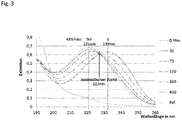
- Fig. 3 a diagram of temporally successive spectra recorded with a Jenway 7315 spectrophotometer.
- Fig. 3 shows here the course of the reaction of the enzyme-catalyzed hydrolysis of sotolon- ⁇ -D-glucoside (SG) to sotolon (S), with UV spectra from 190 to 260 nm being recorded at the specified time intervals. The absorption maxima ABSmax of the two substances are also shown.
- sotolon- ⁇ -D-glucoside When sotolon- ⁇ -D-glucoside is split into sotolon, there is a slight shift and decrease in the absorption maximum. An isosbestic point is also observed, which denotes the point at which all graphs intersect due to the same extinction coefficient there). It is proof of the direct conversion of educt into product, as is to be expected in the case of hydrolysis of a glucoside. It would not be there if intermediate products were created or the product was further degraded; it is very likely that these would have different extinction coefficients at this wavelength, see above that the sum of the absorbances would not be constant. The analysis results are thus in conformity with the presence of a simple glucoside and its cleavage.
- Example 1 Pyrolysis in a heating furnace
- sotolone glucoside 5 mg are successively heated in a precisely temperature-controlled heating furnace with an exhaust device.
- the Sotolon odor odor of the lovage, Levisticum officinale, "Maggi herb odor”
- Table 3 Sotolon odor perception by a person, here an inventor, when sotolon glucoside is heated step-by-step using a heating oven set up in a closed room.
- Example 2 External heating of a coated cable by convection of hot air
- a three-core cable designed for 230V-50Hz was coated with 1 mg sotolone glucoside in methanolic solution and dried.
- a heat gun which, depending on the exposure time, can reach temperatures above 200 ° C, a strong Sotolon odor is perceptible throughout the room within seconds, after no such odor was perceptible in the previous cold state. No changes in the surface of the insulating material are visible on the cable; it is still undamaged.
- the external heating of the cable coated with sotolon glucoside by convection of hot air releases the warning substance sotolon.
- Example 3 External heating of a coated cable by heat radiation
- a three-core cable designed for 230V-50Hz was coated with 1 mg sotolone glucoside in methanolic solution and dried. Under the heat of a warm light lamp (200 W), a strong Sotolon odor is perceptible in the whole room after 15 minutes, after no such odor was perceptible in the previous cold state. No changes in the surface of the insulating material are visible on the cable; it is still undamaged.
- the winding of a fan motor (operating values: 12 V, 0.19 A; manufacturer's specifications) was coated with 2.5 mg of sotolone glucoside in methanolic solution at 24 V applied voltage. After drying, a current flow corresponding to an overload was given through the winding. Warning odor development, heat radiation, electrical functionality and externally visible condition were observed over time.
- the electrical windings of the fan motor were overloaded when a voltage of 24 V was applied. If the warning smell of Sotolon is noticed in the room after 10 minutes of operation under overload, the motor is still functional and externally unchanged, but the inner part of the device with the axis is overheated and can no longer be touched with the bare hand. The experiment was terminated after 1.5 hours and severe overheating of the device before the coils burned out.
Landscapes
- Chemical & Material Sciences (AREA)
- Engineering & Computer Science (AREA)
- Oil, Petroleum & Natural Gas (AREA)
- Physics & Mathematics (AREA)
- General Physics & Mathematics (AREA)
- Materials Engineering (AREA)
- Organic Chemistry (AREA)
- Fats And Perfumes (AREA)
Description
- Die vorliegende Erfindung offenbart eine olfaktorische Signalgebung nach Überhitzung in technischen Einrichtungen mittels Pyrolyse von Duftstoffderivaten.
- Elektrische Anlagen sind durch Stromfluss generell einer Erwärmung bei Betrieb ausgesetzt, die je nach Stromfluss und elektrischem Widerstand und Wärmeabgabe verschiedene Bauteile verschieden stark betrifft. Neben entsprechenden Kühlmaßnahmen und Stromfluss-begrenzenden Maßnahmen, z.B. Sicherungen, werden daher auch Maßnahmen ergriffen, um Bauelemente oder auch die ganze Einrichtung vor Überhitzung zu schützen, die neben dem Schaden an der elektrischen Einrichtung selbst auch die Folgeschäden eines Ausfalles sowie die Brandgefahr zu verhindern suchen.
- Die übliche technische Lösung zum Überhitzungsschutz besteht in dem Einbau von Platinmesswiderständen (z.B. Pt100, Pt1000), die über die Abhängigkeit des elektrischen Widerstandes von Platin von der Temperatur ("Kennlinie") eine Temperaturmessung ermöglichen und sie so als Thermosensoren bzw. "Thermofühler" einsetzbar machen. Diese werden beispielsweise eingesetzt, um eine Abschaltung bei Überhitzung zu erreichen und/oder akustische oder optische Signale bei Überhitzung zu geben.
- Nicht nur in elektrische Anlagen, sondern auch an anderen durch Erhitzung gefährdeten technischen Einrichtungen werden solche Thermosensoren eingesetzt. Eine wichtige technische Einschränkung ist hierbei, das Thermosensoren zunächst nur punktuell arbeiten, und nur durch Einsatz mehrerer Thermosensoren, oder durch Messung in einem Bereich, in dem sich die Wärme zunächst verteilen muss, kann auch eine umfassendere Überwachung erreicht werden.
- Es stellt damit ein technisches Problem dar, einen kompletten Schutz von technischen Einrichtungen zu erreichen, der über die punktuelle Messung zur Signalgebung mittels Thermofühlern hinausgeht.
- Hierfür existieren bereits einige technische Ansätze, die teilweise auf Warnstoff-Ummantelung oder -Mikroverkapselung beruhen, und teilweise auch olfaktorische Signale benutzen:
- Die
JP H09185789 A US 2013/269417 A1 ist ein Sensormodul bekannt, welches den Geruch innerhalb des physikalischen Gehäuses eines Computergeräts überwacht. - Die
JP H06123658 A - Die
GB 2301231 A WO 1996 010260 A1 von 1996 "Electric Cable Having Indicating Malfunction Means Therein" legt eine Methode offen, wie Kabel mit einem Aufmerksamkeit erregenden Material und/oder visuell reagierenden Material, z.B. einem thermochromen Material oder einem Flüssigkristall, versehen werden können, welches in kritischen Temperaturbereichen visuell und/oder physikalisch reagiert und so Überhitzung, Überlastung, Beschädigung oder Fehlfunktion anzeigen kann. - Die
US 2010 0117828 A1 "Alarm Scheme With Olfactory Alerting Component" offenbart prinzipielle Möglichkeiten, eine olfaktorische Alarmkomponente in bisherige akustische und optische Signalsysteme zu integrieren. - Die
US 2012 0298398 A1 "Cable Comprising Indicator Material For Detecting Damage Control" legt eine Methode offen, Kabel und Röhren durch eine Ummantelung mit einem Warnstoff gegen sonst unbemerkte mechanische Beschädigung zu schützen. - Die
US 2014 0032944 A1 aus 2014 "Early Detection Of Overheating Devices" offenbart eine Methode, in einem Computer Überhitzung über Geruchsstoffe festzustellen, optional durch Analyse der Signale mit einem neuronalen Netz. - Die
US 9250220 B2 - Die
WO 2015/168243 A1 offenbart eine sensorgesteuerte Dunstabzugshaube. Salaheddin Sadeghifard et al., A new embedded E-nose system in smoke detection", Computer and knowledge engineering (ICCKE), 2011, 1st Int. Econf. ON, IEEE, S. 18-21, DOI 10.1109/ICCKE.2011.6413317 beschreiben eine elektronische Nase zur Rauchdetektion. - In der
WO 99/40078 A2 - Ein technischer Nachteil der olfaktorischen Warnmethoden, bei denen zuvor aufgebrachte Warnstoffe ummantelt oder mikroverkapselt sind, ist es, dass die Bauteile vorher entsprechend angefertigt oder präpariert werden müssen.
- Eine flächendeckende Dotierung einer technischen Anlage nach deren Installation mit bei Erhitzung aktiv werdenden Duftstoffen ist daher wünschenswert. Eine solche Methode würde eine besondere, neue technische Möglichkeit darstellen, einen kompletten Schutz der Einrichtung zu erreichen.
- Diese ist aber einerseits mit der prinzipiellen Flüchtigkeit von Duftstoffen auch unter ihrem Siedepunkt konfrontiert, aber andererseits auch mit der daher üblicherweise verwendeten, generell technisch notwendigen Umhüllung der Duftstoffe, selbst bei Mikroverkapselung, kaum verträglich.
- Es besteht daher ein Bedarf an einem Verfahren zum Versehen einer technischen Einrichtung mit einem Warnsignal gegenüber Erhitzung, bei dem die oben genannten Probleme nicht auftreten.
- Die Erfinder haben herausgefunden, dass beim Aufbringen oder Einbringen von pyrolysierbaren Duftstoffderivaten auf oder in eine technische Einrichtung oder einen Bestandteil davon ein entsprechendes Warnsignal bei Erhitzung freigesetzt werden kann, ohne dass der Duftstoff selbst zuvor verdampft.
- Die technische Lösung, prinzipiell flüchtige Duftstoffe flächig in einer technischen Einrichtung zu verteilen, ohne dass diese durch Verdunstung mit der Zeit verloren gehen, besteht in der Verwendung chemisch gebundener Duftstoffe, die erst bei erhöhten Temperaturen, also über Raumtemperatur, z.B. von mehr als 50°C, z.B. 80°C oder mehr, 100°C oder mehr, 110°C oder mehr, 120°C oder mehr, in einer chemischen Reaktion zerfallen, also pyrolysieren. Dies kann vor allem durch den Einsatz von Duftstoffglukosiden erreicht werden, ist aber prinzipiell nicht auf diese beschränkt, sondern kann auch mit anderen Duftstoffderivaten erreicht werden. Die Pyrolyse von Stoffen geschieht hierbei üblicherweise im Gegensatz zu der durch die August'sche Dampfdruckformel beschriebene Verdunstung nicht über einen weiten Temperaturbereich, sondern in einem engen.
- In einem ersten Aspekt betrifft die vorliegende Erfindung ein Verfahren zum Versehen einer technischen Einrichtung mit einem Warnsignal gegenüber Erhitzung, wobei ein pyrolysierbares Duftstoffderivat auf die technische Einrichtung oder Bestandteile davon aufgebracht oder eingebracht wird.
- Weiterhin offenbart ist die Verwendung eines Kits, umfassend eine Lösung, ein Spray, ein Aerosol, ein Pulver oder eine auftragbare Folie, welches oder welche ein pyrolysierbares Duftstoffderivat umfasst, bevorzugt wobei das pyrolysierbare Duftstoffderivat ausgewählt ist aus der Gruppe, bestehend aus einem Glykosid, N-Glykosid, Thioglykosid, Ester, Thioester, Ether, Thioether, Amid, Acetal, Halbacetal oder Carbamat, bevorzugt wobei das pyrolysierbare Duftstoffderivat ausgewählt ist aus Mono- und/oder Oligo-Glykosiden, weiter bevorzugt Glukosiden, insbesondere wobei das pyrolysierbare Duftstoffderivat Sotolonglukosid umfasst; und optional eine Geruchsprobe umfassend den zum pyrolysierbaren Duftstoffderivat entsprechenden Duftstoff in einem erfindungsgemäßen Verfahren.
- Ebenfalls offenbart ist Sotolonglukosid, insbesondere Sotolon-β-D-glukosid der allgemeinen chemischen Formel I, welches bisher nicht synthetisch zugänglich war.

- Weitere Aspekte der vorliegenden Erfindung sind den abhängigen Ansprüchen und der detaillierten Beschreibung zu entnehmen.
- So nicht anderweitig definiert haben hierin verwendete technische und wissenschaftliche Ausdrücke dieselbe Bedeutung, wie sie von einem Fachmann auf dem Fachgebiet der Erfindung gemeinhin verstanden wird.
- Ein Duftstoff ist hierbei ein den Geruchssinn anregender, chemischer Stoff, insbesondere ein den Geruchssinn eines Wirbeltiers, bevorzugt eines Menschen, anregender, chemischer Stoff, und/oder ein chemischer Stoff, der durch einen olfaktorischen Sensor detektiert werden kann. Ein olfaktorischer Sensor ist ein Sensor, der eine Detektion eines Stoffs derart vornehmen kann, dass ein Stoff detektiert wird, den eine Vielzahl von Menschen als einen Duftstoff wahrnimmt. Als olfaktorische Sensoren kommen neben den biologischen olfaktorischen Sensoren wie denen des Menschen beispielsweise auch elektronische Nasen oder andere technische Einrichtungen in Frage.
- Ein Derivat eines Duftstoffs ist ein Stoff, der selbst kein Duftstoff ist, oder eine geringere oder andere Wahrnehmungsqualtät besitzt, aus dem jedoch durch eine Abspaltung, insbesondere Abspaltung eines Molekülbestandteils des Duftstoffderivats, ein Duftstoff erzeugt werden kann.
- Die vorliegende Erfindung betrifft in einem ersten Aspekt ein Verfahren zum Versehen einer technischen Einrichtung mit einem Warnsignal gegenüber Erhitzung, wobei ein pyrolysierbares Duftstoffderivat auf die technische Einrichtung oder Bestandteile davon aufgebracht oder eingebracht wird. Auch können mehrere Duftstoffderivate aufgebracht werden, welche bevorzugt zu unterschiedlichen Gerüchen führen können, sodass verschiedene Bediener der technischen Einrichtung zumindest einen Duftstoff nach Pyrolyse erkennen können, etwa wenn sie bestimmte Duftstoffe nicht wahrnehmen können.
- Das Warnsignal, das eine Warnung vor einem Erhitzen, insbesondere einem zu starken Erhitzen, von einer technischen Einrichtung darstellt, und welches insbesondere abgegeben wird, wenn eine Erhitzung zu einer Temperatur erfolgt, die die technische Einrichtung im Normalfall nicht erzielen sollte, wird hierbei durch Freisetzung des Duftstoffes nach Pyrolyse erzeugt, welches somit olfaktorisch wahrnehmbar ist, also beispielsweise durch einen Nutzer oder eine Aufsichtsperson und/oder einen olfaktorischen Sensor.
- Das Aufbringen oder Einbringen kann auf verschiedene Weise erfolgen, sowohl auf oder in die technische Einrichtung wie auch Bestandteile davon, ggf. auch schon vor einem Zusammenbau der technischen Einrichtung, etwa von Akkumulatoren, beispielsweise in Handys, Laptops oder Tablets, oder vor der Installation eines Bauteils, ggf. auch eines Ersatzbauteils.
- Das pyrolysierbare Duftstoffderivat ist hierbei insbesondere ein hitze-instabiles, pyrolysierbares Duftstoffderivat, das auf, beispielsweise durch Überhitzung gefährdete, technische Einrichtungen aufgebracht werden kann. Gemäß bestimmten Ausführungsformen ist das pyrolysierbare Duftstoffderivat ab einer Temperatur von mehr als 120°C, beispielsweise 130°C oder mehr, bevorzugt 140°C oder mehr, weiter bevorzugt 150°C oder mehr, noch weiter bevorzugt 160°C oder mehr, z.B. 160°C bis 240°C, pyrolysierbar, und insbesondere somit auch bei diesen Temperaturen nicht mehr stabil, sodass es zerfällt und den Duftstoff des Duftstoffderivats abgibt. Gemäß bestimmten Ausführungsformen ist das pyrolysierbare Duftstoffderivat bei einer Temperatur von 250°C oder weniger durch Pyrolyse zerfallen, bevorzugt 240°C oder weniger.
- Gemäß bestimmten Ausführungsformen ist das pyrolysierbare Duftstoffderivat ausgewählt aus der Gruppe, bestehend aus Mono- und/oder Oligosacchariden, Estern, Thioestern, Ethern, Thioethern, Amiden, Acetalen, Halbacetalen und Carbamaten und/oder Derivaten davon, bevorzugt einem Glykosid, N-Glykosid, Thioglykosid, Ester, Thioester, Ether, Thioether, Amid, Acetal, Halbacetal oder Carbamat, bevorzugt wobei das pyrolysierbare Duftstoffderivat ausgewählt ist aus Mono- und/oder Oligo-Glykosiden und/oder Derivaten davon, weiter bevorzugt Glukosiden und/oder Derivaten davon, noch weiter bevorzugt Glukosiden, insbesondere wobei das pyrolysierbare Duftstoffderivat Sotolonglukosid umfasst. Als derivatisierende Moleküleinheit im Duftstoffderivat kommen somit also beispielsweise Zucker bzw. Saccharide oder Derivate davon wie etwa Glukose, Galaktose, Fructose, Mannose, etc., etwa zur Bildung von Glykosiden, N-Glykosiden, Thioglykosiden, oder Verbindungen zur Bildung von Estern, Thioestern, Ethern, Thioethern, Amiden, Acetalen, Halbacetalen oder Carbamaten, wie Carbonsäuren, etc., in Frage. Als Saccharide kommen beispielsweise auch komplexere Saccharide, z.B. Glykoside, z.B. Mono- und/oder Oligosaccharide wie Mono- oder Oligoglykoside, und auch Mono- und/oder Oligomere anderer Zucker als Glukose, wie auch Derivate von Zuckern bzw. Sacchariden wie Desoxyzucker, Zuckersäuren, Zuckeralkohole, auch in komplexeren Zuckern, z.B. Glykosiden, in Frage. Auch können als derivatisierende Moleküleinheit organische und/oder anorganische Ester, nichtglykosidische Halbacetale und Acetale, z.B. der Glykoside, und/oder Ether In Frage kommen. Als Derivate von Sacchariden (Mono- wie auch Oligosacchariden), z.B. Glykosiden oder Glukosiden, kommen des Weiteren auch solche mit Substitutionen der Hydroxylgruppen, insbesondere mit Halogenen - insbesondere F, Cl, Br, I - und Pseudohalogenen wie -SCN, -CN, -NCO, -OCN, -NCS, N3, Epimerisierungen von Hydroxylgruppen in den Zuckern, z.B. Glykosiden, und/oder Oxidationen von Hydroxylgruppen zu Ketonen oder zu endständigen Carboxy-Funktionen (z.B. Zuckersäuren), und/oder Komplexe mit Metallionen - vor allem solchen, die die Pyrolysetemparatur des Saccharids, z.B. Glykosids, verändern, in Frage. Die Metallionen für die Komplexe sind hierbei nicht besonders beschränkt und können beispielsweise an den Duftstoff und/oder dem derivatisierenden Bestandteil angepasst sein. So sind beispielsweise mit Glykosidresten, insbesondere Glukosidresten, und/oder Derivaten davon, eventuell auch unter Beteiligung funktioneller Gruppen des Aglycons im Glycosid bzw. Glucosid und/oder Derivat davon, Cu(II), Fe(III), Al(III) und/oder Zn(II) als Metallion denkbar, welche dann die Stabilität der Glycoside bzw. Glucoside und/oder Derivate davon und damit deren Pyrolysetemperatur beeinträchtigen können.
- Die Auswahl sowohl der Duftstoffe als auch ihrer Derivate berücksichtigt hierbei insbesondere gemäß bestimmten Ausführungsformen den Anspruch einer sehr niedrigen Toxizität, indem bevorzugt Duftstoffe aus dem Lebensmittelbereich ausgewählt werden, und diese glykosidisch, insbesondere an Glukose, aber auch Galaktose, etc., gebunden werden. Gemäß bestimmten Ausführungsformen ist das pyrolysierbare Duftstoffderivat ausgewählt aus Glykosiden und/oder Derivaten davon, insbesondere Glukosiden und/oder Derivaten davon, von Sotolon, Maltol, Ethylmaltol, Furaneol, Homofuraneol, Norfuraneol, Eugenol, Terpineol, Thioterpineol, Thymol, 1-Octen-3-ol, und/oder 2-Furfurylthiol und/oder ausgewählt aus Glykosiden und/oder Derivaten davon, insbesondere Glukosiden und/oder Derivaten davon, von Raucharomen, wobei die Raucharomen bevorzugt ausgewählt sind aus Phenol, 2-Methylphenol, Hydrochinon, 2,6-Dimethoxyphenol (syn. Syringol), 2,6-Dimethoxy-4-methylphenol (syn. 4-Methylsyringol), o-, m-, und p-Kresol, 2-Methoxyphenol (Guaiacol), 2-Methoxy-4-vinylphenol, 4-Ethyl-2-methoxyphenol, 4- und 5-Methyl-2-methoxyphenol (ersteres syn. 4-Methyl-guaiacol), und/oder 2- und/oder 4-Methylphenol. Als Duftstoffe treten somit beispielsweise Sotolon, Maltol, Ethylmaltol, Furaneol, Homofuraneol, Norfuraneol, Eugenol, Terpineol, Thioterpineol, Thymol, 1-Octen-3-ol, und/oder 2-Furfurylthiol, sowie Raucharomen, z.B. Phenol, 2-Methylphenol, Hydrochinon, 2,6-Dimethoxyphenol (syn. Syringol), 2,6-Dimethoxy-4-methylphenol (syn. 4-Methylsyringol), o-, m-, und p-Kresol, 2-Methoxyphenol (Guaiacol), 2-Methoxy-4-vinylphenol, 4-Ethyl-2-methoxyphenol, 4- Methyl-2-methoxyphenol (syn. 4-Methyl-guaiacol) und 5-Methyl-2-, und/oder 2- und/oder 4-Methylphenol auf.
- Gemäß bestimmten Ausführungsformen werden Duftstoffe ausgewählt, die einen sehr niedrigen Geruchsschwellenwert besitzen und/oder in der Umgebung der technischen Einrichtung normalerweise nicht zu erwarten wären. So erfüllt beispielsweise Sotolon, der Geruchsstoff des "Maggikrautes" (Liebstöckel, Levisticum officinale), dessen Struktur in der folgenden Formel II gezeigt ist und der einen Geruchschwellenwert von nur 0,02 ng/L Luft aufweist (König et al. 1999, J. Agric. Food Chem. 1999, 47, 3288-3291), diese Vorteile sehr gut und wurde als beispielhafte Verbindung auch in den hier gezeigten Beispielen ausgewählt und benutzt, obgleich die Erfindung nicht auf Sotolon und dessen Derivate beschränkt ist. Dies wurde insbesondere ermöglicht durch die gelungene Synthese des bisher nicht synthetisierten Stoffes Sotolonglukosid, insbesondere Sotolon-β-D-glukosid der allgemeinen chemischen Formel I.


- Das Sotolon besitzt hierbei einen sehr niedrigen Geruchsschwellenwert im Bereich µg/kg, abhängig vom Probanden, wobei im Glukosid als Derivat Glukose über dessen Hydroxygruppe glykosidisch gebunden ist, also über die C1-OH-Gruppe. Gemäß bestimmten Ausführungsformen ist der Duftstoff, der aus dem Duftstoffderivat freigesetzt wird, ein solcher, welcher einen sehr niedrigen Geruchsschwellenwert hat, und/oder dessen Pyrolysetemperatur der jeweils erforderlichen Überhitzungssignaltemperatur - abhängig von der technischen Einrichtung - entspricht, und/oder der in der räumlichen Umgebung der zu schützenden technischen Einrichtung normalerweise nicht zu erwarten ist. Eine erforderliche Überhitzungssignaltemperatur ist die Temperatur, unterhalb oder zumindest bei der das Warnsignal wahrnehmbar sein soll, also der Duftstoff durch Pyroylse in wahrnehmbarer Menge freigesetzt wird, wobei dies vom Duftstoff selbst und dessen Wahrnehmung, dessen Konzentration, der Pyrolyse, sowie der räumlichen Umgebung (z.B. mit oder ohne Luftzug, Raumfeuchtigkeit, etc.) abhängen kann.
- Gemäß bestimmten Ausführungsformen ist der Duftstoff, der aus dem Duftstoffderivat freigesetzt wird, ein Raucharoma, wie beispielsweise aus Dunkel et al., "Nature's Chemical Signatures in Human Olfaction: A Foodborne Perspective for Future Biotechnology, Angew. Chem. Int. Ed. 2014, 53, S. 2-22; Mayr et al., "Determination of the Importance of In-Mouth Release of Volatile Phenol Glycoconjugates to the Flavor of Smoke-Tainted Wines", J. Agric. Food Chem. 2014, 62, S. 2327-2336; oder Pino, "Characterisation of volatile compounds in a smoke flavouring from rice husk", Food Chemistry 153 (2014) S. 81-86, bekannt. Diese bieten den zusätzlichen Vorteil, dass ihre Wahrnehmung direkt mit Brandgefahr assoziiert wird.
- Darüber hinaus sind natürlich auch Mischungen von Duftstoffderivaten möglich, sodass beispielsweise einerseits ein Brandgeruch auftreten kann, andererseits aber auch ein ungewöhnlicher Geruch, was auch einer Lokalisierung eines überhitzten Materials und/oder Bauteils dienen kann. Durch Verwendung verschiedener Duftstoffderivate ist es zudem möglich, die überhitzte Stelle einfacher anhand eines bestimmten Geruchs zu lokalisieren. Ebenfalls kann dies im Hinblick auf eine Variation der Pyrolysetemperatur der Duftstoffderivate von Interesse sein.
- Gemäß bestimmten Ausführungsformen hat das Duftstoffderivat selbst keine, eine andere, und/oder eine wesentlich geringere olfaktorische Wahrnehmung als der Duftstoff. So zeigen grob gereinigte Präparationen von Sotolonglukosid beispielsweise, die nur noch Rückstände von Sotolon aus der Synthese aufweisen, kaum noch einen Geruch nach Sotolon. Glykoside können auch beispielsweise teilweise als Bitterstoffe wahrgenommen werden, dies ist aber hierbei dann im Wesentlichen eine Geschmackswahrnehmung, entsprechend der guten Wasserlöslichkeit und der geringen Flüchtigkeit von Glykosiden; beispielsweise ist Naringin, das Glukosid des Flavonoids Neringenin, ein starker Bitterstoff und für die Bitterkeit der Grapefruit verantwortlich.
- Die Menge des aufgebrachten pyrolysierbaren Duftstoffderivates kann daran angepasst werden, ob eine Erhitzung der technischen Einrichtung punktuell oder flächig zu erwarten ist, derart, dass die durch die Erhitzung im zu erwartenden Bereich freisetzbare Gesamtmenge an Duftstoff ausreichend ist, so dass in dem Raum, in dem sich die zu schützende technische Einrichtung befindet, der Geruchsschwellenwert überschritten werden kann und ein Geruchssignal ausgelöst werden kann. Eine entsprechende angepasste Verteilung kann beispielsweise erreicht werden durch entsprechende Einstellung der Konzentration des pyrolysierbaren Duftstoffderivats in einer Lösung bzw. Flüssigkeit oder in einem Aerosol oder Spray oder einer auftragbaren Folie, etwa ein Aufkleber, die oder das zur Aufbringung verwendet wird, und/oder durch gezielte und/oder mehrfache Auftragung dieser Lösung. Beispielsweise kann das Duftstoffderivat in einer Konzentration von 1 - 1000000 ppm, bevorzugt 10 - 100000 ppm, z.B. ungefähr 50000 ppm aufgetragen werden.
- Gemäß bestimmten Ausführungsformen wird das pyrolysierbare Duftstoffderivat als Aerosol, Spray, in Lösung oder in Pulverform aufgebracht oder eingebracht, bevorzugt als Aerosol, Spray oder in Lösung, wobei als Lösungsmittel bevorzugt ein organisches Lösungsmittel, beispielsweise Ethanol, Ethylacetat, Methanol, Aceton, Dimethylsulfoxid, Dimethylformamid, Ethylenglykolmonomethylether, Isopropanol, oder eine Mischung davon, oder Wasser, bevorzugt ein organisches Lösungsmittel, beispielsweise Ethanol, Ethylacetat, Methanol, Aceton, Dimethylsulfoxid, Dimethylformamid, Ethylenglykolmonomethylether, Isopropanol, oder eine Mischung davon verwendet wird. Gemäß bestimmten Ausführungsformen umfasst das Lösungsmittel keine Elektrolyte.
- Eine Aufbringung als Pulver bzw. Staub ist für das pyrolysierbare Duftstoffderivat auch möglich, beispielsweise wenn es entsprechende Haftkräfte aufweist und/oder derart aufgebracht wird, dass es auf der technischen Einrichtung oder einem Bestandteil davon selbst haftet, beispielsweise durch die Beschaffenheit der technischen Einrichtung oder dem Bestandteil davon.
- Im Falle eines Aerosols oder eines Sprays, wie auch einer Lösung, können weitere Hilfsstoffe enthalten sein, welche üblicherweise enthalten sind, wie etwa oberflächenaktive Mittel, Treibmittel, etc. welche nicht besonders beschränkt sind und entsprechend des verwendeten Duftstoffes und/oder Duftstoffderivats angepasst werden können. Die Lösung, das Aerosol bzw. das Spray können geeignet verpackt werden.
- Bei einer Auftragung in Lösung, mit einem Aerosol oder mit einem Spray kann sich gemäß bestimmten Ausführungsformen eine Trocknung nach der Auftragung anschließen.
- Gemäß bestimmten Ausführungsformen wird bei einem Aufbringen mit einem organischen Lösungsmittel auf die zu schützende technische Einrichtung dieses derart ausgewählt, dass sich während des Aufbringens und einem nachfolgendem Trocknen - wobei sich die technische Einrichtung, beispielsweise eine elektrische Anlage, vorzugsweise im inaktiven Zustand befindet - keine Rückstände durch die Lösung bilden, beispielsweise Elektrolytrückstände, und bevorzugt nur noch das Duftstoffderivat nach dem Auftragen und Trocknen zurückbleibt. Entsprechend ist das Lösungsmittel gemäß bestimmten Ausführungsformen ein solches, welches einen Siedepunkt aufweist, der unterhalb der Pyrolysetemperatur des Duftstoffderivats liegt, bevorzugt unter 100°C, weiter bevorzugt unter 70°C, und/oder bei einer Temperatur von 10 bis 40°C einen Dampfdruck aufweist, dass es im Wesentlichen nach der Auftragung verdampft.
- Gemäß bestimmten Ausführungsformen wird das pyrolysierbare Duftstoffderivat mit einer auftragbaren Folie, bevorzugt einem Aufkleber, optional mit einer nach Aufbringung abziehbarer Schutzfolie, aufgebracht. Die auftragbare Folie bzw. das Material des Aufklebers ist nicht besonders beschränkt und kann beispielsweise auf Basis von einem oder mehreren Polymeren und/oder Cellulose und dessen Derivaten, beispielsweise Papier hergestellt werden, wobei das Polymer und/oder die Cellulose und deren Derivate nicht besonders beschränkt sind. Die optionale abziehbare Schutzfolie ist ebenfalls nicht beschränkt und kann beispielsweise an das Material der Folie, z.B. des Aufklebers, angepasst sein. Das pyrolysierbare Duftstoffderivat kann beispielsweise auf die Folie, z.B. den Aufkleber, aufgebracht vorliegen, also beispielsweise auf einer Oberfläche davon vorliegen, und/oder im Material der Folie, z.B. des Aufklebers, enthalten sein, beispielsweise indem es bei der Herstellung der Folie, z.B. des Aufklebers, in das Ausgangsmaterial eingebracht wird. Gemäß bestimmten Ausführungsformen liegt das pyrolysierbare Duftstoffderivat zumindest auf einer Oberfläche der auftragbaren Folie, z.B. des Aufklebers, vor.
- Die auftragbare Folie, z.B. der Aufkleber, kann mit einem geeigneten Haftmittel versehen sein, welches an die technische Einrichtung angepasst sein kann und ebenfalls nicht besonders beschränkt ist.
- Gemäß bestimmten Ausführungsformen enthält die auftragbare Folie einen Teststreifen umfassend den zum pyrolysierbaren Duftstoffderivat entsprechenden Duftstoff, welcher beispielsweise durch einen Schutzstreifen vor Freisetzung geschützt ist. Der Teststreifen kann hierbei mit der auftragbaren Folie, z.B. einem Aufkleber, verbunden sein oder separat vorliegen. Ein entsprechender Teststreifen kann auch separat zu einer Lösung, einem Spray, und/oder einem Aerosol umfassend das pyrolysierbare Duftstoffderivat zugegeben werden. Der Teststreifen ist weiterhin nicht besonders beschränkt und kann als Geruchsprobe für den Anwender dienen. Auch können mehrere Teststreifen vorhanden sein, um mehreren Nutzern eine entsprechende Geruchsprobe zur Verfügung stellen zu können.
- Mit einer Auftragung mit einer entsprechenden Lösung, einem Spray, einem Pulver und/oder einer auftragbaren Folie, beispielsweise einem Aufkleber, kann ein Anwender die technische Einrichtung, beispielsweise eine technische Anlage, selber nachträglich, auch wiederholt, nach Installation oder Erwerb mit einem entsprechenden olfaktorischen Warnsignal gegen Überhitzung durch pyrolysierbare Duftstoffderivate versehen, vorzugsweise mit einem Spray im Handformat und/oder einem Aufkleber.
- Die technische Einrichtung oder ein Bestandteil davon ist nicht besonders beschränkt und umfasst sowohl die technischen Einrichtungen als Gesamtheit wie auch Teile davon, etwa Bauteile, aber auch Hilfsmittel, welche als Bestandteil davon zum Funktionieren der technischen Einrichtung beitragen, etwa Schmiermittel wie Schmieröl, Pumpenflüssigkeiten, etc. Gemäß bestimmten Ausführungsformen ist die technische Einrichtung oder ein Bestandteil davon ausgewählt aus elektrischen Anlagen oder Bauteilen davon, beispielsweise Kabeln, Kabelschächten, Spulenwicklungen, Motor-, Generator- und/oder Transformatorwicklungen; Achslagern, Leitungen für Flüssigkeiten, insbesondere gefährliche Flüssigkeiten; Behältnissen umfassend leicht entzündliche und/oder explosive Stoffe; medizinische Geräten; IT-Anlagen wie Servern; Anlagen in Luft- und/oder Raumfahrt oder in anderen Personentransportmitteln; Elektronik im häuslichen Bereich und/oder Alltag wie Akkumulatoren, beispielsweise in Handys, Laptops oder Tablets, insbesondere Lithiumakkumulatoren; und/oder Schmiermitteln. Gemäß bestimmten Ausführungsformen ist die technische Einrichtung oder ein Bestandteil davon ausgewählt aus technischen Einrichtungen oder Bauteilen davon, also Teilen, aus denen die technische Einrichtung zusammengefügt werden kann.
- Beispielsweise kann das pyrolysierbare Duftstoffderivat durch Sprühen einer Lösung oder als Staub aufgebracht werden, oder vor Installation auf Bestandteile, z.B. Bauteile, einer technischen Einrichtung, beispielsweise Kabel, Spulenwicklungen, Schmiermittel, etc. aufgebracht werden, um bei Überhitzung derselben durch innere (z.B. Stromfluss, exotherme Reaktion und/oder Reibung) oder äußere Einflüsse (z.B. Wärmestrahlung, Konvektion heißer Gase, Kontakt mit heißen Gegenständen) ein olfaktorisches Warnsignal zu geben, um eine Beschädigung der technischen Einrichtung verhindern zu können, oder die durch deren Ausfall zu erwartenden Folgeschäden oder -kosten zu verringern oder zu verhindern.
- Gemäß bestimmten Ausführungsformen ist die technische Einrichtung eine elektrische Anlage oder ein Bauteil davon, und/oder eine technische Einrichtung, bei der eigene Kosten besonders hoch sind, für deren Ausfall die Folgekosten besonders hoch wären, und/oder deren Ausfall mit besonderen Gefahren verbunden ist, beispielsweise Kabelschächte, Motor-, Generator- oder Transformatorwicklungen, kritische Achslager, Leitungen für gefährliche Flüssigkeiten, Behältnisse leicht entzündlicher oder explosiver Stoffe, lebenswichtige medizinische Geräte, kritischen IT-Anlagen wie Server, elektrische Anlagen in Luft- und Raumfahrt oder in anderen Personentransportmitteln, brandgefährdete Elektronik im häuslichen Bereich und Alltag wie Akkumulatoren in Handys, Laptops oder Tablets, z.B. Lithiumakkumulatoren.
- Gemäß bestimmten Ausführungsformen wird das pyrolysierbare Duftstoffderivat zusammen mit einem Hilfsstoff aufgebracht, der eine enzymatische Spaltung oder einen Abbau durch Mikroorganismen der pyrolysierbaren Duftstoffderivate hemmt oder verhindert, beispielsweise Parabene (Ester der para-Hydroxybenzoesäure). In einem weiteren Aspekt betrifft die vorliegende Erfindung die Verwendung eines Kits, umfassend eine Lösung, ein Spray, ein Aerosol, ein Pulver oder eine auftragbare Folie, welches oder welche ein pyrolysierbares Duftstoffderivat umfasst, bevorzugt wobei das pyrolysierbare Duftstoffderivat ausgewählt ist aus der Gruppe, bestehend aus einem Glykosid, N-Glykosid, Thioglykosid, Ester, Thioester, Ether, Thioether, Amid, Acetal, Halbacetal oder Carbamat, bevorzugt wobei das pyrolysierbare Duftstoffderivat ausgewählt ist aus Mono- und/oder Oligo-Glykosiden, weiter bevorzugt Glukosiden, insbesondere wobei das pyrolysierbare Duftstoffderivat Sotolonglukosid umfasst; und
optional eine Geruchsprobe umfassend den zum pyrolysierbaren Duftstoffderivat entsprechenden Duftstoff in einem erfindungsgemäßen Verfahren. - Das Kit findet also in dem erfindungsgemäßen Verfahren Anwendung. Insofern kann das Kit beispielsweise als Spraydose, beispielsweise im Handformat, als Flüssigkeit, als Feststoff, beispielsweise in einem geeigneten Behälter, vorgesehen sein.
- Gemäß bestimmten Ausführungsformen umfasst das Kit den freien Duftstoff als Muster des Warngeruches, beispielsweise separat verpackt, als Geruchsprobe, z.B. als Teststreifen. So das Kit als auftragbare Folie vorgesehen ist, z.B. als Aufkleber, kann diese bzw. dieser optional eine nach Aufbringung abziehbare Schutzfolie umfassen und/oder eine separate oder mit der Folie, z.B. dem Aufkleber, verbundene Geruchsprobe, beispielsweise einen Teststreifen mit dem freien, nicht gebundenen Duftstoff, die bzw. der beispielsweise durch einen Schutzstreifen geschützt sein kann. Entsprechende Ausführungen zu einer Lösung, einem Pulver, einem Aerosol, einem Spray und einer auftragbaren Folie sowie Ausgestaltungen dazu können auch der Beschreibung zum erfindungsgemäßen Verfahren zum Versehen einer technischen Einrichtung mit einem Warnsignal gegenüber Erhitzung entnommen werden.
- In noch einem weiteren Aspekt betrifft die vorliegende Erfindung Sotolonglukosid, insbesondere Sotolon-β-D-glukosid der allgemeinen chemischen Formel I. Das Sotolonglukosid ist jedoch nicht auf Sotolon-β-D-glukosid, sondern umfasst beispielsweise auch Sotolon-α-D-glukosid, welches durch einfache Umwandlung gewonnen werden kann.
- Das Sotolonglukosid umfasst hierbei Anomere wie auch Diastereomere in Reinform, beispielsweise sowohl das Anomer Sotolon-ß-D-glukosid, also ein Diastereomergemisch gewonnen aus razemischem Sotolon, wie auch die zwei Diastereomeren R- / S-Sotolon-ß-D-glukosid in Reinform oder im Wesentlichen als Reinform, so wie sie aus den jeweiligen Enantiomeren R- und S-Sotolon synthetisiert werden können. In der allgemeinen chemischen Strukturformel I von Sotolon-ß-D-glukosid ist entsprechend auch keine Diastereochemie der 4-Methylgruppe gezeigt, es kann sowohl das eine wie auch das andere Diastereomer erhalten werden wie auch ein Gemisch beider.
- Das Sotolon selbst zeichnet sich durch einen niedrigen Geruchsschwellwert aus. Ebenso offenbart ist die Verwendung von Sotolonglukosid als pyrolysierbares Duftstoffderivat, dessen Verwendung als auftragbares Mittel mit Warnwirkung gegenüber Erhitzung, z.B. über 110°C, z.B. mehr als 120°C, beispielsweise 130°C oder mehr, 140°C oder mehr, 150°C oder mehr, oder 160°C oder mehr, sowie dessen Verwendung im erfindungsgemäßen Verfahren zum Versehen einer technischen Einrichtung mit einem Warnsignal gegenüber Erhitzung.
- Ebenfalls offenbart ist ein Verfahren zur Herstellung von Sotolonglukosid, bei dem Sotolon mit einer geeigneten Glykosyltransferase, beispielsweise einer aus dem Wein stammenden Glykosyltransferase, in einer Biotransformation, z.B. durch Escherichia coli, mit UDP-Glukose, beispielsweise mit zelleigener UDP-Glukose, umgesetzt wird.
- Die obigen Ausführungsformen, Ausgestaltungen und Weiterbildungen lassen sich, sofern sinnvoll, beliebig miteinander kombinieren. Weitere mögliche Ausgestaltungen, Weiterbildungen und Implementierungen der Erfindung umfassen auch nicht explizit genannte Kombinationen von zuvor oder im Folgenden bezüglich der Ausführungsbeispiele beschriebenen Merkmalen der Erfindung. Insbesondere wird der Fachmann auch Einzelaspekte als Verbesserungen oder Ergänzungen zu der jeweiligen Grundform der vorliegenden Erfindung hinzufügen.
- Die Erfindung wird im Anschluss mit Bezug auf verschiedene Beispiele davon weiter im Detail erläutert. Die Erfindung ist jedoch nicht auf diese Beispiele beschränkt.
- In einem Beispiel wurde mit der aus Wein (Vitis vinifera) stammenden Glykosyltransferase VvdGT13 mit der SEQ ID No. 1 eine Glukosylierung von Sotolon zu Sotolonglukosid als Biotransformation in E. coli BL21 (DE3) pLysS (Novagen, Schwalbach, Germany) mit dem VvdGT13-Gen in einem Expressionsvektor durchgeführt. Vorkulturen wurden über Nacht bei 37°C in Luria Bertani (LB)-Medium mit 100 µg/mL Ampizillin und 23 µg/mL Chloramphenikol angezogen. Am nächsten Tag wurde 50 mL LB-Medium mit den genannten Antibiotika mit 1 mL der Vorkultur angeimpft und bei 37°C und 160 rpm angezogen bis eine OD600 (optische Dichte bei 600 nm) von 0.6-0.8 erreicht wurde. Die Kultur wurde bei 16°C weitergeführt und zur Induktion mit 1 mM IPTG (Isopropyl-β-D-thiogalactopyranosid) versetzt. Nach 6 Stunden wurden 20 µL des Substrates Sotolon (razemisch, >= 97%, Sigma-Aldrich, Darmstadt, Germany) zugegeben. In regelmäßigen Zeitabständen wurde eine Probe von 200 µL der Kultur entnommen, zur Entfernung der Zellen abzentrifugiert, und für eine LC-MS-Analyse, wie nachfolgend beschrieben, 1:50 verdünnt. Die mit der Zeit fortschreitende Biotransformation von Sotolon zu Sotolonglukosid ist in
Figur 1 dargestellt.Fig. 1 zeigt die Biotransformation von razemischem Sotolon zu Sotolon-β-D-glukosid (Diastereomere) mit der Glykosyltransferase VvdGT13 in E.coli. Gezeigt ist die Analyse des Kulturüberstandes mittels LC-MS zum Zeitpunkt 0 (obere drei Spektren) und nach einem Tag (untere drei Spektren). Die Spektren zeigen hierbei jeweils: oben: TIC total ion current, negative mode, mittig: UV 250-258 nm, unten: EIC extracted ion current, negative mode. Es ergibt sich: EIC oben 173 Dalton (Mol.gew. Sotolon 128, -1 (Protonenabspaltung), + 46 (da HCOOH-Addukt); EIC unten 335 Dalton (Mol.gew. Sotolonglukosid 290, -1 (Protonenabspaltung), + 46 (da HCOOH-Addukt). Etwa die Hälfte des Substrates war in diesem Versuch nach einem Tag umgesetzt. - Bei langen Synthesezeiten kam es zu vollständigem Umsatz, was bei Einsatz des Razemats beweist, dass beide Enantiomere R- und S-Sotolon auf diesem Wege zum Glukosid umgesetzt werden können.
- Das im Synthesebeispiel 1 produzierte Sotolonglukosid wurde massenspektroskopisch im Rahmen der synthesebegleitenden Analytik identifiziert und charakterisiert. Das verwendete HPLC-System bestand aus einer Vierfachpumpe und einem variablen Wellenlängendetektor, beides von Agilent 1100 (Bruker Daltonics, Bremen, Germany). Es wurde eine LUNA C18 100A 150 x 2 mm Säule benutzt (Phenomenex, Aschaffenburg, Germany). Die HPLC wurde durchgeführt mit dem folgenden binären Gradientensystem: Lösung A, Wasser mit 0.1 % Ameisensäure und Lösung B, 100% Methanol mit 0.1 % Ameisensäure. Als Gradientenprogramm wurde verwendet: 0-3 min, 90 % A/10 % B nach 50 % A/50 % B; 3-6 min, 50 % A/50 % B nach 100 % B, konstant für 8 min; 14-14.1 min, 100 % B nach 90 % A/10 % B, für 11 min. Die Flussrate war 0.2 ml/min. An die HPLC gekoppelt war ein Bruker esquire 3000plus Massenspektrometer mit einem ESI Interface, um die Massenspektren aufzunehmen. Die Ionisierungsspannung der Kapillare betrug 4000 V und die Endplatte wurde auf -500 V gesetzt. Das über seine Masse (als Ameisensäureaddukt), seine Laufzeitverschiebung auf der RP-Säule in Relation zum unglukosylierten Sotolon sowie seine ähnliche UV-Absorption identifizierte Sotolonglukosid wurde durch sein Massenspektrum MS und MS2 weiterhin bestätigt und näher charakterisiert, wie in
Figur 2 gezeigt.Fig. 2 zeigt hierbei das UV-Spektrum (oben), -MS (Mitte) und -MS2 (unten) von Sotolon-β-D-glukosid im beschriebenen LC-MS-System. - -MS zeigt hierbei das Molekülionen-Signal von Sotolonglukosid als deprotoniertes HCOOH-Addukt bei 334.9 Dalton., und -MS2 das deprotonierte Sotolonglukosid mit der Masse 288.7 Dalton und abgespaltenem Sotolonanion-Fragment mit der Masse 126.8 Dalton.
- Um die enzymatische Spaltung von Sotolon-β-D-Glukosid zu analysieren, wurde eine Lösung mit 50 mg/L Sotolon-Glukosid-Extrakt mit Rapidase® AR2000 (enthält β-Glykosidase; Anwendungskonzentration: 0,1 mg/ml) umgesetzt. Der Reaktionsverlauf ist in
Fig. 3 , einem Diagramm zeitlich aufeinanderfolgender Spektren, aufgenommen mit einem Jenway 7315 Spectrophotometer, dargestellt.Fig. 3 zeigt hier den Reaktionsverlauf der enzymkatalysierten Hydrolyse von Sotolon-β-D-Glukosid (SG) zu Sotolon (S) wobei in den angegebenen Zeitabständen UV-Spektren von 190 bis 260nm aufgenommen wurden. Gezeigt sind auch die Absorptionsmaxima ABSmax der beiden Substanzen. - Es findet bei der Spaltung von Sotolon-β-D-Glukosid zu Sotolon eine leichte Verschiebung und Absenkung des Absorptionsmaximums statt. Es wird zudem ein isosbestischer Punkt beobachtet, welcher den Punkt bezeichnet, in dem sich alle Graphen aufgrund des dort gleichen Extinktionskoeffizienten schneiden). Er ist ein Beweis für die direkte Umwandlung von Edukt in Produkt, wie es bei einer Hydrolyse eines Glukosids zu erwarten ist. Er wäre nicht vorhanden, wenn Zwischenprodukte entstehen oder das Produkt weiter abgebaut werden würde; diese besäßen mit hoher Wahrscheinlichkeit bei dieser Wellenlänge andere Extinktionskoeffizienten, so dass die Summe der Extinktionen nicht konstant wäre. Die Analyseergebnisse sind also mit dem Vorliegen eines einfachen Glukosids und dessen Spaltung konform.
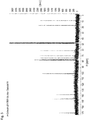
- Weiterhin wurde eine NMR-spektroskopische Untersuchung des hergestellten Sotolon-β-D-Glukosids (30 mg Sotolon-β-D-Glukosid in 600 µL deuteriertem MeOHd4 + 0,03% TMS) mit einem Bruker DRX 500 bei 500, 13 MHz vorgenommen. Entsprechende H- und C-NMR-Spektren finden sich in
Figuren 4 und5 . - Es ergaben sich die folgenden, in Tabellen 1 und 2 angegebenen Peaks, welche dem Sotolon-β-D-Glukosid zugeordnet werden konnten. Die Identifizierung insbesondere im H-NMR erfolgte hierbei zum Teil auch über 2D 1H/13 C NMR-Spektren (Daten nicht gezeigt).

Tabelle 1: 1H NMR-Peaks von Sotolon-β-D-Glukosid Sotolon ppm chem. Verschiebung H an chiralem C4 4,92-4,97 3 H an C5 (Methylgruppe) 2,02-2,10 3 H an C6 (Methylgruppe) 1,42; 1,43; 1,44; 1,45 Glukose H an anomerem C1' 5,11; 5,13; 5,17; 5,19 H an C2' 3,37 H an C3' 3,43 H an C4' 3,38 H an C5' 3,34 2 H an C6' 3,80-3,90; 3,65-3,75 Tabelle 2: 13C NMR-Peaks von Sotolon-β-D-Glukosid Sotolon ppm chem. Verschiebung C1 (Lacton-C) 169,14; 169,23 C2 (Enol-C) 144,41; 144,94 C3 (Alken-C) 137,37; 137,45 C4 (Alkohol-C, lactonisiert, chiral) 76,94; 77,57 C5 (Methylgruppe an C4) 8,70; 8,78 C6 (Methylgruppe an C3) 17,14; 17,17 Glukose C1' (anomeres Glykosid-C) 100,81; 101,08 C2' 73,58; 73,62 C3' 76,29; 76,31 C4' 69,77; 69,80 C5' 76,92 C6' 61,03 - In einem ersten Beispiel werden 5 mg Sotolonglukosid in einem exakt temperierbaren Heizofen mit Ablufteinrichtung sukzessive erhitzt. In einem 20 qm Laborraum wird mit steigender Temperatur der Sotolon-Geruch (Geruchsstoff des Liebstöckels, Levisticum officinale, "Maggikraut-Geruch"), wie in Tabelle 3 angegeben, wahrnehmbar (Tab. 3).
Tabelle 3: Sotolon-Geruchswahrnehmung durch einen Menschen, hier einen Erfinder, bei schrittweiser Erhitzung von Sotolonglukosid durch einen in einem geschlossen Raum aufgestellten Heizofen. Temperatur des Heizofens Wahrnehmung im Laborraum 120°C - Vorinkubation noch ohne Probe - 130°C leichter Sotolon-Geruch 160°C Sotolon-Geruch 170°C deutlicher Sotolon-Geruch ab 190°C nicht weiter zunehmend: vollständige Pyrolyse ist erfolgt - In einem zweiten Beispiel wurde ein dreiadriges, für 230V-50Hz ausgelegtes Kabel mit 1 mg Sotolonglukosid in methanolischer Lösung beschichtet und getrocknet. Im heißen Luftstrom einer Heißluftpistole, mit der je nach Einwirkdauer Temperaturen über 200°C erreicht werden können, wird innerhalb von Sekunden im ganzen Raum ein starker Sotolongeruch wahrnehmbar, nachdem im vorherigen kalten Zustand kein solcher Geruch wahrnehmbar war. Am Kabel sind dabei noch keine Veränderungen der Oberfläche des Isoliermaterials sichtbar, es ist noch unbeschädigt. Die äußere Erhitzung des mit Sotolonglukosid beschichteten Kabels durch Konvektion heißer Luft setzt den Warnstoff Sotolon frei.
- In einem anderen, dritten Beispiel wurde ein dreiadriges, für 230V-50Hz ausgelegtes Kabel mit 1 mg Sotolonglukosid in methanolischer Lösung beschichtet und getrocknet. Unter der Wärmeeinstrahlung einer Warmlichtlampe (200 W) wird nach 15 Minuten im ganzen Raum ein starker Sotolongeruch wahrnehmbar, nachdem im vorherigen kalten Zustand kein solcher Geruch wahrnehmbar war. Am Kabel sind dabei noch keine Veränderungen der Oberfläche des Isoliermaterials sichtbar, es ist noch unbeschädigt.
- In einem vierten Beispiel wurde die Wicklung eines Lüftermotors (Betriebswerte: 12 V, 0,19 A; Herstellerangaben) bei 24 V angelegter Spannung mit 2,5 mg Sotolonglukosid in methanolischer Lösung beschichtet. Nach Abtrocknung wurde ein einer Überlastung entsprechender Stromfluss durch die Wicklung gegeben. Warngeruchentwicklung, Wärmeabstrahlung, elektrische Funktionsfähigkeit und äußerlich sichtbarer Zustand wurden im Zeitverlauf beobachtet.
- Eine Überlastung der elektrischen Wicklungen des Lüftermotors erfolgte bei 24 V angelegter Spannung. Bei einer Wahrnehmung des Warngeruches von Sotolon im Raum nach 10 Minuten Betrieb unter Überlastung ist der Motor noch funktionsfähig und äußerlich unverändert, aber der Innenteil des Gerätes mit der Achse ist überhitzt und mit der bloßen Hand schon nicht mehr berührbar. Der Versuch wurde nach 1,5 Stunden und starker Überhitzung des Geräts vor dem Durchbrennen der Spulen abgebrochen.
- Technische Einrichtung, die durch Überhitzungen gefährdet sind wie vor allem elektrische Anlagen, aber beispielsweise auch Achslager und Treibstoffleitungen, können entweder gezielt über entsprechend präparierte Bauteile, oder durch flächige und nach der Installation oder Erwerb aufgebrachte pyrolysierbare Duftstoffderivate komplett mit einem Überhitzungsschutz durch olfaktorisches Signal geschützt werden. Dies erweitert bisherige Schutzmaßnahmen wie Thermofühler, die mit Abschaltung der Einrichtungen sowie akustischen und optischen Signalen arbeiten, um eine neue Qualität und vielfältige Anwendungsoptionen.
Claims (10)
- Verfahren zum Versehen einer technischen Einrichtung mit einem Warnsignal gegenüber Erhitzung, wobei ein pyrolysierbares Duftstoffderivat auf die technische Einrichtung oder Bestandteile davon aufgebracht oder eingebracht wird.
- Verfahren nach Anspruch 1, wobei das pyrolysierbare Duftstoffderivat ab einer Temperatur von mehr als 120°C, bevorzugt 150°C oder mehr, pyrolysierbar ist.
- Verfahren nach Anspruch 1 oder 2, wobei das pyrolysierbare Duftstoffderivat ausgewählt ist aus der Gruppe, bestehend aus Mono- und/oder Oligosacchariden, Estern, Thioestern, Ethern, Thioethern, Amiden, Acetalen, Halbacetalen und Carbamaten und/oder Derivaten davon, bevorzugt einem Glykosid, N-Glykosid, Thioglykosid, Ester, Thioester, Ether, Thioether, Amid, Acetal, Halbacetal oder Carbamat, und/oder Derivaten davon, bevorzugt wobei das pyrolysierbare Duftstoffderivat ausgewählt ist aus Mono- und/oder Oligo-Glykosiden und/oder Derivaten davon, weiter bevorzugt Glukosiden und/oder Derivaten davon, noch weiter bevorzugt Glukosiden, insbesondere wobei das pyrolysierbare Duftstoffderivat Sotolonglukosid umfasst.
- Verfahren nach Anspruch 3, wobei das pyrolysierbare Duftstoffderivat ausgewählt ist aus Glykosiden, insbesondere Glukosiden, von Sotolon, Maltol, Ethylmaltol, Furaneol, Homofuraneol, Norfuraneol, Eugenol, Terpineol, Thioterpineol, Thymol, 1-Octen-3-ol, und/oder 2-Furfurylthiol, und/oder ausgewählt ist aus Glykosiden, insbesondere Glukosiden, von Raucharomen, wobei die Raucharomen bevorzugt ausgewählt sind aus Phenol, 2-Methylphenol, Hydrochinon, 2,6-Dimethoxyphenol, 2,6-Dimethoxy-4-methylphenol, o-, m-, und p-Kresol, 2-Methoxyphenol, 2-Methoxy-4-vinylphenol, 4-Ethyl-2-methoxyphenol, 4- und 5-Methyl-2-methoxyphenol, und/oder 2- und/oder 4-Methylphenol.
- Verfahren nach einem der vorigen Ansprüche, wobei das pyrolysierbare Duftstoffderivat als Aerosol, Spray, in Lösung oder in Pulverform aufgebracht oder eingebracht wird, bevorzugt wobei das pyrolysierbare Duftstoffderivat als Aerosol, Spray oder in Lösung aufgebracht oder eingebracht wird, wobei als Lösungsmittel bevorzugt Ethanol, Ethylacetat, Methanol, Aceton, Dimethylsulfoxid, Dimethylformamid, Ethylenglykolmonomethylether, Isopropanol, oder eine Mischung davon verwendet wird.
- Verfahren nach einem der Ansprüche 1 bis 4, wobei das pyrolysierbare Duftstoffderivat mit einer auftragbaren Folie, bevorzugt einem Aufkleber, optional mit einer nach Aufbringung abziehbarer Schutzfolie, aufgebracht wird, weiter bevorzugt wobei die auftragbare Folie einen Teststreifen umfassend den zum pyrolysierbaren Duftstoffderivat entsprechenden Duftstoff enthält, welcher durch einen Schutzstreifen vor Freisetzung geschützt ist.
- Verfahren nach einem der vorigen Ansprüche, wobei die technische Einrichtung oder ein Bestandteil davon ausgewählt ist aus elektrischen Anlagen oder Bauteilen davon, beispielsweise Kabeln, Kabelschächten, Spulenwicklungen, Motor-, Generator- und/oder Transformatorwicklungen; Achslagern, Leitungen für Flüssigkeiten, insbesondere gefährliche Flüssigkeiten; Behältnissen umfassend leicht entzündliche und/oder explosive Stoffe; medizinische Geräten; IT-Anlagen wie Servern; Anlagen in Luft- und/oder Raumfahrt oder in anderen Personentransportmitteln; Elektronik im häuslichen Bereich und/oder Alltag wie Akkumulatoren, beispielsweise in Handys, Laptops oder Tablets, insbesondere Lithiumakkumulatoren; und/oder Schmiermitteln.
- Verfahren nach einem der vorigen Ansprüche, wobei das pyrolysierbare Duftstoffderivat zusammen mit einem Hilfsstoff aufgebracht wird, der eine enzymatische Spaltung oder einen Abbau durch Mikroorganismen der pyrolysierbaren Duftstoffderivate hemmt oder verhindert.
- Verwendung eines Kits, umfassend eine Lösung, ein Spray, ein Aerosol, ein Pulver oder eine auftragbare Folie, welches oder welche ein pyrolysierbares Duftstoffderivat umfasst, bevorzugt wobei das pyrolysierbare Duftstoffderivat ausgewählt ist aus der Gruppe, bestehend aus einem Glykosid, N-Glykosid, Thioglykosid, Ester, Thioester, Ether, Thioether, Amid, Acetal, Halbacetal oder Carbamat, bevorzugt wobei das pyrolysierbare Duftstoffderivat ausgewählt ist aus Mono- und/oder Oligo-Glykosiden, weiter bevorzugt Glukosiden, insbesondere wobei das pyrolysierbare Duftstoffderivat Sotolonglukosid umfasst; und
optional eine Geruchsprobe umfassend den zum pyrolysierbaren Duftstoffderivat entsprechenden Duftstoff, in einem Verfahren gemäß einem der Ansprüche 1 bis 8. - Sotolonglukosid, insbesondere Sotolon-β-D-glukosid der allgemeinen chemischen Formel I

Applications Claiming Priority (2)
| Application Number | Priority Date | Filing Date | Title |
|---|---|---|---|
| DE102016225419.7A DE102016225419A1 (de) | 2016-12-19 | 2016-12-19 | Olfaktorische Signalgebung nach Überhitzung in technischen Einrichtungen mittels Pyrolyse von Duftstoffderivaten |
| PCT/EP2017/078702 WO2018114124A1 (de) | 2016-12-19 | 2017-11-09 | Olfaktorische signalgebung nach überhitzung in technischen einrichtungen mittels pyrolyse von duftstoffderivaten |
Publications (2)
| Publication Number | Publication Date |
|---|---|
| EP3545274A1 EP3545274A1 (de) | 2019-10-02 |
| EP3545274B1 true EP3545274B1 (de) | 2021-01-06 |
Family
ID=60654919
Family Applications (1)
| Application Number | Title | Priority Date | Filing Date |
|---|---|---|---|
| EP17811856.8A Active EP3545274B1 (de) | 2016-12-19 | 2017-11-09 | Olfaktorische signalgebung nach überhitzung in technischen einrichtungen mittels pyrolyse von duftstoffderivaten |
Country Status (3)
| Country | Link |
|---|---|
| EP (1) | EP3545274B1 (de) |
| DE (1) | DE102016225419A1 (de) |
| WO (1) | WO2018114124A1 (de) |
Families Citing this family (3)
| Publication number | Priority date | Publication date | Assignee | Title |
|---|---|---|---|---|
| CN108982743B (zh) * | 2018-08-17 | 2021-04-20 | 福建中烟工业有限责任公司 | 检测烟草制品和/或烟用香精香料中葫芦巴内酯的方法 |
| WO2020064054A1 (de) | 2018-09-24 | 2020-04-02 | 4Gene Gmbh | Verfahren, vorrichtung und indikator zur lokalisation von überhitzungsschäden |
| DE102020002054A1 (de) | 2020-03-30 | 2021-09-30 | 4Gene Gmbh | Olfaktorische Signalgebung nach Überhitzung in technischen Einrichtungen mittels Freisetzung von Duftstoffen aus Zusammensetzungen |
Family Cites Families (10)
| Publication number | Priority date | Publication date | Assignee | Title |
|---|---|---|---|---|
| JPH06123658A (ja) | 1992-10-12 | 1994-05-06 | Shikoku Sogo Kenkyusho:Kk | 電気設備の過熱検出装置 |
| US5922996A (en) | 1994-09-27 | 1999-07-13 | Rizzo Development Corp. | Electrical insulated cable having means for indicating malfunctions |
| GB2301231A (en) | 1995-05-26 | 1996-11-27 | Johnson Electric Sa | Thermal olfactory alarm for electril motor winding |
| JP3539525B2 (ja) | 1995-12-27 | 2004-07-07 | 株式会社昭電 | 異常臭気感知警告装置 |
| WO1999040078A2 (en) * | 1998-02-03 | 1999-08-12 | Unilever N.V. | Process for the preparation of sotolon |
| US20100117828A1 (en) | 2008-11-07 | 2010-05-13 | Stuart Owen Goldman | Alarm scheme with olfactory alerting component |
| DE102009047745A1 (de) | 2009-12-09 | 2011-06-16 | Prüftech GmbH | Kabel mit Indikatormaterial zum Erkennen von Beschädigungen |
| US8910508B2 (en) * | 2012-04-16 | 2014-12-16 | International Business Machines Corporation | Early detection of overheating devices |
| US9244046B2 (en) | 2012-12-03 | 2016-01-26 | International Business Machines Corporation | System for preventing undue bending of cables |
| US20230129115A1 (en) * | 2013-05-03 | 2023-04-27 | Broan-Nutone Llc | Sensor-enabled range hood system and method |
-
2016
- 2016-12-19 DE DE102016225419.7A patent/DE102016225419A1/de not_active Withdrawn
-
2017
- 2017-11-09 WO PCT/EP2017/078702 patent/WO2018114124A1/de not_active Ceased
- 2017-11-09 EP EP17811856.8A patent/EP3545274B1/de active Active
Non-Patent Citations (1)
| Title |
|---|
| None * |
Also Published As
| Publication number | Publication date |
|---|---|
| EP3545274A1 (de) | 2019-10-02 |
| DE102016225419A1 (de) | 2018-06-21 |
| WO2018114124A1 (de) | 2018-06-28 |
Similar Documents
| Publication | Publication Date | Title |
|---|---|---|
| Anand et al. | Antimicrobial activity of Agastache honey and characterization of its bioactive compounds in comparison with important commercial honeys | |
| Pękal et al. | Evaluation of aluminium complexation reaction for flavonoid content assay | |
| Alvarez-Suarez et al. | Antioxidant characterization of native monofloral Cuban honeys | |
| Buratti et al. | Evaluation of the antioxidant power of honey, propolis and royal jelly by amperometric flow injection analysis | |
| Aguilar‐Zárate et al. | Characterisation of pomegranate‐husk polyphenols and semi‐preparative fractionation of punicalagin | |
| EP3545274A1 (de) | Olfaktorische signalgebung nach überhitzung in technischen einrichtungen mittels pyrolyse von duftstoffderivaten | |
| Marshall et al. | Determination of antioxidant capacities, α-dicarbonyls, and phenolic phytochemicals in Florida varietal honeys using HPLC-DAD-ESI-MS n | |
| Ravanfar et al. | Extraction and fractionation of anthocyanins from red cabbage: ultrasonic-assisted extraction and conventional percolation method | |
| Singh et al. | Antioxidant, oxidative DNA damage protective and antimicrobial activities of the plant Trigonella foenum‐graecum | |
| Bhatia et al. | Development, characterization, and assessment of antioxidant pectin–sodium alginate based edible films incorporated with cassia essential oil | |
| Wang et al. | Characterization of sodium alginate-carrageenan films prepared by adding peanut shell flavonoids as an antioxidant: Application in chilled pork preservation | |
| Hempfling et al. | Chemical composition of the organic matter in forest soils: 2. Moder profile | |
| Wybraniec et al. | New pathways of betanidin and betanin enzymatic oxidation | |
| Li et al. | A novel approach for authentication of shellac resin in the shellac-based edible coatings: Contain shellac or not in the fruit wax preservative coating | |
| Güçlütürk et al. | Evaluation of anti‐oxidant activity and identification of major polyphenolics of the invasive weed Oxalis pes‐caprae | |
| Del Campo et al. | Effects of mild temperature conditions during dehydration procedures on saffron quality parameters | |
| Garrido et al. | Studies on the food additive propyl gallate: synthesis, structural characterization, and evaluation of the antioxidant activity | |
| Sakaguchi et al. | Major anthocyanins from purple asparagus (Asparagus officinalis) | |
| Cai et al. | Rapid identification of betacyanins from Amaranthus tricolor, Gomphrena globosa, and Hylocereus polyrhizus by matrix-assisted laser desorption/ionization quadrupole ion trap time-of-flight mass spectrometry (MALDI-QIT-TOF MS) | |
| Polovka et al. | Detection of caraway and bay leaves irradiation based on their extracts’ antioxidant properties evaluation | |
| Black et al. | Linkage analysis of oligosaccharides and polysaccharides: a tutorial | |
| Huang et al. | Fast differential analysis of propolis using surface desorption atmospheric pressure chemical ionization mass spectrometry | |
| Ickovski et al. | Chemometric approach to the composition of flavonoid compounds and phenolic acids and antioxidant potential of Artemisia species from different habitats | |
| Yang et al. | Optimization and component identification of ultrasound‐assisted extraction of functional compounds from waste blackberry (Rubus fruticosus Pollich) seeds | |
| Cano‐Gonzalez et al. | Transformation of agricultural wastes into functional oligosaccharides using enzymes and emerging technologies |
Legal Events
| Date | Code | Title | Description |
|---|---|---|---|
| STAA | Information on the status of an ep patent application or granted ep patent |
Free format text: STATUS: UNKNOWN |
|
| STAA | Information on the status of an ep patent application or granted ep patent |
Free format text: STATUS: THE INTERNATIONAL PUBLICATION HAS BEEN MADE |
|
| PUAI | Public reference made under article 153(3) epc to a published international application that has entered the european phase |
Free format text: ORIGINAL CODE: 0009012 |
|
| STAA | Information on the status of an ep patent application or granted ep patent |
Free format text: STATUS: REQUEST FOR EXAMINATION WAS MADE |
|
| 17P | Request for examination filed |
Effective date: 20190626 |
|
| AK | Designated contracting states |
Kind code of ref document: A1 Designated state(s): AL AT BE BG CH CY CZ DE DK EE ES FI FR GB GR HR HU IE IS IT LI LT LU LV MC MK MT NL NO PL PT RO RS SE SI SK SM TR |
|
| AX | Request for extension of the european patent |
Extension state: BA ME |
|
| STAA | Information on the status of an ep patent application or granted ep patent |
Free format text: STATUS: EXAMINATION IS IN PROGRESS |
|
| 17Q | First examination report despatched |
Effective date: 20191115 |
|
| DAV | Request for validation of the european patent (deleted) | ||
| DAX | Request for extension of the european patent (deleted) | ||
| GRAP | Despatch of communication of intention to grant a patent |
Free format text: ORIGINAL CODE: EPIDOSNIGR1 |
|
| STAA | Information on the status of an ep patent application or granted ep patent |
Free format text: STATUS: GRANT OF PATENT IS INTENDED |
|
| INTG | Intention to grant announced |
Effective date: 20200506 |
|
| GRAJ | Information related to disapproval of communication of intention to grant by the applicant or resumption of examination proceedings by the epo deleted |
Free format text: ORIGINAL CODE: EPIDOSDIGR1 |
|
| STAA | Information on the status of an ep patent application or granted ep patent |
Free format text: STATUS: EXAMINATION IS IN PROGRESS |
|
| INTC | Intention to grant announced (deleted) | ||
| GRAR | Information related to intention to grant a patent recorded |
Free format text: ORIGINAL CODE: EPIDOSNIGR71 |
|
| GRAS | Grant fee paid |
Free format text: ORIGINAL CODE: EPIDOSNIGR3 |
|
| STAA | Information on the status of an ep patent application or granted ep patent |
Free format text: STATUS: GRANT OF PATENT IS INTENDED |
|
| INTG | Intention to grant announced |
Effective date: 20201012 |
|
| GRAA | (expected) grant |
Free format text: ORIGINAL CODE: 0009210 |
|
| STAA | Information on the status of an ep patent application or granted ep patent |
Free format text: STATUS: THE PATENT HAS BEEN GRANTED |
|
| AK | Designated contracting states |
Kind code of ref document: B1 Designated state(s): AL AT BE BG CH CY CZ DE DK EE ES FI FR GB GR HR HU IE IS IT LI LT LU LV MC MK MT NL NO PL PT RO RS SE SI SK SM TR |
|
| REG | Reference to a national code |
Ref country code: GB Ref legal event code: FG4D Free format text: NOT ENGLISH |
|
| REG | Reference to a national code |
Ref country code: AT Ref legal event code: REF Ref document number: 1352878 Country of ref document: AT Kind code of ref document: T Effective date: 20210115 Ref country code: CH Ref legal event code: EP |
|
| REG | Reference to a national code |
Ref country code: DE Ref legal event code: R096 Ref document number: 502017009016 Country of ref document: DE |
|
| REG | Reference to a national code |
Ref country code: IE Ref legal event code: FG4D Free format text: LANGUAGE OF EP DOCUMENT: GERMAN |
|
| REG | Reference to a national code |
Ref country code: NL Ref legal event code: MP Effective date: 20210106 |
|
| REG | Reference to a national code |
Ref country code: LT Ref legal event code: MG9D |
|
| PG25 | Lapsed in a contracting state [announced via postgrant information from national office to epo] |
Ref country code: LT Free format text: LAPSE BECAUSE OF FAILURE TO SUBMIT A TRANSLATION OF THE DESCRIPTION OR TO PAY THE FEE WITHIN THE PRESCRIBED TIME-LIMIT Effective date: 20210106 Ref country code: BG Free format text: LAPSE BECAUSE OF FAILURE TO SUBMIT A TRANSLATION OF THE DESCRIPTION OR TO PAY THE FEE WITHIN THE PRESCRIBED TIME-LIMIT Effective date: 20210406 Ref country code: GR Free format text: LAPSE BECAUSE OF FAILURE TO SUBMIT A TRANSLATION OF THE DESCRIPTION OR TO PAY THE FEE WITHIN THE PRESCRIBED TIME-LIMIT Effective date: 20210407 Ref country code: HR Free format text: LAPSE BECAUSE OF FAILURE TO SUBMIT A TRANSLATION OF THE DESCRIPTION OR TO PAY THE FEE WITHIN THE PRESCRIBED TIME-LIMIT Effective date: 20210106 Ref country code: FI Free format text: LAPSE BECAUSE OF FAILURE TO SUBMIT A TRANSLATION OF THE DESCRIPTION OR TO PAY THE FEE WITHIN THE PRESCRIBED TIME-LIMIT Effective date: 20210106 Ref country code: NO Free format text: LAPSE BECAUSE OF FAILURE TO SUBMIT A TRANSLATION OF THE DESCRIPTION OR TO PAY THE FEE WITHIN THE PRESCRIBED TIME-LIMIT Effective date: 20210406 Ref country code: PT Free format text: LAPSE BECAUSE OF FAILURE TO SUBMIT A TRANSLATION OF THE DESCRIPTION OR TO PAY THE FEE WITHIN THE PRESCRIBED TIME-LIMIT Effective date: 20210506 |
|
| PG25 | Lapsed in a contracting state [announced via postgrant information from national office to epo] |
Ref country code: SE Free format text: LAPSE BECAUSE OF FAILURE TO SUBMIT A TRANSLATION OF THE DESCRIPTION OR TO PAY THE FEE WITHIN THE PRESCRIBED TIME-LIMIT Effective date: 20210106 Ref country code: PL Free format text: LAPSE BECAUSE OF FAILURE TO SUBMIT A TRANSLATION OF THE DESCRIPTION OR TO PAY THE FEE WITHIN THE PRESCRIBED TIME-LIMIT Effective date: 20210106 Ref country code: LV Free format text: LAPSE BECAUSE OF FAILURE TO SUBMIT A TRANSLATION OF THE DESCRIPTION OR TO PAY THE FEE WITHIN THE PRESCRIBED TIME-LIMIT Effective date: 20210106 Ref country code: RS Free format text: LAPSE BECAUSE OF FAILURE TO SUBMIT A TRANSLATION OF THE DESCRIPTION OR TO PAY THE FEE WITHIN THE PRESCRIBED TIME-LIMIT Effective date: 20210106 |
|
| PG25 | Lapsed in a contracting state [announced via postgrant information from national office to epo] |
Ref country code: IS Free format text: LAPSE BECAUSE OF FAILURE TO SUBMIT A TRANSLATION OF THE DESCRIPTION OR TO PAY THE FEE WITHIN THE PRESCRIBED TIME-LIMIT Effective date: 20210506 |
|
| REG | Reference to a national code |
Ref country code: DE Ref legal event code: R097 Ref document number: 502017009016 Country of ref document: DE |
|
| PG25 | Lapsed in a contracting state [announced via postgrant information from national office to epo] |
Ref country code: SM Free format text: LAPSE BECAUSE OF FAILURE TO SUBMIT A TRANSLATION OF THE DESCRIPTION OR TO PAY THE FEE WITHIN THE PRESCRIBED TIME-LIMIT Effective date: 20210106 Ref country code: EE Free format text: LAPSE BECAUSE OF FAILURE TO SUBMIT A TRANSLATION OF THE DESCRIPTION OR TO PAY THE FEE WITHIN THE PRESCRIBED TIME-LIMIT Effective date: 20210106 Ref country code: CZ Free format text: LAPSE BECAUSE OF FAILURE TO SUBMIT A TRANSLATION OF THE DESCRIPTION OR TO PAY THE FEE WITHIN THE PRESCRIBED TIME-LIMIT Effective date: 20210106 |
|
| PLBE | No opposition filed within time limit |
Free format text: ORIGINAL CODE: 0009261 |
|
| STAA | Information on the status of an ep patent application or granted ep patent |
Free format text: STATUS: NO OPPOSITION FILED WITHIN TIME LIMIT |
|
| PG25 | Lapsed in a contracting state [announced via postgrant information from national office to epo] |
Ref country code: RO Free format text: LAPSE BECAUSE OF FAILURE TO SUBMIT A TRANSLATION OF THE DESCRIPTION OR TO PAY THE FEE WITHIN THE PRESCRIBED TIME-LIMIT Effective date: 20210106 Ref country code: DK Free format text: LAPSE BECAUSE OF FAILURE TO SUBMIT A TRANSLATION OF THE DESCRIPTION OR TO PAY THE FEE WITHIN THE PRESCRIBED TIME-LIMIT Effective date: 20210106 Ref country code: SK Free format text: LAPSE BECAUSE OF FAILURE TO SUBMIT A TRANSLATION OF THE DESCRIPTION OR TO PAY THE FEE WITHIN THE PRESCRIBED TIME-LIMIT Effective date: 20210106 |
|
| 26N | No opposition filed |
Effective date: 20211007 |
|
| PG25 | Lapsed in a contracting state [announced via postgrant information from national office to epo] |
Ref country code: ES Free format text: LAPSE BECAUSE OF FAILURE TO SUBMIT A TRANSLATION OF THE DESCRIPTION OR TO PAY THE FEE WITHIN THE PRESCRIBED TIME-LIMIT Effective date: 20210106 Ref country code: AL Free format text: LAPSE BECAUSE OF FAILURE TO SUBMIT A TRANSLATION OF THE DESCRIPTION OR TO PAY THE FEE WITHIN THE PRESCRIBED TIME-LIMIT Effective date: 20210106 |
|
| PG25 | Lapsed in a contracting state [announced via postgrant information from national office to epo] |
Ref country code: SI Free format text: LAPSE BECAUSE OF FAILURE TO SUBMIT A TRANSLATION OF THE DESCRIPTION OR TO PAY THE FEE WITHIN THE PRESCRIBED TIME-LIMIT Effective date: 20210106 |
|
| PG25 | Lapsed in a contracting state [announced via postgrant information from national office to epo] |
Ref country code: IT Free format text: LAPSE BECAUSE OF FAILURE TO SUBMIT A TRANSLATION OF THE DESCRIPTION OR TO PAY THE FEE WITHIN THE PRESCRIBED TIME-LIMIT Effective date: 20210106 |
|
| PG25 | Lapsed in a contracting state [announced via postgrant information from national office to epo] |
Ref country code: IS Free format text: LAPSE BECAUSE OF FAILURE TO SUBMIT A TRANSLATION OF THE DESCRIPTION OR TO PAY THE FEE WITHIN THE PRESCRIBED TIME-LIMIT Effective date: 20210506 |
|
| PG25 | Lapsed in a contracting state [announced via postgrant information from national office to epo] |
Ref country code: MC Free format text: LAPSE BECAUSE OF FAILURE TO SUBMIT A TRANSLATION OF THE DESCRIPTION OR TO PAY THE FEE WITHIN THE PRESCRIBED TIME-LIMIT Effective date: 20210106 |
|
| REG | Reference to a national code |
Ref country code: CH Ref legal event code: PL |
|
| GBPC | Gb: european patent ceased through non-payment of renewal fee |
Effective date: 20211109 |
|
| PG25 | Lapsed in a contracting state [announced via postgrant information from national office to epo] |
Ref country code: LU Free format text: LAPSE BECAUSE OF NON-PAYMENT OF DUE FEES Effective date: 20211109 Ref country code: BE Free format text: LAPSE BECAUSE OF NON-PAYMENT OF DUE FEES Effective date: 20211130 |
|
| REG | Reference to a national code |
Ref country code: BE Ref legal event code: MM Effective date: 20211130 |
|
| PG25 | Lapsed in a contracting state [announced via postgrant information from national office to epo] |
Ref country code: LI Free format text: LAPSE BECAUSE OF NON-PAYMENT OF DUE FEES Effective date: 20211130 Ref country code: CH Free format text: LAPSE BECAUSE OF NON-PAYMENT OF DUE FEES Effective date: 20211130 |
|
| PG25 | Lapsed in a contracting state [announced via postgrant information from national office to epo] |
Ref country code: IE Free format text: LAPSE BECAUSE OF NON-PAYMENT OF DUE FEES Effective date: 20211109 Ref country code: GB Free format text: LAPSE BECAUSE OF NON-PAYMENT OF DUE FEES Effective date: 20211109 |
|
| PG25 | Lapsed in a contracting state [announced via postgrant information from national office to epo] |
Ref country code: FR Free format text: LAPSE BECAUSE OF NON-PAYMENT OF DUE FEES Effective date: 20211130 |
|
| PG25 | Lapsed in a contracting state [announced via postgrant information from national office to epo] |
Ref country code: NL Free format text: LAPSE BECAUSE OF NON-PAYMENT OF DUE FEES Effective date: 20210206 Ref country code: CY Free format text: LAPSE BECAUSE OF FAILURE TO SUBMIT A TRANSLATION OF THE DESCRIPTION OR TO PAY THE FEE WITHIN THE PRESCRIBED TIME-LIMIT Effective date: 20210106 |
|
| PG25 | Lapsed in a contracting state [announced via postgrant information from national office to epo] |
Ref country code: HU Free format text: LAPSE BECAUSE OF FAILURE TO SUBMIT A TRANSLATION OF THE DESCRIPTION OR TO PAY THE FEE WITHIN THE PRESCRIBED TIME-LIMIT; INVALID AB INITIO Effective date: 20171109 |
|
| REG | Reference to a national code |
Ref country code: AT Ref legal event code: MM01 Ref document number: 1352878 Country of ref document: AT Kind code of ref document: T Effective date: 20221109 |
|
| PG25 | Lapsed in a contracting state [announced via postgrant information from national office to epo] |
Ref country code: AT Free format text: LAPSE BECAUSE OF NON-PAYMENT OF DUE FEES Effective date: 20221109 |
|
| PG25 | Lapsed in a contracting state [announced via postgrant information from national office to epo] |
Ref country code: MK Free format text: LAPSE BECAUSE OF FAILURE TO SUBMIT A TRANSLATION OF THE DESCRIPTION OR TO PAY THE FEE WITHIN THE PRESCRIBED TIME-LIMIT Effective date: 20210106 |
|
| PG25 | Lapsed in a contracting state [announced via postgrant information from national office to epo] |
Ref country code: TR Free format text: LAPSE BECAUSE OF FAILURE TO SUBMIT A TRANSLATION OF THE DESCRIPTION OR TO PAY THE FEE WITHIN THE PRESCRIBED TIME-LIMIT Effective date: 20210106 |
|
| PG25 | Lapsed in a contracting state [announced via postgrant information from national office to epo] |
Ref country code: MT Free format text: LAPSE BECAUSE OF FAILURE TO SUBMIT A TRANSLATION OF THE DESCRIPTION OR TO PAY THE FEE WITHIN THE PRESCRIBED TIME-LIMIT Effective date: 20210106 |
|
| PGFP | Annual fee paid to national office [announced via postgrant information from national office to epo] |
Ref country code: DE Payment date: 20251128 Year of fee payment: 9 |