EP3541750B1 - Method for synthesizing high-silica ssz-32x zeolite - Google Patents
Method for synthesizing high-silica ssz-32x zeolite Download PDFInfo
- Publication number
- EP3541750B1 EP3541750B1 EP17791869.5A EP17791869A EP3541750B1 EP 3541750 B1 EP3541750 B1 EP 3541750B1 EP 17791869 A EP17791869 A EP 17791869A EP 3541750 B1 EP3541750 B1 EP 3541750B1
- Authority
- EP
- European Patent Office
- Prior art keywords
- zeolite
- ssz
- sio
- reaction mixture
- silica
- Prior art date
- Legal status (The legal status is an assumption and is not a legal conclusion. Google has not performed a legal analysis and makes no representation as to the accuracy of the status listed.)
- Active
Links
Images


Classifications
-
- C—CHEMISTRY; METALLURGY
- C01—INORGANIC CHEMISTRY
- C01B—NON-METALLIC ELEMENTS; COMPOUNDS THEREOF; METALLOIDS OR COMPOUNDS THEREOF NOT COVERED BY SUBCLASS C01C
- C01B39/00—Compounds having molecular sieve and base-exchange properties, e.g. crystalline zeolites; Their preparation; After-treatment, e.g. ion-exchange or dealumination
- C01B39/02—Crystalline aluminosilicate zeolites; Isomorphous compounds thereof; Direct preparation thereof; Preparation thereof starting from a reaction mixture containing a crystalline zeolite of another type, or from preformed reactants; After-treatment thereof
- C01B39/46—Other types characterised by their X-ray diffraction pattern and their defined composition
- C01B39/48—Other types characterised by their X-ray diffraction pattern and their defined composition using at least one organic template directing agent
-
- B—PERFORMING OPERATIONS; TRANSPORTING
- B01—PHYSICAL OR CHEMICAL PROCESSES OR APPARATUS IN GENERAL
- B01J—CHEMICAL OR PHYSICAL PROCESSES, e.g. CATALYSIS OR COLLOID CHEMISTRY; THEIR RELEVANT APPARATUS
- B01J29/00—Catalysts comprising molecular sieves
- B01J29/04—Catalysts comprising molecular sieves having base-exchange properties, e.g. crystalline zeolites
- B01J29/06—Crystalline aluminosilicate zeolites; Isomorphous compounds thereof
- B01J29/70—Crystalline aluminosilicate zeolites; Isomorphous compounds thereof of types characterised by their specific structure not provided for in groups B01J29/08 - B01J29/65
- B01J29/7046—MTT-type, e.g. ZSM-23, KZ-1, ISI-4 or EU-13
-
- B—PERFORMING OPERATIONS; TRANSPORTING
- B01—PHYSICAL OR CHEMICAL PROCESSES OR APPARATUS IN GENERAL
- B01J—CHEMICAL OR PHYSICAL PROCESSES, e.g. CATALYSIS OR COLLOID CHEMISTRY; THEIR RELEVANT APPARATUS
- B01J29/00—Catalysts comprising molecular sieves
- B01J29/04—Catalysts comprising molecular sieves having base-exchange properties, e.g. crystalline zeolites
- B01J29/06—Crystalline aluminosilicate zeolites; Isomorphous compounds thereof
- B01J29/70—Crystalline aluminosilicate zeolites; Isomorphous compounds thereof of types characterised by their specific structure not provided for in groups B01J29/08 - B01J29/65
- B01J29/72—Crystalline aluminosilicate zeolites; Isomorphous compounds thereof of types characterised by their specific structure not provided for in groups B01J29/08 - B01J29/65 containing iron group metals, noble metals or copper
- B01J29/74—Noble metals
-
- B—PERFORMING OPERATIONS; TRANSPORTING
- B01—PHYSICAL OR CHEMICAL PROCESSES OR APPARATUS IN GENERAL
- B01J—CHEMICAL OR PHYSICAL PROCESSES, e.g. CATALYSIS OR COLLOID CHEMISTRY; THEIR RELEVANT APPARATUS
- B01J29/00—Catalysts comprising molecular sieves
- B01J29/04—Catalysts comprising molecular sieves having base-exchange properties, e.g. crystalline zeolites
- B01J29/06—Crystalline aluminosilicate zeolites; Isomorphous compounds thereof
- B01J29/70—Crystalline aluminosilicate zeolites; Isomorphous compounds thereof of types characterised by their specific structure not provided for in groups B01J29/08 - B01J29/65
- B01J29/72—Crystalline aluminosilicate zeolites; Isomorphous compounds thereof of types characterised by their specific structure not provided for in groups B01J29/08 - B01J29/65 containing iron group metals, noble metals or copper
- B01J29/74—Noble metals
- B01J29/7492—MTT-type, e.g. ZSM-23, KZ-1, ISI-4 or EU-13
-
- B—PERFORMING OPERATIONS; TRANSPORTING
- B01—PHYSICAL OR CHEMICAL PROCESSES OR APPARATUS IN GENERAL
- B01J—CHEMICAL OR PHYSICAL PROCESSES, e.g. CATALYSIS OR COLLOID CHEMISTRY; THEIR RELEVANT APPARATUS
- B01J35/00—Catalysts, in general, characterised by their form or physical properties
- B01J35/20—Catalysts, in general, characterised by their form or physical properties characterised by their non-solid state
- B01J35/23—Catalysts, in general, characterised by their form or physical properties characterised by their non-solid state in a colloidal state
-
- B—PERFORMING OPERATIONS; TRANSPORTING
- B01—PHYSICAL OR CHEMICAL PROCESSES OR APPARATUS IN GENERAL
- B01J—CHEMICAL OR PHYSICAL PROCESSES, e.g. CATALYSIS OR COLLOID CHEMISTRY; THEIR RELEVANT APPARATUS
- B01J35/00—Catalysts, in general, characterised by their form or physical properties
- B01J35/40—Catalysts, in general, characterised by their form or physical properties characterised by dimensions, e.g. grain size
- B01J35/45—Nanoparticles
-
- B—PERFORMING OPERATIONS; TRANSPORTING
- B01—PHYSICAL OR CHEMICAL PROCESSES OR APPARATUS IN GENERAL
- B01J—CHEMICAL OR PHYSICAL PROCESSES, e.g. CATALYSIS OR COLLOID CHEMISTRY; THEIR RELEVANT APPARATUS
- B01J35/00—Catalysts, in general, characterised by their form or physical properties
- B01J35/70—Catalysts, in general, characterised by their form or physical properties characterised by their crystalline properties, e.g. semi-crystalline
-
- B—PERFORMING OPERATIONS; TRANSPORTING
- B01—PHYSICAL OR CHEMICAL PROCESSES OR APPARATUS IN GENERAL
- B01J—CHEMICAL OR PHYSICAL PROCESSES, e.g. CATALYSIS OR COLLOID CHEMISTRY; THEIR RELEVANT APPARATUS
- B01J35/00—Catalysts, in general, characterised by their form or physical properties
- B01J35/70—Catalysts, in general, characterised by their form or physical properties characterised by their crystalline properties, e.g. semi-crystalline
- B01J35/77—Compounds characterised by their crystallite size
-
- C—CHEMISTRY; METALLURGY
- C01—INORGANIC CHEMISTRY
- C01B—NON-METALLIC ELEMENTS; COMPOUNDS THEREOF; METALLOIDS OR COMPOUNDS THEREOF NOT COVERED BY SUBCLASS C01C
- C01B39/00—Compounds having molecular sieve and base-exchange properties, e.g. crystalline zeolites; Their preparation; After-treatment, e.g. ion-exchange or dealumination
- C01B39/02—Crystalline aluminosilicate zeolites; Isomorphous compounds thereof; Direct preparation thereof; Preparation thereof starting from a reaction mixture containing a crystalline zeolite of another type, or from preformed reactants; After-treatment thereof
- C01B39/026—After-treatment
-
- C—CHEMISTRY; METALLURGY
- C07—ORGANIC CHEMISTRY
- C07C—ACYCLIC OR CARBOCYCLIC COMPOUNDS
- C07C5/00—Preparation of hydrocarbons from hydrocarbons containing the same number of carbon atoms
- C07C5/22—Preparation of hydrocarbons from hydrocarbons containing the same number of carbon atoms by isomerisation
- C07C5/27—Rearrangement of carbon atoms in the hydrocarbon skeleton
- C07C5/2767—Changing the number of side-chains
- C07C5/277—Catalytic processes
- C07C5/2775—Catalytic processes with crystalline alumino-silicates, e.g. molecular sieves
-
- B—PERFORMING OPERATIONS; TRANSPORTING
- B01—PHYSICAL OR CHEMICAL PROCESSES OR APPARATUS IN GENERAL
- B01J—CHEMICAL OR PHYSICAL PROCESSES, e.g. CATALYSIS OR COLLOID CHEMISTRY; THEIR RELEVANT APPARATUS
- B01J2235/00—Indexing scheme associated with group B01J35/00, related to the analysis techniques used to determine the catalysts form or properties
-
- B—PERFORMING OPERATIONS; TRANSPORTING
- B01—PHYSICAL OR CHEMICAL PROCESSES OR APPARATUS IN GENERAL
- B01J—CHEMICAL OR PHYSICAL PROCESSES, e.g. CATALYSIS OR COLLOID CHEMISTRY; THEIR RELEVANT APPARATUS
- B01J2235/00—Indexing scheme associated with group B01J35/00, related to the analysis techniques used to determine the catalysts form or properties
- B01J2235/15—X-ray diffraction
-
- B—PERFORMING OPERATIONS; TRANSPORTING
- B01—PHYSICAL OR CHEMICAL PROCESSES OR APPARATUS IN GENERAL
- B01J—CHEMICAL OR PHYSICAL PROCESSES, e.g. CATALYSIS OR COLLOID CHEMISTRY; THEIR RELEVANT APPARATUS
- B01J2235/00—Indexing scheme associated with group B01J35/00, related to the analysis techniques used to determine the catalysts form or properties
- B01J2235/30—Scanning electron microscopy; Transmission electron microscopy
-
- C—CHEMISTRY; METALLURGY
- C01—INORGANIC CHEMISTRY
- C01P—INDEXING SCHEME RELATING TO STRUCTURAL AND PHYSICAL ASPECTS OF SOLID INORGANIC COMPOUNDS
- C01P2004/00—Particle morphology
- C01P2004/60—Particles characterised by their size
- C01P2004/64—Nanometer sized, i.e. from 1-100 nanometer
-
- C—CHEMISTRY; METALLURGY
- C07—ORGANIC CHEMISTRY
- C07C—ACYCLIC OR CARBOCYCLIC COMPOUNDS
- C07C2529/00—Catalysts comprising molecular sieves
- C07C2529/04—Catalysts comprising molecular sieves having base-exchange properties, e.g. crystalline zeolites, pillared clays
- C07C2529/06—Crystalline aluminosilicate zeolites; Isomorphous compounds thereof
- C07C2529/70—Crystalline aluminosilicate zeolites; Isomorphous compounds thereof of types characterised by their specific structure not provided for in groups C07C2529/08 - C07C2529/65
- C07C2529/72—Crystalline aluminosilicate zeolites; Isomorphous compounds thereof of types characterised by their specific structure not provided for in groups C07C2529/08 - C07C2529/65 containing iron group metals, noble metals or copper
- C07C2529/74—Noble metals
Definitions
- This disclosure relates generally to a high-silica form of zeolite SSZ-32x, its synthesis, and its use in catalytic processes.
- Molecular sieves are a commercially important class of crystalline materials. They have distinct crystal structures with ordered pore structures which are demonstrated by distinct X-ray diffraction patterns. The crystal structure defines cavities and pores which are characteristic of the different species. Molecular sieves such as zeolites have been used extensively in catalysis, adsorption, separation, and chromatography.
- Molecular sieves are classified by the Structure Commission of the International Zeolite Association according to the rules of the IUPAC Commission on Zeolite Nomenclature. According to this classification, framework type zeolites and other crystalline microporous molecular sieves, for which a structure has been established, are assigned a three-letter code and are described in the " Atlas of Zeolite Framework Types" Sixth Revised Edition, Elsevier (2007 ).
- MTT-type molecular sieves having a MTT-type framework code have a one-dimensional 10-ring pore system. MTT-type molecular sieves have very similar, but not identical, X-ray diffraction patterns. SSZ-32 and its small crystal variant, SSZ-32x, are known MTT-type molecular sieves.
- SSZ-32 and methods for making it in the presence of N -lower alkyl- N'- isopropylimidazolium cations are disclosed in U.S. Patent Nos. 5,053,373 and 5,252,527 .
- SSZ-32 is reported to have a SiO 2 /Al 2 O 3 molar ratio in a range of 20 to less than 40.
- SSZ-32x and methods for making it in the presence of N -lower alkyl- N '-isopropylimidazolium cations are disclosed in U.S. Patent Nos. 7,390,763 and 8,545,805 .
- SSZ-32x is reported to have a SiO 2 /Al 2 O 3 molar ratio in a range of 20 to less than 40 with crystallites having small broad lathe-like components in a range of 20 to 40 nm.
- SSZ-32x in comparison with standard SSZ-32, has broadened X-ray diffraction peaks that may be a result of its inherent small crystals, altered argon adsorption ratios, increased external surface area and reduced cracking activity over other intermediate pore size molecular sieves used for a variety of catalytic processes.
- dipropylamine is effective as a structure directing agent in the synthesis of high-silica forms of SSZ-32x in fluoride media.
- EP 0 347 273 A1 describes synthetic crystalline zeolite of the MTT type, characterised by: a) the following approximate chemical formula : M 2/n O. Al 2 O 3 . xSiO 2 where M denotes a proton and/or a metal cation, n is the valency of the said cation, x is a number between 100 and 40000, b) an X-ray diffraction pattern, and c) a fluorine content of between approximately 0.01% and 2% by weight.
- a reaction mixture is made up which has a pH lower than 9, comprising water, at least one source of silica, at least one source of an aluminium salt, at least one source of a mobilising agent containing fluoride ions and/or at least one source of structuring agent capable of supplying organic cations, the said mixture having a composition in terms of molar ratios which lie within the following ranges of values: SiO 2 /Al 2 O 3 ⁇ 20, F - /SiO 2 0.1 to 6, organic cations/SiO 2 0.1 to 6, H 2 O/SiO 2 6 to 200, b) the said mixture is maintained at a heating temperature not exceeding approximately 250°C until a crystalline compound is obtained, and c) the said compound is calcined at a temperature above 350°C.
- WO 96/29284 A1 describes crystalline zeolites which are prepared using a small quantity of an organic templating compound and a larger quantity of an amine component containing at least one amine having from one to eight carbon atoms, ammonium hydroxide, or mixtures thereof.
- SSZ-95 a crystalline molecular sieve designated SSZ-95.
- SSZ-95 is synthesized from a reaction mixture suitable for synthesizing MTT-type molecular sieves and maintaining the mixture under crystallization conditions sufficient to form product.
- the product molecular sieve is subjected to a pre-calcination step, and ion-exchange to remove extra-framework cations, and a post-calcination step.
- the molecular sieve has a MTT-type framework and a H-D exchangeable acid site density of 0 to 50% relative to molecular sieve SSZ-32.
- a method for synthesizing zeolite SSZ-32x comprising: (a) preparing a reaction mixture comprising: (1) a source of silicon oxide; (2) a source of aluminum oxide; (3) dipropylamine (Q); (4) a source of fluoride ions; and (5) water; and (b) subjecting the reaction mixture to crystallization conditions sufficient to form crystals of the zeolite; wherein the reaction mixture has a composition, in terms of molar ratios, as follows: SiO 2 /Al 2 O 3 ⁇ 50 Q/SiO 2 0.10 to 0.60 F/SiO 2 0.10 to 0.60 H 2 O/SiO 2 10 to 60.
- SSZ-32x zeolite having a SiO 2 /Al 2 O 3 molar ratio of at least 50.
- zeolite refers to crystalline aluminosilicate compositions which are microporous and which are formed from corner-sharing AlO 2 and SiO 2 tetrahedra.
- SSZ-32x refers herein to a zeolite of the structure of SSZ-32 and characterized as having crystallite sizes of less than 100 nm.
- crystallite size refers to the longest dimension of a crystal.
- the crystallite size can be determined by XRD analysis using procedures and equipment available in the art.
- as-synthesized refers to a zeolite in its form after crystallization, prior to removal of the structure directing agent.
- anhydrous is employed herein to refer to a zeolite substantially devoid of both physically adsorbed and chemically adsorbed water.
- colloids and other like terms including “colloidal,” “sol,” and the like refer to a two-phase system having a dispersed phase and a continuous phase.
- the colloids of the present disclosure have a solid phase dispersed or suspended in a continuous or substantially continuous liquid phase, typically an aqueous solution. Colloids are stable mixtures and the dispersed phase generally does not settle out of the mixture.
- SSZ-32x zeolite is prepared by: (a) preparing a reaction mixture comprising (1) a source of silicon oxide; (2) a source of aluminum oxide; (3) dipropylamine (Q); (4) a source of fluoride ions; and (5) water; and (b) subjecting the reaction mixture to crystallization conditions sufficient to form crystals of the zeolite.
- composition of the reaction mixture from which the zeolite is formed in terms of molar ratios, is identified in Table 1 below: TABLE 1 Reactants Broad Exemplary SiO 2 /Al 2 O 3 ⁇ 50 50 to 500 Q/SiO 2 0.10 to 0.60 0.10 to 0.60 F/SiO 2 0.10 to 0.60 0.10 to 0.60 H 2 O/SiO 2 10 to 60 15 to 40 wherein compositional variable Q represents dipropylamine.
- Suitable sources of silicon oxide include colloidal silica, fumed silica, precipitated silica, alkali metal silicates, and tetra-alkyl orthosilicates.
- Suitable sources of aluminum oxide include hydrated alumina and water-soluble aluminum salts (e.g., aluminum nitrate).
- Combined sources of silicon oxide and aluminum oxide can additionally or alternatively be used and can include aluminosilicate zeolites (e.g., zeolite Y), colloidal aluminosilicates, and clays or treated clays (e.g., metakaolin).
- aluminosilicate zeolites e.g., zeolite Y
- colloidal aluminosilicates e.g., colloidal aluminosilicates
- clays or treated clays e.g., metakaolin
- Suitable sources of fluoride ions include hydrogen fluoride, ammonium fluoride, and ammonium hydrogen difluoride.
- the reaction mixture may also contain seeds of a molecular sieve material, such as SSZ-32x from a previous synthesis, desirably in an amount from 0.01 to 10,000 ppm (e.g., 100 ppm to 5,000 ppm) by weight of the reaction mixture.
- a molecular sieve material such as SSZ-32x from a previous synthesis
- reaction mixture may be supplied by more than one source. Also, two or more reaction components may be provided by one source.
- the reaction mixture may be prepared either batch wise or continuously. Crystal size, morphology and crystallization time of the crystalline zeolite described herein may vary with the nature of the reaction mixture and the crystallization conditions.
- Crystallization of the zeolite from the above reaction mixture can be carried out under either static, tumbled or stirred conditions in a suitable reactor vessel, such as for example polypropylene jars or Teflon-lined or stainless steel autoclaves, at a temperature of from 125°C to 200°C for a time sufficient for crystallization to occur at the temperature used, e.g., from 3 to 15 days. Crystallization is usually carried out in a closed system under autogenous pressure.
- a suitable reactor vessel such as for example polypropylene jars or Teflon-lined or stainless steel autoclaves
- the solid product is recovered from the reaction mixture by standard mechanical separation techniques such as centrifugation or filtration.
- the crystals are water-washed and then dried to obtain the as-synthesized zeolite crystals.
- the drying step is typically performed at a temperature of less than 200°C.
- the recovered crystalline zeolite product contains within its pore structure at least a portion of the structure directing agent used in the synthesis.
- the as-synthesized zeolite product may also be subjected to treatment to remove part or all of the organic structure directing agent used in its synthesis.
- This can be conveniently accomplished by thermal treatment, in which the as-synthesized material can be heated to a temperature of at least 370°C for at least 1 minute and generally not longer than 20 hours.
- the thermal treatment can be performed at a temperature up to 925°C. While sub-atmospheric pressure can be employed for the thermal treatment, atmospheric pressure can be desired for reasons of convenience.
- the organic structure directing agent can be removed by treatment with ozone (see, e.g. , A.N. Parikh et ol., Micropor. Mesopor. Mater.
- the organic-free product especially in its metal, hydrogen and ammonium forms, is particularly useful in the catalysis of certain organic (e.g., hydrocarbon) conversion reactions.
- the organic-free molecular sieve in its hydrogen form is referred to as "active form" of the molecular sieve, with or without metal function present.
- the present zeolite synthesis can be carried out in the absence of Group 1 and/or Group 2 metal cations, thereby obviating the need for ion-exchange of the product after thermal treatment to remove any occluded structure directing agent.
- Any cations in the as-synthesized zeolite can be replaced in accordance with techniques well known in the art, e.g., by ion exchange with other cations.
- Preferred replacing cations can include metal ions, hydrogen ions, hydrogen precursor (e.g., ammonium) ions, and combinations thereof.
- Particularly preferred replacing cations can include those that can tailor the catalytic activity for certain organic compound conversion reactions.
- Such cations include hydrogen, rare earth metals, and/or one or more metals of Groups 2-15 of the Periodic Table of the Elements.
- the present zeolite may be intimately combined with a hydrogenating component, such as chromium, molybdenum, manganese, rhenium, cobalt, nickel, and/or a noble metal such as palladium or platinum, where a hydrogenation-dehydrogenation function may be performed.
- a hydrogenating component such as chromium, molybdenum, manganese, rhenium, cobalt, nickel, and/or a noble metal such as palladium or platinum, where a hydrogenation-dehydrogenation function may be performed.
- a hydrogenating component such as chromium, molybdenum, manganese, rhenium, cobalt, nickel, and/or a noble metal such as palladium or platinum
- the present zeolite When used as a catalyst, it may be desirable to incorporate the present zeolite with another material that is resistant to the temperatures and other conditions employed in organic conversion processes.
- Such materials include active and inactive materials and synthetic or naturally occurring zeolites as well as inorganic materials such as clays, silica and/or metal oxides such as alumina. The latter may be either naturally occurring or in the form of gelatinous precipitates or gels, including mixtures of silica and metal oxides.
- inactive materials suitably serve as diluents to control the amount of conversion in a given process so that products can be obtained in an economic and orderly manner without employing other means for controlling the rate of reaction.
- inactive materials may be incorporated into naturally occurring clays, e.g., bentonite and kaolin, to improve the crush strength of the catalyst under commercial operating conditions.
- These materials i.e., clays, oxides, etc.
- binders for the catalyst. It is desirable to provide a catalyst having good crush strength because in commercial use it is desirable to prevent the catalyst from breaking down into powder-like materials.
- clay and/or oxide binders have been employed normally only for the purpose of improving the crush strength of the catalyst.
- Naturally occurring clays which can be composited with the present zeolite include the montmorillonite and kaolin family, which families include the sub-bentonites, and the kaolins commonly known as Dixie, McNamee, Georgia and Florida clays or others in which the main mineral constituent is halloysite, kaolinite, dickite, nacrite, or anauxite.
- Such clays can be used in the raw state as originally mined or initially subjected to calcination, acid treatment or chemical modification.
- Binders useful for compositing with the present zeolite also include inorganic oxides, such as silica, zirconia, titania, magnesia, beryllia, alumina, and mixtures thereof.
- the present zeolite can be composited with a porous matrix material such as silica-alumina, silica-magnesia, silica-zirconia, silica-thoria, silica-beryllia, silica-titania as well as ternary compositions such as silica-alumina-thoria, silica-alumina-zirconia silica-alumina-magnesia and silica-magnesia-zirconia.
- a porous matrix material such as silica-alumina, silica-magnesia, silica-zirconia, silica-thoria, silica-beryllia, silica-titania as well as ternary compositions such as silica-alumina-thoria, silica-alumina-zirconia silica-alumina-magnesia and silica-magnesia-zirconia.
- the relative proportions of SSZ-32x zeolite and matrix may vary widely, with the SSZ-32x content ranging from 1 to 90% by weight (e.g., 2 to 80% by weight) of the composite.
- the present SSZ-32x zeolite has a chemical composition, in terms of molar ratios, as described in Table 2 below.
- Table 2 Broad Exemplary SiO 2 /Al 2 O 3 ⁇ 50 50 to 500 Q/SiO 2 >0 to 0.1 >0 to 0.1 F/SiO 2 >0 to 0.1 >0 to 0.1 wherein Q represents dipropylamine.
- standard SSZ-32 and previously reported forms of SSZ-32x have a SiO 2 /Al 2 O 3 molar ratio in a range of 20 to less than 40.
- the as-synthesized form of the present zeolite may have mole ratios different from the mole ratios of reactants of the reaction mixture used to prepare the as-synthesized form. This result may occur due to incomplete incorporation of 100% of the reactants of the reaction mixture into the crystals formed (from the reaction mixture).
- the present SSZ-32x zeolite is in the form of aggregates of small crystals having crystallite sizes of less than 100 nm (e.g., 15 to 60 nm, or 20 to 40 nm).
- standard SSZ-32 crystals are elongated having crystallite sizes of greater than 100 nm (e.g., about 150 to 200 nm).
- the present SSZ-32x zeolite may have one or more of the following additional properties: an argon adsorption ratio ( ArAR ) of greater than 0.5 (e.g., 0.55 to 0.70) and an external surface area of at least 80 m 2 /g (e.g., 80 to 300 m 2 /g or 100 to 250 m 2 /g).
- ArAR argon adsorption ratio
- External surface area is determined by argon physisorption.
- Standard SSZ-32 has an external surface area of about 50 m 2 /g.
- Argon physisorption experiments can be performed by methods known in the art (see, e.g., C-Y. Chen et al., Chem. Eur. J. 1998, 4, 1312-1323 ).
- the present zeolite has a chemical composition comprising the molar relationship: Al 2 O 3 :( n )SiO 2 wherein n ⁇ 50 (e.g., 50 to 500, 50 to 300, 50 to 200, 50 to 100, 50 to 75, 60 to 500, 60 to 300, 60 to 200, 60 to 100, or 60 to 75).
- n ⁇ 50 e.g., 50 to 500, 50 to 300, 50 to 200, 50 to 100, 50 to 75, 60 to 500, 60 to 300, 60 to 200, 60 to 100, or 60 to 75).
- zeolite SSZ-32 (“standard SSZ-32") has an X-ray diffraction including the characteristic lines listed in Table 3 below.
- FIG. 1 compares the powder XRD patterns of a conventional (standard) sample of SSZ-32 (top pattern) and SSZ-32x prepared according to the present disclosure (bottom pattern).
- the powder X-ray diffraction patterns presented herein were collected by standard techniques.
- the radiation was CuK ⁇ radiation.
- the present zeolite may be useful as an adsorbent or as a catalyst in organic compound (e.g., hydrocarbon) conversion reactions where high activity is important.
- organic compound conversion processes which may be catalyzed by the present zeolite include isomerization and the conversion of organic oxygenates to hydrocarbons, such as gasoline boiling components, olefins and aromatics.
- catalysts containing SSZ-32x produced by the present method can be useful in the isomerization dewaxing of paraffinic hydrocarbon feedstocks.
- Suitable paraffinic hydrocarbon feedstocks can range from relatively light distillate fractions such as kerosene and jet fuel up to high boiling stocks such as whole crude petroleum, reduced crudes, vacuum tower residua, cycle oils, synthetic crudes (e.g., shale oils, tars and oil, etc.), gas oils, vacuum gas oils, foots oils, Fischer-Tropsch derived waxes, and other heavy oils.
- waxes Straight chain n-paraffins either alone or with only slightly branched chain paraffins having 16 or more carbon atoms are sometimes referred to as waxes.
- the feedstock will often be a C 10+ feedstock generally boiling above about 350°F (177°C) since lighter oils will usually be free of significant quantities of waxy components.
- the catalyst is particularly useful with waxy distillate stocks such as middle distillate stocks including gas oils, kerosenes, and jet fuels, lubricating oil stocks, heating oils and other distillate fractions whose pour point and viscosity need to be maintained within certain specification limits.
- Lubricating oil stocks will generally boil above 450°F (230°C), more usually above 600°F (315°C).
- Hydroprocessed stocks are a convenient source of stocks of this kind and also of other distillate fractions since they normally contain significant amounts of waxy n- paraffins.
- the feedstock will normally be a C 10+ feedstock containing paraffins, olefins, naphthenes, aromatic and heterocyclic compounds and with a substantial proportion of higher molecular weight n -paraffins and slightly branched paraffins which contribute to the waxy nature of the feedstock.
- the n- paraffins are isomerized to branched paraffins but also undergo some cracking or hydrocracking to form liquid range materials which contribute to a low viscosity product.
- the degree of cracking which occurs is, however, limited so that the yield of products having boiling points below that of the feedstock is reduced, thereby preserving the economic value of the feedstock.
- Process conditions for isomerization/dewaxing can include a temperature of from 392°F to 800°F (200°C to 427°C), e.g., from 482°F to 752°F (250°C to 400°C); a pressure of from 100 to 3000 psig (0.79 to 20.77 MPa), e.g., from 200 to 2500 psig (1.48 to 17.34 MPa); and a liquid hourly space velocity of from 0.1 to 10 h -1 , e.g., from 0.1 to 5 h -1 ; and a hydrogen treat gas rate of from 250 to 10,000 scf/B (45 to 1780 m 3 /m 3 ), e.g., from 500 to 5000 scf/B (89 to 890 m 3 /m 3 ).
- Catalysts containing SSZ-32x produced by the present method may be used for the conversion of organic oxygenates to hydrocarbons, such as gasoline boiling components, olefins and aromatics.
- Suitable organic oxygenates can include oxygenates containing at least one C 1 -C 4 alkyl group (e.g., oxygenates containing at least one C 1 -C 3 alkyl group).
- the oxygenates can include or be methanol and/or dimethyl ether.
- the oxygenate feed can be derived from any convenient source.
- the oxygenate feed can be formed by reforming of hydrocarbons in a natural gas feed to form synthesis gas (H 2 , CO, CO 2 , etc.), and then using the synthesis gas to form alcohols.
- Process conditions for converting organic oxygenate(s) to hydrocarbons can include a temperature of 150°C to 600°C; a total pressure of 0.1 to 500 psia (0.7 kPaa to 3.5 MPaa); and an oxygenate space velocity of 0.1 h -1 to 20 h -1 , based on weight of oxygenate relative to weight of catalyst.
- the resulting as-synthesized product was analyzed by powder XRD, scanning electron microscopy (SEM), and Energy Dispersive X-ray (EDX) analysis.
- the powder XRD pattern presented in FIG. 1 is consistent with the product being a pure small crystal form of SSZ-32 (i.e., SSZ-32x).
- the as-synthesized product had a SiO 2 /Al 2 O 3 molar ratio of 66, as determined by EDX analysis.
- Powder XRD showed the product to be a pure small crystal form of SSZ-32 (i.e., SSZ-32x).
- Powder XRD showed the product to be a pure small crystal form of SSZ-32 (i.e., SSZ-32x).
- Material from Example 2 was calcined in air at 595°C for 5 hours. After calcination, the material was loaded with platinum by mixing for three days at room temperature 4.5 g of a 0.148 N NH 4 OH solution with 5.5 g of deionized water and then a (NH 3 ) 4 Pt(NO 3 ) 2 solution (buffered at pH 9.5) such that 1 g of this solution mixed in with 1 g of zeolite provided a 0.5 wt. % Pt loading.
- the recovered Pt/SSZ-32x zeolite was washed with deionized water, dried at 95°C, and then calcined to 300°C for 3 hours. The calcined Pt/SSZ-32x catalyst was then pelletized, crushed, and sieved to 20-40 mesh.
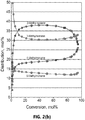
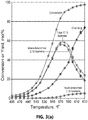
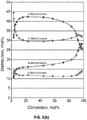
- Conversion is defined as the amount n-decane reacted to produce other products (including iso-C 10 ). Yields are expressed as mole percent of products other than n-decane and include iso-C 10 isomers as a yield product. The results are shown in FIGS. 2(a) and 2(b) .
Landscapes
- Chemical & Material Sciences (AREA)
- Organic Chemistry (AREA)
- Chemical Kinetics & Catalysis (AREA)
- Engineering & Computer Science (AREA)
- Materials Engineering (AREA)
- Life Sciences & Earth Sciences (AREA)
- Geology (AREA)
- General Life Sciences & Earth Sciences (AREA)
- Crystallography & Structural Chemistry (AREA)
- Inorganic Chemistry (AREA)
- Catalysts (AREA)
- Organic Low-Molecular-Weight Compounds And Preparation Thereof (AREA)
- Silicates, Zeolites, And Molecular Sieves (AREA)
- Dispersion Chemistry (AREA)
- Low-Molecular Organic Synthesis Reactions Using Catalysts (AREA)
- Glass Compositions (AREA)
Applications Claiming Priority (2)
| Application Number | Priority Date | Filing Date | Title |
|---|---|---|---|
| US201662423259P | 2016-11-17 | 2016-11-17 | |
| PCT/US2017/056936 WO2018093511A1 (en) | 2016-11-17 | 2017-10-17 | High-silica ssz-32x zeolite |
Publications (2)
| Publication Number | Publication Date |
|---|---|
| EP3541750A1 EP3541750A1 (en) | 2019-09-25 |
| EP3541750B1 true EP3541750B1 (en) | 2020-09-09 |
Family
ID=62106299
Family Applications (1)
| Application Number | Title | Priority Date | Filing Date |
|---|---|---|---|
| EP17791869.5A Active EP3541750B1 (en) | 2016-11-17 | 2017-10-17 | Method for synthesizing high-silica ssz-32x zeolite |
Country Status (6)
| Country | Link |
|---|---|
| US (1) | US10160657B2 (enExample) |
| EP (1) | EP3541750B1 (enExample) |
| JP (1) | JP7138102B2 (enExample) |
| KR (1) | KR102440746B1 (enExample) |
| CN (1) | CN109890758B (enExample) |
| WO (1) | WO2018093511A1 (enExample) |
Families Citing this family (3)
| Publication number | Priority date | Publication date | Assignee | Title |
|---|---|---|---|---|
| CN116113496A (zh) | 2020-08-31 | 2023-05-12 | 雪佛龙美国公司 | 用于基础油生产的工艺和系统 |
| CN117203159A (zh) | 2021-03-26 | 2023-12-08 | 雪佛龙美国公司 | 分子筛ssz-93、催化剂及其使用方法 |
| US20230357030A1 (en) * | 2022-05-09 | 2023-11-09 | Chevron U.S.A. Inc. | Synthesis of aluminum-containing cit-13 and cit-15 molecular sieves |
Citations (1)
| Publication number | Priority date | Publication date | Assignee | Title |
|---|---|---|---|---|
| US20150336089A1 (en) * | 2014-05-21 | 2015-11-26 | Chevron U.S.A. Inc. | Method for making molecular sieve ssz-95 |
Family Cites Families (16)
| Publication number | Priority date | Publication date | Assignee | Title |
|---|---|---|---|---|
| US4490342A (en) * | 1983-04-29 | 1984-12-25 | Mobil Oil Corporation | Synthesis of ZSM-23 zeolite |
| US5252527A (en) | 1988-03-23 | 1993-10-12 | Chevron Research And Technology Company | Zeolite SSZ-32 |
| US5053373A (en) | 1988-03-23 | 1991-10-01 | Chevron Research Company | Zeolite SSZ-32 |
| FR2632943B1 (fr) * | 1988-06-15 | 1990-09-28 | Inst Francais Du Petrole | Nouveau procede de synthese de zeolites de type structural mtt |
| US5707601A (en) * | 1995-03-17 | 1998-01-13 | Chevron U.S.A. Inc. | Process for preparing zeolites having MTT crystal structure using small, neutral amines |
| JPH11502804A (ja) * | 1995-03-17 | 1999-03-09 | シェブロン ユー.エス.エー.インコーポレイテッド | 有機テンプレート及びアミンを用いたゼオライトの製造 |
| FR2805255B1 (fr) * | 2000-02-21 | 2002-04-12 | Inst Francais Du Petrole | Zeolithe mtt comprenant des cristaux et des agregats de cristaux de granulometries specifiques et son utilisation comme catalyseur d'isomerisation des paraffines lineaires |
| US6509290B1 (en) * | 2000-07-17 | 2003-01-21 | Exxon Mobil Chemical Patents, Inc. | Catalyst composition including attrition particles and method for making same |
| US6833127B2 (en) * | 2000-12-22 | 2004-12-21 | California Institute Of Technology | Method of removing structure directing agents from molecular sieves |
| US7390763B2 (en) | 2003-10-31 | 2008-06-24 | Chevron U.S.A. Inc. | Preparing small crystal SSZ-32 and its use in a hydrocarbon conversion process |
| US7157075B1 (en) * | 2005-08-30 | 2007-01-02 | Chevron U.S.A. Inc. | Process for preparing MTT zeolites using nitrogen-containing organic compounds |
| US8263517B2 (en) * | 2007-12-28 | 2012-09-11 | Exxonmobil Research And Engineering Company | Hydroprocessing catalysts with low surface area binders |
| JP5468957B2 (ja) * | 2010-03-29 | 2014-04-09 | Jx日鉱日石エネルギー株式会社 | 水素化異性化触媒、その製造方法、炭化水素油の脱蝋方法、炭化水素の製造方法及び潤滑油基油の製造方法 |
| CN102958838B (zh) * | 2010-06-25 | 2015-07-08 | 雪佛龙美国公司 | 分子筛ssz-81 |
| US8545805B2 (en) | 2010-11-05 | 2013-10-01 | Chevron U.S.A. Inc. | Method for preparing small crystal SSZ-32 |
| CN105645428B (zh) * | 2016-02-29 | 2018-03-02 | 中国科学院山西煤炭化学研究所 | 具有介孔‑微孔分等级结构的ssz‑32分子筛的制备方法 |
-
2017
- 2017-10-17 US US15/785,504 patent/US10160657B2/en active Active
- 2017-10-17 EP EP17791869.5A patent/EP3541750B1/en active Active
- 2017-10-17 WO PCT/US2017/056936 patent/WO2018093511A1/en not_active Ceased
- 2017-10-17 CN CN201780066492.6A patent/CN109890758B/zh active Active
- 2017-10-17 JP JP2019521694A patent/JP7138102B2/ja active Active
- 2017-10-17 KR KR1020197017230A patent/KR102440746B1/ko active Active
Patent Citations (1)
| Publication number | Priority date | Publication date | Assignee | Title |
|---|---|---|---|---|
| US20150336089A1 (en) * | 2014-05-21 | 2015-11-26 | Chevron U.S.A. Inc. | Method for making molecular sieve ssz-95 |
Also Published As
| Publication number | Publication date |
|---|---|
| CN109890758A (zh) | 2019-06-14 |
| US20180134572A1 (en) | 2018-05-17 |
| JP7138102B2 (ja) | 2022-09-15 |
| US10160657B2 (en) | 2018-12-25 |
| CN109890758B (zh) | 2022-04-29 |
| KR20190082919A (ko) | 2019-07-10 |
| EP3541750A1 (en) | 2019-09-25 |
| KR102440746B1 (ko) | 2022-09-06 |
| JP2020504698A (ja) | 2020-02-13 |
| WO2018093511A1 (en) | 2018-05-24 |
Similar Documents
| Publication | Publication Date | Title |
|---|---|---|
| EP2373416B1 (en) | High activity mtt framework type molecular sieves | |
| EP2200939B1 (en) | Synthesis of high activity zsm-48 | |
| EP2373413B1 (en) | Dewaxing catalysts and processes | |
| KR101757402B1 (ko) | 분자체 ssz-81 | |
| AU2010321913B2 (en) | Method for making aluminosilicate ZSM-12 | |
| EP3807218B1 (en) | Aluminum-rich *mre framework type molecular sieves | |
| WO2005042144A2 (en) | Preparing small crystal ssz-32 and its use in a hydrocarbon conversion process | |
| US11542446B2 (en) | Dewaxing using a molecular sieve catalyst | |
| US8101811B2 (en) | Process for isomerizing a hydrocarbonaceous feedstock using aluminosilicate ZSM-12 | |
| US10160657B2 (en) | High-silica SSZ-32x zeolite | |
| EP4291529B1 (en) | Synthesis of ton framework type molecular sieves |
Legal Events
| Date | Code | Title | Description |
|---|---|---|---|
| STAA | Information on the status of an ep patent application or granted ep patent |
Free format text: STATUS: UNKNOWN |
|
| STAA | Information on the status of an ep patent application or granted ep patent |
Free format text: STATUS: THE INTERNATIONAL PUBLICATION HAS BEEN MADE |
|
| PUAI | Public reference made under article 153(3) epc to a published international application that has entered the european phase |
Free format text: ORIGINAL CODE: 0009012 |
|
| STAA | Information on the status of an ep patent application or granted ep patent |
Free format text: STATUS: REQUEST FOR EXAMINATION WAS MADE |
|
| 17P | Request for examination filed |
Effective date: 20190307 |
|
| AK | Designated contracting states |
Kind code of ref document: A1 Designated state(s): AL AT BE BG CH CY CZ DE DK EE ES FI FR GB GR HR HU IE IS IT LI LT LU LV MC MK MT NL NO PL PT RO RS SE SI SK SM TR |
|
| AX | Request for extension of the european patent |
Extension state: BA ME |
|
| DAV | Request for validation of the european patent (deleted) | ||
| DAX | Request for extension of the european patent (deleted) | ||
| RIC1 | Information provided on ipc code assigned before grant |
Ipc: C01B 39/48 20060101AFI20200304BHEP Ipc: C01B 39/02 20060101ALI20200304BHEP Ipc: B01J 35/02 20060101ALI20200304BHEP Ipc: B01J 29/70 20060101ALI20200304BHEP Ipc: B01J 35/00 20060101ALI20200304BHEP Ipc: B01J 29/74 20060101ALI20200304BHEP |
|
| STAA | Information on the status of an ep patent application or granted ep patent |
Free format text: STATUS: EXAMINATION IS IN PROGRESS |
|
| 17Q | First examination report despatched |
Effective date: 20200424 |
|
| GRAP | Despatch of communication of intention to grant a patent |
Free format text: ORIGINAL CODE: EPIDOSNIGR1 |
|
| STAA | Information on the status of an ep patent application or granted ep patent |
Free format text: STATUS: GRANT OF PATENT IS INTENDED |
|
| GRAS | Grant fee paid |
Free format text: ORIGINAL CODE: EPIDOSNIGR3 |
|
| GRAA | (expected) grant |
Free format text: ORIGINAL CODE: 0009210 |
|
| STAA | Information on the status of an ep patent application or granted ep patent |
Free format text: STATUS: THE PATENT HAS BEEN GRANTED |
|
| INTG | Intention to grant announced |
Effective date: 20200715 |
|
| AK | Designated contracting states |
Kind code of ref document: B1 Designated state(s): AL AT BE BG CH CY CZ DE DK EE ES FI FR GB GR HR HU IE IS IT LI LT LU LV MC MK MT NL NO PL PT RO RS SE SI SK SM TR |
|
| REG | Reference to a national code |
Ref country code: GB Ref legal event code: FG4D |
|
| REG | Reference to a national code |
Ref country code: AT Ref legal event code: REF Ref document number: 1311349 Country of ref document: AT Kind code of ref document: T Effective date: 20200915 Ref country code: CH Ref legal event code: EP |
|
| REG | Reference to a national code |
Ref country code: DE Ref legal event code: R096 Ref document number: 602017023448 Country of ref document: DE |
|
| REG | Reference to a national code |
Ref country code: IE Ref legal event code: FG4D |
|
| REG | Reference to a national code |
Ref country code: NL Ref legal event code: FP |
|
| REG | Reference to a national code |
Ref country code: DE Ref legal event code: R082 Ref document number: 602017023448 Country of ref document: DE Representative=s name: HL KEMPNER PATENTANWAELTE, SOLICITORS (ENGLAND, DE Ref country code: DE Ref legal event code: R082 Ref document number: 602017023448 Country of ref document: DE Representative=s name: HL KEMPNER PATENTANWALT, RECHTSANWALT, SOLICIT, DE Ref country code: DE Ref legal event code: R082 Ref document number: 602017023448 Country of ref document: DE Representative=s name: HL KEMPNER PARTG MBB, DE |
|
| REG | Reference to a national code |
Ref country code: LT Ref legal event code: MG4D |
|
| PG25 | Lapsed in a contracting state [announced via postgrant information from national office to epo] |
Ref country code: SE Free format text: LAPSE BECAUSE OF FAILURE TO SUBMIT A TRANSLATION OF THE DESCRIPTION OR TO PAY THE FEE WITHIN THE PRESCRIBED TIME-LIMIT Effective date: 20200909 Ref country code: BG Free format text: LAPSE BECAUSE OF FAILURE TO SUBMIT A TRANSLATION OF THE DESCRIPTION OR TO PAY THE FEE WITHIN THE PRESCRIBED TIME-LIMIT Effective date: 20201209 Ref country code: HR Free format text: LAPSE BECAUSE OF FAILURE TO SUBMIT A TRANSLATION OF THE DESCRIPTION OR TO PAY THE FEE WITHIN THE PRESCRIBED TIME-LIMIT Effective date: 20200909 Ref country code: LT Free format text: LAPSE BECAUSE OF FAILURE TO SUBMIT A TRANSLATION OF THE DESCRIPTION OR TO PAY THE FEE WITHIN THE PRESCRIBED TIME-LIMIT Effective date: 20200909 Ref country code: FI Free format text: LAPSE BECAUSE OF FAILURE TO SUBMIT A TRANSLATION OF THE DESCRIPTION OR TO PAY THE FEE WITHIN THE PRESCRIBED TIME-LIMIT Effective date: 20200909 Ref country code: GR Free format text: LAPSE BECAUSE OF FAILURE TO SUBMIT A TRANSLATION OF THE DESCRIPTION OR TO PAY THE FEE WITHIN THE PRESCRIBED TIME-LIMIT Effective date: 20201210 Ref country code: NO Free format text: LAPSE BECAUSE OF FAILURE TO SUBMIT A TRANSLATION OF THE DESCRIPTION OR TO PAY THE FEE WITHIN THE PRESCRIBED TIME-LIMIT Effective date: 20201209 |
|
| REG | Reference to a national code |
Ref country code: AT Ref legal event code: MK05 Ref document number: 1311349 Country of ref document: AT Kind code of ref document: T Effective date: 20200909 |
|
| PG25 | Lapsed in a contracting state [announced via postgrant information from national office to epo] |
Ref country code: RS Free format text: LAPSE BECAUSE OF FAILURE TO SUBMIT A TRANSLATION OF THE DESCRIPTION OR TO PAY THE FEE WITHIN THE PRESCRIBED TIME-LIMIT Effective date: 20200909 Ref country code: LV Free format text: LAPSE BECAUSE OF FAILURE TO SUBMIT A TRANSLATION OF THE DESCRIPTION OR TO PAY THE FEE WITHIN THE PRESCRIBED TIME-LIMIT Effective date: 20200909 Ref country code: PL Free format text: LAPSE BECAUSE OF FAILURE TO SUBMIT A TRANSLATION OF THE DESCRIPTION OR TO PAY THE FEE WITHIN THE PRESCRIBED TIME-LIMIT Effective date: 20200909 |
|
| PG25 | Lapsed in a contracting state [announced via postgrant information from national office to epo] |
Ref country code: SM Free format text: LAPSE BECAUSE OF FAILURE TO SUBMIT A TRANSLATION OF THE DESCRIPTION OR TO PAY THE FEE WITHIN THE PRESCRIBED TIME-LIMIT Effective date: 20200909 Ref country code: RO Free format text: LAPSE BECAUSE OF FAILURE TO SUBMIT A TRANSLATION OF THE DESCRIPTION OR TO PAY THE FEE WITHIN THE PRESCRIBED TIME-LIMIT Effective date: 20200909 Ref country code: PT Free format text: LAPSE BECAUSE OF FAILURE TO SUBMIT A TRANSLATION OF THE DESCRIPTION OR TO PAY THE FEE WITHIN THE PRESCRIBED TIME-LIMIT Effective date: 20210111 Ref country code: CZ Free format text: LAPSE BECAUSE OF FAILURE TO SUBMIT A TRANSLATION OF THE DESCRIPTION OR TO PAY THE FEE WITHIN THE PRESCRIBED TIME-LIMIT Effective date: 20200909 Ref country code: EE Free format text: LAPSE BECAUSE OF FAILURE TO SUBMIT A TRANSLATION OF THE DESCRIPTION OR TO PAY THE FEE WITHIN THE PRESCRIBED TIME-LIMIT Effective date: 20200909 |
|
| PG25 | Lapsed in a contracting state [announced via postgrant information from national office to epo] |
Ref country code: AL Free format text: LAPSE BECAUSE OF FAILURE TO SUBMIT A TRANSLATION OF THE DESCRIPTION OR TO PAY THE FEE WITHIN THE PRESCRIBED TIME-LIMIT Effective date: 20200909 Ref country code: AT Free format text: LAPSE BECAUSE OF FAILURE TO SUBMIT A TRANSLATION OF THE DESCRIPTION OR TO PAY THE FEE WITHIN THE PRESCRIBED TIME-LIMIT Effective date: 20200909 Ref country code: ES Free format text: LAPSE BECAUSE OF FAILURE TO SUBMIT A TRANSLATION OF THE DESCRIPTION OR TO PAY THE FEE WITHIN THE PRESCRIBED TIME-LIMIT Effective date: 20200909 Ref country code: IS Free format text: LAPSE BECAUSE OF FAILURE TO SUBMIT A TRANSLATION OF THE DESCRIPTION OR TO PAY THE FEE WITHIN THE PRESCRIBED TIME-LIMIT Effective date: 20210109 |
|
| REG | Reference to a national code |
Ref country code: CH Ref legal event code: PL |
|
| REG | Reference to a national code |
Ref country code: DE Ref legal event code: R097 Ref document number: 602017023448 Country of ref document: DE |
|
| PG25 | Lapsed in a contracting state [announced via postgrant information from national office to epo] |
Ref country code: SK Free format text: LAPSE BECAUSE OF FAILURE TO SUBMIT A TRANSLATION OF THE DESCRIPTION OR TO PAY THE FEE WITHIN THE PRESCRIBED TIME-LIMIT Effective date: 20200909 Ref country code: LU Free format text: LAPSE BECAUSE OF NON-PAYMENT OF DUE FEES Effective date: 20201017 Ref country code: MC Free format text: LAPSE BECAUSE OF FAILURE TO SUBMIT A TRANSLATION OF THE DESCRIPTION OR TO PAY THE FEE WITHIN THE PRESCRIBED TIME-LIMIT Effective date: 20200909 |
|
| REG | Reference to a national code |
Ref country code: BE Ref legal event code: MM Effective date: 20201031 |
|
| PLBE | No opposition filed within time limit |
Free format text: ORIGINAL CODE: 0009261 |
|
| STAA | Information on the status of an ep patent application or granted ep patent |
Free format text: STATUS: NO OPPOSITION FILED WITHIN TIME LIMIT |
|
| 26N | No opposition filed |
Effective date: 20210610 |
|
| PG25 | Lapsed in a contracting state [announced via postgrant information from national office to epo] |
Ref country code: BE Free format text: LAPSE BECAUSE OF NON-PAYMENT OF DUE FEES Effective date: 20201031 Ref country code: CH Free format text: LAPSE BECAUSE OF NON-PAYMENT OF DUE FEES Effective date: 20201031 Ref country code: SI Free format text: LAPSE BECAUSE OF FAILURE TO SUBMIT A TRANSLATION OF THE DESCRIPTION OR TO PAY THE FEE WITHIN THE PRESCRIBED TIME-LIMIT Effective date: 20200909 Ref country code: DK Free format text: LAPSE BECAUSE OF FAILURE TO SUBMIT A TRANSLATION OF THE DESCRIPTION OR TO PAY THE FEE WITHIN THE PRESCRIBED TIME-LIMIT Effective date: 20200909 Ref country code: LI Free format text: LAPSE BECAUSE OF NON-PAYMENT OF DUE FEES Effective date: 20201031 |
|
| PG25 | Lapsed in a contracting state [announced via postgrant information from national office to epo] |
Ref country code: IE Free format text: LAPSE BECAUSE OF NON-PAYMENT OF DUE FEES Effective date: 20201017 Ref country code: IT Free format text: LAPSE BECAUSE OF FAILURE TO SUBMIT A TRANSLATION OF THE DESCRIPTION OR TO PAY THE FEE WITHIN THE PRESCRIBED TIME-LIMIT Effective date: 20200909 |
|
| PG25 | Lapsed in a contracting state [announced via postgrant information from national office to epo] |
Ref country code: TR Free format text: LAPSE BECAUSE OF FAILURE TO SUBMIT A TRANSLATION OF THE DESCRIPTION OR TO PAY THE FEE WITHIN THE PRESCRIBED TIME-LIMIT Effective date: 20200909 Ref country code: MT Free format text: LAPSE BECAUSE OF FAILURE TO SUBMIT A TRANSLATION OF THE DESCRIPTION OR TO PAY THE FEE WITHIN THE PRESCRIBED TIME-LIMIT Effective date: 20200909 Ref country code: CY Free format text: LAPSE BECAUSE OF FAILURE TO SUBMIT A TRANSLATION OF THE DESCRIPTION OR TO PAY THE FEE WITHIN THE PRESCRIBED TIME-LIMIT Effective date: 20200909 |
|
| PG25 | Lapsed in a contracting state [announced via postgrant information from national office to epo] |
Ref country code: MK Free format text: LAPSE BECAUSE OF FAILURE TO SUBMIT A TRANSLATION OF THE DESCRIPTION OR TO PAY THE FEE WITHIN THE PRESCRIBED TIME-LIMIT Effective date: 20200909 |
|
| P01 | Opt-out of the competence of the unified patent court (upc) registered |
Effective date: 20230522 |
|
| PGFP | Annual fee paid to national office [announced via postgrant information from national office to epo] |
Ref country code: NL Payment date: 20250912 Year of fee payment: 9 |
|
| PGFP | Annual fee paid to national office [announced via postgrant information from national office to epo] |
Ref country code: GB Payment date: 20250904 Year of fee payment: 9 |
|
| PGFP | Annual fee paid to national office [announced via postgrant information from national office to epo] |
Ref country code: FR Payment date: 20250908 Year of fee payment: 9 |
|
| PGFP | Annual fee paid to national office [announced via postgrant information from national office to epo] |
Ref country code: DE Payment date: 20250902 Year of fee payment: 9 |