EP3538503B1 - Verfahren zur herstellung von fluoriertem cyclobutan - Google Patents
Verfahren zur herstellung von fluoriertem cyclobutan Download PDFInfo
- Publication number
- EP3538503B1 EP3538503B1 EP17869249.7A EP17869249A EP3538503B1 EP 3538503 B1 EP3538503 B1 EP 3538503B1 EP 17869249 A EP17869249 A EP 17869249A EP 3538503 B1 EP3538503 B1 EP 3538503B1
- Authority
- EP
- European Patent Office
- Prior art keywords
- ethylene
- reaction
- reaction vessel
- tfmcb
- hexafluoropropene
- Prior art date
- Legal status (The legal status is an assumption and is not a legal conclusion. Google has not performed a legal analysis and makes no representation as to the accuracy of the status listed.)
- Active
Links
Images
Classifications
-
- C—CHEMISTRY; METALLURGY
- C07—ORGANIC CHEMISTRY
- C07C—ACYCLIC OR CARBOCYCLIC COMPOUNDS
- C07C17/00—Preparation of halogenated hydrocarbons
- C07C17/26—Preparation of halogenated hydrocarbons by reactions involving an increase in the number of carbon atoms in the skeleton
- C07C17/30—Preparation of halogenated hydrocarbons by reactions involving an increase in the number of carbon atoms in the skeleton by a Diels-Alder synthesis
-
- C—CHEMISTRY; METALLURGY
- C07—ORGANIC CHEMISTRY
- C07C—ACYCLIC OR CARBOCYCLIC COMPOUNDS
- C07C17/00—Preparation of halogenated hydrocarbons
- C07C17/26—Preparation of halogenated hydrocarbons by reactions involving an increase in the number of carbon atoms in the skeleton
- C07C17/272—Preparation of halogenated hydrocarbons by reactions involving an increase in the number of carbon atoms in the skeleton by addition reactions
- C07C17/275—Preparation of halogenated hydrocarbons by reactions involving an increase in the number of carbon atoms in the skeleton by addition reactions of hydrocarbons and halogenated hydrocarbons
-
- A—HUMAN NECESSITIES
- A01—AGRICULTURE; FORESTRY; ANIMAL HUSBANDRY; HUNTING; TRAPPING; FISHING
- A01H—NEW PLANTS OR NON-TRANSGENIC PROCESSES FOR OBTAINING THEM; PLANT REPRODUCTION BY TISSUE CULTURE TECHNIQUES
- A01H4/00—Plant reproduction by tissue culture techniques ; Tissue culture techniques therefor
- A01H4/005—Methods for micropropagation; Vegetative plant propagation using cell or tissue culture techniques
- A01H4/006—Encapsulated embryos for plant reproduction, e.g. artificial seeds
-
- C—CHEMISTRY; METALLURGY
- C12—BIOCHEMISTRY; BEER; SPIRITS; WINE; VINEGAR; MICROBIOLOGY; ENZYMOLOGY; MUTATION OR GENETIC ENGINEERING
- C12N—MICROORGANISMS OR ENZYMES; COMPOSITIONS THEREOF; PROPAGATING, PRESERVING, OR MAINTAINING MICROORGANISMS; MUTATION OR GENETIC ENGINEERING; CULTURE MEDIA
- C12N5/00—Undifferentiated human, animal or plant cells, e.g. cell lines; Tissues; Cultivation or maintenance thereof; Culture media therefor
- C12N5/0018—Culture media for cell or tissue culture
- C12N5/0025—Culture media for plant cell or plant tissue culture
-
- C—CHEMISTRY; METALLURGY
- C07—ORGANIC CHEMISTRY
- C07C—ACYCLIC OR CARBOCYCLIC COMPOUNDS
- C07C2601/00—Systems containing only non-condensed rings
- C07C2601/04—Systems containing only non-condensed rings with a four-membered ring
-
- C—CHEMISTRY; METALLURGY
- C12—BIOCHEMISTRY; BEER; SPIRITS; WINE; VINEGAR; MICROBIOLOGY; ENZYMOLOGY; MUTATION OR GENETIC ENGINEERING
- C12N—MICROORGANISMS OR ENZYMES; COMPOSITIONS THEREOF; PROPAGATING, PRESERVING, OR MAINTAINING MICROORGANISMS; MUTATION OR GENETIC ENGINEERING; CULTURE MEDIA
- C12N2500/00—Specific components of cell culture medium
- C12N2500/05—Inorganic components
-
- Y—GENERAL TAGGING OF NEW TECHNOLOGICAL DEVELOPMENTS; GENERAL TAGGING OF CROSS-SECTIONAL TECHNOLOGIES SPANNING OVER SEVERAL SECTIONS OF THE IPC; TECHNICAL SUBJECTS COVERED BY FORMER USPC CROSS-REFERENCE ART COLLECTIONS [XRACs] AND DIGESTS
- Y02—TECHNOLOGIES OR APPLICATIONS FOR MITIGATION OR ADAPTATION AGAINST CLIMATE CHANGE
- Y02P—CLIMATE CHANGE MITIGATION TECHNOLOGIES IN THE PRODUCTION OR PROCESSING OF GOODS
- Y02P20/00—Technologies relating to chemical industry
- Y02P20/50—Improvements relating to the production of bulk chemicals
- Y02P20/582—Recycling of unreacted starting or intermediate materials
Definitions
- the present invention relates to the production of 1,1,2-trifluoro-2-(trifluoromethyl)cyclobutane (TFMCB). More specifically, the present invention relates to methods for production of 1,1,2-trifluoro-2-(trifluoromethyl)cyclobutane via a continuous catalytic reaction from commercially available reactants ethylene and hexafluoropropene.
- TFMCB 1,1,2-trifluoro-2-(trifluoromethyl)cyclobutane
- a number of methods are known in the art for making HFO-1234yf. See, for example U.S. Patent Nos. 8,975,454 , 8,618,340 , 8,058,486 , and 9,061,957 . See also, U.S. Patent Pub. Nos. 2009-0099396 and 2008-0058562 .
- HFO-1234yf Another route to HFO-1234yf is the hydrofluorination of 1,1,2,3-tetrachloro-propene (TCP), as disclosed in U.S. Patent Nos. 8,084,653 and 8,324,436 .
- PCT Publication WO 2009/003085 A1 describes the preparation of HFO-1234yf via the metathesis of hexafluoropropene (HFP) and ethylene. This process requires the use of an expensive metathesis catalyst in an organic solvent and thus not cost effective for commercial production.
- Atom efficiency percentage is calculated as follows: (the molecular weight of the desired product) divided by (the molecular weight of the substances formed) x 100.
- U.S. Patent No. 3,996,299 describes a process for the formation of the copolymer produced from vinylidine fluoride and 2,3,3,3-tetrafluoro-propylene. This process involves the cyclodimerization of a perfluoroolefin, such as perfluoropropylene, with a terminal monoolefin, such as ethylene, to produce the cyclic compound 1,1,2-trifluoro-2-trifluoromethyl-cyclobutane (TFMCB).
- TFMCB 1,1,2-trifluoro-2-trifluoromethyl-cyclobutane
- the cyclic compound such as TFMCB is then subjected to a thermal cracking operation to produce a mixture of acyclic fluorine-containing olefins, such as vinylidine fluoride and 2,3,3,3-tetrafluoro-propylene, which can be used as monomers and/or comonomers in polymerization reactions.
- acyclic fluorine-containing olefins such as vinylidine fluoride and 2,3,3,3-tetrafluoro-propylene
- the '299 patent discloses the cyclodimerization reaction can occur over a very wide range of reaction conditions.
- the reaction temperature can be in the range of 200°-600°C, preferably 300° -400°C, and that the reaction time in the range of about 4 to about 1000 hours, preferably 10 to 100 hours.
- the '299 patent also indicates that the ratio of the monoolefin to the perfluoroolefin usually is in the range of 0.1:1 to about 100:1 preferably 1:1 to about 10:1.
- the '299 patent discloses that the thermal cracking of the cyclic compound at temperatures in the range of 500° to 1000°C and preferably in the range of 600° to 700°C. It is stated that the cracking reaction can be carried out continuously by passage through a heated reactor tube maintaining a contact time in the range of 0.01-10 seconds.
- Another problem is that many of the permitted ratios of perfluorolefin, such as HFP, to the monolefin, such as ethylene, can produce undesirable reaction product results, including unwanted or detrimental by-products and/or poor conversions and/or selectivities. Similar disadvantages associated with unwanted or detrimental by-products and/or poor conversions and/or selectivities are possible within the range of reaction conditions for the cracking reaction.
- TFMCB 1, 1, 2-trifluoro-2-(trifluoromethyl)cyclobutane
- TFMCB 1,1,2-trifluoro-2-(trifluoromethyl)cyclobutane
- 1234yf is commercially available from Honeywell International Inc. under the trademark Solstice ( TM ) . Both 1234yf and VDF are commercially important compounds, specifically, 1234yf is a low global warming compound with zero ozone depletion potential useful as a refrigerant, foam blowing agent, monomer for polymers and many other applications, and VDF is a monomer useful for producing polymers, such as polyvinylidene fluoride (PVDF).
- PVDF polyvinylidene fluoride
- TFMCB is a known compound having a boiling point of 68°C.
- TFMCB was used as a component of a cleaning solvent composition in U.S. Patent Nos. 5,026,499 and 5,035,830 .
- Methods for the synthesis of TFMCB are known.
- PCT Publication No. 2000/75092 describes the codimerization of TFE and ethylene to give tetrafluorocyclobutane, and subsequent electrochemical fluorination to give perfluorocyclobutanes.
- 3,996,299 and 4,086,407 describe the generation of 1, 1, 2-trifluoro-2-(trifluoromethyl) cyclobutane by heating hexafluoropropene and ethylene in a closed stainless steel cylinder at 350°C for about 3 days.
- the present invention relates to the production of 1,1,2-trifluoro-2-(trifluoromethyl)cyclobutane (TFMCB), and provides methods for producing 1,1,2-trifluoro-2-(trifluoromethyl)cyclobutane via a continuous catalytic reaction from commercially available raw materials ethylene and hexafluoropropene.
- TFMCB 1,1,2-trifluoro-2-(trifluoromethyl)cyclobutane
- the present invention provides a continuous process for producing 1, 1, 2-trifluoro-2-(trifluoromethyl)cyclobutane (TFMCB), including the following steps: (a) introducing hexafluoropropene and ethylene into a reaction vessel; (b) reacting the hexafluoropropene and ethylene in the reaction vessel in the presence of at least one metal catalyst; (c) removing TFMCB product from the reaction vessel; and (d) repeating said introducing, reacting and removing steps (a) through (c).
- TFMCB 1, 1, 2-trifluoro-2-(trifluoromethyl)cyclobutane
- the foregoing process may further include the additional steps of removing at least one of unreacted hexafluoropropene and unreacted ethylene from the reaction vessel, and recycling the at least one of unreacted hexafluoropropene and unreacted ethylene back into the reaction vessel.
- the foregoing process may further include the additional steps of removing unreacted hexafluoropropene and unreacted ethylene from the reaction vessel; and recycling the unreacted hexafluoropropene and unreacted ethylene back into the reaction vessel.
- the metal catalyst may include at least one metal catalyst selected from the group consisting of nickel and nickel-based alloys.
- the reaction may be conducted at a pressure between 600 psig (4140 kPag) and 1500 psig (10340 kPag) or at a pressure between 800 psig (5520 kPag) and 1200 psig (8274 kPag); the reaction may be conducted at a temperature between 300°C and 500°C or at a temperature between 300°C and 400°C; and hexafluoropropene and ethylene may be present at a molar ratio of from 1:1 to 1:6 or at a molar ratio of from 1:1 to 1:3.
- the reacting step may be carried out in the presence of at least one oligomerization/polymerization (OP) inhibitor selected from the group consisting of catechol and its derivatives, terpenes, quinones and combinations thereof, and/or may be gas phase nitric oxide (NO).
- OP oligomerization/polymerization
- the oligomerization/polymerization (OP) inhibitor may be present at from about 50 ppm to about 2,000 ppm by weight based on the total weight of the reaction composition in the reaction vessel or may be present at from about 500 ppm to about 1,000 ppm based on the total weight of the reaction composition in the reaction vessel.
- the present invention provides a continuous process for producing 1, 1, 2-trifluoro-2-(trifluoromethyl)cyclobutane (TFMCB), including the following steps: (a) introducing hexafluoropropene and ethylene into a reaction vessel; (b) reacting the hexafluoropropene and ethylene in the reaction vessel in the presence of at least one metal catalyst and at least one oligomerization/polymerization (OP) inhibitor; (c) removing TFMCB product from the reaction vessel; and (d) repeating said introducing, reacting and removing steps (a) through (c).
- TFMCB 1, 1, 2-trifluoro-2-(trifluoromethyl)cyclobutane
- the at least one metal catalyst may include at least one metal catalyst selected from the group consisting of nickel and nickel-based alloys.
- the reacting step is carried out in the presence of at least one oligomerization/polymerization (OP) inhibitor selected from the group consisting of catechol and its derivatives, terpenes, quinones and combinations thereof and/or may be gas phase nitric oxide (NO).
- OP oligomerization/polymerization
- the oligomerization/polymerization (OP) inhibitor may be present at from about 50 ppm to about 2,000 ppm by weight based on the total weight of the reaction composition in the reaction vessel.
- the reacting step may conducted at a pressure between 600 psig (4140 kPag) and 1500 psig (10340 kPag); the reacting step may be conducted at a temperature between 300°C and 500°C; and during the reacting step, the hexafluoropropene and ethylene may be present at a molar ratio of from 1:1 to 1:6.
- the present disclosure provides a process for producing 1,1,2-trifluoro-2-(trifluoromethyl)cyclobutane (TFMCB), including the following steps: introducing hexafluoropropene and ethylene into a reaction vessel; and reacting the hexafluoropropene and ethylene in the reaction vessel in the presence of at least one oligomerization/polymerization (OP) inhibitor and at least one metal catalyst.
- TFMCB 1,1,2-trifluoro-2-(trifluoromethyl)cyclobutane
- the process may be a continuous process and may further include the additional steps, following the reacting step, of: removing TFMCB product from the reaction vessel; and repeating said introducing, reacting and removing steps (a) through (c).
- the process may further include the additional steps, following the reacting step, of: removing at least one of unreacted hexafluoropropene and unreacted ethylene from the reaction vessel; and recycling the at least one of unreacted hexafluoropropene and unreacted ethylene back into the reaction vessel.
- the process may further include the additional steps, following the reacting step, of: removing unreacted hexafluoropropene and unreacted ethylene from the reaction vessel; and recycling the unreacted hexafluoropropene and unreacted ethylene back into the reaction vessel.
- the metal catalyst may be selected from the group consisting of nickel and nickel-based alloys.
- the oligomerization/polymerization (OP) inhibitor may include at least one gas phase compound selected from the group consisting of nitric oxide (NO), nitrogen dioxide (NO 2 ), carbon monoxide (CO) and sulphur dioxide (SO 2 ).
- the oligomerization/polymerization (OP) inhibitor may be 2,2,6,6-tetramethylpiperidinyl-1-oxl.
- the oligomerization/polymerization (OP) inhibitor may be selected from the group consisting of catechol and catechol derivatives, terpenes, quinones and combinations thereof.
- the oligomerization/polymerization (OP) inhibitor may be present at from about 50 ppm to about 2,000 ppm by weight based on the total weight of the reaction composition in the reaction vessel, or may be present at from about 500 ppm to about 1,000 ppm based on the total weight of the reaction composition in the reaction vessel.
- the reacting step may be conducted at a pressure between 600 psig (4140 kPag) and 1500 psig (10340 kPag), or at a pressure between 800 psig (5520 kPag) and 1200 psig.
- the reacting step may be conducted at a temperature between 300°C and 500°C, or at a temperature between 300°C and 400°C.
- the hexafluoropropene and ethylene may be present at a molar ratio of from 1:1 to 1:6.
- the present disclosure provides a process for the formation of a mixture of the compounds 2,3,3,3-tetrafluoropropene (1234yf) and vinylidene fluoride, including the step of pyrolyzing 1,1,2-trifluoro-2-trifluoro-methyl-cyclobutane (TFMCB), wherein the TFMCB has a purity greater than 92%, under conditions effective to produce a reaction product comprising 1234yf and vinylidene fluoride in a 1234yf:vinylidene fluoride molar ratio of from about 0.5 to about 1.2.
- TFMCB 1,1,2-trifluoro-2-trifluoro-methyl-cyclobutane
- the pyrolysis may be conducted at a temperature in the range of from about 750° C to about 800° C and for a contact time of from about 2 seconds to about 25 seconds and at a pressure of about 1 atm (100 kPa).
- the pyrolysis may be conducted in a stainless steel tube reactor, and the reaction may be quenched by cooling as the products come out of the reactor.
- the present disclosure provides a process for the formation of a mixture of the compounds 2,3,3,3-tetrafluoropropene (1234yf) and vinylidene fluoride, including the step of pyrolyzing 1,1,2-trifluoro-2-trifluoro-methyl-cyclobutane under conditions effective to produce a reaction product comprising 1234yf and vinylidene fluoride in a 1234yf:vinylidene fluoride molar ratio of from about 0.5 to about 1.2; wherein the pyrolysis provides a yield in the range of about 80% to about 90%.
- the pyrolysis may provide a conversion rate of about 70%.
- the pyrolysis may be conducted in a batch mode or in a continuous mode.
- the method may further include the step of separating the mixture of the compounds 1234yf and vinylidene fluoride.
- the present disclosure provides a process for the formation of a mixture of the compounds 2,3,3,3-tetrafluoropropene (1234yf) and vinylidene fluoride, including the step of pyrolyzing 1,1,2-trifluoro-2-trifluoro-methyl-cyclobutane under conditions effective to produce a reaction product comprising 1234yf and vinylidene fluoride in a 1234yf:vinylidene fluoride molar ratio of from about 0.5 to about 1.2; the process further including the step of forming the compound 1,1,2-trifluoro-2-trifluoromethyl-cyclobutane (TFMCB) by the thermal dimerization a mixture of hexafluoro-propene (HFP) and a stoichiometric excess of ethylene, in the presence of a polymerization or oligomerization inhibitor; and wherein the TFMCB has a purity greater than 92%.
- TFMCB 1,1,2-trifluoro-2-tri
- the HFP and ethylene may be mixed in a reactor at a molar ratio of from 1:1 to 1:10 or a molar ratio of from 1:1 to 1:6.
- the inhibitor may present at from about 200 ppm to about 3% by weight, or from about 500 ppm to 5000 ppm.
- the inhibitor may be selected from the group consisting of catechol and its derivatives, terpenes, quinones and combinations of two or more thereof.
- the inhibitor may be selected from the group consisting of t-butyl catechol, limonene, pinene, 1,4-naphtho-quinone, 2,5-di-tert-butyl-hydroquinone, hydroquinone, hydroquinone monomethyl ether, mono-tert-butyl hydroquinone, para-benzoquinone, toluhydroquinone, trimethyl-hydroquinone and combinations of any two or more thereof.
- the thermal dimerization may be conducted at a temperature in the range of from about 250° C to 450° C or the thermal dimerization may be conducted at a temperature in the range of from about 300° to 350° C.
- the thermal dimerization may be conducted for a reaction time in the range of from about one to five hours, or for a reaction time in the range of from about one to five hours.
- any unreacted starting materials may be recycled into a separate container, and the product TFMCB may be purified by distillation at greater than 99.8% purity.
- a method or process for the production of 1,1,2-triflfuoro-2-(trifluoromethyl)cyclobutane (TFMCB).
- the method involves a continuous process in which ethylene (C 2 H 4 ) and hexafluoropropene (C 3 F 6 ) reactants (i.e., raw materials or "raws") are added continuously or periodically to a reaction vessel as needed, products are removed from the reaction vessel continuously or periodically as needed and optionally purified, and unreacted materials are removed from the reaction vessel continuously or periodically as needed and optionally recycled back into the reaction vessel.
- the reaction is carried out by constant feeding of reactants and removal of product (TFMCB) and recycling unreacted ethylene (C 2 H 4 ) and hexafluoropropene.
- oligomerization/polymerization of the reactants can be controlled, in order to enhance conversion of the reactants to the desired TFMCB product by control of reaction conditions and/or with the use of at least one catalyst and/or at least one oligomerization/polymerization (OP) inhibitor.
- OP oligomerization/polymerization
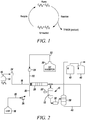
- reaction vessel 10 which may be a heated tube reactor, for example, and which as discussed in further detail below, contains a catalyst 12.
- the reactants ethylene and hexafluoropropene are fed from respective supply tanks 14 and 16 at desired flow rates via conduits 18 and 20, respectively, to reaction vessel 10.
- Reaction vessel 10 may be heated by an appropriate heating mechanism, such as by being placed in a furnace or by the use of heating sleeves and/or tapes, and is equipped with an internal temperature sensor 22 to monitor inside temperature.
- Reaction vessel 10 may be made of stainless steel, nickel, nickel-based alloys such as Monel® (e.g., up to 67% nickel, with copper, and small amounts of iron, manganese, carbon, and silicon; Monel® is a registered trademark of Huntington Alloys Corporation) and/or may be silver lined.
- Monel® e.g., up to 67% nickel, with copper, and small amounts of iron, manganese, carbon, and silicon; Monel® is a registered trademark of Huntington Alloys Corporation
- Monel® is a registered trademark of Huntington Alloys Corporation
- delivery of ethylene to reaction vessel 10 is controlled by a mass flow controller 24 within conduit 18, whereas HFP is pumped through conduit 20 as a liquid using an appropriate high pressure liquid pump 26.
- a premixer 28 may be used with reaction vessel 10 and conduits 18 and 20 to pre-mix the reactants prior to conveyance of the reactants into reaction vessel 10.
- an oligomerization/polymerization (OP) inhibitor is used to control or prevent oligomerization and/or polymerization from occurring during the reaction.
- the OP inhibitor may be delivered from a supply tank via a dedicated conduit 32, or alternatively may be delivered along with either or both reactants via conduits 18 and/or 20.
- a supply device 34 such as a mass flow controller or a pump, depending on the physical nature of the OP inhibitor may be used to devliver the OP inhibitor.
- Constant pressure in reaction vessel 10 may be maintained using a back pressure regulator or research control valve (RCV) assembly, schematically shown in Fig. 2 at 36.
- the reaction may be monitored, at desired intervals, by analyzing exit products using gas chromatography (GC), for example, and/or other analytical methods.
- GC gas chromatography
- the product TFMCB may be separated from unreacted ethylene and hexafluoropropene via separator 38, and collected continuously after withdrawal form reaction vessel 10 in a cooled vessel 40, for example. Unreacted ethylene and hexafluoropropene may be recycled back to reaction vessel 10 (and/or to another suitable point in the process) via conduit 42.
- various modifications of reaction vessel 10 and its associated components from the depiction shown in Fig. 2 are possible for conducting the reaction as well as for the collection and the separation of the products.
- the reaction may be carried out at a temperature as low as 250°C, 300°C, or 330°C, or as high as 400°C, 500°C, or 600°C, or may be carried out within any range defined between any two of the foregoing values, such as 250-600°C, 300-500 °C, or 330-400 °C. In a specific embodiment, the reaction temperature is between 300 and 350 °C.
- the reaction may be carried out at a pressure as low as 400 psig, 600 psig (4140 kPag), or 800 psig (5520 kPag), or as high as 1200 psig (8274 kPag), 1500 psig (10340 kPag), or 2000 psig (13790 kPag), or may be carried out within any range defined between any two of the foregoing values, such as 400-2000 psig (2760-13790 kPag), 600-1500 psig (4140-10340 kPag), or 800-1200 psig (5520-8274 kPag).
- the reaction pressure is between 800 and 900 psig (5520 and 6210 kPag).
- the ratio of the reactants hexafluoropropene to ethylene present in reaction vessel 10 during the reaction can range from 1:1 to 1:10, alternatively from 1:1 to 1:6, and still alternatively from 1:1 to 1:3. In a specific embodiment, the ratio is 1:2.
- Metal catalysts include nickel and nickel-based alloys such as Monel® alloy, nickel Propak® distillation column packing (size 0.16 or 0.24 inch [0.41 or 0.61 cm]), nickel alloy 200 (UNS NO 2200, nickel alloy 201 (UNS NO 2201) and nickel alloys of greater than 99% purity.
- Catalysts can also be in the form of meshes, granules, wires, foams and the like, though will typically be used in the form of distillation column packing.
- the synthesis of TFMCB comprises a thermal, catalytic cyclodimerization of hexafluoropropene and ethylene, optionally in the presence of an OP inhibitor to control undesired oligomerization and/or polymerization of the reactants, which would form undesirable by-products.
- TFMCB may be produced to a high selectivity of about 70-90% as well as a high purity of between 80-90% directly from the reaction of hexafluoropropene and ethylene.
- the TFMCB product may itself be further purified, such as by distillation, in subsequent steps to further increase its purity.
- OP inhibitors can also be employed to minimize or prevent the oligomerization or polymerization of ethylene and HFP.
- exemplary OP inhibitors include terpene, quinone, nitroxyl nitroxyl, hyrdoxylamine based and other inhibitors, such as ⁇ -pinene, limonene, terpineol, t-butyl catechol, hydroquinone, napthoqquinone, p-methoxy hydroquinone (MEHQ), N.N-diakylhydroxylamines, 2,2,6,6,-tetramethylpiperidinyl-1-oxl (TEMPO), 2-sec-butyl-4,6-dintrophenol (DNBP) and gas phases inhibitors such as nitric oxide (NO), nitrogen dioxide (NO 2 ), carbon monoxide (CO) and sulphur dioxide (SO 2 ), as well as combinations of the foregoing.
- NO nitric oxide
- NO 2 nitrogen dioxide
- CO carbon
- the gas phase inhibitors nitric oxide (NO), nitrogen dioxide (NO 2 ), carbon monoxide (CO) and/or sulphur dioxide (SO 2 ) may be added to the reaction mixture as neat gases, or may be diluted with an inert gas such as nitrogen, for example, such that the amount of OP inhibitor used is between 0.01 wt.% and 5 wt.%, for example, or within the ranges set forth below, based on the total weight of the reactant raw materials.
- OP inhibitors are solid and therefore are typically dissolved in a suitable nonreactive solvent, such as dodecane, prior to being pumped into reaction vessel 10 via pump 20, for example.
- a suitable nonreactive solvent such as dodecane
- the OP inhibitors are used in low concentration relative to the raw materials, for example, the amount of OP inhibitor used may be as little as 50 ppm, 100 ppm, 200 ppm, or 500 ppm, or as great as 1,000 ppm, 2,000 ppm, or 1 wt.%, based on the weight of the reaction composition in reaction vessel 10, or may be present within any range defined between any two of the foregoing values, such as 100 ppm to 1 wt.%, 200 ppm to 2,000 ppm, or 500 ppm to 1,000 ppm.
- the OP inhibitor is a gas phase inhibitor such as nitric oxide (NO) which, advantageously, may be fed into reaction vessel 10 either neat or as diluted with an inert gas such as nitrogen through a mass flow controller.
- NO nitric oxide
- Another aspect of the present invention is directed to a process for making HFO-1234yf and/or vinylidine fluoride (VDF) by converting TFMCB to VDF and/or HFO-1234yf, such as by cracking, and in some embodiments by thermal cracking (hereinafter referred to as "pyrolysis"), in which the TFMCB is held in a reaction zone for a contact time of less than about 10 seconds and at an average temperature of less than about 850° C to produce (VDF) and/or HFO-1234yf, preferably both VDF and HF-1234yf and even more preferably in a VDF:HFO-1234yf mole ratio of less than about 1.5:1 and not less than about 0.8:1.
- VDF vinylidine fluoride
- a process for forming VDF and/or HFO-1234yf including the steps of: (a) providing a stream comprising 1,1,2-trifluoro-2-trifluoromethyl-cyclobutane (TFMCB); and (b) cracking, such as by pyrolyzing, the 1,1,2-trifluoro-2-trifluoromethyl-cyclobutane (TFMCB) for a contact time of less than about 10 seconds and at an average temperature of less than about 850°C to produce VDF and/or HFO-1234yf, preferably both VDF and HF-1234yf and even more preferably in a VDF:HFO-1234yf mole ratio of less than about 1.5:1 and not less than about 0.8:1.
- TFMCB 1,1,2-trifluoro-2-trifluoromethyl-cyclobutane
- reaction vessel such as a heated tubular reaction vessel
- a stream including, such as a major proportion by weight or still further alternatively, consisting essentially of, TFMCB.
- the tubular reactor may be a stainless steel tube placed in a furnace maintained at elevated temperature and passing the TFMCB through the reactor, such as via a continuous operation, at a contact time of less than about 10 seconds, alternatively less than about 5 seconds, to produce a reaction product stream comprising 1234yf and/or VDF.
- a quenching operation may be employed to quickly reduce the temperature of the reaction product to halt the pyrolysis reaction, such as for example, introducing the reaction product stream into a cylinder maintained at temperature much lower than the temperature of the heated reaction vessel.
- no carrier gas e.g., helium
- the reaction temperatures may range from 500 °C to 1000 °C, alternatively from 750°C to 850°C.
- the pyrolysis provides a yield in the range of about 80% to about 90%, based on the amount of VDF and HFO-1234yf together, and preferably in a VDF:HFO-1234yf molar ratio of from about 1.5:1 to about 0.8:1. In certain embodiments, the pyrolysis provides a conversion rate of about 70%, based on the conversion of the starting materials.
- the pyrolysis is conducted in a batch mode.
- the pyrolysis is conducted in a continuous mode.
- the process may further include a step of separating the mixture of the compounds HFO-1234yf and vinylidine fluoride, using conventional techniques.
- TFMCB 1,1,2-trifluoro-2-trifluormethyl-cyclobutane
- the thermal cracking of the neat cyclobutane compound in a hot tube reactor gave a mixture of 1234yf and VDF in excellent yield (atom efficiency percentage of about 80% to 90%) with a conversion of rate of about 70%. Approximately 3% to 5% of unreacted HFP and ethylene were observed in the product mixture. If desired, this mixture of compounds may be separated using conventional methods.
- TFMCB is a liquid (bp 67°C)
- it is conveniently added to the reactor via a heated mixer operated at about 100 °C, which vaporizes the TFMCB.
- the tube reactor is first flushed with nitrogen and thereafter, neat liquid TFMCB is introduced to the heated zone at a predetermined flow rate, e.g., via a syringe pump or the like.
- a stainless steel pipe reactor (24 x 1.25 inch [61 x 3.18 cm] or 24 x 1.0 inch [61 x 2.5 cm]) was packed with Monel (alloy 400, 0.16 inch [0.41 cm]) or Nickel (alloy 200, size 0.24 inch [0.61 cm]) Propak® distillation column packing.
- This tubular reactor was equipped a rupture disk assembly for safety (rated to appropriate pressure) as well as an internal thermal sensor (5 points).
- the top end of the reactor (vertical orientation) was connected to a premixer, and the bottom end was connected to a back pressure regulator to maintain a predetermined pressure.
- the tube reactor was heated to the required temperature by either a heating tape or placing the reactor in a furnace.
- the heated zone of the tubular reactor was 12 inches (30 cm) long in all examples described below.
- the feed and product mixture were monitored by GC by collecting samples from the respective sample ports.
- the liquid product mainly TFMCB, is collected in a stainless steel cylinder attached to the bottom of the reactor and analyzed by GC for purity.
- Example 2 The reaction was carried out in the same manner as in Example 1 except that alloy 200 (nickel) packing was used in place of Monel. Under these conditions, analysis of the exit gases by GC indicated 16% conversion of HFP to TFMCB and 86% selectivity.
- Ethylene (21 g/h) and HFP (84.8 g/h) were continuously fed into a stainless steel tube reactor (24 x 1.25 inch [61 x 3.18 cm], heated zone 12 inch [30 cm]) packed with Monel packing for 5 hours at 335°C and 760-810 psig (5240-5580 kPag). The contact time was about 10 minutes.
- GC analysis of exit gases indicated 14% conversion of HFP to TFMCB.
- a total of 509 g HFP was passed through the reactor over 5 hours and collected 83 g of liquid product containing 80% TFMCB by GC, with collected yield of 80 % based on conversion of HFP.
- Ethylene (245 sccm), liquid HFP (0.61 mL/min) and polymerization inhibitor (2,2,6,6,-tetramethylpiperidinyl-1-oxl (TEMPO) in dodecane ( ⁇ 500 ppm)) were continuously fed into a stainless steel tube reactor (24 x 1.25 inch [61 x 3.18 cm], heated zone 12 inch [30 cm]) packed with Monel packing for 3 hours at 361°C and 760-810 psig (5240-5580 kPag). At the end of the reaction, 80.4 g liquid containing 55 % TFMCB was collected.
- Ethylene was supplied to the reaction from a compressed gas cylinder via pressure difference ( ⁇ P ⁇ 50 psig [340 kPag]) through a BronkhostTM mass flow controller (MFC).
- the regulator on the C 2 H 4 cylinder was set to a pressure of approximately 50 psig (340 kPag) greater than the operating pressure.
- the MFC was connected to the feed manifold with a stainless steel braided line; a valve in the feed manifold isolated ethylene supply when not in use.
- a second ethylene cylinder was used to pre-pad the system to slightly (10-20 psig [70-140 kPag]) below desired operating pressure which reduced the startup time.
- Nitric oxide (2% in nitrogen) was supplied to the feed manifold through a regulator and a Bronkhorst mass flow controller (MFC).
- Hexafluoropropene was fed into the manifold as a liquid via a high performance liquid metering pump (Eldex Optos 2HM). Two, one liter stainless steel cylinders containing HFP ( ⁇ 1000g each) were padded to ⁇ 400 psig (2760 kPag) with nitrogen. A three way valve allowed the HFP supply to be switched between source cylinders. A SwagelokTM 15 micron filter and a check valve were in line. The inlet tubing to the pump was cooled with a chiller ( ⁇ 0 °C); HFP entered the feed manifold slightly forward of the ethylene and inhibitor entry valve.
- a chiller ⁇ 0 °C
- the feed manifold entered through a 3 ⁇ 4" (2 cm) schedule 80 stainless steel pipe fitted with a static mixer.
- the static mixer assembly was heated with heat tape to a temperature of 150 °C to 200 °C wrapped with fiberglass fabric insulation to limit heat loss.
- Single point type "J" thermocouples were inserted into the beginning and end of the static mixer.
- Temperature data was collected with a HP DataLink system. System pressure was monitored from a 2000 psig (13790 kPag) stainless steel pressure gauge located in the feed manifold just prior to the static mixer.
- Reactor System Pre-heated feed material exited from the static mixer and flowed towards the vertical reactor.
- the reactor is a 1" (3 cm) schedule 80 stainless steel pipe that is 24" (61 cm) long. All pipe fittings used were schedule 80.
- As a safety measure, at the top of the reactor was equipped with a 1 ⁇ 2" (1 cm) Inconel 1500 psig (10340 kPag) rupture disk. All fittings, pipe, tubing and equipment were rated for pressures above 1500 psig (10340 kPag).
- the reactor was packed with 154 cm 3 of Alloy 200, 0.24" (61 cm) Pro-Pak® protruded metal packing.
- the active zone of the thermocouple is in the 154cc catalyst bed.
- the interior temperature readings in the tube reactor were collected via a HP DataLink system connected to a 5 point type "J" thermocouple (36" x 1 ⁇ 4" [91 cm x 0.6 cm] stainless steel) with sensors at 3" (8 cm) apart along the catalyst bed (1 ⁇ 2" [1 cm], 3" [8 cm], 6" [15 cm], 9" [23 cm] and 12" [30 cm], respectively).
- the catalyst was held in place small amount of nickel mesh at the top and bottom of the catalyst bed.
- the reactor was heated to and maintained at the desired temperature by heat tapes which were wrapped with fiberglass fabric to limit heat loss. There was a 1 ⁇ 4" (0.6 cm) SwagelokTM ball valve at the bottom of the reactor that serves as a drain valve. This was used only during maintenance and was kept closed at all other times.
- the pressure in the reactor was controlled/maintained with an EquilibarTM diaphragm type back pressure regulator (BPR).
- BPR EquilibarTM diaphragm type back pressure regulator
- Reaction products in vapor phase were collected for analysis a stainless steel cylinder with a digital pressure gauge is installed in a sampling loop after the BPR.
- a 1 ⁇ 4" (0.6 cm) stainless steel SwagelokTM ball valve can be closed to direct the outflow through the sample cylinder.
- the exit valve on the sampling cylinder was closed and the cylinder was filled until the pressure reaches ⁇ 20 psig (140 kPag).
- upstream valve was closed and the 1 ⁇ 4" (0.6 cm) stainless steel SwagelokTM ball valve opened again to restore the flow path.
- Analytical - GCs The gas phase samples were analyzed with a Cryo GC [ model HP5890A with a FID, and RestekTM RTX1 column, 105 m. long; operating conditions: initial temperature -55 °C, ramps 15 °C/min 150 °C (no hold) and 25 °C/min to 180 °C (hold for 5 min) and run time, 29.37 min].
- OP gas phase oligomerization/polymerization
- OP oligomeriztion/polymerization
- a 2-L stainless cylinder was charged with 1.01 g of t-butyl catechol, and the cylinder is evacuated with nitrogen three times. Next, 50.0 g of HFP and 56.5 g of ethylene were condensed into the cylinder. The cylinder was heated to 320°C to 329°C for one hour, and the inside pressure dropped from 700 psi (4830 kPa) to 500 psi (3450 kPa) at the end of reaction. Unreacted HFP and ethylene were recovered in a separate cylinder (75.8 g), and the TFMCB product (29.4 g) was decanted from the reactor.
- a 2-L stainless cylinder was charged with 1.10 g of t-butyl catechol, and the cylinder is evacuated with nitrogen three times. Next, a calculated amount of HFP and ethylene were condensed into the cylinder. The cylinder was heated to designated temperature for various time periods. The results were listed in Reaction Table I below.
- a one gallon (4 litre) stainless cylinder was charged with 60 mg of t-butyl catechol (200 ppm), and the cylinder is evacuated with nitrogen three times.
- 140.7 g of HFP and 159.0 g of ethylene (mole ratio 1/6.05) were condensed into the cylinder.
- the cylinder was heated to 320°C to 329°C for one hour, and the inside pressure dropped from 800 psi (5520 kPa) to 600 psi (4140 kPa) at the end of reaction.
- Unreacted HFP and ethylene were recovered in a separate cylinder (174.5 g), and the product of 121.7 g was decanted from the reactor.
- GC analysis showed 78.10% of TFMCB, and 21.40% of side products from ethylene oligomers by GC and GCMS analysis.
- the laboratory scale reactor was made from stainless steel and had dimensions of 0.375 inches (0.953 cm) in diameter and a length of 12 inches [30 cm], providing a heating zone of 10.85 cm 3 .
- the flow rate of the TFMCB provided a contact time of 5 seconds for the pyrolysis reaction.
- the collection vessel was also made from stainless steel and was cooled with liquid nitrogen during the collection of the reaction product mixture.
- the reactor will be much larger, using suitable constructions materials for conducting the pyrolysis reaction on much greater amounts of TFMCB.
- Reaction temperatures may vary from those employed in the laboratory scale reactor. It is anticipated that the product composition of 1234yf/VDF to HFP/ethylene will not change, but the TFMCB conversion will be affected by changes in the operational temperatures. No carrier gas is expected to be used in a production plant.
- the collection vessel will be much larger, and cooling will be provided by alternate means, such as cold water. In a production plant, it is anticipated that the product gas out of the reactor would be compressed into a pressurized storage vessel before distillation or further processing.
- the purified TFMCB (3.0 g) from Example 13 was passed through a heated stainless tube reactor at 800°C at 0.5 ml/min.
- the reaction tube had a diameter of 1.5 cm with a reaction zone length of 13.0 cm, which was filled with 6.8 g Inconel 625 mesh.
- the contact time with helium carrier gas of 66.7 ml/min was 14.1 sec, and 3.0 g of product gas was collected.
- GC analysis showed 3.8% ethylene, 48.7% VDF, 3.3% HFP, and 44.2% 1234yf.
- the ratio of VDF to HFP was relatively constant and there remained about 2 - 5% of unreacted HFP and ethylene.
Landscapes
- Chemical & Material Sciences (AREA)
- Organic Chemistry (AREA)
- Life Sciences & Earth Sciences (AREA)
- Engineering & Computer Science (AREA)
- Biotechnology (AREA)
- Chemical Kinetics & Catalysis (AREA)
- Health & Medical Sciences (AREA)
- Developmental Biology & Embryology (AREA)
- Cell Biology (AREA)
- Biomedical Technology (AREA)
- Botany (AREA)
- Bioinformatics & Cheminformatics (AREA)
- Genetics & Genomics (AREA)
- Wood Science & Technology (AREA)
- Zoology (AREA)
- Environmental Sciences (AREA)
- Microbiology (AREA)
- Biochemistry (AREA)
- General Engineering & Computer Science (AREA)
- General Health & Medical Sciences (AREA)
- Organic Low-Molecular-Weight Compounds And Preparation Thereof (AREA)
- Low-Molecular Organic Synthesis Reactions Using Catalysts (AREA)
Claims (15)
- Verfahren zum Herstellen von 1,1,2-Trifluor-2-(trifluormethyl)cyclobutan (TFMCB), umfassend die folgenden Schritte:Einleiten von Hexafluorpropen und Ethylen in ein Reaktionsgefäß; undUmsetzen des Hexafluorpropens und Ethylens im Reaktionsgefäß in Gegenwart von mindestens einem Oligomerisations-/Polymerisationsinhibitor (OP-Inhibitor) und mindestens einem Metallkatalysator.
- Verfahren nach Anspruch 1, wobei das Verfahren ein kontinuierliches Verfahren ist und nach dem Umsetzungsschritt ferner die weiteren Schritte umfasst:Entfernen des TFMCB-Produkts aus dem Reaktionsgefäß; undWiederholen des Einleitungs-, Umsetzungs- und Entfernungsschritts (a) bis (c).
- Verfahren nach Anspruch 1 oder Anspruch 2, ferner umfassend nach dem Umsetzungsschritt die weiteren Schritte:Entfernen von mindestens einem aus nicht umgesetztem Hexafluorpropen und nicht umgesetztem Ethylen aus dem Reaktionsgefäß; undRückführen des mindestens einen aus nicht umgesetztem Hexafluorpropen und nicht umgesetztem Ethylen in das Reaktionsgefäß.
- Verfahren nach einem der vorhergehenden Ansprüche, ferner umfassend nach dem Umsetzungsschritt die weiteren Schritte:Entfernen von nicht umgesetztem Hexafluorpropen und nicht umgesetztem Ethylen aus dem Reaktionsgefäß; undRückführen des nicht umgesetzten Hexafluorpropens und des nicht umgesetzten Ethylens in das Reaktionsgefäß.
- Verfahren nach einem der vorhergehenden Ansprüche, wobei der Metallkatalysator ausgewählt ist aus der Gruppe, bestehend aus Nickel und Legierungen auf Nickelbasis.
- Verfahren nach einem der vorhergehenden Ansprüche, wobei der Oligomerisations-/Polymerisationsinhibitor (OP-Inhibitor) mindestens eine Gasphasenverbindung umfasst, die ausgewählt ist aus der Gruppe, bestehend aus Stickoxid (NO), Stickstoffdioxid (NO2), Kohlenmonoxid (CO) und Schwefeldioxid (SO2).
- Verfahren nach einem der vorhergehenden Ansprüche, wobei der Oligomerisations-/Polymerisationsinhibitor (OP-Inhibitor) 2,2,6,6-Tetramethylpiperidinyl-1-oxyl ist.
- Verfahren nach einem der vorhergehenden Ansprüche, wobei der Oligomerisations-/Polymerisationsinhibitor (OP-Inhibitor) ausgewählt ist aus der Gruppe, bestehend aus Catechol und Catecholderivaten, Terpenen, Chinonen und Kombinationen davon.
- Verfahren nach einem der vorhergehenden Ansprüche, wobei der Oligomerisations-/Polymerisationsinhibitor (OP-Inhibitor) ausgewählt ist aus der Gruppe, bestehend aus t-Butylcathecol, Limonen, Pinen, 1,4-Naphthochinon, 2,5-Di-tert-Butylhydrochinon, Hydrochinon, Hydrochinonmonomethylether, Mono-tert-Butylhydrochinon, para-Benzochinon, Toluhydrochinon, Trimethylhydrochinon und Kombinationen aus zweien oder mehreren davon.
- Verfahren nach einem der vorhergehenden Ansprüche, wobei der Oligomerisations-/Polymerisationsinhibitor (OP-Inhibitor) bezogen auf das Gesamtgewicht der Reaktionszusammensetzung im Reaktionsgefäß in einer Menge von etwa 50 Gew.-ppm bis etwa 2.000 Gew.-ppm vorliegt, wobei vorzugsweise der Oligomerisations-/Polymerisationsinhibitor (OP-Inhibitor) bezogen auf das Gesamtgewicht der Reaktionszusammensetzung im Reaktionsgefäß in einer Menge von etwa 500 ppm bis etwa 1.000 ppm vorliegt.
- Verfahren nach einem der vorhergehenden Ansprüche, wobei der Umsetzungsschritt bei einem Druck zwischen 600 psig (4.140 kPa rel.) und 1.500 psig (10.340 kPa rel.), vorzugsweise zwischen 800 psig (5.520 kPa rel.) und 1.200 psig (8.274 kPa rel.), durchgeführt wird.
- Verfahren nach einem der vorhergehenden Ansprüche, wobei der Umsetzungsschritt bei einer Temperatur zwischen 300 °C und 500 °C, vorzugsweise zwischen 300 °C und 400 °C, durchgeführt wird.
- Verfahren nach einem der vorhergehenden Ansprüche, wobei während des Umsetzungsschritts Hexafluorpropen und Ethylen in einem Molverhältnis von 1:1 bis 1:6, vorzugsweise von 1:1 bis 1:3, vorliegen.
- Verfahren nach einem der vorhergehenden Ansprüche, ferner umfassend den Schritt des Pyrolysierens von 1,1,2-Trifluor-2-trifluor-methyl-cyclobutan (TFMCB), um 2,3,3,3-Tetrafluorpropen (1234yf) und Vinylidenfluorid herzustellen.
- Verfahren nach Anspruch 13, wobei die Pyrolyse bei einer Temperatur im Bereich von etwa 750 °C bis etwa 800 °C und während einer Kontaktzeit von etwa 2 Sekunden bis etwa 25 Sekunden und bei einem Druck von etwa 1 atm (100 kPa) vorzugsweise in einem kontinuierlichen Verfahren durchgeführt wird.
Applications Claiming Priority (3)
| Application Number | Priority Date | Filing Date | Title |
|---|---|---|---|
| US15/345,695 US9790151B2 (en) | 2015-11-12 | 2016-11-08 | Process for making 2,3,3,3-tetrafluoropropene and/or vinylidine fluoride |
| US15/582,981 US9856193B2 (en) | 2015-11-12 | 2017-05-01 | Process for the production of fluorinated cyclobutane |
| PCT/US2017/060394 WO2018089362A1 (en) | 2016-11-08 | 2017-11-07 | A process for the production of fluorinated cyclobutane |
Publications (3)
| Publication Number | Publication Date |
|---|---|
| EP3538503A1 EP3538503A1 (de) | 2019-09-18 |
| EP3538503A4 EP3538503A4 (de) | 2020-07-08 |
| EP3538503B1 true EP3538503B1 (de) | 2021-08-18 |
Family
ID=62109955
Family Applications (1)
| Application Number | Title | Priority Date | Filing Date |
|---|---|---|---|
| EP17869249.7A Active EP3538503B1 (de) | 2016-11-08 | 2017-11-07 | Verfahren zur herstellung von fluoriertem cyclobutan |
Country Status (9)
| Country | Link |
|---|---|
| EP (1) | EP3538503B1 (de) |
| JP (1) | JP6968162B2 (de) |
| KR (1) | KR102555714B1 (de) |
| CN (1) | CN110088070B (de) |
| BR (1) | BR112019009013A2 (de) |
| CA (1) | CA3043008C (de) |
| ES (1) | ES2890532T3 (de) |
| MX (1) | MX2019005161A (de) |
| WO (1) | WO2018089362A1 (de) |
Families Citing this family (1)
| Publication number | Priority date | Publication date | Assignee | Title |
|---|---|---|---|---|
| CA3124816A1 (en) | 2018-12-21 | 2020-06-25 | Honeywell International Inc. | Solvent compositions containing 1,2,2-trifluoro-1-trifluoromethylcyclobutane (tfmcb) |
Citations (1)
| Publication number | Priority date | Publication date | Assignee | Title |
|---|---|---|---|---|
| WO2017083318A1 (en) * | 2015-11-12 | 2017-05-18 | Honeywell International Inc. | Process for making 2,3,3,3-tetrafluoropropene and/or vinylidine fluoride |
Family Cites Families (27)
| Publication number | Priority date | Publication date | Assignee | Title |
|---|---|---|---|---|
| US2462345A (en) | 1943-04-23 | 1949-02-22 | Du Pont | Monomeric fluorine compounds containing a four-carbon atom ring |
| US2441128A (en) | 1943-09-03 | 1948-05-11 | Du Pont | Polyfluoro four-carbon atom ring carboxylic acids and derivatives |
| US2427116A (en) | 1945-05-22 | 1947-09-09 | Du Pont | Heptafluoromonochlorocyclobutane and process of making same |
| US2848504A (en) | 1954-07-21 | 1958-08-19 | Du Pont | Alkyl hexafluorocyclobutanes and process for preparing them |
| US2982786A (en) | 1958-07-09 | 1961-05-02 | Du Pont | Novel cyclic dimers of perfluorovinyl ethers |
| JPS4933166B1 (de) * | 1967-09-06 | 1974-09-05 | ||
| JPS5035048B1 (de) * | 1970-11-30 | 1975-11-13 | ||
| US3996301A (en) | 1972-09-22 | 1976-12-07 | Phillips Petroleum Company | Producing vinylidene fluoride substantially free from tetrafluoroethylene |
| US3996299A (en) * | 1973-02-08 | 1976-12-07 | Phillips Petroleum Company | Fluoro compound preparation |
| JPS5759822A (en) * | 1980-09-30 | 1982-04-10 | Asahi Glass Co Ltd | Preparation of octafluorocyclobutane |
| US5035830A (en) | 1990-03-21 | 1991-07-30 | E. I. Du Pont De Nemours And Company | Binary azeotropic compositions of hexafluoropropylene/ethylene cyclic dimer with methanol or ethanol |
| US5026499A (en) * | 1990-03-21 | 1991-06-25 | E. I. Du Pont De Nemours And Company | Ternary azeotropic compositions of hexafluoropropylene/ethylene cyclic dimer with trans-1,2-dichloroethylene and methanol |
| US6624337B1 (en) * | 1999-06-04 | 2003-09-23 | E. I. Du Pont De Nemours And Company | Process for the manufacture of fluoroolefins |
| JP3718709B2 (ja) * | 2000-07-28 | 2005-11-24 | 国立大学法人東北大学 | 新規なシクロブタン誘導体及びその合成方法 |
| US8383867B2 (en) | 2004-04-29 | 2013-02-26 | Honeywell International Inc. | Method for producing fluorinated organic compounds |
| US8058486B2 (en) | 2004-04-29 | 2011-11-15 | Honeywell International Inc. | Integrated process to produce 2,3,3,3-tetrafluoropropene |
| US8084653B2 (en) | 2004-04-29 | 2011-12-27 | Honeywell International, Inc. | Method for producing fluorinated organic compounds |
| US8324436B2 (en) | 2006-01-03 | 2012-12-04 | Honeywell International Inc. | Gas phase synthesis of 2,3,3,3-tetrafluoro-1-propene from 2-chloro-3,3,3-trifluoro-1-propene |
| US7420094B2 (en) | 2006-09-05 | 2008-09-02 | E.I. Du Pont De Nemours And Company | Catalytic isomerization processes of 1,3,3,3-tetrafluoropropene for making 2,3,3,3-tetrafluoropropene |
| WO2009003085A1 (en) * | 2007-06-27 | 2008-12-31 | Arkema Inc. | Process for the manufacture of hydrofluoroolefins via metathesis |
| US9079818B2 (en) | 2007-10-15 | 2015-07-14 | Honeywell International Inc. | Process for synthesis of fluorinated olefins |
| EP2294039B1 (de) * | 2008-06-26 | 2018-08-15 | Arkema Inc. | Katalytische gasphasenfluorierung von 1230xa zu 1234yf |
| US8975454B2 (en) | 2008-07-31 | 2015-03-10 | Honeywell International Inc. | Process for producing 2,3,3,3-tetrafluoropropene |
| US20100113691A1 (en) * | 2008-11-06 | 2010-05-06 | E. I. Du Pont De Nemours And Company | Fluoro olefin polymerization |
| JP5360806B2 (ja) * | 2008-11-11 | 2013-12-04 | 独立行政法人産業技術総合研究所 | フッ化シクロブタン化合物の製造方法 |
| US8618340B2 (en) | 2009-11-03 | 2013-12-31 | Honeywell International Inc. | Integrated process for fluoro-olefin production |
| JP5682381B2 (ja) * | 2011-03-09 | 2015-03-11 | 日本ゼオン株式会社 | 含ハロゲノフッ素化シクロアルカン、及び含水素フッ素化シクロアルカンの製造方法 |
-
2017
- 2017-11-07 CA CA3043008A patent/CA3043008C/en active Active
- 2017-11-07 JP JP2019523552A patent/JP6968162B2/ja active Active
- 2017-11-07 ES ES17869249T patent/ES2890532T3/es active Active
- 2017-11-07 MX MX2019005161A patent/MX2019005161A/es unknown
- 2017-11-07 EP EP17869249.7A patent/EP3538503B1/de active Active
- 2017-11-07 BR BR112019009013A patent/BR112019009013A2/pt not_active Application Discontinuation
- 2017-11-07 WO PCT/US2017/060394 patent/WO2018089362A1/en not_active Ceased
- 2017-11-07 KR KR1020197014927A patent/KR102555714B1/ko active Active
- 2017-11-07 CN CN201780076762.1A patent/CN110088070B/zh active Active
Patent Citations (1)
| Publication number | Priority date | Publication date | Assignee | Title |
|---|---|---|---|---|
| WO2017083318A1 (en) * | 2015-11-12 | 2017-05-18 | Honeywell International Inc. | Process for making 2,3,3,3-tetrafluoropropene and/or vinylidine fluoride |
Also Published As
| Publication number | Publication date |
|---|---|
| CN110088070B (zh) | 2022-04-15 |
| ES2890532T3 (es) | 2022-01-20 |
| CA3043008C (en) | 2024-01-02 |
| JP6968162B2 (ja) | 2021-11-17 |
| KR102555714B1 (ko) | 2023-07-14 |
| EP3538503A4 (de) | 2020-07-08 |
| MX2019005161A (es) | 2019-08-12 |
| KR20190069549A (ko) | 2019-06-19 |
| CA3043008A1 (en) | 2018-05-17 |
| EP3538503A1 (de) | 2019-09-18 |
| BR112019009013A2 (pt) | 2019-07-16 |
| CN110088070A (zh) | 2019-08-02 |
| WO2018089362A1 (en) | 2018-05-17 |
| JP2019532993A (ja) | 2019-11-14 |
Similar Documents
| Publication | Publication Date | Title |
|---|---|---|
| US10005705B2 (en) | Process for the production of fluorinated cyclobutane | |
| US9994503B2 (en) | Process for the manufacture of fluorinated olefins | |
| US9856193B2 (en) | Process for the production of fluorinated cyclobutane | |
| US9790151B2 (en) | Process for making 2,3,3,3-tetrafluoropropene and/or vinylidine fluoride | |
| JP7166889B2 (ja) | 1,2-ジフルオロエチレンの製造方法 | |
| EP2348007A1 (de) | Verfahren zur Herstellung von fluorierten organischen Verbindungen | |
| US11560345B2 (en) | Fluoroethane production method and fluoroolefin production method | |
| WO2013141409A1 (en) | Process for preparing 2-chloro-3,3,3-trifluoropropene | |
| EP3538503B1 (de) | Verfahren zur herstellung von fluoriertem cyclobutan | |
| JP6958608B2 (ja) | フルオロエタンの製造方法及びフルオロオレフィンの製造方法 |
Legal Events
| Date | Code | Title | Description |
|---|---|---|---|
| STAA | Information on the status of an ep patent application or granted ep patent |
Free format text: STATUS: THE INTERNATIONAL PUBLICATION HAS BEEN MADE |
|
| PUAI | Public reference made under article 153(3) epc to a published international application that has entered the european phase |
Free format text: ORIGINAL CODE: 0009012 |
|
| STAA | Information on the status of an ep patent application or granted ep patent |
Free format text: STATUS: REQUEST FOR EXAMINATION WAS MADE |
|
| 17P | Request for examination filed |
Effective date: 20190502 |
|
| AK | Designated contracting states |
Kind code of ref document: A1 Designated state(s): AL AT BE BG CH CY CZ DE DK EE ES FI FR GB GR HR HU IE IS IT LI LT LU LV MC MK MT NL NO PL PT RO RS SE SI SK SM TR |
|
| AX | Request for extension of the european patent |
Extension state: BA ME |
|
| DAV | Request for validation of the european patent (deleted) | ||
| DAX | Request for extension of the european patent (deleted) | ||
| REG | Reference to a national code |
Ref country code: DE Ref legal event code: R079 Ref document number: 602017044480 Country of ref document: DE Free format text: PREVIOUS MAIN CLASS: C07C0017275000 Ipc: C09K0005040000 |
|
| A4 | Supplementary search report drawn up and despatched |
Effective date: 20200609 |
|
| RIC1 | Information provided on ipc code assigned before grant |
Ipc: C07C 17/30 20060101ALI20200604BHEP Ipc: C07C 17/275 20060101ALI20200604BHEP Ipc: C07C 17/361 20060101ALI20200604BHEP Ipc: C09K 5/04 20060101AFI20200604BHEP |
|
| GRAP | Despatch of communication of intention to grant a patent |
Free format text: ORIGINAL CODE: EPIDOSNIGR1 |
|
| STAA | Information on the status of an ep patent application or granted ep patent |
Free format text: STATUS: GRANT OF PATENT IS INTENDED |
|
| INTG | Intention to grant announced |
Effective date: 20210325 |
|
| RIN1 | Information on inventor provided before grant (corrected) |
Inventor name: MATTHIES, GLENN Inventor name: ZHAI, YIAN Inventor name: BANAVALI, RAJIV Inventor name: NAIR, HARIDASAN K. |
|
| GRAS | Grant fee paid |
Free format text: ORIGINAL CODE: EPIDOSNIGR3 |
|
| GRAA | (expected) grant |
Free format text: ORIGINAL CODE: 0009210 |
|
| STAA | Information on the status of an ep patent application or granted ep patent |
Free format text: STATUS: THE PATENT HAS BEEN GRANTED |
|
| AK | Designated contracting states |
Kind code of ref document: B1 Designated state(s): AL AT BE BG CH CY CZ DE DK EE ES FI FR GB GR HR HU IE IS IT LI LT LU LV MC MK MT NL NO PL PT RO RS SE SI SK SM TR |
|
| REG | Reference to a national code |
Ref country code: GB Ref legal event code: FG4D |
|
| REG | Reference to a national code |
Ref country code: CH Ref legal event code: EP |
|
| REG | Reference to a national code |
Ref country code: DE Ref legal event code: R096 Ref document number: 602017044480 Country of ref document: DE |
|
| REG | Reference to a national code |
Ref country code: IE Ref legal event code: FG4D Ref country code: AT Ref legal event code: REF Ref document number: 1421640 Country of ref document: AT Kind code of ref document: T Effective date: 20210915 |
|
| REG | Reference to a national code |
Ref country code: NL Ref legal event code: FP |
|
| REG | Reference to a national code |
Ref country code: LT Ref legal event code: MG9D |
|
| REG | Reference to a national code |
Ref country code: AT Ref legal event code: MK05 Ref document number: 1421640 Country of ref document: AT Kind code of ref document: T Effective date: 20210818 |
|
| REG | Reference to a national code |
Ref country code: ES Ref legal event code: FG2A Ref document number: 2890532 Country of ref document: ES Kind code of ref document: T3 Effective date: 20220120 |
|
| PG25 | Lapsed in a contracting state [announced via postgrant information from national office to epo] |
Ref country code: PT Free format text: LAPSE BECAUSE OF FAILURE TO SUBMIT A TRANSLATION OF THE DESCRIPTION OR TO PAY THE FEE WITHIN THE PRESCRIBED TIME-LIMIT Effective date: 20211220 Ref country code: NO Free format text: LAPSE BECAUSE OF FAILURE TO SUBMIT A TRANSLATION OF THE DESCRIPTION OR TO PAY THE FEE WITHIN THE PRESCRIBED TIME-LIMIT Effective date: 20211118 Ref country code: LT Free format text: LAPSE BECAUSE OF FAILURE TO SUBMIT A TRANSLATION OF THE DESCRIPTION OR TO PAY THE FEE WITHIN THE PRESCRIBED TIME-LIMIT Effective date: 20210818 Ref country code: BG Free format text: LAPSE BECAUSE OF FAILURE TO SUBMIT A TRANSLATION OF THE DESCRIPTION OR TO PAY THE FEE WITHIN THE PRESCRIBED TIME-LIMIT Effective date: 20211118 Ref country code: AT Free format text: LAPSE BECAUSE OF FAILURE TO SUBMIT A TRANSLATION OF THE DESCRIPTION OR TO PAY THE FEE WITHIN THE PRESCRIBED TIME-LIMIT Effective date: 20210818 Ref country code: RS Free format text: LAPSE BECAUSE OF FAILURE TO SUBMIT A TRANSLATION OF THE DESCRIPTION OR TO PAY THE FEE WITHIN THE PRESCRIBED TIME-LIMIT Effective date: 20210818 Ref country code: SE Free format text: LAPSE BECAUSE OF FAILURE TO SUBMIT A TRANSLATION OF THE DESCRIPTION OR TO PAY THE FEE WITHIN THE PRESCRIBED TIME-LIMIT Effective date: 20210818 Ref country code: FI Free format text: LAPSE BECAUSE OF FAILURE TO SUBMIT A TRANSLATION OF THE DESCRIPTION OR TO PAY THE FEE WITHIN THE PRESCRIBED TIME-LIMIT Effective date: 20210818 Ref country code: HR Free format text: LAPSE BECAUSE OF FAILURE TO SUBMIT A TRANSLATION OF THE DESCRIPTION OR TO PAY THE FEE WITHIN THE PRESCRIBED TIME-LIMIT Effective date: 20210818 |
|
| PG25 | Lapsed in a contracting state [announced via postgrant information from national office to epo] |
Ref country code: PL Free format text: LAPSE BECAUSE OF FAILURE TO SUBMIT A TRANSLATION OF THE DESCRIPTION OR TO PAY THE FEE WITHIN THE PRESCRIBED TIME-LIMIT Effective date: 20210818 Ref country code: LV Free format text: LAPSE BECAUSE OF FAILURE TO SUBMIT A TRANSLATION OF THE DESCRIPTION OR TO PAY THE FEE WITHIN THE PRESCRIBED TIME-LIMIT Effective date: 20210818 Ref country code: GR Free format text: LAPSE BECAUSE OF FAILURE TO SUBMIT A TRANSLATION OF THE DESCRIPTION OR TO PAY THE FEE WITHIN THE PRESCRIBED TIME-LIMIT Effective date: 20211119 |
|
| PG25 | Lapsed in a contracting state [announced via postgrant information from national office to epo] |
Ref country code: DK Free format text: LAPSE BECAUSE OF FAILURE TO SUBMIT A TRANSLATION OF THE DESCRIPTION OR TO PAY THE FEE WITHIN THE PRESCRIBED TIME-LIMIT Effective date: 20210818 |
|
| REG | Reference to a national code |
Ref country code: DE Ref legal event code: R097 Ref document number: 602017044480 Country of ref document: DE |
|
| PG25 | Lapsed in a contracting state [announced via postgrant information from national office to epo] |
Ref country code: SM Free format text: LAPSE BECAUSE OF FAILURE TO SUBMIT A TRANSLATION OF THE DESCRIPTION OR TO PAY THE FEE WITHIN THE PRESCRIBED TIME-LIMIT Effective date: 20210818 Ref country code: SK Free format text: LAPSE BECAUSE OF FAILURE TO SUBMIT A TRANSLATION OF THE DESCRIPTION OR TO PAY THE FEE WITHIN THE PRESCRIBED TIME-LIMIT Effective date: 20210818 Ref country code: RO Free format text: LAPSE BECAUSE OF FAILURE TO SUBMIT A TRANSLATION OF THE DESCRIPTION OR TO PAY THE FEE WITHIN THE PRESCRIBED TIME-LIMIT Effective date: 20210818 Ref country code: EE Free format text: LAPSE BECAUSE OF FAILURE TO SUBMIT A TRANSLATION OF THE DESCRIPTION OR TO PAY THE FEE WITHIN THE PRESCRIBED TIME-LIMIT Effective date: 20210818 Ref country code: CZ Free format text: LAPSE BECAUSE OF FAILURE TO SUBMIT A TRANSLATION OF THE DESCRIPTION OR TO PAY THE FEE WITHIN THE PRESCRIBED TIME-LIMIT Effective date: 20210818 Ref country code: AL Free format text: LAPSE BECAUSE OF FAILURE TO SUBMIT A TRANSLATION OF THE DESCRIPTION OR TO PAY THE FEE WITHIN THE PRESCRIBED TIME-LIMIT Effective date: 20210818 |
|
| PLBE | No opposition filed within time limit |
Free format text: ORIGINAL CODE: 0009261 |
|
| STAA | Information on the status of an ep patent application or granted ep patent |
Free format text: STATUS: NO OPPOSITION FILED WITHIN TIME LIMIT |
|
| PG25 | Lapsed in a contracting state [announced via postgrant information from national office to epo] |
Ref country code: MC Free format text: LAPSE BECAUSE OF FAILURE TO SUBMIT A TRANSLATION OF THE DESCRIPTION OR TO PAY THE FEE WITHIN THE PRESCRIBED TIME-LIMIT Effective date: 20210818 |
|
| REG | Reference to a national code |
Ref country code: CH Ref legal event code: PL |
|
| 26N | No opposition filed |
Effective date: 20220519 |
|
| PG25 | Lapsed in a contracting state [announced via postgrant information from national office to epo] |
Ref country code: LU Free format text: LAPSE BECAUSE OF NON-PAYMENT OF DUE FEES Effective date: 20211107 Ref country code: BE Free format text: LAPSE BECAUSE OF NON-PAYMENT OF DUE FEES Effective date: 20211130 |
|
| REG | Reference to a national code |
Ref country code: BE Ref legal event code: MM Effective date: 20211130 |
|
| PG25 | Lapsed in a contracting state [announced via postgrant information from national office to epo] |
Ref country code: SI Free format text: LAPSE BECAUSE OF FAILURE TO SUBMIT A TRANSLATION OF THE DESCRIPTION OR TO PAY THE FEE WITHIN THE PRESCRIBED TIME-LIMIT Effective date: 20210818 Ref country code: LI Free format text: LAPSE BECAUSE OF NON-PAYMENT OF DUE FEES Effective date: 20211130 Ref country code: CH Free format text: LAPSE BECAUSE OF NON-PAYMENT OF DUE FEES Effective date: 20211130 |
|
| PG25 | Lapsed in a contracting state [announced via postgrant information from national office to epo] |
Ref country code: IE Free format text: LAPSE BECAUSE OF NON-PAYMENT OF DUE FEES Effective date: 20211107 |
|
| P01 | Opt-out of the competence of the unified patent court (upc) registered |
Effective date: 20230414 |
|
| PG25 | Lapsed in a contracting state [announced via postgrant information from national office to epo] |
Ref country code: CY Free format text: LAPSE BECAUSE OF FAILURE TO SUBMIT A TRANSLATION OF THE DESCRIPTION OR TO PAY THE FEE WITHIN THE PRESCRIBED TIME-LIMIT Effective date: 20210818 |
|
| PG25 | Lapsed in a contracting state [announced via postgrant information from national office to epo] |
Ref country code: HU Free format text: LAPSE BECAUSE OF FAILURE TO SUBMIT A TRANSLATION OF THE DESCRIPTION OR TO PAY THE FEE WITHIN THE PRESCRIBED TIME-LIMIT; INVALID AB INITIO Effective date: 20171107 |
|
| PG25 | Lapsed in a contracting state [announced via postgrant information from national office to epo] |
Ref country code: MK Free format text: LAPSE BECAUSE OF FAILURE TO SUBMIT A TRANSLATION OF THE DESCRIPTION OR TO PAY THE FEE WITHIN THE PRESCRIBED TIME-LIMIT Effective date: 20210818 |
|
| PG25 | Lapsed in a contracting state [announced via postgrant information from national office to epo] |
Ref country code: TR Free format text: LAPSE BECAUSE OF FAILURE TO SUBMIT A TRANSLATION OF THE DESCRIPTION OR TO PAY THE FEE WITHIN THE PRESCRIBED TIME-LIMIT Effective date: 20210818 |
|
| PG25 | Lapsed in a contracting state [announced via postgrant information from national office to epo] |
Ref country code: MT Free format text: LAPSE BECAUSE OF FAILURE TO SUBMIT A TRANSLATION OF THE DESCRIPTION OR TO PAY THE FEE WITHIN THE PRESCRIBED TIME-LIMIT Effective date: 20210818 |
|
| PGFP | Annual fee paid to national office [announced via postgrant information from national office to epo] |
Ref country code: NL Payment date: 20251124 Year of fee payment: 9 |
|
| PGFP | Annual fee paid to national office [announced via postgrant information from national office to epo] |
Ref country code: DE Payment date: 20251126 Year of fee payment: 9 |
|
| PGFP | Annual fee paid to national office [announced via postgrant information from national office to epo] |
Ref country code: GB Payment date: 20251125 Year of fee payment: 9 |
|
| PGFP | Annual fee paid to national office [announced via postgrant information from national office to epo] |
Ref country code: IT Payment date: 20251121 Year of fee payment: 9 |
|
| PGFP | Annual fee paid to national office [announced via postgrant information from national office to epo] |
Ref country code: FR Payment date: 20251125 Year of fee payment: 9 |
|
| PGFP | Annual fee paid to national office [announced via postgrant information from national office to epo] |
Ref country code: ES Payment date: 20251209 Year of fee payment: 9 |