EP3534328B1 - Bildverarbeitungsvorrichtung, bildverarbeitungsverfahren, gesichtserkennungssystem, programm und aufzeichnungsmedium - Google Patents
Bildverarbeitungsvorrichtung, bildverarbeitungsverfahren, gesichtserkennungssystem, programm und aufzeichnungsmedium Download PDFInfo
- Publication number
- EP3534328B1 EP3534328B1 EP17864307.8A EP17864307A EP3534328B1 EP 3534328 B1 EP3534328 B1 EP 3534328B1 EP 17864307 A EP17864307 A EP 17864307A EP 3534328 B1 EP3534328 B1 EP 3534328B1
- Authority
- EP
- European Patent Office
- Prior art keywords
- image
- face
- detected
- unit
- person
- Prior art date
- Legal status (The legal status is an assumption and is not a legal conclusion. Google has not performed a legal analysis and makes no representation as to the accuracy of the status listed.)
- Active
Links
Images


Classifications
-
- G—PHYSICS
- G06—COMPUTING OR CALCULATING; COUNTING
- G06V—IMAGE OR VIDEO RECOGNITION OR UNDERSTANDING
- G06V40/00—Recognition of biometric, human-related or animal-related patterns in image or video data
- G06V40/10—Human or animal bodies, e.g. vehicle occupants or pedestrians; Body parts, e.g. hands
- G06V40/16—Human faces, e.g. facial parts, sketches or expressions
- G06V40/168—Feature extraction; Face representation
-
- A—HUMAN NECESSITIES
- A61—MEDICAL OR VETERINARY SCIENCE; HYGIENE
- A61B—DIAGNOSIS; SURGERY; IDENTIFICATION
- A61B5/00—Measuring for diagnostic purposes; Identification of persons
- A61B5/117—Identification of persons
- A61B5/1171—Identification of persons based on the shapes or appearances of their bodies or parts thereof
-
- G—PHYSICS
- G06—COMPUTING OR CALCULATING; COUNTING
- G06T—IMAGE DATA PROCESSING OR GENERATION, IN GENERAL
- G06T1/00—General purpose image data processing
-
- G—PHYSICS
- G06—COMPUTING OR CALCULATING; COUNTING
- G06T—IMAGE DATA PROCESSING OR GENERATION, IN GENERAL
- G06T7/00—Image analysis
-
- G—PHYSICS
- G06—COMPUTING OR CALCULATING; COUNTING
- G06V—IMAGE OR VIDEO RECOGNITION OR UNDERSTANDING
- G06V40/00—Recognition of biometric, human-related or animal-related patterns in image or video data
- G06V40/10—Human or animal bodies, e.g. vehicle occupants or pedestrians; Body parts, e.g. hands
- G06V40/16—Human faces, e.g. facial parts, sketches or expressions
- G06V40/161—Detection; Localisation; Normalisation
- G06V40/166—Detection; Localisation; Normalisation using acquisition arrangements
-
- G—PHYSICS
- G06—COMPUTING OR CALCULATING; COUNTING
- G06V—IMAGE OR VIDEO RECOGNITION OR UNDERSTANDING
- G06V40/00—Recognition of biometric, human-related or animal-related patterns in image or video data
- G06V40/10—Human or animal bodies, e.g. vehicle occupants or pedestrians; Body parts, e.g. hands
- G06V40/16—Human faces, e.g. facial parts, sketches or expressions
- G06V40/172—Classification, e.g. identification
-
- G—PHYSICS
- G06—COMPUTING OR CALCULATING; COUNTING
- G06V—IMAGE OR VIDEO RECOGNITION OR UNDERSTANDING
- G06V40/00—Recognition of biometric, human-related or animal-related patterns in image or video data
- G06V40/40—Spoof detection, e.g. liveness detection
- G06V40/45—Detection of the body part being alive
Definitions
- the present invention relates to an image processing device, an image processing method, a face recognition system, a program, and a storage medium.
- biometrics recognition has been used in which biometrics information that is information on a physical feature or an action feature of a human is used for authentication.
- Face recognition which is one type of biometrics recognition, has advantages of less psychological resistance at an authentication object, a capability of performing authentication even from a distant place, a psychological deterrence effect against dishonesty, and the like.
- Face recognition is a technology to compare information obtained from a face image of a person captured by a camera with information on a registered person and authenticate whether or not the captured person is the same person as the registered person.
- Patent Literature 1 and Patent Literature 2 disclose a face recognition scheme using an infrared image as a technology of preventing a so-called impersonate act that is to attempt to pass through face recognition using a non-living body such as a photograph. Since a print such as a photograph has a property that does not absorb infrared light, it is possible to determine whether an object is a living body or a photograph from the captured infrared image and exclude a dishonest act.
- the Japanese patent application JP 2005 197914A discloses a face image recognizing apparatus capable of recognizing a face image with high reliability at a high speed.
- Imaging means capture an object to generate infrared ray image data and visible light image data.
- Face position specifying means specify a region corresponding to a face image of a person based on the infrared ray image data.
- Face pattern detection means maps the face image region into the visible light image and detects whether or not the image data in the face image region correspond to the face pattern of a registered person.
- JOONGROCK KIM ET AL "3D Multi-Spectrum Sensor System with Face Recognition",SENSORS, vol. 13, no. 10, 25 September 2013 (2013-09-25), pages 12804-12829 , discloses a sensor system, which comprises three types of sensors, visible, thermal-IR and time-of-flight (ToF). In order to fuse sensor data, registration is used to transform different sets of data into one coordinate system. To demonstrate the effectiveness of the proposed system, a face recognition system with light and pose variation is designed.
- One example object of the present invention is to provide an image processing device, an image processing method, a face recognition system, a program, and a storage medium that can accurately determine a living body and non-living body from a captured image and extract a face image of a living body suitable for face recognition.
- an image processing device according to claim 1.
- the present invention it is possible to accurately determine a living body and non-living body from a captured image and extract a face image of a living body suitable for face recognition.
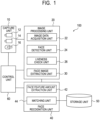
- FIG. 1 is a block diagram illustrating a general configuration of the face recognition system according to the embodiment.
- a face recognition system 100 includes a capture unit 10, an image processing unit 20, a face recognition unit 40, a storage unit 50, and a control unit 60.
- the capture unit 10 acquires a first image generated by capturing an object by using a light at a first wavelength, a second image generated by capturing the object by using a light at a second wavelength, and depth information (three-dimensional information) of the object.
- the light at the first wavelength is a visible light, for example.
- the light at the second wavelength is an infrared light, for example.
- the capture unit 10 may include a camera 12 that captures a visible light image, a camera 14 that captures a near-infrared image, and a projector 16 that irradiates an object with a laser light of a particular pattern, for example.
- a visible light image is captured by the camera 12 and a near-infrared image is captured by the camera 14 will be described as an example.
- a method of acquiring depth information on an object is not particularly limited.
- a method of performing capturing by using the camera 14 in a state where a laser light of a particular pattern is irradiated by the projector 16 can be applied.
- By analyzing a pattern of a reflected light of a laser light of the particular pattern from a captured image it is possible to measure the distance to an object.
- a method of measuring the distance to an object based on a parallax of images acquired by a plurality of cameras or a method of measuring the distance to an object by irradiating an object with an infrared laser and using a time difference of a received reflected light (TOF scheme) may be used.
- a commercially available product having the same function as the capture unit 10 of the configuration described above may be, for example, Kinect (registered trademark) from Microsoft Corporation, RealSense (registered trademark) from Intel Corporation, or the like. These products have an RGB camera as a unit that captures a visible light image and have a near-infrared projector and a near-infrared camera as a unit that captures an image including depth information on an object.
- the image processing unit 20 is a function block that extracts, from images captured by the capture unit 10, a face image in which a living body is captured and includes an image data acquisition unit 22, a face detection unit 24, a liveness check unit 26, and a face image extraction unit 30.
- the image data acquisition unit 22 acquires, from the capture unit 10, visible light image data captured by the camera 12, near-infrared image data captured by the camera 14, and depth information on an object.
- the face detection unit 24 detects a face included in a visible light image and a near-infrared image acquired by the image data acquisition unit 22.
- the liveness check unit 26 checks whether or not a face image in the near-infrared image detected by the face detection unit 24 is an image obtained by capturing living body based on the depth information on an object acquired by the image data acquisition unit 22.
- the face image extraction unit 30 extracts a face image used for face recognition from a visible light image based on information on a face included in the near-infrared image.
- the face recognition unit 40 is a function block that determines whether or not a person of a face image extracted by the image processing unit 20 matches a pre-registered person and includes a face feature amount extraction unit 42 and a matching unit 44. Note that, while the image processing unit 20 and the face recognition unit 40 are separated here for simplified illustration, the image processing unit 20 may have a function of a part of the face recognition unit 40.
- the face feature amount extraction unit 42 extracts, from a face image of a visible light image extracted by the face image extraction unit 30, a face feature amount that is a parameter representing a feature of a face.
- the matching unit 44 performs a matching process to compare a face feature amount of a face image of the visible light image extracted by the face feature amount extraction unit 42 with a face feature amount of a face image of a person registered in the storage unit 50.
- the control unit 60 is a control unit responsible for the entire process in the capture unit 10, the image processing unit 20, and a face recognition unit 40.
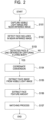
- Fig. 2 is a flowchart illustrating the face recognition method in the face recognition system.
- Some commercially available capture devices in which a visible light camera and a near-infrared camera are integrated have a coordinate conversion function that associates coordinates of an image captured by the visible light camera with coordinates of an image captured by the near-infrared camera.
- An image processing method using such a coordinate conversion function will be described. Note that a visible light camera and a near-infrared camera formed as separated devices may be used, and a coordinate conversion function that associates coordinates of an image captured by the visible light camera with coordinates of an image captured by the near-infrared camera may be separately prepared.
- the face recognition process using the face recognition system 100 is performed in accordance with step S101 to step S107 of Fig. 2 . Note that a process of each unit described later is performed under the control by the control unit 60.
- the capture unit 10 captures an object as a visible light image by using the camera 12 and captures the object as a near-infrared image by using the camera 14. Further, the capture unit 10 acquires depth information on the object by using the camera 14 and the projector 16 (step S101). It is desirable that a visible light image and an infrared image be captured in synchronization.
- the captured visible light image and the captured near-infrared image are images in which at least the same single person is an object.
- the depth information on an object is generated by using information on a near-infrared light reflected at the object.
- the image data of the visible light image and the image data of the near-infrared image captured by the capture unit 10 are transmitted to the image data acquisition unit 22 of the image processing unit 20 together with the depth information on the object. Note that, in the image data acquisition unit 22, additional image processing such as a correction process may be performed on the received image data, if necessary.
- the face detection unit 24 performs a face detection process to detect a face included in an image on the near-infrared image transmitted to the image data acquisition unit 22 (step S102).
- An algorithm used for face detection by the face detection unit 24 is not particularly limited, and various algorithms can be applied.
- the liveness check unit 26 checks whether or not the face image detected from the near-infrared image is an image acquired by the camera 14 capturing a living body (step S103). Specifically, the liveness check unit 26 references the depth information on the object acquired by the capture unit 10 and determines whether or not depth information in accordance with unevenness representing a feature of a living body is included in a face part detected from the near-infrared image.
- the detected face image can be determined as an image obtained by capturing a living body.
- a two-dimensional image such as a photograph does not include depth information that is different for positions in accordance with unevenness of a face, when the depth information on a face part is even, the detected face image can be determined as not obtained by capturing a living body.
- step S103 if it is determined by the liveness check unit 26 that the detected face image is an image obtained by capturing a living body ("YES" in the figure), the process proceeds to step S104. On the other hand, in step S103, if it is determined by the liveness check unit 26 that the detected face image is not an image obtained by capturing a living body ("NO" in the figure), it is determined that face recognition failed, and the process returns to step S101. Note that a case where the detected face is determined as not obtained by capturing a living body includes a case where a face is not detected from the near-infrared image in step S102.
- the face image extraction unit 30 uses a coordinate conversion function included in a capture device to convert coordinates on the near-infrared image of the face image determined as obtained by capturing a living body into coordinates on a visible light image (step S104).
- a coordinate conversion function included in a capture device it is possible to easily determine association to which person's face included in a visible light image the face in the near-infrared image determined as obtained by capturing a living body corresponds.
- the face image extraction unit 30 extracts a corresponding face image from the visible light image based on coordinates on the visible light image of the face determined as obtained by capturing a living body (step S105). That is, the face image extraction unit 30 uses information on a face included in the near-infrared image, namely, information on the position of the face included in the near-infrared image to extract the face image corresponding to a face included in the near-infrared image from the visible light image. At this time, it is desirable to cut out a slightly wide image taking into consideration of a conversion error from coordinates on the near-infrared image to coordinates on the visible light image.
- the face recognition unit 40 performs a face recognition process by using the face image extracted from the visible light image by the image processing unit 20.
- a visible light image By using a visible light image to perform face recognition, it is possible to improve the accuracy of face recognition compared to the case of using a near-infrared image.
- the face feature amount extraction unit 42 extracts a face feature amount, which is a parameter representing a feature of a face, from the face image extracted in step S105 (step S106).
- the extraction of a face feature amount may be performed after face detection is performed by the face detection unit 24 on the face image cut out from the visible light image.
- the face feature amount is a vector amount, which is a combination of components of scalar amounts each representing a feature of a face image.
- the component of a feature amount is not particularly limited, and various types of components can be used.
- a positional relationship such as a distance or an angle between feature points set at the center or the end point of an organ such as an eye, a nose, a mouth, or the like, a curvature of the outline of a face, a color distribution or a value of light and shade of the surface of a face, or the like can be used.
- the number of components of the feature amount is not particularly limited and can be suitably set in accordance with a required recognition accuracy, a processing speed, or the like.
- the matching unit 44 performs a matching process to match whether or not the person in the face image extracted from the visible light image matches any of the persons registered in the storage unit 50 (step S107). Specifically, the matching unit 44 compares the face feature amount of the face image extracted in step S106 with the face feature amount of the face image of a person registered in the storage unit 50. When a person whose similarity of the face feature amount exceeds a predetermined threshold value exists in the storage unit 50, the matching unit 44 determines that the person of the face image extracted from the visible light image is the same person as a person who is already registered, that is, determines that the face recognition succeeded.
- the matching unit 44 determines that the person of the face image extracted from the visible light image is a person who is not registered in the storage unit 50, that is, determines that the face recognition failed.
- the control unit 60 then performs a predetermined process in accordance with a result of the reference process.
- a predetermined process For example, when the face recognition system is used for a gate system of immigration control, access control for a room, or the like, the gate system is controlled so that entry is allowed only when face recognition is successful.
- the face recognition system 100 may determine this as dishonesty and issue an alert. Further, when a detected face is determined as not obtained by capturing a living body despite the fact that the face is detected in the near-infrared image, there is a likelihood that dishonesty to attempt to pass through the gate system by using a photograph or the like is performed. This may be determined as dishonesty, and an alert may be issued in such a case. In contrast, when the storage unit 50 stores a face feature amount of a face image of a person included in a blacklist, the face recognition system 100 may issue an alert when the authentication is successful.
- a face recognition system and a face recognition method will be described with reference to Fig. 3 to Fig. 5B .
- the same components as those in the face recognition system according to the embodiment illustrated in Fig. 1 are labeled with the same references, and the description thereof will be omitted or simplified.
- Fig. 3 is a block diagram illustrating the general configuration of the face recognition system.
- the face recognition system 100 is the same as the face recognition system according to the embodiment illustrated in Fig. 1 except that the image processing unit 20 further includes a face number determination unit 28.
- the face number determination unit 28 determines the number of faces included in a visible light image and the number of faces determined as obtained by capturing living bodies out of faces included in a near-infrared image.
- association of a visible light image and a near-infrared image is performed based on the number of faces included in the visible light image and the number of faces determined as obtained by capturing living bodies out of faces included in the near-infrared image instead of a coordinate conversion function. Therefore, the face recognition system is not necessarily required to use a capture device having a coordinate conversion function between a visible light image and a near-infrared image.
- Fig. 4 is a flowchart illustrating the face recognition method in the face recognition system according to Fig. 3 .
- Fig. 5A and Fig. 5B are diagrams illustrating an example of erroneous extraction of a face image when an object including a two-dimensional face image is captured.
- Fig. 5A illustrates a near-infrared image
- Fig. 5B illustrates a visible light image.
- the face recognition process using the face recognition system 100 according to Fig. 3 is performed in accordance with step S201 to step S207 of Fig. 4 . Note that a process of each unit described later is performed under the control by the control unit 60.
- the capture unit 10 captures an object as a visible light image by using the camera 12 and captures the object as a near-infrared image by using the camera 14. Further, the capture unit 10 acquires depth information on the object by using the camera 14 and the projector 16 (step S201). Since the coordinate conversion function is not used, while the camera 12 and the camera 14 may be separate capture devices, it is desirable to perform calibration in advance so that the field of views of the cameras 12 and 14 are substantially the same.
- the image data of the visible light image and the image data of the near-infrared image captured by the capture unit 10 are transmitted to the image data acquisition unit 22 of the image processing unit 20 together with the depth information on the object.
- the face detection unit 24 performs a face detection process to detect a face included in an image on the visible light image and the near-infrared image transmitted to the image data acquisition unit 22, respectively (step S202).
- the liveness check unit 26 checks whether or not the face image detected from the near-infrared image is an image acquired by the camera 14 capturing a living body (step S203). If a plurality of faces are detected from the near-infrared image, the liveness check unit 26 checks whether or not each of the face images is an image acquired by capturing a living body. The method of the determination is the same as that in step S103.
- the face number determination unit 28 determines the number of faces detected from the visible light image and the number of faces detected from the near-infrared image and determined as obtained by capturing the face of living bodies, and determines whether or not both the numbers are the same (step S204).
- the face number determination unit 28 determines that the numbers of faces are the same in the sept S204 ("YES" in the figure), the face number determination unit 28 determines that all the face images detected in the visible light image are images obtained by capturing living bodies, and the process proceeds to step S205.
- the face number determination unit 28 determines that the numbers of faces are different from each other in the step S204 ("NO" in the figure)
- the face number determination unit 28 determines that at least some of the faces detected in the visible light image are images obtained by capturing a two-dimensional image such as a photograph, and the process returns to step S201. In such a case, an alert may be issued indicating the presence of a dishonest act.
- a face detected from only the visible light image may be identified. Further, the face number determination unit 28 may output a face image of a face detected from only the visible light image as a face obtained by a dishonest act.
- the face image extraction unit 31 extracts an image of a face (face image) detected from the visible light image (step S205).
- This step is performed when the number of faces detected from the visible light image and the number of faces detected from the near-infrared image and determined as obtained by capturing the face of living bodies are the same. That is, in this step, information on a face included in the near-infrared image, namely, the number of faces detected from the near-infrared image and determined as obtained by capturing the face of living bodies is used to extract a face image corresponding to a face included in the near-infrared image from the visible light image.
- the coordinate conversion function described in the face recognition process illustrated in Fig. 2 may be used to extract a face image corresponding to a face included in the near-infrared image from the visible light image.
- the face feature amount extraction unit 42 extracts a face feature amount, which is a parameter representing a face feature, from the face image extracted from the visible light image in step S205 (step S206).
- the extraction method of a face feature amount is the same as that in step S106.
- the matching unit 44 performs a matching process to match whether or not the person in the face image extracted from the visible light image matches any of the persons registered in the storage unit 50 (step S207).
- the method of a matching process is the same as that in step S107.
- the control unit 60 then performs a predetermined process in accordance with a result of the matching process.
- the detected face image is used as a target of a face recognition process only when the number of faces detected from the visible light image and the number of faces detected from the near-infrared image and determined as obtained by capturing the face of living bodies are the same. The reason for this will be described below.
- a two-dimensional face image may not be excluded by only the liveness check on the near-infrared image.
- a near-infrared image of an object including a person A and a photograph of a person B it is assumed that the face of the person A has been detected, but the face of the person B has not been detected.
- no liveness check is performed on the face image of the person B, it will be determined that no dishonest act using a two-dimensional image is performed.
- a subsequent face recognition process as illustrated in Fig. 5B , the face of the person A and the face of the person B included in a visible light image are determined to be process targets, and face recognition will be performed thereon, respectively.
- the number of faces detected from the visible light image and the number of faces detected from the near-infrared image will be different from each other.
- comparison between the number of faces detected in a visible light image and the number of faces detected in a near-infrared image is performed in addition to liveness check on a near-infrared image.
- this face image can be excluded by using liveness check.
- the presence of this face image can be recognized based on the fact that the number of faces detected in the visible light image and the number of faces detected in the near-infrared image are different from each other.
- a face recognition method will be described with reference to Fig. 6 to Fig. 8 .
- the same components as those in the face recognition system according to Fig. 1 and Fig. 3 are labeled with the same references, and the description thereof will be omitted or simplified.
- Fig. 6 is a flowchart illustrating the face recognition method in the face recognition system according to the present embodiment.
- Fig. 7A is a diagram illustrating an example of a visible light image captured by the capture unit.
- Fig. 7B is a diagram illustrating an example of a near-infrared image captured by the capture unit.
- Fig. 8 is a diagram illustrating an example of face recognition result when a face recognition process of the present embodiment is performed based on images in Fig. 7A and Fig. 7B .
- the face recognition method of the present embodiment associates an image captured by the visible light camera with an image captured by a near-infrared camera by using face recognition. Also in the present embodiment, the coordinate conversion function is not used.
- the face recognition process according to the present embodiment is performed in accordance with step S301 to step S307 of Fig. 6 . Note that a process of each unit described later is performed under the control by the control unit 60.
- the capture unit 10 captures an object as a visible light image by using the camera 12 and captures the object as a near-infrared image by using the camera 14. Further, the capture unit 10 acquires depth information on the object by using the camera 14 and the projector 16 (step S301). The image data of the visible light image and the image data of the near-infrared image captured by the capture unit 10 are transmitted to the image data acquisition unit 22 of the image processing unit 20 together with the depth information on the object.
- the face detection unit 24 performs a face detection process to detect a face included in an image on the visible light image and the near-infrared image transmitted to the image data acquisition unit 22, respectively (step S302).
- a case where a person A, a person C, and a photograph of a person B are present in the field of views of the cameras 12 and 14 is assumed here as an example. Further, a face of a person A', a face of a person B', and a face of a person C' are detected from a visible light image, for example, as illustrated in Fig. 7A . Further, a face of a person A", a face of a person B", and a face of a person C" are detected from a near-infrared image, for example, as illustrated in Fig. 7B . It is here assumed that the person A and the person B are persons who are already registered in the storage unit 50, and the person C is a person who is not yet registered in the storage unit 50.
- the liveness check unit 26 checks whether or not a face detected from the near-infrared image is an image obtained by capturing a living body (step S303).
- the method of the determination is the same as that in step S103.
- the face of the person A" and the face of the person C" are determined as images obtained by capturing living bodies, and the face of the person B" is determined as an image obtained by capturing a photograph. Thereby, the face of the person B" is excluded from a group of faces detected from the near-infrared image.
- the face image extraction unit 30 extracts an image of a face (face image) detected from the visible light image and a face image determined as detected from the near-infrared image and obtained by capturing a living body (hereafter, referred to as a "biometric face image”) (step S304).
- the face feature amount extraction unit 42 extracts a face feature amount, which is a parameter representing a feature of a face, from each of the face image detected from the visible light image and the biometric face image detected from the near-infrared image (step S305).
- the extraction method of a face feature amount is the same as that in step S106.
- the matching unit 44 determines whether or not a person of the face image detected from the visible light image is the same as any of persons in the biometric face image detected from the near-infrared image (step S306). Specifically, for all the combinations of the face image detected from the visible light image and the biometric face image detected from the near-infrared image, the matching unit 44 compares the face feature amount of the face image detected from the visible light image with the face feature amount of the biometric face image detected from the near-infrared image. The matching unit 44 then determines a face image to be extracted from the visible light image based on the comparison between the face feature amount of the face image detected from the visible light image and the face feature amount of the biometric face image detected from the near-infrared image. For example, the matching unit 44 determines that the combination in which the similarity between the face feature amounts exceeds a predetermined threshold value is from the same person.
- the number of face images detected from a visible light image is the maximum face detection number.
- the number of biometric face images detected from a near-infrared image is less than or equal to the maximum face detection number.
- the maximum face detection number is N, matching to face images of at most N persons will be performed for a single person.
- a plurality of persons whose similarity degree of the face feature amount exceeds a predetermined threshold value are present, a person having the face image of the highest score can be determined as the same person out of the plurality of persons.
- the matching unit 44 determines that at least some of the persons of face images detected from the visible light image match persons of the biometric face image detected from the near-infrared image ("YES" in the figure), the process proceeds to step S307.
- a face image of the visible light image for which a face image of the same person is not found in the near-infrared image is excluded from a group of the face images detected from the visible light image.
- the matching unit 44 is an extraction unit that, out of all the face images of the persons included in the visible light image, extracts one or more face images of the persons included as biometric face images in the near-infrared image.
- the matching unit 44 determines that none of the persons of face images detected from the visible light image matches a person of the biometric face image detected from the near-infrared image ("NO" in the figure), it is determined that the face recognition failed, and the process returns to step S301.
- the face image of the person A' in the visible light image and the face image of the person A" in the near-infrared image are images obtained by capturing the same person A. Further, it is determined that the face image of the person C' in the visible light image and the face image of the person C" in the near-infrared image are images obtained by capturing the same person C. On the other hand, since the face image of the person B" is excluded from the group of face images detected from the near-infrared image, it is determined that a person corresponding to the person B' in the visible light image is not included in the near-infrared image.
- step S303 may be performed on and after step S306. In this case, however, since it is necessary to perform a process such as extraction of a face feature amount also on a face image obtained by capturing a two-dimensional image, it is desirable to perform the liveness check before the step S305 in terms of reduction in the processing load.
- the matching unit 44 determines whether or not the person of the face image extracted from the visible light image matches any of the persons registered in the storage unit 50 (step S307). Specifically, the matching unit 44 compares a face feature amount of the face image extracted from the visible light image with a face feature amount of the face image of a person registered in the storage unit 50 for each of the face images extracted from the visible light image. If a face image of a person whose similarity of the face feature amount exceeds a predetermined threshold value for each of the face images extracted from the visible light image is present in the storage unit 50, the matching unit 44 determines that the person of the face image extracted from the visible light image is the same as a person who is already registered, that is, determines that the face recognition succeeded.
- the matching unit 44 determines that the person of the face image extracted from the visible light image is a person who is not registered in the storage unit 50, that is, determines that the face recognition failed.
- step S307 If the face recognition is successful in step S307 ("YES” in the drawing), the control unit 60 ends the series of face recognition processes. On the other hand, if the face recognition fails in step S307 ("NO” in the figure), the process returns to step S301.
- the face image of the person A' in the visible light image is determined as the face image of the person A registered in the storage unit 50, and the face recognition is successful.
- face recognition of the face image of the person C' in the visible light image fails.
- Fig. 8 summarizes a determination result of each step when the face recognition process of the present embodiment is performed based on the images in Fig. 7A and Fig. 7B .
- face recognition is successful if all the three conditions are satisfied: 1) a person included in a visible light image and a person included in a near-infrared image are the same person, 2) a person in a near-infrared image is an image obtained by capturing a living body, and 3) a person included in a visible light image is a registered person.
- face images which satisfy the condition are connected by black bars, and face images which do not satisfy the condition are connected by white bars.
- the person A satisfies all the above conditions 1) to 3), and thus face recognition is successful.
- the person B satisfies the above conditions 1) and 3) but does not satisfy the above condition 2), and thus face recognition fails.
- the person C satisfies the above conditions 1) and 2) but does not satisfy the above condition 3), and thus face recognition fails.
- the face recognition method according to the present embodiment realizes matching between an image captured by a visible light camera and an image captured by a near-infrared camera by using face recognition. Therefore, calibration between the visible light camera and the near-infrared camera is unnecessary.
- a computer device according to an embodiment of the present invention will be described with reference to Fig. 9 .
- an example of a computer device used for implementing the process of each unit in the face recognition system will be described.
- Fig. 9 illustrates an example of the computer device used for implementing the process of each unit in the face recognition system described above.
- a computer device 1000 illustrated in Fig. 9 is not particularly limited but may be of various types or forms.
- the computer device 1000 may be a laptop computer, a desktop computer, a workstation, a personal digital assistant, a server, a blade server, a mainframe, an embedded system, or the like.
- the computer device 1000 includes a processor 1002, a memory 1004, and a storage device 1006. Further, the computer device 1000 includes a high-speed controller 1008 including a high-speed interface and a low-speed controller 1010 including a low-speed interface.
- the memory 1004 and a high-speed expansion port 1012 are connected to the high-speed controller 1008. Further, an external input/output device such as a display 1016 or the like is connected to the high-speed controller 1008.
- a low-speed expansion port 1014 and the storage device 1006 are connected to the low-speed controller 1010.
- the processor 1002, the memory 1004, the storage device 1006, the high-speed controller 1008, the low-speed controller 1010, and the high-speed expansion port 1012 are connected to each other through various buses. Further, the processor 1002, the memory 1004, the storage device 1006, the high-speed controller 1008, the low-speed controller 1010, and the high-speed expansion port 1012 may be implemented on a common motherboard or may be implemented in other forms as appropriate.
- the processor 1002 is a central processing unit (CPU), for example, and is able to process instructions executed within the computer device 1000. Such instructions include an instruction that is used for displaying graphics information of a graphical user interface (GUI) on an external input/output device such as the display 1016 and stored in the memory 1004 or the storage device 1006.
- GUI graphical user interface
- a plurality of processors, a plurality of busses, or a plurality of processors and a plurality of busses can be used as appropriate together with a plurality of memory devices and multiple types of memory devices.
- a plurality of computer devices 1000 can be connected to each device that performs a part of the necessary process.
- a plurality of computer devices 1000 can be connected to each other as a server bank, a group of blade servers, or a multiprocessor system.
- the memory 1004 stores therein information within the computer device 1000.
- the memory 1004 may be a volatile memory unit or a non-volatile memory unit.
- the memory 1004 may be another computer readable medium, such as a magnetic disk, an optical disk, or the like, for example.
- the storage device 1006 can configure mass storage used for the computer device 1000.
- the storage device 1006 may be a computer readable storage medium such as a floppy (registered trademark) disk device, a hard disk device, an optical disk device, a tape device, a solid-state memory device such as a flash memory, a disk array, or the like or include such a computer readable storage medium, for example.
- the storage device 1006 may include a storage area network or a device with another configuration.
- a computer program product may be tangibly embodied in an information carrier.
- the computer program product can also store an instruction that executes one or a plurality of processes as described above when executed.
- the information carrier may be a memory device such as the memory 1004, the storage device 1006, or the memory on the processor 1002 or may be a computer readable medium or a machine readable medium such as a carrier signal.
- the high-speed controller 1008 manages processes in which the bandwidth for the computer device 1000 is intensively used.
- the low-speed controller 1010 manages processes in which the bandwidth is less intensively used.
- allocation of the functions is a mere example, and allocation is not limited thereto. Further, a part or a whole of the high-speed controller 1008 may be incorporated in the processor 1002.
- the high-speed controller 1008 is connected to the high-speed expansion port 1012 that can accept the memory 1004 and various expansion cards. Further, the high-speed controller 1008 is connected to the display 1016 via a graphics processor or an accelerator, for example.
- the low-speed controller 1010 is connected to the storage device 1006 and the low-speed expansion port 1014.
- the low-speed expansion port 1014 can include, for example, a communication port of various standards such as Universal Serial Bus (USB), Bluetooth (registered trademark), wired or wireless Ethernet (registered trademark), or the like.
- USB Universal Serial Bus
- Bluetooth registered trademark
- wired or wireless Ethernet registered trademark
- One or plurality of input/output devices such as a keyboard, a pointing device, a scanner, or the like can be connected to the low-speed expansion port 1014.
- one or plurality of network devices such as a switch, a router, or the like can be connected to the low-speed expansion port 1014 via a network adapter, for example.
- the computer device 1000 can be implemented in many different forms.
- the computer device 1000 can be implemented in a form of a typical server or a plurality of servers in a form of a group of such servers.
- the computer device 1000 can be implemented as a part of the rack server system.
- the computer device 1000 can be implemented in a form of a personal computer such as a laptop computer, a desktop computer, or the like.
- the computer device 1000 can function as at least the image processing unit 20, the face recognition unit 40, and the control unit 60 of the face recognition system 100 described above.
- the processor 1002 controls the entire operation of the computer device 1000 and includes the function of the control unit 60. Further, the processor 1002 can function as the image processing unit 20 by executing the program that implements the function of the image data acquisition unit 22, the face detection unit 24, the liveness check unit 26, the face number determination unit 28, and the face image extraction units 30 and 31. Further, the processor 1002 can function as the face recognition unit 40 by executing the program that implements the function of the face feature amount extraction unit 42 and the matching unit 44.
- the processor 1002 executes the program that implements the function of each unit of the image data acquisition unit 22, the face detection unit 24, the liveness check unit 26, the face number determination unit 28, the face image extraction units 30 and 31, the face feature amount extraction unit 42, and the matching unit 44.
- the processor 1002 can function as each unit of the image data acquisition unit 22, the face detection unit 24, the liveness check unit 26, the face number determination unit 28, the face image extraction units 30 and 31, the face feature amount extraction unit 42, and the matching unit 44.
- the storage device 1006 of the computer device 1000 can function as the storage unit 50.
- a part or a whole of the program executed by the processor 1002 of the computer device 1000 can be provided by a computer readable storage medium storing the above, such as a digital versatile disc-read only memory (DVD-ROM), a compact disc-read only memory (CD-ROM), a flash memory such as a USB memory or the like.
- DVD-ROM digital versatile disc-read only memory
- CD-ROM compact disc-read only memory
- flash memory such as a USB memory or the like.
- the face recognition system described above also has a function as an image processing device used for implementing image processing to extract a biometric face image from a visible light image and an image including depth information on an object.
- the image processing device has the same function as that of the image processing unit 20. That is, according to another embodiment, the image processing device 200 can be configured as illustrated in Fig. 10.
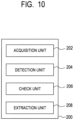
- Fig. 10 is a block diagram illustrating a function configuration of the image processing device according to another embodiment.
- the image processing device 200 includes an acquisition unit 202, a detection unit 204, a check unit 206, and an extraction unit 208.
- the acquisition unit 202 acquires visible light image data and image data including depth information on an object (for example, near-infrared image data).
- the detection unit 204 detects a face included in an image acquired by the acquisition unit 202.
- the check unit 206 checks whether or not a face in the image detected by the detection unit 204 is an image obtained by capturing a living body.
- the extraction unit 208 extracts a face image used for face recognition from a visible light image based on information on a face included in a near-infrared image.
- the specific function of each unit is the same as the function of each unit of the image processing unit 20 described above.
- the image processing device 200 may further have a function as the same determination unit as the face number determination unit 28 included in the image processing unit 20 of Fig. 3 .
- each of the embodiments includes a processing method that stores, in a storage medium, a program causing the configuration of each of the embodiments to operate so as to realize the function of each of the embodiments described above, reads out the program stored in the storage medium as a code, and executes the program in a computer. That is, the scope of each of the embodiments also includes a computer readable storage medium. Further, each of the embodiments includes not only the storage medium in which the program described above is stored but also the program itself.
- the storage medium for example, a floppy (registered trademark) disk, a hard disk, an optical disk, a magneto-optical disk, a CD-ROM, a magnetic tape, a nonvolatile memory card, or a ROM can be used.
- a floppy (registered trademark) disk for example, a hard disk, an optical disk, a magneto-optical disk, a CD-ROM, a magnetic tape, a nonvolatile memory card, or a ROM
- the scope of each of the embodiments includes an example that operates on OS to perform a process in cooperation with another software or a function of an add-in board without being limited to an example that performs a process by an individual program stored in the storage medium.
Landscapes
- Engineering & Computer Science (AREA)
- Physics & Mathematics (AREA)
- Health & Medical Sciences (AREA)
- General Physics & Mathematics (AREA)
- Theoretical Computer Science (AREA)
- Multimedia (AREA)
- General Health & Medical Sciences (AREA)
- Oral & Maxillofacial Surgery (AREA)
- Human Computer Interaction (AREA)
- Life Sciences & Earth Sciences (AREA)
- Computer Vision & Pattern Recognition (AREA)
- Pathology (AREA)
- Animal Behavior & Ethology (AREA)
- Biomedical Technology (AREA)
- Heart & Thoracic Surgery (AREA)
- Medical Informatics (AREA)
- Molecular Biology (AREA)
- Surgery (AREA)
- Biophysics (AREA)
- Public Health (AREA)
- Veterinary Medicine (AREA)
- Collating Specific Patterns (AREA)
- Measurement Of The Respiration, Hearing Ability, Form, And Blood Characteristics Of Living Organisms (AREA)
- Image Input (AREA)
- Artificial Intelligence (AREA)
- Image Analysis (AREA)
Claims (5)
- Bildverarbeitungsvorrichtung, mit:einer Erfassungseinheit (10), die dafür konfiguriert ist, ein erstes Bild, das durch Aufnehmen eines Objekts unter Verwendung von sichtbarem Licht und einer Kamera (12) erzeugt wird, ein zweites Bild, das durch Aufnehmen des Objekts unter Verwendung von Nahinfrarotlicht und einer zweiten Kamera (14) erzeugt wird, und Tiefeninformation über das Objekt unter Verwendung der zweiten Kamera (14) und eines Projektors (16) zu erfassen;einer Erkennungseinheit (24), die dafür konfiguriert ist, ein oder mehrere Gesichter, die im ersten Bild enthalten sind, und ein oder mehrere Gesichter, die im zweiten Bild enthalten sind, zu erkennen;einer Prüfeinheit (26), die dafür konfiguriert ist, basierend auf der Tiefeninformation zu prüfen, ob ein Gesicht im zweiten Bild ein Gesicht ist, das durch Aufnehmen eines lebenden Körpers erhalten wurde, oder nicht;einer Extraktionseinheit (30), die dafür konfiguriert ist, ein Gesichtsbild vom ersten Bild und ein biometrisches Gesichtsbild vom zweiten Bild zu extrahieren, wobei das biometrische Gesichtsbild ein Gesichtsbild ist, das im zweiten Bild erkannt worden ist und bezüglich dem bestimmt worden ist, dass es durch Aufnehmen eines lebenden Körpers erhalten worden ist,einer Gesichtsmerkmalmaßextraktionseinheit (42), die dafür konfiguriert ist, ein Gesichtsmerkmalmaß von dem im ersten Bild erkannten Gesichtsbild und dem im zweiten Bild erkannten biometrischen Gesichtsbild zu extrahieren;einer Abgleicheinheit (44), die für alle Kombinationen der im ersten Bild erkannten Gesichtsbilder und der im zweiten Bild erkannten biometrischen Gesichtsbilder dafür konfiguriert ist:basierend auf einem Vergleich zwischen einem Gesichtsmerkmalmaß des biometrischen Gesichtsbildes, das im zweiten Bild erkannt wird, und einem Gesichtsmerkmalmaß des Gesichtsbildes, das im ersten Bild erkannt wird, zu bestimmen, ob eine Person des Gesichtsbildes, das im ersten Bild erkannt wird, die gleiche ist wie irgendeine von Personen im biometrischen Gesichtsbild, das im zweiten Bild erkannt wird;das Gesichtsbild, das im ersten Bild erkannt wird, in dem Fall zu extrahieren, in dem das Gesichtsbild, das im ersten Bild erkannt wird, das gleiche ist wie dasjenige irgendeiner von Personen im biometrischen Gesichtsbild, das im zweiten Bild erkannt wird; undzu bestimmen, ob eine Person in dem Gesichtsbild, das vom ersten Bild extrahiert wird, die gleiche ist wie eine registrierte Person, oder nicht.
- Bildverarbeitungsvorrichtung nach Anspruch 1, wobei die Tiefeninformation über das Objekt Information ist, die unter Verwendung des am Objekt reflektierten Nahinfrarotlichts erzeugt wird.
- Bildverarbeitungsverfahren, mit den Schritten:Erfassen eines ersten Bildes, das durch Aufnehmen eines Objekts unter Verwendung von sichtbarem Licht und einer Kamera (12) erzeugt wird, eines zweiten Bildes, das durch Aufnehmen des Objekts unter Verwendung von Nahinfrarotlicht und einer zweiten Kamera (14) erzeugt wird, und Tiefeninformation über das Objekt unter Verwendung der zweiten Kamera (14) und eines Projektors (16);Erkennen eines oder mehrerer Gesichter, die in dem erfassten ersten Bild enthalten sind, und eines oder mehrerer Gesichter, die in dem erfassten zweiten Bild enthalten sind;Prüfen, basierend auf der Tiefeninformation, ob ein erkanntes Gesicht im zweiten Bild ein Gesicht ist, das durch Aufnehmen eines lebenden Körpers erhalten wurde;Extrahieren eines Gesichtsbildes vom ersten Bild und eines biometrischen Gesichtsbildes vom zweiten Bild, wobei das biometrische Gesichtsbild ein Gesichtsbild ist, das im zweiten Bild erkannt worden ist und bezüglich dem bestimmt worden ist, dass es durch Aufnehmen eines lebenden Körpers erhalten worden ist;Extrahieren eines Gesichtsmerkmalmaßes von dem Gesichtsbild, das im ersten Bild erkannt wurde, und von dem biometrischen Gesichtsbild, das im zweiten Bild erkannt wurde;für alle Kombinationen der Gesichtsbilder, die im ersten Bild erkannt wurden, und der biometrischen Gesichtsbilder, die im zweiten Bild erkannt wurden:Bestimmen, basierend auf einem Vergleich zwischen einem Gesichtsmerkmalmaß des biometrischen Gesichtsbildes, das im zweiten Bild erkannt wird, und eines Gesichtsmerkmalmaßes des Gesichtsbildes, das im ersten Bild erkannt wird, ob eine Person des Gesichtsbildes, das im ersten Bild erkannt wird, die gleiche ist wie irgendeine von Personen in dem biometrischen Gesichtsbild, das im zweiten Bild erkannt wird, oder nicht;Extrahieren des im ersten Bild erkannten Gesichtsbildes in dem Fall, in dem das im ersten Bild erkannte Gesichtsbild das gleiche ist wie dasjenige irgendeiner von Personen in dem im zweiten Bild erkannten biometrischen Gesichtsbild; undBestimmen, ob eine Person in dem vom ersten Bild extrahierten Gesichtsbild die gleiche ist wie eine registrierte Person, oder nicht.
- Bildverarbeitungsverfahren nach Anspruch 3, wobei die Tiefeninformation über das Objekt Information ist, die unter Verwendung des am Objekt reflektierten Nahinfrarotlichts erzeugt wird.
- Programm, das einen Computer veranlasst, die Schritte auszuführen:Erfassen eines ersten Bildes, das durch Aufnehmen eines Objekts unter Verwendung von sichtbarem Licht und einer Kamera (12) erzeugt wird, eines zweiten Bildes, das durch Aufnehmen des Objekts unter Verwendung von Nahinfrarotlicht und einer zweiten Kamera (14) erzeugt wird, und Tiefeninformation über das Objekt unter Verwendung der zweiten Kamera (14) und eines Projektors (16);Erkennen eines oder mehrerer Gesichter, die in dem erfassten ersten Bild enthalten sind, und eines oder mehrerer Gesichter, die in dem erfassten zweiten Bild enthalten sind;Prüfen, basierend auf der Tiefeninformation, ob ein erkanntes Gesicht im zweiten Bild ein Gesicht ist, das durch Aufnehmen eines lebenden Körpers erhalten wurde;Extrahieren eines Gesichtsbildes vom ersten Bild und eines biometrischen Gesichtsbildes vom zweiten Bild, wobei das biometrische Gesichtsbild ein Gesichtsbild ist, das im zweiten Bild erkannt worden ist und bezüglich dem bestimmt worden ist, dass es durch Aufnehmen eines lebenden Körpers erhalten worden ist;Extrahieren eines Gesichtsmerkmalmaßes vom Gesichtsbild, das im ersten Bild erkannt wurde, und vom biometrischen Gesichtsbild, das im zweiten Bild erkannt wurde;für alle Kombinationen der Gesichtsbilder, die im ersten Bild erkannt werden, und der biometrischen Gesichtsbilder, die im zweiten Bild erkannt werden:Bestimmen, basierend auf einem Vergleich zwischen einem Gesichtsmerkmalmaß des biometrischen Gesichtsbildes, das im zweiten Bild erkannt wird, und einem Gesichtsmerkmalmaß des Gesichtsbildes, das im ersten Bild erkannt wird, ob eine Person des Gesichtsbildes, das im ersten Bild erkannt wird, die gleiche ist wie irgendeine von Personen in dem biometrischen Gesichtsbild, das im zweiten Bild erkannt wird, oder nicht;Extrahieren des im ersten Bild erkannten Gesichtsbildes in dem Fall, in dem das im ersten Bild erkannte Gesichtsbild das gleiche ist wie dasjenige irgendeiner von Personen in dem im zweiten Bild erkannten biometrischen Gesichtsbild; undBestimmen, ob eine Person in dem vom ersten Bild extrahierten Gesichtsbild die gleiche ist wie eine registrierte Person, oder nicht.
Applications Claiming Priority (2)
| Application Number | Priority Date | Filing Date | Title |
|---|---|---|---|
| JP2016212921 | 2016-10-31 | ||
| PCT/JP2017/030120 WO2018079031A1 (ja) | 2016-10-31 | 2017-08-23 | 画像処理装置、画像処理方法、顔認証システム、プログラム及び記録媒体 |
Publications (3)
| Publication Number | Publication Date |
|---|---|
| EP3534328A1 EP3534328A1 (de) | 2019-09-04 |
| EP3534328A4 EP3534328A4 (de) | 2019-11-06 |
| EP3534328B1 true EP3534328B1 (de) | 2024-10-02 |
Family
ID=62023420
Family Applications (1)
| Application Number | Title | Priority Date | Filing Date |
|---|---|---|---|
| EP17864307.8A Active EP3534328B1 (de) | 2016-10-31 | 2017-08-23 | Bildverarbeitungsvorrichtung, bildverarbeitungsverfahren, gesichtserkennungssystem, programm und aufzeichnungsmedium |
Country Status (4)
| Country | Link |
|---|---|
| US (4) | US11423693B2 (de) |
| EP (1) | EP3534328B1 (de) |
| JP (3) | JP7040457B2 (de) |
| WO (1) | WO2018079031A1 (de) |
Families Citing this family (33)
| Publication number | Priority date | Publication date | Assignee | Title |
|---|---|---|---|---|
| EP3534328B1 (de) * | 2016-10-31 | 2024-10-02 | Nec Corporation | Bildverarbeitungsvorrichtung, bildverarbeitungsverfahren, gesichtserkennungssystem, programm und aufzeichnungsmedium |
| CN107590463A (zh) * | 2017-09-12 | 2018-01-16 | 广东欧珀移动通信有限公司 | 人脸识别方法及相关产品 |
| US10726245B2 (en) * | 2017-12-12 | 2020-07-28 | Black Sesame International Holding Limited | Secure facial authentication system using active infrared light source and RGB-IR sensor |
| KR102374747B1 (ko) * | 2017-12-15 | 2022-03-15 | 삼성전자주식회사 | 객체를 인식하는 장치 및 방법 |
| CN110008783A (zh) * | 2018-01-04 | 2019-07-12 | 杭州海康威视数字技术股份有限公司 | 基于神经网络模型的人脸活体检测方法、装置及电子设备 |
| CN108764052B (zh) * | 2018-04-28 | 2020-09-11 | Oppo广东移动通信有限公司 | 图像处理方法、装置、计算机可读存储介质和电子设备 |
| US10930010B2 (en) | 2018-05-10 | 2021-02-23 | Beijing Sensetime Technology Development Co., Ltd | Method and apparatus for detecting living body, system, electronic device, and storage medium |
| CN108764069B (zh) * | 2018-05-10 | 2022-01-14 | 北京市商汤科技开发有限公司 | 活体检测方法及装置 |
| KR102522415B1 (ko) * | 2018-05-15 | 2023-04-17 | 삼성전자주식회사 | 전자 장치의 객체 인증 장치 및 방법 |
| WO2019230306A1 (ja) * | 2018-05-30 | 2019-12-05 | パナソニックIpマネジメント株式会社 | 識別装置および識別方法 |
| CN108830229A (zh) * | 2018-06-20 | 2018-11-16 | 哈尔滨理工大学 | 一种基于caffe框架下结合人脸检测的活体识别方法 |
| CN111382592B (zh) * | 2018-12-27 | 2023-09-29 | 杭州海康威视数字技术股份有限公司 | 活体检测方法和设备 |
| US10635918B1 (en) * | 2019-01-30 | 2020-04-28 | StradVision, Inc. | Method and device for managing smart database for face recognition based on continual learning |
| US10621473B1 (en) * | 2019-01-30 | 2020-04-14 | StradVision, Inc. | Method for providing object detecting system capable of updating types of detectable classes in real-time by using continual learning and devices using the same |
| US20210224985A1 (en) * | 2019-05-06 | 2021-07-22 | Beth Allison Lopez | Microbe scanning device and methods thereof |
| CN111783505B (zh) * | 2019-05-10 | 2025-01-03 | 北京京东尚科信息技术有限公司 | 伪造人脸的识别方法、装置和计算机可读存储介质 |
| CN110337656A (zh) * | 2019-05-27 | 2019-10-15 | 深圳市汇顶科技股份有限公司 | 用于人脸识别的光学传感器、装置、方法和电子设备 |
| WO2021015673A1 (en) * | 2019-07-20 | 2021-01-28 | Zixxe Pte. Ltd. | A system and a method for tracking goods of a value chain originating from a location |
| US10776613B1 (en) * | 2019-09-13 | 2020-09-15 | Royal Caribbean Cruises Ltd. | Facial recognition system and methods for identity credentialing and personalized services |
| US12300037B2 (en) | 2019-12-16 | 2025-05-13 | Nec Corporation | Determination system, determination method, computer program, and authentication system |
| CN113447128B (zh) | 2020-03-10 | 2023-06-23 | 百度在线网络技术(北京)有限公司 | 一种多人体温检测方法、装置、电子设备及存储介质 |
| CN111639522B (zh) * | 2020-04-17 | 2023-10-31 | 北京迈格威科技有限公司 | 活体检测方法、装置、计算机设备和存储介质 |
| FR3109688B1 (fr) * | 2020-04-24 | 2022-04-29 | Idemia Identity & Security France | Procédé d’authentification ou d’identification d’un individu |
| US11170593B1 (en) | 2020-05-05 | 2021-11-09 | Royal Caribbean Cruises Ltd. | Multifunction smart door device |
| CN111579083B (zh) * | 2020-05-13 | 2022-06-07 | 芋头科技(杭州)有限公司 | 基于红外图像人脸检测的体温测量的方法和装置 |
| JP7473965B2 (ja) * | 2020-09-25 | 2024-04-24 | 株式会社ユニバーサルエンターテインメント | 測距センサ、および、距離測定方法 |
| JP7603255B2 (ja) * | 2020-10-12 | 2024-12-20 | パナソニックIpマネジメント株式会社 | インターホンシステム、入退管理システム、顔認証システム、制御方法及びプログラム |
| CN112257561B (zh) * | 2020-10-20 | 2021-07-30 | 广州云从凯风科技有限公司 | 一种人脸活体检测方法、装置、机器可读介质及设备 |
| WO2022137798A1 (ja) | 2020-12-21 | 2022-06-30 | ソニーグループ株式会社 | 画像処理装置および方法 |
| JPWO2022138064A1 (de) * | 2020-12-23 | 2022-06-30 | ||
| PL4546296T3 (pl) * | 2021-02-18 | 2025-12-15 | Trinamix Gmbh | Optyczne wykrywanie skóry w celu odblokowania twarzą |
| JP7778038B2 (ja) * | 2022-05-24 | 2025-12-01 | 株式会社日立製作所 | 対象物解析装置、対象物解析方法 |
| US20240386747A1 (en) * | 2023-05-18 | 2024-11-21 | Ford Global Technologies, Llc | Scene authentication |
Citations (3)
| Publication number | Priority date | Publication date | Assignee | Title |
|---|---|---|---|---|
| JP2005197914A (ja) * | 2004-01-06 | 2005-07-21 | Fuji Photo Film Co Ltd | 顔画像認識装置及びそれを備えたデジタルカメラ |
| US8416303B2 (en) * | 2008-12-05 | 2013-04-09 | Sony Corporation | Imaging apparatus and imaging method |
| US20140099005A1 (en) * | 2012-10-09 | 2014-04-10 | Sony Corporation | Authentication apparatus, authentication method, and program |
Family Cites Families (23)
| Publication number | Priority date | Publication date | Assignee | Title |
|---|---|---|---|---|
| JP4734980B2 (ja) | 2005-03-15 | 2011-07-27 | オムロン株式会社 | 顔認証装置およびその制御方法、顔認証装置を備えた電子機器、顔認証装置制御プログラム、ならびに該プログラムを記録した記録媒体 |
| JP4708879B2 (ja) | 2005-06-24 | 2011-06-22 | グローリー株式会社 | 顔認証装置及び顔認証方法 |
| JP2007226549A (ja) | 2006-02-23 | 2007-09-06 | Konica Minolta Medical & Graphic Inc | Idカードシステム及びidカード作成方法 |
| JP4561703B2 (ja) | 2006-07-06 | 2010-10-13 | 株式会社デンソー | 顔認識装置及びそれを用いた自動車用ユーザーもてなしシステム |
| JP2008158597A (ja) | 2006-12-21 | 2008-07-10 | Smart Wireless Kk | 顔認証装置、その方法および顔認証装置を有する携帯端末器 |
| JPWO2009107237A1 (ja) | 2008-02-29 | 2011-06-30 | グローリー株式会社 | 生体認証装置 |
| JP2009211381A (ja) * | 2008-03-04 | 2009-09-17 | Nec Corp | 使用者認証システム、使用者認証方法、および使用者認証プログラム |
| JP4636140B2 (ja) * | 2008-08-25 | 2011-02-23 | ソニー株式会社 | 静脈撮像装置、静脈撮像方法および静脈認証装置 |
| CN101404060B (zh) * | 2008-11-10 | 2010-06-30 | 北京航空航天大学 | 一种基于可见光与近红外Gabor信息融合的人脸识别方法 |
| US9082235B2 (en) * | 2011-07-12 | 2015-07-14 | Microsoft Technology Licensing, Llc | Using facial data for device authentication or subject identification |
| JP5879877B2 (ja) | 2011-09-28 | 2016-03-08 | 沖電気工業株式会社 | 画像処理装置、画像処理方法、プログラム、および画像処理システム |
| US9148637B2 (en) * | 2011-11-04 | 2015-09-29 | Microsoft Technology Licensing, Llc | Face detection and tracking |
| US9202105B1 (en) * | 2012-01-13 | 2015-12-01 | Amazon Technologies, Inc. | Image analysis for user authentication |
| JP2013250856A (ja) | 2012-06-01 | 2013-12-12 | Mitsubishi Electric Corp | 監視システム |
| TW201401186A (zh) | 2012-06-25 | 2014-01-01 | 盈泰安股份有限公司 | 人臉判斷系統以及方法 |
| US10452894B2 (en) | 2012-06-26 | 2019-10-22 | Qualcomm Incorporated | Systems and method for facial verification |
| WO2014010362A1 (ja) | 2012-07-12 | 2014-01-16 | 日立アプライアンス株式会社 | 機器管理装置 |
| US9396382B2 (en) * | 2012-08-17 | 2016-07-19 | Flashscan3D, Llc | System and method for a biometric image sensor with spoofing detection |
| US8924735B2 (en) * | 2013-02-15 | 2014-12-30 | Microsoft Corporation | Managed biometric identity |
| US9251427B1 (en) * | 2014-08-12 | 2016-02-02 | Microsoft Technology Licensing, Llc | False face representation identification |
| US9396537B2 (en) * | 2014-09-09 | 2016-07-19 | EyeVerify, Inc. | Systems and methods for liveness analysis |
| CN107408298B (zh) | 2015-03-13 | 2021-05-28 | 日本电气株式会社 | 生命体检测设备、生命体检测方法和记录介质 |
| EP3534328B1 (de) * | 2016-10-31 | 2024-10-02 | Nec Corporation | Bildverarbeitungsvorrichtung, bildverarbeitungsverfahren, gesichtserkennungssystem, programm und aufzeichnungsmedium |
-
2017
- 2017-08-23 EP EP17864307.8A patent/EP3534328B1/de active Active
- 2017-08-23 JP JP2018547154A patent/JP7040457B2/ja active Active
- 2017-08-23 US US16/344,500 patent/US11423693B2/en active Active
- 2017-08-23 WO PCT/JP2017/030120 patent/WO2018079031A1/ja not_active Ceased
-
2021
- 2021-10-13 JP JP2021168012A patent/JP7318691B2/ja active Active
-
2022
- 2022-07-08 US US17/860,639 patent/US11915517B2/en active Active
-
2023
- 2023-07-19 JP JP2023117180A patent/JP7597162B2/ja active Active
-
2024
- 2024-01-16 US US18/413,522 patent/US12456330B2/en active Active
-
2025
- 2025-09-30 US US19/344,660 patent/US20260030921A1/en active Pending
Patent Citations (3)
| Publication number | Priority date | Publication date | Assignee | Title |
|---|---|---|---|---|
| JP2005197914A (ja) * | 2004-01-06 | 2005-07-21 | Fuji Photo Film Co Ltd | 顔画像認識装置及びそれを備えたデジタルカメラ |
| US8416303B2 (en) * | 2008-12-05 | 2013-04-09 | Sony Corporation | Imaging apparatus and imaging method |
| US20140099005A1 (en) * | 2012-10-09 | 2014-04-10 | Sony Corporation | Authentication apparatus, authentication method, and program |
Also Published As
| Publication number | Publication date |
|---|---|
| US20190251334A1 (en) | 2019-08-15 |
| JP7040457B2 (ja) | 2022-03-23 |
| JP2022023861A (ja) | 2022-02-08 |
| US20260030921A1 (en) | 2026-01-29 |
| US11423693B2 (en) | 2022-08-23 |
| EP3534328A1 (de) | 2019-09-04 |
| US20240153305A1 (en) | 2024-05-09 |
| JP7597162B2 (ja) | 2024-12-10 |
| EP3534328A4 (de) | 2019-11-06 |
| JP7318691B2 (ja) | 2023-08-01 |
| US12456330B2 (en) | 2025-10-28 |
| US20220343677A1 (en) | 2022-10-27 |
| JPWO2018079031A1 (ja) | 2019-09-12 |
| WO2018079031A1 (ja) | 2018-05-03 |
| US11915517B2 (en) | 2024-02-27 |
| JP2023138534A (ja) | 2023-10-02 |
Similar Documents
| Publication | Publication Date | Title |
|---|---|---|
| US12456330B2 (en) | Image processing device, image processing method, face recognition system, program, and storage medium | |
| KR102766550B1 (ko) | 라이브니스 검사 방법 및 장치, 생체 인증 방법 및 장치 | |
| US8265347B2 (en) | Method and system for personal identification using 3D palmprint imaging | |
| US12217548B2 (en) | Authentication device, authentication method, and recording medium | |
| KR20210069404A (ko) | 라이브니스 검사 방법 및 라이브니스 검사 장치 | |
| JP7251874B2 (ja) | 顔認証装置、顔認証方法、プログラム、および記録媒体 | |
| KR102483647B1 (ko) | 라이브니스 검증 방법 및 장치 | |
| KR20150069799A (ko) | 얼굴 인증 방법 및 그 장치 | |
| EP3588369A1 (de) | Authentifizierungseinrichtung und authentifizierungsverfahren | |
| US10528805B2 (en) | Biometric authentication apparatus, biometric authentication method, and computer-readable storage medium | |
| KR101995025B1 (ko) | 지문인식센서 및 터치스크린에 남은 지문을 이용한 지문 이미지 복원 방법 및 장치 | |
| CN112949364B (zh) | 活体脸部辨识系统与方法 | |
| WO2020003400A1 (ja) | 顔照合システム | |
| JP2022040244A (ja) | 情報処理装置、方法およびプログラム | |
| US20240104963A1 (en) | Determination method, determination program, and information processing apparatus | |
| TWI547882B (zh) | 生物特徵辨識系統、辨識方法、儲存媒體及生物特徵辨識處理晶片 | |
| EP4682847A1 (de) | Spoofing-erkennungssystem und spoofing-erkennungsprogramm | |
| WO2013128699A4 (ja) | 生体認証装置および制御装置 | |
| KR20240119014A (ko) | 홍채 인덱싱을 이용한 부분 홍채 인증 장치 및 방법 | |
| HK40069201B (zh) | 执行指纹识别的方法和系统 |
Legal Events
| Date | Code | Title | Description |
|---|---|---|---|
| STAA | Information on the status of an ep patent application or granted ep patent |
Free format text: STATUS: THE INTERNATIONAL PUBLICATION HAS BEEN MADE |
|
| PUAI | Public reference made under article 153(3) epc to a published international application that has entered the european phase |
Free format text: ORIGINAL CODE: 0009012 |
|
| STAA | Information on the status of an ep patent application or granted ep patent |
Free format text: STATUS: REQUEST FOR EXAMINATION WAS MADE |
|
| 17P | Request for examination filed |
Effective date: 20190531 |
|
| AK | Designated contracting states |
Kind code of ref document: A1 Designated state(s): AL AT BE BG CH CY CZ DE DK EE ES FI FR GB GR HR HU IE IS IT LI LT LU LV MC MK MT NL NO PL PT RO RS SE SI SK SM TR |
|
| AX | Request for extension of the european patent |
Extension state: BA ME |
|
| A4 | Supplementary search report drawn up and despatched |
Effective date: 20191009 |
|
| RIC1 | Information provided on ipc code assigned before grant |
Ipc: G06K 9/00 20060101ALI20191002BHEP Ipc: A61B 5/1171 20160101ALI20191002BHEP Ipc: G06T 1/00 20060101ALI20191002BHEP Ipc: G06T 7/00 20170101AFI20191002BHEP |
|
| DAV | Request for validation of the european patent (deleted) | ||
| DAX | Request for extension of the european patent (deleted) | ||
| STAA | Information on the status of an ep patent application or granted ep patent |
Free format text: STATUS: EXAMINATION IS IN PROGRESS |
|
| 17Q | First examination report despatched |
Effective date: 20210709 |
|
| REG | Reference to a national code |
Ref country code: DE Free format text: PREVIOUS MAIN CLASS: G06T0007000000 Ref legal event code: R079 Ref document number: 602017085268 Country of ref document: DE Ipc: G06V0040160000 |
|
| GRAP | Despatch of communication of intention to grant a patent |
Free format text: ORIGINAL CODE: EPIDOSNIGR1 |
|
| STAA | Information on the status of an ep patent application or granted ep patent |
Free format text: STATUS: GRANT OF PATENT IS INTENDED |
|
| RIC1 | Information provided on ipc code assigned before grant |
Ipc: G06V 40/40 20220101ALI20240130BHEP Ipc: G06V 40/16 20220101AFI20240130BHEP |
|
| INTG | Intention to grant announced |
Effective date: 20240222 |
|
| GRAJ | Information related to disapproval of communication of intention to grant by the applicant or resumption of examination proceedings by the epo deleted |
Free format text: ORIGINAL CODE: EPIDOSDIGR1 |
|
| STAA | Information on the status of an ep patent application or granted ep patent |
Free format text: STATUS: EXAMINATION IS IN PROGRESS |
|
| GRAS | Grant fee paid |
Free format text: ORIGINAL CODE: EPIDOSNIGR3 |
|
| STAA | Information on the status of an ep patent application or granted ep patent |
Free format text: STATUS: GRANT OF PATENT IS INTENDED |
|
| GRAP | Despatch of communication of intention to grant a patent |
Free format text: ORIGINAL CODE: EPIDOSNIGR1 |
|
| INTC | Intention to grant announced (deleted) | ||
| INTG | Intention to grant announced |
Effective date: 20240725 |
|
| GRAA | (expected) grant |
Free format text: ORIGINAL CODE: 0009210 |
|
| STAA | Information on the status of an ep patent application or granted ep patent |
Free format text: STATUS: THE PATENT HAS BEEN GRANTED |
|
| AK | Designated contracting states |
Kind code of ref document: B1 Designated state(s): AL AT BE BG CH CY CZ DE DK EE ES FI FR GB GR HR HU IE IS IT LI LT LU LV MC MK MT NL NO PL PT RO RS SE SI SK SM TR |
|
| REG | Reference to a national code |
Ref country code: GB Ref legal event code: FG4D |
|
| REG | Reference to a national code |
Ref country code: CH Ref legal event code: EP |
|
| REG | Reference to a national code |
Ref country code: IE Ref legal event code: FG4D |
|
| REG | Reference to a national code |
Ref country code: DE Ref legal event code: R096 Ref document number: 602017085268 Country of ref document: DE |
|
| REG | Reference to a national code |
Ref country code: LT Ref legal event code: MG9D |
|
| REG | Reference to a national code |
Ref country code: NL Ref legal event code: MP Effective date: 20241002 |
|
| REG | Reference to a national code |
Ref country code: AT Ref legal event code: MK05 Ref document number: 1729039 Country of ref document: AT Kind code of ref document: T Effective date: 20241002 |
|
| PG25 | Lapsed in a contracting state [announced via postgrant information from national office to epo] |
Ref country code: NL Free format text: LAPSE BECAUSE OF FAILURE TO SUBMIT A TRANSLATION OF THE DESCRIPTION OR TO PAY THE FEE WITHIN THE PRESCRIBED TIME-LIMIT Effective date: 20241002 |
|
| PG25 | Lapsed in a contracting state [announced via postgrant information from national office to epo] |
Ref country code: NL Free format text: LAPSE BECAUSE OF FAILURE TO SUBMIT A TRANSLATION OF THE DESCRIPTION OR TO PAY THE FEE WITHIN THE PRESCRIBED TIME-LIMIT Effective date: 20241002 |
|
| PG25 | Lapsed in a contracting state [announced via postgrant information from national office to epo] |
Ref country code: IS Free format text: LAPSE BECAUSE OF FAILURE TO SUBMIT A TRANSLATION OF THE DESCRIPTION OR TO PAY THE FEE WITHIN THE PRESCRIBED TIME-LIMIT Effective date: 20250202 Ref country code: PT Free format text: LAPSE BECAUSE OF FAILURE TO SUBMIT A TRANSLATION OF THE DESCRIPTION OR TO PAY THE FEE WITHIN THE PRESCRIBED TIME-LIMIT Effective date: 20250203 Ref country code: HR Free format text: LAPSE BECAUSE OF FAILURE TO SUBMIT A TRANSLATION OF THE DESCRIPTION OR TO PAY THE FEE WITHIN THE PRESCRIBED TIME-LIMIT Effective date: 20241002 |
|
| PG25 | Lapsed in a contracting state [announced via postgrant information from national office to epo] |
Ref country code: FI Free format text: LAPSE BECAUSE OF FAILURE TO SUBMIT A TRANSLATION OF THE DESCRIPTION OR TO PAY THE FEE WITHIN THE PRESCRIBED TIME-LIMIT Effective date: 20241002 |
|
| PG25 | Lapsed in a contracting state [announced via postgrant information from national office to epo] |
Ref country code: BG Free format text: LAPSE BECAUSE OF FAILURE TO SUBMIT A TRANSLATION OF THE DESCRIPTION OR TO PAY THE FEE WITHIN THE PRESCRIBED TIME-LIMIT Effective date: 20241002 |
|
| PG25 | Lapsed in a contracting state [announced via postgrant information from national office to epo] |
Ref country code: ES Free format text: LAPSE BECAUSE OF FAILURE TO SUBMIT A TRANSLATION OF THE DESCRIPTION OR TO PAY THE FEE WITHIN THE PRESCRIBED TIME-LIMIT Effective date: 20241002 |
|
| PG25 | Lapsed in a contracting state [announced via postgrant information from national office to epo] |
Ref country code: NO Free format text: LAPSE BECAUSE OF FAILURE TO SUBMIT A TRANSLATION OF THE DESCRIPTION OR TO PAY THE FEE WITHIN THE PRESCRIBED TIME-LIMIT Effective date: 20250102 |
|
| PG25 | Lapsed in a contracting state [announced via postgrant information from national office to epo] |
Ref country code: LV Free format text: LAPSE BECAUSE OF FAILURE TO SUBMIT A TRANSLATION OF THE DESCRIPTION OR TO PAY THE FEE WITHIN THE PRESCRIBED TIME-LIMIT Effective date: 20241002 Ref country code: AT Free format text: LAPSE BECAUSE OF FAILURE TO SUBMIT A TRANSLATION OF THE DESCRIPTION OR TO PAY THE FEE WITHIN THE PRESCRIBED TIME-LIMIT Effective date: 20241002 Ref country code: GR Free format text: LAPSE BECAUSE OF FAILURE TO SUBMIT A TRANSLATION OF THE DESCRIPTION OR TO PAY THE FEE WITHIN THE PRESCRIBED TIME-LIMIT Effective date: 20250103 |
|
| PG25 | Lapsed in a contracting state [announced via postgrant information from national office to epo] |
Ref country code: CZ Free format text: LAPSE BECAUSE OF FAILURE TO SUBMIT A TRANSLATION OF THE DESCRIPTION OR TO PAY THE FEE WITHIN THE PRESCRIBED TIME-LIMIT Effective date: 20241002 Ref country code: PL Free format text: LAPSE BECAUSE OF FAILURE TO SUBMIT A TRANSLATION OF THE DESCRIPTION OR TO PAY THE FEE WITHIN THE PRESCRIBED TIME-LIMIT Effective date: 20241002 |
|
| PG25 | Lapsed in a contracting state [announced via postgrant information from national office to epo] |
Ref country code: RS Free format text: LAPSE BECAUSE OF FAILURE TO SUBMIT A TRANSLATION OF THE DESCRIPTION OR TO PAY THE FEE WITHIN THE PRESCRIBED TIME-LIMIT Effective date: 20250102 |
|
| PG25 | Lapsed in a contracting state [announced via postgrant information from national office to epo] |
Ref country code: SM Free format text: LAPSE BECAUSE OF FAILURE TO SUBMIT A TRANSLATION OF THE DESCRIPTION OR TO PAY THE FEE WITHIN THE PRESCRIBED TIME-LIMIT Effective date: 20241002 |
|
| REG | Reference to a national code |
Ref country code: DE Ref legal event code: R097 Ref document number: 602017085268 Country of ref document: DE |
|
| PG25 | Lapsed in a contracting state [announced via postgrant information from national office to epo] |
Ref country code: DK Free format text: LAPSE BECAUSE OF FAILURE TO SUBMIT A TRANSLATION OF THE DESCRIPTION OR TO PAY THE FEE WITHIN THE PRESCRIBED TIME-LIMIT Effective date: 20241002 |
|
| PG25 | Lapsed in a contracting state [announced via postgrant information from national office to epo] |
Ref country code: EE Free format text: LAPSE BECAUSE OF FAILURE TO SUBMIT A TRANSLATION OF THE DESCRIPTION OR TO PAY THE FEE WITHIN THE PRESCRIBED TIME-LIMIT Effective date: 20241002 |
|
| PG25 | Lapsed in a contracting state [announced via postgrant information from national office to epo] |
Ref country code: RO Free format text: LAPSE BECAUSE OF FAILURE TO SUBMIT A TRANSLATION OF THE DESCRIPTION OR TO PAY THE FEE WITHIN THE PRESCRIBED TIME-LIMIT Effective date: 20241002 |
|
| PG25 | Lapsed in a contracting state [announced via postgrant information from national office to epo] |
Ref country code: SK Free format text: LAPSE BECAUSE OF FAILURE TO SUBMIT A TRANSLATION OF THE DESCRIPTION OR TO PAY THE FEE WITHIN THE PRESCRIBED TIME-LIMIT Effective date: 20241002 |
|
| PG25 | Lapsed in a contracting state [announced via postgrant information from national office to epo] |
Ref country code: IT Free format text: LAPSE BECAUSE OF FAILURE TO SUBMIT A TRANSLATION OF THE DESCRIPTION OR TO PAY THE FEE WITHIN THE PRESCRIBED TIME-LIMIT Effective date: 20241002 |
|
| PLBE | No opposition filed within time limit |
Free format text: ORIGINAL CODE: 0009261 |
|
| STAA | Information on the status of an ep patent application or granted ep patent |
Free format text: STATUS: NO OPPOSITION FILED WITHIN TIME LIMIT |
|
| PG25 | Lapsed in a contracting state [announced via postgrant information from national office to epo] |
Ref country code: SE Free format text: LAPSE BECAUSE OF FAILURE TO SUBMIT A TRANSLATION OF THE DESCRIPTION OR TO PAY THE FEE WITHIN THE PRESCRIBED TIME-LIMIT Effective date: 20241002 |
|
| 26N | No opposition filed |
Effective date: 20250703 |
|
| PGFP | Annual fee paid to national office [announced via postgrant information from national office to epo] |
Ref country code: DE Payment date: 20250820 Year of fee payment: 9 |
|
| PGFP | Annual fee paid to national office [announced via postgrant information from national office to epo] |
Ref country code: GB Payment date: 20250820 Year of fee payment: 9 |
|
| PGFP | Annual fee paid to national office [announced via postgrant information from national office to epo] |
Ref country code: FR Payment date: 20250828 Year of fee payment: 9 |
|
| REG | Reference to a national code |
Ref country code: CH Ref legal event code: H13 Free format text: ST27 STATUS EVENT CODE: U-0-0-H10-H13 (AS PROVIDED BY THE NATIONAL OFFICE) Effective date: 20260324 |
|
| PG25 | Lapsed in a contracting state [announced via postgrant information from national office to epo] |
Ref country code: MC Free format text: LAPSE BECAUSE OF FAILURE TO SUBMIT A TRANSLATION OF THE DESCRIPTION OR TO PAY THE FEE WITHIN THE PRESCRIBED TIME-LIMIT Effective date: 20241002 |
|
| PG25 | Lapsed in a contracting state [announced via postgrant information from national office to epo] |
Ref country code: LU Free format text: LAPSE BECAUSE OF NON-PAYMENT OF DUE FEES Effective date: 20250823 |