EP3533640B1 - Rfid-mesh-etikett, reifen mit einem integral darin integrierten rfid-mesh-etikett und verfahren zur herstellung - Google Patents
Rfid-mesh-etikett, reifen mit einem integral darin integrierten rfid-mesh-etikett und verfahren zur herstellung Download PDFInfo
- Publication number
- EP3533640B1 EP3533640B1 EP19159822.6A EP19159822A EP3533640B1 EP 3533640 B1 EP3533640 B1 EP 3533640B1 EP 19159822 A EP19159822 A EP 19159822A EP 3533640 B1 EP3533640 B1 EP 3533640B1
- Authority
- EP
- European Patent Office
- Prior art keywords
- rfid
- mesh
- tire
- label
- layer
- Prior art date
- Legal status (The legal status is an assumption and is not a legal conclusion. Google has not performed a legal analysis and makes no representation as to the accuracy of the status listed.)
- Active
Links
Images





Classifications
-
- B—PERFORMING OPERATIONS; TRANSPORTING
- B60—VEHICLES IN GENERAL
- B60C—VEHICLE TYRES; TYRE INFLATION; TYRE CHANGING; CONNECTING VALVES TO INFLATABLE ELASTIC BODIES IN GENERAL; DEVICES OR ARRANGEMENTS RELATED TO TYRES
- B60C19/00—Tyre parts or constructions not otherwise provided for
-
- G—PHYSICS
- G06—COMPUTING OR CALCULATING; COUNTING
- G06K—GRAPHICAL DATA READING; PRESENTATION OF DATA; RECORD CARRIERS; HANDLING RECORD CARRIERS
- G06K19/00—Record carriers for use with machines and with at least a part designed to carry digital markings
- G06K19/06—Record carriers for use with machines and with at least a part designed to carry digital markings characterised by the kind of the digital marking, e.g. shape, nature, code
- G06K19/067—Record carriers with conductive marks, printed circuits or semiconductor circuit elements, e.g. credit or identity cards also with resonating or responding marks without active components
- G06K19/07—Record carriers with conductive marks, printed circuits or semiconductor circuit elements, e.g. credit or identity cards also with resonating or responding marks without active components with integrated circuit chips
- G06K19/077—Constructional details, e.g. mounting of circuits in the carrier
- G06K19/07749—Constructional details, e.g. mounting of circuits in the carrier the record carrier being capable of non-contact communication, e.g. constructional details of the antenna of a non-contact smart card
- G06K19/07758—Constructional details, e.g. mounting of circuits in the carrier the record carrier being capable of non-contact communication, e.g. constructional details of the antenna of a non-contact smart card arrangements for adhering the record carrier to further objects or living beings, functioning as an identification tag
- G06K19/07764—Constructional details, e.g. mounting of circuits in the carrier the record carrier being capable of non-contact communication, e.g. constructional details of the antenna of a non-contact smart card arrangements for adhering the record carrier to further objects or living beings, functioning as an identification tag the adhering arrangement making the record carrier attachable to a tyre
-
- B—PERFORMING OPERATIONS; TRANSPORTING
- B29—WORKING OF PLASTICS; WORKING OF SUBSTANCES IN A PLASTIC STATE IN GENERAL
- B29D—PRODUCING PARTICULAR ARTICLES FROM PLASTICS OR FROM SUBSTANCES IN A PLASTIC STATE
- B29D30/00—Producing pneumatic or solid tyres or parts thereof
- B29D30/06—Pneumatic tyres or parts thereof (e.g. produced by casting, moulding, compression moulding, injection moulding, centrifugal casting)
- B29D30/0601—Vulcanising tyres; Vulcanising presses for tyres
- B29D30/0633—After-treatment specially adapted for vulcanising tyres
-
- G—PHYSICS
- G06—COMPUTING OR CALCULATING; COUNTING
- G06K—GRAPHICAL DATA READING; PRESENTATION OF DATA; RECORD CARRIERS; HANDLING RECORD CARRIERS
- G06K19/00—Record carriers for use with machines and with at least a part designed to carry digital markings
- G06K19/02—Record carriers for use with machines and with at least a part designed to carry digital markings characterised by the selection of materials, e.g. to avoid wear during transport through the machine
- G06K19/025—Record carriers for use with machines and with at least a part designed to carry digital markings characterised by the selection of materials, e.g. to avoid wear during transport through the machine the material being flexible or adapted for folding, e.g. paper or paper-like materials used in luggage labels, identification tags, forms or identification documents carrying RFIDs
-
- B—PERFORMING OPERATIONS; TRANSPORTING
- B29—WORKING OF PLASTICS; WORKING OF SUBSTANCES IN A PLASTIC STATE IN GENERAL
- B29D—PRODUCING PARTICULAR ARTICLES FROM PLASTICS OR FROM SUBSTANCES IN A PLASTIC STATE
- B29D30/00—Producing pneumatic or solid tyres or parts thereof
- B29D30/0061—Accessories, details or auxiliary operations not otherwise provided for
- B29D2030/0072—Attaching fasteners to tyres, e.g. patches, in order to connect devices to tyres
-
- B—PERFORMING OPERATIONS; TRANSPORTING
- B29—WORKING OF PLASTICS; WORKING OF SUBSTANCES IN A PLASTIC STATE IN GENERAL
- B29D—PRODUCING PARTICULAR ARTICLES FROM PLASTICS OR FROM SUBSTANCES IN A PLASTIC STATE
- B29D30/00—Producing pneumatic or solid tyres or parts thereof
- B29D30/0061—Accessories, details or auxiliary operations not otherwise provided for
- B29D2030/0077—Directly attaching monitoring devices to tyres before or after vulcanization, e.g. microchips
Definitions
- the present invention relates generally to mesh labels having barcode and/or radio frequency identification (RFID) capabilities, and more particularly, to RFID mesh labels that can be applied on rubber-based articles (e.g., green tires) prior to vulcanization processes and can maintain operability during these processes as well as subsequent use of an article. Additionally, the present subject matter is directed to methods of producing articles and methods of using such labels and articles.
- RFID radio frequency identification
- Articles are commonly monitored during manufacture and thereafter for inventory control purposes.
- a common practice in many fields is to apply a label to an article containing an identifier or other information associated with the article.
- identifying tires and other rubber-based articles can be problematic, particularly if the identification is to occur prior to fabrication and/or before production is complete.
- Tires and a wide array of other rubber-based articles can be subjected to one or more vulcanization processes in which the tire or tire components are fused or molded together.
- Vulcanization modifies the rubber-based composition by forming an extensive network of crosslinks within the rubber matrix, thereby significantly increasing the strength and durability of the article.
- numerous vulcanization techniques are known having various different curing systems, all or nearly all vulcanization techniques include the application of high pressure and elevated temperatures to the "green," i.e., non-vulcanized, rubber-based article.
- adhesive-based labels have been developed that can be applied to green rubber-based articles such as tires, and which can endure the relatively high temperatures and pressures associated with vulcanization. While satisfactory in many respects, adhesive labels and adhesive bead labels are not designed to last the lifetime of the article and can become detached from the article due to the various types of stress the article is subjected to both during and after production.
- Potential detachment of the label can be caused by label stiffness and the inability to handle the flexing of rubber during multiple stages of the tire build and when fitted on the rim.
- the problem starts initially during the vulcanization process while the mold is moving, and continues right after curing when the tire is still hot. If the tire is released from the mold and moves (e.g., flexes) too much, the label can fall off or at the least the adhesion is weakened as a result of the movement. Additionally, during the process of fitting the tire on a rim, the tire (particularly the bead area) is subjected to significant mechanical stress by the fitting machines. Lastly, when tires are in use, the various road and driving stresses can cause the bead label to detach from the tire.
- an adhesive-based RFID label capable of remaining attached and operable to a rubber-based article during article production (e.g., vulcanization), distribution, inventory and article lifetime.
- Patent document US 2005/059308 A1 discloses an RFID label according to the preamble of claim 1.
- the RFID mesh labels disclosed herein are capable of remaining attached and operable to a rubber-based article (e.g., tires) by creating non-flex zones during and/or post-article production (e.g., vulcanization), distribution, inventory, and article lifetime thereby providing unique identifier(s) and/or other information about the article during distribution, inventory, and article lifetime.
- an RFID mesh label configured to be integrally incorporated within a vulcanized tire that provides unique identifier(s) and/or other information about the vulcanized tire during tire manufacture and throughout the lifetime of the vulcanized tire.
- the RFID mesh label includes a face layer configured to be positioned adjacent to or flush on an outer surface of the vulcanized tire (post-vulcanization); an RFID layer positioned underneath the face layer, the RFID layer having an RFID device that is configured to sense and/or provide unique identifier(s) and/or other information about the vulcanized tire upon being read with an RFID reader; and a mesh backing overlying the RFID layer that is adapted to be integrally incorporated in a vulcanized tire after subjecting a green tire to a vulcanization process.
- the mesh backing includes a surface treatment that facilitates bonding between a green tire and the mesh backing during vulcanization to result in the RFID mesh label being integrally incorporated within a vulcanized tire (post-vulcanization).
- the surface treatment comprises a coating having reactive thiols therein, a coating having reactive amines therein, a coating having reactive hydroxyls therein, or any combination thereof that facilitate crosslinking between the mesh backing and a green tire during vulcanization to integrally incorporate the mesh backing within the vulcanized tire formed by the vulcanization process.
- the face layer and mesh backing have convergent ends bonded together along the periphery of the RFID mesh label such that the face layer and mesh backing surround the RFID layer and encase the RFID layer within the RFID mesh label.
- the convergent ends of the face layer and mesh backing are configured to release from one another during vulcanization of the article/tire.
- the mesh backing is a grid having a predetermined shape with a plurality of openings formed thereon that are configured to pass material from the green article/tire there through in a direction towards the RFID device and/or face layer of the RFID mesh label.
- the grid in certain aspects, is an orthogonal grid shape.
- the grid is deformable or non-deformable - with the grid either deforming (e.g., resulting in distorted grid) during vulcanization or being non-deformable and maintaining its initial shape during and after vulcanization of the tire.
- the mesh backing is an orthogonal grid configured to pass and disperse green rubber material from a green tire through the orthogonal grid during vulcanization to the RFID layer and/or face layer such that portions of the RFID layer and/or face layer are bonded to the vulcanized tire.
- the mesh backing is a non-deformable orthogonal grid configured to homogeneously pass and disperse green rubber material from a green tire through the non-deformable orthogonal grid during vulcanization to the RFID layer and/or face layer such that portions of the RFID layer and/or face layer are bonded (homogeneously bonded) to the vulcanized tire.
- the mesh backing is more rigid than both the RFID and face layer(s) and is configured to limit mechanical stress to the RFID and/or face layers while the RFID mesh label is in use by absorbing and/or dampening mechanical stress transmitted from the vulcanized tire to the RFID mesh label.
- the method includes: (a) attaching an RFID mesh label on an outer surface of a green tire; (b) placing the green tire with the RFID mesh label attached thereon into a tire mold; (c) subjecting the green tire of step (b) to vulcanization conditions; (d) while vulcanizing the green tire of step (c), passing green rubber material from the green tire through a mesh backing of the RFID mesh label in a direction towards a face layer of the RFID mesh label while concurrently migrating the RFID mesh label in an internal direction of the green tire; and (e) concluding vulcanization thereby forming a vulcanized tire having the mesh backing of the RFID mesh label internally positioned within the vulcanized tire such that: (i) the mesh backing and other portions of the RFID mesh label are permanently bonded to internal portions of the vulcanized tire, and (ii) the face layer is adjacent to or flush with an outer surface of the method
- the RFID mesh label comprises the face layer and mesh backing with the RFID device positioned there between.
- the mesh backing is a grid having a predetermined shape.
- the grid in certain aspects, is an orthogonal grid shape.
- the grid is deformable or non-deformable - with the grid either deforming (e.g., resulting in distorted grid) during vulcanization or being non-deformable and maintaining its initial shape during and after vulcanization of the tire.
- the mesh backing maintains an orthogonal grid shape throughout vulcanization and after step (e) of forming the vulcanized tire.
- the green rubber material homogeneously disperses through the orthogonal grid during step (d).
- the vulcanized tire of step (e) includes undulating ridges formed on and visible from an outer surface of the vulcanized tire, the undulating ridges correspond to the mesh backing permanently bonded within the vulcanized tire.
- the face layer further comprises bar coding formed thereon.
- the RFID mesh label is integrally incorporated on a tire sidewall or a tire bead.
- a vulcanized tire including an RFID mesh label integrally incorporated within the vulcanized tire that is configured to provide unique identifier(s) and/or other information about the tire, wherein the RFID mesh label comprises: a face layer configured to be adjacent or flush to an outer surface of the vulcanized tire, the outer surface of the vulcanized tire is a tire sidewall or a tire bead; an RFID layer positioned underneath the face layer, the RFID layer having an RFID device that provides unique identifier(s) and/or other information upon being read with an RFID reader; and a mesh backing overlying the RFID layer that is a non-deformable orthogonal grid having vulcanized rubber material homogeneously passed and dispersed there through such that the mesh backing is surrounded by and bonded to vulcanized rubber material of the vulcanized tire and portions of the RFID layer and face layer of the RFID mesh label are bonded to vulcanized rubber material of the vulcanized tire.
- the RFID mesh label comprises: a face layer configured to be adjacent or
- the RFID mesh label further comprises bar coding formed on an outermost surface of the face layer.
- undulating ridges are formed on an outer surface of the vulcanized tire that correspond to the internal position of the mesh backing positioned within the vulcanized tire and the undulating ridges are laterally adjacent to planar surfaces formed on the outer surface of the vulcanized tire.
- the inventive concepts disclosed herein are directed to RFID mesh label(s) including a chemically-treated mesh material/backing (e.g., having reactive amine groups, hydroxyl groups, and/or thiol groups) available within the rubber industry.
- a chemically-treated mesh material/backing e.g., having reactive amine groups, hydroxyl groups, and/or thiol groups
- the mesh backing/material releases from the bead label material as a result of the high temperature and/or pressure, the rubber "floats"/passes through the mesh backing/material and crosslinks the RFID mesh label to the rubber, and the mesh backing/material creates a stiff non-flexing zone within the rubber article where the label is integrated with the rubber material of the article just under the label surface.
- the RFID mesh label remains on the rubber article and is inseparable and operable therefrom for the lifetime of the article.
- the mesh backing/mesh material is currently in use in various tires produced to enforce/re-inforce the tire construction.
- the mesh backing/mesh material disclosed herein preferably comprises nylon, and current suppliers of nylon mesh backings/materials include, but are not limited to, Milliken & CompanyTM and GlanzstoffTM. Current suppliers of vulcanizing label materials include, but are not limited to, Data2TM, LintecTM, Avery DennisonTM and ComputypeTM.
- Embodiments of the invention can include one or more or any combination of the above features and configurations.
- RFID mesh labels enable various tire tracking solutions that include electronic identification provisions such as, for example, RFID devices incorporated in/onto a substrate such as a mesh backing/material such that the labels are configured to withstand pressures, temperatures and stresses associated with manufacturing (e.g., tire vulcanization) and a wide variety of use of tires and other rubber products while concurrently maintaining operability during these processes, after these processes, and throughout the lifetime of the article thereby sensing and providing unique identifier(s) and/or other information about the article during distribution, inventory, and article lifetime.
- electronic identification provisions such as, for example, RFID devices incorporated in/onto a substrate such as a mesh backing/material such that the labels are configured to withstand pressures, temperatures and stresses associated with manufacturing (e.g., tire vulcanization) and a wide variety of use of tires and other rubber products while concurrently maintaining operability during these processes, after these processes, and throughout the lifetime of the article thereby sensing and providing unique identifier(s) and/or other information about the article during distribution, inventory, and article
- the RFID mesh label can be affixed to and/or incorporated on the sidewall and/or within the bead of a wide array of tires.
- the stretch of the tire (sidewall) or the use of the tire (e.g. racing tires) may vary.
- tires are typically used in combination with rims of a vehicle.
- the rubber-based tire provides support and gripping for the vehicle with a road or ground surface.
- the RFID mesh label may be used with bias tires, belted bias tires, radial tires, solid tires, semi-pneumatic tires, pneumatic tires, airless tires, truck and bus tires, airplane tires, agro tires, racing tires, etc.
- the label can withstand conditions typically associated with vulcanization processes without degradation.
- vulcanization as used herein generally refers to heating to a temperature greater than 90°C, and up to 200°C, for a predetermined time period, for example, at least 10 minutes up to several hours.
- the RFID mesh label generally includes at least one RFID device.
- the at least one RFID device generally includes an antenna for wirelessly transmitting and/or receiving RF signals and analog and/or digital electronics operatively connected thereto.
- the RFID device can include passive RFID devices, or active or semi-passive RFID devices including a battery or other power source.
- the electronics can be implemented via an integrated circuit (IC) or microchip or other suitable electronic circuit and may include, for example, communications electronics, data memory, control logic, etc.
- the RFID device can operate in a variety of frequency ranges including, but not limited to, a low frequency (LF) range (i.e., from approximately 30 kHz to approximately 300 kHz), a high frequency (HF) and NFC (Near Field Communication) range (i.e., from approximately 3 MHz to approximately 30 MHz) and an ultra-high frequency (UHF) range (i.e., from approximately 300 MHz to approximately 3 GHz).
- LF low frequency
- HF high frequency
- NFC Near Field Communication
- UHF ultra-high frequency
- a passive device can operate in any one of the aforementioned frequency ranges, in particular, for passive devices, LF systems can operate at about 124 kHz, 125 kHz or 135 kHz, HF and NFC systems can operate at about 13.56 MHz, and UHF systems can use a band from 860 MHz to 960 MHz. Alternately, passive device systems can use 2.45 GHz and other areas of the radio spectrum. Active RFID devices can operate at about 455 MHz, 2.45 GHz, or 5.8 GHz. Semi-passive devices can operate at a frequency of about 2.4 GHz.
- the read range of the RFID device can be determined by the type of device (i.e., active, passive, etc.).
- Passive LF RFID devices also referred to as LFID or LowFID devices
- passive HF RFID devices also referred to as HFID or HighFID or NFC devices
- passive UHF RFID devices also referred to as UHFID devices
- UHFID devices can typically be read from approximately 10 feet (3,05 meters) or more.
- passive RFID devices One factor influencing the read range for passive RFID devices is the method used to transmit data from the device to the reader, i.e., the coupling mode between the device and the reader-which can be either inductive coupling or radiative/propagation coupling.
- the coupling mode between the device and the reader which can be either inductive coupling or radiative/propagation coupling.
- Passive LFID devices and passive HFTD devices can use inductive coupling between the device and the reader, whereas passive UHFID devices can use radiative or propagation coupling between the device and the reader.
- the reader can emit electromagnetic energy that illuminates the device.
- the device gathers the energy from the reader via an antenna, and the device's IC or microchip uses the gathered energy to change the load on the device antenna and reflect back an altered signal, i.e., backscatter.
- UHFID devices can communicate data in a variety of different ways, e.g., increase the amplitude of the reflected wave sent back to the reader (i.e., amplitude shift keying), shift the reflected wave out of the phase received wave (i.e., phase shift keying), or change the frequency of the reflected wave (i.e., frequency shift keying).
- the reader in turn picks up the backscattered signal and converts the altered wave into data understood by the reader or adjunct computer.
- the antenna employed in the RFID device can be affected by numerous factors, e.g., the intended application, the type of device (i.e., active, passive, semi-active, etc.), the desired read range, the device-to-reader coupling mode, the frequency of operation of the device, etc.
- the type of device i.e., active, passive, semi-active, etc.
- the desired read range i.e., the desired read range
- the device-to-reader coupling mode the frequency of operation of the device, etc.
- passive LFID devices can be provisioned with a coil antenna having many turns in order to produce enough voltage to operate the device IC or microchip.
- a conventional HFID passive device can be provisioned with an antenna which is a planar spiral (e.g., with 5 to 7 turns over a credit-card-sized form factor), to provide read ranges on the order of tens of centimeters.
- HFID antenna coils can be less costly to produce (e.g., compared to LFID antenna coils), since they can be made using techniques relatively less expensive than wire winding, e.g., lithography or the like.
- UHFID passive devices can be radiatively and/or propagationally coupled with the reader antenna and consequently can employ conventional dipole like antennas.
- the RFID mesh label of the present invention can utilize any of the aforementioned RFID devices, as well as others not specifically mentioned.
- the RFID device is a passive device.
- FIG. 1 specifically schematically depicts the RFID mesh label 100 disclosed herein, which as further shown in FIGs. 8A-8C , are configured to be integrally incorporated within a vulcanized tire 300 and to provide unique identifier(s) and/or other information about the vulcanized tire. As further shown in FIG. 8A-8C , are configured to be integrally incorporated within a vulcanized tire 300 and to provide unique identifier(s) and/or other information about the vulcanized tire. As further shown in FIG.
- the RFID mesh label 100 includes a face layer 110 configured to be positioned adjacent or flush to an outer surface of the vulcanized tire; an RFID layer 120 positioned underneath the face layer, the RFID layer having an RFID device that is configured to provide unique identifier(s) and/or other information about the vulcanized tire upon being read with an RFID reader; and a mesh backing 130 overlying the RFID layer and adapted to be integrally incorporated in a vulcanized tire after subjecting a green tire to a vulcanization process.
- the face layer 110 of the RFID mesh label 100 is preferably formed from a rigid planar material (e.g., a polyester or a polyester film) that overlies and protects the RFID layer 120 (and more particularly the RFID device) during and after incorporation of the RFID mesh label 100 into a green tire 200 that is subsequently vulcanized such that operability of RFID device is maintained during and post-vulcanization.
- the face layer 110 includes an outermost surface 112 opposite the RFID layer 120 and the mesh backing 130; the outermost surface 112 is visible post-installation of the RFID mesh label (and post-vulcanization of the tire).
- the face layer 110 may have other unique identifiers such as color and/or bar coding (2D or 3D bar coding) provided and/or printed thereon.
- the face layer 110 further includes an inner surface 114 that is immediately adjacent the RFID layer 120 and may further include an adhesive that adheres the face layer 110 to the RFID layer 120.
- the face layer 110 is preferably a solid material with no voids, openings, and/or spaces formed on the outermost surface 112 and is non-deformable, substantially non-deformable, or is resiliently deformable both during and post-vulcanization of the rubber article (i.e., green tire to vulcanized tire) thereby further protecting the RFID layer 120 (and RFID device) positioned underneath the face layer.
- the mesh backing 130 further overlies the RFID layer 120 on a side of the RFID mesh label 100 opposite the face layer 110.
- the mesh backing/layer 130 is formed of a rigid planar material (e.g., nylon) having an inner surface 132 and an outermost surface 134, and in certain aspects, the mesh backing substantially corresponds in shape to the face layer 110 while in other aspects the mesh backing/layer is larger and extends beyond the outer peripheral edges of both the RFID layer 120 and the face layer 110.
- the inner surface 132 of the mesh backing 130 is configured to releasably adhere to portions of the face layer 110.
- the face layer 110 and mesh backing 130 have convergent ends bonded (releasably bonded) together along the periphery of the RFID mesh label 100 such that the face layer 110 and mesh backing 130 surround the RFID layer 120 and encase the RFID layer within the RFID mesh label.
- the convergent ends of the face layer 110 and mesh backing 130 are configured to release from one another during vulcanization to further facilitate integral incorporation of the RFID mesh label 100 into the tire undergoing vulcanization.
- the outermost surface 134 of the mesh backing 130 is configured to attach to an outermost surface 201 (also referred to as outer surface) of a green tire 200 and to subsequently integrally bond with the tire during vulcanization (i.e., while forming the vulcanized tire).
- an outermost surface 201 also referred to as outer surface
- at least the outermost surface 134 of the mesh backing 130 further includes a surface treatment.
- this surface treatment includes a coating having reactive thiols therein, a coating having reactive amines therein, a coating having reactive hydroxyls therein, or any combination thereof that facilitate covalent bonding and/or crosslinking between the mesh backing/material 130 and a green tire 200 during vulcanization to integrally incorporate the mesh backing within the subsequently formed vulcanized tire.
- the mesh backing 130 is more rigid than both the RFID and face layer(s) and is configured to further limit mechanical stress to the RFID layer 120 and/or face layer 110 while the RFID mesh label 100 is in use by creating non-flexing zones that absorb, distribute, and/or dampen mechanical stress transmitted from the vulcanized tire to the RFID mesh label.
- the mesh backing 130 is a grid having a predetermined shape that includes a plurality of openings distributed throughout the backing such that the inner surface 132 and an outermost surface 134 of the mesh backing are in fluid communication with one another and are configured to pass material (e.g., rubber during vulcanization) from the green article/tire there through in a direction towards the RFID device 120 and/or face layer 110 of the RFID mesh label 100.
- the grid is either an orthogonal grid shape or a distorted grid respectively.
- the grid is either deformable or non-deformable - with the grid either deforming (e.g., resulting in distorted grid) during vulcanization or being non-deformable and maintaining its initial shape during and after vulcanization of the tire.
- the mesh backing 130 is either a deformable or non-deformable orthogonal grid configured to pass and disperse green rubber material from a green tire 200 through the orthogonal grid during vulcanization to the RFID layer 120 and/or the inner surface 114 of face layer 110 such that portions of the RFID layer and/or face layer are bonded to the vulcanized tire upon completion of the vulcanization process.
- the mesh backing 130 is a non-deformable orthogonal grid configured to homogeneously pass and disperse green rubber material from a green tire 200 through the non-deformable orthogonal grid during vulcanization to the RFID layer 120 and/or face layer 110 such that portions of the RFID layer and/or face layer are homogeneously bonded to the vulcanized tire.
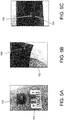
- FIGs. 4A-4C and FIGs. 5A-5C show various photographs of the contemplated RFID mesh labels having various construction(s).
- FIG. 4A is a photograph providing a perspective view of the RFID mesh label 100 depicting the face layer 110 and mesh backing 130 including the inner surface 132 thereof;
- FIG. 4B is a photograph providing a back perspective view of the same mesh label (of FIG.
- FIG. 4A further depicting the RFID layer and mesh backing 130 including the outermost surface 134
- FIG. 4C is a photograph providing a side perspective view of the same mesh label having the RFID layer 120 partially separated from the inner surface 132 of the mesh backing 130.
- FIG. 5A is a photograph showing the face layer 110 and RFID layer 120 of another contemplated RFID mesh label with a bar code printed on the face layer
- FIG. 5B is a back perspective view of the same RFID mesh label further including the mesh backing 130 and the RFID layer 120
- FIG. 5C is another back perspective view of the same mesh label fully assembled with the RFID layer 120 positioned between the mesh backing 130 and face layer (not shown).
- the RFID mesh label 100 can be installed during tire manufacture such that the label becomes an integral, inseparable part of the tire.
- the RFID mesh label 100 can be affixed to and/or incorporated within a wide array of green tires 200 and/or vulcanized tires 300 tire locations thereon including, but not limited to, the sidewall 311, bead 310, etc.
- the label can be incorporated into the sidewall 311 to facilitate reading from alongside the tire as well as avoid impact damage.
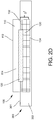
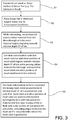
- FIGs. 2A-2D sequentially depict the RFID mesh label 100 being provided/attached to a green tire 200 and subsequently migrating/descending towards an internal depth (D 1 ) within inner portion 202 of the tire during vulcanization such that the RFID mesh label 100 is integrally formed/incorporated within the vulcanized tire 300 (formed from vulcanization of the green tire), and FIG. 3 further depicts the sequential steps S1-S5 of integrally incorporating/forming the RFID mesh label(s) 100 disclosed herein within a vulcanized tire 300.
- the RFID mesh label 100 is initially provided and the outer surface 134 of the mesh backing 130 is adhered/attached to an outermost surface 201 of a green rubber article/green tire 200.
- the arrows extending downward from the RFID mesh label 100 towards the green tire 200 and arrows extending upward from the green tire 200 indicate the direction(s) in which the RFID mesh label 100 is advanced to adhere/attach the label onto the outermost surface 201 of a green rubber article/green tire 200.
- the green tire 200 having the RFID mesh label 100 adhered/attached thereto is placed into a tire mold for subsequent vulcanization in which the green tire 200 and RFID mesh label 100 are subjected to temperatures and pressures associated with vulcanization processes to vulcanize the green tire while in the mold.
- the convergent ends of the face layer 110 and mesh backing 130 release from one another and the released ends of the mesh backing 130 advance in a direction towards the outermost surface 201 of the green tire 200 thereby allowing for more green rubber material to be passed from the green tire there through during vulcanization and to further increase the overall bonding strength between the RFID mesh label (particularly the mesh backing and portions of the RFID layer and portions of the face layer).
- the mesh material 130 passes green rubber material from the green tire 200 therethrough (indicated as arrows extending upward in a direction extending from inside/inner portions 202 the green tire 200 towards face layer 110) while the mesh backing 130 concurrently begins migrating/descending towards internal depth D 1 of an inner portion 202 the green tire 200 (indicated as arrows extending downward in a direction extending from the face layer 110 towards the inside/inner portion(s) 202 of the green tire 200).
- vulcanization is continued for a predetermined time period such that mesh backing 130 and other portions of RFID mesh label 100 continue to migrate/descend towards internal depth D 1 of tire while passing rubber material therethrough such that the mesh backing 130 and other portions of the mesh label bond to tire material 202 during vulcanization.
- step S5 of FIG. 3 and in further view of FIG.
- vulcanization is subsequently concluded thereby forming the vulcanized tire 300 having the meshing backing 130 positioned at internal depth D 1 within an inner portion 302 of the vulcanized tire 300 and such that mesh backing 130 and portions of the RFID layer 120 and/or portions of the face layer 110 such as the inner surface 114 of the RFID mesh label 100 are permanently bonded to/integrally incorporated in the vulcanized tire 300.
- the face layer 110 is adjacent to or flush with the outer surface 301 of vulcanized tire 300 upon concluding the vulcanization process.
- undulating ridges formed by the mesh backing 130 of the RFID mesh label 100 being integrally incorporated in the vulcanized tire 300 are visible when viewing the vulcanized tire and are further flanked by outer surfaces 301 (e.g., planar surfaces and/or planar outer surfaces) immediately adjacent the RFID mesh label 100 on the vulcanized tire.
- outer surfaces 301 e.g., planar surfaces and/or planar outer surfaces
- the mesh backing at least partially releases from the RFID mesh label as a result of heat and/or pressure during vulcanization; (2) the rubber (from the green article/tire) floats through the mesh backing/material and crosslinks the RFID mesh label to the rubber while the mesh backing/material migrates/descends within the rubber; and (3) upon concluding vulcanization, the mesh backing creates a very stiff area ("non-flexing zone") within the vulcanized rubber article just under the label surface (view as undulating ridges in FIGs.
- the RFID mesh label remains on/in the rubber product (e.g., vulcanized tire) and is inseparable from the rubber for the lifetime of the product.
- the disclosed RFID mesh label 100 provides a solution that creates a non-flexing zone within the rubber product (i.e., vulcanized product or vulcanized tire) just under the surface of the label while allowing the rubber to flow through the mesh material and bond the label to the tire.
- the mesh backing 130 is released during the process of vulcanization and creates this non-flexing zone. Therefore, the solution significantly reduces the amount of stress placed on the label thereby increasing operability and lifespan of the label.
- the RFID mesh label 100 further allows for placement on different locations other than the bead area 310 in vulcanized tires 300, which include, for example, tire sidewalls 311 and/or tread(s) 312. This placement flexibility is important when the label is combined with an RFID solution, since the label is not required to be placed on the bead area and therefore is not covered by the steel rim.
- the inventive concepts disclosed herein are further directed to methods of identifying a rubber-based article.
- the method can include affixing one or more RFID mesh labels 100 to a rubber-based article, the label including an RFID component configured to provide a unique identifier or other information upon being read or otherwise interrogated. Once the label is affixed to the rubber-based article, the unique identifier is thus associated with that particular article.
- the label can be affixed to the article prior to vulcanization or in certain applications, after vulcanization.
- the article can be identified by use of an RFID reader as previously described herein. Identification of the article enables a wide array of applications to be performed such as tracking the article in a manufacturing or production system, monitoring the location of the article, performing inventory operations, fleet management, maintenance and repair, product life cycle management, etc.
- the RFID mesh label is suitable for use with other articles, including other rubber-based and non-rubber-based articles.
- other rubber-based articles include suspension components, cushions, shoe soles, hoses, hockey pucks, conveyor belts, musical mouth pieces, bowling balls, rubber mats, etc.
Landscapes
- Engineering & Computer Science (AREA)
- Mechanical Engineering (AREA)
- Physics & Mathematics (AREA)
- General Physics & Mathematics (AREA)
- Theoretical Computer Science (AREA)
- Computer Hardware Design (AREA)
- Microelectronics & Electronic Packaging (AREA)
- Tires In General (AREA)
- Tyre Moulding (AREA)
- Heating, Cooling, Or Curing Plastics Or The Like In General (AREA)
Claims (15)
- RFID-Mesh-Etikett, das ausgelegt ist, um integral in einen vulkanisierten Reifen eingearbeitet zu werden und eindeutige Identifikator(en) und/oder sonstige Informationen zu dem vulkanisierten Reifen bereitzustellen, wobei das RFID-Mesh-Etikett umfasst:eine Deckschicht, die ausgelegt ist, um angrenzend an oder bündig mit einer Außenoberfläche des vulkanisierten Reifens positioniert zu werden;eine RFID-Schicht, die unter der Deckschicht positioniert ist, wobei die RFID-Schicht eine RFID-Vorrichtung aufweist, die ausgelegt ist, um eindeutige Identifikator(en) und/oder sonstige Informationen zu dem vulkanisierten Reifen bereitzustellen, wenn sie mit einem RFID-Lesegerät gelesen wird; und gekennzeichnet durch eine Mesh-Trägerschicht, die über der RFID-Schicht liegt und vorgesehen ist, um integral in einen vulkanisierten Reifen eingearbeitet zu werden, nachdem ein Reifenrohling einem Vulkanisationsprozess unterzogen wird.
- RFID-Mesh-Etikett nach Anspruch 1, wobei die Mesh-Trägerschicht eine Oberflächenbehandlung einschließt, die Bindung zwischen einem Reifenrohling und der Mesh-Trägerschicht erleichtert.
- RFID-Mesh-Etikett nach Anspruch 2, wobei die Oberflächenbehandlung eine Beschichtung mit reaktiven Thiolen darin, eine Beschichtung mit reaktiven Aminen darin, eine Beschichtung mit reaktiven Hydroxylen darin oder jegliche Kombination davon umfasst, die Vernetzen zwischen der Mesh-Trägerschicht und einem Reifenrohling während der Vulkanisation erleichtert, um die Mesh-Trägerschicht integral in den vulkanisierten Reifen einzuarbeiten.
- RFID-Mesh-Etikett nach Anspruch 3, wobei die Deckschicht und die Mesh-Trägerschicht konvergierende Enden aufweisen, die entlang des Randbereichs des RFID-Mesh-Etiketts miteinander verbunden sind, so dass die Deckschicht und die Mesh-Trägerschicht die RFID-Schicht umgeben und die RFID-Schicht innerhalb des RFID-Mesh-Etiketts umschließen.
- RFID-Mesh-Etikett nach Anspruch 4, wobei die konvergierenden Enden der Deckschicht und der Mesh-Trägerschicht ausgelegt sind, um sich während der Vulkanisation voneinander zu lösen.
- RFID-Mesh-Etikett nach Anspruch 5, wobei die Mesh-Trägerschicht ein orthogonales Gitter ist, das ausgelegt ist, um während der Vulkanisation Rohkautschukmaterial aus einem Reifenrohling durch das orthogonale Gitter hindurch homogen zu der RFID-Schicht und/oder Deckschicht passieren zu lassen und darin zu verteilen, so dass Anteile der RFID-Schicht und/oder Deckschicht an den vulkanisierten Reifen gebunden werden.
- RFID-Mesh-Etikett nach Anspruch 6, wobei die Mesh-Trägerschicht ein nicht-verformbares orthogonales Gitter ist, das ausgelegt ist, um während der Vulkanisation Rohkautschukmaterial aus einem Reifenrohling durch das nicht-verformbare orthogonale Gitter hindurch homogen zu der RFID-Schicht und/oder Deckschicht passieren zu lassen und darin zu verteilen, so dass Anteile der RFID-Schicht und/oder Deckschicht an den vulkanisierten Reifen gebunden werden.
- RFID-Mesh-Etikett nach Anspruch 7, wobei die Mesh-Trägerschicht steifer als sowohl die RFID- als auch die Deckschicht (en) ist bzw. sind und ausgelegt ist, um mechanische Beanspruchung der RFID- und/oder Deckschicht(en) zu begrenzen, während das RFID-Mesh-Etikett in Gebrauch ist, indem mechanische Beanspruchung, die durch den vulkanisierten Reifen auf das RFID-Mesh-Etikett übertragen wird, absorbiert und/oder gedämpft wird.
- Verfahren zum Bilden von vulkanisiertem Reifen bzw. vulkanisierten Reifen mit einem darin integral eingearbeiteten RFID-Mesh-Etikett nach Anspruch 1, wobei das Verfahren umfasst:(a) Befestigen des RFID-Mesh-Etiketts auf einer Außenoberfläche eines Reifenrohlings;(b) Platzieren des Reifenrohlings mit dem daran befestigten RFID-Mesh-Etikett in einer Reifenform;(c) Unterziehen des Reifenrohlings von Schritt (b) Vulkanisierungsbedingungen;(d) während der Reifenrohling von Schritt (c) vulkanisiert wird, Passieren von Rohkautschukmaterial aus dem Reifenrohling durch die Mesh-Trägerschicht des RFID-Mesh-Etiketts hindurch in einer Richtung zu einer Deckschicht des RFID-Mesh-Etiketts, während gleichzeitig das RFID-Mesh-Etikett in eine Innenrichtung des Reifenrohlings migriert; und(e) Abschließen der Vulkanisation, wodurch ein vulkanisierter Reifen gebildet wird, bei dem die Mesh-Trägerschicht des RFID-Mesh-Etiketts innen innerhalb des vulkanisierten Reifens positioniert ist, so dass:(i) die Mesh-Trägerschicht und sonstige Anteile des RFID-Mesh-Etiketts permanent an Innenanteile des vulkanisierten Reifens gebunden sind, und(ii) die Deckschicht sich angrenzend an oder bündig zu einer Außenoberfläche des vulkanisierten Reifens befindet, so dass die RFID-Vorrichtung innerhalb des RFID-Mesh-Etiketts aus einem vorgegebenen Abstand durch ein RFID-Lesegerät gelesen werden kann.
- Verfahren nach Anspruch 9, wobei das RFID-Mesh-Etikett die Deckschicht und Mesh-Trägerschicht mit der dazwischen positionierten RFID-Vorrichtung umfasst.
- Verfahren nach Anspruch 9, wobei die Mesh-Trägerschicht eine orthogonale Gitterform ist.
- Verfahren nach Anspruch 11, wobei die Mesh-Trägerschicht während der Vulkanisation und nach Schritt (e) des Bildens des vulkanisierten Reifens eine orthogonale Gitterform beibehält.
- Verfahren nach Anspruch 11, wobei das Rohkautschukmaterial sich während Schritt (d) homogen durch das orthogonale Gitter hindurch verteilt.
- Vulkanisierter Reifen, umfassend:
ein RFID-Mesh-Etikett, das integral in den vulkanisierten Reifen eingearbeitet ist und ausgelegt ist, um eindeutige Identifikator(en) und/oder sonstige Informationen zu dem vulkanisierten Reifen bereitzustellen, wobei das RFID-Mesh-Etikett umfasst:eine Deckschicht, die ausgelegt ist, um angrenzend an oder bündig mit einer Außenoberfläche des vulkanisierten Reifens zu sein, wobei die Außenoberfläche des vulkanisierten Reifens eine Reifenseitenwand oder ein Reifenwulst ist;eine RFID-Schicht, die unter der Deckschicht positioniert ist, wobei die RFID-Schicht eine RFID-Vorrichtung aufweist, die eindeutige Identifikator(en) und/oder sonstige Informationen bereitstellt, wenn sie mit einem RFID-Lesegerät gelesen wird; und gekennzeichnet durch eine Mesh-Trägerschicht, die über der RFID-Schicht liegt, welche ein nicht-verformbares orthogonales Gitter ist, wobei vulkanisierte Kautschukmaterial das Gitter homogen passiert und durch dieses hindurch verteilt wird, so dass das Mesh-Trägermaterial von vulkanisiertem Kautschukmaterial des vulkanisierten Reifens umgeben und daran gebunden ist, und Anteile der RFID-Schicht und Deckschicht des RFID-Mesh-Etiketts an vulkanisiertes Kautschukmaterial des vulkanisierten Reifens gebunden sind. - Vulkanisierter Reifen nach Anspruch 14, wobei das RFID-Mesh-Etikett des Weiteren Barcodierung umfasst, die auf einer äußersten Oberfläche der Deckschicht gebildet ist.
Applications Claiming Priority (2)
| Application Number | Priority Date | Filing Date | Title |
|---|---|---|---|
| US201862636450P | 2018-02-28 | 2018-02-28 | |
| US16/284,068 US10621485B2 (en) | 2018-02-28 | 2019-02-25 | RFID mesh label, tire having RFID mesh label integrally incorporated therein, and methods of making |
Publications (2)
| Publication Number | Publication Date |
|---|---|
| EP3533640A1 EP3533640A1 (de) | 2019-09-04 |
| EP3533640B1 true EP3533640B1 (de) | 2020-04-22 |
Family
ID=65635461
Family Applications (1)
| Application Number | Title | Priority Date | Filing Date |
|---|---|---|---|
| EP19159822.6A Active EP3533640B1 (de) | 2018-02-28 | 2019-02-27 | Rfid-mesh-etikett, reifen mit einem integral darin integrierten rfid-mesh-etikett und verfahren zur herstellung |
Country Status (3)
| Country | Link |
|---|---|
| US (5) | US10621485B2 (de) |
| EP (1) | EP3533640B1 (de) |
| CA (1) | CA3035060C (de) |
Families Citing this family (12)
| Publication number | Priority date | Publication date | Assignee | Title |
|---|---|---|---|---|
| US11903486B2 (en) * | 2017-07-31 | 2024-02-20 | Bijan Dokhanian | Step stool |
| US10621485B2 (en) * | 2018-02-28 | 2020-04-14 | FineLine Technologies | RFID mesh label, tire having RFID mesh label integrally incorporated therein, and methods of making |
| US11259443B1 (en) * | 2019-03-11 | 2022-02-22 | Smartrac Investment B.V. | Heat resistant RFID tags |
| US10899181B2 (en) * | 2019-05-23 | 2021-01-26 | International Business Machines Corporation | Tire puncture detection and alert |
| US20220355625A1 (en) * | 2019-08-22 | 2022-11-10 | FineLine Technologies | Chemically treated, rfid equipped mesh tire labels and methods of making and using the same for identification and tracking purposes during and post-tire manufacture |
| CN110978579A (zh) * | 2019-12-20 | 2020-04-10 | 深圳市昊岳科技有限公司 | 一种基于轮胎管理的轮胎身份标签的新型安装方法 |
| RU204407U1 (ru) * | 2020-10-09 | 2021-05-24 | Сергей Алексеевич Жадан | Носитель кода маркировки шин |
| US11021021B1 (en) | 2020-12-01 | 2021-06-01 | The Goodyear Tire & Rubber Company | RFID tag secured to a tire |
| JP7674929B2 (ja) * | 2021-06-30 | 2025-05-12 | 株式会社ブリヂストン | タイヤ |
| IT202100027812A1 (it) * | 2021-10-29 | 2023-04-29 | Bridgestone Europe Nv Sa | Metodo di produzione di uno pneumatico provvisto di un dispositivo elettronico |
| JP7701866B2 (ja) * | 2021-12-09 | 2025-07-02 | 株式会社ブリヂストン | タイヤ |
| WO2025170775A1 (en) * | 2024-02-09 | 2025-08-14 | Bridgestone Bandag, Llc | Systems and methods for installing electronic assembly on tire |
Family Cites Families (36)
| Publication number | Priority date | Publication date | Assignee | Title |
|---|---|---|---|---|
| US2375089A (en) * | 1941-11-08 | 1945-05-01 | Us Rubber Co | Rubber fabric material |
| US3249658A (en) * | 1964-10-05 | 1966-05-03 | John Schorscher | Processes for curing rubber compounds |
| WO2003070496A1 (en) * | 2002-02-18 | 2003-08-28 | Bridgestone/Firestone North American Tire, Llc | Attachment method for tire tag |
| US7135979B2 (en) * | 2002-11-14 | 2006-11-14 | Brady Worldwide, Inc. | In-mold radio frequency identification device label |
| US20040134578A1 (en) * | 2002-12-23 | 2004-07-15 | Kleckner James P. | Tire with tire tag |
| US20040182494A1 (en) * | 2003-03-19 | 2004-09-23 | Dominak Stephen L. | Tag attachment for tires and method of attaching tags to tires |
| US20050059308A1 (en) | 2003-09-17 | 2005-03-17 | Parsons Edwin D. | Label for mounting to a tire |
| US20050126668A1 (en) * | 2003-12-16 | 2005-06-16 | Pierre Fornerod | Post patch for mounting devices inside tires |
| JP2005216077A (ja) * | 2004-01-30 | 2005-08-11 | Bridgestone Corp | Rfid組込バーコードラベル、及び、タイヤとその管理方法 |
| US7338914B2 (en) * | 2004-03-31 | 2008-03-04 | Intermec Ip Corp. | RFID tire label |
| KR100630823B1 (ko) * | 2004-11-02 | 2006-10-02 | 주식회사 현대오토넷 | 전파식별 시스템에서 타이어용 전파식별 태그 장치 |
| US9545767B2 (en) * | 2005-01-24 | 2017-01-17 | Computype, Inc. | Permanent marking of molded rubber products |
| US20060290505A1 (en) * | 2005-03-01 | 2006-12-28 | Kevin Conwell | RFID tire label |
| US7224278B2 (en) * | 2005-10-18 | 2007-05-29 | Avery Dennison Corporation | Label with electronic components and method of making same |
| US7598877B2 (en) * | 2006-05-30 | 2009-10-06 | The Goodyear Tire & Rubber Company | Transponder carrier for a tire |
| JP4910690B2 (ja) * | 2006-06-12 | 2012-04-04 | ブラザー工業株式会社 | タグテープロール |
| JP4705560B2 (ja) * | 2006-12-05 | 2011-06-22 | 住友ゴム工業株式会社 | Icタグ、それを取付けた空気入りタイヤ、およびicタグの取付方法 |
| CA2694709A1 (en) * | 2007-09-18 | 2009-03-26 | Norbert Seitz | Vibration sensitive viscoplastic balancing material in the central and shoulder zones of vehicles tires |
| US8485359B2 (en) * | 2008-07-07 | 2013-07-16 | Blast Max Llc | Seal absorbent pad-RFID-bar code device for a dosing cap |
| US8157172B2 (en) * | 2008-10-30 | 2012-04-17 | The Goodyear Tire & Rubber Company | RFID tag package and tire assembly |
| US9327554B2 (en) * | 2011-03-29 | 2016-05-03 | Exxonmobil Chemical Patents Inc. | Dynamically vulcanized thermoplastic elastomer laminates |
| US8869854B2 (en) * | 2011-11-21 | 2014-10-28 | The Goodyear Tire & Rubber Company | Tire with label |
| US20130160913A1 (en) * | 2011-12-22 | 2013-06-27 | Satyajit Avinash Lonkar | Tire with label and relief groove |
| US20150202837A1 (en) * | 2012-08-15 | 2015-07-23 | Frederick James Coetzee | Reinforced rubberised transport systems |
| MX2017004059A (es) * | 2014-09-29 | 2017-08-28 | Avery Dennison Corp | Etiqueta rfid de seguimiento de neumáticos. |
| WO2016109088A1 (en) * | 2014-12-30 | 2016-07-07 | Bridgestone Americas Tire Operations, Llc | Method and apparatus for utilizing preprinted labels and appliqués on a tire |
| US10137741B2 (en) * | 2015-04-27 | 2018-11-27 | Keith George Ferry | Display assemblies and methods for applying the same to vulcanized rubber articles |
| EP3411222B1 (de) * | 2016-02-03 | 2020-10-28 | Cooper Tire & Rubber Company | Mit rfid-etiketten versehene reifenaushärtngsbälge |
| US10198677B2 (en) * | 2016-05-26 | 2019-02-05 | Avery Dennison Retail Information Services, Llc | RFID tag for printed fabric label and method of making |
| US20190244074A1 (en) * | 2018-02-02 | 2019-08-08 | FineLine Technologies | Foam-based rfid label |
| US10621485B2 (en) | 2018-02-28 | 2020-04-14 | FineLine Technologies | RFID mesh label, tire having RFID mesh label integrally incorporated therein, and methods of making |
| JP6582105B1 (ja) * | 2018-10-03 | 2019-09-25 | Toyo Tire株式会社 | タイヤの製造方法 |
| JP6582106B1 (ja) * | 2018-10-03 | 2019-09-25 | Toyo Tire株式会社 | タイヤの製造方法 |
| JP6594507B1 (ja) * | 2018-10-03 | 2019-10-23 | Toyo Tire株式会社 | タイヤおよびタイヤの製造方法 |
| JP6686109B1 (ja) * | 2018-11-26 | 2020-04-22 | Toyo Tire株式会社 | タイヤ |
| US11021021B1 (en) * | 2020-12-01 | 2021-06-01 | The Goodyear Tire & Rubber Company | RFID tag secured to a tire |
-
2019
- 2019-02-25 US US16/284,068 patent/US10621485B2/en active Active
- 2019-02-27 CA CA3035060A patent/CA3035060C/en active Active
- 2019-02-27 EP EP19159822.6A patent/EP3533640B1/de active Active
-
2020
- 2020-03-09 US US16/812,906 patent/US11010654B2/en active Active
-
2021
- 2021-05-17 US US17/322,202 patent/US11514287B2/en active Active
-
2022
- 2022-10-26 US US17/973,642 patent/US11809936B2/en active Active
-
2023
- 2023-10-16 US US18/380,394 patent/US12159182B2/en active Active
Non-Patent Citations (1)
| Title |
|---|
| None * |
Also Published As
| Publication number | Publication date |
|---|---|
| US10621485B2 (en) | 2020-04-14 |
| US11514287B2 (en) | 2022-11-29 |
| US20200210802A1 (en) | 2020-07-02 |
| US11010654B2 (en) | 2021-05-18 |
| EP3533640A1 (de) | 2019-09-04 |
| CA3035060C (en) | 2022-02-22 |
| US20190266465A1 (en) | 2019-08-29 |
| CA3035060A1 (en) | 2019-08-28 |
| US20240037366A1 (en) | 2024-02-01 |
| US12159182B2 (en) | 2024-12-03 |
| US11809936B2 (en) | 2023-11-07 |
| US20210271952A1 (en) | 2021-09-02 |
| US20230051078A1 (en) | 2023-02-16 |
Similar Documents
| Publication | Publication Date | Title |
|---|---|---|
| US12159182B2 (en) | RFID mesh label, tire having RFID mesh label integrally incorporated therein, and methods of making | |
| EP4019241B1 (de) | Rfid-etikett-anordnung zur befestigung an einem reifen | |
| US12462138B2 (en) | Chemically treated, RFID equipped mesh tire labels and methods of making and using the same for identification and tracking purposes during and post-tire manufacture | |
| EP3522077B1 (de) | Schaumbasiertes rfid-etikett für reifen | |
| US10586144B2 (en) | Tire tracking RFID label | |
| CA3029809C (en) | Rfid tire plug and method of installing the same in a manufactured tire | |
| EP4300354B1 (de) | Montagepack einer elektronischen vorrichtung an einen reifen | |
| KR20250056181A (ko) | 타이어에 전자 디바이스를 장착하기 위한 팩 |
Legal Events
| Date | Code | Title | Description |
|---|---|---|---|
| PUAI | Public reference made under article 153(3) epc to a published international application that has entered the european phase |
Free format text: ORIGINAL CODE: 0009012 |
|
| STAA | Information on the status of an ep patent application or granted ep patent |
Free format text: STATUS: REQUEST FOR EXAMINATION WAS MADE |
|
| 17P | Request for examination filed |
Effective date: 20190227 |
|
| AK | Designated contracting states |
Kind code of ref document: A1 Designated state(s): AL AT BE BG CH CY CZ DE DK EE ES FI FR GB GR HR HU IE IS IT LI LT LU LV MC MK MT NL NO PL PT RO RS SE SI SK SM TR |
|
| AX | Request for extension of the european patent |
Extension state: BA ME |
|
| RBV | Designated contracting states (corrected) |
Designated state(s): AL AT BE BG CH CY CZ DE DK EE ES FI FR GB GR HR HU IE IS IT LI LT LU LV MC MK MT NL NO PL PT RO RS SE SI SK SM TR |
|
| GRAP | Despatch of communication of intention to grant a patent |
Free format text: ORIGINAL CODE: EPIDOSNIGR1 |
|
| STAA | Information on the status of an ep patent application or granted ep patent |
Free format text: STATUS: GRANT OF PATENT IS INTENDED |
|
| RIC1 | Information provided on ipc code assigned before grant |
Ipc: B60C 19/00 20060101AFI20191025BHEP Ipc: B29D 30/00 20060101ALN20191025BHEP |
|
| RIC1 | Information provided on ipc code assigned before grant |
Ipc: B60C 19/00 20060101AFI20191111BHEP Ipc: B29D 30/00 20060101ALN20191111BHEP |
|
| INTG | Intention to grant announced |
Effective date: 20191127 |
|
| GRAS | Grant fee paid |
Free format text: ORIGINAL CODE: EPIDOSNIGR3 |
|
| GRAA | (expected) grant |
Free format text: ORIGINAL CODE: 0009210 |
|
| STAA | Information on the status of an ep patent application or granted ep patent |
Free format text: STATUS: THE PATENT HAS BEEN GRANTED |
|
| AK | Designated contracting states |
Kind code of ref document: B1 Designated state(s): AL AT BE BG CH CY CZ DE DK EE ES FI FR GB GR HR HU IE IS IT LI LT LU LV MC MK MT NL NO PL PT RO RS SE SI SK SM TR |
|
| REG | Reference to a national code |
Ref country code: CH Ref legal event code: EP |
|
| REG | Reference to a national code |
Ref country code: IE Ref legal event code: FG4D |
|
| REG | Reference to a national code |
Ref country code: DE Ref legal event code: R096 Ref document number: 602019000066 Country of ref document: DE |
|
| REG | Reference to a national code |
Ref country code: AT Ref legal event code: REF Ref document number: 1259622 Country of ref document: AT Kind code of ref document: T Effective date: 20200515 |
|
| REG | Reference to a national code |
Ref country code: NL Ref legal event code: FP |
|
| REG | Reference to a national code |
Ref country code: LT Ref legal event code: MG4D |
|
| PG25 | Lapsed in a contracting state [announced via postgrant information from national office to epo] |
Ref country code: IS Free format text: LAPSE BECAUSE OF FAILURE TO SUBMIT A TRANSLATION OF THE DESCRIPTION OR TO PAY THE FEE WITHIN THE PRESCRIBED TIME-LIMIT Effective date: 20200822 Ref country code: SE Free format text: LAPSE BECAUSE OF FAILURE TO SUBMIT A TRANSLATION OF THE DESCRIPTION OR TO PAY THE FEE WITHIN THE PRESCRIBED TIME-LIMIT Effective date: 20200422 Ref country code: NO Free format text: LAPSE BECAUSE OF FAILURE TO SUBMIT A TRANSLATION OF THE DESCRIPTION OR TO PAY THE FEE WITHIN THE PRESCRIBED TIME-LIMIT Effective date: 20200722 Ref country code: GR Free format text: LAPSE BECAUSE OF FAILURE TO SUBMIT A TRANSLATION OF THE DESCRIPTION OR TO PAY THE FEE WITHIN THE PRESCRIBED TIME-LIMIT Effective date: 20200723 Ref country code: FI Free format text: LAPSE BECAUSE OF FAILURE TO SUBMIT A TRANSLATION OF THE DESCRIPTION OR TO PAY THE FEE WITHIN THE PRESCRIBED TIME-LIMIT Effective date: 20200422 Ref country code: LT Free format text: LAPSE BECAUSE OF FAILURE TO SUBMIT A TRANSLATION OF THE DESCRIPTION OR TO PAY THE FEE WITHIN THE PRESCRIBED TIME-LIMIT Effective date: 20200422 Ref country code: PT Free format text: LAPSE BECAUSE OF FAILURE TO SUBMIT A TRANSLATION OF THE DESCRIPTION OR TO PAY THE FEE WITHIN THE PRESCRIBED TIME-LIMIT Effective date: 20200824 |
|
| REG | Reference to a national code |
Ref country code: AT Ref legal event code: MK05 Ref document number: 1259622 Country of ref document: AT Kind code of ref document: T Effective date: 20200422 |
|
| PG25 | Lapsed in a contracting state [announced via postgrant information from national office to epo] |
Ref country code: HR Free format text: LAPSE BECAUSE OF FAILURE TO SUBMIT A TRANSLATION OF THE DESCRIPTION OR TO PAY THE FEE WITHIN THE PRESCRIBED TIME-LIMIT Effective date: 20200422 Ref country code: LV Free format text: LAPSE BECAUSE OF FAILURE TO SUBMIT A TRANSLATION OF THE DESCRIPTION OR TO PAY THE FEE WITHIN THE PRESCRIBED TIME-LIMIT Effective date: 20200422 Ref country code: BG Free format text: LAPSE BECAUSE OF FAILURE TO SUBMIT A TRANSLATION OF THE DESCRIPTION OR TO PAY THE FEE WITHIN THE PRESCRIBED TIME-LIMIT Effective date: 20200722 Ref country code: RS Free format text: LAPSE BECAUSE OF FAILURE TO SUBMIT A TRANSLATION OF THE DESCRIPTION OR TO PAY THE FEE WITHIN THE PRESCRIBED TIME-LIMIT Effective date: 20200422 |
|
| PG25 | Lapsed in a contracting state [announced via postgrant information from national office to epo] |
Ref country code: AL Free format text: LAPSE BECAUSE OF FAILURE TO SUBMIT A TRANSLATION OF THE DESCRIPTION OR TO PAY THE FEE WITHIN THE PRESCRIBED TIME-LIMIT Effective date: 20200422 |
|
| REG | Reference to a national code |
Ref country code: DE Ref legal event code: R097 Ref document number: 602019000066 Country of ref document: DE |
|
| PG25 | Lapsed in a contracting state [announced via postgrant information from national office to epo] |
Ref country code: ES Free format text: LAPSE BECAUSE OF FAILURE TO SUBMIT A TRANSLATION OF THE DESCRIPTION OR TO PAY THE FEE WITHIN THE PRESCRIBED TIME-LIMIT Effective date: 20200422 Ref country code: AT Free format text: LAPSE BECAUSE OF FAILURE TO SUBMIT A TRANSLATION OF THE DESCRIPTION OR TO PAY THE FEE WITHIN THE PRESCRIBED TIME-LIMIT Effective date: 20200422 Ref country code: DK Free format text: LAPSE BECAUSE OF FAILURE TO SUBMIT A TRANSLATION OF THE DESCRIPTION OR TO PAY THE FEE WITHIN THE PRESCRIBED TIME-LIMIT Effective date: 20200422 Ref country code: CZ Free format text: LAPSE BECAUSE OF FAILURE TO SUBMIT A TRANSLATION OF THE DESCRIPTION OR TO PAY THE FEE WITHIN THE PRESCRIBED TIME-LIMIT Effective date: 20200422 Ref country code: SM Free format text: LAPSE BECAUSE OF FAILURE TO SUBMIT A TRANSLATION OF THE DESCRIPTION OR TO PAY THE FEE WITHIN THE PRESCRIBED TIME-LIMIT Effective date: 20200422 Ref country code: EE Free format text: LAPSE BECAUSE OF FAILURE TO SUBMIT A TRANSLATION OF THE DESCRIPTION OR TO PAY THE FEE WITHIN THE PRESCRIBED TIME-LIMIT Effective date: 20200422 Ref country code: RO Free format text: LAPSE BECAUSE OF FAILURE TO SUBMIT A TRANSLATION OF THE DESCRIPTION OR TO PAY THE FEE WITHIN THE PRESCRIBED TIME-LIMIT Effective date: 20200422 |
|
| PG25 | Lapsed in a contracting state [announced via postgrant information from national office to epo] |
Ref country code: PL Free format text: LAPSE BECAUSE OF FAILURE TO SUBMIT A TRANSLATION OF THE DESCRIPTION OR TO PAY THE FEE WITHIN THE PRESCRIBED TIME-LIMIT Effective date: 20200422 Ref country code: SK Free format text: LAPSE BECAUSE OF FAILURE TO SUBMIT A TRANSLATION OF THE DESCRIPTION OR TO PAY THE FEE WITHIN THE PRESCRIBED TIME-LIMIT Effective date: 20200422 |
|
| PLBE | No opposition filed within time limit |
Free format text: ORIGINAL CODE: 0009261 |
|
| STAA | Information on the status of an ep patent application or granted ep patent |
Free format text: STATUS: NO OPPOSITION FILED WITHIN TIME LIMIT |
|
| 26N | No opposition filed |
Effective date: 20210125 |
|
| PG25 | Lapsed in a contracting state [announced via postgrant information from national office to epo] |
Ref country code: MC Free format text: LAPSE BECAUSE OF FAILURE TO SUBMIT A TRANSLATION OF THE DESCRIPTION OR TO PAY THE FEE WITHIN THE PRESCRIBED TIME-LIMIT Effective date: 20200422 |
|
| REG | Reference to a national code |
Ref country code: BE Ref legal event code: MM Effective date: 20210228 |
|
| PG25 | Lapsed in a contracting state [announced via postgrant information from national office to epo] |
Ref country code: IE Free format text: LAPSE BECAUSE OF NON-PAYMENT OF DUE FEES Effective date: 20210227 |
|
| PG25 | Lapsed in a contracting state [announced via postgrant information from national office to epo] |
Ref country code: BE Free format text: LAPSE BECAUSE OF NON-PAYMENT OF DUE FEES Effective date: 20210228 |
|
| REG | Reference to a national code |
Ref country code: CH Ref legal event code: PL |
|
| PG25 | Lapsed in a contracting state [announced via postgrant information from national office to epo] |
Ref country code: LI Free format text: LAPSE BECAUSE OF NON-PAYMENT OF DUE FEES Effective date: 20220228 Ref country code: CH Free format text: LAPSE BECAUSE OF NON-PAYMENT OF DUE FEES Effective date: 20220228 |
|
| P01 | Opt-out of the competence of the unified patent court (upc) registered |
Effective date: 20230515 |
|
| PG25 | Lapsed in a contracting state [announced via postgrant information from national office to epo] |
Ref country code: CY Free format text: LAPSE BECAUSE OF FAILURE TO SUBMIT A TRANSLATION OF THE DESCRIPTION OR TO PAY THE FEE WITHIN THE PRESCRIBED TIME-LIMIT Effective date: 20200422 |
|
| PG25 | Lapsed in a contracting state [announced via postgrant information from national office to epo] |
Ref country code: HU Free format text: LAPSE BECAUSE OF FAILURE TO SUBMIT A TRANSLATION OF THE DESCRIPTION OR TO PAY THE FEE WITHIN THE PRESCRIBED TIME-LIMIT; INVALID AB INITIO Effective date: 20190227 |
|
| PG25 | Lapsed in a contracting state [announced via postgrant information from national office to epo] |
Ref country code: SI Free format text: LAPSE BECAUSE OF FAILURE TO SUBMIT A TRANSLATION OF THE DESCRIPTION OR TO PAY THE FEE WITHIN THE PRESCRIBED TIME-LIMIT Effective date: 20200422 |
|
| PG25 | Lapsed in a contracting state [announced via postgrant information from national office to epo] |
Ref country code: MK Free format text: LAPSE BECAUSE OF FAILURE TO SUBMIT A TRANSLATION OF THE DESCRIPTION OR TO PAY THE FEE WITHIN THE PRESCRIBED TIME-LIMIT Effective date: 20200422 |
|
| PG25 | Lapsed in a contracting state [announced via postgrant information from national office to epo] |
Ref country code: MT Free format text: LAPSE BECAUSE OF FAILURE TO SUBMIT A TRANSLATION OF THE DESCRIPTION OR TO PAY THE FEE WITHIN THE PRESCRIBED TIME-LIMIT Effective date: 20200422 |
|
| PG25 | Lapsed in a contracting state [announced via postgrant information from national office to epo] |
Ref country code: TR Free format text: LAPSE BECAUSE OF FAILURE TO SUBMIT A TRANSLATION OF THE DESCRIPTION OR TO PAY THE FEE WITHIN THE PRESCRIBED TIME-LIMIT Effective date: 20200422 |
|
| PGFP | Annual fee paid to national office [announced via postgrant information from national office to epo] |
Ref country code: NL Payment date: 20260223 Year of fee payment: 8 Ref country code: LU Payment date: 20260227 Year of fee payment: 8 |
|
| PGFP | Annual fee paid to national office [announced via postgrant information from national office to epo] |
Ref country code: GB Payment date: 20260225 Year of fee payment: 8 |
|
| PGFP | Annual fee paid to national office [announced via postgrant information from national office to epo] |
Ref country code: DE Payment date: 20260220 Year of fee payment: 8 |
|
| PGFP | Annual fee paid to national office [announced via postgrant information from national office to epo] |
Ref country code: IT Payment date: 20260227 Year of fee payment: 8 |
|
| PGFP | Annual fee paid to national office [announced via postgrant information from national office to epo] |
Ref country code: FR Payment date: 20260220 Year of fee payment: 8 |