EP3532609B1 - Cancer-killing cells - Google Patents
Cancer-killing cells Download PDFInfo
- Publication number
- EP3532609B1 EP3532609B1 EP17794046.7A EP17794046A EP3532609B1 EP 3532609 B1 EP3532609 B1 EP 3532609B1 EP 17794046 A EP17794046 A EP 17794046A EP 3532609 B1 EP3532609 B1 EP 3532609B1
- Authority
- EP
- European Patent Office
- Prior art keywords
- cancer
- cell
- cells
- haematopoietic stem
- granulocyte
- Prior art date
- Legal status (The legal status is an assumption and is not a legal conclusion. Google has not performed a legal analysis and makes no representation as to the accuracy of the status listed.)
- Active
Links
Images
Classifications
-
- A—HUMAN NECESSITIES
- A61—MEDICAL OR VETERINARY SCIENCE; HYGIENE
- A61K—PREPARATIONS FOR MEDICAL, DENTAL OR TOILETRY PURPOSES
- A61K31/00—Medicinal preparations containing organic active ingredients
- A61K31/185—Acids; Anhydrides, halides or salts thereof, e.g. sulfur acids, imidic, hydrazonic or hydroximic acids
- A61K31/19—Carboxylic acids, e.g. valproic acid
- A61K31/195—Carboxylic acids, e.g. valproic acid having an amino group
- A61K31/197—Carboxylic acids, e.g. valproic acid having an amino group the amino and the carboxyl groups being attached to the same acyclic carbon chain, e.g. gamma-aminobutyric acid [GABA], beta-alanine, epsilon-aminocaproic acid or pantothenic acid
- A61K31/198—Alpha-amino acids, e.g. alanine or edetic acid [EDTA]
-
- A—HUMAN NECESSITIES
- A61—MEDICAL OR VETERINARY SCIENCE; HYGIENE
- A61K—PREPARATIONS FOR MEDICAL, DENTAL OR TOILETRY PURPOSES
- A61K31/00—Medicinal preparations containing organic active ingredients
- A61K31/185—Acids; Anhydrides, halides or salts thereof, e.g. sulfur acids, imidic, hydrazonic or hydroximic acids
- A61K31/19—Carboxylic acids, e.g. valproic acid
- A61K31/20—Carboxylic acids, e.g. valproic acid having a carboxyl group bound to a chain of seven or more carbon atoms, e.g. stearic, palmitic, arachidic acids
- A61K31/202—Carboxylic acids, e.g. valproic acid having a carboxyl group bound to a chain of seven or more carbon atoms, e.g. stearic, palmitic, arachidic acids having three or more double bonds, e.g. linolenic
-
- A—HUMAN NECESSITIES
- A61—MEDICAL OR VETERINARY SCIENCE; HYGIENE
- A61K—PREPARATIONS FOR MEDICAL, DENTAL OR TOILETRY PURPOSES
- A61K31/00—Medicinal preparations containing organic active ingredients
- A61K31/33—Heterocyclic compounds
- A61K31/335—Heterocyclic compounds having oxygen as the only ring hetero atom, e.g. fungichromin
- A61K31/365—Lactones
- A61K31/375—Ascorbic acid, i.e. vitamin C; Salts thereof
-
- A—HUMAN NECESSITIES
- A61—MEDICAL OR VETERINARY SCIENCE; HYGIENE
- A61K—PREPARATIONS FOR MEDICAL, DENTAL OR TOILETRY PURPOSES
- A61K31/00—Medicinal preparations containing organic active ingredients
- A61K31/59—Compounds containing 9, 10- seco- cyclopenta[a]hydrophenanthrene ring systems
-
- A—HUMAN NECESSITIES
- A61—MEDICAL OR VETERINARY SCIENCE; HYGIENE
- A61K—PREPARATIONS FOR MEDICAL, DENTAL OR TOILETRY PURPOSES
- A61K35/00—Medicinal preparations containing materials or reaction products thereof with undetermined constitution
- A61K35/12—Materials from mammals; Compositions comprising non-specified tissues or cells; Compositions comprising non-embryonic stem cells; Genetically modified cells
- A61K35/14—Blood; Artificial blood
- A61K35/15—Cells of the myeloid line, e.g. granulocytes, basophils, eosinophils, neutrophils, leucocytes, monocytes, macrophages or mast cells; Myeloid precursor cells; Antigen-presenting cells, e.g. dendritic cells
-
- A—HUMAN NECESSITIES
- A61—MEDICAL OR VETERINARY SCIENCE; HYGIENE
- A61K—PREPARATIONS FOR MEDICAL, DENTAL OR TOILETRY PURPOSES
- A61K35/00—Medicinal preparations containing materials or reaction products thereof with undetermined constitution
- A61K35/12—Materials from mammals; Compositions comprising non-specified tissues or cells; Compositions comprising non-embryonic stem cells; Genetically modified cells
- A61K35/28—Bone marrow; Haematopoietic stem cells; Mesenchymal stem cells of any origin, e.g. adipose-derived stem cells
-
- A—HUMAN NECESSITIES
- A61—MEDICAL OR VETERINARY SCIENCE; HYGIENE
- A61K—PREPARATIONS FOR MEDICAL, DENTAL OR TOILETRY PURPOSES
- A61K38/00—Medicinal preparations containing peptides
- A61K38/16—Peptides having more than 20 amino acids; Gastrins; Somatostatins; Melanotropins; Derivatives thereof
- A61K38/17—Peptides having more than 20 amino acids; Gastrins; Somatostatins; Melanotropins; Derivatives thereof from animals; from humans
- A61K38/19—Cytokines; Lymphokines; Interferons
- A61K38/193—Colony stimulating factors [CSF]
-
- A—HUMAN NECESSITIES
- A61—MEDICAL OR VETERINARY SCIENCE; HYGIENE
- A61K—PREPARATIONS FOR MEDICAL, DENTAL OR TOILETRY PURPOSES
- A61K38/00—Medicinal preparations containing peptides
- A61K38/16—Peptides having more than 20 amino acids; Gastrins; Somatostatins; Melanotropins; Derivatives thereof
- A61K38/17—Peptides having more than 20 amino acids; Gastrins; Somatostatins; Melanotropins; Derivatives thereof from animals; from humans
- A61K38/19—Cytokines; Lymphokines; Interferons
- A61K38/20—Interleukins [IL]
-
- A—HUMAN NECESSITIES
- A61—MEDICAL OR VETERINARY SCIENCE; HYGIENE
- A61K—PREPARATIONS FOR MEDICAL, DENTAL OR TOILETRY PURPOSES
- A61K38/00—Medicinal preparations containing peptides
- A61K38/16—Peptides having more than 20 amino acids; Gastrins; Somatostatins; Melanotropins; Derivatives thereof
- A61K38/17—Peptides having more than 20 amino acids; Gastrins; Somatostatins; Melanotropins; Derivatives thereof from animals; from humans
- A61K38/22—Hormones
- A61K38/27—Growth hormone [GH], i.e. somatotropin
-
- A—HUMAN NECESSITIES
- A61—MEDICAL OR VETERINARY SCIENCE; HYGIENE
- A61K—PREPARATIONS FOR MEDICAL, DENTAL OR TOILETRY PURPOSES
- A61K40/00—Cellular immunotherapy
- A61K40/10—Cellular immunotherapy characterised by the cell type used
-
- A—HUMAN NECESSITIES
- A61—MEDICAL OR VETERINARY SCIENCE; HYGIENE
- A61K—PREPARATIONS FOR MEDICAL, DENTAL OR TOILETRY PURPOSES
- A61K40/00—Cellular immunotherapy
- A61K40/40—Cellular immunotherapy characterised by antigens that are targeted or presented by cells of the immune system
- A61K40/41—Vertebrate antigens
- A61K40/42—Cancer antigens
-
- A—HUMAN NECESSITIES
- A61—MEDICAL OR VETERINARY SCIENCE; HYGIENE
- A61P—SPECIFIC THERAPEUTIC ACTIVITY OF CHEMICAL COMPOUNDS OR MEDICINAL PREPARATIONS
- A61P35/00—Antineoplastic agents
-
- C—CHEMISTRY; METALLURGY
- C12—BIOCHEMISTRY; BEER; SPIRITS; WINE; VINEGAR; MICROBIOLOGY; ENZYMOLOGY; MUTATION OR GENETIC ENGINEERING
- C12N—MICROORGANISMS OR ENZYMES; COMPOSITIONS THEREOF; PROPAGATING, PRESERVING, OR MAINTAINING MICROORGANISMS; MUTATION OR GENETIC ENGINEERING; CULTURE MEDIA
- C12N5/00—Undifferentiated human, animal or plant cells, e.g. cell lines; Tissues; Cultivation or maintenance thereof; Culture media therefor
- C12N5/06—Animal cells or tissues; Human cells or tissues
- C12N5/0602—Vertebrate cells
- C12N5/0634—Cells from the blood or the immune system
- C12N5/0642—Granulocytes, e.g. basopils, eosinophils, neutrophils, mast cells
-
- C—CHEMISTRY; METALLURGY
- C12—BIOCHEMISTRY; BEER; SPIRITS; WINE; VINEGAR; MICROBIOLOGY; ENZYMOLOGY; MUTATION OR GENETIC ENGINEERING
- C12N—MICROORGANISMS OR ENZYMES; COMPOSITIONS THEREOF; PROPAGATING, PRESERVING, OR MAINTAINING MICROORGANISMS; MUTATION OR GENETIC ENGINEERING; CULTURE MEDIA
- C12N5/00—Undifferentiated human, animal or plant cells, e.g. cell lines; Tissues; Cultivation or maintenance thereof; Culture media therefor
- C12N5/06—Animal cells or tissues; Human cells or tissues
- C12N5/0602—Vertebrate cells
- C12N5/0634—Cells from the blood or the immune system
- C12N5/0647—Haematopoietic stem cells; Uncommitted or multipotent progenitors
-
- G—PHYSICS
- G01—MEASURING; TESTING
- G01N—INVESTIGATING OR ANALYSING MATERIALS BY DETERMINING THEIR CHEMICAL OR PHYSICAL PROPERTIES
- G01N33/00—Investigating or analysing materials by specific methods not covered by groups G01N1/00 - G01N31/00
- G01N33/48—Biological material, e.g. blood, urine; Haemocytometers
- G01N33/50—Chemical analysis of biological material, e.g. blood, urine; Testing involving biospecific ligand binding methods; Immunological testing
- G01N33/53—Immunoassay; Biospecific binding assay; Materials therefor
- G01N33/575—Immunoassay; Biospecific binding assay; Materials therefor for cancer
- G01N33/57525—Immunoassay; Biospecific binding assay; Materials therefor for cancer of the liver or pancreas
-
- A—HUMAN NECESSITIES
- A61—MEDICAL OR VETERINARY SCIENCE; HYGIENE
- A61K—PREPARATIONS FOR MEDICAL, DENTAL OR TOILETRY PURPOSES
- A61K2239/00—Indexing codes associated with cellular immunotherapy of group A61K40/00
- A61K2239/31—Indexing codes associated with cellular immunotherapy of group A61K40/00 characterized by the route of administration
-
- A—HUMAN NECESSITIES
- A61—MEDICAL OR VETERINARY SCIENCE; HYGIENE
- A61K—PREPARATIONS FOR MEDICAL, DENTAL OR TOILETRY PURPOSES
- A61K2239/00—Indexing codes associated with cellular immunotherapy of group A61K40/00
- A61K2239/38—Indexing codes associated with cellular immunotherapy of group A61K40/00 characterised by the dose, timing or administration schedule
-
- A—HUMAN NECESSITIES
- A61—MEDICAL OR VETERINARY SCIENCE; HYGIENE
- A61K—PREPARATIONS FOR MEDICAL, DENTAL OR TOILETRY PURPOSES
- A61K2239/00—Indexing codes associated with cellular immunotherapy of group A61K40/00
- A61K2239/46—Indexing codes associated with cellular immunotherapy of group A61K40/00 characterised by the cancer treated
- A61K2239/54—Pancreas
-
- A—HUMAN NECESSITIES
- A61—MEDICAL OR VETERINARY SCIENCE; HYGIENE
- A61K—PREPARATIONS FOR MEDICAL, DENTAL OR TOILETRY PURPOSES
- A61K2300/00—Mixtures or combinations of active ingredients, wherein at least one active ingredient is fully defined in groups A61K31/00 - A61K41/00
-
- C—CHEMISTRY; METALLURGY
- C12—BIOCHEMISTRY; BEER; SPIRITS; WINE; VINEGAR; MICROBIOLOGY; ENZYMOLOGY; MUTATION OR GENETIC ENGINEERING
- C12N—MICROORGANISMS OR ENZYMES; COMPOSITIONS THEREOF; PROPAGATING, PRESERVING, OR MAINTAINING MICROORGANISMS; MUTATION OR GENETIC ENGINEERING; CULTURE MEDIA
- C12N2500/00—Specific components of cell culture medium
- C12N2500/30—Organic components
- C12N2500/32—Amino acids
-
- C—CHEMISTRY; METALLURGY
- C12—BIOCHEMISTRY; BEER; SPIRITS; WINE; VINEGAR; MICROBIOLOGY; ENZYMOLOGY; MUTATION OR GENETIC ENGINEERING
- C12N—MICROORGANISMS OR ENZYMES; COMPOSITIONS THEREOF; PROPAGATING, PRESERVING, OR MAINTAINING MICROORGANISMS; MUTATION OR GENETIC ENGINEERING; CULTURE MEDIA
- C12N2500/00—Specific components of cell culture medium
- C12N2500/30—Organic components
- C12N2500/38—Vitamins
-
- C—CHEMISTRY; METALLURGY
- C12—BIOCHEMISTRY; BEER; SPIRITS; WINE; VINEGAR; MICROBIOLOGY; ENZYMOLOGY; MUTATION OR GENETIC ENGINEERING
- C12N—MICROORGANISMS OR ENZYMES; COMPOSITIONS THEREOF; PROPAGATING, PRESERVING, OR MAINTAINING MICROORGANISMS; MUTATION OR GENETIC ENGINEERING; CULTURE MEDIA
- C12N2501/00—Active agents used in cell culture processes, e.g. differentation
- C12N2501/02—Compounds of the arachidonic acid pathway, e.g. prostaglandins, leukotrienes
-
- C—CHEMISTRY; METALLURGY
- C12—BIOCHEMISTRY; BEER; SPIRITS; WINE; VINEGAR; MICROBIOLOGY; ENZYMOLOGY; MUTATION OR GENETIC ENGINEERING
- C12N—MICROORGANISMS OR ENZYMES; COMPOSITIONS THEREOF; PROPAGATING, PRESERVING, OR MAINTAINING MICROORGANISMS; MUTATION OR GENETIC ENGINEERING; CULTURE MEDIA
- C12N2501/00—Active agents used in cell culture processes, e.g. differentation
- C12N2501/10—Growth factors
- C12N2501/145—Thrombopoietin [TPO]
-
- C—CHEMISTRY; METALLURGY
- C12—BIOCHEMISTRY; BEER; SPIRITS; WINE; VINEGAR; MICROBIOLOGY; ENZYMOLOGY; MUTATION OR GENETIC ENGINEERING
- C12N—MICROORGANISMS OR ENZYMES; COMPOSITIONS THEREOF; PROPAGATING, PRESERVING, OR MAINTAINING MICROORGANISMS; MUTATION OR GENETIC ENGINEERING; CULTURE MEDIA
- C12N2501/00—Active agents used in cell culture processes, e.g. differentation
- C12N2501/20—Cytokines; Chemokines
- C12N2501/22—Colony stimulating factors (G-CSF, GM-CSF)
-
- C—CHEMISTRY; METALLURGY
- C12—BIOCHEMISTRY; BEER; SPIRITS; WINE; VINEGAR; MICROBIOLOGY; ENZYMOLOGY; MUTATION OR GENETIC ENGINEERING
- C12N—MICROORGANISMS OR ENZYMES; COMPOSITIONS THEREOF; PROPAGATING, PRESERVING, OR MAINTAINING MICROORGANISMS; MUTATION OR GENETIC ENGINEERING; CULTURE MEDIA
- C12N2501/00—Active agents used in cell culture processes, e.g. differentation
- C12N2501/20—Cytokines; Chemokines
- C12N2501/23—Interleukins [IL]
- C12N2501/2303—Interleukin-3 (IL-3)
-
- C—CHEMISTRY; METALLURGY
- C12—BIOCHEMISTRY; BEER; SPIRITS; WINE; VINEGAR; MICROBIOLOGY; ENZYMOLOGY; MUTATION OR GENETIC ENGINEERING
- C12N—MICROORGANISMS OR ENZYMES; COMPOSITIONS THEREOF; PROPAGATING, PRESERVING, OR MAINTAINING MICROORGANISMS; MUTATION OR GENETIC ENGINEERING; CULTURE MEDIA
- C12N2501/00—Active agents used in cell culture processes, e.g. differentation
- C12N2501/20—Cytokines; Chemokines
- C12N2501/23—Interleukins [IL]
- C12N2501/2304—Interleukin-4 (IL-4)
-
- C—CHEMISTRY; METALLURGY
- C12—BIOCHEMISTRY; BEER; SPIRITS; WINE; VINEGAR; MICROBIOLOGY; ENZYMOLOGY; MUTATION OR GENETIC ENGINEERING
- C12N—MICROORGANISMS OR ENZYMES; COMPOSITIONS THEREOF; PROPAGATING, PRESERVING, OR MAINTAINING MICROORGANISMS; MUTATION OR GENETIC ENGINEERING; CULTURE MEDIA
- C12N2501/00—Active agents used in cell culture processes, e.g. differentation
- C12N2501/20—Cytokines; Chemokines
- C12N2501/23—Interleukins [IL]
- C12N2501/2306—Interleukin-6 (IL-6)
-
- C—CHEMISTRY; METALLURGY
- C12—BIOCHEMISTRY; BEER; SPIRITS; WINE; VINEGAR; MICROBIOLOGY; ENZYMOLOGY; MUTATION OR GENETIC ENGINEERING
- C12N—MICROORGANISMS OR ENZYMES; COMPOSITIONS THEREOF; PROPAGATING, PRESERVING, OR MAINTAINING MICROORGANISMS; MUTATION OR GENETIC ENGINEERING; CULTURE MEDIA
- C12N2501/00—Active agents used in cell culture processes, e.g. differentation
- C12N2501/20—Cytokines; Chemokines
- C12N2501/23—Interleukins [IL]
- C12N2501/2308—Interleukin-8 (IL-8)
-
- C—CHEMISTRY; METALLURGY
- C12—BIOCHEMISTRY; BEER; SPIRITS; WINE; VINEGAR; MICROBIOLOGY; ENZYMOLOGY; MUTATION OR GENETIC ENGINEERING
- C12N—MICROORGANISMS OR ENZYMES; COMPOSITIONS THEREOF; PROPAGATING, PRESERVING, OR MAINTAINING MICROORGANISMS; MUTATION OR GENETIC ENGINEERING; CULTURE MEDIA
- C12N2501/00—Active agents used in cell culture processes, e.g. differentation
- C12N2501/20—Cytokines; Chemokines
- C12N2501/23—Interleukins [IL]
- C12N2501/2318—Interleukin-18 (IL-18)
-
- C—CHEMISTRY; METALLURGY
- C12—BIOCHEMISTRY; BEER; SPIRITS; WINE; VINEGAR; MICROBIOLOGY; ENZYMOLOGY; MUTATION OR GENETIC ENGINEERING
- C12N—MICROORGANISMS OR ENZYMES; COMPOSITIONS THEREOF; PROPAGATING, PRESERVING, OR MAINTAINING MICROORGANISMS; MUTATION OR GENETIC ENGINEERING; CULTURE MEDIA
- C12N2501/00—Active agents used in cell culture processes, e.g. differentation
- C12N2501/20—Cytokines; Chemokines
- C12N2501/25—Tumour necrosing factors [TNF]
-
- C—CHEMISTRY; METALLURGY
- C12—BIOCHEMISTRY; BEER; SPIRITS; WINE; VINEGAR; MICROBIOLOGY; ENZYMOLOGY; MUTATION OR GENETIC ENGINEERING
- C12N—MICROORGANISMS OR ENZYMES; COMPOSITIONS THEREOF; PROPAGATING, PRESERVING, OR MAINTAINING MICROORGANISMS; MUTATION OR GENETIC ENGINEERING; CULTURE MEDIA
- C12N2501/00—Active agents used in cell culture processes, e.g. differentation
- C12N2501/20—Cytokines; Chemokines
- C12N2501/26—Flt-3 ligand (CD135L, flk-2 ligand)
-
- C—CHEMISTRY; METALLURGY
- C12—BIOCHEMISTRY; BEER; SPIRITS; WINE; VINEGAR; MICROBIOLOGY; ENZYMOLOGY; MUTATION OR GENETIC ENGINEERING
- C12N—MICROORGANISMS OR ENZYMES; COMPOSITIONS THEREOF; PROPAGATING, PRESERVING, OR MAINTAINING MICROORGANISMS; MUTATION OR GENETIC ENGINEERING; CULTURE MEDIA
- C12N2501/00—Active agents used in cell culture processes, e.g. differentation
- C12N2501/30—Hormones
- C12N2501/305—Growth hormone [GH], aka. somatotropin
-
- C—CHEMISTRY; METALLURGY
- C12—BIOCHEMISTRY; BEER; SPIRITS; WINE; VINEGAR; MICROBIOLOGY; ENZYMOLOGY; MUTATION OR GENETIC ENGINEERING
- C12N—MICROORGANISMS OR ENZYMES; COMPOSITIONS THEREOF; PROPAGATING, PRESERVING, OR MAINTAINING MICROORGANISMS; MUTATION OR GENETIC ENGINEERING; CULTURE MEDIA
- C12N2501/00—Active agents used in cell culture processes, e.g. differentation
- C12N2501/80—Neurotransmitters; Neurohormones
- C12N2501/825—Serotonine (5-HT); Melatonine
-
- C—CHEMISTRY; METALLURGY
- C12—BIOCHEMISTRY; BEER; SPIRITS; WINE; VINEGAR; MICROBIOLOGY; ENZYMOLOGY; MUTATION OR GENETIC ENGINEERING
- C12N—MICROORGANISMS OR ENZYMES; COMPOSITIONS THEREOF; PROPAGATING, PRESERVING, OR MAINTAINING MICROORGANISMS; MUTATION OR GENETIC ENGINEERING; CULTURE MEDIA
- C12N2501/00—Active agents used in cell culture processes, e.g. differentation
- C12N2501/998—Proteins not provided for elsewhere
-
- C—CHEMISTRY; METALLURGY
- C12—BIOCHEMISTRY; BEER; SPIRITS; WINE; VINEGAR; MICROBIOLOGY; ENZYMOLOGY; MUTATION OR GENETIC ENGINEERING
- C12N—MICROORGANISMS OR ENZYMES; COMPOSITIONS THEREOF; PROPAGATING, PRESERVING, OR MAINTAINING MICROORGANISMS; MUTATION OR GENETIC ENGINEERING; CULTURE MEDIA
- C12N2506/00—Differentiation of animal cells from one lineage to another; Differentiation of pluripotent cells
- C12N2506/11—Differentiation of animal cells from one lineage to another; Differentiation of pluripotent cells from blood or immune system cells
-
- C—CHEMISTRY; METALLURGY
- C12—BIOCHEMISTRY; BEER; SPIRITS; WINE; VINEGAR; MICROBIOLOGY; ENZYMOLOGY; MUTATION OR GENETIC ENGINEERING
- C12N—MICROORGANISMS OR ENZYMES; COMPOSITIONS THEREOF; PROPAGATING, PRESERVING, OR MAINTAINING MICROORGANISMS; MUTATION OR GENETIC ENGINEERING; CULTURE MEDIA
- C12N2506/00—Differentiation of animal cells from one lineage to another; Differentiation of pluripotent cells
- C12N2506/45—Differentiation of animal cells from one lineage to another; Differentiation of pluripotent cells from artificially induced pluripotent stem cells
Definitions
- the present disclosure relates to a cell-based therapy suitable for treating cancer.
- Cancer is a leading cause of morbidity and mortality worldwide, with an annual increase in cancer incidence in developed countries.
- Current therapeutic strategies include combinations of surgery, radiation, and cytotoxic chemotherapy, however many of these treatments are ultimately ineffective and associated with harmful side-effects.
- HSCT Hematopoietic Stem Cell Transplantation
- GVHD Graft vs. Host Disease
- WO2008/045528 describes methods and compositions for the treatment of cancer.
- Yan et al (2014), Oncoimmunology, 3, 7, e950163-1-e950163-8 describes that human polymorphonuclear neutrophils purportedly specifically recognise and kill cancerous cells.
- Anklesaria and Bhisey (1985), Indian Journal of Experimental Biology, 23, 11, 609-612 describes studies on the electrophoretic mobility of leukocytes from chronic myeloid leukaemia patients.
- US 5,639,599 describes amplification of nucleic acids from mononuclear cells using iron complexing and other agents.
- the present invention provides a solution to at least one of the problems described above.
- haematopoietic cells that are capable of differentiating into granulocytes having the ability to kill cancer cells.
- a haematopoietic cell Once such a haematopoietic cell has been selected from a donor, said cell can be either stored for subsequent therapeutic purposes, or used directly as a medicament, for example in the treatment of cancer.
- Advantageously haematopoietic cells obtainable by a method of the invention can be immortalised thus providing a stable cell line that can be stored and/or propagated indefinitely.
- the present invention thus reduces the need for multiple rare donors, and/or for direct transfer of granulocytes collected from a donor to a cancer patient.
- the invention provides a viable, scalable, safe and/or reliable therapy.
- the present invention provides an in vitro method for obtaining a haematopoietic stem or precursor cell suitable for use in treating cancer, said method comprising selecting a haematopoietic stem or precursor cell from a donor, wherein said donor produces granulocytes with the ability to kill cancer cells.
- Another aspect of the invention provides an in vitro cell culture of haematopoietic stem or precursor cells obtainable by a claimed method, wherein said haematopoietic stem or precursor cells are capable of differentiating into granulocytes with the ability to kill cancer cells.
- a subject may be selected for treatment with an in vitro cell culture of haematopoietic cells, or a granulocyte, or an in vitro cell culture of granulocytes, or a pharmaceutical composition described herein, when the granulocyte from said subject kills less than 20% or 10% of the cancer cells in the admixture.
- a subject is selected for treatment with an in vitro cell culture of haematopoietic cells, or a granulocyte, or an in vitro cell culture of granulocytes, or a pharmaceutical composition , when the granulocyte from said subject kills less than 5% or 1% of the cancer cells in the admixture.
- the in vitro method may also be used to monitor the ability of a subject's granulocytes to kill cancer cells.
- the pancreatic cancer cell line may be a pancreatic ductal adenocarcinoma cell line.
- the foregoing in vitro methods may further comprise measuring and/or selecting a granulocyte based on a surface potential as disclosed herein.
- the foregoing in vitro methods may further comprise measuring and/or selecting a granulocyte based on cell density (e.g. of at least 1.077 g/ml) as disclosed herein.
- the foregoing in vitro methods may further comprise measuring and/or selecting a granulocyte based on the expression or activity of toll-like receptors; and/or an absence of expression or inactivity of: programmed death 1 (PD-1) receptor; CD115; CD224; CXCR1; and/or CXCR2 on said granulocyte.
- PD-1 programmed death 1
- such a method allows rapid screening of a granulocyte for the ability to kill multiple cancer types/subsets.
- the granulocyte may then be catalogued according to the types/subsets of cancer that the granulocyte is suitable for use in treating.
- type means cancer of the same organ or tissue as the cancer cell line.
- the cancer cell line is a pancreatic ductal adenocarcinoma cell line
- a granulocyte that kills at least 70% of pancreatic ductal adenocarcinoma cells in an admixture is considered to be suitable for use in treating all pancreatic cancers.
- subset means not only that the cancer is of the same organ or tissue, but that the cancer shares additional characteristics with the cancer cell line (e.g. both are carcinomas, sarcomas, etc. of the same organ or tissue).
- the cancer cell line is a pancreatic ductal adenocarcinoma cell line
- a granulocyte that kills at least 70% of pancreatic ductal adenocarcinoma cells in an admixture is considered to be suitable for use in treating all pancreatic ductal adenocarcinoma variants.
- admix means mixing one or more components together in any order, whether sequentially or simultaneously.
- plality means at least two. In one embodiment "plurality” means at least 3, 4, 5, 6, 7, 8, 9, 10, 11, 12, 13, 14, 15, 16, 17, 18, 19, or 20. "Plurality” may mean at least 30, 40, 50, 60, 70, 80, 90 or 100. In one embodiment “plurality” means 2, 3, 4, 5, 6, 7, 8, 9, 10, 11, 12, 13, 14, 15,16, 17, 18, 19, or 20. In another embodiment "plurality” means 30, 40, 50, 60, 70, 80, 90 or 100.
- the granulocyte may be obtainable from a donor, for example a human donor.
- the granulocyte may be obtainable from a subject having a cancer of a different type/subset to the cancer cell line(s) used in a method described herein.
- the inventors have found that a subject having cancer of one type/subset may have granulocytes with the ability to kill cancer cells of a different cancer type/subset. This is surprising, especially when the subject has particularly low concentrations of granulocytes with the ability to kill cells of the cancer with which the subject has been diagnosed.
- the cancer cell line may be one or more selected from a pancreatic cancer cell line, a liver cancer cell line, an oesophageal cancer cell line, a stomach cancer cell line, a cervical cancer cell line, an ovarian cancer cell line, a lung cancer cell line, a bladder cancer cell line, a kidney cancer cell line, a brain cancer cell line, a prostate cancer cell line, a myeloma cancer cell line, a non-Hodgkin's lymphoma (NHL) cell line, a larynx cancer cell line, a uterine cancer cell line, or a breast cancer cell line.
- the cancer cell line is not a HeLa cell line.
- Suitable cell lines are available commercially from the American Type Culture Collection United Kingdom (U.K.), Guernsey, Ireland, Jersey and Liechtenstein, LGC Standards, Queens Road, Teddington, Middlesex, TW11 OLY, UK.
- a pancreatic cell line may be one or more of Capan-2, ATCC HTB-80; Pane 10.05, ATCC CRL-2547; CFPAC-1, ATCC CRL-1918; HPAF-II, ATCC CRL-1997; SW 1990, ATCC CRL-2172; BxPC-3, ATCC CRL-1687; AsPC-1, ATCC CRL-1682; ATCC® TCP-1026TM; SW1990, ATCC CRL-2172; SU.86.86, ATCC CRL-1837; BXPC-3, ATCC CRL-1687; Panc 10.05, ATCC CRL-2547; MIA-PaCa-2, ATCC CRL-1420; PANC-1, ATCC CRL-1469; or ATCC® TCP-2060TM.
- the incubation step may be carried out for between 6 hours to 6 days.
- the incubation step may be carried out for between 6 hours and 2 days, for example for between 12 hours to 36 hours, such as between 16 to 24 hours.
- the incubation step may be carried out for 24 hours.
- the incubation step may be carried out at any temperature suitable for cell growth and viability, for example at a temperature between 35 °C to 42 °C, suitably at 37 or 39 °C.
- the incubation step is carried out at 37 or 39 °C for 24 hours.
- the incubation step is carried out for 16-24 hours at 30-40 °C (e.g. 37°C).
- the % of cancer cells killed can be measured by reference to the total number of starting cancer cells.
- the number of cancer cells killed can be measured using any suitable means, for example by viability staining (e.g. trypan blue staining), and microscopy, or using other automated means, for example by cell electronic sensing equipment, such as the RT-CESTM system available from ACEA Biosciences, Inc. (11585 Sorrento Valley Rd., Suite 103, San Diego, CA 92121, USA).
- the admixture may comprise at least 100:1 or 75:1 granulocytes to cancer cells.
- the admixture may comprise at least 50:1 or 25:1 granulocytes to cancer cells (preferably a ratio of 10:1 granulocytes to cancer cells).
- the admixture comprises less than 10:1 granulocytes to cancer cells, such as 5:1 or fewer granulocytes to cancer cells.
- the admixture comprises 1:1 or fewer granulocytes to cancer cells.
- the admixture may comprise 8 x 10 5 granulocytes and 1.5 x 10 4 cancer cells, or preferably 8 x 10 5 granulocytes and 8 x 10 4 cancer cells.
- a granulocyte may be selected if it kills at least 80%, 85%, 90% or 95% of the cancer cells.
- Granulocytes that kill less than 70% (suitably less than 80%, 85%, 90% or 95%) of the cancer cells are preferably discarded.
- An in vitro method for selecting a granulocyte suitable for use in treating cancer is described herein that comprises:
- the in vitro method may further comprise measuring and/or selecting a haematopoietic cell based on a surface potential as disclosed herein and/or based on a surface potential of a granulocyte differentiated therefrom.
- the in vitro method may further comprise measuring and/or selecting a haematopoietic cell based on cell density (e.g. of at least 1.077 g/ml) as disclosed herein and/or based on a cell density (e.g. of at least 1.077 g/ml) of a granulocyte differentiated therefrom.
- the in vitro method may further comprise measuring and/or selecting a haematopoietic cell based on the expression or activity of toll-like receptors; and/or an absence of expression or inactivity of: programmed death 1 (PD-1) receptor; CD115; CD224; CXCR1; and/or CXCR2 on a granulocyte differentiated therefrom.
- PD-1 programmed death 1
- haematopoietic stem or precursor cell from a donor when a granulocyte kills at least 70% of cancer cells in the assay; or selecting a granulocyte when said granulocyte kills at least 70% of cancer cells in the assay; a haematopoietic stem or precursor cell or granulocyte may be selected when less than 70% of cancer cells are killed.
- a haematopoietic stem or precursor cell or granulocyte may be selected when a granulocyte kills at least 2%, 5%, 10%, 15%, 20%, 25%, 30%, 35%, 40%, 45%, 50%, 55%, 60% or 65% of cancer cells in the assay.
- kills at least 70% as used herein may be replaced with kills at least 2%.
- kills at least 70% as used herein may be replaced with kills at least 5% or 10%.
- kills at least 70% as used herein may be replaced with kills at least 15% or 20%.
- kills at least 70% as used herein may be replaced with kills at least 25% or 30%.
- kills at least 70% as used herein may be replaced with kills at least 35% or 40%.
- kills at least 70% as used herein may be replaced with kills at least 45% or 50%.
- kills at least 70% as used herein may be replaced with kills at least 55% or 60%.
- kills at least 70% may be replaced with kills at least 65%.
- Granulocytes that kill less than 2%, 5%, 10%, 15%, 20%, 25%, 30%, 35%, 40%, 45%, 50%, 55%, 60% or 65% of cancer cells may be discarded.
- the in vitro methods may comprise a combination of the techniques described herein to improve selection of cells suitable for treating cancer. For example, if multiple haematopoietic cells or granulocytes are selected because they meet the stipulated density threshold, cell surface potential/electrophoretic mobility may be assessed to help identify haematopoietic cells that produce high CKA granulocytes (e.g. neutrophils) or to select those granulocytes having improved CKA.
- CKA granulocytes e.g. neutrophils
- Such a combination of techniques improves the ability to select haematopoietic cells or granulocytes.
- cells with improved CKA may be detected, and haematopoietic cells obtained from said donors.
- the invention also provides a differentiation method, said method comprising differentiating an in vitro cell culture of haematopoietic stem or precursor cells of the invention, or haematopoietic stem or precursor cells obtainable according to a method of the invention into granulocytes.
- the in vitro cell culture may be enriched with granulocytes having:
- the invention provides a pharmaceutical composition
- a pharmaceutical composition comprising: a haematopoietic stem or precursor cell according to the present invention; I; and a granulocyte-macrophage colony-stimulating factor (GM-CSF), a granulocyte colony-stimulating factor (G-CSF), a growth hormone; serotonin, vitamin C, vitamin D, glutamine (Gln), arachidonic acid, AGE-albumin, an interleukin, TNF-alpha, Flt-3 ligand, thrombopoietin, foetal bovine serum (FBS), or combinations thereof.
- GM-CSF granulocyte-macrophage colony-stimulating factor
- G-CSF granulocyte colony-stimulating factor
- FBS foetal bovine serum
- a pharmaceutical composition comprises a haematopoietic stem or precursor cell according to the present invention; and a granulocyte-macrophage colony-stimulating factor (GM-CSF), and a granulocyte colony-stimulating factor (G-CSF), and a growth hormone, and serotonin, and vitamin C, and vitamin D, and glutamine (Gln), and arachidonic acid, and AGE-albumin, and an interleukin, and TNF-alpha, and Flt-3 ligand, and thrombopoietin, and foetal bovine serum (FBS).
- GM-CSF granulocyte-macrophage colony-stimulating factor
- G-CSF granulocyte colony-stimulating factor
- FBS foetal bovine serum
- a growth hormone may be a human growth hormone.
- the haematopoietic stem or precursor cell comprised in the composition may be obtainable (e.g. obtained) by a method of the present invention, or may be part of an in vitro cell culture of haematopoietic stem or precursor cells of the invention.
- An interieukin may be interleukin-3 (IL-3), interleukin 8 (IL-8), Interleukin-4 (IL-4), Interleukin-6 (IL-6), interleukin-18 (IL-18), or combinations thereof.
- an interleukin may be interleukin-3 (IL-3), interleukin 8 (IL-8), Interleukin-4 (IL-4), Interleukin-6 (IL-6), and interleukin-18 (IL-18).
- a granulocyte-macrophage colony-stimulating factor may be a human granulocyte-macrophage colony-stimulating factor (GM-CSF), granulocyte colony-stimulating factor (G-CSF), growth hormone, serotonin, AGE-albumin, interleukin, TNF-alpha, Flt-3 ligand, or thrombopoietin.
- GM-CSF granulocyte-macrophage colony-stimulating factor
- G-CSF granulocyte colony-stimulating factor
- the invention also relates to an in vitro cell culture of haematopoietic stem or precursor cells, or a pharmaceutical composition as claimed for use as a medicament.
- the medicament may be for use in treating cancer, thus in a related aspect there is provided an in vitro cell culture of haematopoietic stem or precursor cells, or pharmaceutical composition as claimed for use in treating cancer.
- the invention provides a cell bank comprising an in vitro cell culture of haematopoietic stem or precursor cells of the present invention, or a pharmaceutical composition of the invention.
- kit comprising:
- haematopoietic cell refers to a cell of the hematopoiesis pathway that is capable of differentiating into a granulocyte (preferably a neutrophil).
- the term “haematopoietic cell” thus encompasses a haematopoietic stem cell, as well as a precursor cell differentiated from a haematopoietic stem cell, wherein said precursor cell is capable of differentiating into a granulocyte (preferably a neutrophil),
- the precursor cell may be referred to herein as a "granulocyte precursor cell”.
- a haematopoietic cell in accordance with the present disclosure may relate to a haematopoietic stem cell, a granulocyte precursor cell or combinations thereof.
- the term "haematopoietic cell” as used herein does not encompass a human embryonic stem cell.
- a haematopoietic stem or precursor cell is a haematopoietic stem cell.
- a haematopoietic stem cell can be selected on the basis of cell surface polypeptide markers, for example selected from CD34, CD59, Thy1, CD38, C-kit, and lin.
- a haematopoietic stem cell comprises the cell surface polypeptide markers CD34 + , CD59 + , Thy1 + , CD38 low/- , C-kit low/- , and lin.
- a haematopoietic cell expresses CD34.
- a haematopoietic stem or precursor cell is a granulocyte precursor cell.
- a granulocyte precursor cell may be one or more selected from a common myeloid progenitor cell, a myeloblast, a N. promyelocyte, a N. myelocyte, a N. metamyelocyte, a N. band, or combinations thereof.
- a haematopoietic stem cell or a granulocyte precursor cell may be differentiated into a granulocyte. Differentiation may be carried out using any suitable method, such as a method based on the disclosure in Lieber et al, Blood, 2004 Feb 1;103(3):852-9 , and/ or Choi et al, Nat. Protoc., 2011 Mar;6(3):296-313 .
- a method of differentiating a haematopoietic stem or precursor cell of the present invention may comprise admixing said haematopoietic stem or precursor cell with a granulocyte-macrophage colony-stimulating factor (GM-CSF), a granulocyte colony-stimulating factor (G-CSF), a growth hormone; serotonin, vitamin C, vitamin D, glutamine (Gin), arachidonic acid, AGE-albumin, an interleukin, TNF-alpha, Flt-3 ligand, thrombopoietin, foetal bovine serum (FBS), or combinations thereof.
- GM-CSF granulocyte-macrophage colony-stimulating factor
- G-CSF granulocyte colony-stimulating factor
- FBS foetal bovine serum
- a method of differentiating a haematopoietic stem or precursor cell of the invention may comprise admixing said haematopoietic stem or precursor cell with a granulocyte-macrophage colony-stimulating factor (GM-CSF), and a granulocyte colony-stimulating factor (G-CSF), and a growth hormone, and serotonin, and vitamin C, and vitamin D, and glutamine (Gln), and arachidonic acid, and AGE-albumin, and an interleukin, and TNF-alpha, and Flt-3 ligand, and thrombopoietin, and foetal bovine serum (FBS).
- GM-CSF granulocyte-macrophage colony-stimulating factor
- G-CSF granulocyte colony-stimulating factor
- FBS foetal bovine serum
- Said haematopoietic stem or precursor cell of the present invention may be part of a haematopoietic stem or precursor cell culture of the present invention.
- the differentiation of a haematopoietic stem or precursor cell of the present invention may comprise culturing said haematopoietic stem or precursor cell with one or more feeder cell(s).
- a feeder cell may be an OP9 cell.
- OP9 cells ATCC® CRL-2749TM are commercially available from the American Type Culture Collection United Kingdom (U.K.), Guernsey, Ireland, Jersey and Liechtenstein, LGC Standards, Queens Road, Teddington, Middlesex, TW11 OLY, UK.
- the haematopoietic stem or precursor cell of the present invention may be cultured with one or more feeder cell(s) and Flt-3 ligand, thrombopoietin, fetal bovine serum (FBS), or combinations thereof.
- a pharmaceutical composition or haematopoietic stem or precursor cell culture of the invention may further comprise a feeder cell, such as an OP9 cell.
- granulocyte encompasses the following cell types: neutrophils, basophils, and eosinophils. Preferably the granulocyte is a neutrophil.
- a granulocyte may express the cell surface polypeptide markers CD11b and CD15.
- a granulocyte may also produce reactive oxygen species (O 2 - ).
- the "ability to kill cancer cells” can be determined by admixing a ceil (e.g. a granulocyte, such as a neutrophil) with a cancer cell, and measuring (e.g. after incubation) viability of said cancer cell. If the cancer cell is no longer viable (i.e. has been killed), the cell exhibits an ability to kill cancer cells, In one embodiment the ability to kill cancer cells is determined using a Cancer Killing Activity (CKA) assay described herein.
- CKA Cancer Killing Activity
- a CKA assay may comprise:
- a CKA assay comprises:
- a cell with the ability to kill cancer cells may be defined as a cell that has at least 70% or 75% CKA in a CKA assay herein (e.g. the CKA assay above).
- said cell may have at least 80% or 90% activity in a CKA assay herein (e.g. the CKA assay above).
- a cell with the "ability to kill cancer cells” is suitable for use in treating cancer.
- Haematopoietic cells that can be differentiated into cells with the "ability to kill cancer cells” are also considered to be suitable for use in treating cancer.
- a granulocyte having a density of at least 1.077 g/ml may be obtainable by a method described in Example 11. Said method may comprise:
- a granulocyte having a density of at least 1.077 g/ml may be obtainable using a commercially available kit, such as the Histopaque®-1077 kit (commercially available from Sigma-Aldrich, Catalogue No. 10771-100ML).
- a granulocyte having a density of 1.077 g/ml may be obtained by Ficoll- Paque separation. Typically such granulocytes are found in the bottom of a 1.077 Ficoll-Paque medium following separation, while lower density granulocytes (e.g. having a density of less than 1.077 g/ml) are found at the 1.077-plasma interface.
- a useful granulocyte may have a density of at least 1.077 g/ml, and granulocytes having a density of less than 1.077 g/ml may be excluded from the present disclosure.
- a granulocyte may have a density of at least 1.077 g/ml and a cell surface potential described herein.
- the granulocyte has a density greater than 1.077 g/ml.
- a granulocyte may have a density of at least 1.078 g/ml.
- a granulocyte may have a density of at least 1.079 g/ml.
- a granulocyte may have a density of at least 1.080 g/ml.
- a granulocyte may have a density of at least 1.081 g/ml.
- a granulocyte may have a density of at least 1.082 g/ml.
- a granulocyte may have a density of at least 1.083 g/ml.
- a granulocyte may have a density of less than 1.084 g/ml.
- a granulocyte may have a density of less than 1.083 g/ml.
- a granulocyte may have a density of less than 1.082 g/ml.
- a granulocyte may have a density of less than 1.081 g/ml.
- a granulocyte may have a density of less than 1.080 g/ml.
- a granulocyte may have a density of less than 1.079 g/ml.
- a granulocyte may have a density of lees than 1.078 g/mL
- a granulocyte may have a density of 1.077 g/ml to 1.084 g/ml (e.g. a density greater than 1.077 g/ml but less than 1.084 g/ml).
- the granulocyte may have a density of 1.079 g/ml to 1.084 g/ml, for example a density of 1.080 g/ml to 1.084 g/ml.
- the granulocyte may have a density of 1.080 g/ml to 1.083 g/ml, for example a density of 1.080 g/ml to 1.082 g/ml.
- a haematopoietic cell may have a density of at least 1.077 g/ml. Preferably the haematopoietic cell has a density greater than 1.077 g/ml.
- a haematopoietic cell may have a density of at least 1.078 g/ml.
- a haematopoletic cell may have a density of at least 1.079 g/ml.
- a haematopoietic cell may have a density of at least 1.080 g/ml.
- a haematopoietic cell may have a density of at least 1.081 g/ml.
- a haematopoietic cell may have a density of at least 1.082 g/ml.
- a haematopoietic cell may have a density of at least 1.083 g/ml.
- a haematopoietic cell may have a density of less than 1.084 g/ml.
- a haematopoietic cell may have a density of less than 1.083 g/ml.
- a haematopoletic cell may have a density of less than 1.082 g/ml.
- a haematopoietic cell may have a density of less than 1.081 g/ml.
- a haematopoietic cell may have a density of less than 1.080 g/ml.
- a haematopoietic cell may have a density of less than 1.079 g/ml.
- a haematopoietic cell may have a density of less than 1.078 g/ml.
- a haematopoietic cell may have a density of 1.077 g/ml to 1.084 g/ml (e.g. a density greater than 1.077 g/ml but less than 1.084 g/ml).
- the haematopoietic cell may have a density of 1.079 g/ml to 1.084 g/ml, for example a density of 1.080 g/ml to 1.084 g/ml.
- the haematopoietic cell may have a density of 1.080 g/ml to 1.083 g/ml, for example a density of 1.080 g/ml to 1.082 g/ml.
- a haematopoietic cell may be immortalised.
- immortalisation techniques which include inter alia introduction of a viral gene that deregulates the cell cycle (e.g. the adenovirus type 5 E1 gene), and artificial expression of telomerase.
- Immortalisation advantageously allows for the preparation of a cell line which can be stably cultured in vitro.
- stable as used in reference to a haematopoietic cell culture or cell line means that the cell culture or cell line has been modified such that it is more amenable to in vitro cell culture than an unmodified cell (i.e. a cell obtained from a donor and subjected directly to in vitro cell culture). Said “stable” cell culture or cell line is therefore capable of undergoing more rounds of replication (preferably for prolonged periods of time) when compared to an unmodified cell.
- a haematopoietic cell is suitably obtainable (e.g. obtained) from a donor, for example a human donor.
- the term "donor” as used herein refers to a subject (suitably a human subject) from whom a biofluid sample is obtained. Any suitable biofluid sample from which a haematopoietic cell or granulocyte cell is obtainable may be used in the present invention.
- a biofluid sample may be a blood sample, such as a peripheral blood sample.
- blood as used herein encompasses whole blood, blood serum, and blood plasma. Blood may be subjected to centrifugation in order to separate red blood cells, white blood cells, and plasma. Following centrifugation, the mononuclear cell layer may be removed for use in the present invention.
- the donor may be selected based on one or more of the following characteristics: sex, age, medical history, and/or blood group type. In one embodiment a donor may be selected if said donor is a male. In another embodiment a donor may be selected if said donor is aged 18-25 (suitably 18-24), Suitably, a donor may be selected if said donor is a male aged between 18-25 (suitably 18-24). Without wishing to be bound by theory, it is believed that males in early adulthood have a higher likelihood of producing granulocytes (e.g. neutrophils) having the ability to kill cancer cells.
- granulocytes e.g. neutrophils
- granulocytes obtainable (e.g. obtained) from a donor may have a surface potential defined by an electrophoretic mobility of at least 2.0 ⁇ m.cm/volt.sec, and the ability to kill cancer cells.
- Granulocytes obtainable (e.g. obtained) from a donor may have a surface potential defined by an electrophoretic mobility of at least 1.0 ⁇ m.cm/volt.sec, and the ability to kill cancer cells.
- a surface potential of a cell can be determined using any suitable technique known in the art.
- a surface potential may be determined using electrophoresis.
- the electrophoresis technique may be carried out by applying a voltage to cells comprised within a suitable electrophoresis medium, and measuring cell mobility.
- the following protocol may be employed:
- Electrophoretic mobility may be determined by:
- the electrophoresis may be carried out in a 0.9% (isotonic) NaCl solution.
- a constant current is used (e.g. 3 mA).
- An electrophoretic mobility assay may be one described in " Cell Electrophoresis” edited by Johann Bauer (ISBN 0-8493-8918-6 published by CRC Press, Inc. ).
- haematopoietic cells e.g. haematopoietic stem cells expressing CD34
- granulocytes e.g. neutrophils
- haematopoietic stem cells expressing CD34 are more positively charged and therefore travel further towards the negatively charged electrode in a given time than similar size and weight/density haematopoietic cells (e.g. haematopoietic stem cells expressing CD34) that differentiate into lower CKA granulocytes (e.g. neutrophils).
- granulocytes (e.g. neutrophils) with higher CKA are more positively charged and therefore travel further towards the negatively charged electrode in a given time than similar size and weight/density granulocytes (e.g. neutrophils) that may have lower CKA.
- the cell surface potential is equivalent to the electrophoretic mobility, and is proportional to the distance travelled by the cell in a given time during electrophoresis.
- a cell with a higher positive charge travels further towards the electrode during electrophoresis than a less positively-charged (or negatively-charged) cell.
- Such a cell will therefore have a greater cell surface potential value than a less positively-charged (or negatively-charged) cell.
- the surface potential of a cell may be defined by an electrophoretic mobility of at least 2,0 ⁇ m.cm/volt.sec or at least 2.25 ⁇ m.cm/volt.sec.
- the surface potential of a cell may be defined by an electrophoretic mobility of at least 2.5 ⁇ m.cm/volt.sec or at least 2.75 ⁇ m.cm/volt.sec.
- the surface potential of a cell may be defined by an electrophoretic mobility of at least 3.0 ⁇ m.cm/volt.sec or at least 3.25 ⁇ m.cm/volt.sec-
- the surface potential of a cell may be defined by an electrophoretic mobility of at least 3.5 ⁇ m.cm/volt.sec or at least 3.75 ⁇ m.cm/volt.sec. More preferably the surface potential of a cell may be defined by an electrophoretic mobility of at least 4.0 ⁇ m.cm/volt.sec.
- the cell may be a haematopoietic cell, or a granulocyte cell.
- a haematopoietic cell may have a surface potential defined by an electrophoretic mobility of at least 1.0 ⁇ m.cm/volt.sec or at least 1.25 ⁇ m.cm/volt.sec, for example at least 1.5 ⁇ m.cm/volt.sec or 1.75 ⁇ m.cm/volt.sec (preferably at least 2.0 ⁇ m.cm/volt.sec).
- a haematopoietic cell may have a surface potential defined by an electrophoretic mobility of at least 2.25 ⁇ m.cm/volt.sec or at least 2.5 ⁇ m.cm/volt.sec.
- a haematopoietic cell may have a surface potential defined by an electrophoretic mobility of at least 2.75 ⁇ m.cm/volt.sec or at least 3.0 ⁇ m.cm/volt.sec.
- a haematopoietic cell may have a surface potential defined by an electrophoretic mobility of at least 3.25 ⁇ m.cm/volt.sec or at least 3.5 ⁇ m.cm/volt.sec.
- a haematopoietic cell may have a surface potential defined by an electrophoretic mobility of at least 3.75 ⁇ m.cm/volt.sec or at least 4.0 ⁇ m.cm/volt.sec.
- a granulocyte cell may have a surface potential defined by an electrophoretic mobility of at least 1.0 ⁇ m.cm/volt.sec or at least 1.25 ⁇ m.cm/volt.sec, for example at least 1.5 ⁇ m.cm/volt.sec or at least 1.75 ⁇ m.cm/volt.sec (preferably at least 2.0 ⁇ m.cm/volt.sec).
- a granulocyte cell may have a surface potential defined by an electrophoretic mobility of at least 2.25 ⁇ m.cm/volt.sec or at least 2.5 ⁇ m.cm/volt.sec.
- a granulocyte cell may have a surface potential defined by an electrophoretic mobility of at least 2.75 ⁇ m.cm/volt.sec or at least 3.0 ⁇ m.cm/volt.sec.
- a granulocyte cell may have a surface potential defined by an electrophoretic mobility of at least 3.25 ⁇ m.cm/volt.sec or at least 3.5 ⁇ m.cm/volt.sec More preferably, a granulocyte cell may have a surface potential defined by an electrophoretic mobility of at least 3.75 ⁇ m.cm/volt.sec or at least 4.0 ⁇ m.cm/volt.sec.
- greater surface potential means a more positive surface charge
- the “reduced ability to kill cancer cells” can be determined experimentally, by testing two or more granulocytes (e.g. neutrophils) under the same experimental conditions, and comparing the concentration/ amount of cancer cells killed.
- the “reduced ability to kill cancer cells” may be determined using a CKA assay described herein.
- a “reduced ability to kill cancer cells” means that a cell kills 10% or 20% fewer cancer cells than cells of the invention (i.e. cells having the "ability to kill cancer cells” as defined herein).
- an appropriate haematopoietic cell surface potential value (allowing selection of haematopoietic cells that can be differentiated into granulocytes suitable for use in treating cancer) can be determined empirically, based on the correlation between the surface potential of granulocytes obtainable therefrom, and/or based on the ability to kill cancer cells.
- a cell described herein may be part of a cell culture (e.g. an in vitro cell culture).
- the cell culture may comprise multiple different cell types (e.g. apart from the haematopoietic cell, or granulocyte cell).
- the cell culture may be enriched with haematopoietic cells that differentiate to form granulocytes characterised by a surface potential defined by an electrophoretic mobility of at least 2.0 ⁇ m.cm/volt.sec (or at least 1.0 ⁇ m.cm/volt.sec); and the ability to kill cancer cells.
- the cell culture may be enriched with haematopoietic cells that differentiate to form granulocytes having: a density of at least 1.077 g/ml; and the ability to kill cancer cells.
- the cell culture may be enriched with haematopoietic cells that differentiate to form granulocytes having expression or activity of toll-like receptors; and/or an absence of expression or inactivity of: programmed death 1 (PD-1) receptor; CD115; CD224; CXCR1; and/or CXCR2; and the ability to kill cancer cells.
- PD-1 programmed death 1
- haematopoietic cells enriched with haematopoietic cells.
- a cell may be an in vitro cell culture of granulocytes. Said granulocytes are obtainable by differentiating a haematopoietic stem or precursor cell of the invention.
- the in vitro cell culture of granulocytes may be enriched with granulocytes having a surface potential defined by an electrophoretic mobility of at least 2.0 ⁇ m.cm/volt.sec (or at least 1.0 ⁇ m.cm/volt.sec); and the ability to kill cancer cells.
- the cell culture may be enriched with granulocytes having: a density of at least 1.077 g/ml; and the ability to kill cancer cells.
- the cell culture may be enriched with granulocytes having expression or activity of toll-like receptors; and/or an absence of expression or inactivity of: programmed death 1 (PD-1) receptor; CD115; CD224; CXCR1; and/or CXCR2; and the ability to kill cancer cells.
- PD-1 programmed death 1
- enriched with granulocytes means that granulocytes having:
- a haematopoietic stem or precursor cell, haematopoietic stem or precursor cell culture or pharmaceutical composition of the invention may be subjected to one or more further processing steps, such as cryogenic freezing.
- the further processing step may include admixing said haematopoietic stem or precursor cell, haematopoietic stem or precursor cell culture or pharmaceutical composition with a preservation medium, for example a cryogenic preservation medium.
- the invention may further comprise depositing a haematopoietic stem or precursor cell, haematopoietic stem or precursor cell culture, or pharmaceutical composition of the invention in a cell bank, and thus in a related aspect provides a cell bank comprising a haematopoietic stem or precursor cell, haematopoietic stem or precursor cell culture or pharmaceutical composition.
- a cell bank refers to a storage facility which maintains a cell under suitable conditions for cell viability.
- the cell may be stored in a metabolically dormant state (e.g. cryogenically frozen).
- a cell comprised within a cell bank is catalogued for appropriate retrieval (e.g. based on blood group, and/or human leukocyte antigen (HLA) type).
- HLA human leukocyte antigen
- a haematopoietic stem or precursor cell or haematopoietic stem or precursor cell culture of the invention may be formulated in any suitable manner, based on its downstream application (e.g. storage in a cell bank, or use in therapy).
- a haematopoietic stem or precursor cell or haematopoietic stem or precursor cell culture of the invention is formulated as a pharmaceutical composition comprising a haematopoietic stem or precursor cell or haematopoietic stem or precursor cell culture of the invention, and a granulocyte-macrophage colony-stimulating factor (GM-CSF), a granulocyte colony-stimulating factor (G-CSF), a growth hormone; serotonin, vitamin C, vitamin D, glutamine (Gin), arachidonic acid, AGE-albumin, an interleukin, TNF-alpha, Flt-3 ligand, thrombopoietin, foetal bovine serum (FBS), or combinations thereof.
- GM-CSF granulocyte-macrophage colony-stimulating factor
- G-CSF granulocyte colony-stimulating factor
- FBS foetal bovine serum
- the haematopoietic stem or precursor cell culture of the invention is formulated as a pharmaceutical composition comprising a haematopoietic stem or precursor cell or haematopoietic stem or precursor cell culture of the invention, and a granulocyte-macrophage colony-stimulating factor (GM-CSF), and a granulocyte colony-stimulating factor (G-CSF), and a growth hormone, and serotonin, and vitamin C, and vitamin D, and glutamine (Gin), and arachidonic acid, and AGE-albumin, and an interleukin, and TNF-alpha, and Flt-3 ligand, and thrombopoietin, and foetal bovine serum (FBS).
- GM-CSF granulocyte-macrophage colony-stimulating factor
- G-CSF granulocyte colony-stimulating factor
- FBS foetal bovine serum
- a haematopoietic stem or precursor cell, haematopoietic stem or precursor cell culture or pharmaceutical composition is formulated with a pharmaceutically acceptable carrier.
- pharmaceutically acceptable carrier means a carrier that can be administered to a subject (e.g. a patient) intravenously, intra-arterially, intraperitoneally, intra-tumourally, intrathecally or combinations thereof (preferably intravenously) without causing harm to said subject.
- a pharmaceutically acceptable carrier is an injectable carrier, such as a sterile physiological saline solution.
- the present invention provides haematopoietic stem or precursor cells, haematopoietic stem or precursor cell cultures and pharmaceutical compositions of the invention for use in medicine.
- haematopoietic stem or precursor cells haematopoietic stem or precursor cell cultures
- pharmaceutical compositions of the invention for use in medicine.
- an in vitro cell culture of haematopoietic stem or precursor cells, or a pharmaceutical composition of the invention for use as a medicament is particularly useful in the treatment of cancer.
- a cancer is a solid tumour cancer.
- solid tumour cancer refers to an abnormal, malignant mass of tissue that does not contain cysts or liquid inclusions. Examples of solid tumour cancers include carcinomas, sarcomas, and lymphomas.
- a solid tumour cancer may be a carcinoma.
- a carcinoma may be selected from one or more of an adenocarcinoma, a basal cell carcinoma, a squamous cell carcinoma, an adenosquamous carcinoma, a renal cell carcinoma, a ductal carcinoma in situ (DCIS), an invasive ductal carcinoma, an anaplastic carcinoma, a large cell carcinoma, a small cell carcinoma or combinations thereof.
- DCIS ductal carcinoma in situ
- a carcinoma may also be selected from epithelial neoplasms, squamous cell neoplasms, squamous cell carcinoma, basal cell neoplasms, basal cell carcinoma, transitional cell carcinomas, adenocarcinomas (such as Adenocarcinoma not otherwise specified (NOS), linitis plastica, vipoma, cholangiocarcinoma, hepatocellular carcinoma NOS, adenoid cystic carcinoma, renal cell carcinoma, Grawitz tumour), adnexal and skin appendage neoplasms, mucoepidermoid neoplasms, cystic mucinous and serous neoplasms, ductal lobular and medullary neoplasms, acinar cell neoplasms, or complex epithelial neoplasms.
- adenocarcinomas such as Adenocarcinoma not otherwise specified (NOS), linitis plastica,
- a solid tumour cancer may be a sarcoma.
- a sarcoma may be selected from Askin's tumour, sarcoma botryoides, chondrosarcoma, Ewing's, malignant hemangioendothelioma, malignant schwannoma, osteosarcoma, or soft tissue sarcomas (including alveolar soft part sarcoma, angiosarcoma, cystosarcoma phyllodes, dermatofibrosarcoma protuberans (DFSP), desmoid tumour, desmoplastic small round cell tumour, epithelioid sarcoma, extraskeletal chondrosarcoma, extraskeletal osteosarcoma, fibrosarcoma, gastrointestinal stromal tumour (GIST), hemangiopericytoma, hemangiosarcoma, Kaposi's sarcoma, leiomyosarcoma, liposarcoma, lymphangiosarcoma,
- a solid tumour may be a lymphoma, such as a B-cell lymphoma, a T-cell lymphoma, a NK-cell lymphoma, or a Hodgkin's lymphoma.
- a lymphoma such as a B-cell lymphoma, a T-cell lymphoma, a NK-cell lymphoma, or a Hodgkin's lymphoma.
- an in vitro cell culture of haematopoietic stem or precursor cells, or a pharmaceutical composition of the invention is for use in treating one or more of: pancreatic cancer, liver cancer, oesophageal cancer, stomach cancer, cervical cancer, ovarian cancer, lung cancer, bladder cancer, kidney cancer, brain cancer, prostate cancer, myeloma cancer, non-Hodgkin's lymphoma (NHL), larynx cancer, uterine cancer, or breast cancer.
- pancreatic cancer liver cancer, oesophageal cancer, stomach cancer, cervical cancer, ovarian cancer, lung cancer, bladder cancer, kidney cancer, brain cancer, prostate cancer, myeloma cancer, non-Hodgkin's lymphoma (NHL), larynx cancer, uterine cancer, or breast cancer.
- an in vitro cell culture of haematopoietic stem or precursor cells, or a pharmaceutical composition of the invention is for use in treating pancreatic cancer.
- the pancreatic cancer may be a pancreatic solid tumour cancer, such as a pancreatic adenocarcinoma (e.g. a pancreatic ductal adenocarcinoma).
- cancer cell herein (e.g. in the context of the “ability to kill cancer cells”) may refer to a cancer cell of any of above-mentioned cancers.
- cancer cell may be a solid tumour cancer cell, such as a pancreatic cancer cell.
- an in vitro cell culture of haematopoietic stem or precursor cells, or a pharmaceutical composition of the invention is administered to a subject (e.g. a subject with cancer).
- a matching step between the medicament (e.g. comprising an in vitro cell culture of haematopoietic stem or precursor cells, or a pharmaceutical composition of the invention) and the subject to be treated.
- Matching may be based on data derived from the donor from which the haematopoietic cell, or granulocyte is derived, and similar data obtained from the subject to be treated. Matching may be achieved on the basis of blood group type, human leukocyte antigen (HLA) type similarity, or combinations thereof.
- HLA human leukocyte antigen
- a typical treatment regimen may include administering from 10 6 , 10 7 , 10 8 or 10 9 haematopoietic stem or precursor cells to a subject, or up to 10 12 , 10 13 or 10 14 haematopoietic stem or precursor cells to a subject.
- a treatment regimen includes administering a dose of at least 1 x 10 9 haematopoietic stem or precursor cells to a subject.
- a treatment regimen may include administering a dose of at least 2 x 10 9 haematopoietic stem or precursor cells or at least 5 x 10 9 haematopoietic stem or precursor cells to a subject.
- a treatment regimen may include administering a dose of at least 1 x 10 10 haematopoietic stem or precursor cells or at least 5 x 10 10 haematopoietic stem or precursor cells to a subject. At least 1 x 10 11 or at least 2 x 10 11 haematopoietic stem or precursor cells may be administered to a subject. In some embodiments between 1 x 10 9 to 3 x 10 11 or 1 x 10 10 to 3 x 10 11 haematopoietic stem or precursor cells are administered to a subject. Suitably, between 5 x 10 10 to 2.5 ⁇ 10 11 haematopoietic stem or precursor cells are administered to a subject
- a subject for treatment may be dosed once, twice, three times, four times, five times, or six times per week.
- a subject may be dosed daily (e.g. once or twice daily).
- a subject may be dosed once weekly or bi-weekly.
- the dose is weekly.
- the dose can be tailored based on the needs of the subject, and efficacy of the medicament. For example, where the medicament is highly efficacious, the dose may be lowered.
- a subject for treatment is dosed weekly (e.g. once weekly) with at least 2 x 10 9 haematopoietic stem or precursor cells or at least 2 x 10 10 haematopoietic stem or precursor cells.
- a subject for treatment may be dosed weekly with at least 1x10 11 or at least 2 x 10 11 haematopoietic stem or precursor cells.
- the treatment term can be varied based on the response of the subject to the treatment, and/or the type and/or severity of the cancer.
- the subject for treatment may be dosed for at least 1 or 2 weeks.
- the subject for treatment may be dosed for at least 3 or 4 weeks.
- the subject for treatment is dosed for at least 5 or 6 weeks, suitably at least 7 or 8 weeks.
- a subject for treatment is dosed for 4-8 weeks with at least 2 x 10 9 haematopoietic stem or precursor cells, wherein said haematopoietic stem or precursor cells are administered once weekly.
- a subject for treatment is dosed for 8 weeks with at least 2 x 10 9 haematopoietic stem or precursor cells (preferably at least 2 x 10 10 or 2 x 10 11 haematopoietic stem or precursor cells), wherein said haematopoietic stem or precursor cells are administered once weekly.
- Administration may be by any suitable technique or route, including but not limited to intravenous injection, intra-arterial injection, intraperitoneal injection, injection into a tumour resection cavity, intrathecal injection, or combinations thereof.
- the medicament may be administered intravenously.
- a white blood cell growth factor may be administered with a medicament of the invention.
- the administration may be sequential or simultaneous (suitably simultaneous).
- Suitable white blood cell growth factors may include a granulocyte-macrophage colony-stimulating factor (GM-CSF), a granulocyte colony-stimulating factor (G-CSF), a growth hormone; serotonin, vitamin C, vitamin D, glutamine (Gln), arachidonic acid, AGE-albumin, an interleukin, TNF-alpha, Flt-3 ligand, thrombopoietin, foetal bovine serum (FBS), or combinations thereof.
- GM-CSF granulocyte-macrophage colony-stimulating factor
- G-CSF granulocyte colony-stimulating factor
- FBS foetal bovine serum
- the white blood cell growth factors may comprise a granulocyte-macrophage colony-stimulating factor (GM-CSF), and a granulocyte colony-stimulating factor (G-CSF), and a growth hormone, and serotonin, and vitamin C, and vitamin D, and glutamine (Gln), and arachidonic acid, and AGE-albumin, and an interleukin, and TNF-alpha, and Flt-3 ligand, and thrombopoietin, and foetal bovine serum (FBS).
- GM-CSF granulocyte-macrophage colony-stimulating factor
- G-CSF granulocyte colony-stimulating factor
- FBS foetal bovine serum
- Particular examples of the foregoing include but are not limited to LEUKINE® brand sargramostim, NEUPOGEN® brand filgrastim, and NEULAST A® brand 5 PEG-filgrastim.
- the medicament is a haematopoietic stem or precursor cell (e.g. a haematopoietic stem or precursor cell culture)
- the medicament may be administered (e.g. sequentially or simultaneously, preferably simultaneously) with a granulocyte-colony stimulating factor; and a growth hormone; and a serotonin; and an interleukin.
- a granulocyte precursor cell e.g. a granulocyte precursor cell culture
- is administered e.g. sequentially or simultaneously, preferably simultaneously with a granulocyte-colony stimulating factor; and a growth hormone; and a serotonin; and an interleukin.
- the present invention also provides a kit comprising an in vitro cell culture of haematopoietic stem or precursor cells, or a pharmaceutical composition of the invention; and instructions for use of same in medicine.
- the instructions may be for the use of the same in treating a cancer described in any one of the foregoing embodiments.
- the instructions also detail an appropriate dosage regimen (e.g. as described in a foregoing embodiment).
- haematopoietic cell includes a plurality of such candidate agents and reference to “the haematopoietic cell” includes reference to one or more haematopoietic cells and equivalents thereof known to those skilled in the art, and so forth.
- Donors are pre-selected based on the probability of having neutrophils exhibiting high levels of Cancer Killing Activity (CKA) in a CKA assay described in Example 2.
- Pre-selection criteria include:
- WBCs White Blood Cells
- the blood is split into three BD VacutainerTM CPT tubes and centrifuged at 175 x g for 35 minutes at 23 °C.
- the mononuclear cell (MN) layer is collected and transferred to a 15 ml conical tube.
- the MN cells are centrifuged at 420 x g for 5 minutes at 23 °C, and washed with 10 ml Dulbecco's Modified Eagle's Medium (DMED) (Invitrogen, Carlsbad, CA) +10% foetal bovine serum (FBS) (Sigma. St. Louis, MO). Cells are counted and resuspended in medium to a final concentration of 1.6 x 10 6 cells/ml.
- DMED Dulbecco's Modified Eagle's Medium
- FBS foetal bovine serum
- Cells are cultured in DMEM + 10% FBS in a T25 flask to 80% confluence.
- the cell line is grown and maintained at 37°C, 8% CO 2 , in T75 cm 2 cell culture flasks in DMEM supplemented with the following ingredients: 10% volume/volume FBS, penicillin (Sigma. St. Louis, MO), streptomycin (Sigma. St. Louis, MO), and supplemental L-glutamine (Sigma. St. Louis, MO).
- Cultured pancreatic cancer cells e.g.
- Capan-2 ATCC HTB-80; Panc 10.05, ATCC CRL-2547; CFPAC-1, ATCC CRL-1918; HPAF-II, ATCC CRL-1997; SW 1990, ATCC CRL-2172; BxPC-3, ATCC CRL-1687; AsPC-1, ATCC CRL-1682; ATCC® TCP-1026TM; SW1990, ATCC CRL-2172; SU.86.86, ATCC CRL-1837; BXPC-3, ATCC CRL-1687; Panc 10.05, ATCC CRL-2547; MIA-PaCa-2, ATCC CRL-1420; PANC-1, ATCC CRL-1469; or ATCC® TCP-2060TM commercially available from the American Type Culture Collection - United Kingdom (U.K.), Guernsey, Ireland, Jersey and Liechtenstein, LGC Standards, Queens Road, Teddington, Middlesex TW11 0LY, UK) are split and passaged before reaching 70% surface confluence in culture flasks.
- the CKA assay is carried out by adding 500 ⁇ l of MN cell suspension (8 x 10 5 granulocytes) to each well in which the pancreatic cancer cells are grown for 24 hours. The cells are mixed and placed in an incubator in 5% CO 2 for 24 hours at 39°C. After a 24-hour incubation, cells are harvested by trypsinisation and centrifuged. Cells are resuspended in 100 ⁇ l cold phosphate-buffered saline (PBS), and 125 ⁇ l 0.4% Trypan Blue subsequently added. Cells are counted under microscope (using phase contrast and fluorescence microscopy).
- PBS cold phosphate-buffered saline
- Granulocytes e.g. neutrophils
- capable of killing at least 70% or at least 80% of the cancer cells i.e. having at least 70% CKA or 80% CKA, respectively
- Electrophoresis is used to investigate the surface potential variation in haematopoietic cells (e.g. haematopoietic stem cells, and/ or precursor cells) and neutrophils by measuring the electrophoretic mobility.
- the suspended cells are collected from culture, by mechanical detachment and collection from the culture substrate. Collected cells are redistributed in an electrophoresis buffer solution containing 10mM Tris-HCl and 291mM glucose, and are introduced into a rectangular glass electrophoresis chamber. 200V DC is applied across the electrophoresis chamber.
- the electrophoretic velocity of cells, u is measured by recording the time needed for cells passing a fixed length with 3 mA under a microscope with a CCD camera.
- G-CSF granulocyte-colony stimulating factor
- GM-CSF granulocyte-macrophage colony-stimulating factor
- Cell surface polypeptide markers are used for identifying long-lasting multipotent stem-cells.
- markers may include CD 34 + , CD59 + , Thy1 + , CD38 low/- , C-kit -/low , and lin - .
- haematopoietic stem cells e.g. haematopoietic stem cells
- haematopoietic stem cells are stimulated using a supernatant growth factor suspension, to either develop more stem cells or differentiate into precursor cells (e.g. myeloid or granulocyte progenitor cells) or granulocytes.
- precursor cells e.g. myeloid or granulocyte progenitor cells
- granulocytes e.g. myeloid or granulocyte progenitor cells
- the protocol is composed of four major stages:
- Haematopoietic stem cells, granulocyte precursor cells and granulocytes obtainable therefrom, are cryogenically frozen and stored in appropriate cell banks.
- haematopoietic cells e.g. haematopoietic stem cells or granulocyte precursor cells obtainable therefrom
- granulocytes e.g. neutrophils
- haematopoietic stem cells or granulocyte precursor cells obtainable therefrom are matched to cancer patients based on their cancer type, blood type (ABO, rhesus and HLA), and/ or genetics. Patients may also be matched based on human leukocyte antigen (HLA) similarity.
- HLA human leukocyte antigen
- cells are infused once weekly for 8 weeks with a cell volume of 2 x 10 11 administered per week. Progress of the therapy is monitored and dosing is adapted accordingly.
- the hospital extracts 20ml of blood from Mary and sends it for analysis using the Cancer Killing Activity Assay, the assay identifies that the pancreatic cancer killing activity of her granulocytes is less than 5%. Such a low reading demonstrates the inadequacy of her own innate immune system to fight off her cancer which will kill her if the efficacy of the granulocytes in her body is not improved.
- Mary's patient notes and assay result are used to find a suitable cancer killing granulocyte match.
- Mary is blood group A.
- Mary's profile is processed using a cell database for a cell bank and suitable granulocytes (that prior to cryogenic freezing exhibit a 70-90% Cancer Killing Activity (CKA) in the Cancer Killing Activity assay of Example 2) are identified.
- Cryogenically freezing granulocytes helps preserve the CKA and so the cells are able to be dispatched directly to the hospital (The Royal Marsden) with no further testing.
- Mary is due to visit that week for her first treatment.
- the hospital appropriately stores the cells.
- Mary receives her first infusion of 2 x 10 9 granulocytes having CKA on the 13 th December under close supervision.
- Mary is invited back to the hospital 3 days later where she is given an ultrasound scan which reveals significant tumour lysis and no signs of tumour lysis syndrome.
- the medical team decide to increase the granulocyte dose incrementally over 3 successive treatment sessions until it reaches 2
- An ultrasound is carried out on the 17 th January; one week after the 4-week course of four treatments is completed, and shows complete tumour destruction and conversion into scar tissue with good healing taking place.
- 20ml of Mary's blood is taken: i) to assess the presence of metastatic cancer cells in her blood (to confirm complete clearance of the cancer) alongside a biopsy; and ii) to test the Cancer Killing Activity of Mary's granulocytes (to indicate risk of remission).
- Mary receives regular check-ups first monthly and then 6-monthly.
- haematopoietic cells e.g. haematopoietic stem cells
- the haematopoietic cells from the cell bank are stimulated to produce more granulocytes (having desired CKA as tested using the assay of Example 2) to replenish stocks.
- sufficient stock of the required granulocytes for similar patient situations is ensured.
- MTT (3-(4,5-dimethylthiazol-2-yl)-2,5-diphenyltetrazolium bromide), a yellow tetrazole which is positively charged and readily penetrates viable eukaryotic cells.
- Viable cells with active metabolism convert MTT into a purple coloured formazan product (1(E,Z)-5-(4,5-dimethylthiazol-2-yl)-1,3-diphenylformazan) through NAD(P)H-dependent oxidoreductase mitochondrial enzymes, with an absorbance maximum near 570 nm. When cells die, they lose the ability to convert MTT into formazan, thus colour formation serves as a useful and convenient marker of only the viable cells.
- a solubilization solution is added to dissolve the insoluble purple formazan product into a coloured solution.
- the absorbance of this coloured solution can be quantified by measuring at wavelength 570 nm by a spectrophotometer.
- the absorption of a reference wavelength of 690 nm is subtracted from the absorption of the 570 nm wavelength. Therefore, the MTT assay was used to measure how many live cells remained as a way to determine Cancer Killing Actvity (CKA) - cytotoxicity to cancer cells.
- CKA Cancer Killing Actvity
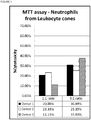
- Leukocyte cones from anonymous blood donors were selected and neutrophils were isolated by Ficoll-Hypaque separation ( Oh H, Siano B, Diamond S. Neutrophil Isolation Protocol. Journal of Visualized Experiments: JoVE. 2008;(17):745 ). These neutrophils were used in the aforementioned MTT assay in ratios of effector to target cell of 1:1, and 5:1.
- Figure 1 shows the percentage cytotoxicity recorded by MTT for the different donors. There is a difference between the donors at ratios 1:1 and 5:1. In conclusion, the MTT assay, is able to demonstrate differences in CKA between neutrophils from different donors.
- the resulting cultures were tested for neutrophil content using CD11b+ and CD15 markers by Fluorescence-activated cell sorting (FACS).
- FACS Fluorescence-activated cell sorting
- ROS Reactive Oxygen Specimens
- NBT nitroblue tetrazolium
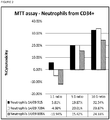
- Stem cell derived neutrophils (batches 008A, 709A and 915) were used as effector cells in the CKA MTT assay using HeLa target cells (see Example 9).
- the effector to target cell ratio is based on CD11b+/CD15+.
- Figure 2 The results are summarized in Figure 2 , which demonstrate that CD34+ stem cell derived neutrophils demonstrate cytotoxicity in a HeLa cell CKA assay and that the results are different between different donors.
- Batch 008A shows consistently lower cytotoxicity than batches 915 and 709A up to 10:1 effector to target ratio, despite being prepared at the same time as the other batches and cultured in the same way.
- stem cells from different donors can a) be differentiated in vitro to produce neutrophils that demonstrate cancer killing abilities, and b) that this cancer killing activity varies by the source donor.
- CKA cancer killing activity
- heparinized (20 U/ml) human blood is mixed with an equal volume of 3% Dextran T500 in saline and incubated for 30 minutes at room temperature to sediment erythrocytes.
- a 50 ml conical polypropylene tube is prepared with 10 ml sucrose 1.077 g/ml and slowly layered with a leukocyte-rich supernatant on top of the 1.077 g/ml sucrose layer prior to centrifuging at 400 x g for 30 minutes at room temperature without brake.
- the high-density neutrophils (HDN) appear in the pellet.
- Low-density neutrophils (LDN) co-purify with monocytes and lymphocytes at the interface between the 1.077 g/ml sucrose layer and plasma.
- the HDNs may be tested in a CKA assay described herein.
- Haematopoietic cells are suitably obtained from a donor having HDNs.
Landscapes
- Health & Medical Sciences (AREA)
- Life Sciences & Earth Sciences (AREA)
- Chemical & Material Sciences (AREA)
- General Health & Medical Sciences (AREA)
- Engineering & Computer Science (AREA)
- Animal Behavior & Ethology (AREA)
- Public Health (AREA)
- Veterinary Medicine (AREA)
- Immunology (AREA)
- Epidemiology (AREA)
- Medicinal Chemistry (AREA)
- Pharmacology & Pharmacy (AREA)
- Zoology (AREA)
- Biomedical Technology (AREA)
- Bioinformatics & Cheminformatics (AREA)
- Hematology (AREA)
- Biotechnology (AREA)
- Cell Biology (AREA)
- Organic Chemistry (AREA)
- Genetics & Genomics (AREA)
- Wood Science & Technology (AREA)
- Developmental Biology & Embryology (AREA)
- Gastroenterology & Hepatology (AREA)
- Proteomics, Peptides & Aminoacids (AREA)
- Biochemistry (AREA)
- Microbiology (AREA)
- Endocrinology (AREA)
- General Engineering & Computer Science (AREA)
- Virology (AREA)
- Urology & Nephrology (AREA)
- Molecular Biology (AREA)
- Nuclear Medicine, Radiotherapy & Molecular Imaging (AREA)
- Chemical Kinetics & Catalysis (AREA)
- General Chemical & Material Sciences (AREA)
- Food Science & Technology (AREA)
- Pathology (AREA)
- Physics & Mathematics (AREA)
- Analytical Chemistry (AREA)
- General Physics & Mathematics (AREA)
- Measuring Or Testing Involving Enzymes Or Micro-Organisms (AREA)
Priority Applications (1)
| Application Number | Priority Date | Filing Date | Title |
|---|---|---|---|
| EP21169745.3A EP3910056A1 (en) | 2016-10-26 | 2017-10-25 | Cancer-killing cells |
Applications Claiming Priority (2)
| Application Number | Priority Date | Filing Date | Title |
|---|---|---|---|
| GBGB1618106.7A GB201618106D0 (en) | 2016-10-26 | 2016-10-26 | Cancer-killing cells |
| PCT/GB2017/053222 WO2018078367A1 (en) | 2016-10-26 | 2017-10-25 | Cancer-killing cells |
Related Child Applications (2)
| Application Number | Title | Priority Date | Filing Date |
|---|---|---|---|
| EP21169745.3A Division EP3910056A1 (en) | 2016-10-26 | 2017-10-25 | Cancer-killing cells |
| EP21169745.3A Division-Into EP3910056A1 (en) | 2016-10-26 | 2017-10-25 | Cancer-killing cells |
Publications (2)
| Publication Number | Publication Date |
|---|---|
| EP3532609A1 EP3532609A1 (en) | 2019-09-04 |
| EP3532609B1 true EP3532609B1 (en) | 2021-06-02 |
Family
ID=57738294
Family Applications (3)
| Application Number | Title | Priority Date | Filing Date |
|---|---|---|---|
| EP17794046.7A Active EP3532609B1 (en) | 2016-10-26 | 2017-10-25 | Cancer-killing cells |
| EP21169745.3A Pending EP3910056A1 (en) | 2016-10-26 | 2017-10-25 | Cancer-killing cells |
| EP18720346.8A Pending EP3701012A1 (en) | 2016-10-26 | 2018-04-24 | Cancer-killing cells |
Family Applications After (2)
| Application Number | Title | Priority Date | Filing Date |
|---|---|---|---|
| EP21169745.3A Pending EP3910056A1 (en) | 2016-10-26 | 2017-10-25 | Cancer-killing cells |
| EP18720346.8A Pending EP3701012A1 (en) | 2016-10-26 | 2018-04-24 | Cancer-killing cells |
Country Status (11)
| Country | Link |
|---|---|
| US (5) | US11642373B2 (enExample) |
| EP (3) | EP3532609B1 (enExample) |
| JP (3) | JP7674102B2 (enExample) |
| CN (1) | CN111278968A (enExample) |
| AU (5) | AU2017349462B2 (enExample) |
| CA (1) | CA3115435A1 (enExample) |
| DK (1) | DK3532609T3 (enExample) |
| ES (1) | ES2886632T3 (enExample) |
| GB (1) | GB201618106D0 (enExample) |
| IL (4) | IL307836B2 (enExample) |
| WO (2) | WO2018078367A1 (enExample) |
Families Citing this family (4)
| Publication number | Priority date | Publication date | Assignee | Title |
|---|---|---|---|---|
| GB201618106D0 (en) | 2016-10-26 | 2016-12-07 | Lift Biosciences Ltd | Cancer-killing cells |
| CN115094112A (zh) * | 2022-06-06 | 2022-09-23 | 同济大学 | 一种抗癌效率、癌症进展与预后的标志物及方法 |
| WO2024189333A1 (en) * | 2023-03-10 | 2024-09-19 | Lift Biosciences Ltd | Immunomodulatory cells and compositions |
| WO2026062399A1 (en) | 2024-09-19 | 2026-03-26 | Lift Biosciences Ltd | Granulocytes and granulocyte precursors |
Family Cites Families (26)
| Publication number | Priority date | Publication date | Assignee | Title |
|---|---|---|---|---|
| IE920716A1 (en) | 1991-03-07 | 1992-09-09 | Gen Hospital Corp | Redirection of cellular immunity by receptor chimeras |
| WO1993018648A1 (en) | 1992-03-23 | 1993-09-30 | Baxter International Inc. | In vitro-derived human neutrophil precursor cells |
| AU687352B2 (en) | 1992-06-08 | 1998-02-26 | Gen-Probe Incorporated | Preparation of nucleic acid from mononuclear cells |
| US5846529A (en) | 1993-08-23 | 1998-12-08 | Nexell Therapeutics, Inc. | Infusion of neutrophil precursors for treatment of neutropenia |
| AU8078894A (en) | 1993-10-08 | 1995-05-04 | Cellpro Ii | Methods for collection and cryopreservation of human granulocytes |
| US5599705A (en) | 1993-11-16 | 1997-02-04 | Cameron; Robert B. | In vitro method for producing differentiated universally compatible mature human blood cells |
| US5733541A (en) | 1995-04-21 | 1998-03-31 | The Regent Of The University Of Michigan | Hematopoietic cells: compositions and methods |
| WO2002038189A1 (en) | 2000-11-09 | 2002-05-16 | Mayo Foundation For Medical Education And Research | Absolute lymphocyte recovery and cancer survival |
| US7498171B2 (en) | 2002-04-12 | 2009-03-03 | Anthrogenesis Corporation | Modulation of stem and progenitor cell differentiation, assays, and uses thereof |
| AU2002951082A0 (en) | 2002-08-30 | 2002-09-12 | The Corporation Of The Trustees Of The Order Of The Sisters Of Mercy In Queensland | Therapeutic cellular agents |
| JP2007509987A (ja) | 2003-10-31 | 2007-04-19 | スリーエム イノベイティブ プロパティズ カンパニー | 免疫応答調節剤化合物による好中球活性化 |
| ZA200704252B (en) * | 2004-10-25 | 2009-09-30 | Cellerant Therapeutics Inc | Methods of expanding myeloid cell populations and uses thereof |
| US7811815B2 (en) | 2004-11-15 | 2010-10-12 | The Board Of Trustees Of The Leland Stanford Junior University | Therapeutic uses of allogeneic myeloid progenitor cells |
| WO2008011664A1 (en) | 2006-07-24 | 2008-01-31 | The University Of Queensland | Method of producing a population of cells |
| US20080089875A1 (en) * | 2006-10-13 | 2008-04-17 | Zheng Cui | Methods and compositions for the treatment of cancer |
| RU2015102067A (ru) | 2009-03-05 | 2015-06-20 | Макрокьюэ, Лтд. | Активированная лейкоцитарная композиция |
| US9199028B2 (en) | 2010-01-15 | 2015-12-01 | Memorial Sloan-Kettering Cancer Center | Use of entrained neutrophils to treat metastatic and micrometastatic disease in at risk patients |
| WO2012075412A1 (en) | 2010-12-03 | 2012-06-07 | Michael Verneris | Generation of natural killer cells and lymphoid tissue inducer-like (lti-like) nk-22 cells |
| CN103215340A (zh) * | 2012-01-19 | 2013-07-24 | 江苏粒福特生物科技有限公司 | 一种新颖的粒细胞制备及其抗癌活性检测方法 |
| RU2603079C2 (ru) | 2015-03-16 | 2016-11-20 | Федеральное государственное бюджетное учреждение "Национальный медицинский исследовательский радиологический центр" Министерства здравоохранения Российской Федерации (ФГБУ "НМИРЦ" Минздрава России) | Способ активации цитотоксических лимфоцитов человека |
| EP4049665B1 (en) | 2016-03-15 | 2025-03-12 | The Children's Medical Center Corporation | Methods and compositions relating to hematopoietic stem cell expansion |
| GB201618106D0 (en) | 2016-10-26 | 2016-12-07 | Lift Biosciences Ltd | Cancer-killing cells |
| EP3743722A4 (en) | 2018-01-26 | 2022-03-02 | Agency for Science, Technology and Research | NEUTROPHIL SUBTYPES |
| CN110755449A (zh) | 2019-10-15 | 2020-02-07 | 南方科技大学 | 一种光调控嗜中性粒细胞在治疗癌症的药物中的应用 |
| GB201918313D0 (en) | 2019-12-12 | 2020-01-29 | Lift Biosciences Ltd | Cells for treating cancer |
| GB201918341D0 (en) | 2019-12-12 | 2020-01-29 | Lift Biosciences Ltd | Cells for treating infections |
-
2016
- 2016-10-26 GB GBGB1618106.7A patent/GB201618106D0/en not_active Ceased
-
2017
- 2017-10-25 AU AU2017349462A patent/AU2017349462B2/en active Active
- 2017-10-25 DK DK17794046.7T patent/DK3532609T3/da active
- 2017-10-25 US US16/345,366 patent/US11642373B2/en active Active
- 2017-10-25 EP EP17794046.7A patent/EP3532609B1/en active Active
- 2017-10-25 WO PCT/GB2017/053222 patent/WO2018078367A1/en not_active Ceased
- 2017-10-25 ES ES17794046T patent/ES2886632T3/es active Active
- 2017-10-25 EP EP21169745.3A patent/EP3910056A1/en active Pending
-
2018
- 2018-04-24 JP JP2020543405A patent/JP7674102B2/ja active Active
- 2018-04-24 WO PCT/GB2018/051073 patent/WO2019081879A1/en not_active Ceased
- 2018-04-24 CA CA3115435A patent/CA3115435A1/en active Pending
- 2018-04-24 AU AU2018356921A patent/AU2018356921B2/en active Active
- 2018-04-24 EP EP18720346.8A patent/EP3701012A1/en active Pending
- 2018-04-24 IL IL307836A patent/IL307836B2/en unknown
- 2018-04-24 IL IL274119A patent/IL274119B2/en unknown
- 2018-04-24 CN CN201880069094.4A patent/CN111278968A/zh active Pending
- 2018-04-24 IL IL322680A patent/IL322680A/en unknown
- 2018-04-24 IL IL316666A patent/IL316666B2/en unknown
- 2018-04-24 US US16/759,293 patent/US12070473B2/en active Active
-
2022
- 2022-02-09 AU AU2022200843A patent/AU2022200843C1/en active Active
-
2023
- 2023-01-27 JP JP2023011332A patent/JP2023052704A/ja active Pending
- 2023-03-24 US US18/189,826 patent/US12370216B2/en active Active
- 2023-11-17 US US18/512,933 patent/US20240197776A1/en active Pending
-
2024
- 2024-12-19 AU AU2024278621A patent/AU2024278621A1/en active Pending
-
2025
- 2025-03-27 JP JP2025054346A patent/JP2025114537A/ja active Pending
- 2025-07-02 US US19/257,953 patent/US20250325584A1/en active Pending
- 2025-07-21 AU AU2025205633A patent/AU2025205633A1/en active Pending
Non-Patent Citations (1)
| Title |
|---|
| None * |
Also Published As
Similar Documents
| Publication | Publication Date | Title |
|---|---|---|
| US12370216B2 (en) | Cancer-killing cells | |
| KR20090097964A (ko) | 단핵세포 증량 방법 | |
| TW201406955A (zh) | 免疫抑制細胞及其製造和使用方法 | |
| KR20230141668A (ko) | 항암 관련 유전자 발현이 조절된 자연살해세포 및 이의 제조방법 | |
| JP2025521032A (ja) | 高純度、高細胞毒活性nk細胞の体外誘導増幅方法 | |
| WO2023165573A1 (zh) | 用于激活整体抗肿瘤免疫系统的培养基配方物及制备激动剂激活的整体免疫效应细胞的方法 | |
| Lin et al. | Interleukin-15 enhances the expansion and function of natural killer T cells from adult peripheral and umbilical cord blood | |
| WO2024046355A1 (en) | Use of composition including mesenchymal stem cells for alleviating myelofibrosis | |
| KR102300846B1 (ko) | 면역 활성 개선용 조성물 및 이의 방법 | |
| TW202608458A (zh) | 癌症治療劑 | |
| US20240148788A1 (en) | New Treatment of Sepsis |
Legal Events
| Date | Code | Title | Description |
|---|---|---|---|
| STAA | Information on the status of an ep patent application or granted ep patent |
Free format text: STATUS: UNKNOWN |
|
| STAA | Information on the status of an ep patent application or granted ep patent |
Free format text: STATUS: THE INTERNATIONAL PUBLICATION HAS BEEN MADE |
|
| PUAI | Public reference made under article 153(3) epc to a published international application that has entered the european phase |
Free format text: ORIGINAL CODE: 0009012 |
|
| STAA | Information on the status of an ep patent application or granted ep patent |
Free format text: STATUS: REQUEST FOR EXAMINATION WAS MADE |
|
| 17P | Request for examination filed |
Effective date: 20190320 |
|
| AK | Designated contracting states |
Kind code of ref document: A1 Designated state(s): AL AT BE BG CH CY CZ DE DK EE ES FI FR GB GR HR HU IE IS IT LI LT LU LV MC MK MT NL NO PL PT RO RS SE SI SK SM TR |
|
| AX | Request for extension of the european patent |
Extension state: BA ME |
|
| STAA | Information on the status of an ep patent application or granted ep patent |
Free format text: STATUS: EXAMINATION IS IN PROGRESS |
|
| DAV | Request for validation of the european patent (deleted) | ||
| DAX | Request for extension of the european patent (deleted) | ||
| 17Q | First examination report despatched |
Effective date: 20200204 |
|
| REG | Reference to a national code |
Ref country code: DE Ref legal event code: R079 Ref document number: 602017039757 Country of ref document: DE Free format text: PREVIOUS MAIN CLASS: C12N0005078700 Ipc: A61K0031198000 |
|
| GRAP | Despatch of communication of intention to grant a patent |
Free format text: ORIGINAL CODE: EPIDOSNIGR1 |
|
| STAA | Information on the status of an ep patent application or granted ep patent |
Free format text: STATUS: GRANT OF PATENT IS INTENDED |
|
| RIC1 | Information provided on ipc code assigned before grant |
Ipc: A61K 31/59 20060101ALI20201111BHEP Ipc: A61K 31/198 20060101AFI20201111BHEP Ipc: A61K 38/27 20060101ALI20201111BHEP Ipc: A61K 35/15 20150101ALI20201111BHEP Ipc: A61K 38/20 20060101ALI20201111BHEP Ipc: A61K 38/19 20060101ALI20201111BHEP Ipc: G01N 33/574 20060101ALI20201111BHEP Ipc: A61P 35/00 20060101ALI20201111BHEP Ipc: A61K 35/28 20150101ALI20201111BHEP Ipc: A61K 31/202 20060101ALI20201111BHEP Ipc: C12N 5/0787 20100101ALI20201111BHEP Ipc: A61K 31/375 20060101ALI20201111BHEP |
|
| INTG | Intention to grant announced |
Effective date: 20201202 |
|
| GRAJ | Information related to disapproval of communication of intention to grant by the applicant or resumption of examination proceedings by the epo deleted |
Free format text: ORIGINAL CODE: EPIDOSDIGR1 |
|
| STAA | Information on the status of an ep patent application or granted ep patent |
Free format text: STATUS: EXAMINATION IS IN PROGRESS |
|
| INTC | Intention to grant announced (deleted) | ||
| GRAP | Despatch of communication of intention to grant a patent |
Free format text: ORIGINAL CODE: EPIDOSNIGR1 |
|
| STAA | Information on the status of an ep patent application or granted ep patent |
Free format text: STATUS: GRANT OF PATENT IS INTENDED |
|
| GRAS | Grant fee paid |
Free format text: ORIGINAL CODE: EPIDOSNIGR3 |
|
| GRAA | (expected) grant |
Free format text: ORIGINAL CODE: 0009210 |
|
| STAA | Information on the status of an ep patent application or granted ep patent |
Free format text: STATUS: THE PATENT HAS BEEN GRANTED |
|
| INTG | Intention to grant announced |
Effective date: 20210412 |
|
| REG | Reference to a national code |
Ref country code: CH Ref legal event code: EP |
|
| AK | Designated contracting states |
Kind code of ref document: B1 Designated state(s): AL AT BE BG CH CY CZ DE DK EE ES FI FR GB GR HR HU IE IS IT LI LT LU LV MC MK MT NL NO PL PT RO RS SE SI SK SM TR |
|
| REG | Reference to a national code |
Ref country code: GB Ref legal event code: FG4D |
|
| REG | Reference to a national code |
Ref country code: AT Ref legal event code: REF Ref document number: 1397784 Country of ref document: AT Kind code of ref document: T Effective date: 20210615 |
|
| REG | Reference to a national code |
Ref country code: DK Ref legal event code: T3 Effective date: 20210618 |
|
| REG | Reference to a national code |
Ref country code: IE Ref legal event code: FG4D |
|
| REG | Reference to a national code |
Ref country code: DE Ref legal event code: R096 Ref document number: 602017039757 Country of ref document: DE |
|
| REG | Reference to a national code |
Ref country code: SE Ref legal event code: TRGR |
|
| REG | Reference to a national code |
Ref country code: NL Ref legal event code: FP |
|
| REG | Reference to a national code |
Ref country code: LT Ref legal event code: MG9D |
|
| PG25 | Lapsed in a contracting state [announced via postgrant information from national office to epo] |
Ref country code: FI Free format text: LAPSE BECAUSE OF FAILURE TO SUBMIT A TRANSLATION OF THE DESCRIPTION OR TO PAY THE FEE WITHIN THE PRESCRIBED TIME-LIMIT Effective date: 20210602 Ref country code: LT Free format text: LAPSE BECAUSE OF FAILURE TO SUBMIT A TRANSLATION OF THE DESCRIPTION OR TO PAY THE FEE WITHIN THE PRESCRIBED TIME-LIMIT Effective date: 20210602 Ref country code: HR Free format text: LAPSE BECAUSE OF FAILURE TO SUBMIT A TRANSLATION OF THE DESCRIPTION OR TO PAY THE FEE WITHIN THE PRESCRIBED TIME-LIMIT Effective date: 20210602 Ref country code: BG Free format text: LAPSE BECAUSE OF FAILURE TO SUBMIT A TRANSLATION OF THE DESCRIPTION OR TO PAY THE FEE WITHIN THE PRESCRIBED TIME-LIMIT Effective date: 20210902 |
|
| REG | Reference to a national code |
Ref country code: AT Ref legal event code: MK05 Ref document number: 1397784 Country of ref document: AT Kind code of ref document: T Effective date: 20210602 |
|
| PG25 | Lapsed in a contracting state [announced via postgrant information from national office to epo] |
Ref country code: GR Free format text: LAPSE BECAUSE OF FAILURE TO SUBMIT A TRANSLATION OF THE DESCRIPTION OR TO PAY THE FEE WITHIN THE PRESCRIBED TIME-LIMIT Effective date: 20210903 Ref country code: RS Free format text: LAPSE BECAUSE OF FAILURE TO SUBMIT A TRANSLATION OF THE DESCRIPTION OR TO PAY THE FEE WITHIN THE PRESCRIBED TIME-LIMIT Effective date: 20210602 Ref country code: PL Free format text: LAPSE BECAUSE OF FAILURE TO SUBMIT A TRANSLATION OF THE DESCRIPTION OR TO PAY THE FEE WITHIN THE PRESCRIBED TIME-LIMIT Effective date: 20210602 Ref country code: LV Free format text: LAPSE BECAUSE OF FAILURE TO SUBMIT A TRANSLATION OF THE DESCRIPTION OR TO PAY THE FEE WITHIN THE PRESCRIBED TIME-LIMIT Effective date: 20210602 Ref country code: NO Free format text: LAPSE BECAUSE OF FAILURE TO SUBMIT A TRANSLATION OF THE DESCRIPTION OR TO PAY THE FEE WITHIN THE PRESCRIBED TIME-LIMIT Effective date: 20210902 |
|
| REG | Reference to a national code |
Ref country code: ES Ref legal event code: FG2A Ref document number: 2886632 Country of ref document: ES Kind code of ref document: T3 Effective date: 20211220 |
|
| PG25 | Lapsed in a contracting state [announced via postgrant information from national office to epo] |
Ref country code: SM Free format text: LAPSE BECAUSE OF FAILURE TO SUBMIT A TRANSLATION OF THE DESCRIPTION OR TO PAY THE FEE WITHIN THE PRESCRIBED TIME-LIMIT Effective date: 20210602 Ref country code: SK Free format text: LAPSE BECAUSE OF FAILURE TO SUBMIT A TRANSLATION OF THE DESCRIPTION OR TO PAY THE FEE WITHIN THE PRESCRIBED TIME-LIMIT Effective date: 20210602 Ref country code: AT Free format text: LAPSE BECAUSE OF FAILURE TO SUBMIT A TRANSLATION OF THE DESCRIPTION OR TO PAY THE FEE WITHIN THE PRESCRIBED TIME-LIMIT Effective date: 20210602 Ref country code: EE Free format text: LAPSE BECAUSE OF FAILURE TO SUBMIT A TRANSLATION OF THE DESCRIPTION OR TO PAY THE FEE WITHIN THE PRESCRIBED TIME-LIMIT Effective date: 20210602 Ref country code: CZ Free format text: LAPSE BECAUSE OF FAILURE TO SUBMIT A TRANSLATION OF THE DESCRIPTION OR TO PAY THE FEE WITHIN THE PRESCRIBED TIME-LIMIT Effective date: 20210602 Ref country code: PT Free format text: LAPSE BECAUSE OF FAILURE TO SUBMIT A TRANSLATION OF THE DESCRIPTION OR TO PAY THE FEE WITHIN THE PRESCRIBED TIME-LIMIT Effective date: 20211004 Ref country code: RO Free format text: LAPSE BECAUSE OF FAILURE TO SUBMIT A TRANSLATION OF THE DESCRIPTION OR TO PAY THE FEE WITHIN THE PRESCRIBED TIME-LIMIT Effective date: 20210602 |
|
| REG | Reference to a national code |
Ref country code: DE Ref legal event code: R097 Ref document number: 602017039757 Country of ref document: DE |
|
| PLBE | No opposition filed within time limit |
Free format text: ORIGINAL CODE: 0009261 |
|
| STAA | Information on the status of an ep patent application or granted ep patent |
Free format text: STATUS: NO OPPOSITION FILED WITHIN TIME LIMIT |
|
| 26N | No opposition filed |
Effective date: 20220303 |
|
| PG25 | Lapsed in a contracting state [announced via postgrant information from national office to epo] |
Ref country code: AL Free format text: LAPSE BECAUSE OF FAILURE TO SUBMIT A TRANSLATION OF THE DESCRIPTION OR TO PAY THE FEE WITHIN THE PRESCRIBED TIME-LIMIT Effective date: 20210602 |
|
| REG | Reference to a national code |
Ref country code: BE Ref legal event code: MM Effective date: 20211031 |
|
| PG25 | Lapsed in a contracting state [announced via postgrant information from national office to epo] |
Ref country code: MC Free format text: LAPSE BECAUSE OF FAILURE TO SUBMIT A TRANSLATION OF THE DESCRIPTION OR TO PAY THE FEE WITHIN THE PRESCRIBED TIME-LIMIT Effective date: 20210602 |
|
| PG25 | Lapsed in a contracting state [announced via postgrant information from national office to epo] |
Ref country code: LU Free format text: LAPSE BECAUSE OF NON-PAYMENT OF DUE FEES Effective date: 20211025 Ref country code: BE Free format text: LAPSE BECAUSE OF NON-PAYMENT OF DUE FEES Effective date: 20211031 |
|
| P01 | Opt-out of the competence of the unified patent court (upc) registered |
Effective date: 20230516 |
|
| PG25 | Lapsed in a contracting state [announced via postgrant information from national office to epo] |
Ref country code: CY Free format text: LAPSE BECAUSE OF FAILURE TO SUBMIT A TRANSLATION OF THE DESCRIPTION OR TO PAY THE FEE WITHIN THE PRESCRIBED TIME-LIMIT Effective date: 20210602 |
|
| PG25 | Lapsed in a contracting state [announced via postgrant information from national office to epo] |
Ref country code: HU Free format text: LAPSE BECAUSE OF FAILURE TO SUBMIT A TRANSLATION OF THE DESCRIPTION OR TO PAY THE FEE WITHIN THE PRESCRIBED TIME-LIMIT; INVALID AB INITIO Effective date: 20171025 |
|
| PG25 | Lapsed in a contracting state [announced via postgrant information from national office to epo] |
Ref country code: MK Free format text: LAPSE BECAUSE OF FAILURE TO SUBMIT A TRANSLATION OF THE DESCRIPTION OR TO PAY THE FEE WITHIN THE PRESCRIBED TIME-LIMIT Effective date: 20210602 |
|
| PG25 | Lapsed in a contracting state [announced via postgrant information from national office to epo] |
Ref country code: MT Free format text: LAPSE BECAUSE OF FAILURE TO SUBMIT A TRANSLATION OF THE DESCRIPTION OR TO PAY THE FEE WITHIN THE PRESCRIBED TIME-LIMIT Effective date: 20210602 |
|
| REG | Reference to a national code |
Ref country code: CH Ref legal event code: U11 Free format text: ST27 STATUS EVENT CODE: U-0-0-U10-U11 (AS PROVIDED BY THE NATIONAL OFFICE) Effective date: 20251101 |
|
| PGFP | Annual fee paid to national office [announced via postgrant information from national office to epo] |
Ref country code: NL Payment date: 20251020 Year of fee payment: 9 |
|
| PG25 | Lapsed in a contracting state [announced via postgrant information from national office to epo] |
Ref country code: TR Free format text: LAPSE BECAUSE OF FAILURE TO SUBMIT A TRANSLATION OF THE DESCRIPTION OR TO PAY THE FEE WITHIN THE PRESCRIBED TIME-LIMIT Effective date: 20210602 |
|
| PGFP | Annual fee paid to national office [announced via postgrant information from national office to epo] |
Ref country code: DE Payment date: 20251020 Year of fee payment: 9 |
|
| PGFP | Annual fee paid to national office [announced via postgrant information from national office to epo] |
Ref country code: GB Payment date: 20251016 Year of fee payment: 9 |
|
| PGFP | Annual fee paid to national office [announced via postgrant information from national office to epo] |
Ref country code: IT Payment date: 20251020 Year of fee payment: 9 Ref country code: DK Payment date: 20251023 Year of fee payment: 9 |
|
| PGFP | Annual fee paid to national office [announced via postgrant information from national office to epo] |
Ref country code: FR Payment date: 20251027 Year of fee payment: 9 |
|
| PGFP | Annual fee paid to national office [announced via postgrant information from national office to epo] |
Ref country code: SE Payment date: 20251020 Year of fee payment: 9 Ref country code: CH Payment date: 20251101 Year of fee payment: 9 |
|
| PGFP | Annual fee paid to national office [announced via postgrant information from national office to epo] |
Ref country code: IE Payment date: 20251020 Year of fee payment: 9 |
|
| PGFP | Annual fee paid to national office [announced via postgrant information from national office to epo] |
Ref country code: ES Payment date: 20251215 Year of fee payment: 9 |