EP3531697B1 - Imaging camera and multi-eye imaging device - Google Patents
Imaging camera and multi-eye imaging device Download PDFInfo
- Publication number
- EP3531697B1 EP3531697B1 EP17861330.3A EP17861330A EP3531697B1 EP 3531697 B1 EP3531697 B1 EP 3531697B1 EP 17861330 A EP17861330 A EP 17861330A EP 3531697 B1 EP3531697 B1 EP 3531697B1
- Authority
- EP
- European Patent Office
- Prior art keywords
- image pickup
- recess
- substrate
- holding member
- securing material
- Prior art date
- Legal status (The legal status is an assumption and is not a legal conclusion. Google has not performed a legal analysis and makes no representation as to the accuracy of the status listed.)
- Active
Links
Images




Classifications
-
- H—ELECTRICITY
- H04—ELECTRIC COMMUNICATION TECHNIQUE
- H04N—PICTORIAL COMMUNICATION, e.g. TELEVISION
- H04N13/00—Stereoscopic video systems; Multi-view video systems; Details thereof
- H04N13/20—Image signal generators
- H04N13/204—Image signal generators using stereoscopic image cameras
- H04N13/239—Image signal generators using stereoscopic image cameras using two two-dimensional [2D] image sensors having a relative position equal to or related to the interocular distance
-
- G—PHYSICS
- G02—OPTICS
- G02B—OPTICAL ELEMENTS, SYSTEMS OR APPARATUS
- G02B7/00—Mountings, adjusting means, or light-tight connections, for optical elements
- G02B7/02—Mountings, adjusting means, or light-tight connections, for optical elements for lenses
-
- G—PHYSICS
- G03—PHOTOGRAPHY; CINEMATOGRAPHY; ANALOGOUS TECHNIQUES USING WAVES OTHER THAN OPTICAL WAVES; ELECTROGRAPHY; HOLOGRAPHY
- G03B—APPARATUS OR ARRANGEMENTS FOR TAKING PHOTOGRAPHS OR FOR PROJECTING OR VIEWING THEM; APPARATUS OR ARRANGEMENTS EMPLOYING ANALOGOUS TECHNIQUES USING WAVES OTHER THAN OPTICAL WAVES; ACCESSORIES THEREFOR
- G03B19/00—Cameras
- G03B19/02—Still-picture cameras
- G03B19/04—Roll-film cameras
- G03B19/07—Roll-film cameras having more than one objective
-
- G—PHYSICS
- G03—PHOTOGRAPHY; CINEMATOGRAPHY; ANALOGOUS TECHNIQUES USING WAVES OTHER THAN OPTICAL WAVES; ELECTROGRAPHY; HOLOGRAPHY
- G03B—APPARATUS OR ARRANGEMENTS FOR TAKING PHOTOGRAPHS OR FOR PROJECTING OR VIEWING THEM; APPARATUS OR ARRANGEMENTS EMPLOYING ANALOGOUS TECHNIQUES USING WAVES OTHER THAN OPTICAL WAVES; ACCESSORIES THEREFOR
- G03B35/00—Stereoscopic photography
- G03B35/08—Stereoscopic photography by simultaneous recording
-
- H—ELECTRICITY
- H04—ELECTRIC COMMUNICATION TECHNIQUE
- H04N—PICTORIAL COMMUNICATION, e.g. TELEVISION
- H04N23/00—Cameras or camera modules comprising electronic image sensors; Control thereof
- H04N23/50—Constructional details
- H04N23/54—Mounting of pick-up tubes, electronic image sensors, deviation or focusing coils
-
- H—ELECTRICITY
- H04—ELECTRIC COMMUNICATION TECHNIQUE
- H04N—PICTORIAL COMMUNICATION, e.g. TELEVISION
- H04N23/00—Cameras or camera modules comprising electronic image sensors; Control thereof
- H04N23/50—Constructional details
- H04N23/55—Optical parts specially adapted for electronic image sensors; Mounting thereof
-
- H—ELECTRICITY
- H04—ELECTRIC COMMUNICATION TECHNIQUE
- H04N—PICTORIAL COMMUNICATION, e.g. TELEVISION
- H04N2213/00—Details of stereoscopic systems
- H04N2213/001—Constructional or mechanical details
Definitions
- the present invention relates to an image pickup camera and a multi-eye image pickup device, and relates to, for example, a coupling structure of a lens component and an image pickup element.
- PTL 1 JP 2014-179795 A discloses a solid-state image pickup device including a protruding portion on a wiring substrate. At a predetermined distance from an adhesion region between a holder and the wiring substrate, the protruding portion is formed along the adhesion region and adhesive for bonding the holder to the wiring substrate is applied to the protruding portion.
- PTL 2 JP 2008-191552 A discloses an adhesion connector for components to be mutually adhered, in which an end-edge portion of one component abuts to and adheres, with adhesive, to the other component. Each side in the thickness direction of the leading end of the end-edge portion has a recess formed thereon. An abutting protrusion between the recesses adheres to the other component with the adhesive, and the recess on each side houses an excess of the adhesive.
- the document JP 2007 110594 A discloses an image pickup device according to the preamble of claim 1.
- PTL 1 or PTL 2 discloses the configuration of an image pickup camera in which a holder holding a lens and a wiring substrate on which an image pickup element is mounted are secured with adhesive.
- adhesive for the configuration of the image pickup camera described in PTL 1 or PTL 2, there is a risk that occurrence of flowing or separating of securing material, such as the adhesive, during manufacturing may cause soiling of the image pickup element, a crack, or a reduction in adhesion strength.
- the present invention has been made in consideration of the problem, and an object of the present invention is to provide an image pickup camera and a multi-eye image pickup device that can inhibit the flowing of securing material from occurring during manufacturing.
- the invention proposes to solve the above problem by providing an image pickup camera according to claim 1.
- flowing of securing material can be inhibited from occurring during manufacturing.
- each embodiment including elemental steps
- constituent elements of each embodiment are not necessarily essential unless otherwise specified or obviously theoretically considered to be essential.
- shape and positional relationship of each constituent element in each embodiment unless otherwise specified or obviously theoretically contradicted, a shape substantially approximate to or similar to the shape thereof is included. This is applicable to the numerical value and the range, similarly.
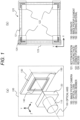
- FIG. 1(a) is a perspective view of an exemplary schematic configuration of an image pickup camera according to a first embodiment of the present invention
- FIG. 1(b) is a plan view of an exemplary structure of a holding member in FIG. 1(a)
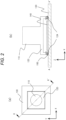
- FIG. 2(a) is a plan view of an exemplary outer shape of the image pickup camera of FIG. 1(a) that has been assembled
- FIG. 2(b) is a sectional view of an exemplary structure taken along line A-A' of FIG. 2(a) .
- the image pickup camera 100 illustrated in FIG. 1(a) includes an optical lens 110, the holding member 120, a substrate 130, an image pickup element 140, and securing material 150.
- the optical lens 110 is held and secured by the holding member 120, resulting in integration with the holding member 120.
- the substrate 130 has the image pickup element 140 mounted thereon, and the securing material 150 for securing the substrate 130 and the holding member 120 is applied on the periphery of the image pickup element 140 on the substrate 130.
- a representative example of the image pickup element 140 is a CMOS image sensor or a CCD image sensor.
- the holding member 120 has a bottom portion (coupling face) 121 that is a looped face opposed to the substrate 130 and that is secured to the substrate 130 through the securing material 150.
- One section in the loop direction of the bottom portion 121 includes a corner portion 122.
- the holding member 120 has a recess 124 open toward the image pickup element 140, at the corner portion 122.
- the bottom portion 121 includes four corner portions 122, and each of the four corner portions 122 is provided with the recess 124.
- the holding member 120 is secured to the substrate 130, through the securing material 150 in a state of surrounding the periphery of the image pickup element 140.
- the holding member 120 and the substrate 130 are secured such that the optical axis 160 of the optical lens 110 integrated with the holding member 120 is substantially perpendicular to the image pickup face of the image pickup element 140 and the focus of the optical lens 110 substantially agrees with the image pickup element 140.
- the securing material 150 in melt is applied to the substrate 130, and solidifies at a securing position determined between the holding member 120 and the substrate 130, resulting in securing of the holding member 120 and the substrate 130. It is considered that specific examples of the securing material 150 include any material that varies from melt to solidification, such as adhesive, resin, and solder.
- This arrangement enables the optical lens 110 to form visual information (subject image) acquired from outside, on the image pickup element 130, so that the image pickup camera 100 acquires an outside image.
- FIG. 3(a) is a perspective view of exemplary shapes of the recess and the securing material in the image pickup camera of FIGS. 1(a) and 1(b)
- FIG. 3(b) is an enlarged plan view of a part of FIG. 3(a)
- FIGS. 4(a) and 4 (b) illustrate a first comparative example of FIGS. 3(a) and 3(b) , respectively.
- FIGS. 5(a), 5(b), and 5(c) are sectional views for describing a mechanism for acquiring the shape of FIGS. 3(a) and 3(b) .
- the optical lens 110 and the image pickup element 140 has a positional relationship where the optical axis 160 of the optical lens 110 is perpendicular to the image pickup face of the image pickup element 140 and the focal position of the optical lens 110 agrees with the image pickup face of the image pickup element 140.
- the manufacturing process of the image pickup camera 100 includes a process of adjusting the positional relationship between the optical lens 110 and the image pickup element 140 and a process of solidifying the securing material 150 in melt at an adjusted position. As a result, desired optical performance is acquired.
- a holding member 120' with an optical lens, abutting on securing material 150 has no recess 124 at a corner portion 122, in some cases, the securing material 150 in melt accumulates at the corner portion of the holding member 120' due to surface tension. This phenomenon results from capillary action, and an inner wall located at the corner portion of the holding member 120' functions as a thin tube.
- Such a state causes, as illustrated in FIG. 4(b) , the securing material 150 that has accumulated at the corner portion, to flow and spread, resulting in adhesion of the securing material 150 to an image pickup element 140.
- the securing material 150 adhering thereto may cause soil of the image pickup element 140 or a crack due to thermal stress.
- the accumulation of the securing material 150 at the corner portion causes, in some cases, a reduction in the applied amount of the securing material 150 at side portions excluding the corner portion of the holding member 120'.
- occurrence of thinning or separating of the securing material 150 at the side portions of the holding member 120' may cause a reduction in securing strength.
- the holding member 120 in the image pickup camera 100 has the recess 124 open toward the image pickup element 140, at the corner portion.
- Such a structure causes a shape in which the securing material 150 at the corner portion is stored inside the recess 124, so that the securing material 150 is inhibited from accumulating not more than the capacity of the recess 124 at the corner portion.
- the securing material 150 is inhibited from flowing and spreading toward the image pickup element 140, so that the securing material 150 can be prevented from adhering to the image pickup element 140. Furthermore, the securing material 150 cannot accumulate at the corner portion greatly over the capacity of the recess 124. Thus, the securing material 150 is inhibited from reducing at the side portions, so that the securing material 150 can be prevented from thinning or separating.
- a mechanism of storing the securing material 150 at the corner portion inside the recess 124 can be described on the basis of the wetting and spreading behavior of the securing material 150 at the holding member 120.
- pressing the bottom portion (coupling face) 121 of the holding member 120 against the securing material 150 causes the recess 124 to suck the securing material 150 due to capillary action.
- the wetting shape of the securing material 150 is temporarily formed.
- the securing material 150 spreads wetly while generally keeping a wetting contact angle determined by the balance between the surface tension of the securing material 150, the surface tension of the holding member 120, and the interfacial tension between the securing material 150 and the holding member 120.
- the securing material 150 needs to spread wetly through the shape of the securing material 150 having a contact angle larger than that in the state of FIG. 5(b) .
- the size h2 in the height direction of the recess 124 is larger than the size h1 in the height direction of the securing material 150 that has been applied on the substrate 130. This is because, if the size h2 of the recess 124 is smaller than the size h1 of the securing material 150, there is a risk that the securing material 150 is likely to get over the edge EG1 at the instant when the holding member 120 is pressed against the securing material 150 as in FIG. 5(a) .
- FIG. 6(a) is a perspective view of an exemplary detailed structure of the holding member of FIG. 3(a)
- FIG. 6(b) is a perspective view of a second comparative example of FIG. 6(a)
- the recess 124 forms a space closed by a wall except for the side on which the image pickup element 140 is mounted.
- the recess 124 has the upper wall W1, side walls W2a and W2b, and a rear wall W3.
- the upper wall W1 is a wall intersecting with the perpendicular direction (Z-axis direction) of a face of the substrate 130.
- Each of the side walls W2a and W2b is a wall intersecting with the loop direction R of the bottom portion (coupling face) 121.
- the rear wall W3 is a wall intersecting with the direction from the inner circumferential side to the outer circumferential side of the bottom portion 121.
- the wetting of the securing material is deterred from getting over the edge EG1 of the upper wall W1 as described in FIG. 5(c) . Furthermore, because of a similar reason, the wetting of the securing material is deterred from getting over the edge EG2 of each of the side walls W2a and W2b.
- the two deterrents store the securing material inside the recess 124.
- flowing of the securing material 150 toward the image pickup element 140 can be inhibited from occurring during manufacturing. Furthermore, the securing material 150 is inhibited from reducing at the side portions, in accordance with the capacity of the recess 124, so that the securing material 150 can be prevented from thinning or separating. Prevention of the securing material 150 from thinning or separating, enables constant retention of the positional relationship between the holding member 120 (furthermore, the optical lens 110) and the substrate 130, and enables sufficient retention of the coupling strength between the holding member 120 and the substrate 130.
- FIG. 6(b) illustrates a holding member 120" having a recess, which is not limited to a corner portion, over the entire inner circumference of a bottom portion, differently from the structure of FIG. 6(a) .
- securing material spreads wetly in the recess from the corner portion as the starting point, similarly to the case of FIG. 4(a) .
- the edge EG1" of an upper wall W1" deters the wetting spread of the securing material, differently from the case of FIG. 4(a) .
- the side walls W2a and W2b each can catch, as tensile force, force in the perpendicular direction of the wall, as illustrated in FIG. 6(a) .
- the use of the structure of FIG. 6(a) allows, in some cases, further improvement of the coupling strength between the holding member 120 and the substrate 130 (particularly, shear strength) in comparison to the structure of FIG. 4(a) or the structure of FIG. 6(b) .
- FIG. 7(a) is a perspective view of an exemplary structure of the vicinity of a holding member in an image pickup camera according to a second embodiment of the present invention
- FIG. 7(b) is an enlarged plan view of a part of FIG. 7(a)
- the image pickup camera according to the second embodiment is different from the image pickup camera according to the first embodiment in terms of the shape of a recess 124 of the holding member 120.
- the recess 124 provided at a corner portion 122 forms a tunnel-like space penetrating between the inner circumference and the outer circumference of a looped bottom portion (coupling face) 121, with the holding member 120 secured to a substrate 130.
- the image pickup camera according to the second embodiment enables acquisition of a similar effect to that according to the first embodiment, and additionally causes securing material 150 to have more difficulty in accumulating on the image pickup element 140 side of the corner portion 124 in comparison to the case according to the first embodiment.
- the securing material 150 can be further inhibited from flowing and spreading toward the image pickup element 140. Note that, for example, depending on the quality of the securing material 150, external light possibly leaks toward the image pickup element 140 through the recess 124. Thus, from this point, the structure according to the first embodiment is preferable.
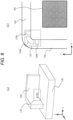
- FIG. 8(a) is a perspective view of an exemplary structure of the vicinity of a holding member in an image pickup camera according to a third embodiment of the present invention
- FIG. 8(b) is an enlarged plan view of a part of FIG. 8(a)
- the image pickup camera according to the third embodiment is different from the image pickup camera according to the first embodiment in that, as illustrated in FIGS. 8(a) and 8(b) , a plurality of recesses 124a, 124b, and 124c (here, three recesses) is provided at a corner portion 122 of the holding member 120.
- a recess 124 provided at the corner portion as illustrated in FIGS. 3(a) and 3(b) , functions as a capillary that sucks the securing material 150, and serves to confine the securing material 150 sucked, inside the recess 124.
- the capacity of the recess 124 is determined in consideration of, for example, how much of the total amount of the securing material 150 should be distributed to the side portions.
- the recess 124 requires increasing in capacity, for example, the interval between the side walls W2a and W2b illustrated in FIG. 6(a) requires widening.
- the recess 124 functions as a thick capillary.
- the suction force for the securing material 150 may be weakened, and additionally the confining force for the securing material 150 sucked inside the recess 124 may also be weakened.
- the provision of the plurality of recesses 124a, 124b, and 124c at the one corner portion 122 is advantageous.
- each of the recesses 124a, 124b, and 124c functioning as a thin capillary strongly sucks securing material 150, and additionally can confine the securing material 150 sucked inside the recess due to strong force.
- the image pickup camera according to the third embodiment enables acquisition of a similar effect to that according to the first embodiment, and additionally causes the plurality of recesses to actively to suck the securing material 150 due to capillary action and store the securing material 150 inside, in comparison to the case according to the first embodiment.
- the securing material 150 can be further inhibited from flowing and spreading toward an image pickup element 140. Even a case where the entire capacity of the recesses requires increasing to some extent can be handled, resulting in further improvement of the degree of freedom in determination of the capacity of the recesses.
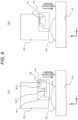
- FIGS. 9(a) and 9(b) are respectively sectional views of an exemplary structure of the vicinity of a holding member in an image pickup camera according to a fourth embodiment of the present invention.
- the image pickup camera according to the fourth embodiment is different from the image pickup camera according to the first embodiment in terms of the shape of a recess 124 of the holding member 120.
- FIGS. 9(a) and 9(b) illustrate that the recess 124 is further provided with a second recess 125.
- the recess 124 and the second recess 125 form a stepwise stage when viewed on a plane (XZ plane) in the perpendicular direction of a face of a substrate 130.
- the provision of the second recess 125 causes stepwise disposition of upper walls W11 and W12 and edges EG11 and EG12.
- the edge EG12 can deter the wetting of the securing material.
- FIG. 10 is a perspective view of an exemplary schematic configuration of a multi-eye image pickup device according to a fifth embodiment of the present invention.
- the multi-eye image pickup device 400 illustrated in FIG. 10 includes an image pickup camera 100, a second image pickup camera 200, and a casing 300.
- the second image pickup camera 200 has a structure equivalent to that of the image pickup camera 100.
- the casing 300 secures the image pickup camera 100 and the second image pickup camera 200 at positions separated by a predetermined distance such that the respective optical axes 160 of the image pickup camera 100 and the second image pickup camera 200 are substantially parallel.
- the multi-eye image pickup device 400 detects identical points between respective images acquired by the image pickup camera 100 and the second image pickup camera 200 and combines both of the images, to generate a range image including outside three-dimensional information.
- the respective optical characteristics of the image pickup cameras include in the multi-eye image pickup device 400 are preferably identical.
- An example of the optical characteristic of each image pickup camera related to the acquisition of the range information is the response characteristic of a focal position to temperature (hereinafter, referred to as a defocus temperature characteristic).
- a defocus temperature characteristic For example, in a case where there is a large difference between the respective defocus temperature characteristics of the image pickup cameras included in the multi-eye image pickup device 400, a variation occurs in resolution between respective images acquired by the image pickup cameras when the outside temperature varies. Such a state causes the multi-eye image pickup device 400 to have difficulty in detecting identical points between the respective images acquired by the image pickup cameras, resulting in deterioration in accuracy of calculating a range in a generated range image.
- the optical characteristic such as the defocus temperature characteristic, depends on the structure or configuration of an optical lens, a holding member, securing material, an image pickup element, and a substrate included in the image pickup camera.
- the securing material applied in melt during manufacturing accumulates at a corner portion of the holding member and causes a variation in shape.
- the securing material is a main factor for a variation in optical characteristic.
- FIG. 11 is a sectional view of an exemplary schematic structure of the multi-eye image pickup device of FIG. 10
- FIG. 12 is a sectional view of a comparative example of FIG. 11
- each of an image pickup camera 100' and a second image pickup camera 200' includes the holding member 120' illustrated in FIGS. 4(a) and 4(b) . In this case, as illustrated in FIG.
- the respective optical axes 160 of the image pickup camera 100' and the second image pickup camera 200' are not parallel, resulting in an event in which the positional relationship between an optical lens 110 and an image pickup element 140 of the image pickup camera 100' is different from the positional relationship between an optical lens 110 and an image pickup element 140 of the second image pickup camera 200'.
- the image pickup element 140 in one of the two image pickup cameras is available for focusing, and it may be difficult to detect identical points between respective images acquired by the image pickup cameras.
- the example of FIG. 12 indicates the image pickup camera 100' having a difference in the accumulation amount of securing material 150 between two corner portions due to occurrence of misalignment during pressing the holding member 120' against the securing material 150.
- the difference causes, in some cases, for example, that the amount of the securing material 150 at side portions of the holding member 120' is different every side portion.
- the optical axis 160 may incline.
- the difference in the accumulation amount of securing material 150 between the two corner portions causes, in some cases, adhesion force at the two corner portions to vary along with outside temperature. As a result, even if the optical axis 160 has no inclination during manufacturing, the optical axis 160 may incline along with a variation in outside temperature.
- use of the multi-eye image pickup device enables, as described in each embodiment, substantially constant retention of the accumulation amount of securing material 150 at each corner portion, in accordance with the capacity of a recess 124.
- This arrangement enables substantially constant retention of the amount of the securing material 150 at side portions of each holding member 120, at each side portion, and enables substantially constant retention of adhesion force at each corner portion regardless of outside temperature.
- the optical axes 160 of the image pickup camera 100 and the second image pickup camera 200 can be retained in parallel, so that identical points between respective images acquired by the image pickup cameras can be detected easily.
- the use of the multi-eye image pickup device according to the fifth embodiment enables acquisition of a similar effect to those according to the first to fourth embodiments, and additionally enables inhibition of a variation in the shape of the securing material in each image pickup camera.
- the range calculating accuracy of the multi-eye image pickup device can be prevented from deteriorating due to a factor, such as a variation in temperature.
- the planar shape formed with the inner circumference of the bottom portion (coupling face) of the holding member is a quadrangle having four corner portions.
- the planar shape is not limited to the quadrangle, and is required at least to have a shape having at least one corner portion.
- the corner portion has two lines intersecting at an angle of ⁇ (0 ⁇ ⁇ ⁇ 180°).
Landscapes
- Physics & Mathematics (AREA)
- General Physics & Mathematics (AREA)
- Engineering & Computer Science (AREA)
- Multimedia (AREA)
- Signal Processing (AREA)
- Optics & Photonics (AREA)
- Lens Barrels (AREA)
- Studio Devices (AREA)
- Stereoscopic And Panoramic Photography (AREA)
- Cameras In General (AREA)
- Transforming Light Signals Into Electric Signals (AREA)
Applications Claiming Priority (2)
| Application Number | Priority Date | Filing Date | Title |
|---|---|---|---|
| JP2016206790A JP6535646B2 (ja) | 2016-10-21 | 2016-10-21 | 撮像カメラおよび多眼撮像装置 |
| PCT/JP2017/035786 WO2018074204A1 (ja) | 2016-10-21 | 2017-10-02 | 撮像カメラおよび多眼撮像装置 |
Publications (3)
| Publication Number | Publication Date |
|---|---|
| EP3531697A1 EP3531697A1 (en) | 2019-08-28 |
| EP3531697A4 EP3531697A4 (en) | 2020-08-26 |
| EP3531697B1 true EP3531697B1 (en) | 2025-06-18 |
Family
ID=62018452
Family Applications (1)
| Application Number | Title | Priority Date | Filing Date |
|---|---|---|---|
| EP17861330.3A Active EP3531697B1 (en) | 2016-10-21 | 2017-10-02 | Imaging camera and multi-eye imaging device |
Country Status (3)
| Country | Link |
|---|---|
| EP (1) | EP3531697B1 (enExample) |
| JP (1) | JP6535646B2 (enExample) |
| WO (1) | WO2018074204A1 (enExample) |
Families Citing this family (1)
| Publication number | Priority date | Publication date | Assignee | Title |
|---|---|---|---|---|
| JP2019208190A (ja) * | 2018-05-30 | 2019-12-05 | 日本電産コパル株式会社 | 撮像装置 |
Citations (1)
| Publication number | Priority date | Publication date | Assignee | Title |
|---|---|---|---|---|
| JP2008153720A (ja) * | 2006-12-14 | 2008-07-03 | Hitachi Maxell Ltd | カメラモジュール及び撮像装置 |
Family Cites Families (7)
| Publication number | Priority date | Publication date | Assignee | Title |
|---|---|---|---|---|
| JP2006086672A (ja) * | 2004-09-15 | 2006-03-30 | Nidec Copal Corp | 撮像モジュール |
| JP2007110594A (ja) * | 2005-10-17 | 2007-04-26 | Hitachi Maxell Ltd | カメラモジュール |
| JP2009224857A (ja) * | 2008-03-13 | 2009-10-01 | Hitachi Maxell Ltd | カメラモジュール及び撮像装置 |
| JP2012155102A (ja) * | 2011-01-25 | 2012-08-16 | Sharp Corp | ステレオカメラユニットおよびその製造方法、電子情報機器 |
| JP5296130B2 (ja) * | 2011-03-22 | 2013-09-25 | シャープ株式会社 | 光学モジュール及び光学モジュールの製造方法 |
| DE102012106834A1 (de) * | 2012-07-27 | 2014-01-30 | Conti Temic Microelectronic Gmbh | Verfahren zur Ausrichtung zweier Bildaufnahmeelemente eines Stereokamerasystems |
| US10009523B2 (en) * | 2015-05-11 | 2018-06-26 | Samsung Electro-Mechanics Co., Ltd. | Electronic module and method of manufacturing the same |
-
2016
- 2016-10-21 JP JP2016206790A patent/JP6535646B2/ja active Active
-
2017
- 2017-10-02 EP EP17861330.3A patent/EP3531697B1/en active Active
- 2017-10-02 WO PCT/JP2017/035786 patent/WO2018074204A1/ja not_active Ceased
Patent Citations (1)
| Publication number | Priority date | Publication date | Assignee | Title |
|---|---|---|---|---|
| JP2008153720A (ja) * | 2006-12-14 | 2008-07-03 | Hitachi Maxell Ltd | カメラモジュール及び撮像装置 |
Also Published As
| Publication number | Publication date |
|---|---|
| EP3531697A4 (en) | 2020-08-26 |
| JP6535646B2 (ja) | 2019-06-26 |
| EP3531697A1 (en) | 2019-08-28 |
| JP2018067869A (ja) | 2018-04-26 |
| WO2018074204A1 (ja) | 2018-04-26 |
Similar Documents
| Publication | Publication Date | Title |
|---|---|---|
| US9866735B2 (en) | Camera module | |
| US11606485B2 (en) | Vehicular camera with controlled camera focus | |
| CN105074564B (zh) | 摄像头单元、车辆及摄像头单元的制造方法 | |
| US20150370086A1 (en) | Optical device | |
| CN113848625A (zh) | 驱动机构 | |
| TWI743429B (zh) | 基於一體封裝工藝的攝像模組及其一體基座組件和製造方法 | |
| JP2019522935A (ja) | 感光性アセンブリとカメラモジュール及びその製造方法 | |
| US20190174044A1 (en) | Imaging element driving device, method for manufacturing imaging element driving device, and imaging device | |
| WO2012032934A1 (ja) | 撮像ユニット、該撮像ユニットを具備する内視鏡先端部 | |
| TW571173B (en) | Image capture device | |
| US20170272642A1 (en) | Phase-Detection Auto-Focus Pixel Array And Associated Imaging System | |
| EP3531697A1 (en) | Imaging camera and multi-eye imaging device | |
| US10007137B2 (en) | Optical device package | |
| JP5296130B2 (ja) | 光学モジュール及び光学モジュールの製造方法 | |
| US20140113399A1 (en) | Manufacturing method of solid-state imaging apparatus, solid-state imaging apparatus, and electronic imaging apparatus | |
| US20250071405A1 (en) | Camera module and vehicle comprising same | |
| JP4292130B2 (ja) | 遮光部材、撮像装置および遮光部材の製造方法 | |
| US8502915B2 (en) | Imaging device | |
| JP4407339B2 (ja) | 撮像装置 | |
| JP5166969B2 (ja) | レンズ組立体および撮像装置 | |
| US9578215B2 (en) | Event data recorder | |
| JP4282383B2 (ja) | 光学機器 | |
| JP2007194272A (ja) | 撮像モジュール | |
| JP2007194271A (ja) | 撮像素子の実装構造 | |
| JP2000307907A (ja) | 撮像装置および写真撮影装置 |
Legal Events
| Date | Code | Title | Description |
|---|---|---|---|
| STAA | Information on the status of an ep patent application or granted ep patent |
Free format text: STATUS: THE INTERNATIONAL PUBLICATION HAS BEEN MADE |
|
| PUAI | Public reference made under article 153(3) epc to a published international application that has entered the european phase |
Free format text: ORIGINAL CODE: 0009012 |
|
| STAA | Information on the status of an ep patent application or granted ep patent |
Free format text: STATUS: REQUEST FOR EXAMINATION WAS MADE |
|
| 17P | Request for examination filed |
Effective date: 20190417 |
|
| AK | Designated contracting states |
Kind code of ref document: A1 Designated state(s): AL AT BE BG CH CY CZ DE DK EE ES FI FR GB GR HR HU IE IS IT LI LT LU LV MC MK MT NL NO PL PT RO RS SE SI SK SM TR |
|
| AX | Request for extension of the european patent |
Extension state: BA ME |
|
| DAV | Request for validation of the european patent (deleted) | ||
| DAX | Request for extension of the european patent (deleted) | ||
| RIC1 | Information provided on ipc code assigned before grant |
Ipc: H04N 5/225 20060101ALI20200324BHEP Ipc: H04N 13/20 20180101AFI20200324BHEP |
|
| A4 | Supplementary search report drawn up and despatched |
Effective date: 20200723 |
|
| RIC1 | Information provided on ipc code assigned before grant |
Ipc: H04N 5/225 20060101ALI20200718BHEP Ipc: H04N 13/239 20180101ALI20200718BHEP Ipc: H04N 13/20 20180101AFI20200718BHEP |
|
| RAP3 | Party data changed (applicant data changed or rights of an application transferred) |
Owner name: HITACHI ASTEMO, LTD. |
|
| STAA | Information on the status of an ep patent application or granted ep patent |
Free format text: STATUS: EXAMINATION IS IN PROGRESS |
|
| 17Q | First examination report despatched |
Effective date: 20220317 |
|
| REG | Reference to a national code |
Ref country code: DE Ref legal event code: R079 Free format text: PREVIOUS MAIN CLASS: H04N0013200000 Ipc: H04N0023500000 Ref document number: 602017090053 Country of ref document: DE |
|
| GRAP | Despatch of communication of intention to grant a patent |
Free format text: ORIGINAL CODE: EPIDOSNIGR1 |
|
| STAA | Information on the status of an ep patent application or granted ep patent |
Free format text: STATUS: GRANT OF PATENT IS INTENDED |
|
| INTG | Intention to grant announced |
Effective date: 20250318 |
|
| RIC1 | Information provided on ipc code assigned before grant |
Ipc: H04N 23/50 20230101AFI20250307BHEP |
|
| GRAS | Grant fee paid |
Free format text: ORIGINAL CODE: EPIDOSNIGR3 |
|
| GRAA | (expected) grant |
Free format text: ORIGINAL CODE: 0009210 |
|
| STAA | Information on the status of an ep patent application or granted ep patent |
Free format text: STATUS: THE PATENT HAS BEEN GRANTED |
|
| AK | Designated contracting states |
Kind code of ref document: B1 Designated state(s): AL AT BE BG CH CY CZ DE DK EE ES FI FR GB GR HR HU IE IS IT LI LT LU LV MC MK MT NL NO PL PT RO RS SE SI SK SM TR |
|
| REG | Reference to a national code |
Ref country code: GB Ref legal event code: FG4D |
|
| RIN1 | Information on inventor provided before grant (corrected) |
Inventor name: KUDO, HIROYUKI Inventor name: TAKEUCHI, KENICHI Inventor name: SHINOHARA, HIDENORI Inventor name: YAMAGUCHI, AKIHIRO |
|
| REG | Reference to a national code |
Ref country code: CH Ref legal event code: EP |
|
| REG | Reference to a national code |
Ref country code: DE Ref legal event code: R096 Ref document number: 602017090053 Country of ref document: DE |
|
| REG | Reference to a national code |
Ref country code: CH Ref legal event code: EP |
|
| REG | Reference to a national code |
Ref country code: IE Ref legal event code: FG4D |
|
| PG25 | Lapsed in a contracting state [announced via postgrant information from national office to epo] |
Ref country code: FI Free format text: LAPSE BECAUSE OF FAILURE TO SUBMIT A TRANSLATION OF THE DESCRIPTION OR TO PAY THE FEE WITHIN THE PRESCRIBED TIME-LIMIT Effective date: 20250618 |
|
| REG | Reference to a national code |
Ref country code: LT Ref legal event code: MG9D |
|
| PG25 | Lapsed in a contracting state [announced via postgrant information from national office to epo] |
Ref country code: GR Free format text: LAPSE BECAUSE OF FAILURE TO SUBMIT A TRANSLATION OF THE DESCRIPTION OR TO PAY THE FEE WITHIN THE PRESCRIBED TIME-LIMIT Effective date: 20250919 Ref country code: NO Free format text: LAPSE BECAUSE OF FAILURE TO SUBMIT A TRANSLATION OF THE DESCRIPTION OR TO PAY THE FEE WITHIN THE PRESCRIBED TIME-LIMIT Effective date: 20250918 |
|
| PG25 | Lapsed in a contracting state [announced via postgrant information from national office to epo] |
Ref country code: BG Free format text: LAPSE BECAUSE OF FAILURE TO SUBMIT A TRANSLATION OF THE DESCRIPTION OR TO PAY THE FEE WITHIN THE PRESCRIBED TIME-LIMIT Effective date: 20250618 |
|
| PG25 | Lapsed in a contracting state [announced via postgrant information from national office to epo] |
Ref country code: HR Free format text: LAPSE BECAUSE OF FAILURE TO SUBMIT A TRANSLATION OF THE DESCRIPTION OR TO PAY THE FEE WITHIN THE PRESCRIBED TIME-LIMIT Effective date: 20250618 |
|
| PG25 | Lapsed in a contracting state [announced via postgrant information from national office to epo] |
Ref country code: RS Free format text: LAPSE BECAUSE OF FAILURE TO SUBMIT A TRANSLATION OF THE DESCRIPTION OR TO PAY THE FEE WITHIN THE PRESCRIBED TIME-LIMIT Effective date: 20250918 |
|
| REG | Reference to a national code |
Ref country code: NL Ref legal event code: MP Effective date: 20250618 |
|
| PG25 | Lapsed in a contracting state [announced via postgrant information from national office to epo] |
Ref country code: LV Free format text: LAPSE BECAUSE OF FAILURE TO SUBMIT A TRANSLATION OF THE DESCRIPTION OR TO PAY THE FEE WITHIN THE PRESCRIBED TIME-LIMIT Effective date: 20250618 |
|
| PG25 | Lapsed in a contracting state [announced via postgrant information from national office to epo] |
Ref country code: NL Free format text: LAPSE BECAUSE OF FAILURE TO SUBMIT A TRANSLATION OF THE DESCRIPTION OR TO PAY THE FEE WITHIN THE PRESCRIBED TIME-LIMIT Effective date: 20250618 |
|
| PG25 | Lapsed in a contracting state [announced via postgrant information from national office to epo] |
Ref country code: PT Free format text: LAPSE BECAUSE OF FAILURE TO SUBMIT A TRANSLATION OF THE DESCRIPTION OR TO PAY THE FEE WITHIN THE PRESCRIBED TIME-LIMIT Effective date: 20251020 |
|
| REG | Reference to a national code |
Ref country code: AT Ref legal event code: MK05 Ref document number: 1805292 Country of ref document: AT Kind code of ref document: T Effective date: 20250618 |
|
| PG25 | Lapsed in a contracting state [announced via postgrant information from national office to epo] |
Ref country code: IS Free format text: LAPSE BECAUSE OF FAILURE TO SUBMIT A TRANSLATION OF THE DESCRIPTION OR TO PAY THE FEE WITHIN THE PRESCRIBED TIME-LIMIT Effective date: 20251018 |
|
| PGFP | Annual fee paid to national office [announced via postgrant information from national office to epo] |
Ref country code: DE Payment date: 20251021 Year of fee payment: 9 |
|
| PG25 | Lapsed in a contracting state [announced via postgrant information from national office to epo] |
Ref country code: AT Free format text: LAPSE BECAUSE OF FAILURE TO SUBMIT A TRANSLATION OF THE DESCRIPTION OR TO PAY THE FEE WITHIN THE PRESCRIBED TIME-LIMIT Effective date: 20250618 Ref country code: SM Free format text: LAPSE BECAUSE OF FAILURE TO SUBMIT A TRANSLATION OF THE DESCRIPTION OR TO PAY THE FEE WITHIN THE PRESCRIBED TIME-LIMIT Effective date: 20250618 |
|
| PG25 | Lapsed in a contracting state [announced via postgrant information from national office to epo] |
Ref country code: CZ Free format text: LAPSE BECAUSE OF FAILURE TO SUBMIT A TRANSLATION OF THE DESCRIPTION OR TO PAY THE FEE WITHIN THE PRESCRIBED TIME-LIMIT Effective date: 20250618 |
|
| PG25 | Lapsed in a contracting state [announced via postgrant information from national office to epo] |
Ref country code: PL Free format text: LAPSE BECAUSE OF FAILURE TO SUBMIT A TRANSLATION OF THE DESCRIPTION OR TO PAY THE FEE WITHIN THE PRESCRIBED TIME-LIMIT Effective date: 20250618 |
|
| PG25 | Lapsed in a contracting state [announced via postgrant information from national office to epo] |
Ref country code: EE Free format text: LAPSE BECAUSE OF FAILURE TO SUBMIT A TRANSLATION OF THE DESCRIPTION OR TO PAY THE FEE WITHIN THE PRESCRIBED TIME-LIMIT Effective date: 20250618 |
|
| PG25 | Lapsed in a contracting state [announced via postgrant information from national office to epo] |
Ref country code: SK Free format text: LAPSE BECAUSE OF FAILURE TO SUBMIT A TRANSLATION OF THE DESCRIPTION OR TO PAY THE FEE WITHIN THE PRESCRIBED TIME-LIMIT Effective date: 20250618 Ref country code: RO Free format text: LAPSE BECAUSE OF FAILURE TO SUBMIT A TRANSLATION OF THE DESCRIPTION OR TO PAY THE FEE WITHIN THE PRESCRIBED TIME-LIMIT Effective date: 20250618 |
|
| PG25 | Lapsed in a contracting state [announced via postgrant information from national office to epo] |
Ref country code: ES Free format text: LAPSE BECAUSE OF FAILURE TO SUBMIT A TRANSLATION OF THE DESCRIPTION OR TO PAY THE FEE WITHIN THE PRESCRIBED TIME-LIMIT Effective date: 20250618 |
|
| REG | Reference to a national code |
Ref country code: DE Ref legal event code: R097 Ref document number: 602017090053 Country of ref document: DE |
|
| PG25 | Lapsed in a contracting state [announced via postgrant information from national office to epo] |
Ref country code: DK Free format text: LAPSE BECAUSE OF FAILURE TO SUBMIT A TRANSLATION OF THE DESCRIPTION OR TO PAY THE FEE WITHIN THE PRESCRIBED TIME-LIMIT Effective date: 20250618 |
|
| PG25 | Lapsed in a contracting state [announced via postgrant information from national office to epo] |
Ref country code: IT Free format text: LAPSE BECAUSE OF FAILURE TO SUBMIT A TRANSLATION OF THE DESCRIPTION OR TO PAY THE FEE WITHIN THE PRESCRIBED TIME-LIMIT Effective date: 20250618 |
|
| PLBE | No opposition filed within time limit |
Free format text: ORIGINAL CODE: 0009261 |
|
| STAA | Information on the status of an ep patent application or granted ep patent |
Free format text: STATUS: NO OPPOSITION FILED WITHIN TIME LIMIT |
|
| REG | Reference to a national code |
Ref country code: CH Ref legal event code: L10 Free format text: ST27 STATUS EVENT CODE: U-0-0-L10-L00 (AS PROVIDED BY THE NATIONAL OFFICE) Effective date: 20260430 |
|
| 26N | No opposition filed |
Effective date: 20260319 |
|
| REG | Reference to a national code |
Ref country code: CH Ref legal event code: H13 Free format text: ST27 STATUS EVENT CODE: U-0-0-H10-H13 (AS PROVIDED BY THE NATIONAL OFFICE) Effective date: 20260527 |
|
| PG25 | Lapsed in a contracting state [announced via postgrant information from national office to epo] |
Ref country code: LU Free format text: LAPSE BECAUSE OF NON-PAYMENT OF DUE FEES Effective date: 20251002 |
|
| REG | Reference to a national code |
Ref country code: BE Ref legal event code: MM Effective date: 20251031 |
|
| GBPC | Gb: european patent ceased through non-payment of renewal fee |
Effective date: 20251002 |
|
| PG25 | Lapsed in a contracting state [announced via postgrant information from national office to epo] |
Ref country code: LT Free format text: LAPSE BECAUSE OF FAILURE TO SUBMIT A TRANSLATION OF THE DESCRIPTION OR TO PAY THE FEE WITHIN THE PRESCRIBED TIME-LIMIT Effective date: 20250618 |
|
| PG25 | Lapsed in a contracting state [announced via postgrant information from national office to epo] |
Ref country code: MC Free format text: LAPSE BECAUSE OF FAILURE TO SUBMIT A TRANSLATION OF THE DESCRIPTION OR TO PAY THE FEE WITHIN THE PRESCRIBED TIME-LIMIT Effective date: 20250618 |
|
| PG25 | Lapsed in a contracting state [announced via postgrant information from national office to epo] |
Ref country code: GB Free format text: LAPSE BECAUSE OF NON-PAYMENT OF DUE FEES Effective date: 20251002 |
|
| PG25 | Lapsed in a contracting state [announced via postgrant information from national office to epo] |
Ref country code: BE Free format text: LAPSE BECAUSE OF NON-PAYMENT OF DUE FEES Effective date: 20251031 Ref country code: CH Free format text: LAPSE BECAUSE OF NON-PAYMENT OF DUE FEES Effective date: 20251031 |
|
| PG25 | Lapsed in a contracting state [announced via postgrant information from national office to epo] |
Ref country code: FR Free format text: LAPSE BECAUSE OF NON-PAYMENT OF DUE FEES Effective date: 20251031 |
|
| PG25 | Lapsed in a contracting state [announced via postgrant information from national office to epo] |
Ref country code: SE Free format text: LAPSE BECAUSE OF FAILURE TO SUBMIT A TRANSLATION OF THE DESCRIPTION OR TO PAY THE FEE WITHIN THE PRESCRIBED TIME-LIMIT Effective date: 20250618 |