EP3530689B1 - Mischung und verfahren zur herstellung eines formteils - Google Patents
Mischung und verfahren zur herstellung eines formteils Download PDFInfo
- Publication number
- EP3530689B1 EP3530689B1 EP18157941.8A EP18157941A EP3530689B1 EP 3530689 B1 EP3530689 B1 EP 3530689B1 EP 18157941 A EP18157941 A EP 18157941A EP 3530689 B1 EP3530689 B1 EP 3530689B1
- Authority
- EP
- European Patent Office
- Prior art keywords
- weight
- mixture
- total amount
- polystyrene particles
- melamine
- Prior art date
- Legal status (The legal status is an assumption and is not a legal conclusion. Google has not performed a legal analysis and makes no representation as to the accuracy of the status listed.)
- Active
Links
Images
Classifications
-
- C—CHEMISTRY; METALLURGY
- C08—ORGANIC MACROMOLECULAR COMPOUNDS; THEIR PREPARATION OR CHEMICAL WORKING-UP; COMPOSITIONS BASED THEREON
- C08J—WORKING-UP; GENERAL PROCESSES OF COMPOUNDING; AFTER-TREATMENT NOT COVERED BY SUBCLASSES C08B, C08C, C08F, C08G or C08H
- C08J9/00—Working-up of macromolecular substances to porous or cellular articles or materials; After-treatment thereof
- C08J9/22—After-treatment of expandable particles; Forming foamed products
- C08J9/228—Forming foamed products
- C08J9/236—Forming foamed products using binding agents
-
- C—CHEMISTRY; METALLURGY
- C08—ORGANIC MACROMOLECULAR COMPOUNDS; THEIR PREPARATION OR CHEMICAL WORKING-UP; COMPOSITIONS BASED THEREON
- C08J—WORKING-UP; GENERAL PROCESSES OF COMPOUNDING; AFTER-TREATMENT NOT COVERED BY SUBCLASSES C08B, C08C, C08F, C08G or C08H
- C08J9/00—Working-up of macromolecular substances to porous or cellular articles or materials; After-treatment thereof
- C08J9/0004—Use of compounding ingredients, the chemical constitution of which is unknown, broadly defined, or irrelevant
-
- C—CHEMISTRY; METALLURGY
- C08—ORGANIC MACROMOLECULAR COMPOUNDS; THEIR PREPARATION OR CHEMICAL WORKING-UP; COMPOSITIONS BASED THEREON
- C08J—WORKING-UP; GENERAL PROCESSES OF COMPOUNDING; AFTER-TREATMENT NOT COVERED BY SUBCLASSES C08B, C08C, C08F, C08G or C08H
- C08J9/00—Working-up of macromolecular substances to porous or cellular articles or materials; After-treatment thereof
- C08J9/0014—Use of organic additives
- C08J9/0023—Use of organic additives containing oxygen
-
- C—CHEMISTRY; METALLURGY
- C08—ORGANIC MACROMOLECULAR COMPOUNDS; THEIR PREPARATION OR CHEMICAL WORKING-UP; COMPOSITIONS BASED THEREON
- C08J—WORKING-UP; GENERAL PROCESSES OF COMPOUNDING; AFTER-TREATMENT NOT COVERED BY SUBCLASSES C08B, C08C, C08F, C08G or C08H
- C08J9/00—Working-up of macromolecular substances to porous or cellular articles or materials; After-treatment thereof
- C08J9/0061—Working-up of macromolecular substances to porous or cellular articles or materials; After-treatment thereof characterized by the use of several polymeric components
-
- C—CHEMISTRY; METALLURGY
- C08—ORGANIC MACROMOLECULAR COMPOUNDS; THEIR PREPARATION OR CHEMICAL WORKING-UP; COMPOSITIONS BASED THEREON
- C08J—WORKING-UP; GENERAL PROCESSES OF COMPOUNDING; AFTER-TREATMENT NOT COVERED BY SUBCLASSES C08B, C08C, C08F, C08G or C08H
- C08J9/00—Working-up of macromolecular substances to porous or cellular articles or materials; After-treatment thereof
- C08J9/0066—Use of inorganic compounding ingredients
-
- C—CHEMISTRY; METALLURGY
- C08—ORGANIC MACROMOLECULAR COMPOUNDS; THEIR PREPARATION OR CHEMICAL WORKING-UP; COMPOSITIONS BASED THEREON
- C08J—WORKING-UP; GENERAL PROCESSES OF COMPOUNDING; AFTER-TREATMENT NOT COVERED BY SUBCLASSES C08B, C08C, C08F, C08G or C08H
- C08J9/00—Working-up of macromolecular substances to porous or cellular articles or materials; After-treatment thereof
- C08J9/04—Working-up of macromolecular substances to porous or cellular articles or materials; After-treatment thereof using blowing gases generated by a previously added blowing agent
- C08J9/12—Working-up of macromolecular substances to porous or cellular articles or materials; After-treatment thereof using blowing gases generated by a previously added blowing agent by a physical blowing agent
- C08J9/14—Working-up of macromolecular substances to porous or cellular articles or materials; After-treatment thereof using blowing gases generated by a previously added blowing agent by a physical blowing agent organic
- C08J9/141—Hydrocarbons
-
- C—CHEMISTRY; METALLURGY
- C08—ORGANIC MACROMOLECULAR COMPOUNDS; THEIR PREPARATION OR CHEMICAL WORKING-UP; COMPOSITIONS BASED THEREON
- C08K—Use of inorganic or non-macromolecular organic substances as compounding ingredients
- C08K3/00—Use of inorganic substances as compounding ingredients
- C08K3/01—Use of inorganic substances as compounding ingredients characterized by their specific function
- C08K3/013—Fillers, pigments or reinforcing additives
-
- C—CHEMISTRY; METALLURGY
- C08—ORGANIC MACROMOLECULAR COMPOUNDS; THEIR PREPARATION OR CHEMICAL WORKING-UP; COMPOSITIONS BASED THEREON
- C08K—Use of inorganic or non-macromolecular organic substances as compounding ingredients
- C08K3/00—Use of inorganic substances as compounding ingredients
- C08K3/01—Use of inorganic substances as compounding ingredients characterized by their specific function
- C08K3/016—Flame-proofing or flame-retarding additives
-
- C—CHEMISTRY; METALLURGY
- C08—ORGANIC MACROMOLECULAR COMPOUNDS; THEIR PREPARATION OR CHEMICAL WORKING-UP; COMPOSITIONS BASED THEREON
- C08K—Use of inorganic or non-macromolecular organic substances as compounding ingredients
- C08K3/00—Use of inorganic substances as compounding ingredients
- C08K3/02—Elements
- C08K3/04—Carbon
-
- C—CHEMISTRY; METALLURGY
- C08—ORGANIC MACROMOLECULAR COMPOUNDS; THEIR PREPARATION OR CHEMICAL WORKING-UP; COMPOSITIONS BASED THEREON
- C08K—Use of inorganic or non-macromolecular organic substances as compounding ingredients
- C08K5/00—Use of organic ingredients
- C08K5/04—Oxygen-containing compounds
- C08K5/09—Carboxylic acids; Metal salts thereof; Anhydrides thereof
-
- C—CHEMISTRY; METALLURGY
- C08—ORGANIC MACROMOLECULAR COMPOUNDS; THEIR PREPARATION OR CHEMICAL WORKING-UP; COMPOSITIONS BASED THEREON
- C08J—WORKING-UP; GENERAL PROCESSES OF COMPOUNDING; AFTER-TREATMENT NOT COVERED BY SUBCLASSES C08B, C08C, C08F, C08G or C08H
- C08J2203/00—Foams characterized by the expanding agent
- C08J2203/12—Organic compounds only containing carbon, hydrogen and oxygen atoms, e.g. ketone or alcohol
-
- C—CHEMISTRY; METALLURGY
- C08—ORGANIC MACROMOLECULAR COMPOUNDS; THEIR PREPARATION OR CHEMICAL WORKING-UP; COMPOSITIONS BASED THEREON
- C08J—WORKING-UP; GENERAL PROCESSES OF COMPOUNDING; AFTER-TREATMENT NOT COVERED BY SUBCLASSES C08B, C08C, C08F, C08G or C08H
- C08J2325/00—Characterised by the use of homopolymers or copolymers of compounds having one or more unsaturated aliphatic radicals, each having only one carbon-to-carbon double bond, and at least one being terminated by an aromatic carbocyclic ring; Derivatives of such polymers
- C08J2325/02—Homopolymers or copolymers of hydrocarbons
- C08J2325/04—Homopolymers or copolymers of styrene
- C08J2325/06—Polystyrene
-
- C—CHEMISTRY; METALLURGY
- C08—ORGANIC MACROMOLECULAR COMPOUNDS; THEIR PREPARATION OR CHEMICAL WORKING-UP; COMPOSITIONS BASED THEREON
- C08J—WORKING-UP; GENERAL PROCESSES OF COMPOUNDING; AFTER-TREATMENT NOT COVERED BY SUBCLASSES C08B, C08C, C08F, C08G or C08H
- C08J2425/00—Characterised by the use of homopolymers or copolymers of compounds having one or more unsaturated aliphatic radicals, each having only one carbon-to-carbon double bond, and at least one being terminated by an aromatic carbocyclic ring; Derivatives of such polymers
- C08J2425/02—Homopolymers or copolymers of hydrocarbons
- C08J2425/04—Homopolymers or copolymers of styrene
- C08J2425/08—Copolymers of styrene
- C08J2425/10—Copolymers of styrene with conjugated dienes
-
- C—CHEMISTRY; METALLURGY
- C08—ORGANIC MACROMOLECULAR COMPOUNDS; THEIR PREPARATION OR CHEMICAL WORKING-UP; COMPOSITIONS BASED THEREON
- C08J—WORKING-UP; GENERAL PROCESSES OF COMPOUNDING; AFTER-TREATMENT NOT COVERED BY SUBCLASSES C08B, C08C, C08F, C08G or C08H
- C08J2425/00—Characterised by the use of homopolymers or copolymers of compounds having one or more unsaturated aliphatic radicals, each having only one carbon-to-carbon double bond, and at least one being terminated by an aromatic carbocyclic ring; Derivatives of such polymers
- C08J2425/18—Homopolymers or copolymers of aromatic monomers containing elements other than carbon and hydrogen
-
- C—CHEMISTRY; METALLURGY
- C08—ORGANIC MACROMOLECULAR COMPOUNDS; THEIR PREPARATION OR CHEMICAL WORKING-UP; COMPOSITIONS BASED THEREON
- C08J—WORKING-UP; GENERAL PROCESSES OF COMPOUNDING; AFTER-TREATMENT NOT COVERED BY SUBCLASSES C08B, C08C, C08F, C08G or C08H
- C08J2461/00—Characterised by the use of condensation polymers of aldehydes or ketones; Derivatives of such polymers
- C08J2461/20—Condensation polymers of aldehydes or ketones with only compounds containing hydrogen attached to nitrogen
- C08J2461/26—Condensation polymers of aldehydes or ketones with only compounds containing hydrogen attached to nitrogen of aldehydes with heterocyclic compounds
- C08J2461/28—Condensation polymers of aldehydes or ketones with only compounds containing hydrogen attached to nitrogen of aldehydes with heterocyclic compounds with melamine
Definitions
- the present invention relates to a mixture and a method for producing a molded part.
- EPS expanded (i.e. foamed) polystyrene.
- the rigid foam panels made from EPS rigid foams have, on the one hand, good thermal insulation properties and, on the other hand, can be produced relatively inexpensively. In addition, they are easy to handle on the construction site because they are dimensionally stable and insensitive to water.
- EPS rigid foams are organic materials and therefore easily flammable. Foams made from rigid EPS foam typically begin to soften and shrink slowly at a temperature above 100 ° C. With further heating, they melt. Disadvantageously, prolonged exposure to heat develops from the melt gaseous, flammable decomposition products which form flammable gases under fire conditions at a temperature above 350 ° C.
- flame-retardant EPS rigid foam Due to the disadvantageous fire behavior of EPS rigid foams, flame-retardant EPS rigid foam is often used, e.g. in Germany. Flame-retardant EPS rigid foam shrinks away from the ignition source when exposed to a pilot flame, e.g. a match, without igniting. However, under the direct influence of other flammable substances with less favorable fire safety behavior or in a full fire with extremely high heat development, the flame-retardant EPS that has so far been used in practice burns completely.
- Aqueous melamine-formaldehyde precondensate solutions are produced industrially in large quantities and are usually widely used in the manufacture of chipboard.
- a common process for the preparation of such solutions consists in adding the components in a heatable stirred autoclave and then condensing them at an elevated temperature over a longer period of time.
- Melamine-formaldehyde precondensate solutions can also be produced continuously by metering melamine, formaldehyde and optionally modifiers and / or additives into a continuously operating mixer, directing the homogeneous mixture into a single- or twin-screw extruder, condensing it at an elevated temperature, and cooling it and unsubscribes.
- WO 2012/113740 discloses the foaming of particulate organic or inorganic filler materials with melamine-formaldehyde condensation products. In this way, filled melamine-formaldehyde condensates can be provided which largely retain the good mechanical properties of the unfilled foams.
- the document WO 2017/136878 A1 relates to a method for producing a polystyrene-phenolic foam composite, comprising the steps of: a) forming a mixture of thermoplastic microspheres, phenolic resole resin, polystyrene particles and at least one acidic catalyst; and b) curing the mixture formed in a) at a temperature above 40 ° C.
- the document CN103711211 (A ) discloses a "Modified melamine formaldehyde resin-based EPS flame retardant thermal insulating board and preparation method thereof" (English translation of the title according to translation from Espacenet).
- thermoformable melamine / formaldehyde foam containing 0.1 to 50% by weight of at least one particulate filler material.
- the document EP 3 184 709 A1 discloses a method for producing a flame-retardant insulating element in which pre-expanded polystyrene particles are used, at least some of which are coated before being filled into a mold and sintered.
- the document EP 3 208 299 A1 discloses a method for producing a sound and / or thermal insulation element using foamable and / or pre-expanded polymer particles that are coated with a binder, preferably with an organic binder, and then subjected to a shaping process in which the polymer particles are glued to one another and / or sintered.
- WO 2008/145599 A1 discloses a composition comprising (i) expanded or expandable polystyrene beads or particles, (ii) an intumescent substance, and (iii) a fire resistant binder.
- the document WO 2011/113795 A2 discloses a composite foam containing A) foamed particles containing A1) 25 to 95% by weight styrene polymer (s), A2) optionally a blowing agent, A3) optionally one or more additives, B) an aminoplast component containing B1) 1 to 65 % By weight of hardened, optionally modified and optionally foamed aminoplast resin, B2) 0.1 to 20% by weight of one or more flame-retardant organic phosphorus compounds with a phosphorus content of 5 to 80% by weight (based on the respective compound) and / or expandable graphite, B3) optionally one or more flame-retardant Synergists for component B2), B4) optionally a blowing agent and B5) optionally one or more additives.
- the document DE 23 52 969 A1 discloses a method of making rigid foams with high fire resistance and low thermal conductivity.
- the process is characterized in that a mixture of a) foamed round particles made of a thermoplastic styrene polymer, b) an aqueous solution of 50 to 300 parts by weight, based on 100 parts by weight of the styrene polymer, a curable resin based on a melamine / formaldehyde condensation product and c) a finely divided inorganic filler in amounts of 25 to 200 parts by volume, based on 100 parts by volume of the resin, compresses by at least 10% of its volume and the resin cures at temperatures below the boiling point of the aqueous solution.
- the document DE 23 52 969 A1 also discloses hard foams with high fire resistance and low thermal conductivity, containing a mixture of a) foamed round particles made of a thermoplastic styrene polymer, b) 50 to 300 parts by weight, based on 100 parts by weight of the styrene polymer, of a cured resin based on a melamine / formaldehyde condensation product and c) a finely divided inorganic filler in amounts of 25 to 200 parts by volume, based on 100 parts by volume of the resin.
- the known materials already have good properties and are particularly suitable as insulating materials, there is still a constant need for improvements, including with regard to fire protection behavior, insulating properties and processability.
- the known materials despite their inherent flame-retardant properties, are still flammable when they generate sufficiently high temperatures and are therefore regularly assigned to building material class B (combustible building materials) according to DIN 4102-1.
- a drastic reduction in the proportion of polystyrene particles within the mixture for the production of an insulating element could lead to an improvement in fire safety, but at the same time it would inevitably result in a disadvantageous change in the thermal insulation properties of an insulating element made from it if the missing polystyrene particles were not replaced by equivalent ones Insulation materials would be replaced.
- the proportion of binder would have to be increased.
- a higher proportion of binder makes the use of a non-flammable binder necessary.
- This task is closely linked to the complementary task of specifying a method for manufacturing a molded part.
- a molded part as defined above preferably as hereinafter referred to as preferred, as an insulating material, preferably for buildings, in particular for building walls, is disclosed.
- Shaped parts disclosed here can be produced in a variety of ways, with z. B. the production (e.g. of blocks or plates) using an automatic molding machine is only one of several options; reference is made to the statements relating to the production method according to the invention.
- the molded part disclosed here comprises a matrix component which in turn comprises a melamine-formaldehyde condensate, that is to say a polycondensation product which is obtained by reacting melamine and formaldehyde with elimination of water.
- a melamine-formaldehyde condensate that is to say a polycondensation product which is obtained by reacting melamine and formaldehyde with elimination of water.
- the condensation reactions taking place during the polycondensation lead to the linkage of the melamine monomers via methylene groups;
- a preliminary product usually aqueous or powdery
- melamine-formaldehyde precondensate is often used to form a water-insoluble and non-meltable product, the condensate.
- the melamine-formaldehyde precondensate is thus a preliminary stage of the melamine-formaldehyde condensate.
- a precondensate is preferably in the form of an aqueous solution or dispersion or as a powder, and after the addition of a hardener (see below) and subsequent temperature treatment, a melamine-formaldehyde condensate results from curing.
- the melamine-formaldehyde condensate of a molding disclosed here is partially or completely etherified with alcohols, preferably C 1 - to C 4 -alcohols, in particular methanol or ethanol.
- Alcohols preferably C 1 - to C 4 -alcohols, in particular methanol or ethanol.
- Acetaldehyde, trimethylolacetaldehyde, acrolein, furfural, glyoxal, phthalaldehyde and / or terephthalaldehyde, for example, can be used as further carbonyl compounds in addition to formaldehyde for producing the melamine-formaldehyde condensates of a molding disclosed here; the above statements on production apply accordingly.
- Melamine-formaldehyde precondensates for use in the context of the present invention are commercially available, for example from BASF SE, Ludwigshafen, Germany, under the Kauramin and Kaurit brands.
- the curable melamine-formaldehyde precondensate is usually used as a preferably aqueous solution or dispersion which is cured during the production of the molding disclosed here.
- the melamine-formaldehyde precondensate is generally present in the solution or dispersion in an amount of from 20 to 70% by weight, in particular from 30 to 60% by weight, based on the total mass of the solution or dispersion.
- Melamine-formaldehyde condensates and corresponding precondensates can be unmodified, but they can also be modified. “Modified” means that up to 30 mol% of the substances used as monomer, but preferably only up to 20 mol%, particularly preferably only up to 10 mol%, particularly preferably only up to 5 mol%, others thermoset formers known per se, preferably urea, phenol and phenol derivatives.
- Melamine is preferably used on its own, ie other thermoset formers such as phenol, phenol derivatives and urea are not used.
- the melamine-formaldehyde condensate is then unmodified.
- the addition or presence of others does not exclude additives that do not function as monomers; however, the total proportion of additives is preferably not greater than 10% by weight, based on the total mass of the melamine-formaldehyde condensate. For common additives see below.
- foamed polystyrene particles are embedded in the matrix component of the molded part disclosed here. “Separately” in this context means that the individual polystyrene particles embedded in the matrix component are separated from one another, that is to say that the foamed polystyrene particles are generally not in direct contact with one another.
- the distance between two polystyrene particles is preferably in the range from 0.5 to 5 mm. This definition does not exclude the possibility of individual polystyrene particles embedded in the matrix component touching each other in exceptional cases.
- the matrix component is preferably a continuous matrix; the matrix component can then be understood as a dispersion medium in which the separate polystyrene particles are dispersed.
- polystyrene includes polymers based on styrene, alpha-methylstyrene or mixtures of styrene and alpha-methylstyrene; The same applies to the styrene content in SAN, AMSAN, ABS, ASA, MBS and MABS (see below).
- Polystyrene used according to the invention is based on at least 50 parts by weight of styrene and / or alpha-methylstyrene monomers.
- At least one of the following polymers is preferably used as polystyrene: crystal clear polystyrene (GPPS), impact polystyrene (HIPS), anionically polymerized polystyrene or impact polystyrene (A-IPS), styrene-alpha-methylstyrene copolymers, acrylonitrile, butadiene, styrene polymers (ABS), Styrene-acrylonitrile copolymers (SAN), acrylonitrile-alpha-methylstyrene copolymers (AMSAN), acrylonitrile-styrene-acrylic ester (ASA), methyl acrylate-butadiene-styrene (MBS), methyl methacrylate-butadiene-styrene (MABS) polymers or mixtures thereof or with polyphenylene ether (PBE).
- GPPS crystal clear polystyrene
- HIPS impact polystyrene
- the polystyrene of the polystyrene particles used according to the invention can in individual cases to improve the mechanical properties or the temperature resistance, optionally using compatibilizers, with thermoplastic polymers such as polyamides (PA), polyolefins such as polypropylene (PP) or polyethylene (PE), polyacrylates such as Polymethyl methacrylate (PMMA), polycarbonate (PC), polyesters such as polyethylene terephthalate (PET) or polybutylene terephthalate (PBT), polyether sulfones (PES), polyether ketones, polyether sulfides (PES) or mixtures thereof in proportions of up to a maximum of 30 parts by weight, preferably in the range of 1 up to 10 parts by weight, based on 100 parts by weight of the polymer melt.
- thermoplastic polymers such as polyamides (PA), polyolefins such as polypropylene (PP) or polyethylene (PE), polyacrylates such as Polymethyl methacrylate (PMMA), polycarbonate (
- mixtures in the stated quantity ranges with, for example, hydrophobically modified or functionalized polymers or oligomers, rubbers such as polyacrylates or polydienes, for example styrene-butadiene block copolymers, or biodegradable aliphatic or aliphatic / aromatic copolyesters are advantageous in individual cases.
- Suitable compatibilizers are, for example, maleic anhydride, modified styrene copolymers, polymers containing epoxy groups or organosilanes.
- Shaped parts disclosed here which contain commercially available types selected from the group consisting of Neopor, Styrofoam and Peripor (all from BASF SE, Ludwigshafen, Germany) as polystyrene particles are preferred, with Neopor being particularly preferred.
- the polystyrene in polystyrene particles for or in the molded parts disclosed here preferably has a molecular weight Mw in the range from 120,000 to 400,000 g / mol, particularly preferably in the range from 180,000 to 300,000 g / mol, measured by means of gel permeation chromatography according to DIN 55672-1 with refractiometric Detection (RI) against polystyrene standards.
- the polymerization takes place, for example, by bulk polymerization, solution polymerization or by emulsion, suspension or dispersion polymerization. Suspension polymerization is preferred.
- styrene alone is preferably used as the monomer. However, up to 20% of its weight can be replaced by other ethylenically unsaturated monomers such as alkylstyrenes, divinylbenzene, acrylonitrile, 1,1-diphenyl ether or alpha-methylstyrene.
- the monomers from which the preferred polymers can be obtained are also preferred here.
- the polystyrene particles used according to the invention are generally produced from a polymer melt, ie. H. from a melt of the polymers used.
- Recycled polymers of the thermoplastic polymers mentioned, in particular polystyrene can also be admixed with the polymer melt in amounts that reflect their properties do not deteriorate significantly, generally in amounts of not more than 50 parts by weight, in particular in amounts of 1 to 20 parts by weight, based on 100 parts by weight of the polystyrene component.
- the usual additives such as flame retardants (see also below) nucleating agents, fillers, plasticizers, soluble and insoluble inorganic and / or organic dyes and pigments, for example IR absorbers such as carbon black, flake graphite or aluminum powder, can be added together or spatially to the polymer melt , for example via a mixer or side extruder.
- the dyes and pigments are added in amounts in the range from 0.01 to 30, preferably in the range from 1 to 5 parts by weight, based on 100 parts by weight of the polystyrene component.
- a dispersing agent for example organosilanes, polymers containing epoxy groups or maleic anhydride-grafted polystyrenes.
- Preferred plasticizers are mineral oils and phthalates, which are preferably used in amounts of 0.05 to 10 parts by weight, based on 100 parts by weight of the polymer component.
- foamed polystyrene particles made of preferred styrene polymers are preferably produced by mixing a blowing agent into the polymer melt, extruding and granulating under pressure to form expandable polystyrene particles and then prefoaming these polystyrene particles and optionally further foaming them later.
- the blowing agent-containing polymer melt generally contains one or more blowing agents in homogeneous distribution in a total proportion of 2 to 10 parts by weight, preferably 3 to 7 parts by weight, based on 100 parts by weight of the polymer melt.
- the usual physical blowing agents such as aliphatic hydrocarbons with 2 to 7 carbon atoms, alcohols, ketones, ethers or halogenated hydrocarbons are suitable as blowing agents.
- Iso-butane, n-butane, iso-pentane, n-pentane or mixtures of isomers are preferably used, for example mixtures of n- and iso-pentane.
- N-Pentane is particularly preferably used.
- One or more solid additives selected from the group consisting of (i) inorganic fillers and (ii) flame retardants are also embedded in the matrix component of the molding disclosed here.
- Flame retardants as contained in the matrix component of the molded part disclosed here, are chemical compounds that are added to combustible materials in order to better protect them against ignition. If the flame retardant material or a neighboring material has ignited, the flame retardant slows down the burning process and thus often prevents the fire from spreading to other parts.
- the term flame retardant thus describes a function and not a class of chemical compounds. Flame retardants are therefore necessary to ensure a high level of fire safety for the molded part disclosed here and contribute to achieving the surprisingly high flame retardant effect of the molded part disclosed here. Flame retardants delay or prevent the combustion process through chemical or physical effects. They intervene in the combustion process during a certain phase of this process, for example during heating, decomposition, ignition and / or flame spread.
- one or more solid inorganic, preferably mineral fillers are embedded in the matrix component of the molding disclosed here to increase the flame retardant effect.
- Inorganic fillers, as used additionally or alternatively in the molding disclosed here, are preferably non-flammable substances, the addition of which results in a dilution effect which results in a reduction in flammability and fire load. It should be noted that not every inorganic filler can act as a flame retardant, whereas a flame retardant can also be used in the form of a solid, inorganic filler (e.g. aluminum hydroxide and magnesium hydroxide).
- the molding disclosed here is distinguished in particular by the fact that the ratio of the total mass of the melamine-formaldehyde condensate to the total mass of the separate, foamed polystyrene particles is greater than 2.2.
- the ratio of the total mass of the melamine-formaldehyde condensate to the total mass of the separate, foamed polystyrene particles is preferably even 2.3 or greater.
- Our own studies have shown that the choice of such a high ratio between the total mass of the melamine-formaldehyde condensate and the total mass of the separate, foamed polystyrene particles results in a surprisingly high flame retardant effect for the molding disclosed here.
- the reason for the high flame retardant effect achieved is probably due to the fact that the use of more than twice the amount of melamine-formaldehyde condensate compared to foamed polystyrene particles results in an even distribution of the foamed polystyrene particles within the melamine-formaldehyde condensate a fire-retardant or fire-reducing distance between the individual polystyrene particles results.
- the density of the molding disclosed here is in the range from 19 to 50 kg / cm 3 and thus in a range that allows the molding disclosed here to be used as an insulating or insulating material z. B. allows for buildings.
- Thermal conductivity is the ability of a building material to transport thermal energy by means of thermal conduction.
- the lower the value for the thermal conductivity of a material the lower the thermal conductivity of a material, i.e. the better the thermal insulation of a material.
- Conventional materials that are used for thermal insulation for example mineral wool and plastic foams such as EPS (expanded polystyrene) and XPS (extruded polystyrene), have a thermal conductivity in the range between 30 and 40 mW / m K.
- Corresponding molded parts disclosed here whose thermal conductivity is less than 34 mW / m K, preferably less than 32 mW / m K, particularly preferably equal to or less than 31 mW / m K, are particularly advantageous because their thermal conductivity and thus the heat-insulating properties Properties of the molded parts disclosed here is better or at least comparable to conventional thermal insulation materials.
- the preferred molded part disclosed here has an extremely high flame retardant effect, which is far above that of conventional thermal insulation materials.
- the embedded separate, foamed polystyrene particles of the molded part disclosed here contain flame retardants.
- Neopor F 5300 has a fire behavior in accordance with DIN 4102-B1 (flame retardant) and EN-ISO 13501-1-E when used as an insulating material and is in the form of (foamable) lenticular granules, with the grain size class of Neopor F 5300 im Is generally 0.9 to 1.4 mm and the usual bulk density is in the range from 15 to 27 kg / m 3 .
- the density of the embedded, separate, foamed polystyrene particles, determined after the further components of the molded part have been separated off, is preferably less than 21 kg / m 3 .
- the density specified here of the embedded, separate, foamed polystyrene particles, determined after the further components of the molded part have been separated off, is to be understood as the bulk density, i.e. the density of the porous solid body based on the volume including the pore spaces.
- the bulk density is thus characterized by the fact that the pore volume is taken into account when determining the bulk density (eg by pycnometric measurements on the uncomminuted material). In the case of building materials, a low bulk density generally has a positive effect on thermal insulation.
- the embedded, separate, foamed polystyrene particles of the molding disclosed here preferably contain athermal particles.
- Athermanic particles are typically referred to as particles which are able to partially or completely absorb infrared or thermal radiation.
- the use of athermanous particles is advantageous because this lowers the thermal conductivity of the embedded, separate, foamed polystyrene particles and thus further increases the heat-insulating property of the molded part disclosed here.
- Suitable athermal particles are metal powders such as aluminum powder, metal oxides such as iron oxide and aluminum oxide, color pigments and, in particular, carbon particles such as soot particles and graphite particles. All common types of carbon black are suitable, with flame black with a particle size of 80 to 120 nm being preferred. Carbon black is preferably used in amounts of 2 to 10% by weight.
- Graphite particles are particularly suitable, with an average particle size of 1 to 50 ⁇ m, in particular 2.5 to 12 ⁇ m, a bulk density in the report from 100 to 500 g / L and a specific surface in the report from 5 to 20 m 2 / g are preferred. Natural graphite or ground synthetic graphite can be used. The graphite particles are contained in the embedded, separate, foamed polystyrene particles typically in amounts of from 0.05 to 25% by weight, in particular from 0.5 to 8% by weight.
- a molding disclosed here is preferred (preferably referred to above as preferred), the volume fraction of the separate foamed polystyrene particles in the molding being in the range from 90 to 99%, preferably in the range from 95 to 99%.
- the volume fraction of the separate foamed polystyrene particles in the molding being in the range from 90 to 99%, preferably in the range from 95 to 99%.
- Correspondingly preferred molded parts are particularly advantageous because the high volume of the separate, foamed polystyrene particles provides an excellent insulating effect for the molded part disclosed here. This means that the excellent insulating properties of the molded part disclosed here are largely brought about by the volume fraction of foamed polystyrene particles.
- a molded part disclosed here (preferably as referred to above as preferred) is preferred, the compressive strength of the molded part being in the range of 22-350 kPa, determined in accordance with DIN EN 826: 2013.
- the resistance of a material to the action of compressive forces can be quantified and the suitability of the corresponding material as a building material can be assessed.
- a compressive strength of the molded part disclosed here which is in the range of 22-350 kPa, is particularly advantageous because a corresponding one Compressive strength value ensures a sufficiently high resistance of the molded part disclosed here for use in, for example, building insulation.
- the flexural strength of the molded part disclosed here is preferably in the range of 22-450 kPa, determined in accordance with DIN EN 12089: 2013. In addition to the compressive strength, the flexural strength represents another quantitatively specifiable strength value.
- a correspondingly preferred flexural strength of the molded part disclosed here which is in the range of 22-450 kPa, is particularly advantageous because the molded part disclosed here has an advantageous mechanical load capacity when such a flexural strength value is present, which makes the molded part disclosed here particularly suitable for the Use as an insulating material, for example in the insulation of buildings.
- a molded part disclosed here is preferred (preferably as indicated above as preferred), the molded part having the shape of a plate or a block.
- a plate is a relatively thin, flat and level solid component that is of the same thickness everywhere.
- This preferred form of the molded part disclosed here is particularly advantageous in particular from the point of view of using the molded part disclosed here as an insulating material for the insulation of buildings or building walls.
- a block is to be understood as a flat and solid component which is at least approximately cuboid and is thicker compared to the plate defined above.
- the use of a molded part disclosed here in the form of a block is particularly advantageous in the case of certain requirements for the insulating effect, for example to achieve a particularly high level of thermal insulation.
- a mixture according to the invention comprises 33 to 65% by weight of melamine-formaldehyde precondensate, based on the total amount of the mixture.
- a melamine-formaldehyde precondensate and the advantages associated with the use of 33 to 65% by weight of melamine-formaldehyde precondensate in the mixture according to the invention, please refer to the discussion above on melamine-formaldehyde precondensates and to Discussion of the ratio of the total mass of the melamine-formaldehyde condensate to the total mass of the separate, foamed polystyrene particles in the molding disclosed here, which apply here accordingly.
- melamine-formaldehyde precondensate is a precursor of the melamine-formaldehyde condensate contained in the molding disclosed here.
- Commercially available melamine-formaldehyde precondensates with the general brand name Kauramin are particularly preferably used for use in the mixture according to the invention.
- a mixture according to the invention comprises 1 to 3.5% by weight of an organic acid selected from the group consisting of formic acid, citric acid and mixtures thereof, preferably 1.5 to 2.8% by weight, based on the total amount of Mixture.
- the organic acid serves as a hardener within the mixture according to the invention, by means of which the melamine-formaldehyde precondensate also contained in the mixture according to the invention hardens to melamine-formaldehyde condensate with simultaneous exposure to temperature. This then results in a molded part, preferably a molded part disclosed here.
- a mixture according to the invention comprises 6 to 12% by weight of a total amount of one or more solid additives selected from the group consisting of (i) inorganic fillers and (ii) flame retardants, preferably 8 to 10% by weight based on the total amount of the mixture .
- solid additives selected from the group consisting of (i) inorganic fillers and (ii) flame retardants, preferably 8 to 10% by weight based on the total amount of the mixture .
- a mixture according to the invention also comprises 25 to 35% by weight of prefoamed polystyrene particles, preferably 27 to 33% by weight, based on the total amount of the mixture, with a pentane content of up to 4% by weight.
- Pentane does not have to be present in the particles, but the pentane content is preferably in the range from 0.1 to 4% by weight, preferably 0.1 to 0.4% by weight or 2 to 4% by weight.
- the pre-expanded polystyrene particles contained in a mixture according to the invention are to be distinguished from the expanded polystyrene particles contained in the molded part disclosed here.
- Pre-expanded polystyrene particles are polystyrene particles whose expansion capacity was not fully exploited in an initial expansion.
- the original expansion capacity of a not yet foamed polystyrene particle depends largely on the amount of blowing agent (such as pentane) contained in the not yet foamed, original polystyrene particle.
- a pre-expanded polystyrene particle is a partially expanded polystyrene particle which, immediately after the first (and only partial) expansion or expansion, still contains an amount of blowing agent which enables it to expand further in a second expansion step immediately after the first expansion step would.
- a pre-expanded polystyrene particle as described above, has not fully exhausted its original expandability during the first expansion. Due to the constant evaporation of residual, still contained blowing agent, a pre-expanded polystyrene particle gradually loses its original expansion capacity after its production, i.e. after the first, only partial expansion, so that pre-expanded polystyrene particles can result after a longer storage time.
- Pre-expanded polystyrene particles containing pentane, preferably n-pentane, as blowing agent are particularly preferably used for mixtures according to the invention.
- the pentane content of the pre-expanded polystyrene particles is preferably in the range from 0.1 to 4% by weight, but it can also be lower.
- a pentane content in the range from 0 to 0.4% by weight means that the prefoamed polystyrene particles have completely or at least almost completely lost their expandability.
- a pentane content in the range from 2 to 4% by weight means that the prefoamed polystyrene particles still have a relevant expandability in any case.
- the different production processes, which cause different preferred pentane contents of the prefoamed polystyrene particles used, are described in more detail below.
- a mixture according to the invention comprises up to 30% by weight in total of inert liquids selected from the group consisting of water and other inert liquids, preferably up to 30% by weight of water, based on the total amount of the mixture.
- inert liquids such as water (for example, functioning as a solvent and / or dispersant) are present.
- inert liquids in this context means that the corresponding liquids, preferably contained in the mixture according to the invention, are inert to the melamine-formaldehyde precondensate also contained in the mixture according to the invention, i.e. do not react with the melamine-formaldehyde precondensate .
- inert liquids are not present.
- mixtures according to the invention which are present in aqueous form (as a dispersion) result in molded parts disclosed here which, compared to other molded parts disclosed here, show a somewhat increased flame retardant effect.
- Kauramin Impregnating Resin 791 Liquid is particularly preferably used as melamine-formaldehyde precondensate.
- Kauramin Impregnating Resin 791 Liquid is an aqueous solution of a modified melamine-formaldehyde precondensate, which has a dry content of 59 to 61% by weight and a density in the range from 1.25 to 1.26 g at 20 ° C / cm 3 .
- liquid components are completely or at least largely dispensed with in order to ensure flowability.
- solids are advantageously used both for the melamine-formaldehyde precondensate and as hardeners.
- preferred mixtures have proven to be particularly advantageous in the handling and in the production of a molded part disclosed here.
- Kauramin Impregnating Resin 773 Powder is particularly preferably used as the powdered melamine-formaldehyde precondensate.
- the moisture content is preferably less than 2.0% by weight.
- Kauramin Impregnating Resin 773 Powder is a modified melamine-formaldehyde precondensate, which is available as a white powder.
- a mixture according to the invention is also preferred (preferably as described above as preferred), the prefoamed polystyrene particles having a bulk density in the range from 7 to 20 kg / m 3 , preferably 7 to 15 kg / m 3 .
- the flame retardant effect of the molding disclosed here to be produced from the mixture according to the invention can be further increased by also adding a flame retardant to the polystyrene particles without the molding disclosed here being suitable as a Losing insulation material.
- a suitable flame retardant particular hurdles had to be overcome, since the use of the additive flame retardant hexabromocyclododecane, which was typically used in polystyrene foams in the past, is no longer desirable.
- the flame retardant hexabromocyclododecane brominated polymers and in particular brominated styrene-butadiene copolymer have proven.
- Brominated styrene-butadiene copolymer is a styrene-butadiene rubber which, due to subsequent bromination of the remaining double bond on the butadiene, has flame-retardant properties.
- styrene-butadiene copolymer has good miscibility with polystyrene and allows the production of stable foams.
- brominated styrene-butadiene copolymer has no acute toxicity and is resistant to chemical-physical and biological degradation.
- inorganic flame retardants preferably mineral flame retardants
- the flame retardant mechanism of inorganic flame retardants, preferably mineral flame retardants, is based in some cases on the release of water, which cools and dilutes the flame zone.
- a mixture according to the invention preferably as described above as preferred, preferably comprising as a further constituent (in addition to the constituents of a mixture according to the invention already defined above) one or more inorganic, mineral fillers, preferably selected from the group consisting of talc and gypsum .
- inorganic, mineral fillers are particularly advantageous because they are characterized by good processability and their ecological sustainability.
- FGD gypsum is preferred, i.e. gypsum obtained from the exhaust gases from flue gas desulphurisation systems (abbreviation "FGD").
- a mixture according to the invention preferably comprises as a further constituent (in addition to the constituents of a mixture according to the invention already defined above), i.e. not as a constituent of the pre-expanded polystyrene particles, one or more flame retardants selected from the group consisting of aluminum sulfate hexadecahydrate, aluminum hydroxide, zinc borate and expandable graphite.
- Aluminum hydroxide is the most widely used flame retardant in the world. By splitting off water, it has a cooling and gas-thinning effect.
- Aluminum sulfate hexadecahydrate also has a cooling and gas-diluting effect by splitting off water.
- Zinc borate usually contains water of crystallization; Used in this form, it also has a cooling and gas-diluting effect through the release of water from the borate. It also forms protective enamel layers.
- Expandable graphite is also preferred as a flame retardant in the mixture according to the invention. Due to its layered lattice structure, graphite is able to form special forms of intercalation compounds. In these so-called interstitial compounds, foreign atoms or molecules have been absorbed into the spaces between the carbon atoms, sometimes in stoichiometric proportions. Such graphite compounds, for example with sulfuric acid as a foreign molecule, which are also produced on an industrial scale, are referred to as expandable graphite. Expandable graphite is intumescent. The density of expandable graphite is preferably in the range from 1.5 to 2.1 g / cm 3 , and the particle size is preferably in the range from 100 to 1000 ⁇ m.
- the layers of expandable graphite are driven apart like an accordion by thermolysis, and the graphite flakes expand.
- expansion can start at around 150 ° C and take place almost suddenly. With free expansion, the final volume can be several hundred times the initial volume.
- the expanded graphite forms an intumescent layer on the surface and thus slows down the spread of the fire.
- the preferred flame retardants mentioned are often used alone, but can also be combined. In some cases it is advantageous to use a mixture of one or more of the flame retardants mentioned.
- Such a preferred mixture according to the invention combines the advantages discussed above and is therefore particularly suitable for the production of a molded part disclosed here, which has a particularly high flame retardant effect and is suitable for use as an insulating material, for example for buildings, in terms of density and mechanical strength.
- a molded part, preferably a molded part disclosed here, can be produced by various methods. All the methods have in common that the mixture according to the invention that is produced or provided is first introduced into a shaping tool. The shape of the molded part to be produced is specified by the shaping tool. After introducing the prepared or provided mixture according to the invention into the molding tool and optionally a separate molding step, the molding disclosed here is formed by temperature-induced curing of the melamine-formaldehyde precondensate contained in the mixture. During curing, the melamine-formaldehyde precondensate (as contained in the mixture according to the invention) reacts to form melamine-formaldehyde condensate (as contained in the molding disclosed here).
- the prefoamed polystyrene particles contained in the mixture in the molding tool before and / or during the hardening of the melamine-formaldehyde precondensate can be foamed further so that their density is reduced.
- a condition for this preferred embodiment is that the pre-expanded polystyrene particles used for this purpose still have a residual expansion capacity, which means that they still contain a sufficiently large amount of blowing agent pentane, preferably a pentane content in the range from 2 to 4 wt. %, which enables the pre-expanded polystyrene particles to expand or expand further during the production of the molded part disclosed here.
- the mixture according to the invention is heated in the shaping tool, preferably by steaming with water vapor or the supply of hot air, with the remaining pentane contained in the pre-expanded polystyrene particles evaporating or expanding in the gas phase, so that the polystyrene - The particles continue to foam or expand.
- the further expansion of the polystyrene particles generates an internal pressure in the molding tool, which ensures the formation of a compact molding disclosed here during the curing of the melamine-formaldehyde precondensate to form the melamine-formaldehyde condensate.
- the pre-expanded polystyrene particles contained in the mixture are compressed in the molding tool before and / or during the curing of the melamine-formaldehyde pre-condensate, so that their density is increased.
- the compression is preferably carried out by exerting an external pressure, which causes the polystyrene particles to be compressed and thus a compact molded part disclosed here results during the curing of the melamine-formaldehyde precondensate. Since in this preferred embodiment of the method according to the invention the necessary pressure or the necessary compression of the mixture takes place through the action of external forces, the use of pre-expanded polystyrene particles with a residual expansion capacity is not necessary in this case.
- Pre-expanded polystyrene particles with a pentane content of not more than 0.4% by weight, preferably in the range from 0.1 to 0.4% by weight, are preferably used for this preferred embodiment of the production process. Pre-expanded polystyrene particles with a higher pentane content are also suitable, however.
- the shaping tool is a particle foam tool with sprayed tool walls and a filling device for filling pre-expanded polystyrene particles into the tool, wherein Preferably, the pre-expanded polystyrene particles contained in the mixture are expanded further in the molding tool before and / or during the curing of the melamine-formaldehyde pre-condensate, so that their density is reduced.
- the particle foam tools mentioned have sprayed tool walls, which preferably allow the filling air to escape from the tool cavity during filling and allow steam to flow through during the filling process.
- water vapor or heated air is supplied for temperature control, with expansion of the pre-expanded polystyrene particles preferably taking place, whereby an internal pressure is generated in the particle foam tool, and at the same time or
- the melamine-formaldehyde precondensate then cures to form melamine-formaldehyde condensate.
- the particle foam tool with sprayed tool walls is set up to apply external pressure to the mixture according to the invention contained therein, so that a relevant expansion of pre-expanded polystyrene particles is not absolutely necessary during production and the pre-expanded polystyrene particles used do not necessarily overflow must have a relevant residual expansion capacity.
- the combination of expansion of the pre-expanded polystyrene particles and exertion of external pressure is advantageous.
- the molding disclosed here is produced by a method according to the invention, the molding tool being selected from the group consisting of molding tool with press bodies for compressing compressible material introduced into the molding tool, with the pre-expanded polystyrene contained in the mixture preferably Particles are compressed in the shaping tool before and / or during the hardening of the melamine-formaldehyde precondensate, so that their density is increased.
- a wooden frame for example, can be used as a molding tool with pressed bodies, which can be narrowed with screw clamps.
- the compression or the pressure to obtain a compact molded part disclosed here is ensured by applying an external pressure to the molding tool.
- a pressure of greater than 0.4 bar is preferably used, based on a base area of 200 ⁇ 200 mm.
- prefoamed polystyrene particles are also used, which preferably have a pentane content of up to 0.4% by weight, preferably in the range from 0.1 to 0.4% by weight, and thus no more have a relevant residual expansion capacity.
- Pre-expanded polystyrene particles with a higher pentane content can also be used.
- a molding disclosed here is particularly suitable due to its extremely high flame retardant effect and its simultaneous good mechanical strength and moderate density for use in the construction industry, that is, in the construction, renovation and repair of buildings, for example for thermal insulation.
- Example 1 Production of a mixture according to the invention using an aqueous melamine-formaldehyde precondensate:
- the resulting mixture (comprising uncured constituents of the matrix component) was then mixed with pre-expanded polystyrene particles of the Neopor F 5300 brand, with a mass ratio between the melamine-formaldehyde pre-condensate and the polystyrene particles of 2.3: 1 being selected.
- Example 2 Production of a mixture according to the invention using a powdered melamine-formaldehyde precondensate:
- the resulting mixture (comprising uncured constituents of the matrix component) was then mixed with pre-expanded polystyrene particles of the Neopor F 5300 brand, with a mass ratio between the melamine-formaldehyde pre-condensate and the polystyrene particles of 2.3: 1 being selected.
- Example 3 Production of molded parts in a molding tool with press bodies:
- Molded parts were each produced from the mixtures according to the invention produced in Examples 1 and 2.
- the mixtures according to the invention were each placed in a wooden frame construction which served as a molding tool.
- the wooden frame structures were each compacted with screw clamps, which served as press bodies, so that a volume reduction of around 50% resulted in both cases.
- the filled and compacted wooden frame structures were then tempered for 1 h each at 80 ° C. in a drying cabinet, the melamine-formaldehyde precondensate contained in the mixtures according to the invention hardening to form melamine-formaldehyde condensate.
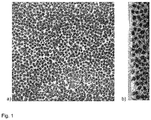
- Fig. 1 shows an example of a picture of a molded part which was produced as described in example 3, based on the mixture from example 1.
- Fig. 1 a) represents a front view, the length of the molded part (from left to right) being 16 cm.
- Fig. 1 b) shows a side view, the thickness (ie the thickness) of the depicted molding (from the left to the right edge of the molding) being 1.4 cm.
- Example 4 Manufacture of molded parts in the molding machine:
- Molded parts were each produced from the mixtures according to the invention produced in Examples 1 and 2 using an automatic molding machine, that is to say using a particle foam tool with sprayed tool walls.
- the mixtures according to the invention were each first placed in a sieve-like metal basket permeable to water vapor.
- the metal baskets used were lined with a plastic net, the plastic net having a mesh size of 40 ⁇ m.
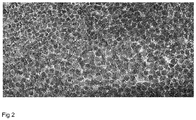
- Fig. 2 shows, by way of example, the front view of a molded part which was produced as described in Example 4.
- the length of the molded part shown (from left to right) is 18.6 cm.
Landscapes
- Chemical & Material Sciences (AREA)
- Health & Medical Sciences (AREA)
- Chemical Kinetics & Catalysis (AREA)
- Medicinal Chemistry (AREA)
- Polymers & Plastics (AREA)
- Organic Chemistry (AREA)
- Engineering & Computer Science (AREA)
- Materials Engineering (AREA)
- Inorganic Chemistry (AREA)
- Emergency Medicine (AREA)
- General Chemical & Material Sciences (AREA)
- Compositions Of Macromolecular Compounds (AREA)
- Manufacture Of Porous Articles, And Recovery And Treatment Of Waste Products (AREA)
Priority Applications (6)
| Application Number | Priority Date | Filing Date | Title |
|---|---|---|---|
| PL18157941T PL3530689T3 (pl) | 2018-02-21 | 2018-02-21 | Mieszanina i sposób wytwarzania kształtki |
| EP18157941.8A EP3530689B1 (de) | 2018-02-21 | 2018-02-21 | Mischung und verfahren zur herstellung eines formteils |
| EP19704834.1A EP3755742B1 (de) | 2018-02-21 | 2019-02-20 | Formteil sowie mischung und verfahren zu seiner herstellung |
| PCT/EP2019/054168 WO2019162304A1 (de) | 2018-02-21 | 2019-02-20 | Formteil sowie mischung und verfahren zu seiner herstellung |
| PL19704834.1T PL3755742T3 (pl) | 2018-02-21 | 2019-02-20 | Kształtka oraz mieszanina i sposób do jej wytwarzania |
| KR1020207027191A KR102801162B1 (ko) | 2018-02-21 | 2019-02-20 | 성형품, 및 이것을 제조하기 위한 혼합물 및 방법 |
Applications Claiming Priority (1)
| Application Number | Priority Date | Filing Date | Title |
|---|---|---|---|
| EP18157941.8A EP3530689B1 (de) | 2018-02-21 | 2018-02-21 | Mischung und verfahren zur herstellung eines formteils |
Publications (2)
| Publication Number | Publication Date |
|---|---|
| EP3530689A1 EP3530689A1 (de) | 2019-08-28 |
| EP3530689B1 true EP3530689B1 (de) | 2021-04-07 |
Family
ID=61256722
Family Applications (2)
| Application Number | Title | Priority Date | Filing Date |
|---|---|---|---|
| EP18157941.8A Active EP3530689B1 (de) | 2018-02-21 | 2018-02-21 | Mischung und verfahren zur herstellung eines formteils |
| EP19704834.1A Active EP3755742B1 (de) | 2018-02-21 | 2019-02-20 | Formteil sowie mischung und verfahren zu seiner herstellung |
Family Applications After (1)
| Application Number | Title | Priority Date | Filing Date |
|---|---|---|---|
| EP19704834.1A Active EP3755742B1 (de) | 2018-02-21 | 2019-02-20 | Formteil sowie mischung und verfahren zu seiner herstellung |
Country Status (4)
| Country | Link |
|---|---|
| EP (2) | EP3530689B1 (pl) |
| KR (1) | KR102801162B1 (pl) |
| PL (2) | PL3530689T3 (pl) |
| WO (1) | WO2019162304A1 (pl) |
Families Citing this family (2)
| Publication number | Priority date | Publication date | Assignee | Title |
|---|---|---|---|---|
| CN115071244A (zh) * | 2022-05-31 | 2022-09-20 | 苏州禧之龙新材料科技有限公司 | 一种防火保温板 |
| KR102866175B1 (ko) * | 2023-10-10 | 2025-10-02 | 주식회사 대경산업 | 난연 기능을 갖는 스티로폼 조성물 및 이를 이용한 스티로폼 제조방법 |
Family Cites Families (12)
| Publication number | Priority date | Publication date | Assignee | Title |
|---|---|---|---|---|
| DE2352969A1 (de) * | 1973-10-23 | 1975-04-30 | Basf Ag | Verfahren zur herstellung von harten schaumstoffen mit hoher feuerwiderstandsdauer |
| WO2008145599A1 (en) | 2007-05-30 | 2008-12-04 | Ineos Nova International Sa | Fire retardant polystyrene |
| WO2011113795A2 (de) | 2010-03-17 | 2011-09-22 | Basf Se | Flammgeschützter verbundschaumstoff |
| EP2678379B1 (de) | 2011-02-24 | 2016-04-20 | Basf Se | Melaminharzschaumstoff mit partikelförmigem füllmaterial |
| DK2708667T3 (en) | 2012-09-13 | 2017-02-27 | Sto Se & Co Kgaa | Process for producing a fire-retardant insulating element, insulating element and using an insulating element |
| EP2735584A1 (de) | 2012-11-26 | 2014-05-28 | Basf Se | Thermoverformbarer Melaminharzschaumstoff mit partikelförmigem Füllmaterial |
| CN103711211B (zh) | 2013-12-02 | 2016-03-23 | 苏州市建筑科学研究院集团股份有限公司 | 改性三聚氰胺甲醛树脂基eps阻燃保温板及其制备方法 |
| KR101684694B1 (ko) * | 2014-10-20 | 2016-12-08 | 한국신발피혁연구원 | 저비중 불연성 복합재료의 제조방법 |
| KR20160072411A (ko) * | 2014-12-15 | 2016-06-23 | 금호석유화학 주식회사 | 성형성이 우수하고 단열성능과 난연성능이 우수한 발포성 폴리스티렌 입자 및 이의 제조방법 |
| AU2017218451B2 (en) | 2016-02-12 | 2021-04-29 | Xflam Pty Ltd | Foam composites |
| EP3208299B1 (de) | 2016-02-19 | 2018-04-11 | STO SE & Co. KGaA | Verfahren zur herstellung eines schall- und/oder wärmedämmelements sowie schall- und/oder wärmedämmelement |
| EP3333216B1 (de) * | 2016-12-08 | 2020-05-06 | JOMA-Dämmstoffwerk GmbH | Flammgeschützte kunststoffschaumstoffe |
-
2018
- 2018-02-21 EP EP18157941.8A patent/EP3530689B1/de active Active
- 2018-02-21 PL PL18157941T patent/PL3530689T3/pl unknown
-
2019
- 2019-02-20 EP EP19704834.1A patent/EP3755742B1/de active Active
- 2019-02-20 KR KR1020207027191A patent/KR102801162B1/ko active Active
- 2019-02-20 PL PL19704834.1T patent/PL3755742T3/pl unknown
- 2019-02-20 WO PCT/EP2019/054168 patent/WO2019162304A1/de not_active Ceased
Non-Patent Citations (1)
| Title |
|---|
| None * |
Also Published As
| Publication number | Publication date |
|---|---|
| KR102801162B1 (ko) | 2025-04-28 |
| KR20200125957A (ko) | 2020-11-05 |
| PL3755742T3 (pl) | 2022-11-28 |
| WO2019162304A1 (de) | 2019-08-29 |
| EP3530689A1 (de) | 2019-08-28 |
| EP3755742B1 (de) | 2022-07-20 |
| PL3530689T3 (pl) | 2021-10-25 |
| EP3755742A1 (de) | 2020-12-30 |
Similar Documents
| Publication | Publication Date | Title |
|---|---|---|
| EP1919988B1 (de) | Verfahren zur herstellung von schaumstoffplatten | |
| EP1919990B1 (de) | Verfahren zur herstellung von schaumstoffplatten | |
| EP2079785B1 (de) | Beschichtete schaumstoffpartikel und verfahren zur herstellung von halogenfreien, feuerbeständigen partikelschaumstoffformkörpern | |
| EP0981574B1 (de) | Graphitpartikel enthaltende expandierbare styrolpolymerisate | |
| EP2190939B1 (de) | Beschichtungszusammensetzung für schaumstoffpartikel und verfahren zur herstellung von schaumstoffformkörpern | |
| EP2513209A1 (de) | Flammgeschützte polymerschaumstoffe | |
| AT511395B1 (de) | Flammgeschützte expandierbare polymerisate | |
| EP1919989B1 (de) | Verfahren zur herstellung von schaumstoffplatten | |
| WO1993024560A1 (de) | Verfahren zur herstellung von schaumstoffplatten mit hoher druckfestigkeit aus styrolpolymerisaten | |
| DE19910257A1 (de) | Flammhemmend ausgerüstete Schaumstoffe auf Basis von Styrolpolymerisaten | |
| EP2609144A1 (de) | Flammgeschützte, wärmedämmende polymerisate und verfahren zu deren herstellung | |
| EP2274369B1 (de) | Ps-schaumstoffe mit geringem metallgehalt | |
| WO2012019578A2 (de) | Brandhemmende materialmischung | |
| EP0915127B1 (de) | Athermane Partikel enthaltende expandierbare Styrolpolymerisate | |
| EP3755742B1 (de) | Formteil sowie mischung und verfahren zu seiner herstellung | |
| EP3333216B1 (de) | Flammgeschützte kunststoffschaumstoffe | |
| WO2011113795A2 (de) | Flammgeschützter verbundschaumstoff | |
| DE1192820B (de) | Verfahren zum Herstellen waermehaertbarer Polyester-Pressmassen | |
| EP0994145A1 (de) | Schaumstoffe auf Basis von Styrolpolymerisaten | |
| DE102012217665A1 (de) | Verfahren zur Herstellung von SAN-basierten expandierbaren Polymerpartikeln | |
| EP1919991B1 (de) | Verfahren zur herstellung von schaumstoffplatten | |
| DE2542841A1 (de) | Verfahren zur herstellung von schwer entzuendbaren bis feuerbestaendigen schaumstoffen mit geringem raumgewicht | |
| DE2240888A1 (de) | Mittel zum flammfestmachen von polystyrol oder styrolhaltigen mischpolymerisaten |
Legal Events
| Date | Code | Title | Description |
|---|---|---|---|
| PUAI | Public reference made under article 153(3) epc to a published international application that has entered the european phase |
Free format text: ORIGINAL CODE: 0009012 |
|
| STAA | Information on the status of an ep patent application or granted ep patent |
Free format text: STATUS: THE APPLICATION HAS BEEN PUBLISHED |
|
| AK | Designated contracting states |
Kind code of ref document: A1 Designated state(s): AL AT BE BG CH CY CZ DE DK EE ES FI FR GB GR HR HU IE IS IT LI LT LU LV MC MK MT NL NO PL PT RO RS SE SI SK SM TR |
|
| AX | Request for extension of the european patent |
Extension state: BA ME |
|
| STAA | Information on the status of an ep patent application or granted ep patent |
Free format text: STATUS: REQUEST FOR EXAMINATION WAS MADE |
|
| 17P | Request for examination filed |
Effective date: 20200228 |
|
| RBV | Designated contracting states (corrected) |
Designated state(s): AL AT BE BG CH CY CZ DE DK EE ES FI FR GB GR HR HU IE IS IT LI LT LU LV MC MK MT NL NO PL PT RO RS SE SI SK SM TR |
|
| GRAP | Despatch of communication of intention to grant a patent |
Free format text: ORIGINAL CODE: EPIDOSNIGR1 |
|
| STAA | Information on the status of an ep patent application or granted ep patent |
Free format text: STATUS: GRANT OF PATENT IS INTENDED |
|
| INTG | Intention to grant announced |
Effective date: 20200921 |
|
| GRAS | Grant fee paid |
Free format text: ORIGINAL CODE: EPIDOSNIGR3 |
|
| GRAA | (expected) grant |
Free format text: ORIGINAL CODE: 0009210 |
|
| STAA | Information on the status of an ep patent application or granted ep patent |
Free format text: STATUS: THE PATENT HAS BEEN GRANTED |
|
| AK | Designated contracting states |
Kind code of ref document: B1 Designated state(s): AL AT BE BG CH CY CZ DE DK EE ES FI FR GB GR HR HU IE IS IT LI LT LU LV MC MK MT NL NO PL PT RO RS SE SI SK SM TR |
|
| REG | Reference to a national code |
Ref country code: GB Ref legal event code: FG4D Free format text: NOT ENGLISH |
|
| REG | Reference to a national code |
Ref country code: CH Ref legal event code: EP Ref country code: AT Ref legal event code: REF Ref document number: 1379640 Country of ref document: AT Kind code of ref document: T Effective date: 20210415 |
|
| REG | Reference to a national code |
Ref country code: DE Ref legal event code: R096 Ref document number: 502018004604 Country of ref document: DE |
|
| REG | Reference to a national code |
Ref country code: IE Ref legal event code: FG4D Free format text: LANGUAGE OF EP DOCUMENT: GERMAN |
|
| REG | Reference to a national code |
Ref country code: NL Ref legal event code: FP |
|
| REG | Reference to a national code |
Ref country code: LT Ref legal event code: MG9D |
|
| PG25 | Lapsed in a contracting state [announced via postgrant information from national office to epo] |
Ref country code: BG Free format text: LAPSE BECAUSE OF FAILURE TO SUBMIT A TRANSLATION OF THE DESCRIPTION OR TO PAY THE FEE WITHIN THE PRESCRIBED TIME-LIMIT Effective date: 20210707 Ref country code: HR Free format text: LAPSE BECAUSE OF FAILURE TO SUBMIT A TRANSLATION OF THE DESCRIPTION OR TO PAY THE FEE WITHIN THE PRESCRIBED TIME-LIMIT Effective date: 20210407 Ref country code: LT Free format text: LAPSE BECAUSE OF FAILURE TO SUBMIT A TRANSLATION OF THE DESCRIPTION OR TO PAY THE FEE WITHIN THE PRESCRIBED TIME-LIMIT Effective date: 20210407 Ref country code: FI Free format text: LAPSE BECAUSE OF FAILURE TO SUBMIT A TRANSLATION OF THE DESCRIPTION OR TO PAY THE FEE WITHIN THE PRESCRIBED TIME-LIMIT Effective date: 20210407 |
|
| PG25 | Lapsed in a contracting state [announced via postgrant information from national office to epo] |
Ref country code: RS Free format text: LAPSE BECAUSE OF FAILURE TO SUBMIT A TRANSLATION OF THE DESCRIPTION OR TO PAY THE FEE WITHIN THE PRESCRIBED TIME-LIMIT Effective date: 20210407 Ref country code: SE Free format text: LAPSE BECAUSE OF FAILURE TO SUBMIT A TRANSLATION OF THE DESCRIPTION OR TO PAY THE FEE WITHIN THE PRESCRIBED TIME-LIMIT Effective date: 20210407 Ref country code: NO Free format text: LAPSE BECAUSE OF FAILURE TO SUBMIT A TRANSLATION OF THE DESCRIPTION OR TO PAY THE FEE WITHIN THE PRESCRIBED TIME-LIMIT Effective date: 20210707 Ref country code: PT Free format text: LAPSE BECAUSE OF FAILURE TO SUBMIT A TRANSLATION OF THE DESCRIPTION OR TO PAY THE FEE WITHIN THE PRESCRIBED TIME-LIMIT Effective date: 20210809 Ref country code: LV Free format text: LAPSE BECAUSE OF FAILURE TO SUBMIT A TRANSLATION OF THE DESCRIPTION OR TO PAY THE FEE WITHIN THE PRESCRIBED TIME-LIMIT Effective date: 20210407 Ref country code: GR Free format text: LAPSE BECAUSE OF FAILURE TO SUBMIT A TRANSLATION OF THE DESCRIPTION OR TO PAY THE FEE WITHIN THE PRESCRIBED TIME-LIMIT Effective date: 20210708 Ref country code: IS Free format text: LAPSE BECAUSE OF FAILURE TO SUBMIT A TRANSLATION OF THE DESCRIPTION OR TO PAY THE FEE WITHIN THE PRESCRIBED TIME-LIMIT Effective date: 20210807 |
|
| REG | Reference to a national code |
Ref country code: DE Ref legal event code: R097 Ref document number: 502018004604 Country of ref document: DE |
|
| PG25 | Lapsed in a contracting state [announced via postgrant information from national office to epo] |
Ref country code: EE Free format text: LAPSE BECAUSE OF FAILURE TO SUBMIT A TRANSLATION OF THE DESCRIPTION OR TO PAY THE FEE WITHIN THE PRESCRIBED TIME-LIMIT Effective date: 20210407 Ref country code: ES Free format text: LAPSE BECAUSE OF FAILURE TO SUBMIT A TRANSLATION OF THE DESCRIPTION OR TO PAY THE FEE WITHIN THE PRESCRIBED TIME-LIMIT Effective date: 20210407 Ref country code: SM Free format text: LAPSE BECAUSE OF FAILURE TO SUBMIT A TRANSLATION OF THE DESCRIPTION OR TO PAY THE FEE WITHIN THE PRESCRIBED TIME-LIMIT Effective date: 20210407 Ref country code: SK Free format text: LAPSE BECAUSE OF FAILURE TO SUBMIT A TRANSLATION OF THE DESCRIPTION OR TO PAY THE FEE WITHIN THE PRESCRIBED TIME-LIMIT Effective date: 20210407 Ref country code: RO Free format text: LAPSE BECAUSE OF FAILURE TO SUBMIT A TRANSLATION OF THE DESCRIPTION OR TO PAY THE FEE WITHIN THE PRESCRIBED TIME-LIMIT Effective date: 20210407 Ref country code: DK Free format text: LAPSE BECAUSE OF FAILURE TO SUBMIT A TRANSLATION OF THE DESCRIPTION OR TO PAY THE FEE WITHIN THE PRESCRIBED TIME-LIMIT Effective date: 20210407 |
|
| PLBE | No opposition filed within time limit |
Free format text: ORIGINAL CODE: 0009261 |
|
| STAA | Information on the status of an ep patent application or granted ep patent |
Free format text: STATUS: NO OPPOSITION FILED WITHIN TIME LIMIT |
|
| 26N | No opposition filed |
Effective date: 20220110 |
|
| PG25 | Lapsed in a contracting state [announced via postgrant information from national office to epo] |
Ref country code: IS Free format text: LAPSE BECAUSE OF FAILURE TO SUBMIT A TRANSLATION OF THE DESCRIPTION OR TO PAY THE FEE WITHIN THE PRESCRIBED TIME-LIMIT Effective date: 20210807 Ref country code: AL Free format text: LAPSE BECAUSE OF FAILURE TO SUBMIT A TRANSLATION OF THE DESCRIPTION OR TO PAY THE FEE WITHIN THE PRESCRIBED TIME-LIMIT Effective date: 20210407 |
|
| PG25 | Lapsed in a contracting state [announced via postgrant information from national office to epo] |
Ref country code: MC Free format text: LAPSE BECAUSE OF FAILURE TO SUBMIT A TRANSLATION OF THE DESCRIPTION OR TO PAY THE FEE WITHIN THE PRESCRIBED TIME-LIMIT Effective date: 20210407 |
|
| REG | Reference to a national code |
Ref country code: CH Ref legal event code: PL |
|
| REG | Reference to a national code |
Ref country code: BE Ref legal event code: MM Effective date: 20220228 |
|
| PG25 | Lapsed in a contracting state [announced via postgrant information from national office to epo] |
Ref country code: LU Free format text: LAPSE BECAUSE OF NON-PAYMENT OF DUE FEES Effective date: 20220221 |
|
| PG25 | Lapsed in a contracting state [announced via postgrant information from national office to epo] |
Ref country code: LI Free format text: LAPSE BECAUSE OF NON-PAYMENT OF DUE FEES Effective date: 20220228 Ref country code: IE Free format text: LAPSE BECAUSE OF NON-PAYMENT OF DUE FEES Effective date: 20220221 Ref country code: CH Free format text: LAPSE BECAUSE OF NON-PAYMENT OF DUE FEES Effective date: 20220228 |
|
| PG25 | Lapsed in a contracting state [announced via postgrant information from national office to epo] |
Ref country code: BE Free format text: LAPSE BECAUSE OF NON-PAYMENT OF DUE FEES Effective date: 20220228 |
|
| PG25 | Lapsed in a contracting state [announced via postgrant information from national office to epo] |
Ref country code: MK Free format text: LAPSE BECAUSE OF FAILURE TO SUBMIT A TRANSLATION OF THE DESCRIPTION OR TO PAY THE FEE WITHIN THE PRESCRIBED TIME-LIMIT Effective date: 20210407 Ref country code: CY Free format text: LAPSE BECAUSE OF FAILURE TO SUBMIT A TRANSLATION OF THE DESCRIPTION OR TO PAY THE FEE WITHIN THE PRESCRIBED TIME-LIMIT Effective date: 20210407 |
|
| PG25 | Lapsed in a contracting state [announced via postgrant information from national office to epo] |
Ref country code: HU Free format text: LAPSE BECAUSE OF FAILURE TO SUBMIT A TRANSLATION OF THE DESCRIPTION OR TO PAY THE FEE WITHIN THE PRESCRIBED TIME-LIMIT; INVALID AB INITIO Effective date: 20180221 |
|
| PG25 | Lapsed in a contracting state [announced via postgrant information from national office to epo] |
Ref country code: TR Free format text: LAPSE BECAUSE OF FAILURE TO SUBMIT A TRANSLATION OF THE DESCRIPTION OR TO PAY THE FEE WITHIN THE PRESCRIBED TIME-LIMIT Effective date: 20210407 |
|
| PG25 | Lapsed in a contracting state [announced via postgrant information from national office to epo] |
Ref country code: MT Free format text: LAPSE BECAUSE OF FAILURE TO SUBMIT A TRANSLATION OF THE DESCRIPTION OR TO PAY THE FEE WITHIN THE PRESCRIBED TIME-LIMIT Effective date: 20210407 |
|
| PGFP | Annual fee paid to national office [announced via postgrant information from national office to epo] |
Ref country code: NL Payment date: 20250224 Year of fee payment: 8 |
|
| PGFP | Annual fee paid to national office [announced via postgrant information from national office to epo] |
Ref country code: DE Payment date: 20250226 Year of fee payment: 8 |
|
| PGFP | Annual fee paid to national office [announced via postgrant information from national office to epo] |
Ref country code: AT Payment date: 20250217 Year of fee payment: 8 |
|
| PGFP | Annual fee paid to national office [announced via postgrant information from national office to epo] |
Ref country code: FR Payment date: 20250224 Year of fee payment: 8 Ref country code: PL Payment date: 20250131 Year of fee payment: 8 Ref country code: CZ Payment date: 20250210 Year of fee payment: 8 |
|
| PGFP | Annual fee paid to national office [announced via postgrant information from national office to epo] |
Ref country code: IT Payment date: 20250225 Year of fee payment: 8 Ref country code: GB Payment date: 20250218 Year of fee payment: 8 |