EP3528958B1 - Verfahren zur beseitigung von schwermetallen aus einer wässrigen lösung - Google Patents
Verfahren zur beseitigung von schwermetallen aus einer wässrigen lösung Download PDFInfo
- Publication number
- EP3528958B1 EP3528958B1 EP17861750.2A EP17861750A EP3528958B1 EP 3528958 B1 EP3528958 B1 EP 3528958B1 EP 17861750 A EP17861750 A EP 17861750A EP 3528958 B1 EP3528958 B1 EP 3528958B1
- Authority
- EP
- European Patent Office
- Prior art keywords
- aqueous solution
- cysteine
- salt
- formula
- heavy metal
- Prior art date
- Legal status (The legal status is an assumption and is not a legal conclusion. Google has not performed a legal analysis and makes no representation as to the accuracy of the status listed.)
- Active
Links
Images



Classifications
-
- C—CHEMISTRY; METALLURGY
- C02—TREATMENT OF WATER, WASTE WATER, SEWAGE, OR SLUDGE
- C02F—TREATMENT OF WATER, WASTE WATER, SEWAGE, OR SLUDGE
- C02F1/00—Treatment of water, waste water, or sewage
- C02F1/58—Treatment of water, waste water, or sewage by removing specified dissolved compounds
- C02F1/62—Heavy metal compounds
-
- B—PERFORMING OPERATIONS; TRANSPORTING
- B01—PHYSICAL OR CHEMICAL PROCESSES OR APPARATUS IN GENERAL
- B01D—SEPARATION
- B01D21/00—Separation of suspended solid particles from liquids by sedimentation
- B01D21/02—Settling tanks with single outlets for the separated liquid
-
- B—PERFORMING OPERATIONS; TRANSPORTING
- B03—SEPARATION OF SOLID MATERIALS USING LIQUIDS OR USING PNEUMATIC TABLES OR JIGS; MAGNETIC OR ELECTROSTATIC SEPARATION OF SOLID MATERIALS FROM SOLID MATERIALS OR FLUIDS; SEPARATION BY HIGH-VOLTAGE ELECTRIC FIELDS
- B03D—FLOTATION; DIFFERENTIAL SEDIMENTATION
- B03D1/00—Flotation
- B03D1/001—Flotation agents
- B03D1/004—Organic compounds
- B03D1/012—Organic compounds containing sulfur
-
- C—CHEMISTRY; METALLURGY
- C02—TREATMENT OF WATER, WASTE WATER, SEWAGE, OR SLUDGE
- C02F—TREATMENT OF WATER, WASTE WATER, SEWAGE, OR SLUDGE
- C02F1/00—Treatment of water, waste water, or sewage
- C02F1/24—Treatment of water, waste water, or sewage by flotation
-
- C—CHEMISTRY; METALLURGY
- C02—TREATMENT OF WATER, WASTE WATER, SEWAGE, OR SLUDGE
- C02F—TREATMENT OF WATER, WASTE WATER, SEWAGE, OR SLUDGE
- C02F2101/00—Nature of the contaminant
- C02F2101/10—Inorganic compounds
- C02F2101/20—Heavy metals or heavy metal compounds
Definitions
- the present invention relates to a method for removing dissolved heavy metals from an aqueous solution.
- heavy metal ions such as ions of arsenic, mercury or lead
- ions of arsenic, mercury or lead can have adverse effects on biological systems.
- the presence of such heavy metal ions in drinking water can cause adverse effects to the health of a human or animal which consumes the water.
- Arsenic is a trace element which can be found in the earth's crust with an abundance of 54, and an average concentration of about 5 ppm. Some processes, such as mining, welldrilling and weathering, may increase the amount of this heavy metal released into the environment, especially into groundwater. This increased presence of arsenic in the environment poses a significant risk to public health in the form of an increased risk of cancer (mostly bladder, lung and skin cancers) and other diseases. Groundwater contamination can also lead to contamination of agricultural products, for example, rice.
- Inorganic forms of arsenic which are toxic include As (V) and As (III).
- As (V) exists predominantly under oxidizing conditions as arsenate (H 2 AsO 4 - and HAsO 4 2- ).
- As (III) exists naturally as arsenite (H 3 AsO 3 ), predominantly under reducing conditions in a pH range of 2-9.
- the World Health Organization (WHO) has stipulated a maximum contaminant level (MCL) for arsenic of 0.01 mg/L in drinking water.
- Mercury is a volatile heavy metal that has caused public health and environmental concern because of its toxic, persistent, and bio-accumulative properties. Recently, mercury contamination has increased considerably, as it is or has been used in various industrial processes and products. Mercury emissions from human activities are about 30-55% of global atmospheric mercury emissions. Mercury can cause severe neurological and renal disturbances. Short-term or long-term exposure to mercury (inhalation, ingestion or dermal) can have toxic effects on the body, mainly the kidneys. Elemental (or metallic) mercury, inorganic mercury (to which people may be exposed through their occupation) and organic mercury (e.g., methylmercury, to which people may be exposed through their diet) may result in different degrees of toxicity and effects on the nervous, digestive and immune systems, and on lungs, kidneys, skin and eyes.
- Lead is a cumulative, toxic, heavy metal, and can affect multiple body systems. Lead is particularly harmful to young children. In the body, lead is distributed to the brain, liver, kidney and bones and can be stored in the teeth and bones, where it accumulates over time.
- the MCL reported by the EPA for lead in drinking water is 0.015 mg/L. Long-term exposure above the MCL could result in delays in physical or mental development in infants and children; slight deficits in attention span and learning abilities are other common symptoms. In adults, kidney problems and high blood pressure could be the results.
- JECFA Joint FAO/WHO Expert Committee on Food Additives
- Lead is used in the production of lead acid batteries, solder, alloys, cable sheathing, pigments, rust inhibitors, ammunition, glazes and plastic stabilizers and may be released into the environment from these products. Corrosion of household plumbing systems and erosion of natural deposits are also known sources of this contaminant in drinking water.
- a range of technologies have been developed for the removal of high concentrations of arsenic or other heavy metals from drinking water, including oxidation, coagulation, precipitation, adsorption, adsorbing floc flotation, ion-exchange and membrane techniques. Many of these techniques are costly and/or energy-intensive. Other approaches for the removal of high concentrations of arsenic from drinking water include phytoremediation or the use of bacteria, which can play an important role in facilitating biological arsenic removal processes.
- GB 1 321 810 A discloses a process for capturing metal ions.
- the present invention provides a method for removing a dissolved heavy metal from an aqueous solution according to claim 1, the method comprising dissolving in the according to claim 1 inter alia heavy metal from an aqueous solution, the method comprising dissolving in the aqueous solution a foaming agent of formula (I):
- the method further comprises passing a gas through the aqueous solution to form a foam, and separating the foam from the aqueous solution.
- R represents an aliphatic hydrophobic group.
- R represents a linear or branched C 5 -C 10 alkyl.
- R represents a linear or branched C 7 -C 9 alkyl.
- R represents -(CH 2 ) 6 CH 3 and R 1 represents H.
- the foaming agent of formula (I) or salt thereof has a solubility of greater than 0.0001 M in water.
- the CMC of the foaming agent of formula (I) or salt thereof in the aqueous solution is greater than 0.0001 M.
- the foaming agent is in the form of a salt.
- the salt is a Na, K, Li or Cs salt.
- the concentration of the foaming agent of formula (I) or salt thereof in the aqueous solution is from about 0.01 mM to about 0.02 M.
- the concentration of the foaming agent of formula (I) or salt thereof in the aqueous solution is from about 0.0001 M to about 0.02 M.
- the pH of the aqueous solution is in the range of from about 8 to about 9.
- the heavy metal is selected from the group consisting of As, Hg, Pb, Cd, Ni, Co, Cr, Zn and Cu. In some embodiments, the heavy metal is present in the solution as the metal cation. In some embodiments, the heavy metal is present in the solution as an oxyanion of the heavy metal (e.g. an oxyanion of As(V)).
- the gas is selected from the group consisting of dry air, humidified air, carbon dioxide, nitrogen, helium, argon and oxygen.
- the inventors have developed a method that can be used to remove a dissolved heavy metal, such as arsenic, mercury and lead, from an aqueous solution.
- the method of the invention removes at least some of the dissolved heavy metal from the aqueous solution, thus reducing the concentration of the dissolved heavy metal in the solution.
- the term "heavy metal” refers to a metal having an atomic weight greater than 40, but excluding s- and f-block metals (i.e. excluding metals in Groups 1 and 2 of the periodic table and excluding the lanthanides and the actinides), in other words, a "heavy metal” is a d- or p-block metal having an atomic weight greater than 40.
- heavy metals include As, Hg, Pb, Cd, Ni, Co, Cr, Zn and Cu.
- the method of the invention may advantageously be used to remove dissolved toxic heavy metals, such as As, Hg and Pb, from an aqueous solution. However, the method is not limited to toxic heavy metals and may be used to remove other dissolved heavy metals from an aqueous solution.
- the dissolved heavy metal may be present in the aqueous solution as the metal cation, a hydrated form of the metal cation or an oxyanion of the metal.
- the term “heavy metal ion” refers to a cation of a heavy metal, a cation of a heavy metal in hydrated form or an oxyanion of a heavy metal.
- the term “arsenic ion” refers to a cation of arsenic, a hydrated form of a cation of arsenic or an oxyanion of As.
- arsenic ions are generally present as As (V) oxyanions (e.g. H 2 AsO 4 - , HAsO 4 2- or AsO 4 3- ).
- the method of the invention can, for example, be used to remove As cations or oxyanions of As from an aqueous solution.
- the inventors have now developed an alternative method of removing dissolved arsenic, or other dissolved heavy metals, from an aqueous solution which uses a fluid source of cysteine groups to adsorb the heavy metal.
- Adsorptive bubble separation techniques have been used to remove various substances from wastewaters. There are several separation techniques employing adsorption on gas bubbles; these methods are divided into two categories, foam separation and nonfoaming adsorptive bubble separation techniques. Foam separation techniques can be subdivided into foam fractionation and flotation methods. Flotation methods include ore flotation, macro flotation, colloidal flotation, ion flotation and precipitate flotation. Precipitate flotation requires precipitation of the metal species in preparation for subsequent flotation. Adsorbing colloid flotation involves removal of metal ions by adsorption onto carrier flocs such as those produced by Fe(OH) 3 and Al(OH) 3 salts.
- Ion flotation is a separation technology for recovering and removing metal ions from aqueous solutions based on the association between the ions and a surfactant species.
- the ion and surfactant are adsorbed onto the surface of rising bubbles and carried into a foam on the surface which is then removed from the solution.
- the method of the present invention provides a novel flotation technique for removing dissolved heavy metals from an aqueous solution.
- the present invention provides a method for removing a dissolved heavy metal (e.g. arsenic, mercury or lead) from an aqueous solution comprising the dissolved heavy metal.
- the method comprises dissolving in the aqueous solution a foaming agent of formula (I): or a salt thereof.
- R represents a hydrophobic group
- R 1 represents H or CH 3 .
- a “foaming agent” is a material which facilitates the formation of foam from an aqueous solution. When gas is passed through the aqueous solution, typically as small bubbles, the foaming agent facilitates the formation of a foam.
- the "foaming agent” used in the method of the present invention is a compound of formula (I) or a salt thereof.
- the foaming agent of formula (I) or salt thereof is a cysteine-surfactant (i.e. a surfactant containing a cysteine group), which has foaming properties in an aqueous solution.
- Surfactants are compounds that lower the surface tension (or interfacial tension) between two liquids or between a liquid and a solid.
- Surfactants are usually organic compounds that are amphiphilic, meaning they contain both a hydrophobic group (their tail) and a hydrophilic group (their head). Therefore, a surfactant contains both a water-insoluble (or oil-soluble) component and a water-soluble component (typically a charged group).
- Surfactants will diffuse in water and adsorb at interfaces between air and water or at the interface between oil and water, in the case where water is mixed with oil.
- the water-insoluble hydrophobic group may extend out of the bulk water phase, into the air or into the oil phase, while the water-soluble head group remains in the water phase.
- surfactants form aggregates, such as micelles, at concentrations above the critical micelle concentration (CMC), where the hydrophobic tails form the core of the aggregate and the hydrophilic heads are in contact with the surrounding liquid.
- CMC critical micelle concentration
- the CMC of a surfactant in an aqueous solution can be determined by a person skilled in the art using techniques known in the art.
- the CMC of a surfactant can be determined by measuring changes in the conductance or surface tension of the solution at different concentrations of the surfactant.
- the compound of formula (I) or salt thereof provides a fluid source of cysteine, in the form of a surfactant comprising a (hydrophobic) group with a cysteine head-group.
- the compound of formula (I) has the following chemical structure:
- the compound of formula (I) may be provided in the form of a salt, in which the H + ion on the COO - B + group (i.e. H of the COOH group) is replaced by another cation (e.g. Na + , K + , Li + or Cs + ).
- R represents a hydrophobic group
- R 1 represents a hydrogen or methyl group
- the compound of formula (I) or salt thereof has a solubility of greater than 0.0001 M in water, e.g. greater than 0.001 M or 0.01 M, at 25 °C.
- a solubility of greater than 0.0001 M in water e.g. greater than 0.001 M or 0.01 M, at 25 °C.
- the CMC of the compound of formula (I) or salt thereof in the aqueous solution is greater than 0.0001 M, e.g. greater than 0.001 M or 0.01 M.
- the CMC of the compound of formula (I) or salt thereof in the aqueous solution is from 0.0001 M to 1 M.
- the method of the present invention can advantageously be used to remove dissolved heavy metals from dilute aqueous solutions comprising less than 10 ppm of the heavy metal ions and containing low levels of other dissolved species.
- the CMC of the compound of formula (I) or salt thereof in the aqueous solution will be similar to the CMC of the compound of formula (I) or salt thereof in water.
- the CMC of the compound of formula (I) or salt thereof in water at 25 °C and atmospheric pressure is greater than 0.0001 M, e.g. greater than 0.001 M or 0.01 M.
- the CMC of the compound of formula (I) or salt thereof in water at 25 °C and atmospheric pressure is from 0.0001 M to 1 M.
- the method of the invention further comprises passing a gas through the aqueous solution to form a foam, and separating the foam from the remaining bulk aqueous solution. Accordingly, the present invention provides a method for removing a dissolved heavy metal from an aqueous solution, the method comprising dissolving in the aqueous solution a foaming agent of formula (I):
- the gas is passed through the aqueous solution to form a foam by bubbling the gas through the liquid aqueous solution.
- the gas is introduced into the aqueous solution near the base of the aqueous solution (e.g. near the floor of a vessel holding the aqueous solution) to form bubbles (typically having a diameter in the range of about 1 mm to about 10 mm) which rise through the aqueous solution to form a foam on the upper surface of the aqueous solution.
- the gas is typically passed through a porous material, for example, a porous glass sinter, to form multiple bubbles of the gas in the aqueous solution.
- the inventors believe that as the bubbles of the gas pass though the aqueous solution, a mono-layer of the compound of formula (I) or salt thereof is formed around each bubble of the gas.
- the inventors believe that it is the interaction between one or more of the cysteine groups, which extend from the surface of the bubble, with the dissolved heavy metal, which results in the heavy metal being adsorbed from the aqueous solution as the bubble passes through the aqueous solution.
- the dissolved heavy metal becomes adsorbed onto the cysteine groups of the mono-layer of the compound of formula (I) or salt thereof formed around each rising bubble.
- the bubbles then form a foam comprising the adsorbed heavy metal which can then be separated from the aqueous solution.
- Continuation of sparging until foaming ceases can be used to remove residual foaming agent from the aqueous solution as the presence of even low levels of the foaming agent causes foaming.
- the method of the present invention comprises dissolving a compound of formula (I) or a salt thereof in an aqueous solution comprising a dissolved heavy metal.
- aqueous solution refers to a solution in which water is the only solvent or is at least 50 % (e.g. at least 80 %, at least 90 %, at least 95 %, at least 98 %, or at least 99 %) by weight of the total solvents in the solution.
- a reference to "a method for removing a dissolved heavy metal from an aqueous solution” refers to a method for removing a dissolved heavy metal from a solution in which water is the only solvent or is at least 50 % by weight of the total solvents in the solution.
- water comprises at least 90 %, at least 95 %, at least 98 %, or at least 99%, by weight of the total solvents in the solution.
- a reference to "dissolving in the aqueous solution a foaming agent of formula (I) or salt thereof' refers to dissolving a foaming agent of formula (I) or salt thereof in a solution in which water is the only solvent or is at least 50 % by weight of the total solvents in the solution.
- water comprises at least 90 %, at least 95 %, at least 98 %, or at least 99%, by weight of the total solvents in the solution.
- foaming agents of formula (I) and salts thereof can be used to remove a dissolved heavy metal from an aqueous solution.
- the method of the present invention can be used to treat an aqueous solution, e.g. groundwater, comprising a dissolved heavy metal, or two or more dissolved heavy metals, to remove at least some of the dissolved heavy metal or metals from the aqueous solution.
- the method of the present invention can be used to remove heavy metal ions from dilute aqueous solutions comprising less than 10 ppm of the heavy metal ions.
- the method of the invention can also be used to remove heavy metal ions from more concentrated solutions of the heavy metal ion.
- the method of the present invention can, for example, be used to remove sufficient arsenic, mercury and lead ions from contaminated water to produce water having concentrations of these metals below those stipulated by WHO for drinking water.
- the method can, for example, be used to treat water contaminated with arsenic, mercury and/or lead ions to remove a sufficient amount of the arsenic, mercury and/or lead ions to afford water having a concentration of arsenic, mercury and lead ions suitable for drinking water.
- the aqueous solution may be any aqueous solution comprising one or more dissolved heavy metals.
- the aqueous solution may, for example, be groundwater or waste water from an industrial process, mining or other human activity, comprising one or more dissolved heavy metals.
- the aqueous solution may comprise particulates and other ions in addition to the dissolved heavy metal or heavy metals.
- the aqueous solution contains less than 1% w/w of particulates.
- the aqueous solution contains less than 20 ppm of dissolved ions of any species.
- the aqueous solution does not contain large amounts of materials (e.g. insoluble oils, polydimethylsiloxanes and other silicones, certain alcohols, stearates and glycols) which will inhibit the compound of formula (I) from facilitating the formation of foam from the aqueous solution.
- the foaming agent is capable of facilitating the formation of a foam from the aqueous solution, that is, facilitating the formation of a foam comprising pockets of a gas encapsulated by the aqueous solution.
- the gas is passed through the aqueous solution, typically in the form of small bubbles (e.g. having a diameter of about 1 mm to about 10 mm)
- bubbles of the gas move to the surface of the aqueous solution to form a foam on the surface.
- the gas bubbles are allowed to rise to the top of the liquid phase to form a foam layer.
- the foam layer phase can then be separated from the liquid phase thereby isolating the adsorbed heavy metal from the liquid phase.
- the foam layer phase can, for example, be separated from the liquid phase using an outlet tube to collect the foam in a waste container.
- the collected foam comprising the heavy metal may be collapsed prior to disposal, for example, using silicone or ethanol sprays.
- the foam may be treated to isolate the heavy metal from the foam.
- the method of the present invention may, for example, comprise aeration at a low flow-rate (e.g. 3 L/min through a sinter of about 7 cm 2 in area) of an aqueous solution containing the dissolved heavy metal and the cysteine surfactant (i.e. the compound of formula (I) or salt thereof) in a suitable vessel, e.g. a bubble column.
- a suitable vessel e.g. a bubble column.
- bubbles rise to the surface of the aqueous solution forming a foam on the surface which is then separated from the aqueous solution. Additional volume of an aqueous solution containing the dissolved heavy metal, with or without the cysteine-surfactant, may be introduced into the vessel.
- the additional aqueous solution introduced into the vessel may be introduced into the vessel in a manner such that the feed solution is initially contacted with the foam so that some amount of separation of the heavy metal from the feed solution takes place while it is passing through the foam.
- the feed solution could also be added directly to the aqueous solution below the interface of the aqueous solution and the foam, e.g. just below the foam.
- the compound of formula (I) or salt thereof dissolved in the aqueous solution forms a monolayer around the bubbles of the gas.
- the orientation of the compound of formula (I) or salt thereof around the bubble is such that the hydrophobic group orients towards the gas and the cysteine head-group orients towards the aqueous solution.
- Bubbles passing through the aqueous solution provide a continuous supply of cysteine coated monolayers, where the surfactants and head-groups will be relatively mobile at room temperature (e.g. at 25 °C). Collisions between the dissolved heavy metal species and the cysteine coated bubbles provide selective and efficient heavy metal capture and removal in a one step water treatment process.
- cysteine groups effectively chelate with dissolved heavy metals in the aqueous solution.
- the inventors believe that the fluid nature of the adsorbed surfactant layer at a bubble surface, which moves through the aqueous solution, supports an efficient spatial arrangement of groups to chelate with the dissolved heavy metal, because it is expected that several groups of cysteine are required for each heavy metal ion. Once adsorbed, the heavy metal can be effectively removed by the bubbles into a foam on the surface of the aqueous solution.
- the method can, for example, provide a removal rate of arsenic ions of 99.4 % in a 5 ppm feed solution, which indicates that this process is capable of reducing 5 ppm arsenic content in solution to lower than the recommended WHO limit (of 0.01 ppm) for drinking water. Similar removal rates have also been obtained for Hg and Pb (see Table 6).
- the method of the present invention provides a selective method of removing heavy metal ions, such as arsenic, mercury and lead ions, from an aqueous solution, for example, polluted groundwater, to below the maximum contaminant level (MCL) specified by WHO or the EPA for drinking water, which can be carried out with low energy consumption and small space requirements, which does not require the use of expensive technology, and which can be conducted in a one step process and/or at the point of access to the contaminated water.
- MCL maximum contaminant level
- the foaming agent of formula (I) or salt thereof (a cysteine-surfactant) is more environmentally friendly and biodegradable than cysteine coated silica microparticles used in some prior art processes for removing arsenic from water.
- the method of the present invention can be carried out in a batch process or, advantageously, a continuous process.
- a continuous process can be advantageous as a continuous process is generally more energy and cost efficient for treating large volumes of an aqueous solution than a batch process.
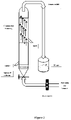
- Figure 2 is a schematic diagram of the column apparatus used in the experiments described in the Examples.
- the same or similar apparatus can, for example, be used to perform the method of the present invention in a batch process or a continuous process.
- a sample of the aqueous solution may be treated in the column depicted in Figure 2 and then the treated aqueous solution is removed from the column through the outlet. Following this, a new sample of the aqueous solution and the foaming agent is introduced to the column through the inlet for treatment by the method of the present invention.
- Similar apparatus can also be used in a continuous process.
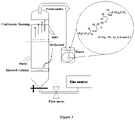
- Figure 3 depicts one example of suitable apparatus for carrying out the method of the present invention in a continuous process.
- the aqueous solution (feed solution) is introduced to the bubble column in a continuous flow through the inlet, and the treated aqueous solution removed through the outlet in a continuous flow.
- a concentrated solution of the foaming agent is introduced in a continuous flow through a separate inlet (labeled "Surfactant" in Figure 3 ), positioned near to the sinter of the column.
- the height of the column relative to its other dimensions, will typically be greater than that depicted in Figure 3 .
- the outlet in Figure 3 is orientated in a downward direction to avoid bubbles rising through the aqueous solution moving though the outlet as the aqueous solution is removed from the column.
- various other apparatuses are possible for performing the method of the present invention.
- R may represent an aliphatic hydrophobic group, for example a linear or branched C 5 -C 10 alkyl, e.g. a linear or branched C 7 -C 9 alkyl.
- R represents -(CH 2 ) 6 CH 3 and R 1 represents H.
- the compound of formula (I) has the following structure:
- This compound can be referred to as "octanoyl-cysteine".
- This amino acid-based monomeric surfactant can be synthesized by reacting cysteine with octanoyl chloride. Similar methods can be used to prepare other compounds of formula (I).
- R represents -(CH 2 ) 8 CH 3 and R 1 represents H.
- the compound of formula (I) may be provided as a salt, where the H atom (H + ion) of the COOH group is replaced by another cation, for example Na + .
- the sodium salt of octanoyl-cysteine has the following structure:
- Suitable salts also include salts of K, Li or Cs.
- the foaming agent is a salt of octanoyl-cysteine.
- the foaming agent i.e. the compound of formula (I) or a salt thereof
- the foaming agent is dissolved in the aqueous solution in an amount up to the critical micelle concentration (CMC), that is, it is preferred that the foaming agent is dissolved in the aqueous solution in an amount to provide a concentration of the foaming agent below the CMC of the foaming agent.
- CMC critical micelle concentration
- the foaming agent will form aggregates, such as micelles, and some of the heavy metal may become bound with the aggregates rather than the cysteine groups in the mono-layer around the bubbles of the gas passing through the aqueous solution. This may reduce the efficiency of the method of the present invention in removing the heavy metal from the aqueous solution.
- the foaming agent i.e. the compound of formula (I) or salt thereof
- the foaming agent is typically dissolved in the aqueous solution in an amount to provide a solution having a concentration of the compound of formula (I) or salt thereof greater than about 0.01 mM, e.g. more than about 0.0001 M, more than about 0.001 M or more than about 0.01 M.
- the compound of formula (I) or salt thereof is dissolved in the aqueous solution in an amount to provide a solution having a concentration of the compound of formula (I) or salt thereof in the range of about 0.01 mM to about 0.1 M, about 0.0001 M to about 0.1 M, about 0.0001 M to about 0.02 M or about 0.001 to about 0.02 M.
- the aqueous solution may optionally be heated to facilitate the dissolution of the compound of formula (I) or salt thereof.
- the compound of formula (I) or salt thereof is dissolved in the aqueous solution in an amount to provide a solution having a concentration of the compound of formula (I) or salt thereof greater than about 0.01 mM. Accordingly, in one embodiment, the present invention provides a method for removing a dissolved heavy metal from an aqueous solution, the method comprising dissolving in the aqueous solution a foaming agent of formula (I):
- the concentration of the compound of formula (I) or salt thereof in the aqueous solution is about 0.01 M.
- the foaming agent of formula (I) or salt thereof has a CMC in the aqueous solution of greater than 0.0001 M, and is dissolved in the aqueous solution in an amount such that the resultant solution has a concentration of the compound of formula (I) or salt thereof greater than about 0.01 mM, e.g. greater than about 0.0001 M.
- the present invention provides a method for removing a dissolved heavy metal from an aqueous solution, the method comprising:
- the pH of the aqueous solution is in the range of from about 8 to about 9.
- arsenic ions are present in an aerated aqueous solution as As (V) oxyanions.
- the gas may be passed through the aqueous solution in either a continuous or an intermittent manner.
- bubbles of the gas are passed through the aqueous solution in a continuous stream.
- the gas may be any gas that is substantially non-reactive with the foaming agent and the aqueous solution.
- the gas may, for example, be selected from the group consisting of dry air, humidified air, carbon dioxide, nitrogen, oxygen, helium or argon.
- the gas may, for example, be introduced into the aqueous solution using a gas inlet having a pressure just above atmospheric pressure, e.g. in the range 1 to 1.5 atm.
- the aqueous solution and the gas introduced into the aqueous solution are typically at about room temperature, and typically the method is performed at atmospheric pressure.
- the method of the present invention can be carried out at other temperatures and pressures.
- L-cysteine (97%), cystine, octanoyl chloride, dodecanoyl chloride, octyl isocyanate, octyl bromide, sodium octanoate 99%, octyl amine 99%, tert-dodecylmercaptan 98.5%, myristyltrimethyl ammonium bromide (C14-Tab), thymolphthalein, arsenic standard solution (1000ppm), sodium hydroxide, acetone, ethanol, methanol, hexane were all purchased from Sigma-Aldrich, Australia. All reagents were used without further purification. Milli-Q water was used in all stages of these experiments.
- 'S-' refers to single chain and 'D-' double chain compounds.
- Double chain surfactant D-octanoyl-cystine
- 0.04 mol of NaOH and 0.04 mol of L-cysteine were dissolved into 40 ml of methanol at 30 °C, followed by adding a small amount of thymolphthalein.
- 0.045 mol of octyl bromide was added to this mixture and refluxed for 5 hours under alkaline conditions by adding NaOH (such that, there was no change in blue colour of the solution in the presence of thymolphthalein). The solution was left overnight. After solvent evaporation under reduced pressure, the residue was dissolved in water and its pH was decreased to about 5 by adding HCl 0.1M.
- Double chain surfactant D-octyl isocyanate-cystine
- the octanoyl-cysteine product was characterized by 1 H NMR spectroscopy, FT-IR spectroscopy, elemental analysis and melting point determination. 1 H spectroscopy was measured in D 2 O on an Oxford NMR 400 spectrometer operating at 400 MHz.
- IR spectra were obtained for samples contained in KBr pellets, using a Shimadzu IRPrestige-21 Spectrophotometer.
- Elemental analysis for C 11 H 21 NO 3 S was carried out using an Elemental Analyser, Model PE2400 CHNS/O (PerkinElmer, Shelton, CT, USA).
- ICP-MS Perkin Elmer, NexION 300D with Universal cell technology
- the As(V)/As(III) speciation measurements were carried out using a PE 200 Series HPLC, using a PRPX 100 Column, attached to a PE DRC-e (Dynamic Reaction Cell - e) ICPMS. 20 milli molar ammonium phosphate buffer was used as carrier solution at 1.5 ml/min with a matched Meinhart nebuliser and baffled spray chamber. The plasma conditions used were: 1500W RF, at a gas flow rate of 0.88 ml/min.
- a foaming test was performed by dissolving the test compound in water at a concentration of approximately one tenth of the CMC of the test compound. The solution was then placed in a stoppered vessel with air and shaken and a visual observation made as to whether a stable foam had been formed. If the shaken solution formed a stable foam, the test compound was considered to have passed the foaming test.
- the synthesized surfactants were compared to each other with respect to their water solubility, conductivity, critical micelle concentration and foaming ability to determine basic suitability for the ion flotation process.
- a mixture of sodium octanoate 0.001M, tert-dodecyl mercaptan 0.001M, octylamine 0.001M and also tert-dodecyl mercaptan 0.001M and C 14 -Tab 0.001M were also used in the flotation column for evaluation of arsenic adsorption.
- Tests 1 and 2 which were run using raw, unpurified product showed an average of 91.00% removal of the 5 ppm feeding solution in the column after 90 minutes while tests 3 and 4 which were done using purified (2 times recrystallized) product of the single chain octanoyl-cysteine showed an average removal of 99.00% after 30 minutes.
- FIG. 6 A schematic diagram of the process of the compounds of formula (I) or salts thereof, i.e. the cysteine-surfactant, attaching to a bubble surface while binding to arsenic species is shown in Figure 6 .
- the octanoyl surfactants (both single, S, and double chain, D), showed good foaming but only the single chain was successful, producing 99.00% arsenic removal, whereas the double chain only gave 3.00% removal of arsenic.
- the single chain octyl based cysteine surfactant failed the foaming test but was still used in the flotation cell due to its good solubility and high CMC. However, no arsenic removal was observed.
- Single chain-octyl isocyanate cysteine and double chain-octyl isocyanate cystine had acceptably high CMC values, but produced no foaming in solution and so were not used in the flotation experiments.
- Single chain-dodecanoyl cysteine and double chain-dodecanoyl cystine had low CMC values and low solubility in water; and even though they had good foaming character in a flotation cell the solubility and CMC were too low for them to efficiently remove As from a 5 ppm As solution.
Landscapes
- Chemical & Material Sciences (AREA)
- Life Sciences & Earth Sciences (AREA)
- Hydrology & Water Resources (AREA)
- Engineering & Computer Science (AREA)
- Environmental & Geological Engineering (AREA)
- Water Supply & Treatment (AREA)
- Organic Chemistry (AREA)
- Chemical Kinetics & Catalysis (AREA)
- Removal Of Specific Substances (AREA)
- Extraction Or Liquid Replacement (AREA)
- Detergent Compositions (AREA)
Claims (14)
- Verfahren zum Entfernen eines gelösten Schwermetallions aus einer wässrigen Lösung, das Verfahren umfassend das Lösen eines Cystein-Tensidschaummittels der Formel (I) in der wässrigen Lösung:
 oder ein Salz davon,wobei R eine hydrophobe Gruppe darstellt; undR1 eine Wasserstoff- oder Methylgruppe darstellt;wobei das Verfahren ferner ein Durchleiten eines Gases durch die wässrige Lösung, um einen Schaum auszubilden und Trennen des Schaums von der wässrigen Lösung und Entfernen des gelösten Schwermetallions aus der wässrigen Lösung umfasst.
 - Verfahren nach Anspruch 1, wobei R eine aliphatische hydrophobe Gruppe darstellt; speziell wobei R ein lineares oder verzweigtes C5-C10-Alkyl darstellt; spezieller, wobei R ein lineares oder verzweigtes C7-C9-Alkyl darstellt; noch spezieller, wobei R -(CH2)6CH3 darstellt und R1 H darstellt.
- Verfahren nach Anspruch 1 oder 2, wobei das Cystein-Tensidschaummittel der Formel (I) oder das Salz davon eine Löslichkeit von mehr als 0,0001 M in Wasser aufweist.
- Verfahren nach einem der Ansprüche 1 bis 3, wobei die CMC des Cystein-Tensidschaummittels der Formel (I) oder das Salz davon in der wässrigen Lösung größer als 0,0001 M ist.
- Verfahren nach einem der Ansprüche 1 bis 4, wobei das Cystein-Tensidschaummittel in der Form eines Salzes vorliegt; speziell wobei das Salz ein Na, K, Li oder Cs-Salz ist.
- Verfahren nach einem der Ansprüche 1 bis 5, wobei die Konzentration des Cystein-Tensidschaummittels der Formel (I) oder des Salzes davon in der wässrigen Lösung von etwa 0,01 mM bis etwa 0,02 M beträgt; speziell wobei die Konzentration etwa 0,0001 M bis etwa 0,02 M beträgt.
- Verfahren nach einem der Ansprüche 1 bis 6, wobei der pH-Wert der wässrigen Lösung in dem Bereich von etwa 8 bis etwa 9 liegt.
- Verfahren nach einem der Ansprüche 1 bis 7, wobei das Schwermetallion aus der Gruppe ausgewählt ist, bestehend aus As, Hg, Pb, Cd, Ni, Co, Cr, Zn und Cu; speziell wobei das gelöste Schwermetallion Arsen (V), Quecksilber (II) oder Blei (II) ist.
- Verfahren nach einem der Ansprüche 1 bis 8, wobei das Gas aus der Gruppe ausgewählt ist, bestehend aus trockener Luft, befeuchteter Luft, Kohlendioxid, Stickstoff, Helium, Argon und Sauerstoff.
- Verwendung einer Verbindung eines Cystein-Tensidschaummittels der Formel (I):
 oder eines Salzes davon,wobei R eine hydrophobe Gruppe darstellt; undR1 eine Wasserstoff- oder Methylgruppe darstellt;zum Entfernen eines gelösten Schwermetallions aus einer wässrigen Lösung.
 - Verwendung nach Anspruch 10, wobei das Cystein-Tensidschaummittel der Formel (I) oder das Salz davon in einem Ionenflotationsprozess verwendet wird, um das gelöste Schwermetallion aus der wässrigen Lösung zu entfernen.
- Verwendung nach Anspruch 10 oder 11, wobei R ein lineares oder verzweigtes C5-C10-Alkyl darstellt; speziell wobei R ein lineares oder verzweigtes C7-C9-Alkyl darstellt.
- Verwendung nach einem der Ansprüche 10 bis 12, wobei das Cystein-Tensidschaummittel der Formel (I) oder das Salz davon eine Löslichkeit von mehr als 0,0001 M in Wasser aufweist.
- Verwendung nach einem der Ansprüche 10 bis 13, wobei die CMC des Cystein-Tensidschaummittels der Formel (I) oder das Salz davon in der wässrigen Lösung größer als 0,0001 M ist.
Applications Claiming Priority (2)
| Application Number | Priority Date | Filing Date | Title |
|---|---|---|---|
| AU2016904251A AU2016904251A0 (en) | 2016-10-20 | Method for removing heavy metals from an aqueous solution | |
| PCT/AU2017/051145 WO2018071985A1 (en) | 2016-10-20 | 2017-10-20 | Method for removing heavy metals from an aqueous solution |
Publications (3)
| Publication Number | Publication Date |
|---|---|
| EP3528958A1 EP3528958A1 (de) | 2019-08-28 |
| EP3528958A4 EP3528958A4 (de) | 2020-07-15 |
| EP3528958B1 true EP3528958B1 (de) | 2022-11-30 |
Family
ID=62018176
Family Applications (1)
| Application Number | Title | Priority Date | Filing Date |
|---|---|---|---|
| EP17861750.2A Active EP3528958B1 (de) | 2016-10-20 | 2017-10-20 | Verfahren zur beseitigung von schwermetallen aus einer wässrigen lösung |
Country Status (9)
| Country | Link |
|---|---|
| US (1) | US11472723B2 (de) |
| EP (1) | EP3528958B1 (de) |
| KR (1) | KR102479604B1 (de) |
| CN (1) | CN110022984B (de) |
| AU (1) | AU2017346939B2 (de) |
| BR (1) | BR112019008068B1 (de) |
| CL (1) | CL2019001080A1 (de) |
| SG (2) | SG11201903525RA (de) |
| WO (1) | WO2018071985A1 (de) |
Families Citing this family (4)
| Publication number | Priority date | Publication date | Assignee | Title |
|---|---|---|---|---|
| US12421616B2 (en) | 2017-05-18 | 2025-09-23 | Powertech Water Inc. | Faradic porosity cell |
| US11117818B2 (en) | 2018-07-23 | 2021-09-14 | Powertech Water Inc. | Faradic porosity cell |
| EP3927684B1 (de) * | 2019-02-18 | 2024-12-18 | NewSouth Innovations Pty Limited | Verfahren zur acylierung von aminosäuren und verwendungen von n-acylaminosäureprodukten |
| CN113072154A (zh) * | 2021-03-24 | 2021-07-06 | 矿冶科技集团有限公司 | 含汞废水的聚结脱汞的处理方法及应用 |
Family Cites Families (21)
| Publication number | Priority date | Publication date | Assignee | Title |
|---|---|---|---|---|
| GB1321810A (en) | 1970-08-10 | 1973-07-04 | Ajinomoto Kk | Process for capturing metal ions |
| JPS493755B1 (de) * | 1970-08-10 | 1974-01-28 | ||
| FR2143724A1 (en) | 1971-06-26 | 1973-02-09 | Kyowa Hakko Kogyo Kk | Removing heavy metal ions from soln - using resins contg both amino and carboxy gps |
| CA1071336A (en) * | 1977-04-22 | 1980-02-05 | Canadian Industries Limited | Hydrophilic thio compounds as selective depressants in the flotation separation of copper and molybdenum |
| JPS53131566A (en) * | 1977-04-22 | 1978-11-16 | Agency Of Ind Science & Technol | Improvement of separating floats by using bubbles and system therefor |
| US4464343A (en) * | 1981-03-27 | 1984-08-07 | The Curators Of The University Of Missouri | Process for isotope separation |
| DE3641579A1 (de) * | 1986-12-05 | 1988-06-16 | Henkel Kgaa | N-alkyl- und n-alkenylasparaginsaeuren als co-sammler fuer die flotation nichtsulfidischer erze |
| US5908557A (en) * | 1997-05-12 | 1999-06-01 | Ntec Solutions, Inc. | Process for the removal of pentavalent arsenic from water |
| IT1291356B1 (it) | 1997-05-13 | 1999-01-07 | Zambon Spa | Processo per la rimozione di metalli pesanti |
| ITTO20030555A1 (it) * | 2003-07-17 | 2005-01-18 | Zschimmer & Schwarz Italiana S P A | Composizione detergente a base di sostanze oleose. |
| US8092686B2 (en) * | 2004-12-23 | 2012-01-10 | Georgia-Pacific Chemicals Llc | Modified amine-aldehyde resins and uses thereof in separation processes |
| US20090065736A1 (en) | 2007-07-03 | 2009-03-12 | Georgia-Pacific Chemicals Llc | Chemical modification of maleated fatty acids |
| CN101781653B (zh) * | 2009-07-15 | 2011-11-30 | 山西省农业生物技术研究中心 | 枣树金属硫蛋白基因及其在处理重金属污染中的应用 |
| MX2014004714A (es) * | 2011-10-18 | 2014-09-25 | Cytec Tech Corp | Procesos de flotacion por espuma. |
| CN102964014B (zh) * | 2012-11-15 | 2014-02-26 | 新疆德安环保科技有限公司 | 一种酸性重金属废水的处理方法 |
| CN103940996B (zh) * | 2013-05-07 | 2016-03-16 | 上海良润生物医药科技有限公司 | Cystatin SN和AFP在制备诊断和预示肝癌标志物中的应用 |
| GB201309788D0 (en) * | 2013-05-31 | 2013-07-17 | Medtrade Products Ltd | Process for the removal of contamination from a raw material |
| CN103831165B (zh) * | 2014-03-18 | 2016-04-27 | 湖南黄金洞矿业有限责任公司 | 高含砷金氰化尾渣无害化处理方法 |
| CN105013439B (zh) * | 2015-06-26 | 2017-05-24 | 同济大学 | 一种氮、硫功能化碳泡沫磁性微球的制备方法 |
| CN105149103A (zh) * | 2015-08-21 | 2015-12-16 | 西北矿冶研究院 | 一种辉钼矿与方铅矿分离选矿方法 |
| CN105537002A (zh) * | 2015-12-17 | 2016-05-04 | 昆明孚锐特经贸有限公司 | 一种硫化铜钼混合精矿浮选分离抑制剂的制备和应用 |
-
2017
- 2017-10-20 US US16/343,233 patent/US11472723B2/en active Active
- 2017-10-20 AU AU2017346939A patent/AU2017346939B2/en active Active
- 2017-10-20 SG SG11201903525RA patent/SG11201903525RA/en unknown
- 2017-10-20 BR BR112019008068-6A patent/BR112019008068B1/pt active IP Right Grant
- 2017-10-20 KR KR1020197014388A patent/KR102479604B1/ko active Active
- 2017-10-20 SG SG10202103970YA patent/SG10202103970YA/en unknown
- 2017-10-20 CN CN201780071212.0A patent/CN110022984B/zh active Active
- 2017-10-20 EP EP17861750.2A patent/EP3528958B1/de active Active
- 2017-10-20 WO PCT/AU2017/051145 patent/WO2018071985A1/en not_active Ceased
-
2019
- 2019-04-18 CL CL2019001080A patent/CL2019001080A1/es unknown
Also Published As
| Publication number | Publication date |
|---|---|
| US11472723B2 (en) | 2022-10-18 |
| AU2017346939B2 (en) | 2022-06-23 |
| EP3528958A4 (de) | 2020-07-15 |
| BR112019008068A2 (pt) | 2019-07-02 |
| CN110022984A (zh) | 2019-07-16 |
| CA3041360A1 (en) | 2018-04-26 |
| BR112019008068B1 (pt) | 2023-10-03 |
| SG11201903525RA (en) | 2019-05-30 |
| US20190248682A1 (en) | 2019-08-15 |
| SG10202103970YA (en) | 2021-06-29 |
| KR20190086677A (ko) | 2019-07-23 |
| CN110022984B (zh) | 2022-06-03 |
| WO2018071985A1 (en) | 2018-04-26 |
| KR102479604B1 (ko) | 2022-12-21 |
| CL2019001080A1 (es) | 2019-09-27 |
| AU2017346939A1 (en) | 2019-05-30 |
| EP3528958A1 (de) | 2019-08-28 |
Similar Documents
| Publication | Publication Date | Title |
|---|---|---|
| Taseidifar et al. | Ion flotation removal of a range of contaminant ions from drinking water | |
| Taseidifar et al. | Removal of heavy metal ions from water using ion flotation | |
| US11472723B2 (en) | Method for removing heavy metals from an aqueous solution | |
| El Ati-Hellal et al. | Heavy metals in the environment and health impact | |
| Ziaee et al. | Synthesis and application of a green surfactant for the treatment of water containing PFAS/hazardous metal ions | |
| EP3927684B1 (de) | Verfahren zur acylierung von aminosäuren und verwendungen von n-acylaminosäureprodukten | |
| US20110076246A1 (en) | Thiol-containing compounds for the removal of elements from contaminated milieu and methods of use | |
| CN109761325B (zh) | 一种废水中金属离子沉淀转化及浮选脱除的复合调控剂及方法 | |
| US20130324673A1 (en) | Process for the removal of arsenic and chromium from water | |
| CN103962106B (zh) | 一种壳聚糖/腐植酸修饰的磁性吸附剂去除废水中铅的方法 | |
| WO2014094130A1 (en) | Graphene oxide for use in removing heavy metal from water | |
| CN113289306A (zh) | 含硫化砷废渣的处理方法 | |
| CA3041360C (en) | Method for removing heavy metals from an aqueous solution | |
| Ziaee et al. | Selective removal of toxic ions from water/wastewater: using a novel surfactant | |
| Vicente-Martínez et al. | Magnetic nanoparticles for removing inorganic arsenic species from waters: A proof of concept for potential application | |
| WO2003062478A1 (fr) | Procede de separation du zinc et d'un second metal en presence d'ions chlorures par mise en contact avec une resine echangeuse d’ions | |
| Tabibi et al. | Cobalt removal from an industrial effluent by foam fractionation | |
| Ziaee | Innovative Wastewater Treatment Processes | |
| CN1317258C (zh) | 一种原料药—n-三甲基赖氨酸的清洁化生产与应用方法 | |
| CN104923165B (zh) | 一种基于芳香吡啶酮分子骨架的衍生物及其在制备汞捕集剂中的应用 | |
| CN113070041A (zh) | 一种氧化石墨烯-有机复合吸附材料及其制备方法和应用 | |
| EP4426650B1 (de) | Verfahren zur behandlung eines mit pfas verunreinigten flüssigen mediums | |
| Afaq et al. | Eco-friendly and cost-effective metal sequestration mechanism by the use of biosensor microorganisms | |
| CN119114015A (zh) | 一种基于气泡破裂的二氧化硅纳米带的制备方法及其对重金属铅的吸附应用 | |
| CA2954480A1 (en) | Selenium and other contaminants removal process |
Legal Events
| Date | Code | Title | Description |
|---|---|---|---|
| STAA | Information on the status of an ep patent application or granted ep patent |
Free format text: STATUS: THE INTERNATIONAL PUBLICATION HAS BEEN MADE |
|
| PUAI | Public reference made under article 153(3) epc to a published international application that has entered the european phase |
Free format text: ORIGINAL CODE: 0009012 |
|
| STAA | Information on the status of an ep patent application or granted ep patent |
Free format text: STATUS: REQUEST FOR EXAMINATION WAS MADE |
|
| 17P | Request for examination filed |
Effective date: 20190520 |
|
| AK | Designated contracting states |
Kind code of ref document: A1 Designated state(s): AL AT BE BG CH CY CZ DE DK EE ES FI FR GB GR HR HU IE IS IT LI LT LU LV MC MK MT NL NO PL PT RO RS SE SI SK SM TR |
|
| AX | Request for extension of the european patent |
Extension state: BA ME |
|
| DAV | Request for validation of the european patent (deleted) | ||
| DAX | Request for extension of the european patent (deleted) | ||
| A4 | Supplementary search report drawn up and despatched |
Effective date: 20200617 |
|
| RIC1 | Information provided on ipc code assigned before grant |
Ipc: B03D 1/012 20060101AFI20200610BHEP Ipc: B01D 21/02 20060101ALI20200610BHEP Ipc: C02F 1/62 20060101ALI20200610BHEP Ipc: C02F 101/20 20060101ALI20200610BHEP Ipc: C02F 1/24 20060101ALI20200610BHEP |
|
| GRAP | Despatch of communication of intention to grant a patent |
Free format text: ORIGINAL CODE: EPIDOSNIGR1 |
|
| STAA | Information on the status of an ep patent application or granted ep patent |
Free format text: STATUS: GRANT OF PATENT IS INTENDED |
|
| INTG | Intention to grant announced |
Effective date: 20220630 |
|
| GRAS | Grant fee paid |
Free format text: ORIGINAL CODE: EPIDOSNIGR3 |
|
| GRAA | (expected) grant |
Free format text: ORIGINAL CODE: 0009210 |
|
| STAA | Information on the status of an ep patent application or granted ep patent |
Free format text: STATUS: THE PATENT HAS BEEN GRANTED |
|
| AK | Designated contracting states |
Kind code of ref document: B1 Designated state(s): AL AT BE BG CH CY CZ DE DK EE ES FI FR GB GR HR HU IE IS IT LI LT LU LV MC MK MT NL NO PL PT RO RS SE SI SK SM TR |
|
| REG | Reference to a national code |
Ref country code: CH Ref legal event code: EP Ref country code: GB Ref legal event code: FG4D |
|
| REG | Reference to a national code |
Ref country code: AT Ref legal event code: REF Ref document number: 1534264 Country of ref document: AT Kind code of ref document: T Effective date: 20221215 |
|
| REG | Reference to a national code |
Ref country code: IE Ref legal event code: FG4D |
|
| REG | Reference to a national code |
Ref country code: DE Ref legal event code: R096 Ref document number: 602017064235 Country of ref document: DE |
|
| REG | Reference to a national code |
Ref country code: LT Ref legal event code: MG9D |
|
| REG | Reference to a national code |
Ref country code: NL Ref legal event code: MP Effective date: 20221130 |
|
| PG25 | Lapsed in a contracting state [announced via postgrant information from national office to epo] |
Ref country code: SE Free format text: LAPSE BECAUSE OF FAILURE TO SUBMIT A TRANSLATION OF THE DESCRIPTION OR TO PAY THE FEE WITHIN THE PRESCRIBED TIME-LIMIT Effective date: 20221130 Ref country code: PT Free format text: LAPSE BECAUSE OF FAILURE TO SUBMIT A TRANSLATION OF THE DESCRIPTION OR TO PAY THE FEE WITHIN THE PRESCRIBED TIME-LIMIT Effective date: 20230331 Ref country code: NO Free format text: LAPSE BECAUSE OF FAILURE TO SUBMIT A TRANSLATION OF THE DESCRIPTION OR TO PAY THE FEE WITHIN THE PRESCRIBED TIME-LIMIT Effective date: 20230228 Ref country code: LT Free format text: LAPSE BECAUSE OF FAILURE TO SUBMIT A TRANSLATION OF THE DESCRIPTION OR TO PAY THE FEE WITHIN THE PRESCRIBED TIME-LIMIT Effective date: 20221130 Ref country code: FI Free format text: LAPSE BECAUSE OF FAILURE TO SUBMIT A TRANSLATION OF THE DESCRIPTION OR TO PAY THE FEE WITHIN THE PRESCRIBED TIME-LIMIT Effective date: 20221130 Ref country code: ES Free format text: LAPSE BECAUSE OF FAILURE TO SUBMIT A TRANSLATION OF THE DESCRIPTION OR TO PAY THE FEE WITHIN THE PRESCRIBED TIME-LIMIT Effective date: 20221130 |
|
| REG | Reference to a national code |
Ref country code: AT Ref legal event code: MK05 Ref document number: 1534264 Country of ref document: AT Kind code of ref document: T Effective date: 20221130 |
|
| PG25 | Lapsed in a contracting state [announced via postgrant information from national office to epo] |
Ref country code: RS Free format text: LAPSE BECAUSE OF FAILURE TO SUBMIT A TRANSLATION OF THE DESCRIPTION OR TO PAY THE FEE WITHIN THE PRESCRIBED TIME-LIMIT Effective date: 20221130 Ref country code: PL Free format text: LAPSE BECAUSE OF FAILURE TO SUBMIT A TRANSLATION OF THE DESCRIPTION OR TO PAY THE FEE WITHIN THE PRESCRIBED TIME-LIMIT Effective date: 20221130 Ref country code: LV Free format text: LAPSE BECAUSE OF FAILURE TO SUBMIT A TRANSLATION OF THE DESCRIPTION OR TO PAY THE FEE WITHIN THE PRESCRIBED TIME-LIMIT Effective date: 20221130 Ref country code: IS Free format text: LAPSE BECAUSE OF FAILURE TO SUBMIT A TRANSLATION OF THE DESCRIPTION OR TO PAY THE FEE WITHIN THE PRESCRIBED TIME-LIMIT Effective date: 20230330 Ref country code: HR Free format text: LAPSE BECAUSE OF FAILURE TO SUBMIT A TRANSLATION OF THE DESCRIPTION OR TO PAY THE FEE WITHIN THE PRESCRIBED TIME-LIMIT Effective date: 20221130 Ref country code: GR Free format text: LAPSE BECAUSE OF FAILURE TO SUBMIT A TRANSLATION OF THE DESCRIPTION OR TO PAY THE FEE WITHIN THE PRESCRIBED TIME-LIMIT Effective date: 20230301 |
|
| PG25 | Lapsed in a contracting state [announced via postgrant information from national office to epo] |
Ref country code: NL Free format text: LAPSE BECAUSE OF FAILURE TO SUBMIT A TRANSLATION OF THE DESCRIPTION OR TO PAY THE FEE WITHIN THE PRESCRIBED TIME-LIMIT Effective date: 20221130 |
|
| PG25 | Lapsed in a contracting state [announced via postgrant information from national office to epo] |
Ref country code: SM Free format text: LAPSE BECAUSE OF FAILURE TO SUBMIT A TRANSLATION OF THE DESCRIPTION OR TO PAY THE FEE WITHIN THE PRESCRIBED TIME-LIMIT Effective date: 20221130 Ref country code: RO Free format text: LAPSE BECAUSE OF FAILURE TO SUBMIT A TRANSLATION OF THE DESCRIPTION OR TO PAY THE FEE WITHIN THE PRESCRIBED TIME-LIMIT Effective date: 20221130 Ref country code: EE Free format text: LAPSE BECAUSE OF FAILURE TO SUBMIT A TRANSLATION OF THE DESCRIPTION OR TO PAY THE FEE WITHIN THE PRESCRIBED TIME-LIMIT Effective date: 20221130 Ref country code: DK Free format text: LAPSE BECAUSE OF FAILURE TO SUBMIT A TRANSLATION OF THE DESCRIPTION OR TO PAY THE FEE WITHIN THE PRESCRIBED TIME-LIMIT Effective date: 20221130 Ref country code: CZ Free format text: LAPSE BECAUSE OF FAILURE TO SUBMIT A TRANSLATION OF THE DESCRIPTION OR TO PAY THE FEE WITHIN THE PRESCRIBED TIME-LIMIT Effective date: 20221130 Ref country code: AT Free format text: LAPSE BECAUSE OF FAILURE TO SUBMIT A TRANSLATION OF THE DESCRIPTION OR TO PAY THE FEE WITHIN THE PRESCRIBED TIME-LIMIT Effective date: 20221130 |
|
| PG25 | Lapsed in a contracting state [announced via postgrant information from national office to epo] |
Ref country code: SK Free format text: LAPSE BECAUSE OF FAILURE TO SUBMIT A TRANSLATION OF THE DESCRIPTION OR TO PAY THE FEE WITHIN THE PRESCRIBED TIME-LIMIT Effective date: 20221130 Ref country code: AL Free format text: LAPSE BECAUSE OF FAILURE TO SUBMIT A TRANSLATION OF THE DESCRIPTION OR TO PAY THE FEE WITHIN THE PRESCRIBED TIME-LIMIT Effective date: 20221130 |
|
| REG | Reference to a national code |
Ref country code: DE Ref legal event code: R097 Ref document number: 602017064235 Country of ref document: DE |
|
| PLBE | No opposition filed within time limit |
Free format text: ORIGINAL CODE: 0009261 |
|
| STAA | Information on the status of an ep patent application or granted ep patent |
Free format text: STATUS: NO OPPOSITION FILED WITHIN TIME LIMIT |
|
| 26N | No opposition filed |
Effective date: 20230831 |
|
| PG25 | Lapsed in a contracting state [announced via postgrant information from national office to epo] |
Ref country code: SI Free format text: LAPSE BECAUSE OF FAILURE TO SUBMIT A TRANSLATION OF THE DESCRIPTION OR TO PAY THE FEE WITHIN THE PRESCRIBED TIME-LIMIT Effective date: 20221130 |
|
| PG25 | Lapsed in a contracting state [announced via postgrant information from national office to epo] |
Ref country code: IT Free format text: LAPSE BECAUSE OF FAILURE TO SUBMIT A TRANSLATION OF THE DESCRIPTION OR TO PAY THE FEE WITHIN THE PRESCRIBED TIME-LIMIT Effective date: 20221130 Ref country code: MC Free format text: LAPSE BECAUSE OF FAILURE TO SUBMIT A TRANSLATION OF THE DESCRIPTION OR TO PAY THE FEE WITHIN THE PRESCRIBED TIME-LIMIT Effective date: 20221130 |
|
| REG | Reference to a national code |
Ref country code: CH Ref legal event code: PL |
|
| REG | Reference to a national code |
Ref country code: BE Ref legal event code: MM Effective date: 20231031 |
|
| PG25 | Lapsed in a contracting state [announced via postgrant information from national office to epo] |
Ref country code: LU Free format text: LAPSE BECAUSE OF NON-PAYMENT OF DUE FEES Effective date: 20231020 |
|
| PG25 | Lapsed in a contracting state [announced via postgrant information from national office to epo] |
Ref country code: LU Free format text: LAPSE BECAUSE OF NON-PAYMENT OF DUE FEES Effective date: 20231020 |
|
| PG25 | Lapsed in a contracting state [announced via postgrant information from national office to epo] |
Ref country code: CH Free format text: LAPSE BECAUSE OF NON-PAYMENT OF DUE FEES Effective date: 20231031 |
|
| PG25 | Lapsed in a contracting state [announced via postgrant information from national office to epo] |
Ref country code: CH Free format text: LAPSE BECAUSE OF NON-PAYMENT OF DUE FEES Effective date: 20231031 |
|
| PG25 | Lapsed in a contracting state [announced via postgrant information from national office to epo] |
Ref country code: BE Free format text: LAPSE BECAUSE OF NON-PAYMENT OF DUE FEES Effective date: 20231031 |
|
| PG25 | Lapsed in a contracting state [announced via postgrant information from national office to epo] |
Ref country code: IE Free format text: LAPSE BECAUSE OF NON-PAYMENT OF DUE FEES Effective date: 20231020 |
|
| PG25 | Lapsed in a contracting state [announced via postgrant information from national office to epo] |
Ref country code: IE Free format text: LAPSE BECAUSE OF NON-PAYMENT OF DUE FEES Effective date: 20231020 |
|
| PG25 | Lapsed in a contracting state [announced via postgrant information from national office to epo] |
Ref country code: BG Free format text: LAPSE BECAUSE OF FAILURE TO SUBMIT A TRANSLATION OF THE DESCRIPTION OR TO PAY THE FEE WITHIN THE PRESCRIBED TIME-LIMIT Effective date: 20221130 |
|
| PG25 | Lapsed in a contracting state [announced via postgrant information from national office to epo] |
Ref country code: BG Free format text: LAPSE BECAUSE OF FAILURE TO SUBMIT A TRANSLATION OF THE DESCRIPTION OR TO PAY THE FEE WITHIN THE PRESCRIBED TIME-LIMIT Effective date: 20221130 |
|
| PG25 | Lapsed in a contracting state [announced via postgrant information from national office to epo] |
Ref country code: CY Free format text: LAPSE BECAUSE OF FAILURE TO SUBMIT A TRANSLATION OF THE DESCRIPTION OR TO PAY THE FEE WITHIN THE PRESCRIBED TIME-LIMIT; INVALID AB INITIO Effective date: 20171020 |
|
| PG25 | Lapsed in a contracting state [announced via postgrant information from national office to epo] |
Ref country code: HU Free format text: LAPSE BECAUSE OF FAILURE TO SUBMIT A TRANSLATION OF THE DESCRIPTION OR TO PAY THE FEE WITHIN THE PRESCRIBED TIME-LIMIT; INVALID AB INITIO Effective date: 20171020 |
|
| PG25 | Lapsed in a contracting state [announced via postgrant information from national office to epo] |
Ref country code: TR Free format text: LAPSE BECAUSE OF FAILURE TO SUBMIT A TRANSLATION OF THE DESCRIPTION OR TO PAY THE FEE WITHIN THE PRESCRIBED TIME-LIMIT Effective date: 20221130 |
|
| PGFP | Annual fee paid to national office [announced via postgrant information from national office to epo] |
Ref country code: DE Payment date: 20251022 Year of fee payment: 9 |
|
| PGFP | Annual fee paid to national office [announced via postgrant information from national office to epo] |
Ref country code: GB Payment date: 20251023 Year of fee payment: 9 |
|
| PGFP | Annual fee paid to national office [announced via postgrant information from national office to epo] |
Ref country code: FR Payment date: 20251023 Year of fee payment: 9 |