EP3522285A1 - Lithiumsekundärbatterie - Google Patents
Lithiumsekundärbatterie Download PDFInfo
- Publication number
- EP3522285A1 EP3522285A1 EP17856584.2A EP17856584A EP3522285A1 EP 3522285 A1 EP3522285 A1 EP 3522285A1 EP 17856584 A EP17856584 A EP 17856584A EP 3522285 A1 EP3522285 A1 EP 3522285A1
- Authority
- EP
- European Patent Office
- Prior art keywords
- electrode
- electrode assembly
- secondary battery
- negative electrode
- positive electrode
- Prior art date
- Legal status (The legal status is an assumption and is not a legal conclusion. Google has not performed a legal analysis and makes no representation as to the accuracy of the status listed.)
- Granted
Links
Images








Classifications
-
- H—ELECTRICITY
- H01—ELECTRIC ELEMENTS
- H01M—PROCESSES OR MEANS, e.g. BATTERIES, FOR THE DIRECT CONVERSION OF CHEMICAL ENERGY INTO ELECTRICAL ENERGY
- H01M50/00—Constructional details or processes of manufacture of the non-active parts of electrochemical cells other than fuel cells, e.g. hybrid cells
- H01M50/50—Current conducting connections for cells or batteries
- H01M50/531—Electrode connections inside a battery casing
- H01M50/538—Connection of several leads or tabs of wound or folded electrode stacks
-
- H—ELECTRICITY
- H01—ELECTRIC ELEMENTS
- H01M—PROCESSES OR MEANS, e.g. BATTERIES, FOR THE DIRECT CONVERSION OF CHEMICAL ENERGY INTO ELECTRICAL ENERGY
- H01M10/00—Secondary cells; Manufacture thereof
- H01M10/05—Accumulators with non-aqueous electrolyte
- H01M10/052—Li-accumulators
- H01M10/0525—Rocking-chair batteries, i.e. batteries with lithium insertion or intercalation in both electrodes; Lithium-ion batteries
-
- H—ELECTRICITY
- H01—ELECTRIC ELEMENTS
- H01M—PROCESSES OR MEANS, e.g. BATTERIES, FOR THE DIRECT CONVERSION OF CHEMICAL ENERGY INTO ELECTRICAL ENERGY
- H01M10/00—Secondary cells; Manufacture thereof
- H01M10/05—Accumulators with non-aqueous electrolyte
- H01M10/058—Construction or manufacture
- H01M10/0587—Construction or manufacture of accumulators having only wound construction elements, i.e. wound positive electrodes, wound negative electrodes and wound separators
-
- H—ELECTRICITY
- H01—ELECTRIC ELEMENTS
- H01M—PROCESSES OR MEANS, e.g. BATTERIES, FOR THE DIRECT CONVERSION OF CHEMICAL ENERGY INTO ELECTRICAL ENERGY
- H01M4/00—Electrodes
- H01M4/02—Electrodes composed of, or comprising, active material
- H01M4/13—Electrodes for accumulators with non-aqueous electrolyte, e.g. for lithium-accumulators; Processes of manufacture thereof
- H01M4/131—Electrodes based on mixed oxides or hydroxides, or on mixtures of oxides or hydroxides, e.g. LiCoOx
-
- H—ELECTRICITY
- H01—ELECTRIC ELEMENTS
- H01M—PROCESSES OR MEANS, e.g. BATTERIES, FOR THE DIRECT CONVERSION OF CHEMICAL ENERGY INTO ELECTRICAL ENERGY
- H01M4/00—Electrodes
- H01M4/02—Electrodes composed of, or comprising, active material
- H01M4/13—Electrodes for accumulators with non-aqueous electrolyte, e.g. for lithium-accumulators; Processes of manufacture thereof
- H01M4/136—Electrodes based on inorganic compounds other than oxides or hydroxides, e.g. sulfides, selenides, tellurides, halogenides or LiCoFy
-
- H—ELECTRICITY
- H01—ELECTRIC ELEMENTS
- H01M—PROCESSES OR MEANS, e.g. BATTERIES, FOR THE DIRECT CONVERSION OF CHEMICAL ENERGY INTO ELECTRICAL ENERGY
- H01M4/00—Electrodes
- H01M4/02—Electrodes composed of, or comprising, active material
- H01M4/36—Selection of substances as active materials, active masses, active liquids
- H01M4/48—Selection of substances as active materials, active masses, active liquids of inorganic oxides or hydroxides
- H01M4/485—Selection of substances as active materials, active masses, active liquids of inorganic oxides or hydroxides of mixed oxides or hydroxides for inserting or intercalating light metals, e.g. LiTi2O4 or LiTi2OxFy
-
- H—ELECTRICITY
- H01—ELECTRIC ELEMENTS
- H01M—PROCESSES OR MEANS, e.g. BATTERIES, FOR THE DIRECT CONVERSION OF CHEMICAL ENERGY INTO ELECTRICAL ENERGY
- H01M4/00—Electrodes
- H01M4/02—Electrodes composed of, or comprising, active material
- H01M4/36—Selection of substances as active materials, active masses, active liquids
- H01M4/58—Selection of substances as active materials, active masses, active liquids of inorganic compounds other than oxides or hydroxides, e.g. sulfides, selenides, tellurides, halogenides or LiCoFy; of polyanionic structures, e.g. phosphates, silicates or borates
- H01M4/5825—Oxygenated metallic salts or polyanionic structures, e.g. borates, phosphates, silicates, olivines
-
- Y—GENERAL TAGGING OF NEW TECHNOLOGICAL DEVELOPMENTS; GENERAL TAGGING OF CROSS-SECTIONAL TECHNOLOGIES SPANNING OVER SEVERAL SECTIONS OF THE IPC; TECHNICAL SUBJECTS COVERED BY FORMER USPC CROSS-REFERENCE ART COLLECTIONS [XRACs] AND DIGESTS
- Y02—TECHNOLOGIES OR APPLICATIONS FOR MITIGATION OR ADAPTATION AGAINST CLIMATE CHANGE
- Y02E—REDUCTION OF GREENHOUSE GAS [GHG] EMISSIONS, RELATED TO ENERGY GENERATION, TRANSMISSION OR DISTRIBUTION
- Y02E60/00—Enabling technologies; Technologies with a potential or indirect contribution to GHG emissions mitigation
- Y02E60/10—Energy storage using batteries
-
- Y—GENERAL TAGGING OF NEW TECHNOLOGICAL DEVELOPMENTS; GENERAL TAGGING OF CROSS-SECTIONAL TECHNOLOGIES SPANNING OVER SEVERAL SECTIONS OF THE IPC; TECHNICAL SUBJECTS COVERED BY FORMER USPC CROSS-REFERENCE ART COLLECTIONS [XRACs] AND DIGESTS
- Y02—TECHNOLOGIES OR APPLICATIONS FOR MITIGATION OR ADAPTATION AGAINST CLIMATE CHANGE
- Y02P—CLIMATE CHANGE MITIGATION TECHNOLOGIES IN THE PRODUCTION OR PROCESSING OF GOODS
- Y02P70/00—Climate change mitigation technologies in the production process for final industrial or consumer products
- Y02P70/50—Manufacturing or production processes characterised by the final manufactured product
Definitions
- the present invention relates to a lithium secondary battery, and particularly, to a lithium secondary battery having excellent charging/discharging characteristics.
- a battery is used as an electric power supply device for operating the portable electronic product, and a secondary battery, which may be reused by being recharged, is often used.
- Examples of the secondary battery in the related art include a lead acid battery, a nickel cadmium (NiCd) battery, a nickel hydrogen (NiMH) battery, a lithium ion (Li-ion) battery, a lithium ion polymer (Li-ion polymer) battery, and a lithium metal battery.
- the secondary battery offers both economic and environmental advantages in contrast to a primary battery which is discarded after being used once.
- the lithium secondary battery in the related art has positive and negative electrodes each of which has an active material that reversibly intercalates and deintercalates lithium ions, a separation membrane which electrically separates the positive and negative electrodes, and an electrolyte which is interposed between the positive and negative electrodes, and the lithium secondary battery is charged and discharged as the lithium ions move between the electrodes.
- Examples of representative negative electrode active materials include graphite, silicon, silicon composite, and lithium titanate (LTO), and examples of representative positive electrode active materials include lithium cobalt oxide (LCO), lithium nickel manganese cobalt oxide (NMC), lithium nickel oxide (NCA), and lithium iron phosphate (LFP).
- LCO lithium cobalt oxide
- NMC lithium nickel manganese cobalt oxide
- NCA lithium nickel oxide
- LFP lithium iron phosphate
- the LTO which is one of the negative electrode active materials, has a spinel structure and a 3D shape, thus allows free intercalation/deintercalation of lithium ions, and has excellent charging characteristics in comparison with general one-dimensional graphite intercalation.
- the LTO has electric potential of 1.55 V and thus causes no lithium plating, such that there is no safety problem caused by the lithium plating resulting from degradation in cycle life testing that is found in a graphite negative electrode.
- the LTO doesn't have a solid electrolyte interphase (SEI) film and thus has a lower SEI film resistance value than graphite, such that the LTO has excellent charging/discharging characteristics at a low temperature in addition to the aforementioned excellent structural characteristics.
- SEI solid electrolyte interphase
- the LTO exhibits superior cycle life performance in comparison with graphite.
- the electrode refers to a structure including an active material, a binder, and a conductive agent.
- the LTO has superior thermal and mechanical stability in comparison with graphite.
- LTO material itself loses conductivity and transferred to more ceramic-like from the semi-conducting materials, and thus has a mechanism that autonomously makes an cell safe. Therefore, it is possible to prevent ignition or explosion of the cell even in the worst situation.
- the lithium secondary battery has produced using a graphite material as a negative electrode, there is a concern about lithium plating, and thereby there is only a method of discarding the lithium secondary battery and then recycling a small amount of metal when recycling the lithium secondary battery.
- the lithium secondary battery made based on an LTO negative electrode there is no concern of lithium plating, and therefore various methods may be applied to safely and efficiently recycle desired metals when the lithium secondary battery is recycled.
- the lithium secondary battery made based on the LTO negative electrode has excellent life cycle performance and environmental merits when we us LFP as a positive electrode because the lithium secondary battery does not include deleterious metal unlike NMC, NCA, and LCO.
- the LTO anode based lithium secondary battery has a lower energy density due to the low specific capacity of LTO materials and low cell voltage caused by higher potential of LTO compared to the Graphite based lithium secondary battery..
- a single-cell battery made by coupling a graphite negative electrode and one of various types of positive electrodes for example, a single-cell battery including an LCO positive electrode and a graphite negative electrode has an average voltage of approximately 3.8 V, and a single-cell battery including an NMC positive electrode and a graphite negative electrode has an average voltage of approximately 3.7 V.
- a single-cell battery made by coupling a LTO negative electrode and one of various types of positive electrodes for example, a single-cell battery including an LCO positive electrode and an LTO negative electrode has an average voltage of approximately 2.4 V, and a single-cell battery including an NMC positive electrode and an LTO negative electrode has an average voltage of approximately 2.3 V.
- the single-cell battery made based on the LTO negative electrode has a low voltage because of high negative electrode electric potential of the LTO, and as a result, it is difficult to provide an operational voltage window of a general small-sized battery.
- the present invention has been contrived in consideration of the aforementioned situations, and an object of the present invention is to provide a lithium secondary battery which is made based on an LTO negative electrode, has excellent charging/discharging characteristics, a prolonged lifespan, and safety in comparison with a battery in the related art, has a new type of jelly roll serial connection structure, and has a rated voltage available for both small-sized battery and large format battery to reduce the cell cost like packaging and lead tabs .
- a lithium secondary battery may include: a first electrode assembly which includes a positive" electrode plate having a positive electrode tab that is used as a positive electrode terminal, a negative electrode plate having a serial connection tab, and a separation membrane provided between the positive electrode plate and the negative electrode plate; and a second electrode assembly which is provided to be insulated from the first electrode assembly, in which the second electrode assembly includes a positive electrode plate having a serial connection tab, a negative electrode plate having a negative electrode tab that is used as a negative electrode terminal, and a separation membrane provided between the positive electrode plate and the negative electrode plate, the serial connection tab of the first electrode assembly is connected to the serial connection tab of the second electrode assembly, and the first electrode assembly and the second electrode assembly are connected in series by the serial connection tabs.
- the multiple first electrode assemblies and the multiple second electrode assemblies may be provided so as to increase a battery capacity, the multiple first electrode assemblies may be stacked with the separation membranes interposed therebetween so as to form a jelly roll structure, and the multiple second electrode assemblies may be stacked with the separation membranes interposed therebetween so as to form a jelly roll structure.
- Each of the first electrode assembly and the second electrode assembly may be wound or stack to form a jelly roll structure.
- the first electrode assembly may be disposed to be stacked on the second electrode assembly, and the lithium secondary battery may further include a quadrangular casing that accommodates the first and second electrode assemblies.
- the first electrode assembly may be deformed in a cylindrical shape so as to constitute an inner cylindrical shape
- the second electrode assembly may surround an outer circumference of the first electrode assembly so as to constitute an outer cylindrical shape
- the lithium secondary battery may further include a cylindrical casing that accommodates the first and second electrode assemblies.
- the positive electrode plate of the first electrode assembly may have a positive electrode current collector onto which any one of LFP, NMC, NCA, and LCO positive electrode active materials is applied, no positive electrode active material may be applied onto the positive electrode tab of the first electrode assembly, and the positive electrode tab of the first electrode assembly may extend from one side of the positive electrode current collector of the first electrode assembly, may be connected to a positive electrode lead tab, and may be used as the positive electrode terminal.
- the negative electrode plate of the first electrode assembly may have a negative electrode current collector onto which an LTO negative electrode active material is applied, no negative electrode active material may be applied onto the serial connection tab of the first electrode assembly, and the serial connection tab of the first electrode assembly may extend from one side of the negative electrode current collector of the first electrode assembly.
- the serial connection tab of the first electrode assembly and the positive electrode tab of the first electrode assembly may be configured so as not to overlap each other.
- the positive electrode plate of the second electrode assembly may have a positive electrode current collector onto which LFP, NMC, NCA, and LCO positive electrode active materials are applied, no positive electrode active material may be applied onto the serial connection tab of the second electrode assembly, and the serial connection tab of the second electrode assembly may extend from one side of the positive electrode current collector of the second electrode assembly.
- serial connection tab of the first electrode assembly and the serial connection tab of the second electrode assembly may overlap each other so as to electrically connect the first electrode assembly and the second electrode assembly.
- the negative electrode plate of the second electrode assembly may have a negative electrode current collector onto which an LTO negative electrode active material is applied, no LTO negative electrode active material may be applied onto the negative electrode tab of the second electrode assembly, and the negative electrode tab of the second electrode assembly may extend from one side of the negative electrode current collector of the second electrode assembly, may be connected to a negative electrode lead tab, and may be used as the negative electrode terminal.
- the positive electrode tab of the first electrode assembly and the negative electrode tab of the second electrode assembly may be configured so as not to overlap each other.
- Each of the negative electrode plate of the first electrode assembly, the positive electrode plate of the first electrode assembly, the negative electrode plate of the second electrode assembly, and the negative electrode plate of the second electrode assembly may include aluminum, stainless steel, or copper.
- the first electrode assembly and the second electrode assembly may be self-balanced by using an LFP positive electrode active material and an LTO negative electrode active material so as to prevent imbalance therebetween.
- the two electrode assemblies are connected by a new type of serial structure, such that the LTO negative electrode, which was restricted in use because of a low voltage thereof, may be used, and thus the lithium secondary battery may has better charging and low-temperature characteristics than a secondary battery made based on graphite in the related art and may solve a problem with safety. Accordingly, the lithium secondary battery may have wide usability in an extreme environment and may have a rated voltage available for a consumer electronic battery.
- the two electrode assemblies use the LFP positive electrode and the LTO negative electrode, it is possible to solve problems of oxidation of an electrolyte due to a relatively low charging voltage(4.2 ⁇ 4.3V, most carbonate solvents starts oxidation around more than 4.5V) and imbalance between the electrode assemblies which occur when the two electrode assemblies or jelly rolls are connected in series in a single cell.
- a lithium secondary battery 100 has excellent charging/discharging characteristics and a rated voltage available for a small-sized battery, and may include a first electrode assembly 110 and a second electrode assembly 120.
- each of the first electrode assembly 110 and the second electrode assembly 120 includes an electrode coated with slurry including an LFP positive electrode active material and an electrode coated with slurry including an LTO negative electrode active material, and the first electrode assembly 110 and the second electrode assembly 120 are stacked on each other with a separation membrane interposed therebetween so that the first electrode assembly 110 and the second electrode assembly 120 are insulated from each other.
- the first electrode assembly 110 and the second electrode assembly 120 are connected to each other by a new type of serial structure through serial connection tabs aT1 and cT2.
- the lithium secondary battery may have a rated voltage of 3.5 to 3.9 V available for general electronic devices (consumer electronics), and the lithium secondary battery is excellent in low-temperature, charging, and lifespan characteristics.
- the stable structure of lithium titanate and the electrochemical characteristics that do not cause lithium plating it is possible to minimize a risk of explosion that may occur due to thermal and mechanical problems.
- a structure for making a single cell by connecting two electrode assemblies in parallel has been generally known and used, but a structure for connecting two electrode assemblies in series is not adapted to a lithium ion battery because of the following two serious problems.
- a carbonate-solvent-based electrolyte (ethylene carbonate, propylene carbonate, dimethyl carbonate, diethyl carbonate, ethyl methyl carbonate, etc.), which is generally and widely used, has the property of being decomposed at a voltage higher than 4.6 V.
- a solid electrolyte or a new ionic liquid needs to be used, but the solid electrolyte or the new ionic liquid has low ion conductivity and is environmentally restricted.
- An electrolyte system which may be substituted for the carbonate-based solvent, has not yet been found.
- one electrode assembly which uses graphite for a negative electrode
- the one electrode assembly typically has a voltage of 3.3 V or more.
- the electrode assemblies In a case in which the one electrode assembly is connected to another electrode assembly (jelly roll) in series, the electrode assemblies have a voltage of 6.6 V or more, and as a result, the electrode assemblies cannot be used for a general electrolyte system.
- the battery having the serial structure is made by using general LCO/Graphite or NMC/Graphite
- connection structure becomes simplified, but when the two electrode assemblies (jelly rolls) are connected in series, a connection structure becomes complicated, and as a result, it is difficult to make the serial structure in the form of a general electrode.
- the lithium secondary battery 100 according to the exemplary embodiment of the present invention adopts a new type of serial structure in order to solve the aforementioned two problems and eliminate the structural complication caused by the serial connection structure.
- the first electrode assembly 110 and the second electrode assembly 120 are stacked and connected by the new type of serial structure, such that the lithium secondary battery 100 has a rated voltage equal to or lower than approximately 4.4 V, particularly, a rated voltage of 3.6 to 3.9 V available for a general small-sized battery, and has excellent charging and low-temperature characteristics, a prolonged lifespan, and mechanical and thermal safety in comparison with a secondary battery in the related art.
- the lithium secondary battery 100 may be used, as an end cell, for general electronic devices (consumer electronics).
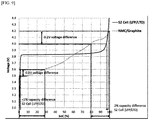
- the lithium secondary battery 100 has the property of autonomously adjusting electric potential by using the nature of LFP and LTO materials that cause a rapid change in electric potential at the end of the charging and discharging, and as a result, the lithium secondary battery 100 may minimize the difference in voltage between the first electrode assembly 110 and the second electrode assembly 120 and continuously maintain balance of electric potential between the two electrode assemblies (jelly rolls). As shown in the graph of FIG. 9 , it is possible to minimize a difference in capacity caused by the difference in electric potential between the two electrode assemblies (jelly rolls) during the charging and discharging in comparison with an NMC/Graphite cell.
- the lithium secondary battery 100 in comparison with the case in which the two end cells are simply connected in series, has a configuration in which sizes of terminal tabs of positive and negative electrodes are reduced, a size of a pouch that constitutes a casing is reduced, or the amount of metal is reduced, and as a result, it is possible to reduce costs and increase energy density by approximately 3 %.
- the lithium secondary battery 100 according to the exemplary embodiment of the present invention may be manufactured by a production process in the related art and manufactured in both winding and stacking manners without additional component or instrument.
- first electrode assembly 110 and the second electrode assembly 120 will be described in detail with reference to FIGS. 2A , 2B , 2C , and 5 .
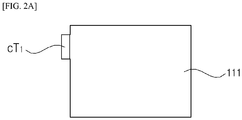
- FIG. 2A is a top plan view of a positive electrode plate (cathode electrode) 111 of the first electrode assembly 110
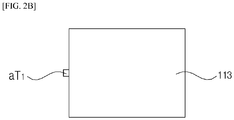
- FIG. 2B is a top plan view of a negative electrode plate (anode electrode) 113 of the first electrode assembly 110
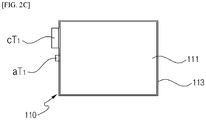
- FIG. 2C is a top plan view illustrating a state in which the positive electrode plate 111 and the negative electrode plate 113 of the first electrode assembly 110 are stacked.
- FIG. 3 is a cross-sectional view of the first electrode assembly 110.
- the first electrode assembly 110 may include the positive electrode plate 111, the negative electrode plate 113, and a separation membrane 115.
- a positive electrode tab cT1 may protrude from a left surface of the positive electrode plate 111.
- the positive electrode tab cT1 may be formed adjacent to an upper side (based on FIG. 3 ) on the left surface of the positive electrode plate 111.
- the serial connection tab aT1 may protrude from a left surface of the negative electrode plate 113.
- the serial connection tab aT1 may be formed at a central portion of the left surface of the negative electrode plate 113.
- the serial connection tab aT1 may be smaller in size than the positive electrode tab cT1.
- the positive electrode plate 111 and the negative electrode plate 113 are stacked.
- the positive electrode tab cT1 and the serial connection tab aT1 do not overlap each other.
- the separation membrane 115 may be provided between the positive electrode plate 111 and the negative electrode plate 113 and may insulate the positive electrode plate 111 and the negative electrode plate 113. This configuration may be ascertained from FIG. 3 .
- the positive electrode plate 111 may include a positive electrode current collector 111a and the positive electrode tab cT1.
- the positive electrode current collector 111a is a part that constitutes a body of the positive electrode plate 111 and may be formed in the form of a quadrangular plate, as illustrated in FIGS. 2A , 2B , and 2C .
- the positive electrode current collector 111a may be made of a material including aluminum or stainless steel.
- Slurry (made by dispersing a positive electrode active material, a binder, and a conductive agent into a solvent) including an LFP positive electrode active material 111b may be applied onto lower and upper surfaces of the positive electrode current collector 111a.
- the LFP positive electrode active material 111b refers to a lithium iron phosphate (LiFePO 4 ) active material.
- the LFP positive electrode active material 111b is a substance that generally forms the positive electrode of the lithium secondary battery, and a detailed description thereof will be omitted.
- the LFP positive electrode active material 111b may be substituted with any one of NMC, NCA, LCO, and LMO positive electrode active materials.
- the positive electrode tab cT1 may extend from the left surface of the positive electrode current collector 111a (based on FIG. 3 ).
- the positive electrode tab cT1 may be made of the same material as the positive electrode current collector 111a. No positive electrode active material is applied onto the positive electrode tab cT1.
- the positive electrode tab cT1 is connected to a lead tab which is a separate conductive connection component, such that the positive electrode tab cT1 may be utilized as a positive electrode terminal of the lithium secondary battery 100.
- the negative electrode plate 113 may include a negative electrode current collector 113a and the serial connection tab aT1.
- the negative electrode current collector 113a is a part that constitutes a body of the negative electrode plate 113 and may be formed in the form of a quadrangular plate similar to the positive electrode current collector 111a.
- the negative electrode current collector 113a may be made of a material including aluminum, copper, or stainless steel.
- Slurry (made by dispersing a negative electrode active material, a binder, and a conductive agent into a solvent) including an LTO negative electrode active material 113b may be applied onto lower and upper surfaces of the negative electrode current collector 113a.
- the LTO negative electrode active material 113b refers to lithium titanium oxide (Li 4 Ti 5 O 12 ). Since the LTO negative electrode active material 113b has been described above, a detailed description thereof will be omitted.
- the serial connection tab aT1 may extend from the left surface of the negative electrode current collector 113a (based on FIG. 3 ).
- the serial connection tab aT1 may be made of the same material as the negative electrode current collector 113a. No negative electrode active material is applied onto the serial connection tab aT1.
- the serial connection tab aT1 may not overlap the positive electrode tab cT1.
- the serial connection tab aT1 may be smaller in size than the positive electrode tab cT1.
- the serial connection tab aT1 is connected directly to a serial connection tab aT2 of the second electrode assembly 120 and serves to connect the first electrode assembly 110 and the second electrode assembly 120 by a new type of serial structure.
- the separation membrane 115 may be provided between the positive electrode plate 111 and the negative electrode plate 113 and may insulate the positive electrode plate 111 and the negative electrode plate 113. That is, the separation membrane 115 may be provided between the LFP positive electrode active material 111b on the lower surface of the positive electrode current collector 111a and the LTO negative electrode active material 113b on the upper surface of the negative electrode current collector 113a.
- the separation membrane 115 electrically separates the positive electrode plate 111 and the negative electrode plate 113 and may allow lithium ions to pass through internal pores of the separation membrane 115.
- the separation membrane 115 is manufactured by using a polyolefin-based (polyethylene or polypropylene) material or non-woven fabric and may include any one of polyvinylidene fluoride, polyethylene oxide, polyacrylonitrile, and polyvinylidene fluoride hexafluoropropylene.
- FIG. 4A is a top plan view of a positive electrode plate 121 of the second electrode assembly 120
- FIG. 4B is a top plan view of a negative electrode plate 123 of the second electrode assembly 120
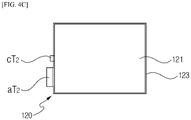
- FIG. 4C is a top plan view illustrating a state in which the positive electrode plate 121 and the negative electrode plate 123 of the second electrode assembly 120 are stacked.
- FIG. 5 is a cross-sectional view of the second electrode assembly 120.
- the second electrode assembly 120 may include the positive electrode plate 121, the negative electrode plate 123, and a separation membrane 125.
- the serial connection tab cT2 may protrude from a left surface of the positive electrode plate 121.
- the connection tab cT2 may be formed at a central portion of the left surface of the positive electrode plate 121.
- the negative electrode tab aT2 may protrude from a left surface of the negative electrode plate 123.
- the negative electrode tab aT2 may be formed adjacent to a lower side (based on FIGS. 4A , 4B , and 4C ) on the left surface of the negative electrode plate 123.
- the negative electrode tab aT2 may be larger in size than the serial connection tab cT2.
- the positive electrode plate 121 and the negative electrode plate 123 are stacked.
- the serial connection tab cT2 and the negative electrode tab aT2 do not overlap each other.
- the separation membrane 125 may be provided between the positive electrode plate 121 and the negative electrode plate 123 and may insulate the positive electrode plate 121 and the negative electrode plate 123. This configuration may be ascertained from FIG. 5 .
- the positive electrode plate 121 may include a positive electrode current collector 121a and the serial connection tab cT2.
- the positive electrode current collector 121a is a part that constitutes a body of the positive electrode plate 121 and may be formed in the form of a quadrangular plate, as illustrated in FIGS. 4A , 4B , and 4C .
- the positive electrode current collector 121a may be made of a material including aluminum or stainless steel.
- Slurry (made by dispersing a positive electrode active material, a binder, and a conductive agent into a solvent) including an LFP positive electrode active material 121b may be applied onto lower and upper surfaces of the positive electrode current collector 121a.
- LFP positive electrode active material 121b is identical to the LFP positive electrode active material 111b applied onto the positive electrode current collector 111a of the first electrode assembly 110, a detailed description thereof will be omitted.
- the serial connection tab cT2 may extend from the left surface of the positive electrode current collector 121a (based on FIG. 5 ).
- the serial connection tab cT2 may be made of the same material as the positive electrode current collector 121a. No positive electrode active material is applied onto the serial connection tab cT2.
- the serial connection tab cT2 may overlap and be joined to the serial connection tab aT1 of the first electrode assembly 110 and may electrically connect the second electrode assembly 120 and the first electrode assembly 110 in series.
- the negative electrode plate 123 may include a negative electrode current collector 123a and the negative electrode tab aT2.
- the negative electrode current collector 123a is a part that constitutes a body of the negative electrode plate 123 and may be formed in the form of a quadrangular plate similar to the positive electrode plate 121.
- the negative electrode current collector 123a may be made of a material including aluminum, copper, or stainless steel.
- Slurry (made by dispersing a negative electrode active material, a binder, and a conductive agent into a solvent) including an LTO negative electrode active material 123b may be applied onto lower and upper surfaces of the negative electrode current collector 123a.
- LTO negative electrode active material 123b is identical to the LTO negative electrode active material 113b applied onto the negative electrode current collector 113a of the first electrode assembly 110, a detailed description thereof will be omitted.
- the negative electrode tab aT2 may extend from the left surface of the negative electrode current collector 123a.
- the negative electrode tab aT2 may be made of the same material as the negative electrode current collector 123a. No negative electrode active material is applied onto the negative electrode tab aT2.
- the negative electrode tab aT2 may not overlap the serial connection tab cT2.
- the negative electrode tab aT2 may be larger in size than the serial connection tab cT2.
- the negative electrode tab aT2 is connected to a lead tab, which is a separate conductive connection component, such that the negative electrode tab aT2 may be utilized as a negative electrode terminal of the lithium secondary battery 100.
- the separation membrane 125 may be provided between the positive electrode plate 121 and the negative electrode plate 123 and may insulate the positive electrode plate 121 and the negative electrode plate 123. That is, the separation membrane 125 may be provided between the LFP positive electrode active material 121b on the lower surface of the positive electrode current collector 121a and the LTO negative electrode active material 123b on the upper surface of the negative electrode current collector 123a.
- the separation membrane 125 may be made of the same material as the aforementioned separation membrane 115 of the first electrode assembly 110.
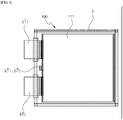
- FIG. 6 is a top plan view of the lithium secondary battery which has an angular (pouch or metal casing) shape and includes the first electrode assembly having the stacking structure and the second electrode assembly having the stacking structure according to the exemplary embodiment of the present invention.
- the first electrode assembly 110 and the second electrode assembly 120 may be stacked with an electrode assembly separation membrane (not illustrated) interposed therebetween.
- the positive electrode plate 111 of the first electrode assembly 110 is disposed at an uppermost end.
- the positive electrode tab cT1 of the first electrode assembly 110 and the serial connection tab cT2 of the second electrode assembly 120 may overlap and be joined to each other, such that the first electrode assembly 110 and the second electrode assembly 120 are connected by a new type of serial structure.
- a quadrangular casing P may accommodate the first electrode assembly 110, the second electrode assembly 120, and the electrode assembly separation membrane.
- examples of the quadrangular casing P may include a pouch, a metal can, and the like.
- the positive electrode tab cT1 is connected to the lead tab which is a separate conductive connection component, such that the positive electrode tab cT1 may protrude to the outside of the quadrangular casing P and may be used as a positive electrode terminal of the lithium secondary battery 100.
- the negative electrode tab aT2 is connected to the lead tab which is a separate conductive connection component, such that the negative electrode tab aT2 may protrude to the outside of the quadrangular casing P and may be used as a negative electrode terminal of the lithium secondary battery 100.
- a liquid electrolyte, a gel type electrolyte such as polymer, or a solid electrolyte may be provided in the quadrangular casing P in order to allow the lithium ions to smoothly move.
- each of the first electrode assembly 110 and the second electrode assembly 120 may be formed to have a jelly roll structure in order to increase a battery capacity.
- the jelly roll structure may be formed by two types of methods.
- the multiple first electrode assemblies 110 and the multiple second electrode assemblies 120 are provided, the multiple first electrode assemblies 110 are stacked on one another with separation membranes interposed therebetween so as to form a jelly roll structure, and the multiple second electrode assemblies 120 are stacked on one another with separation membranes interposed therebetween so as to form a jelly roll structure. Thereafter, the first electrode assembly 110 having the jelly roll structure is stacked on the second electrode assembly 120 having the jelly roll structure with the electrode assembly separation membrane interposed therebetween, and as a result, the lithium secondary battery 110 having an angular (pouch or a metal casing) shape is completely made.
- the second jelly roll structure may be ascertained from the following FIGS. 7A , 7B , and 7C .
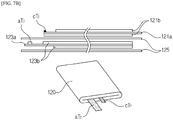
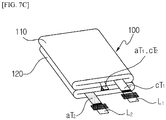
- FIGS. 7A , 7B , and 7C are cross-sectional views and perspective views of the lithium secondary battery which has an angular (pouch or metal casing) shape and includes the first electrode assembly having a winding structure and the second electrode assembly having a winding structure according to the exemplary embodiment of the present invention.
- FIG. 7A is a cross-sectional view and a perspective view of the first electrode assembly having the winding structure
- FIG. 7B is a cross-sectional view and a perspective view of the second electrode assembly having the winding structure
- FIG. 7C is a perspective view of the angular lithium secondary battery having the first electrode assembly stacked on the second electrode assembly.
- the first electrode assembly 110 is wound to form the jelly roll structure, as illustrated in FIG. 7A
- the second electrode assembly 120 is wound to form the jelly roll structure, as illustrated in FIG. 7B .
- the first electrode assembly 110 is stacked on the second electrode assembly 120, the serial connection tabs aT1 and cT2 are coupled to each other, and the first electrode assembly 110 and the second electrode assembly 120 are connected in series, such that the lithium secondary battery 100 may be finally and completely made.
- the positive electrode tab cT1 of the first electrode assembly 110 is connected to a lead tab L1 and used as a positive electrode terminal
- the negative electrode tab aT2 of the second electrode assembly 120 is connected to a lead tab L2 and used as a negative electrode terminal.
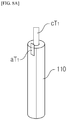
- FIG. 8A is a perspective view of the first electrode assembly 110 that constitutes an inner cylindrical shape of the cylindrical lithium secondary battery 100
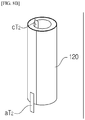
- FIG. 8B is a perspective view of the second electrode assembly 120 that constitutes an outer cylindrical shape of the cylindrical lithium secondary battery 100
- FIG. 8C is a perspective view of the cylindrical lithium secondary battery 100.
- the first electrode assembly 110 may constitute the inner cylindrical shape by holding and winding the positive electrode plate, the negative electrode plate, and the separation membrane by using a mandrel.
- the second electrode assembly 120 may constitute the outer cylindrical shape by winding the positive electrode plate, the negative electrode plate, and the separation membrane so that the positive electrode plate, the negative electrode plate, and the separation membrane surround an outer circumference of the first electrode assembly 120.
- the second electrode assembly 120 which constitutes the outer cylindrical shape, surrounds and is coupled to the first electrode assembly 110 which constitutes the inner cylindrical shape, the serial connection tabs aT1 and cT2 are coupled to each other, and the first electrode assembly 110 and the second electrode assembly 120 are connected in series, such that the cylindrical lithium secondary battery 100 may be finally and completely made.
- the negative electrode tab aT2 of the second electrode assembly 120 may be formed in a direction opposite to a direction in which the positive electrode tab cT1 of the first electrode assembly 110, the serial connection tab aT1 of the first electrode assembly, and the serial connection tab cT2 of the second electrode assembly 120 are formed.
- the positive electrode tab cT1 of the first electrode assembly 110, the serial connection tab aT1 of the first electrode assembly 110, and the serial connection tab cT2 of the second electrode assembly 120 may be disposed to protrude from an upper end portion of the cylindrical lithium secondary battery 100, and the positive electrode tab cT1 of the first electrode assembly 110 is connected to an upper cap assembly and forms a positive electrode terminal of the battery.
- the negative electrode tab aT2 of the second electrode assembly 120 is disposed to protrude from a lower end portion of the cylindrical lithium secondary battery 100 and connected to a lower portion of a cylindrical metal can so that the metal can itself forms negative electrode electric potential.
- the cap at the upper side and the metal can at the lower side are insulated by insulating plastic, such that the positive electrode terminal and the negative electrode terminal may be electrically insulated.
- circular protective caps may be coupled to upper and lower ends of the cylindrical lithium secondary battery 100 in order to protect the positive electrode tab cT1 of the first electrode assembly 110, the serial connection tab aT1 of the first electrode assembly 110, the serial connection tab cT2 of the second electrode assembly 120, and the negative electrode tab aT2 of the second electrode assembly 120.
- FIG. 9 is a graph illustrating a concept of self-balancing between the first and second electrode assemblies according to the exemplary embodiment of the present invention.
- FIG. 9 illustrates that the lithium secondary battery (S2 Cell LFP/LTO) 100 according to the exemplary embodiment of the present invention has a concept of self-balancing that inhibits imbalance between the first and second electrode assemblies 110 and 120.
- a difference in voltage of 0.2 V causes a difference in charging capacity of 20%.
- a difference in voltage of 0.2 V causes a difference in charging capacity of 2%. This situation shows that the self-balancing occurs to maximally inhibit a difference in charging amount caused by a rapid change in electric potential at the end of the charging.
- a difference in voltage of 0.1 V causes a difference in discharging capacity of 27%.
- a difference in voltage of 0.1 V causes a difference in discharging capacity of less than 1%. This situation shows that the self-balancing occurs at the end of the discharging.
- the self-balancing occurs at the end of the charging and discharging, thereby minimizing a difference in capacity caused by a difference in voltage between the two electrode assemblies (jelly rolls) in comparison with the NMC/Graphite secondary battery in the related art.
- the lithium secondary battery 100 As shown in Table 1, the lithium secondary battery 100 according to the exemplary embodiment of the present invention has the new type of serial structure in which the serial connection tab aT1 of the first electrode assembly 110 and the serial connection tab cT2 of the second electrode assembly 120 are directly connected, and as a result, it is possible to solve various types of problems that occur when the LTO and the LFP are used as the negative electrode active material and the positive electrode active material, respectively. Therefore, the lithium secondary battery 100 may have a high rated voltage (3.8 V) that may solve the problem caused by a low rated voltage (1.9 to 2.4 V) of the lithium secondary battery that uses the LTO negative electrode active material in the related art.
- the lithium secondary battery 100 may have a higher charging rate (e.g., 5 C) than any type of secondary battery in the related art, have a superior charging performance even at a low temperature, have lifespan characteristics at least three or more times better than a secondary battery in the related art, and exhibit safety without causing thermal runaway even at a high temperature of 300 degrees or more.
- a higher charging rate e.g., 5 C
- FIG. 10 is a graph illustrating capacity retention with respect to charging rates in respect to LTO and graphite utilized as the negative electrode active material of the secondary battery.
- the LTO and the graphite have similar capacity retention in a case in which a specific current of 100 mA/g or less flows when the charging is performed at a low rate (0.5 C or less), but there is a rapid difference in capacity retention when the charging is performed at a high rate (2 C or more), and there is a difference in capacity retention by seven or more times in a case in which a specific current of 1,000 mA/g or more flows.
- the improvement is possible as the battery according to the present invention is used as a secondary battery for solving the aforementioned problem with the rapid charging.
- FIG. 11 is a graph illustrating discharging characteristics with respect to temperatures in respect to a secondary battery in the related art and the lithium secondary battery according to the exemplary embodiment of the present invention.
- an NMC/Graphite secondary battery, an LFP/Graphite secondary battery, and an NMC/LTO secondary battery will be described as an example of the secondary battery in the related art.
- the NMC/Graphite secondary battery, the LFP/Graphite secondary battery, the NMC/LTO secondary battery, and the lithium secondary battery (LFP/LTO) according to the exemplary embodiment of the present invention have discharging rate proximate to 100% at about room temperature, and the discharging performances thereof are decreased as the temperature is decreased.
- the lithium secondary battery (LFP/LTO) according to the exemplary embodiment of the present invention has a discharging rate of approximately 80% at -30°C, such that the lithium secondary battery (LFP/LTO) has better characteristics at a low temperature than the secondary battery in the related art.
- FIG. 12 is a graph illustrating thermal runaway performances in respect to the secondary battery in the related art and the lithium secondary battery according to the exemplary embodiment of the present invention.
- an LCO/Graphite secondary battery, an NMC/Graphite secondary battery, and an LFP/Graphite secondary battery will be described as an example of the secondary battery in the related art.
- the thermal runaway occurs when the temperature reaches approximately 150°C.
- the thermal runaway occurs when the temperature reaches approximately 190°C.
- the thermal runaway occurs when the temperature reaches approximately 230°C.
- the thermal runaway does not occur until the charging temperature reaches 250°C.
- the lithium secondary battery according to the exemplary embodiment of the present invention may be more quickly charged than the secondary battery in the related art, may have better charging and discharging characteristics at a low temperature than the secondary battery in the related art, and may be stronger against heat than the secondary battery in the related art.
- the lithium secondary battery 100 may have excellent temperature and charging/discharging characteristics of the LTO negative electrode active material, may have a rated voltage available for general electronic devices (consumer electronics), and may have structural stability of the LTO negative electrode active material and the electrochemical property of preventing lithium plating, thereby reducing a risk of explosion caused by an increase in temperature. Accordingly, the lithium secondary battery 100 may be applied to various fields including an electricity storage system (ESS), a solar cell, an electric vehicle, an electric bike, and an industrial battery.
- ESS electricity storage system
Landscapes
- Chemical & Material Sciences (AREA)
- Chemical Kinetics & Catalysis (AREA)
- Electrochemistry (AREA)
- General Chemical & Material Sciences (AREA)
- Engineering & Computer Science (AREA)
- Materials Engineering (AREA)
- Inorganic Chemistry (AREA)
- Manufacturing & Machinery (AREA)
- Crystallography & Structural Chemistry (AREA)
- Secondary Cells (AREA)
- Connection Of Batteries Or Terminals (AREA)
Applications Claiming Priority (3)
| Application Number | Priority Date | Filing Date | Title |
|---|---|---|---|
| KR20160125025 | 2016-09-28 | ||
| KR1020170096954A KR101935229B1 (ko) | 2016-09-28 | 2017-07-31 | 리튬 이차 전지 |
| PCT/KR2017/009397 WO2018062698A1 (ko) | 2016-09-28 | 2017-08-29 | 리튬 이차 전지 |
Publications (3)
| Publication Number | Publication Date |
|---|---|
| EP3522285A1 true EP3522285A1 (de) | 2019-08-07 |
| EP3522285A4 EP3522285A4 (de) | 2020-05-27 |
| EP3522285B1 EP3522285B1 (de) | 2026-04-15 |
Family
ID=61977401
Family Applications (1)
| Application Number | Title | Priority Date | Filing Date |
|---|---|---|---|
| EP17856584.2A Active EP3522285B1 (de) | 2016-09-28 | 2017-08-29 | Lithiumsekundärbatterie |
Country Status (2)
| Country | Link |
|---|---|
| EP (1) | EP3522285B1 (de) |
| KR (1) | KR101935229B1 (de) |
Cited By (1)
| Publication number | Priority date | Publication date | Assignee | Title |
|---|---|---|---|---|
| EP4468510A4 (de) * | 2022-07-19 | 2025-11-05 | Lg Energy Solution Ltd | Elektrodenanordnungsstruktur und zylindrische batterie, batteriepack und fahrzeug damit |
Families Citing this family (3)
| Publication number | Priority date | Publication date | Assignee | Title |
|---|---|---|---|---|
| KR102597528B1 (ko) | 2018-07-03 | 2023-11-01 | 에스케이온 주식회사 | 고전압 배터리 셀 |
| CN114079127A (zh) * | 2020-08-11 | 2022-02-22 | 北京小米移动软件有限公司 | 电池包和终端 |
| KR102911707B1 (ko) * | 2020-09-03 | 2026-01-14 | 삼성전자주식회사 | 배터리 및 배터리를 포함하는 전자장치 |
Family Cites Families (8)
| Publication number | Priority date | Publication date | Assignee | Title |
|---|---|---|---|---|
| JP4654575B2 (ja) * | 2003-10-27 | 2011-03-23 | パナソニック株式会社 | 円筒形電池とそれを用いた電池間接続構造 |
| KR101170881B1 (ko) * | 2007-11-17 | 2012-08-03 | 주식회사 엘지화학 | 직렬 연결 구조의 고출력 이차전지 |
| JP6087489B2 (ja) * | 2010-08-20 | 2017-03-01 | 株式会社東芝 | 組電池システム |
| DE102011088636A1 (de) * | 2011-12-15 | 2013-06-20 | Robert Bosch Gmbh | Hartschalengehäuse mit superhydrophoben Material |
| KR101669216B1 (ko) * | 2013-09-09 | 2016-10-25 | 삼성전자주식회사 | 전극 조립체 및 이를 구비하는 이차 전지 |
| JP6178183B2 (ja) * | 2013-09-17 | 2017-08-09 | 株式会社東芝 | 非水電解質電池、組電池及び蓄電池装置 |
| WO2015140952A1 (ja) * | 2014-03-19 | 2015-09-24 | 株式会社東芝 | 非水電解質二次電池、組電池および電池パック |
| JP2016033898A (ja) * | 2014-07-31 | 2016-03-10 | 株式会社東芝 | 非水電解質電池及び電池パック |
-
2017
- 2017-07-31 KR KR1020170096954A patent/KR101935229B1/ko active Active
- 2017-08-29 EP EP17856584.2A patent/EP3522285B1/de active Active
Cited By (1)
| Publication number | Priority date | Publication date | Assignee | Title |
|---|---|---|---|---|
| EP4468510A4 (de) * | 2022-07-19 | 2025-11-05 | Lg Energy Solution Ltd | Elektrodenanordnungsstruktur und zylindrische batterie, batteriepack und fahrzeug damit |
Also Published As
| Publication number | Publication date |
|---|---|
| EP3522285B1 (de) | 2026-04-15 |
| KR20180035119A (ko) | 2018-04-05 |
| EP3522285A4 (de) | 2020-05-27 |
| KR101935229B1 (ko) | 2019-01-04 |
Similar Documents
| Publication | Publication Date | Title |
|---|---|---|
| EP2779269B1 (de) | Batteriezelle mit neuartigem aufbau | |
| EP1998401B1 (de) | Elektrodenanordnung und Sekundärbatterie damit | |
| EP2770555B1 (de) | Elektrodenanordnung, Batteriezelle mit Elektrodenanordnung und Verfahren zur Herstellung der Batteriezelle | |
| KR101841306B1 (ko) | 안전성 향상을 위한 테이핑부를 포함하는 이종 분리막 전극조립체 및 이를 포함하는 리튬 이차전지 | |
| KR102742761B1 (ko) | 전극 조립체 및 이차 전지 | |
| JP4382557B2 (ja) | 非水二次電池 | |
| EP1875535A1 (de) | Wiederaufladbare lithiumionenbatterie für einen schaukelstuhl | |
| WO2014017864A1 (ko) | 이차전지 | |
| EP3522285B1 (de) | Lithiumsekundärbatterie | |
| US20170047576A1 (en) | Secondary battery | |
| JP2013016265A (ja) | 非水電解質二次電池 | |
| US11450910B2 (en) | Secondary battery and insulator for secondary battery | |
| EP3754749B1 (de) | Sekundärbatterie und batteriemodul | |
| US11394093B2 (en) | Secondary battery and battery module | |
| US11476468B2 (en) | Electrode, electrode assembly and method for manufacturing the same | |
| CN101017887B (zh) | 电池层叠体及电池组件 | |
| KR101576597B1 (ko) | 이차 전지 및 이를 포함하는 배터리 팩 | |
| KR20120130557A (ko) | 안전성이 향상된 전극조립체 및 이를 이용하여 이차전지 | |
| EP4693701A1 (de) | Sekundärbatterie und verfahren zur herstellung davon | |
| KR20160043353A (ko) | 전기화학소자용 분리막 및 이를 포함하는 전기화학소자 | |
| KR102479338B1 (ko) | 하이브리드 전지 모듈 | |
| KR20250030651A (ko) | 전극 조립체 및 이를 포함하는 이차전지 | |
| KR200364044Y1 (ko) | 대용량 고율 리튬 이온전지 | |
| KR101566574B1 (ko) | 물과 무기산화물의 혼합물을 적용한 고안전성 리튬 이차전지 | |
| WO2018062698A1 (ko) | 리튬 이차 전지 |
Legal Events
| Date | Code | Title | Description |
|---|---|---|---|
| STAA | Information on the status of an ep patent application or granted ep patent |
Free format text: STATUS: THE INTERNATIONAL PUBLICATION HAS BEEN MADE |
|
| PUAI | Public reference made under article 153(3) epc to a published international application that has entered the european phase |
Free format text: ORIGINAL CODE: 0009012 |
|
| STAA | Information on the status of an ep patent application or granted ep patent |
Free format text: STATUS: REQUEST FOR EXAMINATION WAS MADE |
|
| 17P | Request for examination filed |
Effective date: 20190412 |
|
| AK | Designated contracting states |
Kind code of ref document: A1 Designated state(s): AL AT BE BG CH CY CZ DE DK EE ES FI FR GB GR HR HU IE IS IT LI LT LU LV MC MK MT NL NO PL PT RO RS SE SI SK SM TR |
|
| AX | Request for extension of the european patent |
Extension state: BA ME |
|
| DAV | Request for validation of the european patent (deleted) | ||
| DAX | Request for extension of the european patent (deleted) | ||
| A4 | Supplementary search report drawn up and despatched |
Effective date: 20200424 |
|
| RIC1 | Information provided on ipc code assigned before grant |
Ipc: H01M 4/485 20100101ALI20200420BHEP Ipc: H01M 2/26 20060101ALI20200420BHEP Ipc: H01M 4/131 20100101ALI20200420BHEP Ipc: H01M 4/136 20100101ALI20200420BHEP Ipc: H01M 4/58 20100101ALI20200420BHEP Ipc: H01M 10/0587 20100101ALI20200420BHEP Ipc: H01M 2/20 20060101ALI20200420BHEP Ipc: H01M 10/0525 20100101AFI20200420BHEP |
|
| STAA | Information on the status of an ep patent application or granted ep patent |
Free format text: STATUS: EXAMINATION IS IN PROGRESS |
|
| 17Q | First examination report despatched |
Effective date: 20210506 |
|
| GRAP | Despatch of communication of intention to grant a patent |
Free format text: ORIGINAL CODE: EPIDOSNIGR1 |
|
| STAA | Information on the status of an ep patent application or granted ep patent |
Free format text: STATUS: GRANT OF PATENT IS INTENDED |
|
| RIC1 | Information provided on ipc code assigned before grant |
Ipc: H01M 10/0525 20100101AFI20251202BHEP Ipc: H01M 4/131 20100101ALI20251202BHEP Ipc: H01M 4/136 20100101ALI20251202BHEP Ipc: H01M 4/485 20100101ALI20251202BHEP Ipc: H01M 4/58 20100101ALI20251202BHEP Ipc: H01M 10/0587 20100101ALI20251202BHEP Ipc: H01M 50/538 20210101ALI20251202BHEP |
|
| INTG | Intention to grant announced |
Effective date: 20251217 |
|
| RAP3 | Party data changed (applicant data changed or rights of an application transferred) |
Owner name: GRINERGY CO.,LTD. |
|
| GRAS | Grant fee paid |
Free format text: ORIGINAL CODE: EPIDOSNIGR3 |
|
| RAP1 | Party data changed (applicant data changed or rights of an application transferred) |
Owner name: GRINERGY CO.,LTD. Owner name: TITANVOLT INDUSTRIES LIMITED |
|
| GRAA | (expected) grant |
Free format text: ORIGINAL CODE: 0009210 |
|
| STAA | Information on the status of an ep patent application or granted ep patent |
Free format text: STATUS: THE PATENT HAS BEEN GRANTED |
|
| AK | Designated contracting states |
Kind code of ref document: B1 Designated state(s): AL AT BE BG CH CY CZ DE DK EE ES FI FR GB GR HR HU IE IS IT LI LT LU LV MC MK MT NL NO PL PT RO RS SE SI SK SM TR |
|
| REG | Reference to a national code |
Ref country code: CH Ref legal event code: F10 Free format text: ST27 STATUS EVENT CODE: U-0-0-F10-F00 (AS PROVIDED BY THE NATIONAL OFFICE) Effective date: 20260415 |