EP3500865B1 - Optical rf spectrum analyser - Google Patents
Optical rf spectrum analyser Download PDFInfo
- Publication number
- EP3500865B1 EP3500865B1 EP17842446.1A EP17842446A EP3500865B1 EP 3500865 B1 EP3500865 B1 EP 3500865B1 EP 17842446 A EP17842446 A EP 17842446A EP 3500865 B1 EP3500865 B1 EP 3500865B1
- Authority
- EP
- European Patent Office
- Prior art keywords
- signal
- frequency
- over time
- optical
- spectral weight
- Prior art date
- Legal status (The legal status is an assumption and is not a legal conclusion. Google has not performed a legal analysis and makes no representation as to the accuracy of the status listed.)
- Active
Links
Images





Classifications
-
- G—PHYSICS
- G01—MEASURING; TESTING
- G01R—MEASURING ELECTRIC VARIABLES; MEASURING MAGNETIC VARIABLES
- G01R23/00—Arrangements for measuring frequencies; Arrangements for analysing frequency spectra
- G01R23/16—Spectrum analysis; Fourier analysis
- G01R23/17—Spectrum analysis; Fourier analysis with optical or acoustical auxiliary devices
Definitions
- This disclosure relates to optical RF spectrum analysers and methods for analysing an input RF signal.
- RF measurement resolution is solely dependent on the optical filtering bandwidth. For example, in order to have an RF measurement resolution of 20MHz, it requires a highly selective optical filter with a 3dB bandwidth of 20MHz, which is extremely complex or even not possible to be achieved in optical fabrication.
- An optical RF spectrum analyser comprises:
- the signal recovery module may be configured to perform a deconvolution of the RF signal over time based on the spectral weight function.
- the deconvolution may be based on an analytical approximation of the spectral weight function.
- the signal recovery module may be configured to perform the deconvolution of the RF signal over time by using a waveform of the RF signal over time as a frequency domain signal.
- Using the waveform of the RF signal over time as a frequency domain signal may comprise creating a frequency axis associated with the RF signal over time based on a rate of modifying the frequency relationship between the spectral weight function and the carrier frequency over time.
- the spectral weight may be a resonance.
- the resonance may be a ring oscillator.
- the optical modulator may comprise a laser source to generate a laser at the carrier frequency.
- the frequency control module may be to modify the relationship between the spectral weight function and the carrier frequency by varying the carrier frequency. Varying the carrier frequency may comprise performing a sweep across a frequency range.
- Modifying the relationship between the spectral weight function and the carrier frequency over time may be based on a rate of change per unit time and the signal recovery module may be to calculate the RF spectrum based on the rate of change.
- a method for analysing an input RF signal comprises:
- Calculating the spectrum of the input RF signal may comprise performing a deconvolution of the RF signal over time based on the spectral weight function.
- the deconvolution may be based on an analytical approximation of the spectral weight function.
- Performing the deconvolution of the RF signal over time may comprise using a waveform of the RF signal over time as a frequency domain signal.
- Using the waveform of the RF signal over time as a frequency domain signal may comprise creating a frequency axis associated with the RF signal over time based on a rate of modifying the frequency relationship between the spectral weight function and the carrier frequency over time.
- Modifying the relationship between the spectral weight function and the carrier frequency may comprise varying a carrier frequency of a laser source.
- Varying the carrier frequency may comprise performing a sweep across a frequency range.
- Modifying the relationship between the spectral weight function and the carrier frequency over time may be based on a rate of change per unit time and calculating the RF spectrum is based on the rate of change.
- a method for controlling an RF signal analyser comprising:
- This disclosure provides a technology that breaks the one-to-one relationship between RF measurement resolution and optical bandwidth, provides a high RF measurement resolution without increasing the design and manufacture complexity, recovers both amplitude and frequency information of the microwave signals and enables the on-chip RF frequency measurement system.
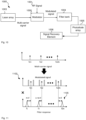
- Fig. 1 illustrates an optical RF spectrum analyser 100 comprising a signal input 101, a modulator 102, frequency control 103, spectral weight 104, such as a filter, optical field integrator 105 and signal recovery module 106.
- Fig. 2 illustrates a method 200 for RF spectrum analysis
- Fig. 3 illustrates a signal flow 300 for RF spectrum analysis.
- the reference numerals in Figs. 1, 2 and 3 correspond to each other in the sense reference numerals 101, 201 and 301 correspond to each other.
- signal input 101 receives 201 an input signal 301
- modulator 102 creates 202 a modulated signal 302 with optical sidebands.
- Frequency control 103 maps 203 the frequency signal 302 into a time domain 303 and spectral weight 104 applies 204 a spectral weight 304 to the time domain signal.
- the frequency integrator 105 integrates 205 the signal to create an integrated time signal 305 and the signal recovery module 106 recovers 206 the signal to calculate the RF spectrum of the input signal 301.
- the input 101 may be an antenna that receives a spectrally limited (narrowband) input signal.
- the narrow band signal is shown at 310.
- the narrow band signal 310 is symmetrical around centre frequency 311.
- the middle of narrow band signal 310 is spaced apart from the origin of the frequency axis by the centre frequency 311. It is noted, however, that the input signal can have any spectrum and in most cases, the input spectrum is unknown.
- the modulation in step 202 by modulator 102 generates an upper sideband 320 and a lower sideband 321.
- the centre of the upper sideband 320 and the lower sideband 321 are spaced apart from a modulator frequency 322 by the centre frequency 311.
- the centre frequency 311 may be the optical frequency of a laser. Since optical frequencies are by magnitudes higher than radio frequencies the frequency axis is broken in Fig. 3 .
- An example RF centre frequency 311 may be 20 GHz and an example optical frequency of carrier 322 may be 195 THz.
- the frequency control 103 maps 203 the modulated signal 302 into the time domain by sweeping the carrier frequency 322 from a low optical wavelength to a high optical wavelength, such as from 1546.45 nm to 1547.25 nm. In effect, this shifts the sidebands 320, 321 as well as the carrier 322 rightwards over time as indicated by time arrow 303.
- the sweep rate is 10 MHz per 1 ms.
- integrator 105 such as a photodiode
- a spectral weight 104 is applied to the signal.
- the spectral weight may be an optical resonance and an example frequency response is plotted at 304 in Fig. 3 .
- Applying a spectral weight basically means multiplying the frequency spectrum 302 at each frequency with the spectral weight 304 at that frequency and then integrating across the entire frequency range. This is also referred to as convolution in the time domain, which becomes the multiplication in the frequency domain.
- the integrated time signal 305 falls back towards zero until the carrier 322 move across the spectral weight 304 resulting in a second peak 352.
- the lower sideband moving across the spectral weight 304 results in a third peak 353.
- the overlapping of spectra may be described as a frequency relationship between the spectral weight function 304 and the carrier frequency 322.
- the frequency relationship is defined by the spectral weight in the sense that the spectral weight defines the relative positioning or alignment between the carrier frequency 322 and the spectral weight function 304.
- This may comprise a fixed spectral weight function, such as implemented by an fixed optical ring oscillator.
- the spectral weight may be tuneable such as by tuning the optical ring oscillator or by using an optical processor. Regardless of the tuning, the spectral weight defines a frequency relationship between the carrier frequency 322 and the spectral weight function 304.
- a particular spectral relationship may be that the spectral weight function is located at a significantly higher frequency than the carrier, is located 10 GHz above the carrier or is located above the carrier by more than the upper sideband 320 frequency.
- Modifying the frequency relationship over time may comprise the above mentioned sweep and causes the overlap as described above.
- the three peaks 351, 352 and 353 are clearly separated as shown in integrated time signal 305 in Fig. 3 .
- the recovery module 106 can detect the three peaks 351, 352 and 353 as the local maxima and measure the time t 0 354 between the upper sideband peak 351 and the carrier peak 352.
- This time t 0 354 is indicative of the time between the overlap of the upper sideband 320 over the spectral weight 304 and the carrier 322 over the spectral weight.
- the time t 0 is indicative of the time period during which the modulated signal spectrum was shifted by f 0 .
- the recovery module 106 can apply a deconvolution algorithm to the time signal. It is noted that many processes in signal processing are described by a convolution of two time signals, such as an input signal and a filter response, which can be transformed into a multiplication in frequency space. In contrast, here the convolution occurs in frequency space between the modulated signal 302 and the spectral weight spectrum 304 but the output is a time domain integrated time signal 305. However, it is possible to replace the time axis of the integrated time signal 305 by a frequency axis according to the sweep rate.
- the recovery module can multiply the time values on the time axis of integrated time signal 305 by 10 MHz/s to convert them to frequencies and apply an offset if applicable.
- the waveform of the integrated time signal 305 can then be passed as a frequency domain signal using the determined frequency axis to a deconvolution algorithm in order to calculate an estimate of the original signal 302.
- the deconvolution may be performed by a processor of a computing system, such as by executing Python code from the scipy.signal.deconvolve package.
- an FPGA performs the deconvolution.
- the accuracy of the deconvolution result can be increased by using the actual spectrum of the spectral weight 204 or an approximation thereof.
- One approximation may be a Gaussian distribution.
- a more accurate approximation may be a Dirac impulse.
- the spectrum analysis system can be realized via 5 signal processing steps in both optical and electrical domain, which include optical sideband (OSB) generation, frequency-to-time mapping, spectral weighting, optical field integration and signal recovery.
- OSB optical sideband
- the input RF signal is applied onto the optical carrier generated by an optical source via an electro-optic modulation, hence realizing the optical sideband generation.
- the optical sideband information in the optical spectrum is translated into a waveform in time domain via frequency-to-time domain mapping where its intensity profile becomes a scaled replica of its optical spectrum.
- the time-varying waveform is transmitted through a spectral weight module, such as an optical filter, where its intensity at the output at each time instance is weighted according to the contributing frequency component.
- an optical field integrator such as photodetector or optical powermeter is employed to measure the exact light intensity at each time instance.
- a signal recovery module based on the deconvolution theorem is used to reconstruct the input RF signal spectrum from the light intensity measured by the optical field integrator.
- the sweeping range can be further extended, e.g. C+L band.
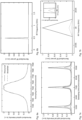
- the optical filter 404 to provide spectral weighting in the system 400 is based on a single ring resonator centered at 1546.85 nm with a 3dB bandwidth of about 1.4 GHz. The measured optical spectrum of the filter is shown in Fig. 5a .
- Fig. 5c shows the measured light intensity waveform at the output of optical field integrator 405 which was an optical power meter in the experiment.
- the results shows the mapping of optical power intensity onto the time domain, the effect of OSB generation 402 and the weighting of optical intensities.
- the estimated frequency of the RF signal at the output of the signal recovery module 406 is shown in Fig. 5d .
- the recovery of the input signal is done through an inverse transformation via various existing signal deconvolution algorithms. For example, the blind deconvolution methods for image and audio processing applications can be adapted and used in the recovery module.
- the measurement error is less than 25MHz which is much less than the filter bandwidth of 1.4GHz.
- Figs. 6a and 6b depict the measurement when the input microwave frequency is reduced to 0.5 GHz which is much smaller than the 3dB bandwidth of the optical filter. Although the output light intensity of the optical power meter is broadened to a single peak as can be seen from Fig. 6a , the frequency of the RF signal can be accurately identified via the new technology as shown in Fig. 6b .
- Fig. 7a and Fig. 7b respectively show the measured light intensity waveform and the estimated modulated signal when the input RF frequency was fixed at 20 GHz and its power was varied. As can be seen, the technology successfully recovers both the amplitude and frequency of the signal.
- the estimated amplitude errors are 0.72, 0.126 and 0.06 dB at 0dBm, -10dBm and -20 dBm input RF power respectively.
- Combining the frequency-to-time mapping module and the spectral weight module with the optical field integrator and a signal recovery module enables the reconstruction of input RF signal spectra with high resolution and also significantly reduces the design and manufacture complexity.
- This technology improves the measurement resolution and operating bandwidth and breaks the one-to-one relationship between RF measurement resolution and optical bandwidth, recovers both amplitude and frequency information of the microwave signals and also enables the on-chip RF frequency measurement system.
- the proposed solution to microwave frequency measurement is insensitive to the wavelength drifting of the optical source and devices as the optical carrier and sidebands information provide self-reference functions.
- the deconvolution may be performed by a processor of a computer system, such as recovery module 106.
- This processor may also perform controlling tasks of the spectrum analyser 100, such as under the instructions of software code that is stored on program memory connected to the processor. These controlling tasks may include generating a modulator control signal to control modulation of the input RF signal 101 onto a carrier frequency 322 by optical modulator 102 to modify a relationship between a spectral weight function 304 and the carrier frequency 322 over time. This basically means that there is another connection in Fig. 1 between the recovery module 106 and the frequency control 103.
- the processor further receives the sensed RF signal over time 305 indicative of the modified signal created by the optical spectral weight 104.
- the processor calculates a spectrum of the input RF signal based on the RF signal over time, such as by applying a deconvolution algorithm to the RF signal over time as described above.
- RF signal 801 in Fig. 8 corresponds to RF signal 101 in Fig. 1 .
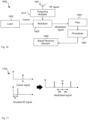
- Fig. 8 shows the schematic diagram of another method for optical RF spectrum analysis, which employs a filter bank 804 to modify the relationship between the spectral weight function 804 and the carrier frequency 803 without varying the carrier frequency 803.
- the modulated optical signal is generated by modulating the RF signal 801 of interest onto the fix-wavelength carrier signal from laser 803. It is then evenly split and sent to a bank of narrow-band optical filters 804 with identical line shapes. Each individual filter is centered at a distinct frequency (f 1 , f 2 ,... f N ) with a constant spacing. It is noted that the relationship between the carrier and the individual filters is changed over time as described before, such as by sweeping the carrier frequency.
- the use of multiple filters as shown in Fig. 8 reduces the time required for the analysis. For example, with four filters only a quarter of the analysis time for one filter is required.
- Fig. 9 shows how each split portion of the modulated signal is multiplied with a shifted spectral weight.
- the weighted spectrum of the modulated signal is then sent to a photodiode 805 where integration over the entire spectrum of modulated signal is implemented.
- the power outputs of the photodiodes are stitched up and deconvolved with the filter line shape, thus the real-time spectrum of the input RF signal is obtained.
- Fig. 10 illustrates another example 1000 of using the filter bank 1004 to realize the optical RF spectrum analyser.
- a laser array 1003 is used to generate multiple carrier signals at different frequencies(fc 1 , fc 2 ,... fc 2N ). Then, the carrier signals are injected to the modulator 1002. RF information is mapped to every carrier signal, hence generating 2N copies of the modulated signal centered at fc 1 , fc 2 ,... fc 2N , respectively. It is then evenly split and sent to a bank of narrow-band optical filters 1004 with identical line shapes.
- each filter output is the product of the shifted spectral weight function and the modulated signal.
- Fig. 11 illustrates the spectra of the optical RF spectrum analyser based on a laser-filter array.
- Fig. 12 shows the schematic diagram of an optical RF spectrum analysis system 1200 based on a laser source 1203 which generates a fixed-wavelength carrier, a modulator 1202, a tunable optical filter 1204, a photodiode 1205 and a signal recovery element 1206.
- the optical filter is of distinct location at each time instance (t 1 , t 2 ,... t N ) as shown in Fig. 13 , a sweep across a frequency range can be achieved.
- Fig. 14 shows another example.
- the laser array 1403 generates multiple carrier signals with a constant frequency spacing (fc 1 , fc 2 ,... fc N ).
- the optical carrier signals are injected to the modulator 1402 to obtain N copies of the modulated optical signal 1401 centered at fc 1 , fc 2 ,... fcrr and then the output of the modulator is sent to a delay element 1410 (e.g. dispersive delay line).
- the time delay provided by the delay element is optical frequency dependent, which indicates each copy of the modulated signal will arrive at the filter 1404 at a different time.
- a dispersive element with a linear delay slope is employed in the system as an optical delay line 1410, it leads to a constant time delay between the n and n+1 (1 ⁇ n ⁇ N) copies of the modulated signal.
- Fig. 15 illustrates the corresponding spectra.
- Fig. 16 illustrates how instead of applying the input RF signal 1601 directly onto the carrier signal generated by the laser source 1603, RF signal 1601 can be sent firstly to a frequency multiplier 1610 then followed by a modulator 1602.
- a frequency doubler could double the input RF frequency as shown in Fig. 17 , thus the relative spacing between the carrier signal and the sidebands is also increased by a factor of 2 in optical frequency domain before being injected to the spectral weight module.
- the ratio of the multiplier 1610 the sideband of the modulated signal is allocated at distinct location at each time instance. Thus, a sweep across a frequency range can be achieved.
Landscapes
- Physics & Mathematics (AREA)
- Mathematical Physics (AREA)
- General Physics & Mathematics (AREA)
- Optical Modulation, Optical Deflection, Nonlinear Optics, Optical Demodulation, Optical Logic Elements (AREA)
- Spectrometry And Color Measurement (AREA)
- Investigating Or Analysing Materials By Optical Means (AREA)
- Analysing Materials By The Use Of Radiation (AREA)
Applications Claiming Priority (2)
| Application Number | Priority Date | Filing Date | Title |
|---|---|---|---|
| AU2016903330A AU2016903330A0 (en) | 2016-08-22 | Optical RF spectrum analyser | |
| PCT/AU2017/050889 WO2018035560A1 (en) | 2016-08-22 | 2017-08-22 | Optical rf spectrum analyser |
Publications (3)
| Publication Number | Publication Date |
|---|---|
| EP3500865A1 EP3500865A1 (en) | 2019-06-26 |
| EP3500865A4 EP3500865A4 (en) | 2020-04-08 |
| EP3500865B1 true EP3500865B1 (en) | 2023-04-05 |
Family
ID=61246646
Family Applications (1)
| Application Number | Title | Priority Date | Filing Date |
|---|---|---|---|
| EP17842446.1A Active EP3500865B1 (en) | 2016-08-22 | 2017-08-22 | Optical rf spectrum analyser |
Country Status (7)
| Country | Link |
|---|---|
| US (1) | US10921356B2 (pl) |
| EP (1) | EP3500865B1 (pl) |
| JP (1) | JP7050334B2 (pl) |
| AU (1) | AU2017315325B2 (pl) |
| ES (1) | ES2947665T3 (pl) |
| PL (1) | PL3500865T3 (pl) |
| WO (1) | WO2018035560A1 (pl) |
Families Citing this family (6)
| Publication number | Priority date | Publication date | Assignee | Title |
|---|---|---|---|---|
| WO2019169442A1 (en) * | 2018-03-08 | 2019-09-12 | Jehmy Pty Ltd | A high sensitivity and selectivity real-time spectrum analyser |
| CN108918966B (zh) * | 2018-05-23 | 2020-06-23 | 成都玖锦科技有限公司 | 基于频谱仪的底噪对消方法 |
| US11313930B1 (en) | 2020-11-13 | 2022-04-26 | Rohde & Schwarz Gmbh & Co. Kg | Alternation pulsed double resonance detection scheme for gapless detection in atomic vapor quantum sensors |
| EP4089421B1 (fr) * | 2021-05-12 | 2023-12-27 | Université Paris Cité | Dispositif d'analyse de spectre de signaux radiofrequences |
| US11223432B1 (en) * | 2021-08-09 | 2022-01-11 | King Abdulaziz University | System and method for determining unknown radio frequencies |
| US12596019B1 (en) * | 2023-03-15 | 2026-04-07 | The Government Of The United States Of America, As Represented By The Secretary Of The Navy | RF spectrum analyzer using Rayleigh backscattering |
Citations (1)
| Publication number | Priority date | Publication date | Assignee | Title |
|---|---|---|---|---|
| EP0586889B1 (de) * | 1992-09-05 | 1998-10-14 | Dornier Gmbh | Verfahren zur Messung von Amplitude und Phase mehrerer hochfrequenter Signale |
Family Cites Families (14)
| Publication number | Priority date | Publication date | Assignee | Title |
|---|---|---|---|---|
| JPS61198935A (ja) * | 1985-02-28 | 1986-09-03 | Toshiba Corp | 光伝送方式 |
| US4695790A (en) * | 1986-01-02 | 1987-09-22 | General Dynamics Electronics Division | RF frequency spectrum analyzer subsystem |
| US4922256A (en) * | 1988-11-18 | 1990-05-01 | Grumman Aerospace Corporation | Tracking receiver for broadband chirp emissions |
| JP2688301B2 (ja) * | 1991-10-16 | 1997-12-10 | 三菱電機株式会社 | 受信装置 |
| JPH08101066A (ja) * | 1994-09-30 | 1996-04-16 | Anritsu Corp | 光スペクトラム測定装置 |
| US6307655B1 (en) * | 1999-11-03 | 2001-10-23 | Lockhead Martin Corporation | Wideband frequency analyzer employing optical chirp transform |
| JP2001242201A (ja) * | 2000-02-25 | 2001-09-07 | Mitsubishi Electric Corp | 周波数分析装置 |
| JP3642569B2 (ja) * | 2001-06-25 | 2005-04-27 | 三菱電機株式会社 | 周波数分析装置 |
| JP2007212427A (ja) * | 2006-01-16 | 2007-08-23 | Tokyo Univ Of Agriculture & Technology | 光周波数検出装置、光スペクトラムアナライザおよび光信号処理装置 |
| US9716553B2 (en) * | 2012-04-30 | 2017-07-25 | Telefonaktiebolaget Lm Ericsson (Publ) | Radio frequency signal transceiver, coherent radar receiver and method of processing radio frequency signals |
| US8861567B2 (en) * | 2012-11-15 | 2014-10-14 | The United States Of America As Represented By The Secretary Of The Army | Method and apparatus for analyzing the spectrum of radio-frequency signals using a fiber optic recirculation loop |
| JP5970405B2 (ja) * | 2013-03-28 | 2016-08-17 | アンリツ株式会社 | ミリ波帯スペクトラム解析装置および解析方法 |
| US9288557B2 (en) * | 2013-05-01 | 2016-03-15 | The United States Of America As Represented By The Secretary Of The Army | Method and apparatus for analyzing the spectrum of radio-frequency signals using unamplified fiber optic recirculation loops |
| JP2015129732A (ja) * | 2014-01-09 | 2015-07-16 | アンリツ株式会社 | 信号処理装置、信号処理方法および信号処理システム |
-
2017
- 2017-08-22 JP JP2019510960A patent/JP7050334B2/ja active Active
- 2017-08-22 AU AU2017315325A patent/AU2017315325B2/en active Active
- 2017-08-22 EP EP17842446.1A patent/EP3500865B1/en active Active
- 2017-08-22 WO PCT/AU2017/050889 patent/WO2018035560A1/en not_active Ceased
- 2017-08-22 PL PL17842446.1T patent/PL3500865T3/pl unknown
- 2017-08-22 ES ES17842446T patent/ES2947665T3/es active Active
- 2017-08-22 US US16/327,002 patent/US10921356B2/en active Active
Patent Citations (1)
| Publication number | Priority date | Publication date | Assignee | Title |
|---|---|---|---|---|
| EP0586889B1 (de) * | 1992-09-05 | 1998-10-14 | Dornier Gmbh | Verfahren zur Messung von Amplitude und Phase mehrerer hochfrequenter Signale |
Also Published As
| Publication number | Publication date |
|---|---|
| AU2017315325A1 (en) | 2019-02-28 |
| PL3500865T3 (pl) | 2024-04-29 |
| JP2019532273A (ja) | 2019-11-07 |
| JP7050334B2 (ja) | 2022-04-08 |
| US10921356B2 (en) | 2021-02-16 |
| AU2017315325B2 (en) | 2023-06-22 |
| EP3500865A1 (en) | 2019-06-26 |
| EP3500865A4 (en) | 2020-04-08 |
| ES2947665T3 (es) | 2023-08-16 |
| US20190212377A1 (en) | 2019-07-11 |
| WO2018035560A1 (en) | 2018-03-01 |
Similar Documents
| Publication | Publication Date | Title |
|---|---|---|
| EP3500865B1 (en) | Optical rf spectrum analyser | |
| CN108418629B (zh) | 一种基于双光频梳的宽带微波测量装置和方法 | |
| CN109813961B (zh) | 基于光学频率梳的微波瞬时测频装置 | |
| CN105812053B (zh) | 瞬时频率测量方法及系统 | |
| Wang et al. | Ultrahigh-resolution photonic-assisted microwave frequency identification based on temporal channelization | |
| CN109613335B (zh) | 一种基于循环移频的微波信号频率测量装置及方法 | |
| EP3594700B1 (en) | Electromagnetic wave measurement apparatus and electromagnetic wave measurement method | |
| CN103954356B (zh) | 一种光器件光谱响应测量方法、测量系统 | |
| CN104990690A (zh) | 一种光器件频率响应测量装置与方法 | |
| CN109257105B (zh) | 宽带信号接收方法、装置及电子战接收机 | |
| CN111175574B (zh) | 一种测量系统及测量方法 | |
| CN114460377B (zh) | 基于里德堡原子的宽带无线信号接收方法 | |
| CN106643837B (zh) | 基于非相干频域反射的布拉格光纤光栅阵列解调装置与方法 | |
| CN108775909B (zh) | 一种基于多变频ofdr的分布式光纤传感系统及传感方法 | |
| CN106768896A (zh) | 超高分辨率光矢量分析方法及装置 | |
| CN115015635B (zh) | 一种微波光子超宽带实时频谱测量方法 | |
| CN114337808A (zh) | 一种基于循环移频器的宽带高速光矢量分析仪 | |
| CN108918085A (zh) | 基于双啁啾强度调制的光矢量分析方法及装置 | |
| CN114441852A (zh) | 基于可调谐里德堡天线的微波光子电磁频谱感知方法 | |
| CN105548686A (zh) | 一种光滤波器幅频响应的测量方法 | |
| US11223432B1 (en) | System and method for determining unknown radio frequencies | |
| CN202547780U (zh) | 宽带参考光源光频域游标法光谱仪 | |
| CN115480100B (zh) | 基于铌酸锂电光f-p腔的频谱分析系统 | |
| Zhu et al. | Photonics-based real-time spectral analysis over 40-GHz bandwidth with fine frequency resolution | |
| CN120528514A (zh) | 光子辅助的宽带高分辨率微波频率测量方法及装置 |
Legal Events
| Date | Code | Title | Description |
|---|---|---|---|
| STAA | Information on the status of an ep patent application or granted ep patent |
Free format text: STATUS: THE INTERNATIONAL PUBLICATION HAS BEEN MADE |
|
| PUAI | Public reference made under article 153(3) epc to a published international application that has entered the european phase |
Free format text: ORIGINAL CODE: 0009012 |
|
| STAA | Information on the status of an ep patent application or granted ep patent |
Free format text: STATUS: REQUEST FOR EXAMINATION WAS MADE |
|
| 17P | Request for examination filed |
Effective date: 20190222 |
|
| AK | Designated contracting states |
Kind code of ref document: A1 Designated state(s): AL AT BE BG CH CY CZ DE DK EE ES FI FR GB GR HR HU IE IS IT LI LT LU LV MC MK MT NL NO PL PT RO RS SE SI SK SM TR |
|
| AX | Request for extension of the european patent |
Extension state: BA ME |
|
| DAV | Request for validation of the european patent (deleted) | ||
| DAX | Request for extension of the european patent (deleted) | ||
| RIN1 | Information on inventor provided before grant (corrected) |
Inventor name: SONG, SHIJIE Inventor name: YI, XIAOKE |
|
| A4 | Supplementary search report drawn up and despatched |
Effective date: 20200310 |
|
| RIC1 | Information provided on ipc code assigned before grant |
Ipc: G01R 23/17 20060101AFI20200304BHEP |
|
| GRAP | Despatch of communication of intention to grant a patent |
Free format text: ORIGINAL CODE: EPIDOSNIGR1 |
|
| STAA | Information on the status of an ep patent application or granted ep patent |
Free format text: STATUS: GRANT OF PATENT IS INTENDED |
|
| INTG | Intention to grant announced |
Effective date: 20221115 |
|
| GRAS | Grant fee paid |
Free format text: ORIGINAL CODE: EPIDOSNIGR3 |
|
| GRAA | (expected) grant |
Free format text: ORIGINAL CODE: 0009210 |
|
| STAA | Information on the status of an ep patent application or granted ep patent |
Free format text: STATUS: THE PATENT HAS BEEN GRANTED |
|
| AK | Designated contracting states |
Kind code of ref document: B1 Designated state(s): AL AT BE BG CH CY CZ DE DK EE ES FI FR GB GR HR HU IE IS IT LI LT LU LV MC MK MT NL NO PL PT RO RS SE SI SK SM TR |
|
| REG | Reference to a national code |
Ref country code: GB Ref legal event code: FG4D |
|
| REG | Reference to a national code |
Ref country code: DE Ref legal event code: R096 Ref document number: 602017067525 Country of ref document: DE |
|
| REG | Reference to a national code |
Ref country code: CH Ref legal event code: EP |
|
| REG | Reference to a national code |
Ref country code: AT Ref legal event code: REF Ref document number: 1558601 Country of ref document: AT Kind code of ref document: T Effective date: 20230415 |
|
| REG | Reference to a national code |
Ref country code: IE Ref legal event code: FG4D |
|
| REG | Reference to a national code |
Ref country code: NL Ref legal event code: FP |
|
| P01 | Opt-out of the competence of the unified patent court (upc) registered |
Effective date: 20230606 |
|
| REG | Reference to a national code |
Ref country code: SE Ref legal event code: TRGR Ref country code: LT Ref legal event code: MG9D |
|
| REG | Reference to a national code |
Ref country code: ES Ref legal event code: FG2A Ref document number: 2947665 Country of ref document: ES Kind code of ref document: T3 Effective date: 20230816 |
|
| REG | Reference to a national code |
Ref country code: NO Ref legal event code: T2 Effective date: 20230405 |
|
| REG | Reference to a national code |
Ref country code: AT Ref legal event code: MK05 Ref document number: 1558601 Country of ref document: AT Kind code of ref document: T Effective date: 20230405 |
|
| PG25 | Lapsed in a contracting state [announced via postgrant information from national office to epo] |
Ref country code: PT Free format text: LAPSE BECAUSE OF FAILURE TO SUBMIT A TRANSLATION OF THE DESCRIPTION OR TO PAY THE FEE WITHIN THE PRESCRIBED TIME-LIMIT Effective date: 20230807 Ref country code: AT Free format text: LAPSE BECAUSE OF FAILURE TO SUBMIT A TRANSLATION OF THE DESCRIPTION OR TO PAY THE FEE WITHIN THE PRESCRIBED TIME-LIMIT Effective date: 20230405 |
|
| PG25 | Lapsed in a contracting state [announced via postgrant information from national office to epo] |
Ref country code: RS Free format text: LAPSE BECAUSE OF FAILURE TO SUBMIT A TRANSLATION OF THE DESCRIPTION OR TO PAY THE FEE WITHIN THE PRESCRIBED TIME-LIMIT Effective date: 20230405 Ref country code: LV Free format text: LAPSE BECAUSE OF FAILURE TO SUBMIT A TRANSLATION OF THE DESCRIPTION OR TO PAY THE FEE WITHIN THE PRESCRIBED TIME-LIMIT Effective date: 20230405 Ref country code: LT Free format text: LAPSE BECAUSE OF FAILURE TO SUBMIT A TRANSLATION OF THE DESCRIPTION OR TO PAY THE FEE WITHIN THE PRESCRIBED TIME-LIMIT Effective date: 20230405 Ref country code: IS Free format text: LAPSE BECAUSE OF FAILURE TO SUBMIT A TRANSLATION OF THE DESCRIPTION OR TO PAY THE FEE WITHIN THE PRESCRIBED TIME-LIMIT Effective date: 20230805 Ref country code: HR Free format text: LAPSE BECAUSE OF FAILURE TO SUBMIT A TRANSLATION OF THE DESCRIPTION OR TO PAY THE FEE WITHIN THE PRESCRIBED TIME-LIMIT Effective date: 20230405 Ref country code: GR Free format text: LAPSE BECAUSE OF FAILURE TO SUBMIT A TRANSLATION OF THE DESCRIPTION OR TO PAY THE FEE WITHIN THE PRESCRIBED TIME-LIMIT Effective date: 20230706 |
|
| PG25 | Lapsed in a contracting state [announced via postgrant information from national office to epo] |
Ref country code: FI Free format text: LAPSE BECAUSE OF FAILURE TO SUBMIT A TRANSLATION OF THE DESCRIPTION OR TO PAY THE FEE WITHIN THE PRESCRIBED TIME-LIMIT Effective date: 20230405 |
|
| REG | Reference to a national code |
Ref country code: DE Ref legal event code: R097 Ref document number: 602017067525 Country of ref document: DE |
|
| PG25 | Lapsed in a contracting state [announced via postgrant information from national office to epo] |
Ref country code: SK Free format text: LAPSE BECAUSE OF FAILURE TO SUBMIT A TRANSLATION OF THE DESCRIPTION OR TO PAY THE FEE WITHIN THE PRESCRIBED TIME-LIMIT Effective date: 20230405 |
|
| PG25 | Lapsed in a contracting state [announced via postgrant information from national office to epo] |
Ref country code: SM Free format text: LAPSE BECAUSE OF FAILURE TO SUBMIT A TRANSLATION OF THE DESCRIPTION OR TO PAY THE FEE WITHIN THE PRESCRIBED TIME-LIMIT Effective date: 20230405 Ref country code: SK Free format text: LAPSE BECAUSE OF FAILURE TO SUBMIT A TRANSLATION OF THE DESCRIPTION OR TO PAY THE FEE WITHIN THE PRESCRIBED TIME-LIMIT Effective date: 20230405 Ref country code: RO Free format text: LAPSE BECAUSE OF FAILURE TO SUBMIT A TRANSLATION OF THE DESCRIPTION OR TO PAY THE FEE WITHIN THE PRESCRIBED TIME-LIMIT Effective date: 20230405 Ref country code: EE Free format text: LAPSE BECAUSE OF FAILURE TO SUBMIT A TRANSLATION OF THE DESCRIPTION OR TO PAY THE FEE WITHIN THE PRESCRIBED TIME-LIMIT Effective date: 20230405 Ref country code: DK Free format text: LAPSE BECAUSE OF FAILURE TO SUBMIT A TRANSLATION OF THE DESCRIPTION OR TO PAY THE FEE WITHIN THE PRESCRIBED TIME-LIMIT Effective date: 20230405 Ref country code: CZ Free format text: LAPSE BECAUSE OF FAILURE TO SUBMIT A TRANSLATION OF THE DESCRIPTION OR TO PAY THE FEE WITHIN THE PRESCRIBED TIME-LIMIT Effective date: 20230405 |
|
| PLBE | No opposition filed within time limit |
Free format text: ORIGINAL CODE: 0009261 |
|
| STAA | Information on the status of an ep patent application or granted ep patent |
Free format text: STATUS: NO OPPOSITION FILED WITHIN TIME LIMIT |
|
| PG25 | Lapsed in a contracting state [announced via postgrant information from national office to epo] |
Ref country code: MC Free format text: LAPSE BECAUSE OF FAILURE TO SUBMIT A TRANSLATION OF THE DESCRIPTION OR TO PAY THE FEE WITHIN THE PRESCRIBED TIME-LIMIT Effective date: 20230405 |
|
| 26N | No opposition filed |
Effective date: 20240108 |
|
| REG | Reference to a national code |
Ref country code: CH Ref legal event code: PL |
|
| PG25 | Lapsed in a contracting state [announced via postgrant information from national office to epo] |
Ref country code: MC Free format text: LAPSE BECAUSE OF FAILURE TO SUBMIT A TRANSLATION OF THE DESCRIPTION OR TO PAY THE FEE WITHIN THE PRESCRIBED TIME-LIMIT Effective date: 20230405 |
|
| PG25 | Lapsed in a contracting state [announced via postgrant information from national office to epo] |
Ref country code: LU Free format text: LAPSE BECAUSE OF NON-PAYMENT OF DUE FEES Effective date: 20230822 |
|
| PG25 | Lapsed in a contracting state [announced via postgrant information from national office to epo] |
Ref country code: LU Free format text: LAPSE BECAUSE OF NON-PAYMENT OF DUE FEES Effective date: 20230822 Ref country code: CH Free format text: LAPSE BECAUSE OF NON-PAYMENT OF DUE FEES Effective date: 20230831 |
|
| PG25 | Lapsed in a contracting state [announced via postgrant information from national office to epo] |
Ref country code: SI Free format text: LAPSE BECAUSE OF FAILURE TO SUBMIT A TRANSLATION OF THE DESCRIPTION OR TO PAY THE FEE WITHIN THE PRESCRIBED TIME-LIMIT Effective date: 20230405 |
|
| REG | Reference to a national code |
Ref country code: IE Ref legal event code: MM4A |
|
| PG25 | Lapsed in a contracting state [announced via postgrant information from national office to epo] |
Ref country code: SI Free format text: LAPSE BECAUSE OF FAILURE TO SUBMIT A TRANSLATION OF THE DESCRIPTION OR TO PAY THE FEE WITHIN THE PRESCRIBED TIME-LIMIT Effective date: 20230405 |
|
| PG25 | Lapsed in a contracting state [announced via postgrant information from national office to epo] |
Ref country code: IE Free format text: LAPSE BECAUSE OF NON-PAYMENT OF DUE FEES Effective date: 20230822 |
|
| PG25 | Lapsed in a contracting state [announced via postgrant information from national office to epo] |
Ref country code: IE Free format text: LAPSE BECAUSE OF NON-PAYMENT OF DUE FEES Effective date: 20230822 |
|
| PGFP | Annual fee paid to national office [announced via postgrant information from national office to epo] |
Ref country code: NL Payment date: 20240821 Year of fee payment: 8 |
|
| PGFP | Annual fee paid to national office [announced via postgrant information from national office to epo] |
Ref country code: DE Payment date: 20240821 Year of fee payment: 8 |
|
| PGFP | Annual fee paid to national office [announced via postgrant information from national office to epo] |
Ref country code: GB Payment date: 20240826 Year of fee payment: 8 |
|
| PGFP | Annual fee paid to national office [announced via postgrant information from national office to epo] |
Ref country code: BE Payment date: 20240821 Year of fee payment: 8 |
|
| PGFP | Annual fee paid to national office [announced via postgrant information from national office to epo] |
Ref country code: FR Payment date: 20240829 Year of fee payment: 8 |
|
| PGFP | Annual fee paid to national office [announced via postgrant information from national office to epo] |
Ref country code: ES Payment date: 20240927 Year of fee payment: 8 |
|
| PGFP | Annual fee paid to national office [announced via postgrant information from national office to epo] |
Ref country code: PL Payment date: 20240809 Year of fee payment: 8 |
|
| PGFP | Annual fee paid to national office [announced via postgrant information from national office to epo] |
Ref country code: NO Payment date: 20240829 Year of fee payment: 8 Ref country code: IT Payment date: 20240827 Year of fee payment: 8 Ref country code: SE Payment date: 20240821 Year of fee payment: 8 |
|
| PG25 | Lapsed in a contracting state [announced via postgrant information from national office to epo] |
Ref country code: BG Free format text: LAPSE BECAUSE OF FAILURE TO SUBMIT A TRANSLATION OF THE DESCRIPTION OR TO PAY THE FEE WITHIN THE PRESCRIBED TIME-LIMIT Effective date: 20230405 |
|
| PG25 | Lapsed in a contracting state [announced via postgrant information from national office to epo] |
Ref country code: BG Free format text: LAPSE BECAUSE OF FAILURE TO SUBMIT A TRANSLATION OF THE DESCRIPTION OR TO PAY THE FEE WITHIN THE PRESCRIBED TIME-LIMIT Effective date: 20230405 |
|
| PGFP | Annual fee paid to national office [announced via postgrant information from national office to epo] |
Ref country code: TR Payment date: 20240813 Year of fee payment: 8 |
|
| PG25 | Lapsed in a contracting state [announced via postgrant information from national office to epo] |
Ref country code: CY Free format text: LAPSE BECAUSE OF FAILURE TO SUBMIT A TRANSLATION OF THE DESCRIPTION OR TO PAY THE FEE WITHIN THE PRESCRIBED TIME-LIMIT; INVALID AB INITIO Effective date: 20170822 |
|
| PG25 | Lapsed in a contracting state [announced via postgrant information from national office to epo] |
Ref country code: HU Free format text: LAPSE BECAUSE OF FAILURE TO SUBMIT A TRANSLATION OF THE DESCRIPTION OR TO PAY THE FEE WITHIN THE PRESCRIBED TIME-LIMIT; INVALID AB INITIO Effective date: 20170822 |
|
| REG | Reference to a national code |
Ref country code: DE Ref legal event code: R119 Ref document number: 602017067525 Country of ref document: DE |
|
| REG | Reference to a national code |
Ref country code: NL Ref legal event code: MM Effective date: 20250901 |
|
| PG25 | Lapsed in a contracting state [announced via postgrant information from national office to epo] |
Ref country code: NO Free format text: LAPSE BECAUSE OF NON-PAYMENT OF DUE FEES Effective date: 20250831 |