EP3493677B1 - Wässrige kapselsuspensionskonzentrate auf basis von 2-(2,4-dichlorphenyl)methyl-4,4-dimethyl-3-isoxazolidinon - Google Patents
Wässrige kapselsuspensionskonzentrate auf basis von 2-(2,4-dichlorphenyl)methyl-4,4-dimethyl-3-isoxazolidinon Download PDFInfo
- Publication number
- EP3493677B1 EP3493677B1 EP17745196.0A EP17745196A EP3493677B1 EP 3493677 B1 EP3493677 B1 EP 3493677B1 EP 17745196 A EP17745196 A EP 17745196A EP 3493677 B1 EP3493677 B1 EP 3493677B1
- Authority
- EP
- European Patent Office
- Prior art keywords
- suspension concentrates
- capsule suspension
- methyl
- der
- und
- Prior art date
- Legal status (The legal status is an assumption and is not a legal conclusion. Google has not performed a legal analysis and makes no representation as to the accuracy of the status listed.)
- Active
Links
Classifications
-
- A—HUMAN NECESSITIES
- A01—AGRICULTURE; FORESTRY; ANIMAL HUSBANDRY; HUNTING; TRAPPING; FISHING
- A01N—PRESERVATION OF BODIES OF HUMANS OR ANIMALS OR PLANTS OR PARTS THEREOF; BIOCIDES, e.g. AS DISINFECTANTS, AS PESTICIDES OR AS HERBICIDES; PEST REPELLANTS OR ATTRACTANTS; PLANT GROWTH REGULATORS
- A01N43/00—Biocides, pest repellants or attractants, or plant growth regulators containing heterocyclic compounds
- A01N43/72—Biocides, pest repellants or attractants, or plant growth regulators containing heterocyclic compounds having rings with nitrogen atoms and oxygen or sulfur atoms as ring hetero atoms
- A01N43/80—Biocides, pest repellants or attractants, or plant growth regulators containing heterocyclic compounds having rings with nitrogen atoms and oxygen or sulfur atoms as ring hetero atoms five-membered rings with one nitrogen atom and either one oxygen atom or one sulfur atom in positions 1,2
-
- A—HUMAN NECESSITIES
- A01—AGRICULTURE; FORESTRY; ANIMAL HUSBANDRY; HUNTING; TRAPPING; FISHING
- A01N—PRESERVATION OF BODIES OF HUMANS OR ANIMALS OR PLANTS OR PARTS THEREOF; BIOCIDES, e.g. AS DISINFECTANTS, AS PESTICIDES OR AS HERBICIDES; PEST REPELLANTS OR ATTRACTANTS; PLANT GROWTH REGULATORS
- A01N25/00—Biocides, pest repellants or attractants, or plant growth regulators, characterised by their forms, or by their non-active ingredients or by their methods of application, e.g. seed treatment or sequential application; Substances for reducing the noxious effect of the active ingredients to organisms other than pests
- A01N25/26—Biocides, pest repellants or attractants, or plant growth regulators, characterised by their forms, or by their non-active ingredients or by their methods of application, e.g. seed treatment or sequential application; Substances for reducing the noxious effect of the active ingredients to organisms other than pests in coated particulate form
- A01N25/28—Microcapsules or nanocapsules
-
- A—HUMAN NECESSITIES
- A01—AGRICULTURE; FORESTRY; ANIMAL HUSBANDRY; HUNTING; TRAPPING; FISHING
- A01P—BIOCIDAL, PEST REPELLANT, PEST ATTRACTANT OR PLANT GROWTH REGULATORY ACTIVITY OF CHEMICAL COMPOUNDS OR PREPARATIONS
- A01P13/00—Herbicides; Algicides
Definitions
- the present invention relates to aqueous capsule suspension concentrates based on 2-[(2,4-dichlorophenyl)methyl]-4,4'-dimethyl-3-isoxazolidinone, their production and mixtures thereof with suspension concentrates and their use as agrochemical formulations.
- the active ingredient 2-[(2,4-dichlorophenyl)methyl]-4,4'-dimethyl-3-isoxazolidinone ( CAS number 81777-95-9 or IPUAC 2-(2,4-dichlorobenzyl)-4,4-dimethyl-1,2-oxazolidin-3-one, hereinafter abbreviated to DCPMI), is a chemical relative of clomazone (hereinafter abbreviated to CPMI, CAS 81777-89-1 , IUPAC 2-(2-chlorobenzyl)-4,4-dimethyl-1,2-oxazolidin-3-one).
- DCPMI Compared to clomazone, DCPMI has a significantly lower water solubility (39.5 ppm instead of 1000 ppm) and a slightly lower vapor pressure (0.88 mPa instead of 19.2 mPa), so that the calculated Henry constant (distribution of the active substance over the water gas phase) is at a similar level. Both active ingredients belong to the class of volatile active ingredients that can cause unwanted damage to neighboring crops. In connection with the low vapor pressure, an undesired wide distribution can also occur, which should be prevented for human, ecotoxicological and economic reasons.
- DCPMI is used in herbicidal compositions and mixtures or used as a selective grass herbicide, such as in WO-A 2015/127259 or WO-A 2012/148689 described.
- microcapsule suspensions for use in agriculture.
- the microcapsules disclosed there are made from gelatin and carbonyl compounds.
- the production of polyurethane/urea capsules (hereinafter referred to as polyurethane capsules) is not disclosed.
- Clomazone is encapsulated with polyurethane.
- the volatility is reduced by up to 50%, but the ratio of Clomazone to isocyanate is 1:1 to 6:1, so that the wall thickness of the polyurethane capsule is very high.
- the encapsulation is carried out with the addition of polyfunctional amines, with a ratio of amine to isocyanate of 0.1:1 to 1:1 being selected.
- WO-A 2015/143979 and WO-A 2015/143975 describe alternative, special solvents for CPMI.
- WO-A 2014/166347 discloses the encapsulation of CPMI with polyacetylenecarbamides.
- WO 96/14743 A1 discloses formulations of the active ingredient clomazone in which the active ingredient is encapsulated with polyurea, with clomazone being dissolved together with the isocyanate in Aromatic 200 to produce these capsule formulations and added to an aqueous solution of polyvinyl alcohol, and this mixture then being heated and mixed with an aqueous solution of a polyamine is transferred.
- US4405357A discloses the herbicidal activity of 2-(2,4-dichlorophenyl)methyl-4,4-dimethyl-3-isoxazolidinone and 2-(2-chlorobenzyl)-4,4-dimethyl-3-isoxazolidinone (clomazon), but without either To give reference to capsule suspensions.
- WO 2012/148689 discloses various formulations of 2-(2,4-dichlorophenyl)methyl-4,4-dimethyl-3-isoxazolidinone and comparison with clomazone formulations.
- WO 2014/166347 discloses a formulation containing microencapsulated clomazone, the microcapsules consisting of a polyacetylenecarbamide polyurea and the mean particle size of the capsules being 30-130 ⁇ m and the wall thickness being 0.5-4 ⁇ m.
- U.S. 2016/135462 A1 discloses capsule suspensions containing microencapsulated clomazone, where the capsule shell consists of a polyurea.
- a disadvantage of the method described in the prior art is that the strong encapsulation leads to a long-lasting release of the active ingredient, which is not desirable in the case of DCPMI. Since clomazone is used pre-emergence of rapeseed crops, release over a longer period of time is advantageous.
- DCPMI is used both pre- and post-emergence of cereal crops. Different grasses (e.g. blackgrass, ALOMY) are fought pre- and post-emergence.
- a combination of the encapsulated active ingredient with non-encapsulated herbicidal active ingredients is preferably used for this purpose. With this type of application, a quick effect is desired. If the effect starts too late, the weeds and grasses can already be too far advanced in growth so that successful control is no longer possible.
- clomazone is an active substance that is liquid at room temperature, which means that it is not necessary to add organic solvents.
- DCPMI must be pre-dissolved in a suitable solvent.
- the object of the present invention was therefore to provide a suitable encapsulation of DCPMI which reduces the volatility by at least 70% (relative) and at the same time reduces the active substance penetration by a maximum of 10%. Furthermore, a suitable solvent for DCPMI should be found. Finally, it was also an object of the present invention to provide agrochemical formulations, preferably capsule suspension concentrates, which contain the encapsulated DCPMI according to the invention and other herbicidal active ingredients, and their use for controlling weeds in cereals and rapeseed, pre-emergence and post-emergence, preferably pre-emergence of winter cereals Control of grasses and here in particular of field foxtail grass (ALOMY). The capsule suspension concentrates should also be able to be mixed with suspension concentrates that contain other agrochemical active ingredients.
- CIPAC Cold-Field Average
- D90 active ingredient particle size (laser scattering 50 or 90% of all volume particles).
- the average particle size denotes the d50 value.
- the particles of the disperse phase A) have an average particle size d50 which is generally between 1 and 50 ⁇ m, preferably 1 to 20 ⁇ m, very particularly preferably between 3 and 15 ⁇ m.
- the present invention also relates to a process for producing the capsule suspension concentrates according to the invention, characterized in that in step (1) 2-[(2,4-dichlorophenyl)methyl]-4,4'-dimethyl-3-isoxazolidinone b), dissolved in an organic, water-insoluble solvent b1), mixed with the isocyanate mixture a2) and optionally with an organic solvent and/or emulsifier, the solution produced in this way then in a (2) second step in water containing a protective colloid c1) , optionally in a mixture with further additives c), is emulsified and the emulsion thus produced is admixed in a (3) third step with a1) and then optionally further additives c) are added.
- At least one diamine, polyamine, dialcohol, polyalcohol and/or aminoalcohol a1) can first be added to the emulsion obtained from the second step (2).
- the amine or alcohol components a1) are expediently added in aqueous solution.
- additives c) are optionally added.
- water is preferably used exclusively as component a1) in the process according to the invention.
- the ratio of NCO groups from component a2) to NCO-reactive groups from component a1) can be varied within a certain range.
- 0.8 to 1.5 equivalents of amine or alcohol component are used per mole of isocyanate.
- the amounts of isocyanate and amine or alcohol are preferably chosen such that equimolar amounts of isocyanate groups and of amino or hydroxyl groups are present.
- reaction temperatures can be varied within a certain range.
- the first stage (1) of the process according to the invention is generally carried out at temperatures between -10 and 80.degree. C., preferably between 0.degree. C. and 50.degree. C., particularly preferably between 2.degree. C. and 40.degree. C., very particularly preferably between 2.degree and 30°C, the second stage (2) generally at temperatures between -10°C and +80°C, preferably between 0°C and 80°C and in the third stage (3) generally carried out at temperatures between 0°C and 80°C, preferably between 10°C and 75°C.
- the process according to the invention is carried out under atmospheric pressure.
- the wall thickness of the capsules of the capsule suspension concentrates according to the invention is between 0.001 and 4 ⁇ m, preferably between 0.01 and 2 ⁇ m and very particularly preferably between 0.01 and 1 ⁇ m.
- the sum of the number-average functionality X of isocyanate groups and isocyanate-reactive groups is 2 ⁇ X ⁇ 6, preferably 2 ⁇ X ⁇ 4.5, particularly preferably 2.0 ⁇ X ⁇ 3, 5 and most preferably 2.2 ⁇ X ⁇ 2.8.
- the "number-average functionality X" as a feature in the process of the present invention is illustrated as follows.
- the higher functional connection is decisive here, with the difference of the lower functional connection minus 2 being added to the higher functional connection.
- 2.1-2 0.1.
- the capsule suspension concentrates according to the invention are distinguished by a number of advantages. This enables them to release the active components in the required amount over a longer period of time. It is also favorable that the plant compatibility of the active ingredients contained is improved and the volatility and thus damage to neighboring crops are reduced. In addition, the acute toxicity of the active components is also reduced, so that the application of the microcapsule formulations is unproblematic for the operating personnel even without great safety precautions.
- Aliphatic, aromatic, cyclic and alicyclic primary and secondary diamines and polyamines are suitable as compounds with group a1) which is reactive toward isocyanate.
- Examples include ethylenediamine (1,2), diethylenetriamine, monoisopropylamine, 4-aminopyridine (4-AP), n-propylamine, ethylene- or propyleneimine-based polyaziridine, triethylenetetraamine (TETA), tetraethylenepentamine, 2,4,4'- Triaminodiphenyl ether, bis(hexamethylene)triamine, ethylenediamine (EDA), trimethylenedipiperidine (TMDP), guanidine carbonate (GUCA), phenylenediamine, toluenediamine, pentamethylenehexamine, 2,4-diamino-6-methyl-1,3,5-triazine, 1, 2-diaminocyclohexane, 4,4'-diaminodiphenylmethane, 1,5-
- Primary and secondary, aliphatic and aromatic dialcohols and polyalcohols are also suitable as compounds with group a1) which is reactive towards isocyanate. Examples which may be mentioned are: ethanediol, propanediol (1,2), propanediol (1,3), butanediol (1,4), pentanediol (1,5), hexanediol (1,6), glycerol and diethylene glycol. Glycerol and 1,2-propanediol are preferably used.
- Amino alcohols are also suitable as compounds having group a1) which is reactive towards isocyanate.
- Examples include triethanolamine, monoethanolamine, triisopropanolamine, diisopropylamine, N-methylethanolamine, N-methyldiethanolamine.
- water is used as the isocyanate-reactive component a1). This is reacted in situ with the isocyanate (poly/di) to form an amine (poly/di). Mixtures of a1) can also be used. Water alone is preferred.
- the isocyanate mixture a2) is a mono, di- and/or polyisocyanate mixture or a reaction product of isocyanate mixtures.
- Suitable compound a2) are, for example, 1,4-butylene diisocyanate, 1,6-hexamethylene diisocyanate (HDI), isophorone diisocyanate (IPDI), 2,2,4 and/or 2,4,4-trimethylhexamethylene diisocyanate, the isomeric bis-(4,4 '-isocyanatocyclohexyl)methane (H12-MDI) or mixtures thereof with any isomer content, 1,4-cyclohexylene diisocyanate, 4-isocyanatomethyl-1,8-octane diisocyanate (nonane triisocyanate), 1,4-phenylene diisocyanate, 2,4- and/or 2, 6-tolylene diisocyanate (TDI), 1,5-naphthylene diisocyanate,
- compounds containing modifications such as allophanate, uretdione, urethane, isocyanurate, biuret, iminooxadiazinedione or oxadiazinetrione structure based on the diisocyanates mentioned are suitable building blocks of component a2) and polynuclear compounds such as polymeric MDI (pMDI such as PAPI- 27 from Dow or Desmodur® 44V20 grades from Covestro AG) and combinations of those mentioned.
- polymeric MDI pMDI such as PAPI- 27 from Dow or Desmodur® 44V20 grades from Covestro AG
- NCO isocyanate
- Diisocyanates from the series HDI, IPDI, H12-MDI, TDI and MDI are preferably used for the modification.
- TDI and MDI and their derivatives are particularly preferred.
- Particular preference is given to using polymeric MDI as MDI, such as PAPI-27, in a mixture with TDI.
- the preferred NCO content of the isocyanate or polyisocyanate or mixture is between 3 and 50% by weight, particularly preferably between 10 and 40% by weight, particularly preferably between 15% and 35% by weight and very particularly preferably between 18 and 30% by weight.
- the isocyanate groups can also be partially or completely blocked up to their reaction with the isocyanate-reactive groups, so that they do not can react directly with the isocyanate-reactive group.
- blocking temperature Typical blocking agents can be found in the prior art and are selected in such a way that they split off again from the isocyanate group at temperatures between 60 and 220° C., depending on the substance, and only then react with the isocyanate-reactive group.
- blocking agents that are built into the polyurethane and also those that remain in the polyurethane as solvents or plasticizers or outgas from the polyurethane.
- blocked NCO values If NCO values are mentioned in the invention, this always refers to the unblocked NCO value. Usually up to ⁇ 0.5% is blocked.
- Typical blocking agents are, for example, caprolactam, methyl ethyl ketoxime, pyrazoles such as 3,5-dimethyl-1,2-pyrazole or 1,-pyrazole, triazoles such as 1,2,4-triazole, diisopropylamine, diethyl malonate, diethylamine, phenol or derivatives thereof imidazole.
- Component a2) can also be used as a mixture of the above compounds or as a prepolymer.
- a compound containing isocyanate groups and having an NCO content of between 3 and 50% by weight is reacted with compounds containing isocyanate-reactive groups and having an OH number between 10 mg KOH/g and 150 mg KOH/g.
- a mixture of polymeric (p)MDI and TDI is very particularly preferably used.
- the ratio of the pMDI to tolylene diisocyanate can be varied within a certain ratio; 0.2 to 2% by weight of pMDI and 0.2 to 2% by weight of TDI are preferably used.
- the aqueous phase B) of the capsule suspension concentrates according to the invention can also contain other additives c), such as emulsifiers, protective colloids, preservatives, defoamers, cold stabilizers, thickeners, pH stabilizers and neutralizing agents.
- emulsifiers, protective colloids c1) are preferred as component c).
- Suitable organic solvents b1) are all customary organic solvents which, on the one hand, are not very miscible with water, but, on the other hand, readily dissolve the agrochemical active ingredients used.
- Preferred are aliphatic and aromatic, optionally halogenated hydrocarbons such as toluene, xylene, Solvesso ® 100, 100ND, 150, 150 ND or 200, 200 ND (mineral oil), carbon tetrachloride, chloroform, methylene chloride and dichloroethane, also esters such as ethyl acetate, and alkanecarboxylic acid amides such as octanecarboxylic acid dimethylamide and decanecarboxylic acid dimethylamide.
- oils and modified oils e.g. by methylation, ethylation and also hydrogenation and hydration
- mineral oil is particularly preferably used, very particularly preferably solvents based on one of dialkylnaphthalene (such as diisopropylnaphthalene), and mixtures of 1-methyl-, 2-methylnaphthalene and naphthalene (for example Solvesso ® 200 ND types, CAS No.: 64742-94-5 ).
- Suitable emulsifiers c) are customary surface-active substances present in formulations of agrochemical active ingredients. Examples which may be mentioned are ethoxylated nonylphenols, polyethylene glycol ethers of linear alcohols, reaction products of alkylphenols with ethylene oxide and/or propylene oxide, and also fatty acid esters, alkyl sulfonates, alkyl sulfates and aryl sulfates.
- Suitable protective colloids c1) are all substances customarily used for this purpose.
- Suitable thickeners c) are organic thickeners and inorganic thickeners.
- Organic thickeners can be considered as organically natural or biotechnologically modified or organically synthetic thickeners.
- Typical synthetic thickeners are Rheostrux (R) (Croda), Thixin (R) or Thixatrol (R) series (Elementis). These are typically based on acrylates.
- Typical organic thickeners are based on xanthan or cellulose (such as hydroxyethyl or carboxymethyl cellulose) or a combination thereof. Other typical representatives are based on cellulose or lignin.
- Natural modified thickeners based on xanthan are preferably used. Typical representatives are, for example, Rhodopol® (Solvay) and Kelzan® ( Kelco Corp.) and Satiaxane® (Cargill). Silicic acids and attapulgites are also preferred.
- Suitable preservatives c) are all substances usually present in plant treatment compositions for this purpose. Examples include Acticide® SPX (Thor) and Proxel® GXL (Lonza).
- Suitable defoamers c) are all substances which can usually be used for this purpose in plant treatment compositions.
- Silane derivatives such as polydimethylsiloxanes and magnesium stearate are preferred.
- Typical products are Silcolapse ® 484 (Solvay, Silioxane Emulsion) as well as SAG 1571 (Momentive) used.
- All substances which can usually be used for this purpose in plant treatment compositions can act as cold stabilizers c).
- Examples include urea, glycerol and propylene glycol.
- Usual acids and bases can be used as the neutralizing agent c). Examples include phosphoric acid, citric acid, caustic soda and aqueous ammonia solution.
- composition of the capsule suspension concentrates according to the invention can be varied within a certain range.
- the proportion of the disperse phase A) in relation to the entire formulation is generally between 10 and 90% by weight, preferably between 30 and 70% by weight, particularly preferably between 40 and 60% by weight.
- the proportion of a) is between 0.2 and 4.5% by weight, particularly preferably between 0.3 and 2.5% by weight, the proportion of agrochemical active substance b) is between 10 and 20% by weight, the proportion of organic solvent b1) is between 20 and 40% by weight and very particularly preferably between 25 and 40% by weight, the proportion of protective colloids c1) is between 0.3 and 1.5% by weight and the proportion of additives c) is between 0.4 and 3% by weight.
- the ratio of agrochemical active substance b) to isocyanate mixture a2) is preferably between 7:1 and 40:1, preferably between 8:1 and 20:1, particularly preferably between 9:1 and 18:1.
- the ratio of aminic isocyanate-reactive groups a1) to isocyanate mixture a2) is between 0 and 1, preferably between 0 and 0.5, particularly preferably between 0 and 0.3. 0 is very particularly preferred, i.e. no amino-functional compounds a1) are used.
- the organic solvent (B1) in the aforementioned embodiments is preferably a mineral oil, more preferably a solvent based on dialkylnaphthalene (such as diisopropylnaphthalene), and a mixture of 1-methyl-, 2-methylnaphthalene and naphthalene (for example Solvesso ® 200 ND types, CAS No.: 64742-94-5 ), a mixture of 1-methyl-, 2-methyl-naphthalene and naphthalene being very particularly preferred as the solvent.
- dialkylnaphthalene such as diisopropylnaphthalene
- 1-methyl-, 2-methylnaphthalene and naphthalene for example Solvesso ® 200 ND types, CAS No.: 64742-94-5
- a mixture of 1-methyl-, 2-methyl-naphthalene and naphthalene being very particularly preferred as the solvent.
- the capsule suspension concentrates (CS) according to the invention are mixed with one or more suspension concentrate(s) (SC) to form a ZC formulation.
- Preferred herbicidal active ingredients a′) are aclonifen, aminopyralid, benzofenap, bifenox, bromoxynil, bromoxynil butyrate, potassium heptanoate and octanoate, butachlor, clomazone, clopyralid, 2,4-D, including the commonly used forms: 2,4-D- butotyl, 2,4-D-butyl, 2,4-D-dimethylammonium, 2,4-D-diolamine (2,4-D-diethanolammonium), 2,4-D-ethyl, 2,4-D-2 -ethylhexyl, 2,4-D-isobutyl, 2,4-D-isooctyl, 2,4-D-isopropyl, 2,4-D-isopropylammonium, 2,4-D-sodium, 2,4-D-triisopropanolammonium , 2,4-D-
- Preferred safeners s) are selected from the group consisting of isoxadifen-ethyl, cyprosulfamide, cloquintocet-mexyl and mefenpyr-diethyl. Mefenpyr-diethyl and cloquintocet-mexyl are particularly preferred. Mefenpyr-diethyl is very particularly preferred.
- herbicidal active ingredients a′) selected from the group: Flufenacet, Prosulfocarb, Pendimethalin, Diflufenican, Aclonifen, Metribuzin, Pyroxasulfone, Propoxycarbazone, Thiencarbazone-methyl, Fenoxaprop, Bromoxynil, Halauxifen-methyl, 2,4-D, MCPA.
- herbicidal active ingredients a′) flufenacet, pyroxasulfone, diflufenican are very particularly preferred.
- herbicidally active compounds a′) selected from the group: flufenacet and pethoxamide; flufenacet and aclonifen; flufenacet and metribuzin; flufenacet and halauxifen-methyl; prosulfocarb and diflufenican; prosulfocarb and aclonifen; prosulfocarb and metribuzin; prosulfocarb and flufenacet; prosulfocarb and halauxifen-methyl; pendimethalin and diflufenican; pendimethalin and aclonifen; pendimethalin and metribuzin; pendimethalin and halauxifen-methyl; metribuzin and diflufenican; halauxifen-methyl and diflufenican; Flufenacet and diflufenican; metribuzin and aclonifen, halauxifen-methyl and aclonifen; py
- the mixtures are very particularly preferably selected from: flufenacet and diflufenican; flufenacet and pyroxasulfones; aclonifen and diflufenican; metribuzin and diflufenican; flufenacet and aclonifen; flufenacet and metribuzin; flufenacet and pyroxasulfone and dilflufenican; aclonifen and diflufenican and flufenacet; metribuzin and diflufenican and flufenacet.
- herbicidal active ingredients a') mentioned and mixtures thereof with a safener s) selected from the group consisting of isoxadifen-ethyl, cyprosulfamide, cloquintocet-mexyl and mefenpyr-diethyl.
- mixtures containing a') and s) selected from: flufenacet and diflufenican and mefenpyr-diethyl; flufenacet and diflufenican and cloquintocet-mexyl, aclonifen and diflufenican and mefenpyr-diethyl; pyroxasulfones and mefenpyr-diethyl.
- Suitable anionic dispersants e1) such as emulsifiers, surfactants, wetting agents and dispersants are, for example, alkali metal, alkaline earth metal or ammonium salts of sulfonates, sulfates, phosphates, carboxylates and mixtures thereof such as the salts of alkyl sulfonic acids or alkyl phosphoric acids and alkylaryl sulfonic or alkylaryl phosphoric acids, diphenyl sulfonates, alpha Olefin sulfonates, lignin sulfonates, sulfonates of fatty acids and oils, sulfonates of ethoxylated alkyl phenols, sulfonates of alkoxylated aryl phenols, sulfonates of condensed naphthalenes, sulfonates of dodecyl and tridecyl benzenes, sulf
- Examples of sulfates are sulfates of fatty acids and oils, of ethoxylated alkyl phenols, of alcohols, of ethoxylated alcohols or of fatty acid esters.
- Examples of phosphates are phosphate esters.
- Examples of carboxylates are alkyl carboxylates and carboxylated alcohol or alkylphenol ethoxylates.
- Examples are calcium dodecyl benzene sulfonate such as Rhodocal ® 70/B (Solvay), phenyl sulfonate CA100 (Clariant) or isopropyl ammonium dodecyl benzene sulfonate such as Atlox ® 3300B (Croda).
- Rhodocal ® 70/B Solvay
- phenyl sulfonate CA100 Clariant
- isopropyl ammonium dodecyl benzene sulfonate such as Atlox ® 3300B (Croda).
- Typical representatives include phenylsulfonate CA (Ca-dodecylbenzenesulfonate), Soprophor® types (optionally esterified derivatives of tristyrylphenoi ethoxylates), Emmulsogen® 3510 (alkylated EO/PO copolymer), Emuisogen® EL 400 (ethoxylated castor oil), Tween® -Types (fatty-acylated sorbitan ethoxylates), Calsogen ® AR 100 (Ca-dodecylbenzenesulfonate).
- Examples of further anionic emulsifiers e1) from the group of naphthalene sulfonates are Galoryl® MT 800 (sodium dibutylnaphthalene sulfonic acid), Morwet® IP (sodium diisopropylnaphthalene sulfonate) and Nekal® BX (alkyl naphthalene sulfonate).
- anionic surfactants from the group of condensation products of naphthalene sulfonates with formaldehyde are Galoryl ® DT 201 (naphthalene sulfonic acid hydroxy polymer with formaldehyde and methylphenol sodium salt), Galoryl ® DT 250 (condensation product of phenol and naphthalene sulfonates), Reserve ® C (condensation product of phenol and Naphthalene sulfonates) or Morwet ® D-425, Tersperse ® 2020.
- 1,2 dibutyl- or di-isobutyl-substituted naphthalene sulfonates such as products such as Galoryl ® MT 800 (CFPI-Nufarm) and Nekal ® BX (BASF).
- Other typical surfactants are Soprophor ® 3D33, Soprophor ® 4D384, Soprophor ® BSU, Soprophor ® CY/8 (Solvay) and Hoe ® S3474 and in the form of the Sapogenat ® T products (Clariant), for example Sapogenat ® T 100.
- Suitable nonionic dispersants e2) such as emulsifiers, wetting agents, surfactants and dispersants, are customary surface-active substances present in formulations of agrochemically active compounds. Examples include ethoxylated nonylphenols, reaction products of linear or branched alcohols with ethylene oxide and/or propylene oxide, ethylene oxide-propylene oxide block copolymers, end-capped and uncapped alkoxylated linear and branched, saturated and unsaturated alcohols (e.g.
- butoxypolyethylene-propylene glycols reaction products of alkylphenols with ethylene oxide and/or propylene oxide, ethylene oxide-propylene oxide block copolymers, polyethylene glycols and polypropylene glycols, also fatty acid esters, fatty acid polyglycol ether esters, alkyl sulfonates, alkyl sulfates, aryl sulfates, ethoxylated arylalkylphenols, such as tristyrylphenol ethoxylate with an average of 16 ethylene oxide units per molecule, also ethoxylated and propoxylated arylalkylphenols and sulfated or phosphated arylalkylphenol ethoxylates or ethoxy- and propoxylates.
- Tristyl-phenol alkoxylates and fatty acid polyglycol ether esters are particularly preferred. Tristyryl phenol ethoxylates, tristyryl phenol ethoxy propoxylates and castor oil polyglycol ether esters, each individually or in mixtures, are very particularly preferred. There may also be additives, such as surfactants or esters of fatty acids, which contribute to improving the biological effectiveness. Examples of suitable nonionic emulsifiers b2) are Soprophor® 796/P, Targetamul® CO30 , Targetamul® HOT, Targetamul® PSI 100 or Synperonic® T304 .
- Suitable nonionic dispersants e2) can also be selected from the group consisting of polyvinylpyrrolidone (PVP), polyvinyl alcohol, copolymer of PVP and dimethylaminoethyl methacrylate, butylated PVP, copolymer of vinyl chloride and vinyl acetate, and partially hydrolyzed vinyl acetate, phenolic resins, modified cellulose types such as Luviskol ® (polyvinylpyrrolidone), Mowiol ® (polyvinyl alcohol) or modified cellulose.
- Polyvinylpyrrolidone grades are preferred, and low molecular weight grades such as Luviskol® K30 or Sokalan® K30 are particularly preferred.
- Suitable nonionic emulsifiers e2) from the group of di- and tri-block copolymers of alkylene oxides are, for example, compounds which are based on ethylene and propylene oxide and have average molecular weights of from 200 to 10,000, preferably from 1,000 to 4000 g/mol, with the mass fraction of the polyethoxylated block varying between 10 and 80%, such as Synperonic ® PE series (Uniqema), Pluronic ® PE series (BASF), VOP ® 32 or Genapol ® PF series (Clariant ).
- carrier materials f are used in the SCs.
- Suitable carrier materials f) are selected from the group of highly absorbent carriers with an absorption capacity of at least 200 g dibutyl phthalate per 100 g carrier material.
- Preferred highly absorbent carriers f) are silicas such as, for example, Sipernat® types (synthetic precipitated silica of high absorbency) and pyrogenic silica ( Aerosil® types). Precipitated silica is preferred.
- the capsule suspension concentrates according to the invention are outstandingly suitable for applying the agrochemical active substances they contain to plants and/or their habitat. They ensure the release of the active components in the desired amount over a longer period of time.
- the capsule suspension concentrates according to the invention can be used in practice either as such or after prior dilution with water.
- the application is carried out according to the usual methods, e.g. by pouring, spraying or spraying.
- the application rate of capsule suspension concentrates according to the invention can be varied within a relatively wide range. It depends on the respective agrochemical active ingredients and their content in the microcapsule formulations.
- a preferred use of the capsule suspension concentrates according to the invention is as a herbicide in cereals and oilseed rape, very particularly preferably in winter cereals and here in pre-emergence and post-emergence.
- the use in an autumn application shortly after sowing the grain and shortly before or shortly after the germination of the weeds and especially grass weeds is therefore preferred.
- the capsule suspension concentrates according to the invention can be prepared by known methods, for example as mixed formulations of the individual components, optionally with other active ingredients, additives and/or customary formulation auxiliaries, which are then used diluted in the customary manner with water, or as so-called tank mixes by joint dilution of the separately formulated or partially separately formulated individual components with water. It is also possible to apply the separately formulated or partially separately formulated individual components at different times (split application). It is also possible to use the individual components or the capsule suspension concentrates according to the invention in several portions (sequential application), e.g. B. after pre-emergence applications followed by post-emergence applications or after early post-emergence applications followed by mid or late post-emergence applications. Preference is given to the joint or timely use of the active ingredients of the respective combination.
- the present invention is therefore also a method for controlling unwanted plants in plant cultures, which is characterized in that the capsule suspension concentrates according to the invention on the plants (e.g. harmful plants such as monocotyledonous or dicotyledonous weeds or unwanted crop plants), or the area on which the Plants grow to be applied.
- the capsule suspension concentrates according to the invention on the plants (e.g. harmful plants such as monocotyledonous or dicotyledonous weeds or unwanted crop plants), or the area on which the Plants grow to be applied.
- Undesirable plants are understood to mean all plants that grow in places where they are undesired. These can be, for example, harmful plants (e.g. monocotyledonous or dicotyledonous weeds or undesired crop plants).
- Monocot weeds come from the genera: Aegilops, Agropyron, Agrostis, Alopecurus, Apera, Avena, Brachiaria, Bromus, Cenchrus, Commelina, Cynodon, Cyperus, Dactyloctenium, Digitaria, Echinochloa, Eleocharis, Eleusine, Eragrostis, Eriochloa, Festuca, Fimbristylis, Heteranthera , Imperata, Ischaemum, Leptochloa, Lolium, Monochoria, Panicum, Paspalum, Phalaris, Phleum, Poa, Rottboellia, Sagittaria, Scirpus, Setaria, and Sorghum.
- Dicotyledonous weeds come from the genera Abutilon, Amaranthus, Ambrosia, Anoda, Anthemis, Aphanes, Artemisia, Atriplex, Bellis, Bidens, Capsella, Carduus, Cassia, Centaurea, Chenopodium, Cirsium, Convolvulus, Datura, Desmodium, Emex, Erysimum, Euphorbia , Galeopsis, Galinsoga, Galium, Hibiscus, Ipomoea, Kochia, Lamium, Lepidium, Lindernia, Matricaria, Mentha, Mercurialis, Mullugo, Myosotis, Papaver, Pharbitis, Plantago, Polygonum, Portulaca, Ranunculus, Raphanus, Rorippa, Rotala, Rumex, Salsola , Senecio, Sesbania, Sida, Sinapis, Solanum, Sonchus, Sphenoclea, Stellaria,
- the capsule suspension concentrates according to the invention are preferably used for controlling weeds of the species Alopecurus myosuroides HUDS (or field foxtail grass).
- the subject matter of the invention is also the use of the capsule suspension concentrates according to the invention for controlling undesired plant growth, preferably in crops of useful plants.
- capsule suspension concentrates according to the invention are applied to the surface of the soil before germination, either the emergence of the weed seedlings is completely prevented or the weeds grow to the cotyledon stage, but then stop growing and finally die off completely after three to four weeks.
- the capsule suspension concentrates according to the invention are distinguished by a rapidly onset and long-lasting herbicidal action.
- the properties and advantages mentioned are useful in practical weed control in order to keep agricultural crops free from unwanted competing plants and thus to secure and/or increase the yields qualitatively and quantitatively.
- the technical standard is clearly exceeded by these new agents with regard to the properties described.
- the capsule suspension concentrates according to the invention have excellent herbicidal activity against monocotyledonous and dicotyledonous weeds, crop plants of economically important crops, e.g , only insignificantly or not at all damaged. For these reasons, the capsule suspension concentrates according to the invention are very suitable for the selective control of undesired plant growth in agricultural crops or in ornamental plants.
- the capsule suspension concentrates according to the invention have outstanding growth-regulating properties in crop plants. They intervene to regulate the plant's own metabolism and can therefore be used to specifically influence plant constituents and to facilitate harvesting, e.g. by triggering desiccation and growth stunted growth. Furthermore, they are also suitable for the general control and inhibition of unwanted vegetative growth without killing the plants. Inhibition of vegetative growth plays a major role in many mono and dicotyledonous crops, since lodging can be reduced or completely prevented as a result.
- the capsule suspension concentrates according to the invention can also be used to combat harmful plants in crops of known or genetically modified plants that are still to be developed.
- the transgenic plants are usually characterized by particularly advantageous properties, for example through resistance to certain pesticides, especially certain herbicides, resistance to plant diseases or pathogens of plant diseases such as certain insects or microorganisms such as fungi, bacteria or viruses.
- Other special properties concern, for example, the harvested crop in terms of quantity, quality, shelf life, composition and special ingredients.
- transgenic plants with an increased starch content or altered starch quality or those with a different fatty acid composition in the harvested crop are known.
- the capsule suspension concentrates according to the invention in economically important transgenic crops of useful and ornamental plants, for example gramineae crops such as wheat, barley, rye, oats, millet, rice, oilseed rape and corn.
- the agents according to the invention can preferably be used as herbicides in crops of useful plants which are resistant to the phytotoxic effects of the herbicides or have been made resistant by genetic engineering.
- the capsule suspension concentrates according to the invention are used in transgenic cultures, in addition to the effects observed in other cultures against harmful plants, there are often effects that are specific to the application in the respective transgenic culture, for example a modified or specially expanded spectrum of weeds that can be controlled Application rates that can be used for the application, preferably good combinability with the herbicides to which the transgenic crop is resistant, and influencing the growth and yield of the transgenic crop plants.
- the present invention also relates to a method for controlling undesired plant growth, preferably in plant crops such as cereals (e.g. wheat, barley, rye, oats, rice, maize, millet), particularly preferably in monocotyledon crops such as cereals, e.g. wheat, barley, Rye, oats, hybrids thereof such as triticale, rice, maize and millet, one or more capsule suspension concentrates according to the invention being applied to the harmful plants, plant parts, plant seeds or the area on which the plants grow, e.g. the area under cultivation.
- the capsule suspension concentrates according to the invention are preferably used pre-emergence and post-emergence. Particularly preferred in the pre-emergence method.
- the invention therefore also relates to the use of the capsule suspension concentrates according to the invention for combating harmful plants in transgenic crop plants.
- Another preferred subject matter of the invention is the use of the capsule suspension concentrates according to the invention for the treatment of plants in which the seed has been treated with a safener.
- the solution was turned into a mixture of 0.8 g Desmodur ® T80, 0.64 g Desmodur ® 44V20L, 0.51 g Kuraray Poval ® 26-88 as well as 0.2 g Silcolapse ® 426R and 0.18 g Kathon ® CG/ ICP added to 50 g water. It was dispersed with a disperser at 15,000 rpm for 10 minutes. The resulting reaction mixture is heated to 70° C. over the course of one hour and kept at 70° C. for a further 4 hours with slow stirring. After subsequent cooling to room temperature, 0.58 g of a 30% aqueous ammonia solution are added. It is thickened with 0.2 g Rhodopol ® G. In this way, a microcapsule formulation with a DCPMI content of 150 g/l and a particle size of 8.3 ⁇ m (d90) is obtained.
- the solution became a mixture of 0.8 g Desmodur®® T80, 0.64 g Desmodur® 44V20L, 0.51 g Kuraray Poval® 26-88 as well as 0.2 g Silcolapse® 426R and 0.18 g Kathon® CG /ICP in 50 g of water. It was dispersed with a disperser (rotor-stator system) at 10,000 rpm for 10 minutes. The resulting reaction mixture is heated to 70° C. over the course of one hour and kept at 70° C. for a further 4 hours with slow stirring. After subsequent cooling to room temperature, 0.58 g of a 30% aqueous ammonia solution are added. It is thickened with 0.2 g Rhodopol ® G. In this way, a microcapsule formulation with a DCPMI content of 150 g/l and a particle size of 15.3 ⁇ m (d90) is obtained.
- the solution was turned into a mixture of 1.4 g Desmodur ® T80, 1.09 g Desmodur ® 44V20L, 0.51 g Kuraray Poval ® 26-88 as well as 0.2 g Silcolapse ® 426R and 0.18 g Kathon ® CG/ ICP added to 50 g water. It was dispersed with a disperser at 15,000 rpm for 10 minutes. The resulting reaction mixture is heated to 70° C. over the course of one hour and kept at 70° C. for a further 4 hours with slow stirring. After subsequent cooling to room temperature, 0.58 g of a 30% aqueous ammonia solution are added. It is thickened with 0.2 g Rhodopol ® G. In this way, a microcapsule formulation with a DCPMI content of 150 g/l and a particle size of 8.3 ⁇ m (d90) is obtained.
- the solution was turned into a mixture of 0.6 g Desmodur ® T80, 0.48 g Desmodur ® 44V20L, 0.51 g Kuraray Poval ® 26-88 as well as 0.2 g Silcolapse ® 426R and 0.18 g Kathon ® CG/ ICP added to 50 g water. It was dispersed with a disperser at 15,000 rpm for 10 minutes. Then 0.36 g of diethylenetriamine are added. The resulting reaction mixture is heated to 70° C. over the course of one hour and kept at 70° C. for a further 4 hours with slow stirring. After subsequent cooling to room temperature, 0.58 g of a 30% aqueous ammonia solution are added. It is thickened with 0.2 g Rhodopol ® G. In this way, a microcapsule formulation with a DCPMI content of 150 g/l and a particle size of 6.6 ⁇ m (d90) is obtained.
- the solution was added to a mixture of 0.9 g Desmodur® 44V20L , 0.51 g Kuraray Poval® 26-88 and 0.2 g Silcolapse® 426R and 0.18 g Kathon® CG/ICP in 50 g water. It was dispersed with a disperser at 15,000 rpm for 10 minutes. Thereafter, 0.54 g of 1,6-hexamethylenediamine dissolved in water (as a 40% by weight solution) was added. The resulting reaction mixture is heated to 70° C. over the course of one hour and kept at 70° C. for a further 4 hours with slow stirring. After subsequent cooling to room temperature, 0.58 g of a 30% aqueous ammonia solution are added. It is thickened with 0.2 g Rhodopol ® G. In this way, a microcapsule formulation with a DCPMI content of 150 g/l and a particle size of 7.9 ⁇ m (d90) is obtained.
- the solution was added to a mixture of 1.22 g Desmodur® N3300 g, 0.51 g Kuraray Poval® 26-88 and 0.2 g Silcolapse® 426R and 0.18 g Kathon® CG/ICP in 50 g water. It was dispersed with a disperser at 15,000 rpm for 10 minutes. Then 0.44 g of a 50% strength by weight solution of diethylenetriamine in water are added. The resulting reaction mixture is heated to 70° C. over the course of one hour and kept at 70° C. for a further 4 hours with slow stirring. After subsequent cooling to room temperature, 0.58 g of a 30% aqueous ammonia solution are added. It is thickened with 0.2 g Rhodopol ® G. In this way, a microcapsule formulation with a DCPMI content of 150 g/l and a particle size of 5.4 ⁇ m (d90) is obtained.
- the solution was added to a mixture of 30 g Desmodur® 44V20L , 4 g Kuraray Poval® 26-88, 430 g water and 1.8 g Silcolapse® 426R and 0.18 g Kathon® CG/ICP. It was dispersed with a disperser at 10,000 rpm within 10 minutes. Then 19 g of 1,6-hexamethylenediamine are added. The resulting reaction mixture is heated to 70° C. over the course of one hour and kept at 70° C. for a further 4 hours with slow stirring. After subsequent cooling to room temperature, 0.58 g of a 30% aqueous ammonia solution are added. It is thickened with 0.2 g Rhodopol ® G. In this way, a microcapsule formulation with a clomazone content of 200 g/l and a particle size of 15.3 ⁇ m (d90) is obtained.
- the ratio of active ingredient to isocyanate is 4.6:1.
- the ratio of active ingredient to solvent is 4.6:1.
- the ratio of isocyanate to amine crosslinker is 1.58:1.
- DCPMI dissolves much worse than clomazone. The approach could not be carried out.
- Comparative example 2b (with DCPMI variation of comparative example 1 with in Solvesso ® 200 ND dissolved DCPMI)
- the ratio of active ingredient to isocyanate is 4.6:1.
- the ratio of active ingredient to solvent is 1:2.
- the ratio of isocyanate to amine crosslinker is 1.58:1.
- a capsule suspension was produced analogously to Example 9a.
- the ratio of active ingredient to isocyanate is 16.8:1.
- the ratio of active ingredient to solvent is 5.6:1. There are 85% active ingredient in relation to solvent.
- the ratio of isocyanate to aminic crosslinker is 1:1.
- the active ingredient in the capsules partially crystallized at room temperature. Some capsules broke. There were the same high sieve residues as in the WO 2015/127259 Example 9A found. The products could not be used further because they clog the syringe and are not storage-stable - but the volatility could be determined.
- a capsule suspension was produced analogously to Example 9b.
- the ratio of active ingredient to isocyanate is 18.2:1.
- the ratio of active ingredient to solvent is 6:1. There are 85% active ingredient in relation to solvent.
- the ratio of isocyanate to amine crosslinker is 1:1.
- the active ingredient in the capsules partially crystallized at room temperature. Some capsules broke. There were the same high sieve residues as in the WO 2015/127259 Example 9A found. The Products could not be used further because they clog the syringe and are not stable in storage - however, the volatility could be determined.
- a capsule suspension was produced analogously to Example 9c.
- the ratio of active ingredient to isocyanate is 12:1.
- the ratio of active ingredient to solvent is 1.44:1. There are 60% active ingredient in relation to solvent.
- the ratio of isocyanate to amine crosslinker is 1:1.
- the active ingredient in the capsules partially crystallized at room temperature. Some capsules broke. There were the same high sieve residues as in the WO 2015/127259 Example 9A found. The products could not be used further because they clog the syringe and are not stable in storage - however, the volatility could be determined.
- the solubility of the active ingredient in Solvesso 200 ND was determined to be 35% by weight at room temperature. At higher concentrations, the active ingredient crystallizes out in the capsule.
- example 10 (corresponds to 48 g flufenacet and 24 g diflufenican) are stirred with 0.5 L of example 1 (corresponds to 80 g encapsulated DCPMI) and 0.1 L (corresponds to 40 g mefenpyr-diethyl).
- Example 10 (equivalent to 48 g Flufenacet and 24 g Diflufenican) are mixed with 0.25 L Example 1 (equivalent to 40 g encapsulated DCPMI) and 0.1 L Example 7 (equivalent to 40 g unencapsulated DCPMI) and 0.1 L (equivalent to 40 g mefenpyr-diethyl) stirred.
- a spray liquor (0.5 g active ingredient/l) is added to three Teflon membranes in a glass box open at the top in a laboratory fume hood under a constant air flow of 1.6 m/s at 22° C. and 60% relative humidity.
- the residue on the Teflon membranes is determined by HPLC after drying after 0, 24 and 72 hours.
- the volatility is related to the 0 h value.
- the amount of active ingredient is the content of DCPMI in % by weight example % relative volatility after 24 hours % relative volatility after 72 hours 1 88 85 8th 1 0 3 90 90 4 100 100 7 3 0 Comparative example 2b, 3, 4, 5 100 100
- a spray mixture (0.5 g active substance/l) is added to three apple cuticles each.
- the amount of drug in the cuticle is measured; determined by HPLC after drying after 0, 24 and 72 hours.
- the formulations according to the invention with the herbicidally active ingredients show a higher herbicidal activity with less damage to the crop plants (phytotoxicity on the crop plants winter barley and winter wheat) with significantly less damage to neighboring crops.
- Example 15 is just about acceptable.
- a higher amount of free active ingredient leads to unacceptable damage to neighboring cultures.
- a capsule wall that is too thick during encapsulation does not have an acceptable effect.
Landscapes
- Life Sciences & Earth Sciences (AREA)
- General Health & Medical Sciences (AREA)
- Health & Medical Sciences (AREA)
- Wood Science & Technology (AREA)
- Environmental Sciences (AREA)
- Pest Control & Pesticides (AREA)
- Plant Pathology (AREA)
- Zoology (AREA)
- Engineering & Computer Science (AREA)
- Dentistry (AREA)
- Agronomy & Crop Science (AREA)
- Toxicology (AREA)
- Chemical & Material Sciences (AREA)
- Chemical Kinetics & Catalysis (AREA)
- General Chemical & Material Sciences (AREA)
- Agricultural Chemicals And Associated Chemicals (AREA)
- Heterocyclic Carbon Compounds Containing A Hetero Ring Having Nitrogen And Oxygen As The Only Ring Hetero Atoms (AREA)
Description
- Die vorliegende Erfindung betrifft wässrige Kapselsuspensionskonzentrate auf Basis von 2-[(2,4-Dichlorphenyl)-methyl]-4,4'-dimethyl-3-isoxazolidinone, deren Herstellung sowie deren Mischungen mit Suspensionskonzentraten und deren Verwendung als agrochemische Formulierung.
- Der Wirkstoff 2-[(2,4-Dichlorphenyl)-methyl]-4,4'-dimethyl-3-isoxazolidinone (CAS Nummer 81777-95-9 bzw. IPUAC 2-(2,4-dichlorobenzyl)-4,4-dimethyl-1,2-oxazolidin-3-one, im Folgenden abgekürzt DCPMI), ist ein chemischer Verwandter des Clomazone (im Folgenden abgekürzt CPMI, CAS 81777-89-1, IUPAC 2-(2-chlorobenzyl)-4,4-dimethyl-1,2-oxazolidin-3-one). Im Vergleich zu Clomazone hat DCPMI eine deutlich geringere Wasserlöslichkeit (39,5 ppm statt 1000 ppm) und einen etwas geringeren Dampfdruck (0,88 mPa statt 19,2 mPa), so dass die berechnete Henry Konstante (Verteilung des Wirkstoffes über die Wassergasphase) auf ähnlichem Niveau ist. Beide Wirkstoffe gehören zur Klasse der flüchtigen Wirkstoffe, die unerwünschte Schäden an Nachbarkulturen verursachen können. Verbunden mit dem geringen Dampfdruck kann es auch zu einer unerwünschten breiten Verteilung kommen, was aus human- und ökotoxikologischen sowie ökonomischen Gründen verhindert werden sollte.
- DCPMI wird in herbiziden Zusammensetzungen und Mischungen eingesetzt oder als selektives Grasherbizid verwendet, wie beispielsweise in der
WO-A 2015/127259 oderWO-A 2012/148689 beschrieben. - Aus der
EP-A 0 039 441 sind bereits Mikrokapsel-Suspensionen zur Anwendung in der Landwirtschaft bekannt. Die dort offenbarten Mikrokapseln werden aus Gelatine und Carbonylverbindungen hergestellt. Die Herstellung von Polyurethan/-harnstoflkapseln (im Folgenden als Polyurethan Kapseln) bezeichnet ist nicht offenbart. - In der
WO-A 96/14743 - In der
WO-A 2015/143974 wird ebenfalls die Verkapselung von CPMI offenbart, allerdings mit einer Harnstoff-Formaldehyd Kapsel. -
WO-A 2015/143979 undWO-A 2015/143975 beschreiben alternative, spezielle Lösemittel für CPMI. In derWO-A 2014/166347 wird die Verkapselung von CPMI mit Polyacetylencarbamiden offenbart. -
WO 96/14743 A1 -
US 4405357 A offenbart die herbizide Wirkung von 2-(2,4-Dichlorphenyl)methyl-4,4-dimethyl-3-isoxazolidinon und 2-(2-Chlorbenzyl)-4,4-dimethyl-3-isoxazolidinon (Clomazon), jedoch ohne einen Hinweis auf Kapselsuspensionen zu geben.WO 2012/148689 offenbart verschiedene Formulierungen von 2-(2,4-Dichlorphenyl) methyl-4,4-dimethyl-3-isoxazolidinon und den Vergleich mit Clomazon-Formulierungen. -
WO 2014/166347 offenbart eine Formulierung enthaltend mikroverkapseltes Clomazon, wobei die Mikrokapseln aus einem Polyacetylencarbamid-Polyharnstoff bestehen und diie mittlere Partikelgrösse der Kapseln bei 30-130 pm und die Wandstärke bei 0.5-4 pm liegt. -
US 2016/135462 A1 offenbart Kapselsuspensionen enthaltend mikroverkapseltes Clomazon, wobei die Kapselhülle aus einem Polyharnstoff besteht. - Nachteilig an dem im Stand der Technik beschriebenen Verfahren ist, dass die starke Verkapselung zu einer langanhaltenden Freisetzung des Wirkstoffes führt, was im Falle von DCPMI nicht erwünscht ist. Da Clomazone im Vorauflauf von Rapskulturen eingesetzt wird, ist eine Freisetzung über einen längeren Zeitraum von Vorteil. DCPMI hingegen wird sowohl im Vor- als auch Nachauflauf von Getreidekulturen eingesetzt. Im Vor- und Nachauflauf werden dabei unterschiedliche Gräser (z.B. Ackerfuchsschwanz, ALOMY) bekämpft. Dazu wird bevorzugt eine Kombination des verkapselten Wirkstoffes mit unverkapselten herbiziden Wirkstoffen verwendet. Bei dieser Art der Anwendung ist eine schnelle Wirkung erwünscht. Bei einer zu spät einsetzenden Wirkung, können die Unkräuter und Gräser schon zu weit im Wachstum fortgeschritten sein, so dass eine erfolgreiche Bekämpfung nicht mehr möglich ist.
- Des Weiteren ist Clomazone ein bei RT flüssiger Wirkstoff, der eine Zugabe von organischen Lösungsmitteln nicht notwendig macht. Im Gegensatz dazu, muss DCPMI in einem geeigneten Lösungsmittel vorgelöst werden. Nachteilig an den im Stand der Technik beschriebenen Verfahren ist, dass keine der dort offenbarten Verkapselungen sich für die o.g. spezielle Anwendung des DCPMI eignet.
- Aufgabe der vorliegenden Erfindung bestand daher in der Bereitstellung einer geeigneten Verkapselung von DCPMI, die die Flüchtigkeit um mindestens 70% (relativ) und gleichzeitig die Wirkstoffpenetration um maximal 10% reduziert. Des Weiteren sollte ein geeignetes Lösemittel für DCPMI gefunden werden. Schließlich war es ebenfalls Aufgabe der vorliegenden Erfindung agrochemische Formulierungen bereitzustellen, bevorzugt Kapselsuspensionskonzentrate, die das erfindungsgemäß verkapselte DCPMI sowie weitere herbizide Wirkstoffe enthalten, sowie deren Verwendung zur Bekämpfung von Unkräutern im Getreide und Raps, im Vorauflauf und Nachauflauf, bevorzugt im Vorauflauf von Wintergetreide zur Bekämpfung von Gräsern und hierbei insbesondere von Acker-Fuchsschwanzgras (ALOMY). Die Kapselsuspensionskonzentrate sollten sich des Weiteren mit Suspensionskonzentraten, die weitere agrochemische Wirkstoffe enthalten, mischen lassen.
- Die Aufgabe wurde mit den erfindungsgemäßen Kapselsuspensionskonzentraten (CS) gelöst.
- Gegenstand der vorliegenden Erfindung sind daher Kapselsuspensionskonzentrate enthaltend
- A) eine teilchenförmige disperse Phase, enthaltend
- a) ein Reaktionsprodukt aus mindestens einer Verbindung mit gegenüber Isocyanat reaktiven Gruppe a1) und einem Isocyanat-Gemisch a2),
- b) 2-[(2,4-dichlorphenyl)-methyl-4,4'-dimethyl]-3-isoxazolidinone, gelöst in einem organischen, wasserunlöslichem Lösemittel b1),
- c) ein oder mehrere Zusatzstoffe und
- c1) mindestens ein Schutzkolloid,
- B) eine flüssige, wässrige Phase,
- wobei die Teilchen der dispersen Phase A) eine mittlere Partikelgröße zwischen 1 und 50 µm aufweisen, und
- dadurch gekennzeichnet, dass
- der Anteil von a) zwischen 0,2 und 4,5 Gew. %,
- der Anteil an agrochemischem Wirkstoff b) zwischen 10 und 20 Gew. %,
- der Anteil an organischem Lösemittel b1) zwischen 20 und 40 Gew. %"
- der Anteil an Schutzkolloide c1) zwischen 0,3 und 1,5Gew.-%,
- und der Anteil an Zusatzstoffen c) zwischen 0,4 und 3 Gew. % liegt,
- wobei sich die Angaben auf die Gesamtmenge aus A) und B) beziehen.
- Die Partikelgröße wird nach CIPAC (CIPAC = Collaborative International Pesticides Analytical Council; www.cipac.org) Methode MT 187 bestimmt als d50 bzw. D90 = Wirkstoff-Partikelgröße (Laserstreuung 50 bzw. 90% aller Volumenpartikel). Die mittlere Partikelgröße bezeichnet den d50 Wert.
- Die Teilchen der dispersen Phase A) weisen eine mittlere Partikelgröße d50 auf, die im allgemeinen zwischen 1 und 50 µm, bevorzugt 1 bis 20 µm, ganz besonders bevorzugt zwischen 3 und 15 µm liegt.
- Ebenfalls Gegenstand der vorliegenden Erfindung ist ein Verfahren zur Herstellung der erfindungsgemäßen Kapselsuspensionskonzentraten, dadurch gekennzeichnet, dass in Schritt (1) 2-[(2,4-dichlorphenyl)-methyl]-4,4'-dimethyl-3-isoxazolidinone b), gelöst in einem organischen, wasserunlöslichem Lösemittel b1), mit dem Isocyanat-Gemisch a2) sowie gegebenenfalls mit einem organischen Lösungsmittel und/oder Emulgator vermischt wird, die so hergestellte Lösung dann in einem (2) zweiten Schritt in Wasser, enthaltend ein Schutzkolloid c1), gegebenenfalls im Gemisch mit weiteren Zusatzstoffen c), emulgiert wird und die so hergestellte Emulsion in einem (3) dritten Schritt mit a1) versetzt wird und danach gegebenenfalls noch Zusatzstoffe c) hinzugefügt werden.
- Im Folgenden beziehen sich die Mengenangaben, sofern nicht anders beschrieben, auf Gesamtmenge aus A) und B).
- In einer weiteren Ausführungsform des erfindungsgemäßen Verfahrens kann die aus dem zweiten Schritt (2) erhaltene Emulsion im dritten Schritt (3) des erfindungsgemäßen Verfahrens unter Rühren zunächst mit mindestens einem Diamin, Polyamin, Dialkohol, Polyalkohol und/oder Aminoalkohol a1) versetzt werden. Dabei werden die Amin bzw. Alkohol Komponenten a1) zweckmäßigerweise in wässriger Lösung zugefügt. Nach Beendigung der zur Kapselbildung führenden Reaktion wird gegebenenfalls noch mit Zusatzstoffen c) versetzt. Bevorzugt wird jedoch im erfindungsgemäßen Verfahren ausschließlich Wasser als Komponente a1) verwendet.
- Zur Herstellung der erfindungsgemäßen CS können alle für derartige Zwecke üblichen Apparate eingesetzt werden, die starke Scherkräfte erzeugen. Beispielhaft genannt seien Rotor-Stator-Mischer und Strahldispergatoren.
- Bei der Durchführung des erfindungsgemäßen Verfahrens kann das Verhältnis von NCO-Gruppen aus der Komponente a2) zu NCO-reaktiven Gruppen aus der Komponente a1) in einem bestimmten Bereich variiert werden. Im Allgemeinen wird auf 1 mol an Isocyanat 0,8 bis 1,5 Äquivalente an Amin- bzw. Alkohol-Komponente eingesetzt. Bevorzugt wird die Mengen an Isocyanat und Amin bzw. Alkohol so gewählt, dass äquimolare Mengen an Isocyanat-Gruppen und an Amino- bzw. Hydroxy-Gruppen vorhanden sind.
- Die Reaktionstemperaturen können bei der Durchführung des erfindungsgemäßen Verfahrens innerhalb eines bestimmten Bereiches variiert werden.
- Die erste Stufe (1) des erfindungsgemäßen Verfahrens wird im Allgemeinen bei Temperaturen zwischen - 10 und 80°C, bevorzugt zwischen 0°C und 50°C, besonders bevorzugt zwischen 2°C und 40 °C, ganz besonders bevorzugt zwischen 2°C und 30°C durchgeführt, die zweite Stufe (2) im Allgemeinen bei Temperaturen zwischen -10°C und +80°C, bevorzugt zwischen 0°C und 80°C und in der dritten Stufe (3) im allgemeinen bei Temperaturen zwischen 0°C und 80°C, bevorzugt zwischen 10°C und 75°C durchgeführt.
- Das erfindungsgemäße Verfahren wird unter Atmosphärendruck durchgeführt.
- Die Wandstärke der Kapseln der erfindungsgemäßen Kapselsuspensionskonzentrate liegt zwischen 0,001 und 4 µm, bevorzugt zwischen 0,01 und 2 µm und ganz besonders bevorzugt zwischen 0,01 und 1 µm.
- Bei der Umsetzung von a1) mit a2) ist die Summe der zahlenmittleren Funktionalität X an Isocyanat-Gruppen und gegenüber Isocyanat reaktiven Gruppen 2 ≤ X ≤ 6, bevorzugt 2 ≤ X ≤ 4,5, besonders bevorzugt 2,0 ≤ X ≤ 3,5 und ganz besonders bevorzugt 2,2 ≤ X ≤ 2,8.
- Die "zahlenmittlere Funktionalität X" als Merkmal im erfindungsgemäßen Verfahren wird wie folgt veranschaulicht. Die höhere funktionale Verbindung ist hierbei entscheidend, wobei die Differenz der niedriger funktionalen Verbindung minus 2 zur höher funktionalen Verbindung addiert wird. Hat beispielsweise a1) eine (durchschnittliche) Funktionalität von 2,1 und a2) von 2,6 so gilt: 2,1-2=0,1. Diese Differenz wird 2,6 zugerechnet: 2,6 + 0,1 = 2,7. So ist die zahlenmittlere Funktionalität 2,7. Alternativ gilt, wenn a1) 2,7 und a2) 2,3 ist, so ergibt sich die zahlenmittlere Funktionalität von 2,7 + 2,3-2 = 3,0.
- Die erfindungsgemäßen Kapselsuspensionskonzentrate zeichnen sich durch eine Reihe von Vorteilen aus. So sind sie in der Lage, die aktiven Komponenten über einen längeren Zeitraum in der jeweils erforderlichen Menge freizusetzen. Günstig ist auch, dass die Pflanzenverträglichkeit der enthaltenen Wirkstoffe verbessert wird und die Flüchtigkeit und somit Schäden an Nachbarkulturen reduziert werden. Außerdem ist auch die akute Toxizität der aktiven Komponenten vermindert, so dass die Ausbringung der Mikrokapsel-Formulierungen für das Bedienungspersonal auch ohne große Sicherheitsvorkehrungen unproblematisch ist.
- Als Verbindungen mit gegenüber Isocyanat reaktiven Gruppe a1) kommen aliphatische, aromatische, cyclische und alicyclische primäre und sekundäre Diamine sowie Polyamine in Betracht. Als Beispiele genannt seien Ethylendiamin (1,2), Diethylentriamin, Monoisopropylamin, 4-Aminopyridin (4-AP), n-Propylamin, Ethylen- oder Propylenimin-basiertes Polyaziridin, Triethylenetetraamin (TETA), Tetraethylenpentamin, 2,4,4'-Triaminodiphenylether, Bis(hexamethylen)-triamin, Ethylendiamin (EDA), Trimethylendipiperidin (TMDP), Guanidincarbonat (GUCA), Phenylendiamin, Toluendiamin, Pentamethylenhexamin, 2,4-Diamino-6-methyl-1,3,5-triazine, 1,2-Diaminocyclohexan, 4,4'-Diaminodiphenylmethan, 1,5-Diaminonaphthalenisophorondiamin, Diaminopropan, Diaminobutan, Piperazin, Aminoethylenepiperazin (AEP), Poly(propyleneglycol)-bis(2-aminopropylether) oder o,o'-Bis(2-aminopropyl)polypropylenglycol-blockpolyethylenglycol-blockpolypropylenglycol, Hexamethlyendiamin, Bis-(3-aminopropyl)amin, Bis-(2-methylaminoethyl)methylamin, 1,4-Diaminocyclohexan, 3-Amino-1-methyl-aminopropan, N-Methyl-bis-(3-aminopropyl)amin, 1,4-Diamino-n-butan und 1,6 Diamino-n-hexan. Bevorzugt sind Hexamethlyendiamin sowie Diethylentriamin.
- Als Verbindungen mit gegenüber Isocyanat reaktiven Gruppe a1) kommen ebenfalls primäre und sekundäre, aliphatische sowie aromatische Dialkohole und Polyalkohole in Frage. Als Beispiele seien genannt: Ethandiol, Propandiol (1,2), Propandiol (1,3), Butandiol (1,4), Pentandiol (1,5), Hexandiol (1,6), Glycerin und Diethylenglykol. Bevorzugt werden Glycerin und 1,2-Propandiol verwendet.
- Als Verbindungen mit gegenüber Isocyanat reaktiven Gruppe a1) kommen auch Aminoalkohle in Betracht. Als Beispiel seien Triethanolamin, Monoethanolamin, Triisopropanolamin, Diisopropylamin, N-Methylethanolamin, N-Methyl-diethanolamin genannt.
- In einer ganz besonders bevorzugten Ausführungsform wird Wasser als isocyanatreaktive Komponente a1) verwendet. Dieses wird in-situ mit dem Isocyanat (Poly/Di) zu einem Amin (Poly/Di) umgesetzt. Ebenso können Abmischungen von a1) eingesetzt werden. Bevorzugt ist ausschließlich Wasser.
- Bei dem Isocyanat-Gemisch a2) handelt es sich um ein Mono, Di- und/oder Polyisocyanat-Gemisch bzw. um ein Reaktionsprodukt von Isocyanat-Gemischen. Geeignete Verbindung a2) sind beispielsweise 1,4-Butylendiisocyanat, 1,6-Hexamethylendiisocyanat (HDI), Isophorondiisocyanat (IPDI), 2,2,4 und/oder 2,4,4-Trimethylhexamethylendiisocyanat, die isomeren Bis-(4,4'-isocyanatocyclohexyl)methane (H12-MDI) oder deren Mischungen beliebigen Isomerengehalts, 1,4-Cyclohexylendiisocyanat, 4-Isocyanatomethyl-1,8-octandiisocyanat (Nonantriisocyanat), 1,4-Phenylendiisocyanat, 2,4- und/oder 2,6-Toluylendiisocyanat (TDI), 1,5-Naphthylendiisocyanat, 2,2'- und/oder 2,4'- und/oder 4,4'-Diphenylmethandiisocyanat (MDI), 1,3- und/oder 1,4-Bis-(2-isocyanato-prop-2-yl)-benzol (TMXDI), 1,3-Bis(isocyanatomethyl)benzol (XDI), Alkyl-2,6-diisocyanatohexanoate (Lysindiisocyanate) mit Alkylgruppen mit 1 bis 8 Kohlenstoffatomen sowie Mischungen davon. Weiterhin sind Modifizierungen wie etwa Allophanat-, Uretdion-, Urethan-, Isocyanurat-, Biuret-, Iminooxadiazindion- oder Oxadiazintrionstruktur enthaltende Verbindungen basierend auf den genannten Diisocyanaten geeignete Bausteine der Komponente a2) sowie mehrkernige Verbindungen wie beispielsweise polymeres MDI (pMDI wie etwa PAPI-27 von Dow oder Desmodur® 44V20 Typen von Covestro AG) sowie Kombinationen von den genannten.
- Bevorzugt werden Modifizierungen mit einer Isocyanat(NCO)-Funktionalität von 2 bis 6, bevorzugt von 2,0 bis 4,5 und besonders bevorzugt von 2,3 bis 4,2 und ganz besonders bevorzugt von 2,3 bis 3,8 eingesetzt. Insbesondere bevorzugt ist eine NCO-Funktionalität von 2,4 bis 2,8.
- Bevorzugt werden zur Modifizierung Diisocyanate aus der Reihe HDI, IPDI, H12-MDI, TDI und MDI verwendet. Besonders bevorzugt sind TDI und MDI sowie deren Derivate. Insbesondere bevorzugt wird als MDI polymeres MDI wie PAPI-27 eingesetzt in Abmischung mit TDI. Der bevorzugte NCO-Gehalt der Isocyanat bzw. Polyisocyanat bzw. Abmischung liegt zwischen 3 und 50 Gew.-%, besonders bevorzugt zwischen 10 und 40 Gew.-%, besonders bevorzugt zwischen 15 % und 35 Gew.-% und ganz besonders bevorzugt zwischen 18 und 30 Gew.-%. Es können die Isocyanatgruppen auch partiell oder ganz bis zu ihrer Reaktion mit den Isocyanat-reaktiven Gruppen blockiert vorliegen, so dass sie nicht unmittelbar mit der Isocyanat-reaktiven Gruppe reagieren können. Dies gewährleistet, dass die Reaktion erst bei einer bestimmten Temperatur (Blockierungstemperatur) stattfindet. Typische Blockierungsmittel finden sich im Stand der Technik und sind so ausgewählt, dass sie bei Temperaturen zwischen 60 und 220 °C, je nach Substanz, von der Isocyanat-Gruppe wieder abspalten und erst dann mit der Isocyanat-reaktiven Gruppe reagieren. Es gibt Blockierungsmittel, die in das Polyurethan eingebaut werden und auch solche, die als Lösemittel bzw. Weichmacher im Polyurethan bleiben oder aus dem Polyurethan ausgasen. Man spricht auch von blockierten NCO-Werten. Ist in der Erfindung von NCO-Werten die Rede, so ist dies immer auf den unblockierten NCO-Wert bezogen. Meist wird bis zu < 0,5% blockiert. Typische Blockierungsmittel sind beispielsweise Caprolactam, Methylethylketoxim, Pyrazole wie beispielsweise 3,5-Dimethyl-1,2-pyrazol oder 1,-Pyrazol, Triazole wie beispielsweise 1,2,4-Triazol, Diisopropylamin, Diethylmalonat, Diethylamin, Phenol oder dessen Derivate oder Imidazol.
- Die Komponente a2) kann auch als Mischung von obigen Verbindungen oder auch als Prepolymer verwendet werden. Hierbei erfolgt die Umsetzung beispielsweise einer Isocyanat-Gruppen enthaltende Verbindung mit einem NCO-Gehalt zwischen 3 und 50 Gew.-%, mit gegenüber isocyanatreaktive Gruppen enthaltende Verbindungen mit einer OH-Zahl zwischen 10 mg KOH/g und 150 mg KOH/g.
- Ganz besonders bevorzugt wird eine Mischung aus polymeren(p)MDI sowie TDI verwendet. Dabei kann das Verhältnis von dem pMDI zu Toluylendiisocyanat in einem bestimmten Verhältnis variiert werden, bevorzugt werden 0,2 bis 2 Gew.-% pMDI und 0,2 bis 2 Gew.-% TDI eingesetzt.
- Die wässrige Phase B) der erfindungsgemäßen Kapselsuspensionskonzentrate kann neben Wasser noch weitere Zusatzstoffe c) wie Emulgatoren, Schutzkolloide, Konservierungsmittel, Entschäumer, Kältestabilisatoren, Verdicker, pH-Stabilisatoren und Neutralisationsmittel enthalten. Bevorzugt als Komponente c) sind Emulgatoren, Verdickerund Schutzkolloide c1).
- Als organische Solventien b1) kommen dabei alle üblichen organischen Lösungsmittel in Betracht, die einerseits mit Wasser wenig mischbar sind, andererseits aber die eingesetzten agrochemischen Wirkstoffe gut lösen. Bevorzugt genannt seien aliphatische und aromatische, gegebenenfalls halogenierte Kohlenwasserstoffe, wie Toluol, Xylol, Solvesso® 100, 100ND, 150, 150 ND oder 200, 200 ND (Mineralöl), Tetrachlormethan, Chloroform, Methylenchlorid und Dichlorethan, außerdem Ester, wie Ethylacetat, und Alkancarbonsäureamide, wie Octancarbonsäuredimethylamid und Decancarbonsäuredimethylamid. Des Weiteren kommen Pflanzenöle sowie modifizierte Öl (bspw. durch Methylierung, Ethylierung und auch Hydrierung und Hydratisierung) auf Basis beispielsweise von Rapskeimöl, Maiskeimöl, Kokosöl oder ähnlichen. Besonders bevorzugt wird Mineralöl verwendet, ganz besonders bevorzugt Lösungsmittel auf Basis einer von Dialkylnaphthalin (wie beispielsweise Diisopropylnaphthalin), sowie Mischung aus 1-Methyl-, 2-Methylnaphthalen und Naphthalen (beispielsweise Solvesso® 200 ND Typen, CAS Nr.: 64742-94-5).
- Als Emulgatoren c) kommen übliche, in Formulierungen von agrochemischen Wirkstoffen vorhandene oberflächenaktive Substanzen in Frage. Beispielhaft genannt seien ethoxylierte Nonylphenole, Polyethylenglykolether von linearen Alkoholen, Umsetzungsprodukte von Alkylphenolen mit Ethylenoxid und/oder Propylenoxid, weiterhin Fettsäureester, Alkylsulfonate, Alkylsulfate und Arylsulfate.
- Als Schutzkolloide c1) (Dispergiermittel) kommen alle üblicherweise für diesen Zweck eingesetzten Substanzen in Betracht. Bevorzugt genannt seien natürliche und synthetische wasserlösliche Polymere, wie Gelatine, Stärke und Cellulose-Derivate, insbesondere Celluloseester und Celluloseether, wie Methylcellulose, ferner Polyvinylalkohole, teilhydrolysierte Polyvinylacetate, Ligninsulfonate (wie Borresperse®NA, REAX® 88 oder Kraftsperse® 25 S), modifizierte Naphthalinsulfonate (wie etwa Morwet D-425), Polyvinylpyrrolidone und Polyacrylamide. Besonders bevorzugt werden Polyvinylalkohole, teilhydrolysierte Polyvinylacetate sowie Ligninsulfonate verwendet. Ganz besonders bevorzugt Polyvinylalkohole.
- Als Verdicker c) kommen organische Verdicker sowie anorganische Verdicker in Frage. Organische Verdicker kommen als organisch natürliche bzw. biotechnologisch modifizierte oder organisch synthetische Verdicker in Frage. Typische synthetische Verdicker sind Rheostrux® (Croda), Thixin®- oder Thixatrol®-Reihe (Elementis). Diese sind typischerweise auf Basis von Acrylaten. Typische organische Verdicker sind auf Basis von Xanthan oder Cellulose (wie etwa Hydroxyethyl oder Carboxymethylcellulose) oder einer Kombination davon. Weitere typische Vertreter sind auf Basis von Cellulose oder Lignin. Bevorzugt werden natürliche modifzierte Verdicker auf Basis von Xanthan verwendet. Typische Vertreter sind beispielsweise Rhodopol® (Solvay) und Kelzan® (Kelco Corp.) sowie Satiaxane® (Cargill). Bevorzugt sind ebenfalls Kieselsäuren und Attapulgite.
- Als Konservierungsmittel c) kommen alle üblicherweise für diesen Zweck in Pflanzenbehandlungsmitteln vorhandenen Substanzen in Betracht. Als Beispiele seien Acticide® SPX (Thor) sowie Proxel® GXL (Lonza) genannt.
- Als Entschäumer c) kommen alle üblicherweise für diesen Zweck in Pflanzenbehandlungsmitteln einsetzbaren Stoffe in Frage. Bevorzugt sind Silan Derivate, wie Polydimethylsiloxane, und Magnesiumstearat. Typische Produkte sind Silcolapse® 484 (Solvay, Silioxane Emulsion) sowie SAG 1571 (Momentive) verwendet.
- Als Kältestabilisatoren c) können alle üblicherweise für diesen Zweck in Pflanzenbehandlungsmitteln einsetzbaren Stoffe fungieren. Beispielhaft genannt seien Harnstoff, Glycerin und Propylenglykol.
- Als Neutralisationsmittel c) kommen übliche Säuren und Basen in Betracht. Beispielhaft genannt seien Phosphorsäure, Zitronensäure, Natronlauge und wässrige Ammoniak-Lösung.
- Die Zusammensetzung der erfindungsgemäßen Kapselsuspensionskonzentrate kann innerhalb eines bestimmten Bereiches variiert werden. Der Anteil der dispersen Phase A) in Bezug auf die gesamte Formulierung liegt im Allgemeinen zwischen 10 und 90 Gew. %, bevorzugt zwischen 30 und 70 Gew. %, besonders bevorzugt zwischen 40 und 60 Gew.-%.
- Der Anteil von a) liegt zwischen 0,2 und 4,5 Gew. %, besonders bevorzugt zwischen 0,3 und 2,5 Gew.-%, der Anteil an agrochemischem Wirkstoff b) liegt zwischen 10 und 20 Gew.-%, der Anteil an organischem Lösemittel b1) liegt zwischen 20 und 40 Gew.-%" und ganz besonders bevorzugt zwischen 25 und 40 Gew.-%, der Anteil an Schutzkolloide c1) liegt zwischen 0,3 und 1,5 Gew.-% und der Anteil an Zusatzstoffen c) liegt zwischen 0,4 und 3 Gew.-%.
- Bei den oben genannten Anteilen der jeweiligen Inhaltsstoffe ist dem Fachmann klar, daß die Vorzugsbereiche der einzelnen Inhaltsstoffe frei miteinander kombiniert werden können, so daß auch diese Zusammensetzungen unterschiedlicher Vorzugsbereiche einzelner Inhaltsstoffe offenbart sein sollen. Besonders bevorzugt sind jedoch, sofern nichts anderes offenbart, Vorzugsbereiche gleicher Ebene, also z.B. alle bevorzugten oder besonders bevorzugten Bereiche, wobei eine spezielle Offenbarung diese allgemeinen Kombinationen nicht ersetzen sondern ergänzen soll.
- Dasselbe gilt für andere Angaben von Vorzugsbereichen an anderen Stellen der vorliegenden Beschreibung.
- In der anspruchsgemässen Ausführungsform liegt der Anteil von a) zwischen 0,2 und 4,5 Gew. %,
- der Anteil an agrochemischem Wirkstoff b) liegt zwischen 10 und 20 Gew. %,
- der Anteil an organischem Lösemittel b1) liegt zwischen 20 und 40 Gew. %"
- der Anteil an Schutzkolloide c1) liegt zwischen 0,3 und 1,5Gew.-%,
- und der Anteil an Zusatzstoffen c) liegt zwischen 0,4 und 3 Gew. %.
- In einer weiteren Ausführungsform liegt der Anteil von a) zwischen 0,3 und 2,5 Gew. %,
- der Anteil an agrochemischem Wirkstoff b) liegt zwischen 10 und 20 Gew. %,
- der Anteil an organischem Lösemittel b1) liegt zwischen 20 und 40 Gew. %"
- der Anteil an Schutzkolloide c1) liegt zwischen 0,3 und 1,5Gew.-%,
- und der Anteil an Zusatzstoffen c) liegt zwischen 0,4 und 3 Gew. %.
- In einer weiteren Ausführungsform liegt der Anteil von a) zwischen 0,3 und 2,5 Gew. %,
- der Anteil an agrochemischem Wirkstoff b) liegt zwischen 10 und 20 Gew. %,
- der Anteil an organischem Lösemittel b1) liegt zwischen 25 und 40 Gew. %"
- der Anteil an Schutzkolloide c1) liegt zwischen 0,3 und 1,5Gew.-%,
- und der Anteil an Zusatzstoffen c) liegt zwischen 0,4 und 3 Gew. %.
- Bevorzugt liegt das Verhältnis von agrochemischem Wirkstoff b) zur Isocyanatmischung a2) zwischen 7:1 und 40:1, bevorzugt zwischen 8:1 und 20:1, besonders bevorzugt zwischen 9:1 und 18:1.
- Werden als Komponente a1) aminofunktionelle Verbindungen eingesetzt, liegt das Verhältnis von aminischen Isocyanat-reaktiven Gruppen a1) zur Isocyanatmischung a2) zwischen 0 und 1, bevorzugt zwischen 0 und 0,5 besonders bevorzugt zwischen 0 und 0,3. Ganz besonders bevorzugt ist 0, d.h. es werden keine aminofunktionelle Verbindungen a1) eingesetzt.
- Ferner ist das organische Lösemittel (B1) in den zuvorgenannten Ausführungsformen bevorzugt ein Mineralöl, weiter bevorzugt ein Lösungsmittel auf Basis von Dialkylnaphthalin (wie beispielsweise Diisopropylnaphthalin), sowie eine Mischung aus 1-Methyl-, 2-Methylnaphthalen und Naphthalen (beispielsweise Solvesso® 200 ND Typen, CAS Nr.: 64742-94-5), wobei eine als Lösemittel eine Mischung aus 1-Methyl-, 2-Methylnaphthalen und Naphthalen ganz besonders bevorzugt ist.
- Weiterhin wird in diesen Ausführungsformen vorzugsweise Wasser als isocyanatreaktive Komponente a1) verwendet, weiter bevorzugt mit der Mischung aus 1-Methyl-, 2-Methylnaphthalen und Naphthalen eine als Lösemittel. In einer bevorzugten Ausführungsform werden die erfindungsgemäßen Kapselsuspensionskonzentrate (CS) mit einem oder mehreren Suspensionskonzentrat(en) (SC) zu einer ZC Formulierung abgemischt.
- Ebenfalls Gegenstand der vorliegenden Erfindung sind ZC-Formulierungen enthaltend die erfindungsgemäßen CS-Formulierungen und mindestens ein Suspensionskonzentrat (SC's) enthaltend
- ein oder mehrere herbizide Wirkstoffe a') und/oder ein oder mehrere Safener s),
- mindestens ein oder mehrere Verdicker c),
- ein oder mehrere anionische Emulgatoren e1) und
- ein oder mehrere nichtionische Emulgatoren e2).
- Bevorzugt enthalten die erfindungsgemäßen ZC-Formulierungen ein oder mehrere Safener s),
- mindestens ein oder mehrere Verdicker c),
- mindestens ein oder mehrere anionische Emulgatoren e1),
- mindestes ein oder mehrere nichtionische Emulgatoren e2) und
- mindestens ein oder mehrere Trägermaterialien f).
- Ebenfalls bevorzugt enthalten die erfindungsgemäßen ZC-Formulierungen ein oder mehrere herbizide Wirkstoffe a') und ein oder mehrere Safener s),
- mindestens ein oder mehrere Verdicker c),
- mindestens ein oder mehrere anionische Emulgatoren e1),
- mindestes ein oder mehrere nichtionische Emulgatoren e2) und
- mindestens ein oder mehrere Trägermaterialien f).
- Bevorzugte herbizide Wirkstoffe a') sind Aclonifen, Aminopyralid, Benzofenap, Bifenox, Bromoxynil, Bromoxynil-butyrate, Kaliumheptanoat und -octanoat, Butachlor, Clomazone, Clopyralid, 2,4-D umfassend auch die häufig eingesetzten Formen: 2,4-D-butotyl, 2,4-D-butyl, 2,4-D-dimethylammonium, 2,4-D-diolamine (2,4-D-diethanolammonium), 2,4-D-ethyl, 2,4-D-2-ethylhexyl, 2,4-D-isobutyl, 2,4-D-isooctyl, 2,4-D-isopropyl, 2,4-D-isopropylammonium, 2,4-D-sodium, 2,4-D-triisopropanolammonium, 2,4-D-trolamin (2,4-D-triethanolammonium, Diflufenican, Dimethachlor, Dimethenamid, Dimethenamid-P, Ethoxysulfuron, Fenoxaprop, Fenoxaprop-P, Penoxaprop-ethyl, Fenoxaprop-P-ethyl, Fenquinotrione, Fentrazamide, Florasulam, Flufenacet, Fluroxypyr, Fluroxypyr-meptyl, Foramsulfuron, Halauxifen-methyl, Iodosulfuron Iodosulfuron-methyl-natrium, Isoxaflutole, MCPA (4-Chloro-2-methylphenoxy)acetic acid, umfassend auch die häufig eingesetzten Formen: MCPA-butotyl, MCPAdimethylammonium, MCPA-isoctyl, MCPA-natrium, MCPA-kalium, MCPA-2-ethylhexyl, Mefenacet, Mesosulfuron, Mesosulfuron-methyl, Metazachlor, Metolachlor, S-Metolachlor, Metosulam, Metribuzin, Napropamid, Nicosulfuron, Oxadiargyl, Oxadiazon, Pendimethalin, Pethoxamid, Picloram, Propoxycarbazone, Propoxycarbazone-natrium, Propyzamid, Prosulfocarb, Pyrasulfotole, Pyroxasulfone, Pyroxsulam, Quinmerac, Tefuryltrione, Tembotrione, Thiencarbazone, Thiencarbazone-methyl, Triafamone.
- Als Komponente s) können auch die folgenden Gruppen von Verbindungen (Safener) eingesetzt werden:
- s1)
- Verbindungen aus der Gruppe heterocyclischer Carbonsäurederivate:
- s1a)
- Verbindungen vom Typ der Dichlorphenylpyrazolin-3-carbonsäure (S1a), vorzugsweise Verbindungen wie
1-(2,4-Dichlorphenyl)-5-(ethoxycarbonyl)-5-methyl-2-pyrazolin-3-carbonsäure, 1-(2,4-Dichlorphenyl)-5-(ethoxycarbonyl)-5-methyl-2-pyrazolin-3-carbonsäureethylester(S1-1) ("Mefenpyr-diethyl"), und verwandte Verbindungen, wie sie in derWO-A-91/07874 - s1b)
- Derivate der Dichlorphenylpyrazolcarbonsäure (S 1b), vorzugsweise Verbindungen wie 1-(2,4-Dichlorphenyl)-5-methylpyrazol-3-carbonsäureethylester (S1-2), 1-(2,4-Dichlorphenyl)-5-isopropylpyrazol-3-carbonsäureethylester (S1-3), 1-(2,4-Dichlorphenyl)-5-(1, 1-dimethyl-ethyl)pyrazol-3 -carbonsäureethylester (S1-4) und verwandte Verbindungen, wie sie in
EP-A-333 131 EP-A-269 806 - s1c)
- Derivate der 1,5-Diphenylpyrazol-3-carbonsäure (S1c), vorzugsweise Verbindungen wie 1-(2,4-Dichlorphenyl)-5-phenylpyrazol-3-carbonsäureethylester (S1-5), 1-(2-Chlorphenyl)-5-phenylpyrazol-3-carbonsäuremethylester (S1-6) und verwandte Verbindungen wie sie beispielsweise in der
EP-A-268554 - s1d)
- Verbindungen vom Typ der Triazolcarbonsäuren (S1d), vorzugsweise Verbindungen wie Fenchlorazol(-ethylester), d.h. 1-(2,4-Dichlorphenyl)-5-trichlormethyl-(1H)-1,2,4-triazol-3-carbonsäureethylester (S1-7), und verwandte Verbindungen, wie sie in
EP-A-174 562 EP-A-346 620 - s1e)
- Verbindungen vom Typ der 5-Benzyl- oder 5-Phenyl-2-isoxazolin-3- carbonsäure, oder der 5,5-Diphenyl-2-isoxazolin-3-carbonsäure(S1e), vorzugsweise Verbindungen wie 5-(2,4-Dichlorbenzyl)-2-isoxazolin-3-carbonsäureethylester (S1-8) oder 5-Phenyl-2-isoxazolin-3-carbonsäureethylester (S1-9) und verwandte Verbindungen, wie sie in
WO-A-91/08202 WO-A-95/07897 - s2)
- Verbindungen aus der Gruppe der 8-Chinolinoxyderivate (S2):
- s2a)
- Verbindungen vom Typ der 8-Chinolinoxyessigsäure (S2a), vorzugsweise
- (5-Chlor-8-chinolinoxy)essigsäure-(1-methylhexyl)-ester ("Cloquintocet-mexyl") (S2-1),
- (5 -Chlor-8-chinolinoxy)essigsäure-( 1,3 -dimethyl-but-1-yl)-ester (S2-2),
- (5-Chlor-8-chinolinoxy)essigsäure-4-allyl-oxy-butylester (S2-3),
- (5-Chlor-8-chinolinoxy)essigsäure-1-allyloxy-prop-2-ylester (S2-4),
- (5-Chlor-8-chinolinoxy)essigsäureethylester (S2-5),
- (5-Chlor-8-chinolinoxy)essigsäuremethylester (S2-6),
- (5-Chlor-8-chinolinoxy)essigsäureallylester (S2-7),
- (5-Chlor-8-chinolinoxy)essigsäure-2-(2-propyliden-iminoxy)-1-ethylester (S2-8),
- (5-Chlor-8-chinolinoxy)essigsäure-2-oxo-prop-1-ylester (S2-9) und verwandte Verbindungen, wie
- sie in
EP-A-86 750 EP-A-94 349 EP-A-191 736 EP-A-0 492 366 beschrieben sind, - sowie (5-Chlor-8-chinolinoxy)essigsäure (S2-10), deren Hydrate und Salze, beispielsweise deren Lithium-, Natrium- Kalium-, Kalzium-, Magnesium-, Aluminium-, Eisen-, Ammonium-, quartäre Ammonium-, Sulfonium-, oder Phosphoniumsalze wie sie in der
WO-A-2002/34048
- s2b)
- Verbindungen vom Typ der (5-Chlor-8-chinolinoxy)malonsäure (S2b), vorzugsweise Verbindungen wie (5-Chlor-8-chinolinoxy)malonsäurediethylester, (5 -Chlor-8 -chinolinoxy)malonsäurediallylester, (5-Chlor-8-chinolinoxy)malonsäure-methyl-ethylester und verwandte Verbindungen, wie sie in
EP-A-0 582 198 beschrieben sind. - s3)
- Wirkstoffe vom Typ der Dichloracetamide (S3), die häufig als Vorauflaufsafener (bodenwirksame Safener) angewendet werden, wie z.B.
- "Dichlormid" (N,N-Diallyl-2,2-dichloracetamid) (S3-1),
- "R-29148" (3-Dichloracetyl-2,2,5-trimethyl-1,3-oxazolidin) der Firma Stauffer (S3-2),
- "R-28725" (3-Dichloracetyl-2,2,-dimethyl-1,3-oxazolidin) der Firma Stauffer (S3-3),
- "Benoxacor" (4-Dichloracetyl-3,4-dihydro-3-methyl-2H-1,4-benzoxazin) (S3-4),
- "PPG-1292" (N-Allyl-N-[(1,3-dioxolan-2-yl)-methyl]-dichloracetamid) der Firma PPG Industries (S3-5),
- "DKA-24" (N-Allyl-N-[(allylaminocarbonyl)methyl]-dichloracetamid) der Firma Sagro-Chem (S3-6),
- "AD-67" oder "MON 4660" (3-Dichloracetyl-1-oxa-3-aza-spiro[4,5]decan) der Firma Nitrokemia bzw. Monsanto (S3-7),
- "TI-35" (1-Dichloracetyl-azepan) der Firma TRI-Chemical RT (S3-8),
- "Diclonon" (Dicyclonon) oder "BAS145138" oder "LAB145138" (S3-9)
- ((RS)-1-Dichloracetyl-3,3,8a-trimethylperhydropyrrolo[1,2-a]pyrimidin-6-on) der Firma BASF, "Furilazol" oder "MON 13900" ((RS)-3-Dichloracetyl-5-(2-furyl)-2,2-dimethyloxazolidin) (S3-10), sowie dessen (R)-Isomer (S3-11).
- s4)
- Verbindungen aus der Klasse der Acylsulfonamide (S4):
- s4a)
- N-Acylsulfonamide der Formel (S4a) und deren Salze wie sie in der
WO-A-97/45016 
- RA 1 (C1-C6)Alkyl, (C3-C6)Cycloalkyl, wobei die 2 letztgenannten Reste durch vA Substituenten aus der Gruppe Halogen, (C1-C4)Alkoxy, (C1-C6)Haloalkoxy und (C1-C4)Alkylthio und im Falle cyclischer Reste auch durch (C1-C4)Alkyl und (C1-C4)Haloalkyl substituiert sind;
- RA 2 Halogen, (C1-C4)Alkyl, (C1-C4)Alkoxy, CF3;
- mA1 oder 2;
- vA ist 0, 1, 2 oder 3 bedeuten;
- s4b)
- Verbindungen vom Typ der 4-(Benzoylsulfamoyl)benzamide der Formel (S4b) und deren Salze, wie sie in der
WO-A-99/16744 
RB 1, RB 2 unabhängig voneinander Wasserstoff, (C1-C6)Alkyl, (C3-C6)Cycloalkyl, (C3-C6)Alkenyl, (C3-C6)Alkinyl,
RB 3 Halogen, (C1-C4)Alkyl, (C1-C4)Haloalkyl oder (C1-C4)Alkoxy und
mB 1 oder 2 bedeuten,- z.B. solche worin
- RB 1 = Cyclopropyl, RB 2 = Wasserstoff und (RB 3) = 2-OMe ist ("Cyprosulfamide", S4-1),
- RB 1 = Cyclopropyl, RB 2 = Wasserstoff und (RB 3) = 5-Cl-2-OMe ist (S4-2),
- RB 1 = Ethyl, RB 2 = Wasserstoff und (RB 3) = 2-OMe ist (S4-3),
- RB 1 = Isopropyl, RB 2 = Wasserstoff und (RB 3) = 5-Cl-2-OMe ist (S4-4) und
- RB 1 = Isopropyl, RB 2 = Wasserstoff und (RB 3) = 2-OMe ist (S4-5);
- s4c)
- Verbindungen aus der Klasse der Benzoylsulfamoylphenylharnstoffe der Formel (S4c), wie sie in der
EP-A-365484 
- RC 1, RC 2 unabhängig voneinander Wasserstoff, (C1-C8)Alkyl, (C3-C8)Cycloalkyl, (C3-C6)Alkenyl, (C3-C6)Alkinyl,
- RC 3 Halogen, (C1-C4)Alkyl, (C1-C4)Alkoxy, CF3 und
- mC 1 oder 2 bedeuten;
- beispielsweise
- 1-[4-(N-2-Methoxybenzoylsulfamoyl)phenyl]-3-methylharnstoff,
- 1-[4-(N-2-Methoxybenzoylsulfamoyl)phenyl]-3,3-dimethylharnstoff,
- 1-[4-(N-4,5-Dimethylbenzovisulfamoyl)phenyl]-3-methylhamstoff,
- s4d)
- Verbindungen vom Typ der N-Phenylsulfonylterephthalamide der Formel (S4d) und deren Salze, die z.B. bekannt sind aus
CN 101838227 ,
RD 4 Halogen, (C1-C4)Alkyl, (C1-C4)Alkoxy, CF3;
mD 1 oder 2;
RD 5 Wasserstoff, (C1-C6)Alkyl, (C3-C6)Cycloalkyl, (C2-C6)Alkenyl, (C2-C6)Alkinyl, (C5-C6)Cycloalkenyl bedeutet. - s5)
- Wirkstoffe aus der Klasse der Hydroxyaromaten und der aromatisch-aliphatischen Carbonsäurederivate (S5), z.B. 3,4,5-Triacetoxybenzoesäureethylester, 3,5-Dimethoxy-4-hydroxybenzoesäure, 3,5-Dihydroxybenzoesäure, 4-Hydroxysalicylsäure, 4-Fluorsalicyclsäure, 2-Hydroxyzimtsäure, 2,4-Dichlorzimtsäure, wie sie in der
WO-A-2004/084631 ,WO-A-2005/015994 ,WO-A-2005/016001 beschrieben sind. - s6)
- Wirkstoffe aus der Klasse der 1,2-Dihydrochinoxalin-2-one (S6), z.B. 1-Methyl-3-(2-thienyl)-1,2-dihydrochinoxalin-2-on, 1-Methyl-3-(2-thienyl)-1,2-dihydro-chinoxalin-2-thion, 1-(2-Aminoethyl)-3-(2-thienyl)-1,2-dihydro-chinoxalin-2-on-hydrochlorid, 1-(2-Methylsulfonylaminoethyl)-3-(2-thienyl)-1,2-dihydro-chinoxalin-2-on, wie sie in der
WO-A-2005/112630 beschrieben sind. - s7)
- Verbindungen aus der Klasse der Diphenylmethoxyessigsäurederivate (S7), z.B. Diphenylmethoxyessigsäuremethylester (CAS-Reg.Nr. 41858-19-9) (S7-1), Diphenylmethoxyessigsäureethylester oder Diphenylmethoxyessigsäure wie sie in der
WO-A-98/38856 - s8)
- Verbindungen der Formel (S8),wie sie in der
WO-A-98/27049 
- RD1
- ist Halogen, (C1-C4)Alkyl, (C1-C4)Haloalkyl, (C1-C4)Alkoxy, (C1-C4)Haloalkoxy,
- RD2
- ist Wasserstoff oder (C1-C4)Alkyl,
- RD3
- ist Wasserstoff, (C1-C8)Alkyl, (C2-C4)Alkenyl, (C2-C4)Alkinyl, oder Aryl, wobei jeder der vorgenannten C-haltigen Reste unsubstituiert oder durch einen oder mehrere, vorzugsweise bis zu drei gleiche oder verschiedene Reste aus der Gruppe, bestehend aus Halogen und Alkoxy substituiert ist; oder deren Salze,
- nD
- ist eine ganze Zahl von 0 bis 2.
- s9)
- Wirkstoffe aus der Klasse der 3-(5-Tetrazolylcarbonyl)-2-chinolone (S9), z.B. 1,2-Dihydro-4-hydroxy-1-ethyl-3-(5-tetrazolylcarbonyl)-2-chinolon (CAS-Reg.Nr.: 219479-18-2), 1,2-Dihydro-4-hydroxy-1-methyl-3-(5-tetrazolyl-carbonyl)-2-chinolon (CAS-Reg.Nr. 95855-00-8), wie sie in der
WO-A-1999/000020 beschrieben sind. - s10)
- Verbindungen der Formeln (S10a) oder (S 10b), wie sie in der
WO-A-2007/023719 undWO-A-2007/023764 beschrieben sind,
- RE1
- Halogen, (C1-C4)Alkyl, Methoxy, Nitro, Cyano, CF3, OCF3
- YE, ZE
- unabhängig voneinander O oder S,
- nE
- eine ganze Zahl von 0 bis 4,
- RE2
- (C1-C16)Alkyl, (C2-C6)Alkenyl, (C3-C6)Cycloalkyl, Aryl; Benzyl, Halogenbenzyl,
- RE3
- Wasserstoff oder (C1-C6)Alkyl bedeuten.
- s11)
- Wirkstoffe vom Typ der Oxyimino-Verbindungen (S11), die als Saatbeizmittel bekannt sind, wie z. B.
- "Oxabetrinil" ((Z)-1,3-Dioxolan-2-ylmethoxyimino(phenyl)acetonitril)(S11-1), das als Saatbeiz-Safener für Hirse gegen Schäden von Metolachlor bekannt ist,
- "Fluxofenim" (1-(4-Chlorphenyl)-2,2,2-trifluor-1-ethanon-O-(1,3-dioxolan-2-ylmethyl)-oxim) (S11-2), das als Saatbeiz-Safener für Hirse gegen Schäden von Metolachlor bekannt ist, und
- "Cyometrinil" oder "CGA-43089" ((Z)-Cyanomethoxyimino(phenyl)acetonitril) (S11-3), das als Saatbeiz-Safener für Hirse gegen Schäden von Metolachlor bekannt ist.
- s12)
- Wirkstoffe aus der Klasse der Isothiochromanone (S12), wie z.B. Methyl-[(3-oxo-1H-2-benzothiopyran-4(3H)-yliden)methoxy]acetat (CAS-Reg.Nr. 205121-04-6) (S12-1) und verwandte Verbindungen aus
WO-A-1998/13361 - s13)
- Eine oder mehrere Verbindungen aus Gruppe (S13): "Naphthalic anhydrid" (1,8-Naphthalindicarbonsäureanhydrid) (S13-1), das als Saatbeiz-Safener für Mais gegen Schäden von Thiocarbamatherbiziden bekannt ist,
- "Fenclorim" (4,6-Dichlor-2-phenylpyrimidin) (S 13-2), das als Safener für Pretilachlor in gesätem Reis bekannt ist,
- "Flurazole" (Benzyl-2-chlor-4-trifluormethyl-1,3-thiazol-5-carboxylat) (S 13-3), das als Saatbeiz-Safener für Hirse gegen Schäden von Alachlor und Metolachlor bekannt ist,
- "CL 304415" (CAS-Reg.Nr. 31541-57-8) (4-Carboxy-3,4-dihydro-2H-1-benzopyran-4-essigsäure) (S13-4) der Firma American Cyanamid, das als Safener für Mais gegen Schäden von Imidazolinonen bekannt ist,
- "MG 191" (CAS-Reg.Nr. 96420-72-3) (2-Dichlormethyl-2-methyl-1,3-dioxolan) (S13-5) der Firma Nitrokemia, das als Safener für Mais bekannt ist,
- "MG 838" (CAS-Reg.Nr. 133993-74-5) (2-propenyl 1-oxa-4-azaspiro[4.5]decan-4-carbodithioat) (S13-6) der Firma Nitrokemia
- "Disulfoton" (O,O-Diethyl S-2-ethylthioethyl phosphordithioat) (S13-7),
- "Dietholate" (O,O-Diethyl-O-phenylphosphorothioat) (S13-8),
- "Mephenate" (4-Chlorphenyl-methylcarbamat) (S13-9).
- s14)
- Wirkstoffe, die neben einer herbiziden Wirkung gegen Schadpflanzen auch Safenerwirkung an Kulturpflanzen wie Reis aufweisen, wie z. B. "Dimepiperate" oder "MY-93" (S-1-Methyl-1-phenylethyl-piperidin-1-carbothioat), das als Safener für Reis gegen Schäden des Herbizids Molinate bekannt ist,
- "Daimuron" oder "SK 23" (1-(1-Methyl-1-phenylethyl)-3-p-tolyl-harnstoff), das als Safener für Reis gegen Schäden des Herbizids Imazosulfuron bekannt ist,
- "Cumyluron" = "JC-940" (3-(2-Chlorphenylmethyl)-1-(1-methyl-1-phenyl-ethyl)harnstoff, siehe
JP-A-60087254 - "Methoxyphenon" oder "NK 049" (3,3'-Dimethyl-4-methoxy-benzophenon), das als Safener für Reis gegen Schäden einiger Herbizide bekannt ist,
- "CSB" (1-Brom-4-(chlormethylsulfonyl)benzol) von Kumiai, (CAS-Reg.Nr. 54091-06-4), das als Safener gegen Schäden einiger Herbizide in Reis bekannt ist.
- s15)
- Verbindungen der Formel (S15) oder deren Tautomere,
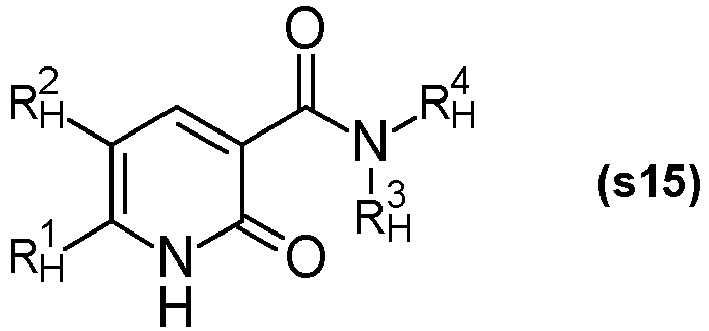
WO-A-2008/131861 undWO-A-2008/131860 beschrieben sind,
worin- RH 1 einen (C1-C6)Haloalkylrest bedeutet und
- RH 2 Wasserstoff oder Halogen bedeutet und
- RH 3, RH 4 unabhängig voneinander Wasserstoff, (C1-C16)Alkyl, (C2-C16)Alkenyl oder (C2-C16)Alkinyl,
- wobei jeder der letztgenannten 3 Reste unsubstituiert oder durch einen oder mehrere Reste aus der Gruppe Halogen, Hydroxy, Cyano, (C1-C4)Alkoxy, (C1-C4)Haloalkoxy, (C1-C4)Alkylthio, (C1-C4)Alkylamino, Di[(C1-C4)alkyl]-amino, [(C1-C4)Alkoxy]-carbonyl, [(C1-C4)Haloalkoxy]-carbonyl, (C3-C6)Cycloalkyl, das unsubstituiert oder substituiert ist, Phenyl, das unsubstituiert oder substituiert ist, und Heterocyclyl, das unsubstituiert oder substituiert ist, substituiert ist,
oder (C3-C6)Cycloalkyl, (C4-C6)Cycloalkenyl, (C3-C6)Cycloalkyl, das an einer Seite des Rings mit einem 4 bis 6-gliedrigen gesättigten oder ungesättigten carbocyclischen Ring kondensiert ist, oder (C4-C6)Cycloalkenyl, das an einer Seite des Rings mit einem 4 bis 6-gliedrigen gesättigten oder ungesättigten carbocyclischen Ring kondensiert ist, - wobei jeder der letztgenannten 4 Reste unsubstituiert oder durch einen oder mehrere Reste aus der Gruppe Halogen, Hydroxy, Cyano, (C1-C4)Alkyl, (C1-C4)Haloalkyl, (C1-C4)Alkoxy, (C1-C4)Haloalkoxy, (C1-C4)Alkylthio, (C1-C4)Alkylamino, Di[(C1-C4)alkyl]-amino, [(C1-C4)Alkoxyl-carbonyl, [(C1-C4)Haloalkoxy]-carbonyl, (C3-C6)Cycloalkyl, das unsubstituiert oder substituiert ist, Phenyl, das unsubstituiert oder substituiert ist, und Heterocyclyl, das unsubstituiert oder substituiert ist, substituiert ist,
- wobei jeder der letztgenannten 3 Reste unsubstituiert oder durch einen oder mehrere Reste aus der Gruppe Halogen, Hydroxy, Cyano, (C1-C4)Alkoxy, (C1-C4)Haloalkoxy, (C1-C4)Alkylthio, (C1-C4)Alkylamino, Di[(C1-C4)alkyl]-amino, [(C1-C4)Alkoxy]-carbonyl, [(C1-C4)Haloalkoxy]-carbonyl, (C3-C6)Cycloalkyl, das unsubstituiert oder substituiert ist, Phenyl, das unsubstituiert oder substituiert ist, und Heterocyclyl, das unsubstituiert oder substituiert ist, substituiert ist,
- RH 3 (C1-C4)-Alkoxy, (C2-C4)Alkenyloxy, (C2-C6)Alkinyloxy oder (C2-C4)Haloalkoxy bedeutet und
- RH 4 Wasserstoff oder (C1-C4)-Alkyl bedeutet oder
- RH 3 und RH 4 zusammen mit dem direkt gebundenen N-Atom einen vier- bis achtgliedrigen heterocyclischen Ring, der neben dem N-Atom auch weitere Heteroringatome, vorzugsweise bis zu zwei weitere Heteroringatome aus der Gruppe N, O und S enthalten kann und der unsubstituiert oder durch einen oder mehrere Reste aus der Gruppe Halogen, Cyano, Nitro, (C1-C4)Alkyl, (C1-C4)Haloalkyl, (C1-C4)Alkoxy, (C1-C4)Haloalkoxy und (C1-C4)Alkylthio substituiert ist, bedeutet.
- s16)
- Wirkstoffe, die vorrangig als Herbizide eingesetzt werden, jedoch auch Safenerwirkung auf Kulturpflanzen aufweisen, z. B.
- (2,4-Dichlorphenoxy)essigsäure (2,4-D),
- (4-Chlorphenoxy)essigsäure,
- (R, S)-2-(4-Chlor-o-tolyloxy)propionsäure (Mecoprop),
- 4-(2,4-Dichlorphenoxy)buttersäure (2,4-DB),
- (4-Chlor-o-tolyloxy)essigsäure (MCPA),
- 4-(4-Chlor-o-tolyloxy)buttersäure,
- 4-(4-Chlorphenoxy)buttersäure,
- 3,6-Dichlor-2-methoxybenzoesäure (Dicamba),
- 1-(Ethoxycarbonyl)ethyl-3,6-dichlor-2-methoxybenzoat (Lactidichlor-ethyl).
- Bevorzugte Safener s) sind ausgewählt aus der Gruppe Isoxadifen-ethyl, Cyprosulfamide, Cloquintocet-mexyl und Mefenpyr-diethyl. Besonders bevorzugt ist Mefenpyr-diethyl und Cloquintocet-mexyl. Ganz besonders bevorzugt ist Mefenpyr-diethyl.
- Besonders bevorzugt sind herbizide Wirkstoffe a') ausgewählt aus der Gruppe:
Flufenacet, Prosulfocarb, Pendimethalin, Diflufenican, Aclonifen, Metribuzin, Pyroxasulfone, Propoxycarbazone, Thiencarbazone-methyl, Fenoxaprop, Bromoxynil, Halauxifen-methyl, 2,4-D, MCPA. - Ganz besonders bevorzugt sind die herbiziden Wirkstoffe a') Flufenacet, Pyroxasulfone, Diflufenican.
- Besonders bevorzugt sind auch Mischungen aus ein oder mehreren herbiziden Wirkstoffen a') ausgewählt aus der Gruppe:
Flufenacet und Pethoxamid; Flufenacet und Aclonifen; Flufenacet und Metribuzin; Flufenacet und Halauxifen-methyl; Prosulfocarb und Diflufenican; Prosulfocarb und Aclonifen; Prosulfocarb und Metribuzin; Prosulfocarb und Flufenacet; Prosulfocarb und Halauxifen-methyl; Pendimethalin und Diflufenican; Pendimethalin und Aclonifen; Pendimethalin und Metribuzin; Pendimethalin und Halauxifen-methyl; Metribuzin und Diflufenican; Halauxifen-methyl und Diflufenican; Flufenacet und Diflufenican; Metribuzin und Aclonifen, Halauxifen-methyl und Aclonifen; Pyroxasulfone und Diflufenican; Aclonifen und Diflufenican; Pyroxasulfone und Prosulfocarb; Pyroxasulfone und Aclonifen; Pyroxasulfone und Metribuzin; Pyroxasulfone und Flufenacet; Pyroxasulfone und Halauxifen-methyl oder Flufenacet und Pyroxasulfone und Dilflufenican; Aclonifen und Diflufenican und Flufenacet; Metribuzin und Diflufenican und Flufenacet. - Ganz besonders bevorzugt sind die Mischungen ausgewählt aus: Flufenacet und Diflufenican; Flufenacet und Pyroxasulfone; Aclonifen und Diflufenican; Metribuzin und Diflufenican; Flufenacet und Aclonifen; Flufenacet und Metribuzin; Flufenacet und Pyroxasulfone und Dilflufenican; Aclonifen und Diflufenican und Flufenacet; Metribuzin und Diflufenican und Flufenacet.
- Ebenfalls können die genannten herbiziden Wirkstoffe a') sowie deren Mischungen mit einem Safener s) ausgewählt aus der Gruppe Isoxadifen-ethyl, Cyprosulfamide, Cloquintocet-mexyl und Mefenpyr-diethyl eingesetzt werden.
- Ganz besonders bevorzugt sind die Mischungen enthaltend a') und s) ausgewählt aus: Flufenacet und Diflufenican und Mefenpyr-diethyl; Flufenacet und Diflufenican und Cloquintocet-mexyl, Aclonifen und Diflufenican und Mefenpyr-diethyl; Pyroxasulfone und Mefenpyr-diethyl.
- Geeignete anionische Dispergiermittel e1) wie Emulgatoren, Tenside, Netzmittel und Dispergatoren sind beispielweise Alkali-, Erdalkali- oder Ammoniumsalze von Sulfonaten, Sulfaten, Phosphaten, Carboxylaten und deren Mischungen wie z.B. die Salze der Alkylsulphonsäuren oder Alkylphosphorsäuren sowie Alkylarylsulphon- oder Alkylarylphosphorsäuren, Diphenylsulfonate, alpha-Olefinsulfonate, Ligninsulfonate, Sulfonate von Fettsäuren und Ölen, Sulfonate von ethoxylierten Alkylphenolen, Sulfonate von alkoxylierten Arylphenolen, Sulfonate von kondensierten Naphthalinen, Sulfonate von Dodecyl- und Tridecylbenzolen, Sulfonate von Naphthalinen und Alkylnaphthalinen, Sulfosuccinate oder Sulfosuccinamate. Beispiele für Sulfate sind Sulfate von Fettsäuren und Ölen, von ethoxylierten Alkylphenolen, von Alkoholen, von ethoxylierten Alkoholen oder von Fettsäureestern. Beispiele für Phosphate sind Phosphatester. Beispiele fur Carboxylate sind Alkylcarboxylate sowie carboxylierte Alkohol- oder Alkylphenolethoxylate. Ebenfalls geeignet ist die Gruppe der anionischen Emulgatoren der Alkalimetall-, Erdalkalimetall- und Ammoniumsalze der Polystyrolsulfonsäuren, Salze der Polyvinylsulphonsäuren, Salze der Alkylnaphthalinsulphonsäuren, Salze von Alkylnaphthalinsulphonsäure-Formaldehyd Kondensationsprodukte, Salze von Kondensationsprodukte der Naphthalinsulphonsäure, Phenolsulphonsäure und Formaldehyd. Beispiele sind Kalziumdodecylbenzensulfonat wie Rhodocal® 70/B (Solvay), Phenylsulfonat CA100 (Clariant) oder Isopropylammoniumdodecylbenzenesulfonate wie Atlox® 3300B (Croda).
- Weitere typische Vertreter sind unter anderem Phenylsulfonat CA (Ca-Dodecylbenzolsulfonat), Soprophor®-Typen (gegebenenfalls veresterte Derivate von Tristyrylphenoi-Ethoxylaten), Emmulsogen® 3510 (alkyliertes EO/PO Copolymerisat), Emuisogen® EL 400 (ethoxyliertes Ricinusöl), Tween®-Typen (fettacylierte Sorbitan-Ethoxylate), Calsogen® AR 100 (Ca-Dodecylbenzolsulfonat). Bevorzugt sind Kombinationen aus Salzen alkylierter aromatischer Sulfonsäuren, wie Phenylsulfonat Ca und/oder Calsogen® AR 100, mit alkylierten Copolymerisaten aus Ethylen- und Propylenoxid, wie Emuisogen® 3510. Besonders bevorzugt sind Kombinationen aus Salzen der Dodecylbenzolsulfonsäure, wie Calsogen® AR 100 mit alkyliertem Copolymerisat aus Ethylen- und Propylenoxid, wie Emulsogen® 3510.
- Beispiele für weitere anionische Emulgatoren e1) aus der Gruppe der Naphthalinsulfonate sind Galoryl® MT 800 (Natrium-Dibutylnaphthalinsulfonsäure), Morwet® IP (Natriumdiisopropylnaphthalinsulfonat) und Nekal® BX (Alkylnaphthalinsulfonat). Beispiele für anionische Tenside aus der Gruppe der Kondensationsprodukte von Naphthalinsulfonaten mit Formaldehyd sind Galoryl® DT 201 (Naphthalinsulfonsäure Hydroxypolymer mit Formaldeyd und Methylphenol Natriumsalz), Galoryl® DT 250 (Kondensationsprodukt aus Phenol- und Naphthalinsulfonaten), Reserve® C (Kondensationsprodukt aus Phenol- und Naphthalinsulfonaten) oder Morwet® D-425, Tersperse® 2020. Bevorzugt sind 1,2 mit DiButyl- oder Di-Isobutyl-substituierte Naphthalinsulfonate, wie z.B. Produkte wie Galoryl® MT 800 (CFPI-Nufarm) und Nekal® BX (BASF). Weitere typische Tenside sind Soprophor® 3D33, Soprophor® 4D384, Soprophor® BSU, Soprophor® CY/8 (Solvay) und Hoe® S3474 und in Form der Sapogenat® T-Produkte (Clariant), beispielsweise Sapogenat® T 100.
- Als nichtionische Dispergiermittel e2) wie Emulgatoren, Netzmittel, Tenside und Dispergatoren kommen übliche, in Formulierungen von agrochemischen Wirkstoffen vorhandene oberflächenative Substanzen in Frage. Beispielhaft genannt seien ethoxylierte Nonylphenole, Umsetzungsprodukte von linearen oder verzweigten Alkoholen mit Ethylenoxid und/oder Propylenoxid, Ethylenoxid-Propylenoxid-Blockcopolymere, Endgruppen-verschlossene und nicht Endgruppen-verschlossene alkoxylierte lineare und verzweigte, gesättigte und ungesättigte Alkohole (z.B. Butoxypolyethylenpropylenglycole), Umsetzungsprodukte von Alkylphenolen mit Ethylenoxid und/oder Propylenoxid, Ethylenoxid-Propylenoxid-Blockcopolymere, Polyethylenglykole und Polypropylenglykole, weiterhin Fettsäureester, Fettsäurepolyglykoletherester, Alkylsulfonate, Alkylsulfate, Arylsulfate, ethoxylierte Arylalkylphenole, wie zum Beispiel Tristyryl-phenol-ethoxylat mit durchschnittlich 16 Ethylenoxid-Einheiten pro Molekül, weiterhin ethoxylierte und propoxylierte Arylalkylphenole sowie sulfatierte oder phosphatierte Arylalkylphenol-ethoxylate bzw. -ethoxy- und -propoxylate. Besonders bevorzugt sind Tristryl-phenolalkoxylate und Fettsäurepolyglykoletherester. Ganz besonders bevorzugt sind Tristyryl-phenol-ethoxylate, Tristyryl-phenol-ethoxy-propoxylate und Ricinusölpolyglykoletherestern, jeweils einzeln oder in Mischungen. Hinzu kommen gegebenenfalls Additive, wie Tenside oder Ester von Fettsäuren, die zur Verbesserung der biologischen Wirksamkeit beitragen. Geeignete nichtionische Emulgatoren b2) sind beispielsweise Soprophor® 796/P, Lucramul® CO30, Lucramul® HOT, Lucramul® PSI 100 oder Synperonic® T304.
- Geeignete nicht-ionische Dispergatoren e2) können ebenfalls ausgewählt werden aus der Gruppe enthaltend Polyvinylpyrrolidon (PVP), Polyvinylalkohol, Co-Polymer aus PVP und Dimethylaminoethylmethacrylat, butyliertes PVP, Co-Polymer aus Vinylchlorid und Vinylacetat, und partiell hydrolysiertem Vinylacetat, Phenolharze, modifizierte Cellulose Typen wie beispielsweise Luviskol® (Polyvinylpyrrolidon), Mowiol® (Polyvinylalkohol) oder modifizierte Cellulose. Bevorzugt sind Polyvinylpyrrolidon-Typen, besonders bevorzugt sind Typen von niedrigem Molekulargewicht wie Luviskol® K30 oder Sokalan®K30.
- Als weitere nicht-ionische Emulgatoren e2) aus der Gruppe der Di- und Tri-block-copolymere aus Alkylenoxiden kommen z.B. Verbindungen in Frage, die auf Basis von Ethylen- und Propylenoxid aufgebaut sind, mit mittleren Molmassen zwischen 200 und 10000, bevorzugt 1000 bis 4000 g/mol, wobei der Massenanteil des polyethoxylierte Blocks zwischen 10 und 80% variiert, wie z.B. Synperonic® PE-Reihe (Uniqema), Pluronic® PE-Reihe (BASF), VOP® 32- oder Genapol®PF-Reihe (Clariant).
- Im Falle des Einsatzes von Safener als Komponente a') werden Trägermaterialien f) in den SC's eingesetzt.
- Geeignete Trägermaterialien f) sind ausgewählt aus der Gruppe der der hochsaugfähigen Träger mit einer Aufnahmefähigkeit von wenigstens 200 g Dibutylphthalat pro 100 g Trägermaterial.
- Bevorzugte hochsaugfähige Träger f) sind Kieselsäuren wie beispielsweise Sipernat®-Typen (synthetische Fällungskieselsäure von hoher Saugfähigkeit) sowie pyrogene Kieselsäure (Aerosil® Typen). Bevorzugt ist Fällungskieselsäure.
- Die erfindungsgemäßen Kapselsuspensionskonzentrate eignen sich hervorragend zur Applikation der enthaltenen agrochemischen Wirkstoffe auf Pflanzen und/oder deren Lebensraum. Sie gewährleisten die Freisetzung der aktiven Komponenten in der jeweils gewünschten Menge über einen längeren Zeitraum.
- Die erfindungsgemäßen Kapselsuspensionskonzentrate können entweder als solche oder nach vorherigem Verdünnen mit Wasser in der Praxis eingesetzt werden. Die Anwendung erfolgt dabei nach üblichen Methoden, also z.B. durch Gießen, Verspritzen oder Versprühen.
- Die Aufwandmenge an erfindungsgemäßen Kapselsuspensionskonzentraten kann innerhalb eines größeren Bereiches variiert werden. Sie richtet sich nach den jeweiligen agrochemischen Wirkstoffen und nach deren Gehalt in den Mikrokapsel-Formulierungen.
- Eine bevorzugte Verwendung der erfindungsgemäßen Kapselsuspensionskonzentrate ist als Herbizid im Getreide und Raps, ganz besonders bevorzugt im Wintergetreide und hierbei im Vorauflauf sowie im Nachauflauf. Bevorzugt ist daher die Verwendung in einer Herbstapplikation kurz nach dem Sähen des Getreide und kurz vor bzw. kurz nach dem Aufkeimen der Unkräuter und vor allem Ungräser.
- Die erfindungsgemäßen Kapselsuspensionskonzentrate können nach bekannten Verfahren z.B. als Mischformulierungen der Einzelkomponenten, gegebenenfalls mit weiteren Wirkstoffen, Zusatzstoffen und/oder üblichen Formulierungshilfsmitteln hergestellt werden, die dann in üblicher Weise mit Wasser verdünnt zur Anwendung gebracht werden, oder als sogenannte Tankmischungen durch gemeinsame Verdünnung der getrennt formulierten oder partiell getrennt formulierten Einzelkomponenten mit Wasser hergestellt werden. Ebenfalls möglich ist die zeitlich versetzte Anwendung (Splitapplikation) der getrennt formulierten oder partiell getrennt formulierten Einzelkomponenten. Möglich ist auch die Anwendung der Einzelkomponenten oder der erfindungsgemäßen Kapselsuspensionskonzentrate in mehreren Portionen (Sequenzanwendung), z. B. nach Anwendungen im Vorauflauf, gefolgt von Nachauflauf-Applikationen oder nach frühen Nachauflaufanwendungen, gefolgt von Applikationen im mittleren oder späten Nachauflauf. Bevorzugt ist dabei die gemeinsame oder die zeitnahe Anwendung der Wirkstoffe der jeweiligen Kombination.
- Gegenstand der vorliegenden Erfindung ist somit weiterhin ein Verfahren zur Bekämpfung von unerwünschten Pflanzen in Pflanzenkulturen, das dadurch gekennzeichnet ist, dass die erfindungsgemäßen Kapselsuspensionskonzentrate auf die Pflanzen (z.B. Schadpflanzen wie mono- oder dikotyle Unkräuter oder unerwünschte Kulturpflanzen), oder die Fläche, auf der die Pflanzen wachsen ausgebracht werden.
- Unter unerwünschten Pflanzen sind alle Pflanzen zu verstehen, die an Orten wachsen, wo sie unerwünscht sind. Dies können z.B. Schadpflanzen (z.B. mono- oder dikotyle Unkräuter oder unerwünschte Kulturpflanzen) sein.
- Monokotyle Unkräuter entstammen z.B. den Gattungen: Aegilops, Agropyron, Agrostis, Alopecurus, Apera, Avena, Brachiaria, Bromus, Cenchrus, Commelina, Cynodon, Cyperus, Dactyloctenium, Digitaria, Echinochloa, Eleocharis, Eleusine, Eragrostis, Eriochloa, Festuca, Fimbristylis, Heteranthera, Imperata, Ischaemum, Leptochloa, Lolium, Monochoria, Panicum, Paspalum, Phalaris, Phleum, Poa, Rottboellia, Sagittaria, Scirpus, Setaria, and Sorghum.
- Dikotyle Unkräuter : entstammen z.B. den Gattungen Abutilon, Amaranthus, Ambrosia, Anoda, Anthemis, Aphanes, Artemisia, Atriplex, Bellis, Bidens, Capsella, Carduus, Cassia, Centaurea, Chenopodium, Cirsium, Convolvulus, Datura, Desmodium, Emex, Erysimum, Euphorbia, Galeopsis, Galinsoga, Galium, Hibiscus, Ipomoea, Kochia, Lamium, Lepidium, Lindernia, Matricaria, Mentha, Mercurialis, Mullugo, Myosotis, Papaver, Pharbitis, Plantago, Polygonum, Portulaca, Ranunculus, Raphanus, Rorippa, Rotala, Rumex, Salsola, Senecio, Sesbania, Sida, Sinapis, Solanum, Sonchus, Sphenoclea, Stellaria, Taraxacum, Thlaspi, Trifolium, Urtica, Veronica, Viola, and Xanthium.
- Bevorzugt werden die erfindungsgemäßen Kapselsuspensionskonzentrate zur Bekämpfung des Unkrauts der Spezies Alopecurus myosuroides HUDS (oder Acker-Fuchsschwanzgras) verwendet.
- Gegenstand der Erfindung ist auch die Verwendung der erfindungsgemäßen Kapselsuspensionskonzentrate zur Bekämpfung von unerwünschtem Pflanzenwuchs, vorzugsweise in Kulturen von Nutzpflanzen.
- Werden die erfindungsgemäßen Kapselsuspensionskonzentrate vor dem Keimen auf die Erdoberfläche appliziert, so wird entweder das Auflaufen der Unkrautkeimlinge vollständig verhindert oder die Unkräuter wachsen bis zum Keimblattstadium heran, stellen jedoch dann ihr Wachstum ein und sterben schließlich nach Ablauf von drei bis vier Wochen vollkommen ab.
- Bei Applikation der erfindungsgemäßen Kapselsuspensionskonzentrate Mittel auf die grünen Pflanzenteile im Nachauflaufverfahren tritt ebenfalls sehr rasch nach der Behandlung ein drastischer Wachstumsstop ein und die Unkrautpflanzen bleiben in dem zum Applikationszeitpunkt vorhandenen Wachstumsstadium stehen oder sterben nach einer gewissen Zeit ganz ab, so dass auf diese Weise eine für die Kulturpflanzen schädliche Unkrautkonkurrenz sehr früh und nachhaltig beseitigt wird.
- Die erfindungsgemäßen Kapselsuspensionskonzentrate zeichnen sich durch eine schnell einsetzende und lang andauernde herbizide Wirkung aus. Die genannten Eigenschaften und Vorteile sind in der praktischen Unkrautbekämpfung von Nutzen, um landwirtschaftliche Kulturen von unerwünschten Konkurrenzpflanzen freizuhalten und damit die Erträge qualitativ und quantitativ zu sichern und/oder zu erhöhen. Der technische Standard wird durch diese neuen Mittel hinsichtlich der beschriebenen Eigenschaften deutlich übertroffen.
- Obgleich die erfindungsgemäßen Kapselsuspensionskonzentrate eine ausgezeichnete herbizide Aktivität gegenüber mono und dikotylen Unkräutern aufweisen, werden Kulturpflanzen wirtschaftlich bedeutender Kulturen z.B. zweikeimblättriger Kulturen wie Soja, Baumwolle, Raps, Zuckerrüben, oder Gramineen-Kulturen wie Weizen, Gerste, Roggen, Hafer, Hirse, Reis oder Mais, nur unwesentlich oder gar nicht geschädigt. Die erfindungsgemäßen Kapselsuspensionskonzentrate eignen sich aus diesen Gründen sehr gut zur selektiven Bekämpfung von unerwünschtem Pflanzenwuchs in landwirtschaftlichen Nutzpflanzungen oder in Zierpflanzungen.
- Darüber hinaus weisen die erfindungsgemäßen Kapselsuspensionskonzentrate hervorragende wachstumsregulatorische Eigenschaften bei Kulturpflanzen auf. Sie greifen regulierend in den pflanzeneigenen Stoffwechsel ein und können damit zur gezielten Beeinflussung von Pflanzeninhaltsstoffen und zur Ernteerleichterung wie z.B. durch Auslösen von Desikkation und Wuchsstauchung eingesetzt werden. Des Weiteren eignen sie sich auch zur generellen Steuerung und Hemmung von unerwünschtem vegetativem Wachstum, ohne dabei die Pflanzen abzutöten. Eine Hemmung des vegetativen Wachstums spielt bei vielen mono und dikotylen Kulturen eine große Rolle, da das Lagern hierdurch verringert oder völlig verhindert werden kann.
- Aufgrund ihrer herbiziden und pflanzenwachstumsregulatorischen Eigenschaften können die erfindungsgemäßen Kapselsuspensionskonzentrate auch zur Bekämpfung von Schadpflanzen in Kulturen von bekannten oder noch zu entwickelnden gentechnisch veränderten Pflanzen eingesetzt werden. Die transgenen Pflanzen zeichnen sich in der Regel durch besondere vorteilhafte Eigenschaften aus, beispielsweise durch Resistenzen gegenüber bestimmten Pestiziden, vor allem bestimmten Herbiziden, Resistenzen gegenüber Pflanzenkrankheiten oder Erregern von Pflanzenkrankheiten wie bestimmten Insekten oder Mikroorganismen wie Pilzen, Bakterien oder Viren. Andere besondere Eigenschaften betreffen z.B. das Erntegut hinsichtlich Menge, Qualität, Lagerfähigkeit, Zusammensetzung und spezieller Inhaltsstoffe. So sind transgene Pflanzen mit erhöhtem Stärkegehalt oder veränderter Qualität der Stärke oder solche mit anderer Fettsäurezusammensetzung des Ernteguts bekannt.
- Bevorzugt ist die Anwendung der erfindungsgemäßen Kapselsuspensionskonzentrate in wirtschaftlich bedeutenden transgenen Kulturen von Nutz- und Zierpflanzen, z.B. von Gramineen-Kulturen wie Weizen, Gerste, Roggen, Hafer, Hirse, Reis, Raps und Mais. Vorzugsweise können die erfindungsgemäßen Mittel als Herbizide in Nutzpflanzenkulturen eingesetzt werden, welche gegenüber den phytotoxischen Wirkungen der Herbizide resistent sind bzw. gentechnisch resistent gemacht worden sind. Besonders bevorzugt ist die Anwendung auf Weizen, Gerste, Roggen und Raps, bevorzugt Winterraps.
- Bei der Anwendung der erfindungsgemäßen Kapselsuspensionskonzentrate in transgenen Kulturen treten neben den in anderen Kulturen zu beobachtenden Wirkungen gegenüber Schadpflanzen oftmals Wirkungen auf, die für die Applikation in der jeweiligen transgenen Kultur spezifisch sind, beispielsweise ein verändertes oder speziell erweitertes Unkrautspektrum, das bekämpft werden kann, veränderte Aufwandmengen, die für die Applikation eingesetzt werden können, vorzugsweise gute Kombinierbarkeit mit den Herbiziden, gegenüber denen die transgene Kultur resistent ist, sowie Beeinflussung von Wuchs und Ertrag der transgenen Kulturpflanzen.
- Gegenstand der vorliegenden Erfindung ist weiterhin auch ein Verfahren zur Bekämpfung von unerwünschtem Pflanzenwuchs, vorzugsweise in Pflanzenkulturen wie Getreide (z.B. Weizen, Gerste, Roggen, Hafer, Reis, Mais, Hirse), besonders bevorzugt in monokotylen Kulturen wie Getreide, z.B. Weizen, Gerste, Roggen, Hafer, Kreuzungen davon wie Triticale, Reis, Mais und Hirse, wobei man ein oder mehrere erfindungsgemäße Kapselsuspensionskonzentrate auf die Schadpflanzen, Pflanzenteile, Pflanzensamen oder die Fläche auf der die Pflanzen wachsen, z.B. die Anbaufläche im appliziert. Bevorzugt erfolgt die Anwendung der erfindungsgemäßen Kapselsuspensionskonzentrate im Vorauflaufverfahren und Nachauflaufverfahren. Besonders bevorzugt im Vorauflaufverfahren.
- Gegenstand der Erfindung ist deshalb auch die Verwendung der erfindungsgemäßen Kapselsuspensionskonzentrate zur Bekämpfung von Schadpflanzen in transgenen Kulturpflanzen.
- Ein weiterer bevorzugter Gegenstand der Erfindung ist die Verwendung der erfindungsgemäßen Kapselsuspensionskonzentrate zur Behandlung von Pflanzen, bei denen das Saatgut mit Safener behandelt wurde.
- Die Erfindung wird durch die folgenden Beispiele veranschaulicht.
- Die in den nachfolgenden Beispielen verwendeten Begriffe haben folgende Bedeutung:
- Mefenpyr-diethyl
- Diethyl (RS)-1-(2,4-dichlorophenyl)-5-methyl-2-pyrazoline-3,5-dicarboxylate, (Bayer CropScience AG), Schmelzbereich 50-55°C
- Flufenacet
- 4'-Fluoro-N-isopropyl-2-(5-trifluoromethyl-1,3,4-thiadiazol-2-yloxy)acetanilide (Bayer CropScience AG)
- Diflufenican
- 2',4'-Difluoro-2-(α,α,α-trifluoro-m-tolyloxy)nicotinanilide (Bayer CropScience AG)
- Cloquintocet-mexyl
- (RS)-1-Methylhexyl (5-chloroquinolin-8yloxy)acetate (Syngenta), Schmelzbereich 60-70°C
- Clomazone
- CPMI, CAS 81777-89-1, IUPAC 2-(2-chlorobenzyl)-4,4-dimethyl-1,2-oxazolidin-3-one
- DCPMI
- 2-[(2,4-Dichlorphenyl)-methyl]-4,4'-dimethyl-3-isoxazolidinone (CAS Nummer 81777-95-9 bzw. IPUAC 2-(2,4-dichlorobenzyl)-4,4-dimethyl-1,2-oxazolidin-3-one, im Folgenden abgekürzt DCPMI)
- Morwet® D-425
- Naphthalinsulfonsäure-formaldehyd-kondensat Natriumsalz (Akzo Nobel)
- Pluronic® PE 10500
- Propylenoxid-Ethylenoxid-(PO-EO)-Blockpolymer (BASF)
- Citronensäure
- mehrbasige organische Säure
- Rhodopol® G
- Xanthan Derivat (Solvay)
- Silcolapse® 426R, 411
- Silikon-Entschäumer (Solvay)
- Glycerin
- Frostschutzmittel
- Proxel® GXL
- Konservierungsmittel (Biozid, Proxel)
- Solvesso® 200 ND
- Mineralöl, ExxonMobil, Naphthalinfrei
- Desmodur® 44V20L
- Polymeres MDI, Covestro AG, Funktionalität 2,7.
- Desmodur® T80
- Diisocyanat, Funktionalität 2,0, Covestro AG, Basis Tolyulyendiisocyanat
- DETA
- Diethylentriam, Sigma-Aldrich
- HDA
- 1,6-Hexamethylendiam, BASF
- Kuraray Poval® 26-88
- Polyvinylalkohol von Kuraray, ca. 88% hydrolyisertes Polyvinylacetat
- Desmodur® N3300
- modifiziertes, trimerisiertes aliphatisches Polyisocyanat auf Basis von HDI, Covestro AG, Funktionalität 3,3; freies monomeres Isocyanat < 0.5%.
- Rhodocal® 60BE
- Ionischer Emulgator, Solvay, Calciumdodecylsulfat
- Emuisogen® EL 400
- nicht-ionischer Emulgator, Croda, Castor-oil mit 40 Ethylenoxideinheiten
- 15 g DCPMI wurden bei 50°C in 32 g Solvesso® 200 ND gelöst (entspricht 32% gelöstem Wirkstoff).
- Die Lösung wurde zu einem Gemisch aus 0,8 g Desmodur® T80, 0,64 g Desmodur® 44V20L, 0,51 g Kuraray Poval® 26-88 sowie 0,2 g Silcolapse® 426R und 0,18 g Kathon® CG/ICP in 50 g Wasser gegeben. Es wurde mit einem Dispergator bei 15 000 Upm 10 Minuten dispergiert. Das dabei entstehende Reaktionsgemisch wird innerhalb von einer Stunde auf 70°C aufgeheizt und weitere 4 Stunden unter langsames Rühren bei 70°C gehalten. Nach dem anschließenden Abkühlen auf Raumtemperatur werden 0,58 g einer 30% wässrigen Ammoniaklösung zugegeben. Es wird mit 0.2 g Rhodopol® G verdickt. Es wird auf diese Weise eine Mikrokapsel-Formulierung mit einem Gehalt an DCPMI von 150 g/1 und einer Partikelgröße von 8,3 µm(d90) erhalten.
- 15 g DCPMI wurden bei 50°C in 32 g Solvesso® 200 ND gelöst (entspricht 32% gelöstem Wirkstoff).
- Die Lösung wurde zu einem Gemisch aus 0,8 g Desmodur®® T80, 0,64 g Desmodur® 44V20L, 0,51 g Kuraray Poval®26-88 sowie 0,2 g Silcolapse® 426R und 0,18 g Kathon® CG/ICP in 50 g Wasser gegeben. Es wurde mit einem Dispergator (Rotor-Stator-System) bei 10 000 U/min 10 Minuten dispergiert. Das dabei entstehende Reaktionsgemisch wird innerhalb von einer Stunde auf 70°C aufgeheizt und weitere 4 Stunden unter langsames Rühren bei 70°C gehalten. Nach dem anschließenden Abkühlen auf Raumtemperatur werden 0,58 g einer 30% wässrigen Ammoniaklösung zugegeben. Es wird mit 0.2 g Rhodopol® G verdickt. Es wird auf diese Weise eine Mikrokapsel-Formulierung mit einem Gehalt an DCPMI von 150 g/1 und einer Partikelgröße von 15,3 µm(d90) erhalten.
- 15 g DCPMI wurden bei 50°C in 32 g Solvesso® 200 ND gelöst (entspricht 32% gelöstem Wirkstoff).
- Die Lösung wurde zu einem Gemisch aus 1,4 g Desmodur® T80, 1,09 g Desmodur® 44V20L, 0,51 g Kuraray Poval® 26-88 sowie 0,2 g Silcolapse® 426R und 0,18 g Kathon® CG/ICP in 50 g Wasser gegeben. Es wurde mit einem Dispergator bei 15 000 Upm 10 Minuten dispergiert. Das dabei entstehende Reaktionsgemisch wird innerhalb von einer Stunde auf 70°C aufgeheizt und weitere 4 Stunden unter langsames Rühren bei 70°C gehalten. Nach dem anschließenden Abkühlen auf Raumtemperatur werden 0,58 g einer 30% wässrigen Ammoniaklösung zugegeben. Es wird mit 0.2 g Rhodopol® G verdickt. Es wird auf diese Weise eine Mikrokapsel-Formulierung mit einem Gehalt an DCPMI von 150 g/l und einer Partikelgröße von 8,3 µm (d90) erhalten.
- 15 g DCPMI wurden bei 50°C in 32 g Solvesso® 200 ND gelöst (entspricht 32% gelöstem Wirkstoff).
- Die Lösung wurde zu einem Gemisch aus 0,6 g Desmodur® T80, 0,48 g Desmodur® 44V20L, 0,51 g Kuraray Poval® 26-88 sowie 0,2 g Silcolapse® 426R und 0,18 g Kathon® CG/ICP in 50 g Wasser gegeben. Es wurde mit einem Dispergator bei 15 000 Upm 10 Minuten dispergiert. Danach werden 0,36 g Diethylentriamin zugegeben. Das dabei entstehende Reaktionsgemisch wird innerhalb von einer Stunde auf 70°C aufgeheizt und weitere 4 Stunden unter langsames Rühren bei 70°C gehalten. Nach dem anschließenden Abkühlen auf Raumtemperatur werden 0,58 g einer 30% wässrigen Ammoniaklösung zugegeben. Es wird mit 0.2 g Rhodopol® G verdickt. Es wird auf diese Weise eine Mikrokapsel-Formulierung mit einem Gehalt an DCPMI von 150 g/l und einer Partikelgröße von 6,6 µm (d90) erhalten.
- 15 g DCPMI wurden bei 50°C in 32 g Solvesso® 200 ND gelöst (entspricht 32% gelöstem Wirkstoff).
- Die Lösung wurde zu einem Gemisch aus 0,9 g Desmodur® 44V20L, 0,51 g Kuraray Poval® 26-88 sowie 0,2 g Silcolapse® 426R und 0,18 g Kathon® CG/ICP in 50 g Wasser gegeben. Es wurde mit einem Dispergator bei 15 000 Upm 10 Minuten dispergiert. Danach wurden 0,54 g 1,6-Hexamethylendiamin in Wasser gelöst (als 40 Gew.-% Lösung) zugegeben. Das dabei entstehende Reaktionsgemisch wird innerhalb von einer Stunde auf 70°C aufgeheizt und weitere 4 Stunden unter langsames Rühren bei 70°C gehalten. Nach dem anschließenden Abkühlen auf Raumtemperatur werden 0,58 g einer 30% wässrigen Ammoniaklösung zugegeben. Es wird mit 0.2 g Rhodopol® G verdickt. Es wird auf diese Weise eine Mikrokapsel-Formulierung mit einem Gehalt an DCPMI von 150 g/l und einer Partikelgröße von 7,9 µm (d90) erhalten.
- 15 g DCPMI wurden bei 50°C in 32 g Solvesso® 200 ND gelöst (entspricht 32% gelöstem Wirkstoff).
- Die Lösung wurde zu einem Gemisch aus 1,22 g Desmodur® N3300 g, 0,51 g Kuraray Poval® 26-88 sowie 0,2 g Silcolapse® 426R und 0,18 g Kathon® CG/ICP in 50 g Wasser gegeben. Es wurde mit einem Dispergator bei 15 000 Upm 10 Minuten dispergiert. Danach werden 0,44 g einer 50 Gew.-%igen Lösung von Diethylentriamin in Wasser zugegeben. Das dabei entstehende Reaktionsgemisch wird innerhalb von einer Stunde auf 70°C aufgeheizt und weitere 4 Stunden unter langsames Rühren bei 70°C gehalten. Nach dem anschließenden Abkühlen auf Raumtemperatur werden 0,58 g einer 30% wässrigen Ammoniaklösung zugegeben. Es wird mit 0.2 g Rhodopol® G verdickt. Es wird auf diese Weise eine Mikrokapsel-Formulierung mit einem Gehalt an DCPMI von 150 g/l und einer Partikelgröße von 5,4 µm (d90) erhalten.
- Vergleichsbeispiel 1 (analog
WO 96/14743 - 140 g Clomazone wurden bei 50°C in 30 g Solvesso® 200 ND gelöst (entspricht 82% gelöstem Wirkstoff).
- Die Lösung wurde zu einem Gemisch aus 30 g Desmodur® 44V20L, 4 g Kuraray Poval® 26-88, 430 g Wasser sowie 1,8 g Silcolapse®426R und 0,18 g Kathon® CG/ICP gegeben. Es wurde mit einem Dispergator bei 10 000 Upm innerhalb 10 Minuten dispergiert. Anschließend werden 19 g 1,6-Hexamethylendiamin zu gegeben. Das dabei entstehende Reaktionsgemisch wird innerhalb von einer Stunde auf 70°C aufgeheizt und weitere 4 Stunden unter langsames Rühren bei 70°C gehalten. Nach dem anschließenden Abkühlen auf Raumtemperatur werden 0,58 g einer 30% wässrigen Ammoniaklösung zugegeben. Es wird mit 0.2 g Rhodopol® G verdickt. Es wird auf diese Weise eine Mikrokapsel-Formulierung mit einem Gehalt an Clomazone von 200 g/l und einer Partikelgröße von 15,3 µm (d90) erhalten.
- Das Verhältnis von Wirkstoff zu Isocyanat beträgt 4,6: 1.
- Das Verhältnis von Wirkstoff zu Lösemittel beträgt 4,6:1.
- Das Verhältnis Isocyanat zu aminischem Vernetzer beträgt 1,58: 1.
- Vergleichsbeispiel 2a (mit DCPMI analog
WO 96/14743 - DCPMI löst sich deutlich schlechter als Clomazone. Der Ansatz konnte nicht durchgeführt werden.
- Es wurde wie in Vergleichsbeispiel 1 verfahren, allerdings wurden 15 g DCPMI bei 50°C in 32 g Solvesso® 200 ND gelöst (entspricht 32% gelöstem Wirkstoff).
- Das Verhältnis von Wirkstoff zu Isocyanat beträgt 4,6: 1.
- Das Verhältnis von Wirkstoff zu Lösemittel beträgt 1:2.
- Das Verhältnis Isocyanat zu aminischem Vernetzer beträgt 1,58:1.
- Es wird deutlich mehr Polyurethan/-harnstoff verwendet als in den erfindungsgemäßen Rezepturen.
- Vergleichsbeispiel 3 (analog
WO 2015/127259 , Beispiel 9a) - Es wurde ein Kapselsuspension analog Beispiel 9a hergestellt.
- Das Verhältnis von Wirkstoff zu Isocyanat beträgt 16,8: 1.
- Das Verhältnis von Wirkstoff zu Lösemittel beträgt 5,6:1. Es liegen 85% Wirkstoff in Bezug auf Lösemittel vor.
- Das Verhältnis Isocyanat zu aminischem Vemetzer beträgt 1:1.
- Der Wirkstoff in den Kapseln kristallisierte bei Raumtemperatur zum Teil aus. Einige Kapseln zerbrachen. Es wurden dieselben hohen Siebrückstände wie in der
WO 2015/127259 Beispiel 9A gefunden.Die Produkte konnten nicht weiterverwendet werden, da sie die Spritze zusetzen und nicht lagerstabil sind - die Flüchtigkeit konnte jedoch bestimmt werden. - Vergleichsbeispiel 4 (analog
WO 2015/127259 , Beispiel 9b) - Es wurde ein Kapselsuspension analog Beispiel 9b hergestellt.
- Das Verhältnis von Wirkstoff zu Isocyanat beträgt 18,2: 1.
- Das Verhältnis von Wirkstoff zu Lösemittel beträgt 6:1. Es liegen 85% Wirkstoff in Bezug auf Lösemittel vor.
- Das Verhältnis Isocyanat zu aminischem Vernetzer beträgt 1:1.
- Der Wirkstoff in den Kapseln kristallisierte bei Raumtemperatur zum Teil aus. Einige Kapseln zerbrachen. Es wurden dieselben hohen Siebrückstände wie in der
WO 2015/127259 Beispiel 9A gefunden.Die Produkte konnten nicht weiterverwendet werden da, sie die Spritze zusetzen und nicht lagerstabil sind - die Flüchtigkeit konnte jedoch bestimmt werden. - Vergleichsbeispiel 5 (analog
WO 2015/127259 , Beispiel 9c) - Es wurde ein Kapselsuspension analog Beispiel 9c hergestellt.
- Das Verhältnis von Wirkstoff zu Isocyanat beträgt 12:1.
- Das Verhältnis von Wirkstoff zu Lösemittel beträgt 1,44:1. Es liegen 60% Wirkstoff in Bezug auf Lösemittel vor.
- Das Verhältnis Isocyanat zu aminischem Vernetzer beträgt 1:1.
- Der Wirkstoff in den Kapseln kristallisierte bei Raumtemperatur zum Teil aus. Einige Kapseln zerbrachen. Es wurden dieselben hohen Siebrückstände wie in der
WO 2015/127259 Beispiel 9A gefunden. Die Produkte konnten nicht weiterverwendet werden, da sie die Spritze zusetzen und nicht lagerstabil sind - die Flüchtigkeit konnte jedoch bestimmt werden. - Die Löslichkeit des Wirkstoffes in Solvesso 200 ND wurde zu 35 Gew.-% bei Raumtemperatur bestimmt. Bei höheren Konzentrationen kristallisiert der Wirkstoff in der Kapsel aus.
- Es wird zunächst Wasser bei Raumtemperatur vorgelegt. Unter Rühren werden anschließend c, e1, e2, und Wirkstoffe a sowie a') zugegeben. Im Falle von a') Menfenpyr-diethyl wird diese warm bei 65°C zugegeben und es wird 2 bis 24 h gerührt, bis sich Kristalle bilden. Anschließend erfolgt eine Nassvermahlung beispielsweise mittels einer Perlmühle. Abschließend wird der organische Verdicker (Komponente c) zugegeben.
- Der Wirkstoff wird bei 30°C mit dem Lösemittel und den Emulgatoren verrührt.
Tabelle 1: Hergestellte Formulierungen (Angaben erfolgen in Gewichtsprozent, Gew.-%) Komponente Beispiel-Nr. 7 SC 8 EC 9 SC 10 SC 11 SC 12 SC 13 SC s Mefenpyrdiethyl 30 10 s Cloquintocet - mexyl 30 10 a DCPMI 40 10 a' Diflufenican 20 15 15 a' Flufenacet 40 30 30 e1 Rhodocal® 60BE 4 e2 Emuisogen® EL 400 4 e1 Morwet® D-425 1,0 1,0 1,0 1,0 1,0 1,0 e2 Pluronic®PE 10500 5 5 5 5 5 5 c Citronensäure 0,1 0,1 0,1 0,1 0,1 0,1 f Aerosil® 200 0,5 0,5 0,5 0,5 0,5 c Rhodopol® 23 0,2 0,2 0,2 0,2 0,2 0,2 c Silcolapse® 411 0,5 0,5 0,5 0,5 0,5 0,5 c Glycerin 5 5 5 5 5 5 c Proxel® GXL 0,18 0,18 0,18 0,18 0,18 0,18 Wasser 52,48 42,48 71,98 42,48 67,48 67,48 Solvesso® 200 ND 82 Gesamt: 100 100 100 100 100 100 100 - Es wird die jeweilige SC Formulierung mit der erfindungsgemäßen CS Formulierung gemischt:
- 0,12 L von Beispiel 10 (entspricht 48 g Flufenacet und 24 g Diflufenican) werden mit 0,5 L Beispiel 1 (entspricht 80 g verkapseltes DCPMI) und 0,1 L (entspricht 40 g Mefenpyr-diethyl) umgerührt.
- 0,12 L von Beispiel 10 (entspricht 48 g Flufenacet und 24 g Diflufenican) werden mit 0,25 L Beispiel 1 (entspricht 40 g verkapseltes DCPMI) sowie 0,1 L Beispiel 7 (entspricht 40 g unverkapseltem DCPMI) und 0,1 L (entspricht 40 g Mefenpyr-diethyl) umgerührt.
- Es wird eine Spritzbrühe (0,5 g Wirkstoff/L) auf je drei Teflonmebranen in einer nach oben offenen Glasbox in einem Laborabzug unter konstantem Luftstrom von 1,6 m/s bei 22°C und 60% relativer Luftfeuchtigkeit gegeben. Der Rückstand auf den Teflonmembranen wird nach Trocknung nach 0, 24 und 72 h per HPLC bestimmt. Die Flüchtigkeit wird bezogen auf den 0 h Wert.
Tabelle 1: Bestimmung der Flüchtigkeit Die Menge an Wirkstoff ist der Gehalt an DCPMI in Gew.-% Beispiel relative Flüchtigkeit in % nach 24 h relative Flüchtigkeit in % nach 72 h 1 88 85 8 1 0 3 90 90 4 100 100 7 3 0 Vergleichsbeispiel 2b, 3, 4, 5 100 100 - Die Ergebnisse zeigen, dass die Verkapselung die Flüchtigkeit deutlich reduzieren kann.
- Es wird eine Spritzbrühe (0,5 g Wirkstoff/L) auf je drei Apfelkutikel gegeben. Es wird die Menge an Wirkstoff in den Kutikel gemessen; nach Trocknung nach 0, 24 und 72 h per HPLC bestimmt.
Tabelle 2: Penetration von DCPMI durch die Apfelkutel Gew.-% Beispiel Cuticle Penetration 24h in % 1 25 8 30 3 37 4 20 7 40 Vergleichsbeispiel 2b, 3, 4, 5 <5% - Die Bioverfügbarkeit der erfindungsgemäßen Beispiele ist auf einem sehr hohen Niveau. Das Vergleichsbeispiel 2 zeigt eine viel zu niedrige Bioverfügbarkeit.
- Verfahren: Standardmäßige Herbst-Feld-Applikation von 200L/ha Spritzbrühen mit der Dosierung von 60 g Diflufenican, 120 g Flufenacet, 200 g DCPMI und 100 g Mefenpyr-diethyl pro Hektar. Ausgewertet wurde die herbizide Wirksamkeit auf den Ackerfuchsschwanz (Alopecurus myosuroides; ALOMY), die Phytotoxizität auf die Kulturpflanzen Wintergerste und Winterweizen; sowie Schäden an einer Nachbarkultur (Baumbestand, Zuckerrüben, Brokkoli). Auf einer Skala von 0-100% optisch im Vergleich zu einer unbehandelten Vergleichsgruppe bewertet: 0% = keine erkennbare Wirkung im Vergleich zur unbehandelten Vergleichsgruppe; 100% = vollständige Wirkung im Vergleich zur unbehandelten Vergleichsgruppe.
Tabelle 3: Feldergebnisse Beispiel Herbizide Wirksamkeit gegen ALOMY Phytotoxizität an ... Schäden an Nachbarkulturen Wintergerste Winterweizen Beispiel 14 in obiger Dosierung 95% 5% 4% akzeptabel Beispiel 15 in obiger Dosierung 95% 5% 4% gerade noch aktzeptabel Beispiel 10 in obiger Dosierung 55% 6% 5% akzeptabel Beispiel 1-6 in obiger Dosierung 20% 2% 2% akzeptabel Vergleichsbeispiel 7 in obiger Dosierung 30% 15% 15% nicht akzeptabel Vergleichsbeispiel 2b in obiger Dosierung 5% 1% 1% akzeptabel - Die erfindungsgemäßen Formulierungen mit den herbiziden Wirkstoffen zeigen eine höhere herbizide Wirksamkeit, bei weniger Schäden an den Kulturpflanzen (Phytotoxizität an den Kulturpflanzen Wintergerste und Winterweizen) bei deutlich weniger Schäden an Nachbarkulturen. Beispiel 15 ist hierbei gerade noch akzeptabel. Eine höhere Menge an freiem Wirkstoff (Beispiel 7) führt zu nicht akzeptablen Schäden an Nachbarkulturen. Eine zu dicke Kapselwand bei der Verkapselung (Vergleichsbeispiel 2b) hat keine akzeptable Wirkung.
Claims (11)
- Kapselsuspensionskonzentrate enthaltendA) eine teilchenförmige disperse Phase, enthaltenda) ein Reaktionsprodukt aus mindestens einer Verbindung mit gegenüber Isocyanat reaktiven Gruppe a1) und einem Isocyanat-Gemisch a2),b) 2-[(2,4-dichlorphenyl)-methyl-4,4'-dimethyl]-3-isoxazolidinone, gelöst in einem organischen, wasserunlöslichem Lösemittel b1),c) ein oder mehrere Zusatzstoffe undc1) mindestens ein Schutzkolloid,B) eine flüssige, wässrige Phase,wobei die Teilchen der dispersen Phase A) eine mittlere Partikelgröße zwischen 1 und 50 µm aufweisen, unddadurch gekennzeichnet, dassder Anteil von a) zwischen 0,2 und 4,5 Gew. %,der Anteil an agrochemischem Wirkstoff b) zwischen 10 und 20 Gew. %,der Anteil an organischem Lösemittel b1) zwischen 20 und 40 Gew. %"der Anteil an Schutzkolloide c1) zwischen 0,3 und 1,5Gew.-%,und der Anteil an Zusatzstoffen c) zwischen 0,4 und 3 Gew. % liegt,wobei sich die Angaben auf die Gesamtmenge aus A) und B) beziehen.
- Kapselsuspensionskonzentrate gemäß dem vorhergehenden Anspruch dadurch gekennzeichnet, dass das organische Lösemittel (b1) eine Mischung aus 1-Methyl-, 2-Methylnaphthalen und Naphthalen ist.
- Kapselsuspensionskonzentrate gemäß einem der vorhergehenden Ansprüche, dadurch gekennzeichnet, das Wasser als isocyanatreaktive Komponente a1) verwendet wird.
- Verfahren zur Herstellung der Kapselsuspensionskonzentrate gemäß einem der vorhergehenden Ansprüche, dadurch gekennzeichnet, dass in Schritt (1) 2-[(2,4-dichlorphenyl)-methyl]-4,4'-dimethyl-3-isoxazolidinone b), gelöst in einem organischen, wasserunlöslichem Lösemittel b1), mit dem Isocyanat-Gemisch a2) sowie gegebenenfalls mit einem organischen Lösungsmittel und/oder Emulgator vermischt wird, die so hergestellte Lösung dann in einem (2) zweiten Schritt in Wasser, enthaltend ein Schutzkolloid c1), gegebenenfalls im Gemisch mit weiteren Zusatzstoffen c), emulgiert wird und die so hergestellte Emulsion in einem (3) dritten Schritt mit a1) versetzt wird und danach gegebenenfalls noch Zusatzstoffe c) hinzugefügt werden.
- ZC-Formulierungen enthaltend Kapselsuspensionskonzentrate gemäß einem der Ansprüche 1-3 und mindestens ein Suspensionskonzentrat (SC's) enthaltend- ein oder mehrere Wirkstoffe a') und/oder ein oder mehrere Safener s),- mindestens ein oder mehrere Verdicker c),- ein oder mehrere anionische Emulgatoren e1) und- ein oder mehrere nichtionische Emulgatoren e2).
- ZC-Formulierungen gemäß Anspruch 5, dadurch gekennzeichnet, dass diese ein oder mehrere Safener s),- mindestens ein oder mehrere Verdicker c),- mindestens ein oder mehrere anionische Emulgatoren e1),- mindestes ein oder mehrere nichtionische Emulgatoren e2) und- mindestens ein oder mehrere Trägermaterialien f) enthalten.
- ZC-Formulierungen gemäß Anspruch 5, dadurch gekennzeichnet, dass diese ein oder mehrere Wirkstoffe a') und ein oder mehrere Safener s), mindestens ein oder mehrere Verdicker c),- mindestens ein oder mehrere anionische Emulgatoren e1),- mindestes ein oder mehrere nichtionische Emulgatoren e2) und- mindestens ein oder mehrere Trägermaterialien f) enthalten.
- Verwendung der Kapselsuspensionskonzentrate gemäß einem der Ansprüche 1 bis 3 als Herbizid im Getreide und Raps und hierbei im Vorauflauf sowie im Nachauflauf.
- Verfahren zur Bekämpfung von unerwünschten Pflanzen in Pflanzenkulturen, dadurch gekennzeichnet, dass die Kapselsuspensionskonzentrate gemäß einem der Ansprüche 1 bis 3 auf die Pflanzen, oder die Fläche, auf der die Pflanzen wachsen ausgebracht werden.
- Verwendung der Kapselsuspensionskonzentrate gemäß einem der Ansprüche 1 bis 3 zur Bekämpfung von Schadpflanzen in transgenen Kulturpflanzen.
- Verwendung der Kapselsuspensionskonzentrate gemäß einem der Ansprüche 1 bis 3 zur Behandlung von Pflanzen, bei denen das Saatgut mit Safener behandelt wurde.
Applications Claiming Priority (2)
| Application Number | Priority Date | Filing Date | Title |
|---|---|---|---|
| EP16182780.3A EP3278666A1 (de) | 2016-08-04 | 2016-08-04 | Wässrige kapselsuspensionskonzentrate auf basis von 2-(2,4-dichlorbenzyl)-4,4-dimethyl-1,2-oxazolidin-3-on |
| PCT/EP2017/069701 WO2018024839A1 (de) | 2016-08-04 | 2017-08-03 | Wässrige kapselsuspensionskonzentrate auf basis von 2-(2,4-dichlorphenyl)methyl-4,4-dimethyl-3-isoxazolidinon |
Publications (2)
| Publication Number | Publication Date |
|---|---|
| EP3493677A1 EP3493677A1 (de) | 2019-06-12 |
| EP3493677B1 true EP3493677B1 (de) | 2022-08-03 |
Family
ID=56571243
Family Applications (2)
| Application Number | Title | Priority Date | Filing Date |
|---|---|---|---|
| EP16182780.3A Ceased EP3278666A1 (de) | 2016-08-04 | 2016-08-04 | Wässrige kapselsuspensionskonzentrate auf basis von 2-(2,4-dichlorbenzyl)-4,4-dimethyl-1,2-oxazolidin-3-on |
| EP17745196.0A Active EP3493677B1 (de) | 2016-08-04 | 2017-08-03 | Wässrige kapselsuspensionskonzentrate auf basis von 2-(2,4-dichlorphenyl)methyl-4,4-dimethyl-3-isoxazolidinon |
Family Applications Before (1)
| Application Number | Title | Priority Date | Filing Date |
|---|---|---|---|
| EP16182780.3A Ceased EP3278666A1 (de) | 2016-08-04 | 2016-08-04 | Wässrige kapselsuspensionskonzentrate auf basis von 2-(2,4-dichlorbenzyl)-4,4-dimethyl-1,2-oxazolidin-3-on |
Country Status (16)
| Country | Link |
|---|---|
| US (1) | US11197477B2 (de) |
| EP (2) | EP3278666A1 (de) |
| JP (1) | JP7184750B2 (de) |
| CN (1) | CN109561689B (de) |
| AR (1) | AR109285A1 (de) |
| AU (2) | AU2017307424A1 (de) |
| CA (1) | CA3032718A1 (de) |
| CL (1) | CL2019000293A1 (de) |
| EA (1) | EA201990405A1 (de) |
| ES (1) | ES2929378T3 (de) |
| MA (1) | MA45844B1 (de) |
| PL (1) | PL3493677T3 (de) |
| TN (1) | TN2019000027A1 (de) |
| UA (1) | UA127215C2 (de) |
| WO (1) | WO2018024839A1 (de) |
| ZA (1) | ZA201901308B (de) |
Families Citing this family (7)
| Publication number | Priority date | Publication date | Assignee | Title |
|---|---|---|---|---|
| EA202092536A1 (ru) * | 2018-05-03 | 2021-03-16 | Байер Акциенгезельшафт | Водные капсульные суспензионные концентраты, содержащие гербицидное защитное средство, а также пестицидное действующее вещество |
| US20210307321A1 (en) * | 2018-07-31 | 2021-10-07 | Bayer Aktiengesellschaft | Capsule suspensions with agrochemical active ingredients |
| CN114615891A (zh) | 2019-09-11 | 2022-06-10 | 拜耳公司 | 基于2-[(2,4-二氯苯基)甲基]-4,4’-二甲基-3-异噁唑烷酮和苗前除草剂的高效制剂 |
| BE1028935B1 (nl) * | 2020-12-22 | 2022-07-19 | Globachem | Herbicide preparaten |
| AR130625A1 (es) * | 2022-09-30 | 2024-12-18 | Fmc Corp | Micropartículas biodegradables para reducir la volatilidad de bixolozona |
| WO2024073019A1 (en) * | 2022-09-30 | 2024-04-04 | Fmc Corporation | Storage-stable compositions including bixlozone and b eflub ut amid |
| WO2025199527A1 (en) * | 2024-03-22 | 2025-09-25 | The Board Of Trustees Of The University Of Arkansas | Enhancing tolerance of rice to group 15 herbicides with fluxofenim |
Family Cites Families (47)
| Publication number | Priority date | Publication date | Assignee | Title |
|---|---|---|---|---|
| DE3016189A1 (de) | 1980-04-26 | 1981-10-29 | Bayer Ag, 5090 Leverkusen | Lagerbestaendige, pflanzenbehandlungsmittel enthaltende mikrokapsel-suspensionen, verfahren zu deren herstellung und deren verwendung |
| US4405357A (en) * | 1980-06-02 | 1983-09-20 | Fmc Corporation | Herbicidal 3-isoxazolidinones and hydroxamic acids |
| ZA813429B (en) * | 1980-06-02 | 1983-02-23 | Fmc Corp | Herbicidal 3-isoxazolidinones and hydroxamic acid intermediates |
| MA19709A1 (fr) | 1982-02-17 | 1983-10-01 | Ciba Geigy Ag | Application de derives de quinoleine a la protection des plantes cultivees . |
| ATE103902T1 (de) | 1982-05-07 | 1994-04-15 | Ciba Geigy Ag | Verwendung von chinolinderivaten zum schuetzen von kulturpflanzen. |
| JPS6087254A (ja) | 1983-10-19 | 1985-05-16 | Japan Carlit Co Ltd:The | 新規尿素化合物及びそれを含有する除草剤 |
| DE3525205A1 (de) | 1984-09-11 | 1986-03-20 | Hoechst Ag, 6230 Frankfurt | Pflanzenschuetzende mittel auf basis von 1,2,4-triazolderivaten sowie neue derivate des 1,2,4-triazols |
| EP0191736B1 (de) | 1985-02-14 | 1991-07-17 | Ciba-Geigy Ag | Verwendung von Chinolinderivaten zum Schützen von Kulturpflanzen |
| DE3633840A1 (de) | 1986-10-04 | 1988-04-14 | Hoechst Ag | Phenylpyrazolcarbonsaeurederivate, ihre herstellung und verwendung als pflanzenwachstumsregulatoren und safener |
| DE3775527D1 (de) | 1986-10-22 | 1992-02-06 | Ciba Geigy Ag | 1,5-diphenylpyrazol-3-carbonsaeurederivate zum schuetzen von kulturpflanzen. |
| DE3808896A1 (de) | 1988-03-17 | 1989-09-28 | Hoechst Ag | Pflanzenschuetzende mittel auf basis von pyrazolcarbonsaeurederivaten |
| DE3817192A1 (de) | 1988-05-20 | 1989-11-30 | Hoechst Ag | 1,2,4-triazolderivate enthaltende pflanzenschuetzende mittel sowie neue derivate des 1,2,4-triazols |
| ES2054088T3 (es) | 1988-10-20 | 1994-08-01 | Ciba Geigy Ag | Sulfamoilfenilureas. |
| DE3939010A1 (de) | 1989-11-25 | 1991-05-29 | Hoechst Ag | Isoxazoline, verfahren zu ihrer herstellung und ihre verwendung als pflanzenschuetzende mittel |
| DE3939503A1 (de) | 1989-11-30 | 1991-06-06 | Hoechst Ag | Neue pyrazoline zum schutz von kulturpflanzen gegenueber herbiziden |
| DE59108636D1 (de) | 1990-12-21 | 1997-04-30 | Hoechst Schering Agrevo Gmbh | Neue 5-Chlorchinolin-8-oxyalkancarbonsäurederivate, Verfahren zu ihrer Herstellung und ihre Verwendung als Antidots von Herbiziden |
| TW259690B (de) | 1992-08-01 | 1995-10-11 | Hoechst Ag | |
| DE4331448A1 (de) | 1993-09-16 | 1995-03-23 | Hoechst Schering Agrevo Gmbh | Substituierte Isoxazoline, Verfahren zu deren Herstellung, diese enthaltende Mittel und deren Verwendung als Safener |
| BR9509694A (pt) * | 1994-11-16 | 1997-10-14 | Fmc Corp | Processo para a preparação de formulação de clomazona efetivas como herbicida e formulação e composição herbicida |
| DE19621522A1 (de) | 1996-05-29 | 1997-12-04 | Hoechst Schering Agrevo Gmbh | Neue N-Acylsulfonamide, neue Mischungen aus Herbiziden und Antidots und deren Verwendung |
| WO1998013361A1 (en) | 1996-09-26 | 1998-04-02 | Novartis Ag | Herbicidal composition |
| DE19652961A1 (de) | 1996-12-19 | 1998-06-25 | Hoechst Schering Agrevo Gmbh | Neue 2-Fluoracrylsäurederivate, neue Mischungen aus Herbiziden und Antidots und deren Verwendung |
| US6071856A (en) | 1997-03-04 | 2000-06-06 | Zeneca Limited | Herbicidal compositions for acetochlor in rice |
| DE19727410A1 (de) | 1997-06-27 | 1999-01-07 | Hoechst Schering Agrevo Gmbh | 3-(5-Tetrazolylcarbonyl)-2-chinolone und diese enthaltende nutzpflanzenschützende Mittel |
| DE19742951A1 (de) | 1997-09-29 | 1999-04-15 | Hoechst Schering Agrevo Gmbh | Acylsulfamoylbenzoesäureamide, diese enthaltende nutzpflanzenschützende Mittel und Verfahren zu ihrer Herstellung |
| AR031027A1 (es) | 2000-10-23 | 2003-09-03 | Syngenta Participations Ag | Composiciones agroquimicas |
| WO2002036566A1 (en) * | 2000-11-01 | 2002-05-10 | Syngenta Participations Ag | Agrochemical composition |
| BRPI0408943A (pt) | 2003-03-26 | 2006-04-04 | Bayer Cropscience Gmbh | aplicação de compostos hidroxiaromáticos como antìdotos |
| DE10335725A1 (de) | 2003-08-05 | 2005-03-03 | Bayer Cropscience Gmbh | Safener auf Basis aromatisch-aliphatischer Carbonsäuredarivate |
| DE10335726A1 (de) | 2003-08-05 | 2005-03-03 | Bayer Cropscience Gmbh | Verwendung von Hydroxyaromaten als Safener |
| DE102004023332A1 (de) | 2004-05-12 | 2006-01-19 | Bayer Cropscience Gmbh | Chinoxalin-2-on-derivate, diese enthaltende nutzpflanzenschützende Mittel und Verfahren zu ihrer Herstellung und deren Verwendung |
| JPWO2007023719A1 (ja) | 2005-08-22 | 2009-02-26 | クミアイ化学工業株式会社 | 薬害軽減剤及び薬害が軽減された除草剤組成物 |
| JPWO2007023764A1 (ja) | 2005-08-26 | 2009-02-26 | クミアイ化学工業株式会社 | 薬害軽減剤及び薬害が軽減された除草剤組成物 |
| EP1987718A1 (de) | 2007-04-30 | 2008-11-05 | Bayer CropScience AG | Verwendung von Pyridin-2-oxy-3-carbonamiden als Safener |
| EP1987717A1 (de) | 2007-04-30 | 2008-11-05 | Bayer CropScience AG | Pyridoncarboxamide, diese enthaltende nutzpflanzenschützende Mittel und Verfahren zu ihrer Herstellung und deren Verwendung |
| CN101838227A (zh) | 2010-04-30 | 2010-09-22 | 孙德群 | 一种苯甲酰胺类除草剂的安全剂 |
| AU2012206618A1 (en) * | 2011-01-11 | 2013-07-25 | Basf Se | Agrochemical formulation comprising encapsulated pesticide |
| WO2012101070A1 (en) * | 2011-01-24 | 2012-08-02 | Basf Se | Agrochemical formulation comprising encapsulated pesticide |
| KR102089889B1 (ko) * | 2011-04-29 | 2020-03-16 | 에프엠씨 코포레이션 | 그래스 및 브라시카 작물에서 선택적인 제초제로서 3-이속사졸리딘온의 용도 |
| AU2013293454B2 (en) * | 2012-07-27 | 2017-06-22 | Fmc Corporation | Formulations of clomazone |
| GB2497901B (en) | 2013-04-12 | 2016-03-02 | Rotam Agrochem Int Co Ltd | A herbicide composition comprising clomazone encapsulated within cross-linked polyacetylene carbamide-polyurea microcapsules |
| CN103664754B (zh) * | 2013-11-08 | 2016-05-25 | 上海交通大学 | 制备1-(6-甲基吡啶-3-基)-2-[4-甲硫基-苯基]乙酮的方法 |
| CA2930012C (en) * | 2013-11-14 | 2021-12-07 | Basf Se | Composition of 1,5-dimethyl-6-thioxo-3-(2,2,7-trifluoro-3-oxo-4-(prop-2-ynyl)-3,4-dihydro-2h-benzo[b][1,4]oxazin-6-yl)-1,3,5-triazinane-2,4-dione |
| CN106455569B (zh) | 2014-02-23 | 2022-12-09 | Fmc有限公司 | 3-异噁唑烷酮化合物作为选择性除草剂的用途 |
| GB2509426B (en) | 2014-03-26 | 2017-04-26 | Rotam Agrochem Int Co Ltd | Clomazone composition, its preparation and use thereof |
| GB2509431B (en) | 2014-03-26 | 2016-09-14 | Rotam Agrochem Int Co Ltd | Herbicidal composition, a method for its preparation and the use thereof |
| GB2509427B (en) | 2014-03-26 | 2016-09-21 | Rotam Agrochem Int Co Ltd | Herbicidal composition, a method for its preparation and the use thereof |
-
2016
- 2016-08-04 EP EP16182780.3A patent/EP3278666A1/de not_active Ceased
-
2017
- 2017-08-03 CA CA3032718A patent/CA3032718A1/en active Pending
- 2017-08-03 WO PCT/EP2017/069701 patent/WO2018024839A1/de not_active Ceased
- 2017-08-03 TN TNP/2019/000027A patent/TN2019000027A1/en unknown
- 2017-08-03 AU AU2017307424A patent/AU2017307424A1/en not_active Abandoned
- 2017-08-03 US US16/322,541 patent/US11197477B2/en active Active
- 2017-08-03 UA UAA201902152A patent/UA127215C2/uk unknown
- 2017-08-03 EA EA201990405A patent/EA201990405A1/ru unknown
- 2017-08-03 PL PL17745196.0T patent/PL3493677T3/pl unknown
- 2017-08-03 ES ES17745196T patent/ES2929378T3/es active Active
- 2017-08-03 CN CN201780048500.4A patent/CN109561689B/zh active Active
- 2017-08-03 JP JP2019505181A patent/JP7184750B2/ja active Active
- 2017-08-03 MA MA45844A patent/MA45844B1/fr unknown
- 2017-08-03 EP EP17745196.0A patent/EP3493677B1/de active Active
- 2017-08-04 AR ARP170102201A patent/AR109285A1/es active IP Right Grant
-
2019
- 2019-02-04 CL CL2019000293A patent/CL2019000293A1/es unknown
- 2019-03-01 ZA ZA2019/01308A patent/ZA201901308B/en unknown
-
2022
- 2022-04-06 AU AU2022202294A patent/AU2022202294B2/en active Active
Also Published As
| Publication number | Publication date |
|---|---|
| EP3493677A1 (de) | 2019-06-12 |
| US20190200614A1 (en) | 2019-07-04 |
| CN109561689A (zh) | 2019-04-02 |
| CL2019000293A1 (es) | 2019-07-05 |
| TN2019000027A1 (en) | 2020-07-15 |
| AU2022202294A1 (en) | 2022-04-28 |
| UA127215C2 (uk) | 2023-06-14 |
| EP3278666A1 (de) | 2018-02-07 |
| EA201990405A1 (ru) | 2019-08-30 |
| US11197477B2 (en) | 2021-12-14 |
| MA45844A (fr) | 2019-06-12 |
| AR109285A1 (es) | 2018-11-14 |
| AU2022202294B2 (en) | 2024-05-09 |
| BR112019002272A8 (pt) | 2022-10-18 |
| CN109561689B (zh) | 2024-09-24 |
| AU2017307424A1 (en) | 2019-02-21 |
| MA45844B1 (fr) | 2022-11-30 |
| JP2019527695A (ja) | 2019-10-03 |
| ZA201901308B (en) | 2023-12-20 |
| CA3032718A1 (en) | 2018-02-08 |
| JP7184750B2 (ja) | 2022-12-06 |
| PL3493677T3 (pl) | 2022-11-21 |
| WO2018024839A1 (de) | 2018-02-08 |
| BR112019002272A2 (pt) | 2019-05-14 |
| ES2929378T3 (es) | 2022-11-28 |
Similar Documents
| Publication | Publication Date | Title |
|---|---|---|
| AU2022202294B2 (en) | Aqueous 2-(2,4-dichlorophenyl)methyl -4,4-dimethyl-3-isoxazolidinone-based capsule suspension concentrates | |
| EP1411767B1 (de) | Herbizid-kombinationen mit speziellen sulfonylharnstoffen | |
| AU2019263602B2 (en) | Aqueous capsule suspension concentrates containing a herbicidal safener and a pesticidal active substance | |
| EP1571908A1 (de) | Ölsuspensionskonzentrat | |
| WO2005011378A1 (de) | Diflufenican enthaltendes ölsuspensionskonzentrat | |
| EP3866599B1 (de) | Herbizid-kombinationen | |
| EP3378316A1 (de) | Herbizide mischungen | |
| EP1689236A1 (de) | Ölsuspensionskonzentrat | |
| US10863742B2 (en) | Herbicide combinations | |
| WO2009068193A2 (de) | Herbizid-azol-kombination | |
| DE10258216A1 (de) | Ölsuspensionskonzentrat | |
| BR112019002272B1 (pt) | Concentrados de suspensão em cápsula à base de 2-(2,4-diclorofenil) metil-4,4'-dimetil-3-isoxazolidinona aquosos, seus usos e seu processo de produção, formulações de zc, e método para controle de plantas indesejadas em culturas de planta | |
| EA045522B1 (ru) | Водные капсульные суспензионные концентраты на основе 2-[(2,4-дихлорфенил)-метил]-4,4'-диметил-3-изоксазолидинона | |
| EA047067B1 (ru) | Капсульный суспензионный концентрат для борьбы с нежелательными растениями в культурах растений, способ его получения и его применение | |
| EP4362680A1 (de) | Herbizide zusammensetzungen enthaltend cinmethylin und ethofumesat | |
| AU2024333736A1 (en) | Herbicide combinations | |
| DE10317779A1 (de) | Ölsuspensionskonzentrat |
Legal Events
| Date | Code | Title | Description |
|---|---|---|---|
| STAA | Information on the status of an ep patent application or granted ep patent |
Free format text: STATUS: UNKNOWN |
|
| STAA | Information on the status of an ep patent application or granted ep patent |
Free format text: STATUS: THE INTERNATIONAL PUBLICATION HAS BEEN MADE |
|
| PUAI | Public reference made under article 153(3) epc to a published international application that has entered the european phase |
Free format text: ORIGINAL CODE: 0009012 |
|
| STAA | Information on the status of an ep patent application or granted ep patent |
Free format text: STATUS: REQUEST FOR EXAMINATION WAS MADE |
|
| 17P | Request for examination filed |
Effective date: 20190304 |
|
| AK | Designated contracting states |
Kind code of ref document: A1 Designated state(s): AL AT BE BG CH CY CZ DE DK EE ES FI FR GB GR HR HU IE IS IT LI LT LU LV MC MK MT NL NO PL PT RO RS SE SI SK SM TR |
|
| AX | Request for extension of the european patent |
Extension state: BA ME |
|
| DAX | Request for extension of the european patent (deleted) | ||
| RAV | Requested validation state of the european patent: fee paid |
Extension state: MA Effective date: 20190304 |
|
| STAA | Information on the status of an ep patent application or granted ep patent |
Free format text: STATUS: EXAMINATION IS IN PROGRESS |
|
| 17Q | First examination report despatched |
Effective date: 20200302 |
|
| GRAP | Despatch of communication of intention to grant a patent |
Free format text: ORIGINAL CODE: EPIDOSNIGR1 |
|
| STAA | Information on the status of an ep patent application or granted ep patent |
Free format text: STATUS: GRANT OF PATENT IS INTENDED |
|
| INTG | Intention to grant announced |
Effective date: 20220221 |
|
| GRAS | Grant fee paid |
Free format text: ORIGINAL CODE: EPIDOSNIGR3 |
|
| GRAA | (expected) grant |
Free format text: ORIGINAL CODE: 0009210 |
|
| STAA | Information on the status of an ep patent application or granted ep patent |
Free format text: STATUS: THE PATENT HAS BEEN GRANTED |
|
| AK | Designated contracting states |
Kind code of ref document: B1 Designated state(s): AL AT BE BG CH CY CZ DE DK EE ES FI FR GB GR HR HU IE IS IT LI LT LU LV MC MK MT NL NO PL PT RO RS SE SI SK SM TR |
|
| REG | Reference to a national code |
Ref country code: AT Ref legal event code: REF Ref document number: 1508022 Country of ref document: AT Kind code of ref document: T Effective date: 20220815 Ref country code: CH Ref legal event code: EP |
|
| REG | Reference to a national code |
Ref country code: DE Ref legal event code: R096 Ref document number: 502017013563 Country of ref document: DE |
|
| REG | Reference to a national code |
Ref country code: IE Ref legal event code: FG4D Free format text: LANGUAGE OF EP DOCUMENT: GERMAN |
|
| REG | Reference to a national code |
Ref country code: RO Ref legal event code: EPE |
|
| REG | Reference to a national code |
Ref country code: LT Ref legal event code: MG9D |
|
| REG | Reference to a national code |
Ref country code: ES Ref legal event code: FG2A Ref document number: 2929378 Country of ref document: ES Kind code of ref document: T3 Effective date: 20221128 |
|
| REG | Reference to a national code |
Ref country code: MA Ref legal event code: VAGR Ref document number: 45844 Country of ref document: MA Kind code of ref document: B1 |
|
| REG | Reference to a national code |
Ref country code: NL Ref legal event code: MP Effective date: 20220803 |
|
| PG25 | Lapsed in a contracting state [announced via postgrant information from national office to epo] |
Ref country code: SE Free format text: LAPSE BECAUSE OF FAILURE TO SUBMIT A TRANSLATION OF THE DESCRIPTION OR TO PAY THE FEE WITHIN THE PRESCRIBED TIME-LIMIT Effective date: 20220803 Ref country code: RS Free format text: LAPSE BECAUSE OF FAILURE TO SUBMIT A TRANSLATION OF THE DESCRIPTION OR TO PAY THE FEE WITHIN THE PRESCRIBED TIME-LIMIT Effective date: 20220803 Ref country code: PT Free format text: LAPSE BECAUSE OF FAILURE TO SUBMIT A TRANSLATION OF THE DESCRIPTION OR TO PAY THE FEE WITHIN THE PRESCRIBED TIME-LIMIT Effective date: 20221205 Ref country code: NO Free format text: LAPSE BECAUSE OF FAILURE TO SUBMIT A TRANSLATION OF THE DESCRIPTION OR TO PAY THE FEE WITHIN THE PRESCRIBED TIME-LIMIT Effective date: 20221103 Ref country code: NL Free format text: LAPSE BECAUSE OF FAILURE TO SUBMIT A TRANSLATION OF THE DESCRIPTION OR TO PAY THE FEE WITHIN THE PRESCRIBED TIME-LIMIT Effective date: 20220803 Ref country code: LV Free format text: LAPSE BECAUSE OF FAILURE TO SUBMIT A TRANSLATION OF THE DESCRIPTION OR TO PAY THE FEE WITHIN THE PRESCRIBED TIME-LIMIT Effective date: 20220803 Ref country code: LT Free format text: LAPSE BECAUSE OF FAILURE TO SUBMIT A TRANSLATION OF THE DESCRIPTION OR TO PAY THE FEE WITHIN THE PRESCRIBED TIME-LIMIT Effective date: 20220803 Ref country code: FI Free format text: LAPSE BECAUSE OF FAILURE TO SUBMIT A TRANSLATION OF THE DESCRIPTION OR TO PAY THE FEE WITHIN THE PRESCRIBED TIME-LIMIT Effective date: 20220803 |
|
| PG25 | Lapsed in a contracting state [announced via postgrant information from national office to epo] |
Ref country code: IS Free format text: LAPSE BECAUSE OF FAILURE TO SUBMIT A TRANSLATION OF THE DESCRIPTION OR TO PAY THE FEE WITHIN THE PRESCRIBED TIME-LIMIT Effective date: 20221203 Ref country code: HR Free format text: LAPSE BECAUSE OF FAILURE TO SUBMIT A TRANSLATION OF THE DESCRIPTION OR TO PAY THE FEE WITHIN THE PRESCRIBED TIME-LIMIT Effective date: 20220803 Ref country code: GR Free format text: LAPSE BECAUSE OF FAILURE TO SUBMIT A TRANSLATION OF THE DESCRIPTION OR TO PAY THE FEE WITHIN THE PRESCRIBED TIME-LIMIT Effective date: 20221104 |
|
| PG25 | Lapsed in a contracting state [announced via postgrant information from national office to epo] |
Ref country code: SM Free format text: LAPSE BECAUSE OF FAILURE TO SUBMIT A TRANSLATION OF THE DESCRIPTION OR TO PAY THE FEE WITHIN THE PRESCRIBED TIME-LIMIT Effective date: 20220803 Ref country code: LU Free format text: LAPSE BECAUSE OF NON-PAYMENT OF DUE FEES Effective date: 20220803 Ref country code: DK Free format text: LAPSE BECAUSE OF FAILURE TO SUBMIT A TRANSLATION OF THE DESCRIPTION OR TO PAY THE FEE WITHIN THE PRESCRIBED TIME-LIMIT Effective date: 20220803 Ref country code: CZ Free format text: LAPSE BECAUSE OF FAILURE TO SUBMIT A TRANSLATION OF THE DESCRIPTION OR TO PAY THE FEE WITHIN THE PRESCRIBED TIME-LIMIT Effective date: 20220803 |
|
| REG | Reference to a national code |
Ref country code: BE Ref legal event code: MM Effective date: 20220831 |
|
| REG | Reference to a national code |
Ref country code: DE Ref legal event code: R097 Ref document number: 502017013563 Country of ref document: DE |
|
| PG25 | Lapsed in a contracting state [announced via postgrant information from national office to epo] |
Ref country code: SK Free format text: LAPSE BECAUSE OF FAILURE TO SUBMIT A TRANSLATION OF THE DESCRIPTION OR TO PAY THE FEE WITHIN THE PRESCRIBED TIME-LIMIT Effective date: 20220803 Ref country code: MC Free format text: LAPSE BECAUSE OF FAILURE TO SUBMIT A TRANSLATION OF THE DESCRIPTION OR TO PAY THE FEE WITHIN THE PRESCRIBED TIME-LIMIT Effective date: 20220803 Ref country code: EE Free format text: LAPSE BECAUSE OF FAILURE TO SUBMIT A TRANSLATION OF THE DESCRIPTION OR TO PAY THE FEE WITHIN THE PRESCRIBED TIME-LIMIT Effective date: 20220803 |
|
| PLBE | No opposition filed within time limit |
Free format text: ORIGINAL CODE: 0009261 |
|
| STAA | Information on the status of an ep patent application or granted ep patent |
Free format text: STATUS: NO OPPOSITION FILED WITHIN TIME LIMIT |
|
| P01 | Opt-out of the competence of the unified patent court (upc) registered |
Effective date: 20230503 |
|
| PG25 | Lapsed in a contracting state [announced via postgrant information from national office to epo] |
Ref country code: AL Free format text: LAPSE BECAUSE OF FAILURE TO SUBMIT A TRANSLATION OF THE DESCRIPTION OR TO PAY THE FEE WITHIN THE PRESCRIBED TIME-LIMIT Effective date: 20220803 |
|
| 26N | No opposition filed |
Effective date: 20230504 |
|
| PG25 | Lapsed in a contracting state [announced via postgrant information from national office to epo] |
Ref country code: IE Free format text: LAPSE BECAUSE OF NON-PAYMENT OF DUE FEES Effective date: 20220803 |
|
| PG25 | Lapsed in a contracting state [announced via postgrant information from national office to epo] |
Ref country code: SI Free format text: LAPSE BECAUSE OF FAILURE TO SUBMIT A TRANSLATION OF THE DESCRIPTION OR TO PAY THE FEE WITHIN THE PRESCRIBED TIME-LIMIT Effective date: 20220803 |
|
| PG25 | Lapsed in a contracting state [announced via postgrant information from national office to epo] |
Ref country code: BE Free format text: LAPSE BECAUSE OF NON-PAYMENT OF DUE FEES Effective date: 20220831 |
|
| PG25 | Lapsed in a contracting state [announced via postgrant information from national office to epo] |
Ref country code: HU Free format text: LAPSE BECAUSE OF FAILURE TO SUBMIT A TRANSLATION OF THE DESCRIPTION OR TO PAY THE FEE WITHIN THE PRESCRIBED TIME-LIMIT; INVALID AB INITIO Effective date: 20170803 |
|
| PG25 | Lapsed in a contracting state [announced via postgrant information from national office to epo] |
Ref country code: MK Free format text: LAPSE BECAUSE OF FAILURE TO SUBMIT A TRANSLATION OF THE DESCRIPTION OR TO PAY THE FEE WITHIN THE PRESCRIBED TIME-LIMIT Effective date: 20220803 Ref country code: CY Free format text: LAPSE BECAUSE OF FAILURE TO SUBMIT A TRANSLATION OF THE DESCRIPTION OR TO PAY THE FEE WITHIN THE PRESCRIBED TIME-LIMIT Effective date: 20220803 |
|
| PG25 | Lapsed in a contracting state [announced via postgrant information from national office to epo] |
Ref country code: BG Free format text: LAPSE BECAUSE OF FAILURE TO SUBMIT A TRANSLATION OF THE DESCRIPTION OR TO PAY THE FEE WITHIN THE PRESCRIBED TIME-LIMIT Effective date: 20220803 |
|
| PG25 | Lapsed in a contracting state [announced via postgrant information from national office to epo] |
Ref country code: MT Free format text: LAPSE BECAUSE OF FAILURE TO SUBMIT A TRANSLATION OF THE DESCRIPTION OR TO PAY THE FEE WITHIN THE PRESCRIBED TIME-LIMIT Effective date: 20220803 |
|
| PGFP | Annual fee paid to national office [announced via postgrant information from national office to epo] |
Ref country code: ES Payment date: 20250909 Year of fee payment: 9 |
|
| PGFP | Annual fee paid to national office [announced via postgrant information from national office to epo] |
Ref country code: DE Payment date: 20250722 Year of fee payment: 9 |
|
| PGFP | Annual fee paid to national office [announced via postgrant information from national office to epo] |
Ref country code: IT Payment date: 20250728 Year of fee payment: 9 Ref country code: TR Payment date: 20250724 Year of fee payment: 9 Ref country code: PL Payment date: 20250728 Year of fee payment: 9 |
|
| PGFP | Annual fee paid to national office [announced via postgrant information from national office to epo] |
Ref country code: GB Payment date: 20250717 Year of fee payment: 9 |
|
| PGFP | Annual fee paid to national office [announced via postgrant information from national office to epo] |
Ref country code: FR Payment date: 20250721 Year of fee payment: 9 Ref country code: AT Payment date: 20250725 Year of fee payment: 9 |
|
| PGFP | Annual fee paid to national office [announced via postgrant information from national office to epo] |
Ref country code: CH Payment date: 20250901 Year of fee payment: 9 |
|
| PGFP | Annual fee paid to national office [announced via postgrant information from national office to epo] |
Ref country code: RO Payment date: 20250729 Year of fee payment: 9 |
|
| VSFP | Annual fee paid to validation state [announced via postgrant information from national office to epo] |
Ref country code: MA Payment date: 20230801 Year of fee payment: 7 |
|
| VSFP | Annual fee paid to validation state [announced via postgrant information from national office to epo] |
Ref country code: MA Payment date: 20221004 Year of fee payment: 6 |
|
| VSFP | Annual fee paid to validation state [announced via postgrant information from national office to epo] |
Ref country code: MA Payment date: 20250813 Year of fee payment: 9 Ref country code: MA Payment date: 20240805 Year of fee payment: 8 |