EP3490553B1 - Combination comprising an indolinone compound and its use in the treatment of lymphoma - Google Patents
Combination comprising an indolinone compound and its use in the treatment of lymphoma Download PDFInfo
- Publication number
- EP3490553B1 EP3490553B1 EP17835216.7A EP17835216A EP3490553B1 EP 3490553 B1 EP3490553 B1 EP 3490553B1 EP 17835216 A EP17835216 A EP 17835216A EP 3490553 B1 EP3490553 B1 EP 3490553B1
- Authority
- EP
- European Patent Office
- Prior art keywords
- cell
- combination
- compound
- venetoclax
- lenalidomide
- Prior art date
- Legal status (The legal status is an assumption and is not a legal conclusion. Google has not performed a legal analysis and makes no representation as to the accuracy of the status listed.)
- Active
Links
Images









Classifications
-
- A—HUMAN NECESSITIES
- A61—MEDICAL OR VETERINARY SCIENCE; HYGIENE
- A61K—PREPARATIONS FOR MEDICAL, DENTAL OR TOILETRY PURPOSES
- A61K31/00—Medicinal preparations containing organic active ingredients
- A61K31/33—Heterocyclic compounds
- A61K31/395—Heterocyclic compounds having nitrogen as a ring hetero atom, e.g. guanethidine or rifamycins
- A61K31/40—Heterocyclic compounds having nitrogen as a ring hetero atom, e.g. guanethidine or rifamycins having five-membered rings with one nitrogen as the only ring hetero atom, e.g. sulpiride, succinimide, tolmetin, buflomedil
- A61K31/403—Heterocyclic compounds having nitrogen as a ring hetero atom, e.g. guanethidine or rifamycins having five-membered rings with one nitrogen as the only ring hetero atom, e.g. sulpiride, succinimide, tolmetin, buflomedil condensed with carbocyclic rings, e.g. carbazole
- A61K31/404—Indoles, e.g. pindolol
-
- A—HUMAN NECESSITIES
- A61—MEDICAL OR VETERINARY SCIENCE; HYGIENE
- A61K—PREPARATIONS FOR MEDICAL, DENTAL OR TOILETRY PURPOSES
- A61K31/00—Medicinal preparations containing organic active ingredients
- A61K31/33—Heterocyclic compounds
- A61K31/395—Heterocyclic compounds having nitrogen as a ring hetero atom, e.g. guanethidine or rifamycins
- A61K31/41—Heterocyclic compounds having nitrogen as a ring hetero atom, e.g. guanethidine or rifamycins having five-membered rings with two or more ring hetero atoms, at least one of which being nitrogen, e.g. tetrazole
- A61K31/415—1,2-Diazoles
- A61K31/4155—1,2-Diazoles non condensed and containing further heterocyclic rings
-
- A—HUMAN NECESSITIES
- A61—MEDICAL OR VETERINARY SCIENCE; HYGIENE
- A61K—PREPARATIONS FOR MEDICAL, DENTAL OR TOILETRY PURPOSES
- A61K31/00—Medicinal preparations containing organic active ingredients
- A61K31/33—Heterocyclic compounds
- A61K31/395—Heterocyclic compounds having nitrogen as a ring hetero atom, e.g. guanethidine or rifamycins
- A61K31/41—Heterocyclic compounds having nitrogen as a ring hetero atom, e.g. guanethidine or rifamycins having five-membered rings with two or more ring hetero atoms, at least one of which being nitrogen, e.g. tetrazole
- A61K31/4164—1,3-Diazoles
- A61K31/4184—1,3-Diazoles condensed with carbocyclic rings, e.g. benzimidazoles
-
- A—HUMAN NECESSITIES
- A61—MEDICAL OR VETERINARY SCIENCE; HYGIENE
- A61K—PREPARATIONS FOR MEDICAL, DENTAL OR TOILETRY PURPOSES
- A61K31/00—Medicinal preparations containing organic active ingredients
- A61K31/33—Heterocyclic compounds
- A61K31/395—Heterocyclic compounds having nitrogen as a ring hetero atom, e.g. guanethidine or rifamycins
- A61K31/435—Heterocyclic compounds having nitrogen as a ring hetero atom, e.g. guanethidine or rifamycins having six-membered rings with one nitrogen as the only ring hetero atom
- A61K31/44—Non condensed pyridines; Hydrogenated derivatives thereof
- A61K31/4427—Non condensed pyridines; Hydrogenated derivatives thereof containing further heterocyclic ring systems
- A61K31/4439—Non condensed pyridines; Hydrogenated derivatives thereof containing further heterocyclic ring systems containing a five-membered ring with nitrogen as a ring hetero atom, e.g. omeprazole
-
- A—HUMAN NECESSITIES
- A61—MEDICAL OR VETERINARY SCIENCE; HYGIENE
- A61K—PREPARATIONS FOR MEDICAL, DENTAL OR TOILETRY PURPOSES
- A61K31/00—Medicinal preparations containing organic active ingredients
- A61K31/33—Heterocyclic compounds
- A61K31/395—Heterocyclic compounds having nitrogen as a ring hetero atom, e.g. guanethidine or rifamycins
- A61K31/435—Heterocyclic compounds having nitrogen as a ring hetero atom, e.g. guanethidine or rifamycins having six-membered rings with one nitrogen as the only ring hetero atom
- A61K31/44—Non condensed pyridines; Hydrogenated derivatives thereof
- A61K31/445—Non condensed piperidines, e.g. piperocaine
- A61K31/4523—Non condensed piperidines, e.g. piperocaine containing further heterocyclic ring systems
- A61K31/454—Non condensed piperidines, e.g. piperocaine containing further heterocyclic ring systems containing a five-membered ring with nitrogen as a ring hetero atom, e.g. pimozide, domperidone
-
- A—HUMAN NECESSITIES
- A61—MEDICAL OR VETERINARY SCIENCE; HYGIENE
- A61K—PREPARATIONS FOR MEDICAL, DENTAL OR TOILETRY PURPOSES
- A61K31/00—Medicinal preparations containing organic active ingredients
- A61K31/33—Heterocyclic compounds
- A61K31/395—Heterocyclic compounds having nitrogen as a ring hetero atom, e.g. guanethidine or rifamycins
- A61K31/435—Heterocyclic compounds having nitrogen as a ring hetero atom, e.g. guanethidine or rifamycins having six-membered rings with one nitrogen as the only ring hetero atom
- A61K31/47—Quinolines; Isoquinolines
- A61K31/475—Quinolines; Isoquinolines having an indole ring, e.g. yohimbine, reserpine, strychnine, vinblastine
-
- A—HUMAN NECESSITIES
- A61—MEDICAL OR VETERINARY SCIENCE; HYGIENE
- A61K—PREPARATIONS FOR MEDICAL, DENTAL OR TOILETRY PURPOSES
- A61K31/00—Medicinal preparations containing organic active ingredients
- A61K31/33—Heterocyclic compounds
- A61K31/395—Heterocyclic compounds having nitrogen as a ring hetero atom, e.g. guanethidine or rifamycins
- A61K31/495—Heterocyclic compounds having nitrogen as a ring hetero atom, e.g. guanethidine or rifamycins having six-membered rings with two or more nitrogen atoms as the only ring heteroatoms, e.g. piperazine or tetrazines
- A61K31/496—Non-condensed piperazines containing further heterocyclic rings, e.g. rifampin, thiothixene or sparfloxacin
-
- A—HUMAN NECESSITIES
- A61—MEDICAL OR VETERINARY SCIENCE; HYGIENE
- A61K—PREPARATIONS FOR MEDICAL, DENTAL OR TOILETRY PURPOSES
- A61K31/00—Medicinal preparations containing organic active ingredients
- A61K31/33—Heterocyclic compounds
- A61K31/395—Heterocyclic compounds having nitrogen as a ring hetero atom, e.g. guanethidine or rifamycins
- A61K31/495—Heterocyclic compounds having nitrogen as a ring hetero atom, e.g. guanethidine or rifamycins having six-membered rings with two or more nitrogen atoms as the only ring heteroatoms, e.g. piperazine or tetrazines
- A61K31/4965—Non-condensed pyrazines
- A61K31/497—Non-condensed pyrazines containing further heterocyclic rings
-
- A—HUMAN NECESSITIES
- A61—MEDICAL OR VETERINARY SCIENCE; HYGIENE
- A61K—PREPARATIONS FOR MEDICAL, DENTAL OR TOILETRY PURPOSES
- A61K31/00—Medicinal preparations containing organic active ingredients
- A61K31/33—Heterocyclic compounds
- A61K31/395—Heterocyclic compounds having nitrogen as a ring hetero atom, e.g. guanethidine or rifamycins
- A61K31/495—Heterocyclic compounds having nitrogen as a ring hetero atom, e.g. guanethidine or rifamycins having six-membered rings with two or more nitrogen atoms as the only ring heteroatoms, e.g. piperazine or tetrazines
- A61K31/505—Pyrimidines; Hydrogenated pyrimidines, e.g. trimethoprim
- A61K31/519—Pyrimidines; Hydrogenated pyrimidines, e.g. trimethoprim ortho- or peri-condensed with heterocyclic rings
-
- A—HUMAN NECESSITIES
- A61—MEDICAL OR VETERINARY SCIENCE; HYGIENE
- A61K—PREPARATIONS FOR MEDICAL, DENTAL OR TOILETRY PURPOSES
- A61K31/00—Medicinal preparations containing organic active ingredients
- A61K31/33—Heterocyclic compounds
- A61K31/395—Heterocyclic compounds having nitrogen as a ring hetero atom, e.g. guanethidine or rifamycins
- A61K31/535—Heterocyclic compounds having nitrogen as a ring hetero atom, e.g. guanethidine or rifamycins having six-membered rings with at least one nitrogen and one oxygen as the ring hetero atoms, e.g. 1,2-oxazines
- A61K31/5375—1,4-Oxazines, e.g. morpholine
- A61K31/5377—1,4-Oxazines, e.g. morpholine not condensed and containing further heterocyclic rings, e.g. timolol
-
- A—HUMAN NECESSITIES
- A61—MEDICAL OR VETERINARY SCIENCE; HYGIENE
- A61K—PREPARATIONS FOR MEDICAL, DENTAL OR TOILETRY PURPOSES
- A61K31/00—Medicinal preparations containing organic active ingredients
- A61K31/33—Heterocyclic compounds
- A61K31/395—Heterocyclic compounds having nitrogen as a ring hetero atom, e.g. guanethidine or rifamycins
- A61K31/55—Heterocyclic compounds having nitrogen as a ring hetero atom, e.g. guanethidine or rifamycins having seven-membered rings, e.g. azelastine, pentylenetetrazole
- A61K31/551—Heterocyclic compounds having nitrogen as a ring hetero atom, e.g. guanethidine or rifamycins having seven-membered rings, e.g. azelastine, pentylenetetrazole having two nitrogen atoms, e.g. dilazep
-
- A—HUMAN NECESSITIES
- A61—MEDICAL OR VETERINARY SCIENCE; HYGIENE
- A61K—PREPARATIONS FOR MEDICAL, DENTAL OR TOILETRY PURPOSES
- A61K31/00—Medicinal preparations containing organic active ingredients
- A61K31/69—Boron compounds
-
- A—HUMAN NECESSITIES
- A61—MEDICAL OR VETERINARY SCIENCE; HYGIENE
- A61K—PREPARATIONS FOR MEDICAL, DENTAL OR TOILETRY PURPOSES
- A61K38/00—Medicinal preparations containing peptides
- A61K38/04—Peptides having up to 20 amino acids in a fully defined sequence; Derivatives thereof
- A61K38/05—Dipeptides
-
- A—HUMAN NECESSITIES
- A61—MEDICAL OR VETERINARY SCIENCE; HYGIENE
- A61K—PREPARATIONS FOR MEDICAL, DENTAL OR TOILETRY PURPOSES
- A61K39/00—Medicinal preparations containing antigens or antibodies
- A61K39/395—Antibodies; Immunoglobulins; Immune serum, e.g. antilymphocytic serum
-
- A—HUMAN NECESSITIES
- A61—MEDICAL OR VETERINARY SCIENCE; HYGIENE
- A61K—PREPARATIONS FOR MEDICAL, DENTAL OR TOILETRY PURPOSES
- A61K39/00—Medicinal preparations containing antigens or antibodies
- A61K39/395—Antibodies; Immunoglobulins; Immune serum, e.g. antilymphocytic serum
- A61K39/39533—Antibodies; Immunoglobulins; Immune serum, e.g. antilymphocytic serum against materials from animals
- A61K39/39558—Antibodies; Immunoglobulins; Immune serum, e.g. antilymphocytic serum against materials from animals against tumor tissues, cells, antigens
-
- A—HUMAN NECESSITIES
- A61—MEDICAL OR VETERINARY SCIENCE; HYGIENE
- A61K—PREPARATIONS FOR MEDICAL, DENTAL OR TOILETRY PURPOSES
- A61K45/00—Medicinal preparations containing active ingredients not provided for in groups A61K31/00 - A61K41/00
- A61K45/06—Mixtures of active ingredients without chemical characterisation, e.g. antiphlogistics and cardiaca
-
- A—HUMAN NECESSITIES
- A61—MEDICAL OR VETERINARY SCIENCE; HYGIENE
- A61P—SPECIFIC THERAPEUTIC ACTIVITY OF CHEMICAL COMPOUNDS OR MEDICINAL PREPARATIONS
- A61P35/00—Antineoplastic agents
-
- A—HUMAN NECESSITIES
- A61—MEDICAL OR VETERINARY SCIENCE; HYGIENE
- A61P—SPECIFIC THERAPEUTIC ACTIVITY OF CHEMICAL COMPOUNDS OR MEDICINAL PREPARATIONS
- A61P35/00—Antineoplastic agents
- A61P35/02—Antineoplastic agents specific for leukemia
-
- C—CHEMISTRY; METALLURGY
- C07—ORGANIC CHEMISTRY
- C07K—PEPTIDES
- C07K16/00—Immunoglobulins [IG], e.g. monoclonal or polyclonal antibodies
- C07K16/18—Immunoglobulins [IG], e.g. monoclonal or polyclonal antibodies against material from animals or humans
- C07K16/28—Immunoglobulins [IG], e.g. monoclonal or polyclonal antibodies against material from animals or humans against receptors, cell surface antigens or cell surface determinants
- C07K16/2887—Immunoglobulins [IG], e.g. monoclonal or polyclonal antibodies against material from animals or humans against receptors, cell surface antigens or cell surface determinants against CD20
-
- A—HUMAN NECESSITIES
- A61—MEDICAL OR VETERINARY SCIENCE; HYGIENE
- A61K—PREPARATIONS FOR MEDICAL, DENTAL OR TOILETRY PURPOSES
- A61K2300/00—Mixtures or combinations of active ingredients, wherein at least one active ingredient is fully defined in groups A61K31/00 - A61K41/00
-
- C—CHEMISTRY; METALLURGY
- C07—ORGANIC CHEMISTRY
- C07K—PEPTIDES
- C07K2317/00—Immunoglobulins specific features
- C07K2317/20—Immunoglobulins specific features characterized by taxonomic origin
- C07K2317/24—Immunoglobulins specific features characterized by taxonomic origin containing regions, domains or residues from different species, e.g. chimeric, humanized or veneered
-
- C—CHEMISTRY; METALLURGY
- C07—ORGANIC CHEMISTRY
- C07K—PEPTIDES
- C07K2317/00—Immunoglobulins specific features
- C07K2317/70—Immunoglobulins specific features characterized by effect upon binding to a cell or to an antigen
- C07K2317/73—Inducing cell death, e.g. apoptosis, necrosis or inhibition of cell proliferation
Definitions
- EWS-FLI transcription factor present in vast variety of Ewing's sarcoma family of tumors (ESFT) was characterized over ten years ago. Progress in the treatment of Ewing's sarcoma the second most common bone tumor in children and adolescents, has improved survival for patients with localized tumors. However, patients with metastases still fare badly and the therapy carries short and long-term toxicities.
- the Ewing sarcoma family of tumors (ESFT) is characterized by a chromosomal translocation that generates EWS-FLI1, on oncogenic fusion transcription factor whose continued expression is believed to be critical for ESFT cell survival ( Balamuth, NJ, Womer, RB., Lancet Oncology 11, 184-192 (2010 )).
- ETS transcription factors such as FLI1 and SPIB
- FLI1 and SPIB are recurrently deregulated in human lymphomas ( Bonetti et al, Blood 2013 ; Lenz et al, PNAS 2008 ).
- the small molecule YK-4-279 inhibits binding of EWS1-FLI1 fusion protein to RHA resulting in growth arrest and apoptosis in Ewing sarcoma cells ( Erkizan et al, Nat Med 2009 ) and it was previously showed that YK-4-279 has in vitro anti-lymphoma activity ( Chung et al, AACR 2015 ).
- EWS-FLI1 RNA Helicase A
- RHA RNA Helicase A
- the paradigm of disrupting key protein interactions may have utility in treatment of diseases including sarcomas with similar translocations, and leukemias with MLL translocations (( Helman LJ, Meltzer P. Mechanisms of sarcoma development. Nat Rev Cancer 2003;3(9):685-94 ); and Pui CH, et al., N Engl J Med 2004;350(15):1535-48 ).
- disordered proteins may be excellent therapeutic targets based on their intrinsic biochemical properties ( Cheng Y, LeGall T, Oldfield CJ, et al., Trends Biotechnol 2006;24(10):435-42 ).
- WO2014173241 discloses compounds having an indolinone core structure of formula (I) for use in the treatment of disease associated with BRD4 activity such as diffuse large B cell lymphoma.
- WO2014168975 and US2015158846 disclose Bcl-2 inhibitors, such as ABT199, for use in the treatment of diffuse large B cell lymphoma.
- FLI-1 is a member of the ETS family transcription factors which are normally active in the developing embryo, but not after birth. There are 29 members of this family of transcription factors, four of which, FLI-1, ETV1, ETV4 and ERG, have been associated with a wide range of cancers.
- Therapeutic compounds targeting the inhibition of the binding of oncogenic fusion proteins of FLI1, ETV1, ETV4 or ERG or the transcription factors themselves will have utility in treatment of cancers including the Ewing's sarcoma family of tumors, pancreatic cancer, prostate cancer, glioblastoma, non-small cell lung cancer, and several other cancers.
- the preferred embodiments fulfill these needs, and provide other advantages as well.
- Some embodiments disclosed herein relate to a compound having the structure: or a stereoisomer, a pharmaceutically acceptable salt, or solvate thereof,
- Some embodiments disclosed herein relate to a compound having the structure: or a stereoisomer, a pharmaceutically acceptable salt, or solvate thereof,
- Some embodiments disclosed herein relate to a combination comprising a compound having the structure: or a stereoisomer, a pharmaceutically acceptable salt, or solvate thereof, and
- Some embodiments disclosed herein relate to an in vitro method for inducing apoptosis in a cell comprising a lymphocyte produced in diffuse large B cell lymphoma, comprising contacting the cell with
- Some embodiments disclosed herein relate to an in vitro method for inducing apoptosis in a cell comprising a lymphocyte produced in diffuse large B cell lymphoma, comprising contacting the cell with a combination comprising
- compositions comprising:
- Ewing sarcoma family of tumors are characterized by the t(11;22)(q24;q12) translocation that generates the Ewing sarcoma breakpoint region 1 and Friend leukemia virus integration 1 (EWS-FLI1) fusion transcription factor responsible for the highly malignant phenotype of this tumor.
- EWS-FLI1 Friend leukemia virus integration 1
- EWS/FLI expression is essential for Ewing sarcoma tumor cells.
- RNAi RNA interference
- the therapeutic agents of the preferred embodiments have broad applicability to a larger group of tumors, and are useful as therapeutics for treatment for other oncogenic transcription factor related malignancies such as chemotherapy-resistant sarcomas and leukemias and difficult to treat tumors such as Ewing's sarcoma.
- pharmaceutically acceptable salt refers to a salt of a compound that does not cause significant irritation to an organism to which it is administered and does not abrogate the biological activity and properties of the compound.
- the salt is an acid addition salt of the compound.
- Pharmaceutical salts can be obtained by reacting a compound with inorganic acids such as hydrohalic acid (e.g., hydrochloric acid or hydrobromic acid), sulfuric acid, nitric acid and phosphoric acid.
- compositions can also be obtained by reacting a compound with an organic acid such as aliphatic or aromatic carboxylic or sulfonic acids, for example formic, acetic, succinic, lactic, malic, tartaric, citric, ascorbic, nicotinic, methanesulfonic, ethanesulfonic, p-toluensulfonic, salicylic or naphthalenesulfonic acid.
- organic acid such as aliphatic or aromatic carboxylic or sulfonic acids
- Pharmaceutical salts can also be obtained by reacting a compound with a base to form a salt such as an ammonium salt, an alkali metal salt, such as a sodium or a potassium salt, an alkaline earth metal salt, such as a calcium or a magnesium salt, a salt of organic bases such as dicyclohexylamine, N-methyl-D-glucamine, tris(hydroxymethyl)methylamine, C 1 -C 7 alkylamine, cyclohexylamine, triethanolamine, ethylenediamine, and salts with amino acids such as arginine and lysine.
- a salt such as an ammonium salt, an alkali metal salt, such as a sodium or a potassium salt, an alkaline earth metal salt, such as a calcium or a magnesium salt, a salt of organic bases such as dicyclohexylamine, N-methyl-D-glucamine, tris(hydroxymethyl)methylamine, C 1 -C 7 alkylamine, cyclohexy
- each center may independently be of R-configuration or S-configuration or a mixture thereof.
- the compounds provided herein may be enantiomerically pure, enantiomerically enriched, racemic mixture, diastereomerically pure, diastereomerically enriched, or a stereoisomeric mixture.
- each double bond may independently be E or Z a mixture thereof.
- valencies are to be filled with hydrogens or isotopes thereof, e.g., hydrogen-1 (protium) and hydrogen-2 (deuterium).
- each chemical element as represented in a compound structure may include any isotope of said element.
- a hydrogen atom may be explicitly disclosed or understood to be present in the compound.
- the hydrogen atom can be any isotope of hydrogen, including but not limited to hydrogen-1 (protium) and hydrogen-2 (deuterium).
- reference herein to a compound encompasses all potential isotopic forms unless the context clearly dictates otherwise.
- the methods and combinations described herein include crystalline forms (also known as polymorphs, which include the different crystal packing arrangements of the same elemental composition of a compound), amorphous phases, salts, solvates, and hydrates.
- the compounds described herein exist in solvated forms with pharmaceutically acceptable solvents such as water, ethanol, or the like.
- the compounds described herein exist in unsolvated form.
- Solvates contain either stoichiometric or non-stoichiometric amounts of a solvent, and may be formed during the process of crystallization with pharmaceutically acceptable solvents such as water, ethanol, or the like. Hydrates are formed when the solvent is water, or alcoholates are formed when the solvent is alcohol.
- the compounds provided herein can exist in unsolvated as well as solvated forms. In general, the solvated forms are considered equivalent to the unsolvated forms for the purposes of the compounds and methods provided herein.
- Some embodiments disclosed herein relate to a compound having the structure: or a stereoisomer, a pharmaceutically acceptable salt, or solvate thereof,
- Some embodiments disclosed herein relate to a compound having the structure: or a stereoisomer, a pharmaceutically acceptable salt, or solvate thereof,
- Some embodiments disclosed herein relate to a combination comprising a compound having the structure: or a stereoisomer, a pharmaceutically acceptable salt, or solvate thereof, and
- Some embodiments disclosed herein relate to a combination comprising a compound having the structure: or a stereoisomer, a pharmaceutically acceptable salt, or solvate thereof, and
- Some embodiments disclosed herein relate to an in vitro method for inducing apoptosis in a cell comprising a lymphocyte produced in diffuse large B cell lymphoma, comprising contacting the cell with
- Some embodiments disclosed herein relate to an in vitro method for inducing apoptosis in a cell comprising a lymphocyte produced in diffuse large B cell lymphoma, comprising contacting the cell with a combination comprising
- compositions comprising:
- the cell is mammalian.
- the cell is human.
- the the compound of the present invention has a structure: or a stereoisomer, a pharmaceutically acceptable salt, or solvate thereof.
- the small molecule inhibitors can be in a form of a pharmaceutically acceptable salt.
- pharmaceutically acceptable salt as used herein are broad terms, and is to be given its ordinary and customary meaning to a person of ordinary skill in the art (and is not to be limited to a special or customized meaning), and refers without limitation to salts prepared from pharmaceutically acceptable, non-toxic acids or bases.
- Suitable pharmaceutically acceptable salts include metallic salts, e.g., salts of aluminum, zinc, alkali metal salts such as lithium, sodium, and potassium salts, alkaline earth metal salts such as calcium and magnesium salts; organic salts, e.g., salts of lysine, N,N'-dibenzylethylenediamine, chloroprocaine, choline, diethanolamine, ethylenediamine, meglumine (N-methylglucamine), procaine, and tris; salts of free acids and bases; inorganic salts, e.g., sulfate, hydrochloride, and hydrobromide; and other salts which are currently in widespread pharmaceutical use and are listed in sources well known to those of skill in the art, such as, for example, The Merck Index. Any suitable constituent can be selected to make a salt of the therapeutic agents discussed herein, provided that it is non-toxic and does not substantially interfere with the desired activity.
- the compounds of preferred embodiments can include isomers, racemates, optical isomers, enantiomers, diastereomers, tautomers, and cis/trans conformers. All such isomeric forms are included within preferred embodiments, including mixtures thereof.
- the compounds of preferred embodiments may have chiral centers, for example, they may contain asymmetric carbon atoms and may thus exist in the form of enantiomers or diastereoisomers and mixtures thereof, e.g., racemates.
- Asymmetric carbon atom(s) can be present in the (R)- or (S)-configuration, or can be present as mixtures of the (R)- and (S)- forms.
- the compounds can be in amorphous form, or in crystalline forms.
- the crystalline forms of the compounds of preferred embodiments can exist as polymorphs, which are included in preferred embodiments.
- some of the compounds of preferred embodiments may also form solvates with water or other organic solvents. Such solvates are similarly included within the scope of the preferred embodiments.
- compositions are provided.
- Suitable routes of administration include but are not limited to oral, parenteral, intravenous, and subcutaneous.
- the inhibitors of preferred embodiments can be formulated into liquid preparations for, e.g., oral administration. Suitable forms include suspensions, syrups, elixirs, and the like.
- Particularly preferred unit dosage forms for oral administration include tablets and capsules. Unit dosage forms configured for administration once a day are particularly preferred; however, in certain embodiments it can be desirable to configure the unit dosage form for administration twice a day, or more.
- compositions of preferred embodiments are preferably isotonic with the blood or other body fluid of the recipient.
- the isotonicity of the compositions can be attained using sodium tartrate, propylene glycol or other inorganic or organic solutes.
- Sodium chloride is particularly preferred.
- Buffering agents can be employed, such as acetic acid and salts, citric acid and salts, boric acid and salts, and phosphoric acid and salts.
- Parenteral vehicles include sodium chloride solution, Ringer's dextrose, dextrose and sodium chloride, lactated Ringer's or fixed oils.
- Intravenous vehicles include fluid and nutrient replenishers, electrolyte replenishers (such as those based on Ringer's dextrose), and the like.
- Viscosity of the pharmaceutical compositions can be maintained at the selected level using a pharmaceutically acceptable thickening agent.
- Methylcellulose is preferred because it is readily and economically available and is easy to work with.
- Other suitable thickening agents include, for example, xanthan gum, carboxymethyl cellulose, hydroxypropyl cellulose, carbomer, and the like.
- the preferred concentration of the thickener will depend upon the thickening agent selected. An amount is preferably used that will achieve the selected viscosity. Viscous compositions are normally prepared from solutions by the addition of such thickening agents.
- a pharmaceutically acceptable preservative can be employed to increase the shelf life of the pharmaceutical compositions.
- Benzyl alcohol can be suitable, although a variety of preservatives including, for example, parabens, thimerosal, chlorobutanol, or benzalkonium chloride can also be employed.
- a suitable concentration of the preservative is typically from about 0.02% to about 2% based on the total weight of the composition, although larger or smaller amounts can be desirable depending upon the agent selected. Reducing agents, as described above, can be advantageously used to maintain good shelf life of the formulation.
- the inhibitors of preferred embodiments can be in admixture with a suitable carrier, diluent, or excipient such as sterile water, physiological saline, glucose, or the like, and can contain auxiliary substances such as wetting or emulsifying agents, pH buffering agents, gelling or viscosity enhancing additives, preservatives, flavoring agents, colors, and the like, depending upon the route of administration and the preparation desired.
- a suitable carrier diluent, or excipient
- auxiliary substances such as wetting or emulsifying agents, pH buffering agents, gelling or viscosity enhancing additives, preservatives, flavoring agents, colors, and the like, depending upon the route of administration and the preparation desired.
- Such preparations can include complexing agents, metal ions, polymeric compounds such as polyacetic acid, polyglycolic acid, hydrogels, dextran, and the like, liposomes, microemulsions, micelles, unilamellar or multilamellar vesicles, erythrocyte ghosts or spheroblasts.
- Suitable lipids for liposomal formulation include, without limitation, monoglycerides, diglycerides, sulfatides, lysolecithin, phospholipids, saponin, bile acids, and the like. The presence of such additional components can influence the physical state, solubility, stability, rate of in vivo release, and rate of in vivo clearance, and are thus chosen according to the intended application, such that the characteristics of the carrier are tailored to the selected route of administration.
- compositions intended for oral use can be prepared according to any method known in the art for the manufacture of pharmaceutical compositions and can include one or more of the following agents: sweeteners, flavoring agents, coloring agents and preservatives.
- Aqueous suspensions can contain the active ingredient in admixture with excipients suitable for the manufacture of aqueous suspensions.
- Formulations for oral use can also be provided as hard gelatin capsules, wherein the active ingredient(s) are mixed with an inert solid diluent, such as calcium carbonate, calcium phosphate, or kaolin, or as soft gelatin capsules.
- the inhibitors can be dissolved or suspended in suitable liquids, such as water or an oil medium, such as peanut oil, olive oil, fatty oils, liquid paraffin, or liquid polyethylene glycols.
- Stabilizers and microspheres formulated for oral administration can also be used.
- Capsules can include push-fit capsules made of gelatin, as well as soft, sealed capsules made of gelatin and a plasticizer, such as glycerol or sorbitol.
- the push-fit capsules can contain the active ingredient in admixture with fillers such as lactose, binders such as starches, and/or lubricants such as talc or magnesium stearate and, optionally, stabilizers.
- Tablets can be uncoated or coated by known methods to delay disintegration and absorption in the gastrointestinal tract and thereby provide a sustained action over a longer period of time.
- a time delay material such as glyceryl monostearate can be used.
- the solid form typically comprises from about 0.001 wt. % or less to about 50 wt. % or more of active ingredient(s), preferably from about 0.005, 0.01, 0.02, 0.03, 0.04, 0.05, 0.06, 0.07, 0.08, 0.09, 0.1, 0.2, 0.3, 0.4, 0.5, 0.6, 0.7, 0.8, 0.9, or 1 wt. % to about 2, 3, 4, 5, 6, 7, 8, 9, 10, 15, 20, 25, 30, 35, 40, or 45 wt. %.
- Tablets can contain the active ingredients in admixture with non-toxic pharmaceutically acceptable excipients including inert materials.
- a tablet can be prepared by compression or molding, optionally, with one or more additional ingredients.
- Compressed tablets can be prepared by compressing in a suitable machine the active ingredients in a free-flowing form such as powder or granules, optionally mixed with a binder, lubricant, inert diluent, surface active or dispersing agent. Molded tablets can be made by molding, in a suitable machine, a mixture of the powdered inhibitor moistened with an inert liquid diluent.
- each tablet or capsule contains from about 1 mg or less to about 1,000 mg or more of an inhibitor of the preferred embodiments, more preferably from about 10, 20, 30, 40, 50, 60, 70, 80, 90, or 100 mg to about 150, 200, 250, 300, 350, 400, 450, 500, 550, 600, 650, 700, 750, 800, or 900 mg.
- tablets or capsules are provided in a range of dosages to permit divided dosages to be administered. A dosage appropriate to the patient and the number of doses to be administered daily can thus be conveniently selected.
- Suitable inert materials include diluents, such as carbohydrates, mannitol, lactose, anhydrous lactose, cellulose, sucrose, modified dextrans, starch, and the like, or inorganic salts such as calcium triphosphate, calcium phosphate, sodium phosphate, calcium carbonate, sodium carbonate, magnesium carbonate, and sodium chloride.
- diluents such as carbohydrates, mannitol, lactose, anhydrous lactose, cellulose, sucrose, modified dextrans, starch, and the like
- inorganic salts such as calcium triphosphate, calcium phosphate, sodium phosphate, calcium carbonate, sodium carbonate, magnesium carbonate, and sodium chloride.
- Disintegrants or granulating agents can be included in the formulation, for example, starches such as corn starch, alginic acid, sodium starch glycolate, Amberlite, sodium carboxymethylcellulose, ultramylopectin, sodium alginate, gelatin, orange peel, acid carboxymethyl cellulose, natural sponge and bentonite, insoluble cationic exchange resins, powdered gums such as agar, karaya or tragacanth, or alginic acid or salts thereof.
- starches such as corn starch, alginic acid, sodium starch glycolate, Amberlite, sodium carboxymethylcellulose, ultramylopectin, sodium alginate, gelatin, orange peel, acid carboxymethyl cellulose, natural sponge and bentonite, insoluble cationic exchange resins, powdered gums such as agar, karaya or tragacanth, or alginic acid or salts thereof.
- Binders can be used to form a hard tablet. Binders include materials from natural products such as acacia, tragacanth, starch and gelatin, methyl cellulose, ethyl cellulose, carboxymethyl cellulose, polyvinyl pyrrolidone, hydroxypropylmethyl cellulose, and the like.
- Lubricants such as stearic acid or magnesium or calcium salts thereof, polytetrafluoroethylene, liquid paraffin, vegetable oils and waxes, sodium lauryl sulfate, magnesium lauryl sulfate, polyethylene glycol, starch, talc, pyrogenic silica, hydrated silicoaluminate, and the like, can be included in tablet formulations.
- Surfactants can also be employed, for example, anionic detergents such as sodium lauryl sulfate, dioctyl sodium sulfosuccinate and dioctyl sodium sulfonate, cationic such as benzalkonium chloride or benzethonium chloride, or nonionic detergents such as polyoxyethylene hydrogenated castor oil, glycerol monostearate, polysorbates, sucrose fatty acid ester, methyl cellulose, or carboxymethyl cellulose.
- anionic detergents such as sodium lauryl sulfate, dioctyl sodium sulfosuccinate and dioctyl sodium sulfonate
- cationic such as benzalkonium chloride or benzethonium chloride
- nonionic detergents such as polyoxyethylene hydrogenated castor oil, glycerol monostearate, polysorbates, sucrose fatty acid ester, methyl cellulose, or carboxymethyl cellulose.
- Controlled release formulations can be employed wherein the amifostine or analog(s) thereof is incorporated into an inert matrix that permits release by either diffusion or leaching mechanisms. Slowly degenerating matrices can also be incorporated into the formulation.
- Other delivery systems can include timed release, delayed release, or sustained release delivery systems.
- Coatings can be used, for example, nonenteric materials such as methyl cellulose, ethyl cellulose, hydroxyethyl cellulose, methylhydroxy-ethyl cellulose, hydroxypropyl cellulose, hydroxypropyl-methyl cellulose, sodium carboxy-methyl cellulose, providone and the polyethylene glycols, or enteric materials such as phthalic acid esters.
- Dyestuffs or pigments can be added for identification or to characterize different combinations of inhibitor doses
- a liquid carrier such as water, petroleum, oils of animal or plant origin such as peanut oil, mineral oil, soybean oil, or sesame oil, or synthetic oils can be added to the active ingredient(s).
- Physiological saline solution, dextrose, or other saccharide solution, or glycols such as ethylene glycol, propylene glycol, or polyethylene glycol are also suitable liquid carriers.
- the pharmaceutical compositions can also be in the form of oil-in-water emulsions.
- the oily phase can be a vegetable oil, such as olive or arachis oil, a mineral oil such as liquid paraffin, or a mixture thereof.
- Suitable emulsifying agents include naturally-occurring gums such as gum acacia and gum tragacanth, naturally occurring phosphatides, such as soybean lecithin, esters or partial esters derived from fatty acids and hexitol anhydrides, such as sorbitan mono-oleate, and condensation products of these partial esters with ethylene oxide, such as polyoxyethylene sorbitan mono-oleate.
- the emulsions can also contain sweetening and flavoring agents.
- Pulmonary delivery can also be employed.
- the compound is delivered to the lungs while inhaling and traverses across the lung epithelial lining to the blood stream.
- a wide range of mechanical devices designed for pulmonary delivery of therapeutic products can be employed, including but not limited to nebulizers, metered dose inhalers, and powder inhalers, all of which are familiar to those skilled in the art.
- These devices employ formulations suitable for the dispensing of compound.
- each formulation is specific to the type of device employed and can involve the use of an appropriate propellant material, in addition to diluents, adjuvants, and/or carriers useful in therapy.
- the compound and/or other optional active ingredients are advantageously prepared for pulmonary delivery in particulate form with an average particle size of from 0.1 ⁇ m or less to 10 ⁇ m or more, more preferably from about 0.2, 0.3, 0.4, 0.5, 0.6, 0.7, 0.8, or 0.9 ⁇ m to about 1.0, 1.5, 2.0, 2.5, 3.0, 3.5, 4.0, 4.5, 5.0, 5.5, 6.0, 6.5, 7.0, 7.5, 8.0, 8.5, 9.0, or 9.5 ⁇ m.
- Pharmaceutically acceptable carriers for pulmonary delivery of inhibitor include carbohydrates such as trehalose, mannitol, xylitol, sucrose, lactose, and sorbitol.
- ingredients for use in formulations can include DPPC, DOPE, DSPC, and DOPC.
- Natural or synthetic surfactants can be used, including polyethylene glycol and dextrans, such as cyclodextran.
- Bile salts and other related enhancers, as well as cellulose and cellulose derivatives, and amino acids can also be used.
- Liposomes, microcapsules, microspheres, inclusion complexes, and other types of carriers can also be employed.
- compositions suitable for use with a nebulizer typically comprise the inhibitor dissolved or suspended in water at a concentration of about 0.01 or less to 100 mg or more of inhibitor per mL of solution, preferably from about 0.1, 1, 2, 3, 4, 5, 6, 7, 8, 9, or 10 mg to about 15, 20, 25, 30, 35, 40, 45, 50, 55, 60, 65, 70, 75, 80, 85, or 90 mg per mL of solution.
- the formulation can also include a buffer and a simple sugar (e.g ., for protein stabilization and regulation of osmotic pressure).
- the nebulizer formulation can also contain a surfactant, to reduce or prevent surface induced aggregation of the inhibitor caused by atomization of the solution in forming the aerosol.
- Formulations for use with a metered-dose inhaler device generally comprise a finely divided powder containing the active ingredients suspended in a propellant with the aid of a surfactant.
- the propellant can include conventional propellants, such as chlorofluorocarbons, hydrochlorofluorocarbons, hydrofluorocarbons, and hydrocarbons.
- Preferred propellants include trichlorofluoromethane, dichlorodifluoromethane, dichlorotetrafluoroethanol, 1,1,1,2-tetrafluoroethane, and combinations thereof.
- Suitable surfactants include sorbitan trioleate, soya lecithin, and oleic acid.
- Formulations for dispensing from a powder inhaler device typically comprise a finely divided dry powder containing inhibitor, optionally including a bulking agent, such as lactose, sorbitol, sucrose, mannitol, trehalose, or xylitol in an amount that facilitates dispersal of the powder from the device, typically from about 1 wt. % or less to 99 wt. % or more of the formulation, preferably from about 5, 10, 15, 20, 25, 30, 35, 40, 45, or 50 wt. % to about 55, 60, 65, 70, 75, 80, 85, or 90 wt. % of the formulation.
- a bulking agent such as lactose, sorbitol, sucrose, mannitol, trehalose, or xylitol in an amount that facilitates dispersal of the powder from the device, typically from about 1 wt. % or less to 99 wt. % or more of the formulation, preferably from about 5, 10, 15,
- a compound of the preferred embodiments When a compound of the preferred embodiments is administered by intravenous, parenteral, or other injection, it is preferably in the form of a pyrogen-free, parenterally acceptable aqueous solution or oleaginous suspension.
- Suspensions can be formulated according to methods well known in the art using suitable dispersing or wetting agents and suspending agents. The preparation of acceptable aqueous solutions with suitable pH, isotonicity, stability, and the like, is within the skill in the art.
- a preferred pharmaceutical composition for injection preferably contains an isotonic vehicle such as 1,3-butanediol, water, isotonic sodium chloride solution, Ringer's solution, dextrose solution, dextrose and sodium chloride solution, lactated Ringer's solution, or other vehicles as are known in the art.
- an isotonic vehicle such as 1,3-butanediol, water, isotonic sodium chloride solution, Ringer's solution, dextrose solution, dextrose and sodium chloride solution, lactated Ringer's solution, or other vehicles as are known in the art.
- sterile fixed oils can be employed conventionally as a solvent or suspending medium.
- any bland fixed oil can be employed including synthetic mono or diglycerides.
- fatty acids such as oleic acid can likewise be used in the formation of injectable preparations.
- the pharmaceutical compositions can also contain stabilizers, preservatives, buffers, antioxidants, or other additives known to those of skill in the art
- the duration of the injection can be adjusted depending upon various factors, and can comprise a single injection administered over the course of a few seconds or less, to 0.5, 0.1, 0.25, 0.5, 0.75, 1, 2, 3, 4, 5, 6, 7, 8, 9, 10, 11, 12, 13, 14, 15, 16, 17, 18, 19, 20, 21, 22, 23, or 24 hours or more of continuous intravenous administration.
- compositions can additionally employ adjunct components conventionally found in pharmaceutical compositions in their art-established fashion and at their art-established levels.
- the compositions can contain additional compatible pharmaceutically active materials for combination therapy (such as supplementary antimicrobials, antipruritics, astringents, local anesthetics, antiinflammatory agents, reducing agents, chemotherapeutics and the like), or can contain materials useful in physically formulating various dosage forms of the preferred embodiments, such as excipients, dyes, thickening agents, stabilizers, preservatives or antioxidants.
- Anti-cancer agents that can be used in combination with the compounds of preferred embodiments include, but are not limited to, vinca alkaloids such as vinblastine and vincristine; anthracyclines such as doxorubicin, daunorubicin, epirubicin; anthracenes such as bisantrene and mitoxantrone; epipodophyllo-toxins such as etoposide and teniposide; and other anticancer drugs such as actinomyocin D, mithomycin C, mitramycin, methotrexate, docetaxel, etoposide (VP-16), paclitaxel, docetaxel, and adriamycin); and immunosuppressants (e.g., cyclosporine A, tacrolimus).
- vinca alkaloids such as vinblastine and vincristine
- anthracyclines such as doxorubicin, daunorubicin, epirubicin
- anthracenes such as
- the compounds, compositions and methods provided herein may be in combination with histone deacetylase inhibitors (HDAC), aurora kinase inhibitors, demethylating agents (such as 5-AZA cytidine), immunotherapy with natural killer cells, IGF-IR antibodies, Ewing antigen antibodies, immunosuppressive drugs, and hydroxyurea.
- histone deacetylase inhibitors include vorinostat, romidepsin, panobinostat, valproic acid, belinostat, mocetinostat, givinostat, and trichostatin A.
- aurora kinase inhibitors include ZM447439, hesperadin, and VX-680.
- demethylating agents include 5-azacytidine, 5-azadeoxycytidine, and procaine.
- immunosuppressive drugs include 6-mercaptopurine, and azathioprine.
- the compounds of the preferred embodiments can be provided to an administering physician or other health care professional in the form of a kit, which is not part of the present invention.
- the kit is a package which houses a container which contains the compounds in a suitable pharmaceutical composition, and instructions for administering the pharmaceutical composition to a subject.
- the kit can optionally also contain one or more additional therapeutic agents, e.g. , chemotherapeutics currently employed for treating the sarcomas described herein.
- a kit containing one or more compositions comprising compounds of the preferred embodiments in combination with one or more additional chemotherapeutic agents can be provided, or separate pharmaceutical compositions containing an inhibitor of the preferred embodiments and additional therapeutic agents can be provided.
- the kit can also contain separate doses of a compound of the preferred embodiments for serial or sequential administration.
- the kit can optionally contain one or more diagnostic tools and instructions for use.
- the kit can contain suitable delivery devices, e.g. , syringes, and the like, along with instructions for administering the inhibitor(s) and any other therapeutic agent.
- the kit can optionally contain instructions for storage, reconstitution (if applicable), and administration of any or all therapeutic agents included.
- the kits can include a plurality of containers reflecting the number of administrations to be given to a subject.
- ETS family of transcription factors is critical for development, differentiation, proliferation, and plays an important role in apoptosis and tissue remodeling.
- Transcriptional consequences of ETS protein deregulation by overexpression, gene fusion, and modulation by RAS/MAPK and PI3K signaling are linked to alterations in normal cell functions, and lead to increased proliferation, sustained angiogenesis, invasion, and metastasis.
- Overexpressed ETS proteins and ETS family fusion proteins have been reported in acute myeloid leukemia (AML) and diffuse large B cell lymphoma (DLBCL).
- AML acute myeloid leukemia
- DLBCL diffuse large B cell lymphoma
- the 11q24.3 region has been identified as a recurrent lesion and a contributor to the pathogenesis of disease, leading to the deregulation of ETS family members, ETS1 and FLI1.
- AML the overexpression and translocations of ERG, an ETS family member, has been shown to be associated with poor prognosis in complex or normal karyo
- TK216 is a first in class, small molecule that directly binds EWS-FLI1 inhibiting the biological activity of ETS-family transcription factor oncoproteins and is currently under clinical investigation in patients with Ewing sarcoma.
- the EWS1-FLI1 is a fusion protein that has been shown to be the driver of Ewing Sarcoma (ES).
- TK216 blocked the binding between EWS-FLI1 and RNA helicase A, showed a significant transcriptional decrease in COS7 cells transfected with a EWS-FLI1 responsive promoter (EC 50 ⁇ 100 nM), and inhibited the proliferation of A4573 cells (EWS-FLI1 expressing Ewing sarcoma cell line) at nanomolar concentrations (EC 50 ⁇ 200 nM).
- TK216 also had anti-proliferative effects, causes cell cycle arrest, and induces apoptosis in a panel of AML and DLBCL cell lines with deregulated ETS family members. Upregulation of FLI1 and/or ERG ETS family members was observed in the myeloid cell lines evaluated (HL-60, Kasumi-1, ML-2, MOLM-13, MOLM-16, and THP-1). Treatment with TK216 showed a decrease in cellular viability and induced dose-dependent apoptosis of cells at 48 hours.
- TK216 treatment resulted in a decrease in cellular proliferation and an increase in apoptosis.
- In vivo efficacy studies in xenograft models of DLBCL indicated anti-tumor activity consistent with in vitro findings, confirming the utility and efficacy of TK216 in the treatment of AML and DLBCL by targeting the aberrant expression and translocations in the ETS-family of transcription factors, which contribute to the pathogenesis of the disease.
- TK216 is active in oncogenesis (anchorage-independent growth; tumors in mice), altered gene expression ( ⁇ E2G2 (chromatin regulator; ⁇ VEGF-A (angiogenesis)), and alternative splicing (cyclin D1b (activates cell cycle); ARID1A-ex18L (chromatin regulator).
- TK216 inhibited aptosis (programmed cell death; inhibits tumor growth), altered gene expression ( ⁇ E2G2; ⁇ VEGF-A), and variant isoforms (cyclin D1a (slows cell cycle); ARID 1A-ex 185 (non-oncogenic)).
- TK216 treatment inhibited EWS-FLI1 protein interactions, leading to a decrease in transcription and proliferation.
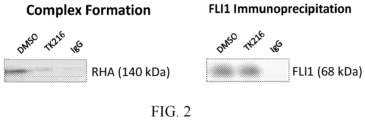
- FLI1 was immunoprecipitated following treatment with TK216 or DMSO control in A4573 (see FIG. 2 ).
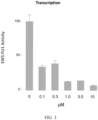
- TK216 reduced transcriptional activity in COS7 cells co-transfected with EWS-FLI1 and NROB 1 reporter-luciferase plasmids which contain EWS-FLI1 DNA-binding sites, as shown in FIG. 3 .
- Treatment with TK216 resulted in a dose-dependent inhibition of proliferation in Ewing Sarcoma A4573 cell line, as shown in FIG. 4 .
- TK216 displayed anti-proliferative activity in AML cell lines.
- the IC 50 of TK216 for each cell line was determined in a 72 hr CellTiter-Glo assay, as shown in FIG. 5 and TABLE 1.
- TABLE 1. TK216 IC 50 in AML Cell Lines Cell line TK216-2 Cisplatin IC 50 ( ⁇ M) IC 50 ( ⁇ M) HL-60 0.363 1.931 Kasumi-1 0.393 4.560 ML-2 0.291 1.395 MOLM-13 0.228 0.798 MOLM-16 0.129 2.190 THP-1 0.152 1.359
- TK216 displayed anti-proliferative activity in DLBCL cell lines.
- the IC 50 of TK216 for each cell line was determined in a 72 hr CellTiter-Glo assay, as shown in FIG. 6 and TABLE 2. TABLE 2.
- TK216 IC 50 in DLBCL Cell Lines Cell line TK216 IC 50 ( ⁇ M) TMD-8 0.152 HBL-1 0.304 DOHH2 0.160 U2932 0.127 WSU-DLCL2 0.897 OCI-Ly18 0.095 OCI-Ly19 0.106
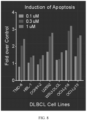
- TK216 induced apoptosis in DLBCL cell lines.
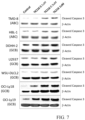
- Cells were treated with various concentrations of TK216 for 18h and apoptosis was assessed by detection of cleaved-Caspase 3.
- the amount of cleaved-Caspase 3 was normalized to b-actin and presented as fold over control, as shown in FIG. 7 and FIG. 8 .
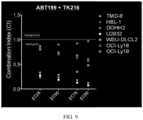
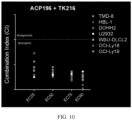
- TK216 displayed synergy when combined with BCL-2 (ABT199) and BTK (ACP196) inhibitors.
- the median-effect analysis was used to determine synergism, antagonism, or additivity of TK216 when combined with ABT199 (BCL-2i) and ACP196 (BTKi).
- CalcuSyn software was used to determine the Combination Index (CI) using the Chou/Talalay equation, as shown in FIG. 9 and FIG. 10 .
- TK216 displayed anti-tumor activity in a DLBCL xenograft model.
- the anti-tumor activity of TK216 was assessed in nude mice harboring TMD-8 tumors, a DLBCL-ABC xenograft model.
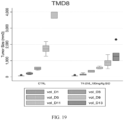
- TK216 was administered orally as a solution at 100 mg/kg BID for 13 days. Results are shown in FIG. 11 .
- TK216 resultsed in tumor growth inhibition.
- TK216 resulted in 77% tumor growth inhibition of the TMD-8 xenograft model when compared to vehicle control following 13 days of treatment, as shown in FIG. 12 .
- TK216 is a first in class, small molecule that directly binds EWS-FLI1 inhibiting the biological activity of ETS-family transcription factor.
- AML and DLBCL cell lines with deregulated ETS-family members treatment with TK216 resulted in potent inhibition of proliferation and the induction of apoptosis.
- Combination of TK216 with BCL-2 and BTK inhibitors in DLBCL cell lines lead to synergistic activity and allowed for a more effective inhibition of cell proliferation.
- Daily, oral administration of TK216 potently inhibited tumor growth in xenograft models of DLBCL with deregulated expression of ETS-family members, and is well-tolerated.
- the inhibition of the EWS-FLI1 oncogene offers a promising approach for the treatment of Ewing Sarcoma, e.g., relapsed/refractory Ewing Sarcoma.
- Venetoclax (4-(4- ⁇ [2-(4-Chlorophenyl)-4,4-dimethyl-1-cyclohexen-1-yl]methyl ⁇ -1-piperazinyl)- N -( ⁇ 3-nitro-4-[(tetrahydro-2 H -pyran-4-ylmethyl)amino] phenyl ⁇ sulfonyl)-2-1 H -pyrrolo[2,3- b ]pyridin-5-yloxy)benzamide) is used for the treatment of chronic lymphocytic leukemia, e.g., in patients who have relapsed or have been refractory to previous treatment and who have the 17p deletion genetic mutation.
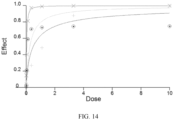
- TK216 was tested in combination with venetoclax and has been demonstrated to exhibit synergism in dose-effect in DLBCL cell lines.
- the top curve ( ⁇ ) was for the combination therapy
- the middle curve ( ⁇ ) was for TK216
- the bottom curve (+) was for venetoclax.
- FIG. 13 is a dose-effect curve for TK216 in combination with venetoclax in the TMD8 cell line.
- FIG. 14 is a dose-effect curve for TK216 in combination with venetoclax in the U2932 cell line.
- FIG. 15 is a dose-effect curve for TK216 in combination with venetoclax in the HLB1 cell line.
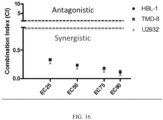
- Dose-effect testing was conducted in DLBLC cell lines (TMD8, HBL1, U2932) indicating a synergistic effect across doses, as shown in FIG. 16 .
- ETS transcription factors such as FLI1 and SPIB
- FLI1 and SPIB are recurrently deregulated in human lymphomas.
- the small molecule YK-4-279 (also referred to as YK-279 or YK279, is 4,7-dichloro-3-hydroxy-3-(2-(4-methoxyphenyl)-2-oxoethyl)indolin-2-one) inhibits binding of EWS 1-FLI1 fusion protein to RHA with growth arrest and apoptosis in Ewing sarcoma cells, and exhibits in vitro anti-lymphoma activity.
- TK-216 is a YK-4-279 clinical derivative that is in phase 1 for patients with relapsed or refractory Ewing sarcoma. Preclinical testing has been conducted for TK-216 in lymphoma models.
- TK-216 was very active, with a median IC50 of 449 nM (95% C.I.: 367-506), as shown in FIG. 1 .
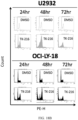
- the anti-tumor activity was mainly cytotoxic, as confirmed performing cell cycle analysis and Annexin V staining in 6 DLBCL cell lines (TMD8, U2932, HBL1, OCI-LY-18, WSU-DLCL2, DOHH2; TK-216 or DMSO for 24, 48, 72h), in which a time-dependent apoptosis was preceded by a G2/M arrest, as shown in FIG. 2 .
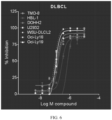
- TK-216 was also tested in combination with other targeted agents in DLBCL cell lines, as shown in FIG. 4 .
- TK-216 with the immunomodulator lenalidomide (synergism in 2/2 activated B cell type DLBCL), with the bromodomain and extra-terminal protein (BET) inhibitor OTX015 (MK-8628) (synergism in 2/4 cells and additive effect in 1/4 cells), with the anti-CD20 monoclonal antibody rituximab (synergism in 2/3 cells) and with the BCL2 inhibitor venetoclax (synergism in 3/4 cells).
- BET bromodomain and extra-terminal protein
- TK-216 presented strong preclinical anti-lymphoma activity, both as a single agent and in combination with other therapeutic agents.
- the two main DLBCL subtypes are the germinal center B cell (GCB) and the ABC types, characterized by individual biologic and clinical features. Since up to 40% DLBCL patients are still not cured with the standard treatments, there is the need for novel therapies.
- YK-4-279 is a small molecule that inhibits binding of the EWS1-FLI1 fusion protein to RHA, resulting in growth arrest and apoptosis in Ewing sarcoma cells.
- Its derivative, TK-216 is the first in class inhibitor of the ETS-family of transcription factors in phase I (NCT02657005 for relapsed or refractory Ewing sarcoma). Both compounds have shown promising preclinical anti-lymphoma activity. Data has been obtained on their mechanism of action in DLBCL.
- RNA expression levels of the different ETS factors were correlated with sensitivity to the drugs.
- SPIB was the gene presenting the most significant negative correlation with both YK-4-279 and TK-216, especially among the ABC DLBCL cell lines (P ⁇ 0.05).
- SPIB is a known oncogene for ABC DLBCL ( Lenz et al, PNAS 2008 ) and is involved in the response to lenalidomide in ABC DLBCL ( Yang et al, Cancer Cell 2012 ).
- YK-4-279 inhibits the binding of EWS1-FLI1 to the helicases RHA and DDX5 ( Selvanathan et al, PNAS 2012 ).
- a group of items linked with the conjunction 'and' should not be read as requiring that each and every one of those items be present in the grouping, but rather should be read as 'and/or' unless expressly stated otherwise.
- a group of items linked with the conjunction 'or' should not be read as requiring mutual exclusivity among that group, but rather should be read as 'and/or' unless expressly stated otherwise.
- a system having at least one of A, B, and C would include but not be limited to systems that have A alone, B alone, C alone, A and B together, A and C together, B and C together, and/or A, B, and C together, etc.).
- a convention analogous to "at least one of A, B, or C, etc.” is used, in general such a construction is intended in the sense one having skill in the art would understand the convention (e.g. , "a system having at least one of A, B, or C” would include but not be limited to systems that have A alone, B alone, C alone, A and B together, A and C together, B and C together, and/or A, B, and C together, etc.).
Landscapes
- Health & Medical Sciences (AREA)
- Chemical & Material Sciences (AREA)
- Life Sciences & Earth Sciences (AREA)
- Medicinal Chemistry (AREA)
- General Health & Medical Sciences (AREA)
- Veterinary Medicine (AREA)
- Animal Behavior & Ethology (AREA)
- Public Health (AREA)
- Pharmacology & Pharmacy (AREA)
- Epidemiology (AREA)
- Immunology (AREA)
- Organic Chemistry (AREA)
- Engineering & Computer Science (AREA)
- Bioinformatics & Cheminformatics (AREA)
- Oncology (AREA)
- General Chemical & Material Sciences (AREA)
- Nuclear Medicine, Radiotherapy & Molecular Imaging (AREA)
- Chemical Kinetics & Catalysis (AREA)
- Mycology (AREA)
- Microbiology (AREA)
- Proteomics, Peptides & Aminoacids (AREA)
- Biomedical Technology (AREA)
- Biochemistry (AREA)
- Biophysics (AREA)
- Genetics & Genomics (AREA)
- Molecular Biology (AREA)
- Hematology (AREA)
- Gastroenterology & Hepatology (AREA)
- Pharmaceuticals Containing Other Organic And Inorganic Compounds (AREA)
- Medicines Containing Antibodies Or Antigens For Use As Internal Diagnostic Agents (AREA)
- Plural Heterocyclic Compounds (AREA)
Applications Claiming Priority (7)
| Application Number | Priority Date | Filing Date | Title |
|---|---|---|---|
| US201662368707P | 2016-07-29 | 2016-07-29 | |
| US201662417572P | 2016-11-04 | 2016-11-04 | |
| US201662422504P | 2016-11-15 | 2016-11-15 | |
| US201662426107P | 2016-11-23 | 2016-11-23 | |
| US201762503238P | 2017-05-08 | 2017-05-08 | |
| US201762534067P | 2017-07-18 | 2017-07-18 | |
| PCT/US2017/043979 WO2018022771A1 (en) | 2016-07-29 | 2017-07-26 | Uses of indolinone compounds |
Publications (3)
| Publication Number | Publication Date |
|---|---|
| EP3490553A1 EP3490553A1 (en) | 2019-06-05 |
| EP3490553A4 EP3490553A4 (en) | 2020-03-25 |
| EP3490553B1 true EP3490553B1 (en) | 2024-08-28 |
Family
ID=61011754
Family Applications (1)
| Application Number | Title | Priority Date | Filing Date |
|---|---|---|---|
| EP17835216.7A Active EP3490553B1 (en) | 2016-07-29 | 2017-07-26 | Combination comprising an indolinone compound and its use in the treatment of lymphoma |
Country Status (11)
| Country | Link |
|---|---|
| US (4) | US10159660B2 (enExample) |
| EP (1) | EP3490553B1 (enExample) |
| JP (3) | JP6885629B2 (enExample) |
| KR (2) | KR20210095721A (enExample) |
| CN (2) | CN109789127B (enExample) |
| CA (1) | CA3029851A1 (enExample) |
| MX (1) | MX395539B (enExample) |
| PH (1) | PH12019500070A1 (enExample) |
| SG (1) | SG11201811661TA (enExample) |
| TW (2) | TWI780061B (enExample) |
| WO (1) | WO2018022771A1 (enExample) |
Families Citing this family (10)
| Publication number | Priority date | Publication date | Assignee | Title |
|---|---|---|---|---|
| CN111777596A (zh) * | 2014-10-09 | 2020-10-16 | 英克特诺治疗公司 | 吲哚酮化合物及其用途 |
| WO2017172368A1 (en) | 2016-03-31 | 2017-10-05 | Oncternal Therapeutics, Inc. | Indoline analogs and uses thereof |
| CN109789127B (zh) * | 2016-07-29 | 2022-03-25 | 英克特诺治疗公司 | 吲哚啉酮化合物的用途 |
| CN110818611B (zh) * | 2018-08-13 | 2023-01-24 | 中国科学院上海药物研究所 | 一类吲哚酮类化合物、其制备方法、药物组合物和用途 |
| US20200171001A1 (en) * | 2018-11-30 | 2020-06-04 | Aptose Biosciences Inc. | Combination therapy with 2,3-dihydro-isoindole-1-one compounds and methods for treating patients with various mutations |
| US20240139153A1 (en) * | 2020-09-17 | 2024-05-02 | Oklahoma Medical Research Foundation | Inhibition of Endothelial ETS Family Transcription Factors Promotes Flow-Dependent Ocular Vessel Regression |
| US20240299558A1 (en) * | 2021-06-18 | 2024-09-12 | University Of Maryland, Baltimore | Proteolysis targeting chimeras and polypharmacological agents targeting bcl-2, and methods of use thereof |
| CA3175913A1 (en) | 2021-07-16 | 2023-01-16 | Celator Pharmaceuticals, Inc. | Liposomal formulations of bcl inhibitors |
| WO2025137592A2 (en) * | 2023-12-21 | 2025-06-26 | Anuj Bellare | Diazirine monomers and polymer compositions derived therefrom |
| WO2025235561A1 (en) * | 2024-05-08 | 2025-11-13 | Enspire Group LLC | Venetoclax oral drugs and uses thereof |
Family Cites Families (41)
| Publication number | Priority date | Publication date | Assignee | Title |
|---|---|---|---|---|
| DE3483704D1 (de) | 1983-07-22 | 1991-01-17 | Du Pont | Phenylchinolinsaeure und derivate als antitumormittel. |
| ATE285769T1 (de) | 1998-12-04 | 2005-01-15 | Neurosearch As | Verwendung von isatinderivaten als ionenkanalaktivierende mittel |
| UA75054C2 (uk) | 1999-10-13 | 2006-03-15 | Бьорінгер Інгельхайм Фарма Гмбх & Ко. Кг | Заміщені в положенні 6 індолінони, їх одержання та їх застосування як лікарського засобу |
| WO2001064681A2 (en) | 2000-02-28 | 2001-09-07 | Sugen, Inc. | 3-(pyrolyllactone)-2-indolinone compounds as kinase inhibitors |
| CN1155572C (zh) | 2001-01-19 | 2004-06-30 | 中国人民解放军军事医学科学院毒物药物研究所 | 吲哚类衍生物及其抗肿瘤用途 |
| US20030157486A1 (en) | 2001-06-21 | 2003-08-21 | Graff Jonathan M. | Methods to identify signal sequences |
| AU2005323437B2 (en) | 2004-04-30 | 2011-10-06 | Alnylam Pharmaceuticals, Inc. | Oligonucleotides comprising a C5-modified pyrimidine |
| AR056317A1 (es) | 2005-04-20 | 2007-10-03 | Xenon Pharmaceuticals Inc | Compuestos de oxindol y composicion farmaceutica |
| WO2006117414A1 (es) | 2005-04-29 | 2006-11-09 | Proyecto De Biomedicina Cima, S.L. | Modelo animal no humano de sarcoma |
| WO2008046083A2 (en) | 2006-10-12 | 2008-04-17 | Xenon Pharmaceuticals Inc. | Use of oxindole compounds as therapeutic agents |
| AU2007341977B2 (en) | 2006-12-29 | 2013-05-23 | Georgetown University | Targeting of EWS-FLI1 as anti-tumor therapy |
| US8232310B2 (en) | 2006-12-29 | 2012-07-31 | Georgetown University | Targeting of EWS-FLI1 as anti-tumor therapy |
| EP2154966B1 (en) | 2007-04-20 | 2013-08-21 | The Research Foundation Of State University Of New York | Benzimidazoles and pharmaceutical compositions thereof |
| US8377992B2 (en) | 2007-10-22 | 2013-02-19 | The Wistar Institute | TRBD-binding effectors and methods for using the same to modulate telomerase activity |
| EP3401684B1 (en) | 2008-10-10 | 2022-03-16 | Dana Farber Cancer Institute, Inc. | Chemical modulators of pro-apoptotic bax and bcl-2 polypeptides |
| JP5675629B2 (ja) * | 2008-10-21 | 2015-02-25 | オニキス セラピューティクス, インク.Onyx Therapeutics, Inc. | ペプチドエポキシケトンを用いた併用療法 |
| US8710068B2 (en) | 2009-01-19 | 2014-04-29 | The Trustees Of The University Of Pennsylvania | Method of treating cancer using a survivin inhibitor |
| AR078161A1 (es) | 2009-09-11 | 2011-10-19 | Hoffmann La Roche | Formulaciones farmaceuticas muy concentradas de un anticuerpo anti cd20. uso de la formulacion. metodo de tratamiento. |
| WO2012078519A2 (en) | 2010-12-06 | 2012-06-14 | Numerate, Inc. | 3-acylidene-2-oxoindole derivatives for inhibition of transglutaminase 2 |
| CN102516152B (zh) | 2011-12-12 | 2014-12-10 | 华东师范大学 | 一种α-二氟羰基取代的手性叔醇类化合物及其合成方法和应用 |
| US20130259927A1 (en) | 2012-04-02 | 2013-10-03 | Gradalis, Inc. | Ewing's Sarcoma Bifunctional shRNA Design |
| NZ700612A (en) * | 2012-04-12 | 2016-09-30 | Univ Georgetown | Methods and compositions for treating ewings sarcoma family of tumors |
| WO2014015153A2 (en) | 2012-07-20 | 2014-01-23 | Star Biotechnology, Llc | Compositions and methods for treating ewing's sarcoma and other disorders related to ews-fli1 |
| CA2905418C (en) | 2013-03-13 | 2023-03-28 | The United States Of America, As Represented By The Secretary, Department Of Health And Human Services | Methods for modulating chemotherapeutic cytotoxicity |
| US20160287592A1 (en) * | 2013-04-08 | 2016-10-06 | Pharmacyclics Llc | Ibrutinib combination therapy |
| EA027139B1 (ru) * | 2013-04-26 | 2017-06-30 | Бейджин, Лтд. | Замещенные 5-(3,5-диметилизоксазол-4-ил)индолин-2-оны |
| KR101500363B1 (ko) * | 2013-07-01 | 2015-03-16 | 현대자동차 주식회사 | 하이브리드 자동차의 동력전달장치 |
| CN105899212A (zh) * | 2013-08-06 | 2016-08-24 | 翁科埃斯克斯有限公司 | 利用β溴结构域抑制剂治疗弥漫性大B细胞淋巴瘤(DLBCL)的方法 |
| CN103435606A (zh) | 2013-08-22 | 2013-12-11 | 中国药科大学 | CDK2与GSK3β双重抑制剂及用途 |
| US9511050B2 (en) | 2013-10-24 | 2016-12-06 | Georgetown University | Methods and compositions for treating cancer |
| WO2015061752A1 (en) * | 2013-10-25 | 2015-04-30 | Pharmacyclics, Inc. | Treatment using bruton's tyrosine kinase inhibitors and immunotherapy |
| JP2016538310A (ja) * | 2013-11-27 | 2016-12-08 | オンコエシックス ゲーエムベーハー | チエノトリアゾロジアゼピン化合物を含む医薬製剤を用いる白血病の治療方法 |
| CN105793251B (zh) * | 2013-12-05 | 2018-10-12 | 豪夫迈·罗氏有限公司 | 具有亲电子官能性的杂芳基吡啶酮和氮杂-吡啶酮化合物 |
| EP3131552B1 (en) | 2014-04-16 | 2020-07-15 | Signal Pharmaceuticals, LLC | Methods for treating cancer using tor kinase inhibitor combination therapy |
| WO2015187848A1 (en) * | 2014-06-04 | 2015-12-10 | Sampath Deepa | Hdac inhibitor and btk inhibitor combinations |
| WO2016014859A1 (en) * | 2014-07-25 | 2016-01-28 | Pharmacyclics Llc | Bet inhibitor and bruton's tyrosine kinase inhibitor combinations |
| CN107427524A (zh) * | 2014-08-28 | 2017-12-01 | 翁科埃斯克斯有限公司 | 利用包含噻吩并三唑并二氮杂*化合物的药物组合物治疗急性髓细胞白血病或急性淋巴性白血病的方法 |
| CN111777596A (zh) | 2014-10-09 | 2020-10-16 | 英克特诺治疗公司 | 吲哚酮化合物及其用途 |
| WO2017172368A1 (en) | 2016-03-31 | 2017-10-05 | Oncternal Therapeutics, Inc. | Indoline analogs and uses thereof |
| CN109789127B (zh) | 2016-07-29 | 2022-03-25 | 英克特诺治疗公司 | 吲哚啉酮化合物的用途 |
| US20190255127A1 (en) | 2018-02-21 | 2019-08-22 | Batu Biologics, Inc. | Augmentation of Oncolytic Viral Efficacy through Immunological Targeting Tumor Endothelial Cells |
-
2017
- 2017-07-26 CN CN201780059006.8A patent/CN109789127B/zh active Active
- 2017-07-26 SG SG11201811661TA patent/SG11201811661TA/en unknown
- 2017-07-26 KR KR1020217023307A patent/KR20210095721A/ko not_active Ceased
- 2017-07-26 US US15/660,566 patent/US10159660B2/en active Active
- 2017-07-26 KR KR1020197005697A patent/KR102282794B1/ko active Active
- 2017-07-26 CA CA3029851A patent/CA3029851A1/en active Pending
- 2017-07-26 EP EP17835216.7A patent/EP3490553B1/en active Active
- 2017-07-26 CN CN202210216619.0A patent/CN114569606B/zh active Active
- 2017-07-26 JP JP2019504916A patent/JP6885629B2/ja active Active
- 2017-07-26 WO PCT/US2017/043979 patent/WO2018022771A1/en not_active Ceased
- 2017-07-26 MX MX2019000867A patent/MX395539B/es unknown
- 2017-07-28 TW TW106125399A patent/TWI780061B/zh active
- 2017-07-28 TW TW111135922A patent/TWI857351B/zh active
-
2018
- 2018-08-27 US US16/114,076 patent/US10646470B2/en active Active
-
2019
- 2019-01-10 PH PH12019500070A patent/PH12019500070A1/en unknown
-
2020
- 2020-04-13 US US16/847,516 patent/US11285132B2/en active Active
- 2020-12-10 JP JP2020204766A patent/JP7182304B2/ja active Active
-
2021
- 2021-05-06 JP JP2021078313A patent/JP7208659B2/ja active Active
-
2022
- 2022-03-28 US US17/705,746 patent/US12161626B2/en active Active
Also Published As
Similar Documents
| Publication | Publication Date | Title |
|---|---|---|
| US12161626B2 (en) | Uses of indolinone compounds | |
| EP2694485B1 (en) | Combination of akt inhibitor compound and vemurafenib for use in therapeutic treatments | |
| EP3585389A1 (en) | Treatment of egfr-driven cancer with fewer side effects | |
| JP6147246B2 (ja) | Akt及びmek阻害剤化合物の組み合わせ、及び使用方法 | |
| JP2023526283A (ja) | 単独療法及び併用療法 | |
| AU2018360559A1 (en) | Combination comprising at least one spliceosome modulator and at least one inhibitor chosen from BCL2 inhibitors, BCL2/BCLxL inhibitors, and BCLxL inhibitors and methods of use | |
| WO2014002922A1 (ja) | 抗癌剤の併用による癌治療方法 | |
| RU2491938C2 (ru) | Производное изоксазола для лечения рака | |
| HK40075992A (en) | Uses of indolinone compounds | |
| HK40006023A (en) | Uses of indolinone compounds | |
| HK40006023B (en) | Uses of indolinone compounds | |
| HK40075992B (en) | Uses of indolinone compounds | |
| WO2024176130A1 (en) | Tead- and her2-inhibitor combinations for treating cancer | |
| JP2015163591A (ja) | 抗癌剤の併用による癌治療方法 | |
| NZ617243B2 (en) | Combinations of akt and mek inhibitor compounds, and methods of use |
Legal Events
| Date | Code | Title | Description |
|---|---|---|---|
| STAA | Information on the status of an ep patent application or granted ep patent |
Free format text: STATUS: THE INTERNATIONAL PUBLICATION HAS BEEN MADE |
|
| PUAI | Public reference made under article 153(3) epc to a published international application that has entered the european phase |
Free format text: ORIGINAL CODE: 0009012 |
|
| STAA | Information on the status of an ep patent application or granted ep patent |
Free format text: STATUS: REQUEST FOR EXAMINATION WAS MADE |
|
| 17P | Request for examination filed |
Effective date: 20190227 |
|
| AK | Designated contracting states |
Kind code of ref document: A1 Designated state(s): AL AT BE BG CH CY CZ DE DK EE ES FI FR GB GR HR HU IE IS IT LI LT LU LV MC MK MT NL NO PL PT RO RS SE SI SK SM TR |
|
| AX | Request for extension of the european patent |
Extension state: BA ME |
|
| DAV | Request for validation of the european patent (deleted) | ||
| DAX | Request for extension of the european patent (deleted) | ||
| A4 | Supplementary search report drawn up and despatched |
Effective date: 20200226 |
|
| RIC1 | Information provided on ipc code assigned before grant |
Ipc: A61K 31/454 20060101ALI20200220BHEP Ipc: A61K 31/404 20060101AFI20200220BHEP Ipc: A61P 35/00 20060101ALI20200220BHEP Ipc: A61K 39/395 20060101ALI20200220BHEP Ipc: A61P 35/02 20060101ALI20200220BHEP Ipc: A61K 45/06 20060101ALI20200220BHEP |
|
| STAA | Information on the status of an ep patent application or granted ep patent |
Free format text: STATUS: EXAMINATION IS IN PROGRESS |
|
| 17Q | First examination report despatched |
Effective date: 20220803 |
|
| GRAP | Despatch of communication of intention to grant a patent |
Free format text: ORIGINAL CODE: EPIDOSNIGR1 |
|
| STAA | Information on the status of an ep patent application or granted ep patent |
Free format text: STATUS: GRANT OF PATENT IS INTENDED |
|
| RIC1 | Information provided on ipc code assigned before grant |
Ipc: A61K 31/635 20060101ALI20240306BHEP Ipc: A61P 35/02 20060101ALI20240306BHEP Ipc: A61P 35/00 20060101ALI20240306BHEP Ipc: A61K 45/06 20060101ALI20240306BHEP Ipc: A61K 39/395 20060101ALI20240306BHEP Ipc: A61K 31/454 20060101ALI20240306BHEP Ipc: A61K 31/404 20060101AFI20240306BHEP |
|
| INTG | Intention to grant announced |
Effective date: 20240321 |
|
| GRAS | Grant fee paid |
Free format text: ORIGINAL CODE: EPIDOSNIGR3 |
|
| GRAA | (expected) grant |
Free format text: ORIGINAL CODE: 0009210 |
|
| STAA | Information on the status of an ep patent application or granted ep patent |
Free format text: STATUS: THE PATENT HAS BEEN GRANTED |
|
| AK | Designated contracting states |
Kind code of ref document: B1 Designated state(s): AL AT BE BG CH CY CZ DE DK EE ES FI FR GB GR HR HU IE IS IT LI LT LU LV MC MK MT NL NO PL PT RO RS SE SI SK SM TR |
|
| RAP3 | Party data changed (applicant data changed or rights of an application transferred) |
Owner name: ONCTERNAL THERAPEUTICS, INC. |
|
| REG | Reference to a national code |
Ref country code: GB Ref legal event code: FG4D |
|
| RIN1 | Information on inventor provided before grant (corrected) |
Inventor name: BREITMEYER, JAMES, BRADLEY Inventor name: JESSEN, KATAYOUN Inventor name: LANNUTTI, BRIAN |
|
| REG | Reference to a national code |
Ref country code: CH Ref legal event code: EP |
|
| REG | Reference to a national code |
Ref country code: DE Ref legal event code: R096 Ref document number: 602017084507 Country of ref document: DE |
|
| REG | Reference to a national code |
Ref country code: IE Ref legal event code: FG4D |
|
| P01 | Opt-out of the competence of the unified patent court (upc) registered |
Free format text: CASE NUMBER: APP_54887/2024 Effective date: 20241005 |
|
| REG | Reference to a national code |
Ref country code: LT Ref legal event code: MG9D |
|
| PG25 | Lapsed in a contracting state [announced via postgrant information from national office to epo] |
Ref country code: NO Free format text: LAPSE BECAUSE OF FAILURE TO SUBMIT A TRANSLATION OF THE DESCRIPTION OR TO PAY THE FEE WITHIN THE PRESCRIBED TIME-LIMIT Effective date: 20241128 |
|
| REG | Reference to a national code |
Ref country code: AT Ref legal event code: MK05 Ref document number: 1717211 Country of ref document: AT Kind code of ref document: T Effective date: 20240828 |
|
| PG25 | Lapsed in a contracting state [announced via postgrant information from national office to epo] |
Ref country code: NL Free format text: LAPSE BECAUSE OF FAILURE TO SUBMIT A TRANSLATION OF THE DESCRIPTION OR TO PAY THE FEE WITHIN THE PRESCRIBED TIME-LIMIT Effective date: 20240828 Ref country code: FI Free format text: LAPSE BECAUSE OF FAILURE TO SUBMIT A TRANSLATION OF THE DESCRIPTION OR TO PAY THE FEE WITHIN THE PRESCRIBED TIME-LIMIT Effective date: 20240828 Ref country code: GR Free format text: LAPSE BECAUSE OF FAILURE TO SUBMIT A TRANSLATION OF THE DESCRIPTION OR TO PAY THE FEE WITHIN THE PRESCRIBED TIME-LIMIT Effective date: 20241129 Ref country code: PT Free format text: LAPSE BECAUSE OF FAILURE TO SUBMIT A TRANSLATION OF THE DESCRIPTION OR TO PAY THE FEE WITHIN THE PRESCRIBED TIME-LIMIT Effective date: 20241230 Ref country code: PL Free format text: LAPSE BECAUSE OF FAILURE TO SUBMIT A TRANSLATION OF THE DESCRIPTION OR TO PAY THE FEE WITHIN THE PRESCRIBED TIME-LIMIT Effective date: 20240828 |
|
| PG25 | Lapsed in a contracting state [announced via postgrant information from national office to epo] |
Ref country code: BG Free format text: LAPSE BECAUSE OF FAILURE TO SUBMIT A TRANSLATION OF THE DESCRIPTION OR TO PAY THE FEE WITHIN THE PRESCRIBED TIME-LIMIT Effective date: 20240828 |
|
| PG25 | Lapsed in a contracting state [announced via postgrant information from national office to epo] |
Ref country code: LV Free format text: LAPSE BECAUSE OF FAILURE TO SUBMIT A TRANSLATION OF THE DESCRIPTION OR TO PAY THE FEE WITHIN THE PRESCRIBED TIME-LIMIT Effective date: 20240828 |
|
| REG | Reference to a national code |
Ref country code: NL Ref legal event code: MP Effective date: 20240828 |
|
| PG25 | Lapsed in a contracting state [announced via postgrant information from national office to epo] |
Ref country code: AT Free format text: LAPSE BECAUSE OF FAILURE TO SUBMIT A TRANSLATION OF THE DESCRIPTION OR TO PAY THE FEE WITHIN THE PRESCRIBED TIME-LIMIT Effective date: 20240828 Ref country code: IS Free format text: LAPSE BECAUSE OF FAILURE TO SUBMIT A TRANSLATION OF THE DESCRIPTION OR TO PAY THE FEE WITHIN THE PRESCRIBED TIME-LIMIT Effective date: 20241228 |
|
| PG25 | Lapsed in a contracting state [announced via postgrant information from national office to epo] |
Ref country code: HR Free format text: LAPSE BECAUSE OF FAILURE TO SUBMIT A TRANSLATION OF THE DESCRIPTION OR TO PAY THE FEE WITHIN THE PRESCRIBED TIME-LIMIT Effective date: 20240828 |
|
| PG25 | Lapsed in a contracting state [announced via postgrant information from national office to epo] |
Ref country code: RS Free format text: LAPSE BECAUSE OF FAILURE TO SUBMIT A TRANSLATION OF THE DESCRIPTION OR TO PAY THE FEE WITHIN THE PRESCRIBED TIME-LIMIT Effective date: 20241128 Ref country code: ES Free format text: LAPSE BECAUSE OF FAILURE TO SUBMIT A TRANSLATION OF THE DESCRIPTION OR TO PAY THE FEE WITHIN THE PRESCRIBED TIME-LIMIT Effective date: 20240828 |
|
| PG25 | Lapsed in a contracting state [announced via postgrant information from national office to epo] |
Ref country code: RS Free format text: LAPSE BECAUSE OF FAILURE TO SUBMIT A TRANSLATION OF THE DESCRIPTION OR TO PAY THE FEE WITHIN THE PRESCRIBED TIME-LIMIT Effective date: 20241128 Ref country code: PT Free format text: LAPSE BECAUSE OF FAILURE TO SUBMIT A TRANSLATION OF THE DESCRIPTION OR TO PAY THE FEE WITHIN THE PRESCRIBED TIME-LIMIT Effective date: 20241230 Ref country code: PL Free format text: LAPSE BECAUSE OF FAILURE TO SUBMIT A TRANSLATION OF THE DESCRIPTION OR TO PAY THE FEE WITHIN THE PRESCRIBED TIME-LIMIT Effective date: 20240828 Ref country code: NO Free format text: LAPSE BECAUSE OF FAILURE TO SUBMIT A TRANSLATION OF THE DESCRIPTION OR TO PAY THE FEE WITHIN THE PRESCRIBED TIME-LIMIT Effective date: 20241128 Ref country code: NL Free format text: LAPSE BECAUSE OF FAILURE TO SUBMIT A TRANSLATION OF THE DESCRIPTION OR TO PAY THE FEE WITHIN THE PRESCRIBED TIME-LIMIT Effective date: 20240828 Ref country code: LV Free format text: LAPSE BECAUSE OF FAILURE TO SUBMIT A TRANSLATION OF THE DESCRIPTION OR TO PAY THE FEE WITHIN THE PRESCRIBED TIME-LIMIT Effective date: 20240828 Ref country code: IS Free format text: LAPSE BECAUSE OF FAILURE TO SUBMIT A TRANSLATION OF THE DESCRIPTION OR TO PAY THE FEE WITHIN THE PRESCRIBED TIME-LIMIT Effective date: 20241228 Ref country code: HR Free format text: LAPSE BECAUSE OF FAILURE TO SUBMIT A TRANSLATION OF THE DESCRIPTION OR TO PAY THE FEE WITHIN THE PRESCRIBED TIME-LIMIT Effective date: 20240828 Ref country code: GR Free format text: LAPSE BECAUSE OF FAILURE TO SUBMIT A TRANSLATION OF THE DESCRIPTION OR TO PAY THE FEE WITHIN THE PRESCRIBED TIME-LIMIT Effective date: 20241129 Ref country code: FI Free format text: LAPSE BECAUSE OF FAILURE TO SUBMIT A TRANSLATION OF THE DESCRIPTION OR TO PAY THE FEE WITHIN THE PRESCRIBED TIME-LIMIT Effective date: 20240828 Ref country code: ES Free format text: LAPSE BECAUSE OF FAILURE TO SUBMIT A TRANSLATION OF THE DESCRIPTION OR TO PAY THE FEE WITHIN THE PRESCRIBED TIME-LIMIT Effective date: 20240828 Ref country code: BG Free format text: LAPSE BECAUSE OF FAILURE TO SUBMIT A TRANSLATION OF THE DESCRIPTION OR TO PAY THE FEE WITHIN THE PRESCRIBED TIME-LIMIT Effective date: 20240828 Ref country code: AT Free format text: LAPSE BECAUSE OF FAILURE TO SUBMIT A TRANSLATION OF THE DESCRIPTION OR TO PAY THE FEE WITHIN THE PRESCRIBED TIME-LIMIT Effective date: 20240828 |
|
| PG25 | Lapsed in a contracting state [announced via postgrant information from national office to epo] |
Ref country code: RO Free format text: LAPSE BECAUSE OF FAILURE TO SUBMIT A TRANSLATION OF THE DESCRIPTION OR TO PAY THE FEE WITHIN THE PRESCRIBED TIME-LIMIT Effective date: 20240828 Ref country code: SM Free format text: LAPSE BECAUSE OF FAILURE TO SUBMIT A TRANSLATION OF THE DESCRIPTION OR TO PAY THE FEE WITHIN THE PRESCRIBED TIME-LIMIT Effective date: 20240828 Ref country code: DK Free format text: LAPSE BECAUSE OF FAILURE TO SUBMIT A TRANSLATION OF THE DESCRIPTION OR TO PAY THE FEE WITHIN THE PRESCRIBED TIME-LIMIT Effective date: 20240828 |
|
| PG25 | Lapsed in a contracting state [announced via postgrant information from national office to epo] |
Ref country code: EE Free format text: LAPSE BECAUSE OF FAILURE TO SUBMIT A TRANSLATION OF THE DESCRIPTION OR TO PAY THE FEE WITHIN THE PRESCRIBED TIME-LIMIT Effective date: 20240828 |
|
| PG25 | Lapsed in a contracting state [announced via postgrant information from national office to epo] |
Ref country code: CZ Free format text: LAPSE BECAUSE OF FAILURE TO SUBMIT A TRANSLATION OF THE DESCRIPTION OR TO PAY THE FEE WITHIN THE PRESCRIBED TIME-LIMIT Effective date: 20240828 |
|
| PG25 | Lapsed in a contracting state [announced via postgrant information from national office to epo] |
Ref country code: SK Free format text: LAPSE BECAUSE OF FAILURE TO SUBMIT A TRANSLATION OF THE DESCRIPTION OR TO PAY THE FEE WITHIN THE PRESCRIBED TIME-LIMIT Effective date: 20240828 Ref country code: IT Free format text: LAPSE BECAUSE OF FAILURE TO SUBMIT A TRANSLATION OF THE DESCRIPTION OR TO PAY THE FEE WITHIN THE PRESCRIBED TIME-LIMIT Effective date: 20240828 |
|
| REG | Reference to a national code |
Ref country code: DE Ref legal event code: R097 Ref document number: 602017084507 Country of ref document: DE |
|
| PLBE | No opposition filed within time limit |
Free format text: ORIGINAL CODE: 0009261 |
|
| STAA | Information on the status of an ep patent application or granted ep patent |
Free format text: STATUS: NO OPPOSITION FILED WITHIN TIME LIMIT |
|
| 26N | No opposition filed |
Effective date: 20250530 |
|
| PG25 | Lapsed in a contracting state [announced via postgrant information from national office to epo] |
Ref country code: SE Free format text: LAPSE BECAUSE OF FAILURE TO SUBMIT A TRANSLATION OF THE DESCRIPTION OR TO PAY THE FEE WITHIN THE PRESCRIBED TIME-LIMIT Effective date: 20240828 |
|
| REG | Reference to a national code |
Ref country code: DE Ref legal event code: R119 Ref document number: 602017084507 Country of ref document: DE |
|
| REG | Reference to a national code |
Ref country code: CH Ref legal event code: H13 Free format text: ST27 STATUS EVENT CODE: U-0-0-H10-H13 (AS PROVIDED BY THE NATIONAL OFFICE) Effective date: 20260224 |
|
| PG25 | Lapsed in a contracting state [announced via postgrant information from national office to epo] |
Ref country code: LU Free format text: LAPSE BECAUSE OF NON-PAYMENT OF DUE FEES Effective date: 20250726 |
|
| GBPC | Gb: european patent ceased through non-payment of renewal fee |
Effective date: 20250726 |
|
| REG | Reference to a national code |
Ref country code: BE Ref legal event code: MM Effective date: 20250731 |
|
| PG25 | Lapsed in a contracting state [announced via postgrant information from national office to epo] |
Ref country code: GB Free format text: LAPSE BECAUSE OF NON-PAYMENT OF DUE FEES Effective date: 20250726 |
|
| PG25 | Lapsed in a contracting state [announced via postgrant information from national office to epo] |
Ref country code: DE Free format text: LAPSE BECAUSE OF NON-PAYMENT OF DUE FEES Effective date: 20260203 |
|
| PG25 | Lapsed in a contracting state [announced via postgrant information from national office to epo] |
Ref country code: BE Free format text: LAPSE BECAUSE OF NON-PAYMENT OF DUE FEES Effective date: 20250731 |
|
| PG25 | Lapsed in a contracting state [announced via postgrant information from national office to epo] |
Ref country code: FR Free format text: LAPSE BECAUSE OF NON-PAYMENT OF DUE FEES Effective date: 20250731 |
|
| PG25 | Lapsed in a contracting state [announced via postgrant information from national office to epo] |
Ref country code: CH Free format text: LAPSE BECAUSE OF NON-PAYMENT OF DUE FEES Effective date: 20250731 |
|
| PG25 | Lapsed in a contracting state [announced via postgrant information from national office to epo] |
Ref country code: LT Free format text: LAPSE BECAUSE OF FAILURE TO SUBMIT A TRANSLATION OF THE DESCRIPTION OR TO PAY THE FEE WITHIN THE PRESCRIBED TIME-LIMIT Effective date: 20240828 |
|
| PG25 | Lapsed in a contracting state [announced via postgrant information from national office to epo] |
Ref country code: IE Free format text: LAPSE BECAUSE OF NON-PAYMENT OF DUE FEES Effective date: 20250726 |
|
| PG25 | Lapsed in a contracting state [announced via postgrant information from national office to epo] |
Ref country code: MC Free format text: LAPSE BECAUSE OF FAILURE TO SUBMIT A TRANSLATION OF THE DESCRIPTION OR TO PAY THE FEE WITHIN THE PRESCRIBED TIME-LIMIT Effective date: 20240828 |
|
| PG25 | Lapsed in a contracting state [announced via postgrant information from national office to epo] |
Ref country code: CY Free format text: LAPSE BECAUSE OF FAILURE TO SUBMIT A TRANSLATION OF THE DESCRIPTION OR TO PAY THE FEE WITHIN THE PRESCRIBED TIME-LIMIT Effective date: 20240828 |