EP3488906B1 - Endgerätevorrichtung, programm und verfahren - Google Patents
Endgerätevorrichtung, programm und verfahren Download PDFInfo
- Publication number
- EP3488906B1 EP3488906B1 EP16909549.4A EP16909549A EP3488906B1 EP 3488906 B1 EP3488906 B1 EP 3488906B1 EP 16909549 A EP16909549 A EP 16909549A EP 3488906 B1 EP3488906 B1 EP 3488906B1
- Authority
- EP
- European Patent Office
- Prior art keywords
- application
- terminal device
- progress
- display
- sensor
- Prior art date
- Legal status (The legal status is an assumption and is not a legal conclusion. Google has not performed a legal analysis and makes no representation as to the accuracy of the status listed.)
- Active
Links
Images



Classifications
-
- H—ELECTRICITY
- H04—ELECTRIC COMMUNICATION TECHNIQUE
- H04W—WIRELESS COMMUNICATION NETWORKS
- H04W48/00—Access restriction; Network selection; Access point selection
- H04W48/02—Access restriction performed under specific conditions
-
- H—ELECTRICITY
- H04—ELECTRIC COMMUNICATION TECHNIQUE
- H04W—WIRELESS COMMUNICATION NETWORKS
- H04W52/00—Power management, e.g. Transmission Power Control [TPC] or power classes
- H04W52/02—Power saving arrangements
- H04W52/0209—Power saving arrangements in terminal devices
- H04W52/0251—Power saving arrangements in terminal devices using monitoring of local events, e.g. events related to user activity
- H04W52/0254—Power saving arrangements in terminal devices using monitoring of local events, e.g. events related to user activity detecting a user operation or a tactile contact or a motion of the device
-
- G—PHYSICS
- G01—MEASURING; TESTING
- G01C—MEASURING DISTANCES, LEVELS OR BEARINGS; SURVEYING; NAVIGATION; GYROSCOPIC INSTRUMENTS; PHOTOGRAMMETRY OR VIDEOGRAMMETRY
- G01C19/00—Gyroscopes; Turn-sensitive devices using vibrating masses; Turn-sensitive devices without moving masses; Measuring angular rate using gyroscopic effects
-
- G—PHYSICS
- G01—MEASURING; TESTING
- G01P—MEASURING LINEAR OR ANGULAR SPEED, ACCELERATION, DECELERATION, OR SHOCK; INDICATING PRESENCE, ABSENCE, OR DIRECTION, OF MOVEMENT
- G01P15/00—Measuring acceleration; Measuring deceleration; Measuring shock, i.e. sudden change of acceleration
-
- H—ELECTRICITY
- H04—ELECTRIC COMMUNICATION TECHNIQUE
- H04M—TELEPHONIC COMMUNICATION
- H04M1/00—Substation equipment, e.g. for use by subscribers
- H04M1/72—Mobile telephones; Cordless telephones, i.e. devices for establishing wireless links to base stations without route selection
- H04M1/724—User interfaces specially adapted for cordless or mobile telephones
- H04M1/72403—User interfaces specially adapted for cordless or mobile telephones with means for local support of applications that increase the functionality
- H04M1/72427—User interfaces specially adapted for cordless or mobile telephones with means for local support of applications that increase the functionality for supporting games or graphical animations
-
- H—ELECTRICITY
- H04—ELECTRIC COMMUNICATION TECHNIQUE
- H04M—TELEPHONIC COMMUNICATION
- H04M1/00—Substation equipment, e.g. for use by subscribers
- H04M1/72—Mobile telephones; Cordless telephones, i.e. devices for establishing wireless links to base stations without route selection
- H04M1/724—User interfaces specially adapted for cordless or mobile telephones
- H04M1/72448—User interfaces specially adapted for cordless or mobile telephones with means for adapting the functionality of the device according to specific conditions
-
- H—ELECTRICITY
- H04—ELECTRIC COMMUNICATION TECHNIQUE
- H04M—TELEPHONIC COMMUNICATION
- H04M1/00—Substation equipment, e.g. for use by subscribers
- H04M1/72—Mobile telephones; Cordless telephones, i.e. devices for establishing wireless links to base stations without route selection
- H04M1/724—User interfaces specially adapted for cordless or mobile telephones
- H04M1/72448—User interfaces specially adapted for cordless or mobile telephones with means for adapting the functionality of the device according to specific conditions
- H04M1/72454—User interfaces specially adapted for cordless or mobile telephones with means for adapting the functionality of the device according to specific conditions according to context-related or environment-related conditions
-
- H—ELECTRICITY
- H04—ELECTRIC COMMUNICATION TECHNIQUE
- H04M—TELEPHONIC COMMUNICATION
- H04M1/00—Substation equipment, e.g. for use by subscribers
- H04M1/66—Substation equipment, e.g. for use by subscribers with means for preventing unauthorised or fraudulent calling
- H04M1/667—Preventing unauthorised calls from a telephone set
- H04M1/67—Preventing unauthorised calls from a telephone set by electronic means
-
- Y—GENERAL TAGGING OF NEW TECHNOLOGICAL DEVELOPMENTS; GENERAL TAGGING OF CROSS-SECTIONAL TECHNOLOGIES SPANNING OVER SEVERAL SECTIONS OF THE IPC; TECHNICAL SUBJECTS COVERED BY FORMER USPC CROSS-REFERENCE ART COLLECTIONS [XRACs] AND DIGESTS
- Y02—TECHNOLOGIES OR APPLICATIONS FOR MITIGATION OR ADAPTATION AGAINST CLIMATE CHANGE
- Y02D—CLIMATE CHANGE MITIGATION TECHNOLOGIES IN INFORMATION AND COMMUNICATION TECHNOLOGIES [ICT], I.E. INFORMATION AND COMMUNICATION TECHNOLOGIES AIMING AT THE REDUCTION OF THEIR OWN ENERGY USE
- Y02D30/00—Reducing energy consumption in communication networks
- Y02D30/70—Reducing energy consumption in communication networks in wireless communication networks
Definitions
- the present disclosure relates to a terminal device, a program, and a method that control the execution of an application based on an output from a sensor unit.
- Patent Literature 1 describes controlling the execution of a fishing video game application based on an output from an acceleration sensor provided in a terminal device such as a smartphone.
- Patent Literature 1 JP 2015-173691 A
- WO 2005/039716 A2 discloses a virtual entity for-use on a monitor, the virtual entity being adapted to display a randomly generated pattern, said randomly generated pattern being generated in response to one or more actions performed by the owner of the virtual entity.
- the monitor may be a computer monitor.
- the virtual entity may function as a screen saver, i.e. it is only visible when the monitor has been idle for a certain period of time.
- KR 20070082425 A discloses a mobile phone having a game execution function in a standby mode and a game executing method are provided to allow a user to easily execute a game in a mobile terminal and increase utilization of a standby screen.
- a display unit(7) displays a screen image.
- a memory(12) stores a game program to be executed in a standby mode and a game key set for controlling the game program.
- a controller(5) executes the game program to display a game image on a user input standby mode screen image of the display unit.
- the controller checks whether the input signal is a game signal.
- the controller controls the game program, and if the input signal is not a game signal, the controller controls a function of the mobile phone according to the input signal.
- the present disclosure provides a terminal device that can execute a new application that can be executed even in a standby state of the terminal device, using various embodiments.
- a terminal device that can execute a new application that can be executed even in a standby state of the terminal device.
- Fig. 1 is a diagram illustrating a terminal device 100 according to a first embodiment of the present disclosure.
- the terminal device 100 includes a display 111, a touch panel 122 disposed with being superimposed on the display 111, and a hardware key 123 for restricting the display of the display 111, that is, turning off the display.
- Examples of such a terminal device 100 include a portable terminal device that can perform wireless communication, as represented by a smartphone.
- a portable game machine, a feature phone, a portable information terminal, a personal digital assistance (PDA), a laptop personal computer, and the like can be preferably applied.
- a terminal device such as a desktop personal computer that is not carried by a user on a daily basis can be applied as the terminal device 100.
- the terminal device 100 can execute an application corresponding to the programs.
- the terminal device 100 has a "standby state” in which the execution of at least a partial application of the above-described application is restricted, and the restriction can be canceled by, for example, the user operating a predetermined icon displayed on the display 111.
- the terminal device 100 has a "normal state” in which the restriction of the execution of the above-described application is canceled, and various operations such as startup and execution of an application can be performed according to the desire of the user.
- the terminal device 100 has a "sleep state" in which the execution of at least a partial application is restricted and the display of the display 111 is turned off, in response to the detection of the user not operating for a predetermined period or more in the above-described standby state or normal state, or the detection of the press of a predetermined hardware key that is performed by the user.
- the terminal device 100 can progress an application started up in the normal state, based on information detected by a sensor unit.
- Fig. 1 illustrates an example of a screen of a standby screen application displayed on the display 111 in the standby state of the terminal device 100.
- information about current time and date, and an unlock key for inputting an instruction for shifting from the standby state to the normal state are displayed on the display 111.
- the standby screen application executed in the standby state can be a game application.
- the standby screen application executed in the standby state can be a game application.
- 1 or a plurality of plant characters 215 is displayed for displaying a progress status of the game application. Then, based on information detected by a sensor 113, the growth degree of the characters 215 is controlled.
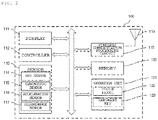
- Fig. 2 is a block diagram illustrating a configuration example of the terminal device 100 according to the first embodiment of the present disclosure.
- the terminal device 100 does not have to include all the constituent elements illustrated in Fig. 2 , and can employ a partially-omitted configuration, or other constituent elements can be added.
- the terminal device 100 includes the display 111, a controller 112, the sensor 113 including a GPS sensor 114, a gyroscopic sensor 115, an acceleration sensor 116, and an illuminance sensor 117, a communication unit including a wireless communication processing circuit 118 and an antenna 119, a memory 120 including a random access memory (RAM), a read-only memory (ROM), a nonvolatile memory (hard disk drive (HDD) depend on the cases), and the like, and an operation unit 121 including the touch panel 122 and the hardware key 123.
- these constituent elements are electrically connected to one another via a control line and a data line.
- the display 111 reads out image information stored in the memory 120, to perform various types of display.
- the display 111 includes, for example, a liquid crystal display, and functions as a display unit.
- the operation unit 121 includes the touch panel 122, the hardware key 123, and the like, and receives various instructions and inputs from the user.
- the touch panel 122 is disposed in such a manner as to cover the display 111, and outputs, to the controller 112, information of a position coordinate corresponding to image data displayed by the display 111.
- Known touch panel systems such as a resistance film system, a capacitive coupling system, an ultrasound surface acoustic wave system, and the like can be used.
- the touch panel 122 detects a swipe operation and a tap operation performed by an instruction body on each icon displayed on the display 111.
- the standby state an operation performed by the user on an unlock icon displayed on the display 111 is detected via the touch panel 122.
- the press of the hardware key 123 (power key) that is performed by the user is detected.
- the controller 112 includes a central processing unit (CPU) (microcomputer), and functions as a control unit that controls other connected constituent elements based on various programs stored in the memory 120. Specifically, the controller 112 reads out programs respectively corresponding to a plurality of applications including applications executable even in the standby state, from the memory 120, and executes the programs. In addition, the controller 112 generates various types of operation information based on outputs from the touch panel 122. In addition, the controller 112 may be constituted by a single CPU, or may be constituted by a plurality of CPUs. In addition, a graphics processing unit (GPU) specialized in image processing may be separately provided.
- GPU graphics processing unit
- the memory 120 includes a ROM, a RAM, a nonvolatile memory, and the like, and functions as a storage unit.
- the ROM stores programs for executing a plurality of applications including applications executable even in the standby state, for each application.
- the RAM is a memory used for writing and reading data while various commands generated by the execution of the programs stored in the ROM are being processed by the controller 112.
- the nonvolatile memory is a memory in which writing and reading of data is executed by the execution of the programs, and the data written into the nonvolatile memory is saved even after the execution of the programs is ended.
- a height parameter, a growth acceleration parameter, a growth speed parameter, and the like of the plant characters are appropriately stored in the memory 120, although these are not especially illustrated in detail in the drawings.
- the sensor 113 functions as a sensor unit that detects an ambient environment of the terminal device 100 or a status of the terminal device itself.
- the ambient environment of the terminal device 100 include illuminance, temperature, humidity, and the like.
- the status of the terminal device 100 itself refers to a status changed by an external factor being added to the terminal device 100.
- Example of the status include position information such as a current position of the terminal device 100, a movement acceleration at which the terminal device 100 has moved, the orientation of the terminal device 100, and the like.
- a temperature sensor in addition to the GPS sensor 114, the gyroscopic sensor 115, the acceleration sensor 116, and the illuminance sensor 117, a temperature sensor, a humidity sensor, an atmospheric pressure sensor, a geomagnetic sensor, a distance sensor, a magnetic sensor, a camera, a microphone, and the like can be used as a sensor.
- a timer for detecting a current time can also be used as a sensor.
- the sensor 113 can execute detection processing in the background, even in the standby state and the sleep state, in addition to the normal state. Detected information is output to the controller 112 as needed, and used for the controller 112 executing an application.
- the wireless communication processing circuit 118 performs processing such as modulation and demodulation via the connected antenna 119, for transmitting and receiving information between the terminal device 100 and a server device installed at a remote place or another terminal device. For example, the wireless communication processing circuit 118 performs processing for receiving, from the server device, a program for executing each application, and various types of information such as user information that are used in applications, according to the progress of applications. In addition, the wireless communication processing circuit 118 performs processing for transmitting a processing result obtained by executing the applications, to the server device.
- This wireless communication processing circuit 118 is processed based on a broadband wireless communication system represented by the Wideband-Code Division Multiple Access (W-CDMA) system.
- the wireless communication processing circuit 118 can be processed based on a wireless local area network (LAN) represented by the IEEE802.11, or a system related to narrowband wireless communication such as the Bluetooth (registered trademark).
- LAN wireless local area network
- Bluetooth registered trademark
- the wireless communication processing circuit 118 and the antenna 119 constitute a communication unit.
- wired communication can also be used.
- wired communication can be achieved by providing a communication processing circuit for wired communication, in place of or in addition to the wireless communication processing circuit 118.
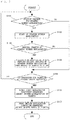
- Fig. 3 is a diagram illustrating a processing flow executed in the terminal device 100 according to the first embodiment of the present disclosure. Specifically, Fig. 3 illustrates a processing flow executed when the terminal device 100 is in a state other than the standby state (mainly, the normal state).
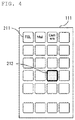
- Fig. 4 is a diagram illustrating an example of a screen displayed on the display 111 of the terminal device 100 according to the first embodiment of the present disclosure.
- Fig. 4 illustrates an example of a screen displayed on the display 111 when the terminal device 100 is in the normal state. More specifically, in the normal state, various icons 211 for starting up and executing applications such as "TEL" (telephone), "Mail” (e-mail), and "Camera” are displayed on the display 111.
- an icon 212 is displayed.
- the icon 212 is displayed for starting up the standby screen application, which is a game application that can perform predetermined display on the display 111 and execute a predetermined game in the standby state.
- the controller 112 of the terminal device 100 determines whether a startup request for the standby screen application has been received, in response to an output from the touch panel 122 (S101) .
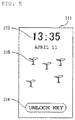
- Fig. 5 is a diagram illustrating an example of a screen displayed on the display 111 of the terminal device 100 according to the first embodiment of the present disclosure.
- the standby screen application is an application for displaying current date and time information 213 and an unlock key icon 214 for shifting from the standby state to the normal state, displaying the plant characters 215, and executing a game of cultivating and growing the plant characters 215 according to a growth degree determined based on information detected by the sensor 113, in the standby state of the terminal device 100. Then, when the standby screen application is being executed, the plant characters 215 are displayed on the display 111 in the standby state, and a progress status of the application is displayed.
- the controller 112 reads out a program from the memory 120, and starts up the standby screen application as illustrated in Fig. 5 (S102). Next, it is determined whether the standby screen application started up in S102 is initial startup (S103). If the startup is initial startup (i.e., if there is no saved data on the growth degree of the plant characters 215 of the standby screen application), an initial setting of the standby screen application is performed. In this case, a height parameter of the plant characters 215 is set to 1 cm being an initial setting (the height may be a virtual height) (S104).
- the controller 112 determines whether a condition for shifting the terminal device 100 to the standby state is satisfied (S105). As an example, the controller 112 determines whether a user not operating for a predetermined period or more has been detected in the normal state, or whether the press of the hardware key 123 that is performed by the user has been detected in the sleep state, to which the terminal device 100 shifts by detecting the press of the hardware key 123 that is performed by the user. In addition, the determination is not limited to such determination, and the controller 112 can determine whether a user not operating for a predetermined period or more has been detected in the normal state, or whether the press of the hardware key 123 that is performed by the user has been detected, without going through the sleep state.
- the controller 112 determines that the condition for shifting the terminal device 100 to the standby state is satisfied, the controller 112 resets an application execution parameter determined based on information detected by the sensor 113 that is temporarily stored in the execution of the standby screen application (S106 and S107). Specifically, the controller 112 resets a first application execution parameter for calculating a height parameter of the plant characters 215 (growth acceleration parameter of the plant characters 215), and a second application execution parameter (growth speed parameter of the plant characters 215).
- the controller 112 ends the processing flow executed when the terminal device 100 is in a state other than the standby state (mainly, the normal state).
- Fig. 6 is a diagram illustrating a processing flow executed in the terminal device 100 according to the first embodiment of the present disclosure. Specifically, Fig. 6 illustrates a processing flow executed when the terminal device 100 is the standby state.
- the processing flow illustrated in Fig. 6 is started from the controller 112 determining whether the terminal device 100 is in the standby state, and the standby screen application has been started up (S201).
- the standby screen application is started up if the controller 112 determines that a startup request for the standby screen application has been received in the processing flow illustrated in Fig. 3 .
- the terminal device 100 shifts to the standby state by detecting a user not operating for a predetermined period or more in the normal state, or by detecting the press of the hardware key 123 that is performed by the user, in the sleep state, to which the terminal device 100 shifts by detecting the press of the hardware key 123 that is performed by the user.
- the transition is not limited to this, and the terminal device 100 can shift by detecting a user not operating for a predetermined period or more in the normal state, or by detecting the press of the hardware key 123 that is performed by the user, without going through the sleep state.
- the controller 112 determines that the standby screen application has been started up, information detected by the sensor 113 is received (S202).
- information detected by the sensor 113 is received (S202).
- an ambient illuminance of the terminal device 100 that has been detected by the illuminance sensor 117 is detected, and information about the detected illuminance is received by the controller 112.
- the controller 112 changes the mode of the plant characters 215 based on a height parameter stored in the memory 120, and displays the plant characters 215 on the display 111 (S203). For example, if the processing flow is executed after the standby screen application has been initially started up, the height parameter is set to 1 cm as an initial setting. Thus, as illustrated in Fig. 5 , the plant characters 215 are displayed in such a display mode as "young trees".
- the controller 112 determines whether a certain amount of illuminance or more has been detected, based on information about illuminance that has been received from the sensor 113 (specifically, the illuminance sensor 117) (S204). Then, if it has been determined that a certain amount of illuminance or more has been detected, the controller 112 refers to the first application execution parameter (growth acceleration parameter) stored in the memory 120, and determines whether the parameter reaches the predetermined maximum value (S205). Then, if the parameter does not reach the maximum value, the first application execution parameter (growth acceleration parameter) is incremented by an amount corresponding to the received illuminance (S206).
- the first application execution parameter growth acceleration parameter
- the amount of increment of the first application execution parameter is determined by the controller 112 by storing a table associating the detected illuminance and the amount of increment, into the memory 120, and by referring to the table, although this is not illustrated in the drawing.
- the controller 112 calculates the second application execution parameter (growth speed parameter) of the plant characters 215 based on the determined growth acceleration parameter (S207). In addition, the calculation is performed by, for example, adding the determined growth acceleration parameter to a prestored growth speed parameter.
- the controller 112 calculates a height parameter of the plant characters 215 based on the calculated growth speed parameter, and stores the calculated height parameter into the memory 120 (S208).
- the controller 112 determines whether an instruction for shifting from the standby state to the normal state has been detected (S209). As an example, based on whether a user operation on the unlock key icon 214 displayed on the display 111 has been detected on the touch panel 122, the detection of the above-described instruction is determined. Then, if the instruction has been detected, the terminal device 100 is shifted to the normal state, and the processing returns to the processing flow illustrated in Fig. 3 . On the other hand, if the instruction has not been detected, the processing returns to the beginning of the processing flow illustrated in Fig. 6 .
- the controller 112 changes the mode of the plant characters 215 based on the height parameter stored in the memory 120, and displays the plant characters 215 on the display 111. Nevertheless, in the next processing loop, the display mode of the plant characters 215 is changed based on the height parameter calculated in S208 of the previous processing loop.
- Fig. 7 is a diagram illustrating an example of a screen displayed on the display 111 of the terminal device 100 according to the first embodiment of the present disclosure. As an example, as illustrated in Fig. 7 , plant characters 215 are displayed based on a calculated new height parameter.
- the sensor 113 detects the ambient environment of the terminal device 100 or the status of the terminal device itself, and the execution of the standby screen application is controlled based on the detected information. Nevertheless, in addition to this, also when the terminal device 100 is in the sleep state, in the background and at every predetermined period, the sensor 113 can detect the ambient environment of the terminal device 100 or the status of the terminal device itself, and the standby screen application can be executed (i.e., the processing flow illustrated in Fig. 6 can be executed) based on the detected information.
- Fig. 8 is a diagram illustrating a state transition of the terminal device 100 according to the first embodiment of the present disclosure. Specifically, Fig. 8 is a diagram conceptually illustrating the relation between the state of the terminal device 100, the state of display of the display 111, and the progress status of the standby screen application that is obtainable when the terminal device 100 executes the processing flows illustrated in Figs. 3 and 6 .
- the processing of the standby screen application that uses information from the sensor 113 is not performed in the subsequent processing.
- the processing in the standby state that is illustrated in Fig. 6 in the standby state and the sleep state, in the processing in S202, information from the sensor 113 is received. Then, in the processing from S203 to S208, the progress of the application that is based on the information is performed.
- the standby screen application is started up, while the progress of the application is restricted in the normal state, the progress of the application is executed based on information detected by the sensor 113, in the standby state and the sleep state.
- the terminal device 100 has at least 3 states, i.e., the sleep state, the standby state, and the normal state.
- the display 111 is turned on, and for example, display as illustrated in Fig. 4 is performed.
- the standby screen application is in a status in which the progress that uses information from the sensor 113 is restricted.
- the above-described status in which the progress is restricted is a status in which only the input of a user name used in the progress of the standby screen application, the selection of a character type, and changes of these, and setting input processing and setting change processing of charges of various items used in the progress of the application are permitted, and processing related to the growth of the plant characters 215 that is performed according to the progress of the application is restricted.
- a status in which the progress of the application is restricted in the normal state on the display 111, display other than those related to the above-described setting input and setting change is not performed.
- the user is restricted from checking the progress status of the application, and the user and the sensor 113 are restricted from intervening in the application.
- the standby screen application receives information from the sensor 113 in the background even in the sleep state, and performs the growing processing of the plant characters 215 that is based on the information, to execute the progress of the application.
- the display of the standby screen application is performed on the display 111.
- the application receives information from the sensor 113 in the standby state, and performs the growing processing of the plant characters 215 that is based on the information, to execute the progress of the application.
- the standby state because the growth process of the plant characters 215 is displayed on the display 111, the user can check the progress status of the application.
- a game of growing the plant characters 215 is executed, so that a standby state with a wealth of tastes can be realized.
- the progress of a game application can be checked only after the game application is started up in a state in which the terminal device 100 is in the normal state.
- a game is executed in the standby state to which the state always shifts when the user operates the terminal device 100, so that the degree of user's gaze at the game can be further enhanced.
- the limitative wordings such as "processing that uses information from the sensor is not performed” and “processing other than display is not performed” are partially used. Nevertheless, these wordings merely mean that these types of processing are not executed in the standby screen application according to the present embodiment. For example, information from the sensor 113 can be received and used for the execution of other applications even in the normal state. In addition, in the normal state, display related to other applications can be performed. Furthermore, wordings such as “execution is restricted” and “progress is restricted” are used. Nevertheless, these wordings do not always mean restricting all the operations of the terminal device and all the operations of each application, and include cases in which only a part of these is restricted.
- known sensors such as the GPS sensor 114, the gyroscopic sensor 115, and/or the acceleration sensor 116 can be used.
- a table associating a distance by which and a direction in which the terminal device 100 has moved and a growth acceleration parameter can be prepared in the memory 120, and a height parameter can be calculated according to the distance by which and the direction in which the terminal device 100 has moved.
- a user's operation of shaking the terminal device 100 can be detected, a table associating a direction in which and the number of times the shake operation has been performed and a growth acceleration parameter can be prepared in the memory 120, and a height parameter can be calculated according to the direction in which and the number of times the shake operation has been performed.
- a game of growing the plant characters 215 is executed by executing the standby screen application.
- games are not limited to the game.
- a position information game that uses the GPS sensor 114 and the like can also be executed.
- a predetermined game can be executed, so that a standby state with a wealth of tastes can be realized.
- the progress of a game application can be checked only after the game application is started up in a state in which the terminal device 100 is in the normal state.
- a game is executed in the standby state to which the state always shifts when the user operates the terminal device 100, so that the degree of user's gaze at the game can be further enhanced.
- the processing and procedure described in the present specification can be realized not only by the components explicitly described in the embodiments, but also by software, hardware, or a combination of these. Specifically, the processing and procedure described in the present specification can be realized by implementing logic corresponding to the processing, in media such as an integrated circuit, a volatile memory, a nonvolatile memory, a magnetic disc, and an optical storage. In addition, the processing and procedure described in the present specification can be implemented with the processing and procedure serving as computer programs, and the processing and procedure can be executed by various computers including terminal devices and server devices.
Landscapes
- Engineering & Computer Science (AREA)
- Computer Networks & Wireless Communication (AREA)
- Signal Processing (AREA)
- Human Computer Interaction (AREA)
- Physics & Mathematics (AREA)
- General Physics & Mathematics (AREA)
- Environmental & Geological Engineering (AREA)
- Radar, Positioning & Navigation (AREA)
- Remote Sensing (AREA)
- Computer Security & Cryptography (AREA)
- User Interface Of Digital Computer (AREA)
Claims (8)
- Endgerät (100), das dazu konfiguriert ist, einen Zustand zwischen einer Vielzahl von Zuständen, einschließlich eines Standby-Zustands und eines Normalzustands, zu wechseln, wobei das Endgerät (100) Folgendes umfasst:einen Speicher (120), der dazu konfiguriert ist, eine Vielzahl von Anwendungen mit einer ersten Anwendung und einer zweiten Anwendung, die sich voneinander unterscheiden, zu speichern;wobei in dem Standby-Zustand Ausführung und Fortschritt der ersten Anwendung beschränkt sind und Ausführung und Fortschritt der zweiten Anwendung gestattet sind; und in dem Normalzustand die Ausführung und der Fortschritt der zweiten Ausführung beschränkt sind und die Ausführung und der Fortschritt der ersten Anwendung gestattet sind; undeine Anzeige (111), die dazu konfiguriert ist, vorbestimmte Informationen in dem Standby-Zustand und in dem Normalzustand anzuzeigen;dadurch gekennzeichnet, dassdie Vielzahl von Zuständen ferner einen Schlafzustand beinhaltet, in dem die Anzeige der vorbestimmten Informationen auf der Anzeige (111) zusätzlich dazu, dass die Ausführung und der Fortschritt der ersten Anwendung beschränkt sind und die Ausführung und der Fortschritt der zweiten Anwendung gestattet sind, beschränkt ist; undder Speicher (120) ferner dazu konfiguriert ist, einen Parameter zu speichern, der beim Fortschritt der zweiten Anwendung verwendet wird, undwobei das Endgerät (100) ferner Folgendes umfasst:einen Sensor (113), der dazu konfiguriert ist, eine Umgebung oder einen Status des Endgeräts (100) selbst in dem Standby-Zustand und dem Schlafzustand zu erkennen; undeine Steuerung (112), die dazu konfiguriert ist, in einem Fall, in dem die zweite Anwendung gestartet ist, den Fortschritt der ersten Anwendung in dem Normalzustand zu beschränken und in dem Standby-Zustand und dem Schlafzustand den Fortschritt der zweiten Anwendung basierend auf dem Parameter entsprechend der Umgebung oder dem Status des Endgeräts (100) selbst, wie durch den Sensor (113) erkannt, zu steuern.
- Endgerät (100) nach Anspruch 1, wobei die Anzeige (111) dazu konfiguriert ist, einen Fortschrittstatus der zweiten Anwendung in dem Standby-Zustand anzuzeigen, und die Anzeige (111) dazu konfiguriert ist, einen Fortschrittstatus der zweiten Anwendung in dem Normalzustand nicht anzuzeigen.
- Endgerät (100) nach Anspruch 1 oder 2,
wobei das Endgerät (100) eine Betriebseinheit umfasst, die dazu konfiguriert ist, eine durch einen Benutzer durchgeführte Anweisungseingabe zu erkennen,
wobei der Standby-Zustand in einem Fall, in dem die Betriebseinheit dazu konfiguriert ist, eine durch einen Benutzer durchgeführte Anweisungseingabe zu erkennen, in den Schlafzustand gewechselt wird, und
wobei der Normalzustand in einem Fall, in dem die Betriebseinheit dazu konfiguriert ist, eine durch einen Benutzer durchgeführte Anweisungseingabe zu erkennen, in den Standby-Zustand gewechselt wird. - Endgerät (100) nach einem der Ansprüche 1 bis 3,
wobei das Endgerät (100) eine Betriebseinheit umfasst, die dazu konfiguriert ist, eine durch einen Benutzer durchgeführte Anweisungseingabe zu erkennen, und
wobei die Steuerung (112) dazu konfiguriert ist, nur eine Einstellungsänderung der zweiten Anwendung, die auf der Anweisungseingabe basiert, die durch die Betriebseinheit erkannt wird, in dem Normalzustand zu gestatten. - Endgerät (100) nach einem der Ansprüche 1 bis 4, wobei die zweite Anwendung eine Spielanwendung ist.
- Endgerät (100) nach einem der Ansprüche 1 bis 5, wobei der Sensor (113) ein beliebiges von einem Beleuchtungssensor (117), einem Beschleunigungssensor (116), einem Kreiselsensor (115), einem GPS-Sensor (114), einem Atmosphärendrucksensor, einem geomagnetischen Sensor, einem Abstandssensor, einem Magnetsensor, einem Mikrofon, einer Kamera und einem Zeitgeber oder einer Kombination davon beinhaltet.
- Nichttransitorisches computerlesbares Medium, auf dem ein Computerprogramm gespeichert ist, das Computerprogramm umfassend Anweisungen, die bei Verarbeitung durch eine Steuerung (112) es einem Endgerät (100), das die Steuerung (112), einen Speicher (120), eine Anzeige (111) und einen Sensor (113) umfasst, ermöglicht, alle Verfahrensschritte aus Anspruch 8 auszuführen.
- Verfahren, das auf einem Endgerät (100) ausgeführt wird, das dazu konfiguriert ist, einen Zustand zwischen einer Vielzahl von Zuständen, beinhaltend einen Standby-Zustand und einen Normalzustand, zu wechseln, wobei das Endgerät (100) einen Speicher (120) umfasst, der dazu konfiguriert ist, eine Vielzahl von Anwendungen mit einer ersten Anwendung und einer zweiten Anwendung, die sich voneinander unterscheiden, zu speichern;
wobei das Verfahren die folgenden Schritte umfasst:Beschränken, in dem Standby-Zustand, von Ausführung und Fortschritt der ersten Anwendung und Ermöglichen der Ausführung und des Fortschritts der zweiten Anwendung;Beschränken, in dem Normalzustand, von Ausführung und Fortschritt der zweiten Anwendung und Ermöglichen der Ausführung und des Fortschritts der ersten Anwendung; undwobei das Endgerät (100) ferner eine Anzeige (111) umfasst, die dazu konfiguriert ist, vorbestimmte Informationen in dem Standby-Zustand und in dem Normalzustand anzuzeigen;
dadurch gekennzeichnet, dassdie Vielzahl von Zuständen ferner einen Schlafzustand beinhaltet, in dem die Anzeige der vorbestimmten Informationen auf der Anzeige (111) zusätzlich dazu, dass die Ausführung und der Fortschritt der ersten Anwendung beschränkt sind und die Ausführung und der Fortschritt der zweiten Anwendung gestattet sind, beschränkt ist; undder Speicher (120) ferner dazu konfiguriert ist, einen Parameter zu speichern, der beim Fortschritt der zweiten Anwendung verwendet wird, undwobei das Verfahren ferner die folgenden Schritte umfasst:Erkennen, durch einen Sensor (113), der in dem Endgerät umfasst ist, einer Umgebung oder eines Status des Endgeräts (100) selbst in dem Standby-Zustand und dem Schlafzustand; undBeschränken, durch eine Steuerung (112), in einem Fall, in dem die zweite Anwendung gestartet ist, des Fortschritts der ersten Anwendung in dem Normalzustand, und in dem Standby-Zustand und dem Schlafzustand Steuern des Fortschritts der zweiten Anwendung basierend auf dem Parameter entsprechend der Umgebung oder dem Status des Endgeräts (100) selbst, wie durch den Sensor (113) erkannt.
Applications Claiming Priority (1)
| Application Number | Priority Date | Filing Date | Title |
|---|---|---|---|
| PCT/JP2016/071568 WO2018016074A1 (ja) | 2016-07-22 | 2016-07-22 | 端末装置、プログラム及び方法 |
Publications (3)
| Publication Number | Publication Date |
|---|---|
| EP3488906A1 EP3488906A1 (de) | 2019-05-29 |
| EP3488906A4 EP3488906A4 (de) | 2019-12-25 |
| EP3488906B1 true EP3488906B1 (de) | 2020-12-16 |
Family
ID=60255707
Family Applications (1)
| Application Number | Title | Priority Date | Filing Date |
|---|---|---|---|
| EP16909549.4A Active EP3488906B1 (de) | 2016-07-22 | 2016-07-22 | Endgerätevorrichtung, programm und verfahren |
Country Status (4)
| Country | Link |
|---|---|
| US (1) | US9820213B1 (de) |
| EP (1) | EP3488906B1 (de) |
| JP (1) | JP6342004B1 (de) |
| WO (1) | WO2018016074A1 (de) |
Families Citing this family (3)
| Publication number | Priority date | Publication date | Assignee | Title |
|---|---|---|---|---|
| CN120299424A (zh) * | 2019-04-15 | 2025-07-11 | 惊叹公司 | 图像显示装置及其动作控制方法 |
| JP7689849B2 (ja) * | 2021-03-29 | 2025-06-09 | 株式会社バンダイナムコエンターテインメント | ゲームシステム及びサーバ装置 |
| JP7721779B1 (ja) * | 2024-12-27 | 2025-08-12 | 株式会社バンダイ | ゲーム装置及びプログラム |
Family Cites Families (28)
| Publication number | Priority date | Publication date | Assignee | Title |
|---|---|---|---|---|
| JP2848219B2 (ja) * | 1993-12-13 | 1999-01-20 | カシオ計算機株式会社 | 画像表示装置及び画像表示方法 |
| US5572646A (en) | 1993-08-25 | 1996-11-05 | Casio Computer Co., Ltd. | Apparatus for displaying images of living things to show growing and/or moving of the living things |
| GB0031477D0 (en) * | 2000-12-22 | 2001-02-07 | Symbian Ltd | Mobile telephone device with idle screen |
| JP2002346216A (ja) * | 2001-05-29 | 2002-12-03 | Sharp Corp | キャラクタ育成システム、そのシステムに用いられるキャラクタ育成装置、キャラクタ育成情報提供装置、キャラクタ受信端末装置、それらの装置に用いられるプログラム、それらのプログラムが記録された記録媒体、および、キャラクタ育成方法 |
| WO2005039716A2 (en) * | 2003-10-22 | 2005-05-06 | Koninklijke Philips Electronics N.V. | A virtual entity with a randomly generated pattern |
| JP2006314405A (ja) * | 2005-05-10 | 2006-11-24 | Xing Inc | キャラクタ画像提供システム、キャラクタ画像提供装置及びキャラクタ画像提供方法 |
| JP2007117639A (ja) * | 2005-10-31 | 2007-05-17 | Sanyo Electric Co Ltd | 仮想生命体の育成装置およびプログラム |
| WO2007063598A1 (ja) * | 2005-12-01 | 2007-06-07 | Fujitsu Limited | 仮想キャラクタ育成装置 |
| US7657849B2 (en) * | 2005-12-23 | 2010-02-02 | Apple Inc. | Unlocking a device by performing gestures on an unlock image |
| KR20070082425A (ko) * | 2006-02-16 | 2007-08-21 | 엘지전자 주식회사 | 대기모드 시 게임 실행기능을 갖는 휴대전화 및 그 게임실행방법 |
| WO2008081945A1 (ja) * | 2006-12-28 | 2008-07-10 | Kyocera Corporation | 携帯情報端末 |
| US8675850B2 (en) * | 2008-01-17 | 2014-03-18 | Google Inc. | Content delivery during call idle time |
| JP5178045B2 (ja) * | 2007-04-26 | 2013-04-10 | 京セラ株式会社 | 携帯端末装置 |
| JP2009272996A (ja) * | 2008-05-09 | 2009-11-19 | Toshiba Corp | 携帯端末 |
| US8754931B2 (en) * | 2010-01-08 | 2014-06-17 | Kopin Corporation | Video eyewear for smart phone games |
| US8588739B2 (en) | 2010-08-27 | 2013-11-19 | Kyocera Corporation | Mobile terminal, lock state control program for mobile terminal, and a method for controlling lock state of mobile terminal |
| JP5587733B2 (ja) * | 2010-10-27 | 2014-09-10 | 京セラ株式会社 | 携帯端末、ロック状態制御プログラムおよびロック状態制御方法 |
| JP5565325B2 (ja) * | 2011-01-19 | 2014-08-06 | 富士通株式会社 | 無線通信装置、無線通信方法および通信制御プログラム |
| JP6001843B2 (ja) * | 2011-11-15 | 2016-10-05 | 任天堂株式会社 | 情報処理装置、情報処理システム、情報処理方法およびプログラム |
| JP5827109B2 (ja) | 2011-11-28 | 2015-12-02 | 京セラ株式会社 | 装置、方法、及びプログラム |
| CN104243683B (zh) * | 2013-06-24 | 2019-09-13 | 南京中兴软件有限责任公司 | 一种处理数据的方法、终端、用户识别卡及系统 |
| JP2015008393A (ja) * | 2013-06-25 | 2015-01-15 | Kddi株式会社 | 携帯情報端末 |
| JP6034255B2 (ja) * | 2013-06-26 | 2016-11-30 | 京セラ株式会社 | 通信端末 |
| JP5933498B2 (ja) * | 2013-09-17 | 2016-06-08 | ソフトバンク株式会社 | 端末、制御方法及び制御プログラム |
| JP2015173691A (ja) | 2014-03-13 | 2015-10-05 | サーマル株式会社 | 釣りビデオゲームシステム及びその制御方法 |
| JP6400962B2 (ja) * | 2014-07-09 | 2018-10-03 | シャープ株式会社 | 携帯通信端末、および、その制御プログラム |
| JP5945621B2 (ja) * | 2015-06-15 | 2016-07-05 | Kddi株式会社 | 押圧操作で動作状態を切り替え可能なユーザインタフェース装置、動作状態切り替え方法及びプログラム |
| US20160372083A1 (en) * | 2015-06-18 | 2016-12-22 | Intel Corporation | Facilitating increased user experience and efficient power performance using intelligent segmentation on flexible display screens |
-
2016
- 2016-07-22 WO PCT/JP2016/071568 patent/WO2018016074A1/ja not_active Ceased
- 2016-07-22 JP JP2016550654A patent/JP6342004B1/ja active Active
- 2016-07-22 EP EP16909549.4A patent/EP3488906B1/de active Active
- 2016-12-01 US US15/366,236 patent/US9820213B1/en active Active
Non-Patent Citations (1)
| Title |
|---|
| None * |
Also Published As
| Publication number | Publication date |
|---|---|
| JPWO2018016074A1 (ja) | 2018-07-19 |
| JP6342004B1 (ja) | 2018-06-13 |
| EP3488906A4 (de) | 2019-12-25 |
| US9820213B1 (en) | 2017-11-14 |
| EP3488906A1 (de) | 2019-05-29 |
| WO2018016074A1 (ja) | 2018-01-25 |
Similar Documents
| Publication | Publication Date | Title |
|---|---|---|
| KR102574183B1 (ko) | 디스플레이를 제어하는 전자 장치 및 방법 | |
| EP3920023B1 (de) | Schnittstellenanzeigeverfahren und endgerät | |
| US8302004B2 (en) | Method of displaying menu items and related touch screen device | |
| CN108965608B (zh) | 一种闹钟设置方法、折叠终端及计算机可读存储介质 | |
| US20160291864A1 (en) | Method of interacting with a portable electronic device | |
| US9052763B2 (en) | Electronic device having a display displaying a symbol indicating execution of a function | |
| US20110316858A1 (en) | Apparatuses and Methods for Real Time Widget Interactions | |
| US11294554B2 (en) | Display apparatus and image displaying method | |
| KR20170093658A (ko) | 복수의 디스플레이들을 포함하는 전자 장치 및 그 동작 방법 | |
| JP2008139711A (ja) | 携帯式電子機器、画面の表示方向の変更方法、プログラムおよび記憶媒体 | |
| CN103543819A (zh) | 功耗控制方法和终端 | |
| KR20180005695A (ko) | 정보 획득 방법 및 디바이스 | |
| CN108170361B (zh) | 一种应用运行状态控制方法及移动终端 | |
| CN108647058A (zh) | 一种应用程序启动方法及移动终端 | |
| EP3488906B1 (de) | Endgerätevorrichtung, programm und verfahren | |
| CN106575199A (zh) | 基于智能装置位置的应用程序交换 | |
| KR20090090362A (ko) | 전자 장치 상의 휴지 모드를 이용하기 위한 시스템 및 방법 | |
| JP2023093420A (ja) | アプリケーションの使用を制限する方法、および端末 | |
| KR20180101879A (ko) | 아이콘을 표시하기 위한 방법 및 그 전자 장치 | |
| US12124543B2 (en) | Permission configuration method and terminal device | |
| CN108172176B (zh) | 用于墨水屏的页面刷新方法及装置 | |
| CN113709306B (zh) | 会话处理方法、装置及电子设备 | |
| EP3528103B1 (de) | Bildschirmverriegelungsverfahren, endgerät und bildschirmverriegelungsvorrichtung | |
| CN113168220A (zh) | 一种显示方法、存储介质及电子设备 | |
| WO2014103379A1 (ja) | 情報処理装置、画面制御プログラム及び画面制御方法 |
Legal Events
| Date | Code | Title | Description |
|---|---|---|---|
| STAA | Information on the status of an ep patent application or granted ep patent |
Free format text: STATUS: THE INTERNATIONAL PUBLICATION HAS BEEN MADE |
|
| PUAI | Public reference made under article 153(3) epc to a published international application that has entered the european phase |
Free format text: ORIGINAL CODE: 0009012 |
|
| STAA | Information on the status of an ep patent application or granted ep patent |
Free format text: STATUS: REQUEST FOR EXAMINATION WAS MADE |
|
| 17P | Request for examination filed |
Effective date: 20180425 |
|
| AK | Designated contracting states |
Kind code of ref document: A1 Designated state(s): AL AT BE BG CH CY CZ DE DK EE ES FI FR GB GR HR HU IE IS IT LI LT LU LV MC MK MT NL NO PL PT RO RS SE SI SK SM TR |
|
| AX | Request for extension of the european patent |
Extension state: BA ME |
|
| DAV | Request for validation of the european patent (deleted) | ||
| DAX | Request for extension of the european patent (deleted) | ||
| A4 | Supplementary search report drawn up and despatched |
Effective date: 20191121 |
|
| RIC1 | Information provided on ipc code assigned before grant |
Ipc: H04M 1/67 20060101ALI20191115BHEP Ipc: A63F 13/825 20140101AFI20191115BHEP Ipc: G06F 9/48 20060101ALI20191115BHEP Ipc: H04W 52/02 20090101ALI20191115BHEP Ipc: A63F 13/2145 20140101ALI20191115BHEP Ipc: G06F 9/445 20180101ALI20191115BHEP Ipc: H04M 1/725 20060101ALI20191115BHEP Ipc: A63F 13/213 20140101ALI20191115BHEP |
|
| GRAP | Despatch of communication of intention to grant a patent |
Free format text: ORIGINAL CODE: EPIDOSNIGR1 |
|
| STAA | Information on the status of an ep patent application or granted ep patent |
Free format text: STATUS: GRANT OF PATENT IS INTENDED |
|
| INTG | Intention to grant announced |
Effective date: 20200811 |
|
| GRAS | Grant fee paid |
Free format text: ORIGINAL CODE: EPIDOSNIGR3 |
|
| GRAA | (expected) grant |
Free format text: ORIGINAL CODE: 0009210 |
|
| STAA | Information on the status of an ep patent application or granted ep patent |
Free format text: STATUS: THE PATENT HAS BEEN GRANTED |
|
| AK | Designated contracting states |
Kind code of ref document: B1 Designated state(s): AL AT BE BG CH CY CZ DE DK EE ES FI FR GB GR HR HU IE IS IT LI LT LU LV MC MK MT NL NO PL PT RO RS SE SI SK SM TR |
|
| REG | Reference to a national code |
Ref country code: GB Ref legal event code: FG4D |
|
| REG | Reference to a national code |
Ref country code: IE Ref legal event code: FG4D |
|
| REG | Reference to a national code |
Ref country code: DE Ref legal event code: R096 Ref document number: 602016050086 Country of ref document: DE |
|
| REG | Reference to a national code |
Ref country code: AT Ref legal event code: REF Ref document number: 1345065 Country of ref document: AT Kind code of ref document: T Effective date: 20210115 |
|
| PG25 | Lapsed in a contracting state [announced via postgrant information from national office to epo] |
Ref country code: GR Free format text: LAPSE BECAUSE OF FAILURE TO SUBMIT A TRANSLATION OF THE DESCRIPTION OR TO PAY THE FEE WITHIN THE PRESCRIBED TIME-LIMIT Effective date: 20210317 Ref country code: FI Free format text: LAPSE BECAUSE OF FAILURE TO SUBMIT A TRANSLATION OF THE DESCRIPTION OR TO PAY THE FEE WITHIN THE PRESCRIBED TIME-LIMIT Effective date: 20201216 Ref country code: RS Free format text: LAPSE BECAUSE OF FAILURE TO SUBMIT A TRANSLATION OF THE DESCRIPTION OR TO PAY THE FEE WITHIN THE PRESCRIBED TIME-LIMIT Effective date: 20201216 Ref country code: NO Free format text: LAPSE BECAUSE OF FAILURE TO SUBMIT A TRANSLATION OF THE DESCRIPTION OR TO PAY THE FEE WITHIN THE PRESCRIBED TIME-LIMIT Effective date: 20210316 |
|
| REG | Reference to a national code |
Ref country code: AT Ref legal event code: MK05 Ref document number: 1345065 Country of ref document: AT Kind code of ref document: T Effective date: 20201216 |
|
| REG | Reference to a national code |
Ref country code: NL Ref legal event code: MP Effective date: 20201216 |
|
| PG25 | Lapsed in a contracting state [announced via postgrant information from national office to epo] |
Ref country code: BG Free format text: LAPSE BECAUSE OF FAILURE TO SUBMIT A TRANSLATION OF THE DESCRIPTION OR TO PAY THE FEE WITHIN THE PRESCRIBED TIME-LIMIT Effective date: 20210316 Ref country code: LV Free format text: LAPSE BECAUSE OF FAILURE TO SUBMIT A TRANSLATION OF THE DESCRIPTION OR TO PAY THE FEE WITHIN THE PRESCRIBED TIME-LIMIT Effective date: 20201216 Ref country code: SE Free format text: LAPSE BECAUSE OF FAILURE TO SUBMIT A TRANSLATION OF THE DESCRIPTION OR TO PAY THE FEE WITHIN THE PRESCRIBED TIME-LIMIT Effective date: 20201216 |
|
| PG25 | Lapsed in a contracting state [announced via postgrant information from national office to epo] |
Ref country code: NL Free format text: LAPSE BECAUSE OF FAILURE TO SUBMIT A TRANSLATION OF THE DESCRIPTION OR TO PAY THE FEE WITHIN THE PRESCRIBED TIME-LIMIT Effective date: 20201216 Ref country code: HR Free format text: LAPSE BECAUSE OF FAILURE TO SUBMIT A TRANSLATION OF THE DESCRIPTION OR TO PAY THE FEE WITHIN THE PRESCRIBED TIME-LIMIT Effective date: 20201216 |
|
| REG | Reference to a national code |
Ref country code: LT Ref legal event code: MG9D |
|
| PG25 | Lapsed in a contracting state [announced via postgrant information from national office to epo] |
Ref country code: EE Free format text: LAPSE BECAUSE OF FAILURE TO SUBMIT A TRANSLATION OF THE DESCRIPTION OR TO PAY THE FEE WITHIN THE PRESCRIBED TIME-LIMIT Effective date: 20201216 Ref country code: CZ Free format text: LAPSE BECAUSE OF FAILURE TO SUBMIT A TRANSLATION OF THE DESCRIPTION OR TO PAY THE FEE WITHIN THE PRESCRIBED TIME-LIMIT Effective date: 20201216 Ref country code: SM Free format text: LAPSE BECAUSE OF FAILURE TO SUBMIT A TRANSLATION OF THE DESCRIPTION OR TO PAY THE FEE WITHIN THE PRESCRIBED TIME-LIMIT Effective date: 20201216 Ref country code: LT Free format text: LAPSE BECAUSE OF FAILURE TO SUBMIT A TRANSLATION OF THE DESCRIPTION OR TO PAY THE FEE WITHIN THE PRESCRIBED TIME-LIMIT Effective date: 20201216 Ref country code: SK Free format text: LAPSE BECAUSE OF FAILURE TO SUBMIT A TRANSLATION OF THE DESCRIPTION OR TO PAY THE FEE WITHIN THE PRESCRIBED TIME-LIMIT Effective date: 20201216 Ref country code: PT Free format text: LAPSE BECAUSE OF FAILURE TO SUBMIT A TRANSLATION OF THE DESCRIPTION OR TO PAY THE FEE WITHIN THE PRESCRIBED TIME-LIMIT Effective date: 20210416 Ref country code: RO Free format text: LAPSE BECAUSE OF FAILURE TO SUBMIT A TRANSLATION OF THE DESCRIPTION OR TO PAY THE FEE WITHIN THE PRESCRIBED TIME-LIMIT Effective date: 20201216 |
|
| PG25 | Lapsed in a contracting state [announced via postgrant information from national office to epo] |
Ref country code: AT Free format text: LAPSE BECAUSE OF FAILURE TO SUBMIT A TRANSLATION OF THE DESCRIPTION OR TO PAY THE FEE WITHIN THE PRESCRIBED TIME-LIMIT Effective date: 20201216 Ref country code: PL Free format text: LAPSE BECAUSE OF FAILURE TO SUBMIT A TRANSLATION OF THE DESCRIPTION OR TO PAY THE FEE WITHIN THE PRESCRIBED TIME-LIMIT Effective date: 20201216 |
|
| REG | Reference to a national code |
Ref country code: DE Ref legal event code: R097 Ref document number: 602016050086 Country of ref document: DE |
|
| PG25 | Lapsed in a contracting state [announced via postgrant information from national office to epo] |
Ref country code: IS Free format text: LAPSE BECAUSE OF FAILURE TO SUBMIT A TRANSLATION OF THE DESCRIPTION OR TO PAY THE FEE WITHIN THE PRESCRIBED TIME-LIMIT Effective date: 20210416 |
|
| PLBE | No opposition filed within time limit |
Free format text: ORIGINAL CODE: 0009261 |
|
| STAA | Information on the status of an ep patent application or granted ep patent |
Free format text: STATUS: NO OPPOSITION FILED WITHIN TIME LIMIT |
|
| PG25 | Lapsed in a contracting state [announced via postgrant information from national office to epo] |
Ref country code: IT Free format text: LAPSE BECAUSE OF FAILURE TO SUBMIT A TRANSLATION OF THE DESCRIPTION OR TO PAY THE FEE WITHIN THE PRESCRIBED TIME-LIMIT Effective date: 20201216 Ref country code: AL Free format text: LAPSE BECAUSE OF FAILURE TO SUBMIT A TRANSLATION OF THE DESCRIPTION OR TO PAY THE FEE WITHIN THE PRESCRIBED TIME-LIMIT Effective date: 20201216 |
|
| 26N | No opposition filed |
Effective date: 20210917 |
|
| PG25 | Lapsed in a contracting state [announced via postgrant information from national office to epo] |
Ref country code: DK Free format text: LAPSE BECAUSE OF FAILURE TO SUBMIT A TRANSLATION OF THE DESCRIPTION OR TO PAY THE FEE WITHIN THE PRESCRIBED TIME-LIMIT Effective date: 20201216 |
|
| PG25 | Lapsed in a contracting state [announced via postgrant information from national office to epo] |
Ref country code: ES Free format text: LAPSE BECAUSE OF FAILURE TO SUBMIT A TRANSLATION OF THE DESCRIPTION OR TO PAY THE FEE WITHIN THE PRESCRIBED TIME-LIMIT Effective date: 20201216 |
|
| PG25 | Lapsed in a contracting state [announced via postgrant information from national office to epo] |
Ref country code: SI Free format text: LAPSE BECAUSE OF FAILURE TO SUBMIT A TRANSLATION OF THE DESCRIPTION OR TO PAY THE FEE WITHIN THE PRESCRIBED TIME-LIMIT Effective date: 20201216 |
|
| REG | Reference to a national code |
Ref country code: CH Ref legal event code: PL |
|
| PG25 | Lapsed in a contracting state [announced via postgrant information from national office to epo] |
Ref country code: MC Free format text: LAPSE BECAUSE OF FAILURE TO SUBMIT A TRANSLATION OF THE DESCRIPTION OR TO PAY THE FEE WITHIN THE PRESCRIBED TIME-LIMIT Effective date: 20201216 |
|
| REG | Reference to a national code |
Ref country code: BE Ref legal event code: MM Effective date: 20210731 |
|
| PG25 | Lapsed in a contracting state [announced via postgrant information from national office to epo] |
Ref country code: LI Free format text: LAPSE BECAUSE OF NON-PAYMENT OF DUE FEES Effective date: 20210731 Ref country code: CH Free format text: LAPSE BECAUSE OF NON-PAYMENT OF DUE FEES Effective date: 20210731 |
|
| PG25 | Lapsed in a contracting state [announced via postgrant information from national office to epo] |
Ref country code: IS Free format text: LAPSE BECAUSE OF FAILURE TO SUBMIT A TRANSLATION OF THE DESCRIPTION OR TO PAY THE FEE WITHIN THE PRESCRIBED TIME-LIMIT Effective date: 20210416 Ref country code: LU Free format text: LAPSE BECAUSE OF NON-PAYMENT OF DUE FEES Effective date: 20210722 |
|
| PG25 | Lapsed in a contracting state [announced via postgrant information from national office to epo] |
Ref country code: IE Free format text: LAPSE BECAUSE OF NON-PAYMENT OF DUE FEES Effective date: 20210722 Ref country code: BE Free format text: LAPSE BECAUSE OF NON-PAYMENT OF DUE FEES Effective date: 20210731 |
|
| PG25 | Lapsed in a contracting state [announced via postgrant information from national office to epo] |
Ref country code: CY Free format text: LAPSE BECAUSE OF FAILURE TO SUBMIT A TRANSLATION OF THE DESCRIPTION OR TO PAY THE FEE WITHIN THE PRESCRIBED TIME-LIMIT Effective date: 20201216 |
|
| PG25 | Lapsed in a contracting state [announced via postgrant information from national office to epo] |
Ref country code: HU Free format text: LAPSE BECAUSE OF FAILURE TO SUBMIT A TRANSLATION OF THE DESCRIPTION OR TO PAY THE FEE WITHIN THE PRESCRIBED TIME-LIMIT; INVALID AB INITIO Effective date: 20160722 |
|
| PG25 | Lapsed in a contracting state [announced via postgrant information from national office to epo] |
Ref country code: MK Free format text: LAPSE BECAUSE OF FAILURE TO SUBMIT A TRANSLATION OF THE DESCRIPTION OR TO PAY THE FEE WITHIN THE PRESCRIBED TIME-LIMIT Effective date: 20201216 |
|
| PG25 | Lapsed in a contracting state [announced via postgrant information from national office to epo] |
Ref country code: TR Free format text: LAPSE BECAUSE OF FAILURE TO SUBMIT A TRANSLATION OF THE DESCRIPTION OR TO PAY THE FEE WITHIN THE PRESCRIBED TIME-LIMIT Effective date: 20201216 |
|
| PG25 | Lapsed in a contracting state [announced via postgrant information from national office to epo] |
Ref country code: MT Free format text: LAPSE BECAUSE OF FAILURE TO SUBMIT A TRANSLATION OF THE DESCRIPTION OR TO PAY THE FEE WITHIN THE PRESCRIBED TIME-LIMIT Effective date: 20201216 |
|
| PGFP | Annual fee paid to national office [announced via postgrant information from national office to epo] |
Ref country code: GB Payment date: 20250527 Year of fee payment: 10 |
|
| PGFP | Annual fee paid to national office [announced via postgrant information from national office to epo] |
Ref country code: DE Payment date: 20250728 Year of fee payment: 10 |
|
| PGFP | Annual fee paid to national office [announced via postgrant information from national office to epo] |
Ref country code: FR Payment date: 20250723 Year of fee payment: 10 |