EP3488032B1 - Process for making high-strength polylactic acid filament - Google Patents
Process for making high-strength polylactic acid filament Download PDFInfo
- Publication number
- EP3488032B1 EP3488032B1 EP17748685.9A EP17748685A EP3488032B1 EP 3488032 B1 EP3488032 B1 EP 3488032B1 EP 17748685 A EP17748685 A EP 17748685A EP 3488032 B1 EP3488032 B1 EP 3488032B1
- Authority
- EP
- European Patent Office
- Prior art keywords
- elongated object
- pla
- polylactic acid
- gel
- mass
- Prior art date
- Legal status (The legal status is an assumption and is not a legal conclusion. Google has not performed a legal analysis and makes no representation as to the accuracy of the status listed.)
- Active
Links
Images
Classifications
-
- D—TEXTILES; PAPER
- D01—NATURAL OR MAN-MADE THREADS OR FIBRES; SPINNING
- D01F—CHEMICAL FEATURES IN THE MANUFACTURE OF ARTIFICIAL FILAMENTS, THREADS, FIBRES, BRISTLES OR RIBBONS; APPARATUS SPECIALLY ADAPTED FOR THE MANUFACTURE OF CARBON FILAMENTS
- D01F6/00—Monocomponent artificial filaments or the like of synthetic polymers; Manufacture thereof
- D01F6/58—Monocomponent artificial filaments or the like of synthetic polymers; Manufacture thereof from homopolycondensation products
- D01F6/62—Monocomponent artificial filaments or the like of synthetic polymers; Manufacture thereof from homopolycondensation products from polyesters
- D01F6/625—Monocomponent artificial filaments or the like of synthetic polymers; Manufacture thereof from homopolycondensation products from polyesters derived from hydroxy-carboxylic acids, e.g. lactones
-
- D—TEXTILES; PAPER
- D01—NATURAL OR MAN-MADE THREADS OR FIBRES; SPINNING
- D01D—MECHANICAL METHODS OR APPARATUS IN THE MANUFACTURE OF ARTIFICIAL FILAMENTS, THREADS, FIBRES, BRISTLES OR RIBBONS
- D01D5/00—Formation of filaments, threads, or the like
- D01D5/06—Wet spinning methods
-
- D—TEXTILES; PAPER
- D01—NATURAL OR MAN-MADE THREADS OR FIBRES; SPINNING
- D01D—MECHANICAL METHODS OR APPARATUS IN THE MANUFACTURE OF ARTIFICIAL FILAMENTS, THREADS, FIBRES, BRISTLES OR RIBBONS
- D01D5/00—Formation of filaments, threads, or the like
- D01D5/12—Stretch-spinning methods
-
- C—CHEMISTRY; METALLURGY
- C08—ORGANIC MACROMOLECULAR COMPOUNDS; THEIR PREPARATION OR CHEMICAL WORKING-UP; COMPOSITIONS BASED THEREON
- C08G—MACROMOLECULAR COMPOUNDS OBTAINED OTHERWISE THAN BY REACTIONS ONLY INVOLVING UNSATURATED CARBON-TO-CARBON BONDS
- C08G63/00—Macromolecular compounds obtained by reactions forming a carboxylic ester link in the main chain of the macromolecule
- C08G63/02—Polyesters derived from hydroxycarboxylic acids or from polycarboxylic acids and polyhydroxy compounds
- C08G63/06—Polyesters derived from hydroxycarboxylic acids or from polycarboxylic acids and polyhydroxy compounds derived from hydroxycarboxylic acids
- C08G63/08—Lactones or lactides
-
- C—CHEMISTRY; METALLURGY
- C08—ORGANIC MACROMOLECULAR COMPOUNDS; THEIR PREPARATION OR CHEMICAL WORKING-UP; COMPOSITIONS BASED THEREON
- C08J—WORKING-UP; GENERAL PROCESSES OF COMPOUNDING; AFTER-TREATMENT NOT COVERED BY SUBCLASSES C08B, C08C, C08F, C08G or C08H
- C08J2367/00—Characterised by the use of polyesters obtained by reactions forming a carboxylic ester link in the main chain; Derivatives of such polymers
- C08J2367/04—Polyesters derived from hydroxy carboxylic acids, e.g. lactones
-
- C—CHEMISTRY; METALLURGY
- C08—ORGANIC MACROMOLECULAR COMPOUNDS; THEIR PREPARATION OR CHEMICAL WORKING-UP; COMPOSITIONS BASED THEREON
- C08L—COMPOSITIONS OF MACROMOLECULAR COMPOUNDS
- C08L67/00—Compositions of polyesters obtained by reactions forming a carboxylic ester link in the main chain; Compositions of derivatives of such polymers
- C08L67/04—Polyesters derived from hydroxycarboxylic acids, e.g. lactones
-
- D—TEXTILES; PAPER
- D10—INDEXING SCHEME ASSOCIATED WITH SUBLASSES OF SECTION D, RELATING TO TEXTILES
- D10B—INDEXING SCHEME ASSOCIATED WITH SUBLASSES OF SECTION D, RELATING TO TEXTILES
- D10B2401/00—Physical properties
- D10B2401/06—Load-responsive characteristics
- D10B2401/063—Load-responsive characteristics high strength
Definitions
- the invention relates to a process for making high-strength polylactic acid elongated objects comprising the steps of making a solution of polylactic acid (PLA), the PLA having an intrinsic viscosity of at least 4 dL/g, in a solvent, wherein the solution has a concentration c P of 5 to 50 mass% expressed as the mass of PLA per total mass of solution, spinning the solution through a spinplate comprising at least 1 spinhole into an air-gap to form a fluid filament, optionally applying a fluid draw ratio DR fluid to the fluid elongated object, contacting the fluid elongated object with a cooling medium to form a solvent-containing gel elongated object, optionally applying a gel draw ratio DR gel to the gel elongated object, removing at least partly the solvent from the gel elongated objectto form a solid elongated objectand drawing the elongated object in at least one step during and/or after at least partly removing the solvent, while applying a draw ratio DR solid of at least
- the invention further relates to a high-strength polylactic acid elongated object and to products containing said elongated object, especially to various kinds of ropes, fabrics and composites.
- a high-strength polylactic acid elongated object is herein understood to mean an object comprising high molecular weight (HMW) or ultra-high molecular weight (UHMW) polylactic acid (PLA) having an intrinsic viscosity (IV, as measured in chloroform at 25°C) of at least about 4 dL/g (HMWPLA), the elongated object having a tenacity of at least 0.3 N/tex, preferably at least 0.4 N/tex.
- HMWPLA high molecular weight
- UHMWPLA ultra-high molecular weight polylactic acid
- IV intrinsic viscosity
- Such high-strength elongated objects have a properties profile that make them an interesting material for use in various products, like ropes and cords, mooring lines, fishing nets, sports equipment, fabrics, medical applications, and composites.
- an elongated object is understood to be an elongated body having cross-sectional dimensions much smaller than its length.
- Typical elongated objects are filaments, fibres, straps, strips, tapes, films or tubes, the elongated object is understood to be a continuous object; that is being of virtually indefinite length.
- the elongated object may have cross-sections of various geometrical or irregular shapes.
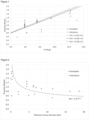
- Figure 1 confirms the said increase in tenacity with increasing intrinsic viscosity for literature reported filaments by showing highest tenacity data for filaments, as collected from open literature (Table 1) and plotted versus the intrinsic viscosities of the PLA from which they have been produced. It is thus concluded that the attainable tenacity of a filament scales with the intrinsic viscosity.
- this is provided by a process characterized in that in the step of cooling (also called quenching) the fluid elongated object, the cooling medium has a temperature (T q ) of less than 0°C.
- PLA elongated objects could be manufactured that for an intrinsic viscosity of the PLA have higher tenacities than known gel-spun PLA elongated objects; Accordingly the invention is also related to a gel-spun elongated object having a tensile strength in N/tex of at least 0.146 times the IV in dL/g of the PLA it comprises.
- Another advantage of the process according to the invention is that the process can be operated with PLA concentrations in the solution substantially higher than the concentrations reported in literature thus far. Furthermore the process can readily be scaled up to a commercial scale, providing PLA filaments or PLA multifilament yarns at an attractive rate.
- Spinning PLA in the melt is also well known and reported amongst others by Eling et al. (Polymer, Vol.23, 1587-1593, 1982 ). Although such work provides processes to be efficiently operated at commercial scale by providing filaments of relatively high filament linear density (FLD), also often called filament titer, at acceptable throughput, the thereby obtained filaments have tenacities substantially inferior to filaments produced by the afore mentioned gel-spinning process.
- Figure 2 confirms the reduction of tenacities with increasing filament titer of both gel and melt-spun filaments reported in literature (Table 1). Such filaments do hence not fulfil the need of high strength PLA. There remains thus an industrial need for PLA filaments with improved tensile properties.
- a PLA elongated object can be obtained that for a given filament titer have higher tenacities than any known gel- or melt-spun PLA elongated object to date.
- one embodiment of the invention concerns a gel-spun elongated object comprising a PLA with an IV in the range of 4-40 dl/g, and having a tenacity (Ten, in N/tex) and a filament titer (t, in tex) such that Ten ⁇ 1.4 * t -0.3 .
- PLA polylactic acid
- polyesters comprising monomeric units derived from lactic acid.
- PLA comprises at least 90 mol% preferably at least 95 mol%, more preferably 98 mol% of monomeric units derived from lactic acid whereby most preferably substantially all monomeric units are derived from lactic acid.
- Derived from lactic acid herein characterizes the building blocks of the polymer and is not a limitation of the manufacturing process of the PLA, which might for example be obtained by polymerization of lactates or lactide.
- Lactic acid with the chemical structure CH 3 -CH(OH)COOH has a carbon atom with 4 distinct substituents.
- PLA may thus comprise one or both enantiomers in equal or different amounts.
- the spinning process is positively affected by the increased presence of one of the enantiomers at the detriment of the other.
- a preferred embodiment of the present invention concerns a PLA elongated object and a process to manufacture a PLA elongated object wherein the lactic acid monomeric units of the PLA have an enantiomeric excess, abbreviated EE, of at least 80%, preferably at least 85 %, more preferably at least 90%, even more preferably at least 95% and most preferably at least 98%, whereby the enantiomeric excess is the difference between molar percentages of the 2 enantiomers, whereby a racemic mixture (50:50) has an EE of 0% an enantiomeric pure compound an EE of 100%.
- EE enantiomeric excess
- L-lactic acid is present in the PLA of the invention in excess of D-lactic acid such that the polylactic acid comprises at least 90 mol%, preferably at least 95 mol%, more preferably at least 98 mol% of monomeric units derived from L-lactic acid, most preferably the polylactic acid is poly-L-lactic acid (PLLA).
- PLLA poly-L-lactic acid
- the polylactic acid applied in the process and present in the elongated object according to the invention is a mixture of poly-D-lactic acid (PDLA) and poly-L-lactic acid, wherein both the D and L polylactic acid have each an enantiomeric excess of at least 80, preferably 95 and most preferably at least 98%.
- PDLA and PDLA are present in a mass ratio PLLA/PDLA of between 0.2 to 5, preferably 0.5 to 2 , more preferably 0.8 to 1.25, even more preferably 0.95 to 1.05 and most preferably 0.99 to 1.01.
- the presence of both PDLA and PLLA in the PLA of the process or the elongated object of the invention provide an improved spinning process due to an increased speed of crystallization of the gel elongated object as well as an increased heat resistance and melting point of the obtained elongated object.
- the polylactic acid applied in the process and present in the elongated object according to the invention has an intrinsic viscosity (IV) of at least 4 dL/g.
- IV of the PLA is in the range of 4-40 dL/g, more preferably in the range of 4 -30, more preferably in the range of 5-20 dL/g, even more preferably in the range of 5-15 dL/g, even more preferably in the range of 5 to 12 dL/g and most preferably in the range of 5 to 10 dL/g, to provide a balance between processability of the solution to be spun and mechanical properties of the obtained elongated objects.
- Intrinsic viscosity is a measure for molar mass (also called molecular weight) that can more easily be determined than actual molar mass parameters like M n , M v or M w .
- M n molar mass
- M v molecular weight
- IV 5.45 ⁇ 10 ⁇ 4 M v 0.73 ( Leenslag et al. Polymer, Vol. 28, 1695-1702, 1987 ) an IV of 4 or 10 dL/g would be approximately equivalent to M v of about 200 or 700 kg/mol, respectively.
- the PLA is a homopolymer of L- or D-lactic acid monomeric units but the PLA may also comprise small amounts of the other lactic acid enantiomer or even of other monomeric units amongst which hydroxy-acid derived units like hydroxy acetic acid, 3-hydroxy propionic acid, 2-hydroxy butanoic acid, 3-hydroxy butanoic acid, 4-hydroxy butanoic acid or 6-hydroxy adipic acid and its regioisomers as well as mixtures thereof.
- small amounts is herein understood between 0.1 and 20 mol%, preferably 0.5 to 15 mol% and more preferably between 1 and 10 mol% of monomeric units in relation to the total amount of monomeric units in the polymer.
- the presence of further monomeric units may increase the elasticity, i.e. elongation at break, of the PLA elongated object.
- the PLA is a linear polymer with less than one branch per 100 monomeric units, and preferably less than one branch per 300 monomeric units.
- a branch is considered to be a side chain comprising at least one hydroxy-acid monomer unit.
- a suitable way to introduce such branches in the PLA is the further introduction of multifunctional monomeric units having more than one of each acid and/or hydroxyl functionality in the monomeric unit.
- any of the known solvents suitable for gel spinning PLA can be used as solvent for making the PLA solution. It is found that the present process is especially advantageous when applying relatively low volatile solvents, i.e. solvents having a boiling point at atmospheric conditions of higher than 200°C, more preferably higher than 225 or 250°C.
- a selection criterion of the cooling medium may be the limiting activity coefficient ( ⁇ ⁇ ) calculations via the group contribution theory as a simplified model.
- the calculations of ⁇ ⁇ are based on the molecular resemblance, according to the main interaction group of PLA. It was discovered that very good solvents for PLA such as chloroform associate with PLA and thereby have negative impact on the spinning process, whereas less good solvents lead to a more drawable filament structure. On the other hand, too high a limiting activity coefficient within the temperature range considered for PLA also negatively impacts the solution spinning. Such solvents lack interaction forces with the functional groups of PLA; therefore, they are poor solvents for PLA.
- cooling medium e.g. solvents, like N-methyl pyrolidone (NMP), toluene, dimethyl formamide (DMF), phenyl propyl ketone, anisole, acetophenone, benzylacetate, ethylacetate, chloroform, dimethoxybenzene. Therefore a preferred embodiment of the invention relates to a process wherein the cooling medium, e.g. NMP, N-methyl pyrolidone (NMP), toluene, dimethyl formamide (DMF), phenyl propyl ketone, anisole, acetophenone, benzylacetate, ethylacetate, chloroform, dimethoxybenzene. Therefore a preferred embodiment of the invention relates to a process wherein the cooling medium, e.g.
- a solvent or solvent mixture having a limiting activity coefficient (activity coefficient at infinite dilution) according to Modified Separation of Cohesive Energy Density Model (MOSCED), which is a combination of Hansen and Hildebrand solubility model at a temperature of between 90-190 °C, preferably 100 °C and 160 °C, most preferably between 120 °C and 150 °C, of between 1 and 2, preferably between 1.1 and 1.8 and most preferably between 1.3 and 1.6.
- MOSCED Modified Separation of Cohesive Energy Density Model
- Other parameters like purity, hygroscopicity, reactivity, industrial availability, environment and health issues may be considered and could result in a preferred selection of solvents being acetophenone and anisole or mixtures thereof.
- the solution of PLA in solvent can be made using known methods.
- a twin-screw extruder is applied to make a homogeneous solution from a PLA/solvent slurry.
- the solution is preferably fed to the spinplate at constant flow rate with metering pumps.
- the concentration of the PLA solution (c P ) is between 5 and 50 mass%, whereby mass% is calculated as the mass of PLA per total mass of solution.
- the PLA solution has a concentration of between 6 and 40 mass%, preferably between 8 and 30 mass% and most preferably between 10 and 25 mass%, with lower concentrations being preferred the higher the molar mass of the PLA is.
- the concentration, cp is between 10 and 25 mass% for PLA with IV in the range 5-15 dL/g.
- the PLA solution is preferably of substantially constant composition over time, because this further improves processing stability and results in elongated objects of more constant quality over time.
- substantially constant composition it is meant that parameters like PLA chemical composition and molar mass, and concentration of PLA in the solution vary only within a certain range around a chosen value.
- the PLA solution should have a low moisture content to limit hydrolytic degradation of PLA during storage and spinning of the solution.
- Low water content of the solution can be obtained by pre-drying the individual components of the solution or drying the solution itself.
- Preferably a non-hygroscopic solvent is employed.
- the PLA solution is formed into at least one individual elongated object by spinning said solution through a spinning plate containing at least one spin-hole.
- the spinning plate contains at least 5 spinholes, more preferably at least 25 spinholes.
- each spin-hole of the spinning plate has a geometry comprising at least one contraction zone.
- contraction zone is herein understood a zone with a gradual decrease in diameter with a cone angle of preferably below 60°, more preferably below 50°, even more preferably below 40°, from an initial diameter D 0 to a final diameter D n such that a draw ratio DR sp is achieved in the spin-hole.
- the spin-hole further comprises upstream and/or downstream of the contraction zone, a zone of constant diameter.
- a zone of constant diameter is present, often called capillary, such a zone preferably has a length/diameter ratio L n /D n of between 1 and 50.
- the step of spinning of the solution through a spinplate is carried out at a spinning temperature above the melting point and below the boiling point of the solvent, more preferably between 100°C and 250°C. If for example acetophenone is used as solvent the spinning temperature is preferably at most 200°C, more preferably at most 180°C, even more preferably at most 160°C and preferably at least 100°C, more preferably at least 110°C, most preferably at least 120°C.
- the fluid elongated object issues from the spin-hole into an air-gap and then into a quench zone, said air-gap having a length of preferably between 1 mm and 50 mm, more preferably between 2 mm and 30 mm, even more preferably between 2 mm and 20 mm, most preferably between 2 mm and 5 mm.
- said gap can be filled with any gas or gaseous mixture, e.g. air, nitrogen or other inert gases.
- air-gap is herein understood the distance between the spinning plate and the quench zone.
- the fluid elongated objects can be drawn upon leaving the spin hole, keeping the fluid elongated object under sufficient tension and preventing relaxation by applying a higher pick-up rate after cooling the elongated object, than the flow rate upon leaving the spinhole.
- This stretching applied before gelling or solidification upon cooling is called the draw ratio in the air-gap DR ag , and is in prior art also referred to as draw down or jet draw, and is typically of between 1 and 20, more preferably between 1.5 and 10, most preferably between 2 and 8.
- the combination of the two optional draw ratios applied in the spin plate and in the airgap DR sp and DR ag can be combined to the fluid draw ratio DR fluid (calculated by DR sp x DR ag ) which expresses the extension applied to the PLA solution in its fluid stage.
- the cooling medium is a fluid, preferably a liquid and most preferably water or an organic solvent comprising alcohol, ketone, ether or esters functional groups or combinations of such solvents or functional groups such as a 40:60 m/m water: ethylene glycol.
- the cooling medium is immiscible with the solvent or solvent mixture of the PLA gel elongated object and a non-solvent for PLA. Cooling of the fluid elongated object into a solvent-containing gel elongated object may be performed with a gas flow, or by quenching the elongated object in said liquid cooling medium directly or after passing an air-gap, the bath preferably containing a non-solvent for the PLA solution.
- the air-gap is the length in air before the elongated object is gelled.
- a liquid quench-bath is applied in combination with an air-gap, the advantage being that drawing and cooling conditions are better defined and controlled than by gas cooling.
- air-gap the atmosphere can be different than air; e.g. as a result of an inert gas like nitrogen flowing, or as a result of solvent evaporating from elongated objects.
- the elongated object is quenched in a bath containing a cooling liquid, which liquid is not miscible with the solvent, the temperature of which is controlled, and which flows along the elongated objects at least at the location where the fluid elongated objects enter the quench bath.
- a cooling liquid which liquid is not miscible with the solvent, the temperature of which is controlled, and which flows along the elongated objects at least at the location where the fluid elongated objects enter the quench bath.
- T q T 0 c P 50 mass % ⁇ 1 , wherein T 0 is at least 20°C, more preferably at least 30°C, even more preferably at least 40°C and most preferably at least 50°C. Processes operated under such temperatures of the cooling medium showed increased robustness and a higher tenacity of the PLA elongated body.
- the cooling rate of the fluid elongated object i.e. the speed at which the fluid elongated object is quenched to form a gel elongated object, allows to further optimize the process of the invention.
- Increased cooling rates may be achieved by several means like lowering the cooling medium temperature, increase cooling medium convection or increase the surface to volume ratio of the elongated object by reducing the dimensions of the object.
- the elongated object After the formation of a gel elongated object by immersion in the cooling medium, the elongated object may be collected and further cooled for enhancing the PLA crystallization process. Alternatively the gel elongated object may continuously be subjected to the at least partial removal of the spinning solvent.
- Solvent removal from the gel elongated object to form a solid elongated object may be performed by known methods, for example by evaporation when a relatively volatile solvent is used to prepare the PLA solution, by using an extraction liquid or by a combination of both methods.
- Suitable extraction liquids are liquids that do not cause significant changes to the PLA network structure of the elongated objects.
- the extraction liquid is chosen such that the solvent can be separated from the extraction liquid for recycling such as ethanol.
- the process for making a PLA elongated object according to the invention further comprises, in addition to the optional drawing of the solution elongated object, drawing the elongated objects in at least one drawing step performed on the gel elongated object and/or on solid elongated object after cooling and at least partial removal of solvent, with a draw ratio DR solid of at least 2.
- drawing is performed in more than two steps, and preferably at different temperatures with an increasing profile between about 120 and 220°C.
- a draw ratio DR solid of upto about 35 can be applied, to optimize tensile properties of the elongated article.
- relatively high draw ratios preferably in the range 5-30, may be applied without frequent breakage occurring, also depending on the applied draw ratio on fluid elongated objects.
- the process according to the invention may further comprise additional steps known in the art, like for example applying a spin finish or sizing agent to the elongated object.
- the invention further relates to a gel-spun elongated object, obtainable by the process according to the invention, the elongated object showing higher tensile strength than any known PLA filament for a given IV of the PLA.
- the gel-spun elongated object according to the invention comprises a PLA with an IV in the range of 4-40 dl/g, and has a tenacity in N/tex measured according to ISO 5079 of at least f 1 * IV, wherein factor f 1 is 0.146 (N/tex).(g/dL), preferably f 1 is 0.148, more preferably 0.150, even more preferably 0.155 and most preferably f is 0.160.
- the tenacity of the elongated object is not specifically limited, nevertheless the factor f 1 may have an upper limit of 0.30, preferably 0.25 (N/tex).(g/dL).
- the gel-spun elongated object comprises a PLA with an IV in the range of 4-40 dl/g, and has a tenacity in N/tex (Ten) measured according to ISO 5079 and a filament titer in tex (t) such that Ten ⁇ f 2 * t -0.3 , wherein factor f 2 is 1.40 N.tex -0.7 , preferably f 2 is 1.45, more preferably 1.50, even more preferably 1.60 and most preferably f 2 is 1.70.
- said tenacity respects the condition that Ten ⁇ fs * t -1/3 , wherein factor f 3 is 1.60 N.tex -2/3 , preferably f 3 is 1.65, more preferably 1.70, even more preferably 1.80 and most preferably f 3 is 1.90. Filaments and yarns comprising such filaments are especially economically attractive since allowing a production on commercial scale while providing filaments and yarns with high tenacities.
- the invention also relates to gel-spun elongated object respecting more than one of the above tenacity relations.
- elongated objects of the invention not only have a high tenacity but may also have an elongation at break superior to many other industrial high tenacity fibers.
- the elongated objects according to the invention may have an elongation at break of at least 10%, preferably at least 15% and more preferably at least 20% (measured according to ISO 5079).
- the elongated objects of the invention have physical properties making them useful for various applications in articles. Accordingly an embodiment of the invention concerns articles containing the gel-spun elongated object of the invention.
- said articles are yarns, ropes, fishing lines, fishing nets, cargo nets and curtains, kite lines, tennis racket strings, canvas, non-woven fabrics, webbings, hoses, cut and stab resistant articles, protective gloves, sport equipment, helmets, sails, geotextiles or medical devices.
- the invention further relates to medical devices comprising the inventive elongated objects.
- the medical device is a cable or a suture, preferably used in implants.
- Other examples include mesh, endless loop products, bag-like or balloon-like products, but also other woven and/or knitted products.
- Good examples of cables include a trauma fixation cable, a sternum closure cable, and a prophylactic or per prosthetic cable, long bone fracture fixation cable, small bone fracture fixation cable.
- tube-like products for e.g. ligament replacement are suitably manufactured from the inventive elongated object.
- Such products made from the inventive elongated objects show an efficient ratio between their load carrying surface and their surface exposed to the human or animal body. It was further observed that the inventive yarns may be less prone to infestation and good resorption properties.
- the solution filaments were quenched in an ethylene glycol/water (60/40 mass/mass) bath set at varying temperatures and taken-up at such rate that a draw ratio of 1 was applied to the as-spun filaments in the air-gap of about 40 mm and collected by winding on a cylinder. In some experiments the quenched filaments could not be collected due to low gel-filament integrity.
- the PLLA gel-filaments were subsequently solvent extracted in ethanol for 24 hours and dried for 24 hours under ambient conditions.
- the solvent free filaments subsequently entered a 1 m long oven at 120°C to be stretched at a draw ratio 3.
- the filaments were stretched a second time at 140°C by applying a draw ratio of about 2 and further stretched a third time at 160°C to a total draw ratio. Relevant data for different experiments is shown in Table 2.
- the solution filaments were quenched in an ethylene glycol/water (60/40 mass/mass) bath set at varying temperatures and taken-up at such rate that a draw ratio of 1 was applied to the as-spun filaments in the air-gap of about 40 mm and collected by winding on a cylinder.
- the PLLA gel-filaments were subsequently solvent extracted in ethanol for 24 hours and dried for 24 hours under ambient conditions.
- the solvent free filaments subsequently entered a 1 m long oven at 120°C to be stretched at a draw ratio 3.
- the filaments were stretched a second time at between 140-150°C by applying a draw ratio of about 2 and further stretched a third time at between 160-175°C to the total draw ratio as reported in Table 3.
Landscapes
- Engineering & Computer Science (AREA)
- Textile Engineering (AREA)
- Mechanical Engineering (AREA)
- Chemical & Material Sciences (AREA)
- Chemical Kinetics & Catalysis (AREA)
- General Chemical & Material Sciences (AREA)
- Artificial Filaments (AREA)
- Spinning Methods And Devices For Manufacturing Artificial Fibers (AREA)
Applications Claiming Priority (2)
| Application Number | Priority Date | Filing Date | Title |
|---|---|---|---|
| EP16180629 | 2016-07-21 | ||
| PCT/EP2017/068457 WO2018015528A1 (en) | 2016-07-21 | 2017-07-21 | Process for making high-strength polylactic acid filament |
Publications (2)
| Publication Number | Publication Date |
|---|---|
| EP3488032A1 EP3488032A1 (en) | 2019-05-29 |
| EP3488032B1 true EP3488032B1 (en) | 2024-06-12 |
Family
ID=56551199
Family Applications (1)
| Application Number | Title | Priority Date | Filing Date |
|---|---|---|---|
| EP17748685.9A Active EP3488032B1 (en) | 2016-07-21 | 2017-07-21 | Process for making high-strength polylactic acid filament |
Country Status (9)
| Country | Link |
|---|---|
| US (1) | US11111607B2 (https=) |
| EP (1) | EP3488032B1 (https=) |
| JP (1) | JP7052179B2 (https=) |
| KR (1) | KR102415701B1 (https=) |
| CN (1) | CN109477246B (https=) |
| AU (1) | AU2017300033B2 (https=) |
| BR (1) | BR112019000972B1 (https=) |
| CA (1) | CA3030507A1 (https=) |
| WO (1) | WO2018015528A1 (https=) |
Families Citing this family (4)
| Publication number | Priority date | Publication date | Assignee | Title |
|---|---|---|---|---|
| CN110629306A (zh) * | 2019-08-14 | 2019-12-31 | 安徽桑尼旅游休闲用品有限公司 | 一种可降解聚乳酸纤维的制备方法 |
| CN114481343A (zh) * | 2020-10-23 | 2022-05-13 | 中国石油化工股份有限公司 | 一种纤维纺丝方法和聚乙烯纺丝纤维 |
| NL2028900B1 (en) | 2021-08-02 | 2023-02-17 | Arapaha B V | A method of closed loop recycling of polylactic acid |
| US20240254662A1 (en) * | 2023-01-30 | 2024-08-01 | Nano And Advanced Materials Institute Limited | Aerogel fiber |
Family Cites Families (9)
| Publication number | Priority date | Publication date | Assignee | Title |
|---|---|---|---|---|
| JPH0473212A (ja) * | 1990-07-09 | 1992-03-09 | Mitsubishi Rayon Co Ltd | 高強度・高弾性率ポリエステル繊維の製造方法 |
| JP2823787B2 (ja) | 1992-11-10 | 1998-11-11 | 帝人株式会社 | 高分子量ポリエステル繊維の製造方法 |
| DE60014408T2 (de) * | 1999-06-18 | 2005-11-17 | Toray Industries, Inc. | Polymilchsäureharz, daraus enthaktene Textilprodukte und Verfahren zur Herstellung von Textilprodukten |
| TWI222475B (en) * | 2001-07-30 | 2004-10-21 | Toray Industries | Polylactic acid fiber |
| CN1814867A (zh) * | 2006-02-24 | 2006-08-09 | 兰平 | 聚乳酸纤维长丝的制备方法 |
| US9365953B2 (en) * | 2007-06-08 | 2016-06-14 | Honeywell International Inc. | Ultra-high strength UHMWPE fibers and products |
| US8747715B2 (en) * | 2007-06-08 | 2014-06-10 | Honeywell International Inc | Ultra-high strength UHMW PE fibers and products |
| EP2220277A2 (en) * | 2007-12-13 | 2010-08-25 | Kimberly-Clark Worldwide, Inc. | Biodegradable fibers formed from a thermoplastic composition containing polylactic acid and a polyether copolymer |
| US10753023B2 (en) * | 2010-08-13 | 2020-08-25 | Kimberly-Clark Worldwide, Inc. | Toughened polylactic acid fibers |
-
2017
- 2017-07-21 EP EP17748685.9A patent/EP3488032B1/en active Active
- 2017-07-21 JP JP2018567865A patent/JP7052179B2/ja active Active
- 2017-07-21 US US16/318,778 patent/US11111607B2/en active Active
- 2017-07-21 CN CN201780044742.6A patent/CN109477246B/zh active Active
- 2017-07-21 BR BR112019000972-8A patent/BR112019000972B1/pt active IP Right Grant
- 2017-07-21 WO PCT/EP2017/068457 patent/WO2018015528A1/en not_active Ceased
- 2017-07-21 KR KR1020197004509A patent/KR102415701B1/ko active Active
- 2017-07-21 AU AU2017300033A patent/AU2017300033B2/en active Active
- 2017-07-21 CA CA3030507A patent/CA3030507A1/en active Pending
Non-Patent Citations (1)
| Title |
|---|
| MIKUSOVÁ ET AL: "Method for testing of Processing Stability of biodegradable Polyesters based on Oscillation Rheometry", KGK-RUBBERPOINT, 18 March 2014 (2014-03-18), pages 51 - 54, XP055925799 * |
Also Published As
| Publication number | Publication date |
|---|---|
| KR102415701B1 (ko) | 2022-06-30 |
| JP2019521260A (ja) | 2019-07-25 |
| JP7052179B2 (ja) | 2022-04-12 |
| KR20190029681A (ko) | 2019-03-20 |
| EP3488032A1 (en) | 2019-05-29 |
| US11111607B2 (en) | 2021-09-07 |
| AU2017300033A1 (en) | 2019-01-17 |
| CA3030507A1 (en) | 2018-01-25 |
| US20190284726A1 (en) | 2019-09-19 |
| AU2017300033B2 (en) | 2022-11-24 |
| CN109477246A (zh) | 2019-03-15 |
| BR112019000972A2 (pt) | 2019-04-30 |
| BR112019000972B1 (pt) | 2023-03-21 |
| CN109477246B (zh) | 2022-02-01 |
| WO2018015528A1 (en) | 2018-01-25 |
Similar Documents
| Publication | Publication Date | Title |
|---|---|---|
| JP7846617B2 (ja) | ポリアミド5x工業用糸、その作製方法およびその使用 | |
| EP3488032B1 (en) | Process for making high-strength polylactic acid filament | |
| KR101775142B1 (ko) | 고강도 폴리에틸렌 멀티필라멘트 섬유 및 제조방법 | |
| KR101363813B1 (ko) | 고강도 폴리에틸렌 섬유 및 그 제조 방법 | |
| CN100482869C (zh) | 用于制备高性能聚乙烯多丝纱线的方法 | |
| US10611881B2 (en) | Polyamide fibers | |
| EP1445356B1 (en) | High-strength polyethylene fiber | |
| JP6760062B2 (ja) | 高機能マルチフィラメント | |
| JPH08209445A (ja) | ポリベンザゾール繊維の製造方法 | |
| CN111378121B (zh) | 一种高粘聚酰胺56树脂、高强聚酰胺56工业丝及其制备方法与应用 | |
| CN101646811A (zh) | 从凝胶纺丝细丝中除去残留纺丝溶剂的方法、细丝、多丝纱线以及包含该细丝的产品 | |
| KR101440570B1 (ko) | 폴리에틸렌 섬유 및 그의 제조방법 | |
| JPWO2009028590A1 (ja) | 生産性の高い高強度ポリエチレン繊維、及びその前駆体、並びに前駆体の製造方法 | |
| JP3734077B2 (ja) | 高強度ポリエチレン繊維 | |
| CN113840950B (zh) | 聚乙烯纤维 | |
| JP2007277763A (ja) | 高強度ポリエチレン繊維 | |
| US6902803B2 (en) | Dimensionally stable yarns | |
| KR101726320B1 (ko) | 초고분자량 폴리에틸렌 섬유용 겔의 제조방법 | |
| JP2004019049A (ja) | 高強度ポリオレフィン繊維およびその製造方法 | |
| TW202611349A (zh) | 聚乙烯纖維、以及使用有該聚乙烯纖維之製品、以及該聚乙烯纖維之製造方法 | |
| JP2002194616A (ja) | 高強度ポリエチレン繊維 | |
| DE1669519A1 (de) | Schmelzspinnverfahren |
Legal Events
| Date | Code | Title | Description |
|---|---|---|---|
| STAA | Information on the status of an ep patent application or granted ep patent |
Free format text: STATUS: UNKNOWN |
|
| STAA | Information on the status of an ep patent application or granted ep patent |
Free format text: STATUS: THE INTERNATIONAL PUBLICATION HAS BEEN MADE |
|
| PUAI | Public reference made under article 153(3) epc to a published international application that has entered the european phase |
Free format text: ORIGINAL CODE: 0009012 |
|
| STAA | Information on the status of an ep patent application or granted ep patent |
Free format text: STATUS: REQUEST FOR EXAMINATION WAS MADE |
|
| 17P | Request for examination filed |
Effective date: 20181220 |
|
| AK | Designated contracting states |
Kind code of ref document: A1 Designated state(s): AL AT BE BG CH CY CZ DE DK EE ES FI FR GB GR HR HU IE IS IT LI LT LU LV MC MK MT NL NO PL PT RO RS SE SI SK SM TR |
|
| AX | Request for extension of the european patent |
Extension state: BA ME |
|
| DAV | Request for validation of the european patent (deleted) | ||
| DAX | Request for extension of the european patent (deleted) | ||
| STAA | Information on the status of an ep patent application or granted ep patent |
Free format text: STATUS: EXAMINATION IS IN PROGRESS |
|
| 17Q | First examination report despatched |
Effective date: 20220603 |
|
| GRAP | Despatch of communication of intention to grant a patent |
Free format text: ORIGINAL CODE: EPIDOSNIGR1 |
|
| STAA | Information on the status of an ep patent application or granted ep patent |
Free format text: STATUS: GRANT OF PATENT IS INTENDED |
|
| INTG | Intention to grant announced |
Effective date: 20231010 |
|
| RAP1 | Party data changed (applicant data changed or rights of an application transferred) |
Owner name: AVIENT PROTECTIVE MATERIALS B.V. |
|
| P01 | Opt-out of the competence of the unified patent court (upc) registered |
Effective date: 20240305 |
|
| GRAS | Grant fee paid |
Free format text: ORIGINAL CODE: EPIDOSNIGR3 |
|
| GRAA | (expected) grant |
Free format text: ORIGINAL CODE: 0009210 |
|
| STAA | Information on the status of an ep patent application or granted ep patent |
Free format text: STATUS: THE PATENT HAS BEEN GRANTED |
|
| AK | Designated contracting states |
Kind code of ref document: B1 Designated state(s): AL AT BE BG CH CY CZ DE DK EE ES FI FR GB GR HR HU IE IS IT LI LT LU LV MC MK MT NL NO PL PT RO RS SE SI SK SM TR |
|
| REG | Reference to a national code |
Ref country code: GB Ref legal event code: FG4D |
|
| REG | Reference to a national code |
Ref country code: CH Ref legal event code: EP |
|
| REG | Reference to a national code |
Ref country code: IE Ref legal event code: FG4D |
|
| REG | Reference to a national code |
Ref country code: DE Ref legal event code: R096 Ref document number: 602017082534 Country of ref document: DE |
|
| REG | Reference to a national code |
Ref country code: NL Ref legal event code: FP |
|
| PG25 | Lapsed in a contracting state [announced via postgrant information from national office to epo] |
Ref country code: BG Free format text: LAPSE BECAUSE OF FAILURE TO SUBMIT A TRANSLATION OF THE DESCRIPTION OR TO PAY THE FEE WITHIN THE PRESCRIBED TIME-LIMIT Effective date: 20240612 |
|
| PG25 | Lapsed in a contracting state [announced via postgrant information from national office to epo] |
Ref country code: HR Free format text: LAPSE BECAUSE OF FAILURE TO SUBMIT A TRANSLATION OF THE DESCRIPTION OR TO PAY THE FEE WITHIN THE PRESCRIBED TIME-LIMIT Effective date: 20240612 Ref country code: FI Free format text: LAPSE BECAUSE OF FAILURE TO SUBMIT A TRANSLATION OF THE DESCRIPTION OR TO PAY THE FEE WITHIN THE PRESCRIBED TIME-LIMIT Effective date: 20240612 |
|
| REG | Reference to a national code |
Ref country code: LT Ref legal event code: MG9D |
|
| PG25 | Lapsed in a contracting state [announced via postgrant information from national office to epo] |
Ref country code: GR Free format text: LAPSE BECAUSE OF FAILURE TO SUBMIT A TRANSLATION OF THE DESCRIPTION OR TO PAY THE FEE WITHIN THE PRESCRIBED TIME-LIMIT Effective date: 20240913 |
|
| PG25 | Lapsed in a contracting state [announced via postgrant information from national office to epo] |
Ref country code: ES Free format text: LAPSE BECAUSE OF FAILURE TO SUBMIT A TRANSLATION OF THE DESCRIPTION OR TO PAY THE FEE WITHIN THE PRESCRIBED TIME-LIMIT Effective date: 20240612 |
|
| PG25 | Lapsed in a contracting state [announced via postgrant information from national office to epo] |
Ref country code: LV Free format text: LAPSE BECAUSE OF FAILURE TO SUBMIT A TRANSLATION OF THE DESCRIPTION OR TO PAY THE FEE WITHIN THE PRESCRIBED TIME-LIMIT Effective date: 20240612 |
|
| PG25 | Lapsed in a contracting state [announced via postgrant information from national office to epo] |
Ref country code: NO Free format text: LAPSE BECAUSE OF FAILURE TO SUBMIT A TRANSLATION OF THE DESCRIPTION OR TO PAY THE FEE WITHIN THE PRESCRIBED TIME-LIMIT Effective date: 20240912 Ref country code: LV Free format text: LAPSE BECAUSE OF FAILURE TO SUBMIT A TRANSLATION OF THE DESCRIPTION OR TO PAY THE FEE WITHIN THE PRESCRIBED TIME-LIMIT Effective date: 20240612 Ref country code: HR Free format text: LAPSE BECAUSE OF FAILURE TO SUBMIT A TRANSLATION OF THE DESCRIPTION OR TO PAY THE FEE WITHIN THE PRESCRIBED TIME-LIMIT Effective date: 20240612 Ref country code: GR Free format text: LAPSE BECAUSE OF FAILURE TO SUBMIT A TRANSLATION OF THE DESCRIPTION OR TO PAY THE FEE WITHIN THE PRESCRIBED TIME-LIMIT Effective date: 20240913 Ref country code: FI Free format text: LAPSE BECAUSE OF FAILURE TO SUBMIT A TRANSLATION OF THE DESCRIPTION OR TO PAY THE FEE WITHIN THE PRESCRIBED TIME-LIMIT Effective date: 20240612 Ref country code: ES Free format text: LAPSE BECAUSE OF FAILURE TO SUBMIT A TRANSLATION OF THE DESCRIPTION OR TO PAY THE FEE WITHIN THE PRESCRIBED TIME-LIMIT Effective date: 20240612 Ref country code: BG Free format text: LAPSE BECAUSE OF FAILURE TO SUBMIT A TRANSLATION OF THE DESCRIPTION OR TO PAY THE FEE WITHIN THE PRESCRIBED TIME-LIMIT Effective date: 20240612 Ref country code: RS Free format text: LAPSE BECAUSE OF FAILURE TO SUBMIT A TRANSLATION OF THE DESCRIPTION OR TO PAY THE FEE WITHIN THE PRESCRIBED TIME-LIMIT Effective date: 20240912 |
|
| REG | Reference to a national code |
Ref country code: AT Ref legal event code: MK05 Ref document number: 1694310 Country of ref document: AT Kind code of ref document: T Effective date: 20240612 |
|
| PG25 | Lapsed in a contracting state [announced via postgrant information from national office to epo] |
Ref country code: PT Free format text: LAPSE BECAUSE OF FAILURE TO SUBMIT A TRANSLATION OF THE DESCRIPTION OR TO PAY THE FEE WITHIN THE PRESCRIBED TIME-LIMIT Effective date: 20241014 |
|
| PG25 | Lapsed in a contracting state [announced via postgrant information from national office to epo] |
Ref country code: PT Free format text: LAPSE BECAUSE OF FAILURE TO SUBMIT A TRANSLATION OF THE DESCRIPTION OR TO PAY THE FEE WITHIN THE PRESCRIBED TIME-LIMIT Effective date: 20241014 |
|
| PG25 | Lapsed in a contracting state [announced via postgrant information from national office to epo] |
Ref country code: PL Free format text: LAPSE BECAUSE OF FAILURE TO SUBMIT A TRANSLATION OF THE DESCRIPTION OR TO PAY THE FEE WITHIN THE PRESCRIBED TIME-LIMIT Effective date: 20240612 |
|
| PG25 | Lapsed in a contracting state [announced via postgrant information from national office to epo] |
Ref country code: EE Free format text: LAPSE BECAUSE OF FAILURE TO SUBMIT A TRANSLATION OF THE DESCRIPTION OR TO PAY THE FEE WITHIN THE PRESCRIBED TIME-LIMIT Effective date: 20240612 |
|
| PG25 | Lapsed in a contracting state [announced via postgrant information from national office to epo] |
Ref country code: IS Free format text: LAPSE BECAUSE OF FAILURE TO SUBMIT A TRANSLATION OF THE DESCRIPTION OR TO PAY THE FEE WITHIN THE PRESCRIBED TIME-LIMIT Effective date: 20241012 Ref country code: AT Free format text: LAPSE BECAUSE OF FAILURE TO SUBMIT A TRANSLATION OF THE DESCRIPTION OR TO PAY THE FEE WITHIN THE PRESCRIBED TIME-LIMIT Effective date: 20240612 |
|
| PG25 | Lapsed in a contracting state [announced via postgrant information from national office to epo] |
Ref country code: CZ Free format text: LAPSE BECAUSE OF FAILURE TO SUBMIT A TRANSLATION OF THE DESCRIPTION OR TO PAY THE FEE WITHIN THE PRESCRIBED TIME-LIMIT Effective date: 20240612 |
|
| PG25 | Lapsed in a contracting state [announced via postgrant information from national office to epo] |
Ref country code: SK Free format text: LAPSE BECAUSE OF FAILURE TO SUBMIT A TRANSLATION OF THE DESCRIPTION OR TO PAY THE FEE WITHIN THE PRESCRIBED TIME-LIMIT Effective date: 20240612 Ref country code: RO Free format text: LAPSE BECAUSE OF FAILURE TO SUBMIT A TRANSLATION OF THE DESCRIPTION OR TO PAY THE FEE WITHIN THE PRESCRIBED TIME-LIMIT Effective date: 20240612 |
|
| PG25 | Lapsed in a contracting state [announced via postgrant information from national office to epo] |
Ref country code: SM Free format text: LAPSE BECAUSE OF FAILURE TO SUBMIT A TRANSLATION OF THE DESCRIPTION OR TO PAY THE FEE WITHIN THE PRESCRIBED TIME-LIMIT Effective date: 20240612 |
|
| PG25 | Lapsed in a contracting state [announced via postgrant information from national office to epo] |
Ref country code: SM Free format text: LAPSE BECAUSE OF FAILURE TO SUBMIT A TRANSLATION OF THE DESCRIPTION OR TO PAY THE FEE WITHIN THE PRESCRIBED TIME-LIMIT Effective date: 20240612 Ref country code: SK Free format text: LAPSE BECAUSE OF FAILURE TO SUBMIT A TRANSLATION OF THE DESCRIPTION OR TO PAY THE FEE WITHIN THE PRESCRIBED TIME-LIMIT Effective date: 20240612 Ref country code: RO Free format text: LAPSE BECAUSE OF FAILURE TO SUBMIT A TRANSLATION OF THE DESCRIPTION OR TO PAY THE FEE WITHIN THE PRESCRIBED TIME-LIMIT Effective date: 20240612 Ref country code: PL Free format text: LAPSE BECAUSE OF FAILURE TO SUBMIT A TRANSLATION OF THE DESCRIPTION OR TO PAY THE FEE WITHIN THE PRESCRIBED TIME-LIMIT Effective date: 20240612 Ref country code: IS Free format text: LAPSE BECAUSE OF FAILURE TO SUBMIT A TRANSLATION OF THE DESCRIPTION OR TO PAY THE FEE WITHIN THE PRESCRIBED TIME-LIMIT Effective date: 20241012 Ref country code: EE Free format text: LAPSE BECAUSE OF FAILURE TO SUBMIT A TRANSLATION OF THE DESCRIPTION OR TO PAY THE FEE WITHIN THE PRESCRIBED TIME-LIMIT Effective date: 20240612 Ref country code: CZ Free format text: LAPSE BECAUSE OF FAILURE TO SUBMIT A TRANSLATION OF THE DESCRIPTION OR TO PAY THE FEE WITHIN THE PRESCRIBED TIME-LIMIT Effective date: 20240612 Ref country code: AT Free format text: LAPSE BECAUSE OF FAILURE TO SUBMIT A TRANSLATION OF THE DESCRIPTION OR TO PAY THE FEE WITHIN THE PRESCRIBED TIME-LIMIT Effective date: 20240612 |
|
| REG | Reference to a national code |
Ref country code: CH Ref legal event code: PL |
|
| REG | Reference to a national code |
Ref country code: DE Ref legal event code: R097 Ref document number: 602017082534 Country of ref document: DE |
|
| PG25 | Lapsed in a contracting state [announced via postgrant information from national office to epo] |
Ref country code: LU Free format text: LAPSE BECAUSE OF NON-PAYMENT OF DUE FEES Effective date: 20240721 |
|
| PG25 | Lapsed in a contracting state [announced via postgrant information from national office to epo] |
Ref country code: MC Free format text: LAPSE BECAUSE OF FAILURE TO SUBMIT A TRANSLATION OF THE DESCRIPTION OR TO PAY THE FEE WITHIN THE PRESCRIBED TIME-LIMIT Effective date: 20240612 |
|
| PG25 | Lapsed in a contracting state [announced via postgrant information from national office to epo] |
Ref country code: MC Free format text: LAPSE BECAUSE OF FAILURE TO SUBMIT A TRANSLATION OF THE DESCRIPTION OR TO PAY THE FEE WITHIN THE PRESCRIBED TIME-LIMIT Effective date: 20240612 Ref country code: LU Free format text: LAPSE BECAUSE OF NON-PAYMENT OF DUE FEES Effective date: 20240721 |
|
| PG25 | Lapsed in a contracting state [announced via postgrant information from national office to epo] |
Ref country code: DK Free format text: LAPSE BECAUSE OF FAILURE TO SUBMIT A TRANSLATION OF THE DESCRIPTION OR TO PAY THE FEE WITHIN THE PRESCRIBED TIME-LIMIT Effective date: 20240612 |
|
| PLBE | No opposition filed within time limit |
Free format text: ORIGINAL CODE: 0009261 |
|
| STAA | Information on the status of an ep patent application or granted ep patent |
Free format text: STATUS: NO OPPOSITION FILED WITHIN TIME LIMIT |
|
| PG25 | Lapsed in a contracting state [announced via postgrant information from national office to epo] |
Ref country code: CH Free format text: LAPSE BECAUSE OF NON-PAYMENT OF DUE FEES Effective date: 20240731 Ref country code: BE Free format text: LAPSE BECAUSE OF NON-PAYMENT OF DUE FEES Effective date: 20240731 |
|
| 26N | No opposition filed |
Effective date: 20250313 |
|
| REG | Reference to a national code |
Ref country code: BE Ref legal event code: MM Effective date: 20240731 |
|
| PG25 | Lapsed in a contracting state [announced via postgrant information from national office to epo] |
Ref country code: IE Free format text: LAPSE BECAUSE OF NON-PAYMENT OF DUE FEES Effective date: 20240721 |
|
| PG25 | Lapsed in a contracting state [announced via postgrant information from national office to epo] |
Ref country code: SE Free format text: LAPSE BECAUSE OF FAILURE TO SUBMIT A TRANSLATION OF THE DESCRIPTION OR TO PAY THE FEE WITHIN THE PRESCRIBED TIME-LIMIT Effective date: 20240612 |
|
| PGFP | Annual fee paid to national office [announced via postgrant information from national office to epo] |
Ref country code: NL Payment date: 20250825 Year of fee payment: 9 |
|
| PGFP | Annual fee paid to national office [announced via postgrant information from national office to epo] |
Ref country code: DE Payment date: 20250827 Year of fee payment: 9 |
|
| PGFP | Annual fee paid to national office [announced via postgrant information from national office to epo] |
Ref country code: TR Payment date: 20250701 Year of fee payment: 9 Ref country code: IT Payment date: 20250821 Year of fee payment: 9 |
|
| PGFP | Annual fee paid to national office [announced via postgrant information from national office to epo] |
Ref country code: GB Payment date: 20250813 Year of fee payment: 9 |
|
| PGFP | Annual fee paid to national office [announced via postgrant information from national office to epo] |
Ref country code: FR Payment date: 20250819 Year of fee payment: 9 |
|
| PG25 | Lapsed in a contracting state [announced via postgrant information from national office to epo] |
Ref country code: CY Free format text: LAPSE BECAUSE OF FAILURE TO SUBMIT A TRANSLATION OF THE DESCRIPTION OR TO PAY THE FEE WITHIN THE PRESCRIBED TIME-LIMIT; INVALID AB INITIO Effective date: 20170721 |
|
| PG25 | Lapsed in a contracting state [announced via postgrant information from national office to epo] |
Ref country code: HU Free format text: LAPSE BECAUSE OF FAILURE TO SUBMIT A TRANSLATION OF THE DESCRIPTION OR TO PAY THE FEE WITHIN THE PRESCRIBED TIME-LIMIT; INVALID AB INITIO Effective date: 20170721 |