EP3484891B1 - Réactifs pour la protection réversible de molécules biologiques - Google Patents
Réactifs pour la protection réversible de molécules biologiques Download PDFInfo
- Publication number
- EP3484891B1 EP3484891B1 EP17748542.2A EP17748542A EP3484891B1 EP 3484891 B1 EP3484891 B1 EP 3484891B1 EP 17748542 A EP17748542 A EP 17748542A EP 3484891 B1 EP3484891 B1 EP 3484891B1
- Authority
- EP
- European Patent Office
- Prior art keywords
- group
- groups
- biological molecule
- protected
- alkyl
- Prior art date
- Legal status (The legal status is an assumption and is not a legal conclusion. Google has not performed a legal analysis and makes no representation as to the accuracy of the status listed.)
- Active
Links
- YZEIKIGGPUDNFD-UHFFFAOYSA-N CC(C)(C)OC(NCc(c(I)cnc1N(C)C(O2)=O)c1C2=O)=O Chemical compound CC(C)(C)OC(NCc(c(I)cnc1N(C)C(O2)=O)c1C2=O)=O YZEIKIGGPUDNFD-UHFFFAOYSA-N 0.000 description 3
- 0 CN(c(c(C(O1)=O)c2COC(COc3ccc(*)cc3)=O)ncc2I)C1=O Chemical compound CN(c(c(C(O1)=O)c2COC(COc3ccc(*)cc3)=O)ncc2I)C1=O 0.000 description 3
- FXBFLOCXQHXXBI-UHFFFAOYSA-N CNc(c(C(NCCc1ccccc1)=O)c1COC(COc(cc2)ccc2F)=O)ncc1I Chemical compound CNc(c(C(NCCc1ccccc1)=O)c1COC(COc(cc2)ccc2F)=O)ncc1I FXBFLOCXQHXXBI-UHFFFAOYSA-N 0.000 description 2
- GJPNAYOPPAAGNR-UHFFFAOYSA-N CC(C)(C)OC(NCc1c(C(NCCc2ccccc2)=O)c(NC)ncc1I)=O Chemical compound CC(C)(C)OC(NCc1c(C(NCCc2ccccc2)=O)c(NC)ncc1I)=O GJPNAYOPPAAGNR-UHFFFAOYSA-N 0.000 description 1
- CPKGQJDHFVDIQG-UHFFFAOYSA-N CNc(nc1)c(C(NCCc2ccccc2)=O)c(CO)c1I Chemical compound CNc(nc1)c(C(NCCc2ccccc2)=O)c(CO)c1I CPKGQJDHFVDIQG-UHFFFAOYSA-N 0.000 description 1
- XIDMVLWLHHGPPX-UHFFFAOYSA-N CNc(ncc(I)c1CO2)c1C2=O Chemical compound CNc(ncc(I)c1CO2)c1C2=O XIDMVLWLHHGPPX-UHFFFAOYSA-N 0.000 description 1
- BHHGXPLMPWCGHP-UHFFFAOYSA-N NCCc1ccccc1 Chemical compound NCCc1ccccc1 BHHGXPLMPWCGHP-UHFFFAOYSA-N 0.000 description 1
Images


Classifications
-
- C—CHEMISTRY; METALLURGY
- C07—ORGANIC CHEMISTRY
- C07D—HETEROCYCLIC COMPOUNDS
- C07D498/00—Heterocyclic compounds containing in the condensed system at least one hetero ring having nitrogen and oxygen atoms as the only ring hetero atoms
- C07D498/02—Heterocyclic compounds containing in the condensed system at least one hetero ring having nitrogen and oxygen atoms as the only ring hetero atoms in which the condensed system contains two hetero rings
- C07D498/04—Ortho-condensed systems
-
- C—CHEMISTRY; METALLURGY
- C07—ORGANIC CHEMISTRY
- C07D—HETEROCYCLIC COMPOUNDS
- C07D498/00—Heterocyclic compounds containing in the condensed system at least one hetero ring having nitrogen and oxygen atoms as the only ring hetero atoms
-
- C—CHEMISTRY; METALLURGY
- C07—ORGANIC CHEMISTRY
- C07D—HETEROCYCLIC COMPOUNDS
- C07D498/00—Heterocyclic compounds containing in the condensed system at least one hetero ring having nitrogen and oxygen atoms as the only ring hetero atoms
- C07D498/02—Heterocyclic compounds containing in the condensed system at least one hetero ring having nitrogen and oxygen atoms as the only ring hetero atoms in which the condensed system contains two hetero rings
-
- C—CHEMISTRY; METALLURGY
- C12—BIOCHEMISTRY; BEER; SPIRITS; WINE; VINEGAR; MICROBIOLOGY; ENZYMOLOGY; MUTATION OR GENETIC ENGINEERING
- C12N—MICROORGANISMS OR ENZYMES; COMPOSITIONS THEREOF; PROPAGATING, PRESERVING, OR MAINTAINING MICROORGANISMS; MUTATION OR GENETIC ENGINEERING; CULTURE MEDIA
- C12N9/00—Enzymes; Proenzymes; Compositions thereof; Processes for preparing, activating, inhibiting, separating or purifying enzymes
- C12N9/10—Transferases (2.)
- C12N9/12—Transferases (2.) transferring phosphorus containing groups, e.g. kinases (2.7)
- C12N9/1241—Nucleotidyltransferases (2.7.7)
- C12N9/1252—DNA-directed DNA polymerase (2.7.7.7), i.e. DNA replicase
-
- C—CHEMISTRY; METALLURGY
- C12—BIOCHEMISTRY; BEER; SPIRITS; WINE; VINEGAR; MICROBIOLOGY; ENZYMOLOGY; MUTATION OR GENETIC ENGINEERING
- C12P—FERMENTATION OR ENZYME-USING PROCESSES TO SYNTHESISE A DESIRED CHEMICAL COMPOUND OR COMPOSITION OR TO SEPARATE OPTICAL ISOMERS FROM A RACEMIC MIXTURE
- C12P19/00—Preparation of compounds containing saccharide radicals
- C12P19/26—Preparation of nitrogen-containing carbohydrates
- C12P19/28—N-glycosides
- C12P19/30—Nucleotides
- C12P19/34—Polynucleotides, e.g. nucleic acids, oligoribonucleotides
-
- C—CHEMISTRY; METALLURGY
- C12—BIOCHEMISTRY; BEER; SPIRITS; WINE; VINEGAR; MICROBIOLOGY; ENZYMOLOGY; MUTATION OR GENETIC ENGINEERING
- C12Q—MEASURING OR TESTING PROCESSES INVOLVING ENZYMES, NUCLEIC ACIDS OR MICROORGANISMS; COMPOSITIONS OR TEST PAPERS THEREFOR; PROCESSES OF PREPARING SUCH COMPOSITIONS; CONDITION-RESPONSIVE CONTROL IN MICROBIOLOGICAL OR ENZYMOLOGICAL PROCESSES
- C12Q1/00—Measuring or testing processes involving enzymes, nucleic acids or microorganisms; Compositions therefor; Processes of preparing such compositions
- C12Q1/68—Measuring or testing processes involving enzymes, nucleic acids or microorganisms; Compositions therefor; Processes of preparing such compositions involving nucleic acids
- C12Q1/6844—Nucleic acid amplification reactions
- C12Q1/6848—Nucleic acid amplification reactions characterised by the means for preventing contamination or increasing the specificity or sensitivity of an amplification reaction
Definitions
- the present invention relates to reagents for the reversible protection of biological molecules. It relates in particular to compounds derived from aza-isatoic anhydride and their uses for the protection of biological molecules, in particular enzymes with a view to blocking their activity. The invention also relates to the biological molecules thus protected and the methods for using these reagents.
- hot-start polymerases have been developed because they have many advantages over their native version and in particular give better performance of sensitivity to diagnostic tests.
- the principle of operation of a "hot-start" polymerase is to block its activity transiently either by an antibody, an aptamer or by a chemical agent then to restore the activity as soon as the temperature rises during the PCR amplification. .
- Blocking with a chemical agent is particularly advantageous because of its low cost.
- the inactivation of the polymerases by acylation of the amine functions of the lysine residues has been described in the state of the art (see for example: Enzyme and Microbial Technology 36 (2005) 947-952 “Thermally reversible inactivation of Taq polymerase in an organic solvent for application in hot start PCR” Ariel Louwrier, Anne van der Valk).
- the protecting groups are cleaved and the activity of the enzyme is restored.
- Licences US5677152 and US5773258 describe the use of citraconic anhydride and its derivatives in aqueous medium to temporarily protect the NH 2 groups of Taq polymerase lysines.
- the amide generated after reaction of the anhydride and of an amine can then be hydrolyzed by the medium made acidic after heat treatment in the presence of Tris buffer used in the PCR reactions.
- isatoic anhydride derivatives are capable of reacting with nucleophilic groups such as the amines present on the proteins.
- Moorman AR et al. described the acylation of a protein, chymotripsin ⁇ , by isatoic anhydride ( Moorman AR, Abeles RHJ Am. Chem. Soc., 1982, 104, 6785-6786 ). This reaction results in the inactivation of the protein by generating stable anthranilic derivatives. More recently, Hooker et al.
- RNA ribonucleic acid
- RNA / DNA chimeric nucleic acid
- the reagents described in the present application are thus particularly suitable for transiently inactivating enzymes involved in the polymerization of nucleic acids, such as Taq polymerase or certain reverse transcriptases, and more generally enzymes used in in vitro diagnostic techniques.
- the compound according to the invention is of the following formula (II):
- the heat-labile and / or acid-labile group R 2 in formulas (I) and (II) above is chosen from tert -butoxycarbonyl (BOC), substituted or unsubstituted phenoxyacetyl, trityl, methoxytrityl, dimethoxytrityl or citraconyl.
- R 1 is a methyl group.
- R 3 is iodine.
- Z 1 is N and Z 2 is C.
- the invention relates to one of the compounds of the following structures:
- the invention also relates to a process for preparing a protected biological molecule, comprising bringing a compound according to the invention as described above into contact with a biological molecule comprising one or more nucleophilic groups under conditions allowing the acylation of one or more nucleophilic groups of said biological molecule, to form a protected biological molecule.
- the biological molecule comprises amine functions.
- the biological molecule is a protein which comprises nucleophilic functions and in particular the amine functions of its lysine residues or of the terminal amino acid, the alcohol functions of serines, and / or the thiol functions of cysteines.
- Biomol is chosen from proteins and in particular enzymes.
- Biomol is an enzyme intended for use in a nucleic acid polymerization reaction, for example a DNA polymerase.
- the invention also relates to the uses of a compound according to the invention for the reversible inactivation of an enzyme.
- the compound according to the invention is used for the reversible inactivation of an enzyme intended to be used in a nucleic acid polymerization reaction, for example a DNA polymerase.
- the invention also relates to a method for amplifying a nucleic acid comprising the use of a polymerase enzyme inactivated by the compounds according to the invention, and at least one step of heat treatment at a temperature allowing the cleavage of the. or R 2 heat labile groups and deprotection of nucleophilic groups, said heat treatment step preceding said nucleic acid amplification step.
- substituted or not means that one or more hydrogen (s) present in a group can be substituted by a functional group chosen from the groups amine, imine, nitrile, cyano, amide, imide, hydroxyl, alkoxyl. , carbonyl, carboxyl, ester, thiol, thioether, thioester and halide.
- a C 1 to C 6 alkyl group denotes a linear or branched alkyl chain, or a cycloalkyl, having x to y carbon atoms.
- a linear alkyl chain mention may be made of: methyl, ethyl, n-propyl, n-butyl, n-pentyl, n-hexyl, n-heptyl, n-octyl, n-nonyl and n-decyl.
- branched alkyl chain mention may be made of: iso-propyl, isobutyl, sec-butyl and tert-butyl, isopentyl, 2,2-dimethylpropyl, iso-octyl, iso-nonyl and iso-decyl.
- cycloalkyl mention may be made of cyclopentyl, cyclohexyl, cycloheptyl and cyclooctyl.
- aryl denotes aromatic cyclic hydrocarbons not comprising heteroatoms in the ring.
- the aryl group can comprise between 6 and 14 carbon atoms in the aromatic ring part.
- an aryl group mention may be made of: phenyl, biphenyl, phenanthrenyl, pyrenyl, chrysenyl, anthracenyl and naphthyl.
- heterocycle denotes a group comprising at least one ring, saturated or unsaturated, of which at least one of the atoms of the ring is a heteroatom, such as for example N, O or S.
- a heterocycle can be composed of several condensed rings.
- the heterocycle can comprise between 6 and 14 atoms in the cyclic part.
- acyl denotes a group comprising a carbonyl group, the acyl group being bonded to the molecule via the carbonyl carbon atom. This carbon atom is also bonded to another carbon atom belonging to a substituted or unsubstituted alkyl group, a substituted or unsubstituted aryl group or a substituted or unsubstituted heterocycle.
- the acyl group has between 2 and 12 carbon atoms.
- alkenyl denotes a linear or branched alkyl chain, or a cycloalkyl, comprising at least one carbon-carbon double bond.
- the alkenyl group has between 2 and 12 carbon atoms.
- nucleophile or “nucleophilic group” denotes a group capable of forming a covalent bond with a reactive site (electrophile) by donating the two electrons necessary for the creation of the bond, under appropriate reaction conditions.
- One or more nucleophilic groups can be naturally present on a biological molecule, for example the amine group of a lysine, the terminal amine of a polypeptide chain, the alcohol of a serine or the thiol group of a cysteine. present on a protein or an enzyme.
- protecting group denotes a functional group introduced into a molecule from a chemical function in order to mask all or part of its reactivity.
- the masking (protection) of a chemical function on the molecule thus improves the selectivity of the following reactions.
- the term “protection” or “protected” thus refers to the state of the molecule after reaction with a protecting group.
- a “protected biological molecule” is a biological molecule which has one or more chemical functions protected by protective groups. Being an enzyme, a protected enzyme can then be inactive. Deprotection refers to the step of release of all or part of the protective groups of a protected molecule and, preferably, obtaining the molecule in its original state, before its protection by the compounds according to the invention.
- heat-labile protective group denotes a protective group which is temperature stable between 15 ° C and 25 ° C, and which is cleaved, dissociated or released from a molecule to which it is linked, by a heat treatment (step of heating) at a temperature between 50 and 100 ° C, in particular in the presence of a buffer suitable for the optimal functioning of a biological molecule, for example, of an enzyme.
- Heat-labile protective groups include in particular those described by Koukhareva et al, Anal. Chem., 2009, 81, 4955-4962 ; or Trinlink Biotechnologies ( WO2012 / 09434 and US8,133,669 ).
- heat-labile protective groups generally include amides, ethers, esters, acetals, carbonates, thioethers, thioesters, thioacetals, thiocarbonates and in particular those described in Koukhareva et al, Anal. Chem. 2009, 81, 4955-4962 , or alternatively, monomethoxy trityl (MMT), dimethoxy trityl (DMT), and / or phenoxyacetate, substituted or not.
- MMT monomethoxy trityl
- DMT dimethoxy trityl
- phenoxyacetate substituted or not.
- acid-labile protective group denotes a protective group which is stable under neutral or basic conditions and which is cleaved, dissociated or released, under acidic condition by treatment at a pH below 6.0, or even below 5.0.
- acid-labile protective groups include in particular citraconyl, tert -butoxycarbonyl (BOC), benzyloxycarbonyl, trityl (Trt), methoxytrityl, dimethoxytrityl, benzyloxymethyl (Bom) or else t-Butoxymethyl (Bum).
- BOC tert -butoxycarbonyl
- Trt benzyloxycarbonyl
- Trt trityl
- methoxytrityl dimethoxytrityl
- benzyloxymethyl Bom
- Tet-Butoxymethyl t-Butoxymethyl
- biological molecule is understood in the broad sense as including all the macromolecules which can be synthesized by biological organisms.
- the term includes polymers of nucleic acids and in particular DNA or RNA, polysaccharides, peptides, polypeptides and proteins, in particular enzymes.
- polypeptide refers to polymers or oligomers of amino acids.
- the amino acids of such a polymer are linked together by a peptide bond between a carboxyl group and an amino group of two amino acids.
- a protein can comprise several polypeptides linked together by non-covalent bonds and / or disulfide bridges.
- amino acids includes natural or unnatural amino acids or their substituted derivatives.
- the compounds according to the invention or reagents for the protection of biological molecules are derivatives of isatoic anhydride useful for transiently protecting (“reversible” protection) the nucleophilic groups, for example amines, of a biological molecule, for example a protein.
- the compounds according to the invention react with the nucleophilic group of a biological molecule and in particular of a protein.
- they can react with the ⁇ amine of a lysine of a protein (or enzyme) or the N-terminal amine of a protein (or enzyme), the alcohol of a serine of a protein (or enzyme) or else the thiol of a cysteine of a protein to respectively form an amide, ester or thioester bond.
- the nucleophilic functions of a protein or of an enzyme at least one preferably contributes in an essential manner to the maintenance of the conformation of the protein and / or of the enzymatic function. The protection of said essential nucleophilic function (for example, a lysine, serine or cysteine) thus results in the inactivation of the protein or the enzyme.
- the expression “compounds according to the invention” refers to the compounds of formula (I) below as well as to all their sub-formulas specifically described (and in particular the formulas (II) to (VI), the salts of these compounds, their stereoisomers (including diastereomers and enantiomers), tautomers and compounds labeled with isotopes (including substitutions for deuterium and for radioactive isotopes).
- only one of the radicals Z 1 , Z 2 and Z 3 is N.
- X is unsubstituted C 1 to C 3 alkyl, for example methyl.
- R 1 is H, a C 1 -C 6 alkyl group, an alkenyl, an aryl group or a heterocycle, said alkyl, alkenyl, aryl, or heterocycle groups, being optionally substituted by one or more groups.
- functional selected from nitrile, cyano, amide, imide, alkoxyl, carbonyl, carboxyl, ester, thioether, thioester and halide.
- R 1 is a C 1 to C 6 alkyl group, optionally substituted with one or more functional groups selected from nitrile, cyano, amide, imide, alkoxyl, carbonyl, carboxyl, ester, thioether, thioester and halide .
- R 2 is a protective group chosen from amides, ethers, esters, acetals, carbonates, thioethers, thioesters, thioacetals, thiocarbonates, monomethoxy trityl (MMT), dimethoxy trityl (DMT), substituted or unsubstituted phenoxyacetate, citraconyl, tert -butoxycarbonyl (BOC), benzyloxycarbonyl, trityl (Trt), methoxytrityl, dimethoxytrityl, benzyloxymethyl (Bom) or t-Butoxymethyl (Bum) .
- MMT monomethoxy trityl
- DMT dimethoxy trityl
- BOC tert -butoxycarbonyl
- Trt benzyloxycarbonyl
- Trt methoxytrityl
- dimethoxytrityl benzyloxymethyl
- R 3 is H, a C 1 -C 12 alkyl group, an aryl group, a heterocycle, an acyl group, an alkenyl group, a halogen (eg F, Cl, Br and I), or a cyano group, said alkyl, aryl, heterocycle or alkenyl groups being optionally substituted by one or more functional groups chosen from nitrile, cyano, amide, imide, alkoxyl, carbonyl, carboxyl, ester, thioether, thioester and halide groups.
- a halogen eg F, Cl, Br and I
- R 3 is a C 1 to C 12 alkyl group or a halogen (eg F, Cl, Br and I), said alkyl group being optionally substituted by one or more functional groups chosen from nitrile groups, cyano, amide, imide, alkoxyl, carbonyl, carboxyl, ester, thioether, thioester and halide.
- a halogen eg F, Cl, Br and I
- R 3 is placed so as to promote the kinetics of cyclization.
- R 3 is preferably in position 6.
- R 3 is a tert -butyl group, an isopropyl group, a cyano group or an iodine atom.
- the number of linear atoms X + Y is greater than or equal to 2, for example between 2 and 4.
- Y is chosen from O, S and NH.
- X is not a bond.
- the compound according to the invention is of the following formula (II):
- the heat-labile or acid-labile group R 2 in formulas (I) and (II) above is chosen from tert -butoxycarbonyl (BOC), substituted or unsubstituted phenoxyacetyl, trityl, methoxytrityl, dimethoxytrityl or citraconyl.
- the protective group R 2 is the thermolabile phenoxyacetyl protective group, substituted or not, preferably, it is a phenoxyacetyl substituted with a halogen, for example fluorophenoxyacetyl.
- R 1 is a methyl group.
- R 3 is halogen, for example iodine.
- Z 1 is N and Z 2 is C.
- the invention relates to one of the compounds of the following structures, also described in examples:
- the compounds according to the invention can be easily synthesized according to the methods described in examples or other synthetic methods known in the state of the art.
- some of the compounds according to the invention of formula (II) can be synthesized from the precursor hydroxyl compound 6 , the synthesis of which is described in example 1.
- the precursor compound 6 can then be modified by reaction of a thermolabile group or acidolabile R 2 on the hydroxyl function of the precursor. It is also possible to react with these precursor compounds or their derivatives the groups R 1 and / or R 3 by conventional chemical methods.
- the compound according to the invention of formula (II) can finally be obtained by cyclization by nucleophilic substitution, as described for example in step (i) of scheme 3 in Example 1 below to give the compounds according to the invention.
- the compounds according to the invention are useful for the protection, modification or reversible inactivation of enzymes, proteins and more generally of biological molecules comprising one or more nucleophilic groups, for example, biological molecules comprising one or more amines.
- the invention relates in particular to a process for preparing a biological molecule comprising one or more protected nucleophilic groups, comprising bringing a compound according to the invention as described above into contact with a biological molecule under conditions allowing the acylation of one or more nucleophilic groups of said biological molecule, to form a biological molecule comprising one or more protected nucleophilic groups (also called hereinafter “protected biological molecule”).
- the biological molecule comprises amine functions.
- the biological molecule is a protein which comprises the ⁇ -amine functions of lysine or amine residues of the terminal amino acid.
- the acylation of the ⁇ -amine functions of lysine residues or of the terminal amine makes it possible to form very stable amide bonds, in particular under long-term storage conditions (for example over more than 24 hours or even several days at room temperature).
- acylation reaction is shown in scheme 1 below with a preferred reagent of formula (II) in which R 1 is a methyl group, Z 1 is N, Z 2 is C and R 3 is an iodine atom.
- the quantity of reagents used can be adjusted according to the degree of modification (protection) desired.
- the desired degree of modification corresponds to the modification threshold beyond which the enzyme is inactivated. This threshold can be determined empirically by simple tests.
- the buffer used for the protection reaction is generally a buffer with a pH of between 6 and 9, preferably between 7 and 9, more preferably between 7 and 8.
- buffers include in particular phosphate buffers, and non-phosphate buffers. nucleophiles operating in this pH range, which may contain up to 50% DMSO.
- Such buffers are known to those skilled in the art as indicated in http://www.sigmaaldrich.com/life-science/core-bioreagents/biological-buffers.html
- acylation reaction in particular acylation of an enzyme with at least one compound of formula (I) or (II) is preferably obtained in a phosphate buffer, for example at pH 7.4.
- the protection process is preferably carried out at a temperature between 4 ° C and 40 ° C, for example a temperature between 4 ° C and 25 ° C.
- an enzyme can comprise several amino groups protected due to the presence of multiple lysines in its polypeptide sequence, or else OH or SH groups due to the presence of serine or cysteine respectively.
- the biological molecule comprises several nucleophilic groups, for example a protein comprising several lysines
- the same biological molecule can comprise all or part of these nucleophilic groups thus protected by acylation with the reagent according to the invention.
- the biological molecule (or Biomol) is chosen from enzymes.
- the process is applicable to any type of enzyme.
- enzymes of interest mention will be made more particularly of the enzymes used in molecular biology techniques, for genetic engineering or for the polymerization of nucleic acids, and more particularly the enzymes used in in vitro diagnostic techniques.
- enzymes include, by way of illustration, lipases, proteases, glycolases or nucleases.
- the enzymes of interest include restriction enzymes, ligases, RNA polymerases, DNA polymerases, such as DNA polymerase I, II or III, or DNA polymerase ⁇ , ⁇ , or ⁇ , terminal deoxynucleotidyl transferase (TdT) or telomerase, DNA-dependent RNA polymerase, primase, or even RNA-dependent DNA polymerase (reverse transcriptase).
- restriction enzymes such as DNA polymerase I, II or III, or DNA polymerase ⁇ , ⁇ , or ⁇
- TdT terminal deoxynucleotidyl transferase
- telomerase DNA-dependent RNA polymerase
- primase primase
- reverse transcriptase RNA-dependent DNA polymerase
- the biological molecule according to the invention is an enzyme intended to be used in a nucleic acid polymerization reaction, for example a DNA polymerase.
- a nucleic acid polymerization reaction for example a DNA polymerase.
- the polymerases which can be used for the polymerization of nucleic acids are well known to those skilled in the art.
- the polymerization reaction is in particular a polymerization reaction in the context of amplification by polymerase chain (PCR).
- an enzyme of interest used in the protection method according to the invention is chosen from the following polymerases: T7 DNA polymerase, Kornberg DNA polymerase, Klenow DNA polymerase, Taq DNA Polymerase, Micrococcal DNA Polymerase, Alpha DNA Polymerase, Pfu DNA Polymerase, AMV Reverse Transcriptase, MMLV Reverse Transcriptase, E.coli RNA Polymerase, SP6, T3 or RNA Polymerase T7.
- DNA polymerases which are thermostable and / or exhibiting exonuclease activity are used in the process according to the invention to prepare protected polymerases.
- polymerases thus protected are more particularly useful for “Hot-Start” hot start applications.
- Polymerase protection prevents non-specific amplification of DNA at low temperature and thus promotes better efficiency of the amplification reaction, the enzyme being deprotected only at high temperature, by cleavage of the thermolabile group.
- thermostable polymerases mention will be made in particular of those which are not subject to a denaturation of their structure and / or an inactivation of their enzymatic activity between 50 ° C and 100 ° C, those which function and are active once they are deprotected, between 50 ° C and 100 ° C. More particularly, the polymerases: TAQ Polymerase and KLen TAQ polymerase.
- thermostable enzymes can be derived from the following biological organisms: Thermus antranikiiding, Thermus aquaticus, Thermus caldophilus, Thermus chliarophilus, Thermus filiformis, Thermus flavus, Thermus igniterrae, Thermus lacteus, Thermus oshimai, Thermus ruber, Thermus rubens, Thermus scotoductus, Thermus silvanus, Thermus species Z05, Thermus species sps 17, Thermus thermophilus, Thermotoga maritima, Thermotoga neapolitana, Thermosipho africanus, Anaerocellum thermophilum, Bacillus caldotenax, Bacillus stearothermophilus, etc.
- the biological molecules protected according to the present invention can be advantageously deprotected by a simple heat and / or acid treatment depending on the R 2 group chosen.
- a heat or acid treatment makes it possible to release the nucleophilic function of the compound according to the invention by cleavage of the heat-labile or acid-labile group. This nucleophilic function thus released can then allow the reversion of the acylation by cyclization and deprotection of the biological molecule.
- the by-product generated by the deprotection reaction is not reactive.
- the present deprotection reaction does not require the use of a Tris buffer, or a buffer which generates acidic conditions at high temperature.
- the deprotection step can be carried out by heat treatment under conditions of pH between 6.5 and 9.5, preferably between 8 and 9.0, more preferably still between 8.5 and 9.0.
- the invention also relates to the uses of a compound according to the invention for the reversible inactivation of an enzyme.
- the compound according to the invention is used for the reversible inactivation of an enzyme intended to be used in a reaction for amplifying nucleic acid, for example a polymerase.
- the invention is particularly suitable for applications of hot start (“Hot Start”) of enzymes, for example the polymerases used in a reaction of amplification of nucleic acid (reaction known as “PCR”).
- Hot Start of enzymes
- PCR reaction known as “PCR”.
- the invention also relates to a method for amplifying a nucleic acid comprising (i) the use of a protected polymerase enzyme or inactivated by the compounds according to the invention, (ii) at least one step for the deprotection of the polymerase, for example by a heat treatment at a temperature allowing the cleavage of the thermolabile group (s) R 2 , (iii) a step of amplification of nucleic acid using the polymerase deprotected in step (ii).
- the amplification process is carried out using a DNA polymerase, such as Taq polymerase, Pfu polymerase, T7 polymerase, Klenow fragment of DNA polymerase from E. . coli and / or a reverse transcriptase, or any other polymerase as described above.
- a DNA polymerase such as Taq polymerase, Pfu polymerase, T7 polymerase, Klenow fragment of DNA polymerase from E. . coli and / or a reverse transcriptase, or any other polymerase as described above.
- the amplification process is a polymerase chain reaction (PCR reaction), well known to those skilled in the art.
- the PCR protocol comprises, for example, 20 to 40 cycles, each cycle comprising at least (i) a phase of denaturing the DNA to be amplified at a temperature generally between 90 ° C and 95 ° C, (ii) a phase of hybridization of the primers with the DNA to be amplified at a temperature generally between 55 ° C and 65 ° C and (iii) an extension phase at a temperature generally between 68 ° C and 75 ° C.
- the protected polymerase according to the invention is in this case preferably a protected thermostable polymerase, for example a protected Taq (Thermus aquaticus) polymerase, a protected Pfu (Pyrococcus furiosus) polymerase, Vent or Tli (Thermococcus litoralis) protected polymerase or their variants. , in particular recombinant.
- a sufficient number of amines of said polymerase are protected so that the protected polymerase is inactive or quasi-inactive at room temperature and can be deprotected at a temperature equivalent to or higher than the hybridization temperature of the primers (primer). used for PCR amplification.
- the enzymes and polymerases protected according to the invention are also advantageously used in variants of nucleic acid amplification methods by PCR. Mention will in particular be made of nested PCR, quantitative (or qPCR), semi-quantitative or real-time PCR, “error-prone” PCRs, or PCR after reverse transcription (RT-PCR).
- the invention is also aimed at implementation kits or kits comprising the enzymes protected according to the invention, and optionally reagents, buffers, controls and / or an operating instruction leaflet.
- kits are useful in particular for the implementation of amplification methods as described above.
- LC-MS analyzes were carried out with a WATERS Alliance 2795 HPLC chain equipped with a PDA 996 diode array detector (Waters), a ZQ 2000 mass spectrometry detector (Waters), Empower version software. 2 and a WATERS XTerra MS C18 column (4.6 x 30 2.5 ⁇ m) used with a flow rate of 1 ml / minute at 30 ° C (detection at 260 nm or in max plot).
- the ZQ 2000 mass spectrometer has an Electrospray ionization source. The ionizations were carried out in positive mode with a cone voltage of 20V and a voltage at the capillary of 3.5kV.
- the NMR spectra were recorded on a Jeol Lambda 400 MHz spectrometer.
- the chemical shifts ( ⁇ ) are given in ppm relative to the peak of the solvent taken as internal reference (CDCl 3 : 7.26 ppm; DMSO-d 6 : 2.49 ppm).
- the spectra are described with the abbreviations above: s, d, t, q, qu and m.
- Coupling constants (J) are expressed in hertz (Hz).
- the analyzes by thin layer chromatography were carried out on Macherey-Nagel POLYGRAM® SIL G / UV254, 0.20 mm or ALUGRAM® RP-18 W / UV254 0.15 mm plates.
- Example 1 Synthesis of an aza-isatoic anhydride molecule according to the invention provided with a heat-labile O-phenoxyacetate protecting group ( 9 ) (corresponding to compound IV)
- a first precursor hydroxyl compound 6 is first of all synthesized in 6 steps. It can serve as a starting compound for the synthesis of other compounds according to the invention.
- Compound 6 is then phenoxyacetylated to give compound 7, then iodized to give compound 8 and finally cyclized in order to obtain the expected aza-isatoic compound 9 able to react with a protein or any other biological molecule to protect it in a manner transient.
- the mixture is filtered through Celite, evaporated and purified on a silica gel column using a gradient of eluent (cyclohexane / AcOEt 95/5 to cyclohexane / AcOEt 90/10).
- the final product is obtained in the form of a white powder with a yield of 67% (3.07 g, 12.70 mmol).
- reaction crude is then purified on a silica gel column using a gradient of eluent (EP to EP / Et 2 O 95/5).
- the final product is obtained in the form of a colorless oil with a yield of 95% (3.15 g, 8.80 mmol).
- the reaction mixture is evaporated to dryness and directly purified on a C18 grafted silica gel column, using a gradient of eluent (H 2 O / ACN 95/5 to H 2 O / ACN 5/95).
- the final product is obtained in the form of a white powder with a yield of 90% (255 mg; 0.54 mmol).
- Example 2 Synthesis of a type of aza-isatoic anhydride molecule according to the invention provided with a heat-labile protective group O- Fluoro phenoxy acetate 13 (corresponding to compound V)
- the precursor compound 6 is fluoro-phenoxyacetylated (a group which may be more heat-labile) to give the compound 11 , then iodized to give the compound 12 and finally cyclized in order to obtain the aza-isatoic compound 13.
- Example 2.2 (6-iodo-1-methyl-2,4-doxo-2,4-dihydro-1H-pyrido [2,3-d] [1,3] oxazin-5-yl) methyl 2- (4 -fluorophenoxy) acetate ( 12 )
- reaction crude is then purified on a silica gel column using a gradient of eluent (EP to EP / AcOEt 9/1).
- the final product is obtained in the form of a yellow oil with a yield of 68% (180 mg, 0.35 mmol).
- Example 3 Synthesis of a type of aza-isatoic anhydride molecule according to the invention provided with an acid / heat-labile N-Boc 18 protecting group (corresponding to compound VI)
- reaction crude is then purified on a silica gel column using a gradient of eluent (EP / AcOEt 9/1 to EP / AcOEt 8/2).
- the final product is obtained in the form of a yellow oil with a yield of 59% (135 mg, 0.40 mmol).
- Example 4 Reaction of the molecules derived from aza-isatoic anhydride according to the invention with an amino compound
- the azaisatoic anhydride 18 is dissolved in 1 ml of DCM. 27.6 ⁇ L of phenylethylamine (0.22 mmol, 1 eq) are then added and the reaction medium is left under stirring at room temperature for 1 hour. 10 mL of water are then added and the solution is extracted with Et 2 O (4x20 mL). The organic phases are then combined, dried over MgSO 4 and evaporated. The reaction crude is then purified on a silica gel column using a gradient eluent (EP / AcOEt 7/3 to EP / AcOEt 4/6).
- Example 5 Process for deprotection of aza-anthranylate compounds and release of phenylethyl amine under “hot-start” PCR conditions
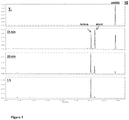
- This reaction cascade is represented on the HPLC chromatograms of the Figure 1 .
- the deprotection process was also implemented using the fluorophenoxyacetate derivative 14. After 15 minutes at 95 ° C., the amide population is very low. In particular, it is lower compared to the result observed with derivative 10 (see Figure 2 ). The presence of the fluorine atom accelerates the cleavage of the group phenoxyacetate. Thus, after 30 minutes, this amide population has almost completely disappeared in favor of the alcohol and the very majority lactone indicating the release of phenylethylamine.
- the non-cyclized deprotected form (intermediate amine) is not detected.
- This example therefore demonstrates the immediate cyclization after deprotection of the N-boc group to form phenylethylamine. This confirms the advantage of the amino function at position 5 over the alcohol function, for the rate of cyclization.
- Those skilled in the art will therefore know how to find the appropriate protective group for the NH 2 function in position 5 of the aromatic ring in order to obtain sufficiently rapid deprotection leading to instantaneous cyclization, and to the release of phenylethylamine.
- Example 6 Reversible protection of hemoglobin by the aza-isatoic compound 13 as described in the invention
- thermolabile fluoro-phenoxy moiety is capable of reacting with a protein under mild conditions and in an aqueous medium to form a protein-aza anthranylate fluoro-phenoxy derivative.
- the AL602 CTRLE 0.25X chromatogram shows the control hemoglobin which has not reacted with compound 13 .
- the following 3 chromatograms show the disappearance of the protein part in favor of a mass shifted to the right corresponding to the alpha and beta subunits acylated by the aza-isatoic compound 13 .
- the widening of the peak corresponds to the random acylation of the reactive sites of the protein.
- reaction media were taken up after reaction in 8M GuHCl in order to solubilize the protein part which would have precipitated during the heat treatment.
- This example demonstrates the reversible acylation of a model protein by compound 13 as described in the invention.
- Example 7 Demonstration of the reversible acylation of TAQ polymerase by the aza-isatoic compound 13 as described in the invention
- thermostable polymerase Taq
- the polymerization activity of the TAQ polymerase is carried out using a 45 base oligonucleotide probe terminated by a "hairpin" structure. This is characterized by the presence of a fluorescence quencher at the start of the structure and by a fluorophore at the end of the probe sequence, so that the quencher is spatially close to the fluorophore and that no signal of fluorescence could not be measured in this configuration. Under the action of the polymerase activity, this probe is extended using an oligonucleotide of 19 bases complementary to the start of the preceding probe. Under the action of elongation, the hairpin structure of the probe unfolds and the fluorophore can emit and fluorescence is then measurable. This fluorescence measurement is carried out at a temperature of 60 ° C. for 20 minutes in the presence of the reagents necessary for the activity of the enzyme, that is to say dNTPs, MgCl2 and a basic buffer at pH 9.5.
- the increase in fluorescence is linear at the start of the measurement and makes it possible to calculate an initial rate corresponding to the quantity of fluorescence emitted per minute of elongation.
- the chemical modification of the polymerase in order to render it inactive is measured by this method. By measuring the level of residual activity after modification of the enzyme, it is possible to determine the effectiveness of the protection put in place. A polymerase completely inactivated by chemical modification should no longer generate activity without thermal activation at temperatures above 90 ° C.
- the capacity to restore the activity of the enzyme after heating for 15 min at 95 ° C., for example, is easily measured by the same method.
Landscapes
- Chemical & Material Sciences (AREA)
- Organic Chemistry (AREA)
- Life Sciences & Earth Sciences (AREA)
- Health & Medical Sciences (AREA)
- Engineering & Computer Science (AREA)
- Zoology (AREA)
- Wood Science & Technology (AREA)
- Molecular Biology (AREA)
- Genetics & Genomics (AREA)
- Bioinformatics & Cheminformatics (AREA)
- Biochemistry (AREA)
- Biotechnology (AREA)
- General Engineering & Computer Science (AREA)
- General Health & Medical Sciences (AREA)
- Microbiology (AREA)
- Chemical Kinetics & Catalysis (AREA)
- Proteomics, Peptides & Aminoacids (AREA)
- Biomedical Technology (AREA)
- Medicinal Chemistry (AREA)
- General Chemical & Material Sciences (AREA)
- Physics & Mathematics (AREA)
- Biophysics (AREA)
- Analytical Chemistry (AREA)
- Immunology (AREA)
- Enzymes And Modification Thereof (AREA)
- Measuring Or Testing Involving Enzymes Or Micro-Organisms (AREA)
- Nitrogen And Oxygen Or Sulfur-Condensed Heterocyclic Ring Systems (AREA)
- Organic Low-Molecular-Weight Compounds And Preparation Thereof (AREA)
- Plural Heterocyclic Compounds (AREA)
- Nitrogen Condensed Heterocyclic Rings (AREA)
Applications Claiming Priority (2)
| Application Number | Priority Date | Filing Date | Title |
|---|---|---|---|
| FR1656791A FR3053968A1 (fr) | 2016-07-13 | 2016-07-13 | Reactifs pour la protection reversible de molecules biologiques |
| PCT/FR2017/051925 WO2018011527A1 (fr) | 2016-07-13 | 2017-07-13 | Réactifs pour la protection réversible de molécules biologiques |
Publications (2)
| Publication Number | Publication Date |
|---|---|
| EP3484891A1 EP3484891A1 (fr) | 2019-05-22 |
| EP3484891B1 true EP3484891B1 (fr) | 2021-04-14 |
Family
ID=57286588
Family Applications (1)
| Application Number | Title | Priority Date | Filing Date |
|---|---|---|---|
| EP17748542.2A Active EP3484891B1 (fr) | 2016-07-13 | 2017-07-13 | Réactifs pour la protection réversible de molécules biologiques |
Country Status (7)
| Country | Link |
|---|---|
| US (1) | US11708375B2 (https=) |
| EP (1) | EP3484891B1 (https=) |
| JP (1) | JP7231540B2 (https=) |
| CN (1) | CN109831913B (https=) |
| ES (1) | ES2878581T3 (https=) |
| FR (1) | FR3053968A1 (https=) |
| WO (1) | WO2018011527A1 (https=) |
Families Citing this family (3)
| Publication number | Priority date | Publication date | Assignee | Title |
|---|---|---|---|---|
| US20230322804A1 (en) * | 2016-07-13 | 2023-10-12 | bioMérieux | Reagents for reversibly protecting biological molecules |
| US10948746B2 (en) | 2017-10-13 | 2021-03-16 | Smith Sport Optics, Inc. | Goggle with replaceable lens |
| CN116410951A (zh) * | 2021-12-30 | 2023-07-11 | 广州达安基因股份有限公司 | 一种提高化学修饰的Taq酶的活性的方法和经该方法处理的Taq酶 |
Family Cites Families (9)
| Publication number | Priority date | Publication date | Assignee | Title |
|---|---|---|---|---|
| FR1257526A (fr) | 1960-05-23 | 1961-03-31 | Leffman Ltd S | Perfectionnements apportés aux soutien-gorge |
| US5773258A (en) | 1995-08-25 | 1998-06-30 | Roche Molecular Systems, Inc. | Nucleic acid amplification using a reversibly inactivated thermostable enzyme |
| AU2003300956A1 (en) * | 2002-12-11 | 2004-06-30 | Smithkline Beecham Corporation | Anti-infectives |
| HUP0700395A2 (en) * | 2007-06-07 | 2009-03-02 | Sanofi Aventis | Substituted [1,2,4] triazolo [1,5-a] quinolines, process for their preparation, pharmaceutical compositions thereof, and intermediates |
| EP2294076B1 (en) | 2008-05-27 | 2017-03-08 | TriLink BioTechnologies | Chemically modified nucleoside 5'-triphosphates for thermally initiated replication of nucleic acid |
| US8800174B2 (en) | 2010-07-13 | 2014-08-12 | Mission Product Holdings, Inc. | Shoe soles for enhancing gripping with a smooth hard surface |
| WO2012094343A1 (en) | 2011-01-05 | 2012-07-12 | Trilink Biotechnologies | Chemically substituted thermosensitive probes and cofactors for hot start ligation |
| FR2994184B1 (fr) | 2012-08-02 | 2017-12-08 | Biomerieux Sa | Procedes de fonctionalisation et reactifs utilises dans de tels procedes utilisant un anhydride aza-isatoique ou un de ses derives, molecules biologiques ainsi traitees et kits |
| EA201692301A1 (ru) | 2014-07-01 | 2017-06-30 | Ремпекс Фармасьютикалз, Инк. | Производные бороновой кислоты и их терапевтическое применение |
-
2016
- 2016-07-13 FR FR1656791A patent/FR3053968A1/fr not_active Withdrawn
-
2017
- 2017-07-13 EP EP17748542.2A patent/EP3484891B1/fr active Active
- 2017-07-13 JP JP2019523188A patent/JP7231540B2/ja active Active
- 2017-07-13 US US16/314,824 patent/US11708375B2/en active Active
- 2017-07-13 WO PCT/FR2017/051925 patent/WO2018011527A1/fr not_active Ceased
- 2017-07-13 CN CN201780043621.XA patent/CN109831913B/zh active Active
- 2017-07-13 ES ES17748542T patent/ES2878581T3/es active Active
Non-Patent Citations (1)
| Title |
|---|
| None * |
Also Published As
| Publication number | Publication date |
|---|---|
| US20190375763A1 (en) | 2019-12-12 |
| WO2018011527A1 (fr) | 2018-01-18 |
| JP7231540B2 (ja) | 2023-03-01 |
| EP3484891A1 (fr) | 2019-05-22 |
| WO2018011527A9 (fr) | 2018-05-03 |
| ES2878581T3 (es) | 2021-11-19 |
| CN109831913B (zh) | 2022-01-21 |
| JP2019522058A (ja) | 2019-08-08 |
| FR3053968A1 (fr) | 2018-01-19 |
| CN109831913A (zh) | 2019-05-31 |
| US11708375B2 (en) | 2023-07-25 |
Similar Documents
| Publication | Publication Date | Title |
|---|---|---|
| EP1290006B1 (fr) | Production combinatoire d'analogues de nucléotides et de nucléosides (XiTP) | |
| US7910726B2 (en) | Amidite for synthesizing modified nucleic acid and method for synthesizing modified nucleic acid | |
| EP3484891B1 (fr) | Réactifs pour la protection réversible de molécules biologiques | |
| TWI628158B (zh) | 新穎方法及中間物 | |
| EP1383732B1 (fr) | Reactifs de marquage, procedes de synthese de tels reactifs et procedes de detection de molecules biologiques | |
| CA2952332A1 (fr) | Sondes moleculaires activables hydrosolubles, intermediaires pour leur synthese et procedes de detection associes | |
| EP1140963B1 (fr) | Compose fonctionnalise, polynucleotide eventuellement marque et procede de detection d'un acide nucleique cible | |
| Roviello et al. | RNA-binding and viral reverse transcriptase inhibitory activity of a novel cationic diamino acid-based peptide | |
| US20250276994A1 (en) | Cap analog for the 5'-end of eukaryotic messenger rnas | |
| US20230322804A1 (en) | Reagents for reversibly protecting biological molecules | |
| Zhang et al. | Facilitated synthesis of proteins containing modified dipeptides | |
| JP2009221168A (ja) | ヌクレオシドまたはヌクレオチド誘導体、核酸誘導体、標的物質捕捉材料、標的物質を捕捉および/または放出する方法、ならびにヘミンアプタマー | |
| WO2008145830A2 (fr) | Nouveaux composes pro-fluorescents | |
| WO2005092910A1 (fr) | Réactifs de marquage, procédés de synthèse de tels réactifs et procédés de détection de molécules biologiques | |
| EP1806400B1 (en) | Inactivation method | |
| Wodtke et al. | Solution-phase synthesis of the fluorogenic TGase 2 acyl donor Z-Glu (HMC)-Gly-OH and its use for inhibitor and amine substrate characterisation | |
| RU2696099C1 (ru) | Хемоэнзиматический синтез производных 2,5-дикетоморфолина | |
| JP2982621B2 (ja) | 光増感機能をもつ新規アミノ酸 | |
| Umamaheswari et al. | Synthesis and investigation of therapeutic potential of isoform-specific HDAC8 inhibitors for the treatment of cutaneous t cell lymphoma | |
| TSUCHIDA et al. | Studies on the Chemical Synthesis of Potential Antimetabolites. XXV. Synthesis of (±)-Isowillardiine by Application of a Four-Component Condensation involving 2-Picolylamine 1-Oxide and 2-Picolyl Isocyanide 1-Oxide | |
| Sheikh et al. | First synthesis of non-symmetrical “phthalimidoyl active ester” bi-dentate cross-linking reagents having an acid chloride, 2-benzothiazole, or 1-benzotriazol group | |
| JP2025533935A (ja) | 1-(スルホニル)-n-フェニルピロリジン-2-カルボキサミド誘導体及びその使用 | |
| WO2000062072A1 (fr) | Methode homogene de detection mettant en jeu un cryptate de terre rare | |
| WO2026003215A1 (fr) | Bases modifiées chimiquement avec un groupement clivable et méthodes de sélection d'acides nucléiques fonctionnels les comprenant | |
| Komissarov et al. | Polymethylene derivatives of nucleic bases bearing ω-functional groups: IX—An unusual reaction of methyl 2-thiocyano-5-chloropentanoate with uracyl and thymine |
Legal Events
| Date | Code | Title | Description |
|---|---|---|---|
| STAA | Information on the status of an ep patent application or granted ep patent |
Free format text: STATUS: UNKNOWN |
|
| STAA | Information on the status of an ep patent application or granted ep patent |
Free format text: STATUS: THE INTERNATIONAL PUBLICATION HAS BEEN MADE |
|
| PUAI | Public reference made under article 153(3) epc to a published international application that has entered the european phase |
Free format text: ORIGINAL CODE: 0009012 |
|
| STAA | Information on the status of an ep patent application or granted ep patent |
Free format text: STATUS: REQUEST FOR EXAMINATION WAS MADE |
|
| 17P | Request for examination filed |
Effective date: 20190205 |
|
| AK | Designated contracting states |
Kind code of ref document: A1 Designated state(s): AL AT BE BG CH CY CZ DE DK EE ES FI FR GB GR HR HU IE IS IT LI LT LU LV MC MK MT NL NO PL PT RO RS SE SI SK SM TR |
|
| AX | Request for extension of the european patent |
Extension state: BA ME |
|
| DAV | Request for validation of the european patent (deleted) | ||
| DAX | Request for extension of the european patent (deleted) | ||
| RIN1 | Information on inventor provided before grant (corrected) |
Inventor name: LAAYOUN, ALI Inventor name: URSUEGUI, SYLVAIN Inventor name: FABIS, FREDERIC Inventor name: LAURENT, ALAIN |
|
| GRAP | Despatch of communication of intention to grant a patent |
Free format text: ORIGINAL CODE: EPIDOSNIGR1 |
|
| STAA | Information on the status of an ep patent application or granted ep patent |
Free format text: STATUS: GRANT OF PATENT IS INTENDED |
|
| INTG | Intention to grant announced |
Effective date: 20201009 |
|
| GRAS | Grant fee paid |
Free format text: ORIGINAL CODE: EPIDOSNIGR3 |
|
| RIN1 | Information on inventor provided before grant (corrected) |
Inventor name: URSUEGUI, SYLVAIN Inventor name: LAAYOUN, ALI Inventor name: FABIS, FREDERIC Inventor name: LAURENT, ALAIN |
|
| GRAA | (expected) grant |
Free format text: ORIGINAL CODE: 0009210 |
|
| STAA | Information on the status of an ep patent application or granted ep patent |
Free format text: STATUS: THE PATENT HAS BEEN GRANTED |
|
| AK | Designated contracting states |
Kind code of ref document: B1 Designated state(s): AL AT BE BG CH CY CZ DE DK EE ES FI FR GB GR HR HU IE IS IT LI LT LU LV MC MK MT NL NO PL PT RO RS SE SI SK SM TR |
|
| REG | Reference to a national code |
Ref country code: GB Ref legal event code: FG4D Free format text: NOT ENGLISH |
|
| REG | Reference to a national code |
Ref country code: CH Ref legal event code: EP |
|
| REG | Reference to a national code |
Ref country code: DE Ref legal event code: R096 Ref document number: 602017036699 Country of ref document: DE |
|
| REG | Reference to a national code |
Ref country code: IE Ref legal event code: FG4D Free format text: LANGUAGE OF EP DOCUMENT: FRENCH |
|
| REG | Reference to a national code |
Ref country code: AT Ref legal event code: REF Ref document number: 1382296 Country of ref document: AT Kind code of ref document: T Effective date: 20210515 |
|
| REG | Reference to a national code |
Ref country code: LT Ref legal event code: MG9D |
|
| REG | Reference to a national code |
Ref country code: AT Ref legal event code: MK05 Ref document number: 1382296 Country of ref document: AT Kind code of ref document: T Effective date: 20210414 |
|
| REG | Reference to a national code |
Ref country code: NL Ref legal event code: MP Effective date: 20210414 |
|
| PG25 | Lapsed in a contracting state [announced via postgrant information from national office to epo] |
Ref country code: NL Free format text: LAPSE BECAUSE OF FAILURE TO SUBMIT A TRANSLATION OF THE DESCRIPTION OR TO PAY THE FEE WITHIN THE PRESCRIBED TIME-LIMIT Effective date: 20210414 Ref country code: HR Free format text: LAPSE BECAUSE OF FAILURE TO SUBMIT A TRANSLATION OF THE DESCRIPTION OR TO PAY THE FEE WITHIN THE PRESCRIBED TIME-LIMIT Effective date: 20210414 Ref country code: AT Free format text: LAPSE BECAUSE OF FAILURE TO SUBMIT A TRANSLATION OF THE DESCRIPTION OR TO PAY THE FEE WITHIN THE PRESCRIBED TIME-LIMIT Effective date: 20210414 Ref country code: BG Free format text: LAPSE BECAUSE OF FAILURE TO SUBMIT A TRANSLATION OF THE DESCRIPTION OR TO PAY THE FEE WITHIN THE PRESCRIBED TIME-LIMIT Effective date: 20210714 Ref country code: FI Free format text: LAPSE BECAUSE OF FAILURE TO SUBMIT A TRANSLATION OF THE DESCRIPTION OR TO PAY THE FEE WITHIN THE PRESCRIBED TIME-LIMIT Effective date: 20210414 Ref country code: LT Free format text: LAPSE BECAUSE OF FAILURE TO SUBMIT A TRANSLATION OF THE DESCRIPTION OR TO PAY THE FEE WITHIN THE PRESCRIBED TIME-LIMIT Effective date: 20210414 |
|
| REG | Reference to a national code |
Ref country code: ES Ref legal event code: FG2A Ref document number: 2878581 Country of ref document: ES Kind code of ref document: T3 Effective date: 20211119 |
|
| PG25 | Lapsed in a contracting state [announced via postgrant information from national office to epo] |
Ref country code: PT Free format text: LAPSE BECAUSE OF FAILURE TO SUBMIT A TRANSLATION OF THE DESCRIPTION OR TO PAY THE FEE WITHIN THE PRESCRIBED TIME-LIMIT Effective date: 20210816 Ref country code: NO Free format text: LAPSE BECAUSE OF FAILURE TO SUBMIT A TRANSLATION OF THE DESCRIPTION OR TO PAY THE FEE WITHIN THE PRESCRIBED TIME-LIMIT Effective date: 20210714 Ref country code: PL Free format text: LAPSE BECAUSE OF FAILURE TO SUBMIT A TRANSLATION OF THE DESCRIPTION OR TO PAY THE FEE WITHIN THE PRESCRIBED TIME-LIMIT Effective date: 20210414 Ref country code: RS Free format text: LAPSE BECAUSE OF FAILURE TO SUBMIT A TRANSLATION OF THE DESCRIPTION OR TO PAY THE FEE WITHIN THE PRESCRIBED TIME-LIMIT Effective date: 20210414 Ref country code: SE Free format text: LAPSE BECAUSE OF FAILURE TO SUBMIT A TRANSLATION OF THE DESCRIPTION OR TO PAY THE FEE WITHIN THE PRESCRIBED TIME-LIMIT Effective date: 20210414 Ref country code: LV Free format text: LAPSE BECAUSE OF FAILURE TO SUBMIT A TRANSLATION OF THE DESCRIPTION OR TO PAY THE FEE WITHIN THE PRESCRIBED TIME-LIMIT Effective date: 20210414 Ref country code: GR Free format text: LAPSE BECAUSE OF FAILURE TO SUBMIT A TRANSLATION OF THE DESCRIPTION OR TO PAY THE FEE WITHIN THE PRESCRIBED TIME-LIMIT Effective date: 20210715 Ref country code: IS Free format text: LAPSE BECAUSE OF FAILURE TO SUBMIT A TRANSLATION OF THE DESCRIPTION OR TO PAY THE FEE WITHIN THE PRESCRIBED TIME-LIMIT Effective date: 20210814 |
|
| REG | Reference to a national code |
Ref country code: DE Ref legal event code: R097 Ref document number: 602017036699 Country of ref document: DE |
|
| PG25 | Lapsed in a contracting state [announced via postgrant information from national office to epo] |
Ref country code: SM Free format text: LAPSE BECAUSE OF FAILURE TO SUBMIT A TRANSLATION OF THE DESCRIPTION OR TO PAY THE FEE WITHIN THE PRESCRIBED TIME-LIMIT Effective date: 20210414 Ref country code: SK Free format text: LAPSE BECAUSE OF FAILURE TO SUBMIT A TRANSLATION OF THE DESCRIPTION OR TO PAY THE FEE WITHIN THE PRESCRIBED TIME-LIMIT Effective date: 20210414 Ref country code: RO Free format text: LAPSE BECAUSE OF FAILURE TO SUBMIT A TRANSLATION OF THE DESCRIPTION OR TO PAY THE FEE WITHIN THE PRESCRIBED TIME-LIMIT Effective date: 20210414 Ref country code: CZ Free format text: LAPSE BECAUSE OF FAILURE TO SUBMIT A TRANSLATION OF THE DESCRIPTION OR TO PAY THE FEE WITHIN THE PRESCRIBED TIME-LIMIT Effective date: 20210414 Ref country code: DK Free format text: LAPSE BECAUSE OF FAILURE TO SUBMIT A TRANSLATION OF THE DESCRIPTION OR TO PAY THE FEE WITHIN THE PRESCRIBED TIME-LIMIT Effective date: 20210414 Ref country code: EE Free format text: LAPSE BECAUSE OF FAILURE TO SUBMIT A TRANSLATION OF THE DESCRIPTION OR TO PAY THE FEE WITHIN THE PRESCRIBED TIME-LIMIT Effective date: 20210414 |
|
| PLBE | No opposition filed within time limit |
Free format text: ORIGINAL CODE: 0009261 |
|
| STAA | Information on the status of an ep patent application or granted ep patent |
Free format text: STATUS: NO OPPOSITION FILED WITHIN TIME LIMIT |
|
| REG | Reference to a national code |
Ref country code: CH Ref legal event code: PL |
|
| 26N | No opposition filed |
Effective date: 20220117 |
|
| PG25 | Lapsed in a contracting state [announced via postgrant information from national office to epo] |
Ref country code: MC Free format text: LAPSE BECAUSE OF FAILURE TO SUBMIT A TRANSLATION OF THE DESCRIPTION OR TO PAY THE FEE WITHIN THE PRESCRIBED TIME-LIMIT Effective date: 20210414 |
|
| REG | Reference to a national code |
Ref country code: BE Ref legal event code: MM Effective date: 20210731 |
|
| PG25 | Lapsed in a contracting state [announced via postgrant information from national office to epo] |
Ref country code: LI Free format text: LAPSE BECAUSE OF NON-PAYMENT OF DUE FEES Effective date: 20210731 Ref country code: CH Free format text: LAPSE BECAUSE OF NON-PAYMENT OF DUE FEES Effective date: 20210731 |
|
| PG25 | Lapsed in a contracting state [announced via postgrant information from national office to epo] |
Ref country code: IS Free format text: LAPSE BECAUSE OF FAILURE TO SUBMIT A TRANSLATION OF THE DESCRIPTION OR TO PAY THE FEE WITHIN THE PRESCRIBED TIME-LIMIT Effective date: 20210814 Ref country code: LU Free format text: LAPSE BECAUSE OF NON-PAYMENT OF DUE FEES Effective date: 20210713 Ref country code: AL Free format text: LAPSE BECAUSE OF FAILURE TO SUBMIT A TRANSLATION OF THE DESCRIPTION OR TO PAY THE FEE WITHIN THE PRESCRIBED TIME-LIMIT Effective date: 20210414 |
|
| PG25 | Lapsed in a contracting state [announced via postgrant information from national office to epo] |
Ref country code: IE Free format text: LAPSE BECAUSE OF NON-PAYMENT OF DUE FEES Effective date: 20210713 Ref country code: BE Free format text: LAPSE BECAUSE OF NON-PAYMENT OF DUE FEES Effective date: 20210731 |
|
| PG25 | Lapsed in a contracting state [announced via postgrant information from national office to epo] |
Ref country code: CY Free format text: LAPSE BECAUSE OF FAILURE TO SUBMIT A TRANSLATION OF THE DESCRIPTION OR TO PAY THE FEE WITHIN THE PRESCRIBED TIME-LIMIT Effective date: 20210414 |
|
| PG25 | Lapsed in a contracting state [announced via postgrant information from national office to epo] |
Ref country code: HU Free format text: LAPSE BECAUSE OF FAILURE TO SUBMIT A TRANSLATION OF THE DESCRIPTION OR TO PAY THE FEE WITHIN THE PRESCRIBED TIME-LIMIT; INVALID AB INITIO Effective date: 20170713 |
|
| PG25 | Lapsed in a contracting state [announced via postgrant information from national office to epo] |
Ref country code: MK Free format text: LAPSE BECAUSE OF FAILURE TO SUBMIT A TRANSLATION OF THE DESCRIPTION OR TO PAY THE FEE WITHIN THE PRESCRIBED TIME-LIMIT Effective date: 20210414 |
|
| PG25 | Lapsed in a contracting state [announced via postgrant information from national office to epo] |
Ref country code: TR Free format text: LAPSE BECAUSE OF FAILURE TO SUBMIT A TRANSLATION OF THE DESCRIPTION OR TO PAY THE FEE WITHIN THE PRESCRIBED TIME-LIMIT Effective date: 20210414 |
|
| PG25 | Lapsed in a contracting state [announced via postgrant information from national office to epo] |
Ref country code: MT Free format text: LAPSE BECAUSE OF FAILURE TO SUBMIT A TRANSLATION OF THE DESCRIPTION OR TO PAY THE FEE WITHIN THE PRESCRIBED TIME-LIMIT Effective date: 20210414 |
|
| PGFP | Annual fee paid to national office [announced via postgrant information from national office to epo] |
Ref country code: ES Payment date: 20250801 Year of fee payment: 9 |
|
| PGFP | Annual fee paid to national office [announced via postgrant information from national office to epo] |
Ref country code: DE Payment date: 20250729 Year of fee payment: 9 |
|
| PGFP | Annual fee paid to national office [announced via postgrant information from national office to epo] |
Ref country code: IT Payment date: 20250721 Year of fee payment: 9 |
|
| PGFP | Annual fee paid to national office [announced via postgrant information from national office to epo] |
Ref country code: GB Payment date: 20250728 Year of fee payment: 9 |
|
| PGFP | Annual fee paid to national office [announced via postgrant information from national office to epo] |
Ref country code: FR Payment date: 20250725 Year of fee payment: 9 |