EP3482207B1 - Verfahren zur vorhersage des auftretens von typ-2-diabetes durch analyse von n-glycanen an den plasmaproteinen einer gesunden personen - Google Patents
Verfahren zur vorhersage des auftretens von typ-2-diabetes durch analyse von n-glycanen an den plasmaproteinen einer gesunden personen Download PDFInfo
- Publication number
- EP3482207B1 EP3482207B1 EP17729435.2A EP17729435A EP3482207B1 EP 3482207 B1 EP3482207 B1 EP 3482207B1 EP 17729435 A EP17729435 A EP 17729435A EP 3482207 B1 EP3482207 B1 EP 3482207B1
- Authority
- EP
- European Patent Office
- Prior art keywords
- glycans
- a3g3s
- diabetes
- glycan
- a4g4s
- Prior art date
- Legal status (The legal status is an assumption and is not a legal conclusion. Google has not performed a legal analysis and makes no representation as to the accuracy of the status listed.)
- Active
Links
Images


Classifications
-
- G—PHYSICS
- G01—MEASURING; TESTING
- G01N—INVESTIGATING OR ANALYSING MATERIALS BY DETERMINING THEIR CHEMICAL OR PHYSICAL PROPERTIES
- G01N33/00—Investigating or analysing materials by specific methods not covered by groups G01N1/00 - G01N31/00
- G01N33/48—Biological material, e.g. blood, urine; Haemocytometers
- G01N33/50—Chemical analysis of biological material, e.g. blood, urine; Testing involving biospecific ligand binding methods; Immunological testing
- G01N33/68—Chemical analysis of biological material, e.g. blood, urine; Testing involving biospecific ligand binding methods; Immunological testing involving proteins, peptides or amino acids
- G01N33/6893—Chemical analysis of biological material, e.g. blood, urine; Testing involving biospecific ligand binding methods; Immunological testing involving proteins, peptides or amino acids related to diseases not provided for elsewhere
-
- G—PHYSICS
- G01—MEASURING; TESTING
- G01N—INVESTIGATING OR ANALYSING MATERIALS BY DETERMINING THEIR CHEMICAL OR PHYSICAL PROPERTIES
- G01N30/00—Investigating or analysing materials by separation into components using adsorption, absorption or similar phenomena or using ion-exchange, e.g. chromatography or field flow fractionation
- G01N30/02—Column chromatography
- G01N30/62—Detectors specially adapted therefor
- G01N30/72—Mass spectrometers
-
- G—PHYSICS
- G01—MEASURING; TESTING
- G01N—INVESTIGATING OR ANALYSING MATERIALS BY DETERMINING THEIR CHEMICAL OR PHYSICAL PROPERTIES
- G01N30/00—Investigating or analysing materials by separation into components using adsorption, absorption or similar phenomena or using ion-exchange, e.g. chromatography or field flow fractionation
- G01N30/02—Column chromatography
- G01N2030/022—Column chromatography characterised by the kind of separation mechanism
- G01N2030/027—Liquid chromatography
-
- G—PHYSICS
- G01—MEASURING; TESTING
- G01N—INVESTIGATING OR ANALYSING MATERIALS BY DETERMINING THEIR CHEMICAL OR PHYSICAL PROPERTIES
- G01N2570/00—Omics, e.g. proteomics, glycomics or lipidomics; Methods of analysis focusing on the entire complement of classes of biological molecules or subsets thereof, i.e. focusing on proteomes, glycomes or lipidomes
-
- G—PHYSICS
- G01—MEASURING; TESTING
- G01N—INVESTIGATING OR ANALYSING MATERIALS BY DETERMINING THEIR CHEMICAL OR PHYSICAL PROPERTIES
- G01N2800/00—Detection or diagnosis of diseases
- G01N2800/04—Endocrine or metabolic disorders
- G01N2800/042—Disorders of carbohydrate metabolism, e.g. diabetes, glucose metabolism
-
- G—PHYSICS
- G01—MEASURING; TESTING
- G01N—INVESTIGATING OR ANALYSING MATERIALS BY DETERMINING THEIR CHEMICAL OR PHYSICAL PROPERTIES
- G01N2800/00—Detection or diagnosis of diseases
- G01N2800/50—Determining the risk of developing a disease
-
- G—PHYSICS
- G16—INFORMATION AND COMMUNICATION TECHNOLOGY [ICT] SPECIALLY ADAPTED FOR SPECIFIC APPLICATION FIELDS
- G16B—BIOINFORMATICS, i.e. INFORMATION AND COMMUNICATION TECHNOLOGY [ICT] SPECIALLY ADAPTED FOR GENETIC OR PROTEIN-RELATED DATA PROCESSING IN COMPUTATIONAL MOLECULAR BIOLOGY
- G16B25/00—ICT specially adapted for hybridisation; ICT specially adapted for gene or protein expression
-
- G—PHYSICS
- G16—INFORMATION AND COMMUNICATION TECHNOLOGY [ICT] SPECIALLY ADAPTED FOR SPECIFIC APPLICATION FIELDS
- G16B—BIOINFORMATICS, i.e. INFORMATION AND COMMUNICATION TECHNOLOGY [ICT] SPECIALLY ADAPTED FOR GENETIC OR PROTEIN-RELATED DATA PROCESSING IN COMPUTATIONAL MOLECULAR BIOLOGY
- G16B40/00—ICT specially adapted for biostatistics; ICT specially adapted for bioinformatics-related machine learning or data mining, e.g. knowledge discovery or pattern finding
-
- G—PHYSICS
- G16—INFORMATION AND COMMUNICATION TECHNOLOGY [ICT] SPECIALLY ADAPTED FOR SPECIFIC APPLICATION FIELDS
- G16B—BIOINFORMATICS, i.e. INFORMATION AND COMMUNICATION TECHNOLOGY [ICT] SPECIALLY ADAPTED FOR GENETIC OR PROTEIN-RELATED DATA PROCESSING IN COMPUTATIONAL MOLECULAR BIOLOGY
- G16B5/00—ICT specially adapted for modelling or simulations in systems biology, e.g. gene-regulatory networks, protein interaction networks or metabolic networks
Definitions
- the present invention relates to a procedure of predicting type 2 diabetes (T2D) development through quantitative analysis of N- glycans attached to the plasma proteins of a healthy person.
- the present invention solves a technical problem of determining the risk for type 2 diabetes (T2D) development in the future for currently healthy person.
- T2D type 2 diabetes
- the present invention solves the above cited technical problem by using quantitative analysis of N-glycans attached to the plasma proteins of the investigated person through single analysis.
- Glycans are complex carbohydrates, which are often attached to the proteins and involved in numerous physiological and pathological processes. Therefore, their diagnostic potential as biomarkers of various physiological and pathological states is well known; see reference 1:
- N-glycan analysis can enable drawing of conclusions on the pathological conditions of the investigated person, such as: sepsis, acute pancreatitis, inflammation and other diseases and conditions; see references 2-4:
- the reference 4A is important for understanding the role of hyperglycemia during the acute illness phase within the currently healty subjects and the developmet of T2D in the future, after several years: (4A)I. Gornik, A. Vujaklija Brajkovi ⁇ , I. Pavli ⁇ Renar, V. Ga ⁇ parovi ⁇ : A prospective observational study of the relationship of critical illness associated hyperglycaemia in medical ICU patients and subsequent development of type 2 diabetes, Critical Care 14 (2010) R130, DOI: 10.1186/cc9101 Diabetes stands out as one of the most significant disease of the modern age, particularly due to its frequency.
- Type 2 diabetes (T2D) also represents one of the most significant global epidemiological problems. It is estimated that by the year 2025 the prevalence of diabetes will increase to 7.3 %.
- T2D type 2 diabetes
- T2D type 2 diabetes
- Increased level and activity of liver ⁇ -1,6-fucosyltransferase was assumed.
- the authors concluded that the increased level of ⁇ -1,6-fucosylation is indicative for T2D pathophysiology. Additionally, their results suggest the possibility of utilizing the N-glycan analysis and, specifically, ⁇ -1,6-fucosylation levels, for the purpose of T2D diagnosis; see reference 5: (5) N. Itoh, S.
- Testa et al have described significant changes of plasma N-glycan profile in patients with type 2 diabetes (T2D) and metabolic syndrome (MS), compared to healthy controls. They observed significant decrease in monogalactosylated N-glycans with ⁇ -(1,6)- and ⁇ -(1,3)-galactosylation, and core fucosylated biantennary N- glycans NG1(6)A2F and NG1(3)A2F in patients with T2D; see reference 6: (6) R. Testa, V. Vanhooren, A. R. Bonfigli, M. Boemi, F. Olivieri, A. Ceriello, S. Genovese, L. Spazzafumo, V. Borelli, M.
- serum N -glycans can be used as non-invasive biomarkers of type 2 diabetes; see the conclusion of the paper.
- Urdea et al have devised a diagnostic procedure for diabetes prediction 1, 2.5, 5, 7.5 or 10 years before potential onset of the disease, by analyzing specific combination of biochemical markers derived from the plasma of investigated person, which are:
- the present invention solves a technical problem of predicting or determining the risk of diabetes development in the future, for currently healthy person, as disclosed in the detailed description of the invention.
- the present invention discloses a procedure of determining the risk of type 2 diabetes (T2D) development in the future, for currently healthy person, based on a single quantitative analysis of plasma N- glycans, and then by employing specific mathematical models based on population study and monitoring the rate of their diabetes incidence, in a time-dependent manner.
- T2D type 2 diabetes
- Logarithm of odds ratio is obtained by logistic regression and corresponds to the change of one standard deviation for each measured glycan (GP1-GP46).
- glycan measurements were also standardized (to N (0,1) distribution) before performing logistic regression.
- Bar height represents the logarithm of estimated odds ratio and error bars represent 95 % confidence intervals of estimated effects.
- y axis represents log(OR) obtained by logistic regression corresponding to the change of one standard deviation of the measured glycan.
- Plasma N-glycans are analyzed by HILIC-UPLC method, according to the present invention, for patients with hyperglycemia during hospitalization in intensive care unit due to the acute illness (59 cases and 59 controls). Significant differences between cases and controls were noticed for multiple directly measured glycans. Differences in plasma glycans are shown as bars, where bar height represents effect size; the estimation is based on logistic regression and error rate, with 95% confidence interval.
- Figure 4 - depicts differences in abundances of plasma glycans, expressed as logarithm of odds ratio; as in Figure 2 , only now x-axis represents different groups of glycans with similar features: high branching (HB); low branching (LB); neutral glycans (S0); sialylated glycans: monosialylated (S1), disialylated (S2), trisialylated (S3), tetrasialylated (S4); and regarding galactosylation level: agalactosylated (G0), monogalactosylated (G1), digalactosylated (G2), trigalactosylated (G3) and tetragalactosylated (G4) glycans.
- HB high branching
- LB low branching
- S0 neutral glycans
- sialylated glycans monosialylated (
- the present invention solves a technical problem of determining the risk for type 2 diabetes (T2D) development in the future, for currently healthy person.
- T2D type 2 diabetes
- a procedure according to the invention basically comprises:
- T2D type 2 diabetes
- OGTT oral glucose tolerance test
- HbA1c oral glucose tolerance test
- Quantitative analysis of N-glycans attached to the plasma proteins comprises the following steps:
- Suitable quantitative analytical technique for separation of plasma N -glycans are following techniques: ultra-performance liquid chromatography (UPLC), capillary electrophoresis (CE), MALDI-TOF mass spectrometry, liquid chromatography coupled with mass spectrometry (LC-MS) and other suitable quantitative techniques - as is well known in the state of the art; see, for example, international patent application WO2014/203010A1, where the inventors are Lauc G. et al.
- N -glycan and/or N -glycan group refers to the one or more glycans originating from blood plasma, which were previously attached to the nitrogen (N-) atom within the plasma glycoprotein.
- N-glycans are released from protein moiety using N -glycosydase F, and released carbohydrate i.e. glycan molecules are, during quantitative analysis, separated into a series of chromatographic peaks or analogue analytical signals, depending on the type of the employed analytical method.
- a single chromatographic peak can contain only one N -glycan or more glycans, in which case the term N -glycan group is used.
- glycoproteins refers to the origin of the corresponding glycan and/or glycan group, prior to their release from the protein moiety of the glycoprotein, i.e., this means that carbohydrates (glycans) are chemically bonded to the nitrogen ( N -) atoms of plasma proteins called glycoproteins.
- Example 2 Details of the implementation of this analytical method are described in Example 2, while retention times of N -glycan groups, previously fluorescently labeled with 2-aminobenzamide, as shown in Table 2. Table 2. Retention times ( t R ) of 46 fluorescently labeled plasma N-glycans or N -glycan groups (GP1-GP46) obtained in ultra-performance liquid chromatography (UPLC) analysis.
- UPLC ultra-performance liquid chromatography
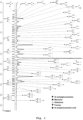
- each chromatographic peak in the chromatogram shown in Figure 1 contains one or more structurally similar glycans (GP1-GP46), which chemical structures are shown in Table 3. Table 3. Chemical structures of N-glycans or N-glycan groups separated as individual chromatographic peaks (GP1-GP46) in the chromatogram shown in Figure 1, according to the analytical method described in Example 2; see reference 8.
- Described quantification of N-glycans was performed for all blood plasma samples from the described study on examining of glycome composition in aforementioned population of patients.
- a model that discriminates the aforementioned two groups of patients was formed.
- the aforementioned model is based on the overall glycan profile, on which basis a ROC (Receiver Operating Characteristic) curve was formed; see Figure 2 .
- the ROC curve analysis shown in Figure 2 describes a discriminatory model for the diagnosis of hyperglycemia in patients with acute illness (increased risk of T2D development). Regularized logistic regression was used for classification analysis, where all 46 plasma glycans were used as predictors.
- the ROC curve is defined on the basis of the validation set obtained by the "leave-one-out" crossover validation (10CV).
- Figure 2 also shows the ROC curve for the discriminatory power of glycated hemoglobin (HbA1c), which is the standard marker for hyperglycemia diagnostics or the success of type 2 diabetes treatment, from the state of the art; see reference 9: (9) M. Vu ⁇ i ⁇ Lovren ⁇ i ⁇ , L. Smir ⁇ i ⁇ Duvnjak, D. Raheli ⁇ : [Hemoglobin A1c and the Quality of Diabetes Care], Lijec. Vjesn. 137 (2015) 292-296.
- HbA1c glycated hemoglobin
- hyperglycemia during acute illness identifies patients at high risk of type 2 diabetes (T2D) development
- T2D type 2 diabetes
- ICU Intensive Care Unit
- Glycans as indirect, but highly reliable, predictors of hyperglycemia in acute illness are much better biomarkers for the risk of T2D development, because analysis can be carried out for currently healthy person by simple analysis of a blood sample.
- glycans are divided into:
- Figure 4 clearly shows the feature which appears in the population, that the predisposition for type 2 diabetes (T2D) is characterized by high branched glycans (HB).
- HB high branched glycans
- LB low branched glycans
- T2D type 2 diabetes development
- the same method, as described earlier, is used as the diagnosis protocol through quantitative analysis of N -glycans attached to the plasma proteins of a healthy person.
- the results of quantitative analysis of all N -glycans are included in a mathematical formula A and/or B.
- the obtained numerical values are used to conclude if a currently healthy person has a significant probability for type 2 diabetes development in the future.
- the diagnosis procedure comprises the following steps:
- the diagnosis procedure comprises the following steps:
- T2D type 2 diabetes development
- the diagnostic procedure is used for predicting the risk of developing type 2 diabetes (T2D) in the future through a single plasma N-glycans analysis of a currently healthy person.
- T2D type 2 diabetes
- Example 1 The study of determining plasma N-glycan compositional changes and the incidence of type 2 diabetes (T2D) development, in a time-dependent manner
- the study can be performed on population of the same size, by analyzing N-glycans and archiving the results. The analysis of plasma N-glycans is then repeated on the same population after several years.
- ICU medical intensive care unit
- OGTT oral glucose tolerance test
- HbA1c oral glucose tolerance test
- the blood plasma was isolated by centrifugation, separated and then stored at -20°C until further analysis were performed.
- 10 ⁇ L of each plasma sample was denatured with the addition of 20 pL of 2 % SDS (w/v) (Invitrogen, Carlsbad, CA, USA) and by incubation at 65 °C for 10 min. Subsequently, 10 ⁇ L of 4 % Igepal-CA630 (Sigma-Aldrich, St. Louis, MO, USA) and 1.25 mU PNGase F (ProZyme, Hayward, CA, USA) in 10 ⁇ L 5 ⁇ PBS were added. Samples were incubated overnight at 37 °C for N-glycan release.
- SDS w/v
- Igepal-CA630 Sigma-Aldrich, St. Louis, MO, USA
- 1.25 mU PNGase F ProZyme, Hayward, CA, USA
- Released N-glycans were fluorescently labeled by reductive amination with 2-aminobenzamide (2-AB).
- the labeling mixture was freshly prepared by dissolving 2-AB (19.2 mg/mL, Sigma-Aldrich, St. Louis, MO, USA) and 2-picoline borane (44.8 mg/mL, Sigma-Aldrich, St. Louis, MO, USA) in DMSO (Sigma-Aldrich, St. Louis, MO, USA) and glacial acetic acid (Merck, Darmstadt, Germany) mixture (70:30, v/v) .
- Free label and reducing agent were removed from the samples using HILIC-SPE. 200 ⁇ L of 0.1 g/mL suspension of microcrystalline cellulose (Merck, Darmstadt, Germany) in water was applied to each well of a 0.45 um GHP filter plate (Pall Corporation, Ann Arbor, MI, USA). Solvent was removed by application of vacuum using a vacuum manifold (Millipore Corporation, Billerica, MA, USA). All wells were prewashed using 5 ⁇ 200 ⁇ L water, followed by equilibration using 3 ⁇ 200 ⁇ L acetonitrile/water (80:20, v/v) . The samples were loaded to the wells.
- Fluorescently labeled N-glycans were separated by hydrophilic interaction ultra-performance liquid chromatography (HILIC-UPLC) on Waters Acquity instrument (Milford, MA, USA) consisting of a quaternary solvent manager, sample manager and a FLR fluorescence detector, set at excitation and emission wavelengths of 250 and 428 nm, respectively.
- the instrument was under the control of Empower 2 software, build 2145 (Waters, Milford, MA, USA).
- N-glycans were separated on a Waters bridged ethylene hybrid (BEH) Glycan chromatography column, 150 ⁇ 2.1 mm and i.d., 1.7 um BEH particles, with 100 mM ammonium formate, pH 4.4, as solvent A and acetonitrile as solvent B.
- the separation method used a linear gradient of 70-53% acetonitrile (v/v) at flow rate of 0.561 ml/min in a 25 min analytical run.
- aforementioned model F(GP1, GP2, ..., GP46) is defined in the way that does not include optional variables D and S:
- F ⁇ 3.82 + 16.30 • HB / LB where HB and LB are additionally defined with quantitative glycan percentages;
- factor HB represents the sum of highly branched glycans, while factor LB represents the sum of glycans with low branching;
- model was trained and validated using "leave-one-out" cross-validation procedure, more specifically, a 10-cross-validation procedure (10CV).
- 10CV procedure data classification was performed in a way that one validation set contains only one sample, while the predictive model is being examined on all remaining samples. Predictions from each validation round were merged into one validation set, on which the performance of a cohort-specific model was evaluated, based on area under the curve (AUC).
- Glycan measurements are not inputted into model as peak areas (raw data), but as percentages in total glycome; total area normalization is performed, where the area of each glycan peak is divided by the total area of the corresponding chromatogram; the sum of all normalized peaks is 100 %.
- Sex parameter is used in the model as the continuous variable; "glmnet” does not allow categorical variables to be used as the input variables.
- Mentioned input variables are not transformed (log transformation) or scaled (standardization on N (0,1)).
- the model coefficients, indicated in this invention, are obtained by "training" of aforementioned model on 107 samples.
- the model coefficients are obtained by "training" the mentioned model on 107 samples. No cross-validation procedure was applied, since the simple method was used.
- Example 4 A procedure of predicting the type 2 diabetes (T2D) development through quantitative analysis of plasma N-glycans from currently healthy person
- the procedure of predicting the T2D development is identical as the procedure described in the Example 2, and it comprises the following steps:
- the blood plasma was isolated by centrifugation, separated and then stored at -20°C until further analysis were performed.
- 10 ⁇ L of each plasma sample was denatured with the addition of 20 ⁇ L of 2 % SDS (w/v) (Invitrogen, Carlsbad, CA, USA) and by incubation at 65 °C for 10 min. Subsequently, 10 ⁇ L of 4 % Igepal-CA630 (Sigma-Aldrich, St. Louis, MO, USA) and 1.25 mU PNGase F (ProZyme, Hayward, CA, USA) in 10 ⁇ L 5 ⁇ PBS were added. Samples were incubated overnight at 37 °C for N-glycan release.
- SDS w/v
- Igepal-CA630 Sigma-Aldrich, St. Louis, MO, USA
- 1.25 mU PNGase F ProZyme, Hayward, CA, USA
- Released N-glycans were fluorescently labeled by reductive amination with 2-aminobenzamide (2-AB).
- the labeling mixture was freshly prepared by dissolving 2-AB (19.2 mg/mL, Sigma-Aldrich, St. Louis, MO, USA) and 2-picoline borane (44.8 mg/mL, Sigma-Aldrich, St. Louis, MO, USA) in DMSO (Sigma-Aldrich, St. Louis, MO, USA) and glacial acetic acid (Merck, Darmstadt, Germany) mixture (70:30, v/v) .
- Free label and reducing agent were removed from the samples using HILIC-SPE. 200 ⁇ L of 0.1 g/mL suspension of microcrystalline cellulose (Merck, Darmstadt, Germany) in water was applied to each well of a 0.45 um GHP filter plate (Pall Corporation, Ann Arbor, MI, USA). Solvent was removed by application of vacuum using a vacuum manifold (Millipore Corporation, Billerica, MA, USA). All wells were prewashed using 5 ⁇ 200 ⁇ L water, followed by equilibration using 3 ⁇ 200 ⁇ L acetonitrile/water (80:20, v/v) . The samples were loaded to the wells.
- Fluorescently labeled N-glycans were separated by hydrophilic interaction ultra-performance liquid chromatography (HILIC-UPLC) on Waters Acquity instrument (Milford, MA, USA) consisting of a quaternary solvent manager, sample manager and a FLR fluorescence detector, set at excitation and emission wavelengths of 250 and 428 nm, respectively.
- the instrument was under the control of Empower 2 software, build 2145 (Waters, Milford, MA, USA).
- HB hexosamine biosynthetic pathway
- UDP-GlcNAc is a key monosaccharide donor, necessary for N- glycan biosynthesis initiation in the endoplasmic reticulum, and later in the Golgi apparatus where branching of N -glycans takes place.
- HB N -glycans i.e. their relative ratios to the low branched (LB) N -glycans were used in the described mathematical model, according to the invention, as a key factor in predicting the T2D development at currently healthy person.
- the present invention reveals the procedure for determining the risk of developing type 2 diabetes in the future at currently healthy person through quantitative analysis of plasma N-glycans. Therefore, the industrial applicability of the present invention is obvious.
Landscapes
- Life Sciences & Earth Sciences (AREA)
- Health & Medical Sciences (AREA)
- Engineering & Computer Science (AREA)
- Chemical & Material Sciences (AREA)
- Immunology (AREA)
- Urology & Nephrology (AREA)
- Molecular Biology (AREA)
- Hematology (AREA)
- Biomedical Technology (AREA)
- Biochemistry (AREA)
- Pathology (AREA)
- General Physics & Mathematics (AREA)
- General Health & Medical Sciences (AREA)
- Physics & Mathematics (AREA)
- Analytical Chemistry (AREA)
- Proteomics, Peptides & Aminoacids (AREA)
- Biotechnology (AREA)
- Cell Biology (AREA)
- Microbiology (AREA)
- Food Science & Technology (AREA)
- Medicinal Chemistry (AREA)
- Investigating Or Analysing Biological Materials (AREA)
Claims (8)
- Verfahren zum Vorhersagen der Entwicklung von Typ-2-Diabetes durch quantitative Analyse von 46 N-Glycanen, die an die menschlichen Plasmaproteine gebunden sind, wobei die N-Glycane und/oder N-Glycangruppen den Strukturen, die in GP1, GP2, ... GP46 enthalten sind, entsprechen, wie nachstehend definiert:
GP Struktur GP Struktur GP Struktur GP1 A1 GP17 FA2[3]G1S[3]1 GP33 A3G3S[3,3,6]3 FA2[3]G1S[6]1 A3G3S[3,6,6]3 FA2[6]BG1S[3]1 A3BG3S[3,3,3]3 FA2[6]BG1S[6]1 A3BG3S[3,3,6]3 A3BG3S[3,6,6]3 GP2 M4 GP18 FA2[3]BG1S[3]1 GP34 FA3G3S[3,3,3]3 FA3BG3S[3,3,3]3 A4G4S[3,6]2 FA1 A3G3S[3,3,3]3 A2 FA2[3]BG1S[6]1 A3G3S[3,3,6]3 A3G3S[3,6,6]3 A3G3S[6,6,6]3 GP3 A1[6]G1 GP19 A2G2S[3]1 GP35 A3BG3S[3,3,3]3 A2G2S[6]1 A3BG3S[3,3,6]3 A3G3 A3BG3S[6,6,6]3 GP4 A2B GP20 A2BG2S[3]1 GP36 FA3G3S[3,3,3]3 A2BG2S[6]1 M5A1G1S[3]1 M5A1G1S[6]1 FA3G3S[3,3,6]3 A1[3]G1 FA3G3 FA3G3S[3,6,6]3 M8D2,D3 FA3G3S[6,6,6]3 A2G2S[3]1 GP5 FA2 GP21 FA2G2S[3]1 GP37 A3G3S[3,3,3]3 A3G3S[3,3,6]3 A3G3S[3,6,6]3 FA2G2S[6]1 A3F1G3S[3,3,3]3 M8D1,D3 A3F1G3S[3,3,6]3 FA3BG3S[3,3,3]3 FA3BG3S[6,6,6]3 GP6 M5 GP22 FA2BG2S[3]1 GP38 A4G4S[3,3,3]3 FA2B FA1[6]G1 A2[6]G1 FA2BG2S[6]1 A3F1G3S[3,6,6]3 FA1[3]G1 A2[3]G1 GP7 A2[6]BG1 GP23 A2F1G2S[3]1 GP39 A4G4S[3,3,6]3 A2F1G2S[6]1 A2G2S[3,3]2 A2G2S[3,6]2 A4G4S[3,6,6]3 FA2G2S[3,3]2 GP8 A2[3]BG1 GP24 A3G3S[3]1 GP40 A4F1G3S[3,3,3]3 A3F2G3S[3,3,3]3 FA2[6]G1 A3G3S[6]1 A4F1G3S[3,3,6]3 M4A1G1 M9 A4F1G3S[3,6,6]3 GP9 FA2[3]G1 GP25 A3BG3S[3]1 GP41 A3F2G3S[3,3,6]3 A3BG3S[6]1 A4F2G3S[3,3,3]3 A2G2S[3,3]2 A4F2G3S[3,3,6]3 A2G2S[3,6]2 *A4G4S[3,3,3,3]4 A2G2S[6,6]2 A4G4S[3,3,3,6]4 GP10 FA2[6]BG1 GP26 FA3G3S[3]1 GP42 A4G4S[3,3,3,6]4 FA3G3S[6]1 FA3BG3S[3]1 A2BG2S[3,3]2 A2BG2S[3,6]2 A2BG2S[6,6]2 GP11 FA2[3]BG1 GP27 A3F1G3S[3]1 GP43 *A4G4S[3,3,3,6]4 FA2G2S[3,3]2 M6D1 oder D2 FA2G2S[3,6]2 A4G4S[3,3,6,6]4 M6D3 FA2G2S[6,6]2 A4G4S[3,6,6,6]4 GP12 A1[3]G1S[3]1 GP28 FA2BG2S[3,3]2 GP44 *A4G4S[3,3,3,3]4 FA2BG2S[3,6]2 FA2BG2S[6,6]2 A2F1G2S[3,3]2 FA4G4S[3,3,3,3]4 A2G2 A2F1G2S[3,6]2 FA4G4S[3,3,3,6]4 A2F1G2S[6,6]2 A4BG4S[3,3,6,6]4 M9Glc GP13 A1[3]G1S[6]1 GP29 A3G3S[3,3]2 GP45 A4F1G4S[3,3,3,3]4 A3G3S[3,6]2 A3G3S[6,6]2 A4F1G4S[3,3,3,6]4 A2BG2 A3BG3S[3,3]2 A4F1G4S[3,3,6,6]4 A3BG3S[3,6]2 A4F1G4S[3,6,6,6]4 A3BG3S[6,6]2 GP14 M5A1G1 GP30 A4G4S[3]1 GP46 A4G4LacS[3,3,3,3]4 FA2G2 A2[3]G1S[3]1 A4G4LacS[3,3,3,6]4 A2[3]G1S[6]1 A4F2G4S[3,3,3,3]4 FA1G1S[3]1 A4F2G4S[3,3,6,6]4 FA1G1S[6]1 A4F3G4S[3,3,3,3]4 GP15 FA2BG2 GP31 FA3G3S[3,3]2 - - M7D3 FA3G3S[3,6]2 A2[6]BG1S[3]1 FA3G3S[6,6]2 A2[6]BG1S[6]1 A3G3S[3,3]2 GP16 A2[3]BG1S[3]1 GP32 A3G3S[3,3,3]3 - - A2[3]BG1S[6]1 FA2[6]G1S[3]1 FA2[6]G1S[6]1 A3F1G3S[3,3]2 M4A1G1S[3]1 A4G4S[6]1 M4A1G1S[6]1 M7D1 wobei * isomere Glycanstrukturen markiert;wobei die quantitative Analyse in den folgenden Schritten durchgeführt wird:(i) Isolierung von Plasma aus einer Blutprobe, die von einer gesunden Person gewonnen wurde;(ii) Freisetzen des gesamten Plasma-N-Glycans durch enzymatische Hydrolyse;(iii) wahlweise Derivatisierung der N-Glycan-Mischung unter Verwendung eines Reagenzes, das geeignet ist, die Nachweisempfindlichkeit solcher derivatisierter N-Glycane zu steigern;(iv) Reinigung der N-Glycan-Mischung oder derivatisierten N-Glycan-Mischung;(v) Trennung und Quantifizierung von N-Glycanen oder derivatisierten N-Glycanen unter Verwendung einer geeigneten quantitativen Analysetechnik;dadurch gekennzeichnet, dass:(vi) der erhaltene quantitative Prozentsatz der in Schritt (v) bestimmten 46 N-Glycane GP1-GP46 als Eingabevariablen eines Modells verwendet werden:F(GP1, GP2, ..., GP46; D, S)wobei D und S optionale Parameter des Modells F mit folgender Bedeutung sind:D = Alter der untersuchten Person;S = Geschlecht der untersuchten Person; männlich = 1, weiblich = 0;wobei die Modellkonstanten durch statistische Datenverarbeitung von analysierter Population erhalten werden; und(vii) das in Schritt (vi) erhaltene Ergebnis F für untersuchte Person mit einem Schwellenwert T verglichen wird, der statistisch an der gleichen Population bestimmt wird, und das gesteigertes Risiko für Entwicklung von Typ-2-Diabetes (T2D) in der Zukunft definiert. - Verfahren zum Vorhersagen der Entwicklung von Typ-2-Diabetes durch quantitative Analyse von 46 N-Glycanen, die an die menschlichen Plasmaproteine gebunden sind, nach Anspruch 1, dadurch gekennzeichnet, dass:- in Schritt (ii) die enzymatische Hydrolyse mit N-Glycosidase F durchgeführt wird;- in Schritt (iii) die Derivatisierung von N-Glycanen mit 2-Aminobenzamid in der Reaktion reduktiver Aminierung mit 2-Picolinboran als Reduktionsmittel zum Zweck von Fluoreszenzkennzeichnung von N-Glycan durchgeführt wird;- in Schritt (iv) die Reinigung der fluoreszierend gekennzeichneten N-Glycan-Mischung durchgeführt wird; und- in Schritt (v) die Trennung und Quantifizierung von fluoreszierend gekennzeichneten N-Glycanen durch Verwenden einer geeigneten quantitativen Analysetechnik durchgeführt wird.
- Verfahren zum Vorhersagen der Entwicklung von Typ-2-Diabetes durch quantitative Analyse von 46 N-Glycanen, die an die menschlichen Plasmaproteine gebunden sind, nach Anspruch 1 oder 2, dadurch gekennzeichnet, dass das Modell F (GP1, GP2, ..., GP46; D, S) auf die folgende Weise definiert ist:

- Verfahren zum Vorhersagen der Entwicklung von Typ-2-Diabetes durch quantitative Analyse von 46 N-Glycanen, die an die menschlichen Plasmaproteine gebunden sind, nach Anspruch 1 oder 2, dadurch gekennzeichnet, dass das Modell F (GP1, GP2, ..., GP46; D, S) auf die folgende Weise definiert ist:


- Verfahren zum Vorhersagen der Entwicklung von Typ-2-Diabetes durch quantitative Analyse von 46 N-Glycanen, die an die menschlichen Plasmaproteine gebunden sind, nach Ansprüchen 1-4, wobei die geeignete quantitative Analysetechnik ausgewählt ist aus dem Satz bestehend aus: Ultraleistungsflüssigkeitschromatographie (UPLC), Kapillarelektrophorese (CE), MALDI-TOF-Massenspektrometrie, Flüssigkeitschromatographie gekoppelt mit Massenspektrometrie (LC-MS).
- Verfahren zum Vorhersagen der Entwicklung von Typ-2-Diabetes durch quantitative Analyse von 46 N-Glycanen, die an die menschlichen Plasmaproteine gebunden sind, nach Anspruch 5, wobei die ausgewählte quantitative Analysetechnik Ultraleistungsflüssigkeitschromatographie (UPLC) ist.
- Verfahren zum Vorhersagen der Entwicklung von Typ-2-Diabetes durch quantitative Analyse von 46 N-Glycanen, die an die menschlichen Plasmaproteine gebunden sind, nach Anspruch 6, wobei Ultraleistungsflüssigkeitschromatographie (UPLC) unter Verwendung folgender Bedingungen durchgeführt wird:(i) Säule: Waters BEH;(ii) mobile Phase: Mischung aus Lösemittel A = 100 mM wässrige Lösung von Ammoniumformiat, pH-Wert = 4,4; B = Acetonitril; linearer Gradient von 70-53 Vol.-% Acetonitril;(iii) Durchfluss: 0,56 ml/min;(iv) Temperatur: 25 °C;(v) Nachweis: Fluoreszenzdetektor, eingestellt bei Anregungswellenlänge von 250 nm und Emissionswellenlänge von 428 nm; und(vi) Analyselauf: 25 min.
- Verfahren zum Vorhersagen der Entwicklung von Typ-2-Diabetes durch quantitative Analyse von N-Glycanen, die an die menschlichen Plasmaproteine gebunden sind, nach Ansprüchen 1-7, wobei das Verfahren an derzeit gesunder Person ohne Anzeichen von Typ-2-Diabetes angewendet wird.
Applications Claiming Priority (2)
| Application Number | Priority Date | Filing Date | Title |
|---|---|---|---|
| HRP20160662AA HRP20160662A2 (hr) | 2016-06-13 | 2016-06-13 | Postupak predviđanja razvoja dijabetesa tipa 2 putem analize n-glikana iz krvne plazme zdravih osoba |
| PCT/EP2017/063619 WO2017215973A1 (en) | 2016-06-13 | 2017-06-05 | Procedure of predicting type 2 diabetes development through analysis of n-glycans attached to the plasma proteins of a healthy person |
Publications (3)
| Publication Number | Publication Date |
|---|---|
| EP3482207A1 EP3482207A1 (de) | 2019-05-15 |
| EP3482207B1 true EP3482207B1 (de) | 2023-03-08 |
| EP3482207B9 EP3482207B9 (de) | 2023-05-03 |
Family
ID=59054099
Family Applications (1)
| Application Number | Title | Priority Date | Filing Date |
|---|---|---|---|
| EP17729435.2A Active EP3482207B9 (de) | 2016-06-13 | 2017-06-05 | Verfahren zur vorhersage des auftretens von typ-2-diabetes durch analyse von n-glycanen an den plasmaproteinen einer gesunden personen |
Country Status (5)
| Country | Link |
|---|---|
| US (1) | US11454636B2 (de) |
| EP (1) | EP3482207B9 (de) |
| CN (1) | CN109477842B (de) |
| HR (1) | HRP20160662A2 (de) |
| WO (1) | WO2017215973A1 (de) |
Cited By (1)
| Publication number | Priority date | Publication date | Assignee | Title |
|---|---|---|---|---|
| US12440716B2 (en) | 2021-06-09 | 2025-10-14 | Im Development D.O.O. | Weightlifting assistance device with safety feature |
Families Citing this family (3)
| Publication number | Priority date | Publication date | Assignee | Title |
|---|---|---|---|---|
| CN113466354B (zh) * | 2021-06-02 | 2022-05-20 | 复旦大学 | N-糖肽末端唾液酸α2,6和α2,3连接异构相对定量方法 |
| CN114354827A (zh) * | 2022-03-21 | 2022-04-15 | 天津云检医疗器械有限公司 | 代谢标志物及其在制备2型糖尿病的风险预测试剂盒中的应用和试剂盒 |
| CN115524502B (zh) * | 2022-10-21 | 2026-04-28 | 山东第一医科大学(山东省医学科学院) | 基于血清中免疫球蛋白G Fc段N-糖基的食管癌辅助诊断模型的建立方法及其应用 |
Family Cites Families (5)
| Publication number | Priority date | Publication date | Assignee | Title |
|---|---|---|---|---|
| FI20050011A7 (fi) | 2005-01-05 | 2006-07-06 | Oy Jurilab Ltd | Menetelmä ja testipakkaus tyypin 2 diabetes mellituksen riskin havaitsemiseksi |
| US8119358B2 (en) | 2005-10-11 | 2012-02-21 | Tethys Bioscience, Inc. | Diabetes-related biomarkers and methods of use thereof |
| GB0816633D0 (en) * | 2008-09-12 | 2008-10-22 | Probiox Sa | Method for the prognosis and diagnosis of type II diabetes in critical persons |
| US20140120559A1 (en) * | 2012-10-26 | 2014-05-01 | Boston Heart Diagnostics Corporation | Diabetes panel |
| HRPK20130568B3 (hr) | 2013-06-20 | 2016-01-29 | Genos D.O.O. | Postupak analize n-glikana vezanih na imunoglobulin g iz krvne plazme ljudi i njegova upotreba |
-
2016
- 2016-06-13 HR HRP20160662AA patent/HRP20160662A2/hr not_active Application Discontinuation
-
2017
- 2017-06-05 EP EP17729435.2A patent/EP3482207B9/de active Active
- 2017-06-05 CN CN201780046617.9A patent/CN109477842B/zh active Active
- 2017-06-05 US US16/307,271 patent/US11454636B2/en active Active
- 2017-06-05 WO PCT/EP2017/063619 patent/WO2017215973A1/en not_active Ceased
Cited By (1)
| Publication number | Priority date | Publication date | Assignee | Title |
|---|---|---|---|---|
| US12440716B2 (en) | 2021-06-09 | 2025-10-14 | Im Development D.O.O. | Weightlifting assistance device with safety feature |
Also Published As
| Publication number | Publication date |
|---|---|
| US11454636B2 (en) | 2022-09-27 |
| US20190195890A1 (en) | 2019-06-27 |
| WO2017215973A1 (en) | 2017-12-21 |
| CN109477842A (zh) | 2019-03-15 |
| HRP20160662A2 (hr) | 2017-12-15 |
| EP3482207A1 (de) | 2019-05-15 |
| EP3482207B9 (de) | 2023-05-03 |
| CN109477842B (zh) | 2022-01-25 |
Similar Documents
| Publication | Publication Date | Title |
|---|---|---|
| Lemmers et al. | IgG glycan patterns are associated with type 2 diabetes in independent European populations | |
| EP3482207B9 (de) | Verfahren zur vorhersage des auftretens von typ-2-diabetes durch analyse von n-glycanen an den plasmaproteinen einer gesunden personen | |
| EP1996923B1 (de) | Verfahren zur unterscheidung von isomeren mithilfe der massenspektrometrie | |
| US9910046B2 (en) | Method for the analysis of N-glycans attached to immunoglobulin G from human blood plasma and its use | |
| US11841362B2 (en) | Method for the diagnosis of Niemann-Pick disease | |
| CN114026427A (zh) | 诊断肾病的标志物以及诊断方法 | |
| CN115876990B (zh) | 鉴别诊断慢性血栓栓塞性肺动脉高压和肺栓塞的标志物及其应用 | |
| KR20200028917A (ko) | N-당사슬 이성질체의 상대정량을 이용한 질병 스크리닝 방법 | |
| Han et al. | Profiling of IgG N-glycome during mouse aging: Fucosylated diantennary glycans containing one Neu5Gc-linked LacNAc are associated with age | |
| US10302664B2 (en) | Method for the diagnosis of Niemann-Pick disease | |
| Tan et al. | NanoLC-timsTOF-Assisted analysis of glycated albumin in diabetes-affected plasma and tears | |
| KR102091636B1 (ko) | N-당사슬 이성질체의 상대정량을 이용한 질병 스크리닝 방법 | |
| EP3819639B1 (de) | Für prostatakrebs spezifische zuckerkette und testverfahren damit | |
| Zhao et al. | Absolute Quantification of Aging-Associated Glycans in IgG for Biological Age Prediction: Insights from Glycomics and Transcriptomics | |
| WO2025031594A1 (en) | METHOD FOR PREDICTION OF FUTURE HbA1c PARAMETER VALUE BASED ON CURRENT HbA1c VALUE AND STATUS OF TOTAL PLASMA N-GLYCOME | |
| US20250052764A1 (en) | METHOD FOR PREDICTION OF FUTURE CARDIOVASCULAR DISEASE RISK VIA ANALYSIS OF IgG GLYCOME | |
| Rao et al. | Evaluation of Serum Uric Acid Levels and Microalbuminuria in Newly Diagnosed Type 2 Diabetics with and without Hypertension | |
| CN117890457A (zh) | 一种血清特征n-聚糖组合在卵巢癌早期病变检测中的应用 | |
| CN119804841A (zh) | 一种用于2型遗传性血管水肿诊断的n-糖链标志物、试剂盒及其应用 | |
| Abid | Quantitative Peptidomics and Proteomics Analysis by LC-MS for Biomarker and Hibernation Investigations | |
| Gudelj et al. | Eric Adua, Elham Memarian 2, Alyce Russell, Irena Trbojević-Akmačić 2 | |
| CN121540891A (zh) | 一种糖尿病周围神经病变预测或诊断的生物标志物及其应用 | |
| EP4677365A1 (de) | Diagnose, überwachung oder prognose von typ-2-diabetes, gestörter glucosetoleranz oder prädiabetes | |
| CN119804690A (zh) | 基于血浆免疫球蛋白g的n-糖基化谱型的生物年龄评价方法 | |
| CN115524502A (zh) | 基于血清中免疫球蛋白G Fc段N-糖基的食管癌辅助诊断模型的建立方法及其应用 |
Legal Events
| Date | Code | Title | Description |
|---|---|---|---|
| STAA | Information on the status of an ep patent application or granted ep patent |
Free format text: STATUS: UNKNOWN |
|
| STAA | Information on the status of an ep patent application or granted ep patent |
Free format text: STATUS: THE INTERNATIONAL PUBLICATION HAS BEEN MADE |
|
| PUAI | Public reference made under article 153(3) epc to a published international application that has entered the european phase |
Free format text: ORIGINAL CODE: 0009012 |
|
| STAA | Information on the status of an ep patent application or granted ep patent |
Free format text: STATUS: REQUEST FOR EXAMINATION WAS MADE |
|
| 17P | Request for examination filed |
Effective date: 20181213 |
|
| AK | Designated contracting states |
Kind code of ref document: A1 Designated state(s): AL AT BE BG CH CY CZ DE DK EE ES FI FR GB GR HR HU IE IS IT LI LT LU LV MC MK MT NL NO PL PT RO RS SE SI SK SM TR |
|
| AX | Request for extension of the european patent |
Extension state: BA ME |
|
| DAV | Request for validation of the european patent (deleted) | ||
| DAX | Request for extension of the european patent (deleted) | ||
| STAA | Information on the status of an ep patent application or granted ep patent |
Free format text: STATUS: EXAMINATION IS IN PROGRESS |
|
| 17Q | First examination report despatched |
Effective date: 20200930 |
|
| GRAP | Despatch of communication of intention to grant a patent |
Free format text: ORIGINAL CODE: EPIDOSNIGR1 |
|
| STAA | Information on the status of an ep patent application or granted ep patent |
Free format text: STATUS: GRANT OF PATENT IS INTENDED |
|
| INTG | Intention to grant announced |
Effective date: 20221019 |
|
| GRAS | Grant fee paid |
Free format text: ORIGINAL CODE: EPIDOSNIGR3 |
|
| GRAA | (expected) grant |
Free format text: ORIGINAL CODE: 0009210 |
|
| STAA | Information on the status of an ep patent application or granted ep patent |
Free format text: STATUS: THE PATENT HAS BEEN GRANTED |
|
| AK | Designated contracting states |
Kind code of ref document: B1 Designated state(s): AL AT BE BG CH CY CZ DE DK EE ES FI FR GB GR HR HU IE IS IT LI LT LU LV MC MK MT NL NO PL PT RO RS SE SI SK SM TR |
|
| REG | Reference to a national code |
Ref country code: GB Ref legal event code: FG4D |
|
| REG | Reference to a national code |
Ref country code: CH Ref legal event code: EP Ref country code: AT Ref legal event code: REF Ref document number: 1552920 Country of ref document: AT Kind code of ref document: T Effective date: 20230315 |
|
| REG | Reference to a national code |
Ref country code: DE Ref legal event code: R096 Ref document number: 602017066602 Country of ref document: DE |
|
| REG | Reference to a national code |
Ref country code: IE Ref legal event code: FG4D |
|
| REG | Reference to a national code |
Ref country code: CH Ref legal event code: PK Free format text: BERICHTIGUNG B9 |
|
| REG | Reference to a national code |
Ref country code: LT Ref legal event code: MG9D |
|
| REG | Reference to a national code |
Ref country code: NL Ref legal event code: MP Effective date: 20230308 |
|
| PG25 | Lapsed in a contracting state [announced via postgrant information from national office to epo] |
Ref country code: RS Free format text: LAPSE BECAUSE OF FAILURE TO SUBMIT A TRANSLATION OF THE DESCRIPTION OR TO PAY THE FEE WITHIN THE PRESCRIBED TIME-LIMIT Effective date: 20230308 Ref country code: NO Free format text: LAPSE BECAUSE OF FAILURE TO SUBMIT A TRANSLATION OF THE DESCRIPTION OR TO PAY THE FEE WITHIN THE PRESCRIBED TIME-LIMIT Effective date: 20230608 Ref country code: LV Free format text: LAPSE BECAUSE OF FAILURE TO SUBMIT A TRANSLATION OF THE DESCRIPTION OR TO PAY THE FEE WITHIN THE PRESCRIBED TIME-LIMIT Effective date: 20230308 Ref country code: LT Free format text: LAPSE BECAUSE OF FAILURE TO SUBMIT A TRANSLATION OF THE DESCRIPTION OR TO PAY THE FEE WITHIN THE PRESCRIBED TIME-LIMIT Effective date: 20230308 Ref country code: HR Free format text: LAPSE BECAUSE OF FAILURE TO SUBMIT A TRANSLATION OF THE DESCRIPTION OR TO PAY THE FEE WITHIN THE PRESCRIBED TIME-LIMIT Effective date: 20230308 Ref country code: ES Free format text: LAPSE BECAUSE OF FAILURE TO SUBMIT A TRANSLATION OF THE DESCRIPTION OR TO PAY THE FEE WITHIN THE PRESCRIBED TIME-LIMIT Effective date: 20230308 |
|
| REG | Reference to a national code |
Ref country code: AT Ref legal event code: MK05 Ref document number: 1552920 Country of ref document: AT Kind code of ref document: T Effective date: 20230308 |
|
| PG25 | Lapsed in a contracting state [announced via postgrant information from national office to epo] |
Ref country code: SE Free format text: LAPSE BECAUSE OF FAILURE TO SUBMIT A TRANSLATION OF THE DESCRIPTION OR TO PAY THE FEE WITHIN THE PRESCRIBED TIME-LIMIT Effective date: 20230308 Ref country code: NL Free format text: LAPSE BECAUSE OF FAILURE TO SUBMIT A TRANSLATION OF THE DESCRIPTION OR TO PAY THE FEE WITHIN THE PRESCRIBED TIME-LIMIT Effective date: 20230308 Ref country code: GR Free format text: LAPSE BECAUSE OF FAILURE TO SUBMIT A TRANSLATION OF THE DESCRIPTION OR TO PAY THE FEE WITHIN THE PRESCRIBED TIME-LIMIT Effective date: 20230609 Ref country code: FI Free format text: LAPSE BECAUSE OF FAILURE TO SUBMIT A TRANSLATION OF THE DESCRIPTION OR TO PAY THE FEE WITHIN THE PRESCRIBED TIME-LIMIT Effective date: 20230308 |
|
| PG25 | Lapsed in a contracting state [announced via postgrant information from national office to epo] |
Ref country code: SM Free format text: LAPSE BECAUSE OF FAILURE TO SUBMIT A TRANSLATION OF THE DESCRIPTION OR TO PAY THE FEE WITHIN THE PRESCRIBED TIME-LIMIT Effective date: 20230308 Ref country code: RO Free format text: LAPSE BECAUSE OF FAILURE TO SUBMIT A TRANSLATION OF THE DESCRIPTION OR TO PAY THE FEE WITHIN THE PRESCRIBED TIME-LIMIT Effective date: 20230308 Ref country code: PT Free format text: LAPSE BECAUSE OF FAILURE TO SUBMIT A TRANSLATION OF THE DESCRIPTION OR TO PAY THE FEE WITHIN THE PRESCRIBED TIME-LIMIT Effective date: 20230710 Ref country code: EE Free format text: LAPSE BECAUSE OF FAILURE TO SUBMIT A TRANSLATION OF THE DESCRIPTION OR TO PAY THE FEE WITHIN THE PRESCRIBED TIME-LIMIT Effective date: 20230308 Ref country code: CZ Free format text: LAPSE BECAUSE OF FAILURE TO SUBMIT A TRANSLATION OF THE DESCRIPTION OR TO PAY THE FEE WITHIN THE PRESCRIBED TIME-LIMIT Effective date: 20230308 Ref country code: AT Free format text: LAPSE BECAUSE OF FAILURE TO SUBMIT A TRANSLATION OF THE DESCRIPTION OR TO PAY THE FEE WITHIN THE PRESCRIBED TIME-LIMIT Effective date: 20230308 |
|
| PG25 | Lapsed in a contracting state [announced via postgrant information from national office to epo] |
Ref country code: SK Free format text: LAPSE BECAUSE OF FAILURE TO SUBMIT A TRANSLATION OF THE DESCRIPTION OR TO PAY THE FEE WITHIN THE PRESCRIBED TIME-LIMIT Effective date: 20230308 Ref country code: PL Free format text: LAPSE BECAUSE OF FAILURE TO SUBMIT A TRANSLATION OF THE DESCRIPTION OR TO PAY THE FEE WITHIN THE PRESCRIBED TIME-LIMIT Effective date: 20230308 Ref country code: IS Free format text: LAPSE BECAUSE OF FAILURE TO SUBMIT A TRANSLATION OF THE DESCRIPTION OR TO PAY THE FEE WITHIN THE PRESCRIBED TIME-LIMIT Effective date: 20230708 |
|
| REG | Reference to a national code |
Ref country code: DE Ref legal event code: R097 Ref document number: 602017066602 Country of ref document: DE |
|
| PLBE | No opposition filed within time limit |
Free format text: ORIGINAL CODE: 0009261 |
|
| STAA | Information on the status of an ep patent application or granted ep patent |
Free format text: STATUS: NO OPPOSITION FILED WITHIN TIME LIMIT |
|
| PG25 | Lapsed in a contracting state [announced via postgrant information from national office to epo] |
Ref country code: MC Free format text: LAPSE BECAUSE OF FAILURE TO SUBMIT A TRANSLATION OF THE DESCRIPTION OR TO PAY THE FEE WITHIN THE PRESCRIBED TIME-LIMIT Effective date: 20230308 |
|
| PG25 | Lapsed in a contracting state [announced via postgrant information from national office to epo] |
Ref country code: SI Free format text: LAPSE BECAUSE OF FAILURE TO SUBMIT A TRANSLATION OF THE DESCRIPTION OR TO PAY THE FEE WITHIN THE PRESCRIBED TIME-LIMIT Effective date: 20230308 Ref country code: MC Free format text: LAPSE BECAUSE OF FAILURE TO SUBMIT A TRANSLATION OF THE DESCRIPTION OR TO PAY THE FEE WITHIN THE PRESCRIBED TIME-LIMIT Effective date: 20230308 Ref country code: DK Free format text: LAPSE BECAUSE OF FAILURE TO SUBMIT A TRANSLATION OF THE DESCRIPTION OR TO PAY THE FEE WITHIN THE PRESCRIBED TIME-LIMIT Effective date: 20230308 |
|
| 26N | No opposition filed |
Effective date: 20231211 |
|
| PG25 | Lapsed in a contracting state [announced via postgrant information from national office to epo] |
Ref country code: LU Free format text: LAPSE BECAUSE OF NON-PAYMENT OF DUE FEES Effective date: 20230605 |
|
| REG | Reference to a national code |
Ref country code: IE Ref legal event code: MM4A |
|
| PG25 | Lapsed in a contracting state [announced via postgrant information from national office to epo] |
Ref country code: LU Free format text: LAPSE BECAUSE OF NON-PAYMENT OF DUE FEES Effective date: 20230605 |
|
| PG25 | Lapsed in a contracting state [announced via postgrant information from national office to epo] |
Ref country code: IE Free format text: LAPSE BECAUSE OF NON-PAYMENT OF DUE FEES Effective date: 20230605 |
|
| PG25 | Lapsed in a contracting state [announced via postgrant information from national office to epo] |
Ref country code: IE Free format text: LAPSE BECAUSE OF NON-PAYMENT OF DUE FEES Effective date: 20230605 |
|
| PG25 | Lapsed in a contracting state [announced via postgrant information from national office to epo] |
Ref country code: IT Free format text: LAPSE BECAUSE OF FAILURE TO SUBMIT A TRANSLATION OF THE DESCRIPTION OR TO PAY THE FEE WITHIN THE PRESCRIBED TIME-LIMIT Effective date: 20230308 |
|
| PG25 | Lapsed in a contracting state [announced via postgrant information from national office to epo] |
Ref country code: BG Free format text: LAPSE BECAUSE OF FAILURE TO SUBMIT A TRANSLATION OF THE DESCRIPTION OR TO PAY THE FEE WITHIN THE PRESCRIBED TIME-LIMIT Effective date: 20230308 |
|
| PG25 | Lapsed in a contracting state [announced via postgrant information from national office to epo] |
Ref country code: BG Free format text: LAPSE BECAUSE OF FAILURE TO SUBMIT A TRANSLATION OF THE DESCRIPTION OR TO PAY THE FEE WITHIN THE PRESCRIBED TIME-LIMIT Effective date: 20230308 |
|
| PGFP | Annual fee paid to national office [announced via postgrant information from national office to epo] |
Ref country code: DE Payment date: 20250626 Year of fee payment: 9 |
|
| PGFP | Annual fee paid to national office [announced via postgrant information from national office to epo] |
Ref country code: GB Payment date: 20250617 Year of fee payment: 9 |
|
| PGFP | Annual fee paid to national office [announced via postgrant information from national office to epo] |
Ref country code: BE Payment date: 20250624 Year of fee payment: 9 |
|
| PGFP | Annual fee paid to national office [announced via postgrant information from national office to epo] |
Ref country code: FR Payment date: 20250623 Year of fee payment: 9 |
|
| PG25 | Lapsed in a contracting state [announced via postgrant information from national office to epo] |
Ref country code: CY Free format text: LAPSE BECAUSE OF FAILURE TO SUBMIT A TRANSLATION OF THE DESCRIPTION OR TO PAY THE FEE WITHIN THE PRESCRIBED TIME-LIMIT; INVALID AB INITIO Effective date: 20170605 |
|
| PG25 | Lapsed in a contracting state [announced via postgrant information from national office to epo] |
Ref country code: HU Free format text: LAPSE BECAUSE OF FAILURE TO SUBMIT A TRANSLATION OF THE DESCRIPTION OR TO PAY THE FEE WITHIN THE PRESCRIBED TIME-LIMIT; INVALID AB INITIO Effective date: 20170605 |
|
| PGFP | Annual fee paid to national office [announced via postgrant information from national office to epo] |
Ref country code: CH Payment date: 20250701 Year of fee payment: 9 |
|
| PG25 | Lapsed in a contracting state [announced via postgrant information from national office to epo] |
Ref country code: TR Free format text: LAPSE BECAUSE OF FAILURE TO SUBMIT A TRANSLATION OF THE DESCRIPTION OR TO PAY THE FEE WITHIN THE PRESCRIBED TIME-LIMIT Effective date: 20230308 |