EP3471782B1 - Sterilization system to treat an item - Google Patents
Sterilization system to treat an item Download PDFInfo
- Publication number
- EP3471782B1 EP3471782B1 EP17742873.7A EP17742873A EP3471782B1 EP 3471782 B1 EP3471782 B1 EP 3471782B1 EP 17742873 A EP17742873 A EP 17742873A EP 3471782 B1 EP3471782 B1 EP 3471782B1
- Authority
- EP
- European Patent Office
- Prior art keywords
- facets
- chamber
- sterilization
- sterilant
- generator
- Prior art date
- Legal status (The legal status is an assumption and is not a legal conclusion. Google has not performed a legal analysis and makes no representation as to the accuracy of the status listed.)
- Active
Links
Images








Classifications
-
- A—HUMAN NECESSITIES
- A61—MEDICAL OR VETERINARY SCIENCE; HYGIENE
- A61L—METHODS OR APPARATUS FOR STERILISING MATERIALS OR OBJECTS IN GENERAL; DISINFECTION, STERILISATION OR DEODORISATION OF AIR; CHEMICAL ASPECTS OF BANDAGES, DRESSINGS, ABSORBENT PADS OR SURGICAL ARTICLES; MATERIALS FOR BANDAGES, DRESSINGS, ABSORBENT PADS OR SURGICAL ARTICLES
- A61L2/00—Methods or apparatus for disinfecting or sterilising materials or objects other than foodstuffs or contact lenses; Accessories therefor
- A61L2/02—Methods or apparatus for disinfecting or sterilising materials or objects other than foodstuffs or contact lenses; Accessories therefor using physical phenomena
- A61L2/14—Plasma, i.e. ionised gases
-
- A—HUMAN NECESSITIES
- A61—MEDICAL OR VETERINARY SCIENCE; HYGIENE
- A61L—METHODS OR APPARATUS FOR STERILISING MATERIALS OR OBJECTS IN GENERAL; DISINFECTION, STERILISATION OR DEODORISATION OF AIR; CHEMICAL ASPECTS OF BANDAGES, DRESSINGS, ABSORBENT PADS OR SURGICAL ARTICLES; MATERIALS FOR BANDAGES, DRESSINGS, ABSORBENT PADS OR SURGICAL ARTICLES
- A61L2/00—Methods or apparatus for disinfecting or sterilising materials or objects other than foodstuffs or contact lenses; Accessories therefor
- A61L2/0005—Methods or apparatus for disinfecting or sterilising materials or objects other than foodstuffs or contact lenses; Accessories therefor for pharmaceuticals, biologicals or living parts
- A61L2/0082—Methods or apparatus for disinfecting or sterilising materials or objects other than foodstuffs or contact lenses; Accessories therefor for pharmaceuticals, biologicals or living parts using chemical substances
- A61L2/0094—Gaseous substances
-
- A—HUMAN NECESSITIES
- A61—MEDICAL OR VETERINARY SCIENCE; HYGIENE
- A61L—METHODS OR APPARATUS FOR STERILISING MATERIALS OR OBJECTS IN GENERAL; DISINFECTION, STERILISATION OR DEODORISATION OF AIR; CHEMICAL ASPECTS OF BANDAGES, DRESSINGS, ABSORBENT PADS OR SURGICAL ARTICLES; MATERIALS FOR BANDAGES, DRESSINGS, ABSORBENT PADS OR SURGICAL ARTICLES
- A61L2/00—Methods or apparatus for disinfecting or sterilising materials or objects other than foodstuffs or contact lenses; Accessories therefor
- A61L2/16—Methods or apparatus for disinfecting or sterilising materials or objects other than foodstuffs or contact lenses; Accessories therefor using chemical substances
- A61L2/20—Gaseous substances, e.g. vapours
- A61L2/208—Hydrogen peroxide
-
- A—HUMAN NECESSITIES
- A61—MEDICAL OR VETERINARY SCIENCE; HYGIENE
- A61L—METHODS OR APPARATUS FOR STERILISING MATERIALS OR OBJECTS IN GENERAL; DISINFECTION, STERILISATION OR DEODORISATION OF AIR; CHEMICAL ASPECTS OF BANDAGES, DRESSINGS, ABSORBENT PADS OR SURGICAL ARTICLES; MATERIALS FOR BANDAGES, DRESSINGS, ABSORBENT PADS OR SURGICAL ARTICLES
- A61L2/00—Methods or apparatus for disinfecting or sterilising materials or objects other than foodstuffs or contact lenses; Accessories therefor
- A61L2/24—Apparatus using programmed or automatic operation
-
- A—HUMAN NECESSITIES
- A61—MEDICAL OR VETERINARY SCIENCE; HYGIENE
- A61P—SPECIFIC THERAPEUTIC ACTIVITY OF CHEMICAL COMPOUNDS OR MEDICINAL PREPARATIONS
- A61P31/00—Antiinfectives, i.e. antibiotics, antiseptics, chemotherapeutics
- A61P31/04—Antibacterial agents
-
- A—HUMAN NECESSITIES
- A61—MEDICAL OR VETERINARY SCIENCE; HYGIENE
- A61L—METHODS OR APPARATUS FOR STERILISING MATERIALS OR OBJECTS IN GENERAL; DISINFECTION, STERILISATION OR DEODORISATION OF AIR; CHEMICAL ASPECTS OF BANDAGES, DRESSINGS, ABSORBENT PADS OR SURGICAL ARTICLES; MATERIALS FOR BANDAGES, DRESSINGS, ABSORBENT PADS OR SURGICAL ARTICLES
- A61L2/00—Methods or apparatus for disinfecting or sterilising materials or objects other than foodstuffs or contact lenses; Accessories therefor
- A61L2/0005—Methods or apparatus for disinfecting or sterilising materials or objects other than foodstuffs or contact lenses; Accessories therefor for pharmaceuticals, biologicals or living parts
- A61L2/0011—Methods or apparatus for disinfecting or sterilising materials or objects other than foodstuffs or contact lenses; Accessories therefor for pharmaceuticals, biologicals or living parts using physical methods
- A61L2/0029—Radiation
- A61L2/007—Particle radiation, e.g. electron-beam, alpha or beta radiation
-
- A—HUMAN NECESSITIES
- A61—MEDICAL OR VETERINARY SCIENCE; HYGIENE
- A61L—METHODS OR APPARATUS FOR STERILISING MATERIALS OR OBJECTS IN GENERAL; DISINFECTION, STERILISATION OR DEODORISATION OF AIR; CHEMICAL ASPECTS OF BANDAGES, DRESSINGS, ABSORBENT PADS OR SURGICAL ARTICLES; MATERIALS FOR BANDAGES, DRESSINGS, ABSORBENT PADS OR SURGICAL ARTICLES
- A61L2/00—Methods or apparatus for disinfecting or sterilising materials or objects other than foodstuffs or contact lenses; Accessories therefor
- A61L2/26—Accessories or devices or components used for biocidal treatment
-
- A—HUMAN NECESSITIES
- A61—MEDICAL OR VETERINARY SCIENCE; HYGIENE
- A61L—METHODS OR APPARATUS FOR STERILISING MATERIALS OR OBJECTS IN GENERAL; DISINFECTION, STERILISATION OR DEODORISATION OF AIR; CHEMICAL ASPECTS OF BANDAGES, DRESSINGS, ABSORBENT PADS OR SURGICAL ARTICLES; MATERIALS FOR BANDAGES, DRESSINGS, ABSORBENT PADS OR SURGICAL ARTICLES
- A61L2202/00—Aspects relating to methods or apparatus for disinfecting or sterilising materials or objects
- A61L2202/10—Apparatus features
- A61L2202/11—Apparatus for generating biocidal substances, e.g. vaporisers, UV lamps
-
- A—HUMAN NECESSITIES
- A61—MEDICAL OR VETERINARY SCIENCE; HYGIENE
- A61L—METHODS OR APPARATUS FOR STERILISING MATERIALS OR OBJECTS IN GENERAL; DISINFECTION, STERILISATION OR DEODORISATION OF AIR; CHEMICAL ASPECTS OF BANDAGES, DRESSINGS, ABSORBENT PADS OR SURGICAL ARTICLES; MATERIALS FOR BANDAGES, DRESSINGS, ABSORBENT PADS OR SURGICAL ARTICLES
- A61L2202/00—Aspects relating to methods or apparatus for disinfecting or sterilising materials or objects
- A61L2202/10—Apparatus features
- A61L2202/12—Apparatus for isolating biocidal substances from the environment
- A61L2202/122—Chambers for sterilisation
-
- A—HUMAN NECESSITIES
- A61—MEDICAL OR VETERINARY SCIENCE; HYGIENE
- A61L—METHODS OR APPARATUS FOR STERILISING MATERIALS OR OBJECTS IN GENERAL; DISINFECTION, STERILISATION OR DEODORISATION OF AIR; CHEMICAL ASPECTS OF BANDAGES, DRESSINGS, ABSORBENT PADS OR SURGICAL ARTICLES; MATERIALS FOR BANDAGES, DRESSINGS, ABSORBENT PADS OR SURGICAL ARTICLES
- A61L2202/00—Aspects relating to methods or apparatus for disinfecting or sterilising materials or objects
- A61L2202/10—Apparatus features
- A61L2202/13—Biocide decomposition means, e.g. catalysts, sorbents
-
- A—HUMAN NECESSITIES
- A61—MEDICAL OR VETERINARY SCIENCE; HYGIENE
- A61L—METHODS OR APPARATUS FOR STERILISING MATERIALS OR OBJECTS IN GENERAL; DISINFECTION, STERILISATION OR DEODORISATION OF AIR; CHEMICAL ASPECTS OF BANDAGES, DRESSINGS, ABSORBENT PADS OR SURGICAL ARTICLES; MATERIALS FOR BANDAGES, DRESSINGS, ABSORBENT PADS OR SURGICAL ARTICLES
- A61L2202/00—Aspects relating to methods or apparatus for disinfecting or sterilising materials or objects
- A61L2202/10—Apparatus features
- A61L2202/14—Means for controlling sterilisation processes, data processing, presentation and storage means, e.g. sensors, controllers, programs
-
- A—HUMAN NECESSITIES
- A61—MEDICAL OR VETERINARY SCIENCE; HYGIENE
- A61L—METHODS OR APPARATUS FOR STERILISING MATERIALS OR OBJECTS IN GENERAL; DISINFECTION, STERILISATION OR DEODORISATION OF AIR; CHEMICAL ASPECTS OF BANDAGES, DRESSINGS, ABSORBENT PADS OR SURGICAL ARTICLES; MATERIALS FOR BANDAGES, DRESSINGS, ABSORBENT PADS OR SURGICAL ARTICLES
- A61L2202/00—Aspects relating to methods or apparatus for disinfecting or sterilising materials or objects
- A61L2202/20—Targets to be treated
- A61L2202/24—Medical instruments, e.g. endoscopes, catheters, sharps
Definitions
- facets of the present disclosure relate generally to the art of generating atmospheres having sterilizing, disinfecting, sanitizing, decontaminating, and/or therapeutic aspects, and more particularly to sterilization, disinfection, sanitization, and/or decontamination of therapeutic devices, as well as related systems and methods.
- Sterilization, disinfection, sanitization, and decontamination methods are used in a broad range of applications, and have used an equally broad range of sterilization, disinfection, sanitization, and decontamination agents.
- the term “sterilization” generally refers to the inactivation of bio-contamination, especially on inanimate objects.
- the term “disinfection” generally refers to the inactivation of organisms considered pathogenic.
- the term “sterilization” may be used in describing certain facets herein, it would be appreciated that such facets can also be used for disinfection, sanitization, and/or other types of decontamination, e.g., as provided with their regulatory definitions.
- Sterilization is also important in the wound space.
- Existing wound therapy includes a standard procedure of care for treatment for chronic wounds, those that last longer than 30 days, that starts with physical debridement. This mechanical process, which involves resection of nonviable cells from abscessed tissues, ensures complete removal of bacterial biofilms that inhibit the healing process.
- patients may require antibiotic therapy, either through intravenous or oral applications. Beyond debridement and antibiotics, other treatments have been developed including Negative Pressure Wound Therapy (NPWT), Hyperbaric Oxygen Therapy (HOT), Biological Dressings (BD), and Hydrogels.
- NGWT Negative Pressure Wound Therapy
- HAT Hyperbaric Oxygen Therapy
- BD Biological Dressings
- Hydrogels Hydrogels.
- Non-thermal plasma processing involves producing plasma in which the majority of the electrical energy goes into the excitation of electrons. These plasmas are characterized by electrons with kinetic energies much higher than those of the ions or molecules. The electrons in these plasmas are short-lived under atmospheric pressure; instead they undergo collisions with the preponderant gas molecules. The electron impact on gas molecules causes dissociation and ionization of these molecules, which creates a mix of reactive species, in the form of free radicals, reactive oxygen and nitrogen species, ions, and secondary electrons. These reactive species cause unique and diverse chemical reactions to occur, even at relatively low temperatures. These chemical reactions are utilized in low temperature decontamination and sterilization technologies.
- non-thermal plasma devices for wound treatment (or disinfection, sterilization, etc. of devices and objects), prior to the facets disclosed herein, all suffered from various therapeutic and practical limitations.
- all of these devices require interaction between the plasma and the wound (or object); that is, since the electric discharge takes place directly on the tissue, the treated tissue itself plays the role of an electrode.
- This makes the application of non-thermal plasma nicely sensitive to small movements or changes in geometry. This adds significant complexity to the treatment and requires the provider to have specialized training to maintain the proper tolerances.
- Other limitations include the inability to cover large surface areas in a short period of time and equipment that has a large environmental footprint and requires a high upfront cost.
- current commercialized non-thermal plasma devices have a requirement for significant provider training and time to administer treatment including one on one provider to patient care.
- VHP vaporized hydrogen peroxide
- Centanni discloses a closed loop sterilization system.
- the purpose of using the closed loop is the increase of the free radical concentration in the circulating effluent.
- Centanni teaches that there should be a VHP (vapor hydrogen peroxide) destroyer employed in the loop.
- VHP vapor hydrogen peroxide
- Centanni teaches that the ozone is mixed with the hydrogen peroxide vapor and the vapor is produced by injecting hydrogen peroxide water solution on a hot plate and thus evaporating it.
- US 2012/277662 A1 shows a disinfecting system using a plasma generator.
- a variety of items or surfaces may require processing in order to reduce the bioburden and decrease risk of infections.
- critical items such as surgical instruments, which contact sterile tissue
- semicritical items such as endoscopes, which contact mucous membranes
- noncritical items such as stethoscopes, which contact only intact skin
- sterilization high-level disinfection, and low-level disinfection, respectively.
- present disclosure provides for various systems, devices and methods for disinfecting/sanitizing various items (e.g., medical devices or electronics) and surfaces (e.g., workspaces, patient rooms, organic material, including but not limited to patient wounds).
- systems, devices, and methods are provided for herein in order to accomplish disinfection of one or more items, surfaces etc. Additionally, in several facets the systems, devices and methods are configured to allow low or high level disinfection. In still additional facets, the systems, devices and methods are configured to allows sterilization.
- the disinfectant generator comprises a free radical generator.
- the free radical generator generates one or more of types of free radical, such as ozone, superoxide, singlet oxygen, peroxide, hydroxyl radicals, nitric oxide, hydrogen peroxide, nitrous oxide, nitrogen dioxide, or peroxynitrite.
- the free radical generator is configured to generate more than one type of free radical.
- multiple free radical generators are included in the system, either of different free radical generating capacities, or capable of operating together to generate more than one type of free radical.
- the free radical generator also comprises a reservoir of disinfectant media.
- the gas distribution unit comprises at a first and a second conduit, wherein the first conduit is in fluid communication with the free radical generator and wherein the second conduit is in fluid communication with the vaporizer unit.
- the system includes at least one conduit exiting the free radical generator and at least one conduit exiting the vaporizer unit, wherein the conduit from the free radical generator and the conduit from the vaporizer unit enter the second unit comprising the chamber.
- the conduit from the free radical generator and the conduit from the vaporizer unit are integrated into a single conduit that enters the second unit comprising the chamber (e.g., they are joint at a point prior to entering the chamber).
- the chamber receives a separate inflow of free radicals and vaporized disinfectant media, which are mixed together in the chamber based on gas flow patterns within the chamber.
- the chamber further comprises at least one conduit exiting the chamber, wherein the at least one conduit is fluidically connected with the disinfectant generator.
- the at least one conduit fluidically connected with the disinfectant generator recycles disinfectant effluent from the chamber back to the disinfectant generator.
- the second unit further comprises an additional conduit that fluidically connects an interior of the chamber with an exterior environment.
- the additional conduit comprises one or more of a filter, a free radical destroyer and a blower.
- the first portion of the second unit comprises an inlet and an outlet configured to receive into the chamber and allow to exit the chamber the disinfectant effluent generated by the disinfectant generator.
- the system is configured to operate in an open-loop mode, wherein the system is configured to allow atmospheric gas to enter the chamber.
- the system is further configured to operate in a closed-loop mode following the open-loop mode, wherein the closed loop mode restricts gas flow into and out of the chamber to gas comprising the disinfectant effluent generated by the disinfectant generator.
- the first part and the second part of the second unit are at least partially joined with one another.
- the insert of the second unit is configured to receive and contain the at least one item based at least in part on a dimension or shape of the at least one item.
- the at least one item to be disinfected comprises an internal lumen and the second unit and the insert are configured to convey disinfectant effluent through the internal lumen.
- the second unit is configured to convey disinfectant effluent around an exterior surface of the at least one item.
- the second unit is configured to allow disinfection of a plurality of items, each of the plurality of items comprising an internal lumen.
- the second unit is configured to store the at least one item until a subsequent use of the at least one item.
- Such facets may involve second units that are configured to stack or nest with at least one additional second unit.
- the second unit is substantially rigid, while in other facets, the second unit is flexible.
- the insert is configured to contain a plurality of items of particular shapes and sizes, and wherein the insert is configured with a specific receiving area for each of the plurality of items.
- the system includes an additional conduit fluidically communicating with an exterior environment and an interior of the chamber.
- that additional conduit further comprises one or more of a valve to control gas flow from the environment to the interior of the chamber, a filter, and a heater element.
- the conduit can be used to allow a pre-treatment gas into the chamber, e.g., to dry and heat the chamber prior to initiating a sterilization or disinfection cycle.
- the free radical generator is a cold plasma generator that generates ozone.
- the reservoir of disinfectant media comprises a liquid or solid source of hydrogen peroxide.
- the system operates at a pressure not significantly different from an ambient environmental pressure.
- the system operates at a pressure between about 800 hPa and 1067 hPa.
- the system operates at or around an ambient temperature, for example in several facets, the system operates at a temperature ranging from about 15 degrees Celsius to about 50 degrees Celsius.
- the system operates at a humidity within an interior of the chamber of between about 20% and 90% relative humidity.
- the system further comprises at least one desiccant depot configured to assist in maintaining the humidity.
- a method for disinfecting at least one item comprises placing the at least one item an insert configured to contain the at least one item, placing the insert in a chamber that forms a sealed and enclosed area around in the insert and the at least one item, activating a disinfectant generator, wherein the disinfectant generator comprises a free radical generator and a reservoir of disinfectant media in fluid communication with a vaporizer unit.
- the disinfectant generator is configured to generate a disinfecting effluent capable of destruction of vegetative microorganisms, mycobacterium, small or nonlipid viruses, medium or lipid viruses, fungal spores, and bacterial spores on the at least one item.
- the activation of the disinfectant generator causes disinfecting effluent to enter the chamber and disinfect the at least one item. Similar methods are employed, in several facets, to sterilize an item (or items) and/or a surface or wound.
- the activation of the system also activates a gas distribution unit that conveys the disinfecting effluent to move from the disinfectant generator to the chamber.
- activation of the system first results in the system operating in an open-loop mode where the chamber is open to receive atmospheric gases followed by a closed-loop mode where the chamber is open to receive only disinfecting effluent.
- the open-loop mode is configured to heat and dry the chamber and the at least one item within the chamber.
- the open-loop mode is configured to dry the chamber by heat and/or dry air and the at least one item within the chamber. Not all facets employ the open loop configuration, some facets operate only on a closed-loop method.
- the methods employ disinfecting effluent comprising vaporized hydrogen peroxide and free radicals.
- the interior of the chamber does not experience a pressure significantly different from an ambient environmental pressure.
- the interior of the chamber is heated or cooled to a temperature ranging from about 15 degrees Celsius to about 50 degrees Celsius.
- the interior of the chamber is maintained at a humidity of between about 20% and 90% relative humidity.
- the methods allow for high-level disinfection to be achieved in a cycle time of between about 120 seconds to about 10 minutes.
- the methods disclosed herein allow for sterilization to be achieved in cycle times ranging from about 5 to about 20 minutes.
- the present disclosure provides various facets of devices, systems and methods for sterilization, disinfection, sanitization, and/or decontamination of, for example, patient to patient, patient to caregiver, caregiver to patient, caregiver to caregiver, other personnel that are employed by or visit health care facilities, regulated and unregulated medical devices, medical equipment, heat and/or moisture sensitive devices or items, and in particular interior and/or exterior surfaces of small diameter or sensitive medical equipment.
- Some facets of the present disclosure relate to use in the veterinary field including devices, systems and methods for sterilization, disinfection, sanitization, and/or decontamination of, for example, a veterinarian treating an animal patient.
- the variations in size of the device are advantageous in the veterinary space, given the wide range of animal sizes.
- the devices and methods disclosed herein are useful for animal shelters, in order to limit spread of infection or disease for animals not having received normal veterinary care.
- Various facets may also be used outside healthcare facilities in a variety of industrial and consumer applications.
- systems and devices for delivering gaseous mixture of hydrogen peroxide vapor and cold plasma effluent (sterilant) under therapeutic parameters to reduce a targeted infection in a subject include devices and systems for delivering pressurized sterilant (or lower than atmospheric pressure or intermittent pressures) to reduce bioburden and promote healing in the wounds of a subject having one or more health conditions, including, but not limited to, skin and soft tissue infections (SSTIs), sepsis, localized infection, and/or osteomyelitis.
- SSTIs skin and soft tissue infections
- Some facets disclosed herein relate to reducing pathogenic infections in soft tissue of a subject in order to promote wound healing in persistent or chronic wounds.
- RH of the circulating sterilant can vary during the sterilizing cycle according to the preprogrammed levels.
- facets disclosed herein include a relative humidity sensor.
- the humidity of the sterilant delivered to the subject in some parts of the cycle, especially during the beginning of the cycle vary from about 20% to about 90%, and any values in between. In some facets, the humidity during the beginning of the cycle varies from about 20% to about 30%.
- facets disclosed herein also include one or more N 2 O, NO, NO 2 sensors.
- facets disclosed herein also include one or more oxygen and/or ozone, H 2 O 2 sensors.
- facets disclosed herein also include a gas flushing mechanism to reduce the incidence of or prevent a subject from being exposed to the sterilant when the subject interface unit is removed.
- facets disclosed herein also include a subject interface unit that includes an attachment mechanism for maintaining a seal on the subject (or an area of a subject's appendage) while the sterilant gas is being delivered.
- facets disclosed herein also include treating the infection in the subject that includes reducing bioburden in a wound located on the subject.
- facets disclosed herein also include treating the infection in the subject by reducing one or more symptom(s) associated with the infection.
- facets disclosed herein also include treating the subject by reducing the risk of developing an infection of one or more pathogenic organisms in the subject by pre-exposing them to the sterilant prior to onset of an infection at a wound site.
- a subject can be treated with the sterilant upon presentation of a new wound.
- facets disclosed herein also include treating infections that include an area of the subject's body infected by at least one pathogen selected from the group consisting of a bacterium, a virus, a fungus, a parasite, a protozoan, and an antibiotic resistant bacterium, or a combination thereof.
- the infection is a lesion, including, but not limited to, a surgical wound, a trauma wound, a burn, an abscess, an actinic keratosis, a keloid, a scar, skin cancer or a combination thereof.
- the present disclosure also provides various facets of gaseous sterilization, disinfection, sanitization, and/or decontamination that can be carried out, optionally without a vacuum, at atmospheric pressure, and/or at room temperature. Some facets can also be carried out at slight negative pressure (e.g., as a safety precaution), slight positive pressure, and/or temperatures above or below room temperature.
- the present disclosure provides various facets of devices, systems, and methods for sterilization, disinfection, sanitization, and/or decontamination of food processing facilities and equipment.
- the provided disclosure can provide devices, system, and methods for those working with foods and in contact with potential bacteria (e.g., Salmonella, E. coli ) .
- Various facets involve the COP (clean out of place) step of food processing.
- the COP process involves cleaning, disinfecting, and decontaminating food processing equipment that has been disassembled for cleaning. Facets include, but are not limited to, the disinfecting and sanitizing of fittings, clamps, product handling utensils, tank vents, pump rotors, impellers, casings, and hoses.
- an input conduit equipped with a valve, heater and filter can supply fresh air to the system and an exhaust blower with an upstream filter and a free radical neutralizer can be used to remove moisture and active radicals from the system.
- the exhaust blower may be operated at a low speed mode during sterilization, disinfection, sanitization, and/or decontamination to create a negative-pressure condition in the chamber (e.g., approximately 0.98 -1.96 hPa lower than ambient pressure).
- the disclosure also presents a method of sterilizing, disinfecting, sanitizing, and/or decontaminating items using the above-described apparatus.
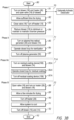
- the method includes placing the items in the chamber, pre-heating and drying them in an open-loop, disinfecting using a closed loop circulating system to supply bactericidal free radicals generated by an electric discharge with free radicals in antimicrobial liquid to the chamber, then flushing and drying the system in an open-loop.
- Various facets can be self-contained allowing for portability and/or adaptation to relatively large scale commercial applications and/or to sterilize, disinfect, sanitize, and/or decontaminate facilities such as operating rooms, hospital rooms or entire buildings.
- Some facets described herein can also be used for reducing or removing the build-up of mold, bacteria, biofilm, and other pathogens which may arise in appliances having closed spaces such as dishwashers, clothes dryers, and/or washing machines, particularly front loading washing machines and refrigerators.
- the present application provides for various systems, devices, and related methods for sterilizing, disinfecting, sanitizing, and/or decontaminating a variety of items, ranging from surgical equipment or other medical devices to electronic equipment, as well as services, rooms, and other items including, but not limited to soft goods, foods, and related manufacturing equipment.
- sterilizing shall be appreciated to not only encompass the removal of all or substantially all microorganisms and or other pathogens from an object or surface but shall also encompass (unless otherwise specified) disinfection, sanitizing, and decontamination.
- a system for sterilization that comprises a free radical generator, a vaporizer, and a chamber that encloses or otherwise contains items to be sterilized.
- these components are directly connected to one another, e.g., are a unitary device.
- conduits connect the respective portions of the system together in a combination of one way, or two-way, fluidic connections between the various components.
- the system additionally comprises a controller element.
- the controller element serves to integrate and coordinate the function of the various components of the system for example cycle duration, amount of free radicals generated and introduced into the chamber and the like.
- facets further comprise a flow distributor.
- the flow distributor is fluidically connected with the free radical generator in the vaporizer.
- the free radical generator in the vaporizer can be positioned in parallel with respect to one another, or in series, with either the vaporizer or the free radical generator occupying the first position in the series, depending on the facet.
- the flow distributor is fluidically connected with the free radical generator and/or the vaporizer by way of one or more conduits.
- one or both of the conduits can also comprise a filter element that functions to remove particulate matter and/or other materials from the gas being passed from the flow distributor to the free radical generator and/or vaporizer.
- filters such as charcoal filters, HEPA filters, and the like, as discussed in more detail below.
- a fluidic connection is also provided, in several facets between the free radical generator into the vaporizer and the chamber.
- these conduits convey either independently or in a joined format, the effluent is generated from the free radical generator and/or vaporizer.
- a first conduit delivers the free radicals to the chamber and a second conduit delivers vaporized sterilant to the chamber.
- two independent conduits meet at a junction point such that the flow of free radicals and vaporized sterilant are combined prior to, or concurrent with, entry into the chamber.
- either the controller and/or the flow distributor adjust the relative distribution of free radicals and vaporized sterilant that are combined and subsequently pass into the sterilization chamber.
- the combination of the free radical generator, sterilant vaporizer, and flow distributor (as well as their respective fluidic conduit connections) are collectively referred to herein as the effluent generator.
- the sterilant chamber prior to the initiation of the sterilization cycle the sterilant chamber is purged and the gaseous contents of the chamber are exited to the environment through this additional bifurcated pathway, having been safely filtered with free radicals destroyed, such that the output to the environment is functionally inert.
- the purge valve can be closed and the additional blower exhaust fan can be disengaged, thereby allowing sterilization system to operate in a closed loop fashion - in other words, free radicals and vaporized sterilant from the effluent generator enter the interior compartment of the sterilization chamber, exit the interior of the sterilization chamber and are recycled via conduit back to the effluent generator via the flow distributor, that is controlled by the controller element.
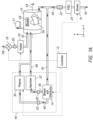
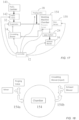
- FIGS. 1 through 2 and 4 through 7 show block diagrams of a sterilization system, illustrating various facets of the present disclosure that use a sterilization chamber.
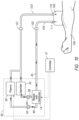
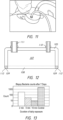
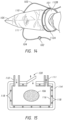
- FIGS. 10 to 12 and 14 to 15 show additional facets using a wound chamber.
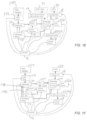
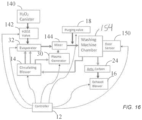
- FIGS. 16 to 18 show further facets incorporated into a washing machine, though it shall be appreciated that these facets are readily adaptable, based on the disclosure provided herein, to other appliance types.
- various facets described herein may apply to healthcare (e.g. acute care settings, point of care settings, and/or long term care setting), industrial, and/or consumer applications.
- Various facets described herein may also apply to an entire room or a commercial or residential building.
- the term "sterilize,” “sterilant,” “sterilization,” etc. may be used in describing certain facets herein, it would be appreciated that such facets can also be used for disinfection, sanitization, and/or decontamination.
- the sterilization systems disclosed herein utilize a combination of broad mixture of free radicals (e.g., reactive oxygen and nitrogen species) used in sterilizing and decontamination devices to sterilize items placed in the sterilization chamber, or over which the wound chamber is placed.
- free radicals e.g., reactive oxygen and nitrogen species
- Various facets can be self-contained, small, light-weight, and portable. In some instances, some facets can be battery operated or powered by hand. In other examples, some facets can be scaled to larger volume.
- the chamber can be custom shaped to fit objects of a particular size or shape.
- the chamber is unitary with the remainder of the system, while in some facets, the chamber is a separate, modular piece of the system.
- the chamber comprises a disposable unit.
- a disposable chamber can be single use, while some facets comprise a multi-use chamber.
- Optionally included in such multi-use formats are indicators for the life-cycle of the chamber, for example indicating a number of cycles remaining before replacement is recommended.
- the system optionally comprises a fixed chamber (e.g. integrated or otherwise operably connected with a controller unit and/or blower/distributor - in essence, a one piece or minimal piece type system).
- a fixed chamber e.g. integrated or otherwise operably connected with a controller unit and/or blower/distributor - in essence, a one piece or minimal piece type system.
- the conduit plumbing discussed in more detail below, is directly into and out of the chamber.
- a chamber size provides a significant degree of volume within the sterilization/disinfection chamber vis-à-vis the overall size of the system.
- such an approach in several facets, provides enhanced consistency of airflow within the chamber, thereby providing for highly consistent and efficacious sterilization/disinfection of a variety of different types and shapes of devices.
- the chamber is optionally removable from the remainder of the system. While several facets of such an approach does require additional connectors between the removable chamber and the effluent generator, or other components of the system, a removable chamber approach advantageously allows for a very compact size of the system when not in use (e.g., the chamber can be removed, stored separately, folded or otherwise compacted/disassembled). Additionally, such an approach is advantageous because a plurality of chambers of different sizes can be provided for in a single system, thereby allowing a corresponding chamber size to be used with an item to be sterilized/disinfected of a certain size. Such an approach improves overall efficiency of sterilant/disinfectant use, so that an appropriate amount of sterilant/disinfectant is provided for a device of a given size.
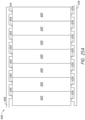
- a plurality of items are sterilized or disinfected simultaneously. While in some facets, this involves simply placing the plurality of items within the chamber, in additional facets, specialized apparatuses are used. For example, in several facets, there is provided a specialized apparatus for disinfecting or sterilizing the exterior of a plurality of devices while simultaneously disinfecting or sterilizing a lumen of each of the devices.
- the sterilization/disinfection systems disclosed herein comprise an endoscope rack or manifold that sterilizes and disinfects endoscopes and similar devices, including other lumen containing devices.
- the endoscope rack can be used with scopes related to the following fields, gastroenterology, endoscopic ultrasound scopes, pulmonology, ENT (ear, nose, and throat), speech, and urology.
- scopes with working channels such as for biopsy or suction can be used with the endoscope rack.
- the endoscope unit (a term that encompasses units to sterilize/disinfect other lumen containing devices) allows the endoscopes or other devices to remain within the unit (either in a bulk section or in individual sections, and maintain sterility while inside the unit.
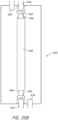
- the unit may optionally further comprise an adapter configured to fluidically connect with a blower that conveys sterile or disinfected air into the working channel of the endoscope until it is dry.
- the conveyed air is heated and/or dehumidified.
- the material that makes up the inner wall of the chamber can vary depending on the facet.
- the chamber comprises a non-conductive, non-corrosive, or otherwise non-reactive material, such that the inner wall of the chamber does not react with the steriliant.
- Suitable materials include, but are not limited to, glass, plastics, polymers, metals, stainless steel (e.g., 304 or 316 stainless), ABS plastic, aluminum, bronze, carbon graphite, cast iron, ceramic (AL203), ceramic magnet, CPVC, EPDM, epoxy, Hastelloy-C ® , Kel-F ® , LDPE, natural rubber, NORYL ® , nylon, polycarbonate, polypropylene, PPS (Ryton ® ), PTFE (Teflon ® ), PVC, PVDF (Kynar ® ), silicone, Titanium, Tygon ® , Viton ® or combinations thereof.
- the inner wall of the chamber may be made of a first material while other layers, including insulating or other layers may be other materials.
- the effluent generator is a sub-unit of a larger system that comprises at least one of a plasma generator (e.g., a free radical generator), a vaporizer (e.g., a unit that generates a vapor of a sterilant, such as hydrogen peroxide, a blower/distributor, and associated conduits to fluidically connect such components.
- a plasma generator e.g., a free radical generator
- a vaporizer e.g., a unit that generates a vapor of a sterilant, such as hydrogen peroxide, a blower/distributor, and associated conduits to fluidically connect such components.
- the effluent generator comprises all of those components, though in other facets only a portion of those are included in the effluent generator.
- the other components may be housed elsewhere in the system or are integrated into the system externally (e.g., a system may be coupled to an existing blower at a site where sterilization
- the vaporizer comprises a "bubbler” or “aerator” or other “evaporator” element, in which the gas passes through a container of liquid to yield a vapor.
- the vaporizer comprises plates or wicks that hold or are soaked with sterilant and over which the gas passes.
- an electronic device or other motorized device e.g., a shaker, vibration plate, or piezoelectric element
- Various configurations of vaporizers can be employed, depending on the facet.
- the sterilant/disinfectant is wicked up the wicking element and gas is passed across the wicking element or bubbled through the wicking element to yield evaporation, misting, and generally formation of a sterilant/disinfectant vapor.
- the wicking material is baffled in order to enhance the surface area of the wick and increase the efficiency of sterilant/disinfectant vapor formation.
- interwoven layers of wicking material are used, for example a first layer or layers in contact with the sterilant/disinfectant pool that are interwoven with a second layer or layer not in contact with the sterilant/disinfectant, wherein the interwoven section allows transfer of sterilant/disinfectant wicked into the first layer to the second layer.
- evaporation/vaporization can optionally occur passively (e.g., without heat) by the flow of air through the wet wicking material, though in several facets a heating source is used.
- the recycling advantageous allows for the optimized use of the sterilant/free radicals in the effluent, replacing or rejuvenating the required component only when needed.
- sensors in the chamber, the conduit, the blower or other location are used to sense the amount of free radical and/or sterilant and report the amount or concentration to a controller module, which thereafter signals the blower/distributor to adjust flow accordingly.
- this approach allows the system to reach an optimal concentration of sterilant in a reduced amount of time, thereby decreasing cycle times.
- the conduit(s) comprise one or more filters that function to eliminate particulate or other matter from an incoming and/or recirculating gas stream within the sterilization/disinfection system.
- filters that function to eliminate particulate or other matter from an incoming and/or recirculating gas stream within the sterilization/disinfection system.
- a variety of filter types can be used, depending on the facet. For example, in several facets, a HEPA filter is used. In some facets, ionic filters, carbon filters, UV filters, cellulose filters, silica based filters or the like are used, either alone or in combination.
- controller unit that interacts with and/or controls or regulates the operation of one or more of the plasma generator, the evaporator, the hydrogen peroxide cartridge, blowers/fans, valves (if any) as well as the electronics and control boards for the system.
- the controller unit is dimensioned to be wall or counter mounted.
- the controller is integral with, or contained within the effluent generator or the chamber.
- control unit receives information, either from a user or automatically (such as by an identifier on an object to be sterilized/disinfected or a carrier for such object) that is used to determine an appropriate sterilization cycle (e.g., time, concentration of sterilant/disinfectant, pressure change, humidity control, etc.).
- an appropriate sterilization cycle e.g., time, concentration of sterilant/disinfectant, pressure change, humidity control, etc.
- the controller comprises one or more special-purpose computing devices that is hardwired or programmed to regulate the operation of the sterilization/disinfection system.
- the sterilizing/disinfecting system includes at least one heater and/or dryer.
- a dryer may be a desiccant dryer or a dehumidifier utilizing a refrigeration system.
- a heater may be used to preheat the conduits and/or the chamber in order to provide for a dry and warmed environment into which items to be sterilized/disinfected are introduced (e.g., the chamber).
- this approach reduces and/or eliminates condensation that could form in or on an item that is sterilized/disinfected, which could provide a potential future source or site of contamination, for example during storage of the item until next use. See, for example FIG.
- the controller interacts with and regulates the dryer and/or heater to maintain desired humidity levels in the chamber and thereby avoid undesired condensation.
- Biological indicators may also be used, such as a positive control strip or container that comprises a known quantity of a type of biological organism that is desirably eliminated by the sterilization/disinfection system. This indicator can demonstrate visually (or otherwise) that the biological organisms have been rendered inert or killed by the sterilization/disinfection process.
- the indicators can optionally be used directly in the chamber, affixed to an item to be sterilized/disinfected, or in a container or vessel that contains an item to be sterilized/disinfected.
- automated or electronic sensors are used.
- such chemical and/or biological indicators have a quality control function that ensures that a given sterilization/disinfection cycle has run to a required degree of efficacy.
- an additional apparatus or component of the system, that comprises a residual coating deposition device, wherein such a device functions to deposit a residual coating on an item or items in the chamber.
- the residual coating that is bactericidal and may optionally be sacrificial in nature (e.g., removable after potential contamination).
- the residual coating material has bactericidal properties such as silver, copper, or a combination of bactericidal materials.
- the residual coating is biocompatible with human subjects and is preferably used on items that come into contact with patients or other persons (e.g., surgical tools, endoscopes, dental products, infant care products, etc.). Prior to deposition the residual coating material may be in the form of a gas, a liquid, a solid agent that is converted into a liquid during the coating cycle, or other suitable material.
- the containers are custom sized for an item (or items) to be sterilized/disinfected.
- the containers provide a customized insert or relief to house the item (items), for example to protect the item from impact or other forces that could damage the item.
- the containers are hard shell or otherwise rigid.
- the containers are flexible and configured to conform to the general shape of the item.
- the containers are flexible, but provided in a "sized to fit" format.
- the containers are configured to be stackable, able to be hung, or otherwise configured for easy and compact storage.
- the containers are configured to allow the item to be stored within the container until its next use, thereby maintaining the sterile/disinfected item and surrounding environment.
- the containers are configured to allow sterilization/disinfection of items comprising a lumen (or lumens).
- the container is configured to provide a sterilant/disinfectant not only the exterior surfaces of the item, but also to internal lumens.
- the containers comprises a dedicated inlet/outlet for sterilizing/disinfecting the external surfaces of the item, and a second (or more) dedicated inlet/outlet for sterilizing/disinfecting the internal, luminal surfaces of the item.
- customized containers are particularly useful because they allow sterilization/disinfection of large (e.g. long) items that using other approaches would require the items to be stretched out to all or substantially all of their longitudinal links.
- the custom containers provided for in several facets allow a large item to be sterilized/disinfected in a compact footprint, thereby reducing the surface area/volume of space required for a system to accomplish that sterilization, reducing waste (e.g. excessively large packaging) and facilitating storage of sterilized/disinfected items until their next use, even when storage space may be limited.
- the container comprises an identifier that enables the user of the system to determine and initiate a sterilization/disinfection cycle that is optimal for the item to be sterilized/disinfected.
- the systems and devices disclosed herein also optionally comprise one or more organizational unit in order is system carrier or cart.
- the system further comprises one or more trays, drawers, or dividers that are configured to carry, house, or otherwise store various accessories routinely used with the system.
- the system may further comprise an organizational unit that houses a plurality of different types of sterilization/disinfection indicators, such as the indicator strips discussed above.
- the system may comprise one or more accessory units that are configured to assist in integrating the sterilization/disinfection system into the environment in which it is used.
- the disclosed devices, systems, and methods are configured to reduce bioburden on an object or surface (e.g., the number of bacteria or other microorganism, fungus, etc. on a surface that has not been sterilized).
- bioburden testing also known as microbial limit testing, can be used in products or components used in the pharmaceutical or medical field to evaluate microbial levels during processing and handling or after a sterilization/disinfection cycle.
- Bioburden can be a significant source of morbidity or mortality.
- hospitalized patients e.g. patients in an intensive care unit
- a hospitalized patient can be fitted with endotracheal tubes to facilitate respiration.
- Such an endotracheal tube may remain in place within a patient for an extended period of time (e.g. up to 14 days).
- Biofilm contamination of endotracheal tubes within an intubated patient can lead to an increased rate of infection (e.g. pneumonia).
- occurrences of catheter related blood stream infection can increase as a result of the use of invasive medical devices including intravascular catheters.
- Such infections are one of the most common types of bloodstream infection.
- the skin and hub are the most common sources of colonization of percutaneous vascular catheters. The organisms can migrate from the skin to the insertion site along the intercutaneous segment, eventually reaching the intravascular segment of the tip.
- the hub can be a major source of colonization of the catheter lumen, which leads to bloodstream infections through luminal colonization of the intravascular segment.
- the catheter surface can be another factor relating to the pathogenesis of catheter related blood stream infection.
- Organisms that adhere to the catheter surface can maintain themselves by producing an "extracellular slime," a substance rich in exopolysaccharides, often referred to as fibrous glycocalyx or microbial biofilm.
- Microorganisms can bind to the surface of host proteins, such as fibrin and fibronectin, to produce biofilm.
- the prevention of colonization of bacterial and fungal organisms on the surfaces of orthopedic implants has frequently required the use of antimicrobial agents, such as antibiotics, bound to the surface of such devices.
- antimicrobial agents such as antibiotics
- the goal of such attempts has been to produce a sufficient bacteriostatic or bactericidal action to prevent colonization.
- Various methods have previously been employed to coat the surfaces of medical devices with an antibiotic.
- the disclosed devices, systems, and methods can be configured to reduce the bioburden of medical devices through sterilization.
- the disclosed devices, systems, and methods can be used to reduce the presence of bacteria and fungal organisms in other settings that require sterilization.
- this can include, but not be limited to, hospital settings, settings where food is processed, prepared, or served, settings where individuals with a compromised or decreased immune system live or have access to, environments with a high rate of bacteria buildup (e.g. bathrooms, daycare centers, public transportation, etc.).
- a liquid sterilizing/disinfecting agent or a solid agent that is at least partially converted to a liquid during a sterilization/disinfection cycle is used.
- a liquid sterilizing/disinfecting agent such as hydrogen peroxide solution is used.
- hydrogen peroxide as the sterilizing/disinfecting agent, it will be appreciated that the system is also applicable to other solutions and/or pure liquids, such as peracetic acid, formalin solution, aldehydes such as formaldehyde, propriolactone, chlorine dioxide, and the like.
- Concentrations can range, in several facets, from about 30% to about 60% concentration, e.g., about 30%, about 35%, about 40%, about 45%, about 50%, about 55%, or about 60% concentration.
- the vapor pressure of the sterilant/disinfectant is maintained at or below the saturation level in the sterilization chamber (e.g., for the pressure and/or temperature inside of chamber). In several facets, this approach reduces or eliminates condensation buildup on the items being sterilized, on the walls of the chamber, and on other components exposed to the sterilant/disinfectant, such as hoses and fittings described herein.
- the disclosed devices, systems, and methods can be operated at an ambient pressure, e.g., a pressure approximately equivalent to the atmospheric pressure in a given location (e.g., sea level vs. mountain).
- the pressures employed in the systems and devices disclosed herein range from about 800 hectopascal (hPa) to about 1067 hPa, including about 800 to about 813, about 813 to about 826, about 826 to about 839, about 839 to about 853, about 853 to about 866 about 866 to about 879, about 879 to about 893 about 893 to about 906, about 906 to about 920, about 920 to about 933, about 933 to about 947, about 947 to about 960, about 960 to about 973, about 973 to about 987, about 987 to about 999, about 999 to about 1013, about 1013 to about 1027, about 102 to about 1040, about 1040 to about 1053, about 1053 to about 1067, and
- the ambient pressure can be pre-programmed and/or adjustable by a user. This can allow the disclosed device, system, and method to be adaptable for a variety of different items to be sterilized. Moreover, in several facets, the relatively ambient pressure can be adjusted as needed to further reduce the potential for condensation formation within the chamber and/or on/in devices to be sterilized/disinfected. Additionally, while various facets can be utilized in approximate room pressures, in some instances, varying the speeds of blowers/distributors, conduit size/valve position, allows for use of slight negative or positive pressure. In some facets, a slight negative pressure may advantageously keep the effluent within the system as a safety precaution. In some facets, the pressure may be approximately 0.98 -1.96 hPa lower than ambient pressure.
- the disclosed devices, systems, and methods operate in a closed loop.
- a closed loop system the system does not rely on matter exchange external to the system.
- sterilization/disinfection vapors can be recirculated. In several facets, this increases the efficiency of the system as the recycled vapors still provide potential sterilization/disinfection effects.
- a carrier gas such as air
- a hydrogen peroxide aqueous solution can be introduced into the vaporizer and enables the solution to be vaporized.
- the resulting vapor is then combined with the carrier gas and introduced into a sterilization chamber of varying size, shape, and material.
- a blower can exhaust the carrier gas from the sterilization chamber and recirculate the carrier gas to the vaporizer where additional vaporized hydrogen peroxide is added.
- an open loop system is also provided in several facets, to provide free air venting.
- the system is configured to allow gases to be vented into the external environment.
- gases can be vented before, after, or during sterilization.
- all gases can be purged and the gaseous contents of the chamber are purged to the environment.
- the open loop system can include inlets to allow independent entrance into the system.
- each of the inlets can comprise one or more valves that provide for selective flow of air into the open loop system.
- the open loop system can include a filter element that filters environmental air and allow it to pass into the system.
- an open loop system is for the purpose of pre-heating (optionally) and drying the chamber 10 before and after the circulation of bactericidal effluent through the closed loop system.
- the open loop system uses a flow generator (e.g., an exhaust pump, an air conveyor, a fan, or a blower), exhausting to atmosphere to draw air from an air input through an input (and an optional heater).
- the input air may optionally be filtered by filter
- the output of the chamber is drawn out by a blower and passes through a conduit and a free radical destroyer.
- the open loop approach is implemented initially, such that the chamber, and items within the chamber, can be dried and pre-heated before implementing closed loop operation. Likewise, after sterilization/disinfection, an open loop operation can be reinstated, depending on the facet.
- moisture control/humidity regulation is important to reduce or avoid unwanted condensation.
- moisture deposition can cause adverse effects on the articles being sterilized/disinfected.
- excessive condensation could potentially create electrical shorts and otherwise damage the electronic devices.
- residual condensation on a device can reduce the efficacy of sterilization/disinfection, or provide a "safe harbor" for future growth of microorganisms or mold during storage.
- a desiccant or other chemical composition that is designed to absorb moisture is provided for use in conjunction with the system.
- the desiccant is provided within the conduits leading into, or exiting, a sterilization/disinfection chamber.
- the desiccant functions analogously to a filter for particulate matter, however serves to remove moisture from the gases entering or exiting the sterilization/disinfection chamber.
- a desiccant reservoir is provided within the sterilization chamber to aid in controlling the relative moisture content within the chamber before, during, or after a sterilization/disinfection cycle.
- a target humidity level is recommended for a given type of device to be sterilized/disinfected or the degree to which a device, or surface, is to be sterilized are disinfected.
- the target relative humidity range is between about 10% to about 50% including about 10% to about 15%, about 15% to about 20%, about 20% to about 25%, about 25% to about 30%, about 30% to about 35%, about 35% to about 40%, about 40% to about 45%, about 45% to about 50%, and any relative humidity between those listed, including endpoints.
- greater degrees of humidity can be provided for within the sterilization chamber, in combination with a heating and/or drying cycle within the sterilization/disinfection protocol.
- various facets may be operated at ambient conditions (e.g., room temperature). However, some facets allow for controlled or automatic regulation of the temperature in the chamber. In several facets, lower ambient temperatures slow the sterilization process, which may be advantageous in several facets. Likewise, in several facets, a higher ambient temperature accelerates the process.
- ambient conditions e.g., room temperature
- chamber 10 further contains a container of custom size and shape based on the device or devices to be sterilized, disinfected, sanitized, and/or decontaminated inside the container.
- the custom sized container inside chamber 10 contains only one device and the container is custom sized to fit that individual device.
- the container inside chamber 10 contains a set of devices and the container contains recesses shaped to hold each individual device.
- an adaptor attaches to the container and delivers sterilant to the container.
- the sterilization cycle for the device is decreased due to the direct, individualized exposure to the sterilant within the custom sized container.
- the maintenance cycle is designed to maintain the sterility/disinfection of the endoscope during storage and before use.
- the endoscope could be placed in the endoscope rack and sterilized at night and stored for use in the morning. Use of the maintenance cycle on the endoscope rack would ensure that the endoscope is sterile/disinfected for use in morning procedures.
- the maintenance cycle could be run, for example, once every four hours while the endoscopes are stored overnight.
- a set timer could be used to initiate maintenance cycles throughout the night or the duration of storage in the endoscope rack.
- each endoscope rack would have light indications that coordinate with the current cycle of the endoscope rack.
- the plasma generator 30 and the vaporizer 32 are disposed in parallel.
- the vaporizer 32 and the plasma generator 30 are disposed in series, e.g., with the vaporizer 32 placed prior or after the plasma generator 30.
- a dryer may be placed a prior to the plasma generator 30.
- the fresh (heated or not heated), filtered air is introduced into the chamber 10 through conduit 42.
- the closed loop blower/distributor 14 may remain on, if desired, so as to circulate air through the closed loop to dry the free radical source 46 and vaporizer 32.
- Heater 26 may optionally be turned on at this stage, as well, so that heated air is circulated through the vaporizer in order to evaporate residual remains of liquid solution of hydrogen peroxide.
- blower/distributor 14 may be turned off if it is not desired to circulate air through the closed loop portion of the system during this drying step.
- a controller 12 is provided in order to control the operation of the various parts of the system.
- various facets may be operated at ambient conditions (e.g., room temperature). Such facets may be advantageous in hospital settings where air conditions and humidity are controlled. However, some facets may adjust the conditions within the chamber 10 to a more effective environment. For example, if the ambient temperature were too cool or too warm, some facets are configured to self-regulate or control the temperature in the chamber 10 to a desired temperature (e.g., within an operating range for sterilant effectiveness).
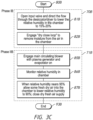
- Another aspect of the sterilizing cycle is to control Relative Humidity in the chamber. The humidity can be varied during the cycle from lower humidity at the beginning of the cycle to higher humidity toward the end of the cycle depending on the initial conditions of the items to be sterilized. For example, some items may contain residual moisture from washing or were stored in moist environment. In such case it is necessary to remove the residual moisture from the items in order to accomplish full sterilization.
- additional purge valves and methods may be incorporated, such as to purge the vaporizer 32 at various intervals and to bled out hydrogen peroxide (e.g., in case of shipping or transport or when the hydrogen peroxide decomposes below the desired w/w% level)).
- Moisture control is also important in the sterilization process when items or their parts to be sterilized are wet and pathogens are "hiding" under a layer of moisture preventing the access of free radicals in the sterilant to the pathogens. In such conditions part of the sterilization cycle is to maintain the circulating sterilant at much lower relative humidity level in order to remove the remnants of the moisture from the article. In some facets where there is a layer of moisture preventing access of free radicals in the sterilant to the pathogens, the target relative humidity level is maintained at 20-30% for some amount of time before the sterilization process is started.
- the vapor pressure of the sterilant may be maintained at or below the saturation level in the sterilization chamber (e.g., for the pressure and/or temperature inside of chamber 10).
- various facets can reduce or eliminate condensation buildup on the items being sterilized, on the walls of the chamber 10, and on other components exposed to the sterilant, such as hoses and fittings described herein.
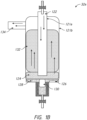
- FIGS. 1B-1D illustrate some examples of evaporators 32a, 32b, and 32c configured to control the vapor pressure of the sterilant.
- Each of evaporators 32a, 32b, and 32c is usable as the vaporizer 32 in all of the facets described herein and may produce, in many instances, a substantially non-condensing output.
- the float 130 can include a magnetic switch float such as, for example, 9FS01-0112 manufactured by Strain Measurement Devices, Inc. 55 Barnes Park North, Wallingford, CT 06492. Based on the position of the float 130, the controller 12 can open or close an intake valve to maintain the desired level of sterilizing agent 128.
- a magnetic switch float such as, for example, 9FS01-0112 manufactured by Strain Measurement Devices, Inc. 55 Barnes Park North, Wallingford, CT 06492.
- the controller 12 can open or close an intake valve to maintain the desired level of sterilizing agent 128.
- the evaporator 32a may comprise a piezoelectric transducer 126 (or other suitable vibration element).
- the piezoelectric transducer 126 may be configured to create a mist 124 of the sterilizing agent 128, which may be absorbed by wicking material 132.
- the evaporator 32a may take in gas (e.g., air or other medium) at intake 122.
- gas e.g., air or other medium
- the intake 122 may extend below the level of the sterilizing agent 128, such that the incoming gas bubbles through the sterilizing agent 128, encouraging evaporation and misting.
- the gas may then pass through mist 124.
- the flow of the gas may assist in the formation of mist 124.
- the flow of the gas may cause some of the sterilizing agent 128 to move into the lower regions of the wicking material 132. Evaporation of the sterilizing agent 128 may occur primarily within the wicking material 132, which is at least partially saturated with sterilizing agent 128.
- the wicking material 132 may be formed from a porous material that, due to its porous nature, has a large internal surface area which enhances evaporation.
- the upper portions of wicking material 132 may remain relatively dry.
- the wicking material 132 may serve to both encourage evaporation and to reduce/avoid producing vapor that is over-saturated (e.g., to avoid or minimize formation of droplets or mists of the sterilizing agent 128 at the output 134 of the evaporator 32a).
- the float 130 may include a level control float sensor/switch 130 configured to regulate the level of sterilizing agent 128.
- sterilizing agent 128 may be received through the float switch 130.
- float sensor/switch 130 may sense a drop in the level of the sterilizing agent 128 and open an intake valve to refill the sterilizing agent 128 in the evaporator 32a.
- a sensor may be provided that measures the level of sterilizing agent 128 and a controller (e.g., controller 12 shown in FIG. 1A ) may open or close an intake valve in response to measurements from the sensor at the beginning of each cycle.
- controller e.g., controller 12 shown in FIG. 1A
- Other examples of liquid level measurement devices include using a laser or a mechanical switch.
- the wicking material 132 and other components of the evaporator 32a that may come into contact with the sterilizing agent 128 may comprise materials that are resistant to the sterilizing agent 128 (e.g., hydrogen peroxide).
- the wicking material 132 and other components of the evaporator 32a that may come into contact with the recirculated sterilant may comprise materials that are also resistant to the sterilant (e.g., which may include ozone).
- FIG. 1C illustrates an evaporator 32b in which the piezoelectric transducer 126 is omitted.
- the liquid sterilizing agent 128 may be transferred to the wicking material 132 by the gas flowing through the evaporator 32b (e.g., by bubbling, by direct liquid surface deformation, etc.).
- wicking material 132 may be extended into sterilizing agent 128 (e.g., the sterilizing agent 128 may be maintained at a level that is in contact with wicking material 132) such that no bubbling or misting is required to draw the sterilizing agent 128 into the wicking material 132.
- wicking material may be used, e.g., a first wicking material that contacts the sterilant directly and is interwoven or overlaid (optionally reversibly) with another wicking material (optionally of the same type as the first) that is relatively permanent to the device (though it is optionally replaceable).
- a first wicking material that contacts the sterilant directly and is interwoven or overlaid (optionally reversibly) with another wicking material (optionally of the same type as the first) that is relatively permanent to the device (though it is optionally replaceable).
- FIG. 1C also illustrates that the output 134 may be arranged in a different way.
- FIG. 1D illustrates an evaporator 32c that may include an input 136 and/or a drain 138 for the sterilizing agent 128.
- float switch 130 or other suitable mechanism may maintain the level of the sterilizing agent 128 in the evaporator 32c by adding sterilizing agent 128 from input 136 and/or by removing sterilizing agent 128 from drain 128.
- the evaporator 32c may be drained through drain 138. By draining the sterilizing agent 128 through drain 138, the evaporator 32c can, if desired, be quickly dried out (e.g., to reduce any danger of any remaining hydrogen peroxide).
- Drying out the evaporator 32c may include passing air through the wicking material 132 to absorb any remaining sterilizing agent 128. Additionally, maintaining a particular level of sterilant, in several facets, optimizes the overall process, as too much or too little sterilant being incorporated into the effluent can lead to inefficient sterilization, while too much may damage the items to be sterilized.
- evaporation can occur passively (e.g., without heat) by the flow of air through the wet wicking material. In some instances, equilibrium between liquid and vapor can be reached at or below the saturation level. Accordingly, various facets may simply adjust the saturation level of the sterilizing agent 128, but need not adjust the concentration of the sterilizing agent 128. Also, by controlling the level of moisture, certain facets do not require the use of heat in the vaporizer 32.
- FIG. 1E illustrates an example facet that may be used to regulate the water vapor saturation level as well as the sterilant vapor saturation level within the sterilization chamber 10.
- Some facets include other features as described herein such as a hydrogen peroxide canister 140, a hydrogen peroxide valve 142 that feeds hydrogen peroxide into evaporator 32, and a door sensor 150 that determines when chamber 10 is open and/or closed.
- Some facets may also include a mixer 144 in which the sterilant vapor and plasma effluent are mixed before entering chamber 10.
- various facets may include a sensor 52 in the chamber 10.
- the sensor 52 may include one or more humidity sensors (sometimes referred to as hygrometers), one or more temperature sensors, and/or one or more pressure sensors.
- Some facets may also include an input pressure control valve 19.
- controller 12 may use sensor 52 to determine when the vapor saturation level within chamber 10 is approaching a threshold level likely to produce undesired condensation (e.g., when the vapor level is approaching saturation). For example, when the pressure difference between the chamber 10 and the outside environment reaches a set value (e.g., the threshold level), controller 12 may send an appropriate control signal to increase the power of the exhaust blower 16. This opens the input pressure control valve 19 to allow fresh, dry air (e.g., air dried by dryer 23) into the chamber 10 to reinstate the pressure in the chamber 10.
- a threshold level likely to produce undesired condensation
- some facets may include a direct valve 19 instead of the input pressure control valve.
- controller 12 may send an appropriate control signal to open the direct valve 19 to allow fresh, dry air (e.g., air dried by dryer 23) into the chamber 10.
- the exhaust blower 16 removes effluent from the chamber 10 to maintain the prescribed pressure difference between the chamber 10 and ambient environment.
- controller 12 may activate or increase (or decrease) the speed of exhaust blower 16, may activate or increase (or decrease) the speed of an intake blower such as dryer 23, may activate or increase (or decrease) the heating power of a drying unit attached to the air intake such as dryer 23, may partially or fully open the purging valve 18, may take other suitable steps, or may take any combinations of these and other steps.
- controller 12 may cycle the introduction of fresh air (e.g., stop adding fresh after the vapor levels fall to a second and lower threshold).
- controller 12 may modulate the amount of fresh air introduced into the system in real time in order to maintain the vapor levels at a desired level or within a desired range.
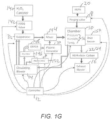
- FIG. 1F and 1G illustrate additional example facets configured to help maintain desired vapor saturation levels to reduce or avoid undesired condensation.
- Such facets may control the vapor saturation level within the sterilization chamber 10 by incorporating a dryer 148 in the recirculating loop of sterilant, e.g., prior to the plasma generator 30.
- the circulating vapor that exits the plasma generator 30 may be slightly dryer than the vapor exiting the evaporator 32 resulting in a dilution of the vapors in the mixer 144 and lowering the saturation level to below the set level (e.g., the condensation level).
- Dryer 148 may be any suitable dryer.
- dryer 148 may be a desiccant dryer or a dehumidifier utilizing a refrigeration system.
- the residual coating device 158 generates a residual coating liquid or vapor that is conveyed to chamber 10 and deposited on items within chamber 10.
- the residual coating may be a material that has bactericidal properties such as silver, copper, or a combination of bactericidal materials.
- the residual coating may be formed from materials that are compatible with the items the coating is deposited on and may also be biocompatible with human subjects, especially in arrangements in which the items the coating is deposited on are items that come into contact with patients or other persons (e.g., surgical tools, endoscopes, dental products, infant care products, etc.).
- the residual coating material contained in canister 158 may be a gas, a liquid, a solid agent that is converted into a liquid during the coating cycle, or other suitable material.
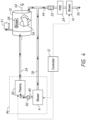
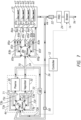
- the effluent generator 46 could be made with only one of the sources--either a plasma generator 30 ( FIG. 4 ) or a vaporizer ( FIG. 5 ).
- the blower/distributor 14 from FIG. 1A is replaced by a blower 4, since with only one source there is no need for distribution.
- a blower distributor may still be used, in order to generate modular systems that can be varied between use of plasma or vapor at one point, and plasma and vapor at another point.
- the open loop pre-heater system with its heater 26, filter 20 and valve 18 is omitted as well, to illustrate a variation where there is no pre-heat capability.
- FIG. 2 illustrates an facet appropriate for more rigid items 62, such as laboratory glassware, surgical implements, dental tools, etc.
- the items 62 may be put on shelves 60, the shelves preferably being made of wire or perforated to allow free circulation of effluent around the items 62.
- a portion of the sterilant gas can be forced through the instruments 67, while the outer surfaces of the instruments 67 are sterilized by the effluent in the chamber, as discussed below.
- one or more additional conduits can be supplied with sterilant gas from the effluent input conduit 34--this is shown in FIG. 2 as tubing (e.g., a flexible hose 63).
- the hose 63 is equipped with one or more appropriate adapters and/or connectors 65 to plug into the handpiece 67.
- the tubing can be made of any material, e.g., a material that is resistant to free radicals and/or reactive species (e.g., of hydrogen peroxide).
- the tubing can be made of Tygon ® , Teflon ® , and or polyvinyl chloride.
- the tubing can be made of any material having an inner coating or sleeve of such resistant material.
- a circulating blower 28 can be used to increase effluent turbulence in the chamber.
- the blower 28 can be placed in the chamber 10, as shown in FIG. 1A , or outside, connected to the chamber by ducts, as shown in FIG. 2 .
- various facets can be used at ambient temperature.
- a heater 64 can be put in the ducts to heat the air circulated by the blower 28, or, alternatively, the chamber may be directly heated by elements 66 either in the chamber or attached to the walls of the chamber.
- a heater can be used in any of the facets described herein although not shown in the figures.
- a sensor e.g., a temperature sensor 52
- the controller 12 can then maintain a selected temperature in the chamber 10 by reading the temperature through sensor 52 and controlling chamber heaters 64 and/or 66 as needed.
- Other sensors e.g., pressure, humidity, etc. can also be used.
- a carrier gas 53 such as air, oxygen, nitrogen, carbon dioxide, helium, argon, or a combination of carrier gases, can be introduced into the effluent generator 46 to be mixed with the effluent in the closed system. This can be done as an additional input to blower/distributor 14, as shown in FIG. 2 .
- FIGS. 8 and 9 show a multiple-output centrifugal blower which is used with the facets as shown in FIGS. 6 and 7 .
- the centrifugal blower used in this facet is a novel development on the centrifugal blowers and "squirrel-cage" type blowers.
- the blower 90 has a central input 91 for drawing gas to be distributed by the blower 90 into the blower housing 93.
- a plurality of tangential outputs 92 are provided, each output providing a stream of gas in approximately equal amounts.
- the number of outputs 92 can vary within the teachings of the disclosure, depending on the requirements of the design. As examples, twelve outputs are shown in FIG. 8 and seven in FIG. 9 , while blower 74 in FIGS. 6 and 7 has eight outputs and blower 84 has seven outputs. Other facets can employ alternative numbers of inputs and/or outputs.
- a central impeller 94 inside the housing 93 is rotated by a conventional motor 100.
- the motor can be electric, or powered by hydraulic fluid or compressed air, or any other motive force known to the art.
- the impeller 94 is here shown as centrifugal impeller" type, which has a plurality of curved blades 95. As the impeller 94 is rotated at high speed, air from input 91 is flung outward by centrifugal force and the action of the blades 95, and is expelled through tangential outputs 92.
- the impeller 94 may be designed with plastic, but other materials may be used, e.g., non-reactive metals, etc.
- FIG. 6 shows how a multiple-output blower can be used within the teachings of the disclosure as the blower-distributor 14 of FIG. 1A .
- the effluent generator 46 uses multiple-output blower 74 to apportion the effluent returning from chamber 10 through conduit 36 between the plasma generator 30, the vaporizer 32, and an optional bypass heater 68.
- the outputs of the plasma generator 30, vaporizer 32 and bypass heater 68 are combined together at a junction 70, the combined effluent streams flowing into the chamber 10 through conduit 34 as in previous figures.
- the outputs 73a-73h of the blower 74 each carry an output flow which is a fraction of the total output flow of the blower approximately equal to the total flow divided by the number of outlets. Therefore a desired portion of the effluent can be chosen by combining an appropriate choice of the number of outputs, with the output of the manifold being approximately equal to the number of blower outputs being combined divided by the total number of outlets available. Multiple outputs can be combined using manifolds, such as manifold 71 to which outputs 73a-73c are input, or manifold 72 which combines the flow from outputs 73d-73g. Output 73h is connected directly to the bypass heater 68.
- blower 74 has eight outputs 73a-73h, so each output carries approximately one eighth or 12.5% of the total output of the blower. Therefore, in the arrangement of this example, manifold 71 receives three eighths (37.5%) of the flow, and the output of the manifold feeds this flow to plasma generator 30 through conduit 75. Similarly, manifold 72 receives four eighths (or one half) (50%) of the flow through conduit 76, the output of which is connected to vaporizer 32. Bypass heater 68 receives one eighth (12.5%) of the flow directly from a single output 73h, which could be thought of as a manifold with a single input. Other proportions between the plasma generator 30, vaporizer 32, and/or bypass heater 68 are possible.
- FIG. 7 shows the third facet used with a fixed chamber for sterilizing items such as endoscopes, catheters, or dental handpieces 67 (or other medical tools having lumens or other interior conduits or spaces which should be sterilized), as in the second facet of FIG. 2 .
- Shelves 60 can be provided to support the tools 67, as needed.
- the effluent conduit 34 is used to feed a second multiple-outlet centrifugal blower 84.
- the multiple outputs 83a-83g of blower 84 are used individually to feed multiple users of the effluent, rather than being combined to apportion flow as with outputs 73a-73h of blower 74.
- the outputs 83a-83f of blower 84 are fitted with shut-off valves or quick-disconnect fittings 85a-85f, of any kind known to the art.
- Flexible hoses 86a-86f are plugged into fittings 85a-85f to conveys effluent from the fittings 85a-85f to connectors or adaptors 87a-87f, into which the handpieces 67 can be plugged to sterilize the insides of the handpieces.
- Output 83g of blower 84 is routed directly to chamber 10, to supply effluent to the chamber for sterilizing the outside of the handpieces 67, as well as any other contents of the chamber.
- the outputs 83a-83f of blower 84 can be fed directly into the chamber 10 with the hoses 86a-86f connected inside the chamber 10.
- the chamber 10 may be separated into multiple chambers such that it may be possible to adjust and/or remove one item from within the chamber 10 without affecting another item within the chamber 10.
- some facets may include a separate exiting rigid or flexible chamber such that one of the items can be conveyed to the exiting chamber prior to removal without affecting another item within the chamber 10.
- Some facets may incorporate quality control and/or regulatory compliance indicators.
- some facets may provide an indicator (e.g., disposable, semi-disposable, or non-disposable) on the shelf 60 for each item (e.g., instrument 67).
- some facets may provide a removable holder for each separate item with the indicator place within or on the holder. The holder can be placed within the chamber 10 and connected accordingly.
- each item can have its own indicator and traveling container. Other examples are possible.
- FIGS. 10-12 show how certain facets can be used with an open-sided portable wound chamber 105 to apply effluent to an open wound on a patient. Such application has been shown in experiments to promote healing.
- FIG. 10 shows how the system of some facets is used in this application.
- Effluent generator 46 recirculates effluent from conduit 36 to conduit 34, as described in the preceding facets. It will be understood that while the effluent generator 46 is shown in FIG. 10 in the version used in FIGS. 1A and 2 , the effluent generator 46 could also be any of the other versions described herein or in application Ser. No. 12/510,341 (now U.S. Patent No. 8,221,679 ). If desired, plasma generator 30 or vaporizer 32 may be omitted. In various arrangements, medication or other treatment may be added to the circulating sterilant.
- the wound chamber 105 is shown in FIG. 12 in a sectional view.
- the chamber 105 has a body 107 with an open bottom 108.
- the edges 109 around the open bottom 108 can be simply rounded off, or could be provided with flexible or resilient sealing material 112 to facilitate a tight seal against a surface.
- Connectors 110 and 111 provide mechanisms for connecting input and output hoses, respectively, to route the flow of effluent to and from the chamber.
- the connectors could be the same size, or, as shown in FIG. 12 , the input connector 110 could be of smaller diameter than the output connector 111.
- the output conduit 34 of the effluent generator feeds a wound chamber 105 through a flexible hose 103 which connects to appropriate connectors 101 and 110 at each end.
- Return effluent from the wound chamber 105 passes through flexible hose 104 with connectors 102 and 111 into return conduit 36, to be recirculated back through the effluent generator 46.
- the chamber 105 is placed upon the body of the patient (here shown as an arm 106), over the wound to be treated. The chamber 105 is pressed firmly against the body 106, and the sterilizer is operated for a selected period of time.
- the wound chamber 105 may be designed to maintain separation from the patient's wound(s).
- the wound chamber 105 may be filled with circulating sterilant at a positive pressure, thereby inflating the wound chamber 105.
- Wound chamber 105 may include structures as collar 112A and cuff 112B that enable chamber 105 to be placed over a limb and sealed to the limb.
- any suitable mechanisms for sealing the wound chamber 105 to a patient may be used. Examples of such suitable mechanisms include flexible cuffs, tape, straps, zippers, snaps, clips, buttons, and other mechanical implementations.
- Access ports such as access port 120 may be provided for the placement of a sensor inside of chamber 105 (e.g., to provide sealed pathways for cabling to and from such sensor) and to provide medical providers with access to the patient's wounds for any purpose.
- wound chamber 105 may be formed from any suitable materials.
- materials that come into contact with the sterilant should be safe to contain the sterilant and materials that come into contact with patients should be biocompatible.
- FIG. 14 illustrates wound chamber 105 sized for a patient's arm
- wound chamber 105 may be provided in alternative forms sized for patients of different sizes and ages, a patient's leg, a chest, or even an entire body (with an opening enabling the patient to breathe).
- the engagement structure 220 can be a clasp, a lock, or any other structure that can secure the two halves of the chamber 210.
- the inlet 244 and the outlet 234 are located on the exterior of the chamber 210 to allow sterilant to be received and circulated into and out of the chamber 210.
- the insert 340 can be configured to provide a custom sized fit for receiving a plurality of devices.
- the insert 340 inside chamber 310 can contain recesses shaped to hold each of a plurality of devices.
- Figure 24 illustrates an example of an insert 340 configured to receive and secure a plurality of devices for sterilization/disinfection.
- This can include, for example, a sterile kit that includes a plurality of items such as a first item 340a (e.g. scissors), a second item 340b (e.g. scalpel), a third item 340c (e.g. catheter), a fourth item 340d (e.g. forceps), a fifth item 340e (e.g. suture), a sixth item 340f (e.g. hemostat), and a seventh item 340g (e.g. syringes).
- a sterile kit that includes a plurality of items such as a first item 340a (e.g. scissors), a
Landscapes
- Health & Medical Sciences (AREA)
- Life Sciences & Earth Sciences (AREA)
- Animal Behavior & Ethology (AREA)
- General Health & Medical Sciences (AREA)
- Public Health (AREA)
- Veterinary Medicine (AREA)
- Epidemiology (AREA)
- Chemical & Material Sciences (AREA)
- Engineering & Computer Science (AREA)
- Chemical Kinetics & Catalysis (AREA)
- Medicinal Chemistry (AREA)
- General Chemical & Material Sciences (AREA)
- Molecular Biology (AREA)
- Biomedical Technology (AREA)
- Physics & Mathematics (AREA)
- Plasma & Fusion (AREA)
- Communicable Diseases (AREA)
- Organic Chemistry (AREA)
- Pharmacology & Pharmacy (AREA)
- Nuclear Medicine, Radiotherapy & Molecular Imaging (AREA)
- Oncology (AREA)
- Apparatus For Disinfection Or Sterilisation (AREA)
- Agricultural Chemicals And Associated Chemicals (AREA)
- Pharmaceuticals Containing Other Organic And Inorganic Compounds (AREA)
Applications Claiming Priority (4)
| Application Number | Priority Date | Filing Date | Title |
|---|---|---|---|
| US201662351873P | 2016-06-17 | 2016-06-17 | |
| US201662351872P | 2016-06-17 | 2016-06-17 | |
| US201662424319P | 2016-11-18 | 2016-11-18 | |
| PCT/US2017/037762 WO2017218832A1 (en) | 2016-06-17 | 2017-06-15 | Sterilization, disinfection, sanitization, decontamination, and therapeutic devices, systems, and methods |
Publications (2)
| Publication Number | Publication Date |
|---|---|
| EP3471782A1 EP3471782A1 (en) | 2019-04-24 |
| EP3471782B1 true EP3471782B1 (en) | 2025-07-09 |
Family
ID=59384209
Family Applications (1)
| Application Number | Title | Priority Date | Filing Date |
|---|---|---|---|
| EP17742873.7A Active EP3471782B1 (en) | 2016-06-17 | 2017-06-15 | Sterilization system to treat an item |
Country Status (6)
| Country | Link |
|---|---|
| US (2) | US11253620B2 (enExample) |
| EP (1) | EP3471782B1 (enExample) |
| JP (3) | JP2019523038A (enExample) |
| CN (1) | CN109862920A (enExample) |
| BR (1) | BR112018076219B1 (enExample) |
| WO (1) | WO2017218832A1 (enExample) |
Families Citing this family (87)
| Publication number | Priority date | Publication date | Assignee | Title |
|---|---|---|---|---|
| USRE47582E1 (en) | 2009-07-28 | 2019-08-27 | Sterifre Medical, Inc. | Free radical sterilization system and method |
| US12215925B2 (en) | 2020-04-21 | 2025-02-04 | Revive Electronics, LLC | Methods and apparatuses for drying electronic devices |
| US12281847B2 (en) | 2020-04-21 | 2025-04-22 | Revive Electronics, LLC | Methods and apparatuses for drying electronic devices |
| US12276454B2 (en) | 2020-04-21 | 2025-04-15 | Revive Electronics, LLC | Methods and apparatuses for drying electronic devices |
| US11713924B2 (en) | 2012-02-01 | 2023-08-01 | Revive Electronics, LLC | Methods and apparatuses for drying electronic devices |
| US11253620B2 (en) | 2016-06-17 | 2022-02-22 | Sterifre Medical, Inc. | Sterilization, disinfection, sanitization, decontamination, and therapeutic devices, systems, and methods |
| US10314929B2 (en) * | 2016-06-30 | 2019-06-11 | Ethicon, Inc. | Apparatus and method for sterilizing endoscope |
| US11696967B2 (en) * | 2016-06-30 | 2023-07-11 | Asp Global Manufacturing Gmbh | Apparatus and method for sterilizing endoscope |
| CN109922748A (zh) * | 2016-08-01 | 2019-06-21 | 德雷塞尔大学 | 用于处理皮肤病况的装置和方法 |
| DE102016014942A1 (de) * | 2016-12-14 | 2018-06-14 | Lohmann & Rauscher Gmbh | Vorrichtung zur human- und tiermedizinischen Behandlung und Applikationseinrichtung dafür |
| EP3700584A4 (en) | 2017-10-25 | 2021-08-11 | Sterifre Medical, Inc. | DEVICES, SYSTEMS AND METHODS FOR STERILIZATION, DISINFECTION, ANTISEPTIC CLEANING AND DECONTAMINATION |
| US10976293B2 (en) * | 2017-12-30 | 2021-04-13 | Mark Alan Lemkin | Agricultural processing system and method |
| US20200316239A1 (en) * | 2017-12-30 | 2020-10-08 | 3M Innovative Properties Company | Plasma sterilization and drying system and methods |
| AU2019218259A1 (en) * | 2018-02-12 | 2020-08-20 | Medivators Inc. | Peracetic acid vapor sterilization system |
| DE102018115300A1 (de) * | 2018-06-26 | 2020-01-02 | Relyon Plasma Gmbh | Anordnung und Verfahren zur Dekontamination von Objekten |
| CN110643510A (zh) * | 2018-06-26 | 2020-01-03 | 深圳市北科生物科技有限公司 | 细胞培养系统及防止交叉污染的细胞培养方法 |
| FI128526B (fi) | 2018-09-09 | 2020-07-15 | Cleamix Oy | Desinfiointimenetelmä ja desinfiointilaite |
| US12383641B2 (en) * | 2018-11-09 | 2025-08-12 | Cold Plasma Group Inc. | Sterilization of plant material |
| US11724007B2 (en) | 2018-11-29 | 2023-08-15 | Ethicon, Inc. | Operating room coating applicator and method |
| WO2020142387A1 (en) * | 2018-12-31 | 2020-07-09 | Vital Vio, Inc. | Appliance disinfecting illumination |
| DE102019106767A1 (de) * | 2019-03-18 | 2020-09-24 | Relyon Plasma Gmbh | Anordnung zur Dekontamination einer Oberfläche von Objekten und Verfahren zur Dekontamination einer Oberfläche von Objekten |
| AU2020257880A1 (en) * | 2019-04-18 | 2021-11-04 | Medivators Inc. | Improved endoscope flushing aid |
| FR3098406B1 (fr) * | 2019-07-11 | 2022-12-16 | Sidel Participations | Procédé de décontamination d'une préforme au moyen d'espèces réactives obtenues par mélange d'un agent précurseur et d'un plasma |
| BR112022005176A2 (pt) * | 2019-09-18 | 2022-09-06 | Revive Electronics Llc | Métodos e aparelhos para secagem e/ou higienização de dispositivos eletrônicos que incluem dispositivos de auxílio auditivo |
| EP4052544A1 (en) * | 2019-10-28 | 2022-09-07 | Clean Crop Technologies, Inc. | Systems and methods for reactive gas-based product treatment |
| CA3159755A1 (en) * | 2019-11-07 | 2021-05-14 | Airex Co., Ltd. | Decontamination system |
| US20210138449A1 (en) * | 2019-11-08 | 2021-05-13 | Pure Quest Technologies | Ozone cabinet |
| NL2024409B1 (en) * | 2019-12-09 | 2021-08-31 | Log10 B V | Method and apparatus for sterilizing medical instruments |
| CN111330035A (zh) * | 2020-03-16 | 2020-06-26 | 友来科技有限公司 | Uv消毒设备及其应用 |
| TWI722845B (zh) * | 2020-03-23 | 2021-03-21 | 成元科技股份有限公司 | 容室空間病毒細菌崩解抑制系統及方法 |
| CN112344462B (zh) * | 2020-03-27 | 2022-05-13 | 广东海钦源信息科技有限公司 | 一种引入室外风空调系统的制冷系统 |
| US12268794B2 (en) * | 2020-03-28 | 2025-04-08 | Battelle Memorial Institute | Systems and methods for decontamination of patient care equipment and interior spaces |
| US11896731B2 (en) * | 2020-04-03 | 2024-02-13 | NanoGuard Technologies, LLC | Methods of disarming viruses using reactive gas |
| EP3892307A1 (en) * | 2020-04-07 | 2021-10-13 | Jeanología, S.L. | Systems and methods for disinfecting items with ozone gas |
| CN111351159A (zh) * | 2020-04-08 | 2020-06-30 | 王全龄 | 通风空调瞬间灭菌系统 |
| EP3900747A1 (en) * | 2020-04-21 | 2021-10-27 | Jeanología, S.L. | Apparatus and method for sanitizing items with ozone gas |
| AU2021263415A1 (en) | 2020-04-29 | 2022-10-06 | True Manufacturing Co., Inc. | Sanitizing cabinet system |
| GB2594501A (en) * | 2020-04-30 | 2021-11-03 | Creo Medical Ltd | Sterilisation apparatus for producing plasma and hydroxyl radicals |
| WO2021222526A1 (en) * | 2020-04-30 | 2021-11-04 | WillowPure, LLC | System and method for treating harvested plant material with ozone |
| GB2594500A (en) * | 2020-04-30 | 2021-11-03 | Creo Medical Ltd | Sterilisation apparatus for producing plasma and hydroxyl radicals |
| CN111358647B (zh) * | 2020-05-28 | 2020-08-07 | 中南大学湘雅医院 | 一种用于传染性疾病治疗的高压氧舱及其使用方法 |
| GB2596278A (en) * | 2020-06-01 | 2021-12-29 | Creo Medical Ltd | Sterilisation apparatus for producing plasma and hydroxyl radicals |
| CN111588845B (zh) * | 2020-06-02 | 2021-02-05 | 哈尔滨元亨生物药业有限公司 | 一种高致病性猪繁殖与呼吸综合征耐热保护剂活疫苗的制备方法 |
| TW202206119A (zh) * | 2020-06-08 | 2022-02-16 | 澳大利亞商流疫諮詢與監控有限公司 | 消毒系統以及方法 |
| US12010997B2 (en) * | 2020-06-08 | 2024-06-18 | Chorus, Llc | Systems, methods, and apparatuses for disinfection and decontamination |
| IT202000014266A1 (it) * | 2020-06-16 | 2021-12-16 | Stampotecnica S R L | Contenitore per mascherina e kit di sanificazione di una mascherina |
| US12381523B2 (en) * | 2020-06-22 | 2025-08-05 | Epirus, Inc. | Systems and methods for radio frequency power systems |
| US12068618B2 (en) * | 2021-07-01 | 2024-08-20 | Epirus, Inc. | Systems and methods for compact directed energy systems |
| CN111671957A (zh) * | 2020-06-24 | 2020-09-18 | 江苏医尔健康管理有限公司 | 一种回路消毒系统 |
| US20220001059A1 (en) * | 2020-07-02 | 2022-01-06 | Koninklijke Philips N.V. | Decontamination of respiratory equipment |
| WO2022000092A1 (en) * | 2020-07-03 | 2022-01-06 | Sanitaires Experts | Disinfection system and method |
| US12396554B1 (en) | 2020-07-13 | 2025-08-26 | PURioLABS, LLC | Equipment disinfection cabinet |
| US12263260B1 (en) | 2020-07-13 | 2025-04-01 | PURioLABS, LLC | Equipment disinfection cabinet |
| WO2022012751A1 (en) * | 2020-07-16 | 2022-01-20 | Dcp Bidco Limited | Disinfecting device |
| US20220023471A1 (en) * | 2020-07-23 | 2022-01-27 | Germinator Mobile Sanitizing, Llc | Process for disinfection and protecting surfaces from contamination |
| CN113973903A (zh) * | 2020-07-27 | 2022-01-28 | 浙江大学 | 一种对桑椹鲜果杀菌保鲜的方法 |
| US12383645B2 (en) * | 2020-08-04 | 2025-08-12 | Lorenzo Lepore | Disinfection apparatus and method |
| EP4344411A4 (en) * | 2020-08-09 | 2025-09-24 | Vikas Khurana | DISINFECTION SYSTEM, PROCESS AND ASSOCIATED CHAMBER |
| CN111997420A (zh) * | 2020-08-21 | 2020-11-27 | 杭州震易机床有限公司 | 一种用于呼吸道传染病的护理病房 |
| CN112076327A (zh) * | 2020-08-27 | 2020-12-15 | 天沣智能科技(苏州)有限公司 | 一种光氧消杀细菌及病毒装置及其工作方法 |
| CN112168997B (zh) * | 2020-09-22 | 2022-03-22 | 杭州东生生物技术有限公司 | 一种隔离器及过氧化氢气体灭菌方法 |
| WO2022069975A1 (en) * | 2020-09-29 | 2022-04-07 | OC S.r.l. | Generator of steam gas from a liquid solution, in particular a sterilizing solution |
| CN112237642A (zh) * | 2020-11-11 | 2021-01-19 | 天津森罗科技股份有限公司 | 一种消毒灭菌系统 |
| DE102020130003A1 (de) * | 2020-11-13 | 2022-05-19 | Richter Lighting Technologies Gmbh | Vorrichtung und Verfahren zur Reduzierung einer Schadstoffbelastung in einem Gas |
| US20220152242A1 (en) * | 2020-11-16 | 2022-05-19 | John Stephen McCook | System and Method of Sanitizing a Fabric-Based Currency |
| KR102619287B1 (ko) * | 2020-12-07 | 2023-12-29 | 주식회사 아이비엠솔 | 의료용 프로브 소독장치 |
| CN112641972B (zh) * | 2020-12-25 | 2023-10-20 | 青岛经济技术开发区海尔热水器有限公司 | 等离子杀菌控制方法、装置、电子设备及存储介质 |
| RU2761437C1 (ru) * | 2020-12-30 | 2021-12-08 | Общество С Ограниченной Ответственностью «Вандер Технолоджис» | Способ свч-плазменной активации воды для синтеза пероксида водорода и устройство для его осуществления |
| CN112933384B (zh) * | 2021-01-26 | 2022-05-20 | 钟朕 | 一种临床医学内科用内置过滤结构的专用消毒设备 |
| TWI745253B (zh) * | 2021-03-30 | 2021-11-01 | 台灣微動股份有限公司 | 翻轉式牙科手機處理裝置 |
| CN113262321A (zh) * | 2021-05-08 | 2021-08-17 | 江苏省徐州财经高等职业技术学校 | 一种公共空间口罩处理机 |
| WO2022251646A1 (en) * | 2021-05-28 | 2022-12-01 | Xenex Disinfection Services, Inc. | Disinfection of live plants via plasma-charged microdroplets |
| US12274281B2 (en) | 2021-06-01 | 2025-04-15 | Clean Crop Technologies, Inc. | System and method for treatment of food with a gas |
| DE102021206001A1 (de) | 2021-06-14 | 2022-12-15 | Henkel Ag & Co. Kgaa | Verfahren zur antimikrobiellen Behandlung mittels Radiowellenstrahlung |
| US12053559B2 (en) * | 2021-06-30 | 2024-08-06 | Uv Partners, Inc. | Dynamic treatment system and pathogen reduction devices |
| USD1066958S1 (en) | 2021-07-13 | 2025-03-18 | PURioLABS, LLC | Cabinet |
| USD1084823S1 (en) | 2022-03-08 | 2025-07-22 | PURioLABS, LLC | Bracket |
| WO2023220574A2 (en) * | 2022-05-09 | 2023-11-16 | Tuga-Global, Inc. | Vehicle delivery box system and method |
| US12104705B2 (en) | 2022-05-11 | 2024-10-01 | American Sterilizer Company | Channel selector valve |
| US20230405159A1 (en) * | 2022-06-14 | 2023-12-21 | Noxilizer, Inc. | Method of sterilization specimen conditioning |
| CN115624637B (zh) * | 2022-10-13 | 2024-10-22 | 河南翔宇医疗设备股份有限公司 | 一种器械处理设备 |
| CN115429922B (zh) * | 2022-11-04 | 2022-12-30 | 四川凯维茵医疗科技有限公司 | 一种快速彻底的过氧化氢消毒灭菌装置及方法 |
| WO2024097411A1 (en) * | 2022-11-04 | 2024-05-10 | Revive Electronics, LLC | Methods and apparatuses for drying electronic devices |
| CN115920269B (zh) * | 2022-11-30 | 2023-07-14 | 北京理工大学 | 感温自动快速产气灭火装置 |
| KR102808665B1 (ko) * | 2022-12-08 | 2025-05-16 | (주)마더케이 | 전기분해수 살균 시스템, 살균기 제어 방법 및 상기 살균기 제어 방법을 수행하기 위해 기록매체에 저장된 컴퓨터 프로그램 |
| KR102802049B1 (ko) * | 2023-02-27 | 2025-05-02 | 주식회사 에스지테크놀로지 | 이산화염소가스를 이용한 내시경 멸균장치 |
| CN117090036A (zh) * | 2023-07-17 | 2023-11-21 | 西安交通大学 | 一种等离子体活化处理医用棉质物的处理装置及方法 |
Citations (1)
| Publication number | Priority date | Publication date | Assignee | Title |
|---|---|---|---|---|
| US20120277662A1 (en) * | 2009-07-28 | 2012-11-01 | Czeslaw Golkowski | Free Radical Sterilization System and Method |
Family Cites Families (65)
| Publication number | Priority date | Publication date | Assignee | Title |
|---|---|---|---|---|
| US4863688A (en) | 1986-12-31 | 1989-09-05 | American Sterilizer Company | Method of decontaminating surfaces on or near living cells with vapor hydrogen peroxide |
| US5087418A (en) | 1987-02-25 | 1992-02-11 | Adir Jacob | Process for dry sterilization of medical devices and materials |
| CA1303811C (en) | 1987-07-06 | 1992-06-23 | Robert W. Childers | Flow-through vapor phase sterilization system |
| US4992247A (en) | 1989-05-11 | 1991-02-12 | Elopak Systems, A.G. | Container sterilization system |
| US5173258A (en) | 1989-10-11 | 1992-12-22 | American Sterilizer Company | Recirculation, vapor and humidity control in a sealable enclosure |
| US5209411A (en) | 1990-09-27 | 1993-05-11 | Cox Sterile Products, Inc. | Decontamination of medical waste |
| WO1993017727A1 (en) | 1992-03-13 | 1993-09-16 | American Sterilizer Company | Device and system for sterilizing objects |
| US5445792A (en) | 1992-03-13 | 1995-08-29 | American Sterilizer Company | Optimum hydrogen peroxide vapor sterlization method |
| US5674450A (en) | 1994-04-28 | 1997-10-07 | Johnson & Johnson Medical, Inc. | Vapor sterilization using a non-aqueous source of hydrogen peroxide |
| US5578280A (en) | 1995-04-28 | 1996-11-26 | Americal Environmental Technologies, Inc. | Ozone generator with a generally spherical corona chamber |
| GB9523717D0 (en) | 1995-11-20 | 1996-01-24 | Mdh Ltd | Method and apparatus for hydrogen peroxide vapour sterilization |
| US6156267A (en) | 1996-02-16 | 2000-12-05 | Steris Corporation | Apparatus and method for real-time monitoring and control of anti-microbial processing |
| US6113851A (en) | 1996-03-01 | 2000-09-05 | Phygen | Apparatus and process for dry sterilization of medical and dental devices and materials |
| US5876664A (en) | 1996-06-14 | 1999-03-02 | American Sterilizer Company | Continuous-operation, closed loop decontamination system and method |
| US5779973A (en) | 1997-04-01 | 1998-07-14 | Steris Corporation | Vapor phase interstitial microbial decontamination of overwrapped IV bags |
| US5792435A (en) | 1997-04-08 | 1998-08-11 | Steris Corporation | Vapor phase decontaminant isolator apparatus with integral vapor phase decontaminant generator system |
| US6077480A (en) | 1997-06-19 | 2000-06-20 | Steris Corporation | Multiple flashpoint vaporization system |
| US6187266B1 (en) | 1997-12-17 | 2001-02-13 | Johnson & Johnson Medical, Inc. | Integrated cleaning/sterilization process with lumen devices |
| US6073627A (en) | 1998-07-30 | 2000-06-13 | Medizone International, Inc. | Apparatus for the application of ozone/oxygen for the treatment of external pathogenic conditions |
| US6329628B1 (en) | 1998-12-10 | 2001-12-11 | Polytechnic University | Methods and apparatus for generating a plasma torch |
| GB2371986A (en) | 2001-02-09 | 2002-08-14 | Jacques Protic | Sterilisation process |
| US6994823B2 (en) | 2000-10-31 | 2006-02-07 | Next Step Technologies, Llc | Apparatus and method for ventilating endoscope soaking basins |
| ATE297225T1 (de) | 2001-02-16 | 2005-06-15 | Steris Inc | Dekontamination von behältern mit dampf |
| JP4360049B2 (ja) | 2001-06-07 | 2009-11-11 | 株式会社Ihi | 過酸化水素滅菌装置 |
| US7803315B2 (en) | 2001-10-05 | 2010-09-28 | American Sterilizer Company | Decontamination of surfaces contaminated with prion-infected material with gaseous oxidizing agents |
| US20060027539A1 (en) | 2003-05-02 | 2006-02-09 | Czeslaw Golkowski | Non-thermal plasma generator device |
| US7232545B2 (en) | 2003-09-16 | 2007-06-19 | Steris Inc. | Sensor for determining concentration of fluid sterilant |
| US20050129571A1 (en) | 2003-12-10 | 2005-06-16 | Steris Inc. | Ozone enhanced vaporized hydrogen peroxide decontamination method and system |
| JP2005205098A (ja) | 2004-01-26 | 2005-08-04 | Shibuya Kogyo Co Ltd | 滅菌蒸気発生装置 |
| US7091441B1 (en) | 2004-03-19 | 2006-08-15 | Polytechnic University | Portable arc-seeded microwave plasma torch |
| US7300638B2 (en) | 2004-05-18 | 2007-11-27 | American Sterilizer Company | Sterilization device for sterilization of lumen devices |
| CA2595065A1 (en) | 2004-11-30 | 2006-06-08 | The Administrators Of The Tulane Educational Fund | Nebulizing treatment method |
| JP2006205085A (ja) | 2005-01-28 | 2006-08-10 | Ngk Insulators Ltd | プラズマ処理装置 |
| KR101416241B1 (ko) | 2005-08-04 | 2014-07-08 | 사반 벤처스 피티와이 리미티드 | 막 살균 |
| US8236240B2 (en) | 2006-02-25 | 2012-08-07 | James Arthur Childers | Method and system for conducting vapor phase decontamination of sealable entities and their contents |
| EP2108380B1 (en) * | 2006-05-01 | 2012-02-01 | American Sterilizer Company | Hydrogen peroxide vaporizer |
| EP2142285B1 (en) | 2007-02-02 | 2016-07-06 | Saban Ventures Pty Limited | Sterilisation device with membrane vapour concentrator |
| WO2008109252A1 (en) | 2007-03-06 | 2008-09-12 | Steris Inc. | Transportable decontamination unit and decontamination process |
| KR100782040B1 (ko) | 2007-06-29 | 2007-12-04 | 주식회사 리노셈 | 과산화수소 및 오존을 사용하는 멸균방법 및 그 방법에따른 장치 |
| US7777151B2 (en) | 2008-02-14 | 2010-08-17 | Adventix Technologies Inc. | Portable plasma sterilizer |
| US8115135B2 (en) | 2008-02-14 | 2012-02-14 | Adventix Technologies Inc. | Plasma assisted oxygen decontaminant generator and sprayer |
| US7621985B1 (en) | 2008-05-24 | 2009-11-24 | Adventix Technologies Inc. | Plasma torch implemented air purifier |
| AU2009270318B2 (en) | 2008-06-30 | 2014-04-03 | Saban Ventures Pty Limited | A container with a frangible sealed access and a vapour permeable vent |
| EP2313752B1 (en) | 2008-06-30 | 2018-11-21 | Saban Ventures Pty Limited | Aerosol sensor |
| US8668882B2 (en) | 2008-08-15 | 2014-03-11 | Saban Ventures Pty Limited | Nebulizer manifold |
| US7880887B2 (en) | 2008-08-29 | 2011-02-01 | Phygen, Inc. | Apparatus and method for measuring the concentration of gases in a sterilization chamber |
| CA2762325A1 (en) | 2009-05-22 | 2010-11-25 | Saban Ventures Pty Limited | Disinfection aerosol, method of use and manufacture |
| AU326951S (en) | 2009-06-01 | 2009-07-31 | Saban Ventures Pty Ltd | Bottle |
| EP2451489B1 (en) | 2009-07-06 | 2016-06-29 | Medizone International Inc. | Healthcare facility disinfecting process and system with oxygen/ozone mixture |
| USRE47582E1 (en) | 2009-07-28 | 2019-08-27 | Sterifre Medical, Inc. | Free radical sterilization system and method |
| US8221679B2 (en) | 2009-07-28 | 2012-07-17 | Czeslaw Golkowski | Free radical sterilization system and method |
| BR122013010299A2 (pt) | 2009-09-30 | 2016-03-29 | Tso3 Inc | unidade de medição de peróxido de hidrogênio para um esterilizador de peróxido de hidrogênio |
| EP2525838B1 (en) | 2010-01-18 | 2016-04-27 | Medizone International Inc. | Bio-terrorism counteraction using ozone and hydrogen peroxide |
| KR101206360B1 (ko) * | 2010-05-24 | 2012-11-29 | 국방과학연구소 | 화학 작용제 또는 생물학 작용제의 처리장치 및 방법 |
| WO2012031364A1 (en) | 2010-09-08 | 2012-03-15 | Medizone International Inc. | Sports equipment and facility disinfection |
| JP6253223B2 (ja) | 2012-07-25 | 2017-12-27 | 株式会社Ihi | 殺菌装置 |
| US9669123B2 (en) | 2012-10-17 | 2017-06-06 | Hantover, Inc. | Deodorizing and sanitizing container |
| KR20140100699A (ko) * | 2013-02-07 | 2014-08-18 | 한국기초과학지원연구원 | 마이크로웨이브 플라즈마 멸균 장치 |
| US8977115B2 (en) | 2013-03-08 | 2015-03-10 | Steris Inc. | Vaporizer with secondary flow path |
| US8927896B2 (en) | 2013-10-15 | 2015-01-06 | Adventix Technologies, Inc. | Battery powered handheld air plasma spray |
| KR102226354B1 (ko) * | 2014-10-22 | 2021-03-11 | 헬더 다 코스타 곤칼베스 | 과산화수소와 오존이 기화되어 여러 개의 모세관을 통한 혼합을 이용한 멸균 장치 |
| US9849204B2 (en) | 2016-01-13 | 2017-12-26 | Sterio3, Llc | Sterilization device and methods |
| US10039850B2 (en) | 2016-01-13 | 2018-08-07 | Sterio3, Llc | Sterilization device and methods |
| US11253620B2 (en) * | 2016-06-17 | 2022-02-22 | Sterifre Medical, Inc. | Sterilization, disinfection, sanitization, decontamination, and therapeutic devices, systems, and methods |
| EP3700584A4 (en) | 2017-10-25 | 2021-08-11 | Sterifre Medical, Inc. | DEVICES, SYSTEMS AND METHODS FOR STERILIZATION, DISINFECTION, ANTISEPTIC CLEANING AND DECONTAMINATION |
-
2017
- 2017-06-15 US US16/309,064 patent/US11253620B2/en active Active
- 2017-06-15 EP EP17742873.7A patent/EP3471782B1/en active Active
- 2017-06-15 CN CN201780049813.1A patent/CN109862920A/zh active Pending
- 2017-06-15 WO PCT/US2017/037762 patent/WO2017218832A1/en not_active Ceased
- 2017-06-15 BR BR112018076219-9A patent/BR112018076219B1/pt active IP Right Grant
- 2017-06-15 JP JP2018566421A patent/JP2019523038A/ja not_active Withdrawn
-
2021
- 2021-10-08 JP JP2021166278A patent/JP2022008986A/ja not_active Withdrawn
-
2022
- 2022-01-05 US US17/569,392 patent/US20230181779A1/en not_active Abandoned
-
2023
- 2023-07-27 JP JP2023122435A patent/JP7544928B2/ja active Active
Patent Citations (1)
| Publication number | Priority date | Publication date | Assignee | Title |
|---|---|---|---|---|
| US20120277662A1 (en) * | 2009-07-28 | 2012-11-01 | Czeslaw Golkowski | Free Radical Sterilization System and Method |
Also Published As
| Publication number | Publication date |
|---|---|
| US20230181779A1 (en) | 2023-06-15 |
| WO2017218832A1 (en) | 2017-12-21 |
| US20190314535A1 (en) | 2019-10-17 |
| JP2022008986A (ja) | 2022-01-14 |
| JP2023139240A (ja) | 2023-10-03 |
| EP3471782A1 (en) | 2019-04-24 |
| CN109862920A (zh) | 2019-06-07 |
| JP2019523038A (ja) | 2019-08-22 |
| JP7544928B2 (ja) | 2024-09-03 |
| BR112018076219A2 (pt) | 2019-06-18 |
| BR112018076219B1 (pt) | 2022-11-01 |
| US11253620B2 (en) | 2022-02-22 |
Similar Documents
| Publication | Publication Date | Title |
|---|---|---|
| US20230181779A1 (en) | Sterilization, disinfection, sanitization, decontamination, and therapeutic devices, systems, and methods | |
| US12011512B2 (en) | Devices, systems, and methods for sterilization, disinfection, sanitization and decontamination | |
| JP2019523038A5 (enExample) | ||
| US11324845B1 (en) | Heated airflow and air filtration apparatus for multi-function sanitization, disinfection and sterilization | |
| US20040022673A1 (en) | Sterilisation process and apparatus therefor | |
| US8758681B2 (en) | Free radical sterilization system and method | |
| JP2003521999A (ja) | 内視鏡の殺菌方法 | |
| KR20130042625A (ko) | 살균 장치 | |
| US20190060492A1 (en) | System and method of providing disinfection, decontamination, and sterilization | |
| US20230355818A1 (en) | System for reducing microbial burden on a surface | |
| CN106163578A (zh) | 饱和度增强、低浓度汽化过氧化氢清洁方法 | |
| USRE49474E1 (en) | Free radical sterilization system and method | |
| EP1064983B1 (en) | Method and device for detoxifying and deodorizing sterilizing gas | |
| EP2801375B1 (en) | Device for sanitizing objects | |
| JP2001029440A (ja) | 反復使用する医療器具、衣類等の殺菌・消臭方法 | |
| GB2371986A (en) | Sterilisation process | |
| US20200138993A1 (en) | System and method of producing and providing an antimicrobial agent that exerts an extended residual effect | |
| CN116249560A (zh) | 消毒装置和方法 | |
| JPH06169976A (ja) | 消毒装置及び消毒格納庫 | |
| WO2021243251A1 (en) | Chamber disinfection devices using nebulized fluid and plasma | |
| US20200206380A1 (en) | Method of producing and providing an antimicrobial agent that exerts an extended residual effect | |
| WO2020219164A1 (en) | Method of producing and providing an antimicrobial agent that exerts an extended residual effect | |
| TW200302113A (en) | Cleaning and sterilizing treatment of used medical appliance | |
| US20090110708A1 (en) | Animate tissue antisepsis | |
| TR202006098Y (tr) | Sicak yi̇yecekleri̇n taşinmasi i̇çi̇n dezenfektasyon çantasi |
Legal Events
| Date | Code | Title | Description |
|---|---|---|---|
| STAA | Information on the status of an ep patent application or granted ep patent |
Free format text: STATUS: UNKNOWN |
|
| STAA | Information on the status of an ep patent application or granted ep patent |
Free format text: STATUS: THE INTERNATIONAL PUBLICATION HAS BEEN MADE |
|
| PUAI | Public reference made under article 153(3) epc to a published international application that has entered the european phase |
Free format text: ORIGINAL CODE: 0009012 |
|
| STAA | Information on the status of an ep patent application or granted ep patent |
Free format text: STATUS: REQUEST FOR EXAMINATION WAS MADE |
|
| 17P | Request for examination filed |
Effective date: 20181213 |
|
| AK | Designated contracting states |
Kind code of ref document: A1 Designated state(s): AL AT BE BG CH CY CZ DE DK EE ES FI FR GB GR HR HU IE IS IT LI LT LU LV MC MK MT NL NO PL PT RO RS SE SI SK SM TR |
|
| AX | Request for extension of the european patent |
Extension state: BA ME |
|
| DAV | Request for validation of the european patent (deleted) | ||
| DAX | Request for extension of the european patent (deleted) | ||
| STAA | Information on the status of an ep patent application or granted ep patent |
Free format text: STATUS: EXAMINATION IS IN PROGRESS |
|
| 17Q | First examination report despatched |
Effective date: 20210726 |
|
| RIN1 | Information on inventor provided before grant (corrected) |
Inventor name: STEFFIE, TOM Inventor name: GOLKOWSKI, ANYA Inventor name: GOLKOWSKI, MARK Inventor name: GOLKOWSKI, CZESLAW Inventor name: GREENE, JONATHAN W. Inventor name: SHEA, RICK |
|
| RIC1 | Information provided on ipc code assigned before grant |
Ipc: A61P 31/04 20060101ALI20241118BHEP Ipc: A61M 35/00 20060101ALI20241118BHEP Ipc: A61L 2/00 20060101ALI20241118BHEP Ipc: A61L 2/20 20060101ALI20241118BHEP Ipc: A61L 2/24 20060101ALI20241118BHEP Ipc: A61L 2/26 20060101ALI20241118BHEP Ipc: A61L 2/14 20060101AFI20241118BHEP |
|
| GRAP | Despatch of communication of intention to grant a patent |
Free format text: ORIGINAL CODE: EPIDOSNIGR1 |
|
| STAA | Information on the status of an ep patent application or granted ep patent |
Free format text: STATUS: GRANT OF PATENT IS INTENDED |
|
| INTG | Intention to grant announced |
Effective date: 20250122 |
|
| GRAS | Grant fee paid |
Free format text: ORIGINAL CODE: EPIDOSNIGR3 |
|
| GRAA | (expected) grant |
Free format text: ORIGINAL CODE: 0009210 |
|
| STAA | Information on the status of an ep patent application or granted ep patent |
Free format text: STATUS: THE PATENT HAS BEEN GRANTED |
|
| AK | Designated contracting states |
Kind code of ref document: B1 Designated state(s): AL AT BE BG CH CY CZ DE DK EE ES FI FR GB GR HR HU IE IS IT LI LT LU LV MC MK MT NL NO PL PT RO RS SE SI SK SM TR |
|
| REG | Reference to a national code |
Ref country code: GB Ref legal event code: FG4D |
|
| REG | Reference to a national code |
Ref country code: CH Ref legal event code: EP |
|
| REG | Reference to a national code |
Ref country code: IE Ref legal event code: FG4D |
|
| REG | Reference to a national code |
Ref country code: DE Ref legal event code: R096 Ref document number: 602017090450 Country of ref document: DE |
|
| REG | Reference to a national code |
Ref country code: NL Ref legal event code: MP Effective date: 20250709 |
|
| PG25 | Lapsed in a contracting state [announced via postgrant information from national office to epo] |
Ref country code: PT Free format text: LAPSE BECAUSE OF FAILURE TO SUBMIT A TRANSLATION OF THE DESCRIPTION OR TO PAY THE FEE WITHIN THE PRESCRIBED TIME-LIMIT Effective date: 20251110 |
|
| PG25 | Lapsed in a contracting state [announced via postgrant information from national office to epo] |
Ref country code: NL Free format text: LAPSE BECAUSE OF FAILURE TO SUBMIT A TRANSLATION OF THE DESCRIPTION OR TO PAY THE FEE WITHIN THE PRESCRIBED TIME-LIMIT Effective date: 20250709 |
|
| REG | Reference to a national code |
Ref country code: AT Ref legal event code: MK05 Ref document number: 1811240 Country of ref document: AT Kind code of ref document: T Effective date: 20250709 |