EP3468622B1 - Verfahren zum beaufschlagen einer flüssigkeit mit beschleunigten elektronen - Google Patents
Verfahren zum beaufschlagen einer flüssigkeit mit beschleunigten elektronen Download PDFInfo
- Publication number
- EP3468622B1 EP3468622B1 EP17731497.8A EP17731497A EP3468622B1 EP 3468622 B1 EP3468622 B1 EP 3468622B1 EP 17731497 A EP17731497 A EP 17731497A EP 3468622 B1 EP3468622 B1 EP 3468622B1
- Authority
- EP
- European Patent Office
- Prior art keywords
- liquid
- particles
- luminescence
- luminophore
- accelerated electrons
- Prior art date
- Legal status (The legal status is an assumption and is not a legal conclusion. Google has not performed a legal analysis and makes no representation as to the accuracy of the status listed.)
- Active
Links
Images

Classifications
-
- A—HUMAN NECESSITIES
- A61—MEDICAL OR VETERINARY SCIENCE; HYGIENE
- A61L—METHODS OR APPARATUS FOR STERILISING MATERIALS OR OBJECTS IN GENERAL; DISINFECTION, STERILISATION OR DEODORISATION OF AIR; CHEMICAL ASPECTS OF BANDAGES, DRESSINGS, ABSORBENT PADS OR SURGICAL ARTICLES; MATERIALS FOR BANDAGES, DRESSINGS, ABSORBENT PADS OR SURGICAL ARTICLES
- A61L2/00—Methods or apparatus for disinfecting or sterilising materials or objects other than foodstuffs or contact lenses; Accessories therefor
- A61L2/0005—Methods or apparatus for disinfecting or sterilising materials or objects other than foodstuffs or contact lenses; Accessories therefor for pharmaceuticals, biologicals or living parts
- A61L2/0011—Methods or apparatus for disinfecting or sterilising materials or objects other than foodstuffs or contact lenses; Accessories therefor for pharmaceuticals, biologicals or living parts using physical methods
- A61L2/0029—Radiation
- A61L2/007—Particle radiation, e.g. electron-beam, alpha or beta radiation
-
- A—HUMAN NECESSITIES
- A61—MEDICAL OR VETERINARY SCIENCE; HYGIENE
- A61L—METHODS OR APPARATUS FOR STERILISING MATERIALS OR OBJECTS IN GENERAL; DISINFECTION, STERILISATION OR DEODORISATION OF AIR; CHEMICAL ASPECTS OF BANDAGES, DRESSINGS, ABSORBENT PADS OR SURGICAL ARTICLES; MATERIALS FOR BANDAGES, DRESSINGS, ABSORBENT PADS OR SURGICAL ARTICLES
- A61L2/00—Methods or apparatus for disinfecting or sterilising materials or objects other than foodstuffs or contact lenses; Accessories therefor
- A61L2/02—Methods or apparatus for disinfecting or sterilising materials or objects other than foodstuffs or contact lenses; Accessories therefor using physical phenomena
- A61L2/08—Radiation
- A61L2/087—Particle radiation, e.g. electron-beam, alpha or beta radiation
-
- A—HUMAN NECESSITIES
- A61—MEDICAL OR VETERINARY SCIENCE; HYGIENE
- A61L—METHODS OR APPARATUS FOR STERILISING MATERIALS OR OBJECTS IN GENERAL; DISINFECTION, STERILISATION OR DEODORISATION OF AIR; CHEMICAL ASPECTS OF BANDAGES, DRESSINGS, ABSORBENT PADS OR SURGICAL ARTICLES; MATERIALS FOR BANDAGES, DRESSINGS, ABSORBENT PADS OR SURGICAL ARTICLES
- A61L2/00—Methods or apparatus for disinfecting or sterilising materials or objects other than foodstuffs or contact lenses; Accessories therefor
- A61L2/02—Methods or apparatus for disinfecting or sterilising materials or objects other than foodstuffs or contact lenses; Accessories therefor using physical phenomena
- A61L2/08—Radiation
- A61L2/10—Ultraviolet radiation
-
- C—CHEMISTRY; METALLURGY
- C02—TREATMENT OF WATER, WASTE WATER, SEWAGE, OR SLUDGE
- C02F—TREATMENT OF WATER, WASTE WATER, SEWAGE, OR SLUDGE
- C02F1/00—Treatment of water, waste water, or sewage
- C02F1/30—Treatment of water, waste water, or sewage by irradiation
- C02F1/305—Treatment of water, waste water, or sewage by irradiation with electrons
-
- C—CHEMISTRY; METALLURGY
- C02—TREATMENT OF WATER, WASTE WATER, SEWAGE, OR SLUDGE
- C02F—TREATMENT OF WATER, WASTE WATER, SEWAGE, OR SLUDGE
- C02F1/00—Treatment of water, waste water, or sewage
- C02F1/30—Treatment of water, waste water, or sewage by irradiation
- C02F1/32—Treatment of water, waste water, or sewage by irradiation with ultraviolet light
-
- A—HUMAN NECESSITIES
- A61—MEDICAL OR VETERINARY SCIENCE; HYGIENE
- A61L—METHODS OR APPARATUS FOR STERILISING MATERIALS OR OBJECTS IN GENERAL; DISINFECTION, STERILISATION OR DEODORISATION OF AIR; CHEMICAL ASPECTS OF BANDAGES, DRESSINGS, ABSORBENT PADS OR SURGICAL ARTICLES; MATERIALS FOR BANDAGES, DRESSINGS, ABSORBENT PADS OR SURGICAL ARTICLES
- A61L2202/00—Aspects relating to methods or apparatus for disinfecting or sterilising materials or objects
- A61L2202/20—Targets to be treated
- A61L2202/21—Pharmaceuticals, e.g. medicaments, artificial body parts
-
- C—CHEMISTRY; METALLURGY
- C02—TREATMENT OF WATER, WASTE WATER, SEWAGE, OR SLUDGE
- C02F—TREATMENT OF WATER, WASTE WATER, SEWAGE, OR SLUDGE
- C02F2303/00—Specific treatment goals
- C02F2303/04—Disinfection
Definitions
- the invention relates to a method for applying accelerated electrons to a liquid, in which the dose of energy introduced into the liquid can be checked and/or adjusted.
- DE 10 2013 109 390 A1 describes a process in which a packaging material for liquid or solid substances is to be sterilized.
- a marker material field is attached to the packaging material, which comprises at least one inorganic phosphor.
- the marker material field is irradiated with electrons, which changes the luminescence lifetime of the phosphor. Based on the change in the luminescence lifetime of the phosphor, it can be determined whether the marker material field has been sufficiently irradiated with electrons. With this process, the energy dose that has been entered into the marker material field can be determined or set precisely. A statement about which energy dose has actually been applied to the solid or liquid substances that are enclosed in the packaging material can, however, only be made approximately.
- DE102015117939 A1 discloses a method in which particles comprising phosphors are suspended in a vessel - freely movable and randomly distributed - are exposed to accelerated electrons and are excited to photoluminescence with low-energy radiation.
- the invention is therefore based on the technical problem of creating a method for applying accelerated electrons to a liquid, by means of which the disadvantages of the prior art can be overcome.
- it is intended With the method according to the invention it should also be possible to check and/or adjust the dose when applying accelerated electrons to a liquid.
- a liquid is first provided which is to be subjected to accelerated electrons.
- Particles which contain at least one phosphor are mixed with this liquid, the particles being formed in such a way that the particles are dispersed in the liquid after mixing.
- Particles are dispersed within a liquid within the meaning of the invention if their sinking or buoyancy speed within a non-flowing volume of the liquid is less than 100 nm/s.
- the liquid mixed with the particles is then subjected to electromagnetic radiation which stimulates the at least one phosphor to luminesce.
- electromagnetic radiation can be, for example, light which can be detected by the human eye or UV radiation.
- an actual value for at least one physical quantity characterizing the luminescence of the phosphor is recorded by means of a detector and forwarded to an evaluation device.
- a physical quantity characterizing the luminescence of the phosphor can be, for example, the luminescence lifetime, the intensity of at least one wavelength of the luminescence or the wavelength at which the luminescence reaches its maximum intensity.
- the liquid mixed with particles and thus also the phosphor of the particles mixed with the liquid are exposed to accelerated electrons. By exposing a phosphor to accelerated electrons, parameters of physical quantities that characterize the luminescence of the phosphor are changed.
- the liquid mixed with particles is therefore exposed to accelerated electrons until the actual value for the at least one quantity characterizing the fluorescence of the phosphor, which is recorded continuously or at intervals by the detector, corresponds to a target value.
- the dose with which a liquid is to be exposed to accelerated electrons can be monitored and adjusted.
- the device shown schematically for carrying out the method according to the invention comprises a vessel 10 in which a liquid 11, for example in the form of a vaccine, is provided.
- the vessel 10 consists of a non-flexible material.
- the liquid 11 can also be in a container made of a flexible material when carrying out the method according to the invention.
- a container can also be designed as a film bag, for example.
- the liquid 11 designed as a vaccine is permeated with microorganisms such as viruses, which are to be inactivated by applying accelerated electrons.
- a certain dose is required to inactivate the vaccine, which must not be too low in order to inactivate as many microorganisms in the vaccine as possible.
- the dose is the amount of energy absorbed per unit mass of the liquid 11 when applying accelerated electrons.
- the dose must not be too high either, as this could negatively affect the effectiveness of the vaccine.
- the optimal dose for a particular application can be determined in laboratory tests.
- the liquid is mixed with particles 12 containing at least one phosphor before being exposed to accelerated electrons.
- the particles 12 used for the method according to the invention can consist entirely of the phosphor or alternatively of a base material to whose surface the phosphor is applied and/or into which the phosphor is embedded.
- the particles consist of a biocompatible material. This is particularly advantageous when the method according to the invention is carried out on vaccines, as described in the exemplary embodiment.
- the base material completely encloses the at least one phosphor.
- the at least one phosphor can be, for example: a cyanate, rhodamine or a derivative thereof, an oxide, an oxyhalide, a sulfide, an oxysulfide, a sulfate, an oxysulfate, a selenide, a nitride, an oxynitride, a nitrate, an oxynitrate, a phosphide, a phosphate, a carbonate, a silicate, an oxysilicate, a vanadate, a molybdate, a tungstate, a germanate, an oxygermanate or a halide of the elements Li, Na, K, Rb, Mg, Ca, Sr, Sc, Y, La, Ti, Zr, Hf, Nb, Ta, Zn
- the phosphor or at least one of the phosphors contains one or more ions from the group In+, Sn 2+ , Pb 2+ , Sb 3+ , Bi 3+ , Ce 3+ , Ce 4+ , Pr 3+ , Nd 3+ , Sm 2+ , Sm 3+ , Eu 2+ , Eu 3+ , Gd 3+ , Tb 3+ , Dy 3+ , Ho 3+ , Er 3+ , Tm 2+ , Tm 3+ , Yb 2+ , Yb 3+ , Ti 3+ , V 2+ , V 3+ , V 4+ , Cr 3+ , Mn 2+ , Mn 3+ , Mn 4+ , Fe 3+ , Fe 4+ , Fe 5+ , Co 3+ , Co 4+ , Ni 2+ , Cu + , Ru 2+ , Ru 3+ , Pd 2+ , Ag + , Ir 3+ ,
- the particles 12 are formed for the method according to the invention in such a way that they are dispersed in the liquid 11 after mixing with the liquid 11. This can essentially be set by means of two parameters, the size and/or the density of the particles 12. In one embodiment of the method according to the invention, particles 12 are formed with a size in the nanometer or micrometer range. It is also advantageous if the particles 12 have a density that corresponds to the density of the liquid 11. If the particles 12 also have a base material in addition to the phosphor, plastics can be used as the base material, for example, because plastics can be produced with a density similar to the density of liquids. In the Fig.
- the particles 12 consist of a base material in the form of a plastic, on the surface of which a phosphor known as "FITC” is applied to one half of the particles and a phosphor known as "PE” is applied to the other half of the particles.
- FITC a phosphor known as "FITC”
- PE phosphor known as "PE”
- the device made of Fig. 1 further comprises a device 13 for emitting electromagnetic radiation, which is applied to the liquid 11 and thus also to the particles 12 dispersed therein and which excites the phosphor contained in the particles 12 to luminesce.
- the phosphor is completely enclosed by the base material of the particles, the base material being transparent to the electromagnetic radiation.
- the electromagnetic radiation is emitted in pulses by the device 13.
- an actual value for the luminescence lifetime is determined by means of a detector 14, to which a Fig. 1 evaluation device (not shown) and compared there with a target value for the luminescence lifetime.
- An electron generator 15 is used to generate accelerated electrons and to act on the liquid 11 and the particles 12 located therein, thereby changing the luminescence lifetime of the phosphor located in the particles.
- a strip emitter or a surface emitter can be used as the electron generator 15 in the method according to the invention, for example.
- the liquid 11 is exposed to accelerated electrons until the actual value for the luminescence lifetime detected by the detector 14 corresponds to the target value, whereby the dose previously determined in laboratory tests with which the liquid 11 is to be exposed by means of accelerated electrons is reached.
- a device arrangement is shown by means of which a liquid volume can be subjected to accelerated electrons, which has no relative movement to the electron generator 15, the device 13 and the detector 14.
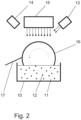
- An alternative device is shown in Fig. 2 schematically shown, by means of which a liquid volume can be subjected to accelerated electrons, which executes a relative movement to the electron generator 15, the device 13 and the detector 14.
- the in Fig. 2 The device shown initially shows all the features of the device Fig. 1
- the Fig. 2 The device shown has a roller 16 which partially extends into the liquid 11 and rotates counterclockwise. This forms a liquid film on the surface of the roller 16 which, as the roller 16 rotates, is guided through an effective area of the device 13, detector 14 and electron generator 15 and is finally removed from the roller 16 by a stripper 17. In this way, the liquid film and the particles 12 located therein are exposed to the electromagnetic radiation of the device 13, whereby the phosphor of the particles 12 is excited to luminesce.
- the detector 14 determines an actual value for the luminescence lifetime, which is compared with a target value in an evaluation device.
- the liquid film on the roller 16 is also subjected to accelerated electrons from the electron generator 15 until the actual value of the luminescence lifetime corresponds to the target value.
- the dose applied by accelerated electrons to which a portion of the liquid film on the roller 16 is subjected can be determined in a device according to Fig. 2 be set by, for example, regulating the rotational speed of the roller 16 and/or the power of the electron generator 15 depending on a detected actual value for the luminescence lifetime. If the electron generator 15 is operated in a pulsed manner, the length of the pulses and/or the length of the pulse pauses can additionally or alternatively be regulated depending on a detected actual value for the luminescence lifetime.
- the Fig. 1 and 2 The devices shown are merely examples. Alternatively, all other devices are also suitable for carrying out the method according to the invention in which a liquid volume can be subjected to accelerated electrons with or without a relative speed to an electron generator.
Landscapes
- Health & Medical Sciences (AREA)
- Life Sciences & Earth Sciences (AREA)
- Chemical & Material Sciences (AREA)
- Engineering & Computer Science (AREA)
- General Health & Medical Sciences (AREA)
- Public Health (AREA)
- Veterinary Medicine (AREA)
- Epidemiology (AREA)
- Animal Behavior & Ethology (AREA)
- Hydrology & Water Resources (AREA)
- Environmental & Geological Engineering (AREA)
- Water Supply & Treatment (AREA)
- Toxicology (AREA)
- Organic Chemistry (AREA)
- Biomedical Technology (AREA)
- Medicinal Chemistry (AREA)
- Molecular Biology (AREA)
- Luminescent Compositions (AREA)
Description
- Die Erfindung betrifft ein Verfahren zum Beaufschlagen einer Flüssigkeit mit beschleunigten Elektronen, bei dem die Dosis der in die Flüssigkeit eingetragenen Energie überprüft und/oder eingestellt werden kann.
- Es sind verschiedene Verfahren bekannt, bei denen Flüssigkeiten mit beschleunigten Elektronen beaufschlagt werden, um schadhafte Mikroorganismen in den Flüssigkeiten zu inaktivieren. In
US 4 230 947 A wird eine Flüssigkeit aufgrund des Flüssigkeitsstandes in einem Zuführungsrohrsystem auf ein Plateau gehoben, von dem es als Flüssigkeitsvorhang hinunterfällt. Während des freien Falls wird dieser Vorhang mit beschleunigten Elektronen beaufschlagt. AusUS 3 988 588 A sind Verfahren bekannt, bei denen eine trichterförmige Einrichtung verwendet wird, bei der durch Überlauf oder durch Rotation ein schichtförmiges Volumen einer Flüssigkeit geformt wird, welches dann durch beschleunigte Elektronen beaufschlagt wird. Mit beiden Verfahren ist es jedoch nicht möglich, die in die Flüssigkeit eingetragene Energiedosis zu überwachen bzw. einzustellen. - In
DE 10 2013 109 390 A1 ist ein Verfahren beschrieben, bei dem ein Verpackungsmaterial für flüssige oder feste Stoffe sterilisiert werden soll. Hierbei wird am Verpackungsmaterial ein Markermaterialfeld angebracht, welches mindestens einen anorganischen Leuchtstoff umfasst. Das Markermaterialfeld wird mit Elektronen bestrahlt, wodurch die Lumineszenzlebensdauer des Leuchtstoffs verändert wird. Anhand der Veränderung der Lumineszenzlebensdauer des Leuchtstoffs kann festgestellt werden, ob das Markermaterialfeld hinreichend mit Elektronen bestrahlt wurde. Bei diesem Verfahren kann die Energiedosis, die in das Markermaterialfeld eingetragen wurde, exakt ermittelt bzw. eingestellt werden. Eine Aussage darüber, welche Energiedosis tatsächlich in den festen oder flüssigen Stoffen appliziert wurde, die vom Verpackungsmaterial umschlossen sind, kann hingegen nur näherungsweise getroffen werden.DE102015117939 A1 offenbart ein Verfahren, in welchem Partikel, die Leuchtstoffe umfassen, in einem Gefäß - frei beweglich und statistisch verteilt - suspendiert vorliegen, mit beschleunigten Elektronen beaufschlagt und mit niederenergetischer Strahlung zu Fotolumineszenz angeregt werden. - Der Erfindung liegt daher das technische Problem zugrunde, ein Verfahren zum Beaufschlagen einer Flüssigkeit mit beschleunigten Elektronen zu schaffen, mittels dessen die Nachteile aus dem Stand der Technik überwunden werden können. Insbesondere soll es mit dem erfindungsgemäßen Verfahren auch möglich sein, die Dosis beim Beaufschlagen einer Flüssigkeit beschleunigter Elektronen zu überprüfen und/oder einzustellen.
- Die Lösung des technischen Problems ergibt sich durch Gegenstände mit den Merkmalen des Patentanspruchs 1. Weitere vorteilhafte Ausgestaltungen der Erfindung ergeben sich aus den abhängigen Ansprüchen.
- Beim erfindungsgemäßen Verfahren wird zunächst eine Flüssigkeit bereitgestellt, die mit beschleunigten Elektronen beaufschlagt werden soll. Mit dieser Flüssigkeit werden Partikel vermischt, welche mindestens einen Leuchtstoff aufweisen, wobei die Partikel derart ausgebildet werden, dass die Partikel nach dem Vermischen dispergiert in der Flüssigkeit vorliegen. Als dispergiert im Sinne der Erfindung liegen Partikel dann innerhalb einer Flüssigkeit vor, wenn deren Sink- bzw. Auftriebsgeschwindigkeit innerhalb eines nicht fließenden Volumens der Flüssigkeit kleiner als 100 nm/s ist. Anschließend wird die mit den Partikeln vermischte Flüssigkeit mit einer elektromagnetischen Strahlung beaufschlagt, welche den mindestens einen Leuchtstoff zum Lumineszieren anregt. Eine solche elektromagnetische Strahlung kann beispielsweise Licht, welches mit einem menschlichen Auge erfassbar ist oder auch UV-Strahlung sein. Während und/oder unmittelbar nach dem Beaufschlagen der Flüssigkeit mit der elektromagnetischen Strahlung wird mittels eines Detektors ein Istwert für mindestens eine, die Lumineszenz des Leuchtstoffs charakterisierende, physikalische Größe erfasst und an eine Auswerteeinrichtung weitergeleitet. Eine die Lumineszenz des Leuchtstoffs charakterisierende physikalische Größe kann beispielsweise die Lumineszenzlebensdauer, die Intensität mindestens einer Wellenlänge der Lumineszenz oder auch die Wellenlänge sein, bei der die Lumineszenz ihr Intensitätsmaximum ausbildet. Des Weiteren wird beim erfindungsgemäßen Verfahren die mit Partikeln vermischte Flüssigkeit und somit auch der Leuchtstoff, der mit der Flüssigkeit vermischten Partikel, mit beschleunigten Elektronen beaufschlagt. Durch das Beaufschlagen eines Leuchtstoffs mit beschleunigten Elektronen werden Parameter physikalischer Größen, die die Lumineszenz des Leuchtstoffs charakterisieren, verändert. Erfindungsgemäß wird daher die mit Partikeln vermischte Flüssigkeit so lange mit beschleunigten Elektronen beaufschlagt, bis der mittels des Detektors kontinuierlich oder in Zeitabständen erfasste Istwert für die mindestens eine die Fluoreszenz des Leuchtstoffs charakterisierende Größe einem Sollwert entspricht. Auf diese Weise kann die Dosis, mit welcher eine Flüssigkeit mit beschleunigten Elektronen beaufschlagt werden soll, überwacht und eingestellt werden.
- Die vorliegende Erfindung wird nachfolgend anhand von Ausführungsbeispielen näher erläutert. Die Fig. zeigen:
- Fig. 1
- eine schematische Darstellung einer Vorrichtung zum Ausführen des erfindungsgemäßen Verfahrens;
- Fig. 2
- eine schematische Darstellung einer alternativen Vorrichtung zum Ausführen des erfindungsgemäßen Verfahrens.
- Eine in
Fig. 1 schematisch dargestellte Vorrichtung zum Ausführen des erfindungsgemäßen Verfahrens umfasst ein Gefäß 10, in welchem eine beispielhaft als Impfstoff ausgebildete Flüssigkeit 11 bereitgestellt wird. Das Gefäß 10 besteht aus einem nicht flexiblen Material. Alternativ kann sich die Flüssigkeit 11 beim Durchführen des erfindungsgemäßen Verfahrens auch in einem Behältnis aus einem flexiblen Material befinden. So kann ein solches Behältnis beispielsweise auch als Folienbeutel ausgebildet sein. - Die als Impfstoff ausgebildete Flüssigkeit 11 ist mit Mikroorganismen wie zum Beispiel Viren durchsetzt, welche durch das Beaufschlagen mit beschleunigten Elektronen inaktiviert werden sollen. Für das Inaktivieren des Impfstoffs ist eine bestimmte Dosis erforderlich, die nicht zu gering sein darf, um möglichst alle Mikroorganismen im Impfstoff zu inaktivieren. Als Dosis ist hierbei die Energiemenge anzusehen, die beim Beaufschlagen mit beschleunigten Elektronen pro Masseeinheit der Flüssigkeit 11 absorbiert wird. Die Dosis darf aber auch nicht zu hoch sein, weil dadurch die Wirksamkeit des Impfstoffs negativ beeinflusst werden könnte. Welche Dosis bei einem jeweiligen Anwendungsfall optimal ist, lässt sich in Laborversuchen ermitteln.
- Erfindungsgemäß wird die Flüssigkeit vor dem Beaufschlagen mit beschleunigten Elektronen mit Partikeln 12 vermischt, die mindestens einen Leuchtstoff enthalten. Dabei können die für das erfindungsgemäße Verfahren verwendeten Partikel 12 vollständig aus dem Leuchtstoff bestehen oder alternativ aus einem Basismaterial, an dessen Oberfläche der Leuchtstoff aufgetragen und/oder in das der Leuchtstoff eingebettet wird. Bei einer Ausführungsform bestehen die Partikel aus einem biokompatiblen Material. Dies ist besonders vorteilhaft, wenn das erfindungsgemäße Verfahren an Impfstoffen, wie im Ausführungsbeispiel beschrieben, durchgeführt wird. Bei einer weiteren Ausführungsform umschließt das Basismaterial vollständig den mindestens einen Leuchtstoff.
- Für das erfindungsgemäße Verfahren sind als Leuchtstoff alle aus dem Stand der Technik bekannten Leuchtstoffe geeignet, die sich durch das Beaufschlagen mit einer elektromagnetischen Strahlung zum Lumineszieren anregen lassen. Der mindestens eine Leuchtstoff kann beispielsweise sein: ein Cyanat, Rhodamin oder ein Derivat davon, ein Oxid, ein Oxihalogenid, ein Sulfid, ein Oxisulfid, ein Sulfat, ein Oxisulfat, ein Selenid, ein Nitrid, ein Oxinitrid, ein Nitrat, ein Oxinitrat, ein Phosphid, ein Phosphat, ein Carbonat, ein Silikat, ein Oxisilikat, ein Vanadat, ein Molybdat, ein Wolframat, ein Germanat, ein Oxigermanat oder ein Halogenid der Elemente Li, Na, K, Rb, Mg, Ca, Sr, Sc, Y, La, Ti, Zr, Hf, Nb, Ta, Zn, Gd, Lu, Al, Ga und/oder In. Für das erfindungsgemässe Verfahren beinhalten der Leuchtstoff oder zumindest einer der Leuchtstoffe ein oder mehrere Ionen aus der Gruppe In+, Sn2+, Pb2+, Sb3+, Bi3+, Ce3+, Ce4+, Pr3+, Nd3+, Sm2+, Sm3+, Eu2+, Eu3+, Gd3+, Tb3+, Dy3+, Ho3+, Er3+, Tm2+, Tm3+, Yb2+, Yb3+, Ti3+, V2+, V3+, V4+, Cr3+, Mn2+, Mn3+, Mn4+, Fe3+, Fe4+, Fe5+, Co3+, Co4+, Ni2+, Cu+, Ru2+, Ru3+, Pd2+, Ag+, Ir3+, Pt2+ und Au+.
- Die Partikel 12 werden für das erfindungsgemäße Verfahren derart ausgebildet, dass diese nach dem Vermischen mit der Flüssigkeit 11 dispergiert in der Flüssigkeit 11 vorliegen. Dies kann im Wesentlichen mittels zweier Parameter eingestellt werden, mit der Größe und/oder der Dichte der Partikel 12. Partikel 12 werden bei einer Ausführungsform des erfindungsgemäßen Verfahrens mit einer Größe im Nanometer- oder Mikrometerbereich ausgebildet. Es ist auch vorteilhaft, wenn die Partikel 12 eine Dichte aufweisen, welche der Dichte der Flüssigkeit 11 entspricht. Weisen die Partikel 12 neben dem Leuchtstoff auch noch ein Basismaterial auf, können beispielsweise Kunststoffe als Basismaterial verwendet werden, weil Kunststoffe mit einer Dichte, ähnlich der Dichte von Flüssigkeiten, hergestellt werden können. Im zu
Fig. 1 beschriebenen Ausführungsbeispiel bestehen die Partikel 12 aus einem als Kunststoff ausgebildeten Basismaterial, an dessen Oberfläche bei einer Hälfte der Partikel ein unter der Bezeichnung "FITC" bekannter Leuchtstoff und bei der anderen Hälfte der Partikel ein unter der Bezeichnung "PE" bekannter Leuchtstoff aufgetragen sind. - Die Vorrichtung aus
Fig. 1 umfasst ferner eine Einrichtung 13, zum Aussenden einer elektromagnetischen Strahlung, mit welcher die Flüssigkeit 11 und somit auch die darin dispergiert vorliegenden Partikel 12 beaufschlagt werden und welche den in den Partikeln 12 enthaltenen Leuchtstoff zum Lumineszieren anregt. Bei einer Ausführungsform wird der Leuchtstoff vollständig vom Basismaterial der Partikel umschlossen, wobei das Basismaterial transparent gegenüber der elektromagnetischen Strahlung ist. Die elektromagnetische Strahlung wird bei einer Ausführungsform pulsförmig von der Einrichtung 13 ausgesendet. - Während und/oder unmittelbar nach dem Beaufschlagen der Flüssigkeit 11 mit der elektromagnetischen Strahlung wird mittels eines Detektors 14 ein Istwert für die Lumineszenzlebensdauer ermittelt, an eine in
Fig. 1 nicht dargestellte Auswerteeinrichtung weitergeleitet und dort mit einem Sollwert für die Lumineszenzlebensdauer verglichen. - Mittels eines Elektronengenerators 15 werden beschleunigte Elektronen erzeugt und mit diesen die Flüssigkeit 11 und die sich darin befindenden Partikel 12 beaufschlagt, wodurch die Lumineszenzlebensdauer des sich in den Partikeln befindenden Leuchtstoffs verändert wird. Als Elektronengenerator 15 kann beim erfindungsgemäßen Verfahren zum Beispiel ein Bandstrahler oder ein Flächenstrahler verwendet werden.
- Das Beaufschlagen der Flüssigkeit 11 mit beschleunigten Elektronen erfolgt so lange, bis der mittels des Detektors 14 erfasste Istwert für die Lumineszenzlebensdauer dem Sollwert entspricht, womit dann die zuvor in Laborversuchen ermittelte Dosis, mit der die Flüssigkeit 11 mittels beschleunigter Elektronen beaufschlagt werden soll, erreicht ist.
- In
Fig. 1 ist eine Vorrichtungsanordnung dargestellt, mittels der ein Flüssigkeitsvolumen mit beschleunigten Elektronen beaufschlagt werden kann, welches keine Relativbewegung zum Elektronengenerator 15, zur Einrichtung 13 und zum Detektor 14 aufweist. Eine alternative Vorrichtung ist inFig. 2 schematisch dargestellt, mittels der ein Flüssigkeitsvolumen mit beschleunigten Elektronen beaufschlagt werden kann, welches eine Relativbewegung zum Elektronengenerator 15, zur Einrichtung 13 und zum Detektor 14 ausführt. - Die in
Fig. 2 dargestellte Vorrichtung weist zunächst alle Merkmale der Vorrichtung ausFig. 1 auf. Zusätzlich umfasst die inFig. 2 dargestellte Vorrichtung eine Walze 16, welche teilweise in die Flüssigkeit 11 hineinragt und sich entgegengesetzt zum Uhrzeigersinn dreht. Dadurch wird ein Flüssigkeitsfilm an der Oberfläche der Walze 16 ausgebildet, der mit voranschreitender Drehung der Walze 16 durch einen Wirkbereich von Einrichtung 13, Detektor 14 und Elektronengenerator 15 geführt und schließlich von einem Abstreifer 17 wieder von der Walze 16 entfernt wird. Auf diese Weise wird der Flüssigkeitsfilm und die sich darin befindenden Partikel 12 mit der elektromagnetischen Strahlung der Einrichtung 13 beaufschlagt, wodurch der Leuchtstoff der Partikel 12 zum Lumineszieren angeregt wird. Der Detektor 14 ermittelt einen Istwert für die Lumineszenzlebensdauer, welcher in einer Auswerteeinrichtung mit einem Sollwert verglichen wird. Der Flüssigkeitsfilm auf der Walze 16 wird außerdem mit beschleunigten Elektronen des Elektronengenerators 15 beaufschlagt, bis der Istwert der Lumineszenzlebensdauer dem Sollwert entspricht. - Die durch beschleunigte Elektronen applizierte Dosis, mit denen ein Abschnitt des Flüssigkeitsfilms auf der Walze 16 beaufschlagt wird, kann bei einer Vorrichtung gemäß
Fig. 2 eingestellt werden, indem beispielsweise die Drehgeschwindigkeit der Walze 16 und/oder die Leistung des Elektronengenerators 15 in Abhängigkeit von einem erfassten Istwert für die Lumineszenzlebensdauer geregelt werden. Wenn der Elektronengenerator 15 gepulst betrieben wird, kann zusätzlich oder alternativ auch die Länge der Pulse und/oder die Länge der Pulspausen in Abhängigkeit von einem erfassten Istwert für die Lumineszenzlebensdauer geregelt werden. - Die in den
Fig. 1 und2 dargestellten Vorrichtungen sind lediglich beispielhaft angeführt. Zum Durchführen des erfindungsgemäßen Verfahrens sind alternativ auch alle anderen Vorrichtungen geeignet, bei denen ein Flüssigkeitsvolumen mit oder ohne einer Relativgeschwindigkeit zu einem Elektronengenerator mit beschleunigten Elektronen beaufschlagt werden kann.
Claims (6)
- Verfahren zum Beaufschlagen einer Flüssigkeit (11) mit beschleunigten Elektronen, gekennzeichnet durch folgende Schrittea) Bereitstellen der Flüssigkeit (11),b) Vermischen der Flüssigkeit (11) mit Partikeln (12), welche mindestens einen Leuchtstoff aufweisen, wobei zumindest einer der Leuchtstoffe ein Ion oder mehrere Ionen aus der Gruppe In+, Sn2+, Pb2+, Sb3+, Bi3+, Ce3+, Ce4+, Pr3+, Nd3+, Sm2+, Sm3+, Eu2+, Eu3+, Gd3+, Tb3+, Dy3+, Ho3+, Er3+, Tm2+, Tm3+, Yb2+, Yb3+, Ti3+, V2+, V3+, V4+, Cr3+, Mn2+, Mn3+, Mn4+, Fe3+, Fe4+, Fe5+, Co3+, Co4+, Ni2+, Cu+, Ru2+, Ru3+, Pd2+, Ag+, Ir3+, Pt2+ und Au+ beinhaltet und wobei die Partikel (12) derart ausgebildet werden, dass die Partikel (12) nach dem Vermischen dispergiert in der Flüssigkeit (11) vorliegen, wobei deren Sink- bzw. Auftriebsgeschwindigkeit innerhalb eines nicht fließenden Volumens der Flüssigkeit (11) kleiner als 100 nm/s ist, und wobei die Größe und oder die Dichte der Partikel (12) derart eingestellt wird, dass die Partikel (12) nach dem Vermischen in der Flüssigkeit (11) dispergiert vorliegen,c) Beaufschlagen der Flüssigkeit (11) mit einer elektromagnetischen Strahlung, welche den mindestens einen Leuchtstoff zum Lumineszieren anregt, wobei Licht, welches mit einem menschlichen Auge erfassbar ist oder UV-Strahlung als elektromagnetische Strahlung verwendet wird;d) Erfassen eines Istwertes einer die Lumineszenz des Leuchtstoffs charakterisierenden physikalischen Größe, wobei als physikalische Größe, welche die Lumineszenz des Leuchtstoffs charakterisiert, verwendet wird: die Lumineszenzlebensdauer, die Intensität mindestens einer Wellenlänge der Lumineszenz oder die Wellenlänge, bei der die Lumineszenz sein Intensitätsmaximum ausbildet,e) Beaufschlagen der Flüssigkeit (11) mit beschleunigten Elektronen, bis der erfasste Istwert einem Sollwert entspricht.
- Verfahren nach Anspruch 1, dadurch gekennzeichnet, dass die Partikel (12) aus einem Basismaterial bestehen, an dessen Oberfläche der Leuchtstoff aufgetragen und/oder in dem der Leuchtstoff eingebettet wird.
- Verfahren nach Anspruch 2, dadurch gekennzeichnet, dass ein Kunststoff als Basismaterial verwendet wird.
- Verfahren nach Anspruch 2, dadurch gekennzeichnet, dass ein biokompatibles Material als Basismaterial verwendet wird.
- Verfahren nach einem der Ansprüche 2 bis 4, dadurch gekennzeichnet, dass der Leuchtstoff vollständig vom Basismaterial umschlossen wird.
- Verfahren nach einem der vorhergehenden Ansprüche, dadurch gekennzeichnet, dass die Flüssigkeit (12) vor dem Beaufschlagen mit beschleunigten Elektronen zu einem Flüssigkeitsfilm ausgebildet wird.
Applications Claiming Priority (2)
| Application Number | Priority Date | Filing Date | Title |
|---|---|---|---|
| DE102016110672.0A DE102016110672A1 (de) | 2016-06-09 | 2016-06-09 | Verfahren zum Beaufschlagen einer Flüssigkeit mit beschleunigten Elektronen |
| PCT/EP2017/064034 WO2017211990A1 (de) | 2016-06-09 | 2017-06-08 | Verfahren zum beaufschlagen einer flüssigkeit mit beschleunigten elektronen |
Publications (2)
| Publication Number | Publication Date |
|---|---|
| EP3468622A1 EP3468622A1 (de) | 2019-04-17 |
| EP3468622B1 true EP3468622B1 (de) | 2024-10-30 |
Family
ID=59091483
Family Applications (1)
| Application Number | Title | Priority Date | Filing Date |
|---|---|---|---|
| EP17731497.8A Active EP3468622B1 (de) | 2016-06-09 | 2017-06-08 | Verfahren zum beaufschlagen einer flüssigkeit mit beschleunigten elektronen |
Country Status (5)
| Country | Link |
|---|---|
| US (1) | US10980903B2 (de) |
| EP (1) | EP3468622B1 (de) |
| CN (1) | CN109310792A (de) |
| DE (1) | DE102016110672A1 (de) |
| WO (1) | WO2017211990A1 (de) |
Families Citing this family (6)
| Publication number | Priority date | Publication date | Assignee | Title |
|---|---|---|---|---|
| DE102016216573A1 (de) * | 2016-09-01 | 2018-03-01 | Fraunhofer-Gesellschaft zur Förderung der angewandten Forschung e.V. | Inaktivierung von Pathogenen in biologischen Medien |
| DE102018124666A1 (de) * | 2018-10-05 | 2020-04-09 | Fraunhofer-Gesellschaft zur Förderung der angewandten Forschung e.V. | Verfahren zum Stimulieren des Wachstums von in einer Flüssigkeit enthaltenen Biomasse innerhalb eines Bioreaktors |
| DE102018124664A1 (de) * | 2018-10-05 | 2020-04-09 | Fraunhofer-Gesellschaft zur Förderung der angewandten Forschung e.V. | Verfahren zum Inaktivieren biologisch aktiver Bestandteile innerhalb einer Flüssigkeit |
| DE102020117091A1 (de) | 2020-06-29 | 2021-12-30 | EcoEnterprises GmbH | Verfahren und Vorrichtung zur Herstellung eines Vakzins |
| DE102021121148A1 (de) | 2021-08-13 | 2023-02-16 | EcoEnterprises GmbH | Microneedle Array Patch sowie Verfahren und Vorrichtung für ein Microneedle Array Patch |
| DE102023207810B3 (de) | 2023-08-14 | 2025-02-13 | Fraunhofer-Gesellschaft zur Förderung der angewandten Forschung eingetragener Verein | Verfahren und Vorrichtung zur Ermittlung einer Strahlungsdosis, die eine wässrige Flüssigkeit durch Elektronenstrahlung erfährt |
Citations (1)
| Publication number | Priority date | Publication date | Assignee | Title |
|---|---|---|---|---|
| DE102015117939A1 (de) * | 2015-10-21 | 2017-04-27 | Fraunhofer-Gesellschaft zur Förderung der angewandten Forschung e.V. | Verfahren zur Bestimmung einer Strahlendosis und Produkt |
Family Cites Families (10)
| Publication number | Priority date | Publication date | Assignee | Title |
|---|---|---|---|---|
| US3988588A (en) | 1972-11-29 | 1976-10-26 | Licentia Patent-Verwaltungs-G.M.B.H. | High energy electron irradiation of flowable materials |
| US4230947A (en) | 1979-07-02 | 1980-10-28 | High Voltage Engineering Corporation | Apparatus for treating flowable material |
| DE3640586A1 (de) * | 1986-11-27 | 1988-06-09 | Norddeutsche Affinerie | Verfahren zur herstellung von hohlkugeln oder deren verbunden mit wandungen erhoehter festigkeit |
| US5962857A (en) * | 1995-09-22 | 1999-10-05 | The Board Of Regents For Oklahoma State University | Method for the fast determination of an unknown absorbed dose of radiation with high sensitivity using optically stimulated luminescence |
| CN1196926C (zh) | 2001-12-22 | 2005-04-13 | 浙江大学 | 测量荧光材料绝对亮度的装置 |
| US8376013B2 (en) * | 2008-03-11 | 2013-02-19 | Duke University | Plasmonic assisted systems and methods for interior energy-activation from an exterior source |
| DE102011056628A1 (de) * | 2011-12-19 | 2013-06-20 | Krones Aktiengesellschaft | Vorrichtung und Verfahren zum Sterilisieren von Behältnissen mit Funktionsüberwachung |
| CN203169652U (zh) | 2012-12-20 | 2013-09-04 | 上海显恒光电科技股份有限公司 | 采用电子束激发荧光紫外光源的杀菌系统 |
| US10786588B2 (en) * | 2013-01-10 | 2020-09-29 | Gene Therapy Systems, Inc. | System and methods for sterilizing enclosed spaces using ozone |
| DE102013109390B4 (de) | 2013-08-29 | 2017-02-02 | Fraunhofer-Gesellschaft zur Förderung der angewandten Forschung e.V. | Verfahren zur Verpackungsherstellungskontrolle |
-
2016
- 2016-06-09 DE DE102016110672.0A patent/DE102016110672A1/de active Pending
-
2017
- 2017-06-08 US US16/308,200 patent/US10980903B2/en active Active
- 2017-06-08 EP EP17731497.8A patent/EP3468622B1/de active Active
- 2017-06-08 WO PCT/EP2017/064034 patent/WO2017211990A1/de not_active Ceased
- 2017-06-08 CN CN201780035515.7A patent/CN109310792A/zh active Pending
Patent Citations (1)
| Publication number | Priority date | Publication date | Assignee | Title |
|---|---|---|---|---|
| DE102015117939A1 (de) * | 2015-10-21 | 2017-04-27 | Fraunhofer-Gesellschaft zur Förderung der angewandten Forschung e.V. | Verfahren zur Bestimmung einer Strahlendosis und Produkt |
Also Published As
| Publication number | Publication date |
|---|---|
| US10980903B2 (en) | 2021-04-20 |
| DE102016110672A1 (de) | 2017-12-14 |
| US20190175769A1 (en) | 2019-06-13 |
| WO2017211990A1 (de) | 2017-12-14 |
| EP3468622A1 (de) | 2019-04-17 |
| CN109310792A (zh) | 2019-02-05 |
Similar Documents
| Publication | Publication Date | Title |
|---|---|---|
| EP3468622B1 (de) | Verfahren zum beaufschlagen einer flüssigkeit mit beschleunigten elektronen | |
| DE102010036046B4 (de) | Teilchenstrahlbestrahlungsvorrichtung und Teilchenstrahlbestrahlungsverfahren | |
| EP2250495B1 (de) | Verfahren zur identifizierung von produkten mit markern bestehend aus salzen von seltenerdmetallen | |
| DE102007054919B4 (de) | Schnelle Regelung der Reichweite von hochenergetischen Ionenstrahlen für Präzisionsbestrahlungen von bewegten Zielvolumina | |
| DE102009040031A1 (de) | Lasergetriebene Teilchenstrahl-Bestrahlungsvorrichtung sowie -Verfahren | |
| DE102008018417A1 (de) | Verfahren und Vorrichtung zum Erstellen eines Bestrahlungsplans | |
| DE102008050352A1 (de) | Multi-Strahl-Röntgenvorrichtung | |
| WO2012097770A1 (de) | Verfahren und vorrichtung zum prüfen von auf objekte energieeintragenden behandlungen | |
| EP2189184B1 (de) | Vorrichtung und Verfahren zur Reduzierung der Strahlaufweitung einer Strahlung | |
| DE102013109390B4 (de) | Verfahren zur Verpackungsherstellungskontrolle | |
| DE2515406A1 (de) | Absorptionskoerper | |
| DE102014117519B4 (de) | Verfahren zur Herstellung und Überprüfung von Werkstücken und Werkstück | |
| DE1798125A1 (de) | Verfahren und Vorrichtung zur Roentgenfluoreszenzmessung eines gewaehlten Elementes hoeherer Atomzahl in einem UEberzug auf einer Unterlage | |
| DE2118426A1 (de) | Neutronenkollimator | |
| DE102015117939A1 (de) | Verfahren zur Bestimmung einer Strahlendosis und Produkt | |
| DE102011079179A1 (de) | Monochromatische Röntgenquelle | |
| DE102017105159B4 (de) | Verfahren zur Validierung einer Bestrahlungsanlage | |
| DE102012011309A1 (de) | Röntgenstrahlröhre vom Transmissionstyp und Röntgenstrahlröhre vom Reflektionstyp | |
| WO2020069944A1 (de) | Verfahren zum stimulieren des wachstums von in einer flüssigkeit enthaltenen biomasse innerhalb eines bioreaktors | |
| DE102017125006B3 (de) | Verfahren zur Dosimetrie | |
| EP2403322A2 (de) | Beschleuniger und Verfahren für die Bestrahlung eines Zielvolumens | |
| DE522966C (de) | Verfahren zur quantitativen chemischen Analyse mit Hilfe von Emissionsspektren | |
| DE1614333C (de) | Verfahren zur Ermittlung der wahren Zerfallsrate eines in einer Flüssigkeitsszintillator-Probe vorliegenden radioaktiven Isotops und Einrichtung zur Durchführung des Verfahrens | |
| DE602006000748T2 (de) | Verfahren zur Aufbereitung von Radioaktivität enthaltendem Badewasser | |
| DE202013005455U1 (de) | Kit zur Detektion unauthorisierter Öffnung eines Poststückes |
Legal Events
| Date | Code | Title | Description |
|---|---|---|---|
| STAA | Information on the status of an ep patent application or granted ep patent |
Free format text: STATUS: UNKNOWN |
|
| STAA | Information on the status of an ep patent application or granted ep patent |
Free format text: STATUS: THE INTERNATIONAL PUBLICATION HAS BEEN MADE |
|
| PUAI | Public reference made under article 153(3) epc to a published international application that has entered the european phase |
Free format text: ORIGINAL CODE: 0009012 |
|
| STAA | Information on the status of an ep patent application or granted ep patent |
Free format text: STATUS: REQUEST FOR EXAMINATION WAS MADE |
|
| 17P | Request for examination filed |
Effective date: 20181207 |
|
| AK | Designated contracting states |
Kind code of ref document: A1 Designated state(s): AL AT BE BG CH CY CZ DE DK EE ES FI FR GB GR HR HU IE IS IT LI LT LU LV MC MK MT NL NO PL PT RO RS SE SI SK SM TR |
|
| AX | Request for extension of the european patent |
Extension state: BA ME |
|
| DAV | Request for validation of the european patent (deleted) | ||
| DAX | Request for extension of the european patent (deleted) | ||
| STAA | Information on the status of an ep patent application or granted ep patent |
Free format text: STATUS: EXAMINATION IS IN PROGRESS |
|
| 17Q | First examination report despatched |
Effective date: 20220222 |
|
| RAP3 | Party data changed (applicant data changed or rights of an application transferred) |
Owner name: FRAUNHOFER-GESELLSCHAFT ZUR FOERDERUNG DER ANGEWANDTEN FORSCHUNG E.V. |
|
| GRAP | Despatch of communication of intention to grant a patent |
Free format text: ORIGINAL CODE: EPIDOSNIGR1 |
|
| STAA | Information on the status of an ep patent application or granted ep patent |
Free format text: STATUS: GRANT OF PATENT IS INTENDED |
|
| INTG | Intention to grant announced |
Effective date: 20240718 |
|
| GRAS | Grant fee paid |
Free format text: ORIGINAL CODE: EPIDOSNIGR3 |
|
| GRAA | (expected) grant |
Free format text: ORIGINAL CODE: 0009210 |
|
| STAA | Information on the status of an ep patent application or granted ep patent |
Free format text: STATUS: THE PATENT HAS BEEN GRANTED |
|
| AK | Designated contracting states |
Kind code of ref document: B1 Designated state(s): AL AT BE BG CH CY CZ DE DK EE ES FI FR GB GR HR HU IE IS IT LI LT LU LV MC MK MT NL NO PL PT RO RS SE SI SK SM TR |
|
| REG | Reference to a national code |
Ref country code: GB Ref legal event code: FG4D Free format text: NOT ENGLISH |
|
| REG | Reference to a national code |
Ref country code: CH Ref legal event code: EP |
|
| REG | Reference to a national code |
Ref country code: DE Ref legal event code: R096 Ref document number: 502017016530 Country of ref document: DE |
|
| REG | Reference to a national code |
Ref country code: IE Ref legal event code: FG4D Free format text: LANGUAGE OF EP DOCUMENT: GERMAN |
|
| REG | Reference to a national code |
Ref country code: NL Ref legal event code: FP |
|
| REG | Reference to a national code |
Ref country code: LT Ref legal event code: MG9D |
|
| PG25 | Lapsed in a contracting state [announced via postgrant information from national office to epo] |
Ref country code: HR Free format text: LAPSE BECAUSE OF FAILURE TO SUBMIT A TRANSLATION OF THE DESCRIPTION OR TO PAY THE FEE WITHIN THE PRESCRIBED TIME-LIMIT Effective date: 20241030 Ref country code: PT Free format text: LAPSE BECAUSE OF FAILURE TO SUBMIT A TRANSLATION OF THE DESCRIPTION OR TO PAY THE FEE WITHIN THE PRESCRIBED TIME-LIMIT Effective date: 20250228 Ref country code: IS Free format text: LAPSE BECAUSE OF FAILURE TO SUBMIT A TRANSLATION OF THE DESCRIPTION OR TO PAY THE FEE WITHIN THE PRESCRIBED TIME-LIMIT Effective date: 20250228 |
|
| PG25 | Lapsed in a contracting state [announced via postgrant information from national office to epo] |
Ref country code: FI Free format text: LAPSE BECAUSE OF FAILURE TO SUBMIT A TRANSLATION OF THE DESCRIPTION OR TO PAY THE FEE WITHIN THE PRESCRIBED TIME-LIMIT Effective date: 20241030 |
|
| PG25 | Lapsed in a contracting state [announced via postgrant information from national office to epo] |
Ref country code: BG Free format text: LAPSE BECAUSE OF FAILURE TO SUBMIT A TRANSLATION OF THE DESCRIPTION OR TO PAY THE FEE WITHIN THE PRESCRIBED TIME-LIMIT Effective date: 20241030 |
|
| PG25 | Lapsed in a contracting state [announced via postgrant information from national office to epo] |
Ref country code: ES Free format text: LAPSE BECAUSE OF FAILURE TO SUBMIT A TRANSLATION OF THE DESCRIPTION OR TO PAY THE FEE WITHIN THE PRESCRIBED TIME-LIMIT Effective date: 20241030 |
|
| PG25 | Lapsed in a contracting state [announced via postgrant information from national office to epo] |
Ref country code: NO Free format text: LAPSE BECAUSE OF FAILURE TO SUBMIT A TRANSLATION OF THE DESCRIPTION OR TO PAY THE FEE WITHIN THE PRESCRIBED TIME-LIMIT Effective date: 20250130 |
|
| PG25 | Lapsed in a contracting state [announced via postgrant information from national office to epo] |
Ref country code: LV Free format text: LAPSE BECAUSE OF FAILURE TO SUBMIT A TRANSLATION OF THE DESCRIPTION OR TO PAY THE FEE WITHIN THE PRESCRIBED TIME-LIMIT Effective date: 20241030 Ref country code: GR Free format text: LAPSE BECAUSE OF FAILURE TO SUBMIT A TRANSLATION OF THE DESCRIPTION OR TO PAY THE FEE WITHIN THE PRESCRIBED TIME-LIMIT Effective date: 20250131 |
|
| PG25 | Lapsed in a contracting state [announced via postgrant information from national office to epo] |
Ref country code: PL Free format text: LAPSE BECAUSE OF FAILURE TO SUBMIT A TRANSLATION OF THE DESCRIPTION OR TO PAY THE FEE WITHIN THE PRESCRIBED TIME-LIMIT Effective date: 20241030 |
|
| PG25 | Lapsed in a contracting state [announced via postgrant information from national office to epo] |
Ref country code: RS Free format text: LAPSE BECAUSE OF FAILURE TO SUBMIT A TRANSLATION OF THE DESCRIPTION OR TO PAY THE FEE WITHIN THE PRESCRIBED TIME-LIMIT Effective date: 20250130 |
|
| PG25 | Lapsed in a contracting state [announced via postgrant information from national office to epo] |
Ref country code: SM Free format text: LAPSE BECAUSE OF FAILURE TO SUBMIT A TRANSLATION OF THE DESCRIPTION OR TO PAY THE FEE WITHIN THE PRESCRIBED TIME-LIMIT Effective date: 20241030 |
|
| PGFP | Annual fee paid to national office [announced via postgrant information from national office to epo] |
Ref country code: DE Payment date: 20250618 Year of fee payment: 9 |
|
| PG25 | Lapsed in a contracting state [announced via postgrant information from national office to epo] |
Ref country code: DK Free format text: LAPSE BECAUSE OF FAILURE TO SUBMIT A TRANSLATION OF THE DESCRIPTION OR TO PAY THE FEE WITHIN THE PRESCRIBED TIME-LIMIT Effective date: 20241030 |
|
| PGFP | Annual fee paid to national office [announced via postgrant information from national office to epo] |
Ref country code: NL Payment date: 20250618 Year of fee payment: 9 Ref country code: BE Payment date: 20250617 Year of fee payment: 9 |
|
| PG25 | Lapsed in a contracting state [announced via postgrant information from national office to epo] |
Ref country code: EE Free format text: LAPSE BECAUSE OF FAILURE TO SUBMIT A TRANSLATION OF THE DESCRIPTION OR TO PAY THE FEE WITHIN THE PRESCRIBED TIME-LIMIT Effective date: 20241030 |
|
| PG25 | Lapsed in a contracting state [announced via postgrant information from national office to epo] |
Ref country code: RO Free format text: LAPSE BECAUSE OF FAILURE TO SUBMIT A TRANSLATION OF THE DESCRIPTION OR TO PAY THE FEE WITHIN THE PRESCRIBED TIME-LIMIT Effective date: 20241030 |
|
| PG25 | Lapsed in a contracting state [announced via postgrant information from national office to epo] |
Ref country code: SK Free format text: LAPSE BECAUSE OF FAILURE TO SUBMIT A TRANSLATION OF THE DESCRIPTION OR TO PAY THE FEE WITHIN THE PRESCRIBED TIME-LIMIT Effective date: 20241030 |
|
| PG25 | Lapsed in a contracting state [announced via postgrant information from national office to epo] |
Ref country code: CZ Free format text: LAPSE BECAUSE OF FAILURE TO SUBMIT A TRANSLATION OF THE DESCRIPTION OR TO PAY THE FEE WITHIN THE PRESCRIBED TIME-LIMIT Effective date: 20241030 |
|
| PG25 | Lapsed in a contracting state [announced via postgrant information from national office to epo] |
Ref country code: IT Free format text: LAPSE BECAUSE OF FAILURE TO SUBMIT A TRANSLATION OF THE DESCRIPTION OR TO PAY THE FEE WITHIN THE PRESCRIBED TIME-LIMIT Effective date: 20241030 |
|
| REG | Reference to a national code |
Ref country code: DE Ref legal event code: R097 Ref document number: 502017016530 Country of ref document: DE |
|
| PLBE | No opposition filed within time limit |
Free format text: ORIGINAL CODE: 0009261 |
|
| STAA | Information on the status of an ep patent application or granted ep patent |
Free format text: STATUS: NO OPPOSITION FILED WITHIN TIME LIMIT |
|
| PG25 | Lapsed in a contracting state [announced via postgrant information from national office to epo] |
Ref country code: SE Free format text: LAPSE BECAUSE OF FAILURE TO SUBMIT A TRANSLATION OF THE DESCRIPTION OR TO PAY THE FEE WITHIN THE PRESCRIBED TIME-LIMIT Effective date: 20241030 |
|
| 26N | No opposition filed |
Effective date: 20250731 |
|
| PGFP | Annual fee paid to national office [announced via postgrant information from national office to epo] |
Ref country code: CH Payment date: 20250701 Year of fee payment: 9 |