EP3468422B1 - Hitzebeständiges spannbetttuch - Google Patents
Hitzebeständiges spannbetttuch Download PDFInfo
- Publication number
- EP3468422B1 EP3468422B1 EP17739636.3A EP17739636A EP3468422B1 EP 3468422 B1 EP3468422 B1 EP 3468422B1 EP 17739636 A EP17739636 A EP 17739636A EP 3468422 B1 EP3468422 B1 EP 3468422B1
- Authority
- EP
- European Patent Office
- Prior art keywords
- sheet
- heat resistant
- elastic
- mattress
- corner
- Prior art date
- Legal status (The legal status is an assumption and is not a legal conclusion. Google has not performed a legal analysis and makes no representation as to the accuracy of the status listed.)
- Active
Links
Images




Classifications
-
- A—HUMAN NECESSITIES
- A47—FURNITURE; DOMESTIC ARTICLES OR APPLIANCES; COFFEE MILLS; SPICE MILLS; SUCTION CLEANERS IN GENERAL
- A47G—HOUSEHOLD OR TABLE EQUIPMENT
- A47G9/00—Bed-covers; Counterpanes; Travelling rugs; Sleeping rugs; Sleeping bags; Pillows
- A47G9/02—Bed linen; Blankets; Counterpanes
- A47G9/0238—Bed linen
- A47G9/0246—Fitted sheets
-
- D—TEXTILES; PAPER
- D03—WEAVING
- D03D—WOVEN FABRICS; METHODS OF WEAVING; LOOMS
- D03D15/00—Woven fabrics characterised by the material, structure or properties of the fibres, filaments, yarns, threads or other warp or weft elements used
- D03D15/50—Woven fabrics characterised by the material, structure or properties of the fibres, filaments, yarns, threads or other warp or weft elements used characterised by the properties of the yarns or threads
- D03D15/56—Woven fabrics characterised by the material, structure or properties of the fibres, filaments, yarns, threads or other warp or weft elements used characterised by the properties of the yarns or threads elastic
-
- D—TEXTILES; PAPER
- D10—INDEXING SCHEME ASSOCIATED WITH SUBLASSES OF SECTION D, RELATING TO TEXTILES
- D10B—INDEXING SCHEME ASSOCIATED WITH SUBLASSES OF SECTION D, RELATING TO TEXTILES
- D10B2331/00—Fibres made from polymers obtained otherwise than by reactions only involving carbon-to-carbon unsaturated bonds, e.g. polycondensation products
- D10B2331/04—Fibres made from polymers obtained otherwise than by reactions only involving carbon-to-carbon unsaturated bonds, e.g. polycondensation products polyesters, e.g. polyethylene terephthalate [PET]
-
- D—TEXTILES; PAPER
- D10—INDEXING SCHEME ASSOCIATED WITH SUBLASSES OF SECTION D, RELATING TO TEXTILES
- D10B—INDEXING SCHEME ASSOCIATED WITH SUBLASSES OF SECTION D, RELATING TO TEXTILES
- D10B2503/00—Domestic or personal
- D10B2503/06—Bed linen
- D10B2503/062—Fitted bedsheets
Definitions
- the present invention relates to fitted sheets that are configured to conform to the shape of mattresses of different thicknesses such that the fitted sheet forms a tight fit around said mattresses.
- Fitted sheets which are also referred to as "bottom” sheets, are conventionally formed of fabric and are used to cover and protect a mattress.
- a fitted sheet typically comprises a top panel, two side panels and two end panels, and in general, the top panel is disposed over the top surface of the mattress, while each of the four side and end panels extends from the top panel and covers a sidewall or endwall, and at least a portion of the bottom surface, of the mattress. Further, each side panel is usually joined to each adjacent end panel at their respective edges by seams, in a manner to form corners adapted to conform to the shape of the mattress.
- a fitted sheet may also include some arrangement for securing the fitted sheet to the mattress and/or for keeping the fitted sheet in place on the mattress. Nevertheless, fitted sheets often become displaced during use, which causes a disheveled look, and which may also cause discomfort to the user.
- mattresses are available commercially in several popular sizes, having width and length dimensions that are standardized within the bedding industry (e.g., "king,” “queen,” “full,” “twin,” etc.), in fact the dimensions of mattresses do vary from manufacturer to manufacturer, and even among the various mattress lines or models of the same manufacturer, particularly with respect to the thickness of the mattress.
- Fitted sheets are often provided with a band of elastic that is sewn into the sheet, such that this band of elastic (that is normally located at the bottom (in use) of the side and end panels) helps to maintain the position of the fitted upon a mattress.
- the band of elastic used normally comprises cords of rubber that are sewn into a cord, tape or fabric. Unfortunately, despite the incorporation of said band of elastic into the fitted sheet, such sheets often become displaced during use.
- US 3 181 179 A discloses a fitted sheet according to the preamble of claim 1.
- a fitted sheet, for a mattress according to claim 1.
- the fitted sheet for a mattress, comprises a stretchable border member wherein the border member is manufactured from said heat resistant elastic comprising a heat resistant rubber.
- the border member is preferably provided in the form of a flexible and stretchable strip or tape comprised of a tightly woven elastic material (the material being more tightly woven than is possible using a knitted elastic).
- the border member is preferably 1.5 to 3.0 cm wide, and is more preferably 1.5 to 2.5 cm wide and most preferably is 1.8 to 2.3 cm wide, i.e. about 2.5 cm (1 inch wide).
- the heat resistant elastic has been heat set at a temperature in the range of 170 to 200 °C, i.e. the elastic is heated to a minimum temperature of 170 °C and a temperature not exceeding 200 °C, and preferably held at this temperature for a period of approximately 1 minute.
- the elastic manufactured in this way is heat resistant to a temperature of at least 170 °C.
- Preferably said heat resistant elastic has been heat set at a temperature in the range of 170 to 200°C, for a period of time in the range of 50 to 70 seconds.
- the fitted sheet for a mattress, wherein the sheet comprises a web of textile material comprising:
- the web of material being manufactured from a substantially inelastic material is used to indicate the use of materials that are not intended to stretch elastically during use, for example materials such as non-stretchable textile fabric that is woven or knitted from cotton, silk, wool, rayon, polyester, viscose and/or other types of threads, yarns or fibers, and combinations thereof, as is conventional in the bedding industry.
- the heat resistant elastic comprises an elastic manufactured using heat resistant rubber, wherein after repeated cycles (50 times or more) of washings and drying (at temperature of up to 60 °C) the elastic and heat resistant rubber contained therein retain their elasticity and do not lose elasticity in the way that a standard elastic and the associated rubber would, i.e. a standard elastic being one that is manufactured using non-heat resistant rubber and/or that further does not comprise a construction of the type disclosed herein and/or does not comprise an elastic manufactured using processes disclosed herein.
- the heat resistant elastic that is disclosed for use herein has been found to be heat resistant to temperatures of up to 80 °C.
- top panel being dimensioned to "substantially" cover the top surface of a mattress
- the top panel covers from 95% to 100% of the top surface of the mattress.
- the top panel covers from 98% to 100% of the top surface of the mattress, in use.
- the top panel covers 100% of the top surface of the mattress, in use.
- Reference to the side panels and end panels being dimensioned to "substantially" cover the sides and ends of said mattress is used to indicate that said panels cover from 90% to 100% of the sides and ends of the mattress to which they are adjacent, in use. More preferably, the side panels and end panels cover from 95% to 100% of the sides and ends of the mattress to which they are adjacent, in use. More preferably, the side panels and end panels cover from 98% to 100% of the sides and ends of the mattress to which they are adjacent, in use. Most preferably the side panels and end panels cover 100% of the top surface of the mattress, in use.
- Reference to the corner members being attached to the corner seams in their stretched state in a position "substantially" overlying said associated corner seam is used to indicate that the stretched corner members cover from 90% to 100% of the corner seams to which they are attached. More preferably the stretched corner members cover from 95% to 100% of the corner seams to which they are attached. More preferably the stretched corner members cover from 98% to 100% of the corner seams to which they are attached. Most preferably the stretched corner members cover 100% of the top surface of the mattress.
- each said additional seam being "substantially aligned axially with the longitudinal axis of an associated corner seam" is a reference to each one of the additional seams extending diagonally, from the peripheral edge of top panel towards the center of top panel, along the same longitudinal axis as the adjacent corner seam i.e. the additional seam is in line with the adjacent corner seam to within 15 degrees or less of the line formed by said corner seam. More preferably, the additional seam is in line with the adjacent corner seam to within 10 degrees or less of the line formed by said corner seam. Most preferably the additional seam is in line with the adjacent corner seam to within 5 degrees or less of the line formed by said corner seam.
- each said additional seam extends "substantially" diagonally from the proximal end of said associated corner seam towards the centre of said top panel, is a reference to the additional seams extending in the direction of the centre of the top panel rather than parallel to the edges of the top panel.
- the heat resistant rubber has a modulus in the range of 26 to 34kg/cm 2 .
- the heat resistant elastic has a stretch ratio in the range of 1:2 to 1:3.
- Elastics have different stretch ratios, the stretch ratio of an elastic is based on the elastics construction, i.e. the quality of rubber used, its gauge, the thickness (denier) of the polyester yarn, the ratio of the polyester yarn to the rubber used in the construction, etc. generally speaking the lower the stretch ratio is, the stronger the elastic is, woven elastics normally have a lower stretch ratio than knitted elastics due to the differing methods of manufacture.
- the stretch ratio of an elastic is the extent to which the elastic can be stretched before it reaches the point where it will not return to its original length when the stretching force is released.
- the heat resistant elastic has a stretch ratio in the range of 1:2 to 1:2.5.
- the use of elastic with a stretch ratio of 1:2 to 1:2.5 is particularly advantageous with respect to the manufacture of the fitted sheet disclosed herein, as it reduces problems associated with stitching the border member and the layer of material covering the border member to the sheet.
- the heat resistant elastic comprises a woven elastic.
- the use of a woven elastic improves the resistance of the elastic to heat as compared to non-woven elastics.
- the woven heat resistant elastic comprises a polyester yarn.
- the polyester yarn used in the invention is preferably heat set polyester yarn, i.e. the polyester yarn is heated to a temperature in the range of 100 to 110 °C before it is used in the manufacture of the woven elastic.
- the polyester yarn is most preferably heat set at a temperature of 170 to 200 °C.
- the polyester being heat set at a temperature of 170 to 200 °C and for a period of time of 50 to 70 seconds. In this way the shrinking of the polyester yarn, used in the manufacture of the heat resistant elastic, is minimised during the washing of a fitted sheet comprising said woven elastic; thus providing improved performance to a fitted sheet comprising such heat resistant elastic in the border member.
- the woven heat resistant elastic comprises rubber cords having a gauge in the range of 28 to 32. Using 28 to 32 gauge rubber cords provides a significant improvement, as regards the heat resistance of the rubber in the woven elastic, as compared to the use of thinner cords such as 38 gauge rubber cords.
- gauge as used herein is British Standard Gauge wherein 28 gauge comprises a cord with a diameter of 0.3759 mm and 32 gauge comprises a cord with a diameter of 0.2743 mm.
- the fitted sheet disclosed herein normally comprises rubber cords that are 30 gauge.
- the woven heat resistant elastic comprises an average in the range of 15 to 25 rubber cords per 2.54 cm across the width of the elastic used.
- the woven heat resistant elastic comprises an average in the range of 21 to 23 rubber cords per 2.54 cm across the width of the elastic used.
- woven elastic comprising an average in the range of 21 to 23 rubber cords per 2.54 cm across the width of the elastic used, the rubber cords having a gauge in the range of 28 to 32, and a polyester yarn that has been heat set at a temperature of at a temperature in the range of 170 to 200 °C, provides an elastic that is particularly stable (a synergistic effect is observed), i.e. the elastic does not lose elasticity after repeated cycles (50 times or more) of washings and drying (at temperature of up to 60 °C) the elastic and heat resistant rubber contained therein retain their elasticity and do not lose elasticity in the way that a standard elastic and the associated rubber would.
- the woven heat resistant elastic comprises a warp in the range of 250 to 350 denier Roto polyester yarn and a weft in the range of 100 to 200 denier Roto polyester yarn.
- the woven heat resistant elastic comprises a warp in the range of 270 to 330 denier Roto polyester yarn and a weft in the range of 135 to 165 denier Roto polyester yarn.
- the woven heat resistant elastic comprises a warp in the range of 290 to 310 denier Roto polyester yarn and a weft in the range of 140 to 160 denier Roto polyester yarn.
- the woven heat resistant elastic has a weight in the range of 20 to 25 grammes per metre, i.e. a weight of 20 to 25 grammes for a 1 metre length of elastic wherein the elastic has a width of 2.54 cm - the weight per linear metre of elastic.
- the woven heat resistant elastic has a weight in the range of 21 to 22 grammes per metre.
- the sheet comprises a truncated pyramidal shape.
- a fitted sheet that comprises a truncated pyramidal shape provides a sheet that, in use, as the truncated pyramid structure narrows it progressively grips the adjacent sides and ends of said mattress more tightly.
- the truncated pyramidal shape tapers towards the distal edges of the side and end panels.
- the tapering (narrowing) of the truncated pyramid toward the distal edges of the side and end panels gives a structure that as it narrows, it progressively grips the adjacent sides and ends of said mattress more tightly, as the sheet approaches the bottom of the mattress.
- the truncated pyramidal shape is created by the use of side and end panels that are trapezoidal in shape. This provides a fitted sheet that, in use, grips the mattress more tightly along both the sides and ends of the mattress, as compared to a fitted sheet that only uses trapezoid shaped end panels.
- the trapezoidal shaped side and end panels comprise side edges that are cut at an interior angle from 85 to 75 degrees relative to the adjacent peripheral edge of the top panel; e.g. the sections of the web that are removed from the initial web of material, to form the side and end panels, are cut with an interior angle that is from 85 to 75 degrees relative to the adjacent peripheral edge of the top panel (i.e. the peripheral edge of the top panel that is adjacent the side or end panel that is being formed by the cutting process).
- the peripheral edges of the top panel are longer than the adjacent distal edges of the side and end panels thus providing side and end panels that are trapezoidal in shape
- the border member is located between two or more layers of shielding material; the border member being manufactured from heat resistant elastic.
- the location of the border member between two layers of shielding material helps to protect the border member from damage, particularly damage that commonly occurs during the laundry process, e.g. the damage that may be caused by the use of washing machines or tumble dryers wherein the border member becomes snagged on the sides of the drums of such devices.
- additional layers of shielding material may be used if desired and one of the layers of shielding material may be manufactured from the web of material from which the sheet is manufactured.
- the elastic is provided with improved stability and durability.
- At least one of the two or more layers of shielding material comprise(s) the material forming the side panels and end panels.
- At least two of the two or more layers of shielding material comprise the web of material from which the side panels and end panels are manufactured.
- the border member is located in a pocket formed by two or more layers of shielding material. If the border member is enclosed in a pocket between two layers of shielding material formed by the web of material from which the sheet is manufactured, then the manufacturing process of the pocket is simplified, and the costs associated with creating the pocket may also be minimised.
- the sheet comprises means to identify a side(s) and/or end(s) of said sheet.
- the means to identify the side(s) and/or end(s) of said sheet are provided in the form of one or more labels.
- corner members are manufactured from heat resistant elastic.
- the heat resistant elastic used to manufacture the corner members comprises a warp of 250 to 350 denier Roto polyester yarn and a weft of 100 to 200 denier Roto polyester yarn.
- the woven heat resistant elastic comprises a warp of 290 to 310 denier Roto polyester yarn and a weft of 140 to 160 denier Roto polyester yarn.
- the extension of the elastic only increases by 0.7%, or less or more preferably by 0.6 % or less, or most preferably by 0.5 % - after the sheet has been washed, and dried (in a tumble dryer at 60 °C) multiple times (i.e. up to 50 times).
- the method of manufacturing a fitted sheet comprises the steps of:
- a bias cut is used to form the side and end panels of said sheet.
- the bias cut used for the side and end panels of said sheet is cut with an interior angle in the range of 87 to 75 degrees relation to the adjacent peripheral edge of the top panel.
- a fitted sheet that includes a top panel, and side and end panels that are continuous and made from the same fabric, using any standard fabric construction process such as weaving or knitting.
- a special seam being provided at the corners (corner seams) to insure that the sheet fits snugly over the mattress and does not pop up during usage.
- flexible and stretchable strips or tapes which stretch when pulled, are used at those corner seams and also along the free peripheral edges of the side panels.
- the process of forming the fitted bed sheet of the previous invention begins with a flat web of material (fabric) 10, usually, although not necessarily, rectangular in shape, and preferably formed from a non-stretchable textile fabric that is woven or knitted from cotton, silk, wool, rayon, polyester, viscose and/or other types of threads, yarns or fibers, and combinations thereof, as is conventional in the bedding industry.
- fabric material
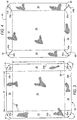
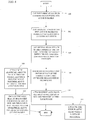
- the four corners of web 10 are cut, substantially along the lines 12, as shown in FIG. 2 (step 100 in FIG. 8 ), forming generally square corner portions 14, 16, 18, 20 that are removed.
- the resulting modified web 22 is still flat, and as shown in FIG.
- top panel 24 having a peripheral edge 26, two opposed side panels 28, 30, as well as two opposed end panels 32, 34.
- Each of side panels 28, 30 and end panels 32, 34 has two respective side edges 35a, as well as a distal edge 35b.
- the dimensions of the top panel 24 are selected so as to be sufficient to be disposed over, and to cover, the top surface of a mattress (not shown), and the dimensions of side panels 28, 30 and end panels 32, 34 are selected to be sufficient to cover the sidewalls and endwalls, respectively, of the mattress, but they also extend a sufficient distance from the peripheral edge 26 of top panel 24 so as to also cover at least a portion of the bottom surface of the mattress.
- opposed side panels 28, 30 will have a dimension L that will correspond substantially to the length dimension of the mattress, while opposed end panels 32, 34 will have a dimension W that will correspond substantially to the width dimension of the mattress; thus, opposed side panels 28, 30 will be substantially congruent, and similarly, opposed end panels 32, 34 will also be substantially congruent.
- FIG. 4 in addition to the aforementioned FIGS. 1-3 and 8 , the adjacent side edges 35a of side and end panels 28, 30, 32, 34 are then brought together as indicated by the arrows A in FIG. 3 , and are joined, two by two (step 102 in FIG. 8 ), to form corner seams 36, 38, 40, 42 respectively, thus resulting in a bed sheet 44.
- a five thread lock stitch is used to join these edges, as illustrated schematically in FIG. 4 .
- This lock stitch uses multiple threads that are interlocked with each other to provide strength for the seams, and this stitch allows bed sheet 44 to accommodate the shape of a mattress at the corners, and maintains the sheet on the mattress.
- FIG. 4 uses multiple threads that are interlocked with each other to provide strength for the seams, and this stitch allows bed sheet 44 to accommodate the shape of a mattress at the corners, and maintains the sheet on the mattress.
- FIG. 4 comprises a reverse view of bed sheet 44 (as compared with FIG. 3 ), so as to illustrate the positions and orientations of the stitches forming the corners seams.
- Each of corner seams 36, 38, 40, 42 has a proximal end 43a and a distal end 43b.
- the distal edges 35b of the side and end panels 28, 30, 32, 34 together form the peripheral free edge of bed sheet 44.
- an additional special seam is made (step 104 in FIG. 8 ) in the fabric of top panel 24 of bed sheet 44 in the general vicinity of each of the corners, along lines 45, each of which, as shown best in FIG. 5 (a top plan view (showing the side of the sheet that faces away from a mattress in use) of bed sheet 44), is formed along a line which is an extension of one of the corner seams.
- Each of these additional seams 46, 48, 50, 52 is preferably about 1.5 inches (2.5 cm) in length, and each one extends diagonally, from peripheral edge 26 of top panel 24 towards the center of top panel 24, along the same longitudinal axis as the adjacent one of corner seams 36, 38, 40, 42 ( FIG. 7A shows the position of these additional seams when the fitted bed sheet of the invention is installed on a mattress).
- the purpose of these additional seams 46, 48, 50, 52 is to gather some of the fabric material of the bed sheet adjacent to the corners, and they help to insure that at each corner, the top panel 24 and each respective intersecting pair of side and end panels 28, 30, 32, 34, do not form a narrow pocket, but instead fit over the mattress corner snugly and assume the shape of the mattress.
- These additional seams 46, 48, 50, 52 can be formed using conventional sewing techniques, such as Daug stitching or using lock stitching placed at all four corners.
- FIG. 5A is an expanded view of the area enclosed by the circle X on figure 5 to enable the line 45, the corner seam 40 and the stitching used to attach the corner elastic to the sheet, to be more clearly seen.
- the fitted bed sheet of the present applicant's previous invention is provided with flexible and stretchable corner members (corner elastics) 54, 56, 58, 60 (step 106 in FIG. 8 ), one at each corner.
- Corner members 54, 56, 58, 60 may be fabricated of any conventional tightly woven elastic material, having a stretch ratio ranging from about 1:2.75 to about 1:3, and may be provided on either surface of the sheet, but preferably they are provided on the surface which will become the inner surface of the sheet, that is, the surface which will be adjacent to the mattress when the sheet is in use.
- Each corner member is positioned overlying one of the corner seams 36, 38, 40, 42, respectively, as illustrated in FIG. 6 , and is secured, preferably via conventional lock stitching; the corner members 54, 56, 58, 60, when the fitted bed sheet of the invention is installed on a horizontally-positioned mattress ( FIG. 7A ), are generally oriented vertically.
- Each corner member 54, 56, 58, 60 is preferably provided in the form of a narrow strip or tape, about 8-12 mm wide, and its length is preferably smaller than the dimension chosen for the length of the side edge 35a of each of the side and end panels 28, 30, 32, 34; most preferably, the length of each corner member, before it is secured to bed sheet 44, is chosen to be less than one-half of the length of the side edge 35a of the side and end panels 28, 30, 32, 34.
- each corner member is secured to the sheet in "stretched” condition, that is, prior to securing each corner member to a respective corner seam, each corner member is stretched out, so that it essentially covers the respective corner seam from end to end.
- the elastic material from which corner members 54, 56, 58 and 60 may be formed is commercially available from a wide variety of sources, such as M/s. Shree Shyam Industries of Bhiwandi, Maharashtra, India and Mahendra Trading Company of Mumbai, Maharashtra, India.
- FIG. 6A is an expanded view of the area enclosed by the circle Y on figure 6 enabling the special seam 48, manufactured using Daug stitching, and the corner member 56 to be more clearly seen.
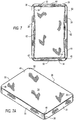
- a border member 62 is secured, preferably via a single needle lock stitching, to the outer edge or perimeter 64 of fitted bed sheet 44 (that is, to the free peripheral edges of the side and end panels 28, 30, 32, 34), as illustrated in FIG. 7 (step 108 in FIG. 8 ).
- the border member 62 is preferably provided in the form of a flexible and stretchable strip or tape comprised of a tightly woven elastic material (the material being more tightly woven than is possible using a knitted elastic), that is preferably about 1 inch (2.5 cm) wide.
- the border member is normally attached to the side of the sheet that, in use, abuts a mattress so that the border member is not normally visible once the fitted sheet is placed on a mattress.
- the overall length of the border member 62 is shorter than the overall length of the perimeter 64 of sheet 44 (the length of perimeter 64 being the combined total of twice the value of dimension W and twice the value of dimension L, as illustrated in FIG. 2 ) most preferably, the length of border member 62 is chosen to be approximately one-half of the length of perimeter 64.
- the border member 62 is secured to the sheet in "stretched” condition, that is, prior to securing the border member 62 to the perimeter 64 of sheet 44, the border member 62 is stretched out, so that it essentially extends around the entire peripheral free edge of the sheet.
- the final fitted bed sheet 44 is formed with a peripheral free edge having an irregular shape (see FIG. 7 ).
- the resulting fitted bed sheet 44 has several advantages over the prior art that pre-dates said applicant's earlier patent.
- the additional seams near the corners insure that the sheet fits snugly and smoothly over the corners of the mattress, while the corner members 54, 56, 58, 60 and the border member 62 cooperate to hold the top panel 24 and side and end panels 28, 30, 32, 34 evenly and smoothly on the various corresponding surfaces of the mattress.
- the fitted bed sheet 44 not only adjusts automatically to variations in the dimensions of a mattress, but can also be used for mattresses with varying heights, depending on the dimension chosen for the edges of the side and end panels 28, 30, 32, 34 (that is, the dimension chosen for the length of the lines 12 shown in FIG. 2 ).
- the fitted sheet will accommodate mattresses with heights ranging from 7 inches (17.8 cm) to 18 inches (45.7 cm), whereas if 14 inches (35.6 cm) is chosen for that dimension, then the fitted sheet will accommodate mattresses with heights ranging from 5.5 inches (14 cm) to 16 inches (40.6 cm), while if 18 inches (45.7 cm) is chosen for that dimension, then the fitted sheet will accommodate mattresses with heights ranging from 9 inches (22.9 cm) to 20 inches (50.8 cm).
- FIGS. 11-13 in addition to the aforementioned FIGS. 1-10 , further advantages of the fitted bed sheet 44 of the applicant's previous invention over the fitted bed sheets of the prior art (that predate the applicant's US patent) become apparent.
- the known fitted bed sheet in FIG. 11 (described in U.S. Pat. No. 5,287,574 ) is provided with the entirety of each end panel 66, 68 being made of a special stretchable (e.g., Lycra®) fabric, as indicated by the arrows B.
- Lycra® stretchable stretchable
- FIG. 12 shows another known fitted sheet (described in U.S. Pat. No. 8,171,581 ) that is provided with segments 72 of special stretchable (e.g., Lycra®) fabric positioned adjacent the corners. Again, this construction is expensive to manufacture, requiring special assembly, particularly near the corner seams, in order to join the stretchable fabric segments with the non-stretchable fabric making up the rest of the fitted sheet.
- FIG. 13 shows yet another known fitted sheet (described in U.S. Pat. No. 7,398,570 ), similar to the one in FIG.
- end panels 74, 76 are "composites" of dual construction, in which a stretchable portion (as indicated by the arrows C) is attached to a non-stretchable portion. Again, this structure is expensive and time-consuming to assemble.
- the flexible and stretchable strip or tape 62 that is stitched to the free peripheral edges of the side and end panels, is comprised of a heat resistant elastic.
- the heat resistant elastic used is most preferably a tightly woven elastic material that is manufactured using elastic having a stretch ratio of from 1:2 to 1:2.5.
- the use of heat resistant elastic provides a sheet that has an extended life as the elastic does not lose it elasticity as rapidly as standard elastic during the laundering process. The loss of elasticity is believed to be due to the degradation of normal elastic on exposure to heat when such fitted sheets are laundered, i.e. particularly when such sheets are tumble dried.
- the heat resistant elastic is manufactured using a heat resistant rubber thread (cord) that is commercially available in the industry, and is simply sold as heat resistant rubber cord; such rubber cord may be purchased from Rubberflex Sdn. Bhd, 21st Floor, U.B.N Tower, Box No. 48, No. 10 Jalan P.Ramlee, 50250 Kuala Lumpur, Malaysia, Tel : +603 2072 0011, Fax : +603 2078 5103 , Email : fikah@rubberflex.com.my , Website www.rubberflex.com.my .
- the heat resistant rubber threads (cords) used are manufactured using a natural rubber, i.e. a latex rubber.
- the heat resistant elastic that has been developed specifically for use in the present invention, and is described herein, is presently manufactured by Royal Elastics, 19-B, Govt. Industrial Estate, Masat. Silvassa. -396230, (D.& N.H.) 02602640764, India.
- polyester yarn suitable for use in the present invention is sold under the trade name "Texturize - polyester yarn”.
- Tests Results (Using test method -IS 7703-Part-2) 30 Gauge rubber - Heat resistant rubber 38 gauge rubber (M)-Standard rubber (non-heat resistant rubber) Breaking Strength in gms a) Original measurements 906 575 Breaking Strength in gms b) Measurements after Ageing at 100°C for 24 hours 908 578 % Elongation at maximum load a) Original 689 588 % Elongation at maximum load b) After Ageing at 100°C for 24 hours 590 593 Visual observation after heat ageing at 100°C for 24 hrs No change - no change in the stiffness of the elastic and no cracking of the elastic was observed
- the modulus (300 %) value of the 30 Gauge heat resistant rubber used herein has been found to be 26-34 (Kg/cm 2 ) as compared to a modulus (300 %) value of 36-42 (Kg/cm 2 ) for a 38 Gauge (non-heat resistant rubber)
- the modulus value of a rubber reflects a test wherein the rubber is stretched up to a length that is 300% greater than its original, and the strength of the rubber is then calculated on the basis of the results obtained.
- the use of heat resistant elastic to manufacture the border member 62 of a fitted sheet provides a fitted sheet that may be washed repeatedly, but wherein the elastic does not suffer from a significant decrease in the elasticity of the elastic border member 62 during cycles of washing and drying.
- the sheets comprising: i) a fitted sheet wherein the border member 62 was manufactured using heat resistant elastic; and, ii) a corresponding sheet wherein the border member 62 of the fitted sheet was manufactured using standard elastic (non-heat resistant elastic).
- a table is shown below, that provides comparative technical data in respect of the border members of these two sheets before and after they have been "aged".
- the standard fitted sheet comprised 2.5cm (1 inch) wide elastic, as disclosed in the present patentee's earlier application, that comprised 38 gauge (non-heat resistant) rubber as opposed to the improved fitted sheet that is disclosed herein and that comprises heat resistant elastic with a gauge of 30.
- EN-14704-3 being a standardised elongation test for elastic/stretchable materials.
- the size of the sheets tested was 152 cm (width) x 203 cm (length) x 40 cm (depth).
- the standard fitted sheet manufactured in accordance with the applicant's earlier US patent no. 8,813,280 B1 - referred to by the applicant as a "True Grip” fitted sheet
- the improved heat resistant sheet disclosed here referred to by the client as "True grip Plus” fitted sheet
- the heat resistant sheet tested above was manufactured using heat resistant rubber, as detailed above, and the standard fitted sheet comprised standard (non-heat resistant) rubber.
- the rubber used to manufacture the heat resistant elastic for the heat resistant sheet was 30 gauge, whilst the rubber cords used to manufacture the standard (non-heat resistant) sheet were 38 gauge.
- the yarn used to produce the elastic of the heat resistant sheet had been pre-shrunk (as discussed above) whilst the elastic used in the manufacture of the standard sheet was not pre-shrunk).
- the flexible and stretchable corner members 54, 56, 58, 60 may similarly be manufactured from heat resistant elastic.
- the elastic for the corner members typically being approximately 1 cm in width.
- Figure 14 illustrates a fitted sheet in accordance with the present invention wherein a label has been affixed to an end panel of said fitted sheet; it will be appreciated that the label 250 could be attached to the top panel 24 (adjacent any side of the top panel). Alternatively, the label 250 (or multiple labels) may be affixed directly to one (or more) of the side panels 28, 30 or to one (or more) of the end panels 32, 34, of a fitted sheet.
- the label(s) 250 may be marked to indicate where on the sheet the label 250 has been attached, i.e. to a side panel (left or right - if they are different) or to an end panel (top or bottom - if they are different) of the sheet.
- the label 250 could be attached to the top panel 24 of the fitted sheet, adjacent to a peripheral edge 26 of the top panel 24, and the label may be marked accordingly to reflect which panel (end, side (left or right) or top) is adjacent said label.
- border members 62 of fitted sheets become damaged, such damage may be caused, for instance, when the sheets are being attached to or detached from a mattress, as the elastic may become caught in the edges of a mattress.
- damage to the border member more commonly occurs during the laundry process, e.g. the damage may be caused by the use of washing machines or tumble dryers wherein the border member becomes snagged on the sides of the drums of such devices.
- the applicant has developed an unexpected solution to this problem wherein the border member 62 is enclosed between the sheet 44 and a second layer of material 281 (i.e. between two layers of shielding material).
- FIG 15 there is shown a bottom/side perspective view of a fitted sheet 44, in accordance with the present invention, the sheet being located on a mattress 280.
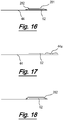
- a partial cross-sectional view (see figure 16 ), taken along the line A-A on figure 15 , illustrates how the fitted sheet 44 and a layer of material (fabric) 281 may form a pocket 282, the material 281 being affixed over the free surface of the border member 62, after said border member 62 has been secured to the sheet 44 as described above.
- the border member 62 may be located in a pocket 282 formed between a layer of material 281 and the fitted sheet 44, wherein the layer of material 281 is provided by one or more appropriately shaped strips of material that are affixed to the fitted sheet and/or to the border member 62 (step 111 in FIG. 8 ).
- the layer of material may be made from any suitable material as would be known to a skilled addressee.
- the layer of material is preferably manufactured from the same material that is used to manufacture the fitted sheet, in order to avoid shrinkage problems.
- the enclosure of the border member 62 in a pocket 282 helps to protect the border member 62 from damage, of the type discussed above, thus prolonging the useful working life of sheets constructed in accordance with the present invention.
- the border member 62 may be enclosed in a pocket 282 formed by a separate layer of material 281, as discussed above.
- the pocket 282 may be formed in its entirety from the web of fabric 10 from which the fitted sheet is manufactured.
- the side panels 28, 30 and end panels 32, 34 are selected such that they cover the sidewalls and endwalls of the mattress, they also extend a sufficient distance from the peripheral edge 26 of top panel 24 so as to also cover at least a portion of the bottom surface of the mattress (as discussed above), and additionally the panels extend beyond the point where the border member is to be attached to the sheet (as described above) (step 109 in FIG. 8 ).
- This provides a portion of material 44a that may be folded back over the border member 62 and affixed to the sheet to form a pocket 282 in which the border member 62 is located.
- the folded back portion 44a of the material may be affixed to the sheet 44 using stitching or any other suitable means, but preferably using a lock stitch (step 110 in FIG. 8 ).
- step 104 the process described above for the manufacture of fitted sheets may be improved by switching the order of the steps 104 and 106, i.e. the flexible and stretchable corner members 54, 56, 58, 60 are attached to the fitted sheet such that they overlie the corner seams 36, 38, 40, 42 (step 106) prior to the additional seam being made in the fabric of the top panel 24 of the bed sheet 44 (step 104).
- Carrying out step 106 before step 104 provides an improved process wherein an automatic stitching machine, as would be known to a person skilled in the art, may be used to affix the stretchable corner members (54, 56, 58, 60) using a chain stitch.
- step 104 is carried out before step 106, a stitching machine (preferably a Juki stitching machine) is used to attach the stretchable corner members (54, 56, 58, 60) using a lock stitch.
- a stitching machine preferably a Juki stitching machine
- the use of the automatic stitching machine speeds up the process of affixing the stretchable corner members 54, 56, 58 and 60 to the bed sheet 44 such that they overlie the corner seams 36, 38, 40, 42.
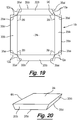
- a bias cut is used to cut out sections from an initial rectangular shaped web of material 10, in order to form side panels 204i, 206i and end panels 203i, 205i that may then be used in the construction of a fitted sheet as described above.
- the use of said bias cut provides side panels 204i, 206i and end panels 203i, 205i wherein the distal edges of the side and end panels 35bi are shorter than the adjacent peripheral edges 26i of the top panel.
- Figure 19 illustrates the shape of a web fabric 10i wherein sections of the web have been removed to form side panels 204i, 206i and end panels 203i, 205i using a bias cut, the additional sections (as compared to the previous embodiment of the invention) of the web that are removed using a bias cut are enclosed by the broken lines 12a.
- the side edges 35ai are preferably cut at an angle of between 80 and 75 degrees (see (a) on figure 19 ) relative to the peripheral edge 26i of the top panel 24i; such that the peripheral edges 26i of the top panel 24i are longer than the adjacent distal edges of the side and end panels 35bi, i.e. the side and end panels are trapezoidal in shape.
- the sheet is then constructed as previously described above. It will be appreciated by the skilled addressee that when the adjacent side edges 35ai of the side panels 204i, 206i and end panels 203i, 205i are brought together and joined, two by two (step 102 in FIG.
- the resulting bed sheet 44i that is initially formed comprises a truncated pyramidal shape that tapers (narrows) towards the distal edges of the side and end panels 35bi, as graphically represented in figure 20 .
- the use of a bias cut corner gives a sheet that is better fitting on mattresses and that is not as readily displaced from its original fitted position on a mattress during use; as the skilled addressee will appreciate mattresses have a tendency to shrink when they are compressed during use and the use of bias cut corners assists the fitted sheet, as disclosed herein, in generally maintaining its position on the mattress, even after repeated washing and drying of said sheet.
- the sheet 44i still generally comprises a generally truncated pyramidal shape, wherein the pyramid tapers towards the outer edge or perimeter of the fitted bed sheet 44i, once the sheet 44i is stretched by its instalment on a mattress.
- the pyramidal shape is obviously not maintained in the section of the sheet 44i that is folded over the bottom surface of the mattress.
- a sheet 44i using a bias cut provides a fitted sheet wherein, in use when the sheet is fitted to a mattress, as the truncated pyramidal structure narrows it progressively grips the adjacent sides and ends of the mattress more tightly (thus avoiding unwanted movement of the sheet) until the point is reached wherein the remainder of the truncated pyramid structure overlaps the bottom of the mattress.
- a bias cut to form a fitted sheet provides a sheet that is better able, in use, to resist unwanted movement of said sheet relative to the mattress to which the sheet 44i has been fitted, due to the lower section of the truncated pyramid structure providing additional resistance to the movement of said sheet on the mattress.
- top panel, the two side panels and the two end panels are described above as being formed from a single piece of material that may comprise, but is not limited to cotton, polyester, viscose or any combination/blend thereof, as described above; The skilled addressee will appreciate that top panel, the two side panels and the two end panels may also be formed from separate pieces of material that are joined together by stitching or by the use of other suitable methods such as gluing, etc.
Landscapes
- Engineering & Computer Science (AREA)
- Textile Engineering (AREA)
- Bedding Items (AREA)
Claims (13)
- Spannbetttuch für eine Matratze, wobei das Spannbetttuch ein wärmebeständiges Elastik aufweist, wobei das wärmebeständige Elastik einen wärmebeständigen Gummi aufweist, dadurch gekennzeichnet, dass das wärmebeständige Elastik bei einer Temperatur in dem Bereich von 170 bis 200 °C thermofixiert worden ist, wobei das wärmebeständige Elastik ein Webelastik aufweist, das ein Polyestergarn, Gummischnüre mit einem Gauge in dem Bereich von 28 bis 32 und mit einem Durchschnitt in dem Bereich von 15 bis 25 Gummischnüren pro 2,54 cm über die Breite des Elastik aufweist.
- Spannbetttuch für eine Matratze nach Anspruch 1, wobei das Spannbetttuch ein dehnbares Randsaumelement aufweist, wobei das Randsaumelement aus dem wärmebeständigen Elastik, das einen wärmebeständigen Gummi aufweist, hergestellt ist.
- Spannbetttuch nach Anspruch 1 oder 2, wobei das wärmebeständige Elastik für eine Zeitdauer in dem Bereich von 50 bis 70 Sekunden bei einer Temperatur in dem Bereich von 170 bis 200 °C thermofixiert worden ist.
- Spannbetttuch für eine Matratze nach einem vorhergehenden Anspruch, wobei das Betttuch ein Gewebe aus Textilmaterial aufweist, wobei das Spannbetttuch aufweist:eine obere Stoffbahn;zwei gegenüberliegende Seitenstoffbahnen; undzwei gegenüberliegende Endstoffbahnen;wobei sich die Seiten- und Endstoffbahnen von der Peripherie der oberen Stoffbahn erstrecken,wobei die obere Stoffbahn dafür dimensioniert ist, die obere Oberfläche der Matratze im Wesentlichen zu bedecken, und wobei die Seitenstoffbahnen und die Endstoffbahnen dafür dimensioniert sind, die Seiten und die Enden der Matratze im Wesentlichen zu bedecken;wobei benachbarte Ränder der Endstoffbahnen und der Seitenstoffbahnen miteinander verbunden sind, um vier Ecknähte zu bilden, die in Verwendung neben den Ecken der Matratze angeordnet sind, und wobei jede Ecknaht eine Längsachse, ein proximales Ende und ein distales Ende aufweist;wobei das Spannbetttuch ferner vier dehnbare Eckelemente aufweist, wobei jedes Eckelement eine ungedehnte Länge aufweist, die kürzer als die Länge der benachbarten Ecknaht ist, wobei die Eckelemente an der zu den Ecknähten benachbarten Stoffbahn befestigt sind und wobei die Eckelemente in ihrem ungedehnten Zustand kürzer als die benachbarten Ecknähte sind, wobei die Eckelemente in ihrem gedehnten Zustand an einer Position an den Ecknähten befestigt sind, die im Wesentlichen über der zugeordneten Ecknaht liegt;wobei die Stoffbahn ferner vier zusätzliche Nähte aufweist, wobei jede zusätzliche Naht auf die Längsachse einer zugeordneten Ecknaht im Wesentlichen axial ausgerichtet ist und wobei jede zusätzliche Naht im Wesentlichen diagonal von dem proximalen Ende der zugeordneten Ecknaht in Richtung der Mitte der oberen Stoffbahn verläuft;ein dehnbares Randsaumelement mit einer ungedehnten Länge, die kürzer als die Länge des Umfangs der Stoffbahn ist, wobei das Randsaumelement in einem gedehnten Zustand an dem Umfang der Stoffbahn befestigt ist; undwobei das dehnbare Randsaumelement aus wärmbeständigem Elastik hergestellt ist, das einen wärmebeständigen Gummi aufweist.
- Spannbetttuch, das ein wärmebeständiges Elastik aufweist, nach einem vorhergehenden Anspruch, wobei das wärmebeständige Elastik einen wärmebeständigen Gummi mit einem Modul in dem Bereich von 26 bis 34 kg/cm2 aufweist.
- Spannbetttuch nach einem vorhergehenden Anspruch, wobei das wärmebeständige Elastik ein Dehnungsverhältnis in dem Bereich von 1:2 bis 1:3 oder ein Dehnungsverhältnis in dem Bereich von 1:2 bis 1:2,5 aufweist und wobei das wärmebeständige Webelastik optional einen Durchschnitt in dem Bereich von 21 bis 23 Gummischnüren pro 2,54 cm über die Breite des verwendeten Elastik aufweist.
- Spannbetttuch nach einem vorhergehenden Anspruch, wobei das wärmebeständige Webelastik eine Kette von Roto-Polyestergarn mit 250 bis 350 Denier und einen Schuss von Roto-Polyestergarn mit 100 bis 200 Denier aufweist oder wobei das wärmebeständige Webelastik eine Kette von Roto-Polyestergarn mit 290 bis 310 Denier und einen Schuss von Roto-Polyestergarn mit 140 bis 160 Denier aufweist.
- Spannbetttuch nach einem vorhergehenden Anspruch, wobei das wärmebeständige Webelastik ein Gewicht in dem Bereich von 20 bis 25 Gramm pro Meter aufweist oder wobei das wärmebeständige Webelastik ein Gewicht in dem Bereich von 21 bis 22 Gramm pro Meter aufweist.
- Spannbetttuch nach einem vorhergehenden Anspruch, wobei das Betttuch eine Pyramidenstumpfform aufweist und wobei die Pyramidenstumpfform optional in Richtung der distalen Räder der Seiten- und Endstoffbahnen geneigt ist und/oder wobei die Pyramidenstumpfform durch die Verwendung von Seiten- und Endstoffbahnen erzeugt ist, die trapezförmig sind, und wobei die trapezförmigen Seiten- und Endstoffbahnen optional Seitenränder aufweisen, die unter einem Winkel in dem Bereich von 80 bis 75 Grad relativ zu dem benachbarten peripheren Rand der oberen Stoffbahn geschnitten sind.
- Spannbetttuch nach Anspruch 2, wobei sich das Randsaumelement zwischen zwei oder mehr Schichten eines Schutzmaterials befindet und wobei optional wenigstens eine der zwei oder mehr Schichten des Schutzmaterials Material aufweist, das die Seitenstoffbahnen und die Endstoffbahnen bildet, und/oder wobei wenigstens zwei der zwei oder mehr Schichten aus Schutzmaterial das Gewebe aus Material aufweisen, aus dem die Seitenstoffbahnen und die Endstoffbahnen hergestellt sind, und/oder wobei sich das Randsaumelement in einer Tasche befindet, die durch zwei oder mehr Schichten des Schutzmaterials gebildet ist.
- Spannbetttuch nach Anspruch 4, wobei die Eckelemente aus wärmebeständigem Elastik hergestellt sind und wobei das zur Herstellung der Eckelemente verwendete wärmebeständige Elastik optional eine Kette von Roto-Polyestergarn mit 250 bis 350 Denier und einen Schuss von Roto-Polyestergarn mit 100 bis 200 Denier aufweist oder wobei das wärmebeständige Webelastik eine Kette von Roto-Polyestergarn mit 290 bis 310 Denier und einen Schuss von Roto-Polyestergarn mit 140 bis 160 Denier aufweist.
- Verfahren zur Herstellung eines Spannbetttuchs nach einem vorhergehenden Anspruch.
- Verfahren zum Herstellen eines Spannbetttuchs nach Anspruch 12, das die folgenden Schritte aufweist:i) Bereitstellen eines Gewebes eines Textilmaterials, das aufweist:eine obere Stoffbahn;zwei gegenüberliegende Seitenstoffbahnen; undzwei gegenüberliegende Endstoffbahnen;wobei die Seiten- und Endstoffbahnen sich von der Peripherie der oberen Stoffbahn erstrecken,wobei die obere Stoffbahn dafür dimensioniert ist, die obere Oberfläche einer Matratze im Wesentlichen zu bedecken, und wobei die Seitenstoffbahnen und die Endstoffbahnen dafür dimensioniert sind, die Seiten und die Enden der Matratze im Wesentlichen zu bedecken;wobei die Stoffbahnen zusammengenäht werden, um ein Spannbetttuch zu bilden;ii) wobei in das Spannbetttuch durch Dehnen des Elastiks vor seinem Befestigen an dem Betttuch ein wärmebeständiges Elastikmaterial, das wärmebeständigen Gummi aufweist, aufgenommen wird, wobei das wärmebeständige Elastik bei einer Temperatur in dem Bereich von 170 bis 200 °C thermofixiert worden ist, und/oder wobei ein Schrägschnitt verwendet wird, um die Seiten- und die Endstoffbahnen des Betttuchs zu bilden, und wobei der Schrägschnitt, der optional verwendet wird, um die Seiten- und Endstoffbahnen des Spannbetttuchs zu bilden, relativ zu dem benachbarten peripheren Rand der oberen Stoffbahn mit einem Innenwinkel in dem Bereich von 85 bis 75 Grad geschnitten wird.
Applications Claiming Priority (2)
| Application Number | Priority Date | Filing Date | Title |
|---|---|---|---|
| GB1610263.4A GB2551341A (en) | 2016-06-13 | 2016-06-13 | A fitted sheet |
| PCT/GB2017/051708 WO2017216535A1 (en) | 2016-06-13 | 2017-06-13 | Heat resistant elastic and a fitted sheet |
Publications (2)
| Publication Number | Publication Date |
|---|---|
| EP3468422A1 EP3468422A1 (de) | 2019-04-17 |
| EP3468422B1 true EP3468422B1 (de) | 2020-11-11 |
Family
ID=56894733
Family Applications (1)
| Application Number | Title | Priority Date | Filing Date |
|---|---|---|---|
| EP17739636.3A Active EP3468422B1 (de) | 2016-06-13 | 2017-06-13 | Hitzebeständiges spannbetttuch |
Country Status (6)
| Country | Link |
|---|---|
| EP (1) | EP3468422B1 (de) |
| AU (1) | AU2017283685B2 (de) |
| CA (1) | CA3030080C (de) |
| DK (1) | DK3468422T3 (de) |
| GB (1) | GB2551341A (de) |
| WO (1) | WO2017216535A1 (de) |
Families Citing this family (4)
| Publication number | Priority date | Publication date | Assignee | Title |
|---|---|---|---|---|
| US12478198B2 (en) * | 2019-12-06 | 2025-11-25 | Indo Count Industries Ltd. | Stretchable bedding components |
| US12376692B2 (en) * | 2020-12-21 | 2025-08-05 | Sysco Guest Supply, Llc | Mattress covers and methods of manufacture |
| CN115120063B (zh) * | 2022-06-28 | 2023-06-16 | 慕思健康睡眠股份有限公司 | 一种床垫内胆及其制作方法、床垫 |
| US20250057339A1 (en) * | 2023-08-14 | 2025-02-20 | Yunus Textile Mills Ltd. | Fitted Sheet for Multiple Mattress Heights |
Family Cites Families (7)
| Publication number | Priority date | Publication date | Assignee | Title |
|---|---|---|---|---|
| US3181179A (en) * | 1962-04-03 | 1965-05-04 | Springs Cotton Mills | Fitted bed sheet and method for making same |
| US4282906A (en) * | 1977-09-07 | 1981-08-11 | J. P. Stevens & Co., Inc. | Narrow elastic fabric |
| US4237805A (en) * | 1978-12-28 | 1980-12-09 | Ferrante Franca G De | Method for making a double fitted sheet |
| US20070283493A1 (en) * | 2006-06-12 | 2007-12-13 | Freudenberg Nonwovens Limited Partnership | Fire Blocking Removable Cover |
| US8438679B2 (en) * | 2008-02-15 | 2013-05-14 | Homtex, Inc. | Bedding system and the like having orientation means |
| US20130042411A1 (en) * | 2011-08-15 | 2013-02-21 | JLJ Home Furnishing LLC. | Fitted sheet |
| US8813280B1 (en) * | 2013-05-07 | 2014-08-26 | Indo Count Industries Ltd | Article of bedding |
-
2016
- 2016-06-13 GB GB1610263.4A patent/GB2551341A/en not_active Withdrawn
-
2017
- 2017-06-13 AU AU2017283685A patent/AU2017283685B2/en active Active
- 2017-06-13 CA CA3030080A patent/CA3030080C/en active Active
- 2017-06-13 DK DK17739636.3T patent/DK3468422T3/da active
- 2017-06-13 EP EP17739636.3A patent/EP3468422B1/de active Active
- 2017-06-13 WO PCT/GB2017/051708 patent/WO2017216535A1/en not_active Ceased
Non-Patent Citations (1)
| Title |
|---|
| None * |
Also Published As
| Publication number | Publication date |
|---|---|
| GB201610263D0 (en) | 2016-07-27 |
| WO2017216535A1 (en) | 2017-12-21 |
| GB2551341A (en) | 2017-12-20 |
| CA3030080C (en) | 2021-10-19 |
| CA3030080A1 (en) | 2017-12-21 |
| AU2017283685A1 (en) | 2019-01-17 |
| DK3468422T3 (da) | 2020-12-07 |
| AU2017283685B2 (en) | 2020-01-30 |
| EP3468422A1 (de) | 2019-04-17 |
Similar Documents
| Publication | Publication Date | Title |
|---|---|---|
| EP3468422B1 (de) | Hitzebeständiges spannbetttuch | |
| US8813280B1 (en) | Article of bedding | |
| EP2087815B1 (de) | Bettlaken mit gewobenem Rand mit elastomeren Garnen | |
| CA2285369C (en) | Fitted mattress cover with stretchable knit skirt | |
| US5636393A (en) | Mattress cover with inelastically stretchable skirt | |
| EP3330419B1 (de) | Gebürstete rundstrickware | |
| DE102007050489A1 (de) | Textiles Flächenmaterial, insbesondere textiles Gewebe, mit Schrumpfeigenschaften, dessen Verwendung sowie damit hergestellte Produkte | |
| CA2622339A1 (en) | Woven bed sheet with elastomeric knitted corners | |
| US11589693B2 (en) | Bed linens, and related bedding assemblies and methods | |
| JPWO2006082725A1 (ja) | 寝具用カバー | |
| JP6757951B2 (ja) | 伸縮性経編地及びそれを用いた衣料 | |
| WO2021176468A1 (en) | An elastomeric fitted sheet and method thereof | |
| US20190257010A1 (en) | Multi-layer woven textiles formed from various materials and towels formed from multi-layer woven textiles | |
| US7007326B2 (en) | Package for skirt material of a fitted cover | |
| US1518798A (en) | Elastic fabric | |
| JP2010047847A (ja) | 衣服 | |
| US12478198B2 (en) | Stretchable bedding components | |
| US20250134282A1 (en) | Bedding, method of making, and method of using the same | |
| US2971197A (en) | Stretchable band of shirred fabric | |
| CA1134111A (en) | Mop construction | |
| JP2019155024A (ja) | 全包布 | |
| HK1133806B (en) | Woven contoured bed sheet with elastomeric yarns | |
| JP2004065306A (ja) | ボタン |
Legal Events
| Date | Code | Title | Description |
|---|---|---|---|
| STAA | Information on the status of an ep patent application or granted ep patent |
Free format text: STATUS: UNKNOWN |
|
| STAA | Information on the status of an ep patent application or granted ep patent |
Free format text: STATUS: THE INTERNATIONAL PUBLICATION HAS BEEN MADE |
|
| PUAI | Public reference made under article 153(3) epc to a published international application that has entered the european phase |
Free format text: ORIGINAL CODE: 0009012 |
|
| STAA | Information on the status of an ep patent application or granted ep patent |
Free format text: STATUS: REQUEST FOR EXAMINATION WAS MADE |
|
| 17P | Request for examination filed |
Effective date: 20190111 |
|
| AK | Designated contracting states |
Kind code of ref document: A1 Designated state(s): AL AT BE BG CH CY CZ DE DK EE ES FI FR GB GR HR HU IE IS IT LI LT LU LV MC MK MT NL NO PL PT RO RS SE SI SK SM TR |
|
| AX | Request for extension of the european patent |
Extension state: BA ME |
|
| DAV | Request for validation of the european patent (deleted) | ||
| DAX | Request for extension of the european patent (deleted) | ||
| GRAP | Despatch of communication of intention to grant a patent |
Free format text: ORIGINAL CODE: EPIDOSNIGR1 |
|
| STAA | Information on the status of an ep patent application or granted ep patent |
Free format text: STATUS: GRANT OF PATENT IS INTENDED |
|
| INTG | Intention to grant announced |
Effective date: 20200603 |
|
| GRAS | Grant fee paid |
Free format text: ORIGINAL CODE: EPIDOSNIGR3 |
|
| GRAA | (expected) grant |
Free format text: ORIGINAL CODE: 0009210 |
|
| STAA | Information on the status of an ep patent application or granted ep patent |
Free format text: STATUS: THE PATENT HAS BEEN GRANTED |
|
| AK | Designated contracting states |
Kind code of ref document: B1 Designated state(s): AL AT BE BG CH CY CZ DE DK EE ES FI FR GB GR HR HU IE IS IT LI LT LU LV MC MK MT NL NO PL PT RO RS SE SI SK SM TR |
|
| REG | Reference to a national code |
Ref country code: GB Ref legal event code: FG4D |
|
| REG | Reference to a national code |
Ref country code: CH Ref legal event code: EP |
|
| REG | Reference to a national code |
Ref country code: AT Ref legal event code: REF Ref document number: 1332635 Country of ref document: AT Kind code of ref document: T Effective date: 20201115 |
|
| REG | Reference to a national code |
Ref country code: DE Ref legal event code: R096 Ref document number: 602017027375 Country of ref document: DE |
|
| REG | Reference to a national code |
Ref country code: DK Ref legal event code: T3 Effective date: 20201201 |
|
| REG | Reference to a national code |
Ref country code: IE Ref legal event code: FG4D |
|
| REG | Reference to a national code |
Ref country code: NL Ref legal event code: MP Effective date: 20201111 |
|
| REG | Reference to a national code |
Ref country code: AT Ref legal event code: MK05 Ref document number: 1332635 Country of ref document: AT Kind code of ref document: T Effective date: 20201111 |
|
| PG25 | Lapsed in a contracting state [announced via postgrant information from national office to epo] |
Ref country code: RS Free format text: LAPSE BECAUSE OF FAILURE TO SUBMIT A TRANSLATION OF THE DESCRIPTION OR TO PAY THE FEE WITHIN THE PRESCRIBED TIME-LIMIT Effective date: 20201111 Ref country code: PT Free format text: LAPSE BECAUSE OF FAILURE TO SUBMIT A TRANSLATION OF THE DESCRIPTION OR TO PAY THE FEE WITHIN THE PRESCRIBED TIME-LIMIT Effective date: 20210311 Ref country code: NO Free format text: LAPSE BECAUSE OF FAILURE TO SUBMIT A TRANSLATION OF THE DESCRIPTION OR TO PAY THE FEE WITHIN THE PRESCRIBED TIME-LIMIT Effective date: 20210211 Ref country code: FI Free format text: LAPSE BECAUSE OF FAILURE TO SUBMIT A TRANSLATION OF THE DESCRIPTION OR TO PAY THE FEE WITHIN THE PRESCRIBED TIME-LIMIT Effective date: 20201111 Ref country code: GR Free format text: LAPSE BECAUSE OF FAILURE TO SUBMIT A TRANSLATION OF THE DESCRIPTION OR TO PAY THE FEE WITHIN THE PRESCRIBED TIME-LIMIT Effective date: 20210212 |
|
| PG25 | Lapsed in a contracting state [announced via postgrant information from national office to epo] |
Ref country code: AT Free format text: LAPSE BECAUSE OF FAILURE TO SUBMIT A TRANSLATION OF THE DESCRIPTION OR TO PAY THE FEE WITHIN THE PRESCRIBED TIME-LIMIT Effective date: 20201111 Ref country code: IS Free format text: LAPSE BECAUSE OF FAILURE TO SUBMIT A TRANSLATION OF THE DESCRIPTION OR TO PAY THE FEE WITHIN THE PRESCRIBED TIME-LIMIT Effective date: 20210311 Ref country code: LV Free format text: LAPSE BECAUSE OF FAILURE TO SUBMIT A TRANSLATION OF THE DESCRIPTION OR TO PAY THE FEE WITHIN THE PRESCRIBED TIME-LIMIT Effective date: 20201111 Ref country code: PL Free format text: LAPSE BECAUSE OF FAILURE TO SUBMIT A TRANSLATION OF THE DESCRIPTION OR TO PAY THE FEE WITHIN THE PRESCRIBED TIME-LIMIT Effective date: 20201111 Ref country code: SE Free format text: LAPSE BECAUSE OF FAILURE TO SUBMIT A TRANSLATION OF THE DESCRIPTION OR TO PAY THE FEE WITHIN THE PRESCRIBED TIME-LIMIT Effective date: 20201111 Ref country code: BG Free format text: LAPSE BECAUSE OF FAILURE TO SUBMIT A TRANSLATION OF THE DESCRIPTION OR TO PAY THE FEE WITHIN THE PRESCRIBED TIME-LIMIT Effective date: 20210211 |
|
| REG | Reference to a national code |
Ref country code: LT Ref legal event code: MG9D |
|
| PG25 | Lapsed in a contracting state [announced via postgrant information from national office to epo] |
Ref country code: HR Free format text: LAPSE BECAUSE OF FAILURE TO SUBMIT A TRANSLATION OF THE DESCRIPTION OR TO PAY THE FEE WITHIN THE PRESCRIBED TIME-LIMIT Effective date: 20201111 |
|
| PG25 | Lapsed in a contracting state [announced via postgrant information from national office to epo] |
Ref country code: SK Free format text: LAPSE BECAUSE OF FAILURE TO SUBMIT A TRANSLATION OF THE DESCRIPTION OR TO PAY THE FEE WITHIN THE PRESCRIBED TIME-LIMIT Effective date: 20201111 Ref country code: RO Free format text: LAPSE BECAUSE OF FAILURE TO SUBMIT A TRANSLATION OF THE DESCRIPTION OR TO PAY THE FEE WITHIN THE PRESCRIBED TIME-LIMIT Effective date: 20201111 Ref country code: SM Free format text: LAPSE BECAUSE OF FAILURE TO SUBMIT A TRANSLATION OF THE DESCRIPTION OR TO PAY THE FEE WITHIN THE PRESCRIBED TIME-LIMIT Effective date: 20201111 Ref country code: CZ Free format text: LAPSE BECAUSE OF FAILURE TO SUBMIT A TRANSLATION OF THE DESCRIPTION OR TO PAY THE FEE WITHIN THE PRESCRIBED TIME-LIMIT Effective date: 20201111 Ref country code: EE Free format text: LAPSE BECAUSE OF FAILURE TO SUBMIT A TRANSLATION OF THE DESCRIPTION OR TO PAY THE FEE WITHIN THE PRESCRIBED TIME-LIMIT Effective date: 20201111 Ref country code: LT Free format text: LAPSE BECAUSE OF FAILURE TO SUBMIT A TRANSLATION OF THE DESCRIPTION OR TO PAY THE FEE WITHIN THE PRESCRIBED TIME-LIMIT Effective date: 20201111 |
|
| REG | Reference to a national code |
Ref country code: DE Ref legal event code: R097 Ref document number: 602017027375 Country of ref document: DE |
|
| PLBE | No opposition filed within time limit |
Free format text: ORIGINAL CODE: 0009261 |
|
| STAA | Information on the status of an ep patent application or granted ep patent |
Free format text: STATUS: NO OPPOSITION FILED WITHIN TIME LIMIT |
|
| 26N | No opposition filed |
Effective date: 20210812 |
|
| PG25 | Lapsed in a contracting state [announced via postgrant information from national office to epo] |
Ref country code: IT Free format text: LAPSE BECAUSE OF FAILURE TO SUBMIT A TRANSLATION OF THE DESCRIPTION OR TO PAY THE FEE WITHIN THE PRESCRIBED TIME-LIMIT Effective date: 20201111 Ref country code: NL Free format text: LAPSE BECAUSE OF FAILURE TO SUBMIT A TRANSLATION OF THE DESCRIPTION OR TO PAY THE FEE WITHIN THE PRESCRIBED TIME-LIMIT Effective date: 20201111 Ref country code: AL Free format text: LAPSE BECAUSE OF FAILURE TO SUBMIT A TRANSLATION OF THE DESCRIPTION OR TO PAY THE FEE WITHIN THE PRESCRIBED TIME-LIMIT Effective date: 20201111 |
|
| PG25 | Lapsed in a contracting state [announced via postgrant information from national office to epo] |
Ref country code: SI Free format text: LAPSE BECAUSE OF FAILURE TO SUBMIT A TRANSLATION OF THE DESCRIPTION OR TO PAY THE FEE WITHIN THE PRESCRIBED TIME-LIMIT Effective date: 20201111 |
|
| PG25 | Lapsed in a contracting state [announced via postgrant information from national office to epo] |
Ref country code: ES Free format text: LAPSE BECAUSE OF FAILURE TO SUBMIT A TRANSLATION OF THE DESCRIPTION OR TO PAY THE FEE WITHIN THE PRESCRIBED TIME-LIMIT Effective date: 20201111 Ref country code: MC Free format text: LAPSE BECAUSE OF FAILURE TO SUBMIT A TRANSLATION OF THE DESCRIPTION OR TO PAY THE FEE WITHIN THE PRESCRIBED TIME-LIMIT Effective date: 20201111 |
|
| REG | Reference to a national code |
Ref country code: CH Ref legal event code: PL |
|
| REG | Reference to a national code |
Ref country code: BE Ref legal event code: MM Effective date: 20210630 |
|
| PG25 | Lapsed in a contracting state [announced via postgrant information from national office to epo] |
Ref country code: LU Free format text: LAPSE BECAUSE OF NON-PAYMENT OF DUE FEES Effective date: 20210613 |
|
| PG25 | Lapsed in a contracting state [announced via postgrant information from national office to epo] |
Ref country code: LI Free format text: LAPSE BECAUSE OF NON-PAYMENT OF DUE FEES Effective date: 20210630 Ref country code: IE Free format text: LAPSE BECAUSE OF NON-PAYMENT OF DUE FEES Effective date: 20210613 Ref country code: CH Free format text: LAPSE BECAUSE OF NON-PAYMENT OF DUE FEES Effective date: 20210630 |
|
| PG25 | Lapsed in a contracting state [announced via postgrant information from national office to epo] |
Ref country code: IS Free format text: LAPSE BECAUSE OF FAILURE TO SUBMIT A TRANSLATION OF THE DESCRIPTION OR TO PAY THE FEE WITHIN THE PRESCRIBED TIME-LIMIT Effective date: 20210311 Ref country code: FR Free format text: LAPSE BECAUSE OF NON-PAYMENT OF DUE FEES Effective date: 20210630 |
|
| PG25 | Lapsed in a contracting state [announced via postgrant information from national office to epo] |
Ref country code: BE Free format text: LAPSE BECAUSE OF NON-PAYMENT OF DUE FEES Effective date: 20210630 |
|
| PG25 | Lapsed in a contracting state [announced via postgrant information from national office to epo] |
Ref country code: CY Free format text: LAPSE BECAUSE OF FAILURE TO SUBMIT A TRANSLATION OF THE DESCRIPTION OR TO PAY THE FEE WITHIN THE PRESCRIBED TIME-LIMIT Effective date: 20201111 |
|
| P01 | Opt-out of the competence of the unified patent court (upc) registered |
Effective date: 20230525 |
|
| PG25 | Lapsed in a contracting state [announced via postgrant information from national office to epo] |
Ref country code: HU Free format text: LAPSE BECAUSE OF FAILURE TO SUBMIT A TRANSLATION OF THE DESCRIPTION OR TO PAY THE FEE WITHIN THE PRESCRIBED TIME-LIMIT; INVALID AB INITIO Effective date: 20170613 |
|
| PG25 | Lapsed in a contracting state [announced via postgrant information from national office to epo] |
Ref country code: MK Free format text: LAPSE BECAUSE OF FAILURE TO SUBMIT A TRANSLATION OF THE DESCRIPTION OR TO PAY THE FEE WITHIN THE PRESCRIBED TIME-LIMIT Effective date: 20201111 |
|
| PG25 | Lapsed in a contracting state [announced via postgrant information from national office to epo] |
Ref country code: TR Free format text: LAPSE BECAUSE OF FAILURE TO SUBMIT A TRANSLATION OF THE DESCRIPTION OR TO PAY THE FEE WITHIN THE PRESCRIBED TIME-LIMIT Effective date: 20201111 |
|
| PG25 | Lapsed in a contracting state [announced via postgrant information from national office to epo] |
Ref country code: MT Free format text: LAPSE BECAUSE OF FAILURE TO SUBMIT A TRANSLATION OF THE DESCRIPTION OR TO PAY THE FEE WITHIN THE PRESCRIBED TIME-LIMIT Effective date: 20201111 |
|
| PGFP | Annual fee paid to national office [announced via postgrant information from national office to epo] |
Ref country code: DK Payment date: 20250728 Year of fee payment: 9 Ref country code: DE Payment date: 20250822 Year of fee payment: 9 |
|
| PGFP | Annual fee paid to national office [announced via postgrant information from national office to epo] |
Ref country code: GB Payment date: 20250725 Year of fee payment: 9 |