EP3462425A1 - Parklückenbeurteilungssystem - Google Patents
Parklückenbeurteilungssystem Download PDFInfo
- Publication number
- EP3462425A1 EP3462425A1 EP17194037.2A EP17194037A EP3462425A1 EP 3462425 A1 EP3462425 A1 EP 3462425A1 EP 17194037 A EP17194037 A EP 17194037A EP 3462425 A1 EP3462425 A1 EP 3462425A1
- Authority
- EP
- European Patent Office
- Prior art keywords
- parking
- vehicle
- data
- location
- user
- Prior art date
- Legal status (The legal status is an assumption and is not a legal conclusion. Google has not performed a legal analysis and makes no representation as to the accuracy of the status listed.)
- Ceased
Links
Images




Classifications
-
- G—PHYSICS
- G08—SIGNALLING
- G08G—TRAFFIC CONTROL SYSTEMS
- G08G1/00—Traffic control systems for road vehicles
- G08G1/16—Anti-collision systems
- G08G1/168—Driving aids for parking, e.g. acoustic or visual feedback on parking space
-
- B—PERFORMING OPERATIONS; TRANSPORTING
- B60—VEHICLES IN GENERAL
- B60W—CONJOINT CONTROL OF VEHICLE SUB-UNITS OF DIFFERENT TYPE OR DIFFERENT FUNCTION; CONTROL SYSTEMS SPECIALLY ADAPTED FOR HYBRID VEHICLES; ROAD VEHICLE DRIVE CONTROL SYSTEMS FOR PURPOSES NOT RELATED TO THE CONTROL OF A PARTICULAR SUB-UNIT
- B60W30/00—Purposes of road vehicle drive control systems not related to the control of a particular sub-unit, e.g. of systems using conjoint control of vehicle sub-units
- B60W30/06—Automatic manoeuvring for parking
-
- G—PHYSICS
- G08—SIGNALLING
- G08G—TRAFFIC CONTROL SYSTEMS
- G08G1/00—Traffic control systems for road vehicles
- G08G1/09—Arrangements for giving variable traffic instructions
- G08G1/0962—Arrangements for giving variable traffic instructions having an indicator mounted inside the vehicle, e.g. giving voice messages
- G08G1/09626—Arrangements for giving variable traffic instructions having an indicator mounted inside the vehicle, e.g. giving voice messages where the origin of the information is within the own vehicle, e.g. a local storage device, digital map
-
- G—PHYSICS
- G08—SIGNALLING
- G08G—TRAFFIC CONTROL SYSTEMS
- G08G1/00—Traffic control systems for road vehicles
- G08G1/14—Traffic control systems for road vehicles indicating individual free spaces in parking areas
- G08G1/141—Traffic control systems for road vehicles indicating individual free spaces in parking areas with means giving the indication of available parking spaces
- G08G1/144—Traffic control systems for road vehicles indicating individual free spaces in parking areas with means giving the indication of available parking spaces on portable or mobile units, e.g. personal digital assistant [PDA]
-
- B—PERFORMING OPERATIONS; TRANSPORTING
- B60—VEHICLES IN GENERAL
- B60W—CONJOINT CONTROL OF VEHICLE SUB-UNITS OF DIFFERENT TYPE OR DIFFERENT FUNCTION; CONTROL SYSTEMS SPECIALLY ADAPTED FOR HYBRID VEHICLES; ROAD VEHICLE DRIVE CONTROL SYSTEMS FOR PURPOSES NOT RELATED TO THE CONTROL OF A PARTICULAR SUB-UNIT
- B60W50/00—Details of control systems for road vehicle drive control not related to the control of a particular sub-unit, e.g. process diagnostic or vehicle driver interfaces
- B60W2050/0062—Adapting control system settings
- B60W2050/0063—Manual parameter input, manual setting means, manual initialising or calibrating means
- B60W2050/0064—Manual parameter input, manual setting means, manual initialising or calibrating means using a remote, e.g. cordless, transmitter or receiver unit, e.g. remote keypad or mobile phone
Definitions
- the present invention relates to a parking space judgment system to judge the suitability of parking a vehicle in one or more parking spaces in one or more parking locations and methods thereof.
- parking affects both the users of vehicles and the general population.
- the location of a car park and time to park a vehicle can be important considerations. This is especially the case in populated areas where parking occupancy tends to be high.
- parking of a vehicle is often chargeable, either by the owner of a parking location or by a government body, therefore the cost of parking may also be an important consideration for the vehicle's owner or user.
- the user may wish to combine their vehicle journey with the use of public transport, so again the location of parking and time to park may well be important considerations.
- a final consideration is that parking can be frustrating to the user, with most drivers agreeing that it is one of the least pleasurable parts of a journey.
- the vehicle has (i) a set of sensors able to gauge the distance between the vehicle and surrounding objects, (ii) the ability to automatically control its motion and (iii) a set of algorithms that guide the parking process.
- the present invention is directed to a parking space judgment system for judging the suitability of parking a vehicle in one or more parking spaces in one or more parking locations and methods thereof that substantially obviates one or more of the above problems.
- a parking space judgment system for judging the suitability of parking a vehicle in one or more parking spaces in one or more parking locations, the system comprising: a map to guide the vehicle; a location properties database to store data pertaining to the parking locations; a receiver unit to receive gathered data from the vehicle when the vehicle is making a parking maneuver; a vehicle database to store data pertaining to a plurality of parking maneuvers of the vehicle and a plurality of self-parking algorithms for the vehicle; a location assessment algorithm to determine a parking requirement of the vehicle; and a user interface to receive instructions from a user and to provide a parking suitability metric to the user of the system.
- the location assessment algorithm may comprise data showing a fit on the parking capability of the vehicle; and a desired parking space of the parking location.
- the self-parking algorithm may be configured to control the parking of the vehicle into the parking space.
- the vehicle database may include data pertaining to motion, and/or distance and/or angle of rotation gathered by a sensor on the vehicle during parking maneuvers.
- the location assessment algorithm may compare the vehicle parking requirement and the parking location data to calculate a parking location assessment result.
- the parking suitability metric may comprise guidance on whether the parking space is deemed fit or unfit for parking.
- the parking suitability metric may be calculated using the parking location assessment result and parking signature data.
- the parking signature data may comprise data that indicates an occurrence of the parking event.
- a vehicle for data collection comprising: a plurality of sensors for sensing data such as acceleration, and/or orientation, and/or motion of the vehicle in order to classify the data as parking maneuvers; a controller configured to initiate the gathering of data by the sensors when the vehicle is making a parking maneuver; a communication unit to send the gathered data to the system; a software application to receive instructions and information from a user, and to display a parking suitability metric to the user.
- the software application may be installed on a portable electronic device.
- a method for providing a user with guidance on the suitability of one or more parking spaces in one or more parking locations comprising the steps of: (a) a parking assessment process to select a desired parking location and calculate a parking assessment result; and (b) an assessment comparison process to calculate a parking suitability metric based on the parking assessment result.
- the parking assessment process may comprise: selecting the desired parking location; determining a vehicle parking requirement by querying a vehicle database; determining parking location data by querying a location properties database; and calculating the parking assessment result by using a location assessment algorithm, wherein the location assessment algorithm compares the vehicle parking requirement with the parking location data.
- the location assessment algorithm may comprise data showing a fit on a parking capability of the vehicle; and a parking space of the parking location.
- the parking location data may comprise percentage guidance on difficulties of parking in the parking location.
- the assessment comparison process may comprise: using a parking location assessment result and the parking signature data as input to calculate a parking suitability metric; and displaying the parking suitability metric to the user via a user interface.
- the parking signature data may comprise the user parking signature data and/or the vehicle parking signature data.
- the user parking signature data may be data on a parking capability and preference of the user.
- the vehicle parking signature may be data on a parking maneuver and the parking capability of the vehicle.
- the parking location assessment result may comprise tolerances on the parking signature data and when the parking space is within the tolerances, the parking space is deemed fit for parking.
- the parking suitability metric may comprise guidance on whether the parking space is deemed fit or unfit for parking.
- a method for collecting data with a vehicle described above may comprise: collecting data sensed by a sensor on the vehicle, wherein the data includes motion data of the vehicle; comparing the sensed data to a parking signature data to determine if a parking event occurs, wherein the parking signature data comprises data that indicates an occurrence of the parking event; storing the sensed data in a vehicle database when the sensed data is determined as the parking event.
- a user's historic parking maneuvers may be stored and assessed, or (ii) a vehicle's self-parking algorithms may be categorized.
- the parking maneuvers used by a plurality of vehicles and drivers at a certain Parking Location may be stored and assessed.
- An assessment may be made of the likely match between the vehicles/users parking capacity and the properties of the spaces in a given Parking Location, and based on this, information is given to the user to allow a choice to be made as to whether they wish to park in that location or choose another (in some embodiments this choice may be automatically made by the system).
- the Parking Location will likely have multiple Parking Spaces, and the Parking Spaces may vary in their properties.
- the method may take an average view of the properties of Parking Spaces in each location. Hence, the smaller the Parking Location is, the more accurate the assessment will be. Therefore, the invention will benefit if the Parking Locations can be sub-divided in a fine-grained but logical way.
- the present invention has the advantageous effect of allowing a user to know (i) whether a vehicle's self-parking algorithms are likely to be able to park in a given location, or (ii) whether the spaces within a given Parking Location are likely to be thought of as comfortable or difficult parking maneuver for a user according to the user's historic parking data.
- parking location refers to a geographical zone containing parking spaces.
- Parking Locations include streets that contain areas where drivers can legally park, a car park or an area of ground where parking takes place.
- a Parking Location typically contains a plurality of Parking Spaces.
- a Parking Space refers to the individual spaces within a Parking Location where a vehicle can be parked.
- existing localization methods such as those based on satellites like Global Positioning System (GPS), or based on the mobile network triangulation may be used by the smart phone and/or car system in combination with much more precise triangulation of the planed narrow band internet of things (NBIoT).
- NBIoT planed narrow band internet of things
- UMTS Universal Mobile Telecommunications System
- a Communication Unit can be used that also contains this functionality i.e. that is able to use new capabilities of the network (800MHz Band 20 and 900MHz Band 8) as outlined by the 3rd Generation Partnership Project (3GPP) standardization body.
- Parking Event refers to the action of a vehicle either arriving and locating at a Parking Space or a vehicle leaving a Parking Space.
- Parking Signature refers to a set of data that indicates that a Parking Event is taking place. This may include proximity data gathered by proximity sensors mounted on a second vehicle that monitors the second vehicle's proximity to a first vehicle as the first vehicle either enters a Parking Space or leaves a Parking Space.
- FIG. 1 is a schematic illustrating a system according to an embodiment of the present invention.
- the system will involve a vehicle (the "Vehicle") being used for a journey that will end with the Vehicle being parked.
- vehicle the “Vehicle”
- the system may comprise a map (the “Map") used to guide the Vehicle, including areas known to be Parking Locations.
- An application running on a device (the “Device”) such as a Smartphone, which includes a method to gather information from the user and also provide information to the user (via the User Interface "UI").
- the Device may be a general purpose device such as a smartphone, or may be a 'specific' device such as GPS device, which in turn may be portable or may be integrated within the Vehicle.
- a sensor either within the Vehicle or the Device that is able to sense data (the “Sensed Data”) may be used to classify parking maneuvers.
- a sensor would be an inertial sensor that is able to measure acceleration and orientation.
- a plurality of algorithms may be used to control the vehicle as it parks.
- the system may comprise a database (the "Location Properties Database”) storing data pertaining to various Parking Locations. Examples of data stored include average size of Parking Spaces, height of curb etc.
- the system may further comprise a database (the "Vehicle Database”) storing either:
- Figs. 2a , 2b and 2c are schematics of the three processes used in the embodiment of the present invention.
- FIG. 2a is a schematic of the Collection of Parking Assessment Data Process according to an embodiment of the present invention.
- the Collection of Parking Assessment Data Process is only used when the vehicle is being manually parked.
- Step S1 the user drives a vehicle which comprises a device with a software application (App).
- the App runs on the device and controls the gathering of information from the user.
- the App controls the gathering data pertaining to the vehicle during parking maneuvers.
- the sensors collect sensed data such as motion data.
- the sensed data is compared to Parking Signatures stored in the Parking Signatures Database in Step S2.
- the Sensed Data is tagged with the Parking Event data and stored in the Vehicle Database in Step S3.
- Step S4 multiple sets of Sensed Data are collected from multiple users over time. Therefore, a given Parking Location can have a set of data describing how people maneuver their vehicles when parking there and a given user can have a set of data describing how they maneuver their vehicles in various Parking Locations.
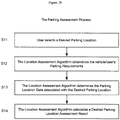
- FIG. 2b is a schematic of the Parking Assessment Process according to an embodiment of the present invention.
- the user selects a Parking Location (defined as the "Desired Parking Location"). This may be an explicit selection, or the user may just select a desired destination on a GPS application, and the nearest Parking Location may then be selected by the GPS application. This selection may also be performed via a "map" type App.
- Step S12 the Location Assessment Algorithm determines the Vehicle's Parking Requirements by querying the Vehicle Database.
- Step S13 the Location Assessment Algorithm determines the Parking Location Data by querying the Location Properties Database for the Desired Parking Location.
- Step S14 the Location Assessment Algorithm calculates a Desired Parking Location Assessment Result.
- the Location Assessment Algorithm compares the Vehicle Parking Requirement and the Parking Location data to calculate a parking location assessment result.
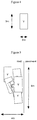
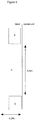
- FIG 2c An example of the Assessment Comparison Process used by the Location Assessment Algorithm is shown in FIG 2c .
- the Location Assessment Algorithm makes a comparison to ensure the available parking space would at least meet the size requirement of the vehicle (found by the combination of all the individual vehicle Parking Requirement measurements).
Landscapes
- Engineering & Computer Science (AREA)
- Physics & Mathematics (AREA)
- General Physics & Mathematics (AREA)
- Automation & Control Theory (AREA)
- Transportation (AREA)
- Mechanical Engineering (AREA)
- Traffic Control Systems (AREA)
Priority Applications (1)
| Application Number | Priority Date | Filing Date | Title |
|---|---|---|---|
| EP17194037.2A EP3462425A1 (de) | 2017-09-29 | 2017-09-29 | Parklückenbeurteilungssystem |
Applications Claiming Priority (1)
| Application Number | Priority Date | Filing Date | Title |
|---|---|---|---|
| EP17194037.2A EP3462425A1 (de) | 2017-09-29 | 2017-09-29 | Parklückenbeurteilungssystem |
Publications (1)
| Publication Number | Publication Date |
|---|---|
| EP3462425A1 true EP3462425A1 (de) | 2019-04-03 |
Family
ID=60021904
Family Applications (1)
| Application Number | Title | Priority Date | Filing Date |
|---|---|---|---|
| EP17194037.2A Ceased EP3462425A1 (de) | 2017-09-29 | 2017-09-29 | Parklückenbeurteilungssystem |
Country Status (1)
| Country | Link |
|---|---|
| EP (1) | EP3462425A1 (de) |
Cited By (4)
| Publication number | Priority date | Publication date | Assignee | Title |
|---|---|---|---|---|
| CN114684149A (zh) * | 2022-04-27 | 2022-07-01 | 广州文远知行科技有限公司 | 泊车评估方法、装置、设备及存储介质 |
| DE102022002243A1 (de) | 2022-06-21 | 2023-07-27 | Mercedes-Benz Group AG | Verfahren zur unterstützten Suche einer Parkmöglichkeit eines Fahrzeuges |
| DE102022208531A1 (de) * | 2022-08-17 | 2024-02-22 | Volkswagen Aktiengesellschaft | Verfahren und System zur Parkplatzcharakterisierung und Kraftfahrzeug |
| DE102022210882A1 (de) * | 2022-10-14 | 2024-04-25 | Volkswagen Aktiengesellschaft | Verfahren zum Erkennen einer Abstellmöglichkeit eines Fahrzeuges, Computerprogrammprodukt sowie System |
Citations (4)
| Publication number | Priority date | Publication date | Assignee | Title |
|---|---|---|---|---|
| US20100152972A1 (en) * | 2008-12-15 | 2010-06-17 | Joe Charles Attard | Parallel park assist |
| US20140266805A1 (en) * | 2013-03-15 | 2014-09-18 | Volkswagen Ag | Personalized parking assistant |
| US20160117925A1 (en) * | 2014-10-22 | 2016-04-28 | International Business Machines Corporation | Intelligent Parking Space Identification and Notification |
| US20160284217A1 (en) * | 2015-03-24 | 2016-09-29 | Lg Electronics Inc. | Vehicle, mobile terminal and method for controlling the same |
-
2017
- 2017-09-29 EP EP17194037.2A patent/EP3462425A1/de not_active Ceased
Patent Citations (4)
| Publication number | Priority date | Publication date | Assignee | Title |
|---|---|---|---|---|
| US20100152972A1 (en) * | 2008-12-15 | 2010-06-17 | Joe Charles Attard | Parallel park assist |
| US20140266805A1 (en) * | 2013-03-15 | 2014-09-18 | Volkswagen Ag | Personalized parking assistant |
| US20160117925A1 (en) * | 2014-10-22 | 2016-04-28 | International Business Machines Corporation | Intelligent Parking Space Identification and Notification |
| US20160284217A1 (en) * | 2015-03-24 | 2016-09-29 | Lg Electronics Inc. | Vehicle, mobile terminal and method for controlling the same |
Cited By (4)
| Publication number | Priority date | Publication date | Assignee | Title |
|---|---|---|---|---|
| CN114684149A (zh) * | 2022-04-27 | 2022-07-01 | 广州文远知行科技有限公司 | 泊车评估方法、装置、设备及存储介质 |
| DE102022002243A1 (de) | 2022-06-21 | 2023-07-27 | Mercedes-Benz Group AG | Verfahren zur unterstützten Suche einer Parkmöglichkeit eines Fahrzeuges |
| DE102022208531A1 (de) * | 2022-08-17 | 2024-02-22 | Volkswagen Aktiengesellschaft | Verfahren und System zur Parkplatzcharakterisierung und Kraftfahrzeug |
| DE102022210882A1 (de) * | 2022-10-14 | 2024-04-25 | Volkswagen Aktiengesellschaft | Verfahren zum Erkennen einer Abstellmöglichkeit eines Fahrzeuges, Computerprogrammprodukt sowie System |
Similar Documents
| Publication | Publication Date | Title |
|---|---|---|
| JP5510007B2 (ja) | 経路探索装置および経路案内システム | |
| JP6659312B2 (ja) | 自律的な乗客用の乗り物のためのコンピューティング装置、コンピュータにより実施される方法及びシステム | |
| US9805602B2 (en) | Parking service | |
| JP5482320B2 (ja) | 車両用運転支援装置 | |
| US9151631B2 (en) | Vehicle fueling route planning | |
| US11823257B2 (en) | Incentivizing and/or penalizing vehicle renters based on telematics data | |
| JP6365780B2 (ja) | 自己位置推定装置及び自己位置推定方法 | |
| JP5257252B2 (ja) | 運転支援装置および運転支援システム | |
| EP2981077A1 (de) | Umgebungsüberwachungsvorrichtung und -programm | |
| CN104180815A (zh) | 存储和调用位置数据的系统和方法 | |
| CN106960589A (zh) | 用于反向垂直停车的系统和方法 | |
| US20140200800A1 (en) | Method and device for determining a suitability of a route | |
| JP2016115143A (ja) | 軌道判定方法、軌道設定装置、自動運転システム | |
| US20180356245A1 (en) | Fueling station rerouting | |
| JPWO2018143238A1 (ja) | 情報処理装置、情報処理方法、及びプログラム | |
| EP3227873A2 (de) | Verfahren und vorrichtung zur bereitstellung von informationen zu punkten von interesse | |
| US10801856B2 (en) | Automatic vehicle map display scaling system | |
| US20200298868A1 (en) | Information processing system, server and program | |
| US20200208990A1 (en) | Method for Determining a Destination Different from an Intended Location, System, and Motor Vehicle Equipped with a System | |
| JP2019061414A (ja) | 推定装置 | |
| EP3674664A1 (de) | Fahrzeuginterne verarbeitungsvorrichtung | |
| CN102542835B (zh) | 具有交通阻塞识别功能的导航系统和导航方法 | |
| CN113386738A (zh) | 风险预警系统、方法和存储介质 | |
| CN116923382A (zh) | 一种泊车方法及装置 | |
| JP4164805B2 (ja) | 走行支援システム及び車載端末器 |
Legal Events
| Date | Code | Title | Description |
|---|---|---|---|
| PUAI | Public reference made under article 153(3) epc to a published international application that has entered the european phase |
Free format text: ORIGINAL CODE: 0009012 |
|
| STAA | Information on the status of an ep patent application or granted ep patent |
Free format text: STATUS: REQUEST FOR EXAMINATION WAS MADE |
|
| 17P | Request for examination filed |
Effective date: 20181126 |
|
| AK | Designated contracting states |
Kind code of ref document: A1 Designated state(s): AL AT BE BG CH CY CZ DE DK EE ES FI FR GB GR HR HU IE IS IT LI LT LU LV MC MK MT NL NO PL PT RO RS SE SI SK SM TR |
|
| AX | Request for extension of the european patent |
Extension state: BA ME |
|
| STAA | Information on the status of an ep patent application or granted ep patent |
Free format text: STATUS: EXAMINATION IS IN PROGRESS |
|
| 17Q | First examination report despatched |
Effective date: 20201012 |
|
| STAA | Information on the status of an ep patent application or granted ep patent |
Free format text: STATUS: THE APPLICATION HAS BEEN REFUSED |
|
| 18R | Application refused |
Effective date: 20220510 |