EP3458509B1 - Alumina products and use thereof in polymer compositions with high thermal conductivity - Google Patents
Alumina products and use thereof in polymer compositions with high thermal conductivity Download PDFInfo
- Publication number
- EP3458509B1 EP3458509B1 EP17723688.2A EP17723688A EP3458509B1 EP 3458509 B1 EP3458509 B1 EP 3458509B1 EP 17723688 A EP17723688 A EP 17723688A EP 3458509 B1 EP3458509 B1 EP 3458509B1
- Authority
- EP
- European Patent Office
- Prior art keywords
- particle size
- alumina product
- range
- alumina
- size component
- Prior art date
- Legal status (The legal status is an assumption and is not a legal conclusion. Google has not performed a legal analysis and makes no representation as to the accuracy of the status listed.)
- Active
Links
Images






Classifications
-
- C—CHEMISTRY; METALLURGY
- C01—INORGANIC CHEMISTRY
- C01F—COMPOUNDS OF THE METALS BERYLLIUM, MAGNESIUM, ALUMINIUM, CALCIUM, STRONTIUM, BARIUM, RADIUM, THORIUM, OR OF THE RARE-EARTH METALS
- C01F7/00—Compounds of aluminium
- C01F7/02—Aluminium oxide; Aluminium hydroxide; Aluminates
- C01F7/021—After-treatment of oxides or hydroxides
- C01F7/023—Grinding, deagglomeration or disintegration
-
- C—CHEMISTRY; METALLURGY
- C01—INORGANIC CHEMISTRY
- C01F—COMPOUNDS OF THE METALS BERYLLIUM, MAGNESIUM, ALUMINIUM, CALCIUM, STRONTIUM, BARIUM, RADIUM, THORIUM, OR OF THE RARE-EARTH METALS
- C01F7/00—Compounds of aluminium
- C01F7/02—Aluminium oxide; Aluminium hydroxide; Aluminates
-
- C—CHEMISTRY; METALLURGY
- C01—INORGANIC CHEMISTRY
- C01F—COMPOUNDS OF THE METALS BERYLLIUM, MAGNESIUM, ALUMINIUM, CALCIUM, STRONTIUM, BARIUM, RADIUM, THORIUM, OR OF THE RARE-EARTH METALS
- C01F7/00—Compounds of aluminium
- C01F7/02—Aluminium oxide; Aluminium hydroxide; Aluminates
- C01F7/021—After-treatment of oxides or hydroxides
-
- C—CHEMISTRY; METALLURGY
- C01—INORGANIC CHEMISTRY
- C01F—COMPOUNDS OF THE METALS BERYLLIUM, MAGNESIUM, ALUMINIUM, CALCIUM, STRONTIUM, BARIUM, RADIUM, THORIUM, OR OF THE RARE-EARTH METALS
- C01F7/00—Compounds of aluminium
- C01F7/02—Aluminium oxide; Aluminium hydroxide; Aluminates
- C01F7/021—After-treatment of oxides or hydroxides
- C01F7/022—Classification
-
- C—CHEMISTRY; METALLURGY
- C08—ORGANIC MACROMOLECULAR COMPOUNDS; THEIR PREPARATION OR CHEMICAL WORKING-UP; COMPOSITIONS BASED THEREON
- C08K—Use of inorganic or non-macromolecular organic substances as compounding ingredients
- C08K3/00—Use of inorganic substances as compounding ingredients
- C08K3/18—Oxygen-containing compounds, e.g. metal carbonyls
- C08K3/20—Oxides; Hydroxides
- C08K3/22—Oxides; Hydroxides of metals
-
- C—CHEMISTRY; METALLURGY
- C08—ORGANIC MACROMOLECULAR COMPOUNDS; THEIR PREPARATION OR CHEMICAL WORKING-UP; COMPOSITIONS BASED THEREON
- C08K—Use of inorganic or non-macromolecular organic substances as compounding ingredients
- C08K9/00—Use of pretreated ingredients
- C08K9/04—Ingredients treated with organic substances
- C08K9/06—Ingredients treated with organic substances with silicon-containing compounds
-
- C—CHEMISTRY; METALLURGY
- C08—ORGANIC MACROMOLECULAR COMPOUNDS; THEIR PREPARATION OR CHEMICAL WORKING-UP; COMPOSITIONS BASED THEREON
- C08L—COMPOSITIONS OF MACROMOLECULAR COMPOUNDS
- C08L23/00—Compositions of homopolymers or copolymers of unsaturated aliphatic hydrocarbons having only one carbon-to-carbon double bond; Compositions of derivatives of such polymers
- C08L23/02—Compositions of homopolymers or copolymers of unsaturated aliphatic hydrocarbons having only one carbon-to-carbon double bond; Compositions of derivatives of such polymers not modified by chemical after-treatment
- C08L23/04—Homopolymers or copolymers of ethene
- C08L23/08—Copolymers of ethene
- C08L23/0846—Copolymers of ethene with unsaturated hydrocarbons containing atoms other than carbon or hydrogen
-
- C—CHEMISTRY; METALLURGY
- C08—ORGANIC MACROMOLECULAR COMPOUNDS; THEIR PREPARATION OR CHEMICAL WORKING-UP; COMPOSITIONS BASED THEREON
- C08L—COMPOSITIONS OF MACROMOLECULAR COMPOUNDS
- C08L23/00—Compositions of homopolymers or copolymers of unsaturated aliphatic hydrocarbons having only one carbon-to-carbon double bond; Compositions of derivatives of such polymers
- C08L23/02—Compositions of homopolymers or copolymers of unsaturated aliphatic hydrocarbons having only one carbon-to-carbon double bond; Compositions of derivatives of such polymers not modified by chemical after-treatment
- C08L23/04—Homopolymers or copolymers of ethene
- C08L23/08—Copolymers of ethene
- C08L23/0846—Copolymers of ethene with unsaturated hydrocarbons containing atoms other than carbon or hydrogen
- C08L23/0853—Ethylene vinyl acetate copolymers
-
- C—CHEMISTRY; METALLURGY
- C08—ORGANIC MACROMOLECULAR COMPOUNDS; THEIR PREPARATION OR CHEMICAL WORKING-UP; COMPOSITIONS BASED THEREON
- C08L—COMPOSITIONS OF MACROMOLECULAR COMPOUNDS
- C08L31/00—Compositions of homopolymers or copolymers of compounds having one or more unsaturated aliphatic radicals, each having only one carbon-to-carbon double bond, and at least one being terminated by an acyloxy radical of a saturated carboxylic acid, of carbonic acid or of a haloformic acid; Compositions of derivatives of such polymers
- C08L31/02—Homopolymers or copolymers of esters of monocarboxylic acids
- C08L31/04—Homopolymers or copolymers of vinyl acetate
-
- C—CHEMISTRY; METALLURGY
- C01—INORGANIC CHEMISTRY
- C01P—INDEXING SCHEME RELATING TO STRUCTURAL AND PHYSICAL ASPECTS OF SOLID INORGANIC COMPOUNDS
- C01P2004/00—Particle morphology
- C01P2004/51—Particles with a specific particle size distribution
-
- C—CHEMISTRY; METALLURGY
- C01—INORGANIC CHEMISTRY
- C01P—INDEXING SCHEME RELATING TO STRUCTURAL AND PHYSICAL ASPECTS OF SOLID INORGANIC COMPOUNDS
- C01P2004/00—Particle morphology
- C01P2004/54—Particles characterised by their aspect ratio, i.e. the ratio of sizes in the longest to the shortest dimension
-
- C—CHEMISTRY; METALLURGY
- C01—INORGANIC CHEMISTRY
- C01P—INDEXING SCHEME RELATING TO STRUCTURAL AND PHYSICAL ASPECTS OF SOLID INORGANIC COMPOUNDS
- C01P2004/00—Particle morphology
- C01P2004/60—Particles characterised by their size
- C01P2004/61—Micrometer sized, i.e. from 1-100 micrometer
-
- C—CHEMISTRY; METALLURGY
- C01—INORGANIC CHEMISTRY
- C01P—INDEXING SCHEME RELATING TO STRUCTURAL AND PHYSICAL ASPECTS OF SOLID INORGANIC COMPOUNDS
- C01P2004/00—Particle morphology
- C01P2004/60—Particles characterised by their size
- C01P2004/62—Submicrometer sized, i.e. from 0.1-1 micrometer
-
- C—CHEMISTRY; METALLURGY
- C01—INORGANIC CHEMISTRY
- C01P—INDEXING SCHEME RELATING TO STRUCTURAL AND PHYSICAL ASPECTS OF SOLID INORGANIC COMPOUNDS
- C01P2004/00—Particle morphology
- C01P2004/90—Other morphology not specified above
-
- C—CHEMISTRY; METALLURGY
- C01—INORGANIC CHEMISTRY
- C01P—INDEXING SCHEME RELATING TO STRUCTURAL AND PHYSICAL ASPECTS OF SOLID INORGANIC COMPOUNDS
- C01P2006/00—Physical properties of inorganic compounds
- C01P2006/11—Powder tap density
-
- C—CHEMISTRY; METALLURGY
- C01—INORGANIC CHEMISTRY
- C01P—INDEXING SCHEME RELATING TO STRUCTURAL AND PHYSICAL ASPECTS OF SOLID INORGANIC COMPOUNDS
- C01P2006/00—Physical properties of inorganic compounds
- C01P2006/12—Surface area
-
- C—CHEMISTRY; METALLURGY
- C01—INORGANIC CHEMISTRY
- C01P—INDEXING SCHEME RELATING TO STRUCTURAL AND PHYSICAL ASPECTS OF SOLID INORGANIC COMPOUNDS
- C01P2006/00—Physical properties of inorganic compounds
- C01P2006/80—Compositional purity
-
- C—CHEMISTRY; METALLURGY
- C08—ORGANIC MACROMOLECULAR COMPOUNDS; THEIR PREPARATION OR CHEMICAL WORKING-UP; COMPOSITIONS BASED THEREON
- C08K—Use of inorganic or non-macromolecular organic substances as compounding ingredients
- C08K3/00—Use of inorganic substances as compounding ingredients
- C08K3/18—Oxygen-containing compounds, e.g. metal carbonyls
- C08K3/20—Oxides; Hydroxides
- C08K3/22—Oxides; Hydroxides of metals
- C08K2003/2227—Oxides; Hydroxides of metals of aluminium
-
- C—CHEMISTRY; METALLURGY
- C08—ORGANIC MACROMOLECULAR COMPOUNDS; THEIR PREPARATION OR CHEMICAL WORKING-UP; COMPOSITIONS BASED THEREON
- C08K—Use of inorganic or non-macromolecular organic substances as compounding ingredients
- C08K2201/00—Specific properties of additives
- C08K2201/001—Conductive additives
-
- C—CHEMISTRY; METALLURGY
- C08—ORGANIC MACROMOLECULAR COMPOUNDS; THEIR PREPARATION OR CHEMICAL WORKING-UP; COMPOSITIONS BASED THEREON
- C08K—Use of inorganic or non-macromolecular organic substances as compounding ingredients
- C08K2201/00—Specific properties of additives
- C08K2201/002—Physical properties
- C08K2201/005—Additives being defined by their particle size in general
-
- C—CHEMISTRY; METALLURGY
- C08—ORGANIC MACROMOLECULAR COMPOUNDS; THEIR PREPARATION OR CHEMICAL WORKING-UP; COMPOSITIONS BASED THEREON
- C08K—Use of inorganic or non-macromolecular organic substances as compounding ingredients
- C08K2201/00—Specific properties of additives
- C08K2201/016—Additives defined by their aspect ratio
-
- C—CHEMISTRY; METALLURGY
- C08—ORGANIC MACROMOLECULAR COMPOUNDS; THEIR PREPARATION OR CHEMICAL WORKING-UP; COMPOSITIONS BASED THEREON
- C08L—COMPOSITIONS OF MACROMOLECULAR COMPOUNDS
- C08L23/00—Compositions of homopolymers or copolymers of unsaturated aliphatic hydrocarbons having only one carbon-to-carbon double bond; Compositions of derivatives of such polymers
- C08L23/02—Compositions of homopolymers or copolymers of unsaturated aliphatic hydrocarbons having only one carbon-to-carbon double bond; Compositions of derivatives of such polymers not modified by chemical after-treatment
- C08L23/04—Homopolymers or copolymers of ethene
- C08L23/06—Polyethylene
Definitions
- the present invention is directed generally to alumina products with specific particle size characteristics. These alumina products can be used in polymer formulations to produce composites having high isotropic thermal conductivity.
- US2005256259A1 discloses heat conductive polymer compositions and molded articles thereof.
- an alumina product according to claim 1 is provided .
- the alumina product can be characterized by a d50 particle size in a range from 1 to 20 ⁇ m, and a d90 particle size in a range from 5 to 50 ⁇ m.
- the alumina product includes a fine particle size component and a coarse particle size component, wherein the fine particle size component has a d50 particle size in a range from 0.3 to 6 ⁇ m, and the coarse particle size component has a d50 particle size in a range from 7 to 35 ⁇ m.
- the amount of the fine particle size component in the alumina product is from 10 to 90 wt. %, based on the total weight of the fine particle size component and the coarse particle size component.
- the particles of the alumina product can be described as irregularly shaped and non-spherical. Often, although not required, the particles are surface treated, resulting in tighter packing and improved polymer compatibility.
- Polymer compositions also are provided herein, and such compositions twit comprise a polymer and any of the alumina products disclosed herein.
- the resultant polymer compositions can have unexpectedly high isotropic thermal conductivity, as well as low viscosity and high tensile elongation properties.
- compositions and methods are described herein in terms of “comprising” various components or steps, the compositions and methods can also “consist essentially of' or “consist of' the various components or steps, unless stated otherwise.
- polymer compositions consistent with aspects of the present invention can comprise; alternatively, can consist essentially of; or alternatively, can consist of; (1) a polymer, and (2) an alumina product.
- groups of elements are indicated using the numbering scheme indicated in the version of the periodic table of elements published in Chemical and Engineering News, 63(5), 27, 1985 .
- a group of elements can be indicated using a common name assigned to the group; for example, alkali metals for Group 1 elements, alkaline earth metals for Group 2 elements, and so forth.
- contacting is used herein to refer to materials or components which can be blended, mixed, slurried, dissolved, reacted, treated, compounded, or otherwise contacted or combined in some other manner or by any suitable method.
- the materials or components can be contacted together in any order, in any manner, and for any length of time, unless otherwise specified.
- the d90 particle size of the alumina product can be in certain ranges in various aspects of this invention.
- the intent is to recite that the d90 can be any particle size within the range and, for example, can be equal to about 5, about 10, about 15, about 20, about 25, about 30, about 35, about 40, about 45, or about 50 ⁇ m.
- the d90 particle size can be within any range from about 5 to about 50 ⁇ m (for example, from about 6 to about 30 ⁇ m), and this also includes any combination of ranges between about 5 and about 50 ⁇ m (for example, the d90 particle size can be in a range from 6 to about 10 ⁇ m or from about 16 to about 28 ⁇ m). Likewise, all other ranges disclosed herein should be interpreted in a manner similar to this example.
- alumina products with multimodal particle size distributions Disclosed herein are alumina products with multimodal particle size distributions, and polymer compositions and articles of manufacture containing the alumina products.
- alumina products containing non-spherical particles could achieve dense packing and could be filled into polymers at the same high loading amounts as those of spherical particles. While not wishing to be bound by the following theory, it is believed that these surprising benefits can be the result of the specific particle size distributions of the non-spherical alumina products disclosed herein, the irregular and non-spherical shape of the calcined alumina particles, and their surface treatment or coating configured to improve packing and polymer compatibility.
- polymer compositions containing the non-spherical alumina products disclosed herein despite high alumina loadings (e.g., from 80 wt. % up to 92-93 wt. %), resulted in low viscosity and good processability, as well as excellent polymer mechanical properties, such as tensile elongation at break.
- high isotropic thermal conductivities of the polymer compositions also were achieved.
- the isotropic thermal conductivity using the non-spherical alumina products disclosed herein can be superior to that achieved using spherical particles, due at least in part to greater inter-planar contact of the alumina particles within the polymer composition. And beneficially, it is believed that the non-spherical alumina products disclosed herein can be produced more cost efficiently and economically than comparable spherical particles.
- the alumina product includes a fine particle size component and a coarse particle size component, and the alumina product can be characterized by a d50 particle size in a range from about 1 to about 20 ⁇ m, and a d90 particle size in a range from about 5 to about 50 ⁇ m.
- the "alumina product” of this invention also may be referred to as an "alumina composition” or an “alumina mixture”; these terms may be used interchangeably throughout this disclosure.
- the "fine” particle size component also may be referred to as a "small” particle size component or a “first” particle size component; these terms may be used interchangeably throughout this disclosure.
- the "coarse" particle size component also may be referred to as a "large” particle size component or a “second” particle size component; these terms may be used interchangeably throughout this disclosure.
- the fine particle size component has a d50 particle size in a range from 0.3 to 6 ⁇ m, and the coarse particle size component has a d50 particle size in a range from 7 to 35 ⁇ m.
- the amount of the fine particle size component in the alumina product is from about 10 to about 90 wt. %, based on the total weight of the fine particle size component and the coarse particle size component.
- alumina products consistent with the present invention also can have any of the characteristics or properties provided below, and in any combination.
- the d50 particle size (median particle size) of the alumina product can be in a range from about 1 to about 20 ⁇ m, such as, for instance, from about 1 to about 10 ⁇ m, from about 2 to about 10 ⁇ m, from about 1 to about 7 ⁇ m, from about 1 to about 6 ⁇ m, from about 1.5 to about 7 ⁇ m, from about 1.5 to about 6 ⁇ m, from about 1 to about 5 ⁇ m, from about 1.5 to about 5 ⁇ m, or from about 1.5 to about 4.5 ⁇ m.
- Other appropriate ranges for the d50 particle size are readily apparent from this disclosure.
- the d90 particle size (90% of the particles have a particle size less than or equal to the d90 particle size) of the alumina product can be in a range from about 5 to about 50 ⁇ m, such as, for instance, from about 7 to about 35 ⁇ m, from about 7 to about 32 ⁇ m, from about 5 to about 35 ⁇ m, from about 6 to about 40 ⁇ m, from about 6 to about 30 ⁇ m, from about 15 to about 40 ⁇ m, from about 16 to about 30 ⁇ m, from about 16 to about 28 ⁇ m, from about 6 to about 25 ⁇ m, or from about 7 to about 28 ⁇ m.
- Other appropriate ranges for the d90 particle size are readily apparent from this disclosure.
- the alumina product can have a d100 (maximum) particle size of less than or equal to about 100 ⁇ m.
- the d100 particle size can be less than or equal to about 85 ⁇ m, or less than or equal to about 75 ⁇ m, while in another aspect, the d100 particle size can be less than or equal to about 65 ⁇ m, less than or equal to about 60 ⁇ m, or less than or equal to about 50 ⁇ m.
- Other appropriate maximum d100 particle sizes for the alumina product are readily apparent from this disclosure.
- the alumina product can have an unexpectedly high tapped density that often falls within a range from about 1,600 to about 2,500, from about 1,700 to about 2,500, or from about 1,800 to about 2,500 kg/m 3 .
- the tapped density can be in a range from about 1,800 to about 2,400, from about 1,900 to about 2,400, from about 1,800 to about 2,300, or from about 1,900 to about 2,300 kg/m 3 .
- Other appropriate ranges for the tapped density are readily apparent from this disclosure.
- the fine particle size component has a d50 particle size within a range from 0.3 to 6 ⁇ m; alternatively, from about 0.5 to about 6 ⁇ m; alternatively, from about 0.5 to about 5 ⁇ m; alternatively, from about 0.5 to about 4 ⁇ m; alternatively, from about 0.8 to about 4.5 ⁇ m; alternatively, from about 0.8 to about 3.5 ⁇ m; alternatively, from about 1 to about 5 ⁇ m; alternatively, from about 1 to about 4.5 ⁇ m; alternatively, from about 1 to about 4 ⁇ m; alternatively, from about 1.5 to about 4.5 ⁇ m; or alternatively, from about 2 to about 4 ⁇ m.
- Other appropriate ranges for the d50 particle size of the fine particle size component are readily apparent from this disclosure.
- the fine particle size component can be further characterized by the d90 particle size, which often falls within a range from about from about 1.5 to about 25 ⁇ m, and this can vary based on the milling procedures employed in producing the particles.
- the d90 of the fine particle size component can fall within a range from about 2 to about 20 ⁇ m, from about 2 to about 18 ⁇ m, or from about 1 to about 16 ⁇ m.
- the d90 of the fine particle size component can fall within a range from about 3 to about 20 ⁇ m, from about 3 to about 18 ⁇ m, or from about 3 to about 16 ⁇ m.
- the d90 of the fine particle size component can fall within a range from about 4 to about 20 ⁇ m, from about 4 to about 18 ⁇ m, or from about 4 to about 16 ⁇ m. Other appropriate ranges for the d90 particle size of the fine particle size component are readily apparent from this disclosure.
- the surface area of the fine particle size component is not limited to any particular range; however, the BET surface area of the fine particle size component often falls within a range from about 0.5 to about 20 m 2 /g.
- the BET surface area can be in a range from about 0.5 to about 8, or from about 1 to about 8 m 2 /g, while in other aspects, the BET surface area can be in a range from about 0.8 to about 5, from about 0.8 to about 4, from about 1 to about 5 m 2 /g, and the like.
- Other appropriate ranges for the BET surface area of the fine particle size component readily apparent from this disclosure.
- the coarse particle size component has a d50 particle size of within a range from 7 to 35 ⁇ m; alternatively, from about 8 to about 35 ⁇ m; alternatively, from about 8 to about 30 ⁇ m; alternatively, from about 8 to about 25 ⁇ m; alternatively, from about 8 to about 22 ⁇ m; alternatively, from about 10 to about 35 ⁇ m; alternatively, from about 10 to about 30 ⁇ m; alternatively, from about 10 to about 25 ⁇ m; alternatively, from about 10 to about 20 ⁇ m; alternatively, from about 12 to about 30 ⁇ m; or alternatively, from about 12 to about 22 ⁇ m.
- Other appropriate ranges for the d50 particle size of the coarse particle size component are readily apparent from this disclosure.
- the coarse particle size component can be further characterized by the d90 particle size, which often falls within a range from about from about 15 to about 65 ⁇ m.
- the d90 of the coarse particle size component can fall within a range from about 20 to about 65 ⁇ m, from about 20 to about 60 ⁇ m, or from about 20 to about 55 ⁇ m.
- the d90 of the coarse particle size component can fall within a range from about 25 to about 65 ⁇ m, from about 25 to about 60 ⁇ m, or from about 25 to about 55 ⁇ m.
- the d90 of the coarse particle size component can fall within a range from about 25 to about 50 ⁇ m, from about 30 to about 55 ⁇ m, or from about 30 to about 50 ⁇ m.
- Other appropriate ranges for the d90 particle size of the coarse particle size component are readily apparent from this disclosure.
- the surface area of the coarse particle size component is not limited to any particular range; however, the BET surface area of the coarse particle size component often falls within a range from about 0.1 to about 1.5 m 2 /g.
- the BET surface area can be in a range from about 0.1 to about 1, or from about 0.2 to about 1 m 2 /g, while in other aspects, the BET surface area can be in a range from about 0.25 to about 1.5, from about 0.25 to about 1, from about 0.25 to about 0.85 m 2 /g, and the like.
- Other appropriate ranges for the BET surface area of the coarse particle size component readily apparent from this disclosure.
- the relative amounts of the fine particle size component and the coarse particle size component in the alumina product are not particularly limited. However, the amount of the fine particle size component in the alumina product is within a range from about 10 to about 90 wt. %, based on the total weight of the fine particle size component and the coarse particle size component. In further aspects, other suitable non-limiting ranges for the amount of the fine particle size component, based on the total weight of the fine particle size component and the coarse particle size component, include the following: from about 20 to about 80 wt. %, from about 30 to about 80 wt. %, from about 40 to about 80 wt. %, from about 50 to about 80 wt. %, from about 30 to about 70 wt.
- the alumina materials of this invention generally can be very high in ⁇ -alumina content.
- the alumina product (and/or the fine particle size component, and/or the coarse particle size component) can have an ⁇ -alumina content of from about 80 to 100 wt. %, from about 90 to 100 wt. %, or from about 95 to 100 wt. %.
- the ⁇ -alumina content of the alumina product (and/or the fine particle size component, and/or the coarse particle size component) can be from about 85 to about 99 wt. %, from about 90 to about 99 wt. %, or from about 92 to about 99 wt. %.
- any of the alumina product, the fine particle size component, and/or the coarse particle size component can comprise (or consist essentially of, or consist of) calcined alumina particles.
- any of the alumina product, the fine particle size component, and/or the coarse particle size component can comprise (or consist essentially of, or consist of) surface treated alumina particles. While not limited thereto, the amount of the surface treatment typically ranges from about 0.05 to about 5 wt. %, or from about 0.1 to about 1 wt. %, based on the weight of the alumina product.
- Any suitable surface treatment can be used, such as silane-based or fatty acid-based surface treatments, as well as nanometallic particles and carbon-based additives (e.g., nanotubes, graphenes), and these treatments can improve the compatibility of the alumina product with various polymers.
- Illustrative and non-limiting silane materials that are suitable for surface treating or coating the alumina product can include 3-aminopropyltriethoxysilane, 3-aminopropyltrimethoxysilane, N-(2-aminoethyl)-3-aminopropyltrimethoxysilane, N-(2-aminoethyl)-3-aminopropyltriethoxysilane, 3-(N-cyclohexylamino)propyltrimethoxysilane, diethylaminomethyltriethoxysilane, 3 -mercaptopropyltriethoxysilane, 3-thiocyanatopropyltriethoxysilane, 3-glycidoxypropyltriethoxysilane, 3-isocyanatepropyltriethoxysilane, iso-butyltrimethoxysilane, methyltriethoxysilane, n-octyltriethoxys
- the shape of the alumina particles consistent with aspects of this invention can be described as irregular and non-spherical.
- the coarse particle size component is characterized by an average aspect ratio in a range from about 1.5:1 to about 30:1, optionally from about 1.5:1 to about 20:1, or from about 1.5:1 to about 15:1.
- the aspect ratio is defined herein as the longest (measurable) particle dimension divided by the shortest dimension.
- the shortest dimension would be the thickness of the disc.
- the alumina product and/or the fine particle size component may also be characterized by an average aspect ratio in a range from about 1.5:1 to about 30:1, optionally from about 1.5:1 to about 20:1, or from about 1.5:1 to about 15:1.
- the average aspect ratio of the alumina product, and/or the fine particle size component, and/or the coarse particle size component can be in a range from about 2:1 to about 30:1, from about 2:1 to about 15:1, from about 2:1 to about 10:1, from about 2.5:1 to about 15:1, from about 3:1 to about 12:1, from about 3:1 to about 10:1, or from about 4:1 to about 8:1.
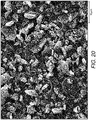
- Other appropriate average aspect ratios are readily apparent from this disclosure. Additional information on aspect ratio and its determination is presented in the Examples that follow, which reference FIGS. 14-20 .
- the irregular and non-spherical attributes of the alumina product, and/or the fine component, and/or the coarse component can be quantified by the average sphericity and/or average roundness of the particles.
- the average sphericity and/or average roundness can be less than or equal to about 0.7, less than or equal to about 0.6, less than or equal to about 0.5, in a range from about 0.4 to about 0.6, in a range from about 0.3 to about 0.6, in a range from about 0.3 to about 0.5, or in a range from about 0.5 to about 0.7.
- the general particle shape can be described as angular or subangular, as described in U.S. Patent No. 8,945,517 . Additional information on particle shape is presented in the Examples that follow, which reference FIGS. 1-6 and FIGS. 7A-7B .
- the alumina product also can contain various amounts of a synergist material or compound, in order to provide improved performance in certain areas.
- the alumina product can further comprise a synergist compound, such as boron nitride, silicon nitride, aluminium nitride, magnesium oxide, graphite, or any flame retardant (e.g., aluminium hydroxide, magnesium hydroxide, or a phosphorus/nitrogen-containing flame retardant), and the like, or combinations thereof.
- Typical loadings of the synergist compound can range from about 0.5 to about 30 wt. %, from about 1 to about 25 wt. %, from about 1 to about 20 wt. %, or from about 2 to about 15 wt. %, based on the weight of the alumina product.
- This invention is also directed to, and encompasses, any compositions, formulations, and articles of manufacture that contain any of the alumina products disclosed herein (and their respective characteristics or features, such as the particle size distribution of the alumina product, the fine particle size component, and the coarse particle size component).
- a polymer composition is disclosed, and in this aspect, the polymer composition can comprise any suitable polymer (one or more than one) and any of the alumina products disclosed herein.
- the polymer in the polymer composition can comprise a thermoplastic polymer, while in another aspect, the polymer can comprise a thermoset polymer. In another aspect, the polymer can comprise, either singly or in any combination, an epoxy, an acrylic, an ester, a urethane, a silicone, and/or a phenolic.
- the polymer can comprise, either singly or in any combination, a polyethylene (e.g., an ethylene homopolymer or ethylene-based copolymer), a polypropylene, a polybutylene terephthalate, an acrylonitrile butadiene styrene (ABS), a polyamide, a polyimide, a polystyrene, a polycarbonate, an ethylene-vinyl acetate (EVA) copolymer, and/or a polyolefin-styrene (e.g., ethylene-styrene).
- a polyethylene e.g., an ethylene homopolymer or ethylene-based copolymer
- ABS acrylonitrile butadiene styrene
- ABS acrylonitrile butadiene styrene
- a polyamide e.g., ethylene-vinyl acetate copolymer
- EVA ethylene-viny
- the polymer can comprise a rubber and/or an elastomer based upon a nitrile, a butadiene, isobutylene, isoprene, a styrene butadiene, and the like, as well as any combination thereof.
- the amount of the alumina product, based on the polymer composition often can range from about 10 to about 93 wt. %, from about 50 to about 93 wt. %, from about 80 to about 93 wt. %, from about 10 to about 92 wt. %, from about 50 to about 92 wt. %, from about 80 to about 92 wt. %, or from about 82 to about 90 wt. %.
- the amount of the alumina product, based on the polymer composition (total volume) often can range from about 15 to about 75 vol. %, from about 40 to about 75 vol. %, from about 47 to about 74 vol. %, from about 48 to about 73 vol. %, or from about 50 to about 70 vol. %.
- Other appropriate loadings of the alumina product in the polymer composition are readily apparent from this disclosure.
- alumina product can provide improved thermal conductivity to the polymer composition.
- Typical isotropic thermal conductivities of the polymer composition generally can range from about 0.5 to about 10 W/m ⁇ K (watts per meter kelvin), from about 0.5 to about 8 W/m ⁇ K, from about 1 to about 6 W/m ⁇ K, from about 1 to about 5 W/m K, or from about 1 to about 3 W/m K, and the like.
- the polymer composition of this invention can have an isotropic thermal conductivity that is greater than that of a polymer composition containing a spherical alumina product having the same particle size characteristics (of the non-spherical alumina product disclosed herein). Additionally or alternatively, the polymer composition can have an isotropic thermal conductivity that is greater than that of a polymer composition containing an irregular (non-spherical) alumina product having different particle size characteristics (from that of the alumina product disclosed herein).
- the polymer composition can have a relatively low viscosity, and additionally or alternatively, a viscosity that is substantially independent of shear rate in the low shear rate region.
- the polymer composition can have a viscosity that is less than that of a polymer composition containing an irregular (non-spherical) alumina product having different particle size characteristics (from that of the alumina product disclosed herein).
- the alumina product can be a surface treated alumina product
- the polymer composition can have a viscosity that is substantially independent of shear rate (the viscosity is substantially the same or constant (+/- 10%) over a given shear rate range).
- the shear rate range can be from 5 to 20 sec -1 , from 10 to 20 sec -1 , or from 5 to 15 sec -1 .
- the viscosity testing can be performed using 72 wt. % alumina product in a polyether polyol at 23 °C.
- the polymer composition can have a relatively low viscosity ranging from about 5,000 to about 15,000 mPa-sec, from about 5,000 to about 10,000 mPa-sec, from about 6,000 to about 12,000 mPa-sec, or from about 6,000 to about 9,000 mPa-sec. Such can be determined at a shear rate of 5 sec -1 , or 10 sec -1 , or 15 sec -1 .
- the polymer composition can have a relatively low viscosity ranging from about 9,000 to about 30,000 mPa-sec, from about 9,000 to about 25,000 mPa-sec, from about 10,000 to about 22,000 mPa-sec, or from about 10,500 to about 18,000 mPa-sec. Such can be determined at a shear rate of 5 sec -1 , or 10 sec -1 , or 15 sec -1 .
- the polymer compositions in accordance with this invention can maintain very good polymer attributes, such as elongation at break.
- the polymer composition can have an elongation at break that is greater than that of a polymer composition containing a spherical alumina product having the same particle size characteristics (of the non-spherical alumina product disclosed herein).
- the polymer composition can have an elongation at break that is greater than that of a polymer composition containing an irregular (non-spherical) alumina product having different particle size characteristics (from that of the alumina product disclosed herein).
- the polymer composition can have an elongation at break in a range from about 500 to about 1000%, or from about 600 to about 900%.
- the elongation testing can be performed using 80 wt. % alumina product in a 0.885 density ethylene/1-octene copolymer.
- the polymer composition can have improved flame retardancy.
- the polymer composition can have a time to ignition that is greater than that of a polymer composition containing a spherical alumina product having the same particle size characteristics (of the non-spherical alumina product disclosed herein).
- the polymer composition can have a time to ignition that is greater than that of a polymer composition containing an irregular (non-spherical) alumina product having different particle size characteristics (from that of the alumina product disclosed herein).
- the heat release rate and time to ignition testing can be performed using 60 wt. % alumina product in a EVA/PE blend.
- Articles of manufacture can be formed from and/or can comprise any of the polymer compositions described herein.
- the article of manufacture can comprise a gel, paste, or coating.
- the article of manufacture can comprise a (polymeric) sheet or film.
- the article of manufacture can comprise an electronic component (e.g., a semiconductor device, a circuit board, and the like).
- the article of manufacture can comprise functional sheets, IC packages, heat sinks, electrical power appliances, tapes, pads, thermal gap fillers, encapsulation compounds, adhesives, greases, sealing materials, coatings, SF 6 gas circuit breakers, solar panels, and the like. Other appropriate articles of manufacture and end-use applications are readily apparent from this disclosure.
- the d50 particles size refers to the particle size for which 50% of the sample has a smaller size and 50% of the sample has a larger size. All particle size measurements (inclusive of d10, d50, d90, and d100) were determined by laser diffraction using a Cilas 1064 L laser spectrometer from Quantachrome according to ISO 13320.
- the BET surface areas disclosed herein were determined in accordance with DIN-66132 using Micromeritics Gemini V and Gemini VII instruments.
- Tapped density used a jolting volumeter STAV 2003 according to ISO 787 part 11, ASTM B 527-93. A standard measuring cylinder of 250 mL was filled with 200 g of the sample, and then was jolted until the sample volume was constant (typically 1250 shakes were sufficient). The final volume was recorded and used to calculate the tapped density by dividing it into the weight of sample used.
- the relative amount of ⁇ -alumina was measured via X-ray diffraction on a D2 Phaser Bruker AXS, using standard measurement parameters according to the Bruker manual.
- the ⁇ -alumina content was determined with the software "Diffrac EVA" version 2.0.
- the method and the instrumental conditions of a phase specific x-ray diffraction experiment were as follows: Radiation: Cu k ⁇ 1 ; Generator voltage: 30 kV; Generator current: 10 mA; and the reflection angle 2 ⁇ was measured for the reflexes (104) and (113) corresponding with the 2 ⁇ range 34.6° to 36.0° and 42.8° and 44.2°.
- the step size was 0.01°/step and the measuring was Is/step.
- the sum of the two resulting intensities of the specific sample was compared in relation to the standard, a pure alpha-alumina with an ⁇ -content of 100%. Therefore, the sum of the intensities was directly proportional to the ⁇ -alumina content of the sample.
- the percent ⁇ -alumina content of the sample was calculated by multiplying 1P times 100, and dividing by IS, where 1P was the integral intensity of the sample (sum of peak 104 and 113), and 1S was the integral intensity of the standard (sum of peak 104 and 113).
- Typical apparatus can include a Buss Ko-kneader, internal mixers, Farrel continuous mixers, or twin screw extruders, as well as single screw extruders or two roll mills in some cases.
- the compounded product can then be molded or extruded in a subsequent processing step.
- Viscosities at 23 °C of polymer compositions were determined using a RheoStress ® 6000 rotational viscometer, rotor Z25 (DIN 53019). The tensile strength and elongation at break were measured in accordance with DIN 53504 and EN ISO 527. Cone calorimetry measurements were made according to ASTM E 1354 at 35 kW/m 2 on 3 mm thick compression molded plates. The time to ignition value is the time when the sample ignites due to heat exposure in the cone calorimeter.
- the alumina product of Example 1 was produced from a fine particle size component and a coarse particle size component.
- the fine particle size component had 0.3 wt. % of a silane surface treatment and had a d50 particle size of 1.8 ⁇ m, a d90 particle size of 4.4 ⁇ m, and a BET surface area of 2.2 m 2 /g.
- the fine particle size component was produced using a Bayer process to produce the feedstock, followed by calcining at 1350 °C, and then ball milling to the final particle size.
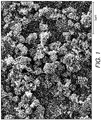
- FIG. 1 is a scanning electron micrograph of the fine particle size component;
- FIG. 1 demonstrates the irregularly shaped and non-spherical particles in the fine particle size component.
- the coarse particle size component had 0.3 wt. % of a silane surface treatment and had a d50 particle size of 16 ⁇ m, a d90 particle size of 33 ⁇ m, and a BET surface area of 0.4 m 2 /g.
- the coarse particle size component was produced in a similar manner to the fine particle size component.
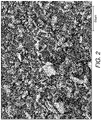
- FIGS. 2-4 are scanning electron micrographs of the coarse particle size component; FIGS. 2-4 demonstrate the irregularly shaped and non-spherical particles (e.g., plate-like, disc-like) in the coarse particle size component.
- the average aspect ratio of the coarse particle size component was approximately 5:1.
- FIG. 7A is a pictorial representation of the sphericity and the roundness of particles; the fine particle size component and coarse particle size component generally had sphericity values of about 0.3 to about 0.7 and roundness values of about 0.3 to about 0.7.
- FIG. 7B is a pictorial representation of various categories of particle roundness; the fine particle size component and coarse particle size component generally contained angular and subangular particles.
- FIG. 8 depicts the particle size distribution of the alumina product of Example 1, and in sum, the alumina product had a d10 of 0.4 ⁇ m, a d50 of 2.8 ⁇ m, a d90 of 21.5 ⁇ m, and a d100 of 45 ⁇ m.
- the alumina product also had a tapped density of 2,160 kg/m 3 , and an ⁇ -alumina content of greater than 95 wt. %.
- the alumina product of Example 2 was produced by mixing 65 wt. % of a fine particle size component and 35 wt. % of the coarse particle size component of Example 1.
- the fine particle size component had 0.3 wt. % of a silane surface treatment and had a d50 particle size of 4 ⁇ m, a d90 particle size of 11 ⁇ m, and a BET surface area of 1.2 m 2 /g.
- the fine particle size component of Example 2 was produced in a similar manner to the fine particle size component of Example 1, but had more particles with a plate-like or disc-like shape.
- FIGS. 5-6 are scanning electron micrographs of the fine particle size component of Example 2; FIGS. 5-6 demonstrate the irregular, plate-shaped and non-spherical particles in the fine particle size component. As discussed further at the end of the example section, and in reference to FIGS. 17-20 , the average aspect ratio of the fine particle size component was approximately 7:1.
- FIG. 9 depicts the particle size distribution of the alumina product of Example 2, and in sum, the alumina product had a d10 of 0.75 ⁇ m, a d50 of 4.8 ⁇ m, a d90 of 28 ⁇ m, and a d100 of 75 ⁇ m.
- the alumina product also had a tapped density of 2100 kg/m 3 , and an ⁇ -alumina content of greater than 95 wt. %.
- the alumina product of Example 3 was produced by mixing 75 wt. % of the fine particle size component of Example 1 and 25 wt. % of the coarse particle size component of Example 1.
- FIG. 10 depicts the particle size distribution of the alumina product of Example 3, and in sum, the alumina product had a d10 of 0.3 ⁇ m, a d50 of 1.95 ⁇ m, a d90 of 7.7 ⁇ m, and a d100 of 32 ⁇ m.
- the alumina product also had a tapped density of 1850 kg/m 3 , and an ⁇ -alumina content of greater than 95 wt. %.
- Example 4 used the alumina product of Example 1, while Example 5 used the same alumina product of Example 1, but without the silane surface treatment.
- the alumina product was blended with Caradol ® polyether polyol at 72 wt. % alumina loading.
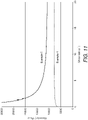
- FIG. 11 presents a plot of the viscosity versus shear rate profiles for the polymer compositions of Example 4 and Example 5 at 23 °C. Unexpectedly, the viscosity was substantially constant and independent of shear rate within the shear rate range from 5 to 20 sec -1 (or from 5 to 15 sec -1 , or from 10 to 20 sec -1 ).
- the polymer composition of Example 4 had a surprisingly low viscosity of approximately 7500 mPa-sec, and the polymer composition of Example 5 also had a surprisingly low viscosity of approximately 11,000-12,000 mPa-sec, particularly given the alumina loading of 72 wt. %.
- the untreated fine particle size components of Examples 1-2 had higher viscosities of approximately 18,000-20,000 mPa-sec, and the surface treated fine particle size components of Examples 1-2 had higher viscosities of approximately 12,000 mPa-sec, in the 10 to 20 sec -1 shear rate range.
- Example 6 used the alumina product of Example 1.
- the alumina product was compounded with Engage ® 8003 polyolefin elastomer (0.885 density ethylene/1-octene copolymer, melt index of 1 g/10 min at 190 °C and 2.16 kg (ASTM D1238)) at 80 wt. % alumina loading.
- the melt index of the polymer composition of Example 6 - containing 80 wt. % of the alumina product of Example 1 - was 7.5 g/10 min.
- the elongation at break of the filled polymer was 870%.
- Examples 7-8 used the alumina product of Example 1.
- the alumina product was compounded with a blend of 75 wt. % EVA and 25 wt. % polyethylene at 60 wt. % alumina loading.
- Example 8 used 80 wt. % of the alumina product.
- FIG. 12 illustrates the heat release rate (HRR) curves for Example 7 (60 wt. %) and Example 8 (80 wt. %).
- HRR heat release rate
- Example 9-14 used the ethylene/1-octene copolymer of Example 6, and Examples 10-14 also used the alumina product of Example 1.
- Example 9 did not contain any alumina
- Example 10 contained 18 vol. % alumina
- Example 11 contained 40 vol. % alumina
- Example 12 contained 47 vol. % alumina (80 wt. %)
- Example 13 contained 56 vol. % alumina
- Example 14 contained 67 vol. % alumina.
- FIG. 13 is a bar chart that demonstrates an increase in through-plane (isotropic) thermal conductivity as the alumina loading increases. Isotropic thermal conductivities of greater than 1 and up to 3 W/m ⁇ K were achieved with polymer compositions containing from 47 vol. % to 67 vol. % alumina, as shown in FIG. 13 .
- Examples 15-16 used the alumina product of Example 1, but with 0.6 wt. % of a silane surface treatment.
- the alumina product was compounded via twin screw extrusion with BASF Ultramid ® B29 HM 01 unreinforced polyamide PA 6 (Nylon 6) at 50 wt. % alumina loading.
- Example 16 used 70 wt. % of the alumina product.
- the resulting polymer compositions of Examples 15-16 had excellent mechanical properties (high tensile strength at break, high elastic modulus, and relatively high elongation at break) and excellent isotropic thermal conductivity. These compositions also had good rheological properties for beneficial processability in injection molding and other applications.
- Example Alumina Loading (wt./vol. %) Elongation @ Break (%) Elastic Modulus (MPa) Tensile Strength (MPa) Thermal Conductivity (W/m.K) 15 50/22 5.2 6000 85 0.7 16 70 / 40 4.0 9500 95 1.2
- the number of SEM images should be an amount sufficient to allow for a minimum of 10 to a maximum of 25 particles to be measured.
- the particles to be measured are those that are oriented vertically (+/- 10°), such that (1) the thickness of the particle can be measured and (2) the longest measurable dimension of the particle can be measured. As one of skill in the art would readily recognize, only two dimensions of these three-dimensional particles can be seen in the SEM image, and quantified.
- particles to be selected are those that are in the D30-D90 range, thus eliminating broken particles or small particle fragments caused by milling.
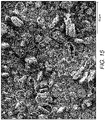
- Example 1 For the coarse particle size component of Example 1, twenty-four (24) particles were measured, as shown in FIGS. 14-16 .
- the aspect ratio ranged from 3.4:1 to 7:1, with an average of approximately 5:1, as summarized in the table below.
- Particle Thickness ( ⁇ m) Length ( ⁇ m) Aspect Ratio 1 3.1 14.5 4.6 2 4.4 17.4 4.0 3 4.5 18.2 4.0 4 5.4 27.2 5.0 5 3.1 14.6 4.7 6 5.4 24.0 4.5 7 2.9 18.3 6.3 8 2.6 12.7 4.8 9 2.8 9.9 3.5 10 3.0 10.7 3.5 11 4.0 13.5 3.4 12 4.4 24.0 5.4 13 3.5 18.2 5.2 14 3.3 14.6 4.4 15 3.7 26.0 7.0 16 2.1 11.6 5.4 17 2.0 11.4 5.6 18 4.0 22.3 5.6 19 3.4 22.8 6.6 20 3.6 17.2 4.8 21 4.1 18.2 4.4 22 2.3 13.5 6.0 23 3.3 20.2 6.1 24 2.8 18.6 6.8
- the procedure for determining the average aspect ratio for the fine particle size component is substantially the same as for the coarse particle size component, with the exception being that the particles to be selected are those that are in the D40-D90 range, to eliminate broken particles or small particle fragments caused by milling, as well as very small particles that are difficult to measure accurately.
- the fine particle size component of Example 2 several SEM photographs were taken of samples of the fine particle size component (see FIGS. 17-20 ). Twelve (12) particles were measured, as shown in FIGS. 17-20 .
- the aspect ratio ranged from 4.7:1 to 11.5:1, with an average of approximately 7:1, as summarized in the table below.
Landscapes
- Chemical & Material Sciences (AREA)
- Organic Chemistry (AREA)
- Health & Medical Sciences (AREA)
- Chemical Kinetics & Catalysis (AREA)
- Medicinal Chemistry (AREA)
- Polymers & Plastics (AREA)
- Life Sciences & Earth Sciences (AREA)
- Geology (AREA)
- Inorganic Chemistry (AREA)
- Compounds Of Alkaline-Earth Elements, Aluminum Or Rare-Earth Metals (AREA)
- Compositions Of Macromolecular Compounds (AREA)
Description
- The present invention is directed generally to alumina products with specific particle size characteristics. These alumina products can be used in polymer formulations to produce composites having high isotropic thermal conductivity.
- TARUTA S. et. al, Journal of Materials Science Letters, 1 January 1993, pages 424-426, discloses the influence of coarse particle shape on packing and sintering of bimodal size-distributed alumina powder mixtures.
US2005256259A1 discloses heat conductive polymer compositions and molded articles thereof. - In one aspect, an alumina product according to
claim 1 is provided . The alumina product can be characterized by a d50 particle size in a range from 1 to 20 µm, and a d90 particle size in a range from 5 to 50 µm. - The alumina product includes a fine particle size component and a coarse particle size component, wherein the fine particle size component has a d50 particle size in a range from 0.3 to 6 µm, and the coarse particle size component has a d50 particle size in a range from 7 to 35 µm. The amount of the fine particle size component in the alumina product is from 10 to 90 wt. %, based on the total weight of the fine particle size component and the coarse particle size component.
- The particles of the alumina product can be described as irregularly shaped and non-spherical. Often, although not required, the particles are surface treated, resulting in tighter packing and improved polymer compatibility. Polymer compositions also are provided herein, and such compositions twit comprise a polymer and any of the alumina products disclosed herein. The resultant polymer compositions can have unexpectedly high isotropic thermal conductivity, as well as low viscosity and high tensile elongation properties.
-
-
FIG. 1 presents a scanning electron micrograph of the fine particle size component used in the alumina product of Example 1. -
FIGS. 2-4 present scanning electron micrographs of the coarse particle size component used in the alumina product of Example 1. -
FIGS. 5-6 present scanning electron micrographs of the fine particle size component used in the alumina product of Example 2. -
FIG. 7A presents a pictorial representation of particle sphericity and particle roundness classifications. -
FIG. 7B presents a pictorial representation of particle roundness categories, ranging from angular particles to well-rounded particles. -
FIG. 8 presents a plot of the particle size distribution of the alumina product of Example 1. -
FIG. 9 presents a plot of the particle size distribution of the alumina product of Example 2. -
FIG. 10 presents a plot of the particle size distribution of the alumina product of Example 3. -
FIG. 11 presents plots of the viscosity versus shear rate for Example 4 and Example 5. -
FIG. 12 presents plots of the heat release rate (HRR) curves for Example 7 (60 wt. % alumina product) and Example 8 (80 wt. % alumina product). -
FIG. 13 presents a bar chart of the through-plane (isotropic) thermal conductivity values for Examples 9-14. -
FIGS. 14-16 present scanning electron micrographs used for the determination of the average aspect ratio of the coarse particle size component in the alumina product of Example 1. -
FIGS. 17-20 present scanning electron micrographs used for the determination of the average aspect ratio of the fine particle size component in the alumina product of Example 2. - To define more clearly the terms used herein, the following definitions are provided. Unless otherwise indicated, the following definitions are applicable to this disclosure. If a term is used in this disclosure but is not specifically defined herein, the definition from the IUPAC Compendium of Chemical Terminology, 2nd Ed (1997), can be applied, as long as that definition does not conflict with any other disclosure or definition applied herein, or render indefinite or non-enabled any claim to which that definition is applied.
- While compositions and methods are described herein in terms of "comprising" various components or steps, the compositions and methods can also "consist essentially of' or "consist of' the various components or steps, unless stated otherwise. For example, polymer compositions consistent with aspects of the present invention can comprise; alternatively, can consist essentially of; or alternatively, can consist of; (1) a polymer, and (2) an alumina product.
- The terms "a," "an," and "the" are intended to include plural alternatives, e.g., at least one, unless otherwise specified.
- Generally, groups of elements are indicated using the numbering scheme indicated in the version of the periodic table of elements published in Chemical and Engineering News, 63(5), 27, 1985. In some instances, a group of elements can be indicated using a common name assigned to the group; for example, alkali metals for
Group 1 elements, alkaline earth metals forGroup 2 elements, and so forth. - The term "contacting" is used herein to refer to materials or components which can be blended, mixed, slurried, dissolved, reacted, treated, compounded, or otherwise contacted or combined in some other manner or by any suitable method. The materials or components can be contacted together in any order, in any manner, and for any length of time, unless otherwise specified.
- Several types of ranges are disclosed in the present invention. When a range of any type is disclosed or claimed, the intent is to disclose or claim individually each possible number that such a range could reasonably encompass, including end points of the range as well as any sub-ranges and combinations of sub-ranges encompassed therein. As a representative example, the d90 particle size of the alumina product can be in certain ranges in various aspects of this invention. By a disclosure that the d90 particle size can be in a range from about 5 to about 50 µm, the intent is to recite that the d90 can be any particle size within the range and, for example, can be equal to about 5, about 10, about 15, about 20, about 25, about 30, about 35, about 40, about 45, or about 50 µm. Additionally, the d90 particle size can be within any range from about 5 to about 50 µm (for example, from about 6 to about 30 µm), and this also includes any combination of ranges between about 5 and about 50 µm (for example, the d90 particle size can be in a range from 6 to about 10 µm or from about 16 to about 28 µm). Likewise, all other ranges disclosed herein should be interpreted in a manner similar to this example.
- The term "about" means that amounts, sizes, formulations, parameters, and other quantities and characteristics are not and need not be exact, but can be approximate including being larger or smaller, as desired, reflecting tolerances, conversion factors, rounding off, measurement errors, and the like, and other factors known to those of skill in the art. In general, an amount, size, formulation, parameter or other quantity or characteristic is "about" or "approximate" whether or not expressly stated to be such. The term "about" also encompasses amounts that differ due to different equilibrium conditions for a composition resulting from a particular initial mixture. Whether or not modified by the term "about," the claims include equivalents to the quantities. The term "about" can mean within 10% of the reported numerical value, preferably within 5% of the reported numerical value.
- Disclosed herein are alumina products with multimodal particle size distributions, and polymer compositions and articles of manufacture containing the alumina products.
- Unexpectedly, it was found that alumina products containing non-spherical particles could achieve dense packing and could be filled into polymers at the same high loading amounts as those of spherical particles. While not wishing to be bound by the following theory, it is believed that these surprising benefits can be the result of the specific particle size distributions of the non-spherical alumina products disclosed herein, the irregular and non-spherical shape of the calcined alumina particles, and their surface treatment or coating configured to improve packing and polymer compatibility.
- Moreover, it was found that polymer compositions containing the non-spherical alumina products disclosed herein, despite high alumina loadings (e.g., from 80 wt. % up to 92-93 wt. %), resulted in low viscosity and good processability, as well as excellent polymer mechanical properties, such as tensile elongation at break. In addition, and beneficially, high isotropic thermal conductivities of the polymer compositions also were achieved. Furthermore, and while not wishing to be bound by the following theory, it is believed that the isotropic thermal conductivity using the non-spherical alumina products disclosed herein can be superior to that achieved using spherical particles, due at least in part to greater inter-planar contact of the alumina particles within the polymer composition. And beneficially, it is believed that the non-spherical alumina products disclosed herein can be produced more cost efficiently and economically than comparable spherical particles.
- The alumina product includes a fine particle size component and a coarse particle size component, and the alumina product can be characterized by a d50 particle size in a range from about 1 to about 20 µm, and a d90 particle size in a range from about 5 to about 50 µm. The "alumina product" of this invention also may be referred to as an "alumina composition" or an "alumina mixture"; these terms may be used interchangeably throughout this disclosure. Likewise, the "fine" particle size component also may be referred to as a "small" particle size component or a "first" particle size component; these terms may be used interchangeably throughout this disclosure. Similarly, the "coarse" particle size component also may be referred to as a "large" particle size component or a "second" particle size component; these terms may be used interchangeably throughout this disclosure. The fine particle size component has a d50 particle size in a range from 0.3 to 6 µm, and the coarse particle size component has a d50 particle size in a range from 7 to 35 µm. The amount of the fine particle size component in the alumina product is from about 10 to about 90 wt. %, based on the total weight of the fine particle size component and the coarse particle size component.
- In further aspects, alumina products consistent with the present invention also can have any of the characteristics or properties provided below, and in any combination.
- In some aspects, the d50 particle size (median particle size) of the alumina product can be in a range from about 1 to about 20 µm, such as, for instance, from about 1 to about 10 µm, from about 2 to about 10 µm, from about 1 to about 7 µm, from about 1 to about 6 µm, from about 1.5 to about 7 µm, from about 1.5 to about 6 µm, from about 1 to about 5 µm, from about 1.5 to about 5 µm, or from about 1.5 to about 4.5 µm. Other appropriate ranges for the d50 particle size are readily apparent from this disclosure.
- In some aspects, the d90 particle size (90% of the particles have a particle size less than or equal to the d90 particle size) of the alumina product can be in a range from about 5 to about 50 µm, such as, for instance, from about 7 to about 35 µm, from about 7 to about 32 µm, from about 5 to about 35 µm, from about 6 to about 40 µm, from about 6 to about 30 µm, from about 15 to about 40 µm, from about 16 to about 30 µm, from about 16 to about 28 µm, from about 6 to about 25 µm, or from about 7 to about 28 µm. Other appropriate ranges for the d90 particle size are readily apparent from this disclosure.
- Generally, it can be beneficial - e.g., for downgauging or for thinner end-use applications - for the alumina product to have a d100 (maximum) particle size of less than or equal to about 100 µm. In one aspect, the d100 particle size can be less than or equal to about 85 µm, or less than or equal to about 75 µm, while in another aspect, the d100 particle size can be less than or equal to about 65 µm, less than or equal to about 60 µm, or less than or equal to about 50 µm. Other appropriate maximum d100 particle sizes for the alumina product are readily apparent from this disclosure.
- Consistent with aspects of this invention, the alumina product can have an unexpectedly high tapped density that often falls within a range from about 1,600 to about 2,500, from about 1,700 to about 2,500, or from about 1,800 to about 2,500 kg/m3. In further aspects, the tapped density can be in a range from about 1,800 to about 2,400, from about 1,900 to about 2,400, from about 1,800 to about 2,300, or from about 1,900 to about 2,300 kg/m3. Other appropriate ranges for the tapped density are readily apparent from this disclosure.
- The fine particle size component has a d50 particle size within a range from 0.3 to 6 µm; alternatively, from about 0.5 to about 6 µm; alternatively, from about 0.5 to about 5 µm; alternatively, from about 0.5 to about 4 µm; alternatively, from about 0.8 to about 4.5 µm; alternatively, from about 0.8 to about 3.5 µm; alternatively, from about 1 to about 5 µm; alternatively, from about 1 to about 4.5 µm; alternatively, from about 1 to about 4 µm; alternatively, from about 1.5 to about 4.5 µm; or alternatively, from about 2 to about 4 µm. Other appropriate ranges for the d50 particle size of the fine particle size component are readily apparent from this disclosure.
- The fine particle size component can be further characterized by the d90 particle size, which often falls within a range from about from about 1.5 to about 25 µm, and this can vary based on the milling procedures employed in producing the particles. In one aspect, the d90 of the fine particle size component can fall within a range from about 2 to about 20 µm, from about 2 to about 18 µm, or from about 1 to about 16 µm. In another aspect, the d90 of the fine particle size component can fall within a range from about 3 to about 20 µm, from about 3 to about 18 µm, or from about 3 to about 16 µm. Yet, in another aspect, the d90 of the fine particle size component can fall within a range from about 4 to about 20 µm, from about 4 to about 18 µm, or from about 4 to about 16 µm. Other appropriate ranges for the d90 particle size of the fine particle size component are readily apparent from this disclosure.
- The surface area of the fine particle size component is not limited to any particular range; however, the BET surface area of the fine particle size component often falls within a range from about 0.5 to about 20 m2/g. In some aspects, the BET surface area can be in a range from about 0.5 to about 8, or from about 1 to about 8 m2/g, while in other aspects, the BET surface area can be in a range from about 0.8 to about 5, from about 0.8 to about 4, from about 1 to about 5 m2/g, and the like. Other appropriate ranges for the BET surface area of the fine particle size component readily apparent from this disclosure.
- The coarse particle size component has a d50 particle size of within a range from 7 to 35 µm; alternatively, from about 8 to about 35 µm; alternatively, from about 8 to about 30 µm; alternatively, from about 8 to about 25 µm; alternatively, from about 8 to about 22 µm; alternatively, from about 10 to about 35 µm; alternatively, from about 10 to about 30 µm; alternatively, from about 10 to about 25 µm; alternatively, from about 10 to about 20 µm; alternatively, from about 12 to about 30 µm; or alternatively, from about 12 to about 22 µm. Other appropriate ranges for the d50 particle size of the coarse particle size component are readily apparent from this disclosure.
- The coarse particle size component can be further characterized by the d90 particle size, which often falls within a range from about from about 15 to about 65 µm. In one aspect, the d90 of the coarse particle size component can fall within a range from about 20 to about 65 µm, from about 20 to about 60 µm, or from about 20 to about 55 µm. In another aspect, the d90 of the coarse particle size component can fall within a range from about 25 to about 65 µm, from about 25 to about 60 µm, or from about 25 to about 55 µm. Yet, in another aspect, the d90 of the coarse particle size component can fall within a range from about 25 to about 50 µm, from about 30 to about 55 µm, or from about 30 to about 50 µm. Other appropriate ranges for the d90 particle size of the coarse particle size component are readily apparent from this disclosure.
- The surface area of the coarse particle size component is not limited to any particular range; however, the BET surface area of the coarse particle size component often falls within a range from about 0.1 to about 1.5 m2/g. In some aspects, the BET surface area can be in a range from about 0.1 to about 1, or from about 0.2 to about 1 m2/g, while in other aspects, the BET surface area can be in a range from about 0.25 to about 1.5, from about 0.25 to about 1, from about 0.25 to about 0.85 m2/g, and the like. Other appropriate ranges for the BET surface area of the coarse particle size component readily apparent from this disclosure.
- The relative amounts of the fine particle size component and the coarse particle size component in the alumina product are not particularly limited. However, the amount of the fine particle size component in the alumina product is within a range from about 10 to about 90 wt. %, based on the total weight of the fine particle size component and the coarse particle size component. In further aspects, other suitable non-limiting ranges for the amount of the fine particle size component, based on the total weight of the fine particle size component and the coarse particle size component, include the following: from about 20 to about 80 wt. %, from about 30 to about 80 wt. %, from about 40 to about 80 wt. %, from about 50 to about 80 wt. %, from about 30 to about 70 wt. %, from about 40 to about 70 wt. %, from about 40 to about 60 wt. %, from about 45 to about 75 wt. %, or from about 45 to about 65 wt. %. Other appropriate ranges for the relative amounts of the fine particle size component and the coarse particle size component in the alumina product are readily apparent from this disclosure.
- The alumina materials of this invention generally can be very high in α-alumina content. For instance, the alumina product (and/or the fine particle size component, and/or the coarse particle size component) can have an α-alumina content of from about 80 to 100 wt. %, from about 90 to 100 wt. %, or from about 95 to 100 wt. %. In some aspects, the α-alumina content of the alumina product (and/or the fine particle size component, and/or the coarse particle size component) can be from about 85 to about 99 wt. %, from about 90 to about 99 wt. %, or from about 92 to about 99 wt. %.
- In these and other aspects, any of the alumina product, the fine particle size component, and/or the coarse particle size component can comprise (or consist essentially of, or consist of) calcined alumina particles. Moreover, any of the alumina product, the fine particle size component, and/or the coarse particle size component can comprise (or consist essentially of, or consist of) surface treated alumina particles. While not limited thereto, the amount of the surface treatment typically ranges from about 0.05 to about 5 wt. %, or from about 0.1 to about 1 wt. %, based on the weight of the alumina product. Any suitable surface treatment can be used, such as silane-based or fatty acid-based surface treatments, as well as nanometallic particles and carbon-based additives (e.g., nanotubes, graphenes), and these treatments can improve the compatibility of the alumina product with various polymers. Illustrative and non-limiting silane materials that are suitable for surface treating or coating the alumina product can include 3-aminopropyltriethoxysilane, 3-aminopropyltrimethoxysilane, N-(2-aminoethyl)-3-aminopropyltrimethoxysilane, N-(2-aminoethyl)-3-aminopropyltriethoxysilane, 3-(N-cyclohexylamino)propyltrimethoxysilane, diethylaminomethyltriethoxysilane, 3 -mercaptopropyltriethoxysilane, 3-thiocyanatopropyltriethoxysilane, 3-glycidoxypropyltriethoxysilane, 3-isocyanatepropyltriethoxysilane, iso-butyltrimethoxysilane, methyltriethoxysilane, n-octyltriethoxysilane, n-decyltrimethoxysilane, n-dodecyltrimethoxysilane, n-hexadecyltrimethoxysilane, vinyltriethoxysilane, and the like, as well as combinations thereof.
- Generally, the shape of the alumina particles consistent with aspects of this invention can be described as irregular and non-spherical. For instance, the coarse particle size component is characterized by an average aspect ratio in a range from about 1.5:1 to about 30:1, optionally from about 1.5:1 to about 20:1, or from about 1.5:1 to about 15:1. The aspect ratio is defined herein as the longest (measurable) particle dimension divided by the shortest dimension. As an example, if the particle is disc-shaped, the shortest dimension would be the thickness of the disc. The alumina product and/or the fine particle size component may also be characterized by an average aspect ratio in a range from about 1.5:1 to about 30:1, optionally from about 1.5:1 to about 20:1, or from about 1.5:1 to about 15:1. In further aspects of the invention, the average aspect ratio of the alumina product, and/or the fine particle size component, and/or the coarse particle size component can be in a range from about 2:1 to about 30:1, from about 2:1 to about 15:1, from about 2:1 to about 10:1, from about 2.5:1 to about 15:1, from about 3:1 to about 12:1, from about 3:1 to about 10:1, or from about 4:1 to about 8:1. Other appropriate average aspect ratios are readily apparent from this disclosure. Additional information on aspect ratio and its determination is presented in the Examples that follow, which reference
FIGS. 14-20 . - Additionally the irregular and non-spherical attributes of the alumina product, and/or the fine component, and/or the coarse component can be quantified by the average sphericity and/or average roundness of the particles. For instance, the average sphericity and/or average roundness can be less than or equal to about 0.7, less than or equal to about 0.6, less than or equal to about 0.5, in a range from about 0.4 to about 0.6, in a range from about 0.3 to about 0.6, in a range from about 0.3 to about 0.5, or in a range from about 0.5 to about 0.7. The general particle shape can be described as angular or subangular, as described in
U.S. Patent No. 8,945,517 . Additional information on particle shape is presented in the Examples that follow, which referenceFIGS. 1-6 andFIGS. 7A-7B . - While not required, the alumina product also can contain various amounts of a synergist material or compound, in order to provide improved performance in certain areas. As an example, the alumina product can further comprise a synergist compound, such as boron nitride, silicon nitride, aluminium nitride, magnesium oxide, graphite, or any flame retardant (e.g., aluminium hydroxide, magnesium hydroxide, or a phosphorus/nitrogen-containing flame retardant), and the like, or combinations thereof. Typical loadings of the synergist compound can range from about 0.5 to about 30 wt. %, from about 1 to about 25 wt. %, from about 1 to about 20 wt. %, or from about 2 to about 15 wt. %, based on the weight of the alumina product.
- This invention is also directed to, and encompasses, any compositions, formulations, and articles of manufacture that contain any of the alumina products disclosed herein (and their respective characteristics or features, such as the particle size distribution of the alumina product, the fine particle size component, and the coarse particle size component). In a particular aspect of this invention, a polymer composition is disclosed, and in this aspect, the polymer composition can comprise any suitable polymer (one or more than one) and any of the alumina products disclosed herein.
- In one aspect, the polymer in the polymer composition can comprise a thermoplastic polymer, while in another aspect, the polymer can comprise a thermoset polymer. In another aspect, the polymer can comprise, either singly or in any combination, an epoxy, an acrylic, an ester, a urethane, a silicone, and/or a phenolic. In yet another aspect, the polymer can comprise, either singly or in any combination, a polyethylene (e.g., an ethylene homopolymer or ethylene-based copolymer), a polypropylene, a polybutylene terephthalate, an acrylonitrile butadiene styrene (ABS), a polyamide, a polyimide, a polystyrene, a polycarbonate, an ethylene-vinyl acetate (EVA) copolymer, and/or a polyolefin-styrene (e.g., ethylene-styrene). In still another aspect, the polymer can comprise a rubber and/or an elastomer based upon a nitrile, a butadiene, isobutylene, isoprene, a styrene butadiene, and the like, as well as any combination thereof.
- While not being limited thereto, the amount of the alumina product, based on the polymer composition (total weight), often can range from about 10 to about 93 wt. %, from about 50 to about 93 wt. %, from about 80 to about 93 wt. %, from about 10 to about 92 wt. %, from about 50 to about 92 wt. %, from about 80 to about 92 wt. %, or from about 82 to about 90 wt. %. Likewise, the amount of the alumina product, based on the polymer composition (total volume), often can range from about 15 to about 75 vol. %, from about 40 to about 75 vol. %, from about 47 to about 74 vol. %, from about 48 to about 73 vol. %, or from about 50 to about 70 vol. %. Other appropriate loadings of the alumina product in the polymer composition are readily apparent from this disclosure.
- Beneficially, the alumina product can provide improved thermal conductivity to the polymer composition. Typical isotropic thermal conductivities of the polymer composition generally can range from about 0.5 to about 10 W/m·K (watts per meter kelvin), from about 0.5 to about 8 W/m·K, from about 1 to about 6 W/m·K, from about 1 to about 5 W/m K, or from about 1 to about 3 W/m K, and the like.
- In some aspects of this invention, the polymer composition of this invention can have an isotropic thermal conductivity that is greater than that of a polymer composition containing a spherical alumina product having the same particle size characteristics (of the non-spherical alumina product disclosed herein). Additionally or alternatively, the polymer composition can have an isotropic thermal conductivity that is greater than that of a polymer composition containing an irregular (non-spherical) alumina product having different particle size characteristics (from that of the alumina product disclosed herein).
- Due it at least in part to the advantageous packing qualities of the alumina products disclosed herein, the polymer composition can have a relatively low viscosity, and additionally or alternatively, a viscosity that is substantially independent of shear rate in the low shear rate region. In one aspect, the polymer composition can have a viscosity that is less than that of a polymer composition containing an irregular (non-spherical) alumina product having different particle size characteristics (from that of the alumina product disclosed herein). In another aspect, the alumina product can be a surface treated alumina product, and the polymer composition can have a viscosity that is substantially independent of shear rate (the viscosity is substantially the same or constant (+/- 10%) over a given shear rate range). For instance, the shear rate range can be from 5 to 20 sec-1, from 10 to 20 sec-1, or from 5 to 15 sec-1. The viscosity testing can be performed using 72 wt. % alumina product in a polyether polyol at 23 °C.
- Under similar conditions (72 wt. % alumina product in a polyether polyol at 23 °C) for a surface treated alumina product, the polymer composition can have a relatively low viscosity ranging from about 5,000 to about 15,000 mPa-sec, from about 5,000 to about 10,000 mPa-sec, from about 6,000 to about 12,000 mPa-sec, or from about 6,000 to about 9,000 mPa-sec. Such can be determined at a shear rate of 5 sec-1, or 10 sec-1, or 15 sec-1.
- Under similar conditions (72 wt. % alumina product in a polyether polyol at 23 °C) for an untreated alumina product, the polymer composition can have a relatively low viscosity ranging from about 9,000 to about 30,000 mPa-sec, from about 9,000 to about 25,000 mPa-sec, from about 10,000 to about 22,000 mPa-sec, or from about 10,500 to about 18,000 mPa-sec. Such can be determined at a shear rate of 5 sec-1, or 10 sec-1, or 15 sec-1.
- Even with high alumina loadings (e.g., 70 wt. %, 80 wt. %), the polymer compositions in accordance with this invention can maintain very good polymer attributes, such as elongation at break. In some aspects, the polymer composition can have an elongation at break that is greater than that of a polymer composition containing a spherical alumina product having the same particle size characteristics (of the non-spherical alumina product disclosed herein). Additionally or alternatively, the polymer composition can have an elongation at break that is greater than that of a polymer composition containing an irregular (non-spherical) alumina product having different particle size characteristics (from that of the alumina product disclosed herein).
- In another aspect, the polymer composition can have an elongation at break in a range from about 500 to about 1000%, or from about 600 to about 900%. The elongation testing can be performed using 80 wt. % alumina product in a 0.885 density ethylene/1-octene copolymer.
- Due to the presence of the alumina product, the polymer composition can have improved flame retardancy. In an aspect, the polymer composition can have a time to ignition that is greater than that of a polymer composition containing a spherical alumina product having the same particle size characteristics (of the non-spherical alumina product disclosed herein). Additionally or alternatively, the polymer composition can have a time to ignition that is greater than that of a polymer composition containing an irregular (non-spherical) alumina product having different particle size characteristics (from that of the alumina product disclosed herein). The heat release rate and time to ignition testing can be performed using 60 wt. % alumina product in a EVA/PE blend.
- Articles of manufacture can be formed from and/or can comprise any of the polymer compositions described herein. In an aspect, the article of manufacture can comprise a gel, paste, or coating. In another aspect, the article of manufacture can comprise a (polymeric) sheet or film. In yet another aspect, the article of manufacture can comprise an electronic component (e.g., a semiconductor device, a circuit board, and the like). In still another aspect, the article of manufacture can comprise functional sheets, IC packages, heat sinks, electrical power appliances, tapes, pads, thermal gap fillers, encapsulation compounds, adhesives, greases, sealing materials, coatings, SF6 gas circuit breakers, solar panels, and the like. Other appropriate articles of manufacture and end-use applications are readily apparent from this disclosure.
- The invention is further illustrated by the following examples, which are not to be construed in any way as imposing limitations to the scope of this invention.
- The d50 particles size, or median particle size, refers to the particle size for which 50% of the sample has a smaller size and 50% of the sample has a larger size. All particle size measurements (inclusive of d10, d50, d90, and d100) were determined by laser diffraction using a Cilas 1064 L laser spectrometer from Quantachrome according to ISO 13320.
- The BET surface areas disclosed herein were determined in accordance with DIN-66132 using Micromeritics Gemini V and Gemini VII instruments.
- Tapped density used a jolting volumeter STAV 2003 according to ISO 787
part 11, ASTM B 527-93. A standard measuring cylinder of 250 mL was filled with 200 g of the sample, and then was jolted until the sample volume was constant (typically 1250 shakes were sufficient). The final volume was recorded and used to calculate the tapped density by dividing it into the weight of sample used. - The relative amount of α-alumina was measured via X-ray diffraction on a D2 Phaser Bruker AXS, using standard measurement parameters according to the Bruker manual. The α-alumina content was determined with the software "Diffrac EVA" version 2.0. The method and the instrumental conditions of a phase specific x-ray diffraction experiment were as follows: Radiation: Cukα1; Generator voltage: 30 kV; Generator current: 10 mA; and the reflection angle 2θ was measured for the reflexes (104) and (113) corresponding with the 2θ range 34.6° to 36.0° and 42.8° and 44.2°. The step size was 0.01°/step and the measuring was Is/step. The sum of the two resulting intensities of the specific sample was compared in relation to the standard, a pure alpha-alumina with an α-content of 100%. Therefore, the sum of the intensities was directly proportional to the α-alumina content of the sample. The percent α-alumina content of the sample was calculated by multiplying 1P
times 100, and dividing by IS, where 1P was the integral intensity of the sample (sum of peak 104 and 113), and 1S was the integral intensity of the standard (sum of peak 104 and 113). - Suitable methods of incorporation and addition of the alumina and polymer components of the polymer composition were used to ensure uniform mixing and distribution of the alumina product. Typical apparatus can include a Buss Ko-kneader, internal mixers, Farrel continuous mixers, or twin screw extruders, as well as single screw extruders or two roll mills in some cases. The compounded product can then be molded or extruded in a subsequent processing step.
- Viscosities at 23 °C of polymer compositions were determined using a RheoStress® 6000 rotational viscometer, rotor Z25 (DIN 53019). The tensile strength and elongation at break were measured in accordance with DIN 53504 and EN ISO 527. Cone calorimetry measurements were made according to ASTM E 1354 at 35 kW/m2 on 3 mm thick compression molded plates. The time to ignition value is the time when the sample ignites due to heat exposure in the cone calorimeter.
- Through-plane (isotropic) thermal conductivity measurements were conducted using a steady state method via THASYS (THA01-1419) ASTM 1114-06 at 23° C. Generally, "through-plane" thermal conductivity values are lower than thermal conductivity values (e.g., often by 0.1 to 2 W/m·K) determined using other test procedures and equipment.
- The alumina product of Example 1 was produced from a fine particle size component and a coarse particle size component. The fine particle size component had 0.3 wt. % of a silane surface treatment and had a d50 particle size of 1.8 µm, a d90 particle size of 4.4 µm, and a BET surface area of 2.2 m2/g. The fine particle size component was produced using a Bayer process to produce the feedstock, followed by calcining at 1350 °C, and then ball milling to the final particle size.
FIG. 1 is a scanning electron micrograph of the fine particle size component;FIG. 1 demonstrates the irregularly shaped and non-spherical particles in the fine particle size component. - The coarse particle size component had 0.3 wt. % of a silane surface treatment and had a d50 particle size of 16 µm, a d90 particle size of 33 µm, and a BET surface area of 0.4 m2/g. The coarse particle size component was produced in a similar manner to the fine particle size component.
FIGS. 2-4 are scanning electron micrographs of the coarse particle size component;FIGS. 2-4 demonstrate the irregularly shaped and non-spherical particles (e.g., plate-like, disc-like) in the coarse particle size component. As discussed further at the end of the example section, and in reference toFIGS. 14-16 , the average aspect ratio of the coarse particle size component was approximately 5:1. -
FIG. 7A is a pictorial representation of the sphericity and the roundness of particles; the fine particle size component and coarse particle size component generally had sphericity values of about 0.3 to about 0.7 and roundness values of about 0.3 to about 0.7.FIG. 7B is a pictorial representation of various categories of particle roundness; the fine particle size component and coarse particle size component generally contained angular and subangular particles. - The fine particle size component and the coarse particle size component were mixed at equal amounts (50 wt. % fine and 50 wt. % coarse) to form the alumina product of Example 1.
FIG. 8 depicts the particle size distribution of the alumina product of Example 1, and in sum, the alumina product had a d10 of 0.4 µm, a d50 of 2.8 µm, a d90 of 21.5 µm, and a d100 of 45 µm. The alumina product also had a tapped density of 2,160 kg/m3, and an α-alumina content of greater than 95 wt. %. - The alumina product of Example 2 was produced by mixing 65 wt. % of a fine particle size component and 35 wt. % of the coarse particle size component of Example 1. The fine particle size component had 0.3 wt. % of a silane surface treatment and had a d50 particle size of 4 µm, a d90 particle size of 11 µm, and a BET surface area of 1.2 m2/g. The fine particle size component of Example 2 was produced in a similar manner to the fine particle size component of Example 1, but had more particles with a plate-like or disc-like shape.
-
FIGS. 5-6 are scanning electron micrographs of the fine particle size component of Example 2;FIGS. 5-6 demonstrate the irregular, plate-shaped and non-spherical particles in the fine particle size component. As discussed further at the end of the example section, and in reference toFIGS. 17-20 , the average aspect ratio of the fine particle size component was approximately 7:1. -
FIG. 9 depicts the particle size distribution of the alumina product of Example 2, and in sum, the alumina product had a d10 of 0.75 µm, a d50 of 4.8 µm, a d90 of 28 µm, and a d100 of 75 µm. The alumina product also had a tapped density of 2100 kg/m3, and an α-alumina content of greater than 95 wt. %. - The alumina product of Example 3 was produced by mixing 75 wt. % of the fine particle size component of Example 1 and 25 wt. % of the coarse particle size component of Example 1.
FIG. 10 depicts the particle size distribution of the alumina product of Example 3, and in sum, the alumina product had a d10 of 0.3 µm, a d50 of 1.95 µm, a d90 of 7.7 µm, and a d100 of 32 µm. The alumina product also had a tapped density of 1850 kg/m3, and an α-alumina content of greater than 95 wt. %. - Example 4 used the alumina product of Example 1, while Example 5 used the same alumina product of Example 1, but without the silane surface treatment. In each example, the alumina product was blended with Caradol® polyether polyol at 72 wt. % alumina loading.
FIG. 11 presents a plot of the viscosity versus shear rate profiles for the polymer compositions of Example 4 and Example 5 at 23 °C. Unexpectedly, the viscosity was substantially constant and independent of shear rate within the shear rate range from 5 to 20 sec-1 (or from 5 to 15 sec-1, or from 10 to 20 sec-1). - Within this shear rate range, the polymer composition of Example 4 had a surprisingly low viscosity of approximately 7500 mPa-sec, and the polymer composition of Example 5 also had a surprisingly low viscosity of approximately 11,000-12,000 mPa-sec, particularly given the alumina loading of 72 wt. %. In comparison, under the same test conditions, the untreated fine particle size components of Examples 1-2 had higher viscosities of approximately 18,000-20,000 mPa-sec, and the surface treated fine particle size components of Examples 1-2 had higher viscosities of approximately 12,000 mPa-sec, in the 10 to 20 sec-1 shear rate range.
- Example 6 used the alumina product of Example 1. For Example 6, the alumina product was compounded with Engage® 8003 polyolefin elastomer (0.885 density ethylene/1-octene copolymer, melt index of 1 g/10 min at 190 °C and 2.16 kg (ASTM D1238)) at 80 wt. % alumina loading. The melt index of the polymer composition of Example 6 - containing 80 wt. % of the alumina product of Example 1 - was 7.5 g/10 min. The elongation at break of the filled polymer was 870%. The high melt index (low viscosity) and high elongational properties were unexpected, given that the comparable properties using the untreated fine particle size components of Examples 1-2 were approximately 3.2 g/10 min (melt index) and 306% (elongation at break), and using the surface treated fine particle size components of Examples 1-2 were approximately 5.3 g/10 min (melt index) and 675% (elongation at break),
- Examples 7-8 used the alumina product of Example 1. For Example 7, the alumina product was compounded with a blend of 75 wt. % EVA and 25 wt. % polyethylene at 60 wt. % alumina loading. Example 8 used 80 wt. % of the alumina product.
FIG. 12 illustrates the heat release rate (HRR) curves for Example 7 (60 wt. %) and Example 8 (80 wt. %). Unexpectedly, the increased amount of alumina resulted in better flame retardancy, as indicated by the increased time to ignition (shifting of curve to the right inFIG. 12 ). - Example 9-14 used the ethylene/1-octene copolymer of Example 6, and Examples 10-14 also used the alumina product of Example 1. Example 9 did not contain any alumina, Example 10 contained 18 vol. % alumina, Example 11 contained 40 vol. % alumina, Example 12 contained 47 vol. % alumina (80 wt. %), Example 13 contained 56 vol. % alumina, and Example 14 contained 67 vol. % alumina.
-
FIG. 13 is a bar chart that demonstrates an increase in through-plane (isotropic) thermal conductivity as the alumina loading increases. Isotropic thermal conductivities of greater than 1 and up to 3 W/m·K were achieved with polymer compositions containing from 47 vol. % to 67 vol. % alumina, as shown inFIG. 13 . - Examples 15-16 used the alumina product of Example 1, but with 0.6 wt. % of a silane surface treatment. For Example 15, the alumina product was compounded via twin screw extrusion with BASF Ultramid® B29 HM 01 unreinforced polyamide PA 6 (Nylon 6) at 50 wt. % alumina loading. Example 16 used 70 wt. % of the alumina product. As shown in the table below, the resulting polymer compositions of Examples 15-16 had excellent mechanical properties (high tensile strength at break, high elastic modulus, and relatively high elongation at break) and excellent isotropic thermal conductivity. These compositions also had good rheological properties for beneficial processability in injection molding and other applications.
Example Alumina Loading (wt./vol. %) Elongation @ Break (%) Elastic Modulus (MPa) Tensile Strength (MPa) Thermal Conductivity (W/m.K) 15 50/22 5.2 6000 85 0.7 16 70 / 40 4.0 9500 95 1.2 - Following is the procedure used for determining the average aspect ratio of the coarse particle size component. Several SEM photographs were taken of samples of the coarse particle size component of Example 1 (see
FIGS. 14-16 ). The number of SEM images should be an amount sufficient to allow for a minimum of 10 to a maximum of 25 particles to be measured. The particles to be measured are those that are oriented vertically (+/- 10°), such that (1) the thickness of the particle can be measured and (2) the longest measurable dimension of the particle can be measured. As one of skill in the art would readily recognize, only two dimensions of these three-dimensional particles can be seen in the SEM image, and quantified. For the coarse particle size component, particles to be selected are those that are in the D30-D90 range, thus eliminating broken particles or small particle fragments caused by milling. For the coarse particle size component of Example 1, twenty-four (24) particles were measured, as shown inFIGS. 14-16 . The aspect ratio ranged from 3.4:1 to 7:1, with an average of approximately 5:1, as summarized in the table below.Particle Thickness (µm) Length (µm) Aspect Ratio 1 3.1 14.5 4.6 2 4.4 17.4 4.0 3 4.5 18.2 4.0 4 5.4 27.2 5.0 5 3.1 14.6 4.7 6 5.4 24.0 4.5 7 2.9 18.3 6.3 8 2.6 12.7 4.8 9 2.8 9.9 3.5 10 3.0 10.7 3.5 11 4.0 13.5 3.4 12 4.4 24.0 5.4 13 3.5 18.2 5.2 14 3.3 14.6 4.4 15 3.7 26.0 7.0 16 2.1 11.6 5.4 17 2.0 11.4 5.6 18 4.0 22.3 5.6 19 3.4 22.8 6.6 20 3.6 17.2 4.8 21 4.1 18.2 4.4 22 2.3 13.5 6.0 23 3.3 20.2 6.1 24 2.8 18.6 6.8 - The procedure for determining the average aspect ratio for the fine particle size component is substantially the same as for the coarse particle size component, with the exception being that the particles to be selected are those that are in the D40-D90 range, to eliminate broken particles or small particle fragments caused by milling, as well as very small particles that are difficult to measure accurately. For the fine particle size component of Example 2, several SEM photographs were taken of samples of the fine particle size component (see
FIGS. 17-20 ). Twelve (12) particles were measured, as shown inFIGS. 17-20 . The aspect ratio ranged from 4.7:1 to 11.5:1, with an average of approximately 7:1, as summarized in the table below.Particle Thickness (µm) Length (µm) Aspect Ratio 1 0.4 3.8 10.3 2 0.7 4.1 5.7 3 0.8 9.6 11.5 4 0.8 4.7 6.2 5 0.8 7.7 9.3 6 1.0 8.3 8.3 7 1.1 6.8 6.4 8 0.9 5.4 6.3 9 0.6 4.0 6.3 10 0.7 4.1 5.5 11 0.7 4.3 6.1 12 0.9 4.5 4.7
Claims (15)
- An alumina product having a fine particle size component and a coarse particle size component, wherein:the fine particle size component has a d50 particle size in a range from 0.3 to 6 µm as determined by laser diffraction;the coarse particle size component has a d50 particle size in a range from 7 to 35 µm as determined by laser diffraction, and is characterized by an average aspect ratio in a range from 1.5 to 30, wherein the average aspect ratio is measured by the method described in the description; andthe amount of the fine particle size component in the alumina product is from 10 to 90 wt. %, based on the total weight of the fine particle size component and the coarse particle size component.
- The alumina product of claim 1, wherein the alumina product has:a d50 particle size in a range from 1 to 20 µm, preferably from 1.5 to 6 µm; anda d90 particle size in a range from 5 to 50 µm, preferably 7 to 35 µm.
- The alumina product of claim 1, wherein:the fine particle size component has a d50 particle size in a range from 0.5 to 5 µm;the coarse particle size component has a d50 particle size in a range from 10 to 30 µm; andthe amount of the fine particle size component in the alumina product is from 30 to 80 wt. %, based on the total weight of the fine particle size component and the coarse particle size component.
- The alumina product of any one of claims 1-3, wherein:the fine particle size component has a d90 particle size in a range from 1 to 16 µm;the coarse particle size component has a d90 particle size in a range from 20 to 55 µm; andthe alumina product has a d100 particle size of less than or equal to 100 µm.
- The alumina product of any one of claims 1-4, wherein:the fine particle size component has a BET surface area in a range from 0.8 to 20m2/g; the coarse particle size component has a BET surface area in a range from 0.25 to 1.5 m2/g; andthe alumina product has a tapped density in a range from 1,700 to 2,500 kg/m3.
- The alumina product of any one of claims 1-5, wherein the alumina product, the fine particle size component, and the coarse particle size component, independently, have an α-alumina content in a range from 90 to 99 wt. %.
- The alumina product of any one of claims 1-6, wherein the alumina product comprises surface treated alumina particles, and wherein the alumina product comprises from 0.05 to 5 wt. % surface treatment.
- The alumina product of any one of claims 1-7, wherein the alumina product and the fine particle size component, independently, are characterized by an average aspect ratio in a range from 1.5 to 30; and, optionally, wherein the alumina product, the fine particle size component, and the coarse particle size component, independently, are characterized by an average sphericity, an average roundness, or both, in a range from 0.4 to 0.6.
- A polymer composition comprising:(a) a polymer; and(b) the alumina product of any one of claims 1-8.
- The polymer composition of claim 9, wherein the polymer composition has an isotropic thermal conductivity in a range from 0.5 to 8 W/m·K, preferably from 1 to 5 W/m·K.
- The polymer composition of claim 9 or claim 10, wherein:the polymer comprises a thermoplastic polymer; andthe amount of the alumina product, based on the total polymer composition, is in a range from 80 to 93 wt. %; or wherein:.the polymer comprises a thermoset polymer; andthe amount of the alumina product, based on the total polymer composition, is in a range from 47 to 74 vol. %.
- The polymer composition of any one of claims 9-11, wherein:the polymer comprises a polyether polyol;the alumina product is surface treated;the amount of the alumina product, based on the total polymer composition, is 72 wt. %; andthe polymer composition is characterized by:a viscosity in a range from 6,000 to 12,000 mPa-sec at a shear rate of 10 sec-1; anda viscosity that is substantially constant over a shear rate range from 10 to 20 sec-1.
- The polymer composition of any one of claims 9-11, wherein:the polymer comprises a polyolefin elastomer;the amount of the alumina product, based on the total polymer composition, is 80 wt. %; andthe polymer composition is characterized by an elongation at break in a range from 500 to 1000%.
- The polymer composition of any one of claims 9-11, wherein:the polymer comprises 75 wt. % EVA and 25 wt. % polyethylene;the amount of the alumina product, based on the total polymer composition, is 80 wt. %; andthe polymer composition is characterized by:a time to ignition that is greater than that of a polymer composition containing a spherical alumina product having the same particle size characteristics as that of the alumina product; and/ora time to ignition that is greater than that of a polymer composition containing an irregular alumina product having different particle size characteristics from that of the alumina product.
- An article of manufacture comprising the polymer composition of any one of claims 9-14; and, optionally, wherein the article comprises an electronic component.
Priority Applications (2)
| Application Number | Priority Date | Filing Date | Title |
|---|---|---|---|
| HRP20221022TT HRP20221022T1 (en) | 2016-05-16 | 2017-05-15 | Alumina products and use thereof in polymer compositions with high thermal conductivity |
| DE17723688.2T DE17723688T1 (en) | 2016-05-16 | 2017-05-15 | Products and uses thereof |
Applications Claiming Priority (2)
| Application Number | Priority Date | Filing Date | Title |
|---|---|---|---|
| US201662336781P | 2016-05-16 | 2016-05-16 | |
| PCT/EP2017/061601 WO2017198611A1 (en) | 2016-05-16 | 2017-05-15 | Products and uses thereof |
Publications (2)
| Publication Number | Publication Date |
|---|---|
| EP3458509A1 EP3458509A1 (en) | 2019-03-27 |
| EP3458509B1 true EP3458509B1 (en) | 2022-07-06 |
Family
ID=58709473
Family Applications (1)
| Application Number | Title | Priority Date | Filing Date |
|---|---|---|---|
| EP17723688.2A Active EP3458509B1 (en) | 2016-05-16 | 2017-05-15 | Alumina products and use thereof in polymer compositions with high thermal conductivity |
Country Status (17)
| Country | Link |
|---|---|
| US (2) | US10968111B2 (en) |
| EP (1) | EP3458509B1 (en) |
| JP (1) | JP7044718B2 (en) |
| KR (2) | KR20190008911A (en) |
| CN (1) | CN109153811B (en) |
| AU (1) | AU2017266677B2 (en) |
| DE (1) | DE17723688T1 (en) |
| DK (1) | DK3458509T3 (en) |
| ES (1) | ES2708704T3 (en) |
| HR (1) | HRP20221022T1 (en) |
| HU (1) | HUE059556T2 (en) |
| MY (1) | MY189227A (en) |
| PL (1) | PL3458509T3 (en) |
| PT (1) | PT3458509T (en) |
| SG (1) | SG11201810208RA (en) |
| TW (1) | TWI782913B (en) |
| WO (1) | WO2017198611A1 (en) |
Families Citing this family (15)
| Publication number | Priority date | Publication date | Assignee | Title |
|---|---|---|---|---|
| EP3458509B1 (en) | 2016-05-16 | 2022-07-06 | Martinswerk GmbH | Alumina products and use thereof in polymer compositions with high thermal conductivity |
| JP6977666B2 (en) * | 2018-05-31 | 2021-12-08 | 日本軽金属株式会社 | Low soda α-alumina powder and its manufacturing method |
| CN113874465B (en) * | 2019-05-21 | 2024-05-24 | Ddp特种电子材料美国有限责任公司 | Thermal Interface Materials |
| CN114222791B (en) * | 2019-08-19 | 2024-09-10 | 株式会社Lg化学 | Resin composition |
| KR102298511B1 (en) * | 2019-09-26 | 2021-09-07 | 주식회사 케이씨씨실리콘 | Heat dissipation adhesive composition |
| JP7584225B2 (en) * | 2020-03-16 | 2024-11-15 | 三菱マテリアル株式会社 | Alumina filler for thermally conductive resin composition, thermally conductive resin composition, and method for producing alumina filler for thermally conductive resin composition |
| KR102403680B1 (en) | 2020-07-13 | 2022-05-31 | 한국세라믹기술원 | Polysiloxane composite containing ceramic beads of various sizes and method for manufacturing the same |
| EP4206138A4 (en) * | 2020-09-29 | 2024-06-19 | Denka Company Limited | SPHERICAL ALUMINUM OXIDE POWDER, RESIN COMPOSITION AND HEAT DISSIPATION MATERIAL |
| KR20230162664A (en) * | 2021-03-30 | 2023-11-28 | 덴카 주식회사 | Mineral powder, mineral composition and resin composition |
| JP2023140601A (en) * | 2022-03-23 | 2023-10-05 | 株式会社リコー | Alumina powder and its manufacturing method, and laminate and its manufacturing method |
| CN120359190A (en) * | 2022-12-16 | 2025-07-22 | 电化株式会社 | Spherical alumina powder |
| CN120359189A (en) * | 2022-12-16 | 2025-07-22 | 电化株式会社 | Spherical alumina powder |
| WO2024128316A1 (en) * | 2022-12-16 | 2024-06-20 | デンカ株式会社 | Spherical alumina powder |
| EP4640633A4 (en) * | 2022-12-23 | 2026-04-29 | Nippon Steel Chemical & Mat Co Ltd | Spherical aluminum oxide particles and methods for their production |
| WO2025113836A1 (en) | 2023-11-29 | 2025-06-05 | Plastformance Gmbh | Manufacturing a work piece by injection molding of a highly filled lcp composition |
Family Cites Families (70)
| Publication number | Priority date | Publication date | Assignee | Title |
|---|---|---|---|---|
| US3826775A (en) | 1973-06-21 | 1974-07-30 | Kaiser Aluminium Chem Corp | Modified alumina hydrate flame retardant filler for polypropylene |
| GB8508110D0 (en) * | 1985-03-28 | 1985-05-01 | Ici Plc | Polymerisable composition |
| JPS62191420A (en) | 1986-02-17 | 1987-08-21 | Showa Alum Ind Kk | Spherical corundum particle and production thereof |
| US5340781A (en) | 1986-07-14 | 1994-08-23 | Showa Denko Kabushiki Kaisha | Spherical corundum particles, process for preparation thereof and rubber or plastic composition having high thermal conductivity and having spherical corundum paticles incorporated therein |
| JPS63156011A (en) | 1986-12-19 | 1988-06-29 | Sumitomo Chem Co Ltd | Spherical alumina filler for packing sealing resin |
| JPH01217071A (en) | 1988-02-26 | 1989-08-30 | Sumitomo Cement Co Ltd | Heat-conducting polymer molding article |
| TW197458B (en) | 1991-02-14 | 1993-01-01 | Ciba Geigy Ag | |
| JP2624069B2 (en) | 1991-11-28 | 1997-06-25 | 昭和電工株式会社 | Spherical corundum particles |
| IL109236A (en) * | 1993-04-13 | 1998-01-04 | Sumitomo Chemical Co | Alpha-alumina powder and its production |
| US5543173A (en) * | 1993-10-12 | 1996-08-06 | Aluminum Company Of America | Surface treating aluminum trihydrate powders with prehydrolized silane |
| JP3214982B2 (en) | 1994-07-04 | 2001-10-02 | 株式会社トクヤマ | Inorganic composition |
| US5929138A (en) | 1996-11-05 | 1999-07-27 | Raychem Corporation | Highly thermally conductive yet highly comformable alumina filled composition and method of making the same |
| JP3937494B2 (en) | 1997-02-24 | 2007-06-27 | 住友化学株式会社 | Alumina-filled resin or rubber composition |
| US6500891B1 (en) | 2000-05-19 | 2002-12-31 | Loctite Corporation | Low viscosity thermally conductive compositions containing spherical thermally conductive particles |
| WO2002098795A1 (en) | 2001-05-30 | 2002-12-12 | Showa Denko K.K. | Spherical alumina particles and production process thereof |
| WO2002098796A1 (en) | 2001-05-30 | 2002-12-12 | Showa Denko K.K. | Spherical alumina particles and production process thereof |
| JP3930273B2 (en) | 2001-08-08 | 2007-06-13 | 岐阜県 | Acicular boehmite and resin composition containing the same |
| US20030125418A1 (en) * | 2001-10-10 | 2003-07-03 | Show A Denko K.K. | Particulate alumina, method for producing particulate alumina, and composition containing particulate alumina |
| JP4004270B2 (en) | 2001-11-05 | 2007-11-07 | 電気化学工業株式会社 | High thermal conductive inorganic powder and resin composition |
| US20050182172A1 (en) | 2001-12-27 | 2005-08-18 | Katsuhiko Kamimura | Particulate alumina, method for producing particulate alumina and composition containing particulate alumina |
| JP2004149687A (en) | 2002-10-31 | 2004-05-27 | Teijin Ltd | Coated fibrous aluminum oxide filler and thermoplastic resin composition containing the same |
| JP4112396B2 (en) | 2003-02-13 | 2008-07-02 | 電気化学工業株式会社 | Resin fillers and applications |
| US7442727B2 (en) | 2003-06-04 | 2008-10-28 | Degussa Ag | Pyrogenically prepared, surface modified aluminum oxide |
| US7595358B2 (en) | 2003-06-04 | 2009-09-29 | Showa Denko K.K. | Corundum for filling in resin and resin composition |
| WO2004110931A2 (en) | 2003-06-12 | 2004-12-23 | Showa Denko K.K. | Method for producing particulate alumina and composition containing particulate alumina |
| JP4197141B2 (en) | 2003-08-22 | 2008-12-17 | 電気化学工業株式会社 | Spherical alumina powder and use thereof |
| JP4631272B2 (en) | 2003-11-14 | 2011-02-16 | 東レ株式会社 | Highly filled resin composition and molded product obtained therefrom |
| US20090188701A1 (en) | 2004-01-08 | 2009-07-30 | Hiroshi Tsuzuki | Inorganic powder, resin composition filled with the powder and use thereof |
| EP1727768A1 (en) | 2004-03-15 | 2006-12-06 | Showa Denko K.K. | Roundish fused alumina particles, production process thereof, and resin composition containing the particles. |
| JP4557136B2 (en) * | 2004-05-13 | 2010-10-06 | 信越化学工業株式会社 | Thermally conductive silicone rubber composition and molded product |
| JP4487689B2 (en) | 2004-08-26 | 2010-06-23 | 日産自動車株式会社 | Alumina particles, method for producing alumina particles, resin composition, and method for producing resin composition |
| JP4940556B2 (en) | 2004-09-07 | 2012-05-30 | 日産自動車株式会社 | Resin composition |
| JP4828145B2 (en) * | 2005-03-30 | 2011-11-30 | 東レ・ダウコーニング株式会社 | Thermally conductive silicone rubber composition |
| US8021451B2 (en) * | 2005-07-25 | 2011-09-20 | Sumitomo Chemical Company, Limited | Fine α-alumina particle |
| JP5089908B2 (en) | 2006-04-06 | 2012-12-05 | 株式会社マイクロン | High thermal conductive resin compound / high thermal conductive resin molding / mixing particles for heat radiating sheet, high thermal conductive resin compound / high thermal conductive resin molding / heat radiating sheet, and manufacturing method thereof |
| JP5037848B2 (en) | 2006-04-21 | 2012-10-03 | 電気化学工業株式会社 | Spherical alumina powder, production method and use thereof |
| US7959895B2 (en) * | 2006-06-21 | 2011-06-14 | Martinswerk Gmbh | Process for the production of aluminum hydroxide |
| JP2008050555A (en) | 2006-07-24 | 2008-03-06 | Sumitomo Chemical Co Ltd | Thermally conductive resin composition and use thereof |
| US20080039555A1 (en) | 2006-08-10 | 2008-02-14 | Michel Ruyters | Thermally conductive material |
| KR101374490B1 (en) * | 2006-09-19 | 2014-03-13 | 스미또모 가가꾸 가부시끼가이샤 | α alumina powder |
| US8354091B2 (en) | 2006-10-31 | 2013-01-15 | Denki Kagaku Kogyo Kabushiki Kaisha | Alumina powder and method for preparing the same as well as use thereof |
| US7851112B2 (en) | 2006-11-28 | 2010-12-14 | Xerox Corporation | Thiophosphate containing photoconductors |
| EP2167577A1 (en) | 2007-07-18 | 2010-03-31 | Lord Corporation | Thermally conductive underfill formulations |
| WO2009032212A1 (en) | 2007-08-31 | 2009-03-12 | Cabot Corporation | Thermal interface materials |
| JP5775692B2 (en) | 2008-04-30 | 2015-09-09 | 電気化学工業株式会社 | Method for producing alumina powder |
| WO2009136508A1 (en) * | 2008-05-08 | 2009-11-12 | 富士高分子工業株式会社 | Heat conductive resin composition |
| JP5345340B2 (en) | 2008-05-16 | 2013-11-20 | 新日鉄住金マテリアルズ株式会社 | Alumina-containing particles and resin moldings |
| JP5310419B2 (en) | 2009-09-11 | 2013-10-09 | ヤマハ株式会社 | Minimum current detection circuit |
| JP5320263B2 (en) | 2009-11-04 | 2013-10-23 | 電気化学工業株式会社 | Spherical alumina powder, production method and use thereof |
| WO2011082102A1 (en) * | 2009-12-31 | 2011-07-07 | Oxane Materials, Inc. | Ceramic particles with controlled pore and/or microsphere placement and/or size and method of making same |
| US8609068B2 (en) | 2010-02-24 | 2013-12-17 | J.M. Huber Corporation | Continuous silica production process and silica product prepared from same |
| JP5417248B2 (en) * | 2010-04-15 | 2014-02-12 | 新日鉄住金マテリアルズ株式会社 | Method for producing spherical alumina powder |
| TWI518034B (en) * | 2010-04-15 | 2016-01-21 | 新日鐵住金高新材料股份有限公司 | Method for producing spherical alumina powder |
| CN102236636A (en) * | 2010-04-26 | 2011-11-09 | 富士通株式会社 | Method and device for analyzing emotional tendency |
| JP5568399B2 (en) | 2010-07-14 | 2014-08-06 | 電気化学工業株式会社 | Spherical alumina powder, production method and use thereof |
| JP2012214612A (en) | 2011-03-31 | 2012-11-08 | Aica Kogyo Co Ltd | Silicone heat dissipation member |
| JP5767863B2 (en) | 2011-06-01 | 2015-08-26 | 電気化学工業株式会社 | Spherical alumina powder, method for producing the same, and composition using the same |
| JP5418720B2 (en) | 2011-09-13 | 2014-02-19 | Dic株式会社 | Inorganic filler composite, thermally conductive resin composition, and molded body |
| FR2984303B1 (en) * | 2011-12-14 | 2014-05-09 | IFP Energies Nouvelles | ALUMINA MATERIAL HAVING A MULTI-HELL STRUCTURE, COMPRISING AN ALUMINUM PHOSPHATE BINDER HAVING GOOD MECHANICAL RESISTANCE AND PROCESS FOR PREPARING THE SAME |
| EP2887390A4 (en) | 2012-05-21 | 2016-03-09 | Toyo Ink Sc Holdings Co Ltd | EASILY DEFORMABLE AGGREGATES AND MANUFACTURING PROCESS THEREOF, THERMOCONDUCTIVE RESIN COMPOSITION, THERMOCONDUCTIVE MEMBER AND PROCESS FOR PRODUCING THE SAME, AND THERMALLY-CONDUCTIVE ADHESION SHEET |
| JP2014009140A (en) | 2012-07-02 | 2014-01-20 | Hitachi Chemical Co Ltd | Spherical type alumina filler, and resin composition for high heat conduction insulation material, prepreg, and laminate sheet including the same |
| CN102815881B (en) * | 2012-09-04 | 2013-10-16 | 焦作市新筑王材料科技有限公司 | Production method for preparing liquid setting accelerator from alumina clinker |
| JP2014193965A (en) | 2013-03-29 | 2014-10-09 | Nippon Steel & Sumikin Chemical Co Ltd | High thermal conductive resin composition, high thermal conductive semi-cured resin film and high thermal conductive resin cured product |
| KR102216535B1 (en) * | 2013-09-09 | 2021-02-16 | 아란세오 캐나다 인코퍼레이티드 | Filled butyl rubber ionomer compounds |
| JP6699171B2 (en) | 2013-10-02 | 2020-05-27 | 株式会社村田製作所 | Batteries, electrolytes, battery packs, electronic devices, electric vehicles, power storage devices and power systems |
| HUE043312T2 (en) | 2014-03-27 | 2019-08-28 | Lanxess Deutschland Gmbh | Flame retardant polyamide compositions |
| US10369248B2 (en) * | 2014-07-29 | 2019-08-06 | The United States Of America As Represented By The Secretary Of The Army | Porous polymer composites |
| CN104497490B (en) | 2014-12-22 | 2017-08-25 | 科化新材料泰州有限公司 | High-thermal-conductivity epoxy resin composition for total incapsulation device and preparation method thereof |
| CN105234834A (en) * | 2015-08-27 | 2016-01-13 | 安徽威铭耐磨材料有限公司 | Superfine-grained cubic boron nitride (CBN) grinding wheel with high abrasion resistance and thermal conductivity and preparation method thereof |
| EP3458509B1 (en) | 2016-05-16 | 2022-07-06 | Martinswerk GmbH | Alumina products and use thereof in polymer compositions with high thermal conductivity |
-
2017
- 2017-05-15 EP EP17723688.2A patent/EP3458509B1/en active Active
- 2017-05-15 DK DK17723688.2T patent/DK3458509T3/en active
- 2017-05-15 KR KR1020187036469A patent/KR20190008911A/en not_active Ceased
- 2017-05-15 SG SG11201810208RA patent/SG11201810208RA/en unknown
- 2017-05-15 PL PL17723688.2T patent/PL3458509T3/en unknown
- 2017-05-15 PT PT177236882T patent/PT3458509T/en unknown
- 2017-05-15 WO PCT/EP2017/061601 patent/WO2017198611A1/en not_active Ceased
- 2017-05-15 US US16/095,405 patent/US10968111B2/en active Active
- 2017-05-15 DE DE17723688.2T patent/DE17723688T1/en active Pending
- 2017-05-15 KR KR1020217042473A patent/KR102451609B1/en active Active
- 2017-05-15 ES ES17723688T patent/ES2708704T3/en active Active
- 2017-05-15 MY MYPI2018001598A patent/MY189227A/en unknown
- 2017-05-15 HU HUE17723688A patent/HUE059556T2/en unknown
- 2017-05-15 JP JP2018561039A patent/JP7044718B2/en active Active
- 2017-05-15 AU AU2017266677A patent/AU2017266677B2/en active Active
- 2017-05-15 CN CN201780028965.3A patent/CN109153811B/en active Active
- 2017-05-15 HR HRP20221022TT patent/HRP20221022T1/en unknown
- 2017-05-16 TW TW106116097A patent/TWI782913B/en active
-
2021
- 2021-02-24 US US17/183,434 patent/US11912584B2/en active Active
Also Published As
| Publication number | Publication date |
|---|---|
| KR102451609B1 (en) | 2022-10-06 |
| PL3458509T3 (en) | 2022-11-28 |
| US11912584B2 (en) | 2024-02-27 |
| JP7044718B2 (en) | 2022-03-30 |
| WO2017198611A1 (en) | 2017-11-23 |
| ES2708704T1 (en) | 2019-04-10 |
| CN109153811B (en) | 2021-03-16 |
| US10968111B2 (en) | 2021-04-06 |
| HUE059556T2 (en) | 2022-11-28 |
| AU2017266677B2 (en) | 2021-05-06 |
| DE17723688T1 (en) | 2019-06-13 |
| JP2019521061A (en) | 2019-07-25 |
| US20190135648A1 (en) | 2019-05-09 |
| KR20220000935A (en) | 2022-01-04 |
| KR20190008911A (en) | 2019-01-25 |
| SG11201810208RA (en) | 2018-12-28 |
| TWI782913B (en) | 2022-11-11 |
| EP3458509A1 (en) | 2019-03-27 |
| CN109153811A (en) | 2019-01-04 |
| HRP20221022T1 (en) | 2022-11-11 |
| MY189227A (en) | 2022-01-31 |
| AU2017266677A1 (en) | 2018-10-04 |
| DK3458509T3 (en) | 2022-09-19 |
| PT3458509T (en) | 2022-07-22 |
| ES2708704T3 (en) | 2022-10-20 |
| TW201815929A (en) | 2018-05-01 |
| US20210179439A1 (en) | 2021-06-17 |
Similar Documents
| Publication | Publication Date | Title |
|---|---|---|
| US11912584B2 (en) | Alumina products and uses thereof in polymer compositions with high thermal conductivity | |
| JP7207384B2 (en) | Aggregated boron nitride particles, method for producing aggregated boron nitride particles, resin composition containing the aggregated boron nitride particles, molded article, and sheet | |
| EP2868641B1 (en) | Sintered spherical bn particles with concave part, method for producing same, and polymer material comprising them | |
| US12195667B2 (en) | Boron nitride nanomaterial and resin composition | |
| EP3915939A1 (en) | Filler composition, silicone resin composition, and heat dissipation component | |
| JP7481214B2 (en) | Magnesium oxide powder, filler composition, resin composition, and heat dissipation part | |
| WO2019115545A1 (en) | Polypropylene composition comprising reduced graphite oxide wormlike structures and having improved mechanical properties | |
| WO2020241716A1 (en) | Alumina powder, resin composition, heat dissipating component, and method for producing coated alumina particles | |
| KR20230066368A (en) | Magnesium oxide powder, filler composition, resin composition and heat dissipation part | |
| WO2019115544A1 (en) | Polypropylene composition comprising reduced graphite oxide worm-like structures and having improved mechanical properties | |
| JP2024513322A (en) | thermally conductive filler | |
| JPH10237311A (en) | Alumina filled resin or rubber composition | |
| EP4215486A1 (en) | Magnesium oxide powder, filler composition, resin composition, and heat dissipating component | |
| EP3529305B1 (en) | Synergistic flame retardant compositions and uses thereof in polymer composites | |
| EP4582372A1 (en) | Aluminum nitride powder and resin composition | |
| JP7804810B1 (en) | Boron nitride powder, inorganic filler, and method for producing boron nitride powder | |
| EP4640633A1 (en) | Spherical alumina particles and method for producing same | |
| JPH08169980A (en) | Resin composition and rubber composition containing α-alumina powder | |
| TW202602822A (en) | Metal-oxide attached hexagonal boron nitride particle, powder containing the same, resin composition containing the same, resin sheet, metal wiring board, and method of producing metal-oxide attached hexagonal boron nitride particle | |
| JPS58108242A (en) | Electrically conductive resin composition |
Legal Events
| Date | Code | Title | Description |
|---|---|---|---|
| REG | Reference to a national code |
Ref country code: HR Ref legal event code: TUEP Ref document number: P20221022T Country of ref document: HR |
|
| STAA | Information on the status of an ep patent application or granted ep patent |
Free format text: STATUS: UNKNOWN |
|
| STAA | Information on the status of an ep patent application or granted ep patent |
Free format text: STATUS: THE INTERNATIONAL PUBLICATION HAS BEEN MADE |
|
| PUAI | Public reference made under article 153(3) epc to a published international application that has entered the european phase |
Free format text: ORIGINAL CODE: 0009012 |
|
| STAA | Information on the status of an ep patent application or granted ep patent |
Free format text: STATUS: REQUEST FOR EXAMINATION WAS MADE |
|
| 17P | Request for examination filed |
Effective date: 20181212 |
|
| AK | Designated contracting states |
Kind code of ref document: A1 Designated state(s): AL AT BE BG CH CY CZ DE DK EE ES FI FR GB GR HR HU IE IS IT LI LT LU LV MC MK MT NL NO PL PT RO RS SE SI SK SM TR |
|
| AX | Request for extension of the european patent |
Extension state: BA ME |
|
| REG | Reference to a national code |
Ref country code: ES Ref legal event code: BA2A Ref document number: 2708704 Country of ref document: ES Kind code of ref document: T1 Effective date: 20190410 |
|
| REG | Reference to a national code |
Ref legal event code: R210 Ref country code: DE Ref legal event code: R210 Ref document number: 602017059229 Country of ref document: DE |
|
| RIN1 | Information on inventor provided before grant (corrected) |
Inventor name: HOFIUS, HENNING Inventor name: MIES, MARTIJN JACOBUS MARINUS Inventor name: GIESSELBACH, MONIKA Inventor name: DIAR BAKERLY, BASHAR |
|
| RIN1 | Information on inventor provided before grant (corrected) |
Inventor name: HOFIUS, HENNING Inventor name: GIESSELBACH, MONIKA Inventor name: DIAR BAKERLY, BASHAR Inventor name: MIES, MARTIJN JACOBUS MARINUS |
|
| DAV | Request for validation of the european patent (deleted) | ||
| DAX | Request for extension of the european patent (deleted) | ||
| STAA | Information on the status of an ep patent application or granted ep patent |
Free format text: STATUS: EXAMINATION IS IN PROGRESS |
|
| 17Q | First examination report despatched |
Effective date: 20210519 |
|
| RIN1 | Information on inventor provided before grant (corrected) |
Inventor name: DIAR BAKERLY, BASHAR Inventor name: HOFIUS, HENNING Inventor name: MIES, MARTIJN JACOBUS MARINUS Inventor name: GIESSELBACH, MONIKA |
|
| REG | Reference to a national code |
Ref country code: DE Ref legal event code: R079 Ref document number: 602017059229 Country of ref document: DE Free format text: PREVIOUS MAIN CLASS: C08K0003220000 Ipc: C01F0007020000 |
|
| GRAP | Despatch of communication of intention to grant a patent |
Free format text: ORIGINAL CODE: EPIDOSNIGR1 |
|
| STAA | Information on the status of an ep patent application or granted ep patent |
Free format text: STATUS: GRANT OF PATENT IS INTENDED |
|
| RIC1 | Information provided on ipc code assigned before grant |
Ipc: C08K 3/22 20060101ALI20211129BHEP Ipc: C08L 23/08 20060101ALI20211129BHEP Ipc: C08L 23/06 20060101ALI20211129BHEP Ipc: C08K 9/06 20060101ALI20211129BHEP Ipc: C01F 7/02 20060101AFI20211129BHEP |
|
| INTG | Intention to grant announced |
Effective date: 20211222 |
|
| TPAC | Observations filed by third parties |
Free format text: ORIGINAL CODE: EPIDOSNTIPA |
|
| GRAS | Grant fee paid |
Free format text: ORIGINAL CODE: EPIDOSNIGR3 |
|
| GRAA | (expected) grant |
Free format text: ORIGINAL CODE: 0009210 |
|
| STAA | Information on the status of an ep patent application or granted ep patent |
Free format text: STATUS: THE PATENT HAS BEEN GRANTED |
|
| REG | Reference to a national code |
Ref country code: DE Ref legal event code: R082 Ref document number: 602017059229 Country of ref document: DE Representative=s name: MURGITROYD & COMPANY, DE Ref legal event code: R082 Country of ref document: DE Ref country code: DE Ref legal event code: R082 Ref document number: 602017059229 Country of ref document: DE Representative=s name: MURGITROYD GERMANY PATENTANWALTSGESELLSCHAFT M, DE |
|
| AK | Designated contracting states |
Kind code of ref document: B1 Designated state(s): AL AT BE BG CH CY CZ DE DK EE ES FI FR GB GR HR HU IE IS IT LI LT LU LV MC MK MT NL NO PL PT RO RS SE SI SK SM TR |
|
| REG | Reference to a national code |
Ref country code: AT Ref legal event code: REF Ref document number: 1502765 Country of ref document: AT Kind code of ref document: T Effective date: 20220715 Ref country code: CH Ref legal event code: EP |
|
| REG | Reference to a national code |
Ref country code: PT Ref legal event code: SC4A Ref document number: 3458509 Country of ref document: PT Date of ref document: 20220722 Kind code of ref document: T Free format text: AVAILABILITY OF NATIONAL TRANSLATION Effective date: 20220718 |
|
| REG | Reference to a national code |
Ref country code: DE Ref legal event code: R096 Ref document number: 602017059229 Country of ref document: DE |
|
| REG | Reference to a national code |
Ref country code: IE Ref legal event code: FG4D |
|
| REG | Reference to a national code |
Ref country code: NL Ref legal event code: FP |
|
| REG | Reference to a national code |
Ref country code: DE Ref legal event code: R082 Ref document number: 602017059229 Country of ref document: DE Representative=s name: MURGITROYD GERMANY PATENTANWALTSGESELLSCHAFT M, DE Ref country code: DE Ref legal event code: R082 Ref document number: 602017059229 Country of ref document: DE Representative=s name: MURGITROYD & COMPANY, DE |
|
| REG | Reference to a national code |
Ref country code: DK Ref legal event code: T3 Effective date: 20220915 |
|
| REG | Reference to a national code |
Ref country code: SE Ref legal event code: TRGR |
|
| REG | Reference to a national code |
Ref country code: ES Ref legal event code: FG2A Ref document number: 2708704 Country of ref document: ES Kind code of ref document: T3 Effective date: 20221020 |
|
| REG | Reference to a national code |
Ref country code: LT Ref legal event code: MG9D |
|
| REG | Reference to a national code |
Ref country code: HR Ref legal event code: T1PR Ref document number: P20221022 Country of ref document: HR |
|
| REG | Reference to a national code |
Ref country code: HU Ref legal event code: AG4A Ref document number: E059556 Country of ref document: HU |
|
| PG25 | Lapsed in a contracting state [announced via postgrant information from national office to epo] |
Ref country code: RS Free format text: LAPSE BECAUSE OF FAILURE TO SUBMIT A TRANSLATION OF THE DESCRIPTION OR TO PAY THE FEE WITHIN THE PRESCRIBED TIME-LIMIT Effective date: 20220706 Ref country code: NO Free format text: LAPSE BECAUSE OF FAILURE TO SUBMIT A TRANSLATION OF THE DESCRIPTION OR TO PAY THE FEE WITHIN THE PRESCRIBED TIME-LIMIT Effective date: 20221006 Ref country code: LV Free format text: LAPSE BECAUSE OF FAILURE TO SUBMIT A TRANSLATION OF THE DESCRIPTION OR TO PAY THE FEE WITHIN THE PRESCRIBED TIME-LIMIT Effective date: 20220706 Ref country code: LT Free format text: LAPSE BECAUSE OF FAILURE TO SUBMIT A TRANSLATION OF THE DESCRIPTION OR TO PAY THE FEE WITHIN THE PRESCRIBED TIME-LIMIT Effective date: 20220706 Ref country code: FI Free format text: LAPSE BECAUSE OF FAILURE TO SUBMIT A TRANSLATION OF THE DESCRIPTION OR TO PAY THE FEE WITHIN THE PRESCRIBED TIME-LIMIT Effective date: 20220706 |
|
| PG25 | Lapsed in a contracting state [announced via postgrant information from national office to epo] |
Ref country code: IS Free format text: LAPSE BECAUSE OF FAILURE TO SUBMIT A TRANSLATION OF THE DESCRIPTION OR TO PAY THE FEE WITHIN THE PRESCRIBED TIME-LIMIT Effective date: 20221106 Ref country code: GR Free format text: LAPSE BECAUSE OF FAILURE TO SUBMIT A TRANSLATION OF THE DESCRIPTION OR TO PAY THE FEE WITHIN THE PRESCRIBED TIME-LIMIT Effective date: 20221007 |
|
| REG | Reference to a national code |
Ref country code: DE Ref legal event code: R097 Ref document number: 602017059229 Country of ref document: DE |
|
| PG25 | Lapsed in a contracting state [announced via postgrant information from national office to epo] |
Ref country code: SM Free format text: LAPSE BECAUSE OF FAILURE TO SUBMIT A TRANSLATION OF THE DESCRIPTION OR TO PAY THE FEE WITHIN THE PRESCRIBED TIME-LIMIT Effective date: 20220706 Ref country code: RO Free format text: LAPSE BECAUSE OF FAILURE TO SUBMIT A TRANSLATION OF THE DESCRIPTION OR TO PAY THE FEE WITHIN THE PRESCRIBED TIME-LIMIT Effective date: 20220706 |
|
| PLBE | No opposition filed within time limit |
Free format text: ORIGINAL CODE: 0009261 |
|
| STAA | Information on the status of an ep patent application or granted ep patent |
Free format text: STATUS: NO OPPOSITION FILED WITHIN TIME LIMIT |
|
| REG | Reference to a national code |
Ref country code: HR Ref legal event code: ODRP Ref document number: P20221022 Country of ref document: HR Payment date: 20230424 Year of fee payment: 7 |
|
| PG25 | Lapsed in a contracting state [announced via postgrant information from national office to epo] |
Ref country code: SK Free format text: LAPSE BECAUSE OF FAILURE TO SUBMIT A TRANSLATION OF THE DESCRIPTION OR TO PAY THE FEE WITHIN THE PRESCRIBED TIME-LIMIT Effective date: 20220706 Ref country code: EE Free format text: LAPSE BECAUSE OF FAILURE TO SUBMIT A TRANSLATION OF THE DESCRIPTION OR TO PAY THE FEE WITHIN THE PRESCRIBED TIME-LIMIT Effective date: 20220706 |
|
| 26N | No opposition filed |
Effective date: 20230411 |
|
| P01 | Opt-out of the competence of the unified patent court (upc) registered |
Effective date: 20230517 |
|
| PG25 | Lapsed in a contracting state [announced via postgrant information from national office to epo] |
Ref country code: AL Free format text: LAPSE BECAUSE OF FAILURE TO SUBMIT A TRANSLATION OF THE DESCRIPTION OR TO PAY THE FEE WITHIN THE PRESCRIBED TIME-LIMIT Effective date: 20220706 |
|
| REG | Reference to a national code |
Ref country code: AT Ref legal event code: UEP Ref document number: 1502765 Country of ref document: AT Kind code of ref document: T Effective date: 20220706 |
|
| PG25 | Lapsed in a contracting state [announced via postgrant information from national office to epo] |
Ref country code: MC Free format text: LAPSE BECAUSE OF FAILURE TO SUBMIT A TRANSLATION OF THE DESCRIPTION OR TO PAY THE FEE WITHIN THE PRESCRIBED TIME-LIMIT Effective date: 20220706 |
|
| PG25 | Lapsed in a contracting state [announced via postgrant information from national office to epo] |
Ref country code: MC Free format text: LAPSE BECAUSE OF FAILURE TO SUBMIT A TRANSLATION OF THE DESCRIPTION OR TO PAY THE FEE WITHIN THE PRESCRIBED TIME-LIMIT Effective date: 20220706 |
|
| REG | Reference to a national code |
Ref country code: IE Ref legal event code: MM4A |
|
| PG25 | Lapsed in a contracting state [announced via postgrant information from national office to epo] |
Ref country code: IE Free format text: LAPSE BECAUSE OF NON-PAYMENT OF DUE FEES Effective date: 20230515 |
|
| PG25 | Lapsed in a contracting state [announced via postgrant information from national office to epo] |
Ref country code: IE Free format text: LAPSE BECAUSE OF NON-PAYMENT OF DUE FEES Effective date: 20230515 |
|
| REG | Reference to a national code |
Ref country code: HR Ref legal event code: ODRP Ref document number: P20221022 Country of ref document: HR Payment date: 20240416 Year of fee payment: 8 |
|
| PG25 | Lapsed in a contracting state [announced via postgrant information from national office to epo] |
Ref country code: BG Free format text: LAPSE BECAUSE OF FAILURE TO SUBMIT A TRANSLATION OF THE DESCRIPTION OR TO PAY THE FEE WITHIN THE PRESCRIBED TIME-LIMIT Effective date: 20220706 |
|
| PG25 | Lapsed in a contracting state [announced via postgrant information from national office to epo] |
Ref country code: BG Free format text: LAPSE BECAUSE OF FAILURE TO SUBMIT A TRANSLATION OF THE DESCRIPTION OR TO PAY THE FEE WITHIN THE PRESCRIBED TIME-LIMIT Effective date: 20220706 |
|
| REG | Reference to a national code |
Ref country code: HR Ref legal event code: ODRP Ref document number: P20221022 Country of ref document: HR Payment date: 20250513 Year of fee payment: 9 |
|
| PGFP | Annual fee paid to national office [announced via postgrant information from national office to epo] |
Ref country code: NL Payment date: 20250527 Year of fee payment: 9 |
|
| PGFP | Annual fee paid to national office [announced via postgrant information from national office to epo] |
Ref country code: PL Payment date: 20250513 Year of fee payment: 9 Ref country code: DE Payment date: 20250529 Year of fee payment: 9 |
|
| PGFP | Annual fee paid to national office [announced via postgrant information from national office to epo] |
Ref country code: GB Payment date: 20250602 Year of fee payment: 9 Ref country code: DK Payment date: 20250528 Year of fee payment: 9 Ref country code: ES Payment date: 20250611 Year of fee payment: 9 |
|
| PGFP | Annual fee paid to national office [announced via postgrant information from national office to epo] |
Ref country code: HU Payment date: 20250523 Year of fee payment: 9 |
|
| PGFP | Annual fee paid to national office [announced via postgrant information from national office to epo] |
Ref country code: LU Payment date: 20250527 Year of fee payment: 9 Ref country code: BE Payment date: 20250527 Year of fee payment: 9 |
|
| PGFP | Annual fee paid to national office [announced via postgrant information from national office to epo] |
Ref country code: HR Payment date: 20250513 Year of fee payment: 9 |
|
| PGFP | Annual fee paid to national office [announced via postgrant information from national office to epo] |
Ref country code: PT Payment date: 20250514 Year of fee payment: 9 |
|
| PGFP | Annual fee paid to national office [announced via postgrant information from national office to epo] |
Ref country code: FR Payment date: 20250526 Year of fee payment: 9 |
|
| PGFP | Annual fee paid to national office [announced via postgrant information from national office to epo] |
Ref country code: CH Payment date: 20250601 Year of fee payment: 9 |
|
| PGFP | Annual fee paid to national office [announced via postgrant information from national office to epo] |
Ref country code: AT Payment date: 20250530 Year of fee payment: 9 |
|
| PG25 | Lapsed in a contracting state [announced via postgrant information from national office to epo] |
Ref country code: CY Free format text: LAPSE BECAUSE OF FAILURE TO SUBMIT A TRANSLATION OF THE DESCRIPTION OR TO PAY THE FEE WITHIN THE PRESCRIBED TIME-LIMIT; INVALID AB INITIO Effective date: 20170515 |
|
| PGFP | Annual fee paid to national office [announced via postgrant information from national office to epo] |
Ref country code: TR Payment date: 20250513 Year of fee payment: 9 |
|
| PGFP | Annual fee paid to national office [announced via postgrant information from national office to epo] |
Ref country code: CZ Payment date: 20250514 Year of fee payment: 9 |
|
| PGFP | Annual fee paid to national office [announced via postgrant information from national office to epo] |
Ref country code: SE Payment date: 20250529 Year of fee payment: 9 Ref country code: SI Payment date: 20250514 Year of fee payment: 9 |
|
| PGFP | Annual fee paid to national office [announced via postgrant information from national office to epo] |
Ref country code: IT Payment date: 20250924 Year of fee payment: 9 |