EP3456762A2 - Beschichtete polyesterfolie mit einer permanenten antifog-beschichtung und einer transparenz von mindestens 93% - Google Patents
Beschichtete polyesterfolie mit einer permanenten antifog-beschichtung und einer transparenz von mindestens 93% Download PDFInfo
- Publication number
- EP3456762A2 EP3456762A2 EP18192912.6A EP18192912A EP3456762A2 EP 3456762 A2 EP3456762 A2 EP 3456762A2 EP 18192912 A EP18192912 A EP 18192912A EP 3456762 A2 EP3456762 A2 EP 3456762A2
- Authority
- EP
- European Patent Office
- Prior art keywords
- polyester film
- layer
- film
- coating
- polyester
- Prior art date
- Legal status (The legal status is an assumption and is not a legal conclusion. Google has not performed a legal analysis and makes no representation as to the accuracy of the status listed.)
- Granted
Links
Classifications
-
- A—HUMAN NECESSITIES
- A01—AGRICULTURE; FORESTRY; ANIMAL HUSBANDRY; HUNTING; TRAPPING; FISHING
- A01G—HORTICULTURE; CULTIVATION OF VEGETABLES, FLOWERS, RICE, FRUIT, VINES, HOPS OR SEAWEED; FORESTRY; WATERING
- A01G9/00—Cultivation in receptacles, forcing-frames or greenhouses; Edging for beds, lawn or the like
- A01G9/14—Greenhouses
- A01G9/1438—Covering materials therefor; Materials for protective coverings used for soil and plants, e.g. films, canopies, tunnels or cloches
-
- A—HUMAN NECESSITIES
- A01—AGRICULTURE; FORESTRY; ANIMAL HUSBANDRY; HUNTING; TRAPPING; FISHING
- A01G—HORTICULTURE; CULTIVATION OF VEGETABLES, FLOWERS, RICE, FRUIT, VINES, HOPS OR SEAWEED; FORESTRY; WATERING
- A01G9/00—Cultivation in receptacles, forcing-frames or greenhouses; Edging for beds, lawn or the like
- A01G9/22—Shades or blinds for greenhouses, or the like
-
- B—PERFORMING OPERATIONS; TRANSPORTING
- B29—WORKING OF PLASTICS; WORKING OF SUBSTANCES IN A PLASTIC STATE IN GENERAL
- B29C—SHAPING OR JOINING OF PLASTICS; SHAPING OF MATERIAL IN A PLASTIC STATE, NOT OTHERWISE PROVIDED FOR; AFTER-TREATMENT OF THE SHAPED PRODUCTS, e.g. REPAIRING
- B29C48/00—Extrusion moulding, i.e. expressing the moulding material through a die or nozzle which imparts the desired form; Apparatus therefor
- B29C48/001—Combinations of extrusion moulding with other shaping operations
- B29C48/0018—Combinations of extrusion moulding with other shaping operations combined with shaping by orienting, stretching or shrinking, e.g. film blowing
-
- B—PERFORMING OPERATIONS; TRANSPORTING
- B29—WORKING OF PLASTICS; WORKING OF SUBSTANCES IN A PLASTIC STATE IN GENERAL
- B29C—SHAPING OR JOINING OF PLASTICS; SHAPING OF MATERIAL IN A PLASTIC STATE, NOT OTHERWISE PROVIDED FOR; AFTER-TREATMENT OF THE SHAPED PRODUCTS, e.g. REPAIRING
- B29C48/00—Extrusion moulding, i.e. expressing the moulding material through a die or nozzle which imparts the desired form; Apparatus therefor
- B29C48/022—Extrusion moulding, i.e. expressing the moulding material through a die or nozzle which imparts the desired form; Apparatus therefor characterised by the choice of material
-
- B—PERFORMING OPERATIONS; TRANSPORTING
- B29—WORKING OF PLASTICS; WORKING OF SUBSTANCES IN A PLASTIC STATE IN GENERAL
- B29C—SHAPING OR JOINING OF PLASTICS; SHAPING OF MATERIAL IN A PLASTIC STATE, NOT OTHERWISE PROVIDED FOR; AFTER-TREATMENT OF THE SHAPED PRODUCTS, e.g. REPAIRING
- B29C48/00—Extrusion moulding, i.e. expressing the moulding material through a die or nozzle which imparts the desired form; Apparatus therefor
- B29C48/03—Extrusion moulding, i.e. expressing the moulding material through a die or nozzle which imparts the desired form; Apparatus therefor characterised by the shape of the extruded material at extrusion
- B29C48/07—Flat, e.g. panels
- B29C48/08—Flat, e.g. panels flexible, e.g. films
-
- B—PERFORMING OPERATIONS; TRANSPORTING
- B29—WORKING OF PLASTICS; WORKING OF SUBSTANCES IN A PLASTIC STATE IN GENERAL
- B29C—SHAPING OR JOINING OF PLASTICS; SHAPING OF MATERIAL IN A PLASTIC STATE, NOT OTHERWISE PROVIDED FOR; AFTER-TREATMENT OF THE SHAPED PRODUCTS, e.g. REPAIRING
- B29C48/00—Extrusion moulding, i.e. expressing the moulding material through a die or nozzle which imparts the desired form; Apparatus therefor
- B29C48/16—Articles comprising two or more components, e.g. co-extruded layers
-
- B—PERFORMING OPERATIONS; TRANSPORTING
- B29—WORKING OF PLASTICS; WORKING OF SUBSTANCES IN A PLASTIC STATE IN GENERAL
- B29C—SHAPING OR JOINING OF PLASTICS; SHAPING OF MATERIAL IN A PLASTIC STATE, NOT OTHERWISE PROVIDED FOR; AFTER-TREATMENT OF THE SHAPED PRODUCTS, e.g. REPAIRING
- B29C48/00—Extrusion moulding, i.e. expressing the moulding material through a die or nozzle which imparts the desired form; Apparatus therefor
- B29C48/16—Articles comprising two or more components, e.g. co-extruded layers
- B29C48/18—Articles comprising two or more components, e.g. co-extruded layers the components being layers
- B29C48/21—Articles comprising two or more components, e.g. co-extruded layers the components being layers the layers being joined at their surfaces
-
- B—PERFORMING OPERATIONS; TRANSPORTING
- B29—WORKING OF PLASTICS; WORKING OF SUBSTANCES IN A PLASTIC STATE IN GENERAL
- B29C—SHAPING OR JOINING OF PLASTICS; SHAPING OF MATERIAL IN A PLASTIC STATE, NOT OTHERWISE PROVIDED FOR; AFTER-TREATMENT OF THE SHAPED PRODUCTS, e.g. REPAIRING
- B29C55/00—Shaping by stretching, e.g. drawing through a die; Apparatus therefor
- B29C55/02—Shaping by stretching, e.g. drawing through a die; Apparatus therefor of plates or sheets
- B29C55/10—Shaping by stretching, e.g. drawing through a die; Apparatus therefor of plates or sheets multiaxial
- B29C55/12—Shaping by stretching, e.g. drawing through a die; Apparatus therefor of plates or sheets multiaxial biaxial
-
- B—PERFORMING OPERATIONS; TRANSPORTING
- B32—LAYERED PRODUCTS
- B32B—LAYERED PRODUCTS, i.e. PRODUCTS BUILT-UP OF STRATA OF FLAT OR NON-FLAT, e.g. CELLULAR OR HONEYCOMB, FORM
- B32B27/00—Layered products comprising a layer of synthetic resin
- B32B27/06—Layered products comprising a layer of synthetic resin as the main or only constituent of a layer, which is next to another layer of the same or of a different material
- B32B27/08—Layered products comprising a layer of synthetic resin as the main or only constituent of a layer, which is next to another layer of the same or of a different material of synthetic resin
-
- B—PERFORMING OPERATIONS; TRANSPORTING
- B32—LAYERED PRODUCTS
- B32B—LAYERED PRODUCTS, i.e. PRODUCTS BUILT-UP OF STRATA OF FLAT OR NON-FLAT, e.g. CELLULAR OR HONEYCOMB, FORM
- B32B27/00—Layered products comprising a layer of synthetic resin
- B32B27/16—Layered products comprising a layer of synthetic resin specially treated, e.g. irradiated
-
- B—PERFORMING OPERATIONS; TRANSPORTING
- B32—LAYERED PRODUCTS
- B32B—LAYERED PRODUCTS, i.e. PRODUCTS BUILT-UP OF STRATA OF FLAT OR NON-FLAT, e.g. CELLULAR OR HONEYCOMB, FORM
- B32B27/00—Layered products comprising a layer of synthetic resin
- B32B27/18—Layered products comprising a layer of synthetic resin characterised by the use of special additives
-
- B—PERFORMING OPERATIONS; TRANSPORTING
- B32—LAYERED PRODUCTS
- B32B—LAYERED PRODUCTS, i.e. PRODUCTS BUILT-UP OF STRATA OF FLAT OR NON-FLAT, e.g. CELLULAR OR HONEYCOMB, FORM
- B32B27/00—Layered products comprising a layer of synthetic resin
- B32B27/36—Layered products comprising a layer of synthetic resin comprising polyesters
-
- B—PERFORMING OPERATIONS; TRANSPORTING
- B32—LAYERED PRODUCTS
- B32B—LAYERED PRODUCTS, i.e. PRODUCTS BUILT-UP OF STRATA OF FLAT OR NON-FLAT, e.g. CELLULAR OR HONEYCOMB, FORM
- B32B7/00—Layered products characterised by the relation between layers; Layered products characterised by the relative orientation of features between layers, or by the relative values of a measurable parameter between layers, i.e. products comprising layers having different physical, chemical or physicochemical properties; Layered products characterised by the interconnection of layers
- B32B7/02—Physical, chemical or physicochemical properties
- B32B7/023—Optical properties
-
- C—CHEMISTRY; METALLURGY
- C08—ORGANIC MACROMOLECULAR COMPOUNDS; THEIR PREPARATION OR CHEMICAL WORKING-UP; COMPOSITIONS BASED THEREON
- C08J—WORKING-UP; GENERAL PROCESSES OF COMPOUNDING; AFTER-TREATMENT NOT COVERED BY SUBCLASSES C08B, C08C, C08F, C08G or C08H
- C08J5/00—Manufacture of articles or shaped materials containing macromolecular substances
- C08J5/18—Manufacture of films or sheets
-
- C—CHEMISTRY; METALLURGY
- C08—ORGANIC MACROMOLECULAR COMPOUNDS; THEIR PREPARATION OR CHEMICAL WORKING-UP; COMPOSITIONS BASED THEREON
- C08J—WORKING-UP; GENERAL PROCESSES OF COMPOUNDING; AFTER-TREATMENT NOT COVERED BY SUBCLASSES C08B, C08C, C08F, C08G or C08H
- C08J7/00—Chemical treatment or coating of shaped articles made of macromolecular substances
- C08J7/04—Coating
- C08J7/042—Coating with two or more layers, where at least one layer of a composition contains a polymer binder
-
- C—CHEMISTRY; METALLURGY
- C08—ORGANIC MACROMOLECULAR COMPOUNDS; THEIR PREPARATION OR CHEMICAL WORKING-UP; COMPOSITIONS BASED THEREON
- C08J—WORKING-UP; GENERAL PROCESSES OF COMPOUNDING; AFTER-TREATMENT NOT COVERED BY SUBCLASSES C08B, C08C, C08F, C08G or C08H
- C08J7/00—Chemical treatment or coating of shaped articles made of macromolecular substances
- C08J7/04—Coating
- C08J7/0427—Coating with only one layer of a composition containing a polymer binder
-
- C—CHEMISTRY; METALLURGY
- C08—ORGANIC MACROMOLECULAR COMPOUNDS; THEIR PREPARATION OR CHEMICAL WORKING-UP; COMPOSITIONS BASED THEREON
- C08J—WORKING-UP; GENERAL PROCESSES OF COMPOUNDING; AFTER-TREATMENT NOT COVERED BY SUBCLASSES C08B, C08C, C08F, C08G or C08H
- C08J7/00—Chemical treatment or coating of shaped articles made of macromolecular substances
- C08J7/04—Coating
- C08J7/043—Improving the adhesiveness of the coatings per se, e.g. forming primers
-
- C—CHEMISTRY; METALLURGY
- C08—ORGANIC MACROMOLECULAR COMPOUNDS; THEIR PREPARATION OR CHEMICAL WORKING-UP; COMPOSITIONS BASED THEREON
- C08J—WORKING-UP; GENERAL PROCESSES OF COMPOUNDING; AFTER-TREATMENT NOT COVERED BY SUBCLASSES C08B, C08C, C08F, C08G or C08H
- C08J7/00—Chemical treatment or coating of shaped articles made of macromolecular substances
- C08J7/04—Coating
- C08J7/054—Forming anti-misting or drip-proofing coatings
-
- C—CHEMISTRY; METALLURGY
- C08—ORGANIC MACROMOLECULAR COMPOUNDS; THEIR PREPARATION OR CHEMICAL WORKING-UP; COMPOSITIONS BASED THEREON
- C08J—WORKING-UP; GENERAL PROCESSES OF COMPOUNDING; AFTER-TREATMENT NOT COVERED BY SUBCLASSES C08B, C08C, C08F, C08G or C08H
- C08J7/00—Chemical treatment or coating of shaped articles made of macromolecular substances
- C08J7/04—Coating
- C08J7/056—Forming hydrophilic coatings
-
- C—CHEMISTRY; METALLURGY
- C08—ORGANIC MACROMOLECULAR COMPOUNDS; THEIR PREPARATION OR CHEMICAL WORKING-UP; COMPOSITIONS BASED THEREON
- C08J—WORKING-UP; GENERAL PROCESSES OF COMPOUNDING; AFTER-TREATMENT NOT COVERED BY SUBCLASSES C08B, C08C, C08F, C08G or C08H
- C08J7/00—Chemical treatment or coating of shaped articles made of macromolecular substances
- C08J7/04—Coating
- C08J7/06—Coating with compositions not containing macromolecular substances
- C08J7/065—Low-molecular-weight organic substances, e.g. absorption of additives in the surface of the article
-
- C—CHEMISTRY; METALLURGY
- C08—ORGANIC MACROMOLECULAR COMPOUNDS; THEIR PREPARATION OR CHEMICAL WORKING-UP; COMPOSITIONS BASED THEREON
- C08K—Use of inorganic or non-macromolecular organic substances as compounding ingredients
- C08K5/00—Use of organic ingredients
- C08K5/16—Nitrogen-containing compounds
- C08K5/34—Heterocyclic compounds having nitrogen in the ring
- C08K5/3467—Heterocyclic compounds having nitrogen in the ring having more than two nitrogen atoms in the ring
- C08K5/3477—Six-membered rings
- C08K5/3492—Triazines
-
- C—CHEMISTRY; METALLURGY
- C08—ORGANIC MACROMOLECULAR COMPOUNDS; THEIR PREPARATION OR CHEMICAL WORKING-UP; COMPOSITIONS BASED THEREON
- C08L—COMPOSITIONS OF MACROMOLECULAR COMPOUNDS
- C08L67/00—Compositions of polyesters obtained by reactions forming a carboxylic ester link in the main chain; Compositions of derivatives of such polymers
- C08L67/02—Polyesters derived from dicarboxylic acids and dihydroxy compounds
-
- C—CHEMISTRY; METALLURGY
- C09—DYES; PAINTS; POLISHES; NATURAL RESINS; ADHESIVES; COMPOSITIONS NOT OTHERWISE PROVIDED FOR; APPLICATIONS OF MATERIALS NOT OTHERWISE PROVIDED FOR
- C09D—COATING COMPOSITIONS, e.g. PAINTS, VARNISHES OR LACQUERS; FILLING PASTES; CHEMICAL PAINT OR INK REMOVERS; INKS; CORRECTING FLUIDS; WOODSTAINS; PASTES OR SOLIDS FOR COLOURING OR PRINTING; USE OF MATERIALS THEREFOR
- C09D5/00—Coating compositions, e.g. paints, varnishes or lacquers, characterised by their physical nature or the effects produced; Filling pastes
- C09D5/006—Anti-reflective coatings
-
- C—CHEMISTRY; METALLURGY
- C09—DYES; PAINTS; POLISHES; NATURAL RESINS; ADHESIVES; COMPOSITIONS NOT OTHERWISE PROVIDED FOR; APPLICATIONS OF MATERIALS NOT OTHERWISE PROVIDED FOR
- C09K—MATERIALS FOR MISCELLANEOUS APPLICATIONS, NOT PROVIDED FOR ELSEWHERE
- C09K3/00—Materials not provided for elsewhere
- C09K3/18—Materials not provided for elsewhere for application to surfaces to minimize adherence of ice, mist or water thereto; Thawing or antifreeze materials for application to surfaces
-
- B—PERFORMING OPERATIONS; TRANSPORTING
- B29—WORKING OF PLASTICS; WORKING OF SUBSTANCES IN A PLASTIC STATE IN GENERAL
- B29K—INDEXING SCHEME ASSOCIATED WITH SUBCLASSES B29B, B29C OR B29D, RELATING TO MOULDING MATERIALS OR TO MATERIALS FOR MOULDS, REINFORCEMENTS, FILLERS OR PREFORMED PARTS, e.g. INSERTS
- B29K2067/00—Use of polyesters or derivatives thereof, as moulding material
-
- B—PERFORMING OPERATIONS; TRANSPORTING
- B29—WORKING OF PLASTICS; WORKING OF SUBSTANCES IN A PLASTIC STATE IN GENERAL
- B29L—INDEXING SCHEME ASSOCIATED WITH SUBCLASS B29C, RELATING TO PARTICULAR ARTICLES
- B29L2007/00—Flat articles, e.g. films or sheets
- B29L2007/008—Wide strips, e.g. films, webs
-
- B—PERFORMING OPERATIONS; TRANSPORTING
- B32—LAYERED PRODUCTS
- B32B—LAYERED PRODUCTS, i.e. PRODUCTS BUILT-UP OF STRATA OF FLAT OR NON-FLAT, e.g. CELLULAR OR HONEYCOMB, FORM
- B32B2250/00—Layers arrangement
- B32B2250/03—3 layers
-
- B—PERFORMING OPERATIONS; TRANSPORTING
- B32—LAYERED PRODUCTS
- B32B—LAYERED PRODUCTS, i.e. PRODUCTS BUILT-UP OF STRATA OF FLAT OR NON-FLAT, e.g. CELLULAR OR HONEYCOMB, FORM
- B32B2250/00—Layers arrangement
- B32B2250/24—All layers being polymeric
- B32B2250/244—All polymers belonging to those covered by group B32B27/36
-
- B—PERFORMING OPERATIONS; TRANSPORTING
- B32—LAYERED PRODUCTS
- B32B—LAYERED PRODUCTS, i.e. PRODUCTS BUILT-UP OF STRATA OF FLAT OR NON-FLAT, e.g. CELLULAR OR HONEYCOMB, FORM
- B32B2255/00—Coating on the layer surface
- B32B2255/10—Coating on the layer surface on synthetic resin layer or on natural or synthetic rubber layer
-
- B—PERFORMING OPERATIONS; TRANSPORTING
- B32—LAYERED PRODUCTS
- B32B—LAYERED PRODUCTS, i.e. PRODUCTS BUILT-UP OF STRATA OF FLAT OR NON-FLAT, e.g. CELLULAR OR HONEYCOMB, FORM
- B32B2255/00—Coating on the layer surface
- B32B2255/20—Inorganic coating
-
- B—PERFORMING OPERATIONS; TRANSPORTING
- B32—LAYERED PRODUCTS
- B32B—LAYERED PRODUCTS, i.e. PRODUCTS BUILT-UP OF STRATA OF FLAT OR NON-FLAT, e.g. CELLULAR OR HONEYCOMB, FORM
- B32B2255/00—Coating on the layer surface
- B32B2255/24—Organic non-macromolecular coating
-
- B—PERFORMING OPERATIONS; TRANSPORTING
- B32—LAYERED PRODUCTS
- B32B—LAYERED PRODUCTS, i.e. PRODUCTS BUILT-UP OF STRATA OF FLAT OR NON-FLAT, e.g. CELLULAR OR HONEYCOMB, FORM
- B32B2255/00—Coating on the layer surface
- B32B2255/26—Polymeric coating
-
- B—PERFORMING OPERATIONS; TRANSPORTING
- B32—LAYERED PRODUCTS
- B32B—LAYERED PRODUCTS, i.e. PRODUCTS BUILT-UP OF STRATA OF FLAT OR NON-FLAT, e.g. CELLULAR OR HONEYCOMB, FORM
- B32B2264/00—Composition or properties of particles which form a particulate layer or are present as additives
- B32B2264/02—Synthetic macromolecular particles
- B32B2264/0214—Particles made of materials belonging to B32B27/00
- B32B2264/0228—Vinyl resin particles, e.g. polyvinyl acetate, polyvinyl alcohol polymers or ethylene-vinyl acetate copolymers
-
- B—PERFORMING OPERATIONS; TRANSPORTING
- B32—LAYERED PRODUCTS
- B32B—LAYERED PRODUCTS, i.e. PRODUCTS BUILT-UP OF STRATA OF FLAT OR NON-FLAT, e.g. CELLULAR OR HONEYCOMB, FORM
- B32B2264/00—Composition or properties of particles which form a particulate layer or are present as additives
- B32B2264/02—Synthetic macromolecular particles
- B32B2264/0214—Particles made of materials belonging to B32B27/00
- B32B2264/0228—Vinyl resin particles, e.g. polyvinyl acetate, polyvinyl alcohol polymers or ethylene-vinyl acetate copolymers
- B32B2264/0242—Vinyl halide, e.g. PVC, PVDC, PVF or PVDF (co)polymers
-
- B—PERFORMING OPERATIONS; TRANSPORTING
- B32—LAYERED PRODUCTS
- B32B—LAYERED PRODUCTS, i.e. PRODUCTS BUILT-UP OF STRATA OF FLAT OR NON-FLAT, e.g. CELLULAR OR HONEYCOMB, FORM
- B32B2264/00—Composition or properties of particles which form a particulate layer or are present as additives
- B32B2264/10—Inorganic particles
-
- B—PERFORMING OPERATIONS; TRANSPORTING
- B32—LAYERED PRODUCTS
- B32B—LAYERED PRODUCTS, i.e. PRODUCTS BUILT-UP OF STRATA OF FLAT OR NON-FLAT, e.g. CELLULAR OR HONEYCOMB, FORM
- B32B2264/00—Composition or properties of particles which form a particulate layer or are present as additives
- B32B2264/10—Inorganic particles
- B32B2264/102—Oxide or hydroxide
-
- B—PERFORMING OPERATIONS; TRANSPORTING
- B32—LAYERED PRODUCTS
- B32B—LAYERED PRODUCTS, i.e. PRODUCTS BUILT-UP OF STRATA OF FLAT OR NON-FLAT, e.g. CELLULAR OR HONEYCOMB, FORM
- B32B2264/00—Composition or properties of particles which form a particulate layer or are present as additives
- B32B2264/10—Inorganic particles
- B32B2264/104—Oxysalt, e.g. carbonate, sulfate, phosphate or nitrate particles
-
- B—PERFORMING OPERATIONS; TRANSPORTING
- B32—LAYERED PRODUCTS
- B32B—LAYERED PRODUCTS, i.e. PRODUCTS BUILT-UP OF STRATA OF FLAT OR NON-FLAT, e.g. CELLULAR OR HONEYCOMB, FORM
- B32B2307/00—Properties of the layers or laminate
- B32B2307/30—Properties of the layers or laminate having particular thermal properties
- B32B2307/306—Resistant to heat
- B32B2307/3065—Flame resistant or retardant, fire resistant or retardant
-
- B—PERFORMING OPERATIONS; TRANSPORTING
- B32—LAYERED PRODUCTS
- B32B—LAYERED PRODUCTS, i.e. PRODUCTS BUILT-UP OF STRATA OF FLAT OR NON-FLAT, e.g. CELLULAR OR HONEYCOMB, FORM
- B32B2307/00—Properties of the layers or laminate
- B32B2307/40—Properties of the layers or laminate having particular optical properties
- B32B2307/402—Coloured
- B32B2307/4026—Coloured within the layer by addition of a colorant, e.g. pigments, dyes
-
- B—PERFORMING OPERATIONS; TRANSPORTING
- B32—LAYERED PRODUCTS
- B32B—LAYERED PRODUCTS, i.e. PRODUCTS BUILT-UP OF STRATA OF FLAT OR NON-FLAT, e.g. CELLULAR OR HONEYCOMB, FORM
- B32B2307/00—Properties of the layers or laminate
- B32B2307/40—Properties of the layers or laminate having particular optical properties
- B32B2307/406—Bright, glossy, shiny surface
-
- B—PERFORMING OPERATIONS; TRANSPORTING
- B32—LAYERED PRODUCTS
- B32B—LAYERED PRODUCTS, i.e. PRODUCTS BUILT-UP OF STRATA OF FLAT OR NON-FLAT, e.g. CELLULAR OR HONEYCOMB, FORM
- B32B2307/00—Properties of the layers or laminate
- B32B2307/40—Properties of the layers or laminate having particular optical properties
- B32B2307/408—Matt, dull surface
-
- B—PERFORMING OPERATIONS; TRANSPORTING
- B32—LAYERED PRODUCTS
- B32B—LAYERED PRODUCTS, i.e. PRODUCTS BUILT-UP OF STRATA OF FLAT OR NON-FLAT, e.g. CELLULAR OR HONEYCOMB, FORM
- B32B2307/00—Properties of the layers or laminate
- B32B2307/40—Properties of the layers or laminate having particular optical properties
- B32B2307/41—Opaque
-
- B—PERFORMING OPERATIONS; TRANSPORTING
- B32—LAYERED PRODUCTS
- B32B—LAYERED PRODUCTS, i.e. PRODUCTS BUILT-UP OF STRATA OF FLAT OR NON-FLAT, e.g. CELLULAR OR HONEYCOMB, FORM
- B32B2307/00—Properties of the layers or laminate
- B32B2307/40—Properties of the layers or laminate having particular optical properties
- B32B2307/412—Transparent
-
- B—PERFORMING OPERATIONS; TRANSPORTING
- B32—LAYERED PRODUCTS
- B32B—LAYERED PRODUCTS, i.e. PRODUCTS BUILT-UP OF STRATA OF FLAT OR NON-FLAT, e.g. CELLULAR OR HONEYCOMB, FORM
- B32B2307/00—Properties of the layers or laminate
- B32B2307/50—Properties of the layers or laminate having particular mechanical properties
- B32B2307/514—Oriented
- B32B2307/518—Oriented bi-axially
-
- B—PERFORMING OPERATIONS; TRANSPORTING
- B32—LAYERED PRODUCTS
- B32B—LAYERED PRODUCTS, i.e. PRODUCTS BUILT-UP OF STRATA OF FLAT OR NON-FLAT, e.g. CELLULAR OR HONEYCOMB, FORM
- B32B2307/00—Properties of the layers or laminate
- B32B2307/50—Properties of the layers or laminate having particular mechanical properties
- B32B2307/54—Yield strength; Tensile strength
-
- B—PERFORMING OPERATIONS; TRANSPORTING
- B32—LAYERED PRODUCTS
- B32B—LAYERED PRODUCTS, i.e. PRODUCTS BUILT-UP OF STRATA OF FLAT OR NON-FLAT, e.g. CELLULAR OR HONEYCOMB, FORM
- B32B2307/00—Properties of the layers or laminate
- B32B2307/70—Other properties
-
- B—PERFORMING OPERATIONS; TRANSPORTING
- B32—LAYERED PRODUCTS
- B32B—LAYERED PRODUCTS, i.e. PRODUCTS BUILT-UP OF STRATA OF FLAT OR NON-FLAT, e.g. CELLULAR OR HONEYCOMB, FORM
- B32B2307/00—Properties of the layers or laminate
- B32B2307/70—Other properties
- B32B2307/71—Resistive to light or to UV
-
- B—PERFORMING OPERATIONS; TRANSPORTING
- B32—LAYERED PRODUCTS
- B32B—LAYERED PRODUCTS, i.e. PRODUCTS BUILT-UP OF STRATA OF FLAT OR NON-FLAT, e.g. CELLULAR OR HONEYCOMB, FORM
- B32B2307/00—Properties of the layers or laminate
- B32B2307/70—Other properties
- B32B2307/728—Hydrophilic
-
- B—PERFORMING OPERATIONS; TRANSPORTING
- B32—LAYERED PRODUCTS
- B32B—LAYERED PRODUCTS, i.e. PRODUCTS BUILT-UP OF STRATA OF FLAT OR NON-FLAT, e.g. CELLULAR OR HONEYCOMB, FORM
- B32B2307/00—Properties of the layers or laminate
- B32B2307/70—Other properties
- B32B2307/732—Dimensional properties
-
- B—PERFORMING OPERATIONS; TRANSPORTING
- B32—LAYERED PRODUCTS
- B32B—LAYERED PRODUCTS, i.e. PRODUCTS BUILT-UP OF STRATA OF FLAT OR NON-FLAT, e.g. CELLULAR OR HONEYCOMB, FORM
- B32B2307/00—Properties of the layers or laminate
- B32B2307/70—Other properties
- B32B2307/732—Dimensional properties
- B32B2307/734—Dimensional stability
-
- B—PERFORMING OPERATIONS; TRANSPORTING
- B32—LAYERED PRODUCTS
- B32B—LAYERED PRODUCTS, i.e. PRODUCTS BUILT-UP OF STRATA OF FLAT OR NON-FLAT, e.g. CELLULAR OR HONEYCOMB, FORM
- B32B2471/00—Floor coverings
- B32B2471/04—Mats
-
- C—CHEMISTRY; METALLURGY
- C08—ORGANIC MACROMOLECULAR COMPOUNDS; THEIR PREPARATION OR CHEMICAL WORKING-UP; COMPOSITIONS BASED THEREON
- C08J—WORKING-UP; GENERAL PROCESSES OF COMPOUNDING; AFTER-TREATMENT NOT COVERED BY SUBCLASSES C08B, C08C, C08F, C08G or C08H
- C08J2367/00—Characterised by the use of polyesters obtained by reactions forming a carboxylic ester link in the main chain; Derivatives of such polymers
- C08J2367/02—Polyesters derived from dicarboxylic acids and dihydroxy compounds
-
- C—CHEMISTRY; METALLURGY
- C08—ORGANIC MACROMOLECULAR COMPOUNDS; THEIR PREPARATION OR CHEMICAL WORKING-UP; COMPOSITIONS BASED THEREON
- C08J—WORKING-UP; GENERAL PROCESSES OF COMPOUNDING; AFTER-TREATMENT NOT COVERED BY SUBCLASSES C08B, C08C, C08F, C08G or C08H
- C08J2433/00—Characterised by the use of homopolymers or copolymers of compounds having one or more unsaturated aliphatic radicals, each having only one carbon-to-carbon double bond, and only one being terminated by only one carboxyl radical, or of salts, anhydrides, esters, amides, imides, or nitriles thereof; Derivatives of such polymers
- C08J2433/04—Characterised by the use of homopolymers or copolymers of compounds having one or more unsaturated aliphatic radicals, each having only one carbon-to-carbon double bond, and only one being terminated by only one carboxyl radical, or of salts, anhydrides, esters, amides, imides, or nitriles thereof; Derivatives of such polymers esters
-
- C—CHEMISTRY; METALLURGY
- C08—ORGANIC MACROMOLECULAR COMPOUNDS; THEIR PREPARATION OR CHEMICAL WORKING-UP; COMPOSITIONS BASED THEREON
- C08J—WORKING-UP; GENERAL PROCESSES OF COMPOUNDING; AFTER-TREATMENT NOT COVERED BY SUBCLASSES C08B, C08C, C08F, C08G or C08H
- C08J2433/00—Characterised by the use of homopolymers or copolymers of compounds having one or more unsaturated aliphatic radicals, each having only one carbon-to-carbon double bond, and only one being terminated by only one carboxyl radical, or of salts, anhydrides, esters, amides, imides, or nitriles thereof; Derivatives of such polymers
- C08J2433/04—Characterised by the use of homopolymers or copolymers of compounds having one or more unsaturated aliphatic radicals, each having only one carbon-to-carbon double bond, and only one being terminated by only one carboxyl radical, or of salts, anhydrides, esters, amides, imides, or nitriles thereof; Derivatives of such polymers esters
- C08J2433/06—Characterised by the use of homopolymers or copolymers of compounds having one or more unsaturated aliphatic radicals, each having only one carbon-to-carbon double bond, and only one being terminated by only one carboxyl radical, or of salts, anhydrides, esters, amides, imides, or nitriles thereof; Derivatives of such polymers esters of esters containing only carbon, hydrogen, and oxygen, the oxygen atom being present only as part of the carboxyl radical
- C08J2433/08—Homopolymers or copolymers of acrylic acid esters
-
- C—CHEMISTRY; METALLURGY
- C08—ORGANIC MACROMOLECULAR COMPOUNDS; THEIR PREPARATION OR CHEMICAL WORKING-UP; COMPOSITIONS BASED THEREON
- C08L—COMPOSITIONS OF MACROMOLECULAR COMPOUNDS
- C08L2201/00—Properties
- C08L2201/10—Transparent films; Clear coatings; Transparent materials
-
- Y—GENERAL TAGGING OF NEW TECHNOLOGICAL DEVELOPMENTS; GENERAL TAGGING OF CROSS-SECTIONAL TECHNOLOGIES SPANNING OVER SEVERAL SECTIONS OF THE IPC; TECHNICAL SUBJECTS COVERED BY FORMER USPC CROSS-REFERENCE ART COLLECTIONS [XRACs] AND DIGESTS
- Y02—TECHNOLOGIES OR APPLICATIONS FOR MITIGATION OR ADAPTATION AGAINST CLIMATE CHANGE
- Y02A—TECHNOLOGIES FOR ADAPTATION TO CLIMATE CHANGE
- Y02A40/00—Adaptation technologies in agriculture, forestry, livestock or agroalimentary production
- Y02A40/10—Adaptation technologies in agriculture, forestry, livestock or agroalimentary production in agriculture
- Y02A40/25—Greenhouse technology, e.g. cooling systems therefor
Definitions
- the invention relates to a coated polyester film which is equipped at least on one side with a permanent anti-fog coating.
- the film according to the invention is suitable for the production of greenhouse shadow mats and has special transparency properties, permanent anti-fog properties and high UV stability.
- the invention further relates to processes for the preparation of the polyester film according to the invention and to their use.
- Greenhouse shadow mats in greenhouses must meet a number of requirements.
- the part of the light required for plant growth should pass through the foil / shadow mat and the unneeded part of the light, which would lead to excessive heating of the greenhouse, should be reflected.
- the shadow mat should also hold the heat rising from the floor by convection brake, as well as again by reflection and reflection in the greenhouse and thus ensure optimum light.
- a high light transmission must be given as it is needed by the plants for optimal plant growth. The light transmission should not be impaired if possible in weather conditions where condensation forms on the shadow mats.
- anti-fogging is used to describe water droplets on the surface of transparent plastic films. Due to the typically high humidity in the greenhouse arises under appropriate weather conditions (eg temperature differences between day and night) condensation in the form of water droplets in particular on the surface of the plant-facing side of greenhouse shadow mats. In addition to the weather conditions, the different surface tension of water and plastic favors the formation of condensation. Films with anti-fog properties prevent the formation of water droplets and allow a fog-free view through the plastic film. In general, antifogging additives may be incorporated into the polymer matrix during the extrusion process or applied as a coating to the polymer matrix.
- Such antifogging additives are generally divalent compounds having a nonpolar aliphatic region for anchoring in the polymer matrix and a polar hydrophilic region capable of interacting with water and lowering the surface tension of the water droplets to form a continuous transparent water film (due to a hydrophilic surface ) is formed on the film surface.
- the use of anti-fog additives should not adversely affect the translucency and thus the transparency of the greenhouse films so as not to reduce the crop yield.
- the water droplets In contrast to a liquid film, the water droplets have a strong light-scattering and enhanced reflective effect, which leads to significantly lower photosynthesis, especially in the light-poor morning hours.
- the decay of plants, plant parts is avoided by non-adherent or dripping water droplets and combustion phenomena of plants, parts of plants by drops on the surface of the film when exposed to light as a focal lens, reduced.
- the greenhouse film it would be desirable for the greenhouse film to have UV stability which allows the shadow mat to be used in a greenhouse for at least 5 years without significant yellowing, embrittlement or cracking on the surface and severe mechanical properties abate or lose transparency significantly.
- the antifogging component must not contain any toxic or particularly environmentally harmful substances. Among the undesirable substances, mention may be made in particular of alkylphenol ethoxylates which are frequently used in antifogging systems (eg WO 1995018210 ).
- surface-active coatings based on hydrophilic water-soluble polymers and / or surfactants are used to coat the surfaces of plastic films in order to achieve an antifogging effect.
- the surfactants may be nonionic, cationic, anionic or zwitterionic in nature.
- polymeric surfactants or protective colloids can be used as antifog agents.
- Other common components for an anti-fog coating are, for example, fatty acid esters and their derivatives, aliphatic alcohols and their esters, polyoxyethylenated aromatic alcohols, one or more esterified sorbitol esters or repeatedly esterified glycerol esters, mixed glycerol esters, or for example ethoxylated amines.
- Typical are, for example, drug combinations from the three classes of substances such as glycerol esters, sorbitol esters and ethoxylated amines.
- Suitable substances which are used as anti-fog additives are, for example, in the WO 97/22655 A1 described.
- a fundamental problem of water-soluble polymers and or surfactants is the easy washability of the coating, whereby a permanent antifogging effect can not be realized.
- Common polyester films with an anti-fog coating are used in EP 1647568 B1 and EP 1777251 B1 described. These polyester films have good mechanical properties, but show lower transparency. Furthermore, they have a lower long-term stability under weathering.
- polyester films has a low life of a few months, since the corresponding anti-fog additives are easily washed off and soluble in water, so that the active substance is rapidly consumed when used as a greenhouse shadow mat.
- EP 1534776 A1 and EP 2216362 A1 describe polyolefin films based on PVC, LDPE and EVA with long-lasting antifogging properties for food packaging and applications for greenhouse applications using anti-fog additives based on inorganic hydrophilic colloidal substances (colloidal silicon, aluminum and others) and nonionic, anionic or cationic surface-active additives.
- polyolefin-based films can be categorically excluded for the target application, as the desired long-term stability and, consequently, the long-term life of 5 years can not be realized due to the faster UV degradation of PE compared to PET, thus adversely affecting their economics.
- the lower mechanical stability of the polyolefins causes the shadow mat to stretch and lose their largely closed structure, resulting in a lower insulation effect.
- polyester films according to the prior art are disadvantageous because they have no permanent antifogging coating in conjunction with a high transparency and long-term stability.
- Object of the present invention was to produce a polyester film, the permanent antifogging properties (hereinafter also known as anti-fog properties) with at the same time high transparency of at least 93% and has a UV stability of at least 5 years without significantly yellowing and embrittlement or cracking of the surface as well as a deterioration of the critical for the application mechanical and optical To show properties.
- the film should have a thickness of 10 to 40 microns and can also be produced economically on existing polyester film systems, single or multi-layer systems.
- the polyester film according to the present invention is a biaxially oriented polyester film.
- the total film thickness is at least 10 ⁇ m and a maximum of 40 ⁇ m.
- the film thickness is at least 14 microns and a maximum of 23 microns and more preferably at least 14.5 microns and a maximum of 20 microns. If the film thickness is less than 10 .mu.m, the mechanical strength of the film is no longer sufficient to absorb the features occurring in the application in the energy-saving mat trains without dilation. Above 40 microns, the film is too stiff and in the open, wound up condition creates a too large "foil ball" with correspondingly large shading.
- a layer in the sense of the present invention is a polymer layer which is formed by means of coextrusion. That is, the polyester film according to the present invention is constituted by one or more layers.
- a coating in the sine of the present invention is the drying product of an aqueous dispersion applied to the polyester film and not part of the extrusion process of the polyester film per se.
- the polyester film comprises a base layer B.
- Single-layer films consist only of this base layer.
- the polyester film consists of the (ie, a) base layer and at least one further layer A.
- the polyester film may comprise a further layer C. If the film comprises two further layers A and C, the base layer B forms an intermediate layer.
- the polyester film has a first and a second surface. In the case of a single-layered film, the surfaces of the base layer B form the surfaces of the polyester film.
- the polyester film comprises a base layer B and another layer A or C
- the surface of the base layer facing away from the further layer A or C forms a first surface of the polyester film and the surface of the further layer A or C facing away from the base layer , forms the second surface of the polyester film.
- the thickness of the base layer is at least as large as the sum of the remaining layer thicknesses.
- the thickness of the base layer is at least 55% of the total film thickness and more preferably at least 63% of the total film thickness.
- the thickness of the remaining layers is at least 0.5 .mu.m, preferably at least 0.6 .mu.m and particularly preferably at least 0.7 .mu.m.
- the thickness of the further layers A and / or C is at most 3 ⁇ m and preferably at most 2.5 ⁇ m and particularly preferably at most 1.5 ⁇ m. Below 0.5 ⁇ m, the process stability and thickness uniformity of the further layer decreases. From 0.7 ⁇ m a very good process stability is achieved. If the layers A and / or C become too thick, the economy decreases because, for reasons of property assurance (in particular UV stability), regenerates should be fed only to the base, and if the base layer thickness is too low compared to the total thickness then this layer must increase in percentage a lot of regenerated be supplied to close the recirculation cycle. This can then negatively affect the properties such as UV stability and transparency via the base layer.
- reasons of property assurance in particular UV stability
- the further layers A and / or C in the case of multilayered embodiments generally contain particles for improving the slip properties (improvement of the windability). These particles lead to a loss of transparency due to backscattering. If the proportion of further layers A and / or C with such particles becomes too large, the achievement of the Transparent properties of the invention significantly more difficult.
- the base layer B and the layers A and / or C consist at least 70 wt .-% of a thermoplastic polyester, the remaining Bestsandmaschine be by additives such as UV stabilizers, particles, flame retardants, polyolefins , COC's and other additives and / or polyester compatible polymers, such as Polyamides formed.
- the other additives and / or polyester compatible polymers such as polyamides to less than 20 wt .-%, preferably less than 2 wt .-% and most preferably not in the base layer B and the layers A and / or C included.
- polyesters which consist of at least 85 mol%, preferably at least 90 mol% and particularly preferably at least 92 mol% of units derived from ethylene glycol and terephthalic acid.
- naphthalene-2,6-dicarboxylic acid has no advantages over the use of terephthalic acid, so that it is usually dispensed with due to the higher price of naphthalene-2,6-dicarboxylic acid.
- 2,5-Furandicarboxylic acid is usually not used because of the higher price.
- the remaining monomer units are derived from other aliphatic, cycloaliphatic or aromatic diols or dicarboxylic acids.
- Suitable other aliphatic diols are, for example, diethylene glycol, triethylene glycol, aliphatic glycols of the general formula HO- (CH 2 ) n -OH, where n is preferably less than 10, cyclohexanedimethanol, butanediol, propanediol, etc.
- Suitable other dicarboxylic acids are, for example, isophthalic acid, adipic acid, etc. It has proved to be favorable for the running safety and the weathering stability in greenhouse applications, if the film less than 2 wt .-%, preferably less than 1.5 wt .-% diethylene glycol (based on the total weight of the polyester of the layer) or diethylene glycol derived units.
- the base layer B and the layers A and / or C less than 12 mol%, preferably less than 8 mol% and ideally less than 5 mol% of isophthalic acid (IPA) respect of the dicarboxylic acid component of the polyester. It has also proved to be advantageous if the base layer B and the layers A and / or C less than 3 mol%, preferably less than 1 mol% CHDM (1,4-cyclohexanedimethanol) with respect to the diol component of the polyester contain. If the content of the said co-monomers, in particular of CHDM, does not exceed the stated limits, the UV stability of the energy-saving mats produced from the film is significantly better than in the case in which the limits are exceeded.
- IPA isophthalic acid
- layer C When layer C is coextruded onto base layer B, which forms an antireflection modification according to the present invention and faces the antifogging layer, layer C contains co-monomers in the amounts set forth below.
- the film In a single-layer embodiment (mono-film), the film is represented by the base layer B.
- the SV value of the polyester used is chosen such that the film has an SV value of greater than 600, preferably greater than 650 and more preferably greater than 700.
- the SV value of the film is less than 950 and preferably less than 850. If the SV value is less than 600, the film becomes so fragile even during production that frequent breaks occur. In addition, in the end applications, more rapid loss of viscosity occurs, with loss of flexibility of the films with breakage. In addition, the mechanical strengths mentioned below are no longer safely achieved at lower SV value. If the film is to have a SV higher than 950 then the polymers used would also have to have a median SV of at least 950. These would then be in the melt Extruders remain so tough that excessively high currents would occur in the operation of the extruder electric motors and pressure fluctuations would occur in the extrusion, which would lead to poor running safety.
- the polyester film can be transparent, opaque, glossy or matt. These various optical properties are achieved, for example, by the addition of different amounts of additives such as barium sulfate, calcium carbonate, amorphous silica or titanium dioxide. These additives may be contained in both the base layer B and the layer C. Matting or opacifying additives can be added only in amounts that do not endanger the transparency of the invention.
- additives such as barium sulfate, calcium carbonate, amorphous silica or titanium dioxide. These additives may be contained in both the base layer B and the layer C. Matting or opacifying additives can be added only in amounts that do not endanger the transparency of the invention.
- the film must also have a low transmission in the wavelength range of below 370 nm to 300 nm. This is at each wavelength in the specified range at less than 40%, preferably less than 30% and most preferably at less than 15%. This protects the film against embrittlement and yellowing, and protects the plants and installations in the greenhouse from UV light. Between 390 and 400 nm, the transparency is greater than 20%, preferably greater than 30% and particularly preferably greater than 40%, since this wavelength range is already clearly Photosynthesedon and plant growth would be negatively influenced by excessive filtering in this wavelength range.
- the low UV transmission is achieved by the addition of organic UV stabilizer. A low permeability to UV light protects the possibly existing flame stabilizer from rapid destruction and strong yellowing.
- the organic UV stabilizer is selected from the group of triazines, benzotriazoles or benzoxazinones. Triazines are particularly preferred, inter alia, because they have good thermal stability and low outgassing from the film at the processing temperatures of 275.degree. To 310.degree. C. which are customary for PET. Particularly suitable is 2- (4,6-diphenyl-1,3,5-triazin-2-yl) -5- (hexyl) oxy-phenol (Tinuvin® 1577). Particularly preferred are 2- (2'-hydroxyphenyl) -4,6-bis (4-phenylphenyl) triazines, such as those sold by BASF under the brand name Tinuvin 1600 TM. If these are used, the preferred low transparencies below 370 nm can be achieved even at lower stabilizer concentrations, while at the same time achieving greater transparency at wavelengths above 390 nm.
- the film or in the case of a multilayer film, all film layers contain at least one organic UV stabilizer.
- UV stabilizers are added to the layer (s) or the monofilm in amounts of between 0.3 and 3% by weight, based on the weight of the respective layer. Particularly preferred is a UV stabilizer content between 0.75 and 2.8 wt .-%.
- layers A and / or C contain between 1.2 and 2.5 wt% UV stabilizer.
- the content of UV stabilizer in% by weight in the base layer is preferably lower than in layer (s) A and / or C.
- layer (s) A and / or C refer to triazine derivatives . If, instead of a triazine derivative, all or part of a UV stabilizer from the group of the benzotriazoles or benzoxazinones is used, then the replaced portion of the triazine component must be substituted by 1.5 times the amount of a benzotriazole or benzoxazinone component.
- polyesters such as polypropylene, cycloolefin copolymers (COC's), polyethylene, uncrosslinked polystyrene, etc. are for the purposes of the invention less than 0.1% by weight (based on the weight of the film) and ideally at all not (to 0 wt .-%), since these greatly reduce the transparency and adversely affect the fire behavior, and under UV influence tend to strong yellowing and therefore significant additional amounts of UV stabilizer would be needed, which significantly reduces the efficiency.
- COC's cycloolefin copolymers
- Base layer B and the further layer (s) A and / or C may contain particles for improving the windability.
- Such inorganic or organic particles are z.
- calcium carbonate apatite, silicas, alumina, crosslinked polystyrene, crosslinked polymethyl methacrylate (PMMA), zeolites and other silicates such as aluminum silicates, or white pigments such as TiO 2 or BaSO 4 .
- PMMA polymethyl methacrylate
- zeolites and other silicates such as aluminum silicates, or white pigments such as TiO 2 or BaSO 4 .
- These particles are preferably added to the layers A and / or C to improve the windability of the film. When such particles are added, the use of silica-based particles is preferred because they have little transparency reducing effect.
- the proportion of these or other particles in each layer is not more than 3% by weight and is preferably less than 1% by weight and more preferably less than 0.2% by weight in each layer, based in each case on the total weight of the respective particles Layer.
- these particles are preferably added to only one or both layers A and / or B, and only to a small extent Share on the regenerate in the base layer.
- a minimal reduction in transparency is achieved by the particles required for the winding.
- at least one outer layer contains at least 0.07% by weight of these particles.
- Flame retardants are not required to achieve a fire performance suitable for greenhouse energy saving mats if the levels of particles, as well as white pigments and incompatible polymers are within the preferred or better within the preferred ranges (the film will then score 4 or less in the fire test). If contents higher than the preferred levels in one of the groups mentioned are used, or if a further improved fire behavior is required for a particular greenhouse application, then it has proved favorable if the film also contains a flame retardant based on organophosphorus compounds. These are preferably esters of phosphoric acid or phosphonic acid. Flame retardants that are suitable for use in the polyester films according to the invention are, for example, in EP1368405 B1 described.
- the film of the invention has a transparency of at least 93%, preferably the transparency is 94%, more preferably 94.5% and most preferably at least 95%. The higher the transparency, the better the plant growth in the greenhouse is supported.
- the transparency according to the invention is achieved when the raw materials according to the invention and additive and / or particle contents are used.
- the increase in transparency is mainly influenced by the permanent antifog coating on at least one side, as well as the antireflection coating or antireflection modification of the layer C which is optionally located opposite the anti-fog coating.
- the uncoated biaxially oriented polyester film must have a transparency of at least 91% and at least one side be equipped with an anti-fog coating.
- the polyester film is provided on one side with an anti-fog coating, which simultaneously contributes to the increase in transparency (acts as an antireflection modification).
- the anti-fog coating described below must have a lower refractive index than the polyester film.
- the refractive index at a wavelength of 589 nm in the machine direction of the film is below 1.64, preferably below 1.60 and ideally below 1.58.
- the thickness of the antifogging coating must be at least 60 nm, preferably at least 70 nm, particularly preferably at least 80 nm and at most 150 nm, preferably at most 130 nm, particularly preferably at most 120 nm.
- the antifogging coating no longer contributes to the increase in transparency. However, with a layer thickness of at least 30 nm, the permanent anti-fogging properties are retained. If the layer thickness of max. Exceeded 150 nm, the additional request leads to no further increase in transparency. Furthermore, the economy of the film is reduced due to the higher coating consumption.
- the antifogging coating has a thickness of at least 30 nm and preferably at least 40 nm and particularly preferably at least 50 nm and is at most 60 nm. This achieves the permanent antifogging effect according to the invention.
- this embodiment must have an anti-reflection modification on the side of the film opposite the anti-fog coating. This may be formed by either an antireflective coating or a lower refractive index topcoat modification than polyethylene terephthalate.
- the antireflection modification is represented by an antireflection coating
- this coating has a lower refractive index than the polyester film.
- the refractive index at a wavelength of 589 nm in the machine direction of the film is below 1.64, preferably below 1.60 and ideally below 1.58.
- Particularly suitable are polyacrylates, silicones and Polyurethanes, as well as polyvinyl acetate. Suitable acrylates are for example in the EP-A-0144948 described and suitable silicones for example in the EP-A-0769540 described. Acrylate-based coatings are particularly preferred since they do not tend to exude coating components or flaking off parts of the coating in the greenhouse, which is much the case with silicone-based coatings.
- the coating preferably contains copolymers of acrylate and silicone.
- the antireflection coating is preferably prepared by an acrylate coating which comprises more than 70% by weight of methyl methacrylate and ethyl acrylate, particularly preferably more than 80% by weight of methyl methacrylate and ethyl acrylate and very particularly preferably more than 93% by weight Methyl methacrylate and ethyl acrylate repeating units is constructed.
- the other repeating units are derived from other conventional monomers copolymerizable with methyl methacrylate, e.g. Butadiene, vinyl acetate, etc.
- the acrylate coating contains less than 10 wt .-%, more preferably less than 5 wt .-% and most preferably less than 1 wt .-% of repeat units containing an aromatic structural element. Above 10% by weight proportion of repeating units having an aromatic structural element, there is a marked deterioration in the weathering stability of the coating.
- the antireflection coating particularly preferably contains at least 1% by weight (based on the dry weight) of a UV stabilizer, particular preference being given to Tinuvin 479 or Tinuvin 5333-DW. Less preferred are HALS (hindered amine light stabilizers), as these lead to a significant yellowing of the material during regeneration (recycling of film residues from production) and thus to a reduction in transparency.
- the antireflective coating may consist of an acrylate-silicone copolymer or a polyurethane (e.g., NeoRez® R-600 from DSM Coating Resins LLC.) And another UV stabilizer.
- the thickness of the antireflection coating is at least 60 nm, preferably at least 70 nm and particularly preferably at least 80 nm and is at most 130 nm, preferably at most 115 nm and particularly preferably at most 110 nm. This achieves an ideal increase in transparency in the desired wavelength range.
- the thickness of the coating is more than 87 nm, and more preferably more than 95 nm.
- the thickness of the coating is preferably less than 115 nm, and ideally less than 110 nm. In this narrow thickness range, both the transparency increase is near the optimum and, at the same time, the reflection of the UV and blue region of light is in this range Remains of the visible spectrum increased. This saves on the one hand UV stabilizer, but mainly leads to the fact that the blue / red ratio shifts in favor of the red component. As a result, an improved plant growth, increased flowering and fruit set is achieved and counteracted a displacement of the plants.
- the cover layer modification is formed by coextrusion on the base layer B and is located on the side of the film opposite the antifog coating.
- the layer formed by the cover layer modification forms the layer C.
- this layer must consist of a polyester which has a lower refractive index than the polyester of the base layer B.
- the refractive index at a wavelength of 589 nm in the machine direction of the co-extruded layer C is below 1.70, preferably below 1.65, and more preferably below 1.60.
- This refractive index is achieved in that the polymer contains a co-monomer content of at least 2 mol%, preferably at least 3 mol% and particularly preferably at least 6 mol%. Below 2 mol%, the refractive index values of the invention can not be achieved.
- the co-monomer content is below 20 mol%, more preferably below 18 mol%, and most preferably below 16 mol%. Above 16 mol%, the UV stability becomes significantly worse due to the amorphous nature of the layer, and above 20 mol%, even with an increase in UV stabilizer, the same level of UV stability can no longer be achieved as below 16 mol%.
- Co-monomers are all monomers except ethylene glycol and terephthalic acid (or dimethyl terephthalate).
- the proportions of co-monomer according to the invention always relate to the sum of all co-monomers.
- Particularly preferred as a co-monomer is isophthalic acid.
- co-extruded layer C comprises greater than 8 mole percent IPA, and more preferably greater than 10 mole percent IPA, but less than 20 mole percent IPA, preferably less than 19 mole percent, and more preferably less than 15 Mol% (in each case with respect to the dicarboxylic acid component of the polyester).
- a layer with a co-monomer content greater than 8 mol% also preferably contains at least 1.5 wt .-%, and more preferably more than 2.1 % By weight of organic UV stabilizer, based on the total weight of the layer, to compensate for the poorer UV stability of layers with increased co-monomer content.
- a film surface has an antifogging coating having a thickness of at least 60 nm, preferably at least 70 nm, particularly preferably at least 80 nm and at most 150 nm, preferably at most 130 nm and ideally at most 120 nm.
- the refractive index is thereby the anti-fog coating at a wavelength of 589 nm in the machine direction of the film below 1.64, preferably below 1.60, and ideally below 1.58.
- the film surface opposite the antifogging coating has an antireflection modification which can be formed as already described above, either by an antireflective coating or by a topcoat modification.
- the particularly preferred transparency values of at least 94.5% and the ideal transparency values of 95% can be achieved particularly easily.
- these films have very good cold-fog and hot-fog test results and are therefore particularly suitable for use in the greenhouse for several years.
- both film surfaces have an antifogging coating with a thickness of at least 60 nm, preferably at least 70 nm, particularly preferably at least 80 nm and at most 150 nm, preferably at most 130 nm and ideally at most 120 nm.
- the refractive index of the antifogging coating at a wavelength of 589 nm in the machine direction of the film is below 1.64, preferably below 1.60, and ideally below 1.58.
- the anti-fog coating on both sides allows the preferred transparency values of at least 94.5% to be achieved.
- This film is particularly suitable in greenhouses with a continuously high humidity (condensation), since the bilateral antifogging coating the formation of water droplets on both sides of the film surface can be avoided and thus on the one hand Minimizing loss of transparency caused by water droplet formation and on the other hand reduces the combustion effect of plants by the lens effect of the water droplets.
- the film In order to achieve the permanent anti-fog effect according to the invention, the film must be equipped on at least one side with a permanent anti-fog coating.
- the good anti-fogging properties of the surface are achieved when the formation of fine water droplets (eg, condensation in the greenhouse) is not observed on the surface of the polyester film and at the same time the wash-off resistance of the coating is good.
- a minimum requirement for good anti-fog properties is a high surface tension or a low contact angle ⁇ .
- the anti-fogging properties are sufficiently good when the surface tension of the anti-fogging surface is at least 46 mN / m, preferably at least 48 mN / m, and more preferably at least 55 mN / m.
- a permanent antifogging effect can be achieved for a period of at least one year in the cold-fog test and for at least three months in the hot-fog test (desired ratings A and B).
- the permanent antifogging coating is applied to the antireflective modified coex layer facing the film side.
- the antifogging coating is formed by drying a coating composition. The coating is applied homogeneously with application weights between 1.0 and 3.0 g / m2 (wet application).
- the antifogging coating composition according to the invention is a dispersion and contains, apart from water (continuous phase), the following components (disperse phase): a) hygroscopic, porous material, b) a polymer-based crosslinker, c) an adhesion-promoting organofunctional silane and d) one or more surfactants.
- the components a) -d) can be introduced either dry or pure (ie in the undissolved or undispersed state) and then dispersed in the aqueous medium, or each individually pre-dispersed or dissolved in the aqueous medium and subsequently charged mixed and diluted with water if necessary.
- the components a) - d) each individually dispersed, or dissolved for use it has proved to be advantageous if the resulting mixture is homogenized for at least 10 minutes with a stirrer before it is used. If components a) -d) are used in their pure form (ie in undissolved or undispersed state), it has proven to be particularly advantageous if, during dispersion, high shear forces are applied by using appropriate homogenization methods.
- the non-aqueous portion of the dispersion is preferably in the range of 2 to 20 wt .-% and particularly preferably in the range of 5 to 18 wt .-%.
- inorganic and / or organic particles such as amorphous silica, inorganic alkoxides containing silicon, aluminum or titanium (as described in DE 69833711 ), Kaolin, cross-linked polystyrene or acrylate particles.
- inorganic alkoxides, crosslinked polystyrene or acrylate particles have proven to be disadvantageous, since a negative influence on the anti-fogging properties could be observed.
- SiO 2 such as amorphous silica, and aluminum silicates (zeolites).
- SiO 2 nanoparticles can additionally or exclusively be used in order to increase the wettability of the film surface, as well as to absorb sufficient water, so that a homogeneous film of water is formed and thus the antifogging impression is produced.
- Elecut AG 100 an aluminum silicate dispersion from Takemoto Oil and Fat Co. Ltd. (Japan).
- the component a) is used in a concentration of 1.0 to 6.5 wt .-%, preferably 1.5 to 6.0 wt .-%.
- component b) 0.5 to 6.0 wt .-%, preferably 1.0 to 5.0 wt .-% of a crosslinking polymer, an acrylate, hydrophilic polyester, polyurethane, or an oxazoline functionalized acrylate polymer is used.
- an oxazoline-modified polymer (oxazoline-based crosslinker) is used under the trade name EPOCROS WS-500 and in particular EPOCROS WS-700 from Nippon Shokubai.
- vinyltrimethoxysilane vinyltriethoxysilane, ⁇ -meth-acryloxypropyl-trimethoxysilane, or ⁇ -glycidoxypropyltrimethoxysilane can be used, which in a concentration of 0.1 to 1.0 wt .-%, preferably from 0.2 to 0.7 % By weight. More preferably, the Z-6040 silane, a glycidoxypropyltrimethoxysilane from Dow Corning, is used for improved adhesion promotion.
- surfactant d is used in a concentration of 1.5 to 7.0 wt .-%, preferably from 2.0 to 6.5 wt .-%, and is either an ionic, preferably an anionic surfactant, from the group of Alkyl sulfates, alkyl benzene sulfates or sulfosuccinic acid esters.
- surfactants which are selected from the group of the sulfosuccinic acid esters (sodium dioctylsulfosuccinate) or nonionic surfactants, for example polysorbate 80 (polyoxyethylene (20) sorbitan monooleate), for example Tween 80 (Sigma Aldrich), or Elecut AG 200 from Takemoto Oil and Fat Co. Ltd. (Japan) used.
- sulfosuccinic acid esters sodium dioctylsulfosuccinate
- nonionic surfactants for example polysorbate 80 (polyoxyethylene (20) sorbitan monooleate), for example Tween 80 (Sigma Aldrich), or Elecut AG 200 from Takemoto Oil and Fat Co. Ltd. (Japan) used.
- the surface appearance of the coating can be improved by using an in-line application process.
- the dispersion reaches too high a viscosity, so that the coating can no longer be applied homogeneously with the general coating method.
- the economy of the film decreases due to the use of an excess of coating components.
- the desired anti-fog properties occur only limited (not permanent), since the desired coating thickness is too low.
- the reaction product of the coating dispersion especially on a biaxially stretched polyester film, gives a good anti-fog effect, a high dishwashing resistance and a high hydrophilicity.
- the antifogging and / or antireflection coating is applied in-line in the production process of the biaxially oriented polyester film.
- the application of the coating (permanent antifogging coating) or the coatings (antifogging coating and antireflection coating) takes place on one or both sides after the longitudinal and before the transverse extension.
- the film surface (s) is / are preferably initially corona treated.
- the coating (s) may be prepared by a common suitable method such as a slot caster or a spray method be applied.
- the application of the coating (s) by means of the "reverse gravure-roll coating” process in which the coating (s) can be applied very homogeneously / let.
- the application by the Meyer-Rod method which can be achieved with larger coverages.
- the coating components can react with each other during drying and stretching of the polyester film, and especially during the subsequent heat treatment, which can reach up to 240 ° C.
- the in-line method is economically more attractive, since with a two-sided coating, the anti-fog and anti-reflection coating can be applied simultaneously, so that a process step can be saved in contrast to the off-line method.
- the above-described coatings are applied by off-line technology.
- the antireflection and / or antifogging coating according to the present invention is applied by means of off-line technology in an additional, downstream of the film production process step on the corresponding surfaces of the polyester film, wherein a gravure roller (forward gravure) is used.
- the upper limits are determined by the process conditions and the viscosity of the coating dispersion and find their upper limit in the processability of the coating dispersion.
- polyester polymers of the individual layers are prepared by polycondensation, either starting from dicarboxylic acids and diol or else starting from the esters of dicarboxylic acids, preferably the dimethyl esters, and diol.
- Useful polyesters preferably have SV values in the range of 500 to 1300, the individual values being less important, but the average SV value of the raw materials used must be greater than 700 and preferably greater than 750.
- the particles, as well as UV stabilizers can be added already in the production of the polyester.
- the particles are dispersed in the diol, optionally ground, decanted and / or filtered and added to the reactor, either in the (Um) esterification or polycondensation step.
- a concentrated particle-containing or additive-containing polyester masterbatch can be prepared with a twin-screw extruder and diluted in the film extrusion with particle-free polyester. It has proved to be advantageous if no masterbatches are used which contain less than 30 wt .-% polyester.
- the masterbatch containing SiO 2 particles should not be more than 20% by weight of SiO 2 (risk of gel formation). Another possibility is to add particles and additives directly during film extrusion in a twin-screw extruder.
- the polyester or the polyester mixture of the layer or in multilayer films of the individual layers is compressed in extruders and liquefied. Then, the melt (s) in a single or multi-layer die are formed into flat melt films, pressed through a slot die, and drawn on a chill roll and one or more take-off rolls, thereby cooling and solidifying.
- the film according to the invention is biaxially oriented, ie stretched biaxially.
- the stretching in the longitudinal direction can be performed with the help of two according to the desired stretch ratio rolling different speeds.
- a corresponding clip frame For cross-stretching is generally used a corresponding clip frame.
- the temperature at which the stretching is carried out may vary within a relatively wide range and depends on the desired properties of the film.
- the stretching is carried out in the longitudinal direction in a temperature range of 80 to 130 ° C (heating temperatures 80 to 130 ° C) and in the transverse direction in a temperature range of 90 ° C (start of stretching) to 140 ° C (end of stretching).
- the longitudinal stretch ratio ranges from 2.5: 1 to 4.5: 1, preferably from 2.8: 1 to 3.4: 1.
- a stretch ratio above 4.5 leads to a significantly deteriorated manufacturability (breaks).
- the transverse stretch ratio is generally in the range of 2.5: 1 to 5.0: 1, preferably 3.2: 1 to 4: 1.
- a higher transverse stretch ratio than 4.8 leads to a significantly deteriorated manufacturability (breaks) and should therefore preferably be avoided.
- the stretching temperature in MD and TD
- the in-line coating can preferably be used to apply a coating for increasing the transparency (antireflection).
- the film is held under tension at a temperature of 150 to 250 ° C for a period of about 0.1 to 10 seconds, and at least 1%, preferably at least 3%, and especially to achieve the preferred shrinkage and elongation values preferably at least 4% relaxed in the transverse direction.
- This relaxation preferably takes place in a temperature range from 150 to 190.degree.
- the temperature in the first fixing field is preferably below 220 ° C. and particularly preferably below 190 ° C.
- at least 1% should preferably be at least 2% of the total transverse stretching ratio in the first fixing field, in which it is usually no longer stretched.
- the film is wound in the usual manner.
- the blending material (regenerate) can be fed to the extrusion in an amount of up to 60% by weight, based on the total weight of the film, without the physical properties of the film being appreciably adversely affected.
- the novel film according to the method described above preferably has a shrinkage in the longitudinal and transverse direction of less than 5%, preferably less than 2% and particularly preferably less than 1.5%, at 150 ° C.
- This film also has at 100 ° C an extent of less than 3%, preferably less than 1% and more preferably less than 0.3%.
- This dimensional stability can be obtained for example by suitable relaxation of the film before winding. This dimensional stability is important in order to avoid re-shrinking of the strips when used in energy-saving mats, which would lead to increased passage of air between the strips (reduction of the energy-saving effect). Both in the production of roller blinds and in energy-saving mats, both excessive shrinkage and too high expansion lead to undulating expansions of the finished products.
- the film according to the invention furthermore has an E-modulus in both film directions in the longitudinal and transverse direction of greater than 3000 N / mm 2 and preferably greater than 3500 N / mm 2 and particularly preferably (in at least one film direction) of> 4500 N / mm 2 ,
- the F5 values are preferably in the longitudinal and transverse directions at more than 80 N / mm 2 and particularly preferably above 90 N / mm 2 .
- the haze of the film is less than 20%, preferably less than 18% and ideally less than 15%.
- the films according to the invention are outstandingly suitable as highly transparent convection barrier, in particular for the production of energy-saving mats in greenhouses.
- the film is usually cut into narrow strips from which subsequently together with polyester yarn (this also has to be UV-stabilized), a fabric / scrim is produced, which is suspended in the greenhouse.
- the strips of inventive film can be combined with strips of other films (in particular with films with a light scattering effect or further transparency increase).
- the film itself (full area, no fabric) can be installed in the greenhouse.
- the films were measured in transmission in a UV / Vis dual-beam spectrometer (Lambda 12 or 35) from Perkin Elmer USA.
- An approximately (3 x 5) cm large film sample is inserted via a flat sample holder perpendicular to the measuring beam in the beam path.
- the measuring beam leads via a 50 mm integrating sphere to the detector, where the intensity for determining the transparency at the desired wavelength is determined.
- the background is air.
- the transmission is read at the desired wavelength.
- the test is intended to determine the haze and transparency of plastic films where optical clarity or haze is essential to the utility value.
- the measurement was carried out on Hazegard Hazemeter XL-21 1 from BYK Gardner in accordance with ASTM D 1003-61.
- the transparency was measured according to ASTM-D 1003-61 (Method A) using haze-gard plus from BYK-Gardner GmbH Germany ,
- the standard viscosity in dilute solution SV was measured, based on DIN 53 728 part 3, in an Ubbelohde viscometer at (25 ⁇ 0.05) ° C.
- Dichloroacetic acid (DCE) was used as the solvent.
- the concentration of the dissolved polymer was 1 g of polymer / 100 ml of pure solvent.
- the dissolution of the polymer was carried out at 60 ° C. for 1 hour. If the samples were not completely dissolved after this time, two more dissolution experiments were carried out for 40 min at 80 ° C and the solutions then centrifuged for 1 hour at a speed of 4100 min -1 .
- the mechanical properties were determined by tensile test based on DIN EN ISO 572-1 and -3 (specimen type 2) on 100 mm x 15 mm film strips.
- the UV stability was as in DE69731750 (DE from WO9806575 ) and the UTS value in% of the initial value, the weathering time being not 1000 but 2000 h.
- a 30 * 30 cm piece of film was taken with 2 clamps at the corners and hung vertically. In general, it must be ensured that there is no air movement at the location of the suspension that noticeably moves the film piece. A slight exhaust air from above is acceptable.
- the film piece was then flamed in the middle of the lower side with a flame from below. To flame a commercial lighter, or better a Bunsen burner can be used. The flame must be longer than 1 cm and shorter than 3 cm. The flame was held on the foil until it burned on without pilot flame (at least 3 seconds). The flame was held for a maximum of 5 seconds on the film and the burning / weg shrinking film tracked. 4 ignitions were performed.
- VASE variable-angle spectroscopic ellipsometry
- the base film without coating or modified coexist.
- roughen the back of the film with sandpaper with the finest possible grain size (for example P1000).
- the film is then measured with a spectroscopic ellipsometer, here an M-2000 from J. A. Woollam Co., Inc. equipped with a rotating compensator.
- the machine direction of the sample is parallel to the light beam.
- the measured wavelength is in the range of 370 to 1000 nm, the measuring angles are 65, 70 and 75 °.
- the ellipsometric data ⁇ and ⁇ are then modeled using a model.
- the parameters A, B and C are varied so that the data match as well as possible with the measured spectrum ⁇ and ⁇ .
- the MSE value can be included, which should be as small as possible and compares the model with measured data ( ⁇ ( ⁇ ) and ⁇ ( ⁇ )).
- n number of wavelengths
- m number of fit parameters
- N cos (2 ⁇ )
- C sin (2 ⁇ ) cos ( ⁇ )
- S sin (2 ⁇ ) sin ( ⁇ ) [1]
- the obtained Cauchy parameters A, B and C for the base film allow the calculation of the refractive index n as a function of the wavelength, valid in the measured range 370 to 1000 nm.
- the coating or a modified coextruded layer can be analyzed analogously.
- the parameters of the film base are already known and should be kept constant during modeling.
- the film backside must be roughened as described above.
- the Cauchy model to describe the refractive index as a function of the wavelength.
- the respective layer is now located on the already known substrate, which is taken into account in the respective evaluation software (CompleteEASE or WVase).
- the thickness of the layer affects the spectrum obtained and must be taken into account in the modeling.
- the surface tension was calculated from the contact angles using the Owens-Wendt-Rabel-Kaelble method according to DIN 5560-1,2.
- the test liquids are water, 1,5-pentanediol and diiodomethane.
- the determination of the contact angle was carried out by means of a DSA-100 measuring device from Krüss GmbH, Germany.
- the evaluation according to Owens-Wendt-Rabel-Kaelble was carried out by means of the device belonging to the DSA software (as of 2005).
- values for the polar and disperse fractions were taken from Gebhardt, for water and di-iodomethane values according to Ström.
- a static contact angle measurement of distilled water according to DIN 55660-1,2 is used.
- the measuring device DSA-100 from Krüss GmbH with the software Ver. 4 used for measurement on static drops (B). The determination takes place at 23 ° C and 50% r. F. on discharged and in standard climate at least 16 hours before conditioned film samples instead.
- the contact angle ⁇ is determined automatically every 5 seconds. The measurement is carried out on 4 drops and from the 16 individual values of the average value of the contact angle ⁇ is formed.
- APET amorphous polyethylene terephthalate
- a film provided with an effective anti-fogging agent is transparent even after condensate formation, since the condensate forms a coherent, transparent film. Without effective anti-fogging agent, the formation of a fine droplet mist on the film surface results in reduced transparency of the film; in the worst case, the content of the menu shell is no longer visible.
- the assessment of the anti-fog effect is visual.
- the polymer blends were melted at 292 ° C and applied electrostatically through a slot die on a tempered to 50 ° C cooling roller.
- the following raw materials were melted in each case in one extruder per layer and extruded through a three-layer slot die onto a cooled take-off roll.
- the resulting amorphous prefilm was then first stretched longitudinally.
- the elongated film was corona treated in a corona discharger and then reverse-engraved with the coated the following dispersion. Thereafter, the film was transversely stretched, fixed and rolled up.
- composition of the coating dispersion is composition of the coating dispersion
- the individual components were slowly added to deionized water while stirring and stirred for at least 30 minutes before use.
- the individual components were slowly added to deionized water while stirring and stirred for at least 30 minutes before use.
Landscapes
- Chemical & Material Sciences (AREA)
- Organic Chemistry (AREA)
- Engineering & Computer Science (AREA)
- Health & Medical Sciences (AREA)
- Chemical Kinetics & Catalysis (AREA)
- Medicinal Chemistry (AREA)
- Polymers & Plastics (AREA)
- Life Sciences & Earth Sciences (AREA)
- Mechanical Engineering (AREA)
- Materials Engineering (AREA)
- Environmental Sciences (AREA)
- Soil Sciences (AREA)
- Combustion & Propulsion (AREA)
- Wood Science & Technology (AREA)
- Manufacturing & Machinery (AREA)
- Laminated Bodies (AREA)
- Greenhouses (AREA)
- Coating Of Shaped Articles Made Of Macromolecular Substances (AREA)
Abstract
Description
- Die Erfindung betrifft eine beschichtete Polyesterfolie welche mindestens einseitig mit einer permanenten Antifog- Beschichtung ausgestattet ist. Die erfindungsgemäße Folie eignet sich zur Herstellung von Gewächshausschattenmatten und weist spezielle Transparenzeigenschaften, permanente Antifog-Eigenschaften und eine hohe UV-Stabilität auf. Die Erfindung betrifft ferner Verfahren zur Herstellung der erfindungsgemäßen Polyesterfolie sowie ihre Verwendung.
- Folien für Gewächshausschattenmatten in Gewächshäusern müssen eine Reihe von Anforderungen erfüllen. Zum einen soll der für das Pflanzenwachstum benötigte Teil des Lichtes durch die Folie/Schattenmatte hindurchgehen und der nicht benötigte Teil des Lichts, der zu einer übermäßigen Erwärmung des Gewächshauses führen würde, reflektiert werden. In der Nacht und in den frühen Morgenstunden soll die Schattenmatte zudem die vom Boden aufsteigende Wärme sowohl durch Konvektionsbremse, als auch wiederum durch Reflektion und Rückstrahlung im Gewächshaus halten und somit für einen optimalen Lichteinfall sorgen. Im photosynthetischen Wellenlängenbereich muss eine hohe Lichtdurchlässigkeit gegeben sein, da dieser von den Pflanzen für ein optimales Pflanzenwachstum benötigt wird. Die Lichtdurchlässigkeit soll bei Witterungsbedingungen, bei denen sich Kondenswasser an den Schattenmatten bildet, nach Möglichkeit nicht beeinträchtigt werden.
- Der Begriff Antifog (Anti-Beschlag) wird verwendet, um Wassertropfen auf der Oberfläche von transparenten Kunststofffolien zu beschreiben. Aufgrund der typischerweise hohen Luftfeuchtigkeit im Gewächshaus entsteht bei entsprechenden Witterungsbedingungen (z.B. Temperaturdifferenzen zwischen Tag und Nacht) Kondenswasser in Form von Wassertropfen insbesondere auf der Oberfläche der pflanzenzugewandten Seite von Gewächshausschattenmatten. Neben den Witterungsbedingungen, begünstigt die unterschiedliche Oberflächenspannung von Wasser und Kunststoff die Kondenswasserbildung. Folien mit Antifog-Eigenschaften verhindern die Wassertropfenbildung und ermöglichen eine beschlagfreie Sicht durch die Kunststofffolie. Im Allgemeinen können Antifog-Additive während des Extrusionsprozesses in die Polymermatrix eingearbeitet oder als Beschichtung auf die Polymermatrix aufgetragen werden. Derartige Antifog-Additive sind allgemein bivalente Verbindungen, die einen unpolaren aliphatischen Bereich zur Verankerung in der Polymermatrix und einen polaren hydrophilen Bereich haben, der mit Wasser wechselwirken kann und die Oberflächenspannung der Wassertropfen so herabsetzt, dass sich ein kontinuierlicher transparenter Wasserfilm (aufgrund einer hydrophilen Oberfläche) auf der Folienoberfläche ausbildet. Durch den Einsatz von Antifog-Additiven sollte die Lichtdurchlässigkeit und somit die Transparenz der Gewächshausfolien nicht negativ beeinflusst werden, um den Ernteertrag nicht zu vermindern. Die Wassertröpfchen wirken im Gegensatz zu einem Flüssigkeitsfilm stark lichtstreuend und verstärkt reflektierend, die insbesondere in den lichtarmen Morgenstunden zu einer deutlich geringeren Photosynthese führen. Des Weiteren wird die Fäulnisbildung von Pflanzen, Pflanzenteilen durch nicht haftende bzw. heruntertropfende Wassertropfen vermieden und Verbrennungserscheinungen von Pflanzen, Pflanzenteilen durch Tropfen die auf der Folienoberfläche bei Lichteinfall wie eine Brennlinse fungieren, reduziert. Weiterhin wäre es wünschenswert, wenn die Gewächshausfolie eine UV-Stabilität aufweist, die es ermöglicht die Schattenmatte mindestens 5 Jahre in einem Gewächshaus im Einsatz zu lassen, ohne dabei signifikant zu vergilben, Versprödungen oder Rissbildungen an der Oberfläche zu zeigen und in den mechanischen Eigenschaften gravierend nachzulassen oder deutlich an Transparenz zu verlieren. Für den Fall, dass es bei sehr starker Kondenswasserbildung dennoch zu einer Tröpfchenbildung kommt, darf die Antifog-Komponente keine giftigen bzw. besonders umweltschädigenden Substanzen enthalten. Unter den unerwünschten Substanzen sind insbesondere Alkylphenolethoxylate zu nennen, die in Antifog-Systemen häufig zum Einsatz kommen (z.B.
WO 1995018210 ). - Generell werden grenzflächenaktive Beschichtungen basierend auf hydrophilen wasserlöslichen Polymeren und/oder Tenside zur Beschichtung der Oberflächen von Kunststofffolien eingesetzt, um einen Antifog-Effekt zu erzielen. Die Tenside können dabei nichtionischer, kationischer, anionischer oder zwitterionischer Natur sein. Weiterhin sind polymere Tenside oder Schutzkolloide als Antifog-Mittel einsetzbar. Weitere gängige Komponenten für eine Antifog-Beschichtung sind bspw. Fettsäureester und deren Derivate, aliphatische Alkohole und deren Ester, mehrfach ethoxylierte aromatische Alkohole, ein oder mehrfache veresterte Sorbitolester, ein oder mehrfach veresterte Glycerolester, gemischte Glycerolester, oder z.B. ethoxylierte Amine. Typisch sind bspw. Wirkstoffkombinationen aus den drei Substanzklassen wie Glycerolester, Sorbitolester und ethoxylierte Amine. Geeignete Substanzen, die als Antifog-Additive eingesetzt werden, sind bspw. in der
WO 97/22655 A1 EP 1647568 B1 undEP 1777251 B1 beschrieben. Diese Polyesterfolien haben gute mechanische Eigenschaften, zeigen jedoch eine niedrigere Transparenz. Des Weiteren weisen sie eine geringere Langzeitstabilität unter Bewitterung auf. Außerdem hat die Antifog-Wirkung dieser Polyesterfolien nur eine geringe Lebensdauer von einigen Monaten, da sich die entsprechenden Antifog-Additive leicht abwaschen lassen und im Wasser löslich sind, so dass die Wirksubstanz beim Einsatz als Gewächshausschattenmatte schnell verbraucht wird.EP 1152027 A1 ,EP 1534776 A1 undEP 2216362 A1 beschreiben Polyolefinfolien basierend auf PVC, LDPE und EVA mit langanhaltenden Antifog-Eigenschaften für Lebensmittelverpackungen und Anwendungen für Gewächshausanwendungen unter Verwendung von Antifog-Additiven basierend auf inorganischen hydrophilien kolloidalen Substanzen (kolloidalem Silizium, Aluminium und weiteren) und nichtionischen, anionischen oder kationischen oberflächenaktiven Additiven. Diese zeigen zwar permanente Antifog-Eigenschaften, weisen jedoch im Gegensatz zu Polyesterbasierten Gewächshausschattenmatten stark verminderte mechanische Eigenschaften auf. Der Einsatz von Polyolefinbasierten Folien kann für die Zielanwendung kategorisch ausgeschlossen werden, da die gewünschte Langzeitstabilität und in Folge die Langzeitlebensdauer von 5 Jahren aufgrund der schnelleren UV-Degradierung von PE im Vergleich zu PET nicht realisiert werden kann, wodurch deren Wirtschaftlichkeit negativ beeinflusst wird. Außerdem führt die geringere mechanische Stabilität der Polyolefine dazu, dass die Schattenmatte sich verdehnt und ihre weitestgehend geschlossene Struktur verlieren, was zu einer geringeren Isolationswirkung führt. - Die Polyesterfolien gemäß dem Stand der Technik sind nachteilig, weil sie über keine permanente Antifog-Beschichtung in Verbindung mit einer hohen Transparenz und Langzeitstabilität verfügen. Aufgabe der vorliegenden Erfindung war es eine Polyesterfolie herzustellen, die permanente Antifog-Eigenschaften (im Folgenden auch als Antibeschlag-Eigenschaften bezeichnet) bei gleichzeitig hoher Transparenz von mindestens 93% aufweist und eine UV-Stabilität von mindestens 5 Jahren hat, ohne dabei signifikant zu vergilben und eine Versprödung oder Rissbildung der Oberfläche sowie eine Verschlechterung der für die Anwendung kritischen mechanischen und optischen Eigenschaften zu zeigen. Die Folie soll eine Dicke von 10 bis 40 µm aufweisen und sich zudem wirtschaftlich auf existierenden Polyesterfolienanlagen, Ein- oder Mehrschichtanlagen herstellen lassen.
- Gelöst wird diese Aufgabe durch eine beschichtete Polyesterfolie mit einer Transparenz von mindestens 93% umfassend:
- mindestens eine Basisschicht B, die einen thermoplastischen Polyester und einen UV-Stabilisator umfasst;
- wobei die Polyesterfolie eine erste und eine zweite Oberfläche aufweist, wobei auf mindestens einer der Oberflächen der Polyesterfolie eine permanente Antifog-Beschichtung aufgebracht ist, und wobei die Antifog-Beschichtung einen niedrigeren Brechungsindex aufweist als die Basisschicht B.
- Bei der Polyesterfolie gemäß der vorliegenden Erfindung handelt es sich um eine biaxial-orientierte Polyesterfolie. Die Gesamtfoliendicke beträgt mind. 10 µm und maximal 40 µm. Bevorzugt liegt die Foliendicke bei mindestens 14 µm und maximal 23 µm und besonders bevorzugt bei mindestens 14,5 µm und maximal 20 µm. Liegt die Foliendicke unter 10 µm, so reicht die mechanische Festigkeit der Folie nicht mehr aus, um die in der Anwendung in der Energiesparmatte auftretenden Züge ohne Verdehnungen aufzunehmen. Oberhalb von 40 µm wird die Folie zu steif und im geöffneten, aufgezogenen Zustand entsteht ein zu großer "Folienballen" mit entsprechender zu großer Abschattung.
- Eine Schicht im Sinne der vorliegenden Erfindung ist eine Polymerschicht, die mittels Coextrusion gebildet wird. Das heißt, die Polyesterfolie gemäß der vorliegenden Erfindung wird durch eine oder mehrere Schicht(en) gebildet.
- Eine Beschichtung im Sine der vorliegenden Erfindung ist das Trocknungsprodukt einer auf die Polyesterfolie aufgebrachten wässrigen Dispersion und nicht Teil des Extrussionsprozesses der Polyesterfolie an sich.
- Die Polyesterfolie umfasst eine Basisschicht B. Einschichtige Folien bestehen nur aus dieser Basisschicht. Bei einer mehrschichtigen Ausführungsform besteht die Polyesterfolie aus der (d.h. einer) Basisschicht und mindestens einer weiteren Schicht A. Die Polyesterfolie kann eine weitere Schicht C umfassen. Wenn die Folie zwei weitere Schichten A und C umfasst, so bildet die Basisschicht B eine Zwischenschicht. Die Polyesterfolie weist eine erste und eine zweite Oberfläche auf. Im Falle einer einschichtigen Folie, bilden die Oberflächen der Basisschicht B die Oberflächen der Polyesterfolie. Wenn die Polyesterfolie eine Basisschicht B und eine weitere Schicht A oder C umfasst, bildet die Oberfläche der Basisschicht, die der weiteren Schicht A oder C abgewandt ist eine erste Oberfläche der Polyesterfolie und die Oberfläche der weiteren Schicht A oder C, die der Basisschicht abgewandt ist, bildet die zweite Oberfläche der Polyesterfolie. Wenn die Polyesterfolie eine Basisschicht B und zwei weitere Schichten A und C umfasst, bildet die Oberfläche der Schicht A, die der Basisschicht abgewandt ist eine erste Oberfläche der Polyesterfolie und die Oberfläche der Schicht C, die der Basisschicht abgewandt ist, bildet die zweite Oberfläche der Polyesterfolie. Bei der mehrschichtigen Ausführung ist die Dicke der Basisschicht mindestens genauso groß wie die Summe der übrigen Schichtdicken. Bevorzugt liegt die Dicke der Basisschicht bei mindestens 55 % der Gesamtfoliendicke und besonders bevorzugt bei mindestens 63 % der Gesamtfoliendicke. Die Dicke der übrigen Schichten beträgt mindestens 0,5 µm, bevorzugt mindestens 0,6 µm und besonders bevorzugt mindestens 0,7 µm. Die Dicke der weiteren Schichten A und/oder C beträgt maximal 3 µm und bevorzugt maximal 2,5 µm und besonders bevorzugt maximal 1,5 µm. Unterhalb von 0,5 µm sinkt die Prozessstabilität und die Dickengleichmäßigkeit der weiteren Schicht. Ab 0,7 µm wird eine sehr gute Prozessstabilität erreicht. Wenn die Schichten A und/oder C zu dick werden sinkt die Wirtschaftlichkeit, da aus Gründen der Eigenschaftssicherung (insbesondere der UV-Stabilität), Regenerate nur der Basis zugeführt werden sollten und bei zu geringer Basisschichtdicke im Vergleich zur Gesamtdicke muss dieser Schicht dann prozentual zu viel Regenerat zugeführt werden, um den Regeneratkreislauf zu schließen. Dies kann dann auch über die Basisschicht die Eigenschaften wie z.B. UV-Stabilität und Transparenz negativ beeinflussen. Zudem enthalten die weiteren Schichten A und/oder C (bei mehrschichtigen Ausführungsformen) in der Regel Partikel zur Verbesserung der Schlupfeigenschaften (Verbesserung der Wickelbarkeit). Diese Partikel führen zu einem Transparenzverlust durch Rückstreuung. Wird der Anteil der weiteren Schichten A und/oder C mit solchen Partikeln zu groß, wird das Erreichen der erfindungsgemäßen Transparenzeigenschaften deutlich erschwert.
- Hohe Schichtdicken der gegebenenfalls vorhandenen Folienschicht C, die eine Antireflexmodifikation darstellt, führen infolge des bei Copolymer-modifizierten Schichten notwendigen höheren UV-Stabilisatorgehalts dieser Schicht zu einer unerwünschten Kostensteigerung.
- Die Basisschicht B und die Schichten A und/ oder C (sofern die Schicht C keine Antirefelxmodifikation darstellt) bestehen mind. zu 70 Gew.-% aus einem thermoplastischen Polyester, die restlichen Bestsandteile werden durch Additive wie UV-Stabilisatoren, Partikel, Flammschutzmittel, Polyolefine, COC's und sonstige Additive und/oder Polyester kompatible Polymere, wie z.B. Polyamide gebildet. Erfindungsgemäß sind die sonstigen Additive und/oder Polyester kompatible Polymere (wie z.B. Polyamide) zu weniger als 20 Gew.-%, bevorzugt zu weniger als 2 Gew.-% und besonders bevorzugt gar nicht in der Basisschicht B und den Schichten A und/ oder C enthalten. Der Einsatz von sonstigen Additiven und/oder Polymeren kann bei der Rückführung des Regenerats im Folienherstellungsprozess zu einer unerwünschten Gelbfärbung der Folie führen, wodurch der Regeneratanteil reduziert werden muss und somit die Wirtschaftlichkeit des Prozesses herabgesetzt wird. Weiterhin kann der Einsatz von sonstigen Additiven zu einer Verschlechterung der mechanischen Eigenschaften der Folie führen.
- Als geeignete Polyester haben sich unter anderem Polyester aus Ethylenglykol und Terephthalsäure (= Polyethylenterephthalat, PET), aus Ethylenglykol und Naphthalin-2,6-dicarbonsäure (= Polyethylen-2,6-naphthalat, PEN), 2,5-Furandicarbonsäure und Ethylenglykol, sowie aus beliebigen Mischungen der genannten Carbonsäuren und Diole erwiesen. Bevorzugt sind Polyester, die zu mindestens 85 Mol-%, bevorzugt mindestens 90 Mol-% und besonders bevorzugt zu mindestens 92 Mol-% aus Ethylenglykol und Terephthalsäure abgeleiteten Einheiten bestehen. Der Einsatz von Naphthalin-2,6-dicarbonsäure hat gegenüber dem Einsatz von Terephthalsäure keine Vorteile, so dass bedingt durch den höheren Preis von Naphthalin-2,6-dicarbonsäure üblicherweise auf diese verzichtet wird. 2,5-Furandicarbonsäure kommt aufgrund des höheren Preises in der Regel nicht zum Einsatz. Die restlichen Monomereinheiten stammen aus anderen aliphatischen, cycloaliphatischen oder aromatischen Diolen bzw. Dicarbonsäuren.
- Geeignete andere aliphatische Diole sind beispielsweise Diethylenglykol, Triethylenglykol, aliphatische Glykole der allgemeinen Formel HO-(CH2)n-OH, wobei n bevorzugt kleiner 10 ist, Cyclohexandimethanol, Butandiol, Propandiol, etc. Geeignete andere Dicarbonsäuren sind z.B. Isophthalsäure, Adipinsäure etc. Es hat sich als günstig für die Laufsicherheit und die Bewitterungsstabilität in Gewächshausanwendungen erwiesen, wenn die Folie weniger als 2 Gew.-%, bevorzugt weniger als 1,5 Gew.-% Diethylenglykol (bezogen auf das Gesamtgewicht des Polyesters der Schicht) bzw. die von Diethylenglykol abgeleiteten Einheiten enthält. Es hat sich aus den gleichen Gründen als günstig erwiesen, wenn die Basisschicht B und die Schichten A und/ oder C weniger als 12 Mol-%, bevorzugt weniger als 8 Mol-% und idealerweise weniger als 5 Mol-% Isophthalsäure (IPA) bzgl. der Dicarbonsäure-Komponente des Polyesters enthalten. Es hat sich weiterhin als günstig erwiesen, wenn die Basisschicht B und die Schichten A und/ oder C weniger als 3 Mol-%, bevorzugt weniger als 1 Mol-% CHDM (1,4-Cyclohexandimethanol) bzgl. der Diol-Komponente des Polyesters enthalten. Wenn der Gehalt an den genannten Co-Monomeren, insbesondere der von CHDM, die genannten Grenzen nicht überschreitet ist die UV-Stabilität der aus der Folie hergestellten Energiesparmatten signifikant besser, als bei Ausführungen in denen die Grenzen überschritten werden.
- Wird die Schicht C durch Co-Extrusion auf die Basisschicht B aufgebracht, die eine Antireflex-Modifikation gemäß der vorliegenden Erfindung bildet und der Antifog-Beschichtung gegenüberliegt, so enthält diese Schicht C in den weiter unten angegebenen Mengen Co-Monomere. Bei einer einschichtigen Ausführungsform (Mono-Folie) wird die Folie durch die Basisschicht B dargestellt.
- Für die Herstellung der erfindungsgemäßen Folie wird der SV-Wert der eingesetzten Polyesters so gewählt, dass die Folie einen SV-Wert von größer 600, bevorzugt von größer 650 und besonders bevorzugt von größer 700 aufweist. Der SV-Wert der Folie ist dabei kleiner 950 und bevorzugt kleiner 850. Liegt der SV-Wert unterhalb von 600, so wird die Folie schon bei der Herstellung so brüchig, dass es zu häufigen Abrissen kommt. Zudem kommt es in den Endanwendungen zu einem schnelleren weiteren Viskositätsverlust unter Verlust der Flexibilität der Folien mit Bruchfolge. Außerdem werden die weiter unten genannten mechanischen Festigkeiten bei geringerem SV-Wert nicht mehr sicher erreicht. Wenn die Folie einen höheren SV als 950 aufweisen soll, dann müssten die eingesetzten Polymere ebenfalls einen mittleren SV von mindestens 950 haben. Diese würden dann in der Schmelze im Extruder so zäh bleiben, dass übermäßig hohe Ströme beim Betrieb der Extruder-Elektromotoren auftreten und es zu Druckschwankungen in der Extrusion kommen würde, was zu einer schlechten Laufsicherheit führen würde.
- Die Polyesterfolie kann transparent, opak, glänzend oder matt sein. Diese verschiedenen optischen Eigenschaften erreicht man beispielsweise durch die Zugabe von unterschiedlichen Mengen an Additiven wie Bariumsulfat, Calciumcarbonat, amorpher Kieselsäure oder Titandioxid. Diese Additive können sowohl in der Basisschicht B als auch in der Schicht C enthalten sein. Mattierende oder opakisierende Additive können nur in Mengen zugegeben werden, die die erfindungsgemäße Transparenz nicht gefährden.
- Die Folie muss zudem eine geringe Transmission im Wellenlängenbereich von unterhalb 370 nm bis 300 nm aufweisen. Diese liegt bei jeder Wellenlänge im angegebenen Bereich bei kleiner 40 % bevorzugt bei kleiner 30 % und besodners bevorzugt bei kleiner 15 %. Hierdurch wird die Folie vor Versprödung und Vergilbung geschützt, zudem werden hierdurch die Pflanzen und Installationen im Gewächshaus vor dem UV-Licht geschützt. Zwischen 390 und 400 nm liegt die Transparenz bei größer 20 %, bevorzugt bei größer 30 % und besonders bevorzugt bei größer 40 %, da dieser Wellenlängenbereich bereits deutlich Photosyntheseaktiv ist und das Pflanzenwachstum bei zu starker Filterung in diesem Wellenlängenbereich negativ beeinflusst würde. Die geringe UV Durchlässigkeit wird durch den Zusatz von organischem UV-Stabilisator erzielt. Eine geringe Durchlässigkeit für UV-Licht schützt den gegebenenfalls vorhandenen Flammstabilisator vor schneller Zerstörung und starker Vergilbung. Der organische UV-Stabilisator wird dabei aus der Gruppe der Triazine, Benzotriazole oder Benzoxazinone ausgewählt. Besonders bevorzugt sind dabei Triazine, u.a. weil sie bei den für PET üblichen Verarbeitungstemperaturen von 275 - 310 °C eine gute thermische Stabilität und eine geringe Ausgasung aus der Folie aufweisen. Insbesondere geeignet ist 2-(4,6-Diphenyl-1,3,5-triazin-2-yl)-5-(hexyl)oxy-phenol (Tinuvin® 1577). Besonders bevorzugt sind dabei 2-(2'-hydroxyphenyl)-4,6- bis(4-phenylphenyl) Triazine, wie sie z.B. von der BASF unter dem Markennamen Tinuvin 1600™ vertrieben werden. Werden diese eingesetzt, können die bevorzugten niedrigen Transparenzen unterhalb von 370 nm schon bei geringeren Stabilisator-Konzentrationen erreicht werden, wobei gleichzeitig eine höhere Transparenz bei Wellenlängen oberhalb von 390 nm erreicht wird.
- Die Folie, bzw. im Fall einer Mehrschichtfolie alle Folienschichten enthalten mindestens einen organischen UV-Stabilisator. UV-Stabilisatoren werden der/den Schicht/ten bzw. der Monofolie in einer bevorzugten Ausführungsform in Mengen zwischen 0,3 und 3 Gew.-%, bezogen auf das Gewicht der jeweiligen Schicht, zugegeben. Besonders bevorzugt ist ein UV-Stabilisatorgehalt zwischen 0,75 und 2,8 Gew.-%. Idealerweise enthalten die Schichten A und/oder C zwischen 1,2 und 2,5 Gew.-% UV-Stabilisator. Der Gehalt an UV-Stabilisator in Gew.-% in der Basisschicht ist bevorzugt niedriger, als in der/den Schicht(en) A und/oder C. Diese angegebenen Gehalte in der/den Schichten A und/oder C beziehen sich auf Triazinderivate. Wird statt eines Triazinderivats komplett oder teilweise ein UV-Stabilisator aus der Gruppe der Benzotriazole oder Benzoxazinone eingesetzt, so muss der ersetzte Anteil der Triazin-Komponente durch die 1,5 fache Menge einer Benzotriazol- oder Benzoxazinon-Komponente substituiert werden.
- Weißfärbende, jedoch mit dem Hauptbestandteil Polyester inkompatible Polymere, wie Polypropylen, Cycloolefincopolymere (COC's), Polyethylen, unvernetztes Polystyrol etc. sind im Sinn der Erfindung zu weniger als 0,1 Gew.-% (bezogen auf das Gewicht der Folie) und idealerweise überhaupt nicht (zu 0 Gew.-%) enthalten, da diese die Transparenz stark senken und das Brandverhalten negativ beeinflussen, und unter UV-Einfluss zu starker Vergilbung neigen und daher erhebliche zusätzliche Mengen an UV-Stabilisator benötigt würden, was die Wirtschaftlichkeit deutlich verschlechtert.
- Basisschicht B und die weitere Schicht(en) A und/oder C können Partikel zur Verbesserung der Wickelbarkeit enthalten. Solche anorganischen oder organischen Partikel sind z. B. Kalziumcarbonat, Apatit, Siliziumdioxide, Aluminiumoxid, vernetztes Polystyrol, vernetztes Polymethylmethacrylat (PMMA), Zeolithe und andere Silikate wie Aluminiumsilikate, oder auch Weißpigmente wie TiO2 oder BaSO4. Diese Partikel werden bevorzugt den Schichten A und/oder C zur Verbesserung der Wickelbarkeit der Folie zugegeben. Wenn solche Partikel zugegeben werden, ist die Verwendung von Siliziumdioxid basierten Partikeln bevorzugt, da diese wenig Transparenz reduzierend wirken. Der Anteil dieser oder anderen Partikel beträgt in keiner Schicht mehr als 3 Gew.-% und liegt bevorzugt bei unter 1 Gew.-% und besonder bevorzugt bei unter 0,2 Gew.-% in jeder Schicht, jeweils bezogen auf das Gesamtgewicht der betreffenden Schicht. Diese Partikel werden im Fall einer mehrschichtigen Ausführungsform bevorzugt nur einer oder beiden Schichten A und/oder B zugesetzt und gelangen nur zu einem geringen Anteil über das Regenerat in die Basisschicht. So wird eine minimale Reduktion der Transparenz durch die für die Wicklung benötigten Partikel erreicht. Bevorzugt enthält mindestens eine Außenschicht mindestens 0,07 Gew.-% dieser Partikel.
- Da Brände in Gewächshäusern eine Quelle hoher wirtschaftlicher Schäden sind, muss die Folie eine reduzierte Entflammbarkeit aufweisen.
- Für das Erreichen eines für Gewächshausenergiesparmatten geeigneten Brandverhaltens werden keine Flammschutzmittel benötigt, wenn die Gehalte an Partikeln, sowie Weißpigmenten und inkompatiblen Polymeren innerhalb der bevorzugten oder besser innerhalb der besonders bevorzugten Bereiche liegen (die Folie erreicht dann eine Note im Brandtest von 4 oder kleiner). Werden Gehalte höher als die bevorzugten Gehalte bei einer der genannten Gruppen verwendet, oder wird für eine besondere Gewächshausanwendung ein noch weiter verbessertes Brandverhalten benötigt, so hat es sich als günstig erwiesen, wenn die Folie zudem ein Flammschutzmittel auf Basis von phosphororganischen Verbindungen enthält. Bevorzugt sind dies Ester der Phosphorsäure oder Phosphonsäure. Flammschutzmittel, die für den Einsatz in den erfindungsgemäßen Polyesterfolien geeignet sind, werden zum Beispiel in
EP1368405 B1 beschrieben. - Die erfindungsgemäße Folie weist eine Transparenz von mindestens 93 % auf, bevorzugt liegt die Transparenz bei 94 %, besonders bevorzugt bei 94,5 % und ganz besonders bevorzugt bei mindestens 95 %. Je höher die Transparenz, desto besser wird das Pflanzenwachstum im Gewächshaus unterstützt.
- Erreicht wird die erfindungsgemäße Transparenz, wenn die erfindungsgemäßen Rohstoffe und Additiv- und/oder Partikelgehalte verwendet werden. Hauptsächlich wird die Erhöhung der Transparenz durch die auf mindestens einer Seite befindliche permanente Antifog-Beschichtung, sowie der optional der Antifog-Beschichtung gegenüberliegenden Seite befindlichen Antireflexbeschichtung bzw. Antireflexmodifikation der Schicht C beeinflusst.
- Um die erfindungsgemäße Transparenz von mindestens 93 %, bevorzugt 94 %, besonders bevorzugt 94,5 % und idealerweise von 95 % zu erreichen, muss die unbeschichtete biaxial-orientierte Polyesterfolie eine Transparenz von mindestens 91 % aufweisen und mindestens einseitig mit einer Antifog-Beschichtung ausgestattet sein.
- In einer Ausführungsform ist die Polyesterfolie einseitig mit einer Antifog-Beschichtung ausgestattet, die gleichzeitig zur Transparenzerhöhung beiträgt (als Antireflex-Modifikation wirkt). Mit dieser Ausführungsform werden die gewünschten Transparenzwerte erreicht. Dabei muss die unten beschriebene Antifog-Beschichtung einen geringeren Brechungsindex als die Polyesterfolie aufweisen. Der Brechungsindex bei einer Wellenlänge von 589 nm in Maschinenrichtung der Folie liegt dabei unterhalb von 1,64, bevorzugt unterhalb von 1,60 und idealerweise unterhalb von 1,58. Weiterhin muss die Dicke der Antifog-Beschichtung mindestens 60 nm, bevorzugt mindestens 70 nm, besonders bevorzugt mindestens 80 nm betragen und maximal 150 nm, bevorzugt maximal 130 nm, besonders bevorzugt maximal 120 nm. Hierdurch wird eine ideale Transparenzerhöhung im gewünschten Wellenlängenbereich erreicht. Unterhalb einer Schichtdicke von 60 nm trägt die Antifog-Beschichtung nicht mehr zur Transparenzerhöhung bei. Jedoch bleiben bei einer Schichtdicke von mindestens 30 nm die permanenten Antibeschlag-Eigenschaften erhalten. Wird die erfindungsgemäße Schichtdicke von max. 150 nm überschritten, so führt der Mehrantrag zu keiner weiteren Transparenzerhöhung. Weiterhin wird aufgrund des höheren Beschichtungsverbrauchs die Wirtschaftlichkeit der Folie herabgesetzt.
- In einer weiteren Ausführungsform weist die Antifog-Beschichtung eine Dicke von mindestens 30 nm und bevorzugt mindestens 40 nm und besonders bevorzugt mindestens 50 nm auf und liegt maximal bei 60 nm. Dadurch wird die erfindungsgemäße permanente Antifog-Wirkung erreicht. Um die erfindungsgemäßen Transparenzwerte von mindestens 93% zu erzielen, muss diese Ausführungsform auf der der Antifog-Beschichtung gegenüberliegenden Folienseite eine Antireflex-Modifikation aufweisen. Diese kann entweder durch eine Antireflex-Beschichtung, oder eine Deckschichtmodifikation mit niedrigerem Brechungsindex als Polyethylenterephthalat gebildet werden.
- Wird die Antireflex-Modifikation durch eine Antireflex-Beschichtung dargestellt, so weist diese Beschichtung einen geringeren Brechungsindex als die Polyesterfolie auf. Der Brechungsindex bei einer Wellenlänge von 589 nm in Maschinenrichtung der Folie liegt dabei unterhalb von 1,64, bevorzugt unterhalb von 1,60 und idealerweise unterhalb von 1,58. Besonders geeignet sind Polyacrylate, Silikone und Polyurethane, sowie Polyvinylacetat. Geeignete Acrylate sind beispielsweise in der
EP-A-0144948 beschrieben und geeignete Silikone beispielsweise in derEP-A-0769540 beschrieben. Besonders bevorzugt sind Beschichtungen auf Acrylatbasis, da diese im Gewächshaus nicht zum Ausschwitzen von Beschichtungskomponenten bzw. Abblättern von Teilen der Beschichtung neigen, was bei Beschichtungen auf Silikonbasis weit eher der Fall ist. Bevorzugt enthält die Beschichtung Copolymere aus Acrylat und Silikon. - Bevorzugt wird die Antireflex-Beschichtung durch eine Acrylatbeschichtung dargestellt, die zu mehr als 70 Gew.-% Methylmethacrylat und Ethylacrylat, besonders bevorzugt zu mehr als 80 Gew.-% Methylmethacrylat und Ethylacrylat und ganz besonders bevorzugt zu mehr als 93 Gew.-% aus Methylmethacrylat und Ethylacrylat Wiederholungseinheiten aufgebaut ist. Die anderen Wiederholungseinheiten stammen aus anderen üblichen mit Methylmethacrylat copolymerisierbaren Monomeren wie z.B. Butadien, Vinylacetat, etc.. Bevorzugt bestehen mehr als 50 Gew.-% der Acrylatbeschichtung aus Methylmethacrylat-Wiederholungseinheiten. Bevorzugt enthält die Acrylatbeschichtung weniger als 10 Gew.-%, besonders bevorzugt weniger als 5 Gew.-% und ganz besonders bevorzugt weniger als 1 Gew.-% Wiederholungseinheiten, die ein aromatisches Strukturelement enthalten. Oberhalb von 10 Gew.-% Anteil an Wiederholungseinheiten mit aromatischem Strukturelement kommt es zu einer deutlichen Verschlechterung der Bewitterungsstabilität der Beschichtung. Besonders bevorzugt enthält die Antireflex-Beschichtung, mindestens 1 Gew.-% (bezogen auf das Trockengewicht) eines UV-Stabilisators, besonders bevorzugt ist dabei Tinuvin 479, oder Tinuvin 5333-DW. Weniger bevorzugt sind HALS (hindered amin light stabilizers), da diese bei der Regenerierung (Rückführung von Folienresten aus der Produktion) zu einer deutlichen Gelbfärbung des Materials und damit zur Transparenzreduktion führen. Weiterhin kann die Antireflex-Beschichtung aus einem Acrylat-Silikon-Copolymer oder einem Polyurethan (z.B. NeoRez® R-600 von DSM Coating Resins LLC.) und einem weiteren UV-Stabilisator bestehen.
- Die Dicke der Antireflex-Beschichtung beträgt mindestens 60 nm bevorzugt mindestens 70 nm und besonders bevorzugt mindestens 80 nm und beträgt maximal 130 nm, bevorzugt maximal 115 nm und besonders bevorzugt maximal 110 nm. Hierdurch wird eine ideale Transparenzerhöhung im gewünschten Wellenlängenbereich erreicht. In einer bevorzugten Ausführungsform liegt die Dicke der Beschichtung bei mehr als 87 nm, und besonders bevorzugt bei mehr als 95 nm. In dieser bevorzugten Ausführungsform liegt die Dicke der Beschichtung bevorzugt bei kleiner 115 nm und idealerweise unter 110 nm. In diesem engen Dickenbereich, ist sowohl die Transparenzerhöhung in der Nähe des Optimums und gleichzeitig ist in diesem Bereich die Reflektion des UV und Blaubereichs des Lichts gegenüber dem Rest des sichtbaren Spektrums erhöht. Dies spart einerseits UV-Stabilisator, führt aber vor allem dazu, dass sich das Blau/Rot-Verhältnis zugunsten des Rot-Anteils verschiebt. Hierdurch wird ein verbessertes Pflanzenwachstum, ein vermehrter Blüten- und Fruchtansatz erreicht und einer Vergeilung der Pflanzen entgegen gewirkt.
- Wird die Antireflex-Modifikation durch eine Deckschichtmodifikation gebildet, so wird die Deckschichtmodifikation durch Co-Extrusion auf der Basisschicht B gebildet und befindet sich auf der der Antifog-Beschichtung gegenüberliegenden Folienseite. In diesem Fall bildet die Schicht, die durch die Deckschichtmodifikation gebildet wird die Schicht C. Dabei muss diese Schicht aus einem Polyester bestehen, der einen geringeren Brechungsindex als der Polyester der Basisschicht B aufweist. Der Brechungsindex bei einer Wellenlänge von 589 nm in Maschinenrichtung der durch Co-Extrusion aufgebrachten Schicht C liegt unterhalb von 1,70, bevorzugt unterhalb von 1,65 und besonders bevorzugt unterhalb von 1,60. Dieser Brechungsindex wird dadurch erreicht, dass das Polymer einen Co-Monomeranteil von mindestens 2 Mol-%, bevorzugt mindestens 3 Mol-% und besonders bevorzugt mindestens 6 Mol-% enthält. Unterhalb von 2 Mol-% können die erfindungsgemäßen Werte für den Brechungsindex nicht erreicht werden. Der Co-Monomeranteil liegt in unterhalb von 20 Mol-%, besonders bevorzugt unterhalb von 18 Mol-% und besonders bevorzugt unterhalb von 16 Mol-%. Oberhalb von 16 Mol-% wird die UV-Stabilität aufgrund der amorphen Natur der Schicht deutlich schlechter und oberhalb von 20 Mol-% kann auch mit einem Mehr an UV-Stabilisator nicht mehr das gleiche Niveau an UV-Stabilität erreicht werden, wie unterhalb von 16 Mol-%.
- Als Co-Monomere gelten alle Monomere außer Ethylenglycol und Terephthalsäure (bzw. Dimethylterephthalat). Die erfindungsgemäßen Anteile an Co-Monomer beziehen sich immer auf die Summe aller Co-Monomere. Bevorzugt werden nicht mehr als 2 Co-Monomere gleichzeitig verwendet. Besonders bevorzugt als Co-Monomer ist Isophthalsäure. Bevorzugt umfasst die durch Co-Extrusion aufgebrachte Schicht C mehr als 8 Mol-% IPA und besonders bevorzugt mehr als 10 Mol-% IPA, aber weniger als 20 Mol-% IPA, bevorzugt weniger als 19 Mol-% und besonders bevorzugt weniger als 15 Mol-% (jeweils bzgl. der Dicarbonsäure-Komponente des Polyesters). Eine Schicht mit einem Co-Monomer-Gehalt größer 8 Mol-% (bezogen auf den Polyester in dieser Schicht, bzw. auf dessen Dicarbonsäure-komponente) enthält zudem bevorzugt mindestens 1,5 Gew.-% und besonders bevorzugt mehr als 2,1 Gew.-% organischen UV-Stabilisator, bezogen auf das Gesamtgewicht der Schicht, um die schlechtere UV-Stabilität von Schichten mit erhöhtem Co-Monomer-Gehalt zu kompensieren.
- In einer besonders bevorzugten Ausführungsform weist eine Folienoberfläche eine Antifog-Beschichtung mit einer Dicke von mindestens 60 nm, bevorzugt mindestens 70 nm, besonders bevorzugt mindestens 80 nm auf und maximal 150 nm, bevorzugt maximal 130 nm und idealerweise maximal 120 nm. Dabei liegt der Brechungsindex der Antifog-Beschichtung bei einer Wellenlänge von 589 nm in Maschinenrichtung der Folie unterhalb von 1,64, bevorzugt unterhalb von 1,60 und idealerweise unterhalb von 1,58. Die der Antifog-Beschichtung gegenüberliegen Folienoberfläche weist eine Antireflex-Modifikation auf, die wie bereits oben beschrieben gebildet werden kann, entweder durch eine Antireflexbeschichtung oder durch eine Deckschichtmodifikation. Dadurch können die besonders bevorzugten Transsparenzwerte von mindestens 94.5 % und die idealen Transparenzwerte von 95 % besonders einfach erzielt werden. Diese Folien weisen bei einer sehr hohen Transparenz sehr gute Ergebnisse im Cold-Fog und Hot-Fog-Test auf und sind somit besonders für einen mehrjährigen Einsatz im Gewächshaus geeignet.
- In einer weiteren besonders bevorzugten Ausführungsform weisen beide Folienoberflächen eine Antifog-Beschichtung mit einer Dicke von mindestens 60 nm, bevorzugt mindestens 70 nm, besonders bevorzugt mindestens 80 nm und maximal 150 nm, bevorzugt maximal 130 nm und idealerweise maximal 120 nm auf. Dabei liegt der Brechungsindex der Antifog-Beschichtung bei einer Wellenlänge von 589 nm in Maschinenrichtung der Folie unterhalb von 1,64, bevorzugt unterhalb von 1,60 und idealerweise unterhalb von 1,58. Durch die beidseitige Antifog-Beschichtung können die bevorzugten Transparenzwerte von mindestens 94.5 % erzielt werden. Aufgrund der Verwendung einer einzelnen Beschichtungszusammensetzung können auf diese Weise, hochtransparente Folien mit sehr guten permanenten Antifog-Eigenschaften (Cold-Fog und Hot-Fog-Test) besonders wirtschaftlich hergestellt werden. Diese Folie ist besonders in Gewächshäusern mit einer kontinuierlich hohen Luftfeuchtigkeit (Kondensation) geeignet, da durch die beidseitige Antifog-Beschichtung die Bildung von Wassertröpfchen auf beiden Seiten der Folienoberfläche vermieden werden kann und somit zum Einen der Transparenzverlust durch Wassertröpfchenbildung minimiert und zum Anderen der Verbrennungseffekt von Pflanzen durch den Linseneffekt der Wassertropfen reduziert wird.
- Um die erfindungsgemäße permanente Antibeschlag-Wirkung zu erzielen, muss die Folie mindestens einseitig mit einer permanenten Antifog-Beschichtung ausgestattet sein. Die guten Antibeschlag-Eigenschaften der Oberfläche werden erzielt, wenn die Bildung feiner Wassertröpfchen (z.B. Kondensation im Gewächshaus) auf der Oberfläche der Polyesterfolie nicht beobachtet wird und gleichzeitig die Abwaschbeständigkeit der Beschichtung gut ist. Eine Mindestvoraussetzung für gute Antibeschlag-Eigenschaften ist eine hohe Oberflächenspannung, bzw. ein niedriger Kontaktwinkel α. Die Antibeschlag-Eigenschaften sind ausreichendend gut, wenn die Oberflächenspannung der Antibeschlagoberfläche mindestens 46 mN/m, bevorzugt mindestens 48 mN/m und besonders bevorzugt mindestens 55 mN/m beträgt. Ein permanenter Antifog-Effekt kann für eine Dauer von mindestens einem Jahr im Cold-Fog-Test und für mindestens drei Monate im Hot-Fog-Test erreicht werden (gewünschte Ratings A und B). Bei einer mehrschichtigen Ausführungsform mit einer Antireflex-modifizierten Coex-Schicht wird die permanente Antifog-Beschichtung der Antireflex-modifizierten Coex-Schicht gegenüberliegende Folienseite aufgebracht. Die Antifog-Beschichtung wird durch Trocknung einer Beschichtungszusammensetzung gebildet. Die Beschichtung wird homogen mit Antragsgewichten zwischen 1,0 und 3,0 g/m2 aufgetragen (Nassantrag).
- Durch die Verwendung der im Folgenden beschriebenen Beschichtungszusammensetzung werden die erfindungsgemäßen permanenten Antibeschlag-Eigenschaften und eine Transparenz von mindestens 93% erreicht. Die erfindungsgemäße Antifog-Beschichtungszusammensetzung stellt eine Dispersion dar und enthält neben Wasser (kontinuierliche Phase) folgende Komponenten (disperse Phase): a) hygroskopisch, poröses Material, b) einen Vernetzer auf Polymerbasis, c) ein haftvermittelndes organofunktionelles Silan und d) ein oder mehrere Tenside.
- Zur Herstellung der Beschichtungsdispersion können die Komponenten a) - d) entweder trocken, bzw. pur (d.h. in nicht gelöstem bzw. nicht dispergiertem Zustand) vorgelegt und anschließend im wässrigen Medium dispergiert, oder jeweils einzeln im wässrigen Medium vordispergiert bzw. gelöst vorgelegt und anschließend gemischt und ggf. mit Wasser verdünnt werden. Kommen die Komponenten a) - d) jeweils einzeln dispergiert, bzw. gelöst zum Einsatz, so hat es sich als günstig erwiesen, wenn das resultierende Gemisch mindestens 10 Minuten mit einem Rührer homogenisiert wird bevor es zum Einsatz kommt. Falls die Komponenten a) - d) in Reinform (d.h. in nicht gelöstem bzw. nicht dispergiertem Zustand) zum Einsatz kommen, so hat es sich als besonders günstig erwiesen, wenn bei der Dispergierung hohe Scherkräfte durch den Einsatz entsprechender Homogenisierungsverfahren aufgebracht werden.
- Der nicht-wässrige Anteil der Dispersion liegt bevorzugt im Bereich von 2 bis 20 Gew.-% und besonders bevorzugt im Bereich von 5 bis 18 Gew.-%. Im Allgemeinen können als Komponente a) anorganische und/oder organische Partikel, wie amorphe Kieselsäure, anorganisches Alkoxide, die Silizium, Aluminium oder Titan enthalten (wie beschrieben in
DE 69833711 ), Kaolin, vernetzte Polystyrol- oder Acrylat-Partikel eingesetzt werden. Der Einsatz von anorganischen Alkoxiden, vernetzte Polystyrol- oder Acrylat-Partikeln haben sich als nachteilig erwiesen, da eine negative Beeinflussung der Antibeschlag-Eigenschaften beobachtet werden konnte. Bevorzugt wird poröses SiO2, wie amorphe Kieselsäure, sowie Aluminiumsilikate (Zeolithe) eingesetzt. Des Weiteren können zusätzlich oder ausschließlich SiO2-Nanopartikel eingesetzt werden, um die Benetzbarkeit der Folienoberfläche zu erhöhen, sowie genügend Wasser zu absorbieren, so dass ein homogener Wasserfilm gebildet wird und somit der Antibeschlag-Eindruck entsteht. Insbesondere geeignet ist hier Elecut AG 100, eine Aluminiumsilicat-Dispersion von Takemoto Oil and Fat Co. Ltd. (Japan). Die Komponente a) wird in einer Konzentration von 1,0 bis 6,5 Gew.-%, bevorzugt 1,5 bis 6,0 Gew.-% eingesetzt. Als Komponente b) werden 0,5 bis 6,0 Gew.-%, bevorzugt 1,0 bis 5,0 Gew.-% eines vernetzenden Polymers, ein Acrylat, hydrophiler Polyester, Polyurethan, oder ein Oxazolin funktionalisiertes Acrylatpolymer eingesetzt. In einer bevorzugten Ausführungsform wird ein Oxazolin-modifiziertes Polymer (Oxazolin basierter Vernetzer) das unter dem Handelsnamen geführte EPOCROS WS-500 und insbesondere EPOCROS WS-700 von Nippon Shokubai eingesetzt. - Als Komponente c) kann Vinyltrimethoxysilan, Vinyltriethoxysilan, γ-Meth-Acryloxypropyl-trimethoxysilan, oder γ-Glycidoxypropyltrimethoxysilan verwendet werden, welches in einer Konzentration von 0,1 bis 1,0 Gew.-%, bevorzugt von 0,2 bis 0,7 Gew.-%, eingesetzt wird. Besonders bevorzugt wird das Z-6040 Silan, ein Gylcidoxypropyltrimethoxysilan von Dow Corning für eine verbesserte Haftvermittlung eingesetzt. Das in der oben beschriebenen Beschichtungszusammensetzung genannte Tensid d) wird in einer Konzentration von 1.5 bis 7,0 Gew.-%, bevorzugt von 2,0 bis 6,5 Gew.-%, verwendet und ist entweder ein ionisches, bevorzugt ein anionisches Tensid, aus der Gruppe der Alkylsulfate, Alkylbenzolsulfate oder Sulfobernsteinsäureester. Bevorzugt sind Tenside, die aus der Gruppe der Sulfobernstseinsäureester (Natriumdioctylsulfosuccinat) ausgewählt sind, oder nichtionische Tenside, z.B. Polysorbat 80 (Polyoxyethylen(20)-sorbitan-monooleat), wie z.B. Tween 80 (Sigma Aldrich), oder Elecut AG 200 von Takemoto Oil and Fat Co. Ltd. (Japan) zum Einsatz. Durch die Zugabe eines weiteren Tensids von 0,01 bis 0,08 Gew.-%, bevorzugt 0,02 bis 0,07 Gew.-% auf Basis von Alkoholalkoxylaten, wie z.B. unter dem Handelsnamen BYK-DYNWET 800 von BYK-Chemie, oder Surfynol 440 von Air Products erhältlich, kann die Oberflächenoptik der Beschichtung bei der Verwendung eines In-Line Auftragungsprozesses verbessert werden.
- Oberhalb der erfindungsgemäßen Grenzen erreicht die Dispersion eine zu hohe Viskosität, so dass die Beschichtung nicht mehr homogen mit den allgemeinen Beschichtungsverfahren aufgetragen werden kann. Außerdem sinkt die Wirtschaftlichkeit der Folie, aufgrund der Verwendung eines Überschusses an Beschichtungskomponenten. Unterhalb der erfindungsgemäßen Grenzen treten die gewünschten Antibeschlag-Eigenschaften nur begrenzt (nicht permanent) auf, da die gewünschte Beschichtungsstärke zu gering ist.
- Durch die Einhaltung der erfindungsgemäßen Grenzen liefert das Reaktionsprodukt der Beschichtungsdispersion, speziell auf einer biaxial verstreckten Polyesterfolie, einen guten Antibeschlageffekt, eine hohe Abwaschresistenz und eine hohe Hydrophilie.
- Gemäß einer Ausführungsform wird die Antibeschlag- und/oder Antireflex-Beschichtung In-Line beim Herstellungsprozess der biaxial orientierten Polyesterfolie aufgebracht. Dabei erfolgen der Antrag der Beschichtung (permanente Antifog-Beschichtung) bzw. der Beschichtungen (Antifog-Beschichtung und Antireflex-Beschichtung), einseitig bzw. beidseitig nach der Längs- und vor der Querstreckung. Um eine gute Benetzung der Polyesterfolie mit den wässrig basierten Beschichtungen zu erzielen, wird/werden die Folienoberfläche/n bevorzugt zunächst coronabehandelt. Die Beschichtung(en) kann/können mit einem gängigen geeigneten Verfahren wie mit einem Schlitzgießer oder einem Sprühverfahren aufgetragen werden. Besonders bevorzugt ist die Aufbringung der Beschichtung(en) mittels des "Reverse gravure-roll coating"-Verfahrens, bei dem sich die Beschichtung(en) äußerst homogen auftragen lässt/lassen. Ebenfalls bevorzugt ist die Auftragung durch das Meyer-Rod-Verfahren, mit dem sich größere Beschichtungsstärken erzielen lassen. Die Beschichtungskomponenten können während der Trocknung und Verstreckung der Polyesterfolie und besonders bei der anschließenden Wärmebehandlung, die bis zu 240 °C erreichen kann, miteinander reagieren. Das In-Line-Verfahren ist hierbei wirtschaftlich attraktiver, da bei einer beidseitigen Beschichtung, die Antifog- und Antireflex-Beschichtung gleichzeitig aufgetragen werden können, so dass ein Prozessschritt im Gegensatz zum Off-Line Verfahren eingespart werden kann.
- In einem weiteren bevorzugten Verfahren werden die oben beschriebenen Beschichtungen durch Off-Line-Technologie aufgetragen. Dabei wird die Antireflex- und/oder Antifog-Beschichtung gemäß der vorliegenden Erfindung mittels Off-Line-Technologie in einem zusätzlichen, der Folienherstellung nachgeordnetem Prozessschritt auf die entsprechende Oberflächen der Polyesterfolie aufgebracht, wobei eine Gravurwalze (forward gravure) verwendet wird. Die Höchstgrenzen werden durch die Verfahrensbedingungen und der Viskosität der Beschichtungsdispersion festgelegt und finden ihre Obergrenze in der Verarbeitbarkeit der Beschichtungsdispersion. Es hat sich als ungünstig erwiesen, die Antifog-Beschichtung auf eine Unterbeschichtung aufzubringen (Antifog-Beschichtung auf eine Antireflex-Beschichtung), da zum einen der Materialverbrauch steigt und zum anderen ein weiterer Prozessschritt benötigt wird, wodurch die Wirtschaftlichkeit der Folie herabgesetzt wird. Bei manchen In-Line-Beschichtungsverfahren können die besonders bevorzugten Beschichtungsdicken aufgrund der hohen Viskosität der Beschichtungsdispersion nicht erreicht werden. In diesem Fall bietet es sich an das Off-Line-Beschichtungsverfahren zu wählen, da hier Dispersionen mit niedrigeren Feststoffgehalten und höheren Nassantrrägen verarbeitet werden können, wodurch sich eine einfachere Verarbeitbarkeit ergibt. Außerdem können bei Off-Line-Beschichtungen höhere Beschichtungsdicken erreicht werden, was sich bei Anwendungen die eine hohe Anforderung an die Lebenszeit der Antibeschlag-Wikung haben, als vorteilhaft erwiesen hat. So können durch das Off-Line Verfahren besonders einfach Beschichtungsdicken von größer 80 nm erzielt werden, wordurch sich ein besserer permanenter Antibeschlag-Effekt erzielen läßt, jedoch keine weitere Erhöhung der Transparenz.
- Die Polyesterpolymere der einzelnen Schichten werden durch Polykondensation hergestellt, entweder ausgehend von Dicarbonsäuren und Diol oder auch ausgehend von den Estern der Dicarbonsäuren, vorzugweise den Dimethylestern, und Diol. Verwendbare Polyester haben bevorzugt SV-Werte im Bereich von 500 bis 1300, wobei die einzelnen Werte weniger wichtig sind, aber der mittlere SV-Wert der eingesetzten Rohstoffe größer als 700 sein muss und bevorzugt größer als 750 ist.
- Die Partikel, sowie UV-Stabilisatoren können bereits bei der Herstellung des Polyesters zugegeben werden. Hierzu werden die Partikel im Diol dispergiert, gegebenenfalls gemahlen, dekantiert oder/und filtriert und dem Reaktor, entweder im (Um)-Esterungs- oder Polykondensationsschritt zugegeben. Bevorzugt kann ein konzentriertes partikelhaltiges oder additivhaltiges Polyester-Masterbatch mit einem Zweischneckenextruder hergestellt werden und bei der Folienextrusion mit partikelfreiem Polyester verdünnt werden. Es hat sich dabei als günstig erwiesen, wenn keine Masterbatche eingesetzt werden, die weniger als 30 Gew.-% Polyester enthalten. Insbesondere das SiO2-Partikel enthaltende Masterbatch sollte nicht mehr als 20 Gew.-%ig an SiO2 sein (Gefahr der Gelbildung). Eine weitere Möglichkeit besteht darin, Partikel und Additive direkt bei der Folienextrusion in einem Zweischneckenextruder zuzugeben.
- Wenn Einschneckenextruder verwendet werden, dann hat es sich als vorteilhaft erwiesen die Polyester vorher zu trocknen. Bei Verwendung eines Zweischneckenextruders mit Entgasungszone kann auf den Trocknungsschritt verzichtet werden.
- Zunächst wird der Polyester bzw. die Polyestermischung der Schicht oder bei Mehrschichtfolien der einzelnen Schichten in Extrudern komprimiert und verflüssigt. Dann wird/werden die Schmelze/Schmelzen in einer Ein- bzw. Mehrschichtdüse zu flachen Schmelzefilmen ausgeformt, durch eine Breitschlitzdüse gepresst und auf einer Kühlwalze und einer oder mehreren Abzugswalzen abgezogen, wobei sie abkühlt und sich verfestigt.
- Die erfindungsgemäße Folie wird biaxial orientiert, d.h. biaxial gestreckt. Die biaxiale Verstreckung der Folie wird am häufigsten sequenziell durchgeführt. Dabei wird vorzugsweise erst in Längsrichtung (d.h. in Maschinenrichtung, = MD-Richtung) und anschließend in Querrichtung (d.h. senkrecht zur Maschinenrichtung, = TD-Richtung) verstreckt. Das Verstrecken in Längsrichtung lässt sich mit Hilfe zweier entsprechend dem angestrebten Streckverhältnis verschieden schnell laufenden Walzen durchführen. Zum Querverstrecken benutzt man im Allgemeinen einen entsprechenden Kluppenrahmen.
- Die Temperatur, bei der die Streckung durchgeführt wird, kann in einem relativ großen Bereich variieren und richtet sich nach den gewünschten Eigenschaften der Folie. Im Allgemeinen wird die Streckung in Längsrichtung in einem Temperaturbereich von 80 bis 130 °C (Aufheiztemperaturen 80 bis 130 °C) und in Querrichtung in einem Temperaturbereich von 90 °C (Beginn der Streckung) bis 140°C (Ende der Streckung) durchgeführt. Das Längsstreckverhältnis liegt im Bereich von 2,5:1 bis 4,5:1, bevorzugt von 2,8:1 bis 3,4:1. Ein Streckverhältnis oberhalb von 4,5 führt zu einer deutlich verschlechterten Herstellbarkeit (Abrisse). Das Querstreckverhältnis liegt allgemein im Bereich von 2,5:1 bis 5,0:1, bevorzugt von 3,2:1 bis 4:1. Ein höheres Querstreckverhältnis als 4,8 führt zu einer deutlich verschlechterten Herstellbarkeit (Abrisse) und sollte daher bevorzugt vermieden werden. Zum Erreichen der gewünschten Folieneigenschaften hat es sich als vorteilhaft erwiesen, wenn die Strecktemperatur (in MD und TD) unter 125 °C und bevorzugt unter 118 °C liegt. Vor der Querstreckung können eine oder beide Oberfläche(n) der Folie nach den an sich bekannten Verfahren In-Line beschichtet werden. Die In-Line-Beschichtung kann bevorzugt zur Aufbringung einer Beschichtung zur Transparenzerhöhung (Antireflex) benutzt werden. Bei der nachfolgenden Thermofixierung wird die Folie über eine Zeitdauer von etwa 0,1 bis 10 s unter Spannung bei einer Temperatur von 150 bis 250 °C gehalten und zum Erreichen der bevorzugten Schrumpf- und Längungswerte um mindestens 1 %, bevorzugt mindestens 3 % und besonders bevorzugt mindestens 4 % in Querrichtung relaxiert. Diese Relaxation findet bevorzugt in einem Temperaturbereich von 150 bis 190 °C statt. Zur Reduktion des Transparenzbows liegt die Temperatur im ersten Fixierfeld bevorzugt unter 220 °C und besonders bevorzugt unter 190 °C. Zudem sollten vorzugsweise aus dem gleichen Grund mindestens 1% bevorzugt mindestens 2% des Gesamtquerstreckverhältnisses im ersten Fixierfeld liegen, in dem üblicherweise nicht mehr gestreckt wird. Anschließend wird die Folie in üblicher Weise aufgewickelt.
- Bei einer besonders wirtschaftlichen Herstellungsweise der Polyesterfolie kann das Verschnittmaterial (Regenerat) in einer Menge von bis zu 60 Gew.-%, bezogen auf das Gesamtgewicht der Folie, der Extrusion zugeführt werden, ohne dass dabei die physikalischen Eigenschaften der Folie nennenswert negativ beeinflusst werden.
- Die erfindungsgemäße Folie nach dem oben beschrieben Verfahren weist bevorzugt bei 150 °C einen Schrumpf in Längs- und Querrichtung von unter 5 %, bevorzugt unter 2 % und besonders bevorzugt von unter 1,5 % auf. Diese Folie weist weiterhin bei 100 °C eine Ausdehnung von weniger als 3 %, bevorzugt von weniger als 1 % und besonders bevorzugt von weniger als 0,3 % auf. Diese Formstabilität kann beispielsweise durch geeignete Relaxation der Folie vor dem Aufwickeln erhalten werden. Diese Formstabilität ist wichtig, um bei der Verwendung in Energiesparmatten ein Nachschrumpfen der Streifen zu vermeiden, welches zum vermehrten Durchtritt von Luft zwischen den Streifen führen würde (Reduktion der Energiesparwirkung). Sowohl bei der Herstellung von Rollos als auch bei Energiesparmatten führen sowohl ein zu hoher Schrumpf als auch eine zu hohe Ausdehnung, zur wellenartigen Verdehnungen der fertigen Produkte.
- Die erfindungsgemäße Folie weist weiterhin einen E-Modul in beiden Folienrichtungen in Längs- und Querrichtung von größer 3000 N/mm2 und bevorzugt von größer 3500 N/mm2 und besonders bevorzugt (in mindestens einer Folienrichtung) von > 4500 N/mm2 auf. Die F5-Werte (Kraft bei 5 % Dehnung) liegen bevorzugt in Längs- und Querrichtung bei über 80 N/mm2 und besonders bevorzugt bei über 90 N/mm2. Diese mechanischen Eigenschaften können durch Variation der Parameter der biaxialen Streckung der Folie im Rahmen der oben angegebenen Verfahrensbedingungen eingestellt und erhalten werden. Folien mit den genannten mechanischen Eigenschaften werden in der Anwendung unter Zug nicht übermäßig verdehnt und bleiben gut führbar.
- Zum Erreichen der erfindungsgemäßen Transparenzwerte hat es sich zudem als günstig erwiesen, wenn die Trübung der Folie kleiner ist als 20 %, bevorzugt, kleiner ist als 18 % und idealerweise kleiner ist als 15 %. Je geringer die Trübung ist, desto geringer auch die Rückstreuung von Licht und damit der Transparenzverlust. Bei Einhaltung der erfindungsgemäßen Partikelgehalte und Polymerzusammensetzung werden diese Trübungswerte erreicht.
- Die erfindungsgemäßen Folien eignen sich hervorragend als hochtransparente Konvektionssperre, insbesondere zur Herstellung von Energiesparmatten in Gewächshäusern. Hierbei wird die Folie üblicherweise in schmale Streifen geschnitten, aus denen anschließend zusammen mit Polyestergarn (auch dieses muss UV-stabilisiert sein) ein Gewebe/Gelege hergestellt wird, welches im Gewächshaus aufgehängt wird. Die Streifen aus erfindungsgemäßer Folie können dabei mit Streifen aus anderen Folien kombiniert werden (insbesondere mit Folien mit einer Lichtstreuwirkung oder weiteren Transparenzerhöhung).
- Alternativ kann auch die Folie selbst (Vollfläche, kein Gewebe) im Gewächshaus installiert werden.
- Zur Charakterisierung der Rohstoffe und der Folien wurden die folgenden Messmethoden benutzt:
- Die Folien wurden in Transmission in einem UV/Vis Zweistrahlspektrometer (Lambda 12 oder 35) der Firma Perkin Elmer USA gemessen. Eine etwa (3 x 5) cm große Folienprobe wird dazu über eine Flachprobenhaltevorrichtung senkrecht zum Messstrahl in den Strahlengang eingelegt. Der Messstrahl führt über eine 50 mm-Ulbrichtkugel hin zum Detektor, wo die Intensität zur Bestimmung der Transparenz bei gewünschter Wellenlänge bestimmt wird.
- Als Hintergrund dient Luft. Die Transmission wird bei der gewünschten Wellenlänge abgelesen.
- Die Prüfung dient zur Bestimmung der Trübung und Transparenz von KunststoffFolien, bei denen die optische Klarheit bzw. Trübung für den Gebrauchswert wesentlich ist. Die Messung erfolgt an dem Hazegard Hazemeter XL-21 1 der Fa. BYK Gardner nach ASTM D 1003-61.Die Transparenz wurde nach ASTM-D 1003-61 (Methode A) gemessen mittels haze-gard plus der Firma BYK-Gardner GmbH Deutschland.
- Die Standardviskosität in verdünnter Lösung SV wurde, angelehnt an DIN 53 728 Teil 3, in einem Ubbelohde Viskosimeter bei (25 ± 0,05)°C gemessen. Dichloressigsäure (DCE) wurde als Lösemittel verwendet. Die Konzentration des gelösten Polymers betrug 1 g Polymer / 100 ml reines Lösemittels. Die Auflösung des Polymers erfolgte 1 Stunde bei 60°C. Wurden die Proben nach dieser Zeit nicht vollständig gelöst, wurden noch bis zwei Auflösungsversuche jeweils 40 Min bei 80°C durchgeführt und die Lösungen anschließend 1 Stunde bei einer Drehzahl von 4100 min-1 zentrifugiert.
- Aus der relativen Viskosität (ηrel = η /ηs) wird der dimensionslose SV-Wert wie folgt ermittelt:

- Der Anteil an Partikeln in der Folie bzw. Polymerrohstoff wurde mittels Aschebestimmung ermittelt und durch entsprechende Mehreinwaage korrigiert. D.h.:

- Die mechanischen Eigenschaften wurden über Zugprüfung angelehnt an DIN EN ISO 572-1 und -3 (Probekörper Typ 2) an 100 mm x 15 mm großen Folienstreifen bestimmt.
- Der thermische Schrumpf wurde an quadratischen Folienmustern mit einer Kantenlänge von 10 cm bestimmt. Die Proben wurden so ausgeschnitten, dass eine Kante parallel zur Maschinenrichtung und eine Kante senkrecht zur Maschinenrichtung verlief. Die Proben wurden genau ausgemessen (die Kantenlänge L0 wurde für jede Maschinenrichtung TD und MD bestimmt, L0 TD und L0 MD) und 15 min bei der angegeben Schrumpfungstemperatur (hier 150 °C) in einem Umlufttrockenschrank getempert. Die Proben wurden entnommen und bei Raumtemperatur genau ausgemessen (Kantenlänge LTD und LMD). Der Schrumpf ergibt sich aus der Gleichung:


- Die thermische Ausdehnung wurde an quadratischen Folienmustern mit einer Kantenlänge von 10 cm bestimmt. Die Proben wurden genau ausgemessen (Kantenlänge L0), 15 Minuten bei 100 °C in einem Umlufttrockenschrank getempert, und anschließend bei Raumtemperatur genau ausgemessen (Kantenlänge L). Die Ausdehnung ergibt sich aus der Gleichung:

- Die UV-Stabilität wurde wie in
DE69731750 (DE vonWO9806575 - Ein 30 * 30 cm großes Folienstück wurde mit 2 Klammern an den Ecken gefasst und senkrecht aufgehängt. Im Allgemeinen ist darauf zu achten, dass am Ort der Aufhängung keine Luftbewegung herrscht, die das Folienstück merklich bewegt. Eine leichte Abluft von oben ist dabei akzeptabel. Das Folienstück wurde anschließend in der Mitte der unteren Seite mit einer Flamme von unten beflammt. Zur Beflammung kann ein handelsübliches Feuerzeug, oder besser ein Bunsenbrenner genutzt werden. Die Flamme muss dabei länger als 1 cm und kürzer als 3 cm sein. Die Flamme wurde solange an die Folie gehalten, bis diese ohne Zündflamme weiterbrennte (mindestens 3 Sekunden). Die Flamme wurde dabei aber maximal für 5 Sekunden an die Folie gehalten und der abbrennenden / wegschrumpfenden Folie nachgeführt. Es wurden 4 Zündvorgänge durchgeführt.
- In den hier angeführten Beispielen wird die Flammfestigkeit mit folgenden Noten bewertet:
- 1 = die Folie hatte sich bei 4 Zündvorgängen keinmal länger als 3 Sekunden entzündet.
- 2 = die Folie hatte sich entzündet und ist nach weniger als 15 Sekunden selbst verloschen und es war noch mehr als 30 % der Folienfläche vorhanden.
- 3 = die Folie hatte sich entzündet und ist nach weniger als 20 Sekunden selbst verloschen und es war noch mehr als 30 % der Folienfläche vorhanden.
- 4 = die Folie hatte sich entzündet und ist nach weniger als 40 Sekunden selbst verloschen und es war noch mehr als 30 % der Folienfläche vorhanden.
- 5 = die Folie hatte sich entzündet und ist nach weniger als 40 Sekunden selbst verloschen und es war noch mehr als 10 % der Folienfläche vorhanden.
- 6 = die Folie hatte sich entzündet und hat mehr als 40 Sekunden gebrannt, oder es war nach dem selbst Verlöschen weniger als 10 % der Folienfläche vorhanden.
- Um den Brechungsindex eines Foliensubstrats und einer aufgebrachten Beschichtung in Abhängigkeit der Wellenlänge zu bestimmen, bedient man sich der spektroskopischen Ellipsometrie.
- J. A. Woollam et al, Overview of variable-angle spectroscopic ellipsometry (VASE): I. Basic theory and typical applications, Proc. SPIE Vol. CR72, p. 3-28, Optical Metrology, Ghanim A. Al-Jumaily; Ed.
- Dazu analysiert man zunächst die Basisfolie ohne Beschichtung oder modifizierte Coexseite. Zur Unterdrückung der Rückseitenreflexion raut man die Folienrückseite mit einem Schleifpapier mit möglichst feiner Körnung (beispielsweise P1000) an. Die Folie wird anschließend mit einem spektroskopischen Ellipsometer vermessen, hier ein M-2000 der Firma J. A. Woollam Co., Inc., das mit einem rotierenden Kompensator ausgestattet ist. Die Maschinenrichtung der Probe liegt parallel zum Lichtstrahl. Die vermessene Wellenlänge liegt im Bereich von 370 bis 1000 nm, die Messwinkel betragen 65, 70 und 75 °.
- Die ellipsometrischen Daten Ψ und Δ werden anschließend mit einem Modell nachempfunden. Dazu eignet sich im vorliegenden Fall das Cauchy-Modell


- Die erhaltenen Cauchy-Parameter A, B und C für die Basisfolie erlauben die Berechnung des Brechungsindex n in Abhängigkeit der Wellenlänge, gültig im vermessenen Bereich 370 bis 1000 nm.
- Die Beschichtung oder eine modifizierte coextrudierte Schicht kann analog analysiert werden. Die Parameter der Folienbasis sind nun schon bekannt und sollten bei der Modellierung konstant gehalten werden. Auch zur Bestimmung der Beschichtung der der coextrudierte Schicht muss die Folienrückseite, wie oben beschrieben, angeraut werden. Hier kann man ebenfalls das Cauchy-Modell verwenden, um den Brechungsindex in Abhängigkeit der Wellenlänge zu beschreiben. Die jeweilige Schicht befindet sich jetzt jedoch auf dem bereits bekannten Substrat, was in der jeweiligen Auswertesoftware berücksichtigt wird (CompleteEASE oder WVase). Die Dicke der Schicht beeinflusst das erhaltene Spektrum und muss bei der Modellierung berücksichtigt werden.
- Die Oberflächenspannung (Surface free energy) wurde aus den Kontaktwinkeln mittels der Owens-Wendt-Rabel-Kaelble-Methode nach DIN 5560-1,2 berechnet. Als Testflüssigkeiten dienen Wasser, 1,5-Pentandiol und Dijodmethan. Die Bestimmung der Kontaktwinkel erfolgte mittels eines DSA-100-Messgerätes der Firma Krüss GmbH, Deutschland. Die Auswertung nach Owens-Wendt-Rabel-Kaelble erfolgte mittels der zum Gerät gehörenden DSA-Software (Stand 2005). Für 1,5-Pentandiole wurden Werte für den polaren und dispersen Anteil nach Gebhardt übernommen, für Wasser und Dijodmethan Werte nach Ström.
IFT in mN/m dispers in mN/m polar in mN/m Wasser 72,8 21,8 51 1,5-Pentandiol 43,3 27,6 15,7 Dijodmethan 50,8 50,8 0 - Als Maß für die Hydrophilie der Folienoberfläche (A) wird eine statische Kontaktwinkelmessung von destilliertem Wasser nach DIN 55660-1,2 benutzt. Zur Messung an statischen Tropfen (B) wird das Messgerät DSA-100 der Firma Krüss GmbH mit der Software Ver. 4 eingesetzt. Die Bestimmung findet bei 23 °C und 50 % r. F. auf entladenen und in Standardklima mindestens 16 Stunden vorher konditionierten Folienproben statt. Mittels einer automatisierten Dosierspritze Typ ME41 werden 3-5 µl von destilliertem Wasser auf die Folienoberfläche aufgebracht. Über eine Zeit von 20 Sekunden wird alle 5 Sekunden der Kontaktwinkel α automatisch bestimmt. Die Messung erfolgt an 4 Tropfen und aus den 16 Einzelwerten wird der Mittelwert des Kontaktwinkels α gebildet.
- Cold-Fog-Test: Die Antibeschlag-Eigenschaften der Polyesterfolien werden wie folgt bestimmt: In einem auf 23 °C und 50 % relative Luftfeuchtigkeit temperierten Labor wurden Folienmuster auf eine Menüschale (Länge ca. 17 cm, Breite ca. 12 cm, Höhe ca. 3 cm) aus amorphem Polyethylenterephthalat (=APET), die ca. 50 ml Wasser enthielt, gesiegelt. Die Schalen werden in einem auf 4 °C temperierten Kühlschrank gelagert und in einem Winkel von 30° aufgestellt und nach jeweils 12h, 24h, 1 Woche, 1 Monat, 1 Jahr zur Beurteilung entnommen. Die Kondensatbildung beim Abkühlen der 23 °C warmen Luft auf Kühlschranktemperatur wird geprüft. Eine mit einem wirksamen Antibeschlag-Mittel ausgerüstete Folie ist auch nach der Kondensatbildung transparent, da das Kondensat einen zusammenhängenden, transparenten Film bildet. Ohne wirksames Antibeschlag-Mittel führt die Bildung eines feinen Tröpfchennebels auf der Folienoberfläche zu einer verminderten Transparenz der Folie; im ungünstigsten Fall ist der Inhalt der Menüschale nicht mehr sichtbar.
- Eine weitere Untersuchungsmethode ist der so genannte Heiß-Dampf- oder Hot-Fog-Test. Hierzu wird ein QCT Kondensations-Tester von Q-Lab verwendet. Dieser simuliert die Beschlag-Effekte von klimatischen Feuchtigkeitseinflüssen, indem warmes Wasser direkt auf der Folie kondensiert wird. In wenigen Tagen bzw. Wochen können somit Ergebnisse reproduziert werden, die durch Feuchtigkeit innerhalb von Monaten oder Jahren verursacht werden. Dazu wird das Wasser im QCT-Kondensationsgerät auf 60 °C temperiert und die Folie in der entsprechenden Halterung eingespannt. Dabei hat die bespannte Folie einen Neigungswinkel von ca. 30°. Die Beurteilung ist die Gleiche wie zuvor oben beschrieben. Mit diesem Test kann die Langzeit-Antibeschlag-Wirkung bzw. die Abwaschbeständigkeit der Folie geprüft werden, da der Dampf ständig an der Folie kondensiert und wieder abläuft und/oder abtropft. Leichtlösliche Substanzen werden so abgewaschen und die Antibeschlag-Wirkung lässt nach. Diese Untersuchung wird ebenfalls in einem auf 23 °C und 50% relative Luftfeuchtigkeit temperierten Labor durchgeführt.
- Die Beurteilung der Antibeschlag-Wirkung (Antifog-Test) erfolgt visuell.
- Rating:
- A Eine transparente Folie, die kein sichtbares Wasser zeigt, vollständig transparent ist, exzellent
- B Einige zufällig, unregelmäßig verteilte Wassertropfen auf der Oberfläche, diskontinuierlicher Wasserfilm, akzeptabel
- C Eine vollständige Schicht von großtransparenten Wassertropfen, schlechte Durchsicht, Linsenbildung, Tropfenbildung, schlecht
- D Eine opake oder transparente Schicht von großen Wassertropfen, keine Durchsicht, schlechte Lichtdurchlässigkeit, sehr schlecht
- Die nachfolgenden Ausführungsbeispiele dienen zur weiteren Erläuterung der Erfindung, ohne diese hierauf zu beschränken. Vielmehr sind alle genannten Merkmale in jeder für den Fachmann als geeignet erscheinenden Form frei kombinierbar, und alle diese Formen werden von der vorliegenden Erfindung umfasst.
- Im Folgenden wird die Erfindung anhand von Beispielen näher erläutert.
- Beispiele 1-9 und
- Vergleichsbeispiele VB1-7
- Die Polymermischungen wurden bei 292 °C aufgeschmolzen und durch eine Breitschlitzdüse auf eine auf 50° C temperierte Kühlwalze elektrostatisch angelegt. Die nachstehenden Rohstoffe wurden in je einem Extruder pro Schicht aufgeschmolzen und durch eine dreischichtige Breitschlitzdüse auf eine gekühlte Abzugswalze extrudiert. Die so erhaltene amorphe Vorfolie wurde dann zunächst längsgestreckt. Die längsgestreckte Folie wurde in einem Corona-Entladegerät coronabehandelt und danach durch Reversgravur-Beschichtung mit der nachstehenden Dispersion beschichtet. Danach wurde die Folie quergestreckt, fixiert und aufgerollt. Die Bedingungen in den einzelnen Verfahrensschritten waren:
Längsstreckung Aufheiztemperatur 75-115 °C Strecktemperatur 115 °C Längsstreckverhältnis 3,8 Querstreckung Aufheiztemperatur 100 °C Strecktemperatur 112 °C Querstreckverhältnis (inklusive Streckung 1.Fixierfeld) 3,9 Fixierung Temperatur 237 - 150 °C Dauer 3 s Relaxation in TD bei 200 - 150 °C 5 % Fixierung Temperatur 1. Fixierfeld 170 °C - Zur Herstellung der nachfolgend beschriebenen Folien wurden folgende Ausgangsmaterialien verwendet:
- PET1 = Polyethylenterephthalatrohstoff aus Ethylenglykol und Terephthalsäure mit einem SV Wert von 820 und DEG-Gehalt von 0,9 Gew.-% (Diethylenglykolgehalt als Monomer).
- PET2 = Polyethylenterephthalatrohstoff mit einem SV-Wert von 700, der 20 Gew.-% Tinuvin 1577 enthält. Der UV-Stabilisator hat folgende Zusammensetzung 2-(4,6-Diphenyl-1,3,5-triaziin-2-yl)-5-(hexyl)oxy-phenol (®Tinuvin 1577 der Firma BASF, Ludwigshafen, Deutschland). Tinuvin 1577 hat einen Schmelzpunkt von 149 °C und ist bei 330 °C thermisch stabil.
- PET3 = Polyethylenterephthalatrohstoff mit einem SV-Wert von 700 und 15 Gew.-% Siliziumdioxidpartikel Sylysia310 P mit einem d50 von 2,7 µm (Hersteller FUJI SILYSIA CHEMICAL LTD. Greenville NC/USA) . Das SiO2 wurde in einem Zweischneckenextruder in das Polyethylenterephthalat eingearbeitet
- PET4 = Polyethylenterephthalatrohstoff mit einem SV-Wert von 710, der 25 Mol-% Isophthalsäure als Comonomer enthält.
- Folgende Zusammensetzung der Beschichtungslösung wurde verwendet
- 88,95 Gew.-% entionisiertes Wasser
- 3,50 Gew.-% Elecut AG 100 (16,5 Gew.-%, Takemoto Oil and Fat Co. Ltd.)
- 4,50 Gew.-% Elecut AG 200 (13,5 Gew.-%, Takemoto Oil and Fat Co. Ltd.)
- 2,50 Gew.-% EPOCROS WS-700 (25 Gew.-%, Nippon Shokubai)
- 0,50 Gew.-% Z-6040 (90-100 Gew.-%, Dow Corning)
- 0,05 Gew.-% BYK-DYNWET 800 (100 Gew.-%, BYK-Chemie GmbH)
- Die einzelnen Komponenten wurden langsam unter Rühren in entionisiertes Wasser gegeben und vor Verwendung für mindestens 30 min gerührt.
- Folgende Zusammensetzung der Beschichtungslösung wurde verwendet:
- 88,45 Gew.-% entionisiertes Wasser
- 2,50 Gew.-% Elecut AG 100 (16,5 Gew.-%, Takemoto Oil and Fat Co. Ltd.)
- 3,50 Gew.-% Elecut AG 200 (13,5 Gew.-%, Takemoto Oil and Fat Co. Ltd.)
- 5,00 Gew.-% EPOCROS WS-700 (25 Gew.-%, Nippon Shokubai)
- 0,50 Gew.-% Z-6040 (90-100 Gew.-%, Dow Corning)
- 0,05 Gew.-% BYK-DYNWET 800 (100 Gew.-%, BYK-Chemie GmbH)
- Die einzelnen Komponenten wurden langsam unter Rühren in entionisiertes Wasser gegeben und vor Verwendung für mindestens 30 min gerührt.
- Wenn nicht anders beschrieben sind die Beschichtungen im In-Line Prozess aufgetragen. Die nachfolgende Tabelle 1 fasst die Rezepturen, Herstellbedingungen und resultierenden Folieneigenschaften zusammen:


- Beschichtung wie in
EP 1777251 A1 , bestehend aus einer hydrophilen Beschichtung, bei der das Trocknungsprodukt der Beschichtungszusammensetzung Wasser, einen Sulfopolyester, ein Tensid und optional ein haftvermittelndes Polymer enthält. Diese Folien weisen eine hydrophile Oberfläche auf, die das kurzfristige Beschlagen der Folien mit Wassertröpfchen verhindert. Folgende Zusammensetzung der Beschichtungslösung wurde verwendet: - 1,0 Gew.-% Sulfopolyester (Copolyester aus 90 Mol-% Isophthalsäure und 10 Mol-% Natriumsulfoisophthalsäure und Ethyleneglykol)
- 1,0 Gew.-% Acrylat-Copolymer bestehend aus 60 Gew.-% Methylmethacrylat, 35 Gew.-% Ethylacrylat und 5 Gew.-% N-Methylolacrylamid
- 1,5 Gew.-% Diethylhexylsulfosuccinat Natriumsalz (Lutensit A-BO BASF AG).
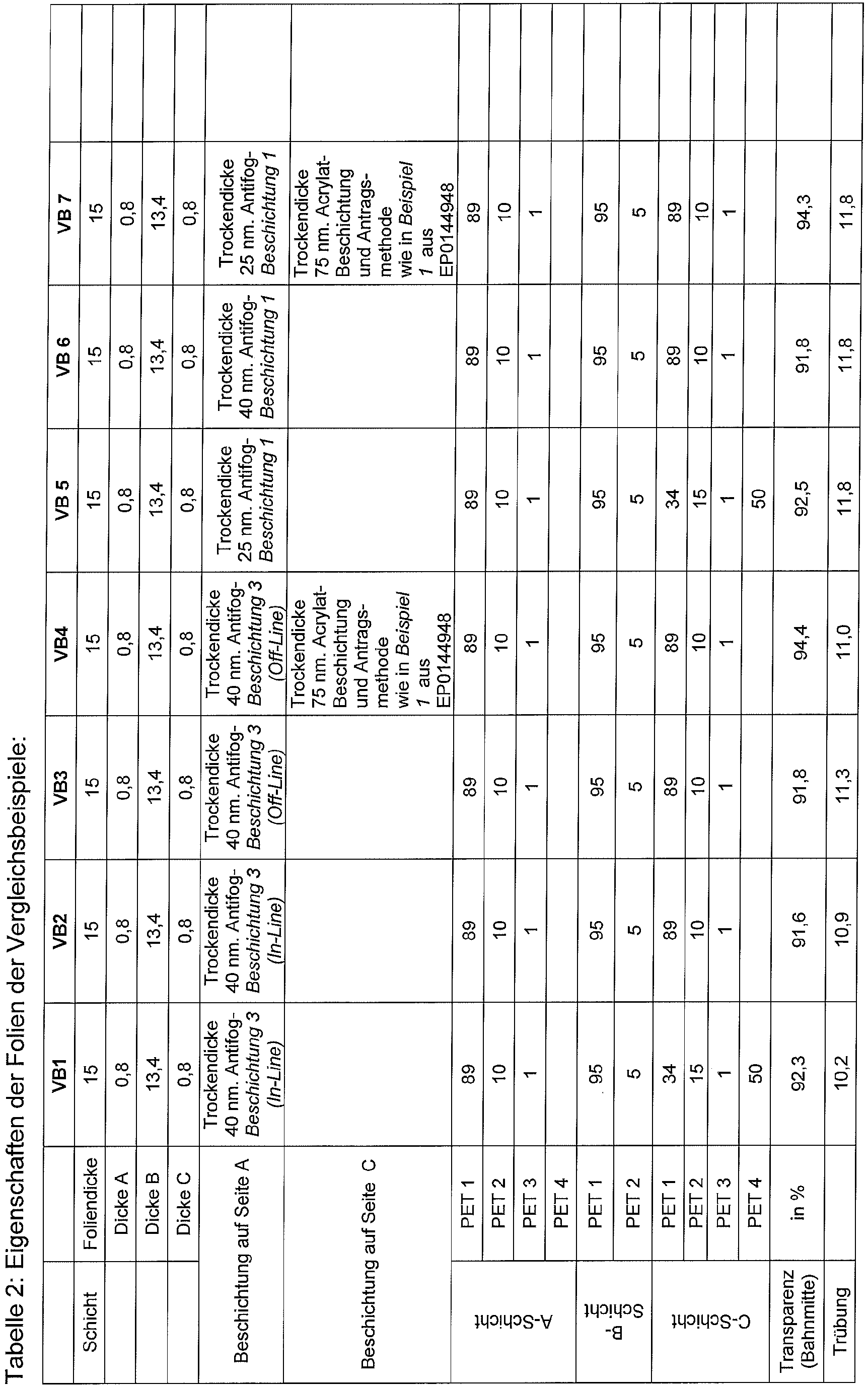

Claims (16)
- Beschichtete Polyesterfolie mit einer Transparenz von mindestens 93% umfassend:mindestens eine Basisschicht B, die einen thermoplastischen Polyester und einen UV-Stabilisator umfasst;wobei die Polyesterfolie eine erste und eine zweite Oberfläche aufweist, wobei auf mindestens einer der Oberflächen der Polyesterfolie eine permanente Antifog-Beschichtung aufgebracht ist, und wobei die Antifog-Beschichtung einen niedrigeren Brechungsindex aufweist als die Basisschicht B.
- Polyesterfolie nach Anspruch 1, dadurch gekennzeichnet, dass die Polyesterfolie eine mehrschichtige Folie ist und eine Schicht A umfasst, die auf der Basisschicht aufgebracht ist, oder eine Schicht A und eine Schicht C umfasst, wobei die Basisschicht B zwischen der Schicht A und der Schicht C angeordnet ist, und wobei die Schichten A und C ein thermoplastisches Polymer und einen UV-Stabilisator umfassen.
- Polyesterfolie nach Anspruch 1 oder 2, dadurch gekennzeichnet, dass die Dicke der Polyesterfolie mindestens 10 µm und maximal 40 µm, bevorzugt mindestens 14 µm und maximal 23 µm, besonders bevorzugt mindestens 14,5 µm und maximal 20 µm beträgt.
- Polyesterfolie nach einem oder mehreren der Ansprüche 1 bis 3, dadurch gekennzeichnet, dass die Basisschicht B zu mindestens 70 Gew.-% aus dem thermoplastischen Polyester besteht, wobei der thermoplastische Polyester zu mindestens 85 Mol-%, bevorzugt mindestens 90 Mol-%, besonders bevorzugt zu mindestens 92 Mol-% aus von Ethylenglykol- und Terephthalsäure abgeleiteten Einheiten besteht.
- Polyesterfolie nach einem oder mehreren der Ansprüche 1 bis 4, dadurch gekennzeichnet, dass die Polyesterfolie einen SV-Wert von größer 600, bevorzugt von größer 650, besonders bevorzugt von größer 700 aufweist, wobei der SV-Wert der Folie kleiner als 950, bevorzugt kleiner als 850 ist.
- Polyesterfolie nach einem oder mehreren der Ansprüche 1 bis 5, dadurch gekennzeichnet, dass der UV-Stabilisator ausgewählt ist aus der Gruppe bestehend aus Triazine, Benzotriazole, Benzoxazinone, wobei Triazine bevorzugt sind, wobei die Basisschicht B, und falls vorhanden, die Schicht A und die Schicht C den UV-Stabilisator in einer Menge von 0,3 bis 3 Gew.-%, bevorzugt von 0,75 bis 2,8 Gew.-% enthalten, bezogen auf das Gewicht der jeweiligen Schicht.
- Polyesterfolie nach einem oder mehreren der Ansprüche 1 bis 6, dadurch gekennzeichnet, dass Antifog-Beschichtung das Reaktionsprodukt einer Dispersion einer Antifog-Beschichtungszusammensetzung ist, die neben Wasser, a) hygroskopisch, poröses Material, b) einen Vernetzer auf Polymerbasis, c) ein haftvermittelndes organofunktionelles Silan und d) ein oder mehrere Tenside enthält.
- Polyesterfolie nach einem oder mehreren der Ansprüche 1 bis 7, dadurch gekennzeichnet, dass auf der ersten oder der zweiten Oberflächen der Polyesterfolie eine Antifog-Beschichtung aufgebracht ist und die der Antifog-Beschichtung gegenüberliegenden Oberfläche der Polyesterfolie eine Antirefex-Modifikation aufweist, die(1) eine Antireflexbeschichtung ist, oder(2) durch eine Deckschichtmodifikation gebildet wird.
- Polyesterfolie nach einem oder mehreren der Ansprüche 1 bis 8, dadurch gekennzeichnet, dass die Deckschichtmodifikation durch Co-Extrusion auf der Basisschicht B gebildet wird, wobei die Deckschichtmodifikation einen Polyester umfasst, der einen geringeren Brechungsindex als der Polyester der Basisschicht B aufweist.
- Polyesterfolie nach einem oder mehreren der Ansprüche 1 bis 8, dadurch gekennzeichnet, dass das Polymer der Deckschichtmodifikation einen Co-Monomeranteil von mindestens 2 Mol-%, bevorzugt mindestens 3 Mol-% und besonders bevorzugt mindestens 6 Mol-% enthält.
- Polyesterfolie nach einem oder mehreren der Ansprüche 1 bis 10, dadurch gekennzeichnet, dass die Antifog-Beschichtung eine Dicke von mindestens 60 nm und maximal 150 nm, bevorzugt mindestens 70 nm und maximal 130 nm, besonders bevorzugt von mindestens 80 nm und maximal 120 nm aufweist.
- Polyesterfolie nach einem oder mehreren der Ansprüche 9 bis 10, dadurch gekennzeichnet, dass die Antifog-Beschichtung eine Dicke von mindestens 30 nm und bevorzugt mindestens 40 nm und besonders bevorzugt mindestens 50 nm und maximal 60 nm aufweist.
- Verfahren zur Herstellung einer beschichteten Polyesterfolie nach einem oder mehreren der Ansprüche 1 bis 12, dadurch gekennzeichnet, dass die Polyesterfolie mittels Extrusion hergestellt und biaxial gestreckt wird, eine Antifog Beschichtungsmasse In-Line nass an die Polyesterfolie angetragen wird, und die beschichtete Polyesterfolie thermofixiert und aufgerollt wird.
- Verfahren zur Herstellung einer beschichteten Polyesterfolie nach einem oder mehreren der Ansprüche 1 bis 11, dadurch gekennzeichnet, dass Polyesterfolie mittels Extrusion hergestellt, biaxial gestreckt, thermofixiert und aufgerollt wird, anschließend offline mittels üblicher Beschichtungstechnologie eine Antifog-Beschichtungszusammensetzung an die Polyesterfolie nass angetragen wird, und die Polyesterfolie anschließend getrocknet und aufgewickelt wird.
- Verwendung der beschichteten Polyesterfolie nach einem der Ansprüche 1 bis 12 als hochtransparente Konvektionssperre.
- Verwendung der beschichteten Polyesterfolie nach einem der Ansprüche 1 bis 12 zur Herstellung von Energiesparmatten in Gewächshäusern.
Priority Applications (1)
| Application Number | Priority Date | Filing Date | Title |
|---|---|---|---|
| PL18192912T PL3456762T3 (pl) | 2017-09-14 | 2018-09-06 | Powlekana folia poliestrowa z trwałą powłoką przeciwmgielną i o przezroczystości co najmniej 93% |
Applications Claiming Priority (1)
| Application Number | Priority Date | Filing Date | Title |
|---|---|---|---|
| DE102017216258.9A DE102017216258A1 (de) | 2017-09-14 | 2017-09-14 | Beschichtete Polyesterfolie mit einer permanenten Antifog-Beschichtung und einer Transparenz von mindesten 93% |
Publications (3)
| Publication Number | Publication Date |
|---|---|
| EP3456762A2 true EP3456762A2 (de) | 2019-03-20 |
| EP3456762A3 EP3456762A3 (de) | 2019-04-03 |
| EP3456762B1 EP3456762B1 (de) | 2021-01-06 |
Family
ID=63683629
Family Applications (1)
| Application Number | Title | Priority Date | Filing Date |
|---|---|---|---|
| EP18192912.6A Active EP3456762B1 (de) | 2017-09-14 | 2018-09-06 | Beschichtete polyesterfolie mit einer permanenten antifog-beschichtung und einer transparenz von mindestens 93% |
Country Status (6)
| Country | Link |
|---|---|
| US (1) | US11097518B2 (de) |
| EP (1) | EP3456762B1 (de) |
| JP (1) | JP2019051713A (de) |
| KR (1) | KR20190030619A (de) |
| DE (1) | DE102017216258A1 (de) |
| PL (1) | PL3456762T3 (de) |
Cited By (3)
| Publication number | Priority date | Publication date | Assignee | Title |
|---|---|---|---|---|
| CN109971137A (zh) * | 2019-03-21 | 2019-07-05 | 深圳市昱荣环保材料有限公司 | 一种吸塑用防雾胶片及其制备方法 |
| EP3985052A1 (de) | 2020-10-16 | 2022-04-20 | Mitsubishi Polyester Film GmbH | Ein- oder mehrschichtige polyesterfolie mit einer permanenten antifog-beschichtung und einer transparenz von mindestens 92% |
| WO2022079229A1 (en) | 2020-10-16 | 2022-04-21 | Ab Ludvig Svensson | Greenhouse screen with antifogging effect |
Families Citing this family (4)
| Publication number | Priority date | Publication date | Assignee | Title |
|---|---|---|---|---|
| CN111093361B (zh) * | 2017-09-14 | 2022-07-01 | 卢德维格斯文松股份公司 | 温室帘幕 |
| KR102501654B1 (ko) | 2021-01-26 | 2023-02-20 | 도레이첨단소재 주식회사 | 친수성 폴리에스테르 필름 및 이의 제조 방법 |
| EP4363219B1 (de) | 2021-06-30 | 2025-05-07 | Bostik SA | (co)polyesterharze zur verwendung als heisssiegelschichten für behälter und folien mit solchen schichten zum versiegeln und wiederverschliessen von behältern |
| JP7782339B2 (ja) * | 2022-03-24 | 2025-12-09 | 三菱ケミカル株式会社 | 積層ポリエステルフィルム |
Citations (12)
| Publication number | Priority date | Publication date | Assignee | Title |
|---|---|---|---|---|
| EP0144948A2 (de) | 1983-12-12 | 1985-06-19 | Hoechst Celanese Corporation | Polyesterfolie mit vernetzter acrylischer Haftvermittlerbeschichtung |
| WO1995018210A1 (en) | 1993-12-30 | 1995-07-06 | The Procter & Gamble Company | Liquid hard surface detergent compositions containing builders |
| EP0769540A2 (de) | 1995-10-17 | 1997-04-23 | Hoechst Diafoil Company | Mit Silikontrennschicht beschichteter Polyesterfilm |
| WO1997022655A1 (en) | 1995-12-15 | 1997-06-26 | Cryovac, Inc. | Film having excellent ink adhesion in combination with enhanced slip, antifog, and/or antistatic properties |
| WO1998006575A1 (en) | 1996-08-15 | 1998-02-19 | Imperial Chemical Industries Plc | Polymeric film |
| EP1152027A1 (de) | 2000-05-04 | 2001-11-07 | Ciba SC Holding AG | Polyolefinfilmzusammensetzungen mit Antibeschlageigenschaften |
| EP1368405B1 (de) | 2001-02-21 | 2005-04-27 | Dupont Teijin Films U.S. Limited Partnership | Flammgehemmter polyester film |
| EP1534776A1 (de) | 2002-09-06 | 2005-06-01 | Ciba SC Holding AG | Filmzusammensetzungen mit permanenten antibeschlag-, antinebel-, und antiwolken-eigenschaften |
| DE69833711T2 (de) | 1997-08-27 | 2006-09-21 | Canon K.K. | Antibeschlag-Beschichtungszusammensetzung, Antibeschlag-Beschichtung und Antibeschlag-Gegenstand |
| EP1777251A1 (de) | 2005-10-18 | 2007-04-25 | Mitsubishi Polyester Film GmbH | Polyesterfolie mit hydrophiler Beschichtung |
| EP1647568B1 (de) | 2004-10-12 | 2009-01-21 | Mitsubishi Polyester Film GmbH | Polyesterfolie mit hydrophiler Beschichtung, Verfahren zu ihrer Herstellung und ihre Verwendung |
| EP2216362A1 (de) | 2009-02-06 | 2010-08-11 | SABO S.r.l | Polyolefine-zusammensetzungen für Folien mit permanenten Antibeschlag-Eigenschaften, insbedondere für Landwirtschaftliche Film-anwendungen und für Verpackung von nassen Waren |
Family Cites Families (10)
| Publication number | Priority date | Publication date | Assignee | Title |
|---|---|---|---|---|
| US5585186A (en) * | 1994-12-12 | 1996-12-17 | Minnesota Mining And Manufacturing Company | Coating composition having anti-reflective, and anti-fogging properties |
| US5580819A (en) * | 1995-03-22 | 1996-12-03 | Ppg Industries, Inc. | Coating composition, process for producing antireflective coatings, and coated articles |
| US6455142B1 (en) * | 1999-12-17 | 2002-09-24 | Mitsubishi Polyester Film, Llc | Anti-fog coating and coated film |
| DE10007724A1 (de) * | 2000-02-19 | 2001-08-23 | Mitsubishi Polyester Film Gmbh | Transparente, siegelfähige, UV-stabilisierte Polyesterfolie, Verfahren zu ihrer Herstellung und ihre Verwendung |
| TWI464201B (zh) * | 2006-12-19 | 2014-12-11 | Mitsubishi Polyester Film Gmbh | 單一或多層穩定的聚酯膜 |
| JP5492781B2 (ja) * | 2007-10-31 | 2014-05-14 | デュポン・テイジン・フィルムズ・ユー・エス・リミテッド・パートナーシップ | コーティングされた物品 |
| US20130224478A1 (en) * | 2008-08-07 | 2013-08-29 | 3M Innovative Properties Company | Acicular silica coating for enhanced hydrophilicity/transmittivity |
| CN104053731B (zh) * | 2011-12-15 | 2016-10-26 | 3M创新有限公司 | 包含含水聚合物分散体、交联剂和表面活性剂的防雾涂料 |
| TWI707932B (zh) * | 2015-02-03 | 2020-10-21 | 美商道康寧公司 | 硬塗層及相關組成物、方法、及物品 |
| DE102016200875A1 (de) * | 2016-01-22 | 2017-07-27 | Mitsubishi Polyester Film Gmbh | Biaxial orientierte, UV-stabilisierte, ein- oder mehrschichtige Polyesterfolie mit einer Kombination aus Siliziumdioxidpartikeln als Lichtstreupartikel und einem UV-Stabilisator sowie Verfahren zu ihrer Herstellung und ihre Verwendung in Gewächshausschattenmatten |
-
2017
- 2017-09-14 DE DE102017216258.9A patent/DE102017216258A1/de not_active Withdrawn
-
2018
- 2018-09-06 EP EP18192912.6A patent/EP3456762B1/de active Active
- 2018-09-06 PL PL18192912T patent/PL3456762T3/pl unknown
- 2018-09-12 US US16/128,652 patent/US11097518B2/en active Active
- 2018-09-13 KR KR1020180109396A patent/KR20190030619A/ko not_active Withdrawn
- 2018-09-14 JP JP2018171978A patent/JP2019051713A/ja active Pending
Patent Citations (14)
| Publication number | Priority date | Publication date | Assignee | Title |
|---|---|---|---|---|
| EP0144948A2 (de) | 1983-12-12 | 1985-06-19 | Hoechst Celanese Corporation | Polyesterfolie mit vernetzter acrylischer Haftvermittlerbeschichtung |
| WO1995018210A1 (en) | 1993-12-30 | 1995-07-06 | The Procter & Gamble Company | Liquid hard surface detergent compositions containing builders |
| EP0769540A2 (de) | 1995-10-17 | 1997-04-23 | Hoechst Diafoil Company | Mit Silikontrennschicht beschichteter Polyesterfilm |
| WO1997022655A1 (en) | 1995-12-15 | 1997-06-26 | Cryovac, Inc. | Film having excellent ink adhesion in combination with enhanced slip, antifog, and/or antistatic properties |
| DE69731750T2 (de) | 1996-08-15 | 2006-02-16 | DuPont Teijin Films U.S., Ltd. Partnership, Wilmington | Kunststofffolie |
| WO1998006575A1 (en) | 1996-08-15 | 1998-02-19 | Imperial Chemical Industries Plc | Polymeric film |
| DE69833711T2 (de) | 1997-08-27 | 2006-09-21 | Canon K.K. | Antibeschlag-Beschichtungszusammensetzung, Antibeschlag-Beschichtung und Antibeschlag-Gegenstand |
| EP1152027A1 (de) | 2000-05-04 | 2001-11-07 | Ciba SC Holding AG | Polyolefinfilmzusammensetzungen mit Antibeschlageigenschaften |
| EP1368405B1 (de) | 2001-02-21 | 2005-04-27 | Dupont Teijin Films U.S. Limited Partnership | Flammgehemmter polyester film |
| EP1534776A1 (de) | 2002-09-06 | 2005-06-01 | Ciba SC Holding AG | Filmzusammensetzungen mit permanenten antibeschlag-, antinebel-, und antiwolken-eigenschaften |
| EP1647568B1 (de) | 2004-10-12 | 2009-01-21 | Mitsubishi Polyester Film GmbH | Polyesterfolie mit hydrophiler Beschichtung, Verfahren zu ihrer Herstellung und ihre Verwendung |
| EP1777251A1 (de) | 2005-10-18 | 2007-04-25 | Mitsubishi Polyester Film GmbH | Polyesterfolie mit hydrophiler Beschichtung |
| EP1777251B1 (de) | 2005-10-18 | 2012-03-14 | Mitsubishi Polyester Film GmbH | Polyesterfolie mit hydrophiler Beschichtung |
| EP2216362A1 (de) | 2009-02-06 | 2010-08-11 | SABO S.r.l | Polyolefine-zusammensetzungen für Folien mit permanenten Antibeschlag-Eigenschaften, insbedondere für Landwirtschaftliche Film-anwendungen und für Verpackung von nassen Waren |
Non-Patent Citations (1)
| Title |
|---|
| J. A. WOOLLAM ET AL.: "Optical Metrology", vol. CR72, article "Overview of variable-angle spectroscopic ellipsometry (VASE): I. Basic theory and typical applications, Proc. SPIE", pages: 3 - 28 |
Cited By (5)
| Publication number | Priority date | Publication date | Assignee | Title |
|---|---|---|---|---|
| CN109971137A (zh) * | 2019-03-21 | 2019-07-05 | 深圳市昱荣环保材料有限公司 | 一种吸塑用防雾胶片及其制备方法 |
| EP3985052A1 (de) | 2020-10-16 | 2022-04-20 | Mitsubishi Polyester Film GmbH | Ein- oder mehrschichtige polyesterfolie mit einer permanenten antifog-beschichtung und einer transparenz von mindestens 92% |
| WO2022079229A1 (en) | 2020-10-16 | 2022-04-21 | Ab Ludvig Svensson | Greenhouse screen with antifogging effect |
| DE102020213101A1 (de) | 2020-10-16 | 2022-04-21 | Mitsubishi Polyester Film Gmbh | Ein- oder mehrschichtige Polyesterfolie mit einer permanenten Antifog-Beschichtung und einer Transparenz von mindestens 92% |
| US12606680B2 (en) | 2020-10-16 | 2026-04-21 | Mitsubishi Polyester Film Gmbh | Single-layer or multilayer polyester film having a permanent anti-fog coating and a transparency of at least 92 % |
Also Published As
| Publication number | Publication date |
|---|---|
| US20190077137A1 (en) | 2019-03-14 |
| JP2019051713A (ja) | 2019-04-04 |
| KR20190030619A (ko) | 2019-03-22 |
| US11097518B2 (en) | 2021-08-24 |
| EP3456762A3 (de) | 2019-04-03 |
| PL3456762T3 (pl) | 2021-07-05 |
| DE102017216258A1 (de) | 2019-03-14 |
| EP3456762B1 (de) | 2021-01-06 |
Similar Documents
| Publication | Publication Date | Title |
|---|---|---|
| EP3456762B1 (de) | Beschichtete polyesterfolie mit einer permanenten antifog-beschichtung und einer transparenz von mindestens 93% | |
| EP3251841B1 (de) | Biaxial orientierte, uv-stabilisierte, ein- oder mehrschichtige polyesterfolie mit mindestens einseitiger antireflex-beschichtung (antiglare) und einer transparenz von mindestens 93,5% | |
| EP3196014B1 (de) | Biaxial orientierte, uv-stabilisierte, ein- oder mehrschichtige polyesterfolie mit einer kombination aus siliziumdioxidpartikeln als lichtstreupartikel und einem uv-stabilisator sowie verfahren zu ihrer herstellung und ihre verwendung in gewächshausschattenmatten | |
| EP3985052A1 (de) | Ein- oder mehrschichtige polyesterfolie mit einer permanenten antifog-beschichtung und einer transparenz von mindestens 92% | |
| EP1274576B1 (de) | Matte, uv-stabile, thermoformbare, koextrudierte polyesterfolie, verfahren zu ihrer herstellung und ihre verwendung | |
| EP1728815B1 (de) | Weiss-opake Folie mit niedriger Transparenz und verbesserter Durchschlagsfestigkeit | |
| DE102018215379A1 (de) | Biaxial orientierte, UV-stabilisierte, ein- oder mehrschichtige transparente Polyesterfolie mit einer permanenten wässrigen Antifog-Beschichtung und einer Transparenz von mindestens 93% | |
| EP1261481A1 (de) | Matte, uv-stabile, flammhemmend ausgerüstete koextrudierte polyesterfolie, verfahren zu ihrer herstellung und ihre verwendung | |
| EP1614536A2 (de) | Mehrschichtige, matte, thermoformbare, IR-reflektierende Polyesterfolie | |
| EP1125732A1 (de) | Transparente, siegelfähige, UV-stabilisierte Polyesterfolie, Verfahren zu ihrer Herstellung und ihre Verwendung | |
| EP1274579A1 (de) | Einseitig matte, siegelfähige, uv stabilisierte, koextrudierte, biaxial orientierte folie, verfahren zu ihrer herstellung und verwendung | |
| EP1268206B1 (de) | Matte, uv-stabile, koextrudierte polyesterfolie, verfahren zu ihrer herstellung und ihre verwendung | |
| DE10007726A1 (de) | Transparente, siegelfähige, UV-stabilisierte und flammhemmend ausgerüstete Polyesterfolie, Verfahren zu ihrer Herstellung und ihre Verwendung | |
| EP1862300A1 (de) | Siegelfähige, biaxial orientierte Polyesterfolie mit hydrophiler Beschichtung | |
| EP3681268B1 (de) | Gewächshausabschirmung | |
| EP3683257B1 (de) | Biaxial orientierte, uv-stabilisierte, ein- oder mehrschichtige polyesterfolie mit mindestens einseitiger antireflex und flammgeschützter-beschichtung (antiglare) und einer transparenz von mindestens 93,5% | |
| EP3569646A1 (de) | Matte, biaxial orientierte polyesterfolie mit erhöhtem reibungskoeffizient | |
| EP2740597B1 (de) | Weiße, biaxial orientierte, mindestens einseitig matte und bewitterungsstabile Polyesterfolie, Verfahren zu ihrer Herstellung und ihre Verwendung | |
| WO2001053083A1 (de) | Transparente, biaxial orientierte, uv-stabilisierte barrierefolie, verfahren zu ihrer herstellung und ihre verwendung | |
| DE102007039777A1 (de) | Zubereitung zur permanenten hydrophilen Beschichtung von Polyesterfolien | |
| WO2001060140A2 (de) | Weisse, siegelfähige, uv stabilisierte und flammhemmend ausgerüstete, biaxial orientierte polyesterfolie, verfahren zu ihrer herstellung und ihre verwendung | |
| EP1274578B1 (de) | Matte, uv-stabile, sulfonatgruppenenthaltende, schwerentflammbare, thermoformbare koextrudierte polyesterfolie, verfahren zu ihrer herstellung und ihre verwendung | |
| WO2001060608A1 (de) | Weisse, siegelfähige, uv stabilisierte, biaxial orientierte polyesterfolie, verfahren zu ihrer herstellung und ihre verwendung | |
| DE102005058918A1 (de) | Matte, UV-stabilisierte, biaxial orientierte Polyesterfolie mit hoher Siegelnahtfestigkeit | |
| DE102005058919A1 (de) | Matte, siegelfähige und UV-stabilisierte, biaxial orientierte Polyesterfolie |
Legal Events
| Date | Code | Title | Description |
|---|---|---|---|
| PUAI | Public reference made under article 153(3) epc to a published international application that has entered the european phase |
Free format text: ORIGINAL CODE: 0009012 |
|
| STAA | Information on the status of an ep patent application or granted ep patent |
Free format text: STATUS: THE APPLICATION HAS BEEN PUBLISHED |
|
| PUAL | Search report despatched |
Free format text: ORIGINAL CODE: 0009013 |
|
| AK | Designated contracting states |
Kind code of ref document: A2 Designated state(s): AL AT BE BG CH CY CZ DE DK EE ES FI FR GB GR HR HU IE IS IT LI LT LU LV MC MK MT NL NO PL PT RO RS SE SI SK SM TR |
|
| AX | Request for extension of the european patent |
Extension state: BA ME |
|
| AK | Designated contracting states |
Kind code of ref document: A3 Designated state(s): AL AT BE BG CH CY CZ DE DK EE ES FI FR GB GR HR HU IE IS IT LI LT LU LV MC MK MT NL NO PL PT RO RS SE SI SK SM TR |
|
| AX | Request for extension of the european patent |
Extension state: BA ME |
|
| RIC1 | Information provided on ipc code assigned before grant |
Ipc: C08J 7/04 20060101AFI20190222BHEP Ipc: A01G 9/22 20060101ALI20190222BHEP Ipc: B32B 27/08 20060101ALI20190222BHEP Ipc: B32B 27/36 20060101ALI20190222BHEP Ipc: A01G 9/14 20060101ALI20190222BHEP |
|
| STAA | Information on the status of an ep patent application or granted ep patent |
Free format text: STATUS: REQUEST FOR EXAMINATION WAS MADE |
|
| 17P | Request for examination filed |
Effective date: 20191004 |
|
| RBV | Designated contracting states (corrected) |
Designated state(s): AL AT BE BG CH CY CZ DE DK EE ES FI FR GB GR HR HU IE IS IT LI LT LU LV MC MK MT NL NO PL PT RO RS SE SI SK SM TR |
|
| GRAP | Despatch of communication of intention to grant a patent |
Free format text: ORIGINAL CODE: EPIDOSNIGR1 |
|
| STAA | Information on the status of an ep patent application or granted ep patent |
Free format text: STATUS: GRANT OF PATENT IS INTENDED |
|
| RIC1 | Information provided on ipc code assigned before grant |
Ipc: A01G 9/22 20060101ALI20200709BHEP Ipc: B32B 27/36 20060101ALI20200709BHEP Ipc: A01G 9/14 20060101ALI20200709BHEP Ipc: B32B 27/08 20060101ALI20200709BHEP Ipc: C08J 7/04 20200101AFI20200709BHEP |
|
| INTG | Intention to grant announced |
Effective date: 20200727 |
|
| GRAS | Grant fee paid |
Free format text: ORIGINAL CODE: EPIDOSNIGR3 |
|
| GRAA | (expected) grant |
Free format text: ORIGINAL CODE: 0009210 |
|
| STAA | Information on the status of an ep patent application or granted ep patent |
Free format text: STATUS: THE PATENT HAS BEEN GRANTED |
|
| AK | Designated contracting states |
Kind code of ref document: B1 Designated state(s): AL AT BE BG CH CY CZ DE DK EE ES FI FR GB GR HR HU IE IS IT LI LT LU LV MC MK MT NL NO PL PT RO RS SE SI SK SM TR |
|
| REG | Reference to a national code |
Ref country code: GB Ref legal event code: FG4D Free format text: NOT ENGLISH |
|
| REG | Reference to a national code |
Ref country code: AT Ref legal event code: REF Ref document number: 1352317 Country of ref document: AT Kind code of ref document: T Effective date: 20210115 Ref country code: CH Ref legal event code: EP |
|
| REG | Reference to a national code |
Ref country code: DE Ref legal event code: R096 Ref document number: 502018003537 Country of ref document: DE |
|
| REG | Reference to a national code |
Ref country code: IE Ref legal event code: FG4D Free format text: LANGUAGE OF EP DOCUMENT: GERMAN |
|
| REG | Reference to a national code |
Ref country code: SE Ref legal event code: TRGR |
|
| REG | Reference to a national code |
Ref country code: NL Ref legal event code: FP |
|
| REG | Reference to a national code |
Ref country code: LT Ref legal event code: MG9D |
|
| PG25 | Lapsed in a contracting state [announced via postgrant information from national office to epo] |
Ref country code: LT Free format text: LAPSE BECAUSE OF FAILURE TO SUBMIT A TRANSLATION OF THE DESCRIPTION OR TO PAY THE FEE WITHIN THE PRESCRIBED TIME-LIMIT Effective date: 20210106 Ref country code: PT Free format text: LAPSE BECAUSE OF FAILURE TO SUBMIT A TRANSLATION OF THE DESCRIPTION OR TO PAY THE FEE WITHIN THE PRESCRIBED TIME-LIMIT Effective date: 20210506 Ref country code: NO Free format text: LAPSE BECAUSE OF FAILURE TO SUBMIT A TRANSLATION OF THE DESCRIPTION OR TO PAY THE FEE WITHIN THE PRESCRIBED TIME-LIMIT Effective date: 20210406 Ref country code: BG Free format text: LAPSE BECAUSE OF FAILURE TO SUBMIT A TRANSLATION OF THE DESCRIPTION OR TO PAY THE FEE WITHIN THE PRESCRIBED TIME-LIMIT Effective date: 20210406 Ref country code: HR Free format text: LAPSE BECAUSE OF FAILURE TO SUBMIT A TRANSLATION OF THE DESCRIPTION OR TO PAY THE FEE WITHIN THE PRESCRIBED TIME-LIMIT Effective date: 20210106 Ref country code: FI Free format text: LAPSE BECAUSE OF FAILURE TO SUBMIT A TRANSLATION OF THE DESCRIPTION OR TO PAY THE FEE WITHIN THE PRESCRIBED TIME-LIMIT Effective date: 20210106 Ref country code: GR Free format text: LAPSE BECAUSE OF FAILURE TO SUBMIT A TRANSLATION OF THE DESCRIPTION OR TO PAY THE FEE WITHIN THE PRESCRIBED TIME-LIMIT Effective date: 20210407 |
|
| PG25 | Lapsed in a contracting state [announced via postgrant information from national office to epo] |
Ref country code: LV Free format text: LAPSE BECAUSE OF FAILURE TO SUBMIT A TRANSLATION OF THE DESCRIPTION OR TO PAY THE FEE WITHIN THE PRESCRIBED TIME-LIMIT Effective date: 20210106 Ref country code: RS Free format text: LAPSE BECAUSE OF FAILURE TO SUBMIT A TRANSLATION OF THE DESCRIPTION OR TO PAY THE FEE WITHIN THE PRESCRIBED TIME-LIMIT Effective date: 20210106 |
|
| PG25 | Lapsed in a contracting state [announced via postgrant information from national office to epo] |
Ref country code: IS Free format text: LAPSE BECAUSE OF FAILURE TO SUBMIT A TRANSLATION OF THE DESCRIPTION OR TO PAY THE FEE WITHIN THE PRESCRIBED TIME-LIMIT Effective date: 20210506 |
|
| REG | Reference to a national code |
Ref country code: DE Ref legal event code: R097 Ref document number: 502018003537 Country of ref document: DE |
|
| PG25 | Lapsed in a contracting state [announced via postgrant information from national office to epo] |
Ref country code: EE Free format text: LAPSE BECAUSE OF FAILURE TO SUBMIT A TRANSLATION OF THE DESCRIPTION OR TO PAY THE FEE WITHIN THE PRESCRIBED TIME-LIMIT Effective date: 20210106 Ref country code: CZ Free format text: LAPSE BECAUSE OF FAILURE TO SUBMIT A TRANSLATION OF THE DESCRIPTION OR TO PAY THE FEE WITHIN THE PRESCRIBED TIME-LIMIT Effective date: 20210106 Ref country code: SM Free format text: LAPSE BECAUSE OF FAILURE TO SUBMIT A TRANSLATION OF THE DESCRIPTION OR TO PAY THE FEE WITHIN THE PRESCRIBED TIME-LIMIT Effective date: 20210106 |
|
| PLBE | No opposition filed within time limit |
Free format text: ORIGINAL CODE: 0009261 |
|
| STAA | Information on the status of an ep patent application or granted ep patent |
Free format text: STATUS: NO OPPOSITION FILED WITHIN TIME LIMIT |
|
| PG25 | Lapsed in a contracting state [announced via postgrant information from national office to epo] |
Ref country code: DK Free format text: LAPSE BECAUSE OF FAILURE TO SUBMIT A TRANSLATION OF THE DESCRIPTION OR TO PAY THE FEE WITHIN THE PRESCRIBED TIME-LIMIT Effective date: 20210106 Ref country code: SK Free format text: LAPSE BECAUSE OF FAILURE TO SUBMIT A TRANSLATION OF THE DESCRIPTION OR TO PAY THE FEE WITHIN THE PRESCRIBED TIME-LIMIT Effective date: 20210106 Ref country code: RO Free format text: LAPSE BECAUSE OF FAILURE TO SUBMIT A TRANSLATION OF THE DESCRIPTION OR TO PAY THE FEE WITHIN THE PRESCRIBED TIME-LIMIT Effective date: 20210106 |
|
| 26N | No opposition filed |
Effective date: 20211007 |
|
| PG25 | Lapsed in a contracting state [announced via postgrant information from national office to epo] |
Ref country code: AL Free format text: LAPSE BECAUSE OF FAILURE TO SUBMIT A TRANSLATION OF THE DESCRIPTION OR TO PAY THE FEE WITHIN THE PRESCRIBED TIME-LIMIT Effective date: 20210106 Ref country code: ES Free format text: LAPSE BECAUSE OF FAILURE TO SUBMIT A TRANSLATION OF THE DESCRIPTION OR TO PAY THE FEE WITHIN THE PRESCRIBED TIME-LIMIT Effective date: 20210106 |
|
| PG25 | Lapsed in a contracting state [announced via postgrant information from national office to epo] |
Ref country code: SI Free format text: LAPSE BECAUSE OF FAILURE TO SUBMIT A TRANSLATION OF THE DESCRIPTION OR TO PAY THE FEE WITHIN THE PRESCRIBED TIME-LIMIT Effective date: 20210106 |
|
| REG | Reference to a national code |
Ref country code: CH Ref legal event code: PL |
|
| PG25 | Lapsed in a contracting state [announced via postgrant information from national office to epo] |
Ref country code: IS Free format text: LAPSE BECAUSE OF FAILURE TO SUBMIT A TRANSLATION OF THE DESCRIPTION OR TO PAY THE FEE WITHIN THE PRESCRIBED TIME-LIMIT Effective date: 20210506 Ref country code: MC Free format text: LAPSE BECAUSE OF FAILURE TO SUBMIT A TRANSLATION OF THE DESCRIPTION OR TO PAY THE FEE WITHIN THE PRESCRIBED TIME-LIMIT Effective date: 20210106 |
|
| PG25 | Lapsed in a contracting state [announced via postgrant information from national office to epo] |
Ref country code: IE Free format text: LAPSE BECAUSE OF NON-PAYMENT OF DUE FEES Effective date: 20210906 |
|
| PG25 | Lapsed in a contracting state [announced via postgrant information from national office to epo] |
Ref country code: LI Free format text: LAPSE BECAUSE OF NON-PAYMENT OF DUE FEES Effective date: 20210930 Ref country code: CH Free format text: LAPSE BECAUSE OF NON-PAYMENT OF DUE FEES Effective date: 20210930 |
|
| P01 | Opt-out of the competence of the unified patent court (upc) registered |
Effective date: 20230515 |
|
| PG25 | Lapsed in a contracting state [announced via postgrant information from national office to epo] |
Ref country code: CY Free format text: LAPSE BECAUSE OF FAILURE TO SUBMIT A TRANSLATION OF THE DESCRIPTION OR TO PAY THE FEE WITHIN THE PRESCRIBED TIME-LIMIT Effective date: 20210106 |
|
| PG25 | Lapsed in a contracting state [announced via postgrant information from national office to epo] |
Ref country code: HU Free format text: LAPSE BECAUSE OF FAILURE TO SUBMIT A TRANSLATION OF THE DESCRIPTION OR TO PAY THE FEE WITHIN THE PRESCRIBED TIME-LIMIT; INVALID AB INITIO Effective date: 20180906 |
|
| PG25 | Lapsed in a contracting state [announced via postgrant information from national office to epo] |
Ref country code: MK Free format text: LAPSE BECAUSE OF FAILURE TO SUBMIT A TRANSLATION OF THE DESCRIPTION OR TO PAY THE FEE WITHIN THE PRESCRIBED TIME-LIMIT Effective date: 20210106 |
|
| PG25 | Lapsed in a contracting state [announced via postgrant information from national office to epo] |
Ref country code: MT Free format text: LAPSE BECAUSE OF FAILURE TO SUBMIT A TRANSLATION OF THE DESCRIPTION OR TO PAY THE FEE WITHIN THE PRESCRIBED TIME-LIMIT Effective date: 20210106 |
|
| PGFP | Annual fee paid to national office [announced via postgrant information from national office to epo] |
Ref country code: GB Payment date: 20240927 Year of fee payment: 7 |
|
| PGFP | Annual fee paid to national office [announced via postgrant information from national office to epo] |
Ref country code: LU Payment date: 20240926 Year of fee payment: 7 |
|
| PGFP | Annual fee paid to national office [announced via postgrant information from national office to epo] |
Ref country code: PL Payment date: 20240829 Year of fee payment: 7 |
|
| REG | Reference to a national code |
Ref country code: AT Ref legal event code: MM01 Ref document number: 1352317 Country of ref document: AT Kind code of ref document: T Effective date: 20230906 |
|
| PG25 | Lapsed in a contracting state [announced via postgrant information from national office to epo] |
Ref country code: AT Free format text: LAPSE BECAUSE OF NON-PAYMENT OF DUE FEES Effective date: 20230906 |
|
| PG25 | Lapsed in a contracting state [announced via postgrant information from national office to epo] |
Ref country code: AT Free format text: LAPSE BECAUSE OF NON-PAYMENT OF DUE FEES Effective date: 20230906 |
|
| REG | Reference to a national code |
Ref country code: DE Ref legal event code: R082 Ref document number: 502018003537 Country of ref document: DE Representative=s name: DR. MUELLER PATENTANWAELTE, DE |
|
| PGFP | Annual fee paid to national office [announced via postgrant information from national office to epo] |
Ref country code: DE Payment date: 20250930 Year of fee payment: 8 |
|
| PGFP | Annual fee paid to national office [announced via postgrant information from national office to epo] |
Ref country code: NL Payment date: 20250918 Year of fee payment: 8 Ref country code: IT Payment date: 20250923 Year of fee payment: 8 |
|
| PGFP | Annual fee paid to national office [announced via postgrant information from national office to epo] |
Ref country code: BE Payment date: 20250918 Year of fee payment: 8 |
|
| PGFP | Annual fee paid to national office [announced via postgrant information from national office to epo] |
Ref country code: FR Payment date: 20250922 Year of fee payment: 8 |
|
| PGFP | Annual fee paid to national office [announced via postgrant information from national office to epo] |
Ref country code: SE Payment date: 20250918 Year of fee payment: 8 |
|
| PG25 | Lapsed in a contracting state [announced via postgrant information from national office to epo] |
Ref country code: TR Free format text: LAPSE BECAUSE OF FAILURE TO SUBMIT A TRANSLATION OF THE DESCRIPTION OR TO PAY THE FEE WITHIN THE PRESCRIBED TIME-LIMIT Effective date: 20210106 |
|
| PGFP | Annual fee paid to national office [announced via postgrant information from national office to epo] |
Ref country code: AT Payment date: 20260410 Year of fee payment: 5 |