EP3455292B1 - Polyimide compositions and a polyimide test socket housing - Google Patents
Polyimide compositions and a polyimide test socket housing Download PDFInfo
- Publication number
- EP3455292B1 EP3455292B1 EP17725815.9A EP17725815A EP3455292B1 EP 3455292 B1 EP3455292 B1 EP 3455292B1 EP 17725815 A EP17725815 A EP 17725815A EP 3455292 B1 EP3455292 B1 EP 3455292B1
- Authority
- EP
- European Patent Office
- Prior art keywords
- polyimide
- titanium dioxide
- ppd
- test socket
- bpda
- Prior art date
- Legal status (The legal status is an assumption and is not a legal conclusion. Google has not performed a legal analysis and makes no representation as to the accuracy of the status listed.)
- Active
Links
Images


Classifications
-
- C—CHEMISTRY; METALLURGY
- C08—ORGANIC MACROMOLECULAR COMPOUNDS; THEIR PREPARATION OR CHEMICAL WORKING-UP; COMPOSITIONS BASED THEREON
- C08L—COMPOSITIONS OF MACROMOLECULAR COMPOUNDS
- C08L79/00—Compositions of macromolecular compounds obtained by reactions forming in the main chain of the macromolecule a linkage containing nitrogen with or without oxygen or carbon only, not provided for in groups C08L61/00 - C08L77/00
- C08L79/04—Polycondensates having nitrogen-containing heterocyclic rings in the main chain; Polyhydrazides; Polyamide acids or similar polyimide precursors
- C08L79/08—Polyimides; Polyester-imides; Polyamide-imides; Polyamide acids or similar polyimide precursors
-
- C—CHEMISTRY; METALLURGY
- C08—ORGANIC MACROMOLECULAR COMPOUNDS; THEIR PREPARATION OR CHEMICAL WORKING-UP; COMPOSITIONS BASED THEREON
- C08K—Use of inorganic or non-macromolecular organic substances as compounding ingredients
- C08K3/00—Use of inorganic substances as compounding ingredients
- C08K3/18—Oxygen-containing compounds, e.g. metal carbonyls
- C08K3/20—Oxides; Hydroxides
- C08K3/22—Oxides; Hydroxides of metals
-
- C—CHEMISTRY; METALLURGY
- C08—ORGANIC MACROMOLECULAR COMPOUNDS; THEIR PREPARATION OR CHEMICAL WORKING-UP; COMPOSITIONS BASED THEREON
- C08G—MACROMOLECULAR COMPOUNDS OBTAINED OTHERWISE THAN BY REACTIONS ONLY INVOLVING UNSATURATED CARBON-TO-CARBON BONDS
- C08G73/00—Macromolecular compounds obtained by reactions forming a linkage containing nitrogen with or without oxygen or carbon in the main chain of the macromolecule, not provided for in groups C08G12/00 - C08G71/00
- C08G73/06—Polycondensates having nitrogen-containing heterocyclic rings in the main chain of the macromolecule
- C08G73/10—Polyimides; Polyester-imides; Polyamide-imides; Polyamide acids or similar polyimide precursors
- C08G73/1003—Preparatory processes
- C08G73/1007—Preparatory processes from tetracarboxylic acids or derivatives and diamines
- C08G73/101—Preparatory processes from tetracarboxylic acids or derivatives and diamines containing chain terminating or branching agents
- C08G73/1014—Preparatory processes from tetracarboxylic acids or derivatives and diamines containing chain terminating or branching agents in the form of (mono)anhydrid
-
- C—CHEMISTRY; METALLURGY
- C08—ORGANIC MACROMOLECULAR COMPOUNDS; THEIR PREPARATION OR CHEMICAL WORKING-UP; COMPOSITIONS BASED THEREON
- C08G—MACROMOLECULAR COMPOUNDS OBTAINED OTHERWISE THAN BY REACTIONS ONLY INVOLVING UNSATURATED CARBON-TO-CARBON BONDS
- C08G73/00—Macromolecular compounds obtained by reactions forming a linkage containing nitrogen with or without oxygen or carbon in the main chain of the macromolecule, not provided for in groups C08G12/00 - C08G71/00
- C08G73/06—Polycondensates having nitrogen-containing heterocyclic rings in the main chain of the macromolecule
- C08G73/10—Polyimides; Polyester-imides; Polyamide-imides; Polyamide acids or similar polyimide precursors
- C08G73/1042—Copolyimides derived from at least two different tetracarboxylic compounds or two different diamino compounds
-
- C—CHEMISTRY; METALLURGY
- C08—ORGANIC MACROMOLECULAR COMPOUNDS; THEIR PREPARATION OR CHEMICAL WORKING-UP; COMPOSITIONS BASED THEREON
- C08G—MACROMOLECULAR COMPOUNDS OBTAINED OTHERWISE THAN BY REACTIONS ONLY INVOLVING UNSATURATED CARBON-TO-CARBON BONDS
- C08G73/00—Macromolecular compounds obtained by reactions forming a linkage containing nitrogen with or without oxygen or carbon in the main chain of the macromolecule, not provided for in groups C08G12/00 - C08G71/00
- C08G73/06—Polycondensates having nitrogen-containing heterocyclic rings in the main chain of the macromolecule
- C08G73/10—Polyimides; Polyester-imides; Polyamide-imides; Polyamide acids or similar polyimide precursors
- C08G73/1067—Wholly aromatic polyimides, i.e. having both tetracarboxylic and diamino moieties aromatically bound
-
- C—CHEMISTRY; METALLURGY
- C08—ORGANIC MACROMOLECULAR COMPOUNDS; THEIR PREPARATION OR CHEMICAL WORKING-UP; COMPOSITIONS BASED THEREON
- C08K—Use of inorganic or non-macromolecular organic substances as compounding ingredients
- C08K3/00—Use of inorganic substances as compounding ingredients
- C08K3/01—Use of inorganic substances as compounding ingredients characterized by their specific function
- C08K3/013—Fillers, pigments or reinforcing additives
-
- C—CHEMISTRY; METALLURGY
- C08—ORGANIC MACROMOLECULAR COMPOUNDS; THEIR PREPARATION OR CHEMICAL WORKING-UP; COMPOSITIONS BASED THEREON
- C08K—Use of inorganic or non-macromolecular organic substances as compounding ingredients
- C08K7/00—Use of ingredients characterised by shape
- C08K7/02—Fibres or whiskers
-
- C—CHEMISTRY; METALLURGY
- C08—ORGANIC MACROMOLECULAR COMPOUNDS; THEIR PREPARATION OR CHEMICAL WORKING-UP; COMPOSITIONS BASED THEREON
- C08K—Use of inorganic or non-macromolecular organic substances as compounding ingredients
- C08K7/00—Use of ingredients characterised by shape
- C08K7/02—Fibres or whiskers
- C08K7/04—Fibres or whiskers inorganic
- C08K7/08—Oxygen-containing compounds
-
- C—CHEMISTRY; METALLURGY
- C08—ORGANIC MACROMOLECULAR COMPOUNDS; THEIR PREPARATION OR CHEMICAL WORKING-UP; COMPOSITIONS BASED THEREON
- C08K—Use of inorganic or non-macromolecular organic substances as compounding ingredients
- C08K9/00—Use of pretreated ingredients
- C08K9/02—Ingredients treated with inorganic substances
-
- C—CHEMISTRY; METALLURGY
- C08—ORGANIC MACROMOLECULAR COMPOUNDS; THEIR PREPARATION OR CHEMICAL WORKING-UP; COMPOSITIONS BASED THEREON
- C08L—COMPOSITIONS OF MACROMOLECULAR COMPOUNDS
- C08L79/00—Compositions of macromolecular compounds obtained by reactions forming in the main chain of the macromolecule a linkage containing nitrogen with or without oxygen or carbon only, not provided for in groups C08L61/00 - C08L77/00
- C08L79/02—Polyamines
-
- G—PHYSICS
- G01—MEASURING; TESTING
- G01R—MEASURING ELECTRIC VARIABLES; MEASURING MAGNETIC VARIABLES
- G01R1/00—Details of instruments or arrangements of the types included in groups G01R5/00 - G01R13/00 and G01R31/00
- G01R1/02—General constructional details
- G01R1/04—Housings; Supporting members; Arrangements of terminals
-
- G—PHYSICS
- G01—MEASURING; TESTING
- G01R—MEASURING ELECTRIC VARIABLES; MEASURING MAGNETIC VARIABLES
- G01R1/00—Details of instruments or arrangements of the types included in groups G01R5/00 - G01R13/00 and G01R31/00
- G01R1/02—General constructional details
- G01R1/04—Housings; Supporting members; Arrangements of terminals
- G01R1/0408—Test fixtures or contact fields; Connectors or connecting adaptors; Test clips; Test sockets
- G01R1/0433—Sockets for IC's or transistors
-
- C—CHEMISTRY; METALLURGY
- C08—ORGANIC MACROMOLECULAR COMPOUNDS; THEIR PREPARATION OR CHEMICAL WORKING-UP; COMPOSITIONS BASED THEREON
- C08K—Use of inorganic or non-macromolecular organic substances as compounding ingredients
- C08K3/00—Use of inorganic substances as compounding ingredients
- C08K3/18—Oxygen-containing compounds, e.g. metal carbonyls
- C08K3/20—Oxides; Hydroxides
- C08K3/22—Oxides; Hydroxides of metals
- C08K2003/2227—Oxides; Hydroxides of metals of aluminium
-
- C—CHEMISTRY; METALLURGY
- C08—ORGANIC MACROMOLECULAR COMPOUNDS; THEIR PREPARATION OR CHEMICAL WORKING-UP; COMPOSITIONS BASED THEREON
- C08K—Use of inorganic or non-macromolecular organic substances as compounding ingredients
- C08K3/00—Use of inorganic substances as compounding ingredients
- C08K3/18—Oxygen-containing compounds, e.g. metal carbonyls
- C08K3/20—Oxides; Hydroxides
- C08K3/22—Oxides; Hydroxides of metals
- C08K2003/2237—Oxides; Hydroxides of metals of titanium
- C08K2003/2241—Titanium dioxide
-
- C—CHEMISTRY; METALLURGY
- C08—ORGANIC MACROMOLECULAR COMPOUNDS; THEIR PREPARATION OR CHEMICAL WORKING-UP; COMPOSITIONS BASED THEREON
- C08K—Use of inorganic or non-macromolecular organic substances as compounding ingredients
- C08K2201/00—Specific properties of additives
- C08K2201/002—Physical properties
- C08K2201/004—Additives being defined by their length
-
- C—CHEMISTRY; METALLURGY
- C08—ORGANIC MACROMOLECULAR COMPOUNDS; THEIR PREPARATION OR CHEMICAL WORKING-UP; COMPOSITIONS BASED THEREON
- C08K—Use of inorganic or non-macromolecular organic substances as compounding ingredients
- C08K2201/00—Specific properties of additives
- C08K2201/002—Physical properties
- C08K2201/005—Additives being defined by their particle size in general
-
- C—CHEMISTRY; METALLURGY
- C08—ORGANIC MACROMOLECULAR COMPOUNDS; THEIR PREPARATION OR CHEMICAL WORKING-UP; COMPOSITIONS BASED THEREON
- C08L—COMPOSITIONS OF MACROMOLECULAR COMPOUNDS
- C08L2203/00—Applications
- C08L2203/20—Applications use in electrical or conductive gadgets
-
- H—ELECTRICITY
- H01—ELECTRIC ELEMENTS
- H01R—ELECTRICALLY-CONDUCTIVE CONNECTIONS; STRUCTURAL ASSOCIATIONS OF A PLURALITY OF MUTUALLY-INSULATED ELECTRICAL CONNECTING ELEMENTS; COUPLING DEVICES; CURRENT COLLECTORS
- H01R12/00—Structural associations of a plurality of mutually-insulated electrical connecting elements, specially adapted for printed circuits, e.g. printed circuit boards [PCB], flat or ribbon cables, or like generally planar structures, e.g. terminal strips, terminal blocks; Coupling devices specially adapted for printed circuits, flat or ribbon cables, or like generally planar structures; Terminals specially adapted for contact with, or insertion into, printed circuits, flat or ribbon cables, or like generally planar structures
- H01R12/70—Coupling devices
- H01R12/7076—Coupling devices for connection between PCB and component, e.g. display
-
- H—ELECTRICITY
- H01—ELECTRIC ELEMENTS
- H01R—ELECTRICALLY-CONDUCTIVE CONNECTIONS; STRUCTURAL ASSOCIATIONS OF A PLURALITY OF MUTUALLY-INSULATED ELECTRICAL CONNECTING ELEMENTS; COUPLING DEVICES; CURRENT COLLECTORS
- H01R13/00—Details of coupling devices of the kinds covered by groups H01R12/70 or H01R24/00 - H01R33/00
- H01R13/02—Contact members
- H01R13/22—Contacts for co-operating by abutting
- H01R13/24—Contacts for co-operating by abutting resilient; resiliently-mounted
- H01R13/2407—Contacts for co-operating by abutting resilient; resiliently-mounted characterized by the resilient means
- H01R13/2421—Contacts for co-operating by abutting resilient; resiliently-mounted characterized by the resilient means using coil springs
-
- H—ELECTRICITY
- H01—ELECTRIC ELEMENTS
- H01R—ELECTRICALLY-CONDUCTIVE CONNECTIONS; STRUCTURAL ASSOCIATIONS OF A PLURALITY OF MUTUALLY-INSULATED ELECTRICAL CONNECTING ELEMENTS; COUPLING DEVICES; CURRENT COLLECTORS
- H01R2201/00—Connectors or connections adapted for particular applications
- H01R2201/20—Connectors or connections adapted for particular applications for testing or measuring purposes
Definitions
- the disclosure generally relates to polyimide compositions, and articles such as test sockets and test sockets made from the aforementioned having improved mechanical properties.
- polyimide compositions comprising a polyimide and a titanium dioxide filler and test socket housings made of compositions comprising a polyimide and a titanium dioxide filler.
- Test sockets are used in back-end testing of finished and semi-finished semiconductor packages under a variety of stressed operational situations to evaluate performance characteristics of the semiconductor packages.
- a test socket often includes a test socket housing that is disposed between pads of a semiconductor package and terminals of a test board. Sockets and socket housings are described in DE 203 16 645 U1 .
- a first aspect of the present invention relates to a test socket housing having through-holes vertically extending through the housing, wherein the housing comprises: a) 40 wt% - 80 wt% polyimide polymer; and b) 20 wt% - 60 wt% rutile titanium dioxide or acicular titanium dioxide.
- a second aspect of the present invention relates to a test socket comprising: a test socket housing having through-holes vertically extending through the housing, wherein the housing comprises: a) 40 wt% - 80 wt% polyimide polymer; and b) 20 wt% - 60 wt% rutile titanium dioxide or acicular titanium dioxide.
- polyimide composition comprising: a) 40 wt% - 80 wt% polyimide polymer; and b) 20 wt% - 60 wt% rutile titanium dioxide or acicular titanium dioxide.
- a polyimide composition comprising: a) 40 wt% - 80 wt% polyimide polymer; and b) 20 wt% - 60 wt% rutile titanium dioxide.
- the article “a” refers to one as well as more than one and does not necessarily limit its referent noun to the grammatical category of singular number.
- the terms “about” and “at or about”, when used to modify an amount or value, refers to an approximation of an amount or value that is more or less than the precise amount or value recited in the claims or described herein.
- the precise value of the approximation is determined by what one of skill in the art would recognize as an appropriate approximation to the precise value.
- the term conveys that similar values, not precisely recited in the claims or described herein, can bring about results or effects that are equivalent to those recited in the claims or described herein, for which one of skill in the art would acknowledge as acceptably brought about by the similar values.
- the term “article” refers to an unfinished or finished item, thing, object, or an element or feature of an unfinished or finished item, thing or object.
- the term “article” when an article is unfinished, the term “article” may refer to any item, thing, object, element, device, etc. that has a form, shape, configuration that may undergo further processing in order to become a finished article.
- the term “preform” may refer to that form, shape, configuration, any part of which may undergo further processing to become finished.
- article refers to an item, thing, object, element, device, etc. that is in a form, shape, configuration that is suitable for a particular use/purpose without further processing of the entire entity or a portion of it.
- An article may comprise one or more element(s) or subassembly(ies) that either are partially finished and awaiting further processing or assembly with other elements/subassemblies that together will comprise a finished article.
- article may refer to a system or configuration of articles.
- any range set forth herein expressly includes its endpoints unless explicitly stated otherwise. Setting forth an amount, concentration, or other value or parameter as a range specifically discloses all possible ranges formed from any possible upper range limit and any possible lower range limit, regardless of whether such pairs of upper and lower range limits are expressly disclosed herein. Compounds, processes and articles described herein are not limited to specific values disclosed in defining a range in the description.
- polyimide compositions comprising polyimides and titanium dioxide fillers address the industry needs described herein.
- Semiconductor processes are performed on a wafer of silicon or other semiconductive material to form a plurality of semiconductor chips.
- a packaging process is performed on the wafer to form semiconductor packages.
- the semiconductor package which is manufactured by the above-mentioned processes, are tested.
- the semiconductor package is loaded into a test chamber wherein the semiconductor package is held in a test socket.
- the semiconductor package in the test socket electrically makes contact with a test board.
- a test current is supplied to the semiconductor package through the test board to test the electrical characteristics of the semiconductor package.
- test socket is used as a medium for connecting the semiconductor package to the test board and in particular, a test socket housing.
- the test socket housing is disposed between the pads of the semiconductor package and the terminals of the test board to exchange signals between them via pins in contact with both.
- test sockets With complex and expensive semiconductor packages, reliability of test readings is necessary because semiconductor packages are normally costly and failing a semiconductor package for test socket deficiencies can lead to a needlessly high rejection rate which increases the cost of manufacture. It is normal to test the semiconductor package before soldering it to circuit board and then functionally testing the finished article. If the semiconductor package then fails, scrapping the finished article is extremely expensive both in terms of material and time costs. A complex semiconductor package with densely packed pad contacts is expensive, thus a need exists for test sockets that product accurate and reliable readings.
- test socket housing During testing of the electrical characteristics of the semiconductor package, rapid and continuous insertions and removals of the semiconductor package into and from the test socket place extreme mechanical demands on it and in particular, the test socket housing such that dimensional stability, wear, and compression, ⁇ performance characteristics of the housing degrade and ultimately may affect the accuracy and reliability of the test socket's readings.
- test socket housings that can withstand the rigors of semiconductor package testing, and have dimensional stability, wear, and compression.
- test socket housings comprising polyimides and titanium dioxide fillers address the industry needs described herein.
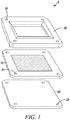
- test socket 2 is used to receive successive semiconductor packages 4 in order to perform various quality assurance tests described herein.
- Semiconductor packages 4 typically include a plurality of electrical terminals 6 that are electrically connected to operative circuitry of the device. Examples of semiconductor packages 4 for use with the test socket of the present invention include but are not limited to ball array, bare die, leadless array, surface mount, and through hole.
- Electrical terminals 6 of semiconductor packages 4 are made to be in contact with corresponding terminals (or pads) of a test board 8 via pins 10 in order to access the functionality of the operative circuitry.
- An example of a test board is a printed circuit board (PCB).
- Pins 10 include but are not limited to spring pins that compress and connect the circuit.
- the test socket 2 is capable of releasably receiving semiconductor packages 4 and biasing electrical terminals 6 thereof against corresponding terminals of test board 8. Thus, quality assurance tests may be performed on a given semiconductor package 4 while in test socket 2 and semiconductor package 4 may be subsequently removed without suffering significant deformation.
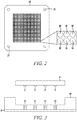
- Test socket 2 includes a test socket housing 12 that engages semiconductor package 4 and maintains its electrical terminals 6 in registration with the corresponding electrical terminals of test board 8 via pins 10.
- Test socket 2 may also include a top assembly plate 20 and a bottom assembly plate 22. Plates 20 and 22 function to guide semiconductor package 4 and pins 10 of test socket housing 12 to the correct position for testing.
- Test socket 2 may additionally include a lid 14 which is either hinged to top assembly plate 20 along one edge or clipped to top assembly plate 20 along several edges, either of which is intended to clamp semiconductor device 4 onto pins10 as lid 14 is closed.
- test socket 2 may include guide holes 24 which for the top plates 20 and 22 to be aligned with test socket housing 12 via screws or securing pins (not shown).
- Test sockets and their general design are well known in the industry.
- the common features of all test sockets are test board pins 10 and a test socket housing 12.
- the aforementioned is not meant to limit the type of test sockets encompassed by the present invention.
- Test sockets encompassed by the present invention encompass those that may incorporate a test socket housing having through holes, and disposed between pads of a semiconductor package and terminals of a test board to exchange signals between them.
- Examples of test sockets include but are not limited to burn-in, development, production, and test contactor sockets. Other examples include ball array, bare die, leadless array, surface mount, and through hole.
- Test socket housing 12 comprises a generally grid-shaped pattern with a plurality of through holes 18 that receive pins 10 and electrical terminals 6 of semiconductor chip package 4.
- socket housing 12 may be matched with the dimensions of semiconductor package 4 and test socket 2. Dimensions include height, width, and depth. Other dimensional aspects include but are not limited to number of through holes, pitch, and through hole diameter. Therefore, when different sizes of semiconductor chip packages 4 are to be tested (as is common when non-standardized chip scale semiconductor packages are tested) and/or different types of test sockets are to be used, socket housing 12 may be changed and/or designed as necessary to match semiconductor chip package 4 and/or test socket 2 without undue experimentation.
- test socket housing is not a standardized term but is synonymous with other descriptions in the art that include but are not limited to a floating guide, a contact plate, guide plate, and an electrical connector.
- test socket housing encompasses a generally grid-shaped article having through holes, and for use in a test socket where the test socket housing is disposed between pads of a semiconductor package and terminals of a test board to exchange signals between them.
- Test socket housing 12 may be made of polymeric resins such as polyimides.
- the polyimide resins may also include fillers to increase the mechanical performance characteristics of the test socket housing 12 so as to withstand the rigors of semiconductor insertion and removal, and to ultimately allow test socket 2 to make accurate and reliable reading.
- compositions used to make the test socket housing and test socket of the present invention may comprise a polyimide powder and a titanium dioxide filler.
- Polyimides as described herein and for use in articles may contain the characteristic -CO-NR-CO- group as a linear or heterocyclic unit along the main chain of the polymer backbone.
- the polyimide can be obtained, for example, from the reaction of monomers such as an organic tetracarboxylic acid, or the corresponding anhydride or ester derivative thereof, with an aliphatic or aromatic diamine.
- a polyimide precursor as used to prepare a polyimide is an organic polymer that becomes the corresponding polyimide when the polyimide precursor is heated or chemically treated.
- about 60 to 100 mole percent, preferably about 70 mole percent or more, more preferably about 80 mole percent or more, of the repeating units of the polymer chain thereof has a polyimide structure as represented, for example, by the following formula: wherein R 1 is a tetravalent aromatic radical having 1 to 5 benzenoid-unsaturated rings of 6 carbon atoms, the four carbonyl groups being directly bonded to different carbon atoms in a benzene ring of the R 1 radical and each pair of carbonyl groups being bonded to adjacent carbon atoms in the benzene ring of the R 1 radical; and R 2 is a divalent aromatic radical having 1 to 5 benzenoid-unsaturated rings of carbon atoms, the two amino groups being directly bonded to different carbon atoms
- Preferred polyimide precursors are aromatic, and provide, when imidized, polyimides in which a benzene ring of an aromatic compound is directly bonded to the imide group.
- An especially preferred polyimide precursor includes a polyamic acid having a repeating unit represented, for example, by the following general formula, wherein the polyamic acid can be either a homopolymer or copolymer of two or more of the repeating units: wherein R 3 is a tetravalent aromatic radical having 1 to 5 benzenoid-unsaturated rings of 6 carbon atoms, the four carbonyl groups being directly bonded to different carbon atoms in a benzene ring of the R 3 radical and each pair of carbonyl groups being bonded to adjacent carbon atoms in the benzene ring of the R 3 radical; and R 4 is a divalent aromatic radical having 1 to 5 benzenoid-unsaturated rings of carbon atoms, the two amino groups being directly bonded to different carbon atoms in the
- Typical examples of a polyamic acid having a repeating unit represented by the general formula above are those obtained from pyromellitic dianhydride ("PMDA”) and diaminodiphenyl ether (“ODA”) and 3,3',4,4'-biphenyltetracarboxylic dianhydride (“BPDA”) and ODA.
- PMDA pyromellitic dianhydride
- ODA diaminodiphenyl ether
- BPDA 3,3',4,4'-biphenyltetracarboxylic dianhydride
- ODA pyromellitic dianhydride
- BPDA 3,3',4,4'-biphenyltetracarboxylic dianhydride
- ODA pyromellitic dianhydride
- BPDA 3,3',4,4'-biphenyltetracarboxylic dianhydride
- ODA pyromellitic dianhydride
- BPDA 3,3',
- a typical example of a polyimide prepared by a solution imidization process is a rigid, aromatic polyimide composition having the recurring unit: wherein R 5 is p -phenylene diamine (“PPD").
- polyimide prepared by a solution imidization process is a rigid, aromatic polyimide composition wherein R5 is greater than 60 to about 85 mole percent p phenylene diamine (“PPD”) units and about 15 to less than 40 mole percent m phenylene diamine (“MPD”) units.
- PPD p phenylene diamine
- MPD mole percent m phenylene diamine
- the tetracarboxylic acids preferably employed in the practice of the invention, or those from which derivatives useful in the practice of this invention can be prepared, are those having the general formula: wherein A is a tetravalent organic group and R 6 to R 9 , inclusive, comprise hydrogen or a lower alkyl, and preferably methyl, ethyl, or propyl.
- the tetravalent organic group A preferably has one of the following structures: or or wherein X comprises at least one of -(CO)-, -O-, -S-, -SO 2 -, -CH 2 -, -C(CH 3 ) 2 -, and -C(CF 3 ) 2 -.
- aromatic tetracarboxylic acids there can be mentioned aromatic tetracarboxylic acids, acid anhydrides thereof, salts thereof and esters thereof.
- aromatic tetracarboxylic acids include 3,3',4,4'-biphenyltetracarboxylic acid, 2,3,3',4'-biphenyltetracarboxylic acid, pyromellitic acid, 3,3',4,4'-benzophenonetetracarboxylic acid, 2,2-bis(3,4-dicarboxyphenyl)propane, bis(3,4-dicarboxyphenyl)methane, bis(3,4-dicarboxyphenyl)ether, bis(3,4-dicarboxyphenyl)thioether, bis(3,4-dicarboxyphenyl)phosphine, 2,2-bis(3',4'-dicarboxyphenyl)hexafluoropropane, 2,2-bis[4-(3,4-dicarboxylic
- aromatic tetracarboxylic acids can be employed singly or in combination.
- Preferred is an aromatic tetracarboxylic dianhydride, and particularly preferred are 3,3',4,4'-biphenyltetracarboxylic dianhydride, pyromellitic dianhydride, 3,3',4,4'-benzophenonetetracarboxylic dianhydride, and mixtures thereof.
- aromatic diamine use is preferably made of one or more aromatic and/or heterocyclic diamines, which are themselves known to the art.
- aromatic diamines can be represented by the structure: H 2 N-R 10 -NH 2 , wherein R 10 is an aromatic group containing up to 16 carbon atoms and, optionally, containing up to one heteroatom in the ring, the heteroatom comprising -N-, -O-, or -S-. Also included herein are those R 10 groups wherein R 10 is a diphenylene group or a diphenylmethane group.
- diamines are 2,6-diaminopyridine, 3,5-diaminopyridine, m-phenylenediamine, p-phenylene diamine, p,p'-methylene dianiline, 2,6-diaminotoluene, and 2,4-diaminotoluene.
- aromatic diamine components include benzene diamines such as 1,4-diaminobenzene, 1,3-diaminobenzene, and 1,2-diaminobenzene; diphenyl(thio)ether diamines such as 4,4'-diaminodiphenylether, 3,4'-diaminodiphenylether, 3,3'-diaminodiphenylether, and 4,4'-diaminodiphenylthioether; benzophenone diamines such as 3,3'-diaminobenzophenone and 4,4'-diaminobenzophenone; diphenylphosphine diamines such as 3,3'-diaminodiphenylphosphine and 4,4'-diaminodiphenylphosphine; diphenylalkylene diamines such as 3,3'-diaminodiphenylmethane, 1,4-diaminodiphenyl
- Other useful diamines have at least one non-heteroatom containing aromatic rings or at least two aromatic rings bridged by a functional group.
- aromatic diamines can be employed singly or in combination.
- aromatic diamine component are 1,4-diaminobenzene, 1,3-diaminobenzene, 4,4'-diaminodiphenylether, and mixtures thereof.
- a polyamic acid can be obtained by polymerizing an aromatic diamine component and an aromatic tetracarboxylic acid component preferably in substantially equimolar amounts in an organic polar solvent.
- the amount of all monomers in the solvent can be in the range of about 5 to about 40 weight percent, more preferably in the range of about 6 to about 35 weight percent, and most preferably in the range of about 8 to about 30 weight percent.
- the temperature for the reaction generally is not higher than about 100 °C, preferably in the range of about 10 °C to 80 °C.
- the time for the polymerization reaction generally is in the range of about 0.2 to 60 hours.
- a polyimide is prepared can also vary according to the identity of the monomers from which the polymer is made up.
- the monomers form a complex salt at ambient temperature. Heating of such a reaction mixture at a moderate temperature of about 100 to about 150°C yields low molecular weight oligomers (for example, a polyamic acid), and these oligomers can, in turn, be transformed into higher molecular weight polymer by further heating at an elevated temperature of about 240 to about 350°C.
- a solvent such as dimethylacetamide or N-methylpyrrolidinone is typically added to the system.
- An aliphatic diamine and dianhydride also form oligomers at ambient temperature, and subsequent heating at about 150 to about 200°C drives off the solvent and yields the corresponding polyimide.
- an aromatic diamine is typically polymerized with a dianhydride in preference to a tetracarboxylic acid, and in such a reaction a catalyst is frequently used in addition to a solvent.
- a nitrogen-containing base, phenol, or amphoteric material can be used as such a catalyst. Longer periods of heating can be needed to polymerize an aromatic diamine.
- the ring closure can also be effected by conventionally used methods such as a heat treatment or a process in which a cyclization agent such as pyridine and acetic anhydride, picoline and acetic anhydride, 2,6-lutidine and acetic anhydride, or the like is used.
- a cyclization agent such as pyridine and acetic anhydride, picoline and acetic anhydride, 2,6-lutidine and acetic anhydride, or the like is used.
- Preferred the polyimides used herein are infusible polyimides. In some preferred polyimides essentially all of the connecting groups are imide groups. Preferred polyimides include those made from: a tetracarboxylic anhydride (for example pyromellitic dianhydride and/or 3,3',4,4'-biphenyltetracarboxylic dianhydride) and about 60 to about 85 mole percent p-phenylenediamine and about 15 to about 40 mole percent m-phenylenediamine (see U.S.
- a tetracarboxylic anhydride for example pyromellitic dianhydride and/or 3,3',4,4'-biphenyltetracarboxylic dianhydride
- Patent 5,886,129 which is hereby included by reference); 3,3',4,4'-biphenyltetracarboxylic dianhydride and m-phenylenediamine, maleic anhydride and bis(4-aminophenyl)methane; 3,3',4,4'-benzophenone tetracarboxylic dianhydride, toluenediamine and m-phenylenediamine, 3,3',4,4'-benzophenone tetracarboxylic dianhydride, bis(4-aminophenyl)methane and nadic anhydride; trimellitic anhydride and m-phenylenediamine; trimellitic anhydride and bis(4-aminophenyl)ether; 3,3',4,4'-biphenyltetracarboxylic dianhydride and bis(4-aminophenyl)ether; 3,3',4,4'-biphenyltetracarboxylic
- An especially preferred polyimide is a polyimide made from a tetracarboxylic anhydride (for example pyromellitic dianhydride and/or 3,3',4,4'-biphenyltetracarboxylic dianhydride) and about 60 to about 85 mole percent p-phenylenediamine and about 15 to about 40 mole percent m-phenylenediamine.
- a tetracarboxylic anhydride for example pyromellitic dianhydride and/or 3,3',4,4'-biphenyltetracarboxylic dianhydride
- the polyimide composition may comprise from about 40 wt% to about 80 wt% polyimide powder.
- the polyimide composition comprises 50 wt%, 60 wt%, 70 wt%, and 80 wt% polyimide powder.
- the polyimide powder may be a polyimide polymer that is a rigid polyaromatic polyimide derived from 3,3',4,4'-biphenyltetracarboxylic acid dianhydride (BPDA) and p -phenylenediamine (PPD).
- BPDA 3,3',4,4'-biphenyltetracarboxylic acid dianhydride
- PPD p -phenylenediamine
- the polyimide composition comprises from about 40 wt% to about 80 wt% polyimide powder that is a rigid polyaromatic polyimide derived from 3,3',4,4'-biphenyltetracarboxylic acid dianhydride (BPDA) and p -phenylenediamine (PPD).
- BPDA 3,3',4,4'-biphenyltetracarboxylic acid dianhydride
- PPD p -phenylenediamine
- the polyimides of test socket housing 12 may comprise 40 wt% to 80 wt% of a rigid polyaromatic polyimide derived from 3,3',4,4'-biphenyltetracarboxylic acid dianhydride (BPDA), m-phenylenediamine (MPD), and p-phenylenediamine (PPD).
- BPDA 3,3',4,4'-biphenyltetracarboxylic acid dianhydride
- MPD m-phenylenediamine
- PPD p-phenylenediamine
- the polyimides of test socket housing 12 may comprise 40 wt% to 60 wt% of a rigid polyaromatic polyimide derived from 3,3',4,4'-biphenyltetracarboxylic acid dianhydride (BPDA), m-phenylenediamine (MPD), and p-phenylenediamine (PPD).
- BPDA 3,3',4,4'-biphenyltetracarboxylic acid dianhydride
- MPD m-phenylenediamine
- PPD p-phenylenediamine
- the polyimide compositions described herein may include fillers.
- the titanium dioxide described herein may be rutile acicular grade titanium dioxide and referred to herein as acicular titanium dioxide, or may be rutile grade titanium dioxide.
- the term rutile refers to the crystal type of the titanium dioxide particles and the term acicular refers to the shape of the particles.
- the rutile titanium dioxide particles described herein are different from acicular rutile titanium dioxide and do not encompass acicular rutile titanium dioxide particles. Both rutile and acicular are terms of art.
- the acicular titanium dioxide may have a length of 1.7 microns to 5.15 microns. In an embodiment, the length is about 1.7 microns. In another embodiment, the length is about 2.9 microns.
- the acicular titanium dioxide may have a diameter of 0.13 microns to 0.27 microns. In an embodiment, the diameter is about 0.13 microns. In another embodiment, the diameter is 0.21 microns.
- the rutile titanium dioxide may have median particle size in range from about 0.25 microns to about 0.50 microns. In an embodiment, the median particle size is 0.36 microns.
- the titanium dioxide, acicular and rutile may include surface treatment with alumina, silica, or both.
- Various surface treatments of titanium dioxide are well known in the art.
- the surface treatment is a coating.
- the surface treatment is a continuous coating.
- the titanium dioxide fillers described herein may be incorporated into the polyimide compositions described herein by adding at any stage during the preparation of polyamic acid.
- the titanium dioxide filler may be added to the organic solvent prior event to the introduction of the diamine and the dianhydride. It also may be added to the solution in the organic solvent of one or both of the reactants before, during, or after the formation of the polyamic acid. In an embodiment, the titanium dioxide filler is added to a solution of polyamic acid.
- the particles may represent from 20% wt% to 60 wt%, of the blend of titanium dioxide and polyimide.
- the use of less than 5 wt% does not provide a significant increase in dielectric constant.
- the use of amounts greater than 90 wt% and with some polyimides greater than about 70 wt% (about 200 wt% based on the weight of the polyimide) tends to weaken the product and does limit its usefulness.
- the polyimide composition comprises 20% wt% to 60 wt% of acicular titanium dioxide. In another embodiment, the polyimide composition comprises 20% wt% to 60 wt% of rutile titanium dioxide. In another embodiment, the polyimide composition comprises 20% wt% to 60 wt% of acicular titanium dioxide. In another embodiment, the polyimide composition comprises 40% wt% to 60 wt% of rutile titanium dioxide.
- acicular titanium dioxide suitable for use with the polyimide compositions described herein include but is not limited to FTL series of acicular titanium dioxide.
- FTL-100, FTL-110, FTL-200, and FTL-300 [(Ishihara Corporation, USA (ISK)].
- rutile titanium dioxide suitable for use with the polyimide compositions described herein include but are not limited to Ti-PureTM grades of rutile titanium dioxide.
- R-706 titanium dioxide [The Chemours Company, Wilmington, DE, USA).
- the polyimide composition may comprise 40 wt% to 60 wt% of a rigid polyaromatic polyimide derived from 3,3',4,4'-biphenyltetracarboxylic acid dianhydride (BPDA) and p -phenylenediamine (PPD); and 20 wt% to 80 wt% of acicular titanium dioxide.
- BPDA 3,3',4,4'-biphenyltetracarboxylic acid dianhydride
- PPD p -phenylenediamine
- the polyimide composition comprises 50 wt% of a rigid polyaromatic polyimide derived from 3,3',4,4'-biphenyltetracarboxylic acid dianhydride (BPDA) and p-phenylenediamine (PPD) and 50 wt% acicular titanium dioxide.
- BPDA 3,3',4,4'-biphenyltetracarboxylic acid dianhydride
- PPD p-phenylenediamine
- polyimide composition comprises 60 wt% of a rigid polyaromatic polyimide derived from 3,3',4,4'-biphenyltetracarboxylic acid dianhydride (BPDA) and p -phenylenediamine (PPD); and 40% wt% acicular titanium dioxide.
- BPDA 3,3',4,4'-biphenyltetracarboxylic acid dianhydride
- PPD p -phenylenediamine
- the polyimide composition may comprise 40 wt% to 60 wt% of a rigid polyaromatic polyimide derived from 3,3',4,4'-biphenyltetracarboxylic acid dianhydride (BPDA) and p -phenylenediamine (PPD); and 20 wt% to 80 wt% of rutile titanium dioxide.
- BPDA 3,3',4,4'-biphenyltetracarboxylic acid dianhydride
- PPD p -phenylenediamine
- the polyimide composition comprises 50 wt% of a rigid polyaromatic polyimide derived from 3,3',4,4'-biphenyltetracarboxylic acid dianhydride (BPDA) and p -phenylenediamine (PPD) and 50 wt% rutile titanium dioxide.
- BPDA 3,3',4,4'-biphenyltetracarboxylic acid dianhydride
- PPD p -phenylenediamine
- the polyimide composition comprises 70 wt% of a rigid polyaromatic polyimide derived from 3,3',4,4'-biphenyltetracarboxylic acid dianhydride (BPDA) and p -phenylenediamine (PPD) and 30 wt% rutile titanium dioxide.
- BPDA 3,3',4,4'-biphenyltetracarboxylic acid dianhydride
- PPD p -phenylenediamine
- the polyimide composition comprises 80 wt% of a rigid polyaromatic polyimide derived from 3,3',4,4'-biphenyltetracarboxylic acid dianhydride (BPDA) and p -phenylenediamine (PPD) and 20 wt% rutile titanium dioxide.
- BPDA 3,3',4,4'-biphenyltetracarboxylic acid dianhydride
- PPD p -phenylenediamine
- Test socket housing 12 may comprise a polyimide polymer and acicular titanium dioxide.
- test socket housing 12 may comprise 40 wt% to 80 wt% of a rigid polyaromatic polyimide derived from 3,3',4,4'-biphenyltetracarboxylic acid dianhydride (BPDA), m-phenylenediamine (MPD), and p-phenylenediamine (PPD); and 20 wt% to 60 wt% of acicular titanium dioxide.
- BPDA 3,3',4,4'-biphenyltetracarboxylic acid dianhydride
- MPD m-phenylenediamine
- PPD p-phenylenediamine
- test socket housing 12 may comprise 40 wt% to 60 wt% of a rigid polyaromatic polyimide derived from 3,3',4,4'-biphenyltetracarboxylic acid dianhydride (BPDA), m-phenylenediamine (MPD), and p-phenylenediamine (PPD); and 40 wt% to 60 wt% of acicular titanium dioxide.
- BPDA 3,3',4,4'-biphenyltetracarboxylic acid dianhydride
- MPD m-phenylenediamine
- PPD p-phenylenediamine
- test socket housing 12 comprises 50 wt%, 52 wt%, 57 wt%, or 60 wt% of a rigid polyaromatic polyimide derived from 3,3',4,4'-biphenyltetracarboxylic acid dianhydride (BPDA), m-phenylenediamine (MPD), and p-phenylenediamine (PPD).
- BPDA 3,3',4,4'-biphenyltetracarboxylic acid dianhydride
- MPD m-phenylenediamine
- PPD p-phenylenediamine
- test socket housing 12 comprises 50 wt%, 48 wt%, 43 wt%, or 40 wt% acicular titanium dioxide.
- Test socket housing 12 may comprise 50 wt%, 52 wt%, 57 wt%, or 60 wt% of a rigid polyaromatic polyimide derived from 3,3',4,4'-biphenyltetracarboxylic acid dianhydride (BPDA), m-phenylenediamine (MPD); and p-phenylenediamine (PPD) in combination with 50 w%, 48 wt%, 43 wt%, or 40 wt% acicular titanium dioxide.
- BPDA 3,3',4,4'-biphenyltetracarboxylic acid dianhydride
- MPD m-phenylenediamine
- PPD p-phenylenediamine
- test socket housing 12 comprises 50 wt% of a rigid polyaromatic polyimide derived from 3,3',4,4'-biphenyltetracarboxylic acid dianhydride (BPDA), m-phenylenediamine (MPD), and p-phenylenediamine (PPD); and 50% wt% acicular titanium dioxide.
- BPDA 3,3',4,4'-biphenyltetracarboxylic acid dianhydride
- MPD m-phenylenediamine
- PPD p-phenylenediamine
- test socket housing 12 comprises 52 wt% of a rigid polyaromatic polyimide derived from 3,3',4,4'-biphenyltetracarboxylic acid dianhydride (BPDA), m-phenylenediamine (MPD), and p-phenylenediamine (PPD); and 48% wt% acicular titanium dioxide.
- BPDA 3,3',4,4'-biphenyltetracarboxylic acid dianhydride
- MPD m-phenylenediamine
- PPD p-phenylenediamine
- test socket housing 12 comprises 57 wt% of a rigid polyaromatic polyimide derived from 3,3',4,4'-biphenyltetracarboxylic acid dianhydride (BPDA), m-phenylenediamine (MPD), and p-phenylenediamine (PPD); and 43% wt% acicular titanium dioxide.
- BPDA 3,3',4,4'-biphenyltetracarboxylic acid dianhydride
- MPD m-phenylenediamine
- PPD p-phenylenediamine
- test socket housing 12 comprises 60 wt% of a rigid polyaromatic polyimide derived from 3,3',4,4'-biphenyltetracarboxylic acid dianhydride (BPDA), m-phenylenediamine (MPD), and p-phenylenediamine (PPD); and 40% wt% acicular titanium dioxide.
- BPDA 3,3',4,4'-biphenyltetracarboxylic acid dianhydride
- MPD m-phenylenediamine
- PPD p-phenylenediamine
- Test socket housing 12 may comprise a polyimide polymer and rutile titanium dioxide.
- test socket housing 12 may comprise 40 wt% to 80 wt% of a rigid polyaromatic polyimide derived from 3,3',4,4'-biphenyltetracarboxylic acid dianhydride (BPDA), m -phenylenediamine (MPD), and p -phenylenediamine (PPD); and 20 wt% to 60 wt% of rutile titanium dioxide.
- BPDA 3,3',4,4'-biphenyltetracarboxylic acid dianhydride
- MPD m -phenylenediamine
- PPD p -phenylenediamine
- test socket housing 12 may comprise 40 wt% to 60 wt% of a rigid polyaromatic polyimide derived from 3,3',4,4'-biphenyltetracarboxylic acid dianhydride (BPDA), m -phenylenediamine (MPD), and p -phenylenediamine (PPD); and 40 wt% to 60 wt% of rutile titanium dioxide.
- BPDA 3,3',4,4'-biphenyltetracarboxylic acid dianhydride
- MPD m -phenylenediamine
- PPD p -phenylenediamine
- test socket housing 12 may comprise 70 wt% of a rigid polyaromatic polyimide derived from 3,3',4,4'-biphenyltetracarboxylic acid dianhydride (BPDA), m -phenylenediamine (MPD), and p -phenylenediamine (PPD); and 30 wt% of rutile titanium dioxide.
- BPDA 3,3',4,4'-biphenyltetracarboxylic acid dianhydride
- MPD m -phenylenediamine
- PPD p -phenylenediamine
- test socket housing 12 comprises 50 wt% or 60 wt% of a rigid polyaromatic polyimide derived from 3,3',4,4'-biphenyltetracarboxylic acid dianhydride (BPDA), m -phenylenediamine (MPD), and p -phenylenediamine (PPD).
- BPDA 3,3',4,4'-biphenyltetracarboxylic acid dianhydride
- MPD m -phenylenediamine
- PPD p -phenylenediamine
- test socket housing 12 comprises 50 wt% or 40 wt% rutile titanium dioxide.
- Test socket housing 12 may comprise 50 wt or 60 wt% of a rigid polyaromatic polyimide derived from 3,3',4,4'-biphenyltetracarboxylic acid dianhydride (BPDA), m- phenylenediamine (MPD), and p -phenylenediamine (PPD) in combination with 50 w% or 40 wt% rutile titanium dioxide.
- BPDA 3,3',4,4'-biphenyltetracarboxylic acid dianhydride
- MPD m- phenylenediamine
- PPD p -phenylenediamine
- test socket housing 12 comprises 50 wt% of a rigid polyaromatic polyimide derived from 3,3',4,4'-biphenyltetracarboxylic acid dianhydride (BPDA), m -phenylenediamine (MPD), and p -phenylenediamine (PPD); and 50% wt% rutile titanium dioxide.
- BPDA 3,3',4,4'-biphenyltetracarboxylic acid dianhydride
- MPD m -phenylenediamine
- PPD p -phenylenediamine
- test socket housing 12 comprises 60 wt% of a rigid polyaromatic polyimide derived from 3,3',4,4'-biphenyltetracarboxylic acid dianhydride (BPDA), m -phenylenediamine (MPD), and p -phenylenediamine (PPD); and 40% wt% rutile titanium dioxide.
- BPDA 3,3',4,4'-biphenyltetracarboxylic acid dianhydride
- MPD m -phenylenediamine
- PPD p -phenylenediamine
- titanium dioxide-filled polyimide compositions described herein may be made, and shapes and parts made from, by techniques normally used for making shapes and parts from infusible polymeric materials, namely by the application of heat and pressure to powder mixtures of various ingredients as described in U.S. Pat. No. 4,360,626 .
- Blanks for testing may be prepared according to above and then machined to the final article dimensions as required.
- One having ordinary skill in the art in the process of making blanks and machining them will recognize that various dimensions of articles may be formed without undo experimentation, and via blank forming and machining process commonly used in the industry.
- tensile strength, elongations %, modulus, and flex modulus are measured using ASTM D1708 and ASTM D790. All test pieces were molded from the titanium dioxide-filled polyimide compositions described herein using a procedure substantially according to the procedure described in U.S. Pat. No. 4,360,626 (especially column 2, lines 54-60).
- BPDA 3,3',4,4'-biphenyltetracarboxylic anhydride
- MPD m-phenylenediamine
- PPD p-phenylenediamine
- Acicular titanium dioxide filler used in the examples E described herein are from the FTL series of acicular titanium dioxide.
- FTL-100, FTL-110, FTL-200, and FTL-300 [(Ishihara Corporation, USA (ISK)].
- Rutile titanium dioxide filler used in the examples E described herein are from Ti-PureTM grades of rutile titanium dioxide.
- R-706 titanium dioxide [The Chemours Company, Wilmington, DE, USA).
- Polyamide Compositions BPDA, MPD, and PPD Derived with, Acicular Titanium Dioxide
- Particles of a polyimide composition containing 52% of a polyimide made from BPDA, PPD, & MPD (1:1 molar ratio BPDA to combined PPD and MPD; and 70/30 wt% ratio of PPD/MPD) and 48 wt% acicular titanium dioxide (FTL-100) were prepared according to the method described in U.S. Pat. No. 5,886,129 (specifically example 7). The particles were milled and passed through a 20 mesh screen and used to prepare tensile bar samples. Bars made were measured to have a tensile strength of 23763 MPa, elongation of 1.6%, modulus of 16073 MPa, and flex modulus of 13339 MPa.
- Particles of a polyimide composition containing 60% of a polyimide made from BPDA, PPD, & MPD (1:1 molar ratio BPDA to combined PPD and MPD; and 70/30 wt% ratio of PPD/MPD) and 40 wt% acicular titanium dioxide (FTL-100) were prepared according to the method described in U.S. Pat. No. 5,886,129 (specifically example 7). The particles were milled and passed through a 20 mesh screen and used to prepare tensile bar samples. Bars made were measured to have a tensile strength of 26304 MPa, elongation of 3%, modulus of 13259 MPa, and flex modulus of 13406 MPa.
- Particles of a polyimide composition containing 50% of a polyimide made from BPDA, PPD, & MPD (1:1 molar ratio BPDA to combined PPD and MPD; and 70/30 wt% ratio of PPD/MPD) and 50 wt% acicular titanium dioxide (FTL-110) were prepared according to the method described in U.S. Pat. No. 5,886,129 (specifically example 7). The particles were milled and passed through a 20 mesh screen and used to prepare tensile bar samples. Bars made were measured to have a tensile strength of 27096 MPa, elongation of 2.2%, modulus of 16334 MPa, and flex modulus of 17279 MPa.
- Particles of a polyimide composition containing 57% of a polyimide made from BPDA, PPD, & MPD (1:1 molar ratio BPDA to combined PPD and MPD; and 70/30 wt% ratio of PPD/MPD) and 43 wt% acicular titanium dioxide (FTL-110) were prepared according to the method described in U.S. Pat. No. 5,886,129 (specifically example 7). The particles were milled and passed through a 20 mesh screen and used to prepare tensile bar samples. Bars made were measured to have a tensile strength of 25908 MPa, elongation of 2.5%, modulus of 15463 MPa, and flex modulus of 14461 MPa.
- Particles of a polyimide composition containing 50% of a polyimide made from BPDA, PPD, & MPD (1:1 molar ratio BPDA to combined PPD and MPD; and 70/30 wt% ratio of PPD/MPD) and 50 wt% acicular titanium dioxide (FTL-200) were prepared according to the method described in U.S. Pat. No. 5,886,129 (specifically example 7). The particles were milled and passed through a 20 mesh screen and used to prepare tensile bar samples. Bars made were measured to have a tensile strength of 2332 MPa, elongation of 2.1%, modulus of 13526 MPa, and flex modulus of 16503 MPa.
- Particles of a polyimide composition containing 60% of a polyimide made from BPDA, PPD, & MPD (1:1 molar ratio BPDA to combined PPD and MPD; and 70/30 wt% ratio of PPD/MPD) and 40 wt% acicular titanium dioxide (FTL-300) were prepared according to the method described in U.S. Pat. No. 5,886,129 (specifically example 7). The particles were milled and passed through a 20 mesh screen and used to prepare tensile bar samples. Bars made were measured to have a tensile strength of 23389 MPa, elongation of 2.5%, modulus of 12108 MPa, and flex modulus of 12569 MPa.
- DuPontTMVespel®SCP-5000 grade resin (an unfilled polyimide resin) was used to prepare tensile bars. Bars made were measured to have a tensile strength of 22962 MPa, elongation of 6.2%, modulus of 5770 MPa, and flex modulus of 5630 MPa.
- DuPontTMVespel®SCP-5000 grade resin is available from E.I. DuPont de Nemours & Co., Wilmington, DE, USA.
- DuPontTMVespel®SCP-5050 grade resin is available from E.I. DuPont de Nemours & Co., Wilmington, DE, USA.
- Particles of a polyimide composition containing 50% of a polyimide made from BPDA, PPD, & MPD (1:1 molar ratio BPDA to combined PPD and MPD; and 70/30 wt% ratio of PPD/MPD) and 50 wt% rutile titanium dioxide (R-706) were prepared according to the method described in U.S. Pat. No. 5,886,129 (specifically example 7). The particles were milled and passed through a 20 mesh screen and used to prepare tensile bar samples. Bars made were measured to have a tensile strength of 21252 MPa, elongation of 2.0%, modulus of 9701 MPa, and flex modulus of 11537 MPa.
- Particles of a polyimide composition containing 50% of a polyimide made from BPDA, PPD, & MPD (1:1 molar ratio BPDA to combined PPD and MPD; and 70/30 wt% ratio of PPD/MPD) and 50 wt% rutile titanium dioxide (R-706) were prepared according to the method described in U.S. Pat. No. 5,886,129 (specifically example 7). The particles were milled and passed through a 20 mesh screen and used to prepare tensile bar samples. Bars made were measured to have a tensile strength of 21252 MPa, elongation of 2.9%, modulus of 10802 MPa, and flex modulus of 11695 MPa.
- Particles of a polyimide composition containing 60% of a polyimide made from BPDA, PPD, & MPD (1:1 molar ratio BPDA to combined PPD and MPD; and 70/30 wt% ratio of PPD/MPD) and 40 wt% rutile titanium dioxide (R-706) were prepared according to the method described in U.S. Pat. No. 5,886,129 (specifically example 7). The particles were milled and passed through a 20 mesh screen and used to prepare tensile bar samples. Bars made were measured to have a tensile strength of 16938 MPa, elongation of 1.7%, modulus of 9352 MPa, and flex modulus of 9667 MPa.
- Particles of a polyimide composition containing 63% of a polyimide made from BPDA, PPD, & MPD (1:1 molar ratio BPDA to combined PPD and MPD; and 70/30 wt% ratio of PPD/MPD) and 37 wt% rutile titanium dioxide (R-706) were prepared according to the method described in U.S. Pat. No. 5,886,129 (specifically example 7). The particles were milled and passed through a 20 mesh screen and used to prepare tensile bar samples. Bars made were measured to have a tensile strength of 21857 MPa, elongation of 4.0%, modulus of 8316 MPa, and flex modulus of 8756 MPa.
- Particles of a polyimide composition containing 70% of a polyimide made from BPDA, PPD, & MPD (1:1 molar ratio BPDA to combined PPD and MPD; and 70/30 wt% ratio of PPD/MPD) and 30 wt% rutile titanium dioxide (R-706) were prepared according to the method described in U.S. Pat. No. 5,886,129 (specifically example 7). The particles were milled and passed through a 20 mesh screen and used to prepare tensile bar samples. Bars made were measured to have a tensile strength of 20939 MPa, elongation of 3.9%, modulus of 7306 MPa, and flex modulus of 7384 MPa.
- DuPontTMVespel®SCP-5000 grade resin (an unfilled polyimide resin) was used to prepare tensile bars. Bars made were measured to have a tensile strength of 22962 MPa, elongation of 6.2%, modulus of 5770 MPa, and flex modulus of 5630 MPa.
- DuPontTMVespel®SCP-5000 grade resin is available from E.I. DuPont de Nemours & Co., Wilmington, DE, USA.
- DuPontTMVespel®SCP-5050 grade resin is available from E.I. DuPont de Nemours & Co., Wilmington, DE, USA.
- Particles of a polyimide composition containing 50% of a polyimide made from BPDA & PPD (1:1 molar ratio BPDA to PPD; and 50 wt% acicular titanium dioxide (FTL-100) were prepared according to the method described in U.S. Pat. No. 5,886,129 (specifically example 7). The particles were milled and passed through a 20 mesh screen and used to prepare tensile bar samples. Bars made were measured to have a tensile strength of 16307 MPa, elongation of 0.9%, and tensile modulus of 16285 MPa (2361944 PSI).
- Particles of a polyimide composition containing 60% of a polyimide made from BPDA & PPD (1:1 molar ratio BPDA to PPD; and 40 wt% acicular titanium dioxide (FTL-110) were prepared according to the method described in U.S. Pat. No. 5,886,129 (specifically example 7). The particles were milled and passed through a 20 mesh screen and used to prepare tensile bar samples. Bars made were measured to have a tensile strength of 21403 MPa, elongation of 1.7%, tensile modulus of 13010 MPa (1886882 PSI) and flex modulus of 13118 MPa.
- Particles of a polyimide composition containing 50% of a polyimide made from BPDA & PPD (1:1 molar ratio BPDA to PPD; and and 50 wt% acicular titanium dioxide (FTL-110) were prepared according to the method described in U.S. Pat. No. 5,886,129 (specifically example 7). The particles were milled and passed through a 20 mesh screen and used to prepare tensile bar samples. Bars made were measured to have a tensile strength of 20665 MPa, elongation of 1.6%, tensile modulus of 14092 MPa (2043845 PSI) and flex modulus of 15647 MPa.
- Particles of a polyimide composition containing 50% of a polyimide made from BPDA & PPD (1:1 molar ratio BPDA to PPD; and 50 wt% acicular titanium dioxide (FTL-200) were prepared according to the method described in U.S. Pat. No. 5,886,129 (specifically example 7). The particles were milled and passed through a 20 mesh screen and used to prepare tensile bar samples. Bars made were measured to have a tensile strength of 17176 MPa, elongation of 1.2%, and tensile modulus of 13547 MPa (1964772 PSI).
- Particles of a polyimide composition containing 97.6% of a polyimide made from BPDA & PPD (1:1 molar ratio BPDA to PPD; and 2.4 wt% synthetic graphite (bulk density of 0.100 g/cc; particle size of 5.0 ⁇ m at a density of 1.81 g/cc; and d50 commercially available from Imerys Graphite & Carbon, Switzerland) were prepared according to the method described in U.S. Pat. No. 5,886,129 (specifically example 7). The particles were milled and passed through a 20 mesh screen and used to prepare tensile bar samples. Bars made were measured to have a tensile strength of 18553 MPa, elongation of 2.9%, and tensile modulus of 6562 MPa (951662 PSI).
- Particles of a polyimide composition containing 70% of a polyimide made from BPDA & PPD (1:1 molar ratio BPDA to PPD; and 30 wt% synthetic graphite (bulk density of 0.100 g/cc; particle size of 5.0 ⁇ m at a density of 1.81 g/cc; and d50 commercially available from Imerys Graphite & Carbon, Switzerland) were prepared according to the method described in U.S. Pat. No. 5,886,129 (specifically example 7). The particles were milled and passed through a 20 mesh screen and used to prepare tensile bar samples. Bars made were measured to have a tensile strength of 13549 MPa, elongation of 2.9%, and tensile modulus of 7041 MPa (1021216 PSI).
- Particles of a polyimide composition containing 50% of a polyimide made from BPDA & PPD (1:1 molar ratio BPDA to PPD; and 50 wt% synthetic graphite (bulk density of 0.100 g/cc; particle size of 5.0 ⁇ m at a density of 1.81 g/cc; and d50 commercially available from Imerys Graphite & Carbon, Switzerland) were prepared according to the method described in U.S. Pat. No. 5,886,129 (specifically example 7). The particles were milled and passed through a 20 mesh screen and used to prepare tensile bar samples. Bars made were measured to have a tensile strength of 10603 MPa, elongation of 1.9%, and tensile modulus of 8574 MPa (1243534 PSI).
- Particles of a polyimide composition containing 100% of a polyimide made from BPDA & PPD (1:1 molar ratio BPDA to PPD were prepared according to the method described in U.S. Pat. No. 5,886,129 (specifically example 7). The particles were milled and passed through a 20 mesh screen and used to prepare tensile bar samples. Bars made were measured to have a tensile strength of 19603 MPa and elongation of 3.2%.
- Particles of a polyimide composition containing 50% of a polyimide made from BPDA & PPD (1:1 molar ratio BPDA to PPD; and 50 wt% rutile titanium dioxide (R-706) were prepared according to the method described in U.S. Pat. No. 5,886,129 (specifically example 7). The particles were milled and passed through a 20 mesh screen and used to prepare tensile bar samples. Bars made were measured to have a tensile strength of 18045 MPa, elongation of 1.7%, tensile modulus of 10844 MPa (1572774 PSI) and flex modulus of 12790 MPa.
- Particles of a polyimide composition containing 70% of a polyimide made from BPDA & PPD (1:1 molar ratio BPDA to PPD; and 30 wt% rutile titanium dioxide (R-706) were prepared according to the method described in U.S. Pat. No. 5,886,129 (specifically example 7). The particles were milled and passed through a 20 mesh screen and used to prepare tensile bar samples. Bars made were measured to have a tensile strength of 16776 MPa, elongation of 1.9%, and tensile modulus of 9191MPa (1333009 PSI).
- Particles of a polyimide composition containing 80% of a polyimide made from BPDA & PPD (1:1 molar ratio BPDA to PPD; and 20 wt% rutile titanium dioxide (R-706) were prepared according to the method described in U.S. Pat. No. 5,886,129 (specifically example 7). The particles were milled and passed through a 20 mesh screen and used to prepare tensile bar samples. Bars made were measured to have a tensile strength of 14045 MPa, elongation of 1.5%, and tensile modulus of 9098 MPa (1319481 PSI.
Landscapes
- Chemical & Material Sciences (AREA)
- Polymers & Plastics (AREA)
- Health & Medical Sciences (AREA)
- Chemical Kinetics & Catalysis (AREA)
- Medicinal Chemistry (AREA)
- Organic Chemistry (AREA)
- General Physics & Mathematics (AREA)
- Physics & Mathematics (AREA)
- Engineering & Computer Science (AREA)
- Computer Hardware Design (AREA)
- Microelectronics & Electronic Packaging (AREA)
- Compositions Of Macromolecular Compounds (AREA)
- Macromolecular Compounds Obtained By Forming Nitrogen-Containing Linkages In General (AREA)
- Connecting Device With Holders (AREA)
- Measuring Leads Or Probes (AREA)
Applications Claiming Priority (4)
| Application Number | Priority Date | Filing Date | Title |
|---|---|---|---|
| US201662335222P | 2016-05-12 | 2016-05-12 | |
| US201662335229P | 2016-05-12 | 2016-05-12 | |
| US201662335225P | 2016-05-12 | 2016-05-12 | |
| PCT/US2017/032093 WO2017197077A1 (en) | 2016-05-12 | 2017-05-11 | Polyimide compositions and a polyimide test socket housing |
Publications (2)
| Publication Number | Publication Date |
|---|---|
| EP3455292A1 EP3455292A1 (en) | 2019-03-20 |
| EP3455292B1 true EP3455292B1 (en) | 2021-06-23 |
Family
ID=58772643
Family Applications (1)
| Application Number | Title | Priority Date | Filing Date |
|---|---|---|---|
| EP17725815.9A Active EP3455292B1 (en) | 2016-05-12 | 2017-05-11 | Polyimide compositions and a polyimide test socket housing |
Country Status (6)
| Country | Link |
|---|---|
| US (1) | US20190136054A1 (enExample) |
| EP (1) | EP3455292B1 (enExample) |
| JP (1) | JP2019526163A (enExample) |
| KR (1) | KR20190008538A (enExample) |
| CN (2) | CN112920601A (enExample) |
| WO (1) | WO2017197077A1 (enExample) |
Families Citing this family (3)
| Publication number | Priority date | Publication date | Assignee | Title |
|---|---|---|---|---|
| GB201911133D0 (en) * | 2019-08-05 | 2019-09-18 | Qinetiq Ltd | Materials and methods |
| KR102548091B1 (ko) * | 2021-04-16 | 2023-06-27 | 주식회사 대림 | 폴리이미드를 포함하는 반도체 소자 테스트 소켓용 성형체 및 이의 제조방법 |
| USD1112120S1 (en) * | 2024-06-04 | 2026-02-10 | Tfe Co., Ltd. | Detachable pocket for semiconductor test socket housing |
Family Cites Families (17)
| Publication number | Priority date | Publication date | Assignee | Title |
|---|---|---|---|---|
| US4331970A (en) * | 1978-09-18 | 1982-05-25 | General Electric Company | Use of dispersed solids as fillers in polymeric materials to provide material for semiconductor junction passivation |
| US4360626A (en) | 1981-04-24 | 1982-11-23 | E. I. Du Pont De Nemours And Company | Oxidatively stable polyimide compositions |
| DE68927376D1 (de) * | 1988-12-27 | 1996-11-28 | Mitsui Toatsu Chemicals | Verfahren zur Herstellung einer Buchse für eine integrierte Schaltung |
| US5886129A (en) | 1997-07-01 | 1999-03-23 | E. I. Du Pont De Nemours And Company | Oxidatively stable rigid aromatic polyimide compositions and process for their preparation |
| JP2000143984A (ja) * | 1998-11-05 | 2000-05-26 | Showa Denko Kk | フッ素化ポリイミド樹脂組成物及びその製造方法 |
| CN1311594C (zh) * | 2001-04-03 | 2007-04-18 | 株式会社吴羽 | Ic插座 |
| JP2004035825A (ja) * | 2002-07-05 | 2004-02-05 | Kanegafuchi Chem Ind Co Ltd | 半導電性ポリイミドフィルムおよびその製造方法 |
| DE20316645U1 (de) * | 2003-10-29 | 2005-03-10 | Fan, Wei-Fang, Jwu Beei | Modulare elastische Kontaktstiftgruppevorrichtung |
| WO2008033428A2 (en) * | 2006-09-12 | 2008-03-20 | Innoconnex, Inc. | Compliance partitioning in testing of integrated circuits |
| DE602007013585D1 (de) * | 2006-10-11 | 2011-05-12 | Sumitomo Electric Industries | Polyimidrohr, herstellungsverfahren dafür, verfahren zur herstellung eines polyimidlacks und fixierband |
| US8433029B2 (en) * | 2007-12-14 | 2013-04-30 | Global Nuclear Fuel—Americas, LLC | Determination of safety limit minimum critical power ratio |
| JP5346078B2 (ja) * | 2008-05-20 | 2013-11-20 | イー・アイ・デュポン・ドウ・ヌムール・アンド・カンパニー | 熱および寸法安定性ポリイミドフィルム、ならびに、これに関する方法 |
| KR20120096003A (ko) * | 2009-11-20 | 2012-08-29 | 이 아이 듀폰 디 네모아 앤드 캄파니 | 반도체 패키징 응용에 유용한 인터포저 필름, 및 그 관련 방법 |
| CN101805517B (zh) * | 2010-03-02 | 2012-05-09 | 天津恒通时代电工材料科技有限公司 | 一种无机颗粒填充的聚酰亚胺薄膜的制造方法 |
| CN101831175A (zh) * | 2010-04-01 | 2010-09-15 | 辽宁科技大学 | 一种无色透明的聚酰亚胺纳米复合材料膜及其制备方法 |
| KR20130097781A (ko) * | 2010-09-29 | 2013-09-03 | 이 아이 듀폰 디 네모아 앤드 캄파니 | 고온 용도를 위한 폴리이미드 수지 |
| CN107000427A (zh) * | 2014-10-01 | 2017-08-01 | 纳幕尔杜邦公司 | 作为饮料罐印刷单元的一部分的包含非热塑性聚酰亚胺的主轴套 |
-
2017
- 2017-05-11 JP JP2018558325A patent/JP2019526163A/ja active Pending
- 2017-05-11 CN CN202110048235.8A patent/CN112920601A/zh active Pending
- 2017-05-11 EP EP17725815.9A patent/EP3455292B1/en active Active
- 2017-05-11 CN CN201780027829.2A patent/CN109071874B/zh not_active Expired - Fee Related
- 2017-05-11 KR KR1020187034141A patent/KR20190008538A/ko not_active Ceased
- 2017-05-11 US US16/095,434 patent/US20190136054A1/en not_active Abandoned
- 2017-05-11 WO PCT/US2017/032093 patent/WO2017197077A1/en not_active Ceased
Non-Patent Citations (1)
| Title |
|---|
| None * |
Also Published As
| Publication number | Publication date |
|---|---|
| WO2017197077A1 (en) | 2017-11-16 |
| US20190136054A1 (en) | 2019-05-09 |
| KR20190008538A (ko) | 2019-01-24 |
| CN109071874B (zh) | 2021-02-05 |
| CN112920601A (zh) | 2021-06-08 |
| CN109071874A (zh) | 2018-12-21 |
| EP3455292A1 (en) | 2019-03-20 |
| JP2019526163A (ja) | 2019-09-12 |
Similar Documents
| Publication | Publication Date | Title |
|---|---|---|
| EP2520606B1 (en) | Method for manufacturing a wholly aromatic polyimide resin having improved heat resistance and elongation properties in a high temperature range | |
| KR102317327B1 (ko) | 폴리이미드 필름 및 그 제조방법 | |
| KR20070058812A (ko) | 폴리이미드 필름 | |
| KR101404093B1 (ko) | 폴리이미드 필름 | |
| KR102362385B1 (ko) | 고탄성 및 고내열 폴리이미드 필름 및 그 제조방법 | |
| EP0386207B1 (en) | Process for lowering the dielectric constant of polyimides using diamic acid additives | |
| TWI585156B (zh) | 聚醯亞胺樹脂組成物、膜、接著劑及構件 | |
| EP3455292B1 (en) | Polyimide compositions and a polyimide test socket housing | |
| WO2007083909A1 (en) | Polyimide film | |
| KR101136616B1 (ko) | 분말 금속 또는 압축 성형 기술을 사용한 제조에 적합한고온 수지의 블렌드 | |
| KR102347589B1 (ko) | 저유전 폴리이미드 필름 및 그 제조방법 | |
| KR100710099B1 (ko) | 폴리이미드 필름 및 그의 제조 방법 및 그의 이용 | |
| JP7648798B2 (ja) | ポリイミドを含む半導体素子テストソケット用成形体及びその製造方法 | |
| EP0618269B1 (en) | Thermosetting resin compositions and their use for making resin articles and thin film wiring boards | |
| KR100495096B1 (ko) | 할로겐계 수지 분말을 함유한 방향족 폴리이미드계 복합소재 분말과 이의 제조방법 | |
| KR20090003826A (ko) | 폴리이미드 필름 | |
| EP4674891A1 (en) | Polyimide powder for molded body, and polyimide molded body | |
| KR20020065722A (ko) | 폴리이미드 고내열 접착제 및 이를 이용한 접착테이프 | |
| WO2024211079A1 (en) | Molded polyimide article | |
| KR20150047744A (ko) | 덴드라이트 형태의 징크옥사이드를 분산시킨 폴리아믹산 조성물 및 이를 이용한 고기능성 폴리이미드 | |
| KR20210037332A (ko) | 폴리아믹산 조성물, 폴리아믹산 조성물의 제조방법 및 이를 포함하는 폴리이미드 | |
| HK1098422B (en) | Blends of high temperature resins suitable for fabrication using powdered metal or compression molding techniques |
Legal Events
| Date | Code | Title | Description |
|---|---|---|---|
| STAA | Information on the status of an ep patent application or granted ep patent |
Free format text: STATUS: UNKNOWN |
|
| STAA | Information on the status of an ep patent application or granted ep patent |
Free format text: STATUS: THE INTERNATIONAL PUBLICATION HAS BEEN MADE |
|
| PUAI | Public reference made under article 153(3) epc to a published international application that has entered the european phase |
Free format text: ORIGINAL CODE: 0009012 |
|
| STAA | Information on the status of an ep patent application or granted ep patent |
Free format text: STATUS: REQUEST FOR EXAMINATION WAS MADE |
|
| 17P | Request for examination filed |
Effective date: 20181030 |
|
| AK | Designated contracting states |
Kind code of ref document: A1 Designated state(s): AL AT BE BG CH CY CZ DE DK EE ES FI FR GB GR HR HU IE IS IT LI LT LU LV MC MK MT NL NO PL PT RO RS SE SI SK SM TR |
|
| AX | Request for extension of the european patent |
Extension state: BA ME |
|
| DAV | Request for validation of the european patent (deleted) | ||
| DAX | Request for extension of the european patent (deleted) | ||
| STAA | Information on the status of an ep patent application or granted ep patent |
Free format text: STATUS: EXAMINATION IS IN PROGRESS |
|
| 17Q | First examination report despatched |
Effective date: 20200417 |
|
| REG | Reference to a national code |
Ref country code: DE Ref legal event code: R079 Ref document number: 602017040774 Country of ref document: DE Free format text: PREVIOUS MAIN CLASS: C08K0007020000 Ipc: C08K0003220000 |
|
| RIC1 | Information provided on ipc code assigned before grant |
Ipc: C08K 3/22 20060101AFI20201207BHEP Ipc: H01R 13/24 20060101ALI20201207BHEP Ipc: C08K 7/02 20060101ALI20201207BHEP Ipc: H01R 12/70 20110101ALI20201207BHEP Ipc: G01R 1/04 20060101ALI20201207BHEP Ipc: C08K 9/02 20060101ALI20201207BHEP |
|
| GRAP | Despatch of communication of intention to grant a patent |
Free format text: ORIGINAL CODE: EPIDOSNIGR1 |
|
| STAA | Information on the status of an ep patent application or granted ep patent |
Free format text: STATUS: GRANT OF PATENT IS INTENDED |
|
| INTG | Intention to grant announced |
Effective date: 20210121 |
|
| GRAS | Grant fee paid |
Free format text: ORIGINAL CODE: EPIDOSNIGR3 |
|
| GRAA | (expected) grant |
Free format text: ORIGINAL CODE: 0009210 |
|
| STAA | Information on the status of an ep patent application or granted ep patent |
Free format text: STATUS: THE PATENT HAS BEEN GRANTED |
|
| AK | Designated contracting states |
Kind code of ref document: B1 Designated state(s): AL AT BE BG CH CY CZ DE DK EE ES FI FR GB GR HR HU IE IS IT LI LT LU LV MC MK MT NL NO PL PT RO RS SE SI SK SM TR |
|
| REG | Reference to a national code |
Ref country code: GB Ref legal event code: FG4D |
|
| REG | Reference to a national code |
Ref country code: CH Ref legal event code: EP |
|
| REG | Reference to a national code |
Ref country code: DE Ref legal event code: R096 Ref document number: 602017040774 Country of ref document: DE Ref country code: AT Ref legal event code: REF Ref document number: 1404274 Country of ref document: AT Kind code of ref document: T Effective date: 20210715 |
|
| REG | Reference to a national code |
Ref country code: IE Ref legal event code: FG4D |
|
| REG | Reference to a national code |
Ref country code: LT Ref legal event code: MG9D |
|
| PG25 | Lapsed in a contracting state [announced via postgrant information from national office to epo] |
Ref country code: HR Free format text: LAPSE BECAUSE OF FAILURE TO SUBMIT A TRANSLATION OF THE DESCRIPTION OR TO PAY THE FEE WITHIN THE PRESCRIBED TIME-LIMIT Effective date: 20210623 Ref country code: BG Free format text: LAPSE BECAUSE OF FAILURE TO SUBMIT A TRANSLATION OF THE DESCRIPTION OR TO PAY THE FEE WITHIN THE PRESCRIBED TIME-LIMIT Effective date: 20210923 Ref country code: FI Free format text: LAPSE BECAUSE OF FAILURE TO SUBMIT A TRANSLATION OF THE DESCRIPTION OR TO PAY THE FEE WITHIN THE PRESCRIBED TIME-LIMIT Effective date: 20210623 Ref country code: LT Free format text: LAPSE BECAUSE OF FAILURE TO SUBMIT A TRANSLATION OF THE DESCRIPTION OR TO PAY THE FEE WITHIN THE PRESCRIBED TIME-LIMIT Effective date: 20210623 |
|
| REG | Reference to a national code |
Ref country code: AT Ref legal event code: MK05 Ref document number: 1404274 Country of ref document: AT Kind code of ref document: T Effective date: 20210623 |
|
| PG25 | Lapsed in a contracting state [announced via postgrant information from national office to epo] |
Ref country code: LV Free format text: LAPSE BECAUSE OF FAILURE TO SUBMIT A TRANSLATION OF THE DESCRIPTION OR TO PAY THE FEE WITHIN THE PRESCRIBED TIME-LIMIT Effective date: 20210623 Ref country code: GR Free format text: LAPSE BECAUSE OF FAILURE TO SUBMIT A TRANSLATION OF THE DESCRIPTION OR TO PAY THE FEE WITHIN THE PRESCRIBED TIME-LIMIT Effective date: 20210924 Ref country code: SE Free format text: LAPSE BECAUSE OF FAILURE TO SUBMIT A TRANSLATION OF THE DESCRIPTION OR TO PAY THE FEE WITHIN THE PRESCRIBED TIME-LIMIT Effective date: 20210623 Ref country code: RS Free format text: LAPSE BECAUSE OF FAILURE TO SUBMIT A TRANSLATION OF THE DESCRIPTION OR TO PAY THE FEE WITHIN THE PRESCRIBED TIME-LIMIT Effective date: 20210623 Ref country code: NO Free format text: LAPSE BECAUSE OF FAILURE TO SUBMIT A TRANSLATION OF THE DESCRIPTION OR TO PAY THE FEE WITHIN THE PRESCRIBED TIME-LIMIT Effective date: 20210923 |
|
| PG25 | Lapsed in a contracting state [announced via postgrant information from national office to epo] |
Ref country code: SK Free format text: LAPSE BECAUSE OF FAILURE TO SUBMIT A TRANSLATION OF THE DESCRIPTION OR TO PAY THE FEE WITHIN THE PRESCRIBED TIME-LIMIT Effective date: 20210623 Ref country code: SM Free format text: LAPSE BECAUSE OF FAILURE TO SUBMIT A TRANSLATION OF THE DESCRIPTION OR TO PAY THE FEE WITHIN THE PRESCRIBED TIME-LIMIT Effective date: 20210623 Ref country code: RO Free format text: LAPSE BECAUSE OF FAILURE TO SUBMIT A TRANSLATION OF THE DESCRIPTION OR TO PAY THE FEE WITHIN THE PRESCRIBED TIME-LIMIT Effective date: 20210623 Ref country code: NL Free format text: LAPSE BECAUSE OF FAILURE TO SUBMIT A TRANSLATION OF THE DESCRIPTION OR TO PAY THE FEE WITHIN THE PRESCRIBED TIME-LIMIT Effective date: 20210623 Ref country code: PT Free format text: LAPSE BECAUSE OF FAILURE TO SUBMIT A TRANSLATION OF THE DESCRIPTION OR TO PAY THE FEE WITHIN THE PRESCRIBED TIME-LIMIT Effective date: 20211025 Ref country code: ES Free format text: LAPSE BECAUSE OF FAILURE TO SUBMIT A TRANSLATION OF THE DESCRIPTION OR TO PAY THE FEE WITHIN THE PRESCRIBED TIME-LIMIT Effective date: 20210623 Ref country code: AT Free format text: LAPSE BECAUSE OF FAILURE TO SUBMIT A TRANSLATION OF THE DESCRIPTION OR TO PAY THE FEE WITHIN THE PRESCRIBED TIME-LIMIT Effective date: 20210623 Ref country code: EE Free format text: LAPSE BECAUSE OF FAILURE TO SUBMIT A TRANSLATION OF THE DESCRIPTION OR TO PAY THE FEE WITHIN THE PRESCRIBED TIME-LIMIT Effective date: 20210623 Ref country code: CZ Free format text: LAPSE BECAUSE OF FAILURE TO SUBMIT A TRANSLATION OF THE DESCRIPTION OR TO PAY THE FEE WITHIN THE PRESCRIBED TIME-LIMIT Effective date: 20210623 |
|
| PG25 | Lapsed in a contracting state [announced via postgrant information from national office to epo] |
Ref country code: PL Free format text: LAPSE BECAUSE OF FAILURE TO SUBMIT A TRANSLATION OF THE DESCRIPTION OR TO PAY THE FEE WITHIN THE PRESCRIBED TIME-LIMIT Effective date: 20210623 |
|
| REG | Reference to a national code |
Ref country code: DE Ref legal event code: R097 Ref document number: 602017040774 Country of ref document: DE |
|
| PG25 | Lapsed in a contracting state [announced via postgrant information from national office to epo] |
Ref country code: DK Free format text: LAPSE BECAUSE OF FAILURE TO SUBMIT A TRANSLATION OF THE DESCRIPTION OR TO PAY THE FEE WITHIN THE PRESCRIBED TIME-LIMIT Effective date: 20210623 |
|
| PLBE | No opposition filed within time limit |
Free format text: ORIGINAL CODE: 0009261 |
|
| STAA | Information on the status of an ep patent application or granted ep patent |
Free format text: STATUS: NO OPPOSITION FILED WITHIN TIME LIMIT |
|
| 26N | No opposition filed |
Effective date: 20220324 |
|
| PG25 | Lapsed in a contracting state [announced via postgrant information from national office to epo] |
Ref country code: AL Free format text: LAPSE BECAUSE OF FAILURE TO SUBMIT A TRANSLATION OF THE DESCRIPTION OR TO PAY THE FEE WITHIN THE PRESCRIBED TIME-LIMIT Effective date: 20210623 |
|
| PG25 | Lapsed in a contracting state [announced via postgrant information from national office to epo] |
Ref country code: IT Free format text: LAPSE BECAUSE OF FAILURE TO SUBMIT A TRANSLATION OF THE DESCRIPTION OR TO PAY THE FEE WITHIN THE PRESCRIBED TIME-LIMIT Effective date: 20210623 |
|
| REG | Reference to a national code |
Ref country code: DE Ref legal event code: R119 Ref document number: 602017040774 Country of ref document: DE |
|
| REG | Reference to a national code |
Ref country code: CH Ref legal event code: PL |
|
| REG | Reference to a national code |
Ref country code: BE Ref legal event code: MM Effective date: 20220531 |
|
| GBPC | Gb: european patent ceased through non-payment of renewal fee |
Effective date: 20220511 |
|
| PG25 | Lapsed in a contracting state [announced via postgrant information from national office to epo] |
Ref country code: MC Free format text: LAPSE BECAUSE OF FAILURE TO SUBMIT A TRANSLATION OF THE DESCRIPTION OR TO PAY THE FEE WITHIN THE PRESCRIBED TIME-LIMIT Effective date: 20210623 Ref country code: LU Free format text: LAPSE BECAUSE OF NON-PAYMENT OF DUE FEES Effective date: 20220511 Ref country code: LI Free format text: LAPSE BECAUSE OF NON-PAYMENT OF DUE FEES Effective date: 20220531 Ref country code: CH Free format text: LAPSE BECAUSE OF NON-PAYMENT OF DUE FEES Effective date: 20220531 |
|
| PG25 | Lapsed in a contracting state [announced via postgrant information from national office to epo] |
Ref country code: IE Free format text: LAPSE BECAUSE OF NON-PAYMENT OF DUE FEES Effective date: 20220511 Ref country code: FR Free format text: LAPSE BECAUSE OF NON-PAYMENT OF DUE FEES Effective date: 20220531 |
|
| PG25 | Lapsed in a contracting state [announced via postgrant information from national office to epo] |
Ref country code: GB Free format text: LAPSE BECAUSE OF NON-PAYMENT OF DUE FEES Effective date: 20220511 Ref country code: DE Free format text: LAPSE BECAUSE OF NON-PAYMENT OF DUE FEES Effective date: 20221201 Ref country code: BE Free format text: LAPSE BECAUSE OF NON-PAYMENT OF DUE FEES Effective date: 20220531 |
|
| PG25 | Lapsed in a contracting state [announced via postgrant information from national office to epo] |
Ref country code: HU Free format text: LAPSE BECAUSE OF FAILURE TO SUBMIT A TRANSLATION OF THE DESCRIPTION OR TO PAY THE FEE WITHIN THE PRESCRIBED TIME-LIMIT; INVALID AB INITIO Effective date: 20170511 |
|
| PG25 | Lapsed in a contracting state [announced via postgrant information from national office to epo] |
Ref country code: MK Free format text: LAPSE BECAUSE OF FAILURE TO SUBMIT A TRANSLATION OF THE DESCRIPTION OR TO PAY THE FEE WITHIN THE PRESCRIBED TIME-LIMIT Effective date: 20210623 Ref country code: CY Free format text: LAPSE BECAUSE OF FAILURE TO SUBMIT A TRANSLATION OF THE DESCRIPTION OR TO PAY THE FEE WITHIN THE PRESCRIBED TIME-LIMIT Effective date: 20210623 |
|
| PG25 | Lapsed in a contracting state [announced via postgrant information from national office to epo] |
Ref country code: MT Free format text: LAPSE BECAUSE OF FAILURE TO SUBMIT A TRANSLATION OF THE DESCRIPTION OR TO PAY THE FEE WITHIN THE PRESCRIBED TIME-LIMIT Effective date: 20210623 |
|
| PG25 | Lapsed in a contracting state [announced via postgrant information from national office to epo] |
Ref country code: TR Free format text: LAPSE BECAUSE OF FAILURE TO SUBMIT A TRANSLATION OF THE DESCRIPTION OR TO PAY THE FEE WITHIN THE PRESCRIBED TIME-LIMIT Effective date: 20210623 |