EP3446139B1 - Modification of mri pulse sequence parameters using a historical database - Google Patents
Modification of mri pulse sequence parameters using a historical database Download PDFInfo
- Publication number
- EP3446139B1 EP3446139B1 EP17720024.3A EP17720024A EP3446139B1 EP 3446139 B1 EP3446139 B1 EP 3446139B1 EP 17720024 A EP17720024 A EP 17720024A EP 3446139 B1 EP3446139 B1 EP 3446139B1
- Authority
- EP
- European Patent Office
- Prior art keywords
- historical
- pulse sequence
- image data
- magnetic resonance
- parameters
- Prior art date
- Legal status (The legal status is an assumption and is not a legal conclusion. Google has not performed a legal analysis and makes no representation as to the accuracy of the status listed.)
- Active
Links
Images


Classifications
-
- G—PHYSICS
- G01—MEASURING; TESTING
- G01R—MEASURING ELECTRIC VARIABLES; MEASURING MAGNETIC VARIABLES
- G01R33/00—Arrangements or instruments for measuring magnetic variables
- G01R33/20—Arrangements or instruments for measuring magnetic variables involving magnetic resonance
- G01R33/44—Arrangements or instruments for measuring magnetic variables involving magnetic resonance using nuclear magnetic resonance [NMR]
- G01R33/48—NMR imaging systems
- G01R33/54—Signal processing systems, e.g. using pulse sequences ; Generation or control of pulse sequences; Operator console
- G01R33/543—Control of the operation of the MR system, e.g. setting of acquisition parameters prior to or during MR data acquisition, dynamic shimming, use of one or more scout images for scan plane prescription
-
- G—PHYSICS
- G01—MEASURING; TESTING
- G01R—MEASURING ELECTRIC VARIABLES; MEASURING MAGNETIC VARIABLES
- G01R33/00—Arrangements or instruments for measuring magnetic variables
- G01R33/20—Arrangements or instruments for measuring magnetic variables involving magnetic resonance
- G01R33/44—Arrangements or instruments for measuring magnetic variables involving magnetic resonance using nuclear magnetic resonance [NMR]
- G01R33/48—NMR imaging systems
- G01R33/54—Signal processing systems, e.g. using pulse sequences ; Generation or control of pulse sequences; Operator console
-
- G—PHYSICS
- G01—MEASURING; TESTING
- G01R—MEASURING ELECTRIC VARIABLES; MEASURING MAGNETIC VARIABLES
- G01R33/00—Arrangements or instruments for measuring magnetic variables
- G01R33/20—Arrangements or instruments for measuring magnetic variables involving magnetic resonance
- G01R33/44—Arrangements or instruments for measuring magnetic variables involving magnetic resonance using nuclear magnetic resonance [NMR]
- G01R33/48—NMR imaging systems
- G01R33/54—Signal processing systems, e.g. using pulse sequences ; Generation or control of pulse sequences; Operator console
- G01R33/546—Interface between the MR system and the user, e.g. for controlling the operation of the MR system or for the design of pulse sequences
-
- G—PHYSICS
- G06—COMPUTING OR CALCULATING; COUNTING
- G06F—ELECTRIC DIGITAL DATA PROCESSING
- G06F16/00—Information retrieval; Database structures therefor; File system structures therefor
- G06F16/50—Information retrieval; Database structures therefor; File system structures therefor of still image data
- G06F16/53—Querying
- G06F16/538—Presentation of query results
-
- G—PHYSICS
- G06—COMPUTING OR CALCULATING; COUNTING
- G06F—ELECTRIC DIGITAL DATA PROCESSING
- G06F16/00—Information retrieval; Database structures therefor; File system structures therefor
- G06F16/50—Information retrieval; Database structures therefor; File system structures therefor of still image data
- G06F16/58—Retrieval characterised by using metadata, e.g. metadata not derived from the content or metadata generated manually
- G06F16/583—Retrieval characterised by using metadata, e.g. metadata not derived from the content or metadata generated manually using metadata automatically derived from the content
Definitions
- the invention relates to magnetic resonance imaging, in particular to the modification of pulse sequence parameters when acquiring magnetic resonance data.
- a large static magnetic field is used by Magnetic Resonance Imaging (MRI) scanners to align the nuclear spins of atoms as part of the procedure for producing images within the body of a patient.
- This large static magnetic field is referred to as the B0 field.
- Radio Frequency (RF) pulses generated by one or more transmitter coils cause a called B1 field. Additionally applied gradient fields and the B1 field cause perturbations to the effective local magnetic field. RF signals are then emitted by the nuclear spins and detected by one or more receiver coils. These RF signals are used to construct the MR images. These coils can also be referred to as antennas.
- RF Radio Frequency
- a slice is a thin volume that is only one voxel thick.
- a voxel is a small volume element over which the MR signal is averaged, and represents the resolution of the MR image.
- a voxel may also be referred to as a pixel (picture element) herein if a single slice is considered.
- United States patent application publication US 2014/0088984 A1 discloses medical imaging apparatus operates to automatically recommend protocols suitable for image capture of a subject based on information related to the subject, and a control method operates the medical imaging apparatus.
- the medical imaging apparatus includes a controller which determines one or more protocols to scan a subject, classifies the protocols based on plural predefined criteria, and aligns and recommends the protocols classified according to a selected criterion if any one of the plural criteria is selected, and a display unit which displays an array of the protocols recommended by the controller.
- United States patent application publication US 2006/0058635 A1 discloses a a method and MR apparatus for acquisition of images of an examination region of a human or animal body by means of measurement parameter sets controlling the image acquisition, selection of an examination region to be acquired is made by a user according to anatomical viewpoints by means of a whole-body representation of an image element of the body (stored in a storage region for image data) on a monitor.
- a list of measurement parameter sets for the selected region is displayed on the monitor, with the measurement parameter sets in the list each being shown with at least one region-specific image element (stored in a storage region) of an acquisition result that can be obtained with this measurement parameter set.
- a measurement parameter set for image acquisition is then selected.
- European patent application publication EP 1 229 472 A4 discloses an MRI system center is connected through the electronic communication circuit to a plurality of MRI systems for converting the inside of a sample into video signals using magnetic resonance.
- the MRI system center receives data of a log file storing the usage of the MRI system, or usage data extracted from the log file, from the MRI systems through a communication control unit.
- a database unit stores the data of the log file or the usage data.
- An analysis unit analyzes the data of a log file or the usage data received within a predetermined period of time.
- United States patent application publication US 2004/0148403 A1 discloses a technique for sharing clinical protocols for diagnostic imaging systems.
- the clinical protocols generally represent operational parameters, such as configuration data and procedures, which are clinically developed for a particular imaging diagnosis.
- An interface or access point such as a network accessible database or website, is provided to facilitate the exchange of these clinical protocols between clinicians.
- the present technique also may facilitate the formation of new clinical protocols and/or the integration of new clinical protocols into various diagnostic imaging systems. Accordingly, clinicians can electronically exchange and configure a variety of imaging protocols for potentially greater quality in the particular imaging diagnosis.
- the invention provides for a magnetic resonance imaging system, a method, and a computer program product in the independent claims. Embodiments are given in the dependent claims.
- pulse sequences or pulse sequences commands are used to control the operation and timing of various components of the magnetic resonance imaging system.
- a physician or operator will have a number of pulse sequences that are preconfigured for various types of examinations. Very often, this is sufficient to obtain good imaging results.
- non-standard regions of a subject need to be imaged or for other reasons the pulse sequence needs to be modified: The subject could have an abnormal anatomy or the imaging requirement is not normally performed at the clinical site. This can be very problematic because the pulse sequence has has a large number of parameters which can be varied.
- the timings and values of various parameters which can be adjusted in a pulse sequence are referred to herein as "pulse sequence parameters.”
- Embodiments of the invention may provide for a means of reducing the need to physically operate the magnetic resonance imaging system to test the effects of a particular set of pulse sequence parameters.
- a selected set of pulse sequence parameters are used to query a database of historical image data.
- Techniques such as cluster analysis can be used to retrieve historical image data from one or more historical magnetic resonance imaging scans.
- the resulting data comprises historical images which the user of the magnetic resonance imaging system can use to estimate the results of using the selected pulse sequence parameters.
- the operator can look at one or more images and choose an image that is identical to the selected scan parameters or possibly even select one of several images with a cluster of images. This can be used for a guide in improving the selected scan parameters or in training the operator to modify the scan parameters in a way which provides suitable clinical images.
- the historical image data may contain meta-data.
- the meta-data may contain information such as concrete properties such as signal to noise, contrast to noise, and/or scan time. This may allow an operator or an algorithm to automatically select changes to the scan parameters to optimize factors such as the scan time to contrast without having to perform any preliminary scans.
- the meta-data can comprise a rating how well an image processing algorithm such as an automatic segmentation algorithm or a measurement algorithm worked on the historical image.
- the invention provides for a magnetic resonance imaging system for acquiring magnetic resonance data from an imaging zone as defined in claim 1.
- the magnetic resonance imaging system comprises a memory storing initial pulse sequence commands.
- the magnetic resonance imaging system further comprises a processor for controlling the magnetic resonance imaging system. Execution of the machine-executable instructions cause the processor to receive a set of selected pulse sequence parameters comprising a definition of a region of interest of a subject. The region of interest is within the imaging zone.
- the set of selected pulse sequence parameters may be received from a user via a user interface or they may also be completely or partially a predetermined set of selected pulse sequence parameters that are selected from a menu or provided by a selection from a repository of different pulse sequence parameters.
- the set of selected pulse sequence parameters may be a so called exam card or predefined scan parameters that are then modified by a user.
- Execution of the machine-executable instructions further cause the processor to send an image data request to a historical database using the set of pulse sequence parameters.
- the image data request comprises the set of selected pulse sequence parameters.
- the historical database may be local to the magnetic resonance imaging system. In other cases the historical database may be located at a remote location in a server or also may be in the cloud.
- the image data request may be considered to be a database query of the historical database.
- Execution of the machine-executable instructions further cause the processor to receive historical image data from the historical database in response to the image data request.
- the historical image data may take different forms in different examples.
- the historical image data may comprise an image.
- the historical image data may comprise an image plus meta-data descriptive of the image.
- Execution of the machine-executable instructions further cause the processor to display at least a portion of the historical image data on a user interface. In some examples this may take the form of retrieving and displaying a particular historical image.
- the meta-data descriptive of the historical image may also be displayed in addition to the image.
- the meta-data is displayed by altering the appearance of an object or image on a user interface. For example the success of a particular segmentation algorithm could be used to modify the appearance of a "traffic light" like object which shows a green light if the historical image data indicates that a particular segmentation algorithm was successful in meta-data of the received historical image data.
- Execution of the machine-executable instructions further cause the processor to receive scan input modifications in response to displaying the historical image data from the user interface.
- the user may see the historical image data displayed and then manually enter using the user interface data which is then used to modify the pulse sequence commands.
- the scan input modifications may be received automatically by using or partially using some of the scan input modifications or pulse sequence parameters which are identified as meta-data in a historical image data.
- execution of the machine-executable instructions further cause the processor to generate modified pulse sequence commands using the initial pulse sequence commands, the set of pulse sequence parameters, and the scan input modifications.
- the initial pulse sequence commands can be thought of as a template or generic pulse sequence, which is then, modified using the set of pulse sequence parameters and the scan input modifications.
- the historical database enables historical image data to be retrieved. Another potential benefit is that it may be faster to retrieve the historical image data than it would be to make a trial acquisition with a magnetic resonance imaging system. By comparing the historical image data directly or by comparing it to other images it can be determined if a particular set of pulse sequence parameters will be successful in imaging a subject or not.
- the set of selected pulse sequence parameters comprises the adjustable timing of the initial pulse sequence commands and the adjustable parameters of the initial pulse sequence commands.
- the set of selected pulse sequence parameters may also include such data descriptive of the subject such as height, BMI or body mass index, age, sex, and/or weight. This may be helpful in refining and choosing historical image data from the historical database that more closely matches a particular subject.
- the selected pulse sequence parameters may also include a hardware configuration of the magnetic resonance imaging system.
- the historical database stores historical data from several different types or configurations of magnetic resonance imaging systems.
- the historical database is configured to return a no-result if a match within a particular threshold of parameters is not found or returned. This may be a useful feature to indicate a poor choice of selected pulse sequence parameters. Instead of just blindly returning the closest result, if the result is above a particular threshold then a no-result is returned and then the physician or operator of the magnetic resonance imaging system should be more cautious with proceeding.
- matching the set of selected pulse sequence parameters to the set of historical pulse sequence parameters is performed using a clustering algorithm.
- the clustering algorithm can for example work by using a distance metric or a measure that is defined in terms of the various scan parameters. Some parameters count more than others and may therefore count more in the search. In other examples a proximity matrix is used to determine the clustering.
- the historical database comprises a closest historical image. This may be considered to be the image which has pulse sequence parameters that closely match the selected pulse sequence parameters using a particular metric or measure.
- the historical database is configured for selecting the closest historical image by comparing the pulse sequence parameters to the set of historical pulse sequence parameters using a metric or measure.
- execution of the machine-executable instructions cause the processor to display the closest historical image on the user interface. This embodiment may be beneficial because it may provide for a means of seeing how a magnetic resonance imaging scan will result before performing the scan.
- this may also include aligning or scaling the closest historical image to match the existing image. For example, a survey scan may have been performed and the closest historical image may be scaled and/or aligned with the survey scan. The same may be for a previously acquired image. For example, this may also be useful in the case where the magnetic resonance imaging system was used to acquire a magnetic resonance image and then for some reason the image was deemed to be of insufficient quality. The historical database could then be used by the operator of the magnetic resonance imaging system to search for an image which would provide a better result before the image is actually acquired.
- the historical image data comprises multiple historical images.
- the step of displaying at least a portion of the historical image data on the user interface comprises displaying the multiple historical images on the user interface.
- the closest historical image may be one of the multiple historical images.
- Displaying the multiple historical images on the user interface may be beneficial because it may enable the operator to see the effect of changing a number of parameters at once. For example, if a clustering algorithm is used to search for the multiple historical images a cluster or group of images around the selected pulse sequence parameters may be selected. The operator can then examine the multiple historical images and this choice can be used to select or correct the selected pulse sequence parameters.
- each of the multiple historical images comprises meta-data.
- the step of receiving scan input modifications in response to displaying the historical image data on the user interface comprises a selection of one of the multiple historical images.
- Execution of the machine-executable instructions further causes the processor to update the set of selected pulse sequence parameters using the set of historical pulse sequence parameters.
- some values from the historical database or in the meta-data may be ignored and some may be used.
- the parameters might be identified as giving a high weight and when the image is selected these are then propagated or copied into the set of selected pulse sequence parameters. These may include, but are not limited to, TR, TE, TSE factor, the SENSE factor, or other key parameters of the pulse sequence.
- execution of the machine-executable instructions further causes the processor to automatically highlight one of the multiple historical images on the user interface by using a selection criterion and the meta-data.
- the selection criterion might be pre-programmed or be able to be selected by the user. These may include certain properties of the magnetic resonance image such as the contrast or contrast-to-noise.
- the selection criterion also might contain a physical property of the pulse sequence such as the scan time. This embodiment may be very beneficial because it may provide for a means of automatically selecting the third image from the set of historical images. The system automatically selects the proper image and it is simply highlighted, the user need only confirm the choice.
- execution of the machine executable instructions further causes the processor to automatically highlight of one of the multiple historical images on the user interface by searching the meta-data for each of the multiple historical images for a best value that matches a selection criterion.
- the best value is the meta-data for the one of the multiple historical images.
- the selection criterion may for example be to select the meta-data which most closely matches a predetermined meta-data value or combination of values.
- each of the multiple historical images comprises meta-data.
- Execution of the machine-executable instructions further causes the processor to automatically selected one of the multiple historical images using a selection criterion and the meta-data.
- Execution of the machine-executable instructions further causes the processor to update the set of selected pulse sequence parameters using the set of historical pulse sequence parameters.
- the process is fully automated. This may be useful in a situation where the operator of the magnetic resonance imaging system has insufficient time to examine all the images or may not be sufficiently trained.
- execution of the machine executable instructions further causes the processor to automatically highlight one of the multiple historical images on the user interface by searching the meta-data for each of the multiple historical images for a best value that matches a selection criterion.
- the best value is the meta-data for the one of the multiple historical images.
- the selection criterion may for example be to select the meta-data which most closely matches a predetermined meta-data value or combination of values.
- the meta-data comprises any one of the following: scan time, signal-to-noise, contrast, contrast-to-noise, the success of a pre-selected segmentation algorithm, the success of a predetermined measurement algorithm, and combinations thereof.
- the images in the historical database could be processed for these parameters ahead of time and it is simply data that may be searched for.
- the inclusion of the success of the segmentation algorithm or the measurement algorithm may be particularly beneficial.
- a human examines an image it may not be clear to the human if the segmentation algorithm will function properly or not.
- the images or image data in the historical database can be classified as to whether particular algorithms function well or not. This may provide a time savings as it may not otherwise be known whether an algorithm will be successful until the scan has been performed and the algorithm has been executed.
- execution of the machine-executable instructions further cause the processor to arrange multiple historical images on the user interface along one or more axes determined by the meta-data.
- the images may be arranged on one or more axes and the position on the axis may indicate the value of a particular element or item of meta-data. This may enable the easy sorting of the multiple historical images to enable selection of the proper image.
- the meta-data used for sorting the images arranged on the one or more axes includes an image property such as signal to noise or contrast to noise.
- the meta-data used for sorting the images on the one or more axes includes a scan parameter or a variable in a pulse sequence.
- the meta-data or a property of the magnetic resonance acquisition is used for sorting the images arranged on the one or more axes. For example the scan time needed to acquire an image may be used to sort the images.
- the meta-data comprises scan time.
- Execution of the machine-executable instructions causes the processor to arrange the multiple historical images on the user interface along a scan time axis.
- This embodiment may be particularly beneficial because it is not always known or obvious how long the scan time is.
- it may be beneficial to arrange images along a scan time axis because it may enable comparison of other properties such as the signal-to-noise versus the scan time used. This may enable an operator to choose a trade-off between the so-called image quality and the scan time easily. This is something which is not easily accomplished.
- execution of the machine-executable instructions further cause the processor to generate preliminary pulse sequence commands using the initial pulse sequence commands.
- Execution of the machine-executable instructions further cause the processor to control the magnetic resonance imaging system to acquire preliminary magnetic resonance data using the preliminary pulse sequence commands.
- Execution of the machine-executable instructions further cause the processor to reconstruct a preliminary magnetic resonance image using the preliminary magnetic resonance data.
- Execution of the machine-executable instructions further cause the processor to display the preliminary magnetic resonance image on the user interface.
- Execution of the machine-executable instructions further cause the processor to receive an image correction request from the user interface in response to displaying the preliminary magnetic resonance image. The sending of the image data request to the historical database is made in response to receiving the image correction request.
- the request or the image data request was sent to the historical database in response to a preliminary magnetic resonance image being rejected. This may be beneficial in reacquiring the magnetic resonance image so that it may be useful in a clinical or diagnostic setting.
- the magnetic resonance imaging system comprises the historical database.
- the processor communicates with the historical database via a network connection.
- the historical database may be located on a remote server or may be located in the cloud.
- the historical database is any one of the following: a relational database, a document orientated database, an object relational database, or a key-value store database.
- execution of the machine-executable instructions may first comprise acquiring survey magnetic resonance data and taking a survey magnetic resonance image first.
- the images from the historical database can then be aligned or scaled so that they match the survey image so that the operator has an idea of how the acquired magnetic resonance image will look after it has been acquired.
- the process may be repeated over and over again. For example, once the historical medical image data has been retrieved, the user may then go through and modify the set of selected pulse sequence parameters and the process may be repeated. This may be useful for an operator to search for better image characteristics or may be useful in training. For example the user sets the scan parameters and then retrieves one or more historical images. If the user does not like them the user changes the scan parameters and repeats the process.
- the invention provides for a computer program product comprising machine-executable instructions for execution by a processor as defined in claim 13.
- the invention provides for a method of operating a magnetic resonance imaging system as defined in claim 14.
- aspects of the present invention may be embodied as an apparatus, method or computer program product. Accordingly, aspects of the present invention may take the form of an entirely hardware embodiment, an entirely software embodiment (including firmware, resident software, microcode, etc.) or an embodiment combining software and hardware aspects that may all generally be referred to herein as a "circuit,” “module” or “system.” Furthermore, aspects of the present invention may take the form of a computer program product embodied in one or more computer readable medium(s) having computer executable code embodied thereon.
- the computer readable medium may be a computer readable signal medium or a computer readable storage medium.
- a ⁇ computer-readable storage medium' as used herein encompasses any tangible storage medium which may store instructions which are executable by a processor of a computing device.
- the computer-readable storage medium may be referred to as a computer-readable non-transitory storage medium.
- the computer-readable storage medium may also be referred to as a tangible computer readable medium.
- a computer-readable storage medium may also be able to store data which is able to be accessed by the processor of the computing device.
- Examples of computer-readable storage media include, but are not limited to: a floppy disk, a magnetic hard disk drive, a solid state hard disk, flash memory, a USB thumb drive, Random Access Memory (RAM), Read Only Memory (ROM), an optical disk, a magneto-optical disk, and the register file of the processor.
- Examples of optical disks include Compact Disks (CD) and Digital Versatile Disks (DVD), for example CD-ROM, CD-RW, CD-R, DVD-ROM, DVD-RW, or DVD-R disks.
- the term computer readable-storage medium also refers to various types of recording media capable of being accessed by the computer device via a network or communication link.
- a data may be retrieved over a modem, over the internet, or over a local area network.
- Computer executable code embodied on a computer readable medium may be transmitted using any appropriate medium, including but not limited to wireless, wire line, optical fiber cable, RF, etc., or any suitable combination of the foregoing.
- a computer readable signal medium may include a propagated data signal with computer executable code embodied therein, for example, in baseband or as part of a carrier wave. Such a propagated signal may take any of a variety of forms, including, but not limited to, electro-magnetic, optical, or any suitable combination thereof.
- a computer readable signal medium may be any computer readable medium that is not a computer readable storage medium and that can communicate, propagate, or transport a program for use by or in connection with an instruction execution system, apparatus, or device.
- These computer program instructions may be provided to a processor of a general purpose computer, special purpose computer, or other programmable data processing apparatus to produce a machine, such that the instructions, which execute via the processor of the computer or other programmable data processing apparatus, create means for implementing the functions/acts specified in the flowchart and/or block diagram block or blocks.
- the computer program instructions may also be loaded onto a computer, other programmable data processing apparatus, or other devices to cause a series of operational steps to be performed on the computer, other programmable apparatus or other devices to produce a computer implemented process such that the instructions which execute on the computer or other programmable apparatus provide processes for implementing the functions/acts specified in the flowchart and/or block diagram block or blocks.
- the receiving of data through a keyboard, mouse, trackball, touchpad, pointing stick, graphics tablet, joystick, gamepad, webcam, headset, pedals, wired glove, remote control, and accelerometer are all examples of user interface components which enable the receiving of information or data from an operator.
- a ⁇ hardware interface' as used herein encompasses an interface which enables the processor of a computer system to interact with and/or control an external computing device and/or apparatus.
- a hardware interface may allow a processor to send control signals or instructions to an external computing device and/or apparatus.
- a hardware interface may also enable a processor to exchange data with an external computing device and/or apparatus. Examples of a hardware interface include, but are not limited to: a universal serial bus, IEEE 1394 port, parallel port, IEEE 1284 port, serial port, RS-232 port, IEEE-488 port, bluetooth connection, wireless local area network connection, TCP/IP connection, ethernet connection, control voltage interface, MIDI interface, analog input interface, and digital input interface.
- Magnetic Resonance (MR) data is defined herein as being the recorded measurements of radio frequency signals emitted by atomic spins using the antenna of a magnetic resonance apparatus during a magnetic resonance imaging scan. Magnetic resonance data is an example of medical image data.
- a Magnetic Resonance (MR) image is defined herein as being the reconstructed two or three dimensional visualization of anatomic data contained within the magnetic resonance imaging data. This visualization can be performed using a computer.
- Fig. 1 shows an example of a magnetic resonance imaging system 100 which can be involved when performing the present invention.
- the magnetic resonance imaging system 10 0 comprises a magnet 104.
- the magnet 104 is a superconducting cylindrical type magnet 104 with a bore 106 through it. The use of different types of magnets is also possible.
- Inside the cryostat of the cylindrical magnet there is a collection of superconducting coils.
- Within the bore 106 of the cylindrical magnet 104 there is an imaging zone 108 where the magnetic field is strong and uniform enough to perform magnetic resonance imaging.
- the magnetic field gradient coils 110 are connected to a magnetic field gradient coil power supply 112.
- the magnetic field gradient coils 110 are intended to be representative.
- magnetic field gradient coils 110 contain three separate sets of coils for spatially encoding in three orthogonal spatial directions.
- a magnetic field gradient power supply supplies current to the magnetic field gradient coils. The current supplied to the magnetic field gradient coils 110 is controlled as a function of time and may be ramped or pulsed.
- a radio-frequency coil 114 Adjacent to the imaging zone 108 is a radio-frequency coil 114 for manipulating the orientation of magnetic spins within the imaging zone 108 and for receiving radio transmissions from spins also within the imaging zone 108.
- the radio frequency antenna may contain multiple coil elements.
- the radio frequency antenna may also be referred to as a channel or antenna.
- the radio-frequency coil 114 is connected to a radio frequency transceiver 116.
- the radio-frequency coil 114 and radio frequency transceiver 116 may be replaced by separate transmit and receive coils and a separate transmitter and receiver. It is understood that the radio-frequency coil 114 and the radio frequency transceiver 116 are representative.
- the radio-frequency coil 114 is intended to also represent a dedicated transmit antenna and a dedicated receive antenna.
- the transceiver 116 may also represent a separate transmitter and receiver.
- the radio-frequency coil 114 may also have multiple receive/transmit elements and the radio frequency transceiver 116 may have multiple receive/transmit channels.
- the transceiver 116, the magnetic field gradient coil power supply 112 are seen as being connected to a hardware interface 128 of computer system 126.
- the processor 130 is also shown as being connected to a historical database 138.
- the historical database 138 may be part of the computer system 126 or it may be located at a remote location.
- the processor 130 may communicate with the historical database 138 via a network connection.
- the historical database 138 may for example be a server which hosts a database or a relational database.
- the historical database 138 is configured to be queried by using at least the set of selected pulse sequence parameters 142. Other parameters such as the height, BMI, age, sex, weight and a hardware configuration of the magnetic resonance imaging system 100 may also be used to at least partially construct queries for the historical database 138.
- the computer storage 134 is shown as containing initial pulse sequence commands 140.
- the computer storage 134 is further shown as containing a set of selected pulse sequence parameters 142.
- the computer storage 134 is further shown containing an image data request 144.
- the computer storage 134 is further shown as containing a historical image data 146 that was received from the historical database 138 in response to the image data request 144.
- the computer storage 134 is further shown as containing a portion of historical image data 148 displayed on the user interface 132.
- the computer storage 134 is further shown as containing scan input modifications 150 that were received from the user interface 132 in response to displaying the portion of the historical image data 148.
- the computer storage 134 is further shown as containing modified pulse sequence commands 152 that were generated from the initial pulse sequence commands 140 by modifying them with the scan input modifications 150.
- the computer storage 134 is further shown as containing magnetic resonance data 154 that was optionally acquired with the modified pulse sequence commands 152 being used to control the magnetic resonance imaging system 100.
- the computer storage 134 is further shown as containing a magnetic resonance image 156 that was reconstructed from the magnetic resonance data 154.
- the computer memory 136 is shown as containing machine-executable instructions 160 which enable the processor 130 to control and operate the magnetic resonance imaging system 100.
- Fig. 2 shows a flowchart which illustrates a method of operating the magnetic resonance imaging system 100 of Fig. 1 .
- the steps in the flowchart in Fig. 2 may for example illustrate at least partially the actions performed by the machine-executable instructions 160.
- the method of Fig. 2 as such is outside the scope of the invention as defined by the claims because it does not comprise all features defined in claim 14.
- a set of selected pulse sequence parameters 142 are received.
- the set of selected pulse sequence parameters comprise a definition of the region of interest 109 of the subject 118.
- the region of interest 109 is within the imaging zone 108.
- an image data request 144 is sent to the historical database 138.
- the image data request may comprise the set of pulse sequence parameters 142.
- the processor 130 receives historical image data 146 from the historical database 138 in response to the image data request 144.
- the processor 130 controls the display to display at least a portion 148 of the historical image data on the user interface 132.
- the historical image data can include different types of data.
- the historical image data may include, but is not limited to: historical images, meta-data, and or pulse sequence parameters for the historical images.
- the processor 130 receives scan input modifications 150 in response to displaying the historical image data 148 on the user interface 132.
- the processor 130 generates modified pulse sequence commands 152 using the initial pulse sequence commands 140, the set of selected pulse sequence parameters and the scan input modifications 150.
- the processor controls the magnetic resonance imaging system 100 to acquire the magnetic resonance data 154 using the machine-executable instructions 160.
- Figs. 1 and 2 may be modified.
- the computer system 126 in conjunction with the historical database 138 and the display 132 may be used alone.
- steps 200, 202, 204, and 206 may be performed using a computer system independent of the rest of the components of the magnetic resonance imaging system. These steps 200-206 may be repeated a number of times. This may be useful in planning and also in training operators how to modify the scan parameters for particular image qualities.
- Fig. 3 shows an example of a portion 300 of the user interface display.
- this portion 300 of the user interface display there is a first meta-data access 302 and a second meta-data access 304.
- access 302 could be scan time and access 304 could be a parameter such as signal-to-noise or contrast-to-noise. This may provide a ready means which allow an operator to examine the trade-offs associated with one of the meta-data parameters 302, 304.
- MRI scans or pulse sequences may be defined by hundreds of carefully crafted parameters or scan parameters.
- predefined pulse sequences which may be referred to as "ExamCards" herein, for different anatomies and use cases can be readily used, but there are situations where radiologists adopt parameters to optimize image contrast or scan time.
- a sub-optimal parameter setting can only be identified after the corresponding image is acquired, as a result, the scan may have to be repeated with some initial setting again, resulting in additional cost and reduced patient comfort and throughput.
- Examples may provide a visual support system retrieving representative overview images from previous acquisitions (different sites, different patients) with a comparable set of parameters.
- the scan parameters and overview images are stored in a central database, ideally on Philips HSDP, and a standard clustering algorithm defines clusters of most similar scans by means of data mining. Ideally the entire MRI installed based would be connected to the platform.
- the system retrieves a representative image/overview of the most similar parameter cluster allowing to instantly get a visual feedback of the expected result of an updated scan parameter prior execution of the actual scan.
- MRI scanners are a large investment for hospitals and even more for smaller radiology practices. This might be a reason why many radiologist have a tendency to not update the system as long as it is running. Many scanners have never had a software update let alone more substantial changes such as hardware upgrades.
- a typical MR image acquisition may possibly be defined by a few hundred parameter that can be modified in the scanning console prior to the scan. Usually those parameters describe carefully crafted pulse sequences leading to a large variety of contrasts. In the case of Philips systems, these parameter sets are stored in the form of ExamCards on each scanner. The effect of updating a single parameter is often hard to predict, even for experienced radiologists. In clinical practice, scans frequently have to be repeated, if the parameter change does not has to anticipated improvement with respect to image contrast or total scan time.
- Fig. 4 illustrates an example of a user interface 132.
- the user interface 132 shows two images.
- the image 400 shows an acquired magnetic resonance image 400.
- the image 400 shows a central slice of an acquired magnetic resonance imaging brain scan. This may for instance be done using a set of predetermined or canned scan settings for a pulse sequence.
- the user interface 132 has a portion 404 which has boxes and controls which enable a user to change the scan parameters.
- the portion of the user interface 404 enables the operator to input the set of selected pulse sequence parameters 142.
- the image 402 shows a historical image 402 that was retrieved from the historical database 138 in response to the input that the user put into the portion of the interface 404.
- the images 400 and 402 are from different people however the scan anatomy in 402 is similar to that in 400. It would give an operator a good idea of what the image 400 would look like when the scan parameters input into the portion 404 are used.
- the image 402 may be registered to the image 400 and the position of the image 402 may be modified such that the images seem more similar.
- the registration between 402 and 400 may also be used to deform the image 402 so that it more closely resembles the image 400.
- Fig. 4 further shows the implementation of an example of an MRI scanner console or user interface.
- the left image 400 shows a central slice of an acquired MRI brain scan (current parameter setting in ExamCard). After the user changes a scan parameter (in the window below the images) the image is updated (right image 402) according to the new setting.
- the grey/white matter contrast is influenced by the parameter update. It is possible that in some examples, the image anatomy be not exactly the same when compared to the current scan, since the clustering algorithm selects images from different patients/sites.
- a visual guidance system for radiologists is provided when updating the parameter of an ExamCard or of a single scan.
- the radiologist can see how the image appearance (i.e. contrast, noise, representation of structures such as bones, fat, white matter) and total scan time will change caused by the parameter modification prior to the scan. Hence the radiologist will be able to better judge the effect of the change or he will be able check quality issues or scheduling constraints just before the actual scan is acquired. This will also help to reduce the number of wrongly parameterized scans which have to be redone later on.
- Fig. 4 shows how the scanner UI may look like.
- Fig. 5 illustrates the data collection and retrieval by the historical database 138.
- the historical database 138 is represented by a cloud storage-based system.
- the historical images 500 and associated meta-data 502 are then pre-processed and clustered and then stored in the historical database 138.
- the magnetic resonance imaging system 100 may then send a set of scan parameters 142 to the database 138.
- the database finds a historical image 146 which is then returned to it.
- Fig. 5 provides a schematic overview over data collection and retrieval for one example.
- Each participating hospital is reporting performed exams by uploading all relevant information.
- the combined uploaded data is then processed and clustered into representative groups, the results are stored in a secondary database.
- the system can query this database to retrieve a representative image of an older acquisition, allowing to estimate the effect of the updated parameter.
- a number of magnetic resonance imaging systems are connected to the historical database and that relevant information about the examination (ExamCard, manually selected protocol parameters and anatomy, but also patient age and gender among others) are send to the historical database, where they are stored together with the type and configuration of the scanner.
- relevant information about the examination ExamCard, manually selected protocol parameters and anatomy, but also patient age and gender among others
- an anonymized version of the image is available for further computation if necessary.
- the images may also be stored in the historical database, but it would also be possible to keep the images in the hospitals and only store the URL of such images.
- the actual image is only retrieved (in anonymized form) on demand. It may also be possible to send a single, but characteristically slice only (for example the central slice, calculated by some algorithm) to the historical database to reduce bandwidth and storage requirements.
- Such algorithms may also operate on the historical database.
- Fig. 5 shows a schematic overview over the proposed workflow.
- Each participating hospital is reporting performed exams by uploading the data to the cloud based system.
- the information sent includes the exact parameter used to acquire the scan, meta-data about the exam as well as a representative image for each diagnostic scan (i.e. the most representative slices or a specific anatomical feature extracted through automated segmentation algorithms).
- a representative image for each diagnostic scan i.e. the most representative slices or a specific anatomical feature extracted through automated segmentation algorithms.
- the cloud based system at least some of the uploaded scans are then processed and clustered based on the exact parameter used during the acquisition. For each resulting cluster a representative slice is selected (as an example).
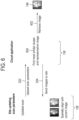
- Fig. 6 illustrates several operations performed by the computer system 126 or the magnetic resonance imaging system 100 and a cloud application which is represented by the historical database 138.
- the magnetic resonance imaging system updates the scan and then uploads the scan parameters 202.
- the historical database 138 finds the most similar cluster of images and finds a representative image in step 600.
- the historical database 138 retrieves the historical image data 146.
- the historical database 138 sends the historical image data 146 to the magnetic resonance imaging system 100. It may also send it to a computer system 126 without a magnetic resonance imaging system.
- the previously acquired image may be aligned with the historical image 146.
- Fig. 6 shows one possible workflow for retrieving the data from a cloud based system.
- the application sends the updated scan parameter.
- the cloud application identifies the corresponding cluster and returns the identified image.
- the local application spatially aligns the image to the currently shown one to minimize irritations.
- an algorithm running on the historical database calculates clusters of similar sets by using known clustering algorithms.
- clustering algorithms use a "distance measure” for scans and a minimum “variation” of those parameters within the clusters to determine some optimal clustering.
- prior knowledge from MRI experts
- the algorithms updates the cluster information when new sets are store in the database.
- the local console can then query this cumulative database given the current set of parameter and retrieve a representative images. These images allow for a quick estimate of how an acquired image could potentially look like.
- Fig. 6 shows one possible image retrieval workflow in more detail.
- the local application sends the updated parameter set to the cloud based application, which in turn identifies the closes matching cluster along with the representative image.
- This image is then returned to the client where it is spatially aligned to the currently displayed image to provide a better visual comparison.
- the fast and robust rigid image registration method could be applied.
- the spatial alignment of the images cannot guarantee perfect alignment since the images originate from different patients, but the aim of this task is to provide a more "consistent" viewing of the images.
- the system is implemented as a cloud based ExamCard management solution allowing to manage the installed ExamCards on a fleet of MRI scanner as well as to update the parameter within those ExamCards.
- the calculation of representative images may not only be calculated for the new value of the parameter, but also incrementally within the range from the old to the new value.
- the use may then use a slider the continuously scan through all images within the parameter range.
- a computer program may be stored/distributed on a suitable medium, such as an optical storage medium or a solid-state medium supplied together with or as part of other hardware, but may also be distributed in other forms, such as via the Internet or other wired or wireless telecommunication systems. Any reference signs in the claims should not be construed as limiting the scope.
Landscapes
- Physics & Mathematics (AREA)
- Engineering & Computer Science (AREA)
- General Physics & Mathematics (AREA)
- Signal Processing (AREA)
- High Energy & Nuclear Physics (AREA)
- Condensed Matter Physics & Semiconductors (AREA)
- Theoretical Computer Science (AREA)
- Data Mining & Analysis (AREA)
- Databases & Information Systems (AREA)
- General Engineering & Computer Science (AREA)
- Library & Information Science (AREA)
- Magnetic Resonance Imaging Apparatus (AREA)
Applications Claiming Priority (3)
| Application Number | Priority Date | Filing Date | Title |
|---|---|---|---|
| EP16166337 | 2016-04-21 | ||
| EP16172859 | 2016-06-03 | ||
| PCT/EP2017/058840 WO2017182369A1 (en) | 2016-04-21 | 2017-04-12 | Modification of mri pulse sequence parameters using a historical database |
Publications (2)
| Publication Number | Publication Date |
|---|---|
| EP3446139A1 EP3446139A1 (en) | 2019-02-27 |
| EP3446139B1 true EP3446139B1 (en) | 2024-08-28 |
Family
ID=58640830
Family Applications (1)
| Application Number | Title | Priority Date | Filing Date |
|---|---|---|---|
| EP17720024.3A Active EP3446139B1 (en) | 2016-04-21 | 2017-04-12 | Modification of mri pulse sequence parameters using a historical database |
Country Status (6)
| Country | Link |
|---|---|
| US (1) | US10627467B2 (enExample) |
| EP (1) | EP3446139B1 (enExample) |
| JP (1) | JP6790119B2 (enExample) |
| CN (1) | CN109073723B (enExample) |
| RU (1) | RU2734059C2 (enExample) |
| WO (1) | WO2017182369A1 (enExample) |
Families Citing this family (11)
| Publication number | Priority date | Publication date | Assignee | Title |
|---|---|---|---|---|
| US10600511B2 (en) | 2018-02-20 | 2020-03-24 | International Business Machine Corporation | Accelerating human understanding of medical images by dynamic image alteration |
| EP3584596A1 (en) * | 2018-06-19 | 2019-12-25 | Koninklijke Philips N.V. | Tracking of image quality in magnetic resonance imaging |
| EP3719525A1 (en) * | 2019-04-01 | 2020-10-07 | Koninklijke Philips N.V. | Correction of magnetic resonance images using simulated magnetic resonance images |
| EP3742183A1 (en) * | 2019-05-20 | 2020-11-25 | Koninklijke Philips N.V. | A control system for a magnetic resonance imaging system |
| CN110488210B (zh) * | 2019-07-19 | 2021-09-17 | 上海联影医疗科技股份有限公司 | 磁共振系统的扫描方法、计算机设备和存储介质 |
| US11353527B2 (en) | 2019-07-19 | 2022-06-07 | Shanghai United Imaging Healthcare Co., Ltd. | Systems and methods for waveform determination in magnetic resonance imaging |
| CN112395668B (zh) * | 2020-11-15 | 2024-05-17 | 深圳千里马装饰集团有限公司 | 在线建模的家装方案生成方法及系统、以及存储介质 |
| CN115562135B (zh) * | 2022-12-05 | 2023-03-24 | 安徽省国盛量子科技有限公司 | 脉冲序列的参数配置方法及脉冲序列的生成方法、设备 |
| EP4450994A1 (en) * | 2023-04-20 | 2024-10-23 | Koninklijke Philips N.V. | Automated configuration of magnetic resonance imaging systems |
| GB2634873A (en) * | 2023-10-16 | 2025-04-30 | Elekta ltd | A method for modifying medical imaging protocol parameters |
| CN117671284B (zh) * | 2023-12-06 | 2024-04-30 | 广州科松医疗智能科技有限公司 | 侵入性胎盘植入影像特征ai智能提取系统 |
Family Cites Families (28)
| Publication number | Priority date | Publication date | Assignee | Title |
|---|---|---|---|---|
| US6466017B1 (en) * | 1999-12-02 | 2002-10-15 | Ge Medical Systems Global Technology Company, Llc | MRI system with modular gradient system |
| JP4112861B2 (ja) | 2000-03-14 | 2008-07-02 | 株式会社東芝 | Mriシステムセンタ装置 |
| US6690961B1 (en) * | 2000-05-12 | 2004-02-10 | Toshiba America Mri, Inc. | Apparatus and method for transition between fluoro-mode and diagnostic mode magnetic resonance imaging |
| GB0022341D0 (en) * | 2000-09-12 | 2000-10-25 | Nycomed Imaging As | Method |
| US7254623B1 (en) | 2002-04-16 | 2007-08-07 | General Electric Company | Method and apparatus for reducing x-ray dosage in CT imaging prescription |
| US7685262B2 (en) * | 2003-01-24 | 2010-03-23 | General Electric Company | Method and system for transfer of imaging protocols and procedures |
| DE102004043262B4 (de) | 2004-09-07 | 2007-06-06 | Siemens Ag | Verfahren zur Aufnahme von Bildern eines Untersuchungsbereichs eines menschlichen oder tierischen Körpers in einer Magnetresonanzanlage und zugehörige Magnetresonanzanlage |
| DE102005002213A1 (de) * | 2005-01-17 | 2006-07-27 | Siemens Ag | Verfahren zur optimierten Suche von optimalen Protokollen zum Betrieb von radiologischen Scannern |
| JP4868862B2 (ja) * | 2005-01-26 | 2012-02-01 | 株式会社東芝 | 画像診断装置、医用システムおよびプロトコル管理方法 |
| JP5075344B2 (ja) * | 2006-03-16 | 2012-11-21 | 株式会社東芝 | Mri装置及び画像表示装置 |
| US7672976B2 (en) | 2006-05-03 | 2010-03-02 | Ut-Battelle, Llc | Method for the reduction of image content redundancy in large image databases |
| JP5576117B2 (ja) * | 2006-07-31 | 2014-08-20 | コーニンクレッカ フィリップス エヌ ヴェ | 画像データセットの視覚化のためのプリセットマップを生成する方法、装置及びコンピュータ可読媒体 |
| CN100571620C (zh) * | 2008-07-29 | 2009-12-23 | 四川大学华西医院 | 一种核磁共振成像设备稳定性及成像指标的测量方法 |
| JP2010259614A (ja) * | 2009-05-07 | 2010-11-18 | Hitachi Medical Corp | 医用画像診断装置 |
| US8030920B2 (en) * | 2009-06-03 | 2011-10-04 | General Electric Company | Method and system for modifying pulse sequences |
| JP5551981B2 (ja) * | 2009-07-28 | 2014-07-16 | 株式会社イシダ | 箱詰装置 |
| JP2011104041A (ja) * | 2009-11-16 | 2011-06-02 | Toshiba Corp | 医用画像撮影支援装置、医用画像撮影支援システムおよび医用画像撮影支援システムのサーバー |
| EP2652653B1 (en) | 2010-12-13 | 2021-02-17 | Koninklijke Philips N.V. | Magnetic resonance examination system with preferred settings based on data mining |
| WO2012096109A1 (ja) * | 2011-01-11 | 2012-07-19 | 株式会社 東芝 | 画像診断装置、画像診断方法、医用画像サーバ及び医用画像保存方法 |
| US8248070B1 (en) * | 2011-03-22 | 2012-08-21 | Kabushiki Kaisha Toshiba | MRI using prep scan sequence producing phase-offset NMR signals from different NMR species |
| JP5920077B2 (ja) * | 2012-07-13 | 2016-05-18 | 富士電機株式会社 | 半導体装置の製造方法及び半導体装置 |
| KR20140040419A (ko) * | 2012-09-26 | 2014-04-03 | 삼성전자주식회사 | 의료영상장치 및 그 제어방법 |
| CN103885665B (zh) * | 2012-12-20 | 2018-05-04 | 上海联影医疗科技有限公司 | 磁共振系统中的用户定制提示信息的系统和方法 |
| CN103919551A (zh) * | 2013-01-11 | 2014-07-16 | 上海联影医疗科技有限公司 | 磁共振扫描协议交互系统和方法 |
| CN104274174B (zh) * | 2013-06-28 | 2018-04-03 | 上海联影医疗科技有限公司 | 磁共振成像的控制方法及装置 |
| JP6203610B2 (ja) * | 2013-11-21 | 2017-09-27 | 株式会社日立製作所 | 磁気共鳴イメージング装置 |
| WO2015134530A1 (en) | 2014-03-03 | 2015-09-11 | Semanticmd, Inc. | Personalized content-based patient retrieval system |
| WO2015198680A1 (ja) * | 2014-06-24 | 2015-12-30 | 株式会社 日立メディコ | プロトコル配信システム、医用画像診断装置及びプロトコル配信方法 |
-
2017
- 2017-04-12 EP EP17720024.3A patent/EP3446139B1/en active Active
- 2017-04-12 CN CN201780024658.8A patent/CN109073723B/zh active Active
- 2017-04-12 JP JP2018554673A patent/JP6790119B2/ja active Active
- 2017-04-12 US US16/093,742 patent/US10627467B2/en active Active
- 2017-04-12 RU RU2018140830A patent/RU2734059C2/ru active
- 2017-04-12 WO PCT/EP2017/058840 patent/WO2017182369A1/en not_active Ceased
Also Published As
| Publication number | Publication date |
|---|---|
| US20190120920A1 (en) | 2019-04-25 |
| CN109073723A (zh) | 2018-12-21 |
| US10627467B2 (en) | 2020-04-21 |
| RU2018140830A3 (enExample) | 2020-05-21 |
| JP6790119B2 (ja) | 2020-11-25 |
| JP2019520863A (ja) | 2019-07-25 |
| RU2018140830A (ru) | 2020-05-21 |
| EP3446139A1 (en) | 2019-02-27 |
| RU2734059C2 (ru) | 2020-10-12 |
| WO2017182369A1 (en) | 2017-10-26 |
| CN109073723B (zh) | 2021-08-24 |
Similar Documents
| Publication | Publication Date | Title |
|---|---|---|
| EP3446139B1 (en) | Modification of mri pulse sequence parameters using a historical database | |
| EP3710847B1 (en) | Artificial intelligence-enabled localization of anatomical landmarks | |
| US9523750B2 (en) | Determination of a magnetic resonance imaging pulse sequence protocol classification | |
| US11333732B2 (en) | Automatic artifact detection and pulse sequence modification in magnetic resonance imaging | |
| EP4266074A1 (en) | Segmentation of medical images reconstructed from a set of magnetic resonance images | |
| CN111095011B (zh) | 用于利用归档的线圈灵敏度图的并行成像的系统和方法 | |
| EP3451344A1 (en) | Automated consistency check for medical imaging | |
| EP3776460A1 (en) | Automatic slice selection in medical imaging | |
| US20190285711A1 (en) | Image quality control in dynamic contrast enhanced magnetic resonance imaging | |
| US12078703B2 (en) | Automated field of view alignment for magnetic resonance imaging | |
| EP4138092A1 (en) | Detection of improperly configured medical imaging systems | |
| EP4603858A1 (en) | Adjustment recommendation for scan parameters | |
| EP3524996A1 (en) | Reduction of artifacts in parallel magnetic resonance imaging | |
| EP4306983A1 (en) | Making anatomical measurements using magnetic resonance imaging |
Legal Events
| Date | Code | Title | Description |
|---|---|---|---|
| STAA | Information on the status of an ep patent application or granted ep patent |
Free format text: STATUS: UNKNOWN |
|
| STAA | Information on the status of an ep patent application or granted ep patent |
Free format text: STATUS: THE INTERNATIONAL PUBLICATION HAS BEEN MADE |
|
| PUAI | Public reference made under article 153(3) epc to a published international application that has entered the european phase |
Free format text: ORIGINAL CODE: 0009012 |
|
| STAA | Information on the status of an ep patent application or granted ep patent |
Free format text: STATUS: REQUEST FOR EXAMINATION WAS MADE |
|
| 17P | Request for examination filed |
Effective date: 20181121 |
|
| AK | Designated contracting states |
Kind code of ref document: A1 Designated state(s): AL AT BE BG CH CY CZ DE DK EE ES FI FR GB GR HR HU IE IS IT LI LT LU LV MC MK MT NL NO PL PT RO RS SE SI SK SM TR |
|
| AX | Request for extension of the european patent |
Extension state: BA ME |
|
| DAV | Request for validation of the european patent (deleted) | ||
| DAX | Request for extension of the european patent (deleted) | ||
| RAP1 | Party data changed (applicant data changed or rights of an application transferred) |
Owner name: KONINKLIJKE PHILIPS N.V. |
|
| STAA | Information on the status of an ep patent application or granted ep patent |
Free format text: STATUS: EXAMINATION IS IN PROGRESS |
|
| 17Q | First examination report despatched |
Effective date: 20211008 |
|
| GRAP | Despatch of communication of intention to grant a patent |
Free format text: ORIGINAL CODE: EPIDOSNIGR1 |
|
| STAA | Information on the status of an ep patent application or granted ep patent |
Free format text: STATUS: GRANT OF PATENT IS INTENDED |
|
| INTG | Intention to grant announced |
Effective date: 20240327 |
|
| RIN1 | Information on inventor provided before grant (corrected) |
Inventor name: NETSCH, THOMAS Inventor name: HARDER, TIM PHILIPP |
|
| GRAS | Grant fee paid |
Free format text: ORIGINAL CODE: EPIDOSNIGR3 |
|
| GRAA | (expected) grant |
Free format text: ORIGINAL CODE: 0009210 |
|
| STAA | Information on the status of an ep patent application or granted ep patent |
Free format text: STATUS: THE PATENT HAS BEEN GRANTED |
|
| AK | Designated contracting states |
Kind code of ref document: B1 Designated state(s): AL AT BE BG CH CY CZ DE DK EE ES FI FR GB GR HR HU IE IS IT LI LT LU LV MC MK MT NL NO PL PT RO RS SE SI SK SM TR |
|
| REG | Reference to a national code |
Ref country code: GB Ref legal event code: FG4D |
|
| REG | Reference to a national code |
Ref country code: CH Ref legal event code: EP |
|
| REG | Reference to a national code |
Ref country code: DE Ref legal event code: R096 Ref document number: 602017084450 Country of ref document: DE |
|
| REG | Reference to a national code |
Ref country code: DE Ref legal event code: R084 Ref document number: 602017084450 Country of ref document: DE Ref country code: DE Ref legal event code: R086 Ref document number: 602017084450 Country of ref document: DE |
|
| REG | Reference to a national code |
Ref country code: IE Ref legal event code: FG4D |
|
| REG | Reference to a national code |
Ref country code: LT Ref legal event code: MG9D |
|
| PG25 | Lapsed in a contracting state [announced via postgrant information from national office to epo] |
Ref country code: NO Free format text: LAPSE BECAUSE OF FAILURE TO SUBMIT A TRANSLATION OF THE DESCRIPTION OR TO PAY THE FEE WITHIN THE PRESCRIBED TIME-LIMIT Effective date: 20241128 |
|
| REG | Reference to a national code |
Ref country code: AT Ref legal event code: MK05 Ref document number: 1718541 Country of ref document: AT Kind code of ref document: T Effective date: 20240828 |
|
| PG25 | Lapsed in a contracting state [announced via postgrant information from national office to epo] |
Ref country code: PL Free format text: LAPSE BECAUSE OF FAILURE TO SUBMIT A TRANSLATION OF THE DESCRIPTION OR TO PAY THE FEE WITHIN THE PRESCRIBED TIME-LIMIT Effective date: 20240828 Ref country code: NL Free format text: LAPSE BECAUSE OF FAILURE TO SUBMIT A TRANSLATION OF THE DESCRIPTION OR TO PAY THE FEE WITHIN THE PRESCRIBED TIME-LIMIT Effective date: 20240828 Ref country code: PT Free format text: LAPSE BECAUSE OF FAILURE TO SUBMIT A TRANSLATION OF THE DESCRIPTION OR TO PAY THE FEE WITHIN THE PRESCRIBED TIME-LIMIT Effective date: 20241230 Ref country code: FI Free format text: LAPSE BECAUSE OF FAILURE TO SUBMIT A TRANSLATION OF THE DESCRIPTION OR TO PAY THE FEE WITHIN THE PRESCRIBED TIME-LIMIT Effective date: 20240828 Ref country code: GR Free format text: LAPSE BECAUSE OF FAILURE TO SUBMIT A TRANSLATION OF THE DESCRIPTION OR TO PAY THE FEE WITHIN THE PRESCRIBED TIME-LIMIT Effective date: 20241129 |
|
| PG25 | Lapsed in a contracting state [announced via postgrant information from national office to epo] |
Ref country code: BG Free format text: LAPSE BECAUSE OF FAILURE TO SUBMIT A TRANSLATION OF THE DESCRIPTION OR TO PAY THE FEE WITHIN THE PRESCRIBED TIME-LIMIT Effective date: 20240828 |
|
| PG25 | Lapsed in a contracting state [announced via postgrant information from national office to epo] |
Ref country code: LV Free format text: LAPSE BECAUSE OF FAILURE TO SUBMIT A TRANSLATION OF THE DESCRIPTION OR TO PAY THE FEE WITHIN THE PRESCRIBED TIME-LIMIT Effective date: 20240828 |
|
| REG | Reference to a national code |
Ref country code: NL Ref legal event code: MP Effective date: 20240828 |
|
| PG25 | Lapsed in a contracting state [announced via postgrant information from national office to epo] |
Ref country code: AT Free format text: LAPSE BECAUSE OF FAILURE TO SUBMIT A TRANSLATION OF THE DESCRIPTION OR TO PAY THE FEE WITHIN THE PRESCRIBED TIME-LIMIT Effective date: 20240828 Ref country code: IS Free format text: LAPSE BECAUSE OF FAILURE TO SUBMIT A TRANSLATION OF THE DESCRIPTION OR TO PAY THE FEE WITHIN THE PRESCRIBED TIME-LIMIT Effective date: 20241228 |
|
| PG25 | Lapsed in a contracting state [announced via postgrant information from national office to epo] |
Ref country code: HR Free format text: LAPSE BECAUSE OF FAILURE TO SUBMIT A TRANSLATION OF THE DESCRIPTION OR TO PAY THE FEE WITHIN THE PRESCRIBED TIME-LIMIT Effective date: 20240828 |
|
| PG25 | Lapsed in a contracting state [announced via postgrant information from national office to epo] |
Ref country code: RS Free format text: LAPSE BECAUSE OF FAILURE TO SUBMIT A TRANSLATION OF THE DESCRIPTION OR TO PAY THE FEE WITHIN THE PRESCRIBED TIME-LIMIT Effective date: 20241128 Ref country code: ES Free format text: LAPSE BECAUSE OF FAILURE TO SUBMIT A TRANSLATION OF THE DESCRIPTION OR TO PAY THE FEE WITHIN THE PRESCRIBED TIME-LIMIT Effective date: 20240828 |
|
| PG25 | Lapsed in a contracting state [announced via postgrant information from national office to epo] |
Ref country code: RS Free format text: LAPSE BECAUSE OF FAILURE TO SUBMIT A TRANSLATION OF THE DESCRIPTION OR TO PAY THE FEE WITHIN THE PRESCRIBED TIME-LIMIT Effective date: 20241128 Ref country code: PT Free format text: LAPSE BECAUSE OF FAILURE TO SUBMIT A TRANSLATION OF THE DESCRIPTION OR TO PAY THE FEE WITHIN THE PRESCRIBED TIME-LIMIT Effective date: 20241230 Ref country code: PL Free format text: LAPSE BECAUSE OF FAILURE TO SUBMIT A TRANSLATION OF THE DESCRIPTION OR TO PAY THE FEE WITHIN THE PRESCRIBED TIME-LIMIT Effective date: 20240828 Ref country code: NO Free format text: LAPSE BECAUSE OF FAILURE TO SUBMIT A TRANSLATION OF THE DESCRIPTION OR TO PAY THE FEE WITHIN THE PRESCRIBED TIME-LIMIT Effective date: 20241128 Ref country code: NL Free format text: LAPSE BECAUSE OF FAILURE TO SUBMIT A TRANSLATION OF THE DESCRIPTION OR TO PAY THE FEE WITHIN THE PRESCRIBED TIME-LIMIT Effective date: 20240828 Ref country code: LV Free format text: LAPSE BECAUSE OF FAILURE TO SUBMIT A TRANSLATION OF THE DESCRIPTION OR TO PAY THE FEE WITHIN THE PRESCRIBED TIME-LIMIT Effective date: 20240828 Ref country code: IS Free format text: LAPSE BECAUSE OF FAILURE TO SUBMIT A TRANSLATION OF THE DESCRIPTION OR TO PAY THE FEE WITHIN THE PRESCRIBED TIME-LIMIT Effective date: 20241228 Ref country code: HR Free format text: LAPSE BECAUSE OF FAILURE TO SUBMIT A TRANSLATION OF THE DESCRIPTION OR TO PAY THE FEE WITHIN THE PRESCRIBED TIME-LIMIT Effective date: 20240828 Ref country code: GR Free format text: LAPSE BECAUSE OF FAILURE TO SUBMIT A TRANSLATION OF THE DESCRIPTION OR TO PAY THE FEE WITHIN THE PRESCRIBED TIME-LIMIT Effective date: 20241129 Ref country code: FI Free format text: LAPSE BECAUSE OF FAILURE TO SUBMIT A TRANSLATION OF THE DESCRIPTION OR TO PAY THE FEE WITHIN THE PRESCRIBED TIME-LIMIT Effective date: 20240828 Ref country code: ES Free format text: LAPSE BECAUSE OF FAILURE TO SUBMIT A TRANSLATION OF THE DESCRIPTION OR TO PAY THE FEE WITHIN THE PRESCRIBED TIME-LIMIT Effective date: 20240828 Ref country code: BG Free format text: LAPSE BECAUSE OF FAILURE TO SUBMIT A TRANSLATION OF THE DESCRIPTION OR TO PAY THE FEE WITHIN THE PRESCRIBED TIME-LIMIT Effective date: 20240828 Ref country code: AT Free format text: LAPSE BECAUSE OF FAILURE TO SUBMIT A TRANSLATION OF THE DESCRIPTION OR TO PAY THE FEE WITHIN THE PRESCRIBED TIME-LIMIT Effective date: 20240828 |
|
| PG25 | Lapsed in a contracting state [announced via postgrant information from national office to epo] |
Ref country code: SM Free format text: LAPSE BECAUSE OF FAILURE TO SUBMIT A TRANSLATION OF THE DESCRIPTION OR TO PAY THE FEE WITHIN THE PRESCRIBED TIME-LIMIT Effective date: 20240828 Ref country code: DK Free format text: LAPSE BECAUSE OF FAILURE TO SUBMIT A TRANSLATION OF THE DESCRIPTION OR TO PAY THE FEE WITHIN THE PRESCRIBED TIME-LIMIT Effective date: 20240828 Ref country code: RO Free format text: LAPSE BECAUSE OF FAILURE TO SUBMIT A TRANSLATION OF THE DESCRIPTION OR TO PAY THE FEE WITHIN THE PRESCRIBED TIME-LIMIT Effective date: 20240828 |
|
| PG25 | Lapsed in a contracting state [announced via postgrant information from national office to epo] |
Ref country code: EE Free format text: LAPSE BECAUSE OF FAILURE TO SUBMIT A TRANSLATION OF THE DESCRIPTION OR TO PAY THE FEE WITHIN THE PRESCRIBED TIME-LIMIT Effective date: 20240828 |
|
| PG25 | Lapsed in a contracting state [announced via postgrant information from national office to epo] |
Ref country code: CZ Free format text: LAPSE BECAUSE OF FAILURE TO SUBMIT A TRANSLATION OF THE DESCRIPTION OR TO PAY THE FEE WITHIN THE PRESCRIBED TIME-LIMIT Effective date: 20240828 |
|
| PG25 | Lapsed in a contracting state [announced via postgrant information from national office to epo] |
Ref country code: SK Free format text: LAPSE BECAUSE OF FAILURE TO SUBMIT A TRANSLATION OF THE DESCRIPTION OR TO PAY THE FEE WITHIN THE PRESCRIBED TIME-LIMIT Effective date: 20240828 Ref country code: IT Free format text: LAPSE BECAUSE OF FAILURE TO SUBMIT A TRANSLATION OF THE DESCRIPTION OR TO PAY THE FEE WITHIN THE PRESCRIBED TIME-LIMIT Effective date: 20240828 |
|
| REG | Reference to a national code |
Ref country code: DE Ref legal event code: R097 Ref document number: 602017084450 Country of ref document: DE |
|
| PLBE | No opposition filed within time limit |
Free format text: ORIGINAL CODE: 0009261 |
|
| STAA | Information on the status of an ep patent application or granted ep patent |
Free format text: STATUS: NO OPPOSITION FILED WITHIN TIME LIMIT |
|
| PGFP | Annual fee paid to national office [announced via postgrant information from national office to epo] |
Ref country code: DE Payment date: 20250428 Year of fee payment: 9 |
|
| 26N | No opposition filed |
Effective date: 20250530 |
|
| PG25 | Lapsed in a contracting state [announced via postgrant information from national office to epo] |
Ref country code: SE Free format text: LAPSE BECAUSE OF FAILURE TO SUBMIT A TRANSLATION OF THE DESCRIPTION OR TO PAY THE FEE WITHIN THE PRESCRIBED TIME-LIMIT Effective date: 20240828 |
|
| REG | Reference to a national code |
Ref country code: CH Ref legal event code: H13 Free format text: ST27 STATUS EVENT CODE: U-0-0-H10-H13 (AS PROVIDED BY THE NATIONAL OFFICE) Effective date: 20251125 |