EP3445901B1 - Kunstrasenfaser mit lldpe und ldpe - Google Patents
Kunstrasenfaser mit lldpe und ldpe Download PDFInfo
- Publication number
- EP3445901B1 EP3445901B1 EP17716937.2A EP17716937A EP3445901B1 EP 3445901 B1 EP3445901 B1 EP 3445901B1 EP 17716937 A EP17716937 A EP 17716937A EP 3445901 B1 EP3445901 B1 EP 3445901B1
- Authority
- EP
- European Patent Office
- Prior art keywords
- polymer
- artificial turf
- lldpe
- monofilament
- fiber
- Prior art date
- Legal status (The legal status is an assumption and is not a legal conclusion. Google has not performed a legal analysis and makes no representation as to the accuracy of the status listed.)
- Active
Links
Images

Classifications
-
- D—TEXTILES; PAPER
- D01—NATURAL OR MAN-MADE THREADS OR FIBRES; SPINNING
- D01F—CHEMICAL FEATURES IN THE MANUFACTURE OF ARTIFICIAL FILAMENTS, THREADS, FIBRES, BRISTLES OR RIBBONS; APPARATUS SPECIALLY ADAPTED FOR THE MANUFACTURE OF CARBON FILAMENTS
- D01F6/00—Monocomponent artificial filaments or the like of synthetic polymers; Manufacture thereof
- D01F6/44—Monocomponent artificial filaments or the like of synthetic polymers; Manufacture thereof from mixtures of polymers obtained by reactions only involving carbon-to-carbon unsaturated bonds as major constituent with other polymers or low-molecular-weight compounds
- D01F6/46—Monocomponent artificial filaments or the like of synthetic polymers; Manufacture thereof from mixtures of polymers obtained by reactions only involving carbon-to-carbon unsaturated bonds as major constituent with other polymers or low-molecular-weight compounds of polyolefins
-
- D—TEXTILES; PAPER
- D01—NATURAL OR MAN-MADE THREADS OR FIBRES; SPINNING
- D01F—CHEMICAL FEATURES IN THE MANUFACTURE OF ARTIFICIAL FILAMENTS, THREADS, FIBRES, BRISTLES OR RIBBONS; APPARATUS SPECIALLY ADAPTED FOR THE MANUFACTURE OF CARBON FILAMENTS
- D01F1/00—General methods for the manufacture of artificial filaments or the like
- D01F1/02—Addition of substances to the spinning solution or to the melt
-
- D—TEXTILES; PAPER
- D01—NATURAL OR MAN-MADE THREADS OR FIBRES; SPINNING
- D01F—CHEMICAL FEATURES IN THE MANUFACTURE OF ARTIFICIAL FILAMENTS, THREADS, FIBRES, BRISTLES OR RIBBONS; APPARATUS SPECIALLY ADAPTED FOR THE MANUFACTURE OF CARBON FILAMENTS
- D01F1/00—General methods for the manufacture of artificial filaments or the like
- D01F1/02—Addition of substances to the spinning solution or to the melt
- D01F1/04—Pigments
-
- D—TEXTILES; PAPER
- D01—NATURAL OR MAN-MADE THREADS OR FIBRES; SPINNING
- D01F—CHEMICAL FEATURES IN THE MANUFACTURE OF ARTIFICIAL FILAMENTS, THREADS, FIBRES, BRISTLES OR RIBBONS; APPARATUS SPECIALLY ADAPTED FOR THE MANUFACTURE OF CARBON FILAMENTS
- D01F1/00—General methods for the manufacture of artificial filaments or the like
- D01F1/02—Addition of substances to the spinning solution or to the melt
- D01F1/06—Dyes
-
- D—TEXTILES; PAPER
- D01—NATURAL OR MAN-MADE THREADS OR FIBRES; SPINNING
- D01F—CHEMICAL FEATURES IN THE MANUFACTURE OF ARTIFICIAL FILAMENTS, THREADS, FIBRES, BRISTLES OR RIBBONS; APPARATUS SPECIALLY ADAPTED FOR THE MANUFACTURE OF CARBON FILAMENTS
- D01F8/00—Conjugated, i.e. bi- or multicomponent, artificial filaments or the like; Manufacture thereof
- D01F8/04—Conjugated, i.e. bi- or multicomponent, artificial filaments or the like; Manufacture thereof from synthetic polymers
- D01F8/06—Conjugated, i.e. bi- or multicomponent, artificial filaments or the like; Manufacture thereof from synthetic polymers with at least one polyolefin as constituent
-
- D—TEXTILES; PAPER
- D01—NATURAL OR MAN-MADE THREADS OR FIBRES; SPINNING
- D01F—CHEMICAL FEATURES IN THE MANUFACTURE OF ARTIFICIAL FILAMENTS, THREADS, FIBRES, BRISTLES OR RIBBONS; APPARATUS SPECIALLY ADAPTED FOR THE MANUFACTURE OF CARBON FILAMENTS
- D01F8/00—Conjugated, i.e. bi- or multicomponent, artificial filaments or the like; Manufacture thereof
- D01F8/04—Conjugated, i.e. bi- or multicomponent, artificial filaments or the like; Manufacture thereof from synthetic polymers
- D01F8/12—Conjugated, i.e. bi- or multicomponent, artificial filaments or the like; Manufacture thereof from synthetic polymers with at least one polyamide as constituent
-
- D—TEXTILES; PAPER
- D06—TREATMENT OF TEXTILES OR THE LIKE; LAUNDERING; FLEXIBLE MATERIALS NOT OTHERWISE PROVIDED FOR
- D06N—WALL, FLOOR, OR LIKE COVERING MATERIALS, e.g. LINOLEUM, OILCLOTH, ARTIFICIAL LEATHER, ROOFING FELT, CONSISTING OF A FIBROUS WEB COATED WITH A LAYER OF MACROMOLECULAR MATERIAL; FLEXIBLE SHEET MATERIAL NOT OTHERWISE PROVIDED FOR
- D06N7/00—Flexible sheet materials not otherwise provided for, e.g. textile threads, filaments, yarns or tow, glued on macromolecular material
- D06N7/0063—Floor covering on textile basis comprising a fibrous top layer being coated at the back with at least one polymer layer, e.g. carpets, rugs, synthetic turf
- D06N7/0065—Floor covering on textile basis comprising a fibrous top layer being coated at the back with at least one polymer layer, e.g. carpets, rugs, synthetic turf characterised by the pile
-
- E—FIXED CONSTRUCTIONS
- E01—CONSTRUCTION OF ROADS, RAILWAYS, OR BRIDGES
- E01C—CONSTRUCTION OF, OR SURFACES FOR, ROADS, SPORTS GROUNDS, OR THE LIKE; MACHINES OR AUXILIARY TOOLS FOR CONSTRUCTION OR REPAIR
- E01C13/00—Pavings or foundations specially adapted for playgrounds or sports grounds; Drainage, irrigation or heating of sports grounds
- E01C13/08—Surfaces simulating grass ; Grass-grown sports grounds
-
- D—TEXTILES; PAPER
- D06—TREATMENT OF TEXTILES OR THE LIKE; LAUNDERING; FLEXIBLE MATERIALS NOT OTHERWISE PROVIDED FOR
- D06N—WALL, FLOOR, OR LIKE COVERING MATERIALS, e.g. LINOLEUM, OILCLOTH, ARTIFICIAL LEATHER, ROOFING FELT, CONSISTING OF A FIBROUS WEB COATED WITH A LAYER OF MACROMOLECULAR MATERIAL; FLEXIBLE SHEET MATERIAL NOT OTHERWISE PROVIDED FOR
- D06N2201/00—Chemical constitution of the fibres, threads or yarns
- D06N2201/02—Synthetic macromolecular fibres
- D06N2201/0254—Polyolefin fibres
-
- D—TEXTILES; PAPER
- D10—INDEXING SCHEME ASSOCIATED WITH SUBLASSES OF SECTION D, RELATING TO TEXTILES
- D10B—INDEXING SCHEME ASSOCIATED WITH SUBLASSES OF SECTION D, RELATING TO TEXTILES
- D10B2321/00—Fibres made from polymers obtained by reactions only involving carbon-to-carbon unsaturated bonds
- D10B2321/02—Fibres made from polymers obtained by reactions only involving carbon-to-carbon unsaturated bonds polyolefins
- D10B2321/021—Fibres made from polymers obtained by reactions only involving carbon-to-carbon unsaturated bonds polyolefins polyethylene
-
- D—TEXTILES; PAPER
- D10—INDEXING SCHEME ASSOCIATED WITH SUBLASSES OF SECTION D, RELATING TO TEXTILES
- D10B—INDEXING SCHEME ASSOCIATED WITH SUBLASSES OF SECTION D, RELATING TO TEXTILES
- D10B2505/00—Industrial
- D10B2505/20—Industrial for civil engineering, e.g. geotextiles
- D10B2505/202—Artificial grass
-
- Y—GENERAL TAGGING OF NEW TECHNOLOGICAL DEVELOPMENTS; GENERAL TAGGING OF CROSS-SECTIONAL TECHNOLOGIES SPANNING OVER SEVERAL SECTIONS OF THE IPC; TECHNICAL SUBJECTS COVERED BY FORMER USPC CROSS-REFERENCE ART COLLECTIONS [XRACs] AND DIGESTS
- Y10—TECHNICAL SUBJECTS COVERED BY FORMER USPC
- Y10T—TECHNICAL SUBJECTS COVERED BY FORMER US CLASSIFICATION
- Y10T428/00—Stock material or miscellaneous articles
- Y10T428/23907—Pile or nap type surface or component
- Y10T428/23993—Composition of pile or adhesive
Definitions
- Artificial turf or artificial grass is surface that is made up of fibers which is used to replace grass.
- the structure of the artificial turf is designed such that the artificial turf has an appearance which resembles grass.
- artificial turf is used as a surface for sports such as soccer, American football, rugby, tennis, golf, for playing fields, or exercise fields.
- artificial turf is frequently used for landscaping applications.
- Artificial turf fields are brushed regularly to help fibers stand-up after being stepped down during the play or exercise. Throughout the typical usage time of 5-15 years it may be beneficial if an artificial turf sports field can withstand high mechanical wear, can resist UV, can withstand thermal cycling or thermal ageing, can resist interactions with chemicals and various environmental conditions. It is therefore beneficial if the artificial turf has a long usable life, is durable, and keeps its playing and surface characteristics as well as appearance throughout its usage time.
- EP1378592 A1 describes a method for producing a synthetic fiber comprising a mixture of a plastomer and a polyethylene.
- the polyethylene may be a LLPE or HDPE.
- Patent application CN 102493011 A (TAISHAN SPORTS INDUSTRY GROUP; LEUNG TAISHAN ARTIFICIAL TURF INDUSTRY) 13 June 2012 describes wear-resisting artificial grass filaments.
- One embodiment comprises 85% LLDPE and 6% of a wear-resistant master batch, wherein about 50% of the master batch consist of LDPE.
- WO 2012/005974 A1 (DOW GLOBAL TECHNOLOGIES LLC [US] Sandkuehler Peter [ES]; Martin Jill) 12 January 2012 describes an oriented article, for example, a yarn, tape or filament made from a three component polymer blend.
- the blend comprises: (a) 20 to 50 parts of a first component (A) comprising a homogeneous ethylene polymer having a density between 0.85 and 0.90 gm/cm3 , and a Mw/Mn less than 3, and a melt index (12) between 0.5 and 5 gm/10minutes; and (b) 30 to 80 parts of a second component (B) comprising a heterogeneous branched ethylene polymer having a density between 0.91 and 0.945 gm/cm3 , and a Mw/Mn greater than 3.5, and a melt index (12) between 0.5 and 10 gm/10 minutes; and (c) 2 to 25 parts of a third component (C) comprising an ethylene polymer having a density greater than 0.945 gm/cm3 , and a melt index (12) between 0.01 and 10 gm/10 minutes. It may be desirable to manufacture artificial turf fibers having a set of desired properties e.g. in respect to smoothness, tensile strength
- the invention provides for a method of manufacturing artificial turf in the independent claims. Embodiments are given in the dependent claims. Embodiments can freely be combined with each other if they are not mutually exclusive.
- the invention relates to a method of manufacturing an artificial turf fiber.
- the method comprises:
- LDPE Low-density polyethylene
- Embodiments of the invention are based on LDPE whose density range is within the above specified sub-range.
- Linear low-density polyethylene as used herein is a substantially linear polymer (polyethylene), with significant numbers of short branches. LLDPE differs structurally from conventional LDPE because of the absence of long chain branching. The linearity of LLDPE results from the different manufacturing processes of LLDPE and LDPE. In general, LLDPE is produced at lower temperatures and pressures by copolymerization of ethylene and alpha-olefins.
- an artificial turf comprising a mixture of LLDPE and LDPE in the above specified amount ranges for creating a monofilament in an extrusion and stretching process may be advantageous for multiple reasons:
- the method allows manufacturing artificial turf fibers which are at the same time soft, flexible, resistant to shear forces (e.g. applied during extrusion or during stretching), have a high tensile strength and are resistant to splicing.
- "Splicing" as used herein relates to the splitting a fiber along its longitudinal axis.
- a polymer mix comprising a combination of LLDPE and LDPE in the specified amount ranges surprisingly shows an increased softness, flexibility and improved tensile strength while showing the same or an even improved resistance against splitting. It has been observed that not all plastomers are well suited for preventing splitting in artificial turf fibers, presumably because plastomers - at least if provided in some particular amount ranges and/or having a particular density - appear not to generate a chain entanglement that can reliably prevent splicing and/or have negative side effects like making a fiber that has decreased tensile strength or flexibility and/or an increased brittleness.
- Applicant has surprisingly observed that an optimal compromise between a high splicing resistance on the one hand and high tensile strength on the other hand can be achieved by combining specific amounts of LLDPE and LDPE polymers for generating an artificial turf fiber.
- Said fiber may in addition have a decreased brittleness and increased flexibility.
- the amount of LDPE used should be comparatively low, preferentially in the range of 1%-15%, more preferentially in the range of 5-8 % by weight of the polymer mixture to ensure a high resistance to splicing in combination with a high tensile strength and high flexibility of the generated fiber.
- LLDPE long-chain branching in LLDPE allows the chains to slide by one another upon elongation without becoming entangled.
- fibers completely consisting of LLDPE are susceptible to splicing if a pulling force is applied on the surface of a fiber.
- LLDPE has a higher tensile strength and a higher puncture resistance than LDPE and many plastomers.
- Applicant has surprisingly observed that, using a specific combination of LDPE and LLDPE in the above specified amount ranges allows manufacturing artificial turf fibers which can resist splicing and at the same time are soft, flexible and have a high tensile strength.
- the stretching-induced formation of polymer crystals within and at the surface of the monofilament increases the roughness of the fiber, thereby allowing a strong mechanical fixing in an artificial turf backing in embodiments wherein the monofilaments are partially embedded in a liquid film that later solidifies, e.g. a latex or PU film.
- Applicant has further observed that, upon applying strong shear forces on a polymer mixture comprising LLDPE and LDPE polymers, e.g. by extruding a polymer mixture comprising LLDPE and LDPE polymers, LDPE molecules are deformed, the side branches of the LDPE molecules get entangled with the ones of other LDPE molecules and/or with LLDPE molecules. As a consequence of chain entanglement, the viscosity raises.
- an artificial turf fiber manufactured from a particular mixture of specific amounts of LDPE and LLDPE is soft and flexible and has high tensile strength (thanks to the LLDPE component) and is at the same time resistant against splicing (thanks to chain entanglement caused by the LDPE component). Applicant has observed that if the ratio of LLDPE to LDPE is too large, splicing may occur, and if said ratio is too low, the flexibility and tensile strength of the fiber may significantly decrease.
- polyethylene is in general considered as a comparatively soft and flexible polymer that reduces the risk of injuries such as skin burns.
- LLDPE is a form of PE that is shear sensitive because of its shorter chain branching. LLDPE allows for a faster stress relaxation of the polymer chains after extrusion or stretching compared with stress relaxation of an LDPE of equivalent melt index. Stress resistance may be particularly beneficial in the context of artificial turf fiber production: the stretching process triggers the formation of crystalline portions on the surface (and inner portions) of the stretched fiber. The crystals increase the surface roughness and thus allow for a better mechanical fixing of the fiber in a surface backing.
- the "polymer mixture” may comprise additional substances, e.g. filler materials and/or additives, so the total amount of the LLDPE polymer and the LDPE polymer do not have to sum up to 100% of the weight of the polymer mixture.
- the LDPE polymer has a density in a range of 0.919 g/cm 3 to 0.921 g/cm 3 and the LLDPE has a density in a range of 0.918 g/cm 3 to 0.920 g/cm 3 .
- the LLDPE polymer comprises a first LLDPE polymer having a density in a range of 0.918 g/cm 3 to 0.920 g/cm 3 and comprises a second LLDPE polymer having a density in a range of 0.914 g/cm 3 to 0.918 g/cm 3 .
- the polymer mixture comprises the second LLDPE polymer in an amount of 7 - 13 % by weight of the polymer mixture.
- the rest of the LLDPE polymer in the mixture may consist of the first LLDPE having the above specified, higher density.
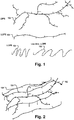
- Adding a second, "low density” LLDPE in addition to the first, “medium density” LDPE may be advantageous as the risk of splicing is further reduced: the low density LLDPE is folded in three-dimensional space in a less dense manner (see Fig. 1 ) and may thus reduce the amount of crystalline portions that are created in the stretching process. This reduces the brittleness of the fiber and thus may also reduce the risk of splicing.
- splicing may be prevented by promoting chain entanglement, whereby the risk of splicing may be further reduced by adding low-density LLDPE.
- adding an amount of said "low density" LDPE makes the fiber smoother and reduces risk of skin burns.
- the polymer mixture further comprises one or more additives.
- the additives may be added to the polymer mixture e.g. by adding the master batch.
- the additives are selected from a group comprising: a wax, a dulling agent, a UV stabilizer, a flame retardant, an anti-oxidant, a pigment, a filling material and combinations thereof.
- the filling material may also be added separately to the polymer mix and may constitute a significant portion of the final polymer mixture that is extruded.
- the LLDPE polymer is a polymer created by a polymerization reaction under the presence of a Ziegler-Natta catalyst.
- the Ziegler-Natta catalyst is a homogeneous catalyst.
- Homogeneous catalysts are usually based on complexes of Ti, Zr or Hf and are preferentially used in combination with a different organoaluminium cocatalyst, methylaluminoxane (MAO).
- MAO methylaluminoxane
- Using a Ziegler-Natta catalyst may have the advantage that the branches of the generated LLDPE are distributed more randomly, e.g. show an atactic orientation. This may ease the entanglement with branches of LDPE molecules.
- a metallocene catalyst may be used together with a cocatalyst such as MAO, (AI(CH3)xOy)n.
- the organic ligands are derivatives of cyclopentadienyl. Depending of the type of their cyclopentadienyl ligands, for example by using an Ansa-bridge, metallocene catalysts can produce polymers of different tacticity and different branching frequencies .
- a tactic macromolecule in the IUPAC definition is a macromolecule in which essentially all the configurational (repeating) units are identical.
- LLDPE low density polyethylene
- the production of LLDPE is initiated by a catalyst t.
- the actual polymerization process can be done either in solution phase or in gas phase reactors.
- octene is the comonomer in solution phase while butene and hexene are copolymerized with ethylene in a gas phase reactor.
- the LDPE polymer is a polymer more than 0.001, preferentially more than 1 tertiary C-atom/ 100 C atoms of the polymer chain.
- the number of tertiary C-atoms is a measure of the degree of branching.
- Using an LLDPE and/or LDPE polymer having the above specified degree of branching may be advantageous as said degree of branching has been observed to cause a strong entanglement between LLDPE and LDPE polymer molecules which protects the polymer fiber against splicing.
- manufacturing the artificial turf fiber comprises forming the stretched monofilament into a yarn. Multiple, for example 4 to 8 monofilaments, could be formed or finished into a yarn.
- the method further comprises weaving, spinning, twisting, rewinding, and/or bundling the stretched monofilament into the artificial turf fiber.
- This technique of manufacturing artificial turf is known e.g. from United States patent application US 20120125474 A1 .
- the polymer mixture is a liquid polymer mixture and comprises two or more different, liquid phases.
- a first one of the phases comprises a first dye and the components of the polymer mixture according to any one of the embodiments described previously.
- said first phase may comprise a mixture of the first and the second LLDPE polymer and the LDPE polymer.
- the second phase may comprise a second dye and an additional polymer, e.g. polyamide, that is immiscible with the first phase.
- the second dye may have a different color than the first dye, the additional polymer forming polymer beads within the first phase.
- a liquid polymer mixture may be created wherein the two different dyes are separated in two different phases wherein one of the phases is "emulsified" in the other phase in the form of beads.
- This may be advantageous as it is not necessary to use or create customized extruders which mechanically prevent a premature intermixing of the two dyes, thereby ensuring that a monofilament with a marbled pattern rather than a monofilament with a color being the intermediate of the first and second color is created.
- embodiments of the invention allow using the same extrusion machinery for creating marbled monofilaments as for creating monochrome monofilaments. This may reduce production costs and may increase the diversity of artificial turf types that can be created with a single melting- and extrusion apparatus.
- the polymer mixture completely or largely constituting - together with the first dye - the first phase may not delaminate from the other polymer constituting - together with the second dye - completely or largely the second phase, even in case two different types of polymers are used in the two phases, e.g. the various forms of PE in the first phase and Polyamide in the second phase.
- the thread-like regions are embedded within the polymer mixture of the first phase. It is therefore impossible for them to delaminate.
- a further advantage may possibly be that the thread-like regions are concentrated, due to fluid dynamics during the extrusion process, in a central region of the monofilament during the extrusion process, while there is still a significant portion of the thread-like regions also on the surface of a monofilament to produce the marble pattern appearance.
- the other polymer that may be of a more rigid material than LLDPE and LDPE in the first phase
- LLDPE and LDPE in the first phase may be concentrated in the center of the monofilament and a larger amount of softer plastic on the exterior or outer region of the monofilament. This may further lead to an artificial turf fiber with more grass-like properties both in terms of rigidity, surface smoothness and surface coloration and texture.
- embodiments of the method result in a monofilament that comprises the marble color pattern not only on its surface but also inside.
- a filament should be split, its surface abraded or otherwise damaged, the marble color pattern will not be removed as it is not confined to the surface of the monofilament
- the polymer mixture comprises 0.2 to 35 % by weight the additional polymer, and more preferentially comprises 2 to 10 % by weight the additional polymer.
- the amount of the "pure" LLDPE having a density in a range of 0.918 g/cm 3 to 0.920 g/cm 3 is chosen such that the said LLDPE polymer, the LLDPE master batch, the optional low density LLDPE, the LDPE polymer, the other polymer and the optional additives and/or filler substances add up to 100%.
- the additional polymer is a polar polymer.
- the additional polymer is any one of the following: polyamide, polyethylene terephthalate (PET), and polybutylene terephthalate (PBT).
- the first dye is phthalocyanine green in a concentration of 0,001 - 0,3 % by weight, preferably 0,05 - 0,2 % by weight of the first phase.
- the first dye has a green or dark green color.
- the second dye is an azo-nickel pigment complex in a concentration of 0.5-5, more preferentially of 1.5-2 percent by weight of the second phase.
- the azo-nickel pigment "BAYPLAST®Gelb 5GN" of LANXESS may be used as the second dye.
- the second dye has a yellow, light green or yellow-green color.
- the extrusion is performed at a pressure of 40-140 bars, more preferentially between 60-100 bars.
- the polymer mixture may be created by adding polymer granules to a solid polymer composition that is mixed and heated until all polymers are molten.
- the polymer mixture may be heated to reach at the time of extrusion a temperature of 190-260°C, more preferentially 210-250°C.
- the stretching comprises stretching the reheated monofilament according to a stretch factor in the range of 1.1-8, more preferentially in the range of 3-7.
- the quenching is performed in a quenching solution having a temperature of 10-60°C, more preferentially between 25°C-45°C.
- the occurrence of the two different colors changes preferentially every 50-1000 ⁇ m, more preferentially every 100-700 ⁇ m.
- the marble pattern of the monofilament reproduces color patterns of natural grass.
- the artificial turf fiber extends a predetermined length beyond the artificial turf backing.
- the threadlike regions have a length less than one half of the predetermined length.
- the method further comprises manufacturing an artificial turf by incorporating the artificial turf fiber into an artificial turf backing.
- the incorporation of the artificial turf fiber into the artificial turf backing comprises tufting the artificial turf fiber into the artificial turf backing and binding the artificial turf fibers to the artificial turf backing.
- the incorporation of the artificial turf fiber into the artificial turf backing comprises weaving the artificial turf fiber into the artificial turf backing.
- the invention relates to an artificial turf fiber manufactured according to the method of any one of the embodiments described herein.
- the invention relates to an artificial turf manufactured according to the method of any one of the embodiments described herein.
- an artificial turf fiber comprising:
- the LLDPE polymer has a density in a range of 0.918 g/cm 3 to 0.920 g/cm 3 and the LDPE polymer has a density in a range of 0.919 g/cm 3 to 0.921 g/cm 3 .
- the invention relates to an artificial turf comprising an artificial turf textile backing and the artificial turf fiber as described for embodiments of the invention.
- the artificial turf fiber is incorporated into the artificial turf backing.
- the monofilament is an extruded and/or stretched monofilament.
- the creation of the artificial turf fiber comprises extruding the polymer mixture and stretching the monofilament to form the monofilament into the artificial turf fiber.
- the compatibilizer is any one of the following: grafted maleic acid anhydride (MAH), ethylene ethyl acrylate (EEA), a maleic acid grafted on polyethylene or polyamide; a maleic anhydride grafted on free radical initiated graft copolymer of polyethylene, SEBS (styrene ethylene butylene styrene), EVA (ethylene-vinyl acetate), EPD (ethylene-propylene diene), or polypropylene with an unsaturated acid or its anhydride such as maleic acid, glycidyl methacrylate, ricinoloxazoline maleinate; a graft copolymer of SEBS with glycidyl methacrylate, a graft copolymer of EVA with mercaptoacetic acid and maleic anhydride; a graft copolymer of EPDM with maleic anhydride; a graft copolymer of polypropylene with male
- MAH
- a mixture of polymers of different types e.g. the apolar polyethylene(s) in the first phase and the polar polyamide in the second phase as described above has the advantage that an artificial turf fiber is created that shows a marbled color pattern and that has increased durability against wear and tear due to the more rigid PA and at the same time a smoother surface and increased elasticity compared to pure-PA based monofilaments.
- the compatibilizer prevents splicing between polymer regions relating to different phases.
- the resulting time interval during which the polymer phases are liquid and during which dye can potentially diffuse to the other phase is so short that significant dye diffusion to the other phase is prohibited.
- multiple polymer domains of a given phase do not unify. Under these "turbulent" conditions, the threads of the first polymer phase are often so thin that a marbled structure would not be observable if the extruded monofilament would solidify immediately after extrusion.
- the different polymer domains of the same phase have sufficient time to unify after the polymer mixture flow has become laminar, thereby forming threads whose size and thickness is large enough as to provide for a marbled color impression if viewed by a human eye, e.g. at a distance of 15 cm or less.
- the first and second dyes respectively are an inorganic dye, an organic dye or a mixture thereof.
- the above mentioned conditions will basically prohibit a diffusion of the dyes into the respective other phase irrespective of the dyes' polarity or molecular weight.
- This may be advantageous as the diffusion of the dyes into the respective other phase and thus a mixing of the dyes is prevented, thereby ensuring that a marbled color expression is generated for an arbitrary combination of first and second dyes.
- the threadlike regions have a length less than 2 mm.
- the extrusion-mass temperature, stirring parameters of a mixer are chosen such that the average diameter of the beads in the molten polymer mixture before extrusion is less than 50 micrometer, preferentially between 0.1 to 3 micrometer, preferably 1 to 2 ⁇ m.
- Said features in combination with quenching conditions that allow a unification of polymer domains of the same phase once the extruded polymer mix has reached laminar flow state may be advantageous as they will support a formation of a marble structure in which the occurrence of the two different colors changes preferentially every 50-1000 ⁇ m, more preferentially every 100-700 ⁇ m.
- the polymer domains of the second polymer phase is very fine-granularly dispersed within the first polymer phase and the portions on the surface of the monofilaments showing the second color may form as coarse-grained structures by unification (merging) of multiple second phase domains after extrusion until the monofilament solidifies. This may allow for a better intermixing of the first and second polymer phases and prohibit delamination.
- domain may refer to a localized region, such as a droplet, of a polymer that is immiscible in a surrounding phase of another polymer.
- the polymer beads may in some instances be round or spherical or oval-shaped, but they may also be irregularly-shaped.
- a "polymer” as used herein is a polyolefin.
- Fig. 1 shows a single LDPE molecule 102 as it may be used in embodiments of the invention. It comprises one or more long main chains and a plurality of small side chains extending from any one of the main chains. The small side chains are typically 2-8 carbon atoms long.
- Fig. 1 shows a single LLDPE molecule 104.
- the LLDPE molecule does not comprise larger side chains. It only comprises a single, long polyethylene main chain and a plurality of small side chains extending from the main chain.
- the type of catalyst used during the polymerization reaction determines the tacticity and the branching properties of a PE molecule (number and distances of branches in a main chain, length of side chains, etc).
- metallocene catalysts are used for creating the LLDPE, because they result in a more regular branching pattern than other catalysts (which typically trigger the generation of LLDPE polymers whose number and distance of branches and the length of the individual branches follows a normal distribution).
- Generating LLDPE polymers with a defined, regular (not normally distributed) branching pattern can be beneficial as the properties of a monofilament resulting from a mixture of such an LLDPE polymer with an LDPE polymer can thus be predicted more clearly.
- the density is then a more accurate indicator of the tacticity and the branching pattern.
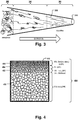
- Fig. 2 shows chain entanglement between a single LDPE molecule 102 and multiple LLDPE molecules 104.
- the entanglement is achieved by Van-der-Waals forces between the larger and minor branches of the LPDE with the main chain and the minor side chains of one or more LLDPE molecules. Due to the lack of larger side chains, a polymer fiber solely consisting of LLDPE would be susceptible to splicing.
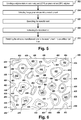
- Figure 3 shows a section through an area within a cylindrical extrusion nozzle.
- the polymers of a liquefied polymer mixture are mostly in an amorphous state, i.e., there are only few or no crystalline regions and the polymer molecules do not show any preferred orientation in one dimension.
- a second area 304 that corresponds to an area of increased shear forces, the polymer molecules are sheared and pulled at least partially in the direction of the opening 310 of the nozzle.
- the LLDPE and partially also the LDPE molecules are at least partially disentangled, oriented and form crystalline portions 308.
- the majority of crystalline portions is created later in the stretching process.
- LLDPE-LDPE mixture are particularly beneficial for preventing splicing in artificial turf fibers which are stretched in the manufacturing process.
- the extrusion, and in particular the stretching results in an at least partial disentanglement and parallel orientation of LLDPE molecules which again causes an increased susceptibility of the fiber to splicing.
- the splicing can be prohibited even in fibers that are stretched during manufacturing.
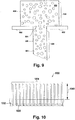
- Figure 4 shows a cross-section of a granular polymer mixture 470 according to one embodiment of the invention.
- the polymer mixture comprises the following components e.g. in the form of polymer granules that are molten later:
- the polymer components 450-456 together form a first liquid phase 404 that may in addition comprise an additional polymer, e.g. PA, that may form a second phase 402 that forms beads 408 within the first phase.
- an additional polymer e.g. PA
- the amount of the first LLDPE is reduced in accordance with the amount of the other polymer.
- Fig. 5 shows a flowchart which illustrates an example of a method of manufacturing artificial turf fiber.
- a polymer mixture is created.
- the polymer mixture is comprises at least an LLDPE polymer having a density of 0.918 g/cm 3 to 0.920 g/cm 3 and a first LLDPE polymer having a density of 0.920 g/cm 3 in an amount of about 5-8% by weight of the polymer mixture.
- the LLDPE polymer may be added in the form of pure LLDPE granules 450 and master batch LLDPE granules 452 as depicted, for example, in Fig. 4 .
- the master batch LLDPE polymer granules may comprise additives.
- the LLDPE polymer in the polymer granules 450, 452 is of an identical type.
- the polymer mixture may comprise about 10% of a "low density" LLDPE.
- the polymer mixture comprises a small fraction of an additional polymer, e.g. PA, and optionally a compatibilizer, as depicted and discussed in further detail in Fig. 6 .
- the polymer mixture may at first have the form of a polymer granules mixture. By heating the granules, a liquid polymer mixture is created. Thereby, the polymer mixture may optionally be stirred at a stirring rate suitable to ensure that the molten polymers and additives are homogeneously mixed.
- step 504 the polymer mixture is extruded into a monofilament.
- step 506 the monofilament is quenched or rapidly cooled down.
- step 508 the monofilament is reheated.
- step 510 the reheated monofilament is stretched to form the monofilament into the artificial turf fiber. Said step is depicted in greater detail in Fig. 3 .
Landscapes
- Engineering & Computer Science (AREA)
- Textile Engineering (AREA)
- Chemical & Material Sciences (AREA)
- Chemical Kinetics & Catalysis (AREA)
- General Chemical & Material Sciences (AREA)
- Manufacturing & Machinery (AREA)
- Architecture (AREA)
- Civil Engineering (AREA)
- Structural Engineering (AREA)
- Artificial Filaments (AREA)
- Road Paving Structures (AREA)
- Extrusion Moulding Of Plastics Or The Like (AREA)
Claims (20)
- Verfahren zum Herstellen einer Kunstrasenfaser, wobei das Verfahren umfasst:- Erzeugen (502) einer Polymermischung (470), die umfasst:• ein LLDPE-Polymer (450, 452) in einer Menge von 60-99 %, bezogen auf das Gewicht der Polymermischung, wobei das LLDPE-Polymer eine Dichte in einem Bereich von 0,918 g/cm3 bis 0,920 g/cm3 aufweist;• ein LDPE-Polymer (102, 454) in einer Menge von 1-15 %, bezogen auf das Gewicht der Polymermischung, wobei das LDPE-Polymer (454) eine Dichte in einem Bereich von 0,919 g/cm3 bis 0,921 g/cm3 aufweist;- Extrudieren (504) der Polymermischung zu einem Monofilament (606);- Quenchen (506) des Monofilaments;- Wiedererwärmen (508) des Monofilaments;- Strecken (510) des wiedererwärmten Monofilaments, um aus dem Monofilament die Kunstrasenfaser (1004) zu bilden.
- Verfahren nach Anspruch 1, wobei die Polymermischung das LDPE-Polymer in einer Menge von 5-8 %, bezogen auf das Gewicht der Polymermischung, umfasst und/oder das LLDPE-Polymer in einer Menge von 60 % - 95 %, bezogen auf das Gewicht der Polymermischung, umfasst.
- Verfahren nach einem der vorangehenden Ansprüche 1-2, wobei 7-13 %, bezogen auf das Gewicht der Polymermischung, ein weiteres LLDPE-Polymer umfassen, das eine Dichte in einem Bereich von 0,914 g/cm3 bis 0,918 g/cm3 aufweist.
- Verfahren nach einem der vorstehenden Ansprüche, wobei die Polymermischung einen oder mehrere Zusätze aufweist, die ausgewählt sind aus einer Gruppe, die umfasst: ein Wachs, ein Mattierungsmittel, einen UV-Stabilisator, ein Flammschutzmittel, ein Antioxidationsmittel, ein Pigment, ein Füllmaterial und Kombinationen davon.
- Verfahren nach einem der vorstehenden Ansprüche, wobei das LLDPE-Polymer (456, 452, 450) ein Polymer ist, das durch eine Polymerisationsreaktion in Anwesenheit eines Ziegler-Natta-Katalysators erzeugt wird.
- Verfahren nach einem der vorstehenden Ansprüche 1-5, wobei das LLDPE-Polymer (456, 452, 450) ein Polymer ist, das durch eine Polymerisationsreaktion in Anwesenheit eines Metallocenkatalysators erzeugt wird.
- Verfahren nach einem der vorstehenden Ansprüche, wobei das LLDPE-Polymer (456, 452, 450) ein Polymer ist, das durch Copolymerisieren von Ethylen mit 5-12 % α-Olefinen, die 3-8 Kohlenwasserstoffatome aufweisen, erzeugt wird.
- Verfahren nach einem der vorstehenden Ansprüche, wobei das LLDPE-Polymer 0,001-10 tertiäre C-Atome pro 100 C-Atomen der Polymerkette umfasst.
- Verfahren nach einem der vorstehenden Ansprüche, wobei das Herstellen der Kunstrasenfaser das Ausbilden eines Garns aus dem gestreckten Monofilament umfasst.
- Verfahren nach einem der vorstehenden Ansprüche, ferner ein Weben, Spinnen, Verdrehen, Aufwickeln und/oder Bündeln des gestreckten Monofilaments zu der Kunstrasenfaser umfassend
- Verfahren nach einem der vorstehenden Ansprüche, wobei die Polymermischung zumindest ein Zweiphasensystem ist, wobei eine erste von den Phasen einen ersten Farbstoff und die Komponenten der Polymermischung nach einem der vorangehenden Ansprüche umfasst, die zweite Phase einen zweiten Farbstoff und ein zusätzliches Polymer, das mit der ersten Phase nicht mischbar ist, umfasst, wobei der zweite Farbstoff eine andere Farbe aufweist als der erste Farbstoff, wobei das zusätzliche Polymer Polymerkügelchen innerhalb der ersten Phase bildet.
- Verfahren nach Anspruch 11, wobei das zusätzliche Polymer ein polares Polymer ist und/oder eines der Folgenden ist: Polyamid, Polyethylenterephthalat (PET) und Polybutylenterephthalat (PBT).
- Verfahren nach einem der vorangehenden Ansprüche, ferner umfassend:- Herstellen eines Kunstrasens durch Aufnehmen der Kunstrasenfaser in einen Kunstrasenrücken (1002).
- Verfahren nach Anspruch 13, wobei das Aufnehmen der Kunstrasenfaser in den Kunstrasenrücken umfasst: Tuften der Kunstrasenfaser in den Kunstrasenrücken und Binden der Kunstrasenfasern an den Kunstrasenrücken; oder Weben der Kunstrasenfaser in den Kunstrasenrücken.
- Kunstrasenfaser, hergestellt gemäß dem Verfahren nach einem der vorstehenden Ansprüche 1-12.
- Kunstrasen, hergestellt gemäß dem Verfahren nach einem der vorstehenden Ansprüche 13-14.
- Kunstrasenfaser, umfassend:- 60-99 Gew.-% LLDPE-Polymer (456, 452, 450), wobei das LLDPE-Polymer eine Dichte in einem Bereich von 0,918 g/cm3 bis 0,920 g/cm3 aufweist.- 1-15 Gew.-% LDPE-Polymer (454), wobei das LDPE-Polymer (454) eine Dichte in einem Bereich von 0,919 g/cm3 bis 0,921 g/cm3 aufweist.
- Kunstrasenfaser nach Anspruch 17, wobei 7-13 %, bezogen auf das Gewicht der Polymerfaser, ein weiteres LLDPE-Polymer (456) umfassen, das eine Dichte in einem Bereich von 0,914 g/cm3 bis 0,918 g/cm3 aufweist.
- Kunstrasen (1000), einen textilen Kunstrasenrücken (1002) und die Kunstrasenfaser (1004) nach einem der Ansprüche 17-18 umfassend, wobei die Kunstrasenfaser in den Kunstrasenrücken aufgenommen ist.
- Kunstrasen nach Anspruch 19, wobei das Monofilament ein extrudiertes und gestrecktes Monofilament ist.
Applications Claiming Priority (2)
| Application Number | Priority Date | Filing Date | Title |
|---|---|---|---|
| EP16165769.7A EP3235930A1 (de) | 2016-04-18 | 2016-04-18 | Kunstrasenfaser mit lldpe und ldpe |
| PCT/EP2017/059184 WO2017182466A1 (en) | 2016-04-18 | 2017-04-18 | Artificial turf fiber with lldpe and ldpe |
Publications (2)
| Publication Number | Publication Date |
|---|---|
| EP3445901A1 EP3445901A1 (de) | 2019-02-27 |
| EP3445901B1 true EP3445901B1 (de) | 2020-01-08 |
Family
ID=55759531
Family Applications (2)
| Application Number | Title | Priority Date | Filing Date |
|---|---|---|---|
| EP16165769.7A Withdrawn EP3235930A1 (de) | 2016-04-18 | 2016-04-18 | Kunstrasenfaser mit lldpe und ldpe |
| EP17716937.2A Active EP3445901B1 (de) | 2016-04-18 | 2017-04-18 | Kunstrasenfaser mit lldpe und ldpe |
Family Applications Before (1)
| Application Number | Title | Priority Date | Filing Date |
|---|---|---|---|
| EP16165769.7A Withdrawn EP3235930A1 (de) | 2016-04-18 | 2016-04-18 | Kunstrasenfaser mit lldpe und ldpe |
Country Status (8)
| Country | Link |
|---|---|
| US (2) | US11015268B2 (de) |
| EP (2) | EP3235930A1 (de) |
| JP (1) | JP6596598B2 (de) |
| KR (1) | KR102217859B1 (de) |
| CN (1) | CN109072489B (de) |
| AU (1) | AU2017251943B2 (de) |
| CA (1) | CA3016856A1 (de) |
| WO (1) | WO2017182466A1 (de) |
Families Citing this family (24)
| Publication number | Priority date | Publication date | Assignee | Title |
|---|---|---|---|---|
| US11987939B2 (en) * | 2014-03-27 | 2024-05-21 | Polytex Sportbeläge Produktions—GmbH | Artificial turf and production method |
| CA3010557A1 (en) | 2016-03-18 | 2017-09-21 | Advanced Polymer Technology Corp. | Using a polyol mixture comprising pbd for creating a pu-based artificial turf |
| US10870952B2 (en) * | 2016-03-18 | 2020-12-22 | Advanced Polymer Technologies Corp. | Using a polyol mixture comprising PBD for creating a PU-based artificial turf |
| DK3228737T3 (en) * | 2016-04-04 | 2019-02-25 | Polytex Sportbelaege Produktions Gmbh | Artificial grass with marbled monofilament |
| EP3480361A1 (de) * | 2017-11-03 | 2019-05-08 | Polytex Sportbeläge Produktions-GmbH | Kunstrasenfaser mit unrunder ummantelung |
| KR101962320B1 (ko) * | 2018-12-18 | 2019-07-31 | 코오롱글로텍주식회사 | 인조잔디 원사 및 이를 이용한 인조잔디 |
| CN113260744A (zh) * | 2019-01-03 | 2021-08-13 | 陶氏环球技术有限责任公司 | 具有自然外观的人造草皮草 |
| KR102620945B1 (ko) * | 2019-08-21 | 2024-01-08 | 한화솔루션 주식회사 | 인조잔디 원사용 폴리에틸렌 수지 조성물 및 이를 이용한 인조잔디 원사 |
| EP3800284A1 (de) * | 2019-10-04 | 2021-04-07 | Dow Global Technologies Llc | Filamentzusammensetzung |
| CN110777605A (zh) * | 2019-11-08 | 2020-02-11 | 江苏文明人造草坪有限公司 | 一种使用尼龙材质的人造草坪 |
| KR102244250B1 (ko) * | 2020-01-15 | 2021-04-27 | 지앤지텍(주) | 인조잔디 파일사의 제조방법 및 그 방법에 따른 인조잔디 파일사 |
| KR102143595B1 (ko) * | 2020-02-06 | 2020-08-11 | 코오롱글로텍주식회사 | 인조잔디 파일사 및 이를 이용한 인조잔디 구조체 |
| CN112030265B (zh) * | 2020-09-15 | 2023-01-24 | 张家港市民华塑胶有限公司 | 一种具有高抗老化性的人造草丝及其制备方法 |
| KR102374724B1 (ko) * | 2021-02-22 | 2022-03-14 | 코오롱글로텍주식회사 | 비선형 인조잔디 파일사를 포함하는 인조잔디 구조체 및 이의 제조방법 |
| WO2023232992A1 (en) * | 2022-06-03 | 2023-12-07 | Polytex Sportbeläge Produktions-Gmbh | Artificial turf with anti-slip agent reservoir for soccer or rugby |
| JP2025513518A (ja) * | 2022-06-03 | 2025-04-24 | ポリテックス・シュポルトベレーゲ・プロドゥクシオンス・ゲゼルシャフト・ミット・ベシュレンクテル・ハフツング | 滑り止め剤リザーバを有する人工芝 |
| WO2024056675A1 (en) * | 2022-09-13 | 2024-03-21 | Polytex Sportbeläge Produktions-Gmbh | Artificial turf fiber comprising a polymer grafted with siloxanes |
| US20240200282A1 (en) | 2022-12-16 | 2024-06-20 | Astro Turf Corporation | Artificial turf with shielded water absorber layer |
| US20250263894A1 (en) | 2022-12-16 | 2025-08-21 | Astroturf Corporation | Artificial turf with shielded water absorber layer |
| EP4524302A1 (de) * | 2023-09-12 | 2025-03-19 | Polytex Sportbeläge Produktions-GmbH | Kunstrasen mit traktionskontrollmittel |
| EP4524301A1 (de) * | 2023-09-12 | 2025-03-19 | Polytex Sportbeläge Produktions-GmbH | Kunstrasen mit traktionskontrollmittel für hockeyfelder |
| EP4527994A1 (de) | 2023-09-21 | 2025-03-26 | Polytex Sportbeläge Produktions-GmbH | Extrusionsvorrichtung für ein grasfasermonofilament |
| AU2024344216A1 (en) | 2023-09-21 | 2025-12-18 | Polytex Sportbeläge Produktions-Gmbh | Extrusion apparatus for turf fiber monofilament |
| EP4741546A1 (de) * | 2024-11-07 | 2026-05-13 | Polytex Sportbeläge Produktions-GmbH | Schraubenförmige kunstrasenfaser mit anti-spleissmittel |
Family Cites Families (45)
| Publication number | Priority date | Publication date | Assignee | Title |
|---|---|---|---|---|
| US20040180200A1 (en) * | 1994-11-14 | 2004-09-16 | Luca Bertamini | Polyolefin-based synthetic fibers and method therefor |
| US5587118A (en) * | 1995-03-14 | 1996-12-24 | Mallonee; William C. | Process for making fiber for a carpet face yarn |
| JP3480543B2 (ja) * | 1996-02-20 | 2003-12-22 | ダイヤテックス株式会社 | 人工芝生 |
| JPH1016105A (ja) * | 1996-06-27 | 1998-01-20 | Toray Ind Inc | 積層体 |
| AU2001271409A1 (en) | 2000-06-22 | 2002-01-02 | Exxonmobil Chemical Patents Inc | Very low density polyethylene and high density polyethylene blends |
| JP2003268648A (ja) * | 2001-12-28 | 2003-09-25 | Hagihara Industries Inc | 人工芝用基布及びそれを用いた人工芝 |
| EP1378592A1 (de) | 2002-07-01 | 2004-01-07 | Ten Cate Thiolon B.V. | Kunstfaser und daraus hergestellter Kunstrasen |
| JP4147122B2 (ja) * | 2003-02-10 | 2008-09-10 | 日本ポリプロ株式会社 | 柔軟ヤーン及びそれからなる人工芝 |
| JP2007016367A (ja) | 2005-07-11 | 2007-01-25 | Hagihara Industries Inc | 人工芝パイル糸及びそれを用いた人工芝生 |
| ES2315830T3 (es) * | 2005-12-30 | 2009-04-01 | Mondo S.P.A. | Procedimiento para producir un hilo para cesped sintetico y estructura de cesped sintetico producida utilizando dicho hilo. |
| CN101168612A (zh) * | 2006-10-26 | 2008-04-30 | 天津科技大学 | 双相共连续纳米结构聚乙烯/尼龙6共混合金制备技术 |
| CN101600822B (zh) * | 2006-12-27 | 2016-05-25 | 西巴控股有限公司 | 复丝,单丝,无纺织物或条带 |
| KR101028575B1 (ko) * | 2007-05-18 | 2011-04-11 | 코오롱글로텍주식회사 | 이형단면사용 방사구금 및 이를 이용한 필라멘트의제조방법 |
| KR101028574B1 (ko) * | 2007-05-18 | 2011-04-12 | 코오롱글로텍주식회사 | 인조잔디 원사용 조성물 및 이를 이용한 원사 |
| BRPI0816027B1 (pt) * | 2007-09-24 | 2019-05-28 | Dow Global Technologies Inc. | Superfície de gramado sintético |
| KR100904020B1 (ko) * | 2009-03-06 | 2009-06-22 | 장덕수 | 투수용 인조잔디 삽입형 블록 |
| NL1036870C2 (nl) | 2009-04-17 | 2010-10-19 | Ten Cate Itex B V | Inrichting voor het door middel van weven vervaardigen van een vezelmat. |
| DE102009037740A1 (de) * | 2009-08-17 | 2011-02-24 | Oerlikon Textile Gmbh & Co. Kg | Verfahren und Vorrichtung zur Herstellung eines Grasgarnes |
| EP2374917B1 (de) * | 2010-04-07 | 2013-02-13 | Dow Global Technologies LLC | Kunstrasengarn |
| WO2012004422A1 (es) * | 2010-07-06 | 2012-01-12 | Dow Global Technologies Llc | Mezclas de polímeros de etileno y artículos orientados con resistencia mejorada a la contracción |
| US20130273268A1 (en) | 2010-09-23 | 2013-10-17 | Total Research & Technology Feluy | Artificial grass |
| US20130209707A1 (en) * | 2010-10-29 | 2013-08-15 | Dow Global Technologies Llc | Polyethylene-based oriented monofilaments and strips and method for the preparation thereof |
| KR101073966B1 (ko) * | 2011-02-11 | 2011-10-18 | 준우무역 주식회사 | 요철형 복합소재 인조잔디 원사 제조법 |
| KR101112983B1 (ko) * | 2011-02-11 | 2012-02-24 | 주식회사 유신섬유 | 벌키성 지지부재를 구비한 인조잔디의 제조방법 |
| JP5866717B2 (ja) * | 2011-05-31 | 2016-02-17 | コーロン グロテック インコーポレイテッド | 人工芝構造体及びその製造方法、並びに製造装置 |
| CN102493011B (zh) * | 2011-11-14 | 2013-12-11 | 泰山体育产业集团有限公司 | 耐磨人造草丝纤维 |
| JP5794737B2 (ja) * | 2012-07-02 | 2015-10-14 | 住友ゴム工業株式会社 | 人工芝 |
| CN102965753A (zh) * | 2012-11-16 | 2013-03-13 | 广州爱奇实业有限公司 | 一种夜光人造草 |
| CN103057136A (zh) | 2012-11-30 | 2013-04-24 | 南通捷诺塑胶科技有限公司 | 一种具有高抗撕裂强度的聚乙烯薄膜的制备方法 |
| CN104822716B (zh) | 2012-12-21 | 2017-11-14 | 埃克森美孚化学专利公司 | 具有改进的加工性的支化聚乙烯及由其制成的高抗撕裂性膜 |
| JP6429893B2 (ja) * | 2014-03-27 | 2018-11-28 | ポリテックス・シュポルトベレーゲ・プロドゥクシオンス・ゲゼルシャフト・ミット・ベシュレンクテル・ハフツングPolytex Sportbelaege Produktions GmbH | 人工芝生の製造方法 |
| EP2940212A1 (de) * | 2014-05-02 | 2015-11-04 | Polytex Sportbeläge Produktions-GmbH | Kunstrasenherstellung mit Nukleierungsmittel |
| ES2654171T3 (es) * | 2015-04-27 | 2018-02-12 | Polytex Sportbeläge Produktions-Gmbh | Césped artificial y método de producción |
| EP3214211B2 (de) * | 2016-03-03 | 2025-09-03 | Dow Global Technologies LLC | Kunstrasen und verfahren zur herstellung davon |
| DK3228737T3 (en) * | 2016-04-04 | 2019-02-25 | Polytex Sportbelaege Produktions Gmbh | Artificial grass with marbled monofilament |
| CA3025337A1 (en) * | 2016-06-10 | 2017-12-14 | Beaulieu International Group Nv | Artificial turf |
| CN106592095A (zh) * | 2016-12-19 | 2017-04-26 | 广州爱奇实业有限公司 | 一种仿真草坪的制备方法 |
| US20180177254A1 (en) * | 2016-12-22 | 2018-06-28 | Russell Neuman | Method of extruding a thermoplastic polymer to produce random coloration and a product using same |
| EP3421666B1 (de) * | 2017-06-30 | 2020-10-28 | Dow Global Technologies, LLC | Kunstrasenfilamente und daraus hergestellte artikel |
| EP3421649B1 (de) * | 2017-06-30 | 2020-11-25 | Dow Global Technologies LLC | Kunstrasenfilamente und daraus hergestellte artikel |
| EP3480361A1 (de) * | 2017-11-03 | 2019-05-08 | Polytex Sportbeläge Produktions-GmbH | Kunstrasenfaser mit unrunder ummantelung |
| US20190267928A1 (en) * | 2018-02-26 | 2019-08-29 | Charles Favroth | Solar power absorbing artificial turf |
| KR102143595B1 (ko) * | 2020-02-06 | 2020-08-11 | 코오롱글로텍주식회사 | 인조잔디 파일사 및 이를 이용한 인조잔디 구조체 |
| CN111395103B (zh) * | 2020-02-24 | 2022-04-22 | 广州傲胜人造草股份有限公司 | 一种仿真低温型人造草坪 |
| CN111395102B (zh) * | 2020-02-24 | 2022-06-10 | 广州傲胜人造草股份有限公司 | 一种疏水运动型人造草坪 |
-
2016
- 2016-04-18 EP EP16165769.7A patent/EP3235930A1/de not_active Withdrawn
-
2017
- 2017-04-18 US US16/085,808 patent/US11015268B2/en active Active
- 2017-04-18 CN CN201780019560.3A patent/CN109072489B/zh active Active
- 2017-04-18 KR KR1020187025740A patent/KR102217859B1/ko active Active
- 2017-04-18 CA CA3016856A patent/CA3016856A1/en not_active Abandoned
- 2017-04-18 JP JP2018549560A patent/JP6596598B2/ja active Active
- 2017-04-18 WO PCT/EP2017/059184 patent/WO2017182466A1/en not_active Ceased
- 2017-04-18 EP EP17716937.2A patent/EP3445901B1/de active Active
- 2017-04-18 AU AU2017251943A patent/AU2017251943B2/en active Active
-
2021
- 2021-04-22 US US17/237,743 patent/US12152318B2/en active Active
Non-Patent Citations (1)
| Title |
|---|
| None * |
Also Published As
| Publication number | Publication date |
|---|---|
| US20210238771A1 (en) | 2021-08-05 |
| AU2017251943B2 (en) | 2018-12-20 |
| US20190100857A1 (en) | 2019-04-04 |
| WO2017182466A1 (en) | 2017-10-26 |
| KR20180102213A (ko) | 2018-09-14 |
| CN109072489A (zh) | 2018-12-21 |
| EP3445901A1 (de) | 2019-02-27 |
| CN109072489B (zh) | 2021-02-12 |
| KR102217859B1 (ko) | 2021-02-24 |
| HK1257990A1 (zh) | 2019-11-01 |
| CA3016856A1 (en) | 2017-10-26 |
| JP6596598B2 (ja) | 2019-10-23 |
| AU2017251943A1 (en) | 2018-09-13 |
| US12152318B2 (en) | 2024-11-26 |
| US11015268B2 (en) | 2021-05-25 |
| EP3235930A1 (de) | 2017-10-25 |
| JP2019513909A (ja) | 2019-05-30 |
Similar Documents
| Publication | Publication Date | Title |
|---|---|---|
| US12152318B2 (en) | Artificial turf fiber with LLDPE and LDPE | |
| US20230183888A1 (en) | Artificial turf with marbled monofilament | |
| CN106087106A (zh) | 人造草皮及生产方法 | |
| EP4339367A1 (de) | Kunstrasenfaser mit einem siloxangepfropften polyolefin | |
| US20250075442A1 (en) | Artificial turf fiber comprising a polymer grafted with siloxanes | |
| HK1257990B (en) | Artificial turf fiber with lldpe and ldpe | |
| US20260125826A1 (en) | Helical artificial turf fiber with anti-splicing agent | |
| EP4741546A1 (de) | Schraubenförmige kunstrasenfaser mit anti-spleissmittel | |
| EP4741545A1 (de) | Schraubenförmige kunstrasenfaser mit unterschiedlichen polymeren im kern und in der peripherie | |
| WO2026099356A1 (en) | Helical artificial turf fiber with anti-splicing agent |
Legal Events
| Date | Code | Title | Description |
|---|---|---|---|
| STAA | Information on the status of an ep patent application or granted ep patent |
Free format text: STATUS: UNKNOWN |
|
| STAA | Information on the status of an ep patent application or granted ep patent |
Free format text: STATUS: THE INTERNATIONAL PUBLICATION HAS BEEN MADE |
|
| PUAI | Public reference made under article 153(3) epc to a published international application that has entered the european phase |
Free format text: ORIGINAL CODE: 0009012 |
|
| STAA | Information on the status of an ep patent application or granted ep patent |
Free format text: STATUS: REQUEST FOR EXAMINATION WAS MADE |
|
| 17P | Request for examination filed |
Effective date: 20181119 |
|
| AK | Designated contracting states |
Kind code of ref document: A1 Designated state(s): AL AT BE BG CH CY CZ DE DK EE ES FI FR GB GR HR HU IE IS IT LI LT LU LV MC MK MT NL NO PL PT RO RS SE SI SK SM TR |
|
| AX | Request for extension of the european patent |
Extension state: BA ME |
|
| DAX | Request for extension of the european patent (deleted) | ||
| RAV | Requested validation state of the european patent: fee paid |
Extension state: MA Effective date: 20181119 |
|
| GRAP | Despatch of communication of intention to grant a patent |
Free format text: ORIGINAL CODE: EPIDOSNIGR1 |
|
| STAA | Information on the status of an ep patent application or granted ep patent |
Free format text: STATUS: GRANT OF PATENT IS INTENDED |
|
| INTG | Intention to grant announced |
Effective date: 20190806 |
|
| GRAS | Grant fee paid |
Free format text: ORIGINAL CODE: EPIDOSNIGR3 |
|
| GRAA | (expected) grant |
Free format text: ORIGINAL CODE: 0009210 |
|
| STAA | Information on the status of an ep patent application or granted ep patent |
Free format text: STATUS: THE PATENT HAS BEEN GRANTED |
|
| AK | Designated contracting states |
Kind code of ref document: B1 Designated state(s): AL AT BE BG CH CY CZ DE DK EE ES FI FR GB GR HR HU IE IS IT LI LT LU LV MC MK MT NL NO PL PT RO RS SE SI SK SM TR |
|
| REG | Reference to a national code |
Ref country code: GB Ref legal event code: FG4D |
|
| REG | Reference to a national code |
Ref country code: CH Ref legal event code: EP |
|
| REG | Reference to a national code |
Ref country code: DE Ref legal event code: R096 Ref document number: 602017010720 Country of ref document: DE |
|
| REG | Reference to a national code |
Ref country code: IE Ref legal event code: FG4D |
|
| REG | Reference to a national code |
Ref country code: AT Ref legal event code: REF Ref document number: 1222822 Country of ref document: AT Kind code of ref document: T Effective date: 20200215 |
|
| REG | Reference to a national code |
Ref country code: NL Ref legal event code: MP Effective date: 20200108 |
|
| REG | Reference to a national code |
Ref country code: LT Ref legal event code: MG4D |
|
| PG25 | Lapsed in a contracting state [announced via postgrant information from national office to epo] |
Ref country code: NO Free format text: LAPSE BECAUSE OF FAILURE TO SUBMIT A TRANSLATION OF THE DESCRIPTION OR TO PAY THE FEE WITHIN THE PRESCRIBED TIME-LIMIT Effective date: 20200408 Ref country code: LT Free format text: LAPSE BECAUSE OF FAILURE TO SUBMIT A TRANSLATION OF THE DESCRIPTION OR TO PAY THE FEE WITHIN THE PRESCRIBED TIME-LIMIT Effective date: 20200108 Ref country code: NL Free format text: LAPSE BECAUSE OF FAILURE TO SUBMIT A TRANSLATION OF THE DESCRIPTION OR TO PAY THE FEE WITHIN THE PRESCRIBED TIME-LIMIT Effective date: 20200108 Ref country code: FI Free format text: LAPSE BECAUSE OF FAILURE TO SUBMIT A TRANSLATION OF THE DESCRIPTION OR TO PAY THE FEE WITHIN THE PRESCRIBED TIME-LIMIT Effective date: 20200108 Ref country code: RS Free format text: LAPSE BECAUSE OF FAILURE TO SUBMIT A TRANSLATION OF THE DESCRIPTION OR TO PAY THE FEE WITHIN THE PRESCRIBED TIME-LIMIT Effective date: 20200108 Ref country code: PT Free format text: LAPSE BECAUSE OF FAILURE TO SUBMIT A TRANSLATION OF THE DESCRIPTION OR TO PAY THE FEE WITHIN THE PRESCRIBED TIME-LIMIT Effective date: 20200531 |
|
| PG25 | Lapsed in a contracting state [announced via postgrant information from national office to epo] |
Ref country code: GR Free format text: LAPSE BECAUSE OF FAILURE TO SUBMIT A TRANSLATION OF THE DESCRIPTION OR TO PAY THE FEE WITHIN THE PRESCRIBED TIME-LIMIT Effective date: 20200409 Ref country code: IS Free format text: LAPSE BECAUSE OF FAILURE TO SUBMIT A TRANSLATION OF THE DESCRIPTION OR TO PAY THE FEE WITHIN THE PRESCRIBED TIME-LIMIT Effective date: 20200508 Ref country code: HR Free format text: LAPSE BECAUSE OF FAILURE TO SUBMIT A TRANSLATION OF THE DESCRIPTION OR TO PAY THE FEE WITHIN THE PRESCRIBED TIME-LIMIT Effective date: 20200108 Ref country code: LV Free format text: LAPSE BECAUSE OF FAILURE TO SUBMIT A TRANSLATION OF THE DESCRIPTION OR TO PAY THE FEE WITHIN THE PRESCRIBED TIME-LIMIT Effective date: 20200108 Ref country code: SE Free format text: LAPSE BECAUSE OF FAILURE TO SUBMIT A TRANSLATION OF THE DESCRIPTION OR TO PAY THE FEE WITHIN THE PRESCRIBED TIME-LIMIT Effective date: 20200108 Ref country code: BG Free format text: LAPSE BECAUSE OF FAILURE TO SUBMIT A TRANSLATION OF THE DESCRIPTION OR TO PAY THE FEE WITHIN THE PRESCRIBED TIME-LIMIT Effective date: 20200408 |
|
| REG | Reference to a national code |
Ref country code: DE Ref legal event code: R097 Ref document number: 602017010720 Country of ref document: DE |
|
| PG25 | Lapsed in a contracting state [announced via postgrant information from national office to epo] |
Ref country code: ES Free format text: LAPSE BECAUSE OF FAILURE TO SUBMIT A TRANSLATION OF THE DESCRIPTION OR TO PAY THE FEE WITHIN THE PRESCRIBED TIME-LIMIT Effective date: 20200108 Ref country code: DK Free format text: LAPSE BECAUSE OF FAILURE TO SUBMIT A TRANSLATION OF THE DESCRIPTION OR TO PAY THE FEE WITHIN THE PRESCRIBED TIME-LIMIT Effective date: 20200108 Ref country code: EE Free format text: LAPSE BECAUSE OF FAILURE TO SUBMIT A TRANSLATION OF THE DESCRIPTION OR TO PAY THE FEE WITHIN THE PRESCRIBED TIME-LIMIT Effective date: 20200108 Ref country code: CZ Free format text: LAPSE BECAUSE OF FAILURE TO SUBMIT A TRANSLATION OF THE DESCRIPTION OR TO PAY THE FEE WITHIN THE PRESCRIBED TIME-LIMIT Effective date: 20200108 Ref country code: RO Free format text: LAPSE BECAUSE OF FAILURE TO SUBMIT A TRANSLATION OF THE DESCRIPTION OR TO PAY THE FEE WITHIN THE PRESCRIBED TIME-LIMIT Effective date: 20200108 Ref country code: SK Free format text: LAPSE BECAUSE OF FAILURE TO SUBMIT A TRANSLATION OF THE DESCRIPTION OR TO PAY THE FEE WITHIN THE PRESCRIBED TIME-LIMIT Effective date: 20200108 Ref country code: SM Free format text: LAPSE BECAUSE OF FAILURE TO SUBMIT A TRANSLATION OF THE DESCRIPTION OR TO PAY THE FEE WITHIN THE PRESCRIBED TIME-LIMIT Effective date: 20200108 |
|
| PLBE | No opposition filed within time limit |
Free format text: ORIGINAL CODE: 0009261 |
|
| STAA | Information on the status of an ep patent application or granted ep patent |
Free format text: STATUS: NO OPPOSITION FILED WITHIN TIME LIMIT |
|
| REG | Reference to a national code |
Ref country code: AT Ref legal event code: MK05 Ref document number: 1222822 Country of ref document: AT Kind code of ref document: T Effective date: 20200108 |
|
| PG25 | Lapsed in a contracting state [announced via postgrant information from national office to epo] |
Ref country code: MC Free format text: LAPSE BECAUSE OF FAILURE TO SUBMIT A TRANSLATION OF THE DESCRIPTION OR TO PAY THE FEE WITHIN THE PRESCRIBED TIME-LIMIT Effective date: 20200108 |
|
| REG | Reference to a national code |
Ref country code: CH Ref legal event code: PL |
|
| 26N | No opposition filed |
Effective date: 20201009 |
|
| PG25 | Lapsed in a contracting state [announced via postgrant information from national office to epo] |
Ref country code: LI Free format text: LAPSE BECAUSE OF NON-PAYMENT OF DUE FEES Effective date: 20200430 Ref country code: IT Free format text: LAPSE BECAUSE OF FAILURE TO SUBMIT A TRANSLATION OF THE DESCRIPTION OR TO PAY THE FEE WITHIN THE PRESCRIBED TIME-LIMIT Effective date: 20200108 Ref country code: CH Free format text: LAPSE BECAUSE OF NON-PAYMENT OF DUE FEES Effective date: 20200430 Ref country code: LU Free format text: LAPSE BECAUSE OF NON-PAYMENT OF DUE FEES Effective date: 20200418 Ref country code: AT Free format text: LAPSE BECAUSE OF FAILURE TO SUBMIT A TRANSLATION OF THE DESCRIPTION OR TO PAY THE FEE WITHIN THE PRESCRIBED TIME-LIMIT Effective date: 20200108 |
|
| REG | Reference to a national code |
Ref country code: BE Ref legal event code: MM Effective date: 20200430 |
|
| PG25 | Lapsed in a contracting state [announced via postgrant information from national office to epo] |
Ref country code: BE Free format text: LAPSE BECAUSE OF NON-PAYMENT OF DUE FEES Effective date: 20200430 Ref country code: PL Free format text: LAPSE BECAUSE OF FAILURE TO SUBMIT A TRANSLATION OF THE DESCRIPTION OR TO PAY THE FEE WITHIN THE PRESCRIBED TIME-LIMIT Effective date: 20200108 Ref country code: SI Free format text: LAPSE BECAUSE OF FAILURE TO SUBMIT A TRANSLATION OF THE DESCRIPTION OR TO PAY THE FEE WITHIN THE PRESCRIBED TIME-LIMIT Effective date: 20200108 |
|
| PG25 | Lapsed in a contracting state [announced via postgrant information from national office to epo] |
Ref country code: IE Free format text: LAPSE BECAUSE OF NON-PAYMENT OF DUE FEES Effective date: 20200418 |
|
| VS25 | Lapsed in a validation state [announced via postgrant information from nat. office to epo] |
Ref country code: MA Free format text: LAPSE BECAUSE OF FAILURE TO SUBMIT A TRANSLATION OF THE DESCRIPTION OR TO PAY THE FEE WITHIN THE PRESCRIBED TIME-LIMIT Effective date: 20200108 |
|
| PG25 | Lapsed in a contracting state [announced via postgrant information from national office to epo] |
Ref country code: TR Free format text: LAPSE BECAUSE OF FAILURE TO SUBMIT A TRANSLATION OF THE DESCRIPTION OR TO PAY THE FEE WITHIN THE PRESCRIBED TIME-LIMIT Effective date: 20200108 Ref country code: MT Free format text: LAPSE BECAUSE OF FAILURE TO SUBMIT A TRANSLATION OF THE DESCRIPTION OR TO PAY THE FEE WITHIN THE PRESCRIBED TIME-LIMIT Effective date: 20200108 Ref country code: CY Free format text: LAPSE BECAUSE OF FAILURE TO SUBMIT A TRANSLATION OF THE DESCRIPTION OR TO PAY THE FEE WITHIN THE PRESCRIBED TIME-LIMIT Effective date: 20200108 |
|
| PG25 | Lapsed in a contracting state [announced via postgrant information from national office to epo] |
Ref country code: MK Free format text: LAPSE BECAUSE OF FAILURE TO SUBMIT A TRANSLATION OF THE DESCRIPTION OR TO PAY THE FEE WITHIN THE PRESCRIBED TIME-LIMIT Effective date: 20200108 Ref country code: AL Free format text: LAPSE BECAUSE OF FAILURE TO SUBMIT A TRANSLATION OF THE DESCRIPTION OR TO PAY THE FEE WITHIN THE PRESCRIBED TIME-LIMIT Effective date: 20200108 |
|
| PGFP | Annual fee paid to national office [announced via postgrant information from national office to epo] |
Ref country code: DE Payment date: 20250422 Year of fee payment: 9 |
|
| PGFP | Annual fee paid to national office [announced via postgrant information from national office to epo] |
Ref country code: GB Payment date: 20250423 Year of fee payment: 9 |
|
| PGFP | Annual fee paid to national office [announced via postgrant information from national office to epo] |
Ref country code: FR Payment date: 20250425 Year of fee payment: 9 |