EP3441289B1 - Aide à la conduite lors de la suivie d'une trajectoire de conduite de consigne d'un véhicule automobile - Google Patents
Aide à la conduite lors de la suivie d'une trajectoire de conduite de consigne d'un véhicule automobile Download PDFInfo
- Publication number
- EP3441289B1 EP3441289B1 EP18187645.9A EP18187645A EP3441289B1 EP 3441289 B1 EP3441289 B1 EP 3441289B1 EP 18187645 A EP18187645 A EP 18187645A EP 3441289 B1 EP3441289 B1 EP 3441289B1
- Authority
- EP
- European Patent Office
- Prior art keywords
- driver
- motor vehicle
- driving
- information
- manoeuvre
- Prior art date
- Legal status (The legal status is an assumption and is not a legal conclusion. Google has not performed a legal analysis and makes no representation as to the accuracy of the status listed.)
- Active
Links
Images
Classifications
-
- B—PERFORMING OPERATIONS; TRANSPORTING
- B62—LAND VEHICLES FOR TRAVELLING OTHERWISE THAN ON RAILS
- B62D—MOTOR VEHICLES; TRAILERS
- B62D15/00—Steering not otherwise provided for
- B62D15/02—Steering position indicators ; Steering position determination; Steering aids
- B62D15/025—Active steering aids, e.g. helping the driver by actively influencing the steering system after environment evaluation
-
- B—PERFORMING OPERATIONS; TRANSPORTING
- B60—VEHICLES IN GENERAL
- B60W—CONJOINT CONTROL OF VEHICLE SUB-UNITS OF DIFFERENT TYPE OR DIFFERENT FUNCTION; CONTROL SYSTEMS SPECIALLY ADAPTED FOR HYBRID VEHICLES; ROAD VEHICLE DRIVE CONTROL SYSTEMS FOR PURPOSES NOT RELATED TO THE CONTROL OF A PARTICULAR SUB-UNIT
- B60W30/00—Purposes of road vehicle drive control systems not related to the control of a particular sub-unit, e.g. of systems using conjoint control of vehicle sub-units
- B60W30/18—Propelling the vehicle
- B60W30/18009—Propelling the vehicle related to particular drive situations
- B60W30/18163—Lane change; Overtaking manoeuvres
-
- B—PERFORMING OPERATIONS; TRANSPORTING
- B62—LAND VEHICLES FOR TRAVELLING OTHERWISE THAN ON RAILS
- B62D—MOTOR VEHICLES; TRAILERS
- B62D15/00—Steering not otherwise provided for
- B62D15/02—Steering position indicators ; Steering position determination; Steering aids
- B62D15/025—Active steering aids, e.g. helping the driver by actively influencing the steering system after environment evaluation
- B62D15/0255—Automatic changing of lane, e.g. for passing another vehicle
Definitions
- the invention relates to a method for operating a driver assistance device of a motor vehicle.
- the invention also relates to a driver assistance device for a motor vehicle, with an environment sensor device for detecting the surroundings of the motor vehicle and for providing information about the surroundings which represents the detected environment, and with a vehicle-internal sensor device for detecting the behavior of a driver of the motor vehicle and for providing behavior information, which represents the behavior of the driver.
- Advanced driver assistance systems in the motor vehicle are based on the monitoring of multimodal sensor data about the surroundings of the motor vehicle and on a vehicle-internal condition. Since these driver assistance devices analyze corresponding data from an environment sensor device and a vehicle-internal sensor device, they are able to predict a movement of the motor vehicle and to assess the environment of the motor vehicle. The evaluation of the information obtained enables the driver assistance devices to support a driver of the motor vehicle in driving the motor vehicle, in particular in performing driving maneuvers, and to point out possible dangers or to automatically perform specific maneuvers in order to avoid these dangers.
- driver assistance devices are a lane departure warning.
- lane markings in the vicinity of the motor vehicle are detected using suitable sensors. If the driver assistance device detects an impending crossing of a lane marking, it can automatically intervene in the steering process and counteract a steering input by the driver with a (small) counterforce. This prevents the driver from accidentally leaving the lane and increases his safety.
- a method for driving a vehicle within a lane is described.
- the driver is supported when driving within a lane without the system working against the driver's steering input. Rather, a predetermined target trajectory for the driver within the lane is determined and the system only intervenes in a correcting manner in order to maintain the target trajectory.
- the invention is therefore based on the object of providing a driver assistance device which assists the driver in keeping in a lane and can nevertheless react flexibly to changing situations and thus does not hinder the driver in a desired maneuver.
- the invention relates to a method for operating a driver assistance device of a motor vehicle, in particular a lane keeping assistance device of a motor vehicle, with a series of method steps.
- One method step here is a detection of the surroundings of the motor vehicle by an environmental sensor device of the driver assistance device.
- a further method step is providing information about the surroundings, which represents the detected surroundings, to a computing device of the driver assistance device by the surroundings sensor device.
- the next step here is an identification of at least one possible driving maneuver, that is to say one or more possible driving maneuvers, for the motor vehicle in the present driving situation on the basis of the environmental information by the computing device, the identified driving maneuver or maneuvers being selected from a group of driving maneuvers which include a Lane keeping maneuver and / or an overtaking maneuver and / or a lane change maneuver and / or an evasive maneuver.
- a driving maneuver thus comprises a series of control inputs which are used to reach a destination, for example to overtake another motor vehicle or to stay in a lane.
- the individual control inputs can also have different characteristics for the same driving maneuver, since, for example, keeping a lane through a large A variety of different control inputs can be achieved.
- the number of Driving maneuvers usually very small, i.e. less than five, since the surroundings and the respective driving situation severely limit the respective possible options of the driver.
- Another method step is a detection of the behavior of a driver of the motor vehicle by a vehicle-internal sensor device, for example a camera or a blinker input or actuation device. This is followed as the next method step by providing corresponding behavior information, which represents the detected behavior of the driver, to the computing device by the vehicle-internal sensor device.
- a subsequent method step is a recognition of whether one of the identified driving maneuvers is a driving maneuver intended by the driver, that is, whether one of the identified driving maneuvers corresponds to a driving intention of the driver, based on the behavior information provided, i.e. based on an analysis of the behavior information provided by the computing device.
- a further method step of this type is calculating a setpoint driving trajectory of the motor vehicle, which can also be referred to as the optimal driving trajectory, for the intended driving maneuver by the computing device.
- This can be derived on the basis of or as a function of the environmental information and in particular further information such as a course of the road, which is derived from map information, or such as the steering angle and / or a yaw rate and / or further parameters of the motor vehicle.
- Such optimal driving trajectories or target driving trajectories can also be determined here for all identified driving maneuvers, and the target trajectory of the intended driving maneuver can then be selected.
- a further procedural step is then a recording of a steering input, which can be understood here in the sense of a change in the steering angle, since compliance with an already set steering angle generally does not require any input from the driver, and checking whether the steering input has to be increased or decreased in order to achieve this To guide the motor vehicle along the target trajectory calculated for the intended driving maneuver.
- the steering input is then strengthened or weakened by the driver assistance device, with the detection of the steering input and the strengthening or weakening of the steering input being carried out continuously for a calculated target driving trajectory as a function of the result of the checking, for example by a steering device the driver assistance device.
- the steering input is amplified accordingly. If the check reveals that the steering input has to be weakened in order to guide the motor vehicle along the target driving trajectory, the driver assistance device weakening the steering input takes place accordingly. If the driver does not change the steering angle, and accordingly does not make any steering input, the steering angle remains unchanged by the driver assistance device, since there is no steering input in the sense of a steering angle change which could be increased or decreased.
- the target driving trajectory thus acts similar to the "magnetic" orientation lines in modern computer presentation applications, in which these magnetic lines help the user to arrange graphic elements on a worksheet in a precise and simple manner by supporting the positioning of the graphic elements.
- the graphic element approaches one of the orientation lines or approaches a position which should sensibly be arranged according to a corresponding stored specification of this element, it is attracted to this position or the line in the sense of an attractor.
- the position or orientation line is determined on the basis of a symmetry or a relative arrangement to other, for example similar, graphic elements in the worksheet. If a user now brings the graphic element close to the corresponding position or line, the approach is intensified and the graphic element is automatically and precisely arranged on the line or position. Correspondingly, removal from this position is made more difficult by weakening the movement of the graphic element.
- the invention therefore proposes a method for supporting a driver in driving a motor vehicle, in which the driver assistance system or the driver assistance device determines the driving intention of the driver and supports the driver in executing the driving intention by the inputs of the driver, For example, steering and / or acceleration and / or further inputs, optimized, that is to say reinforced or weakened.
- An optimal target travel trajectory is determined, which corresponds to the driver's intention. Inputs from the driver are optimized to follow this target travel trajectory. If the driver does not make any input or if no driving intention is clearly identified, that is to say no intended driving maneuver is recognized, the driver assistance device will remain inactive and will not intervene.
- the degree of amplification or weakening which can be specified in absolute or relative terms, can be continuously adapted in order to improve the input of the driver for driving the motor vehicle along the target driving trajectory.
- the method including individual method steps, can in particular be carried out repeatedly.
- the driver assistance device does not assume any control function on its own, that is to say independently without any action by the driver, and is therefore particularly safe, similar to a brake booster, for example.
- the driver is less likely to be disturbed because the driver assistance system is only active when the driver is also active, so that he continues to have the feeling of complete control over the motor vehicle.
- the driver assistance device provides the functionality known from known lane departure warning systems, but is particularly flexible due to the identification of the intended driving maneuver of the driver and can support the driver in a variety of different maneuvers in the unobtrusive manner described without hindering him and thus improving safety Increase road traffic. Since the system does not reinforce or weaken an input from the driver if no intended driving maneuver has been detected, the susceptibility to errors and corresponding incorrect consequences are also reduced here.
- the driver assistance device thus inherently corresponds to an SAE level 2 system (partially automation).
- the amplification or weakening in particular also the detection with the checking and / or the calculation of the target driving trajectory, is only carried out if, when recognizing whether an identified driving maneuver is a driving maneuver intended by the driver is, an intended driving maneuver was clearly recognized, that is, it was recognized that a, in particular exactly one, identified driving maneuver corresponds to the driving intention of the driver.
- the calculated target travel trajectory also includes a target speed profile and / or a target acceleration profile along the target travel trajectory and also an acceleration input and / or speed input, that is, a brake pedal angle change and / or a gas pedal angle change of the driver is detected and it is checked whether the acceleration input and / or speed input of the driver must be increased or weakened in order to guide the motor vehicle with the target speed profile along the target driving trajectory, as well as an increase or decrease depending on a result of the check the acceleration input and / or speed input takes place.
- a speed of the motor vehicle can be reduced when turning, and a speed of the motor vehicle can be increased when overtaking, in order to increase the safety and comfort of the driver.
- the behavior information is information from a vehicle-internal input device, in particular steering angle information and / or route information that was entered into a route guidance device of the motor vehicle, and / or travel direction change information that is generated by actuating a turn signal control element in a travel direction change display device has been entered, and / or information from a vehicle-internal detection device, in particular information about a direction of view of the driver, which was detected via a vehicle-internal camera and / or speed or acceleration information about a speed or acceleration of the motor vehicle, which via a corresponding Speed and / or acceleration sensor was detected, includes.
- the speed or acceleration information can relate to a longitudinal and / or a transverse speed or acceleration.
- a vehicle-internal sensor device detects a driving state of the motor vehicle, and driving state information representing the state of the motor vehicle, for example a yaw rate and / or a speed, is provided to the computing device, and the computing device is one or the several driving maneuvers are also identified on the basis of the driving status information.
- the driving maneuvers can therefore not only be identified on the basis of information about the surroundings, but also on the basis of information on the driving state or vehicle state.
- the identified driving maneuver or maneuvers are selected from a group of driving maneuvers which include a lane keeping maneuver and / or an overtaking maneuver and / or a lane change maneuver and / or optionally an evasive maneuver, in particular an emergency evasive maneuver, and / or further maneuvers.
- the mentioned maneuvers in particular differ significantly, are therefore easy to identify as intended driving maneuvers and at the same time occur frequently in normal driving operation of the motor vehicle. Therefore, the identification of one of the mentioned driving maneuvers is particularly useful as a possibly intended driving maneuver in order to support the driver accordingly.
- the invention also relates to a driver assistance device for a motor vehicle, with an environment sensor device for detecting the surroundings of the motor vehicle and providing environment information that represents the detected environment and with a vehicle-internal sensor device for detecting the behavior of a driver of the motor vehicle and providing behavior information which represents the behavior of the driver.
- the driver assistance device also has a computing device which is designed to identify one or more possible driving maneuvers for the motor vehicle on the basis of the environmental situation provided and to use the behavior information provided to recognize whether one of the identified driving maneuvers is a driving maneuver intended by the driver , and, if an identified driving maneuver is an intended driving maneuver, to calculate a target driving trajectory of the motor vehicle for the intended driving maneuver and to check a steering input of the driver detected by a detection device of the driver assistance device to determine whether the steering input needs to be increased or weakened in order to To guide motor vehicle along the target driving trajectory.
- the driver assistance device preferably also has a steering device which is designed to increase or decrease the steering input of the driver as a function of a result of the checking of the steering input.
- the environment sensor device has a camera unit, in particular a front camera unit for front-side arrangement on the motor vehicle, and / or a lidar unit, a light detection and ranging unit, i.e. a unit for optical speed and / or distance determination, and / or a radar unit and / or an ultrasound unit.
- a camera unit in particular a front camera unit for front-side arrangement on the motor vehicle, and / or a lidar unit
- a light detection and ranging unit i.e. a unit for optical speed and / or distance determination
- a radar unit and / or an ultrasound unit i.e. a radar unit and / or an ultrasound unit.
- the units mentioned are particularly suitable here in the field of motor vehicles in order to detect the surroundings of the motor vehicle particularly precisely and reliably and are therefore particularly suitable for the driver assistance device or the method described. Since many of the units mentioned are often already present in a motor vehicle, the advantages described can also be achieved here with a large synergetic effect without additional hardware outlay or with little additional hardware outlay.
- the invention also relates to a motor vehicle with such a driver assistance device.
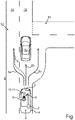
- a motor vehicle with an exemplary embodiment of a driver assistance device is shown in an example scenario, on the basis of which a method for operating the driver assistance device is to be explained.
- the motor vehicle 1 has a driver assistance device 2 with an environment sensor device 3, which in the present case is designed as a lidar, for capturing an environment 4 of the motor vehicle 1 and for providing information about the environment that represents the captured environment 4.
- the driver assistance system 2 also has a vehicle-internal sensor device 5, which in the present case is designed as a camera device, for detecting the behavior of a driver 6 of the motor vehicle 1 and for providing corresponding behavior information that represents the behavior of the driver 6.
- the driver assistance device 2 also has a computing device 7 which is designed to identify one or more possible driving maneuvers 8a to 8c for the motor vehicle 1 on the basis of the environmental information provided and to use the behavior information provided to recognize whether one of the identified driving maneuvers 8a to 8c is a is the driving maneuver intended by the driver 6.
- the different driving maneuvers are indicated by way of example with corresponding arrows and here comprise an overtaking maneuver 8a, a lane keeping maneuver 8b and a turning maneuver 8c. If an identified driving maneuver 8a to 8c is an intended driving maneuver, i.e.
- the computing device 7 is designed to provide a target driving trajectory 9 of the motor vehicle 1 for the intended driving maneuver 8a to c, in this case overtaking Maneuver 8a, and to check a steering input of the driver 6 recorded by a recording device 10 of the driver assistance device 2 to determine whether the steering input must be increased or weakened in order to guide the motor vehicle 1 along the target travel trajectory 9.
- the driver assistance device 2 in the present case also has a steering device 11 which is designed to increase or decrease the steering input of the driver 6 as a function of a result of the checking.
- motor vehicle 1 is now traveling on a road 12 behind another vehicle 13.
- a turning maneuver 8c is also possible in the present case due to a junction 14. All of this is recognized by the computing unit 7 on the basis of the environment information provided by the environment sensor device 3 or the corresponding possible driving maneuvers 8a to 8c are identified.
- further information for example map information which is stored in the driver assistance device 2, can also be taken into account.
- the computing device 7 can in the present case using the accelerator and conspicuous observation of the opposite lane of the road 12 recognize that the driver 6 intends to overtake the other vehicle 13, that is, intends an overtaking maneuver 8a. For this driving maneuver 8a identified as intended, the computing device 7 then calculates an optimal target driving trajectory 9, which corresponds to the best choice for implementing the overtaking maneuver 8a according to the optimality criteria stored in the computing device. This target travel trajectory 9 can of course be updated continuously. If the driver 6 does nothing, that is, does not make any input, in particular no steering input, then the driver assistance device 2 or the steering device 11 does not undertake any steering intervention either.
- the computing device 7 checks whether the steering input is amplified or should be weakened in order to guide the motor vehicle 1 along the target travel trajectory 9. Correspondingly, the driver 6 is only supported in his own activity, when making a change in the steering angle, in guiding the motor vehicle 1 along the ideal target driving trajectory 9 calculated for the overtaking maneuver 8a.
- the proposed method or the proposed driver assistance device 2 enables a number of advantageous applications here.
- An advantageous application is a dynamic adaptation of the optimal route as a function of a changing environment 4 of the motor vehicle 1.
- a driver 6 may have to cover a large distance on a country road or a motorway.
- the driver assistance device 2 continuously detects the surroundings 4 and the behavior of the driver 6 or an internal driving state of the motor vehicle 1. If no intended driving maneuver is identified here in which a lane change is intended, the driver assistance device 2 supports the driver 6 in driving the motor vehicle 1 on the optimal target travel trajectory 9 in one's own lane 15. As long as the environment sensor device 3 does not detect any obstacles in the lane 15 and If other vehicles in adjacent lanes 16 keep an appropriate safety distance, the target driving trajectory runs in the middle of the lane 15.
- the proposed driver assistance device 2 now actively supports the driver 6 in keeping the motor vehicle 1 on the target driving trajectory 9 in the middle of the lane 15 to keep.
- the target travel trajectory 9 is adapted using the stored optimality criteria.
- the center of the lane 15 will no longer be chosen as the best choice for the route of the motor vehicle 1, but rather a safety distance from any obstacles and / or other road users will be set to minimize the risk for all road users.
- the driver assistance device 2 will support the driver 6 in guiding the motor vehicle 1 along the adjusted target travel trajectory 9.
- Another advantageous application is the assisted steering of the motor vehicle 1 in an unusual traffic situation. For example, if the driver has to pass a road section on which construction work is taking place and the available lanes are correspondingly reduced in width and traffic may be diverted past the construction site over several winding road sections, other road users generally move unsafe and often come to their own Motor vehicle 2 or one's own lane 15 closer than desired. In such a situation, too, the driver 6 can accordingly decide to change a lane. In the present case, this is recognized on the basis of the behavioral information, the driver assistance device 2 now calculating an adapted target travel trajectory 9 for the support of the driver 6 for the narrowed lanes and the other vehicles 13 detected in the surroundings 4 as well as the corresponding geometry of the course of the lane. Since the driver assistance system 2 here continuously monitors and records the respective right and left boundaries of the road 12 and the lanes 15, 16, for example, the driver 6 can also be continuously supported in this, to always guide the motor vehicle 1 on an optimized driving trajectory 9 adapted to the respective circumstances.
- Another advantageous application relates to assistance in inner-city intersections.
- inner-city intersections and junctions with several lanes 15, 16 many drivers 6 have difficulties in finding the best route from one side of the intersection to the other side of the intersection, so that the distance between different vehicles is often very small and dangerous situations arise surrender.
- the proposed driver assistance device 2 optimizes the movement path here and supports the driver 6 in finding the best path across the intersection, even if, for example, there is currently no road marking in the driver's field of vision.
- the driver assistance device 2 can preferably also access map information stored in the computing device 7.
Landscapes
- Engineering & Computer Science (AREA)
- Transportation (AREA)
- Mechanical Engineering (AREA)
- Chemical & Material Sciences (AREA)
- Combustion & Propulsion (AREA)
- Automation & Control Theory (AREA)
- Traffic Control Systems (AREA)
- Control Of Driving Devices And Active Controlling Of Vehicle (AREA)
Claims (10)
- Procédé pour faire fonctionner un arrangement d'assistance au conducteur (2) d'un véhicule automobile (1), comprenant les étapes suivantes :a) détection d'un environnement (4) du véhicule automobile (1) par un dispositif de détection d'environnement (3) de l'arrangement d'assistance au conducteur (2) ;b) fourniture d'une information d'environnement, laquelle représente l'environnement (4) détecté, à un dispositif de calcul (7) de l'arrangement d'assistance au conducteur (2) ;c) identification d'une ou de plusieurs manœuvres de conduite (8a, 8b, 8c) possibles pour le véhicule automobile (1) à l'aide de l'information d'environnement par le dispositif de calcul (7), la ou les manœuvres de conduite (8a, 8b, 8c) identifiées étant sélectionnées dans un groupe de manœuvres de conduite qui comprend une manœuvre de maintien de trajectoire (8b) et/ou une manœuvre de dépassement (8a) et/ou une manœuvre de changement de voie et/ou une manœuvre d'évitement ;d) détection d'un comportement d'un conducteur (6) du véhicule automobile (1) par un dispositif détecteur (5) interne au véhicule ;e) fourniture, au dispositif de calcul (7), d'une information de comportement qui représente le comportement du conducteur (6) ;f) reconnaissance, par le dispositif de calcul (7), à l'aide de l'information de comportement fournie, si l'une des manœuvres de conduite (8a, 8b, 8c) identifiées est une manœuvre de conduite (8a) prévue par le conducteur (6) ;caractérisé en ce que
dans le cas où une manœuvre de conduite (8a, 8b, 8c) identifiée est une manœuvre de conduite (8a) prévue :g) calcul d'une trajectoire de conduite voulue (9) du véhicule automobile (1) pour la manœuvre de conduite (8a) prévue par le dispositif de calcul (7) ;h) détection d'une intervention de braquage du conducteur (6) et vérification si l'intervention de braquage doit être amplifiée ou affaiblie en vue de guider le véhicule automobile (1) le long de la trajectoire de conduite voulue (9) ;i) amplification ou affaiblissement de l'intervention de braquage en fonction d'un résultat de la vérification, la détection selon l'étape h) et l'amplification ou l'affaiblissement selon l'étape i) étant effectués en continu pour une trajectoire de conduite voulue (9) calculée. - Procédé selon la revendication 1, caractérisé en ce que l'amplification ou l'affaiblissement selon l'étape i), notamment aussi la détection avec la vérification selon l'étape h) et/ou le calcul selon l'étape g) ne sont effectués que si dans le cas de la reconnaissance selon l'étape f), une manœuvre de conduite (8a, 8b, 8c) prévue a été reconnue à l'aide de l'information de comportement.
- Procédé selon l'une des revendications précédentes, caractérisé en ce que la trajectoire de conduite voulue (9) calculée comprend également une courbe de vitesse de consigne le long de la trajectoire de conduite voulue (9) et une intervention d'accélération du conducteur (6) est également détectée et un contrôle est effectué afin de vérifier si l'intervention d'accélération doit être amplifiée ou affaiblie en vue de guider le véhicule automobile (1) avec la courbe de vitesse de consigne le long de la trajectoire de conduite voulue (9), et une amplification ou un affaiblissement de l'intervention d'accélération est effectué(e) en fonction d'un résultat de la vérification.
- Procédé selon l'une des revendications précédentes, caractérisé en ce que l'information de comportement comporte une information d'un dispositif de saisie interne au véhicule, notamment une information d'angle de braquage et/ou une information d'itinéraire et/ou une information de changement de direction de conduite et/ou une information d'un dispositif de détection interne au véhicule, notamment une information à propos d'une direction du regard du conducteur (6) et/ou une information de vitesse.
- Procédé selon l'une des revendications précédentes, caractérisé en ce qu'un état de conduite du véhicule automobile (1) est détecté par un dispositif détecteur (5) interne au véhicule et une information d'état de conduite, qui représente l'état du véhicule automobile (1), est fournie au dispositif de calcul (7) et le dispositif de calcul (7) identifie également la ou les manœuvres de conduite (8a, 8b, 8c) à l'aide de l'information d'état de conduite.
- Procédé selon l'une des revendications précédentes, caractérisé en ce que la manœuvre d'évitement comprend une manœuvre d'évitement d'urgence.
- Procédé selon l'une des revendications précédentes, caractérisé en ce que l'arrangement d'assistance au conducteur est un arrangement d'assistance au maintien de la trajectoire.
- Arrangement d'assistance au conducteur (2) pour un véhicule automobile (1), comprenant :- un dispositif de détection d'environnement (3) destiné à détecter un environnement (4) du véhicule automobile (1) et à fournir une information d'environnement, laquelle représente l'environnement (4) détecté ;- un dispositif détecteur (5) interne au véhicule destiné à détecter un comportement d'un conducteur (6) du véhicule automobile (1) et à fournir une information de comportement qui représente le comportement du conducteur (6) ;caractérisé par- un dispositif de calcul (7) qui est configuré pour, à l'aide de l'information d'environnement fournie, identifier une ou plusieurs manœuvres de conduite (8a, 8b, 8c) possibles pour le véhicule automobile (1), la ou les manœuvres de conduite (8a, 8b, 8c) identifiées étant sélectionnées dans un groupe de manœuvres de conduite qui comprend une manœuvre de maintien de trajectoire (8b) et/ou une manœuvre de dépassement (8a) et/ou une manœuvre de changement de voie et/ou une manœuvre d'évitement, et le dispositif de calcul (7) étant en outre configuré pour reconnaître, à l'aide de l'information de comportement fournie, si l'une des manœuvres de conduite (8a, 8b, 8c) identifiées est une manœuvre de conduite (8a) prévue par le conducteur (6) ;caractérisé en ce que
dans le cas où une manœuvre de conduite (8a, 8b, 8c) identifiée est une manœuvre de conduite (8a) prévue, une trajectoire de conduite voulue (9) du véhicule automobile (1) pour la manœuvre de conduite (8a) prévue est calculée et une intervention de braquage du conducteur (6) détectée par un dispositif de détection (10) de l'arrangement d'assistance au conducteur (2) est soumis à contrôle afin de vérifier si l'intervention de braquage doit être amplifiée ou affaiblie en vue de guider le véhicule automobile (1) le long de la trajectoire de conduite voulue (9) ; et- un dispositif de braquage (11) qui est configuré pour amplifier ou affaiblir l'intervention de braquage du conducteur (6) en fonction d'un résultat de la vérification,la détection par le dispositif de détection (10) ainsi que la vérification et l'amplification ou l'affaiblissement par le dispositif de braquage (11) étant effectués en continu pour une trajectoire de conduite voulue (9) calculée. - Arrangement d'assistance au conducteur (2) selon la revendication 8, caractérisé en ce que le dispositif de détection d'environnement (3) possède une unité de caméra, notamment une unité de caméra avant, et/ou une unité de lidar et/ou une unité de radar et/ou une unité à ultrasons.
- Véhicule automobile (1) équipé d'un arrangement d'assistance au conducteur (2) selon la revendication 8 ou 9.
Applications Claiming Priority (1)
| Application Number | Priority Date | Filing Date | Title |
|---|---|---|---|
| DE102017118400.7A DE102017118400A1 (de) | 2017-08-11 | 2017-08-11 | Fahrerunterstützung beim Folgen einer Soll-Fahrtrajektorie eines Kraftfahrzeugs |
Publications (2)
| Publication Number | Publication Date |
|---|---|
| EP3441289A1 EP3441289A1 (fr) | 2019-02-13 |
| EP3441289B1 true EP3441289B1 (fr) | 2020-09-09 |
Family
ID=63293935
Family Applications (1)
| Application Number | Title | Priority Date | Filing Date |
|---|---|---|---|
| EP18187645.9A Active EP3441289B1 (fr) | 2017-08-11 | 2018-08-07 | Aide à la conduite lors de la suivie d'une trajectoire de conduite de consigne d'un véhicule automobile |
Country Status (2)
| Country | Link |
|---|---|
| EP (1) | EP3441289B1 (fr) |
| DE (1) | DE102017118400A1 (fr) |
Families Citing this family (4)
| Publication number | Priority date | Publication date | Assignee | Title |
|---|---|---|---|---|
| DE102021203404B4 (de) * | 2021-04-07 | 2024-06-13 | Robert Bosch Gesellschaft mit beschränkter Haftung | Verfahren zum Manövrieren eines Fahrzeugs |
| DE102022209448A1 (de) | 2022-09-09 | 2024-03-14 | Continental Autonomous Mobility Germany GmbH | Verfahren und Fahrerassistenzvorrichtung zur dynamischen Planung einer Trajektorie während einer zumindest teilautomatisierten Führung eines Fahrzeugs |
| DE102023115923A1 (de) * | 2023-06-19 | 2024-12-19 | Bayerische Motoren Werke Aktiengesellschaft | Assistenzsystem zum Unterstützen eines Fahrers eines Fahrzeugs bei einer Querführung des Fahrzeugs im Bereich von Abzweigungen von Fahrbahnen, Fahrzeug sowie Verfahren |
| CN122143923A (zh) * | 2024-12-04 | 2026-06-05 | 通用汽车环球科技运作有限责任公司 | 通知及促进辅助驾驶即将进行动作的多选择的方法和系统 |
Family Cites Families (5)
| Publication number | Priority date | Publication date | Assignee | Title |
|---|---|---|---|---|
| JP4229051B2 (ja) * | 2004-11-26 | 2009-02-25 | 日産自動車株式会社 | 運転意図推定装置、車両用運転操作補助装置および車両用運転操作補助装置を備えた車両 |
| US8983765B2 (en) | 2006-10-11 | 2015-03-17 | GM Global Technology Operations LLC | Method and system for lane centering control |
| DE102010049586A1 (de) * | 2010-10-26 | 2012-04-26 | Daimler Ag | Verfahren zur Unterstützung eines Fahrzeugführers eines Fahrzeugs bei der Ansteuerung einer Zielposition |
| EP2711908A4 (fr) * | 2011-05-20 | 2015-01-21 | Honda Motor Co Ltd | Système d'aide au changement de file |
| DE102012214847A1 (de) | 2012-08-21 | 2014-03-27 | Robert Bosch Gmbh | Verfahren und Vorrichtung zum Führen eines Fahrzeugs innerhalb eines Fahrstreifens |
-
2017
- 2017-08-11 DE DE102017118400.7A patent/DE102017118400A1/de not_active Withdrawn
-
2018
- 2018-08-07 EP EP18187645.9A patent/EP3441289B1/fr active Active
Non-Patent Citations (1)
| Title |
|---|
| None * |
Also Published As
| Publication number | Publication date |
|---|---|
| EP3441289A1 (fr) | 2019-02-13 |
| DE102017118400A1 (de) | 2019-02-14 |
Similar Documents
| Publication | Publication Date | Title |
|---|---|---|
| DE102009017152B4 (de) | Verfahren und Vorrichtung zur Längs- und Querführung eines Kraftfahrzeugs | |
| EP3250426B1 (fr) | Procédé et dispositif pour faire fonctionner un véhicule | |
| EP2253499B1 (fr) | Véhicule automobile doté d'un système d'assistance au conducteur pour le guidage latéral du véhicule automobile et procédé destiné à l'assistance au conducteur du véhicule automobile lors de l'arrêt d'une voie de circulation | |
| EP3497686B1 (fr) | Procédé de vérification d'une condition de dépassement possible | |
| DE102015201588B4 (de) | Verfahren und System zur Durchführung einer automatischen Steuerung der Bewegung eines Fahrzeugs | |
| EP3181422B1 (fr) | Procédé et système de commande automatique d'un véhicule suiveur comprenant un véhicule scout | |
| EP2862767B1 (fr) | Véhicule automobile et procédé de commande d'un véhicule automobile | |
| EP2234864B1 (fr) | Systeme d'aide à la conduite et procede pour aider le conducteur d'un vehicule automobile à respecter une trajectoire delimitee par des marquages de voie | |
| EP2888139B1 (fr) | Système d'aide à la conduite et procédé pour faire fonctionner le système d'aide à la conduite | |
| EP4096955B1 (fr) | Procédé pour faire fonctionner un système d'assistance | |
| DE102013013865B3 (de) | Verfahren zum Betrieb eines Kraftfahrzeugs mit einem Sicherheitssystem und einem vollautomatischen Fahrerassistenzsystem und Kraftfahrzeug | |
| EP3105092B1 (fr) | Procédé d'utilisation d'un système de véhicule conçu pour la conduite au moins partiellement automatique d'un véhicule et véhicule automobile | |
| EP3341266B1 (fr) | Dispositif d'aide au maintien dans la voie de circulation, véhicule automobile équipé d'un tel dispositif d'aide au maintien dans la voie de circulation et procédé de surveillance de trajectoire latérale | |
| DE102018130243A1 (de) | Erweitertes Szenario für Autobahnassistenten | |
| DE102014107302B4 (de) | Verfahren zum zumindest semi-autonomen Manövrieren eines Kraftfahrzeugs entlang einer benutzerseitig vorgebbaren Fahrtrajektorie sowie Fahrerassistenzeinrichtung und Kraftfahrzeug | |
| EP3313714B1 (fr) | Système d'aide en cas de zone étroite pour un véhicule automobile | |
| DE102008011128B4 (de) | Fahrassistenzsteuereinheit, Fahrassistenzsystem und Assistenzverfahren zum Unterstützen eines kollisionsfreien Führen eines Kraftfahrzeugs | |
| DE102011011120B4 (de) | Verfahren und Vorrichtung zum Unterstützen eines Fahrspurwechsels | |
| EP3441289A1 (fr) | Aide à la conduite lors de la suivie d'une trajectoire de conduite de consigne d'un véhicule automobile | |
| DE102021206886A1 (de) | Verfahren zum Betreiben eines Fahrerassistenzsystems eines Fahrzeugs und Fahrzeug | |
| DE102019201590B4 (de) | Verfahren und Vorrichtung zum Vermeiden einer Kollision eines Fahrzeugs mit einem entgegenkommenden Fahrzeug | |
| DE102010049586A1 (de) | Verfahren zur Unterstützung eines Fahrzeugführers eines Fahrzeugs bei der Ansteuerung einer Zielposition | |
| DE102013219414A1 (de) | Verfahren und Vorrichtung zur Bereitstellung einer prädiktiven Fahrzeugbewegungsinformation für ein Fahrerassistenzsystem eines Fahrzeugs | |
| DE102015205930A1 (de) | Automatisches Führen eines Fahrzeugs | |
| DE102024208675A1 (de) | Verfahren zum Betrieb eines Kraftfahrzeugs |
Legal Events
| Date | Code | Title | Description |
|---|---|---|---|
| PUAI | Public reference made under article 153(3) epc to a published international application that has entered the european phase |
Free format text: ORIGINAL CODE: 0009012 |
|
| STAA | Information on the status of an ep patent application or granted ep patent |
Free format text: STATUS: THE APPLICATION HAS BEEN PUBLISHED |
|
| AK | Designated contracting states |
Kind code of ref document: A1 Designated state(s): AL AT BE BG CH CY CZ DE DK EE ES FI FR GB GR HR HU IE IS IT LI LT LU LV MC MK MT NL NO PL PT RO RS SE SI SK SM TR |
|
| AX | Request for extension of the european patent |
Extension state: BA ME |
|
| STAA | Information on the status of an ep patent application or granted ep patent |
Free format text: STATUS: REQUEST FOR EXAMINATION WAS MADE |
|
| 17P | Request for examination filed |
Effective date: 20190808 |
|
| RBV | Designated contracting states (corrected) |
Designated state(s): AL AT BE BG CH CY CZ DE DK EE ES FI FR GB GR HR HU IE IS IT LI LT LU LV MC MK MT NL NO PL PT RO RS SE SI SK SM TR |
|
| GRAP | Despatch of communication of intention to grant a patent |
Free format text: ORIGINAL CODE: EPIDOSNIGR1 |
|
| STAA | Information on the status of an ep patent application or granted ep patent |
Free format text: STATUS: GRANT OF PATENT IS INTENDED |
|
| INTG | Intention to grant announced |
Effective date: 20200416 |
|
| GRAS | Grant fee paid |
Free format text: ORIGINAL CODE: EPIDOSNIGR3 |
|
| GRAA | (expected) grant |
Free format text: ORIGINAL CODE: 0009210 |
|
| STAA | Information on the status of an ep patent application or granted ep patent |
Free format text: STATUS: THE PATENT HAS BEEN GRANTED |
|
| AK | Designated contracting states |
Kind code of ref document: B1 Designated state(s): AL AT BE BG CH CY CZ DE DK EE ES FI FR GB GR HR HU IE IS IT LI LT LU LV MC MK MT NL NO PL PT RO RS SE SI SK SM TR |
|
| REG | Reference to a national code |
Ref country code: GB Ref legal event code: FG4D Free format text: NOT ENGLISH |
|
| REG | Reference to a national code |
Ref country code: AT Ref legal event code: REF Ref document number: 1311248 Country of ref document: AT Kind code of ref document: T Effective date: 20200915 Ref country code: CH Ref legal event code: EP |
|
| REG | Reference to a national code |
Ref country code: IE Ref legal event code: FG4D Free format text: LANGUAGE OF EP DOCUMENT: GERMAN |
|
| REG | Reference to a national code |
Ref country code: DE Ref legal event code: R096 Ref document number: 502018002374 Country of ref document: DE |
|
| REG | Reference to a national code |
Ref country code: LT Ref legal event code: MG4D |
|
| PG25 | Lapsed in a contracting state [announced via postgrant information from national office to epo] |
Ref country code: SE Free format text: LAPSE BECAUSE OF FAILURE TO SUBMIT A TRANSLATION OF THE DESCRIPTION OR TO PAY THE FEE WITHIN THE PRESCRIBED TIME-LIMIT Effective date: 20200909 Ref country code: BG Free format text: LAPSE BECAUSE OF FAILURE TO SUBMIT A TRANSLATION OF THE DESCRIPTION OR TO PAY THE FEE WITHIN THE PRESCRIBED TIME-LIMIT Effective date: 20201209 Ref country code: HR Free format text: LAPSE BECAUSE OF FAILURE TO SUBMIT A TRANSLATION OF THE DESCRIPTION OR TO PAY THE FEE WITHIN THE PRESCRIBED TIME-LIMIT Effective date: 20200909 Ref country code: NO Free format text: LAPSE BECAUSE OF FAILURE TO SUBMIT A TRANSLATION OF THE DESCRIPTION OR TO PAY THE FEE WITHIN THE PRESCRIBED TIME-LIMIT Effective date: 20201209 Ref country code: FI Free format text: LAPSE BECAUSE OF FAILURE TO SUBMIT A TRANSLATION OF THE DESCRIPTION OR TO PAY THE FEE WITHIN THE PRESCRIBED TIME-LIMIT Effective date: 20200909 Ref country code: LT Free format text: LAPSE BECAUSE OF FAILURE TO SUBMIT A TRANSLATION OF THE DESCRIPTION OR TO PAY THE FEE WITHIN THE PRESCRIBED TIME-LIMIT Effective date: 20200909 Ref country code: GR Free format text: LAPSE BECAUSE OF FAILURE TO SUBMIT A TRANSLATION OF THE DESCRIPTION OR TO PAY THE FEE WITHIN THE PRESCRIBED TIME-LIMIT Effective date: 20201210 |
|
| REG | Reference to a national code |
Ref country code: NL Ref legal event code: MP Effective date: 20200909 |
|
| PG25 | Lapsed in a contracting state [announced via postgrant information from national office to epo] |
Ref country code: LV Free format text: LAPSE BECAUSE OF FAILURE TO SUBMIT A TRANSLATION OF THE DESCRIPTION OR TO PAY THE FEE WITHIN THE PRESCRIBED TIME-LIMIT Effective date: 20200909 Ref country code: PL Free format text: LAPSE BECAUSE OF FAILURE TO SUBMIT A TRANSLATION OF THE DESCRIPTION OR TO PAY THE FEE WITHIN THE PRESCRIBED TIME-LIMIT Effective date: 20200909 Ref country code: RS Free format text: LAPSE BECAUSE OF FAILURE TO SUBMIT A TRANSLATION OF THE DESCRIPTION OR TO PAY THE FEE WITHIN THE PRESCRIBED TIME-LIMIT Effective date: 20200909 |
|
| PG25 | Lapsed in a contracting state [announced via postgrant information from national office to epo] |
Ref country code: SM Free format text: LAPSE BECAUSE OF FAILURE TO SUBMIT A TRANSLATION OF THE DESCRIPTION OR TO PAY THE FEE WITHIN THE PRESCRIBED TIME-LIMIT Effective date: 20200909 Ref country code: EE Free format text: LAPSE BECAUSE OF FAILURE TO SUBMIT A TRANSLATION OF THE DESCRIPTION OR TO PAY THE FEE WITHIN THE PRESCRIBED TIME-LIMIT Effective date: 20200909 Ref country code: PT Free format text: LAPSE BECAUSE OF FAILURE TO SUBMIT A TRANSLATION OF THE DESCRIPTION OR TO PAY THE FEE WITHIN THE PRESCRIBED TIME-LIMIT Effective date: 20210111 Ref country code: RO Free format text: LAPSE BECAUSE OF FAILURE TO SUBMIT A TRANSLATION OF THE DESCRIPTION OR TO PAY THE FEE WITHIN THE PRESCRIBED TIME-LIMIT Effective date: 20200909 Ref country code: CZ Free format text: LAPSE BECAUSE OF FAILURE TO SUBMIT A TRANSLATION OF THE DESCRIPTION OR TO PAY THE FEE WITHIN THE PRESCRIBED TIME-LIMIT Effective date: 20200909 |
|
| PG25 | Lapsed in a contracting state [announced via postgrant information from national office to epo] |
Ref country code: IS Free format text: LAPSE BECAUSE OF FAILURE TO SUBMIT A TRANSLATION OF THE DESCRIPTION OR TO PAY THE FEE WITHIN THE PRESCRIBED TIME-LIMIT Effective date: 20210109 Ref country code: ES Free format text: LAPSE BECAUSE OF FAILURE TO SUBMIT A TRANSLATION OF THE DESCRIPTION OR TO PAY THE FEE WITHIN THE PRESCRIBED TIME-LIMIT Effective date: 20200909 Ref country code: AL Free format text: LAPSE BECAUSE OF FAILURE TO SUBMIT A TRANSLATION OF THE DESCRIPTION OR TO PAY THE FEE WITHIN THE PRESCRIBED TIME-LIMIT Effective date: 20200909 |
|
| REG | Reference to a national code |
Ref country code: DE Ref legal event code: R097 Ref document number: 502018002374 Country of ref document: DE |
|
| PG25 | Lapsed in a contracting state [announced via postgrant information from national office to epo] |
Ref country code: SK Free format text: LAPSE BECAUSE OF FAILURE TO SUBMIT A TRANSLATION OF THE DESCRIPTION OR TO PAY THE FEE WITHIN THE PRESCRIBED TIME-LIMIT Effective date: 20200909 |
|
| PLBE | No opposition filed within time limit |
Free format text: ORIGINAL CODE: 0009261 |
|
| STAA | Information on the status of an ep patent application or granted ep patent |
Free format text: STATUS: NO OPPOSITION FILED WITHIN TIME LIMIT |
|
| 26N | No opposition filed |
Effective date: 20210610 |
|
| PG25 | Lapsed in a contracting state [announced via postgrant information from national office to epo] |
Ref country code: DK Free format text: LAPSE BECAUSE OF FAILURE TO SUBMIT A TRANSLATION OF THE DESCRIPTION OR TO PAY THE FEE WITHIN THE PRESCRIBED TIME-LIMIT Effective date: 20200909 Ref country code: SI Free format text: LAPSE BECAUSE OF FAILURE TO SUBMIT A TRANSLATION OF THE DESCRIPTION OR TO PAY THE FEE WITHIN THE PRESCRIBED TIME-LIMIT Effective date: 20200909 |
|
| PG25 | Lapsed in a contracting state [announced via postgrant information from national office to epo] |
Ref country code: IT Free format text: LAPSE BECAUSE OF FAILURE TO SUBMIT A TRANSLATION OF THE DESCRIPTION OR TO PAY THE FEE WITHIN THE PRESCRIBED TIME-LIMIT Effective date: 20200909 |
|
| REG | Reference to a national code |
Ref country code: CH Ref legal event code: PL |
|
| PG25 | Lapsed in a contracting state [announced via postgrant information from national office to epo] |
Ref country code: MC Free format text: LAPSE BECAUSE OF FAILURE TO SUBMIT A TRANSLATION OF THE DESCRIPTION OR TO PAY THE FEE WITHIN THE PRESCRIBED TIME-LIMIT Effective date: 20200909 |
|
| REG | Reference to a national code |
Ref country code: BE Ref legal event code: MM Effective date: 20210831 |
|
| PG25 | Lapsed in a contracting state [announced via postgrant information from national office to epo] |
Ref country code: LI Free format text: LAPSE BECAUSE OF NON-PAYMENT OF DUE FEES Effective date: 20210831 Ref country code: CH Free format text: LAPSE BECAUSE OF NON-PAYMENT OF DUE FEES Effective date: 20210831 |
|
| PG25 | Lapsed in a contracting state [announced via postgrant information from national office to epo] |
Ref country code: LU Free format text: LAPSE BECAUSE OF NON-PAYMENT OF DUE FEES Effective date: 20210807 |
|
| PG25 | Lapsed in a contracting state [announced via postgrant information from national office to epo] |
Ref country code: IE Free format text: LAPSE BECAUSE OF NON-PAYMENT OF DUE FEES Effective date: 20210807 Ref country code: BE Free format text: LAPSE BECAUSE OF NON-PAYMENT OF DUE FEES Effective date: 20210831 |
|
| GBPC | Gb: european patent ceased through non-payment of renewal fee |
Effective date: 20220807 |
|
| PG25 | Lapsed in a contracting state [announced via postgrant information from national office to epo] |
Ref country code: NL Free format text: LAPSE BECAUSE OF NON-PAYMENT OF DUE FEES Effective date: 20200923 Ref country code: CY Free format text: LAPSE BECAUSE OF FAILURE TO SUBMIT A TRANSLATION OF THE DESCRIPTION OR TO PAY THE FEE WITHIN THE PRESCRIBED TIME-LIMIT Effective date: 20200909 |
|
| P01 | Opt-out of the competence of the unified patent court (upc) registered |
Effective date: 20230528 |
|
| PG25 | Lapsed in a contracting state [announced via postgrant information from national office to epo] |
Ref country code: HU Free format text: LAPSE BECAUSE OF FAILURE TO SUBMIT A TRANSLATION OF THE DESCRIPTION OR TO PAY THE FEE WITHIN THE PRESCRIBED TIME-LIMIT; INVALID AB INITIO Effective date: 20180807 |
|
| PG25 | Lapsed in a contracting state [announced via postgrant information from national office to epo] |
Ref country code: GB Free format text: LAPSE BECAUSE OF NON-PAYMENT OF DUE FEES Effective date: 20220807 |
|
| PG25 | Lapsed in a contracting state [announced via postgrant information from national office to epo] |
Ref country code: MK Free format text: LAPSE BECAUSE OF FAILURE TO SUBMIT A TRANSLATION OF THE DESCRIPTION OR TO PAY THE FEE WITHIN THE PRESCRIBED TIME-LIMIT Effective date: 20200909 |
|
| PG25 | Lapsed in a contracting state [announced via postgrant information from national office to epo] |
Ref country code: MT Free format text: LAPSE BECAUSE OF FAILURE TO SUBMIT A TRANSLATION OF THE DESCRIPTION OR TO PAY THE FEE WITHIN THE PRESCRIBED TIME-LIMIT Effective date: 20200909 |
|
| REG | Reference to a national code |
Ref country code: AT Ref legal event code: MM01 Ref document number: 1311248 Country of ref document: AT Kind code of ref document: T Effective date: 20230807 |
|
| PG25 | Lapsed in a contracting state [announced via postgrant information from national office to epo] |
Ref country code: AT Free format text: LAPSE BECAUSE OF NON-PAYMENT OF DUE FEES Effective date: 20230807 |
|
| PG25 | Lapsed in a contracting state [announced via postgrant information from national office to epo] |
Ref country code: AT Free format text: LAPSE BECAUSE OF NON-PAYMENT OF DUE FEES Effective date: 20230807 |
|
| PGFP | Annual fee paid to national office [announced via postgrant information from national office to epo] |
Ref country code: DE Payment date: 20250812 Year of fee payment: 8 |
|
| PGFP | Annual fee paid to national office [announced via postgrant information from national office to epo] |
Ref country code: FR Payment date: 20250828 Year of fee payment: 8 |
|
| PG25 | Lapsed in a contracting state [announced via postgrant information from national office to epo] |
Ref country code: TR Free format text: LAPSE BECAUSE OF FAILURE TO SUBMIT A TRANSLATION OF THE DESCRIPTION OR TO PAY THE FEE WITHIN THE PRESCRIBED TIME-LIMIT Effective date: 20200909 |
|
| PGFP | Annual fee paid to national office [announced via postgrant information from national office to epo] |
Ref country code: AT Payment date: 20260410 Year of fee payment: 5 |