EP3441289B1 - Driver support when following a target driving trajectory of a motor vehicle - Google Patents
Driver support when following a target driving trajectory of a motor vehicle Download PDFInfo
- Publication number
- EP3441289B1 EP3441289B1 EP18187645.9A EP18187645A EP3441289B1 EP 3441289 B1 EP3441289 B1 EP 3441289B1 EP 18187645 A EP18187645 A EP 18187645A EP 3441289 B1 EP3441289 B1 EP 3441289B1
- Authority
- EP
- European Patent Office
- Prior art keywords
- driver
- motor vehicle
- driving
- information
- manoeuvre
- Prior art date
- Legal status (The legal status is an assumption and is not a legal conclusion. Google has not performed a legal analysis and makes no representation as to the accuracy of the status listed.)
- Active
Links
Images
Classifications
-
- B—PERFORMING OPERATIONS; TRANSPORTING
- B62—LAND VEHICLES FOR TRAVELLING OTHERWISE THAN ON RAILS
- B62D—MOTOR VEHICLES; TRAILERS
- B62D15/00—Steering not otherwise provided for
- B62D15/02—Steering position indicators ; Steering position determination; Steering aids
- B62D15/025—Active steering aids, e.g. helping the driver by actively influencing the steering system after environment evaluation
-
- B—PERFORMING OPERATIONS; TRANSPORTING
- B60—VEHICLES IN GENERAL
- B60W—CONJOINT CONTROL OF VEHICLE SUB-UNITS OF DIFFERENT TYPE OR DIFFERENT FUNCTION; CONTROL SYSTEMS SPECIALLY ADAPTED FOR HYBRID VEHICLES; ROAD VEHICLE DRIVE CONTROL SYSTEMS FOR PURPOSES NOT RELATED TO THE CONTROL OF A PARTICULAR SUB-UNIT
- B60W30/00—Purposes of road vehicle drive control systems not related to the control of a particular sub-unit, e.g. of systems using conjoint control of vehicle sub-units
- B60W30/18—Propelling the vehicle
- B60W30/18009—Propelling the vehicle related to particular drive situations
- B60W30/18163—Lane change; Overtaking manoeuvres
-
- B—PERFORMING OPERATIONS; TRANSPORTING
- B62—LAND VEHICLES FOR TRAVELLING OTHERWISE THAN ON RAILS
- B62D—MOTOR VEHICLES; TRAILERS
- B62D15/00—Steering not otherwise provided for
- B62D15/02—Steering position indicators ; Steering position determination; Steering aids
- B62D15/025—Active steering aids, e.g. helping the driver by actively influencing the steering system after environment evaluation
- B62D15/0255—Automatic changing of lane, e.g. for passing another vehicle
Definitions
- the invention relates to a method for operating a driver assistance device of a motor vehicle.
- the invention also relates to a driver assistance device for a motor vehicle, with an environment sensor device for detecting the surroundings of the motor vehicle and for providing information about the surroundings which represents the detected environment, and with a vehicle-internal sensor device for detecting the behavior of a driver of the motor vehicle and for providing behavior information, which represents the behavior of the driver.
- Advanced driver assistance systems in the motor vehicle are based on the monitoring of multimodal sensor data about the surroundings of the motor vehicle and on a vehicle-internal condition. Since these driver assistance devices analyze corresponding data from an environment sensor device and a vehicle-internal sensor device, they are able to predict a movement of the motor vehicle and to assess the environment of the motor vehicle. The evaluation of the information obtained enables the driver assistance devices to support a driver of the motor vehicle in driving the motor vehicle, in particular in performing driving maneuvers, and to point out possible dangers or to automatically perform specific maneuvers in order to avoid these dangers.
- driver assistance devices are a lane departure warning.
- lane markings in the vicinity of the motor vehicle are detected using suitable sensors. If the driver assistance device detects an impending crossing of a lane marking, it can automatically intervene in the steering process and counteract a steering input by the driver with a (small) counterforce. This prevents the driver from accidentally leaving the lane and increases his safety.
- a method for driving a vehicle within a lane is described.
- the driver is supported when driving within a lane without the system working against the driver's steering input. Rather, a predetermined target trajectory for the driver within the lane is determined and the system only intervenes in a correcting manner in order to maintain the target trajectory.
- the invention is therefore based on the object of providing a driver assistance device which assists the driver in keeping in a lane and can nevertheless react flexibly to changing situations and thus does not hinder the driver in a desired maneuver.
- the invention relates to a method for operating a driver assistance device of a motor vehicle, in particular a lane keeping assistance device of a motor vehicle, with a series of method steps.
- One method step here is a detection of the surroundings of the motor vehicle by an environmental sensor device of the driver assistance device.
- a further method step is providing information about the surroundings, which represents the detected surroundings, to a computing device of the driver assistance device by the surroundings sensor device.
- the next step here is an identification of at least one possible driving maneuver, that is to say one or more possible driving maneuvers, for the motor vehicle in the present driving situation on the basis of the environmental information by the computing device, the identified driving maneuver or maneuvers being selected from a group of driving maneuvers which include a Lane keeping maneuver and / or an overtaking maneuver and / or a lane change maneuver and / or an evasive maneuver.
- a driving maneuver thus comprises a series of control inputs which are used to reach a destination, for example to overtake another motor vehicle or to stay in a lane.
- the individual control inputs can also have different characteristics for the same driving maneuver, since, for example, keeping a lane through a large A variety of different control inputs can be achieved.
- the number of Driving maneuvers usually very small, i.e. less than five, since the surroundings and the respective driving situation severely limit the respective possible options of the driver.
- Another method step is a detection of the behavior of a driver of the motor vehicle by a vehicle-internal sensor device, for example a camera or a blinker input or actuation device. This is followed as the next method step by providing corresponding behavior information, which represents the detected behavior of the driver, to the computing device by the vehicle-internal sensor device.
- a subsequent method step is a recognition of whether one of the identified driving maneuvers is a driving maneuver intended by the driver, that is, whether one of the identified driving maneuvers corresponds to a driving intention of the driver, based on the behavior information provided, i.e. based on an analysis of the behavior information provided by the computing device.
- a further method step of this type is calculating a setpoint driving trajectory of the motor vehicle, which can also be referred to as the optimal driving trajectory, for the intended driving maneuver by the computing device.
- This can be derived on the basis of or as a function of the environmental information and in particular further information such as a course of the road, which is derived from map information, or such as the steering angle and / or a yaw rate and / or further parameters of the motor vehicle.
- Such optimal driving trajectories or target driving trajectories can also be determined here for all identified driving maneuvers, and the target trajectory of the intended driving maneuver can then be selected.
- a further procedural step is then a recording of a steering input, which can be understood here in the sense of a change in the steering angle, since compliance with an already set steering angle generally does not require any input from the driver, and checking whether the steering input has to be increased or decreased in order to achieve this To guide the motor vehicle along the target trajectory calculated for the intended driving maneuver.
- the steering input is then strengthened or weakened by the driver assistance device, with the detection of the steering input and the strengthening or weakening of the steering input being carried out continuously for a calculated target driving trajectory as a function of the result of the checking, for example by a steering device the driver assistance device.
- the steering input is amplified accordingly. If the check reveals that the steering input has to be weakened in order to guide the motor vehicle along the target driving trajectory, the driver assistance device weakening the steering input takes place accordingly. If the driver does not change the steering angle, and accordingly does not make any steering input, the steering angle remains unchanged by the driver assistance device, since there is no steering input in the sense of a steering angle change which could be increased or decreased.
- the target driving trajectory thus acts similar to the "magnetic" orientation lines in modern computer presentation applications, in which these magnetic lines help the user to arrange graphic elements on a worksheet in a precise and simple manner by supporting the positioning of the graphic elements.
- the graphic element approaches one of the orientation lines or approaches a position which should sensibly be arranged according to a corresponding stored specification of this element, it is attracted to this position or the line in the sense of an attractor.
- the position or orientation line is determined on the basis of a symmetry or a relative arrangement to other, for example similar, graphic elements in the worksheet. If a user now brings the graphic element close to the corresponding position or line, the approach is intensified and the graphic element is automatically and precisely arranged on the line or position. Correspondingly, removal from this position is made more difficult by weakening the movement of the graphic element.
- the invention therefore proposes a method for supporting a driver in driving a motor vehicle, in which the driver assistance system or the driver assistance device determines the driving intention of the driver and supports the driver in executing the driving intention by the inputs of the driver, For example, steering and / or acceleration and / or further inputs, optimized, that is to say reinforced or weakened.
- An optimal target travel trajectory is determined, which corresponds to the driver's intention. Inputs from the driver are optimized to follow this target travel trajectory. If the driver does not make any input or if no driving intention is clearly identified, that is to say no intended driving maneuver is recognized, the driver assistance device will remain inactive and will not intervene.
- the degree of amplification or weakening which can be specified in absolute or relative terms, can be continuously adapted in order to improve the input of the driver for driving the motor vehicle along the target driving trajectory.
- the method including individual method steps, can in particular be carried out repeatedly.
- the driver assistance device does not assume any control function on its own, that is to say independently without any action by the driver, and is therefore particularly safe, similar to a brake booster, for example.
- the driver is less likely to be disturbed because the driver assistance system is only active when the driver is also active, so that he continues to have the feeling of complete control over the motor vehicle.
- the driver assistance device provides the functionality known from known lane departure warning systems, but is particularly flexible due to the identification of the intended driving maneuver of the driver and can support the driver in a variety of different maneuvers in the unobtrusive manner described without hindering him and thus improving safety Increase road traffic. Since the system does not reinforce or weaken an input from the driver if no intended driving maneuver has been detected, the susceptibility to errors and corresponding incorrect consequences are also reduced here.
- the driver assistance device thus inherently corresponds to an SAE level 2 system (partially automation).
- the amplification or weakening in particular also the detection with the checking and / or the calculation of the target driving trajectory, is only carried out if, when recognizing whether an identified driving maneuver is a driving maneuver intended by the driver is, an intended driving maneuver was clearly recognized, that is, it was recognized that a, in particular exactly one, identified driving maneuver corresponds to the driving intention of the driver.
- the calculated target travel trajectory also includes a target speed profile and / or a target acceleration profile along the target travel trajectory and also an acceleration input and / or speed input, that is, a brake pedal angle change and / or a gas pedal angle change of the driver is detected and it is checked whether the acceleration input and / or speed input of the driver must be increased or weakened in order to guide the motor vehicle with the target speed profile along the target driving trajectory, as well as an increase or decrease depending on a result of the check the acceleration input and / or speed input takes place.
- a speed of the motor vehicle can be reduced when turning, and a speed of the motor vehicle can be increased when overtaking, in order to increase the safety and comfort of the driver.
- the behavior information is information from a vehicle-internal input device, in particular steering angle information and / or route information that was entered into a route guidance device of the motor vehicle, and / or travel direction change information that is generated by actuating a turn signal control element in a travel direction change display device has been entered, and / or information from a vehicle-internal detection device, in particular information about a direction of view of the driver, which was detected via a vehicle-internal camera and / or speed or acceleration information about a speed or acceleration of the motor vehicle, which via a corresponding Speed and / or acceleration sensor was detected, includes.
- the speed or acceleration information can relate to a longitudinal and / or a transverse speed or acceleration.
- a vehicle-internal sensor device detects a driving state of the motor vehicle, and driving state information representing the state of the motor vehicle, for example a yaw rate and / or a speed, is provided to the computing device, and the computing device is one or the several driving maneuvers are also identified on the basis of the driving status information.
- the driving maneuvers can therefore not only be identified on the basis of information about the surroundings, but also on the basis of information on the driving state or vehicle state.
- the identified driving maneuver or maneuvers are selected from a group of driving maneuvers which include a lane keeping maneuver and / or an overtaking maneuver and / or a lane change maneuver and / or optionally an evasive maneuver, in particular an emergency evasive maneuver, and / or further maneuvers.
- the mentioned maneuvers in particular differ significantly, are therefore easy to identify as intended driving maneuvers and at the same time occur frequently in normal driving operation of the motor vehicle. Therefore, the identification of one of the mentioned driving maneuvers is particularly useful as a possibly intended driving maneuver in order to support the driver accordingly.
- the invention also relates to a driver assistance device for a motor vehicle, with an environment sensor device for detecting the surroundings of the motor vehicle and providing environment information that represents the detected environment and with a vehicle-internal sensor device for detecting the behavior of a driver of the motor vehicle and providing behavior information which represents the behavior of the driver.
- the driver assistance device also has a computing device which is designed to identify one or more possible driving maneuvers for the motor vehicle on the basis of the environmental situation provided and to use the behavior information provided to recognize whether one of the identified driving maneuvers is a driving maneuver intended by the driver , and, if an identified driving maneuver is an intended driving maneuver, to calculate a target driving trajectory of the motor vehicle for the intended driving maneuver and to check a steering input of the driver detected by a detection device of the driver assistance device to determine whether the steering input needs to be increased or weakened in order to To guide motor vehicle along the target driving trajectory.
- the driver assistance device preferably also has a steering device which is designed to increase or decrease the steering input of the driver as a function of a result of the checking of the steering input.
- the environment sensor device has a camera unit, in particular a front camera unit for front-side arrangement on the motor vehicle, and / or a lidar unit, a light detection and ranging unit, i.e. a unit for optical speed and / or distance determination, and / or a radar unit and / or an ultrasound unit.
- a camera unit in particular a front camera unit for front-side arrangement on the motor vehicle, and / or a lidar unit
- a light detection and ranging unit i.e. a unit for optical speed and / or distance determination
- a radar unit and / or an ultrasound unit i.e. a radar unit and / or an ultrasound unit.
- the units mentioned are particularly suitable here in the field of motor vehicles in order to detect the surroundings of the motor vehicle particularly precisely and reliably and are therefore particularly suitable for the driver assistance device or the method described. Since many of the units mentioned are often already present in a motor vehicle, the advantages described can also be achieved here with a large synergetic effect without additional hardware outlay or with little additional hardware outlay.
- the invention also relates to a motor vehicle with such a driver assistance device.
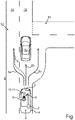
- a motor vehicle with an exemplary embodiment of a driver assistance device is shown in an example scenario, on the basis of which a method for operating the driver assistance device is to be explained.
- the motor vehicle 1 has a driver assistance device 2 with an environment sensor device 3, which in the present case is designed as a lidar, for capturing an environment 4 of the motor vehicle 1 and for providing information about the environment that represents the captured environment 4.
- the driver assistance system 2 also has a vehicle-internal sensor device 5, which in the present case is designed as a camera device, for detecting the behavior of a driver 6 of the motor vehicle 1 and for providing corresponding behavior information that represents the behavior of the driver 6.
- the driver assistance device 2 also has a computing device 7 which is designed to identify one or more possible driving maneuvers 8a to 8c for the motor vehicle 1 on the basis of the environmental information provided and to use the behavior information provided to recognize whether one of the identified driving maneuvers 8a to 8c is a is the driving maneuver intended by the driver 6.
- the different driving maneuvers are indicated by way of example with corresponding arrows and here comprise an overtaking maneuver 8a, a lane keeping maneuver 8b and a turning maneuver 8c. If an identified driving maneuver 8a to 8c is an intended driving maneuver, i.e.
- the computing device 7 is designed to provide a target driving trajectory 9 of the motor vehicle 1 for the intended driving maneuver 8a to c, in this case overtaking Maneuver 8a, and to check a steering input of the driver 6 recorded by a recording device 10 of the driver assistance device 2 to determine whether the steering input must be increased or weakened in order to guide the motor vehicle 1 along the target travel trajectory 9.
- the driver assistance device 2 in the present case also has a steering device 11 which is designed to increase or decrease the steering input of the driver 6 as a function of a result of the checking.
- motor vehicle 1 is now traveling on a road 12 behind another vehicle 13.
- a turning maneuver 8c is also possible in the present case due to a junction 14. All of this is recognized by the computing unit 7 on the basis of the environment information provided by the environment sensor device 3 or the corresponding possible driving maneuvers 8a to 8c are identified.
- further information for example map information which is stored in the driver assistance device 2, can also be taken into account.
- the computing device 7 can in the present case using the accelerator and conspicuous observation of the opposite lane of the road 12 recognize that the driver 6 intends to overtake the other vehicle 13, that is, intends an overtaking maneuver 8a. For this driving maneuver 8a identified as intended, the computing device 7 then calculates an optimal target driving trajectory 9, which corresponds to the best choice for implementing the overtaking maneuver 8a according to the optimality criteria stored in the computing device. This target travel trajectory 9 can of course be updated continuously. If the driver 6 does nothing, that is, does not make any input, in particular no steering input, then the driver assistance device 2 or the steering device 11 does not undertake any steering intervention either.
- the computing device 7 checks whether the steering input is amplified or should be weakened in order to guide the motor vehicle 1 along the target travel trajectory 9. Correspondingly, the driver 6 is only supported in his own activity, when making a change in the steering angle, in guiding the motor vehicle 1 along the ideal target driving trajectory 9 calculated for the overtaking maneuver 8a.
- the proposed method or the proposed driver assistance device 2 enables a number of advantageous applications here.
- An advantageous application is a dynamic adaptation of the optimal route as a function of a changing environment 4 of the motor vehicle 1.
- a driver 6 may have to cover a large distance on a country road or a motorway.
- the driver assistance device 2 continuously detects the surroundings 4 and the behavior of the driver 6 or an internal driving state of the motor vehicle 1. If no intended driving maneuver is identified here in which a lane change is intended, the driver assistance device 2 supports the driver 6 in driving the motor vehicle 1 on the optimal target travel trajectory 9 in one's own lane 15. As long as the environment sensor device 3 does not detect any obstacles in the lane 15 and If other vehicles in adjacent lanes 16 keep an appropriate safety distance, the target driving trajectory runs in the middle of the lane 15.
- the proposed driver assistance device 2 now actively supports the driver 6 in keeping the motor vehicle 1 on the target driving trajectory 9 in the middle of the lane 15 to keep.
- the target travel trajectory 9 is adapted using the stored optimality criteria.
- the center of the lane 15 will no longer be chosen as the best choice for the route of the motor vehicle 1, but rather a safety distance from any obstacles and / or other road users will be set to minimize the risk for all road users.
- the driver assistance device 2 will support the driver 6 in guiding the motor vehicle 1 along the adjusted target travel trajectory 9.
- Another advantageous application is the assisted steering of the motor vehicle 1 in an unusual traffic situation. For example, if the driver has to pass a road section on which construction work is taking place and the available lanes are correspondingly reduced in width and traffic may be diverted past the construction site over several winding road sections, other road users generally move unsafe and often come to their own Motor vehicle 2 or one's own lane 15 closer than desired. In such a situation, too, the driver 6 can accordingly decide to change a lane. In the present case, this is recognized on the basis of the behavioral information, the driver assistance device 2 now calculating an adapted target travel trajectory 9 for the support of the driver 6 for the narrowed lanes and the other vehicles 13 detected in the surroundings 4 as well as the corresponding geometry of the course of the lane. Since the driver assistance system 2 here continuously monitors and records the respective right and left boundaries of the road 12 and the lanes 15, 16, for example, the driver 6 can also be continuously supported in this, to always guide the motor vehicle 1 on an optimized driving trajectory 9 adapted to the respective circumstances.
- Another advantageous application relates to assistance in inner-city intersections.
- inner-city intersections and junctions with several lanes 15, 16 many drivers 6 have difficulties in finding the best route from one side of the intersection to the other side of the intersection, so that the distance between different vehicles is often very small and dangerous situations arise surrender.
- the proposed driver assistance device 2 optimizes the movement path here and supports the driver 6 in finding the best path across the intersection, even if, for example, there is currently no road marking in the driver's field of vision.
- the driver assistance device 2 can preferably also access map information stored in the computing device 7.
Landscapes
- Engineering & Computer Science (AREA)
- Transportation (AREA)
- Mechanical Engineering (AREA)
- Chemical & Material Sciences (AREA)
- Combustion & Propulsion (AREA)
- Automation & Control Theory (AREA)
- Traffic Control Systems (AREA)
- Control Of Driving Devices And Active Controlling Of Vehicle (AREA)
Description
Die Erfindung betrifft ein Verfahren zum Betreiben einer Fahrerassistenzvorrichtung eines Kraftfahrzeugs. Die Erfindung betrifft auch eine Fahrerassistenzvorrichtung für ein Kraftfahrzeug, mit einer Umgebungssensoreinrichtung zum Erfassen einer Umgebung des Kraftfahrzeugs und zum Bereitstellen einer Umgebungsinformation, welche die erfasste Umgebung repräsentiert, und mit einer fahrzeuginternen Sensoreinrichtung zum Erfassen eines Verhaltens eines Fahrers des Kraftfahrzeugs und zum Bereitstellen einer Verhaltensinformation, welche das Verhalten des Fahrers repräsentiert.The invention relates to a method for operating a driver assistance device of a motor vehicle. The invention also relates to a driver assistance device for a motor vehicle, with an environment sensor device for detecting the surroundings of the motor vehicle and for providing information about the surroundings which represents the detected environment, and with a vehicle-internal sensor device for detecting the behavior of a driver of the motor vehicle and for providing behavior information, which represents the behavior of the driver.
Fortgeschrittene Fahrerassistenzsysteme im Kraftfahrzeug basieren auf dem Überwachen multimodaler Sensordaten über eine Umgebung des Kraftfahrzeugs sowie auf einem fahrzeuginternen Zustand. Indem diese Fahrerassistenzvorrichtungen entsprechende Daten einer Umgebungssensoreinrichtung und einer fahrzeuginternen Sensorvorrichtung analysieren, sind sie dazu in der Lage, eine Bewegung des Kraftfahrzeugs vorherzusagen und die Umgebung des Kraftfahrzeugs einzuschätzen. Die Auswertung der gewonnenen Informationen befähigt die Fahrerassistenzvorrichtungen dazu, einen Fahrer des Kraftfahrzeugs bei dem Führen des Kraftfahrzeugs, insbesondere bei dem Durchführen von Fahrmanövern, zu unterstützen, und ihn auf mögliche Gefahren hinzuweisen oder automatisch spezifische Manöver durchzuführen, um diesen Gefahren zu entgehen.Advanced driver assistance systems in the motor vehicle are based on the monitoring of multimodal sensor data about the surroundings of the motor vehicle and on a vehicle-internal condition. Since these driver assistance devices analyze corresponding data from an environment sensor device and a vehicle-internal sensor device, they are able to predict a movement of the motor vehicle and to assess the environment of the motor vehicle. The evaluation of the information obtained enables the driver assistance devices to support a driver of the motor vehicle in driving the motor vehicle, in particular in performing driving maneuvers, and to point out possible dangers or to automatically perform specific maneuvers in order to avoid these dangers.
Ein Beispiel für derartige Fahrerassistenzvorrichtungen ist ein Spurhalteassistent. Dabei werden bekanntermaßen Spurmarkierungen in der Umgebung des Kraftfahrzeugs über geeignete Sensoren erfasst. Stellt die Fahrerassistenzvorrichtung ein bevorstehendes Überqueren einer Spurmarkierung fest, so kann sie automatisch in den Lenkvorgang eingreifen und einer Lenkeingabe des Fahrers mit einer (geringen) Gegenkraft entgegenwirken. Dies hält den Fahrer von einem irrtümlichen Verlassen der Fahrspur ab und erhöht seine Sicherheit.An example of such driver assistance devices is a lane departure warning. As is known, lane markings in the vicinity of the motor vehicle are detected using suitable sensors. If the driver assistance device detects an impending crossing of a lane marking, it can automatically intervene in the steering process and counteract a steering input by the driver with a (small) counterforce. This prevents the driver from accidentally leaving the lane and increases his safety.
Beispielsweise ist aus der
In der
Das Dokument
Der Erfindung liegt somit die Aufgabe zugrunde, eine Fahrerassistenzvorrichtung bereitzustellen, welche den Fahrer bei einem Halten einer Spur unterstützt und dennoch flexibel auf sich ändernde Situationen reagieren kann und somit den Fahrer nicht bei einem gewünschten Manöver behindert.The invention is therefore based on the object of providing a driver assistance device which assists the driver in keeping in a lane and can nevertheless react flexibly to changing situations and thus does not hinder the driver in a desired maneuver.
Diese Aufgabe wird durch die Gegenstände der unabhängigen Patentansprüche gelöst. Vorteilhafte Ausführungsformen ergeben sich aus den abhängigen Patentansprüchen, der Beschreibung und der Figur.This object is achieved by the subjects of the independent claims. Advantageous embodiments result from the dependent claims, the description and the figure.
Die Erfindung betrifft ein Verfahren zum Betreiben einer Fahrerassistenzvorrichtung eines Kraftfahrzeugs, insbesondere einer Spurhalteassistenzvorrichtung eines Kraftfahrzeugs, mit einer Reihe von Verfahrensschritten. Ein Verfahrensschritt ist dabei ein Erfassen einer Umgebung des Kraftfahrzeugs durch eine Umgebungssensoreinrichtung der Fahrerassistenzvorrichtung. Ein weiterer Verfahrensschritt ist ein Bereitstellen einer Umgebungsinformation, welche die erfasste Umgebung repräsentiert, an eine Recheneinrichtung der Fahrerassistenzvorrichtung durch die Umgebungssensoreinrichtung. Als nächster Verfahrensschritt folgt hier ein Identifizieren zumindest eines möglichen Fahrmanövers, das heißt eines oder mehrerer möglicher Fahrmanöver, für das Kraftfahrzeug in der vorliegenden Fahrsituation anhand der Umgebungsinformation durch die Recheneinrichtung, wobei das oder die identifizierten Fahrmanöver aus einer Gruppe von Fahrmanöver ausgewählt werden, welche ein Spurhalte-Manöver und/oder ein Überhol-Manöver und/oder ein Spurwechsel-Manöver und/oder ein Ausweich-Manöver umfasst.The invention relates to a method for operating a driver assistance device of a motor vehicle, in particular a lane keeping assistance device of a motor vehicle, with a series of method steps. One method step here is a detection of the surroundings of the motor vehicle by an environmental sensor device of the driver assistance device. A further method step is providing information about the surroundings, which represents the detected surroundings, to a computing device of the driver assistance device by the surroundings sensor device. The next step here is an identification of at least one possible driving maneuver, that is to say one or more possible driving maneuvers, for the motor vehicle in the present driving situation on the basis of the environmental information by the computing device, the identified driving maneuver or maneuvers being selected from a group of driving maneuvers which include a Lane keeping maneuver and / or an overtaking maneuver and / or a lane change maneuver and / or an evasive maneuver.
Insbesondere umfasst ein Fahrmanöver also eine Reihe von Steuereingaben, welche dem Erreichen eines Ziels, beispielsweise einem Überholen eines anderen Kraftfahrzeugs oder einem Halten einer Spur, dienen. Dabei können die Einzelsteuereingaben auch für das gleiche Fahrmanöver unterschiedlich ausgeprägt sein, da beispielsweise ein Spurhalten durch eine große Vielzahl unterschiedlicher Steuereingaben erreicht werden kann. Dabei ist die Anzahl der Fahrmanöver üblicherweise sehr gering, also weniger als fünf, da die Umgebung und die jeweilige Fahrsituation die jeweiligen möglichen Optionen des Fahrers stark einschränken.In particular, a driving maneuver thus comprises a series of control inputs which are used to reach a destination, for example to overtake another motor vehicle or to stay in a lane. The individual control inputs can also have different characteristics for the same driving maneuver, since, for example, keeping a lane through a large A variety of different control inputs can be achieved. Where is the number of Driving maneuvers usually very small, i.e. less than five, since the surroundings and the respective driving situation severely limit the respective possible options of the driver.
Ein weiterer Verfahrensschritt ist ein Erfassen eines Verhaltens eines Fahrers des Kraftfahrzeugs durch eine fahrzeuginterne Sensoreinrichtung, beispielsweise eine Kamera oder eine Blinker-Eingabe- oder -Betätigungseinrichtung. Darauf folgt als nächster Verfahrensschritt ein Bereitstellen einer entsprechenden Verhaltensinformation, welche das erfasste Verhalten des Fahrers repräsentiert, an die Recheneinrichtung durch die fahrzeuginterne Sensoreinrichtung. Ein darauffolgender Verfahrensschritt ist ein Erkennen, ob eines der identifizierten Fahrmanöver ein von dem Fahrer beabsichtigtes Fahrmanöver ist, das heißt ob eines der identifizierten Fahrmanöver einer Fahrintention des Fahrers entspricht, anhand der bereitgestellten Verhaltensinformation, also anhand einer Analyse der bereitgestellten Verhaltensinformation, durch die Recheneinrichtung.Another method step is a detection of the behavior of a driver of the motor vehicle by a vehicle-internal sensor device, for example a camera or a blinker input or actuation device. This is followed as the next method step by providing corresponding behavior information, which represents the detected behavior of the driver, to the computing device by the vehicle-internal sensor device. A subsequent method step is a recognition of whether one of the identified driving maneuvers is a driving maneuver intended by the driver, that is, whether one of the identified driving maneuvers corresponds to a driving intention of the driver, based on the behavior information provided, i.e. based on an analysis of the behavior information provided by the computing device.
Falls nun ein, insbesondere genau ein, identifiziertes Fahrmanöver ein beabsichtigtes Fahrmanöver ist, das heißt der Fahrintention des Fahrers entspricht, erfolgen weitere Verfahrensschritte. Ein solcher weiterer Verfahrensschritt ist dabei ein Berechnen einer Soll-Fahrtrajektorie des Kraftfahrzeugs, welche auch als optimale Fahrtrajektorie bezeichnet werden kann, für das beabsichtigte Fahrmanöver durch die Recheneinrichtung. Dies kann anhand beziehungsweise in Abhängigkeit der Umgebungsinformation sowie insbesondere weiterer Informationen wie beispielsweise einem Straßenverlauf, welcher aus einer Karteninformation abgeleitet wird, oder wie dem Lenkwinkel und/oder einer Gierrate und/oder weiterer Parameter des Kraftfahrzeugs abgeleitet werden. Es können hier auch für alle identifizierten Fahrmanöver derartige optimale Fahrtrajektorien oder Soll-Fahrtrajektorien bestimmt werden und sodann die Soll-Trajektorie des beabsichtigten Fahrmanövers ausgewählt werden.If a, in particular precisely one, identified driving maneuver is an intended driving maneuver, that is to say corresponds to the driving intention of the driver, further method steps take place. A further method step of this type is calculating a setpoint driving trajectory of the motor vehicle, which can also be referred to as the optimal driving trajectory, for the intended driving maneuver by the computing device. This can be derived on the basis of or as a function of the environmental information and in particular further information such as a course of the road, which is derived from map information, or such as the steering angle and / or a yaw rate and / or further parameters of the motor vehicle. Such optimal driving trajectories or target driving trajectories can also be determined here for all identified driving maneuvers, and the target trajectory of the intended driving maneuver can then be selected.
Ein weiterer Verfahrensschritt ist dann ein Erfassen einer Lenkeingabe, welche hier im Sinne einer Lenkwinkeländerung verstanden werden kann, da die Einhaltung eines bereits eingestellten Lenkwinkels im Allgemeinen keine Eingabe des Fahrers erfordert, und ein Überprüfen, ob die Lenkeingabe verstärkt oder abgeschwächt werden muss, um das Kraftfahrzeug entlang der für das beabsichtigte Fahrmanöver berechneten Soll-Trajektorie zu führen. In Abhängigkeit eines Ergebnisses des Überprüfens erfolgt dann ein Verstärken oder Abschwächen der Lenkeingabe durch die Fahrerassistenzvorrichtung, wobei für eine berechnete Soll-Fahrtrajektorie das Erfassen der Lenkeingabe und das Verstärken oder Abschwächen der Lenkeingabe in Abhängigkeit des Ergebnisses des Überprüfens fortlaufend durchgeführt wird, beispielsweise durch eine Lenkeinrichtung der Fahrerassistenzvorrichtung. Wird also festgestellt, dass eine Lenkeingabe des Fahrers verstärkt werden muss, um das Kraftfahrzeug entlang der Soll-Fahrtrajektorie zu führen, so wird entsprechend die Lenkeingabe verstärkt. Ergibt das Überprüfen, dass die Lenkeingabe abgeschwächt werden muss, um das Kraftfahrzeug entlang der Soll-Fahrtrajektorie zu führen, erfolgt entsprechend das Abschwächen der Lenkeingabe des Fahrers durch die Fahrerassistenzvorrichtung. Ändert der Fahrer den Lenkwinkel nicht, nimmt entsprechend keine Lenkeingabe vor, so bleibt der Lenkwinkel entsprechend auch durch die Fahrerassistenzvorrichtung unverändert, da keine Lenkeingabe im Sinne einer Lenkwinkeländerung vorliegt, welche verstärkt oder abgeschwächt werden könnte.A further procedural step is then a recording of a steering input, which can be understood here in the sense of a change in the steering angle, since compliance with an already set steering angle generally does not require any input from the driver, and checking whether the steering input has to be increased or decreased in order to achieve this To guide the motor vehicle along the target trajectory calculated for the intended driving maneuver. Depending on a result of the checking, the steering input is then strengthened or weakened by the driver assistance device, with the detection of the steering input and the strengthening or weakening of the steering input being carried out continuously for a calculated target driving trajectory as a function of the result of the checking, for example by a steering device the driver assistance device. So it is determined that a steering input from the driver has to be amplified in order to guide the motor vehicle along the target driving trajectory, the steering input is amplified accordingly. If the check reveals that the steering input has to be weakened in order to guide the motor vehicle along the target driving trajectory, the driver assistance device weakening the steering input takes place accordingly. If the driver does not change the steering angle, and accordingly does not make any steering input, the steering angle remains unchanged by the driver assistance device, since there is no steering input in the sense of a steering angle change which could be increased or decreased.
Die Soll-Fahrtrajektorie wirkt also ähnlich der "magnetischen" Orientierungslinien in modernen Computer-Präsentationsapplikationen, bei welchen diese magnetischen Linien dem Benutzer dabei helfen, Grafikelemente auf einem Arbeitsblatt in genauer und einfacher Weise anzuordnen, indem die Positionierung der Grafikelemente unterstützt wird. Dabei wird das Grafikelement, sobald es sich einer der Orientierungslinien nähert oder einer Position nähert, welcher gemäß einer entsprechenden hinterlegten Vorgabe dieses Element sinnvollerweise angeordnet werden sollte, von dieser Position oder der Linie im Sinne eines Attraktors angezogen. Die Position oder Orientierungslinie wird dabei anhand einer Symmetrie oder einer relativen Anordnung zu anderen, beispielsweise gleichartigen, Grafikelementen in dem Arbeitsblatt bestimmt. Führt nun ein Benutzer das Grafikelement nahe zu der entsprechenden Position oder Linie heran, so wird das Heranführen verstärkt und das Grafikelement automatisch und genau auf der Linie beziehungsweise der Position angeordnet. Entsprechend wird ein Entfernen von dieser Position erschwert, indem ein Wegführen des Grafikelementes abgeschwächt wird.The target driving trajectory thus acts similar to the "magnetic" orientation lines in modern computer presentation applications, in which these magnetic lines help the user to arrange graphic elements on a worksheet in a precise and simple manner by supporting the positioning of the graphic elements. As soon as the graphic element approaches one of the orientation lines or approaches a position which should sensibly be arranged according to a corresponding stored specification of this element, it is attracted to this position or the line in the sense of an attractor. The position or orientation line is determined on the basis of a symmetry or a relative arrangement to other, for example similar, graphic elements in the worksheet. If a user now brings the graphic element close to the corresponding position or line, the approach is intensified and the graphic element is automatically and precisely arranged on the line or position. Correspondingly, removal from this position is made more difficult by weakening the movement of the graphic element.
Ähnliches ist auch aus dem Bereich der Zielassistenzsysteme im Konsolenspielbereich bekannt, welche entwickelt wurden, um eine mangelnde Präzision analoger Eingabegeräte im Vergleich zu den aus dem Computerbereich bekannten Mäusen zu kompensieren. Dabei wird ein Spieler von der Zielassistenzvorrichtung unterstützt, wenn die entsprechende Konsole annimmt, dass er auf ein spezifisches Ziel zielt, da er einen Cursor nah an dieses Ziel bewegt hat. Die Zielassistenzvorrichtung übernimmt dabei die Feinsteuerung beziehungsweise das Feinzielen auf das Ziel und hilft ihm, weiter auf das Ziel ausgerichtet zu bleiben.Something similar is also known from the area of target assistance systems in the console game area, which were developed to compensate for a lack of precision of analog input devices in comparison to the mice known from the computer area. A player is supported by the aiming assistance device when the corresponding console assumes that he is aiming at a specific target because he has moved a cursor close to this target. The target assistance device takes over the fine control or fine aiming at the target and helps him to remain focused on the target.
Die Erfindung schlägt also ein Verfahren zur Unterstützung eines Fahrers beim Führen eines Kraftfahrzeugs vor, bei welchem das Fahrerassistenzsystem oder die Fahrerassistenzvorrichtung die Fahrintention des Fahrers bestimmt und den Fahrer bei dem Ausführen der Fahrintention unterstützt, indem die Eingaben des Fahrers, beispielsweise eine Lenkung und/oder Beschleunigung und/oder weitere Eingaben, optimiert, das heißt verstärkt oder abschwächt. Dabei wird eine optimale Soll-Fahrtrajektorie bestimmt, welche der Intention des Fahrers entspricht. Eingaben des Fahrers werden dabei zum Folgen dieser Soll-Fahrtrajektorie optimiert. Sollte der Fahrer also keine Eingabe tätigen oder keine Fahrintention eindeutig identifiziert werden, das heißt kein beabsichtigtes Fahrmanöver erkannt werden, so wird die Fahrerassistenzvorrichtung untätig bleiben und nicht eingreifen. Dabei kann der Grad des Verstärkens oder Abschwächens, welcher absolut oder relativ vorgegeben werden kann, kontinuierlich angepasst werden, um die Eingabe des Fahrers zum Führen des Kraftfahrzeugs entlang der Soll-Fahrtrajektorie zu verbessern. Das Verfahren, auch einzelne Verfahrensschritte, können dabei insbesondere wiederholt durchgeführt werden.The invention therefore proposes a method for supporting a driver in driving a motor vehicle, in which the driver assistance system or the driver assistance device determines the driving intention of the driver and supports the driver in executing the driving intention by the inputs of the driver, For example, steering and / or acceleration and / or further inputs, optimized, that is to say reinforced or weakened. An optimal target travel trajectory is determined, which corresponds to the driver's intention. Inputs from the driver are optimized to follow this target travel trajectory. If the driver does not make any input or if no driving intention is clearly identified, that is to say no intended driving maneuver is recognized, the driver assistance device will remain inactive and will not intervene. The degree of amplification or weakening, which can be specified in absolute or relative terms, can be continuously adapted in order to improve the input of the driver for driving the motor vehicle along the target driving trajectory. The method, including individual method steps, can in particular be carried out repeatedly.
Das hat zunächst den Vorteil, dass die Fahrerassistenzvorrichtung von sich aus, also selbstständig ohne Aktion des Fahrers, keine Steuerfunktion übernimmt und daher ähnlich wie beispielsweise ein Bremskraftverstärker besonders sicher ist. Überdies wird der Fahrer so weniger leicht gestört, da das Fahrerassistenzsystem nur aktiv ist, wenn auch der Fahrer aktiv ist, sodass dieser weiterhin das Gefühl der vollständigen Kontrolle über das Kraftfahrzeug hat. Dabei stellt die Fahrerassistenzvorrichtung die von bekannten Spurhalteassistenten bekannte Funktionalität bereit, ist jedoch aufgrund der Identifikation des jeweils beabsichtigten Fahrmanövers des Fahrers besonders flexibel und kann dem Fahrer bei einer Vielzahl von unterschiedlichen Manövern in der beschriebenen unaufdringlichen Weise unterstützen ohne ihn zu behindern und so die Sicherheit im Straßenverkehr erhöhen. Da das System nicht eine Eingabe des Fahrers verstärkt oder abschwächt, wenn kein beabsichtigtes Fahrmanöver erkannt wurde, ist hier auch eine Fehleranfälligkeit und entsprechende fehlerhafte Konsequenzen reduziert. Die Fahrerassistenzvorrichtung entspricht so inhärent einem SAE-Level 2-System (teilweise Automation).This initially has the advantage that the driver assistance device does not assume any control function on its own, that is to say independently without any action by the driver, and is therefore particularly safe, similar to a brake booster, for example. In addition, the driver is less likely to be disturbed because the driver assistance system is only active when the driver is also active, so that he continues to have the feeling of complete control over the motor vehicle. The driver assistance device provides the functionality known from known lane departure warning systems, but is particularly flexible due to the identification of the intended driving maneuver of the driver and can support the driver in a variety of different maneuvers in the unobtrusive manner described without hindering him and thus improving safety Increase road traffic. Since the system does not reinforce or weaken an input from the driver if no intended driving maneuver has been detected, the susceptibility to errors and corresponding incorrect consequences are also reduced here. The driver assistance device thus inherently corresponds to an
In einer vorteilhaften Ausführungsform ist dabei vorgesehen, dass das Verstärken oder Abschwächen, insbesondere auch das Erfassen mit dem Überprüfen und/oder das Berechnen der Soll-Fahrtrajektorie, nur durchgeführt wird, falls bei dem Erkennen, ob ein identifiziertes Fahrmanöver ein von dem Fahrer beabsichtigtes Fahrmanöver ist, eindeutig ein beabsichtigtes Fahrmanöver erkannt wurde, das heißt erkannt wurde, dass ein, insbesondere genau ein, identifiziertes Fahrmanöver der Fahrintention des Fahrers entspricht.In an advantageous embodiment, it is provided that the amplification or weakening, in particular also the detection with the checking and / or the calculation of the target driving trajectory, is only carried out if, when recognizing whether an identified driving maneuver is a driving maneuver intended by the driver is, an intended driving maneuver was clearly recognized, that is, it was recognized that a, in particular exactly one, identified driving maneuver corresponds to the driving intention of the driver.
Das hat den Vorteil, dass die Sicherheit des Verfahrens erhöht wird, da im Fehlerfall oder bei einer Unsicherheit in der Erkennung des beabsichtigten Fahrmanövers das Fahrerassistenzsystem nicht in die Lenkeingabe eingreift. Hierfür kann insbesondere ein jeweiliger Grenzwert für ein entsprechendes Optimalitätskriterium vorgegeben werden, sodass die Eindeutigkeit der erkannten Fahrintention sichergestellt ist.This has the advantage that the security of the method is increased, since in the event of an error or if there is an uncertainty in the detection of the intended driving maneuver, the driver assistance system does not intervene in the steering input. For this purpose, in particular, a respective limit value can be specified for a corresponding optimality criterion, so that the uniqueness of the identified driving intention is ensured.
In einer weiteren vorteilhaften Ausführungsform ist vorgesehen, dass die berechnete Soll-Fahrtrajektorie auch einen Soll-Geschwindigkeitsverlauf und/oder einen Soll-Beschleunigungsverlauf entlang der Soll-Fahrtrajektorie umfasst und auch eine Beschleunigungseingabe und/oder Geschwindigkeitseingabe, das heißt eine Bremspedalwinkeländerung und/oder eine Gaspedalwinkeländerung des Fahrers erfasst wird und überprüft wird, ob die Beschleunigungseingabe und/oder Geschwindigkeitseingabe des Fahrers verstärkt oder abgeschwächt werden muss, um das Kraftfahrzeug mit dem Soll-Geschwindigkeitsverlauf entlang der Soll-Fahrtrajektorie zu führen, sowie in Abhängigkeit eines Ergebnisses des Überprüfens ein Verstärken oder Abschwächen der Beschleunigungseingabe und/oder Geschwindigkeitseingabe erfolgt.In a further advantageous embodiment it is provided that the calculated target travel trajectory also includes a target speed profile and / or a target acceleration profile along the target travel trajectory and also an acceleration input and / or speed input, that is, a brake pedal angle change and / or a gas pedal angle change of the driver is detected and it is checked whether the acceleration input and / or speed input of the driver must be increased or weakened in order to guide the motor vehicle with the target speed profile along the target driving trajectory, as well as an increase or decrease depending on a result of the check the acceleration input and / or speed input takes place.
Das hat den Vorteil, dass nicht nur eine Quer-, sondern auch eine Längssteuerung des Kraftfahrzeugs optimiert wird und so beispielsweise gerade bei einem Überholvorgang oder einem Abbiegevorgang leichter das optimale Verhalten des Kraftfahrzeugs und somit die maximale Sicherheit erreicht werden kann. Insbesondere kann also beispielsweise in Abhängigkeit eines Kurvenradius bei einem Abbiegen eine Geschwindigkeit reduziert und bei einem Überholvorgang eine Geschwindigkeit des Kraftfahrzeugs erhöht werden, um so Sicherheit und Komfort des Fahrers zu erhöhen.This has the advantage that not only a transverse but also a longitudinal control of the motor vehicle is optimized and, for example, especially during an overtaking maneuver or a turning maneuver, the optimal behavior of the motor vehicle and thus maximum safety can be achieved more easily. In particular, depending on a curve radius, a speed of the motor vehicle can be reduced when turning, and a speed of the motor vehicle can be increased when overtaking, in order to increase the safety and comfort of the driver.
In einer weiteren vorteilhaften Ausführungsform ist vorgesehen, dass die Verhaltensinformation eine Information einer fahrzeuginternen Eingabeeinrichtung, insbesondere eine Lenkwinkelinformation und/oder eine Routeninformation, welche in eine Routenführungseinrichtung des Kraftfahrzeugs eingegeben wurde, und/oder eine Fahrtrichtungsänderungsinformation, welche durch ein Betätigen eines Blinker-Bedienelements in eine Fahrtrichtungsänderungsanzeigeeinrichtung eingegeben wurde, und/oder eine Information einer fahrzeuginternen Erfassungseinrichtung, insbesondere eine Information über eine Blickrichtung des Fahrers, welche über eine fahrzeuginterne Kamera erfasst wurde und/oder eine Geschwindigkeits- oder Beschleunigungsinformation über eine Geschwindigkeit oder Beschleunigung des Kraftfahrzeugs, welche über einen entsprechenden Geschwindigkeits- und/oder Beschleunigungssensor erfasst wurde, umfasst. Die Geschwindigkeits- oder Beschleunigungsinformation kann sich dabei auf eine Längs- und/oder eine Quergeschwindigkeit oder- Beschleunigung beziehen.In a further advantageous embodiment, it is provided that the behavior information is information from a vehicle-internal input device, in particular steering angle information and / or route information that was entered into a route guidance device of the motor vehicle, and / or travel direction change information that is generated by actuating a turn signal control element in a travel direction change display device has been entered, and / or information from a vehicle-internal detection device, in particular information about a direction of view of the driver, which was detected via a vehicle-internal camera and / or speed or acceleration information about a speed or acceleration of the motor vehicle, which via a corresponding Speed and / or acceleration sensor was detected, includes. The speed or acceleration information can relate to a longitudinal and / or a transverse speed or acceleration.
Das hat den Vorteil, dass, gerade je mehr Informationen die Verhaltensinformation umfasst, die entsprechende Fahrintention des Fahrers und entsprechend beabsichtigte Fahrmanöver mit einer größeren Genauigkeit vorhergesagt werden können, sodass die Fahrerassistenzvorrichtung den Fahrer besser unterstützen kann.This has the advantage that the more information the behavioral information contains, the corresponding driving intention of the driver and corresponding intended driving maneuvers can be predicted with greater accuracy, so that the driver assistance device can better support the driver.
In einer weiteren vorteilhaften Ausführungsform ist vorgesehen, dass durch eine fahrzeuginterne Sensoreinrichtung ein Fahrzustand des Kraftfahrzeugs erfasst wird, und eine Fahrzustandsinformation die den Zustand des Kraftfahrzeugs repräsentiert, beispielsweise eine Gierrate und/oder eine Geschwindigkeit, an die Recheneinrichtung bereitgestellt wird, und die Recheneinrichtung das eine oder die mehreren Fahrmanöver auch anhand der Fahrzustandsinformation identifiziert. Die Fahrmanöver können also nicht nur anhand der Umgebungsinformation, sondern zusätzlich anhand einer Fahrzustands- oder Fahrzeugzustandsinformation identifiziert werden.In a further advantageous embodiment it is provided that a vehicle-internal sensor device detects a driving state of the motor vehicle, and driving state information representing the state of the motor vehicle, for example a yaw rate and / or a speed, is provided to the computing device, and the computing device is one or the several driving maneuvers are also identified on the basis of the driving status information. The driving maneuvers can therefore not only be identified on the basis of information about the surroundings, but also on the basis of information on the driving state or vehicle state.
Das hat den Vorteil, dass die in der jeweiligen Fahrsituation möglichen Fahrmanöver genauer und umfassender bestimmt werden können, sodass die Verlässlichkeit und Genauigkeit der Fahrerassistenzvorrichtung erhöht wird.This has the advantage that the driving maneuvers possible in the respective driving situation can be determined more precisely and more comprehensively, so that the reliability and accuracy of the driver assistance device is increased.
In einer erfindungsgemäßen Ausführungsform ist vorgesehen, dass das oder die identifizierten Fahrmanöver aus einer Gruppe von Fahrmanövern ausgewählt werden, welche ein Spurhalte-Manöver und/oder ein Überhol-Manöver und/oder ein Spurwechsel-Manöver und/oder optional ein Ausweich-Manöver, insbesondere ein Not-Ausweich-Manöver, und/oder weitere Manöver umfasst.In one embodiment according to the invention, it is provided that the identified driving maneuver or maneuvers are selected from a group of driving maneuvers which include a lane keeping maneuver and / or an overtaking maneuver and / or a lane change maneuver and / or optionally an evasive maneuver, in particular an emergency evasive maneuver, and / or further maneuvers.
Gerade die genannten Manöver unterscheiden sich deutlich, sind somit einfach als beabsichtigtes Fahrmanöver zu identifizieren und treten zugleich in einem üblichen Fahrbetrieb des Kraftfahrzeugs häufig auf. Daher ist die Identifizierung eines der genannten Fahrmanöver als möglicherweise beabsichtigtes Fahrmanöver besonders nützlich, um den Fahrer entsprechend zu unterstützen.The mentioned maneuvers in particular differ significantly, are therefore easy to identify as intended driving maneuvers and at the same time occur frequently in normal driving operation of the motor vehicle. Therefore, the identification of one of the mentioned driving maneuvers is particularly useful as a possibly intended driving maneuver in order to support the driver accordingly.
In einer erfindungsgemäßen Ausführungsform ist vorgesehen, dass für eine berechnete Soll-Fahrtrajektorie das Erfassen der Lenkeingabe mit dem Überprüfen sowie das Verstärken oder Abschwächen der Lenkeingabe fortlaufend durchgeführt wird.In one embodiment according to the invention, it is provided that for a calculated target driving trajectory the detection of the steering input with the checking as well as the reinforcement or weakening of the steering input is carried out continuously.
Das hat den Vorteil, dass das Kraftfahrzeug besonders leicht besonders genau auf der Soll-Trajektorie geführt werden kann.This has the advantage that the motor vehicle can be guided particularly easily, particularly precisely, on the target trajectory.
Die Erfindung betrifft auch eine Fahrerassistenzvorrichtung für ein Kraftfahrzeug, mit einer Umgebungssensoreinrichtung zum Erfassen einer Umgebung des Kraftfahrzeugs und dem Bereitstellen einer Umgebungsinformation, welche die erfasste Umgebung repräsentiert und mit einer fahrzeuginternen Sensoreinrichtung zum Erfassen eines Verhaltens eines Fahrers des Kraftfahrzeugs und zum Bereitstellen einer Verhaltensinformation, welche das Verhalten des Fahrers repräsentiert.The invention also relates to a driver assistance device for a motor vehicle, with an environment sensor device for detecting the surroundings of the motor vehicle and providing environment information that represents the detected environment and with a vehicle-internal sensor device for detecting the behavior of a driver of the motor vehicle and providing behavior information which represents the behavior of the driver.
Wichtig ist hier, dass die Fahrerassistenzvorrichtung auch eine Recheneinrichtung aufweist, welche ausgebildet ist, anhand der bereitgestellten Umgebungssituation ein oder mehrere mögliche Fahrmanöver für das Kraftfahrzeug zu identifizieren und anhand der bereitgestellten Verhaltensinformation zu erkennen, ob eines der identifizierten Fahrmanöver ein von dem Fahrer beabsichtigtes Fahrmanöver ist, sowie, falls ein identifiziertes Fahrmanöver ein beabsichtigtes Fahrmanöver ist, eine Soll-Fahrtrajektorie des Kraftfahrzeugs für das beabsichtigte Fahrmanöver zu berechnen und eine von einer Erfassungseinrichtung der Fahrerassistenzvorrichtung erfassten Lenkeingabe des Fahrers dahingehend zu überprüfen, ob die Lenkeingabe verstärkt oder abgeschwächt werden muss, um das Kraftfahrzeug entlang der Soll-Fahrtrajektorie zu führen. Die Fahrerassistenzvorrichtung weist dabei bevorzugt auch eine Lenkeinrichtung auf, welche ausgebildet ist, die Lenkeingabe des Fahrers in Abhängigkeit eines Ergebnisses des Überprüfens der Lenkeingabe zu verstärken oder abzuschwächen.It is important here that the driver assistance device also has a computing device which is designed to identify one or more possible driving maneuvers for the motor vehicle on the basis of the environmental situation provided and to use the behavior information provided to recognize whether one of the identified driving maneuvers is a driving maneuver intended by the driver , and, if an identified driving maneuver is an intended driving maneuver, to calculate a target driving trajectory of the motor vehicle for the intended driving maneuver and to check a steering input of the driver detected by a detection device of the driver assistance device to determine whether the steering input needs to be increased or weakened in order to To guide motor vehicle along the target driving trajectory. The driver assistance device preferably also has a steering device which is designed to increase or decrease the steering input of the driver as a function of a result of the checking of the steering input.
Vorteilhafte Ausführungsformen und Vorteile der Fahrerassistenzvorrichtung entsprechend dabei Vorteilen und vorteilhaften Ausführungsformen des beschriebenen Verfahrens und umgekehrt.Advantageous embodiments and advantages of the driver assistance device correspond to advantages and advantageous embodiments of the described method and vice versa.
In einer vorteilhaften Ausführungsform ist dabei vorgesehen, dass die Umgebungssensoreinrichtung eine Kameraeinheit, insbesondere eine Frontkameraeinheit zur frontseitigen Anordnung an dem Kraftfahrzeug, und/oder eine Lidareinheit, eine Light-Detection-and-Ranging-Einheit, also eine Einheit zur optischen Geschwindigkeits- und/oder Entfernungsbestimmung, und/oder eine Radareinheit und/oder eine Ultraschalleinheit aufweist.In an advantageous embodiment it is provided that the environment sensor device has a camera unit, in particular a front camera unit for front-side arrangement on the motor vehicle, and / or a lidar unit, a light detection and ranging unit, i.e. a unit for optical speed and / or distance determination, and / or a radar unit and / or an ultrasound unit.
Die genannten Einheiten sind hier im Bereich von Kraftfahrzeugen besonders geeignet, um eine Umgebung des Kraftfahrzeugs besonders genau und zuverlässig zu erfassen und eignen sich somit besonders für die Fahrerassistenzvorrichtung beziehungsweise das beschriebene Verfahren. Da viele der genannten Einheiten oft ohnehin in einem Kraftfahrzeug vorhanden sind, können hier auch mit großem synergetischem Effekt ohne zusätzlichen Hardwareaufwand oder mit geringem zusätzlichem Hardwareaufwand die beschriebenen Vorteile erreicht werden.The units mentioned are particularly suitable here in the field of motor vehicles in order to detect the surroundings of the motor vehicle particularly precisely and reliably and are therefore particularly suitable for the driver assistance device or the method described. Since many of the units mentioned are often already present in a motor vehicle, the advantages described can also be achieved here with a large synergetic effect without additional hardware outlay or with little additional hardware outlay.
Die Erfindung betrifft auch ein Kraftfahrzeug mit einer solchen Fahrerassistenzvorrichtung.The invention also relates to a motor vehicle with such a driver assistance device.
Die vorstehend in der Beschreibung genannten Merkmale und Merkmalskombinationen, sowie die nachfolgend in der Figurenbeschreibung genannten und/oder in den Figuren alleine gezeigten Merkmale und Merkmalskombinationen sind nicht nur in der jeweils angegebenen Kombination, sondern auch in anderen Kombinationen verwendbar, ohne den Rahmen der Erfindung zu verlassen. Es sind somit auch Ausführungen von der Erfindung als umfasst und offenbart anzusehen, die in den Figuren nicht explizit gezeigt und erläutert sind, jedoch durch separierte Merkmalskombinationen aus den erläuterten Ausführungen hervorgehen und erzeugbar sind. Es sind auch Ausführungen und Merkmalskombinationen als offenbart anzusehen, die somit nicht alle Merkmale eines ursprünglich formulierten unabhängigen Anspruchs aufweisen. Es sind darüber hinaus Ausführungen und Merkmalskombinationen, insbesondere durch die oben dargelegten Ausführungen, als offenbart anzusehen, die über die in den Rückbezügen der Ansprüche dargelegten Merkmalskombinationen hinausgehen oder von diesen abweichen.The features and combinations of features mentioned above in the description, as well as the features and combinations of features mentioned below in the description of the figures and / or shown alone in the figures, can be used not only in the respectively specified combination, but also in other combinations, without falling within the scope of the invention leave. There are thus also embodiments of the invention to be considered as encompassed and disclosed, which are not explicitly shown and explained in the figures, but emerge from the explained embodiments and can be generated by separate combinations of features. Designs and combinations of features are also to be regarded as disclosed, which therefore do not have all the features of an originally formulated independent claim. In addition, designs and combinations of features, in particular through the statements set out above, are to be regarded as disclosed that go beyond the combinations of features set forth in the back-references of the claims or differ from them.
Ausführungsbeispiele der Erfindung werden nachfolgend anhand einer schematischen Zeichnung näher erläutert.Embodiments of the invention are explained in more detail below with reference to a schematic drawing.
In der einzigen Figur ist dabei ein Kraftfahrzeug mit einer beispielhaften Ausführungsform einer Fahrerassistenzvorrichtung in einem Beispielszenario dargestellt, anhand dessen ein Verfahren zum Betreiben der Fahrerassistenzvorrichtung erläutert werden soll.In the single FIGURE, a motor vehicle with an exemplary embodiment of a driver assistance device is shown in an example scenario, on the basis of which a method for operating the driver assistance device is to be explained.
Das Kraftfahrzeug 1 weist dabei eine Fahrerassistenzvorrichtung 2 mit einer Umgebungssensoreinrichtung 3, welche vorliegend als Lidar ausgeführt ist, zum Erfassen einer Umgebung 4 des Kraftfahrzeugs 1 und zum Bereitstellen einer Umgebungsinformation, welche die erfasste Umgebung 4 repräsentiert, auf. Überdies weist die Fahrerassistenzsystem 2 auch eine fahrzeuginterne Sensoreinrichtung 5, welche vorliegend als eine Kameraeinrichtung ausgeführt ist, zum Erfassen eines Verhaltens eines Fahrers 6 des Kraftfahrzeugs 1 und zum Bereitstellen einer entsprechenden Verhaltensinformation, welche das Verhalten des Fahrers 6 repräsentiert, auf.The motor vehicle 1 has a
Die Fahrerassistenzvorrichtung 2 weist dabei auch eine Recheneinrichtung 7 auf, die ausgebildet ist, anhand der bereitgestellten Umgebungsinformationen eine oder mehrere mögliche Fahrmanöver 8a bis 8c für das Kraftfahrzeug 1 zu identifizieren und anhand der bereitgestellten Verhaltensinformationen zu erkennen, ob eines der identifizierten Fahrmanöver 8a bis 8c ein von dem Fahrer 6 beabsichtigtes Fahrmanöver ist. Die unterschiedlichen Fahrmanöver sind in der vorliegenden Situation beispielhaft mit entsprechenden Pfeilen gekennzeichnet und umfassen hier ein Überhol-Manöver 8a, ein Spurhalte-Manöver 8b und ein Abbiege-Manöver 8c. Falls ein identifiziertes Fahrmanöver 8a bis 8c ein beabsichtigtes Fahrmanöver ist, das heißt einer anhand der Verhaltensinformation erkannten Intention des Fahrers 6 entspricht, ist die Recheneinrichtung 7 ausgebildet, eine Soll-Fahrtrajektorie 9 des Kraftfahrzeugs 1 für das beabsichtige Fahrmanöver 8a bis c, vorliegend das Überhol-Manöver 8a, zu berechnen und einen von einer Erfassungseinrichtung 10 der Fahrerassistenzvorrichtung 2 erfassten Lenkeingabe des Fahrers 6 dahingehend zu überprüfen, ob die Lenkeingabe verstärkt oder abgeschwächt werden muss, um das Kraftfahrzeug 1 entlang der Soll-Fahrtrajektorie 9 zu führen. Entsprechend weist die Fahrerassistenzvorrichtung 2 vorliegend auch eine Lenkeinrichtung 11 auf, welche ausgebildet ist, die Lenkeingabe des Fahrers 6 in Abhängigkeit eines Ergebnisses des Überprüfens zu verstärken oder abzuschwächen.The
In der gezeigten Beispielssituation fährt nun das Kraftfahrzeug 1 auf einer Straße 12 hinter einem weiteren Fahrzeug 13 einher. Neben der Möglichkeit eines Überhol-Manövers 8a und der Möglichkeit eines Spurhalte-Manövers 8b mit einem entsprechenden weiter hinter dem anderen Fahrzeug 13 Hinterherfahren ist vorliegend aufgrund einer Abzweigung 14 auch ein Abbiege-Manöver 8c möglich. Dies alles wird von der Recheneinheit 7 anhand der von der Umgebungssensoreinrichtung 3 bereitgestellten Umgebungsinformation erkannt beziehungsweise die entsprechenden möglichen Fahrmanöver 8a bis 8c identifiziert. Bei dem Identifizieren der möglichen Fahrmanöver können auch weitere Informationen, beispielsweise eine Karteninformation, welche in der Fahrerassistenzvorrichtung 2 hinterlegt ist, berücksichtigt werden.In the example situation shown, motor vehicle 1 is now traveling on a
Anhand der von der fahrzeuginternen Sensoreinrichtung 5 bereitgestellten Verhaltensinformation, beispielsweise eines Blicks des Fahrers 6 und bevorzugt auch weiteren Verhaltensinformationen wie beispielsweise einem Gasgeben des Fahrers 6, kann die Recheneinrichtung 7 vorliegend anhand des Gasgebens und auffälligen Beobachtens der Gegenspur der Straße 12 erkennen, dass der Fahrer 6 vor hat, das andere Fahrzeug 13 zu überholen, also ein Überhol-Manöver 8a beabsichtigt. Für dieses als beabsichtigt identifizierte Fahrmanöver 8a berechnet sodann die Recheneinrichtung 7 eine optimale Soll-Fahrtrajektorie 9, die gemäß in der Recheneinrichtung hinterlegten Optimalitätskriterien die beste Wahl für eine Realisierung des Überhol-Manövers 8a entspricht. Diese Soll-Fahrtrajektorie 9 kann selbstverständlich laufend aktualisiert werden. Unternimmt der Fahrer 6 nämlich nichts, nimmt also keine Eingabe, insbesondere keine Lenkeingabe, vor, so wird auch durch die Fahrerassistenzvorrichtung 2 beziehungsweise die Lenkeinrichtung 11 keinen Lenkeingriff vorgenommen.Using the behavioral information provided by the vehicle-
Erst wenn der Fahrer 6 durch eine Lenkeingabe oder allgemein auch eine sonstige Eingabe das Überhol-Manöver 8a startet und vorliegend damit einen Lenkwinkel des Kraftfahrzeugs 1 verändert oder beispielsweise eine Gaspedalstellung des Kraftfahrzeugs 1 verändert, wird von der Recheneinrichtung 7 hier überprüft, ob die Lenkeingabe verstärkt oder abgeschwächt werden sollte, um das Kraftfahrzeug 1 entlang der Soll-Fahrtrajektorie 9 zu führen. Entsprechend wird der Fahrer 6 nur bei einer eigenen Aktivität, bei dem Vornehmen einer Lenkwinkeländerung, darin unterstützt, das Kraftfahrzeug 1 entlang der für das Überhol-Manöver 8a berechneten idealen Soll-Fahrtrajektorie 9 zu führen.Only when the
Das vorgeschlagene Verfahren beziehungsweise die vorgeschlagene Fahrerassistenzvorrichtung 2 ermöglicht hier eine Reihe von vorteilhaften Anwendungen.The proposed method or the proposed
Eine vorteilhafte Anwendung ist eine dynamische Anpassung des optimalen Fahrwegs in Abhängigkeit einer sich verändernden Umgebung 4 des Kraftfahrzeugs 1. Beispielsweise kann ein Fahrer 6 eine große Distanz auf einer Landstraße oder einer Autobahn hinter sich zu bringen haben. Die Fahrerassistenzvorrichtung 2 erfasst hier kontinuierlich die Umgebung 4 sowie das Verhalten des Fahrers 6 beziehungsweise einen internen Fahrzustand des Kraftfahrzeugs 1. Wird hier kein beabsichtigtes Fahrmanöver identifiziert, bei welchem ein Spurwechsel vorgesehen ist, unterstützt die Fahrerassistenzvorrichtung 2 den Fahrer 6 bei dem Führen des Kraftfahrzeugs 1 auf der optimalen Soll-Fahrtrajektorie 9 in der eigenen Fahrspur 15. Solange die Umgebungssensoreinrichtung 3 keine Hindernisse auf der Fahrspur 15 entdeckt und andere Fahrzeuge in benachbarten Fahrspuren 16 einen angemessenen Sicherheitsabstand halten, verläuft die Soll-Fahrtrajektorie in der Mitte der Fahrspur 15. Die vorgeschlagene Fahrerassistenzvorrichtung 2 unterstützt den Fahrer 6 nun aktiv darin, das Kraftfahrzeug 1 auf der Soll-Fahrtrajektorie 9 in der Mitte der Fahrspur 15 zu halten. Kleine Abweichungen in dem Lenkverhalten des Fahrers 6, wie sie beispielsweise auftreten können, wenn dieser Niesen muss oder kurzzeitig einen Blick auf ein Navigationssystem wirft, werden so durch die Fahrerassistenzvorrichtung 2 beziehungsweise die Lenkeinrichtung 11 kompensiert und korrigiert.An advantageous application is a dynamic adaptation of the optimal route as a function of a changing
Falls die Umgebungssensoreinrichtung 3 ein Hindernis auf der Fahrspur 15 detektiert, beispielsweise einen verlorenen Reifen, oder falls durch die Umgebungssensoreinrichtung 3 ein anderer Verkehrsteilnehmer erfasst wird, welcher zum Beispiel einen empfohlenen Mindestsicherheitsabstand nicht einhält, wird die Soll-Fahrtrajektorie 9 anhand der hinterlegten Optimalitätskriterien angepasst. Dabei wird in diesem Fall nicht länger die Mitte der Fahrspur 15 als beste Wahl für den Fahrweg des Kraftfahrzeugs 1 gewählt werden, sondern vielmehr für eine Risikominimierung für alle Verkehrsteilnehmer ein Sicherheitsabstand zu etwaigen Hindernissen und/oder anderen Verkehrsteilnehmern eingestellt werden. Entsprechend wird die Fahrerassistenzvorrichtung 2 den Fahrer 6 bei dem Führen des Kraftfahrzeugs 1 entlang der angepassten Soll-Fahrtrajektorie 9 unterstützen.If the
Eine weitere vorteilhafte Anwendung ist das unterstützte Lenken des Kraftfahrzeugs 1 in einer ungewöhnlichen Verkehrssituation. Hat beispielsweise der Fahrer einen Straßenabschnitt zu passieren, an welchem Bauarbeiten stattfinden und entsprechend die verfügbaren Fahrspuren eine verringerte Breite aufweisen und möglicherweise der Verkehr über mehrere kurvige Straßenabschnitte an der Baustelle vorbeigeleitet werden, bewegen sich auch andere Verkehrsteilnehmer im Allgemeinen unsicher und kommen dabei oft dem eigenen Kraftfahrzeug 2 oder der eigenen Fahrspur 15 näher als gewünscht. Auch in einer solchen Situation kann der Fahrer 6 entsprechend entscheiden, eine Fahrspur zu wechseln. Dies wird vorliegend anhand der Verhaltensinformation erkannt, wobei die Fahrerassistenzvorrichtung 2 zur Unterstützung des Fahrers 6 nun für die verengten Fahrspuren und die in der Umgebung 4 detektierten weiteren Fahrzeuge 13 sowie der entsprechenden Geometrie des Verlaufs der Fahrspur eine angepasste Soll-Fahrtrajektorie 9 berechnet. Da das Fahrerassistenzsystem 2 hier beispielsweise fortlaufend jeweilige rechte und linke Grenzen der Straße 12 und der Fahrspuren 15, 16 überwacht und erfasst, kann auch der Fahrer 6 so fortlaufend darin unterstützt werden, das Kraftfahrzeug 1 stets auf einer optimierten, den jeweiligen Umständen angepassten Fahr-Trajektorie 9 zu führen.Another advantageous application is the assisted steering of the motor vehicle 1 in an unusual traffic situation. For example, if the driver has to pass a road section on which construction work is taking place and the available lanes are correspondingly reduced in width and traffic may be diverted past the construction site over several winding road sections, other road users generally move unsafe and often come to their
Eine andere vorteilhafte Anwendung betrifft die Unterstützung in innerstädtischen Kreuzungen. Gerade in innerstädtischen Kreuzungen und Abzweigungen mit mehreren Fahrspuren 15, 16 haben viele Fahrer 6 Schwierigkeiten, den jeweils besten Fahrweg von einer Seite der Kreuzung zur anderen Seite der Kreuzung zu finden, sodass hier oftmals ein Abstand zwischen unterschiedlichen Fahrzeugen sehr gering wird und sich gefährliche Situationen ergeben. Die vorgeschlagene Fahrerassistenzvorrichtung 2 optimiert hier den Bewegungsweg und unterstützt den Fahrer 6 darin, den jeweils besten Weg über die Kreuzung zu finden, auch wenn beispielsweise im Sichtfeld des Fahrers 6 gerade keine Straßenmarkierung vorhanden ist. Die Fahrerassistenzvorrichtung 2 kann dabei bevorzugt auch auf eine in der Recheneinrichtung 7 hinterlegte Karteninformation zurückgreifen.Another advantageous application relates to assistance in inner-city intersections. Especially in inner-city intersections and junctions with
Claims (10)
- Method for operating a driver assistance device (2) of a motor vehicle (1), having the method steps:a) sensing a surrounding area (4) of the motor vehicle (1) by means of a surroundings sensor apparatus (3) of the driver assistance device (2);b) providing surroundings information which represents the sensed surroundings (4), to a computer apparatus (7) of the driver assistance device (2);c) identifying one or more possible driving manoeuvres (8a, 8b, 8c) for the motor vehicle (1) on the basis of the surroundings information by means of the computer apparatus (7), wherein the identified driving manoeuvre or manoeuvres (8a, 8b, 8c) is/are selected from a group of driving manoeuvres which comprises a lane-given manoeuvre (8b) and/or an overtaking manoeuvre (8a) and/or a lane-changing manoeuvre and/or an avoidance manoeuvre;d) sensing a behaviour of a driver (6) of the motor vehicle (1) by means of a vehicle-internal sensor apparatus (5);e) providing behaviour information which represents the behaviour of the driver (6), to the computer apparatus (7);f) detecting whether one of the identified driving manoeuvres (8a, 8b, 8c) is a driving manoeuvre (8a) which is intended by the driver (6), on the basis of the provided behaviour information, by means of the computer apparatus (7);characterized in that
if an identified driving manoeuvre (8a, 8b, 8c) is an intended driving manoeuvre (8a):g) calculating a setpoint trajectory (9) of the motor vehicle (1) for the intended driving manoeuvre (8a) by means of the computer apparatus (7);h) registering a steering input of the driver (6) and checking whether the steering input has to be boosted or attenuated in order to guide the motor vehicle (1) along the setpoint trajectory (9);i) boosting or attenuating the steering input in accordance with a result of the checking process, wherein for a calculated setpoint trajectory (9) the registration according to method step h) and the boosting or attenuation according to method step i) are carried out continuously. - Method according to Claim 1,
characterized in that
the boosting or attenuation according to method step i), in particular also the registration with the checking according to method step h) and/or the calculation according to method step g), is carried out only if during the detection according to method step f) an intended driving manoeuvre (8a, 8b, 8c) has been detected on the basis of the behaviour information. - Method according to one of the preceding claims,
characterized in that
the calculated setpoint trajectory (9) also comprises a setpoint speed profile along the setpoint trajectory (9), and an acceleration input of the driver (6) is also registered and it is checked whether the acceleration input has to be boosted or attenuated in order to guide the motor vehicle (1) with the setpoint speed profile along the setpoint trajectory (9), and boosting or attenuation of the acceleration input is carried out in accordance with a result of the checking. - Method according to one of the preceding claims,
characterized in that
the behaviour information comprises information of a vehicle-internal input apparatus, in particular steering angle information and/or route information and/or travel-direction change information and/or information of a vehicle-internal sensing apparatus, in particular information about a viewing direction of the driver (6) and/or speed information. - Method according to one of the preceding claims,
characterized in that
a driving state of the motor vehicle (1) is sensed by a vehicle-internal sensor apparatus (5), and driving state information which represents the state of the motor vehicle (1) is provided to the computing apparatus (7), and the computing apparatus (7) identifies the one or more driving manoeuvres (8a, 8b, 8c) also on the basis of the driving state information. - Method according to one of the preceding claims,
characterized in that
the avoidance manoeuvre comprises an emergency avoidance manoeuvre. - Method according to one of the preceding claims,
characterized in that
the driver assistance device is a lane-keeping assistance device. - Driver assistance device (2) for a motor vehicle (1), having:- a surroundings sensor apparatus (3) for sensing surroundings (4) of the motor vehicle (1) and for providing surroundings information which represents the sensed surroundings (4);- a vehicle-internal sensor apparatus (5) for sensing a behaviour of a driver (6) of the motor vehicle (1) and for providing behaviour information which represents the behaviour of the driver (6); characterized by- a computer apparatus (7) which is designed to identify, on the basis of the provided surroundings information, one or more possible driving manoeuvres (8a, 8b, 8c) for the motor vehicle (1), wherein the identified driving manoeuvre or manoeuvres (8a, 8b, 8c) is/are selected from the group comprising manoeuvres which comprises a lane-keeping manoeuvre (8b) and/or an overtaking manoeuvre (8a) and/or a lane-changing manoeuvre and/or an avoidance manoeuvre, and wherein the computer apparatus is also designed to detect, on the basis of the provided behaviour information, whether one of the identified driving manoeuvres (8a, 8b, 8c) is a driving manoeuvre (8a) which is intended by the driver (6), characterized in that if
an identified driving manoeuvre (8a, 8b, 8c) is an intended driving manoeuvre (8a), a setpoint trajectory (9) of the motor vehicle (1) is calculated for the intended driving manoeuvre (8a) and steering input, registered by a registration apparatus (10) of the driver assistance apparatus (2), of the driver (6) is checked to determine whether the steering input has to be boosted or attenuated in order to guide the motor vehicle (1) along the setpoint trajectory (9); and- a steering apparatus (11) which is designed to boost or attenuate the steering input of the driver (6) in accordance with a result of the checking process,wherein for a calculated setpoint trajectory (9) the registration by the registration device (10) and the checking and the boosting or attenuation by the steering apparatus (11) are carried out continuously. - Driver assistance device (2) according to Claim 8, characterized in that
the surroundings sensor apparatus (3) has a camera unit, in particular a front camera unit and/or a Lidar unit and/or a radar unit and/or an ultrasonic unit. - Motor vehicle (1) having a driver assistance device (2) according to Claim 8 or 9.
Applications Claiming Priority (1)
| Application Number | Priority Date | Filing Date | Title |
|---|---|---|---|
| DE102017118400.7A DE102017118400A1 (en) | 2017-08-11 | 2017-08-11 | Driver assistance in following a desired driving trajectory of a motor vehicle |
Publications (2)
| Publication Number | Publication Date |
|---|---|
| EP3441289A1 EP3441289A1 (en) | 2019-02-13 |
| EP3441289B1 true EP3441289B1 (en) | 2020-09-09 |
Family
ID=63293935
Family Applications (1)
| Application Number | Title | Priority Date | Filing Date |
|---|---|---|---|
| EP18187645.9A Active EP3441289B1 (en) | 2017-08-11 | 2018-08-07 | Driver support when following a target driving trajectory of a motor vehicle |
Country Status (2)
| Country | Link |
|---|---|
| EP (1) | EP3441289B1 (en) |
| DE (1) | DE102017118400A1 (en) |
Families Citing this family (4)
| Publication number | Priority date | Publication date | Assignee | Title |
|---|---|---|---|---|
| DE102021203404B4 (en) * | 2021-04-07 | 2024-06-13 | Robert Bosch Gesellschaft mit beschränkter Haftung | Method for maneuvering a vehicle |
| DE102022209448A1 (en) | 2022-09-09 | 2024-03-14 | Continental Autonomous Mobility Germany GmbH | Method and driver assistance device for dynamic planning of a trajectory during at least partially automated guidance of a vehicle |
| DE102023115923A1 (en) * | 2023-06-19 | 2024-12-19 | Bayerische Motoren Werke Aktiengesellschaft | Assistance system for supporting a driver of a vehicle during lateral guidance of the vehicle in the area of lane junctions, vehicle and method |
| CN122143923A (en) * | 2024-12-04 | 2026-06-05 | 通用汽车环球科技运作有限责任公司 | Method and system for informing and facilitating multiple choices of upcoming actions for assisted driving |
Family Cites Families (5)
| Publication number | Priority date | Publication date | Assignee | Title |
|---|---|---|---|---|
| JP4229051B2 (en) * | 2004-11-26 | 2009-02-25 | 日産自動車株式会社 | Driving intention estimation device, vehicle driving assistance device, and vehicle equipped with vehicle driving assistance device |
| US8983765B2 (en) | 2006-10-11 | 2015-03-17 | GM Global Technology Operations LLC | Method and system for lane centering control |
| DE102010049586A1 (en) * | 2010-10-26 | 2012-04-26 | Daimler Ag | Method for assisting driver for vehicle during traffic situation, involves communicating haptic feedback to driver in vehicle during driving to target position that is determined in surrounding of vehicle |
| EP2711908A4 (en) * | 2011-05-20 | 2015-01-21 | Honda Motor Co Ltd | Lane change assistant system |
| DE102012214847A1 (en) | 2012-08-21 | 2014-03-27 | Robert Bosch Gmbh | Method and device for guiding a vehicle within a lane |
-
2017
- 2017-08-11 DE DE102017118400.7A patent/DE102017118400A1/en not_active Withdrawn
-
2018
- 2018-08-07 EP EP18187645.9A patent/EP3441289B1/en active Active
Non-Patent Citations (1)
| Title |
|---|
| None * |
Also Published As
| Publication number | Publication date |
|---|---|
| EP3441289A1 (en) | 2019-02-13 |
| DE102017118400A1 (en) | 2019-02-14 |
Similar Documents
| Publication | Publication Date | Title |
|---|---|---|
| DE102009017152B4 (en) | Method and device for longitudinal and transverse guidance of a motor vehicle | |
| EP3250426B1 (en) | Method and device for operating a vehicle | |
| EP2253499B1 (en) | Car with a driver assistance system for transverse guidance of the car and procedure for assisting a driver of a car while keeping to a lane | |
| EP3497686B1 (en) | Method for checking a passing possibility condition | |
| DE102015201588B4 (en) | Method and system for performing automatic control of the movement of a vehicle | |
| EP3181422B1 (en) | Method and system for automatically guiding a follow vehicle with a scout vehicle | |
| EP2862767B1 (en) | Method for controlling a motor vehicle and motor vehicle | |
| EP2234864B1 (en) | Driver assistance system and method for supporting the driver of a vehicle in maintaining a traffic lane limited by traffic lane markings | |
| EP2888139B1 (en) | Driver assistance system, and method for operating said driver assistance system | |
| EP4096955B1 (en) | Method for operating an assistance system | |
| DE102013013865B3 (en) | Method for operating a motor vehicle with a safety system and a fully automatic driver assistance system and motor vehicle | |
| EP3105092B1 (en) | Method for operating a vehicle system designed to perform at least partially automatic vehicle guidance, and motor vehicle | |
| EP3341266B1 (en) | Lane-keeping assistance device, motor vehicle having such a lane-keeping assistance device, and a method for monitoring lane-keeping | |
| DE102018130243A1 (en) | Extended scenario for motorway assistants | |
| DE102014107302B4 (en) | Method for at least semi-autonomous maneuvering of a motor vehicle along a user-definable driving trajectory, as well as driver assistance device and motor vehicle | |
| EP3313714B1 (en) | Narrow-passage assistance system in a motor vehicle | |
| DE102008011128B4 (en) | Driver assistance control unit, driver assistance system and assistance method for supporting a collision-free guidance of a motor vehicle | |
| DE102011011120B4 (en) | Method and device for assisting a lane change | |
| EP3441289A1 (en) | Driver support when following a target driving trajectory of a motor vehicle | |
| DE102021206886A1 (en) | Method for operating a driver assistance system of a vehicle and vehicle | |
| DE102019201590B4 (en) | Method and device for avoiding a collision of a vehicle with an oncoming vehicle | |
| DE102010049586A1 (en) | Method for assisting driver for vehicle during traffic situation, involves communicating haptic feedback to driver in vehicle during driving to target position that is determined in surrounding of vehicle | |
| DE102013219414A1 (en) | Method and device for providing predictive vehicle movement information for a driver assistance system of a vehicle | |
| DE102015205930A1 (en) | Automatic driving of a vehicle | |
| DE102024208675A1 (en) | Procedures for operating a motor vehicle |
Legal Events
| Date | Code | Title | Description |
|---|---|---|---|
| PUAI | Public reference made under article 153(3) epc to a published international application that has entered the european phase |
Free format text: ORIGINAL CODE: 0009012 |
|
| STAA | Information on the status of an ep patent application or granted ep patent |
Free format text: STATUS: THE APPLICATION HAS BEEN PUBLISHED |
|
| AK | Designated contracting states |
Kind code of ref document: A1 Designated state(s): AL AT BE BG CH CY CZ DE DK EE ES FI FR GB GR HR HU IE IS IT LI LT LU LV MC MK MT NL NO PL PT RO RS SE SI SK SM TR |
|
| AX | Request for extension of the european patent |
Extension state: BA ME |
|
| STAA | Information on the status of an ep patent application or granted ep patent |
Free format text: STATUS: REQUEST FOR EXAMINATION WAS MADE |
|
| 17P | Request for examination filed |
Effective date: 20190808 |
|
| RBV | Designated contracting states (corrected) |
Designated state(s): AL AT BE BG CH CY CZ DE DK EE ES FI FR GB GR HR HU IE IS IT LI LT LU LV MC MK MT NL NO PL PT RO RS SE SI SK SM TR |
|
| GRAP | Despatch of communication of intention to grant a patent |
Free format text: ORIGINAL CODE: EPIDOSNIGR1 |
|
| STAA | Information on the status of an ep patent application or granted ep patent |
Free format text: STATUS: GRANT OF PATENT IS INTENDED |
|
| INTG | Intention to grant announced |
Effective date: 20200416 |
|
| GRAS | Grant fee paid |
Free format text: ORIGINAL CODE: EPIDOSNIGR3 |
|
| GRAA | (expected) grant |
Free format text: ORIGINAL CODE: 0009210 |
|
| STAA | Information on the status of an ep patent application or granted ep patent |
Free format text: STATUS: THE PATENT HAS BEEN GRANTED |
|
| AK | Designated contracting states |
Kind code of ref document: B1 Designated state(s): AL AT BE BG CH CY CZ DE DK EE ES FI FR GB GR HR HU IE IS IT LI LT LU LV MC MK MT NL NO PL PT RO RS SE SI SK SM TR |
|
| REG | Reference to a national code |
Ref country code: GB Ref legal event code: FG4D Free format text: NOT ENGLISH |
|
| REG | Reference to a national code |
Ref country code: AT Ref legal event code: REF Ref document number: 1311248 Country of ref document: AT Kind code of ref document: T Effective date: 20200915 Ref country code: CH Ref legal event code: EP |
|
| REG | Reference to a national code |
Ref country code: IE Ref legal event code: FG4D Free format text: LANGUAGE OF EP DOCUMENT: GERMAN |
|
| REG | Reference to a national code |
Ref country code: DE Ref legal event code: R096 Ref document number: 502018002374 Country of ref document: DE |
|
| REG | Reference to a national code |
Ref country code: LT Ref legal event code: MG4D |
|
| PG25 | Lapsed in a contracting state [announced via postgrant information from national office to epo] |
Ref country code: SE Free format text: LAPSE BECAUSE OF FAILURE TO SUBMIT A TRANSLATION OF THE DESCRIPTION OR TO PAY THE FEE WITHIN THE PRESCRIBED TIME-LIMIT Effective date: 20200909 Ref country code: BG Free format text: LAPSE BECAUSE OF FAILURE TO SUBMIT A TRANSLATION OF THE DESCRIPTION OR TO PAY THE FEE WITHIN THE PRESCRIBED TIME-LIMIT Effective date: 20201209 Ref country code: HR Free format text: LAPSE BECAUSE OF FAILURE TO SUBMIT A TRANSLATION OF THE DESCRIPTION OR TO PAY THE FEE WITHIN THE PRESCRIBED TIME-LIMIT Effective date: 20200909 Ref country code: NO Free format text: LAPSE BECAUSE OF FAILURE TO SUBMIT A TRANSLATION OF THE DESCRIPTION OR TO PAY THE FEE WITHIN THE PRESCRIBED TIME-LIMIT Effective date: 20201209 Ref country code: FI Free format text: LAPSE BECAUSE OF FAILURE TO SUBMIT A TRANSLATION OF THE DESCRIPTION OR TO PAY THE FEE WITHIN THE PRESCRIBED TIME-LIMIT Effective date: 20200909 Ref country code: LT Free format text: LAPSE BECAUSE OF FAILURE TO SUBMIT A TRANSLATION OF THE DESCRIPTION OR TO PAY THE FEE WITHIN THE PRESCRIBED TIME-LIMIT Effective date: 20200909 Ref country code: GR Free format text: LAPSE BECAUSE OF FAILURE TO SUBMIT A TRANSLATION OF THE DESCRIPTION OR TO PAY THE FEE WITHIN THE PRESCRIBED TIME-LIMIT Effective date: 20201210 |
|
| REG | Reference to a national code |
Ref country code: NL Ref legal event code: MP Effective date: 20200909 |
|
| PG25 | Lapsed in a contracting state [announced via postgrant information from national office to epo] |
Ref country code: LV Free format text: LAPSE BECAUSE OF FAILURE TO SUBMIT A TRANSLATION OF THE DESCRIPTION OR TO PAY THE FEE WITHIN THE PRESCRIBED TIME-LIMIT Effective date: 20200909 Ref country code: PL Free format text: LAPSE BECAUSE OF FAILURE TO SUBMIT A TRANSLATION OF THE DESCRIPTION OR TO PAY THE FEE WITHIN THE PRESCRIBED TIME-LIMIT Effective date: 20200909 Ref country code: RS Free format text: LAPSE BECAUSE OF FAILURE TO SUBMIT A TRANSLATION OF THE DESCRIPTION OR TO PAY THE FEE WITHIN THE PRESCRIBED TIME-LIMIT Effective date: 20200909 |
|
| PG25 | Lapsed in a contracting state [announced via postgrant information from national office to epo] |
Ref country code: SM Free format text: LAPSE BECAUSE OF FAILURE TO SUBMIT A TRANSLATION OF THE DESCRIPTION OR TO PAY THE FEE WITHIN THE PRESCRIBED TIME-LIMIT Effective date: 20200909 Ref country code: EE Free format text: LAPSE BECAUSE OF FAILURE TO SUBMIT A TRANSLATION OF THE DESCRIPTION OR TO PAY THE FEE WITHIN THE PRESCRIBED TIME-LIMIT Effective date: 20200909 Ref country code: PT Free format text: LAPSE BECAUSE OF FAILURE TO SUBMIT A TRANSLATION OF THE DESCRIPTION OR TO PAY THE FEE WITHIN THE PRESCRIBED TIME-LIMIT Effective date: 20210111 Ref country code: RO Free format text: LAPSE BECAUSE OF FAILURE TO SUBMIT A TRANSLATION OF THE DESCRIPTION OR TO PAY THE FEE WITHIN THE PRESCRIBED TIME-LIMIT Effective date: 20200909 Ref country code: CZ Free format text: LAPSE BECAUSE OF FAILURE TO SUBMIT A TRANSLATION OF THE DESCRIPTION OR TO PAY THE FEE WITHIN THE PRESCRIBED TIME-LIMIT Effective date: 20200909 |
|
| PG25 | Lapsed in a contracting state [announced via postgrant information from national office to epo] |
Ref country code: IS Free format text: LAPSE BECAUSE OF FAILURE TO SUBMIT A TRANSLATION OF THE DESCRIPTION OR TO PAY THE FEE WITHIN THE PRESCRIBED TIME-LIMIT Effective date: 20210109 Ref country code: ES Free format text: LAPSE BECAUSE OF FAILURE TO SUBMIT A TRANSLATION OF THE DESCRIPTION OR TO PAY THE FEE WITHIN THE PRESCRIBED TIME-LIMIT Effective date: 20200909 Ref country code: AL Free format text: LAPSE BECAUSE OF FAILURE TO SUBMIT A TRANSLATION OF THE DESCRIPTION OR TO PAY THE FEE WITHIN THE PRESCRIBED TIME-LIMIT Effective date: 20200909 |
|
| REG | Reference to a national code |
Ref country code: DE Ref legal event code: R097 Ref document number: 502018002374 Country of ref document: DE |
|
| PG25 | Lapsed in a contracting state [announced via postgrant information from national office to epo] |
Ref country code: SK Free format text: LAPSE BECAUSE OF FAILURE TO SUBMIT A TRANSLATION OF THE DESCRIPTION OR TO PAY THE FEE WITHIN THE PRESCRIBED TIME-LIMIT Effective date: 20200909 |
|
| PLBE | No opposition filed within time limit |
Free format text: ORIGINAL CODE: 0009261 |
|
| STAA | Information on the status of an ep patent application or granted ep patent |
Free format text: STATUS: NO OPPOSITION FILED WITHIN TIME LIMIT |
|
| 26N | No opposition filed |
Effective date: 20210610 |
|
| PG25 | Lapsed in a contracting state [announced via postgrant information from national office to epo] |
Ref country code: DK Free format text: LAPSE BECAUSE OF FAILURE TO SUBMIT A TRANSLATION OF THE DESCRIPTION OR TO PAY THE FEE WITHIN THE PRESCRIBED TIME-LIMIT Effective date: 20200909 Ref country code: SI Free format text: LAPSE BECAUSE OF FAILURE TO SUBMIT A TRANSLATION OF THE DESCRIPTION OR TO PAY THE FEE WITHIN THE PRESCRIBED TIME-LIMIT Effective date: 20200909 |
|
| PG25 | Lapsed in a contracting state [announced via postgrant information from national office to epo] |
Ref country code: IT Free format text: LAPSE BECAUSE OF FAILURE TO SUBMIT A TRANSLATION OF THE DESCRIPTION OR TO PAY THE FEE WITHIN THE PRESCRIBED TIME-LIMIT Effective date: 20200909 |
|
| REG | Reference to a national code |
Ref country code: CH Ref legal event code: PL |
|
| PG25 | Lapsed in a contracting state [announced via postgrant information from national office to epo] |
Ref country code: MC Free format text: LAPSE BECAUSE OF FAILURE TO SUBMIT A TRANSLATION OF THE DESCRIPTION OR TO PAY THE FEE WITHIN THE PRESCRIBED TIME-LIMIT Effective date: 20200909 |
|
| REG | Reference to a national code |
Ref country code: BE Ref legal event code: MM Effective date: 20210831 |
|
| PG25 | Lapsed in a contracting state [announced via postgrant information from national office to epo] |
Ref country code: LI Free format text: LAPSE BECAUSE OF NON-PAYMENT OF DUE FEES Effective date: 20210831 Ref country code: CH Free format text: LAPSE BECAUSE OF NON-PAYMENT OF DUE FEES Effective date: 20210831 |
|
| PG25 | Lapsed in a contracting state [announced via postgrant information from national office to epo] |
Ref country code: LU Free format text: LAPSE BECAUSE OF NON-PAYMENT OF DUE FEES Effective date: 20210807 |
|
| PG25 | Lapsed in a contracting state [announced via postgrant information from national office to epo] |
Ref country code: IE Free format text: LAPSE BECAUSE OF NON-PAYMENT OF DUE FEES Effective date: 20210807 Ref country code: BE Free format text: LAPSE BECAUSE OF NON-PAYMENT OF DUE FEES Effective date: 20210831 |
|
| GBPC | Gb: european patent ceased through non-payment of renewal fee |
Effective date: 20220807 |
|
| PG25 | Lapsed in a contracting state [announced via postgrant information from national office to epo] |
Ref country code: NL Free format text: LAPSE BECAUSE OF NON-PAYMENT OF DUE FEES Effective date: 20200923 Ref country code: CY Free format text: LAPSE BECAUSE OF FAILURE TO SUBMIT A TRANSLATION OF THE DESCRIPTION OR TO PAY THE FEE WITHIN THE PRESCRIBED TIME-LIMIT Effective date: 20200909 |
|
| P01 | Opt-out of the competence of the unified patent court (upc) registered |
Effective date: 20230528 |
|
| PG25 | Lapsed in a contracting state [announced via postgrant information from national office to epo] |
Ref country code: HU Free format text: LAPSE BECAUSE OF FAILURE TO SUBMIT A TRANSLATION OF THE DESCRIPTION OR TO PAY THE FEE WITHIN THE PRESCRIBED TIME-LIMIT; INVALID AB INITIO Effective date: 20180807 |
|
| PG25 | Lapsed in a contracting state [announced via postgrant information from national office to epo] |
Ref country code: GB Free format text: LAPSE BECAUSE OF NON-PAYMENT OF DUE FEES Effective date: 20220807 |
|
| PG25 | Lapsed in a contracting state [announced via postgrant information from national office to epo] |
Ref country code: MK Free format text: LAPSE BECAUSE OF FAILURE TO SUBMIT A TRANSLATION OF THE DESCRIPTION OR TO PAY THE FEE WITHIN THE PRESCRIBED TIME-LIMIT Effective date: 20200909 |
|
| PG25 | Lapsed in a contracting state [announced via postgrant information from national office to epo] |
Ref country code: MT Free format text: LAPSE BECAUSE OF FAILURE TO SUBMIT A TRANSLATION OF THE DESCRIPTION OR TO PAY THE FEE WITHIN THE PRESCRIBED TIME-LIMIT Effective date: 20200909 |
|
| REG | Reference to a national code |
Ref country code: AT Ref legal event code: MM01 Ref document number: 1311248 Country of ref document: AT Kind code of ref document: T Effective date: 20230807 |
|
| PG25 | Lapsed in a contracting state [announced via postgrant information from national office to epo] |
Ref country code: AT Free format text: LAPSE BECAUSE OF NON-PAYMENT OF DUE FEES Effective date: 20230807 |
|
| PG25 | Lapsed in a contracting state [announced via postgrant information from national office to epo] |
Ref country code: AT Free format text: LAPSE BECAUSE OF NON-PAYMENT OF DUE FEES Effective date: 20230807 |
|
| PGFP | Annual fee paid to national office [announced via postgrant information from national office to epo] |
Ref country code: DE Payment date: 20250812 Year of fee payment: 8 |
|
| PGFP | Annual fee paid to national office [announced via postgrant information from national office to epo] |
Ref country code: FR Payment date: 20250828 Year of fee payment: 8 |
|
| PG25 | Lapsed in a contracting state [announced via postgrant information from national office to epo] |
Ref country code: TR Free format text: LAPSE BECAUSE OF FAILURE TO SUBMIT A TRANSLATION OF THE DESCRIPTION OR TO PAY THE FEE WITHIN THE PRESCRIBED TIME-LIMIT Effective date: 20200909 |
|
| PGFP | Annual fee paid to national office [announced via postgrant information from national office to epo] |
Ref country code: AT Payment date: 20260410 Year of fee payment: 5 |